
ChemistryQ1–42 of 42 questions
Page 1 of 1 · English
1
ChemistryMediumMCQWBJEE · 2021
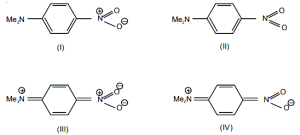
$p-$nitro$-N, N-$dimethylaniline cannot be represented by which of the following resonating structures? (Refer to the provided structures $I, II, III, IV$)
A
$I$ and $II$
B
$II$ and $IV$
C
$I$ and $III$
D
$III$ and $IV$
Solution
(D) In structures $III$ and $IV$,the nitrogen atom of the nitro group is shown to be bonded to five atoms/groups (pentavalent).
Nitrogen belongs to the second period and does not have vacant $d-$orbitals in its valence shell,so it cannot expand its covalency beyond $4$.
Therefore,structures $III$ and $IV$ are chemically impossible and cannot represent the resonating structures of $p-$nitro$-N, N-$dimethylaniline.
Nitrogen belongs to the second period and does not have vacant $d-$orbitals in its valence shell,so it cannot expand its covalency beyond $4$.
Therefore,structures $III$ and $IV$ are chemically impossible and cannot represent the resonating structures of $p-$nitro$-N, N-$dimethylaniline.
0 likesView Solution
2
ChemistryEasyMCQWBJEE · 2021
Which structure has delocalised $\pi$-electrons?
A
$O_{3}$
B
$CO$
C
$HCN$
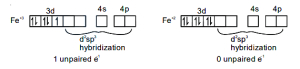
D
$O_{3}$ and $HCN$
Solution
(A) Delocalisation of $\pi$-electrons occurs in molecules that exhibit resonance.
$O_{3}$ (ozone) exists as a resonance hybrid of two canonical structures,where the $\pi$-electrons are delocalised over the three oxygen atoms.
$CO$ and $HCN$ have localised $\pi$-bonds and do not exhibit resonance-based delocalisation of $\pi$-electrons.
Therefore,the correct option is $A$.
$O_{3}$ (ozone) exists as a resonance hybrid of two canonical structures,where the $\pi$-electrons are delocalised over the three oxygen atoms.
$CO$ and $HCN$ have localised $\pi$-bonds and do not exhibit resonance-based delocalisation of $\pi$-electrons.
Therefore,the correct option is $A$.
0 likesView Solution
3
ChemistryEasyMCQWBJEE · 2021
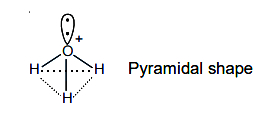
The $H_3O^{+}$ ion has the following shape:
A
Tetrahedral
B
Pyramidal
C
Trigonal planar
D
$T$-shaped
Solution
(B) In the $H_3O^{+}$ ion,the central oxygen atom is $sp^3$ hybridized.
It contains $3$ bond pairs and $1$ lone pair.
According to the $VSEPR$ theory,the presence of one lone pair in a tetrahedral electron geometry results in a pyramidal molecular shape.
It contains $3$ bond pairs and $1$ lone pair.
According to the $VSEPR$ theory,the presence of one lone pair in a tetrahedral electron geometry results in a pyramidal molecular shape.
0 likesView Solution
4
ChemistryEasyMCQWBJEE · 2021
The maximum number of atoms that can be in one plane in the molecule $p$-nitrobenzonitrile are
A
$6$
B
$12$
C
$13$
D
$15$
Solution
(D) The molecular formula of $p$-nitrobenzonitrile is $C_{7}H_{4}N_{2}O_{2}$.
In this molecule,the benzene ring is planar ($sp^{2}$ hybridized carbons).
The nitro group $(-NO_{2})$ is attached to the benzene ring,and due to resonance,it tends to lie in the same plane as the benzene ring.
The cyano group $(-CN)$ is linear ($sp$ hybridized carbon) and is also in the same plane as the benzene ring.
Therefore,all $15$ atoms ($7$ carbons,$4$ hydrogens,$2$ nitrogens,and $2$ oxygens) lie in the same plane.
In this molecule,the benzene ring is planar ($sp^{2}$ hybridized carbons).
The nitro group $(-NO_{2})$ is attached to the benzene ring,and due to resonance,it tends to lie in the same plane as the benzene ring.
The cyano group $(-CN)$ is linear ($sp$ hybridized carbon) and is also in the same plane as the benzene ring.
Therefore,all $15$ atoms ($7$ carbons,$4$ hydrogens,$2$ nitrogens,and $2$ oxygens) lie in the same plane.
0 likesView Solution
5
ChemistryEasyMCQWBJEE · 2021
The equilibrium constant for the reaction $N_{2(g)} + O_{2(g)} \rightleftharpoons 2 NO_{(g)}$ is $4 \times 10^{-4}$ at $2000 \ K$. In the presence of a catalyst,the equilibrium is attained $10$ times faster. Therefore,the equilibrium constant,in the presence of the catalyst at $2000 \ K$ is:
A
$4 \times 10^{-4}$
B
$4 \times 10^{-3}$
C
$4 \times 10^{-5}$
D
$2.5 \times 10^{-4}$
Solution
(A) catalyst provides an alternative reaction pathway with a lower activation energy,which increases the rate of both the forward and backward reactions equally.
Since the rate of both reactions increases by the same factor,the equilibrium position remains unchanged.
The equilibrium constant $(K_{eq})$ is a function of temperature only for a given reaction.
Since the temperature remains constant at $2000 \ K$,the equilibrium constant remains $4 \times 10^{-4}$.
Since the rate of both reactions increases by the same factor,the equilibrium position remains unchanged.
The equilibrium constant $(K_{eq})$ is a function of temperature only for a given reaction.
Since the temperature remains constant at $2000 \ K$,the equilibrium constant remains $4 \times 10^{-4}$.
0 likesView Solution
6
ChemistryMediumMCQWBJEE · 2021
$5.75 \ mg$ of sodium vapour is converted to sodium ion. If the ionisation energy of sodium is $490 \ kJ \ mol^{-1}$ and atomic weight is $23 \ g \ mol^{-1}$,the amount of energy needed for this conversion will be (in $kJ$)
A
$1.96$
B
$1960$
C
$122.5$
D
$0.1225$
0 likesView Solution
7
ChemistryMCQWBJEE · 2021
Two metal wires of identical dimensions are connected in series. If $\sigma_{1}$ and $\sigma_{2}$ are the electrical conductivities of the metal wires respectively,the effective conductivity of the combination is
A
$\sigma_{1}+\sigma_{2}$
B
$\frac{\sigma_{1} \sigma_{2}}{\sigma_{1}+\sigma_{2}}$
C
$\frac{2 \sigma_{1} \sigma_{2}}{\sigma_{1}+\sigma_{2}}$
D
$\frac{\sigma_{1}+\sigma_{2}}{2 \sigma_{1} \sigma_{2}}$
Solution
(C) For two wires of length $l$ and cross-sectional area $A$,the resistance is given by $R = \frac{l}{\sigma A}$.
When connected in series,the equivalent resistance is $R_{eq} = R_{1} + R_{2}$.
Substituting the values,we get $\frac{2l}{\sigma_{eq} A} = \frac{l}{\sigma_{1} A} + \frac{l}{\sigma_{2} A}$.
Dividing both sides by $\frac{l}{A}$,we get $\frac{2}{\sigma_{eq}} = \frac{1}{\sigma_{1}} + \frac{1}{\sigma_{2}}$.
$\frac{2}{\sigma_{eq}} = \frac{\sigma_{1} + \sigma_{2}}{\sigma_{1} \sigma_{2}}$.
Therefore,the effective conductivity is $\sigma_{eq} = \frac{2 \sigma_{1} \sigma_{2}}{\sigma_{1} + \sigma_{2}}$.
When connected in series,the equivalent resistance is $R_{eq} = R_{1} + R_{2}$.
Substituting the values,we get $\frac{2l}{\sigma_{eq} A} = \frac{l}{\sigma_{1} A} + \frac{l}{\sigma_{2} A}$.
Dividing both sides by $\frac{l}{A}$,we get $\frac{2}{\sigma_{eq}} = \frac{1}{\sigma_{1}} + \frac{1}{\sigma_{2}}$.
$\frac{2}{\sigma_{eq}} = \frac{\sigma_{1} + \sigma_{2}}{\sigma_{1} \sigma_{2}}$.
Therefore,the effective conductivity is $\sigma_{eq} = \frac{2 \sigma_{1} \sigma_{2}}{\sigma_{1} + \sigma_{2}}$.
0 likesView Solution
8
ChemistryMediumMCQWBJEE · 2021
$A$ given amount of $Fe^{2+}$ is oxidized by $x \ mol$ of $MnO_{4}^{-}$ in acidic medium. The number of moles of $Cr_{2}O_{7}^{2-}$ required to oxidize the same amount of $Fe^{2+}$ in acidic medium is
A
$x$
B
$0.83x$
C
$2.0x$
D
$1.2x$
Solution
(B) According to the Law of Equivalence,the number of equivalents of the oxidizing agent must be equal to the number of equivalents of the reducing agent.
Number of equivalents of $Fe^{2+}$ = Number of equivalents of $MnO_{4}^{-}$ = Number of equivalents of $Cr_{2}O_{7}^{2-}$.
For $MnO_{4}^{-}$ in acidic medium: $MnO_{4}^{-} + 8H^{+} + 5e^{-} \rightarrow Mn^{2+} + 4H_{2}O$. The $n$-factor is $5$.
Number of equivalents of $MnO_{4}^{-} = x \times 5 = 5x$.
For $Cr_{2}O_{7}^{2-}$ in acidic medium: $Cr_{2}O_{7}^{2-} + 14H^{+} + 6e^{-} \rightarrow 2Cr^{3+} + 7H_{2}O$. The $n$-factor is $6$.
Let the number of moles of $Cr_{2}O_{7}^{2-}$ be $y$.
Number of equivalents of $Cr_{2}O_{7}^{2-} = y \times 6 = 6y$.
Equating the equivalents: $6y = 5x$.
Therefore,$y = \frac{5}{6}x = 0.833x \approx 0.83x$.
Number of equivalents of $Fe^{2+}$ = Number of equivalents of $MnO_{4}^{-}$ = Number of equivalents of $Cr_{2}O_{7}^{2-}$.
For $MnO_{4}^{-}$ in acidic medium: $MnO_{4}^{-} + 8H^{+} + 5e^{-} \rightarrow Mn^{2+} + 4H_{2}O$. The $n$-factor is $5$.
Number of equivalents of $MnO_{4}^{-} = x \times 5 = 5x$.
For $Cr_{2}O_{7}^{2-}$ in acidic medium: $Cr_{2}O_{7}^{2-} + 14H^{+} + 6e^{-} \rightarrow 2Cr^{3+} + 7H_{2}O$. The $n$-factor is $6$.
Let the number of moles of $Cr_{2}O_{7}^{2-}$ be $y$.
Number of equivalents of $Cr_{2}O_{7}^{2-} = y \times 6 = 6y$.
Equating the equivalents: $6y = 5x$.
Therefore,$y = \frac{5}{6}x = 0.833x \approx 0.83x$.
0 likesView Solution
9
ChemistryMediumMCQWBJEE · 2021
The exact order of acidity of the compounds $p-$nitrophenol,acetic acid,acetylene and ethanol is
A
$p-$nitrophenol $< $ acetic acid $< $ acetylene $< $ ethanol
B
acetic acid $< p-$nitrophenol $< $ acetylene $< $ ethanol
C
acetylene $< p-$nitrophenol $< $ ethanol $< $ acetic acid
D
acetylene $< $ ethanol $< p-$nitrophenol $< $ acetic acid
Solution
(D) The acidity of a compound depends on the stability of its conjugate base.
$1$. Acetic acid $(CH_3COOH)$ is the most acidic because its conjugate base (acetate ion,$CH_3COO^-$) is stabilized by resonance with two equivalent oxygen atoms.
$2$. $p-$Nitrophenol is the next most acidic because the phenoxide ion is stabilized by resonance,and the $-NO_2$ group at the para position exerts a strong $-I$ and $-M$ effect,further stabilizing the negative charge.
$3$. Ethanol $(CH_3CH_2OH)$ is less acidic than phenols because the ethoxide ion $(CH_3CH_2O^-)$ is destabilized by the $+I$ effect of the ethyl group.
$4$. Acetylene $(HC \equiv CH)$ is the least acidic among these as the negative charge resides on an $sp$ hybridized carbon atom,which is less electronegative than oxygen.
Thus,the correct order of acidity is: $\text{acetic acid} > p-\text{nitrophenol} > \text{ethanol} > \text{acetylene}$.
$1$. Acetic acid $(CH_3COOH)$ is the most acidic because its conjugate base (acetate ion,$CH_3COO^-$) is stabilized by resonance with two equivalent oxygen atoms.
$2$. $p-$Nitrophenol is the next most acidic because the phenoxide ion is stabilized by resonance,and the $-NO_2$ group at the para position exerts a strong $-I$ and $-M$ effect,further stabilizing the negative charge.
$3$. Ethanol $(CH_3CH_2OH)$ is less acidic than phenols because the ethoxide ion $(CH_3CH_2O^-)$ is destabilized by the $+I$ effect of the ethyl group.
$4$. Acetylene $(HC \equiv CH)$ is the least acidic among these as the negative charge resides on an $sp$ hybridized carbon atom,which is less electronegative than oxygen.
Thus,the correct order of acidity is: $\text{acetic acid} > p-\text{nitrophenol} > \text{ethanol} > \text{acetylene}$.
0 likesView Solution
10
ChemistryEasyMCQWBJEE · 2021
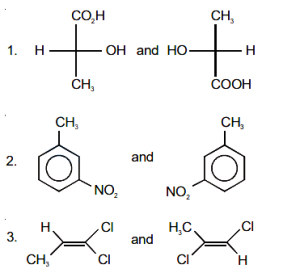
The relationships between the pairs of compounds shown below are respectively:
A
Homomer (identical),enantiomer and constitutional isomer
B
Enantiomer,enantiomer and diastereomer
C
Homomer (identical),homomer (identical) and constitutional isomer
D
Enantiomer,homomer (identical) and geometrical isomer
Solution
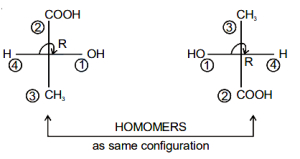
(C) Pair $1$: Both structures represent the same molecule. By rotating the second structure by $180^{\circ}$ in the plane,it superimposes on the first. Thus,they are homomers (identical).
Pair $2$: Both structures are $m$-nitrotoluene. They are identical (homomers).
Pair $3$: The first structure is $1,1$-dichloro-$2$-methylprop-$1$-ene and the second is $1,2$-dichloro-$2$-methylprop-$1$-ene. These are constitutional isomers (specifically,positional isomers).
Pair $2$: Both structures are $m$-nitrotoluene. They are identical (homomers).
Pair $3$: The first structure is $1,1$-dichloro-$2$-methylprop-$1$-ene and the second is $1,2$-dichloro-$2$-methylprop-$1$-ene. These are constitutional isomers (specifically,positional isomers).
0 likesView Solution
11
ChemistryMediumMCQWBJEE · 2021
The product$(s)$ in the following sequence of reactions will be: $Me-C \equiv C-Me \xrightarrow[2. \text{dil. alkaline } KMnO_4]{1. Na/NH_3(liq.), \text{ethanol}, -33^\circ C}$ Product$(s)$
A
Meso-butane$-2,3-$diol
B
$(2R, 3R)$-butane$-2,3-$diol
C
Racemic mixture of butane$-2,3-$diol
D
$(2S, 3S)$-butane$-2,3-$diol
Solution
(C) Step $1$: $Me-C \equiv C-Me$ (but$-2-$yne) reacts with $Na/NH_3(liq.)$ to form $trans$-but$-2-$ene.
Step $2$: $trans$-but$-2-$ene reacts with dilute alkaline $KMnO_4$ (Baeyer's reagent),which performs $syn$-hydroxylation.
The $syn$-addition of two $-OH$ groups to a $trans$-alkene results in a racemic mixture of butane$-2,3-$diol.
Step $2$: $trans$-but$-2-$ene reacts with dilute alkaline $KMnO_4$ (Baeyer's reagent),which performs $syn$-hydroxylation.
The $syn$-addition of two $-OH$ groups to a $trans$-alkene results in a racemic mixture of butane$-2,3-$diol.
0 likesView Solution
12
ChemistryEasyMCQWBJEE · 2021
$N_2H_4$ and $H_2O_2$ show similarity in
A
Density
B
Reducing nature
C
Oxidising nature
D
Hybridisation of central atoms
Solution
(D) In $N_2H_4$ (hydrazine),each nitrogen atom is bonded to two hydrogen atoms and one nitrogen atom,with one lone pair. The steric number for each $N$ atom is $3 + 1 = 4$,which corresponds to $sp^3$ hybridisation.
In $H_2O_2$ (hydrogen peroxide),each oxygen atom is bonded to one hydrogen atom and one oxygen atom,with two lone pairs. The steric number for each $O$ atom is $2 + 2 = 4$,which corresponds to $sp^3$ hybridisation.
Therefore,both compounds show similarity in the hybridisation of their central atoms $(sp^3)$.
In $H_2O_2$ (hydrogen peroxide),each oxygen atom is bonded to one hydrogen atom and one oxygen atom,with two lone pairs. The steric number for each $O$ atom is $2 + 2 = 4$,which corresponds to $sp^3$ hybridisation.
Therefore,both compounds show similarity in the hybridisation of their central atoms $(sp^3)$.
0 likesView Solution
13
ChemistryMediumMCQWBJEE · 2021
$2.5 \ mL$ of $0.4 \ M$ weak monoacidic base ($K_{b}=1 \times 10^{-12}$ at $25^{\circ} C$) is titrated with $\frac{2}{15} \ M \ HCl$ in water at $25^{\circ} C$. The concentration of $H^{+}$ at equivalence point is ($K_{w}=1 \times 10^{-14}$ at $25^{\circ} C$).
A
$3.7 \times 10^{-13} \ M$
B
$3.2 \times 10^{-7} \ M$
C
$3.2 \times 10^{-2} \ M$
D
$2.7 \times 10^{-2} \ M$
Solution
(C) At equivalence point,the moles of base equal the moles of acid: $n_{base} = n_{acid}$.
$0.4 \ M \times 2.5 \ mL = \frac{2}{15} \ M \times V_{acid}$.
$V_{acid} = \frac{0.4 \times 2.5 \times 15}{2} = 7.5 \ mL$.
Total volume $= 2.5 \ mL + 7.5 \ mL = 10 \ mL$.
Concentration of salt $(C)$ $= \frac{0.4 \times 2.5}{10} = 0.1 \ M$.
The salt formed is a salt of a weak base and a strong acid,which undergoes cationic hydrolysis.
The formula for $[H^{+}]$ is $[H^{+}] = \sqrt{\frac{K_{w} \times C}{K_{b}}}$.
$[H^{+}] = \sqrt{\frac{10^{-14} \times 0.1}{10^{-12}}} = \sqrt{10^{-3}} = \sqrt{10 \times 10^{-4}} = 3.16 \times 10^{-2} \ M \approx 3.2 \times 10^{-2} \ M$.
$0.4 \ M \times 2.5 \ mL = \frac{2}{15} \ M \times V_{acid}$.
$V_{acid} = \frac{0.4 \times 2.5 \times 15}{2} = 7.5 \ mL$.
Total volume $= 2.5 \ mL + 7.5 \ mL = 10 \ mL$.
Concentration of salt $(C)$ $= \frac{0.4 \times 2.5}{10} = 0.1 \ M$.
The salt formed is a salt of a weak base and a strong acid,which undergoes cationic hydrolysis.
The formula for $[H^{+}]$ is $[H^{+}] = \sqrt{\frac{K_{w} \times C}{K_{b}}}$.
$[H^{+}] = \sqrt{\frac{10^{-14} \times 0.1}{10^{-12}}} = \sqrt{10^{-3}} = \sqrt{10 \times 10^{-4}} = 3.16 \times 10^{-2} \ M \approx 3.2 \times 10^{-2} \ M$.
0 likesView Solution
14
ChemistryEasyMCQWBJEE · 2021
Aqueous solutions of $HNO_{3}$,$KOH$,$CH_{3}COOH$,and $CH_{3}COONa$ of identical concentration are provided. The pair$(s)$ of solutions which form a buffer upon mixing is (are):
A
$HNO_{3}$ and $CH_{3}COOH$
B
$KOH$ and $CH_{3}COONa$
C
$HNO_{3}$ and $CH_{3}COONa$
D
$CH_{3}COOH$ and $CH_{3}COONa$
Solution
(C, D) buffer solution is formed by a weak acid and its conjugate base or a weak base and its conjugate acid.
$1$. $CH_{3}COOH$ (weak acid) and $CH_{3}COONa$ (salt of weak acid and strong base) form an acidic buffer. Thus,$(D)$ is correct.
$2$. When $HNO_{3}$ (strong acid) is mixed with $CH_{3}COONa$ (salt of weak acid) in a ratio such that the salt is in excess,the reaction $HNO_{3} + CH_{3}COO^{-} \rightarrow CH_{3}COOH + NO_{3}^{-}$ occurs. This results in a mixture of the weak acid $(CH_{3}COOH)$ and its conjugate base $(CH_{3}COO^{-})$,which acts as a buffer. Thus,$(C)$ is also correct.
$1$. $CH_{3}COOH$ (weak acid) and $CH_{3}COONa$ (salt of weak acid and strong base) form an acidic buffer. Thus,$(D)$ is correct.
$2$. When $HNO_{3}$ (strong acid) is mixed with $CH_{3}COONa$ (salt of weak acid) in a ratio such that the salt is in excess,the reaction $HNO_{3} + CH_{3}COO^{-} \rightarrow CH_{3}COOH + NO_{3}^{-}$ occurs. This results in a mixture of the weak acid $(CH_{3}COOH)$ and its conjugate base $(CH_{3}COO^{-})$,which acts as a buffer. Thus,$(C)$ is also correct.
0 likesView Solution
15
ChemistryMediumMCQWBJEE · 2021
Solubility products $(K_{sp})$ of the salts of types $MX, MX_2$ and $M_3X$ at temperature $T$ are $4.0 \times 10^{-8}, 3.2 \times 10^{-14}$ and $2.7 \times 10^{-15}$ respectively. Solubilities (in $mol \text{ dm}^{-3}$) of the salts at temperature $T$ are in the order:
A
$MX > MX_2 > M_3X$
B
$M_3X > MX_2 > MX$
C
$MX_2 > M_3X > MX$
D
$MX > M_3X > MX_2$
Solution
(D) For $MX$: $K_{sp} = S^2 = 4.0 \times 10^{-8} \Rightarrow S = 2 \times 10^{-4} \text{ mol dm}^{-3}$.
For $MX_2$: $K_{sp} = 4S^3 = 3.2 \times 10^{-14}$ $\Rightarrow S^3 = 8 \times 10^{-15}$ $\Rightarrow S = 2 \times 10^{-5} \text{ mol dm}^{-3}$.
For $M_3X$: $K_{sp} = 27S^4 = 2.7 \times 10^{-15}$ $\Rightarrow S^4 = 10^{-16}$ $\Rightarrow S = 1 \times 10^{-4} \text{ mol dm}^{-3}$.
Comparing the solubilities: $2 \times 10^{-4} > 1 \times 10^{-4} > 2 \times 10^{-5}$.
Thus,the order of solubility is $MX > M_3X > MX_2$.
For $MX_2$: $K_{sp} = 4S^3 = 3.2 \times 10^{-14}$ $\Rightarrow S^3 = 8 \times 10^{-15}$ $\Rightarrow S = 2 \times 10^{-5} \text{ mol dm}^{-3}$.
For $M_3X$: $K_{sp} = 27S^4 = 2.7 \times 10^{-15}$ $\Rightarrow S^4 = 10^{-16}$ $\Rightarrow S = 1 \times 10^{-4} \text{ mol dm}^{-3}$.
Comparing the solubilities: $2 \times 10^{-4} > 1 \times 10^{-4} > 2 \times 10^{-5}$.
Thus,the order of solubility is $MX > M_3X > MX_2$.
0 likesView Solution
16
ChemistryMediumMCQWBJEE · 2021
$A$ saturated solution of $BaSO_4$ at $25^\circ C$ is $4 \times 10^{-5} \ M$. The solubility of $BaSO_4$ in $0.1 \ M \ Na_2SO_4$ at this temperature will be:
A
$1.6 \times 10^{-9} \ M$
B
$1.6 \times 10^{-8} \ M$
C
$4 \times 10^{-6} \ M$
D
$4 \times 10^{-4} \ M$
Solution
(B) For $BaSO_4$,the solubility product constant $K_{sp} = s^2 = (4 \times 10^{-5})^2 = 1.6 \times 10^{-9}$.
In $0.1 \ M \ Na_2SO_4$,the concentration of the common ion $[SO_4^{2-}] = 0.1 \ M$.
Let the new solubility be $s'$.
$K_{sp} = [Ba^{2+}][SO_4^{2-}] = s' \times 0.1$.
$1.6 \times 10^{-9} = s' \times 0.1$.
$s' = 1.6 \times 10^{-8} \ M$.
In $0.1 \ M \ Na_2SO_4$,the concentration of the common ion $[SO_4^{2-}] = 0.1 \ M$.
Let the new solubility be $s'$.
$K_{sp} = [Ba^{2+}][SO_4^{2-}] = s' \times 0.1$.
$1.6 \times 10^{-9} = s' \times 0.1$.
$s' = 1.6 \times 10^{-8} \ M$.
0 likesView Solution
17
ChemistryEasyMCQWBJEE · 2021
Cyclo$[18]$ carbon is an allotrope of carbon with molecular formula $C_{18}$. It is a ring of $18$ carbon atoms,connected by alternating single and triple bonds. The total number of triple bonds present in this cyclocarbon is:
A
$9$
B
$10$
C
$12$
D
$6$
Solution
(A) Cyclo$[18]$ carbon $(C_{18})$ is a cyclic allotrope of carbon consisting of $18$ carbon atoms.
In this structure,the carbon atoms are connected by alternating single and triple bonds.
Since there are $18$ carbon atoms in the ring,and each triple bond involves two carbon atoms while each single bond connects two adjacent triple-bonded units,the structure consists of $9$ triple bonds and $9$ single bonds.
Therefore,the total number of triple bonds is $9$.
In this structure,the carbon atoms are connected by alternating single and triple bonds.
Since there are $18$ carbon atoms in the ring,and each triple bond involves two carbon atoms while each single bond connects two adjacent triple-bonded units,the structure consists of $9$ triple bonds and $9$ single bonds.
Therefore,the total number of triple bonds is $9$.
0 likesView Solution
18
ChemistryEasyMCQWBJEE · 2021
Reaction of silver nitrate solution with phosphorous acid produces:
A
Silver phosphite
B
Phosphoric acid
C
Metallic silver
D
Silver phosphate
Solution
(C) The reaction between silver nitrate $(AgNO_{3})$ and phosphorous acid $(H_{3}PO_{3})$ is a redox reaction where silver ions are reduced to metallic silver.
The balanced chemical equation is:
$2 \ AgNO_{3} + H_{3}PO_{3} + H_{2}O \longrightarrow H_{3}PO_{4} + 2 \ Ag + 2 \ HNO_{3}$
As shown in the equation,metallic silver $(Ag)$ is produced.
The balanced chemical equation is:
$2 \ AgNO_{3} + H_{3}PO_{3} + H_{2}O \longrightarrow H_{3}PO_{4} + 2 \ Ag + 2 \ HNO_{3}$
As shown in the equation,metallic silver $(Ag)$ is produced.
0 likesView Solution
19
ChemistryMediumMCQWBJEE · 2021
The white precipitate $(Y)$,obtained on passing a colourless and odourless gas $(X)$ through an ammoniacal solution of $NaCl$,loses about $37 \%$ of its weight on heating and a white residue $(Z)$ of basic nature is left. Identify $(X)$,$(Y)$,and $(Z)$ from the following sets.
A
$N_{2}, (NH_{4})_{2}CO_{3}, NH_{4}Cl$
B
$O_{2}, NaNH_{4}CO_{3}, NaHCO_{3}$
C
$CO_{2}, NH_{4}HCO_{3}, (NH_{4})_{2}CO_{3}$
D
$CO_{2}, NaHCO_{3}, Na_{2}CO_{3}$
Solution
(D) The process described is the Solvay process for the manufacture of sodium carbonate.
Passing $CO_{2}$ $(X)$ through an ammoniacal brine solution $(NaCl + NH_{3} + H_{2}O)$ yields sodium bicarbonate $(Y)$ as a white precipitate.
$NH_{3} + CO_{2} + H_{2}O \longrightarrow NH_{4}HCO_{3}$
$NH_{4}HCO_{3} + NaCl \longrightarrow NaHCO_{3} \downarrow (Y) + NH_{4}Cl$
Upon heating,$NaHCO_{3}$ decomposes: $2NaHCO_{3} \xrightarrow{\Delta} Na_{2}CO_{3} (Z) + CO_{2} + H_{2}O$.
The weight loss percentage for $2NaHCO_{3} (2 \times 84 = 168 \ g)$ to $Na_{2}CO_{3} (106 \ g)$ is $\frac{168 - 106}{168} \times 100 \approx 36.9 \% \approx 37 \%$.
Thus,$(X) = CO_{2}$,$(Y) = NaHCO_{3}$,and $(Z) = Na_{2}CO_{3}$.
Passing $CO_{2}$ $(X)$ through an ammoniacal brine solution $(NaCl + NH_{3} + H_{2}O)$ yields sodium bicarbonate $(Y)$ as a white precipitate.
$NH_{3} + CO_{2} + H_{2}O \longrightarrow NH_{4}HCO_{3}$
$NH_{4}HCO_{3} + NaCl \longrightarrow NaHCO_{3} \downarrow (Y) + NH_{4}Cl$
Upon heating,$NaHCO_{3}$ decomposes: $2NaHCO_{3} \xrightarrow{\Delta} Na_{2}CO_{3} (Z) + CO_{2} + H_{2}O$.
The weight loss percentage for $2NaHCO_{3} (2 \times 84 = 168 \ g)$ to $Na_{2}CO_{3} (106 \ g)$ is $\frac{168 - 106}{168} \times 100 \approx 36.9 \% \approx 37 \%$.
Thus,$(X) = CO_{2}$,$(Y) = NaHCO_{3}$,and $(Z) = Na_{2}CO_{3}$.
0 likesView Solution
20
ChemistryEasyMCQWBJEE · 2021
Molecular velocities of two gases at the same temperature $(T)$ are $u_{1}$ and $u_{2}$. Their masses are $m_{1}$ and $m_{2}$ respectively. Which of the following expressions is correct at temperature $T$?
A
$\frac{m_{1}}{u_{1}^{2}}=\frac{m_{2}}{u_{2}^{2}}$
B
$m_{1} u_{1}=m_{2} u_{2}$
C
$\frac{m_{1}}{u_{1}}=\frac{m_{2}}{u_{2}}$
D
$m_{1} u_{1}^{2}=m_{2} u_{2}^{2}$
Solution
(D) The root mean square velocity of a gas is given by $u = \sqrt{\frac{3RT}{M}}$.
Since the temperature $T$ is the same for both gases,$u \propto \frac{1}{\sqrt{m}}$.
Therefore,$\frac{u_{1}}{u_{2}} = \sqrt{\frac{m_{2}}{m_{1}}}$.
Squaring both sides,we get $\frac{u_{1}^{2}}{u_{2}^{2}} = \frac{m_{2}}{m_{1}}$.
Cross-multiplying gives $m_{1} u_{1}^{2} = m_{2} u_{2}^{2}$.
Since the temperature $T$ is the same for both gases,$u \propto \frac{1}{\sqrt{m}}$.
Therefore,$\frac{u_{1}}{u_{2}} = \sqrt{\frac{m_{2}}{m_{1}}}$.
Squaring both sides,we get $\frac{u_{1}^{2}}{u_{2}^{2}} = \frac{m_{2}}{m_{1}}$.
Cross-multiplying gives $m_{1} u_{1}^{2} = m_{2} u_{2}^{2}$.
0 likesView Solution
21
ChemistryMCQWBJEE · 2021
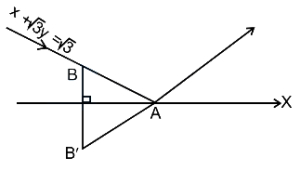
$A$ ray of light along $x+\sqrt{3}y=\sqrt{3}$ gets reflected upon reaching the $x$-axis. The equation of the reflected ray is:
A
$y=x+\sqrt{3}$
B
$\sqrt{3}y=x-\sqrt{3}$
C
$y=\sqrt{3}x-\sqrt{3}$
D
$\sqrt{3}y=x-1$
Solution
(B) The given equation of the incident ray is $x+\sqrt{3}y=\sqrt{3}$.
To find the point of incidence $A$ on the $x$-axis,set $y=0$ in the equation: $x+\sqrt{3}(0)=\sqrt{3} \Rightarrow x=\sqrt{3}$. Thus,$A \equiv (\sqrt{3}, 0)$.
To find another point $B$ on the incident ray,set $x=0$: $0+\sqrt{3}y=\sqrt{3} \Rightarrow y=1$. Thus,$B \equiv (0, 1)$.
The reflected ray passes through $A(\sqrt{3}, 0)$ and the reflection of point $B$ across the $x$-axis,which is $B' \equiv (0, -1)$.
The equation of the line passing through $A(\sqrt{3}, 0)$ and $B'(0, -1)$ is given by the two-point form: $\frac{y-0}{x-\sqrt{3}} = \frac{-1-0}{0-\sqrt{3}}$.
$\frac{y}{x-\sqrt{3}} = \frac{-1}{-\sqrt{3}} = \frac{1}{\sqrt{3}}$.
$\sqrt{3}y = x-\sqrt{3}$.
To find the point of incidence $A$ on the $x$-axis,set $y=0$ in the equation: $x+\sqrt{3}(0)=\sqrt{3} \Rightarrow x=\sqrt{3}$. Thus,$A \equiv (\sqrt{3}, 0)$.
To find another point $B$ on the incident ray,set $x=0$: $0+\sqrt{3}y=\sqrt{3} \Rightarrow y=1$. Thus,$B \equiv (0, 1)$.
The reflected ray passes through $A(\sqrt{3}, 0)$ and the reflection of point $B$ across the $x$-axis,which is $B' \equiv (0, -1)$.
The equation of the line passing through $A(\sqrt{3}, 0)$ and $B'(0, -1)$ is given by the two-point form: $\frac{y-0}{x-\sqrt{3}} = \frac{-1-0}{0-\sqrt{3}}$.
$\frac{y}{x-\sqrt{3}} = \frac{-1}{-\sqrt{3}} = \frac{1}{\sqrt{3}}$.
$\sqrt{3}y = x-\sqrt{3}$.
0 likesView Solution
22
ChemistryDifficultMCQWBJEE · 2021
The atomic masses of helium and neon are $4.0$ and $20.0 \ amu$ respectively. The value of the de Broglie wavelength of helium gas at $-73^{\circ} C$ is $M$ times the de Broglie wavelength of neon at $727^{\circ} C$. The value of $M$ is
A
$5$
B
$25$
C
$\frac{1}{5}$
D
$\frac{1}{25}$
Solution
(A) The de Broglie wavelength is given by $\lambda = \frac{h}{p} = \frac{h}{m \cdot v}$.
For a gas,the most probable velocity is $C_{mp} = \sqrt{\frac{2KT}{m}}$.
Thus,$\lambda = \frac{h}{m \sqrt{\frac{2KT}{m}}} = \frac{h}{\sqrt{2mKT}}$.
Given $T_{He} = -73 + 273 = 200 \ K$ and $T_{Ne} = 727 + 273 = 1000 \ K$.
$\lambda_{He} = M \times \lambda_{Ne}$ $\Rightarrow \frac{h}{\sqrt{2 \times 4 \times K \times 200}} = M \times \frac{h}{\sqrt{2 \times 20 \times K \times 1000}}$.
$\frac{1}{\sqrt{1600K}} = M \times \frac{1}{\sqrt{40000K}}$.
$\frac{1}{40\sqrt{K}} = M \times \frac{1}{200\sqrt{K}}$.
$M = \frac{200}{40} = 5$.
For a gas,the most probable velocity is $C_{mp} = \sqrt{\frac{2KT}{m}}$.
Thus,$\lambda = \frac{h}{m \sqrt{\frac{2KT}{m}}} = \frac{h}{\sqrt{2mKT}}$.
Given $T_{He} = -73 + 273 = 200 \ K$ and $T_{Ne} = 727 + 273 = 1000 \ K$.
$\lambda_{He} = M \times \lambda_{Ne}$ $\Rightarrow \frac{h}{\sqrt{2 \times 4 \times K \times 200}} = M \times \frac{h}{\sqrt{2 \times 20 \times K \times 1000}}$.
$\frac{1}{\sqrt{1600K}} = M \times \frac{1}{\sqrt{40000K}}$.
$\frac{1}{40\sqrt{K}} = M \times \frac{1}{200\sqrt{K}}$.
$M = \frac{200}{40} = 5$.
0 likesView Solution
23
ChemistryEasyMCQWBJEE · 2021
For a spontaneous reaction at all temperatures,which of the following is correct?
A
Both $\Delta H$ and $\Delta S$ are positive
B
$\Delta H$ is positive and $\Delta S$ is negative
C
$\Delta H$ is negative and $\Delta S$ is positive
D
Both $\Delta H$ and $\Delta S$ are negative
Solution
(C) For a reaction to be spontaneous,the Gibbs free energy change $\Delta G$ must be negative.
The relationship is given by the equation $\Delta G = \Delta H - T \Delta S$.
For $\Delta G$ to be negative at all temperatures $(T)$,the enthalpy change $\Delta H$ must be negative (exothermic) and the entropy change $\Delta S$ must be positive (increase in disorder).
Thus,the condition is $\Delta H < 0$ and $\Delta S > 0$.
The relationship is given by the equation $\Delta G = \Delta H - T \Delta S$.
For $\Delta G$ to be negative at all temperatures $(T)$,the enthalpy change $\Delta H$ must be negative (exothermic) and the entropy change $\Delta S$ must be positive (increase in disorder).
Thus,the condition is $\Delta H < 0$ and $\Delta S > 0$.
0 likesView Solution
24
ChemistryMediumMCQWBJEE · 2021
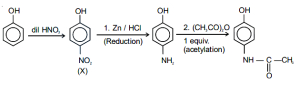
The products $X$ and $Y$ which are formed in the following sequence of reactions are respectively:
$\text{Phenol}$ $\xrightarrow{dil \ HNO_3} X$ $\xrightarrow{1. Zn/HCl, \Delta \atop 2.(CH_3CO)_2O (1 \ equiv)} Y$
$\text{Phenol}$ $\xrightarrow{dil \ HNO_3} X$ $\xrightarrow{1. Zn/HCl, \Delta \atop 2.(CH_3CO)_2O (1 \ equiv)} Y$
A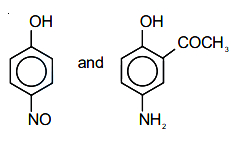
B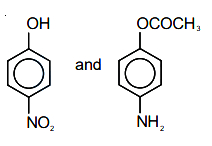
C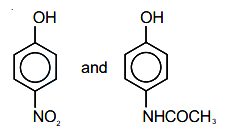
D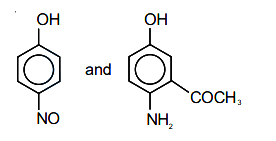
Solution
(C) $1$. $\text{Phenol}$ reacts with dilute $HNO_3$ to form a mixture of $o$-nitrophenol and $p$-nitrophenol. The major product is $p$-nitrophenol $(X)$.
$2$. $p$-nitrophenol $(X)$ is reduced using $Zn/HCl$ to form $p$-aminophenol.
$3$. $p$-aminophenol reacts with $1 \ equiv$ of acetic anhydride $(CH_3CO)_2O$. The amino group $(-NH_2)$ is more nucleophilic than the hydroxyl group $(-OH)$, so acetylation occurs at the nitrogen atom to form $p$-acetamidophenol $(Y)$.
$2$. $p$-nitrophenol $(X)$ is reduced using $Zn/HCl$ to form $p$-aminophenol.
$3$. $p$-aminophenol reacts with $1 \ equiv$ of acetic anhydride $(CH_3CO)_2O$. The amino group $(-NH_2)$ is more nucleophilic than the hydroxyl group $(-OH)$, so acetylation occurs at the nitrogen atom to form $p$-acetamidophenol $(Y)$.
0 likesView Solution
25
ChemistryMediumMCQWBJEE · 2021
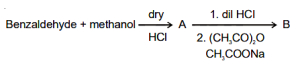
The compounds $A$ and $B$ are respectively
A
$Ph-CH(Cl)(OMe)$ and $Ph-CH=CH-CO_2H$
B
$Ph-CH(OMe)_2$ and $PhCOCH_3$
C
$Ph-CH(OMe)(OH)$ and $Ph-CH(OH)-CH_2-CO_2H$
D
$Ph-CH(OMe)_2$ and $Ph-CH=CH-CO_2H$
Solution
(D) $1$. Reaction of benzaldehyde with methanol in the presence of dry $HCl$ gas leads to the formation of an acetal,$A$,which is benzaldehyde dimethyl acetal,$Ph-CH(OMe)_2$.
$2$. Treatment of the acetal $A$ with dilute $HCl$ results in its hydrolysis back to benzaldehyde $(Ph-CHO)$ and methanol.
$3$. The subsequent reaction of benzaldehyde with acetic anhydride $((CH_3CO)_2O)$ in the presence of sodium acetate $(CH_3COONa)$ is the Perkin condensation reaction,which yields cinnamic acid $(Ph-CH=CH-COOH)$ as the final product $B$.
$2$. Treatment of the acetal $A$ with dilute $HCl$ results in its hydrolysis back to benzaldehyde $(Ph-CHO)$ and methanol.
$3$. The subsequent reaction of benzaldehyde with acetic anhydride $((CH_3CO)_2O)$ in the presence of sodium acetate $(CH_3COONa)$ is the Perkin condensation reaction,which yields cinnamic acid $(Ph-CH=CH-COOH)$ as the final product $B$.
0 likesView Solution
26
ChemistryDifficultMCQWBJEE · 2021
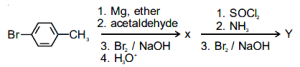
The compounds $X$ and $Y$ are respectively:
A
$p$-methyl$-1-$phenylethanol and $p$-toluidine
B
$p$-methylacetophenone and $p$-toluidine
C
$1-(p-tolyl)ethanol$ and $p$-toluamide
D
$p$-toluic acid and $p$-toluidine
Solution
(D) $1$. Formation of $X$: The reaction of $p$-bromotoluene with $Mg$ in ether forms a Grignard reagent,$p-CH_3-C_6H_4-MgBr$. This reacts with acetaldehyde $(CH_3CHO)$ followed by hydrolysis to give $1-(p-tolyl)ethanol$. The haloform reaction $(Br_2/NaOH)$ on this secondary alcohol oxidizes it to $p$-methylacetophenone,which then undergoes haloform reaction again to produce $p$-toluic acid $(X)$.
$2$. Formation of $Y$: $p$-toluic acid $(X)$ reacts with $SOCl_2$ to form $p$-toluoyl chloride,which on reaction with $NH_3$ gives $p$-toluamide. Finally,the Hoffman bromamide reaction $(Br_2/NaOH)$ converts the amide into $p$-toluidine $(Y)$.
$2$. Formation of $Y$: $p$-toluic acid $(X)$ reacts with $SOCl_2$ to form $p$-toluoyl chloride,which on reaction with $NH_3$ gives $p$-toluamide. Finally,the Hoffman bromamide reaction $(Br_2/NaOH)$ converts the amide into $p$-toluidine $(Y)$.
0 likesView Solution
27
ChemistryMediumMCQWBJEE · 2021
$1.$ Glycylglycine
$2.$ Alanylalanine
$3.$ Glycylalanine
$4.$ Alanylglycine
The dipeptides which may be obtained from the amino acids glycine and alanine are
$2.$ Alanylalanine
$3.$ Glycylalanine
$4.$ Alanylglycine
The dipeptides which may be obtained from the amino acids glycine and alanine are
A
only $1$
B
only $2$
C
both $1$ and $2$
D
all of them
Solution
(D) When two different amino acids,glycine $(G)$ and alanine $(A)$,react to form dipeptides,they can combine in different sequences to form different products.
The possible combinations are:
$1.$ Glycine + Glycine $\rightarrow$ Glycylglycine $(G-G)$
$2.$ Alanine + Alanine $\rightarrow$ Alanylalanine $(A-A)$
$3.$ Glycine + Alanine $\rightarrow$ Glycylalanine $(G-A)$
$4.$ Alanine + Glycine $\rightarrow$ Alanylglycine $(A-G)$
Since the question asks for dipeptides obtained from glycine and alanine,it implies all combinations involving these two amino acids (including self-condensation). Thus,all four listed dipeptides can be formed.
The possible combinations are:
$1.$ Glycine + Glycine $\rightarrow$ Glycylglycine $(G-G)$
$2.$ Alanine + Alanine $\rightarrow$ Alanylalanine $(A-A)$
$3.$ Glycine + Alanine $\rightarrow$ Glycylalanine $(G-A)$
$4.$ Alanine + Glycine $\rightarrow$ Alanylglycine $(A-G)$
Since the question asks for dipeptides obtained from glycine and alanine,it implies all combinations involving these two amino acids (including self-condensation). Thus,all four listed dipeptides can be formed.
0 likesView Solution
28
ChemistryMediumMCQWBJEE · 2021
Under the same reaction conditions,initial concentration of $1.386 \ mol \ dm^{-3}$ of a substance becomes half in $40 \ s$ and $20 \ s$ through first-order and zero-order kinetics respectively. Ratio $\left(\frac{k_{1}}{k_{0}}\right)$ of the rate constants for first-order $\left(k_{1}\right)$ and zero-order $\left(k_{0}\right)$ of the reactions is
A
$0.5 \ mol^{-1} \ dm^{3}$
B
$0.5 \ mol \ dm^{-3}$
C
$1.0 \ mol \ dm^{-3}$
D
$2.0 \ mol^{-1} \ dm^{3}$
Solution
(A) For first-order reaction:
$t_{1/2} = \frac{0.693}{k_{1}} \Rightarrow k_{1} = \frac{0.693}{40} \ s^{-1} \quad (I)$
For zero-order reaction:
$t_{1/2} = \frac{[R]_{0}}{2k_{0}} \Rightarrow k_{0} = \frac{1.386}{2 \times 20} \ mol \ dm^{-3} \ s^{-1} \quad (II)$
Calculating the ratio $\frac{k_{1}}{k_{0}}$:
$\frac{k_{1}}{k_{0}} = \frac{0.693 / 40}{1.386 / 40} = \frac{0.693}{1.386} = 0.5 \ mol^{-1} \ dm^{3}$
$t_{1/2} = \frac{0.693}{k_{1}} \Rightarrow k_{1} = \frac{0.693}{40} \ s^{-1} \quad (I)$
For zero-order reaction:
$t_{1/2} = \frac{[R]_{0}}{2k_{0}} \Rightarrow k_{0} = \frac{1.386}{2 \times 20} \ mol \ dm^{-3} \ s^{-1} \quad (II)$
Calculating the ratio $\frac{k_{1}}{k_{0}}$:
$\frac{k_{1}}{k_{0}} = \frac{0.693 / 40}{1.386 / 40} = \frac{0.693}{1.386} = 0.5 \ mol^{-1} \ dm^{3}$
0 likesView Solution
29
ChemistryMediumMCQWBJEE · 2021
Indicate the number of unpaired electrons in $K_3[Fe(CN)_6]$ and $K_4[Fe(CN)_6]$.
A
$1, 0$
B
$5, 6$
C
$6, 5$
D
$0, 1$
Solution
(A) In $K_3[Fe(CN)_6]$,the oxidation state of $Fe$ is $+3$.
Electronic configuration of $Fe^{3+}$ is $[Ar] 3d^5$.
Since $CN^-$ is a strong field ligand,pairing occurs,resulting in $t_{2g}^5 e_g^0$ configuration with $1$ unpaired electron.
In $K_4[Fe(CN)_6]$,the oxidation state of $Fe$ is $+2$.
Electronic configuration of $Fe^{2+}$ is $[Ar] 3d^6$.
Due to the strong field ligand $CN^-$,pairing occurs,resulting in $t_{2g}^6 e_g^0$ configuration with $0$ unpaired electrons.
Electronic configuration of $Fe^{3+}$ is $[Ar] 3d^5$.
Since $CN^-$ is a strong field ligand,pairing occurs,resulting in $t_{2g}^5 e_g^0$ configuration with $1$ unpaired electron.
In $K_4[Fe(CN)_6]$,the oxidation state of $Fe$ is $+2$.
Electronic configuration of $Fe^{2+}$ is $[Ar] 3d^6$.
Due to the strong field ligand $CN^-$,pairing occurs,resulting in $t_{2g}^6 e_g^0$ configuration with $0$ unpaired electrons.
0 likesView Solution
30
ChemistryDifficultMCQWBJEE · 2021
Which of the following compounds has a magnetic moment identical to $[Cr(H_{2}O)_{6}]^{3+}$?
A
$[Cu(H_{2}O)_{6}]^{2+}$
B
$[Mn(H_{2}O)_{6}]^{3+}$
C
$[Fe(H_{2}O)_{6}]^{3+}$
D
$[Mn(H_{2}O)_{6}]^{4+}$
Solution
(D) The magnetic moment depends on the number of unpaired electrons $(n)$. The formula is $\mu = \sqrt{n(n+2)} \ BM$.
For $[Cr(H_{2}O)_{6}]^{3+}$: $Cr$ is in $+3$ oxidation state. Electronic configuration of $Cr^{3+}$ is $[Ar] 3d^{3}$. Number of unpaired electrons $(n)$ = $3$.
Now,let us check the number of unpaired electrons for each option:
$A$) $[Cu(H_{2}O)_{6}]^{2+}$: $Cu^{2+}$ is $[Ar] 3d^{9}$,$n = 1$.
$B$) $[Mn(H_{2}O)_{6}]^{3+}$: $Mn^{3+}$ is $[Ar] 3d^{4}$,$n = 4$.
$C$) $[Fe(H_{2}O)_{6}]^{3+}$: $Fe^{3+}$ is $[Ar] 3d^{5}$,$n = 5$.
$D$) $[Mn(H_{2}O)_{6}]^{4+}$: $Mn^{4+}$ is $[Ar] 3d^{3}$,$n = 3$.
Since $[Mn(H_{2}O)_{6}]^{4+}$ has $3$ unpaired electrons,it has the same magnetic moment as $[Cr(H_{2}O)_{6}]^{3+}$.
For $[Cr(H_{2}O)_{6}]^{3+}$: $Cr$ is in $+3$ oxidation state. Electronic configuration of $Cr^{3+}$ is $[Ar] 3d^{3}$. Number of unpaired electrons $(n)$ = $3$.
Now,let us check the number of unpaired electrons for each option:
$A$) $[Cu(H_{2}O)_{6}]^{2+}$: $Cu^{2+}$ is $[Ar] 3d^{9}$,$n = 1$.
$B$) $[Mn(H_{2}O)_{6}]^{3+}$: $Mn^{3+}$ is $[Ar] 3d^{4}$,$n = 4$.
$C$) $[Fe(H_{2}O)_{6}]^{3+}$: $Fe^{3+}$ is $[Ar] 3d^{5}$,$n = 5$.
$D$) $[Mn(H_{2}O)_{6}]^{4+}$: $Mn^{4+}$ is $[Ar] 3d^{3}$,$n = 3$.
Since $[Mn(H_{2}O)_{6}]^{4+}$ has $3$ unpaired electrons,it has the same magnetic moment as $[Cr(H_{2}O)_{6}]^{3+}$.
0 likesView Solution
31
ChemistryEasyMCQWBJEE · 2021
$A$ solution is prepared by mixing a concentrated solution of $Co(NO_3)_2$ with a concentrated solution of $NaNO_2$ in $50\%$ acetic acid. $A$ solution of a salt containing metal $M$ is added to the mixture,and a yellow precipitate is formed. Metal $M$ is:
A
Magnesium
B
Sodium
C
Potassium
D
Zinc
Solution
(C) When a concentrated solution of $Co(NO_3)_2$ reacts with $NaNO_2$ in $50\%$ acetic acid,the hexanitritocobaltate$(III)$ complex ion,$[Co(NO_2)_6]^{3-}$,is formed.
Upon adding a salt containing the potassium ion $(K^+)$,a yellow precipitate of potassium hexanitritocobaltate$(III)$,$K_3[Co(NO_2)_6]$,is produced.
This reaction is a standard qualitative test for the identification of potassium ions.
Therefore,metal $M$ is potassium $(K)$.
Upon adding a salt containing the potassium ion $(K^+)$,a yellow precipitate of potassium hexanitritocobaltate$(III)$,$K_3[Co(NO_2)_6]$,is produced.
This reaction is a standard qualitative test for the identification of potassium ions.
Therefore,metal $M$ is potassium $(K)$.
0 likesView Solution
32
ChemistryMediumMCQWBJEE · 2021
The reduction potential of a hydrogen half-cell will be negative if:
A
$p(H_{2}) = 1 \ atm$ and $[H^{+}] = 1.0 \ M$
B
$p(H_{2}) = 1 \ atm$ and $[H^{+}] = 2.0 \ M$
C
$p(H_{2}) = 2 \ atm$ and $[H^{+}] = 1.0 \ M$
D
$p(H_{2}) = 2 \ atm$ and $[H^{+}] = 2.0 \ M$
Solution
(C) The reduction reaction for a hydrogen half-cell is: $2H^{+} + 2e^{-} \rightarrow H_{2}$
Here,$n = 2$ and the reaction quotient $Q = \frac{p(H_{2})}{[H^{+}]^{2}}$.
Using the Nernst equation: $E_{H^{+}/H_{2}} = E^{0}_{H^{+}/H_{2}} - \frac{0.059}{n} \log Q$.
Since $E^{0}_{H^{+}/H_{2}} = 0 \ V$,we have $E_{H^{+}/H_{2}} = -\frac{0.059}{2} \log Q$.
For $E_{H^{+}/H_{2}}$ to be negative,$\log Q$ must be positive,which means $Q > 1$.
Evaluating the options:
$(A)$ $Q = \frac{1}{1^{2}} = 1$ (Not negative)
$(B)$ $Q = \frac{1}{2^{2}} = 0.25 < 1$ (Positive potential)
$(C)$ $Q = \frac{2}{1^{2}} = 2 > 1$ (Negative potential)
$(D)$ $Q = \frac{2}{2^{2}} = 0.5 < 1$ (Positive potential)
Therefore,the correct option is $(C)$.
Here,$n = 2$ and the reaction quotient $Q = \frac{p(H_{2})}{[H^{+}]^{2}}$.
Using the Nernst equation: $E_{H^{+}/H_{2}} = E^{0}_{H^{+}/H_{2}} - \frac{0.059}{n} \log Q$.
Since $E^{0}_{H^{+}/H_{2}} = 0 \ V$,we have $E_{H^{+}/H_{2}} = -\frac{0.059}{2} \log Q$.
For $E_{H^{+}/H_{2}}$ to be negative,$\log Q$ must be positive,which means $Q > 1$.
Evaluating the options:
$(A)$ $Q = \frac{1}{1^{2}} = 1$ (Not negative)
$(B)$ $Q = \frac{1}{2^{2}} = 0.25 < 1$ (Positive potential)
$(C)$ $Q = \frac{2}{1^{2}} = 2 > 1$ (Negative potential)
$(D)$ $Q = \frac{2}{2^{2}} = 0.5 < 1$ (Positive potential)
Therefore,the correct option is $(C)$.
0 likesView Solution
33
ChemistryEasyMCQWBJEE · 2021
Extraction of a metal $(M)$ from its sulfide ore $(M_2S)$ involves the following chemical reactions:
$2M_2S + 3O_2 \xrightarrow{\text{heat}} 2M_2O + 2SO_2 \uparrow$
$M_2S + 2M_2O \xrightarrow{\text{heat}} 6M + SO_2 \uparrow$
The metal $(M)$ may be
$2M_2S + 3O_2 \xrightarrow{\text{heat}} 2M_2O + 2SO_2 \uparrow$
$M_2S + 2M_2O \xrightarrow{\text{heat}} 6M + SO_2 \uparrow$
The metal $(M)$ may be
A
$Zn$
B
$Cu$
C
$Fe$
D
$Ca$
Solution
(B) The given reactions represent the self-reduction (auto-reduction) process.
This process is used for the extraction of less reactive metals like $Cu$,$Hg$,and $Pb$ from their sulfide ores.
In the case of copper,the reactions are:
$2Cu_2S + 3O_2 \rightarrow 2Cu_2O + 2SO_2$
$Cu_2S + 2Cu_2O \rightarrow 6Cu + SO_2$
Therefore,the metal $M$ is $Cu$.
This process is used for the extraction of less reactive metals like $Cu$,$Hg$,and $Pb$ from their sulfide ores.
In the case of copper,the reactions are:
$2Cu_2S + 3O_2 \rightarrow 2Cu_2O + 2SO_2$
$Cu_2S + 2Cu_2O \rightarrow 6Cu + SO_2$
Therefore,the metal $M$ is $Cu$.
0 likesView Solution
34
ChemistryMediumMCQWBJEE · 2021
Among the following chlorides,the compounds which will be hydrolysed most easily and most slowly in aqueous $NaOH$ solution are respectively:
$1$. Methoxymethyl chloride $(CH_3OCH_2Cl)$
$2$. Benzyl chloride $(C_6H_5CH_2Cl)$
$3$. Neopentyl chloride $((CH_3)_3CCH_2Cl)$
$4$. Propyl chloride $(CH_3CH_2CH_2Cl)$
$1$. Methoxymethyl chloride $(CH_3OCH_2Cl)$
$2$. Benzyl chloride $(C_6H_5CH_2Cl)$
$3$. Neopentyl chloride $((CH_3)_3CCH_2Cl)$
$4$. Propyl chloride $(CH_3CH_2CH_2Cl)$
A
$1$ and $3$
B
$2$ and $3$
C
$2$ and $4$
D
$3$ and $1$
Solution
(A) The hydrolysis of alkyl chlorides in aqueous $NaOH$ proceeds via $S_N1$ or $S_N2$ mechanisms.
$1$. Methoxymethyl chloride $(CH_3OCH_2Cl)$ undergoes $S_N1$ reaction very rapidly because the resulting carbocation $(CH_3OCH_2^+)$ is highly stabilized by resonance from the lone pair on the oxygen atom.
$2$. Benzyl chloride $(C_6H_5CH_2Cl)$ also forms a resonance-stabilized carbocation,but it is less stable than the methoxymethyl carbocation.
$3$. Neopentyl chloride $((CH_3)_3CCH_2Cl)$ is a primary alkyl halide with significant steric hindrance at the $\beta$-carbon,which makes $S_N2$ reactions extremely slow.
$4$. Propyl chloride $(CH_3CH_2CH_2Cl)$ is a primary alkyl halide that undergoes $S_N2$ reaction at a moderate rate.
Therefore,methoxymethyl chloride $(1)$ is hydrolysed most easily,and neopentyl chloride $(3)$ is hydrolysed most slowly.
$1$. Methoxymethyl chloride $(CH_3OCH_2Cl)$ undergoes $S_N1$ reaction very rapidly because the resulting carbocation $(CH_3OCH_2^+)$ is highly stabilized by resonance from the lone pair on the oxygen atom.
$2$. Benzyl chloride $(C_6H_5CH_2Cl)$ also forms a resonance-stabilized carbocation,but it is less stable than the methoxymethyl carbocation.
$3$. Neopentyl chloride $((CH_3)_3CCH_2Cl)$ is a primary alkyl halide with significant steric hindrance at the $\beta$-carbon,which makes $S_N2$ reactions extremely slow.
$4$. Propyl chloride $(CH_3CH_2CH_2Cl)$ is a primary alkyl halide that undergoes $S_N2$ reaction at a moderate rate.
Therefore,methoxymethyl chloride $(1)$ is hydrolysed most easily,and neopentyl chloride $(3)$ is hydrolysed most slowly.
0 likesView Solution
35
ChemistryMediumMCQWBJEE · 2021
The exact order of boiling points of the compounds $n$-pentane,isopentane,butanone,and $1$-butanol is:
A
$n$-pentane < isopentane < butanone < $1$-butanol
B
isopentane < $n$-pentane < butanone < $1$-butanol
C
butanone < $n$-pentane < isopentane < $1$-butanol
D
$1$-butanol < butanone < $n$-pentane < isopentane
Solution
(B) The boiling point depends on the strength of intermolecular forces. The order of strength of intermolecular forces is: $\text{Hydrogen bonding} > \text{Dipole-dipole interaction} > \text{Van der Waals forces}$.
$1$. $1$-butanol $(CH_3CH_2CH_2CH_2OH)$ exhibits intermolecular hydrogen bonding,which is the strongest force among the given compounds,resulting in the highest boiling point.
$2$. Butanone $(CH_3COCH_2CH_3)$ is a polar molecule and exhibits dipole-dipole interactions,which are stronger than Van der Waals forces but weaker than hydrogen bonding.
$3$. $n$-pentane and isopentane are non-polar alkanes and exhibit only Van der Waals forces. For alkanes,the boiling point decreases with branching because branching reduces the surface area of contact,leading to weaker Van der Waals forces. Thus,$n$-pentane has a higher boiling point than isopentane.
Therefore,the correct order of boiling points is: $\text{isopentane} < n\text{-pentane} < \text{butanone} < 1\text{-butanol}$.
$1$. $1$-butanol $(CH_3CH_2CH_2CH_2OH)$ exhibits intermolecular hydrogen bonding,which is the strongest force among the given compounds,resulting in the highest boiling point.
$2$. Butanone $(CH_3COCH_2CH_3)$ is a polar molecule and exhibits dipole-dipole interactions,which are stronger than Van der Waals forces but weaker than hydrogen bonding.
$3$. $n$-pentane and isopentane are non-polar alkanes and exhibit only Van der Waals forces. For alkanes,the boiling point decreases with branching because branching reduces the surface area of contact,leading to weaker Van der Waals forces. Thus,$n$-pentane has a higher boiling point than isopentane.
Therefore,the correct order of boiling points is: $\text{isopentane} < n\text{-pentane} < \text{butanone} < 1\text{-butanol}$.
0 likesView Solution
36
ChemistryEasyMCQWBJEE · 2021
Which one of the following solutions will have the highest conductivity?
A
$0.1 \ M \ CH_{3}COOH$
B
$0.1 \ M \ NaCl$
C
$0.1 \ M \ KNO_{3}$
D
$0.1 \ M \ HCl$
Solution
(D) Conductivity depends on the number of ions and their ionic mobility.
$CH_{3}COOH$ is a weak electrolyte and dissociates poorly.
$NaCl$,$KNO_{3}$,and $HCl$ are strong electrolytes.
Among these,$HCl$ provides $H^{+}$ ions,which possess the highest ionic mobility in aqueous solution compared to $Na^{+}$,$K^{+}$,$Cl^{-}$,and $NO_{3}^{-}$ ions.
Therefore,$0.1 \ M \ HCl$ will have the highest conductivity.
$CH_{3}COOH$ is a weak electrolyte and dissociates poorly.
$NaCl$,$KNO_{3}$,and $HCl$ are strong electrolytes.
Among these,$HCl$ provides $H^{+}$ ions,which possess the highest ionic mobility in aqueous solution compared to $Na^{+}$,$K^{+}$,$Cl^{-}$,and $NO_{3}^{-}$ ions.
Therefore,$0.1 \ M \ HCl$ will have the highest conductivity.
0 likesView Solution
37
ChemistryEasyMCQWBJEE · 2021
$A$ solution of $NaNO_3$,when treated with a mixture of $Zn$ dust and '$A$' yields ammonia. '$A$' can be
A
caustic soda
B
dilute sulphuric acid
C
concentrated sulphuric acid
D
sodium carbonate
Solution
(A) The reduction of nitrate ions $(NO_3^-)$ to ammonia $(NH_3)$ by zinc $(Zn)$ dust in an alkaline medium is a standard laboratory test for nitrates.
The chemical reaction is: $NaNO_3 + 4 Zn + 7 NaOH \rightarrow 4 Na_2ZnO_2 + NH_3 + 2 H_2O$.
Here,'$A$' represents the alkaline medium,which is $NaOH$ (caustic soda).
The chemical reaction is: $NaNO_3 + 4 Zn + 7 NaOH \rightarrow 4 Na_2ZnO_2 + NH_3 + 2 H_2O$.
Here,'$A$' represents the alkaline medium,which is $NaOH$ (caustic soda).
0 likesView Solution
38
ChemistryEasyMCQWBJEE · 2021
Indicate the products $(X)$ and $(Y)$ in the following reactions:
$Na_{2}S + nS (n=1-8) \rightarrow (X)$
$Na_{2}SO_{3} + S \rightarrow (Y)$
$Na_{2}S + nS (n=1-8) \rightarrow (X)$
$Na_{2}SO_{3} + S \rightarrow (Y)$
A
$Na_{2}S_{2}O_{3} \quad Na_{2}S_{2}$
B
$Na_{2}S_{(n+1)} \quad Na_{2}S_{2}O_{3}$
C
$Na_{2}S_{n} \quad Na_{2}S_{2}O_{3}$
D
$Na_{2}S_{5} \quad Na_{2}S_{2}O_{4}$
Solution
(B) The reaction of sodium sulfide with sulfur is given by: $Na_{2}S + nS \rightarrow Na_{2}S_{(n+1)}$,where $(X) = Na_{2}S_{(n+1)}$.
The reaction of sodium sulfite with sulfur is given by: $Na_{2}SO_{3} + S \rightarrow Na_{2}S_{2}O_{3}$,where $(Y) = Na_{2}S_{2}O_{3}$.
The reaction of sodium sulfite with sulfur is given by: $Na_{2}SO_{3} + S \rightarrow Na_{2}S_{2}O_{3}$,where $(Y) = Na_{2}S_{2}O_{3}$.
0 likesView Solution
39
ChemistryMediumMCQWBJEE · 2021
An element crystallizes in a body-centred cubic lattice. The edge length of the unit cell is $200 \ pm$ and the density of the element is $5.0 \ g \ cm^{-3}$. Calculate the number of atoms in $100 \ g$ of this element.
A
$2.5 \times 10^{23}$
B
$2.5 \times 10^{24}$
C
$5.0 \times 10^{23}$
D
$5.0 \times 10^{24}$
Solution
(D) For a body-centred cubic $(BCC)$ lattice, the number of atoms per unit cell is $Z = 2$.
The density formula is given by $\rho = \frac{Z \times M}{N_A \times a^3}$.
Given: $\rho = 5.0 \ g \ cm^{-3}$, $a = 200 \ pm = 200 \times 10^{-10} \ cm = 2 \times 10^{-8} \ cm$.
$5.0 = \frac{2 \times M}{6.022 \times 10^{23} \times (2 \times 10^{-8})^3}$.
$M = \frac{5.0 \times 6.022 \times 10^{23} \times 8 \times 10^{-24}}{2} = 12.044 \ g \ mol^{-1}$.
Number of moles in $100 \ g = \frac{100}{M} = \frac{100}{12.044} \approx 8.303 \ mol$.
Number of atoms $= \text{moles} \times N_A = \frac{100}{M} \times N_A$.
Substituting $M = \frac{5.0 \times N_A \times 8 \times 10^{-24}}{2}$:
Number of atoms $= \frac{100 \times 2}{5.0 \times 8 \times 10^{-24}} = \frac{200}{40 \times 10^{-24}} = 5 \times 10^{24}$.
The density formula is given by $\rho = \frac{Z \times M}{N_A \times a^3}$.
Given: $\rho = 5.0 \ g \ cm^{-3}$, $a = 200 \ pm = 200 \times 10^{-10} \ cm = 2 \times 10^{-8} \ cm$.
$5.0 = \frac{2 \times M}{6.022 \times 10^{23} \times (2 \times 10^{-8})^3}$.
$M = \frac{5.0 \times 6.022 \times 10^{23} \times 8 \times 10^{-24}}{2} = 12.044 \ g \ mol^{-1}$.
Number of moles in $100 \ g = \frac{100}{M} = \frac{100}{12.044} \approx 8.303 \ mol$.
Number of atoms $= \text{moles} \times N_A = \frac{100}{M} \times N_A$.
Substituting $M = \frac{5.0 \times N_A \times 8 \times 10^{-24}}{2}$:
Number of atoms $= \frac{100 \times 2}{5.0 \times 8 \times 10^{-24}} = \frac{200}{40 \times 10^{-24}} = 5 \times 10^{24}$.
0 likesView Solution
40
ChemistryEasyMCQWBJEE · 2021
When $20 \ g$ of naphthoic acid $(C_{11}H_8O_2)$ is dissolved in $50 \ g$ of benzene,a freezing point depression of $2 \ K$ is observed. The van't Hoff factor $(i)$ is [$K_f = 1.72 \ K \ kg \ mol^{-1}$].
A
$0.5$
B
$1.0$
C
$2.0$
D
$3.0$
Solution
(A) Given:
Mass of solute $(w_2)$ = $20 \ g$
Mass of solvent $(w_1)$ = $50 \ g$
Freezing point depression $(\Delta T_f)$ = $2 \ K$
$K_f$ of benzene = $1.72 \ K \ kg \ mol^{-1}$
Molar mass of naphthoic acid $(C_{11}H_8O_2)$ = $(11 \times 12) + (8 \times 1) + (2 \times 16) = 172 \ g \ mol^{-1}$
Using the formula:
$\Delta T_f = i \times K_f \times m$
$\Delta T_f = i \times K_f \times \frac{w_2 \times 1000}{M_2 \times w_1}$
$2 = i \times 1.72 \times \frac{20 \times 1000}{172 \times 50}$
$2 = i \times 1.72 \times \frac{20000}{8600}$
$2 = i \times 1.72 \times 2.3255...$
$2 = i \times 4$
$i = \frac{2}{4} = 0.5$
Mass of solute $(w_2)$ = $20 \ g$
Mass of solvent $(w_1)$ = $50 \ g$
Freezing point depression $(\Delta T_f)$ = $2 \ K$
$K_f$ of benzene = $1.72 \ K \ kg \ mol^{-1}$
Molar mass of naphthoic acid $(C_{11}H_8O_2)$ = $(11 \times 12) + (8 \times 1) + (2 \times 16) = 172 \ g \ mol^{-1}$
Using the formula:
$\Delta T_f = i \times K_f \times m$
$\Delta T_f = i \times K_f \times \frac{w_2 \times 1000}{M_2 \times w_1}$
$2 = i \times 1.72 \times \frac{20 \times 1000}{172 \times 50}$
$2 = i \times 1.72 \times \frac{20000}{8600}$
$2 = i \times 1.72 \times 2.3255...$
$2 = i \times 4$
$i = \frac{2}{4} = 0.5$
0 likesView Solution
41
ChemistryDifficultMCQWBJEE · 2021
The mole fraction of a solute in a binary solution is $0.1$. At $298 \ K$,molarity of this solution is same as its molality. Density of this solution at $298 \ K$ is $2.0 \ g \ cm^{-3}$. The ratio of molecular weights of the solute and the solvent $(M_{solute} / M_{solvent})$ is:
A
$9$
B
$1/9$
C
$4.5$
D
$1/4.5$
Solution
(A) Given:
Mole fraction of solute $(x_2)$ = $0.1$
Mole fraction of solvent $(x_1)$ = $1 - 0.1 = 0.9$
Density $(d)$ = $2.0 \ g \ cm^{-3}$
Molarity $(M)$ = Molality $(m)$
We know that:
$m = \frac{x_2 \times 1000}{x_1 \times M_1}$
$M = \frac{1000 \times d \times x_2}{x_1 M_1 + x_2 M_2}$
Since $M = m$:
$\frac{x_2 \times 1000}{x_1 \times M_1} = \frac{1000 \times d \times x_2}{x_1 M_1 + x_2 M_2}$
$\frac{1}{x_1 M_1} = \frac{d}{x_1 M_1 + x_2 M_2}$
$x_1 M_1 + x_2 M_2 = d \times x_1 M_1$
$0.9 M_1 + 0.1 M_2 = 2.0 \times 0.9 M_1$
$0.9 M_1 + 0.1 M_2 = 1.8 M_1$
$0.1 M_2 = 0.9 M_1$
$\frac{M_2}{M_1} = \frac{0.9}{0.1} = 9$
Therefore,the ratio of molecular weights of the solute and the solvent is $9$.
Mole fraction of solute $(x_2)$ = $0.1$
Mole fraction of solvent $(x_1)$ = $1 - 0.1 = 0.9$
Density $(d)$ = $2.0 \ g \ cm^{-3}$
Molarity $(M)$ = Molality $(m)$
We know that:
$m = \frac{x_2 \times 1000}{x_1 \times M_1}$
$M = \frac{1000 \times d \times x_2}{x_1 M_1 + x_2 M_2}$
Since $M = m$:
$\frac{x_2 \times 1000}{x_1 \times M_1} = \frac{1000 \times d \times x_2}{x_1 M_1 + x_2 M_2}$
$\frac{1}{x_1 M_1} = \frac{d}{x_1 M_1 + x_2 M_2}$
$x_1 M_1 + x_2 M_2 = d \times x_1 M_1$
$0.9 M_1 + 0.1 M_2 = 2.0 \times 0.9 M_1$
$0.9 M_1 + 0.1 M_2 = 1.8 M_1$
$0.1 M_2 = 0.9 M_1$
$\frac{M_2}{M_1} = \frac{0.9}{0.1} = 9$
Therefore,the ratio of molecular weights of the solute and the solvent is $9$.
0 likesView Solution
42
ChemistryMediumMCQWBJEE · 2021
For the reaction $^{14}N + \alpha \longrightarrow {}^{17}O + p$,$1.16 \ MeV$ (Mass equivalent $= 0.00124 \ amu$) of energy is absorbed. Mass on the reactant side is $18.00567 \ amu$ and proton mass $= 1.00782 \ amu$. The atomic mass of ${}^{17}O$ will be (in $amu$)
A
$17.0044$
B
$16.9991$
C
$17.0114$
D
$16.9966$
Solution
(B) The reaction is $^{14}N + {}_{2}^{4}He \rightarrow {}^{17}O + {}_{1}^{1}H$.
Since energy is absorbed,the mass of the products is greater than the mass of the reactants.
Mass defect $(\Delta m) = 0.00124 \ amu$.
$(m_{{}^{17}O} + m_{p}) - (m_{reactants}) = \Delta m$.
$m_{{}^{17}O} + 1.00782 \ amu - 18.00567 \ amu = 0.00124 \ amu$.
$m_{{}^{17}O} = 18.00567 + 0.00124 - 1.00782 = 16.99909 \ amu$.
Rounding to four decimal places,we get $16.9991 \ amu$.
Since energy is absorbed,the mass of the products is greater than the mass of the reactants.
Mass defect $(\Delta m) = 0.00124 \ amu$.
$(m_{{}^{17}O} + m_{p}) - (m_{reactants}) = \Delta m$.
$m_{{}^{17}O} + 1.00782 \ amu - 18.00567 \ amu = 0.00124 \ amu$.
$m_{{}^{17}O} = 18.00567 + 0.00124 - 1.00782 = 16.99909 \ amu$.
Rounding to four decimal places,we get $16.9991 \ amu$.
0 likesView Solution
Vedclass Products
For Students
Vedclass Test Series
Mock tests in real WBJEE style covering Chemistry with performance analysis. 5-day free trial.
Start Free TrialFor Teachers
Exam Paper Generator
Generate Set A/B/C/D Chemistry papers from 7.5L+ questions in 2 minutes. 3 chapters free.
Try FreeFor Institutes
Online Exam Module
Run live WBJEE mock exams with unlimited students, 360° analytics & white-label branding.
See DemoFrequently Asked Questions
How many Chemistry questions are in WBJEE 2021?
There are 42 Chemistry questions from the WBJEE 2021 paper on Vedclass, each with a detailed step-by-step solution in English.
Are WBJEE 2021 Chemistry solutions available in English?
Yes. All solutions on this page are in English. You can also switch to English or Hindi using the language buttons above the questions.
Can I practice WBJEE 2021 Chemistry as a timed test?
Yes. Use the Vedclass Test Series to attempt a full WBJEE mock test covering Chemistry with time limits and instant score analysis.
Can teachers create Chemistry papers from WBJEE previous year questions?
Yes. The Vedclass Exam Paper Generator lets teachers mix WBJEE Chemistry questions and generate Set A/B/C/D papers in minutes.
For Teachers & Institutes
Build a Custom Chemistry Paper
Pick WBJEE 2021 Chemistry questions, set difficulty, and generate Set A/B/C/D in 2 minutes.