
ChemistryQ1–44 of 44 questions
Page 1 of 1 · English
1
ChemistryMCQWBJEE · 2022
If $a$ and $b$ are odd integers,then the roots of the equation $2ax^2 + (2a + b)x + b = 0, a \ne 0,$ will be
A
Rational
B
Irrational
C
Non-real
D
Equal
Solution
(A) Given the quadratic equation $2ax^2 + (2a + b)x + b = 0$,where $a \ne 0$.
The discriminant $D$ is given by $D = B^2 - 4AC$.
Substituting the coefficients $A = 2a$,$B = (2a + b)$,and $C = b$:
$D = (2a + b)^2 - 4(2a)(b)$
$D = 4a^2 + 4ab + b^2 - 8ab$
$D = 4a^2 - 4ab + b^2$
$D = (2a - b)^2$.
Since $a$ and $b$ are integers,$(2a - b)^2$ is a perfect square of an integer.
For a quadratic equation with rational coefficients,if the discriminant is a perfect square,the roots are rational.
The discriminant $D$ is given by $D = B^2 - 4AC$.
Substituting the coefficients $A = 2a$,$B = (2a + b)$,and $C = b$:
$D = (2a + b)^2 - 4(2a)(b)$
$D = 4a^2 + 4ab + b^2 - 8ab$
$D = 4a^2 - 4ab + b^2$
$D = (2a - b)^2$.
Since $a$ and $b$ are integers,$(2a - b)^2$ is a perfect square of an integer.
For a quadratic equation with rational coefficients,if the discriminant is a perfect square,the roots are rational.
0 likesView Solution
2
ChemistryMCQWBJEE · 2022
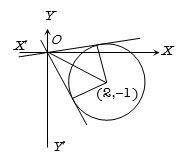
If the equation of one tangent to the circle with centre at $(2, -1)$ from the origin is $3x + y = 0$,then the equation of the other tangent through the origin is
A
$3x - y = 0$
B
$x + 3y = 0$
C
$x - 3y = 0$
D
$x + 2y = 0$
Solution
(C) Let the equation of the other tangent passing through the origin $(0, 0)$ be $y = mx$,or $mx - y = 0$.
Since this is a tangent to the circle with centre $(2, -1)$,the perpendicular distance from the centre to the tangent must be equal to the radius $r$.
The distance from $(2, -1)$ to $3x + y = 0$ is $r = \frac{|3(2) + 1|}{\sqrt{3^2 + 1^2}} = \frac{7}{\sqrt{10}}$.
Now,the distance from $(2, -1)$ to $mx - y = 0$ must also be $r = \frac{7}{\sqrt{10}}$.
So,$\frac{|m(2) - (-1)|}{\sqrt{m^2 + (-1)^2}} = \frac{7}{\sqrt{10}}$.
$\frac{|2m + 1|}{\sqrt{m^2 + 1}} = \frac{7}{\sqrt{10}}$.
Squaring both sides: $\frac{(2m + 1)^2}{m^2 + 1} = \frac{49}{10}$.
$10(4m^2 + 4m + 1) = 49(m^2 + 1)$.
$40m^2 + 40m + 10 = 49m^2 + 49$.
$9m^2 - 40m + 39 = 0$.
Since one tangent is $3x + y = 0$ (slope $m_1 = -3$),the product of roots $m_1 m_2 = \frac{39}{9} = \frac{13}{3}$.
$-3 \times m_2 = \frac{13}{3} \implies m_2 = -\frac{13}{9}$.
Wait,checking the options: for $x - 3y = 0$,$y = \frac{1}{3}x$,slope $m = \frac{1}{3}$.
Distance from $(2, -1)$ to $x - 3y = 0$ is $\frac{|2 - 3(-1)|}{\sqrt{1^2 + (-3)^2}} = \frac{|2 + 3|}{\sqrt{10}} = \frac{5}{\sqrt{10}}$.
This matches the radius if the circle passes through the origin. Since the tangent passes through the origin,the radius squared is $2^2 + (-1)^2 = 5$,so $r = \sqrt{5}$.
Thus,the correct equation is $x - 3y = 0$.
Since this is a tangent to the circle with centre $(2, -1)$,the perpendicular distance from the centre to the tangent must be equal to the radius $r$.
The distance from $(2, -1)$ to $3x + y = 0$ is $r = \frac{|3(2) + 1|}{\sqrt{3^2 + 1^2}} = \frac{7}{\sqrt{10}}$.
Now,the distance from $(2, -1)$ to $mx - y = 0$ must also be $r = \frac{7}{\sqrt{10}}$.
So,$\frac{|m(2) - (-1)|}{\sqrt{m^2 + (-1)^2}} = \frac{7}{\sqrt{10}}$.
$\frac{|2m + 1|}{\sqrt{m^2 + 1}} = \frac{7}{\sqrt{10}}$.
Squaring both sides: $\frac{(2m + 1)^2}{m^2 + 1} = \frac{49}{10}$.
$10(4m^2 + 4m + 1) = 49(m^2 + 1)$.
$40m^2 + 40m + 10 = 49m^2 + 49$.
$9m^2 - 40m + 39 = 0$.
Since one tangent is $3x + y = 0$ (slope $m_1 = -3$),the product of roots $m_1 m_2 = \frac{39}{9} = \frac{13}{3}$.
$-3 \times m_2 = \frac{13}{3} \implies m_2 = -\frac{13}{9}$.
Wait,checking the options: for $x - 3y = 0$,$y = \frac{1}{3}x$,slope $m = \frac{1}{3}$.
Distance from $(2, -1)$ to $x - 3y = 0$ is $\frac{|2 - 3(-1)|}{\sqrt{1^2 + (-3)^2}} = \frac{|2 + 3|}{\sqrt{10}} = \frac{5}{\sqrt{10}}$.
This matches the radius if the circle passes through the origin. Since the tangent passes through the origin,the radius squared is $2^2 + (-1)^2 = 5$,so $r = \sqrt{5}$.
Thus,the correct equation is $x - 3y = 0$.
0 likesView Solution
3
ChemistryMCQWBJEE · 2022
$A$ determinant is chosen at random from the set of all determinants of order $2$ with elements $0$ or $1$ only. The probability that the determinant chosen is non-zero is
A
$\frac{3}{16}$
B
$\frac{3}{8}$
C
$\frac{1}{4}$
D
None of these
Solution
(B) determinant of order $2$ is of the form $\Delta = \begin{vmatrix} a & b \\ c & d \end{vmatrix}$.
It is equal to $ad - bc$.
The total number of ways of choosing $a, b, c,$ and $d$ is $2 \times 2 \times 2 \times 2 = 16$.
Now,$\Delta \neq 0$ if and only if $ad - bc \neq 0$,which means $ad \neq bc$.
Since $a, b, c, d \in \{0, 1\}$,the possible values for $ad$ and $bc$ are $0$ or $1$.
We have $\Delta \neq 0$ in the following cases:
$1$. If $ad = 1$ and $bc = 0$: This happens when $a=1, d=1$ and $(b, c) \in \{(0, 0), (0, 1), (1, 0)\}$. ($3$ cases)
$2$. If $ad = 0$ and $bc = 1$: This happens when $(a, d) \in \{(0, 0), (0, 1), (1, 0)\}$ and $b=1, c=1$. ($3$ cases)
Total favorable cases = $3 + 3 = 6$.
Therefore,the required probability = $\frac{6}{16} = \frac{3}{8}$.
It is equal to $ad - bc$.
The total number of ways of choosing $a, b, c,$ and $d$ is $2 \times 2 \times 2 \times 2 = 16$.
Now,$\Delta \neq 0$ if and only if $ad - bc \neq 0$,which means $ad \neq bc$.
Since $a, b, c, d \in \{0, 1\}$,the possible values for $ad$ and $bc$ are $0$ or $1$.
We have $\Delta \neq 0$ in the following cases:
$1$. If $ad = 1$ and $bc = 0$: This happens when $a=1, d=1$ and $(b, c) \in \{(0, 0), (0, 1), (1, 0)\}$. ($3$ cases)
$2$. If $ad = 0$ and $bc = 1$: This happens when $(a, d) \in \{(0, 0), (0, 1), (1, 0)\}$ and $b=1, c=1$. ($3$ cases)
Total favorable cases = $3 + 3 = 6$.
Therefore,the required probability = $\frac{6}{16} = \frac{3}{8}$.
0 likesView Solution
4
ChemistryMCQWBJEE · 2022
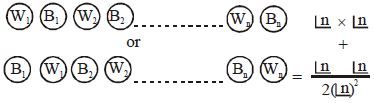
There are $n$ white and $n$ black balls marked $1, 2, 3, ..., n$. The number of ways in which we can arrange these balls in a row so that neighbouring balls are of different colours is
A
$n!$
B
$(2n)!$
C
$2(n!)^2$
D
$\frac{(2n)!}{(n!)^2}$
Solution
(C) To arrange $n$ white and $n$ black balls such that no two balls of the same colour are adjacent,the arrangement must be alternating.
There are two possible patterns for the sequence of colours:
$1$. $W, B, W, B, ..., W, B$
$2$. $B, W, B, W, ..., B, W$
For the first pattern,the $n$ white balls can be arranged in $n!$ ways and the $n$ black balls can be arranged in $n!$ ways. Thus,there are $n! \times n! = (n!)^2$ ways.
For the second pattern,similarly,there are $n! \times n! = (n!)^2$ ways.
Total number of ways = $(n!)^2 + (n!)^2 = 2(n!)^2$.
There are two possible patterns for the sequence of colours:
$1$. $W, B, W, B, ..., W, B$
$2$. $B, W, B, W, ..., B, W$
For the first pattern,the $n$ white balls can be arranged in $n!$ ways and the $n$ black balls can be arranged in $n!$ ways. Thus,there are $n! \times n! = (n!)^2$ ways.
For the second pattern,similarly,there are $n! \times n! = (n!)^2$ ways.
Total number of ways = $(n!)^2 + (n!)^2 = 2(n!)^2$.
0 likesView Solution
5
ChemistryMediumMCQWBJEE · 2022
$XeF_2, NO_2, HCN, ClO_2, CO_2$. Identify the non-linear molecule pair from the above-mentioned molecules.
A
$XeF_2, ClO_2$
B
$CO_2, NO_2$
C
$HCN, NO_2$
D
$ClO_2, NO_2$
Solution
(D) To determine the geometry of the molecules,we analyze their structures:
$1$. $XeF_2$: The central atom $Xe$ has $2$ bond pairs and $3$ lone pairs,resulting in a linear geometry.
$2$. $NO_2$: The central atom $N$ has $1$ odd electron and $2$ bond pairs,resulting in a bent (non-linear) geometry.
$3$. $HCN$: The central atom $C$ has $2$ bond pairs and no lone pairs,resulting in a linear geometry.
$4$. $ClO_2$: The central atom $Cl$ has $2$ bond pairs and $1$ lone pair,resulting in a bent (non-linear) geometry.
$5$. $CO_2$: The central atom $C$ has $2$ bond pairs and no lone pairs,resulting in a linear geometry.
Thus,the non-linear molecules are $NO_2$ and $ClO_2$.
$1$. $XeF_2$: The central atom $Xe$ has $2$ bond pairs and $3$ lone pairs,resulting in a linear geometry.
$2$. $NO_2$: The central atom $N$ has $1$ odd electron and $2$ bond pairs,resulting in a bent (non-linear) geometry.
$3$. $HCN$: The central atom $C$ has $2$ bond pairs and no lone pairs,resulting in a linear geometry.
$4$. $ClO_2$: The central atom $Cl$ has $2$ bond pairs and $1$ lone pair,resulting in a bent (non-linear) geometry.
$5$. $CO_2$: The central atom $C$ has $2$ bond pairs and no lone pairs,resulting in a linear geometry.
Thus,the non-linear molecules are $NO_2$ and $ClO_2$.
0 likesView Solution
6
ChemistryEasyMCQWBJEE · 2022
The hybridisation of the negatively charged carbon atoms in $(1)$ and $(2)$ are:
$(1)$ $CH_3^-$
$(2)$ $H_2C^- - CHO - CH_3$
$(1)$ $CH_3^-$
$(2)$ $H_2C^- - CHO - CH_3$
A
$sp^2$ and $sp^3$
B
$sp^3$ and $sp^2$
C
both $sp^2$
D
None of the above
Solution
(B) In structure $(1)$,the carbon atom in $CH_3^-$ is bonded to $3$ hydrogen atoms and has $1$ lone pair. The steric number is $3 + 1 = 4$,which corresponds to $sp^3$ hybridisation.
In structure $(2)$,the carbon atom in $H_2C^-$ is adjacent to a carbonyl group $(C=O)$. The negative charge is delocalised through resonance with the carbonyl group,making the carbon atom $sp^2$ hybridised to allow for the overlap of the $p$-orbital with the $\pi$-system.
In structure $(2)$,the carbon atom in $H_2C^-$ is adjacent to a carbonyl group $(C=O)$. The negative charge is delocalised through resonance with the carbonyl group,making the carbon atom $sp^2$ hybridised to allow for the overlap of the $p$-orbital with the $\pi$-system.
0 likesView Solution
7
ChemistryMediumMCQWBJEE · 2022
The correct bond order of the $B-F$ bond in the $BF_3$ molecule is:
A
$1$
B
$1 \frac{1}{2}$
C
$2$
D
$1 \frac{1}{3}$
Solution
(D) In the $BF_3$ molecule,the boron atom is electron-deficient and completes its octet through back-bonding from the fluorine atoms. This results in resonance structures where one $B-F$ bond has a double bond character while the other two remain single bonds.
There are $3$ contributing resonance structures.
In each structure,one bond is a double bond (order $2$) and two are single bonds (order $1$).
The average bond order is calculated as:
$\text{Bond Order} = \frac{\text{Total number of bonds}}{\text{Number of resonating positions}} = \frac{2 + 1 + 1}{3} = \frac{4}{3} = 1 \frac{1}{3}$.
There are $3$ contributing resonance structures.
In each structure,one bond is a double bond (order $2$) and two are single bonds (order $1$).
The average bond order is calculated as:
$\text{Bond Order} = \frac{\text{Total number of bonds}}{\text{Number of resonating positions}} = \frac{2 + 1 + 1}{3} = \frac{4}{3} = 1 \frac{1}{3}$.
0 likesView Solution
8
ChemistryMediumMCQWBJEE · 2022
The boiling point of water is higher than that of liquid $HF$. The reason is that
A
Hydrogen bonds are stronger in water
B
Hydrogen bonds are stronger in $HF$
C
Hydrogen bonds are larger in number in $HF$
D
Hydrogen bonds are larger in number in water
Solution
(D) In $H_2O$,each oxygen atom has two hydrogen atoms and two lone pairs of electrons,allowing each water molecule to form four hydrogen bonds with neighboring molecules. This creates a three-dimensional network structure.
In $HF$,each fluorine atom has three lone pairs but only one hydrogen atom,which limits each $HF$ molecule to forming only two hydrogen bonds,resulting in a linear chain structure.
Because water molecules can form a larger number of hydrogen bonds per molecule compared to $HF$,more energy is required to break these intermolecular forces,leading to a higher boiling point for water.
In $HF$,each fluorine atom has three lone pairs but only one hydrogen atom,which limits each $HF$ molecule to forming only two hydrogen bonds,resulting in a linear chain structure.
Because water molecules can form a larger number of hydrogen bonds per molecule compared to $HF$,more energy is required to break these intermolecular forces,leading to a higher boiling point for water.
0 likesView Solution
9
ChemistryEasyMCQWBJEE · 2022
The correct pair of electron affinity order is
A
$O > S, F > Cl$
B
$O < S, Cl > F$
C
$S > O, F > Cl$
D
$S < O, Cl > F$
Solution
(B) The electron affinity of elements in the second period is lower than that of the corresponding elements in the third period due to their small atomic size and high inter-electronic repulsion.
Thus,$S > O$ and $Cl > F$.
Thus,$S > O$ and $Cl > F$.
0 likesView Solution
10
ChemistryDifficultMCQWBJEE · 2022
The metal-pair that can produce nascent hydrogen in alkaline medium is
A
$Zn, Al$
B
$Fe, Ni$
C
$Al, Mg$
D
$Mg, Zn$
Solution
(A) Amphoteric metals like $Zn$ and $Al$ react with strong bases (alkaline medium) to produce hydrogen gas.
For example,$Zn + 2NaOH \rightarrow Na_2ZnO_2 + H_2$ and $2Al + 2NaOH + 2H_2O \rightarrow 2NaAlO_2 + 3H_2$.
Thus,the pair $Zn$ and $Al$ is capable of producing hydrogen in an alkaline medium.
For example,$Zn + 2NaOH \rightarrow Na_2ZnO_2 + H_2$ and $2Al + 2NaOH + 2H_2O \rightarrow 2NaAlO_2 + 3H_2$.
Thus,the pair $Zn$ and $Al$ is capable of producing hydrogen in an alkaline medium.
0 likesView Solution
11
ChemistryEasyMCQWBJEE · 2022
The oxidation states of $Cr$ in $K_2Cr_2O_7$ and $CrO_5$ are,respectively:
A
$+6, +5$
B
$+6, +10$
C
$+6, +6$
D
None of these
Solution
(C) For $K_2Cr_2O_7$: Let the oxidation state of $Cr$ be $x$.
$2(+1) + 2x + 7(-2) = 0$
$2 + 2x - 14 = 0$
$2x = 12$
$x = +6$
For $CrO_5$: This compound has a butterfly structure containing four peroxy oxygen atoms (each with $-1$ charge) and one oxo oxygen atom (with $-2$ charge). Let the oxidation state of $Cr$ be $x$.
$x + 4(-1) + 1(-2) = 0$
$x - 4 - 2 = 0$
$x - 6 = 0$
$x = +6$
Thus,the oxidation states of $Cr$ in both compounds are $+6$.
$2(+1) + 2x + 7(-2) = 0$
$2 + 2x - 14 = 0$
$2x = 12$
$x = +6$
For $CrO_5$: This compound has a butterfly structure containing four peroxy oxygen atoms (each with $-1$ charge) and one oxo oxygen atom (with $-2$ charge). Let the oxidation state of $Cr$ be $x$.
$x + 4(-1) + 1(-2) = 0$
$x - 4 - 2 = 0$
$x - 6 = 0$
$x = +6$
Thus,the oxidation states of $Cr$ in both compounds are $+6$.
0 likesView Solution
12
ChemistryMediumMCQWBJEE · 2022
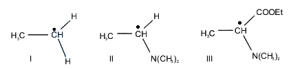
The correct order of relative stability for the given free radicals is:
A
$I < II < III$
B
$I < III < II$
C
$III < II < I$
D
$II < I < III$
Solution
(B) The stability of free radicals is determined by the resonance and inductive effects of the attached groups.
$I$ is an ethyl radical $(CH_3CH_2^{\bullet})$,which is stabilized by hyperconjugation.
$II$ is a radical with an amino group $(N(CH_3)_2)$ attached to the radical carbon. The lone pair on the nitrogen atom provides resonance stabilization through the $+M$ effect,which is very effective for radical stabilization.
$III$ has both an amino group $(N(CH_3)_2)$ and an ester group $(COOEt)$ attached to the radical carbon. While the amino group provides strong resonance stabilization,the ester group is electron-withdrawing ($-I$ and $-M$ effects),which destabilizes the radical compared to $II$.
Therefore,the stability order is $III < II < I$ is incorrect based on the provided options; the correct order is $I < II < III$ is also not quite right as $II$ is more stable than $I$ due to resonance. Comparing $II$ and $III$,$II$ is more stable than $III$ because the electron-withdrawing ester group in $III$ reduces the electron density on the radical carbon. Thus,the order is $I < III < II$.
$I$ is an ethyl radical $(CH_3CH_2^{\bullet})$,which is stabilized by hyperconjugation.
$II$ is a radical with an amino group $(N(CH_3)_2)$ attached to the radical carbon. The lone pair on the nitrogen atom provides resonance stabilization through the $+M$ effect,which is very effective for radical stabilization.
$III$ has both an amino group $(N(CH_3)_2)$ and an ester group $(COOEt)$ attached to the radical carbon. While the amino group provides strong resonance stabilization,the ester group is electron-withdrawing ($-I$ and $-M$ effects),which destabilizes the radical compared to $II$.
Therefore,the stability order is $III < II < I$ is incorrect based on the provided options; the correct order is $I < II < III$ is also not quite right as $II$ is more stable than $I$ due to resonance. Comparing $II$ and $III$,$II$ is more stable than $III$ because the electron-withdrawing ester group in $III$ reduces the electron density on the radical carbon. Thus,the order is $I < III < II$.
0 likesView Solution
13
ChemistryEasyMCQWBJEE · 2022
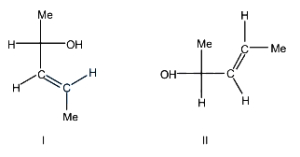
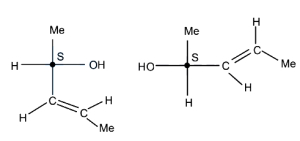
The correct relationship between molecules $I$ and $II$ is:
A
Enantiomer
B
Homomer
C
Diastereomer
D
Constitutional isomer
Solution
(B) To determine the relationship between the two molecules,we analyze their stereochemistry and connectivity.
Both molecules have the same connectivity and the same configuration at the chiral center (both are $S$-configuration).
By rotating the molecule $II$ in space,it can be superimposed on molecule $I$.
Since they are superimposable,they are identical molecules,which are known as homomers.
Both molecules have the same connectivity and the same configuration at the chiral center (both are $S$-configuration).
By rotating the molecule $II$ in space,it can be superimposed on molecule $I$.
Since they are superimposable,they are identical molecules,which are known as homomers.
0 likesView Solution
14
ChemistryEasyMCQWBJEE · 2022
The enol form in which ethyl $3$-oxobutanoate exists is
A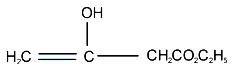
B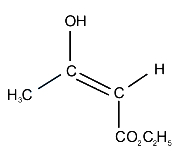
C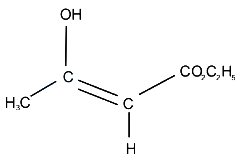
D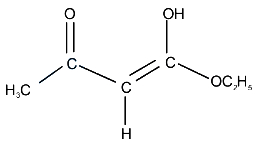
Solution
(D) Ethyl $3$-oxobutanoate (also known as ethyl acetoacetate) exists in keto-enol tautomerism. The enol form is stabilized by intramolecular hydrogen bonding between the hydroxyl group and the carbonyl oxygen of the ester group. The keto form is $CH_3COCH_2COOC_2H_5$. The enol form is $CH_3C(OH)=CHCOOC_2H_5$,which forms a stable six-membered ring due to hydrogen bonding.
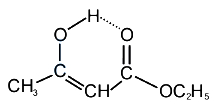
0 likesView Solution
15
ChemistryEasyMCQWBJEE · 2022
The correct order of relative stability of the given conformers of $n$-butane is
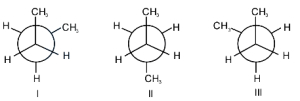
A
$II > I = III$
B
$II > III > I$
C
$II > I > III$
D
$I = III > II$
Solution
(A) The given structures represent the Newman projections of $n$-butane.
Structure $II$ is the anti-conformer,where the two bulky $-CH_3$ groups are at a dihedral angle of $180^{\circ}$,minimizing steric repulsion.
Structures $I$ and $III$ are gauche-conformers,where the two $-CH_3$ groups are at a dihedral angle of $60^{\circ}$,leading to higher steric repulsion compared to the anti-form.
Since both $I$ and $III$ are equivalent gauche-conformers,they have equal stability.
Thus,the order of stability is $II > I = III$.
Structure $II$ is the anti-conformer,where the two bulky $-CH_3$ groups are at a dihedral angle of $180^{\circ}$,minimizing steric repulsion.
Structures $I$ and $III$ are gauche-conformers,where the two $-CH_3$ groups are at a dihedral angle of $60^{\circ}$,leading to higher steric repulsion compared to the anti-form.
Since both $I$ and $III$ are equivalent gauche-conformers,they have equal stability.
Thus,the order of stability is $II > I = III$.
0 likesView Solution
16
ChemistryEasyMCQWBJEE · 2022
How many monobrominated product$(s)$ (including stereoisomers) would form in the free radical bromination of $n$-butane?
A
$2$
B
$1$
C
$3$
D
$4$
Solution
(C) The free radical bromination of $n$-butane $(CH_3-CH_2-CH_2-CH_3)$ can occur at two different types of carbon atoms:
$1$. At the terminal carbon ($C_1$ or $C_4$),it forms $1$-bromobutane $(CH_3-CH_2-CH_2-CH_2Br)$. This product is achiral.
$2$. At the internal carbon ($C_2$ or $C_3$),it forms $2$-bromobutane $(CH_3-CHBr-CH_2-CH_3)$. This product has a chiral center at $C_2$,resulting in a pair of enantiomers ($R$ and $S$ forms).
Therefore,the total number of monobrominated products including stereoisomers is $1$ (from $1$-bromobutane) + $2$ (from $2$-bromobutane) = $3$ products.
$1$. At the terminal carbon ($C_1$ or $C_4$),it forms $1$-bromobutane $(CH_3-CH_2-CH_2-CH_2Br)$. This product is achiral.
$2$. At the internal carbon ($C_2$ or $C_3$),it forms $2$-bromobutane $(CH_3-CHBr-CH_2-CH_3)$. This product has a chiral center at $C_2$,resulting in a pair of enantiomers ($R$ and $S$ forms).
Therefore,the total number of monobrominated products including stereoisomers is $1$ (from $1$-bromobutane) + $2$ (from $2$-bromobutane) = $3$ products.
0 likesView Solution
17
ChemistryEasyMCQWBJEE · 2022
The major product of the following reaction is $F_3C-CH=CH_2 + HBr \rightarrow$
A
$F_3C-CH_2-CH_2Br$
B
$F_3C-CH(Br)-CH_3$
C
$F_2C(Br)-CH(F)-CH_3$
D
$F_2CH-CH(Br)-CH_2F$
Solution
(A) The reaction of $F_3C-CH=CH_2$ with $HBr$ follows electrophilic addition. The $F_3C-$ group is a strong electron-withdrawing group due to the inductive effect ($-I$ effect).
When the proton $(H^+)$ attacks the double bond,it can form two possible carbocations:
$1$. $F_3C-CH^+-CH_3$ (secondary carbocation,destabilized by the strong $-I$ effect of the $F_3C$ group).
$2$. $F_3C-CH_2-CH_2^+$ (primary carbocation,less destabilized by the $-I$ effect as the positive charge is further away).
Since the primary carbocation $F_3C-CH_2-CH_2^+$ is more stable than the secondary carbocation $F_3C-CH^+-CH_3$ in this specific case due to the proximity of the electron-withdrawing group,the bromide ion $(Br^-)$ attacks the primary carbocation to form the major product $F_3C-CH_2-CH_2Br$.
When the proton $(H^+)$ attacks the double bond,it can form two possible carbocations:
$1$. $F_3C-CH^+-CH_3$ (secondary carbocation,destabilized by the strong $-I$ effect of the $F_3C$ group).
$2$. $F_3C-CH_2-CH_2^+$ (primary carbocation,less destabilized by the $-I$ effect as the positive charge is further away).
Since the primary carbocation $F_3C-CH_2-CH_2^+$ is more stable than the secondary carbocation $F_3C-CH^+-CH_3$ in this specific case due to the proximity of the electron-withdrawing group,the bromide ion $(Br^-)$ attacks the primary carbocation to form the major product $F_3C-CH_2-CH_2Br$.
0 likesView Solution
18
ChemistryMediumMCQWBJEE · 2022
The product of the following hydrogenation reaction is:
$C_6H_6 + H_2 \xrightarrow{\text{Catalyst, High temperature and pressure}} ?$
Given: $1 \text{ eqv. of } C_6H_6$ and $1 \text{ eqv. of } H_2$.
$C_6H_6 + H_2 \xrightarrow{\text{Catalyst, High temperature and pressure}} ?$
Given: $1 \text{ eqv. of } C_6H_6$ and $1 \text{ eqv. of } H_2$.
A
$A$ mixture of $0.33 \text{ eqv. of } C_6H_6$ and $0.66 \text{ eqv. of cyclohexene}$.
B
Cyclohexane $(1 \text{ eqv.})$
C
$A$ mixture of $0.66 \text{ eqv. of } C_6H_6$ and $0.33 \text{ eqv. of cyclohexane}$.
D
Cyclohexene $(1 \text{ eqv.})$
Solution
(C) The hydrogenation of benzene $(C_6H_6)$ requires $3 \text{ equivalents}$ of $H_2$ to fully reduce it to cyclohexane $(C_6H_{12})$.
$C_6H_6 + 3H_2 \rightarrow C_6H_{12}$
In this reaction,we are given $1 \text{ equivalent}$ of benzene and only $1 \text{ equivalent}$ of $H_2$.
Since the stoichiometry requires $3 \text{ equivalents}$ of $H_2$ for $1 \text{ equivalent}$ of benzene,$1 \text{ equivalent}$ of $H_2$ will react with $1/3$ $(0.33)$ of the benzene molecules to fully reduce them to cyclohexane,while $2/3$ $(0.66)$ of the benzene molecules will remain unreacted.
Therefore,the final mixture will contain $0.66 \text{ equivalents}$ of unreacted benzene and $0.33 \text{ equivalents}$ of cyclohexane.
$C_6H_6 + 3H_2 \rightarrow C_6H_{12}$
In this reaction,we are given $1 \text{ equivalent}$ of benzene and only $1 \text{ equivalent}$ of $H_2$.
Since the stoichiometry requires $3 \text{ equivalents}$ of $H_2$ for $1 \text{ equivalent}$ of benzene,$1 \text{ equivalent}$ of $H_2$ will react with $1/3$ $(0.33)$ of the benzene molecules to fully reduce them to cyclohexane,while $2/3$ $(0.66)$ of the benzene molecules will remain unreacted.
Therefore,the final mixture will contain $0.66 \text{ equivalents}$ of unreacted benzene and $0.33 \text{ equivalents}$ of cyclohexane.
0 likesView Solution
19
ChemistryEasyMCQWBJEE · 2022
Which of the following is radioactive?
A
Hydrogen
B
Deuterium
C
Tritium
D
None of these
Solution
(C) Among the isotopes of hydrogen,$^1H$ (Protium),$^2H$ (Deuterium),and $^3H$ (Tritium),only $^3H$ (Tritium) is radioactive.
It emits low-energy $\beta$-particles and has a half-life of $12.33 \ \text{years}$.
It emits low-energy $\beta$-particles and has a half-life of $12.33 \ \text{years}$.
0 likesView Solution
20
ChemistryMediumMCQWBJEE · 2022
Which of the following statements are incorrect?
A
$pH$ of a solution of salt of strong acid and weak base is less than $7$.
B
$pH$ of a solution of a weak acid and weak base is basic if $K_{b} < K_{a}$.
C
$pH$ of an aqueous solution of $10^{-8} \ M \ HCl$ is $8$.
D
Conjugate acid of $NH_{2}^{-}$ is $NH_{3}$.
Solution
(B, C) $1$. The salt of a strong acid and a weak base undergoes cationic hydrolysis,resulting in an acidic solution with $pH < 7$. This is a correct statement.
$2$. For a salt of a weak acid and a weak base,the $pH$ is determined by the relation $pH = 7 + \frac{1}{2}(pK_{a} - pK_{b})$. If $K_{b} < K_{a}$,then $pK_{b} > pK_{a}$,which implies $pH < 7$ (acidic). Thus,the statement that it is basic if $K_{b} < K_{a}$ is incorrect.
$3$. For a very dilute solution of $HCl$ $(10^{-8} \ M)$,the contribution of $H^{+}$ ions from water cannot be neglected. The total $[H^{+}] = 10^{-8} + 10^{-7} \approx 1.1 \times 10^{-7} \ M$. Thus,$pH = -\log(1.1 \times 10^{-7}) \approx 6.96$,which is less than $7$. The statement that $pH$ is $8$ is incorrect.
$4$. The conjugate acid of $NH_{2}^{-}$ is formed by adding a proton $(H^{+})$,resulting in $NH_{3}$. This is a correct statement.
Therefore,statements $B$ and $C$ are incorrect.
$2$. For a salt of a weak acid and a weak base,the $pH$ is determined by the relation $pH = 7 + \frac{1}{2}(pK_{a} - pK_{b})$. If $K_{b} < K_{a}$,then $pK_{b} > pK_{a}$,which implies $pH < 7$ (acidic). Thus,the statement that it is basic if $K_{b} < K_{a}$ is incorrect.
$3$. For a very dilute solution of $HCl$ $(10^{-8} \ M)$,the contribution of $H^{+}$ ions from water cannot be neglected. The total $[H^{+}] = 10^{-8} + 10^{-7} \approx 1.1 \times 10^{-7} \ M$. Thus,$pH = -\log(1.1 \times 10^{-7}) \approx 6.96$,which is less than $7$. The statement that $pH$ is $8$ is incorrect.
$4$. The conjugate acid of $NH_{2}^{-}$ is formed by adding a proton $(H^{+})$,resulting in $NH_{3}$. This is a correct statement.
Therefore,statements $B$ and $C$ are incorrect.
0 likesView Solution
21
ChemistryEasyMCQWBJEE · 2022
The correct statement$(s)$ about $B_2H_6$ is/are:
A
All $B$ atoms are $sp^3$ hybridised
B
It is paramagnetic
C
It contains $3C-4e$ bonding
D
There are two types of $H$ present
Solution
(A, D) In diborane $(B_2H_6)$,both boron atoms are $sp^3$ hybridised.
It is diamagnetic because all electrons are paired.
It contains two $3C-2e$ (three-center two-electron) bonds,also known as banana bonds.
There are two types of hydrogen atoms: $4$ terminal hydrogens and $2$ bridging hydrogens.
It is diamagnetic because all electrons are paired.
It contains two $3C-2e$ (three-center two-electron) bonds,also known as banana bonds.
There are two types of hydrogen atoms: $4$ terminal hydrogens and $2$ bridging hydrogens.
0 likesView Solution
22
ChemistryEasyMCQWBJEE · 2022
How much solid oxalic acid (Molecular weight $126$) has to be weighed to prepare $100 \ mL$ of exactly $0.1 \ N$ oxalic acid solution in water (in $g$)?
A
$1.26$
B
$0.126$
C
$0.63$
D
$0.063$
Solution
(C) The normality $(N)$ of the solution is given by the formula: $N = \frac{\text{Number of equivalents}}{\text{Volume in Liters}}$.
Number of equivalents $(n_{eq})$ $= N \times V(L) = 0.1 \times \frac{100}{1000} = 0.01$.
Oxalic acid $(H_2C_2O_4 \cdot 2H_2O)$ has a molecular weight of $126$. Its n-factor is $2$ (since it provides $2 \ H^+$ ions).
Equivalent mass $= \frac{\text{Molecular weight}}{n\text{-factor}} = \frac{126}{2} = 63$.
Weight required $= n_{eq} \times \text{Equivalent mass} = 0.01 \times 63 = 0.63 \ g$.
Number of equivalents $(n_{eq})$ $= N \times V(L) = 0.1 \times \frac{100}{1000} = 0.01$.
Oxalic acid $(H_2C_2O_4 \cdot 2H_2O)$ has a molecular weight of $126$. Its n-factor is $2$ (since it provides $2 \ H^+$ ions).
Equivalent mass $= \frac{\text{Molecular weight}}{n\text{-factor}} = \frac{126}{2} = 63$.
Weight required $= n_{eq} \times \text{Equivalent mass} = 0.01 \times 63 = 0.63 \ g$.
0 likesView Solution
23
ChemistryDifficultMCQWBJEE · 2022
$A$ sample of $MgCO_3$ is dissolved in dil. $HCl$ and the solution is neutralized with ammonia and buffered with $NH_4Cl / NH_4OH$. Disodium hydrogen phosphate reagent is added to the resulting solution. $A$ white precipitate is formed. What is the formula of the precipitate?
A
$Mg_3(PO_4)_2$
B
$Mg(NH_4)PO_4$
C
$MgHPO_4$
D
$Mg_2P_2O_7$
Solution
(B) The reaction proceeds as follows:
$1$. $MgCO_3(s) + 2HCl(aq) \rightarrow MgCl_2(aq) + H_2O(l) + CO_2(g)$
$2$. The solution is neutralized with ammonia and buffered with $NH_4Cl / NH_4OH$.
$3$. Upon adding disodium hydrogen phosphate $(Na_2HPO_4)$ to the solution containing $Mg^{2+}$ ions in the presence of $NH_4^+$ ions,a white crystalline precipitate of magnesium ammonium phosphate is formed:
$Mg^{2+}(aq) + NH_4^+(aq) + HPO_4^{2-}(aq) \rightarrow Mg(NH_4)PO_4(s) \downarrow$
Thus,the formula of the white precipitate is $Mg(NH_4)PO_4$.
$1$. $MgCO_3(s) + 2HCl(aq) \rightarrow MgCl_2(aq) + H_2O(l) + CO_2(g)$
$2$. The solution is neutralized with ammonia and buffered with $NH_4Cl / NH_4OH$.
$3$. Upon adding disodium hydrogen phosphate $(Na_2HPO_4)$ to the solution containing $Mg^{2+}$ ions in the presence of $NH_4^+$ ions,a white crystalline precipitate of magnesium ammonium phosphate is formed:
$Mg^{2+}(aq) + NH_4^+(aq) + HPO_4^{2-}(aq) \rightarrow Mg(NH_4)PO_4(s) \downarrow$
Thus,the formula of the white precipitate is $Mg(NH_4)PO_4$.
0 likesView Solution
24
ChemistryEasyMCQWBJEE · 2022
Avogadro's law is valid for
A
all gases
B
ideal gas
C
Van der Waals gas
D
real gas
Solution
(B) Avogadro's law states that equal volumes of all gases at the same temperature and pressure contain an equal number of molecules. This law is strictly applicable only to $ideal$ gases,as it assumes that gas molecules have negligible volume and no intermolecular forces of attraction,which are the fundamental postulates of the kinetic molecular theory of gases.
0 likesView Solution
25
ChemistryMediumMCQWBJEE · 2022
$A$ metal $(M)$ forms two oxides. The ratio $M:O$ (by weight) in the two oxides are $25:4$ and $25:6$. The minimum value of atomic mass of $M$ is
A
$50$
B
$100$
C
$150$
D
$200$
Solution
(B) Let the two oxides be $M_x O_y$ and $M_x O_z$.
According to the problem,the ratio of mass of $M$ to mass of $O$ is given as $\frac{M_{mass}}{O_{mass}} = \frac{25}{4}$ and $\frac{25}{6}$.
Let $A$ be the atomic mass of metal $M$.
For the first oxide: $\frac{x \times A}{y \times 16} = \frac{25}{4} \implies \frac{x \times A}{y} = 100$.
For the second oxide: $\frac{x \times A}{z \times 16} = \frac{25}{6} \implies \frac{x \times A}{z} = \frac{200}{3}$.
From the first equation,$x \times A = 100y$.
Substituting this into the second equation: $\frac{100y}{z} = \frac{200}{3} \implies \frac{y}{z} = \frac{2}{3}$.
Thus,$y=2$ and $z=3$ are the smallest integers.
Substituting $y=2$ into $x \times A = 100 \times 2 = 200$.
For minimum atomic mass,we take $x=2$,so $2 \times A = 200 \implies A = 100 \ u$.
According to the problem,the ratio of mass of $M$ to mass of $O$ is given as $\frac{M_{mass}}{O_{mass}} = \frac{25}{4}$ and $\frac{25}{6}$.
Let $A$ be the atomic mass of metal $M$.
For the first oxide: $\frac{x \times A}{y \times 16} = \frac{25}{4} \implies \frac{x \times A}{y} = 100$.
For the second oxide: $\frac{x \times A}{z \times 16} = \frac{25}{6} \implies \frac{x \times A}{z} = \frac{200}{3}$.
From the first equation,$x \times A = 100y$.
Substituting this into the second equation: $\frac{100y}{z} = \frac{200}{3} \implies \frac{y}{z} = \frac{2}{3}$.
Thus,$y=2$ and $z=3$ are the smallest integers.
Substituting $y=2$ into $x \times A = 100 \times 2 = 200$.
For minimum atomic mass,we take $x=2$,so $2 \times A = 200 \implies A = 100 \ u$.
0 likesView Solution
26
ChemistryEasyMCQWBJEE · 2022
$1 \ mL$ of water has $25$ drops. Let $N_0$ be the Avogadro number. What is the number of molecules present in $1$ drop of water? (Density of water $= 1 \ g / mL$)
A
$\frac{0.02}{9} \ N_0$
B
$\frac{18}{25} \ N_0$
C
$\frac{25}{18} \ N_0$
D
$\frac{0.04}{25} \ N_0$
Solution
(A) Volume of one drop $= (\frac{1}{25}) \ mL$
$\therefore$ Mass of $1$ drop $= V \times d = (\frac{1}{25} \ mL)(1 \ g / mL) = \frac{1}{25} \ g$
Number of moles of $H_2O = \frac{\text{Mass of water in one drop}}{\text{Molar mass of water}} = \frac{1/25}{18} = \frac{1}{450} \ mol$
$\therefore$ Number of $H_2O$ molecules $= \frac{1}{450} \ N_0 = \frac{0.02}{9} \ N_0$
$\therefore$ Mass of $1$ drop $= V \times d = (\frac{1}{25} \ mL)(1 \ g / mL) = \frac{1}{25} \ g$
Number of moles of $H_2O = \frac{\text{Mass of water in one drop}}{\text{Molar mass of water}} = \frac{1/25}{18} = \frac{1}{450} \ mol$
$\therefore$ Number of $H_2O$ molecules $= \frac{1}{450} \ N_0 = \frac{0.02}{9} \ N_0$
0 likesView Solution
27
ChemistryMediumMCQWBJEE · 2022
$C_6H_6$ (liq) + $\frac{15}{2}O_2$ $(g)$ $\rightarrow$ $6CO_2$ $(g)$ + $3H_2O$ (liq). Benzene burns in oxygen according to the above equation. What is the volume of oxygen (at $STP$) needed for complete combustion of $39 \ g$ of liquid benzene (in $L$)?
A
$11.2$
B
$22.4$
C
$84$
D
$168$
Solution
(C) The molar mass of benzene $(C_6H_6)$ is $(6 \times 12) + (6 \times 1) = 78 \ g/mol$.
Number of moles of $C_6H_6 = \frac{39 \ g}{78 \ g/mol} = 0.5 \ mol$.
From the balanced chemical equation,$1 \ mol$ of $C_6H_6$ requires $\frac{15}{2} \ mol$ of $O_2$.
Therefore,$0.5 \ mol$ of $C_6H_6$ requires $\frac{15}{2} \times 0.5 = 3.75 \ mol$ of $O_2$.
At $STP$,$1 \ mol$ of any gas occupies $22.4 \ L$.
Volume of $O_2$ at $STP = 3.75 \ mol \times 22.4 \ L/mol = 84 \ L$.
Number of moles of $C_6H_6 = \frac{39 \ g}{78 \ g/mol} = 0.5 \ mol$.
From the balanced chemical equation,$1 \ mol$ of $C_6H_6$ requires $\frac{15}{2} \ mol$ of $O_2$.
Therefore,$0.5 \ mol$ of $C_6H_6$ requires $\frac{15}{2} \times 0.5 = 3.75 \ mol$ of $O_2$.
At $STP$,$1 \ mol$ of any gas occupies $22.4 \ L$.
Volume of $O_2$ at $STP = 3.75 \ mol \times 22.4 \ L/mol = 84 \ L$.
0 likesView Solution
28
ChemistryEasyMCQWBJEE · 2022
The average speed of $H_2$ at $T_1 \ K$ is equal to that of $O_2$ at $T_2 \ K$. The ratio $T_1: T_2$ is
A
$1: 6$
B
$16: 1$
C
$1: 4$
D
None of these
Solution
(D) The formula for average speed is $C_{av} = \sqrt{\frac{8RT}{\pi M}}$.
Given that $(C_{av})_{H_2} = (C_{av})_{O_2}$,we have:
$\sqrt{\frac{8RT_1}{\pi M_{H_2}}} = \sqrt{\frac{8RT_2}{\pi M_{O_2}}}$
Squaring both sides:
$\frac{T_1}{M_{H_2}} = \frac{T_2}{M_{O_2}}$
$\frac{T_1}{T_2} = \frac{M_{H_2}}{M_{O_2}}$
Substituting the molar masses ($M_{H_2} = 2 \ g/mol$ and $M_{O_2} = 32 \ g/mol$):
$\frac{T_1}{T_2} = \frac{2}{32} = \frac{1}{16}$
Thus,the ratio $T_1: T_2$ is $1: 16$.
Given that $(C_{av})_{H_2} = (C_{av})_{O_2}$,we have:
$\sqrt{\frac{8RT_1}{\pi M_{H_2}}} = \sqrt{\frac{8RT_2}{\pi M_{O_2}}}$
Squaring both sides:
$\frac{T_1}{M_{H_2}} = \frac{T_2}{M_{O_2}}$
$\frac{T_1}{T_2} = \frac{M_{H_2}}{M_{O_2}}$
Substituting the molar masses ($M_{H_2} = 2 \ g/mol$ and $M_{O_2} = 32 \ g/mol$):
$\frac{T_1}{T_2} = \frac{2}{32} = \frac{1}{16}$
Thus,the ratio $T_1: T_2$ is $1: 16$.
0 likesView Solution
29
ChemistryEasyMCQWBJEE · 2022
Let $(C_{rms})_{H_2}$ be the r.m.s. speed of $H_2$ at $150 \ K$. At what temperature will the most probable speed of helium $[(C_{mp})_{He}]$ be half of $(C_{rms})_{H_2}$ (in $K$)?
A
$75$
B
$112.5$
C
$225$
D
$900$
Solution
(B) The formula for r.m.s. speed is $(C_{rms}) = \sqrt{\frac{3RT}{M}}$ and for most probable speed is $(C_{mp}) = \sqrt{\frac{2RT}{M}}$.
Given $(C_{rms})_{H_2} = \sqrt{\frac{3 \times R \times 150}{2}}$.
According to the problem,$(C_{mp})_{He} = \frac{1}{2} (C_{rms})_{H_2}$.
Substituting the values: $\sqrt{\frac{2RT}{4}} = \frac{1}{2} \sqrt{\frac{3 \times R \times 150}{2}}$.
Squaring both sides: $\frac{2RT}{4} = \frac{1}{4} \times \frac{3 \times R \times 150}{2}$.
$\frac{RT}{2} = \frac{450R}{8}$.
$T = \frac{450}{4} = 112.5 \ K$.
Given $(C_{rms})_{H_2} = \sqrt{\frac{3 \times R \times 150}{2}}$.
According to the problem,$(C_{mp})_{He} = \frac{1}{2} (C_{rms})_{H_2}$.
Substituting the values: $\sqrt{\frac{2RT}{4}} = \frac{1}{2} \sqrt{\frac{3 \times R \times 150}{2}}$.
Squaring both sides: $\frac{2RT}{4} = \frac{1}{4} \times \frac{3 \times R \times 150}{2}$.
$\frac{RT}{2} = \frac{450R}{8}$.
$T = \frac{450}{4} = 112.5 \ K$.
0 likesView Solution
30
ChemistryEasyMCQWBJEE · 2022
In the Bohr model of an atom,the radius of a hydrogen atom in the ground state is $r_1$ and the radius of a $He^{+}$ ion in the ground state is $r_2$. Which of the following is correct?
A
$r_1/r_2 = 4$
B
$r_1/r_2 = 1/2$
C
$r_2/r_1 = 1/4$
D
$r_2/r_1 = 1/2$
Solution
(D) The radius of an orbit in the Bohr model is given by $r_n = a_0 \times \frac{n^2}{Z}$.
For a hydrogen atom $(Z=1)$ in the ground state $(n=1)$: $r_1 = a_0 \times \frac{1^2}{1} = a_0$.
For a $He^{+}$ ion $(Z=2)$ in the ground state $(n=1)$: $r_2 = a_0 \times \frac{1^2}{2} = \frac{a_0}{2}$.
Since $r_1 = a_0$,we have $r_2 = \frac{r_1}{2}$.
Therefore,$\frac{r_2}{r_1} = \frac{1}{2}$.
For a hydrogen atom $(Z=1)$ in the ground state $(n=1)$: $r_1 = a_0 \times \frac{1^2}{1} = a_0$.
For a $He^{+}$ ion $(Z=2)$ in the ground state $(n=1)$: $r_2 = a_0 \times \frac{1^2}{2} = \frac{a_0}{2}$.
Since $r_1 = a_0$,we have $r_2 = \frac{r_1}{2}$.
Therefore,$\frac{r_2}{r_1} = \frac{1}{2}$.
0 likesView Solution
31
ChemistryMediumMCQWBJEE · 2022
The de-Broglie wavelength $(\lambda)$ for electron $(e)$,proton $(p)$ and $He^{2+}$ ion $(\alpha)$ are in the following order. (Speed of $e$,$p$ and $\alpha$ are the same)
A
$\alpha > p > e$
B
$e > p > \alpha$
C
$e > \alpha > p$
D
$\alpha < p > e$
Solution
(B) The de-Broglie wavelength is given by the formula $\lambda = \frac{h}{mv}$.
Since the speed $(v)$ is the same for all particles,the wavelength is inversely proportional to the mass: $\lambda \propto \frac{1}{m}$.
The masses of the particles are in the order $m_\alpha > m_p > m_e$.
Therefore,the wavelength order is $\lambda_e > \lambda_p > \lambda_\alpha$.
Since the speed $(v)$ is the same for all particles,the wavelength is inversely proportional to the mass: $\lambda \propto \frac{1}{m}$.
The masses of the particles are in the order $m_\alpha > m_p > m_e$.
Therefore,the wavelength order is $\lambda_e > \lambda_p > \lambda_\alpha$.
0 likesView Solution
32
ChemistryEasyMCQWBJEE · 2022
Which one of the following is the correct set of four quantum numbers $(n, l, m, s)$?
A
$(3, 0, -1, +\frac{1}{2})$
B
$(4, 3, -2, -\frac{1}{2})$
C
$(3, 1, -2, -\frac{1}{2})$
D
$(4, 2, -3, +\frac{1}{2})$
Solution
(B) The rules for quantum numbers are as follows:
$1$. Principal quantum number $n$ can be any positive integer $(1, 2, 3, ...)$.
$2$. Azimuthal quantum number $\ell$ ranges from $0$ to $n-1$.
$3$. Magnetic quantum number $m$ ranges from $-\ell$ to $+\ell$.
$4$. Spin quantum number $s$ can be $+\frac{1}{2}$ or $-\frac{1}{2}$.
Evaluating the options:
$A$: $(3, 0, -1, +\frac{1}{2})$ is incorrect because $m$ cannot be $-1$ when $\ell=0$.
$B$: $(4, 3, -2, -\frac{1}{2})$ is correct because for $n=4$,$\ell=3$ is allowed,and for $\ell=3$,$m=-2$ is allowed.
$C$: $(3, 1, -2, -\frac{1}{2})$ is incorrect because $m$ cannot be $-2$ when $\ell=1$.
$D$: $(4, 2, -3, +\frac{1}{2})$ is incorrect because $m$ cannot be $-3$ when $\ell=2$.
$1$. Principal quantum number $n$ can be any positive integer $(1, 2, 3, ...)$.
$2$. Azimuthal quantum number $\ell$ ranges from $0$ to $n-1$.
$3$. Magnetic quantum number $m$ ranges from $-\ell$ to $+\ell$.
$4$. Spin quantum number $s$ can be $+\frac{1}{2}$ or $-\frac{1}{2}$.
Evaluating the options:
$A$: $(3, 0, -1, +\frac{1}{2})$ is incorrect because $m$ cannot be $-1$ when $\ell=0$.
$B$: $(4, 3, -2, -\frac{1}{2})$ is correct because for $n=4$,$\ell=3$ is allowed,and for $\ell=3$,$m=-2$ is allowed.
$C$: $(3, 1, -2, -\frac{1}{2})$ is incorrect because $m$ cannot be $-2$ when $\ell=1$.
$D$: $(4, 2, -3, +\frac{1}{2})$ is incorrect because $m$ cannot be $-3$ when $\ell=2$.
0 likesView Solution
33
ChemistryDifficultMCQWBJEE · 2022
The product of the following reaction is :
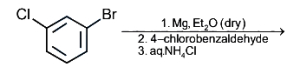
A
$3-$chlorophenyl$-4-$chlorophenylmethanol
B
$3-$bromophenyl$-4-$chlorophenylmethanol
C
$4-$bromophenyl$-3-$chlorophenylmethanol
D
bis($4$-chlorophenyl)methanol
Solution
(A) The reaction proceeds as follows:
$1$. $3$-bromo-$1$-chlorobenzene reacts with $Mg$ in dry $Et_2O$ to form the Grignard reagent,$3$-chlorophenylmagnesium bromide.
$2$. This Grignard reagent then undergoes a nucleophilic addition reaction with $4$-chlorobenzaldehyde.
$3$. Finally,aqueous $NH_4Cl$ workup protonates the alkoxide intermediate to yield the secondary alcohol,$3$-chlorophenyl-$4$-chlorophenylmethanol.
$1$. $3$-bromo-$1$-chlorobenzene reacts with $Mg$ in dry $Et_2O$ to form the Grignard reagent,$3$-chlorophenylmagnesium bromide.
$2$. This Grignard reagent then undergoes a nucleophilic addition reaction with $4$-chlorobenzaldehyde.
$3$. Finally,aqueous $NH_4Cl$ workup protonates the alkoxide intermediate to yield the secondary alcohol,$3$-chlorophenyl-$4$-chlorophenylmethanol.
0 likesView Solution
34
ChemistryEasyMCQWBJEE · 2022
Which of the following would produce enantiomeric products when reacted with methyl magnesium iodide?
A
Benzaldehyde
B
Propiophenone
C
Acetone
D
Acetaldehyde
Solution
(A) The reaction of a carbonyl compound $R-CO-R'$ with methyl magnesium iodide $(CH_3MgI)$ followed by hydrolysis yields a tertiary or secondary alcohol with a chiral center if the four groups attached to the central carbon are different.
For the product to be chiral (enantiomeric),the central carbon must be bonded to four distinct groups: $R$,$R'$,$CH_3$,and $H$ (or $OH$ group).
$1$. Benzaldehyde $(C_6H_5CHO)$: Reacts to form $1$-phenylethanol,which has a chiral center $(C_6H_5, CH_3, H, OH)$. Thus,it produces enantiomers.
$2$. Propiophenone $(C_6H_5COCH_2CH_3)$: Reacts to form $2$-phenylbutan-$2$-ol. Here,the groups are $C_6H_5, CH_3, CH_2CH_3, OH$. All four are different,so it forms enantiomers.
$3$. Acetone $(CH_3COCH_3)$: Forms $2$-methylpropan-$2$-ol,which is achiral.
$4$. Acetaldehyde $(CH_3CHO)$: Forms propan-$2$-ol,which is achiral.
Given the options,Benzaldehyde is the standard example for producing a chiral secondary alcohol.
For the product to be chiral (enantiomeric),the central carbon must be bonded to four distinct groups: $R$,$R'$,$CH_3$,and $H$ (or $OH$ group).
$1$. Benzaldehyde $(C_6H_5CHO)$: Reacts to form $1$-phenylethanol,which has a chiral center $(C_6H_5, CH_3, H, OH)$. Thus,it produces enantiomers.
$2$. Propiophenone $(C_6H_5COCH_2CH_3)$: Reacts to form $2$-phenylbutan-$2$-ol. Here,the groups are $C_6H_5, CH_3, CH_2CH_3, OH$. All four are different,so it forms enantiomers.
$3$. Acetone $(CH_3COCH_3)$: Forms $2$-methylpropan-$2$-ol,which is achiral.
$4$. Acetaldehyde $(CH_3CHO)$: Forms propan-$2$-ol,which is achiral.
Given the options,Benzaldehyde is the standard example for producing a chiral secondary alcohol.
0 likesView Solution
35
ChemistryMediumMCQWBJEE · 2022
What is the correct order of acidity of salicylic acid,$4-$hydroxybenzoic acid,and $2,6-$dihydroxybenzoic acid?
A
$2,6-$dihydroxybenzoic acid > salicylic acid > $4-$hydroxybenzoic acid
B
$2,6-$dihydroxybenzoic acid > $4-$hydroxybenzoic acid > salicylic acid
C
salicylic acid > $2,6-$dihydroxybenzoic acid > $4-$hydroxybenzoic acid
D
salicylic acid > $4-$hydroxybenzoic acid > $2,6-$dihydroxybenzoic acid
Solution
(A) The acidity of these compounds depends on the stability of their conjugate bases.
$2,6-$dihydroxybenzoic acid has two $-OH$ groups at ortho positions relative to the $-COOH$ group. The conjugate base is highly stabilized by strong intramolecular hydrogen bonding between the carboxylate oxygen and both ortho-hydroxyl groups.
Salicylic acid ($2-$hydroxybenzoic acid) has only one ortho $-OH$ group,providing less stabilization than $2,6-$dihydroxybenzoic acid.
$4-$hydroxybenzoic acid lacks ortho-stabilization and the $-OH$ group at the para position exerts an electron-donating effect ($+M$ effect),which destabilizes the carboxylate anion,making it the least acidic.
Therefore,the correct order is: $2,6-$dihydroxybenzoic acid > salicylic acid > $4-$hydroxybenzoic acid.
$2,6-$dihydroxybenzoic acid has two $-OH$ groups at ortho positions relative to the $-COOH$ group. The conjugate base is highly stabilized by strong intramolecular hydrogen bonding between the carboxylate oxygen and both ortho-hydroxyl groups.
Salicylic acid ($2-$hydroxybenzoic acid) has only one ortho $-OH$ group,providing less stabilization than $2,6-$dihydroxybenzoic acid.
$4-$hydroxybenzoic acid lacks ortho-stabilization and the $-OH$ group at the para position exerts an electron-donating effect ($+M$ effect),which destabilizes the carboxylate anion,making it the least acidic.
Therefore,the correct order is: $2,6-$dihydroxybenzoic acid > salicylic acid > $4-$hydroxybenzoic acid.
0 likesView Solution
36
ChemistryEasyMCQWBJEE · 2022
Choose the correct statement for the $[Ni(CN)_4]^{2-}$ complex ion (Atomic number of $Ni=28$).
A
The complex is square planar and paramagnetic
B
The complex is tetrahedral and diamagnetic
C
The complex is square planar and diamagnetic
D
The complex is tetrahedral and paramagnetic
Solution
(C) $1$. The atomic number of $Ni$ is $28$. Its electronic configuration is $[Ar] 3d^8 4s^2$.
$2$. In $[Ni(CN)_4]^{2-}$,the oxidation state of $Ni$ is $+2$,so the configuration of $Ni^{2+}$ is $[Ar] 3d^8$.
$3$. $CN^-$ is a strong field ligand,which causes the pairing of electrons in the $3d$ orbitals.
$4$. Due to this pairing,one $3d$ orbital becomes vacant,allowing $dsp^2$ hybridization.
$5$. The $dsp^2$ hybridization results in a square planar geometry.
$6$. Since all electrons are paired,the complex is diamagnetic.
$2$. In $[Ni(CN)_4]^{2-}$,the oxidation state of $Ni$ is $+2$,so the configuration of $Ni^{2+}$ is $[Ar] 3d^8$.
$3$. $CN^-$ is a strong field ligand,which causes the pairing of electrons in the $3d$ orbitals.
$4$. Due to this pairing,one $3d$ orbital becomes vacant,allowing $dsp^2$ hybridization.
$5$. The $dsp^2$ hybridization results in a square planar geometry.
$6$. Since all electrons are paired,the complex is diamagnetic.
0 likesView Solution
37
ChemistryEasyMCQWBJEE · 2022
The number of unpaired electrons in $Mn^{2+}$ ion is
A
$2$
B
$3$
C
$5$
D
$6$
Solution
(C) The atomic number of $Mn$ is $25$.
The electronic configuration of $Mn$ is $[Ar] 3d^5 4s^2$.
When $Mn$ forms $Mn^{2+}$ ion,it loses two electrons from the $4s$ orbital.
Thus,the electronic configuration of $Mn^{2+}$ is $[Ar] 3d^5$.
In the $3d$ subshell,there are $5$ orbitals,and according to Hund's rule,each orbital will be occupied by one electron.
Therefore,there are $5$ unpaired electrons in $Mn^{2+}$ ion.
The electronic configuration of $Mn$ is $[Ar] 3d^5 4s^2$.
When $Mn$ forms $Mn^{2+}$ ion,it loses two electrons from the $4s$ orbital.
Thus,the electronic configuration of $Mn^{2+}$ is $[Ar] 3d^5$.
In the $3d$ subshell,there are $5$ orbitals,and according to Hund's rule,each orbital will be occupied by one electron.
Therefore,there are $5$ unpaired electrons in $Mn^{2+}$ ion.
0 likesView Solution
38
ChemistryEasyMCQWBJEE · 2022
What is the chemical formula of sodium nitroprusside?
A
$Na_4[Fe(CN)_5 NO_2]$
B
$Na_2[Fe(CN)_5 NO]$
C
$Na_3[Fe(CN)_5 NO]$
D
$Na_4[Fe(CN)_5 NO_3]$
Solution
(B) Sodium nitroprusside is a coordination compound with the chemical formula $Na_2[Fe(CN)_5 NO]$.
It is commonly used in analytical chemistry as a reagent for the detection of sulfide ions $(S^{2-})$ and as a vasodilator in medicine.
It is commonly used in analytical chemistry as a reagent for the detection of sulfide ions $(S^{2-})$ and as a vasodilator in medicine.
0 likesView Solution
39
ChemistryDifficultMCQWBJEE · 2022
The above conversion can be carried out by,
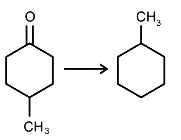
A
$Zn-Hg / \text{Conc. } HCl$
B
$i. H_2NNH_2, ii. NaOH \text{ in ethylene glycol, } \Delta$
C
$i. HSCH_2CH_2SH / H^{\oplus}, ii. H_2 / Ni$
D
Bromine water
Solution
(A, B, C) The given reaction is the reduction of a ketone (specifically $4$-methylcyclohexanone) to an alkane ($1$-methylcyclohexane). This involves the reduction of the carbonyl group $(-C=O)$ to a methylene group $(-CH_2-)$.
$A$. $Zn-Hg / \text{Conc. } HCl$ is the reagent for Clemmensen reduction.
$B$. $i. H_2NNH_2, ii. NaOH \text{ in ethylene glycol, } \Delta$ is the reagent for Wolff-Kishner reduction.
$C$. $i. HSCH_2CH_2SH / H^{\oplus}, ii. H_2 / Ni$ is the Mozingo reduction method.
All three methods $(A, B, C)$ are standard chemical reactions used to reduce a carbonyl group to a methylene group. Therefore,all these reagents can carry out the given conversion.
$A$. $Zn-Hg / \text{Conc. } HCl$ is the reagent for Clemmensen reduction.
$B$. $i. H_2NNH_2, ii. NaOH \text{ in ethylene glycol, } \Delta$ is the reagent for Wolff-Kishner reduction.
$C$. $i. HSCH_2CH_2SH / H^{\oplus}, ii. H_2 / Ni$ is the Mozingo reduction method.
All three methods $(A, B, C)$ are standard chemical reactions used to reduce a carbonyl group to a methylene group. Therefore,all these reagents can carry out the given conversion.
0 likesView Solution
40
ChemistryEasyMCQWBJEE · 2022
During the preparation of $NH_3$ in Haber's process,the promoter$(s)$ used is / are -
A
$PtO_2$
B
$Mo$
C
Mix of $Al_2O_3$ and $K_2O$
D
$Fe$ and $Mn$
Solution
(C) In the Haber's process for the synthesis of $NH_3$,$Fe$ is used as the catalyst.
$Mo$ was used as a promoter in earlier industrial processes.
Currently,a mixture of $K_2O$ and $Al_2O_3$ is used as the promoter to increase the efficiency of the catalyst.
$Mo$ was used as a promoter in earlier industrial processes.
Currently,a mixture of $K_2O$ and $Al_2O_3$ is used as the promoter to increase the efficiency of the catalyst.
0 likesView Solution
41
ChemistryEasyMCQWBJEE · 2022
The correct order of acidity of the following hydra acids is:
A
$HF > HCl > HBr > HI$
B
$HF < HCl < HBr < HI$
C
$HF < HCl > HBr > HI$
D
$HF > HCl < HBr > HI$
Solution
(B) The acidic strength of hydrohalic acids $(HX)$ depends on the bond dissociation enthalpy of the $H-X$ bond.
As we move down the group from $F$ to $I$,the atomic size increases,which leads to a decrease in the bond dissociation enthalpy of the $H-X$ bond.
Therefore,the ease of releasing $H^+$ ions increases,making the acidity increase in the order: $HF < HCl < HBr < HI$.
As we move down the group from $F$ to $I$,the atomic size increases,which leads to a decrease in the bond dissociation enthalpy of the $H-X$ bond.
Therefore,the ease of releasing $H^+$ ions increases,making the acidity increase in the order: $HF < HCl < HBr < HI$.
0 likesView Solution
42
ChemistryDifficultMCQWBJEE · 2022
To a solution of a colourless sodium salt,a solution of lead nitrate was added to form a white precipitate which dissolves in warm water and reprecipitates on cooling. Which of the following acid radicals is present in the salt?
A
$Cl^{-}$
B
$SO_4^{2-}$
C
$S^{2-}$
D
$NO_3^{-}$
Solution
(A) The reaction of lead nitrate with a chloride salt produces lead$(II)$ chloride,which is a white precipitate.
$Pb^{2+} (aq) + 2Cl^{-} (aq) \rightarrow PbCl_2 (s) \text{ (white precipitate)}$
Lead$(II)$ chloride $(PbCl_2)$ is sparingly soluble in cold water but dissolves significantly in hot water.
Upon cooling,the solubility decreases,and the lead$(II)$ chloride reprecipitates as needle-like crystals.
Therefore,the acid radical present is the chloride ion $(Cl^{-})$.
$Pb^{2+} (aq) + 2Cl^{-} (aq) \rightarrow PbCl_2 (s) \text{ (white precipitate)}$
Lead$(II)$ chloride $(PbCl_2)$ is sparingly soluble in cold water but dissolves significantly in hot water.
Upon cooling,the solubility decreases,and the lead$(II)$ chloride reprecipitates as needle-like crystals.
Therefore,the acid radical present is the chloride ion $(Cl^{-})$.
0 likesView Solution
43
ChemistryEasyMCQWBJEE · 2022
The number of atoms in body-centred and face-centred cubic unit cells are,respectively:
A
$2$ and $4$
B
$4$ and $3$
C
$1$ and $2$
D
$4$ and $6$
Solution
(A) For a body-centred cubic $(BCC)$ unit cell:
$Z_{BCC} = (\frac{1}{8} \times 8) + 1 = 1 + 1 = 2$
For a face-centred cubic $(FCC)$ unit cell:
$Z_{FCC} = (\frac{1}{8} \times 8) + (\frac{1}{2} \times 6) = 1 + 3 = 4$
Therefore,the number of atoms are $2$ and $4$ respectively.
$Z_{BCC} = (\frac{1}{8} \times 8) + 1 = 1 + 1 = 2$
For a face-centred cubic $(FCC)$ unit cell:
$Z_{FCC} = (\frac{1}{8} \times 8) + (\frac{1}{2} \times 6) = 1 + 3 = 4$
Therefore,the number of atoms are $2$ and $4$ respectively.
0 likesView Solution
44
ChemistryMediumMCQWBJEE · 2022
Pick the correct statement.
A
Relative lowering of vapour pressure is independent of $T$.
B
Osmotic pressure always depends on the nature of solute.
C
Elevation of boiling point is independent of nature of the solvent.
D
Lowering of freezing point is proportional to the molar concentration of solute.
Solution
(A) The relative lowering of vapour pressure is given by $\frac{\Delta P}{P^{\circ}} = x_{solute}$.
Since the mole fraction $(x_{solute})$ is a dimensionless quantity and does not change with temperature,the relative lowering of vapour pressure is independent of $T$.
Option $A$ is correct.
Option $B$ is incorrect because osmotic pressure is a colligative property and depends on the number of particles,not the nature of the solute.
Option $C$ is incorrect because elevation of boiling point depends on the molal elevation constant $(K_b)$,which is a characteristic property of the solvent.
Option $D$ is incorrect because the lowering of freezing point is proportional to the molality $(m)$ of the solute,not the molar concentration (molarity).
Since the mole fraction $(x_{solute})$ is a dimensionless quantity and does not change with temperature,the relative lowering of vapour pressure is independent of $T$.
Option $A$ is correct.
Option $B$ is incorrect because osmotic pressure is a colligative property and depends on the number of particles,not the nature of the solute.
Option $C$ is incorrect because elevation of boiling point depends on the molal elevation constant $(K_b)$,which is a characteristic property of the solvent.
Option $D$ is incorrect because the lowering of freezing point is proportional to the molality $(m)$ of the solute,not the molar concentration (molarity).
0 likesView Solution
Vedclass Products
For Students
Vedclass Test Series
Mock tests in real WBJEE style covering Chemistry with performance analysis. 5-day free trial.
Start Free TrialFor Teachers
Exam Paper Generator
Generate Set A/B/C/D Chemistry papers from 7.5L+ questions in 2 minutes. 3 chapters free.
Try FreeFor Institutes
Online Exam Module
Run live WBJEE mock exams with unlimited students, 360° analytics & white-label branding.
See DemoFrequently Asked Questions
How many Chemistry questions are in WBJEE 2022?
There are 44 Chemistry questions from the WBJEE 2022 paper on Vedclass, each with a detailed step-by-step solution in English.
Are WBJEE 2022 Chemistry solutions available in English?
Yes. All solutions on this page are in English. You can also switch to English or Hindi using the language buttons above the questions.
Can I practice WBJEE 2022 Chemistry as a timed test?
Yes. Use the Vedclass Test Series to attempt a full WBJEE mock test covering Chemistry with time limits and instant score analysis.
Can teachers create Chemistry papers from WBJEE previous year questions?
Yes. The Vedclass Exam Paper Generator lets teachers mix WBJEE Chemistry questions and generate Set A/B/C/D papers in minutes.
For Teachers & Institutes
Build a Custom Chemistry Paper
Pick WBJEE 2022 Chemistry questions, set difficulty, and generate Set A/B/C/D in 2 minutes.