
ChemistryQ1–40 of 40 questions
Page 1 of 1 · English
1
ChemistryMediumMCQWBJEE · 2023
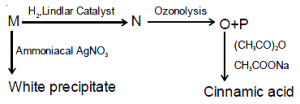
Identify the structure of $M$ based on the following reaction scheme:
A
$Ph-C \equiv CH$
B
$Ph-C \equiv C-CH_3$
C
$H_3C-C \equiv CH$
D
$H_3C-C \equiv C-CH_3$
Solution
(A) $1$. Compound $M$ reacts with ammoniacal $AgNO_3$ to give a white precipitate,which indicates that $M$ is a terminal alkyne $(R-C \equiv CH)$.
$2$. $M$ undergoes hydrogenation with $H_2$ and Lindlar catalyst to form $N$,which is an alkene.
$3$. $N$ undergoes ozonolysis to give $O$ and $P$. $O$ (benzaldehyde,$Ph-CHO$) reacts with $(CH_3CO)_2O$ and $CH_3COONa$ (Perkin's condensation) to form cinnamic acid $(Ph-CH=CH-COOH)$.
$4$. Based on the reaction sequence,$M$ must be phenylacetylene $(Ph-C \equiv CH)$.
$5$. $Ph-C \equiv CH + H_2 \xrightarrow{Lindlar} Ph-CH=CH_2$ $(N)$.
$6$. $Ph-CH=CH_2 \xrightarrow{O_3} Ph-CHO$ $(O)$ + $HCHO$ $(P)$.
$7$. Thus,$M$ is $Ph-C \equiv CH$.
$2$. $M$ undergoes hydrogenation with $H_2$ and Lindlar catalyst to form $N$,which is an alkene.
$3$. $N$ undergoes ozonolysis to give $O$ and $P$. $O$ (benzaldehyde,$Ph-CHO$) reacts with $(CH_3CO)_2O$ and $CH_3COONa$ (Perkin's condensation) to form cinnamic acid $(Ph-CH=CH-COOH)$.
$4$. Based on the reaction sequence,$M$ must be phenylacetylene $(Ph-C \equiv CH)$.
$5$. $Ph-C \equiv CH + H_2 \xrightarrow{Lindlar} Ph-CH=CH_2$ $(N)$.
$6$. $Ph-CH=CH_2 \xrightarrow{O_3} Ph-CHO$ $(O)$ + $HCHO$ $(P)$.
$7$. Thus,$M$ is $Ph-C \equiv CH$.
0 likesView Solution
2
ChemistryDifficultMCQWBJEE · 2023
The molecular shapes of $SF_4$,$CF_4$ and $XeF_4$ are
A
the same with $2, 0$ and $1$ lone pairs of electrons on the central atoms,respectively.
B
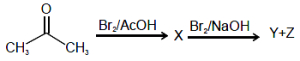
the same with $1, 1$ and $1$ lone pairs of electrons on the central atoms,respectively
C
different with $0, 1$ and $2$ lone pairs of electrons on the central atoms,respectively
D
different with $1, 0$ and $2$ lone pairs of electrons on the central atoms,respectively
Solution
(D) To determine the molecular shapes and lone pairs ($L$.$P$.) on the central atoms:
$1$. For $SF_4$: The central atom $S$ has $6$ valence electrons. It forms $4$ bonds with $F$ atoms,leaving $1$ lone pair. The shape is see-saw.
$2$. For $CF_4$: The central atom $C$ has $4$ valence electrons. It forms $4$ bonds with $F$ atoms,leaving $0$ lone pairs. The shape is tetrahedral.
$3$. For $XeF_4$: The central atom $Xe$ has $8$ valence electrons. It forms $4$ bonds with $F$ atoms,leaving $2$ lone pairs. The shape is square planar.
Thus,the shapes are different with $1, 0$ and $2$ lone pairs of electrons on the central atoms,respectively.
$1$. For $SF_4$: The central atom $S$ has $6$ valence electrons. It forms $4$ bonds with $F$ atoms,leaving $1$ lone pair. The shape is see-saw.
$2$. For $CF_4$: The central atom $C$ has $4$ valence electrons. It forms $4$ bonds with $F$ atoms,leaving $0$ lone pairs. The shape is tetrahedral.
$3$. For $XeF_4$: The central atom $Xe$ has $8$ valence electrons. It forms $4$ bonds with $F$ atoms,leaving $2$ lone pairs. The shape is square planar.
Thus,the shapes are different with $1, 0$ and $2$ lone pairs of electrons on the central atoms,respectively.
0 likesView Solution
3
ChemistryEasyMCQWBJEE · 2023
The species in which the nitrogen atom is in a state of $sp$ hybridisation is
A
$NO_3^{-}$
B
$NO_2$
C
$NO_2^{+}$
D
$NO_2^{-}$
Solution
(C) The hybridisation of an atom can be determined by calculating the steric number $(SN)$:
$SN = \frac{1}{2} [V + M - C + A]$
Where $V$ is the number of valence electrons of the central atom,$M$ is the number of monovalent atoms,$C$ is the cationic charge,and $A$ is the anionic charge.
For $NO_2^{+}$:
$V = 5$ (nitrogen),$M = 0$,$C = 1$,$A = 0$.
$SN = \frac{1}{2} [5 + 0 - 1 + 0] = \frac{4}{2} = 2$.
$A$ steric number of $2$ corresponds to $sp$ hybridisation.
Therefore,the nitrogen atom in $NO_2^{+}$ is $sp$ hybridised.
$SN = \frac{1}{2} [V + M - C + A]$
Where $V$ is the number of valence electrons of the central atom,$M$ is the number of monovalent atoms,$C$ is the cationic charge,and $A$ is the anionic charge.
For $NO_2^{+}$:
$V = 5$ (nitrogen),$M = 0$,$C = 1$,$A = 0$.
$SN = \frac{1}{2} [5 + 0 - 1 + 0] = \frac{4}{2} = 2$.
$A$ steric number of $2$ corresponds to $sp$ hybridisation.
Therefore,the nitrogen atom in $NO_2^{+}$ is $sp$ hybridised.
0 likesView Solution
4
ChemistryMediumMCQWBJEE · 2023
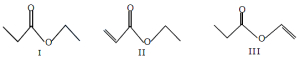
The correct order of $C=O$ bond length in ethyl propanoate $(I)$,ethyl propenoate $(II)$ and ethenyl propanoate $(III)$ is
A
$I > II > III$
B
$III > II > I$
C
$I > III > II$
D
$II > I > III$
Solution
(B) The bond length of the $C=O$ bond depends on the extent of resonance. Greater resonance character increases the single bond character of the $C=O$ bond,thereby increasing its bond length.
$I$: Ethyl propanoate has no conjugation with the $C=O$ group.
$II$: Ethyl propenoate has conjugation between the $C=C$ double bond and the $C=O$ group,which increases the single bond character of $C=O$.
$III$: Ethenyl propanoate has conjugation between the lone pair of the oxygen atom and the $C=O$ group (back-bonding),which significantly increases the single bond character of $C=O$.
Comparing the resonance effects:
In $III$,the lone pair on the oxygen atom is directly conjugated with the $C=O$ group,leading to a strong resonance effect that makes the $C=O$ bond more like a single bond.
In $II$,the $C=C$ double bond is conjugated with the $C=O$ group.
In $I$,there is no such conjugation.
Thus,the extent of single bond character is $III > II > I$.
Therefore,the order of $C=O$ bond length is $III > II > I$.
$I$: Ethyl propanoate has no conjugation with the $C=O$ group.
$II$: Ethyl propenoate has conjugation between the $C=C$ double bond and the $C=O$ group,which increases the single bond character of $C=O$.
$III$: Ethenyl propanoate has conjugation between the lone pair of the oxygen atom and the $C=O$ group (back-bonding),which significantly increases the single bond character of $C=O$.
Comparing the resonance effects:
In $III$,the lone pair on the oxygen atom is directly conjugated with the $C=O$ group,leading to a strong resonance effect that makes the $C=O$ bond more like a single bond.
In $II$,the $C=C$ double bond is conjugated with the $C=O$ group.
In $I$,there is no such conjugation.
Thus,the extent of single bond character is $III > II > I$.
Therefore,the order of $C=O$ bond length is $III > II > I$.
0 likesView Solution
5
ChemistryEasyMCQWBJEE · 2023
Suppose a gaseous mixture of $He$,$Ne$,$Ar$ and $Kr$ is treated with photons of the frequency appropriate to ionize $Ar$. What ion$(s)$ will be present in the mixture?
A
$Ar^{+}$
B
$Ar^{+}, Kr^{+}$
C
$Ar^{+}, He^{+}, Ne^{+}$
D
$He^{+}, Ar^{+}, Kr^{+}$
Solution
(B) The ionization energy order for the given noble gases is $He > Ne > Ar > Kr$.
Since the energy of the photon is sufficient to ionize $Ar$,it will also be sufficient to ionize $Kr$ because the ionization energy of $Kr$ is lower than that of $Ar$.
However,the energy is not sufficient to ionize $He$ or $Ne$ as they have higher ionization energies than $Ar$.
Therefore,the ions present in the mixture will be $Ar^{+}$ and $Kr^{+}$.
Since the energy of the photon is sufficient to ionize $Ar$,it will also be sufficient to ionize $Kr$ because the ionization energy of $Kr$ is lower than that of $Ar$.
However,the energy is not sufficient to ionize $He$ or $Ne$ as they have higher ionization energies than $Ar$.
Therefore,the ions present in the mixture will be $Ar^{+}$ and $Kr^{+}$.
0 likesView Solution
6
ChemistryDifficultMCQWBJEE · 2023
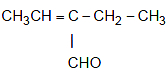
The $IUPAC$ name of the compound shown below is:
A
$3-$Formylpent$-2-$ene
B
$2-$Ethylbut$-2-$enal
C
$3-$Ethylbut$-3-$enal
D
$2-$Ethylcrotonaldehyde
Solution
(B) $1$. Identify the principal functional group: The aldehyde group $(-CHO)$ has the highest priority and must be assigned the lowest possible number,so it is at position $1$.
$2$. Select the longest carbon chain containing the principal functional group and the double bond: The chain starting from the aldehyde carbon $(C-1)$ through the double bond gives a $4-$carbon chain (but$-2-$enal).
$3$. Number the chain: The aldehyde carbon is $C-1$,the carbon with the double bond is $C-2$,the next is $C-3$,and the terminal methyl is $C-4$.
$4$. Identify substituents: There is an ethyl group $(-CH_2CH_3)$ attached to $C-2$.
$5$. Combine: The $IUPAC$ name is $2-$ethylbut$-2-$enal.
$2$. Select the longest carbon chain containing the principal functional group and the double bond: The chain starting from the aldehyde carbon $(C-1)$ through the double bond gives a $4-$carbon chain (but$-2-$enal).
$3$. Number the chain: The aldehyde carbon is $C-1$,the carbon with the double bond is $C-2$,the next is $C-3$,and the terminal methyl is $C-4$.
$4$. Identify substituents: There is an ethyl group $(-CH_2CH_3)$ attached to $C-2$.
$5$. Combine: The $IUPAC$ name is $2-$ethylbut$-2-$enal.
0 likesView Solution
7
ChemistryMediumMCQWBJEE · 2023
The correct stability order of the following carbocations is:
$I$. $H_2C^+-CH=CH-CH_3$
$II$. $H_2C^+-CH=CH-BMe_2$
$III$. $H_2C^+-CH=CH-NMe_2$
$IV$. $H_2C^+-CH=CH-OMe$
$I$. $H_2C^+-CH=CH-CH_3$
$II$. $H_2C^+-CH=CH-BMe_2$
$III$. $H_2C^+-CH=CH-NMe_2$
$IV$. $H_2C^+-CH=CH-OMe$
A
$II > I > III > IV$
B
$III > I > II > IV$
C
$III > IV > I > II$
D
$IV > III > II > I$
Solution
(C) The stability of carbocations is determined by the electron-donating or electron-withdrawing nature of the substituents attached to the conjugated system.
$1$. In $III$ and $IV$,the groups $-NMe_2$ and $-OMe$ show a strong $+R$ (resonance) effect,which stabilizes the carbocation significantly.
$2$. Since nitrogen is less electronegative than oxygen,the lone pair on $N$ is more easily donated,making $-NMe_2$ a stronger $+R$ group than $-OMe$. Thus,$III > IV$.
$3$. In $I$,the $-CH_3$ group shows a weak $+I$ (inductive) effect and hyperconjugation,providing moderate stability.
$4$. In $II$,the $-BMe_2$ group has an empty $p$-orbital and shows a $-R$ effect,which destabilizes the carbocation.
$5$. Therefore,the correct stability order is $III > IV > I > II$.
$1$. In $III$ and $IV$,the groups $-NMe_2$ and $-OMe$ show a strong $+R$ (resonance) effect,which stabilizes the carbocation significantly.
$2$. Since nitrogen is less electronegative than oxygen,the lone pair on $N$ is more easily donated,making $-NMe_2$ a stronger $+R$ group than $-OMe$. Thus,$III > IV$.
$3$. In $I$,the $-CH_3$ group shows a weak $+I$ (inductive) effect and hyperconjugation,providing moderate stability.
$4$. In $II$,the $-BMe_2$ group has an empty $p$-orbital and shows a $-R$ effect,which destabilizes the carbocation.
$5$. Therefore,the correct stability order is $III > IV > I > II$.
0 likesView Solution
8
ChemistryMediumMCQWBJEE · 2023
Select the molecule in which all the atoms may lie on a single plane.
A
$4-$Nitrobenzaldehyde
B
$4-$Methoxybenzaldehyde
C
$4-$Methylnitrobenzene
D
$4-$Nitroacetophenone
Solution
(A) For all atoms to lie in a single plane,all carbon atoms and the atoms attached to the benzene ring must be $sp^2$ hybridized to maintain planarity through conjugation.
In $4-$Nitrobenzaldehyde $(O_2N-C_6H_4-CHO)$,the benzene ring,the nitro group $(-NO_2)$,and the aldehyde group $(-CHO)$ are all $sp^2$ hybridized.
The conjugation extends throughout the molecule,allowing all atoms (including the hydrogen of the aldehyde group) to lie in the same plane.
In other options,groups like $-OCH_3$ (in $4-$Methoxybenzaldehyde),$-CH_3$ (in $4-$Methylnitrobenzene),and $-COCH_3$ (in $4-$Nitroacetophenone) contain $sp^3$ hybridized carbon atoms,which possess tetrahedral geometry and prevent all atoms from lying in a single plane.
In $4-$Nitrobenzaldehyde $(O_2N-C_6H_4-CHO)$,the benzene ring,the nitro group $(-NO_2)$,and the aldehyde group $(-CHO)$ are all $sp^2$ hybridized.
The conjugation extends throughout the molecule,allowing all atoms (including the hydrogen of the aldehyde group) to lie in the same plane.
In other options,groups like $-OCH_3$ (in $4-$Methoxybenzaldehyde),$-CH_3$ (in $4-$Methylnitrobenzene),and $-COCH_3$ (in $4-$Nitroacetophenone) contain $sp^3$ hybridized carbon atoms,which possess tetrahedral geometry and prevent all atoms from lying in a single plane.
0 likesView Solution
9
ChemistryDifficultMCQWBJEE · 2023
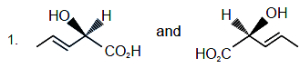
The relationship between the pair of compounds shown below is respectively:
A
enantiomer,diastereomer,diastereomer
B
enantiomer,enantiomer,diastereomer
C
enantiomer,homomer (identical),diastereomer
D
homomer (identical),diastereomer,geometrical isomer
Solution
(B) The given pair of compounds are non-superimposable mirror images of each other.
By assigning $R/S$ configurations using the Cahn-Ingold-Prelog $(CIP)$ priority rules:
$1$. The priority order is $-OH > -CO_2H > -CH=CH-CH_3 > -H$.
$2$. In the first structure,the configuration is $R$.
$3$. In the second structure,the configuration is $S$.
Since they are mirror images and have opposite configurations at the chiral center,they are enantiomers.
By assigning $R/S$ configurations using the Cahn-Ingold-Prelog $(CIP)$ priority rules:
$1$. The priority order is $-OH > -CO_2H > -CH=CH-CH_3 > -H$.
$2$. In the first structure,the configuration is $R$.
$3$. In the second structure,the configuration is $S$.
Since they are mirror images and have opposite configurations at the chiral center,they are enantiomers.
0 likesView Solution
10
ChemistryDifficultMCQWBJEE · 2023
The conversion$(s)$ that can be carried out by bromine in carbon tetrachloride $(CCl_4)$ solvent is/are:
A
$PhCH=CHCH_3 \rightarrow PhCHBrCHBrCH_3$
B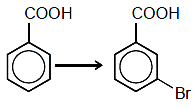
C
$CH_3CH_2COOH \rightarrow CH_3CHBrCOOH$
D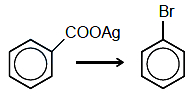
Solution
(A, D) The reaction of $Br_2$ in $CCl_4$ is typically used for the electrophilic addition to alkenes.
$(A)$ $PhCH=CHCH_3 + Br_2 \xrightarrow{CCl_4} PhCHBrCHBrCH_3$. This is a standard addition reaction.
$(B)$ Bromination of benzoic acid requires a Lewis acid catalyst like $FeBr_3$ and is not achieved by $Br_2/CCl_4$ alone.
$(C)$ $CH_3CH_2COOH \rightarrow CH_3CHBrCOOH$ is the Hell-Volhard-Zelinsky $(HVZ)$ reaction,which requires $Br_2$ and red phosphorus $(P)$.
$(D)$ The conversion of silver benzoate to bromobenzene is the Borodine-Hunsdiecker reaction,which uses $Br_2$ in $CCl_4$ under reflux conditions.
Therefore,the conversions that can be carried out by $Br_2$ in $CCl_4$ are $(A)$ and $(D)$.
$(A)$ $PhCH=CHCH_3 + Br_2 \xrightarrow{CCl_4} PhCHBrCHBrCH_3$. This is a standard addition reaction.
$(B)$ Bromination of benzoic acid requires a Lewis acid catalyst like $FeBr_3$ and is not achieved by $Br_2/CCl_4$ alone.
$(C)$ $CH_3CH_2COOH \rightarrow CH_3CHBrCOOH$ is the Hell-Volhard-Zelinsky $(HVZ)$ reaction,which requires $Br_2$ and red phosphorus $(P)$.
$(D)$ The conversion of silver benzoate to bromobenzene is the Borodine-Hunsdiecker reaction,which uses $Br_2$ in $CCl_4$ under reflux conditions.
Therefore,the conversions that can be carried out by $Br_2$ in $CCl_4$ are $(A)$ and $(D)$.
0 likesView Solution
11
ChemistryDifficultMCQWBJEE · 2023
Which of the following mixtures act$(s)$ as a buffer solution?
A
$NaOH + CH_3COOH$ ($1:1$ mole ratio)
B
$NH_4OH + HCl$ ($2:1$ mole ratio)
C
$CH_3COOH + NaOH$ ($2:1$ mole ratio)
D
$CH_3COOH + NaOH$ ($1:2$ mole ratio)
Solution
(B, C) buffer solution is formed by a mixture of a weak acid and its salt with a strong base,or a weak base and its salt with a strong acid.
Option $B$: $NH_4OH$ (weak base) + $HCl$ (strong acid) in $2:1$ mole ratio results in $NH_4Cl$ (salt) and remaining $NH_4OH$. This forms a basic buffer.
Option $C$: $CH_3COOH$ (weak acid) + $NaOH$ (strong base) in $2:1$ mole ratio results in $CH_3COONa$ (salt) and remaining $CH_3COOH$. This forms an acidic buffer.
Both $B$ and $C$ act as buffer solutions.
Option $B$: $NH_4OH$ (weak base) + $HCl$ (strong acid) in $2:1$ mole ratio results in $NH_4Cl$ (salt) and remaining $NH_4OH$. This forms a basic buffer.
Option $C$: $CH_3COOH$ (weak acid) + $NaOH$ (strong base) in $2:1$ mole ratio results in $CH_3COONa$ (salt) and remaining $CH_3COOH$. This forms an acidic buffer.
Both $B$ and $C$ act as buffer solutions.
0 likesView Solution
12
ChemistryEasyMCQWBJEE · 2023
$BrF_3$ self-ionizes as follows:
A
$2 BrF_3 \rightleftharpoons BrF_4^+ + BrF_2^-$
B
$2 BrF_3 \rightleftharpoons BrF_2^+ + BrF_4^-$
C
$2 BrF_3 \rightleftharpoons BrF_4^+ + BrF_2^+$
D
$2 BrF_3 \rightleftharpoons BrF_3^+ + BrF_3^-$
Solution
(B) The self-ionization of interhalogen compounds like $BrF_3$ occurs through the transfer of a fluoride ion $(F^-)$.
The reaction is represented as: $2 BrF_3 \rightleftharpoons BrF_2^+ + BrF_4^-$.
Here,$BrF_3$ acts as both an acid and a base,forming the $BrF_2^+$ cation and the $BrF_4^-$ anion.
The reaction is represented as: $2 BrF_3 \rightleftharpoons BrF_2^+ + BrF_4^-$.
Here,$BrF_3$ acts as both an acid and a base,forming the $BrF_2^+$ cation and the $BrF_4^-$ anion.
0 likesView Solution
13
ChemistryEasyMCQWBJEE · 2023
The equivalent weight of $KIO_3$ in the given reaction is ($M=$ molecular mass) :
$2 Cr(OH)_3 + 4 OH^{-} + KIO_3 \rightarrow 2 CrO_4^{2-} + 5 H_2O + KI$
$2 Cr(OH)_3 + 4 OH^{-} + KIO_3 \rightarrow 2 CrO_4^{2-} + 5 H_2O + KI$
A
$M$
B
$M / 2$
C
$M / 6$
D
$M / 8$
Solution
(C) In the given reaction: $2 Cr(OH)_3 + 4 OH^{-} + KIO_3 \rightarrow 2 CrO_4^{2-} + 5 H_2O + KI$
The oxidation state of iodine in $KIO_3$ changes from $+5$ to $-1$ in $KI$.
The change in oxidation state of iodine is $|5 - (-1)| = 6$.
The equivalent weight of an oxidizing agent is given by the formula: $\text{Equivalent weight} = \frac{\text{Molecular mass}}{\text{Change in oxidation state}}$.
Therefore,the equivalent weight of $KIO_3 = M / 6$.
The oxidation state of iodine in $KIO_3$ changes from $+5$ to $-1$ in $KI$.
The change in oxidation state of iodine is $|5 - (-1)| = 6$.
The equivalent weight of an oxidizing agent is given by the formula: $\text{Equivalent weight} = \frac{\text{Molecular mass}}{\text{Change in oxidation state}}$.
Therefore,the equivalent weight of $KIO_3 = M / 6$.
0 likesView Solution
14
ChemistryEasyMCQWBJEE · 2023
$Na_2CO_3$ is prepared by the Solvay process,but $K_2CO_3$ cannot be prepared by the same process because:
A
$K_2CO_3$ is highly soluble in $H_2O$
B
$KHCO_3$ is sparingly soluble
C
$KHCO_3$ is appreciably soluble
D
$KHCO_3$ decomposes
Solution
(C) In the Solvay process,$NaHCO_3$ is precipitated because it is sparingly soluble in water and can be easily separated by filtration.
However,in the case of potassium,the reaction is: $(NH_4)HCO_3 + KCl \longrightarrow KHCO_3(aq) + NH_4Cl(aq)$.
Since $KHCO_3$ is appreciably soluble in water,it does not precipitate out of the solution.
Therefore,it cannot be isolated from the reaction medium to be converted into $K_2CO_3$ by heating.
However,in the case of potassium,the reaction is: $(NH_4)HCO_3 + KCl \longrightarrow KHCO_3(aq) + NH_4Cl(aq)$.
Since $KHCO_3$ is appreciably soluble in water,it does not precipitate out of the solution.
Therefore,it cannot be isolated from the reaction medium to be converted into $K_2CO_3$ by heating.
0 likesView Solution
15
ChemistryEasyMCQWBJEE · 2023
Arrange the following in order of increasing mass:
$I$. $1$ mole of $N_2$
$II$. $0.5$ mole of $O_3$
$III$. $3.011 \times 10^{23}$ molecules of $O_2$
$IV$. $0.5$ gram atom of $O$
$I$. $1$ mole of $N_2$
$II$. $0.5$ mole of $O_3$
$III$. $3.011 \times 10^{23}$ molecules of $O_2$
$IV$. $0.5$ gram atom of $O$
A
$IV < III < II < I$
B
$IV < I < III < II$
C
$III < II < IV < I$
D
$I < III < II < IV$
Solution
(A) Calculate the mass of each substance:
$I$. $1$ mole of $N_2 = 1 \times 28 \ g = 28 \ g$
$II$. $0.5$ mole of $O_3 = 0.5 \times 48 \ g = 24 \ g$
$III$. $3.011 \times 10^{23}$ molecules of $O_2 = 0.5$ mole of $O_2 = 0.5 \times 32 \ g = 16 \ g$
$IV$. $0.5$ gram atom of $O = 0.5 \times 16 \ g = 8 \ g$
Comparing the masses: $8 \ g < 16 \ g < 24 \ g < 28 \ g$.
Thus,the order of increasing mass is $IV < III < II < I$.
$I$. $1$ mole of $N_2 = 1 \times 28 \ g = 28 \ g$
$II$. $0.5$ mole of $O_3 = 0.5 \times 48 \ g = 24 \ g$
$III$. $3.011 \times 10^{23}$ molecules of $O_2 = 0.5$ mole of $O_2 = 0.5 \times 32 \ g = 16 \ g$
$IV$. $0.5$ gram atom of $O = 0.5 \times 16 \ g = 8 \ g$
Comparing the masses: $8 \ g < 16 \ g < 24 \ g < 28 \ g$.
Thus,the order of increasing mass is $IV < III < II < I$.
0 likesView Solution
16
ChemistryMediumMCQWBJEE · 2023
The root mean square (rms) speed of $X_2$ gas is $x \ m/s$ at a given temperature. When the temperature is doubled,the $X_2$ molecules dissociate completely into atoms. The root mean square speed of the sample of gas then becomes (in $m/s$):
A
$x / 2$
B
$x$
C
$2x$
D
$4x$
Solution
(C) The formula for root mean square speed is $C_{rms} = \sqrt{\frac{3RT}{M}}$.
Initially,for $X_2$ gas at temperature $T$,$C_1 = x = \sqrt{\frac{3RT}{M_{X_2}}}$.
When temperature is doubled $(T_2 = 2T)$ and $X_2$ dissociates into $2X$,the molar mass becomes $M_2 = \frac{M_{X_2}}{2}$.
The new rms speed $C_2$ is given by $C_2 = \sqrt{\frac{3R(2T)}{M_{X_2}/2}} = \sqrt{4 \times \frac{3RT}{M_{X_2}}} = 2 \times \sqrt{\frac{3RT}{M_{X_2}}}$.
Substituting $x$ for the initial speed,we get $C_2 = 2x \ m/s$.
Initially,for $X_2$ gas at temperature $T$,$C_1 = x = \sqrt{\frac{3RT}{M_{X_2}}}$.
When temperature is doubled $(T_2 = 2T)$ and $X_2$ dissociates into $2X$,the molar mass becomes $M_2 = \frac{M_{X_2}}{2}$.
The new rms speed $C_2$ is given by $C_2 = \sqrt{\frac{3R(2T)}{M_{X_2}/2}} = \sqrt{4 \times \frac{3RT}{M_{X_2}}} = 2 \times \sqrt{\frac{3RT}{M_{X_2}}}$.
Substituting $x$ for the initial speed,we get $C_2 = 2x \ m/s$.
0 likesView Solution
17
ChemistryMediumMCQWBJEE · 2023
Case $-1:$ An ideal gas of molecular weight $M$ at temperature $T$.
Case $-2:$ Another ideal gas of molecular weight $2M$ at temperature $T/2$.
Identify the correct statement in the context of the above two cases.
Case $-2:$ Another ideal gas of molecular weight $2M$ at temperature $T/2$.
Identify the correct statement in the context of the above two cases.
A
Average kinetic energy and average speed will be the same in the two cases
B
Both the averages are halved
C
Both the averages are doubled
D
Only average speed is halved in the second case
Solution
(B) The average kinetic energy $(KE_{avg})$ of an ideal gas is given by $\frac{3}{2}kT$. Since the temperature $T$ is halved in Case $-2$,the average kinetic energy is also halved.
The average speed $(C_{avg})$ is given by $\sqrt{\frac{8RT}{\pi M}}$.
For Case $-1$: $C_1 \propto \sqrt{\frac{T}{M}}$.
For Case $-2$: $C_2 \propto \sqrt{\frac{T/2}{2M}} = \sqrt{\frac{T}{4M}} = \frac{1}{2} \sqrt{\frac{T}{M}}$.
Thus,$C_2 = \frac{1}{2} C_1$.
Therefore,both the average kinetic energy and the average speed are halved in the second case.
The average speed $(C_{avg})$ is given by $\sqrt{\frac{8RT}{\pi M}}$.
For Case $-1$: $C_1 \propto \sqrt{\frac{T}{M}}$.
For Case $-2$: $C_2 \propto \sqrt{\frac{T/2}{2M}} = \sqrt{\frac{T}{4M}} = \frac{1}{2} \sqrt{\frac{T}{M}}$.
Thus,$C_2 = \frac{1}{2} C_1$.
Therefore,both the average kinetic energy and the average speed are halved in the second case.
0 likesView Solution
18
ChemistryMediumMCQWBJEE · 2023
Which statement$(s)$ is/are applicable above critical temperature?
A
$A$. $A$ gas cannot be liquified
B
$B$. Surface tension of a liquid is very high
C
$C$. $A$ liquid phase cannot be distinguished from a gas phase
D
$D$. Density changes continuously with $P$ or $V$
Solution
(A, C, D) Above the critical temperature $(T_c)$,a gas cannot be liquefied by the application of pressure alone.
At this temperature,the distinction between the liquid and gas phases disappears,meaning the liquid phase cannot be distinguished from the gas phase.
Furthermore,the density of the substance changes continuously with changes in pressure $(P)$ or volume $(V)$ as it exists as a supercritical fluid.
Therefore,statements $A$,$C$,and $D$ are applicable.
At this temperature,the distinction between the liquid and gas phases disappears,meaning the liquid phase cannot be distinguished from the gas phase.
Furthermore,the density of the substance changes continuously with changes in pressure $(P)$ or volume $(V)$ as it exists as a supercritical fluid.
Therefore,statements $A$,$C$,and $D$ are applicable.
0 likesView Solution
19
ChemistryMediumMCQWBJEE · 2023
Two base balls (masses: $m_1 = 100 \ g$ and $m_2 = 50 \ g$) are thrown. Both of them move with uniform velocity,but the velocity of $m_2$ is $1.5$ times that of $m_1$. The ratio of de Broglie wavelengths $\lambda(m_1) : \lambda(m_2)$ is given by
A
$4 : 3$
B
$3 : 4$
C
$2 : 1$
D
$1 : 2$
Solution
(B) The de Broglie wavelength is given by $\lambda = \frac{h}{mv}$.
Given: $m_1 = 100 \ g$,$m_2 = 50 \ g$,and $v_2 = 1.5 \ v_1$.
The ratio of wavelengths is $\frac{\lambda_1}{\lambda_2} = \frac{h / (m_1 v_1)}{h / (m_2 v_2)} = \frac{m_2 v_2}{m_1 v_1}$.
Substituting the values: $\frac{\lambda_1}{\lambda_2} = \frac{50 \times 1.5 \ v_1}{100 \times v_1} = \frac{75}{100} = \frac{3}{4}$.
Thus,the ratio is $3 : 4$.
Given: $m_1 = 100 \ g$,$m_2 = 50 \ g$,and $v_2 = 1.5 \ v_1$.
The ratio of wavelengths is $\frac{\lambda_1}{\lambda_2} = \frac{h / (m_1 v_1)}{h / (m_2 v_2)} = \frac{m_2 v_2}{m_1 v_1}$.
Substituting the values: $\frac{\lambda_1}{\lambda_2} = \frac{50 \times 1.5 \ v_1}{100 \times v_1} = \frac{75}{100} = \frac{3}{4}$.
Thus,the ratio is $3 : 4$.
0 likesView Solution
20
ChemistryMediumMCQWBJEE · 2023
An electron in the $5d$ orbital can be represented by the following $(n, l, m_l)$ values:
A
$(5, 2, 1)$
B
$(5, 1, -1)$
C
$(5, 0, 1)$
D
$(5, 2, -1)$
Solution
(A) For an electron in the $5d$ orbital,the principal quantum number $n = 5$ and the azimuthal quantum number $l = 2$ (since $s=0, p=1, d=2, f=3$).
The magnetic quantum number $m_l$ can take any integer value from $-l$ to $+l$,which is $-2, -1, 0, 1, 2$.
Both $(5, 2, 1)$ and $(5, 2, -1)$ are valid sets of quantum numbers for a $5d$ electron.
However,in multiple-choice questions of this type,if multiple options are mathematically valid,we select the one provided in the set. Since both $A$ and $D$ are valid,but $D$ is often cited in standard examples,we identify the valid range.
The magnetic quantum number $m_l$ can take any integer value from $-l$ to $+l$,which is $-2, -1, 0, 1, 2$.
Both $(5, 2, 1)$ and $(5, 2, -1)$ are valid sets of quantum numbers for a $5d$ electron.
However,in multiple-choice questions of this type,if multiple options are mathematically valid,we select the one provided in the set. Since both $A$ and $D$ are valid,but $D$ is often cited in standard examples,we identify the valid range.
0 likesView Solution
21
ChemistryMediumMCQWBJEE · 2023
At $STP$,the dissociation reaction of water is $H_2O \rightleftharpoons H^{+}(aq.) + OH^{-}(aq.)$,and the $pH$ of water is $7.0$. The change of standard free energy $(\Delta G^{\circ})$ for the above dissociation process is given by
A
$20301 \ cal / mol$
B
$19091 \ cal / mol$
C
$20096 \ cal / mol$
D
$21301 \ cal / mol$
Solution
(B) The dissociation constant of water at $STP$ $(298 \ K)$ is $K_w = [H^{+}][OH^{-}] = 10^{-7} \times 10^{-7} = 10^{-14}$.
The relation between standard free energy change and equilibrium constant is $\Delta G^{\circ} = -RT \ln K_w = -2.303 RT \log K_w$.
Given $R = 1.987 \ cal \ K^{-1} mol^{-1}$,$T = 298 \ K$,and $K_w = 10^{-14}$.
$\Delta G^{\circ} = -2.303 \times 1.987 \times 298 \times \log(10^{-14})$.
$\Delta G^{\circ} = -2.303 \times 1.987 \times 298 \times (-14)$.
$\Delta G^{\circ} = 2.303 \times 1.987 \times 298 \times 14 \approx 19091 \ cal / mol$.
The relation between standard free energy change and equilibrium constant is $\Delta G^{\circ} = -RT \ln K_w = -2.303 RT \log K_w$.
Given $R = 1.987 \ cal \ K^{-1} mol^{-1}$,$T = 298 \ K$,and $K_w = 10^{-14}$.
$\Delta G^{\circ} = -2.303 \times 1.987 \times 298 \times \log(10^{-14})$.
$\Delta G^{\circ} = -2.303 \times 1.987 \times 298 \times (-14)$.
$\Delta G^{\circ} = 2.303 \times 1.987 \times 298 \times 14 \approx 19091 \ cal / mol$.
0 likesView Solution
22
ChemistryDifficultMCQWBJEE · 2023
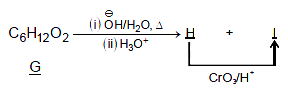
$G$ in the above sequence of reactions is
A
$\left(CH_3\right)_2 CHCOOCH_2 CH_3$
B
$CH_3 CH_2 CH_2 COOCH_2 CH_3$
C
$CH_3 CH_2 COOCH_2 CH_2 CH_3$
D
$CH_3 CH_2 COOCH\left(CH_3\right)_2$
Solution
(C) The reaction sequence involves the alkaline hydrolysis (saponification) of an ester $G$ $(C_6H_{12}O_2)$ to form an alcohol $(H)$ and a carboxylate salt,which upon acidification gives a carboxylic acid $(I)$.
$H$ is then oxidized by $CrO_3/H^+$ to form the same carboxylic acid $(I)$.
This indicates that the alcohol $H$ is a primary alcohol,which oxidizes to a carboxylic acid with the same number of carbon atoms.
Looking at the options,we need an ester that hydrolyzes into a primary alcohol and a carboxylic acid such that the alcohol can be oxidized to the acid.
Option $C$ is $CH_3CH_2COOCH_2CH_2CH_3$ (propyl propionate).
Hydrolysis: $CH_3CH_2COOCH_2CH_2CH_3 + OH^- \rightarrow CH_3CH_2COO^- + CH_3CH_2CH_2OH$.
Acidification: $CH_3CH_2COO^- + H^+ \rightarrow CH_3CH_2COOH$ (propanoic acid).
Oxidation of $H$ $(CH_3CH_2CH_2OH)$: $CH_3CH_2CH_2OH \xrightarrow{CrO_3/H^+} CH_3CH_2COOH$.
Since the acid formed from hydrolysis and the acid formed from oxidation of the alcohol must be the same for the cycle to work as shown,the ester must be $CH_3CH_2COOCH_2CH_2CH_3$.
$H$ is then oxidized by $CrO_3/H^+$ to form the same carboxylic acid $(I)$.
This indicates that the alcohol $H$ is a primary alcohol,which oxidizes to a carboxylic acid with the same number of carbon atoms.
Looking at the options,we need an ester that hydrolyzes into a primary alcohol and a carboxylic acid such that the alcohol can be oxidized to the acid.
Option $C$ is $CH_3CH_2COOCH_2CH_2CH_3$ (propyl propionate).
Hydrolysis: $CH_3CH_2COOCH_2CH_2CH_3 + OH^- \rightarrow CH_3CH_2COO^- + CH_3CH_2CH_2OH$.
Acidification: $CH_3CH_2COO^- + H^+ \rightarrow CH_3CH_2COOH$ (propanoic acid).
Oxidation of $H$ $(CH_3CH_2CH_2OH)$: $CH_3CH_2CH_2OH \xrightarrow{CrO_3/H^+} CH_3CH_2COOH$.
Since the acid formed from hydrolysis and the acid formed from oxidation of the alcohol must be the same for the cycle to work as shown,the ester must be $CH_3CH_2COOCH_2CH_2CH_3$.
0 likesView Solution
23
ChemistryDifficultMCQWBJEE · 2023
$L$ $\xrightarrow[(ii) H_3O^{\oplus}]{(i) PhMgBr} M$ $\xrightarrow{CrO_3 / H^{\oplus}} N$ $\xrightarrow{Ph_3P=CH_2} Ph_2C=CH_2$
$L$ in the above sequence of reaction is/are (where $L \neq M \neq N$)
$L$ in the above sequence of reaction is/are (where $L \neq M \neq N$)
A
Benzaldehyde
B
Methyl benzoate
C
Benzoyl chloride
D
Benzonitrile
Solution
(A) The final product is $Ph_2C=CH_2$ ($1$,$1$-diphenylethene).
The last step is a Wittig reaction: $N + Ph_3P=CH_2 \rightarrow Ph_2C=CH_2$. This implies $N$ must be benzophenone $(Ph_2C=O)$.
The step $M \xrightarrow{CrO_3 / H^{\oplus}} N$ is an oxidation of a secondary alcohol to a ketone. Thus,$M$ is diphenylmethanol $(Ph_2CHOH)$.
The first step is the Grignard reaction: $L \xrightarrow[(ii) H_3O^{\oplus}]{(i) PhMgBr} Ph_2CHOH$.
Benzaldehyde $(PhCHO)$ reacts with $PhMgBr$ followed by hydrolysis to give diphenylmethanol $(Ph_2CHOH)$.
Therefore,$L$ is benzaldehyde.
The last step is a Wittig reaction: $N + Ph_3P=CH_2 \rightarrow Ph_2C=CH_2$. This implies $N$ must be benzophenone $(Ph_2C=O)$.
The step $M \xrightarrow{CrO_3 / H^{\oplus}} N$ is an oxidation of a secondary alcohol to a ketone. Thus,$M$ is diphenylmethanol $(Ph_2CHOH)$.
The first step is the Grignard reaction: $L \xrightarrow[(ii) H_3O^{\oplus}]{(i) PhMgBr} Ph_2CHOH$.
Benzaldehyde $(PhCHO)$ reacts with $PhMgBr$ followed by hydrolysis to give diphenylmethanol $(Ph_2CHOH)$.
Therefore,$L$ is benzaldehyde.
0 likesView Solution
24
ChemistryEasyMCQWBJEE · 2023
The correct order of boiling points of $N$-ethylethanamine $(I)$,ethoxyethane $(II)$ and butan$-2-$ol $(III)$ is
A
$III < II < I$
B
$II < III < I$
C
$II < I < III$
D
$III < I < II$
Solution
(C) The boiling point depends on the strength of intermolecular forces.
$1$. Ethoxyethane $(II)$ is an ether,which exhibits only weak dipole-dipole interactions.
$2$. $N$-ethylethanamine $(I)$ is a secondary amine,which exhibits hydrogen bonding,but it is weaker than the hydrogen bonding in alcohols due to the lower electronegativity of $N$ compared to $O$.
$3$. Butan$-2-$ol $(III)$ is an alcohol,which exhibits strong intermolecular hydrogen bonding.
Therefore,the order of boiling points is $II < I < III$.
$1$. Ethoxyethane $(II)$ is an ether,which exhibits only weak dipole-dipole interactions.
$2$. $N$-ethylethanamine $(I)$ is a secondary amine,which exhibits hydrogen bonding,but it is weaker than the hydrogen bonding in alcohols due to the lower electronegativity of $N$ compared to $O$.
$3$. Butan$-2-$ol $(III)$ is an alcohol,which exhibits strong intermolecular hydrogen bonding.
Therefore,the order of boiling points is $II < I < III$.
0 likesView Solution
25
ChemistryEasyMCQWBJEE · 2023
For the reaction $A + B \rightarrow C$,we have the following data:
The order of the reaction with respect to $A$ and $B$ are:
| Initial concentration of $A$ $(M)$ | Initial concentration of $B$ $(M)$ | Initial Rate $(M \cdot s^{-1})$ |
| $1$ | $10$ | $100$ |
| $1$ | $1$ | $1$ |
| $10$ | $1$ | $10$ |
The order of the reaction with respect to $A$ and $B$ are:
A
Not possible to tell with the given data
B
First order with respect to both $A$ and $B$
C
First order with respect to $A$ and second order with respect to $B$
D
Second order with respect to $A$ and first order with respect to $B$
Solution
(C) Let the rate law be $Rate = k[A]^x[B]^y$.
From experiments $2$ and $3$ (where $[B]$ is constant):
$\frac{10}{1} = \frac{k(10)^x(1)^y}{k(1)^x(1)^y}$ $\Rightarrow 10 = 10^x$ $\Rightarrow x = 1$.
From experiments $1$ and $2$ (where $[A]$ is constant):
$\frac{100}{1} = \frac{k(1)^x(10)^y}{k(1)^x(1)^y}$ $\Rightarrow 100 = 10^y$ $\Rightarrow 10^2 = 10^y$ $\Rightarrow y = 2$.
Thus,the order with respect to $A$ is $1$ and with respect to $B$ is $2$.
From experiments $2$ and $3$ (where $[B]$ is constant):
$\frac{10}{1} = \frac{k(10)^x(1)^y}{k(1)^x(1)^y}$ $\Rightarrow 10 = 10^x$ $\Rightarrow x = 1$.
From experiments $1$ and $2$ (where $[A]$ is constant):
$\frac{100}{1} = \frac{k(1)^x(10)^y}{k(1)^x(1)^y}$ $\Rightarrow 100 = 10^y$ $\Rightarrow 10^2 = 10^y$ $\Rightarrow y = 2$.
Thus,the order with respect to $A$ is $1$ and with respect to $B$ is $2$.
0 likesView Solution
26
ChemistryMediumMCQWBJEE · 2023
If in the case of a radioisotope the value of half-life $(T_{1/2})$ and decay constant $(\lambda)$ are identical in magnitude,then their value should be
A
$0.693 / 2$
B
$(0.693)^{1/2}$
C
$(0.693)^2$
D
$0.693$
Solution
(B) The relationship between half-life $(T_{1/2})$ and decay constant $(\lambda)$ is given by: $T_{1/2} = \frac{0.693}{\lambda}$.
Given that the magnitudes are identical,let $T_{1/2} = \lambda = x$.
Substituting this into the equation: $x = \frac{0.693}{x}$.
This simplifies to: $x^2 = 0.693$.
Therefore,$x = \sqrt{0.693} = (0.693)^{1/2}$.
Given that the magnitudes are identical,let $T_{1/2} = \lambda = x$.
Substituting this into the equation: $x = \frac{0.693}{x}$.
This simplifies to: $x^2 = 0.693$.
Therefore,$x = \sqrt{0.693} = (0.693)^{1/2}$.
0 likesView Solution
27
ChemistryMediumMCQWBJEE · 2023
Which of the following would give a linear plot?
($k$ is the rate constant of an elementary reaction and $T$ is temperature in absolute scale)
($k$ is the rate constant of an elementary reaction and $T$ is temperature in absolute scale)
A
$k$ vs $T$
B
$k$ vs $1 / T$
C
$\ln k$ vs $T$
D
$\ln k$ vs $1 / T$
Solution
(D) The Arrhenius equation is given by:
$k = A e^{-E_a / RT}$
Taking the natural logarithm on both sides:
$\ln k = \ln A - \frac{E_a}{R} \left( \frac{1}{T} \right)$
This equation is in the form of a straight line equation $y = mx + c$,where:
$y = \ln k$
$x = \frac{1}{T}$
$m = -\frac{E_a}{R}$ (slope)
$c = \ln A$ (intercept)
Therefore,a plot of $\ln k$ versus $1 / T$ gives a linear plot with a slope of $-E_a / R$.
$k = A e^{-E_a / RT}$
Taking the natural logarithm on both sides:
$\ln k = \ln A - \frac{E_a}{R} \left( \frac{1}{T} \right)$
This equation is in the form of a straight line equation $y = mx + c$,where:
$y = \ln k$
$x = \frac{1}{T}$
$m = -\frac{E_a}{R}$ (slope)
$c = \ln A$ (intercept)
Therefore,a plot of $\ln k$ versus $1 / T$ gives a linear plot with a slope of $-E_a / R$.
0 likesView Solution
28
ChemistryMediumMCQWBJEE · 2023
The correct statement about the magnetic properties of $[Fe(CN)_6]^{3-}$ and $[FeF_6]^{3-}$ is
A
Both are paramagnetic
B
Both are diamagnetic
C
$[Fe(CN)_6]^{3-}$ is diamagnetic,$[FeF_6]^{3-}$ is paramagnetic
D
$[Fe(CN)_6]^{3-}$ is paramagnetic,$[FeF_6]^{3-}$ is diamagnetic
Solution
(A) In both complexes,the central metal ion is $Fe^{3+}$. The electronic configuration of $Fe^{3+}$ is $[Ar] 3d^5$.
For $[Fe(CN)_6]^{3-}$: $CN^-$ is a strong field ligand,which causes pairing of electrons in the $3d$ orbitals. This results in one unpaired electron $(t_{2g}^5 e_g^0)$,making it paramagnetic.
For $[FeF_6]^{3-}$: $F^-$ is a weak field ligand,which does not cause pairing of electrons. This results in five unpaired electrons $(t_{2g}^3 e_g^2)$,making it paramagnetic.
Therefore,both complexes are paramagnetic.
For $[Fe(CN)_6]^{3-}$: $CN^-$ is a strong field ligand,which causes pairing of electrons in the $3d$ orbitals. This results in one unpaired electron $(t_{2g}^5 e_g^0)$,making it paramagnetic.
For $[FeF_6]^{3-}$: $F^-$ is a weak field ligand,which does not cause pairing of electrons. This results in five unpaired electrons $(t_{2g}^3 e_g^2)$,making it paramagnetic.
Therefore,both complexes are paramagnetic.
0 likesView Solution
29
ChemistryMediumMCQWBJEE · 2023
Which of the following statements is incorrect?
A
$[VF_6]^{3-}$ is paramagnetic with $2$ unpaired electrons.
B
$[CuCl_4]^{2-}$ is paramagnetic with $1$ unpaired electron.
C
$[Co(NH_3)_6]^{3+}$ is diamagnetic.
D
$[CoF_6]^{3-}$ is paramagnetic with $2$ unpaired electrons.
Solution
(D) Let us analyze each complex:
$1$. In $[VF_6]^{3-}$,$V$ is in $+3$ oxidation state. $V^{3+}$ is $3d^2$. It has $2$ unpaired electrons,so it is paramagnetic. This statement is correct.
$2$. In $[CuCl_4]^{2-}$,$Cu$ is in $+2$ oxidation state. $Cu^{2+}$ is $3d^9$. It has $1$ unpaired electron,so it is paramagnetic. This statement is correct.
$3$. In $[Co(NH_3)_6]^{3+}$,$Co$ is in $+3$ oxidation state. $Co^{3+}$ is $3d^6$. $NH_3$ is a strong field ligand,causing pairing of electrons. All $6$ electrons are paired,so it is diamagnetic. This statement is correct.
$4$. In $[CoF_6]^{3-}$,$Co$ is in $+3$ oxidation state. $Co^{3+}$ is $3d^6$. $F^-$ is a weak field ligand,so no pairing occurs. The $3d$ orbitals have $4$ unpaired electrons. Thus,it is paramagnetic with $4$ unpaired electrons. The statement claiming $2$ unpaired electrons is incorrect.
$1$. In $[VF_6]^{3-}$,$V$ is in $+3$ oxidation state. $V^{3+}$ is $3d^2$. It has $2$ unpaired electrons,so it is paramagnetic. This statement is correct.
$2$. In $[CuCl_4]^{2-}$,$Cu$ is in $+2$ oxidation state. $Cu^{2+}$ is $3d^9$. It has $1$ unpaired electron,so it is paramagnetic. This statement is correct.
$3$. In $[Co(NH_3)_6]^{3+}$,$Co$ is in $+3$ oxidation state. $Co^{3+}$ is $3d^6$. $NH_3$ is a strong field ligand,causing pairing of electrons. All $6$ electrons are paired,so it is diamagnetic. This statement is correct.
$4$. In $[CoF_6]^{3-}$,$Co$ is in $+3$ oxidation state. $Co^{3+}$ is $3d^6$. $F^-$ is a weak field ligand,so no pairing occurs. The $3d$ orbitals have $4$ unpaired electrons. Thus,it is paramagnetic with $4$ unpaired electrons. The statement claiming $2$ unpaired electrons is incorrect.
0 likesView Solution
30
ChemistryMediumMCQWBJEE · 2023
Nickel combines with a uninegative monodentate ligand $(X^{-})$ to form a paramagnetic complex $[NiX_4]^{2-}$. The hybridisation involved and the number of unpaired electrons present in the complex are respectively:
A
$sp^3$,two
B
$dsp^2$,zero
C
$dsp^2$,one
D
$sp^3$,one
Solution
(A) The central metal ion is $Ni^{2+}$,which has an electronic configuration of $[Ar] 3d^8$.
Since the complex $[NiX_4]^{2-}$ is paramagnetic and has a coordination number of $4$,it adopts a tetrahedral geometry.
In a tetrahedral geometry,the hybridisation is $sp^3$.
For $Ni^{2+}$ $(3d^8)$,the $3d$ orbitals have two unpaired electrons.
Therefore,the hybridisation is $sp^3$ and the number of unpaired electrons is $2$.
Since the complex $[NiX_4]^{2-}$ is paramagnetic and has a coordination number of $4$,it adopts a tetrahedral geometry.
In a tetrahedral geometry,the hybridisation is $sp^3$.
For $Ni^{2+}$ $(3d^8)$,the $3d$ orbitals have two unpaired electrons.
Therefore,the hybridisation is $sp^3$ and the number of unpaired electrons is $2$.
0 likesView Solution
31
ChemistryMediumMCQWBJEE · 2023
$4f^2$ electronic configuration is found in
A
$Pr$
B
$Pr^{3+}$
C
$Nd^{3+}$
D
$Pm^{3+}$
Solution
(B) The atomic number of $Pr$ (Praseodymium) is $59$.
The electronic configuration of $Pr$ is $[Xe] 4f^3 6s^2$.
When $Pr$ forms a $Pr^{3+}$ ion,it loses three electrons (two from $6s$ and one from $4f$).
Therefore,the electronic configuration of $Pr^{3+}$ is $[Xe] 4f^2$.
The electronic configuration of $Pr$ is $[Xe] 4f^3 6s^2$.
When $Pr$ forms a $Pr^{3+}$ ion,it loses three electrons (two from $6s$ and one from $4f$).
Therefore,the electronic configuration of $Pr^{3+}$ is $[Xe] 4f^2$.
0 likesView Solution
32
ChemistryEasyMCQWBJEE · 2023
The equivalent conductance of $NaCl$,$HCl$,and $CH_{3}COONa$ at infinite dilution are $126.45$,$426.16$,and $91 \ \Omega^{-1} \ cm^{2} \ eq^{-1}$ respectively at $25^{\circ}C$. The equivalent conductance of acetic acid (at infinite dilution) would be:
A
$461.61 \ \Omega^{-1} \ cm^{2} \ eq^{-1}$
B
$390.71 \ \Omega^{-1} \ cm^{2} \ eq^{-1}$
C
Cannot be determined from the given data
D
$208.71 \ \Omega^{-1} \ cm^{2} \ eq^{-1}$
Solution
(B) According to Kohlrausch's law of independent migration of ions,the equivalent conductance at infinite dilution for acetic acid is given by:
$\wedge^{0}_{CH_{3}COOH} = \wedge^{0}_{CH_{3}COONa} + \wedge^{0}_{HCl} - \wedge^{0}_{NaCl}$
Substituting the given values:
$\wedge^{0}_{CH_{3}COOH} = 91 + 426.16 - 126.45$
$\wedge^{0}_{CH_{3}COOH} = 390.71 \ \Omega^{-1} \ cm^{2} \ eq^{-1}$
$\wedge^{0}_{CH_{3}COOH} = \wedge^{0}_{CH_{3}COONa} + \wedge^{0}_{HCl} - \wedge^{0}_{NaCl}$
Substituting the given values:
$\wedge^{0}_{CH_{3}COOH} = 91 + 426.16 - 126.45$
$\wedge^{0}_{CH_{3}COOH} = 390.71 \ \Omega^{-1} \ cm^{2} \ eq^{-1}$
0 likesView Solution
33
ChemistryEasyMCQWBJEE · 2023
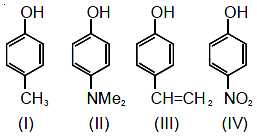
The correct order of acidity of the above compounds is:
A
$II > IV > I > III$
B
$III > IV > II > I$
C
$IV > III > I > II$
D
$IV > I > III > II$
Solution
(C) The acidity of phenols depends on the stability of the phenoxide ion formed after the loss of a proton. Electron-withdrawing groups $(EWG)$ stabilize the phenoxide ion and increase acidity,while electron-donating groups $(EDG)$ destabilize it and decrease acidity.
$1$. Compound $(IV)$ has a $-NO_2$ group,which is a strong electron-withdrawing group ($-R$ and $-I$ effect),making it the most acidic.
$2$. Compound $(III)$ has a $-CH=CH_2$ group,which is an electron-withdrawing group ($-R$ effect),making it more acidic than $(I)$ and $(II)$.
$3$. Compound $(I)$ has a $-CH_3$ group,which is an electron-donating group ($+I$ and hyperconjugation),making it less acidic than $(III)$ but more acidic than $(II)$.
$4$. Compound $(II)$ has a $-NMe_2$ group,which is a very strong electron-donating group ($+R$ effect),making it the least acidic.
Therefore,the correct order of acidity is $(IV) > (III) > (I) > (II)$.
$1$. Compound $(IV)$ has a $-NO_2$ group,which is a strong electron-withdrawing group ($-R$ and $-I$ effect),making it the most acidic.
$2$. Compound $(III)$ has a $-CH=CH_2$ group,which is an electron-withdrawing group ($-R$ effect),making it more acidic than $(I)$ and $(II)$.
$3$. Compound $(I)$ has a $-CH_3$ group,which is an electron-donating group ($+I$ and hyperconjugation),making it less acidic than $(III)$ but more acidic than $(II)$.
$4$. Compound $(II)$ has a $-NMe_2$ group,which is a very strong electron-donating group ($+R$ effect),making it the least acidic.
Therefore,the correct order of acidity is $(IV) > (III) > (I) > (II)$.
0 likesView Solution
34
ChemistryMediumMCQWBJEE · 2023
The correct option for the above reaction is
A
$X = CH_3COCH_2Br, Y = CHBr_3, Z = CH_3CO_2Na$
B
$X = CH_3COCBr_3, Y = CHBr_3, Z = CH_3CO_2Na$
C
$X = CH_3COCH_2Br, Y = CHBr_3, Z = CH_2BrCO_2Na$
D
$X = CH_2BrCOCH_2Br, Y = CHBr_3, Z = CH_2BrCO_2Na$
Solution
(A) In the first step,acetone $(CH_3COCH_3)$ reacts with $Br_2$ in an acidic medium $(AcOH)$. Acidic halogenation of ketones typically results in monohalogenation at the $\alpha$-carbon,yielding $X = CH_3COCH_2Br$.
In the second step,the monobromoacetone $(CH_3COCH_2Br)$ reacts with $Br_2$ in a basic medium $(NaOH)$. This is a haloform reaction. The base promotes further halogenation of the $\alpha$-carbon followed by cleavage to form bromoform $(CHBr_3)$ and the corresponding carboxylate salt,which is sodium acetate $(CH_3CO_2Na)$.
In the second step,the monobromoacetone $(CH_3COCH_2Br)$ reacts with $Br_2$ in a basic medium $(NaOH)$. This is a haloform reaction. The base promotes further halogenation of the $\alpha$-carbon followed by cleavage to form bromoform $(CHBr_3)$ and the corresponding carboxylate salt,which is sodium acetate $(CH_3CO_2Na)$.
0 likesView Solution
35
ChemistryDifficultMCQWBJEE · 2023
If all the nucleophilic substitution reactions at saturated carbon atoms in the above sequence of reactions follow $S_N2$ mechanism,then $\underline{E}$ and $\underline{E}$ will be respectively,

A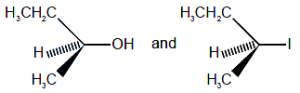
B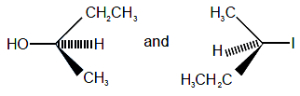
C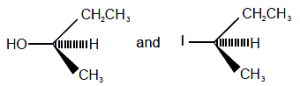
D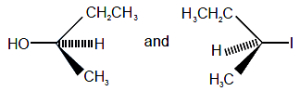
Solution
(D) The reaction sequence involves two $S_N2$ steps,each resulting in an inversion of configuration at the chiral center.
$1$. The starting material is $sec$-butyl chloride. Reaction with aqueous $NaOH$ proceeds via $S_N2$ mechanism,leading to the formation of $sec$-butyl alcohol with inversion of configuration.
$2$. The alcohol then reacts with $p$-toluenesulfonyl chloride $(TsCl)$ in pyridine to form a tosylate intermediate,which is a good leaving group.
$3$. Finally,the tosylate reacts with $NaI$ in acetone via another $S_N2$ reaction,resulting in a second inversion of configuration.
$4$. Since there are two inversions,the final product $C_4H_9I$ will have the same configuration as the starting material $C_4H_9Cl$.
$5$. Comparing the structures,option $D$ correctly represents the intermediate alcohol (inverted) and the final iodide (retained configuration relative to the starting material).
$1$. The starting material is $sec$-butyl chloride. Reaction with aqueous $NaOH$ proceeds via $S_N2$ mechanism,leading to the formation of $sec$-butyl alcohol with inversion of configuration.
$2$. The alcohol then reacts with $p$-toluenesulfonyl chloride $(TsCl)$ in pyridine to form a tosylate intermediate,which is a good leaving group.
$3$. Finally,the tosylate reacts with $NaI$ in acetone via another $S_N2$ reaction,resulting in a second inversion of configuration.
$4$. Since there are two inversions,the final product $C_4H_9I$ will have the same configuration as the starting material $C_4H_9Cl$.
$5$. Comparing the structures,option $D$ correctly represents the intermediate alcohol (inverted) and the final iodide (retained configuration relative to the starting material).
0 likesView Solution
36
ChemistryDifficultMCQWBJEE · 2023
The correct set$(s)$ of reactions to synthesize benzoic acid starting from benzene is/are:
A
$(i) Br_2 / Fe, (ii) Mg / \text{dry ether}, (iii) CO_2, (iv) H_3O^{\oplus}$
B
$(i) Br_2 / Fe, (ii) NH_3, 25^{\circ}C, (iii) NaNO_2, \text{dil. } HCl, 0^{\circ} \text{ to } 5^{\circ}C, (iv) CuCN / KCN, (v) \text{dil. } HCl, \Delta$
C
$(i) CH_3Cl, \text{Anhydrous } AlCl_3, (ii) KMnO_4 / OH^{\ominus}, \Delta, (iii) H_3O^{\oplus}$
D
$(i) CH_3COCl, \text{Anhydrous } AlCl_3, (ii) Br_2, NaOH, (iii) H_3O^{\oplus}$
Solution
(A, C, D) To synthesize benzoic acid from benzene:
Option $(A)$: Benzene reacts with $Br_2/Fe$ to form bromobenzene,which forms a Grignard reagent $(PhMgBr)$ with $Mg/\text{dry ether}$. This reacts with $CO_2$ followed by acid hydrolysis $(H_3O^{\oplus})$ to yield benzoic acid.
Option $(C)$: Friedel-Crafts alkylation of benzene with $CH_3Cl/AlCl_3$ gives toluene. Oxidation of toluene with alkaline $KMnO_4$ followed by acidification gives benzoic acid.
Option $(D)$: Friedel-Crafts acylation of benzene with $CH_3COCl/AlCl_3$ gives acetophenone. The haloform reaction with $Br_2/NaOH$ followed by acidification gives benzoic acid.
Option $(B)$ is incorrect as the reaction sequence does not lead to benzoic acid.
Therefore,the correct sets are $(A), (C),$ and $(D)$.
Option $(A)$: Benzene reacts with $Br_2/Fe$ to form bromobenzene,which forms a Grignard reagent $(PhMgBr)$ with $Mg/\text{dry ether}$. This reacts with $CO_2$ followed by acid hydrolysis $(H_3O^{\oplus})$ to yield benzoic acid.
Option $(C)$: Friedel-Crafts alkylation of benzene with $CH_3Cl/AlCl_3$ gives toluene. Oxidation of toluene with alkaline $KMnO_4$ followed by acidification gives benzoic acid.
Option $(D)$: Friedel-Crafts acylation of benzene with $CH_3COCl/AlCl_3$ gives acetophenone. The haloform reaction with $Br_2/NaOH$ followed by acidification gives benzoic acid.
Option $(B)$ is incorrect as the reaction sequence does not lead to benzoic acid.
Therefore,the correct sets are $(A), (C),$ and $(D)$.
0 likesView Solution
37
ChemistryEasyMCQWBJEE · 2023
What is the edge length of the unit cell of a body-centred cubic $(BCC)$ crystal of an element whose atomic radius is $75 \ pm$ (in $pm$)?
A
$170$
B
$175$
C
$178$
D
$173.2$
Solution
(D) For a body-centred cubic $(BCC)$ unit cell, the relationship between the edge length $(a)$ and the atomic radius $(r)$ is given by the formula: $4r = \sqrt{3}a$.
Given that the atomic radius $r = 75 \ pm$.
Substituting the value of $r$ into the formula: $a = \frac{4r}{\sqrt{3}}$.
$a = \frac{4 \times 75}{\sqrt{3}} = \frac{300}{\sqrt{3}}$.
Rationalizing the denominator: $a = \frac{300 \times \sqrt{3}}{3} = 100 \times \sqrt{3}$.
Since $\sqrt{3} \approx 1.732$, we get $a = 100 \times 1.732 = 173.2 \ pm$.
Given that the atomic radius $r = 75 \ pm$.
Substituting the value of $r$ into the formula: $a = \frac{4r}{\sqrt{3}}$.
$a = \frac{4 \times 75}{\sqrt{3}} = \frac{300}{\sqrt{3}}$.
Rationalizing the denominator: $a = \frac{300 \times \sqrt{3}}{3} = 100 \times \sqrt{3}$.
Since $\sqrt{3} \approx 1.732$, we get $a = 100 \times 1.732 = 173.2 \ pm$.
0 likesView Solution
38
ChemistryDifficultMCQWBJEE · 2023
$A$ solution containing $4 \ g$ of polymer in $4.0 \ L$ solution at $27^{\circ} C$ shows an osmotic pressure of $3.0 \times 10^{-4} \ atm$. The molar mass of the polymer in $g \ mol^{-1}$ is
A
$820000$
B
$82000$
C
$8200$
D
$820$
Solution
(B) The osmotic pressure formula is $\pi = CRT$,where $C$ is the molarity,$R$ is the gas constant $(0.0821 \ L \ atm \ K^{-1} \ mol^{-1})$,and $T$ is the temperature in Kelvin.
Given: $\pi = 3.0 \times 10^{-4} \ atm$,$T = 27 + 273 = 300 \ K$,$V = 4.0 \ L$,and mass of solute $w = 4 \ g$.
$C = \frac{\pi}{RT} = \frac{3.0 \times 10^{-4}}{0.0821 \times 300} = 1.218 \times 10^{-5} \ mol \ L^{-1}$.
Since $C = \frac{w}{M \times V}$,where $M$ is the molar mass:
$1.218 \times 10^{-5} = \frac{4}{M \times 4.0}$.
$M = \frac{4}{1.218 \times 10^{-5} \times 4.0} = \frac{1}{1.218 \times 10^{-5}} \approx 82101 \ g \ mol^{-1}$.
Rounding to the nearest given option,the molar mass is $82000 \ g \ mol^{-1}$.
Given: $\pi = 3.0 \times 10^{-4} \ atm$,$T = 27 + 273 = 300 \ K$,$V = 4.0 \ L$,and mass of solute $w = 4 \ g$.
$C = \frac{\pi}{RT} = \frac{3.0 \times 10^{-4}}{0.0821 \times 300} = 1.218 \times 10^{-5} \ mol \ L^{-1}$.
Since $C = \frac{w}{M \times V}$,where $M$ is the molar mass:
$1.218 \times 10^{-5} = \frac{4}{M \times 4.0}$.
$M = \frac{4}{1.218 \times 10^{-5} \times 4.0} = \frac{1}{1.218 \times 10^{-5}} \approx 82101 \ g \ mol^{-1}$.
Rounding to the nearest given option,the molar mass is $82000 \ g \ mol^{-1}$.
0 likesView Solution
39
ChemistryEasyMCQWBJEE · 2023
$63 \ g$ of a compound (Mol. Wt. $= 126$) was dissolved in $500 \ g$ of distilled water. The density of the resultant solution is $1.126 \ g / mL$. The molarity of the solution is: (in $M$)
A
$1.25$
B
$1.0$
C
$0.75$
D
$1.1$
Solution
(B) Step $1$: Calculate the number of moles of the solute.
Moles $= \frac{\text{Mass}}{\text{Molar Mass}} = \frac{63 \ g}{126 \ g/mol} = 0.5 \ mol$.
Step $2$: Calculate the total mass of the solution.
Mass of solution $= \text{Mass of solute} + \text{Mass of solvent} = 63 \ g + 500 \ g = 563 \ g$.
Step $3$: Calculate the volume of the solution using density.
Volume $= \frac{\text{Mass}}{\text{Density}} = \frac{563 \ g}{1.126 \ g/mL} = 500 \ mL = 0.5 \ L$.
Step $4$: Calculate the molarity.
Molarity $(M) = \frac{\text{Moles of solute}}{\text{Volume of solution in } L} = \frac{0.5 \ mol}{0.5 \ L} = 1.0 \ M$.
Moles $= \frac{\text{Mass}}{\text{Molar Mass}} = \frac{63 \ g}{126 \ g/mol} = 0.5 \ mol$.
Step $2$: Calculate the total mass of the solution.
Mass of solution $= \text{Mass of solute} + \text{Mass of solvent} = 63 \ g + 500 \ g = 563 \ g$.
Step $3$: Calculate the volume of the solution using density.
Volume $= \frac{\text{Mass}}{\text{Density}} = \frac{563 \ g}{1.126 \ g/mL} = 500 \ mL = 0.5 \ L$.
Step $4$: Calculate the molarity.
Molarity $(M) = \frac{\text{Moles of solute}}{\text{Volume of solution in } L} = \frac{0.5 \ mol}{0.5 \ L} = 1.0 \ M$.
0 likesView Solution
40
ChemistryEasyMCQWBJEE · 2023
The calculated spin-only magnetic moment values in $BM$ for $[FeCl_4]^-$ and $[Fe(CN)_6]^{3-}$ are
A
$5.9 \ BM, 1.732 \ BM$
B
$4.89 \ BM, 1.732 \ BM$
C
$3.87 \ BM, 1.732 \ BM$
D
$1.732 \ BM, 2.82 \ BM$
Solution
(A) For both complexes,the central metal ion is $Fe^{3+}$.
Electronic configuration of $Fe^{3+}$ is $[Ar] 3d^5$.
In $[FeCl_4]^-$,$Cl^-$ is a weak field ligand,so no pairing of electrons occurs. The number of unpaired electrons $(n)$ is $5$.
The spin-only magnetic moment is $\mu = \sqrt{n(n+2)} = \sqrt{5(5+2)} = \sqrt{35} \approx 5.9 \ BM$.
In $[Fe(CN)_6]^{3-}$,$CN^-$ is a strong field ligand,causing pairing of electrons. The configuration becomes $t_{2g}^5 e_g^0$,leaving $n = 1$ unpaired electron.
The spin-only magnetic moment is $\mu = \sqrt{1(1+2)} = \sqrt{3} \approx 1.732 \ BM$.
Thus,the values are $5.9 \ BM$ and $1.732 \ BM$.
Electronic configuration of $Fe^{3+}$ is $[Ar] 3d^5$.
In $[FeCl_4]^-$,$Cl^-$ is a weak field ligand,so no pairing of electrons occurs. The number of unpaired electrons $(n)$ is $5$.
The spin-only magnetic moment is $\mu = \sqrt{n(n+2)} = \sqrt{5(5+2)} = \sqrt{35} \approx 5.9 \ BM$.
In $[Fe(CN)_6]^{3-}$,$CN^-$ is a strong field ligand,causing pairing of electrons. The configuration becomes $t_{2g}^5 e_g^0$,leaving $n = 1$ unpaired electron.
The spin-only magnetic moment is $\mu = \sqrt{1(1+2)} = \sqrt{3} \approx 1.732 \ BM$.
Thus,the values are $5.9 \ BM$ and $1.732 \ BM$.
0 likesView Solution
Vedclass Products
For Students
Vedclass Test Series
Mock tests in real WBJEE style covering Chemistry with performance analysis. 5-day free trial.
Start Free TrialFor Teachers
Exam Paper Generator
Generate Set A/B/C/D Chemistry papers from 7.5L+ questions in 2 minutes. 3 chapters free.
Try FreeFor Institutes
Online Exam Module
Run live WBJEE mock exams with unlimited students, 360° analytics & white-label branding.
See DemoFrequently Asked Questions
How many Chemistry questions are in WBJEE 2023?
There are 40 Chemistry questions from the WBJEE 2023 paper on Vedclass, each with a detailed step-by-step solution in English.
Are WBJEE 2023 Chemistry solutions available in English?
Yes. All solutions on this page are in English. You can also switch to English or Hindi using the language buttons above the questions.
Can I practice WBJEE 2023 Chemistry as a timed test?
Yes. Use the Vedclass Test Series to attempt a full WBJEE mock test covering Chemistry with time limits and instant score analysis.
Can teachers create Chemistry papers from WBJEE previous year questions?
Yes. The Vedclass Exam Paper Generator lets teachers mix WBJEE Chemistry questions and generate Set A/B/C/D papers in minutes.
For Teachers & Institutes
Build a Custom Chemistry Paper
Pick WBJEE 2023 Chemistry questions, set difficulty, and generate Set A/B/C/D in 2 minutes.