
ChemistryQ1–42 of 42 questions
Page 1 of 1 · English
1
ChemistryMCQWBJEE · 2020
In a certain test there are $n$ questions. In the test,${2^{n - i}}$ students gave wrong answers to at least $i$ questions,where $i = 1, 2, \dots, n$. If the total number of wrong answers given is $2047$,then $n$ is equal to:
A
$10$
B
$11$
C
$12$
D
$13$
Solution
(B) Let $S_i$ be the number of students who gave wrong answers to at least $i$ questions. We are given $S_i = 2^{n-i}$ for $i = 1, 2, \dots, n$.
The total number of wrong answers is the sum of the number of students who answered at least $i$ questions wrongly for all $i$ from $1$ to $n$.
Total wrong answers $= \sum_{i=1}^{n} S_i = \sum_{i=1}^{n} 2^{n-i}$.
This is a geometric series: $2^{n-1} + 2^{n-2} + \dots + 2^0$.
The sum of this geometric series is $\frac{2^n - 1}{2 - 1} = 2^n - 1$.
Given that the total number of wrong answers is $2047$,we have:
$2^n - 1 = 2047$
$2^n = 2048$
$2^n = 2^{11}$
Therefore,$n = 11$.
The total number of wrong answers is the sum of the number of students who answered at least $i$ questions wrongly for all $i$ from $1$ to $n$.
Total wrong answers $= \sum_{i=1}^{n} S_i = \sum_{i=1}^{n} 2^{n-i}$.
This is a geometric series: $2^{n-1} + 2^{n-2} + \dots + 2^0$.
The sum of this geometric series is $\frac{2^n - 1}{2 - 1} = 2^n - 1$.
Given that the total number of wrong answers is $2047$,we have:
$2^n - 1 = 2047$
$2^n = 2048$
$2^n = 2^{11}$
Therefore,$n = 11$.
0 likesView Solution
2
ChemistryMCQWBJEE · 2020
What is the major product of the following reaction?
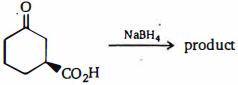
A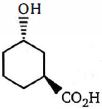
B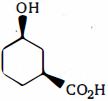
C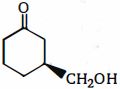
D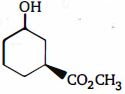
Solution
(A) $NaBH_4$ is a selective reducing agent that reduces aldehydes and ketones to alcohols but does not reduce carboxylic acids. In the given reaction,the ketone group is reduced to a hydroxyl group,while the carboxylic acid group remains unchanged. The reduction of the ketone in a substituted cyclohexane ring typically leads to the formation of the more stable isomer. The $trans$ isomer,where the bulky $-OH$ and $-CO_2H$ groups are in a more stable configuration,is the major product.
0 likesView Solution
3
ChemistryMediumMCQWBJEE · 2020
Bond order of $He_{2}$,$He_{2}^{+}$ and $He_{2}^{2+}$ are respectively:
A
$1, 0.5, 0$
B
$0, 0.5, 1$
C
$0.5, 1, 0$
D
$1, 0, 0.5$
Solution
(B) The bond order is calculated using the formula: $B.O. = \frac{1}{2} (N_b - N_a)$,where $N_b$ is the number of bonding electrons and $N_a$ is the number of antibonding electrons.
For $He_{2}$ $(4 \ e^{-})$: Configuration is $\sigma(1s)^{2}, \sigma^{*}(1s)^{2}$. $B.O. = \frac{2-2}{2} = 0$.
For $He_{2}^{+}$ $(3 \ e^{-})$: Configuration is $\sigma(1s)^{2}, \sigma^{*}(1s)^{1}$. $B.O. = \frac{2-1}{2} = 0.5$.
For $He_{2}^{2+}$ $(2 \ e^{-})$: Configuration is $\sigma(1s)^{2}$. $B.O. = \frac{2-0}{2} = 1$.
Thus,the bond orders are $0, 0.5, 1$ respectively.
For $He_{2}$ $(4 \ e^{-})$: Configuration is $\sigma(1s)^{2}, \sigma^{*}(1s)^{2}$. $B.O. = \frac{2-2}{2} = 0$.
For $He_{2}^{+}$ $(3 \ e^{-})$: Configuration is $\sigma(1s)^{2}, \sigma^{*}(1s)^{1}$. $B.O. = \frac{2-1}{2} = 0.5$.
For $He_{2}^{2+}$ $(2 \ e^{-})$: Configuration is $\sigma(1s)^{2}$. $B.O. = \frac{2-0}{2} = 1$.
Thus,the bond orders are $0, 0.5, 1$ respectively.
0 likesView Solution
4
ChemistryEasyMCQWBJEE · 2020
$A$ homonuclear diatomic gas molecule shows $2$-electron magnetic moment. The one-electron and two-electron reduced species obtained from the above gas molecule can act as both oxidizing and reducing agents. When the gas molecule is one-electron oxidized,the bond length decreases compared to the neutral molecule. The gas molecule is
A
$N_2$
B
$Cl_2$
C
$O_2$
D
$B_2$
Solution
(C) The molecule is $O_2$.
$1$. $O_2$ has two unpaired electrons in its antibonding $\pi^*{2p}$ orbitals,which corresponds to a $2$-electron magnetic moment (paramagnetic).
$2$. The one-electron reduced species is the superoxide ion $(O_2^-)$ and the two-electron reduced species is the peroxide ion $(O_2^{2-})$. Both can act as oxidizing and reducing agents.
$3$. When $O_2$ is one-electron oxidized,it forms the dioxygenyl cation $(O_2^+)$. In $O_2$,the bond order is $2.0$ (electrons in antibonding orbitals). Removing one electron from the antibonding orbital increases the bond order to $2.5$,which causes the bond length to decrease.
$1$. $O_2$ has two unpaired electrons in its antibonding $\pi^*{2p}$ orbitals,which corresponds to a $2$-electron magnetic moment (paramagnetic).
$2$. The one-electron reduced species is the superoxide ion $(O_2^-)$ and the two-electron reduced species is the peroxide ion $(O_2^{2-})$. Both can act as oxidizing and reducing agents.
$3$. When $O_2$ is one-electron oxidized,it forms the dioxygenyl cation $(O_2^+)$. In $O_2$,the bond order is $2.0$ (electrons in antibonding orbitals). Removing one electron from the antibonding orbital increases the bond order to $2.5$,which causes the bond length to decrease.
0 likesView Solution
5
ChemistryMediumMCQWBJEE · 2020
The equilibrium constants for the following reactions are given at $25^{\circ} C$:
$2 A \rightleftharpoons B + C, K_{1} = 1.0$
$2 B \rightleftharpoons C + D, K_{2} = 16$
$2 C + D \rightleftharpoons 2 P, K_{3} = 25$
The equilibrium constant for the reaction $P \rightleftharpoons A + \frac{1}{2} B$ at $25^{\circ} C$ is
$2 A \rightleftharpoons B + C, K_{1} = 1.0$
$2 B \rightleftharpoons C + D, K_{2} = 16$
$2 C + D \rightleftharpoons 2 P, K_{3} = 25$
The equilibrium constant for the reaction $P \rightleftharpoons A + \frac{1}{2} B$ at $25^{\circ} C$ is
A
$\frac{1}{20}$
B
$20$
C
$\frac{1}{42}$
D
$21$
Solution
(A) Given reactions:
$(i) 2 A \rightleftharpoons B + C, K_{1} = 1$
$(ii) 2 B \rightleftharpoons C + D, K_{2} = 16$
$(iii) 2 C + D \rightleftharpoons 2 P, K_{3} = 25$
We need the equilibrium constant for $P \rightleftharpoons A + \frac{1}{2} B$.
Reverse reaction $(iii)$ and divide by $2$: $P \rightleftharpoons C + \frac{1}{2} D, K' = \sqrt{\frac{1}{K_{3}}} = \frac{1}{5}$.
Reverse reaction $(ii)$ and divide by $2$: $\frac{1}{2} C + \frac{1}{2} D \rightleftharpoons B, K'' = \sqrt{\frac{1}{K_{2}}} = \frac{1}{4}$.
Reverse reaction $(i)$ and divide by $2$: $\frac{1}{2} B + \frac{1}{2} C \rightleftharpoons A, K''' = \sqrt{\frac{1}{K_{1}}} = 1$.
Adding these reactions: $P + \frac{1}{2} C + \frac{1}{2} D + \frac{1}{2} B + \frac{1}{2} C \rightleftharpoons C + \frac{1}{2} D + B + A$.
Simplifying: $P \rightleftharpoons A + \frac{1}{2} B$.
The equilibrium constant $K_{final} = K' \times K'' \times K''' = \frac{1}{5} \times \frac{1}{4} \times 1 = \frac{1}{20}$.
$(i) 2 A \rightleftharpoons B + C, K_{1} = 1$
$(ii) 2 B \rightleftharpoons C + D, K_{2} = 16$
$(iii) 2 C + D \rightleftharpoons 2 P, K_{3} = 25$
We need the equilibrium constant for $P \rightleftharpoons A + \frac{1}{2} B$.
Reverse reaction $(iii)$ and divide by $2$: $P \rightleftharpoons C + \frac{1}{2} D, K' = \sqrt{\frac{1}{K_{3}}} = \frac{1}{5}$.
Reverse reaction $(ii)$ and divide by $2$: $\frac{1}{2} C + \frac{1}{2} D \rightleftharpoons B, K'' = \sqrt{\frac{1}{K_{2}}} = \frac{1}{4}$.
Reverse reaction $(i)$ and divide by $2$: $\frac{1}{2} B + \frac{1}{2} C \rightleftharpoons A, K''' = \sqrt{\frac{1}{K_{1}}} = 1$.
Adding these reactions: $P + \frac{1}{2} C + \frac{1}{2} D + \frac{1}{2} B + \frac{1}{2} C \rightleftharpoons C + \frac{1}{2} D + B + A$.
Simplifying: $P \rightleftharpoons A + \frac{1}{2} B$.
The equilibrium constant $K_{final} = K' \times K'' \times K''' = \frac{1}{5} \times \frac{1}{4} \times 1 = \frac{1}{20}$.
0 likesView Solution
6
ChemistryEasyMCQWBJEE · 2020
For the following carbocations,the correct order of stability is:
$I: ^+CH_2-COCH_3$
$II: ^+CH_2-OCH_3$
$III: ^+CH_2-CH_3$
$I: ^+CH_2-COCH_3$
$II: ^+CH_2-OCH_3$
$III: ^+CH_2-CH_3$
A
$III < I < II$
B
$I < II < III$
C
$II < I < III$
D
$I < III < II$
Solution
(D) The stability of carbocations is determined by electronic effects:
$1$. In $II$ $(^+CH_2-OCH_3)$,the oxygen atom has lone pairs that can donate electron density through resonance ($+M$ effect),completing the octet of the carbon atom,making it the most stable.
$2$. In $III$ $(^+CH_2-CH_3)$,the ethyl group provides stability through hyperconjugation and the inductive effect ($+I$ effect) of the methyl group.
$3$. In $I$ $(^+CH_2-COCH_3)$,the carbonyl group $(-C=O)$ is a strong electron-withdrawing group ($-I$ and $-M$ effect),which destabilizes the positive charge,making it the least stable.
Therefore,the order of stability is $I < III < II$.
$1$. In $II$ $(^+CH_2-OCH_3)$,the oxygen atom has lone pairs that can donate electron density through resonance ($+M$ effect),completing the octet of the carbon atom,making it the most stable.
$2$. In $III$ $(^+CH_2-CH_3)$,the ethyl group provides stability through hyperconjugation and the inductive effect ($+I$ effect) of the methyl group.
$3$. In $I$ $(^+CH_2-COCH_3)$,the carbonyl group $(-C=O)$ is a strong electron-withdrawing group ($-I$ and $-M$ effect),which destabilizes the positive charge,making it the least stable.
Therefore,the order of stability is $I < III < II$.
0 likesView Solution
7
ChemistryMediumMCQWBJEE · 2020
Which of the following compounds is asymmetric?
A
cis$-1-$bromo$-3-$chlorocyclobutane
B
$1-$bromo$-2,2-$dichlorocyclopropane
C
trans$-1-$bromo$-3-$chlorocyclobutane
D
$1-$bromo$-2,2-$dichlorocyclopropane (with different stereochemistry)
Solution
(C) molecule is asymmetric if it lacks any element of symmetry,such as a plane of symmetry or a center of inversion.
$A$: $cis-1-bromo-3-chlorocyclobutane$ has a plane of symmetry passing through $C1$ and $C3$.
$B$: $1-bromo-2,2-dichlorocyclopropane$ has a plane of symmetry passing through the $C1-Br$ bond and the $C2$ atom.
$C$: $trans-1-bromo-3-chlorocyclobutane$ lacks both a plane of symmetry and a center of symmetry,making it asymmetric.
$D$: $1-bromo-2,2-dichlorocyclopropane$ (as shown in the image) also possesses a plane of symmetry.
Therefore,the correct option is $C$.
$A$: $cis-1-bromo-3-chlorocyclobutane$ has a plane of symmetry passing through $C1$ and $C3$.
$B$: $1-bromo-2,2-dichlorocyclopropane$ has a plane of symmetry passing through the $C1-Br$ bond and the $C2$ atom.
$C$: $trans-1-bromo-3-chlorocyclobutane$ lacks both a plane of symmetry and a center of symmetry,making it asymmetric.
$D$: $1-bromo-2,2-dichlorocyclopropane$ (as shown in the image) also possesses a plane of symmetry.
Therefore,the correct option is $C$.
0 likesView Solution
8
ChemistryMediumMCQWBJEE · 2020
The total number of alkyl bromides (including stereoisomers) formed in the reaction $(CH_3)_3C-CH=CH_2 + HBr \rightarrow$ will be
A
$1$
B
$2$
C
$3$
D
$4$
Solution
(C) The reaction of $3,3-dimethylbut-1-ene$ with $HBr$ proceeds via the formation of a carbocation intermediate.
Initially,the protonation of the double bond yields a secondary carbocation,which undergoes a $1,2-methyl$ shift to form a more stable tertiary carbocation.
$1$. The direct addition of $Br^-$ to the secondary carbocation gives $2-bromo-3,3-dimethylbutane$. This molecule has a chiral center,so it exists as a pair of enantiomers ($R$ and $S$).
$2$. The addition of $Br^-$ to the rearranged tertiary carbocation gives $2-bromo-2,3-dimethylbutane$,which is achiral.
Thus,the total number of alkyl bromides formed is $2$ (enantiomers) $+ 1$ (rearranged product) $= 3$.
Initially,the protonation of the double bond yields a secondary carbocation,which undergoes a $1,2-methyl$ shift to form a more stable tertiary carbocation.
$1$. The direct addition of $Br^-$ to the secondary carbocation gives $2-bromo-3,3-dimethylbutane$. This molecule has a chiral center,so it exists as a pair of enantiomers ($R$ and $S$).
$2$. The addition of $Br^-$ to the rearranged tertiary carbocation gives $2-bromo-2,3-dimethylbutane$,which is achiral.
Thus,the total number of alkyl bromides formed is $2$ (enantiomers) $+ 1$ (rearranged product) $= 3$.
0 likesView Solution
9
ChemistryMediumMCQWBJEE · 2020
Which of the following reaction$(s)$ give$(s)$ a meso-compound as the main product?
A
$trans-hex-3-ene + Br_2 \xrightarrow{CH_2Cl_2}$
B
$cis-hex-3-ene + H_2 \xrightarrow{Pd-C}$
C
$hex-3-yne + H_2 \xrightarrow{Lindlar's \ catalyst}$
D
$cyclohexene + Br_2 \xrightarrow{CCl_4}$
Solution
(B) meso-compound is an achiral molecule that contains stereocenters but is superimposable on its mirror image due to an internal plane of symmetry.
$1$. $trans-hex-3-ene + Br_2$ undergoes anti-addition to form a racemic mixture of $(3R, 4R)$ and $(3S, 4S)-3,4-dibromohexane$.
$2$. $cis-hex-3-ene + H_2 \xrightarrow{Pd-C}$ undergoes syn-addition to form a meso-compound,$(3R, 4S)-hexane-3,4-diol$ (if it were dihydroxylation) or in this case,the product of hydrogenation is $hexane$,which is achiral but not a meso-compound in the stereochemical sense. However,looking at the options provided,the question asks for the reaction that yields a meso-compound.
$3$. $hex-3-yne + H_2 \xrightarrow{Lindlar's \ catalyst}$ gives $cis-hex-3-ene$,which is not a meso-compound.
$4$. $cyclohexene + Br_2 \xrightarrow{CCl_4}$ gives $trans-1,2-dibromocyclohexane$,which is a racemic mixture,not a meso-compound.
Re-evaluating the options based on standard textbook examples: The hydrogenation of $cis-3,4-dimethylhex-3-ene$ (if that were the substrate) would yield a meso-compound. Given the provided image for option $B$ shows $cis-3,4-dimethylhex-3-ene$,the product of syn-addition is indeed a meso-compound.
$1$. $trans-hex-3-ene + Br_2$ undergoes anti-addition to form a racemic mixture of $(3R, 4R)$ and $(3S, 4S)-3,4-dibromohexane$.
$2$. $cis-hex-3-ene + H_2 \xrightarrow{Pd-C}$ undergoes syn-addition to form a meso-compound,$(3R, 4S)-hexane-3,4-diol$ (if it were dihydroxylation) or in this case,the product of hydrogenation is $hexane$,which is achiral but not a meso-compound in the stereochemical sense. However,looking at the options provided,the question asks for the reaction that yields a meso-compound.
$3$. $hex-3-yne + H_2 \xrightarrow{Lindlar's \ catalyst}$ gives $cis-hex-3-ene$,which is not a meso-compound.
$4$. $cyclohexene + Br_2 \xrightarrow{CCl_4}$ gives $trans-1,2-dibromocyclohexane$,which is a racemic mixture,not a meso-compound.
Re-evaluating the options based on standard textbook examples: The hydrogenation of $cis-3,4-dimethylhex-3-ene$ (if that were the substrate) would yield a meso-compound. Given the provided image for option $B$ shows $cis-3,4-dimethylhex-3-ene$,the product of syn-addition is indeed a meso-compound.
0 likesView Solution
10
ChemistryDifficultMCQWBJEE · 2020
The product$(s)$ from the above reaction will be

A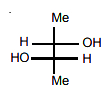
B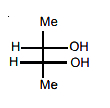
C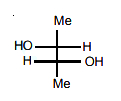
D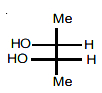
Solution
(A) Step $1$: The reduction of but-$2$-yne with $Na/NH_3(liq)$ in the presence of ethanol is a Birch reduction,which yields $trans$-but-$2$-ene as the intermediate $X$.
Step $2$: The reaction of $trans$-but-$2$-ene with dilute alkaline $KMnO_4$ (Baeyer's reagent) proceeds via $syn$-dihydroxylation.
Step $3$: $Syn$-dihydroxylation of $trans$-alkenes results in the formation of a racemic mixture of enantiomers.
Step $4$: The product is a racemic mixture of $(2R, 3R)$-butane-$2,3$-diol and $(2S, 3S)$-butane-$2,3$-diol,which corresponds to the structures shown in option $A$.
Step $2$: The reaction of $trans$-but-$2$-ene with dilute alkaline $KMnO_4$ (Baeyer's reagent) proceeds via $syn$-dihydroxylation.
Step $3$: $Syn$-dihydroxylation of $trans$-alkenes results in the formation of a racemic mixture of enantiomers.
Step $4$: The product is a racemic mixture of $(2R, 3R)$-butane-$2,3$-diol and $(2S, 3S)$-butane-$2,3$-diol,which corresponds to the structures shown in option $A$.
0 likesView Solution
11
ChemistryEasyMCQWBJEE · 2020
How and why does the density of liquid water change on prolonged electrolysis?
A
Decreases,as the proportion of $H_{2}O$ increases
B
Remains unchanged
C
Increases,as the proportion of $D_{2}O$ increases
D
Increases,as the volume decreases
Solution
(C) During the electrolysis of water,$H_{2}O$ molecules are decomposed into $H_{2}$ and $O_{2}$ gas more readily than $D_{2}O$ molecules due to the kinetic isotope effect.
As a result,the concentration of heavy water $(D_{2}O)$ in the remaining liquid increases over time.
Since the density of $D_{2}O$ $(1.107 \ g/cm^3)$ is higher than that of $H_{2}O$ $(1.00 \ g/cm^3)$,the overall density of the remaining liquid water increases.
As a result,the concentration of heavy water $(D_{2}O)$ in the remaining liquid increases over time.
Since the density of $D_{2}O$ $(1.107 \ g/cm^3)$ is higher than that of $H_{2}O$ $(1.00 \ g/cm^3)$,the overall density of the remaining liquid water increases.
0 likesView Solution
12
ChemistryDifficultMCQWBJEE · 2020
$A$ solution is saturated with $SrCO_3$ and $SrF_2$. The $[CO_3^{2-}]$ is found to be $1.2 \times 10^{-3} \ M$. The concentration of $F^{-}$ in the solution would be:
Given: $K_{sp}(SrCO_3) = 7.0 \times 10^{-10}$,$K_{sp}(SrF_2) = 7.9 \times 10^{-10}$
Given: $K_{sp}(SrCO_3) = 7.0 \times 10^{-10}$,$K_{sp}(SrF_2) = 7.9 \times 10^{-10}$
A
$3.7 \times 10^{-6} \ M$
B
$3.2 \times 10^{-3} \ M$
C
$5.1 \times 10^{-7} \ M$
D
$3.7 \times 10^{-2} \ M$
Solution
(D) For $SrCO_3$,the solubility product expression is $K_{sp} = [Sr^{2+}][CO_3^{2-}]$.
Given $[CO_3^{2-}] = 1.2 \times 10^{-3} \ M$ and $K_{sp}(SrCO_3) = 7.0 \times 10^{-10}$,we calculate the concentration of $Sr^{2+}$:
$[Sr^{2+}] = \frac{7.0 \times 10^{-10}}{1.2 \times 10^{-3}} = 5.83 \times 10^{-7} \ M$.
For $SrF_2$,the solubility product expression is $K_{sp} = [Sr^{2+}][F^{-}]^2$.
Substituting the values: $7.9 \times 10^{-10} = (5.83 \times 10^{-7}) \times [F^{-}]^2$.
$[F^{-}]^2 = \frac{7.9 \times 10^{-10}}{5.83 \times 10^{-7}} = 1.355 \times 10^{-3}$.
$[F^{-}] = \sqrt{1.355 \times 10^{-3}} \approx 3.68 \times 10^{-2} \ M \approx 3.7 \times 10^{-2} \ M$.
Given $[CO_3^{2-}] = 1.2 \times 10^{-3} \ M$ and $K_{sp}(SrCO_3) = 7.0 \times 10^{-10}$,we calculate the concentration of $Sr^{2+}$:
$[Sr^{2+}] = \frac{7.0 \times 10^{-10}}{1.2 \times 10^{-3}} = 5.83 \times 10^{-7} \ M$.
For $SrF_2$,the solubility product expression is $K_{sp} = [Sr^{2+}][F^{-}]^2$.
Substituting the values: $7.9 \times 10^{-10} = (5.83 \times 10^{-7}) \times [F^{-}]^2$.
$[F^{-}]^2 = \frac{7.9 \times 10^{-10}}{5.83 \times 10^{-7}} = 1.355 \times 10^{-3}$.
$[F^{-}] = \sqrt{1.355 \times 10^{-3}} \approx 3.68 \times 10^{-2} \ M \approx 3.7 \times 10^{-2} \ M$.
0 likesView Solution
13
ChemistryMediumMCQWBJEE · 2020
$SiO_{2}$ is attacked by which of the following?
A
$HF$
B
conc. $HCl$
C
hot $NaOH$
D
Fluorine
Solution
(A, C, D) $SiO_{2}$ is an acidic oxide and reacts with both strong bases and specific fluorinating agents.
$1$. $SiO_{2(s)} + 2F_{2(g)} \rightarrow SiF_{4(g)} + O_{2(g)}$
$2$. $SiO_{2(s)} + 6HF(aq.) \rightarrow H_{2}SiF_{6}(aq.) + 2H_{2}O(\ell)$
$3$. $SiO_{2(s)} + 2NaOH(aq.) \rightarrow Na_{2}SiO_{3}(aq.) + H_{2}O(\ell)$
Since $HF$,hot $NaOH$,and $F_{2}$ all react with $SiO_{2}$,the question implies identifying reagents that attack it. Given the standard multiple-choice format,this is a multiple-correct type question.
$1$. $SiO_{2(s)} + 2F_{2(g)} \rightarrow SiF_{4(g)} + O_{2(g)}$
$2$. $SiO_{2(s)} + 6HF(aq.) \rightarrow H_{2}SiF_{6}(aq.) + 2H_{2}O(\ell)$
$3$. $SiO_{2(s)} + 2NaOH(aq.) \rightarrow Na_{2}SiO_{3}(aq.) + H_{2}O(\ell)$
Since $HF$,hot $NaOH$,and $F_{2}$ all react with $SiO_{2}$,the question implies identifying reagents that attack it. Given the standard multiple-choice format,this is a multiple-correct type question.
0 likesView Solution
14
ChemistryEasyMCQWBJEE · 2020
Which of the following statement$(s)$ is/are incorrect:
A
$A$. $A$ sink of $SO_{2}$ pollutant is $O_{3}$ in the atmosphere.
B
$B$. $FGD$ is a process of removing $NO_{2}$ from atmosphere.
C
$C$. $NO$ in fuel gases can be removed by alkaline scrubbing.
D
$D$. The catalyst used to convert $CCl_{4}$ to $CF_{4}$ by $HF$ is $SbF_{5}$.
Solution
(B, C) . $SO_{2}$ is oxidized to $SO_{3}$ by $O_{3}$ in the atmosphere,so it acts as a sink. This statement is correct.
$B$. $FGD$ (Flue Gas Desulfurization) is a process used to remove $SO_{2}$ from flue gases,not $NO_{2}$. This statement is incorrect.
$C$. $NO$ is not easily removed by alkaline scrubbing because it is neutral. $NO_{2}$ can be removed by alkaline scrubbing. This statement is incorrect.
$D$. The reaction $CCl_{4} + HF \xrightarrow{SbF_{5}} CF_{4} + HCl$ is a standard fluorination reaction using $SbF_{5}$ as a catalyst. This statement is correct.
Therefore,statements $B$ and $C$ are incorrect.
$B$. $FGD$ (Flue Gas Desulfurization) is a process used to remove $SO_{2}$ from flue gases,not $NO_{2}$. This statement is incorrect.
$C$. $NO$ is not easily removed by alkaline scrubbing because it is neutral. $NO_{2}$ can be removed by alkaline scrubbing. This statement is incorrect.
$D$. The reaction $CCl_{4} + HF \xrightarrow{SbF_{5}} CF_{4} + HCl$ is a standard fluorination reaction using $SbF_{5}$ as a catalyst. This statement is correct.
Therefore,statements $B$ and $C$ are incorrect.
0 likesView Solution
15
ChemistryEasyMCQWBJEE · 2020
Equal masses of ethane $(C_2H_6)$ and hydrogen $(H_2)$ are mixed in an empty container at $298 \ K$. The fraction of total pressure exerted by hydrogen is:
A
$15:16$
B
$1:1$
C
$1:4$
D
$1:16$
Solution
(A) Let the mass of ethane $(C_2H_6)$ and hydrogen $(H_2)$ be $w \ g$ each.
Molar mass of $C_2H_6 = 30 \ g/mol$.
Molar mass of $H_2 = 2 \ g/mol$.
Number of moles of $C_2H_6$ $(n_{C_2H_6})$ = $\frac{w}{30}$.
Number of moles of $H_2$ $(n_{H_2})$ = $\frac{w}{2}$.
Total moles $(n_{total})$ = $n_{C_2H_6} + n_{H_2} = \frac{w}{30} + \frac{w}{2} = \frac{w + 15w}{30} = \frac{16w}{30}$.
Mole fraction of $H_2$ $(X_{H_2})$ = $\frac{n_{H_2}}{n_{total}} = \frac{w/2}{16w/30} = \frac{w}{2} \times \frac{30}{16w} = \frac{15}{16}$.
According to Dalton's law of partial pressure,the fraction of total pressure exerted by a gas is equal to its mole fraction.
Therefore,the fraction of total pressure exerted by hydrogen is $\frac{15}{16}$ or $15:16$.
Molar mass of $C_2H_6 = 30 \ g/mol$.
Molar mass of $H_2 = 2 \ g/mol$.
Number of moles of $C_2H_6$ $(n_{C_2H_6})$ = $\frac{w}{30}$.
Number of moles of $H_2$ $(n_{H_2})$ = $\frac{w}{2}$.
Total moles $(n_{total})$ = $n_{C_2H_6} + n_{H_2} = \frac{w}{30} + \frac{w}{2} = \frac{w + 15w}{30} = \frac{16w}{30}$.
Mole fraction of $H_2$ $(X_{H_2})$ = $\frac{n_{H_2}}{n_{total}} = \frac{w/2}{16w/30} = \frac{w}{2} \times \frac{30}{16w} = \frac{15}{16}$.
According to Dalton's law of partial pressure,the fraction of total pressure exerted by a gas is equal to its mole fraction.
Therefore,the fraction of total pressure exerted by hydrogen is $\frac{15}{16}$ or $15:16$.
0 likesView Solution
16
ChemistryMediumMCQWBJEE · 2020
Which of the following has the largest number of atoms?
A
$1 \ g$ of $Ag$
B
$1 \ g$ of $Fe$
C
$1 \ g$ of $Cl_{2}$
D
$1 \ g$ of $Mg$
Solution
(D) To find the number of atoms,we use the formula: $\text{Number of atoms} = \frac{\text{mass}}{\text{molar mass}} \times \text{atomicity} \times N_{A}$.
For $A$: $1 \ g$ of $Ag$ (atomic mass = $108 \ g/mol$): $\text{Atoms} = \frac{1}{108} \times 1 \times N_{A} \approx 0.0092 \ N_{A}$.
For $B$: $1 \ g$ of $Fe$ (atomic mass = $56 \ g/mol$): $\text{Atoms} = \frac{1}{56} \times 1 \times N_{A} \approx 0.0178 \ N_{A}$.
For $C$: $1 \ g$ of $Cl_{2}$ (molar mass = $71 \ g/mol$): $\text{Atoms} = \frac{1}{71} \times 2 \times N_{A} \approx 0.0281 \ N_{A}$.
For $D$: $1 \ g$ of $Mg$ (atomic mass = $24 \ g/mol$): $\text{Atoms} = \frac{1}{24} \times 1 \times N_{A} \approx 0.0416 \ N_{A}$.
Comparing the values,$1 \ g$ of $Mg$ has the largest number of atoms.
For $A$: $1 \ g$ of $Ag$ (atomic mass = $108 \ g/mol$): $\text{Atoms} = \frac{1}{108} \times 1 \times N_{A} \approx 0.0092 \ N_{A}$.
For $B$: $1 \ g$ of $Fe$ (atomic mass = $56 \ g/mol$): $\text{Atoms} = \frac{1}{56} \times 1 \times N_{A} \approx 0.0178 \ N_{A}$.
For $C$: $1 \ g$ of $Cl_{2}$ (molar mass = $71 \ g/mol$): $\text{Atoms} = \frac{1}{71} \times 2 \times N_{A} \approx 0.0281 \ N_{A}$.
For $D$: $1 \ g$ of $Mg$ (atomic mass = $24 \ g/mol$): $\text{Atoms} = \frac{1}{24} \times 1 \times N_{A} \approx 0.0416 \ N_{A}$.
Comparing the values,$1 \ g$ of $Mg$ has the largest number of atoms.
0 likesView Solution
17
ChemistryMediumMCQWBJEE · 2020
What will be the mass of one atom of ${}^{12}C$?
A
$1 \ \text{a.m.u.}$
B
$1.9923 \times 10^{-23} \ \text{g}$
C
$1.6603 \times 10^{-22} \ \text{g}$
D
$6 \ \text{a.m.u.}$
Solution
(B) The mass of one atom of ${}^{12}C$ is defined as exactly $12 \ \text{a.m.u.}$
Since $1 \ \text{a.m.u.} = 1.66056 \times 10^{-24} \ \text{g}$,
The mass of one atom of ${}^{12}C = 12 \times 1.66056 \times 10^{-24} \ \text{g}$
$= 1.99267 \times 10^{-23} \ \text{g} \approx 1.9923 \times 10^{-23} \ \text{g}$.
Since $1 \ \text{a.m.u.} = 1.66056 \times 10^{-24} \ \text{g}$,
The mass of one atom of ${}^{12}C = 12 \times 1.66056 \times 10^{-24} \ \text{g}$
$= 1.99267 \times 10^{-23} \ \text{g} \approx 1.9923 \times 10^{-23} \ \text{g}$.
0 likesView Solution
18
ChemistryMediumMCQWBJEE · 2020
$5 \ mL$ of $0.1 \ M \ Pb(NO_{3})_{2}$ is mixed with $10 \ mL$ of $0.02 \ M \ KI$. The amount of $PbI_{2}$ precipitated will be about
A
$10^{-2} \ mol$
B
$10^{-4} \ mol$
C
$2 \times 10^{-4} \ mol$
D
$10^{-3} \ mol$
Solution
(B) The balanced chemical equation for the reaction is:
$Pb(NO_{3})_{2}(aq) + 2KI(aq) \rightarrow PbI_{2}(s) + 2KNO_{3}(aq)$
Calculate the initial millimoles of each reactant:
Millimoles of $Pb(NO_{3})_{2} = 5 \ mL \times 0.1 \ M = 0.5 \ mmol$
Millimoles of $KI = 10 \ mL \times 0.02 \ M = 0.2 \ mmol$
According to the stoichiometry,$1 \ mol$ of $Pb(NO_{3})_{2}$ reacts with $2 \ mol$ of $KI$. Therefore,$0.2 \ mmol$ of $KI$ will react with $0.1 \ mmol$ of $Pb(NO_{3})_{2}$.
Since $KI$ is the limiting reagent,the amount of $PbI_{2}$ formed depends on the amount of $KI$.
From the stoichiometry,$2 \ mmol$ of $KI$ produces $1 \ mmol$ of $PbI_{2}$.
So,$0.2 \ mmol$ of $KI$ will produce $0.1 \ mmol$ of $PbI_{2}$.
Convert millimoles to moles:
$0.1 \ mmol = 0.1 \times 10^{-3} \ mol = 10^{-4} \ mol$.
$Pb(NO_{3})_{2}(aq) + 2KI(aq) \rightarrow PbI_{2}(s) + 2KNO_{3}(aq)$
Calculate the initial millimoles of each reactant:
Millimoles of $Pb(NO_{3})_{2} = 5 \ mL \times 0.1 \ M = 0.5 \ mmol$
Millimoles of $KI = 10 \ mL \times 0.02 \ M = 0.2 \ mmol$
According to the stoichiometry,$1 \ mol$ of $Pb(NO_{3})_{2}$ reacts with $2 \ mol$ of $KI$. Therefore,$0.2 \ mmol$ of $KI$ will react with $0.1 \ mmol$ of $Pb(NO_{3})_{2}$.
Since $KI$ is the limiting reagent,the amount of $PbI_{2}$ formed depends on the amount of $KI$.
From the stoichiometry,$2 \ mmol$ of $KI$ produces $1 \ mmol$ of $PbI_{2}$.
So,$0.2 \ mmol$ of $KI$ will produce $0.1 \ mmol$ of $PbI_{2}$.
Convert millimoles to moles:
$0.1 \ mmol = 0.1 \times 10^{-3} \ mol = 10^{-4} \ mol$.
0 likesView Solution
19
ChemistryEasyMCQWBJEE · 2020
At $273 \ K$ temperature and $76 \ cm \ Hg$ pressure,the density of a gas is $1.964 \ g \ L^{-1}$. The gas is
A
$CH_4$
B
$CO$
C
$He$
D
$CO_2$
Solution
(D) The ideal gas equation is given by $PV = nRT = \frac{w}{M} RT$.
Rearranging for density $(d = \frac{w}{V})$,we get $d = \frac{PM}{RT}$.
Thus,the molar mass $M = \frac{dRT}{P}$.
Given: $d = 1.964 \ g \ L^{-1}$,$T = 273 \ K$,$P = 76 \ cm \ Hg = 1 \ atm$,and $R = 0.0821 \ L \ atm \ K^{-1} \ mol^{-1}$.
Substituting the values: $M = \frac{1.964 \times 0.0821 \times 273}{1} \approx 44 \ g \ mol^{-1}$.
The molar mass of $CO_2$ is $12 + 2 \times 16 = 44 \ g \ mol^{-1}$.
Therefore,the gas is $CO_2$.
Rearranging for density $(d = \frac{w}{V})$,we get $d = \frac{PM}{RT}$.
Thus,the molar mass $M = \frac{dRT}{P}$.
Given: $d = 1.964 \ g \ L^{-1}$,$T = 273 \ K$,$P = 76 \ cm \ Hg = 1 \ atm$,and $R = 0.0821 \ L \ atm \ K^{-1} \ mol^{-1}$.
Substituting the values: $M = \frac{1.964 \times 0.0821 \times 273}{1} \approx 44 \ g \ mol^{-1}$.
The molar mass of $CO_2$ is $12 + 2 \times 16 = 44 \ g \ mol^{-1}$.
Therefore,the gas is $CO_2$.
0 likesView Solution
20
ChemistryMediumMCQWBJEE · 2020
The radius of the first Bohr orbit of a hydrogen atom is $0.53 \times 10^{-8} \ cm$. The velocity of the electron in the first Bohr orbit is
A
$2.188 \times 10^{8} \ cm \ s^{-1}$
B
$4.376 \times 10^{8} \ cm \ s^{-1}$
C
$1.094 \times 10^{8} \ cm \ s^{-1}$
D
$2.188 \times 10^{9} \ cm \ s^{-1}$
Solution
(A) The velocity of an electron in the $n^{th}$ Bohr orbit of a hydrogen-like atom is given by the formula: $v_n = 2.188 \times 10^8 \times \frac{Z}{n} \ cm \ s^{-1}$.
For the first Bohr orbit of a hydrogen atom,$Z = 1$ and $n = 1$.
Substituting these values: $v_1 = 2.188 \times 10^8 \times \frac{1}{1} \ cm \ s^{-1} = 2.188 \times 10^8 \ cm \ s^{-1}$.
For the first Bohr orbit of a hydrogen atom,$Z = 1$ and $n = 1$.
Substituting these values: $v_1 = 2.188 \times 10^8 \times \frac{1}{1} \ cm \ s^{-1} = 2.188 \times 10^8 \ cm \ s^{-1}$.
0 likesView Solution
21
ChemistryMediumMCQWBJEE · 2020
The difference between the orbital angular momentum of an electron in a $4f$ orbital and another electron in a $4s$ orbital is
A
$2 \sqrt{3} \times \frac{h}{2 \pi}$
B
$3 \sqrt{2} \times \frac{h}{2 \pi}$
C
$\sqrt{3} \times \frac{h}{2 \pi}$
D
$2 \times \frac{h}{2 \pi}$
Solution
(A) The orbital angular momentum is given by the formula: $\text{Orbital angular momentum} = \sqrt{\ell(\ell+1)} \frac{h}{2 \pi}$.
For a $4f$ orbital,the azimuthal quantum number $\ell = 3$. Therefore,the orbital angular momentum is $\sqrt{3(3+1)} \frac{h}{2 \pi} = \sqrt{12} \frac{h}{2 \pi} = 2 \sqrt{3} \frac{h}{2 \pi}$.
For a $4s$ orbital,the azimuthal quantum number $\ell = 0$. Therefore,the orbital angular momentum is $\sqrt{0(0+1)} \frac{h}{2 \pi} = 0$.
The difference between the two is $2 \sqrt{3} \frac{h}{2 \pi} - 0 = 2 \sqrt{3} \frac{h}{2 \pi}$.
For a $4f$ orbital,the azimuthal quantum number $\ell = 3$. Therefore,the orbital angular momentum is $\sqrt{3(3+1)} \frac{h}{2 \pi} = \sqrt{12} \frac{h}{2 \pi} = 2 \sqrt{3} \frac{h}{2 \pi}$.
For a $4s$ orbital,the azimuthal quantum number $\ell = 0$. Therefore,the orbital angular momentum is $\sqrt{0(0+1)} \frac{h}{2 \pi} = 0$.
The difference between the two is $2 \sqrt{3} \frac{h}{2 \pi} - 0 = 2 \sqrt{3} \frac{h}{2 \pi}$.
0 likesView Solution
22
ChemistryMediumMCQWBJEE · 2020
The maximum number of electrons in an atom in which the last electron filled has the quantum numbers $n=3, \ell=2$ and $m=-1$ is
A
$17$
B
$27$
C
$28$
D
$30$
Solution
(D) The quantum numbers $n=3$ and $\ell=2$ correspond to the $3d$ subshell.
Since the last electron is filled in the $3d$ subshell,we look for the maximum number of electrons possible when the $3d$ subshell is completely filled.
The electronic configuration for a completely filled $3d$ subshell is $1s^2 2s^2 2p^6 3s^2 3p^6 4s^2 3d^{10}$.
Counting the total number of electrons: $2+2+6+2+6+2+10 = 30$.
This corresponds to the element Zinc $(Zn)$ with atomic number $30$.
Since the last electron is filled in the $3d$ subshell,we look for the maximum number of electrons possible when the $3d$ subshell is completely filled.
The electronic configuration for a completely filled $3d$ subshell is $1s^2 2s^2 2p^6 3s^2 3p^6 4s^2 3d^{10}$.
Counting the total number of electrons: $2+2+6+2+6+2+10 = 30$.
This corresponds to the element Zinc $(Zn)$ with atomic number $30$.
0 likesView Solution
23
ChemistryEasyMCQWBJEE · 2020
An ideal gas expands adiabatically against vacuum. Which of the following is correct for the given process?
A
$\Delta S = 0$
B
$\Delta T = -ve$
C
$\Delta U = 0$
D
$\Delta P = 0$
Solution
(C) For an adiabatic process,the heat exchange $dq = 0$.
Since the gas expands against a vacuum,the external pressure $P_{ext} = 0$,so the work done $dw = -P_{ext} \times dV = 0$.
According to the first law of thermodynamics,$dU = dq + dw$.
Substituting the values,$dU = 0 + 0 = 0$.
For an ideal gas,internal energy $U$ is a function of temperature only $(U = f(T))$,so if $\Delta U = 0$,then $\Delta T = 0$.
Therefore,the correct statement is $\Delta U = 0$.
Since the gas expands against a vacuum,the external pressure $P_{ext} = 0$,so the work done $dw = -P_{ext} \times dV = 0$.
According to the first law of thermodynamics,$dU = dq + dw$.
Substituting the values,$dU = 0 + 0 = 0$.
For an ideal gas,internal energy $U$ is a function of temperature only $(U = f(T))$,so if $\Delta U = 0$,then $\Delta T = 0$.
Therefore,the correct statement is $\Delta U = 0$.
0 likesView Solution
24
ChemistryMediumMCQWBJEE · 2020
The reaction $Ph-CDO \xrightarrow{50\% \text{ aq. } NaOH, \text{ warm}} Ph-COO^- + \text{an alcohol}$. This alcohol is:
A
$Ph-CHD-OH$
B
$Ph-CHD-OD$
C
$Ph-CD_2-OH$
D
$Ph-CD_2-OD$
Solution
(C) The reaction is a Cannizzaro reaction. In the mechanism,the nucleophilic attack of $OH^-$ on the carbonyl carbon of $Ph-CDO$ forms a tetrahedral intermediate. In the rate-determining step,a hydride (or deuteride) ion is transferred from this intermediate to another molecule of $Ph-CDO$. Since the intermediate contains a $D$ atom attached to the carbon,a deuteride ion $(D^-)$ is transferred to the second $Ph-CDO$ molecule. This results in the formation of $Ph-CD_2-O^-$ and $Ph-COO^-$. Upon workup (or proton exchange with the solvent),the alkoxide $Ph-CD_2-O^-$ becomes $Ph-CD_2-OH$.
0 likesView Solution
25
ChemistryMediumMCQWBJEE · 2020
What is the product in the above reaction?
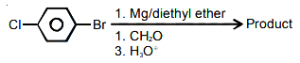
A
$4-$bromobenzyl alcohol
B
$3-$chloro$-1,2-$benzenedimethanol
C
$3-$bromo$-1,2-$benzenedimethanol
D
$1,4-$benzenedimethanol
Solution
(D) The reaction of $1$-bromo-$4$-chlorobenzene with $Mg$ in diethyl ether forms a di-Grignard reagent,$ClMg-C_6H_4-MgBr$.
When this di-Grignard reagent reacts with $2$ equivalents of formaldehyde $(CH_2O)$,it undergoes nucleophilic addition at both the $ClMg-$ and $-MgBr$ sites.
Subsequent acidic hydrolysis $(H_3O^+)$ converts both $-CH_2OMgX$ groups into $-CH_2OH$ groups.
Thus,the final product is $1,4$-benzenedimethanol (also known as $p$-xylylene glycol).
When this di-Grignard reagent reacts with $2$ equivalents of formaldehyde $(CH_2O)$,it undergoes nucleophilic addition at both the $ClMg-$ and $-MgBr$ sites.
Subsequent acidic hydrolysis $(H_3O^+)$ converts both $-CH_2OMgX$ groups into $-CH_2OH$ groups.
Thus,the final product is $1,4$-benzenedimethanol (also known as $p$-xylylene glycol).
0 likesView Solution
26
ChemistryMediumMCQWBJEE · 2020
The reduction product of ethyl $3$-oxobutanoate by $NaBH_4$ in methanol is
A
Ethyl $3,3$-dihydroxybutanoate
B
$4$-hydroxypentan-$2$-one
C
Ethyl $3$-hydroxybutanoate
D
$4$-hydroxypentan-$2$-one
Solution
(C) $NaBH_4$ is a selective reducing agent that reduces ketones and aldehydes to alcohols but does not reduce esters under mild conditions.
Ethyl $3$-oxobutanoate contains both a ketone group and an ester group.
Therefore,$NaBH_4$ will selectively reduce the ketone group at the $C-3$ position to a hydroxyl group,while the ester group at the $C-1$ position remains unaffected.
The reaction is:
$CH_3COCH_2COOC_2H_5 \xrightarrow{NaBH_4, CH_3OH} CH_3CH(OH)CH_2COOC_2H_5$
Thus,the product is ethyl $3$-hydroxybutanoate.
Ethyl $3$-oxobutanoate contains both a ketone group and an ester group.
Therefore,$NaBH_4$ will selectively reduce the ketone group at the $C-3$ position to a hydroxyl group,while the ester group at the $C-1$ position remains unaffected.
The reaction is:
$CH_3COCH_2COOC_2H_5 \xrightarrow{NaBH_4, CH_3OH} CH_3CH(OH)CH_2COOC_2H_5$
Thus,the product is ethyl $3$-hydroxybutanoate.
0 likesView Solution
27
ChemistryDifficultMCQWBJEE · 2020
What is the major product of the following reaction?

A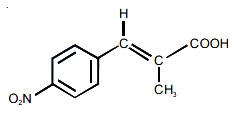
B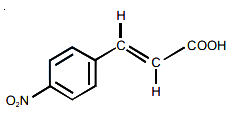
C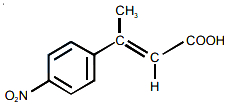
D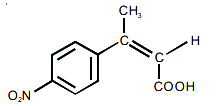
Solution
(A) The reaction is a $Perkin$ condensation. It involves the reaction of an aromatic aldehyde with an acid anhydride in the presence of the corresponding carboxylate salt.
In this case,$p$-nitrobenzaldehyde reacts with propanoic anhydride $(CH_3CH_2CO)_2O$ in the presence of sodium propionate $(CH_3CH_2COONa)$.
The $\alpha$-hydrogen of the propanoic anhydride is abstracted by the propionate ion to form a nucleophilic enolate.
This enolate attacks the carbonyl carbon of $p$-nitrobenzaldehyde.
Subsequent steps involve the formation of a $\beta$-hydroxy acid derivative,followed by dehydration to form an $\alpha,\beta$-unsaturated acid.
The product formed is $2$-methyl-$3$-($4$-nitrophenyl)prop$-2-$enoic acid. The major product is the $(E)$-isomer due to steric considerations,which corresponds to option $A$.
In this case,$p$-nitrobenzaldehyde reacts with propanoic anhydride $(CH_3CH_2CO)_2O$ in the presence of sodium propionate $(CH_3CH_2COONa)$.
The $\alpha$-hydrogen of the propanoic anhydride is abstracted by the propionate ion to form a nucleophilic enolate.
This enolate attacks the carbonyl carbon of $p$-nitrobenzaldehyde.
Subsequent steps involve the formation of a $\beta$-hydroxy acid derivative,followed by dehydration to form an $\alpha,\beta$-unsaturated acid.
The product formed is $2$-methyl-$3$-($4$-nitrophenyl)prop$-2-$enoic acid. The major product is the $(E)$-isomer due to steric considerations,which corresponds to option $A$.
0 likesView Solution
28
ChemistryEasyMCQWBJEE · 2020
The correct order of acidity for the following compounds is:
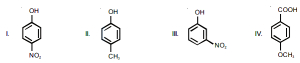
A
$II < I < III < IV$
B
$II < III < I < IV$
C
$II < I < IV < III$
D
$IV < II < III < I$
Solution
(B) The compounds are:
$I$: $p$-Nitrophenol
$II$: $p$-Cresol ($4$-Methylphenol)
$III$: $m$-Nitrophenol
$IV$: $p$-Methoxybenzoic acid
Step $1$: Compare the acidity of phenols and carboxylic acids. Carboxylic acids are significantly more acidic than phenols. Thus,$IV$ is the most acidic.
Step $2$: Compare the acidity of the phenols $(I, II, III)$.
- $II$ ($p$-Cresol) has a $-CH_3$ group,which is an electron-donating group ($+I$ and hyperconjugation),decreasing acidity. Thus,$II$ is the least acidic.
- $I$ ($p$-Nitrophenol) has a $-NO_2$ group at the para position,which exerts a strong electron-withdrawing effect ($-I$ and $-M$).
- $III$ ($m$-Nitrophenol) has a $-NO_2$ group at the meta position,which exerts only an electron-withdrawing inductive effect $(-I)$.
- The $-M$ effect of the $-NO_2$ group in $p$-Nitrophenol $(I)$ makes it more acidic than $m$-Nitrophenol $(III)$.
Step $3$: Combining these,the order of acidity is $II < III < I < IV$.
$I$: $p$-Nitrophenol
$II$: $p$-Cresol ($4$-Methylphenol)
$III$: $m$-Nitrophenol
$IV$: $p$-Methoxybenzoic acid
Step $1$: Compare the acidity of phenols and carboxylic acids. Carboxylic acids are significantly more acidic than phenols. Thus,$IV$ is the most acidic.
Step $2$: Compare the acidity of the phenols $(I, II, III)$.
- $II$ ($p$-Cresol) has a $-CH_3$ group,which is an electron-donating group ($+I$ and hyperconjugation),decreasing acidity. Thus,$II$ is the least acidic.
- $I$ ($p$-Nitrophenol) has a $-NO_2$ group at the para position,which exerts a strong electron-withdrawing effect ($-I$ and $-M$).
- $III$ ($m$-Nitrophenol) has a $-NO_2$ group at the meta position,which exerts only an electron-withdrawing inductive effect $(-I)$.
- The $-M$ effect of the $-NO_2$ group in $p$-Nitrophenol $(I)$ makes it more acidic than $m$-Nitrophenol $(III)$.
Step $3$: Combining these,the order of acidity is $II < III < I < IV$.
0 likesView Solution
29
ChemistryMediumMCQWBJEE · 2020
For the following three esters,the order of rates of alkaline hydrolysis is:
$(I)$ $p-NO_2-C_6H_4-COOCH_3$
$(II)$ $p-CH_3O-C_6H_4-COOCH_3$
$(III)$ $p-CH_3-C_6H_4-COOCH_3$
$(I)$ $p-NO_2-C_6H_4-COOCH_3$
$(II)$ $p-CH_3O-C_6H_4-COOCH_3$
$(III)$ $p-CH_3-C_6H_4-COOCH_3$
A
$I > III > II$
B
$II > III > I$
C
$I > II > III$
D
$III > II > I$
Solution
(A) Alkaline hydrolysis of esters is a nucleophilic acyl substitution reaction. The rate of this reaction depends on the electrophilicity of the carbonyl carbon.
Electron-withdrawing groups $(EWG)$ increase the electrophilicity of the carbonyl carbon,thereby increasing the rate of hydrolysis.
Electron-donating groups $(EDG)$ decrease the electrophilicity of the carbonyl carbon,thereby decreasing the rate of hydrolysis.
Analysis of substituents:
$(I)$ $-NO_2$ group: Strong $-R$ and $-I$ effect (Strong $EWG$).
$(II)$ $-OCH_3$ group: Strong $+R$ and weak $-I$ effect (Strong $EDG$).
$(III)$ $-CH_3$ group: $+I$ effect and hyperconjugation (Weak $EDG$).
Order of electrophilicity: $-NO_2 > -CH_3 > -OCH_3$.
Therefore,the order of rates of alkaline hydrolysis is $I > III > II$.
Electron-withdrawing groups $(EWG)$ increase the electrophilicity of the carbonyl carbon,thereby increasing the rate of hydrolysis.
Electron-donating groups $(EDG)$ decrease the electrophilicity of the carbonyl carbon,thereby decreasing the rate of hydrolysis.
Analysis of substituents:
$(I)$ $-NO_2$ group: Strong $-R$ and $-I$ effect (Strong $EWG$).
$(II)$ $-OCH_3$ group: Strong $+R$ and weak $-I$ effect (Strong $EDG$).
$(III)$ $-CH_3$ group: $+I$ effect and hyperconjugation (Weak $EDG$).
Order of electrophilicity: $-NO_2 > -CH_3 > -OCH_3$.
Therefore,the order of rates of alkaline hydrolysis is $I > III > II$.
0 likesView Solution
30
ChemistryDifficultMCQWBJEE · 2020
For a reaction $2 \ A + B \rightarrow P$,when the concentration of $B$ alone is doubled,the rate does not change,and when the concentrations of both $A$ and $B$ are doubled,the rate increases by a factor of $4$. The unit of the rate constant is,
A
$s^{-1}$
B
$L \ mol^{-1} \ s^{-1}$
C
$mol \ L^{-1} \ s^{-1}$
D
$L^{2} \ mol^{-2} \ s^{-1}$
Solution
(B) The rate law is given by $r = k[A]^{\alpha}[B]^{\beta}$.
When the concentration of $B$ is doubled,the rate does not change,which implies that the reaction is of zero order with respect to $B$. Therefore,$\beta = 0$.
When the concentrations of both $A$ and $B$ are doubled,the rate increases by a factor of $4$:
$\frac{r_2}{r_1} = \frac{k[2A]^{\alpha}[2B]^{\beta}}{k[A]^{\alpha}[B]^{\beta}} = 4$
$2^{\alpha} \cdot 2^{\beta} = 4$
Since $\beta = 0$,we have $2^{\alpha} = 4$,which gives $\alpha = 2$.
The overall order of the reaction is $\alpha + \beta = 2 + 0 = 2$.
The unit of the rate constant for a second-order reaction is $L \ mol^{-1} \ s^{-1}$.
When the concentration of $B$ is doubled,the rate does not change,which implies that the reaction is of zero order with respect to $B$. Therefore,$\beta = 0$.
When the concentrations of both $A$ and $B$ are doubled,the rate increases by a factor of $4$:
$\frac{r_2}{r_1} = \frac{k[2A]^{\alpha}[2B]^{\beta}}{k[A]^{\alpha}[B]^{\beta}} = 4$
$2^{\alpha} \cdot 2^{\beta} = 4$
Since $\beta = 0$,we have $2^{\alpha} = 4$,which gives $\alpha = 2$.
The overall order of the reaction is $\alpha + \beta = 2 + 0 = 2$.
The unit of the rate constant for a second-order reaction is $L \ mol^{-1} \ s^{-1}$.
0 likesView Solution
31
ChemistryEasyMCQWBJEE · 2020
Which of the following statements is not true for the reaction $2 F_{2} + 2 H_{2}O \rightarrow 4 HF + O_{2}$?
A
$F_{2}$ is more strongly oxidising than $O_{2}$
B
$F-F$ bond is weaker than $O=O$ bond
C
$H-F$ bond is stronger than $H-O$ bond
D
$F$ is less electronegative than $O$
Solution
(D) The reaction $2 F_{2} + 2 H_{2}O \rightarrow 4 HF + O_{2}$ occurs because $F_{2}$ is a strong oxidizing agent.
$F$ is the most electronegative element in the periodic table,so the statement that $F$ is less electronegative than $O$ is false.
$F_{2}$ is a stronger oxidizing agent than $O_{2}$ because of its high electronegativity and the low bond dissociation energy of the $F-F$ bond compared to the $O=O$ bond.
The $H-F$ bond is stronger than the $H-O$ bond due to the high electronegativity of $F$.
$F$ is the most electronegative element in the periodic table,so the statement that $F$ is less electronegative than $O$ is false.
$F_{2}$ is a stronger oxidizing agent than $O_{2}$ because of its high electronegativity and the low bond dissociation energy of the $F-F$ bond compared to the $O=O$ bond.
The $H-F$ bond is stronger than the $H-O$ bond due to the high electronegativity of $F$.
0 likesView Solution
32
ChemistryMediumMCQWBJEE · 2020
Indicate the correct $IUPAC$ name of the coordination compound shown in the figure.
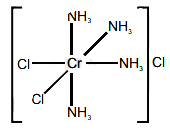
A
$Cis-dichlorotetraamminochromium(III)$ chloride
B
$Trans-dichlorotetraamminochromium(III)$ chloride
C
$Trans-tetraamminodichlorochromium(III)$ chloride
D
$Cis-tetraamminodichlorochromium(III)$ chloride
Solution
(D) $1$. Identify the ligands: There are four $NH_3$ (ammine) ligands and two $Cl^-$ (chloro) ligands attached to the central $Cr$ atom.
$2$. Determine the geometry: The two $Cl^-$ ligands are adjacent to each other (at $90^\circ$ angle),which indicates a $cis$ configuration.
$3$. Apply $IUPAC$ nomenclature rules:
- List ligands alphabetically: $ammine$ comes before $chloro$.
- Use prefixes for the number of ligands: $tetra$ for four $NH_3$ and $di$ for two $Cl$.
- The name is $cis-tetraamminodichlorochromium(III)$ chloride.
$4$. Oxidation state of $Cr$: $x + 4(0) + 2(-1) = +1$ (since $Cl^-$ is outside the coordination sphere),so $x = +3$.
$2$. Determine the geometry: The two $Cl^-$ ligands are adjacent to each other (at $90^\circ$ angle),which indicates a $cis$ configuration.
$3$. Apply $IUPAC$ nomenclature rules:
- List ligands alphabetically: $ammine$ comes before $chloro$.
- Use prefixes for the number of ligands: $tetra$ for four $NH_3$ and $di$ for two $Cl$.
- The name is $cis-tetraamminodichlorochromium(III)$ chloride.
$4$. Oxidation state of $Cr$: $x + 4(0) + 2(-1) = +1$ (since $Cl^-$ is outside the coordination sphere),so $x = +3$.
0 likesView Solution
33
ChemistryEasyMCQWBJEE · 2020
The reaction for obtaining the metal $(M)$ from its oxide $(M_{2}O_{3})$ ore is given by
$M_{2}O_{3(s)} + 2 Al(\ell) \xrightarrow{\text{Heat}} Al_{2}O_{3}(\ell) + 2 M_{(s)}$,$(s = \text{solid}, \ell = \text{liquid})$
In this case,$M$ is
$M_{2}O_{3(s)} + 2 Al(\ell) \xrightarrow{\text{Heat}} Al_{2}O_{3}(\ell) + 2 M_{(s)}$,$(s = \text{solid}, \ell = \text{liquid})$
In this case,$M$ is
A
Copper
B
Calcium
C
Iron
D
Zinc
Solution
(C) The given reaction is a classic example of the Thermite process,which is used for the reduction of metal oxides using aluminum as a reducing agent.
In the Thermite process,aluminum reduces metal oxides like $Fe_{2}O_{3}$ to produce the metal and aluminum oxide $(Al_{2}O_{3})$.
The reaction is: $Fe_{2}O_{3(s)} + 2 Al_{(s)} \xrightarrow{\text{Heat}} Al_{2}O_{3(s)} + 2 Fe_{(s)}$.
Comparing this with the given equation $M_{2}O_{3} + 2 Al \rightarrow Al_{2}O_{3} + 2 M$,we can identify that $M$ is Iron $(Fe)$.
In the Thermite process,aluminum reduces metal oxides like $Fe_{2}O_{3}$ to produce the metal and aluminum oxide $(Al_{2}O_{3})$.
The reaction is: $Fe_{2}O_{3(s)} + 2 Al_{(s)} \xrightarrow{\text{Heat}} Al_{2}O_{3(s)} + 2 Fe_{(s)}$.
Comparing this with the given equation $M_{2}O_{3} + 2 Al \rightarrow Al_{2}O_{3} + 2 M$,we can identify that $M$ is Iron $(Fe)$.
0 likesView Solution
34
ChemistryMediumMCQWBJEE · 2020
Which information below regarding this reaction is applicable?
$CH_3-O-CH_2-Cl \xrightarrow{aq. OH^-, \Delta} CH_3-O-CH_2-OH$
$CH_3-O-CH_2-Cl \xrightarrow{aq. OH^-, \Delta} CH_3-O-CH_2-OH$
A
It follows $S_{N}2$ pathway,because it is a primary alkyl chloride.
B
It follows $S_{N}1$ pathway,because the intermediate carbocation is resonance stabilized.
C
$S_{N}1$ pathway is not followed,because the intermediate carbocation is destabilised by $-I$ effect of oxygen.
D
$A$ mixed $S_{N}1$ and $S_{N}2$ pathway is followed.
Solution
(B) The reaction involves the substitution of a chlorine atom in $CH_3-O-CH_2-Cl$ with a hydroxyl group.
In this substrate,the carbon atom attached to chlorine is adjacent to an oxygen atom with lone pairs.
If the $C-Cl$ bond breaks to form a carbocation,the intermediate $CH_3-O^+-CH_2$ is formed.
This carbocation is highly stabilized by resonance due to the donation of lone pair electrons from the oxygen atom $(CH_3-O^+=CH_2)$.
Due to this significant resonance stabilization,the reaction proceeds via the $S_{N}1$ mechanism.
In this substrate,the carbon atom attached to chlorine is adjacent to an oxygen atom with lone pairs.
If the $C-Cl$ bond breaks to form a carbocation,the intermediate $CH_3-O^+-CH_2$ is formed.
This carbocation is highly stabilized by resonance due to the donation of lone pair electrons from the oxygen atom $(CH_3-O^+=CH_2)$.
Due to this significant resonance stabilization,the reaction proceeds via the $S_{N}1$ mechanism.
0 likesView Solution
35
ChemistryEasyMCQWBJEE · 2020
To a solution of a colourless efflorescent sodium salt,when dilute acid is added,a colourless gas is evolved along with the formation of a white precipitate. Acidified dichromate solution turns green when the colourless gas is passed through it. The sodium salt is
A
$Na_2SO_3$
B
$Na_2S$
C
$Na_2S_2O_3$
D
$Na_2S_4O_6$
Solution
(C) The sodium salt is sodium thiosulphate $(Na_2S_2O_3 \cdot 5H_2O)$,which is a colourless efflorescent salt.
When dilute acid is added to it,it undergoes disproportionation to form sulphur (white precipitate) and sulphur dioxide gas $(SO_2)$:
$Na_2S_2O_{3(s)} + 2H^+_{(aq)} \rightarrow S_{(s)} + SO_{2(g)} + H_2O_{(\ell)} + 2Na^+_{(aq)}$
$SO_2$ gas turns acidified potassium dichromate solution green due to the reduction of $Cr(VI)$ to $Cr(III)$:
$K_2Cr_2O_{7(\text{aq})} + 3SO_{2(\text{g})} + H_2SO_{4(\text{aq})} \rightarrow K_2SO_{4(\text{aq})} + Cr_2(SO_4)_{3(\text{aq})} + H_2O_{(\ell)}$
Thus,the correct option is $C$.
When dilute acid is added to it,it undergoes disproportionation to form sulphur (white precipitate) and sulphur dioxide gas $(SO_2)$:
$Na_2S_2O_{3(s)} + 2H^+_{(aq)} \rightarrow S_{(s)} + SO_{2(g)} + H_2O_{(\ell)} + 2Na^+_{(aq)}$
$SO_2$ gas turns acidified potassium dichromate solution green due to the reduction of $Cr(VI)$ to $Cr(III)$:
$K_2Cr_2O_{7(\text{aq})} + 3SO_{2(\text{g})} + H_2SO_{4(\text{aq})} \rightarrow K_2SO_{4(\text{aq})} + Cr_2(SO_4)_{3(\text{aq})} + H_2O_{(\ell)}$
Thus,the correct option is $C$.
0 likesView Solution
36
ChemistryMediumMCQWBJEE · 2020
In the extraction of $Ca$ by electro-reduction of molten $CaCl_{2}$,some $CaF_{2}$ is added to the electrolyte for the following reason:
A
To keep the electrolyte in liquid state at a temperature lower than the melting point of $CaCl_{2}$
B
To effect precipitation of $Ca$
C
To effect the electrolysis at lower voltage
D
To increase the current efficiency
Solution
(A) The melting point of pure $CaCl_{2}$ is very high $(1045 \ K)$.
Adding $CaF_{2}$ to the electrolyte mixture lowers the melting point of the electrolyte.
This allows the electrolysis process to be carried out at a lower temperature,which saves energy and prevents the evaporation of the electrolyte.
Adding $CaF_{2}$ to the electrolyte mixture lowers the melting point of the electrolyte.
This allows the electrolysis process to be carried out at a lower temperature,which saves energy and prevents the evaporation of the electrolyte.
0 likesView Solution
37
ChemistryMediumMCQWBJEE · 2020
In the face-centred cubic $(FCC)$ lattice structure of gold,the closest distance between gold atoms is ('a' being the edge length of the cubic unit cell).
A
$a \sqrt{2}$
B
$\frac{a}{\sqrt{2}}$
C
$\frac{a}{2 \sqrt{2}}$
D
$2 \sqrt{2} \ a$
Solution
(B) In a face-centred cubic $(FCC)$ lattice,the atoms touch each other along the face diagonal.
The length of the face diagonal is $a \sqrt{2}$.
Since the face diagonal consists of two radii of the corner atoms and one full diameter of the face-centred atom,the distance between the centres of two nearest atoms (the closest distance) is half of the face diagonal.
Therefore,the closest distance $d = \frac{a \sqrt{2}}{2} = \frac{a}{\sqrt{2}}$.
The length of the face diagonal is $a \sqrt{2}$.
Since the face diagonal consists of two radii of the corner atoms and one full diameter of the face-centred atom,the distance between the centres of two nearest atoms (the closest distance) is half of the face diagonal.
Therefore,the closest distance $d = \frac{a \sqrt{2}}{2} = \frac{a}{\sqrt{2}}$.
0 likesView Solution
38
ChemistryEasyMCQWBJEE · 2020
$K_{f}$ (water) $= 1.86 \ K \ kg \ mol^{-1}$. The temperature at which ice begins to separate from a mixture of $10$ mass $\%$ ethylene glycol is (in $^{\circ} C$)
A
$-1.86$
B
$-3.72$
C
$-3.3$
D
$-3$
Solution
(C) The depression in freezing point is given by $\Delta T_{f} = K_{f} \times m$.
Here,$10 \%$ mass of ethylene glycol ($C_2H_6O_2$,molar mass $= 62 \ g \ mol^{-1}$) means $10 \ g$ of solute in $90 \ g$ of water.
Molality $(m)$ $= \frac{\text{mass of solute}}{\text{molar mass of solute} \times \text{mass of solvent in kg}} = \frac{10}{62} \times \frac{1000}{90} \approx 1.79 \ mol \ kg^{-1}$.
$\Delta T_{f} = 1.86 \times 1.79 \approx 3.33^{\circ} C$.
Since the freezing point of pure water is $0^{\circ} C$,the temperature at which ice begins to separate is $0 - 3.33 = -3.33^{\circ} C$,which is approximately $-3.3^{\circ} C$.
Here,$10 \%$ mass of ethylene glycol ($C_2H_6O_2$,molar mass $= 62 \ g \ mol^{-1}$) means $10 \ g$ of solute in $90 \ g$ of water.
Molality $(m)$ $= \frac{\text{mass of solute}}{\text{molar mass of solute} \times \text{mass of solvent in kg}} = \frac{10}{62} \times \frac{1000}{90} \approx 1.79 \ mol \ kg^{-1}$.
$\Delta T_{f} = 1.86 \times 1.79 \approx 3.33^{\circ} C$.
Since the freezing point of pure water is $0^{\circ} C$,the temperature at which ice begins to separate is $0 - 3.33 = -3.33^{\circ} C$,which is approximately $-3.3^{\circ} C$.
0 likesView Solution
39
ChemistryMediumMCQWBJEE · 2020
The mole fraction of ethanol in water is $0.08$. Its molality is
A
$6.32 \ mol \ kg^{-1}$
B
$4.83 \ mol \ kg^{-1}$
C
$3.82 \ mol \ kg^{-1}$
D
$2.84 \ mol \ kg^{-1}$
Solution
(B) Given: Mole fraction of ethanol $(x_{EtOH})$ = $0.08$.
Since the sum of mole fractions is $1$,the mole fraction of water $(x_{H_2O})$ = $1 - 0.08 = 0.92$.
Molality $(m)$ is defined as the number of moles of solute per kilogram of solvent.
The formula relating molality to mole fraction is:
$m = \frac{x_{solute}}{x_{solvent}} \times \frac{1000}{MW_{solvent}}$
Substituting the values:
$m = \frac{0.08}{0.92} \times \frac{1000}{18.02} \approx 4.83 \ mol \ kg^{-1}$.
Since the sum of mole fractions is $1$,the mole fraction of water $(x_{H_2O})$ = $1 - 0.08 = 0.92$.
Molality $(m)$ is defined as the number of moles of solute per kilogram of solvent.
The formula relating molality to mole fraction is:
$m = \frac{x_{solute}}{x_{solvent}} \times \frac{1000}{MW_{solvent}}$
Substituting the values:
$m = \frac{0.08}{0.92} \times \frac{1000}{18.02} \approx 4.83 \ mol \ kg^{-1}$.
0 likesView Solution
40
ChemistryMediumMCQWBJEE · 2020
The number of unpaired electrons in the uranium $({ }_{92} U)$ atom is:
A
$4$
B
$6$
C
$3$
D
$1$
Solution
(A) The electronic configuration of uranium $({ }_{92} U)$ is $[Rn] \ 5f^{3} \ 6d^{1} \ 7s^{2}$.
In the $5f$ subshell,there are $3$ unpaired electrons,and in the $6d$ subshell,there is $1$ unpaired electron.
The $7s$ subshell is fully filled.
Therefore,the total number of unpaired electrons is $3 + 1 = 4$.
In the $5f$ subshell,there are $3$ unpaired electrons,and in the $6d$ subshell,there is $1$ unpaired electron.
The $7s$ subshell is fully filled.
Therefore,the total number of unpaired electrons is $3 + 1 = 4$.
0 likesView Solution
41
ChemistryEasyMCQWBJEE · 2020
Among the following,the ion which will be more effective for flocculation of $Fe(OH)_{3}$ sol is:
A
$PO_{4}^{3-}$
B
$SO_{4}^{2-}$
C
$SO_{3}^{2-}$
D
$NO_{3}^{-}$
Solution
(A) According to the $Hardy-Schulze$ law,the coagulating power of an ion depends on the magnitude of the charge carried by the ion.
$Fe(OH)_{3}$ sol is a positively charged sol.
Therefore,the ion with the highest negative charge will be most effective for its flocculation.
Comparing the charges of the given ions:
$PO_{4}^{3-}$ has a charge of $-3$.
$SO_{4}^{2-}$ has a charge of $-2$.
$SO_{3}^{2-}$ has a charge of $-2$.
$NO_{3}^{-}$ has a charge of $-1$.
Since $PO_{4}^{3-}$ carries the highest negative charge,it is the most effective ion for the flocculation of $Fe(OH)_{3}$ sol.
$Fe(OH)_{3}$ sol is a positively charged sol.
Therefore,the ion with the highest negative charge will be most effective for its flocculation.
Comparing the charges of the given ions:
$PO_{4}^{3-}$ has a charge of $-3$.
$SO_{4}^{2-}$ has a charge of $-2$.
$SO_{3}^{2-}$ has a charge of $-2$.
$NO_{3}^{-}$ has a charge of $-1$.
Since $PO_{4}^{3-}$ carries the highest negative charge,it is the most effective ion for the flocculation of $Fe(OH)_{3}$ sol.
0 likesView Solution
42
ChemistryEasyMCQWBJEE · 2020
For spontaneous polymerization,which of the following is (are) correct?
A
$\Delta G$ is negative
B
$\Delta H$ is negative
C
$\Delta S$ is positive
D
$\Delta S$ is negative
Solution
(A, B, D) For a process to be spontaneous,the Gibbs free energy change,$\Delta G$,must be negative.
Polymerization involves the association of monomer units into a long chain,which leads to a decrease in the randomness of the system,meaning $\Delta S$ is negative.
According to the Gibbs-Helmholtz equation,$\Delta G = \Delta H - T\Delta S$.
Since $\Delta G < 0$ and $\Delta S < 0$,for the process to be spontaneous,$\Delta H$ must be negative and its magnitude must be greater than $T\Delta S$.
Polymerization involves the association of monomer units into a long chain,which leads to a decrease in the randomness of the system,meaning $\Delta S$ is negative.
According to the Gibbs-Helmholtz equation,$\Delta G = \Delta H - T\Delta S$.
Since $\Delta G < 0$ and $\Delta S < 0$,for the process to be spontaneous,$\Delta H$ must be negative and its magnitude must be greater than $T\Delta S$.
0 likesView Solution
Vedclass Products
For Students
Vedclass Test Series
Mock tests in real WBJEE style covering Chemistry with performance analysis. 5-day free trial.
Start Free TrialFor Teachers
Exam Paper Generator
Generate Set A/B/C/D Chemistry papers from 7.5L+ questions in 2 minutes. 3 chapters free.
Try FreeFor Institutes
Online Exam Module
Run live WBJEE mock exams with unlimited students, 360° analytics & white-label branding.
See DemoFrequently Asked Questions
How many Chemistry questions are in WBJEE 2020?
There are 42 Chemistry questions from the WBJEE 2020 paper on Vedclass, each with a detailed step-by-step solution in English.
Are WBJEE 2020 Chemistry solutions available in English?
Yes. All solutions on this page are in English. You can also switch to English or Hindi using the language buttons above the questions.
Can I practice WBJEE 2020 Chemistry as a timed test?
Yes. Use the Vedclass Test Series to attempt a full WBJEE mock test covering Chemistry with time limits and instant score analysis.
Can teachers create Chemistry papers from WBJEE previous year questions?
Yes. The Vedclass Exam Paper Generator lets teachers mix WBJEE Chemistry questions and generate Set A/B/C/D papers in minutes.
For Teachers & Institutes
Build a Custom Chemistry Paper
Pick WBJEE 2020 Chemistry questions, set difficulty, and generate Set A/B/C/D in 2 minutes.