
ChemistryQ1–40 of 40 questions
Page 1 of 1 · English
1
ChemistryDifficultMCQWBJEE · 2024
Ozonolysis of $o$-xylene produces:

A
$I:III = 1:2$
B
$II:III = 2:1$
C
$I:II:III = 1:2:3$
D
$I:II:III = 3:2:1$
Solution
(C) $o$-Xylene exists in two resonance structures. Ozonolysis of these structures breaks the double bonds to form dicarbonyl compounds.
Structure $I$ is $CH_3-CO-CO-CH_3$ (butane$-2,3-$dione).
Structure $II$ is $CH_3-CO-CHO$ ($2$-oxopropanal).
Structure $III$ is $CHO-CHO$ (ethanedial).
From the resonance structures of $o$-xylene,ozonolysis yields:
$1$ mole of $I$ (butane$-2,3-$dione),
$2$ moles of $II$ ($2$-oxopropanal),
$3$ moles of $III$ (ethanedial).
Therefore,the ratio of the products is $I:II:III = 1:2:3$.
Structure $I$ is $CH_3-CO-CO-CH_3$ (butane$-2,3-$dione).
Structure $II$ is $CH_3-CO-CHO$ ($2$-oxopropanal).
Structure $III$ is $CHO-CHO$ (ethanedial).
From the resonance structures of $o$-xylene,ozonolysis yields:
$1$ mole of $I$ (butane$-2,3-$dione),
$2$ moles of $II$ ($2$-oxopropanal),
$3$ moles of $III$ (ethanedial).
Therefore,the ratio of the products is $I:II:III = 1:2:3$.
0 likesView Solution
2
ChemistryDifficultMCQWBJEE · 2024
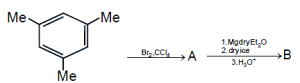
The compounds $A$ and $B$ are respectively
A
$A$ = $1,3,5-$tris(bromomethyl)benzene; $B$ = $1,3,5-$benzenetricarboxylic acid
B
$A$ = $1-$bromo$-3,5-$dimethylbenzene; $B$ = $3,5-$dimethylbenzoic acid
C
$A$ = $2-$bromo$-1,3,5-$trimethylbenzene; $B$ = $2,4,6-$trimethylbenzoic acid
D
$A$ = $2,4,6-$tribromo$-1,3,5-$trimethylbenzene; $B$ = $2,4,6-$trimethylbenzene$-1,3,5-$tricarboxylic acid
Solution
(C) $1$. The starting material is $1,3,5$-trimethylbenzene (mesitylene).
$2$. Electrophilic aromatic substitution with $Br_2$ in $CCl_4$ occurs at the position ortho to the methyl groups. Since all positions are equivalent,it forms $2$-bromo-$1,3,5$-trimethylbenzene $(A)$.
$3$. Treatment of $A$ with $Mg$ in dry ether forms the Grignard reagent,$2,4,6$-trimethylphenylmagnesium bromide.
$4$. Reaction of the Grignard reagent with dry ice $(CO_2)$ followed by acidic workup $(H_3O^+)$ yields the corresponding carboxylic acid,$2,4,6$-trimethylbenzoic acid $(B)$.
$2$. Electrophilic aromatic substitution with $Br_2$ in $CCl_4$ occurs at the position ortho to the methyl groups. Since all positions are equivalent,it forms $2$-bromo-$1,3,5$-trimethylbenzene $(A)$.
$3$. Treatment of $A$ with $Mg$ in dry ether forms the Grignard reagent,$2,4,6$-trimethylphenylmagnesium bromide.
$4$. Reaction of the Grignard reagent with dry ice $(CO_2)$ followed by acidic workup $(H_3O^+)$ yields the corresponding carboxylic acid,$2,4,6$-trimethylbenzoic acid $(B)$.
0 likesView Solution
3
ChemistryMediumMCQWBJEE · 2024
Which of the following contains the maximum number of lone pairs on the central atom?
A
$ClO_3^{-}$
B
$XeF_4$
C
$SF_4$
D
$I_3^{-}$
Solution
(D) To determine the number of lone pairs on the central atom,we use the formula: $\text{Lone pairs} = \frac{1}{2} (V - M - C + A)$,where $V$ is the number of valence electrons of the central atom,$M$ is the number of monovalent atoms,$C$ is the cationic charge,and $A$ is the anionic charge.
$A) \ ClO_3^{-}$: Central atom $Cl$ $(V=7)$. $3$ oxygen atoms are divalent. Lone pairs $= \frac{1}{2} (7 - 0 - 0 + 1) = 4$ electrons,which corresponds to $1$ lone pair.
$B) \ XeF_4$: Central atom $Xe$ $(V=8)$. $4$ fluorine atoms are monovalent. Lone pairs $= \frac{1}{2} (8 - 4) = 2$ lone pairs.
$C) \ SF_4$: Central atom $S$ $(V=6)$. $4$ fluorine atoms are monovalent. Lone pairs $= \frac{1}{2} (6 - 4) = 1$ lone pair.
$D) \ I_3^{-}$: Central atom $I$ $(V=7)$. $2$ iodine atoms are monovalent. Lone pairs $= \frac{1}{2} (7 - 2 + 1) = 3$ lone pairs.
Thus,$I_3^{-}$ has the maximum number of lone pairs $(3)$ on the central atom.
$A) \ ClO_3^{-}$: Central atom $Cl$ $(V=7)$. $3$ oxygen atoms are divalent. Lone pairs $= \frac{1}{2} (7 - 0 - 0 + 1) = 4$ electrons,which corresponds to $1$ lone pair.
$B) \ XeF_4$: Central atom $Xe$ $(V=8)$. $4$ fluorine atoms are monovalent. Lone pairs $= \frac{1}{2} (8 - 4) = 2$ lone pairs.
$C) \ SF_4$: Central atom $S$ $(V=6)$. $4$ fluorine atoms are monovalent. Lone pairs $= \frac{1}{2} (6 - 4) = 1$ lone pair.
$D) \ I_3^{-}$: Central atom $I$ $(V=7)$. $2$ iodine atoms are monovalent. Lone pairs $= \frac{1}{2} (7 - 2 + 1) = 3$ lone pairs.
Thus,$I_3^{-}$ has the maximum number of lone pairs $(3)$ on the central atom.
0 likesView Solution
4
ChemistryDifficultMCQWBJEE · 2024
What will be the change in acidity if
$(i)$ $CuSO_4$ is added in saturated $(NH_4)_2SO_4$ solution
$(ii)$ $SbF_5$ is added in anhydrous $HF$?
$(i)$ $CuSO_4$ is added in saturated $(NH_4)_2SO_4$ solution
$(ii)$ $SbF_5$ is added in anhydrous $HF$?
A
increase,increase
B
decrease,decrease
C
increase,decrease
D
decrease,increase
Solution
(A) $(i)$ In a saturated $(NH_4)_2SO_4$ solution,$NH_4^+$ ions are in equilibrium with $NH_3$ and $H^+$. When $CuSO_4$ is added,$Cu^{2+}$ reacts with $NH_3$ to form the stable complex $[Cu(NH_3)_4]^{2+}$.
$Cu^{2+}_{(aq)} + 4NH_{3(aq)} \rightarrow [Cu(NH_3)_4]^{2+}_{(aq)}$
This reaction consumes $NH_3$,shifting the equilibrium $NH_4^+ \rightleftharpoons NH_3 + H^+$ to the right,which increases the $H^+$ ion concentration and thus increases the acidity.
$(ii)$ In anhydrous $HF$,the auto-ionization equilibrium is $2HF \rightleftharpoons H_2F^+ + F^-$.
When $SbF_5$ is added,it acts as a strong Lewis acid and reacts with $F^-$ to form the stable $SbF_6^-$ ion $(SbF_5 + F^- \rightarrow SbF_6^-)$.
This removes $F^-$ from the solution,shifting the equilibrium to the right,which increases the concentration of $H_2F^+$ (the superacidic species),thereby increasing the acidity.
$Cu^{2+}_{(aq)} + 4NH_{3(aq)} \rightarrow [Cu(NH_3)_4]^{2+}_{(aq)}$
This reaction consumes $NH_3$,shifting the equilibrium $NH_4^+ \rightleftharpoons NH_3 + H^+$ to the right,which increases the $H^+$ ion concentration and thus increases the acidity.
$(ii)$ In anhydrous $HF$,the auto-ionization equilibrium is $2HF \rightleftharpoons H_2F^+ + F^-$.
When $SbF_5$ is added,it acts as a strong Lewis acid and reacts with $F^-$ to form the stable $SbF_6^-$ ion $(SbF_5 + F^- \rightarrow SbF_6^-)$.
This removes $F^-$ from the solution,shifting the equilibrium to the right,which increases the concentration of $H_2F^+$ (the superacidic species),thereby increasing the acidity.
0 likesView Solution
5
ChemistryMediumMCQWBJEE · 2024
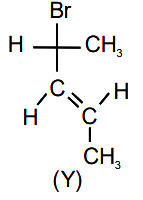
Which of the following represent$(s)$ the enantiomer of $Y$?
A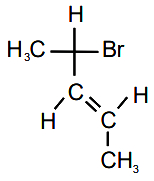
B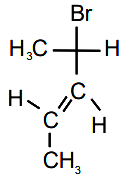
C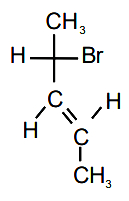
D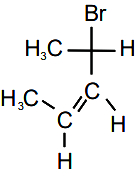
Solution
(B) To find the enantiomer of $Y$,we must look for a structure that is a non-superimposable mirror image of $Y$.
$1$. The molecule $Y$ contains a chiral center. The priority order of groups attached to the chiral center is: $-Br (1) > -CH=CHCH_3 (2) > -CH_3 (3) > -H (4)$.
$2$. In $Y$,the configuration of the chiral center is '$R$'.
$3$. An enantiomer must have the opposite configuration ('$S$') at the chiral center while maintaining the same geometry at the double bond $(trans)$.
$4$. Analyzing the options:
- Option $A$ has the same configuration as $Y$ (identical).
- Option $B$ has the '$S$' configuration at the chiral center and maintains the $trans$ geometry,making it the enantiomer of $Y$.
- Option $C$ has the '$S$' configuration but the structure is different.
- Option $D$ has a different geometry at the double bond $(cis)$,so it is a diastereomer,not an enantiomer.
$1$. The molecule $Y$ contains a chiral center. The priority order of groups attached to the chiral center is: $-Br (1) > -CH=CHCH_3 (2) > -CH_3 (3) > -H (4)$.
$2$. In $Y$,the configuration of the chiral center is '$R$'.
$3$. An enantiomer must have the opposite configuration ('$S$') at the chiral center while maintaining the same geometry at the double bond $(trans)$.
$4$. Analyzing the options:
- Option $A$ has the same configuration as $Y$ (identical).
- Option $B$ has the '$S$' configuration at the chiral center and maintains the $trans$ geometry,making it the enantiomer of $Y$.
- Option $C$ has the '$S$' configuration but the structure is different.
- Option $D$ has a different geometry at the double bond $(cis)$,so it is a diastereomer,not an enantiomer.
0 likesView Solution
6
ChemistryEasyMCQWBJEE · 2024
The compound that does not give a positive test for nitrogen in Lassaigne's test is
A
$o$-Nitrophenol
B
Benzene diazonium chloride
C
Sulfanilic acid
D
$m$-Chloroaniline
Solution
(B) Lassaigne's test is used to detect nitrogen,sulfur,and halogens in organic compounds. The test involves fusing the organic compound with metallic sodium to convert the elements into water-soluble sodium salts like $NaCN$,$Na_2S$,and $NaCl$.
In the case of benzene diazonium chloride $(C_6H_5N_2^+Cl^-)$,the diazonium group is unstable. Upon heating with sodium metal,the nitrogen atoms are released as $N_2$ gas before they can react with sodium to form $NaCN$. Consequently,the test for nitrogen becomes negative.
Other compounds like $o$-nitrophenol,sulfanilic acid,and $m$-chloroaniline contain nitrogen in more stable forms that successfully convert to $NaCN$ during the fusion process,thus giving a positive test.
In the case of benzene diazonium chloride $(C_6H_5N_2^+Cl^-)$,the diazonium group is unstable. Upon heating with sodium metal,the nitrogen atoms are released as $N_2$ gas before they can react with sodium to form $NaCN$. Consequently,the test for nitrogen becomes negative.
Other compounds like $o$-nitrophenol,sulfanilic acid,and $m$-chloroaniline contain nitrogen in more stable forms that successfully convert to $NaCN$ during the fusion process,thus giving a positive test.
0 likesView Solution
7
ChemistryMediumMCQWBJEE · 2024
The decreasing order of reactivity of the following alkenes towards $HBr$ addition is:
$(I) \ CH_3-CH=CH_2$
$(II) \ CF_3-CH=CH_2$
$(III) \ MeOCH=CH_2$
$(IV) \ CH_3-CO-CH=CH_2$
$(I) \ CH_3-CH=CH_2$
$(II) \ CF_3-CH=CH_2$
$(III) \ MeOCH=CH_2$
$(IV) \ CH_3-CO-CH=CH_2$
A
$I > II > III > IV$
B
$II > IV > I > III$
C
$III > IV > I > II$
D
$III > I > II > IV$
Solution
(D) The reactivity of alkenes towards electrophilic addition of $HBr$ depends on the stability of the carbocation intermediate formed in the rate-determining step (r.d.s.).
$1$. In $(III) \ MeOCH=CH_2$,the methoxy group $(-OCH_3)$ shows a strong $+M$ effect,which highly stabilizes the carbocation.
$2$. In $(I) \ CH_3-CH=CH_2$,the methyl group shows $+I$ and hyperconjugation,providing moderate stability.
$3$. In $(IV) \ CH_3-CO-CH=CH_2$,the carbonyl group $(-CO-)$ shows a $-M$ effect,which destabilizes the carbocation.
$4$. In $(II) \ CF_3-CH=CH_2$,the trifluoromethyl group $(-CF_3)$ shows a very strong $-I$ effect,which strongly destabilizes the carbocation.
Thus,the stability order of the carbocation (and hence reactivity) is: $III > I > IV > II$.
$1$. In $(III) \ MeOCH=CH_2$,the methoxy group $(-OCH_3)$ shows a strong $+M$ effect,which highly stabilizes the carbocation.
$2$. In $(I) \ CH_3-CH=CH_2$,the methyl group shows $+I$ and hyperconjugation,providing moderate stability.
$3$. In $(IV) \ CH_3-CO-CH=CH_2$,the carbonyl group $(-CO-)$ shows a $-M$ effect,which destabilizes the carbocation.
$4$. In $(II) \ CF_3-CH=CH_2$,the trifluoromethyl group $(-CF_3)$ shows a very strong $-I$ effect,which strongly destabilizes the carbocation.
Thus,the stability order of the carbocation (and hence reactivity) is: $III > I > IV > II$.
0 likesView Solution
8
ChemistryMediumMCQWBJEE · 2024
In the reaction sequence $Me_3CCH=CH_2 \xrightarrow{Q} Me_3CCH_2CH_2OH$ and $Me_3CCH=CH_2 \xrightarrow{R} Me_3C-CH(OH)-CH_3$,$Q$ and $R$ are respectively:
A
$Hg(OAc)_2, NaBH_4 / \overline{O}H ; B_2H_6, H_2O_2 / \overline{O}H$
B
$B_2H_6, H_2O_2 / \overline{O}H ; H^{+} / H_2O$
C
$Hg(OAc)_2, NaBH_4 / \overline{O}H ; H^{+} / H_2O$
D
$B_2H_6, H_2O_2 / \overline{O}H ; Hg(OAc)_2, NaBH_4 / \overline{O}H$
Solution
(D) The reaction $Me_3CCH=CH_2 \xrightarrow{Q} Me_3CCH_2CH_2OH$ represents an anti-Markovnikov addition of water,which is achieved by hydroboration-oxidation using $B_2H_6, H_2O_2 / \overline{O}H$.
The reaction $Me_3CCH=CH_2 \xrightarrow{R} Me_3C-CH(OH)-CH_3$ represents a Markovnikov addition of water without rearrangement,which is achieved by oxymercuration-demercuration using $Hg(OAc)_2, NaBH_4 / \overline{O}H$.
Therefore,$Q$ is $B_2H_6, H_2O_2 / \overline{O}H$ and $R$ is $Hg(OAc)_2, NaBH_4 / \overline{O}H$.
The reaction $Me_3CCH=CH_2 \xrightarrow{R} Me_3C-CH(OH)-CH_3$ represents a Markovnikov addition of water without rearrangement,which is achieved by oxymercuration-demercuration using $Hg(OAc)_2, NaBH_4 / \overline{O}H$.
Therefore,$Q$ is $B_2H_6, H_2O_2 / \overline{O}H$ and $R$ is $Hg(OAc)_2, NaBH_4 / \overline{O}H$.
0 likesView Solution
9
ChemistryMediumMCQWBJEE · 2024
Toluene reacts with mixed acid at $25^{\circ} C$ to produce
A
nearly equal amounts of $o-$ and $m-$ nitrotoluene
B
$p-$ nitrotoluene (only)
C
Predominantly $o-$ nitrotoluene and $p-$ nitrotoluene
D
$2, 4, 6-$ trinitrotoluene (only)
Solution
(C) The methyl group $(-CH_3)$ in toluene is an electron-donating group by inductive effect and hyperconjugation.
It is an ortho- and para-directing group.
Therefore,the nitration of toluene with a mixture of concentrated $HNO_3$ and $H_2SO_4$ at $25^{\circ} C$ yields a mixture of $o-$nitrotoluene and $p-$nitrotoluene as the major products,with a very small amount of $m-$nitrotoluene.
Thus,the reaction produces predominantly $o-$nitrotoluene and $p-$nitrotoluene.
It is an ortho- and para-directing group.
Therefore,the nitration of toluene with a mixture of concentrated $HNO_3$ and $H_2SO_4$ at $25^{\circ} C$ yields a mixture of $o-$nitrotoluene and $p-$nitrotoluene as the major products,with a very small amount of $m-$nitrotoluene.
Thus,the reaction produces predominantly $o-$nitrotoluene and $p-$nitrotoluene.
0 likesView Solution
10
ChemistryEasyMCQWBJEE · 2024
pH of $10^{-8} \ M \ HCl$ solution is
A
$8$
B
greater than $7$,less than $8$
C
greater than $8$
D
greater than $6$,less than $7$
Solution
(D) For a very dilute solution like $10^{-8} \ M \ HCl$,the concentration of $H^{+}$ ions from water cannot be neglected.
$H^{+}_{total} = [H^{+}]_{HCl} + [H^{+}]_{H_2O}$
$[H^{+}]_{total} = 10^{-8} + 10^{-7} \approx 1.1 \times 10^{-7} \ M$
$pH = -\log[H^{+}]_{total} = -\log(1.1 \times 10^{-7})$
$pH = 7 - \log(1.1) \approx 7 - 0.0414 = 6.9586$
Thus,the pH is greater than $6$ and less than $7$.
$H^{+}_{total} = [H^{+}]_{HCl} + [H^{+}]_{H_2O}$
$[H^{+}]_{total} = 10^{-8} + 10^{-7} \approx 1.1 \times 10^{-7} \ M$
$pH = -\log[H^{+}]_{total} = -\log(1.1 \times 10^{-7})$
$pH = 7 - \log(1.1) \approx 7 - 0.0414 = 6.9586$
Thus,the pH is greater than $6$ and less than $7$.
0 likesView Solution
11
ChemistryEasyMCQWBJEE · 2024
At $25^{\circ} C$,the ionic product of water is $10^{-14}$. The free energy change for the self-ionization of water in $kCal \ mol^{-1}$ is close to
A
$20.5$
B
$14$
C
$19.1$
D
$25.3$
Solution
(C) The self-ionization reaction of water is: $H_2O(\ell) \rightleftharpoons H^{+}_{(aq)} + OH^{-}_{(aq)}$ with $K_w = 10^{-14}$.
The standard Gibbs free energy change is given by: $\Delta G^{\circ} = -RT \ln K_w = -2.303 RT \log K_w$.
Given $R = 1.987 \times 10^{-3} \ kCal \ K^{-1} \ mol^{-1}$ and $T = 298 \ K$:
$\Delta G^{\circ} = -2.303 \times (1.987 \times 10^{-3}) \times 298 \times \log(10^{-14})$
$\Delta G^{\circ} = -2.303 \times 1.987 \times 10^{-3} \times 298 \times (-14)$
$\Delta G^{\circ} \approx 19.1 \ kCal \ mol^{-1}$.
The standard Gibbs free energy change is given by: $\Delta G^{\circ} = -RT \ln K_w = -2.303 RT \log K_w$.
Given $R = 1.987 \times 10^{-3} \ kCal \ K^{-1} \ mol^{-1}$ and $T = 298 \ K$:
$\Delta G^{\circ} = -2.303 \times (1.987 \times 10^{-3}) \times 298 \times \log(10^{-14})$
$\Delta G^{\circ} = -2.303 \times 1.987 \times 10^{-3} \times 298 \times (-14)$
$\Delta G^{\circ} \approx 19.1 \ kCal \ mol^{-1}$.
0 likesView Solution
12
ChemistryMediumMCQWBJEE · 2024
The equivalent weight of $Na_2S_2O_3$ (Gram molecular weight $= M$) in the given reaction is $I_2 + 2Na_2S_2O_3 \rightarrow 2NaI + Na_2S_4O_6$.
A
$M/2$
B
$M$
C
$2M$
D
$M/4$
Solution
(B) In the given reaction: $I_2 + 2Na_2S_2O_3 \rightarrow 2NaI + Na_2S_4O_6$.
The oxidation state of sulfur in $Na_2S_2O_3$ changes from $+2$ to $+2.5$ in $Na_2S_4O_6$.
The change in oxidation state per sulfur atom is $2.5 - 2 = 0.5$.
Since there are $2$ sulfur atoms in $Na_2S_2O_3$,the total change in oxidation state per molecule is $2 \times 0.5 = 1$.
Thus,the $n$-factor for $Na_2S_2O_3$ is $1$.
Equivalent weight $= \frac{\text{Molecular weight}}{n\text{-factor}} = \frac{M}{1} = M$.
The oxidation state of sulfur in $Na_2S_2O_3$ changes from $+2$ to $+2.5$ in $Na_2S_4O_6$.
The change in oxidation state per sulfur atom is $2.5 - 2 = 0.5$.
Since there are $2$ sulfur atoms in $Na_2S_2O_3$,the total change in oxidation state per molecule is $2 \times 0.5 = 1$.
Thus,the $n$-factor for $Na_2S_2O_3$ is $1$.
Equivalent weight $= \frac{\text{Molecular weight}}{n\text{-factor}} = \frac{M}{1} = M$.
0 likesView Solution
13
ChemistryDifficultMCQWBJEE · 2024
Identify the incorrect statement among the following:
A
Viscosity of liquid always decreases with increase in temperature.
B
Surface tension of liquid always decreases with increase in temperature.
C
Viscosity of liquid always increases in presence of impurity.
D
Surface tension of liquid always increases in presence of impurity.
Solution
(C) The viscosity of a liquid generally decreases with an increase in temperature due to the decrease in intermolecular forces.
Surface tension of a liquid also decreases with an increase in temperature because the kinetic energy of molecules increases,reducing the cohesive forces.
However,the effect of impurities on viscosity and surface tension is not uniform.
For example,highly soluble solutes like sugar increase the viscosity of water,while some other impurities may decrease it.
Similarly,surface-active agents (surfactants) decrease the surface tension of water,while inorganic salts increase it.
Therefore,both statements $C$ and $D$ are incorrect as they use the word 'always'.
Surface tension of a liquid also decreases with an increase in temperature because the kinetic energy of molecules increases,reducing the cohesive forces.
However,the effect of impurities on viscosity and surface tension is not uniform.
For example,highly soluble solutes like sugar increase the viscosity of water,while some other impurities may decrease it.
Similarly,surface-active agents (surfactants) decrease the surface tension of water,while inorganic salts increase it.
Therefore,both statements $C$ and $D$ are incorrect as they use the word 'always'.
0 likesView Solution
14
ChemistryEasyMCQWBJEE · 2024
Equal volumes of aqueous solution of $0.1 \ M \ HCl$ and $0.2 \ M \ H_2SO_4$ are mixed. The concentration of $H^{+}$ ions in the resulting solution is (in $M$)
A
$0.15$
B
$0.30$
C
$0.10$
D
$0.25$
Solution
(D) The concentration of $H^{+}$ ions is calculated using the formula: $[H^{+}] = \frac{\text{Total moles of } H^{+}}{\text{Total volume of solution}}$.
Let the volume of each solution be $V \ L$.
Moles of $H^{+}$ from $HCl = M \times V \times n = 0.1 \times V \times 1 = 0.1V \ mol$.
Moles of $H^{+}$ from $H_2SO_4 = M \times V \times n = 0.2 \times V \times 2 = 0.4V \ mol$.
Total moles of $H^{+} = 0.1V + 0.4V = 0.5V \ mol$.
Total volume of the mixture $= V + V = 2V \ L$.
Concentration of $H^{+} = \frac{0.5V}{2V} = 0.25 \ M$.
Let the volume of each solution be $V \ L$.
Moles of $H^{+}$ from $HCl = M \times V \times n = 0.1 \times V \times 1 = 0.1V \ mol$.
Moles of $H^{+}$ from $H_2SO_4 = M \times V \times n = 0.2 \times V \times 2 = 0.4V \ mol$.
Total moles of $H^{+} = 0.1V + 0.4V = 0.5V \ mol$.
Total volume of the mixture $= V + V = 2V \ L$.
Concentration of $H^{+} = \frac{0.5V}{2V} = 0.25 \ M$.
0 likesView Solution
15
ChemistryEasyMCQWBJEE · 2024
The compressibility factor for a van der Waal gas at high pressure is
A
$1+\frac{RT}{Pb}$
B
$1+\frac{Pb}{RT}$
C
$1-\frac{Pb}{RT}$
D
$1$
Solution
(B) For $1 \ mol$ of a van der Waal gas,the equation is $(P+\frac{a}{V^2})(V-b)=RT$.
At high pressure,the term $\frac{a}{V^2}$ is negligible compared to $P$,so $P+\frac{a}{V^2} \approx P$.
Substituting this into the equation,we get $P(V-b)=RT$.
Expanding this gives $PV-Pb=RT$,which rearranges to $PV=RT+Pb$.
The compressibility factor $z$ is defined as $z=\frac{PV}{RT}$.
Dividing the equation $PV=RT+Pb$ by $RT$,we get $z=\frac{RT}{RT}+\frac{Pb}{RT}$.
Therefore,$z=1+\frac{Pb}{RT}$.
At high pressure,the term $\frac{a}{V^2}$ is negligible compared to $P$,so $P+\frac{a}{V^2} \approx P$.
Substituting this into the equation,we get $P(V-b)=RT$.
Expanding this gives $PV-Pb=RT$,which rearranges to $PV=RT+Pb$.
The compressibility factor $z$ is defined as $z=\frac{PV}{RT}$.
Dividing the equation $PV=RT+Pb$ by $RT$,we get $z=\frac{RT}{RT}+\frac{Pb}{RT}$.
Therefore,$z=1+\frac{Pb}{RT}$.
0 likesView Solution
16
ChemistryMediumMCQWBJEE · 2024
Consider an electron moving in the first Bohr orbit of a $He^{+}$ ion with a velocity $v_1$. If it is allowed to move in the third Bohr orbit with a velocity $v_3$,then indicate the correct $v_3: v_1$ ratio.
A
$3: 1$
B
$2: 1$
C
$1: 3$
D
$1: 2$
Solution
(C) The velocity of an electron in the $n^{th}$ Bohr orbit is given by the formula $v = v_0 \frac{Z}{n}$,where $Z$ is the atomic number and $n$ is the orbit number.
For a $He^{+}$ ion,the atomic number $Z = 2$.
For the $1^{st}$ orbit $(n=1)$,the velocity is $v_1 = v_0 \frac{2}{1} = 2v_0$.
For the $3^{rd}$ orbit $(n=3)$,the velocity is $v_3 = v_0 \frac{2}{3} = \frac{2}{3}v_0$.
Therefore,the ratio $v_3 : v_1 = \frac{2}{3}v_0 : 2v_0 = \frac{1}{3} : 1 = 1 : 3$.
For a $He^{+}$ ion,the atomic number $Z = 2$.
For the $1^{st}$ orbit $(n=1)$,the velocity is $v_1 = v_0 \frac{2}{1} = 2v_0$.
For the $3^{rd}$ orbit $(n=3)$,the velocity is $v_3 = v_0 \frac{2}{3} = \frac{2}{3}v_0$.
Therefore,the ratio $v_3 : v_1 = \frac{2}{3}v_0 : 2v_0 = \frac{1}{3} : 1 = 1 : 3$.
0 likesView Solution
17
ChemistryEasyMCQWBJEE · 2024
Which hydrogen-like species will have the same radius as that of the $1^{st}$ Bohr orbit of a hydrogen atom?
A
$n=2, Li^{2+}$
B
$n=2, Be^{3+}$
C
$n=2, He^{+}$
D
$n=3, Li^{2+}$
Solution
(B) The radius of the $n^{th}$ orbit for a hydrogen-like species is given by the formula: $r_n = 0.529 \times \frac{n^2}{Z} \mathring{A}$.
For the $1^{st}$ Bohr orbit of a hydrogen atom $(n=1, Z=1)$: $r = 0.529 \times \frac{1^2}{1} = 0.529 \mathring{A}$.
Now,checking the options:
For $Be^{3+}$ $(Z=4)$ with $n=2$: $r = 0.529 \times \frac{2^2}{4} = 0.529 \times \frac{4}{4} = 0.529 \mathring{A}$.
Thus,the $2^{nd}$ orbit of $Be^{3+}$ has the same radius as the $1^{st}$ orbit of hydrogen.
For the $1^{st}$ Bohr orbit of a hydrogen atom $(n=1, Z=1)$: $r = 0.529 \times \frac{1^2}{1} = 0.529 \mathring{A}$.
Now,checking the options:
For $Be^{3+}$ $(Z=4)$ with $n=2$: $r = 0.529 \times \frac{2^2}{4} = 0.529 \times \frac{4}{4} = 0.529 \mathring{A}$.
Thus,the $2^{nd}$ orbit of $Be^{3+}$ has the same radius as the $1^{st}$ orbit of hydrogen.
0 likesView Solution
18
ChemistryEasyMCQWBJEE · 2024
For a spontaneous process,the incorrect statement is
A
$(\Delta G_{\text{system}})_{T, P} > 0$
B
$(\Delta S_{\text{system}}) + (\Delta S_{\text{surroundings}}) > 0$
C
$(\Delta G_{\text{system}})_{T, P} < 0$
D
$(\Delta U_{\text{system}})_{S, V} < 0$
Solution
(A) For a spontaneous process,the following criteria must be satisfied:
$1$. The change in Gibbs energy at constant temperature and pressure must be negative: $(\Delta G_{\text{system}})_{T, P} < 0$.
$2$. The total entropy change of the universe must be positive: $\Delta S_{\text{total}} = (\Delta S_{\text{system}}) + (\Delta S_{\text{surroundings}}) > 0$.
$3$. The change in internal energy at constant entropy and volume must be negative: $(\Delta U_{\text{system}})_{S, V} < 0$.
Therefore,the statement $(\Delta G_{\text{system}})_{T, P} > 0$ is incorrect.
$1$. The change in Gibbs energy at constant temperature and pressure must be negative: $(\Delta G_{\text{system}})_{T, P} < 0$.
$2$. The total entropy change of the universe must be positive: $\Delta S_{\text{total}} = (\Delta S_{\text{system}}) + (\Delta S_{\text{surroundings}}) > 0$.
$3$. The change in internal energy at constant entropy and volume must be negative: $(\Delta U_{\text{system}})_{S, V} < 0$.
Therefore,the statement $(\Delta G_{\text{system}})_{T, P} > 0$ is incorrect.
0 likesView Solution
19
ChemistryMediumMCQWBJEE · 2024
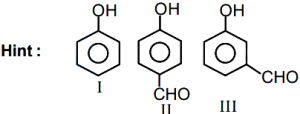
The correct acidity order of phenol $(I)$,$4-$hydroxybenzaldehyde $(II)$ and $3-$hydroxybenzaldehyde $(III)$ is:
A
$I < II < III$
B
$I < III < II$
C
$II < III < I$
D
$III < II < I$
Solution
(B) Electron-withdrawing groups $(EWG)$ like $-CHO$ increase the acidity of phenols by stabilizing the phenoxide ion.
In $4-$hydroxybenzaldehyde $(II)$,the $-CHO$ group is at the para position and exerts both $-M$ (mesomeric) and $-I$ (inductive) effects.
In $3-$hydroxybenzaldehyde $(III)$,the $-CHO$ group is at the meta position and exerts only the $-I$ effect (the mesomeric effect does not operate at the meta position).
Phenol $(I)$ has no such electron-withdrawing group.
Therefore,the acidity order is $I < III < II$.
In $4-$hydroxybenzaldehyde $(II)$,the $-CHO$ group is at the para position and exerts both $-M$ (mesomeric) and $-I$ (inductive) effects.
In $3-$hydroxybenzaldehyde $(III)$,the $-CHO$ group is at the meta position and exerts only the $-I$ effect (the mesomeric effect does not operate at the meta position).
Phenol $(I)$ has no such electron-withdrawing group.
Therefore,the acidity order is $I < III < II$.
0 likesView Solution
20
ChemistryMediumMCQWBJEE · 2024
In the following sequence of reactions,compound $M$ is:
$M$ $\xrightarrow{CH_3MgBr} N + CH_4 \uparrow$ $\xrightarrow{H^+} CH_3COCH_2COCH_3$
$M$ $\xrightarrow{CH_3MgBr} N + CH_4 \uparrow$ $\xrightarrow{H^+} CH_3COCH_2COCH_3$
A
$CH_3COCH_2COCH_3$
B
$CH_3COCH_2CO_2Et$
C
$CH_3COCH_3$
D
$CH_3COOH$
Solution
(A) The reaction shows that compound $M$ reacts with $CH_3MgBr$ (a Grignard reagent) to release $CH_4$ gas. This indicates that $M$ contains an acidic hydrogen atom.
Upon treatment with $H^+$,the intermediate $N$ yields $CH_3COCH_2COCH_3$ (acetylacetone).
Acetylacetone has an active methylene group ($-CH_2-$ between two carbonyl groups) with acidic protons.
Therefore,$M$ must be $CH_3COCH_2COCH_3$ itself,as the Grignard reagent acts as a base to abstract the acidic proton from the active methylene group,forming the enolate $N$,which is then protonated back to the original ketone upon treatment with $H^+$.
Upon treatment with $H^+$,the intermediate $N$ yields $CH_3COCH_2COCH_3$ (acetylacetone).
Acetylacetone has an active methylene group ($-CH_2-$ between two carbonyl groups) with acidic protons.
Therefore,$M$ must be $CH_3COCH_2COCH_3$ itself,as the Grignard reagent acts as a base to abstract the acidic proton from the active methylene group,forming the enolate $N$,which is then protonated back to the original ketone upon treatment with $H^+$.
0 likesView Solution
21
ChemistryDifficultMCQWBJEE · 2024
The product $P$ in the following reaction is:
$PhCHO + (CH_3CH_2CO)_2O \xrightarrow{CH_3CH_2COONa \text{ (anhydrous)}} P$
$PhCHO + (CH_3CH_2CO)_2O \xrightarrow{CH_3CH_2COONa \text{ (anhydrous)}} P$
A
$Ph-CH=C(CH_3)-COOH$
B
$Ph-CH=C(CH_2CH_3)-COOH$
C
$Ph-CH(OCOCH_2CH_3)_2$
D
$Ph-CH=CH-CH_2-COO-COCH_2CH_3$
Solution
(A) The given reaction is a variation of the Perkin condensation.
In this reaction,an aromatic aldehyde $(PhCHO)$ reacts with an acid anhydride $((CH_3CH_2CO)_2O)$ in the presence of the sodium salt of the corresponding acid $(CH_3CH_2COONa)$.
The $\alpha$-hydrogen of the anhydride is abstracted by the base to form a carbanion,which then attacks the carbonyl carbon of the aldehyde.
Following dehydration and hydrolysis,the final product is an $\alpha,\beta$-unsaturated carboxylic acid.
For the reactants $PhCHO$ and propionic anhydride $((CH_3CH_2CO)_2O)$,the product formed is $Ph-CH=C(CH_3)-COOH$ ($2$-methyl$-3-$phenylprop$-2-$enoic acid).
In this reaction,an aromatic aldehyde $(PhCHO)$ reacts with an acid anhydride $((CH_3CH_2CO)_2O)$ in the presence of the sodium salt of the corresponding acid $(CH_3CH_2COONa)$.
The $\alpha$-hydrogen of the anhydride is abstracted by the base to form a carbanion,which then attacks the carbonyl carbon of the aldehyde.
Following dehydration and hydrolysis,the final product is an $\alpha,\beta$-unsaturated carboxylic acid.
For the reactants $PhCHO$ and propionic anhydride $((CH_3CH_2CO)_2O)$,the product formed is $Ph-CH=C(CH_3)-COOH$ ($2$-methyl$-3-$phenylprop$-2-$enoic acid).
0 likesView Solution
22
ChemistryMediumMCQWBJEE · 2024
For a first order reaction with rate constant $k$,the slope of the plot of $\log(\text{reactant concentration})$ against time is
A
$k / 2.303$
B
$k$
C
$-k / 2.303$
D
$-k$
Solution
(C) For a first order reaction,the integrated rate equation is:
$\ln[A]_t = -kt + \ln[A]_0$
Converting to base $10$ logarithm:
$\log[A]_t = \frac{-kt}{2.303} + \log[A]_0$
Comparing this with the equation of a straight line $y = mx + c$,where $y = \log[A]_t$,$x = t$,and $c = \log[A]_0$,the slope $m$ is equal to $\frac{-k}{2.303}$.
$\ln[A]_t = -kt + \ln[A]_0$
Converting to base $10$ logarithm:
$\log[A]_t = \frac{-kt}{2.303} + \log[A]_0$
Comparing this with the equation of a straight line $y = mx + c$,where $y = \log[A]_t$,$x = t$,and $c = \log[A]_0$,the slope $m$ is equal to $\frac{-k}{2.303}$.
0 likesView Solution
23
ChemistryEasyMCQWBJEE · 2024
After the emission of a $\beta$-particle followed by an $\alpha$-particle from ${ }_{83}^{214} Bi$,the number of neutrons in the resulting atom is:
A
$210$
B
$128$
C
$129$
D
$82$
Solution
(B) The initial nucleus is ${ }_{83}^{214} Bi$.
Emission of a $\beta$-particle $({ }_{-1}^{0} e)$ increases the atomic number by $1$ while the mass number remains unchanged:
${ }_{83}^{214} Bi \rightarrow { }_{84}^{214} Po + { }_{-1}^{0} e$
Emission of an $\alpha$-particle $({ }_{2}^{4} He)$ decreases the mass number by $4$ and the atomic number by $2$:
${ }_{84}^{214} Po \rightarrow { }_{82}^{210} Pb + { }_{2}^{4} He$
The final nucleus is ${ }_{82}^{210} Pb$.
The number of neutrons $N = A - Z = 210 - 82 = 128$.
Emission of a $\beta$-particle $({ }_{-1}^{0} e)$ increases the atomic number by $1$ while the mass number remains unchanged:
${ }_{83}^{214} Bi \rightarrow { }_{84}^{214} Po + { }_{-1}^{0} e$
Emission of an $\alpha$-particle $({ }_{2}^{4} He)$ decreases the mass number by $4$ and the atomic number by $2$:
${ }_{84}^{214} Po \rightarrow { }_{82}^{210} Pb + { }_{2}^{4} He$
The final nucleus is ${ }_{82}^{210} Pb$.
The number of neutrons $N = A - Z = 210 - 82 = 128$.
0 likesView Solution
24
ChemistryMediumMCQWBJEE · 2024
Which of the following statements is true about the equilibrium constant and rate constant of a single-step chemical reaction?
A
Equilibrium constant may increase or decrease but rate constant always increases with temperature
B
Both equilibrium constant and rate constant increase with temperature
C
Rate constant may increase or decrease but equilibrium constant always increases with temperature
D
Both equilibrium constant and rate constant decrease with temperature
Solution
(A) According to the Arrhenius equation,the rate constant $k$ is given by $k = A e^{-E_a/RT}$. Since the activation energy $E_a$ is always positive,the rate constant $k$ always increases with an increase in temperature.
According to the Van't Hoff equation,$\log \left(\frac{K_2}{K_1}\right) = \frac{\Delta H}{2.303 R} \left[\frac{1}{T_1} - \frac{1}{T_2}\right]$.
If the reaction is endothermic $(\Delta H > 0)$,the equilibrium constant $K$ increases with temperature.
If the reaction is exothermic $(\Delta H < 0)$,the equilibrium constant $K$ decreases with temperature.
Therefore,the equilibrium constant may increase or decrease depending on the enthalpy change,while the rate constant always increases with temperature.
According to the Van't Hoff equation,$\log \left(\frac{K_2}{K_1}\right) = \frac{\Delta H}{2.303 R} \left[\frac{1}{T_1} - \frac{1}{T_2}\right]$.
If the reaction is endothermic $(\Delta H > 0)$,the equilibrium constant $K$ increases with temperature.
If the reaction is exothermic $(\Delta H < 0)$,the equilibrium constant $K$ decreases with temperature.
Therefore,the equilibrium constant may increase or decrease depending on the enthalpy change,while the rate constant always increases with temperature.
0 likesView Solution
25
ChemistryMediumMCQWBJEE · 2024
Which of the following ion/ions is/are diamagnetic?
A
$[CoF_6]^{3-}$
B
$[Co(NH_3)_6]^{3+}$
C
$[Fe(OH_2)_6]^{2+}$
D
$[Fe(CN)_6]^{4-}$
Solution
(B, D) To determine if a complex is diamagnetic,we check for the presence of unpaired electrons in the metal ion's $d$-orbitals.
$1$. $[CoF_6]^{3-}$: $Co^{3+}$ is a $d^6$ ion. $F^-$ is a weak field ligand,resulting in a high-spin complex with $4$ unpaired electrons. It is paramagnetic.
$2$. $[Co(NH_3)_6]^{3+}$: $Co^{3+}$ is a $d^6$ ion. $NH_3$ is a strong field ligand,causing pairing of electrons. The configuration is $t_{2g}^6 e_g^0$,meaning $0$ unpaired electrons. It is diamagnetic.
$3$. $[Fe(OH_2)_6]^{2+}$: $Fe^{2+}$ is a $d^6$ ion. $H_2O$ is a weak field ligand,resulting in a high-spin complex with $4$ unpaired electrons. It is paramagnetic.
$4$. $[Fe(CN)_6]^{4-}$: $Fe^{2+}$ is a $d^6$ ion. $CN^-$ is a strong field ligand,causing pairing of electrons. The configuration is $t_{2g}^6 e_g^0$,meaning $0$ unpaired electrons. It is diamagnetic.
Thus,both $[Co(NH_3)_6]^{3+}$ and $[Fe(CN)_6]^{4-}$ are diamagnetic.
$1$. $[CoF_6]^{3-}$: $Co^{3+}$ is a $d^6$ ion. $F^-$ is a weak field ligand,resulting in a high-spin complex with $4$ unpaired electrons. It is paramagnetic.
$2$. $[Co(NH_3)_6]^{3+}$: $Co^{3+}$ is a $d^6$ ion. $NH_3$ is a strong field ligand,causing pairing of electrons. The configuration is $t_{2g}^6 e_g^0$,meaning $0$ unpaired electrons. It is diamagnetic.
$3$. $[Fe(OH_2)_6]^{2+}$: $Fe^{2+}$ is a $d^6$ ion. $H_2O$ is a weak field ligand,resulting in a high-spin complex with $4$ unpaired electrons. It is paramagnetic.
$4$. $[Fe(CN)_6]^{4-}$: $Fe^{2+}$ is a $d^6$ ion. $CN^-$ is a strong field ligand,causing pairing of electrons. The configuration is $t_{2g}^6 e_g^0$,meaning $0$ unpaired electrons. It is diamagnetic.
Thus,both $[Co(NH_3)_6]^{3+}$ and $[Fe(CN)_6]^{4-}$ are diamagnetic.
0 likesView Solution
26
ChemistryMediumMCQWBJEE · 2024
Number of moles of ions produced by complete dissociation of one mole of Mohr's salt in water is
A
$3$
B
$4$
C
$5$
D
$6$
Solution
(C) Mohr's salt is a double salt with the formula $FeSO_4 \cdot (NH_4)_2SO_4 \cdot 6H_2O$.
Upon complete dissociation in water,it ionizes as follows:
$FeSO_4 \cdot (NH_4)_2SO_4 \cdot 6H_2O \rightarrow Fe^{2+} + 2NH_4^{+} + 2SO_4^{2-} + 6H_2O$.
Counting the ions produced: $1$ mole of $Fe^{2+}$,$2$ moles of $NH_4^{+}$,and $2$ moles of $SO_4^{2-}$.
Total moles of ions = $1 + 2 + 2 = 5$ moles.
Upon complete dissociation in water,it ionizes as follows:
$FeSO_4 \cdot (NH_4)_2SO_4 \cdot 6H_2O \rightarrow Fe^{2+} + 2NH_4^{+} + 2SO_4^{2-} + 6H_2O$.
Counting the ions produced: $1$ mole of $Fe^{2+}$,$2$ moles of $NH_4^{+}$,and $2$ moles of $SO_4^{2-}$.
Total moles of ions = $1 + 2 + 2 = 5$ moles.
0 likesView Solution
27
ChemistryMediumMCQWBJEE · 2024
Which of the following species exhibits both $LMCT$ and paramagnetism?
A
$MnO_4^{2-}$
B
$MnO_4^{-}$
C
$Cr_2O_7^{2-}$
D
$CrO_4^{2-}$
Solution
(A) $LMCT$ (Ligand to Metal Charge Transfer) causes intense color in oxoanions of transition metals.
$MnO_4^{2-}$ (manganate ion) has $Mn$ in the $+6$ oxidation state,which corresponds to a $3d^1$ electronic configuration.
Since it has one unpaired electron,it is paramagnetic.
Additionally,it exhibits color due to $LMCT$ from $O^{2-}$ to $Mn^{+6}$.
In contrast,$MnO_4^{-}$,$Cr_2O_7^{2-}$,and $CrO_4^{2-}$ have $Mn^{+7}$ $(3d^0)$ and $Cr^{+6}$ $(3d^0)$ respectively,which are diamagnetic.
$MnO_4^{2-}$ (manganate ion) has $Mn$ in the $+6$ oxidation state,which corresponds to a $3d^1$ electronic configuration.
Since it has one unpaired electron,it is paramagnetic.
Additionally,it exhibits color due to $LMCT$ from $O^{2-}$ to $Mn^{+6}$.
In contrast,$MnO_4^{-}$,$Cr_2O_7^{2-}$,and $CrO_4^{2-}$ have $Mn^{+7}$ $(3d^0)$ and $Cr^{+6}$ $(3d^0)$ respectively,which are diamagnetic.
0 likesView Solution
28
ChemistryDifficultMCQWBJEE · 2024
Which of the following statement$(s)$ is/are correct regarding the solubility of solid $I_2$?
A
Solid $I_2$ is freely soluble in water
B
Solid $I_2$ is freely soluble in water but only in the presence of excess $KI$
C
Solid $I_2$ is freely soluble in $CCl_4$
D
Solid $I_2$ is freely soluble in hot water
Solution
(B, C) The solubility of $I_2$ is governed by the principle of 'like dissolves like'.
$I_2$ is a non-polar covalent molecule,making it poorly soluble in polar solvents like water.
However,$I_2$ dissolves in an aqueous solution of $KI$ due to the formation of the soluble triiodide complex ion: $I_2 + I^- \rightarrow I_3^-$.
Additionally,$I_2$ is freely soluble in non-polar organic solvents like $CCl_4$ because both are non-polar in nature.
Therefore,both statements $B$ and $C$ are correct.
$I_2$ is a non-polar covalent molecule,making it poorly soluble in polar solvents like water.
However,$I_2$ dissolves in an aqueous solution of $KI$ due to the formation of the soluble triiodide complex ion: $I_2 + I^- \rightarrow I_3^-$.
Additionally,$I_2$ is freely soluble in non-polar organic solvents like $CCl_4$ because both are non-polar in nature.
Therefore,both statements $B$ and $C$ are correct.
0 likesView Solution
29
ChemistryDifficultMCQWBJEE · 2024
The specific conductance $(k)$ of $0.02 \ M$ aqueous acetic acid solution at $298 \ K$ is $1.65 \times 10^{-4} \ S \ cm^{-1}$. The degree of dissociation $(\alpha)$ of acetic acid is: [Given: $\lambda_{H^{+}}^{\infty} = 349.1 \ S \ cm^2 \ mol^{-1}$ and $\lambda_{CH_3COO^{-}}^{\infty} = 40.9 \ S \ cm^2 \ mol^{-1}$]
A
$0.021$
B
$0.21$
C
$0.012$
D
$0.12$
Solution
(A) Step $1$: Calculate the molar conductivity $(\lambda_m)$ at the given concentration.
$\lambda_m = \frac{k \times 1000}{C} = \frac{1.65 \times 10^{-4} \times 1000}{0.02} = 8.25 \ S \ cm^2 \ mol^{-1}$.
Step $2$: Calculate the molar conductivity at infinite dilution $(\lambda_m^{\infty})$ using Kohlrausch's law.
$\lambda_m^{\infty}(CH_3COOH) = \lambda_{H^{+}}^{\infty} + \lambda_{CH_3COO^{-}}^{\infty} = 349.1 + 40.9 = 390.0 \ S \ cm^2 \ mol^{-1}$.
Step $3$: Calculate the degree of dissociation $(\alpha)$.
$\alpha = \frac{\lambda_m}{\lambda_m^{\infty}} = \frac{8.25}{390.0} = 0.02115 \approx 0.021$.
$\lambda_m = \frac{k \times 1000}{C} = \frac{1.65 \times 10^{-4} \times 1000}{0.02} = 8.25 \ S \ cm^2 \ mol^{-1}$.
Step $2$: Calculate the molar conductivity at infinite dilution $(\lambda_m^{\infty})$ using Kohlrausch's law.
$\lambda_m^{\infty}(CH_3COOH) = \lambda_{H^{+}}^{\infty} + \lambda_{CH_3COO^{-}}^{\infty} = 349.1 + 40.9 = 390.0 \ S \ cm^2 \ mol^{-1}$.
Step $3$: Calculate the degree of dissociation $(\alpha)$.
$\alpha = \frac{\lambda_m}{\lambda_m^{\infty}} = \frac{8.25}{390.0} = 0.02115 \approx 0.021$.
0 likesView Solution
30
ChemistryEasyMCQWBJEE · 2024
The reactivity order of the following molecules towards $S_N1$ reaction is:
$(I)$ Allyl chloride
$(II)$ Chlorobenzene
$(III)$ Ethyl chloride
$(I)$ Allyl chloride
$(II)$ Chlorobenzene
$(III)$ Ethyl chloride
A
$I > III > II$
B
$I > II > III$
C
$II > I > III$
D
$III > I > II$
Solution
(A) The reactivity of alkyl halides towards $S_N1$ reaction depends on the stability of the carbocation formed in the rate-determining step.
$1$. Allyl chloride $(I)$ forms an allyl carbocation $(CH_2=CH-CH_2^+)$,which is resonance-stabilized.
$2$. Ethyl chloride $(III)$ forms a primary ethyl carbocation $(CH_3-CH_2^+)$,which is less stable than the allyl carbocation.
$3$. Chlorobenzene $(II)$ does not undergo $S_N1$ reaction easily because the $C-Cl$ bond has partial double bond character due to resonance,making the formation of a phenyl carbocation extremely difficult.
Thus,the order of reactivity is $I > III > II$.
$1$. Allyl chloride $(I)$ forms an allyl carbocation $(CH_2=CH-CH_2^+)$,which is resonance-stabilized.
$2$. Ethyl chloride $(III)$ forms a primary ethyl carbocation $(CH_3-CH_2^+)$,which is less stable than the allyl carbocation.
$3$. Chlorobenzene $(II)$ does not undergo $S_N1$ reaction easily because the $C-Cl$ bond has partial double bond character due to resonance,making the formation of a phenyl carbocation extremely difficult.
Thus,the order of reactivity is $I > III > II$.
0 likesView Solution
31
ChemistryMediumMCQWBJEE · 2024
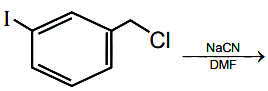
The major product of the following reaction is:
A
$3-$(cyanomethyl)benzonitrile
B
$3-$(chloromethyl)benzonitrile
C
$2-$($3$-iodophenyl)acetonitrile
D
$3-$iodobenzonitrile
Solution
(C) The reaction involves the nucleophilic substitution of a primary alkyl halide in the presence of $NaCN$ and $DMF$ (a polar aprotic solvent),which favors the $S_{N}2$ mechanism.
The substrate contains two halogen atoms: an iodine atom directly attached to the benzene ring (aryl iodide) and a chlorine atom attached to a benzylic carbon (benzylic chloride).
$1$. The $C-I$ bond attached to the benzene ring has partial double-bond character due to resonance,making it very resistant to nucleophilic substitution.
$2$. The benzylic $C-Cl$ bond is highly reactive towards $S_{N}2$ substitution because the transition state is stabilized by the adjacent benzene ring.
Therefore,the $CN^-$ nucleophile selectively attacks the benzylic carbon,displacing the $Cl^-$ ion to form $2-(3-iodophenyl)acetonitrile$ as the major product.
The substrate contains two halogen atoms: an iodine atom directly attached to the benzene ring (aryl iodide) and a chlorine atom attached to a benzylic carbon (benzylic chloride).
$1$. The $C-I$ bond attached to the benzene ring has partial double-bond character due to resonance,making it very resistant to nucleophilic substitution.
$2$. The benzylic $C-Cl$ bond is highly reactive towards $S_{N}2$ substitution because the transition state is stabilized by the adjacent benzene ring.
Therefore,the $CN^-$ nucleophile selectively attacks the benzylic carbon,displacing the $Cl^-$ ion to form $2-(3-iodophenyl)acetonitrile$ as the major product.
0 likesView Solution
32
ChemistryMediumMCQWBJEE · 2024
The correct solubility order of $AgF$,$AgCl$,$AgBr$,and $AgI$ in water is:
A
$AgF < AgCl > AgBr > AgI$
B
$AgI < AgBr < AgCl < AgF$
C
$AgF < AgI < AgBr < AgCl$
D
$AgCl > AgBr > AgF > AgI$
Solution
(B) The solubility of silver halides in water depends on the lattice energy and hydration energy.
$AgF$ is highly soluble in water due to its high hydration energy.
For the other silver halides ($AgCl$,$AgBr$,$AgI$),the lattice energy decreases as the size of the halide ion increases $(Cl^- < Br^- < I^-)$.
However,the decrease in hydration energy is more significant than the decrease in lattice energy as we move from $Cl^-$ to $I^-$.
Therefore,the solubility decreases in the order: $AgCl > AgBr > AgI$.
Combining these,the overall order of solubility is $AgI < AgBr < AgCl < AgF$.
$AgF$ is highly soluble in water due to its high hydration energy.
For the other silver halides ($AgCl$,$AgBr$,$AgI$),the lattice energy decreases as the size of the halide ion increases $(Cl^- < Br^- < I^-)$.
However,the decrease in hydration energy is more significant than the decrease in lattice energy as we move from $Cl^-$ to $I^-$.
Therefore,the solubility decreases in the order: $AgCl > AgBr > AgI$.
Combining these,the overall order of solubility is $AgI < AgBr < AgCl < AgF$.
0 likesView Solution
33
ChemistryDifficultMCQWBJEE · 2024
Which of the following statements about the $S_{N}2$ reaction mechanism is/are true?
A
The rate of reaction increases with increasing nucleophilicity.
B
The number $2$ denotes a second order reaction.
C
Tertiary butyl substrates do not follow this mechanism.
D
The optical rotation of substrates always changes from $(+)$ to $(-)$ or from $(-)$ to $(+)$.
Solution
(A, B, C) The $S_{N}2$ reaction is a bimolecular nucleophilic substitution reaction.
$1$. The rate of reaction depends on the concentration of both the substrate and the nucleophile,hence it is a second-order reaction.
$2$. The rate increases with the strength of the nucleophile (nucleophilicity).
$3$. Tertiary substrates are sterically hindered,making $S_{N}2$ reactions extremely slow or impossible.
$4$. Optical rotation change is not guaranteed; it depends on the priority of the incoming nucleophile compared to the leaving group according to Cahn-Ingold-Prelog rules.
Therefore,statements $A$,$B$,and $C$ are true.
$1$. The rate of reaction depends on the concentration of both the substrate and the nucleophile,hence it is a second-order reaction.
$2$. The rate increases with the strength of the nucleophile (nucleophilicity).
$3$. Tertiary substrates are sterically hindered,making $S_{N}2$ reactions extremely slow or impossible.
$4$. Optical rotation change is not guaranteed; it depends on the priority of the incoming nucleophile compared to the leaving group according to Cahn-Ingold-Prelog rules.
Therefore,statements $A$,$B$,and $C$ are true.
0 likesView Solution
34
ChemistryEasyMCQWBJEE · 2024
How many $P-O-P$ linkages are there in $P_4O_{10}$?
A
$6$
B
$4$
C
$5$
D
$1$
Solution
(A) The structure of $P_4O_{10}$ consists of a central $P_4$ tetrahedron where each edge is bridged by an oxygen atom,forming $P-O-P$ linkages.
There are $6$ edges in a tetrahedron,and each edge is bridged by one oxygen atom.
Therefore,there are $6$ $P-O-P$ linkages in the $P_4O_{10}$ molecule.
There are $6$ edges in a tetrahedron,and each edge is bridged by one oxygen atom.
Therefore,there are $6$ $P-O-P$ linkages in the $P_4O_{10}$ molecule.
0 likesView Solution
35
ChemistryEasyMCQWBJEE · 2024
The number$(s)$ of $-OH$ group$(s)$ present in $H_3PO_3$ and $H_3PO_4$ is/are
A
$3$ and $3$ respectively
B
$3$ and $4$ respectively
C
$2$ and $3$ respectively
D
$1$ and $3$ respectively
Solution
(C) The structure of $H_3PO_3$ (Phosphorous acid) contains two $-OH$ groups and one $P-H$ bond.
Thus,it has $2$ $-OH$ groups.
The structure of $H_3PO_4$ (Orthophosphoric acid) contains three $-OH$ groups.
Thus,it has $3$ $-OH$ groups.
Therefore,the number of $-OH$ groups in $H_3PO_3$ and $H_3PO_4$ are $2$ and $3$ respectively.
Thus,it has $2$ $-OH$ groups.
The structure of $H_3PO_4$ (Orthophosphoric acid) contains three $-OH$ groups.
Thus,it has $3$ $-OH$ groups.
Therefore,the number of $-OH$ groups in $H_3PO_3$ and $H_3PO_4$ are $2$ and $3$ respectively.
0 likesView Solution
36
ChemistryMediumMCQWBJEE · 2024
Identify the correct statement$(s)$:
A
The oxidation number of $Cr$ in $CrO_5$ is $+6$
B
$\Delta H > \Delta U$ for the reaction $N_2O_{4(g)} \rightarrow 2NO_{2(g)}$,provided both gases behave ideally
C
pH of $0.1 \ N \ H_2SO_4$ is less than that of $0.1 \ N \ HCl$ at $25^{\circ} C$
D
$\left(\frac{2.303 RT}{F}\right) = 0.0591 \ V$ at $25^{\circ} C$
Solution
(A, B, D) : In $CrO_5$ (butterfly structure),there are four peroxide linkages and one double bond. The oxidation state of $Cr$ is $+6$. This statement is correct.
$B$: For the reaction $N_2O_{4(g)} \rightarrow 2NO_{2(g)}$,$\Delta n_g = 2 - 1 = 1$. Since $\Delta H = \Delta U + \Delta n_g RT$,and $\Delta n_g > 0$,$\Delta H > \Delta U$. This statement is correct.
$C$: For $0.1 \ N \ H_2SO_4$,$[H^+] = 0.1 \ N$. For $0.1 \ N \ HCl$,$[H^+] = 0.1 \ N$. Since both have the same $[H^+]$,their pH is the same. This statement is incorrect.
$D$: The value of $\frac{2.303 RT}{F}$ at $25^{\circ} C$ $(298 \ K)$ is $\frac{2.303 \times 8.314 \times 298}{96500} \approx 0.0591 \ V$. This statement is correct.
$B$: For the reaction $N_2O_{4(g)} \rightarrow 2NO_{2(g)}$,$\Delta n_g = 2 - 1 = 1$. Since $\Delta H = \Delta U + \Delta n_g RT$,and $\Delta n_g > 0$,$\Delta H > \Delta U$. This statement is correct.
$C$: For $0.1 \ N \ H_2SO_4$,$[H^+] = 0.1 \ N$. For $0.1 \ N \ HCl$,$[H^+] = 0.1 \ N$. Since both have the same $[H^+]$,their pH is the same. This statement is incorrect.
$D$: The value of $\frac{2.303 RT}{F}$ at $25^{\circ} C$ $(298 \ K)$ is $\frac{2.303 \times 8.314 \times 298}{96500} \approx 0.0591 \ V$. This statement is correct.
0 likesView Solution
37
ChemistryEasyMCQWBJEE · 2024
Metallic conductors and semiconductors are heated separately. What are the changes with respect to conductivity?
A
increase,increase
B
decrease,decrease
C
increase,decrease
D
decrease,increase
Solution
(D) For metallic conductors,resistance $R$ increases with temperature $T$ $(R \propto T)$. Since conductivity is the reciprocal of resistivity,conductivity decreases as temperature increases.
For semiconductors,the number of charge carriers (electron-hole pairs) increases significantly with temperature,which leads to an increase in conductivity.
For semiconductors,the number of charge carriers (electron-hole pairs) increases significantly with temperature,which leads to an increase in conductivity.
0 likesView Solution
38
ChemistryMediumMCQWBJEE · 2024
The correct order of boiling point of the given aqueous solutions is:
A
$1 \ N \ KNO_3 > 1 \ N \ NaCl > 1 \ N \ CH_3COOH > 1 \ N \ \text{sucrose}$
B
$1 \ N \ KNO_3 = 1 \ N \ NaCl > 1 \ N \ CH_3COOH > 1 \ N \ \text{sucrose}$
C
Same for all
D
$1 \ N \ KNO_3 = 1 \ N \ NaCl = 1 \ N \ CH_3COOH > 1 \ N \ \text{sucrose}$
Solution
(B) The elevation in boiling point is a colligative property,which is directly proportional to the van't Hoff factor $(i)$ for solutions of the same normality $(N)$.
$KNO_3$ and $NaCl$ are strong electrolytes,so they dissociate completely into $2$ ions each $(i = 2)$.
$CH_3COOH$ is a weak electrolyte and dissociates partially,so its $i$ value is between $1$ and $2$ $(1 < i < 2)$.
Sucrose is a non-electrolyte,so it does not dissociate $(i = 1)$.
Since $i$ values are $KNO_3 = 2$,$NaCl = 2$,$CH_3COOH \approx 1.05$ (partial dissociation),and $\text{sucrose} = 1$,the order of boiling point is $1 \ N \ KNO_3 = 1 \ N \ NaCl > 1 \ N \ CH_3COOH > 1 \ N \ \text{sucrose}$.
$KNO_3$ and $NaCl$ are strong electrolytes,so they dissociate completely into $2$ ions each $(i = 2)$.
$CH_3COOH$ is a weak electrolyte and dissociates partially,so its $i$ value is between $1$ and $2$ $(1 < i < 2)$.
Sucrose is a non-electrolyte,so it does not dissociate $(i = 1)$.
Since $i$ values are $KNO_3 = 2$,$NaCl = 2$,$CH_3COOH \approx 1.05$ (partial dissociation),and $\text{sucrose} = 1$,the order of boiling point is $1 \ N \ KNO_3 = 1 \ N \ NaCl > 1 \ N \ CH_3COOH > 1 \ N \ \text{sucrose}$.
0 likesView Solution
39
ChemistryMediumMCQWBJEE · 2024
Identify the ion having $4f^6$ electronic configuration.
A
$Gd^{3+}$
B
$Sm^{3+}$
C
$Sm^{2+}$
D
$Tb^{3+}$
Solution
(C) The atomic number of Samarium $(Sm)$ is $62$.
The ground state electronic configuration of $Sm$ is $[Xe] 4f^6 6s^2$.
When $Sm$ forms the $Sm^{2+}$ ion,it loses two electrons from the $6s$ orbital.
Therefore,the electronic configuration of $Sm^{2+}$ is $[Xe] 4f^6 6s^0$ or simply $[Xe] 4f^6$.
The ground state electronic configuration of $Sm$ is $[Xe] 4f^6 6s^2$.
When $Sm$ forms the $Sm^{2+}$ ion,it loses two electrons from the $6s$ orbital.
Therefore,the electronic configuration of $Sm^{2+}$ is $[Xe] 4f^6 6s^0$ or simply $[Xe] 4f^6$.
0 likesView Solution
40
ChemistryEasyMCQWBJEE · 2024
Which of the following statements is correct for a spontaneous polymerization reaction?
A
$\Delta G < 0, \Delta H < 0, \Delta S < 0$
B
$\Delta G < 0, \Delta H > 0, \Delta S > 0$
C
$\Delta G > 0, \Delta H < 0, \Delta S > 0$
D
$\Delta G > 0, \Delta H > 0, \Delta S > 0$
Solution
(A) For a spontaneous reaction,the Gibbs free energy change must be negative,i.e.,$\Delta G < 0$.
In a polymerization reaction,many monomer units combine to form a single polymer chain $(n A \rightarrow A_n)$.
This process leads to a decrease in the number of particles and an increase in order,resulting in a decrease in entropy,i.e.,$\Delta S < 0$.
Using the Gibbs-Helmholtz equation: $\Delta G = \Delta H - T \Delta S$.
Since $\Delta G < 0$ and $\Delta S < 0$,the term $-T \Delta S$ becomes positive.
For $\Delta G$ to remain negative,the enthalpy change $\Delta H$ must be negative and its magnitude must be greater than the magnitude of $T \Delta S$,i.e.,$\Delta H < 0$.
In a polymerization reaction,many monomer units combine to form a single polymer chain $(n A \rightarrow A_n)$.
This process leads to a decrease in the number of particles and an increase in order,resulting in a decrease in entropy,i.e.,$\Delta S < 0$.
Using the Gibbs-Helmholtz equation: $\Delta G = \Delta H - T \Delta S$.
Since $\Delta G < 0$ and $\Delta S < 0$,the term $-T \Delta S$ becomes positive.
For $\Delta G$ to remain negative,the enthalpy change $\Delta H$ must be negative and its magnitude must be greater than the magnitude of $T \Delta S$,i.e.,$\Delta H < 0$.
0 likesView Solution
Vedclass Products
For Students
Vedclass Test Series
Mock tests in real WBJEE style covering Chemistry with performance analysis. 5-day free trial.
Start Free TrialFor Teachers
Exam Paper Generator
Generate Set A/B/C/D Chemistry papers from 7.5L+ questions in 2 minutes. 3 chapters free.
Try FreeFor Institutes
Online Exam Module
Run live WBJEE mock exams with unlimited students, 360° analytics & white-label branding.
See DemoFrequently Asked Questions
How many Chemistry questions are in WBJEE 2024?
There are 40 Chemistry questions from the WBJEE 2024 paper on Vedclass, each with a detailed step-by-step solution in English.
Are WBJEE 2024 Chemistry solutions available in English?
Yes. All solutions on this page are in English. You can also switch to English or Hindi using the language buttons above the questions.
Can I practice WBJEE 2024 Chemistry as a timed test?
Yes. Use the Vedclass Test Series to attempt a full WBJEE mock test covering Chemistry with time limits and instant score analysis.
Can teachers create Chemistry papers from WBJEE previous year questions?
Yes. The Vedclass Exam Paper Generator lets teachers mix WBJEE Chemistry questions and generate Set A/B/C/D papers in minutes.
For Teachers & Institutes
Build a Custom Chemistry Paper
Pick WBJEE 2024 Chemistry questions, set difficulty, and generate Set A/B/C/D in 2 minutes.