
ChemistryQ1–62 of 62 questions
Page 1 of 1 · English
1
ChemistryMCQKCET · 2021
If a slab of insulating material $4 \times 10^{-3} \ m$ thick is introduced between the plates of a parallel plate capacitor,the separation between plates has to be increased by $3.5 \times 10^{-3} \ m$ to restore the capacity to its original value. The dielectric constant of the material will be
A
$6$
B
$8$
C
$10$
D
$12$
Solution
(B) Let the original separation between the plates be $d$ and the area of the plates be $A$. The original capacitance is $C = \frac{\epsilon_0 A}{d}$.
When a dielectric slab of thickness $t = 4 \times 10^{-3} \ m$ is introduced,the new capacitance $C'$ becomes $C' = \frac{\epsilon_0 A}{d - t + \frac{t}{K}}$.
To restore the capacity to its original value,the separation $d$ is increased by $\Delta d = 3.5 \times 10^{-3} \ m$. The new separation is $d' = d + \Delta d$.
The new capacitance is $C'' = \frac{\epsilon_0 A}{d' - t + \frac{t}{K}} = \frac{\epsilon_0 A}{d + \Delta d - t + \frac{t}{K}}$.
Since $C'' = C$,we have $d = d + \Delta d - t + \frac{t}{K}$.
This simplifies to $\Delta d = t(1 - \frac{1}{K})$.
Substituting the values: $3.5 \times 10^{-3} = 4 \times 10^{-3} (1 - \frac{1}{K})$.
$0.875 = 1 - \frac{1}{K} \implies \frac{1}{K} = 1 - 0.875 = 0.125$.
$K = \frac{1}{0.125} = 8$.
When a dielectric slab of thickness $t = 4 \times 10^{-3} \ m$ is introduced,the new capacitance $C'$ becomes $C' = \frac{\epsilon_0 A}{d - t + \frac{t}{K}}$.
To restore the capacity to its original value,the separation $d$ is increased by $\Delta d = 3.5 \times 10^{-3} \ m$. The new separation is $d' = d + \Delta d$.
The new capacitance is $C'' = \frac{\epsilon_0 A}{d' - t + \frac{t}{K}} = \frac{\epsilon_0 A}{d + \Delta d - t + \frac{t}{K}}$.
Since $C'' = C$,we have $d = d + \Delta d - t + \frac{t}{K}$.
This simplifies to $\Delta d = t(1 - \frac{1}{K})$.
Substituting the values: $3.5 \times 10^{-3} = 4 \times 10^{-3} (1 - \frac{1}{K})$.
$0.875 = 1 - \frac{1}{K} \implies \frac{1}{K} = 1 - 0.875 = 0.125$.
$K = \frac{1}{0.125} = 8$.
0 likesView Solution
2
ChemistryMCQKCET · 2021
If $y = (\cos x^2)^2$,then $\frac{dy}{dx}$ is equal to:
A
$-4x \sin 2x^2$
B
$-x \sin x^2$
C
$-2x \sin 2x^2$
D
$-x \cos 2x^2$
Solution
(C) Given $y = (\cos x^2)^2$.
Applying the chain rule,we differentiate with respect to $x$:
$\frac{dy}{dx} = 2(\cos x^2) \cdot \frac{d}{dx}(\cos x^2)$
$\frac{dy}{dx} = 2(\cos x^2) \cdot (-\sin x^2) \cdot \frac{d}{dx}(x^2)$
$\frac{dy}{dx} = 2(\cos x^2) \cdot (-\sin x^2) \cdot (2x)$
$\frac{dy}{dx} = -4x \sin x^2 \cos x^2$
Using the trigonometric identity $\sin 2\theta = 2 \sin \theta \cos \theta$,we have:
$\frac{dy}{dx} = -2x(2 \sin x^2 \cos x^2) = -2x \sin 2x^2$.
Applying the chain rule,we differentiate with respect to $x$:
$\frac{dy}{dx} = 2(\cos x^2) \cdot \frac{d}{dx}(\cos x^2)$
$\frac{dy}{dx} = 2(\cos x^2) \cdot (-\sin x^2) \cdot \frac{d}{dx}(x^2)$
$\frac{dy}{dx} = 2(\cos x^2) \cdot (-\sin x^2) \cdot (2x)$
$\frac{dy}{dx} = -4x \sin x^2 \cos x^2$
Using the trigonometric identity $\sin 2\theta = 2 \sin \theta \cos \theta$,we have:
$\frac{dy}{dx} = -2x(2 \sin x^2 \cos x^2) = -2x \sin 2x^2$.
0 likesView Solution
3
ChemistryEasyMCQKCET · 2021
Which of the following is an incorrect statement?
A
Hydrogen bonding is stronger than dispersion forces
B
$Sigma$ bonds are stronger than $\pi$-bonds
C
Ionic bonding is non-directional
D
$\sigma$-electrons are referred to as mobile electrons
Solution
(D) All the statements except $(d)$ are correct.
$\sigma$-bonds are formed by head-on overlap of orbitals,making them stronger than $\pi$-bonds formed by lateral overlap.
Hydrogen bonding is a strong dipole-dipole interaction,which is stronger than weak dispersion forces (London forces).
Ionic bonding is electrostatic in nature and is non-directional.
The statement in $(d)$ is incorrect because $\pi$-electrons,which are loosely held in the $\pi$-molecular orbital,are referred to as mobile electrons,not $\sigma$-electrons.
$\sigma$-bonds are formed by head-on overlap of orbitals,making them stronger than $\pi$-bonds formed by lateral overlap.
Hydrogen bonding is a strong dipole-dipole interaction,which is stronger than weak dispersion forces (London forces).
Ionic bonding is electrostatic in nature and is non-directional.
The statement in $(d)$ is incorrect because $\pi$-electrons,which are loosely held in the $\pi$-molecular orbital,are referred to as mobile electrons,not $\sigma$-electrons.
0 likesView Solution
4
ChemistryEasyMCQKCET · 2021
For the reaction,$A_{(g)} + B_{(g)} \rightleftharpoons C_{(g)} + D_{(g)}$; $\Delta H = Q \ kJ$,the equilibrium constant cannot be disturbed by
A
addition of $A$
B
addition of $D$
C
increasing of pressure
D
increasing of temperature
Solution
(C) For the given reaction,$A_{(g)} + B_{(g)} \rightleftharpoons C_{(g)} + D_{(g)}$,the change in the number of moles of gaseous species is $\Delta n_g = (1 + 1) - (1 + 1) = 0$.
Since $\Delta n_g = 0$,the pressure change does not affect the equilibrium position or the equilibrium constant.
The equilibrium constant $K_c$ is a function of temperature only.
Therefore,increasing the pressure will not disturb the equilibrium constant.
Since $\Delta n_g = 0$,the pressure change does not affect the equilibrium position or the equilibrium constant.
The equilibrium constant $K_c$ is a function of temperature only.
Therefore,increasing the pressure will not disturb the equilibrium constant.
0 likesView Solution
5
ChemistryEasyMCQKCET · 2021
The third ionisation enthalpy is highest in
A
alkali metals
B
alkaline earth metals
C
chalcogens
D
pnictogens
Solution
(B) The third ionisation enthalpy is highest in $alkaline \ earth \ metals$ because they achieve a stable noble gas configuration after the removal of two electrons.
Further removal of an electron from the completely filled orbital requires a very high ionisation enthalpy.
Further removal of an electron from the completely filled orbital requires a very high ionisation enthalpy.
0 likesView Solution
6
ChemistryEasyMCQKCET · 2021
The number of six-membered and five-membered rings in Buckminster fullerene respectively is
A
$20, 12$
B
$12, 20$
C
$14, 18$
D
$14, 11$
Solution
(A) Buckminster fullerene,also known as $C_{60}$,consists of $60$ carbon atoms arranged in a soccer ball-like structure.
It contains $20$ six-membered rings and $12$ five-membered rings.
Therefore,the number of six-membered and five-membered rings is $20$ and $12$ respectively.
It contains $20$ six-membered rings and $12$ five-membered rings.
Therefore,the number of six-membered and five-membered rings is $20$ and $12$ respectively.
0 likesView Solution
7
ChemistryEasyMCQKCET · 2021
The correct $IUPAC$ name of the given compound is:
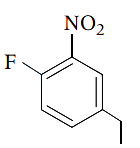
A
$1-$ethyl$-4-$fluoro$-3-$nitrobenzene
B
$4-$ethyl$-1-$fluoro$-2-$nitrobenzene
C
$3-$ethyl$-6-$fluoronitrobenzene
D
$5-$ethyl$-2-$fluoronitrobenzene
Solution
(B) To determine the $IUPAC$ name,we identify the substituents on the benzene ring: an ethyl group $(-C_2H_5)$,a fluoro group $(-F)$,and a nitro group $(-NO_2)$.
According to $IUPAC$ rules,we number the ring to give the lowest possible locants to the substituents.
If we start numbering from the fluoro group as $1$,the nitro group is at $2$,and the ethyl group is at $4$.
The set of locants is $(1, 2, 4)$.
Alphabetical order of substituents: ethyl,fluoro,nitro.
Therefore,the name is $4-$ethyl$-1-$fluoro$-2-$nitrobenzene.
According to $IUPAC$ rules,we number the ring to give the lowest possible locants to the substituents.
If we start numbering from the fluoro group as $1$,the nitro group is at $2$,and the ethyl group is at $4$.
The set of locants is $(1, 2, 4)$.
Alphabetical order of substituents: ethyl,fluoro,nitro.
Therefore,the name is $4-$ethyl$-1-$fluoro$-2-$nitrobenzene.
0 likesView Solution
8
ChemistryMediumMCQKCET · 2021
Arrange benzene,$n$-hexane and ethyne in decreasing order of their acidic behaviour.
A
Benzene $> n$-hexane $>$ Ethyne
B
$n$-hexane $>$ Benzene $>$ Ethyne
C
Ethyne $> n$-hexane $>$ Benzene
D
Ethyne $>$ Benzene $> n$-hexane
Solution
(D) The decreasing order of acidic behaviour is ethyne $>$ benzene $>$ $n$-hexane.
The acidity of a hydrocarbon depends on the $s$-character of the hybridised carbon atom to which the hydrogen is attached.
Higher $s$-character leads to higher electronegativity of the carbon atom,which makes the $C-H$ bond more polar and the resulting carbanion more stable.
The hybridisation of carbon atoms in these compounds is as follows:
Ethyne $(HC \equiv CH)$: $sp$ hybridised ($50\% \ s$-character).
Benzene $(C_6H_6)$: $sp^2$ hybridised ($\approx 33.3\% \ s$-character).
$n$-Hexane $(CH_3(CH_2)_4CH_3)$: $sp^3$ hybridised ($25\% \ s$-character).
Therefore,the order of acidity is ethyne $>$ benzene $>$ $n$-hexane.
The acidity of a hydrocarbon depends on the $s$-character of the hybridised carbon atom to which the hydrogen is attached.
Higher $s$-character leads to higher electronegativity of the carbon atom,which makes the $C-H$ bond more polar and the resulting carbanion more stable.
The hybridisation of carbon atoms in these compounds is as follows:
Ethyne $(HC \equiv CH)$: $sp$ hybridised ($50\% \ s$-character).
Benzene $(C_6H_6)$: $sp^2$ hybridised ($\approx 33.3\% \ s$-character).
$n$-Hexane $(CH_3(CH_2)_4CH_3)$: $sp^3$ hybridised ($25\% \ s$-character).
Therefore,the order of acidity is ethyne $>$ benzene $>$ $n$-hexane.
0 likesView Solution
9
ChemistryDifficultMCQKCET · 2021
Peroxide effect is observed with the addition of $HBr$ but not with the addition of $HI$ to unsymmetrical alkene because
A
$H-I$ bond is stronger than $H-Br$ and is not cleaved by the free radical
B
$H-I$ bond is weaker than $H-Br$ bond so that iodine free radicals combine to form iodine molecules
C
Bond strength of $HI$ and $HBr$ are same but free radicals are formed in $HBr$
D
All of the above
Solution
(B) The peroxide effect (Kharasch effect) is observed with the addition of $HBr$ to unsymmetrical alkenes because the $H-Br$ bond can be homolytically cleaved by free radicals generated from the peroxide.
However,in the case of $HI$,the $H-I$ bond is very weak.
When iodine free radicals are generated,they are highly unstable and rapidly combine with each other to form stable $I_2$ molecules instead of attacking the alkene double bond.
The reaction is:
$I^{\bullet} + I^{\bullet} \rightarrow I_2$
(Unstable) (Stable)
Therefore,the anti-Markovnikov addition is not observed for $HI$.
However,in the case of $HI$,the $H-I$ bond is very weak.
When iodine free radicals are generated,they are highly unstable and rapidly combine with each other to form stable $I_2$ molecules instead of attacking the alkene double bond.
The reaction is:
$I^{\bullet} + I^{\bullet} \rightarrow I_2$
(Unstable) (Stable)
Therefore,the anti-Markovnikov addition is not observed for $HI$.
0 likesView Solution
10
ChemistryEasyMCQKCET · 2021
Permanent hardness cannot be removed by
A
using washing soda
B
Calgon's method
C
Clark's method
D
ion exchange method
Solution
(C) Permanent hardness is caused by the presence of soluble salts of magnesium and calcium in the form of chlorides and sulphates in water.
Clark's method involves the addition of calculated amounts of lime $(Ca(OH)_2)$ to water to remove temporary hardness caused by calcium bicarbonate $(Ca(HCO_3)_2)$ and magnesium bicarbonate $(Mg(HCO_3)_2)$.
It is ineffective against permanent hardness,which requires methods like washing soda treatment,Calgon's method,or ion exchange method.
Clark's method involves the addition of calculated amounts of lime $(Ca(OH)_2)$ to water to remove temporary hardness caused by calcium bicarbonate $(Ca(HCO_3)_2)$ and magnesium bicarbonate $(Mg(HCO_3)_2)$.
It is ineffective against permanent hardness,which requires methods like washing soda treatment,Calgon's method,or ion exchange method.
0 likesView Solution
11
ChemistryEasyMCQKCET · 2021
$K_{a}$ values for acids $H_{2}SO_{3}$,$HNO_{2}$,$CH_{3}COOH$ and $HCN$ are respectively $1.3 \times 10^{-2}$,$4 \times 10^{-4}$,$1.8 \times 10^{-5}$ and $4 \times 10^{-10}$. Which of the above acids produces a stronger conjugate base in aqueous solution?
A
$H_{2}SO_{3}$
B
$HNO_{2}$
C
$CH_{3}COOH$
D
$HCN$
Solution
(D) The strength of an acid is directly proportional to its $K_{a}$ value,while the strength of its conjugate base is inversely proportional to the $K_{a}$ value of the parent acid.
Therefore,the acid with the lowest $K_{a}$ value will produce the strongest conjugate base.
Comparing the given $K_{a}$ values: $1.3 \times 10^{-2} > 4 \times 10^{-4} > 1.8 \times 10^{-5} > 4 \times 10^{-10}$.
Since $HCN$ has the lowest $K_{a}$ value $(4 \times 10^{-10})$,it produces the strongest conjugate base.
Therefore,the acid with the lowest $K_{a}$ value will produce the strongest conjugate base.
Comparing the given $K_{a}$ values: $1.3 \times 10^{-2} > 4 \times 10^{-4} > 1.8 \times 10^{-5} > 4 \times 10^{-10}$.
Since $HCN$ has the lowest $K_{a}$ value $(4 \times 10^{-10})$,it produces the strongest conjugate base.
0 likesView Solution
12
ChemistryMediumMCQKCET · 2021
The correct order of boiling point in the following compounds is
A
$HF > H_{2}O > NH_{3}$
B
$H_{2}O > HF > NH_{3}$
C
$NH_{3} > H_{2}O > HF$
D
$NH_{3} > HF > H_{2}O$
Solution
(B) The boiling point depends on the extent of intermolecular hydrogen bonding.
$H_{2}O$ has the highest boiling point because each molecule can form four hydrogen bonds due to the presence of two hydrogen atoms and two lone pairs on the oxygen atom.
$HF$ has a high boiling point due to strong hydrogen bonding,but it forms fewer hydrogen bonds per molecule compared to $H_{2}O$.
$NH_{3}$ has the lowest boiling point among these three because nitrogen is less electronegative than oxygen and fluorine,resulting in weaker hydrogen bonding.
Therefore,the correct order is $H_{2}O > HF > NH_{3}$.
$H_{2}O$ has the highest boiling point because each molecule can form four hydrogen bonds due to the presence of two hydrogen atoms and two lone pairs on the oxygen atom.
$HF$ has a high boiling point due to strong hydrogen bonding,but it forms fewer hydrogen bonds per molecule compared to $H_{2}O$.
$NH_{3}$ has the lowest boiling point among these three because nitrogen is less electronegative than oxygen and fluorine,resulting in weaker hydrogen bonding.
Therefore,the correct order is $H_{2}O > HF > NH_{3}$.
0 likesView Solution
13
ChemistryEasyMCQKCET · 2021
Which of the following is not true for oxidation?
A
Addition of oxygen
B
Addition of electronegative element
C
Removal of hydrogen
D
Removal of electronegative element
Solution
(D) Oxidation is defined as the addition of oxygen,the addition of an electronegative element,or the removal of hydrogen.
Removal of an electronegative element is actually a characteristic of reduction.
Therefore,option $(D)$ is not true for oxidation.
Removal of an electronegative element is actually a characteristic of reduction.
Therefore,option $(D)$ is not true for oxidation.
0 likesView Solution
14
ChemistryEasyMCQKCET · 2021
The property of the alkaline earth metals that increases with their atomic number is
A
ionisation enthalpy
B
electronegativity
C
solubility of their hydroxide in water
D
solubility of their sulphate in water
Solution
(C) The solubility of ionic compounds,such as the hydroxides of alkaline earth metals,depends on two factors: $(i)$ lattice energy and $(ii)$ hydration energy.
As we move down the group,the lattice energy decreases more significantly compared to the hydration energy.
Consequently,the solubility of alkaline earth metal hydroxides increases with an increase in their atomic number.
In contrast,other properties such as ionisation enthalpy,electronegativity,and the solubility of their sulphates in water decrease as the atomic number increases.
As we move down the group,the lattice energy decreases more significantly compared to the hydration energy.
Consequently,the solubility of alkaline earth metal hydroxides increases with an increase in their atomic number.
In contrast,other properties such as ionisation enthalpy,electronegativity,and the solubility of their sulphates in water decrease as the atomic number increases.
0 likesView Solution
15
ChemistryEasyMCQKCET · 2021
$A$ pure compound contains $2.4 \ g$ of $C$,$1.2 \times 10^{23}$ atoms of $H$,and $0.2 \ mol$ of oxygen atoms. Its empirical formula is
A
$C_{2}HO$
B
$C_{2}H_{2}O_{2}$
C
$CH_{2}O$
D
$CHO$
Solution
(D) Moles of carbon $= \frac{2.4 \ g}{12 \ g/mol} = 0.2 \ mol$
Moles of $H = \frac{1.2 \times 10^{23}}{6.022 \times 10^{23}} \approx 0.2 \ mol$
Moles of oxygen atoms $= 0.2 \ mol$
The molar ratio of $C:H:O$ is $0.2:0.2:0.2$,which simplifies to $1:1:1$.
Therefore,the empirical formula is $CHO$.
Moles of $H = \frac{1.2 \times 10^{23}}{6.022 \times 10^{23}} \approx 0.2 \ mol$
Moles of oxygen atoms $= 0.2 \ mol$
The molar ratio of $C:H:O$ is $0.2:0.2:0.2$,which simplifies to $1:1:1$.
Therefore,the empirical formula is $CHO$.
0 likesView Solution
16
ChemistryEasyMCQKCET · 2021
When the absolute temperature of an ideal gas is doubled and the pressure is halved,the volume of the gas
A
will be half of the original volume
B
will be $4$ times the original volume
C
will be $2$ times the original volume
D
will be $1/4$ th of the original volume
Solution
(B) According to the ideal gas law,$\frac{p_{1} V_{1}}{T_{1}} = \frac{p_{2} V_{2}}{T_{2}}$.
Given: $T_{2} = 2 T_{1}$ and $p_{2} = \frac{p_{1}}{2}$.
Substituting these values into the equation:
$\frac{p_{1} V_{1}}{T_{1}} = \frac{(p_{1} / 2) \times V_{2}}{2 T_{1}}$.
Canceling $p_{1}$ and $T_{1}$ from both sides:
$V_{1} = \frac{V_{2}}{4}$.
Therefore,$V_{2} = 4 V_{1}$.
The volume becomes $4$ times the original volume.
Given: $T_{2} = 2 T_{1}$ and $p_{2} = \frac{p_{1}}{2}$.
Substituting these values into the equation:
$\frac{p_{1} V_{1}}{T_{1}} = \frac{(p_{1} / 2) \times V_{2}}{2 T_{1}}$.
Canceling $p_{1}$ and $T_{1}$ from both sides:
$V_{1} = \frac{V_{2}}{4}$.
Therefore,$V_{2} = 4 V_{1}$.
The volume becomes $4$ times the original volume.
0 likesView Solution
17
ChemistryMediumMCQKCET · 2021
The number of angular and radial nodes in $3p$ orbital respectively are
A
$3, 1$
B
$1, 1$
C
$2, 1$
D
$2, 3$
Solution
(B) For the $3p$ orbital,the principal quantum number $n = 3$ and the azimuthal quantum number $l = 1$.
The number of angular nodes is given by $l = 1$.
The number of radial nodes is given by the formula $(n - l - 1)$.
Substituting the values: $3 - 1 - 1 = 1$.
Therefore,the number of angular and radial nodes in the $3p$ orbital are $1$ and $1$ respectively.
The number of angular nodes is given by $l = 1$.
The number of radial nodes is given by the formula $(n - l - 1)$.
Substituting the values: $3 - 1 - 1 = 1$.
Therefore,the number of angular and radial nodes in the $3p$ orbital are $1$ and $1$ respectively.
0 likesView Solution
18
ChemistryMediumMCQKCET · 2021
Bond enthalpies of $A_{2}$,$B_{2}$ and $AB$ are in the ratio $2:1:2$. If the enthalpy of formation of $AB$ is $-100 \ kJ \ mol^{-1}$,the bond enthalpy of $B_{2}$ is:
A
$100 \ kJ \ mol^{-1}$
B
$50 \ kJ \ mol^{-1}$
C
$200 \ kJ \ mol^{-1}$
D
$150 \ kJ \ mol^{-1}$
Solution
(C) Given,$(BE)_{A_{2}} : (BE)_{B_{2}} : (BE)_{AB} = 2 : 1 : 2$,where $BE$ is bond enthalpy.
Let $(BE)_{A_{2}} = 2x$,$(BE)_{B_{2}} = x$,and $(BE)_{AB} = 2x$.
The reaction for the formation of $AB$ is: $\frac{1}{2} A_{2}(g) + \frac{1}{2} B_{2}(g) \rightarrow AB(g)$.
The enthalpy of formation is given by: $\Delta H^{\circ}_{f} = \Sigma (BE)_{\text{reactants}} - \Sigma (BE)_{\text{products}}$.
Substituting the values: $-100 = [\frac{1}{2}(2x) + \frac{1}{2}(x)] - 2x$.
$-100 = [x + 0.5x] - 2x$.
$-100 = 1.5x - 2x$.
$-100 = -0.5x$.
$x = \frac{100}{0.5} = 200 \ kJ \ mol^{-1}$.
Thus,the bond enthalpy of $B_{2}$ is $200 \ kJ \ mol^{-1}$.
Let $(BE)_{A_{2}} = 2x$,$(BE)_{B_{2}} = x$,and $(BE)_{AB} = 2x$.
The reaction for the formation of $AB$ is: $\frac{1}{2} A_{2}(g) + \frac{1}{2} B_{2}(g) \rightarrow AB(g)$.
The enthalpy of formation is given by: $\Delta H^{\circ}_{f} = \Sigma (BE)_{\text{reactants}} - \Sigma (BE)_{\text{products}}$.
Substituting the values: $-100 = [\frac{1}{2}(2x) + \frac{1}{2}(x)] - 2x$.
$-100 = [x + 0.5x] - 2x$.
$-100 = 1.5x - 2x$.
$-100 = -0.5x$.
$x = \frac{100}{0.5} = 200 \ kJ \ mol^{-1}$.
Thus,the bond enthalpy of $B_{2}$ is $200 \ kJ \ mol^{-1}$.
0 likesView Solution
19
ChemistryEasyMCQKCET · 2021
The reagent which can perform the conversion $CH_{3}COOH \longrightarrow CH_{3}CH_{2}OH$ is
A
$LiAlH_{4} / \text{ether}$
B
$H_{2}, Pt$
C
$NaBH_{4}$
D
$Na \text{ and } C_{2}H_{5}OH$
Solution
(A) $LiAlH_{4} / \text{ether}$ is a strong reducing agent. It is capable of reducing carboxylic acids to primary alcohols.
The reaction is: $CH_{3}COOH \xrightarrow{LiAlH_{4} / \text{ether}} CH_{3}CH_{2}OH$.
The reaction is: $CH_{3}COOH \xrightarrow{LiAlH_{4} / \text{ether}} CH_{3}CH_{2}OH$.
0 likesView Solution
20
ChemistryMediumMCQKCET · 2021
$A$ compound $A$ $(C_{7}H_{8}O)$ is insoluble in $NaHCO_{3}$ solution but dissolves in $NaOH$ and gives a characteristic colour with neutral $FeCl_{3}$ solution. When treated with bromine water,compound $A$ forms the compound $B$ with the formula $C_{7}H_{5}OBr_{3}$. $A$ is:
A
Phenylmethanol
B
$m$-Cresol
C
$o$-Cresol
D
$p$-Cresol
Solution
(B) $1$. The compound $A$ $(C_{7}H_{8}O)$ is insoluble in $NaHCO_{3}$ (meaning it is not a carboxylic acid) but soluble in $NaOH$ and gives a characteristic color with neutral $FeCl_{3}$ solution,which indicates the presence of a phenolic $-OH$ group.
$2$. The reaction with bromine water to form a tribromo derivative $(C_{7}H_{5}OBr_{3})$ is a characteristic reaction of phenols where the ortho and para positions are substituted by bromine atoms.
$3$. Among the given options,$m$-cresol ($3$-methylphenol) is a phenol that reacts with bromine water to form $2,4,6$-tribromo-$3$-methylphenol $(C_{7}H_{5}OBr_{3})$.
$4$. Therefore,compound $A$ is $m$-cresol.
$2$. The reaction with bromine water to form a tribromo derivative $(C_{7}H_{5}OBr_{3})$ is a characteristic reaction of phenols where the ortho and para positions are substituted by bromine atoms.
$3$. Among the given options,$m$-cresol ($3$-methylphenol) is a phenol that reacts with bromine water to form $2,4,6$-tribromo-$3$-methylphenol $(C_{7}H_{5}OBr_{3})$.
$4$. Therefore,compound $A$ is $m$-cresol.
0 likesView Solution
21
ChemistryMediumMCQKCET · 2021
$A, B$ and $C$ respectively are
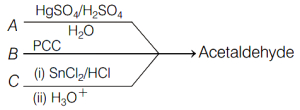
A
ethyne,ethanol and ethane nitrile
B
ethane nitrile,ethanol and ethyne
C
ethyne,ethane nitrile and ethanol
D
ethanol,ethane nitrile and ethyne
Solution
(A) The given reactions are standard methods for the preparation of acetaldehyde $(CH_3CHO)$:
$1$. $A$ is ethyne $(HC \equiv CH)$. Hydration of ethyne in the presence of $HgSO_4 / H_2SO_4$ gives vinyl alcohol $(CH_2=CH-OH)$,which tautomerises to form acetaldehyde $(CH_3CHO)$.
$2$. $B$ is ethanol $(CH_3CH_2OH)$. $PCC$ (Pyridinium chlorochromate) is a mild oxidising agent that oxidises primary alcohols to aldehydes. Thus,$CH_3CH_2OH \xrightarrow{PCC} CH_3CHO$.
$3$. $C$ is ethane nitrile $(CH_3CN)$. The Stephen reduction of nitriles using $SnCl_2 / HCl$ followed by acid hydrolysis $(H_3O^+)$ yields acetaldehyde $(CH_3CHO)$.
Therefore,$A$ is ethyne,$B$ is ethanol,and $C$ is ethane nitrile.
$1$. $A$ is ethyne $(HC \equiv CH)$. Hydration of ethyne in the presence of $HgSO_4 / H_2SO_4$ gives vinyl alcohol $(CH_2=CH-OH)$,which tautomerises to form acetaldehyde $(CH_3CHO)$.
$2$. $B$ is ethanol $(CH_3CH_2OH)$. $PCC$ (Pyridinium chlorochromate) is a mild oxidising agent that oxidises primary alcohols to aldehydes. Thus,$CH_3CH_2OH \xrightarrow{PCC} CH_3CHO$.
$3$. $C$ is ethane nitrile $(CH_3CN)$. The Stephen reduction of nitriles using $SnCl_2 / HCl$ followed by acid hydrolysis $(H_3O^+)$ yields acetaldehyde $(CH_3CHO)$.
Therefore,$A$ is ethyne,$B$ is ethanol,and $C$ is ethane nitrile.
0 likesView Solution
22
ChemistryEasyMCQKCET · 2021
Which is the most suitable reagent for the following conversion?
$CH_3-CH=CH-CH_2-CO-CH_3 \rightarrow CH_3-CH=CH-CH_2-COOH$
$CH_3-CH=CH-CH_2-CO-CH_3 \rightarrow CH_3-CH=CH-CH_2-COOH$
A
Tollen's reagent
B
Benzoyl peroxide
C
$I_2$ and $NaOH$ solution with subsequent acidification
D
$Sn$ and $NaOH$ solution
Solution
(C) The given reaction involves the oxidation of a methyl ketone group $(-COCH_3)$ to a carboxylic acid group $(-COOH)$ while keeping the carbon-carbon double bond intact.
This transformation is characteristic of the haloform reaction.
When a methyl ketone is treated with $I_2$ and $NaOH$,it undergoes the iodoform reaction to form a carboxylate salt,which upon subsequent acidification yields the corresponding carboxylic acid.
The reaction is:
$CH_3-CH=CH-CH_2-COCH_3 \xrightarrow[(ii) \text{ Acidification}]{(i) I_2/NaOH} CH_3-CH=CH-CH_2-COOH + CHI_3$
This transformation is characteristic of the haloform reaction.
When a methyl ketone is treated with $I_2$ and $NaOH$,it undergoes the iodoform reaction to form a carboxylate salt,which upon subsequent acidification yields the corresponding carboxylic acid.
The reaction is:
$CH_3-CH=CH-CH_2-COCH_3 \xrightarrow[(ii) \text{ Acidification}]{(i) I_2/NaOH} CH_3-CH=CH-CH_2-COOH + CHI_3$
0 likesView Solution
23
ChemistryMediumMCQKCET · 2021
The product '$A$' gives a white precipitate when treated with bromine water. The product '$B$' is treated with barium hydroxide to give the product $C$. The compound $C$ is heated strongly to form product $D$. The product $D$ is
A
$4-$methylpent$-3-$en$-2-$one
B
but$-2-$enal
C
$3-$methylpent$-3-$en$-2-$one
D
$2-$methylbut$-2-$enal
Solution
(A) The given reaction proceeds as follows:
$1$. The cumene hydroperoxide process yields phenol $(A)$ and acetone $(B)$.
$2$. Phenol $(A)$ gives a white precipitate with bromine water due to the formation of $2,4,6-$tribromophenol.
$3$. Acetone $(B)$ undergoes aldol condensation in the presence of barium hydroxide $(Ba(OH)_2)$ to form $4-$hydroxy$-4-$methylpentan$-2-$one $(C)$.
$4$. Upon strong heating,$C$ undergoes dehydration to form $4-$methylpent$-3-$en$-2-$one $(D)$,which is mesityl oxide.
Therefore,the product $D$ is $4-$methylpent$-3-$en$-2-$one.
$1$. The cumene hydroperoxide process yields phenol $(A)$ and acetone $(B)$.
$2$. Phenol $(A)$ gives a white precipitate with bromine water due to the formation of $2,4,6-$tribromophenol.
$3$. Acetone $(B)$ undergoes aldol condensation in the presence of barium hydroxide $(Ba(OH)_2)$ to form $4-$hydroxy$-4-$methylpentan$-2-$one $(C)$.
$4$. Upon strong heating,$C$ undergoes dehydration to form $4-$methylpent$-3-$en$-2-$one $(D)$,which is mesityl oxide.
Therefore,the product $D$ is $4-$methylpent$-3-$en$-2-$one.
0 likesView Solution
24
ChemistryMediumMCQKCET · 2021
Consider the following reaction sequence:
$CH_3CHO$ $\xrightarrow[(ii) H_3O^+]{(i) CH_3MgBr} A$ $\xrightarrow[\Delta]{Conc. H_2SO_4} B$ $\xrightarrow[(ii) H_2O, OH^-]{(i) B_2H_6} C$
$A$ and $C$ are:
$CH_3CHO$ $\xrightarrow[(ii) H_3O^+]{(i) CH_3MgBr} A$ $\xrightarrow[\Delta]{Conc. H_2SO_4} B$ $\xrightarrow[(ii) H_2O, OH^-]{(i) B_2H_6} C$
$A$ and $C$ are:
A
Identical
B
Position isomers
C
Functional isomers
D
Optical isomers
Solution
(B) $1$. Reaction of $CH_3CHO$ with $CH_3MgBr$ followed by hydrolysis gives $A$,which is $CH_3-CH(OH)-CH_3$ (Propan$-2-$ol).
$2$. Dehydration of $A$ with $Conc. H_2SO_4$ at high temperature gives $B$,which is $CH_3-CH=CH_2$ (Prop$-1-$ene).
$3$. Hydroboration-oxidation of $B$ $(CH_3-CH=CH_2)$ with $(i) B_2H_6$ and $(ii) H_2O_2/OH^-$ follows anti-Markovnikov addition of water to give $C$,which is $CH_3-CH_2-CH_2OH$ (Propan$-1-$ol).
$4$. Comparing $A$ $(CH_3-CH(OH)-CH_3)$ and $C$ $(CH_3-CH_2-CH_2OH)$,the position of the $-OH$ group is different (carbon-$2$ vs carbon-$1$). Therefore,they are position isomers.
$2$. Dehydration of $A$ with $Conc. H_2SO_4$ at high temperature gives $B$,which is $CH_3-CH=CH_2$ (Prop$-1-$ene).
$3$. Hydroboration-oxidation of $B$ $(CH_3-CH=CH_2)$ with $(i) B_2H_6$ and $(ii) H_2O_2/OH^-$ follows anti-Markovnikov addition of water to give $C$,which is $CH_3-CH_2-CH_2OH$ (Propan$-1-$ol).
$4$. Comparing $A$ $(CH_3-CH(OH)-CH_3)$ and $C$ $(CH_3-CH_2-CH_2OH)$,the position of the $-OH$ group is different (carbon-$2$ vs carbon-$1$). Therefore,they are position isomers.
0 likesView Solution
25
ChemistryEasyMCQKCET · 2021
An organic compound $X$ on treatment with $PCC$ in dichloromethane gives the compound $Y$. Compound $Y$ reacts with $I_{2}$ and alkali to form a yellow precipitate of triiodomethane. The compound $X$ is
A
$CH_{3}CHO$
B
$CH_{3}COCH_{3}$
C
$CH_{3}CH_{2}OH$
D
$CH_{3}COOH$
Solution
(C) Compound $(Y)$ gives the iodoform test,which means it contains an acetyl group $(CH_{3}-C=O)$.
$PCC$ (Pyridinium chlorochromate) is an oxidizing agent that oxidizes primary alcohols to aldehydes and secondary alcohols to ketones.
Since compound $Y$ is formed from $X$ using $PCC$ and $Y$ gives the iodoform test,$Y$ must be acetaldehyde $(CH_{3}CHO)$,as it is the only aldehyde that gives the iodoform test.
Therefore,the starting material $X$ must be ethanol $(CH_{3}CH_{2}OH)$.
The reactions are as follows:
$CH_{3}CH_{2}OH$ $\xrightarrow{PCC} CH_{3}CHO$ $\xrightarrow{I_{2}/OH^{-}} CHI_{3} + HCOONa$
$PCC$ (Pyridinium chlorochromate) is an oxidizing agent that oxidizes primary alcohols to aldehydes and secondary alcohols to ketones.
Since compound $Y$ is formed from $X$ using $PCC$ and $Y$ gives the iodoform test,$Y$ must be acetaldehyde $(CH_{3}CHO)$,as it is the only aldehyde that gives the iodoform test.
Therefore,the starting material $X$ must be ethanol $(CH_{3}CH_{2}OH)$.
The reactions are as follows:
$CH_{3}CH_{2}OH$ $\xrightarrow{PCC} CH_{3}CHO$ $\xrightarrow{I_{2}/OH^{-}} CHI_{3} + HCOONa$
0 likesView Solution
26
ChemistryMediumMCQKCET · 2021
$RNA$ and $DNA$ are chiral molecules. Their chirality is due to the presence of:
A
$D$-sugar component
B
$L$-sugar component
C
chiral bases
D
chiral phosphate ester unit
Solution
(A) $RNA$ and $DNA$ are chiral molecules because they contain sugar units ($D$-ribose in $RNA$ and $D$-2-deoxyribose in $DNA$).
These sugar molecules possess multiple chiral carbon atoms,which impart chirality to the entire $RNA$ and $DNA$ structure.
These sugar molecules possess multiple chiral carbon atoms,which impart chirality to the entire $RNA$ and $DNA$ structure.
0 likesView Solution
27
ChemistryEasyMCQKCET · 2021
The primary structure of a nucleic acid contains the base sequence $GATGC...$. Which of the following chains is complementary to this sequence?
A
$GGTGA...$
B
$TGAAG...$
C
$CTACG...$
D
$TTTAG...$
Solution
(C) In $DNA$,the base pairing rules are based on hydrogen bonding between specific nitrogenous bases: $A$ (Adenine) pairs with $T$ (Thymine),and $G$ (Guanine) pairs with $C$ (Cytosine).
Given the sequence $G-A-T-G-C$,the complementary sequence is formed by replacing each base with its pair:
$G \rightarrow C$
$A \rightarrow T$
$T \rightarrow A$
$G \rightarrow C$
$C \rightarrow G$
Thus,the complementary chain is $CTACG...$.
Given the sequence $G-A-T-G-C$,the complementary sequence is formed by replacing each base with its pair:
$G \rightarrow C$
$A \rightarrow T$
$T \rightarrow A$
$G \rightarrow C$
$C \rightarrow G$
Thus,the complementary chain is $CTACG...$.
0 likesView Solution
28
ChemistryEasyMCQKCET · 2021
Higher order $(>3)$ reactions are rare due to
A
shifting of equilibrium towards reactants due to elastic collisions
B
loss of active species on collision
C
low probability of simultaneous collision of all reacting species
D
increase in entropy as more molecules are involved
Solution
(C) Higher order reactions $(>3)$ are rare because the probability of simultaneous collision of more than three reacting species is extremely low,making the frequency of such effective collisions negligible.
0 likesView Solution
29
ChemistryMediumMCQKCET · 2021
For a reaction,$A + 2B \rightarrow$ Products,when the concentration of $B$ alone is increased,the half-life remains the same. If the concentration of $A$ alone is doubled,the rate remains the same. The unit of the rate constant for the reaction is:
A
$s^{-1}$
B
$L \ mol^{-1} \ s^{-1}$
C
$mol \ L^{-1} \ s^{-1}$
D
$atm^{-1}$
Solution
(A) For the reaction,$A + 2B \rightarrow$ Products.
Since the half-life $(t_{1/2})$ remains constant when the concentration of $B$ is increased,the reaction is of $1^{st}$ order with respect to $B$.
Since the rate remains constant when the concentration of $A$ is doubled,the reaction is of $0^{th}$ order with respect to $A$.
The rate law expression is: $\text{Rate} = k[A]^0[B]^1$.
The overall order of the reaction is $0 + 1 = 1$.
The unit of the rate constant $(k)$ for a $1^{st}$ order reaction is $s^{-1}$.
Since the half-life $(t_{1/2})$ remains constant when the concentration of $B$ is increased,the reaction is of $1^{st}$ order with respect to $B$.
Since the rate remains constant when the concentration of $A$ is doubled,the reaction is of $0^{th}$ order with respect to $A$.
The rate law expression is: $\text{Rate} = k[A]^0[B]^1$.
The overall order of the reaction is $0 + 1 = 1$.
The unit of the rate constant $(k)$ for a $1^{st}$ order reaction is $s^{-1}$.
0 likesView Solution
30
ChemistryEasyMCQKCET · 2021
The rate of a gaseous reaction is given by the expression $k[A][B]^{2}$. If the volume of the vessel is reduced to one-half of the initial volume,the reaction rate as compared to the original rate is:
A
$1/16$
B
$1/8$
C
$8$
D
$16$
Solution
(C) The rate law is given by $r = k[A][B]^{2}$.
When the volume of the vessel is reduced to half $(V_{2} = V_{1}/2)$,the concentration of the gaseous reactants doubles because concentration is inversely proportional to volume $(C = n/V)$.
Thus,the new concentrations are $[A]' = 2[A]$ and $[B]' = 2[B]$.
The new rate $r'$ is calculated as:
$r' = k[A]'([B]')^{2} = k(2[A])(2[B])^{2}$.
$r' = k \times 2[A] \times 4[B]^{2} = 8 \times k[A][B]^{2}$.
Since $r = k[A][B]^{2}$,we have $r' = 8r$.
Therefore,the reaction rate increases by $8$ times.
When the volume of the vessel is reduced to half $(V_{2} = V_{1}/2)$,the concentration of the gaseous reactants doubles because concentration is inversely proportional to volume $(C = n/V)$.
Thus,the new concentrations are $[A]' = 2[A]$ and $[B]' = 2[B]$.
The new rate $r'$ is calculated as:
$r' = k[A]'([B]')^{2} = k(2[A])(2[B])^{2}$.
$r' = k \times 2[A] \times 4[B]^{2} = 8 \times k[A][B]^{2}$.
Since $r = k[A][B]^{2}$,we have $r' = 8r$.
Therefore,the reaction rate increases by $8$ times.
0 likesView Solution
31
ChemistryMediumMCQKCET · 2021
If the rate constant for a first order reaction is $k$,the time $(t)$ required for the completion of $99 \%$ of the reaction is given by
A
$t = \frac{4.606}{k}$
B
$t = \frac{2.303}{k}$
C
$t = \frac{0.693}{k}$
D
$t = \frac{6.909}{k}$
Solution
(A) For a first order reaction,the integrated rate equation is $t = \frac{2.303}{k} \log \frac{[R]_0}{[R]}$.
Given that $99 \%$ of the reaction is complete,the remaining concentration $[R]$ is $100 \% - 99 \% = 1 \%$ of the initial concentration $[R]_0$.
So,$[R] = 0.01 [R]_0 = \frac{[R]_0}{100}$.
Substituting these values into the equation:
$t = \frac{2.303}{k} \log \frac{[R]_0}{[R]_0 / 100} = \frac{2.303}{k} \log(100)$.
Since $\log(100) = 2$,we get $t = \frac{2.303 \times 2}{k} = \frac{4.606}{k}$.
Given that $99 \%$ of the reaction is complete,the remaining concentration $[R]$ is $100 \% - 99 \% = 1 \%$ of the initial concentration $[R]_0$.
So,$[R] = 0.01 [R]_0 = \frac{[R]_0}{100}$.
Substituting these values into the equation:
$t = \frac{2.303}{k} \log \frac{[R]_0}{[R]_0 / 100} = \frac{2.303}{k} \log(100)$.
Since $\log(100) = 2$,we get $t = \frac{2.303 \times 2}{k} = \frac{4.606}{k}$.
0 likesView Solution
32
ChemistryEasyMCQKCET · 2021
Homoleptic complexes among the following are:
$(A)$ $K_3[Al(C_2O_4)_3]$
$(B)$ $[CoCl_2(en)_2]^{+}$
$(C)$ $K_2[Zn(OH)_4]$
$(A)$ $K_3[Al(C_2O_4)_3]$
$(B)$ $[CoCl_2(en)_2]^{+}$
$(C)$ $K_2[Zn(OH)_4]$
A
$A$ only
B
$A$ and $B$ only
C
$A$ and $C$ only
D
$C$ only
Solution
(C) homoleptic complex is a coordination compound in which all the ligands attached to the central metal atom or ion are identical.
In $K_3[Al(C_2O_4)_3]$,the central metal $Al^{3+}$ is bonded to three identical oxalate $(C_2O_4)^{2-}$ ligands.
In $[CoCl_2(en)_2]^{+}$,the central metal $Co^{3+}$ is bonded to two different types of ligands: chloride $(Cl^-)$ and ethylenediamine $(en)$. Thus,it is a heteroleptic complex.
In $K_2[Zn(OH)_4]$,the central metal $Zn^{2+}$ is bonded to four identical hydroxide $(OH)^-$ ligands.
Therefore,$K_3[Al(C_2O_4)_3]$ and $K_2[Zn(OH)_4]$ are homoleptic complexes.
In $K_3[Al(C_2O_4)_3]$,the central metal $Al^{3+}$ is bonded to three identical oxalate $(C_2O_4)^{2-}$ ligands.
In $[CoCl_2(en)_2]^{+}$,the central metal $Co^{3+}$ is bonded to two different types of ligands: chloride $(Cl^-)$ and ethylenediamine $(en)$. Thus,it is a heteroleptic complex.
In $K_2[Zn(OH)_4]$,the central metal $Zn^{2+}$ is bonded to four identical hydroxide $(OH)^-$ ligands.
Therefore,$K_3[Al(C_2O_4)_3]$ and $K_2[Zn(OH)_4]$ are homoleptic complexes.
0 likesView Solution
33
ChemistryEasyMCQKCET · 2021
The $IUPAC$ name of $[Co(NH_3)_5(CO_3)]Cl$ is
A
pentaamminecarbonatocobalt $(III)$ chloride
B
carbonatopentamminecobalt $(III)$ chloride
C
pentaamminecarbonatocobaltate $(III)$ chloride
D
pentaammine cobalt $(III)$ carbonate chloride
Solution
(A) In the complex $[Co(NH_3)_5(CO_3)]Cl$,the ligands are ammine $(NH_3)$ and carbonato $(CO_3^{2-})$.
According to $IUPAC$ nomenclature rules,ligands are named in alphabetical order. Thus,'ammine' precedes 'carbonato'.
The oxidation state of cobalt $(Co)$ is calculated as follows: $x + 5(0) + 1(-2) = +1 \Rightarrow x = +3$.
Since the complex ion $[Co(NH_3)_5(CO_3)]^+$ is cationic,the metal name remains 'cobalt'.
Combining these,the $IUPAC$ name is pentaamminecarbonatocobalt $(III)$ chloride.
According to $IUPAC$ nomenclature rules,ligands are named in alphabetical order. Thus,'ammine' precedes 'carbonato'.
The oxidation state of cobalt $(Co)$ is calculated as follows: $x + 5(0) + 1(-2) = +1 \Rightarrow x = +3$.
Since the complex ion $[Co(NH_3)_5(CO_3)]^+$ is cationic,the metal name remains 'cobalt'.
Combining these,the $IUPAC$ name is pentaamminecarbonatocobalt $(III)$ chloride.
0 likesView Solution
34
ChemistryMediumMCQKCET · 2021
For the crystal field splitting in octahedral complexes,
A
the energy of the $e_{g}$ orbitals will decrease by $(3/5) \Delta_{o}$ and that of the $t_{2g}$ will increase by $(2/5) \Delta_{o}$
B
the energy of the $e_{g}$ orbitals will increase by $(3/5) \Delta_{o}$ and that of the $t_{2g}$ will decrease by $(2/5) \Delta_{o}$
C
the energy of the $e_{g}$ orbitals will increase by $(3/5) \Delta_{o}$ and that of the $t_{2g}$ will increase by $(2/5) \Delta_{o}$
D
the energy of the $e_{g}$ orbitals will decrease by $(3/5) \Delta_{o}$ and that of the $t_{2g}$ will decrease by $(2/5) \Delta_{o}$
Solution
(B) In an octahedral complex,the five degenerate $d$-orbitals split into two sets due to the approach of ligands along the axes.
The two orbitals $d_{x^2-y^2}$ and $d_{z^2}$ (collectively called $e_{g}$ orbitals) point directly towards the ligands and experience greater repulsion,thus their energy increases by $+(3/5) \Delta_{o}$.
The three orbitals $d_{xy}$,$d_{yz}$,and $d_{zx}$ (collectively called $t_{2g}$ orbitals) point between the axes and experience less repulsion,thus their energy decreases by $-(2/5) \Delta_{o}$ relative to the barycenter.
The two orbitals $d_{x^2-y^2}$ and $d_{z^2}$ (collectively called $e_{g}$ orbitals) point directly towards the ligands and experience greater repulsion,thus their energy increases by $+(3/5) \Delta_{o}$.
The three orbitals $d_{xy}$,$d_{yz}$,and $d_{zx}$ (collectively called $t_{2g}$ orbitals) point between the axes and experience less repulsion,thus their energy decreases by $-(2/5) \Delta_{o}$ relative to the barycenter.
0 likesView Solution
35
ChemistryMediumMCQKCET · 2021
The correct order for wavelengths of light absorbed in the complex ions $[CoCl(NH_{3})_{5}]^{2+}$, $[Co(NH_{3})_{6}]^{3+}$ and $[Co(CN)_{6}]^{3-}$ is
A
$[CoCl(NH_{3})_{5}]^{2+} > [Co(NH_{3})_{6}]^{3+} > [Co(CN)_{6}]^{3-}$
B
$[Co(NH_{3})_{6}]^{3+} > [Co(CN)_{6}]^{3-} > [CoCl(NH_{3})_{5}]^{2+}$
C
$[Co(CN)_{6}]^{3-} > [CoCl(NH_{3})_{5}]^{2+} > [Co(NH_{3})_{6}]^{3+}$
D
$[Co(NH_{3})_{6}]^{3+} > [CoCl(NH_{3})_{5}]^{2+} > [Co(CN)_{6}]^{3-}$
Solution
(A) The wavelength of light absorbed $(\lambda)$ is inversely proportional to the crystal field splitting energy $(\Delta_o)$.
According to the spectrochemical series, the strength of the ligands is $Cl^{-} < NH_{3} < CN^{-}$.
Since $\Delta_o$ is directly proportional to the ligand field strength, the order of $\Delta_o$ is $[CoCl(NH_{3})_{5}]^{2+} < [Co(NH_{3})_{6}]^{3+} < [Co(CN)_{6}]^{3-}$.
Therefore, the order of wavelength of light absorbed $(\lambda \propto 1/\Delta_o)$ is $[CoCl(NH_{3})_{5}]^{2+} > [Co(NH_{3})_{6}]^{3+} > [Co(CN)_{6}]^{3-}$.
According to the spectrochemical series, the strength of the ligands is $Cl^{-} < NH_{3} < CN^{-}$.
Since $\Delta_o$ is directly proportional to the ligand field strength, the order of $\Delta_o$ is $[CoCl(NH_{3})_{5}]^{2+} < [Co(NH_{3})_{6}]^{3+} < [Co(CN)_{6}]^{3-}$.
Therefore, the order of wavelength of light absorbed $(\lambda \propto 1/\Delta_o)$ is $[CoCl(NH_{3})_{5}]^{2+} > [Co(NH_{3})_{6}]^{3+} > [Co(CN)_{6}]^{3-}$.
0 likesView Solution
36
ChemistryMediumMCQKCET · 2021
Which of the following does not represent the property stated against it?
A
$Co^{2+} < Fe^{2+} < Mn^{2+}$ - Ionic size
B
$Ti < V < Mn$ - Number of oxidation states
C
$Cr^{2+} < Mn^{2+} < Fe^{2+}$ - Paramagnetic behaviour
D
$Sc < Cr < Fe$ - Density
Solution
(C) The property stated against option $(C)$ is incorrect.
The electronic configurations of the given ions are:
$Cr^{2+} = [Ar] 3d^4$ ($4$ unpaired electrons)
$Mn^{2+} = [Ar] 3d^5$ ($5$ unpaired electrons)
$Fe^{2+} = [Ar] 3d^6$ ($4$ unpaired electrons)
Paramagnetic behaviour is directly proportional to the number of unpaired electrons.
Since $Mn^{2+}$ has $5$ unpaired electrons,it shows the maximum paramagnetic behaviour among the three.
Therefore,the correct order of paramagnetic behaviour is $Cr^{2+} = Fe^{2+} < Mn^{2+}$.
The electronic configurations of the given ions are:
$Cr^{2+} = [Ar] 3d^4$ ($4$ unpaired electrons)
$Mn^{2+} = [Ar] 3d^5$ ($5$ unpaired electrons)
$Fe^{2+} = [Ar] 3d^6$ ($4$ unpaired electrons)
Paramagnetic behaviour is directly proportional to the number of unpaired electrons.
Since $Mn^{2+}$ has $5$ unpaired electrons,it shows the maximum paramagnetic behaviour among the three.
Therefore,the correct order of paramagnetic behaviour is $Cr^{2+} = Fe^{2+} < Mn^{2+}$.
0 likesView Solution
37
ChemistryMediumMCQKCET · 2021
Which one of the following is correct for all elements from $Sc$ to $Cu$?
A
The lowest oxidation state shown by them is $+2$
B
$4s$ orbital is completely filled in the ground state
C
$3d$ orbital is not completely filled in the ground state
D
The ions in $+2$ oxidation states are paramagnetic
Solution
(C) The elements from $Sc$ $(Z=21)$ to $Cu$ $(Z=29)$ are transition elements belonging to the $3d$ series.
For all these elements,the $3d$ subshell is partially filled in their ground state electronic configuration.
For example:
$Sc: [Ar] 3d^1 4s^2$
$Ti: [Ar] 3d^2 4s^2$
...
$Cu: [Ar] 3d^{10} 4s^1$
Since the $3d$ orbital is not completely filled for all elements from $Sc$ to $Cu$ in their ground state (except $Cu$,but the question asks for a general property of the series elements),option $(c)$ is the most appropriate description of the $3d$ series characteristics.
For all these elements,the $3d$ subshell is partially filled in their ground state electronic configuration.
For example:
$Sc: [Ar] 3d^1 4s^2$
$Ti: [Ar] 3d^2 4s^2$
...
$Cu: [Ar] 3d^{10} 4s^1$
Since the $3d$ orbital is not completely filled for all elements from $Sc$ to $Cu$ in their ground state (except $Cu$,but the question asks for a general property of the series elements),option $(c)$ is the most appropriate description of the $3d$ series characteristics.
0 likesView Solution
38
ChemistryMediumMCQKCET · 2021
Which of the following pairs has both the ions coloured in aqueous solution? [Atomic numbers of $Sc=21, Ti=22, Ni=28, Cu=29, Mn=25$]
A
$Sc^{3+}, Mn^{2+}$
B
$Ni^{2+}, Ti^{4+}$
C
$Ti^{3+}, Cu^{+}$
D
$Mn^{2+}, Ti^{3+}$
Solution
(D) Ions are coloured in aqueous solution if they have unpaired electrons in their $d$-orbitals (i.e.,$d^1$ to $d^9$ configuration).
$1$. $Sc^{3+}$ $(3d^0)$: Colourless (no unpaired electrons).
$2$. $Ti^{3+}$ $(3d^1)$: Coloured (one unpaired electron).
$3$. $Mn^{2+}$ $(3d^5)$: Coloured (five unpaired electrons).
$4$. $Ni^{2+}$ $(3d^8)$: Coloured (two unpaired electrons).
$5$. $Cu^{+}$ $(3d^{10})$: Colourless (no unpaired electrons).
$6$. $Ti^{4+}$ $(3d^0)$: Colourless (no unpaired electrons).
Comparing the options:
- Option $(A)$: $Sc^{3+}$ is colourless.
- Option $(B)$: $Ti^{4+}$ is colourless.
- Option $(C)$: $Cu^{+}$ is colourless.
- Option $(D)$: Both $Mn^{2+}$ and $Ti^{3+}$ have unpaired electrons and are coloured.
Therefore,the correct pair is $(Mn^{2+}, Ti^{3+})$.
$1$. $Sc^{3+}$ $(3d^0)$: Colourless (no unpaired electrons).
$2$. $Ti^{3+}$ $(3d^1)$: Coloured (one unpaired electron).
$3$. $Mn^{2+}$ $(3d^5)$: Coloured (five unpaired electrons).
$4$. $Ni^{2+}$ $(3d^8)$: Coloured (two unpaired electrons).
$5$. $Cu^{+}$ $(3d^{10})$: Colourless (no unpaired electrons).
$6$. $Ti^{4+}$ $(3d^0)$: Colourless (no unpaired electrons).
Comparing the options:
- Option $(A)$: $Sc^{3+}$ is colourless.
- Option $(B)$: $Ti^{4+}$ is colourless.
- Option $(C)$: $Cu^{+}$ is colourless.
- Option $(D)$: Both $Mn^{2+}$ and $Ti^{3+}$ have unpaired electrons and are coloured.
Therefore,the correct pair is $(Mn^{2+}, Ti^{3+})$.
0 likesView Solution
39
ChemistryEasyMCQKCET · 2021
Consider the following electrodes $P = Zn^{2+}(0.0001 \ M) / Zn$,$Q = Zn^{2+}(0.1 \ M) / Zn$,$R = Zn^{2+}(0.01 \ M) / Zn$,$S = Zn^{2+}(0.001 \ M) / Zn$. Given $E^{\circ}(Zn^{2+} / Zn) = -0.76 \ V$,the electrode potentials of the above electrodes in volts are in the order:
A
$P > S > R > Q$
B
$S > R > Q < P$
C
$Q > R > S > P$
D
$P > Q > R > S$
Solution
(C) The standard reduction potential of $Zn^{2+} / Zn$ half-cell is $E^{\circ} = -0.76 \ V$.
The Nernst equation for the reduction half-cell reaction $Zn^{2+}_{(aq)} + 2e^{-} \longrightarrow Zn_{(s)}$ is:
$E_{red} = E^{\circ}_{red} - \frac{0.059}{n} \log \frac{1}{[Zn^{2+}]}$
$E_{red} = -0.76 + \frac{0.059}{2} \log [Zn^{2+}]$
Since the term $\frac{0.059}{2} \log [Zn^{2+}]$ is positive,a higher concentration of $Zn^{2+}$ leads to a higher (less negative) reduction potential.
Comparing the concentrations: $[Q] = 0.1 \ M$,$[R] = 0.01 \ M$,$[S] = 0.001 \ M$,$[P] = 0.0001 \ M$.
Therefore,the order of electrode potentials is $Q > R > S > P$.
The Nernst equation for the reduction half-cell reaction $Zn^{2+}_{(aq)} + 2e^{-} \longrightarrow Zn_{(s)}$ is:
$E_{red} = E^{\circ}_{red} - \frac{0.059}{n} \log \frac{1}{[Zn^{2+}]}$
$E_{red} = -0.76 + \frac{0.059}{2} \log [Zn^{2+}]$
Since the term $\frac{0.059}{2} \log [Zn^{2+}]$ is positive,a higher concentration of $Zn^{2+}$ leads to a higher (less negative) reduction potential.
Comparing the concentrations: $[Q] = 0.1 \ M$,$[R] = 0.01 \ M$,$[S] = 0.001 \ M$,$[P] = 0.0001 \ M$.
Therefore,the order of electrode potentials is $Q > R > S > P$.
0 likesView Solution
40
ChemistryDifficultMCQKCET · 2021
$H_{2(g)} + 2 AgCl_{(s)} \rightleftharpoons 2 Ag_{(s)} + 2 HCl_{(aq)}$. The $E^{\circ}_{cell}$ at $25^{\circ} C$ for the cell is $0.22 \ V$. The equilibrium constant at $25^{\circ} C$ is
A
$2.8 \times 10^{7}$
B
$5.2 \times 10^{8}$
C
$2.8 \times 10^{5}$
D
$5.2 \times 10^{4}$
Solution
(A) For the given reaction,the number of electrons transferred $n = 2$.
Given $E^{\circ}_{cell} = 0.22 \ V$ at $25^{\circ} C$.
At equilibrium,the relationship between $E^{\circ}_{cell}$ and equilibrium constant $K_{C}$ is given by:
$E^{\circ}_{cell} = \frac{0.0591}{n} \log K_{C}$
Substituting the values:
$0.22 = \frac{0.0591}{2} \log K_{C}$
$\log K_{C} = \frac{0.22 \times 2}{0.0591} \approx 7.445$
$K_{C} = \text{antilog}(7.445) \approx 2.786 \times 10^{7} \approx 2.8 \times 10^{7}$
Given $E^{\circ}_{cell} = 0.22 \ V$ at $25^{\circ} C$.
At equilibrium,the relationship between $E^{\circ}_{cell}$ and equilibrium constant $K_{C}$ is given by:
$E^{\circ}_{cell} = \frac{0.0591}{n} \log K_{C}$
Substituting the values:
$0.22 = \frac{0.0591}{2} \log K_{C}$
$\log K_{C} = \frac{0.22 \times 2}{0.0591} \approx 7.445$
$K_{C} = \text{antilog}(7.445) \approx 2.786 \times 10^{7} \approx 2.8 \times 10^{7}$
0 likesView Solution
41
ChemistryDifficultMCQKCET · 2021
The resistance of $0.01 \ M$ $KCl$ solution at $298 \ K$ is $1500 \ \Omega$. If the conductivity of $0.01 \ M$ $KCl$ solution at $298 \ K$ is $0.1466 \times 10^{-3} \ S \ cm^{-1}$,the cell constant of the conductivity cell in $cm^{-1}$ is:
A
$0.219$
B
$0.291$
C
$0.301$
D
$0.194$
Solution
(A) Given: Resistance $(R) = 1500 \ \Omega$
Conductivity $(\kappa) = 0.1466 \times 10^{-3} \ S \ cm^{-1}$
The formula for cell constant $(G^*)$ is:
$G^* = \kappa \times R$
Substituting the values:
$G^* = (0.1466 \times 10^{-3} \ S \ cm^{-1}) \times (1500 \ \Omega)$
$G^* = 0.2199 \ \approx 0.219 \ cm^{-1}$
Conductivity $(\kappa) = 0.1466 \times 10^{-3} \ S \ cm^{-1}$
The formula for cell constant $(G^*)$ is:
$G^* = \kappa \times R$
Substituting the values:
$G^* = (0.1466 \times 10^{-3} \ S \ cm^{-1}) \times (1500 \ \Omega)$
$G^* = 0.2199 \ \approx 0.219 \ cm^{-1}$
0 likesView Solution
42
ChemistryMediumMCQKCET · 2021
$A$ hydrocarbon $A$ $(C_{4}H_{8})$ on reaction with $HCl$ gives a compound $B$ $(C_{4}H_{9}Cl)$ which on reaction with $1 \ mol$ of $NH_{3}$ gives compound $C$ $(C_{4}H_{11}N)$. On reacting with $NaNO_{2}$ and $HCl$ followed by treatment with water,compound $C$ yields an optically active compound $D$. The compound $D$ is
A
$2-$chlorobutane
B
butan$-2-$ol
C
butan$-2-$amine
D
butane
Solution
(B) The hydrocarbon $A$ is $but-2-ene$ $(CH_{3}-CH=CH-CH_{3})$.
Reaction with $HCl$ follows Markovnikov's rule to give $B$,which is $2-chlorobutane$ $(CH_{3}-CHCl-CH_{2}-CH_{3})$.
Reaction of $B$ with $NH_{3}$ gives $C$,which is $butan-2-amine$ $(CH_{3}-CH(NH_{2})-CH_{2}-CH_{3})$.
Reaction of $C$ with $NaNO_{2}/HCl$ forms a diazonium salt,which upon hydrolysis with water yields $D$,which is $butan-2-ol$ $(CH_{3}-CH(OH)-CH_{2}-CH_{3})$.
$Butan-2-ol$ contains a chiral carbon atom and is therefore optically active.
Reaction with $HCl$ follows Markovnikov's rule to give $B$,which is $2-chlorobutane$ $(CH_{3}-CHCl-CH_{2}-CH_{3})$.
Reaction of $B$ with $NH_{3}$ gives $C$,which is $butan-2-amine$ $(CH_{3}-CH(NH_{2})-CH_{2}-CH_{3})$.
Reaction of $C$ with $NaNO_{2}/HCl$ forms a diazonium salt,which upon hydrolysis with water yields $D$,which is $butan-2-ol$ $(CH_{3}-CH(OH)-CH_{2}-CH_{3})$.
$Butan-2-ol$ contains a chiral carbon atom and is therefore optically active.
0 likesView Solution
43
ChemistryEasyMCQKCET · 2021
$C_6H_5CH_2Cl$ $\xrightarrow{\text{Alc. } NH_3} A$ $\xrightarrow{2 CH_3Cl} B$. The product $B$ is
A
$N, N$-dimethylphenylmethanamine
B
$N, N$-dimethylbenzenamine
C
$N$-benzyl-$N$-methylmethanamine
D
phenyl-$N, N$-dimethylmethanamine
Solution
(A) Benzyl chloride $(C_6H_5CH_2Cl)$ reacts with alcoholic $NH_3$ to form benzylamine ($C_6H_5CH_2NH_2$,$A$) via nucleophilic substitution.
Benzylamine $(A)$ then undergoes alkylation with two moles of methyl chloride $(CH_3Cl)$ to form $N, N$-dimethylphenylmethanamine ($C_6H_5CH_2N(CH_3)_2$,$B$).
Benzylamine $(A)$ then undergoes alkylation with two moles of methyl chloride $(CH_3Cl)$ to form $N, N$-dimethylphenylmethanamine ($C_6H_5CH_2N(CH_3)_2$,$B$).
0 likesView Solution
44
ChemistryEasyMCQKCET · 2021
The order of reactivity of the compounds $C_6H_5CH_2Br$,$C_6H_5CH(C_6H_5)Br$,$C_6H_5CH(CH_3)Br$ and $C_6H_5C(CH_3)(C_6H_5)Br$ in $S_N2$ reaction is
A
$C_6H_5C(CH_3)(C_6H_5)Br < C_6H_5CH(C_6H_5)Br < C_6H_5CH(CH_3)Br < C_6H_5CH_2Br$
B
$C_6H_5CH_2Br < C_6H_5CH(CH_3)Br < C_6H_5CH(C_6H_5)Br < C_6H_5C(CH_3)(C_6H_5)Br$
C
$C_6H_5CH(CH_3)Br < C_6H_5CH_2Br < C_6H_5CH(C_6H_5)Br < C_6H_5C(CH_3)(C_6H_5)Br$
D
$C_6H_5CH(CH_3)Br < C_6H_5CH_2Br < C_6H_5C(CH_3)(C_6H_5)Br < C_6H_5CH(C_6H_5)Br$
Solution
(A) The reactivity of alkyl halides in $S_N2$ reactions is primarily governed by steric hindrance. The nucleophile attacks from the side opposite to the leaving group. As the number of bulky groups attached to the electrophilic carbon increases,the steric hindrance increases,making the $S_N2$ reaction slower.
The compounds are:
$1$. $C_6H_5CH_2Br$ (Primary,least hindered)
$2$. $C_6H_5CH(CH_3)Br$ (Secondary,more hindered than primary)
$3$. $C_6H_5CH(C_6H_5)Br$ (Secondary,more hindered than $C_6H_5CH(CH_3)Br$ due to the bulky phenyl group)
$4$. $C_6H_5C(CH_3)(C_6H_5)Br$ (Tertiary,most hindered)
Thus,the order of reactivity in $S_N2$ is: $C_6H_5C(CH_3)(C_6H_5)Br < C_6H_5CH(C_6H_5)Br < C_6H_5CH(CH_3)Br < C_6H_5CH_2Br$.
The compounds are:
$1$. $C_6H_5CH_2Br$ (Primary,least hindered)
$2$. $C_6H_5CH(CH_3)Br$ (Secondary,more hindered than primary)
$3$. $C_6H_5CH(C_6H_5)Br$ (Secondary,more hindered than $C_6H_5CH(CH_3)Br$ due to the bulky phenyl group)
$4$. $C_6H_5C(CH_3)(C_6H_5)Br$ (Tertiary,most hindered)
Thus,the order of reactivity in $S_N2$ is: $C_6H_5C(CH_3)(C_6H_5)Br < C_6H_5CH(C_6H_5)Br < C_6H_5CH(CH_3)Br < C_6H_5CH_2Br$.
0 likesView Solution
45
ChemistryMediumMCQKCET · 2021
The major product of the following reaction is $CH_{2}=CH-CH_{2}-OH \xrightarrow[\text{Excess}]{HBr} \text{Product}$
A
$CH_{3}-CHBr-CH_{2}Br$
B
$CH_{2}=CH-CH_{2}Br$
C
$CH_{3}-CHBr-CH_{2}-OH$
D
$CH_{3}-CHOH-CH_{2}OH$
Solution
(A) The reaction proceeds in two steps as $HBr$ is in excess:
$1$. The $-OH$ group is substituted by $-Br$ to form allyl bromide: $CH_{2}=CH-CH_{2}-OH + HBr \rightarrow CH_{2}=CH-CH_{2}Br + H_{2}O$.
$2$. The second equivalent of $HBr$ adds across the double bond following Markownikoff's rule to form $1,2-\text{dibromopropane}$: $CH_{2}=CH-CH_{2}Br + HBr \rightarrow CH_{3}-CH(Br)-CH_{2}Br$.
$1$. The $-OH$ group is substituted by $-Br$ to form allyl bromide: $CH_{2}=CH-CH_{2}-OH + HBr \rightarrow CH_{2}=CH-CH_{2}Br + H_{2}O$.
$2$. The second equivalent of $HBr$ adds across the double bond following Markownikoff's rule to form $1,2-\text{dibromopropane}$: $CH_{2}=CH-CH_{2}Br + HBr \rightarrow CH_{3}-CH(Br)-CH_{2}Br$.
0 likesView Solution
46
ChemistryDifficultMCQKCET · 2021
In the given set of reactions,identify $D$:
$CH_3COOH$ $\xrightarrow{SOCl_2} A$ $\xrightarrow[Anhy. AlCl_3]{Benzene} B$ $\xrightarrow{HCN} C$ $\xrightarrow{H_2O} D$
$CH_3COOH$ $\xrightarrow{SOCl_2} A$ $\xrightarrow[Anhy. AlCl_3]{Benzene} B$ $\xrightarrow{HCN} C$ $\xrightarrow{H_2O} D$
A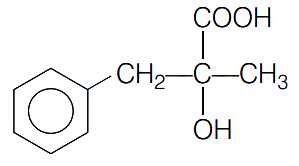
B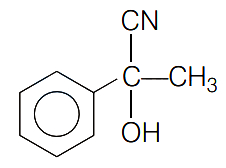
C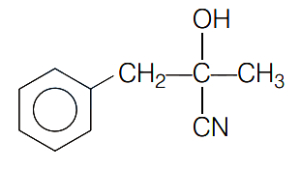
D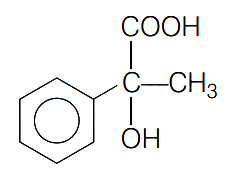
Solution
(D) The reaction sequence is as follows:
$1$. $CH_3COOH + SOCl_2 \rightarrow CH_3COCl$ ($A$ is acetyl chloride).
$2$. $CH_3COCl + C_6H_6 \xrightarrow{Anhy. AlCl_3} C_6H_5COCH_3$ ($B$ is acetophenone,a Friedel-Crafts acylation reaction).
$3$. $C_6H_5COCH_3 + HCN \rightarrow C_6H_5C(OH)(CH_3)CN$ ($C$ is acetophenone cyanohydrin).
$4$. $C_6H_5C(OH)(CH_3)CN + H_2O \rightarrow C_6H_5C(OH)(CH_3)COOH$ ($D$ is $2-$hydroxy$-2-$phenylpropanoic acid,formed by the hydrolysis of the cyanohydrin group).
$1$. $CH_3COOH + SOCl_2 \rightarrow CH_3COCl$ ($A$ is acetyl chloride).
$2$. $CH_3COCl + C_6H_6 \xrightarrow{Anhy. AlCl_3} C_6H_5COCH_3$ ($B$ is acetophenone,a Friedel-Crafts acylation reaction).
$3$. $C_6H_5COCH_3 + HCN \rightarrow C_6H_5C(OH)(CH_3)CN$ ($C$ is acetophenone cyanohydrin).
$4$. $C_6H_5C(OH)(CH_3)CN + H_2O \rightarrow C_6H_5C(OH)(CH_3)COOH$ ($D$ is $2-$hydroxy$-2-$phenylpropanoic acid,formed by the hydrolysis of the cyanohydrin group).
0 likesView Solution
47
ChemistryEasyMCQKCET · 2021
The method by which aniline cannot be prepared is
A
Nitration of benzene followed by reduction with $Sn$ and conc. $HCl$
B
Degradation of benzamide with bromine in alkaline solution
C
Reduction of nitrobenzene with $H_2 / Pd$ in ethanol
D
Potassium salt of phthalimide treated with chlorobenzene followed by hydrolysis with aqueous $NaOH$ solution
Solution
(D) Aryl halides,such as chlorobenzene,do not undergo nucleophilic substitution reactions with potassium phthalimide under ordinary conditions because the $C-Cl$ bond in chlorobenzene has partial double bond character and the electron-rich benzene ring repels the nucleophile.
Therefore,the Gabriel phthalimide synthesis cannot be used for the preparation of aniline.
Thus,method $(d)$ is incorrect for the preparation of aniline.
Therefore,the Gabriel phthalimide synthesis cannot be used for the preparation of aniline.
Thus,method $(d)$ is incorrect for the preparation of aniline.
0 likesView Solution
48
ChemistryEasyMCQKCET · 2021
The compound $A$ (major product) is
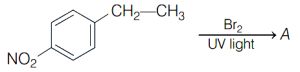
A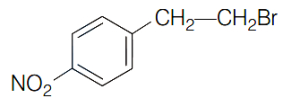
B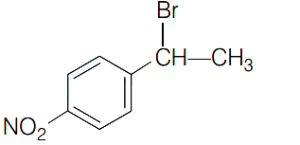
C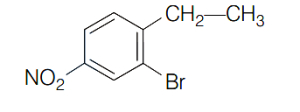
D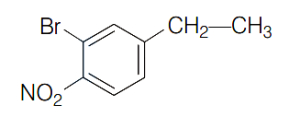
Solution
(C) The reaction of $p$-nitroethylbenzene with $Br_2$ in the presence of $UV$ light proceeds via a free radical mechanism. The bromine radical abstracts a hydrogen atom from the benzylic position because the resulting benzylic radical is stabilized by resonance with the benzene ring. Therefore,the major product is $1$-bromo-$1$-($4$-nitrophenyl)ethane.
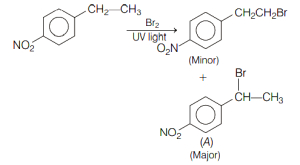
0 likesView Solution
49
ChemistryEasyMCQKCET · 2021
Which of the following properties is true for the given sequence? $NH_{3} > PH_{3} > AsH_{3} > SbH_{3} > BiH_{3}$
A
Reducing property
B
Thermal stability
C
Bond angle
D
Acidic character
Solution
(B) The thermal stability of the hydrides of group $15$ elements decreases down the group as $NH_{3} > PH_{3} > AsH_{3} > SbH_{3} > BiH_{3}$.
As we move down the group,the atomic size of the central atom increases (from $N$ to $Bi$).
This leads to an increase in the bond length and a decrease in the bond dissociation enthalpy (bond strength).
Consequently,the thermal stability decreases.
As we move down the group,the atomic size of the central atom increases (from $N$ to $Bi$).
This leads to an increase in the bond length and a decrease in the bond dissociation enthalpy (bond strength).
Consequently,the thermal stability decreases.
0 likesView Solution
50
ChemistryMediumMCQKCET · 2021
$A$ colourless,neutral,paramagnetic oxide of nitrogen '$P$' on oxidation gives reddish brown gas $Q$. $Q$ on cooling gives colourless gas $R$. $R$ on reaction with $P$ gives blue solid $S$. Identify $P, Q, R, S$ respectively.
A
$N_2O, NO, NO_2, N_2O_5$
B
$N_2O, NO_2, N_2O_4, N_2O_3$
C
$NO, NO_2, N_2O_4, N_2O_3$
D
$NO, NO, N_2O_4, N_2O_5$
Solution
(C) The reactions are as follows:
$1$. $2NO(g) + O_2(g) \rightarrow 2NO_2(g)$ (Reddish brown gas $Q$)
$2$. $2NO_2(g) \rightleftharpoons N_2O_4(g)$ (Colourless gas $R$ on cooling)
$3$. $NO(g) + NO_2(g) \rightarrow N_2O_3(s)$ (Blue solid $S$)
Thus,$P = NO$,$Q = NO_2$,$R = N_2O_4$,and $S = N_2O_3$.
$1$. $2NO(g) + O_2(g) \rightarrow 2NO_2(g)$ (Reddish brown gas $Q$)
$2$. $2NO_2(g) \rightleftharpoons N_2O_4(g)$ (Colourless gas $R$ on cooling)
$3$. $NO(g) + NO_2(g) \rightarrow N_2O_3(s)$ (Blue solid $S$)
Thus,$P = NO$,$Q = NO_2$,$R = N_2O_4$,and $S = N_2O_3$.
0 likesView Solution
51
ChemistryEasyMCQKCET · 2021
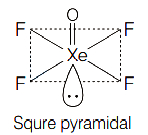
$XeF_{6}$ on partial hydrolysis gives a compound $X$,which has square pyramidal geometry. '$X$' is
A
$XeO_{3}$
B
$XeO_{4}$
C
$XeOF_{4}$
D
$XeO_{2}F_{2}$
Solution
(C) $XeF_{6}$ on partial hydrolysis with water gives $XeOF_{4}$.
The reaction involved is as follows:
$XeF_{6} + H_{2}O \rightarrow XeOF_{4} + 2HF$
The structure of $XeOF_{4}$ is square pyramidal.
The reaction involved is as follows:
$XeF_{6} + H_{2}O \rightarrow XeOF_{4} + 2HF$
The structure of $XeOF_{4}$ is square pyramidal.
0 likesView Solution
52
ChemistryMediumMCQKCET · 2021
Which of the following compounds on heating gives $N_{2}O$?
A
$Pb(NO_{3})_{2}$
B
$NH_{4}NO_{3}$
C
$NH_{4}NO_{2}$
D
$NaNO_{3}$
Solution
(B) $NH_{4}NO_{3}$ on heating gives nitrous oxide $(N_{2}O)$.
The reaction is as follows:
$NH_{4}NO_{3} \stackrel{\Delta}{\longrightarrow} N_{2}O_{(g)} + 2H_{2}O_{(g)}$
Nitrous oxide is also known as laughing gas.
The reaction is as follows:
$NH_{4}NO_{3} \stackrel{\Delta}{\longrightarrow} N_{2}O_{(g)} + 2H_{2}O_{(g)}$
Nitrous oxide is also known as laughing gas.
0 likesView Solution
53
ChemistryMediumMCQKCET · 2021
In the detection of $II$ group acid radical,the salt containing chloride is treated with concentrated sulphuric acid,the colourless gas is liberated. The name of the gas is
A
hydrogen chloride gas
B
chlorine gas
C
sulphur dioxide gas
D
hydrogen gas
Solution
(A) When a salt containing chloride $(Cl^-)$ is treated with concentrated sulphuric acid $(H_2SO_4)$,it undergoes a displacement reaction to produce hydrogen chloride gas $(HCl)$.
The reaction is: $NaCl(s) + H_2SO_4(conc.) \rightarrow NaHSO_4(s) + HCl(g) \uparrow$.
$HCl$ is a colourless gas with a pungent odour.
The reaction is: $NaCl(s) + H_2SO_4(conc.) \rightarrow NaHSO_4(s) + HCl(g) \uparrow$.
$HCl$ is a colourless gas with a pungent odour.
0 likesView Solution
54
ChemistryMediumMCQKCET · 2021
In chrysoberyl,a compound containing beryllium,aluminium and oxygen,oxide ions form a cubic close-packed structure. Aluminium ions occupy $\frac{1}{4}$ of the octahedral voids and beryllium ions occupy $\frac{1}{8}$ of the tetrahedral voids. The formula of the compound is
A
$BeAlO_{4}$
B
$BeAl_{2}O_{4}$
C
$Be_{2}AlO_{2}$
D
$BeAlO_{2}$
Solution
(A) Let the number of oxide ions $(O^{2-})$ in the $ccp$ structure be $N$.
Number of octahedral voids = $N$.
Number of tetrahedral voids = $2N$.
Given that $Al^{3+}$ ions occupy $\frac{1}{4}$ of the octahedral voids,so number of $Al^{3+} = \frac{1}{4} \times N = \frac{N}{4}$.
Given that $Be^{2+}$ ions occupy $\frac{1}{8}$ of the tetrahedral voids,so number of $Be^{2+} = \frac{1}{8} \times 2N = \frac{N}{4}$.
The ratio of $Be : Al : O$ is $\frac{N}{4} : \frac{N}{4} : N$.
Multiplying by $4$,we get the ratio $1 : 1 : 4$.
Therefore,the formula of the compound is $BeAlO_{4}$.
Number of octahedral voids = $N$.
Number of tetrahedral voids = $2N$.
Given that $Al^{3+}$ ions occupy $\frac{1}{4}$ of the octahedral voids,so number of $Al^{3+} = \frac{1}{4} \times N = \frac{N}{4}$.
Given that $Be^{2+}$ ions occupy $\frac{1}{8}$ of the tetrahedral voids,so number of $Be^{2+} = \frac{1}{8} \times 2N = \frac{N}{4}$.
The ratio of $Be : Al : O$ is $\frac{N}{4} : \frac{N}{4} : N$.
Multiplying by $4$,we get the ratio $1 : 1 : 4$.
Therefore,the formula of the compound is $BeAlO_{4}$.
0 likesView Solution
55
ChemistryMediumMCQKCET · 2021
$A$ metal crystallises in $bcc$ lattice with unit cell edge length of $300 \ pm$ and density $6.15 \ g \ cm^{-3}$. The molar mass of the metal is
A
$50 \ g \ mol^{-1}$
B
$60 \ g \ mol^{-1}$
C
$40 \ g \ mol^{-1}$
D
$70 \ g \ mol^{-1}$
Solution
(A) Given, metal crystallises in $bcc$ lattice, therefore $Z = 2$.
Edge length $a = 300 \ pm = 300 \times 10^{-10} \ cm$.
Density $d = 6.15 \ g \ cm^{-3}$.
Using the formula for density: $d = \frac{Z \times M}{a^3 \times N_A}$.
Rearranging for molar mass $M$: $M = \frac{d \times a^3 \times N_A}{Z}$.
Substituting the values: $M = \frac{6.15 \times (300 \times 10^{-10})^3 \times 6.022 \times 10^{23}}{2}$.
$M = \frac{6.15 \times 27 \times 10^{-24} \times 6.022 \times 10^{23}}{2} = \frac{99.965}{2} \approx 49.98 \ g \ mol^{-1}$.
Thus, the molar mass is approximately $50 \ g \ mol^{-1}$.
Edge length $a = 300 \ pm = 300 \times 10^{-10} \ cm$.
Density $d = 6.15 \ g \ cm^{-3}$.
Using the formula for density: $d = \frac{Z \times M}{a^3 \times N_A}$.
Rearranging for molar mass $M$: $M = \frac{d \times a^3 \times N_A}{Z}$.
Substituting the values: $M = \frac{6.15 \times (300 \times 10^{-10})^3 \times 6.022 \times 10^{23}}{2}$.
$M = \frac{6.15 \times 27 \times 10^{-24} \times 6.022 \times 10^{23}}{2} = \frac{99.965}{2} \approx 49.98 \ g \ mol^{-1}$.
Thus, the molar mass is approximately $50 \ g \ mol^{-1}$.
0 likesView Solution
56
ChemistryEasyMCQKCET · 2021
The correct statement regarding defects in solids is
A
Frenkel defect is a vacancy defect
B
Schottky defect is a dislocation defect
C
Trapping of an electron in the lattice leads to the formation of $F$-centre
D
Schottky defect has no effect on density
Solution
(C) The correct statement is that the trapping of an electron in the lattice leads to the formation of an $F$-centre.
Frenkel defect is a dislocation defect where an ion leaves its lattice site and occupies an interstitial site.
Schottky defect is a vacancy defect where equal numbers of cations and anions are missing from the lattice,which leads to a decrease in the density of the solid.
Frenkel defect is a dislocation defect where an ion leaves its lattice site and occupies an interstitial site.
Schottky defect is a vacancy defect where equal numbers of cations and anions are missing from the lattice,which leads to a decrease in the density of the solid.
0 likesView Solution
57
ChemistryEasyMCQKCET · 2021
The vapour pressure of pure liquids $A$ and $B$ are $450 \ mm$ and $700 \ mm$ of $Hg$ at $350 \ K$ respectively. If the total vapour pressure of the mixture is $600 \ mm$ of $Hg$,the composition of the mixture in the solution is
A
$\chi_{A}=0.4, \chi_{B}=0.6$
B
$\chi_{A}=0.6, \chi_{B}=0.4$
C
$\chi_{A}=0.3, \chi_{B}=0.7$
D
$\chi_{A}=0.7, \chi_{B}=0.3$
Solution
(A) Given,vapour pressure of pure liquid $A$,$p_{A}^{\circ} = 450 \ mm \ Hg$.
Vapour pressure of pure liquid $B$,$p_{B}^{\circ} = 700 \ mm \ Hg$.
Total vapour pressure,$p_{\text{Total}} = 600 \ mm \ Hg$.
From Raoult's law,$p_{\text{Total}} = p_{A}^{\circ}\chi_{A} + p_{B}^{\circ}\chi_{B}$.
Since $\chi_{B} = 1 - \chi_{A}$,we have:
$600 = 450\chi_{A} + 700(1 - \chi_{A})$
$600 = 450\chi_{A} + 700 - 700\chi_{A}$
$600 = 700 - 250\chi_{A}$
$250\chi_{A} = 100$
$\chi_{A} = \frac{100}{250} = 0.4$
$\therefore \chi_{B} = 1 - 0.4 = 0.6$.
Vapour pressure of pure liquid $B$,$p_{B}^{\circ} = 700 \ mm \ Hg$.
Total vapour pressure,$p_{\text{Total}} = 600 \ mm \ Hg$.
From Raoult's law,$p_{\text{Total}} = p_{A}^{\circ}\chi_{A} + p_{B}^{\circ}\chi_{B}$.
Since $\chi_{B} = 1 - \chi_{A}$,we have:
$600 = 450\chi_{A} + 700(1 - \chi_{A})$
$600 = 450\chi_{A} + 700 - 700\chi_{A}$
$600 = 700 - 250\chi_{A}$
$250\chi_{A} = 100$
$\chi_{A} = \frac{100}{250} = 0.4$
$\therefore \chi_{B} = 1 - 0.4 = 0.6$.
0 likesView Solution
58
ChemistryMediumMCQKCET · 2021
Henry's law constant for the solubility of $N_2$ gas in water at $298 \ K$ is $1.0 \times 10^5 \ atm$. The mole fraction of $N_2$ in air is $0.8$. The number of moles of $N_2$ from air dissolved in $10 \ moles$ of water at $298 \ K$ and $5 \ atm$ pressure is
A
$4.0 \times 10^{-4}$
B
$4.0 \times 10^{-5}$
C
$5.0 \times 10^{-4}$
D
$4.0 \times 10^{-6}$
Solution
(A) Given,Henry's law constant $(K_H)$ for the solubility of $N_2$ gas in water at $298 \ K = 1 \times 10^5 \ atm$.
Mole fraction of $N_2$ in air $(\chi_{N_2, \text{air}}) = 0.8$.
Total pressure $(P_{\text{total}}) = 5 \ atm$.
Partial pressure of nitrogen $(p_{N_2}) = P_{\text{total}} \times \chi_{N_2, \text{air}} = 5 \times 0.8 = 4 \ atm$.
According to Henry's law,$p_{N_2} = K_H \times \chi_{N_2, \text{water}}$.
$4 = 10^5 \times \chi_{N_2, \text{water}} \Rightarrow \chi_{N_2, \text{water}} = 4 \times 10^{-5}$.
We know that $\chi_{N_2, \text{water}} = \frac{n_{N_2}}{n_{N_2} + n_{H_2O}}$.
Since $n_{N_2} \ll n_{H_2O}$,we can approximate $\chi_{N_2, \text{water}} \approx \frac{n_{N_2}}{n_{H_2O}}$.
$4 \times 10^{-5} = \frac{n_{N_2}}{10}$.
$n_{N_2} = 4 \times 10^{-4} \ moles$.
Mole fraction of $N_2$ in air $(\chi_{N_2, \text{air}}) = 0.8$.
Total pressure $(P_{\text{total}}) = 5 \ atm$.
Partial pressure of nitrogen $(p_{N_2}) = P_{\text{total}} \times \chi_{N_2, \text{air}} = 5 \times 0.8 = 4 \ atm$.
According to Henry's law,$p_{N_2} = K_H \times \chi_{N_2, \text{water}}$.
$4 = 10^5 \times \chi_{N_2, \text{water}} \Rightarrow \chi_{N_2, \text{water}} = 4 \times 10^{-5}$.
We know that $\chi_{N_2, \text{water}} = \frac{n_{N_2}}{n_{N_2} + n_{H_2O}}$.
Since $n_{N_2} \ll n_{H_2O}$,we can approximate $\chi_{N_2, \text{water}} \approx \frac{n_{N_2}}{n_{H_2O}}$.
$4 \times 10^{-5} = \frac{n_{N_2}}{10}$.
$n_{N_2} = 4 \times 10^{-4} \ moles$.
0 likesView Solution
59
ChemistryEasyMCQKCET · 2021
Choose the correct statement.
A
$K_{H}$ value is same for a gas in any solution.
B
Higher the $K_{H}$ value more the solubility of gas.
C
$K_{H}$ value increases on increasing the temperature of the solution.
D
Easily liquefiable gases usually have lesser $K_{H}$ values.
Solution
(C) Among the given statements,only statement $(c)$ is correct regarding the Henry's law constant $(K_{H})$.
$(a)$ $K_{H}$ is a function of the nature of the gas and the solvent used; therefore,the $K_{H}$ value is not the same for a gas in different solutions.
$(b)$ According to Henry's law,$p = K_{H} \cdot x$,which implies $x = p / K_{H}$. Thus,a higher $K_{H}$ value corresponds to lower solubility of the gas.
$(c)$ $K_{H}$ is temperature-dependent and generally increases with an increase in temperature,which explains why gases are less soluble in warm water.
$(d)$ Easily liquefiable gases have stronger intermolecular forces,which leads to lower $K_{H}$ values.
$(a)$ $K_{H}$ is a function of the nature of the gas and the solvent used; therefore,the $K_{H}$ value is not the same for a gas in different solutions.
$(b)$ According to Henry's law,$p = K_{H} \cdot x$,which implies $x = p / K_{H}$. Thus,a higher $K_{H}$ value corresponds to lower solubility of the gas.
$(c)$ $K_{H}$ is temperature-dependent and generally increases with an increase in temperature,which explains why gases are less soluble in warm water.
$(d)$ Easily liquefiable gases have stronger intermolecular forces,which leads to lower $K_{H}$ values.
0 likesView Solution
60
ChemistryEasyMCQKCET · 2021
The $K_H$ values (in $k\text{bar}$) of argon $(I)$,carbon dioxide $(II)$,formaldehyde $(III)$,and methane $(IV)$ are $40.3$,$1.67$,$1.83 \times 10^{-5}$,and $0.413$ respectively at $298 \ K$. The increasing order of solubility of these gases in liquid is:
A
$II < I < IV < III$
B
$III < IV < II < I$
C
$I < II < IV < III$
D
$II < IV < I < III$
Solution
(C) According to Henry's law,the solubility of a gas in a liquid is inversely proportional to its Henry's law constant $(K_H)$.
Mathematically,$\text{Solubility} \propto \frac{1}{K_H}$.
Given $K_H$ values at $298 \ K$:
Argon $(I)$: $40.3 \ k\text{bar}$
Carbon dioxide $(II)$: $1.67 \ k\text{bar}$
Methane $(IV)$: $0.413 \ k\text{bar}$
Formaldehyde $(III)$: $1.83 \times 10^{-5} \ k\text{bar}$
Comparing the $K_H$ values: $1.83 \times 10^{-5} < 0.413 < 1.67 < 40.3$.
Therefore,the order of $K_H$ is $III < IV < II < I$.
Since solubility is inversely proportional to $K_H$,the increasing order of solubility is $I < II < IV < III$.
Mathematically,$\text{Solubility} \propto \frac{1}{K_H}$.
Given $K_H$ values at $298 \ K$:
Argon $(I)$: $40.3 \ k\text{bar}$
Carbon dioxide $(II)$: $1.67 \ k\text{bar}$
Methane $(IV)$: $0.413 \ k\text{bar}$
Formaldehyde $(III)$: $1.83 \times 10^{-5} \ k\text{bar}$
Comparing the $K_H$ values: $1.83 \times 10^{-5} < 0.413 < 1.67 < 40.3$.
Therefore,the order of $K_H$ is $III < IV < II < I$.
Since solubility is inversely proportional to $K_H$,the increasing order of solubility is $I < II < IV < III$.
0 likesView Solution
61
ChemistryMediumMCQKCET · 2021
$A$ colloidal solution is subjected to an electric field,and the colloidal particles move towards the anode. The amount of electrolytes $BaCl_{2}$,$AlCl_{3}$,and $NaCl$ required to coagulate the given colloid is in the order:
A
$NaCl > BaCl_{2} > AlCl_{3}$
B
$BaCl_{2} < AlCl_{3} > NaCl$
C
$AlCl_{3} = NaCl = BaCl_{2}$
D
$AlCl_{3} > BaCl_{2} > NaCl$
Solution
(A) Since the colloidal particles move towards the anode,they are negatively charged.
According to the Hardy-Schulze rule,the coagulating power of an electrolyte increases with the increase in the magnitude of the charge on the cation (for negatively charged colloids).
The coagulating power order is $Al^{3+} > Ba^{2+} > Na^{+}$.
Since the coagulation value is inversely proportional to the coagulating power,the amount of electrolyte required follows the order: $NaCl > BaCl_{2} > AlCl_{3}$.
According to the Hardy-Schulze rule,the coagulating power of an electrolyte increases with the increase in the magnitude of the charge on the cation (for negatively charged colloids).
The coagulating power order is $Al^{3+} > Ba^{2+} > Na^{+}$.
Since the coagulation value is inversely proportional to the coagulating power,the amount of electrolyte required follows the order: $NaCl > BaCl_{2} > AlCl_{3}$.
0 likesView Solution
62
ChemistryMediumMCQKCET · 2021
Zeta potential is
A
potential required to bring about coagulation of a colloidal sol.
B
potential required to give the particle a speed of $1 \ cm \ s^{-1}$.
C
potential difference between fixed charged layer and the diffused layer having opposite charges.
D
potential energy of the colloidal particles.
Solution
(C) Zeta potential,also known as electrokinetic potential,is the potential difference between the fixed charged layer and the diffused layer of opposite charges surrounding the colloidal particle.
0 likesView Solution
Vedclass Products
For Students
Vedclass Test Series
Mock tests in real KCET style covering Chemistry with performance analysis. 5-day free trial.
Start Free TrialFor Teachers
Exam Paper Generator
Generate Set A/B/C/D Chemistry papers from 7.5L+ questions in 2 minutes. 3 chapters free.
Try FreeFor Institutes
Online Exam Module
Run live KCET mock exams with unlimited students, 360° analytics & white-label branding.
See DemoFrequently Asked Questions
How many Chemistry questions are in KCET 2021?
There are 62 Chemistry questions from the KCET 2021 paper on Vedclass, each with a detailed step-by-step solution in English.
Are KCET 2021 Chemistry solutions available in English?
Yes. All solutions on this page are in English. You can also switch to English or Hindi using the language buttons above the questions.
Can I practice KCET 2021 Chemistry as a timed test?
Yes. Use the Vedclass Test Series to attempt a full KCET mock test covering Chemistry with time limits and instant score analysis.
Can teachers create Chemistry papers from KCET previous year questions?
Yes. The Vedclass Exam Paper Generator lets teachers mix KCET Chemistry questions and generate Set A/B/C/D papers in minutes.
For Teachers & Institutes
Build a Custom Chemistry Paper
Pick KCET 2021 Chemistry questions, set difficulty, and generate Set A/B/C/D in 2 minutes.