
ChemistryQ1–65 of 65 questions
Page 1 of 1 · English
1
ChemistryMCQKCET · 2025
If $\cos x + \cos^2 x = 1$,then the value of $\sin^2 x + \sin^4 x$ is
A
$1$
B
$-1$
C
$0$
D
$2$
Solution
(A) Given that $\cos x + \cos^2 x = 1$.
From this,we have $\cos x = 1 - \cos^2 x$.
Using the identity $\sin^2 x + \cos^2 x = 1$,we get $\cos x = \sin^2 x$.
Now,we need to find the value of $\sin^2 x + \sin^4 x$.
Substituting $\sin^2 x = \cos x$,we get $\sin^4 x = (\sin^2 x)^2 = \cos^2 x$.
Therefore,$\sin^2 x + \sin^4 x = \cos x + \cos^2 x$.
Since $\cos x + \cos^2 x = 1$,the value is $1$.
From this,we have $\cos x = 1 - \cos^2 x$.
Using the identity $\sin^2 x + \cos^2 x = 1$,we get $\cos x = \sin^2 x$.
Now,we need to find the value of $\sin^2 x + \sin^4 x$.
Substituting $\sin^2 x = \cos x$,we get $\sin^4 x = (\sin^2 x)^2 = \cos^2 x$.
Therefore,$\sin^2 x + \sin^4 x = \cos x + \cos^2 x$.
Since $\cos x + \cos^2 x = 1$,the value is $1$.
0 likesView Solution
2
ChemistryDifficultMCQKCET · 2025
The equilibrium constant at $298 \ K$ for a reaction $A + B \rightleftharpoons C + D$ is $100$. If the initial concentration of all the four species were $1 \ M$ each,then the equilibrium concentration of $D$ (in $mol \ L^{-1}$) will be:
A
$1.818$
B
$1.182$
C
$0.182$
D
$0.818$
Solution
(A) For the reaction $A + B \rightleftharpoons C + D$,the equilibrium constant $K_c = 100$.
Initial concentrations: $[A]_0 = 1 \ M, [B]_0 = 1 \ M, [C]_0 = 1 \ M, [D]_0 = 1 \ M$.
Let $x$ be the change in concentration at equilibrium.
At equilibrium: $[A] = 1-x, [B] = 1-x, [C] = 1+x, [D] = 1+x$.
$K_c = \frac{[C][D]}{[A][B]} = \frac{(1+x)(1+x)}{(1-x)(1-x)} = \left(\frac{1+x}{1-x}\right)^2 = 100$.
Taking the square root of both sides: $\frac{1+x}{1-x} = 10$.
$1+x = 10 - 10x \implies 11x = 9 \implies x = \frac{9}{11} \approx 0.818$.
Equilibrium concentration of $D$ is $[D] = 1 + x = 1 + 0.818 = 1.818 \ M$.
Initial concentrations: $[A]_0 = 1 \ M, [B]_0 = 1 \ M, [C]_0 = 1 \ M, [D]_0 = 1 \ M$.
Let $x$ be the change in concentration at equilibrium.
At equilibrium: $[A] = 1-x, [B] = 1-x, [C] = 1+x, [D] = 1+x$.
$K_c = \frac{[C][D]}{[A][B]} = \frac{(1+x)(1+x)}{(1-x)(1-x)} = \left(\frac{1+x}{1-x}\right)^2 = 100$.
Taking the square root of both sides: $\frac{1+x}{1-x} = 10$.
$1+x = 10 - 10x \implies 11x = 9 \implies x = \frac{9}{11} \approx 0.818$.
Equilibrium concentration of $D$ is $[D] = 1 + x = 1 + 0.818 = 1.818 \ M$.
0 likesView Solution
3
ChemistryMCQKCET · 2025
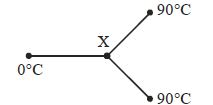
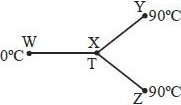
Three metal rods of the same material and identical in all respects are joined as shown in the figure. The temperatures at the ends are maintained as indicated. Assuming no loss of heat from the curved surfaces of the rods,the temperature at the junction $X$ would be ....... $^oC$
A
$45$
B
$60$
C
$30$
D
$20$
Solution
(B) Let $T$ be the temperature at the junction $X$.
Let $L$ and $A$ be the length and area of cross-section of each rod respectively,and $K$ be the thermal conductivity.
Heat current from $Y$ to $X$ is $H_1 = \frac{KA(90^{\circ}C - T)}{L}$.
Heat current from $Z$ to $X$ is $H_2 = \frac{KA(90^{\circ}C - T)}{L}$.
Heat current from $X$ to $W$ is $H_3 = \frac{KA(T - 0^{\circ}C)}{L}$.
At the junction $X$,by the principle of conservation of energy (steady state),the sum of incoming heat currents equals the outgoing heat current:
$H_1 + H_2 = H_3$
$\frac{KA(90 - T)}{L} + \frac{KA(90 - T)}{L} = \frac{KA(T - 0)}{L}$
$(90 - T) + (90 - T) = T$
$180 - 2T = T$
$3T = 180^{\circ}C$
$T = 60^{\circ}C$
Let $L$ and $A$ be the length and area of cross-section of each rod respectively,and $K$ be the thermal conductivity.
Heat current from $Y$ to $X$ is $H_1 = \frac{KA(90^{\circ}C - T)}{L}$.
Heat current from $Z$ to $X$ is $H_2 = \frac{KA(90^{\circ}C - T)}{L}$.
Heat current from $X$ to $W$ is $H_3 = \frac{KA(T - 0^{\circ}C)}{L}$.
At the junction $X$,by the principle of conservation of energy (steady state),the sum of incoming heat currents equals the outgoing heat current:
$H_1 + H_2 = H_3$
$\frac{KA(90 - T)}{L} + \frac{KA(90 - T)}{L} = \frac{KA(T - 0)}{L}$
$(90 - T) + (90 - T) = T$
$180 - 2T = T$
$3T = 180^{\circ}C$
$T = 60^{\circ}C$
0 likesView Solution
4
ChemistryMCQKCET · 2025
If $A$ and $B$ are two events such that $A \subset B$ and $P(B) \neq 0$,then which of the following is correct?
A
$P(A | B) = \frac{P(B)}{P(A)}$
B
$P(A | B) < P(A)$
C
$P(A | B) \geq P(A)$
D
None of these
Solution
(C) Given that $A \subset B$,we have $A \cap B = A$.
By the definition of conditional probability,$P(A | B) = \frac{P(A \cap B)}{P(B)}$.
Substituting $A \cap B = A$,we get $P(A | B) = \frac{P(A)}{P(B)}$.
Since $A \subset B$,it follows that $P(A) \leq P(B)$,which implies $\frac{P(A)}{P(B)} \leq 1$.
Also,since $P(B) \leq 1$,we have $\frac{1}{P(B)} \geq 1$.
Multiplying both sides by $P(A)$ (where $P(A) \geq 0$),we get $\frac{P(A)}{P(B)} \geq P(A)$.
Therefore,$P(A | B) \geq P(A)$.
Thus,the correct option is $C$.
By the definition of conditional probability,$P(A | B) = \frac{P(A \cap B)}{P(B)}$.
Substituting $A \cap B = A$,we get $P(A | B) = \frac{P(A)}{P(B)}$.
Since $A \subset B$,it follows that $P(A) \leq P(B)$,which implies $\frac{P(A)}{P(B)} \leq 1$.
Also,since $P(B) \leq 1$,we have $\frac{1}{P(B)} \geq 1$.
Multiplying both sides by $P(A)$ (where $P(A) \geq 0$),we get $\frac{P(A)}{P(B)} \geq P(A)$.
Therefore,$P(A | B) \geq P(A)$.
Thus,the correct option is $C$.
0 likesView Solution
5
ChemistryMediumMCQKCET · 2025
The electronic configuration of $X$ and $Y$ are given below:
$X: 1s^2 2s^2 2p^6 3s^2 3p^3$
$Y: 1s^2 2s^2 2p^6 3s^2 3p^5$
Which of the following is the correct molecular formula and type of bond formed between $X$ and $Y$?
$X: 1s^2 2s^2 2p^6 3s^2 3p^3$
$Y: 1s^2 2s^2 2p^6 3s^2 3p^5$
Which of the following is the correct molecular formula and type of bond formed between $X$ and $Y$?
A
$X_3 Y$,ionic bond
B
$X_2 Y_3$,coordinate bond
C
$XY_3$,covalent bond
D
$X_2 Y$,covalent bond
Solution
(C) $X$ has $5$ valence electrons $(3s^2 3p^3)$,so it is a non-metal (Phosphorus,$P$).
$Y$ has $7$ valence electrons $(3s^2 3p^5)$,so it is a non-metal (Chlorine,$Cl$).
Non-metals share electrons to complete their octet,forming covalent bonds.
The valency of $X$ is $3$ and the valency of $Y$ is $1$.
Therefore,the formula is $XY_3$ (e.g.,$PCl_3$).
Thus,the bond formed is covalent.
$Y$ has $7$ valence electrons $(3s^2 3p^5)$,so it is a non-metal (Chlorine,$Cl$).
Non-metals share electrons to complete their octet,forming covalent bonds.
The valency of $X$ is $3$ and the valency of $Y$ is $1$.
Therefore,the formula is $XY_3$ (e.g.,$PCl_3$).
Thus,the bond formed is covalent.
0 likesView Solution
6
ChemistryEasyMCQKCET · 2025
The change in hybridization (if any) of the $Al$ atom in the following reaction is $AlCl_3 + Cl^{-} \rightarrow AlCl_4^{-}$
A
No change in the hybridization state
B
$sp^2$ to $sp^3$
C
$sp^3$ to $sp^3d$
D
$sp^3$ to $sp^2$
Solution
(B) In $AlCl_3$,the $Al$ atom is bonded to $3$ chlorine atoms with $3$ $\sigma$ bonds and has no lone pair. The steric number is $3$,which corresponds to $sp^2$ hybridization.
In $AlCl_4^{-}$,the $Al$ atom is bonded to $4$ chlorine atoms with $4$ $\sigma$ bonds and has no lone pair. The steric number is $4$,which corresponds to $sp^3$ hybridization.
Therefore,the hybridization of the $Al$ atom changes from $sp^2$ to $sp^3$.
In $AlCl_4^{-}$,the $Al$ atom is bonded to $4$ chlorine atoms with $4$ $\sigma$ bonds and has no lone pair. The steric number is $4$,which corresponds to $sp^3$ hybridization.
Therefore,the hybridization of the $Al$ atom changes from $sp^2$ to $sp^3$.
0 likesView Solution
7
ChemistryMediumMCQKCET · 2025
Match List-$I$ with List-$II$ and select the correct option:
| List-$I$ (Molecule / ion) | List-$II$ (Bond order) |
|---|---|
| $1$. $NO$ | $i$. $1.5$ |
| $2$. $CO$ | $ii$. $2.0$ |
| $3$. $O_2^{-}$ | $iii$. $2.5$ |
| $4$. $O_2$ | $iv$. $3.0$ |
A
$1-iii, 2-iv, 3-i, 4-ii$
B
$1-i, 2-iv, 3-iii, 4-ii$
C
$1-ii, 2-iii, 3-iv, 4-i$
D
$1-iv, 2-iii, 3-ii, 4-i$
Solution
(A) The bond order is calculated using the formula: $\text{Bond Order} = \frac{1}{2} [\text{Number of bonding electrons} - \text{Number of antibonding electrons}]$.
$1$. For $NO$ ($15$ electrons): $\text{Bond Order} = \frac{1}{2} [10 - 5] = 2.5$ (Matches $iii$).
$2$. For $CO$ ($14$ electrons): $\text{Bond Order} = \frac{1}{2} [10 - 4] = 3.0$ (Matches $iv$).
$3$. For $O_2^{-}$ ($17$ electrons): $\text{Bond Order} = \frac{1}{2} [10 - 7] = 1.5$ (Matches $i$).
$4$. For $O_2$ ($16$ electrons): $\text{Bond Order} = \frac{1}{2} [10 - 6] = 2.0$ (Matches $ii$).
Thus,the correct matching is $1-iii, 2-iv, 3-i, 4-ii$.
$1$. For $NO$ ($15$ electrons): $\text{Bond Order} = \frac{1}{2} [10 - 5] = 2.5$ (Matches $iii$).
$2$. For $CO$ ($14$ electrons): $\text{Bond Order} = \frac{1}{2} [10 - 4] = 3.0$ (Matches $iv$).
$3$. For $O_2^{-}$ ($17$ electrons): $\text{Bond Order} = \frac{1}{2} [10 - 7] = 1.5$ (Matches $i$).
$4$. For $O_2$ ($16$ electrons): $\text{Bond Order} = \frac{1}{2} [10 - 6] = 2.0$ (Matches $ii$).
Thus,the correct matching is $1-iii, 2-iv, 3-i, 4-ii$.
0 likesView Solution
8
ChemistryMediumMCQKCET · 2025
Which of the following statements is/are true about equilibrium?
$(a)$ Equilibrium is possible only in a closed system at a given temperature.
$(b)$ All the measurable properties of the system remain constant at equilibrium.
$(c)$ Equilibrium constant for the reverse reaction is the inverse of the equilibrium constant for the reaction in the forward direction.
$(a)$ Equilibrium is possible only in a closed system at a given temperature.
$(b)$ All the measurable properties of the system remain constant at equilibrium.
$(c)$ Equilibrium constant for the reverse reaction is the inverse of the equilibrium constant for the reaction in the forward direction.
A
Only $b$
B
Only $c$
C
$a$,$b$ and $c$
D
Only $a$
Solution
(C) True: Chemical equilibrium can only be attained in a closed system at a constant temperature.
$(b)$ True: At equilibrium,the macroscopic properties like concentration,pressure,and density remain constant over time.
$(c)$ True: If $K_f$ is the equilibrium constant for the forward reaction,then the equilibrium constant for the reverse reaction $K_r$ is given by $K_r = \frac{1}{K_f}$.
$(b)$ True: At equilibrium,the macroscopic properties like concentration,pressure,and density remain constant over time.
$(c)$ True: If $K_f$ is the equilibrium constant for the forward reaction,then the equilibrium constant for the reverse reaction $K_r$ is given by $K_r = \frac{1}{K_f}$.
0 likesView Solution
9
ChemistryMCQKCET · 2025
The equilibrium constant at $298 \ K$ for the reaction $A + B \rightleftharpoons C + D$ is $100$. If the initial concentrations of all the four species were $1 \ M$ each,then the equilibrium concentration of $D$ (in $mol \ L^{-1}$) will be
A
$0.182$
B
$1.818$
C
$1.182$
D
$0.818$
Solution
(B) The reaction is $A + B \rightleftharpoons C + D$.
Initial concentrations: $[A] = 1 \ M, [B] = 1 \ M, [C] = 1 \ M, [D] = 1 \ M$.
At equilibrium,let the change in concentration be $x$.
Equilibrium concentrations: $[A] = 1-x, [B] = 1-x, [C] = 1+x, [D] = 1+x$.
The equilibrium constant expression is $K_c = \frac{[C][D]}{[A][B]}$.
Given $K_c = 100$,we have:
$100 = \frac{(1+x)(1+x)}{(1-x)(1-x)}$
Taking the square root on both sides:
$10 = \frac{1+x}{1-x}$
$10(1-x) = 1+x$
$10 - 10x = 1 + x$
$9 = 11x$
$x = \frac{9}{11} \approx 0.818 \ M$.
The equilibrium concentration of $D$ is $[D] = 1 + x = 1 + 0.818 = 1.818 \ M$.
Initial concentrations: $[A] = 1 \ M, [B] = 1 \ M, [C] = 1 \ M, [D] = 1 \ M$.
At equilibrium,let the change in concentration be $x$.
Equilibrium concentrations: $[A] = 1-x, [B] = 1-x, [C] = 1+x, [D] = 1+x$.
The equilibrium constant expression is $K_c = \frac{[C][D]}{[A][B]}$.
Given $K_c = 100$,we have:
$100 = \frac{(1+x)(1+x)}{(1-x)(1-x)}$
Taking the square root on both sides:
$10 = \frac{1+x}{1-x}$
$10(1-x) = 1+x$
$10 - 10x = 1 + x$
$9 = 11x$
$x = \frac{9}{11} \approx 0.818 \ M$.
The equilibrium concentration of $D$ is $[D] = 1 + x = 1 + 0.818 = 1.818 \ M$.
0 likesView Solution
10
ChemistryEasyMCQKCET · 2025
According to Le Chatelier's principle,in the reaction $CO_{(g)} + 3H_{2(g)} \rightleftharpoons CH_{4(g)} + H_2O_{(g)}$,the formation of methane is favoured by:
A
$a$ and $c$
B
$b$ and $d$
C
$a$ and $d$
D
$a$ and $b$
Solution
(A) According to Le Chatelier's principle,the equilibrium shifts in the direction that counteracts the change applied to the system.
For the reaction $CO_{(g)} + 3H_{2(g)} \rightleftharpoons CH_{4(g)} + H_2O_{(g)}$,the formation of methane $(CH_4)$ is favoured by:
$1$. Increasing the concentration of reactants ($CO$ or $H_2$): This shifts the equilibrium to the right.
$2$. Decreasing the concentration of products ($CH_4$ or $H_2O$): This also shifts the equilibrium to the right to produce more product.
Evaluating the options:
$(a)$ Increasing the concentration of $CO$ favours the forward reaction.
$(b)$ Increasing the concentration of $H_2O$ favours the backward reaction.
$(c)$ Decreasing the concentration of $CH_4$ favours the forward reaction.
$(d)$ Decreasing the concentration of $H_2$ favours the backward reaction.
Therefore,the formation of methane is favoured by $a$ and $c$.
For the reaction $CO_{(g)} + 3H_{2(g)} \rightleftharpoons CH_{4(g)} + H_2O_{(g)}$,the formation of methane $(CH_4)$ is favoured by:
$1$. Increasing the concentration of reactants ($CO$ or $H_2$): This shifts the equilibrium to the right.
$2$. Decreasing the concentration of products ($CH_4$ or $H_2O$): This also shifts the equilibrium to the right to produce more product.
Evaluating the options:
$(a)$ Increasing the concentration of $CO$ favours the forward reaction.
$(b)$ Increasing the concentration of $H_2O$ favours the backward reaction.
$(c)$ Decreasing the concentration of $CH_4$ favours the forward reaction.
$(d)$ Decreasing the concentration of $H_2$ favours the backward reaction.
Therefore,the formation of methane is favoured by $a$ and $c$.
0 likesView Solution
11
ChemistryMediumMCQKCET · 2025
Given below are the atomic masses of the elements:
Which of the following does not form a $Dobereiner's$ triad?
| Element | $Li$ | $Na$ | $Cl$ | $K$ | $Ca$ | $Br$ | $Sr$ | $I$ | $Ba$ |
|---|---|---|---|---|---|---|---|---|---|
| Atomic Mass $(g \cdot mol^{-1})$ | $7$ | $23$ | $35.5$ | $39$ | $40$ | $80$ | $88$ | $127$ | $137$ |
Which of the following does not form a $Dobereiner's$ triad?
A
$Ba, Sr, Ca$
B
$Cl, Br, I$
C
$Cl, K, Ca$
D
$Li, Na, K$
Solution
(C) According to $Dobereiner's$ law of triads,the atomic mass of the middle element is approximately the arithmetic mean of the atomic masses of the other two elements.
$1$. For $Li, Na, K$: $\frac{7 + 39}{2} = 23$ (Forms a triad).
$2$. For $Ca, Sr, Ba$: $\frac{40 + 137}{2} = 88.5 \approx 88$ (Forms a triad).
$3$. For $Cl, Br, I$: $\frac{35.5 + 127}{2} = 81.25 \approx 80$ (Forms a triad).
$4$. For $Cl, K, Ca$: The atomic masses are $35.5, 39,$ and $40$. The average of $35.5$ and $40$ is $37.75$,which is not equal to $39$. Thus,it does not form a triad.
$1$. For $Li, Na, K$: $\frac{7 + 39}{2} = 23$ (Forms a triad).
$2$. For $Ca, Sr, Ba$: $\frac{40 + 137}{2} = 88.5 \approx 88$ (Forms a triad).
$3$. For $Cl, Br, I$: $\frac{35.5 + 127}{2} = 81.25 \approx 80$ (Forms a triad).
$4$. For $Cl, K, Ca$: The atomic masses are $35.5, 39,$ and $40$. The average of $35.5$ and $40$ is $37.75$,which is not equal to $39$. Thus,it does not form a triad.
0 likesView Solution
12
ChemistryMCQKCET · 2025
If $A$ and $B$ are two events such that $A \subset B$ and $P(B) \neq 0$,then which of the following is correct?
A
$P(A \mid B) = \frac{P(B)}{P(A)}$
B
$P(A \mid B) < P(A)$
C
$P(A \mid B) \geq P(A)$
D
$P(A) = P(B)$
Solution
(C) Given $A \subset B$,we have $A \cap B = A$.
Using the definition of conditional probability:
$P(A \mid B) = \frac{P(A \cap B)}{P(B)} = \frac{P(A)}{P(B)}$.
Since $A \subset B$,we know that $P(A) \leq P(B)$.
Since $P(B) \neq 0$,we can divide by $P(B)$ to get $\frac{P(A)}{P(B)} \leq 1$.
Thus,$P(A \mid B) = \frac{P(A)}{P(B)}$.
Since $P(B) \leq 1$,it follows that $\frac{P(A)}{P(B)} \geq P(A)$.
Therefore,$P(A \mid B) \geq P(A)$.
Using the definition of conditional probability:
$P(A \mid B) = \frac{P(A \cap B)}{P(B)} = \frac{P(A)}{P(B)}$.
Since $A \subset B$,we know that $P(A) \leq P(B)$.
Since $P(B) \neq 0$,we can divide by $P(B)$ to get $\frac{P(A)}{P(B)} \leq 1$.
Thus,$P(A \mid B) = \frac{P(A)}{P(B)}$.
Since $P(B) \leq 1$,it follows that $\frac{P(A)}{P(B)} \geq P(A)$.
Therefore,$P(A \mid B) \geq P(A)$.
0 likesView Solution
13
ChemistryEasyMCQKCET · 2025
The $IUPAC$ name of the given organic compound is $HC \equiv C-CH=CH-CH=CH_2$.
A
Hexa$-1-$yn$-3,5-$diene
B
Hexa$-5-$yn$-1,3-$diene
C
Hexa$-1,3-$dien$-5-$yne
D
Hexa$-3,5-$dien$-1-$yne
Solution
(C) The given compound is $HC \equiv C-CH=CH-CH=CH_2$.
According to $IUPAC$ nomenclature rules,when both double and triple bonds are present,the double bond is given preference in numbering if the set of locants is the same.
Numbering from the right side gives the double bonds positions $1$ and $3$,and the triple bond position $5$.
Numbering from the left side gives the triple bond position $1$,and the double bonds positions $3$ and $5$.
Comparing the sets of locants: $(1, 3, 5)$ vs $(1, 3, 5)$.
Since the sets are identical,the double bond is given the lower locant.
Therefore,the correct numbering starts from the right: $CH_2=CH-CH=CH-C \equiv CH$ is not the structure,but $CH_2=CH-CH=CH-C \equiv CH$ is the reverse of the given structure.
Given structure: $HC \equiv C-CH=CH-CH=CH_2$.
Numbering from right to left: $C_1=CH_2, C_2=CH, C_3=CH, C_4=CH, C_5=C, C_6=CH$.
This gives the name Hexa$-1,3-$dien$-5-$yne.
According to $IUPAC$ nomenclature rules,when both double and triple bonds are present,the double bond is given preference in numbering if the set of locants is the same.
Numbering from the right side gives the double bonds positions $1$ and $3$,and the triple bond position $5$.
Numbering from the left side gives the triple bond position $1$,and the double bonds positions $3$ and $5$.
Comparing the sets of locants: $(1, 3, 5)$ vs $(1, 3, 5)$.
Since the sets are identical,the double bond is given the lower locant.
Therefore,the correct numbering starts from the right: $CH_2=CH-CH=CH-C \equiv CH$ is not the structure,but $CH_2=CH-CH=CH-C \equiv CH$ is the reverse of the given structure.
Given structure: $HC \equiv C-CH=CH-CH=CH_2$.
Numbering from right to left: $C_1=CH_2, C_2=CH, C_3=CH, C_4=CH, C_5=C, C_6=CH$.
This gives the name Hexa$-1,3-$dien$-5-$yne.
0 likesView Solution
14
ChemistryMediumMCQKCET · 2025
Which of the following is not an aromatic compound?
A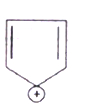
B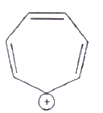
C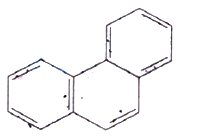
D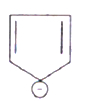
Solution
(A) To determine if a compound is aromatic,it must follow $H$ückel's rule ($4n+2$ $\pi$ electrons,where $n=0, 1, 2, ...$),be planar,and have a cyclic conjugated system.
$A$: Cyclopentadienyl cation has $4$ $\pi$ electrons ($n=1$ for antiaromatic,$4n$ rule). It is antiaromatic.
$B$: Cycloheptatrienyl cation has $6$ $\pi$ electrons $(n=1)$,which is aromatic.
$C$: Phenanthrene is a polycyclic aromatic hydrocarbon with $14$ $\pi$ electrons $(n=3)$,which is aromatic.
$D$: Cyclopentadienyl anion has $6$ $\pi$ electrons $(n=1)$,which is aromatic.
Therefore,the compound that is not aromatic is the cyclopentadienyl cation.
$A$: Cyclopentadienyl cation has $4$ $\pi$ electrons ($n=1$ for antiaromatic,$4n$ rule). It is antiaromatic.
$B$: Cycloheptatrienyl cation has $6$ $\pi$ electrons $(n=1)$,which is aromatic.
$C$: Phenanthrene is a polycyclic aromatic hydrocarbon with $14$ $\pi$ electrons $(n=3)$,which is aromatic.
$D$: Cyclopentadienyl anion has $6$ $\pi$ electrons $(n=1)$,which is aromatic.
Therefore,the compound that is not aromatic is the cyclopentadienyl cation.
0 likesView Solution
15
ChemistryEasyMCQKCET · 2025
Among the following,identify the compound that is not an isomer of hexane $(C_6H_{14})$:
A
$CH_3-CH_2-CH(CH_3)-CH_2-CH_3$
B
$CH_3-CH_2-CH_2-CH_2-CH_2-CH_3$
C
Ethylcyclobutane
D
$CH_3-CH(CH_3)-CH_2-CH_2-CH_3$
Solution
(C) Hexane is an alkane with the molecular formula $C_6H_{14}$. Isomers of hexane must also have the molecular formula $C_6H_{14}$.
$A$. $3$-methylpentane $(C_6H_{14})$ is an isomer.
$B$. $n$-hexane $(C_6H_{14})$ is an isomer.
$C$. Ethylcyclobutane has a ring structure,and its molecular formula is $C_6H_{12}$. Therefore,it is not an isomer of hexane.
$D$. $2$-methylpentane $(C_6H_{14})$ is an isomer.
Thus,the compound that is not an isomer of hexane is ethylcyclobutane.
$A$. $3$-methylpentane $(C_6H_{14})$ is an isomer.
$B$. $n$-hexane $(C_6H_{14})$ is an isomer.
$C$. Ethylcyclobutane has a ring structure,and its molecular formula is $C_6H_{12}$. Therefore,it is not an isomer of hexane.
$D$. $2$-methylpentane $(C_6H_{14})$ is an isomer.
Thus,the compound that is not an isomer of hexane is ethylcyclobutane.
0 likesView Solution
16
ChemistryMediumMCQKCET · 2025
In the preparation of sodium fusion extract,the purpose of fusing organic compound with a piece of sodium metal is to
A
Convert the organic compound into vapour state
B
Convert the elements of the compound from covalent form to ionic form
C
Convert the elements of the compound from ionic form to covalent form
D
Decrease the melting point of the compound
Solution
(B) The purpose of the sodium fusion test (Lassaigne's test) is to convert the elements present in the organic compound (like $N$,$S$,and halogens) from their covalent form into their corresponding water-soluble ionic forms (like $NaCN$,$Na_2S$,and $NaX$).
This allows for the subsequent qualitative detection of these elements using standard chemical reagents.
This allows for the subsequent qualitative detection of these elements using standard chemical reagents.
0 likesView Solution
17
ChemistryMediumMCQKCET · 2025
The sodium fusion extract is boiled with concentrated nitric acid while testing for halogens. By doing so,it
A
helps in precipitation of $AgCl$
B
increases the solubility of $AgCl$
C
increases the concentration of $NO_3^-$ ion
D
decomposes $Na_2S$ and $NaCN$,if formed
Solution
(D) The sodium fusion extract is boiled with concentrated nitric acid before adding silver nitrate $(AgNO_3)$ to test for halogens.
This step is essential to decompose any sodium sulfide $(Na_2S)$ or sodium cyanide $(NaCN)$ present in the extract,which would otherwise interfere with the test by forming precipitates like $Ag_2S$ or $AgCN$.
This step is essential to decompose any sodium sulfide $(Na_2S)$ or sodium cyanide $(NaCN)$ present in the extract,which would otherwise interfere with the test by forming precipitates like $Ag_2S$ or $AgCN$.
0 likesView Solution
18
ChemistryMediumMCQKCET · 2025
In the reaction between hydrogen sulphide and acidified permanganate solution,which of the following occurs?
A
$H_2S$ is reduced to $S$,$MnO_4^{-}$ is oxidised to $Mn^{2+}$
B
$H_2S$ is oxidised to $SO_2$,$MnO_4^{-}$ is reduced to $MnO_2$
C
$H_2S$ is reduced to $SO_2$,$MnO_4^{-}$ is oxidised to $Mn^{2+}$
D
$H_2S$ is oxidised to $S$,$MnO_4^{-}$ is reduced to $Mn^{2+}$
Solution
(D) The balanced redox reaction is: $5H_2S + 2MnO_4^{-} + 6H^{+} \rightarrow 5S + 2Mn^{2+} + 8H_2O$.
In this reaction,the oxidation state of $S$ in $H_2S$ increases from $-2$ to $0$,so $H_2S$ is oxidised to $S$.
The oxidation state of $Mn$ in $MnO_4^{-}$ decreases from $+7$ to $+2$,so $MnO_4^{-}$ is reduced to $Mn^{2+}$.
In this reaction,the oxidation state of $S$ in $H_2S$ increases from $-2$ to $0$,so $H_2S$ is oxidised to $S$.
The oxidation state of $Mn$ in $MnO_4^{-}$ decreases from $+7$ to $+2$,so $MnO_4^{-}$ is reduced to $Mn^{2+}$.
0 likesView Solution
19
ChemistryMediumMCQKCET · 2025
Match List-$I$ with List-$II$.
Choose the correct answer from the options given below.
| List-$I$ (Types of redox reactions) | List-$II$ (Examples) |
|---|---|
| $a.$ Combination reaction | $(i)$ $Cl_{2(g)} + 2Br^-_{(aq)} \rightarrow 2Cl^-_{(aq)} + Br_{2(l)}$ |
| $b.$ Decomposition reaction | $(ii)$ $2H_2O_{2(aq)} \rightarrow 2H_2O_{(l)} + O_{2(g)}$ |
| $c.$ Displacement reaction | $(iii)$ $CH_{4(g)} + 2O_{2(g)} \xrightarrow{\Delta} CO_{2(g)} + 2H_2O_{(l)}$ |
| $d.$ Disproportionation reaction | $(iv)$ $2H_2O_{(l)} \xrightarrow{\text{electrolysis}} 2H_{2(g)} + O_{2(g)}$ |
Choose the correct answer from the options given below.
A
$a-iv, b-iii, c-i, d-ii$
B
$a-ii, b-i, c-iv, d-iii$
C
$a-iii, b-iv, c-i, d-ii$
D
$a-iii, b-ii, c-i, d-iv$
Solution
(C) $1$. Combination reaction: $CH_{4(g)} + 2O_{2(g)} \xrightarrow{\Delta} CO_{2(g)} + 2H_2O_{(l)}$ (This is a combustion reaction,which is a type of combination/redox process where elements combine with oxygen).
$2$. Decomposition reaction: $2H_2O_{(l)} \xrightarrow{\text{electrolysis}} 2H_{2(g)} + O_{2(g)}$ ($A$ single compound breaks down into simpler substances).
$3$. Displacement reaction: $Cl_{2(g)} + 2Br^-_{(aq)} \rightarrow 2Cl^-_{(aq)} + Br_{2(l)}$ ($A$ more reactive halogen displaces a less reactive one).
$4$. Disproportionation reaction: $2H_2O_{2(aq)} \rightarrow 2H_2O_{(l)} + O_{2(g)}$ (The oxygen atom in $H_2O_2$ is simultaneously oxidized and reduced).
Therefore,the correct match is $a-iii, b-iv, c-i, d-ii$.
$2$. Decomposition reaction: $2H_2O_{(l)} \xrightarrow{\text{electrolysis}} 2H_{2(g)} + O_{2(g)}$ ($A$ single compound breaks down into simpler substances).
$3$. Displacement reaction: $Cl_{2(g)} + 2Br^-_{(aq)} \rightarrow 2Cl^-_{(aq)} + Br_{2(l)}$ ($A$ more reactive halogen displaces a less reactive one).
$4$. Disproportionation reaction: $2H_2O_{2(aq)} \rightarrow 2H_2O_{(l)} + O_{2(g)}$ (The oxygen atom in $H_2O_2$ is simultaneously oxidized and reduced).
Therefore,the correct match is $a-iii, b-iv, c-i, d-ii$.
0 likesView Solution
20
ChemistryMediumMCQKCET · 2025
Select the $INCORRECT$ statement/s from the following:
$(a)$ $22$ books have infinite significant figures
$(b)$ In the answer of calculation $2.5 \times 1.25$,the result has four significant figures.
$(c)$ Zeros preceding the first non-zero digit are significant.
$(d)$ In the answer of calculation $12.11 + 18.0 + 1.012$,the result has three significant figures.
$(a)$ $22$ books have infinite significant figures
$(b)$ In the answer of calculation $2.5 \times 1.25$,the result has four significant figures.
$(c)$ Zeros preceding the first non-zero digit are significant.
$(d)$ In the answer of calculation $12.11 + 18.0 + 1.012$,the result has three significant figures.
A
$b, c$ and $d$
B
$b$ and $c$ only
C
$b$ and $d$ only
D
$a$ and $b$ only
Solution
(B) Exact numbers like $22$ books have an infinite number of significant figures. This statement is correct.
$(b)$ $2.5 \times 1.25 = 3.125$. Since $2.5$ has two significant figures and $1.25$ has three,the result should be rounded to two significant figures $(3.1)$. Thus,the statement that it has four significant figures is incorrect.
$(c)$ Zeros preceding the first non-zero digit are not significant (e.g.,$0.0025$ has two significant figures). Thus,this statement is incorrect.
$(d)$ $12.11 + 18.0 + 1.012 = 31.122$. In addition,the result should be reported to the same number of decimal places as the term with the fewest decimal places ($18.0$ has one decimal place). The result should be $31.1$,which has three significant figures. This statement is correct.
Therefore,the incorrect statements are $(b)$ and $(c)$.
$(b)$ $2.5 \times 1.25 = 3.125$. Since $2.5$ has two significant figures and $1.25$ has three,the result should be rounded to two significant figures $(3.1)$. Thus,the statement that it has four significant figures is incorrect.
$(c)$ Zeros preceding the first non-zero digit are not significant (e.g.,$0.0025$ has two significant figures). Thus,this statement is incorrect.
$(d)$ $12.11 + 18.0 + 1.012 = 31.122$. In addition,the result should be reported to the same number of decimal places as the term with the fewest decimal places ($18.0$ has one decimal place). The result should be $31.1$,which has three significant figures. This statement is correct.
Therefore,the incorrect statements are $(b)$ and $(c)$.
0 likesView Solution
21
ChemistryMediumMCQKCET · 2025
According to the Heisenberg's Uncertainty principle,the value of $\Delta v \cdot \Delta x$ for an object whose mass is $10^{-6} \ kg$ is $(h = 6.626 \times 10^{-34} \ J \cdot s)$.
A
$3.0 \times 10^{-24} \ m^{2} \ s^{-1}$
B
$4.0 \times 10^{-26} \ m^{2} \ s^{-1}$
C
$3.5 \times 10^{-25} \ m^{2} \ s^{-1}$
D
$5.2 \times 10^{-29} \ m^{2} \ s^{-1}$
Solution
(D) According to Heisenberg's uncertainty principle,the product of uncertainty in position and velocity is given by: $\Delta v \cdot \Delta x \geq \frac{h}{4 \pi m}$.
Substituting the given values: $m = 10^{-6} \ kg$ and $h = 6.626 \times 10^{-34} \ J \cdot s$.
$\Delta v \cdot \Delta x = \frac{6.626 \times 10^{-34}}{4 \times 3.14159 \times 10^{-6}}$.
$\Delta v \cdot \Delta x = \frac{6.626 \times 10^{-34}}{12.566 \times 10^{-6}} \approx 0.527 \times 10^{-28} \ m^{2} \ s^{-1} = 5.27 \times 10^{-29} \ m^{2} \ s^{-1}$.
Thus,the correct option is $D$.
Substituting the given values: $m = 10^{-6} \ kg$ and $h = 6.626 \times 10^{-34} \ J \cdot s$.
$\Delta v \cdot \Delta x = \frac{6.626 \times 10^{-34}}{4 \times 3.14159 \times 10^{-6}}$.
$\Delta v \cdot \Delta x = \frac{6.626 \times 10^{-34}}{12.566 \times 10^{-6}} \approx 0.527 \times 10^{-28} \ m^{2} \ s^{-1} = 5.27 \times 10^{-29} \ m^{2} \ s^{-1}$.
Thus,the correct option is $D$.
0 likesView Solution
22
ChemistryEasyMCQKCET · 2025
The number of orbitals associated with the '$N$' shell of an atom is
A
$16$
B
$32$
C
$3$
D
$4$
Solution
(A) The shell '$N$' corresponds to the principal quantum number $n = 4$.
The total number of orbitals in a shell is given by the formula $n^2$.
Substituting $n = 4$ into the formula,we get $4^2 = 16$.
Therefore,the number of orbitals associated with the '$N$' shell is $16$.
The total number of orbitals in a shell is given by the formula $n^2$.
Substituting $n = 4$ into the formula,we get $4^2 = 16$.
Therefore,the number of orbitals associated with the '$N$' shell is $16$.
0 likesView Solution
23
ChemistryEasyMCQKCET · 2025
Given below are two statements.
Statement-$I$ : Adiabatic work done is positive when work is done on the system and internal energy of the system increases.
Statement-$II$ : No work is done during free expansion of an ideal gas.
In the light of the above statements,choose the correct answer from the options given below.
Statement-$I$ : Adiabatic work done is positive when work is done on the system and internal energy of the system increases.
Statement-$II$ : No work is done during free expansion of an ideal gas.
In the light of the above statements,choose the correct answer from the options given below.
A
Both statements-$I$ and Statement-$II$ are false
B
Statement-$I$ is true but statement-$II$ is false
C
Statement-$I$ is false but statement-$II$ is true
D
Both statements-$I$ and Statement-$II$ are true.
Solution
(D) Statement-$I$: In an adiabatic process,$q = 0$,so according to the first law of thermodynamics,$\Delta U = w$. When work is done on the system,$w$ is positive,which leads to an increase in internal energy $(\Delta U > 0)$. Thus,Statement-$I$ is true.
Statement-$II$: Free expansion occurs against zero external pressure $(P_{ext} = 0)$. Since $w = -P_{ext} \Delta V$,the work done is zero. Thus,Statement-$II$ is true.
Statement-$II$: Free expansion occurs against zero external pressure $(P_{ext} = 0)$. Since $w = -P_{ext} \Delta V$,the work done is zero. Thus,Statement-$II$ is true.
0 likesView Solution
24
ChemistryMediumMCQKCET · 2025
Which one of the following reactions has $\Delta H = \Delta U$?
A
$CaCO_{3(s)} \xrightarrow{\Delta} CaO_{(s)} + CO_{2(g)}$
B
$C_6H_{6(l)} + \frac{15}{2}O_{2(g)} \longrightarrow 6CO_{2(g)} + 3H_2O_{(l)}$
C
$2HI_{(g)} \rightleftharpoons H_{2(g)} + I_{2(g)}$
D
$N_{2(g)} + 3H_{2(g)} \rightleftharpoons 2NH_{3(g)}$
Solution
(C) The relationship between enthalpy change $(\Delta H)$ and internal energy change $(\Delta U)$ is given by the equation: $\Delta H = \Delta U + \Delta n_g RT$.
For $\Delta H = \Delta U$ to hold true,the term $\Delta n_g$ must be equal to $0$.
$\Delta n_g$ is the difference between the sum of stoichiometric coefficients of gaseous products and gaseous reactants.
For the reaction $2HI_{(g)} \rightleftharpoons H_{2(g)} + I_{2(g)}$:
$\Delta n_g = (1 + 1) - 2 = 0$.
Therefore,for this reaction,$\Delta H = \Delta U$.
For $\Delta H = \Delta U$ to hold true,the term $\Delta n_g$ must be equal to $0$.
$\Delta n_g$ is the difference between the sum of stoichiometric coefficients of gaseous products and gaseous reactants.
For the reaction $2HI_{(g)} \rightleftharpoons H_{2(g)} + I_{2(g)}$:
$\Delta n_g = (1 + 1) - 2 = 0$.
Therefore,for this reaction,$\Delta H = \Delta U$.
0 likesView Solution
25
ChemistryMediumMCQKCET · 2025
Identify the incorrect statements among the following:
$(a)$ All enthalpies of fusion are positive.
$(b)$ The magnitude of enthalpy change does not depend on the strength of the intermolecular interactions in the substance undergoing phase transformations.
$(c)$ When a chemical reaction is reversed,the value of $\Delta_r H^{\circ}$ is reversed in sign.
$(d)$ The change in enthalpy is dependent on the path between the initial state (reactants) and final state (products).
$(e)$ For most of the ionic compounds,$\Delta_{\text{sol}} H^{\circ}$ is negative.
$(a)$ All enthalpies of fusion are positive.
$(b)$ The magnitude of enthalpy change does not depend on the strength of the intermolecular interactions in the substance undergoing phase transformations.
$(c)$ When a chemical reaction is reversed,the value of $\Delta_r H^{\circ}$ is reversed in sign.
$(d)$ The change in enthalpy is dependent on the path between the initial state (reactants) and final state (products).
$(e)$ For most of the ionic compounds,$\Delta_{\text{sol}} H^{\circ}$ is negative.
A
$a, b$ and $d$
B
$b, d$ and $e$
C
$a, d$ and $e$
D
$a$ and $e$ only
Solution
(B) Fusion is an endothermic process,so $\Delta_{\text{fus}} H$ is always positive. This is a correct statement.
$(b)$ The magnitude of enthalpy change during phase transformation depends directly on the strength of intermolecular forces. Thus,this statement is incorrect.
$(c)$ Reversing a reaction changes the sign of $\Delta_r H^{\circ}$. This is a correct statement.
$(d)$ Enthalpy is a state function,meaning it is independent of the path taken. Thus,this statement is incorrect.
$(e)$ For most ionic compounds,the enthalpy of solution $\Delta_{\text{sol}} H^{\circ}$ is positive (endothermic) due to the high lattice energy required to break the crystal lattice. Thus,this statement is incorrect.
Therefore,the incorrect statements are $(b)$,$(d)$,and $(e)$.
$(b)$ The magnitude of enthalpy change during phase transformation depends directly on the strength of intermolecular forces. Thus,this statement is incorrect.
$(c)$ Reversing a reaction changes the sign of $\Delta_r H^{\circ}$. This is a correct statement.
$(d)$ Enthalpy is a state function,meaning it is independent of the path taken. Thus,this statement is incorrect.
$(e)$ For most ionic compounds,the enthalpy of solution $\Delta_{\text{sol}} H^{\circ}$ is positive (endothermic) due to the high lattice energy required to break the crystal lattice. Thus,this statement is incorrect.
Therefore,the incorrect statements are $(b)$,$(d)$,and $(e)$.
0 likesView Solution
26
ChemistryEasyMCQKCET · 2025
Ethyl alcohol is heated with concentrated sulphuric acid at $413 \ K$. The major product is:
A
$C_2H_5-O-C_2H_5$
B
$CH_3-O-C_3H_7$
C
$CH_2=CH_2$
D
$CH_3COOC_2H_5$
Solution
(A) When ethyl alcohol $(C_2H_5OH)$ is heated with concentrated sulphuric acid $(H_2SO_4)$ at $413 \ K$,the reaction undergoes intermolecular dehydration to form diethyl ether $(C_2H_5-O-C_2H_5)$.
The reaction is as follows:
$2C_2H_5OH \xrightarrow{Conc. H_2SO_4, 413 \ K} C_2H_5-O-C_2H_5 + H_2O$
At a higher temperature of $443 \ K$,the reaction would instead produce ethene $(CH_2=CH_2)$ via intramolecular dehydration.
The reaction is as follows:
$2C_2H_5OH \xrightarrow{Conc. H_2SO_4, 413 \ K} C_2H_5-O-C_2H_5 + H_2O$
At a higher temperature of $443 \ K$,the reaction would instead produce ethene $(CH_2=CH_2)$ via intramolecular dehydration.
0 likesView Solution
27
ChemistryEasyMCQKCET · 2025
Phenol can be distinguished from propanol by using the reagent
A
Bromine water
B
Iron metal
C
Iodine in alcohol
D
Sodium metal
Solution
(A) Phenol reacts with bromine water to form a white precipitate of $2,4,6$-tribromophenol due to the high reactivity of the benzene ring towards electrophilic substitution.
Propanol does not undergo this reaction and does not form a white precipitate with bromine water.
Therefore,bromine water is an effective reagent to distinguish between phenol and propanol.
Propanol does not undergo this reaction and does not form a white precipitate with bromine water.
Therefore,bromine water is an effective reagent to distinguish between phenol and propanol.
0 likesView Solution
28
ChemistryMediumMCQKCET · 2025
Match the following acids with their respective $pK_a$ values:
| Acid | $pK_a$ |
| $(i)$ Phenol | $a. 10$ |
| $(ii)$ $p-$Nitrophenol | $b. 7.1$ |
| $(iii)$ Ethyl alcohol | $c. 16$ |
| $(iv)$ Picric acid | $d. 0.78$ |
A
$i-c, ii-d, iii-a, iv-b$
B
$i-a, ii-b, iii-c, iv-d$
C
$i-b, ii-a, iii-d, iv-c$
D
$i-d, ii-c, iii-b, iv-a$
Solution
(B) The acidic strength order is: $\text{Ethyl alcohol} < \text{Phenol} < p-\text{Nitrophenol} < \text{Picric acid}$.
Since $pK_a = -\log(K_a)$,the $pK_a$ values follow the inverse order of acidic strength:
$(i)$ Phenol: $10$
$(ii)$ $p-$Nitrophenol: $7.1$
$(iii)$ Ethyl alcohol: $16$
$(iv)$ Picric acid: $0.78$
Therefore,the correct matching is: $(i)-a, (ii)-b, (iii)-c, (iv)-d$.
Since $pK_a = -\log(K_a)$,the $pK_a$ values follow the inverse order of acidic strength:
$(i)$ Phenol: $10$
$(ii)$ $p-$Nitrophenol: $7.1$
$(iii)$ Ethyl alcohol: $16$
$(iv)$ Picric acid: $0.78$
Therefore,the correct matching is: $(i)-a, (ii)-b, (iii)-c, (iv)-d$.
0 likesView Solution
29
ChemistryMediumMCQKCET · 2025
What are $A$ and $B$ respectively in the following reaction?
$(CH_3)_3C-OCH_3 + HI \rightarrow A + B$
$(CH_3)_3C-OCH_3 + HI \rightarrow A + B$
A
$A = CH_3OH, B = (CH_3)_3C-OH$
B
$A = CH_3-I, B = (CH_3)_3C-OH$
C
$A = CH_3OH, B = (CH_3)_3C-I$
D
$A = CH_3-I, B = (CH_3)_3C-I$
Solution
(C) The reaction of an ether with $HI$ proceeds via an $S_N1$ mechanism when one of the alkyl groups is tertiary,as it can form a stable carbocation.
$1$. The oxygen atom of the ether is protonated by $HI$ to form an oxonium ion: $(CH_3)_3C-O^+(H)-CH_3$.
$2$. The $C-O$ bond between the tertiary carbon and oxygen breaks to form a stable tertiary carbocation $(CH_3)_3C^+$ and methanol $CH_3OH$.
$3$. The iodide ion $I^-$ then attacks the tertiary carbocation to form tert-butyl iodide $(CH_3)_3C-I$.
Thus,$A$ is $CH_3OH$ and $B$ is $(CH_3)_3C-I$.
$1$. The oxygen atom of the ether is protonated by $HI$ to form an oxonium ion: $(CH_3)_3C-O^+(H)-CH_3$.
$2$. The $C-O$ bond between the tertiary carbon and oxygen breaks to form a stable tertiary carbocation $(CH_3)_3C^+$ and methanol $CH_3OH$.
$3$. The iodide ion $I^-$ then attacks the tertiary carbocation to form tert-butyl iodide $(CH_3)_3C-I$.
Thus,$A$ is $CH_3OH$ and $B$ is $(CH_3)_3C-I$.
0 likesView Solution
30
ChemistryMediumMCQKCET · 2025
Statement-$I$: Reduction of ester by $DIBAL-H$ followed by hydrolysis gives aldehyde.
Statement-$II$: Oxidation of benzyl alcohol with aqueous $KMnO_4$ leads to the formation of benzaldehyde.
Among the above statements,identify the correct statement.
Statement-$II$: Oxidation of benzyl alcohol with aqueous $KMnO_4$ leads to the formation of benzaldehyde.
Among the above statements,identify the correct statement.
A
Both statements-$I$ and $II$ are false
B
Statement-$I$ is true but statement-$II$ is false
C
Statement-$I$ is false but statement-$II$ is true
D
Both statements-$I$ and $II$ are true.
Solution
(B) Statement-$I$ is true: Esters are reduced to aldehydes using $DIBAL-H$ at low temperature followed by hydrolysis.
Statement-$II$ is false: Oxidation of benzyl alcohol with aqueous $KMnO_4$ (a strong oxidizing agent) leads to the formation of benzoic acid,not benzaldehyde.
Statement-$II$ is false: Oxidation of benzyl alcohol with aqueous $KMnO_4$ (a strong oxidizing agent) leads to the formation of benzoic acid,not benzaldehyde.
0 likesView Solution
31
ChemistryMediumMCQKCET · 2025
Arrange the following compounds in their decreasing order of reactivity towards nucleophilic addition reaction: $CH_3COCH_3$,$CH_3COC_2H_5$,$CH_3CHO$.
A
$CH_3CHO > CH_3COCH_3 > CH_3COC_2H_5$
B
$CH_3COCH_3 > CH_3CHO > CH_3COC_2H_5$
C
$CH_3COC_2H_5 > CH_3COCH_3 > CH_3CHO$
D
$CH_3CHO > CH_3COC_2H_5 > CH_3COCH_3$
Solution
(A) The reactivity of carbonyl compounds towards nucleophilic addition reaction is governed by two factors: electronic effects (positive charge on the carbonyl carbon) and steric hindrance.
Aldehydes are generally more reactive than ketones because they have less steric hindrance and a higher partial positive charge on the carbonyl carbon.
Among the given compounds:
$1$. $CH_3CHO$ (Acetaldehyde): One alkyl group attached to the carbonyl carbon.
$2$. $CH_3COCH_3$ (Acetone): Two methyl groups attached.
$3$. $CH_3COC_2H_5$ (Butanone): One methyl and one ethyl group attached.
As the size of the alkyl groups increases,steric hindrance increases,decreasing reactivity. Thus,the order is $CH_3CHO > CH_3COCH_3 > CH_3COC_2H_5$.
Aldehydes are generally more reactive than ketones because they have less steric hindrance and a higher partial positive charge on the carbonyl carbon.
Among the given compounds:
$1$. $CH_3CHO$ (Acetaldehyde): One alkyl group attached to the carbonyl carbon.
$2$. $CH_3COCH_3$ (Acetone): Two methyl groups attached.
$3$. $CH_3COC_2H_5$ (Butanone): One methyl and one ethyl group attached.
As the size of the alkyl groups increases,steric hindrance increases,decreasing reactivity. Thus,the order is $CH_3CHO > CH_3COCH_3 > CH_3COC_2H_5$.
0 likesView Solution
32
ChemistryMediumMCQKCET · 2025
Which of the following reagents are suitable to differentiate $Aniline$ and $N$-methylaniline?
A
Acetic anhydride
B
$Br_2$ water
C
Conc. Hydrochloric acid and anhydrous zinc chloride
D
Chloroform and Alcoholic potassium hydroxide
Solution
(D) $Aniline$ is a primary amine $(C_6H_5NH_2)$,while $N$-methylaniline is a secondary amine $(C_6H_5NHCH_3)$.
Primary amines react with chloroform $(CHCl_3)$ and alcoholic potassium hydroxide $(KOH)$ to form isocyanides (carbylamines),which have a foul smell. This is known as the Carbylamine test.
Secondary amines do not give this test.
Therefore,chloroform and alcoholic $KOH$ are suitable reagents to differentiate between them.
Primary amines react with chloroform $(CHCl_3)$ and alcoholic potassium hydroxide $(KOH)$ to form isocyanides (carbylamines),which have a foul smell. This is known as the Carbylamine test.
Secondary amines do not give this test.
Therefore,chloroform and alcoholic $KOH$ are suitable reagents to differentiate between them.
0 likesView Solution
33
ChemistryMediumMCQKCET · 2025
Which of the following reaction/s does not yield an amine?
$I. R-X + NH_3 \xrightarrow{\Delta} \text{(alc)}$
$II. R-C \equiv N \xrightarrow{H_2/Ni \text{ or } Na(Hg)/C_2H_5OH}$
$III. R-C \equiv N + H_2O \xrightarrow{H^+}$
$IV. R-CONH_2 + 4[H] \xrightarrow{i) LiAlH_4, ii) H_3O^+}$
$I. R-X + NH_3 \xrightarrow{\Delta} \text{(alc)}$
$II. R-C \equiv N \xrightarrow{H_2/Ni \text{ or } Na(Hg)/C_2H_5OH}$
$III. R-C \equiv N + H_2O \xrightarrow{H^+}$
$IV. R-CONH_2 + 4[H] \xrightarrow{i) LiAlH_4, ii) H_3O^+}$
A
Both $I$ and $III$
B
Only $II$
C
Only $III$
D
Both $II$ and $IV$
Solution
(C) Let us analyze each reaction:
$I.$ Ammonolysis of alkyl halides $(R-X + NH_3 \rightarrow R-NH_2)$ yields amines.
$II.$ Reduction of nitriles $(R-C \equiv N + 4[H] \rightarrow R-CH_2NH_2)$ yields primary amines.
$III.$ Acidic hydrolysis of nitriles $(R-C \equiv N + 2H_2O + H^+ \rightarrow R-COOH + NH_4^+)$ yields carboxylic acids,not amines.
$IV.$ Reduction of amides $(R-CONH_2 + 4[H] \rightarrow R-CH_2NH_2 + H_2O)$ yields primary amines.
Therefore,only reaction $III$ does not yield an amine.
$I.$ Ammonolysis of alkyl halides $(R-X + NH_3 \rightarrow R-NH_2)$ yields amines.
$II.$ Reduction of nitriles $(R-C \equiv N + 4[H] \rightarrow R-CH_2NH_2)$ yields primary amines.
$III.$ Acidic hydrolysis of nitriles $(R-C \equiv N + 2H_2O + H^+ \rightarrow R-COOH + NH_4^+)$ yields carboxylic acids,not amines.
$IV.$ Reduction of amides $(R-CONH_2 + 4[H] \rightarrow R-CH_2NH_2 + H_2O)$ yields primary amines.
Therefore,only reaction $III$ does not yield an amine.
0 likesView Solution
34
ChemistryMediumMCQKCET · 2025
Match the compounds given in List-$I$ with the items given in List-$II$.
| List-$I$ | List-$II$ |
| $I.$ Benzenesulphonyl Chloride | $A.$ Zwitterion |
| $II.$ Sulphanilic acid | $B.$ Hinsberg reagent |
| $III.$ Alkyl Diazonium salts | $C.$ Dyes |
| $IV.$ Aryl Diazonium salts | $D.$ Conversion to alcohols |
A
$I-C, II-B, III-A, IV-D$
B
$I-A, II-C, III-B, IV-D$
C
$I-C, II-A, III-D, IV-B$
D
$I-B, II-A, III-D, IV-C$
Solution
(D) $I.$ Benzenesulphonyl Chloride is known as the Hinsberg reagent $(I-B)$.
$II.$ Sulphanilic acid exists as a zwitterion due to the presence of both acidic $(-SO_3H)$ and basic $(-NH_2)$ groups in the same molecule $(II-A)$.
$III.$ Alkyl diazonium salts are highly unstable and decompose to form alcohols $(III-D)$.
$IV.$ Aryl diazonium salts are stable at low temperatures and are used in coupling reactions to form azo dyes $(IV-C)$.
Therefore,the correct matching is $I-B, II-A, III-D, IV-C$.
$II.$ Sulphanilic acid exists as a zwitterion due to the presence of both acidic $(-SO_3H)$ and basic $(-NH_2)$ groups in the same molecule $(II-A)$.
$III.$ Alkyl diazonium salts are highly unstable and decompose to form alcohols $(III-D)$.
$IV.$ Aryl diazonium salts are stable at low temperatures and are used in coupling reactions to form azo dyes $(IV-C)$.
Therefore,the correct matching is $I-B, II-A, III-D, IV-C$.
0 likesView Solution
35
ChemistryMediumMCQKCET · 2025
Match List-$I$ with List-$II$ for the following reaction pattern:
Glucose $\xrightarrow{\text{Reagent}}$ Product $\longrightarrow$ Structural prediction
Choose the correct answer from the options given below.
Glucose $\xrightarrow{\text{Reagent}}$ Product $\longrightarrow$ Structural prediction
| List-$I$ (Reagents) | List-$II$ (Structural prediction) |
|---|---|
| $a$. Acetic anhydride | $i$. Glucose has an aldehyde group |
| $b$. Bromine water | $ii$. Glucose has a straight chain of six carbon atoms |
| $c$. Hydroiodic acid | $iii$. Glucose has five hydroxyl groups |
| $d$. Hydrogen cyanide | $iv$. Glucose has a carbonyl group |
Choose the correct answer from the options given below.
A
$a-iv, b-iii, c-ii, d-i$
B
$a-iii, b-i, c-ii, d-iv$
C
$a-i, b-ii, c-iii, d-iv$
D
$a-iii, b-ii, c-i, d-iv$
Solution
(B) The reactions of glucose provide evidence for its structure:
$a$. Acetic anhydride reacts with glucose to form glucose pentaacetate,indicating the presence of $5$ hydroxyl groups $(iii)$.
$b$. Bromine water is a mild oxidizing agent that oxidizes the aldehyde group of glucose to gluconic acid,indicating the presence of an aldehyde group $(i)$.
$c$. Hydroiodic acid $(HI)$ reduces glucose to $n$-hexane,confirming that glucose has a straight chain of $6$ carbon atoms $(ii)$.
$d$. Hydrogen cyanide $(HCN)$ reacts with the carbonyl group of glucose to form a cyanohydrin,indicating the presence of a carbonyl group $(iv)$.
Therefore,the correct matching is $a-iii, b-i, c-ii, d-iv$.
$a$. Acetic anhydride reacts with glucose to form glucose pentaacetate,indicating the presence of $5$ hydroxyl groups $(iii)$.
$b$. Bromine water is a mild oxidizing agent that oxidizes the aldehyde group of glucose to gluconic acid,indicating the presence of an aldehyde group $(i)$.
$c$. Hydroiodic acid $(HI)$ reduces glucose to $n$-hexane,confirming that glucose has a straight chain of $6$ carbon atoms $(ii)$.
$d$. Hydrogen cyanide $(HCN)$ reacts with the carbonyl group of glucose to form a cyanohydrin,indicating the presence of a carbonyl group $(iv)$.
Therefore,the correct matching is $a-iii, b-i, c-ii, d-iv$.
0 likesView Solution
36
ChemistryEasyMCQKCET · 2025
Which examples of carbohydrates exhibit $\alpha$-link,($\alpha$-glycosidic link) in their structure?
A
Maltose and Lactose
B
Amylose and Amylopectin
C
Cellulose and Glycogen
D
Glucose and Fructose
Solution
(B) The $\alpha$-glycosidic linkage is formed when the hydroxyl group on the $C1$ carbon of an $\alpha$-glucose molecule is involved in a glycosidic bond.
Starch is a polymer of $\alpha$-glucose and consists of two components: amylose and amylopectin.
Amylose is a linear chain of $\alpha$-$D$-glucose units linked by $\alpha(1 \to 4)$-glycosidic bonds.
Amylopectin is a branched chain of $\alpha$-$D$-glucose units with $\alpha(1 \to 4)$-glycosidic bonds in the linear chain and $\alpha(1 \to 6)$-glycosidic bonds at the branching points.
Therefore,both amylose and amylopectin exhibit $\alpha$-glycosidic linkages.
Starch is a polymer of $\alpha$-glucose and consists of two components: amylose and amylopectin.
Amylose is a linear chain of $\alpha$-$D$-glucose units linked by $\alpha(1 \to 4)$-glycosidic bonds.
Amylopectin is a branched chain of $\alpha$-$D$-glucose units with $\alpha(1 \to 4)$-glycosidic bonds in the linear chain and $\alpha(1 \to 6)$-glycosidic bonds at the branching points.
Therefore,both amylose and amylopectin exhibit $\alpha$-glycosidic linkages.
0 likesView Solution
37
ChemistryEasyMCQKCET · 2025
The correct sequence of $\alpha$-amino acids,hormone,vitamin,carbohydrates respectively is
A
Thiamine,Thyroxine,Vitamin $A$,Glucose
B
Glutamine,Insulin,Aspartic acid,Fructose
C
Arginine,Testosterone,Glutamic acid,Fructose
D
Aspartic acid,Insulin,Ascorbic acid,Rhamnose
Solution
(D) Aspartic acid is an $\alpha$-amino acid.
Insulin is a peptide hormone.
Ascorbic acid is Vitamin $C$.
Rhamnose is a deoxy sugar,which is a type of carbohydrate.
Therefore,the correct sequence is Aspartic acid,Insulin,Ascorbic acid,Rhamnose.
Insulin is a peptide hormone.
Ascorbic acid is Vitamin $C$.
Rhamnose is a deoxy sugar,which is a type of carbohydrate.
Therefore,the correct sequence is Aspartic acid,Insulin,Ascorbic acid,Rhamnose.
0 likesView Solution
38
ChemistryMediumMCQKCET · 2025
Which of the following has the most acidic hydrogen?
A
Propanoic acid
B
Dichloroacetic acid
C
Trichloroacetic acid
D
Chloroacetic acid
Solution
(C) The acidity of carboxylic acids is determined by the stability of the conjugate base (carboxylate ion).
Electron-withdrawing groups ($-I$ effect) stabilize the carboxylate ion by dispersing the negative charge,thereby increasing acidity.
$CH_3CH_2COOH$ (Propanoic acid) has no $-I$ group.
$ClCH_2COOH$ (Chloroacetic acid) has one $-I$ group.
$Cl_2CHCOOH$ (Dichloroacetic acid) has two $-I$ groups.
$Cl_3CCOOH$ (Trichloroacetic acid) has three $-I$ groups.
Since the number of $-I$ groups is highest in Trichloroacetic acid,it is the most acidic.
Electron-withdrawing groups ($-I$ effect) stabilize the carboxylate ion by dispersing the negative charge,thereby increasing acidity.
$CH_3CH_2COOH$ (Propanoic acid) has no $-I$ group.
$ClCH_2COOH$ (Chloroacetic acid) has one $-I$ group.
$Cl_2CHCOOH$ (Dichloroacetic acid) has two $-I$ groups.
$Cl_3CCOOH$ (Trichloroacetic acid) has three $-I$ groups.
Since the number of $-I$ groups is highest in Trichloroacetic acid,it is the most acidic.
0 likesView Solution
39
ChemistryMediumMCQKCET · 2025
For the reaction $2 N_2O_{5(g)} \rightarrow 4 NO_{2(g)} + O_{2(g)}$,the initial concentration of $N_2O_5$ is $2.0 \ mol \ L^{-1}$ and after $300 \ min$,it is reduced to $1.4 \ mol \ L^{-1}$. The rate of production of $NO_2$ (in $mol \ L^{-1} \ min^{-1}$) is
A
$2.5 \times 10^{-4}$
B
$4 \times 10^{-4}$
C
$2.5 \times 10^{-3}$
D
$4 \times 10^{-3}$
Solution
(D) The rate of reaction is given by: $Rate = -\frac{1}{2} \frac{d[N_2O_5]}{dt} = \frac{1}{4} \frac{d[NO_2]}{dt}$.
First,calculate the rate of disappearance of $N_2O_5$: $-\frac{d[N_2O_5]}{dt} = -\frac{1.4 - 2.0}{300} = \frac{0.6}{300} = 2 \times 10^{-3} \ mol \ L^{-1} \ min^{-1}$.
Since the rate of production of $NO_2$ is twice the rate of disappearance of $N_2O_5$ (from the stoichiometry $2:4$ or $1:2$): $\frac{d[NO_2]}{dt} = 2 \times (-\frac{d[N_2O_5]}{dt}) = 2 \times 2 \times 10^{-3} = 4 \times 10^{-3} \ mol \ L^{-1} \ min^{-1}$.
First,calculate the rate of disappearance of $N_2O_5$: $-\frac{d[N_2O_5]}{dt} = -\frac{1.4 - 2.0}{300} = \frac{0.6}{300} = 2 \times 10^{-3} \ mol \ L^{-1} \ min^{-1}$.
Since the rate of production of $NO_2$ is twice the rate of disappearance of $N_2O_5$ (from the stoichiometry $2:4$ or $1:2$): $\frac{d[NO_2]}{dt} = 2 \times (-\frac{d[N_2O_5]}{dt}) = 2 \times 2 \times 10^{-3} = 4 \times 10^{-3} \ mol \ L^{-1} \ min^{-1}$.
0 likesView Solution
40
ChemistryMediumMCQKCET · 2025
Half-life of a first order reaction is $20 \ s$ and initial concentration of reactant is $0.2 \ M$. The concentration of reactant left after $80 \ s$ is (in $M$)
A
$0.1$
B
$0.05$
C
$0.0125$
D
$0.2$
Solution
(C) The number of half-lives $(n)$ is calculated as: $n = \frac{t}{t_{1/2}} = \frac{80 \ s}{20 \ s} = 4$.
The concentration of reactant remaining after $n$ half-lives is given by the formula: $[A_t] = [A_0] \times (\frac{1}{2})^n$.
Substituting the values: $[A_t] = 0.2 \ M \times (\frac{1}{2})^4 = 0.2 \times \frac{1}{16} = 0.0125 \ M$.
The concentration of reactant remaining after $n$ half-lives is given by the formula: $[A_t] = [A_0] \times (\frac{1}{2})^n$.
Substituting the values: $[A_t] = 0.2 \ M \times (\frac{1}{2})^4 = 0.2 \times \frac{1}{16} = 0.0125 \ M$.
0 likesView Solution
41
ChemistryEasyMCQKCET · 2025
Catalysts are used to increase the rate of a chemical reaction. Because it
A
Increases the activation energy of the reaction
B
Decreases the activation energy of the reaction
C
Brings about improper orientation of reactant molecules
D
Increases the potential energy barrier
Solution
(B) positive catalyst provides an alternative reaction pathway with a lower activation energy $(E_a)$.
By decreasing the activation energy,a larger fraction of reactant molecules possess sufficient energy to cross the energy barrier,thereby increasing the rate of the chemical reaction.
By decreasing the activation energy,a larger fraction of reactant molecules possess sufficient energy to cross the energy barrier,thereby increasing the rate of the chemical reaction.
0 likesView Solution
42
ChemistryEasyMCQKCET · 2025
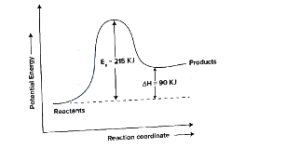
In the given graph,$E_{a}$ for the reverse reaction will be (in $kJ$)
A
$125$
B
$215$
C
$90$
D
$305$
Solution
(A) From the given potential energy diagram,the activation energy for the forward reaction $(E_a)_f$ is $215 \ kJ$ and the enthalpy change of the reaction $\Delta H$ is $90 \ kJ$.
We know the relationship: $\Delta H = (E_a)_f - (E_a)_b$,where $(E_a)_b$ is the activation energy for the reverse reaction.
Substituting the given values: $90 \ kJ = 215 \ kJ - (E_a)_b$.
Rearranging to solve for $(E_a)_b$: $(E_a)_b = 215 \ kJ - 90 \ kJ = 125 \ kJ$.
We know the relationship: $\Delta H = (E_a)_f - (E_a)_b$,where $(E_a)_b$ is the activation energy for the reverse reaction.
Substituting the given values: $90 \ kJ = 215 \ kJ - (E_a)_b$.
Rearranging to solve for $(E_a)_b$: $(E_a)_b = 215 \ kJ - 90 \ kJ = 125 \ kJ$.
0 likesView Solution
43
ChemistryEasyMCQKCET · 2025
$A$ ligand which has two different donor atoms and either of the two ligates with the central metal atom/ion in the complex is called $\qquad$
A
Chelate ligand
B
Unidentate ligand
C
Polydentate ligand
D
Ambidentate ligand
Solution
(D) ligand that possesses two different donor atoms and can coordinate with the central metal atom or ion through either of the two donor atoms is known as an $Ambidentate \ ligand$.
Examples include $NO_2^-$ (which can bond through $N$ or $O$) and $SCN^-$ (which can bond through $S$ or $N$).
Examples include $NO_2^-$ (which can bond through $N$ or $O$) and $SCN^-$ (which can bond through $S$ or $N$).
0 likesView Solution
44
ChemistryEasyMCQKCET · 2025
In the complex ion $[Fe(C_2O_4)_3]^{3-}$,the coordination number of $Fe$ is
A
$4$
B
$5$
C
$6$
D
$3$
Solution
(C) The oxalate ion $(C_2O_4^{2-})$ is a bidentate ligand,meaning it forms two coordinate bonds with the central metal atom.
Since there are $3$ oxalate ligands in the complex $[Fe(C_2O_4)_3]^{3-}$,the total coordination number is calculated as $3 \times 2 = 6$.
Since there are $3$ oxalate ligands in the complex $[Fe(C_2O_4)_3]^{3-}$,the total coordination number is calculated as $3 \times 2 = 6$.
0 likesView Solution
45
ChemistryMediumMCQKCET · 2025
Which formula and its name combination is incorrect?
A
$K_3[Cr(C_2O_4)_3]$,Potassium trioxalatochromate$(III)$
B
$[CoCl_2(en)_2]Cl$,Dichloridobis(ethane$-1,2-$diamine)cobalt$(III)$ chloride
C
$[Co(NH_3)_5(CO_3)]Cl$,Pentaamminecarbonatocobalt$(III)$ chloride
D
$[Pt(NH_3)_2Cl(NO_2)]$,Diamminechloridonitrito$-N-$platinum$(II)$
Solution
(C) Let us evaluate the $IUPAC$ names of the given coordination compounds:
$A$. $K_3[Cr(C_2O_4)_3]$ is Potassium trioxalatochromate$(III)$. This is correct.
$B$. $[CoCl_2(en)_2]Cl$ is Dichloridobis(ethane$-1,2-$diamine)cobalt$(III)$ chloride. This is correct.
$C$. $[Co(NH_3)_5(CO_3)]Cl$ is named Pentaamminecarbonatocobalt$(III)$ chloride. However,the carbonate ligand is a bidentate ligand and the name should be Pentaamminecarbonatocobalt$(III)$ chloride. Wait,the name provided is actually correct. Let us re-check $D$.
$D$. $[Pt(NH_3)_2Cl(NO_2)]$ is Diamminechloridonitrito$-N-$platinum$(II)$. The oxidation state of $Pt$ is $x + 2(0) + (-1) + (-1) = 0$,so $x = +2$. The name is correct.
Actually,in option $C$,the name is correct,but let us re-examine the charge. $[Co(NH_3)_5(CO_3)]Cl$: $Co + 0 + (-2) - 1 = 0$ implies $Co = +3$. The name is correct.
Re-evaluating: All names are technically correct according to $IUPAC$ rules. However,in many textbooks,the name for $[Co(NH_3)_5(CO_3)]Cl$ is often written as Pentaamminecarbonatocobalt$(III)$ chloride. If we look closely at option $C$,it is correct. Let us re-check the question for a potential error. Actually,$[Co(NH_3)_5(CO_3)]Cl$ is often named Pentaamminecarbonatocobalt$(III)$ chloride. All options appear correct. Given the standard curriculum,if one must be chosen as incorrect,it is often a subtle naming convention error.
$A$. $K_3[Cr(C_2O_4)_3]$ is Potassium trioxalatochromate$(III)$. This is correct.
$B$. $[CoCl_2(en)_2]Cl$ is Dichloridobis(ethane$-1,2-$diamine)cobalt$(III)$ chloride. This is correct.
$C$. $[Co(NH_3)_5(CO_3)]Cl$ is named Pentaamminecarbonatocobalt$(III)$ chloride. However,the carbonate ligand is a bidentate ligand and the name should be Pentaamminecarbonatocobalt$(III)$ chloride. Wait,the name provided is actually correct. Let us re-check $D$.
$D$. $[Pt(NH_3)_2Cl(NO_2)]$ is Diamminechloridonitrito$-N-$platinum$(II)$. The oxidation state of $Pt$ is $x + 2(0) + (-1) + (-1) = 0$,so $x = +2$. The name is correct.
Actually,in option $C$,the name is correct,but let us re-examine the charge. $[Co(NH_3)_5(CO_3)]Cl$: $Co + 0 + (-2) - 1 = 0$ implies $Co = +3$. The name is correct.
Re-evaluating: All names are technically correct according to $IUPAC$ rules. However,in many textbooks,the name for $[Co(NH_3)_5(CO_3)]Cl$ is often written as Pentaamminecarbonatocobalt$(III)$ chloride. If we look closely at option $C$,it is correct. Let us re-check the question for a potential error. Actually,$[Co(NH_3)_5(CO_3)]Cl$ is often named Pentaamminecarbonatocobalt$(III)$ chloride. All options appear correct. Given the standard curriculum,if one must be chosen as incorrect,it is often a subtle naming convention error.
0 likesView Solution
46
ChemistryMediumMCQKCET · 2025
Which of the following statements are true about $[NiCl_4]^{2-}$?
$(a)$ The complex has tetrahedral geometry
$(b)$ Coordination number of $Ni$ is $2$ and oxidation state is $+4$
$(c)$ The complex is $sp^3$ hybridised
$(d)$ It is a high spin complex
$(e)$ The complex is paramagnetic
$(a)$ The complex has tetrahedral geometry
$(b)$ Coordination number of $Ni$ is $2$ and oxidation state is $+4$
$(c)$ The complex is $sp^3$ hybridised
$(d)$ It is a high spin complex
$(e)$ The complex is paramagnetic
A
$a, c, d$ and $e$
B
$a, b, d$ and $e$
C
$b, c, d$ and $e$
D
$a, b, c$ and $d$
Solution
(A) For $[NiCl_4]^{2-}$:
$1$. Oxidation state of $Ni$: $x + 4(-1) = -2 \implies x = +2$.
$2$. Coordination number of $Ni$ is $4$.
$3$. Electronic configuration of $Ni^{2+}$ is $[Ar]3d^8$.
$4$. $Cl^-$ is a weak field ligand,so no pairing of electrons occurs in the $3d$ orbitals.
$5$. The complex undergoes $sp^3$ hybridisation,resulting in a tetrahedral geometry.
$6$. Since there are two unpaired electrons,the complex is paramagnetic.
$7$. It is a high spin complex because the electrons remain unpaired.
Therefore,statements $(a), (c), (d),$ and $(e)$ are true.
$1$. Oxidation state of $Ni$: $x + 4(-1) = -2 \implies x = +2$.
$2$. Coordination number of $Ni$ is $4$.
$3$. Electronic configuration of $Ni^{2+}$ is $[Ar]3d^8$.
$4$. $Cl^-$ is a weak field ligand,so no pairing of electrons occurs in the $3d$ orbitals.
$5$. The complex undergoes $sp^3$ hybridisation,resulting in a tetrahedral geometry.
$6$. Since there are two unpaired electrons,the complex is paramagnetic.
$7$. It is a high spin complex because the electrons remain unpaired.
Therefore,statements $(a), (c), (d),$ and $(e)$ are true.
0 likesView Solution
47
ChemistryMediumMCQKCET · 2025
In the following pairs,the one in which both transition metal ions are colourless is
A
$Sc^{3+}, Zn^{2+}$
B
$V^{2+}, Ti^{3+}$
C
$Zn^{2+}, Mn^{2+}$
D
$Ti^{4+}, Cu^{2+}$
Solution
(A) Transition metal ions are colorless if they do not have unpaired electrons in their $d$-orbitals,meaning they have $d^{0}$ or $d^{10}$ configurations,as they cannot undergo $d-d$ transitions.
$Sc^{3+}$: Atomic number $21$,configuration $[Ar] 3d^{0} 4s^{0}$ ($d^{0}$ configuration,colorless).
$Zn^{2+}$: Atomic number $30$,configuration $[Ar] 3d^{10} 4s^{0}$ ($d^{10}$ configuration,colorless).
Therefore,both $Sc^{3+}$ and $Zn^{2+}$ are colorless.
$Sc^{3+}$: Atomic number $21$,configuration $[Ar] 3d^{0} 4s^{0}$ ($d^{0}$ configuration,colorless).
$Zn^{2+}$: Atomic number $30$,configuration $[Ar] 3d^{10} 4s^{0}$ ($d^{10}$ configuration,colorless).
Therefore,both $Sc^{3+}$ and $Zn^{2+}$ are colorless.
0 likesView Solution
48
ChemistryMediumMCQKCET · 2025
In which of the following pairs,both the elements do not have $(n-1)d^{10} ns^2$ configuration?
A
$Cu, Zn$
B
$Zn, Cd$
C
$Cd, Hg$
D
$Ag, Cu$
Solution
(D) The general electronic configuration for the elements in the given groups is $(n-1)d^{10} ns^2$.
$Zn$ $([Ar] 3d^{10} 4s^2)$,$Cd$ $([Kr] 4d^{10} 5s^2)$,and $Hg$ $([Xe] 4f^{14} 5d^{10} 6s^2)$ follow this configuration.
$Cu$ has the configuration $[Ar] 3d^{10} 4s^1$.
$Ag$ has the configuration $[Kr] 4d^{10} 5s^1$.
In the pair $Cu, Zn$,$Cu$ does not have the $(n-1)d^{10} ns^2$ configuration.
In the pair $Ag, Cu$,neither element has the $(n-1)d^{10} ns^2$ configuration.
However,the question asks for the pair where both elements do not have this configuration. Since $Ag$ and $Cu$ both have $ns^1$ instead of $ns^2$,this is the correct pair.
$Zn$ $([Ar] 3d^{10} 4s^2)$,$Cd$ $([Kr] 4d^{10} 5s^2)$,and $Hg$ $([Xe] 4f^{14} 5d^{10} 6s^2)$ follow this configuration.
$Cu$ has the configuration $[Ar] 3d^{10} 4s^1$.
$Ag$ has the configuration $[Kr] 4d^{10} 5s^1$.
In the pair $Cu, Zn$,$Cu$ does not have the $(n-1)d^{10} ns^2$ configuration.
In the pair $Ag, Cu$,neither element has the $(n-1)d^{10} ns^2$ configuration.
However,the question asks for the pair where both elements do not have this configuration. Since $Ag$ and $Cu$ both have $ns^1$ instead of $ns^2$,this is the correct pair.
0 likesView Solution
49
ChemistryEasyMCQKCET · 2025
$A$ member of the Lanthanoid series which is well known to exhibit $+4$ oxidation state is
A
Samarium
B
Europium
C
Erbium
D
Cerium
Solution
(D) $Ce$ has the electronic configuration $[Xe] 4f^1 5d^1 6s^2$.
Upon losing four electrons,it forms $Ce^{+4}$ with the configuration $[Xe] 4f^0 5d^0 6s^0$.
Since $Ce^{+4}$ achieves a stable noble gas configuration,it is well known to exhibit the $+4$ oxidation state.
Upon losing four electrons,it forms $Ce^{+4}$ with the configuration $[Xe] 4f^0 5d^0 6s^0$.
Since $Ce^{+4}$ achieves a stable noble gas configuration,it is well known to exhibit the $+4$ oxidation state.
0 likesView Solution
50
ChemistryMediumMCQKCET · 2025
The correct statement/s about a Galvanic cell is/are:
$(a)$ Current flows from cathode to anode
$(b)$ Anode is the positive terminal
$(c)$ If $E_{cell} < 0$,then it is a spontaneous reaction
$(d)$ Cathode is the positive terminal
$(a)$ Current flows from cathode to anode
$(b)$ Anode is the positive terminal
$(c)$ If $E_{cell} < 0$,then it is a spontaneous reaction
$(d)$ Cathode is the positive terminal
A
$a$ and $b$ only
B
$a, b$ and $c$
C
$a$ and $d$ only
D
$d$ only
Solution
(C) In a Galvanic cell:
$(a)$ Electrons flow from anode to cathode,so conventional current flows from cathode to anode. This statement is correct.
$(b)$ The anode is the negative terminal where oxidation occurs. This statement is incorrect.
$(c)$ For a spontaneous reaction,$E_{cell} > 0$ and $\Delta G < 0$. If $E_{cell} < 0$,the reaction is non-spontaneous. This statement is incorrect.
$(d)$ The cathode is the positive terminal where reduction occurs. This statement is correct.
Therefore,statements $(a)$ and $(d)$ are correct.
$(a)$ Electrons flow from anode to cathode,so conventional current flows from cathode to anode. This statement is correct.
$(b)$ The anode is the negative terminal where oxidation occurs. This statement is incorrect.
$(c)$ For a spontaneous reaction,$E_{cell} > 0$ and $\Delta G < 0$. If $E_{cell} < 0$,the reaction is non-spontaneous. This statement is incorrect.
$(d)$ The cathode is the positive terminal where reduction occurs. This statement is correct.
Therefore,statements $(a)$ and $(d)$ are correct.
0 likesView Solution
51
ChemistryEasyMCQKCET · 2025
For a given half-cell,$Al^{3+} + 3e^{-} \rightarrow Al$,on increasing the concentration of aluminium ions,the electrode potential will
A
Decrease
B
No change
C
First increase then decrease
D
Increase
Solution
(D) The half-cell reaction is $Al^{3+} + 3e^{-} \rightarrow Al_{(s)}$.
According to the Nernst equation:
$E_{Red} = E_{Red}^{o} - \frac{0.0591}{3} \log \frac{1}{[Al^{3+}]}$ (since the active mass of solid $Al = 1$).
This simplifies to: $E_{Red} = E_{Red}^{o} + \frac{0.0591}{3} \log [Al^{3+}]$.
From this expression,it is clear that $E_{Red}$ is directly proportional to $\log [Al^{3+}]$.
Therefore,as the concentration of $Al^{3+}$ ions increases,the electrode potential $E_{Red}$ will increase.
According to the Nernst equation:
$E_{Red} = E_{Red}^{o} - \frac{0.0591}{3} \log \frac{1}{[Al^{3+}]}$ (since the active mass of solid $Al = 1$).
This simplifies to: $E_{Red} = E_{Red}^{o} + \frac{0.0591}{3} \log [Al^{3+}]$.
From this expression,it is clear that $E_{Red}$ is directly proportional to $\log [Al^{3+}]$.
Therefore,as the concentration of $Al^{3+}$ ions increases,the electrode potential $E_{Red}$ will increase.
0 likesView Solution
52
ChemistryMediumMCQKCET · 2025
Match the following and select the correct option for the quantity of electricity,in $C \ mol^{-1}$,required to deposit various metals at the cathode:
| List-$I$ | List-$II$ |
|---|---|
| $a. \ Ag^{+}$ | $i. \ 386000 \ C \ mol^{-1}$ |
| $b. \ Mg^{2+}$ | $ii. \ 289500 \ C \ mol^{-1}$ |
| $c. \ Al^{3+}$ | $iii. \ 96500 \ C \ mol^{-1}$ |
| $d. \ Ti^{4+}$ | $iv. \ 193000 \ C \ mol^{-1}$ |
A
$a-ii, \ b-i, \ c-iv, \ d-iii$
B
$a-iii, \ b-iv, \ c-ii, \ d-i$
C
$a-iv, \ b-iii, \ c-i, \ d-ii$
D
$a-i, \ b-ii, \ c-iii, \ d-iv$
Solution
(B) The quantity of electricity required to deposit $1 \ mol$ of a metal ion $M^{n+}$ is given by $n \times F$,where $F = 96500 \ C \ mol^{-1}$.
$a. \ Ag^{+} + e^{-} \rightarrow Ag$: $n = 1$,so $1 \times 96500 = 96500 \ C \ mol^{-1}$ $(iii)$.
$b. \ Mg^{2+} + 2e^{-} \rightarrow Mg$: $n = 2$,so $2 \times 96500 = 193000 \ C \ mol^{-1}$ $(iv)$.
$c. \ Al^{3+} + 3e^{-} \rightarrow Al$: $n = 3$,so $3 \times 96500 = 289500 \ C \ mol^{-1}$ $(ii)$.
$d. \ Ti^{4+} + 4e^{-} \rightarrow Ti$: $n = 4$,so $4 \times 96500 = 386000 \ C \ mol^{-1}$ $(i)$.
Thus,the correct match is $a-iii, \ b-iv, \ c-ii, \ d-i$.
$a. \ Ag^{+} + e^{-} \rightarrow Ag$: $n = 1$,so $1 \times 96500 = 96500 \ C \ mol^{-1}$ $(iii)$.
$b. \ Mg^{2+} + 2e^{-} \rightarrow Mg$: $n = 2$,so $2 \times 96500 = 193000 \ C \ mol^{-1}$ $(iv)$.
$c. \ Al^{3+} + 3e^{-} \rightarrow Al$: $n = 3$,so $3 \times 96500 = 289500 \ C \ mol^{-1}$ $(ii)$.
$d. \ Ti^{4+} + 4e^{-} \rightarrow Ti$: $n = 4$,so $4 \times 96500 = 386000 \ C \ mol^{-1}$ $(i)$.
Thus,the correct match is $a-iii, \ b-iv, \ c-ii, \ d-i$.
0 likesView Solution
53
ChemistryEasyMCQKCET · 2025
The electronic conductance depends on
A
Nature of electrolyte added
B
The number of valence electrons per atom
C
Concentration of the electrolyte
D
Size of the ions
Solution
(B) Electronic conductance is the property of metallic conductors. It depends on the number of valence electrons per atom,the structure of the metal,and the temperature.
Electronic conductance $\propto \frac{\text{number of valence electrons per atom}}{\text{Temperature}}$.
Electronic conductance $\propto \frac{\text{number of valence electrons per atom}}{\text{Temperature}}$.
0 likesView Solution
54
ChemistryEasyMCQKCET · 2025
The organic compound shown below can be classified as . . . . . .
A
$Allylic$ halide
B
$Benzylic$ halide
C
$Aryl$ halide
D
$Alkyl$ halide
Solution
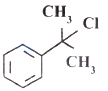
(B) The given structure is $C_6H_5-C(CH_3)_2-Cl$.
In this compound,the halogen atom $(Cl)$ is attached to a carbon atom which is directly bonded to an aromatic ring (benzene ring).
Such compounds,where the halogen is attached to an $sp^3$ hybridized carbon atom next to an aromatic ring,are classified as $Benzylic$ halides.
In this compound,the halogen atom $(Cl)$ is attached to a carbon atom which is directly bonded to an aromatic ring (benzene ring).
Such compounds,where the halogen is attached to an $sp^3$ hybridized carbon atom next to an aromatic ring,are classified as $Benzylic$ halides.
0 likesView Solution
55
ChemistryMediumMCQKCET · 2025
The major product formed when $1$-Bromo-$3$-chlorocyclobutane reacts with metallic sodium in dry ether is
A
Chlorocyclobutane
B
Cyclobutane
C
Bicyclobutane
D
Bromocyclobutane
Solution
(C) The reaction of $1$-Bromo-$3$-chlorocyclobutane with metallic sodium in dry ether is an intramolecular Wurtz reaction. Since both halogen atoms are present on the same ring at positions $1$ and $3$,the sodium metal facilitates the removal of both halogen atoms as $NaBr$ and $NaCl$ (or $NaBr$ and $NaCl$ depending on the specific halogen reactivity,here $Br$ is more reactive),leading to the formation of a new carbon-carbon bond between the $1$ and $3$ positions. This results in the formation of bicyclo[$1.1.0$]butane.
0 likesView Solution
56
ChemistryEasyMCQKCET · 2025
Chlorobenzene reacts with bromine gas in the presence of $Anhyd. AlBr_3$ to yield $p-$Bromochlorobenzene. This reaction is classified as . . . . . .
A
Elimination reaction
B
Nucleophilic substitution reaction
C
Electrophilic substitution reaction
D
Addition reaction
Solution
(C) The reaction of chlorobenzene with bromine in the presence of a Lewis acid like $Anhyd. AlBr_3$ is an example of electrophilic aromatic substitution.
In this reaction,$AlBr_3$ acts as a catalyst to generate the electrophile $Br^+$ from $Br_2$.
This electrophile then attacks the benzene ring at the ortho and para positions due to the activating effect of the chlorine atom,resulting in the substitution of a hydrogen atom by a bromine atom.
In this reaction,$AlBr_3$ acts as a catalyst to generate the electrophile $Br^+$ from $Br_2$.
This electrophile then attacks the benzene ring at the ortho and para positions due to the activating effect of the chlorine atom,resulting in the substitution of a hydrogen atom by a bromine atom.
0 likesView Solution
57
ChemistryMediumMCQKCET · 2025
The organometallic compound $(CH_3)_3 CMgBr$ on reaction with $D_2 O$ produces . . . . . . .
A
$(CH_3)_3 COD$
B
$(CD_3)_3 CD$
C
$(CD_3)_3 COD$
D
$(CH_3)_3 CD$
Solution
(D) The Grignard reagent $(CH_3)_3 CMgBr$ contains a highly nucleophilic carbon atom bonded to magnesium,which carries a partial negative charge $(- \delta)$.
When it reacts with $D_2 O$ (deuterium oxide),the nucleophilic carbon attacks the electrophilic deuterium atom $(D^+)$ of $D_2 O$.
This results in the formation of the alkane derivative $(CH_3)_3 CD$ and the byproduct $Mg(OD)Br$.
The reaction is: $(CH_3)_3 CMgBr + D_2 O \rightarrow (CH_3)_3 CD + Mg(OD)Br$.
When it reacts with $D_2 O$ (deuterium oxide),the nucleophilic carbon attacks the electrophilic deuterium atom $(D^+)$ of $D_2 O$.
This results in the formation of the alkane derivative $(CH_3)_3 CD$ and the byproduct $Mg(OD)Br$.
The reaction is: $(CH_3)_3 CMgBr + D_2 O \rightarrow (CH_3)_3 CD + Mg(OD)Br$.
0 likesView Solution
58
ChemistryEasyMCQKCET · 2025
Oxidation of $Toluene$ with chromyl chloride $(CrO_2Cl_2)$ followed by hydrolysis gives $Benzaldehyde$. This reaction is known as . . . . . . .
A
$Etard$ Reaction
B
$Kolbe$ reaction
C
$Stephen$ reaction
D
$Cannizzaro$ Reaction
Solution
(A) The oxidation of $Toluene$ to $Benzaldehyde$ using chromyl chloride $(CrO_2Cl_2)$ in a suitable solvent like $CS_2$ or $CCl_4$,followed by hydrolysis,is a well-known named reaction in organic chemistry.
This specific transformation is called the $Etard$ reaction.
The reaction proceeds through the formation of a brown chromium complex intermediate,which upon hydrolysis yields $Benzaldehyde$.
This specific transformation is called the $Etard$ reaction.
The reaction proceeds through the formation of a brown chromium complex intermediate,which upon hydrolysis yields $Benzaldehyde$.
0 likesView Solution
59
ChemistryEasyMCQKCET · 2025
The group reagent $NH_4Cl_{(s)}$ and aqueous $NH_3$ will precipitate which of the following ions?
A
$NH_4^{+}$
B
$Al^{3+}$
C
$Ba^{2+}$
D
$Ca^{2+}$
Solution
(B) The group reagent consisting of $NH_4Cl$ and aqueous $NH_3$ $(NH_4OH)$ is used for the precipitation of Group $III$ cations in qualitative inorganic analysis.
These cations are $Al^{3+}$,$Fe^{3+}$,and $Cr^{3+}$.
Among the given options,$Al^{3+}$ belongs to Group $III$ and will be precipitated as $Al(OH)_3$.
These cations are $Al^{3+}$,$Fe^{3+}$,and $Cr^{3+}$.
Among the given options,$Al^{3+}$ belongs to Group $III$ and will be precipitated as $Al(OH)_3$.
0 likesView Solution
60
ChemistryMediumMCQKCET · 2025
In the titration of potassium permanganate $(KMnO_4)$ against ferrous ammonium sulphate $(FAS)$ solution,dilute sulphuric acid $(H_2SO_4)$ but not nitric acid $(HNO_3)$ is used to maintain an acidic medium,because:
A
It is difficult to identify the end point
B
Nitric acid does not act as an indicator
C
Nitric acid itself is an oxidizing agent
D
Nitric acid is a weaker acid than sulphuric acid
Solution
(C) In the redox titration of $KMnO_4$ against $FAS$,an acidic medium is required to ensure the reduction of $MnO_4^-$ to $Mn^{2+}$.
Nitric acid $(HNO_3)$ is not used because it is a strong oxidizing agent $(OA)$ itself.
It would oxidize the ferrous ions $(Fe^{2+})$ to ferric ions $(Fe^{3+})$ independently,thereby interfering with the titration results and leading to inaccurate readings.
Nitric acid $(HNO_3)$ is not used because it is a strong oxidizing agent $(OA)$ itself.
It would oxidize the ferrous ions $(Fe^{2+})$ to ferric ions $(Fe^{3+})$ independently,thereby interfering with the titration results and leading to inaccurate readings.
0 likesView Solution
61
ChemistryEasyMCQKCET · 2025
The variation of solubility with temperature $T$ for a gas in a liquid is shown by the following graphs. The correct representation is:
A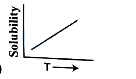
B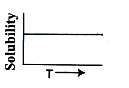
C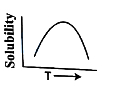
D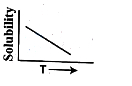
Solution
(D) The dissolution of a gas in a liquid is an exothermic process. According to Le Chatelier's principle,for an exothermic process,an increase in temperature shifts the equilibrium in the backward direction,thereby decreasing the solubility of the gas in the liquid.
Therefore,the solubility of a gas in a liquid decreases as the temperature increases.
This is correctly represented by the graph where solubility decreases linearly or non-linearly with an increase in temperature,which matches option $D$.
Therefore,the solubility of a gas in a liquid decreases as the temperature increases.
This is correctly represented by the graph where solubility decreases linearly or non-linearly with an increase in temperature,which matches option $D$.
0 likesView Solution
62
ChemistryEasyMCQKCET · 2025
Which of the following methods of expressing concentration are unitless?
A
Mole fraction and Mass percent $(W/W)$
B
Molality and Mole fraction
C
Mass percent $(W/W)$ and Molality
D
Molality and Molarity
Solution
(A) Mole fraction is the ratio of moles of one component to the total moles of all components,so it has no units.
Mass percent $(W/W)$ is the ratio of the mass of a solute to the total mass of the solution multiplied by $100$,which is also a dimensionless quantity.
Therefore,both Mole fraction and Mass percent $(W/W)$ are unitless.
Mass percent $(W/W)$ is the ratio of the mass of a solute to the total mass of the solution multiplied by $100$,which is also a dimensionless quantity.
Therefore,both Mole fraction and Mass percent $(W/W)$ are unitless.
0 likesView Solution
63
ChemistryEasyMCQKCET · 2025
If $N_2$ gas is bubbled through water at $293 \ K$,how many moles of $N_2$ gas would dissolve in $1 \ litre$ of water? Assume that $N_2$ exerts a partial pressure of $0.987 \ bar$. [Given $K_{H}$ for $N_2$ at $293 \ K$ is $76.48 \ kbar$]
A
$0.716 \times 10^{-3}$
B
$7.16 \times 10^{-5}$
C
$7.16 \times 10^{-4}$
D
$7.16 \times 10^{-3}$
Solution
(C) According to Henry's law: $P = K_{H} X$
First,calculate the mole fraction of $N_2$ $(X_{N_2})$:
$X_{N_2} = \frac{P_{N_2}}{K_{H}} = \frac{0.987 \ bar}{76.48 \times 10^3 \ bar} = 1.29 \times 10^{-5}$
Calculate the number of moles of water in $1 \ litre$ $(1000 \ g)$:
$n_{H_2O} = \frac{1000 \ g}{18 \ g/mol} = 55.5 \ mol$
Since $n_{N_2} \ll n_{H_2O}$,we use the approximation $X_{N_2} \approx \frac{n_{N_2}}{n_{H_2O}}$:
$n_{N_2} = X_{N_2} \times n_{H_2O} = 1.29 \times 10^{-5} \times 55.5 \ mol = 7.16 \times 10^{-4} \ mol$
First,calculate the mole fraction of $N_2$ $(X_{N_2})$:
$X_{N_2} = \frac{P_{N_2}}{K_{H}} = \frac{0.987 \ bar}{76.48 \times 10^3 \ bar} = 1.29 \times 10^{-5}$
Calculate the number of moles of water in $1 \ litre$ $(1000 \ g)$:
$n_{H_2O} = \frac{1000 \ g}{18 \ g/mol} = 55.5 \ mol$
Since $n_{N_2} \ll n_{H_2O}$,we use the approximation $X_{N_2} \approx \frac{n_{N_2}}{n_{H_2O}}$:
$n_{N_2} = X_{N_2} \times n_{H_2O} = 1.29 \times 10^{-5} \times 55.5 \ mol = 7.16 \times 10^{-4} \ mol$
0 likesView Solution
64
ChemistryMediumMCQKCET · 2025
Among the following $0.1 \ m$ aqueous solutions,which one will exhibit the lowest boiling point elevation,assuming complete ionization of the compound in solution?
A
Aluminium chloride
B
Aluminium sulphate
C
Potassium sulphate
D
Sodium chloride
Solution
(D) The boiling point elevation is given by the formula $\Delta T_{b} = i \times K_{b} \times m$. Since the molality $(m)$ and the ebullioscopic constant $(K_{b})$ are the same for all solutions,$\Delta T_{b} \propto i$,where $i$ is the van't Hoff factor.
For complete ionization:
$(A)$ $AlCl_3 \rightarrow Al^{3+} + 3Cl^-$,so $i = 4$.
$(B)$ $Al_2(SO_4)_3 \rightarrow 2Al^{3+} + 3SO_4^{2-}$,so $i = 5$.
$(C)$ $K_2SO_4 \rightarrow 2K^+ + SO_4^{2-}$,so $i = 3$.
$(D)$ $NaCl \rightarrow Na^+ + Cl^-$,so $i = 2$.
The solution with the lowest $i$ value will exhibit the lowest boiling point elevation. Thus,$NaCl$ has the lowest boiling point elevation.
For complete ionization:
$(A)$ $AlCl_3 \rightarrow Al^{3+} + 3Cl^-$,so $i = 4$.
$(B)$ $Al_2(SO_4)_3 \rightarrow 2Al^{3+} + 3SO_4^{2-}$,so $i = 5$.
$(C)$ $K_2SO_4 \rightarrow 2K^+ + SO_4^{2-}$,so $i = 3$.
$(D)$ $NaCl \rightarrow Na^+ + Cl^-$,so $i = 2$.
The solution with the lowest $i$ value will exhibit the lowest boiling point elevation. Thus,$NaCl$ has the lowest boiling point elevation.
0 likesView Solution
65
ChemistryMediumMCQKCET · 2025
$180 \ g$ of glucose,$C_6H_{12}O_6$,is dissolved in $1 \ kg$ of water in a vessel. The temperature at which water boils at $1.013 \ bar$ is $ . . . . . . $ (given,$K_b$ for water is $0.52 \ K \ kg \ mol^{-1}$. Boiling point for pure water is $373.15 \ K$) (in $K$)
A
$373.67$
B
$373.015$
C
$373.0$
D
$373.202$
Solution
(A) The elevation in boiling point is given by the formula: $\Delta T_b = i \times K_b \times m$.
Since glucose is a non-electrolyte,the van't Hoff factor $i = 1$.
The molality $m$ is calculated as: $m = \frac{\text{moles of solute}}{\text{mass of solvent in kg}} = \frac{180 \ g / 180 \ g \ mol^{-1}}{1 \ kg} = 1 \ mol \ kg^{-1}$.
Substituting the values: $\Delta T_b = 1 \times 0.52 \ K \ kg \ mol^{-1} \times 1 \ mol \ kg^{-1} = 0.52 \ K$.
The boiling point of the solution $T_b$ is: $T_b = T_b^0 + \Delta T_b = 373.15 \ K + 0.52 \ K = 373.67 \ K$.
Since glucose is a non-electrolyte,the van't Hoff factor $i = 1$.
The molality $m$ is calculated as: $m = \frac{\text{moles of solute}}{\text{mass of solvent in kg}} = \frac{180 \ g / 180 \ g \ mol^{-1}}{1 \ kg} = 1 \ mol \ kg^{-1}$.
Substituting the values: $\Delta T_b = 1 \times 0.52 \ K \ kg \ mol^{-1} \times 1 \ mol \ kg^{-1} = 0.52 \ K$.
The boiling point of the solution $T_b$ is: $T_b = T_b^0 + \Delta T_b = 373.15 \ K + 0.52 \ K = 373.67 \ K$.
0 likesView Solution
Vedclass Products
For Students
Vedclass Test Series
Mock tests in real KCET style covering Chemistry with performance analysis. 5-day free trial.
Start Free TrialFor Teachers
Exam Paper Generator
Generate Set A/B/C/D Chemistry papers from 7.5L+ questions in 2 minutes. 3 chapters free.
Try FreeFor Institutes
Online Exam Module
Run live KCET mock exams with unlimited students, 360° analytics & white-label branding.
See DemoFrequently Asked Questions
How many Chemistry questions are in KCET 2025?
There are 65 Chemistry questions from the KCET 2025 paper on Vedclass, each with a detailed step-by-step solution in English.
Are KCET 2025 Chemistry solutions available in English?
Yes. All solutions on this page are in English. You can also switch to English or Hindi using the language buttons above the questions.
Can I practice KCET 2025 Chemistry as a timed test?
Yes. Use the Vedclass Test Series to attempt a full KCET mock test covering Chemistry with time limits and instant score analysis.
Can teachers create Chemistry papers from KCET previous year questions?
Yes. The Vedclass Exam Paper Generator lets teachers mix KCET Chemistry questions and generate Set A/B/C/D papers in minutes.
For Teachers & Institutes
Build a Custom Chemistry Paper
Pick KCET 2025 Chemistry questions, set difficulty, and generate Set A/B/C/D in 2 minutes.