
ChemistryQ1–64 of 64 questions
Page 1 of 1 · English
1
ChemistryMCQKCET · 2017
The metal extracted by leaching with cyanide is
A
$Cu$
B
$Al$
C
$Na$
D
$Ag$
Solution
(D) Leaching is a process used when the ore is soluble in a suitable solvent. In the metallurgy of silver $(Ag)$ and gold $(Au)$,the metal is leached with a dilute solution of $NaCN$ or $KCN$ in the presence of air (for $O_2$). The metal is subsequently recovered by displacement using a more reactive metal like zinc $(Zn)$.
The chemical reaction is:
$4 M_{(s)} + 8 CN^{-}_{(aq)} + 2 H_2O_{(aq)} + O_{2(g)} \rightarrow 4[M(CN)_2]^{-}_{(aq)} + 4 OH^{-}_{(aq)}$ (where $M = Ag$ or $Au$)
Recovery step:
$2[M(CN)_2]^{-}_{(aq)} + Zn_{(s)} \rightarrow [Zn(CN)_4]^{2-}_{(aq)} + 2 M_{(s)}$
The chemical reaction is:
$4 M_{(s)} + 8 CN^{-}_{(aq)} + 2 H_2O_{(aq)} + O_{2(g)} \rightarrow 4[M(CN)_2]^{-}_{(aq)} + 4 OH^{-}_{(aq)}$ (where $M = Ag$ or $Au$)
Recovery step:
$2[M(CN)_2]^{-}_{(aq)} + Zn_{(s)} \rightarrow [Zn(CN)_4]^{2-}_{(aq)} + 2 M_{(s)}$
0 likesView Solution
2
ChemistryMCQKCET · 2017
Which of the following is a bactericidal antibiotic?
A
ofloxacin
B
chloramphenicol
C
erythromycin
D
tetracycline
Solution
(A) Antibiotics are classified as bactericidal or bacteriostatic based on their action.
Bactericidal antibiotics kill the microorganisms in the body.
Examples of bactericidal antibiotics include $Penicillin$,$Ofloxacin$,and $Aminoglycosides$.
Bacteriostatic antibiotics inhibit the growth of microorganisms.
Examples of bacteriostatic antibiotics include $Chloramphenicol$,$Erythromycin$,and $Tetracycline$.
Therefore,$Ofloxacin$ is a bactericidal antibiotic.
Bactericidal antibiotics kill the microorganisms in the body.
Examples of bactericidal antibiotics include $Penicillin$,$Ofloxacin$,and $Aminoglycosides$.
Bacteriostatic antibiotics inhibit the growth of microorganisms.
Examples of bacteriostatic antibiotics include $Chloramphenicol$,$Erythromycin$,and $Tetracycline$.
Therefore,$Ofloxacin$ is a bactericidal antibiotic.
0 likesView Solution
3
ChemistryEasyMCQKCET · 2017
The pressure of real gases is less than that of ideal gas because of:
A
Intermolecular attraction
B
Finite size of particles
C
Increase in the number of collisions
D
Increase in the kinetic energy of the molecules
Solution
(A) The force of attraction in real gases tends to show slightly lower pressure as compared to ideal gases.
$p_{ideal} = p_{real} + \frac{a n^2}{V^2}$ or $p_{real} = p_{ideal} - \frac{a n^2}{V^2}$
Here,'$a$' is the constant which measures the magnitude of attractive forces among the molecules of gas,'$n$' is the number of moles present,and '$V$' is the volume of the gas.
$p_{ideal} = p_{real} + \frac{a n^2}{V^2}$ or $p_{real} = p_{ideal} - \frac{a n^2}{V^2}$
Here,'$a$' is the constant which measures the magnitude of attractive forces among the molecules of gas,'$n$' is the number of moles present,and '$V$' is the volume of the gas.
0 likesView Solution
4
ChemistryEasyMCQKCET · 2017
Which of the following is the correct electron dot structure of $N_{2}O$ molecule?
A
$:\ddot{N}=N^{+}=\ddot{O}:^{-}$
B
$:\ddot{N}^{-}-N^{+}\equiv O:$
C
$:\ddot{N}=N=\ddot{O}:$
D
$:\ddot{N}^{-}-N=\ddot{O}^{+}$
Solution
(B) The $N_{2}O$ molecule has a linear structure with the connectivity $N-N-O$.
Total valence electrons $= (5 \times 2) + 6 = 16 \ e^{-}$.
To satisfy the octet rule for all atoms,the most stable Lewis structure involves a triple bond between the two nitrogen atoms and a single bond between the central nitrogen and oxygen,or a double bond between both pairs.
The most significant resonance contributor is $:\ddot{N}^{-}-N^{+}\equiv O:$,where the central nitrogen has a formal charge of $+1$,the terminal nitrogen has a formal charge of $-1$,and the oxygen has a formal charge of $0$.
Total valence electrons $= (5 \times 2) + 6 = 16 \ e^{-}$.
To satisfy the octet rule for all atoms,the most stable Lewis structure involves a triple bond between the two nitrogen atoms and a single bond between the central nitrogen and oxygen,or a double bond between both pairs.
The most significant resonance contributor is $:\ddot{N}^{-}-N^{+}\equiv O:$,where the central nitrogen has a formal charge of $+1$,the terminal nitrogen has a formal charge of $-1$,and the oxygen has a formal charge of $0$.
0 likesView Solution
5
ChemistryMediumMCQKCET · 2017
The reaction quotient $Q_{C}$ is useful in predicting the direction of the reaction. Which of the following is incorrect?
A
If $Q_{C} > K_{C}$,the reverse reaction is favoured
B
If $Q_{C} < K_{C}$,the forward reaction is favoured
C
If $Q_{C} = K_{C}$,forward reaction is favoured
D
If $Q_{C} > K_{C}$,forward reaction is favoured
Solution
(C, D) The reaction quotient $Q_{C}$ is compared with the equilibrium constant $K_{C}$ to determine the direction of the reaction:
$1$. If $Q_{C} > K_{C}$,the system has excess products,so the reverse reaction is favoured to reach equilibrium.
$2$. If $Q_{C} < K_{C}$,the system has excess reactants,so the forward reaction is favoured to reach equilibrium.
$3$. If $Q_{C} = K_{C}$,the reaction is at equilibrium.
Therefore,statements $C$ and $D$ are incorrect.
$1$. If $Q_{C} > K_{C}$,the system has excess products,so the reverse reaction is favoured to reach equilibrium.
$2$. If $Q_{C} < K_{C}$,the system has excess reactants,so the forward reaction is favoured to reach equilibrium.
$3$. If $Q_{C} = K_{C}$,the reaction is at equilibrium.
Therefore,statements $C$ and $D$ are incorrect.
0 likesView Solution
6
ChemistryEasyMCQKCET · 2017
$3 ClO_{3}^{-}(aq) \rightarrow ClO^{-}(aq) + 2 ClO_{3}^{-}(aq)$ is an example of
A
Oxidation reaction
B
Reduction reaction
C
Disproportionation reaction
D
Decomposition reaction
Solution
(C) The given reaction is $3 ClO_{3}^{-}(aq) \rightarrow ClO^{-}(aq) + 2 ClO_{3}^{-}(aq)$.
Actually,the correct reaction for disproportionation of chlorate is $3 ClO_{3}^{-}(aq) \rightarrow ClO_{4}^{-}(aq) + 2 ClO_{2}(aq)$ or similar,but based on the provided image logic:
In the reaction $ClO_{3}^{-} \rightarrow ClO^{-} + Cl^{-}$,the oxidation state of $Cl$ changes from $+5$ to $+1$ and $-1$.
Since the same element $(Cl)$ is simultaneously reduced (from $+5$ to $+1$ and $-1$) and oxidized (if applicable,though here it is only reduction),this specific type of reaction where an element's oxidation state changes in both directions is called a disproportionation reaction.
Actually,the correct reaction for disproportionation of chlorate is $3 ClO_{3}^{-}(aq) \rightarrow ClO_{4}^{-}(aq) + 2 ClO_{2}(aq)$ or similar,but based on the provided image logic:
In the reaction $ClO_{3}^{-} \rightarrow ClO^{-} + Cl^{-}$,the oxidation state of $Cl$ changes from $+5$ to $+1$ and $-1$.
Since the same element $(Cl)$ is simultaneously reduced (from $+5$ to $+1$ and $-1$) and oxidized (if applicable,though here it is only reduction),this specific type of reaction where an element's oxidation state changes in both directions is called a disproportionation reaction.
0 likesView Solution
7
ChemistryMediumMCQKCET · 2017
If $3.01 \times 10^{20}$ molecules are removed from $98 \ mg$ of $H_2SO_4$,then the number of moles of $H_2SO_4$ left are:
A
$0.1 \times 10^{-3} \ mol$
B
$0.5 \times 10^{-3} \ mol$
C
$1.66 \times 10^{-3} \ mol$
D
$9.95 \times 10^{-2} \ mol$
Solution
(B) The molar mass of $H_2SO_4$ is $98 \ g/mol$.
Initial amount of $H_2SO_4 = 98 \ mg = 98 \times 10^{-3} \ g = 0.1 \times 10^{-2} \ mol = 1 \times 10^{-3} \ mol$.
Number of molecules in $1 \times 10^{-3} \ mol = 1 \times 10^{-3} \times 6.022 \times 10^{23} = 6.022 \times 10^{20}$ molecules.
Number of molecules removed $= 3.01 \times 10^{20}$.
Number of molecules left $= 6.022 \times 10^{20} - 3.01 \times 10^{20} = 3.012 \times 10^{20}$ molecules.
Number of moles left $= \frac{3.012 \times 10^{20}}{6.022 \times 10^{23}} \approx 0.5 \times 10^{-3} \ mol$.
Initial amount of $H_2SO_4 = 98 \ mg = 98 \times 10^{-3} \ g = 0.1 \times 10^{-2} \ mol = 1 \times 10^{-3} \ mol$.
Number of molecules in $1 \times 10^{-3} \ mol = 1 \times 10^{-3} \times 6.022 \times 10^{23} = 6.022 \times 10^{20}$ molecules.
Number of molecules removed $= 3.01 \times 10^{20}$.
Number of molecules left $= 6.022 \times 10^{20} - 3.01 \times 10^{20} = 3.012 \times 10^{20}$ molecules.
Number of moles left $= \frac{3.012 \times 10^{20}}{6.022 \times 10^{23}} \approx 0.5 \times 10^{-3} \ mol$.
0 likesView Solution
8
ChemistryEasyMCQKCET · 2017
Which one of the following is not a common component of photo-chemical smog?
A
Ozone
B
Acrolein
C
Peroxy acetyl nitrate
D
Chlorofluorocarbons
Solution
(D) Photo-chemical smog is a mixture of air pollutants that have been chemically altered into further poisonous compounds upon exposure to sunlight.
The main components of photochemical smog include nitrogen oxides $(NO_x)$,volatile organic compounds $(VOCs)$,tropospheric ozone $(O_3)$,peroxyacetyl nitrate $(PAN)$,and acrolein.
Chlorofluorocarbons $(CFCs)$ are not components of photochemical smog; they are primarily responsible for ozone layer depletion in the stratosphere.
The main components of photochemical smog include nitrogen oxides $(NO_x)$,volatile organic compounds $(VOCs)$,tropospheric ozone $(O_3)$,peroxyacetyl nitrate $(PAN)$,and acrolein.
Chlorofluorocarbons $(CFCs)$ are not components of photochemical smog; they are primarily responsible for ozone layer depletion in the stratosphere.
0 likesView Solution
9
ChemistryEasyMCQKCET · 2017
$A$ reaction has both $\Delta H$ and $\Delta S$ negative. The rate of reaction
A
increases with increase in temperature
B
increases with decrease in temperature
C
remains unaffected by change in temperature
D
cannot be predicted for change in temperature
Solution
(B) For a reaction where $\Delta H < 0$ and $\Delta S < 0$,the spontaneity is governed by the Gibbs free energy equation: $\Delta G = \Delta H - T\Delta S$.
For the reaction to be spontaneous,$\Delta G$ must be negative.
Since $\Delta S$ is negative,the term $-T\Delta S$ is positive.
As temperature $(T)$ decreases,the magnitude of the positive term $-T\Delta S$ decreases,making $\Delta G$ more negative.
Thus,the reaction becomes more thermodynamically favorable at lower temperatures.
In the context of this question,the term "rate" refers to the thermodynamic favorability or the extent of the reaction.
For the reaction to be spontaneous,$\Delta G$ must be negative.
Since $\Delta S$ is negative,the term $-T\Delta S$ is positive.
As temperature $(T)$ decreases,the magnitude of the positive term $-T\Delta S$ decreases,making $\Delta G$ more negative.
Thus,the reaction becomes more thermodynamically favorable at lower temperatures.
In the context of this question,the term "rate" refers to the thermodynamic favorability or the extent of the reaction.
0 likesView Solution
10
ChemistryEasyMCQKCET · 2017
For the preparation of alkanes,an aqueous solution of sodium or potassium salt of carboxylic acid is subjected to:
A
Hydrolysis
B
Oxidation
C
Hydrogenation
D
Electrolysis
Solution
(D) This is $Kolbe's$ electrolytic method which produces alkanes.
$2 RCOONa + 2 H_2O \xrightarrow{\text{Electrolysis}} R-R + 2 NaOH + H_2 + 2 CO_2$
Steps of reaction:
$2 CH_3COONa \rightleftharpoons 2 CH_3COO^{-} + 2 Na^{+}$
$2 H_2O \rightleftharpoons 2 OH^{-} + 2 H^{+}$
At anode:
$2 CH_3COO^{-} - 2 e^{-}$ $\rightarrow [2 CH_3COO]$ $\rightarrow CH_3-CH_3 + 2 CO_2$
At cathode:
$2 H^{+} + 2 e^{-}$ $\rightarrow [2 H]$ $\rightarrow H_2$
$2 RCOONa + 2 H_2O \xrightarrow{\text{Electrolysis}} R-R + 2 NaOH + H_2 + 2 CO_2$
Steps of reaction:
$2 CH_3COONa \rightleftharpoons 2 CH_3COO^{-} + 2 Na^{+}$
$2 H_2O \rightleftharpoons 2 OH^{-} + 2 H^{+}$
At anode:
$2 CH_3COO^{-} - 2 e^{-}$ $\rightarrow [2 CH_3COO]$ $\rightarrow CH_3-CH_3 + 2 CO_2$
At cathode:
$2 H^{+} + 2 e^{-}$ $\rightarrow [2 H]$ $\rightarrow H_2$
0 likesView Solution
11
ChemistryMediumMCQKCET · 2017
The correct set of quantum numbers for the unpaired electron of a chlorine atom is:
A
$2, 0, 0, +\frac{1}{2}$
B
$2, 1, -1, +\frac{1}{2}$
C
$3, 1, 1, \pm \frac{1}{2}$
D
$3, 0, 0, \pm \frac{1}{2}$
Solution
(C) The electronic configuration of a chlorine atom $(Z=17)$ is $1s^2 2s^2 2p^6 3s^2 3p^5$.
The unpaired electron is present in the $3p$ subshell.
For the $3p$ orbital: Principal quantum number $(n)$ = $3$,Azimuthal quantum number $(l)$ = $1$.
The $3p^5$ configuration fills the orbitals as follows: $m_l = -1$ ($2$ electrons),$m_l = 0$ ($2$ electrons),$m_l = +1$ ($1$ electron).
Thus,for the unpaired electron: $n=3$,$l=1$,$m_l=1$,and $m_s = \pm \frac{1}{2}$.
The unpaired electron is present in the $3p$ subshell.
For the $3p$ orbital: Principal quantum number $(n)$ = $3$,Azimuthal quantum number $(l)$ = $1$.
The $3p^5$ configuration fills the orbitals as follows: $m_l = -1$ ($2$ electrons),$m_l = 0$ ($2$ electrons),$m_l = +1$ ($1$ electron).
Thus,for the unpaired electron: $n=3$,$l=1$,$m_l=1$,and $m_s = \pm \frac{1}{2}$.
0 likesView Solution
12
ChemistryMediumMCQKCET · 2017
Which one of the following metallic oxides exhibits amphoteric nature?
A
$CaO$
B
$Na_{2}O$
C
$BaO$
D
$Al_{2}O_{3}$
Solution
(D) $Al_{2}O_{3}$ is an amphoteric metallic oxide because it reacts with both acids and bases.
$Al_{2}O_{3} + 6HCl \rightarrow 2AlCl_{3} + 3H_{2}O$
$Al_{2}O_{3} + 2NaOH \rightarrow 2NaAlO_{2} + H_{2}O$
$Al_{2}O_{3} + 6HCl \rightarrow 2AlCl_{3} + 3H_{2}O$
$Al_{2}O_{3} + 2NaOH \rightarrow 2NaAlO_{2} + H_{2}O$
0 likesView Solution
13
ChemistryMCQKCET · 2017
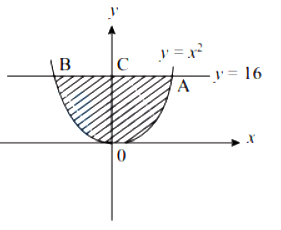
The area of the region bounded by the curve $y=x^{2}$ and the line $y=16$ is
A
$ \frac{32}{3} $ sq. units
B
$ \frac{256}{3} $ sq. units
C
$ \frac{64}{3} $ sq. units
D
$ \frac{128}{3} $ sq. units
Solution
(B) The given curve is $y=x^{2}$ and the line is $y=16$.
To find the area,we integrate with respect to $y$ from $y=0$ to $y=16$.
The curve $y=x^{2}$ implies $x = \pm \sqrt{y}$.
The area is given by the integral:
$Area = \int_{-4}^{4} (16 - x^{2}) dx$
$= 2 \int_{0}^{4} (16 - x^{2}) dx$
$= 2 [16x - \frac{x^{3}}{3}]_{0}^{4}$
$= 2 [16(4) - \frac{4^{3}}{3}]$
$= 2 [64 - \frac{64}{3}]$
$= 2 [\frac{192 - 64}{3}]$
$= 2 [\frac{128}{3}] = \frac{256}{3} \text{ sq. units}$.
Alternatively,using integration with respect to $y$:
$Area = 2 \int_{0}^{16} \sqrt{y} dy$
$= 2 [\frac{y^{3/2}}{3/2}]_{0}^{16}$
$= 2 \times \frac{2}{3} [y^{3/2}]_{0}^{16}$
$= \frac{4}{3} [16^{3/2}]$
$= \frac{4}{3} [64] = \frac{256}{3} \text{ sq. units}$.
To find the area,we integrate with respect to $y$ from $y=0$ to $y=16$.
The curve $y=x^{2}$ implies $x = \pm \sqrt{y}$.
The area is given by the integral:
$Area = \int_{-4}^{4} (16 - x^{2}) dx$
$= 2 \int_{0}^{4} (16 - x^{2}) dx$
$= 2 [16x - \frac{x^{3}}{3}]_{0}^{4}$
$= 2 [16(4) - \frac{4^{3}}{3}]$
$= 2 [64 - \frac{64}{3}]$
$= 2 [\frac{192 - 64}{3}]$
$= 2 [\frac{128}{3}] = \frac{256}{3} \text{ sq. units}$.
Alternatively,using integration with respect to $y$:
$Area = 2 \int_{0}^{16} \sqrt{y} dy$
$= 2 [\frac{y^{3/2}}{3/2}]_{0}^{16}$
$= 2 \times \frac{2}{3} [y^{3/2}]_{0}^{16}$
$= \frac{4}{3} [16^{3/2}]$
$= \frac{4}{3} [64] = \frac{256}{3} \text{ sq. units}$.
0 likesView Solution
14
ChemistryDifficultMCQKCET · 2017
In the manufacture of hydrogen from water gas $(CO + H_2)$,which of the following is the correct statement?
A
$CO$ is oxidized to $CO_2$ with steam in the presence of a catalyst followed by absorption of $CO_2$ in alkali.
B
$CO$ and $H_2$ are separated based on the difference in their densities.
C
Hydrogen is isolated by diffusion.
D
$H_2$ is removed by occlusion with $Pd$.
Solution
(A) In the manufacture of hydrogen from water gas $(CO + H_2)$,the process is known as the water-gas shift reaction.
The reaction is: $CO(g) + H_2O(g) \xrightarrow{\text{catalyst}} CO_2(g) + H_2(g)$.
$CO$ is oxidized to $CO_2$ with steam in the presence of an iron chromate catalyst.
The resulting $CO_2$ is then removed by scrubbing the mixture with a solution of sodium arsenite or alkali (like $KOH$ or $NaOH$) to obtain pure hydrogen.
The reaction is: $CO(g) + H_2O(g) \xrightarrow{\text{catalyst}} CO_2(g) + H_2(g)$.
$CO$ is oxidized to $CO_2$ with steam in the presence of an iron chromate catalyst.
The resulting $CO_2$ is then removed by scrubbing the mixture with a solution of sodium arsenite or alkali (like $KOH$ or $NaOH$) to obtain pure hydrogen.
0 likesView Solution
15
ChemistryMCQKCET · 2017
Which of the following is a bactericidal antibiotic?
A
Ofloxacin
B
Erythromycin
C
Tetracycline
D
Chloramphenicol
Solution
(A) $Ofloxacin$ is a bactericidal antibiotic,which means it kills bacteria.
$Erythromycin$,$tetracycline$,and $chloramphenicol$ are bacteriostatic antibiotics,which inhibit the growth of microorganisms.
$Erythromycin$,$tetracycline$,and $chloramphenicol$ are bacteriostatic antibiotics,which inhibit the growth of microorganisms.
0 likesView Solution
16
ChemistryDifficultMCQKCET · 2017
The electronegativities of $C, N, Si$ and $P$ are in the order of
A
$P < Si < C < N$
B
$Si < P < N < C$
C
$Si < P < C < N$
D
$P < Si < N < C$
Solution
(C) Electronegativity generally increases across a period from left to right and decreases down a group from top to bottom.
In the periodic table,$C$ and $N$ belong to the $2^{nd}$ period,while $Si$ and $P$ belong to the $3^{rd}$ period.
Comparing the values: $Si$ $(1.90)$ < $P$ $(2.19)$ < $C$ $(2.55)$ < $N$ $(3.04)$.
Thus,the correct increasing order of electronegativity is $Si < P < C < N$.
In the periodic table,$C$ and $N$ belong to the $2^{nd}$ period,while $Si$ and $P$ belong to the $3^{rd}$ period.
Comparing the values: $Si$ $(1.90)$ < $P$ $(2.19)$ < $C$ $(2.55)$ < $N$ $(3.04)$.
Thus,the correct increasing order of electronegativity is $Si < P < C < N$.
0 likesView Solution
17
ChemistryEasyMCQKCET · 2017
In which of the following,homolytic bond fission takes place?
A
Alkaline hydrolysis of ethyl chloride
B
Addition of $HBr$ to double bond
C
Free radical chlorination of methane
D
Nitration of Benzene
Solution
(C) The correct answer is $(C)$.
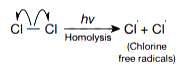
Homolytic bond fission occurs when a covalent bond breaks such that each atom retains one electron,resulting in the formation of free radicals.
Free radical chlorination of methane involves the homolytic cleavage of the $Cl-Cl$ bond by $UV$ light or heat to produce chlorine radicals $(Cl^{\bullet})$.
$Cl-Cl \xrightarrow{h\nu} Cl^{\bullet} + Cl^{\bullet}$
Homolytic bond fission occurs when a covalent bond breaks such that each atom retains one electron,resulting in the formation of free radicals.
Free radical chlorination of methane involves the homolytic cleavage of the $Cl-Cl$ bond by $UV$ light or heat to produce chlorine radicals $(Cl^{\bullet})$.
$Cl-Cl \xrightarrow{h\nu} Cl^{\bullet} + Cl^{\bullet}$
0 likesView Solution
18
ChemistryMediumMCQKCET · 2017
Addition of mineral acid to an aqueous solution of Borax,the following compound is formed:
A
Boron hydride
B
Orthoboric acid
C
Meta boric acid
D
Pyroboric acid
Solution
(B) When a mineral acid (like $HCl$) is added to an aqueous solution of Borax $(Na_{2}B_{4}O_{7} \cdot 10H_{2}O)$,it reacts to form orthoboric acid $(H_{3}BO_{3})$.
The chemical reaction is:
$Na_{2}B_{4}O_{7} + 2HCl + 5H_{2}O \rightarrow 4H_{3}BO_{3} + 2NaCl$
The chemical reaction is:
$Na_{2}B_{4}O_{7} + 2HCl + 5H_{2}O \rightarrow 4H_{3}BO_{3} + 2NaCl$
0 likesView Solution
19
ChemistryEasyMCQKCET · 2017
The equilibrium constant for the reaction $N_{2(g)} + O_{2(g)} \rightleftharpoons 2NO_{(g)}$ is $4 \times 10^{-4}$ at $2000 \ K$. In the presence of a catalyst,the equilibrium is attained ten times faster. Therefore,the equilibrium constant in the presence of a catalyst at $2000 \ K$ is:
A
$4 \times 10^{-3}$
B
$4 \times 10^{-2}$
C
$4 \times 10^{-3}$
D
$4 \times 10^{-4}$
Solution
(D) The equilibrium constant $(K_c)$ depends only on temperature and is independent of the presence of a catalyst. $A$ catalyst only increases the rate of both forward and backward reactions equally,allowing the system to reach equilibrium faster without changing the position of equilibrium or the value of the equilibrium constant. Therefore,the equilibrium constant remains $4 \times 10^{-4}$.
0 likesView Solution
20
ChemistryEasyMCQKCET · 2017
Plaster of Paris is represented as
A
$CaSO_4 \cdot \frac{1}{2} H_2O$
B
$CaSO_4 \cdot H_2O$
C
$CaSO_4 \cdot 2 H_2O$
D
$CaSO_4$
Solution
(A) Plaster of Paris is a hemihydrate of calcium sulfate.
It is chemically represented as $CaSO_4 \cdot \frac{1}{2} H_2O$.
It is chemically represented as $CaSO_4 \cdot \frac{1}{2} H_2O$.
0 likesView Solution
21
ChemistryMediumMCQKCET · 2017
Identify the correct statement among the following:
A
$n$-butane and iso-butane are functional isomers
B
Dimethyl ether and ethanol are chain isomers
C
Propan-$1$-ol and propan-$2$-ol are position isomers
D
Ethanoic acid and methyl methanoate are position isomers
Solution
(C) Option $(A)$: $n$-Butane and iso-butane are chain isomers,not functional isomers.
Option $(B)$: Dimethyl ether $(CH_3OCH_3)$ and ethanol $(CH_3CH_2OH)$ are functional isomers because they contain different functional groups (ether and alcohol).
Option $(C)$: Propan-$1$-ol $(CH_3CH_2CH_2OH)$ and propan-$2$-ol $(CH_3CH(OH)CH_3)$ are position isomers because the position of the hydroxyl $(-OH)$ group changes along the carbon chain.
Option $(D)$: Ethanoic acid $(CH_3COOH)$ and methyl methanoate $(HCOOCH_3)$ are functional isomers because they contain different functional groups (carboxylic acid and ester).
Option $(B)$: Dimethyl ether $(CH_3OCH_3)$ and ethanol $(CH_3CH_2OH)$ are functional isomers because they contain different functional groups (ether and alcohol).
Option $(C)$: Propan-$1$-ol $(CH_3CH_2CH_2OH)$ and propan-$2$-ol $(CH_3CH(OH)CH_3)$ are position isomers because the position of the hydroxyl $(-OH)$ group changes along the carbon chain.
Option $(D)$: Ethanoic acid $(CH_3COOH)$ and methyl methanoate $(HCOOCH_3)$ are functional isomers because they contain different functional groups (carboxylic acid and ester).
0 likesView Solution
22
ChemistryEasyMCQKCET · 2017
Which of the following structures of a molecule is expected to have three bond pairs and one lone pair of electrons?
A
Tetrahedral
B
Trigonal Planar
C
Pyramidal
D
Octahedral
Solution
(C) According to $VSEPR$ theory:
For tetrahedral geometry: No. of electron pairs $= 4$,Bond pairs $= 4$,Lone pairs $= 0$.
For pyramidal geometry (e.g.,$NH_3$): No. of electron pairs $= 4$,Bond pairs $= 3$,Lone pairs $= 1$.
For trigonal planar geometry: No. of electron pairs $= 3$,Bond pairs $= 3$,Lone pairs $= 0$.
For octahedral geometry: No. of electron pairs $= 6$,Bond pairs $= 6$,Lone pairs $= 0$.
Therefore,the structure with three bond pairs and one lone pair is pyramidal.
For tetrahedral geometry: No. of electron pairs $= 4$,Bond pairs $= 4$,Lone pairs $= 0$.
For pyramidal geometry (e.g.,$NH_3$): No. of electron pairs $= 4$,Bond pairs $= 3$,Lone pairs $= 1$.
For trigonal planar geometry: No. of electron pairs $= 3$,Bond pairs $= 3$,Lone pairs $= 0$.
For octahedral geometry: No. of electron pairs $= 6$,Bond pairs $= 6$,Lone pairs $= 0$.
Therefore,the structure with three bond pairs and one lone pair is pyramidal.
0 likesView Solution
23
ChemistryMediumMCQKCET · 2017
Which of the following is a bactericidal antibiotic?
A
Ofloxacin
B
Tetracycline
C
Chloramphenicol
D
Erythromycin
Solution
(A) Antibiotics are classified as either bactericidal (kill bacteria) or bacteriostatic (inhibit the growth of bacteria).
$Ofloxacin$ is a bactericidal antibiotic.
$Tetracycline$,$Chloramphenicol$,and $Erythromycin$ are examples of bacteriostatic antibiotics.
$Ofloxacin$ is a bactericidal antibiotic.
$Tetracycline$,$Chloramphenicol$,and $Erythromycin$ are examples of bacteriostatic antibiotics.
0 likesView Solution
24
ChemistryEasyMCQKCET · 2017
Lower members of aliphatic carboxylic acids are soluble in water. This is due to
A
Formation of hydrogen bonds with water.
B
Van der-Waals interaction with water molecules.
C
Water is non electrolyte
D
Due to London forces
Solution
(A) Lower members of aliphatic carboxylic acids are soluble in water. This is due to the formation of hydrogen bonds with water molecules.
Carboxylic acids are polar molecules; they tend to be soluble in water,but as the alkyl chain gets longer,their solubility decreases due to the increasing hydrophobic nature of the carbon chain.
Carboxylic acids are polar molecules; they tend to be soluble in water,but as the alkyl chain gets longer,their solubility decreases due to the increasing hydrophobic nature of the carbon chain.
0 likesView Solution
25
ChemistryMediumMCQKCET · 2017
Toluene reacts with halogen in the presence of iron$(III)$ chloride to give ortho and para halo compounds. The reaction is:
A
Electrophilic elimination reaction
B
Electrophilic substitution reaction
C
Free radical addition reaction
D
Nucleophilic substitution reaction
Solution
(B) The reaction involved is an electrophilic aromatic substitution.
In the presence of $FeCl_{3}$ (a Lewis acid) and in the dark,the halogen $(X_{2})$ reacts to generate an electrophile $(X^{+})$.
This electrophile attacks the benzene ring of toluene.
Since the methyl group $(-CH_{3})$ is an ortho/para-directing group due to its $+I$ effect and hyperconjugation,the electrophilic substitution occurs primarily at the ortho and para positions to yield ortho and para-halotoluene.
In the presence of $FeCl_{3}$ (a Lewis acid) and in the dark,the halogen $(X_{2})$ reacts to generate an electrophile $(X^{+})$.
This electrophile attacks the benzene ring of toluene.
Since the methyl group $(-CH_{3})$ is an ortho/para-directing group due to its $+I$ effect and hyperconjugation,the electrophilic substitution occurs primarily at the ortho and para positions to yield ortho and para-halotoluene.
0 likesView Solution
26
ChemistryEasyMCQKCET · 2017
The products formed during the following reaction are:
$(CH_{3})_{3}C-O-CH_{3} + HI \rightarrow ?$
$(CH_{3})_{3}C-O-CH_{3} + HI \rightarrow ?$
A
$CH_{3}OH + (CH_{3})_{3}C-I$
B
$CH_{3}I + (CH_{3})_{3}C-OH$
C
$CH_{3}OI + (CH_{3})_{3}C-H$
D
$CH_{4} + (CH_{3})_{3}C-OI$
Solution
(A) The reaction involved is:
$(CH_{3})_{3}C-O-CH_{3} + HI \rightarrow (CH_{3})_{3}C-I + CH_{3}OH$
This is because the reaction occurs by the $S_{N}1$ mechanism. The formation of products is governed by the stability of the carbocation formed from the cleavage of the $C-O$ bond in the protonated ether (oxonium ion).
Since the tert-butyl carbocation $[(CH_{3})_{3}C^{+}]$ is more stable than the methyl carbocation $[CH_{3}^{+}]$,the cleavage of the $C-O$ bond gives the more stable carbocation $[(CH_{3})_{3}C^{+}]$ and methanol as products.
Then,the iodide ion $(I^{-})$ attacks the tert-butyl carbocation to form tert-butyl iodide.
$(CH_{3})_{3}C-O-CH_{3} + HI \rightarrow (CH_{3})_{3}C-I + CH_{3}OH$
This is because the reaction occurs by the $S_{N}1$ mechanism. The formation of products is governed by the stability of the carbocation formed from the cleavage of the $C-O$ bond in the protonated ether (oxonium ion).
Since the tert-butyl carbocation $[(CH_{3})_{3}C^{+}]$ is more stable than the methyl carbocation $[CH_{3}^{+}]$,the cleavage of the $C-O$ bond gives the more stable carbocation $[(CH_{3})_{3}C^{+}]$ and methanol as products.
Then,the iodide ion $(I^{-})$ attacks the tert-butyl carbocation to form tert-butyl iodide.
0 likesView Solution
27
ChemistryEasyMCQKCET · 2017
The standard reduction potential at $298 \ K$ for the following half-cell reactions is given as:
$Zn^{2+}_{(aq)} + 2e^{-} \rightarrow Zn_{(s)} ; \quad E^{\circ} = -0.762 \ V$
$Cr^{3+}_{(aq)} + 3e^{-} \rightarrow Cr_{(s)} ; \quad E^{\circ} = -0.740 \ V$
$2H^{+}_{(aq)} + 2e^{-} \rightarrow H_{2(g)} ; \quad E^{\circ} = 0.0 \ V$
$F_{2(g)} + 2e^{-} \rightarrow 2F^{-}_{(aq)} ; \quad E^{\circ} = 2.87 \ V$
Which of the following is the strongest reducing agent?
$Zn^{2+}_{(aq)} + 2e^{-} \rightarrow Zn_{(s)} ; \quad E^{\circ} = -0.762 \ V$
$Cr^{3+}_{(aq)} + 3e^{-} \rightarrow Cr_{(s)} ; \quad E^{\circ} = -0.740 \ V$
$2H^{+}_{(aq)} + 2e^{-} \rightarrow H_{2(g)} ; \quad E^{\circ} = 0.0 \ V$
$F_{2(g)} + 2e^{-} \rightarrow 2F^{-}_{(aq)} ; \quad E^{\circ} = 2.87 \ V$
Which of the following is the strongest reducing agent?
A
$Zn_{(s)}$
B
$Cr_{(s)}$
C
$H_{2(g)}$
D
$F_{2(g)}$
Solution
(A) reducing agent is a substance that loses electrons and gets oxidized.
The strength of a reducing agent is inversely proportional to its standard reduction potential $(E^{\circ})$.
The more negative the $E^{\circ}$ value,the greater the tendency to lose electrons,making it a stronger reducing agent.
Comparing the given values:
$E^{\circ} (Zn^{2+}/Zn) = -0.762 \ V$
$E^{\circ} (Cr^{3+}/Cr) = -0.740 \ V$
$E^{\circ} (H^{+}/H_2) = 0.0 \ V$
$E^{\circ} (F_2/F^-) = 2.87 \ V$
Since $-0.762 \ V$ is the most negative value,$Zn_{(s)}$ is the strongest reducing agent.
The strength of a reducing agent is inversely proportional to its standard reduction potential $(E^{\circ})$.
The more negative the $E^{\circ}$ value,the greater the tendency to lose electrons,making it a stronger reducing agent.
Comparing the given values:
$E^{\circ} (Zn^{2+}/Zn) = -0.762 \ V$
$E^{\circ} (Cr^{3+}/Cr) = -0.740 \ V$
$E^{\circ} (H^{+}/H_2) = 0.0 \ V$
$E^{\circ} (F_2/F^-) = 2.87 \ V$
Since $-0.762 \ V$ is the most negative value,$Zn_{(s)}$ is the strongest reducing agent.
0 likesView Solution
28
ChemistryEasyMCQKCET · 2017
Cannizzaro's reaction is an example of auto-oxidation and reduction (disproportionation). Which of the following statements is correct regarding this reaction?
A
It is a typical reaction of aliphatic aldehydes.
B
It is a reaction answered only by aromatic aldehydes.
C
It is a reaction answered by aldehydes that do not contain an $\alpha$-hydrogen atom.
D
None of the above
Solution
(C) The Cannizzaro reaction is a disproportionation reaction (auto-oxidation and reduction).
It occurs in aldehydes that do not possess an $\alpha$-hydrogen atom,such as formaldehyde $(HCHO)$ and benzaldehyde $(C_6H_5CHO)$.
When treated with concentrated alkali,one molecule of the aldehyde is oxidized to a carboxylic acid salt,and another molecule is reduced to an alcohol.
It occurs in aldehydes that do not possess an $\alpha$-hydrogen atom,such as formaldehyde $(HCHO)$ and benzaldehyde $(C_6H_5CHO)$.
When treated with concentrated alkali,one molecule of the aldehyde is oxidized to a carboxylic acid salt,and another molecule is reduced to an alcohol.
0 likesView Solution
29
ChemistryEasyMCQKCET · 2017
Select the wrong chemical reaction among the following:
A
$MnO_2 + 4HCl \rightarrow MnCl_2 + Cl_2 + 2H_2O$
B
$8NH_3 + 3Cl_2 \rightarrow 6NH_4Cl + N_2$
C
$2NaOH + Cl_2 \rightarrow 2NaCl + H_2 + O_2$
D
$2Ca(OH)_2 + 2Cl_2 \rightarrow Ca(OCl)_2 + CaCl_2 + 2H_2O$
Solution
(C) In the reaction of $NaOH$ with $Cl_2$,hydrogen gas $(H_2)$ is not produced. The reaction depends on the concentration of $NaOH$.
For cold and dilute $NaOH$,the reaction is: $2NaOH + Cl_2 \rightarrow NaCl + NaClO + H_2O$.
For hot and concentrated $NaOH$,the reaction is: $6NaOH + 3Cl_2 \rightarrow 5NaCl + NaClO_3 + 3H_2O$.
Option $C$ is incorrect because it suggests the liberation of $H_2$ and $O_2$ gases,which does not occur.
For cold and dilute $NaOH$,the reaction is: $2NaOH + Cl_2 \rightarrow NaCl + NaClO + H_2O$.
For hot and concentrated $NaOH$,the reaction is: $6NaOH + 3Cl_2 \rightarrow 5NaCl + NaClO_3 + 3H_2O$.
Option $C$ is incorrect because it suggests the liberation of $H_2$ and $O_2$ gases,which does not occur.
0 likesView Solution
30
ChemistryEasyMCQKCET · 2017
The process which is responsible for the formation of a delta at a place where rivers meet the sea is
A
Coagulation
B
Colloid formation
C
Emulsification
D
Peptization
Solution
(A) delta is formed where a river meets the sea due to the process of settling down of colloidal particles. The river water contains colloidal clay particles,while sea water contains various electrolytes. When these two meet,the electrolytes present in sea water cause the coagulation of the colloidal clay particles,leading to their deposition and the formation of a delta.
0 likesView Solution
31
ChemistryEasyMCQKCET · 2017
The Van't Hoff factor '$i$' accounts for
A
extent of solubility of solute
B
extent of dissociation of solute
C
extent of dissolution of solute
D
extent of mobility of solute
Solution
(B) The Van't Hoff factor '$i$' is defined as the ratio of the observed colligative property to the calculated colligative property.
It accounts for the extent of dissociation or association of solute particles in a solution.
It accounts for the extent of dissociation or association of solute particles in a solution.
0 likesView Solution
32
ChemistryDifficultMCQKCET · 2017
In the following sequence of reactions,the final product $C$ is:
$CH_{3}Br$ $\xrightarrow{KCN} A$ $\xrightarrow{H_{2}O} B$ $\xrightarrow{LiAlH_{4}} C$
$CH_{3}Br$ $\xrightarrow{KCN} A$ $\xrightarrow{H_{2}O} B$ $\xrightarrow{LiAlH_{4}} C$
A
Acetone
B
Methane
C
Acetaldehyde
D
Ethyl Alcohol
Solution
(D) The reaction sequence is as follows:
$1$. $CH_{3}Br + KCN \rightarrow CH_{3}CN + KBr$ (Product $A$ is $CH_{3}CN$)
$2$. $CH_{3}CN + 2H_{2}O \xrightarrow{H^{+}} CH_{3}COOH + NH_{3}$ (Product $B$ is $CH_{3}COOH$)
$3$. $CH_{3}COOH \xrightarrow{LiAlH_{4}} CH_{3}CH_{2}OH$ (Product $C$ is $CH_{3}CH_{2}OH$)
Thus,the final product $C$ is ethyl alcohol.
$1$. $CH_{3}Br + KCN \rightarrow CH_{3}CN + KBr$ (Product $A$ is $CH_{3}CN$)
$2$. $CH_{3}CN + 2H_{2}O \xrightarrow{H^{+}} CH_{3}COOH + NH_{3}$ (Product $B$ is $CH_{3}COOH$)
$3$. $CH_{3}COOH \xrightarrow{LiAlH_{4}} CH_{3}CH_{2}OH$ (Product $C$ is $CH_{3}CH_{2}OH$)
Thus,the final product $C$ is ethyl alcohol.
0 likesView Solution
33
ChemistryMediumMCQKCET · 2017
Which of the following crystals has a unit cell such that $a \neq b \neq c$ and $\alpha \neq \beta \neq \gamma \neq 90^{\circ}$?
A
$K_2Cr_2O_7$
B
$NaNO_3$
C
$KNO_3$
D
$K_2SO_4$
Solution
(A) The condition $a \neq b \neq c$ and $\alpha \neq \beta \neq \gamma \neq 90^{\circ}$ represents the triclinic crystal system.
Among the given options,$K_2Cr_2O_7$ crystallizes in the triclinic system.
Therefore,the correct option is $A$.
Among the given options,$K_2Cr_2O_7$ crystallizes in the triclinic system.
Therefore,the correct option is $A$.
0 likesView Solution
34
ChemistryMediumMCQKCET · 2017
When the pure solvent diffuses out of the solution through the semi-permeable membrane,then the process is called:
A
Osmosis
B
Reverse osmosis
C
Sorption
D
Dialysis
Solution
(B) When an external pressure higher than the osmotic pressure is applied to the solution side,the solvent molecules move from the solution into the pure solvent through a semi-permeable membrane. This process is known as $Reverse \ osmosis$.
0 likesView Solution
35
ChemistryMediumMCQKCET · 2017
By passing electric current,$NaClO_{3}$ is converted into $NaClO_{4}$ according to the following equation:
$NaClO_{3} + H_{2}O \rightarrow NaClO_{4} + H_{2}$
How many moles of $NaClO_{4}$ will be formed when $3 \ F$ of charge is passed through $NaClO_{3}$?
$NaClO_{3} + H_{2}O \rightarrow NaClO_{4} + H_{2}$
How many moles of $NaClO_{4}$ will be formed when $3 \ F$ of charge is passed through $NaClO_{3}$?
A
$0.75$
B
$1.0$
C
$1.5$
D
$3.0$
Solution
(C) The balanced chemical equation is: $NaClO_{3} + H_{2}O \rightarrow NaClO_{4} + H_{2}$.
The oxidation state of $Cl$ in $NaClO_{3}$ is $+5$ and in $NaClO_{4}$ is $+7$.
The change in oxidation state is $7 - 5 = 2$,which means $2$ moles of electrons are involved per mole of $NaClO_{3}$.
Thus,$2 \ F$ of charge is required to produce $1$ mole of $NaClO_{4}$.
Therefore,$1 \ F$ of charge produces $1/2$ mole of $NaClO_{4}$.
For $3 \ F$ of charge,the moles of $NaClO_{4}$ formed $= (1/2) \times 3 = 1.5 \ mol$.
The oxidation state of $Cl$ in $NaClO_{3}$ is $+5$ and in $NaClO_{4}$ is $+7$.
The change in oxidation state is $7 - 5 = 2$,which means $2$ moles of electrons are involved per mole of $NaClO_{3}$.
Thus,$2 \ F$ of charge is required to produce $1$ mole of $NaClO_{4}$.
Therefore,$1 \ F$ of charge produces $1/2$ mole of $NaClO_{4}$.
For $3 \ F$ of charge,the moles of $NaClO_{4}$ formed $= (1/2) \times 3 = 1.5 \ mol$.
0 likesView Solution
36
ChemistryMediumMCQKCET · 2017
Which of the following reagents cannot be used to oxidize primary alcohols to aldehydes?
A
$CrO_3$ in anhydrous medium
B
$KMnO_4$ in acidic medium
C
Pyridinium chlorochromate
D
Heating in the presence of $Cu$ at $573 \ K$
Solution
(B) Acidified $KMnO_4$ is a strong oxidizing agent. It oxidizes primary alcohols directly to carboxylic acids rather than stopping at the aldehyde stage. Therefore,it cannot be used to prepare aldehydes from primary alcohols.
0 likesView Solution
37
ChemistryMediumMCQKCET · 2017
The correct statement regarding defects in solids is
A
Frenkel defect is usually favoured by a very small difference in the sizes of cations and anions.
B
Frenkel defect is a dislocation defect.
C
Trapping of proton in the lattice leads to the formation of $F$-centers.
D
Schottky defect has no effect on the physical properties of solids.
Solution
(B) Option $(B)$ is correct.
$1$. Frenkel defect occurs in compounds where there is a large difference in the size of ions,specifically where anions are much larger than cations.
$2$. Frenkel defect is known as a dislocation defect because an ion is dislocated from its normal lattice site to an interstitial site.
$3$. $F$-centers are formed by the trapping of electrons in anion vacancies,not protons.
$4$. Schottky defect leads to a decrease in the density of the crystal due to the presence of vacancies.
$1$. Frenkel defect occurs in compounds where there is a large difference in the size of ions,specifically where anions are much larger than cations.
$2$. Frenkel defect is known as a dislocation defect because an ion is dislocated from its normal lattice site to an interstitial site.
$3$. $F$-centers are formed by the trapping of electrons in anion vacancies,not protons.
$4$. Schottky defect leads to a decrease in the density of the crystal due to the presence of vacancies.
0 likesView Solution
38
ChemistryEasyMCQKCET · 2017
Extraction of chlorine from brine solution is based on
A
Oxidation
B
Chlorination
C
Reduction
D
Acidification
Solution
(A) The extraction of chlorine from brine solution ($NaCl$ solution) is based on the oxidation of chloride ions $(Cl^{-})$ to chlorine gas $(Cl_2)$ during electrolysis.
The reaction at the anode is: $2Cl^{-}_{(aq)} \rightarrow Cl_{2(g)} + 2e^{-}$.
The reaction at the anode is: $2Cl^{-}_{(aq)} \rightarrow Cl_{2(g)} + 2e^{-}$.
0 likesView Solution
39
ChemistryEasyMCQKCET · 2017
Which of the following statements is in accordance with the Arrhenius equation?
A
Rate of a reaction increases with increase in temperature
B
Rate of a reaction increases with decrease in activation energy
C
Rate constant decreases exponentially with increase in temperature
D
Rate of reaction does not change with increase in activation energy
Solution
(A) According to the Arrhenius equation,$k = A e^{\frac{-E_{a}}{RT}}$.
Taking the natural logarithm on both sides,we get $\ln k = \ln A - \frac{E_{a}}{R} \times \frac{1}{T}$.
From this equation,it is clear that as the temperature $(T)$ increases,the term $\frac{E_{a}}{RT}$ decreases,which causes the rate constant $(k)$ to increase exponentially.
Similarly,if the activation energy $(E_{a})$ decreases,the term $\frac{E_{a}}{RT}$ decreases,which also leads to an increase in the rate constant $(k)$.
Therefore,both statements $A$ and $B$ are technically correct based on the Arrhenius equation. However,in standard multiple-choice contexts,the dependence on temperature is the primary characteristic.
Taking the natural logarithm on both sides,we get $\ln k = \ln A - \frac{E_{a}}{R} \times \frac{1}{T}$.
From this equation,it is clear that as the temperature $(T)$ increases,the term $\frac{E_{a}}{RT}$ decreases,which causes the rate constant $(k)$ to increase exponentially.
Similarly,if the activation energy $(E_{a})$ decreases,the term $\frac{E_{a}}{RT}$ decreases,which also leads to an increase in the rate constant $(k)$.
Therefore,both statements $A$ and $B$ are technically correct based on the Arrhenius equation. However,in standard multiple-choice contexts,the dependence on temperature is the primary characteristic.
0 likesView Solution
40
ChemistryEasyMCQKCET · 2017
Hydrogenation of vegetable oils in the presence of finely divided $Ni$ as a catalyst. The reaction is:
A
Heterogeneous catalysis
B
Homogeneous catalysis
C
Enzyme catalysed reaction
D
Liquid catalysed reaction
Solution
(A) The hydrogenation of vegetable oil involves the reaction of liquid oil with gaseous $H_2$ in the presence of solid $Ni$ catalyst.
Since the catalyst $(Ni)$ is in a solid phase and the reactants (oil and $H_2$) are in liquid/gas phases,the phases are different.
Therefore,this is an example of heterogeneous catalysis.
Since the catalyst $(Ni)$ is in a solid phase and the reactants (oil and $H_2$) are in liquid/gas phases,the phases are different.
Therefore,this is an example of heterogeneous catalysis.
0 likesView Solution
41
ChemistryMediumMCQKCET · 2017
The correct order of increasing basic nature for the bases $NH_{3}$,$CH_{3}NH_{2}$ and $(CH_{3})_{2}NH$ in aqueous solutions is:
A
$CH_{3}NH_{2} < NH_{3} < (CH_{3})_{2}NH$
B
$(CH_{3})_{2}NH < NH_{3} < CH_{3}NH_{2}$
C
$NH_{3} < CH_{3}NH_{2} < (CH_{3})_{2}NH$
D
$CH_{3}NH_{2} < (CH_{3})_{2}NH < NH_{3}$
Solution
(C) The basicity of aliphatic amines in aqueous solution depends on the combined effect of inductive effect $(+I)$,solvation effect,and steric hindrance.
Alkyl groups are electron-releasing ($+I$ effect),which increases the electron density on the nitrogen atom,thereby increasing basicity.
However,in aqueous solutions,the stability of the conjugate acid (ammonium ion) formed by protonation is also crucial,which is influenced by hydrogen bonding (solvation) and steric hindrance.
For the given amines,the order of basicity is $NH_{3} < CH_{3}NH_{2} < (CH_{3})_{2}NH$.
Alkyl groups are electron-releasing ($+I$ effect),which increases the electron density on the nitrogen atom,thereby increasing basicity.
However,in aqueous solutions,the stability of the conjugate acid (ammonium ion) formed by protonation is also crucial,which is influenced by hydrogen bonding (solvation) and steric hindrance.
For the given amines,the order of basicity is $NH_{3} < CH_{3}NH_{2} < (CH_{3})_{2}NH$.
0 likesView Solution
42
ChemistryEasyMCQKCET · 2017
Pick the correct statement among the following:
A
Cetyl trimethyl ammonium bromide is a popular cationic detergent used in air conditioner.
B
Non-ionic detergents are formed when polyethylene glycol reacts with adipic acid.
C
Sodium dodecyl benzene sulphonate used in toothpaste is a cationic detergent.
D
None of the above.
Solution
(D) Option $A$: Cetyltrimethylammonium bromide is a popular cationic detergent used in hair conditioners,not air conditioners.
Option $B$: Non-ionic detergents are formed when polyethylene glycol reacts with stearic acid,not adipic acid.
Option $C$: Sodium dodecyl benzene sulphonate used in toothpaste is an anionic detergent,not a cationic detergent.
Option $D$: Since all statements $A$,$B$,and $C$ are incorrect,the correct choice is $D$.
Option $B$: Non-ionic detergents are formed when polyethylene glycol reacts with stearic acid,not adipic acid.
Option $C$: Sodium dodecyl benzene sulphonate used in toothpaste is an anionic detergent,not a cationic detergent.
Option $D$: Since all statements $A$,$B$,and $C$ are incorrect,the correct choice is $D$.
0 likesView Solution
43
ChemistryMediumMCQKCET · 2017
Which monomers are used in the preparation of Novolac,a polymer used in paints?
A
Phenol and Formaldehyde
B
Melamine and Formaldehyde
C
Butadiene and Styrene
D
Butadiene and acrylonitrile
Solution
(A) Novolac is a linear polymer formed by the condensation polymerization of phenol and formaldehyde in the presence of an acid or base catalyst.
The reaction involves the formation of $o-$ or $p-$hydroxymethylphenol intermediates,which then undergo further condensation to form the linear polymer Novolac.
The reaction involves the formation of $o-$ or $p-$hydroxymethylphenol intermediates,which then undergo further condensation to form the linear polymer Novolac.
0 likesView Solution
44
ChemistryMediumMCQKCET · 2017
The glycosidic linkage present in sucrose is between
A
$C-1$ of $\alpha$-glucose and $C-2$ of $\beta$-fructose
B
$C-1$ of $\alpha$-glucose and $C-4$ of $\alpha$-glucose
C
$C-1$ of $\beta$-galactose and $C-4$ of $\alpha$-glucose
D
$C-1$ of $\alpha$-glucose and $C-4$ of $\beta$-fructose
Solution
(A) Sucrose is a disaccharide composed of one molecule of $\alpha$-$D$-glucose and one molecule of $\beta$-$D$-fructose.
These two monosaccharide units are joined together by a glycosidic linkage between $C-1$ of $\alpha$-$D$-glucose and $C-2$ of $\beta$-$D$-fructose.
These two monosaccharide units are joined together by a glycosidic linkage between $C-1$ of $\alpha$-$D$-glucose and $C-2$ of $\beta$-$D$-fructose.
0 likesView Solution
45
ChemistryMediumMCQKCET · 2017
In the electrolysis of aqueous sodium chloride solution,which of the half-cell reaction will occur at the anode?
A
$Na^{+}_{(aq)} + e^{-} \rightarrow Na_{(s)} ; E^{\circ} = -2.71 \ V$
B
$2H_{2}O_{(l)} \rightarrow O_{2(g)} + 4H^{+}_{(aq)} + 4e^{-} ; E^{\circ} = 1.23 \ V$
C
$H^{+}_{(aq)} + e^{-} \rightarrow \frac{1}{2}H_{2(g)} ; E^{\circ} = 0.00 \ V$
D
$Cl^{-}_{(aq)} \rightarrow \frac{1}{2}Cl_{2(g)} + e^{-} ; E^{\circ} = 1.36 \ V$
Solution
(D) In an aqueous solution of sodium chloride,the following ions are present: $Na^{+}$,$Cl^{-}$,$H^{+}$,and $OH^{-}$.
At the anode,oxidation occurs. The two possible oxidation reactions are:
$1$) $2H_{2}O_{(l)} \rightarrow O_{2(g)} + 4H^{+}_{(aq)} + 4e^{-} ; E^{\circ} = 1.23 \ V$
$2$) $Cl^{-}_{(aq)} \rightarrow \frac{1}{2}Cl_{2(g)} + e^{-} ; E^{\circ} = 1.36 \ V$
Although the standard electrode potential for water oxidation is lower,the oxidation of $Cl^{-}$ is kinetically preferred due to the overpotential of oxygen evolution on the electrode surface. Thus,$Cl^{-}$ ions are preferentially oxidized at the anode.
At the anode,oxidation occurs. The two possible oxidation reactions are:
$1$) $2H_{2}O_{(l)} \rightarrow O_{2(g)} + 4H^{+}_{(aq)} + 4e^{-} ; E^{\circ} = 1.23 \ V$
$2$) $Cl^{-}_{(aq)} \rightarrow \frac{1}{2}Cl_{2(g)} + e^{-} ; E^{\circ} = 1.36 \ V$
Although the standard electrode potential for water oxidation is lower,the oxidation of $Cl^{-}$ is kinetically preferred due to the overpotential of oxygen evolution on the electrode surface. Thus,$Cl^{-}$ ions are preferentially oxidized at the anode.
0 likesView Solution
46
ChemistryEasyMCQKCET · 2017
Square planar complex of the type $MAXBL$ (where $A, B, X$ and $L$ are unidentate ligands) shows which of the following sets of isomers?
A
Two cis and one trans
B
Two trans and one cis
C
Two cis and two trans
D
Three cis and one trans
Solution
(A) For a square planar complex of the type $M(abcd)$,there are $3$ possible geometric isomers.
In the case of $MAXBL$,we can fix one ligand (e.g.,$M$) and arrange the others.
There are $2$ isomers where two specific ligands are in the $cis$ position (adjacent) and $1$ isomer where they are in the $trans$ position (opposite).
Thus,the complex shows $2$ $cis$ and $1$ $trans$ isomers.
In the case of $MAXBL$,we can fix one ligand (e.g.,$M$) and arrange the others.
There are $2$ isomers where two specific ligands are in the $cis$ position (adjacent) and $1$ isomer where they are in the $trans$ position (opposite).
Thus,the complex shows $2$ $cis$ and $1$ $trans$ isomers.
0 likesView Solution
47
ChemistryMediumMCQKCET · 2017
Which of the following orders is true regarding the acidic nature of phenol and its derivatives?
A
$Phenol > o-cresol > o-nitrophenol$
B
$o-cresol < phenol < o-nitrophenol$
C
$phenol < o-cresol > o-nitrophenol$
D
$phenol < o-cresol < o-nitrophenol$
Solution
(B) The acidity of substituted phenols is significantly affected by the nature of the substituents.
Electron-withdrawing groups $(EWG)$ such as $-NO_2$ increase the acidic strength by stabilizing the phenoxide ion through the $-I$ and $-M$ effects.
Conversely,electron-donating groups $(EDG)$ such as $-CH_3$ (methyl group in cresol) decrease the acidic strength due to the $+I$ effect and hyperconjugation,which destabilizes the phenoxide ion.
Therefore,the acidic strength follows the order: $o-cresol < phenol < o-nitrophenol$.
Electron-withdrawing groups $(EWG)$ such as $-NO_2$ increase the acidic strength by stabilizing the phenoxide ion through the $-I$ and $-M$ effects.
Conversely,electron-donating groups $(EDG)$ such as $-CH_3$ (methyl group in cresol) decrease the acidic strength due to the $+I$ effect and hyperconjugation,which destabilizes the phenoxide ion.
Therefore,the acidic strength follows the order: $o-cresol < phenol < o-nitrophenol$.
0 likesView Solution
48
ChemistryEasyMCQKCET · 2017
For a reaction $\frac{1}{2} A \rightarrow 2 B$,the rate of disappearance of $A$ is related to the rate of appearance of $B$ by the expression:
A
$\frac{-d[A]}{dt} = 4 \frac{d[B]}{dt}$
B
$\frac{-d[A]}{dt} = \frac{1}{4} \frac{d[B]}{dt}$
C
$\frac{-d[A]}{dt} = \frac{1}{2} \frac{d[B]}{dt}$
D
$\frac{-d[A]}{dt} = \frac{d[B]}{dt}$
Solution
(B) For a general reaction $aA \rightarrow bB$,the rate of reaction is given by:
Rate $= -\frac{1}{a} \frac{d[A]}{dt} = \frac{1}{b} \frac{d[B]}{dt}$
Given the reaction $\frac{1}{2} A \rightarrow 2 B$,we have $a = \frac{1}{2}$ and $b = 2$.
Substituting these values:
$-\frac{1}{1/2} \frac{d[A]}{dt} = \frac{1}{2} \frac{d[B]}{dt}$
$-2 \frac{d[A]}{dt} = \frac{1}{2} \frac{d[B]}{dt}$
Multiplying both sides by $\frac{1}{2}$:
$-\frac{d[A]}{dt} = \frac{1}{4} \frac{d[B]}{dt}$
Rate $= -\frac{1}{a} \frac{d[A]}{dt} = \frac{1}{b} \frac{d[B]}{dt}$
Given the reaction $\frac{1}{2} A \rightarrow 2 B$,we have $a = \frac{1}{2}$ and $b = 2$.
Substituting these values:
$-\frac{1}{1/2} \frac{d[A]}{dt} = \frac{1}{2} \frac{d[B]}{dt}$
$-2 \frac{d[A]}{dt} = \frac{1}{2} \frac{d[B]}{dt}$
Multiplying both sides by $\frac{1}{2}$:
$-\frac{d[A]}{dt} = \frac{1}{4} \frac{d[B]}{dt}$
0 likesView Solution
49
ChemistryEasyMCQKCET · 2017
According to crystal field theory,the $M-L$ bond in a complex is
A
purely ionic
B
purely covalent
C
purely co-ordinate
D
partially covalent
Solution
(A) The fundamental assumption of $CFT$ is that $M-L$ interactions are purely electrostatic in nature.
In an octahedral metal complex,the electrostatic interaction of a positively charged metal ion with six negatively charged ligands or with the negative ends of dipoles associated with the six ligands is considered.
In an octahedral metal complex,the electrostatic interaction of a positively charged metal ion with six negatively charged ligands or with the negative ends of dipoles associated with the six ligands is considered.
0 likesView Solution
50
ChemistryDifficultMCQKCET · 2017
Hormones are secreted by ductless glands of the human body. The iodine-containing hormone is:
A
Insulin
B
Thyroxine
C
Testosterone
D
Adrenaline
Solution
(B) The hormone that contains iodine is $Thyroxine$. It is secreted by the thyroid gland.
0 likesView Solution
51
ChemistryEasyMCQKCET · 2017
Pick the wrong statement from the following :
A
Sources of Vitamin $B_{1}$ are yeast,milk,green vegetables and cereals
B
Deficiency of Vitamin $B_{6}$ $(pyridoxine)$ results in convulsions
C
Consumption of citrus fruits and green leafy vegetables in food prevents scurvy
D
Deficiency of vitamin $D$ causes xerophthalmia
Solution
(D) Xerophthalmia is caused by the deficiency of Vitamin $A$. It is characterized by the hardening and dryness of the cornea of the eye. Deficiency of Vitamin $D$ causes rickets in children and osteomalacia in adults,not xerophthalmia. Therefore,the statement in option $D$ is incorrect.
0 likesView Solution
52
ChemistryEasyMCQKCET · 2017
Reduction of ketones cannot be carried out with which of the following reagents?
A
Sodium borohydride or lithium aluminium hydride
B
Zinc amalgam and concentrated $HCl$
C
Hydrazine and $KOH$ in ethylene glycol
D
Hydrogen in presence of palladium in Barium sulphate and quinoline
Solution
(D) Ketones can be reduced to secondary alcohols using $NaBH_4$ or $LiAlH_4$.
They can also be reduced to alkanes using Clemmensen reduction $(Zn(Hg)/conc. HCl)$ or Wolff-Kishner reduction ($NH_2NH_2/KOH$ in ethylene glycol).
Hydrogen in the presence of palladium in Barium sulphate and quinoline is known as Lindlar's catalyst,which is specifically used for the partial reduction of alkynes to alkenes,not for the reduction of ketones.
They can also be reduced to alkanes using Clemmensen reduction $(Zn(Hg)/conc. HCl)$ or Wolff-Kishner reduction ($NH_2NH_2/KOH$ in ethylene glycol).
Hydrogen in the presence of palladium in Barium sulphate and quinoline is known as Lindlar's catalyst,which is specifically used for the partial reduction of alkynes to alkenes,not for the reduction of ketones.
0 likesView Solution
53
ChemistryEasyMCQKCET · 2017
Which of the following elements forms $p\pi-p\pi$ bond with itself?
A
$N$
B
$P$
C
$Se$
D
$Te$
Solution
(A) $N$ forms $p\pi-p\pi$ bond with itself because the $N$ atom has a small atomic size and high electronegativity,allowing it to form $1\sigma$ and $2\pi$ bonds (triple bonds) with another $N$ atom.
This results in the formation of a stable diatomic molecule,$N_2$.
This results in the formation of a stable diatomic molecule,$N_2$.
0 likesView Solution
54
ChemistryEasyMCQKCET · 2017
In a face-centred cubic arrangement of $A$ and $B$ atoms,$A$ atoms are at the corners of the unit cell and $B$ atoms are at the face centres. If one of the $A$ atoms is missing from one corner of the unit cell,what is the simplest formula of the compound?
A
$A_{7} B_{24}$
B
$A_{7} B_{8}$
C
$A B_{3}$
D
$A_{7} B_{12}$
Solution
(A) In a face-centred cubic $(FCC)$ unit cell,there are $8$ corners and $6$ face centres.
Number of $A$ atoms at corners = $7 \times \frac{1}{8} = \frac{7}{8}$ (since one corner is missing).
Number of $B$ atoms at face centres = $6 \times \frac{1}{2} = 3$.
The ratio of $A : B = \frac{7}{8} : 3$.
Multiplying both sides by $8$,we get the ratio $7 : 24$.
Therefore,the simplest formula of the compound is $A_{7} B_{24}$.
Number of $A$ atoms at corners = $7 \times \frac{1}{8} = \frac{7}{8}$ (since one corner is missing).
Number of $B$ atoms at face centres = $6 \times \frac{1}{2} = 3$.
The ratio of $A : B = \frac{7}{8} : 3$.
Multiplying both sides by $8$,we get the ratio $7 : 24$.
Therefore,the simplest formula of the compound is $A_{7} B_{24}$.
0 likesView Solution
55
ChemistryMediumMCQKCET · 2017
The metal extracted by leaching with a cyanide is
A
$Al$
B
$Ag$
C
$Cu$
D
$Na$
Solution
(B) The metal extracted by leaching with a cyanide is $Ag$ (or $Au$).
In the Mac-Arthur Forest process,silver $(Ag)$ or gold $(Au)$ ores are treated with a dilute solution of $NaCN$ in the presence of air $(O_2)$.
The chemical reaction is: $4M + 8CN^- + 2H_2O + O_2 \rightarrow 4[M(CN)_2]^- + 4OH^-$.
Subsequently,the metal is recovered by displacement using a more electropositive metal like zinc $(Zn)$: $2[M(CN)_2]^- + Zn \rightarrow [Zn(CN)_4]^{2-} + 2M$.
In the Mac-Arthur Forest process,silver $(Ag)$ or gold $(Au)$ ores are treated with a dilute solution of $NaCN$ in the presence of air $(O_2)$.
The chemical reaction is: $4M + 8CN^- + 2H_2O + O_2 \rightarrow 4[M(CN)_2]^- + 4OH^-$.
Subsequently,the metal is recovered by displacement using a more electropositive metal like zinc $(Zn)$: $2[M(CN)_2]^- + Zn \rightarrow [Zn(CN)_4]^{2-} + 2M$.
0 likesView Solution
56
ChemistryEasyMCQKCET · 2017
Which one of the following noble gas has an unusual property of diffusing through materials such as rubber,glass,or plastic?
A
$Ne$
B
$Ar$
C
$Kr$
D
$He$
Solution
(D) $He$ (helium) has an unusual property of diffusing through materials such as rubber,glass,or plastic.
This is due to its very small atomic size.
The increasing order of diffusibility of noble gases is $Xe < Kr < Ar < Ne < He$.
This is due to its very small atomic size.
The increasing order of diffusibility of noble gases is $Xe < Kr < Ar < Ne < He$.
0 likesView Solution
57
ChemistryEasyMCQKCET · 2017
The coordination number and the oxidation state of the element $M$ in the complex $[M(en)_{2}(C_{2}O_{4})]NO_{2}$ [where $en$ is ethane-$1,2$-diamine] are respectively:
A
$6$ and $3$
B
$6$ and $2$
C
$4$ and $2$
D
$4$ and $3$
Solution
(A) The complex is $[M(en)_{2}(C_{2}O_{4})]NO_{2}$.
In this complex,the counter ion is $NO_{2}^{-}$,which has a charge of $-1$. Therefore,the complex ion $[M(en)_{2}(C_{2}O_{4})]$ must have a charge of $+1$.
Let the oxidation state of $M$ be $x$.
$en$ (ethane-$1,2$-diamine) is a neutral bidentate ligand (charge $= 0$).
$C_{2}O_{4}^{2-}$ (oxalate) is a bidentate ligand with a charge of $-2$.
Setting up the equation for the charge of the complex ion:
$x + (2 \times 0) + (1 \times -2) = +1$
$x - 2 = +1$
$x = +3$
Thus,the oxidation state of $M$ is $+3$.
Coordination number calculation:
$en$ is bidentate ($2$ donor sites each,$2 \times 2 = 4$ sites).
$C_{2}O_{4}^{2-}$ is bidentate ($2$ donor sites).
Total coordination number $= 4 + 2 = 6$.
Therefore,the coordination number is $6$ and the oxidation state is $3$.
In this complex,the counter ion is $NO_{2}^{-}$,which has a charge of $-1$. Therefore,the complex ion $[M(en)_{2}(C_{2}O_{4})]$ must have a charge of $+1$.
Let the oxidation state of $M$ be $x$.
$en$ (ethane-$1,2$-diamine) is a neutral bidentate ligand (charge $= 0$).
$C_{2}O_{4}^{2-}$ (oxalate) is a bidentate ligand with a charge of $-2$.
Setting up the equation for the charge of the complex ion:
$x + (2 \times 0) + (1 \times -2) = +1$
$x - 2 = +1$
$x = +3$
Thus,the oxidation state of $M$ is $+3$.
Coordination number calculation:
$en$ is bidentate ($2$ donor sites each,$2 \times 2 = 4$ sites).
$C_{2}O_{4}^{2-}$ is bidentate ($2$ donor sites).
Total coordination number $= 4 + 2 = 6$.
Therefore,the coordination number is $6$ and the oxidation state is $3$.
0 likesView Solution
58
ChemistryDifficultMCQKCET · 2017
Which of the following is not a biodegradable polymer?
A
Polyhydroxy butyrate-co-$\beta$-hydroxyvalerate
B
$PHBV$
C
Nylon $2$-Nylon-$6$
D
Glyptal
Solution
(D) Biodegradable polymers are polymers that decompose by bacterial action.
Polyhydroxy butyrate-co-$\beta$-hydroxyvalerate $(PHBV)$ and Nylon $2$-Nylon-$6$ are examples of biodegradable polymers.
Glyptal is a condensation polymer of ethylene glycol and phthalic acid,which is not biodegradable.
Polyhydroxy butyrate-co-$\beta$-hydroxyvalerate $(PHBV)$ and Nylon $2$-Nylon-$6$ are examples of biodegradable polymers.
Glyptal is a condensation polymer of ethylene glycol and phthalic acid,which is not biodegradable.
0 likesView Solution
59
ChemistryDifficultMCQKCET · 2017
Which of the following aqueous solutions has the highest freezing point?
A
$0.1 \ molal \ Al_2(SO_4)_3$
B
$0.1 \ molal \ BaCl_2$
C
$0.1 \ molal \ AlCl_3$
D
$0.1 \ molal \ NH_4Cl$
Solution
(D) The depression in freezing point is given by the formula $\Delta T_f = i \times K_f \times m$.
Since the molality $(m)$ and the cryoscopic constant $(K_f)$ are the same for all solutions,the depression in freezing point $(\Delta T_f)$ is directly proportional to the van't Hoff factor $(i)$.
The freezing point of the solution is $T_f = T_f^0 - \Delta T_f$. Therefore,the solution with the lowest value of $i$ will have the highest freezing point.
Comparing the values of $i$,$NH_4Cl$ has the lowest van't Hoff factor $(i = 2)$. Thus,it will have the minimum depression in freezing point and consequently the highest freezing point.
Since the molality $(m)$ and the cryoscopic constant $(K_f)$ are the same for all solutions,the depression in freezing point $(\Delta T_f)$ is directly proportional to the van't Hoff factor $(i)$.
The freezing point of the solution is $T_f = T_f^0 - \Delta T_f$. Therefore,the solution with the lowest value of $i$ will have the highest freezing point.
| Compound | van't Hoff Factor $(i)$ |
| $Al_2(SO_4)_3 \rightarrow 2Al^{3+} + 3SO_4^{2-}$ | $5$ |
| $BaCl_2 \rightarrow Ba^{2+} + 2Cl^{-}$ | $3$ |
| $AlCl_3 \rightarrow Al^{3+} + 3Cl^{-}$ | $4$ |
| $NH_4Cl \rightarrow NH_4^+ + Cl^{-}$ | $2$ |
Comparing the values of $i$,$NH_4Cl$ has the lowest van't Hoff factor $(i = 2)$. Thus,it will have the minimum depression in freezing point and consequently the highest freezing point.
0 likesView Solution
60
ChemistryMediumMCQKCET · 2017
The magnetic nature of elements depends on the presence of unpaired electrons. Identify the configuration of transition elements which shows the highest magnetic moment.
A
$3d^7$
B
$3d^5$
C
$3d^8$
D
$3d^2$
Solution
(B) The spin-only magnetic moment $(\mu_{spin})$ is calculated using the formula $\mu_{spin} = \sqrt{n(n+2)} \text{ BM}$,where $n$ is the number of unpaired electrons.
| Electronic Configuration | No. of Unpaired Electrons $(n)$ | Magnetic Moment $(\mu_{spin})$ |
| $3d^7$ | $3$ | $\sqrt{3(3+2)} = \sqrt{15} \text{ BM}$ |
| $3d^5$ | $5$ | $\sqrt{5(5+2)} = \sqrt{35} \text{ BM}$ |
| $3d^8$ | $2$ | $\sqrt{2(2+2)} = \sqrt{8} = 2\sqrt{2} \text{ BM}$ |
| $3d^2$ | $2$ | $\sqrt{2(2+2)} = \sqrt{8} = 2\sqrt{2} \text{ BM}$ |
Comparing the values,the $3d^5$ configuration has the highest number of unpaired electrons $(n=5)$,resulting in the highest magnetic moment of $\sqrt{35} \text{ BM}$.
| Electronic Configuration | No. of Unpaired Electrons $(n)$ | Magnetic Moment $(\mu_{spin})$ |
| $3d^7$ | $3$ | $\sqrt{3(3+2)} = \sqrt{15} \text{ BM}$ |
| $3d^5$ | $5$ | $\sqrt{5(5+2)} = \sqrt{35} \text{ BM}$ |
| $3d^8$ | $2$ | $\sqrt{2(2+2)} = \sqrt{8} = 2\sqrt{2} \text{ BM}$ |
| $3d^2$ | $2$ | $\sqrt{2(2+2)} = \sqrt{8} = 2\sqrt{2} \text{ BM}$ |
Comparing the values,the $3d^5$ configuration has the highest number of unpaired electrons $(n=5)$,resulting in the highest magnetic moment of $\sqrt{35} \text{ BM}$.
0 likesView Solution
61
ChemistryEasyMCQKCET · 2017
Which of the following statements is wrong regarding lanthanoids?
A
$Ln(III)$ compounds are generally colourless.
B
$Ln(III)$ compounds are predominantly ionic in character.
C
The ionic size of $Ln(III)$ ions decreases with increasing atomic number.
D
$Ln(III)$ hydroxides are mainly basic in nature.
Solution
(A) $Ln(III)$ ions are often colored due to $f-f$ transitions,which occur because of the presence of partly filled $4f$ orbitals,allowing them to absorb certain wavelengths from the visible region of the spectrum.
Therefore,the statement that "$Ln(III)$ compounds are generally colourless" is incorrect.
Therefore,the statement that "$Ln(III)$ compounds are generally colourless" is incorrect.
0 likesView Solution
62
ChemistryEasyMCQKCET · 2017
Which of the following is not a favourable condition for physical adsorption?
A
High temperature
B
High pressure
C
Higher critical temperature of adsorbate
D
Low temperature
Solution
(A) Physical adsorption is an exothermic process. According to Le Chatelier's principle,an increase in temperature decreases the extent of adsorption. Therefore,high temperature is an unfavorable condition for physical adsorption.
0 likesView Solution
63
ChemistryMediumMCQKCET · 2017
Gabriel phthalimide synthesis is used in the preparation of primary amines from phthalimide. Which of the following reagents is not used during the process?
A
$KOH$
B
$NaOH$
C
$HCl$
D
Alkyl Halides
Solution
(C) Gabriel phthalimide synthesis is a method used to prepare pure primary amines.
$1$. Phthalimide is reacted with alcoholic $KOH$ to form potassium phthalimide.
$2$. Potassium phthalimide is then reacted with an alkyl halide to form $N$-alkyl phthalimide.
$3$. Finally,$N$-alkyl phthalimide undergoes alkaline hydrolysis using aqueous $NaOH$ to yield the primary amine and phthalic acid (as a salt).
$HCl$ is not used in this process as the final step requires basic hydrolysis to release the amine.
$1$. Phthalimide is reacted with alcoholic $KOH$ to form potassium phthalimide.
$2$. Potassium phthalimide is then reacted with an alkyl halide to form $N$-alkyl phthalimide.
$3$. Finally,$N$-alkyl phthalimide undergoes alkaline hydrolysis using aqueous $NaOH$ to yield the primary amine and phthalic acid (as a salt).
$HCl$ is not used in this process as the final step requires basic hydrolysis to release the amine.
0 likesView Solution
64
ChemistryEasyMCQKCET · 2017
Which of the following statements is incorrect?
A
The rate law for any reaction cannot be determined experimentally.
B
Complex reactions have fractional order.
C
Bimolecular reactions involve simultaneous collision between two species.
D
Molecularity is only applicable for elementary reactions.
Solution
(A) The rate law is determined experimentally by measuring the rate of reaction at different concentrations of reactants. Therefore,the statement that the rate law cannot be determined experimentally is incorrect. Complex reactions often exhibit fractional orders,bimolecular reactions involve the collision of two species,and molecularity is a concept defined specifically for elementary reactions.
0 likesView Solution
Vedclass Products
For Students
Vedclass Test Series
Mock tests in real KCET style covering Chemistry with performance analysis. 5-day free trial.
Start Free TrialFor Teachers
Exam Paper Generator
Generate Set A/B/C/D Chemistry papers from 7.5L+ questions in 2 minutes. 3 chapters free.
Try FreeFor Institutes
Online Exam Module
Run live KCET mock exams with unlimited students, 360° analytics & white-label branding.
See DemoFrequently Asked Questions
How many Chemistry questions are in KCET 2017?
There are 64 Chemistry questions from the KCET 2017 paper on Vedclass, each with a detailed step-by-step solution in English.
Are KCET 2017 Chemistry solutions available in English?
Yes. All solutions on this page are in English. You can also switch to English or Hindi using the language buttons above the questions.
Can I practice KCET 2017 Chemistry as a timed test?
Yes. Use the Vedclass Test Series to attempt a full KCET mock test covering Chemistry with time limits and instant score analysis.
Can teachers create Chemistry papers from KCET previous year questions?
Yes. The Vedclass Exam Paper Generator lets teachers mix KCET Chemistry questions and generate Set A/B/C/D papers in minutes.
For Teachers & Institutes
Build a Custom Chemistry Paper
Pick KCET 2017 Chemistry questions, set difficulty, and generate Set A/B/C/D in 2 minutes.