
ChemistryQ1–63 of 63 questions
Page 1 of 1 · English
1
ChemistryMCQKCET · 2018
$A$ candle placed $25 \ cm$ from a lens forms an image on a screen placed $75 \ cm$ on the other side of the lens. The focal length and type of the lens are:
A
$+ 18.75 \ cm$ and convex lens
B
$- 18.75 \ cm$ and concave lens
C
$+ 20.25 \ cm$ and convex lens
D
$- 20.25 \ cm$ and concave lens
Solution
(A) Given: Object distance $u = - 25 \ cm$ (by sign convention,object is placed to the left).
Image distance $v = + 75 \ cm$ (image is formed on a screen on the other side,so it is real).
Using the lens formula: $\frac{1}{f} = \frac{1}{v} - \frac{1}{u}$.
Substituting the values: $\frac{1}{f} = \frac{1}{75} - \frac{1}{-25} = \frac{1}{75} + \frac{1}{25}$.
$\frac{1}{f} = \frac{1 + 3}{75} = \frac{4}{75}$.
$f = \frac{75}{4} = + 18.75 \ cm$.
Since the focal length is positive,the lens is a convex lens.
Image distance $v = + 75 \ cm$ (image is formed on a screen on the other side,so it is real).
Using the lens formula: $\frac{1}{f} = \frac{1}{v} - \frac{1}{u}$.
Substituting the values: $\frac{1}{f} = \frac{1}{75} - \frac{1}{-25} = \frac{1}{75} + \frac{1}{25}$.
$\frac{1}{f} = \frac{1 + 3}{75} = \frac{4}{75}$.
$f = \frac{75}{4} = + 18.75 \ cm$.
Since the focal length is positive,the lens is a convex lens.
0 likesView Solution
2
ChemistryEasyMCQKCET · 2018
The intramolecular hydrogen bond is present in
A
Phenol
B
$o-$Nitrophenol
C
$p-$Nitrophenol
D
$p-$Cresol
Solution
(B) Intramolecular hydrogen bonding occurs within the same molecule. In $o-$nitrophenol,the hydrogen atom of the hydroxyl group $(-OH)$ forms a hydrogen bond with the oxygen atom of the adjacent nitro group $(-NO_2)$. This is known as chelation or intramolecular hydrogen bonding. In contrast,$p-$nitrophenol exhibits intermolecular hydrogen bonding.
0 likesView Solution
3
ChemistryEasyMCQKCET · 2018
The state of hybrid orbitals of carbon in $CO_{2}$,$CH_{4}$ and $CO_{3}^{2-}$ respectively is
A
$sp^{3}, sp^{2}$ and $sp$
B
$sp^{3}, sp$ and $sp^{2}$
C
$sp, sp^{3}$ and $sp^{2}$
D
$sp^{2}, sp^{3}$ and $sp$
Solution
(C) The hybridization state is calculated using the formula: $\text{Hybridization} = \frac{1}{2}(V + M - C + A)$
Where $V$ is the number of valence electrons of the central atom,$M$ is the number of monovalent atoms,$C$ is the cationic charge,and $A$ is the anionic charge.
For $CO_{2}$: $V=4, M=0, C=0, A=0$. $\text{Hybridization} = \frac{4+0}{2} = 2 \Rightarrow sp$.
For $CH_{4}$: $V=4, M=4, C=0, A=0$. $\text{Hybridization} = \frac{4+4}{2} = 4 \Rightarrow sp^{3}$.
For $CO_{3}^{2-}$: $V=4, M=0, C=0, A=2$. $\text{Hybridization} = \frac{4+0+2}{2} = 3 \Rightarrow sp^{2}$.
Thus,the states are $sp, sp^{3}, sp^{2}$ respectively.
Where $V$ is the number of valence electrons of the central atom,$M$ is the number of monovalent atoms,$C$ is the cationic charge,and $A$ is the anionic charge.
For $CO_{2}$: $V=4, M=0, C=0, A=0$. $\text{Hybridization} = \frac{4+0}{2} = 2 \Rightarrow sp$.
For $CH_{4}$: $V=4, M=4, C=0, A=0$. $\text{Hybridization} = \frac{4+4}{2} = 4 \Rightarrow sp^{3}$.
For $CO_{3}^{2-}$: $V=4, M=0, C=0, A=2$. $\text{Hybridization} = \frac{4+0+2}{2} = 3 \Rightarrow sp^{2}$.
Thus,the states are $sp, sp^{3}, sp^{2}$ respectively.
0 likesView Solution
4
ChemistryEasyMCQKCET · 2018
The relationship between $K_{p}$ and $K_{c}$ is $K_{p}=K_{c}(RT)^{\Delta n_{g}}$. What would be the value of $\Delta n_{g}$ for the reaction $NH_{4}Cl_{(s)} \rightleftharpoons NH_{3(g)} + HCl_{(g)}$?
A
$1$
B
$0.5$
C
$1.5$
D
$2$
Solution
(D) The relationship is given by $K_{p}=K_{c}(RT)^{\Delta n_{g}}$.
$\Delta n_{g}$ is defined as the difference between the sum of the stoichiometric coefficients of gaseous products and the sum of the stoichiometric coefficients of gaseous reactants.
For the reaction $NH_{4}Cl_{(s)} \rightleftharpoons NH_{3(g)} + HCl_{(g)}$:
Number of moles of gaseous products = $1 (NH_{3}) + 1 (HCl) = 2$.
Number of moles of gaseous reactants = $0$ (since $NH_{4}Cl$ is a solid).
Therefore,$\Delta n_{g} = 2 - 0 = 2$.
$\Delta n_{g}$ is defined as the difference between the sum of the stoichiometric coefficients of gaseous products and the sum of the stoichiometric coefficients of gaseous reactants.
For the reaction $NH_{4}Cl_{(s)} \rightleftharpoons NH_{3(g)} + HCl_{(g)}$:
Number of moles of gaseous products = $1 (NH_{3}) + 1 (HCl) = 2$.
Number of moles of gaseous reactants = $0$ (since $NH_{4}Cl$ is a solid).
Therefore,$\Delta n_{g} = 2 - 0 = 2$.
0 likesView Solution
5
ChemistryEasyMCQKCET · 2018
Which of the following is the correct order of ionic/atomic radius?
A
$H^{-} > H > H^{+}$
B
$Na^{+} > F^{-} > O^{2-}$
C
$F^{-} > O^{2-} > Na^{+}$
D
$Al^{3+} > Mg^{2+} > N^{3-}$
Solution
(A) The size of an anion is always larger than its parent atom due to an increase in electron-electron repulsion and a decrease in effective nuclear charge $(Z_{eff})$.
Conversely,the size of a cation is always smaller than its parent atom due to the loss of an electron shell and an increase in effective nuclear charge $(Z_{eff})$.
For the hydrogen species:
$H^{-}$ has two electrons,$H$ has one electron,and $H^{+}$ has no electrons.
Therefore,the correct order of radius is $H^{-} > H > H^{+}$.
Conversely,the size of a cation is always smaller than its parent atom due to the loss of an electron shell and an increase in effective nuclear charge $(Z_{eff})$.
For the hydrogen species:
$H^{-}$ has two electrons,$H$ has one electron,and $H^{+}$ has no electrons.
Therefore,the correct order of radius is $H^{-} > H > H^{+}$.
0 likesView Solution
6
ChemistryMediumMCQKCET · 2018
$KMnO_4$ acts as an oxidising agent in alkaline medium. When alkaline $KMnO_4$ is treated with $KI$,iodide ion is oxidized to
A
$I_2$
B
$IO^-$
C
$IO_3^-$
D
$IO_4^-$
Solution
(C) In an alkaline medium,$KMnO_4$ acts as an oxidizing agent and is reduced to $MnO_2$.
The reaction with iodide ion $(I^-)$ is as follows:
$2MnO_4^- + H_2O + I^- \rightarrow 2MnO_2 + 2OH^- + IO_3^-$
Thus,the iodide ion is oxidized to iodate ion $(IO_3^-)$.
The reaction with iodide ion $(I^-)$ is as follows:
$2MnO_4^- + H_2O + I^- \rightarrow 2MnO_2 + 2OH^- + IO_3^-$
Thus,the iodide ion is oxidized to iodate ion $(IO_3^-)$.
0 likesView Solution
7
ChemistryMCQKCET · 2018
The distance between the foci of a hyperbola is $16$ and its eccentricity is $\sqrt{2}$. Its equation is
A
$x^{2}-y^{2}=32$
B
$\frac{x^{2}}{4}-\frac{y^{2}}{9}=1$
C
$2x^{2}-3y^{2}=7$
D
$y^{2}-x^{2}=32$
Solution
(A) The distance between the foci of a hyperbola is given by $2ae = 16$.
Given $e = \sqrt{2}$,we have $2a(\sqrt{2}) = 16$,which simplifies to $a = \frac{8}{\sqrt{2}} = 4\sqrt{2}$.
Thus,$a^{2} = (4\sqrt{2})^{2} = 32$.
For a hyperbola,$b^{2} = a^{2}(e^{2} - 1)$.
Substituting the values,$b^{2} = 32((\sqrt{2})^{2} - 1) = 32(2 - 1) = 32$.
The standard equation of the hyperbola is $\frac{x^{2}}{a^{2}} - \frac{y^{2}}{b^{2}} = 1$.
Substituting $a^{2} = 32$ and $b^{2} = 32$,we get $\frac{x^{2}}{32} - \frac{y^{2}}{32} = 1$,which simplifies to $x^{2} - y^{2} = 32$.
Given $e = \sqrt{2}$,we have $2a(\sqrt{2}) = 16$,which simplifies to $a = \frac{8}{\sqrt{2}} = 4\sqrt{2}$.
Thus,$a^{2} = (4\sqrt{2})^{2} = 32$.
For a hyperbola,$b^{2} = a^{2}(e^{2} - 1)$.
Substituting the values,$b^{2} = 32((\sqrt{2})^{2} - 1) = 32(2 - 1) = 32$.
The standard equation of the hyperbola is $\frac{x^{2}}{a^{2}} - \frac{y^{2}}{b^{2}} = 1$.
Substituting $a^{2} = 32$ and $b^{2} = 32$,we get $\frac{x^{2}}{32} - \frac{y^{2}}{32} = 1$,which simplifies to $x^{2} - y^{2} = 32$.
0 likesView Solution
8
ChemistryMCQKCET · 2018
The maximum value of $\left(\frac{1}{x}\right)^{x}$ is
A
$e$
B
$e^{e}$
C
$e^{1/e}$
D
$\left(\frac{1}{e}\right)^{1/e}$
Solution
(C) Let $f(x) = \left(\frac{1}{x}\right)^{x} = x^{-x}$.
Taking the natural logarithm on both sides,we get $\ln f(x) = -x \ln x$.
Differentiating with respect to $x$,we have $\frac{1}{f(x)} f'(x) = -(\ln x + x \cdot \frac{1}{x}) = -(1 + \ln x)$.
Thus,$f'(x) = -f(x)(1 + \ln x)$.
For critical points,set $f'(x) = 0$,which implies $1 + \ln x = 0$,so $\ln x = -1$,which gives $x = e^{-1} = \frac{1}{e}$.
To check for maximum,we observe the sign of $f'(x)$. For $x < \frac{1}{e}$,$f'(x) > 0$,and for $x > \frac{1}{e}$,$f'(x) < 0$. Thus,$x = \frac{1}{e}$ is a point of local maxima.
The maximum value is $f\left(\frac{1}{e}\right) = \left(\frac{1}{1/e}\right)^{1/e} = e^{1/e}$.
Taking the natural logarithm on both sides,we get $\ln f(x) = -x \ln x$.
Differentiating with respect to $x$,we have $\frac{1}{f(x)} f'(x) = -(\ln x + x \cdot \frac{1}{x}) = -(1 + \ln x)$.
Thus,$f'(x) = -f(x)(1 + \ln x)$.
For critical points,set $f'(x) = 0$,which implies $1 + \ln x = 0$,so $\ln x = -1$,which gives $x = e^{-1} = \frac{1}{e}$.
To check for maximum,we observe the sign of $f'(x)$. For $x < \frac{1}{e}$,$f'(x) > 0$,and for $x > \frac{1}{e}$,$f'(x) < 0$. Thus,$x = \frac{1}{e}$ is a point of local maxima.
The maximum value is $f\left(\frac{1}{e}\right) = \left(\frac{1}{1/e}\right)^{1/e} = e^{1/e}$.
0 likesView Solution
9
ChemistryMediumMCQKCET · 2018
Identify the compound which exhibits geometrical isomerism:
A
$But-2-ene$
B
$But-1-ene$
C
$Butane$
D
$Isobutane$
Solution
(A) $But-2-ene$ $(CH_3-CH=CH-CH_3)$ exhibits geometrical isomerism because each carbon atom of the double bond is attached to two different groups (a hydrogen atom and a methyl group).
It exists in two forms:
$1$. $cis-but-2-ene$: The two methyl groups are on the same side of the double bond.
$2$. $trans-but-2-ene$: The two methyl groups are on opposite sides of the double bond.
It exists in two forms:
$1$. $cis-but-2-ene$: The two methyl groups are on the same side of the double bond.
$2$. $trans-but-2-ene$: The two methyl groups are on opposite sides of the double bond.
0 likesView Solution
10
ChemistryDifficultMCQKCET · 2018
During the fusion of an organic compound with sodium metal,the nitrogen present in the organic compound is converted into:
A
$NaNO_{2}$
B
$NaNH_{2}$
C
$NaCN$
D
$NaNC$
Solution
(C) During the Lassaigne's test,when an organic compound containing nitrogen is fused with sodium metal,the nitrogen present in the compound reacts with carbon and sodium to form sodium cyanide.
The chemical reaction involved is:
$Na + C + N \xrightarrow{\Delta} NaCN$
The chemical reaction involved is:
$Na + C + N \xrightarrow{\Delta} NaCN$
0 likesView Solution
11
ChemistryMediumMCQKCET · 2018
$n$-Propyl chloride reacts with sodium metal in dry ether to give:
A
$CH_{3}CH_{2}CH_{2}CH_{2}CH_{2}CH_{3}$
B
$CH_{3}CH_{2}CH_{3}$
C
$CH_{3}CH_{2}CH_{2}CH_{3}$
D
$CH_{3}CH_{2}CH_{2}CH_{2}CH_{2}CH_{2}CH_{3}$
Solution
(A) This reaction is an example of the $Wurtz$ reaction,where alkyl halides react with sodium metal in the presence of dry ether to form higher alkanes.
$2 CH_{3}CH_{2}CH_{2}Cl + 2 Na \xrightarrow{\text{dry ether}} CH_{3}CH_{2}CH_{2}CH_{2}CH_{2}CH_{3} + 2 NaCl$
As $n$-propyl chloride $(CH_{3}CH_{2}CH_{2}Cl)$ is used,the product formed is $n$-hexane $(CH_{3}CH_{2}CH_{2}CH_{2}CH_{2}CH_{3})$.
$2 CH_{3}CH_{2}CH_{2}Cl + 2 Na \xrightarrow{\text{dry ether}} CH_{3}CH_{2}CH_{2}CH_{2}CH_{2}CH_{3} + 2 NaCl$
As $n$-propyl chloride $(CH_{3}CH_{2}CH_{2}Cl)$ is used,the product formed is $n$-hexane $(CH_{3}CH_{2}CH_{2}CH_{2}CH_{2}CH_{3})$.
0 likesView Solution
12
ChemistryMediumMCQKCET · 2018
The reagent '$X$' used for the following reaction is:
$R-C \equiv C-R' + H_2 \xrightarrow{X} \text{cis-alkene}$
$R-C \equiv C-R' + H_2 \xrightarrow{X} \text{cis-alkene}$
A
$Ni$
B
$Pd/C$ (Lindlar's catalyst)
C
$LiAlH_4$
D
$Na/\text{liquid } NH_3$
Solution
(B) The given reaction shows the partial hydrogenation of an alkyne to a $cis$-alkene.
Lindlar's catalyst,which is partially deactivated palladised charcoal $(Pd/C)$ poisoned with quinoline or sulfur,is used for this purpose.
Therefore,the reagent '$X$' is $Pd/C$ (Lindlar's catalyst).
Lindlar's catalyst,which is partially deactivated palladised charcoal $(Pd/C)$ poisoned with quinoline or sulfur,is used for this purpose.
Therefore,the reagent '$X$' is $Pd/C$ (Lindlar's catalyst).
0 likesView Solution
13
ChemistryMediumMCQKCET · 2018
$H_{2}O_{2}$ is
A
An oxidising agent
B
$A$ reducing agent
C
Both oxidising and reducing agent
D
Neither oxidising nor reducing agent
Solution
(C) $H_{2}O_{2}$ can act as both an oxidizing and a reducing agent in both acidic and basic media.
Oxidizing action:
In acidic media,$2Fe^{2+} + 2H^{+} + H_{2}O_{2} \rightarrow 2Fe^{3+} + 2H_{2}O$
In basic media,$2Fe^{2+} + H_{2}O_{2} \rightarrow 2Fe^{3+} + 2OH^{-}$
Reducing action:
In acidic media,$HOCl + H_{2}O_{2} \rightarrow H_{3}O^{+} + Cl^{-} + O_{2}$
In basic media,$I_{2} + H_{2}O_{2} + 2OH^{-} \rightarrow 2I^{-} + 2H_{2}O + O_{2}$
Oxidizing action:
In acidic media,$2Fe^{2+} + 2H^{+} + H_{2}O_{2} \rightarrow 2Fe^{3+} + 2H_{2}O$
In basic media,$2Fe^{2+} + H_{2}O_{2} \rightarrow 2Fe^{3+} + 2OH^{-}$
Reducing action:
In acidic media,$HOCl + H_{2}O_{2} \rightarrow H_{3}O^{+} + Cl^{-} + O_{2}$
In basic media,$I_{2} + H_{2}O_{2} + 2OH^{-} \rightarrow 2I^{-} + 2H_{2}O + O_{2}$
0 likesView Solution
14
ChemistryEasyMCQKCET · 2018
Which of the following ions will cause hardness in water?
A
$Ca^{2+}$
B
$Na^{+}$
C
$Cl^{-}$
D
$K^{+}$
Solution
(A) The hardness of water is primarily caused by the presence of dissolved calcium $(Ca^{2+})$ and magnesium $(Mg^{2+})$ ions in the form of their hydrogen carbonates,chlorides,and sulphates. Among the given options,$Ca^{2+}$ is responsible for causing hardness in water.
0 likesView Solution
15
ChemistryMediumMCQKCET · 2018
Acidity of $BF_3$ can be explained on which of the following concepts?
A
Arrhenius concept
B
Bronsted-Lowry concept
C
Lewis concept
D
Bronsted-Lowry as well as Lewis concept
Solution
(C) $BF_3$ acts as a Lewis acid because it is an electron-deficient molecule.
The boron atom in $BF_3$ has only $6$ electrons in its valence shell,which means its octet is incomplete.
According to the Lewis concept,an acid is a substance that can accept an electron pair.
Therefore,$BF_3$ accepts an electron pair to complete its octet,classifying it as a Lewis acid.
The boron atom in $BF_3$ has only $6$ electrons in its valence shell,which means its octet is incomplete.
According to the Lewis concept,an acid is a substance that can accept an electron pair.
Therefore,$BF_3$ accepts an electron pair to complete its octet,classifying it as a Lewis acid.
0 likesView Solution
16
ChemistryEasyMCQKCET · 2018
$(CH_3)_3SiCl$ is used during the polymerization of organosilicons because
A
The chain length of organosilicon polymers can be controlled by adding $(CH_3)_3SiCl$
B
$(CH_3)_3SiCl$ improves the quality and yield of the polymer
C
$(CH_3)_3SiCl$ does not block the end terminal of the silicone polymer
D
$(CH_3)_3SiCl$ acts as a catalyst during polymerization
Solution
(A) Silicones are a group of organosilicon polymers that have $-(R_2SiO)-$ as a repeating unit.
During the polymerization process,the chain length of the polymer can be controlled by adding $(CH_3)_3SiCl$,which acts as a chain terminator by blocking the end terminals of the polymer chain.
During the polymerization process,the chain length of the polymer can be controlled by adding $(CH_3)_3SiCl$,which acts as a chain terminator by blocking the end terminals of the polymer chain.
0 likesView Solution
17
ChemistryMediumMCQKCET · 2018
For the redox reaction $ xMnO_{4}^{-} + yH_{2}C_{2}O_{4} + zH^{+} \rightarrow mMn^{2+} + nCO_{2} + pH_{2}O $,the values of $ x, y, m $ and $ n $ are:
A
$ 10, 2, 5, 2 $
B
$ 2, 5, 2, 10 $
C
$ 6, 4, 2, 5 $
D
$ 3, 5, 2, 10 $
Solution
(B) The balanced chemical equation for the reaction is:
$ 2MnO_{4}^{-} + 5H_{2}C_{2}O_{4} + 6H^{+} \rightarrow 2Mn^{2+} + 10CO_{2} + 8H_{2}O $
Comparing this with the given equation $ xMnO_{4}^{-} + yH_{2}C_{2}O_{4} + zH^{+} \rightarrow mMn^{2+} + nCO_{2} + pH_{2}O $,we get:
$ x = 2 $
$ y = 5 $
$ m = 2 $
$ n = 10 $
Thus,the correct values are $ 2, 5, 2, 10 $.
$ 2MnO_{4}^{-} + 5H_{2}C_{2}O_{4} + 6H^{+} \rightarrow 2Mn^{2+} + 10CO_{2} + 8H_{2}O $
Comparing this with the given equation $ xMnO_{4}^{-} + yH_{2}C_{2}O_{4} + zH^{+} \rightarrow mMn^{2+} + nCO_{2} + pH_{2}O $,we get:
$ x = 2 $
$ y = 5 $
$ m = 2 $
$ n = 10 $
Thus,the correct values are $ 2, 5, 2, 10 $.
0 likesView Solution
18
ChemistryEasyMCQKCET · 2018
Dead burnt plaster is
A
$CaSO_4$
B
$CaSO_4 \cdot \frac{1}{2} H_2O$
C
$CaSO_4 \cdot H_2O$
D
$CaSO_4 \cdot 2 H_2O$
Solution
(A) When gypsum is heated at a temperature above $393 \ K$,all water of crystallization is removed,and anhydrous calcium sulphate $(CaSO_4)$ is formed. This is known as dead burnt plaster.
$CaSO_4 \cdot 2 H_2O \rightarrow CaSO_4 + 2 H_2O$
$CaSO_4 \cdot 2 H_2O \rightarrow CaSO_4 + 2 H_2O$
0 likesView Solution
19
ChemistryEasyMCQKCET · 2018
Dry ice is
A
Solid $CO$
B
Solid $SO_{2}$
C
Solid $CO_{2}$
D
Solid $O_{2}$
Solution
(C) Dry ice is the solid form of carbon dioxide.
It is produced by allowing liquified $CO_{2}$ to expand rapidly,which causes it to cool and solidify into a white,snow-like substance.
It is produced by allowing liquified $CO_{2}$ to expand rapidly,which causes it to cool and solidify into a white,snow-like substance.
0 likesView Solution
20
ChemistryMediumMCQKCET · 2018
$1.0 \ g$ of $Mg$ is burnt with $0.28 \ g$ of $O_2$ in a closed vessel. Which reactant is left in excess and how much?
A
$Mg, 5.8 \ g$
B
$Mg, 0.58 \ g$
C
$O_2, 0.24 \ g$
D
$O_2, 2.4 \ g$
Solution
(B) The balanced chemical equation is: $2Mg(s) + O_2(g) \rightarrow 2MgO(s)$.
According to the stoichiometry,$48 \ g$ of $Mg$ reacts with $32 \ g$ of $O_2$.
For $1.0 \ g$ of $Mg$,the required amount of $O_2$ is $\frac{32 \ g \ O_2}{48 \ g \ Mg} \times 1.0 \ g \ Mg = 0.667 \ g \ O_2$.
Since only $0.28 \ g$ of $O_2$ is available,$O_2$ is the limiting reagent and $Mg$ is in excess.
Now,calculate the amount of $Mg$ consumed by $0.28 \ g$ of $O_2$: $\frac{48 \ g \ Mg}{32 \ g \ O_2} \times 0.28 \ g \ O_2 = 0.42 \ g \ Mg$.
The amount of $Mg$ left in excess is $1.0 \ g - 0.42 \ g = 0.58 \ g$.
According to the stoichiometry,$48 \ g$ of $Mg$ reacts with $32 \ g$ of $O_2$.
For $1.0 \ g$ of $Mg$,the required amount of $O_2$ is $\frac{32 \ g \ O_2}{48 \ g \ Mg} \times 1.0 \ g \ Mg = 0.667 \ g \ O_2$.
Since only $0.28 \ g$ of $O_2$ is available,$O_2$ is the limiting reagent and $Mg$ is in excess.
Now,calculate the amount of $Mg$ consumed by $0.28 \ g$ of $O_2$: $\frac{48 \ g \ Mg}{32 \ g \ O_2} \times 0.28 \ g \ O_2 = 0.42 \ g \ Mg$.
The amount of $Mg$ left in excess is $1.0 \ g - 0.42 \ g = 0.58 \ g$.
0 likesView Solution
21
ChemistryEasyMCQKCET · 2018
For an ideal gas,the compressibility factor $(Z)$ is
A
$1$
B
$2$
C
$4$
D
$0$
Solution
(A) For an ideal gas,the equation of state is $PV = nRT$.
The compressibility factor $(Z)$ is defined as $Z = \frac{PV}{nRT}$.
Since $PV = nRT$ for an ideal gas,the value of $Z$ is always $1$.
The compressibility factor $(Z)$ is defined as $Z = \frac{PV}{nRT}$.
Since $PV = nRT$ for an ideal gas,the value of $Z$ is always $1$.
0 likesView Solution
22
ChemistryEasyMCQKCET · 2018
The orbital nearest to the nucleus is
A
$4f$
B
$5d$
C
$4s$
D
$7p$
Solution
(C) The distance of an orbital from the nucleus depends on the principal quantum number $(n)$.
For a given $n$,the penetration power of orbitals follows the order $s > p > d > f$.
Among the given options,$4s$ has the lowest principal quantum number $(n=4)$ and the highest penetration power,making it the closest to the nucleus.
For a given $n$,the penetration power of orbitals follows the order $s > p > d > f$.
Among the given options,$4s$ has the lowest principal quantum number $(n=4)$ and the highest penetration power,making it the closest to the nucleus.
0 likesView Solution
23
ChemistryDifficultMCQKCET · 2018
When the vapours of tertiary butyl alcohol are passed through heated copper at $573 \ K$,the product formed is
A
$2-$Methylpropene
B
$2-$Butanone
C
Butan$-2-$ol
D
Butanal
Solution
(A) When vapours of tertiary alcohols are passed over heated copper at $573 \ K$,they undergo dehydration to form alkenes.
$(CH_3)_3COH \xrightarrow[573 \ K]{Cu} CH_2=C(CH_3)_2 + H_2O$
Thus,the product formed is $2-$methylpropene.
$(CH_3)_3COH \xrightarrow[573 \ K]{Cu} CH_2=C(CH_3)_2 + H_2O$
Thus,the product formed is $2-$methylpropene.
0 likesView Solution
24
ChemistryEasyMCQKCET · 2018
Phenol can be distinguished from ethanol by the reagent
A
Bromine water
B
Sodium metal
C
Iron metal
D
Chlorine water
Solution
(A) Phenol reacts with bromine water to give a white precipitate of $2,4,6$-tribromophenol.
Ethanol does not react with bromine water.
The reaction is:
$C_6H_5OH + 3Br_2(aq) \rightarrow C_6H_2Br_3OH(s) + 3HBr(aq)$
($2,4,6$-Tribromophenol,White precipitate)
Ethanol does not react with bromine water.
The reaction is:
$C_6H_5OH + 3Br_2(aq) \rightarrow C_6H_2Br_3OH(s) + 3HBr(aq)$
($2,4,6$-Tribromophenol,White precipitate)
0 likesView Solution
25
ChemistryDifficultMCQKCET · 2018
What is the increasing order of acidic strength among the following?
$(i)$ $p-$methoxy phenol
$(ii)$ $p-$methyl phenol
$(iii)$ $p-$nitro phenol
$(i)$ $p-$methoxy phenol
$(ii)$ $p-$methyl phenol
$(iii)$ $p-$nitro phenol
A
$ii < i < iii$
B
$iii < ii < i$
C
$i < ii < iii$
D
$i < iii < ii$
Solution
(C) The acidic strength of phenols depends on the nature of the substituent attached to the benzene ring.
Electron-withdrawing groups $(EWG)$ like $-NO_2$ stabilize the phenoxide ion through resonance and inductive effects,thereby increasing acidic strength.
Electron-donating groups $(EDG)$ like $-OCH_3$ and $-CH_3$ destabilize the phenoxide ion by increasing electron density.
The $-OCH_3$ group acts as an $EDG$ via the $+M$ effect,which is stronger than the $+I$ effect of the $-CH_3$ group,making $p-$methoxy phenol less acidic than $p-$methyl phenol.
Thus,the order of acidic strength is: $p-$methoxy phenol $(i)$ < $p-$methyl phenol $(ii)$ < $p-$nitro phenol $(iii)$.
The correct increasing order is $i < ii < iii$.
Electron-withdrawing groups $(EWG)$ like $-NO_2$ stabilize the phenoxide ion through resonance and inductive effects,thereby increasing acidic strength.
Electron-donating groups $(EDG)$ like $-OCH_3$ and $-CH_3$ destabilize the phenoxide ion by increasing electron density.
The $-OCH_3$ group acts as an $EDG$ via the $+M$ effect,which is stronger than the $+I$ effect of the $-CH_3$ group,making $p-$methoxy phenol less acidic than $p-$methyl phenol.
Thus,the order of acidic strength is: $p-$methoxy phenol $(i)$ < $p-$methyl phenol $(ii)$ < $p-$nitro phenol $(iii)$.
The correct increasing order is $i < ii < iii$.
0 likesView Solution
26
ChemistryEasyMCQKCET · 2018
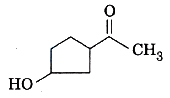
The appropriate reagent for the following transformation is
A
$Zn-Hg / HCl$
B
$H_2N-NH_2, KOH / \text{ethylene glycol}$
C
$Ni / H_2$
D
$NaBH_4$
Solution
(B) The transformation involves the reduction of a ketone group $(-C=O)$ to a methylene group $(-CH_2-)$ in the presence of an alcohol group $(-OH)$.
$Zn-Hg / HCl$ (Clemmensen reduction) is acidic and would cause the dehydration of the alcohol group.
$H_2N-NH_2, KOH / \text{ethylene glycol}$ (Wolff-Kishner reduction) is a basic condition,which is compatible with the presence of an alcohol group.
Therefore,the appropriate reagent is $H_2N-NH_2, KOH / \text{ethylene glycol}$.
$Zn-Hg / HCl$ (Clemmensen reduction) is acidic and would cause the dehydration of the alcohol group.
$H_2N-NH_2, KOH / \text{ethylene glycol}$ (Wolff-Kishner reduction) is a basic condition,which is compatible with the presence of an alcohol group.
Therefore,the appropriate reagent is $H_2N-NH_2, KOH / \text{ethylene glycol}$.
0 likesView Solution
27
ChemistryEasyMCQKCET · 2018
The reaction of Benzenediazonium chloride with aniline yields a yellow dye. The name of the yellow dye is
A
$p$-Hydroxyazobenzene
B
$p$-Aminoazobenzene
C
$p$-Nitroazobenzene
D
$o$-Nitroazobenzene
Solution
(B) The reaction of Benzenediazonium chloride with aniline in the presence of a base is a coupling reaction.
$C_6H_5N_2Cl + C_6H_5NH_2 \xrightarrow{OH^-} C_6H_5-N=N-C_6H_4-NH_2 + HCl$
The product formed is $p$-Aminoazobenzene,which is a yellow dye.
$C_6H_5N_2Cl + C_6H_5NH_2 \xrightarrow{OH^-} C_6H_5-N=N-C_6H_4-NH_2 + HCl$
The product formed is $p$-Aminoazobenzene,which is a yellow dye.
0 likesView Solution
28
ChemistryMediumMCQKCET · 2018
Which of the following will be the most stable diazonium salt $(R-N_2{^+} X^{-})$?
A
$CH_3-N_2{^+} X^{-}$
B
$C_6H_5-N_2{^+} X^{-}$
C
$CH_3-CH_2-N_2{^+} X^{-}$
D
$C_6H_5-CH_2-N_2{^+} X^{-}$
Solution
(B) Primary aromatic amines form arenediazonium salts,such as $C_6H_5-N_2{^+} X^{-}$,which are significantly more stable than aliphatic diazonium salts.
This stability is due to the resonance interaction between the diazonium group and the benzene ring,which delocalizes the positive charge over the aromatic system.
This stability is due to the resonance interaction between the diazonium group and the benzene ring,which delocalizes the positive charge over the aromatic system.
0 likesView Solution
29
ChemistryEasyMCQKCET · 2018
The two forms of $D$-Glucopyranose are called
A
Diastereomers
B
Anomers
C
Epimers
D
Enantiomers
Solution
(B) The two forms of $D$-glucopyranose,known as $\alpha$-$D$-glucopyranose and $\beta$-$D$-glucopyranose,are called anomers.
These forms differ in their configuration only at the $C-1$ carbon atom,which is the anomeric carbon.
These forms differ in their configuration only at the $C-1$ carbon atom,which is the anomeric carbon.
0 likesView Solution
30
ChemistryEasyMCQKCET · 2018
The glycosidic linkage involved in linking the glucose units in the amylose part of starch is
A
$C_{1}-C_{4}$ $\beta$-linkage
B
$C_{1}-C_{6}$ $\alpha$-linkage
C
$C_{1}-C_{6}$ $\beta$-linkage
D
$C_{1}-C_{4}$ $\alpha$-linkage
Solution
(D) Amylose is a linear polymer of $\alpha-D-(+)$-glucose units.
These units are connected by $C_{1}-C_{4}$ glycosidic linkages.
Therefore,the correct option is $D$.
These units are connected by $C_{1}-C_{4}$ glycosidic linkages.
Therefore,the correct option is $D$.
0 likesView Solution
31
ChemistryEasyMCQKCET · 2018
Which of the following bases is not present in $DNA$?
A
Adenine
B
Guanine
C
Cytosine
D
Uracil
Solution
(D) $DNA$ contains four bases,that is,adenine,guanine,cytosine,and thymine.
Uracil is found in $RNA$.
Uracil is found in $RNA$.
0 likesView Solution
32
ChemistryEasyMCQKCET · 2018
For the reaction,$2 \ SO_{2} + O_{2} \rightleftharpoons 2 \ SO_{3}$,the rate of disappearance of $O_{2}$ is $2 \times 10^{-4} \ mol \ L^{-1} \ s^{-1}$. The rate of appearance of $SO_{3}$ is
A
$2 \times 10^{-4} \ mol \ L^{-1} \ s^{-1}$
B
$4 \times 10^{-4} \ mol \ L^{-1} \ s^{-1}$
C
$1 \times 10^{-4} \ mol \ L^{-1} \ s^{-1}$
D
$6 \times 10^{-4} \ mol \ L^{-1} \ s^{-1}$
Solution
(B) For the reaction,$2 \ SO_{2} + O_{2} \rightleftharpoons 2 \ SO_{3}$.
The rate of reaction is given by: $\text{Rate} = -\frac{1}{2} \frac{d[SO_{2}]}{dt} = -\frac{d[O_{2}]}{dt} = +\frac{1}{2} \frac{d[SO_{3}]}{dt}$.
Given that the rate of disappearance of $O_{2}$ is $-\frac{d[O_{2}]}{dt} = 2 \times 10^{-4} \ mol \ L^{-1} \ s^{-1}$.
We need to find the rate of appearance of $SO_{3}$,which is $\frac{d[SO_{3}]}{dt}$.
From the rate expression: $-\frac{d[O_{2}]}{dt} = \frac{1}{2} \frac{d[SO_{3}]}{dt}$.
Therefore,$\frac{d[SO_{3}]}{dt} = 2 \times (-\frac{d[O_{2}]}{dt}) = 2 \times (2 \times 10^{-4} \ mol \ L^{-1} \ s^{-1}) = 4 \times 10^{-4} \ mol \ L^{-1} \ s^{-1}$.
The rate of reaction is given by: $\text{Rate} = -\frac{1}{2} \frac{d[SO_{2}]}{dt} = -\frac{d[O_{2}]}{dt} = +\frac{1}{2} \frac{d[SO_{3}]}{dt}$.
Given that the rate of disappearance of $O_{2}$ is $-\frac{d[O_{2}]}{dt} = 2 \times 10^{-4} \ mol \ L^{-1} \ s^{-1}$.
We need to find the rate of appearance of $SO_{3}$,which is $\frac{d[SO_{3}]}{dt}$.
From the rate expression: $-\frac{d[O_{2}]}{dt} = \frac{1}{2} \frac{d[SO_{3}]}{dt}$.
Therefore,$\frac{d[SO_{3}]}{dt} = 2 \times (-\frac{d[O_{2}]}{dt}) = 2 \times (2 \times 10^{-4} \ mol \ L^{-1} \ s^{-1}) = 4 \times 10^{-4} \ mol \ L^{-1} \ s^{-1}$.
0 likesView Solution
33
ChemistryDifficultMCQKCET · 2018
The temperature coefficient of a reaction is $2$. When the temperature is increased from $30^{\circ}C$ to $90^{\circ}C$, the rate of reaction is increased by (in $times$)
A
$150$
B
$410$
C
$72$
D
$64$
Solution
(D) The formula for the temperature coefficient is given by $\frac{K_{T_{2}}}{K_{T_{1}}} = \mu^{\frac{\Delta T}{10}}$.
Here, $\mu = 2$, $T_{1} = 30^{\circ}C$, and $T_{2} = 90^{\circ}C$.
$\Delta T = T_{2} - T_{1} = 90 - 30 = 60^{\circ}C$.
Substituting the values: $\frac{K_{T_{2}}}{K_{T_{1}}} = 2^{\frac{60}{10}} = 2^{6}$.
$2^{6} = 64$.
Therefore, the rate of reaction increases by $64$ times.
Here, $\mu = 2$, $T_{1} = 30^{\circ}C$, and $T_{2} = 90^{\circ}C$.
$\Delta T = T_{2} - T_{1} = 90 - 30 = 60^{\circ}C$.
Substituting the values: $\frac{K_{T_{2}}}{K_{T_{1}}} = 2^{\frac{60}{10}} = 2^{6}$.
$2^{6} = 64$.
Therefore, the rate of reaction increases by $64$ times.
0 likesView Solution
34
ChemistryEasyMCQKCET · 2018
The value of the rate constant of a pseudo first order reaction:
A
Depends only on temperature
B
Depends on the concentration of reactants present in small amounts
C
Depends on the concentration of reactants present in excess
D
Independent of the concentration of reactants
Solution
(C) pseudo first order reaction is a reaction that appears to be of first order but is actually of a higher order.
In such reactions,one of the reactants is present in a large excess,so its concentration remains effectively constant throughout the reaction.
The rate constant $(k')$ of a pseudo first order reaction is defined as $k' = k[B]$,where $[B]$ is the concentration of the reactant present in excess.
Therefore,the rate constant depends on the concentration of the reactant present in excess.
In such reactions,one of the reactants is present in a large excess,so its concentration remains effectively constant throughout the reaction.
The rate constant $(k')$ of a pseudo first order reaction is defined as $k' = k[B]$,where $[B]$ is the concentration of the reactant present in excess.
Therefore,the rate constant depends on the concentration of the reactant present in excess.
0 likesView Solution
35
ChemistryEasyMCQKCET · 2018
The $IUPAC$ name of $[Co(NH_3)_4 Cl(NO_2)] Cl$ is
A
tetraamminechloridonitrito-$N$-cobalt$(III)$ chloride
B
tetraamminechloridonitrocobalt$(II)$ chloride
C
tetraamminechloridonitrocobalt$(I)$ chloride
D
tetraamminechloridodinitrocobalt$(III)$ chloride
Solution
(A) The oxidation number of $Co$ in the given complex is calculated as follows:
$x + 4(0) + (-1) + (-1) = +1$
$x - 2 = +1$
$x = +3$
The ligands are named in alphabetical order: ammine,chlorido,and nitrito-$N$.
Therefore,the $IUPAC$ name is tetraamminechloridonitrito-$N$-cobalt$(III)$ chloride.
$x + 4(0) + (-1) + (-1) = +1$
$x - 2 = +1$
$x = +3$
The ligands are named in alphabetical order: ammine,chlorido,and nitrito-$N$.
Therefore,the $IUPAC$ name is tetraamminechloridonitrito-$N$-cobalt$(III)$ chloride.
0 likesView Solution
36
ChemistryEasyMCQKCET · 2018
$[Fe(NO_{2})_{3} Cl_{3}]$ and $[Fe(ONO)_{3} Cl_{3}]$ show
A
Linkage isomerism
B
Geometrical isomerism
C
Optical isomerism
D
Hydrate isomerism
Solution
(A) $[Fe(NO_{2})_{3} Cl_{3}]$ and $[Fe(ONO)_{3} Cl_{3}]$ exhibit linkage isomerism.
This occurs because the nitrite ion $(NO_{2}^-)$ is an ambidentate ligand.
It can coordinate to the central metal atom through either the nitrogen atom $(-NO_{2})$ or the oxygen atom $(-ONO)$.
This occurs because the nitrite ion $(NO_{2}^-)$ is an ambidentate ligand.
It can coordinate to the central metal atom through either the nitrogen atom $(-NO_{2})$ or the oxygen atom $(-ONO)$.
0 likesView Solution
37
ChemistryDifficultMCQKCET · 2018
Which of the following is an amphoteric oxide?
A
$V_{2}O_{5}, Cr_{2}O_{3}$
B
$Mn_{2}O_{7}, Cr_{2}O_{3}$
C
$CrO, V_{2}O_{5}$
D
$V_{2}O_{5}, V_{2}O_{4}$
Solution
(A) Amphoteric oxides are those which react with both acids as well as bases.
$V_{2}O_{5}$ and $Cr_{2}O_{3}$ are amphoteric oxides.
$V_{2}O_{5}$ reacts with both acids and bases to form salts.
$Cr_{2}O_{3}$ also exhibits amphoteric character.
$V_{2}O_{5}$ and $Cr_{2}O_{3}$ are amphoteric oxides.
$V_{2}O_{5}$ reacts with both acids and bases to form salts.
$Cr_{2}O_{3}$ also exhibits amphoteric character.
0 likesView Solution
38
ChemistryEasyMCQKCET · 2018
The electronic configuration of transition element $X$ is $[Ar] 3d^5$,and its oxidation state is $+3$. What is its atomic number?
A
$24$
B
$25$
C
$26$
D
$27$
Solution
(C) The electronic configuration of the ion $X^{3+}$ is given as $[Ar] 3d^5$.
To find the atomic number of the neutral element $X$,we add the number of electrons lost during oxidation to the number of electrons in the ion.
Number of electrons in $X^{3+} = 18 (Ar) + 5 (3d) = 23 \ e^-$.
Since the oxidation state is $+3$,the neutral element $X$ has $23 + 3 = 26 \ e^-$.
Therefore,the atomic number of element $X$ is $26$,which corresponds to Iron $(Fe)$.
To find the atomic number of the neutral element $X$,we add the number of electrons lost during oxidation to the number of electrons in the ion.
Number of electrons in $X^{3+} = 18 (Ar) + 5 (3d) = 23 \ e^-$.
Since the oxidation state is $+3$,the neutral element $X$ has $23 + 3 = 26 \ e^-$.
Therefore,the atomic number of element $X$ is $26$,which corresponds to Iron $(Fe)$.
0 likesView Solution
39
ChemistryDifficultMCQKCET · 2018
Which of the following oxidation states is common for all lanthanides?
A
$+2$
B
$+3$
C
$+4$
D
$+5$
Solution
(B) Lanthanoids exhibit a $+3$ oxidation state as the most stable configuration is acquired by losing $3 \ e^{-}$ ions.
0 likesView Solution
40
ChemistryMediumMCQKCET · 2018
For a cell reaction involving two electron changes,$E_{\text{cell}}^{\circ} = 0.3 \text{ V}$ at $25^{\circ}\text{C}$. The equilibrium constant of the reaction is:
A
$10^{-10}$
B
$3 \times 10^{-2}$
C
$10$
D
$10^{10}$
Solution
(D) Given $n = 2$ and $E_{\text{cell}}^{\circ} = 0.3 \text{ V}$.
At $298 \text{ K}$,the relation between $E_{\text{cell}}^{\circ}$ and equilibrium constant $K_c$ is given by the Nernst equation: $E_{\text{cell}}^{\circ} = \frac{0.0591}{n} \log K_c$.
Substituting the values: $0.3 = \frac{0.0591}{2} \log K_c$.
$\log K_c = \frac{0.3 \times 2}{0.0591} = \frac{0.6}{0.0591} \approx 10.15$.
$K_c = \text{antilog}(10.15) \approx 1.41 \times 10^{10}$.
Among the given options,the closest value is $10^{10}$.
At $298 \text{ K}$,the relation between $E_{\text{cell}}^{\circ}$ and equilibrium constant $K_c$ is given by the Nernst equation: $E_{\text{cell}}^{\circ} = \frac{0.0591}{n} \log K_c$.
Substituting the values: $0.3 = \frac{0.0591}{2} \log K_c$.
$\log K_c = \frac{0.3 \times 2}{0.0591} = \frac{0.6}{0.0591} \approx 10.15$.
$K_c = \text{antilog}(10.15) \approx 1.41 \times 10^{10}$.
Among the given options,the closest value is $10^{10}$.
0 likesView Solution
41
ChemistryMediumMCQKCET · 2018
The charge required for the reduction of $1 \ \text{mole}$ of $MnO_4^{-}$ to $MnO_2$ is (in $F$)
A
$1$
B
$3$
C
$5$
D
$7$
Solution
(B) The reduction half-reaction for the conversion of $MnO_4^{-}$ to $MnO_2$ in an acidic medium is given by:
$MnO_4^{-} + 4H^{+} + 3e^{-} \rightarrow MnO_2 + 2H_2O$
From the stoichiometry of the balanced equation,$3 \ \text{moles}$ of electrons are required to reduce $1 \ \text{mole}$ of $MnO_4^{-}$.
Since the charge of $1 \ \text{mole}$ of electrons is $1 \ F$,the total charge required is $3 \ F$.
$MnO_4^{-} + 4H^{+} + 3e^{-} \rightarrow MnO_2 + 2H_2O$
From the stoichiometry of the balanced equation,$3 \ \text{moles}$ of electrons are required to reduce $1 \ \text{mole}$ of $MnO_4^{-}$.
Since the charge of $1 \ \text{mole}$ of electrons is $1 \ F$,the total charge required is $3 \ F$.
0 likesView Solution
42
ChemistryMediumMCQKCET · 2018
At a particular temperature,the ratio of molar conductance to specific conductance of $0.01 \ M$ $NaCl$ solution is
A
$10^{5} \ cm^{3} \ mol^{-1}$
B
$10^{3} \ cm^{3} \ mol^{-1}$
C
$10 \ cm^{3} \ mol^{-1}$
D
$10^{5} \ cm^{2} \ mol^{-1}$
Solution
(A) The molar conductance $(\Lambda_{m})$ is related to specific conductance $(K)$ by the formula: $\Lambda_{m} = \frac{K \times 1000}{C}$.
Rearranging the formula to find the ratio of molar conductance to specific conductance: $\frac{\Lambda_{m}}{K} = \frac{1000}{C}$.
Given the concentration $C = 0.01 \ M$,we substitute the value into the equation:
$\frac{\Lambda_{m}}{K} = \frac{1000}{0.01} = 10^{5} \ cm^{3} \ mol^{-1}$.
Rearranging the formula to find the ratio of molar conductance to specific conductance: $\frac{\Lambda_{m}}{K} = \frac{1000}{C}$.
Given the concentration $C = 0.01 \ M$,we substitute the value into the equation:
$\frac{\Lambda_{m}}{K} = \frac{1000}{0.01} = 10^{5} \ cm^{3} \ mol^{-1}$.
0 likesView Solution
43
ChemistryEasyMCQKCET · 2018
Which of the following is more basic than aniline?
A
Diphenylamine
B
Triphenylamine
C
$p-$nitroaniline
D
Benzylamine
Solution
(D) In aniline,the lone pair of electrons on the nitrogen atom is involved in resonance with the benzene ring,which decreases its availability for protonation.
In $p-$nitroaniline,the $-NO_2$ group is electron-withdrawing,further decreasing the basicity.
In diphenylamine and triphenylamine,the lone pair is delocalized over two and three benzene rings respectively,making them even less basic than aniline.
In benzylamine $(C_6H_5CH_2NH_2)$,the lone pair of electrons on the nitrogen atom is not involved in resonance with the benzene ring because it is separated by a $CH_2$ group.
Therefore,benzylamine is more basic than aniline.
In $p-$nitroaniline,the $-NO_2$ group is electron-withdrawing,further decreasing the basicity.
In diphenylamine and triphenylamine,the lone pair is delocalized over two and three benzene rings respectively,making them even less basic than aniline.
In benzylamine $(C_6H_5CH_2NH_2)$,the lone pair of electrons on the nitrogen atom is not involved in resonance with the benzene ring because it is separated by a $CH_2$ group.
Therefore,benzylamine is more basic than aniline.
0 likesView Solution
44
ChemistryMediumMCQKCET · 2018
The common impurity present in bauxite is
A
$CuO$
B
$ZnO$
C
$Fe_{2}O_{3}$
D
$Cr_{2}O_{3}$
Solution
(C) Bauxite $(AlO_{x}(OH)_{3-2x})$ is the principal ore of aluminum.
It typically contains impurities such as silica $(SiO_{2})$,iron oxides $(Fe_{2}O_{3})$,and titania $(TiO_{2})$.
It typically contains impurities such as silica $(SiO_{2})$,iron oxides $(Fe_{2}O_{3})$,and titania $(TiO_{2})$.
0 likesView Solution
45
ChemistryEasyMCQKCET · 2018
Electrolytic refining is used to purify which of the following metals?
A
$Cu$ and $Zn$
B
$Ge$ and $Si$
C
$Zr$ and $Ti$
D
$Zn$ and $Hg$
Solution
(A) Electrolytic refining is a process used for the purification of metals like $Cu$ and $Zn$.
In this method,the impure metal is made the anode,and a thin strip of pure metal is used as the cathode.
These electrodes are immersed in an electrolytic solution containing a soluble salt of the same metal.
Upon passing an electric current,the pure metal from the anode dissolves into the electrolyte and deposits on the cathode.
In this method,the impure metal is made the anode,and a thin strip of pure metal is used as the cathode.
These electrodes are immersed in an electrolytic solution containing a soluble salt of the same metal.
Upon passing an electric current,the pure metal from the anode dissolves into the electrolyte and deposits on the cathode.
0 likesView Solution
46
ChemistryEasyMCQKCET · 2018
Tertiary alkyl halide is practically $inert$ to substitution by $S_{N}2$ mechanism because of:
A
Insolubility
B
Instability
C
Inductive effect
D
Steric hindrance
Solution
(D) In $S_{N}2$ reactions,the nucleophile attacks the carbon atom bearing the leaving group from the backside.
In tertiary alkyl halides,the central carbon is surrounded by three bulky alkyl groups.
These bulky groups create significant $steric \text{ } hindrance$,which blocks the path of the incoming nucleophile.
Due to this,the rate of $S_{N}2$ reaction is extremely low for tertiary alkyl halides.
Therefore,the order of reactivity for $S_{N}2$ mechanism is $1^{\circ} > 2^{\circ} > 3^{\circ}$.
In tertiary alkyl halides,the central carbon is surrounded by three bulky alkyl groups.
These bulky groups create significant $steric \text{ } hindrance$,which blocks the path of the incoming nucleophile.
Due to this,the rate of $S_{N}2$ reaction is extremely low for tertiary alkyl halides.
Therefore,the order of reactivity for $S_{N}2$ mechanism is $1^{\circ} > 2^{\circ} > 3^{\circ}$.
0 likesView Solution
47
ChemistryEasyMCQKCET · 2018
Which of the following statements is true in the case of alkyl halides?
A
They are polar in nature
B
They can form hydrogen bonds
C
They are highly soluble in water
D
They undergo addition reactions
Solution
(A) Alkyl halides $(R-X)$ are polar in nature because the halogen atom is more electronegative than the carbon atom,creating a dipole with a partial positive charge on carbon and a partial negative charge on the halogen.
They do not form hydrogen bonds with water molecules,which makes them insoluble in water.
They typically undergo substitution or elimination reactions,not addition reactions.
They do not form hydrogen bonds with water molecules,which makes them insoluble in water.
They typically undergo substitution or elimination reactions,not addition reactions.
0 likesView Solution
48
ChemistryMediumMCQKCET · 2018
Which of the following compounds undergoes haloform reaction?
A
$CH_3COCH_3$
B
$HCHO$
C
$CH_3CH_2Br$
D
$CH_3-O-CH_3$
Solution
(A) Compounds containing the $CH_3CO-$ group or the $CH_3CH(OH)-$ group undergo the haloform reaction.
$CH_3COCH_3$ (acetone) contains the $CH_3CO-$ group,therefore,it gives a positive haloform test.
The reaction is as follows:
$CH_3COCH_3 + 3I_2 + 4NaOH \rightarrow CH_3COONa + CHI_3 \downarrow + 3NaI + 3H_2O$
Here,$CHI_3$ (iodoform) is obtained as a yellow precipitate.
$CH_3COCH_3$ (acetone) contains the $CH_3CO-$ group,therefore,it gives a positive haloform test.
The reaction is as follows:
$CH_3COCH_3 + 3I_2 + 4NaOH \rightarrow CH_3COONa + CHI_3 \downarrow + 3NaI + 3H_2O$
Here,$CHI_3$ (iodoform) is obtained as a yellow precipitate.
0 likesView Solution
49
ChemistryMediumMCQKCET · 2018
The products $X$ and $Z$ in the following reaction sequence are:
$\text{Benzene} + CH_3-CH=CH_2$ $\xrightarrow{AlCl_3/\text{ether}, \text{Heat}} X$ $\xrightarrow{O_2/130^{\circ}C} Z$
$\text{Benzene} + CH_3-CH=CH_2$ $\xrightarrow{AlCl_3/\text{ether}, \text{Heat}} X$ $\xrightarrow{O_2/130^{\circ}C} Z$
A
Isopropylbenzene and acetone
B
Cumene peroxide and acetone
C
Isopropylbenzene and isopropyl alcohol
D
Phenol and acetone
Solution
(D) The reaction sequence is the industrial preparation of phenol from cumene.
Step $1$: Benzene reacts with propene in the presence of $AlCl_3/\text{ether}$ and heat to form isopropylbenzene,which is also known as cumene $(X)$.
Step $2$: Cumene $(X)$ is then oxidized by $O_2$ at $130^{\circ}C$ to form cumene hydroperoxide,which upon further treatment with acid yields phenol and acetone $(Z)$.
Therefore,$X$ is isopropylbenzene (cumene) and $Z$ represents the final products,phenol and acetone.
Step $1$: Benzene reacts with propene in the presence of $AlCl_3/\text{ether}$ and heat to form isopropylbenzene,which is also known as cumene $(X)$.
Step $2$: Cumene $(X)$ is then oxidized by $O_2$ at $130^{\circ}C$ to form cumene hydroperoxide,which upon further treatment with acid yields phenol and acetone $(Z)$.
Therefore,$X$ is isopropylbenzene (cumene) and $Z$ represents the final products,phenol and acetone.
0 likesView Solution
50
ChemistryDifficultMCQKCET · 2018
In the following reaction sequence,identify the compound $Z$ if the starting material is toluene $(C_6H_5CH_3)$:
$C_6H_5CH_3 \xrightarrow{CrO_2Cl_2 / CS_2, H_3O^+} Z$
$C_6H_5CH_3 \xrightarrow{CrO_2Cl_2 / CS_2, H_3O^+} Z$
A
Benzoic acid
B
Benzaldehyde
C
Acetophenone
D
Benzene
Solution
(B) The reaction of toluene $(C_6H_5CH_3)$ with chromyl chloride $(CrO_2Cl_2)$ in the presence of carbon disulfide $(CS_2)$ followed by hydrolysis is known as the Etard reaction.
This reaction specifically oxidizes the methyl group of toluene to a formyl group,resulting in the formation of benzaldehyde $(C_6H_5CHO)$.
Therefore,the compound $Z$ is benzaldehyde.
This reaction specifically oxidizes the methyl group of toluene to a formyl group,resulting in the formation of benzaldehyde $(C_6H_5CHO)$.
Therefore,the compound $Z$ is benzaldehyde.
0 likesView Solution
51
ChemistryMediumMCQKCET · 2018
When $PbO_2$ reacts with concentrated $HNO_3$,the gas evolved is
A
$NO_2$
B
$O_2$
C
$N_2$
D
$N_2O$
Solution
(B) The reaction between lead dioxide $(PbO_2)$ and concentrated nitric acid $(HNO_3)$ is a redox reaction.
$PbO_2$ acts as an oxidizing agent and oxidizes water to oxygen gas.
The balanced chemical equation is:
$2PbO_2 + 4HNO_3 \rightarrow 2Pb(NO_3)_2 + 2H_2O + O_2$
Thus,the gas evolved is oxygen $(O_2)$.
$PbO_2$ acts as an oxidizing agent and oxidizes water to oxygen gas.
The balanced chemical equation is:
$2PbO_2 + 4HNO_3 \rightarrow 2Pb(NO_3)_2 + 2H_2O + O_2$
Thus,the gas evolved is oxygen $(O_2)$.
0 likesView Solution
52
ChemistryMediumMCQKCET · 2018
Very pure $N_2$ can be obtained by
A
Thermal decomposition of ammonium dichromate
B
Treating aqueous solution of $NH_4Cl$ and $NaNO_2$
C
Liquefaction and fractional distillation of liquid air
D
Thermal decomposition of sodium azide
Solution
(D) Very pure nitrogen gas is obtained by the thermal decomposition of sodium azide $(NaN_3)$.
The chemical reaction is:
$2NaN_3 \rightarrow 2Na + 3N_2$
This method is commonly used in automobile airbags.
The chemical reaction is:
$2NaN_3 \rightarrow 2Na + 3N_2$
This method is commonly used in automobile airbags.
0 likesView Solution
53
ChemistryEasyMCQKCET · 2018
Among the following,the branched chain polymer is
A
Polyvinyl chloride
B
Bakelite
C
Low density polythene
D
High density polythene
Solution
(C) Low density polythene $(LDPE)$ is prepared by the polymerization of ethene under high pressure and temperature in the presence of traces of dioxygen or a peroxide initiator.
This process involves free radical addition and $H$-atom abstraction,which results in a highly branched structure.
This process involves free radical addition and $H$-atom abstraction,which results in a highly branched structure.
0 likesView Solution
54
ChemistryEasyMCQKCET · 2018
Ziegler-Natta catalyst is used to prepare
A
Low-density polythene
B
Teflon
C
High-density polythene
D
Nylon-$6$
Solution
(C) Ziegler-Natta catalyst is a mixture of $TiCl_4$ and $Al(C_2H_5)_3$ (titanium tetrachloride and triethylaluminium).
It is specifically used in the polymerization of ethene to produce high-density polythene $(HDP)$.
This process occurs at a temperature of $333 \ K$ to $343 \ K$ under a pressure of $6-7 \ atm$.
It is specifically used in the polymerization of ethene to produce high-density polythene $(HDP)$.
This process occurs at a temperature of $333 \ K$ to $343 \ K$ under a pressure of $6-7 \ atm$.
0 likesView Solution
55
ChemistryEasyMCQKCET · 2018
Which one of the following is a polyamide polymer?
A
$Terylene$
B
$Nylon-6,6$
C
$Buna-S$
D
$Bakelite$
Solution
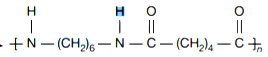
(B) $Nylon-6,6$ is a polyamide polymer because it contains amide linkages $(-CONH-)$ formed by the condensation polymerization of hexamethylenediamine and adipic acid.
0 likesView Solution
56
ChemistryDifficultMCQKCET · 2018
Which of the following oxides shows electrical properties like metals?
A
$SiO_{2}$
B
$MgO$
C
$SO_{2} \ (s)$
D
$CrO_{2}$
Solution
(D) Some transition metal oxides exhibit electrical conductivity similar to metals.
Specifically,$TiO$,$CrO_{2}$,and $ReO_{3}$ are known to behave like metals in terms of their electrical properties.
Specifically,$TiO$,$CrO_{2}$,and $ReO_{3}$ are known to behave like metals in terms of their electrical properties.
0 likesView Solution
57
ChemistryEasyMCQKCET · 2018
Which of the following is not a conductor of electricity?
A
Solid $NaCl$
B
$Cu$
C
Fused $NaCl$
D
Brine solution
Solution
(A) Solid $NaCl$ is a bad conductor of electricity because the ions are held in a rigid crystal lattice and are not free to move to carry charge.
In contrast,$Cu$ is a metallic conductor,while fused $NaCl$ and brine solution contain free ions that allow them to conduct electricity.
In contrast,$Cu$ is a metallic conductor,while fused $NaCl$ and brine solution contain free ions that allow them to conduct electricity.
0 likesView Solution
58
ChemistryMediumMCQKCET · 2018
The edge length of a cube is $300 \ pm$. Its body diagonal would be: (in $pm$)
A
$600$
B
$423$
C
$519.6$
D
$450.5$
Solution
(C) The formula for the body diagonal of a cube is given by $\sqrt{3} \times a$, where $a$ is the edge length of the cube.
Given, $a = 300 \ pm$.
Body diagonal $= \sqrt{3} \times 300 \ pm$.
Using $\sqrt{3} \approx 1.732$, we get:
Body diagonal $= 1.732 \times 300 \ pm = 519.6 \ pm$.
Given, $a = 300 \ pm$.
Body diagonal $= \sqrt{3} \times 300 \ pm$.
Using $\sqrt{3} \approx 1.732$, we get:
Body diagonal $= 1.732 \times 300 \ pm = 519.6 \ pm$.
0 likesView Solution
59
ChemistryEasyMCQKCET · 2018
In $F.C.C.$,each face of the unit cell is shared equally by how many unit cells?
A
$10$
B
$08$
C
$06$
D
$12$
Solution
(C) In a face-centered cubic $(F.C.C.)$ unit cell,the atoms present at the face centers are shared between two adjacent unit cells.
However,the question asks about the sharing of the face itself. Each face of a cube is common to $2$ adjacent unit cells.
If the question implies how many faces are present in a unit cell,there are $6$ faces.
Given the standard interpretation of this specific question in chemistry textbooks,it refers to the number of faces in a unit cell,which is $6$.
However,the question asks about the sharing of the face itself. Each face of a cube is common to $2$ adjacent unit cells.
If the question implies how many faces are present in a unit cell,there are $6$ faces.
Given the standard interpretation of this specific question in chemistry textbooks,it refers to the number of faces in a unit cell,which is $6$.
0 likesView Solution
60
ChemistryMediumMCQKCET · 2018
Which of the following aqueous solutions should have the highest boiling point?
A
$1.0 \ M \ NaOH$
B
$1.0 \ M \ Na_{2}SO_{4}$
C
$1.0 \ M \ NH_{4}NO_{3}$
D
$1.0 \ M \ KNO_{3}$
Solution
(B) The elevation in boiling point is a colligative property,which depends on the total number of solute particles in the solution.
For solutions with the same molar concentration,the one that produces the highest number of ions upon dissociation will exhibit the highest boiling point.
Since $Na_{2}SO_{4}$ produces the maximum number of ions ($3$ ions per formula unit),it will have the highest boiling point.
For solutions with the same molar concentration,the one that produces the highest number of ions upon dissociation will exhibit the highest boiling point.
| Aqueous Solution | Number of Ions Produced |
|---|---|
| $1.0 \ M \ NaOH \rightarrow Na^{+} + OH^{-}$ | $2$ |
| $1.0 \ M \ Na_{2}SO_{4} \rightarrow 2Na^{+} + SO_{4}^{2-}$ | $3$ |
| $1.0 \ M \ NH_{4}NO_{3} \rightarrow NH_{4}^{+} + NO_{3}^{-}$ | $2$ |
| $1.0 \ M \ KNO_{3} \rightarrow K^{+} + NO_{3}^{-}$ | $2$ |
Since $Na_{2}SO_{4}$ produces the maximum number of ions ($3$ ions per formula unit),it will have the highest boiling point.
0 likesView Solution
61
ChemistryMediumMCQKCET · 2018
Isotonic solutions are solutions having the same
A
Surface tension
B
Vapour pressure
C
Osmotic pressure
D
Viscosity
Solution
(C) Isotonic solutions are defined as solutions that exhibit the same osmotic pressure at a given temperature.
Mathematically,for two isotonic solutions,$\Pi_{1} = \Pi_{2}$.
Mathematically,for two isotonic solutions,$\Pi_{1} = \Pi_{2}$.
0 likesView Solution
62
ChemistryEasyMCQKCET · 2018
Which of the following electrolytes will have maximum coagulating value for $AgI / Ag^{+}$ sol?
A
$Na_{2}S$
B
$Na_{3}PO_{4}$
C
$Na_{2}SO_{4}$
D
$NaCl$
Solution
(D) The $AgI / Ag^{+}$ sol is a positively charged sol. According to the Hardy-Schulze rule,the coagulating power of an electrolyte depends on the valency of the oppositely charged ion (anion in this case).
Greater the valency of the flocculating ion,greater is its coagulating power.
Coagulating power is inversely proportional to the coagulating value.
The valency of the anions are: $PO_{4}^{3-} (3) > SO_{4}^{2-} (2) = S^{2-} (2) > Cl^{-} (1)$.
Since $Cl^{-}$ has the lowest valency,it has the minimum coagulating power and therefore the maximum coagulating value.
Greater the valency of the flocculating ion,greater is its coagulating power.
Coagulating power is inversely proportional to the coagulating value.
The valency of the anions are: $PO_{4}^{3-} (3) > SO_{4}^{2-} (2) = S^{2-} (2) > Cl^{-} (1)$.
Since $Cl^{-}$ has the lowest valency,it has the minimum coagulating power and therefore the maximum coagulating value.
0 likesView Solution
63
ChemistryEasyMCQKCET · 2018
Gold sol is not a
A
Lyophobic sol
B
Negatively charged sol
C
Macromolecular sol
D
Multimolecular colloid
Solution
(C) Gold sol is a $multimolecular$ colloid because it consists of aggregates of a large number of gold atoms $(Au_n)$ with diameters less than $1 \ nm$. It is a $lyophobic$ sol and is $negatively$ charged. It is not a $macromolecular$ colloid,as macromolecular colloids are formed by large molecules like starch or proteins.
0 likesView Solution
Vedclass Products
For Students
Vedclass Test Series
Mock tests in real KCET style covering Chemistry with performance analysis. 5-day free trial.
Start Free TrialFor Teachers
Exam Paper Generator
Generate Set A/B/C/D Chemistry papers from 7.5L+ questions in 2 minutes. 3 chapters free.
Try FreeFor Institutes
Online Exam Module
Run live KCET mock exams with unlimited students, 360° analytics & white-label branding.
See DemoFrequently Asked Questions
How many Chemistry questions are in KCET 2018?
There are 63 Chemistry questions from the KCET 2018 paper on Vedclass, each with a detailed step-by-step solution in English.
Are KCET 2018 Chemistry solutions available in English?
Yes. All solutions on this page are in English. You can also switch to English or Hindi using the language buttons above the questions.
Can I practice KCET 2018 Chemistry as a timed test?
Yes. Use the Vedclass Test Series to attempt a full KCET mock test covering Chemistry with time limits and instant score analysis.
Can teachers create Chemistry papers from KCET previous year questions?
Yes. The Vedclass Exam Paper Generator lets teachers mix KCET Chemistry questions and generate Set A/B/C/D papers in minutes.
For Teachers & Institutes
Build a Custom Chemistry Paper
Pick KCET 2018 Chemistry questions, set difficulty, and generate Set A/B/C/D in 2 minutes.