
ChemistryQ1–61 of 61 questions
Page 1 of 1 · English
1
ChemistryMCQKCET · 2023
If $y = a \sin x + b \cos x$,then $y^2 + \left( \frac{dy}{dx} \right)^2$ is a
A
Function of $x$
B
Function of $y$
C
Function of $x$ and $y$
D
Constant
Solution
(D) Given $y = a \sin x + b \cos x$.
Differentiating with respect to $x$,we get:
$\frac{dy}{dx} = a \cos x - b \sin x$.
Now,calculating the square of the derivative:
$\left( \frac{dy}{dx} \right)^2 = (a \cos x - b \sin x)^2 = a^2 \cos^2 x + b^2 \sin^2 x - 2ab \sin x \cos x$.
Calculating the square of $y$:
$y^2 = (a \sin x + b \cos x)^2 = a^2 \sin^2 x + b^2 \cos^2 x + 2ab \sin x \cos x$.
Adding both expressions:
$y^2 + \left( \frac{dy}{dx} \right)^2 = (a^2 \sin^2 x + b^2 \cos^2 x + 2ab \sin x \cos x) + (a^2 \cos^2 x + b^2 \sin^2 x - 2ab \sin x \cos x)$.
Grouping the terms:
$y^2 + \left( \frac{dy}{dx} \right)^2 = a^2(\sin^2 x + \cos^2 x) + b^2(\cos^2 x + \sin^2 x)$.
Since $\sin^2 x + \cos^2 x = 1$,we get:
$y^2 + \left( \frac{dy}{dx} \right)^2 = a^2(1) + b^2(1) = a^2 + b^2$.
Since $a$ and $b$ are constants,$a^2 + b^2$ is a constant.
Therefore,the correct option is $D$.
Differentiating with respect to $x$,we get:
$\frac{dy}{dx} = a \cos x - b \sin x$.
Now,calculating the square of the derivative:
$\left( \frac{dy}{dx} \right)^2 = (a \cos x - b \sin x)^2 = a^2 \cos^2 x + b^2 \sin^2 x - 2ab \sin x \cos x$.
Calculating the square of $y$:
$y^2 = (a \sin x + b \cos x)^2 = a^2 \sin^2 x + b^2 \cos^2 x + 2ab \sin x \cos x$.
Adding both expressions:
$y^2 + \left( \frac{dy}{dx} \right)^2 = (a^2 \sin^2 x + b^2 \cos^2 x + 2ab \sin x \cos x) + (a^2 \cos^2 x + b^2 \sin^2 x - 2ab \sin x \cos x)$.
Grouping the terms:
$y^2 + \left( \frac{dy}{dx} \right)^2 = a^2(\sin^2 x + \cos^2 x) + b^2(\cos^2 x + \sin^2 x)$.
Since $\sin^2 x + \cos^2 x = 1$,we get:
$y^2 + \left( \frac{dy}{dx} \right)^2 = a^2(1) + b^2(1) = a^2 + b^2$.
Since $a$ and $b$ are constants,$a^2 + b^2$ is a constant.
Therefore,the correct option is $D$.
0 likesView Solution
2
ChemistryDifficultMCQKCET · 2023
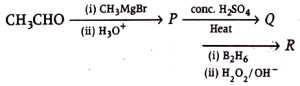
Compounds $P$ and $R$ in the following reaction are:
A
Position isomers
B
Functional isomers
C
Metamers
D
Chain isomers
Solution
(A) $1$. The reaction sequence is as follows:
$CH_3CHO \xrightarrow[(ii) H_3O^+]{(i) CH_3MgBr} CH_3-CH(OH)-CH_3 (P)$
$CH_3-CH(OH)-CH_3 \xrightarrow[\Delta]{conc. H_2SO_4} CH_3-CH=CH_2 (Q)$
$CH_3-CH=CH_2 \xrightarrow[(ii) H_2O_2/OH^-]{(i) B_2H_6} CH_3-CH_2-CH_2OH (R)$
$2$. Compound $P$ is propan$-2-$ol $(CH_3-CH(OH)-CH_3)$ and compound $R$ is propan$-1-$ol $(CH_3-CH_2-CH_2OH)$.
$3$. Both compounds have the same molecular formula $(C_3H_8O)$ and the same functional group $(-OH)$,but the position of the hydroxyl group is different (carbon-$2$ in $P$ and carbon-$1$ in $R$).
$4$. Therefore,$P$ and $R$ are position isomers.
$CH_3CHO \xrightarrow[(ii) H_3O^+]{(i) CH_3MgBr} CH_3-CH(OH)-CH_3 (P)$
$CH_3-CH(OH)-CH_3 \xrightarrow[\Delta]{conc. H_2SO_4} CH_3-CH=CH_2 (Q)$
$CH_3-CH=CH_2 \xrightarrow[(ii) H_2O_2/OH^-]{(i) B_2H_6} CH_3-CH_2-CH_2OH (R)$
$2$. Compound $P$ is propan$-2-$ol $(CH_3-CH(OH)-CH_3)$ and compound $R$ is propan$-1-$ol $(CH_3-CH_2-CH_2OH)$.
$3$. Both compounds have the same molecular formula $(C_3H_8O)$ and the same functional group $(-OH)$,but the position of the hydroxyl group is different (carbon-$2$ in $P$ and carbon-$1$ in $R$).
$4$. Therefore,$P$ and $R$ are position isomers.
0 likesView Solution
3
ChemistryMediumMCQKCET · 2023
In solid state,$PCl_5$ is a/an
A
octahedral structure
B
ionic solid with $[PCl_6]^{+}$ and $[PCl_4]^{-}$
C
ionic solid with $[PCl_4]^{+}$ and $[PCl_6]^{-}$
D
covalent solid present in the form of $P_2Cl_{10}$
Solution
(C) In the solid state,$PCl_5$ exists as an ionic solid.
It consists of a tetrahedral $[PCl_4]^{+}$ cation and an octahedral $[PCl_6]^{-}$ anion.
This structure is formed due to the transfer of a chloride ion from one $PCl_5$ molecule to another.
It consists of a tetrahedral $[PCl_4]^{+}$ cation and an octahedral $[PCl_6]^{-}$ anion.
This structure is formed due to the transfer of a chloride ion from one $PCl_5$ molecule to another.
0 likesView Solution
4
ChemistryMediumMCQKCET · 2023
Which of the following statements is incorrect?
A
Bond length of $O_2 >$ Bond length of $O_2^{2+}$
B
Bond order of $O_2^+ < $ Bond order of $O_2^{2-}$
C
Bond length of $O_2 >$ Bond length of $O_2^{2-}$
D
Bond order of $O_2 >$ Bond order of $O_2^{2-}$
Solution
(B) The bond order values for the given species are as follows:
$O_2^{2+} = 3.0$
$O_2^+ = 2.5$
$O_2 = 2.0$
$O_2^- = 1.5$
$O_2^{2-} = 1.0$
Bond order is inversely proportional to bond length (Bond length $\propto \frac{1}{\text{Bond order}}$).
Evaluating the options:
$(A)$ Bond length of $O_2 > O_2^{2+}$: Correct (since $2.0 < 3.0$ in bond order).
$(B)$ Bond order of $O_2^+ < O_2^{2-}$: Incorrect ($2.5 < 1.0$ is false).
$(C)$ Bond length of $O_2 > O_2^{2-}$: Correct (since $2.0 < 1.0$ in bond order).
$(D)$ Bond order of $O_2 > O_2^{2-}$: Correct ($2.0 > 1.0$ is true).
Thus,the incorrect statement is option $(B)$.
$O_2^{2+} = 3.0$
$O_2^+ = 2.5$
$O_2 = 2.0$
$O_2^- = 1.5$
$O_2^{2-} = 1.0$
Bond order is inversely proportional to bond length (Bond length $\propto \frac{1}{\text{Bond order}}$).
Evaluating the options:
$(A)$ Bond length of $O_2 > O_2^{2+}$: Correct (since $2.0 < 3.0$ in bond order).
$(B)$ Bond order of $O_2^+ < O_2^{2-}$: Incorrect ($2.5 < 1.0$ is false).
$(C)$ Bond length of $O_2 > O_2^{2-}$: Correct (since $2.0 < 1.0$ in bond order).
$(D)$ Bond order of $O_2 > O_2^{2-}$: Correct ($2.0 > 1.0$ is true).
Thus,the incorrect statement is option $(B)$.
0 likesView Solution
5
ChemistryEasyMCQKCET · 2023
At $500 \ K$,for a reversible reaction $A_{2(g)} + B_{2(g)} \rightleftharpoons 2 AB_{(g)}$ in a closed container,$K_C = 2 \times 10^{-5}$. In the presence of a catalyst,the equilibrium is attained $10$ times faster. The equilibrium constant $K_C$ in the presence of a catalyst at the same temperature is:
A
$2 \times 10^{-4}$
B
$2 \times 10^{-6}$
C
$2 \times 10^{-10}$
D
$2 \times 10^{-5}$
Solution
(D) The value of the equilibrium constant $K_C$ depends only on the temperature of the reaction.
Catalysts increase the rate of both the forward and backward reactions equally,allowing the system to reach equilibrium faster,but they do not change the position of the equilibrium or the value of $K_C$.
Since the temperature remains constant at $500 \ K$,the value of $K_C$ remains unchanged.
Therefore,the equilibrium constant $K_C$ in the presence of a catalyst is $2 \times 10^{-5}$.
Catalysts increase the rate of both the forward and backward reactions equally,allowing the system to reach equilibrium faster,but they do not change the position of the equilibrium or the value of $K_C$.
Since the temperature remains constant at $500 \ K$,the value of $K_C$ remains unchanged.
Therefore,the equilibrium constant $K_C$ in the presence of a catalyst is $2 \times 10^{-5}$.
0 likesView Solution
6
ChemistryEasyMCQKCET · 2023
The correct order of first ionisation enthalpy of the given elements is:
A
$Li < B < Be < C$
B
$Be < Li < B < C$
C
$C < B < Be < Li$
D
$Li < Be < B < C$
Solution
(A) The first ionisation enthalpy generally increases as we move from left to right across a period due to an increase in effective nuclear charge.
However,$Be$ $(1s^2 2s^2)$ has a fully-filled $2s$ subshell,which is more stable than the $2p^1$ configuration of $B$ $(1s^2 2s^2 2p^1)$.
Therefore,$Be$ has a higher first ionisation enthalpy than $B$.
The correct order is $Li < B < Be < C$.
However,$Be$ $(1s^2 2s^2)$ has a fully-filled $2s$ subshell,which is more stable than the $2p^1$ configuration of $B$ $(1s^2 2s^2 2p^1)$.
Therefore,$Be$ has a higher first ionisation enthalpy than $B$.
The correct order is $Li < B < Be < C$.
0 likesView Solution
7
ChemistryEasyMCQKCET · 2023
Which one of the following gases converts haemoglobin into carboxyhaemoglobin?
A
$CO$
B
$O_2$
C
$NO$
D
$CO_2$
Solution
(A) Carbon monoxide $(CO)$ converts haemoglobin into carboxyhaemoglobin.
When $CO$ is inhaled,it binds to haemoglobin in red blood cells with an affinity approximately $200$ to $300$ times higher than that of oxygen.
This binding forms carboxyhaemoglobin,which is a stable complex that prevents the normal binding of oxygen to haemoglobin.
Consequently,this leads to a significantly decreased oxygen-carrying capacity of the blood,which can be fatal.
When $CO$ is inhaled,it binds to haemoglobin in red blood cells with an affinity approximately $200$ to $300$ times higher than that of oxygen.
This binding forms carboxyhaemoglobin,which is a stable complex that prevents the normal binding of oxygen to haemoglobin.
Consequently,this leads to a significantly decreased oxygen-carrying capacity of the blood,which can be fatal.
0 likesView Solution
8
ChemistryEasyMCQKCET · 2023
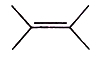
The $IUPAC$ name of the given compound is:
A
$2,3-$dimethylbut$-2-$ene
B
$2,3-$dimethylbutyne
C
$1,1,2,2-$tetramethylethene
D
$2,3-$dimethylbutene
Solution
(A) The given structure is a hydrocarbon with a double bond between two carbon atoms.
To name it according to $IUPAC$ rules:
$1$. Identify the longest carbon chain containing the double bond. The longest chain has $4$ carbon atoms,so the parent alkane is butane,and the alkene is but$-2-$ene.
$2$. Number the chain from the end that gives the double bond the lowest locant. In this case,numbering from either side gives the double bond the position $2$.
$3$. Identify the substituents. There are two methyl groups attached at positions $2$ and $3$.
$4$. Combining these,the $IUPAC$ name is $2,3-$dimethylbut$-2-$ene.
To name it according to $IUPAC$ rules:
$1$. Identify the longest carbon chain containing the double bond. The longest chain has $4$ carbon atoms,so the parent alkane is butane,and the alkene is but$-2-$ene.
$2$. Number the chain from the end that gives the double bond the lowest locant. In this case,numbering from either side gives the double bond the position $2$.
$3$. Identify the substituents. There are two methyl groups attached at positions $2$ and $3$.
$4$. Combining these,the $IUPAC$ name is $2,3-$dimethylbut$-2-$ene.
0 likesView Solution
9
ChemistryMediumMCQKCET · 2023
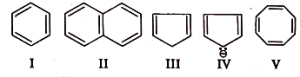
Among the following,the set which represents aromatic species is:
A
$I, II$ and $III$
B
$III, IV$ and $V$
C
$II$ and $III$
D
$I, II$ and $IV$
Solution
(D) species is aromatic if it follows $H$ückel's rule,which states it must be planar,cyclic,fully conjugated,and contain $(4n+2)$ $\pi$-electrons,where $n = 0, 1, 2, \dots$
$I$ (Benzene): Planar,cyclic,fully conjugated,$6$ $\pi$-electrons $(n=1)$. It is aromatic.
$II$ (Naphthalene): Planar,cyclic,fully conjugated,$10$ $\pi$-electrons $(n=2)$. It is aromatic.
$III$ (Cyclopentadiene): Not fully conjugated because of the $sp^3$ hybridized carbon. It is non-aromatic.
$IV$ (Cyclopentadienyl anion): Planar,cyclic,fully conjugated,$6$ $\pi$-electrons $(n=1)$. It is aromatic.
$V$ (Cyclooctatetraene): It has $8$ $\pi$-electrons ($4n$ system,$n=2$) and is non-planar (tub-shaped). It is non-aromatic.
Thus,the aromatic species are $I, II$ and $IV$.
$I$ (Benzene): Planar,cyclic,fully conjugated,$6$ $\pi$-electrons $(n=1)$. It is aromatic.
$II$ (Naphthalene): Planar,cyclic,fully conjugated,$10$ $\pi$-electrons $(n=2)$. It is aromatic.
$III$ (Cyclopentadiene): Not fully conjugated because of the $sp^3$ hybridized carbon. It is non-aromatic.
$IV$ (Cyclopentadienyl anion): Planar,cyclic,fully conjugated,$6$ $\pi$-electrons $(n=1)$. It is aromatic.
$V$ (Cyclooctatetraene): It has $8$ $\pi$-electrons ($4n$ system,$n=2$) and is non-planar (tub-shaped). It is non-aromatic.
Thus,the aromatic species are $I, II$ and $IV$.
0 likesView Solution
10
ChemistryMediumMCQKCET · 2023
$A$ pair of compounds having the same boiling points are
A
$cis$-but-$2$-ene and $trans$-but-$2$-ene
B
$n$-hexane and neo-hexane
C
benzene and naphthalene
D
$(+)$ butan-$2$-ol and $(-)$ butan-$2$-ol
Solution
(D) Enantiomers,such as $(+)$ butan-$2$-ol and $(-)$ butan-$2$-ol,are non-superimposable mirror images of each other.
They possess identical physical properties,including boiling points,melting points,and refractive indices,in an achiral environment.
They differ only in their interaction with plane-polarized light and their reactivity with other chiral substances.
Therefore,$(+)$ butan-$2$-ol and $(-)$ butan-$2$-ol have the same boiling point.
They possess identical physical properties,including boiling points,melting points,and refractive indices,in an achiral environment.
They differ only in their interaction with plane-polarized light and their reactivity with other chiral substances.
Therefore,$(+)$ butan-$2$-ol and $(-)$ butan-$2$-ol have the same boiling point.
0 likesView Solution
11
ChemistryEasyMCQKCET · 2023
The composition of water gas is
A
$CO_{(g)} + N_{2(g)}$
B
$CH_{4(g)}$
C
$CO_{(g)} + H_2O_{(g)}$
D
$CO_{(g)} + H_{2(g)}$
Solution
(D) Water gas is primarily composed of carbon monoxide and hydrogen gas,i.e.,$CO_{(g)} + H_{2(g)}$.
It is a valuable industrial feedstock and is used in the production of chemicals,fuels,and as a reducing agent in metallurgical applications.
It is a valuable industrial feedstock and is used in the production of chemicals,fuels,and as a reducing agent in metallurgical applications.
0 likesView Solution
12
ChemistryMediumMCQKCET · 2023
$A$ $30 \%$ solution of hydrogen peroxide is
A
$30$ volume hydrogen peroxide
B
$10$ volume hydrogen peroxide
C
$50$ volume hydrogen peroxide
D
$100$ volume hydrogen peroxide
Solution
(D) $30 \% (w/v)$ solution of $H_2O_2$ means that $30 \ g$ of $H_2O_2$ is present in $100 \ mL$ of the solution.
The molarity of this solution is calculated as: $M = \frac{30 \ g / 34 \ g/mol}{0.1 \ L} \approx 8.82 \ M$.
The volume strength of $H_2O_2$ is given by the formula: $\text{Volume strength} = 5.6 \times \text{Molarity}$.
Therefore,$\text{Volume strength} = 5.6 \times 8.82 \approx 49.4 \approx 50 \ V$ (often approximated as $100 \ V$ in some contexts,but strictly $30 \% (w/v)$ corresponds to approximately $100 \ V$ based on standard industrial definitions where $1 \ mL$ of $30 \% H_2O_2$ yields $100 \ mL$ of $O_2$ gas).
The molarity of this solution is calculated as: $M = \frac{30 \ g / 34 \ g/mol}{0.1 \ L} \approx 8.82 \ M$.
The volume strength of $H_2O_2$ is given by the formula: $\text{Volume strength} = 5.6 \times \text{Molarity}$.
Therefore,$\text{Volume strength} = 5.6 \times 8.82 \approx 49.4 \approx 50 \ V$ (often approximated as $100 \ V$ in some contexts,but strictly $30 \% (w/v)$ corresponds to approximately $100 \ V$ based on standard industrial definitions where $1 \ mL$ of $30 \% H_2O_2$ yields $100 \ mL$ of $O_2$ gas).
0 likesView Solution
13
ChemistryMediumMCQKCET · 2023
$A$ weak acid with $pK_a$ $5.9$ and a weak base with $pK_b$ $5.8$ are mixed in equal proportions. The $pH$ of the resulting solution is:
A
$7.005$
B
$7.5$
C
$7$
D
$7.05$
Solution
(D) The $pH$ of a salt solution formed by a weak acid and a weak base is given by the formula:
$pH = 7 + \frac{1}{2}(pK_a - pK_b)$
Given: $pK_a = 5.9$,$pK_b = 5.8$
Substituting the values:
$pH = 7 + \frac{1}{2}(5.9 - 5.8)$
$pH = 7 + \frac{1}{2}(0.1)$
$pH = 7 + 0.05 = 7.05$
$pH = 7 + \frac{1}{2}(pK_a - pK_b)$
Given: $pK_a = 5.9$,$pK_b = 5.8$
Substituting the values:
$pH = 7 + \frac{1}{2}(5.9 - 5.8)$
$pH = 7 + \frac{1}{2}(0.1)$
$pH = 7 + 0.05 = 7.05$
0 likesView Solution
14
ChemistryMediumMCQKCET · 2023
$A$ pair of amphoteric oxides is
A
$Al_2O_3, Li_2O$
B
$BeO, B_2O_3$
C
$BeO, MgO$
D
$BeO, ZnO$
Solution
(D) $BeO$,$Al_2O_3$,and $ZnO$ are amphoteric in nature.
$MgO$ and $Li_2O$ are basic in nature,whereas $B_2O_3$ is acidic.
Thus,the pair of amphoteric oxides is $BeO$ and $ZnO$.
$MgO$ and $Li_2O$ are basic in nature,whereas $B_2O_3$ is acidic.
Thus,the pair of amphoteric oxides is $BeO$ and $ZnO$.
0 likesView Solution
15
ChemistryEasyMCQKCET · 2023
Identify the reducing agent in the following chemical equations:
$4Ag(s) + 8CN^{-}(aq) + 2H_{2}O(aq) + O_{2}(g) \rightarrow 4[Ag(CN)_{2}]^{-}(aq) + 4OH^{-}(aq)$
$2[Ag(CN)_{2}]^{-}(aq) + Zn(s) \rightarrow [Zn(CN)_{4}]^{2-}(aq) + 2Ag(s)$
$4Ag(s) + 8CN^{-}(aq) + 2H_{2}O(aq) + O_{2}(g) \rightarrow 4[Ag(CN)_{2}]^{-}(aq) + 4OH^{-}(aq)$
$2[Ag(CN)_{2}]^{-}(aq) + Zn(s) \rightarrow [Zn(CN)_{4}]^{2-}(aq) + 2Ag(s)$
A
$Zn$
B
$O_{2}$
C
$H_{2}O$
D
$CN^{-}$
Solution
(A) In the second reaction,$Zn(s)$ is oxidized to $[Zn(CN)_{4}]^{2-}(aq)$ as its oxidation state increases from $0$ to $+2$.
Since $Zn$ undergoes oxidation,it acts as a reducing agent by reducing $Ag^{+}$ ions to $Ag(s)$.
Since $Zn$ undergoes oxidation,it acts as a reducing agent by reducing $Ag^{+}$ ions to $Ag(s)$.
0 likesView Solution
16
ChemistryEasyMCQKCET · 2023
What is the oxidation number of $S$ in $H_2S_2O_8$?
A
$+5$
B
$+4$
C
$+7$
D
$+6$
Solution
(D) The structure of $H_2S_2O_8$ (peroxodisulphuric acid) contains a peroxide linkage $(-O-O-)$.
In this structure,there are two sulphur atoms,two hydroxyl groups $(-OH)$,two peroxide oxygen atoms (oxidation state $-1$ each),and six terminal oxygen atoms (oxidation state $-2$ each).
Let the oxidation state of sulphur be $x$.
The sum of oxidation states in a neutral molecule is zero:
$2(+1) + 2(x) + 2(-1) + 6(-2) = 0$
$2 + 2x - 2 - 12 = 0$
$2x - 12 = 0$
$2x = 12$
$x = +6$
Thus,the oxidation state of $S$ in $H_2S_2O_8$ is $+6$.
In this structure,there are two sulphur atoms,two hydroxyl groups $(-OH)$,two peroxide oxygen atoms (oxidation state $-1$ each),and six terminal oxygen atoms (oxidation state $-2$ each).
Let the oxidation state of sulphur be $x$.
The sum of oxidation states in a neutral molecule is zero:
$2(+1) + 2(x) + 2(-1) + 6(-2) = 0$
$2 + 2x - 2 - 12 = 0$
$2x - 12 = 0$
$2x = 12$
$x = +6$
Thus,the oxidation state of $S$ in $H_2S_2O_8$ is $+6$.
0 likesView Solution
17
ChemistryMediumMCQKCET · 2023
For the given redox reaction: $a MnO_4^{-} + b S_2 O_3^{2-} + H_2 O \longrightarrow x MnO_2 + y SO_4^{2-} + z OH^-$,the values of $a$ and $y$ respectively are:
A
$8; 3$
B
$8; 6$
C
$3; 6$
D
$8; 8$
Solution
(B) To balance the redox reaction in basic medium:
$1$. Oxidation half-reaction: $S_2 O_3^{2-} \longrightarrow 2 SO_4^{2-} + 8 e^-$
$2$. Reduction half-reaction: $MnO_4^{-} + 2 H_2 O + 3 e^- \longrightarrow MnO_2 + 4 OH^-$
$3$. To balance electrons,multiply the oxidation half-reaction by $3$ and the reduction half-reaction by $8$:
$3 S_2 O_3^{2-} \longrightarrow 6 SO_4^{2-} + 24 e^-$
$8 MnO_4^{-} + 16 H_2 O + 24 e^- \longrightarrow 8 MnO_2 + 32 OH^-$
$4$. Adding both equations:
$8 MnO_4^{-} + 3 S_2 O_3^{2-} + 16 H_2 O \longrightarrow 8 MnO_2 + 6 SO_4^{2-} + 32 OH^-$
Simplifying $H_2 O$ and $OH^-$ on both sides:
$8 MnO_4^{-} + 3 S_2 O_3^{2-} + H_2 O \longrightarrow 8 MnO_2 + 6 SO_4^{2-} + 2 OH^-$
Comparing with the given equation,$a = 8$ and $y = 6$.
$1$. Oxidation half-reaction: $S_2 O_3^{2-} \longrightarrow 2 SO_4^{2-} + 8 e^-$
$2$. Reduction half-reaction: $MnO_4^{-} + 2 H_2 O + 3 e^- \longrightarrow MnO_2 + 4 OH^-$
$3$. To balance electrons,multiply the oxidation half-reaction by $3$ and the reduction half-reaction by $8$:
$3 S_2 O_3^{2-} \longrightarrow 6 SO_4^{2-} + 24 e^-$
$8 MnO_4^{-} + 16 H_2 O + 24 e^- \longrightarrow 8 MnO_2 + 32 OH^-$
$4$. Adding both equations:
$8 MnO_4^{-} + 3 S_2 O_3^{2-} + 16 H_2 O \longrightarrow 8 MnO_2 + 6 SO_4^{2-} + 32 OH^-$
Simplifying $H_2 O$ and $OH^-$ on both sides:
$8 MnO_4^{-} + 3 S_2 O_3^{2-} + H_2 O \longrightarrow 8 MnO_2 + 6 SO_4^{2-} + 2 OH^-$
Comparing with the given equation,$a = 8$ and $y = 6$.
0 likesView Solution
18
ChemistryEasyMCQKCET · 2023
$25^{\circ} C$ temperature in Fahrenheit and Kelvin scales are respectively:
A
$77^{\circ} F$ and $298.15 \ K$
B
$17^{\circ} F$ and $298.15 \ K$
C
$45^{\circ} F$ and $260.15 \ K$
D
$47^{\circ} F$ and $312.15 \ K$
Solution
(A) The formula to convert Celsius to Fahrenheit is: $F = (\frac{9}{5} \times ^{\circ} C) + 32$
Substituting $25^{\circ} C$: $F = (\frac{9}{5} \times 25) + 32 = 45 + 32 = 77^{\circ} F$
The formula to convert Celsius to Kelvin is: $K = ^{\circ} C + 273.15$
Substituting $25^{\circ} C$: $K = 25 + 273.15 = 298.15 \ K$
Substituting $25^{\circ} C$: $F = (\frac{9}{5} \times 25) + 32 = 45 + 32 = 77^{\circ} F$
The formula to convert Celsius to Kelvin is: $K = ^{\circ} C + 273.15$
Substituting $25^{\circ} C$: $K = 25 + 273.15 = 298.15 \ K$
0 likesView Solution
19
ChemistryMediumMCQKCET · 2023
$A$ gas at a pressure of $2 \ atm$ is heated from $25^{\circ} C$ to $323^{\circ} C$ and simultaneously compressed to $\frac{2}{3}$ of its original volume. What is the final pressure (in $atm$)?
A
$1.33$
B
$6$
C
$2$
D
$4$
Solution
(B) Given: $p_1 = 2 \ atm$,$T_1 = 25 + 273 = 298 \ K$,$T_2 = 323 + 273 = 596 \ K$.
Let initial volume $V_1 = V$. Then final volume $V_2 = \frac{2}{3} V$.
Using the combined gas law: $\frac{p_1 V_1}{T_1} = \frac{p_2 V_2}{T_2}$.
Substituting the values: $\frac{2 \times V}{298} = \frac{p_2 \times (2/3) V}{596}$.
$p_2 = \frac{2 \times 596}{298 \times (2/3)} = \frac{2 \times 2}{2/3} = 2 \times 3 = 6 \ atm$.
Let initial volume $V_1 = V$. Then final volume $V_2 = \frac{2}{3} V$.
Using the combined gas law: $\frac{p_1 V_1}{T_1} = \frac{p_2 V_2}{T_2}$.
Substituting the values: $\frac{2 \times V}{298} = \frac{p_2 \times (2/3) V}{596}$.
$p_2 = \frac{2 \times 596}{298 \times (2/3)} = \frac{2 \times 2}{2/3} = 2 \times 3 = 6 \ atm$.
0 likesView Solution
20
ChemistryEasyMCQKCET · 2023
The number of protons,neutrons and electrons in the ion ${ }_{16}^{32} S^{2-}$ respectively are
A
$16, 18, 16$
B
$16, 16, 18$
C
$18, 16, 16$
D
$16, 16, 16$
Solution
(B) For the ion ${ }_{16}^{32} S^{2-}$:
Number of protons $= Z = 16$.
Number of neutrons $= A - Z = 32 - 16 = 16$.
Number of electrons $= Z + (\text{charge magnitude}) = 16 + 2 = 18$.
Therefore,the number of protons,neutrons,and electrons are $16, 16, 18$ respectively.
Number of protons $= Z = 16$.
Number of neutrons $= A - Z = 32 - 16 = 16$.
Number of electrons $= Z + (\text{charge magnitude}) = 16 + 2 = 18$.
Therefore,the number of protons,neutrons,and electrons are $16, 16, 18$ respectively.
0 likesView Solution
21
ChemistryDifficultMCQKCET · 2023
Lattice enthalpy for $NaCl$ is $+788 \ kJ \ mol^{-1}$ and $\Delta H_{\text{hyd}}^{\circ} = -784 \ kJ \ mol^{-1}$. The enthalpy of solution of $NaCl$ is:
A
$+572 \ kJ \ mol^{-1}$
B
$+4 \ kJ \ mol^{-1}$
C
$-572 \ kJ \ mol^{-1}$
D
$-4 \ kJ \ mol^{-1}$
Solution
(B) The enthalpy of solution $(\Delta H_{\text{sol}})$ is given by the sum of the lattice enthalpy and the enthalpy of hydration:
$\Delta H_{\text{sol}} = \Delta H_{\text{lattice}} + \Delta H_{\text{hyd}}$
Given: $\Delta H_{\text{lattice}} = +788 \ kJ \ mol^{-1}$ and $\Delta H_{\text{hyd}} = -784 \ kJ \ mol^{-1}$
$\Delta H_{\text{sol}} = 788 \ kJ \ mol^{-1} + (-784 \ kJ \ mol^{-1}) = +4 \ kJ \ mol^{-1}$
$\Delta H_{\text{sol}} = \Delta H_{\text{lattice}} + \Delta H_{\text{hyd}}$
Given: $\Delta H_{\text{lattice}} = +788 \ kJ \ mol^{-1}$ and $\Delta H_{\text{hyd}} = -784 \ kJ \ mol^{-1}$
$\Delta H_{\text{sol}} = 788 \ kJ \ mol^{-1} + (-784 \ kJ \ mol^{-1}) = +4 \ kJ \ mol^{-1}$
0 likesView Solution
22
ChemistryMediumMCQKCET · 2023
The heating of phenyl methyl ether with $HI$ produces an aromatic compound $A$ which on treatment with conc. $HNO_3$ gives $B$. $A$ and $B$ respectively are
A
methanol,ethanoic acid
B
picric acid,phenol
C
iodobenzene,$1-$iodo$-4-$nitrobenzene
D
phenol,picric acid
Solution
(D) The reaction of phenyl methyl ether (anisole) with $HI$ involves the cleavage of the $C-O$ bond,yielding phenol $(A)$ and methyl iodide $(CH_3I)$.
Phenol $(A)$ reacts with concentrated $HNO_3$ (nitration) to form $2,4,6-$trinitrophenol,commonly known as picric acid $(B)$.
Phenol $(A)$ reacts with concentrated $HNO_3$ (nitration) to form $2,4,6-$trinitrophenol,commonly known as picric acid $(B)$.
0 likesView Solution
23
ChemistryMediumMCQKCET · 2023
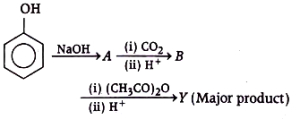
In the reaction shown below,$Y$ is:
A
salicylaldehyde
B
aspirin
C
cumene
D
picric acid
Solution
(B) $1$. The reaction of phenol with $NaOH$ gives sodium phenoxide $(A)$.
$2$. The reaction of sodium phenoxide with $CO_2$ followed by acidification gives salicylic acid $(B)$ (Kolbe's reaction).
$3$. The acetylation of salicylic acid $(B)$ with acetic anhydride $(CH_3CO)_2O$ in the presence of an acid catalyst gives acetylsalicylic acid,which is commonly known as aspirin $(Y)$.
$2$. The reaction of sodium phenoxide with $CO_2$ followed by acidification gives salicylic acid $(B)$ (Kolbe's reaction).
$3$. The acetylation of salicylic acid $(B)$ with acetic anhydride $(CH_3CO)_2O$ in the presence of an acid catalyst gives acetylsalicylic acid,which is commonly known as aspirin $(Y)$.
0 likesView Solution
24
ChemistryEasyMCQKCET · 2023
$CH_3-CH=CH-CH_2OH \xrightarrow{PCC} CH_3-CH=CH-CHO$
What is the change in hybridisation at $C-1$ in the above reaction?
What is the change in hybridisation at $C-1$ in the above reaction?
A
$sp^3$ to $sp$
B
$sp^3$ to $sp^2$
C
$sp^2$ to $sp^3$
D
$sp$ to $sp^2$
Solution
(B) In the reactant $CH_3-CH=CH-CH_2OH$,the carbon atom at position $C-1$ is bonded to two hydrogen atoms,one oxygen atom,and one carbon atom. It is $sp^3$ hybridised.
In the product $CH_3-CH=CH-CHO$,the carbon atom at position $C-1$ is part of the aldehyde group $(-CHO)$,where it forms a double bond with oxygen. It is $sp^2$ hybridised.
Therefore,the hybridisation of $C-1$ changes from $sp^3$ to $sp^2$.
In the product $CH_3-CH=CH-CHO$,the carbon atom at position $C-1$ is part of the aldehyde group $(-CHO)$,where it forms a double bond with oxygen. It is $sp^2$ hybridised.
Therefore,the hybridisation of $C-1$ changes from $sp^3$ to $sp^2$.
0 likesView Solution
25
ChemistryEasyMCQKCET · 2023
$A$ better reagent to oxidize primary alcohols into aldehydes is
A
$PCC$
B
Alkaline $KMnO_4$
C
Acidified $K_2Cr_2O_7$
D
$CrO_3$
Solution
(A) $PCC$ (pyridinium chlorochromate) is a commonly used reagent for the oxidation of primary alcohols to aldehydes.
It is favored due to its selectivity,mild reaction conditions,compatibility with other functional groups,and its ability to stop the oxidation at the aldehyde stage without further oxidation to carboxylic acids.
It is favored due to its selectivity,mild reaction conditions,compatibility with other functional groups,and its ability to stop the oxidation at the aldehyde stage without further oxidation to carboxylic acids.
0 likesView Solution
26
ChemistryMediumMCQKCET · 2023
In the reaction,$C_6H_5CN$ $\xrightarrow[(ii) H_3O^+]{(i) SnCl_2 + HCl} X$ $\xrightarrow{conc. KOH} Y + Z$,the formation of $X, Y$ and $Z$ are known by:
A
Rosenmund reduction,Cannizzaro reaction
B
Clemmensen reduction,Sandmeyer reaction
C
Wolff-Kishner reaction,Wurtz reaction
D
Stephen reaction,Cannizzaro reaction
Solution
(D) The given reaction is: $C_6H_5CN$ $\xrightarrow[(ii) H_3O^+]{(i) SnCl_2 + HCl} C_6H_5CHO (X)$ $\xrightarrow{conc. KOH} C_6H_5COOK (Y) + C_6H_5CH_2OH (Z)$.
$1$. The conversion of nitrile $(C_6H_5CN)$ to aldehyde $(C_6H_5CHO)$ using $SnCl_2 + HCl$ followed by hydrolysis is known as the Stephen reaction.
$2$. Benzaldehyde $(C_6H_5CHO)$ lacks $\alpha$-hydrogen atoms,so it undergoes the Cannizzaro reaction in the presence of concentrated alkali $(KOH)$ to form a mixture of alcohol $(C_6H_5CH_2OH)$ and salt of carboxylic acid $(C_6H_5COOK)$.
$1$. The conversion of nitrile $(C_6H_5CN)$ to aldehyde $(C_6H_5CHO)$ using $SnCl_2 + HCl$ followed by hydrolysis is known as the Stephen reaction.
$2$. Benzaldehyde $(C_6H_5CHO)$ lacks $\alpha$-hydrogen atoms,so it undergoes the Cannizzaro reaction in the presence of concentrated alkali $(KOH)$ to form a mixture of alcohol $(C_6H_5CH_2OH)$ and salt of carboxylic acid $(C_6H_5COOK)$.
0 likesView Solution
27
ChemistryMediumMCQKCET · 2023
Identify $A$,$B$ and $C$ in the sequence: $CH_3CH_2Br$ $\xrightarrow[Alc.]{KCN} A$ $\xrightarrow{LiAlH_4} B$ $\xrightarrow[0^{\circ}C]{HNO_2} C$
A
$CH_3-CH_2-CN, CH_3-CH_2-CH_2-NH_2, CH_3-CH_2-CH_2-OH$
B
$CH_3-CH_2-NC, CH_3-CH_2-OH, CH_3-CH_2-CH_2-NH_2$
C
$CH_3-CH_2-CN, C_2H_5-OH, C_2H_5-N_2Cl$
D
$CH_3-CH_2-CN, CH_3-CH_2-NH_2, C_2H_5-OH$
Solution
(A) The reaction sequence is as follows:
$1$. $CH_3CH_2Br + KCN \rightarrow CH_3CH_2CN (A) + KBr$
$2$. $CH_3CH_2CN + 4[H] \xrightarrow{LiAlH_4} CH_3CH_2CH_2NH_2 (B)$
$3$. $CH_3CH_2CH_2NH_2 + HNO_2$ $\xrightarrow{0^{\circ}C} [CH_3CH_2CH_2N_2^+]$ $\rightarrow CH_3CH_2CH_2^+$ $\xrightarrow{H_2O} CH_3CH_2CH_2OH (C)$
(Note: While rearrangement to the more stable isopropyl carbocation can occur,the primary alcohol $CH_3CH_2CH_2OH$ is the major product expected in this context.)
$1$. $CH_3CH_2Br + KCN \rightarrow CH_3CH_2CN (A) + KBr$
$2$. $CH_3CH_2CN + 4[H] \xrightarrow{LiAlH_4} CH_3CH_2CH_2NH_2 (B)$
$3$. $CH_3CH_2CH_2NH_2 + HNO_2$ $\xrightarrow{0^{\circ}C} [CH_3CH_2CH_2N_2^+]$ $\rightarrow CH_3CH_2CH_2^+$ $\xrightarrow{H_2O} CH_3CH_2CH_2OH (C)$
(Note: While rearrangement to the more stable isopropyl carbocation can occur,the primary alcohol $CH_3CH_2CH_2OH$ is the major product expected in this context.)
0 likesView Solution
28
ChemistryMediumMCQKCET · 2023
Aniline does not undergo
A
nitration
B
sulphonation
C
Friedel-Craft's reaction
D
bromination
Solution
(C) Aniline does not undergo Friedel-Craft's reaction because the lone pair on the nitrogen atom of the $-NH_2$ group forms a coordinate bond with the Lewis acid (catalyst) like $AlCl_3$.
This results in the formation of a positively charged species on the nitrogen atom,which acts as a strong deactivating group for the aromatic ring,thereby preventing the reaction.
This results in the formation of a positively charged species on the nitrogen atom,which acts as a strong deactivating group for the aromatic ring,thereby preventing the reaction.
0 likesView Solution
29
ChemistryDifficultMCQKCET · 2023
In the reaction,$P, Q$ and $R$ respectively are:
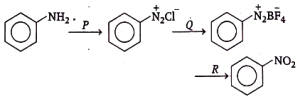
A
$NaNO_2 + \text{dil. } HCl, HBF_4, Cu + NaNO_2$
B
$NaNO_2 + \text{conc. } HCl, F_2, Cu + NaNO_3$
C
$NaNO_2 + \text{dil. } HCl, BF_3, Cu + NaNO_2$
D
$NaNO_2 + \text{dil. } HCl, F_2, Cu + NaNO_3$
Solution
(A) The reaction sequence is as follows:
$1$. The conversion of aniline to benzene diazonium chloride $(C_6H_5N_2^+Cl^-)$ is achieved using $NaNO_2 + \text{dil. } HCl$ at $0-5 \ ^\circ C$. Thus,$P = NaNO_2 + \text{dil. } HCl$.
$2$. The conversion of benzene diazonium chloride to benzene diazonium fluoroborate $(C_6H_5N_2^+BF_4^-)$ is achieved by adding fluoroboric acid $(HBF_4)$. Thus,$Q = HBF_4$.
$3$. The conversion of benzene diazonium fluoroborate to nitrobenzene $(C_6H_5NO_2)$ is achieved by heating with sodium nitrite in the presence of copper powder. Thus,$R = Cu + NaNO_2$.
Therefore,$P, Q$ and $R$ are $NaNO_2 + \text{dil. } HCl, HBF_4, Cu + NaNO_2$ respectively.
$1$. The conversion of aniline to benzene diazonium chloride $(C_6H_5N_2^+Cl^-)$ is achieved using $NaNO_2 + \text{dil. } HCl$ at $0-5 \ ^\circ C$. Thus,$P = NaNO_2 + \text{dil. } HCl$.
$2$. The conversion of benzene diazonium chloride to benzene diazonium fluoroborate $(C_6H_5N_2^+BF_4^-)$ is achieved by adding fluoroboric acid $(HBF_4)$. Thus,$Q = HBF_4$.
$3$. The conversion of benzene diazonium fluoroborate to nitrobenzene $(C_6H_5NO_2)$ is achieved by heating with sodium nitrite in the presence of copper powder. Thus,$R = Cu + NaNO_2$.
Therefore,$P, Q$ and $R$ are $NaNO_2 + \text{dil. } HCl, HBF_4, Cu + NaNO_2$ respectively.
0 likesView Solution
30
ChemistryMediumMCQKCET · 2023
Sucrose is dextrorotatory but after hydrolysis the mixture shows laevorotation,this is because of
A
laevorotation of glucose is more than dextrorotation of fructose.
B
sucrose is a non-reducing sugar.
C
racemic mixture is formed.
D
laevorotation of fructose is more than dextrorotation of glucose.
Solution
(D) Sucrose is a disaccharide that is dextrorotatory $(+66.5^{\circ})$.
Upon hydrolysis,it yields an equimolar mixture of $D-(+)$-glucose and $D-(-)$-fructose.
The specific rotation of $D-(+)$-glucose is $+52.5^{\circ}$,while the specific rotation of $D-(-)$-fructose is $-92.4^{\circ}$.
Since the magnitude of the laevorotation of fructose $(-92.4^{\circ})$ is greater than the magnitude of the dextrorotation of glucose $(+52.5^{\circ})$,the resulting mixture is laevorotatory.
Therefore,the correct reason is that the laevorotation of fructose is more than the dextrorotation of glucose.
Upon hydrolysis,it yields an equimolar mixture of $D-(+)$-glucose and $D-(-)$-fructose.
The specific rotation of $D-(+)$-glucose is $+52.5^{\circ}$,while the specific rotation of $D-(-)$-fructose is $-92.4^{\circ}$.
Since the magnitude of the laevorotation of fructose $(-92.4^{\circ})$ is greater than the magnitude of the dextrorotation of glucose $(+52.5^{\circ})$,the resulting mixture is laevorotatory.
Therefore,the correct reason is that the laevorotation of fructose is more than the dextrorotation of glucose.
0 likesView Solution
31
ChemistryDifficultMCQKCET · 2023
The correct order of match between column $X$ and column $Y$ is:
| $X$ | $Y$ |
|---|---|
| $I$. Vitamin $A$ | $i$. Muscular weakness |
| $II$. Vitamin $D$ | $ii$. Increased blood clotting time |
| $III$. Vitamin $E$ | $iii$. Night-blindness |
| $IV$. Vitamin $K$ | $iv$. Osteomalacia |
A
$I-iv, II-iii, III-ii, IV-i$
B
$I-ii, II-i, III-iii, IV-iv$
C
$I-iii, II-ii, III-iv, IV-i$
D
$I-iii, II-iv, III-i, IV-ii$
Solution
(D) The correct matches are as follows:
$I$. Vitamin $A$ is associated with $(iii)$ Night-blindness.
$II$. Vitamin $D$ is associated with $(iv)$ Osteomalacia.
$III$. Vitamin $E$ is associated with $(i)$ Muscular weakness.
$IV$. Vitamin $K$ is associated with $(ii)$ Increased blood clotting time.
Therefore,the correct order is $I-iii, II-iv, III-i, IV-ii$.
$I$. Vitamin $A$ is associated with $(iii)$ Night-blindness.
$II$. Vitamin $D$ is associated with $(iv)$ Osteomalacia.
$III$. Vitamin $E$ is associated with $(i)$ Muscular weakness.
$IV$. Vitamin $K$ is associated with $(ii)$ Increased blood clotting time.
Therefore,the correct order is $I-iii, II-iv, III-i, IV-ii$.
0 likesView Solution
32
ChemistryMediumMCQKCET · 2023
Thyroxine produced in the thyroid gland is an iodinated derivative of
A
threonine
B
lysine
C
tyrosine
D
tryptophan
Solution
(C) Thyroxine,also known as tetraiodothyronine or $T_4$,is an iodinated derivative of the amino acid tyrosine.
It is a hormone produced by the thyroid gland and plays a crucial role in regulating the metabolism and growth in the body.
It is a hormone produced by the thyroid gland and plays a crucial role in regulating the metabolism and growth in the body.
0 likesView Solution
33
ChemistryMediumMCQKCET · 2023
Dimerisation of solute molecules in low dielectric constant solvent is due to
A
hydrogen bond
B
covalent bond
C
co-ordinate bond
D
ionic bond
Solution
(A) Dimerisation of solute molecules in low dielectric constant solvents is primarily due to the formation of intermolecular $hydrogen \ bonds$.
In solvents with low dielectric constants,the electrostatic screening is weak,which facilitates the association of solute molecules through $hydrogen \ bonding$ to form stable dimers,such as the dimerization of carboxylic acids.
In solvents with low dielectric constants,the electrostatic screening is weak,which facilitates the association of solute molecules through $hydrogen \ bonding$ to form stable dimers,such as the dimerization of carboxylic acids.
0 likesView Solution
34
ChemistryDifficultMCQKCET · 2023
In which one of the following reactions,the rate constant has the unit $mol \ L^{-1} \ s^{-1}$?
A
Acid catalysed hydrolysis of $CH_3COOCH_3$
B
$CHCl_3 + Cl_2 \longrightarrow CCl_4 + HCl$
C
$2 \ NO_{(g)} + O_{2(g)} \longrightarrow 2 \ NO_{2(g)}$
D
Decomposition of $HI$ on the surface of gold
Solution
(D) The unit of the rate constant $k$ is given by $(mol \ L^{-1})^{1-n} \ s^{-1}$,where $n$ is the order of the reaction.
For a zero order reaction $(n = 0)$,the unit is $(mol \ L^{-1})^{1-0} \ s^{-1} = mol \ L^{-1} \ s^{-1}$.
Among the given options,the decomposition of $HI$ on the surface of gold is a zero order reaction because it is a heterogeneous catalytic reaction where the rate is independent of the concentration of the reactant.
For a zero order reaction $(n = 0)$,the unit is $(mol \ L^{-1})^{1-0} \ s^{-1} = mol \ L^{-1} \ s^{-1}$.
Among the given options,the decomposition of $HI$ on the surface of gold is a zero order reaction because it is a heterogeneous catalytic reaction where the rate is independent of the concentration of the reactant.
0 likesView Solution
35
ChemistryMediumMCQKCET · 2023
For a reaction,the value of rate constant at $300 \ K$ is $6.0 \times 10^5 \ s^{-1}$. The value of Arrhenius factor $A$ at infinitely high temperature is
A
$6 \times 10^5 \times e^{-E_a / (300 R)}$
B
$e^{-E_a / (300 R)}$
C
$\frac{6 \times 10^{-5}}{300}$
D
$6 \times 10^5$
Solution
(D) The Arrhenius equation is given by $k = A e^{-E_a / (RT)}$.
At infinitely high temperature,i.e.,$T \to \infty$,the term $\frac{E_a}{RT} \to 0$.
Therefore,the equation becomes $k = A e^0 = A \times 1 = A$.
Since the Arrhenius factor $A$ is a constant independent of temperature,its value remains the same as the rate constant $k$ at $T \to \infty$.
Given that $k = 6.0 \times 10^5 \ s^{-1}$ at $300 \ K$,and $A$ is independent of temperature,the value of $A$ is $6.0 \times 10^5 \ s^{-1}$.
At infinitely high temperature,i.e.,$T \to \infty$,the term $\frac{E_a}{RT} \to 0$.
Therefore,the equation becomes $k = A e^0 = A \times 1 = A$.
Since the Arrhenius factor $A$ is a constant independent of temperature,its value remains the same as the rate constant $k$ at $T \to \infty$.
Given that $k = 6.0 \times 10^5 \ s^{-1}$ at $300 \ K$,and $A$ is independent of temperature,the value of $A$ is $6.0 \times 10^5 \ s^{-1}$.
0 likesView Solution
36
ChemistryMediumMCQKCET · 2023
The rate constants $k_1$ and $k_2$ for two different reactions are $10^{16} \times e^{-2000/T}$ and $10^{15} \times e^{-1000/T}$ respectively. The temperature at which $k_1 = k_2$ is
A
$\frac{2000}{2.303} \text{ K}$
B
$2000 \text{ K}$
C
$\frac{1000}{2.303} \text{ K}$
D
$1000 \text{ K}$
Solution
(C) Given $k_1 = 10^{16} \times e^{-2000/T}$ and $k_2 = 10^{15} \times e^{-1000/T}$.
For $k_1 = k_2$:
$10^{16} \times e^{-2000/T} = 10^{15} \times e^{-1000/T}$
$10 \times e^{-2000/T} = e^{-1000/T}$
$10 = \frac{e^{-1000/T}}{e^{-2000/T}}$
$10 = e^{1000/T}$
Taking the natural logarithm on both sides:
$\ln(10) = \frac{1000}{T}$
$2.303 \times \log_{10}(10) = \frac{1000}{T}$
$2.303 = \frac{1000}{T}$
$T = \frac{1000}{2.303} \text{ K}$
For $k_1 = k_2$:
$10^{16} \times e^{-2000/T} = 10^{15} \times e^{-1000/T}$
$10 \times e^{-2000/T} = e^{-1000/T}$
$10 = \frac{e^{-1000/T}}{e^{-2000/T}}$
$10 = e^{1000/T}$
Taking the natural logarithm on both sides:
$\ln(10) = \frac{1000}{T}$
$2.303 \times \log_{10}(10) = \frac{1000}{T}$
$2.303 = \frac{1000}{T}$
$T = \frac{1000}{2.303} \text{ K}$
0 likesView Solution
37
ChemistryEasyMCQKCET · 2023
Which one of the following is a non-narcotic analgesic?
A
Heroin
B
Codeine
C
Aspirin
D
Morphine
Solution
(C) $Aspirin$ is classified as a non-narcotic analgesic because it does not produce the typical effects associated with narcotic or opioid analgesics.
In addition to its analgesic effects,it also possesses anti-inflammatory and antipyretic (fever reducing) properties.
It is commonly used for relieving mild to moderate pain,reducing inflammation,headaches,etc.
In addition to its analgesic effects,it also possesses anti-inflammatory and antipyretic (fever reducing) properties.
It is commonly used for relieving mild to moderate pain,reducing inflammation,headaches,etc.
0 likesView Solution
38
ChemistryMediumMCQKCET · 2023
Receptors are proteins and are crucial to the body's communication process. These receptors are embedded in
A
cell membrane
B
protein
C
endocrine gland
D
chromosomes
Solution
(A) Receptors are specialized proteins that are crucial for communication in the body.
They are typically embedded in the $ \text{cell membrane} $ so that their active sites are exposed to the outer surface of the cell,or they may be located intracellularly within the cell.
They are typically embedded in the $ \text{cell membrane} $ so that their active sites are exposed to the outer surface of the cell,or they may be located intracellularly within the cell.
0 likesView Solution
39
ChemistryEasyMCQKCET · 2023
Which formula and name combination is incorrect?
A
$K_3[Al(C_2O_4)_3]$ - Potassium trioxalatoaluminate$(III)$
B
$[Pt(NH_3)_2Cl(NO_2)]$ - Diamminechloridonitrito-$N$-platinum$(II)$
C
$[CoCl_2(en)_2]Cl$ - Dichloridodiethylenediammine cobalt$(II)$ chloride
D
$[Co(NH_3)_4(H_2O)Cl]Cl_2$ - Tetraammineaquachloridocobalt$(III)$ chloride
Solution
(C) The formula and name combination given in option $(C)$ is incorrect.
In the complex $[CoCl_2(en)_2]Cl$,the oxidation state of $Co$ is calculated as: $x + 2(-1) + 2(0) = +1$,which gives $x = +3$.
Also,the ligand $en$ (ethylenediamine) is a bidentate ligand,so it is named as 'bis(ethylenediamine)'.
Therefore,the correct $IUPAC$ name is Dichloridobis(ethylenediamine)cobalt$(III)$ chloride.
In the complex $[CoCl_2(en)_2]Cl$,the oxidation state of $Co$ is calculated as: $x + 2(-1) + 2(0) = +1$,which gives $x = +3$.
Also,the ligand $en$ (ethylenediamine) is a bidentate ligand,so it is named as 'bis(ethylenediamine)'.
Therefore,the correct $IUPAC$ name is Dichloridobis(ethylenediamine)cobalt$(III)$ chloride.
0 likesView Solution
40
ChemistryEasyMCQKCET · 2023
If a didentate ligand ethane-$1, 2$-diamine is progressively added in the molar ratio $en : Ni :: 1: 1, 2: 1, 3: 1$ to $[Ni(H_2O)_6]^{2+}$ aqueous solution,the following coordination entities are formed:
$I$. $[Ni(H_2O)_4en]^{2+}_{(aq)} -$ pale blue
$II$. $[Ni(H_2O)_2(en)_2]^{2+}_{(aq)} -$ blue/purple
$III$. $[Ni(en)_3]^{2+}_{(aq)} -$ violet
The wavelengths in $nm$ of light absorbed in the case of $I$ and $III$ are respectively:
$I$. $[Ni(H_2O)_4en]^{2+}_{(aq)} -$ pale blue
$II$. $[Ni(H_2O)_2(en)_2]^{2+}_{(aq)} -$ blue/purple
$III$. $[Ni(en)_3]^{2+}_{(aq)} -$ violet
The wavelengths in $nm$ of light absorbed in the case of $I$ and $III$ are respectively:
A
$475 \ nm$ and $310 \ nm$
B
$300 \ nm$ and $475 \ nm$
C
$310 \ nm$ and $500 \ nm$
D
$600 \ nm$ and $535 \ nm$
Solution
(D) The color of a coordination complex is complementary to the color of light absorbed.
For complex $I$,the observed color is pale blue,which corresponds to the absorption of orange light (wavelength range $\approx 600-650 \ nm$).
For complex $III$,the observed color is violet,which corresponds to the absorption of yellow light (wavelength range $\approx 530-580 \ nm$).
Comparing these with the given options,the wavelengths absorbed for $I$ and $III$ are approximately $600 \ nm$ and $535 \ nm$ respectively.
For complex $I$,the observed color is pale blue,which corresponds to the absorption of orange light (wavelength range $\approx 600-650 \ nm$).
For complex $III$,the observed color is violet,which corresponds to the absorption of yellow light (wavelength range $\approx 530-580 \ nm$).
Comparing these with the given options,the wavelengths absorbed for $I$ and $III$ are approximately $600 \ nm$ and $535 \ nm$ respectively.
0 likesView Solution
41
ChemistryMediumMCQKCET · 2023
Which of the following systems in an octahedral complex has the maximum number of unpaired electrons?
A
$d^9$ (high spin)
B
$d^6$ (low spin)
C
$d^4$ (low spin)
D
$d^7$ (high spin)
Solution
(D) In an octahedral complex,the $d$-orbitals split into $t_{2g}$ and $e_g$ levels.
For $d^9$ (high spin): $t_{2g}^6 e_g^3$,number of unpaired electrons $(n)$ = $1$.
For $d^6$ (low spin): $t_{2g}^6 e_g^0$,$n = 0$.
For $d^4$ (low spin): $t_{2g}^4 e_g^0$,$n = 2$.
For $d^7$ (high spin): $t_{2g}^5 e_g^2$,$n = 3$.
Therefore,the $d^7$ (high spin) system has the maximum number of unpaired electrons.
For $d^9$ (high spin): $t_{2g}^6 e_g^3$,number of unpaired electrons $(n)$ = $1$.
For $d^6$ (low spin): $t_{2g}^6 e_g^0$,$n = 0$.
For $d^4$ (low spin): $t_{2g}^4 e_g^0$,$n = 2$.
For $d^7$ (high spin): $t_{2g}^5 e_g^2$,$n = 3$.
Therefore,the $d^7$ (high spin) system has the maximum number of unpaired electrons.
0 likesView Solution
42
ChemistryEasyMCQKCET · 2023
Which of the following is an organometallic compound?
A
$CH_3COONa$
B
$CH_3CH_2MgBr$
C
$(CH_3COO)_2Ca$
D
$CH_3ONa$
Solution
(B) $CH_3CH_2MgBr$ is an organometallic compound because it contains a direct carbon-metal bond between the carbon atom of the ethyl group and the magnesium atom.
Organometallic compounds are defined as compounds containing at least one direct bond between a carbon atom and a metal atom.
In $CH_3COONa$,$(CH_3COO)_2Ca$,and $CH_3ONa$,the metal atoms are bonded to oxygen atoms,not directly to carbon atoms.
Organometallic compounds are defined as compounds containing at least one direct bond between a carbon atom and a metal atom.
In $CH_3COONa$,$(CH_3COO)_2Ca$,and $CH_3ONa$,the metal atoms are bonded to oxygen atoms,not directly to carbon atoms.
0 likesView Solution
43
ChemistryEasyMCQKCET · 2023
In which one of the following pairs,both the elements do not have $(n-1)d^{10}ns^2$ configuration in their elementary state?
A
$Zn, Cd$
B
$Cd, Hg$
C
$Hg, Cn$
D
$Cu, Zn$
Solution
(D) The general electronic configuration of group $12$ elements $(Zn, Cd, Hg, Cn)$ is $(n-1)d^{10}ns^2$.
Copper $(Cu)$ belongs to group $11$ and has an electronic configuration of $3d^{10}4s^1$.
Zinc $(Zn)$ belongs to group $12$ and has an electronic configuration of $3d^{10}4s^2$.
In option $D$,$Cu$ does not have the $(n-1)d^{10}ns^2$ configuration,while $Zn$ does.
Therefore,the pair where both elements do not have this configuration is $Cu, Zn$.
Copper $(Cu)$ belongs to group $11$ and has an electronic configuration of $3d^{10}4s^1$.
Zinc $(Zn)$ belongs to group $12$ and has an electronic configuration of $3d^{10}4s^2$.
In option $D$,$Cu$ does not have the $(n-1)d^{10}ns^2$ configuration,while $Zn$ does.
Therefore,the pair where both elements do not have this configuration is $Cu, Zn$.
0 likesView Solution
44
ChemistryMediumMCQKCET · 2023
Which of the following is correct with respect to the melting point of a transition element?
A
$V > Cr$
B
$Cr > Mn$
C
$Mn > Fe$
D
$Ti > V$
Solution
(B) The melting points of transition elements are related to the strength of metallic bonding,which depends on the number of unpaired $d$-electrons available for bonding.
In the $3d$ series,$Cr$ $(3d^5 4s^1)$ has six unpaired electrons,leading to strong metallic bonding and a high melting point.
$Mn$ $(3d^5 4s^2)$ has a stable half-filled $d$-subshell,which makes the $d$-electrons less available for metallic bonding,resulting in a significantly lower melting point compared to $Cr$.
Therefore,the correct order is $Cr > Mn$.
In the $3d$ series,$Cr$ $(3d^5 4s^1)$ has six unpaired electrons,leading to strong metallic bonding and a high melting point.
$Mn$ $(3d^5 4s^2)$ has a stable half-filled $d$-subshell,which makes the $d$-electrons less available for metallic bonding,resulting in a significantly lower melting point compared to $Cr$.
Therefore,the correct order is $Cr > Mn$.
0 likesView Solution
45
ChemistryDifficultMCQKCET · 2023
When $FeCl_3$ is added to an excess of hot water,it gives a sol '$X$'. When $FeCl_3$ is added to $NaOH_{(aq)}$ solution,it gives a sol '$Y$'. The sols '$X$' and '$Y$' formed in the above processes respectively are:
A
$Fe_2O_3 \cdot xH_2O / Fe^{3+}$ and $Fe_2O_3 \cdot xH_2O / OH^{-}$
B
$Fe_2O_3 \cdot xH_2O / H^{+}$ and $Fe_2O_3 \cdot xH_2O / Na^{+}$
C
$Fe_2O_3 \cdot xH_2O / Cl^{-}$ and $Fe_2O_3 \cdot xH_2O / OH^{-}$
D
$Fe_2O_3 \cdot xH_2O / Fe^{3+}$ and $Fe_2O_3 \cdot xH_2O / Cl^{-}$
Solution
(A) When $FeCl_3$ is added to an excess of hot water,hydrolysis occurs to form a positively charged sol '$X$' of hydrated ferric oxide,which adsorbs $Fe^{3+}$ ions from the solution: $Fe_2O_3 \cdot xH_2O / Fe^{3+}$.
When $FeCl_3$ is added to $NaOH_{(aq)}$ solution,the resulting hydrated ferric oxide sol adsorbs $OH^{-}$ ions from the excess $NaOH$ to form a negatively charged sol '$Y$': $Fe_2O_3 \cdot xH_2O / OH^{-}$.
When $FeCl_3$ is added to $NaOH_{(aq)}$ solution,the resulting hydrated ferric oxide sol adsorbs $OH^{-}$ ions from the excess $NaOH$ to form a negatively charged sol '$Y$': $Fe_2O_3 \cdot xH_2O / OH^{-}$.
0 likesView Solution
46
ChemistryMediumMCQKCET · 2023
During the electrolysis of brine,by using inert electrodes,
A
$O_2$ liberates at anode
B
$H_2$ liberates at anode
C
$Na$ deposits on cathode
D
$Cl_2$ liberates at anode
Solution
(D) During the electrolysis of brine ($NaCl$ aqueous solution) using inert electrodes:
At anode: $2 Cl^{-} \longrightarrow Cl_2 + 2 e^{-}$
At cathode: $2 H_2 O + 2 e^{-} \longrightarrow H_2 + 2 OH^{-}$
Overall reaction: $2 NaCl + 2 H_2 O \longrightarrow Cl_2 + H_2 + 2 NaOH$
Thus,$Cl_2$ gas is liberated at the anode and $H_2$ gas is liberated at the cathode.
At anode: $2 Cl^{-} \longrightarrow Cl_2 + 2 e^{-}$
At cathode: $2 H_2 O + 2 e^{-} \longrightarrow H_2 + 2 OH^{-}$
Overall reaction: $2 NaCl + 2 H_2 O \longrightarrow Cl_2 + H_2 + 2 NaOH$
Thus,$Cl_2$ gas is liberated at the anode and $H_2$ gas is liberated at the cathode.
0 likesView Solution
47
ChemistryEasyMCQKCET · 2023
Consider the following $4$ electrodes:
$E^{\circ}_{Ag^{+} / Ag} = +0.80 \ V$
Arrange the reduction potential of these electrodes in decreasing order.
| $A$. $Ag^{+}(0.0001 \ M) / Ag_{(s)}$ | $B$. $Ag^{+}(0.1 \ M) / Ag_{(s)}$ |
| $C$. $Ag^{+}(0.01 \ M) / Ag_{(s)}$ | $D$. $Ag^{+}(0.001 \ M) / Ag_{(s)}$ |
$E^{\circ}_{Ag^{+} / Ag} = +0.80 \ V$
Arrange the reduction potential of these electrodes in decreasing order.
A
$B > C > D > A$
B
$C > D > A > B$
C
$A > D > C > B$
D
$A > B > C > D$
Solution
(A) The Nernst equation for the reduction of $Ag^{+}$ to $Ag_{(s)}$ is given by:
$E_{Ag^{+} / Ag} = E^{\circ}_{Ag^{+} / Ag} + 0.059 \log [Ag^{+}]$
Since $E^{\circ}_{Ag^{+} / Ag}$ is constant $(+0.80 \ V)$,the reduction potential $E_{Ag^{+} / Ag}$ depends directly on the concentration of $Ag^{+}$ ions.
As the concentration of $Ag^{+}$ increases,the value of $\log [Ag^{+}]$ increases,and thus the reduction potential $E_{Ag^{+} / Ag}$ increases.
Comparing the concentrations:
$B: 0.1 \ M$
$C: 0.01 \ M$
$D: 0.001 \ M$
$A: 0.0001 \ M$
Since $0.1 > 0.01 > 0.001 > 0.0001$,the order of reduction potential is $B > C > D > A$.
$E_{Ag^{+} / Ag} = E^{\circ}_{Ag^{+} / Ag} + 0.059 \log [Ag^{+}]$
Since $E^{\circ}_{Ag^{+} / Ag}$ is constant $(+0.80 \ V)$,the reduction potential $E_{Ag^{+} / Ag}$ depends directly on the concentration of $Ag^{+}$ ions.
As the concentration of $Ag^{+}$ increases,the value of $\log [Ag^{+}]$ increases,and thus the reduction potential $E_{Ag^{+} / Ag}$ increases.
Comparing the concentrations:
$B: 0.1 \ M$
$C: 0.01 \ M$
$D: 0.001 \ M$
$A: 0.0001 \ M$
Since $0.1 > 0.01 > 0.001 > 0.0001$,the order of reduction potential is $B > C > D > A$.
0 likesView Solution
48
ChemistryDifficultMCQKCET · 2023
The resistance of $0.1 \ M$ weak acid $HA$ in a conductivity cell is $2 \times 10^3 \ \Omega$. The cell constant of the cell is $0.78 \ cm^{-1}$ and $\lambda_{m}^{\circ}$ of acid $HA$ is $390 \ S \ cm^2 \ mol^{-1}$. The $pH$ of the solution is
A
$3.3$
B
$4.2$
C
$5$
D
$3$
Solution
(D) Given: Concentration $C = 0.1 \ M$,Molar conductivity at infinite dilution $\Lambda_{m}^{\circ} = 390 \ S \ cm^2 \ mol^{-1}$,Resistance $R = 2 \times 10^3 \ \Omega$,Cell constant $G^* = 0.78 \ cm^{-1}$.
First,calculate the conductivity $K$:
$K = \frac{G^*}{R} = \frac{0.78}{2 \times 10^3} = 3.9 \times 10^{-4} \ S \ cm^{-1}$.
Next,calculate the molar conductivity $\Lambda_{m}$:
$\Lambda_{m} = \frac{K \times 1000}{C} = \frac{3.9 \times 10^{-4} \times 1000}{0.1} = 3.9 \ S \ cm^2 \ mol^{-1}$.
Calculate the degree of dissociation $\alpha$:
$\alpha = \frac{\Lambda_{m}}{\Lambda_{m}^{\circ}} = \frac{3.9}{390} = 0.01 = 10^{-2}$.
Calculate the concentration of $H^{+}$ ions:
$[H^{+}] = C \times \alpha = 0.1 \times 10^{-2} = 10^{-3} \ M$.
Finally,calculate the $pH$:
$pH = -\log[H^{+}] = -\log(10^{-3}) = 3$.
First,calculate the conductivity $K$:
$K = \frac{G^*}{R} = \frac{0.78}{2 \times 10^3} = 3.9 \times 10^{-4} \ S \ cm^{-1}$.
Next,calculate the molar conductivity $\Lambda_{m}$:
$\Lambda_{m} = \frac{K \times 1000}{C} = \frac{3.9 \times 10^{-4} \times 1000}{0.1} = 3.9 \ S \ cm^2 \ mol^{-1}$.
Calculate the degree of dissociation $\alpha$:
$\alpha = \frac{\Lambda_{m}}{\Lambda_{m}^{\circ}} = \frac{3.9}{390} = 0.01 = 10^{-2}$.
Calculate the concentration of $H^{+}$ ions:
$[H^{+}] = C \times \alpha = 0.1 \times 10^{-2} = 10^{-3} \ M$.
Finally,calculate the $pH$:
$pH = -\log[H^{+}] = -\log(10^{-3}) = 3$.
0 likesView Solution
49
ChemistryMediumMCQKCET · 2023
For the formation of which compound in the Ellingham diagram does $\Delta G^{\circ}$ become more and more negative with an increase in temperature?
A
$CO$
B
$FeO$
C
$ZnO$
D
$Cu_2O$
Solution
(A) In the Ellingham diagram,the slope of the line for the formation of $CO$ is negative because the reaction $2C(s) + O_2(g) \rightarrow 2CO(g)$ involves an increase in the number of moles of gas $(\Delta n_g = 2 - 1 = 1)$.
According to the equation $\Delta G^{\circ} = \Delta H^{\circ} - T\Delta S^{\circ}$,since $\Delta S^{\circ}$ is positive,the term $-T\Delta S^{\circ}$ becomes more negative as temperature $(T)$ increases.
Therefore,the formation of $CO$ becomes more thermodynamically stable and favorable at higher temperatures compared to metal oxides like $FeO$,$ZnO$,or $Cu_2O$,which show positive slopes.
According to the equation $\Delta G^{\circ} = \Delta H^{\circ} - T\Delta S^{\circ}$,since $\Delta S^{\circ}$ is positive,the term $-T\Delta S^{\circ}$ becomes more negative as temperature $(T)$ increases.
Therefore,the formation of $CO$ becomes more thermodynamically stable and favorable at higher temperatures compared to metal oxides like $FeO$,$ZnO$,or $Cu_2O$,which show positive slopes.
0 likesView Solution
50
ChemistryMediumMCQKCET · 2023
Which of the following compounds does not give dinitrogen on heating?
A
$Ba(N_3)_2$
B
$NH_4NO_2$
C
$NH_4NO_3$
D
$(NH_4)_2Cr_2O_7$
Solution
(C) Among the given compounds,only ammonium nitrate $(NH_4NO_3)$ does not produce $N_2$ gas on decomposition; instead,it produces nitrous oxide $(N_2O)$.
$Ba(N_3)_2 \xrightarrow{\Delta} Ba + 3N_2$
$NH_4NO_2 \xrightarrow{\Delta} N_2 + 2H_2O$
$NH_4NO_3 \xrightarrow{\Delta} N_2O + 2H_2O$
$(NH_4)_2Cr_2O_7 \xrightarrow{\Delta} Cr_2O_3 + N_2 + 4H_2O$
$Ba(N_3)_2 \xrightarrow{\Delta} Ba + 3N_2$
$NH_4NO_2 \xrightarrow{\Delta} N_2 + 2H_2O$
$NH_4NO_3 \xrightarrow{\Delta} N_2O + 2H_2O$
$(NH_4)_2Cr_2O_7 \xrightarrow{\Delta} Cr_2O_3 + N_2 + 4H_2O$
0 likesView Solution
51
ChemistryEasyMCQKCET · 2023
The correct decreasing order of basicity of hydrides of group-$15$ elements is
A
$SbH_3 > AsH_3 > PH_3 > NH_3$
B
$PH_3 > AsH_3 > SbH_3 > NH_3$
C
$AsH_3 > SbH_3 > NH_3 > PH_3$
D
$NH_3 > PH_3 > AsH_3 > SbH_3$
Solution
(D) The basicity of group-$15$ hydrides depends on the availability of the lone pair of electrons on the central atom for donation.
As we move down the group from $N$ to $Bi$,the size of the central atom increases.
This leads to the dispersion of the lone pair over a larger volume,making it less available for donation.
Therefore,the basicity decreases down the group.
The correct decreasing order is $NH_3 > PH_3 > AsH_3 > SbH_3$.
As we move down the group from $N$ to $Bi$,the size of the central atom increases.
This leads to the dispersion of the lone pair over a larger volume,making it less available for donation.
Therefore,the basicity decreases down the group.
The correct decreasing order is $NH_3 > PH_3 > AsH_3 > SbH_3$.
0 likesView Solution
52
ChemistryDifficultMCQKCET · 2023
Which one of the following oxoacids of phosphorus can reduce $AgNO_3$ to metallic silver?
A
$H_3PO_2$
B
$H_4P_2O_7$
C
$H_4P_2O_6$
D
$H_3PO_4$
Solution
(A) Hypophosphorus acid $(H_3PO_2)$ acts as a strong reducing agent because it contains two $P-H$ bonds.
It can effectively reduce $Ag^{+}$ ions to metallic $Ag$ and itself gets oxidized to phosphorus acid $(H_3PO_3)$.
The chemical reaction is as follows:
$3AgNO_3 + H_3PO_2 + 2H_2O \longrightarrow 3Ag + H_3PO_3 + 3HNO_3$
It can effectively reduce $Ag^{+}$ ions to metallic $Ag$ and itself gets oxidized to phosphorus acid $(H_3PO_3)$.
The chemical reaction is as follows:
$3AgNO_3 + H_3PO_2 + 2H_2O \longrightarrow 3Ag + H_3PO_3 + 3HNO_3$
0 likesView Solution
53
ChemistryEasyMCQKCET · 2023
Which of the following monomers form biodegradable polymers?
A
Ethylene glycol and phthalic acid
B
Caprolactam and $1, 3-$butadiene
C
Phenol and formaldehyde
D
$3-$hydroxybutanoic acid and $3-$hydroxypentanoic acid
Solution
(D) $PHBV$ (Poly-$\beta$-hydroxybutyrate-co-$\beta$-hydroxyvalerate) is a biodegradable polymer that belongs to the family of polyhydroxyalkanoates $(PHAs)$.
It is synthesized by the copolymerization of two monomeric units,namely $3-$hydroxybutanoic acid and $3-$hydroxypentanoic acid.
It is synthesized by the copolymerization of two monomeric units,namely $3-$hydroxybutanoic acid and $3-$hydroxypentanoic acid.
0 likesView Solution
54
ChemistryMediumMCQKCET · 2023
Match the List-$I$ with List-$II$ in the following.
| List-$I$ | List-$II$ |
|---|---|
| $1$. Caprolactam | $a$. $(-CH_2-CH(CH_3)-)_n$ |
| $2$. Vinyl chloride | $b$. $(-CH_2-CH(C_6H_5)-)_n$ |
| $3$. Styrene | $c$. $(-CH_2-CH(Cl)-)_n$ |
| $4$. Propene | $d$. $(-CO-(CH_2)_5-NH-)_n$ |
A
$1-c, 2-d, 3-a, 4-b$
B
$1-a, 2-d, 3-c, 4-b$
C
$1-d, 2-c, 3-a, 4-b$
D
$1-d, 2-c, 3-b, 4-a$
Solution
(D) The correct matches are:
$1$. Caprolactam polymerizes to form Nylon-$6$,which has the structure $(-CO-(CH_2)_5-NH-)_n$ $(d)$.
$2$. Vinyl chloride polymerizes to form Polyvinyl chloride $(PVC)$,which has the structure $(-CH_2-CH(Cl)-)_n$ $(c)$.
$3$. Styrene polymerizes to form Polystyrene,which has the structure $(-CH_2-CH(C_6H_5)-)_n$ $(b)$.
$4$. Propene polymerizes to form Polypropylene,which has the structure $(-CH_2-CH(CH_3)-)_n$ $(a)$.
Thus,the correct match is $1-d, 2-c, 3-b, 4-a$.
$1$. Caprolactam polymerizes to form Nylon-$6$,which has the structure $(-CO-(CH_2)_5-NH-)_n$ $(d)$.
$2$. Vinyl chloride polymerizes to form Polyvinyl chloride $(PVC)$,which has the structure $(-CH_2-CH(Cl)-)_n$ $(c)$.
$3$. Styrene polymerizes to form Polystyrene,which has the structure $(-CH_2-CH(C_6H_5)-)_n$ $(b)$.
$4$. Propene polymerizes to form Polypropylene,which has the structure $(-CH_2-CH(CH_3)-)_n$ $(a)$.
Thus,the correct match is $1-d, 2-c, 3-b, 4-a$.
0 likesView Solution
55
ChemistryMediumMCQKCET · 2023
Match the column $A$ (type of crystalline solid) with the column $B$ (example for each type).
| $P$. Molecular solid | $i$. $SiC$ |
| $Q$. Ionic solid | $ii$. $Mg$ |
| $R$. Metallic solid | $iii$. $H_2O$ |
| $S$. Network solid | $iv$. $MgO$ |
A
$P-iii, Q-i, R-ii, S-iv$
B
$P-iv, Q-iii, R-ii, S-i$
C
$P-ii, Q-iv, R-iii, S-i$
D
$P-iii, Q-iv, R-ii, S-i$
Solution
(D) The correct matches are as follows:
$P$. Molecular solid: $H_2O$ $(iii)$
$Q$. Ionic solid: $MgO$ $(iv)$
$R$. Metallic solid: $Mg$ $(ii)$
$S$. Network solid: $SiC$ $(i)$
Therefore,the correct sequence is $P-iii, Q-iv, R-ii, S-i$.
$P$. Molecular solid: $H_2O$ $(iii)$
$Q$. Ionic solid: $MgO$ $(iv)$
$R$. Metallic solid: $Mg$ $(ii)$
$S$. Network solid: $SiC$ $(i)$
Therefore,the correct sequence is $P-iii, Q-iv, R-ii, S-i$.
0 likesView Solution
56
ChemistryMediumMCQKCET · 2023
If '$a$' stands for the edge length of the cubic systems,the ratio of radii in simple cubic,body-centered cubic,and face-centered cubic unit cells is:
A
$1 \ a : \sqrt{3} \ a : \sqrt{2} \ a$
B
$\frac{1}{2} \ a : \frac{\sqrt{3}}{4} \ a : \frac{1}{2 \sqrt{2}} \ a$
C
$\frac{1}{2} \ a : \frac{\sqrt{3}}{2} \ a : \frac{\sqrt{2}}{2} \ a$
D
$\frac{1}{2} \ a : \sqrt{3} \ a : \frac{1}{\sqrt{2}} \ a$
Solution
(B) For a simple cubic unit cell,the relation between radius '$r$' and edge length '$a$' is $r = \frac{a}{2}$.
For a body-centered cubic $(bcc)$ unit cell,the relation is $r = \frac{a \sqrt{3}}{4}$.
For a face-centered cubic $(fcc)$ unit cell,the relation is $r = \frac{a}{2 \sqrt{2}}$.
Thus,the ratio of the radii for simple cubic : $bcc$ : $fcc$ is $\frac{1}{2} \ a : \frac{\sqrt{3}}{4} \ a : \frac{1}{2 \sqrt{2}} \ a$.
For a body-centered cubic $(bcc)$ unit cell,the relation is $r = \frac{a \sqrt{3}}{4}$.
For a face-centered cubic $(fcc)$ unit cell,the relation is $r = \frac{a}{2 \sqrt{2}}$.
Thus,the ratio of the radii for simple cubic : $bcc$ : $fcc$ is $\frac{1}{2} \ a : \frac{\sqrt{3}}{4} \ a : \frac{1}{2 \sqrt{2}} \ a$.
0 likesView Solution
57
ChemistryEasyMCQKCET · 2023
$A$ metal crystallises in a body-centred cubic $(BCC)$ lattice with the metallic radius $\sqrt{3} \ \mathring{A}$. The volume of the unit cell in $m^3$ is:
A
$64 \times 10^{-29}$
B
$4 \times 10^{-29}$
C
$6.4 \times 10^{-29}$
D
$4 \times 10^{-10}$
Solution
(C) Given,metallic radius $r = \sqrt{3} \ \mathring{A} = \sqrt{3} \times 10^{-10} \ m$.
For a body-centred cubic $(BCC)$ lattice,the relationship between radius $r$ and edge length $a$ is $r = \frac{\sqrt{3} a}{4}$.
Rearranging for $a$: $a = \frac{4r}{\sqrt{3}} = \frac{4 \times \sqrt{3} \times 10^{-10} \ m}{\sqrt{3}} = 4 \times 10^{-10} \ m$.
The volume of the unit cell is $V = a^3 = (4 \times 10^{-10} \ m)^3 = 64 \times 10^{-30} \ m^3 = 6.4 \times 10^{-29} \ m^3$.
For a body-centred cubic $(BCC)$ lattice,the relationship between radius $r$ and edge length $a$ is $r = \frac{\sqrt{3} a}{4}$.
Rearranging for $a$: $a = \frac{4r}{\sqrt{3}} = \frac{4 \times \sqrt{3} \times 10^{-10} \ m}{\sqrt{3}} = 4 \times 10^{-10} \ m$.
The volume of the unit cell is $V = a^3 = (4 \times 10^{-10} \ m)^3 = 64 \times 10^{-30} \ m^3 = 6.4 \times 10^{-29} \ m^3$.
0 likesView Solution
58
ChemistryMediumMCQKCET · 2023
The swelling in feet and ankles of an aged person due to sitting continuously for long hours during travel,is reduced by soaking the feet in warm salt water. This is because of
A
reverse osmosis
B
osmosis
C
edema
D
diffusion
Solution
(B) The swelling in the feet is caused by the accumulation of excess fluid in the tissues,a condition known as edema.
When the feet are soaked in a concentrated salt solution,the concentration of salt outside the skin is higher than that inside the tissues.
Through the process of $osmosis$,water molecules move from the region of higher water concentration (the swollen tissues) to the region of lower water concentration (the salt solution) across the semi-permeable membrane of the skin.
This movement of water out of the tissues helps to reduce the swelling.
When the feet are soaked in a concentrated salt solution,the concentration of salt outside the skin is higher than that inside the tissues.
Through the process of $osmosis$,water molecules move from the region of higher water concentration (the swollen tissues) to the region of lower water concentration (the salt solution) across the semi-permeable membrane of the skin.
This movement of water out of the tissues helps to reduce the swelling.
0 likesView Solution
59
ChemistryDifficultMCQKCET · 2023
$A$ sample of water is found to contain $5.85 \% \left(\frac{w}{w}\right)$ of $AB$ (molecular mass $58.5$) and $9.50 \% \left(\frac{w}{w}\right)$ $XY_2$ (molecular mass $95$). Assuming $80 \%$ ionisation of $AB$ and $60 \%$ ionisation of $XY_2$, the freezing point of the water sample is: [Given, $K_f$ for water $= 1.86 \ K \ kg \ mol^{-1}$, freezing point of pure water $= 273 \ K$ and $A, B, X, Y$ are monovalent ions.] (in $K$)
A
$264.25$
B
$265.56$
C
$280.44$
D
$281.75$
Solution
(A) $1$. Calculate molality $(m)$ of each solute in $100 \ g$ of solution (assuming $84.65 \ g$ of water solvent):
$m_{AB} = \frac{5.85 \ g / 58.5 \ g \ mol^{-1}}{0.08465 \ kg} = 1.181 \ mol \ kg^{-1}$
$m_{XY_2} = \frac{9.50 \ g / 95 \ g \ mol^{-1}}{0.08465 \ kg} = 1.181 \ mol \ kg^{-1}$
$2$. Calculate van't Hoff factor $(i)$ for each:
For $AB \rightarrow A^+ + B^-$, $i_1 = 1 + (2-1)0.8 = 1.8$
For $XY_2 \rightarrow X^{2+} + 2Y^-$, $i_2 = 1 + (3-1)0.6 = 2.2$
$3$. Calculate total depression in freezing point $(\Delta T_f)$:
$\Delta T_f = K_f \times (i_1 m_1 + i_2 m_2) = 1.86 \times (1.8 \times 1.181 + 2.2 \times 1.181) = 1.86 \times (4.724) \approx 8.786 \ K$
$4$. Calculate final freezing point:
$T_f = 273 \ K - 8.786 \ K = 264.214 \ K \approx 264.25 \ K$.
$m_{AB} = \frac{5.85 \ g / 58.5 \ g \ mol^{-1}}{0.08465 \ kg} = 1.181 \ mol \ kg^{-1}$
$m_{XY_2} = \frac{9.50 \ g / 95 \ g \ mol^{-1}}{0.08465 \ kg} = 1.181 \ mol \ kg^{-1}$
$2$. Calculate van't Hoff factor $(i)$ for each:
For $AB \rightarrow A^+ + B^-$, $i_1 = 1 + (2-1)0.8 = 1.8$
For $XY_2 \rightarrow X^{2+} + 2Y^-$, $i_2 = 1 + (3-1)0.6 = 2.2$
$3$. Calculate total depression in freezing point $(\Delta T_f)$:
$\Delta T_f = K_f \times (i_1 m_1 + i_2 m_2) = 1.86 \times (1.8 \times 1.181 + 2.2 \times 1.181) = 1.86 \times (4.724) \approx 8.786 \ K$
$4$. Calculate final freezing point:
$T_f = 273 \ K - 8.786 \ K = 264.214 \ K \approx 264.25 \ K$.
0 likesView Solution
60
ChemistryEasyMCQKCET · 2023
Aqueous solution of raw sugar when passed over beds of animal charcoal,it becomes colourless. Pick the correct set of terminologies (Adsorbent,Adsorbate,Process) that can be used for the above example.
A
$A$: $\text{Solution of sugar}$,$B$: $\text{Animal charcoal}$,$C$: $\text{Sorption}$
B
$A$: $\text{Animal charcoal}$,$B$: $\text{Solution of sugar}$,$C$: $\text{Absorption}$
C
$A$: $\text{Animal charcoal}$,$B$: $\text{Colouring substance}$,$C$: $\text{Adsorption}$
D
$A$: $\text{Colouring substance}$,$B$: $\text{Animal charcoal}$,$C$: $\text{Adsorption}$
Solution
(C) In the process of decolorization of raw sugar,$\text{Animal charcoal}$ acts as the $\text{adsorbent}$ because it provides the surface for the impurities to stick to.
The $\text{colouring substances}$ (impurities) present in the sugar solution are the $\text{adsorbate}$ as they get accumulated on the surface of the charcoal.
This phenomenon is known as $\text{adsorption}$.
Therefore,the correct set is: $\text{Adsorbent} = \text{Animal charcoal}$,$\text{Adsorbate} = \text{Colouring substance}$,$\text{Process} = \text{Adsorption}$.
The $\text{colouring substances}$ (impurities) present in the sugar solution are the $\text{adsorbate}$ as they get accumulated on the surface of the charcoal.
This phenomenon is known as $\text{adsorption}$.
Therefore,the correct set is: $\text{Adsorbent} = \text{Animal charcoal}$,$\text{Adsorbate} = \text{Colouring substance}$,$\text{Process} = \text{Adsorption}$.
0 likesView Solution
61
ChemistryEasyMCQKCET · 2023
For Freundlich adsorption isotherm,a graph of $\log (x / m)$ vs $\log (p)$ gives a straight line. The slope of the line and its $Y$-axis intercept respectively are
A
$\log (1 / n), k$
B
$\frac{1}{n}, \log k$
C
$\log (1 / n), \log k$
D
$\frac{1}{n}, k$
Solution
(B) The Freundlich adsorption isotherm equation is given by $\frac{x}{m} = k p^{1/n}$.
Taking logarithm on both sides,we get $\log (x / m) = \log k + \frac{1}{n} \log p$.
Comparing this with the equation of a straight line,$y = mx + c$,where $y = \log (x / m)$,$x = \log p$,$m = \frac{1}{n}$,and $c = \log k$.
Thus,the slope of the line is $\frac{1}{n}$ and the $Y$-axis intercept is $\log k$.
Taking logarithm on both sides,we get $\log (x / m) = \log k + \frac{1}{n} \log p$.
Comparing this with the equation of a straight line,$y = mx + c$,where $y = \log (x / m)$,$x = \log p$,$m = \frac{1}{n}$,and $c = \log k$.
Thus,the slope of the line is $\frac{1}{n}$ and the $Y$-axis intercept is $\log k$.
0 likesView Solution
Vedclass Products
For Students
Vedclass Test Series
Mock tests in real KCET style covering Chemistry with performance analysis. 5-day free trial.
Start Free TrialFor Teachers
Exam Paper Generator
Generate Set A/B/C/D Chemistry papers from 7.5L+ questions in 2 minutes. 3 chapters free.
Try FreeFor Institutes
Online Exam Module
Run live KCET mock exams with unlimited students, 360° analytics & white-label branding.
See DemoFrequently Asked Questions
How many Chemistry questions are in KCET 2023?
There are 61 Chemistry questions from the KCET 2023 paper on Vedclass, each with a detailed step-by-step solution in English.
Are KCET 2023 Chemistry solutions available in English?
Yes. All solutions on this page are in English. You can also switch to English or Hindi using the language buttons above the questions.
Can I practice KCET 2023 Chemistry as a timed test?
Yes. Use the Vedclass Test Series to attempt a full KCET mock test covering Chemistry with time limits and instant score analysis.
Can teachers create Chemistry papers from KCET previous year questions?
Yes. The Vedclass Exam Paper Generator lets teachers mix KCET Chemistry questions and generate Set A/B/C/D papers in minutes.
For Teachers & Institutes
Build a Custom Chemistry Paper
Pick KCET 2023 Chemistry questions, set difficulty, and generate Set A/B/C/D in 2 minutes.