
BiologyQ1–58 of 58 questions
Page 1 of 1 · English
1
BiologyEasyMCQKCET · 2021
The correct sequence of events in prophase $I$ is
A
Synapsis $\rightarrow$ Crossing over $\rightarrow$ Chiasmata $\rightarrow$ Terminalisation
B
Crossing over $\rightarrow$ Synapsis $\rightarrow$ Chiasmata $\rightarrow$ Terminalisation
C
Chiasmata $\rightarrow$ Synapsis $\rightarrow$ Crossing over $\rightarrow$ Terminalisation
D
Chiasmata $\rightarrow$ Crossing over $\rightarrow$ Synapsis $\rightarrow$ Terminalisation
Solution
(A) is the correct sequence: Synapsis $\rightarrow$ Crossing over $\rightarrow$ Chiasmata $\rightarrow$ Terminalisation.
Prophase $I$ of meiosis is divided into $5$ sub-stages: leptotene,zygotene,pachytene,diplotene,and diakinesis.
$1$. Synapsis: Pairing of homologous chromosomes occurs during the zygotene stage.
$2$. Crossing over: Exchange of genetic material between non-sister chromatids of homologous chromosomes occurs during the pachytene stage.
$3$. Chiasmata: The $X$-shaped structures formed at the sites of crossing over become visible during the diplotene stage.
$4$. Terminalisation: The shifting of chiasmata towards the ends of the chromosomes occurs during the diakinesis stage.
Prophase $I$ of meiosis is divided into $5$ sub-stages: leptotene,zygotene,pachytene,diplotene,and diakinesis.
$1$. Synapsis: Pairing of homologous chromosomes occurs during the zygotene stage.
$2$. Crossing over: Exchange of genetic material between non-sister chromatids of homologous chromosomes occurs during the pachytene stage.
$3$. Chiasmata: The $X$-shaped structures formed at the sites of crossing over become visible during the diplotene stage.
$4$. Terminalisation: The shifting of chiasmata towards the ends of the chromosomes occurs during the diakinesis stage.
0 likesView Solution
2
BiologyEasyMCQKCET · 2021
The enzyme that is not found in $C_3$ plants is
A
$ATP$ synthase
B
$RUBP$ carboxylase
C
$NADP$ reductase
D
$PEP$ carboxylase
Solution
(D) $PEP$ carboxylase $(PEPcase)$ is an enzyme that catalyzes the carboxylation of phosphoenolpyruvate $(PEP)$ in $C_4$ plants.
It is primarily involved in the initial carbon fixation step in $C_4$ plants and is not found in the mesophyll cells of $C_3$ plants.
It is primarily involved in the initial carbon fixation step in $C_4$ plants and is not found in the mesophyll cells of $C_3$ plants.
0 likesView Solution
3
BiologyEasyMCQKCET · 2021
Match the location of the cell given in Column $I$ with its function in Column $II$.
| Column $I$ | Column $II$ |
|---|---|
| $A$. Mitochondrial matrix | $i$. Krebs' cycle |
| $B$. Cytoplasm | $ii$. $ETC$ |
| $C$. $F_0$ and $F_1$ | $iii$. Glycolysis |
| $D$. Inner Mitochondrial membrane | $iv$. $ATP$ synthesis |
A
$(A)-(i); (B)-(iii); (C)-(iv); (D)-(ii)$
B
$(A)-(ii); (B)-(iv); (C)-(i); (D)-(iii)$
C
$(A)-(iii); (B)-(ii); (C)-(i); (D)-(iv)$
D
$(A)-(iv); (B)-(i); (C)-(iii); (D)-(ii)$
Solution
(A) Mitochondrial matrix is the site for the Krebs' cycle $(i)$.
$(B)$ Cytoplasm is the site for Glycolysis $(iii)$.
$(C)$ $F_0$ and $F_1$ particles ($ATP$ synthase) are responsible for $ATP$ synthesis $(iv)$.
$(D)$ Inner mitochondrial membrane is the site for the Electron Transport Chain $(ETC)$ $(ii)$.
Therefore,the correct matching is $(A)-(i), (B)-(iii), (C)-(iv), (D)-(ii)$.
$(B)$ Cytoplasm is the site for Glycolysis $(iii)$.
$(C)$ $F_0$ and $F_1$ particles ($ATP$ synthase) are responsible for $ATP$ synthesis $(iv)$.
$(D)$ Inner mitochondrial membrane is the site for the Electron Transport Chain $(ETC)$ $(ii)$.
Therefore,the correct matching is $(A)-(i), (B)-(iii), (C)-(iv), (D)-(ii)$.
0 likesView Solution
4
BiologyEasyMCQKCET · 2021
Identify the incorrect statement/s.
$I$. Kinetin is a derivative of adenine which is a pyrimidine.
$II$. The technique of decapitation is widely used in tea plantations.
$III$. Ethylene is a gaseous plant hormone.
$IV$. Use of $GA$ hastens the malting process in brewing industry.
$V$. $ABA$ is a growth promoter.
$I$. Kinetin is a derivative of adenine which is a pyrimidine.
$II$. The technique of decapitation is widely used in tea plantations.
$III$. Ethylene is a gaseous plant hormone.
$IV$. Use of $GA$ hastens the malting process in brewing industry.
$V$. $ABA$ is a growth promoter.
A
$I, II, III, IV$
B
Only $III$
C
$II, III, IV$
D
$I$ and $V$
Solution
(D) The correct answer is $D$ ($I$ and $V$).
Statement $I$ is incorrect because Kinetin is a derivative of adenine,which is a purine,not a pyrimidine.
Statement $II$ is correct; decapitation (removal of shoot tips) is used in tea plantations to promote lateral branching.
Statement $III$ is correct; ethylene is a gaseous plant hormone.
Statement $IV$ is correct; Gibberellic acid $(GA)$ is used to speed up the malting process in the brewing industry.
Statement $V$ is incorrect because Abscisic acid $(ABA)$ acts as a growth inhibitor,not a growth promoter.
Statement $I$ is incorrect because Kinetin is a derivative of adenine,which is a purine,not a pyrimidine.
Statement $II$ is correct; decapitation (removal of shoot tips) is used in tea plantations to promote lateral branching.
Statement $III$ is correct; ethylene is a gaseous plant hormone.
Statement $IV$ is correct; Gibberellic acid $(GA)$ is used to speed up the malting process in the brewing industry.
Statement $V$ is incorrect because Abscisic acid $(ABA)$ acts as a growth inhibitor,not a growth promoter.
0 likesView Solution
5
BiologyEasyMCQKCET · 2021
In a standard $ECG$,one of the following functions of its components is not correctly interpreted.
A
$P$ is the contraction of only left atria
B
$QRS$ complex represents ventricular contraction
C
$T$ is the end of systole
D
$P$ is the contraction of both atria
Solution
(A) $P$ is the contraction of only left atria is incorrect because the $P$-wave represents the electrical excitation (depolarisation) of both atria,which leads to the contraction of both atria simultaneously.
$ECG$ or Electrocardiogram records the electrical activity of the heart to diagnose various cardiac conditions.
$1$. The $P$-wave represents atrial depolarisation,which leads to the contraction of both atria.
$2$. The $QRS$ complex represents ventricular depolarisation,which initiates ventricular contraction (systole).
$3$. The $T$-wave represents ventricular repolarisation,which marks the end of ventricular systole as the ventricles begin to relax.
$ECG$ or Electrocardiogram records the electrical activity of the heart to diagnose various cardiac conditions.
$1$. The $P$-wave represents atrial depolarisation,which leads to the contraction of both atria.
$2$. The $QRS$ complex represents ventricular depolarisation,which initiates ventricular contraction (systole).
$3$. The $T$-wave represents ventricular repolarisation,which marks the end of ventricular systole as the ventricles begin to relax.
0 likesView Solution
6
BiologyEasyMCQKCET · 2021
Calculate the cardiac output of an individual having $70$ heart beats/min with a stroke volume of $55 \ mL$.
A
$3750 \ mL$
B
$125 \ mL$
C
$3850 \ mL$
D
None of above
Solution
(C) Cardiac output is defined as the volume of blood pumped by the heart per minute.
It is calculated by multiplying the stroke volume $(SV)$,which is the volume of blood ejected by the ventricle during each contraction,by the heart rate $(HR)$,which is the number of heart beats per minute.
The formula is: $\text{Cardiac Output} (CO) = SV \times HR$.
Given: Stroke volume $(SV)$ = $55 \ mL$ and Heart rate $(HR)$ = $70 \ \text{beats/min}$.
Therefore,$\text{Cardiac Output} = 55 \times 70 = 3850 \ mL$.
It is calculated by multiplying the stroke volume $(SV)$,which is the volume of blood ejected by the ventricle during each contraction,by the heart rate $(HR)$,which is the number of heart beats per minute.
The formula is: $\text{Cardiac Output} (CO) = SV \times HR$.
Given: Stroke volume $(SV)$ = $55 \ mL$ and Heart rate $(HR)$ = $70 \ \text{beats/min}$.
Therefore,$\text{Cardiac Output} = 55 \times 70 = 3850 \ mL$.
0 likesView Solution
7
BiologyEasyMCQKCET · 2021
Match the hormones of Column-$I$ with their functions in Column-$II$.
| Column-$I$ | Column-$II$ |
|---|---|
| $A$. Catecholamines | $(i)$ Diurnal rhythm |
| $B$. $MSH$ | $(ii)$ Immune response |
| $C$. Thymosins | $(iii)$ Pigmentation |
| $D$. Melatonin | $(iv)$ Stress hormone |
A
$A-(iv); B-(iii); C-(ii); D-(i)$
B
$A-(iii); B-(ii); C-(iv); D-(i)$
C
$A-(ii); B-(iv); C-(iii); D-(i)$
D
$A-(i); B-(ii); C-(iii); D-(iv)$
Solution
(A) The correct matching is as follows:
$A$. Catecholamines (e.g.,adrenaline and noradrenaline) are secreted by the adrenal medulla and are known as stress hormones,which help the body respond to emergency situations. Thus,$A-(iv)$.
$B$. $MSH$ (Melanocyte Stimulating Hormone) acts on melanocytes to regulate skin pigmentation. Thus,$B-(iii)$.
$C$. Thymosins are secreted by the thymus gland and play a major role in the differentiation of $T$-lymphocytes,which provide cell-mediated immunity. Thus,$C-(ii)$.
$D$. Melatonin is secreted by the pineal gland and plays a very important role in the regulation of a $24$-hour (diurnal) rhythm of our body,such as the sleep-wake cycle and body temperature. Thus,$D-(i)$.
Therefore,the correct sequence is $A-(iv), B-(iii), C-(ii), D-(i)$.
$A$. Catecholamines (e.g.,adrenaline and noradrenaline) are secreted by the adrenal medulla and are known as stress hormones,which help the body respond to emergency situations. Thus,$A-(iv)$.
$B$. $MSH$ (Melanocyte Stimulating Hormone) acts on melanocytes to regulate skin pigmentation. Thus,$B-(iii)$.
$C$. Thymosins are secreted by the thymus gland and play a major role in the differentiation of $T$-lymphocytes,which provide cell-mediated immunity. Thus,$C-(ii)$.
$D$. Melatonin is secreted by the pineal gland and plays a very important role in the regulation of a $24$-hour (diurnal) rhythm of our body,such as the sleep-wake cycle and body temperature. Thus,$D-(i)$.
Therefore,the correct sequence is $A-(iv), B-(iii), C-(ii), D-(i)$.
0 likesView Solution
8
BiologyEasyMCQKCET · 2021
Identify the odd one out.
A
Ustilago
B
Alternaria
C
Colletotrichum
D
Trichoderma
Solution
(A) $Ustilago$ is an example of the class $Basidiomycetes$ (club fungi).
$Alternaria$,$Colletotrichum$,and $Trichoderma$ are all examples of the class $Deuteromycetes$ (imperfect fungi).
Therefore,$Ustilago$ is the odd one out.
$Alternaria$,$Colletotrichum$,and $Trichoderma$ are all examples of the class $Deuteromycetes$ (imperfect fungi).
Therefore,$Ustilago$ is the odd one out.
0 likesView Solution
9
BiologyEasyMCQKCET · 2021
The concept of "Contagium vivum fluidum" was given by
A
$D$. $J$. Ivanowsky
B
$W$. $M$. Stanley
C
$M$. $W$. Beijerinck
D
$R$. $H$. Whittaker
Solution
(C) The correct answer is $C$.
In $1898$, the Dutch microbiologist $M. W. Beijerinck$ demonstrated that the extract of infected tobacco plants could cause infection in healthy plants.
He called this fluid extract "Contagium vivum fluidum", which translates to "infectious living fluid".
In $1898$, the Dutch microbiologist $M. W. Beijerinck$ demonstrated that the extract of infected tobacco plants could cause infection in healthy plants.
He called this fluid extract "Contagium vivum fluidum", which translates to "infectious living fluid".
0 likesView Solution
10
BiologyEasyMCQKCET · 2021
The plant body having holdfast,stipe and frond is a characteristic of
A
Laminaria
B
Volvox
C
Gelidium
D
Porphyra
Solution
(A) $Laminaria$.
$Phaeophyceae$ (brown algae) typically possess a plant body differentiated into a root-like structure called a holdfast,a stem-like stalk called a stipe,and leaf-like photosynthetic organs called fronds.
$Laminaria$ is a well-known genus of brown algae belonging to the class $Phaeophyceae$.
$Phaeophyceae$ (brown algae) typically possess a plant body differentiated into a root-like structure called a holdfast,a stem-like stalk called a stipe,and leaf-like photosynthetic organs called fronds.
$Laminaria$ is a well-known genus of brown algae belonging to the class $Phaeophyceae$.
0 likesView Solution
11
BiologyEasyMCQKCET · 2021
Identify the correct statements regarding class $Aves$.
$I$. Forelimbs are modified into wings and hindlimbs are modified for walking and swimming.
$II$. Heart is completely four-chambered.
$III$. They are homeotherms.
$IV$. They are oviparous and development is direct.
$I$. Forelimbs are modified into wings and hindlimbs are modified for walking and swimming.
$II$. Heart is completely four-chambered.
$III$. They are homeotherms.
$IV$. They are oviparous and development is direct.
A
Both $I$ and $III$
B
Both $I$ and $IV$
C
$I$,$II$ and $III$
D
All of these
Solution
(D) The correct answer is $D$.
Members of class $Aves$ are homeothermic or warm-blooded animals.
Their forelimbs are modified into wings to assist in flight,while their hindlimbs are adapted for walking,swimming,or perching.
The heart in birds is completely four-chambered,consisting of two atria and two ventricles.
They are oviparous (egg-laying) and exhibit direct development,meaning there is no larval stage.
Therefore,all the given statements $(I, II, III, IV)$ are correct.
Members of class $Aves$ are homeothermic or warm-blooded animals.
Their forelimbs are modified into wings to assist in flight,while their hindlimbs are adapted for walking,swimming,or perching.
The heart in birds is completely four-chambered,consisting of two atria and two ventricles.
They are oviparous (egg-laying) and exhibit direct development,meaning there is no larval stage.
Therefore,all the given statements $(I, II, III, IV)$ are correct.
0 likesView Solution
12
BiologyEasyMCQKCET · 2021
Epigynous flower is one in which:
A
ovary is superior and other floral parts are inferior
B
ovary is inferior and other floral parts are superior
C
all the floral parts are at same level
D
none of these
Solution
(B) In epigynous flowers,the margin of the thalamus grows upward enclosing the ovary completely and getting fused with it,while other parts of the flower arise above the ovary.
Hence,the ovary is said to be inferior and other floral parts are superior.
Examples include flowers of guava,cucumber,and the ray florets of sunflower.
Hence,the ovary is said to be inferior and other floral parts are superior.
Examples include flowers of guava,cucumber,and the ray florets of sunflower.
0 likesView Solution
13
BiologyEasyMCQKCET · 2021
$A$ bacterial flagellum is composed of
A
filament,hook and basal body
B
vesicles,tubules and lamellae
C
pili,fimbriae and filament
D
hook,tubules and fimbriae
Solution
(A) The correct answer is $A$.
$A$ bacterial flagellum is composed of three distinct parts:
$1$. The basal body: This is the structure that anchors the flagellum into the cell wall and plasma membrane.
$2$. The hook: This is a curved structure that connects the basal body to the filament.
$3$. The filament: This is the longest portion that extends from the cell surface into the surrounding medium and is responsible for bacterial motility.
$A$ bacterial flagellum is composed of three distinct parts:
$1$. The basal body: This is the structure that anchors the flagellum into the cell wall and plasma membrane.
$2$. The hook: This is a curved structure that connects the basal body to the filament.
$3$. The filament: This is the longest portion that extends from the cell surface into the surrounding medium and is responsible for bacterial motility.
0 likesView Solution
14
BiologyEasyMCQKCET · 2021
Match the compounds of Column-$I$ with their function in Column-$II$.
| Column-$I$ | Column-$II$ |
|---|---|
| $A$. Trypsin | $(i)$ Fights infectious agents |
| $B$. $GLUT$-$4$ | $(ii)$ Is an intercellular ground substance |
| $C$. Collagen | $(iii)$ Works as an enzyme |
| $D$. Antibody | $(iv)$ Enables glucose transport into cells |
A
$A-(iv), B-(iii), C-(ii), D-(i)$
B
$A-(iii), B-(iv), C-(i), D-(ii)$
C
$A-(iv), B-(iii), C-(i), D-(ii)$
D
$A-(iii), B-(iv), C-(ii), D-(i)$
Solution
(D) $A-(iii), B-(iv), C-(ii), D-(i)$
The correct matching is as follows:
$A$. Trypsin is an enzyme that digests proteins.
$B$. $GLUT$-$4$ is a protein that enables glucose transport into cells.
$C$. Collagen is a structural protein that forms the intercellular ground substance in connective tissues.
$D$. Antibody is a protein produced by our body to fight against infectious agents and foreign pathogens.
The correct matching is as follows:
$A$. Trypsin is an enzyme that digests proteins.
$B$. $GLUT$-$4$ is a protein that enables glucose transport into cells.
$C$. Collagen is a structural protein that forms the intercellular ground substance in connective tissues.
$D$. Antibody is a protein produced by our body to fight against infectious agents and foreign pathogens.
0 likesView Solution
15
BiologyEasyMCQKCET · 2021
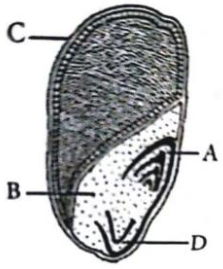
In the given diagram of a maize grain,identify the parts labelled as $A, B, C$ and $D$.
A
$A$-Coleoptile,$B$-Scutellum,$C$-Pericarp,$D$-Coleorrhiza
B
$A$-Coleoptile,$B$-Scutellum,$C$-Coleorrhiza,$D$-Pericarp
C
$A$-Pericarp,$B$-Coleorrhiza,$C$-Scutellum,$D$-Pericarp
D
$A$-Coleorrhiza,$B$-Coleoptile,$C$-Scutellum,$D$-Pericarp
Solution
(A) The given diagram represents the structure of a monocotyledonous seed (maize grain).
$A$ points to the coleoptile,which is the protective sheath covering the plumule.
$B$ points to the scutellum,which is a large,shield-shaped cotyledon.
$C$ points to the pericarp,which is the outer wall of the fruit fused with the seed coat.
$D$ points to the coleorrhiza,which is the protective sheath covering the radicle.
Therefore,the correct identification is $A$-Coleoptile,$B$-Scutellum,$C$-Pericarp,$D$-Coleorrhiza.
$A$ points to the coleoptile,which is the protective sheath covering the plumule.
$B$ points to the scutellum,which is a large,shield-shaped cotyledon.
$C$ points to the pericarp,which is the outer wall of the fruit fused with the seed coat.
$D$ points to the coleorrhiza,which is the protective sheath covering the radicle.
Therefore,the correct identification is $A$-Coleoptile,$B$-Scutellum,$C$-Pericarp,$D$-Coleorrhiza.
0 likesView Solution
16
BiologyEasyMCQKCET · 2021
Which cell of the female gametophyte is involved in the formation of primary endosperm nucleus $(PEN)$ after fertilisation?
A
Antipodals
B
Synergids
C
Egg cell
D
Central cell
Solution
(D) During double fertilisation in angiosperms,one male gamete fuses with the egg cell to form a zygote (syngamy).
Another male gamete fuses with the two polar nuclei located in the central cell to form the primary endosperm nucleus $(PEN)$.
This process is known as triple fusion.
Therefore,the central cell is the cell of the female gametophyte that is involved in the formation of the $PEN$.
Another male gamete fuses with the two polar nuclei located in the central cell to form the primary endosperm nucleus $(PEN)$.
This process is known as triple fusion.
Therefore,the central cell is the cell of the female gametophyte that is involved in the formation of the $PEN$.
0 likesView Solution
17
BiologyEasyMCQKCET · 2021
Which of the following aquatic plants does not show pollination by water?
A
Vallisneria
B
Hydrilla
C
Water hyacinth
D
Zostera
Solution
(C) Pollination by water (hydrophily) is quite rare in flowering plants and is limited to about $30$ genera, mostly monocotyledons.
In many aquatic plants such as $Vallisneria$ and $Hydrilla$, pollination occurs through water.
However, in many other aquatic plants like $Water \text{ } hyacinth$ $(Eichhornia)$ and $Water \text{ } lily$, the flowers emerge above the level of water and are pollinated by insects or wind, similar to most land plants.
Therefore, $Water \text{ } hyacinth$ does not show pollination by water.
In many aquatic plants such as $Vallisneria$ and $Hydrilla$, pollination occurs through water.
However, in many other aquatic plants like $Water \text{ } hyacinth$ $(Eichhornia)$ and $Water \text{ } lily$, the flowers emerge above the level of water and are pollinated by insects or wind, similar to most land plants.
Therefore, $Water \text{ } hyacinth$ does not show pollination by water.
0 likesView Solution
18
BiologyEasyMCQKCET · 2021
Identify the correct statement.
A
Only one megaspore present towards chalazal end remains functional.
B
$3$ megaspores present towards chalazal end degenerate gradually.
C
Each megaspore mother cell directly develops into a megaspore.
D
Each female gametophyte is $7-$celled and $7-$nucleated structure.
Solution
(A) In the process of megasporogenesis,the megaspore mother cell $(MMC)$ undergoes meiosis to form four haploid megaspores.
Out of these four megaspores,three megaspores present towards the micropylar end degenerate,while only one megaspore present towards the chalazal end remains functional.
This functional megaspore develops into the female gametophyte (embryo sac).
The mature female gametophyte is typically $7$-celled and $8$-nucleated.
Out of these four megaspores,three megaspores present towards the micropylar end degenerate,while only one megaspore present towards the chalazal end remains functional.
This functional megaspore develops into the female gametophyte (embryo sac).
The mature female gametophyte is typically $7$-celled and $8$-nucleated.
0 likesView Solution
19
BiologyEasyMCQKCET · 2021
Consider the following statements and choose the correct answer from the given options.
$Statement \ 1$: Innermost layer of microsporangium is tapetum.
$Statement \ 2$: Cells of tapetum possess dense cytoplasm, more than one nucleus, and nourish the developing pollen grains.
$Statement \ 1$: Innermost layer of microsporangium is tapetum.
$Statement \ 2$: Cells of tapetum possess dense cytoplasm, more than one nucleus, and nourish the developing pollen grains.
A
Both Statements $1$ and $2$ are incorrect.
B
Both Statements $1$ and $2$ are correct.
C
Statement $1$ is correct and $2$ is incorrect.
D
Statement $2$ is correct and $1$ is incorrect.
Solution
(B) The correct answer is $B$.
$Statement \ 1$ is correct because the microsporangium is surrounded by four wall layers: epidermis, endothecium, middle layers, and the innermost layer, which is the tapetum.
$Statement \ 2$ is correct because the cells of the tapetum possess dense cytoplasm and generally have more than one nucleus (multinucleate condition). Their primary function is to provide nourishment to the developing pollen grains.
$Statement \ 1$ is correct because the microsporangium is surrounded by four wall layers: epidermis, endothecium, middle layers, and the innermost layer, which is the tapetum.
$Statement \ 2$ is correct because the cells of the tapetum possess dense cytoplasm and generally have more than one nucleus (multinucleate condition). Their primary function is to provide nourishment to the developing pollen grains.
0 likesView Solution
20
BiologyEasyMCQKCET · 2021
How many microsporangia are located at the corners of a typical bilobed anther of angiosperm?
A
$2$
B
$4$
C
$8$
D
$1$
Solution
(B) typical angiosperm anther is bilobed,with each lobe having two theca (dithecous).
In a transverse section,a typical microsporangium appears near-circular in outline.
It is generally surrounded by four wall layers: epidermis,endothecium,middle layers,and tapetum.
There are four microsporangia located at the corners,two in each lobe.
Eventually,these microsporangia develop into pollen sacs and extend longitudinally all through the length of an anther and are packed with pollen grains.
In a transverse section,a typical microsporangium appears near-circular in outline.
It is generally surrounded by four wall layers: epidermis,endothecium,middle layers,and tapetum.
There are four microsporangia located at the corners,two in each lobe.
Eventually,these microsporangia develop into pollen sacs and extend longitudinally all through the length of an anther and are packed with pollen grains.
0 likesView Solution
21
BiologyEasyMCQKCET · 2021
Identify the correct order of events in pollen-pistil interaction from the options given below.
$I.$ Release of male gametes into the embryo sac
$II.$ Deposition of pollen grains on stigma
$III.$ Entry of pollen tube into embryo sac
$IV.$ Development of pollen tube
$V.$ Entry of pollen tube into the ovule
$I.$ Release of male gametes into the embryo sac
$II.$ Deposition of pollen grains on stigma
$III.$ Entry of pollen tube into embryo sac
$IV.$ Development of pollen tube
$V.$ Entry of pollen tube into the ovule
A
$V \to IV \to III \to II \to I$
B
$IV \to III \to II \to I \to V$
C
$II \to IV \to V \to III \to I$
D
$II \to IV \to III \to V \to I$
Solution
(C) The process of pollen-pistil interaction follows a specific sequence:
$1$. $II.$ Deposition of pollen grains on the stigma.
$2$. $IV.$ Development of the pollen tube through the style.
$3$. $V.$ Entry of the pollen tube into the ovule through the micropyle.
$4$. $III.$ Entry of the pollen tube into the embryo sac (synergids).
$5$. $I.$ Release of male gametes into the embryo sac for fertilization.
Therefore,the correct sequence is $II \to IV \to V \to III \to I$.
$1$. $II.$ Deposition of pollen grains on the stigma.
$2$. $IV.$ Development of the pollen tube through the style.
$3$. $V.$ Entry of the pollen tube into the ovule through the micropyle.
$4$. $III.$ Entry of the pollen tube into the embryo sac (synergids).
$5$. $I.$ Release of male gametes into the embryo sac for fertilization.
Therefore,the correct sequence is $II \to IV \to V \to III \to I$.
0 likesView Solution
22
BiologyEasyMCQKCET · 2021
Silencing of a gene could be achieved through the use of
A
short interfering $RNA$ (RNAi).
B
antisense $RNA$.
C
by both $(a)$ and $(b)$
D
none of the above.
Solution
(C) The correct answer is $C$.
Gene silencing is a biological process in which the expression of a specific gene is suppressed or turned off.
This can be achieved using $RNA$ interference $(RNAi)$,which involves short interfering $RNA$ molecules that bind to complementary $mRNA$ and trigger its degradation.
Similarly,antisense $RNA$ technology involves introducing an $RNA$ molecule that is complementary to the target $mRNA$,thereby preventing its translation into protein.
Therefore,both $RNAi$ and antisense $RNA$ are effective methods for gene silencing.
Gene silencing is a biological process in which the expression of a specific gene is suppressed or turned off.
This can be achieved using $RNA$ interference $(RNAi)$,which involves short interfering $RNA$ molecules that bind to complementary $mRNA$ and trigger its degradation.
Similarly,antisense $RNA$ technology involves introducing an $RNA$ molecule that is complementary to the target $mRNA$,thereby preventing its translation into protein.
Therefore,both $RNAi$ and antisense $RNA$ are effective methods for gene silencing.
0 likesView Solution
23
BiologyEasyMCQKCET · 2021
Which of the following diagnostic tools allows the detection of very low concentration of bacteria or viruses by amplifying their nucleic acid?
A
$ELISA$
B
$PCR$
C
Autoradiography
D
r-$DNA$ technology
Solution
(B) $PCR$.
Polymerase Chain Reaction $(PCR)$ is a molecular biology technique that allows for the amplification of specific $DNA$ sequences.
It enables the detection of pathogens like bacteria or viruses even when they are present in very low concentrations in a sample by creating millions of copies of their nucleic acid.
Polymerase Chain Reaction $(PCR)$ is a molecular biology technique that allows for the amplification of specific $DNA$ sequences.
It enables the detection of pathogens like bacteria or viruses even when they are present in very low concentrations in a sample by creating millions of copies of their nucleic acid.
0 likesView Solution
24
BiologyEasyMCQKCET · 2021
Rapid antigen test and $RT$-$PCR$ are two diagnostic tests for the $COVID-19$ virus. $PCR$,a molecular diagnostic tool,stands for:
A
Polymerase Chain Reaction
B
Polymerase Chain Reagent
C
Physiological Chain Reaction
D
Physiological Chain Reagent
Solution
(A) $PCR$ stands for Polymerase Chain Reaction.
It is a molecular diagnostic technique used to amplify specific segments of $DNA$ in vitro.
In this process,a short region of a $DNA$ molecule is copied many times using the $DNA$ polymerase enzyme,allowing for the detection of pathogens like the $COVID-19$ virus even in small quantities.
It is a molecular diagnostic technique used to amplify specific segments of $DNA$ in vitro.
In this process,a short region of a $DNA$ molecule is copied many times using the $DNA$ polymerase enzyme,allowing for the detection of pathogens like the $COVID-19$ virus even in small quantities.
0 likesView Solution
25
BiologyEasyMCQKCET · 2021
$\alpha-1$ antitrypsin is
A
an antacid
B
an enzyme
C
used to treat emphysema
D
used to treat arthritis
Solution
(C) $\alpha-1$ antitrypsin is a protein that inhibits the enzyme elastase,which breaks down lung tissue.
Deficiency of this protein leads to emphysema,a chronic lung disease.
Therefore,$\alpha-1$ antitrypsin is used to treat emphysema by replacing the missing protein.
Deficiency of this protein leads to emphysema,a chronic lung disease.
Therefore,$\alpha-1$ antitrypsin is used to treat emphysema by replacing the missing protein.
0 likesView Solution
26
BiologyEasyMCQKCET · 2021
Population size keeps changing depending on different factor$(s)$ such as:
A
food availability
B
predation pressure
C
adverse weather
D
all of the above
Solution
(D) The correct answer is $D$.
Population size is not a static parameter; it keeps fluctuating due to various ecological factors.
$1$. Food availability: Limited resources restrict population growth,while abundance promotes it.
$2$. Predation pressure: High predation rates reduce the population size of prey species.
$3$. Adverse weather: Extreme conditions like droughts,floods,or severe winters can significantly decrease population density.
Therefore,all the mentioned factors are responsible for the dynamic nature of population size.
Population size is not a static parameter; it keeps fluctuating due to various ecological factors.
$1$. Food availability: Limited resources restrict population growth,while abundance promotes it.
$2$. Predation pressure: High predation rates reduce the population size of prey species.
$3$. Adverse weather: Extreme conditions like droughts,floods,or severe winters can significantly decrease population density.
Therefore,all the mentioned factors are responsible for the dynamic nature of population size.
0 likesView Solution
27
BiologyEasyMCQKCET · 2021
Relate Column $I$ with Column $II$ with regard to predatory behaviour:
| Column $I$ | Column $II$ |
|---|---|
| $A$. Calotropis | $i$. Invertebrates |
| $B$. Pisaster | $ii$. Distasteful |
| $C$. Monarch butterfly | $iii$. Cryptically coloured |
| $D$. Frogs | $iv$. Cardio glycosides |
A
$A-iv, B-i, C-iii, D-ii$
B
$A-iv, B-i, C-ii, D-iii$
C
$A-ii, B-iv, C-i, D-iii$
D
$A-iii, B-i, C-ii, D-iii$
Solution
(B) . Calotropis is a plant that produces highly poisonous cardiac glycosides,which protect it from herbivores. Thus,$A-iv$.
$B$. Pisaster is a starfish that acts as a predator in rocky intertidal communities of the American Pacific Coast,feeding on invertebrates. Thus,$B-i$.
$C$. The Monarch butterfly is highly distasteful to its predator (birds) because of a special chemical acquired during its caterpillar stage. Thus,$C-ii$.
$D$. Frogs are often cryptically coloured (camouflaged) to escape detection by predators. Thus,$D-iii$.
Therefore,the correct matching is $A-iv, B-i, C-ii, D-iii$.
$B$. Pisaster is a starfish that acts as a predator in rocky intertidal communities of the American Pacific Coast,feeding on invertebrates. Thus,$B-i$.
$C$. The Monarch butterfly is highly distasteful to its predator (birds) because of a special chemical acquired during its caterpillar stage. Thus,$C-ii$.
$D$. Frogs are often cryptically coloured (camouflaged) to escape detection by predators. Thus,$D-iii$.
Therefore,the correct matching is $A-iv, B-i, C-ii, D-iii$.
0 likesView Solution
28
BiologyEasyMCQKCET · 2021
Identify the correct statement/s from the following:
$I$. $Cuscuta$ is a chlorophyllous endoparasite.
$II$. The human liverfluke needs only one host to complete its life cycle.
$III$. The life cycle of endoparasite is more complex due to their extreme specialisation.
$IV$. During the course of evolution the host bird's eggs have evolved to resemble the eggs of the parasitic bird.
$I$. $Cuscuta$ is a chlorophyllous endoparasite.
$II$. The human liverfluke needs only one host to complete its life cycle.
$III$. The life cycle of endoparasite is more complex due to their extreme specialisation.
$IV$. During the course of evolution the host bird's eggs have evolved to resemble the eggs of the parasitic bird.
A
$I, II, III$
B
$II, IV$
C
Only $III$
D
$I, III$ and $IV$
Solution
(C) The correct statement is $III$.
Explanation of incorrect statements:
$I$. $Cuscuta$ is a parasitic plant that lacks chlorophyll and cannot perform photosynthesis; it is not a chlorophyllous endoparasite.
$II$. The human liverfluke ($Fasciola$ $hepatica$) requires two intermediate hosts (a snail and a fish) to complete its life cycle.
$IV$. In brood parasitism,the parasitic bird's eggs have evolved to resemble the host's eggs in size and color to avoid detection by the host,not the other way around.
$III$. Endoparasites exhibit extreme specialization,which makes their life cycles more complex as they must adapt to the host's internal environment and often require multiple hosts.
Explanation of incorrect statements:
$I$. $Cuscuta$ is a parasitic plant that lacks chlorophyll and cannot perform photosynthesis; it is not a chlorophyllous endoparasite.
$II$. The human liverfluke ($Fasciola$ $hepatica$) requires two intermediate hosts (a snail and a fish) to complete its life cycle.
$IV$. In brood parasitism,the parasitic bird's eggs have evolved to resemble the host's eggs in size and color to avoid detection by the host,not the other way around.
$III$. Endoparasites exhibit extreme specialization,which makes their life cycles more complex as they must adapt to the host's internal environment and often require multiple hosts.
0 likesView Solution
29
BiologyEasyMCQKCET · 2021
The correct equation depicting the species-area relationship is:
A
logS = logC + ZlogA
B
logC = logS + ZlogA
C
logA = logC + ZlogA
D
logZ = logC + ZlogA
Solution
(A) The species-area relationship was proposed by Alexander von Humboldt.
The relationship is represented by the equation $S = CA^Z$.
Taking the logarithm on both sides,we get:
$\log S = \log(CA^Z)$
$\log S = \log C + \log(A^Z)$
$\log S = \log C + Z \log A$
Therefore,the correct equation is $\log S = \log C + Z \log A$.
The relationship is represented by the equation $S = CA^Z$.
Taking the logarithm on both sides,we get:
$\log S = \log(CA^Z)$
$\log S = \log C + \log(A^Z)$
$\log S = \log C + Z \log A$
Therefore,the correct equation is $\log S = \log C + Z \log A$.
0 likesView Solution
30
BiologyEasyMCQKCET · 2021
Identify the incorrect statement.
$I$. Speciation is generally a function of time.
$II$. Tropical environment is less seasonal,relatively more constant and predictable.
$III$. Solar energy contributes to high productivity.
$IV$. Temperate regions have remained relatively undisturbed for millions of years.
$I$. Speciation is generally a function of time.
$II$. Tropical environment is less seasonal,relatively more constant and predictable.
$III$. Solar energy contributes to high productivity.
$IV$. Temperate regions have remained relatively undisturbed for millions of years.
A
$I, II, III, IV$
B
$II, III$
C
Only $IV$
D
$III, IV$
Solution
(C) The correct answer is $C$ (Only $IV$).
Statement $I$ is correct because evolutionary processes like speciation require significant time to occur.
Statement $II$ is correct as tropical latitudes remain relatively undisturbed by seasonal variations,making them more constant and predictable.
Statement $III$ is correct because higher solar energy availability in the tropics leads to higher primary productivity.
Statement $IV$ is incorrect. Unlike tropical regions,temperate regions have been subjected to frequent glaciations in the past,which disrupted the environment and hindered species diversification.
Statement $I$ is correct because evolutionary processes like speciation require significant time to occur.
Statement $II$ is correct as tropical latitudes remain relatively undisturbed by seasonal variations,making them more constant and predictable.
Statement $III$ is correct because higher solar energy availability in the tropics leads to higher primary productivity.
Statement $IV$ is incorrect. Unlike tropical regions,temperate regions have been subjected to frequent glaciations in the past,which disrupted the environment and hindered species diversification.
0 likesView Solution
31
BiologyEasyMCQKCET · 2021
Identify the correct statement/s about $ex \, situ$ conservation. Advanced $ex \, situ$ conservation includes:
$I$. Cryopreservation of gametes
$II$. Plant tissue culture method
$III$. Seed bank
$IV$. $In \, vitro$ fertilisation
$I$. Cryopreservation of gametes
$II$. Plant tissue culture method
$III$. Seed bank
$IV$. $In \, vitro$ fertilisation
A
Only $I$
B
$I$ and $II$
C
$I, II, III, IV$
D
None of the above
Solution
(C) is the correct answer.
Advanced $ex \, situ$ conservation involves the preservation of genetic resources of species away from their natural habitat or area of origin.
This strategy is designed to conserve a larger amount of genetic material within a smaller physical space.
The various methods through which $ex \, situ$ conservation is achieved include:
$1$. Cryopreservation (storage of gametes or embryos at extremely low temperatures).
$2$. Plant tissue culture (propagation of plants from cells or tissues).
$3$. Seed banks (long-term storage of seeds).
$4$. $In \, vitro$ fertilisation (fertilisation outside the living organism).
Therefore, all the listed statements $(I, II, III, IV)$ are correct.
Advanced $ex \, situ$ conservation involves the preservation of genetic resources of species away from their natural habitat or area of origin.
This strategy is designed to conserve a larger amount of genetic material within a smaller physical space.
The various methods through which $ex \, situ$ conservation is achieved include:
$1$. Cryopreservation (storage of gametes or embryos at extremely low temperatures).
$2$. Plant tissue culture (propagation of plants from cells or tissues).
$3$. Seed banks (long-term storage of seeds).
$4$. $In \, vitro$ fertilisation (fertilisation outside the living organism).
Therefore, all the listed statements $(I, II, III, IV)$ are correct.
0 likesView Solution
32
BiologyEasyMCQKCET · 2021
Match Column-$I$ with Column-$II$.
| Column-$I$ | Column-$II$ |
|---|---|
| $(A)$ Narrowly utilitarian argument | $(i)$ Conserving biodiversity for major ecosystem services |
| $(B)$ Broadly utilitarian argument | $(ii)$ Every species has an intrinsic value and moral duty to pass our biological legacy in good order to future generations |
| $(C)$ Ethical argument | $(iii)$ Receiving benefits like food,medicine and industrial products |
A
$(A)-(i); (B)-(ii); (C)-(iii)$
B
$(A)-(iii); (B)-(ii); (C)-(i)$
C
$(A)-(iii); (B)-(i); (C)-(ii)$
D
$(A)-(ii); (B)-(i); (C)-(iii)$
Solution
(C) The arguments for biodiversity conservation are categorized into three types:
$1$. Narrowly utilitarian: Humans derive countless direct economic benefits from nature such as food (cereals,pulses,fruits),firewood,fiber,construction material,industrial products (tannins,lubricants,dyes,resins,perfumes) and products of medicinal importance. Thus,$(A)$ matches with $(iii)$.
$2$. Broadly utilitarian: Biodiversity plays a major role in many ecosystem services that nature provides. The fast-dwindling Amazon forest is estimated to produce,through photosynthesis,$20$ percent of the total oxygen in the earth's atmosphere. Other services include pollination and aesthetic pleasures. Thus,$(B)$ matches with $(i)$.
$3$. Ethical: This argument relates to what we owe to millions of plant,animal and microbe species with whom we share this planet. Every species has an intrinsic value,even if it may not be of current or any economic value to us. We have a moral duty to care for their well-being and pass on our biological legacy in good order to future generations. Thus,$(C)$ matches with $(ii)$.
Therefore,the correct matching is $(A)-(iii), (B)-(i), (C)-(ii)$.
$1$. Narrowly utilitarian: Humans derive countless direct economic benefits from nature such as food (cereals,pulses,fruits),firewood,fiber,construction material,industrial products (tannins,lubricants,dyes,resins,perfumes) and products of medicinal importance. Thus,$(A)$ matches with $(iii)$.
$2$. Broadly utilitarian: Biodiversity plays a major role in many ecosystem services that nature provides. The fast-dwindling Amazon forest is estimated to produce,through photosynthesis,$20$ percent of the total oxygen in the earth's atmosphere. Other services include pollination and aesthetic pleasures. Thus,$(B)$ matches with $(i)$.
$3$. Ethical: This argument relates to what we owe to millions of plant,animal and microbe species with whom we share this planet. Every species has an intrinsic value,even if it may not be of current or any economic value to us. We have a moral duty to care for their well-being and pass on our biological legacy in good order to future generations. Thus,$(C)$ matches with $(ii)$.
Therefore,the correct matching is $(A)-(iii), (B)-(i), (C)-(ii)$.
0 likesView Solution
33
BiologyEasyMCQKCET · 2021
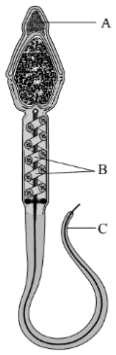
In the given diagram of human sperm,identify the functions of the labelled parts $A$,$B$ and $C$.
A
$A \rightarrow$ Helps in penetration of sperm into ovum,$B \rightarrow$ Helps in movement of sperm,$C \rightarrow$ provides energy for the movement of sperms into the female reproductive tract.
B
$A \rightarrow$ Helps in penetration of sperm into ovum,$B \rightarrow$ Provides energy for the movement of sperm,$C \rightarrow$ Helps in movement of sperm.
C
$A \rightarrow$ Helps in movement of sperm,$B \rightarrow$ Helps in penetration of sperm into ovum,$C \rightarrow$ provides energy for the movement of sperms.
D
$A \rightarrow$ Provides energy for the movement of sperm,$B \rightarrow$ Helps in movement of sperm,$C \rightarrow$ Helps in penetration of sperm into ovum.
Solution
(B) The correct answer is $(B)$.
$A$ represents the acrosome,which contains enzymes that help in the penetration of the sperm into the ovum.
$B$ represents the middle piece,which contains numerous mitochondria arranged in a spiral. These mitochondria provide the energy $(ATP)$ required for the movement of the sperm.
$C$ represents the tail,which facilitates the movement of the sperm through the female reproductive tract.
$A$ represents the acrosome,which contains enzymes that help in the penetration of the sperm into the ovum.
$B$ represents the middle piece,which contains numerous mitochondria arranged in a spiral. These mitochondria provide the energy $(ATP)$ required for the movement of the sperm.
$C$ represents the tail,which facilitates the movement of the sperm through the female reproductive tract.
0 likesView Solution
34
BiologyEasyMCQKCET · 2021
Under the influence of oxytocin,which layer of the uterus exhibits strong contractions during parturition?
A
Endometrium
B
Myometrium
C
Perimetrium
D
Both $(a)$ and $(c)$
Solution
(B) The correct answer is $B$ (Myometrium).
During parturition,the hormone oxytocin acts on the uterine muscles.
The $Myometrium$ is the thick middle layer of the uterus composed of smooth muscle tissue.
Under the influence of oxytocin,the $Myometrium$ undergoes strong rhythmic contractions,which facilitate the expulsion of the fetus from the uterus.
During parturition,the hormone oxytocin acts on the uterine muscles.
The $Myometrium$ is the thick middle layer of the uterus composed of smooth muscle tissue.
Under the influence of oxytocin,the $Myometrium$ undergoes strong rhythmic contractions,which facilitate the expulsion of the fetus from the uterus.
0 likesView Solution
35
BiologyEasyMCQKCET · 2021
Select the correct path of flow of milk during breast feeding.
A
Mammary tubules $ \rightarrow $ Mammary duct $ \rightarrow $ Mammary ampulla $ \rightarrow $ Lactiferous duct $ \rightarrow $ Alveoli
B
Mammary tubules $ \rightarrow $ Mammary duct $ \rightarrow $ Lactiferous duct $ \rightarrow $ Mammary ampulla $ \rightarrow $ Alveoli
C
Alveoli $ \rightarrow $ Mammary tubules $ \rightarrow $ Mammary ampulla $ \rightarrow $ Mammary duct $ \rightarrow $ Lactiferous duct
D
Alveoli $ \rightarrow $ Mammary tubules $ \rightarrow $ Mammary duct $ \rightarrow $ Mammary ampulla $ \rightarrow $ Lactiferous duct
Solution
(D) Alveoli $ \rightarrow $ Mammary tubules $ \rightarrow $ Mammary duct $ \rightarrow $ Mammary ampulla $ \rightarrow $ Lactiferous duct.
$A$ functional mammary gland is a characteristic feature of all female mammals. The mammary glands are paired structures (breasts) that contain glandular tissue and a variable amount of fat. The glandular tissue of each breast is divided into $15-20$ mammary lobes containing clusters of cells called alveoli. The cells of the alveoli secrete milk,which is stored in the cavities (lumens) of the alveoli. The alveoli open into mammary tubules. The tubules of each lobe join to form a mammary duct. Several mammary ducts join to form a wider mammary ampulla,which is connected to the lactiferous duct through which milk is sucked out.
$A$ functional mammary gland is a characteristic feature of all female mammals. The mammary glands are paired structures (breasts) that contain glandular tissue and a variable amount of fat. The glandular tissue of each breast is divided into $15-20$ mammary lobes containing clusters of cells called alveoli. The cells of the alveoli secrete milk,which is stored in the cavities (lumens) of the alveoli. The alveoli open into mammary tubules. The tubules of each lobe join to form a mammary duct. Several mammary ducts join to form a wider mammary ampulla,which is connected to the lactiferous duct through which milk is sucked out.
0 likesView Solution
36
BiologyEasyMCQKCET · 2021
Select the incorrect statement about contraceptives.
A
They are regular requirements for the maintenance of reproductive health.
B
They have a significant role in checking uncontrolled growth of population.
C
They are practised against natural reproductive events like conception or pregnancy.
D
The possible ill-effects like nausea,abdominal pain,irregular menstrual bleeding or even breast cancer should not be totally ignored.
Solution
(A) is the incorrect statement.
Contraceptives are not regular requirements for the maintenance of reproductive health.
They are used specifically to prevent unwanted pregnancies and to space births,rather than to maintain general reproductive health.
Options $B$,$C$,and $D$ are correct statements regarding the role and potential side effects of contraceptives.
Contraceptives are not regular requirements for the maintenance of reproductive health.
They are used specifically to prevent unwanted pregnancies and to space births,rather than to maintain general reproductive health.
Options $B$,$C$,and $D$ are correct statements regarding the role and potential side effects of contraceptives.
0 likesView Solution
37
BiologyEasyMCQKCET · 2021
The method of directly injecting a sperm into an ovum is called:
A
$GIFT$
B
$ZIFT$
C
$ICSI$
D
$IVF$-$ET$
Solution
(C) The correct answer is $C$.
Intra-cytoplasmic sperm injection $(ICSI)$ is a specialized procedure in which a single sperm is directly injected into the ovum to form an embryo in the laboratory.
This technique is primarily used to treat cases of male infertility.
Intra-cytoplasmic sperm injection $(ICSI)$ is a specialized procedure in which a single sperm is directly injected into the ovum to form an embryo in the laboratory.
This technique is primarily used to treat cases of male infertility.
0 likesView Solution
38
BiologyEasyMCQKCET · 2021
Match the Column $I$ with Column $II$:
| Column $I$ | Column $II$ |
|---|---|
| $(A)$ Autosomal trisomy | $(i)$ Turner's Syndrome |
| $(B)$ Allosomal trisomy | $(ii)$ Mendelian disorder |
| $(C)$ Allosomal Monosomy | $(iii)$ Klinefelter's Syndrome |
| $(D)$ Cystic fibrosis | $(iv)$ Down's Syndrome |
A
$(A)-(i); (B)-(ii); (C)-(iii); (D)-(iv)$
B
$(A)-(i); (B)-(ii); (C)-(iv); (D)-(iii)$
C
$(A)-(iv); (B)-(iii); (C)-(ii); (D)-(i)$
D
$(A)-(iv); (B)-(iii); (C)-(i); (D)-(ii)$
Solution
(D) The correct matching is as follows:
$(A)$ Autosomal trisomy: $(iv)$ Down's Syndrome (Trisomy of chromosome $21$).
$(B)$ Allosomal trisomy: $(iii)$ Klinefelter's Syndrome $(47, XXY)$.
$(C)$ Allosomal Monosomy: $(i)$ Turner's Syndrome $(45, XO)$.
$(D)$ Cystic fibrosis: $(ii)$ Mendelian disorder (Autosomal recessive trait).
Therefore,the correct sequence is $(A)-(iv), (B)-(iii), (C)-(i), (D)-(ii)$.
$(A)$ Autosomal trisomy: $(iv)$ Down's Syndrome (Trisomy of chromosome $21$).
$(B)$ Allosomal trisomy: $(iii)$ Klinefelter's Syndrome $(47, XXY)$.
$(C)$ Allosomal Monosomy: $(i)$ Turner's Syndrome $(45, XO)$.
$(D)$ Cystic fibrosis: $(ii)$ Mendelian disorder (Autosomal recessive trait).
Therefore,the correct sequence is $(A)-(iv), (B)-(iii), (C)-(i), (D)-(ii)$.
0 likesView Solution
39
BiologyEasyMCQKCET · 2021
Match Column $I$ with Column $II$ and find the correct answer.
| Column $I$ | Column $II$ |
|---|---|
| $(A)$ Aneuploidy | $(i)$ Increase in whole set of chromosomes |
| $(B)$ Monoploidy | $(ii)$ Loss or gain of a chromosome |
| $(C)$ Polyploidy | $(iii)$ Two sets of chromosomes |
| $(D)$ Diploidy | $(iv)$ $A$ single set of chromosomes |
A
$A-i, B-ii, C-iii, D-iv$
B
$A-iii, B-i, C-ii, D-iv$
C
$A-ii, B-iv, C-i, D-iii$
D
$A-iv, B-iii, C-i, D-ii$
Solution
(C) The correct matching is as follows:
$(A)$ Aneuploidy: It refers to the loss or gain of one or more chromosomes,resulting in an abnormal number of chromosomes $(ii)$.
$(B)$ Monoploidy: It refers to the presence of a single set of chromosomes $(n)$ in an organism $(iv)$.
$(C)$ Polyploidy: It refers to an increase in the whole set of chromosomes,such as $3n, 4n$,etc. $(i)$.
$(D)$ Diploidy: It refers to the presence of two sets of chromosomes $(2n)$ in an organism $(iii)$.
Therefore,the correct sequence is $A-ii, B-iv, C-i, D-iii$.
$(A)$ Aneuploidy: It refers to the loss or gain of one or more chromosomes,resulting in an abnormal number of chromosomes $(ii)$.
$(B)$ Monoploidy: It refers to the presence of a single set of chromosomes $(n)$ in an organism $(iv)$.
$(C)$ Polyploidy: It refers to an increase in the whole set of chromosomes,such as $3n, 4n$,etc. $(i)$.
$(D)$ Diploidy: It refers to the presence of two sets of chromosomes $(2n)$ in an organism $(iii)$.
Therefore,the correct sequence is $A-ii, B-iv, C-i, D-iii$.
0 likesView Solution
40
BiologyEasyMCQKCET · 2021
What is the possible blood group of children whose parents are heterozygous for $A$ and $B$ blood groups?
A
$A$,$B$ only
B
$A$,$B$,$AB$ and $O$
C
$AB$ only
D
$A$,$B$ and $AB$ only
Solution
(B) The correct answer is $B$.
Parents are heterozygous for blood groups $A$ and $B$,meaning their genotypes are $I^A i$ and $I^B i$.
When these parents cross,the possible combinations of alleles in the offspring are:
$1. I^A I^B$ (Blood group $AB$)
$2. I^A i$ (Blood group $A$)
$3. I^B i$ (Blood group $B$)
$4. ii$ (Blood group $O$)
Therefore,the children can have any of the four blood groups: $A, B, AB,$ or $O$.
Parents are heterozygous for blood groups $A$ and $B$,meaning their genotypes are $I^A i$ and $I^B i$.
When these parents cross,the possible combinations of alleles in the offspring are:
$1. I^A I^B$ (Blood group $AB$)
$2. I^A i$ (Blood group $A$)
$3. I^B i$ (Blood group $B$)
$4. ii$ (Blood group $O$)
Therefore,the children can have any of the four blood groups: $A, B, AB,$ or $O$.
0 likesView Solution
41
BiologyEasyMCQKCET · 2021
The genotypes of a husband and wife are $I^A I^B$ and $I^A I^O$. Among the blood types of their children,how many different genotypes and phenotypes are possible?
A
$3$ genotypes; $3$ phenotypes
B
$4$ genotypes; $3$ phenotypes
C
$4$ phenotypes; $3$ genotypes
D
$4$ phenotypes; $4$ genotypes
Solution
(B) The genotypes of the parents are $I^A I^B$ (husband) and $I^A I^O$ (wife).
To find the possible genotypes of the offspring,we perform a Punnett square cross:
- $I^A$ from father $\times$ $I^A$ from mother $\rightarrow$ $I^A I^A$ (Blood type $A$)
- $I^A$ from father $\times$ $I^O$ from mother $\rightarrow$ $I^A I^O$ (Blood type $A$)
- $I^B$ from father $\times$ $I^A$ from mother $\rightarrow$ $I^A I^B$ (Blood type $AB$)
- $I^B$ from father $\times$ $I^O$ from mother $\rightarrow$ $I^B I^O$ (Blood type $B$)
Possible genotypes: $I^A I^A, I^A I^O, I^A I^B, I^B I^O$ (Total $4$ genotypes).
Possible phenotypes: Blood type $A$,Blood type $AB$,Blood type $B$ (Total $3$ phenotypes).
Therefore,the correct answer is $4$ genotypes and $3$ phenotypes.
To find the possible genotypes of the offspring,we perform a Punnett square cross:
- $I^A$ from father $\times$ $I^A$ from mother $\rightarrow$ $I^A I^A$ (Blood type $A$)
- $I^A$ from father $\times$ $I^O$ from mother $\rightarrow$ $I^A I^O$ (Blood type $A$)
- $I^B$ from father $\times$ $I^A$ from mother $\rightarrow$ $I^A I^B$ (Blood type $AB$)
- $I^B$ from father $\times$ $I^O$ from mother $\rightarrow$ $I^B I^O$ (Blood type $B$)
Possible genotypes: $I^A I^A, I^A I^O, I^A I^B, I^B I^O$ (Total $4$ genotypes).
Possible phenotypes: Blood type $A$,Blood type $AB$,Blood type $B$ (Total $3$ phenotypes).
Therefore,the correct answer is $4$ genotypes and $3$ phenotypes.
0 likesView Solution
42
BiologyEasyMCQKCET · 2021
Which among the following characters selected by Mendel in a pea plant is a recessive character?
A
Inflated (full) pod
B
Green pod colour
C
White flower
D
Axillary flower
Solution
(C) Gregor Mendel studied $7$ pairs of contrasting traits in pea plants.
Among the given options,the recessive characters are: white flower color,constricted pod shape,yellow pod color,terminal flower position,dwarf plant height,wrinkled seed shape,and green seed color.
Therefore,$C$ (White flower) is the correct answer as it is a recessive trait,whereas inflated pod,green pod color,and axillary flower position are dominant traits.
Among the given options,the recessive characters are: white flower color,constricted pod shape,yellow pod color,terminal flower position,dwarf plant height,wrinkled seed shape,and green seed color.
Therefore,$C$ (White flower) is the correct answer as it is a recessive trait,whereas inflated pod,green pod color,and axillary flower position are dominant traits.
0 likesView Solution
43
BiologyEasyMCQKCET · 2021
In which part of the $tRNA$ molecule is the amino acid binding site located?
A
$5'$ end
B
Anticodon loop
C
$3'$ end
D
None of the above
Solution
(C) The correct answer is $C$.
In a $tRNA$ molecule,the amino acid binding site is located at the $3'$ end.
This end contains a conserved sequence $CCA$ where the specific amino acid is attached via an ester bond to the $3'-OH$ group of the terminal adenosine residue.
In a $tRNA$ molecule,the amino acid binding site is located at the $3'$ end.
This end contains a conserved sequence $CCA$ where the specific amino acid is attached via an ester bond to the $3'-OH$ group of the terminal adenosine residue.
0 likesView Solution
44
BiologyEasyMCQKCET · 2021
$^{15}N$ labeled $E. coli$ is allowed to grow in a $^{14}N$ medium. The two strands of the $DNA$ molecule of the first generation bacteria have:
A
same density and resemble their parent $DNA$.
B
same density but do not resemble their parent $DNA$.
C
different density but do not resemble their parent $DNA$.
D
different density but resemble their parent $DNA$.
Solution
(C) The correct answer is $C$.
According to the semi-conservative model of $DNA$ replication demonstrated by Meselson and Stahl,the parental $DNA$ strands (labeled with $^{15}N$) separate,and each acts as a template for the synthesis of a new strand using $^{14}N$ from the medium.
In the first generation,each $DNA$ molecule consists of one heavy strand $(^{15}N)$ and one light strand $(^{14}N)$.
Since the two strands have different densities (one heavy and one light),the resulting $DNA$ molecule is a hybrid.
Because the hybrid $DNA$ contains one $^{14}N$ strand,it does not resemble the original parent $DNA$ (which was entirely $^{15}N$).
According to the semi-conservative model of $DNA$ replication demonstrated by Meselson and Stahl,the parental $DNA$ strands (labeled with $^{15}N$) separate,and each acts as a template for the synthesis of a new strand using $^{14}N$ from the medium.
In the first generation,each $DNA$ molecule consists of one heavy strand $(^{15}N)$ and one light strand $(^{14}N)$.
Since the two strands have different densities (one heavy and one light),the resulting $DNA$ molecule is a hybrid.
Because the hybrid $DNA$ contains one $^{14}N$ strand,it does not resemble the original parent $DNA$ (which was entirely $^{15}N$).
0 likesView Solution
45
BiologyEasyMCQKCET · 2021
Match the scientist of Column $I$ with their contributions in Column $II$.
| Column $I$ | Column $II$ |
| $A$. Griffith | $i$. Lac operon |
| $B$. Jacob and Monod | $ii$. $DNA$ is the genetic material |
| $C$. Meselson and Stahl | $iii$. Transforming principle |
| $D$. Hershey and Chase | $iv$. $DNA$ replicates semiconservatively |
A
$A-ii, B-ii, C-iii, D-iv$
B
$A-i, B-iv, C-ii, D-iii$
C
$A-iii, B-i, C-iv, D-ii$
D
$A-iii, B-ii, C-i, D-iv$
Solution
$(C)$. Griffith performed the transformation experiment, which led to the discovery of the "Transforming principle" $(A-iii)$.
$B$. Jacob and Monod proposed the "Lac operon" model to explain gene regulation in bacteria $(B-i)$.
$C$. Meselson and Stahl provided experimental evidence that "$DNA$ replicates semiconservatively" $(C-iv)$.
$D$. Hershey and Chase used bacteriophages to prove that "$DNA$ is the genetic material" $(D-ii)$.
Therefore, the correct match is $A-iii, B-i, C-iv, D-ii$.
$B$. Jacob and Monod proposed the "Lac operon" model to explain gene regulation in bacteria $(B-i)$.
$C$. Meselson and Stahl provided experimental evidence that "$DNA$ replicates semiconservatively" $(C-iv)$.
$D$. Hershey and Chase used bacteriophages to prove that "$DNA$ is the genetic material" $(D-ii)$.
Therefore, the correct match is $A-iii, B-i, C-iv, D-ii$.
0 likesView Solution
46
BiologyEasyMCQKCET · 2021
Experiments involving the use of radioactive thymidine to detect the distribution of newly synthesized $DNA$ in the chromosome were performed on which plant?
A
Vicia faba
B
Pisum sativum
C
Cocos nucifera
D
Antirrhinum
Solution
(A) The experiment to demonstrate the semi-conservative replication of $DNA$ in eukaryotes was performed by Taylor and his colleagues in $1958$.
They used radioactive thymidine to detect the distribution of newly synthesized $DNA$ in the chromosomes.
This experiment was performed on the root meristem cells of the plant $Vicia$ $faba$ (fava bean).
By using autoradiography, they observed that the radioactive label was distributed in both chromatids of the chromosome, confirming the semi-conservative mode of $DNA$ replication.
They used radioactive thymidine to detect the distribution of newly synthesized $DNA$ in the chromosomes.
This experiment was performed on the root meristem cells of the plant $Vicia$ $faba$ (fava bean).
By using autoradiography, they observed that the radioactive label was distributed in both chromatids of the chromosome, confirming the semi-conservative mode of $DNA$ replication.
0 likesView Solution
47
BiologyEasyMCQKCET · 2021
If the sequence of nucleotides in a template strand of $DNA$ is $3'-ATGCTTCCGAAT-5'$. Write the sequence in the corresponding region of the transcribed mRNA.
A
$5'-UACGAAGGCCUA-3'$
B
$5'-UACGAAGGCCUU-3'$
C
$3'-UACGAAGGCCUA-5'$
D
$5'-TACGAAGGCCTT-3'$
Solution
(B) During transcription,the enzyme $RNA$ polymerase synthesizes mRNA using the $DNA$ template strand.
According to the principle of complementarity,the nitrogenous bases in the mRNA are complementary to the template strand of $DNA$.
In $DNA$,Adenine $(A)$ pairs with Thymine $(T)$,and Cytosine $(C)$ pairs with Guanine $(G)$.
However,in $RNA$,Uracil $(U)$ replaces Thymine $(T)$.
Therefore,the base pairing rule for transcription is:
$A$ $(DNA)$ $\rightarrow$ $U$ (mRNA)
$T$ $(DNA)$ $\rightarrow$ $A$ (mRNA)
$C$ $(DNA)$ $\rightarrow$ $G$ (mRNA)
$G$ $(DNA)$ $\rightarrow$ $C$ (mRNA)
Given $DNA$ template strand: $3'-ATGCTTCCGAAT-5'$
Complementary mRNA sequence: $5'-UACGAAGGCCUU-3'$
Thus,the correct option is $B$.
According to the principle of complementarity,the nitrogenous bases in the mRNA are complementary to the template strand of $DNA$.
In $DNA$,Adenine $(A)$ pairs with Thymine $(T)$,and Cytosine $(C)$ pairs with Guanine $(G)$.
However,in $RNA$,Uracil $(U)$ replaces Thymine $(T)$.
Therefore,the base pairing rule for transcription is:
$A$ $(DNA)$ $\rightarrow$ $U$ (mRNA)
$T$ $(DNA)$ $\rightarrow$ $A$ (mRNA)
$C$ $(DNA)$ $\rightarrow$ $G$ (mRNA)
$G$ $(DNA)$ $\rightarrow$ $C$ (mRNA)
Given $DNA$ template strand: $3'-ATGCTTCCGAAT-5'$
Complementary mRNA sequence: $5'-UACGAAGGCCUU-3'$
Thus,the correct option is $B$.
0 likesView Solution
48
BiologyEasyMCQKCET · 2021
Identify the techniques useful in detecting the cancers of internal organs.
A
$CT$
B
$MRI$
C
Radiology
D
All of the above
Solution
(D) The correct answer is $D$.
Techniques such as $CT$ (Computed Tomography),$MRI$ (Magnetic Resonance Imaging),and Radiology ($X$-rays) are widely used for the detection of cancers in internal organs.
$CT$ uses $X$-rays to generate a three-dimensional image of the internal organs.
$MRI$ uses strong magnetic fields and non-ionizing radiations to accurately detect pathological and physiological changes in the living tissue.
Therefore,all the listed techniques are useful for cancer detection.
Techniques such as $CT$ (Computed Tomography),$MRI$ (Magnetic Resonance Imaging),and Radiology ($X$-rays) are widely used for the detection of cancers in internal organs.
$CT$ uses $X$-rays to generate a three-dimensional image of the internal organs.
$MRI$ uses strong magnetic fields and non-ionizing radiations to accurately detect pathological and physiological changes in the living tissue.
Therefore,all the listed techniques are useful for cancer detection.
0 likesView Solution
49
BiologyEasyMCQKCET · 2021
Which is the most feared property of a malignant tumor?
A
Neoplasty
B
Metastasis
C
Rapid invasive growth
D
Passive immunization
Solution
(B) The correct answer is $B$. Metastasis is the most feared property of malignant tumors.
$1$. Malignant tumors consist of a mass of proliferating cells known as neoplastic or tumor cells.
$2$. These cells grow rapidly,invading and damaging the surrounding normal tissues.
$3$. As these cells actively divide,they can detach from the primary tumor and spread to distant organs of the body through the blood and lymph systems.
$4$. This process of spreading and developing secondary tumors at distant sites is called metastasis,which makes cancer difficult to treat and life-threatening.
$1$. Malignant tumors consist of a mass of proliferating cells known as neoplastic or tumor cells.
$2$. These cells grow rapidly,invading and damaging the surrounding normal tissues.
$3$. As these cells actively divide,they can detach from the primary tumor and spread to distant organs of the body through the blood and lymph systems.
$4$. This process of spreading and developing secondary tumors at distant sites is called metastasis,which makes cancer difficult to treat and life-threatening.
0 likesView Solution
50
BiologyEasyMCQKCET · 2021
Pneumonia is caused by
A
Streptococcus pneumoniae
B
Haemophilus influenzae
C
Both $(a)$ and $(b)$
D
None of the above
Solution
(C) The correct answer is $C$.
$Pneumonia$ is a respiratory infection that affects the alveoli of the lungs.
It is primarily caused by pathogenic bacteria such as $Streptococcus$ $pneumoniae$ and $Haemophilus$ $influenzae$.
$Pneumonia$ is a respiratory infection that affects the alveoli of the lungs.
It is primarily caused by pathogenic bacteria such as $Streptococcus$ $pneumoniae$ and $Haemophilus$ $influenzae$.
0 likesView Solution
51
BiologyEasyMCQKCET · 2021
Which among the following plants is a source of a drug and is native to America?
A
Papaver somniferum
B
Erythroxylum coca
C
Cannabis sativa
D
Atropa belladonna
Solution
(B) $Erythroxylum$ $coca$ is the correct answer.
$Erythroxylum$ $coca$ is a shrub native to South America.
The leaves of this plant are used to extract a stimulant drug known as cocaine or coca alkaloid,which interferes with the transport of the neurotransmitter dopamine.
$Erythroxylum$ $coca$ is a shrub native to South America.
The leaves of this plant are used to extract a stimulant drug known as cocaine or coca alkaloid,which interferes with the transport of the neurotransmitter dopamine.
0 likesView Solution
52
BiologyEasyMCQKCET · 2021
The development of a quick immune response in a person infected with deadly microbes by administering preformed antibodies is known as:
A
active immunity
B
cell-mediated immunity
C
innate immunity
D
passive immunisation
Solution
(D) passive immunisation.
When a person is exposed to deadly microbes (like those causing tetanus or snake bites),there is no time to wait for the body to produce its own antibodies. In such cases,preformed antibodies or antitoxins are directly injected into the patient's body to provide an immediate immune response. This type of immunity is known as passive immunisation.
When a person is exposed to deadly microbes (like those causing tetanus or snake bites),there is no time to wait for the body to produce its own antibodies. In such cases,preformed antibodies or antitoxins are directly injected into the patient's body to provide an immediate immune response. This type of immunity is known as passive immunisation.
0 likesView Solution
53
BiologyEasyMCQKCET · 2021
The large holes in Swiss cheese are made by a
A
bacterium producing a large amount of $CO_2$
B
fungus that releases a lot of gases during metabolic activities
C
fungus that does not release a lot of gases during metabolic activities
D
bacterium that produces methane gas
Solution
(A) The correct answer is $A$.
Large holes in Swiss cheese are formed due to the production of a large amount of $CO_2$ by the bacterium $Propionibacterium$ $shermanii$ during the fermentation process.
Large holes in Swiss cheese are formed due to the production of a large amount of $CO_2$ by the bacterium $Propionibacterium$ $shermanii$ during the fermentation process.
0 likesView Solution
54
BiologyEasyMCQKCET · 2021
Match the following:
| Column-$I$ | Column-$II$ |
|---|---|
| $(A)$ Cyclosporin-$A$ | $(i)$ Clot busters |
| $(B)$ Streptokinase | $(ii)$ Antibiotic |
| $(C)$ Statins | $(iii)$ Immuno-suppressive agent |
| $(D)$ Penicillin | $(iv)$ Blood cholesterol lowering agent |
A
$(A)$-$(iii)$; $(B)$-$(i)$; $(C)$-$(iv)$; $(D)$-$(ii)$
B
$(A)$-$(iii)$; $(B)$-$(iv)$; $(C)$-$(i)$; $(D)$-$(ii)$
C
$(A)$-$(i)$; $(B)$-$(ii)$; $(C)$-$(iii)$; $(D)$-$(iv)$
D
$(A)$-$(i)$; $(B)$-$(ii)$; $(C)$-$(iv)$; $(D)$-$(iii)$
Solution
(A) The correct matching is: $(A)$-$(iii)$; $(B)$-$(i)$; $(C)$-$(iv)$; $(D)$-$(ii)$.
$1$. Cyclosporin-$A$ is produced by the fungus $Trichoderma$ $polysporum$. It is used as an immuno-suppressive agent in organ transplant patients.
$2$. Streptokinase is produced by the bacterium $Streptococcus$ and is used as a 'clot buster' for removing clots from the blood vessels of patients who have undergone myocardial infarction.
$3$. Statins are produced by the yeast $Monascus$ $purpureus$. They act as blood cholesterol-lowering agents by competitively inhibiting the enzyme responsible for cholesterol synthesis.
$4$. Penicillin was the first antibiotic discovered,obtained from the fungus $Penicillium$ $notatum$.
$1$. Cyclosporin-$A$ is produced by the fungus $Trichoderma$ $polysporum$. It is used as an immuno-suppressive agent in organ transplant patients.
$2$. Streptokinase is produced by the bacterium $Streptococcus$ and is used as a 'clot buster' for removing clots from the blood vessels of patients who have undergone myocardial infarction.
$3$. Statins are produced by the yeast $Monascus$ $purpureus$. They act as blood cholesterol-lowering agents by competitively inhibiting the enzyme responsible for cholesterol synthesis.
$4$. Penicillin was the first antibiotic discovered,obtained from the fungus $Penicillium$ $notatum$.
0 likesView Solution
55
BiologyEasyMCQKCET · 2021
Which among the following products of microbes is not obtained from fungi?
A
Penicillin
B
Statins
C
Swiss cheese
D
Cyclosporin-$A$
Solution
(C) - Swiss cheese.
$Swiss$ cheese is produced by the fermentation of lactic acid by the bacterium $Propionibacterium$ $shermanii$,which produces propionic acid,acetic acid,and carbon dioxide.
The acids provide flavor to the cheese,and the carbon dioxide,which becomes trapped in the curd,produces the characteristic holes in the cheese.
In contrast,$Penicillin$ is obtained from the fungus $Penicillium$ $notatum$,$Statins$ are produced by the yeast $Monascus$ $purpureus$,and $Cyclosporin-A$ is produced by the fungus $Trichoderma$ $polysporum$.
$Swiss$ cheese is produced by the fermentation of lactic acid by the bacterium $Propionibacterium$ $shermanii$,which produces propionic acid,acetic acid,and carbon dioxide.
The acids provide flavor to the cheese,and the carbon dioxide,which becomes trapped in the curd,produces the characteristic holes in the cheese.
In contrast,$Penicillin$ is obtained from the fungus $Penicillium$ $notatum$,$Statins$ are produced by the yeast $Monascus$ $purpureus$,and $Cyclosporin-A$ is produced by the fungus $Trichoderma$ $polysporum$.
0 likesView Solution
56
BiologyEasyMCQKCET · 2021
The technology of biogas production was developed in India due to the efforts of
A
$KVIC$
B
$IARI$
C
$CDRI$
D
both $(a)$ and $(b)$
Solution
(D) The correct answer is $(D)$ both $(a)$ and $(b)$.
In India,the technology of biogas production was developed mainly due to the efforts of the Indian Agricultural Research Institute $(IARI)$ and the Khadi and Village Industries Commission $(KVIC)$.
$IARI$ conducted significant research on the microbial processes involved in biogas production.
$KVIC$ played a crucial role in the $1960s$ by developing and promoting practical models for biogas plants suitable for rural areas.
In India,the technology of biogas production was developed mainly due to the efforts of the Indian Agricultural Research Institute $(IARI)$ and the Khadi and Village Industries Commission $(KVIC)$.
$IARI$ conducted significant research on the microbial processes involved in biogas production.
$KVIC$ played a crucial role in the $1960s$ by developing and promoting practical models for biogas plants suitable for rural areas.
0 likesView Solution
57
BiologyEasyMCQKCET · 2021
What does the sample of the given base sequence represent?
$5'-GAATTC-3'$
$3'-CTTAAG-5'$
$5'-GAATTC-3'$
$3'-CTTAAG-5'$
A
Completion of replication
B
Initiator codon at $5$' end
C
Palindromic sequence
D
Deletion mutation
Solution
(C) The given sequence $5'-GAATTC-3'$ and $3'-CTTAAG-5'$ is a palindromic sequence.
In molecular biology,a palindromic $DNA$ sequence is a sequence of nucleotides that reads the same in the $5'$ to $3'$ direction on one strand as it does in the $5'$ to $3'$ direction on the complementary strand.
This specific sequence is the recognition site for the restriction enzyme $EcoRI$.
In molecular biology,a palindromic $DNA$ sequence is a sequence of nucleotides that reads the same in the $5'$ to $3'$ direction on one strand as it does in the $5'$ to $3'$ direction on the complementary strand.
This specific sequence is the recognition site for the restriction enzyme $EcoRI$.
0 likesView Solution
58
BiologyEasyMCQKCET · 2021
The $rop$ gene,which codes for the proteins involved in the replication of the plasmid $pBR322$ in $E. coli$,is located at the restriction site of:
A
$Hind III$
B
$EcoRI$
C
$Pvu II$
D
$BamHI$
Solution
(C) The correct answer is $C$.
The $rop$ gene,which codes for the proteins involved in the replication of the plasmid $pBR322$ in $E. coli$,is located at the restriction site of $Pvu II$.
The repressor of primer $(rop)$ gene codes for the $rop$ protein,which regulates the copy number of the plasmid and modulates its replication process.
The $rop$ gene,which codes for the proteins involved in the replication of the plasmid $pBR322$ in $E. coli$,is located at the restriction site of $Pvu II$.
The repressor of primer $(rop)$ gene codes for the $rop$ protein,which regulates the copy number of the plasmid and modulates its replication process.
0 likesView Solution
Vedclass Products
For Students
Vedclass Test Series
Mock tests in real KCET style covering Biology with performance analysis. 5-day free trial.
Start Free TrialFor Teachers
Exam Paper Generator
Generate Set A/B/C/D Biology papers from 7.5L+ questions in 2 minutes. 3 chapters free.
Try FreeFor Institutes
Online Exam Module
Run live KCET mock exams with unlimited students, 360° analytics & white-label branding.
See DemoFrequently Asked Questions
How many Biology questions are in KCET 2021?
There are 58 Biology questions from the KCET 2021 paper on Vedclass, each with a detailed step-by-step solution in English.
Are KCET 2021 Biology solutions available in English?
Yes. All solutions on this page are in English. You can also switch to English or Hindi using the language buttons above the questions.
Can I practice KCET 2021 Biology as a timed test?
Yes. Use the Vedclass Test Series to attempt a full KCET mock test covering Biology with time limits and instant score analysis.
Can teachers create Biology papers from KCET previous year questions?
Yes. The Vedclass Exam Paper Generator lets teachers mix KCET Biology questions and generate Set A/B/C/D papers in minutes.
For Teachers & Institutes
Build a Custom Biology Paper
Pick KCET 2021 Biology questions, set difficulty, and generate Set A/B/C/D in 2 minutes.