
ChemistryQ1–68 of 68 questions
Page 1 of 1 · English
1
ChemistryMCQKCET · 2020
The refracting angle of a prism is $A$ and the refractive index of the material of the prism is $\cot \frac{A}{2}$. The angle of minimum deviation is
A
$180^\circ - 3A$
B
$180^\circ + 2A$
C
$90^\circ - A$
D
$180^\circ - 2A$
Solution
(D) The formula for the refractive index $\mu$ of a prism in terms of the refracting angle $A$ and the angle of minimum deviation $\delta_m$ is given by:
$\mu = \frac{\sin \left( \frac{A + \delta_m}{2} \right)}{\sin \left( \frac{A}{2} \right)}$
Given $\mu = \cot \frac{A}{2}$,we substitute this into the formula:
$\cot \frac{A}{2} = \frac{\sin \left( \frac{A + \delta_m}{2} \right)}{\sin \left( \frac{A}{2} \right)}$
Since $\cot \theta = \frac{\cos \theta}{\sin \theta}$,we have:
$\frac{\cos \frac{A}{2}}{\sin \frac{A}{2}} = \frac{\sin \left( \frac{A + \delta_m}{2} \right)}{\sin \frac{A}{2}}$
$\cos \frac{A}{2} = \sin \left( \frac{A + \delta_m}{2} \right)$
Using the trigonometric identity $\cos \theta = \sin(90^\circ - \theta)$:
$\sin \left( 90^\circ - \frac{A}{2} \right) = \sin \left( \frac{A + \delta_m}{2} \right)$
Comparing the angles:
$90^\circ - \frac{A}{2} = \frac{A + \delta_m}{2}$
$180^\circ - A = A + \delta_m$
$\delta_m = 180^\circ - 2A$
$\mu = \frac{\sin \left( \frac{A + \delta_m}{2} \right)}{\sin \left( \frac{A}{2} \right)}$
Given $\mu = \cot \frac{A}{2}$,we substitute this into the formula:
$\cot \frac{A}{2} = \frac{\sin \left( \frac{A + \delta_m}{2} \right)}{\sin \left( \frac{A}{2} \right)}$
Since $\cot \theta = \frac{\cos \theta}{\sin \theta}$,we have:
$\frac{\cos \frac{A}{2}}{\sin \frac{A}{2}} = \frac{\sin \left( \frac{A + \delta_m}{2} \right)}{\sin \frac{A}{2}}$
$\cos \frac{A}{2} = \sin \left( \frac{A + \delta_m}{2} \right)$
Using the trigonometric identity $\cos \theta = \sin(90^\circ - \theta)$:
$\sin \left( 90^\circ - \frac{A}{2} \right) = \sin \left( \frac{A + \delta_m}{2} \right)$
Comparing the angles:
$90^\circ - \frac{A}{2} = \frac{A + \delta_m}{2}$
$180^\circ - A = A + \delta_m$
$\delta_m = 180^\circ - 2A$
0 likesView Solution
2
ChemistryMCQKCET · 2020
$A$ paramagnetic sample shows a net magnetization of $8 \ Am^{-1}$ when placed in an external magnetic field of $0.6 \ T$ at a temperature of $4 \ K$. When the same sample is placed in an external magnetic field of $0.2 \ T$ at a temperature of $16 \ K$,the magnetization will be
A
$\frac{32}{3} \ Am^{-1}$
B
$\frac{2}{3} \ Am^{-1}$
C
$6 \ Am^{-1}$
D
$2.4 \ Am^{-1}$
Solution
(B) According to Curie's Law,the magnetic susceptibility $\chi$ is inversely proportional to the absolute temperature $T$,i.e.,$\chi = \frac{C}{T}$.
The magnetization $I$ is given by $I = \chi H$,where $H$ is the magnetic field intensity. Since $B = \mu_0 H$,we have $H = \frac{B}{\mu_0}$.
Thus,$I = \chi \frac{B}{\mu_0} = \frac{C}{T} \cdot \frac{B}{\mu_0} = K \frac{B}{T}$,where $K$ is a constant.
Given:
$I_1 = 8 \ Am^{-1}$,$B_1 = 0.6 \ T$,$T_1 = 4 \ K$
$I_2 = ?$,$B_2 = 0.2 \ T$,$T_2 = 16 \ K$
Using the ratio $\frac{I_2}{I_1} = \frac{B_2}{B_1} \cdot \frac{T_1}{T_2}$:
$\frac{I_2}{8} = \frac{0.2}{0.6} \cdot \frac{4}{16}$
$\frac{I_2}{8} = \frac{1}{3} \cdot \frac{1}{4} = \frac{1}{12}$
$I_2 = 8 \cdot \frac{1}{12} = \frac{8}{12} = \frac{2}{3} \ Am^{-1}$.
The magnetization $I$ is given by $I = \chi H$,where $H$ is the magnetic field intensity. Since $B = \mu_0 H$,we have $H = \frac{B}{\mu_0}$.
Thus,$I = \chi \frac{B}{\mu_0} = \frac{C}{T} \cdot \frac{B}{\mu_0} = K \frac{B}{T}$,where $K$ is a constant.
Given:
$I_1 = 8 \ Am^{-1}$,$B_1 = 0.6 \ T$,$T_1 = 4 \ K$
$I_2 = ?$,$B_2 = 0.2 \ T$,$T_2 = 16 \ K$
Using the ratio $\frac{I_2}{I_1} = \frac{B_2}{B_1} \cdot \frac{T_1}{T_2}$:
$\frac{I_2}{8} = \frac{0.2}{0.6} \cdot \frac{4}{16}$
$\frac{I_2}{8} = \frac{1}{3} \cdot \frac{1}{4} = \frac{1}{12}$
$I_2 = 8 \cdot \frac{1}{12} = \frac{8}{12} = \frac{2}{3} \ Am^{-1}$.
0 likesView Solution
3
ChemistryMCQKCET · 2020
The refracting angle of a prism is $A$ and the refractive index of the material of the prism is $\cot(A/2)$. Then the angle of minimum deviation is
A
$180^\circ - 3A$
B
$180^\circ + 2A$
C
$90^\circ - A$
D
$180^\circ - 2A$
Solution
(D) The formula for the refractive index $\mu$ of a prism in terms of the angle of minimum deviation $\delta_m$ and the refracting angle $A$ is given by:
$\mu = \frac{\sin[(\delta_m + A)/2]}{\sin(A/2)}$
Given that $\mu = \cot(A/2) = \frac{\cos(A/2)}{\sin(A/2)}$,we substitute this into the formula:
$\frac{\cos(A/2)}{\sin(A/2)} = \frac{\sin[(\delta_m + A)/2]}{\sin(A/2)}$
Canceling $\sin(A/2)$ from both sides,we get:
$\cos(A/2) = \sin[(\delta_m + A)/2]$
Using the trigonometric identity $\cos(\theta) = \sin(90^\circ - \theta)$,we can write:
$\sin(90^\circ - A/2) = \sin[(\delta_m + A)/2]$
Equating the angles:
$90^\circ - A/2 = (\delta_m + A)/2$
Multiplying by $2$:
$180^\circ - A = \delta_m + A$
Therefore,$\delta_m = 180^\circ - 2A$.
$\mu = \frac{\sin[(\delta_m + A)/2]}{\sin(A/2)}$
Given that $\mu = \cot(A/2) = \frac{\cos(A/2)}{\sin(A/2)}$,we substitute this into the formula:
$\frac{\cos(A/2)}{\sin(A/2)} = \frac{\sin[(\delta_m + A)/2]}{\sin(A/2)}$
Canceling $\sin(A/2)$ from both sides,we get:
$\cos(A/2) = \sin[(\delta_m + A)/2]$
Using the trigonometric identity $\cos(\theta) = \sin(90^\circ - \theta)$,we can write:
$\sin(90^\circ - A/2) = \sin[(\delta_m + A)/2]$
Equating the angles:
$90^\circ - A/2 = (\delta_m + A)/2$
Multiplying by $2$:
$180^\circ - A = \delta_m + A$
Therefore,$\delta_m = 180^\circ - 2A$.
0 likesView Solution
4
ChemistryMCQKCET · 2020
$A$ body is initially at rest. It undergoes one-dimensional motion with constant acceleration. The power delivered to it at time $t$ is proportional to
A
$t^{1/2}$
B
$t$
C
$t^{3/2}$
D
$t^2$
Solution
(B) Let the mass of the body be $m$ and the constant acceleration be $a$.
According to Newton's second law of motion,the force $F$ acting on the body is:
$F = ma$
Since $m$ and $a$ are constants,the force $F$ is also constant.
For a body starting from rest $(u = 0)$,the velocity $v$ at time $t$ is given by the equation of motion:
$v = u + at = 0 + at = at$
Thus,$v \propto t$.
Power $P$ delivered to the body is defined as the product of force and velocity:
$P = F \cdot v$
Substituting the expressions for $F$ and $v$:
$P = (ma) \cdot (at) = (ma^2)t$
Since $m$ and $a$ are constants,$ma^2$ is also a constant.
Therefore,$P \propto t$.
According to Newton's second law of motion,the force $F$ acting on the body is:
$F = ma$
Since $m$ and $a$ are constants,the force $F$ is also constant.
For a body starting from rest $(u = 0)$,the velocity $v$ at time $t$ is given by the equation of motion:
$v = u + at = 0 + at = at$
Thus,$v \propto t$.
Power $P$ delivered to the body is defined as the product of force and velocity:
$P = F \cdot v$
Substituting the expressions for $F$ and $v$:
$P = (ma) \cdot (at) = (ma^2)t$
Since $m$ and $a$ are constants,$ma^2$ is also a constant.
Therefore,$P \propto t$.
0 likesView Solution
5
ChemistryMCQKCET · 2020
The refracting angle of a prism is $A$ and the refractive index of the material of the prism is $\cot(A/2)$. Then the angle of minimum deviation will be
A
$180^{\circ}-2A$
B
$90^{\circ}-A$
C
$180^{\circ}+2A$
D
$180^{\circ}-3A$
Solution
(A) The formula for the refractive index $\mu$ of a prism in terms of the refracting angle $A$ and the angle of minimum deviation $\delta_{m}$ is given by:
$\mu = \frac{\sin((A + \delta_{m})/2)}{\sin(A/2)}$
Given that $\mu = \cot(A/2) = \frac{\cos(A/2)}{\sin(A/2)}$,we substitute this into the formula:
$\frac{\cos(A/2)}{\sin(A/2)} = \frac{\sin((A + \delta_{m})/2)}{\sin(A/2)}$
Canceling $\sin(A/2)$ from both sides,we get:
$\cos(A/2) = \sin((A + \delta_{m})/2)$
Using the trigonometric identity $\cos(\theta) = \sin(90^{\circ} - \theta)$,we can write:
$\sin(90^{\circ} - A/2) = \sin((A + \delta_{m})/2)$
Comparing the angles:
$90^{\circ} - A/2 = (A + \delta_{m})/2$
$180^{\circ} - A = A + \delta_{m}$
$\delta_{m} = 180^{\circ} - 2A$
$\mu = \frac{\sin((A + \delta_{m})/2)}{\sin(A/2)}$
Given that $\mu = \cot(A/2) = \frac{\cos(A/2)}{\sin(A/2)}$,we substitute this into the formula:
$\frac{\cos(A/2)}{\sin(A/2)} = \frac{\sin((A + \delta_{m})/2)}{\sin(A/2)}$
Canceling $\sin(A/2)$ from both sides,we get:
$\cos(A/2) = \sin((A + \delta_{m})/2)$
Using the trigonometric identity $\cos(\theta) = \sin(90^{\circ} - \theta)$,we can write:
$\sin(90^{\circ} - A/2) = \sin((A + \delta_{m})/2)$
Comparing the angles:
$90^{\circ} - A/2 = (A + \delta_{m})/2$
$180^{\circ} - A = A + \delta_{m}$
$\delta_{m} = 180^{\circ} - 2A$
0 likesView Solution
6
ChemistryMediumMCQKCET · 2020
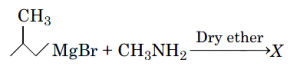
In the reaction,as shown in the image,the number of possible isomers for the organic compound $X$ is
A
$4$
B
$5$
C
$3$
D
$2$
Solution
(D) The reaction is between isobutylmagnesium bromide and methylamine. The Grignard reagent acts as a base and abstracts the acidic proton from the amine to form an alkane.
$ (CH_3)_2CHCH_2MgBr + CH_3NH_2 \rightarrow (CH_3)_2CHCH_3 + Mg(Br)NHCH_3 $
The organic compound $X$ formed is isobutane,which is $2$-methylpropane,$(CH_3)_2CHCH_3$.
The molecular formula of $X$ is $C_4H_{10}$.
The isomers of $C_4H_{10}$ are:
$1$. $n$-butane: $CH_3-CH_2-CH_2-CH_3$
$2$. Isobutane ($2$-methylpropane): $CH_3-CH(CH_3)-CH_3$
Thus,there are $2$ possible isomers for the organic compound $X$.
$ (CH_3)_2CHCH_2MgBr + CH_3NH_2 \rightarrow (CH_3)_2CHCH_3 + Mg(Br)NHCH_3 $
The organic compound $X$ formed is isobutane,which is $2$-methylpropane,$(CH_3)_2CHCH_3$.
The molecular formula of $X$ is $C_4H_{10}$.
The isomers of $C_4H_{10}$ are:
$1$. $n$-butane: $CH_3-CH_2-CH_2-CH_3$
$2$. Isobutane ($2$-methylpropane): $CH_3-CH(CH_3)-CH_3$
Thus,there are $2$ possible isomers for the organic compound $X$.
0 likesView Solution
7
ChemistryEasyMCQKCET · 2020
Bond angle in $PH_{4}^{+}$ is more than that of $PH_{3}$. This is because
A
lone pair-bond pair repulsion exists in $PH_{3}$
B
$PH_{4}^{+}$ has square planar structure
C
$PH_{3}$ has planar trigonal structure
D
hybridisation of $P$ changes when $PH_{3}$ is converted to $PH_{4}^{+}$
Solution
(A) In $PH_{3}$,the phosphorus atom has one lone pair of electrons. According to $VSEPR$ theory,the lone pair-bond pair repulsion is greater than the bond pair-bond pair repulsion,which causes the bond angle to decrease from the ideal tetrahedral angle of $109^{\circ} 28^{\prime}$ to approximately $93.6^{\circ}$,resulting in a pyramidal geometry.
In $PH_{4}^{+}$,the phosphorus atom has four bond pairs and no lone pair. Due to the absence of lone pair-bond pair repulsions and the presence of four identical bond pair-bond pair interactions,$PH_{4}^{+}$ adopts a perfect tetrahedral geometry with a bond angle of $109^{\circ} 28^{\prime}$.
In $PH_{4}^{+}$,the phosphorus atom has four bond pairs and no lone pair. Due to the absence of lone pair-bond pair repulsions and the presence of four identical bond pair-bond pair interactions,$PH_{4}^{+}$ adopts a perfect tetrahedral geometry with a bond angle of $109^{\circ} 28^{\prime}$.
0 likesView Solution
8
ChemistryEasyMCQKCET · 2020
The percentage of $s$-character in the hybrid orbitals of nitrogen in $NO_{2}^{+}$ and $NO_{3}^{-}$ respectively are:
A
$33.3 \%, 50 \%$
B
$50 \%, 33.3 \%$
C
$25 \%, 50 \%$
D
$50 \%, 25 \%$
Solution
(B) In $NO_{2}^{+}$,the nitrogen atom is $sp$-hybridized. The $s$-character in $sp$-hybridization is $\frac{1}{2} \times 100 = 50 \%$.
In $NO_{3}^{-}$,the nitrogen atom is $sp^{2}$-hybridized. The $s$-character in $sp^{2}$-hybridization is $\frac{1}{3} \times 100 = 33.3 \%$.
Therefore,the percentages are $50 \%$ and $33.3 \%$ respectively.
In $NO_{3}^{-}$,the nitrogen atom is $sp^{2}$-hybridized. The $s$-character in $sp^{2}$-hybridization is $\frac{1}{3} \times 100 = 33.3 \%$.
Therefore,the percentages are $50 \%$ and $33.3 \%$ respectively.
0 likesView Solution
9
ChemistryEasyMCQKCET · 2020
The formal charge on the central oxygen atom in ozone $(O_3)$ is:
A
$-1$
B
$0$
C
$+2$
D
$+1$
Solution
(D) The formal charge on an atom in a Lewis structure is calculated using the formula:
Formal Charge = (Total number of valence electrons on the free atom) - ($\frac{1}{2}$ $\times$ Total number of shared electrons) - (Total number of unshared valence electrons).
For the central oxygen atom in the ozone $(O_3)$ molecule:
$1$. The central oxygen atom has $6$ valence electrons in its free state.
$2$. It forms one double bond with one oxygen atom and one single bond with another oxygen atom,sharing a total of $6$ electrons ($3$ bonds $\times$ $2$ electrons per bond).
$3$. It has $2$ unshared electrons (one lone pair).
Formal Charge = $6 - \frac{1}{2}(6) - 2 = 6 - 3 - 2 = +1$.
Formal Charge = (Total number of valence electrons on the free atom) - ($\frac{1}{2}$ $\times$ Total number of shared electrons) - (Total number of unshared valence electrons).
For the central oxygen atom in the ozone $(O_3)$ molecule:
$1$. The central oxygen atom has $6$ valence electrons in its free state.
$2$. It forms one double bond with one oxygen atom and one single bond with another oxygen atom,sharing a total of $6$ electrons ($3$ bonds $\times$ $2$ electrons per bond).
$3$. It has $2$ unshared electrons (one lone pair).
Formal Charge = $6 - \frac{1}{2}(6) - 2 = 6 - 3 - 2 = +1$.
0 likesView Solution
10
ChemistryMediumMCQKCET · 2020
How many moles of acidified $K_{2}Cr_{2}O_{7}$ are required to liberate $6$ moles of $I_{2}$ from an aqueous solution of $I^{-}$?
A
$2$
B
$1$
C
$0.25$
D
$0.5$
Solution
(A) The balanced chemical equation for the reaction is:
$Cr_{2}O_{7}^{2-} + 6I^{-} + 14H^{+} \longrightarrow 2Cr^{3+} + 3I_{2} + 7H_{2}O$
From the stoichiometry of the reaction,$1$ mole of $K_{2}Cr_{2}O_{7}$ produces $3$ moles of $I_{2}$.
Therefore,to liberate $6$ moles of $I_{2}$,the required moles of $K_{2}Cr_{2}O_{7}$ is:
$\frac{1 \text{ mol } K_{2}Cr_{2}O_{7}}{3 \text{ mol } I_{2}} \times 6 \text{ mol } I_{2} = 2 \text{ moles of } K_{2}Cr_{2}O_{7}$.
$Cr_{2}O_{7}^{2-} + 6I^{-} + 14H^{+} \longrightarrow 2Cr^{3+} + 3I_{2} + 7H_{2}O$
From the stoichiometry of the reaction,$1$ mole of $K_{2}Cr_{2}O_{7}$ produces $3$ moles of $I_{2}$.
Therefore,to liberate $6$ moles of $I_{2}$,the required moles of $K_{2}Cr_{2}O_{7}$ is:
$\frac{1 \text{ mol } K_{2}Cr_{2}O_{7}}{3 \text{ mol } I_{2}} \times 6 \text{ mol } I_{2} = 2 \text{ moles of } K_{2}Cr_{2}O_{7}$.
0 likesView Solution
11
ChemistryMCQKCET · 2020
$A$ die is thrown $10$ times. The probability that an odd number will come up at least one time is:
A
$\frac{1}{1024}$
B
$\frac{1023}{1024}$
C
$\frac{11}{1024}$
D
$\frac{1013}{1024}$
Solution
(B) Let $X$ be the number of times an odd number appears in $10$ throws of a die. This follows a binomial distribution with $n = 10$ and $p = \frac{3}{6} = \frac{1}{2}$.
Thus,$q = 1 - p = \frac{1}{2}$.
We need to find the probability of getting an odd number at least once,which is $P(X \geq 1)$.
$P(X \geq 1) = 1 - P(X = 0)$.
Using the binomial probability formula $P(X = k) = {}^{n}C_{k} p^{k} q^{n-k}$,we have:
$P(X = 0) = {}^{10}C_{0} \left(\frac{1}{2}\right)^{0} \left(\frac{1}{2}\right)^{10} = 1 \times 1 \times \frac{1}{1024} = \frac{1}{1024}$.
Therefore,$P(X \geq 1) = 1 - \frac{1}{1024} = \frac{1023}{1024}$.
Thus,$q = 1 - p = \frac{1}{2}$.
We need to find the probability of getting an odd number at least once,which is $P(X \geq 1)$.
$P(X \geq 1) = 1 - P(X = 0)$.
Using the binomial probability formula $P(X = k) = {}^{n}C_{k} p^{k} q^{n-k}$,we have:
$P(X = 0) = {}^{10}C_{0} \left(\frac{1}{2}\right)^{0} \left(\frac{1}{2}\right)^{10} = 1 \times 1 \times \frac{1}{1024} = \frac{1}{1024}$.
Therefore,$P(X \geq 1) = 1 - \frac{1}{1024} = \frac{1023}{1024}$.
0 likesView Solution
12
ChemistryEasyMCQKCET · 2020
Which of the following is not a greenhouse gas?
A
$CFC$
B
$CO_{2}$
C
$O_{2}$
D
$NO_{2}$
Solution
(C) Greenhouse gases are gases that form a layer in the atmosphere and prevent reflected sun rays from escaping,thereby contributing to an increase in global temperature.
$CFC$,$CO_{2}$,and $NO_{2}$ are known greenhouse gases.
$O_{2}$ (oxygen) is not a greenhouse gas as it does not absorb infrared radiation.
$CFC$,$CO_{2}$,and $NO_{2}$ are known greenhouse gases.
$O_{2}$ (oxygen) is not a greenhouse gas as it does not absorb infrared radiation.
0 likesView Solution
13
ChemistryEasyMCQKCET · 2020
Which of the following is the strongest base?
A
$CH_{3}COO^{-}$
B
$Cl^{-}$
C
$OH^{-}$
D
$CH_{3}O^{-}$
Solution
(D) The strength of a base is inversely proportional to the strength of its conjugate acid.
$1$. $CH_{3}COO^{-}$ has conjugate acid $CH_{3}COOH$ $(pK_{a} \approx 4.75)$.
$2$. $Cl^{-}$ has conjugate acid $HCl$ $(pK_{a} \approx -7)$.
$3$. $OH^{-}$ has conjugate acid $H_{2}O$ $(pK_{a} \approx 15.7)$.
$4$. $CH_{3}O^{-}$ has conjugate acid $CH_{3}OH$ $(pK_{a} \approx 15.5)$.
Comparing the $pK_{a}$ values,$CH_{3}OH$ is the weakest acid among the given options.
Therefore,its conjugate base,$CH_{3}O^{-}$,is the strongest base.
$1$. $CH_{3}COO^{-}$ has conjugate acid $CH_{3}COOH$ $(pK_{a} \approx 4.75)$.
$2$. $Cl^{-}$ has conjugate acid $HCl$ $(pK_{a} \approx -7)$.
$3$. $OH^{-}$ has conjugate acid $H_{2}O$ $(pK_{a} \approx 15.7)$.
$4$. $CH_{3}O^{-}$ has conjugate acid $CH_{3}OH$ $(pK_{a} \approx 15.5)$.
Comparing the $pK_{a}$ values,$CH_{3}OH$ is the weakest acid among the given options.
Therefore,its conjugate base,$CH_{3}O^{-}$,is the strongest base.
0 likesView Solution
14
ChemistryEasyMCQKCET · 2020
Which of the following is not a pair of functional isomers?
A
$C_{2}H_{5}OC_{2}H_{5}$ and $C_{3}H_{7}OCH_{3}$
B
$CH_{3}CH_{2}OH$ and $CH_{3}OCH_{3}$
C
$CH_{3}CH_{2}NO_{2}$ and $H_{2}NCH_{2}COOH$
D
$CH_{3}COOH$ and $HCOOCH_{3}$
Solution
(A) Functional isomers are compounds that have the same molecular formula but possess different functional groups.
In option $A$,both $C_{2}H_{5}OC_{2}H_{5}$ (diethyl ether) and $C_{3}H_{7}OCH_{3}$ (methyl propyl ether) contain the same functional group,which is an ether $(-O-)$. Therefore,they are metamers,not functional isomers.
In option $B$,$CH_{3}CH_{2}OH$ (alcohol) and $CH_{3}OCH_{3}$ (ether) are functional isomers.
In option $C$,$CH_{3}CH_{2}NO_{2}$ (nitroalkane) and $H_{2}NCH_{2}COOH$ (amino acid) represent different functional groups.
In option $D$,$CH_{3}COOH$ (carboxylic acid) and $HCOOCH_{3}$ (ester) are functional isomers.
In option $A$,both $C_{2}H_{5}OC_{2}H_{5}$ (diethyl ether) and $C_{3}H_{7}OCH_{3}$ (methyl propyl ether) contain the same functional group,which is an ether $(-O-)$. Therefore,they are metamers,not functional isomers.
In option $B$,$CH_{3}CH_{2}OH$ (alcohol) and $CH_{3}OCH_{3}$ (ether) are functional isomers.
In option $C$,$CH_{3}CH_{2}NO_{2}$ (nitroalkane) and $H_{2}NCH_{2}COOH$ (amino acid) represent different functional groups.
In option $D$,$CH_{3}COOH$ (carboxylic acid) and $HCOOCH_{3}$ (ester) are functional isomers.
0 likesView Solution
15
ChemistryDifficultMCQKCET · 2020
Identify $X$ in the following reaction.

A
$1,2-$Dichlorobenzene
B
Hexachlorobenzene
C
Hexachlorocyclohexane
D
Chlorobenzene
Solution
(B) The reaction of benzene with excess chlorine in the presence of anhydrous $AlCl_3$ (a Lewis acid) in the dark and at cold conditions leads to the electrophilic aromatic substitution of all six hydrogen atoms of the benzene ring by chlorine atoms. This process is known as exhaustive chlorination. The reaction is as follows:
$C_6H_6 + 6Cl_2 \xrightarrow{\text{Anhydrous } AlCl_3, \text{dark, cold}} C_6Cl_6 + 6HCl$
Here,$C_6Cl_6$ is hexachlorobenzene. Therefore,the correct option is $B$.
$C_6H_6 + 6Cl_2 \xrightarrow{\text{Anhydrous } AlCl_3, \text{dark, cold}} C_6Cl_6 + 6HCl$
Here,$C_6Cl_6$ is hexachlorobenzene. Therefore,the correct option is $B$.
0 likesView Solution
16
ChemistryEasyMCQKCET · 2020
The conjugate base of $NH_{3}$ is
A
$NH_{4}^{+}$
B
$NH_{4}OH$
C
$NH_{2}OH$
D
$NH_{2}^{-}$
Solution
(D) The conjugate base of a species is formed by the removal of one proton $(H^{+})$ from it.
For $NH_{3}$,the reaction is:
$NH_{3} \longrightarrow H^{+} + NH_{2}^{-}$
Therefore,$NH_{2}^{-}$ is the conjugate base of $NH_{3}$.
For $NH_{3}$,the reaction is:
$NH_{3} \longrightarrow H^{+} + NH_{2}^{-}$
Therefore,$NH_{2}^{-}$ is the conjugate base of $NH_{3}$.
0 likesView Solution
17
ChemistryMCQKCET · 2020
The ratio of the magnetic field at the centre of a current-carrying circular coil to its magnetic moment is $x$. If the current and the radius are both doubled,the new ratio will become:
A
$2 x$
B
$4 x$
C
$\frac{x}{4}$
D
$\frac{x}{8}$
Solution
(D) The magnetic field $B$ at the centre of a circular coil of radius $r$ carrying current $I$ is given by $B = \frac{\mu_0 I}{2r}$.
The magnetic dipole moment $m$ is given by $m = I A = I (\pi r^2)$.
The initial ratio is $x = \frac{B}{m} = \frac{\mu_0 I / 2r}{I \pi r^2} = \frac{\mu_0}{2 \pi r^3}$.
When the current $I$ becomes $I' = 2I$ and the radius $r$ becomes $r' = 2r$,the new magnetic field $B'$ is $B' = \frac{\mu_0 (2I)}{2(2r)} = \frac{\mu_0 I}{2r} = B$.
The new magnetic moment $m'$ is $m' = (2I) \pi (2r)^2 = (2I) \pi (4r^2) = 8 I \pi r^2 = 8m$.
The new ratio $x'$ is $x' = \frac{B'}{m'} = \frac{B}{8m} = \frac{1}{8} \left( \frac{B}{m} \right) = \frac{x}{8}$.
The magnetic dipole moment $m$ is given by $m = I A = I (\pi r^2)$.
The initial ratio is $x = \frac{B}{m} = \frac{\mu_0 I / 2r}{I \pi r^2} = \frac{\mu_0}{2 \pi r^3}$.
When the current $I$ becomes $I' = 2I$ and the radius $r$ becomes $r' = 2r$,the new magnetic field $B'$ is $B' = \frac{\mu_0 (2I)}{2(2r)} = \frac{\mu_0 I}{2r} = B$.
The new magnetic moment $m'$ is $m' = (2I) \pi (2r)^2 = (2I) \pi (4r^2) = 8 I \pi r^2 = 8m$.
The new ratio $x'$ is $x' = \frac{B'}{m'} = \frac{B}{8m} = \frac{1}{8} \left( \frac{B}{m} \right) = \frac{x}{8}$.
0 likesView Solution
18
ChemistryDifficultMCQKCET · 2020
$A$ Lewis acid '$X$' reacts with $LiAlH_{4}$ in ether medium to give a highly toxic gas. This gas when heated with $NH_{3}$ gives a compound commonly known as inorganic benzene. The gas is
A
$B_{2}O_{3}$
B
$B_{2}H_{6}$
C
$B_{3}N_{3}H_{6}$
D
$BF_{3}$
Solution
(B) The reaction of a Lewis acid like $BCl_{3}$ with $LiAlH_{4}$ in an ether medium produces diborane $(B_{2}H_{6})$,which is a highly toxic gas.
$4BCl_{3} + 3LiAlH_{4} \rightarrow 2B_{2}H_{6} + 3AlCl_{3} + 3LiCl$
When diborane $(B_{2}H_{6})$ is heated with ammonia $(NH_{3})$,it forms borazine $(B_{3}N_{3}H_{6})$,which is commonly known as inorganic benzene.
$3B_{2}H_{6} + 6NH_{3} \rightarrow 2B_{3}N_{3}H_{6} + 12H_{2}$
Thus,the toxic gas is $B_{2}H_{6}$.
$4BCl_{3} + 3LiAlH_{4} \rightarrow 2B_{2}H_{6} + 3AlCl_{3} + 3LiCl$
When diborane $(B_{2}H_{6})$ is heated with ammonia $(NH_{3})$,it forms borazine $(B_{3}N_{3}H_{6})$,which is commonly known as inorganic benzene.
$3B_{2}H_{6} + 6NH_{3} \rightarrow 2B_{3}N_{3}H_{6} + 12H_{2}$
Thus,the toxic gas is $B_{2}H_{6}$.
0 likesView Solution
19
ChemistryMediumMCQKCET · 2020
The metal that produces $H_{2}$ with both dil. $HCl$ and $NaOH_{(aq)}$ is
A
$Zn$
B
$Mg$
C
$Ca$
D
$Fe$
Solution
(A) Amphoteric metals react with both acids and bases to liberate $H_{2}$ gas.
$Zn + 2 HCl \text{ (dil.)} \longrightarrow ZnCl_{2} + H_{2}$
$Zn + 2 NaOH + 2 H_{2}O \longrightarrow Na_{2}[Zn(OH)_{4}] + H_{2}$
$Mg$,$Ca$,and $Fe$ are not amphoteric and do not react with aqueous $NaOH$ to produce $H_{2}$.
$Zn + 2 HCl \text{ (dil.)} \longrightarrow ZnCl_{2} + H_{2}$
$Zn + 2 NaOH + 2 H_{2}O \longrightarrow Na_{2}[Zn(OH)_{4}] + H_{2}$
$Mg$,$Ca$,and $Fe$ are not amphoteric and do not react with aqueous $NaOH$ to produce $H_{2}$.
0 likesView Solution
20
ChemistryMediumMCQKCET · 2020
The oxidation number of nitrogen atoms in $NH_4NO_3$ are
A
$+5, +5$
B
$-3, +5$
C
$+3, -5$
D
$-3, -3$
Solution
(B) $NH_4NO_3 \longrightarrow NH_4^+ + NO_3^-$
In $NH_4^+$,let the oxidation number of $N$ be $x$.
$x + 4(+1) = +1 \implies x = -3$.
In $NO_3^-$,let the oxidation number of $N$ be $y$.
$y + 3(-2) = -1 \implies y - 6 = -1 \implies y = +5$.
Thus,the oxidation numbers of nitrogen atoms in $NH_4NO_3$ are $-3$ and $+5$.
In $NH_4^+$,let the oxidation number of $N$ be $x$.
$x + 4(+1) = +1 \implies x = -3$.
In $NO_3^-$,let the oxidation number of $N$ be $y$.
$y + 3(-2) = -1 \implies y - 6 = -1 \implies y = +5$.
Thus,the oxidation numbers of nitrogen atoms in $NH_4NO_3$ are $-3$ and $+5$.
0 likesView Solution
21
ChemistryEasyMCQKCET · 2020
The oxide of potassium that does not exist is
A
$K_{2}O$
B
$KO_{2}$
C
$K_{2}O_{2}$
D
$K_{2}O_{3}$
Solution
(D) Potassium forms various oxides such as $K_{2}O$ (oxide),$K_{2}O_{2}$ (peroxide),and $KO_{2}$ (superoxide).
$K_{2}O_{3}$ (potassium sesquioxide) does not exist because the $O_{3}^{2-}$ ion is not a stable chemical entity.
$K_{2}O_{3}$ (potassium sesquioxide) does not exist because the $O_{3}^{2-}$ ion is not a stable chemical entity.
0 likesView Solution
22
ChemistryDifficultMCQKCET · 2020
$0.4 \text{ g}$ of dihydrogen is made to react with $7.4 \text{ g}$ of dichlorine to form hydrogen chloride. The volume of hydrogen chloride formed at $273 \text{ K}$ and $1 \text{ bar}$ pressure is: (in $\text{ L}$)
A
$9.08$
B
$4.67$
C
$90.8$
D
$45.4$
Solution
(B) The balanced chemical equation is: $H_{2(g)} + Cl_{2(g)} \rightarrow 2HCl_{(g)}$
Moles of $H_2 = \frac{0.4 \text{ g}}{2 \text{ g/mol}} = 0.2 \text{ mol}$
Moles of $Cl_2 = \frac{7.4 \text{ g}}{71 \text{ g/mol}} \approx 0.1042 \text{ mol}$
Since $1 \text{ mol}$ of $H_2$ reacts with $1 \text{ mol}$ of $Cl_2$, $Cl_2$ is the limiting reagent because it is present in a smaller amount.
Moles of $HCl$ formed $= 2 \times \text{moles of } Cl_2 = 2 \times 0.1042 = 0.2084 \text{ mol}$
At $273 \text{ K}$ and $1 \text{ bar}$ ($STP$ conditions), the molar volume of an ideal gas is approximately $22.7 \text{ L/mol}$.
Volume of $HCl = 0.2084 \text{ mol} \times 22.7 \text{ L/mol} \approx 4.73 \text{ L}$.
Given the options, $4.67 \text{ L}$ is the closest value, which is obtained by using the older $STP$ definition $(22.4 \text{ L/mol})$.
Thus, the correct option is $(b)$.
Moles of $H_2 = \frac{0.4 \text{ g}}{2 \text{ g/mol}} = 0.2 \text{ mol}$
Moles of $Cl_2 = \frac{7.4 \text{ g}}{71 \text{ g/mol}} \approx 0.1042 \text{ mol}$
Since $1 \text{ mol}$ of $H_2$ reacts with $1 \text{ mol}$ of $Cl_2$, $Cl_2$ is the limiting reagent because it is present in a smaller amount.
Moles of $HCl$ formed $= 2 \times \text{moles of } Cl_2 = 2 \times 0.1042 = 0.2084 \text{ mol}$
At $273 \text{ K}$ and $1 \text{ bar}$ ($STP$ conditions), the molar volume of an ideal gas is approximately $22.7 \text{ L/mol}$.
Volume of $HCl = 0.2084 \text{ mol} \times 22.7 \text{ L/mol} \approx 4.73 \text{ L}$.
Given the options, $4.67 \text{ L}$ is the closest value, which is obtained by using the older $STP$ definition $(22.4 \text{ L/mol})$.
Thus, the correct option is $(b)$.
0 likesView Solution
23
ChemistryMediumMCQKCET · 2020
$A$ metal exists as an oxide with formula $M_{0.96} O$. Metal $M$ can exist as $M^{2+}$ and $M^{3+}$ in its oxide $M_{0.96} O$. The percentage of $M^{3+}$ in the oxide is nearly: (in $\%$)
A
$8.3$
B
$4.6$
C
$5$
D
$9.6$
Solution
(A) Let the total number of oxide ions be $100$. Then the number of metal ions $M$ is $96$.
Let the number of $M^{2+}$ ions be $x$ and the number of $M^{3+}$ ions be $(96 - x)$.
Since the compound is electrically neutral,the total positive charge must equal the total negative charge.
Total negative charge $= 100 \times 2 = 200$.
Total positive charge $= 2x + 3(96 - x) = 200$.
$2x + 288 - 3x = 200$.
$-x = 200 - 288 = -88$.
$x = 88$ (number of $M^{2+}$ ions).
Number of $M^{3+}$ ions $= 96 - 88 = 8$.
Percentage of $M^{3+} = \frac{8}{96} \times 100 = 8.33 \% \approx 8.3 \%$.
Let the number of $M^{2+}$ ions be $x$ and the number of $M^{3+}$ ions be $(96 - x)$.
Since the compound is electrically neutral,the total positive charge must equal the total negative charge.
Total negative charge $= 100 \times 2 = 200$.
Total positive charge $= 2x + 3(96 - x) = 200$.
$2x + 288 - 3x = 200$.
$-x = 200 - 288 = -88$.
$x = 88$ (number of $M^{2+}$ ions).
Number of $M^{3+}$ ions $= 96 - 88 = 8$.
Percentage of $M^{3+} = \frac{8}{96} \times 100 = 8.33 \% \approx 8.3 \%$.
0 likesView Solution
24
ChemistryMediumMCQKCET · 2020
$A$ gas mixture contains $25 \%$ He and $75 \% CH_4$ by volume at a given temperature and pressure. The percentage by mass of methane in the mixture is approximately . . . . . . (in $\%$)
A
$75$
B
$25$
C
$92$
D
$8$
Solution
(C) Assume the total volume of the gas mixture is $100 \ mL$.
Since the volume percentage is equal to the mole percentage for ideal gases,we have $25 \ mol$ of He and $75 \ mol$ of $CH_4$.
Molar mass of He $= 4 \ g/mol$.
Molar mass of $CH_4 = 16 \ g/mol$.
Mass of He $= 25 \times 4 = 100 \ g$.
Mass of $CH_4 = 75 \times 16 = 1200 \ g$.
Total mass of the mixture $= 100 + 1200 = 1300 \ g$.
Mass percentage of $CH_4 = \frac{\text{Mass of } CH_4}{\text{Total mass}} \times 100 = \frac{1200}{1300} \times 100 \approx 92.3 \%$.
Thus,the percentage by mass of methane is approximately $92 \%$.
Since the volume percentage is equal to the mole percentage for ideal gases,we have $25 \ mol$ of He and $75 \ mol$ of $CH_4$.
Molar mass of He $= 4 \ g/mol$.
Molar mass of $CH_4 = 16 \ g/mol$.
Mass of He $= 25 \times 4 = 100 \ g$.
Mass of $CH_4 = 75 \times 16 = 1200 \ g$.
Total mass of the mixture $= 100 + 1200 = 1300 \ g$.
Mass percentage of $CH_4 = \frac{\text{Mass of } CH_4}{\text{Total mass}} \times 100 = \frac{1200}{1300} \times 100 \approx 92.3 \%$.
Thus,the percentage by mass of methane is approximately $92 \%$.
0 likesView Solution
25
ChemistryMCQKCET · 2020
Which one of the following is not included under in-situ conservation?
A
Biosphere Reserve
B
National Park
C
Sanctuary
D
Botanical Garden
Solution
(D) $In-situ$ conservation refers to protecting an endangered species in its natural habitat.
$In-situ$ approach includes the protection of a group of ecosystems through a network of protected areas,such as biodiversity hotspots,national parks,sanctuaries,biosphere reserves,and sacred groves and lakes.
Whereas $Ex-situ$ conservation involves the protection of genetic resources of species away from their area of origin or development.
This includes off-site collections such as zoos,botanical gardens,aquariums,gene banks,and $In-vitro$ preservation methods like tissue culture and cryopreservation.
Therefore,a botanical garden is an example of $Ex-situ$ conservation,not $In-situ$ conservation.
$In-situ$ approach includes the protection of a group of ecosystems through a network of protected areas,such as biodiversity hotspots,national parks,sanctuaries,biosphere reserves,and sacred groves and lakes.
Whereas $Ex-situ$ conservation involves the protection of genetic resources of species away from their area of origin or development.
This includes off-site collections such as zoos,botanical gardens,aquariums,gene banks,and $In-vitro$ preservation methods like tissue culture and cryopreservation.
Therefore,a botanical garden is an example of $Ex-situ$ conservation,not $In-situ$ conservation.
0 likesView Solution
26
ChemistryMediumMCQKCET · 2020
With regard to the photoelectric effect,identify the correct statement among the following.
A
Energy of electron ejected increases with the increase in the intensity of incident light.
B
Number of electron ejected increases with the increase in the frequency of incident light.
C
Number of electron ejected increases with the increase in work function.
D
Number of electron ejected increases with the increase in the intensity of incident light.
Solution
(D) The photoelectric effect occurs when light of a suitable frequency strikes the surface of a metal,causing the ejection of electrons.
The number of photoelectrons emitted per second is directly proportional to the intensity of the incident light,provided the frequency is above the threshold frequency.
The kinetic energy of the emitted electrons depends on the frequency of the incident light,not its intensity.
Therefore,the correct statement is that the number of electrons ejected increases with the increase in the intensity of incident light.
The number of photoelectrons emitted per second is directly proportional to the intensity of the incident light,provided the frequency is above the threshold frequency.
The kinetic energy of the emitted electrons depends on the frequency of the incident light,not its intensity.
Therefore,the correct statement is that the number of electrons ejected increases with the increase in the intensity of incident light.
0 likesView Solution
27
ChemistryMediumMCQKCET · 2020
When the same quantity of heat is absorbed by a system at two different temperatures $T_{1}$ and $T_{2}$,such that $T_{1} > T_{2}$,the changes in entropy are $\Delta S_{1}$ and $\Delta S_{2}$ respectively. Then:
A
$\Delta S_{1} < \Delta S_{2}$
B
$\Delta S_{1} = \Delta S_{2}$
C
$\Delta S_{1} > \Delta S_{2}$
D
$\Delta S_{2} < \Delta S_{1}$
Solution
(A) We know that the change in entropy is given by $\Delta S = \frac{q_{rev}}{T}$.
Given that the quantity of heat $q_{rev}$ is the same in both cases,we have $\Delta S_{1} = \frac{q_{rev}}{T_{1}}$ and $\Delta S_{2} = \frac{q_{rev}}{T_{2}}$.
Since $T_{1} > T_{2}$,the denominator in the expression for $\Delta S_{1}$ is larger than the denominator in the expression for $\Delta S_{2}$.
Therefore,$\Delta S_{1} < \Delta S_{2}$.
Given that the quantity of heat $q_{rev}$ is the same in both cases,we have $\Delta S_{1} = \frac{q_{rev}}{T_{1}}$ and $\Delta S_{2} = \frac{q_{rev}}{T_{2}}$.
Since $T_{1} > T_{2}$,the denominator in the expression for $\Delta S_{1}$ is larger than the denominator in the expression for $\Delta S_{2}$.
Therefore,$\Delta S_{1} < \Delta S_{2}$.
0 likesView Solution
28
ChemistryDifficultMCQKCET · 2020
The steps involved in the conversion of propan$-2-$ol to propan$-1-$ol are in the order
A
dehydration,addition of $HBr$,heating with aq. $KOH$
B
heating with $PCl_{5}$,heating with alc. $KOH$,acid catalysed addition of water
C
heating with $PCl_{5}$,heating with alc. $KOH$,hydroboration oxidation
D
dehydration,addition of $HBr$ in presence of peroxide,heating with alc. $KOH$
Solution
(C) The conversion of propan$-2-$ol to propan$-1-$ol proceeds as follows:
$1$. Propan$-2-$ol reacts with $PCl_{5}$ to form $2-$chloropropane.
$2$. $2-$chloropropane undergoes dehydrohalogenation with alcoholic $KOH$ to form propene.
$3$. Propene undergoes hydroboration-oxidation (reaction with $B_{2}H_{6}$ followed by $H_{2}O_{2}/NaOH$) to form propan$-1-$ol via anti-Markovnikov addition of water.
$1$. Propan$-2-$ol reacts with $PCl_{5}$ to form $2-$chloropropane.
$2$. $2-$chloropropane undergoes dehydrohalogenation with alcoholic $KOH$ to form propene.
$3$. Propene undergoes hydroboration-oxidation (reaction with $B_{2}H_{6}$ followed by $H_{2}O_{2}/NaOH$) to form propan$-1-$ol via anti-Markovnikov addition of water.
0 likesView Solution
29
ChemistryMediumMCQKCET · 2020
Which of the following on heating gives an ether as the major product?
$(P)$ $C_6H_5CH_2Br + CH_3ONa$
$(Q)$ $C_6H_5ONa + CH_3Br$
$(R)$ $(CH_3)_3CCl + CH_3ONa$
$(S)$ $C_6H_5CH=CHCl + CH_3ONa$
$(P)$ $C_6H_5CH_2Br + CH_3ONa$
$(Q)$ $C_6H_5ONa + CH_3Br$
$(R)$ $(CH_3)_3CCl + CH_3ONa$
$(S)$ $C_6H_5CH=CHCl + CH_3ONa$
A
Both $(R)$ and $(S)$
B
Both $(P)$ and $(R)$
C
Both $(Q)$ and $(S)$
D
Both $(P)$ and $(Q)$
Solution
(D) The Williamson ether synthesis involves the reaction of an alkoxide ion with a primary alkyl halide to form an ether.
$(P)$ $C_6H_5CH_2Br + CH_3ONa \rightarrow C_6H_5CH_2OCH_3 + NaBr$. This is a $S_N2$ reaction between a primary benzylic halide and a strong nucleophile,yielding an ether as the major product.
$(Q)$ $C_6H_5ONa + CH_3Br \rightarrow C_6H_5OCH_3 + NaBr$. This is a $S_N2$ reaction between a phenoxide ion and a primary alkyl halide,yielding an ether as the major product.
$(R)$ $(CH_3)_3CCl + CH_3ONa \rightarrow (CH_3)_2C=CH_2 + CH_3OH + NaCl$. Since $(CH_3)_3CCl$ is a tertiary alkyl halide,the strong base $CH_3ONa$ promotes an $E2$ elimination reaction,giving an alkene as the major product.
$(S)$ $C_6H_5CH=CHCl + CH_3ONa$. Vinyl halides are unreactive towards $S_N2$ reactions due to the partial double bond character of the $C-X$ bond and the instability of the vinylic carbocation,so no ether is formed.
Therefore,both $(P)$ and $(Q)$ give an ether as the major product.
$(P)$ $C_6H_5CH_2Br + CH_3ONa \rightarrow C_6H_5CH_2OCH_3 + NaBr$. This is a $S_N2$ reaction between a primary benzylic halide and a strong nucleophile,yielding an ether as the major product.
$(Q)$ $C_6H_5ONa + CH_3Br \rightarrow C_6H_5OCH_3 + NaBr$. This is a $S_N2$ reaction between a phenoxide ion and a primary alkyl halide,yielding an ether as the major product.
$(R)$ $(CH_3)_3CCl + CH_3ONa \rightarrow (CH_3)_2C=CH_2 + CH_3OH + NaCl$. Since $(CH_3)_3CCl$ is a tertiary alkyl halide,the strong base $CH_3ONa$ promotes an $E2$ elimination reaction,giving an alkene as the major product.
$(S)$ $C_6H_5CH=CHCl + CH_3ONa$. Vinyl halides are unreactive towards $S_N2$ reactions due to the partial double bond character of the $C-X$ bond and the instability of the vinylic carbocation,so no ether is formed.
Therefore,both $(P)$ and $(Q)$ give an ether as the major product.
0 likesView Solution
30
ChemistryMediumMCQKCET · 2020
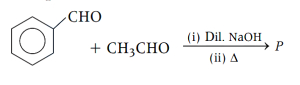
The product '$P$' is
A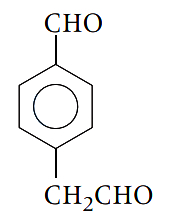
B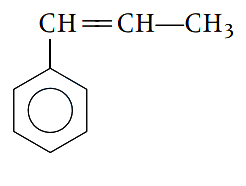
C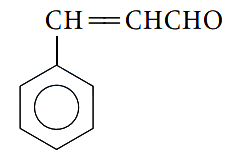
D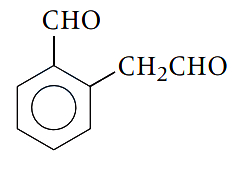
Solution
(C) The reaction between benzaldehyde $(C_6H_5CHO)$ and acetaldehyde $(CH_3CHO)$ in the presence of dilute $NaOH$ followed by heating $(\Delta)$ is a cross-aldol condensation reaction.
$1$. The enolate ion formed from acetaldehyde attacks the carbonyl carbon of benzaldehyde to form a $\beta$-hydroxy aldehyde.
$2$. Upon heating,this $\beta$-hydroxy aldehyde undergoes dehydration to form an $\alpha,\beta$-unsaturated aldehyde,which is cinnamaldehyde $(C_6H_5CH=CHCHO)$.
$1$. The enolate ion formed from acetaldehyde attacks the carbonyl carbon of benzaldehyde to form a $\beta$-hydroxy aldehyde.
$2$. Upon heating,this $\beta$-hydroxy aldehyde undergoes dehydration to form an $\alpha,\beta$-unsaturated aldehyde,which is cinnamaldehyde $(C_6H_5CH=CHCHO)$.
0 likesView Solution
31
ChemistryMediumMCQKCET · 2020
The carbonyl compound that does not undergo aldol condensation is
A
acetone
B
dichloro acetaldehyde
C
trichloro acetaldehyde
D
acetaldehyde
Solution
(C) Any carbonyl compound having $\alpha$-hydrogen will undergo aldol condensation.
In $CCl_3CHO$ (trichloro acetaldehyde),the $\alpha$-carbon is bonded to three chlorine atoms and has no $\alpha$-hydrogen atom attached to it.
Therefore,it does not show the aldol condensation reaction.
In $CCl_3CHO$ (trichloro acetaldehyde),the $\alpha$-carbon is bonded to three chlorine atoms and has no $\alpha$-hydrogen atom attached to it.
Therefore,it does not show the aldol condensation reaction.
0 likesView Solution
32
ChemistryMediumMCQKCET · 2020
Hinsberg's reagent is
A
$(CH_{3}CO)_{2}O / \text{pyridine}$
B
$C_{6}H_{5}SO_{2}Cl$
C
$C_{6}H_{5}SO_{2}NH_{2}$
D
$CH_{3}COCl / \text{pyridine}$
Solution
(B) Hinsberg reagent is $C_{6}H_{5}SO_{2}Cl$ (benzene sulphonyl chloride).
It is used for the detection and differentiation of primary,secondary,and tertiary amines.
It is used for the detection and differentiation of primary,secondary,and tertiary amines.
0 likesView Solution
33
ChemistryEasyMCQKCET · 2020
$C_{1}-C_{4}$ glycosidic bond is not found in
A
maltose
B
sucrose
C
lactose
D
starch
Solution
(B) Sucrose does not contain a $C_{1}-C_{4}$ glycosidic linkage.
In sucrose,the glycosidic linkage is formed between $C_{1}$ of $\alpha$-glucose and $C_{2}$ of $\beta$-fructose.
Therefore,it is a $C_{1}-C_{2}$ linkage.
In sucrose,the glycosidic linkage is formed between $C_{1}$ of $\alpha$-glucose and $C_{2}$ of $\beta$-fructose.
Therefore,it is a $C_{1}-C_{2}$ linkage.
0 likesView Solution
34
ChemistryEasyMCQKCET · 2020
Which one of the following vitamins is not stored in adipose tissue?
A
$A$
B
$B_{6}$
C
$D$
D
$E$
Solution
(B) Vitamins are classified as fat-soluble or water-soluble.
Fat-soluble vitamins $(A, D, E, K)$ are stored in the body,primarily in the liver and adipose tissue.
Water-soluble vitamins (such as $B$-complex and $C$) are not stored in the body and are excreted through urine.
Therefore,vitamin $B_{6}$ is not stored in adipose tissue.
Fat-soluble vitamins $(A, D, E, K)$ are stored in the body,primarily in the liver and adipose tissue.
Water-soluble vitamins (such as $B$-complex and $C$) are not stored in the body and are excreted through urine.
Therefore,vitamin $B_{6}$ is not stored in adipose tissue.
0 likesView Solution
35
ChemistryEasyMCQKCET · 2020
Hypothyroidism is caused by the deficiency of
A
vitamin $B_{12}$
B
adrenalin
C
thyroxine
D
glucocorticoid
Solution
(C) Hypothyroidism is caused due to the deficiency of thyroxine.
Thyroxine is a hormone secreted by the thyroid gland,which regulates the metabolism of carbohydrates,lipids,and proteins in the body.
Thyroxine is a hormone secreted by the thyroid gland,which regulates the metabolism of carbohydrates,lipids,and proteins in the body.
0 likesView Solution
36
ChemistryEasyMCQKCET · 2020
Which of the following pairs is incorrectly matched?
A
$XeO_3$: Pyramidal
B
$XeF_4$: Tetrahedral
C
$XeF_6$: Distorted octahedral
D
$XeOF_4$: Square pyramidal
Solution
(B) The incorrectly matched pair is $XeF_4$: Tetrahedral.
$XeF_4$ has a square planar structure due to $sp^3d^2$ hybridization with two lone pairs of electrons occupying the axial positions.
$XeF_4$ has a square planar structure due to $sp^3d^2$ hybridization with two lone pairs of electrons occupying the axial positions.
0 likesView Solution
37
ChemistryMediumMCQKCET · 2020
Which of the following has the lowest boiling point?
A
$CH_3-CH_2-OH$
B
$CH_3-CH_2-NH_2$
C
$CH_3-O-CH_3$
D
$HCOOH$
Solution
(C) The boiling point of a compound depends on the strength of intermolecular forces.
$CH_3-CH_2-OH$ (alcohol),$CH_3-CH_2-NH_2$ (amine),and $HCOOH$ (carboxylic acid) all exhibit intermolecular hydrogen bonding,which significantly increases their boiling points.
$CH_3-O-CH_3$ (dimethyl ether) is a polar molecule but lacks hydrogen bonding,relying only on dipole-dipole interactions.
Therefore,$CH_3-O-CH_3$ has the lowest boiling point among the given options.
$CH_3-CH_2-OH$ (alcohol),$CH_3-CH_2-NH_2$ (amine),and $HCOOH$ (carboxylic acid) all exhibit intermolecular hydrogen bonding,which significantly increases their boiling points.
$CH_3-O-CH_3$ (dimethyl ether) is a polar molecule but lacks hydrogen bonding,relying only on dipole-dipole interactions.
Therefore,$CH_3-O-CH_3$ has the lowest boiling point among the given options.
0 likesView Solution
38
ChemistryEasyMCQKCET · 2020
For an elementary reaction $2 A + 3 B \rightarrow 4 C + D$,the rate of appearance of $C$ at time $t$ is $2.8 \times 10^{-3} \ mol \ L^{-1} \ s^{-1}$. The rate of disappearance of $B$ at time $t$ will be:
A
$\frac{4}{3}(2.8 \times 10^{-3}) \ mol \ L^{-1} \ s^{-1}$
B
$\frac{3}{4}(2.8 \times 10^{-3}) \ mol \ L^{-1} \ s^{-1}$
C
$2(2.8 \times 10^{-3}) \ mol \ L^{-1} \ s^{-1}$
D
$\frac{1}{4}(2.8 \times 10^{-3}) \ mol \ L^{-1} \ s^{-1}$
Solution
(B) For the reaction $2 A + 3 B \rightarrow 4 C + D$,the rate expression is given by:
$-\frac{1}{3} \frac{d[B]}{dt} = +\frac{1}{4} \frac{d[C]}{dt}$
Given that the rate of appearance of $C$ is $\frac{d[C]}{dt} = 2.8 \times 10^{-3} \ mol \ L^{-1} \ s^{-1}$.
The rate of disappearance of $B$ is $-\frac{d[B]}{dt}$.
From the rate expression: $-\frac{d[B]}{dt} = \frac{3}{4} \frac{d[C]}{dt}$
Substituting the given value: $-\frac{d[B]}{dt} = \frac{3}{4} \times (2.8 \times 10^{-3}) \ mol \ L^{-1} \ s^{-1}$.
$-\frac{1}{3} \frac{d[B]}{dt} = +\frac{1}{4} \frac{d[C]}{dt}$
Given that the rate of appearance of $C$ is $\frac{d[C]}{dt} = 2.8 \times 10^{-3} \ mol \ L^{-1} \ s^{-1}$.
The rate of disappearance of $B$ is $-\frac{d[B]}{dt}$.
From the rate expression: $-\frac{d[B]}{dt} = \frac{3}{4} \frac{d[C]}{dt}$
Substituting the given value: $-\frac{d[B]}{dt} = \frac{3}{4} \times (2.8 \times 10^{-3}) \ mol \ L^{-1} \ s^{-1}$.
0 likesView Solution
39
ChemistryMediumMCQKCET · 2020
The time required for $60 \%$ completion of a first order reaction is $50 \ min$. The time required for $93.6 \%$ completion of the same reaction will be (in $min$)
A
$100$
B
$83.8$
C
$50$
D
$150$
Solution
(D) For a first order reaction,the rate constant $k$ is given by $k = \frac{2.303}{t} \log \frac{[A]_0}{[A]_t}$.
For $60 \%$ completion,$[A]_t = [A]_0 - 0.60[A]_0 = 0.40[A]_0$ and $t = 50 \ min$.
$k = \frac{2.303}{50} \log \frac{[A]_0}{0.40[A]_0} = \frac{2.303}{50} \log 2.5$.
For $93.6 \%$ completion,$[A]_t = [A]_0 - 0.936[A]_0 = 0.064[A]_0$.
$k = \frac{2.303}{t'} \log \frac{[A]_0}{0.064[A]_0} = \frac{2.303}{t'} \log \frac{1}{0.064} = \frac{2.303}{t'} \log 15.625$.
Equating the two expressions for $k$:
$\frac{2.303}{50} \log 2.5 = \frac{2.303}{t'} \log 15.625$.
$t' = 50 \times \frac{\log 15.625}{\log 2.5} = 50 \times \frac{\log (2.5)^3}{\log 2.5} = 50 \times 3 = 150 \ min$.
For $60 \%$ completion,$[A]_t = [A]_0 - 0.60[A]_0 = 0.40[A]_0$ and $t = 50 \ min$.
$k = \frac{2.303}{50} \log \frac{[A]_0}{0.40[A]_0} = \frac{2.303}{50} \log 2.5$.
For $93.6 \%$ completion,$[A]_t = [A]_0 - 0.936[A]_0 = 0.064[A]_0$.
$k = \frac{2.303}{t'} \log \frac{[A]_0}{0.064[A]_0} = \frac{2.303}{t'} \log \frac{1}{0.064} = \frac{2.303}{t'} \log 15.625$.
Equating the two expressions for $k$:
$\frac{2.303}{50} \log 2.5 = \frac{2.303}{t'} \log 15.625$.
$t' = 50 \times \frac{\log 15.625}{\log 2.5} = 50 \times \frac{\log (2.5)^3}{\log 2.5} = 50 \times 3 = 150 \ min$.
0 likesView Solution
40
ChemistryDifficultMCQKCET · 2020
The rate constant of a reaction is given by $k = P Z e^{-E_{a} / R T}$ under standard notation. In order to speed up the reaction,which of the following factors has to be decreased?
A
$Z$
B
Both $Z$ and $T$
C
$E_{a}$
D
$T$
Solution
(C) The rate constant $k$ is given by the Arrhenius equation: $k = P Z e^{-E_{a} / R T}$.
To speed up the reaction,the rate constant $k$ must be increased.
From the expression,$k$ is inversely proportional to the exponential term $e^{E_{a} / R T}$.
If the activation energy $E_{a}$ is decreased,the value of the exponent $E_{a} / R T$ decreases.
Consequently,the term $e^{E_{a} / R T}$ decreases,which leads to an increase in the value of $k$.
Therefore,decreasing $E_{a}$ increases the reaction rate.
To speed up the reaction,the rate constant $k$ must be increased.
From the expression,$k$ is inversely proportional to the exponential term $e^{E_{a} / R T}$.
If the activation energy $E_{a}$ is decreased,the value of the exponent $E_{a} / R T$ decreases.
Consequently,the term $e^{E_{a} / R T}$ decreases,which leads to an increase in the value of $k$.
Therefore,decreasing $E_{a}$ increases the reaction rate.
0 likesView Solution
41
ChemistryEasyMCQKCET · 2020
Which of the following is not related to drug-enzyme interaction?
A
Allosteric site
B
Antagonist
C
Co-enzymes
D
Enzyme inhibitor
Solution
(B) An $Antagonist$ is a substance that binds to a receptor to block or dampen a biological response,rather than interacting directly with an enzyme's catalytic site in the context of enzyme inhibition mechanisms. $LSD$ is a well-known serotonin antagonist.
Conversely,$Allosteric$ $site$,$Co-enzymes$,and $Enzyme$ $inhibitors$ are all fundamental components or mechanisms involved in drug-enzyme interactions.
Conversely,$Allosteric$ $site$,$Co-enzymes$,and $Enzyme$ $inhibitors$ are all fundamental components or mechanisms involved in drug-enzyme interactions.
0 likesView Solution
42
ChemistryEasyMCQKCET · 2020
$A$ food additive that acts as an antioxidant is
A
$BHA$
B
saccharin
C
sugar syrup
D
salt
Solution
(A) $BHA$ (Butylated hydroxyanisole) acts as a food additive which functions as an antioxidant.
It helps in preserving food by preventing the oxidation of fats and oils.
Saccharin is an artificial sweetener,while sugar syrup and salt are commonly used as food preservatives.
It helps in preserving food by preventing the oxidation of fats and oils.
Saccharin is an artificial sweetener,while sugar syrup and salt are commonly used as food preservatives.
0 likesView Solution
43
ChemistryEasyMCQKCET · 2020
Silicon doped with gallium forms
A
$n$-type semiconductor
B
both $n$ and $p$-type semiconductor
C
an intrinsic semiconductor
D
$p$-type semiconductor
Solution
(D) Silicon belongs to group $14$ and gallium belongs to group $13$.
When $Si$ is doped with $Ga$,a $p$-type semiconductor is produced.
This is because group $13$ elements have only $3$ valence electrons,while group $14$ elements have $4$.
This creates an electron-deficient bond or an electron vacancy (hole) in the crystal lattice.
These holes can move through the crystal like a positive charge,giving rise to electrical conductivity.
When $Si$ is doped with $Ga$,a $p$-type semiconductor is produced.
This is because group $13$ elements have only $3$ valence electrons,while group $14$ elements have $4$.
This creates an electron-deficient bond or an electron vacancy (hole) in the crystal lattice.
These holes can move through the crystal like a positive charge,giving rise to electrical conductivity.
0 likesView Solution
44
ChemistryEasyMCQKCET · 2020
The coordination number of $Fe$ and $Co$ in the complex ions,$[Fe(C_{2}O_{4})_{3}]^{3-}$ and $[Co(SCN)_{4}]^{2-}$ are respectively
A
$3$ and $4$
B
$6$ and $8$
C
$4$ and $6$
D
$6$ and $4$
Solution
(D) The coordination number of a central metal ion is the total number of sigma bonds formed by ligands with the metal atom.
In $[Fe(C_{2}O_{4})_{3}]^{3-}$,the ligand is oxalate $(C_{2}O_{4}^{2-})$,which is a bidentate ligand. Therefore,the coordination number is $3 \times 2 = 6$.
In $[Co(SCN)_{4}]^{2-}$,the ligand is thiocyanate $(SCN^-)$,which is a monodentate ligand. Therefore,the coordination number is $4 \times 1 = 4$.
Thus,the coordination numbers are $6$ and $4$ respectively.
In $[Fe(C_{2}O_{4})_{3}]^{3-}$,the ligand is oxalate $(C_{2}O_{4}^{2-})$,which is a bidentate ligand. Therefore,the coordination number is $3 \times 2 = 6$.
In $[Co(SCN)_{4}]^{2-}$,the ligand is thiocyanate $(SCN^-)$,which is a monodentate ligand. Therefore,the coordination number is $4 \times 1 = 4$.
Thus,the coordination numbers are $6$ and $4$ respectively.
0 likesView Solution
45
ChemistryEasyMCQKCET · 2020
The $IUPAC$ name of $[Pt(NH_3)_4][PtCl_4]$ is:
A
tetraammine platinum $(0)$ tetrachlorido platinum $(IV)$
B
tetraammine platinate $(II)$ tetrachlorido platinum $(II)$
C
tetraammine platinate $(0)$ tetrachlorido platinum $(IV)$
D
tetraammine platinum $(II)$ tetrachloridoplatinate $(II)$
Solution
(D) The complex $[Pt(NH_3)_4][PtCl_4]$ consists of a cationic part $[Pt(NH_3)_4]^{2+}$ and an anionic part $[PtCl_4]^{2-}$.
In the cation $[Pt(NH_3)_4]^{2+}$,the oxidation state of $Pt$ is $x + 4(0) = +2$,so $x = +2$.
In the anion $[PtCl_4]^{2-}$,the oxidation state of $Pt$ is $y + 4(-1) = -2$,so $y = +2$.
The $IUPAC$ name is tetraammineplatinum $(II)$ tetrachloridoplatinate $(II)$.
In the cation $[Pt(NH_3)_4]^{2+}$,the oxidation state of $Pt$ is $x + 4(0) = +2$,so $x = +2$.
In the anion $[PtCl_4]^{2-}$,the oxidation state of $Pt$ is $y + 4(-1) = -2$,so $y = +2$.
The $IUPAC$ name is tetraammineplatinum $(II)$ tetrachloridoplatinate $(II)$.
0 likesView Solution
46
ChemistryEasyMCQKCET · 2020
Number of stereoisomers exhibited by $[Co(en)_{2} Cl_{2}]^{+}$ is
A
$4$
B
$2$
C
$5$
D
$3$
Solution
(D) The complex $[Co(en)_{2} Cl_{2}]^{+}$ exhibits geometrical isomerism and optical isomerism.
$1$. Geometrical isomerism: It exists in two forms,the $cis$-isomer and the $trans$-isomer.
$2$. Optical isomerism: The $cis$-isomer is optically active and exists as a pair of enantiomers ($d$ and $l$ forms),while the $trans$-isomer is optically inactive (achiral) due to the presence of a plane of symmetry.
Therefore,the total number of stereoisomers is $2$ (from $cis$-enantiomers) $+ 1$ (from $trans$-isomer) $= 3$.
$1$. Geometrical isomerism: It exists in two forms,the $cis$-isomer and the $trans$-isomer.
$2$. Optical isomerism: The $cis$-isomer is optically active and exists as a pair of enantiomers ($d$ and $l$ forms),while the $trans$-isomer is optically inactive (achiral) due to the presence of a plane of symmetry.
Therefore,the total number of stereoisomers is $2$ (from $cis$-enantiomers) $+ 1$ (from $trans$-isomer) $= 3$.
0 likesView Solution
47
ChemistryEasyMCQKCET · 2020
Identify the set of paramagnetic ions among the following.
A
$V^{2+}, Co^{2+}, Ti^{4+}$
B
$Ni^{2+}, Cu^{2+}, Zn^{2+}$
C
$Ti^{2+}, Cu^{2+}, Mn^{3+}$
D
$Sc^{3+}, Ti^{3+}, V^{3+}$
Solution
(C) substance is paramagnetic if it contains at least one unpaired electron. Let us analyze the electronic configurations of the ions in option $C$:
$Ti$ $(Z=22)$: $[Ar] 4s^{2} 3d^{2}$. $Ti^{2+}$: $[Ar] 3d^{2}$ (contains $2$ unpaired electrons).
$Cu$ $(Z=29)$: $[Ar] 4s^{1} 3d^{10}$. $Cu^{2+}$: $[Ar] 3d^{9}$ (contains $1$ unpaired electron).
$Mn$ $(Z=25)$: $[Ar] 4s^{2} 3d^{5}$. $Mn^{3+}$: $[Ar] 3d^{4}$ (contains $4$ unpaired electrons).
Since all these ions contain unpaired electrons,they are paramagnetic.
$Ti$ $(Z=22)$: $[Ar] 4s^{2} 3d^{2}$. $Ti^{2+}$: $[Ar] 3d^{2}$ (contains $2$ unpaired electrons).
$Cu$ $(Z=29)$: $[Ar] 4s^{1} 3d^{10}$. $Cu^{2+}$: $[Ar] 3d^{9}$ (contains $1$ unpaired electron).
$Mn$ $(Z=25)$: $[Ar] 4s^{2} 3d^{5}$. $Mn^{3+}$: $[Ar] 3d^{4}$ (contains $4$ unpaired electrons).
Since all these ions contain unpaired electrons,they are paramagnetic.
0 likesView Solution
48
ChemistryEasyMCQKCET · 2020
For $Cu_{2}Cl_{2}$ and $CuCl_{2}$ in aqueous medium,which of the following statements is correct?
A
$CuCl_{2}$ is more stable than $Cu_{2}Cl_{2}$
B
Stability of $Cu_{2}Cl_{2}$ is equal to stability of $CuCl_{2}$
C
Both are unstable
D
$Cu_{2}Cl_{2}$ is more stable than $CuCl_{2}$
Solution
(A) In an aqueous medium,$Cu^{2+}$ is more stable than $Cu^{+}$ because the higher negative enthalpy of hydration of $Cu^{2+}_{(aq)}$ more than compensates for the energy required to remove the second electron from $Cu^{+}$.
Therefore,$CuCl_{2}$ (containing $Cu^{2+}$) is more stable than $Cu_{2}Cl_{2}$ (containing $Cu^{+}$) in aqueous solution.
Therefore,$CuCl_{2}$ (containing $Cu^{2+}$) is more stable than $Cu_{2}Cl_{2}$ (containing $Cu^{+}$) in aqueous solution.
0 likesView Solution
49
ChemistryEasyMCQKCET · 2020
Given $E_{Fe^{3+}/Fe^{2+}}^{\circ} = +0.76 \ V$ and $E_{I_{2}/I^{-}}^{\circ} = +0.55 \ V$. The equilibrium constant for the reaction taking place in a galvanic cell consisting of the above two electrodes is (Given $\frac{2.303 \ RT}{F} = 0.06 \ V$)
A
$1 \times 10^{7}$
B
$1 \times 10^{9}$
C
$3 \times 10^{8}$
D
$5 \times 10^{12}$
Solution
(A) The cell reaction is $2Fe^{3+} + 2I^{-} \longrightarrow 2Fe^{2+} + I_{2}$.
Here,the number of electrons transferred $n = 2$.
The standard cell potential is $E_{\text{cell}}^{\circ} = E_{\text{cathode}}^{\circ} - E_{\text{anode}}^{\circ} = 0.76 \ V - 0.55 \ V = 0.21 \ V$.
The relationship between equilibrium constant $K_{c}$ and $E_{\text{cell}}^{\circ}$ is given by $\log K_{c} = \frac{n E_{\text{cell}}^{\circ}}{0.0591} \approx \frac{n E_{\text{cell}}^{\circ}}{0.06}$.
Substituting the values: $\log K_{c} = \frac{2 \times 0.21}{0.06} = \frac{0.42}{0.06} = 7$.
Therefore,$K_{c} = 10^{7} = 1 \times 10^{7}$.
Here,the number of electrons transferred $n = 2$.
The standard cell potential is $E_{\text{cell}}^{\circ} = E_{\text{cathode}}^{\circ} - E_{\text{anode}}^{\circ} = 0.76 \ V - 0.55 \ V = 0.21 \ V$.
The relationship between equilibrium constant $K_{c}$ and $E_{\text{cell}}^{\circ}$ is given by $\log K_{c} = \frac{n E_{\text{cell}}^{\circ}}{0.0591} \approx \frac{n E_{\text{cell}}^{\circ}}{0.06}$.
Substituting the values: $\log K_{c} = \frac{2 \times 0.21}{0.06} = \frac{0.42}{0.06} = 7$.
Therefore,$K_{c} = 10^{7} = 1 \times 10^{7}$.
0 likesView Solution
50
ChemistryEasyMCQKCET · 2020
In which of the following cases a chemical reaction is possible?
A
$ZnSO_{4}(aq)$ is placed in a copper vessel
B
$AgNO_{3}$ solution is stirred with a copper spoon
C
Conc. $HNO_{3}$ is stored in a platinum vessel
D
gold ornaments are washed with dil. $HCl$
Solution
A chemical reaction is possible when $AgNO_{3}$ solution is stirred with copper spoon as copper has lesser positive value of standard electrode reduction potential as compared to $Ag$.
The reaction will be,
$2 AgNO_{3} + Cu \longrightarrow Cu(NO_{3})_{2} + 2 Ag$
The reaction will be,
$2 AgNO_{3} + Cu \longrightarrow Cu(NO_{3})_{2} + 2 Ag$
0 likesView Solution
51
ChemistryDifficultMCQKCET · 2020
The pair of electrolytes that possess the same value for the constant $(A)$ in the Debye-Huckel-Onsager equation,$\Lambda_{m} = \Lambda_{m}^{\circ} - A \sqrt{C}$ is
A
$MgSO_{4}, Na_{2}SO_{4}$
B
$NH_{4}Cl, NaBr$
C
$NaBr, MgSO_{4}$
D
$NaCl, CaCl_{2}$
Solution
(B) The Debye-Huckel-Onsager equation is given by $\Lambda_{m} = \Lambda_{m}^{\circ} - A \sqrt{C}$.
In this equation,the constant $A$ depends on the stoichiometry of the electrolyte,which determines the charge type (e.g.,$1:1, 1:2, 2:2$ electrolytes).
Electrolytes with the same charge type (e.g.,both are $1:1$ electrolytes) will have the same value for the constant $A$.
$NH_{4}Cl$ dissociates into $NH_{4}^{+}$ and $Cl^{-}$ ($1:1$ electrolyte).
$NaBr$ dissociates into $Na^{+}$ and $Br^{-}$ ($1:1$ electrolyte).
Since both are $1:1$ electrolytes,they possess the same value for the constant $A$.
In this equation,the constant $A$ depends on the stoichiometry of the electrolyte,which determines the charge type (e.g.,$1:1, 1:2, 2:2$ electrolytes).
Electrolytes with the same charge type (e.g.,both are $1:1$ electrolytes) will have the same value for the constant $A$.
$NH_{4}Cl$ dissociates into $NH_{4}^{+}$ and $Cl^{-}$ ($1:1$ electrolyte).
$NaBr$ dissociates into $Na^{+}$ and $Br^{-}$ ($1:1$ electrolyte).
Since both are $1:1$ electrolytes,they possess the same value for the constant $A$.
0 likesView Solution
52
ChemistryMediumMCQKCET · 2020
Prolonged exposure of chloroform in humans may cause damage to the liver. It is due to the formation of the following compound.
A
$CCl_{4}$
B
$COCl_{2}$
C
$CH_{2}Cl_{2}$
D
$Cl_{2}$
Solution
(B) The prolonged exposure of chloroform $(CHCl_{3})$ to air and sunlight leads to its oxidation to form phosgene $(COCl_{2})$,which is a highly poisonous gas.
Phosgene causes damage to the liver and other organs upon inhalation or exposure.
The chemical reaction is:
$2CHCl_{3} + O_{2} \xrightarrow{\text{Sunlight}} 2COCl_{2} + 2HCl$
Phosgene causes damage to the liver and other organs upon inhalation or exposure.
The chemical reaction is:
$2CHCl_{3} + O_{2} \xrightarrow{\text{Sunlight}} 2COCl_{2} + 2HCl$
0 likesView Solution
53
ChemistryEasyMCQKCET · 2020
Sulphide ore on roasting gives a gas $X$. $X$ reacts with $Cl_{2}$ in the presence of activated charcoal to give $Y$. $Y$ is
A
$SO_{2}Cl_{2}$
B
$S_{2}Cl_{2}$
C
$SCl_{6}$
D
$SOCl_{2}$
Solution
(A) When sulphide ore is roasted,it is heated in the presence of excess air to form the gas $SO_{2}$.
$S + O_{2} \longrightarrow SO_{2} (X)$
For example: $2ZnS + 3O_{2} \longrightarrow 2ZnO + 2SO_{2}$
Thereafter,$X$ $(SO_{2})$ reacts with $Cl_{2}$ in the presence of activated charcoal to give $Y$ $(SO_{2}Cl_{2})$:
$SO_{2} + Cl_{2} \xrightarrow{\text{activated charcoal}} SO_{2}Cl_{2} (Y)$
Thus,$Y$ is $SO_{2}Cl_{2}$.
$S + O_{2} \longrightarrow SO_{2} (X)$
For example: $2ZnS + 3O_{2} \longrightarrow 2ZnO + 2SO_{2}$
Thereafter,$X$ $(SO_{2})$ reacts with $Cl_{2}$ in the presence of activated charcoal to give $Y$ $(SO_{2}Cl_{2})$:
$SO_{2} + Cl_{2} \xrightarrow{\text{activated charcoal}} SO_{2}Cl_{2} (Y)$
Thus,$Y$ is $SO_{2}Cl_{2}$.
0 likesView Solution
54
ChemistryEasyMCQKCET · 2020
The function of potassium ethyl xanthate in the froth floatation process is to make the ore
A
lighter
B
hydrophobic
C
hydrophilic
D
heavier
Solution
(B) In the froth floatation process,collectors like potassium ethyl xanthate are added to the suspension.
These molecules adsorb onto the surface of the mineral particles,making them water-repellent or $hydrophobic$.
This allows the mineral particles to attach to air bubbles and rise to the surface with the froth,effectively separating them from the gangue.
These molecules adsorb onto the surface of the mineral particles,making them water-repellent or $hydrophobic$.
This allows the mineral particles to attach to air bubbles and rise to the surface with the froth,effectively separating them from the gangue.
0 likesView Solution
55
ChemistryEasyMCQKCET · 2020
Copper is extracted from copper pyrites by
A
thermal decomposition
B
reduction by coke
C
electrometallurgy
D
auto reduction
Solution
(D) Copper is extracted from copper pyrites $(CuFeS_{2})$ by the auto-reduction process. The steps are as follows:
$2 CuFeS_{2} + O_{2} \longrightarrow Cu_{2}S + 2 FeS + SO_{2}$
$2 FeS + 3 O_{2} \longrightarrow 2 FeO + 2 SO_{2}$
$FeO + SiO_{2} \longrightarrow FeSiO_{3}$
$2 Cu_{2}S + 3 O_{2} \longrightarrow 2 Cu_{2}O + 2 SO_{2}$
$2 Cu_{2}O + Cu_{2}S \longrightarrow 6 Cu + SO_{2}$
In the final step,$Cu_{2}O$ reacts with $Cu_{2}S$ to produce metallic copper,which is known as auto-reduction.
$2 CuFeS_{2} + O_{2} \longrightarrow Cu_{2}S + 2 FeS + SO_{2}$
$2 FeS + 3 O_{2} \longrightarrow 2 FeO + 2 SO_{2}$
$FeO + SiO_{2} \longrightarrow FeSiO_{3}$
$2 Cu_{2}S + 3 O_{2} \longrightarrow 2 Cu_{2}O + 2 SO_{2}$
$2 Cu_{2}O + Cu_{2}S \longrightarrow 6 Cu + SO_{2}$
In the final step,$Cu_{2}O$ reacts with $Cu_{2}S$ to produce metallic copper,which is known as auto-reduction.
0 likesView Solution
56
ChemistryMediumMCQKCET · 2020
Which of the following halides shows the highest reactivity towards $S_{N}1$ reaction?
A
$C_{6}H_{5}CH_{2}Cl$
B
$CH_{3}CH_{2}Cl$
C
$CH_{3}CH_{2}CH_{2}CH_{2}I$
D
$C_{6}H_{5}Cl$
Solution
(A) The reactivity of halides towards $S_{N}1$ reaction depends on the stability of the carbocation intermediate formed in the rate-determining step.
$S_{N}1$ reactivity order is generally $3^{\circ} > 2^{\circ} > 1^{\circ}$.
In $C_{6}H_{5}CH_{2}Cl$,the loss of $Cl^{-}$ generates a benzyl carbocation $(C_{6}H_{5}CH_{2}^{+})$,which is highly stabilized by resonance with the benzene ring.
$CH_{3}CH_{2}Cl$ and $CH_{3}CH_{2}CH_{2}CH_{2}I$ form primary carbocations,which are less stable.
$C_{6}H_{5}Cl$ does not undergo $S_{N}1$ reaction easily due to the partial double bond character of the $C-Cl$ bond and the instability of the phenyl cation.
Therefore,$C_{6}H_{5}CH_{2}Cl$ shows the highest reactivity towards $S_{N}1$ reaction.
$S_{N}1$ reactivity order is generally $3^{\circ} > 2^{\circ} > 1^{\circ}$.
In $C_{6}H_{5}CH_{2}Cl$,the loss of $Cl^{-}$ generates a benzyl carbocation $(C_{6}H_{5}CH_{2}^{+})$,which is highly stabilized by resonance with the benzene ring.
$CH_{3}CH_{2}Cl$ and $CH_{3}CH_{2}CH_{2}CH_{2}I$ form primary carbocations,which are less stable.
$C_{6}H_{5}Cl$ does not undergo $S_{N}1$ reaction easily due to the partial double bond character of the $C-Cl$ bond and the instability of the phenyl cation.
Therefore,$C_{6}H_{5}CH_{2}Cl$ shows the highest reactivity towards $S_{N}1$ reaction.
0 likesView Solution
57
ChemistryEasyMCQKCET · 2020
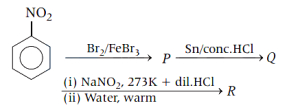
The final product $R$ for the reaction is:
A
$3-$Bromonitrobenzene
B
$3-$Bromophenol
C
$3-$Bromobenzenediazonium chloride
D
$3-$Bromoaniline
Solution
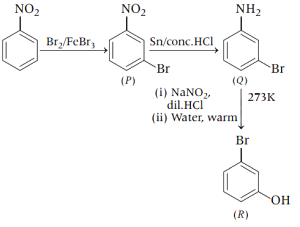
(B) $1$. Nitrobenzene reacts with $Br_2/FeBr_3$ to form $m$-bromonitrobenzene $(P)$ because the $-NO_2$ group is meta-directing.
$2$. $m$-Bromonitrobenzene $(P)$ is reduced by $Sn/conc. HCl$ to form $m$-bromoaniline $(Q)$.
$3$. $m$-Bromoaniline $(Q)$ reacts with $NaNO_2/dil. HCl$ at $273 \ K$ to form $m$-bromobenzenediazonium chloride.
$4$. Finally,warming with water replaces the diazonium group with an $-OH$ group to form $m$-bromophenol $(R)$.
$2$. $m$-Bromonitrobenzene $(P)$ is reduced by $Sn/conc. HCl$ to form $m$-bromoaniline $(Q)$.
$3$. $m$-Bromoaniline $(Q)$ reacts with $NaNO_2/dil. HCl$ at $273 \ K$ to form $m$-bromobenzenediazonium chloride.
$4$. Finally,warming with water replaces the diazonium group with an $-OH$ group to form $m$-bromophenol $(R)$.
0 likesView Solution
58
ChemistryMediumMCQKCET · 2020
Phosphorus pentachloride $(PCl_{5})$:
A
on hydrolysis gives an oxo-acid of phosphorus which is tribasic
B
on hydrolysis gives an oxo-acid of phosphorus which is a good reducing agent
C
has all the five equivalent bonds
D
exists as an ionic solid in which cation has octahedral structure and anion has tetrahedral structure
Solution
(A) Phosphorus pentachloride $(PCl_{5})$ on hydrolysis gives phosphoric acid $(H_{3}PO_{4})$,which is a tribasic acid.
$PCl_{5} + 4H_{2}O \longrightarrow H_{3}PO_{4} + 5HCl$
In $H_{3}PO_{4}$,there are three $P-OH$ groups,making it tribasic.
$PCl_{5} + 4H_{2}O \longrightarrow H_{3}PO_{4} + 5HCl$
In $H_{3}PO_{4}$,there are three $P-OH$ groups,making it tribasic.
0 likesView Solution
59
ChemistryEasyMCQKCET · 2020
Which of the following polymers has the strongest intermolecular forces of attraction?
A
Neoprene
B
Terylene
C
Polythene
D
Polystyrene
Solution
(B) Polymers are classified based on intermolecular forces into elastomers,fibres,thermoplastics,and thermosetting polymers.
$1$. Elastomers (e.g.,Neoprene) have the weakest intermolecular forces,allowing the polymer chains to be stretched.
$2$. Thermoplastics (e.g.,Polythene,Polystyrene) have intermediate intermolecular forces.
$3$. Fibres (e.g.,Terylene) have the strongest intermolecular forces,such as hydrogen bonding or dipole-dipole interactions,which result in high tensile strength and crystalline nature.
Therefore,Terylene,being a fibre,has the strongest intermolecular forces among the given options.
$1$. Elastomers (e.g.,Neoprene) have the weakest intermolecular forces,allowing the polymer chains to be stretched.
$2$. Thermoplastics (e.g.,Polythene,Polystyrene) have intermediate intermolecular forces.
$3$. Fibres (e.g.,Terylene) have the strongest intermolecular forces,such as hydrogen bonding or dipole-dipole interactions,which result in high tensile strength and crystalline nature.
Therefore,Terylene,being a fibre,has the strongest intermolecular forces among the given options.
0 likesView Solution
60
ChemistryEasyMCQKCET · 2020
Which of the following monomers can undergo condensation polymerisation?
A
Styrene
B
Glycine
C
Isoprene
D
Propene
Solution
(B) Condensation polymerisation occurs when monomers containing two or more functional groups (such as $-NH_2$ and $-COOH$) react,resulting in the loss of small molecules like $H_2O$,$HCl$,etc.
Glycine $(NH_2CH_2COOH)$ contains both an amino group $(-NH_2)$ and a carboxylic acid group $(-COOH)$. Therefore,it can undergo condensation polymerisation to form polyglycine.
Styrene,isoprene,and propene contain carbon-carbon double bonds and undergo addition polymerisation.
Glycine $(NH_2CH_2COOH)$ contains both an amino group $(-NH_2)$ and a carboxylic acid group $(-COOH)$. Therefore,it can undergo condensation polymerisation to form polyglycine.
Styrene,isoprene,and propene contain carbon-carbon double bonds and undergo addition polymerisation.
0 likesView Solution
61
ChemistryMediumMCQKCET · 2020
Aqueous solution of a salt $(A)$ forms a dense white precipitate with $BaCl_{2}$ solution. The precipitate dissolves in dilute $HCl$ to produce a gas $(B)$ which decolourises acidified $KMnO_{4}$ solution. $A$ and $B$ respectively are
A
$Na_{2}SO_{3}, SO_{2}$
B
$Na_{2}SO_{4}, H_{2}S$
C
$Na_{2}SO_{3}, H_{2}S$
D
$Na_{2}SO_{4}, SO_{2}$
Solution
(A) The salt $(A)$ reacts with $BaCl_{2}$ to form a white precipitate. Sulfite salts $(SO_{3}^{2-})$ form $BaSO_{3}$ (white precipitate) with $BaCl_{2}$.
$BaSO_{3(s)} + 2HCl_{(aq)} \longrightarrow BaCl_{2(aq)} + H_{2}O_{(l)} + SO_{2(g)}$.
The gas $(B)$ is $SO_{2}$,which is a reducing agent and decolourises acidified $KMnO_{4}$ solution by reducing $Mn^{7+}$ to $Mn^{2+}$.
Therefore,$(A)$ is $Na_{2}SO_{3}$ and $(B)$ is $SO_{2}$.
$BaSO_{3(s)} + 2HCl_{(aq)} \longrightarrow BaCl_{2(aq)} + H_{2}O_{(l)} + SO_{2(g)}$.
The gas $(B)$ is $SO_{2}$,which is a reducing agent and decolourises acidified $KMnO_{4}$ solution by reducing $Mn^{7+}$ to $Mn^{2+}$.
Therefore,$(A)$ is $Na_{2}SO_{3}$ and $(B)$ is $SO_{2}$.
0 likesView Solution
62
ChemistryMediumMCQKCET · 2020
If an aqueous solution of $NaF$ is electrolysed between inert electrodes,the product obtained at anode is
A
$F_{2}$
B
$H_{2}$
C
$Na$
D
$O_{2}$
Solution
(D) During the electrolysis of an aqueous solution of $NaF$ using inert electrodes,water molecules are preferentially oxidized at the anode rather than fluoride ions because the oxidation potential of water is lower than that of fluoride ions.
At the cathode: $2H_{2}O + 2e^{-} \longrightarrow H_{2} + 2OH^{-}$.
At the anode: $2H_{2}O \longrightarrow O_{2} + 4H^{+} + 4e^{-}$.
Even if $F_{2}$ were produced,it would react with water to form $O_{2}$ as follows: $2F_{2} + 2H_{2}O \longrightarrow 4HF + O_{2}$.
Therefore,the final product obtained at the anode is $O_{2}$.
At the cathode: $2H_{2}O + 2e^{-} \longrightarrow H_{2} + 2OH^{-}$.
At the anode: $2H_{2}O \longrightarrow O_{2} + 4H^{+} + 4e^{-}$.
Even if $F_{2}$ were produced,it would react with water to form $O_{2}$ as follows: $2F_{2} + 2H_{2}O \longrightarrow 4HF + O_{2}$.
Therefore,the final product obtained at the anode is $O_{2}$.
0 likesView Solution
63
ChemistryEasyMCQKCET · 2020
$A$ metal crystallises in a face-centred cubic $(FCC)$ structure with a metallic radius of $\sqrt{2} \ \mathring{A}$. The volume of the unit cell (in $m^{3}$) is:
A
$4 \times 10^{-10}$
B
$6.4 \times 10^{-29}$
C
$4 \times 10^{-9}$
D
$6.4 \times 10^{-30}$
Solution
(B) For an $FCC$ unit cell,the relationship between the edge length $a$ and the metallic radius $r$ is given by $4r = \sqrt{2}a$.
Given $r = \sqrt{2} \ \mathring{A}$.
Substituting the value of $r$: $a = \frac{4r}{\sqrt{2}} = \frac{4 \times \sqrt{2}}{\sqrt{2}} = 4 \ \mathring{A}$.
The volume of the unit cell is $V = a^{3} = (4 \ \mathring{A})^{3} = 64 \ \mathring{A}^{3}$.
Since $1 \ \mathring{A} = 10^{-10} \ m$,then $1 \ \mathring{A}^{3} = 10^{-30} \ m^{3}$.
Therefore,$V = 64 \times 10^{-30} \ m^{3} = 6.4 \times 10^{-29} \ m^{3}$.
Given $r = \sqrt{2} \ \mathring{A}$.
Substituting the value of $r$: $a = \frac{4r}{\sqrt{2}} = \frac{4 \times \sqrt{2}}{\sqrt{2}} = 4 \ \mathring{A}$.
The volume of the unit cell is $V = a^{3} = (4 \ \mathring{A})^{3} = 64 \ \mathring{A}^{3}$.
Since $1 \ \mathring{A} = 10^{-10} \ m$,then $1 \ \mathring{A}^{3} = 10^{-30} \ m^{3}$.
Therefore,$V = 64 \times 10^{-30} \ m^{3} = 6.4 \times 10^{-29} \ m^{3}$.
0 likesView Solution
64
ChemistryEasyMCQKCET · 2020
Which of the following pairs of solutions is isotonic?
A
$0.01 \ M \ BaCl_2$ and $0.015 \ M \ NaCl$
B
$0.001 \ M \ Al_2(SO_4)_3$ and $0.001 \ M \ BaCl_2$
C
$0.001 \ M \ CaCl_2$ and $0.001 \ M \ Al_2(SO_4)_3$
D
$0.01 \ M \ BaCl_2$ and $0.001 \ M \ CaCl_2$
Solution
(A) Two solutions are isotonic if their osmotic pressures are equal.
Osmotic pressure $\pi = iCRT$,where $i$ is the van't Hoff factor,$C$ is molarity,$R$ is the gas constant,and $T$ is temperature.
For isotonic solutions at the same temperature,the effective concentration $(i \times C)$ must be equal.
$(A)$ For $0.01 \ M \ BaCl_2$: $i = 3$,$C = 0.01$,$i \times C = 0.03$. For $0.015 \ M \ NaCl$: $i = 2$,$C = 0.015$,$i \times C = 0.03$. Since $0.03 = 0.03$,this pair is isotonic.
$(B)$ For $0.001 \ M \ Al_2(SO_4)_3$: $i = 5$,$C = 0.001$,$i \times C = 0.005$. For $0.001 \ M \ BaCl_2$: $i = 3$,$C = 0.001$,$i \times C = 0.003$. Not isotonic.
$(C)$ For $0.001 \ M \ CaCl_2$: $i = 3$,$C = 0.001$,$i \times C = 0.003$. For $0.001 \ M \ Al_2(SO_4)_3$: $i = 5$,$C = 0.001$,$i \times C = 0.005$. Not isotonic.
$(D)$ For $0.01 \ M \ BaCl_2$: $i \times C = 0.03$. For $0.001 \ M \ CaCl_2$: $i \times C = 0.003$. Not isotonic.
Thus,the correct option is $(A)$.
Osmotic pressure $\pi = iCRT$,where $i$ is the van't Hoff factor,$C$ is molarity,$R$ is the gas constant,and $T$ is temperature.
For isotonic solutions at the same temperature,the effective concentration $(i \times C)$ must be equal.
$(A)$ For $0.01 \ M \ BaCl_2$: $i = 3$,$C = 0.01$,$i \times C = 0.03$. For $0.015 \ M \ NaCl$: $i = 2$,$C = 0.015$,$i \times C = 0.03$. Since $0.03 = 0.03$,this pair is isotonic.
$(B)$ For $0.001 \ M \ Al_2(SO_4)_3$: $i = 5$,$C = 0.001$,$i \times C = 0.005$. For $0.001 \ M \ BaCl_2$: $i = 3$,$C = 0.001$,$i \times C = 0.003$. Not isotonic.
$(C)$ For $0.001 \ M \ CaCl_2$: $i = 3$,$C = 0.001$,$i \times C = 0.003$. For $0.001 \ M \ Al_2(SO_4)_3$: $i = 5$,$C = 0.001$,$i \times C = 0.005$. Not isotonic.
$(D)$ For $0.01 \ M \ BaCl_2$: $i \times C = 0.03$. For $0.001 \ M \ CaCl_2$: $i \times C = 0.003$. Not isotonic.
Thus,the correct option is $(A)$.
0 likesView Solution
65
ChemistryMediumMCQKCET · 2020
Solute '$X$' dimerises in water to the extent of $80 \%$. $2.5 \ g$ of '$X$' in $100 \ g$ of water increases the boiling point by $0.3^{\circ} C$. The molar mass of '$X$' is $\left[K_{b}=0.52 \ K \ kg \ mol^{-1}\right]$
A
$13$
B
$52$
C
$65$
D
$26$
Solution
(D) Given:
Mass of solute $(w_B)$ = $2.5 \ g$
Mass of solvent $(w_A)$ = $100 \ g$
Elevation in boiling point $(\Delta T_b)$ = $0.3 \ K$
$K_b = 0.52 \ K \ kg \ mol^{-1}$
Degree of association $(\alpha)$ = $0.8$
For dimerization: $2X \rightleftharpoons X_2$
Van't Hoff factor $(i)$ = $1 - \alpha + \frac{\alpha}{2} = 1 - 0.8 + \frac{0.8}{2} = 0.2 + 0.4 = 0.6$
Formula for elevation in boiling point:
$\Delta T_b = i \times K_b \times m$
$\Delta T_b = i \times K_b \times \left( \frac{w_B \times 1000}{M_B \times w_A} \right)$
$0.3 = 0.6 \times 0.52 \times \left( \frac{2.5 \times 1000}{M_B \times 100} \right)$
$0.3 = 0.6 \times 0.52 \times \left( \frac{25}{M_B} \right)$
$M_B = \frac{0.6 \times 0.52 \times 25}{0.3}$
$M_B = 2 \times 0.52 \times 25 = 26 \ g \ mol^{-1}$
Mass of solute $(w_B)$ = $2.5 \ g$
Mass of solvent $(w_A)$ = $100 \ g$
Elevation in boiling point $(\Delta T_b)$ = $0.3 \ K$
$K_b = 0.52 \ K \ kg \ mol^{-1}$
Degree of association $(\alpha)$ = $0.8$
For dimerization: $2X \rightleftharpoons X_2$
Van't Hoff factor $(i)$ = $1 - \alpha + \frac{\alpha}{2} = 1 - 0.8 + \frac{0.8}{2} = 0.2 + 0.4 = 0.6$
Formula for elevation in boiling point:
$\Delta T_b = i \times K_b \times m$
$\Delta T_b = i \times K_b \times \left( \frac{w_B \times 1000}{M_B \times w_A} \right)$
$0.3 = 0.6 \times 0.52 \times \left( \frac{2.5 \times 1000}{M_B \times 100} \right)$
$0.3 = 0.6 \times 0.52 \times \left( \frac{25}{M_B} \right)$
$M_B = \frac{0.6 \times 0.52 \times 25}{0.3}$
$M_B = 2 \times 0.52 \times 25 = 26 \ g \ mol^{-1}$
0 likesView Solution
66
ChemistryEasyMCQKCET · 2020
The last element of the $p$-block in the $6$th period is represented by which outermost electronic configuration?
A
$7 s^2, 7 p^6$
B
$5 f^{14}, 6 d^{10}, 7 s^2, 7 p^5$
C
$4 f^{14}, 5 d^{10}, 6 s^2, 6 p^4$
D
$4 f^{14}, 5 d^{10}, 6 s^2, 6 p^6$
Solution
(D) The $6$th period corresponds to the filling of the $6s, 4f, 5d,$ and $6p$ orbitals.
The last element of the $6$th period is the noble gas Radon $(Rn)$,which has an atomic number of $86$.
The electronic configuration of Radon is $[Xe] 4f^{14} 5d^{10} 6s^2 6p^6$.
Therefore,the outermost electronic configuration is $4f^{14}, 5d^{10}, 6s^2, 6p^6$.
The last element of the $6$th period is the noble gas Radon $(Rn)$,which has an atomic number of $86$.
The electronic configuration of Radon is $[Xe] 4f^{14} 5d^{10} 6s^2 6p^6$.
Therefore,the outermost electronic configuration is $4f^{14}, 5d^{10}, 6s^2, 6p^6$.
0 likesView Solution
67
ChemistryEasyMCQKCET · 2020
$A$ sol of $AgI$ is prepared by mixing equal volumes of $0.1 \ M \ AgNO_{3}$ and $0.2 \ M \ KI$. Which of the following statements is correct?
A
Sol obtained is a negative sol with $NO_{3}^{-}$ adsorbed on $AgI$.
B
Sol obtained is a positive sol with $Ag^{+}$ adsorbed on $AgI$.
C
Sol obtained is a positive sol with $K^{+}$ adsorbed on $AgI$.
D
Sol obtained is a negative sol with $I^{-}$ adsorbed on $AgI$.
Solution
(D) The reaction between $AgNO_{3}$ and $KI$ is: $AgNO_{3} + KI \longrightarrow AgI(s) + KNO_{3}$.
Since equal volumes are mixed,the number of moles of $KI$ $(0.2 \ M)$ is greater than the number of moles of $AgNO_{3}$ $(0.1 \ M)$.
Thus,$KI$ is in excess.
The $AgI$ particles preferentially adsorb the common ion present in excess from the dispersion medium.
In this case,$I^{-}$ ions are in excess and are adsorbed on the surface of $AgI$ particles,resulting in a negatively charged sol.
Since equal volumes are mixed,the number of moles of $KI$ $(0.2 \ M)$ is greater than the number of moles of $AgNO_{3}$ $(0.1 \ M)$.
Thus,$KI$ is in excess.
The $AgI$ particles preferentially adsorb the common ion present in excess from the dispersion medium.
In this case,$I^{-}$ ions are in excess and are adsorbed on the surface of $AgI$ particles,resulting in a negatively charged sol.
0 likesView Solution
68
ChemistryEasyMCQKCET · 2020
During the adsorption of a gas on a solid at low temperature,which of the following thermodynamic conditions is correct?
A
$\Delta G < 0, \Delta H < 0, \Delta S < 0$
B
$\Delta G > 0, \Delta H > 0, \Delta S > 0$
C
$\Delta G < 0, \Delta H < 0, \Delta S > 0$
D
$\Delta G < 0, \Delta H > 0, \Delta S < 0$
Solution
(A) Adsorption is a spontaneous process,so $\Delta G < 0$.
It is an exothermic process,which means heat is released,so $\Delta H < 0$.
As gas molecules get adsorbed on the solid surface,their freedom of movement decreases,leading to a decrease in entropy,so $\Delta S < 0$.
According to the Gibbs-Helmholtz equation,$\Delta G = \Delta H - T \Delta S$. At low temperatures,the negative $\Delta H$ term dominates,ensuring $\Delta G < 0$.
It is an exothermic process,which means heat is released,so $\Delta H < 0$.
As gas molecules get adsorbed on the solid surface,their freedom of movement decreases,leading to a decrease in entropy,so $\Delta S < 0$.
According to the Gibbs-Helmholtz equation,$\Delta G = \Delta H - T \Delta S$. At low temperatures,the negative $\Delta H$ term dominates,ensuring $\Delta G < 0$.
0 likesView Solution
Vedclass Products
For Students
Vedclass Test Series
Mock tests in real KCET style covering Chemistry with performance analysis. 5-day free trial.
Start Free TrialFor Teachers
Exam Paper Generator
Generate Set A/B/C/D Chemistry papers from 7.5L+ questions in 2 minutes. 3 chapters free.
Try FreeFor Institutes
Online Exam Module
Run live KCET mock exams with unlimited students, 360° analytics & white-label branding.
See DemoFrequently Asked Questions
How many Chemistry questions are in KCET 2020?
There are 68 Chemistry questions from the KCET 2020 paper on Vedclass, each with a detailed step-by-step solution in English.
Are KCET 2020 Chemistry solutions available in English?
Yes. All solutions on this page are in English. You can also switch to English or Hindi using the language buttons above the questions.
Can I practice KCET 2020 Chemistry as a timed test?
Yes. Use the Vedclass Test Series to attempt a full KCET mock test covering Chemistry with time limits and instant score analysis.
Can teachers create Chemistry papers from KCET previous year questions?
Yes. The Vedclass Exam Paper Generator lets teachers mix KCET Chemistry questions and generate Set A/B/C/D papers in minutes.
For Teachers & Institutes
Build a Custom Chemistry Paper
Pick KCET 2020 Chemistry questions, set difficulty, and generate Set A/B/C/D in 2 minutes.