
ChemistryQ1–64 of 64 questions
Page 1 of 1 · English
1
ChemistryMCQKCET · 2024
Two finite sets have $m$ and $n$ elements. The total number of subsets of the first set is $56$ more than the total number of subsets of the second set. The values of $m$ and $n$ are
A
$7, 6$
B
$6, 3$
C
$5, 1$
D
$8, 7$
Solution
(B) The number of subsets of a set with $k$ elements is $2^k$.
Given that the first set has $m$ elements and the second set has $n$ elements,the number of subsets are $2^m$ and $2^n$ respectively.
According to the problem,$2^m - 2^n = 56$.
$2^n(2^{m-n} - 1) = 56$.
We can write $56$ as $8 \times 7 = 2^3 \times (8 - 1) = 2^3 \times (2^3 - 1)$.
Comparing $2^n(2^{m-n} - 1) = 2^3(2^3 - 1)$,we get $n = 3$ and $m - n = 3$.
Substituting $n = 3$ into $m - n = 3$,we get $m - 3 = 3$,so $m = 6$.
Thus,the values are $m = 6$ and $n = 3$.
Given that the first set has $m$ elements and the second set has $n$ elements,the number of subsets are $2^m$ and $2^n$ respectively.
According to the problem,$2^m - 2^n = 56$.
$2^n(2^{m-n} - 1) = 56$.
We can write $56$ as $8 \times 7 = 2^3 \times (8 - 1) = 2^3 \times (2^3 - 1)$.
Comparing $2^n(2^{m-n} - 1) = 2^3(2^3 - 1)$,we get $n = 3$ and $m - n = 3$.
Substituting $n = 3$ into $m - n = 3$,we get $m - 3 = 3$,so $m = 6$.
Thus,the values are $m = 6$ and $n = 3$.
0 likesView Solution
2
ChemistryMCQKCET · 2024
Two finite sets have $m$ and $n$ elements respectively. If the number of subsets of the first set is $56$ more than the number of subsets of the second set,then the values of $m$ and $n$ are:
A
$7, 6$
B
$6, 3$
C
$5, 1$
D
$8, 7$
Solution
(B) The number of subsets of a set with $k$ elements is $2^k$.
Given,$2^m - 2^n = 56$.
$2^n(2^{m-n} - 1) = 56$.
$2^n(2^{m-n} - 1) = 8 \times 7 = 2^3 \times (8 - 1) = 2^3 \times (2^3 - 1)$.
Comparing both sides,we get $n = 3$ and $m - n = 3$.
Substituting $n = 3$,we get $m - 3 = 3$,which implies $m = 6$.
Thus,the values are $m = 6$ and $n = 3$.
Given,$2^m - 2^n = 56$.
$2^n(2^{m-n} - 1) = 56$.
$2^n(2^{m-n} - 1) = 8 \times 7 = 2^3 \times (8 - 1) = 2^3 \times (2^3 - 1)$.
Comparing both sides,we get $n = 3$ and $m - n = 3$.
Substituting $n = 3$,we get $m - 3 = 3$,which implies $m = 6$.
Thus,the values are $m = 6$ and $n = 3$.
0 likesView Solution
3
ChemistryDifficultMCQKCET · 2024
Sodium ethanoate on heating with soda lime gives '$X$'. Electrolysis of aqueous solution of sodium ethanoate gives '$Y$'. '$X$' and '$Y$' respectively are
A
methane and ethane
B
methane and methane
C
ethane and methane
D
ethane and ethane
Solution
(A) The complete reaction sequence involved is as follows:
$CH_3COONa + NaOH \xrightarrow[\Delta]{CaO} CH_4 + Na_2CO_3$
(Sodium ethanoate) (Methane $X$)
$2CH_3COONa + 2H_2O \xrightarrow{\text{Electrolysis}} CH_3-CH_3 + 2CO_2 + H_2 + 2NaOH$
(Ethane $Y$)
Thus,the compounds $X$ and $Y$ are methane and ethane respectively.
$CH_3COONa + NaOH \xrightarrow[\Delta]{CaO} CH_4 + Na_2CO_3$
(Sodium ethanoate) (Methane $X$)
$2CH_3COONa + 2H_2O \xrightarrow{\text{Electrolysis}} CH_3-CH_3 + 2CO_2 + H_2 + 2NaOH$
(Ethane $Y$)
Thus,the compounds $X$ and $Y$ are methane and ethane respectively.
0 likesView Solution
4
ChemistryMediumMCQKCET · 2024
$A$ pair of isoelectronic species having bond order of $1$ is
A
$N_2, CO$
B
$N_2, NO^{+}$
C
$O_2^{2-}, F_2$
D
$CO, NO^{+}$
Solution
(C) To determine the bond order,we calculate the number of electrons and use the molecular orbital theory formula: $B.O. = \frac{N_b - N_a}{2}$.
For $O_2^{2-}$,the total number of electrons is $8 + 8 + 2 = 18 \ e^{-}$. The bond order is $\frac{10 - 8}{2} = 1$.
For $F_2$,the total number of electrons is $9 + 9 = 18 \ e^{-}$. The bond order is $\frac{10 - 8}{2} = 1$.
Both species are isoelectronic $(18 \ e^{-})$ and have a bond order of $1$.
For $O_2^{2-}$,the total number of electrons is $8 + 8 + 2 = 18 \ e^{-}$. The bond order is $\frac{10 - 8}{2} = 1$.
For $F_2$,the total number of electrons is $9 + 9 = 18 \ e^{-}$. The bond order is $\frac{10 - 8}{2} = 1$.
Both species are isoelectronic $(18 \ e^{-})$ and have a bond order of $1$.
0 likesView Solution
5
ChemistryMediumMCQKCET · 2024
In the reaction between moist $SO_2$ and acidified permanganate solution:
A
$SO_2$ is oxidised to $SO_4^{2-}$. $MnO_4^{-}$ is reduced to $Mn^{2+}$.
B
$SO_2$ is reduced to $S$. $MnO_4^{-}$ is oxidised to $MnO_4$.
C
$SO_2$ is oxidised to $SO_3^{2-}$. $MnO_4^{-}$ is reduced to $MnO_2$.
D
$SO_2$ is reduced to $H_2S$. $MnO_4^{-}$ is oxidised to $MnO_4$.
Solution
(A) The balanced chemical equation for the reaction between moist $SO_2$ and acidified permanganate solution is:
$2MnO_4^{-} + 5SO_2 + 2H_2O \rightarrow 2Mn^{2+} + 5SO_4^{2-} + 4H^{+}$
In this redox reaction,$SO_2$ (where $S$ is in $+4$ oxidation state) is oxidised to $SO_4^{2-}$ (where $S$ is in $+6$ oxidation state).
Simultaneously,$MnO_4^{-}$ (where $Mn$ is in $+7$ oxidation state) is reduced to $Mn^{2+}$ (where $Mn$ is in $+2$ oxidation state).
Therefore,option $A$ is correct.
$2MnO_4^{-} + 5SO_2 + 2H_2O \rightarrow 2Mn^{2+} + 5SO_4^{2-} + 4H^{+}$
In this redox reaction,$SO_2$ (where $S$ is in $+4$ oxidation state) is oxidised to $SO_4^{2-}$ (where $S$ is in $+6$ oxidation state).
Simultaneously,$MnO_4^{-}$ (where $Mn$ is in $+7$ oxidation state) is reduced to $Mn^{2+}$ (where $Mn$ is in $+2$ oxidation state).
Therefore,option $A$ is correct.
0 likesView Solution
6
ChemistryDifficultMCQKCET · 2024
In the analysis of $III$ group basic radicals of salts,the purpose of adding $NH_4Cl_{(s)}$ to $NH_4OH$ is
A
to increase the concentration of $OH^{-}$ ions
B
to precipitate the radicals of group $IV$ and $V$
C
to suppress the dissociation of $NH_4OH$
D
to introduce $Cl^{-}$ ions
Solution
(C) In the analysis of $III$ group basic radicals,$NH_4Cl$ is added to $NH_4OH$ to suppress the dissociation of $NH_4OH$ due to the common ion effect ($NH_4^+$ ions).
This ensures that the concentration of $OH^-$ ions is low enough to precipitate only the $III$ group hydroxides (like $Fe(OH)_3$,$Al(OH)_3$,$Cr(OH)_3$) while preventing the precipitation of hydroxides of subsequent groups.
This ensures that the concentration of $OH^-$ ions is low enough to precipitate only the $III$ group hydroxides (like $Fe(OH)_3$,$Al(OH)_3$,$Cr(OH)_3$) while preventing the precipitation of hydroxides of subsequent groups.
0 likesView Solution
7
ChemistryMCQKCET · 2024
If $P = \begin{bmatrix} 1 & \alpha & 3 \\ 1 & 3 & 3 \\ 2 & 4 & 4 \end{bmatrix}$ is the adjoint of a $3 \times 3$ matrix $A$ and $|A| = 4$,then $\alpha$ is equal to
A
$4$
B
$5$
C
$11$
D
$0$
Solution
(C) Given that $P = \text{adj}(A)$ and $|A| = 4$.
For a $3 \times 3$ matrix $A$,the property of the adjoint matrix is $|\text{adj}(A)| = |A|^{n-1}$,where $n$ is the order of the matrix.
Here,$n = 3$,so $|\text{adj}(A)| = |A|^{3-1} = |A|^2$.
Given $|A| = 4$,we have $|\text{adj}(A)| = 4^2 = 16$.
Since $P = \text{adj}(A)$,we have $|P| = 16$.
Calculating the determinant of $P$:
$|P| = \begin{vmatrix} 1 & \alpha & 3 \\ 1 & 3 & 3 \\ 2 & 4 & 4 \end{vmatrix} = 1(12 - 12) - \alpha(4 - 6) + 3(4 - 6) = 16$.
$0 - \alpha(-2) + 3(-2) = 16$.
$2\alpha - 6 = 16$.
$2\alpha = 22$.
$\alpha = 11$.
For a $3 \times 3$ matrix $A$,the property of the adjoint matrix is $|\text{adj}(A)| = |A|^{n-1}$,where $n$ is the order of the matrix.
Here,$n = 3$,so $|\text{adj}(A)| = |A|^{3-1} = |A|^2$.
Given $|A| = 4$,we have $|\text{adj}(A)| = 4^2 = 16$.
Since $P = \text{adj}(A)$,we have $|P| = 16$.
Calculating the determinant of $P$:
$|P| = \begin{vmatrix} 1 & \alpha & 3 \\ 1 & 3 & 3 \\ 2 & 4 & 4 \end{vmatrix} = 1(12 - 12) - \alpha(4 - 6) + 3(4 - 6) = 16$.
$0 - \alpha(-2) + 3(-2) = 16$.
$2\alpha - 6 = 16$.
$2\alpha = 22$.
$\alpha = 11$.
0 likesView Solution
8
ChemistryMCQKCET · 2024
If $f(x)=x e^{x(1-x)}$,then $f(x)$ is
A
increasing in $R$
B
decreasing in $R$
C
decreasing in $\left[-\frac{1}{2}, 1\right]$
D
increasing in $\left[-\frac{1}{2}, 1\right]$
Solution
(D) Given,$f(x)=x e^{x(1-x)}$.
To find the intervals of increase and decrease,we calculate the derivative $f^{\prime}(x)$:
$f^{\prime}(x) = \frac{d}{dx} [x e^{x-x^2}] = e^{x-x^2} + x e^{x-x^2} (1-2x)$
$f^{\prime}(x) = e^{x-x^2} [1 + x(1-2x)] = e^{x-x^2} (1 + x - 2x^2)$
$f^{\prime}(x) = -e^{x-x^2} (2x^2 - x - 1) = -e^{x-x^2} (2x^2 - 2x + x - 1)$
$f^{\prime}(x) = -e^{x-x^2} [2x(x-1) + 1(x-1)] = -e^{x-x^2} (x-1)(2x+1)$.
Since $e^{x-x^2} > 0$ for all $x \in R$,the sign of $f^{\prime}(x)$ depends on $-(x-1)(2x+1)$.
Setting $f^{\prime}(x) = 0$,we get critical points $x = 1$ and $x = -\frac{1}{2}$.
Analyzing the sign of $f^{\prime}(x)$ on the number line:
For $x \in \left(-\infty, -\frac{1}{2}\right)$,$f^{\prime}(x) < 0$ (decreasing).
For $x \in \left[-\frac{1}{2}, 1\right]$,$f^{\prime}(x) \geq 0$ (increasing).
For $x \in (1, \infty)$,$f^{\prime}(x) < 0$ (decreasing).
Thus,$f(x)$ is increasing in the interval $\left[-\frac{1}{2}, 1\right]$.
To find the intervals of increase and decrease,we calculate the derivative $f^{\prime}(x)$:
$f^{\prime}(x) = \frac{d}{dx} [x e^{x-x^2}] = e^{x-x^2} + x e^{x-x^2} (1-2x)$
$f^{\prime}(x) = e^{x-x^2} [1 + x(1-2x)] = e^{x-x^2} (1 + x - 2x^2)$
$f^{\prime}(x) = -e^{x-x^2} (2x^2 - x - 1) = -e^{x-x^2} (2x^2 - 2x + x - 1)$
$f^{\prime}(x) = -e^{x-x^2} [2x(x-1) + 1(x-1)] = -e^{x-x^2} (x-1)(2x+1)$.
Since $e^{x-x^2} > 0$ for all $x \in R$,the sign of $f^{\prime}(x)$ depends on $-(x-1)(2x+1)$.
Setting $f^{\prime}(x) = 0$,we get critical points $x = 1$ and $x = -\frac{1}{2}$.
Analyzing the sign of $f^{\prime}(x)$ on the number line:
For $x \in \left(-\infty, -\frac{1}{2}\right)$,$f^{\prime}(x) < 0$ (decreasing).
For $x \in \left[-\frac{1}{2}, 1\right]$,$f^{\prime}(x) \geq 0$ (increasing).
For $x \in (1, \infty)$,$f^{\prime}(x) < 0$ (decreasing).
Thus,$f(x)$ is increasing in the interval $\left[-\frac{1}{2}, 1\right]$.
0 likesView Solution
9
ChemistryDifficultMCQKCET · 2024
When a tertiary alcohol $A$ $(C_4H_{10}O)$ reacts with $20\% \ H_3PO_4$ at $358 \ K$,it gives a compound $B$ $(C_4H_8)$ as a major product. The $IUPAC$ name of the compound $B$ is
A
but$-1-$ene
B
but$-2-$ene
C
cyclobutane
D
$2-$methylpropene
Solution
(D) The reaction is a dehydration of a tertiary alcohol ($tert$-butyl alcohol) via $\beta$-elimination.
When $2$-methylpropan$-2-$ol $(A)$ is heated with $20\% \ H_3PO_4$ at $358 \ K$,it undergoes dehydration to form $2$-methylpropene $(B)$ as the major product.
The reaction is:
$(CH_3)_3C-OH \xrightarrow{20\% \ H_3PO_4, 358 \ K} CH_2=C(CH_3)_2 + H_2O$
Thus,the $IUPAC$ name of the product $B$ is $2$-methylpropene.
When $2$-methylpropan$-2-$ol $(A)$ is heated with $20\% \ H_3PO_4$ at $358 \ K$,it undergoes dehydration to form $2$-methylpropene $(B)$ as the major product.
The reaction is:
$(CH_3)_3C-OH \xrightarrow{20\% \ H_3PO_4, 358 \ K} CH_2=C(CH_3)_2 + H_2O$
Thus,the $IUPAC$ name of the product $B$ is $2$-methylpropene.
0 likesView Solution
10
ChemistryEasyMCQKCET · 2024
$Propanone$ and $propanal$ are:
A
position isomers
B
functional isomers
C
chain isomers
D
geometrical isomers
Solution
(B) $Propanone$ $(CH_3COCH_3)$ and $propanal$ $(CH_3CH_2CHO)$ have the same molecular formula,$C_3H_6O$.
$Propanone$ contains a ketone functional group $(-CO-)$,whereas $propanal$ contains an aldehyde functional group $(-CHO)$.
Since they possess the same molecular formula but different functional groups,they are classified as functional isomers.
$Propanone$ contains a ketone functional group $(-CO-)$,whereas $propanal$ contains an aldehyde functional group $(-CHO)$.
Since they possess the same molecular formula but different functional groups,they are classified as functional isomers.
0 likesView Solution
11
ChemistryEasyMCQKCET · 2024
In the given sequence of reactions,identify $P, Q, R$ and $S$ respectively.
$CH_2=CH_2 + Br_2$ $\xrightarrow{P} CH_2(Br)-CH_2(Br)$ $\xrightarrow{Q} CH_2=CH-Br$ $\xrightarrow{R} CH \equiv CH$ $\xrightarrow{S} C_6H_6$
$CH_2=CH_2 + Br_2$ $\xrightarrow{P} CH_2(Br)-CH_2(Br)$ $\xrightarrow{Q} CH_2=CH-Br$ $\xrightarrow{R} CH \equiv CH$ $\xrightarrow{S} C_6H_6$
A
$Br_2$,Alc. $KOH, NaOH, Al_2O_3$
B
$HBr$,Alc. $KOH, CaC_2, KMnO_4$
C
$HBr$,Alc. $KOH, NaNH_2$,Red hot iron tube
D
$Br_2$,Alc. $KOH, NaNH_2$,Red hot iron tube
Solution
(D) The complete reaction sequence is as follows:
$1$. $CH_2=CH_2 + Br_2 \xrightarrow{P=Br_2} CH_2(Br)-CH_2(Br)$ (Electrophilic addition)
$2$. $CH_2(Br)-CH_2(Br) \xrightarrow{Q=Alc. KOH} CH_2=CH-Br$ (Dehydrohalogenation)
$3$. $CH_2=CH-Br \xrightarrow{R=NaNH_2} CH \equiv CH$ (Dehydrohalogenation)
$4$. $3 CH \equiv CH \xrightarrow{S=Red \ hot \ iron \ tube} C_6H_6$ (Cyclic polymerization)
Thus,the reagents $P, Q, R$ and $S$ are $Br_2$,alc. $KOH, NaNH_2$,and Red hot iron tube respectively.
$1$. $CH_2=CH_2 + Br_2 \xrightarrow{P=Br_2} CH_2(Br)-CH_2(Br)$ (Electrophilic addition)
$2$. $CH_2(Br)-CH_2(Br) \xrightarrow{Q=Alc. KOH} CH_2=CH-Br$ (Dehydrohalogenation)
$3$. $CH_2=CH-Br \xrightarrow{R=NaNH_2} CH \equiv CH$ (Dehydrohalogenation)
$4$. $3 CH \equiv CH \xrightarrow{S=Red \ hot \ iron \ tube} C_6H_6$ (Cyclic polymerization)
Thus,the reagents $P, Q, R$ and $S$ are $Br_2$,alc. $KOH, NaNH_2$,and Red hot iron tube respectively.
0 likesView Solution
12
ChemistryMediumMCQKCET · 2024
But$-1-$yne on reaction with dil. $H_2SO_4$ in the presence of $Hg^{2+}$ ions at $333 \ K$ gives:
A
Butan$-2-$one
B
Butanal
C
But$-3-$en$-2-$one
D
But$-3-$enal
Solution
(A) The hydration of alkynes in the presence of $Hg^{2+}$ and $H_2SO_4$ follows Markovnikov's rule. The reaction proceeds as follows:
$CH_3-CH_2-C \equiv CH + H_2O \xrightarrow{Hg^{2+}, H_2SO_4, 333 \ K} [CH_3-CH_2-C(OH)=CH_2]$
This enol intermediate undergoes tautomerization to form a stable ketone:
$[CH_3-CH_2-C(OH)=CH_2] \rightleftharpoons CH_3-CH_2-CO-CH_3$ (Butan$-2-$one).
$CH_3-CH_2-C \equiv CH + H_2O \xrightarrow{Hg^{2+}, H_2SO_4, 333 \ K} [CH_3-CH_2-C(OH)=CH_2]$
This enol intermediate undergoes tautomerization to form a stable ketone:
$[CH_3-CH_2-C(OH)=CH_2] \rightleftharpoons CH_3-CH_2-CO-CH_3$ (Butan$-2-$one).
0 likesView Solution
13
ChemistryMediumMCQKCET · 2024
Solubility product of $CaC_2O_4$ at a given temperature in pure water is $4 \times 10^{-9} \ (mol \ L^{-1})^2$. Solubility of $CaC_2O_4$ at the same temperature is
A
$6.3 \times 10^{-5} \ mol \ L^{-1}$
B
$2 \times 10^{-5} \ mol \ L^{-1}$
C
$2 \times 10^{-4} \ mol \ L^{-1}$
D
$6.3 \times 10^{-4} \ mol \ L^{-1}$
Solution
(A) Given,$K_{sp} = 4 \times 10^{-9} \ (mol \ L^{-1})^2$.
For the dissociation of $CaC_2O_4$:
$CaC_2O_4(s) \rightleftharpoons Ca^{2+}(aq) + C_2O_4^{2-}(aq)$.
Let the solubility be $S \ mol \ L^{-1}$.
Then,$[Ca^{2+}] = S$ and $[C_2O_4^{2-}] = S$.
$K_{sp} = [Ca^{2+}][C_2O_4^{2-}] = S \times S = S^2$.
$S^2 = 4 \times 10^{-9}$.
$S = \sqrt{4 \times 10^{-9}} = \sqrt{40 \times 10^{-10}} = 6.32 \times 10^{-5} \ mol \ L^{-1}$.
Thus,the solubility of $CaC_2O_4$ is $6.3 \times 10^{-5} \ mol \ L^{-1}$.
For the dissociation of $CaC_2O_4$:
$CaC_2O_4(s) \rightleftharpoons Ca^{2+}(aq) + C_2O_4^{2-}(aq)$.
Let the solubility be $S \ mol \ L^{-1}$.
Then,$[Ca^{2+}] = S$ and $[C_2O_4^{2-}] = S$.
$K_{sp} = [Ca^{2+}][C_2O_4^{2-}] = S \times S = S^2$.
$S^2 = 4 \times 10^{-9}$.
$S = \sqrt{4 \times 10^{-9}} = \sqrt{40 \times 10^{-10}} = 6.32 \times 10^{-5} \ mol \ L^{-1}$.
Thus,the solubility of $CaC_2O_4$ is $6.3 \times 10^{-5} \ mol \ L^{-1}$.
0 likesView Solution
14
ChemistryEasyMCQKCET · 2024
Which one of the following nitrates will decompose to give $NO_2$ on heating?
A
$NaNO_3$
B
$KNO_3$
C
$RbNO_3$
D
$LiNO_3$
Solution
(D) Among the given nitrates,only $LiNO_3$ decomposes to give $NO_2$ on heating,whereas the nitrates of $Na, K,$ and $Rb$ decompose to form their respective nitrites and release oxygen gas.
The decomposition reaction for $LiNO_3$ is:
$4 LiNO_3 \xrightarrow{\Delta} 2 Li_2O + 4 NO_2 + O_2$
The decomposition reaction for other alkali metal nitrates $(M = Na, K, Rb)$ is:
$2 MNO_3 \xrightarrow{\Delta} 2 MNO_2 + O_2$
The decomposition reaction for $LiNO_3$ is:
$4 LiNO_3 \xrightarrow{\Delta} 2 Li_2O + 4 NO_2 + O_2$
The decomposition reaction for other alkali metal nitrates $(M = Na, K, Rb)$ is:
$2 MNO_3 \xrightarrow{\Delta} 2 MNO_2 + O_2$
0 likesView Solution
15
ChemistryMediumMCQKCET · 2024
Identify the incorrect statement from the following.
A
Oxides of nitrogen in the atmosphere can cause depletion of the ozone layer.
B
Ozone absorbs the intense ultraviolet radiation of Sun.
C
Depletion of ozone layer is because of its chemical reactions with chlorofluoro alkanes.
D
Ozone absorbs infrared radiation.
Solution
(D) Statement given in option $(D)$ is incorrect while all other statements are correct.
Ozone $(O_3)$ primarily absorbs high-energy $UV$ radiation from the Sun,which protects the Earth's surface.
It does not primarily absorb infrared radiation; rather,greenhouse gases like $CO_2$ and $CH_4$ are responsible for absorbing infrared radiation.
Ozone $(O_3)$ primarily absorbs high-energy $UV$ radiation from the Sun,which protects the Earth's surface.
It does not primarily absorb infrared radiation; rather,greenhouse gases like $CO_2$ and $CH_4$ are responsible for absorbing infrared radiation.
0 likesView Solution
16
ChemistryMediumMCQKCET · 2024
Which of the following halides cannot be hydrolysed?
A
$CCl_4$
B
$SiCl_4$
C
$GeCl_4$
D
$SnCl_4$
Solution
(A) Among the given halides,only $CCl_4$ cannot be hydrolysed.
This is because carbon lacks vacant $d$-orbitals in its valence shell,which are required to accept the lone pair of electrons from water molecules during the hydrolysis process.
In contrast,$SiCl_4$,$GeCl_4$,and $SnCl_4$ possess vacant $d$-orbitals,allowing them to undergo hydrolysis.
This is because carbon lacks vacant $d$-orbitals in its valence shell,which are required to accept the lone pair of electrons from water molecules during the hydrolysis process.
In contrast,$SiCl_4$,$GeCl_4$,and $SnCl_4$ possess vacant $d$-orbitals,allowing them to undergo hydrolysis.
0 likesView Solution
17
ChemistryEasyMCQKCET · 2024
Which one of the following properties is generally not applicable to ionic hydrides?
A
Non-volatile
B
Non-conducting in solid state
C
Crystalline
D
Volatile
Solution
(D) Ionic hydrides are formed by the transfer of electrons from electropositive metals to hydrogen.
They are typically crystalline solids with high melting and boiling points,making them non-volatile.
They do not conduct electricity in the solid state but conduct in the molten state or in solution.
Therefore,being volatile is not a property of ionic hydrides.
They are typically crystalline solids with high melting and boiling points,making them non-volatile.
They do not conduct electricity in the solid state but conduct in the molten state or in solution.
Therefore,being volatile is not a property of ionic hydrides.
0 likesView Solution
18
ChemistryEasyMCQKCET · 2024
For which one of the following mixtures is composition uniform throughout?
A
Sand and water.
B
Grains and pulses with stone.
C
Mixture of oil and water.
D
Dilute aqueous solution of sugar.
Solution
(D) Homogeneous mixtures have uniform composition throughout. Thus,among the given options,a dilute aqueous solution of sugar is a homogeneous mixture and has a uniform composition.
0 likesView Solution
19
ChemistryEasyMCQKCET · 2024
$0.48 \ g$ of an organic compound on complete combustion produced $0.22 \ g$ of $CO_2$. The percentage of $C$ in the given organic compound is
A
$25$
B
$50$
C
$12.5$
D
$87.5$
Solution
(C) Given,
Mass of organic compound $= 0.48 \ g$
Mass of $CO_2$ produced $= 0.22 \ g$
$\% C = ?$
Using the formula:
$\% C = \frac{12}{44} \times \frac{\text{mass of } CO_2}{\text{mass of organic compound}} \times 100$
$= \frac{12}{44} \times \frac{0.22}{0.48} \times 100$
$= \frac{1}{44} \times \frac{0.22}{0.04} \times 100$
$= 12.5 \%$
Mass of organic compound $= 0.48 \ g$
Mass of $CO_2$ produced $= 0.22 \ g$
$\% C = ?$
Using the formula:
$\% C = \frac{12}{44} \times \frac{\text{mass of } CO_2}{\text{mass of organic compound}} \times 100$
$= \frac{12}{44} \times \frac{0.22}{0.48} \times 100$
$= \frac{1}{44} \times \frac{0.22}{0.04} \times 100$
$= 12.5 \%$
0 likesView Solution
20
ChemistryEasyMCQKCET · 2024
Identify the wrong relation for real gases :
A
$Z = \frac{V_{ideal}}{V_{real}}$
B
$p_{ideal} = p_{real} + \frac{an^2}{V^2}$
C
$V_{real} = V_{ideal} - nb$
D
$(p + \frac{a}{V^2})(V - b) = RT$
Solution
(A) The wrong relation for real gases is given in option $A$.
The compressibility factor $Z$ is defined as the ratio of the molar volume of a real gas to the molar volume of an ideal gas at the same temperature and pressure.
Therefore,the correct form is $Z = \frac{V_{real}}{V_{ideal}}$.
Option $B$ represents the pressure correction term in the van der Waals equation.
Option $C$ represents the volume correction term where $V_{real} = V_{ideal} + nb$ is generally used for the excluded volume correction,but in the context of the van der Waals equation $(p + \frac{an^2}{V^2})(V - nb) = nRT$,the relation $V_{real} = V_{ideal} + nb$ is standard.
Option $D$ is the van der Waals equation for $1 \text{ mole}$ of gas.
The compressibility factor $Z$ is defined as the ratio of the molar volume of a real gas to the molar volume of an ideal gas at the same temperature and pressure.
Therefore,the correct form is $Z = \frac{V_{real}}{V_{ideal}}$.
Option $B$ represents the pressure correction term in the van der Waals equation.
Option $C$ represents the volume correction term where $V_{real} = V_{ideal} + nb$ is generally used for the excluded volume correction,but in the context of the van der Waals equation $(p + \frac{an^2}{V^2})(V - nb) = nRT$,the relation $V_{real} = V_{ideal} + nb$ is standard.
Option $D$ is the van der Waals equation for $1 \text{ mole}$ of gas.
0 likesView Solution
21
ChemistryMediumMCQKCET · 2024
The energy associated with the first orbit of $He^{+}$ is
A
$0 \ J$
B
$-8.72 \times 10^{-18} \ J$
C
$-4.58 \times 10^{-18} \ J$
D
$-0.545 \times 10^{-18} \ J$
Solution
(B) The energy of an electron in the $n^{th}$ orbit of a hydrogen-like species is given by the formula:
$E_n = -2.18 \times 10^{-18} \times \frac{Z^2}{n^2} \ J$
For $He^{+}$,the atomic number $Z = 2$ and for the first orbit $n = 1$.
Substituting these values into the formula:
$E_1 = -2.18 \times 10^{-18} \times \frac{2^2}{1^2} \ J$
$E_1 = -2.18 \times 10^{-18} \times 4 \ J$
$E_1 = -8.72 \times 10^{-18} \ J$
$E_n = -2.18 \times 10^{-18} \times \frac{Z^2}{n^2} \ J$
For $He^{+}$,the atomic number $Z = 2$ and for the first orbit $n = 1$.
Substituting these values into the formula:
$E_1 = -2.18 \times 10^{-18} \times \frac{2^2}{1^2} \ J$
$E_1 = -2.18 \times 10^{-18} \times 4 \ J$
$E_1 = -8.72 \times 10^{-18} \ J$
0 likesView Solution
22
ChemistryMediumMCQKCET · 2024
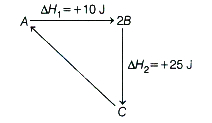
From the given diagram, the enthalpy change $\Delta_r H$ for the reaction $C \rightarrow A$ is:
A
$+35 \ J$
B
$-15 \ J$
C
$-35 \ J$
D
$+15 \ J$
Solution
$\textbf{(C) According to Hess's Law, the enthalpy change for a cyclic process is zero.}$
$\text{For the cycle } A \rightarrow 2B \rightarrow C \rightarrow A, \text{ we have:}$
$\Delta H_{A \to 2B} + \Delta H_{2B \to C} + \Delta H_{C \to A} = 0$
$\text{Given } \Delta H_{A \to 2B} = +10 \text{ J and } \Delta H_{2B \to C} = +25 \text{ J}.$
$\text{Substituting these values:}$
$10 \text{ J} + 25 \text{ J} + \Delta H_{C \to A} = 0$
$35 \text{ J} + \Delta H_{C \to A} = 0$
$\Delta H_{C \to A} = -35 \text{ J}$
$\text{For the cycle } A \rightarrow 2B \rightarrow C \rightarrow A, \text{ we have:}$
$\Delta H_{A \to 2B} + \Delta H_{2B \to C} + \Delta H_{C \to A} = 0$
$\text{Given } \Delta H_{A \to 2B} = +10 \text{ J and } \Delta H_{2B \to C} = +25 \text{ J}.$
$\text{Substituting these values:}$
$10 \text{ J} + 25 \text{ J} + \Delta H_{C \to A} = 0$
$35 \text{ J} + \Delta H_{C \to A} = 0$
$\Delta H_{C \to A} = -35 \text{ J}$
0 likesView Solution
23
ChemistryMediumMCQKCET · 2024
$PCC$ is
A
$K_2Cr_2O_7 + \text{Pyridine}$
B
$CrO_3 + CHCl_3$
C
$CrO_3 + H_2SO_4$
D
$A$ complex of chromium trioxide with pyridine $+ HCl$
Solution
(D) $PCC$ stands for pyridinium chlorochromate.
It is a complex of chromium trioxide with pyridine and $HCl$,represented as $[C_5H_5NH]^{+}[CrO_3Cl]^{-}$.
It is a reagent in organic synthesis used primarily for the oxidation of primary alcohols to aldehydes and secondary alcohols to ketones.
It is a complex of chromium trioxide with pyridine and $HCl$,represented as $[C_5H_5NH]^{+}[CrO_3Cl]^{-}$.
It is a reagent in organic synthesis used primarily for the oxidation of primary alcohols to aldehydes and secondary alcohols to ketones.
0 likesView Solution
24
ChemistryDifficultMCQKCET · 2024
$8.8 \ g$ of monohydric alcohol added to ethyl magnesium iodide in ether liberates $2240 \ cm^3$ of ethane at $STP$. This monohydric alcohol when oxidized using pyridinium chlorochromate $(PCC)$,forms a carbonyl compound that answers the silver mirror test (Tollen's test). The monohydric alcohol is:
A
butan-$2$-ol
B
$2, 2$-dimethylpropan-$1$-ol
C
pentan-$2$-ol
D
$2$-methylpropan-$1$-ol
Solution
(B) The reaction of monohydric alcohol $(R-OH)$ with ethyl magnesium iodide $(C_2H_5MgI)$ is: $R-OH + C_2H_5MgI \rightarrow R-OMgI + C_2H_6 \uparrow$.
At $STP$,$1 \ mol$ of ethane occupies $22400 \ cm^3$.
Given $2240 \ cm^3$ of ethane is liberated,which corresponds to $2240 / 22400 = 0.1 \ mol$ of ethane.
Since $1 \ mol$ of alcohol produces $1 \ mol$ of ethane,$0.1 \ mol$ of alcohol has a mass of $8.8 \ g$.
Thus,the molar mass of the alcohol is $8.8 / 0.1 = 88 \ g/mol$.
The general formula for a saturated monohydric alcohol is $C_nH_{2n+1}OH$,so $12n + (2n+1) + 16 + 1 = 88$,which gives $14n = 70$,so $n = 5$.
The alcohol is a pentanol isomer $(C_5H_{12}O)$.
Since the alcohol forms an aldehyde upon oxidation with $PCC$ (which gives a positive Tollen's test),it must be a primary $(1^{\circ})$ alcohol.
Among the options,$2, 2$-dimethylpropan-$1$-ol has the formula $(CH_3)_3CCH_2OH$,which is a primary alcohol with molar mass $88 \ g/mol$.
At $STP$,$1 \ mol$ of ethane occupies $22400 \ cm^3$.
Given $2240 \ cm^3$ of ethane is liberated,which corresponds to $2240 / 22400 = 0.1 \ mol$ of ethane.
Since $1 \ mol$ of alcohol produces $1 \ mol$ of ethane,$0.1 \ mol$ of alcohol has a mass of $8.8 \ g$.
Thus,the molar mass of the alcohol is $8.8 / 0.1 = 88 \ g/mol$.
The general formula for a saturated monohydric alcohol is $C_nH_{2n+1}OH$,so $12n + (2n+1) + 16 + 1 = 88$,which gives $14n = 70$,so $n = 5$.
The alcohol is a pentanol isomer $(C_5H_{12}O)$.
Since the alcohol forms an aldehyde upon oxidation with $PCC$ (which gives a positive Tollen's test),it must be a primary $(1^{\circ})$ alcohol.
Among the options,$2, 2$-dimethylpropan-$1$-ol has the formula $(CH_3)_3CCH_2OH$,which is a primary alcohol with molar mass $88 \ g/mol$.
0 likesView Solution
25
ChemistryDifficultMCQKCET · 2024
Biologically active adrenaline and ephedrine,which are used to increase blood pressure,contain which of the following functional groups?
A
Primary amino group
B
Secondary amino group
C
Tertiary amino group
D
Quaternary ammonium salt
Solution
(B) Adrenaline and ephedrine are biologically active compounds used to increase blood pressure.
In the structure of adrenaline,the nitrogen atom is bonded to one methyl group and one alkyl chain,making it a secondary amine.
Similarly,ephedrine also contains a secondary amino group.
Therefore,both contain a secondary amino group.
In the structure of adrenaline,the nitrogen atom is bonded to one methyl group and one alkyl chain,making it a secondary amine.
Similarly,ephedrine also contains a secondary amino group.
Therefore,both contain a secondary amino group.
0 likesView Solution
26
ChemistryMediumMCQKCET · 2024
The type of linkage present between nucleotides is
A
phosphoester linkage
B
phosphodiester linkage
C
amide linkage
D
glycosidic linkage
Solution
(B) Nucleotides are joined together by a phosphodiester linkage between the $5^{\prime}$ and $3^{\prime}$ carbon atoms of the pentose sugar.
0 likesView Solution
27
ChemistryMediumMCQKCET · 2024
For the reaction,$PCl_5 \longrightarrow PCl_3 + Cl_2$,the rate and rate constant are $1.02 \times 10^{-4} \ mol \ L^{-1} \ s^{-1}$ and $3.4 \times 10^{-5} \ s^{-1}$ respectively at a given instant. The molar concentration of $PCl_5$ at that instant is
A
$8.0 \ mol \ L^{-1}$
B
$3.0 \ mol \ L^{-1}$
C
$0.2 \ mol \ L^{-1}$
D
$2.0 \ mol \ L^{-1}$
Solution
(B) Given,
The reaction is $PCl_5 \longrightarrow PCl_3 + Cl_2$.
Rate $= 1.02 \times 10^{-4} \ mol \ L^{-1} \ s^{-1}$.
Rate constant $(k) = 3.4 \times 10^{-5} \ s^{-1}$.
The rate law for this first-order reaction is:
$\text{Rate} = k [PCl_5]$
Substituting the given values:
$1.02 \times 10^{-4} = 3.4 \times 10^{-5} \times [PCl_5]$
$[PCl_5] = \frac{1.02 \times 10^{-4}}{3.4 \times 10^{-5}}$
$[PCl_5] = 3 \ mol \ L^{-1}$.
The reaction is $PCl_5 \longrightarrow PCl_3 + Cl_2$.
Rate $= 1.02 \times 10^{-4} \ mol \ L^{-1} \ s^{-1}$.
Rate constant $(k) = 3.4 \times 10^{-5} \ s^{-1}$.
The rate law for this first-order reaction is:
$\text{Rate} = k [PCl_5]$
Substituting the given values:
$1.02 \times 10^{-4} = 3.4 \times 10^{-5} \times [PCl_5]$
$[PCl_5] = \frac{1.02 \times 10^{-4}}{3.4 \times 10^{-5}}$
$[PCl_5] = 3 \ mol \ L^{-1}$.
0 likesView Solution
28
ChemistryMediumMCQKCET · 2024
For the reaction,$A \rightleftharpoons B$,$E_a = 50 \ kJ \ mol^{-1}$ and $\Delta H = -20 \ kJ \ mol^{-1}$. When a catalyst is added,$E_a$ decreases by $10 \ kJ \ mol^{-1}$. What is the $E_a$ for the backward reaction in the presence of the catalyst?
A
$60 \ kJ \ mol^{-1}$
B
$40 \ kJ \ mol^{-1}$
C
$70 \ kJ \ mol^{-1}$
D
$20 \ kJ \ mol^{-1}$
Solution
(A) The enthalpy change of a reaction is given by the difference between the activation energy of the forward reaction $(E_a)_f$ and the activation energy of the backward reaction $(E_a)_b$: $\Delta H = (E_a)_f - (E_a)_b$.
Given that the initial $(E_a)_f = 50 \ kJ \ mol^{-1}$ and the catalyst decreases it by $10 \ kJ \ mol^{-1}$,the new forward activation energy is $(E_a)_f = 50 - 10 = 40 \ kJ \ mol^{-1}$.
The enthalpy change $\Delta H$ remains constant at $-20 \ kJ \ mol^{-1}$ because a catalyst does not change the energy of the reactants or products.
Substituting the values into the formula: $-20 = 40 - (E_a)_b$.
Solving for $(E_a)_b$: $(E_a)_b = 40 + 20 = 60 \ kJ \ mol^{-1}$.
Given that the initial $(E_a)_f = 50 \ kJ \ mol^{-1}$ and the catalyst decreases it by $10 \ kJ \ mol^{-1}$,the new forward activation energy is $(E_a)_f = 50 - 10 = 40 \ kJ \ mol^{-1}$.
The enthalpy change $\Delta H$ remains constant at $-20 \ kJ \ mol^{-1}$ because a catalyst does not change the energy of the reactants or products.
Substituting the values into the formula: $-20 = 40 - (E_a)_b$.
Solving for $(E_a)_b$: $(E_a)_b = 40 + 20 = 60 \ kJ \ mol^{-1}$.
0 likesView Solution
29
ChemistryEasyMCQKCET · 2024
Which one of the following does not represent the Arrhenius equation?
A
$\log k = \log A - \frac{E_a}{2.303 RT}$
B
$k = A e^{\frac{-E_a}{RT}}$
C
$\ln k = -\frac{E_a}{RT} + \ln A$
D
$k = A e^{\frac{E_a}{RT}}$
Solution
(D) The Arrhenius equation is given by $k = A e^{\frac{-E_a}{RT}}$.
Taking natural logarithm on both sides,we get $\ln k = \ln A - \frac{E_a}{RT}$.
Converting to base $10$ logarithm,we get $\log k = \log A - \frac{E_a}{2.303 RT}$.
Comparing these with the given options,option $(D)$ i.e.,$k = A e^{\frac{E_a}{RT}}$ is incorrect because the exponent should be negative.
Taking natural logarithm on both sides,we get $\ln k = \ln A - \frac{E_a}{RT}$.
Converting to base $10$ logarithm,we get $\log k = \log A - \frac{E_a}{2.303 RT}$.
Comparing these with the given options,option $(D)$ i.e.,$k = A e^{\frac{E_a}{RT}}$ is incorrect because the exponent should be negative.
0 likesView Solution
30
ChemistryMediumMCQKCET · 2024
The synthetically produced radioactive noble gas by the collision of ${}_{98}^{249}Cf$ with ${}_{20}^{48}Ca$ is
A
radon
B
radium
C
oganesson
D
xenon
Solution
(C) The nuclear reaction between ${}_{98}^{249}Cf$ and ${}_{20}^{48}Ca$ is given by:
${}_{98}^{249}Cf + {}_{20}^{48}Ca \longrightarrow {}_{118}^{294}Og + 3{}_0^1n$
Here,${}_{118}^{294}Og$ represents Oganesson,which is a synthetic radioactive noble gas with atomic number $Z = 118$.
${}_{98}^{249}Cf + {}_{20}^{48}Ca \longrightarrow {}_{118}^{294}Og + 3{}_0^1n$
Here,${}_{118}^{294}Og$ represents Oganesson,which is a synthetic radioactive noble gas with atomic number $Z = 118$.
0 likesView Solution
31
ChemistryEasyMCQKCET · 2024
The female sex hormone which is responsible for the development of secondary female characteristics and participates in the control of menstrual cycle is
A
testosterone
B
estradiol
C
insulin
D
thyroxine
Solution
(B) Estradiol is the primary female sex hormone. It is responsible for the development of secondary female characteristics and plays a crucial role in the regulation of the menstrual cycle.
0 likesView Solution
32
ChemistryEasyMCQKCET · 2024
The first chlorinated organic insecticide prepared is
A
Gammaxene
B
Chloroform
C
$COCl_2$
D
$DDT$
Solution
(D) The first chlorinated organic insecticide prepared was $DDT$ (Dichlorodiphenyltrichloroethane).
Its structure is shown below:
$Cl-C_6H_4-CH(CCl_3)-C_6H_4-Cl$
Its structure is shown below:
$Cl-C_6H_4-CH(CCl_3)-C_6H_4-Cl$
0 likesView Solution
33
ChemistryDifficultMCQKCET · 2024
The compound shown in the image is:
A
sucralose
B
aspartame
C
saccharin
D
alitame
Solution
(C) The structure provided in the image is $Phthalimide$.
None of the given options ($sucralose$,$aspartame$,$saccharin$,$alitame$) represent $Phthalimide$.
$Saccharin$ is a common artificial sweetener with the structure $1,2-benzisothiazol-3(2H)-one \ 1,1-dioxide$.
Since the question asks to identify the compound and the provided options do not contain the correct name,this question is technically flawed. However,if this were a multiple-choice question where one must be selected,it is often misidentified in some contexts due to structural similarities in bicyclic systems,but strictly speaking,none of the options are correct.
None of the given options ($sucralose$,$aspartame$,$saccharin$,$alitame$) represent $Phthalimide$.
$Saccharin$ is a common artificial sweetener with the structure $1,2-benzisothiazol-3(2H)-one \ 1,1-dioxide$.
Since the question asks to identify the compound and the provided options do not contain the correct name,this question is technically flawed. However,if this were a multiple-choice question where one must be selected,it is often misidentified in some contexts due to structural similarities in bicyclic systems,but strictly speaking,none of the options are correct.
0 likesView Solution
34
ChemistryEasyMCQKCET · 2024
$A$ metalloid is
A
$Bi$
B
$Sb$
C
$P$
D
$Se$
Solution
(B) metalloid is defined as a chemical element whose physical and chemical properties lie between those of metals and non-metals.
Among the given options,only antimony $(Sb)$ is a metalloid.
Among the given options,only antimony $(Sb)$ is a metalloid.
0 likesView Solution
35
ChemistryEasyMCQKCET · 2024
The complex compounds $[Co(NH_3)_5 SO_4] Br$ and $[Co(NH_3)_5 Br] SO_4$ are
A
coordination isomers
B
geometrical isomers
C
optical isomers
D
ionisation isomers
Solution
(D) The complex compounds $[Co(NH_3)_5 SO_4] Br$ and $[Co(NH_3)_5 Br] SO_4$ are ionisation isomers of each other.
- Ionisation isomerism occurs when the counter ion in a coordination compound is a potential ligand and can exchange places with a ligand present in the coordination sphere.
- In $[Co(NH_3)_5 SO_4] Br$,the $Br^-$ ion is the counter ion,while in $[Co(NH_3)_5 Br] SO_4$,the $SO_4^{2-}$ ion is the counter ion.
- Ionisation isomerism occurs when the counter ion in a coordination compound is a potential ligand and can exchange places with a ligand present in the coordination sphere.
- In $[Co(NH_3)_5 SO_4] Br$,the $Br^-$ ion is the counter ion,while in $[Co(NH_3)_5 Br] SO_4$,the $SO_4^{2-}$ ion is the counter ion.
0 likesView Solution
36
ChemistryDifficultMCQKCET · 2024
Which of the following statements are true about $[CoF_6]^{3-}$ ion?
$I$. The complex has octahedral geometry.
$II$. Coordination number of $Co$ is $3$ and oxidation state is $+6$.
$III$. The complex is $sp^3d^2$ hybridised.
$IV$. It is a high spin complex.
$I$. The complex has octahedral geometry.
$II$. Coordination number of $Co$ is $3$ and oxidation state is $+6$.
$III$. The complex is $sp^3d^2$ hybridised.
$IV$. It is a high spin complex.
A
$I$,$II$ and $IV$
B
$I$,$III$ and $IV$
C
$II$ and $IV$
D
$II$,$III$ and $IV$
Solution
(B) For the complex $[CoF_6]^{3-}$:
$1$. The coordination number is $6$,so it has an octahedral geometry. Statement $I$ is true.
$2$. The oxidation state of $Co$ is $x + 6(-1) = -3$,which gives $x = +3$. The coordination number is $6$. Statement $II$ is false.
$3$. $F^-$ is a weak field ligand,so it forms an outer orbital complex with $sp^3d^2$ hybridization. Statement $III$ is true.
$4$. Since it is an outer orbital complex with weak field ligands,it remains a high spin complex. Statement $IV$ is true.
Therefore,statements $I$,$III$,and $IV$ are correct.
$1$. The coordination number is $6$,so it has an octahedral geometry. Statement $I$ is true.
$2$. The oxidation state of $Co$ is $x + 6(-1) = -3$,which gives $x = +3$. The coordination number is $6$. Statement $II$ is false.
$3$. $F^-$ is a weak field ligand,so it forms an outer orbital complex with $sp^3d^2$ hybridization. Statement $III$ is true.
$4$. Since it is an outer orbital complex with weak field ligands,it remains a high spin complex. Statement $IV$ is true.
Therefore,statements $I$,$III$,and $IV$ are correct.
0 likesView Solution
37
ChemistryDifficultMCQKCET · 2024
Match the following:
| $I. \ Zn^{2+}$ | $(i) \ d^8 \ \text{configuration}$ |
| $II. \ Cu^{2+}$ | $(ii) \ \text{Colourless}$ |
| $III. \ Ni^{2+}$ | $(iii) \ \mu = 1.73 \ \text{BM}$ |
A
$I \to (i), II \to (ii), III \to (iii)$
B
$I \to (ii), II \to (iii), III \to (i)$
C
$I \to (ii), II \to (i), III \to (iii)$
D
$I \to (i), II \to (iii), III \to (ii)$
Solution
(B) The correct match is $I \to (ii), II \to (iii), III \to (i)$.
- $Zn^{2+} (Z=30)$: The electronic configuration is $[Ar] 3d^{10}$. Since all $d$-orbitals are fully filled,there are no unpaired electrons,making it colourless.
- $Cu^{2+} (Z=29)$: The electronic configuration is $[Ar] 3d^9$. It has one unpaired electron. The magnetic moment is $\mu = \sqrt{n(n+2)} = \sqrt{1(1+2)} = \sqrt{3} \approx 1.73 \ \text{BM}$.
- $Ni^{2+} (Z=28)$: The electronic configuration is $[Ar] 3d^8$. Thus,it has a $d^8$ configuration.
- $Zn^{2+} (Z=30)$: The electronic configuration is $[Ar] 3d^{10}$. Since all $d$-orbitals are fully filled,there are no unpaired electrons,making it colourless.
- $Cu^{2+} (Z=29)$: The electronic configuration is $[Ar] 3d^9$. It has one unpaired electron. The magnetic moment is $\mu = \sqrt{n(n+2)} = \sqrt{1(1+2)} = \sqrt{3} \approx 1.73 \ \text{BM}$.
- $Ni^{2+} (Z=28)$: The electronic configuration is $[Ar] 3d^8$. Thus,it has a $d^8$ configuration.
0 likesView Solution
38
ChemistryMediumMCQKCET · 2024
On treating $100 \ mL$ of $0.1 \ M$ aqueous solution of the complex $CrCl_3 \cdot 6 H_2 O$ with excess of $AgNO_3$,$2.86 \ g$ of $AgCl$ was obtained. The complex is:
A
$[Cr(H_2 O)_3 Cl_3] \cdot 3 H_2 O$
B
$[Cr(H_2 O)_4 Cl_2] Cl \cdot 2 H_2 O$
C
$[Cr(H_2 O)_5 Cl] Cl_2 \cdot H_2 O$
D
$[Cr(H_2 O)_6] Cl_3$
Solution
(C) Given,Molarity of the complex $= 0.1 \ M$.
Volume of the complex $= 100 \ mL$.
Mass of $AgCl$ obtained $= 2.86 \ g$.
Molar mass of $AgCl = 108 + 35.5 = 143.5 \ g/mol$.
Number of moles of complex $= \frac{0.1 \times 100}{1000} = 0.01 \ mol$.
Number of moles of $AgCl$ precipitated $= \frac{2.86 \ g}{143.5 \ g/mol} \approx 0.02 \ mol$.
Since $1 \ mol$ of complex gives $2 \ mol$ of $AgCl$,there must be $2$ ionizable $Cl^-$ ions outside the coordination sphere.
Therefore,the complex is $[Cr(H_2 O)_5 Cl] Cl_2 \cdot H_2 O$.
Volume of the complex $= 100 \ mL$.
Mass of $AgCl$ obtained $= 2.86 \ g$.
Molar mass of $AgCl = 108 + 35.5 = 143.5 \ g/mol$.
Number of moles of complex $= \frac{0.1 \times 100}{1000} = 0.01 \ mol$.
Number of moles of $AgCl$ precipitated $= \frac{2.86 \ g}{143.5 \ g/mol} \approx 0.02 \ mol$.
Since $1 \ mol$ of complex gives $2 \ mol$ of $AgCl$,there must be $2$ ionizable $Cl^-$ ions outside the coordination sphere.
Therefore,the complex is $[Cr(H_2 O)_5 Cl] Cl_2 \cdot H_2 O$.
0 likesView Solution
39
ChemistryEasyMCQKCET · 2024
$MnO$ exhibits
A
ferrimagnetism
B
antiferromagnetism
C
ferromagnetism
D
paramagnetism
Solution
(B) $MnO$ exhibits antiferromagnetism.
They have a domain structure similar to ferromagnetic substances,but their domains are oppositely oriented and cancel out each other's magnetic moment.
They have a domain structure similar to ferromagnetic substances,but their domains are oppositely oriented and cancel out each other's magnetic moment.
0 likesView Solution
40
ChemistryMediumMCQKCET · 2024
The transition element ( $\approx 5 \%$ ) present with lanthanoid metal in misch metal is
A
$Mg$
B
$Fe$
C
$Zn$
D
$Co$
Solution
(B) Misch metal is an alloy that consists of a lanthanoid metal (approximately $95 \%$) and iron (approximately $5 \%$).
It also contains traces of sulfur $(S)$,carbon $(C)$,calcium $(Ca)$,and aluminum $(Al)$.
It also contains traces of sulfur $(S)$,carbon $(C)$,calcium $(Ca)$,and aluminum $(Al)$.
0 likesView Solution
41
ChemistryMediumMCQKCET · 2024
Which of the following statements related to lanthanoids is incorrect?
A
Lanthanoids are silvery white soft metals.
B
$Samarium$ $(Sm)$ shows $+2$ oxidation state.
C
$Ce^{+4}$ solutions are widely used as oxidising agents in titrimetric analysis.
D
Colour of lanthanoid ion in solution is due to $d-d$ transition.
Solution
(D) The incorrect statement regarding lanthanoids is given in option $(D)$.
Lanthanoids exhibit colour in solution due to $f-f$ transitions,not $d-d$ transitions,because the $4f$ orbitals are partially filled in their ions.
Lanthanoids exhibit colour in solution due to $f-f$ transitions,not $d-d$ transitions,because the $4f$ orbitals are partially filled in their ions.
0 likesView Solution
42
ChemistryEasyMCQKCET · 2024
How many coulombs are required to oxidise $0.1 \ mole$ of $H_2O$ to oxygen?
A
$1.93 \times 10^5 \ C$
B
$1.93 \times 10^4 \ C$
C
$3.86 \times 10^4 \ C$
D
$9.65 \times 10^3 \ C$
Solution
(B) The oxidation reaction of water is: $H_2O \longrightarrow \frac{1}{2}O_2 + 2H^+ + 2e^-$.
From the stoichiometry of the reaction,$1 \ mole$ of $H_2O$ requires $2 \ moles$ of electrons for oxidation.
Since $1 \ mole$ of electrons carries $96500 \ C$ (Faraday's constant),$2 \ moles$ of electrons carry $2 \times 96500 \ C = 193000 \ C$.
Therefore,for $0.1 \ mole$ of $H_2O$,the charge required is $0.1 \times 193000 \ C = 19300 \ C$.
This is equal to $1.93 \times 10^4 \ C$.
From the stoichiometry of the reaction,$1 \ mole$ of $H_2O$ requires $2 \ moles$ of electrons for oxidation.
Since $1 \ mole$ of electrons carries $96500 \ C$ (Faraday's constant),$2 \ moles$ of electrons carry $2 \times 96500 \ C = 193000 \ C$.
Therefore,for $0.1 \ mole$ of $H_2O$,the charge required is $0.1 \times 193000 \ C = 19300 \ C$.
This is equal to $1.93 \times 10^4 \ C$.
0 likesView Solution
43
ChemistryMediumMCQKCET · 2024
$A$ current of $3 \ A$ is passed through a molten calcium salt for $1 \ hr \ 47 \ min \ 13 \ s$. The mass of calcium deposited is $(Molar \ mass \ of \ Ca = 40 \ g \ mol^{-1})$ (in $g$)
A
$6.0$
B
$2.0$
C
$8.0$
D
$4.0$
Solution
(D) Given:
$t = 1 \ hr \ 47 \ min \ 13 \ s = (1 \times 3600) + (47 \times 60) + 13 = 3600 + 2820 + 13 = 6433 \ s$
$Molar \ mass \ of \ Ca = 40 \ g \ mol^{-1}$
$Current \ (I) = 3 \ A$
$n-factor \ for \ Ca^{2+} + 2e^- \rightarrow Ca \text{ is } 2$.
Using Faraday's law of electrolysis:
$w = \frac{M \times I \times t}{n \times 96500}$
$w = \frac{40 \times 3 \times 6433}{2 \times 96500}$
$w = \frac{771960}{193000} \approx 4.0 \ g$
$t = 1 \ hr \ 47 \ min \ 13 \ s = (1 \times 3600) + (47 \times 60) + 13 = 3600 + 2820 + 13 = 6433 \ s$
$Molar \ mass \ of \ Ca = 40 \ g \ mol^{-1}$
$Current \ (I) = 3 \ A$
$n-factor \ for \ Ca^{2+} + 2e^- \rightarrow Ca \text{ is } 2$.
Using Faraday's law of electrolysis:
$w = \frac{M \times I \times t}{n \times 96500}$
$w = \frac{40 \times 3 \times 6433}{2 \times 96500}$
$w = \frac{771960}{193000} \approx 4.0 \ g$
0 likesView Solution
44
ChemistryMediumMCQKCET · 2024
The value of '$A$' in the equation $\lambda_{m} = \lambda_{m}^{\circ} - A \sqrt{C}$ is the same for which of the following pairs?
A
$NaCl$ and $CaCl_2$
B
$CaCl_2$ and $MgSO_4$
C
$NaCl$ and $KBr$
D
$MgCl_2$ and $NaCl$
Solution
(C) The equation $\lambda_{m} = \lambda_{m}^{\circ} - A \sqrt{C}$ is the Debye-Huckel-Onsager equation.
In this equation,'$A$' is a constant that depends on the nature of the solvent and the temperature,but it also depends on the type of electrolyte (i.e.,the charges on the ions,such as $1:1$,$1:2$,$2:1$,or $2:2$ electrolytes).
$NaCl$ and $KBr$ are both $1:1$ electrolytes.
Since they are of the same type,they will have the same value of '$A$'.
In this equation,'$A$' is a constant that depends on the nature of the solvent and the temperature,but it also depends on the type of electrolyte (i.e.,the charges on the ions,such as $1:1$,$1:2$,$2:1$,or $2:2$ electrolytes).
$NaCl$ and $KBr$ are both $1:1$ electrolytes.
Since they are of the same type,they will have the same value of '$A$'.
0 likesView Solution
45
ChemistryMediumMCQKCET · 2024
$\alpha-D-(+)$-glucose and $\beta-D-(+)$-glucose are
A
enantiomers
B
conformers
C
epimers
D
anomers
Solution
(D) $\alpha-D-(+)$-glucose and $\beta-D-(+)$-glucose are called anomers.
These are the two cyclic hemiacetal forms of glucose that differ only in the configuration of the hydroxyl group at $C1$.
These are the two cyclic hemiacetal forms of glucose that differ only in the configuration of the hydroxyl group at $C1$.
0 likesView Solution
46
ChemistryEasyMCQKCET · 2024
Select the correct statement:
A
Roasting involves heating the ore in the absence of air.
B
Calcination involves heating the ore above its melting point.
C
Smelting involves heating the ore with a suitable reducing agent and flux below its melting point.
D
Calcination of calcium carbonate is endothermic.
Solution
(D) The correct statement is given in option $(D)$.
- Roasting involves heating the ore in a regular supply of air.
- Calcination involves heating the ore below its melting point.
- Smelting is the process by which a metal is obtained at temperatures above its melting point.
- Calcination of calcium carbonate $(CaCO_3 \rightarrow CaO + CO_2)$ is an endothermic process as it requires heat to proceed.
- Roasting involves heating the ore in a regular supply of air.
- Calcination involves heating the ore below its melting point.
- Smelting is the process by which a metal is obtained at temperatures above its melting point.
- Calcination of calcium carbonate $(CaCO_3 \rightarrow CaO + CO_2)$ is an endothermic process as it requires heat to proceed.
0 likesView Solution
47
ChemistryMediumMCQKCET · 2024
The incorrect statement about the Hall$-$Heroult process is:
A
Carbon anode is oxidised to $CO$ and $CO_2$.
B
$Na_3AlF_6$ helps to decrease the melting point of the electrolyte.
C
$CaF_2$ helps to increase the conductivity of the electrolyte.
D
Oxidation state of oxygen changes in the overall cell reaction.
Solution
(D) The incorrect statement about the Hall$-$Heroult process is given in option $(D)$.
In this process,the overall cell reaction is $2Al_2O_3 + 3C \longrightarrow 4Al + 3CO_2$.
In $Al_2O_3$,the oxidation state of oxygen is $-2$,and in $CO_2$,it is also $-2$.
Therefore,the oxidation state of oxygen does not change during the overall cell reaction.
In this process,the overall cell reaction is $2Al_2O_3 + 3C \longrightarrow 4Al + 3CO_2$.
In $Al_2O_3$,the oxidation state of oxygen is $-2$,and in $CO_2$,it is also $-2$.
Therefore,the oxidation state of oxygen does not change during the overall cell reaction.
0 likesView Solution
48
ChemistryDifficultMCQKCET · 2024
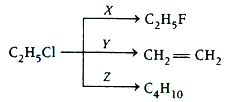
In the following scheme of reaction,$X, Y$ and $Z$ respectively are:
A
$AgF$,alcoholic $KOH$ and benzene
B
$HF$,aqueous $KOH$ and $Na$ in dry ether
C
$Hg_2F_2$,alcoholic $KOH$ and $Na$ in dry ether
D
$CoF_2$,aqueous $KOH$ and benzene
Solution
(C) The given reaction scheme shows three different reactions of ethyl chloride $(C_2H_5Cl)$:
$1$. The conversion of $C_2H_5Cl$ to $C_2H_5F$ is a Swarts reaction,which uses a metallic fluoride like $Hg_2F_2$ or $AgF$. Thus,$X = Hg_2F_2$.
$2$. The conversion of $C_2H_5Cl$ to ethene $(CH_2=CH_2)$ is a dehydrohalogenation reaction,which occurs in the presence of alcoholic $KOH$. Thus,$Y = \text{alcoholic } KOH$.
$3$. The conversion of $C_2H_5Cl$ to butane $(C_4H_{10})$ is a Wurtz reaction,which uses $Na$ in dry ether. Thus,$Z = Na \text{ in dry ether}$.
Therefore,the correct sequence is $Hg_2F_2$,alcoholic $KOH$ and $Na$ in dry ether.
$1$. The conversion of $C_2H_5Cl$ to $C_2H_5F$ is a Swarts reaction,which uses a metallic fluoride like $Hg_2F_2$ or $AgF$. Thus,$X = Hg_2F_2$.
$2$. The conversion of $C_2H_5Cl$ to ethene $(CH_2=CH_2)$ is a dehydrohalogenation reaction,which occurs in the presence of alcoholic $KOH$. Thus,$Y = \text{alcoholic } KOH$.
$3$. The conversion of $C_2H_5Cl$ to butane $(C_4H_{10})$ is a Wurtz reaction,which uses $Na$ in dry ether. Thus,$Z = Na \text{ in dry ether}$.
Therefore,the correct sequence is $Hg_2F_2$,alcoholic $KOH$ and $Na$ in dry ether.
0 likesView Solution
49
ChemistryMediumMCQKCET · 2024
$A$ haloalkane undergoes $S_{N}2$ or $S_{N}1$ reaction depending on
A
solvent used in the reaction
B
low temperature
C
the type of halogen atom
D
stability of the haloalkane
Solution
(A) - The mechanism of nucleophilic substitution in haloalkanes,whether $S_{N}2$ or $S_{N}1$,is significantly influenced by the nature of the solvent used in the reaction.
- $S_{N}2$ reactions are favored in polar aprotic solvents (e.g.,acetone,$DMSO$,$DMF$) because they do not solvate the nucleophile strongly.
- $S_{N}1$ reactions are favored in polar protic solvents (e.g.,$H_2O$,alcohols) because they stabilize the carbocation intermediate and the leaving group through solvation.
- $S_{N}2$ reactions are favored in polar aprotic solvents (e.g.,acetone,$DMSO$,$DMF$) because they do not solvate the nucleophile strongly.
- $S_{N}1$ reactions are favored in polar protic solvents (e.g.,$H_2O$,alcohols) because they stabilize the carbocation intermediate and the leaving group through solvation.
0 likesView Solution
50
ChemistryMediumMCQKCET · 2024
$2-$methylpropane can be prepared by the Wurtz reaction. The haloalkanes taken along with metallic sodium and dry ether are:
A
chloromethane and $2-$chloropropane
B
chloroethane and chloromethane
C
chloroethane and $1-$chloropropane
D
chloromethane and $1-$chloropropane
Solution
(A) To prepare $2-$methylpropane by the Wurtz reaction,we need to couple a methyl group with an isopropyl group. Therefore,the haloalkanes required are chloromethane $(CH_3Cl)$ and $2-$chloropropane $(CH_3CHClCH_3)$.
The reaction is as follows:
$CH_3Cl + CH_3CHClCH_3 + 2Na \xrightarrow{\text{dry ether}} CH_3CH(CH_3)CH_3 + 2NaCl$
Thus,the correct option is $A$.
The reaction is as follows:
$CH_3Cl + CH_3CHClCH_3 + 2Na \xrightarrow{\text{dry ether}} CH_3CH(CH_3)CH_3 + 2NaCl$
Thus,the correct option is $A$.
0 likesView Solution
51
ChemistryEasyMCQKCET · 2024
In the reaction,Aniline $\xrightarrow[\text{Dil. } HCl]{NaNO_2} P$ $\xrightarrow[NaOH]{\text{Phenol}} Q$,identify $Q$.
A
$C_6H_5N_2Cl$
B
$ortho$-hydroxyazobenzene
C
$para$-hydroxyazobenzene
D
$meta$-hydroxyazobenzene
Solution
(C) The reaction sequence is as follows:
$1$. Aniline reacts with $NaNO_2$ and $\text{Dil. } HCl$ at $0-5^{\circ}C$ to form benzenediazonium chloride $(P)$:
$C_6H_5NH_2 + NaNO_2 + 2HCl \rightarrow C_6H_5N_2^+Cl^- + NaCl + 2H_2O$
$2$. Benzenediazonium chloride $(P)$ then undergoes an electrophilic substitution (coupling reaction) with phenol in the presence of $NaOH$ ($pH$ $9-10$). The coupling occurs primarily at the $para$-position due to steric hindrance at the $ortho$-position,forming $p$-hydroxyazobenzene $(Q)$:
$C_6H_5N_2^+Cl^- + C_6H_5OH \xrightarrow{NaOH} C_6H_5-N=N-C_6H_4-OH(p) + HCl$
$1$. Aniline reacts with $NaNO_2$ and $\text{Dil. } HCl$ at $0-5^{\circ}C$ to form benzenediazonium chloride $(P)$:
$C_6H_5NH_2 + NaNO_2 + 2HCl \rightarrow C_6H_5N_2^+Cl^- + NaCl + 2H_2O$
$2$. Benzenediazonium chloride $(P)$ then undergoes an electrophilic substitution (coupling reaction) with phenol in the presence of $NaOH$ ($pH$ $9-10$). The coupling occurs primarily at the $para$-position due to steric hindrance at the $ortho$-position,forming $p$-hydroxyazobenzene $(Q)$:
$C_6H_5N_2^+Cl^- + C_6H_5OH \xrightarrow{NaOH} C_6H_5-N=N-C_6H_4-OH(p) + HCl$
0 likesView Solution
52
ChemistryEasyMCQKCET · 2024
$NO_2$ gas is
A
colourless,neutral
B
colourless,acidic
C
brown,acidic
D
brown,neutral
Solution
(C) $NO_2$ (Nitrogen dioxide) gas is brown in colour and acidic in nature.
0 likesView Solution
53
ChemistryEasyMCQKCET · 2024
The correct decreasing order of boiling point of hydrogen halides is
A
$HF > HCl > HBr > HI$
B
$HI > HBr > HCl > HF$
C
$HF > HI > HBr > HCl$
D
$HI > HF > HBr > HCl$
Solution
(C) $HF$ exhibits strong intermolecular hydrogen bonding,which results in a significantly higher boiling point compared to other hydrogen halides.
For the remaining hydrogen halides $(HCl, HBr, HI)$,the boiling point is primarily determined by the magnitude of van der Waals' forces,which increase with an increase in molecular mass.
Therefore,the order of boiling points is $HI > HBr > HCl$.
Combining these,the overall decreasing order of boiling points is $HF > HI > HBr > HCl$.
For the remaining hydrogen halides $(HCl, HBr, HI)$,the boiling point is primarily determined by the magnitude of van der Waals' forces,which increase with an increase in molecular mass.
Therefore,the order of boiling points is $HI > HBr > HCl$.
Combining these,the overall decreasing order of boiling points is $HF > HI > HBr > HCl$.
0 likesView Solution
54
ChemistryEasyMCQKCET · 2024
Which of the following set of polymers are used as fibres?
$(i)$ Teflon
$(ii)$ Starch
$(iii)$ Terylene
$(iv)$ Orlon
$(i)$ Teflon
$(ii)$ Starch
$(iii)$ Terylene
$(iv)$ Orlon
A
$(i)$ and $(ii)$
B
$(ii)$ and $(iii)$
C
$(iii)$ and $(iv)$
D
$(i)$ and $(iv)$
Solution
(C) Fibres are thread-forming solids that possess high tensile strength and high modulus. These characteristics are due to strong intermolecular forces like hydrogen bonds or dipole-dipole interactions.
Among the given polymers:
$(i)$ Teflon is an elastomer/plastic.
$(ii)$ Starch is a natural polymer (carbohydrate).
$(iii)$ Terylene is a polyester fibre.
$(iv)$ Orlon (polyacrylonitrile) is a synthetic fibre.
Therefore,the correct set is $(iii)$ and $(iv)$.
Among the given polymers:
$(i)$ Teflon is an elastomer/plastic.
$(ii)$ Starch is a natural polymer (carbohydrate).
$(iii)$ Terylene is a polyester fibre.
$(iv)$ Orlon (polyacrylonitrile) is a synthetic fibre.
Therefore,the correct set is $(iii)$ and $(iv)$.
0 likesView Solution
55
ChemistryEasyMCQKCET · 2024
The biodegradable polymer obtained by polymerization of glycine and aminocaproic acid is
A
nylon $6$
B
$PHBV$
C
nylon-$2$-nylon-$6$
D
nylon-$6, 10$
Solution
(C) The biodegradable polymer nylon-$2$-nylon-$6$ is an alternating polyamide copolymer of glycine $[H_2N-CH_2-COOH]$ and aminocaproic acid $[H_2N-(CH_2)_5-COOH]$.
0 likesView Solution
56
ChemistryMediumMCQKCET · 2024
Which of the following crystals has the unit cell such that $a=b \neq c$ and $\alpha=\beta=90^{\circ}$,$\gamma=120^{\circ}$?
A
Zinc blende
B
Graphite
C
Cinnabar
D
Potassium dichromate
Solution
(B) The given unit cell parameters $a=b \neq c$ and $\alpha=\beta=90^{\circ}$,$\gamma=120^{\circ}$ correspond to the hexagonal crystal system.
Among the given options,graphite crystallizes in the hexagonal system.
Among the given options,graphite crystallizes in the hexagonal system.
0 likesView Solution
57
ChemistryDifficultMCQKCET · 2024
The number of atoms in $4.5 \ g$ of a face-centred cubic crystal with edge length $300 \ pm$ is (Given: Density $= 10 \ g \ cm^{-3}$ and $N_A = 6.022 \times 10^{23}$)
A
$6.6 \times 10^{20}$
B
$6.6 \times 10^{23}$
C
$6.6 \times 10^{19}$
D
$6.6 \times 10^{22}$
Solution
(D) For a face-centred cubic $(FCC)$ crystal, the number of atoms per unit cell is $Z = 4$.
Edge length $a = 300 \ pm = 300 \times 10^{-10} \ cm = 3 \times 10^{-8} \ cm$.
Density $d = 10 \ g \ cm^{-3}$.
Using the density formula: $d = \frac{Z \times M}{N_A \times a^3}$, where $M$ is the molar mass.
$M = \frac{d \times N_A \times a^3}{Z} = \frac{10 \times 6.022 \times 10^{23} \times (3 \times 10^{-8})^3}{4}$.
$M = \frac{10 \times 6.022 \times 10^{23} \times 27 \times 10^{-24}}{4} = \frac{162.594}{4} = 40.6485 \ g \ mol^{-1}$.
Now, the number of atoms in $4.5 \ g$ is calculated as:
$\text{Number of atoms} = \frac{\text{mass}}{\text{molar mass}} \times N_A = \frac{4.5}{40.6485} \times 6.022 \times 10^{23} \approx 6.66 \times 10^{22}$ atoms.
Edge length $a = 300 \ pm = 300 \times 10^{-10} \ cm = 3 \times 10^{-8} \ cm$.
Density $d = 10 \ g \ cm^{-3}$.
Using the density formula: $d = \frac{Z \times M}{N_A \times a^3}$, where $M$ is the molar mass.
$M = \frac{d \times N_A \times a^3}{Z} = \frac{10 \times 6.022 \times 10^{23} \times (3 \times 10^{-8})^3}{4}$.
$M = \frac{10 \times 6.022 \times 10^{23} \times 27 \times 10^{-24}}{4} = \frac{162.594}{4} = 40.6485 \ g \ mol^{-1}$.
Now, the number of atoms in $4.5 \ g$ is calculated as:
$\text{Number of atoms} = \frac{\text{mass}}{\text{molar mass}} \times N_A = \frac{4.5}{40.6485} \times 6.022 \times 10^{23} \approx 6.66 \times 10^{22}$ atoms.
0 likesView Solution
58
ChemistryMediumMCQKCET · 2024
Vapour pressure of a solution containing $18 \ g$ of glucose and $178.2 \ g$ of water at $100^{\circ} C$ is (Vapour pressure of pure water at $100^{\circ} C = 760 \ torr$) (in $torr$)
A
$76.0$
B
$752.0$
C
$7.6$
D
$3207.6$
Solution
(B) Relative lowering of vapour pressure is equal to the mole fraction of glucose.
$\frac{p_0 - p_s}{p_0} = \chi_{\text{glucose}}$ ...$(I)$
Number of moles of glucose $= \frac{18 \ g}{180 \ g/mol} = 0.1 \ mol$
Number of moles of water $= \frac{178.2 \ g}{18 \ g/mol} = 9.9 \ mol$
Mole fraction of glucose $(\chi_{\text{glucose}})$ $= \frac{0.1}{0.1 + 9.9} = \frac{0.1}{10} = 0.01$
Substituting the value of mole fraction in Eq. $(I)$:
$\frac{760 - p_s}{760} = 0.01$
$760 - p_s = 7.6$
$p_s = 760 - 7.6 = 752.4 \ torr$
Rounding to the nearest option,$p_s \approx 752.0 \ torr$.
$\frac{p_0 - p_s}{p_0} = \chi_{\text{glucose}}$ ...$(I)$
Number of moles of glucose $= \frac{18 \ g}{180 \ g/mol} = 0.1 \ mol$
Number of moles of water $= \frac{178.2 \ g}{18 \ g/mol} = 9.9 \ mol$
Mole fraction of glucose $(\chi_{\text{glucose}})$ $= \frac{0.1}{0.1 + 9.9} = \frac{0.1}{10} = 0.01$
Substituting the value of mole fraction in Eq. $(I)$:
$\frac{760 - p_s}{760} = 0.01$
$760 - p_s = 7.6$
$p_s = 760 - 7.6 = 752.4 \ torr$
Rounding to the nearest option,$p_s \approx 752.0 \ torr$.
0 likesView Solution
59
ChemistryMediumMCQKCET · 2024
$A$ mixture of phenol and aniline shows negative deviation from Raoult's law. This is due to the formation of
A
polar covalent bond
B
non-polar covalent bond
C
intermolecular hydrogen bond
D
intramolecular hydrogen bond
Solution
(C) mixture of phenol $(C_6H_5OH)$ and aniline $(C_6H_5NH_2)$ shows negative deviation from Raoult's law.
This occurs because the intermolecular hydrogen bonding between the phenolic hydrogen and the lone pair of nitrogen in aniline is stronger than the individual intermolecular forces present in the pure components.
This stronger interaction leads to a decrease in the tendency of molecules to escape into the vapor phase,resulting in a lower vapor pressure than expected.
This occurs because the intermolecular hydrogen bonding between the phenolic hydrogen and the lone pair of nitrogen in aniline is stronger than the individual intermolecular forces present in the pure components.
This stronger interaction leads to a decrease in the tendency of molecules to escape into the vapor phase,resulting in a lower vapor pressure than expected.
0 likesView Solution
60
ChemistryEasyMCQKCET · 2024
Which one of the following pairs will show positive deviation from Raoult's law?
A
Water $-$ $HCl$
B
Benzene $-$ Methanol
C
Water $-$ $HNO_3$
D
Acetone $-$ Chloroform
Solution
(B) Positive deviation from Raoult's law occurs when the solute-solvent intermolecular forces are weaker than the solute-solute and solvent-solvent forces.
In the mixture of benzene and methanol,the hydrogen bonding between methanol molecules is disrupted by the addition of non-polar benzene,leading to weaker interactions in the solution.
Therefore,the vapour pressure of the solution is higher than that predicted by Raoult's law.
Water $-$ $HCl$ and Water $-$ $HNO_3$ show negative deviation due to strong hydrogen bonding,and Acetone $-$ Chloroform shows negative deviation due to hydrogen bond formation between them.
In the mixture of benzene and methanol,the hydrogen bonding between methanol molecules is disrupted by the addition of non-polar benzene,leading to weaker interactions in the solution.
Therefore,the vapour pressure of the solution is higher than that predicted by Raoult's law.
Water $-$ $HCl$ and Water $-$ $HNO_3$ show negative deviation due to strong hydrogen bonding,and Acetone $-$ Chloroform shows negative deviation due to hydrogen bond formation between them.
0 likesView Solution
61
ChemistryEasyMCQKCET · 2024
Gold sol is not a
A
macromolecular colloid
B
lyophobic colloid
C
multimolecular colloid
D
negatively charged colloid
Solution
(A) Gold sols are formed by the aggregation of a large number of gold atoms,making them $multimolecular$ colloids.
They are $lyophobic$ in nature and carry a $negative$ charge due to the adsorption of $OH^-$ ions.
They are not $macromolecular$ colloids,as macromolecular colloids consist of large molecules like proteins or starch.
They are $lyophobic$ in nature and carry a $negative$ charge due to the adsorption of $OH^-$ ions.
They are not $macromolecular$ colloids,as macromolecular colloids consist of large molecules like proteins or starch.
0 likesView Solution
62
ChemistryMediumMCQKCET · 2024
Which one of the following is a cationic detergent?
A
$Cetyltrimethylammonium \text{ } bromide$
B
$Sodium \text{ } dodecylbenzene \text{ } sulphonate$
C
$Dodecylbenzene \text{ } sulphonic \text{ } acid$
D
$Dodecylbenzene$
Solution
(A) Cationic detergents are quaternary ammonium salts of amines with acetates,chlorides,or bromides as anions.
Among the given options,$Cetyltrimethylammonium \text{ } bromide$ is a popular cationic detergent.
It is commonly used in hair conditioners.
Among the given options,$Cetyltrimethylammonium \text{ } bromide$ is a popular cationic detergent.
It is commonly used in hair conditioners.
0 likesView Solution
63
ChemistryEasyMCQKCET · 2024
Identify the incorrect statement.
A
Values of colligative properties of colloidal solutions are of small order compared to values of true solutions.
B
Tyndall effect is observed only when the diameter of the dispersed particles is not much smaller than the wavelength of the incident light.
C
The colour of a colloidal solution depends on the wavelength of light scattered by the dispersed particles.
D
Brownian movement is due to balanced bombardment of molecules of the dispersion medium on colloidal particles.
Solution
(D) The incorrect statement is given in option $(D)$.
Brownian movement is caused by the unbalanced bombardment of molecules of the dispersion medium on the colloidal particles,which results in a zig-zag motion.
Therefore,the statement claiming it is due to balanced bombardment is incorrect.
Brownian movement is caused by the unbalanced bombardment of molecules of the dispersion medium on the colloidal particles,which results in a zig-zag motion.
Therefore,the statement claiming it is due to balanced bombardment is incorrect.
0 likesView Solution
64
ChemistryDifficultMCQKCET · 2024
For the coagulation of a positively charged hydrated ferric oxide sol,the flocculating power of the ions is in the order:
A
$PO_4^{3-} > SO_4^{2-} > Cl^{-} > [Fe(CN)_6]^{4-}$
B
$Cl^{-} > SO_4^{2-} > PO_4^{3-} > [Fe(CN)_6]^{4-}$
C
$SO_4^{2-} = Cl^{-} = PO_4^{3-} = [Fe(CN)_6]^{4-}$
D
$[Fe(CN)_6]^{4-} > PO_4^{3-} > SO_4^{2-} > Cl^{-}$
Solution
(D) According to the $Hardy-Schulze$ rule,the coagulating (or flocculating) power of an ion depends on its valency.
For a positively charged sol,the coagulating power of the anions increases with the increase in the magnitude of their negative charge.
The valencies of the given ions are: $[Fe(CN)_6]^{4-}$ $(4-)$,$PO_4^{3-}$ $(3-)$,$SO_4^{2-}$ $(2-)$,and $Cl^{-}$ $(1-)$.
Therefore,the order of flocculating power is $[Fe(CN)_6]^{4-} > PO_4^{3-} > SO_4^{2-} > Cl^{-}$.
For a positively charged sol,the coagulating power of the anions increases with the increase in the magnitude of their negative charge.
The valencies of the given ions are: $[Fe(CN)_6]^{4-}$ $(4-)$,$PO_4^{3-}$ $(3-)$,$SO_4^{2-}$ $(2-)$,and $Cl^{-}$ $(1-)$.
Therefore,the order of flocculating power is $[Fe(CN)_6]^{4-} > PO_4^{3-} > SO_4^{2-} > Cl^{-}$.
0 likesView Solution
Vedclass Products
For Students
Vedclass Test Series
Mock tests in real KCET style covering Chemistry with performance analysis. 5-day free trial.
Start Free TrialFor Teachers
Exam Paper Generator
Generate Set A/B/C/D Chemistry papers from 7.5L+ questions in 2 minutes. 3 chapters free.
Try FreeFor Institutes
Online Exam Module
Run live KCET mock exams with unlimited students, 360° analytics & white-label branding.
See DemoFrequently Asked Questions
How many Chemistry questions are in KCET 2024?
There are 64 Chemistry questions from the KCET 2024 paper on Vedclass, each with a detailed step-by-step solution in English.
Are KCET 2024 Chemistry solutions available in English?
Yes. All solutions on this page are in English. You can also switch to English or Hindi using the language buttons above the questions.
Can I practice KCET 2024 Chemistry as a timed test?
Yes. Use the Vedclass Test Series to attempt a full KCET mock test covering Chemistry with time limits and instant score analysis.
Can teachers create Chemistry papers from KCET previous year questions?
Yes. The Vedclass Exam Paper Generator lets teachers mix KCET Chemistry questions and generate Set A/B/C/D papers in minutes.
For Teachers & Institutes
Build a Custom Chemistry Paper
Pick KCET 2024 Chemistry questions, set difficulty, and generate Set A/B/C/D in 2 minutes.