
MathematicsQ1–60 of 60 questions
Page 1 of 1 · English
1
MathematicsEasyMCQKCET · 2021
The cost and revenue functions of a product are given by $C(x) = 20x + 4000$ and $R(x) = 60x + 2000$ respectively,where $x$ is the number of items produced and sold. The value of $x$ to earn profit is
A
$> 50$
B
$> 60$
C
$> 80$
D
$> 40$
Solution
(A) Given,$C(x) = 20x + 4000$ and $R(x) = 60x + 2000$.
To earn a profit,the revenue must be greater than the cost,i.e.,$R(x) - C(x) > 0$.
Substituting the given functions:
$(60x + 2000) - (20x + 4000) > 0$
$60x + 2000 - 20x - 4000 > 0$
$40x - 2000 > 0$
$40x > 2000$
$x > \frac{2000}{40}$
$x > 50$.
Thus,the number of items $x$ must be greater than $50$ to earn a profit.
To earn a profit,the revenue must be greater than the cost,i.e.,$R(x) - C(x) > 0$.
Substituting the given functions:
$(60x + 2000) - (20x + 4000) > 0$
$60x + 2000 - 20x - 4000 > 0$
$40x - 2000 > 0$
$40x > 2000$
$x > \frac{2000}{40}$
$x > 50$.
Thus,the number of items $x$ must be greater than $50$ to earn a profit.
0 likesView Solution
2
MathematicsMediumMCQKCET · 2021
If $\left(\frac{1+i}{1-i}\right)^{x}=1$,then
A
$x=4n+1, n \in N$
B
$x=2n+1, n \in N$
C
$x=2n, n \in N$
D
$x=4n, n \in N$
Solution
(D) Given,$\left(\frac{1+i}{1-i}\right)^{x}=1$
Rationalizing the base:
$\left[\frac{1+i}{1-i} \times \frac{1+i}{1+i}\right]^{x}=1$
$\left[\frac{1+i^2+2i}{1^2-i^2}\right]^{x}=1$
Since $i^2 = -1$:
$\left[\frac{1-1+2i}{1+1}\right]^{x}=1$
$\left[\frac{2i}{2}\right]^{x}=1$
$i^x = 1$
We know that $i^k = 1$ if and only if $k$ is a multiple of $4$.
Therefore,$x = 4n$ for $n \in N$.
Rationalizing the base:
$\left[\frac{1+i}{1-i} \times \frac{1+i}{1+i}\right]^{x}=1$
$\left[\frac{1+i^2+2i}{1^2-i^2}\right]^{x}=1$
Since $i^2 = -1$:
$\left[\frac{1-1+2i}{1+1}\right]^{x}=1$
$\left[\frac{2i}{2}\right]^{x}=1$
$i^x = 1$
We know that $i^k = 1$ if and only if $k$ is a multiple of $4$.
Therefore,$x = 4n$ for $n \in N$.
0 likesView Solution
3
MathematicsEasyMCQKCET · 2021
$A$ student has to answer $10$ questions,choosing at least $4$ from each of the parts $A$ and $B$. If there are $6$ questions in part $A$ and $7$ in part $B$,then the number of ways the student can choose $10$ questions is:
A
$256$
B
$352$
C
$266$
D
$426$
Solution
(C) Given,total questions in part $A = 6$ and total questions in part $B = 7$.
To choose $10$ questions with at least $4$ from each part,the possible combinations are:
$1$. $4$ from part $A$ and $6$ from part $B$
$2$. $5$ from part $A$ and $5$ from part $B$
$3$. $6$ from part $A$ and $4$ from part $B$
Total ways = $({ }^{6}C_{4} \times { }^{7}C_{6}) + ({ }^{6}C_{5} \times { }^{7}C_{5}) + ({ }^{6}C_{6} \times { }^{7}C_{4})$
$= (15 \times 7) + (6 \times 21) + (1 \times 35)$
$= 105 + 126 + 35 = 266$
To choose $10$ questions with at least $4$ from each part,the possible combinations are:
$1$. $4$ from part $A$ and $6$ from part $B$
$2$. $5$ from part $A$ and $5$ from part $B$
$3$. $6$ from part $A$ and $4$ from part $B$
Total ways = $({ }^{6}C_{4} \times { }^{7}C_{6}) + ({ }^{6}C_{5} \times { }^{7}C_{5}) + ({ }^{6}C_{6} \times { }^{7}C_{4})$
$= (15 \times 7) + (6 \times 21) + (1 \times 35)$
$= 105 + 126 + 35 = 266$
0 likesView Solution
4
MathematicsEasyMCQKCET · 2021
If the middle term of the $AP$ is $300$,then the sum of its first $51$ terms is
A
$15300$
B
$14800$
C
$16500$
D
$14300$
Solution
(A) Given,number of terms,$n = 51$.
Since $n$ is odd,the middle term is the $\left(\frac{n+1}{2}\right)$-th term.
$\text{Middle term} = \left(\frac{51+1}{2}\right) = 26\text{-th term}$.
Thus,$T_{26} = a + 25d = 300$.
The sum of the first $n$ terms of an $AP$ is given by $S_n = \frac{n}{2}(a + l)$,where $l$ is the last term.
Here,$l = T_{51} = a + 50d$.
$S_{51} = \frac{51}{2}(a + a + 50d) = \frac{51}{2}(2a + 50d) = 51(a + 25d)$.
Substituting $a + 25d = 300$,we get:
$S_{51} = 51 \times 300 = 15300$.
Since $n$ is odd,the middle term is the $\left(\frac{n+1}{2}\right)$-th term.
$\text{Middle term} = \left(\frac{51+1}{2}\right) = 26\text{-th term}$.
Thus,$T_{26} = a + 25d = 300$.
The sum of the first $n$ terms of an $AP$ is given by $S_n = \frac{n}{2}(a + l)$,where $l$ is the last term.
Here,$l = T_{51} = a + 50d$.
$S_{51} = \frac{51}{2}(a + a + 50d) = \frac{51}{2}(2a + 50d) = 51(a + 25d)$.
Substituting $a + 25d = 300$,we get:
$S_{51} = 51 \times 300 = 15300$.
0 likesView Solution
5
MathematicsEasyMCQKCET · 2021
The value of $\cos 1200^{\circ} + \tan 1485^{\circ}$ is
A
$\frac{1}{2}$
B
$\frac{3}{2}$
C
$-\frac{3}{2}$
D
$-\frac{1}{2}$
Solution
(A) Given expression: $\cos 1200^{\circ} + \tan 1485^{\circ}$
Using the property $\cos(n \times 360^{\circ} + \theta) = \cos \theta$ and $\tan(n \times 360^{\circ} + \theta) = \tan \theta$:
$\cos 1200^{\circ} = \cos(3 \times 360^{\circ} + 120^{\circ}) = \cos 120^{\circ}$
$\tan 1485^{\circ} = \tan(4 \times 360^{\circ} + 45^{\circ}) = \tan 45^{\circ}$
Now,calculate the values:
$\cos 120^{\circ} = \cos(180^{\circ} - 60^{\circ}) = -\cos 60^{\circ} = -\frac{1}{2}$
$\tan 45^{\circ} = 1$
Therefore,$\cos 1200^{\circ} + \tan 1485^{\circ} = -\frac{1}{2} + 1 = \frac{1}{2}$
Using the property $\cos(n \times 360^{\circ} + \theta) = \cos \theta$ and $\tan(n \times 360^{\circ} + \theta) = \tan \theta$:
$\cos 1200^{\circ} = \cos(3 \times 360^{\circ} + 120^{\circ}) = \cos 120^{\circ}$
$\tan 1485^{\circ} = \tan(4 \times 360^{\circ} + 45^{\circ}) = \tan 45^{\circ}$
Now,calculate the values:
$\cos 120^{\circ} = \cos(180^{\circ} - 60^{\circ}) = -\cos 60^{\circ} = -\frac{1}{2}$
$\tan 45^{\circ} = 1$
Therefore,$\cos 1200^{\circ} + \tan 1485^{\circ} = -\frac{1}{2} + 1 = \frac{1}{2}$
0 likesView Solution
6
MathematicsMediumMCQKCET · 2021
The value of $\tan 1^{\circ} \tan 2^{\circ} \tan 3^{\circ} \ldots \tan 89^{\circ}$ is
A
$0$
B
$1$
C
$\frac{1}{2}$
D
$-1$
Solution
(B) We are given the expression: $\tan 1^{\circ} \tan 2^{\circ} \tan 3^{\circ} \ldots \tan 89^{\circ}$.
Using the property $\tan(90^{\circ} - \theta) = \cot \theta$,we can rewrite the terms from $46^{\circ}$ to $89^{\circ}$ as:
$\tan 89^{\circ} = \tan(90^{\circ} - 1^{\circ}) = \cot 1^{\circ}$
$\tan 88^{\circ} = \tan(90^{\circ} - 2^{\circ}) = \cot 2^{\circ}$
$\dots$
$\tan 46^{\circ} = \tan(90^{\circ} - 44^{\circ}) = \cot 44^{\circ}$.
Substituting these into the expression:
$= (\tan 1^{\circ} \cot 1^{\circ}) \times (\tan 2^{\circ} \cot 2^{\circ}) \times \dots \times (\tan 44^{\circ} \cot 44^{\circ}) \times \tan 45^{\circ}$.
Since $\tan \theta \cot \theta = 1$ and $\tan 45^{\circ} = 1$,the expression becomes:
$= 1 \times 1 \times \dots \times 1 \times 1 = 1$.
Using the property $\tan(90^{\circ} - \theta) = \cot \theta$,we can rewrite the terms from $46^{\circ}$ to $89^{\circ}$ as:
$\tan 89^{\circ} = \tan(90^{\circ} - 1^{\circ}) = \cot 1^{\circ}$
$\tan 88^{\circ} = \tan(90^{\circ} - 2^{\circ}) = \cot 2^{\circ}$
$\dots$
$\tan 46^{\circ} = \tan(90^{\circ} - 44^{\circ}) = \cot 44^{\circ}$.
Substituting these into the expression:
$= (\tan 1^{\circ} \cot 1^{\circ}) \times (\tan 2^{\circ} \cot 2^{\circ}) \times \dots \times (\tan 44^{\circ} \cot 44^{\circ}) \times \tan 45^{\circ}$.
Since $\tan \theta \cot \theta = 1$ and $\tan 45^{\circ} = 1$,the expression becomes:
$= 1 \times 1 \times \dots \times 1 \times 1 = 1$.
0 likesView Solution
7
MathematicsMediumMCQKCET · 2021
The equation of the straight line which passes through the point $(a \cos^{3} \theta, a \sin^{3} \theta)$ and is perpendicular to $x \sec \theta + y \operatorname{cosec} \theta = a$ is
A
$x \cos \theta + y \sin \theta = a \cos 2 \theta$
B
$x \cos \theta - y \sin \theta = a \cos 2 \theta$
C
$x \sin \theta - y \cos \theta = a \cos 2 \theta$
D
$x \sin \theta + y \cos \theta = a \cos 2 \theta$
Solution
(B) Given point $(x_{1}, y_{1}) = (a \cos^{3} \theta, a \sin^{3} \theta)$.
Given line: $x \sec \theta + y \operatorname{cosec} \theta = a$.
Rewriting the given line in slope-intercept form:
$y \operatorname{cosec} \theta = -x \sec \theta + a$
$y = -\frac{\sec \theta}{\operatorname{cosec} \theta} x + \frac{a}{\operatorname{cosec} \theta}$
$y = -\frac{\sin \theta}{\cos \theta} x + a \sin \theta$.
Thus,the slope $m_{1} = -\frac{\sin \theta}{\cos \theta}$.
The slope $m$ of the line perpendicular to this line is $m = -\frac{1}{m_{1}} = \frac{\cos \theta}{\sin \theta}$.
The equation of the required line is $(y - y_{1}) = m(x - x_{1})$:
$y - a \sin^{3} \theta = \frac{\cos \theta}{\sin \theta} (x - a \cos^{3} \theta)$
$y \sin \theta - a \sin^{4} \theta = x \cos \theta - a \cos^{4} \theta$
$x \cos \theta - y \sin \theta = a \cos^{4} \theta - a \sin^{4} \theta$
$x \cos \theta - y \sin \theta = a (\cos^{2} \theta - \sin^{2} \theta) (\cos^{2} \theta + \sin^{2} \theta)$
Since $\cos^{2} \theta + \sin^{2} \theta = 1$ and $\cos^{2} \theta - \sin^{2} \theta = \cos 2 \theta$,we get:
$x \cos \theta - y \sin \theta = a \cos 2 \theta$.
Given line: $x \sec \theta + y \operatorname{cosec} \theta = a$.
Rewriting the given line in slope-intercept form:
$y \operatorname{cosec} \theta = -x \sec \theta + a$
$y = -\frac{\sec \theta}{\operatorname{cosec} \theta} x + \frac{a}{\operatorname{cosec} \theta}$
$y = -\frac{\sin \theta}{\cos \theta} x + a \sin \theta$.
Thus,the slope $m_{1} = -\frac{\sin \theta}{\cos \theta}$.
The slope $m$ of the line perpendicular to this line is $m = -\frac{1}{m_{1}} = \frac{\cos \theta}{\sin \theta}$.
The equation of the required line is $(y - y_{1}) = m(x - x_{1})$:
$y - a \sin^{3} \theta = \frac{\cos \theta}{\sin \theta} (x - a \cos^{3} \theta)$
$y \sin \theta - a \sin^{4} \theta = x \cos \theta - a \cos^{4} \theta$
$x \cos \theta - y \sin \theta = a \cos^{4} \theta - a \sin^{4} \theta$
$x \cos \theta - y \sin \theta = a (\cos^{2} \theta - \sin^{2} \theta) (\cos^{2} \theta + \sin^{2} \theta)$
Since $\cos^{2} \theta + \sin^{2} \theta = 1$ and $\cos^{2} \theta - \sin^{2} \theta = \cos 2 \theta$,we get:
$x \cos \theta - y \sin \theta = a \cos 2 \theta$.
0 likesView Solution
8
MathematicsMediumMCQKCET · 2021
If the parabola $y = \alpha x^{2} - 6x + \beta$ passes through the point $(0, 2)$ and has its tangent at $x = \frac{3}{2}$ parallel to the $X$-axis,then:
A
$\alpha = 2, \beta = -2$
B
$\alpha = -2, \beta = 2$
C
$\alpha = 2, \beta = 2$
D
$\alpha = -2, \beta = -2$
Solution
(C) Given the parabola equation: $y = \alpha x^{2} - 6x + \beta \dots (i)$
Since the parabola passes through the point $(0, 2)$,we substitute $x = 0$ and $y = 2$ into equation $(i)$:
$2 = \alpha(0)^{2} - 6(0) + \beta \implies \beta = 2$
Now,differentiate equation $(i)$ with respect to $x$:
$\frac{dy}{dx} = 2\alpha x - 6$
The tangent at $x = \frac{3}{2}$ is parallel to the $X$-axis,which means the slope $\frac{dy}{dx} = 0$ at $x = \frac{3}{2}$:
$\left(\frac{dy}{dx}\right)_{x = 3/2} = 2\alpha \left(\frac{3}{2}\right) - 6 = 0$
$3\alpha - 6 = 0 \implies 3\alpha = 6 \implies \alpha = 2$
Thus,the values are $\alpha = 2$ and $\beta = 2$.
Since the parabola passes through the point $(0, 2)$,we substitute $x = 0$ and $y = 2$ into equation $(i)$:
$2 = \alpha(0)^{2} - 6(0) + \beta \implies \beta = 2$
Now,differentiate equation $(i)$ with respect to $x$:
$\frac{dy}{dx} = 2\alpha x - 6$
The tangent at $x = \frac{3}{2}$ is parallel to the $X$-axis,which means the slope $\frac{dy}{dx} = 0$ at $x = \frac{3}{2}$:
$\left(\frac{dy}{dx}\right)_{x = 3/2} = 2\alpha \left(\frac{3}{2}\right) - 6 = 0$
$3\alpha - 6 = 0 \implies 3\alpha = 6 \implies \alpha = 2$
Thus,the values are $\alpha = 2$ and $\beta = 2$.
0 likesView Solution
9
MathematicsMediumMCQKCET · 2021
Consider the following statements:
Statement $1$: $\lim _{x \rightarrow 1} \frac{a x^{2}+b x+c}{c x^{2}+b x+a} = 1$ (where $a+b+c \neq 0$).
Statement $2$: $\lim _{x \rightarrow -2} \frac{\frac{1}{x}+\frac{1}{2}}{x+2} = \frac{1}{4}$.
Statement $1$: $\lim _{x \rightarrow 1} \frac{a x^{2}+b x+c}{c x^{2}+b x+a} = 1$ (where $a+b+c \neq 0$).
Statement $2$: $\lim _{x \rightarrow -2} \frac{\frac{1}{x}+\frac{1}{2}}{x+2} = \frac{1}{4}$.
A
Only statement $2$ is true.
B
Only statement $1$ is true.
C
Both statements $1$ and $2$ are true.
D
Both statements $1$ and $2$ are false.
Solution
(B) For Statement $1$:
$\lim _{x \rightarrow 1} \frac{a x^{2}+b x+c}{c x^{2}+b x+a} = \frac{a(1)^{2}+b(1)+c}{c(1)^{2}+b(1)+a} = \frac{a+b+c}{a+b+c} = 1$.
Since $a+b+c \neq 0$,the limit is $1$. Thus,Statement $1$ is true.
For Statement $2$:
$\lim _{x \rightarrow -2} \frac{\frac{1}{x}+\frac{1}{2}}{x+2} = \lim _{x \rightarrow -2} \frac{\frac{2+x}{2x}}{x+2} = \lim _{x \rightarrow -2} \frac{2+x}{2x(x+2)} = \lim _{x \rightarrow -2} \frac{1}{2x} = \frac{1}{2(-2)} = -\frac{1}{4}$.
Since $-\frac{1}{4} \neq \frac{1}{4}$,Statement $2$ is false.
$\lim _{x \rightarrow 1} \frac{a x^{2}+b x+c}{c x^{2}+b x+a} = \frac{a(1)^{2}+b(1)+c}{c(1)^{2}+b(1)+a} = \frac{a+b+c}{a+b+c} = 1$.
Since $a+b+c \neq 0$,the limit is $1$. Thus,Statement $1$ is true.
For Statement $2$:
$\lim _{x \rightarrow -2} \frac{\frac{1}{x}+\frac{1}{2}}{x+2} = \lim _{x \rightarrow -2} \frac{\frac{2+x}{2x}}{x+2} = \lim _{x \rightarrow -2} \frac{2+x}{2x(x+2)} = \lim _{x \rightarrow -2} \frac{1}{2x} = \frac{1}{2(-2)} = -\frac{1}{4}$.
Since $-\frac{1}{4} \neq \frac{1}{4}$,Statement $2$ is false.
0 likesView Solution
10
MathematicsEasyMCQKCET · 2021
The standard deviation of the numbers $31, 32, 33, \ldots, 46, 47$ is
A
$\sqrt{\frac{17}{12}}$
B
$\sqrt{\frac{47^{2}-1}{12}}$
C
$2 \sqrt{6}$
D
$4 \sqrt{3}$
Solution
(C) The given numbers are $31, 32, 33, \ldots, 47$.
Subtracting $30$ from each term,we get the sequence $1, 2, 3, \ldots, 17$.
The standard deviation remains unchanged when a constant is subtracted from each term.
The formula for the standard deviation of the first $n$ natural numbers is $SD = \sqrt{\frac{n^{2}-1}{12}}$.
Here,$n = 17$.
$SD = \sqrt{\frac{17^{2}-1}{12}} = \sqrt{\frac{289-1}{12}} = \sqrt{\frac{288}{12}}$.
$SD = \sqrt{24} = 2 \sqrt{6}$.
Subtracting $30$ from each term,we get the sequence $1, 2, 3, \ldots, 17$.
The standard deviation remains unchanged when a constant is subtracted from each term.
The formula for the standard deviation of the first $n$ natural numbers is $SD = \sqrt{\frac{n^{2}-1}{12}}$.
Here,$n = 17$.
$SD = \sqrt{\frac{17^{2}-1}{12}} = \sqrt{\frac{289-1}{12}} = \sqrt{\frac{288}{12}}$.
$SD = \sqrt{24} = 2 \sqrt{6}$.
0 likesView Solution
11
MathematicsEasyMCQKCET · 2021
$A$ and $B$ are non-singleton sets and $n(A \times B) = 35$. If $B \subset A$,then ${}^{n(A)}C_{n(B)}$ is equal to
A
$28$
B
$35$
C
$42$
D
$21$
Solution
(D) Given,$n(A \times B) = 35$ and $B \subset A$.
Since $n(A \times B) = n(A) \times n(B) = 35$,the possible factors of $35$ are $(35, 1)$ or $(7, 5)$.
Since $B \subset A$ and $A, B$ are non-singleton sets,$n(A) > n(B) > 1$.
Thus,$n(A) = 7$ and $n(B) = 5$.
Now,calculating ${}^{n(A)}C_{n(B)} = {}^{7}C_{5}$.
Using the property ${}^{n}C_{r} = {}^{n}C_{n-r}$,we get ${}^{7}C_{5} = {}^{7}C_{2}$.
${}^{7}C_{2} = \frac{7 \times 6}{2 \times 1} = 21$.
Since $n(A \times B) = n(A) \times n(B) = 35$,the possible factors of $35$ are $(35, 1)$ or $(7, 5)$.
Since $B \subset A$ and $A, B$ are non-singleton sets,$n(A) > n(B) > 1$.
Thus,$n(A) = 7$ and $n(B) = 5$.
Now,calculating ${}^{n(A)}C_{n(B)} = {}^{7}C_{5}$.
Using the property ${}^{n}C_{r} = {}^{n}C_{n-r}$,we get ${}^{7}C_{5} = {}^{7}C_{2}$.
${}^{7}C_{2} = \frac{7 \times 6}{2 \times 1} = 21$.
0 likesView Solution
12
MathematicsMediumMCQKCET · 2021
If the area of the ellipse $\frac{x^{2}}{25}+\frac{y^{2}}{\lambda^{2}}=1$ is $20 \pi$ sq units,then $\lambda$ is
A
$\pm 4$
B
$\pm 3$
C
$\pm 2$
D
$\pm 1$
Solution
(A) The area of an ellipse given by the equation $\frac{x^{2}}{a^{2}}+\frac{y^{2}}{b^{2}}=1$ is calculated as $\pi |ab|$.
Given the equation $\frac{x^{2}}{25}+\frac{y^{2}}{\lambda^{2}}=1$,we identify $a^{2} = 25$ and $b^{2} = \lambda^{2}$.
Thus,$a = 5$ and $b = |\lambda|$.
The area is given as $20 \pi$ sq units.
Substituting these values into the area formula: $\pi \times 5 \times |\lambda| = 20 \pi$.
Dividing both sides by $5 \pi$,we get $|\lambda| = 4$.
Therefore,$\lambda = \pm 4$.
Given the equation $\frac{x^{2}}{25}+\frac{y^{2}}{\lambda^{2}}=1$,we identify $a^{2} = 25$ and $b^{2} = \lambda^{2}$.
Thus,$a = 5$ and $b = |\lambda|$.
The area is given as $20 \pi$ sq units.
Substituting these values into the area formula: $\pi \times 5 \times |\lambda| = 20 \pi$.
Dividing both sides by $5 \pi$,we get $|\lambda| = 4$.
Therefore,$\lambda = \pm 4$.
0 likesView Solution
13
MathematicsEasyMCQKCET · 2021
The midpoints of the sides of a triangle are $(1, 5, -1)$,$(0, 4, -2)$,and $(2, 3, 4)$. Find the centroid of the triangle.
A
$(1, 4, 3)$
B
$(1, 4, 1/3)$
C
$(-1, 4, 3)$
D
$(1/3, 2, 4)$
Solution
(B) The centroid of a triangle formed by joining the midpoints of the sides of another triangle is the same as the centroid of the original triangle.
Let the midpoints be $M_1 = (1, 5, -1)$,$M_2 = (0, 4, -2)$,and $M_3 = (2, 3, 4)$.
The centroid $G(x, y, z)$ of the triangle formed by these midpoints is given by the average of their coordinates:
$x = \frac{1 + 0 + 2}{3} = \frac{3}{3} = 1$
$y = \frac{5 + 4 + 3}{3} = \frac{12}{3} = 4$
$z = \frac{-1 - 2 + 4}{3} = \frac{1}{3}$
Therefore,the centroid is $(1, 4, 1/3)$.
Let the midpoints be $M_1 = (1, 5, -1)$,$M_2 = (0, 4, -2)$,and $M_3 = (2, 3, 4)$.
The centroid $G(x, y, z)$ of the triangle formed by these midpoints is given by the average of their coordinates:
$x = \frac{1 + 0 + 2}{3} = \frac{3}{3} = 1$
$y = \frac{5 + 4 + 3}{3} = \frac{12}{3} = 4$
$z = \frac{-1 - 2 + 4}{3} = \frac{1}{3}$
Therefore,the centroid is $(1, 4, 1/3)$.
0 likesView Solution
14
MathematicsEasyMCQKCET · 2021
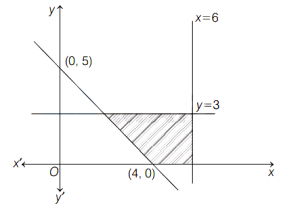
The shaded region is the solution set of the inequalities:
A
$5x + 4y \geq 20, x \leq 6, y \geq 3, x \geq 0, y \geq 0$
B
$5x + 4y \leq 20, x \leq 6, y \leq 3, x \geq 0, y \geq 0$
C
$5x + 4y \geq 20, x \leq 6, y \leq 3, x \geq 0, y \geq 0$
D
$5x + 4y \geq 20, x \geq 6, y \leq 3, x \geq 0, y \geq 0$
Solution
(C) $1$. Analyze the line $l_1$ passing through $(0, 5)$ and $(4, 0)$. The equation of this line in intercept form is $\frac{x}{4} + \frac{y}{5} = 1$,which simplifies to $5x + 4y = 20$. Since the shaded region does not contain the origin $(0, 0)$,the inequality is $5x + 4y \geq 20$.
$2$. Analyze the horizontal line $l_2$. The shaded region lies below the line $y = 3$,so the inequality is $y \leq 3$.
$3$. Analyze the vertical line $l_3$. The shaded region lies to the left of the line $x = 6$,so the inequality is $x \leq 6$.
$4$. The region is in the first quadrant,so $x \geq 0$ and $y \geq 0$.
$5$. Combining these,the system of inequalities is $5x + 4y \geq 20, x \leq 6, y \leq 3, x \geq 0, y \geq 0$. This matches option $C$.
$2$. Analyze the horizontal line $l_2$. The shaded region lies below the line $y = 3$,so the inequality is $y \leq 3$.
$3$. Analyze the vertical line $l_3$. The shaded region lies to the left of the line $x = 6$,so the inequality is $x \leq 6$.
$4$. The region is in the first quadrant,so $x \geq 0$ and $y \geq 0$.
$5$. Combining these,the system of inequalities is $5x + 4y \geq 20, x \leq 6, y \leq 3, x \geq 0, y \geq 0$. This matches option $C$.
0 likesView Solution
15
MathematicsEasyMCQKCET · 2021
If $P(A)=0.59, P(B)=0.30$ and $P(A \cap B)=0.21$,then $P(A^{\prime} \cap B^{\prime})$ is equal to
A
$0.11$
B
$0.38$
C
$0.32$
D
$0.35$
Solution
(C) Given,$P(A)=0.59, P(B)=0.30$ and $P(A \cap B)=0.21$.
By De Morgan's Law,$P(A^{\prime} \cap B^{\prime}) = P((A \cup B)^{\prime}) = 1 - P(A \cup B)$.
Using the addition theorem of probability,$P(A \cup B) = P(A) + P(B) - P(A \cap B)$.
Substituting the values: $P(A \cup B) = 0.59 + 0.30 - 0.21 = 0.89 - 0.21 = 0.68$.
Therefore,$P(A^{\prime} \cap B^{\prime}) = 1 - 0.68 = 0.32$.
By De Morgan's Law,$P(A^{\prime} \cap B^{\prime}) = P((A \cup B)^{\prime}) = 1 - P(A \cup B)$.
Using the addition theorem of probability,$P(A \cup B) = P(A) + P(B) - P(A \cap B)$.
Substituting the values: $P(A \cup B) = 0.59 + 0.30 - 0.21 = 0.89 - 0.21 = 0.68$.
Therefore,$P(A^{\prime} \cap B^{\prime}) = 1 - 0.68 = 0.32$.
0 likesView Solution
16
MathematicsMediumMCQKCET · 2021
In a certain town,$65\%$ of families own cell phones,$15000$ families own scooters,and $15\%$ of families own both. Given that every family owns at least one of the two,the total number of families in the town is:
A
$20000$
B
$30000$
C
$40000$
D
$50000$
Solution
(B) Let the total number of families be $x$.
Let $A$ be the set of families that own cell phones,so $n(A) = \frac{65}{100}x$.
Let $B$ be the set of families that own scooters,so $n(B) = 15000$.
The number of families that own both is $n(A \cap B) = \frac{15}{100}x$.
Since every family owns at least one,$n(A \cup B) = x$.
Using the formula $n(A \cup B) = n(A) + n(B) - n(A \cap B)$,we have:
$x = \frac{65x}{100} + 15000 - \frac{15x}{100}$
$x = \frac{50x}{100} + 15000$
$x = 0.5x + 15000$
$0.5x = 15000$
$x = \frac{15000}{0.5} = 30000$.
Thus,the total number of families in the town is $30000$.
Let $A$ be the set of families that own cell phones,so $n(A) = \frac{65}{100}x$.
Let $B$ be the set of families that own scooters,so $n(B) = 15000$.
The number of families that own both is $n(A \cap B) = \frac{15}{100}x$.
Since every family owns at least one,$n(A \cup B) = x$.
Using the formula $n(A \cup B) = n(A) + n(B) - n(A \cap B)$,we have:
$x = \frac{65x}{100} + 15000 - \frac{15x}{100}$
$x = \frac{50x}{100} + 15000$
$x = 0.5x + 15000$
$0.5x = 15000$
$x = \frac{15000}{0.5} = 30000$.
Thus,the total number of families in the town is $30000$.
0 likesView Solution
17
MathematicsMediumMCQKCET · 2021
If $f(x) = \left| \begin{array}{ccc} \cos x & 1 & 0 \\ 0 & 2 \cos x & 3 \\ 0 & 1 & 2 \cos x \end{array} \right|$,then $\lim_{x \rightarrow \pi} f(x)$ is equal to
A
$-1$
B
$1$
C
$0$
D
$3$
Solution
(A) Given $f(x) = \left| \begin{array}{ccc} \cos x & 1 & 0 \\ 0 & 2 \cos x & 3 \\ 0 & 1 & 2 \cos x \end{array} \right|$.
Expanding the determinant along the first column $(C_1)$:
$f(x) = \cos x \cdot \left| \begin{array}{cc} 2 \cos x & 3 \\ 1 & 2 \cos x \end{array} \right| - 0 + 0$
$f(x) = \cos x \cdot ((2 \cos x)(2 \cos x) - (3)(1))$
$f(x) = \cos x (4 \cos^2 x - 3)$
$f(x) = 4 \cos^3 x - 3 \cos x$
Using the trigonometric identity $\cos 3x = 4 \cos^3 x - 3 \cos x$,we get:
$f(x) = \cos 3x$
Now,calculating the limit:
$\lim_{x \rightarrow \pi} f(x) = \lim_{x \rightarrow \pi} \cos 3x = \cos(3\pi)$
Since $\cos(3\pi) = -1$,the limit is $-1$.
Expanding the determinant along the first column $(C_1)$:
$f(x) = \cos x \cdot \left| \begin{array}{cc} 2 \cos x & 3 \\ 1 & 2 \cos x \end{array} \right| - 0 + 0$
$f(x) = \cos x \cdot ((2 \cos x)(2 \cos x) - (3)(1))$
$f(x) = \cos x (4 \cos^2 x - 3)$
$f(x) = 4 \cos^3 x - 3 \cos x$
Using the trigonometric identity $\cos 3x = 4 \cos^3 x - 3 \cos x$,we get:
$f(x) = \cos 3x$
Now,calculating the limit:
$\lim_{x \rightarrow \pi} f(x) = \lim_{x \rightarrow \pi} \cos 3x = \cos(3\pi)$
Since $\cos(3\pi) = -1$,the limit is $-1$.
0 likesView Solution
18
MathematicsDifficultMCQKCET · 2021
If $x^{3}-2x^{2}-9x+18=0$ and $A=\left|\begin{array}{lll}1 & 2 & 3 \\ 4 & x & 6 \\ 7 & 8 & 9\end{array}\right|$,then the maximum value of $A$ is
A
$96$
B
$36$
C
$24$
D
$120$
Solution
(A) Given the equation $x^{3}-2x^{2}-9x+18=0$.
Factoring the equation: $x^{2}(x-2)-9(x-2)=0 \Rightarrow (x^{2}-9)(x-2)=0 \Rightarrow (x-3)(x+3)(x-2)=0$.
Thus,the possible values for $x$ are $x=2, 3, -3$.
Now,evaluate the determinant $A = \left|\begin{array}{lll}1 & 2 & 3 \\ 4 & x & 6 \\ 7 & 8 & 9\end{array}\right|$.
Expanding along the first row: $A = 1(9x - 48) - 2(36 - 42) + 3(32 - 7x)$.
$A = 9x - 48 - 2(-6) + 96 - 21x$.
$A = 9x - 48 + 12 + 96 - 21x = -12x + 60$.
Now,substitute the values of $x$:
For $x=2$: $A = -12(2) + 60 = -24 + 60 = 36$.
For $x=3$: $A = -12(3) + 60 = -36 + 60 = 24$.
For $x=-3$: $A = -12(-3) + 60 = 36 + 60 = 96$.
Comparing the values $36, 24, 96$,the maximum value of $A$ is $96$.
Factoring the equation: $x^{2}(x-2)-9(x-2)=0 \Rightarrow (x^{2}-9)(x-2)=0 \Rightarrow (x-3)(x+3)(x-2)=0$.
Thus,the possible values for $x$ are $x=2, 3, -3$.
Now,evaluate the determinant $A = \left|\begin{array}{lll}1 & 2 & 3 \\ 4 & x & 6 \\ 7 & 8 & 9\end{array}\right|$.
Expanding along the first row: $A = 1(9x - 48) - 2(36 - 42) + 3(32 - 7x)$.
$A = 9x - 48 - 2(-6) + 96 - 21x$.
$A = 9x - 48 + 12 + 96 - 21x = -12x + 60$.
Now,substitute the values of $x$:
For $x=2$: $A = -12(2) + 60 = -24 + 60 = 36$.
For $x=3$: $A = -12(3) + 60 = -36 + 60 = 24$.
For $x=-3$: $A = -12(-3) + 60 = 36 + 60 = 96$.
Comparing the values $36, 24, 96$,the maximum value of $A$ is $96$.
0 likesView Solution
19
MathematicsEasyMCQKCET · 2021
If $A=\left[\begin{array}{ccc}1 & -2 & 1 \\ 2 & 1 & 3\end{array}\right]$ and $B=\left[\begin{array}{cc}2 & 1 \\ 3 & 2 \\ 1 & 1\end{array}\right]$,then $(AB)^{\prime}$ is equal to
A
$\left[\begin{array}{cc}-3 & -2 \\ 10 & 7\end{array}\right]$
B
$\left[\begin{array}{cc}-3 & 10 \\ -2 & 7\end{array}\right]$
C
$\left[\begin{array}{cc}-3 & 7 \\ 10 & 2\end{array}\right]$
D
$\left[\begin{array}{cc}-3 & 7 \\ 10 & -2\end{array}\right]$
Solution
(B) Given,$A=\left[\begin{array}{ccc}1 & -2 & 1 \\ 2 & 1 & 3\end{array}\right]$ and $B=\left[\begin{array}{cc}2 & 1 \\ 3 & 2 \\ 1 & 1\end{array}\right]$.
First,calculate the product $AB$:
$AB = \left[\begin{array}{ccc}1 & -2 & 1 \\ 2 & 1 & 3\end{array}\right] \left[\begin{array}{cc}2 & 1 \\ 3 & 2 \\ 1 & 1\end{array}\right]$
$AB = \left[\begin{array}{cc}(1)(2) + (-2)(3) + (1)(1) & (1)(1) + (-2)(2) + (1)(1) \\ (2)(2) + (1)(3) + (3)(1) & (2)(1) + (1)(2) + (3)(1)\end{array}\right]$
$AB = \left[\begin{array}{cc}2 - 6 + 1 & 1 - 4 + 1 \\ 4 + 3 + 3 & 2 + 2 + 3\end{array}\right]$
$AB = \left[\begin{array}{cc}-3 & -2 \\ 10 & 7\end{array}\right]$
Now,find the transpose $(AB)^{\prime}$ by interchanging rows and columns:
$(AB)^{\prime} = \left[\begin{array}{cc}-3 & 10 \\ -2 & 7\end{array}\right]$
Thus,the correct option is $B$.
First,calculate the product $AB$:
$AB = \left[\begin{array}{ccc}1 & -2 & 1 \\ 2 & 1 & 3\end{array}\right] \left[\begin{array}{cc}2 & 1 \\ 3 & 2 \\ 1 & 1\end{array}\right]$
$AB = \left[\begin{array}{cc}(1)(2) + (-2)(3) + (1)(1) & (1)(1) + (-2)(2) + (1)(1) \\ (2)(2) + (1)(3) + (3)(1) & (2)(1) + (1)(2) + (3)(1)\end{array}\right]$
$AB = \left[\begin{array}{cc}2 - 6 + 1 & 1 - 4 + 1 \\ 4 + 3 + 3 & 2 + 2 + 3\end{array}\right]$
$AB = \left[\begin{array}{cc}-3 & -2 \\ 10 & 7\end{array}\right]$
Now,find the transpose $(AB)^{\prime}$ by interchanging rows and columns:
$(AB)^{\prime} = \left[\begin{array}{cc}-3 & 10 \\ -2 & 7\end{array}\right]$
Thus,the correct option is $B$.
0 likesView Solution
20
MathematicsEasyMCQKCET · 2021
If $A$ and $B$ are matrices of order $3 \times 3$ and $|A|=5, |B|=3$,then $|3AB|$ is:
A
$425$
B
$405$
C
$565$
D
$585$
Solution
(B) Given that $A$ and $B$ are square matrices of order $n=3$.
We are given $|A|=5$ and $|B|=3$.
Using the property of determinants,$|AB| = |A| \cdot |B| = 5 \times 3 = 15$.
Using the property $|kA| = k^n |A|$,where $k$ is a scalar and $n$ is the order of the square matrix,we have:
$|3AB| = 3^3 |AB|$.
Since $n=3$,$3^3 = 27$.
Therefore,$|3AB| = 27 \times 15 = 405$.
We are given $|A|=5$ and $|B|=3$.
Using the property of determinants,$|AB| = |A| \cdot |B| = 5 \times 3 = 15$.
Using the property $|kA| = k^n |A|$,where $k$ is a scalar and $n$ is the order of the square matrix,we have:
$|3AB| = 3^3 |AB|$.
Since $n=3$,$3^3 = 27$.
Therefore,$|3AB| = 27 \times 15 = 405$.
0 likesView Solution
21
MathematicsEasyMCQKCET · 2021
Let $M$ be a $2 \times 2$ symmetric matrix with integer entries. Then $M$ is invertible if:
A
the first column of $M$ is the transpose of the second row of $M$.
B
the second row of $M$ is the transpose of the first column of $M$.
C
$M$ is a diagonal matrix with non-zero entries in the principal diagonal.
D
the product of entries in the principal diagonal of $M$ is not equal to the product of entries in the other diagonal.
Solution
(D) Let $M$ be a symmetric matrix of the form $M = \begin{bmatrix} a & c \\ c & b \end{bmatrix}$,where $a, b, c \in \mathbb{Z}$.
For a matrix to be invertible,its determinant must be non-zero.
The determinant of $M$ is given by $|M| = ab - c^2$.
For $M$ to be invertible,we require $|M| \neq 0$,which implies $ab - c^2 \neq 0$,or $ab \neq c^2$.
In a symmetric matrix,the entries in the other diagonal are both $c$,so their product is $c^2$.
Thus,the condition for invertibility is that the product of the principal diagonal entries $(ab)$ is not equal to the product of the other diagonal entries $(c^2)$.
For a matrix to be invertible,its determinant must be non-zero.
The determinant of $M$ is given by $|M| = ab - c^2$.
For $M$ to be invertible,we require $|M| \neq 0$,which implies $ab - c^2 \neq 0$,or $ab \neq c^2$.
In a symmetric matrix,the entries in the other diagonal are both $c$,so their product is $c^2$.
Thus,the condition for invertibility is that the product of the principal diagonal entries $(ab)$ is not equal to the product of the other diagonal entries $(c^2)$.
0 likesView Solution
22
MathematicsEasyMCQKCET · 2021
If $A$ and $B$ are invertible matrices,then which of the following is not correct?
A
$\operatorname{adj} A = |A| A^{-1}$
B
$\operatorname{det}(A^{-1}) = [\operatorname{det}(A)]^{-1}$
C
$(AB)^{-1} = B^{-1} A^{-1}$
D
$(A+B)^{-1} = B^{-1} + A^{-1}$
Solution
(D) For invertible matrices $A$ and $B$,the following properties hold:
$1$. The inverse of a product is the product of inverses in reverse order: $(AB)^{-1} = B^{-1} A^{-1}$.
$2$. The adjoint of a matrix is related to its inverse by: $\operatorname{adj} A = |A| A^{-1}$.
$3$. The determinant of an inverse matrix is the reciprocal of the determinant of the original matrix: $\operatorname{det}(A^{-1}) = [\operatorname{det}(A)]^{-1}$.
$4$. The inverse of a sum is generally not equal to the sum of the inverses: $(A+B)^{-1} \neq A^{-1} + B^{-1}$.
Therefore,the statement $(A+B)^{-1} = B^{-1} + A^{-1}$ is incorrect.
$1$. The inverse of a product is the product of inverses in reverse order: $(AB)^{-1} = B^{-1} A^{-1}$.
$2$. The adjoint of a matrix is related to its inverse by: $\operatorname{adj} A = |A| A^{-1}$.
$3$. The determinant of an inverse matrix is the reciprocal of the determinant of the original matrix: $\operatorname{det}(A^{-1}) = [\operatorname{det}(A)]^{-1}$.
$4$. The inverse of a sum is generally not equal to the sum of the inverses: $(A+B)^{-1} \neq A^{-1} + B^{-1}$.
Therefore,the statement $(A+B)^{-1} = B^{-1} + A^{-1}$ is incorrect.
0 likesView Solution
23
MathematicsEasyMCQKCET · 2021
$\cos \left[\cot ^{-1}(-\sqrt{3})+\frac{\pi}{6}\right]$ is equal to
A
$0$
B
$1$
C
$\frac{1}{\sqrt{2}}$
D
$-1$
Solution
(D) Given expression: $\cos \left[\cot ^{-1}(-\sqrt{3})+\frac{\pi}{6}\right]$
We know that $\cot ^{-1}(-x) = \pi - \cot ^{-1}(x)$.
Therefore,$\cot ^{-1}(-\sqrt{3}) = \pi - \cot ^{-1}(\sqrt{3})$.
Since $\cot \left(\frac{\pi}{6}\right) = \sqrt{3}$,we have $\cot ^{-1}(\sqrt{3}) = \frac{\pi}{6}$.
Substituting this into the expression:
$\cos \left[\pi - \frac{\pi}{6} + \frac{\pi}{6}\right]$
$= \cos [\pi]$
$= -1$.
We know that $\cot ^{-1}(-x) = \pi - \cot ^{-1}(x)$.
Therefore,$\cot ^{-1}(-\sqrt{3}) = \pi - \cot ^{-1}(\sqrt{3})$.
Since $\cot \left(\frac{\pi}{6}\right) = \sqrt{3}$,we have $\cot ^{-1}(\sqrt{3}) = \frac{\pi}{6}$.
Substituting this into the expression:
$\cos \left[\pi - \frac{\pi}{6} + \frac{\pi}{6}\right]$
$= \cos [\pi]$
$= -1$.
0 likesView Solution
24
MathematicsEasyMCQKCET · 2021
$\tan ^{-1}\left[\frac{1}{\sqrt{3}} \sin \frac{5 \pi}{2}\right] + \sin ^{-1}\left[\cos \left(\sin ^{-1} \frac{\sqrt{3}}{2}\right)\right]$ is equal to
A
$0$
B
$\frac{\pi}{6}$
C
$\frac{\pi}{3}$
D
$\pi$
Solution
(C) Let the expression be $E = \tan ^{-1}\left[\frac{1}{\sqrt{3}} \sin \frac{5 \pi}{2}\right] + \sin ^{-1}\left[\cos \left(\sin ^{-1} \frac{\sqrt{3}}{2}\right)\right]$.
First,evaluate $\sin \frac{5 \pi}{2} = \sin \left(2 \pi + \frac{\pi}{2}\right) = \sin \frac{\pi}{2} = 1$.
Next,evaluate $\sin ^{-1} \frac{\sqrt{3}}{2} = \frac{\pi}{3}$.
Now substitute these values into the expression:
$E = \tan ^{-1}\left[\frac{1}{\sqrt{3}} \times 1\right] + \sin ^{-1}\left[\cos \frac{\pi}{3}\right]$.
Since $\cos \frac{\pi}{3} = \frac{1}{2}$,we have:
$E = \tan ^{-1}\left(\frac{1}{\sqrt{3}}\right) + \sin ^{-1}\left(\frac{1}{2}\right)$.
We know that $\tan ^{-1}\left(\frac{1}{\sqrt{3}}\right) = \frac{\pi}{6}$ and $\sin ^{-1}\left(\frac{1}{2}\right) = \frac{\pi}{6}$.
Therefore,$E = \frac{\pi}{6} + \frac{\pi}{6} = \frac{2 \pi}{6} = \frac{\pi}{3}$.
First,evaluate $\sin \frac{5 \pi}{2} = \sin \left(2 \pi + \frac{\pi}{2}\right) = \sin \frac{\pi}{2} = 1$.
Next,evaluate $\sin ^{-1} \frac{\sqrt{3}}{2} = \frac{\pi}{3}$.
Now substitute these values into the expression:
$E = \tan ^{-1}\left[\frac{1}{\sqrt{3}} \times 1\right] + \sin ^{-1}\left[\cos \frac{\pi}{3}\right]$.
Since $\cos \frac{\pi}{3} = \frac{1}{2}$,we have:
$E = \tan ^{-1}\left(\frac{1}{\sqrt{3}}\right) + \sin ^{-1}\left(\frac{1}{2}\right)$.
We know that $\tan ^{-1}\left(\frac{1}{\sqrt{3}}\right) = \frac{\pi}{6}$ and $\sin ^{-1}\left(\frac{1}{2}\right) = \frac{\pi}{6}$.
Therefore,$E = \frac{\pi}{6} + \frac{\pi}{6} = \frac{2 \pi}{6} = \frac{\pi}{3}$.
0 likesView Solution
25
MathematicsEasyMCQKCET · 2021
Domain of $f(x) = \frac{x}{1-|x|}$ is
A
$R - [-1, 1]$
B
$(-\infty, 1)$
C
$(-\infty, 1) \cup (0, 1)$
D
$R - \{-1, 1\}$
Solution
(D) Given function,$f(x) = \frac{x}{1-|x|}$.
For the function to be defined,the denominator must not be zero.
$1 - |x| \neq 0$
$|x| \neq 1$
$x \neq 1$ and $x \neq -1$.
Therefore,the domain is all real numbers except $1$ and $-1$,which is written as $R - \{-1, 1\}$.
For the function to be defined,the denominator must not be zero.
$1 - |x| \neq 0$
$|x| \neq 1$
$x \neq 1$ and $x \neq -1$.
Therefore,the domain is all real numbers except $1$ and $-1$,which is written as $R - \{-1, 1\}$.
0 likesView Solution
26
MathematicsMediumMCQKCET · 2021
The domain of the function $f(x) = \frac{1}{\sqrt{[x]^2 - [x] - 6}}$,where $[x]$ is the greatest integer function $\leq x$,is:
A
$(-\infty, -2) \cup [4, \infty)$
B
$(-\infty, -2) \cup [3, \infty)$
C
$(-\infty, -2] \cup [4, \infty)$
D
$(-\infty, -2] \cup [3, \infty)$
Solution
(A) For the function $f(x) = \frac{1}{\sqrt{[x]^2 - [x] - 6}}$ to be defined,the expression inside the square root must be strictly positive:
$[x]^2 - [x] - 6 > 0$
Factoring the quadratic expression:
$([x] - 3)([x] + 2) > 0$
This inequality holds when:
$[x] > 3$ or $[x] < -2$
If $[x] > 3$,then the smallest integer value for $[x]$ is $4$,which implies $x \geq 4$,or $x \in [4, \infty)$.
If $[x] < -2$,then the largest integer value for $[x]$ is $-3$,which implies $x < -2$,or $x \in (-\infty, -2)$.
Combining these,the domain is $x \in (-\infty, -2) \cup [4, \infty)$.
$[x]^2 - [x] - 6 > 0$
Factoring the quadratic expression:
$([x] - 3)([x] + 2) > 0$
This inequality holds when:
$[x] > 3$ or $[x] < -2$
If $[x] > 3$,then the smallest integer value for $[x]$ is $4$,which implies $x \geq 4$,or $x \in [4, \infty)$.
If $[x] < -2$,then the largest integer value for $[x]$ is $-3$,which implies $x < -2$,or $x \in (-\infty, -2)$.
Combining these,the domain is $x \in (-\infty, -2) \cup [4, \infty)$.
0 likesView Solution
27
MathematicsEasyMCQKCET · 2021
Let $A = \{x : x \in R, x \text{ is not a positive integer}\}$. Define $f: A \rightarrow R$ as $f(x) = \frac{2x}{x-1}$. Then $f$ is:
A
injective but not surjective.
B
surjective but not injective.
C
bijective.
D
neither injective nor surjective.
Solution
(A) Given the function $f(x) = \frac{2x}{x-1}$ where $A = \{x \in R : x \neq 1, 2, 3, \dots\}$.
To check for injectivity,we find the derivative $f'(x)$:
$f'(x) = \frac{(x-1)(2) - 2x(1)}{(x-1)^2} = \frac{2x - 2 - 2x}{(x-1)^2} = \frac{-2}{(x-1)^2}$.
Since $f'(x) < 0$ for all $x \in A$,the function is strictly decreasing,which implies $f$ is injective.
To check for surjectivity,let $y = \frac{2x}{x-1}$.
$y(x-1) = 2x \implies yx - y = 2x \implies x(y-2) = y \implies x = \frac{y}{y-2}$.
For $f$ to be surjective,for every $y \in R$,there must exist an $x \in A$. If $y = 2$,$x$ is undefined. Furthermore,we must ensure $x$ is not a positive integer. If $y = 0$,$x = 0$,which is allowed. However,if we choose $y$ such that $x$ becomes a positive integer (e.g.,if $x=2$,$y = \frac{2(2)}{2-1} = 4$),then $y=4$ has a pre-image $x=2$,but $2 \notin A$. Thus,$f$ is not surjective.
To check for injectivity,we find the derivative $f'(x)$:
$f'(x) = \frac{(x-1)(2) - 2x(1)}{(x-1)^2} = \frac{2x - 2 - 2x}{(x-1)^2} = \frac{-2}{(x-1)^2}$.
Since $f'(x) < 0$ for all $x \in A$,the function is strictly decreasing,which implies $f$ is injective.
To check for surjectivity,let $y = \frac{2x}{x-1}$.
$y(x-1) = 2x \implies yx - y = 2x \implies x(y-2) = y \implies x = \frac{y}{y-2}$.
For $f$ to be surjective,for every $y \in R$,there must exist an $x \in A$. If $y = 2$,$x$ is undefined. Furthermore,we must ensure $x$ is not a positive integer. If $y = 0$,$x = 0$,which is allowed. However,if we choose $y$ such that $x$ becomes a positive integer (e.g.,if $x=2$,$y = \frac{2(2)}{2-1} = 4$),then $y=4$ has a pre-image $x=2$,but $2 \notin A$. Thus,$f$ is not surjective.
0 likesView Solution
28
MathematicsEasyMCQKCET · 2021
The function $f(x) = \sqrt{3} \sin 2x - \cos 2x + 4$ is one-one in the interval
A
$[-\frac{\pi}{6}, \frac{\pi}{3}]$
B
$[\frac{\pi}{6}, -\frac{\pi}{3}]$
C
$[-\frac{\pi}{2}, \frac{\pi}{2}]$
D
$[-\frac{\pi}{6}, -\frac{\pi}{3}]$
Solution
(A) Given function,$f(x) = \sqrt{3} \sin 2x - \cos 2x + 4$.
We can rewrite this as:
$f(x) = 2(\sin 2x \cdot \frac{\sqrt{3}}{2} - \cos 2x \cdot \frac{1}{2}) + 4$
$f(x) = 2(\sin 2x \cos \frac{\pi}{6} - \cos 2x \sin \frac{\pi}{6}) + 4$
$f(x) = 2 \sin(2x - \frac{\pi}{6}) + 4$.
$A$ function $f(x) = \sin(\theta)$ is one-one when the argument $\theta$ lies in the interval $[-\frac{\pi}{2}, \frac{\pi}{2}]$.
Therefore,for $f(x)$ to be one-one:
$-\frac{\pi}{2} \leq 2x - \frac{\pi}{6} \leq \frac{\pi}{2}$
Adding $\frac{\pi}{6}$ to all parts:
$-\frac{\pi}{2} + \frac{\pi}{6} \leq 2x \leq \frac{\pi}{2} + \frac{\pi}{6}$
$-\frac{2\pi}{6} \leq 2x \leq \frac{4\pi}{6}$
$-\frac{\pi}{3} \leq 2x \leq \frac{2\pi}{3}$
Dividing by $2$:
$-\frac{\pi}{6} \leq x \leq \frac{\pi}{3}$.
Thus,the function is one-one in the interval $[-\frac{\pi}{6}, \frac{\pi}{3}]$.
We can rewrite this as:
$f(x) = 2(\sin 2x \cdot \frac{\sqrt{3}}{2} - \cos 2x \cdot \frac{1}{2}) + 4$
$f(x) = 2(\sin 2x \cos \frac{\pi}{6} - \cos 2x \sin \frac{\pi}{6}) + 4$
$f(x) = 2 \sin(2x - \frac{\pi}{6}) + 4$.
$A$ function $f(x) = \sin(\theta)$ is one-one when the argument $\theta$ lies in the interval $[-\frac{\pi}{2}, \frac{\pi}{2}]$.
Therefore,for $f(x)$ to be one-one:
$-\frac{\pi}{2} \leq 2x - \frac{\pi}{6} \leq \frac{\pi}{2}$
Adding $\frac{\pi}{6}$ to all parts:
$-\frac{\pi}{2} + \frac{\pi}{6} \leq 2x \leq \frac{\pi}{2} + \frac{\pi}{6}$
$-\frac{2\pi}{6} \leq 2x \leq \frac{4\pi}{6}$
$-\frac{\pi}{3} \leq 2x \leq \frac{2\pi}{3}$
Dividing by $2$:
$-\frac{\pi}{6} \leq x \leq \frac{\pi}{3}$.
Thus,the function is one-one in the interval $[-\frac{\pi}{6}, \frac{\pi}{3}]$.
0 likesView Solution
29
MathematicsEasyMCQKCET · 2021
Let $f: R \rightarrow R$ be defined by $f(x) = \left\{\begin{array}{cc} 2x, & x > 3 \\ x^2, & 1 < x \leq 3 \\ 3x, & x \leq 1 \end{array}\right.$. Then,the value of $f(-2) + f(3) + f(4)$ is:
A
$14$
B
$9$
C
$5$
D
$11$
Solution
(D) Given the function $f(x) = \left\{\begin{array}{cc} 2x, & x > 3 \\ x^2, & 1 < x \leq 3 \\ 3x, & x \leq 1 \end{array}\right.$.
To find $f(-2) + f(3) + f(4)$,we calculate each term individually:
$1$. For $f(-2)$: Since $-2 \leq 1$,we use $f(x) = 3x$. Thus,$f(-2) = 3(-2) = -6$.
$2$. For $f(3)$: Since $1 < 3 \leq 3$,we use $f(x) = x^2$. Thus,$f(3) = (3)^2 = 9$.
$3$. For $f(4)$: Since $4 > 3$,we use $f(x) = 2x$. Thus,$f(4) = 2(4) = 8$.
Summing these values: $f(-2) + f(3) + f(4) = -6 + 9 + 8 = 11$.
To find $f(-2) + f(3) + f(4)$,we calculate each term individually:
$1$. For $f(-2)$: Since $-2 \leq 1$,we use $f(x) = 3x$. Thus,$f(-2) = 3(-2) = -6$.
$2$. For $f(3)$: Since $1 < 3 \leq 3$,we use $f(x) = x^2$. Thus,$f(3) = (3)^2 = 9$.
$3$. For $f(4)$: Since $4 > 3$,we use $f(x) = 2x$. Thus,$f(4) = 2(4) = 8$.
Summing these values: $f(-2) + f(3) + f(4) = -6 + 9 + 8 = 11$.
0 likesView Solution
30
MathematicsEasyMCQKCET · 2021
At $x=1$,the function $f(x)=\begin{cases} x^{3}-1, & 1 < x < \infty \\ x-1, & -\infty < x \leq 1 \end{cases}$ is
A
continuous and differentiable.
B
continuous and non-differentiable.
C
discontinuous and differentiable.
D
discontinuous and non-differentiable.
Solution
(B) Given $f(x)=\begin{cases} x^{3}-1, & 1 < x < \infty \\ x-1, & -\infty < x \leq 1 \end{cases}$
First,we check the continuity at $x=1$.
$RHL = \lim_{x \rightarrow 1^{+}} f(x) = \lim_{x \rightarrow 1^{+}} (x^{3}-1) = 1^{3}-1 = 0$
$LHL = \lim_{x \rightarrow 1^{-}} f(x) = \lim_{x \rightarrow 1^{-}} (x-1) = 1-1 = 0$
$f(1) = 1-1 = 0$
Since $LHL = RHL = f(1)$,the function is continuous at $x=1$.
Next,we check the differentiability at $x=1$.
$f'(x) = \begin{cases} 3x^{2}, & 1 < x < \infty \\ 1, & -\infty < x < 1 \end{cases}$
$LHD = \lim_{x \rightarrow 1^{-}} f'(x) = 1$
$RHD = \lim_{x \rightarrow 1^{+}} f'(x) = 3(1)^{2} = 3$
Since $LHD \neq RHD$,the function is non-differentiable at $x=1$.
Therefore,the function is continuous and non-differentiable.
First,we check the continuity at $x=1$.
$RHL = \lim_{x \rightarrow 1^{+}} f(x) = \lim_{x \rightarrow 1^{+}} (x^{3}-1) = 1^{3}-1 = 0$
$LHL = \lim_{x \rightarrow 1^{-}} f(x) = \lim_{x \rightarrow 1^{-}} (x-1) = 1-1 = 0$
$f(1) = 1-1 = 0$
Since $LHL = RHL = f(1)$,the function is continuous at $x=1$.
Next,we check the differentiability at $x=1$.
$f'(x) = \begin{cases} 3x^{2}, & 1 < x < \infty \\ 1, & -\infty < x < 1 \end{cases}$
$LHD = \lim_{x \rightarrow 1^{-}} f'(x) = 1$
$RHD = \lim_{x \rightarrow 1^{+}} f'(x) = 3(1)^{2} = 3$
Since $LHD \neq RHD$,the function is non-differentiable at $x=1$.
Therefore,the function is continuous and non-differentiable.
0 likesView Solution
31
MathematicsMediumMCQKCET · 2021
If $a$ and $b$ are fixed non-zero constants,then the derivative of $\frac{a}{x^{4}}-\frac{b}{x^{2}}+\cos x$ is $ma+nb-p$,where
A
$m=4x^{3}, n=\frac{-2}{x^{3}}$ and $p=\sin x$
B
$m=\frac{-4}{x^{5}}, n=\frac{2}{x^{3}}$ and $p=\sin x$
C
$m=\frac{-4}{x^{5}}, n=\frac{-2}{x^{3}}$ and $p=\sin x$
D
$m=4x^{3}, n=\frac{2}{x^{3}}$ and $p=-\sin x$
Solution
(B) Given the function is $f(x) = \frac{a}{x^{4}} - \frac{b}{x^{2}} + \cos x$.
To find the derivative with respect to $x$,we use the power rule $\frac{d}{dx}(x^{n}) = nx^{n-1}$ and the derivative of $\cos x$ is $-\sin x$.
$\frac{d}{dx} f(x) = \frac{d}{dx}(ax^{-4} - bx^{-2} + \cos x)$
$= a(-4x^{-5}) - b(-2x^{-3}) - \sin x$
$= -\frac{4a}{x^{5}} + \frac{2b}{x^{3}} - \sin x$
Comparing this with the expression $ma + nb - p$,we get:
$m = -\frac{4}{x^{5}}$,$n = \frac{2}{x^{3}}$,and $p = \sin x$.
To find the derivative with respect to $x$,we use the power rule $\frac{d}{dx}(x^{n}) = nx^{n-1}$ and the derivative of $\cos x$ is $-\sin x$.
$\frac{d}{dx} f(x) = \frac{d}{dx}(ax^{-4} - bx^{-2} + \cos x)$
$= a(-4x^{-5}) - b(-2x^{-3}) - \sin x$
$= -\frac{4a}{x^{5}} + \frac{2b}{x^{3}} - \sin x$
Comparing this with the expression $ma + nb - p$,we get:
$m = -\frac{4}{x^{5}}$,$n = \frac{2}{x^{3}}$,and $p = \sin x$.
0 likesView Solution
32
MathematicsEasyMCQKCET · 2021
If $y = (\cos x^{2})^{2}$,then $\frac{dy}{dx}$ is equal to
A
$-4x \sin 2x^{2}$
B
$-x \sin x^{2}$
C
$-2x \sin 2x^{2}$
D
$-x \cos 2x^{2}$
Solution
(C) $y = (\cos x^{2})^{2}$
Differentiating with respect to $x$ using the chain rule:
$\frac{dy}{dx} = 2(\cos x^{2}) \cdot \frac{d}{dx}(\cos x^{2})$
$\frac{dy}{dx} = 2(\cos x^{2}) \cdot (-\sin x^{2}) \cdot \frac{d}{dx}(x^{2})$
$\frac{dy}{dx} = 2(\cos x^{2}) \cdot (-\sin x^{2}) \cdot (2x)$
$\frac{dy}{dx} = -4x \sin x^{2} \cos x^{2}$
Using the trigonometric identity $\sin 2\theta = 2 \sin \theta \cos \theta$,we have:
$\frac{dy}{dx} = -2x(2 \sin x^{2} \cos x^{2}) = -2x \sin 2x^{2}$
Differentiating with respect to $x$ using the chain rule:
$\frac{dy}{dx} = 2(\cos x^{2}) \cdot \frac{d}{dx}(\cos x^{2})$
$\frac{dy}{dx} = 2(\cos x^{2}) \cdot (-\sin x^{2}) \cdot \frac{d}{dx}(x^{2})$
$\frac{dy}{dx} = 2(\cos x^{2}) \cdot (-\sin x^{2}) \cdot (2x)$
$\frac{dy}{dx} = -4x \sin x^{2} \cos x^{2}$
Using the trigonometric identity $\sin 2\theta = 2 \sin \theta \cos \theta$,we have:
$\frac{dy}{dx} = -2x(2 \sin x^{2} \cos x^{2}) = -2x \sin 2x^{2}$
0 likesView Solution
33
MathematicsMediumMCQKCET · 2021
For constant $a$,$\frac{d}{d x}\left(x^{x}+x^{a}+a^{x}+a^{a}\right)$ is
A
$x^{x}(1+\log x)+a x^{a-1}$
B
$x^{x}(1+\log x)+a x^{a-1}+a^{x} \log a$
C
$x^{x}(1+\log x)+a^{a}(1+\log x)$
D
$x^{x}(1+\log x)+a^{a}(1+\log a)+a x^{a-1}$
Solution
(B) We need to find the derivative of the sum: $\frac{d}{d x}\left(x^{x}+x^{a}+a^{x}+a^{a}\right)$.
Using the linearity property of the derivative,we have:
$\frac{d}{d x}\left(x^{x}\right)+\frac{d}{d x}\left(x^{a}\right)+\frac{d}{d x}\left(a^{x}\right)+\frac{d}{d x}\left(a^{a}\right)$.
$1$. For $\frac{d}{d x}(x^x)$: Let $y = x^x$. Taking $\log$ on both sides,$\log y = x \log x$. Differentiating with respect to $x$,$\frac{1}{y} \frac{dy}{dx} = 1 \cdot \log x + x \cdot \frac{1}{x} = \log x + 1$. Thus,$\frac{dy}{dx} = x^x(1 + \log x)$.
$2$. For $\frac{d}{d x}(x^a)$: Using the power rule,$\frac{d}{d x}(x^a) = a x^{a-1}$.
$3$. For $\frac{d}{d x}(a^x)$: Using the exponential derivative rule,$\frac{d}{d x}(a^x) = a^x \log a$.
$4$. For $\frac{d}{d x}(a^a)$: Since $a$ is a constant,$a^a$ is a constant,so its derivative is $0$.
Combining these,the result is $x^{x}(1+\log x)+a x^{a-1}+a^{x} \log a$.
Using the linearity property of the derivative,we have:
$\frac{d}{d x}\left(x^{x}\right)+\frac{d}{d x}\left(x^{a}\right)+\frac{d}{d x}\left(a^{x}\right)+\frac{d}{d x}\left(a^{a}\right)$.
$1$. For $\frac{d}{d x}(x^x)$: Let $y = x^x$. Taking $\log$ on both sides,$\log y = x \log x$. Differentiating with respect to $x$,$\frac{1}{y} \frac{dy}{dx} = 1 \cdot \log x + x \cdot \frac{1}{x} = \log x + 1$. Thus,$\frac{dy}{dx} = x^x(1 + \log x)$.
$2$. For $\frac{d}{d x}(x^a)$: Using the power rule,$\frac{d}{d x}(x^a) = a x^{a-1}$.
$3$. For $\frac{d}{d x}(a^x)$: Using the exponential derivative rule,$\frac{d}{d x}(a^x) = a^x \log a$.
$4$. For $\frac{d}{d x}(a^a)$: Since $a$ is a constant,$a^a$ is a constant,so its derivative is $0$.
Combining these,the result is $x^{x}(1+\log x)+a x^{a-1}+a^{x} \log a$.
0 likesView Solution
34
MathematicsMediumMCQKCET · 2021
Consider the following statements:
Statement $1$: If $y = \log_{10} x + \log_{e} x$,then $\frac{dy}{dx} = \frac{\log_{10} e}{x} + \frac{1}{x}$.
Statement $2$: $\frac{d}{dx}(\log_{10} x) = \frac{\log x}{\log 10}$ and $\frac{d}{dx}(\log_{e} x) = \frac{\log x}{\log e}$.
Statement $1$: If $y = \log_{10} x + \log_{e} x$,then $\frac{dy}{dx} = \frac{\log_{10} e}{x} + \frac{1}{x}$.
Statement $2$: $\frac{d}{dx}(\log_{10} x) = \frac{\log x}{\log 10}$ and $\frac{d}{dx}(\log_{e} x) = \frac{\log x}{\log e}$.
A
Statement $1$ is true,Statement $2$ is false.
B
Statement $1$ is false,Statement $2$ is true.
C
Both statements $1$ and $2$ are true.
D
Both statements $1$ and $2$ are false.
Solution
(A) For Statement $1$:
$y = \log_{10} x + \log_{e} x$
Using the change of base formula,$\log_{a} b = \frac{\log_{e} b}{\log_{e} a}$,we have:
$y = \frac{\log_{e} x}{\log_{e} 10} + \log_{e} x$
Differentiating with respect to $x$:
$\frac{dy}{dx} = \frac{1}{x \log_{e} 10} + \frac{1}{x}$
Since $\frac{1}{\log_{e} 10} = \log_{10} e$,we get:
$\frac{dy}{dx} = \frac{\log_{10} e}{x} + \frac{1}{x}$.
Thus,Statement $1$ is true.
For Statement $2$:
$\frac{d}{dx}(\log_{10} x) = \frac{d}{dx} \left( \frac{\log_{e} x}{\log_{e} 10} \right) = \frac{1}{x \log_{e} 10}$.
The statement claims it is $\frac{\log x}{\log 10}$,which is incorrect.
Similarly,$\frac{d}{dx}(\log_{e} x) = \frac{1}{x}$.
The statement claims it is $\frac{\log x}{\log e}$,which is incorrect.
Thus,Statement $2$ is false.
$y = \log_{10} x + \log_{e} x$
Using the change of base formula,$\log_{a} b = \frac{\log_{e} b}{\log_{e} a}$,we have:
$y = \frac{\log_{e} x}{\log_{e} 10} + \log_{e} x$
Differentiating with respect to $x$:
$\frac{dy}{dx} = \frac{1}{x \log_{e} 10} + \frac{1}{x}$
Since $\frac{1}{\log_{e} 10} = \log_{10} e$,we get:
$\frac{dy}{dx} = \frac{\log_{10} e}{x} + \frac{1}{x}$.
Thus,Statement $1$ is true.
For Statement $2$:
$\frac{d}{dx}(\log_{10} x) = \frac{d}{dx} \left( \frac{\log_{e} x}{\log_{e} 10} \right) = \frac{1}{x \log_{e} 10}$.
The statement claims it is $\frac{\log x}{\log 10}$,which is incorrect.
Similarly,$\frac{d}{dx}(\log_{e} x) = \frac{1}{x}$.
The statement claims it is $\frac{\log x}{\log e}$,which is incorrect.
Thus,Statement $2$ is false.
0 likesView Solution
35
MathematicsMediumMCQKCET · 2021
If $y=(x-1)^{2}(x-2)^{3}(x-3)^{5}$,then $\frac{dy}{dx}$ at $x=4$ is equal to
A
$108$
B
$54$
C
$36$
D
$516$
Solution
(D) Given $y=(x-1)^{2}(x-2)^{3}(x-3)^{5}$.
Taking the natural logarithm on both sides:
$\log y = \log [(x-1)^{2}(x-2)^{3}(x-3)^{5}]$
Using logarithmic properties,$\log y = 2 \log (x-1) + 3 \log (x-2) + 5 \log (x-3)$.
Differentiating both sides with respect to $x$:
$\frac{1}{y} \frac{dy}{dx} = \frac{2}{x-1} + \frac{3}{x-2} + \frac{5}{x-3}$.
Therefore,$\frac{dy}{dx} = y \left[ \frac{2}{x-1} + \frac{3}{x-2} + \frac{5}{x-3} \right]$.
Substituting $x=4$:
$y(4) = (4-1)^{2}(4-2)^{3}(4-3)^{5} = 3^{2} \times 2^{3} \times 1^{5} = 9 \times 8 \times 1 = 72$.
$\left( \frac{dy}{dx} \right)_{x=4} = 72 \left[ \frac{2}{4-1} + \frac{3}{4-2} + \frac{5}{4-3} \right] = 72 \left[ \frac{2}{3} + \frac{3}{2} + 5 \right]$.
$= 72 \left[ \frac{4 + 9 + 30}{6} \right] = 72 \times \frac{43}{6} = 12 \times 43 = 516$.
Taking the natural logarithm on both sides:
$\log y = \log [(x-1)^{2}(x-2)^{3}(x-3)^{5}]$
Using logarithmic properties,$\log y = 2 \log (x-1) + 3 \log (x-2) + 5 \log (x-3)$.
Differentiating both sides with respect to $x$:
$\frac{1}{y} \frac{dy}{dx} = \frac{2}{x-1} + \frac{3}{x-2} + \frac{5}{x-3}$.
Therefore,$\frac{dy}{dx} = y \left[ \frac{2}{x-1} + \frac{3}{x-2} + \frac{5}{x-3} \right]$.
Substituting $x=4$:
$y(4) = (4-1)^{2}(4-2)^{3}(4-3)^{5} = 3^{2} \times 2^{3} \times 1^{5} = 9 \times 8 \times 1 = 72$.
$\left( \frac{dy}{dx} \right)_{x=4} = 72 \left[ \frac{2}{4-1} + \frac{3}{4-2} + \frac{5}{4-3} \right] = 72 \left[ \frac{2}{3} + \frac{3}{2} + 5 \right]$.
$= 72 \left[ \frac{4 + 9 + 30}{6} \right] = 72 \times \frac{43}{6} = 12 \times 43 = 516$.
0 likesView Solution
36
MathematicsEasyMCQKCET · 2021
$A$ particle starts from rest and its angular displacement (in radians) is given by $\theta = \frac{t^{2}}{20} + \frac{t}{5}$. If the angular velocity at the end of $t = 4 \ s$ is $k$,then the value of $5k$ is
A
$0.6$
B
$5$
C
$3$
D
$1.5$
Solution
(C) The angular displacement is given by $\theta = \frac{t^{2}}{20} + \frac{t}{5}$.
Angular velocity $\omega$ is the rate of change of angular displacement with respect to time,given by $\omega = \frac{d\theta}{dt}$.
Differentiating $\theta$ with respect to $t$:
$\omega = \frac{d}{dt} \left( \frac{t^{2}}{20} + \frac{t}{5} \right) = \frac{2t}{20} + \frac{1}{5} = \frac{t}{10} + \frac{1}{5}$.
At $t = 4 \ s$,the angular velocity $k$ is:
$k = \left( \frac{4}{10} + \frac{1}{5} \right) = \frac{4}{10} + \frac{2}{10} = \frac{6}{10} = 0.6 \ rad/s$.
We need to find the value of $5k$:
$5k = 5 \times 0.6 = 3$.
Angular velocity $\omega$ is the rate of change of angular displacement with respect to time,given by $\omega = \frac{d\theta}{dt}$.
Differentiating $\theta$ with respect to $t$:
$\omega = \frac{d}{dt} \left( \frac{t^{2}}{20} + \frac{t}{5} \right) = \frac{2t}{20} + \frac{1}{5} = \frac{t}{10} + \frac{1}{5}$.
At $t = 4 \ s$,the angular velocity $k$ is:
$k = \left( \frac{4}{10} + \frac{1}{5} \right) = \frac{4}{10} + \frac{2}{10} = \frac{6}{10} = 0.6 \ rad/s$.
We need to find the value of $5k$:
$5k = 5 \times 0.6 = 3$.
0 likesView Solution
37
MathematicsEasyMCQKCET · 2021
The function $f(x)=x^{2}-2x$ is strictly decreasing in the interval
A
$(-\infty, 1)$
B
$(1, \infty)$
C
$R$
D
$(-\infty, \infty)$
Solution
(A) Given function is $f(x) = x^{2} - 2x$.
To find the interval where the function is strictly decreasing,we first find the derivative $f'(x)$.
$f'(x) = \frac{d}{dx}(x^{2} - 2x) = 2x - 2$.
$A$ function is strictly decreasing when $f'(x) < 0$.
So,$2x - 2 < 0$.
$2(x - 1) < 0$.
$x - 1 < 0$.
$x < 1$.
Thus,the function $f(x)$ is strictly decreasing in the interval $(-\infty, 1)$.
To find the interval where the function is strictly decreasing,we first find the derivative $f'(x)$.
$f'(x) = \frac{d}{dx}(x^{2} - 2x) = 2x - 2$.
$A$ function is strictly decreasing when $f'(x) < 0$.
So,$2x - 2 < 0$.
$2(x - 1) < 0$.
$x - 1 < 0$.
$x < 1$.
Thus,the function $f(x)$ is strictly decreasing in the interval $(-\infty, 1)$.
0 likesView Solution
38
MathematicsMediumMCQKCET · 2021
If the parametric equations of a curve are given by $x = \cos \theta + \log \tan \frac{\theta}{2}$ and $y = \sin \theta$,then the points for which $\frac{dy}{dx} = 0$ are given by
A
$\theta = \frac{n \pi}{2}, n \in Z$
B
$\theta = (2n + 1) \frac{\pi}{2}, n \in Z$
C
$\theta = (2n + 1) \pi, n \in Z$
D
$\theta = n \pi, n \in Z$
Solution
(D) Given $x = \cos \theta + \log \tan \frac{\theta}{2}$.
On differentiating with respect to $\theta$,we get:
$\frac{dx}{d\theta} = -\sin \theta + \frac{1}{\tan \frac{\theta}{2}} \cdot \sec^2 \frac{\theta}{2} \cdot \frac{1}{2}$
$= -\sin \theta + \frac{\cos \frac{\theta}{2}}{\sin \frac{\theta}{2}} \cdot \frac{1}{\cos^2 \frac{\theta}{2}} \cdot \frac{1}{2}$
$= -\sin \theta + \frac{1}{2 \sin \frac{\theta}{2} \cos \frac{\theta}{2}} = -\sin \theta + \frac{1}{\sin \theta}$
$= \frac{1 - \sin^2 \theta}{\sin \theta} = \frac{\cos^2 \theta}{\sin \theta} \quad ...(i)$
Now,$y = \sin \theta$. On differentiating with respect to $\theta$,we get:
$\frac{dy}{d\theta} = \cos \theta \quad ...(ii)$
Therefore,$\frac{dy}{dx} = \frac{dy/d\theta}{dx/d\theta} = \frac{\cos \theta}{\frac{\cos^2 \theta}{\sin \theta}} = \tan \theta$.
For $\frac{dy}{dx} = 0$,we must have $\tan \theta = 0$.
This implies $\theta = n \pi$ for $n \in Z$.
On differentiating with respect to $\theta$,we get:
$\frac{dx}{d\theta} = -\sin \theta + \frac{1}{\tan \frac{\theta}{2}} \cdot \sec^2 \frac{\theta}{2} \cdot \frac{1}{2}$
$= -\sin \theta + \frac{\cos \frac{\theta}{2}}{\sin \frac{\theta}{2}} \cdot \frac{1}{\cos^2 \frac{\theta}{2}} \cdot \frac{1}{2}$
$= -\sin \theta + \frac{1}{2 \sin \frac{\theta}{2} \cos \frac{\theta}{2}} = -\sin \theta + \frac{1}{\sin \theta}$
$= \frac{1 - \sin^2 \theta}{\sin \theta} = \frac{\cos^2 \theta}{\sin \theta} \quad ...(i)$
Now,$y = \sin \theta$. On differentiating with respect to $\theta$,we get:
$\frac{dy}{d\theta} = \cos \theta \quad ...(ii)$
Therefore,$\frac{dy}{dx} = \frac{dy/d\theta}{dx/d\theta} = \frac{\cos \theta}{\frac{\cos^2 \theta}{\sin \theta}} = \tan \theta$.
For $\frac{dy}{dx} = 0$,we must have $\tan \theta = 0$.
This implies $\theta = n \pi$ for $n \in Z$.
0 likesView Solution
39
MathematicsEasyMCQKCET · 2021
The maximum slope of the curve $y=-x^{3}+3x^{2}+2x-27$ is
A
$1$
B
$23$
C
$5$
D
$-23$
Solution
(C) Given the curve $y = -x^{3} + 3x^{2} + 2x - 27$.
To find the slope of the curve,we differentiate with respect to $x$:
$\frac{dy}{dx} = -3x^{2} + 6x + 2$.
Let the slope be $m = -3x^{2} + 6x + 2$.
To find the maximum slope,we differentiate $m$ with respect to $x$:
$\frac{dm}{dx} = -6x + 6$.
Setting $\frac{dm}{dx} = 0$ for critical points:
$-6x + 6 = 0 \implies x = 1$.
Checking the second derivative:
$\frac{d^{2}m}{dx^{2}} = -6 < 0$.
Since the second derivative is negative,the slope is maximum at $x = 1$.
Substituting $x = 1$ into the expression for $m$:
$m_{\text{max}} = -3(1)^{2} + 6(1) + 2 = -3 + 6 + 2 = 5$.
To find the slope of the curve,we differentiate with respect to $x$:
$\frac{dy}{dx} = -3x^{2} + 6x + 2$.
Let the slope be $m = -3x^{2} + 6x + 2$.
To find the maximum slope,we differentiate $m$ with respect to $x$:
$\frac{dm}{dx} = -6x + 6$.
Setting $\frac{dm}{dx} = 0$ for critical points:
$-6x + 6 = 0 \implies x = 1$.
Checking the second derivative:
$\frac{d^{2}m}{dx^{2}} = -6 < 0$.
Since the second derivative is negative,the slope is maximum at $x = 1$.
Substituting $x = 1$ into the expression for $m$:
$m_{\text{max}} = -3(1)^{2} + 6(1) + 2 = -3 + 6 + 2 = 5$.
0 likesView Solution
40
MathematicsDifficultMCQKCET · 2021
The value of $\int \frac{x e^{x} d x}{(1+x)^{2}}$ is equal to
A
$e^{x}(1+x)+C$
B
$e^{x}(1+x^{2})+C$
C
$e^{x}(1+x)^{2}+C$
D
$\frac{e^{x}}{1+x}+C$
Solution
(D) Let $I = \int \frac{x e^{x} d x}{(1+x)^{2}}$.
We can rewrite the numerator as $(x+1-1)$.
$I = \int \frac{e^{x}(x+1-1)}{(1+x)^{2}} d x$.
$I = \int e^{x} \left[ \frac{x+1}{(1+x)^{2}} - \frac{1}{(1+x)^{2}} \right] d x$.
$I = \int e^{x} \left[ \frac{1}{1+x} - \frac{1}{(1+x)^{2}} \right] d x$.
Let $f(x) = \frac{1}{1+x}$. Then $f'(x) = -\frac{1}{(1+x)^{2}}$.
Using the standard integration formula $\int e^{x} [f(x) + f'(x)] d x = e^{x} f(x) + C$,we get:
$I = e^{x} \left( \frac{1}{1+x} \right) + C = \frac{e^{x}}{1+x} + C$.
We can rewrite the numerator as $(x+1-1)$.
$I = \int \frac{e^{x}(x+1-1)}{(1+x)^{2}} d x$.
$I = \int e^{x} \left[ \frac{x+1}{(1+x)^{2}} - \frac{1}{(1+x)^{2}} \right] d x$.
$I = \int e^{x} \left[ \frac{1}{1+x} - \frac{1}{(1+x)^{2}} \right] d x$.
Let $f(x) = \frac{1}{1+x}$. Then $f'(x) = -\frac{1}{(1+x)^{2}}$.
Using the standard integration formula $\int e^{x} [f(x) + f'(x)] d x = e^{x} f(x) + C$,we get:
$I = e^{x} \left( \frac{1}{1+x} \right) + C = \frac{e^{x}}{1+x} + C$.
0 likesView Solution
41
MathematicsDifficultMCQKCET · 2021
$\int \frac{x^{3} \sin \left(\tan ^{-1}\left(x^{4}\right)\right)}{1+x^{8}} d x$ is equal to
A
$\frac{-\cos \left(\tan ^{-1}\left(x^{4}\right)\right)}{4}+C$
B
$\frac{\cos \left(\tan ^{-1}\left(x^{4}\right)\right)}{4}+C$
C
$\frac{-\cos \left(\tan ^{-1}\left(x^{3}\right)\right)}{3}+C$
D
$\frac{\sin \left(\tan ^{-1}\left(x^{4}\right)\right)}{4}+C$
Solution
(A) Let $I = \int \frac{x^{3} \sin \left(\tan ^{-1}\left(x^{4}\right)\right)}{1+x^{8}} dx$.
Substitute $t = \tan ^{-1}\left(x^{4}\right)$.
Differentiating both sides with respect to $x$,we get $\frac{dt}{dx} = \frac{1}{1+(x^{4})^{2}} \cdot 4x^{3} = \frac{4x^{3}}{1+x^{8}}$.
Thus,$\frac{x^{3}}{1+x^{8}} dx = \frac{1}{4} dt$.
Substituting these into the integral,we get $I = \int \sin(t) \cdot \frac{1}{4} dt$.
$I = \frac{1}{4} \int \sin(t) dt = \frac{1}{4} (-\cos(t)) + C$.
Substituting back $t = \tan ^{-1}\left(x^{4}\right)$,we get $I = -\frac{1}{4} \cos \left(\tan ^{-1}\left(x^{4}\right)\right) + C$.
Substitute $t = \tan ^{-1}\left(x^{4}\right)$.
Differentiating both sides with respect to $x$,we get $\frac{dt}{dx} = \frac{1}{1+(x^{4})^{2}} \cdot 4x^{3} = \frac{4x^{3}}{1+x^{8}}$.
Thus,$\frac{x^{3}}{1+x^{8}} dx = \frac{1}{4} dt$.
Substituting these into the integral,we get $I = \int \sin(t) \cdot \frac{1}{4} dt$.
$I = \frac{1}{4} \int \sin(t) dt = \frac{1}{4} (-\cos(t)) + C$.
Substituting back $t = \tan ^{-1}\left(x^{4}\right)$,we get $I = -\frac{1}{4} \cos \left(\tan ^{-1}\left(x^{4}\right)\right) + C$.
0 likesView Solution
42
MathematicsMediumMCQKCET · 2021
The value of $\int \frac{x^{2} d x}{\sqrt{x^{6}+a^{6}}}$ is equal to
A
$\log \left|x^{3}+\sqrt{x^{6}+a^{6}}\right|+C$
B
$\log \left|x^{3}-\sqrt{x^{6}+a^{6}}\right|+C$
C
$\frac{1}{3} \log \left|x^{3}+\sqrt{x^{6}+a^{6}}\right|+C$
D
$\frac{1}{3} \log \left|x^{3}-\sqrt{x^{6}+a^{6}}\right|+C$
Solution
(C) Let $I = \int \frac{x^{2}}{\sqrt{x^{6}+a^{6}}} dx$.
Substitute $x^{3} = t$.
Then,$3x^{2} dx = dt$,which implies $x^{2} dx = \frac{1}{3} dt$.
Substituting these into the integral,we get:
$I = \frac{1}{3} \int \frac{1}{\sqrt{t^{2} + (a^{3})^{2}}} dt$.
Using the standard integral formula $\int \frac{1}{\sqrt{x^{2} + a^{2}}} dx = \log |x + \sqrt{x^{2} + a^{2}}| + C$,we have:
$I = \frac{1}{3} \log |t + \sqrt{t^{2} + (a^{3})^{2}}| + C$.
Substituting $t = x^{3}$ back into the expression:
$I = \frac{1}{3} \log |x^{3} + \sqrt{x^{6} + a^{6}}| + C$.
Substitute $x^{3} = t$.
Then,$3x^{2} dx = dt$,which implies $x^{2} dx = \frac{1}{3} dt$.
Substituting these into the integral,we get:
$I = \frac{1}{3} \int \frac{1}{\sqrt{t^{2} + (a^{3})^{2}}} dt$.
Using the standard integral formula $\int \frac{1}{\sqrt{x^{2} + a^{2}}} dx = \log |x + \sqrt{x^{2} + a^{2}}| + C$,we have:
$I = \frac{1}{3} \log |t + \sqrt{t^{2} + (a^{3})^{2}}| + C$.
Substituting $t = x^{3}$ back into the expression:
$I = \frac{1}{3} \log |x^{3} + \sqrt{x^{6} + a^{6}}| + C$.
0 likesView Solution
43
MathematicsDifficultMCQKCET · 2021
The value of $\int e^{x}\left[\frac{1+\sin x}{1+\cos x}\right] d x$ is equal to
A
$e^{x} \tan \frac{x}{2}+C$
B
$e^{x} \tan x+C$
C
$e^{x}(1+\cos x)+C$
D
$e^{x}(1+\sin x)+C$
Solution
(A) Let $I = \int e^{x} \left( \frac{1+\sin x}{1+\cos x} \right) dx$.
Using trigonometric identities,$1+\sin x = 1+2 \sin \frac{x}{2} \cos \frac{x}{2}$ and $1+\cos x = 2 \cos^2 \frac{x}{2}$.
Substituting these into the integral:
$I = \int e^{x} \left( \frac{1+2 \sin \frac{x}{2} \cos \frac{x}{2}}{2 \cos^2 \frac{x}{2}} \right) dx$
$I = \int e^{x} \left( \frac{1}{2 \cos^2 \frac{x}{2}} + \frac{2 \sin \frac{x}{2} \cos \frac{x}{2}}{2 \cos^2 \frac{x}{2}} \right) dx$
$I = \int e^{x} \left( \frac{1}{2} \sec^2 \frac{x}{2} + \tan \frac{x}{2} \right) dx$.
Let $f(x) = \tan \frac{x}{2}$. Then $f'(x) = \sec^2 \frac{x}{2} \cdot \frac{1}{2} = \frac{1}{2} \sec^2 \frac{x}{2}$.
Since the integral is in the form $\int e^{x} [f(x) + f'(x)] dx = e^{x} f(x) + C$,
we get $I = e^{x} \tan \frac{x}{2} + C$.
Using trigonometric identities,$1+\sin x = 1+2 \sin \frac{x}{2} \cos \frac{x}{2}$ and $1+\cos x = 2 \cos^2 \frac{x}{2}$.
Substituting these into the integral:
$I = \int e^{x} \left( \frac{1+2 \sin \frac{x}{2} \cos \frac{x}{2}}{2 \cos^2 \frac{x}{2}} \right) dx$
$I = \int e^{x} \left( \frac{1}{2 \cos^2 \frac{x}{2}} + \frac{2 \sin \frac{x}{2} \cos \frac{x}{2}}{2 \cos^2 \frac{x}{2}} \right) dx$
$I = \int e^{x} \left( \frac{1}{2} \sec^2 \frac{x}{2} + \tan \frac{x}{2} \right) dx$.
Let $f(x) = \tan \frac{x}{2}$. Then $f'(x) = \sec^2 \frac{x}{2} \cdot \frac{1}{2} = \frac{1}{2} \sec^2 \frac{x}{2}$.
Since the integral is in the form $\int e^{x} [f(x) + f'(x)] dx = e^{x} f(x) + C$,
we get $I = e^{x} \tan \frac{x}{2} + C$.
0 likesView Solution
44
MathematicsEasyMCQKCET · 2021
The value of $\int_{0}^{4042} \frac{\sqrt{x} \, dx}{\sqrt{x}+\sqrt{4042-x}}$ is equal to
A
$4042$
B
$2021$
C
$8084$
D
$1010$
Solution
(B) Let $I = \int_{0}^{4042} \frac{\sqrt{x}}{\sqrt{x}+\sqrt{4042-x}} \, dx \quad \dots (i)$
Using the property $\int_{0}^{a} f(x) \, dx = \int_{0}^{a} f(a-x) \, dx$,we get:
$I = \int_{0}^{4042} \frac{\sqrt{4042-x}}{\sqrt{4042-x}+\sqrt{x}} \, dx \quad \dots (ii)$
Adding equations $(i)$ and $(ii)$:
$2I = \int_{0}^{4042} \frac{\sqrt{x}+\sqrt{4042-x}}{\sqrt{x}+\sqrt{4042-x}} \, dx$
$2I = \int_{0}^{4042} 1 \, dx$
$2I = [x]_{0}^{4042} = 4042$
$I = \frac{4042}{2} = 2021$
Using the property $\int_{0}^{a} f(x) \, dx = \int_{0}^{a} f(a-x) \, dx$,we get:
$I = \int_{0}^{4042} \frac{\sqrt{4042-x}}{\sqrt{4042-x}+\sqrt{x}} \, dx \quad \dots (ii)$
Adding equations $(i)$ and $(ii)$:
$2I = \int_{0}^{4042} \frac{\sqrt{x}+\sqrt{4042-x}}{\sqrt{x}+\sqrt{4042-x}} \, dx$
$2I = \int_{0}^{4042} 1 \, dx$
$2I = [x]_{0}^{4042} = 4042$
$I = \frac{4042}{2} = 2021$
0 likesView Solution
45
MathematicsDifficultMCQKCET · 2021
If $I_{n} = \int_{0}^{\frac{\pi}{4}} \tan^{n} x \, dx$,where $n$ is a positive integer,then $I_{10} + I_{8}$ is equal to
A
$9$
B
$\frac{1}{7}$
C
$\frac{1}{8}$
D
$\frac{1}{9}$
Solution
(D) $I_{n} = \int_{0}^{\frac{\pi}{4}} \tan^{n} x \, dx$ ... $(i)$
$I_{n+2} = \int_{0}^{\frac{\pi}{4}} \tan^{n+2} x \, dx$ ... $(ii)$
Adding equations $(i)$ and $(ii)$:
$I_{n} + I_{n+2} = \int_{0}^{\frac{\pi}{4}} \tan^{n} x (1 + \tan^{2} x) \, dx$
$I_{n} + I_{n+2} = \int_{0}^{\frac{\pi}{4}} \tan^{n} x \sec^{2} x \, dx$
Let $u = \tan x$,then $du = \sec^{2} x \, dx$.
When $x = 0, u = 0$ and when $x = \frac{\pi}{4}, u = 1$.
$I_{n} + I_{n+2} = \int_{0}^{1} u^{n} \, du = \left[ \frac{u^{n+1}}{n+1} \right]_{0}^{1} = \frac{1}{n+1}$.
For $n = 8$,we have $I_{8} + I_{10} = \frac{1}{8+1} = \frac{1}{9}$.
$I_{n+2} = \int_{0}^{\frac{\pi}{4}} \tan^{n+2} x \, dx$ ... $(ii)$
Adding equations $(i)$ and $(ii)$:
$I_{n} + I_{n+2} = \int_{0}^{\frac{\pi}{4}} \tan^{n} x (1 + \tan^{2} x) \, dx$
$I_{n} + I_{n+2} = \int_{0}^{\frac{\pi}{4}} \tan^{n} x \sec^{2} x \, dx$
Let $u = \tan x$,then $du = \sec^{2} x \, dx$.
When $x = 0, u = 0$ and when $x = \frac{\pi}{4}, u = 1$.
$I_{n} + I_{n+2} = \int_{0}^{1} u^{n} \, du = \left[ \frac{u^{n+1}}{n+1} \right]_{0}^{1} = \frac{1}{n+1}$.
For $n = 8$,we have $I_{8} + I_{10} = \frac{1}{8+1} = \frac{1}{9}$.
0 likesView Solution
46
MathematicsMediumMCQKCET · 2021
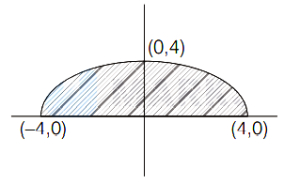
The area of the region bounded by $y=-\sqrt{16-x^{2}}$ and the $X$-axis is
A
$8 \pi$ sq units
B
$20 \pi$ sq units
C
$16 \pi$ sq units
D
$256 \pi$ sq units
Solution
(A) The equation $y=-\sqrt{16-x^{2}}$ represents the lower semi-circle of the circle $x^{2}+y^{2}=16$,which has a radius $r=4$ and center at the origin $(0,0)$.
Since the area is bounded by this curve and the $X$-axis,we are looking for the area of the semi-circle below the $X$-axis.
The area of a full circle is $\pi r^{2} = \pi(4)^{2} = 16\pi$.
Therefore,the area of the semi-circle is $\frac{1}{2} \times 16\pi = 8\pi$ sq units.
Alternatively,using integration:
$\text{Area} = \left| \int_{-4}^{4} (-\sqrt{16-x^{2}}) dx \right|$
$= \left| \left[ \frac{x}{2} \sqrt{16-x^{2}} + \frac{16}{2} \sin^{-1} \frac{x}{4} \right]_{-4}^{4} \right|$
$= \left| [0 + 8 \sin^{-1}(1)] - [0 + 8 \sin^{-1}(-1)] \right|$
$= \left| 8(\frac{\pi}{2}) - 8(-\frac{\pi}{2}) \right| = |4\pi + 4\pi| = 8\pi$ sq units.
Since the area is bounded by this curve and the $X$-axis,we are looking for the area of the semi-circle below the $X$-axis.
The area of a full circle is $\pi r^{2} = \pi(4)^{2} = 16\pi$.
Therefore,the area of the semi-circle is $\frac{1}{2} \times 16\pi = 8\pi$ sq units.
Alternatively,using integration:
$\text{Area} = \left| \int_{-4}^{4} (-\sqrt{16-x^{2}}) dx \right|$
$= \left| \left[ \frac{x}{2} \sqrt{16-x^{2}} + \frac{16}{2} \sin^{-1} \frac{x}{4} \right]_{-4}^{4} \right|$
$= \left| [0 + 8 \sin^{-1}(1)] - [0 + 8 \sin^{-1}(-1)] \right|$
$= \left| 8(\frac{\pi}{2}) - 8(-\frac{\pi}{2}) \right| = |4\pi + 4\pi| = 8\pi$ sq units.
0 likesView Solution
47
MathematicsEasyMCQKCET · 2021
The solution of the differential equation $x dy - y dx = 0$ represents:
A
$A$ rectangular hyperbola.
B
$A$ parabola whose vertex is at the origin.
C
$A$ straight line passing through the origin.
D
$A$ circle whose centre is the origin.
Solution
(C) Given the differential equation: $x dy - y dx = 0$
Rearranging the terms,we get: $x dy = y dx$
Dividing both sides by $xy$ (assuming $x, y \neq 0$): $\frac{dy}{y} = \frac{dx}{x}$
Integrating both sides: $\int \frac{1}{y} dy = \int \frac{1}{x} dx$
This gives: $\ln|y| = \ln|x| + C$
Taking the exponential of both sides: $y = cx$,where $c$ is an arbitrary constant.
This is the equation of a straight line passing through the origin.
Rearranging the terms,we get: $x dy = y dx$
Dividing both sides by $xy$ (assuming $x, y \neq 0$): $\frac{dy}{y} = \frac{dx}{x}$
Integrating both sides: $\int \frac{1}{y} dy = \int \frac{1}{x} dx$
This gives: $\ln|y| = \ln|x| + C$
Taking the exponential of both sides: $y = cx$,where $c$ is an arbitrary constant.
This is the equation of a straight line passing through the origin.
0 likesView Solution
48
MathematicsDifficultMCQKCET · 2021
The number of solutions of $\frac{dy}{dx} = \frac{y+1}{x-1}$,when $y(1) = 2$ is
A
three
B
one
C
infinite
D
zero
Solution
(D) Given the differential equation: $\frac{dy}{dx} = \frac{y+1}{x-1}$.
Separating the variables,we get: $\frac{1}{y+1} dy = \frac{1}{x-1} dx$.
Integrating both sides: $\int \frac{1}{y+1} dy = \int \frac{1}{x-1} dx$.
This gives: $\ln|y+1| = \ln|x-1| + \ln|C|$,which simplifies to $y+1 = C(x-1)$.
Using the initial condition $y(1) = 2$,we substitute $x=1$ and $y=2$ into the equation:
$2+1 = C(1-1) \Rightarrow 3 = C(0)$.
This implies $3 = 0$,which is a contradiction.
Since the initial condition $y(1) = 2$ is given at a point where the derivative $\frac{dy}{dx}$ is undefined (at $x=1$),the solution does not exist.
Therefore,the number of solutions is $0$.
Separating the variables,we get: $\frac{1}{y+1} dy = \frac{1}{x-1} dx$.
Integrating both sides: $\int \frac{1}{y+1} dy = \int \frac{1}{x-1} dx$.
This gives: $\ln|y+1| = \ln|x-1| + \ln|C|$,which simplifies to $y+1 = C(x-1)$.
Using the initial condition $y(1) = 2$,we substitute $x=1$ and $y=2$ into the equation:
$2+1 = C(1-1) \Rightarrow 3 = C(0)$.
This implies $3 = 0$,which is a contradiction.
Since the initial condition $y(1) = 2$ is given at a point where the derivative $\frac{dy}{dx}$ is undefined (at $x=1$),the solution does not exist.
Therefore,the number of solutions is $0$.
0 likesView Solution
49
MathematicsEasyMCQKCET · 2021
$A$ vector $a$ makes equal acute angles with the coordinate axes. Then the projection of vector $b = 5\hat{i} + 7\hat{j} - \hat{k}$ on $a$ is
A
$\frac{11}{15}$
B
$\frac{11}{\sqrt{3}}$
C
$\frac{4}{5}$
D
$\frac{3}{5\sqrt{3}}$
Solution
(B) Let the equal acute angles of vector $a$ with the coordinate axes be $\alpha$.
Since the direction cosines are $l = \cos \alpha$,$m = \cos \alpha$,and $n = \cos \alpha$,we have the relation $l^2 + m^2 + n^2 = 1$.
Substituting the values,we get $3 \cos^2 \alpha = 1$,which implies $\cos \alpha = \frac{1}{\sqrt{3}}$.
Thus,the direction ratios of vector $a$ are proportional to $(1, 1, 1)$,so we can take $a = \hat{i} + \hat{j} + \hat{k}$.
The projection of vector $b$ on vector $a$ is given by the formula $\frac{b \cdot a}{|a|}$.
Calculating the dot product: $b \cdot a = (5\hat{i} + 7\hat{j} - \hat{k}) \cdot (\hat{i} + \hat{j} + \hat{k}) = 5(1) + 7(1) - 1(1) = 5 + 7 - 1 = 11$.
The magnitude of vector $a$ is $|a| = \sqrt{1^2 + 1^2 + 1^2} = \sqrt{3}$.
Therefore,the projection is $\frac{11}{\sqrt{3}}$.
Since the direction cosines are $l = \cos \alpha$,$m = \cos \alpha$,and $n = \cos \alpha$,we have the relation $l^2 + m^2 + n^2 = 1$.
Substituting the values,we get $3 \cos^2 \alpha = 1$,which implies $\cos \alpha = \frac{1}{\sqrt{3}}$.
Thus,the direction ratios of vector $a$ are proportional to $(1, 1, 1)$,so we can take $a = \hat{i} + \hat{j} + \hat{k}$.
The projection of vector $b$ on vector $a$ is given by the formula $\frac{b \cdot a}{|a|}$.
Calculating the dot product: $b \cdot a = (5\hat{i} + 7\hat{j} - \hat{k}) \cdot (\hat{i} + \hat{j} + \hat{k}) = 5(1) + 7(1) - 1(1) = 5 + 7 - 1 = 11$.
The magnitude of vector $a$ is $|a| = \sqrt{1^2 + 1^2 + 1^2} = \sqrt{3}$.
Therefore,the projection is $\frac{11}{\sqrt{3}}$.
0 likesView Solution
50
MathematicsMediumMCQKCET · 2021
The diagonals of a parallelogram are the vectors $\vec{d_1} = 3 \hat{i} + 6 \hat{j} - 2 \hat{k}$ and $\vec{d_2} = -\hat{i} - 2 \hat{j} - 8 \hat{k}$. Then the length of the shorter side of the parallelogram is
A
$\sqrt{29}$
B
$\sqrt{14}$
C
$3 \sqrt{5}$
D
$4 \sqrt{3}$
Solution
(A) Let $\vec{a}$ and $\vec{b}$ be the adjacent sides of the parallelogram,and $\vec{d_1}$ and $\vec{d_2}$ be the diagonals.
We know that $\vec{d_1} = \vec{a} + \vec{b}$ and $\vec{d_2} = \vec{a} - \vec{b}$ (or vice versa).
Thus,$\vec{a} = \frac{\vec{d_1} + \vec{d_2}}{2} = \frac{(3 \hat{i} + 6 \hat{j} - 2 \hat{k}) + (-\hat{i} - 2 \hat{j} - 8 \hat{k})}{2} = \frac{2 \hat{i} + 4 \hat{j} - 10 \hat{k}}{2} = \hat{i} + 2 \hat{j} - 5 \hat{k}$.
The length of side $\vec{a}$ is $|\vec{a}| = \sqrt{1^2 + 2^2 + (-5)^2} = \sqrt{1 + 4 + 25} = \sqrt{30}$.
Similarly,$\vec{b} = \frac{\vec{d_1} - \vec{d_2}}{2} = \frac{(3 \hat{i} + 6 \hat{j} - 2 \hat{k}) - (-\hat{i} - 2 \hat{j} - 8 \hat{k})}{2} = \frac{4 \hat{i} + 8 \hat{j} + 6 \hat{k}}{2} = 2 \hat{i} + 4 \hat{j} + 3 \hat{k}$.
The length of side $\vec{b}$ is $|\vec{b}| = \sqrt{2^2 + 4^2 + 3^2} = \sqrt{4 + 16 + 9} = \sqrt{29}$.
Comparing the lengths $\sqrt{30}$ and $\sqrt{29}$,the shorter side is $\sqrt{29}$.
We know that $\vec{d_1} = \vec{a} + \vec{b}$ and $\vec{d_2} = \vec{a} - \vec{b}$ (or vice versa).
Thus,$\vec{a} = \frac{\vec{d_1} + \vec{d_2}}{2} = \frac{(3 \hat{i} + 6 \hat{j} - 2 \hat{k}) + (-\hat{i} - 2 \hat{j} - 8 \hat{k})}{2} = \frac{2 \hat{i} + 4 \hat{j} - 10 \hat{k}}{2} = \hat{i} + 2 \hat{j} - 5 \hat{k}$.
The length of side $\vec{a}$ is $|\vec{a}| = \sqrt{1^2 + 2^2 + (-5)^2} = \sqrt{1 + 4 + 25} = \sqrt{30}$.
Similarly,$\vec{b} = \frac{\vec{d_1} - \vec{d_2}}{2} = \frac{(3 \hat{i} + 6 \hat{j} - 2 \hat{k}) - (-\hat{i} - 2 \hat{j} - 8 \hat{k})}{2} = \frac{4 \hat{i} + 8 \hat{j} + 6 \hat{k}}{2} = 2 \hat{i} + 4 \hat{j} + 3 \hat{k}$.
The length of side $\vec{b}$ is $|\vec{b}| = \sqrt{2^2 + 4^2 + 3^2} = \sqrt{4 + 16 + 9} = \sqrt{29}$.
Comparing the lengths $\sqrt{30}$ and $\sqrt{29}$,the shorter side is $\sqrt{29}$.
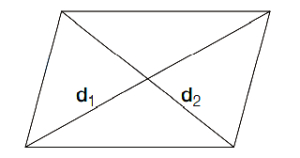
0 likesView Solution
51
MathematicsEasyMCQKCET · 2021
If $a \cdot b = 0$ and $a + b$ makes an angle $60^{\circ}$ with $a$,then
A
$|a| = 2|b|$
B
$2|a| = |b|$
C
$|a| = \sqrt{3}|b|$
D
$\sqrt{3}|a| = |b|$
Solution
(D) Given,$a \cdot b = 0$ and $(a + b)$ makes a $60^{\circ}$ angle with $a$.
Using the formula for the angle between two vectors:
$\cos 60^{\circ} = \frac{(a + b) \cdot a}{|a + b||a|}$
$\Rightarrow \frac{1}{2} = \frac{a \cdot a + b \cdot a}{|a + b||a|}$
Since $a \cdot b = 0$,we have $b \cdot a = 0$.
$\Rightarrow \frac{1}{2} = \frac{|a|^2}{|a + b||a|} = \frac{|a|}{|a + b|}$
$\Rightarrow |a + b| = 2|a|$
Squaring both sides:
$|a + b|^2 = 4|a|^2$
$|a|^2 + |b|^2 + 2(a \cdot b) = 4|a|^2$
Since $a \cdot b = 0$:
$|a|^2 + |b|^2 = 4|a|^2$
$|b|^2 = 3|a|^2$
$|b| = \sqrt{3}|a|$
Using the formula for the angle between two vectors:
$\cos 60^{\circ} = \frac{(a + b) \cdot a}{|a + b||a|}$
$\Rightarrow \frac{1}{2} = \frac{a \cdot a + b \cdot a}{|a + b||a|}$
Since $a \cdot b = 0$,we have $b \cdot a = 0$.
$\Rightarrow \frac{1}{2} = \frac{|a|^2}{|a + b||a|} = \frac{|a|}{|a + b|}$
$\Rightarrow |a + b| = 2|a|$
Squaring both sides:
$|a + b|^2 = 4|a|^2$
$|a|^2 + |b|^2 + 2(a \cdot b) = 4|a|^2$
Since $a \cdot b = 0$:
$|a|^2 + |b|^2 = 4|a|^2$
$|b|^2 = 3|a|^2$
$|b| = \sqrt{3}|a|$
0 likesView Solution
52
MathematicsMediumMCQKCET · 2021
If the area of the parallelogram with $a$ and $b$ as two adjacent sides is $15$ sq units,then the area of the parallelogram having $3a+2b$ and $a+3b$ as two adjacent sides in sq units is
A
$45$
B
$75$
C
$105$
D
$120$
Solution
(C) The area of a parallelogram with adjacent sides $a$ and $b$ is given by $|a \times b| = 15$ sq units.
Now,the area of the parallelogram with adjacent sides $(3a+2b)$ and $(a+3b)$ is given by the magnitude of their cross product:
Area $= |(3a+2b) \times (a+3b)|$
$= |3a \times a + 9a \times b + 2b \times a + 6b \times b|$
Since $a \times a = 0$ and $b \times b = 0$,the expression simplifies to:
$= |9(a \times b) + 2(b \times a)|$
Using the property $b \times a = -(a \times b)$:
$= |9(a \times b) - 2(a \times b)|$
$= |7(a \times b)|$
$= 7 |a \times b|$
Substituting the given value $|a \times b| = 15$:
$= 7 \times 15 = 105$ sq units.
Now,the area of the parallelogram with adjacent sides $(3a+2b)$ and $(a+3b)$ is given by the magnitude of their cross product:
Area $= |(3a+2b) \times (a+3b)|$
$= |3a \times a + 9a \times b + 2b \times a + 6b \times b|$
Since $a \times a = 0$ and $b \times b = 0$,the expression simplifies to:
$= |9(a \times b) + 2(b \times a)|$
Using the property $b \times a = -(a \times b)$:
$= |9(a \times b) - 2(a \times b)|$
$= |7(a \times b)|$
$= 7 |a \times b|$
Substituting the given value $|a \times b| = 15$:
$= 7 \times 15 = 105$ sq units.
0 likesView Solution
53
MathematicsEasyMCQKCET · 2021
The area of the quadrilateral $ABCD$ with vertices $A(0,4,1)$,$B(2,3,-1)$,$C(4,5,0)$,and $D(2,6,2)$ is equal to
A
$9 \text{ sq units}$
B
$18 \text{ sq units}$
C
$27 \text{ sq units}$
D
$81 \text{ sq units}$
Solution
(A) Given the vertices of the quadrilateral $ABCD$ are $A(0,4,1)$,$B(2,3,-1)$,$C(4,5,0)$,and $D(2,6,2)$.
We can divide the quadrilateral into two triangles,$\triangle ABD$ and $\triangle BCD$.
The area of the quadrilateral is the sum of the areas of these two triangles.
Area of $\triangle ABD = \frac{1}{2} |\vec{AB} \times \vec{AD}|$.
$\vec{AB} = (2-0)\hat{i} + (3-4)\hat{j} + (-1-1)\hat{k} = 2\hat{i} - \hat{j} - 2\hat{k}$.
$\vec{AD} = (2-0)\hat{i} + (6-4)\hat{j} + (2-1)\hat{k} = 2\hat{i} + 2\hat{j} + \hat{k}$.
$\vec{AB} \times \vec{AD} = \begin{vmatrix} \hat{i} & \hat{j} & \hat{k} \\ 2 & -1 & -2 \\ 2 & 2 & 1 \end{vmatrix} = \hat{i}(-1+4) - \hat{j}(2+4) + \hat{k}(4+2) = 3\hat{i} - 6\hat{j} + 6\hat{k}$.
$|\vec{AB} \times \vec{AD}| = \sqrt{3^2 + (-6)^2 + 6^2} = \sqrt{9 + 36 + 36} = \sqrt{81} = 9$.
Area of $\triangle ABD = \frac{1}{2} \times 9 = 4.5 \text{ sq units}$.
Area of $\triangle BCD = \frac{1}{2} |\vec{BC} \times \vec{BD}|$.
$\vec{BC} = (4-2)\hat{i} + (5-3)\hat{j} + (0-(-1))\hat{k} = 2\hat{i} + 2\hat{j} + \hat{k}$.
$\vec{BD} = (2-2)\hat{i} + (6-3)\hat{j} + (2-(-1))\hat{k} = 0\hat{i} + 3\hat{j} + 3\hat{k}$.
$\vec{BC} \times \vec{BD} = \begin{vmatrix} \hat{i} & \hat{j} & \hat{k} \\ 2 & 2 & 1 \\ 0 & 3 & 3 \end{vmatrix} = \hat{i}(6-3) - \hat{j}(6-0) + \hat{k}(6-0) = 3\hat{i} - 6\hat{j} + 6\hat{k}$.
$|\vec{BC} \times \vec{BD}| = \sqrt{3^2 + (-6)^2 + 6^2} = 9$.
Area of $\triangle BCD = \frac{1}{2} \times 9 = 4.5 \text{ sq units}$.
Total Area = $4.5 + 4.5 = 9 \text{ sq units}$.
We can divide the quadrilateral into two triangles,$\triangle ABD$ and $\triangle BCD$.
The area of the quadrilateral is the sum of the areas of these two triangles.
Area of $\triangle ABD = \frac{1}{2} |\vec{AB} \times \vec{AD}|$.
$\vec{AB} = (2-0)\hat{i} + (3-4)\hat{j} + (-1-1)\hat{k} = 2\hat{i} - \hat{j} - 2\hat{k}$.
$\vec{AD} = (2-0)\hat{i} + (6-4)\hat{j} + (2-1)\hat{k} = 2\hat{i} + 2\hat{j} + \hat{k}$.
$\vec{AB} \times \vec{AD} = \begin{vmatrix} \hat{i} & \hat{j} & \hat{k} \\ 2 & -1 & -2 \\ 2 & 2 & 1 \end{vmatrix} = \hat{i}(-1+4) - \hat{j}(2+4) + \hat{k}(4+2) = 3\hat{i} - 6\hat{j} + 6\hat{k}$.
$|\vec{AB} \times \vec{AD}| = \sqrt{3^2 + (-6)^2 + 6^2} = \sqrt{9 + 36 + 36} = \sqrt{81} = 9$.
Area of $\triangle ABD = \frac{1}{2} \times 9 = 4.5 \text{ sq units}$.
Area of $\triangle BCD = \frac{1}{2} |\vec{BC} \times \vec{BD}|$.
$\vec{BC} = (4-2)\hat{i} + (5-3)\hat{j} + (0-(-1))\hat{k} = 2\hat{i} + 2\hat{j} + \hat{k}$.
$\vec{BD} = (2-2)\hat{i} + (6-3)\hat{j} + (2-(-1))\hat{k} = 0\hat{i} + 3\hat{j} + 3\hat{k}$.
$\vec{BC} \times \vec{BD} = \begin{vmatrix} \hat{i} & \hat{j} & \hat{k} \\ 2 & 2 & 1 \\ 0 & 3 & 3 \end{vmatrix} = \hat{i}(6-3) - \hat{j}(6-0) + \hat{k}(6-0) = 3\hat{i} - 6\hat{j} + 6\hat{k}$.
$|\vec{BC} \times \vec{BD}| = \sqrt{3^2 + (-6)^2 + 6^2} = 9$.
Area of $\triangle BCD = \frac{1}{2} \times 9 = 4.5 \text{ sq units}$.
Total Area = $4.5 + 4.5 = 9 \text{ sq units}$.
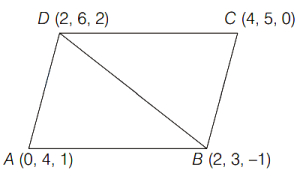
0 likesView Solution
54
MathematicsEasyMCQKCET · 2021
The angle between the lines whose direction cosines are $\left(\frac{\sqrt{3}}{4}, \frac{1}{4}, \frac{\sqrt{3}}{2}\right)$ and $\left(\frac{\sqrt{3}}{4}, \frac{1}{4}, \frac{-\sqrt{3}}{2}\right)$ is
A
$\pi$
B
$\frac{\pi}{2}$
C
$\frac{\pi}{3}$
D
$\frac{\pi}{4}$
Solution
(C) Given,direction cosines of line $1$ are $(l_{1}, m_{1}, n_{1}) = \left(\frac{\sqrt{3}}{4}, \frac{1}{4}, \frac{\sqrt{3}}{2}\right)$.
Direction cosines of line $2$ are $(l_{2}, m_{2}, n_{2}) = \left(\frac{\sqrt{3}}{4}, \frac{1}{4}, -\frac{\sqrt{3}}{2}\right)$.
The angle $\theta$ between two lines is given by $\cos \theta = |l_{1}l_{2} + m_{1}m_{2} + n_{1}n_{2}|$.
Substituting the values:
$\cos \theta = \left|\left(\frac{\sqrt{3}}{4} \times \frac{\sqrt{3}}{4}\right) + \left(\frac{1}{4} \times \frac{1}{4}\right) + \left(\frac{\sqrt{3}}{2} \times -\frac{\sqrt{3}}{2}\right)\right|$
$\cos \theta = \left|\frac{3}{16} + \frac{1}{16} - \frac{3}{4}\right|$
$\cos \theta = \left|\frac{3 + 1 - 12}{16}\right| = \left|-\frac{8}{16}\right| = \left|-\frac{1}{2}\right| = \frac{1}{2}$.
Since $\cos \theta = \frac{1}{2}$,we have $\theta = \frac{\pi}{3}$.
Direction cosines of line $2$ are $(l_{2}, m_{2}, n_{2}) = \left(\frac{\sqrt{3}}{4}, \frac{1}{4}, -\frac{\sqrt{3}}{2}\right)$.
The angle $\theta$ between two lines is given by $\cos \theta = |l_{1}l_{2} + m_{1}m_{2} + n_{1}n_{2}|$.
Substituting the values:
$\cos \theta = \left|\left(\frac{\sqrt{3}}{4} \times \frac{\sqrt{3}}{4}\right) + \left(\frac{1}{4} \times \frac{1}{4}\right) + \left(\frac{\sqrt{3}}{2} \times -\frac{\sqrt{3}}{2}\right)\right|$
$\cos \theta = \left|\frac{3}{16} + \frac{1}{16} - \frac{3}{4}\right|$
$\cos \theta = \left|\frac{3 + 1 - 12}{16}\right| = \left|-\frac{8}{16}\right| = \left|-\frac{1}{2}\right| = \frac{1}{2}$.
Since $\cos \theta = \frac{1}{2}$,we have $\theta = \frac{\pi}{3}$.
0 likesView Solution
55
MathematicsEasyMCQKCET · 2021
The equation of the line joining the points $(-3, 4, 11)$ and $(1, -2, 7)$ is
A
$\frac{x+3}{2} = \frac{y-4}{3} = \frac{z-11}{4}$
B
$\frac{x+3}{-2} = \frac{y-4}{3} = \frac{z-11}{2}$
C
$\frac{x+3}{-2} = \frac{y+4}{3} = \frac{z+11}{4}$
D
$\frac{x+3}{2} = \frac{y+4}{-3} = \frac{z+11}{2}$
Solution
(B) Given points are $A(-3, 4, 11)$ and $B(1, -2, 7)$.
Direction ratios of the line $AB$ are given by $(x_2 - x_1, y_2 - y_1, z_2 - z_1) = (1 - (-3), -2 - 4, 7 - 11) = (4, -6, -4)$.
Dividing by $-2$,we get the simplified direction ratios as $(-2, 3, 2)$.
The equation of a line passing through $(x_1, y_1, z_1)$ with direction ratios $(a, b, c)$ is $\frac{x - x_1}{a} = \frac{y - y_1}{b} = \frac{z - z_1}{c}$.
Substituting the point $(-3, 4, 11)$ and direction ratios $(-2, 3, 2)$,we get $\frac{x - (-3)}{-2} = \frac{y - 4}{3} = \frac{z - 11}{2}$.
Thus,the equation is $\frac{x + 3}{-2} = \frac{y - 4}{3} = \frac{z - 11}{2}$.
Direction ratios of the line $AB$ are given by $(x_2 - x_1, y_2 - y_1, z_2 - z_1) = (1 - (-3), -2 - 4, 7 - 11) = (4, -6, -4)$.
Dividing by $-2$,we get the simplified direction ratios as $(-2, 3, 2)$.
The equation of a line passing through $(x_1, y_1, z_1)$ with direction ratios $(a, b, c)$ is $\frac{x - x_1}{a} = \frac{y - y_1}{b} = \frac{z - z_1}{c}$.
Substituting the point $(-3, 4, 11)$ and direction ratios $(-2, 3, 2)$,we get $\frac{x - (-3)}{-2} = \frac{y - 4}{3} = \frac{z - 11}{2}$.
Thus,the equation is $\frac{x + 3}{-2} = \frac{y - 4}{3} = \frac{z - 11}{2}$.
0 likesView Solution
56
MathematicsEasyMCQKCET · 2021
If a plane meets the coordinate axes at $A, B$ and $C$ in such a way that the centroid of $\triangle ABC$ is at the point $(1, 2, 3)$,then the equation of the plane is
A
$\frac{x}{1} + \frac{y}{2} + \frac{z}{3} = 1$
B
$\frac{x}{3} + \frac{y}{6} + \frac{z}{9} = 1$
C
$\frac{x}{1} + \frac{y}{2} + \frac{z}{3} = \frac{1}{3}$
D
$\frac{x}{1} - \frac{y}{2} + \frac{z}{3} = -1$
Solution
(B) Let the plane meet the coordinate axes at points $A(a, 0, 0)$,$B(0, b, 0)$,and $C(0, 0, c)$.
The intercept form of the equation of the plane is $\frac{x}{a} + \frac{y}{b} + \frac{z}{c} = 1 \dots (i)$.
The centroid of $\triangle ABC$ with vertices $(a, 0, 0)$,$(0, b, 0)$,and $(0, 0, c)$ is given by $\left(\frac{a+0+0}{3}, \frac{0+b+0}{3}, \frac{0+0+c}{3}\right) = \left(\frac{a}{3}, \frac{b}{3}, \frac{c}{3}\right)$.
Given that the centroid is $(1, 2, 3)$,we equate the coordinates:
$\frac{a}{3} = 1 \Rightarrow a = 3$
$\frac{b}{3} = 2 \Rightarrow b = 6$
$\frac{c}{3} = 3 \Rightarrow c = 9$
Substituting the values of $a, b,$ and $c$ into equation $(i)$,we get $\frac{x}{3} + \frac{y}{6} + \frac{z}{9} = 1$.
The intercept form of the equation of the plane is $\frac{x}{a} + \frac{y}{b} + \frac{z}{c} = 1 \dots (i)$.
The centroid of $\triangle ABC$ with vertices $(a, 0, 0)$,$(0, b, 0)$,and $(0, 0, c)$ is given by $\left(\frac{a+0+0}{3}, \frac{0+b+0}{3}, \frac{0+0+c}{3}\right) = \left(\frac{a}{3}, \frac{b}{3}, \frac{c}{3}\right)$.
Given that the centroid is $(1, 2, 3)$,we equate the coordinates:
$\frac{a}{3} = 1 \Rightarrow a = 3$
$\frac{b}{3} = 2 \Rightarrow b = 6$
$\frac{c}{3} = 3 \Rightarrow c = 9$
Substituting the values of $a, b,$ and $c$ into equation $(i)$,we get $\frac{x}{3} + \frac{y}{6} + \frac{z}{9} = 1$.
0 likesView Solution
57
MathematicsEasyMCQKCET · 2021
Given that $A$ and $B$ are two events such that $P(B) = \frac{3}{5}$,$P\left(\frac{A}{B}\right) = \frac{1}{2}$,and $P(A \cup B) = \frac{4}{5}$,then $P(A)$ is equal to:
A
$\frac{3}{10}$
B
$\frac{1}{2}$
C
$\frac{1}{5}$
D
$\frac{3}{5}$
Solution
(B) Given,$P(B) = \frac{3}{5}$,$P\left(\frac{A}{B}\right) = \frac{1}{2}$,and $P(A \cup B) = \frac{4}{5}$.
Since $P\left(\frac{A}{B}\right) = \frac{P(A \cap B)}{P(B)}$,we have:
$\frac{P(A \cap B)}{P(B)} = \frac{1}{2}$
$P(A \cap B) = \frac{1}{2} \times \frac{3}{5} = \frac{3}{10}$.
Using the formula $P(A \cup B) = P(A) + P(B) - P(A \cap B)$:
$\frac{4}{5} = P(A) + \frac{3}{5} - \frac{3}{10}$
$P(A) = \frac{4}{5} - \frac{3}{5} + \frac{3}{10}$
$P(A) = \frac{1}{5} + \frac{3}{10} = \frac{2+3}{10} = \frac{5}{10} = \frac{1}{2}$.
Since $P\left(\frac{A}{B}\right) = \frac{P(A \cap B)}{P(B)}$,we have:
$\frac{P(A \cap B)}{P(B)} = \frac{1}{2}$
$P(A \cap B) = \frac{1}{2} \times \frac{3}{5} = \frac{3}{10}$.
Using the formula $P(A \cup B) = P(A) + P(B) - P(A \cap B)$:
$\frac{4}{5} = P(A) + \frac{3}{5} - \frac{3}{10}$
$P(A) = \frac{4}{5} - \frac{3}{5} + \frac{3}{10}$
$P(A) = \frac{1}{5} + \frac{3}{10} = \frac{2+3}{10} = \frac{5}{10} = \frac{1}{2}$.
0 likesView Solution
58
MathematicsEasyMCQKCET · 2021
Two dice are thrown. If it is known that the sum of numbers on the dice was less than $6$,the probability of getting a sum as $3$ is:
A
$\frac{1}{18}$
B
$\frac{5}{18}$
C
$\frac{1}{5}$
D
$\frac{2}{5}$
Solution
(C) Let $E_{A}$ be the event that the sum of numbers on the dice is less than $6$.
The possible outcomes for $E_{A}$ are:
$E_{A} = \{(1,1), (1,2), (1,3), (1,4), (2,1), (2,2), (2,3), (3,1), (3,2), (4,1)\}$
Thus,$n(E_{A}) = 10$.
Let $E_{B}$ be the event that the sum of numbers on the dice is $3$.
The possible outcomes for $E_{B}$ are:
$E_{B} = \{(1,2), (2,1)\}$
Thus,$n(E_{B}) = 2$.
The required conditional probability is $P(E_{B}|E_{A}) = \frac{n(E_{B} \cap E_{A})}{n(E_{A})} = \frac{2}{10} = \frac{1}{5}$.
The possible outcomes for $E_{A}$ are:
$E_{A} = \{(1,1), (1,2), (1,3), (1,4), (2,1), (2,2), (2,3), (3,1), (3,2), (4,1)\}$
Thus,$n(E_{A}) = 10$.
Let $E_{B}$ be the event that the sum of numbers on the dice is $3$.
The possible outcomes for $E_{B}$ are:
$E_{B} = \{(1,2), (2,1)\}$
Thus,$n(E_{B}) = 2$.
The required conditional probability is $P(E_{B}|E_{A}) = \frac{n(E_{B} \cap E_{A})}{n(E_{A})} = \frac{2}{10} = \frac{1}{5}$.
0 likesView Solution
59
MathematicsEasyMCQKCET · 2021
If $A, B$ and $C$ are three independent events such that $P(A)=P(B)=P(C)=P$, then $P$ (at least two of $A, B$ and $C$ occur) is equal to
A
$P^{3}-3 P$
B
$3 P-2 P^{2}$
C
$3 P^{2}-2 P^{3}$
D
$3 P^{2}$
Solution
(C) Given that $A, B$ and $C$ are independent events with $P(A)=P(B)=P(C)=P$.
The probability that at least two of $A, B$ and $C$ occur is the sum of the probabilities of the following mutually exclusive cases:
$1$. Exactly two events occur: $(A \cap B \cap C') \cup (A \cap B' \cap C) \cup (A' \cap B \cap C)$
$2$. All three events occur: $(A \cap B \cap C)$
Since the events are independent, $P(A \cap B \cap C') = P(A)P(B)P(C') = P \times P \times (1-P) = P^{2}(1-P)$.
Similarly, $P(A \cap B' \cap C) = P^{2}(1-P)$ and $P(A' \cap B \cap C) = P^{2}(1-P)$.
Also, $P(A \cap B \cap C) = P \times P \times P = P^{3}$.
Thus, $P(\text{at least two occur}) = 3 \times P^{2}(1-P) + P^{3}$.
$= 3P^{2} - 3P^{3} + P^{3} = 3P^{2} - 2P^{3}$.
The probability that at least two of $A, B$ and $C$ occur is the sum of the probabilities of the following mutually exclusive cases:
$1$. Exactly two events occur: $(A \cap B \cap C') \cup (A \cap B' \cap C) \cup (A' \cap B \cap C)$
$2$. All three events occur: $(A \cap B \cap C)$
Since the events are independent, $P(A \cap B \cap C') = P(A)P(B)P(C') = P \times P \times (1-P) = P^{2}(1-P)$.
Similarly, $P(A \cap B' \cap C) = P^{2}(1-P)$ and $P(A' \cap B \cap C) = P^{2}(1-P)$.
Also, $P(A \cap B \cap C) = P \times P \times P = P^{3}$.
Thus, $P(\text{at least two occur}) = 3 \times P^{2}(1-P) + P^{3}$.
$= 3P^{2} - 3P^{3} + P^{3} = 3P^{2} - 2P^{3}$.
0 likesView Solution
60
MathematicsMediumMCQKCET · 2021
$A$ car manufacturing factory has two plants $X$ and $Y$. Plant $X$ manufactures $70 \%$ of cars and plant $Y$ manufactures $30 \%$ of cars. $80 \%$ of cars at plant $X$ and $90 \%$ of cars at plant $Y$ are rated as standard quality. $A$ car is chosen at random and is found to be standard quality. The probability that it has come from plant $X$ is
A
$\frac{56}{73}$
B
$\frac{56}{84}$
C
$\frac{56}{83}$
D
$\frac{56}{79}$
Solution
(C) Let $E$ be the event that the car is of standard quality. Let $A_{1}$ be the event that the car is manufactured in plant $X$,and $A_{2}$ be the event that the car is manufactured in plant $Y$.
Given probabilities are:
$P(A_{1}) = \frac{70}{100} = \frac{7}{10}$
$P(A_{2}) = \frac{30}{100} = \frac{3}{10}$
$P(E|A_{1}) = \frac{80}{100} = \frac{8}{10}$
$P(E|A_{2}) = \frac{90}{100} = \frac{9}{10}$
Using Bayes' Theorem,the probability that the car came from plant $X$ given it is of standard quality is:
$P(A_{1}|E) = \frac{P(A_{1}) \times P(E|A_{1})}{P(A_{1}) \times P(E|A_{1}) + P(A_{2}) \times P(E|A_{2})}$
$P(A_{1}|E) = \frac{\frac{7}{10} \times \frac{8}{10}}{\frac{7}{10} \times \frac{8}{10} + \frac{3}{10} \times \frac{9}{10}}$
$P(A_{1}|E) = \frac{56/100}{56/100 + 27/100} = \frac{56}{56 + 27} = \frac{56}{83}$
Thus,the required probability is $\frac{56}{83}$.
Given probabilities are:
$P(A_{1}) = \frac{70}{100} = \frac{7}{10}$
$P(A_{2}) = \frac{30}{100} = \frac{3}{10}$
$P(E|A_{1}) = \frac{80}{100} = \frac{8}{10}$
$P(E|A_{2}) = \frac{90}{100} = \frac{9}{10}$
Using Bayes' Theorem,the probability that the car came from plant $X$ given it is of standard quality is:
$P(A_{1}|E) = \frac{P(A_{1}) \times P(E|A_{1})}{P(A_{1}) \times P(E|A_{1}) + P(A_{2}) \times P(E|A_{2})}$
$P(A_{1}|E) = \frac{\frac{7}{10} \times \frac{8}{10}}{\frac{7}{10} \times \frac{8}{10} + \frac{3}{10} \times \frac{9}{10}}$
$P(A_{1}|E) = \frac{56/100}{56/100 + 27/100} = \frac{56}{56 + 27} = \frac{56}{83}$
Thus,the required probability is $\frac{56}{83}$.
0 likesView Solution
Vedclass Products
For Students
Vedclass Test Series
Mock tests in real KCET style covering Mathematics with performance analysis. 5-day free trial.
Start Free TrialFor Teachers
Exam Paper Generator
Generate Set A/B/C/D Mathematics papers from 7.5L+ questions in 2 minutes. 3 chapters free.
Try FreeFor Institutes
Online Exam Module
Run live KCET mock exams with unlimited students, 360° analytics & white-label branding.
See DemoFrequently Asked Questions
How many Mathematics questions are in KCET 2021?
There are 60 Mathematics questions from the KCET 2021 paper on Vedclass, each with a detailed step-by-step solution in English.
Are KCET 2021 Mathematics solutions available in English?
Yes. All solutions on this page are in English. You can also switch to English or Hindi using the language buttons above the questions.
Can I practice KCET 2021 Mathematics as a timed test?
Yes. Use the Vedclass Test Series to attempt a full KCET mock test covering Mathematics with time limits and instant score analysis.
Can teachers create Mathematics papers from KCET previous year questions?
Yes. The Vedclass Exam Paper Generator lets teachers mix KCET Mathematics questions and generate Set A/B/C/D papers in minutes.
For Teachers & Institutes
Build a Custom Mathematics Paper
Pick KCET 2021 Mathematics questions, set difficulty, and generate Set A/B/C/D in 2 minutes.