
ChemistryQ1–65 of 65 questions
Page 1 of 1 · English
1
ChemistryMCQKCET · 2019
$A$ particle of mass $m$ and charge $q$ is placed at rest in a uniform electric field $E$ and then released. The $KE$ attained by the particle after moving a distance $y$ is
A
$qEy^2$
B
$qE^2y$
C
$qEy$
D
$q^2Ey$
Solution
(C) The force acting on the particle in a uniform electric field is given by $F = qE$.
According to Newton's second law,the acceleration $a$ of the particle is $a = F/m = (qE)/m$.
Using the equation of motion $v^2 = u^2 + 2ay$,where initial velocity $u = 0$ and distance $s = y$,we get $v^2 = 0 + 2(qE/m)y = 2(qE/m)y$.
The kinetic energy $(KE)$ is given by $KE = (1/2)mv^2$.
Substituting the value of $v^2$,we get $KE = (1/2)m[2(qE/m)y] = qEy$.
According to Newton's second law,the acceleration $a$ of the particle is $a = F/m = (qE)/m$.
Using the equation of motion $v^2 = u^2 + 2ay$,where initial velocity $u = 0$ and distance $s = y$,we get $v^2 = 0 + 2(qE/m)y = 2(qE/m)y$.
The kinetic energy $(KE)$ is given by $KE = (1/2)mv^2$.
Substituting the value of $v^2$,we get $KE = (1/2)m[2(qE/m)y] = qEy$.
0 likesView Solution
2
ChemistryMCQKCET · 2019
In a permanent magnet at room temperature,
A
Magnetic moment of each molecule is zero
B
The individual molecules have non-zero magnetic moment which are all perfectly aligned
C
Domains are partially aligned
D
Domains are all perfectly aligned
Solution
(D) permanent magnet is a substance that retains its ferromagnetic properties for a long period at room temperature.
In ferromagnetic materials,individual atoms possess a magnetic dipole moment.
These atoms interact with each other such that they spontaneously align in a common direction over a macroscopic region known as a domain.
In a permanent magnet,these domains are all perfectly aligned in the direction of the external magnetizing field,resulting in a strong net magnetic moment.
In ferromagnetic materials,individual atoms possess a magnetic dipole moment.
These atoms interact with each other such that they spontaneously align in a common direction over a macroscopic region known as a domain.
In a permanent magnet,these domains are all perfectly aligned in the direction of the external magnetizing field,resulting in a strong net magnetic moment.
0 likesView Solution
3
ChemistryEasyMCQKCET · 2019
Which of the following pairs contains $2$ lone pairs of electrons on the central atom?
A
$XeF_{4}, NH_{3}$
B
$SO_{4}^{2-}, H_{2}S$
C
$I_{3}^{+}, H_{2}O$
D
$H_{2}O, NF_{3}$
Solution
(C) To determine the number of lone pairs on the central atom,we use the formula: $\text{Lone pairs} = \frac{1}{2} (V - B)$,where $V$ is the number of valence electrons of the central atom and $B$ is the number of bonding electrons (or atoms bonded to it).
$1$. $I_{3}^{+}$: The central $I$ atom has $7$ valence electrons. It forms $2$ bonds with other $I$ atoms and has a positive charge,so $V = 7 - 1 = 6$. Bonding electrons $B = 2$. Lone pairs = $\frac{1}{2} (6 - 2) = 2$.
$2$. $H_{2}O$: The central $O$ atom has $6$ valence electrons. It forms $2$ bonds with $H$ atoms. Lone pairs = $\frac{1}{2} (6 - 2) = 2$.
Both $I_{3}^{+}$ and $H_{2}O$ have $2$ lone pairs on their central atoms. Therefore,option $C$ is correct.
$1$. $I_{3}^{+}$: The central $I$ atom has $7$ valence electrons. It forms $2$ bonds with other $I$ atoms and has a positive charge,so $V = 7 - 1 = 6$. Bonding electrons $B = 2$. Lone pairs = $\frac{1}{2} (6 - 2) = 2$.
$2$. $H_{2}O$: The central $O$ atom has $6$ valence electrons. It forms $2$ bonds with $H$ atoms. Lone pairs = $\frac{1}{2} (6 - 2) = 2$.
Both $I_{3}^{+}$ and $H_{2}O$ have $2$ lone pairs on their central atoms. Therefore,option $C$ is correct.
0 likesView Solution
4
ChemistryEasyMCQKCET · 2019
The number of $\pi$-bonds and $\sigma$-bonds present in naphthalene are respectively
A
$5, 11$
B
$5, 20$
C
$6, 19$
D
$5, 19$
Solution
(D) The chemical formula of naphthalene is $C_{10}H_8$.
In the structure of naphthalene,there are two fused benzene rings.
The number of $\pi$-bonds is equal to the number of double bonds in the structure,which is $5$.
The number of $\sigma$-bonds can be calculated by counting all single bonds and one bond from each double bond.
Total $\sigma$-bonds = $19$.
Therefore,the number of $\pi$-bonds and $\sigma$-bonds are $5$ and $19$ respectively.
The correct option is $(D)$.
In the structure of naphthalene,there are two fused benzene rings.
The number of $\pi$-bonds is equal to the number of double bonds in the structure,which is $5$.
The number of $\sigma$-bonds can be calculated by counting all single bonds and one bond from each double bond.
Total $\sigma$-bonds = $19$.
Therefore,the number of $\pi$-bonds and $\sigma$-bonds are $5$ and $19$ respectively.
The correct option is $(D)$.
0 likesView Solution
5
ChemistryEasyMCQKCET · 2019
Which of the following possess a net dipole moment?
A
$BeCl_2$
B
$CO_2$
C
$SO_2$
D
$BF_3$
Solution
(C) $BeCl_2$ and $CO_2$ have a linear geometry,and $BF_3$ has a trigonal planar geometry; therefore,they all have a net dipole moment of zero.
$SO_2$ has a bent (angular) geometry due to the presence of a lone pair on the sulfur atom,which results in a non-zero net dipole moment.
Thus,the correct option is $C$.
$SO_2$ has a bent (angular) geometry due to the presence of a lone pair on the sulfur atom,which results in a non-zero net dipole moment.
Thus,the correct option is $C$.
0 likesView Solution
6
ChemistryEasyMCQKCET · 2019
The first ionization enthalpy of the following elements are in the order:
A
$Si < P < C < N$
B
$Si < C < P < N$
C
$C < N < Si < P$
D
$P < Si < N < C$
Solution
(A) The first ionization enthalpy $(\Delta H_{IE})$ generally increases across a period from left to right and decreases down a group.
Comparing the elements $C$ (Group $14$,Period $2$),$N$ (Group $15$,Period $2$),$Si$ (Group $14$,Period $3$),and $P$ (Group $15$,Period $3$):
$1$. Elements in Period $2$ $(C, N)$ have higher ionization enthalpy than those in Period $3$ $(Si, P)$ due to smaller atomic size.
$2$. Within the same period,Group $15$ elements have higher ionization enthalpy than Group $14$ elements due to the stable half-filled $p$-orbital configuration $(ns^2 np^3)$.
$3$. Combining these trends,the order is $Si < P < C < N$.
Comparing the elements $C$ (Group $14$,Period $2$),$N$ (Group $15$,Period $2$),$Si$ (Group $14$,Period $3$),and $P$ (Group $15$,Period $3$):
$1$. Elements in Period $2$ $(C, N)$ have higher ionization enthalpy than those in Period $3$ $(Si, P)$ due to smaller atomic size.
$2$. Within the same period,Group $15$ elements have higher ionization enthalpy than Group $14$ elements due to the stable half-filled $p$-orbital configuration $(ns^2 np^3)$.
$3$. Combining these trends,the order is $Si < P < C < N$.
0 likesView Solution
7
ChemistryMCQKCET · 2019
$ f: R \rightarrow R $ and $ g:[0, \infty) \rightarrow R $ are defined by $ f(x)=x^{2} $ and $ g(x)=\sqrt{x} $. Which one of the following is not true?
A
$ f \circ g(-4) = 4 $
B
$ g \circ f(-2) = 2 $
C
$ g \circ f(4) = 4 $
D
$ f \circ g(2) = 2 $
Solution
(A) Given $ f(x) = x^2 $ and $ g(x) = \sqrt{x} $.
Check option $ (A) $: $ f \circ g(-4) = f(g(-4)) $. Since the domain of $ g $ is $ [0, \infty) $,$ g(-4) $ is not defined. Thus,$ f \circ g(-4) $ is not defined. This statement is not true.
Check option $ (B) $: $ g \circ f(-2) = g(f(-2)) = g((-2)^2) = g(4) = \sqrt{4} = 2 $. This is true.
Check option $ (C) $: $ g \circ f(4) = g(f(4)) = g(4^2) = g(16) = \sqrt{16} = 4 $. This is true.
Check option $ (D) $: $ f \circ g(2) = f(g(2)) = f(\sqrt{2}) = (\sqrt{2})^2 = 2 $. This is true.
Therefore,the statement that is not true is $ (A) $.
Check option $ (A) $: $ f \circ g(-4) = f(g(-4)) $. Since the domain of $ g $ is $ [0, \infty) $,$ g(-4) $ is not defined. Thus,$ f \circ g(-4) $ is not defined. This statement is not true.
Check option $ (B) $: $ g \circ f(-2) = g(f(-2)) = g((-2)^2) = g(4) = \sqrt{4} = 2 $. This is true.
Check option $ (C) $: $ g \circ f(4) = g(f(4)) = g(4^2) = g(16) = \sqrt{16} = 4 $. This is true.
Check option $ (D) $: $ f \circ g(2) = f(g(2)) = f(\sqrt{2}) = (\sqrt{2})^2 = 2 $. This is true.
Therefore,the statement that is not true is $ (A) $.
0 likesView Solution
8
ChemistryMCQKCET · 2019
$A$ particle of mass $m$ and charge $q$ is placed at rest in a uniform electric field $E$ and then released. The kinetic energy attained by the particle after moving a distance $y$ is
A
$qEy$
B
$qEy^2$
C
$q^2Ey$
D
$qE^2y$
Solution
(A) The force acting on the particle is $F = qE$.
According to Newton's second law,the acceleration of the particle is $a = \frac{F}{m} = \frac{qE}{m}$.
Using the kinematic equation $v^2 = u^2 + 2ay$,where initial velocity $u = 0$:
$v^2 = 0 + 2 \left(\frac{qE}{m}\right)y = \frac{2qEy}{m}$.
The kinetic energy $K$ is given by $K = \frac{1}{2}mv^2$.
Substituting the value of $v^2$:
$K = \frac{1}{2} \times m \times \left(\frac{2qEy}{m}\right) = qEy$.
Therefore,the correct option is $A$.
According to Newton's second law,the acceleration of the particle is $a = \frac{F}{m} = \frac{qE}{m}$.
Using the kinematic equation $v^2 = u^2 + 2ay$,where initial velocity $u = 0$:
$v^2 = 0 + 2 \left(\frac{qE}{m}\right)y = \frac{2qEy}{m}$.
The kinetic energy $K$ is given by $K = \frac{1}{2}mv^2$.
Substituting the value of $v^2$:
$K = \frac{1}{2} \times m \times \left(\frac{2qEy}{m}\right) = qEy$.
Therefore,the correct option is $A$.
0 likesView Solution
9
ChemistryEasyMCQKCET · 2019
Eutrophication causes:
A
reduction in dissolved oxygen
B
decrease in $BOD$
C
increase of nutrients in water
D
reduction in water pollution
Solution
(A)
Eutrophication refers to the excessive enrichment of water bodies with minerals and nutrients,which promotes the growth of algae.
This excessive algal growth leads to the consumption of dissolved oxygen by microorganisms during decomposition,resulting in a significant reduction in dissolved oxygen levels.
Eutrophication refers to the excessive enrichment of water bodies with minerals and nutrients,which promotes the growth of algae.
This excessive algal growth leads to the consumption of dissolved oxygen by microorganisms during decomposition,resulting in a significant reduction in dissolved oxygen levels.
0 likesView Solution
10
ChemistryEasyMCQKCET · 2019
Resonance effect is not observed in
A
$CH_2=CH-Cl$
B
$CH_2=CH-CH_2-NH_2$
C
$CH_2=CH-CH=CH_2$
D
$CH_2=CH-C\equiv N$
Solution
(B)
In $CH_2=CH-CH_2-NH_2$,the lone pair on the nitrogen atom is separated from the $\pi$ bond by an $sp^3$ hybridized carbon atom ($-CH_2-$ group).
Since there is no continuous conjugation,the resonance effect is not observed in this molecule.
In $CH_2=CH-CH_2-NH_2$,the lone pair on the nitrogen atom is separated from the $\pi$ bond by an $sp^3$ hybridized carbon atom ($-CH_2-$ group).
Since there is no continuous conjugation,the resonance effect is not observed in this molecule.
0 likesView Solution
11
ChemistryEasyMCQKCET · 2019
$2-$butyne is reduced to $trans-but-2-ene$ using:
A
$H_2 \mid Pd-C$
B
$Zn$ in dil. $HCl$
C
$H_2 \mid Ni$
D
$Na$ in liq. $NH_3$
Solution
(D)
The reduction of an alkyne to a $trans-alkene$ is achieved using dissolving metal reduction,such as $Na$ in liquid $NH_3$ (Birch reduction).
The reaction is:
$CH_3-C \equiv C-CH_3 \xrightarrow{Na \mid liq. NH_3} trans-CH_3-CH=CH-CH_3$
The reduction of an alkyne to a $trans-alkene$ is achieved using dissolving metal reduction,such as $Na$ in liquid $NH_3$ (Birch reduction).
The reaction is:
$CH_3-C \equiv C-CH_3 \xrightarrow{Na \mid liq. NH_3} trans-CH_3-CH=CH-CH_3$
0 likesView Solution
12
ChemistryMediumMCQKCET · 2019
Which of the following is $NOT$ true regarding the usage of hydrogen as a fuel?
A
Combustion product is ecofriendly.
B
Hydrogen gas can be easily liquefied and stored.
C
High calorific value
D
The combustible energy of hydrogen can be directly converted to electrical energy in a fuel cell.
Solution
(B)
Hydrogen is highly inflammable and hence storage is difficult.
Hydrogen has a low critical temperature and is therefore not easily liquefiable.
Hydrogen is highly inflammable and hence storage is difficult.
Hydrogen has a low critical temperature and is therefore not easily liquefiable.
0 likesView Solution
13
ChemistryEasyMCQKCET · 2019
In the reaction $B(OH)_{3} + 2 H_{2}O \rightarrow [B(OH)_{4}]^{-} + H_{3}O^{+}$,$B(OH)_{3}$ functions as:
A
Bronsted acid
B
Lewis acid
C
Protonic acid
D
Lewis base
Solution
(B) . Boric acid $(B(OH)_{3})$ is a weak monobasic acid. It does not dissociate to give $H^{+}$ ions directly; instead,it acts as a Lewis acid by accepting a lone pair of electrons from the oxygen atom of a water molecule to form the $[B(OH)_{4}]^{-}$ complex.
0 likesView Solution
14
ChemistryMCQKCET · 2019
In a permanent magnet at room temperature,
A
domains are partially aligned.
B
magnetic moment of each molecule is zero.
C
domains are all perfectly aligned.
D
the individual molecules have non-zero magnetic moment which are all perfectly aligned.
Solution
(A) In a permanent magnet,the magnetic domains are not perfectly aligned due to thermal agitations at room temperature. While the material exhibits a net magnetic moment,the alignment is only partial because thermal energy prevents complete orientation of all domains in a single direction.
0 likesView Solution
15
ChemistryMediumMCQKCET · 2019
In the reaction of gold with aqua regia,the oxidation state of Nitrogen changes from
A
$+5$ to $+2$
B
$+3$ to $+1$
C
$+4$ to $+2$
D
$+6$ to $+4$
Solution
(A) The reaction of gold with aqua regia is given by the equation:
$Au + 4H^{+} + NO_{3}^{-} (+5) + 4Cl^{-} \rightarrow AuCl_{4}^{-} + NO (+2) + 2H_{2}O$
In this reaction,the nitrogen atom in the nitrate ion $(NO_{3}^{-})$ has an oxidation state of $+5$.
It is reduced to nitric oxide $(NO)$,where the oxidation state of nitrogen is $+2$.
Therefore,the oxidation state of nitrogen changes from $+5$ to $+2$.
$Au + 4H^{+} + NO_{3}^{-} (+5) + 4Cl^{-} \rightarrow AuCl_{4}^{-} + NO (+2) + 2H_{2}O$
In this reaction,the nitrogen atom in the nitrate ion $(NO_{3}^{-})$ has an oxidation state of $+5$.
It is reduced to nitric oxide $(NO)$,where the oxidation state of nitrogen is $+2$.
Therefore,the oxidation state of nitrogen changes from $+5$ to $+2$.
0 likesView Solution
16
ChemistryEasyMCQKCET · 2019
Which metal nitrate liberates $NO_{2}$ gas upon heating?
A
$KNO_{3}$
B
$RbNO_{3}$
C
$NaNO_{3}$
D
$LiNO_{3}$
Solution
(D) The thermal decomposition of alkali metal nitrates follows different patterns based on the size of the cation.
$LiNO_{3}$ decomposes to form its oxide,nitrogen dioxide,and oxygen: $4LiNO_{3} \rightarrow 2Li_{2}O + 4NO_{2} + O_{2}$.
In contrast,nitrates of other alkali metals like $KNO_{3}$,$RbNO_{3}$,and $NaNO_{3}$ decompose to form nitrites and oxygen gas $(2MNO_{3} \rightarrow 2MNO_{2} + O_{2})$ and do not release $NO_{2}$ gas.
Therefore,the correct option is $D$.
$LiNO_{3}$ decomposes to form its oxide,nitrogen dioxide,and oxygen: $4LiNO_{3} \rightarrow 2Li_{2}O + 4NO_{2} + O_{2}$.
In contrast,nitrates of other alkali metals like $KNO_{3}$,$RbNO_{3}$,and $NaNO_{3}$ decompose to form nitrites and oxygen gas $(2MNO_{3} \rightarrow 2MNO_{2} + O_{2})$ and do not release $NO_{2}$ gas.
Therefore,the correct option is $D$.
0 likesView Solution
17
ChemistryMediumMCQKCET · 2019
The number of moles of electrons required to reduce $0.2 \ mol$ of $Cr_2O_7^{2-}$ to $Cr^{3+}$ is:
A
$12$
B
$0.6$
C
$1.2$
D
$6$
Solution
(C) The reduction half-reaction is: $Cr_2O_7^{2-} + 14H^{+} + 6e^{-} \rightarrow 2Cr^{3+} + 7H_2O$.
In $Cr_2O_7^{2-}$,the oxidation state of $Cr$ is $+6$.
The change in oxidation state for $2$ atoms of $Cr$ is $2 \times (6 - 3) = 6$.
Thus,$1 \ mol$ of $Cr_2O_7^{2-}$ requires $6 \ mol$ of electrons.
For $0.2 \ mol$ of $Cr_2O_7^{2-}$,the number of moles of electrons required is $0.2 \times 6 = 1.2 \ mol$.
In $Cr_2O_7^{2-}$,the oxidation state of $Cr$ is $+6$.
The change in oxidation state for $2$ atoms of $Cr$ is $2 \times (6 - 3) = 6$.
Thus,$1 \ mol$ of $Cr_2O_7^{2-}$ requires $6 \ mol$ of electrons.
For $0.2 \ mol$ of $Cr_2O_7^{2-}$,the number of moles of electrons required is $0.2 \times 6 = 1.2 \ mol$.
0 likesView Solution
18
ChemistryMediumMCQKCET · 2019
The solubility of $AgCl$ is least in which of the following solutions?
A
$0.1 \ M \ BaCl_2$
B
$0.1 \ M \ AlCl_3$
C
$0.1 \ M \ NaCl$
D
Pure water
Solution
(B) The solubility of a sparingly soluble salt like $AgCl$ is governed by the common ion effect.
According to the common ion effect,the presence of a common ion $(Cl^-)$ decreases the solubility of the salt.
The concentration of $Cl^-$ ions provided by the electrolytes are:
$0.1 \ M \ BaCl_2$ provides $0.2 \ M \ Cl^-$ ions.
$0.1 \ M \ AlCl_3$ provides $0.3 \ M \ Cl^-$ ions.
$0.1 \ M \ NaCl$ provides $0.1 \ M \ Cl^-$ ions.
Since $AlCl_3$ provides the highest concentration of common $Cl^-$ ions $(0.3 \ M)$,the equilibrium $AgCl(s) \rightleftharpoons Ag^+(aq) + Cl^-(aq)$ shifts furthest to the left.
Therefore,the solubility of $AgCl$ is least in $0.1 \ M \ AlCl_3$.
According to the common ion effect,the presence of a common ion $(Cl^-)$ decreases the solubility of the salt.
The concentration of $Cl^-$ ions provided by the electrolytes are:
$0.1 \ M \ BaCl_2$ provides $0.2 \ M \ Cl^-$ ions.
$0.1 \ M \ AlCl_3$ provides $0.3 \ M \ Cl^-$ ions.
$0.1 \ M \ NaCl$ provides $0.1 \ M \ Cl^-$ ions.
Since $AlCl_3$ provides the highest concentration of common $Cl^-$ ions $(0.3 \ M)$,the equilibrium $AgCl(s) \rightleftharpoons Ag^+(aq) + Cl^-(aq)$ shifts furthest to the left.
Therefore,the solubility of $AgCl$ is least in $0.1 \ M \ AlCl_3$.
0 likesView Solution
19
ChemistryMediumMCQKCET · 2019
The mass of $AgCl$ precipitated when a solution containing $11.70 \ g$ of $NaCl$ is added to a solution containing $3.4 \ g$ of $AgNO_3$ is [Atomic mass of $Ag=108$,$Na=23$,$Cl=35.5$,$N=14$,$O=16$] (in $g$)
A
$2.87$
B
$6.8$
C
$5.74$
D
$1.17$
Solution
(A) The balanced chemical equation is:
$NaCl + AgNO_3 \rightarrow AgCl + NaNO_3$
Molar mass of $AgNO_3 = 108 + 14 + (3 \times 16) = 170 \ g/mol$
Molar mass of $NaCl = 23 + 35.5 = 58.5 \ g/mol$
Molar mass of $AgCl = 108 + 35.5 = 143.5 \ g/mol$
Given amounts:
$NaCl = 11.70 \ g$
$AgNO_3 = 3.4 \ g$
From the stoichiometry,$1 \ mol$ of $AgNO_3$ reacts with $1 \ mol$ of $NaCl$.
$170 \ g$ of $AgNO_3$ requires $58.5 \ g$ of $NaCl$.
$3.4 \ g$ of $AgNO_3$ requires $\frac{58.5}{170} \times 3.4 = 1.17 \ g$ of $NaCl$.
Since we have $11.70 \ g$ of $NaCl$ (which is more than $1.17 \ g$),$AgNO_3$ is the limiting reagent.
The amount of $AgCl$ produced depends on the limiting reagent $(AgNO_3)$:
$170 \ g$ of $AgNO_3$ produces $143.5 \ g$ of $AgCl$.
$3.4 \ g$ of $AgNO_3$ produces $\frac{143.5}{170} \times 3.4 = 2.87 \ g$ of $AgCl$.
Thus,the mass of $AgCl$ precipitated is $2.87 \ g$.
$NaCl + AgNO_3 \rightarrow AgCl + NaNO_3$
Molar mass of $AgNO_3 = 108 + 14 + (3 \times 16) = 170 \ g/mol$
Molar mass of $NaCl = 23 + 35.5 = 58.5 \ g/mol$
Molar mass of $AgCl = 108 + 35.5 = 143.5 \ g/mol$
Given amounts:
$NaCl = 11.70 \ g$
$AgNO_3 = 3.4 \ g$
From the stoichiometry,$1 \ mol$ of $AgNO_3$ reacts with $1 \ mol$ of $NaCl$.
$170 \ g$ of $AgNO_3$ requires $58.5 \ g$ of $NaCl$.
$3.4 \ g$ of $AgNO_3$ requires $\frac{58.5}{170} \times 3.4 = 1.17 \ g$ of $NaCl$.
Since we have $11.70 \ g$ of $NaCl$ (which is more than $1.17 \ g$),$AgNO_3$ is the limiting reagent.
The amount of $AgCl$ produced depends on the limiting reagent $(AgNO_3)$:
$170 \ g$ of $AgNO_3$ produces $143.5 \ g$ of $AgCl$.
$3.4 \ g$ of $AgNO_3$ produces $\frac{143.5}{170} \times 3.4 = 2.87 \ g$ of $AgCl$.
Thus,the mass of $AgCl$ precipitated is $2.87 \ g$.
0 likesView Solution
20
ChemistryEasyMCQKCET · 2019
Which of the following equations does $NOT$ represent Charles's law for a given mass of gas at constant pressure?
A
$\log K = \log V + \log T$
B
$\frac{d(\ln V)}{d T} = \frac{1}{T}$
C
$\frac{V}{T} = K$
D
$\log V = \log K + \log T$
Solution
(A) Charles's law states that for a given mass of gas at constant pressure,the volume $V$ is directly proportional to the absolute temperature $T$,expressed as $V/T = K$ (where $K$ is a constant).
Taking the natural logarithm on both sides: $\ln V = \ln K + \ln T$.
Taking the common logarithm on both sides: $\log V = \log K + \log T$.
Rearranging the logarithmic equation: $\log V - \log T = \log K$.
Option $A$ represents $\log K = \log V + \log T$,which implies $\log K = \log(VT)$,or $K = VT$. This contradicts Charles's law $(V/T = K)$.
Therefore,option $A$ does not represent Charles's law.
Taking the natural logarithm on both sides: $\ln V = \ln K + \ln T$.
Taking the common logarithm on both sides: $\log V = \log K + \log T$.
Rearranging the logarithmic equation: $\log V - \log T = \log K$.
Option $A$ represents $\log K = \log V + \log T$,which implies $\log K = \log(VT)$,or $K = VT$. This contradicts Charles's law $(V/T = K)$.
Therefore,option $A$ does not represent Charles's law.
0 likesView Solution
21
ChemistryEasyMCQKCET · 2019
Two particles $A$ and $B$ are in motion. If the wavelength associated with particle $A$ is $5 \times 10^{-8} \ m$,calculate the wavelength (in $\mathring{A}$) associated with particle $B$ if its momentum is half of $A$.
A
$1000 \ \mathring{A}$
B
$500 \ \mathring{A}$
C
$250 \ \mathring{A}$
D
$1250 \ \mathring{A}$
Solution
(A) According to the de Broglie equation,$\lambda = h / p$,where $\lambda$ is the wavelength,$h$ is Planck's constant,and $p$ is the momentum.
Given $\lambda_{A} = 5 \times 10^{-8} \ m$ and $p_{B} = 0.5 \ p_{A}$.
Since $\lambda \propto 1 / p$,we have $\lambda_{B} / \lambda_{A} = p_{A} / p_{B}$.
Substituting $p_{B} = 0.5 \ p_{A}$,we get $\lambda_{B} / \lambda_{A} = p_{A} / (0.5 \ p_{A}) = 2$.
Therefore,$\lambda_{B} = 2 \times \lambda_{A} = 2 \times 5 \times 10^{-8} \ m = 10^{-7} \ m$.
Converting to $\mathring{A}$: $1 \ m = 10^{10} \ \mathring{A}$,so $10^{-7} \ m = 10^{-7} \times 10^{10} \ \mathring{A} = 1000 \ \mathring{A}$.
Given $\lambda_{A} = 5 \times 10^{-8} \ m$ and $p_{B} = 0.5 \ p_{A}$.
Since $\lambda \propto 1 / p$,we have $\lambda_{B} / \lambda_{A} = p_{A} / p_{B}$.
Substituting $p_{B} = 0.5 \ p_{A}$,we get $\lambda_{B} / \lambda_{A} = p_{A} / (0.5 \ p_{A}) = 2$.
Therefore,$\lambda_{B} = 2 \times \lambda_{A} = 2 \times 5 \times 10^{-8} \ m = 10^{-7} \ m$.
Converting to $\mathring{A}$: $1 \ m = 10^{10} \ \mathring{A}$,so $10^{-7} \ m = 10^{-7} \times 10^{10} \ \mathring{A} = 1000 \ \mathring{A}$.
0 likesView Solution
22
ChemistryEasyMCQKCET · 2019
The reaction in which $\Delta H > \Delta U$ is
A
$N_{2(g)} + 3H_{2(g)} \rightarrow 2NH_{3(g)}$
B
$CH_{4(g)} + 2O_{2(g)} \rightarrow CO_{2(g)} + 2H_2O_{(l)}$
C
$N_{2(g)} + 2O_{2(g)} \rightarrow 2NO_{2(g)}$
D
$CaCO_{3(s)} \rightarrow CaO_{(s)} + CO_{2(g)}$
Solution
(D) The relationship between enthalpy change and internal energy change is given by $\Delta H = \Delta U + \Delta n_g RT$.
For $\Delta H > \Delta U$,the value of $\Delta n_g$ (change in the number of moles of gaseous products and reactants) must be positive,i.e.,$\Delta n_g > 0$.
In option $(d)$: $CaCO_{3(s)} \rightarrow CaO_{(s)} + CO_{2(g)}$.
Here,$\Delta n_g = (\text{moles of gaseous products}) - (\text{moles of gaseous reactants}) = 1 - 0 = 1$.
Since $\Delta n_g$ is positive,$\Delta H > \Delta U$.
For $\Delta H > \Delta U$,the value of $\Delta n_g$ (change in the number of moles of gaseous products and reactants) must be positive,i.e.,$\Delta n_g > 0$.
In option $(d)$: $CaCO_{3(s)} \rightarrow CaO_{(s)} + CO_{2(g)}$.
Here,$\Delta n_g = (\text{moles of gaseous products}) - (\text{moles of gaseous reactants}) = 1 - 0 = 1$.
Since $\Delta n_g$ is positive,$\Delta H > \Delta U$.
0 likesView Solution
23
ChemistryDifficultMCQKCET · 2019
Which of the following can be used to test the acidic nature of ethanol?
A
$NaHCO_{3}$
B
$Na$ metal
C
Blue litmus solution
D
$Na_{2}CO_{3}$
Solution
(B)
$1$. Ethanol is a very weak acid,much weaker than water. It does not react with bases like $NaHCO_{3}$ or $Na_{2}CO_{3}$ and does not change the color of litmus paper.
$2$. However,it reacts with active metals like sodium $(Na)$ to evolve hydrogen gas $(H_{2})$,which confirms its acidic hydrogen atom.
$3$. The reaction is: $2C_{2}H_{5}OH + 2Na \rightarrow 2C_{2}H_{5}ONa + H_{2} \uparrow$
$1$. Ethanol is a very weak acid,much weaker than water. It does not react with bases like $NaHCO_{3}$ or $Na_{2}CO_{3}$ and does not change the color of litmus paper.
$2$. However,it reacts with active metals like sodium $(Na)$ to evolve hydrogen gas $(H_{2})$,which confirms its acidic hydrogen atom.
$3$. The reaction is: $2C_{2}H_{5}OH + 2Na \rightarrow 2C_{2}H_{5}ONa + H_{2} \uparrow$
0 likesView Solution
24
ChemistryDifficultMCQKCET · 2019
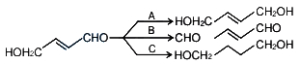
The reagents $A$,$B$ and $C$ respectively are:
A
$NaBH_{4}$,$PCC$,$H_{2} / Pd$
B
$H_{2} / Pd$,alk. $KMnO_{4}$,$NaBH_{4}$
C
$H_{2} / Pd$,$PCC$,$NaBH_{4}$
D
$NaBH_{4}$,alk. $KMnO_{4}$,$H_{2} / Pd$
Solution
(A) The starting material is $HOCH_{2}-CH=CH-CHO$.
Step $A$: The product is $HOCH_{2}-CH=CH-CH_{2}OH$. This indicates the reduction of the aldehyde group to a primary alcohol while leaving the $C=C$ double bond intact. $NaBH_{4}$ is a selective reducing agent that reduces aldehydes/ketones but not $C=C$ double bonds.
Step $B$: The product is $HOCH_{2}-CH=CH-CHO$. This indicates that the aldehyde group remains unchanged. $PCC$ (Pyridinium chlorochromate) is an oxidizing agent used to oxidize alcohols to aldehydes,but it does not affect the aldehyde group itself.
Step $C$: The product is $HOCH_{2}-CH_{2}-CH_{2}-CH_{2}OH$. This indicates the reduction of both the aldehyde group and the $C=C$ double bond. $H_{2} / Pd$ is a catalytic hydrogenation reagent that reduces both aldehydes and $C=C$ double bonds.
Therefore,the reagents are $A = NaBH_{4}$,$B = PCC$,$C = H_{2} / Pd$.
Step $A$: The product is $HOCH_{2}-CH=CH-CH_{2}OH$. This indicates the reduction of the aldehyde group to a primary alcohol while leaving the $C=C$ double bond intact. $NaBH_{4}$ is a selective reducing agent that reduces aldehydes/ketones but not $C=C$ double bonds.
Step $B$: The product is $HOCH_{2}-CH=CH-CHO$. This indicates that the aldehyde group remains unchanged. $PCC$ (Pyridinium chlorochromate) is an oxidizing agent used to oxidize alcohols to aldehydes,but it does not affect the aldehyde group itself.
Step $C$: The product is $HOCH_{2}-CH_{2}-CH_{2}-CH_{2}OH$. This indicates the reduction of both the aldehyde group and the $C=C$ double bond. $H_{2} / Pd$ is a catalytic hydrogenation reagent that reduces both aldehydes and $C=C$ double bonds.
Therefore,the reagents are $A = NaBH_{4}$,$B = PCC$,$C = H_{2} / Pd$.
0 likesView Solution
25
ChemistryMediumMCQKCET · 2019
Which of the following is least soluble in water at $298 \ K$?
A
$(CH_3)_2NH$
B
$C_6H_5NH_2$
C
$CH_3NH_2$
D
$(CH_3)_3N$
Solution
(D) The solubility of amines in water depends on their ability to form hydrogen bonds with water molecules.
$CH_3NH_2$ and $(CH_3)_2NH$ are primary and secondary amines,respectively,which can form hydrogen bonds with water.
$C_6H_5NH_2$ (aniline) is less soluble due to the large hydrophobic phenyl group,but it still has an $-NH_2$ group capable of hydrogen bonding.
$(CH_3)_3N$ is a tertiary amine and lacks a hydrogen atom attached to the nitrogen atom,meaning it cannot act as a hydrogen bond donor to water molecules.
Therefore,$(CH_3)_3N$ is the least soluble in water among the given options.
$CH_3NH_2$ and $(CH_3)_2NH$ are primary and secondary amines,respectively,which can form hydrogen bonds with water.
$C_6H_5NH_2$ (aniline) is less soluble due to the large hydrophobic phenyl group,but it still has an $-NH_2$ group capable of hydrogen bonding.
$(CH_3)_3N$ is a tertiary amine and lacks a hydrogen atom attached to the nitrogen atom,meaning it cannot act as a hydrogen bond donor to water molecules.
Therefore,$(CH_3)_3N$ is the least soluble in water among the given options.
0 likesView Solution
26
ChemistryEasyMCQKCET · 2019
In nucleic acids,the nucleotides are joined together by
A
Phosphodisulphide linkage
B
Sulphodiester linkage
C
Phosphoester linkage
D
Phosphodiester linkage
Solution
(D)
In nucleic acids,the individual nucleotides are linked together through the $3'-5'$ phosphodiester bonds,which connect the $5'$ carbon atom of one sugar molecule to the $3'$ carbon atom of the next sugar molecule via a phosphate group.
In nucleic acids,the individual nucleotides are linked together through the $3'-5'$ phosphodiester bonds,which connect the $5'$ carbon atom of one sugar molecule to the $3'$ carbon atom of the next sugar molecule via a phosphate group.
0 likesView Solution
27
ChemistryEasyMCQKCET · 2019
The vitamin that helps in the clotting of blood is
A
$B_{2}$
B
$K$
C
$A$
D
$C$
Solution
(B) . Vitamin $K$ is essential for the synthesis of proteins required for blood coagulation (clotting). It acts as a cofactor for the enzyme that carboxylates glutamate residues in clotting factors.
0 likesView Solution
28
ChemistryEasyMCQKCET · 2019
Which of the following is generally water insoluble?
A
Amylose
B
Glycine
C
Fibrous protein
D
Vitamin-$C$
Solution
(C)
Fibrous proteins are generally insoluble in water due to the presence of strong intermolecular hydrogen bonds and disulfide linkages that hold the polypeptide chains together.
Fibrous proteins are generally insoluble in water due to the presence of strong intermolecular hydrogen bonds and disulfide linkages that hold the polypeptide chains together.
0 likesView Solution
29
ChemistryMediumMCQKCET · 2019
Which is the most suitable reagent for the following conversion?
$CH_3-CH=CH-CH_2-CO-CH_3 \rightarrow CH_3-CH=CH-CH_2-COO^- + CHI_3$
$CH_3-CH=CH-CH_2-CO-CH_3 \rightarrow CH_3-CH=CH-CH_2-COO^- + CHI_3$
A
Benzoyl peroxide
B
$Sn$ and $NaOH$ solution
C
Tollen's reagent
D
$I_2$ and $NaOH$ solution
Solution
(D) The given reaction is a haloform reaction (specifically iodoform test).
$CH_3-CH=CH-CH_2-CO-CH_3$ contains a methyl ketone group $(-COCH_3)$.
Methyl ketones react with $I_2$ in the presence of $NaOH$ to form a carboxylate salt and iodoform $(CHI_3)$.
This reaction is specific to methyl ketones and does not affect the double bond present in the chain.
Therefore,the correct reagent is $I_2$ and $NaOH$ solution.
$CH_3-CH=CH-CH_2-CO-CH_3$ contains a methyl ketone group $(-COCH_3)$.
Methyl ketones react with $I_2$ in the presence of $NaOH$ to form a carboxylate salt and iodoform $(CHI_3)$.
This reaction is specific to methyl ketones and does not affect the double bond present in the chain.
Therefore,the correct reagent is $I_2$ and $NaOH$ solution.
0 likesView Solution
30
ChemistryMediumMCQKCET · 2019
Propanoic acid undergoes the $HVZ$ reaction to give $2-$chloropropanoic acid. The product obtained is:
A
a weaker acid than propanoic acid
B
stronger than dichloropropanoic acid
C
a stronger acid than propanoic acid
D
as strong as propanoic acid
Solution
(C) The $HVZ$ (Hell-Volhard-Zelinsky) reaction of propanoic acid $(CH_3CH_2COOH)$ with $Cl_2/P$ yields $2-$chloropropanoic acid $(CH_3CHClCOOH)$.
In $2-$chloropropanoic acid,the chlorine atom is an electron-withdrawing group ($-I$ effect).
Electron-withdrawing groups stabilize the carboxylate anion $(RCOO^-)$ by dispersing the negative charge,thereby increasing the acidity of the carboxylic acid.
Therefore,$2-$chloropropanoic acid is a stronger acid than propanoic acid.
In $2-$chloropropanoic acid,the chlorine atom is an electron-withdrawing group ($-I$ effect).
Electron-withdrawing groups stabilize the carboxylate anion $(RCOO^-)$ by dispersing the negative charge,thereby increasing the acidity of the carboxylic acid.
Therefore,$2-$chloropropanoic acid is a stronger acid than propanoic acid.
0 likesView Solution
31
ChemistryMediumMCQKCET · 2019
Match the following $pKa$ values:
| Acid | $pKa$ |
|---|---|
| $(a)$ Phenol | $(i)$ $16$ |
| $(b)$ $p$-Nitrophenol | $(ii)$ $0.78$ |
| $(c)$ Ethanol | $(iii)$ $10$ |
| $(d)$ Picric acid | $(iv)$ $7.1$ |
A
$a-i, b-ii, c-iii, d-iv$
B
$a-iv, b-ii, c-iii, d-i$
C
$a-iii, b-iv, c-i, d-ii$
D
$a-ii, b-i, c-ii, d-iv$
Solution
(C) Acidity is inversely proportional to the $pKa$ value.
$1$. Picric acid ($2,4,6$-trinitrophenol) is the strongest acid among the given options due to the presence of three electron-withdrawing $-NO_2$ groups,so it has the lowest $pKa$ value $(0.78)$.
$2$. $p$-Nitrophenol is more acidic than phenol due to the $-I$ and $-M$ effect of the $-NO_2$ group $(pKa = 7.1)$.
$3$. Phenol is more acidic than ethanol because the phenoxide ion is resonance stabilized $(pKa = 10)$.
$4$. Ethanol is the least acidic $(pKa = 16)$.
Therefore,the correct match is: $a-iii, b-iv, c-i, d-ii$.
$1$. Picric acid ($2,4,6$-trinitrophenol) is the strongest acid among the given options due to the presence of three electron-withdrawing $-NO_2$ groups,so it has the lowest $pKa$ value $(0.78)$.
$2$. $p$-Nitrophenol is more acidic than phenol due to the $-I$ and $-M$ effect of the $-NO_2$ group $(pKa = 7.1)$.
$3$. Phenol is more acidic than ethanol because the phenoxide ion is resonance stabilized $(pKa = 10)$.
$4$. Ethanol is the least acidic $(pKa = 16)$.
Therefore,the correct match is: $a-iii, b-iv, c-i, d-ii$.
0 likesView Solution
32
ChemistryDifficultMCQKCET · 2019
$1 \ L$ of $2 \ M$ $CH_3COOH$ is mixed with $1 \ L$ of $3 \ M$ $C_2H_5OH$ to form an ester. The rate of the reaction with respect to the initial rate when each solution is diluted with an equal volume of water will be (in times).
A
$0.5$
B
$4$
C
$0.25$
D
$2$
Solution
(C) Esterification is a second-order reaction.
$CH_3COOH + C_2H_5OH \rightarrow CH_3COOC_2H_5 + H_2O$
The rate law for this reaction is $r = k[CH_3COOH][C_2H_5OH]$.
When each solution is diluted with an equal volume of water,the total volume doubles,so the concentration of each reactant is reduced to half of its initial value.
Let the initial concentrations be $[A]_0$ and $[B]_0$. The initial rate is $r = k[A]_0[B]_0$.
After dilution,the new concentrations are $[A]' = \frac{[A]_0}{2}$ and $[B]' = \frac{[B]_0}{2}$.
The new rate is $r' = k \times (\frac{[A]_0}{2}) \times (\frac{[B]_0}{2}) = \frac{1}{4} \times k[A]_0[B]_0 = \frac{1}{4}r$.
Thus,the rate of reaction becomes $0.25$ times the initial rate.
$CH_3COOH + C_2H_5OH \rightarrow CH_3COOC_2H_5 + H_2O$
The rate law for this reaction is $r = k[CH_3COOH][C_2H_5OH]$.
When each solution is diluted with an equal volume of water,the total volume doubles,so the concentration of each reactant is reduced to half of its initial value.
Let the initial concentrations be $[A]_0$ and $[B]_0$. The initial rate is $r = k[A]_0[B]_0$.
After dilution,the new concentrations are $[A]' = \frac{[A]_0}{2}$ and $[B]' = \frac{[B]_0}{2}$.
The new rate is $r' = k \times (\frac{[A]_0}{2}) \times (\frac{[B]_0}{2}) = \frac{1}{4} \times k[A]_0[B]_0 = \frac{1}{4}r$.
Thus,the rate of reaction becomes $0.25$ times the initial rate.
0 likesView Solution
33
ChemistryMediumMCQKCET · 2019
The plot of $t_{1/2}$ versus $[R]_0$ for a reaction is a straight line parallel to the $x$-axis. The unit for the rate constant of this reaction is:
A
$L \ mol^{-1} \ s^{-1}$
B
$s^{-1}$
C
$mol \ L^{-1} \ s^{-1}$
D
$mol^{-1} \ L \ s^{-1}$
Solution
(B) For a reaction,the half-life $t_{1/2}$ is related to the initial concentration $[R]_0$ by the expression $t_{1/2} \propto [R]_0^{1-n}$,where $n$ is the order of the reaction.
If the plot of $t_{1/2}$ versus $[R]_0$ is a straight line parallel to the $x$-axis,it implies that $t_{1/2}$ is independent of the initial concentration $[R]_0$.
This occurs when $1-n = 0$,which means $n = 1$.
Therefore,the reaction is a first-order reaction.
The unit of the rate constant for a first-order reaction is $s^{-1}$.
If the plot of $t_{1/2}$ versus $[R]_0$ is a straight line parallel to the $x$-axis,it implies that $t_{1/2}$ is independent of the initial concentration $[R]_0$.
This occurs when $1-n = 0$,which means $n = 1$.
Therefore,the reaction is a first-order reaction.
The unit of the rate constant for a first-order reaction is $s^{-1}$.
0 likesView Solution
34
ChemistryDifficultMCQKCET · 2019
Which is a wrong statement?
A
In $\ln k$ vs $\frac{1}{T}$ plot is a straight line
B
Presence of catalyst will not alter the value of $E_a$
C
Rate constant $k = $ Arrhenius constant $A$: if $E_a = 0$
D
$e^{-E_a / RT}$ gives the fraction of reactant molecules that are activated at the given temp
Solution
(B)
According to the Arrhenius equation,a catalyst provides an alternative reaction pathway with a lower activation energy $(E_a)$.
Therefore,the presence of a catalyst changes the value of $E_a$.
According to the Arrhenius equation,a catalyst provides an alternative reaction pathway with a lower activation energy $(E_a)$.
Therefore,the presence of a catalyst changes the value of $E_a$.
0 likesView Solution
35
ChemistryEasyMCQKCET · 2019
Which of the following is an anti-histamine?
A
Amoxycillin
B
Chloroxylenol
C
Bromopheniramine
D
Morphine
Solution
(C)
Bromopheniramine is a well-known anti-histamine drug used to treat allergic symptoms.
Bromopheniramine is a well-known anti-histamine drug used to treat allergic symptoms.
0 likesView Solution
36
ChemistryDifficultMCQKCET · 2019
Which cleansing agent gets precipitated in hard water?
A
Cetyl trimethyl ammonium bromide
B
Sodium dodecyl benzene sulphonate
C
Sodium lauryl sulphate
D
Sodium stearate
Solution
(D) is the correct answer.
Sodium stearate $(C_{17}H_{35}COONa)$ is a soap. In hard water,it reacts with calcium or magnesium ions ($Ca^{2+}$ or $Mg^{2+}$) to form insoluble precipitates (scum),which makes it ineffective as a cleansing agent.
The reaction with calcium ions is:
$2 C_{17}H_{35}COONa + CaCl_{2} \rightarrow (C_{17}H_{35}COO)_{2}Ca + 2 NaCl$
Sodium stearate $(C_{17}H_{35}COONa)$ is a soap. In hard water,it reacts with calcium or magnesium ions ($Ca^{2+}$ or $Mg^{2+}$) to form insoluble precipitates (scum),which makes it ineffective as a cleansing agent.
The reaction with calcium ions is:
$2 C_{17}H_{35}COONa + CaCl_{2} \rightarrow (C_{17}H_{35}COO)_{2}Ca + 2 NaCl$
0 likesView Solution
37
ChemistryEasyMCQKCET · 2019
Which among the following is the strongest ligand?
A
$CO$
B
$en$
C
$CN^{-}$
D
$NH_{3}$
Solution
(A)
$CO$ is the strongest ligand among the given options due to the synergic bonding effect.
It acts as a $\sigma$-donor and a $\pi$-acceptor,which strengthens the metal-ligand bond significantly.
$CO$ is the strongest ligand among the given options due to the synergic bonding effect.
It acts as a $\sigma$-donor and a $\pi$-acceptor,which strengthens the metal-ligand bond significantly.
0 likesView Solution
38
ChemistryEasyMCQKCET · 2019
The formula of pentaaquanitratochromium$(III)$ nitrate is,
A
$[Cr(H_2O)_5(NO_3)](NO_3)_2$
B
$[Cr(H_2O)_5(NO_2)]NO_3$
C
$[Cr(H_2O)_6](NO_3)_3$
D
$[Cr(H_2O)_6](NO_2)_2$
Solution
(A) The name pentaaquanitratochromium$(III)$ nitrate indicates the following components:
$1$. The central metal ion is Chromium $(Cr)$ with an oxidation state of $+3$.
$2$. The ligands are five water molecules ($H_2O$,aqua) and one nitrate ion ($NO_3^-$,nitrato).
$3$. The coordination sphere is $[Cr(H_2O)_5(NO_3)]$.
$4$. To balance the charge: $Cr$ is $+3$,$H_2O$ is $0$,and $NO_3$ is $-1$. The net charge on the coordination sphere is $(+3) + 0 + (-1) = +2$.
$5$. To neutralize the $+2$ charge of the complex,two nitrate ions $(NO_3^-)$ are required outside the coordination sphere.
$6$. Thus,the formula is $[Cr(H_2O)_5(NO_3)](NO_3)_2$.
$1$. The central metal ion is Chromium $(Cr)$ with an oxidation state of $+3$.
$2$. The ligands are five water molecules ($H_2O$,aqua) and one nitrate ion ($NO_3^-$,nitrato).
$3$. The coordination sphere is $[Cr(H_2O)_5(NO_3)]$.
$4$. To balance the charge: $Cr$ is $+3$,$H_2O$ is $0$,and $NO_3$ is $-1$. The net charge on the coordination sphere is $(+3) + 0 + (-1) = +2$.
$5$. To neutralize the $+2$ charge of the complex,two nitrate ions $(NO_3^-)$ are required outside the coordination sphere.
$6$. Thus,the formula is $[Cr(H_2O)_5(NO_3)](NO_3)_2$.
0 likesView Solution
39
ChemistryMediumMCQKCET · 2019
Which of the following statements is incorrect?
A
Metals in highest oxidation states are more stable in oxides than in fluorides.
B
All elements of $3d$ series exhibit variable oxidation states.
C
In highest oxidation states,the transition metals show acidic character.
D
$Mn^{3+}$ and $Co^{3+}$ are oxidizing agents in aqueous solution.
Solution
(B) The correct answer is $(B)$.
$Zn$ (Zinc) has a completely filled $d$-orbital $(3d^{10}4s^2)$ and does not exhibit variable oxidation states; it only shows a $+2$ oxidation state.
$Zn$ (Zinc) has a completely filled $d$-orbital $(3d^{10}4s^2)$ and does not exhibit variable oxidation states; it only shows a $+2$ oxidation state.
0 likesView Solution
40
ChemistryMediumMCQKCET · 2019
$A$ mixture of $NaCl$ and $K_{2}Cr_{2}O_{7}$ is heated with conc. $H_{2}SO_{4}$,deep red vapours are formed. Which of the following statements is false?
A
The vapours contain $CrO_{2}Cl_{2}$ and $Cl_{2}$
B
The vapours when passed into lead acetate in acetic acid give a yellow precipitate.
C
The vapours give a yellow solution with $NaOH$.
D
The vapours contain $CrO_{2}Cl_{2}$ only.
Solution
(A) The reaction is the Chromyl Chloride test: $4Cl^{-} + Cr_{2}O_{7}^{2-} + 6H^{+} \rightarrow 2CrO_{2}Cl_{2} + 3H_{2}O$.
The deep red vapours consist of $CrO_{2}Cl_{2}$ (Chromyl chloride).
Statement $A$ is false because the vapours do not contain $Cl_{2}$ gas.
When these vapours are passed into $NaOH$,a yellow solution of sodium chromate is formed: $CrO_{2}Cl_{2} + 4OH^{-} \rightarrow CrO_{4}^{2-} + 2Cl^{-} + 2H_{2}O$.
This solution,when treated with lead acetate,gives a yellow precipitate of lead chromate: $CrO_{4}^{2-} + Pb^{2+} \rightarrow PbCrO_{4} \downarrow$ (yellow).
The deep red vapours consist of $CrO_{2}Cl_{2}$ (Chromyl chloride).
Statement $A$ is false because the vapours do not contain $Cl_{2}$ gas.
When these vapours are passed into $NaOH$,a yellow solution of sodium chromate is formed: $CrO_{2}Cl_{2} + 4OH^{-} \rightarrow CrO_{4}^{2-} + 2Cl^{-} + 2H_{2}O$.
This solution,when treated with lead acetate,gives a yellow precipitate of lead chromate: $CrO_{4}^{2-} + Pb^{2+} \rightarrow PbCrO_{4} \downarrow$ (yellow).
0 likesView Solution
41
ChemistryEasyMCQKCET · 2019
The elements in which electrons are progressively filled in $4f$ orbital are called
A
Lanthanoids
B
Halogens
C
Actinoids
D
Transition elements
Solution
(A) The elements in which the $4f$ orbitals are progressively filled are known as Lanthanoids.
These elements range from atomic number $58$ $(Ce)$ to $71$ $(Lu)$.
They are also known as $4f$-block elements or rare earth elements.
Therefore,the correct option is $A$.
These elements range from atomic number $58$ $(Ce)$ to $71$ $(Lu)$.
They are also known as $4f$-block elements or rare earth elements.
Therefore,the correct option is $A$.
0 likesView Solution
42
ChemistryMediumMCQKCET · 2019
Which of the following statements is incorrect with reference to $Ce$ $(Z=58)$?
A
Atomic size of $Ce$ is more than that of $Lu$.
B
$Ce$ shows common oxidation states of $+3$ and $+4$.
C
$Ce^{4+}$ is a reducing agent.
D
$Ce$ in $+3$ oxidation state is more stable than in $+4$.
Solution
(C) $Ce^{4+}$ acts as a strong oxidizing agent because it has a strong tendency to gain an electron to attain the stable $+3$ oxidation state $(Ce^{4+} + e^- \rightarrow Ce^{3+})$. Therefore,the statement that $Ce^{4+}$ is a reducing agent is incorrect.
0 likesView Solution
43
ChemistryDifficultMCQKCET · 2019
One litre solution of $MgCl_2$ is electrolyzed completely by passing a current of $1 \ A$ for $16 \ min \ 5 \ sec$. The original concentration of $MgCl_2$ solution was (Atomic mass of $Mg = 24$)
A
$0.5 \times 10^{-3} \ M$
B
$1.0 \times 10^{-2} \ M$
C
$5 \times 10^{-3} \ M$
D
$5 \times 10^{-2} \ M$
Solution
(C) The electrolysis reaction for $MgCl_2$ is: $Mg^{2+} + 2e^- \rightarrow Mg(s)$.
The total charge passed is $Q = I \times t = 1 \ A \times (16 \times 60 + 5) \ s = 965 \ C$.
According to Faraday's law,the number of moles of $Mg$ deposited is $n = \frac{Q}{n_f \times F} = \frac{965}{2 \times 96500} = 0.005 \ \text{mol}$.
Since the volume of the solution is $1 \ L$,the molarity $M = \frac{n}{V} = \frac{0.005 \ \text{mol}}{1 \ L} = 5 \times 10^{-3} \ M$.
The total charge passed is $Q = I \times t = 1 \ A \times (16 \times 60 + 5) \ s = 965 \ C$.
According to Faraday's law,the number of moles of $Mg$ deposited is $n = \frac{Q}{n_f \times F} = \frac{965}{2 \times 96500} = 0.005 \ \text{mol}$.
Since the volume of the solution is $1 \ L$,the molarity $M = \frac{n}{V} = \frac{0.005 \ \text{mol}}{1 \ L} = 5 \times 10^{-3} \ M$.
0 likesView Solution
44
ChemistryMediumMCQKCET · 2019
An aqueous solution of $CuSO_{4}$ is subjected to electrolysis using inert electrodes. The $pH$ of the solution will
A
decrease
B
increase or decrease depending on the strength of the current
C
increase
D
remains unchanged
Solution
(A) The electrolysis of an aqueous solution of $CuSO_{4}$ with inert electrodes involves the following reactions:
At the cathode: $Cu^{2+}_{(aq)} + 2e^{-} \rightarrow Cu_{(s)}$
At the anode: $2H_{2}O_{(l)} \rightarrow O_{2(g)} + 4H^{+}_{(aq)} + 4e^{-}$
Since $H^{+}$ ions are produced at the anode,the concentration of $H^{+}$ ions in the solution increases.
As $pH = -\log[H^{+}]$,an increase in $[H^{+}]$ leads to a decrease in the $pH$ of the solution.
At the cathode: $Cu^{2+}_{(aq)} + 2e^{-} \rightarrow Cu_{(s)}$
At the anode: $2H_{2}O_{(l)} \rightarrow O_{2(g)} + 4H^{+}_{(aq)} + 4e^{-}$
Since $H^{+}$ ions are produced at the anode,the concentration of $H^{+}$ ions in the solution increases.
As $pH = -\log[H^{+}]$,an increase in $[H^{+}]$ leads to a decrease in the $pH$ of the solution.
0 likesView Solution
45
ChemistryEasyMCQKCET · 2019
Given: $E^{0}_{Mn^{+7} \mid Mn^{+2}} = 1.5 \ V$ and $E^{0}_{Mn^{+4} \mid Mn^{+2}} = 1.2 \ V$,then $E^{0}_{Mn^{+7} \mid Mn^{+4}}$ is (in $V$)
A
$1.7$
B
$2.1$
C
$0.3$
D
$0.1$
Solution
(A) For the reaction $Mn^{+7} + 5e^{-} \rightarrow Mn^{2+}$,$\Delta G^{0}_{1} = -nFE^{0} = -5 \times F \times 1.5 = -7.5F$.
For the reaction $Mn^{+4} + 2e^{-} \rightarrow Mn^{2+}$,$\Delta G^{0}_{2} = -nFE^{0} = -2 \times F \times 1.2 = -2.4F$.
To obtain the reaction $Mn^{+7} + 3e^{-} \rightarrow Mn^{4+}$,we subtract the second reaction from the first:
$(Mn^{+7} + 5e^{-}$ $\rightarrow Mn^{2+}) - (Mn^{+4} + 2e^{-}$ $\rightarrow Mn^{2+})$ $\Rightarrow Mn^{+7} + 3e^{-}$ $\rightarrow Mn^{4+}$.
Thus,$\Delta G^{0}_{3} = \Delta G^{0}_{1} - \Delta G^{0}_{2} = -7.5F - (-2.4F) = -5.1F$.
Using $\Delta G^{0}_{3} = -nFE^{0}_{3}$ where $n=3$:
$-3FE^{0}_{3} = -5.1F
\therefore E^{0}_{3} = \frac{5.1}{3} = 1.7 \ V$.
For the reaction $Mn^{+4} + 2e^{-} \rightarrow Mn^{2+}$,$\Delta G^{0}_{2} = -nFE^{0} = -2 \times F \times 1.2 = -2.4F$.
To obtain the reaction $Mn^{+7} + 3e^{-} \rightarrow Mn^{4+}$,we subtract the second reaction from the first:
$(Mn^{+7} + 5e^{-}$ $\rightarrow Mn^{2+}) - (Mn^{+4} + 2e^{-}$ $\rightarrow Mn^{2+})$ $\Rightarrow Mn^{+7} + 3e^{-}$ $\rightarrow Mn^{4+}$.
Thus,$\Delta G^{0}_{3} = \Delta G^{0}_{1} - \Delta G^{0}_{2} = -7.5F - (-2.4F) = -5.1F$.
Using $\Delta G^{0}_{3} = -nFE^{0}_{3}$ where $n=3$:
$-3FE^{0}_{3} = -5.1F
\therefore E^{0}_{3} = \frac{5.1}{3} = 1.7 \ V$.
0 likesView Solution
46
ChemistryEasyMCQKCET · 2019
Addition of excess of $AgNO_3$ to an aqueous solution of $1$ mole of $PdCl_2 \cdot 4 NH_3$ gives $2$ moles of $AgCl$. The conductivity of this solution corresponds to
A
$1:2$ electrolyte
B
$1:4$ electrolyte
C
$1:1$ electrolyte
D
$1:3$ electrolyte
Solution
(A) The reaction of $1$ mole of $PdCl_2 \cdot 4 NH_3$ with excess $AgNO_3$ produces $2$ moles of $AgCl$ precipitate,which indicates that $2$ chloride ions $(Cl^-)$ are present outside the coordination sphere.
Thus,the complex can be formulated as $[Pd(NH_3)_4]Cl_2$.
In aqueous solution,it dissociates as: $[Pd(NH_3)_4]Cl_2 \rightarrow [Pd(NH_3)_4]^{2+} + 2Cl^-$.
This produces $1$ cation and $2$ anions,making it a $1:2$ electrolyte.
Thus,the complex can be formulated as $[Pd(NH_3)_4]Cl_2$.
In aqueous solution,it dissociates as: $[Pd(NH_3)_4]Cl_2 \rightarrow [Pd(NH_3)_4]^{2+} + 2Cl^-$.
This produces $1$ cation and $2$ anions,making it a $1:2$ electrolyte.
0 likesView Solution
47
ChemistryEasyMCQKCET · 2019
The oxidation state of copper is $ +1 $ in which of the following?
A
Azurite
B
Chalcopyrite
C
Malachite
D
Cuprite
Solution
(D) The oxidation state of copper in the given ores is as follows:
$1$. Azurite: $Cu_3(CO_3)_2(OH)_2$ (Copper is in $ +2 $ state)
$2$. Chalcopyrite: $CuFeS_2$ (Copper is in $ +2 $ state)
$3$. Malachite: $CuCO_3 \cdot Cu(OH)_2$ (Copper is in $ +2 $ state)
$4$. Cuprite: $Cu_2O$ (Copper is in $ +1 $ state)
Therefore,the correct option is $D$.
$1$. Azurite: $Cu_3(CO_3)_2(OH)_2$ (Copper is in $ +2 $ state)
$2$. Chalcopyrite: $CuFeS_2$ (Copper is in $ +2 $ state)
$3$. Malachite: $CuCO_3 \cdot Cu(OH)_2$ (Copper is in $ +2 $ state)
$4$. Cuprite: $Cu_2O$ (Copper is in $ +1 $ state)
Therefore,the correct option is $D$.
0 likesView Solution
48
ChemistryMediumMCQKCET · 2019
Among the following,the main reactions occurring in the blast furnace during the extraction of iron from haematite are:
$i$. $Fe_2O_3 + 3CO \rightarrow 2Fe + 3CO_2$
$ii$. $FeO + SiO_2 \rightarrow FeSiO_3$
$iii$. $Fe_2O_3 + 3C \rightarrow 2Fe + 3CO$
$iv$. $CaO + SiO_2 \rightarrow CaSiO_3$
$i$. $Fe_2O_3 + 3CO \rightarrow 2Fe + 3CO_2$
$ii$. $FeO + SiO_2 \rightarrow FeSiO_3$
$iii$. $Fe_2O_3 + 3C \rightarrow 2Fe + 3CO$
$iv$. $CaO + SiO_2 \rightarrow CaSiO_3$
A
$ii$ and $iii$
B
$i$ and $iv$
C
$i$ and $ii$
D
$iii$ and $iv$
Solution
(B) In the blast furnace,the extraction of iron from haematite $(Fe_2O_3)$ involves the following key processes:
$1$. Reduction of iron oxide: $Fe_2O_3$ is reduced by $CO$ to form metallic iron $(Fe)$ and $CO_2$. This is represented by reaction $i$: $Fe_2O_3 + 3CO \rightarrow 2Fe + 3CO_2$.
$2$. Slag formation: The impurity $SiO_2$ (silica) is removed by adding limestone $(CaCO_3)$,which decomposes to $CaO$. $CaO$ reacts with $SiO_2$ to form calcium silicate slag $(CaSiO_3)$. This is represented by reaction $iv$: $CaO + SiO_2 \rightarrow CaSiO_3$.
Therefore,reactions $i$ and $iv$ are the main reactions occurring in the blast furnace.
$1$. Reduction of iron oxide: $Fe_2O_3$ is reduced by $CO$ to form metallic iron $(Fe)$ and $CO_2$. This is represented by reaction $i$: $Fe_2O_3 + 3CO \rightarrow 2Fe + 3CO_2$.
$2$. Slag formation: The impurity $SiO_2$ (silica) is removed by adding limestone $(CaCO_3)$,which decomposes to $CaO$. $CaO$ reacts with $SiO_2$ to form calcium silicate slag $(CaSiO_3)$. This is represented by reaction $iv$: $CaO + SiO_2 \rightarrow CaSiO_3$.
Therefore,reactions $i$ and $iv$ are the main reactions occurring in the blast furnace.
0 likesView Solution
49
ChemistryMediumMCQKCET · 2019
The alkyl halides required to prepare $2,3-$dimethylbutane by the Wurtz reaction are
A
$CH_3-CH_2-Br$ and $CH_3-CH_2-Br$
B
$CH_3-CH_2-CH_2-Br$ and $CH_3-Br$
C
$CH_3-CH(Br)-CH_3$ and $CH_3-CH(Br)-CH_3$
D
$CH_3-CH_2-CH_2-Br$ and $CH_3-CH_2-Br$
Solution
(C) The Wurtz reaction involves the coupling of two alkyl halide molecules in the presence of sodium metal in dry ether to form a symmetrical alkane.
To prepare $2,3-$dimethylbutane,which has a symmetric structure,we need two molecules of $2-$bromopropane:
$2 CH_3-CH(Br)-CH_3 + 2 Na \xrightarrow{\text{dry ether}} CH_3-CH(CH_3)-CH(CH_3)-CH_3 + 2 NaBr$
Thus,the required alkyl halide is $2-$bromopropane.
To prepare $2,3-$dimethylbutane,which has a symmetric structure,we need two molecules of $2-$bromopropane:
$2 CH_3-CH(Br)-CH_3 + 2 Na \xrightarrow{\text{dry ether}} CH_3-CH(CH_3)-CH(CH_3)-CH_3 + 2 NaBr$
Thus,the required alkyl halide is $2-$bromopropane.
0 likesView Solution
50
ChemistryMediumMCQKCET · 2019
Which of the following halides undergoes hydrolysis on warming with water or aqueous $NaOH$?
A
$4-$nitrochlorobenzene
B
$2,4,6-$trinitrochlorobenzene
C
Chlorobenzene
D
$2,4-$dinitrochlorobenzene
Solution
(B) The correct answer is $(B)$.
Nucleophilic aromatic substitution in haloarenes is facilitated by the presence of electron-withdrawing groups (like $-NO_2$) at the ortho and para positions.
These groups stabilize the carbanion intermediate formed during the reaction.
$2,4,6$-trinitrochlorobenzene has three electron-withdrawing $-NO_2$ groups at the ortho and para positions,which makes it highly reactive towards nucleophilic substitution.
Therefore,it can undergo hydrolysis even under mild conditions like warming with water or dilute aqueous $NaOH$.
Nucleophilic aromatic substitution in haloarenes is facilitated by the presence of electron-withdrawing groups (like $-NO_2$) at the ortho and para positions.
These groups stabilize the carbanion intermediate formed during the reaction.
$2,4,6$-trinitrochlorobenzene has three electron-withdrawing $-NO_2$ groups at the ortho and para positions,which makes it highly reactive towards nucleophilic substitution.
Therefore,it can undergo hydrolysis even under mild conditions like warming with water or dilute aqueous $NaOH$.
0 likesView Solution
51
ChemistryMediumMCQKCET · 2019
The compound having the longest $C-Cl$ bond is:
A
$p-Nitrochlorobenzene$
B
$CH_2=CH-Cl$
C
$Chlorobenzene$
D
$3-Chlorocyclohexene$
Solution
(D) The bond length of $C-Cl$ depends on the hybridization of the carbon atom attached to the chlorine atom.
$1$. In $p-Nitrochlorobenzene$,$Chlorobenzene$,and $CH_2=CH-Cl$,the carbon atom attached to $Cl$ is $sp^2$ hybridized.
$2$. In $3-Chlorocyclohexene$,the carbon atom attached to $Cl$ is $sp^3$ hybridized.
$3$. The bond length increases as the $s$-character of the hybrid orbital decreases. $sp^3$ hybridized carbon has $25\%$ $s$-character,while $sp^2$ hybridized carbon has $33.3\%$ $s$-character.
$4$. Therefore,the $C-Cl$ bond in $3-Chlorocyclohexene$ is the longest due to the $sp^3$ hybridization of the carbon atom.
$1$. In $p-Nitrochlorobenzene$,$Chlorobenzene$,and $CH_2=CH-Cl$,the carbon atom attached to $Cl$ is $sp^2$ hybridized.
$2$. In $3-Chlorocyclohexene$,the carbon atom attached to $Cl$ is $sp^3$ hybridized.
$3$. The bond length increases as the $s$-character of the hybrid orbital decreases. $sp^3$ hybridized carbon has $25\%$ $s$-character,while $sp^2$ hybridized carbon has $33.3\%$ $s$-character.
$4$. Therefore,the $C-Cl$ bond in $3-Chlorocyclohexene$ is the longest due to the $sp^3$ hybridization of the carbon atom.
0 likesView Solution
52
ChemistryMediumMCQKCET · 2019
If aniline is treated with a $1:1$ mixture of conc. $HNO_{3}$ and conc. $H_{2}SO_{4}$,$p$-nitroaniline and $m$-nitroaniline are formed in nearly equal amounts. This is due to:
A
$m$- and $p$-directing property of $-NH_{2}$ group.
B
isomerization of some $p$-nitroaniline into $m$-nitroaniline.
C
$m$-directing property of $-NH_{2}$ group.
D
protonation of $-NH_{2}$ which causes the formation of the $m$-directing anilinium ion.
Solution
(D)
In the presence of strong acids like conc. $H_{2}SO_{4}$,the $-NH_{2}$ group of aniline gets protonated to form the anilinium ion $(-NH_{3}^{+})$.
The $-NH_{3}^{+}$ group is electron-withdrawing and meta-directing.
However,because the reaction is an equilibrium and some unprotonated aniline (which is ortho/para-directing) remains,a mixture of products is obtained,including a significant amount of $m$-nitroaniline due to the presence of the anilinium ion.
In the presence of strong acids like conc. $H_{2}SO_{4}$,the $-NH_{2}$ group of aniline gets protonated to form the anilinium ion $(-NH_{3}^{+})$.
The $-NH_{3}^{+}$ group is electron-withdrawing and meta-directing.
However,because the reaction is an equilibrium and some unprotonated aniline (which is ortho/para-directing) remains,a mixture of products is obtained,including a significant amount of $m$-nitroaniline due to the presence of the anilinium ion.
0 likesView Solution
53
ChemistryDifficultMCQKCET · 2019
$P \xrightarrow{H_2 / Pd-BaSO_4} Q \xrightarrow{(i) \text{ conc. } NaOH} R + S$. $R$ and $S$ form benzyl benzoate when treated with each other. Hence,$P$ is
A
$C_{6}H_{5}COCl$
B
$C_{6}H_{5}COOH$
C
$C_{6}H_{5}CHO$
D
$C_{6}H_{5}CH_{2}OH$
Solution
(A) $1$. The reaction $P \stackrel{H_{2} / Pd-BaSO_{4}}{\longrightarrow} Q$ is the Rosenmund reduction,which converts an acid chloride $(RCOCl)$ to an aldehyde $(RCHO)$. Thus,$P$ is $C_{6}H_{5}COCl$ (benzoyl chloride) and $Q$ is $C_{6}H_{5}CHO$ (benzaldehyde).
$2$. The reaction of $Q$ (benzaldehyde) with conc. $NaOH$ is the Cannizzaro reaction,which produces a carboxylic acid salt and an alcohol. Upon acidification,we get $R$ ($C_{6}H_{5}COOH$,benzoic acid) and $S$ ($C_{6}H_{5}CH_{2}OH$,benzyl alcohol).
$3$. Benzoic acid $(R)$ and benzyl alcohol $(S)$ undergo esterification to form benzyl benzoate $(C_{6}H_{5}COOCH_{2}C_{6}H_{5})$.
$4$. Therefore,$P$ is $C_{6}H_{5}COCl$.
$2$. The reaction of $Q$ (benzaldehyde) with conc. $NaOH$ is the Cannizzaro reaction,which produces a carboxylic acid salt and an alcohol. Upon acidification,we get $R$ ($C_{6}H_{5}COOH$,benzoic acid) and $S$ ($C_{6}H_{5}CH_{2}OH$,benzyl alcohol).
$3$. Benzoic acid $(R)$ and benzyl alcohol $(S)$ undergo esterification to form benzyl benzoate $(C_{6}H_{5}COOCH_{2}C_{6}H_{5})$.
$4$. Therefore,$P$ is $C_{6}H_{5}COCl$.
0 likesView Solution
54
ChemistryMediumMCQKCET · 2019
$0.1 \ mol$ of $XeF_6$ is treated with $1.8 \ g$ of water. The product obtained is
A
$XeOF_4$
B
$XeO_2F_2$
C
$XeO_3$
D
$XeO_2$
Solution
(A) The molar mass of $H_2O$ is $18 \ g/mol$.
Given mass of $H_2O = 1.8 \ g$.
Number of moles of $H_2O = \frac{1.8 \ g}{18 \ g/mol} = 0.1 \ mol$.
The balanced chemical equation for the reaction of $XeF_6$ with $H_2O$ in a $1:1$ molar ratio is:
$XeF_6 + H_2O \rightarrow XeOF_4 + 2HF$.
Since $0.1 \ mol$ of $XeF_6$ reacts with $0.1 \ mol$ of $H_2O$,the product formed is $XeOF_4$.
Given mass of $H_2O = 1.8 \ g$.
Number of moles of $H_2O = \frac{1.8 \ g}{18 \ g/mol} = 0.1 \ mol$.
The balanced chemical equation for the reaction of $XeF_6$ with $H_2O$ in a $1:1$ molar ratio is:
$XeF_6 + H_2O \rightarrow XeOF_4 + 2HF$.
Since $0.1 \ mol$ of $XeF_6$ reacts with $0.1 \ mol$ of $H_2O$,the product formed is $XeOF_4$.
0 likesView Solution
55
ChemistryEasyMCQKCET · 2019
The polymer containing five methylene groups in its repeating unit is
A
Dacron
B
Bakelite
C
Nylon-$6,6$
D
Nylon-$6$
Solution
(D) The correct answer is $(D)$.
Nylon-$6$ is prepared by the polymerization of caprolactam.
The monomer,caprolactam,contains a seven-membered ring with one nitrogen atom and six carbon atoms.
In the repeating unit of Nylon-$6$,which is $-[NH-(CH_2)_5-CO]-$,there are $5$ methylene $(-CH_2-)$ groups.
Nylon-$6$ is prepared by the polymerization of caprolactam.
The monomer,caprolactam,contains a seven-membered ring with one nitrogen atom and six carbon atoms.
In the repeating unit of Nylon-$6$,which is $-[NH-(CH_2)_5-CO]-$,there are $5$ methylene $(-CH_2-)$ groups.
0 likesView Solution
56
ChemistryEasyMCQKCET · 2019
$Cis-1,4-polyisoprene$ is called:
A
Buna-$S$
B
Natural rubber
C
Buna-$N$
D
Neoprene
Solution
(B) $Cis-1,4-polyisoprene$ is the chemical name for natural rubber. It is a polymer of $2-methyl-1,3-butadiene$ (isoprene). The structure is as follows:
$[-CH_2-C(CH_3)=CH-CH_2-]_n$
Due to the $cis$ configuration of the double bonds,the polymer chains are coiled and exhibit elastic properties,making it natural rubber.
$[-CH_2-C(CH_3)=CH-CH_2-]_n$
Due to the $cis$ configuration of the double bonds,the polymer chains are coiled and exhibit elastic properties,making it natural rubber.
0 likesView Solution
57
ChemistryEasyMCQKCET · 2019
Which of the following statements is correct?
A
$F_2$ oxidizes $H_2O$ to $O_2$ but $Cl_2$ does not
B
Fluoride is a good oxidizing agent
C
$Cl_2$ oxidizes $H_2O$ to $O_2$ but $F_2$ does not
D
$Cl_2$ is a stronger oxidizing agent than $F_2$
Solution
(A) $F_2$ is a very strong oxidizing agent $(E^\circ = +2.87 \ V)$ and oxidizes water to oxygen: $2F_2 + 2H_2O \rightarrow 4HF + O_2$.
In contrast,$Cl_2$ reacts with water to form a mixture of $HCl$ and $HOCl$.
Fluoride $(F^-)$ is a weak reducing agent,not an oxidizing agent.
$F_2$ is the strongest oxidizing agent among the halogens.
In contrast,$Cl_2$ reacts with water to form a mixture of $HCl$ and $HOCl$.
Fluoride $(F^-)$ is a weak reducing agent,not an oxidizing agent.
$F_2$ is the strongest oxidizing agent among the halogens.
0 likesView Solution
58
ChemistryEasyMCQKCET · 2019
Which of the following is a network crystalline solid?
A
$NaCl$
B
$Ice$
C
$I_2$
D
$AlN$
Solution
(D) network crystalline solid,also known as a covalent network solid,consists of atoms linked by a continuous network of covalent bonds throughout the crystal.
$NaCl$ is an ionic solid.
$Ice$ is a molecular solid held by hydrogen bonds.
$I_2$ is a molecular solid held by London dispersion forces.
$AlN$ (Aluminum Nitride) is a covalent network solid with a wurtzite-like structure.
Therefore,the correct option is $(D)$.
$NaCl$ is an ionic solid.
$Ice$ is a molecular solid held by hydrogen bonds.
$I_2$ is a molecular solid held by London dispersion forces.
$AlN$ (Aluminum Nitride) is a covalent network solid with a wurtzite-like structure.
Therefore,the correct option is $(D)$.
0 likesView Solution
59
ChemistryEasyMCQKCET · 2019
The number of atoms in $2.4 \ g$ of body-centred cubic $(BCC)$ crystal with edge length $200 \ pm$ is (density = $10 \ g \ cm^{-3}$,$N_A = 6 \times 10^{23} \ atoms \ mol^{-1}$)
A
$6 \times 10^{23}$
B
$6 \times 10^{19}$
C
$6 \times 10^{22}$
D
$6 \times 10^{20}$
Solution
(C) For a $BCC$ crystal,the number of atoms per unit cell,$Z = 2$.
The density formula is $d = \frac{Z \times M}{a^3 \times N_A}$.
Given: $d = 10 \ g \ cm^{-3}$,$a = 200 \ pm = 200 \times 10^{-10} \ cm = 2 \times 10^{-8} \ cm$,$N_A = 6 \times 10^{23} \ mol^{-1}$,$Z = 2$.
Calculating molar mass $(M)$:
$M = \frac{d \times a^3 \times N_A}{Z} = \frac{10 \times (2 \times 10^{-8})^3 \times 6 \times 10^{23}}{2} = \frac{10 \times 8 \times 10^{-24} \times 6 \times 10^{23}}{2} = 24 \ g \ mol^{-1}$.
Number of moles in $2.4 \ g$ = $\frac{2.4 \ g}{24 \ g \ mol^{-1}} = 0.1 \ mol$.
Number of atoms = $\text{moles} \times N_A = 0.1 \times 6 \times 10^{23} = 6 \times 10^{22} \ atoms$.
The density formula is $d = \frac{Z \times M}{a^3 \times N_A}$.
Given: $d = 10 \ g \ cm^{-3}$,$a = 200 \ pm = 200 \times 10^{-10} \ cm = 2 \times 10^{-8} \ cm$,$N_A = 6 \times 10^{23} \ mol^{-1}$,$Z = 2$.
Calculating molar mass $(M)$:
$M = \frac{d \times a^3 \times N_A}{Z} = \frac{10 \times (2 \times 10^{-8})^3 \times 6 \times 10^{23}}{2} = \frac{10 \times 8 \times 10^{-24} \times 6 \times 10^{23}}{2} = 24 \ g \ mol^{-1}$.
Number of moles in $2.4 \ g$ = $\frac{2.4 \ g}{24 \ g \ mol^{-1}} = 0.1 \ mol$.
Number of atoms = $\text{moles} \times N_A = 0.1 \times 6 \times 10^{23} = 6 \times 10^{22} \ atoms$.
0 likesView Solution
60
ChemistryMediumMCQKCET · 2019
$1 \ \text{mole}$ of $NaCl$ is doped with $10^{-5} \ \text{mole}$ of $SrCl_{2}$. The number of cationic vacancies in the crystal lattice will be:
A
$6.022 \times 10^{23}$
B
$12.044 \times 10^{20}$
C
$6.022 \times 10^{18}$
D
$6.022 \times 10^{15}$
Solution
(C) When $SrCl_{2}$ is added to $NaCl$,each $Sr^{2+}$ ion replaces two $Na^{+}$ ions to maintain electrical neutrality.
One $Sr^{2+}$ ion creates one cationic vacancy.
Therefore,$1 \ \text{mole}$ of $SrCl_{2}$ creates $1 \ \text{mole}$ of cationic vacancies.
$10^{-5} \ \text{mole}$ of $SrCl_{2}$ will create $10^{-5} \ \text{mole}$ of cationic vacancies.
Number of cationic vacancies $= 10^{-5} \times 6.022 \times 10^{23} = 6.022 \times 10^{18}$.
One $Sr^{2+}$ ion creates one cationic vacancy.
Therefore,$1 \ \text{mole}$ of $SrCl_{2}$ creates $1 \ \text{mole}$ of cationic vacancies.
$10^{-5} \ \text{mole}$ of $SrCl_{2}$ will create $10^{-5} \ \text{mole}$ of cationic vacancies.
Number of cationic vacancies $= 10^{-5} \times 6.022 \times 10^{23} = 6.022 \times 10^{18}$.
0 likesView Solution
61
ChemistryEasyMCQKCET · 2019
Solution $A$ contains acetone dissolved in chloroform and solution $B$ contains acetone dissolved in carbon disulphide. The type of deviations from Raoult's law shown by solutions $A$ and $B$,respectively,are:
A
Negative and negative
B
Negative and positive
C
Positive and positive
D
Positive and negative
Solution
(B) Solution $A$ consists of acetone and chloroform. The interaction between acetone and chloroform is stronger than the individual interactions due to hydrogen bonding,leading to a negative deviation from Raoult's law.
Solution $B$ consists of acetone and carbon disulphide. The interaction between acetone and carbon disulphide is weaker than the individual interactions,leading to a positive deviation from Raoult's law.
Therefore,the correct sequence is negative and positive.
Solution $B$ consists of acetone and carbon disulphide. The interaction between acetone and carbon disulphide is weaker than the individual interactions,leading to a positive deviation from Raoult's law.
Therefore,the correct sequence is negative and positive.
0 likesView Solution
62
ChemistryMediumMCQKCET · 2019
Relative lowering of vapour pressure of a dilute solution of glucose dissolved in $1 \ kg$ of water is $0.002$. The molality of the solution is (in $m$)
A
$0.111$
B
$0.021$
C
$0.004$
D
$0.222$
Solution
(A) The relative lowering of vapour pressure is given by the formula: $\frac{P^{\circ}-P}{P^{\circ}} = \frac{n_2}{n_1 + n_2} \approx \frac{n_2}{n_1}$ for a dilute solution.
Here,$n_2$ is the number of moles of solute (glucose) and $n_1$ is the number of moles of solvent (water).
Given: $\frac{P^{\circ}-P}{P^{\circ}} = 0.002$ and mass of water $(W_1)$ = $1000 \ g$.
Since $n_1 = \frac{1000 \ g}{18 \ g/mol} = 55.55 \ mol$,we have $0.002 = \frac{n_2}{55.55}$.
Therefore,$n_2 = 0.002 \times 55.55 = 0.111 \ mol$.
Molality $(m)$ is defined as the number of moles of solute per kilogram of solvent: $m = \frac{n_2}{W_1 (\text{in } kg)} = \frac{0.111 \ mol}{1 \ kg} = 0.111 \ m$.
Here,$n_2$ is the number of moles of solute (glucose) and $n_1$ is the number of moles of solvent (water).
Given: $\frac{P^{\circ}-P}{P^{\circ}} = 0.002$ and mass of water $(W_1)$ = $1000 \ g$.
Since $n_1 = \frac{1000 \ g}{18 \ g/mol} = 55.55 \ mol$,we have $0.002 = \frac{n_2}{55.55}$.
Therefore,$n_2 = 0.002 \times 55.55 = 0.111 \ mol$.
Molality $(m)$ is defined as the number of moles of solute per kilogram of solvent: $m = \frac{n_2}{W_1 (\text{in } kg)} = \frac{0.111 \ mol}{1 \ kg} = 0.111 \ m$.
0 likesView Solution
63
ChemistryMediumMCQKCET · 2019
$A$ non-volatile solute '$A$' tetramerizes in water to the extent of $80\%$. $2.5 \text{ g}$ of '$A$' in $100 \text{ g}$ of water lowers the freezing point by $0.3^\circ \text{C}$. The molar mass of $A$ in $\text{g mol}^{-1}$ is ($K_f$ for water $= 1.86 \text{ K kg mol}^{-1}$)
A
$155$
B
$354$
C
$62$
D
$221$
Solution
(C) Given: Degree of association $\alpha = 80\% = 0.8$ and $n = 4$ (for tetramerization).
Van't Hoff factor $i = 1 + (\frac{1}{n} - 1)\alpha = 1 + (\frac{1}{4} - 1) \times 0.8 = 1 - 0.6 = 0.4$.
Depression in freezing point $\Delta T_f = i \times K_f \times m$.
$0.3 = 0.4 \times 1.86 \times \frac{2.5 \times 1000}{M_A \times 100}$.
$0.3 = 0.4 \times 1.86 \times \frac{25}{M_A}$.
$M_A = \frac{0.4 \times 1.86 \times 25}{0.3} = \frac{18.6}{0.3} = 62 \text{ g mol}^{-1}$.
Van't Hoff factor $i = 1 + (\frac{1}{n} - 1)\alpha = 1 + (\frac{1}{4} - 1) \times 0.8 = 1 - 0.6 = 0.4$.
Depression in freezing point $\Delta T_f = i \times K_f \times m$.
$0.3 = 0.4 \times 1.86 \times \frac{2.5 \times 1000}{M_A \times 100}$.
$0.3 = 0.4 \times 1.86 \times \frac{25}{M_A}$.
$M_A = \frac{0.4 \times 1.86 \times 25}{0.3} = \frac{18.6}{0.3} = 62 \text{ g mol}^{-1}$.
0 likesView Solution
64
ChemistryEasyMCQKCET · 2019
Which of the following is an example of homogeneous catalysis?
A
Oxidation of $SO_2$ in lead chamber process
B
Manufacture of $NH_3$ by Haber's process
C
Oxidation of $NH_3$ in Ostwald's process
D
Oxidation of $SO_2$ in contact process
Solution
(A)
$2 SO_{2(g)} + O_{2(g)} \xrightarrow{NO_{(g)}} 2 SO_{3(g)}$
In this reaction,the reactants ($SO_2$ and $O_2$) and the catalyst $(NO)$ are all in the gaseous phase,which defines homogeneous catalysis.
$2 SO_{2(g)} + O_{2(g)} \xrightarrow{NO_{(g)}} 2 SO_{3(g)}$
In this reaction,the reactants ($SO_2$ and $O_2$) and the catalyst $(NO)$ are all in the gaseous phase,which defines homogeneous catalysis.
0 likesView Solution
65
ChemistryMediumMCQKCET · 2019
Critical Micelle Concentration $(CMC)$ for a soap solution is $1.5 \times 10^{-4} \ mol \ L^{-1}$. Micelle formation is possible only when the concentration of soap solution in $mol \ L^{-1}$ is:
A
$7.5 \times 10^{-5}$
B
$1.1 \times 10^{-4}$
C
$2.0 \times 10^{-3}$
D
$4.6 \times 10^{-5}$
Solution
(C) The correct option is $C$.
Micelles are formed only when the concentration of the surfactant (soap) in the solution is greater than the $CMC$ value.
Given $CMC = 1.5 \times 10^{-4} \ mol \ L^{-1}$.
Comparing the given options,only $2.0 \times 10^{-3} \ mol \ L^{-1}$ is greater than $1.5 \times 10^{-4} \ mol \ L^{-1}$.
Micelles are formed only when the concentration of the surfactant (soap) in the solution is greater than the $CMC$ value.
Given $CMC = 1.5 \times 10^{-4} \ mol \ L^{-1}$.
Comparing the given options,only $2.0 \times 10^{-3} \ mol \ L^{-1}$ is greater than $1.5 \times 10^{-4} \ mol \ L^{-1}$.
0 likesView Solution
Vedclass Products
For Students
Vedclass Test Series
Mock tests in real KCET style covering Chemistry with performance analysis. 5-day free trial.
Start Free TrialFor Teachers
Exam Paper Generator
Generate Set A/B/C/D Chemistry papers from 7.5L+ questions in 2 minutes. 3 chapters free.
Try FreeFor Institutes
Online Exam Module
Run live KCET mock exams with unlimited students, 360° analytics & white-label branding.
See DemoFrequently Asked Questions
How many Chemistry questions are in KCET 2019?
There are 65 Chemistry questions from the KCET 2019 paper on Vedclass, each with a detailed step-by-step solution in English.
Are KCET 2019 Chemistry solutions available in English?
Yes. All solutions on this page are in English. You can also switch to English or Hindi using the language buttons above the questions.
Can I practice KCET 2019 Chemistry as a timed test?
Yes. Use the Vedclass Test Series to attempt a full KCET mock test covering Chemistry with time limits and instant score analysis.
Can teachers create Chemistry papers from KCET previous year questions?
Yes. The Vedclass Exam Paper Generator lets teachers mix KCET Chemistry questions and generate Set A/B/C/D papers in minutes.
For Teachers & Institutes
Build a Custom Chemistry Paper
Pick KCET 2019 Chemistry questions, set difficulty, and generate Set A/B/C/D in 2 minutes.