
ChemistryQ1–74 of 74 questions
Page 1 of 1 · English
1
ChemistryMCQKCET · 2022
$A$ charged particle of mass $m$ and charge $q$ is released from rest in a uniform electric field $E.$ Neglecting the effect of gravity,the kinetic energy of the charged particle after $t$ seconds is:
A
$\frac{Eq^2m}{2t^2}$
B
$\frac{2E^2t^2}{mq}$
C
$\frac{E^2q^2t^2}{2m}$
D
$\frac{Eqm}{t}$
Solution
(C) When a charge $q$ is released in a uniform electric field $E$,the force acting on it is $F = qE.$
Since $F = ma$,the acceleration of the particle is $a = \frac{qE}{m}.$
Since the particle starts from rest $(u = 0)$,its velocity $v$ after time $t$ is given by $v = u + at = 0 + \left(\frac{qE}{m}\right)t = \frac{qEt}{m}.$
The kinetic energy $(KE)$ of the particle is given by $KE = \frac{1}{2}mv^2.$
Substituting the value of $v$,we get $KE = \frac{1}{2}m\left(\frac{qEt}{m}\right)^2 = \frac{1}{2}m\left(\frac{q^2E^2t^2}{m^2}\right) = \frac{q^2E^2t^2}{2m}.$
Since $F = ma$,the acceleration of the particle is $a = \frac{qE}{m}.$
Since the particle starts from rest $(u = 0)$,its velocity $v$ after time $t$ is given by $v = u + at = 0 + \left(\frac{qE}{m}\right)t = \frac{qEt}{m}.$
The kinetic energy $(KE)$ of the particle is given by $KE = \frac{1}{2}mv^2.$
Substituting the value of $v$,we get $KE = \frac{1}{2}m\left(\frac{qEt}{m}\right)^2 = \frac{1}{2}m\left(\frac{q^2E^2t^2}{m^2}\right) = \frac{q^2E^2t^2}{2m}.$
0 likesView Solution
2
ChemistryMCQKCET · 2022
Focal length of a convex lens will be maximum for
A
Blue light
B
Yellow light
C
Green light
D
Red light
Solution
(D) According to the lens maker's formula,the focal length $f$ of a lens is given by $\frac{1}{f} = (\mu - 1) \left( \frac{1}{R_1} - \frac{1}{R_2} \right)$.
This implies $f \propto \frac{1}{\mu - 1}$.
According to Cauchy's dispersion formula,the refractive index $\mu$ is related to the wavelength $\lambda$ as $\mu = A + \frac{B}{\lambda^2}$. Thus,$\mu$ is inversely proportional to $\lambda$ $(\mu \propto \frac{1}{\lambda})$.
Combining these,we get $f \propto \lambda$.
Since the wavelength of red light $({\lambda_r})$ is greater than the wavelength of blue,green,or yellow light,the focal length $f$ will be maximum for red light.
This implies $f \propto \frac{1}{\mu - 1}$.
According to Cauchy's dispersion formula,the refractive index $\mu$ is related to the wavelength $\lambda$ as $\mu = A + \frac{B}{\lambda^2}$. Thus,$\mu$ is inversely proportional to $\lambda$ $(\mu \propto \frac{1}{\lambda})$.
Combining these,we get $f \propto \lambda$.
Since the wavelength of red light $({\lambda_r})$ is greater than the wavelength of blue,green,or yellow light,the focal length $f$ will be maximum for red light.
0 likesView Solution
3
ChemistryMCQKCET · 2022
Which of the following colligative properties can provide the molar mass of proteins (or polymers or colloids) with greater precision?
A
Relative lowering of vapour pressure
B
Elevation of boiling point
C
Depression in freezing point
D
Osmotic pressure
Solution
(D) $ (d) $ Osmotic pressure method is especially suitable for the determination of molecular masses of macromolecules such as proteins and polymers.
For these substances,the values of other colligative properties,such as elevation in boiling point or depression in freezing point,are too small to be measured accurately.
On the other hand,the osmotic pressure of such substances is large enough to be measured precisely even at low concentrations.
For these substances,the values of other colligative properties,such as elevation in boiling point or depression in freezing point,are too small to be measured accurately.
On the other hand,the osmotic pressure of such substances is large enough to be measured precisely even at low concentrations.
0 likesView Solution
4
ChemistryMCQKCET · 2022
Which of the following hydrides is electron-deficient?
A
$NaH$
B
$CaH_2$
C
$CH_4$
D
$B_2H_6$
Solution
(D) An electron-deficient hydride is one that does not have sufficient electrons to form normal covalent bonds between all the bonded atoms.
In $B_2H_6$ (diborane),there are only $12$ valence electrons available for bonding,which is insufficient to form the expected number of two-center two-electron bonds.
Therefore,$B_2H_6$ is an electron-deficient hydride.
In $B_2H_6$ (diborane),there are only $12$ valence electrons available for bonding,which is insufficient to form the expected number of two-center two-electron bonds.
Therefore,$B_2H_6$ is an electron-deficient hydride.
0 likesView Solution
5
ChemistryMCQKCET · 2022
$A$ fully charged capacitor $C$ with initial charge $q_0$ is connected to a coil of self-inductance $L$ at $t = 0$. The time at which the energy is stored equally between the electric and the magnetic fields is
A
$\pi \sqrt{LC}$
B
$\frac{\pi}{4} \sqrt{LC}$
C
$2\pi \sqrt{LC}$
D
$\sqrt{LC}$
Solution
(B) In an $LC$ circuit,the charge on the capacitor at any time $t$ is given by $q(t) = q_0 \cos(\omega t)$,where $\omega = \frac{1}{\sqrt{LC}}$.
The energy stored in the electric field is $U_E = \frac{q^2}{2C}$ and the total energy is $U_{total} = \frac{q_0^2}{2C}$.
We are given that the energy is shared equally between the electric and magnetic fields,so $U_E = \frac{1}{2} U_{total}$.
$\frac{q^2}{2C} = \frac{1}{2} \left( \frac{q_0^2}{2C} \right) \implies q^2 = \frac{q_0^2}{2} \implies q = \frac{q_0}{\sqrt{2}}$.
Substituting $q(t) = q_0 \cos(\omega t)$,we get $q_0 \cos(\omega t) = \frac{q_0}{\sqrt{2}}$,which means $\cos(\omega t) = \frac{1}{\sqrt{2}}$.
Thus,$\omega t = \frac{\pi}{4}$.
Substituting $\omega = \frac{1}{\sqrt{LC}}$,we get $t = \frac{\pi}{4\omega} = \frac{\pi}{4} \sqrt{LC}$.
The energy stored in the electric field is $U_E = \frac{q^2}{2C}$ and the total energy is $U_{total} = \frac{q_0^2}{2C}$.
We are given that the energy is shared equally between the electric and magnetic fields,so $U_E = \frac{1}{2} U_{total}$.
$\frac{q^2}{2C} = \frac{1}{2} \left( \frac{q_0^2}{2C} \right) \implies q^2 = \frac{q_0^2}{2} \implies q = \frac{q_0}{\sqrt{2}}$.
Substituting $q(t) = q_0 \cos(\omega t)$,we get $q_0 \cos(\omega t) = \frac{q_0}{\sqrt{2}}$,which means $\cos(\omega t) = \frac{1}{\sqrt{2}}$.
Thus,$\omega t = \frac{\pi}{4}$.
Substituting $\omega = \frac{1}{\sqrt{LC}}$,we get $t = \frac{\pi}{4\omega} = \frac{\pi}{4} \sqrt{LC}$.
0 likesView Solution
6
ChemistryMCQKCET · 2022
$A$ charged particle of mass $m$ and charge $q$ is released from rest in a uniform electric field $E$. Neglecting the effect of gravity,the kinetic energy of the charged particle after $t$ seconds is:
A
$\frac{Eq^2m}{2t}$
B
$\frac{2E^2t^2}{mq}$
C
$\frac{E^2q^2t^2}{2m}$
D
$\frac{Eqm}{t}$
Solution
(C) When a charge $q$ is released in a uniform electric field $E$,the force acting on it is $F = qE$.
According to Newton's second law,the acceleration $a$ is given by $a = \frac{F}{m} = \frac{qE}{m}$.
Since the electric field is uniform,the acceleration is constant.
Using the equation of motion $v = u + at$,where initial velocity $u = 0$,the velocity after time $t$ is $v = \left(\frac{qE}{m}\right)t$.
The kinetic energy $KE$ is given by $KE = \frac{1}{2}mv^2$.
Substituting the value of $v$,we get $KE = \frac{1}{2}m\left(\frac{qEt}{m}\right)^2 = \frac{1}{2}m \cdot \frac{q^2E^2t^2}{m^2} = \frac{q^2E^2t^2}{2m}$.
According to Newton's second law,the acceleration $a$ is given by $a = \frac{F}{m} = \frac{qE}{m}$.
Since the electric field is uniform,the acceleration is constant.
Using the equation of motion $v = u + at$,where initial velocity $u = 0$,the velocity after time $t$ is $v = \left(\frac{qE}{m}\right)t$.
The kinetic energy $KE$ is given by $KE = \frac{1}{2}mv^2$.
Substituting the value of $v$,we get $KE = \frac{1}{2}m\left(\frac{qEt}{m}\right)^2 = \frac{1}{2}m \cdot \frac{q^2E^2t^2}{m^2} = \frac{q^2E^2t^2}{2m}$.
0 likesView Solution
7
ChemistryMCQKCET · 2022
$A$ fully charged capacitor $C$ with initial charge $q_0$ is connected to a coil of self-inductance $L$ at $t = 0$. The time at which the energy is stored equally between the electric and the magnetic fields is
A
$2\pi \sqrt{LC}$
B
$\sqrt{LC}$
C
$\pi \sqrt{LC}$
D
$\frac{\pi}{4} \sqrt{LC}$
Solution
(D) The total energy in an $LC$ circuit is constant and is given by $U = U_E + U_B$,where $U_E$ is the electric energy and $U_B$ is the magnetic energy.
At $t = 0$,the charge on the capacitor is $q_0$,so the total energy is $U = \frac{q_0^2}{2C}$.
We want to find the time $t$ when $U_E = U_B = \frac{U}{2}$.
Since $U_E = \frac{q^2}{2C}$,we have $\frac{q^2}{2C} = \frac{1}{2} \frac{q_0^2}{2C}$,which implies $q^2 = \frac{q_0^2}{2}$,or $q = \frac{q_0}{\sqrt{2}}$.
The charge on the capacitor at time $t$ is given by $q(t) = q_0 \cos(\omega t)$,where $\omega = \frac{1}{\sqrt{LC}}$.
Setting $q(t) = \frac{q_0}{\sqrt{2}}$,we get $\cos(\omega t) = \frac{1}{\sqrt{2}}$.
This implies $\omega t = \frac{\pi}{4}$.
Substituting $\omega = \frac{1}{\sqrt{LC}}$,we get $t = \frac{\pi}{4} \sqrt{LC}$.
At $t = 0$,the charge on the capacitor is $q_0$,so the total energy is $U = \frac{q_0^2}{2C}$.
We want to find the time $t$ when $U_E = U_B = \frac{U}{2}$.
Since $U_E = \frac{q^2}{2C}$,we have $\frac{q^2}{2C} = \frac{1}{2} \frac{q_0^2}{2C}$,which implies $q^2 = \frac{q_0^2}{2}$,or $q = \frac{q_0}{\sqrt{2}}$.
The charge on the capacitor at time $t$ is given by $q(t) = q_0 \cos(\omega t)$,where $\omega = \frac{1}{\sqrt{LC}}$.
Setting $q(t) = \frac{q_0}{\sqrt{2}}$,we get $\cos(\omega t) = \frac{1}{\sqrt{2}}$.
This implies $\omega t = \frac{\pi}{4}$.
Substituting $\omega = \frac{1}{\sqrt{LC}}$,we get $t = \frac{\pi}{4} \sqrt{LC}$.
0 likesView Solution
8
ChemistryMCQKCET · 2022
Which of the following hydrides is electron-deficient?
A
$NaH$
B
$CaH_2$
C
$CH_4$
D
$B_2H_6$
Solution
(D) An electron-deficient hydride is one that does not have sufficient electrons to form the conventional electron-pair bonds between all its bonded atoms.
$B_2H_6$ (diborane) is a classic example of an electron-deficient hydride because it has fewer electrons than required to form standard two-center two-electron bonds for all its atoms.
$NaH$ and $CaH_2$ are saline (ionic) hydrides,and $CH_4$ is an electron-precise hydride (octet is complete).
$B_2H_6$ (diborane) is a classic example of an electron-deficient hydride because it has fewer electrons than required to form standard two-center two-electron bonds for all its atoms.
$NaH$ and $CaH_2$ are saline (ionic) hydrides,and $CH_4$ is an electron-precise hydride (octet is complete).
0 likesView Solution
9
ChemistryMCQKCET · 2022
In a series $LCR$ circuit,$R=300 \Omega, L=0.9 \text{ H}, C=2.0 \mu\text{F}$ and $\omega=1000 \text{ rad/s}$,then the impedance of the circuit is: (in $Omega$)
A
$900$
B
$500$
C
$400$
D
$1300$
Solution
(B) Given: $R = 300 \Omega, L = 0.9 \text{ H}, C = 2.0 \mu\text{F} = 2.0 \times 10^{-6} \text{ F}, \omega = 1000 \text{ rad/s}$.
The impedance $Z$ of a series $LCR$ circuit is given by the formula:
$Z = \sqrt{R^2 + (X_L - X_C)^2}$
First,calculate the inductive reactance $X_L$:
$X_L = \omega L = 1000 \times 0.9 = 900 \Omega$
Next,calculate the capacitive reactance $X_C$:
$X_C = \frac{1}{\omega C} = \frac{1}{1000 \times 2.0 \times 10^{-6}} = \frac{1}{2 \times 10^{-3}} = 500 \Omega$
Now,substitute these values into the impedance formula:
$Z = \sqrt{300^2 + (900 - 500)^2}$
$Z = \sqrt{90000 + (400)^2}$
$Z = \sqrt{90000 + 160000}$
$Z = \sqrt{250000} = 500 \Omega$
Therefore,the impedance of the circuit is $500 \Omega$.
The impedance $Z$ of a series $LCR$ circuit is given by the formula:
$Z = \sqrt{R^2 + (X_L - X_C)^2}$
First,calculate the inductive reactance $X_L$:
$X_L = \omega L = 1000 \times 0.9 = 900 \Omega$
Next,calculate the capacitive reactance $X_C$:
$X_C = \frac{1}{\omega C} = \frac{1}{1000 \times 2.0 \times 10^{-6}} = \frac{1}{2 \times 10^{-3}} = 500 \Omega$
Now,substitute these values into the impedance formula:
$Z = \sqrt{300^2 + (900 - 500)^2}$
$Z = \sqrt{90000 + (400)^2}$
$Z = \sqrt{90000 + 160000}$
$Z = \sqrt{250000} = 500 \Omega$
Therefore,the impedance of the circuit is $500 \Omega$.
0 likesView Solution
10
ChemistryMediumMCQKCET · 2022
In oxygen $(O_2)$ and carbon $(C_2)$ molecules,the bonding is:
A
$O_2: 2 \sigma, 0 \pi ; C_2: 0 \sigma, 2 \pi$
B
$O_2: 1 \sigma, 1 \pi ; C_2: 0 \sigma, 2 \pi$
C
$O_2: 0 \sigma, 2 \pi ; C_2: 2 \sigma, 0 \pi$
D
$O_2: 1 \sigma, 1 \pi ; C_2: 1 \sigma, 1 \pi$
Solution
(B) According to Molecular Orbital Theory $(MOT)$:
For $O_2$ ($16$ electrons),the electronic configuration is $\sigma 1s^2, \sigma^* 1s^2, \sigma 2s^2, \sigma^* 2s^2, \sigma 2p_z^2, \pi 2p_x^2 = \pi 2p_y^2, \pi^* 2p_x^1 = \pi^* 2p_y^1$. The bond order is $2$,consisting of $1 \sigma$ and $1 \pi$ bond.
For $C_2$ ($12$ electrons),the electronic configuration is $\sigma 1s^2, \sigma^* 1s^2, \sigma 2s^2, \sigma^* 2s^2, \pi 2p_x^2 = \pi 2p_y^2$. The bond order is $2$,consisting of $2 \pi$ bonds (no $\sigma$ bond).
Thus,option $(B)$ is correct.
For $O_2$ ($16$ electrons),the electronic configuration is $\sigma 1s^2, \sigma^* 1s^2, \sigma 2s^2, \sigma^* 2s^2, \sigma 2p_z^2, \pi 2p_x^2 = \pi 2p_y^2, \pi^* 2p_x^1 = \pi^* 2p_y^1$. The bond order is $2$,consisting of $1 \sigma$ and $1 \pi$ bond.
For $C_2$ ($12$ electrons),the electronic configuration is $\sigma 1s^2, \sigma^* 1s^2, \sigma 2s^2, \sigma^* 2s^2, \pi 2p_x^2 = \pi 2p_y^2$. The bond order is $2$,consisting of $2 \pi$ bonds (no $\sigma$ bond).
Thus,option $(B)$ is correct.
0 likesView Solution
11
ChemistryMediumMCQKCET · 2022
$1 \ mole$ of $HI$ is heated in a closed container of capacity $2 \ L$. At equilibrium,half a mole of $HI$ is dissociated. The equilibrium constant of the reaction is
A
$0.5$
B
$0.25$
C
$0.35$
D
$1$
Solution
(B) The reaction is: $2HI \rightleftharpoons H_2 + I_2$
Initial moles: $1 \ mol$ of $HI$,$0 \ mol$ of $H_2$,$0 \ mol$ of $I_2$.
At equilibrium,$0.5 \ mol$ of $HI$ is dissociated. Therefore,remaining $HI = 1 - 0.5 = 0.5 \ mol$.
According to stoichiometry,$2 \ mol$ of $HI$ produces $1 \ mol$ of $H_2$ and $1 \ mol$ of $I_2$.
So,$0.5 \ mol$ of $HI$ produces $0.25 \ mol$ of $H_2$ and $0.25 \ mol$ of $I_2$.
Equilibrium concentrations in $2 \ L$ container:
$[HI] = 0.5 / 2 = 0.25 \ M$
$[H_2] = 0.25 / 2 = 0.125 \ M$
$[I_2] = 0.25 / 2 = 0.125 \ M$
$K_C = \frac{[H_2][I_2]}{[HI]^2} = \frac{0.125 \times 0.125}{(0.25)^2} = \frac{0.015625}{0.0625} = 0.25$
Initial moles: $1 \ mol$ of $HI$,$0 \ mol$ of $H_2$,$0 \ mol$ of $I_2$.
At equilibrium,$0.5 \ mol$ of $HI$ is dissociated. Therefore,remaining $HI = 1 - 0.5 = 0.5 \ mol$.
According to stoichiometry,$2 \ mol$ of $HI$ produces $1 \ mol$ of $H_2$ and $1 \ mol$ of $I_2$.
So,$0.5 \ mol$ of $HI$ produces $0.25 \ mol$ of $H_2$ and $0.25 \ mol$ of $I_2$.
Equilibrium concentrations in $2 \ L$ container:
$[HI] = 0.5 / 2 = 0.25 \ M$
$[H_2] = 0.25 / 2 = 0.125 \ M$
$[I_2] = 0.25 / 2 = 0.125 \ M$
$K_C = \frac{[H_2][I_2]}{[HI]^2} = \frac{0.125 \times 0.125}{(0.25)^2} = \frac{0.015625}{0.0625} = 0.25$
0 likesView Solution
12
ChemistryMCQKCET · 2022
Let the relation $R$ be defined on the set of natural numbers $N$ by $a R b$ if $3 a + 2 b = 27$. Then $R$ is:
A
$\{(1, 12), (3, 9), (5, 6), (7, 3)\}$
B
$\{(0, 13.5), (1, 12), (3, 9), (5, 6), (7, 3)\}$
C
$\{(1, 12), (3, 9), (5, 6), (7, 3), (9, 0)\}$
D
$\{(2, 1), (9, 3), (6, 5), (3, 7)\}$
Solution
(A) The relation is defined as $3 a + 2 b = 27$,where $a, b \in N$ (natural numbers).
Since $b = \frac{27 - 3 a}{2}$,for $b$ to be a natural number,$(27 - 3 a)$ must be even and positive.
If $a = 1$,$b = \frac{27 - 3}{2} = 12$.
If $a = 3$,$b = \frac{27 - 9}{2} = 9$.
If $a = 5$,$b = \frac{27 - 15}{2} = 6$.
If $a = 7$,$b = \frac{27 - 21}{2} = 3$.
If $a = 9$,$b = \frac{27 - 27}{2} = 0$,which is not in $N$.
Thus,the relation $R = \{(1, 12), (3, 9), (5, 6), (7, 3)\}$.
Therefore,option $A$ is correct.
Since $b = \frac{27 - 3 a}{2}$,for $b$ to be a natural number,$(27 - 3 a)$ must be even and positive.
If $a = 1$,$b = \frac{27 - 3}{2} = 12$.
If $a = 3$,$b = \frac{27 - 9}{2} = 9$.
If $a = 5$,$b = \frac{27 - 15}{2} = 6$.
If $a = 7$,$b = \frac{27 - 21}{2} = 3$.
If $a = 9$,$b = \frac{27 - 27}{2} = 0$,which is not in $N$.
Thus,the relation $R = \{(1, 12), (3, 9), (5, 6), (7, 3)\}$.
Therefore,option $A$ is correct.
0 likesView Solution
13
ChemistryMCQKCET · 2022
$A$ fully charged capacitor $C$ with initial charge $q_0$ is connected to a coil of self-inductance $L$ at $t=0$. The time at which the energy is stored equally between the electric and the magnetic field is
A
$\sqrt{L C}$
B
$\pi \sqrt{L C}$
C
$\frac{\pi}{4} \sqrt{L C}$
D
$2 \pi \sqrt{L C}$
Solution
(C) In an $LC$ circuit,the total energy $E$ is constant and oscillates between the electric field of the capacitor and the magnetic field of the inductor.
The energy stored in the capacitor is $U_E = \frac{q^2}{2C}$ and the energy stored in the inductor is $U_B = \frac{1}{2}LI^2$.
At $t=0$,the charge is $q_0$,so the total energy is $E = \frac{q_0^2}{2C}$.
We want the time $t$ when $U_E = U_B = \frac{E}{2}$.
Since $U_E = \frac{q^2}{2C} = \frac{1}{2} \left( \frac{q_0^2}{2C} \right)$,we have $q^2 = \frac{q_0^2}{2}$,which implies $q = \frac{q_0}{\sqrt{2}}$.
Given $q = q_0 \cos(\omega t)$,we set $q_0 \cos(\omega t) = \frac{q_0}{\sqrt{2}}$,so $\cos(\omega t) = \frac{1}{\sqrt{2}}$.
This gives $\omega t = \frac{\pi}{4}$.
Since $\omega = \frac{1}{\sqrt{LC}}$,we have $t = \frac{\pi}{4\omega} = \frac{\pi}{4} \sqrt{LC}$.
The energy stored in the capacitor is $U_E = \frac{q^2}{2C}$ and the energy stored in the inductor is $U_B = \frac{1}{2}LI^2$.
At $t=0$,the charge is $q_0$,so the total energy is $E = \frac{q_0^2}{2C}$.
We want the time $t$ when $U_E = U_B = \frac{E}{2}$.
Since $U_E = \frac{q^2}{2C} = \frac{1}{2} \left( \frac{q_0^2}{2C} \right)$,we have $q^2 = \frac{q_0^2}{2}$,which implies $q = \frac{q_0}{\sqrt{2}}$.
Given $q = q_0 \cos(\omega t)$,we set $q_0 \cos(\omega t) = \frac{q_0}{\sqrt{2}}$,so $\cos(\omega t) = \frac{1}{\sqrt{2}}$.
This gives $\omega t = \frac{\pi}{4}$.
Since $\omega = \frac{1}{\sqrt{LC}}$,we have $t = \frac{\pi}{4\omega} = \frac{\pi}{4} \sqrt{LC}$.
0 likesView Solution
14
ChemistryMCQKCET · 2022
The Vernier scale of a travelling microscope has $50$ divisions which coincide with $49$ main scale divisions. If each main scale division is $0.5 \text{ mm}$,then the least count of the microscope is
A
$0.5 \text{ mm}$
B
$0.01 \text{ mm}$
C
$0.5 \text{ cm}$
D
$0.01 \text{ cm}$
Solution
(B) Given,reading of $1$ main scale division $(MSD)$ = $0.5 \text{ mm}$.
According to the given situation,$50$ vernier scale divisions $(VSD)$ = $49$ main scale divisions $(MSD)$.
Therefore,$1$ vernier scale division $(VSD)$ = $\frac{49}{50} \text{ MSD}$.
The least count of the microscope is defined as the difference between $1 \text{ MSD}$ and $1 \text{ VSD}$.
$\text{Least count} = 1 \text{ MSD} - 1 \text{ VSD} = 1 \text{ MSD} - \frac{49}{50} \text{ MSD} = \frac{1}{50} \text{ MSD}$.
Substituting the value of $1 \text{ MSD} = 0.5 \text{ mm}$:
$\text{Least count} = \frac{1}{50} \times 0.5 \text{ mm} = 0.01 \text{ mm}$.
According to the given situation,$50$ vernier scale divisions $(VSD)$ = $49$ main scale divisions $(MSD)$.
Therefore,$1$ vernier scale division $(VSD)$ = $\frac{49}{50} \text{ MSD}$.
The least count of the microscope is defined as the difference between $1 \text{ MSD}$ and $1 \text{ VSD}$.
$\text{Least count} = 1 \text{ MSD} - 1 \text{ VSD} = 1 \text{ MSD} - \frac{49}{50} \text{ MSD} = \frac{1}{50} \text{ MSD}$.
Substituting the value of $1 \text{ MSD} = 0.5 \text{ mm}$:
$\text{Least count} = \frac{1}{50} \times 0.5 \text{ mm} = 0.01 \text{ mm}$.
0 likesView Solution
15
ChemistryEasyMCQKCET · 2022
The $IUPAC$ name for the compound $CH_3-CO-CH_2-CH_2-COOH$ is:
A
$1, 4-$dioxopentanol
B
$1-$carboxybutan$-3-$one
C
$4-$oxopentanoic acid
D
$1-$hydroxy pentane$-1, 4-$dione
Solution
(C) $1$. Identify the principal functional group. The carboxylic acid group $(-COOH)$ has higher priority than the ketone group $(>C=O)$.
$2$. Number the carbon chain starting from the carbon of the carboxylic acid group as $C-1$.
$3$. The chain is $CH_3(5)-CO(4)-CH_2(3)-CH_2(2)-COOH(1)$.
$4$. The ketone group is at position $4$,so it is named as an oxo substituent.
$5$. The parent chain has $5$ carbons,so the root is pentane. Adding the suffix for the acid gives pentanoic acid.
$6$. Combining these,the $IUPAC$ name is $4-$oxopentanoic acid.
$2$. Number the carbon chain starting from the carbon of the carboxylic acid group as $C-1$.
$3$. The chain is $CH_3(5)-CO(4)-CH_2(3)-CH_2(2)-COOH(1)$.
$4$. The ketone group is at position $4$,so it is named as an oxo substituent.
$5$. The parent chain has $5$ carbons,so the root is pentane. Adding the suffix for the acid gives pentanoic acid.
$6$. Combining these,the $IUPAC$ name is $4-$oxopentanoic acid.
0 likesView Solution
16
ChemistryMediumMCQKCET · 2022
Identify $A$ and $B$ in the following reaction:
Propene $\xrightarrow{\text{HBr (Benzoyl peroxide)}}$ $A$ (Major product)
Propene $\xrightarrow{\text{HI}}$ $B$ (Major product)
Propene $\xrightarrow{\text{HBr (Benzoyl peroxide)}}$ $A$ (Major product)
Propene $\xrightarrow{\text{HI}}$ $B$ (Major product)
A
$A: CH_3-CH_2-CH_2-Br$
$B: CH_3-CH(I)-CH_3$
$B: CH_3-CH(I)-CH_3$
B
$A: CH_3-CH(Br)-CH_3$
$B: CH_3-CH_2-CH_2-I$
$B: CH_3-CH_2-CH_2-I$
C
$A: CH_3-CH(Br)-CH_3$
$B: CH_3-CH(I)-CH_3$
$B: CH_3-CH(I)-CH_3$
D
$A: CH_3-CH_2-CH_2-Br$
$B: CH_3-CH_2-CH_2-I$
$B: CH_3-CH_2-CH_2-I$
Solution
(A) $1$. The reaction of propene with $HBr$ in the presence of benzoyl peroxide follows the anti-Markovnikov addition (peroxide effect or Kharasch effect). In this reaction,the $Br^-$ adds to the less substituted carbon atom of the double bond,resulting in $1$-bromopropane $(CH_3-CH_2-CH_2-Br)$ as the major product $(A)$.
$2$. The reaction of propene with $HI$ follows the Markovnikov addition rule. In this reaction,the $H^+$ adds to the carbon with more hydrogen atoms,and the $I^-$ adds to the more substituted carbon atom,resulting in $2$-iodopropane $(CH_3-CH(I)-CH_3)$ as the major product $(B)$.
$2$. The reaction of propene with $HI$ follows the Markovnikov addition rule. In this reaction,the $H^+$ adds to the carbon with more hydrogen atoms,and the $I^-$ adds to the more substituted carbon atom,resulting in $2$-iodopropane $(CH_3-CH(I)-CH_3)$ as the major product $(B)$.
0 likesView Solution
17
ChemistryEasyMCQKCET · 2022
Which of the following hydrides is electron deficient?
A
$CaH_2$
B
$CH_4$
C
$B_2H_6$
D
$NaH$
Solution
(C) An electron-deficient hydride is one that does not have sufficient electrons to form the required number of covalent bonds for its structure.
In $B_2H_6$ (diborane),there are $8$ covalent bonds,which would normally require $16$ electrons.
However,$B_2H_6$ has only $12$ valence electrons available for bonding.
Therefore,it is an electron-deficient hydride.
In $B_2H_6$ (diborane),there are $8$ covalent bonds,which would normally require $16$ electrons.
However,$B_2H_6$ has only $12$ valence electrons available for bonding.
Therefore,it is an electron-deficient hydride.
0 likesView Solution
18
ChemistryEasyMCQKCET · 2022
Which among the following has the highest $pH$?
A
$1 \ M \ NaOH$
B
$1 \ M \ H_2SO_4$
C
$0.1 \ M \ NaOH$
D
$1 \ M \ HCl$
Solution
(A) For an aqueous solution,the $pH$ scale ranges from $0$ to $14$. Acidic solutions have $pH < 7$,neutral solutions have $pH = 7$,and basic solutions have $pH > 7$.
Among the given options,$H_2SO_4$ and $HCl$ are strong acids,while $NaOH$ is a strong base. Therefore,the basic solutions will have a higher $pH$ than the acidic solutions.
Comparing the two basic solutions ($1 \ M \ NaOH$ and $0.1 \ M \ NaOH$):
For $1 \ M \ NaOH$: $[OH^-] = 1 \ M$. Thus,$pOH = -\log(1) = 0$. Since $pH + pOH = 14$,$pH = 14 - 0 = 14$.
For $0.1 \ M \ NaOH$: $[OH^-] = 0.1 \ M$. Thus,$pOH = -\log(0.1) = 1$. Since $pH + pOH = 14$,$pH = 14 - 1 = 13$.
Comparing the values,$1 \ M \ NaOH$ has the highest $pH$.
Among the given options,$H_2SO_4$ and $HCl$ are strong acids,while $NaOH$ is a strong base. Therefore,the basic solutions will have a higher $pH$ than the acidic solutions.
Comparing the two basic solutions ($1 \ M \ NaOH$ and $0.1 \ M \ NaOH$):
For $1 \ M \ NaOH$: $[OH^-] = 1 \ M$. Thus,$pOH = -\log(1) = 0$. Since $pH + pOH = 14$,$pH = 14 - 0 = 14$.
For $0.1 \ M \ NaOH$: $[OH^-] = 0.1 \ M$. Thus,$pOH = -\log(0.1) = 1$. Since $pH + pOH = 14$,$pH = 14 - 1 = 13$.
Comparing the values,$1 \ M \ NaOH$ has the highest $pH$.
0 likesView Solution
19
ChemistryMediumMCQKCET · 2022
Which property of $CO_2$ makes it biologically and geo-chemically important?
A
Its colourless and odourless nature
B
Its low solubility in water
C
Its high compressibility
D
Its acidic nature
Solution
(B) The property of low solubility of carbon dioxide in water makes it biologically and geo-chemically important.
Carbon dioxide on reaction with water forms carbonic acid,which dissociates to give $HCO_3^{-}$ ions.
The $H_2CO_3 / HCO_3^{-}$ buffer system helps to maintain the $pH$ of blood between $7.26$ and $7.42$.
Carbon dioxide on reaction with water forms carbonic acid,which dissociates to give $HCO_3^{-}$ ions.
The $H_2CO_3 / HCO_3^{-}$ buffer system helps to maintain the $pH$ of blood between $7.26$ and $7.42$.
0 likesView Solution
20
ChemistryEasyMCQKCET · 2022
In which of the following compounds,an element exhibits two different oxidation states?
A
$NH_4NO_3$
B
$N_2H_4$
C
$N_3H$
D
$NH_2CONH_2$
Solution
(A) In $NH_4NO_3$,the nitrogen element exhibits two different oxidation states.
$NH_4NO_3$ is an ionic compound consisting of $NH_4^+$ and $NO_3^-$ ions.
For $NH_4^+$: Let the oxidation state of $N$ be $x$. Then $x + 4(+1) = +1$,which gives $x = -3$.
For $NO_3^-$: Let the oxidation state of $N$ be $y$. Then $y + 3(-2) = -1$,which gives $y = +5$.
Thus,nitrogen exists in $-3$ and $+5$ oxidation states in $NH_4NO_3$.
$NH_4NO_3$ is an ionic compound consisting of $NH_4^+$ and $NO_3^-$ ions.
For $NH_4^+$: Let the oxidation state of $N$ be $x$. Then $x + 4(+1) = +1$,which gives $x = -3$.
For $NO_3^-$: Let the oxidation state of $N$ be $y$. Then $y + 3(-2) = -1$,which gives $y = +5$.
Thus,nitrogen exists in $-3$ and $+5$ oxidation states in $NH_4NO_3$.
0 likesView Solution
21
ChemistryEasyMCQKCET · 2022
Which of the following is an amphoteric oxide?
A
$CO_2$
B
$Ag_2O$
C
$SnO_2$
D
None of these
Solution
(C) $SnO_2$ (Tin$(IV)$ oxide) is amphoteric in nature,meaning it can react with both acids and bases.
$CO_2$ is an acidic oxide,and $Ag_2O$ is a basic oxide.
$CO_2$ is an acidic oxide,and $Ag_2O$ is a basic oxide.
0 likesView Solution
22
ChemistryMCQKCET · 2022
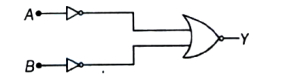
Which logic gate is represented by the following combination of logic gates?
A
$NAND$
B
$AND$
C
$NOR$
D
$OR$
Solution
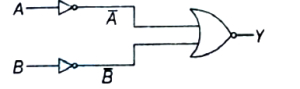
(B) The given circuit consists of two $NOT$ gates connected to the inputs $A$ and $B$,followed by a $NOR$ gate.
Let the inputs to the $NOR$ gate be $\bar{A}$ and $\bar{B}$.
The output $Y$ of the $NOR$ gate is given by:
$Y = \overline{\bar{A} + \bar{B}}$
Using De Morgan's Law,$\overline{x + y} = \bar{x} \cdot \bar{y}$,we get:
$Y = \overline{\bar{A}} \cdot \overline{\bar{B}}$
Since $\overline{\bar{A}} = A$ and $\overline{\bar{B}} = B$,the expression simplifies to:
$Y = A \cdot B$
This is the Boolean expression for an $AND$ gate.
Therefore,the combination represents an $AND$ gate.
Let the inputs to the $NOR$ gate be $\bar{A}$ and $\bar{B}$.
The output $Y$ of the $NOR$ gate is given by:
$Y = \overline{\bar{A} + \bar{B}}$
Using De Morgan's Law,$\overline{x + y} = \bar{x} \cdot \bar{y}$,we get:
$Y = \overline{\bar{A}} \cdot \overline{\bar{B}}$
Since $\overline{\bar{A}} = A$ and $\overline{\bar{B}} = B$,the expression simplifies to:
$Y = A \cdot B$
This is the Boolean expression for an $AND$ gate.
Therefore,the combination represents an $AND$ gate.
0 likesView Solution
23
ChemistryEasyMCQKCET · 2022
The volume of $2.8 \ g$ of $CO$ at $27^{\circ} C$ and $0.821 \ atm$ pressure is (Given: $R = 0.08210 \ L \ atm \ K^{-1} \ mol^{-1}$) (in $L$)
A
$1.5$
B
$3$
C
$30$
D
$0.3$
Solution
(B) Given,mass of $CO = 2.8 \ g$.
Temperature $T = 27 + 273 = 300 \ K$.
Pressure $p = 0.821 \ atm$.
Gas constant $R = 0.08210 \ L \ atm \ K^{-1} \ mol^{-1}$.
Molar mass of $CO = 12 + 16 = 28 \ g \ mol^{-1}$.
Number of moles $n = \frac{2.8 \ g}{28 \ g \ mol^{-1}} = 0.1 \ mol$.
Using the ideal gas equation $pV = nRT$:
$V = \frac{nRT}{p} = \frac{0.1 \times 0.08210 \times 300}{0.821} = \frac{2.463}{0.821} = 3 \ L$.
Temperature $T = 27 + 273 = 300 \ K$.
Pressure $p = 0.821 \ atm$.
Gas constant $R = 0.08210 \ L \ atm \ K^{-1} \ mol^{-1}$.
Molar mass of $CO = 12 + 16 = 28 \ g \ mol^{-1}$.
Number of moles $n = \frac{2.8 \ g}{28 \ g \ mol^{-1}} = 0.1 \ mol$.
Using the ideal gas equation $pV = nRT$:
$V = \frac{nRT}{p} = \frac{0.1 \times 0.08210 \times 300}{0.821} = \frac{2.463}{0.821} = 3 \ L$.
0 likesView Solution
24
ChemistryMCQKCET · 2022
Cuscuta is an example of
A
ectoparasitism
B
brood parasitism
C
predation
D
endoparasitism
Solution
(A) $Cuscuta$ is an example of ectoparasitism.
$Cuscuta$ is a parasitic plant that lacks chlorophyll and leaves. It derives its nutrition from the host plant by growing on its surface,which classifies it as an ectoparasite.
$Cuscuta$ is a parasitic plant that lacks chlorophyll and leaves. It derives its nutrition from the host plant by growing on its surface,which classifies it as an ectoparasite.
0 likesView Solution
25
ChemistryEasyMCQKCET · 2022
Elements $X, Y$ and $Z$ have atomic numbers $19, 37$ and $55$ respectively. Which of the following statements is true about them?
A
$Y$ would have an ionisation potential between those of $X$ and $Z$.
B
$Z$ would have the highest ionisation potential.
C
$Y$ would have the highest ionisation potential.
D
Their ionisation potential would increase with increasing atomic number.
Solution
(A) Elements $X, Y$ and $Z$ with atomic numbers $19, 37$ and $55$ are $K, Rb$ and $Cs$ respectively.
These elements belong to group-$I$ of the periodic table.
On moving down the group,the atomic size increases,which leads to a decrease in the ionisation potential.
Therefore,the order of ionisation potential is $X > Y > Z$.
Thus,$Y$ has an ionisation potential between those of $X$ and $Z$.
These elements belong to group-$I$ of the periodic table.
On moving down the group,the atomic size increases,which leads to a decrease in the ionisation potential.
Therefore,the order of ionisation potential is $X > Y > Z$.
Thus,$Y$ has an ionisation potential between those of $X$ and $Z$.
0 likesView Solution
26
ChemistryMediumMCQKCET · 2022
If the wavelength of a photon is $2.2 \times 10^{-11} \ m$ and $h = 6.6 \times 10^{-34} \ J \ s$,then the momentum of the photon is:
A
$3.33 \times 10^{-22} \ kg \ m \ s^{-1}$
B
$1.452 \times 10^{-44} \ kg \ m \ s^{-1}$
C
$6.89 \times 10^{+43} \ kg \ m \ s^{-1}$
D
$3 \times 10^{-23} \ kg \ m \ s^{-1}$
Solution
(D) Given,wavelength of photon,$\lambda = 2.2 \times 10^{-11} \ m$.
Planck constant,$h = 6.6 \times 10^{-34} \ J \ s$.
According to the de Broglie relation,$\lambda = \frac{h}{p}$.
Therefore,the momentum $p = \frac{h}{\lambda}$.
Substituting the values: $p = \frac{6.6 \times 10^{-34} \ J \ s}{2.2 \times 10^{-11} \ m} = 3 \times 10^{-23} \ kg \ m \ s^{-1}$.
Planck constant,$h = 6.6 \times 10^{-34} \ J \ s$.
According to the de Broglie relation,$\lambda = \frac{h}{p}$.
Therefore,the momentum $p = \frac{h}{\lambda}$.
Substituting the values: $p = \frac{6.6 \times 10^{-34} \ J \ s}{2.2 \times 10^{-11} \ m} = 3 \times 10^{-23} \ kg \ m \ s^{-1}$.
0 likesView Solution
27
ChemistryEasyMCQKCET · 2022
The work done when $2 \ mol$ of an ideal gas expands reversibly and isothermally from a volume of $1 \ L$ to $10 \ L$ at $300 \ K$ is $(R = 0.0083 \ kJ \ K^{-1} \ mol^{-1})$ (in $kJ$)
A
$5.8$
B
$0.115$
C
$58.5$
D
$11.5$
Solution
(D) Given: $n = 2 \ mol$,$V_1 = 1 \ L$,$V_2 = 10 \ L$,$T = 300 \ K$,$R = 0.0083 \ kJ \ K^{-1} \ mol^{-1}$.
For a reversible isothermal expansion,the work done is given by the formula:
$W = -2.303 \ nRT \log \frac{V_2}{V_1}$.
Substituting the values:
$W = -2.303 \times 2 \times 0.0083 \times 300 \times \log \frac{10}{1}$.
$W = -2.303 \times 2 \times 0.0083 \times 300 \times 1$.
$W = -11.47 \ kJ \approx -11.5 \ kJ$.
The magnitude of work done by the system is $11.5 \ kJ$.
For a reversible isothermal expansion,the work done is given by the formula:
$W = -2.303 \ nRT \log \frac{V_2}{V_1}$.
Substituting the values:
$W = -2.303 \times 2 \times 0.0083 \times 300 \times \log \frac{10}{1}$.
$W = -2.303 \times 2 \times 0.0083 \times 300 \times 1$.
$W = -11.47 \ kJ \approx -11.5 \ kJ$.
The magnitude of work done by the system is $11.5 \ kJ$.
0 likesView Solution
28
ChemistryEasyMCQKCET · 2022
The major product obtained when ethanol is heated with excess of conc. $H_2SO_4$ at $443 \ K$ is:
A
ethyne
B
ethane
C
methane
D
ethene
Solution
(D) The reaction of ethanol with excess concentrated $H_2SO_4$ at $443 \ K$ is a dehydration reaction.
In this process,a molecule of water is removed from ethanol to form ethene.
The chemical equation is:
$CH_3CH_2OH \xrightarrow[443 \ K]{\text{Conc. } H_2SO_4} CH_2=CH_2 + H_2O$
In this process,a molecule of water is removed from ethanol to form ethene.
The chemical equation is:
$CH_3CH_2OH \xrightarrow[443 \ K]{\text{Conc. } H_2SO_4} CH_2=CH_2 + H_2O$
0 likesView Solution
29
ChemistryEasyMCQKCET · 2022
In Kolbe's reaction,the reacting substances are:
A
phenol and $CCl_4$
B
sodium phenolate and $CCl_4$
C
phenol and $CHCl_3$
D
sodium phenolate and $CO_2$
Solution
(D) In Kolbe's reaction,phenol is first converted to sodium phenolate by reaction with $NaOH$.
Then,sodium phenolate reacts with $CO_2$ under pressure,followed by acidification to form salicylic acid.
The reaction is as follows:
$C_6H_5OH + NaOH \rightarrow C_6H_5ONa + H_2O$
$C_6H_5ONa + CO_2 \xrightarrow{H^+} \text{Salicylic acid}$
Thus,the reacting substances for the carboxylation step are sodium phenolate and $CO_2$.
Then,sodium phenolate reacts with $CO_2$ under pressure,followed by acidification to form salicylic acid.
The reaction is as follows:
$C_6H_5OH + NaOH \rightarrow C_6H_5ONa + H_2O$
$C_6H_5ONa + CO_2 \xrightarrow{H^+} \text{Salicylic acid}$
Thus,the reacting substances for the carboxylation step are sodium phenolate and $CO_2$.
0 likesView Solution
30
ChemistryDifficultMCQKCET · 2022
Among the following,the products formed by the reaction of anisole with $HI$ are
A
sodium phenate + methanol
B
benzene + methanol
C
phenol + methane
D
phenol + iodomethane
Solution
(D) The reaction of anisole $(C_6H_5OCH_3)$ with $HI$ involves the cleavage of the $C-O$ bond between the methyl group and the oxygen atom.
This occurs because the $C_6H_5-O$ bond has partial double bond character due to resonance,making it stronger and harder to break.
The reaction is:
$C_6H_5OCH_3 + HI \rightarrow C_6H_5OH + CH_3I$
Thus,the products formed are phenol and iodomethane.
This occurs because the $C_6H_5-O$ bond has partial double bond character due to resonance,making it stronger and harder to break.
The reaction is:
$C_6H_5OCH_3 + HI \rightarrow C_6H_5OH + CH_3I$
Thus,the products formed are phenol and iodomethane.
0 likesView Solution
31
ChemistryMediumMCQKCET · 2022
Which of the following reactions cannot be used to prepare benzaldehyde?
A
Benzoic acid $\xrightarrow{Zn-Hg \text{ and conc. } HCl}$
B
Toluene $\xrightarrow[(ii) H_3O^{+}]{(i) CrO_2Cl_2 \text{ in } CS_2}$ Benzaldehyde
C
Benzoyl chloride $+ H_2 \xrightarrow{Pd-BaSO_4}$ Benzaldehyde
D
Benzene $+ CO + HCl \xrightarrow{\text{Anhyd. } AlCl_3}$ Benzaldehyde
Solution
(A) The reaction in option $(A)$ involves Clemmensen reduction conditions $(Zn-Hg/HCl)$,which are used to reduce carbonyl groups (aldehydes or ketones) to methylene groups $(-CH_2-)$. Carboxylic acids are generally inert to these conditions,so benzaldehyde cannot be prepared from benzoic acid using this method.
Option $(B)$ is the Etard reaction,which produces benzaldehyde from toluene.
Option $(C)$ is the Rosenmund reduction,which produces benzaldehyde from benzoyl chloride.
Option $(D)$ is the Gattermann-Koch reaction,which produces benzaldehyde from benzene.
Option $(B)$ is the Etard reaction,which produces benzaldehyde from toluene.
Option $(C)$ is the Rosenmund reduction,which produces benzaldehyde from benzoyl chloride.
Option $(D)$ is the Gattermann-Koch reaction,which produces benzaldehyde from benzene.
0 likesView Solution
32
ChemistryEasyMCQKCET · 2022
The general name of the compound formed by the reaction between aldehyde and alcohol is
A
acetal
B
glycol
C
acetate
D
ester
Solution
(A) Aldehydes react with alcohols in the presence of dry $HCl$ gas to form hemiacetals,which further react with another molecule of alcohol to form acetals.
The reaction is as follows:
$R-CHO + R'-OH \rightleftharpoons R-CH(OH)(OR')$ (Hemiacetal)
$R-CH(OH)(OR') + R'-OH \rightleftharpoons R-CH(OR')_2 + H_2O$ (Acetal)
The reaction is as follows:
$R-CHO + R'-OH \rightleftharpoons R-CH(OH)(OR')$ (Hemiacetal)
$R-CH(OH)(OR') + R'-OH \rightleftharpoons R-CH(OR')_2 + H_2O$ (Acetal)
0 likesView Solution
33
ChemistryMediumMCQKCET · 2022
The test to differentiate between $\text{pentan-2-one}$ and $\text{pentan-3-one}$ is
A
Benedict's test
B
Fehling's test
C
Iodoform test
D
Baeyer's test
Solution
(C) $\text{Pentan-2-one}$ contains a $CH_3CO-$ group,which gives a positive iodoform test when reacted with $I_2$ and $NaOH$,resulting in yellow precipitates of iodoform $(CHI_3)$.
$\text{Pentan-3-one}$ does not contain a $CH_3CO-$ group and therefore does not give the iodoform test.
The reaction for $\text{pentan-2-one}$ is:
$CH_3CH_2CH_2COCH_3 + 3NaOI \rightarrow CH_3CH_2CH_2COONa + CHI_3 \downarrow + 2NaOH$
$\text{Pentan-3-one}$ does not contain a $CH_3CO-$ group and therefore does not give the iodoform test.
The reaction for $\text{pentan-2-one}$ is:
$CH_3CH_2CH_2COCH_3 + 3NaOI \rightarrow CH_3CH_2CH_2COONa + CHI_3 \downarrow + 2NaOH$
0 likesView Solution
34
ChemistryEasyMCQKCET · 2022
In the carbylamine test for primary amines,the resulting foul-smelling product is:
A
$CH_3CN$
B
$R-NC$ (isocyanide)
C
$COCl_2$
D
$CH_3NCl_2$
Solution
(B) The carbylamine test is a chemical test for the detection of primary amines. In this reaction,a primary amine is heated with chloroform $(CHCl_3)$ and an alcoholic solution of potassium hydroxide $(KOH)$. The reaction produces an isocyanide (also known as a carbylamine),which has a characteristic foul smell. The general reaction is: $R-NH_2 + CHCl_3 + 3KOH \rightarrow R-NC + 3KCl + 3H_2O$. Among the given options,the general product is an isocyanide $(R-NC)$.
0 likesView Solution
35
ChemistryMediumMCQKCET · 2022
$A$ secondary amine is
A
a compound with two carbon atoms and an $NH_2$ group
B
a compound with an $NH_2$ group on the carbon atom in number $2$ position
C
a compound in which $2$ of the hydrogen atoms of $NH_3$ have been replaced by organic groups
D
an organic compound with two $NH_2$ groups
Solution
(C) secondary amine is a compound in which $2$ of the hydrogen atoms of $NH_3$ have been replaced by organic groups. The general structure is $R_2NH$,where $R$ represents an alkyl or aryl group. For example,dimethylamine $(CH_3)_2NH$ is a secondary amine.
0 likesView Solution
36
ChemistryEasyMCQKCET · 2022
Which institute has approved the emergency use of $2-$deoxy$-D-$glucose as additive therapy for $COVID-19$ patients?
A
World Health Organisation
B
Ministry of Health and Family Welfare
C
Drug Controller General of India
D
India Council of Medical Research
Solution
(C) The $2-$deoxy$-D-$glucose $(2-DG)$ was developed by the Institute of Nuclear Medicine and Allied Sciences $(INMAS)$,a laboratory of the Defence Research and Development Organisation $(DRDO)$,in collaboration with Dr. Reddy's Laboratories. The emergency use of this drug as an additive therapy for $COVID-19$ patients was approved by the Drug Controller General of India $(DCGI)$.
0 likesView Solution
37
ChemistryEasyMCQKCET · 2022
$A$ nucleic acid,whether $DNA$ or $RNA$,gives on complete hydrolysis,two purine bases,two pyrimidine bases,a pentose sugar,and phosphoric acid. Nucleotides,which are intermediate products in the hydrolysis,contain:
A
a purine base,pentose sugar and ortho-phosphoric acid
B
purine or pyrimidine base and ortho-phosphoric acid
C
purine or pyrimidine base,a pentose sugar and ortho-phosphoric acid
D
purine or pyrimidine base and pentose sugar
Solution
(C) nucleotide is composed of three components: a nitrogenous base (purine or pyrimidine),a pentose sugar,and ortho-phosphoric acid.
These three components are linked together to form the monomeric unit of nucleic acids.
These three components are linked together to form the monomeric unit of nucleic acids.
0 likesView Solution
38
ChemistryMediumMCQKCET · 2022
Ethanoic acid undergoes Hell-Volhard Zelinsky reaction but methanoic acid does not,because of
A
presence of $\alpha-H$ atom in ethanoic acid
B
absence of $\alpha-H$ atom in ethanoic acid
C
higher acidic strength of ethanoic acid than methanoic acid
D
presence of $\alpha-H$ atom in methanoic acid
Solution
(A) The Hell-Volhard Zelinsky $(HVZ)$ reaction is specific to carboxylic acids that contain at least one $\alpha$-hydrogen atom.
Ethanoic acid $(CH_3COOH)$ contains an $\alpha$-carbon atom attached to three $\alpha$-hydrogen atoms,allowing it to undergo the $HVZ$ reaction.
Methanoic acid $(HCOOH)$ does not have an $\alpha$-carbon atom,and consequently,it lacks $\alpha$-hydrogen atoms,which prevents it from undergoing the $HVZ$ reaction.
Ethanoic acid $(CH_3COOH)$ contains an $\alpha$-carbon atom attached to three $\alpha$-hydrogen atoms,allowing it to undergo the $HVZ$ reaction.
Methanoic acid $(HCOOH)$ does not have an $\alpha$-carbon atom,and consequently,it lacks $\alpha$-hydrogen atoms,which prevents it from undergoing the $HVZ$ reaction.
0 likesView Solution
39
ChemistryEasyMCQKCET · 2022
The rate of the reaction,$CH_3COOC_2H_5 + NaOH \longrightarrow CH_3COONa + C_2H_5OH$ is given by the equation,$\text{rate} = k[CH_3COOC_2H_5][NaOH]$. If concentration is expressed in $mol \ L^{-1}$,the unit of $k$ is
A
$mol \ L^{-1} \ s^{-1}$
B
$L \ mol^{-1} \ s^{-1}$
C
$s^{-1}$
D
$mol^{-2} \ L^2 \ s^{-1}$
Solution
(B) The given rate law is $\text{rate} = k[CH_3COOC_2H_5][NaOH]$.
Since the sum of the powers of the concentration terms is $1 + 1 = 2$,the reaction is of second order.
The unit of the rate constant $k$ for a reaction of order $n$ is given by $(mol \ L^{-1})^{1-n} \ s^{-1}$.
For $n = 2$,the unit is $(mol \ L^{-1})^{1-2} \ s^{-1} = (mol \ L^{-1})^{-1} \ s^{-1} = L \ mol^{-1} \ s^{-1}$.
Since the sum of the powers of the concentration terms is $1 + 1 = 2$,the reaction is of second order.
The unit of the rate constant $k$ for a reaction of order $n$ is given by $(mol \ L^{-1})^{1-n} \ s^{-1}$.
For $n = 2$,the unit is $(mol \ L^{-1})^{1-2} \ s^{-1} = (mol \ L^{-1})^{-1} \ s^{-1} = L \ mol^{-1} \ s^{-1}$.
0 likesView Solution
40
ChemistryEasyMCQKCET · 2022
For $n$th order of reaction,half-life period is directly proportional to
A
$1 / a^{1-n}$
B
$a^{n-1}$
C
$a^{1-n}$
D
$1 / a^{n-1}$
Solution
(C) For a reaction of $n$th order,the integrated rate law is given by $k = \frac{1}{(n-1)t} [\frac{1}{(A_t)^{n-1}} - \frac{1}{(A_0)^{n-1}}]$.
At half-life,$t = t_{1/2}$ and $A_t = A_0 / 2$.
Substituting these values,we get $t_{1/2} \propto \frac{1}{(A_0)^{n-1}}$,which can also be written as $t_{1/2} \propto (A_0)^{1-n}$.
Therefore,the half-life period is directly proportional to $a^{1-n}$ where $a$ is the initial concentration.
At half-life,$t = t_{1/2}$ and $A_t = A_0 / 2$.
Substituting these values,we get $t_{1/2} \propto \frac{1}{(A_0)^{n-1}}$,which can also be written as $t_{1/2} \propto (A_0)^{1-n}$.
Therefore,the half-life period is directly proportional to $a^{1-n}$ where $a$ is the initial concentration.
0 likesView Solution
41
ChemistryEasyMCQKCET · 2022
Half-life of a reaction is found to be inversely proportional to the fifth power of its initial concentration,the order of reaction is
A
$4$
B
$5$
C
$6$
D
$3$
Solution
(C) The half-life period $(t_{1/2})$ of an $n$th order reaction is related to the initial concentration $(a)$ as:
$t_{1/2} \propto \frac{1}{a^{n-1}}$
Given that $t_{1/2} \propto \frac{1}{a^5}$,we can compare the exponents:
$n - 1 = 5$
$n = 6$
Therefore,the order of the reaction is $6$.
$t_{1/2} \propto \frac{1}{a^{n-1}}$
Given that $t_{1/2} \propto \frac{1}{a^5}$,we can compare the exponents:
$n - 1 = 5$
$n = 6$
Therefore,the order of the reaction is $6$.
0 likesView Solution
42
ChemistryMediumMCQKCET · 2022
$A$ first order reaction is half completed in $45 \ min$. How long does it need $99.9 \%$ of the reaction to be completed (in $Hours$)?
A
$7.5$
B
$10$
C
$20$
D
$5$
Solution
(A) For a first order reaction,the rate constant $k$ is given by $k = \frac{0.693}{t_{1/2}}$.
Given $t_{1/2} = 45 \ min$,so $k = \frac{0.693}{45} \ min^{-1}$.
For $99.9 \%$ completion,the amount remaining $(a-x)$ is $100 - 99.9 = 0.1$.
The time $t$ required is $t = \frac{2.303}{k} \log \frac{a}{a-x}$.
Substituting the values: $t = \frac{2.303}{0.693 / 45} \log \frac{100}{0.1} = \frac{2.303 \times 45}{0.693} \log 1000$.
Since $\log 1000 = 3$,we have $t = \frac{2.303 \times 45 \times 3}{0.693} \approx 448.5 \ min$.
Converting to hours: $t = \frac{448.5}{60} \approx 7.475 \ hrs \approx 7.5 \ hours$.
Given $t_{1/2} = 45 \ min$,so $k = \frac{0.693}{45} \ min^{-1}$.
For $99.9 \%$ completion,the amount remaining $(a-x)$ is $100 - 99.9 = 0.1$.
The time $t$ required is $t = \frac{2.303}{k} \log \frac{a}{a-x}$.
Substituting the values: $t = \frac{2.303}{0.693 / 45} \log \frac{100}{0.1} = \frac{2.303 \times 45}{0.693} \log 1000$.
Since $\log 1000 = 3$,we have $t = \frac{2.303 \times 45 \times 3}{0.693} \approx 448.5 \ min$.
Converting to hours: $t = \frac{448.5}{60} \approx 7.475 \ hrs \approx 7.5 \ hours$.
0 likesView Solution
43
ChemistryEasyMCQKCET · 2022
The correct $IUPAC$ name of $cis-$platin is
A
diamminedichloridoplatinum $(IV)$
B
diamminedichloridoplatinum $(0)$
C
dichloridodiammineplatinum $(IV)$
D
diamminedichloridoplatinum $(II)$
Solution
(D) The chemical formula of $cis-$platin is $[Pt(NH_3)_2Cl_2]$.
In this coordination complex,the oxidation state of $Pt$ is calculated as $x + 2(0) + 2(-1) = 0$,which gives $x = +2$.
According to $IUPAC$ nomenclature rules for coordination compounds,ligands are named in alphabetical order: ammine $(NH_3)$ comes before chlorido $(Cl^-)$.
Thus,the name is diamminedichloridoplatinum $(II)$.
In this coordination complex,the oxidation state of $Pt$ is calculated as $x + 2(0) + 2(-1) = 0$,which gives $x = +2$.
According to $IUPAC$ nomenclature rules for coordination compounds,ligands are named in alphabetical order: ammine $(NH_3)$ comes before chlorido $(Cl^-)$.
Thus,the name is diamminedichloridoplatinum $(II)$.
0 likesView Solution
44
ChemistryEasyMCQKCET · 2022
$A$ transition metal exists in its highest oxidation state. It is expected to behave as
A
a central metal in a coordination compound
B
an oxidising agent
C
a reducing agent
D
a chelating agent
Solution
(B) When a transition metal is in its highest oxidation state,it cannot be further oxidized.
Instead,it can easily gain electrons to reach a lower oxidation state.
Therefore,it acts as an oxidising agent.
Instead,it can easily gain electrons to reach a lower oxidation state.
Therefore,it acts as an oxidising agent.
0 likesView Solution
45
ChemistryEasyMCQKCET · 2022
What will be the value of $x$ in $Fe^{x+}$,if the magnetic moment,$\mu=\sqrt{24} \ BM$?
A
$3$
B
$0$
C
$1$
D
$2$
Solution
(D) The magnetic moment is given by the formula $\mu = \sqrt{n(n+2)} \ BM$,where $n$ is the number of unpaired electrons.
Given $\mu = \sqrt{24} \ BM$,we have $\sqrt{n(n+2)} = \sqrt{24}$.
Squaring both sides,$n(n+2) = 24$,which simplifies to $n^2 + 2n - 24 = 0$.
Solving the quadratic equation: $(n+6)(n-4) = 0$.
Since the number of electrons cannot be negative,$n = 4$.
The electronic configuration of $Fe$ $(Z=26)$ is $[Ar] 3d^6 4s^2$.
For $Fe^{2+}$,the configuration is $[Ar] 3d^6$,which has $4$ unpaired electrons.
Thus,$x = 2$.
Given $\mu = \sqrt{24} \ BM$,we have $\sqrt{n(n+2)} = \sqrt{24}$.
Squaring both sides,$n(n+2) = 24$,which simplifies to $n^2 + 2n - 24 = 0$.
Solving the quadratic equation: $(n+6)(n-4) = 0$.
Since the number of electrons cannot be negative,$n = 4$.
The electronic configuration of $Fe$ $(Z=26)$ is $[Ar] 3d^6 4s^2$.
For $Fe^{2+}$,the configuration is $[Ar] 3d^6$,which has $4$ unpaired electrons.
Thus,$x = 2$.
0 likesView Solution
46
ChemistryEasyMCQKCET · 2022
The complex hexamineplatinum$(IV)$ chloride will give how many ions upon ionization?
A
$4$
B
$3$
C
$2$
D
$5$
Solution
(D) The chemical formula of hexamineplatinum$(IV)$ chloride is $[Pt(NH_3)_6]Cl_4$.
Upon ionization in an aqueous solution,it dissociates as follows:
$[Pt(NH_3)_6]Cl_4 \rightarrow [Pt(NH_3)_6]^{4+} + 4Cl^-$.
This results in one complex cation $[Pt(NH_3)_6]^{4+}$ and four chloride anions $4Cl^-$.
Total number of ions = $1 + 4 = 5$ ions.
Upon ionization in an aqueous solution,it dissociates as follows:
$[Pt(NH_3)_6]Cl_4 \rightarrow [Pt(NH_3)_6]^{4+} + 4Cl^-$.
This results in one complex cation $[Pt(NH_3)_6]^{4+}$ and four chloride anions $4Cl^-$.
Total number of ions = $1 + 4 = 5$ ions.
0 likesView Solution
47
ChemistryMediumMCQKCET · 2022
Crystal field splitting energy $(CFSE)$ for $[CoCl_6]^{4-}$ is $18000 \ cm^{-1}$. The crystal field splitting energy $(CFSE)$ for $[CoCl_4]^{2-}$ will be (in $cm^{-1}$)
A
$16000$
B
$8000$
C
$10000$
D
$18000$
Solution
(B) $[CoCl_6]^{4-}$ is an octahedral complex,so its $CFSE$ value is $\Delta_0 = 18000 \ cm^{-1}$.
$[CoCl_4]^{2-}$ is a tetrahedral complex,so its $CFSE$ value is $\Delta_t$.
The relationship between tetrahedral and octahedral splitting is given by $\Delta_t = \frac{4}{9} \Delta_0$.
Substituting the value: $\Delta_t = \frac{4}{9} \times 18000 \ cm^{-1} = 8000 \ cm^{-1}$.
$[CoCl_4]^{2-}$ is a tetrahedral complex,so its $CFSE$ value is $\Delta_t$.
The relationship between tetrahedral and octahedral splitting is given by $\Delta_t = \frac{4}{9} \Delta_0$.
Substituting the value: $\Delta_t = \frac{4}{9} \times 18000 \ cm^{-1} = 8000 \ cm^{-1}$.
0 likesView Solution
48
ChemistryMediumMCQKCET · 2022
All $Cu(II)$ halides are known,except the iodide. The reason for this is that:
A
$Cu^{2+}$ oxidises iodide to iodine
B
$Cu^{2+}$ has much more negative hydration enthalpy
C
$Cu^{2+}$ ion has smaller size
D
iodide is a bulky ion
Solution
(A) $Cu^{2+}$ is a strong oxidizing agent and $I^{-}$ is a strong reducing agent. $Cu^{2+}$ oxidizes $I^{-}$ to $I_2$ as follows:
$2Cu^{2+} + 4I^{-}$ $\longrightarrow 2CuI_2$ $\longrightarrow 2CuI + I_2$.
Thus,$CuI_2$ is unstable and decomposes to form $CuI$ and $I_2$.
$2Cu^{2+} + 4I^{-}$ $\longrightarrow 2CuI_2$ $\longrightarrow 2CuI + I_2$.
Thus,$CuI_2$ is unstable and decomposes to form $CuI$ and $I_2$.
0 likesView Solution
49
ChemistryMediumMCQKCET · 2022
The only lanthanoid which is radioactive is:
A
Cerium
B
Promethium
C
Praseodymium
D
Lanthanum
Solution
(B) Among the lanthanoids (atomic numbers $57-71$),$Promethium$ ($Pm$,atomic number $61$) is the only element that is radioactive.
0 likesView Solution
50
ChemistryEasyMCQKCET · 2022
For the spontaneity of a cell,which of the following is correct?
A
$\Delta G = -\text{ve}, \Delta E = 0$
B
$\Delta G = +\text{ve}, \Delta E = +\text{ve}$
C
$\Delta G = -\text{ve}$
D
$\Delta G = 0, \Delta E = 0$
Solution
(C) For a cell reaction to be spontaneous,the Gibbs free energy change $(\Delta G)$ must be negative.
Since $\Delta G = -nFE_{\text{cell}}$,a negative $\Delta G$ implies that the cell potential $(E_{\text{cell}})$ must be positive.
Since $\Delta G = -nFE_{\text{cell}}$,a negative $\Delta G$ implies that the cell potential $(E_{\text{cell}})$ must be positive.
0 likesView Solution
51
ChemistryMediumMCQKCET · 2022
In fuel cells,$Pt-Pd$ are used as catalysts. Identify the full names of these catalysts.
A
nickel-cadmium
B
zinc-mercury
C
lead-manganese
D
platinum-palladium
Solution
(D) In fuel cells,$Pt$ stands for platinum and $Pd$ stands for palladium. These metals are used as catalysts to increase the rate of the electrochemical reactions occurring at the electrodes.
0 likesView Solution
52
ChemistryMediumMCQKCET · 2022
The molar conductivity is maximum for the solution of concentration (in $M$)
A
$0.002$
B
$0.005$
C
$0.001$
D
$0.004$
Solution
(C) We know that,molar conductivity,$\Lambda_{m} = \frac{\kappa \times 1000}{M}$.
This implies that $\Lambda_{m}$ is inversely proportional to the molarity $(M)$.
The solution with the lowest concentration will have the maximum molar conductivity.
Comparing the given concentrations,$0.001 \ M$ is the lowest concentration.
Therefore,the solution with $0.001 \ M$ concentration has the maximum molar conductivity.
This implies that $\Lambda_{m}$ is inversely proportional to the molarity $(M)$.
The solution with the lowest concentration will have the maximum molar conductivity.
Comparing the given concentrations,$0.001 \ M$ is the lowest concentration.
Therefore,the solution with $0.001 \ M$ concentration has the maximum molar conductivity.
0 likesView Solution
53
ChemistryMediumMCQKCET · 2022
Specific conductance of $0.1 \ M \ HNO_3$ is $6.3 \times 10^{-2} \ \Omega^{-1} \ cm^{-1}$. The molar conductance of the solution is
A
$315 \ \Omega^{-1} \ cm^2 \ mol^{-1}$
B
$6300 \ \Omega^{-1} \ cm^2 \ mol^{-1}$
C
$63.0 \ \Omega^{-1} \ cm^2 \ mol^{-1}$
D
$630 \ \Omega^{-1} \ cm^2 \ mol^{-1}$
Solution
(D) Given,specific conductance,$\kappa = 6.3 \times 10^{-2} \ \Omega^{-1} \ cm^{-1}$.
$HNO_3$ concentration,$c = 0.1 \ M$.
Molar conductance formula is $\Lambda_m = \frac{\kappa \times 1000}{c}$.
Substituting the values: $\Lambda_m = \frac{6.3 \times 10^{-2} \times 1000}{0.1} = \frac{63}{0.1} = 630 \ \Omega^{-1} \ cm^2 \ mol^{-1}$.
$HNO_3$ concentration,$c = 0.1 \ M$.
Molar conductance formula is $\Lambda_m = \frac{\kappa \times 1000}{c}$.
Substituting the values: $\Lambda_m = \frac{6.3 \times 10^{-2} \times 1000}{0.1} = \frac{63}{0.1} = 630 \ \Omega^{-1} \ cm^2 \ mol^{-1}$.
0 likesView Solution
54
ChemistryEasyMCQKCET · 2022
In the following pairs of halogen compounds,which compound undergoes faster $S_N 1$ reaction?

A
$(i)$ $2$-chloro$-2-$methylpropane and (ii) $2$-chloropentane
B
$(i)$ $2$-chloropentane and (ii) $1$-chloropentane
C
$(i)$ $2$-chloro$-2-$methylpropane and (ii) $1$-chloropentane
D
$(i)$ $2$-chloropentane and (ii) $2$-chlorohexane
Solution
(A) The rate of $S_N 1$ reaction depends on the stability of the carbocation intermediate formed during the rate-determining step.
The stability order of carbocations is $3^{\circ} > 2^{\circ} > 1^{\circ}$.
In pair $(i)$,$2$-chloro$-2-$methylpropane forms a $3^{\circ}$ carbocation,which is more stable than the $2^{\circ}$ carbocation formed by $2$-chloropentane.
In pair (ii),$2$-chloropentane forms a $2^{\circ}$ carbocation,which is more stable than the $1^{\circ}$ carbocation formed by $1$-chloropentane.
Therefore,both $2$-chloro$-2-$methylpropane and $2$-chloropentane undergo faster $S_N 1$ reactions compared to their respective counterparts in the given pairs.
The stability order of carbocations is $3^{\circ} > 2^{\circ} > 1^{\circ}$.
In pair $(i)$,$2$-chloro$-2-$methylpropane forms a $3^{\circ}$ carbocation,which is more stable than the $2^{\circ}$ carbocation formed by $2$-chloropentane.
In pair (ii),$2$-chloropentane forms a $2^{\circ}$ carbocation,which is more stable than the $1^{\circ}$ carbocation formed by $1$-chloropentane.
Therefore,both $2$-chloro$-2-$methylpropane and $2$-chloropentane undergo faster $S_N 1$ reactions compared to their respective counterparts in the given pairs.
0 likesView Solution
55
ChemistryMediumMCQKCET · 2022
Identify the products $A$ and $B$ in the reactions :
$R-X + AgCN \longrightarrow A + AgX$
$R-X + KCN \longrightarrow B + KX$
$R-X + AgCN \longrightarrow A + AgX$
$R-X + KCN \longrightarrow B + KX$
A
$A = R-CN ; B = R-NC$
B
$A = R-NC ; B = R-CN$
C
$A = R-NC ; B = R-NC$
D
$A = R-CN ; B = R-CN$
Solution
(B) $R-X + AgCN \longrightarrow R-NC + AgX$
$R-X + KCN \longrightarrow R-CN + KX$
$KCN$ is predominantly ionic in nature,providing $CN^-$ ions in solution. The carbon atom is more nucleophilic,leading to the formation of alkyl cyanide $(R-CN)$.
$AgCN$ is predominantly covalent in nature. The nitrogen atom has a lone pair available for bonding,while the carbon atom is involved in the covalent bond with silver. This leads to the formation of alkyl isocyanide $(R-NC)$.
$R-X + KCN \longrightarrow R-CN + KX$
$KCN$ is predominantly ionic in nature,providing $CN^-$ ions in solution. The carbon atom is more nucleophilic,leading to the formation of alkyl cyanide $(R-CN)$.
$AgCN$ is predominantly covalent in nature. The nitrogen atom has a lone pair available for bonding,while the carbon atom is involved in the covalent bond with silver. This leads to the formation of alkyl isocyanide $(R-NC)$.
0 likesView Solution
56
ChemistryMediumMCQKCET · 2022
An organic compound with molecular formula $C_7H_8O$ dissolves in $NaOH$ and gives a characteristic colour with $FeCl_3$. On treatment with bromine,it gives a tribromo derivative $C_7H_5OBr_3$. The compound is
A
$o$-cresol
B
$m$-cresol
C
$p$-cresol
D
benzyl alcohol
Solution
(B) The molecular formula $C_7H_8O$ corresponds to cresols or benzyl alcohol.
Since the compound dissolves in $NaOH$,it must be acidic in nature,which indicates it is a phenol (cresol).
It gives a characteristic violet color with neutral $FeCl_3$,which is a test for phenolic groups.
Treatment with bromine water leads to a tribromo derivative,indicating the presence of three reactive positions (ortho and para) relative to the $-OH$ group.
All three isomers of cresol ($o$-,$m$-,and $p$-) satisfy these conditions. However,in many textbook contexts,$m$-cresol is often cited for such reactions.
Specifically,the reaction with $Br_2$ water on $m$-cresol yields $2,4,6$-tribromo-$m$-cresol.
Since the compound dissolves in $NaOH$,it must be acidic in nature,which indicates it is a phenol (cresol).
It gives a characteristic violet color with neutral $FeCl_3$,which is a test for phenolic groups.
Treatment with bromine water leads to a tribromo derivative,indicating the presence of three reactive positions (ortho and para) relative to the $-OH$ group.
All three isomers of cresol ($o$-,$m$-,and $p$-) satisfy these conditions. However,in many textbook contexts,$m$-cresol is often cited for such reactions.
Specifically,the reaction with $Br_2$ water on $m$-cresol yields $2,4,6$-tribromo-$m$-cresol.
0 likesView Solution
57
ChemistryMediumMCQKCET · 2022
Which one of the following chlorohydrocarbons readily undergoes solvolysis?
A
$C_6H_5Cl$
B
$C_6H_5CH_2Cl$
C
$C_6H_5CH_2CH_2Cl$
D
$CH_2=CHCl$
Solution
(B) Solvolysis proceeds via an $S_N1$ mechanism,which involves the formation of a carbocation intermediate. The rate of solvolysis depends on the stability of the carbocation formed.
$(a)$ $C_6H_5Cl$: The carbocation formed would be a phenyl cation,which is highly unstable.
$(b)$ $C_6H_5CH_2Cl$: The carbocation formed is $C_6H_5CH_2^+$,which is resonance-stabilized by the benzene ring (benzylic carbocation). This is the most stable among the options.
$(c)$ $C_6H_5CH_2CH_2Cl$: The carbocation formed is a primary alkyl carbocation,which is less stable than the benzylic carbocation.
$(d)$ $CH_2=CHCl$: The carbocation formed would be a vinyl cation,which is highly unstable due to the $sp$ hybridization of the positively charged carbon.
Therefore,$C_6H_5CH_2Cl$ readily undergoes solvolysis.
$(a)$ $C_6H_5Cl$: The carbocation formed would be a phenyl cation,which is highly unstable.
$(b)$ $C_6H_5CH_2Cl$: The carbocation formed is $C_6H_5CH_2^+$,which is resonance-stabilized by the benzene ring (benzylic carbocation). This is the most stable among the options.
$(c)$ $C_6H_5CH_2CH_2Cl$: The carbocation formed is a primary alkyl carbocation,which is less stable than the benzylic carbocation.
$(d)$ $CH_2=CHCl$: The carbocation formed would be a vinyl cation,which is highly unstable due to the $sp$ hybridization of the positively charged carbon.
Therefore,$C_6H_5CH_2Cl$ readily undergoes solvolysis.
0 likesView Solution
58
ChemistryDifficultMCQKCET · 2022
Heating $(NH_4)_2Cr_2O_7$ liberates a gas. The same gas is obtained by:
A
Heating $NH_4NO_2$
B
Treating $H_2O_2$ with $NaNO_2$
C
Treating $Mg_3N_2$ with $H_2O$
D
Heating $NH_4NO_3$
Solution
(A) The thermal decomposition of ammonium dichromate $(NH_4)_2Cr_2O_7$ produces nitrogen gas $(N_2)$:
$(NH_4)_2Cr_2O_7 \stackrel{\Delta}{\longrightarrow} N_2 \uparrow + Cr_2O_3 + 4H_2O$
Similarly,ammonium nitrite $(NH_4NO_2)$ on heating also liberates nitrogen gas $(N_2)$:
$NH_4NO_2 \stackrel{\Delta}{\longrightarrow} N_2 \uparrow + 2H_2O$
Thus,the same gas is obtained by heating $NH_4NO_2$.
$(NH_4)_2Cr_2O_7 \stackrel{\Delta}{\longrightarrow} N_2 \uparrow + Cr_2O_3 + 4H_2O$
Similarly,ammonium nitrite $(NH_4NO_2)$ on heating also liberates nitrogen gas $(N_2)$:
$NH_4NO_2 \stackrel{\Delta}{\longrightarrow} N_2 \uparrow + 2H_2O$
Thus,the same gas is obtained by heating $NH_4NO_2$.
0 likesView Solution
59
ChemistryDifficultMCQKCET · 2022
The strong reducing property of hypophosphorus acid $(H_3PO_2)$ is due to
A
the positive valency of phosphorus
B
two $P-H$ bonds
C
presence of phosphorus in its highest oxidation state
D
its concentration
Solution
(B) The strong reducing property of hypophosphorus acid $(H_3PO_2)$ is due to the presence of two $P-H$ bonds. The hydrogen atoms directly bonded to the phosphorus atom are responsible for its reducing character. The structure of $H_3PO_2$ is as follows:
$O=P(H)(H)(OH)$
$O=P(H)(H)(OH)$
0 likesView Solution
60
ChemistryEasyMCQKCET · 2022
The property of halogens which is not correctly matched is
A
$F > Cl > Br > I$ (Electronegativity)
B
$I > Br > Cl > F$ (Density)
C
$F > Cl > Br > I$ (Electron gain enthalpy)
D
$F > Cl > Br > I$ (Ionisation enthalpy)
Solution
(C) Down the group,electron gain enthalpies become less negative with the increase in the size of the halogen. However,the electron gain enthalpy of $F$ is less negative than $Cl$. This is due to the small size of the $F$-atom. As a result,there are strong inter-electronic repulsions in the relatively small $2p$-orbitals of $F$,and thus incoming electrons experience much less attraction. Thus,the correct order is $Cl > F > Br > I$. Therefore,the option $F > Cl > Br > I$ for electron gain enthalpy is incorrect.
0 likesView Solution
61
ChemistryEasyMCQKCET · 2022
Which noble gas has the least tendency to form compounds?
A
$Ne$
B
$Ar$
C
$Kr$
D
$He$
Solution
(D) Among the noble gases,$He$ (Helium) has the least tendency to form compounds.
This is because $He$ has the highest first ionization enthalpy among all elements in the periodic table,making it extremely stable and chemically inert.
This is because $He$ has the highest first ionization enthalpy among all elements in the periodic table,making it extremely stable and chemically inert.
0 likesView Solution
62
ChemistryEasyMCQKCET · 2022
Which of the following is correctly matched?
A
$Teflon - \text{Caprolactum}$
B
$Bakelite - \text{Novolac}$
C
$Polyester - \text{Tetrafluoroethene}$
D
$Nylon - \text{Acrylonitrile}$
Solution
(B) The correct pair is $Bakelite$ and $Novolac$.
$Bakelite$ is formed by the polymerization of $phenol$ and $formaldehyde$ monomers.
$Teflon$ is the polymer of $tetrafluoroethene$.
$Polyester$ is the polymer of $ethylene glycol$ and $terephthalic acid$.
$Nylon 6$ is the polymer of $caprolactum$.
$Bakelite$ is formed by the polymerization of $phenol$ and $formaldehyde$ monomers.
$Teflon$ is the polymer of $tetrafluoroethene$.
$Polyester$ is the polymer of $ethylene glycol$ and $terephthalic acid$.
$Nylon 6$ is the polymer of $caprolactum$.
0 likesView Solution
63
ChemistryEasyMCQKCET · 2022
Which of the following is not true about the amorphous solids?
A
They may become crystalline on keeping for long time.
B
Amorphous solids can be moulded by heating.
C
They are anisotropic in nature.
D
On heating they may become crystalline at certain temperature.
Solution
(C) Statement $(C)$ is incorrect.
Amorphous solids are isotropic in nature,meaning their physical properties (such as electrical conductivity or refractive index) are the same in all directions.
Crystalline solids,on the other hand,are anisotropic.
Amorphous solids are isotropic in nature,meaning their physical properties (such as electrical conductivity or refractive index) are the same in all directions.
Crystalline solids,on the other hand,are anisotropic.
0 likesView Solution
64
ChemistryMediumMCQKCET · 2022
Vacant space in body centered cubic $(BCC)$ lattice unit cell is about (in $\%$)
A
$10$
B
$23$
C
$46$
D
$32$
Solution
(D) For a $BCC$ unit cell,the number of atoms per unit cell is $2$.
The packing efficiency is calculated as:
$\text{Packing Efficiency} = \frac{Z \times \frac{4}{3} \pi r^3}{a^3} \times 100$.
For $BCC$,the relation between edge length $a$ and radius $r$ is $a = \frac{4r}{\sqrt{3}}$.
Substituting this,$\text{Packing Efficiency} = \frac{2 \times \frac{4}{3} \pi r^3}{(\frac{4}{\sqrt{3}} r)^3} \times 100 = 68 \%$.
Therefore,the vacant space (void space) is $100 \% - 68 \% = 32 \%$.
The packing efficiency is calculated as:
$\text{Packing Efficiency} = \frac{Z \times \frac{4}{3} \pi r^3}{a^3} \times 100$.
For $BCC$,the relation between edge length $a$ and radius $r$ is $a = \frac{4r}{\sqrt{3}}$.
Substituting this,$\text{Packing Efficiency} = \frac{2 \times \frac{4}{3} \pi r^3}{(\frac{4}{\sqrt{3}} r)^3} \times 100 = 68 \%$.
Therefore,the vacant space (void space) is $100 \% - 68 \% = 32 \%$.
0 likesView Solution
65
ChemistryEasyMCQKCET · 2022
How many atoms are there in a cube-based unit cell,having one atom on each corner and $2$ atoms on each body diagonal of the cube?
A
$6$
B
$4$
C
$9$
D
$8$
Solution
(C) cube has $8$ corners,and each corner atom contributes $\frac{1}{8}$ to the unit cell. So,atoms from corners $= 8 \times \frac{1}{8} = 1$.
$A$ cube has $4$ body diagonals. Each body diagonal contains $2$ atoms. Since these atoms are inside the body,they contribute fully $(1)$ to the unit cell.
So,atoms from body diagonals $= 4 \times 2 = 8$.
Total number of atoms $= 1 + 8 = 9$.
$A$ cube has $4$ body diagonals. Each body diagonal contains $2$ atoms. Since these atoms are inside the body,they contribute fully $(1)$ to the unit cell.
So,atoms from body diagonals $= 4 \times 2 = 8$.
Total number of atoms $= 1 + 8 = 9$.
0 likesView Solution
66
ChemistryEasyMCQKCET · 2022
Alkali halides do not show dislocation defect because
A
anions cannot be accommodated in vacant spaces
B
cations and anions have almost equal size
C
there is large difference in size of cations and anions
D
cations and anions have low coordination number
Solution
(B) Dislocation defect (Frenkel defect) occurs in ionic crystals where there is a large difference in the size of the ions,allowing the smaller ion (usually the cation) to occupy an interstitial site. In alkali halides,the sizes of the cations and anions are almost equal,which prevents the smaller ion from fitting into the interstitial spaces. Therefore,they do not show dislocation defect.
0 likesView Solution
67
ChemistryEasyMCQKCET · 2022
Which is most viscous?
A
Ethanol
B
Ethylene glycol
C
Glycerol
D
Methanol
Solution
(C) Viscosity is directly proportional to the extent of intermolecular hydrogen bonding.
Among the given options,$Glycerol$ $(CH_2OH-CHOH-CH_2OH)$ has the highest viscosity because it contains $3$ $-OH$ groups,allowing for extensive hydrogen bonding.
In comparison,$Ethylene \ glycol$ has $2$ $-OH$ groups,while $Ethanol$ and $Methanol$ each have only $1$ $-OH$ group.
Among the given options,$Glycerol$ $(CH_2OH-CHOH-CH_2OH)$ has the highest viscosity because it contains $3$ $-OH$ groups,allowing for extensive hydrogen bonding.
In comparison,$Ethylene \ glycol$ has $2$ $-OH$ groups,while $Ethanol$ and $Methanol$ each have only $1$ $-OH$ group.
0 likesView Solution
68
ChemistryEasyMCQKCET · 2022
Solubility of a gas in a liquid increases with
A
decrease of $p$ and increase of $T$
B
increase of $p$ and decrease of $T$
C
decrease of $p$ and decrease of $T$
D
increase of $p$ and increase of $T$
Solution
(B) According to Henry's Law,the solubility of a gas in a liquid is directly proportional to the partial pressure of the gas $(p)$ above the liquid surface.
Additionally,the dissolution of a gas in a liquid is an exothermic process. According to Le Chatelier's principle,decreasing the temperature $(T)$ favors the forward reaction,thereby increasing the solubility of the gas.
Additionally,the dissolution of a gas in a liquid is an exothermic process. According to Le Chatelier's principle,decreasing the temperature $(T)$ favors the forward reaction,thereby increasing the solubility of the gas.
0 likesView Solution
69
ChemistryEasyMCQKCET · 2022
The rise in boiling point of a solution containing $1.8 \ g$ of glucose in $100 \ g$ of solvent is $0.1^{\circ} C$. The molal elevation constant of the liquid is
A
$1 \ K \ kg / mol$
B
$2 \ K \ kg / mol$
C
$10 \ K \ kg / mol$
D
$0.1 \ K \ kg / mol$
Solution
(A) Given: Mass of glucose $(w) = 1.8 \ g$
Mass of solvent $(W) = 100 \ g$
Elevation in boiling point $(\Delta T_b) = 0.1^{\circ} C$
Molar mass of glucose $(M) = 180 \ g / mol$
The formula for elevation in boiling point is $\Delta T_b = K_b \times m$,where $m$ is molality.
Molality $(m) = \frac{w \times 1000}{M \times W} = \frac{1.8 \times 1000}{180 \times 100} = 0.1 \ mol / kg$
Now,$K_b = \frac{\Delta T_b}{m} = \frac{0.1}{0.1} = 1 \ K \ kg / mol$.
Mass of solvent $(W) = 100 \ g$
Elevation in boiling point $(\Delta T_b) = 0.1^{\circ} C$
Molar mass of glucose $(M) = 180 \ g / mol$
The formula for elevation in boiling point is $\Delta T_b = K_b \times m$,where $m$ is molality.
Molality $(m) = \frac{w \times 1000}{M \times W} = \frac{1.8 \times 1000}{180 \times 100} = 0.1 \ mol / kg$
Now,$K_b = \frac{\Delta T_b}{m} = \frac{0.1}{0.1} = 1 \ K \ kg / mol$.
0 likesView Solution
70
ChemistryEasyMCQKCET · 2022
If $3 \ g$ of glucose (molar mass $= 180 \ g \ mol^{-1}$) is dissolved in $60 \ g$ of water at $15^{\circ} C$,the osmotic pressure of the solution will be (in $atm$)
A
$0.65$
B
$6.57$
C
$5.57$
D
$0.34$
Solution
(B) Given: Molar mass of glucose $(M_B) = 180 \ g \ mol^{-1}$.
Mass of glucose $(W_B) = 3 \ g$.
Mass of water $(W_A) = 60 \ g$.
Temperature $(T) = 15^{\circ} C = 273 + 15 = 288 \ K$.
Assuming the density of the solution is approximately $1 \ g \ mL^{-1}$,the volume of the solution $(V)$ is approximately $60 \ mL = 0.06 \ L$.
Number of moles of glucose $(n_B) = \frac{W_B}{M_B} = \frac{3}{180} = 0.01667 \ mol$.
Molarity $(C) = \frac{n_B}{V(L)} = \frac{0.01667}{0.06} = 0.2778 \ mol \ L^{-1}$.
Using the formula for osmotic pressure: $\pi = CRT$.
$\pi = 0.2778 \times 0.0821 \times 288 = 6.568 \ atm \approx 6.57 \ atm$.
Mass of glucose $(W_B) = 3 \ g$.
Mass of water $(W_A) = 60 \ g$.
Temperature $(T) = 15^{\circ} C = 273 + 15 = 288 \ K$.
Assuming the density of the solution is approximately $1 \ g \ mL^{-1}$,the volume of the solution $(V)$ is approximately $60 \ mL = 0.06 \ L$.
Number of moles of glucose $(n_B) = \frac{W_B}{M_B} = \frac{3}{180} = 0.01667 \ mol$.
Molarity $(C) = \frac{n_B}{V(L)} = \frac{0.01667}{0.06} = 0.2778 \ mol \ L^{-1}$.
Using the formula for osmotic pressure: $\pi = CRT$.
$\pi = 0.2778 \times 0.0821 \times 288 = 6.568 \ atm \approx 6.57 \ atm$.
0 likesView Solution
71
ChemistryEasyMCQKCET · 2022
Which of the following colligative properties can provide the molar mass of proteins,polymers,and colloids with greater precision?
A
Elevation in boiling point
B
Depression in freezing point
C
Osmotic pressure
D
Relative lowering of vapour pressure
Solution
(C) Among the given colligative properties,osmotic pressure can provide the molar mass of proteins,polymers,and colloids with greater precision.
This is because,for these substances,the values of other colligative properties are too small to be measured accurately.
Secondly,this method uses molarity at room temperature,which is more convenient than molality for these large molecules.
This is because,for these substances,the values of other colligative properties are too small to be measured accurately.
Secondly,this method uses molarity at room temperature,which is more convenient than molality for these large molecules.
0 likesView Solution
72
ChemistryEasyMCQKCET · 2022
An aqueous solution of alcohol contains $18 \ g$ of water and $414 \ g$ of ethyl alcohol. The mole fraction of water is
A
$0.4$
B
$0.7$
C
$0.9$
D
$0.1$
Solution
(D) Given,amount of ethyl alcohol $= 414 \ g$.
Amount of water $= 18 \ g$.
Molar mass of water $(H_2O) = 18 \ g/mol$.
Molar mass of ethyl alcohol $(C_2H_5OH) = 46 \ g/mol$.
Moles of $C_2H_5OH = \frac{414}{46} = 9 \ mol$.
Moles of $H_2O = \frac{18}{18} = 1 \ mol$.
Mole fraction of $H_2O = \frac{\text{Moles of } H_2O}{\text{Moles of } H_2O + \text{Moles of } C_2H_5OH} = \frac{1}{1+9} = \frac{1}{10} = 0.1$.
Amount of water $= 18 \ g$.
Molar mass of water $(H_2O) = 18 \ g/mol$.
Molar mass of ethyl alcohol $(C_2H_5OH) = 46 \ g/mol$.
Moles of $C_2H_5OH = \frac{414}{46} = 9 \ mol$.
Moles of $H_2O = \frac{18}{18} = 1 \ mol$.
Mole fraction of $H_2O = \frac{\text{Moles of } H_2O}{\text{Moles of } H_2O + \text{Moles of } C_2H_5OH} = \frac{1}{1+9} = \frac{1}{10} = 0.1$.
0 likesView Solution
73
ChemistryEasyMCQKCET · 2022
Which can adsorb a larger volume of hydrogen gas?
A
Colloidal solution of palladium
B
Finely divided platinum
C
Colloidal $Fe(OH)_3$
D
Finely divided nickel
Solution
(A) Palladium has a unique property of adsorbing a very large volume of hydrogen gas on its surface. This phenomenon is known as occlusion. Among the given options,the colloidal solution of palladium provides a very high surface area,allowing it to adsorb a significantly larger volume of hydrogen gas compared to the others.
0 likesView Solution
74
ChemistryEasyMCQKCET · 2022
Colloidal solution commonly used in the treatment of skin disease is
A
colloidal silver
B
colloidal gold
C
colloidal antimony
D
colloidal sulphur
Solution
(D) Among the given options,colloidal sulphur is commonly used in the treatment of skin diseases,often in the form of lotions or ointments to treat conditions like acne or scabies.
0 likesView Solution
Vedclass Products
For Students
Vedclass Test Series
Mock tests in real KCET style covering Chemistry with performance analysis. 5-day free trial.
Start Free TrialFor Teachers
Exam Paper Generator
Generate Set A/B/C/D Chemistry papers from 7.5L+ questions in 2 minutes. 3 chapters free.
Try FreeFor Institutes
Online Exam Module
Run live KCET mock exams with unlimited students, 360° analytics & white-label branding.
See DemoFrequently Asked Questions
How many Chemistry questions are in KCET 2022?
There are 74 Chemistry questions from the KCET 2022 paper on Vedclass, each with a detailed step-by-step solution in English.
Are KCET 2022 Chemistry solutions available in English?
Yes. All solutions on this page are in English. You can also switch to English or Hindi using the language buttons above the questions.
Can I practice KCET 2022 Chemistry as a timed test?
Yes. Use the Vedclass Test Series to attempt a full KCET mock test covering Chemistry with time limits and instant score analysis.
Can teachers create Chemistry papers from KCET previous year questions?
Yes. The Vedclass Exam Paper Generator lets teachers mix KCET Chemistry questions and generate Set A/B/C/D papers in minutes.
For Teachers & Institutes
Build a Custom Chemistry Paper
Pick KCET 2022 Chemistry questions, set difficulty, and generate Set A/B/C/D in 2 minutes.