
BiologyQ1–48 of 48 questions
Page 1 of 1 · English
1
BiologyEasyMCQKCET · 2017
Identify the 'order' from the following.
A
Carnivora
B
Muscidae
C
Insecta
D
Panthera
Solution
(A) The correct answer is $A$ (Carnivora).
In biological classification,the taxonomic hierarchy is organized as: Kingdom,Phylum,Class,Order,Family,Genus,Species.
$1$. $Carnivora$ is an order of mammals.
$2$. $Muscidae$ is a family of flies.
$3$. $Insecta$ is a class of arthropods.
$4$. $Panthera$ is a genus of big cats.
In biological classification,the taxonomic hierarchy is organized as: Kingdom,Phylum,Class,Order,Family,Genus,Species.
$1$. $Carnivora$ is an order of mammals.
$2$. $Muscidae$ is a family of flies.
$3$. $Insecta$ is a class of arthropods.
$4$. $Panthera$ is a genus of big cats.
0 likesView Solution
2
BiologyEasyMCQKCET · 2017
The outcome of the Calvin cycle includes:
A
$6 CO_2, 18 ATP, 12 NADPH$
B
$1$ glucose,$18 ATP, 12 NADPH$
C
$6 CO_2, 18 ADP, 12 NADP$
D
$1$ glucose,$18 ADP, 12 NADP$
Solution
(D) The correct answer is $D$.
The Calvin cycle (also known as the $C_3$ cycle) is the light-independent reaction of photosynthesis.
For the synthesis of one molecule of glucose $(C_6H_{12}O_6)$,the cycle must turn six times.
The overall stoichiometry for the production of one glucose molecule is:
$6 CO_2 + 18 ATP + 12 NADPH + 12 H^+ \rightarrow 1 C_6H_{12}O_6 + 18 ADP + 18 Pi + 12 NADP^+ + 6 H_2O$.
Thus,the net outcome includes $1$ glucose,$18 ADP$,and $12 NADP^+$.
The Calvin cycle (also known as the $C_3$ cycle) is the light-independent reaction of photosynthesis.
For the synthesis of one molecule of glucose $(C_6H_{12}O_6)$,the cycle must turn six times.
The overall stoichiometry for the production of one glucose molecule is:
$6 CO_2 + 18 ATP + 12 NADPH + 12 H^+ \rightarrow 1 C_6H_{12}O_6 + 18 ADP + 18 Pi + 12 NADP^+ + 6 H_2O$.
Thus,the net outcome includes $1$ glucose,$18 ADP$,and $12 NADP^+$.
0 likesView Solution
3
BiologyEasyMCQKCET · 2017
The number of $ATP$ molecules utilized for the breakdown of one molecule of glucose during glycolysis is
A
$4$
B
$2$
C
$6$
D
$8$
Solution
(B) The correct answer is $B$ $(2)$.
During the process of glycolysis,$2$ $ATP$ molecules are consumed in the preparatory phase (phosphorylation of glucose to glucose-$6$-phosphate and fructose-$6$-phosphate to fructose-$1,6$-bisphosphate).
Although $4$ $ATP$ molecules are produced in the payoff phase,the net gain is $2$ $ATP$ molecules because $2$ $ATP$ were initially utilized.
During the process of glycolysis,$2$ $ATP$ molecules are consumed in the preparatory phase (phosphorylation of glucose to glucose-$6$-phosphate and fructose-$6$-phosphate to fructose-$1,6$-bisphosphate).
Although $4$ $ATP$ molecules are produced in the payoff phase,the net gain is $2$ $ATP$ molecules because $2$ $ATP$ were initially utilized.
0 likesView Solution
4
BiologyEasyMCQKCET · 2017
The volume of air inspired or expired by a healthy man per minute is
A
$1000$ mL-$1100$ mL
B
$2500$ mL-$3000$ mL
C
$6000$ mL-$8000$ mL
D
$400$ mL-$500$ mL
Solution
(C) The volume of air inspired or expired during a normal respiration is called Tidal Volume $(TV)$.
$TV$ is approximately $500 \ mL$ per breath.
To calculate the volume of air inspired or expired per minute,we multiply the $TV$ by the average respiratory rate (breathing rate),which is $12-16$ times per minute.
Calculation: $500 \ mL \times 12 = 6000 \ mL$ and $500 \ mL \times 16 = 8000 \ mL$.
Therefore,a healthy man can inspire or expire approximately $6000 \ mL$ to $8000 \ mL$ of air per minute.
$TV$ is approximately $500 \ mL$ per breath.
To calculate the volume of air inspired or expired per minute,we multiply the $TV$ by the average respiratory rate (breathing rate),which is $12-16$ times per minute.
Calculation: $500 \ mL \times 12 = 6000 \ mL$ and $500 \ mL \times 16 = 8000 \ mL$.
Therefore,a healthy man can inspire or expire approximately $6000 \ mL$ to $8000 \ mL$ of air per minute.
0 likesView Solution
5
BiologyEasyMCQKCET · 2017
The blood cell that secretes histamine,serotonin,and heparin is
A
neutrophil
B
$T$-lymphocyte
C
killer cell
D
basophil
Solution
(D) The correct answer is $D$.
Basophils are a type of granulocyte white blood cell.
They play a crucial role in inflammatory responses and allergic reactions.
They secrete chemical substances such as histamine (a vasodilator),serotonin (a neurotransmitter),and heparin (an anticoagulant) to modulate the immune response.
Basophils are a type of granulocyte white blood cell.
They play a crucial role in inflammatory responses and allergic reactions.
They secrete chemical substances such as histamine (a vasodilator),serotonin (a neurotransmitter),and heparin (an anticoagulant) to modulate the immune response.
0 likesView Solution
6
BiologyEasyMCQKCET · 2017
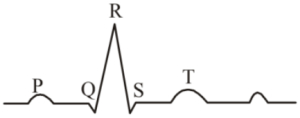
In the following diagrammatic representation of a standard $ECG$,the '$T$' wave represents:
A
Depolarisation of atria
B
Depolarisation of ventricles
C
Repolarisation of atria
D
Repolarisation of ventricles
Solution
(D) The correct answer is $(D)$.
In a standard $ECG$,the '$P$' wave represents the electrical excitation or depolarisation of the atria,which leads to the contraction of both the atria.
The '$QRS$' complex represents the depolarisation of the ventricles,which initiates the ventricular contraction.
The '$T$' wave represents the return of the ventricles from an excited to a normal state,i.e.,the repolarisation of the ventricles. The end of the '$T$' wave marks the end of systole.
In a standard $ECG$,the '$P$' wave represents the electrical excitation or depolarisation of the atria,which leads to the contraction of both the atria.
The '$QRS$' complex represents the depolarisation of the ventricles,which initiates the ventricular contraction.
The '$T$' wave represents the return of the ventricles from an excited to a normal state,i.e.,the repolarisation of the ventricles. The end of the '$T$' wave marks the end of systole.
0 likesView Solution
7
BiologyEasyMCQKCET · 2017
The hormones involved in maintaining calcium balance in the human body are
A
$PTH$ and $TCT$
B
$PTH$ and $LTH$
C
$TCT$ and $FSH$
D
$MSH$ and $ACTH$
Solution
(A) The correct answer is $A$.
Parathyroid hormone $(PTH)$ and Thyrocalcitonin $(TCT)$ are the two hormones responsible for maintaining calcium homeostasis in the human body.
$PTH$ is secreted by the parathyroid glands and is a hypercalcemic hormone,meaning it increases blood $Ca^{2+}$ levels by stimulating bone resorption,renal reabsorption of $Ca^{2+}$,and intestinal absorption of $Ca^{2+}$.
$TCT$ is secreted by the thyroid gland and is a hypocalcemic hormone,which lowers blood $Ca^{2+}$ levels.
Together,these two hormones act antagonistically to maintain the precise balance of calcium in the blood.
Parathyroid hormone $(PTH)$ and Thyrocalcitonin $(TCT)$ are the two hormones responsible for maintaining calcium homeostasis in the human body.
$PTH$ is secreted by the parathyroid glands and is a hypercalcemic hormone,meaning it increases blood $Ca^{2+}$ levels by stimulating bone resorption,renal reabsorption of $Ca^{2+}$,and intestinal absorption of $Ca^{2+}$.
$TCT$ is secreted by the thyroid gland and is a hypocalcemic hormone,which lowers blood $Ca^{2+}$ levels.
Together,these two hormones act antagonistically to maintain the precise balance of calcium in the blood.
0 likesView Solution
8
BiologyEasyMCQKCET · 2017
Which of the following options shows the characteristics of $Mycoplasma$?
A
Smallest living cell without cell wall,survives with oxygen.
B
Smallest living cell with cell wall,survives with oxygen.
C
Smallest living cell without cell wall,survives without oxygen.
D
Smallest living cell with cell wall,survives without oxygen.
Solution
(C) $Mycoplasma$ are the smallest known living cells.
They completely lack a cell wall,which makes them naturally resistant to antibiotics that target cell wall synthesis (like penicillin).
They are facultative anaerobes,meaning they can survive without oxygen.
Therefore,option $C$ is the correct description.
They completely lack a cell wall,which makes them naturally resistant to antibiotics that target cell wall synthesis (like penicillin).
They are facultative anaerobes,meaning they can survive without oxygen.
Therefore,option $C$ is the correct description.
0 likesView Solution
9
BiologyEasyMCQKCET · 2017
Which class of algae reproduces asexually by non-motile spores and sexually by non-motile gametes?
A
Rhodophyceae
B
Phaeophyceae
C
Chlorophyceae
D
Cyanophyceae
Solution
(A) The correct answer is $A$ (Rhodophyceae).
In the class $Rhodophyceae$ (red algae),asexual reproduction occurs through various types of non-motile spores.
Sexual reproduction is exclusively oogamous,involving non-motile gametes.
In contrast,$Chlorophyceae$ and $Phaeophyceae$ typically produce motile spores and gametes (flagellated) during their life cycles.
In the class $Rhodophyceae$ (red algae),asexual reproduction occurs through various types of non-motile spores.
Sexual reproduction is exclusively oogamous,involving non-motile gametes.
In contrast,$Chlorophyceae$ and $Phaeophyceae$ typically produce motile spores and gametes (flagellated) during their life cycles.
0 likesView Solution
10
BiologyEasyMCQKCET · 2017
Which of the following plants produce zygomorphic flowers?
A
Hibiscus
B
Canna
C
Gulmohar
D
Mustard
Solution
(C) flower is said to be zygomorphic when it can be divided into two similar halves only in one particular vertical plane.
Examples of zygomorphic flowers include pea,bean,Cassia,and Gulmohar.
In contrast,actinomorphic flowers (radial symmetry) are seen in Mustard,Datura,and Hibiscus.
Canna is an example of an asymmetric (irregular) flower.
Therefore,the correct option is $C$ (Gulmohar).
Examples of zygomorphic flowers include pea,bean,Cassia,and Gulmohar.
In contrast,actinomorphic flowers (radial symmetry) are seen in Mustard,Datura,and Hibiscus.
Canna is an example of an asymmetric (irregular) flower.
Therefore,the correct option is $C$ (Gulmohar).
0 likesView Solution
11
BiologyEasyMCQKCET · 2017
The secondary wall material suberin is deposited on the walls of
A
pericycle of stem and endodermis of root
B
phellem of stem and endodermis of root
C
epidermis of stem and endodermis of root
D
phellogen and phelloderm
Solution
(B) The correct answer is $B$.
Suberin is a hydrophobic,waxy substance that provides protection and prevents water loss.
It is characteristically deposited in the cell walls of the $phellem$ (cork) cells in the stem,which are part of the periderm.
Additionally,it is deposited in the radial and tangential walls of the $endodermis$ of the root,forming the Casparian strips,which regulate the movement of water and solutes into the vascular cylinder.
Suberin is a hydrophobic,waxy substance that provides protection and prevents water loss.
It is characteristically deposited in the cell walls of the $phellem$ (cork) cells in the stem,which are part of the periderm.
Additionally,it is deposited in the radial and tangential walls of the $endodermis$ of the root,forming the Casparian strips,which regulate the movement of water and solutes into the vascular cylinder.
0 likesView Solution
12
BiologyEasyMCQKCET · 2017
Which one of the following is not included under the endomembrane system?
A
Endoplasmic reticulum
B
Mitochondria
C
Lysosome
D
Vacuole
Solution
(B) The correct answer is $B$ (Mitochondria).
The endomembrane system includes organelles whose functions are coordinated,such as the endoplasmic reticulum $(ER)$,Golgi complex,lysosomes,and vacuoles.
Organelles like mitochondria,chloroplasts,and peroxisomes are not considered part of the endomembrane system because their functions are not coordinated with the endomembrane components,and they do not participate in the same vesicular transport pathway.
The endomembrane system includes organelles whose functions are coordinated,such as the endoplasmic reticulum $(ER)$,Golgi complex,lysosomes,and vacuoles.
Organelles like mitochondria,chloroplasts,and peroxisomes are not considered part of the endomembrane system because their functions are not coordinated with the endomembrane components,and they do not participate in the same vesicular transport pathway.
0 likesView Solution
13
BiologyEasyMCQKCET · 2017
Which of the following characters is not required for autogamy?
A
Flowers require synchrony in pollen release and stigma maturation.
B
Anthers and stigma should lie close to each other.
C
Flowers should be bisexual.
D
Requires pollination agents.
Solution
(D) The correct answer is $D$.
Autogamy is a type of self-pollination where pollen grains are transferred from the anther to the stigma of the same flower.
For autogamy to occur,the following conditions are necessary:
$1$. The flower must be bisexual.
$2$. There must be synchrony in pollen release and stigma receptivity.
$3$. The anthers and stigma should lie close to each other.
Autogamy does not require any external pollination agents (like wind,water,or insects) because the transfer happens within the same flower.
Autogamy is a type of self-pollination where pollen grains are transferred from the anther to the stigma of the same flower.
For autogamy to occur,the following conditions are necessary:
$1$. The flower must be bisexual.
$2$. There must be synchrony in pollen release and stigma receptivity.
$3$. The anthers and stigma should lie close to each other.
Autogamy does not require any external pollination agents (like wind,water,or insects) because the transfer happens within the same flower.
0 likesView Solution
14
BiologyEasyMCQKCET · 2017
Pollen grains are generally spherical,measuring about
A
$25-50 \ \mu m$
B
$25-50 \ mm$
C
$25-50 \ nm$
D
$25-50 \ cm$
Solution
(A) The correct answer is $A$.
Pollen grains are unicellular,haploid,and generally spherical in shape.
They typically measure about $25-50 \ \mu m$ (micrometres) in diameter.
Pollen grains are unicellular,haploid,and generally spherical in shape.
They typically measure about $25-50 \ \mu m$ (micrometres) in diameter.
0 likesView Solution
15
BiologyEasyMCQKCET · 2017
If a tetraploid plant contains $48$ chromosomes in its nucellus,then what is the number of chromosomes in the egg cell and in a synergid,respectively?
A
$48$ and $48$
B
$24$ and $24$
C
$24$ and $48$
D
$48$ and $24$
Solution
(B) The nucellus is a diploid $(2n)$ tissue in the ovule,but in a tetraploid plant,the somatic cells are $4n$.
Given that the tetraploid plant has $4n = 48$ chromosomes in its nucellus,the haploid number $(n)$ is $48 / 4 = 12$.
The egg cell and synergids are part of the embryo sac (gametophyte) and are haploid $(n)$.
Therefore,the number of chromosomes in the egg cell is $n = 12$ and in a synergid is $n = 12$.
Wait,re-evaluating the ploidy: If the plant is tetraploid $(4n)$,the gametes produced by meiosis are diploid $(2n)$.
Thus,$4n = 48$,so $2n = 24$.
Both the egg cell and synergids are haploid relative to the sporophyte,but since the sporophyte is $4n$,the gametophyte cells are $2n$.
Therefore,both the egg cell and the synergid contain $24$ chromosomes.
Given that the tetraploid plant has $4n = 48$ chromosomes in its nucellus,the haploid number $(n)$ is $48 / 4 = 12$.
The egg cell and synergids are part of the embryo sac (gametophyte) and are haploid $(n)$.
Therefore,the number of chromosomes in the egg cell is $n = 12$ and in a synergid is $n = 12$.
Wait,re-evaluating the ploidy: If the plant is tetraploid $(4n)$,the gametes produced by meiosis are diploid $(2n)$.
Thus,$4n = 48$,so $2n = 24$.
Both the egg cell and synergids are haploid relative to the sporophyte,but since the sporophyte is $4n$,the gametophyte cells are $2n$.
Therefore,both the egg cell and the synergid contain $24$ chromosomes.
0 likesView Solution
16
BiologyEasyMCQKCET · 2017
Read the statements and choose the correct option.
$Statement I$: $RNAi$ takes place in all prokaryotic and eukaryotic organisms as a method of cellular defence.
$Statement II$: $RNA$ interference is a pre-translational process.
$Statement I$: $RNAi$ takes place in all prokaryotic and eukaryotic organisms as a method of cellular defence.
$Statement II$: $RNA$ interference is a pre-translational process.
A
$Statement I$ is incorrect, $Statement II$ is correct.
B
$Statement I$ is correct, $Statement II$ is incorrect.
C
Both statements are correct.
D
Both statements are incorrect.
Solution
$(A)$ $Statement I$ is incorrect because $RNA$ interference $(RNAi)$ is a method of cellular defence that occurs only in eukaryotic organisms, not in prokaryotes.
$Statement II$ is correct because $RNAi$ involves the silencing of specific $mRNA$ due to a complementary $dsRNA$ molecule, which prevents the translation of the $mRNA$ into protein. Thus, it is a pre-translational process.
$Statement II$ is correct because $RNAi$ involves the silencing of specific $mRNA$ due to a complementary $dsRNA$ molecule, which prevents the translation of the $mRNA$ into protein. Thus, it is a pre-translational process.
0 likesView Solution
17
BiologyEasyMCQKCET · 2017
The human protein $\alpha-1$ antitrypsin is obtained from
A
transformed bacteria
B
transgenic animal
C
transgenic plant
D
a plant from Western ghats
Solution
(B) The correct answer is $B$.
$\alpha-1$ antitrypsin is a human protein used to treat emphysema.
It is produced by transgenic animals,specifically transgenic sheep.
Tracy,a transgenic sheep produced in $1997$ (often cited in literature as the first transgenic farm mammal),was engineered to express this human protein in its milk,which allows for large-scale production and purification.
$\alpha-1$ antitrypsin is a human protein used to treat emphysema.
It is produced by transgenic animals,specifically transgenic sheep.
Tracy,a transgenic sheep produced in $1997$ (often cited in literature as the first transgenic farm mammal),was engineered to express this human protein in its milk,which allows for large-scale production and purification.
0 likesView Solution
18
BiologyEasyMCQKCET · 2017
The interaction between "Cuckoo and Crow" is an example of:
A
competition
B
predation
C
brood parasitism
D
mutualism
Solution
$(C)$ brood parasitism.
In brood parasitism, the parasitic bird lays its eggs in the nest of its host, and the host incubates them.
During the course of evolution, the eggs of the parasitic bird have evolved to resemble the host's eggs in size and color to reduce the chances of the host bird detecting the foreign eggs and ejecting them from the nest.
In brood parasitism, the parasitic bird lays its eggs in the nest of its host, and the host incubates them.
During the course of evolution, the eggs of the parasitic bird have evolved to resemble the host's eggs in size and color to reduce the chances of the host bird detecting the foreign eggs and ejecting them from the nest.
0 likesView Solution
19
BiologyEasyMCQKCET · 2017
Mac Arthur's observation of $5$ closely related species of warblers living on the same tree showed that they were able to avoid competition and co-exist due to behavioral differences. This is an example of:
A
competitive release
B
resource partitioning
C
competitive exclusion principle
D
adaptive radiation
Solution
(B) The correct answer is $B$.
Mac Arthur observed that $5$ closely related species of warblers living on the same tree were able to avoid competition and co-exist due to behavioral differences in their foraging activities.
This phenomenon is known as resource partitioning,where species sharing the same habitat divide resources to minimize competition and allow for coexistence.
Mac Arthur observed that $5$ closely related species of warblers living on the same tree were able to avoid competition and co-exist due to behavioral differences in their foraging activities.
This phenomenon is known as resource partitioning,where species sharing the same habitat divide resources to minimize competition and allow for coexistence.
0 likesView Solution
20
BiologyEasyMCQKCET · 2017
The process of decomposition is delayed when:
A
the detritus is made up of sugars and nitrogen compounds
B
aeration is sufficient
C
a warm and moist environment exists
D
detritus is rich in lignin and chitin
Solution
(D) The correct answer is $D$.
Decomposition is the process by which complex organic matter is broken down into simpler inorganic substances like $CO_2$,water,and nutrients.
The rate of decomposition is significantly influenced by the chemical composition of the detritus.
If the detritus is rich in nitrogen and water-soluble substances like sugars,the decomposition process is rapid.
Conversely,if the detritus is rich in substances like lignin and chitin,the decomposition process is delayed or slower because these compounds are highly resistant to microbial degradation.
Decomposition is the process by which complex organic matter is broken down into simpler inorganic substances like $CO_2$,water,and nutrients.
The rate of decomposition is significantly influenced by the chemical composition of the detritus.
If the detritus is rich in nitrogen and water-soluble substances like sugars,the decomposition process is rapid.
Conversely,if the detritus is rich in substances like lignin and chitin,the decomposition process is delayed or slower because these compounds are highly resistant to microbial degradation.
0 likesView Solution
21
BiologyEasyMCQKCET · 2017
So far,$1.5$ million species have been identified. Among these,the number of identified fungi species is more than the combined total of which of the following groups?
A
algae,lichens,mosses,and ferns
B
fishes,amphibians,reptiles,and mammals
C
molluscs and crustaceans
D
molluscs,fishes,and amphibians
Solution
(B) The correct answer is $B$. According to the global biodiversity data provided in the $NCERT$ textbook,the number of identified fungi species is more than the combined total of the species of fishes,amphibians,reptiles,and mammals. This highlights the immense diversity of the kingdom Fungi compared to the vertebrate groups mentioned.
0 likesView Solution
22
BiologyEasyMCQKCET · 2017
The variety of indigenous cows is an example of
A
genetic diversity
B
species diversity
C
ecological diversity
D
microbial diversity
Solution
(A) - genetic diversity.
Genetic diversity refers to the total number of genetic characteristics within a specific species,subspecies,or group of species.
It represents the variation of genes within a species.
In the case of indigenous cows (e.g.,$Bos$ $indicus$),different breeds exist due to variations in their genetic makeup,which allows them to adapt to different environmental conditions.
Therefore,the existence of various breeds of the same species is a classic example of genetic diversity.
Genetic diversity refers to the total number of genetic characteristics within a specific species,subspecies,or group of species.
It represents the variation of genes within a species.
In the case of indigenous cows (e.g.,$Bos$ $indicus$),different breeds exist due to variations in their genetic makeup,which allows them to adapt to different environmental conditions.
Therefore,the existence of various breeds of the same species is a classic example of genetic diversity.
0 likesView Solution
23
BiologyEasyMCQKCET · 2017
The inner cell mass of the blastocyst differentiates into:
A
extraembryonic membranes
B
the embryo proper
C
chorionic villi
D
placenta
Solution
(B) The correct answer is $B$.
In the process of human development,the blastocyst consists of an outer layer called the trophoblast and an inner group of cells known as the inner cell mass $(ICM)$.
The trophoblast layer attaches to the endometrium and eventually forms the extraembryonic membranes and the fetal part of the placenta.
The inner cell mass differentiates into the embryo proper,which includes the three germ layers (ectoderm,mesoderm,and endoderm) that give rise to all the tissues and organs of the developing fetus.
In the process of human development,the blastocyst consists of an outer layer called the trophoblast and an inner group of cells known as the inner cell mass $(ICM)$.
The trophoblast layer attaches to the endometrium and eventually forms the extraembryonic membranes and the fetal part of the placenta.
The inner cell mass differentiates into the embryo proper,which includes the three germ layers (ectoderm,mesoderm,and endoderm) that give rise to all the tissues and organs of the developing fetus.
0 likesView Solution
24
BiologyEasyMCQKCET · 2017
Implantation is influenced by
A
$FSH$
B
Progesterone
C
$LH$
D
Relaxin
Solution
(B) The correct answer is $B$.
Implantation is the process by which the blastocyst attaches to the endometrium of the uterus.
This process is primarily influenced and maintained by the hormone $Progesterone$,which is secreted by the corpus luteum.
$Progesterone$ prepares the endometrium for implantation and maintains pregnancy by preventing the contraction of uterine muscles.
Implantation is the process by which the blastocyst attaches to the endometrium of the uterus.
This process is primarily influenced and maintained by the hormone $Progesterone$,which is secreted by the corpus luteum.
$Progesterone$ prepares the endometrium for implantation and maintains pregnancy by preventing the contraction of uterine muscles.
0 likesView Solution
25
BiologyEasyMCQKCET · 2017
In human females,the number of primary follicles left in each ovary at puberty is
A
$30,000-30,000$
B
$30,000-60,000$
C
$60,000-80,000$
D
$1,50,000-1,60,000$
Solution
(C) The correct answer is $C$.
During fetal development,millions of oogonia are formed in each fetal ovary.
However,no more oogonia are formed or added after birth.
Many of these primary follicles degenerate during the phase from birth to puberty.
As a result,at the time of puberty,only about $60,000-80,000$ primary follicles are left in each ovary.
During fetal development,millions of oogonia are formed in each fetal ovary.
However,no more oogonia are formed or added after birth.
Many of these primary follicles degenerate during the phase from birth to puberty.
As a result,at the time of puberty,only about $60,000-80,000$ primary follicles are left in each ovary.
0 likesView Solution
26
BiologyEasyMCQKCET · 2017
Accessory ducts of the reproductive system of the human female include:
A
oviduct,uterus,and vagina
B
oviduct,ovaries,and ovarian ligaments
C
oviduct,ovaries,and mammary glands
D
ovaries,uterus,and vagina
Solution
(A) The female reproductive system consists of a pair of ovaries,a pair of oviducts,a uterus,a cervix,a vagina,and the external genitalia.
Among these,the accessory ducts include the oviducts (Fallopian tubes),the uterus,and the vagina.
Ovaries are the primary sex organs,not accessory ducts.
Therefore,the correct option is $A$.
Among these,the accessory ducts include the oviducts (Fallopian tubes),the uterus,and the vagina.
Ovaries are the primary sex organs,not accessory ducts.
Therefore,the correct option is $A$.
0 likesView Solution
27
BiologyEasyMCQKCET · 2017
Which one of the following characters favours the process of normal spermatogenesis in human male?
A
Descent of testes into scrotum
B
Testes remain in the abdominal cavity
C
Infection by mumps virus during childhood
D
Increased scrotal temperature
Solution
(A) The correct answer is $A$.
$1$. The testes are the primary male reproductive organs responsible for the production of sperms and the secretion of male sex hormones.
$2$. The scrotum is a pouch of skin that holds the testes outside the abdominal cavity.
$3$. This external position is crucial because it maintains the temperature of the testes at $2-2.5^{\circ}C$ lower than the normal internal body temperature.
$4$. This lower temperature is essential for the process of normal spermatogenesis,as higher temperatures can inhibit sperm production.
$1$. The testes are the primary male reproductive organs responsible for the production of sperms and the secretion of male sex hormones.
$2$. The scrotum is a pouch of skin that holds the testes outside the abdominal cavity.
$3$. This external position is crucial because it maintains the temperature of the testes at $2-2.5^{\circ}C$ lower than the normal internal body temperature.
$4$. This lower temperature is essential for the process of normal spermatogenesis,as higher temperatures can inhibit sperm production.
0 likesView Solution
28
BiologyEasyMCQKCET · 2017
In India,the action plans for family planning were initiated in the year:
A
$1972$
B
$1947$
C
$1951$
D
$1950$
Solution
(C) The correct answer is $1951$.
India was among the first countries in the world to initiate action plans and programs at a national level to attain total reproductive health as a social goal.
These programs,called 'family planning',were initiated in $1951$ and have been periodically assessed over the past decades.
India was among the first countries in the world to initiate action plans and programs at a national level to attain total reproductive health as a social goal.
These programs,called 'family planning',were initiated in $1951$ and have been periodically assessed over the past decades.
0 likesView Solution
29
BiologyEasyMCQKCET · 2017
Replacement of which one of the following nucleotides in the $Hb^A$ gene causes sickle cell anaemia?
A
$A$ to $T$
B
$T$ to $A$
C
$U$ to $A$
D
$C$ to $G$
Solution
(A) Sickle cell anaemia is caused by a point mutation in the $Hb^A$ gene.
Specifically,a single nucleotide substitution occurs in the $DNA$ sequence where the nucleotide $Adenine$ $(A)$ is replaced by $Thymine$ $(T)$.
This mutation changes the codon $GAG$ to $GTG$ at the sixth position of the $\beta$-globin chain.
Consequently,the amino acid $Glutamic$ $acid$ is replaced by $Valine$ at the sixth position of the hemoglobin protein,leading to the formation of abnormal $Hb^S$ hemoglobin.
Specifically,a single nucleotide substitution occurs in the $DNA$ sequence where the nucleotide $Adenine$ $(A)$ is replaced by $Thymine$ $(T)$.
This mutation changes the codon $GAG$ to $GTG$ at the sixth position of the $\beta$-globin chain.
Consequently,the amino acid $Glutamic$ $acid$ is replaced by $Valine$ at the sixth position of the hemoglobin protein,leading to the formation of abnormal $Hb^S$ hemoglobin.
0 likesView Solution
30
BiologyEasyMCQKCET · 2017
Example for autosomal hyper aneuploidy is
A
Down's syndrome
B
Klinefelter's syndrome
C
Turner's syndrome
D
Haemophilia
Solution
(A) The correct answer is $A$.
Hyper-aneuploidy refers to a condition where the chromosome number is higher than the normal diploid number,specifically represented as $2n + 1$ (trisomy).
Down's syndrome is an example of autosomal hyper-aneuploidy,caused by the presence of an extra copy of chromosome $21$ (trisomy $21$).
Klinefelter's syndrome $(47, XXY)$ and Turner's syndrome $(45, X)$ are examples of sex chromosomal aneuploidy.
Haemophilia is a sex-linked recessive disorder,not an aneuploidy.
Hyper-aneuploidy refers to a condition where the chromosome number is higher than the normal diploid number,specifically represented as $2n + 1$ (trisomy).
Down's syndrome is an example of autosomal hyper-aneuploidy,caused by the presence of an extra copy of chromosome $21$ (trisomy $21$).
Klinefelter's syndrome $(47, XXY)$ and Turner's syndrome $(45, X)$ are examples of sex chromosomal aneuploidy.
Haemophilia is a sex-linked recessive disorder,not an aneuploidy.
0 likesView Solution
31
BiologyEasyMCQKCET · 2017
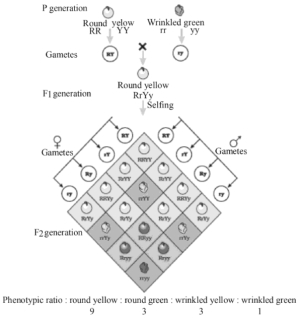
In a dihybrid cross,when $F_1$ plants $(RrYy)$ are self-hybridized,what is the segregation ratio of yellow and green seeds in the $F_2$ generation?
A
$1$:$2$:$1$
B
$3$:$1$
C
$9$:$3$:$3$:$1$
D
$1$:$1$:$1$:$1$
Solution
(B) In a dihybrid cross,the inheritance of two traits is considered independently. According to Mendel's Law of Independent Assortment,the alleles for seed color (Yellow $Y$ and Green $y$) segregate independently of the alleles for seed shape (Round $R$ and Wrinkled $r$).
For the seed color trait,the $F_1$ generation is heterozygous $(Yy)$. When $F_1$ plants are self-hybridized $(Yy \times Yy)$,the resulting $F_2$ generation follows a monohybrid phenotypic ratio.
The Punnett square for seed color yields: $1 YY$ (Yellow) : $2 Yy$ (Yellow) : $1 yy$ (Green).
Thus,the total number of Yellow seeds is $3$ $(1 YY + 2 Yy)$ and the total number of Green seeds is $1$ $(1 yy)$.
Therefore,the phenotypic segregation ratio of Yellow to Green seeds in the $F_2$ generation is $3:1$.
For the seed color trait,the $F_1$ generation is heterozygous $(Yy)$. When $F_1$ plants are self-hybridized $(Yy \times Yy)$,the resulting $F_2$ generation follows a monohybrid phenotypic ratio.
The Punnett square for seed color yields: $1 YY$ (Yellow) : $2 Yy$ (Yellow) : $1 yy$ (Green).
Thus,the total number of Yellow seeds is $3$ $(1 YY + 2 Yy)$ and the total number of Green seeds is $1$ $(1 yy)$.
Therefore,the phenotypic segregation ratio of Yellow to Green seeds in the $F_2$ generation is $3:1$.
0 likesView Solution
32
BiologyEasyMCQKCET · 2017
The type of sex determination in honey bees is:
A
Haplo-diploidy
B
Haploidy
C
Diploidy
D
$ZZ$-$ZW$
Solution
(A) The correct answer is $A$.
In honey bees,sex determination is based on the number of sets of chromosomes an individual receives.
This mechanism is known as $Haplo-diploidy$.
In this system,females (queens and workers) are diploid $(2n = 32)$ and are produced from fertilized eggs.
Males (drones) are haploid $(n = 16)$ and are produced from unfertilized eggs via parthenogenesis.
In honey bees,sex determination is based on the number of sets of chromosomes an individual receives.
This mechanism is known as $Haplo-diploidy$.
In this system,females (queens and workers) are diploid $(2n = 32)$ and are produced from fertilized eggs.
Males (drones) are haploid $(n = 16)$ and are produced from unfertilized eggs via parthenogenesis.
0 likesView Solution
33
BiologyEasyMCQKCET · 2017
The anticodon found on the $t-RNA$ for tryptophan amino acid is
A
$ACC$
B
$UGG$
C
$UCC$
D
$CUU$
Solution
(A) The genetic code for the amino acid tryptophan is $UGG$.
During the process of translation,the anticodon on the $t-RNA$ molecule is complementary to the codon on the $mRNA$ molecule.
Since the codon is $UGG$,the complementary anticodon will be $ACC$ (where $U$ pairs with $A$,and $G$ pairs with $C$).
During the process of translation,the anticodon on the $t-RNA$ molecule is complementary to the codon on the $mRNA$ molecule.
Since the codon is $UGG$,the complementary anticodon will be $ACC$ (where $U$ pairs with $A$,and $G$ pairs with $C$).
0 likesView Solution
34
BiologyEasyMCQKCET · 2017
In the $lac$ operon concept of gene expression,allolactose acts as:
A
repressor
B
inducer
C
co-repressor
D
co-enzyme
Solution
(B) The correct answer is $(B)$.
In the $lac$ operon,lactose or its isomer allolactose acts as an inducer.
It binds to the repressor protein,preventing it from binding to the operator region,thereby allowing the transcription of structural genes.
In the $lac$ operon,lactose or its isomer allolactose acts as an inducer.
It binds to the repressor protein,preventing it from binding to the operator region,thereby allowing the transcription of structural genes.
0 likesView Solution
35
BiologyEasyMCQKCET · 2017
Polymerisation of $DNA$ nucleotides during the synthesis of the lagging strand occurs in:
A
$3^{\prime} \rightarrow 5^{\prime}$ direction
B
$5^{\prime} \rightarrow 3^{\prime}$ direction
C
any direction
D
promoter to terminator direction
Solution
(B) The correct answer is $(B)$.
$DNA$ polymerase enzymes can only catalyze the addition of nucleotides in the $5^{\prime} \rightarrow 3^{\prime}$ direction.
Even during the synthesis of the lagging strand,where $DNA$ is synthesized in short fragments known as Okazaki fragments,each individual fragment is synthesized in the $5^{\prime} \rightarrow 3^{\prime}$ direction.
$DNA$ polymerase enzymes can only catalyze the addition of nucleotides in the $5^{\prime} \rightarrow 3^{\prime}$ direction.
Even during the synthesis of the lagging strand,where $DNA$ is synthesized in short fragments known as Okazaki fragments,each individual fragment is synthesized in the $5^{\prime} \rightarrow 3^{\prime}$ direction.
0 likesView Solution
36
BiologyEasyMCQKCET · 2017
Match the number of nucleotides of the genome in Column $I$ with the organisms in Column $II$. Choose the correct option given below.
| Column $I$ | Column $II$ |
|---|---|
| $(A) 5386$ nucleotides | $(p) E. coli$ |
| $(B) 48502$ bp | $(q) \text{Man}$ |
| $(C) 4.6 \times 10^6$ bp | $(r) \text{Drosophila}$ |
| $(D) 3.3 \times 10^9$ bp | $(s) \phi \times 174 \text{ bacteriophage}$ |
| $(t) \text{Bacteriophage lambda}$ |
A
$A-s; B-q; C-p; D-t$
B
$A-s; B-p; C-q; D-r$
C
$A-s; B-t; C-p; D-q$
D
$A-r; B-t; C-s; D-p$
Solution
(C) The genome sizes of various organisms are as follows:
$1$. $\phi \times 174$ bacteriophage has $5386$ nucleotides.
$2$. Bacteriophage lambda has $48502$ base pairs (bp).
$3$. $E. coli$ has $4.6 \times 10^6$ base pairs (bp).
$4$. Human (haploid content) has $3.3 \times 10^9$ base pairs (bp).
Matching these with the given columns:
$(A) \rightarrow (s)$
$(B) \rightarrow (t)$
$(C) \rightarrow (p)$
$(D) \rightarrow (q)$
Therefore, the correct matching is $A-s, B-t, C-p, D-q$.
$1$. $\phi \times 174$ bacteriophage has $5386$ nucleotides.
$2$. Bacteriophage lambda has $48502$ base pairs (bp).
$3$. $E. coli$ has $4.6 \times 10^6$ base pairs (bp).
$4$. Human (haploid content) has $3.3 \times 10^9$ base pairs (bp).
Matching these with the given columns:
$(A) \rightarrow (s)$
$(B) \rightarrow (t)$
$(C) \rightarrow (p)$
$(D) \rightarrow (q)$
Therefore, the correct matching is $A-s, B-t, C-p, D-q$.
0 likesView Solution
37
BiologyEasyMCQKCET · 2017
If $E. coli$ is allowed to grow for $40$ minutes in a medium containing $^{15}N$,then the number of $^{14}N / ^{14}N$ containing $DNA$ molecules would be:
A
zero
B
$20$
C
$10$
D
$2$
Solution
(A) The correct answer is $A$ (zero).
$E. coli$ replicates its $DNA$ every $20$ minutes.
Initially,the $E. coli$ cells contain $^{14}N / ^{14}N$ $DNA$.
When these cells are transferred to a medium containing $^{15}N$,the new $DNA$ strands synthesized will incorporate $^{15}N$.
After $20$ minutes (one generation),the $DNA$ molecules will be hybrid $(^{15}N / ^{14}N)$.
After $40$ minutes (two generations),the $DNA$ molecules will be a mix of hybrid $(^{15}N / ^{14}N)$ and heavy $(^{15}N / ^{15}N)$.
Since the medium only contains $^{15}N$,no new $^{14}N / ^{14}N$ $DNA$ can be formed,and the original $^{14}N$ strands will be paired with $^{15}N$ strands.
Therefore,the number of $^{14}N / ^{14}N$ $DNA$ molecules will be zero.
$E. coli$ replicates its $DNA$ every $20$ minutes.
Initially,the $E. coli$ cells contain $^{14}N / ^{14}N$ $DNA$.
When these cells are transferred to a medium containing $^{15}N$,the new $DNA$ strands synthesized will incorporate $^{15}N$.
After $20$ minutes (one generation),the $DNA$ molecules will be hybrid $(^{15}N / ^{14}N)$.
After $40$ minutes (two generations),the $DNA$ molecules will be a mix of hybrid $(^{15}N / ^{14}N)$ and heavy $(^{15}N / ^{15}N)$.
Since the medium only contains $^{15}N$,no new $^{14}N / ^{14}N$ $DNA$ can be formed,and the original $^{14}N$ strands will be paired with $^{15}N$ strands.
Therefore,the number of $^{14}N / ^{14}N$ $DNA$ molecules will be zero.
0 likesView Solution
38
BiologyEasyMCQKCET · 2017
The average length of $hnRNA$ in humans is
A
$3000$ bases
B
$2.4$ million bases
C
$1500$ bases
D
$500$ bases
Solution
(A) The correct answer is $A$.
In humans,the primary transcript,known as $hnRNA$ (heterogeneous nuclear $RNA$),undergoes processing to form mature $mRNA$.
The average length of $hnRNA$ in humans is approximately $3000$ bases.
In humans,the primary transcript,known as $hnRNA$ (heterogeneous nuclear $RNA$),undergoes processing to form mature $mRNA$.
The average length of $hnRNA$ in humans is approximately $3000$ bases.
0 likesView Solution
39
BiologyEasyMCQKCET · 2017
Identify the plants that are dominant during the Jurassic period.
A
Angiosperms and Bryophytes
B
Sphenopsida and Ginkgo's
C
Ferns,Conifers and Cycads
D
Monocotyledons and Arborescent lycopods
Solution
(C) The correct answer is $C$.
During the Jurassic period,the Earth's flora was dominated by gymnosperms,specifically conifers,cycads,and ferns.
These groups were highly successful and widespread,forming the primary vegetation before the later rise of angiosperms.
During the Jurassic period,the Earth's flora was dominated by gymnosperms,specifically conifers,cycads,and ferns.
These groups were highly successful and widespread,forming the primary vegetation before the later rise of angiosperms.
0 likesView Solution
40
BiologyEasyMCQKCET · 2017
Which one of the following is the identifiable character of Neanderthal man?
A
Brain capacity $650 \ cc - 800 \ cc$
B
Developed pre-historic cave art
C
Lived before $2$ million years ago
D
Buried their dead
Solution
(D) Buried their dead.
Neanderthal man $(Homo \ neanderthalensis)$ had a brain capacity of approximately $1400 \ cc$.
They lived in the Near East and Central Asia between $1,00,000$ to $40,000$ years ago.
One of their most significant and identifiable cultural characteristics was that they buried their dead,which suggests the development of social or ritualistic behavior.
Neanderthal man $(Homo \ neanderthalensis)$ had a brain capacity of approximately $1400 \ cc$.
They lived in the Near East and Central Asia between $1,00,000$ to $40,000$ years ago.
One of their most significant and identifiable cultural characteristics was that they buried their dead,which suggests the development of social or ritualistic behavior.
0 likesView Solution
41
BiologyEasyMCQKCET · 2017
Which of the following vector-borne diseases are caused by $Aedes$ mosquitoes?
A
Ascariasis and Filariasis
B
Malaria and sleeping sickness
C
Dengue and Chikungunya
D
Kala-azar and Filariasis
Solution
(C) Dengue and Chikungunya.
$Dengue$ is a mosquito-borne viral infection caused by the $Dengue$ virus,transmitted by infected female $Aedes$ $aegypti$ mosquitoes.
$Chikungunya$ is also a mosquito-borne viral disease. The virus is transmitted from human to human by the bite of an infected female $Aedes$ $aegypti$ mosquito.
$Dengue$ is a mosquito-borne viral infection caused by the $Dengue$ virus,transmitted by infected female $Aedes$ $aegypti$ mosquitoes.
$Chikungunya$ is also a mosquito-borne viral disease. The virus is transmitted from human to human by the bite of an infected female $Aedes$ $aegypti$ mosquito.
0 likesView Solution
42
BiologyEasyMCQKCET · 2017
In humans,common cold is caused by
A
Retrovirus
B
Bacculovirus
C
Rhinovirus
D
Rhabdovirus
Solution
(C) The correct answer is $C$.
Common cold is a viral infectious disease of the upper respiratory tract.
It is primarily caused by a group of viruses known as Rhinoviruses.
These viruses infect the nose and throat,leading to symptoms such as sneezing,sore throat,cough,and nasal congestion.
Common cold is a viral infectious disease of the upper respiratory tract.
It is primarily caused by a group of viruses known as Rhinoviruses.
These viruses infect the nose and throat,leading to symptoms such as sneezing,sore throat,cough,and nasal congestion.
0 likesView Solution
43
BiologyEasyMCQKCET · 2017
Morphine is obtained from the
A
Inflorescence of Cannabis
B
Leaves of Erythroxylum
C
Latex of Poppy plant
D
Root of Atropa
Solution
(C) . Latex of Poppy plant.
Morphine is a potent analgesic alkaloid obtained from the dried latex of the unripe seed capsules of the poppy plant,$Papaver$ $somniferum$.
Morphine is a potent analgesic alkaloid obtained from the dried latex of the unripe seed capsules of the poppy plant,$Papaver$ $somniferum$.
0 likesView Solution
44
BiologyEasyMCQKCET · 2017
Which one of the following has been commercialised as a blood-cholesterol lowering agent?
A
Streptokinase
B
Cyclosporin $A$
C
Statins
D
$\alpha$-Trypsin-$A$
Solution
(C) Statins.
Statins are produced by the yeast $Monascus$ $purpureus$.
They act as competitive inhibitors of the enzyme $3$-hydroxy-$3$-methylglutaryl-CoA ($HMG$-$CoA$) reductase,which is the rate-limiting enzyme in the cholesterol synthesis pathway in the liver.
By inhibiting this enzyme,statins effectively lower blood cholesterol levels.
Statins are produced by the yeast $Monascus$ $purpureus$.
They act as competitive inhibitors of the enzyme $3$-hydroxy-$3$-methylglutaryl-CoA ($HMG$-$CoA$) reductase,which is the rate-limiting enzyme in the cholesterol synthesis pathway in the liver.
By inhibiting this enzyme,statins effectively lower blood cholesterol levels.
0 likesView Solution
45
BiologyEasyMCQKCET · 2017
As the organic matter increases in a water body,the $BOD$
A
increases
B
decreases
C
remains unchanged
D
not a parameter
Solution
(A) $BOD$ stands for Biochemical Oxygen Demand.
It is the amount of oxygen required by aerobic microorganisms to decompose the organic matter present in $1 \text{ litre}$ of water.
As the amount of organic matter in a water body increases,the microorganisms require more oxygen to decompose it.
Therefore,the $BOD$ increases,which serves as an indicator of water pollution.
It is the amount of oxygen required by aerobic microorganisms to decompose the organic matter present in $1 \text{ litre}$ of water.
As the amount of organic matter in a water body increases,the microorganisms require more oxygen to decompose it.
Therefore,the $BOD$ increases,which serves as an indicator of water pollution.
0 likesView Solution
46
BiologyEasyMCQKCET · 2017
$A$ transformed bacterium with a human gene fails to produce the desired protein. The reason could be:
A
Human gene may have introns which bacteria cannot process.
B
Amino acid codons for human and bacteria differ.
C
Human protein is formed but degraded by bacteria.
D
The bacterial promoter gene cannot induce transcription of the human gene.
Solution
(A) - Human gene may have introns which bacteria cannot process.
In recombinant $DNA$ technology,when a eukaryotic (human) gene is inserted into a prokaryotic host like a bacterium,the bacterium lacks the splicing machinery required to remove introns.
Since human genes contain non-coding sequences called introns,the bacterial transcription process results in a pre-mRNA that still contains these introns.
Because bacteria cannot process or splice these heterogeneous nuclear RNAs,the correct protein cannot be synthesized.
In recombinant $DNA$ technology,when a eukaryotic (human) gene is inserted into a prokaryotic host like a bacterium,the bacterium lacks the splicing machinery required to remove introns.
Since human genes contain non-coding sequences called introns,the bacterial transcription process results in a pre-mRNA that still contains these introns.
Because bacteria cannot process or splice these heterogeneous nuclear RNAs,the correct protein cannot be synthesized.
0 likesView Solution
47
BiologyEasyMCQKCET · 2017
From which bacterium is the restriction endonuclease $Sal I$ isolated?
A
Escherichia coli
B
Streptococcus aureus
C
Haemophilus influenzae
D
Streptomyces albus
Solution
(D) The correct answer is $D$.
Restriction enzymes are named based on the genus and species of the bacterium from which they are isolated.
The first letter of the genus is written in capital letters,followed by the first two letters of the species name.
For $Sal I$,'$S$' comes from the genus $Streptomyces$ and '$al$' comes from the species $albus$.
Therefore,$Sal I$ is isolated from $Streptomyces albus$.
Restriction enzymes are named based on the genus and species of the bacterium from which they are isolated.
The first letter of the genus is written in capital letters,followed by the first two letters of the species name.
For $Sal I$,'$S$' comes from the genus $Streptomyces$ and '$al$' comes from the species $albus$.
Therefore,$Sal I$ is isolated from $Streptomyces albus$.
0 likesView Solution
48
BiologyEasyMCQKCET · 2017
Restriction endonucleases are isolated from some bacteria. Their role in bacteria is
A
defence against virus
B
synthesis of proteins
C
act as genetic material
D
help in reproduction
Solution
(A) The correct answer is $A$.
Restriction endonucleases are enzymes produced by bacteria as a defense mechanism against bacteriophages (viruses that infect bacteria).
These enzymes recognize specific $DNA$ sequences and cleave the viral $DNA$,thereby preventing the infection and replication of the virus within the bacterial cell.
Restriction endonucleases are enzymes produced by bacteria as a defense mechanism against bacteriophages (viruses that infect bacteria).
These enzymes recognize specific $DNA$ sequences and cleave the viral $DNA$,thereby preventing the infection and replication of the virus within the bacterial cell.
0 likesView Solution
Vedclass Products
For Students
Vedclass Test Series
Mock tests in real KCET style covering Biology with performance analysis. 5-day free trial.
Start Free TrialFor Teachers
Exam Paper Generator
Generate Set A/B/C/D Biology papers from 7.5L+ questions in 2 minutes. 3 chapters free.
Try FreeFor Institutes
Online Exam Module
Run live KCET mock exams with unlimited students, 360° analytics & white-label branding.
See DemoFrequently Asked Questions
How many Biology questions are in KCET 2017?
There are 48 Biology questions from the KCET 2017 paper on Vedclass, each with a detailed step-by-step solution in English.
Are KCET 2017 Biology solutions available in English?
Yes. All solutions on this page are in English. You can also switch to English or Hindi using the language buttons above the questions.
Can I practice KCET 2017 Biology as a timed test?
Yes. Use the Vedclass Test Series to attempt a full KCET mock test covering Biology with time limits and instant score analysis.
Can teachers create Biology papers from KCET previous year questions?
Yes. The Vedclass Exam Paper Generator lets teachers mix KCET Biology questions and generate Set A/B/C/D papers in minutes.
For Teachers & Institutes
Build a Custom Biology Paper
Pick KCET 2017 Biology questions, set difficulty, and generate Set A/B/C/D in 2 minutes.