
PhysicsQ1–60 of 60 questions
Page 1 of 1 · English
1
PhysicsEasyMCQKCET · 2017
$A$ substance of mass $49.53 \ g$ occupies $1.5 \ cm^3$ of volume. The density of the substance (in $g \ cm^{-3}$) with the correct number of significant figures is:
A
$33.02$
B
$33$
C
$3.3$
D
$33.0$
Solution
(B) Density is defined as the ratio of mass to volume: $\text{Density} = \frac{\text{Mass}}{\text{Volume}}$.
Given: $\text{Mass} = 49.53 \ g$ (which has $4$ significant figures).
Given: $\text{Volume} = 1.5 \ cm^3$ (which has $2$ significant figures).
Calculation: $\text{Density} = \frac{49.53}{1.5} = 33.02 \ g \ cm^{-3}$.
According to the rules of significant figures,when dividing,the result should have the same number of significant figures as the measurement with the fewest significant figures.
Since $1.5$ has $2$ significant figures,the final answer must be rounded to $2$ significant figures.
Therefore,the density is $33 \ g \ cm^{-3}$.
Given: $\text{Mass} = 49.53 \ g$ (which has $4$ significant figures).
Given: $\text{Volume} = 1.5 \ cm^3$ (which has $2$ significant figures).
Calculation: $\text{Density} = \frac{49.53}{1.5} = 33.02 \ g \ cm^{-3}$.
According to the rules of significant figures,when dividing,the result should have the same number of significant figures as the measurement with the fewest significant figures.
Since $1.5$ has $2$ significant figures,the final answer must be rounded to $2$ significant figures.
Therefore,the density is $33 \ g \ cm^{-3}$.
0 likesView Solution
2
PhysicsMediumMCQKCET · 2017
Young's modulus is defined as the ratio of
A
tensile stress and longitudinal strain
B
hydraulic stress and hydraulic strain
C
shearing stress and shearing strain
D
bulk stress and longitudinal strain
Solution
(A) Young's modulus $(Y)$ is defined as the ratio of tensile stress to longitudinal strain within the elastic limit.
Mathematically,it is expressed as $Y = \frac{\text{Tensile Stress}}{\text{Longitudinal Strain}}$.
It provides a measure of the ability of a material to withstand changes in length under tension or compression.
Mathematically,it is expressed as $Y = \frac{\text{Tensile Stress}}{\text{Longitudinal Strain}}$.
It provides a measure of the ability of a material to withstand changes in length under tension or compression.
0 likesView Solution
3
PhysicsEasyMCQKCET · 2017
If $\vec{A} = 2\hat{i} + 3\hat{j} + 8\hat{k}$ is perpendicular to $\vec{B} = -4\hat{i} + 4\hat{j} + \alpha\hat{k}$,then the value of $\alpha$ is:
A
$1/2$
B
$-1/2$
C
$11$
D
$-1$
Solution
(B) Two vectors $\vec{A}$ and $\vec{B}$ are perpendicular if their dot product is zero,i.e.,$\vec{A} \cdot \vec{B} = 0$.
Given $\vec{A} = 2\hat{i} + 3\hat{j} + 8\hat{k}$ and $\vec{B} = -4\hat{i} + 4\hat{j} + \alpha\hat{k}$.
Calculating the dot product: $(2\hat{i} + 3\hat{j} + 8\hat{k}) \cdot (-4\hat{i} + 4\hat{j} + \alpha\hat{k}) = 0$.
$(2)(-4) + (3)(4) + (8)(\alpha) = 0$.
$-8 + 12 + 8\alpha = 0$.
$4 + 8\alpha = 0$.
$8\alpha = -4$.
$\alpha = -4/8 = -1/2$.
Given $\vec{A} = 2\hat{i} + 3\hat{j} + 8\hat{k}$ and $\vec{B} = -4\hat{i} + 4\hat{j} + \alpha\hat{k}$.
Calculating the dot product: $(2\hat{i} + 3\hat{j} + 8\hat{k}) \cdot (-4\hat{i} + 4\hat{j} + \alpha\hat{k}) = 0$.
$(2)(-4) + (3)(4) + (8)(\alpha) = 0$.
$-8 + 12 + 8\alpha = 0$.
$4 + 8\alpha = 0$.
$8\alpha = -4$.
$\alpha = -4/8 = -1/2$.
0 likesView Solution
4
PhysicsMediumMCQKCET · 2017
The value of acceleration due to gravity at a depth of $ 1600 \,km $ is equal to: (Radius of Earth $ = 6400 \,km $) (in $\,ms^{-2}$)
A
$9.8$
B
$4.9$
C
$19.6$
D
$7.35$
Solution
(D) The acceleration due to gravity $ g_d $ at a depth $ d $ below the Earth's surface is given by the formula:
$ g_d = g \left( 1 - \frac{d}{R} \right) $
Where $ g $ is the acceleration due to gravity at the surface $( 9.8 \,ms^{-2} )$,$ d $ is the depth $( 1600 \,km )$,and $ R $ is the radius of the Earth $( 6400 \,km )$.
Substituting the values:
$ g_d = 9.8 \left( 1 - \frac{1600}{6400} \right) $
$ g_d = 9.8 \left( 1 - \frac{1}{4} \right) $
$ g_d = 9.8 \times \frac{3}{4} $
$ g_d = 7.35 \,ms^{-2} $
Therefore,the acceleration due to gravity at a depth of $ 1600 \,km $ is $ 7.35 \,ms^{-2} $.
$ g_d = g \left( 1 - \frac{d}{R} \right) $
Where $ g $ is the acceleration due to gravity at the surface $( 9.8 \,ms^{-2} )$,$ d $ is the depth $( 1600 \,km )$,and $ R $ is the radius of the Earth $( 6400 \,km )$.
Substituting the values:
$ g_d = 9.8 \left( 1 - \frac{1600}{6400} \right) $
$ g_d = 9.8 \left( 1 - \frac{1}{4} \right) $
$ g_d = 9.8 \times \frac{3}{4} $
$ g_d = 7.35 \,ms^{-2} $
Therefore,the acceleration due to gravity at a depth of $ 1600 \,km $ is $ 7.35 \,ms^{-2} $.
0 likesView Solution
5
PhysicsMediumMCQKCET · 2017
$A$ motor pump lifts $6$ tonnes of water from a well of depth $25 \ m$ to the first floor of height $35 \ m$ from the ground floor in $20$ minutes. The power of the pump (in $kW$) is: $[g=10 \ ms^{-2}]$
A
$3$
B
$6$
C
$1.5$
D
$12$
Solution
(A) Mass of water $m = 6 \text{ tonnes} = 6000 \ kg$.
Total height $h$ through which water is lifted = depth of well + height of first floor = $25 \ m + 35 \ m = 60 \ m$.
Time taken $t = 20 \text{ minutes} = 20 \times 60 \ s = 1200 \ s$.
Work done $W = mgh = 6000 \ kg \times 10 \ ms^{-2} \times 60 \ m = 3,600,000 \ J$.
Power $P = \frac{W}{t} = \frac{3,600,000 \ J}{1200 \ s} = 3000 \ W$.
Since $1 \ kW = 1000 \ W$,the power of the pump is $3 \ kW$.
Total height $h$ through which water is lifted = depth of well + height of first floor = $25 \ m + 35 \ m = 60 \ m$.
Time taken $t = 20 \text{ minutes} = 20 \times 60 \ s = 1200 \ s$.
Work done $W = mgh = 6000 \ kg \times 10 \ ms^{-2} \times 60 \ m = 3,600,000 \ J$.
Power $P = \frac{W}{t} = \frac{3,600,000 \ J}{1200 \ s} = 3000 \ W$.
Since $1 \ kW = 1000 \ W$,the power of the pump is $3 \ kW$.
0 likesView Solution
6
PhysicsEasyMCQKCET · 2017
'Hydraulic lift' works on the basis of
A
Stoke's law
B
Toricelli's law
C
Pascal's Law
D
Bernoulli's Law
Solution
(C) The 'Hydraulic lift' operates on the principle of Pascal's Law.
Pascal's Law states that a change in pressure applied to an enclosed fluid is transmitted undiminished to every portion of the fluid and to the walls of the container.
$A$ hydraulic lift uses this principle by applying a small force on a small piston to create pressure, which is then transmitted through the fluid to a larger piston, resulting in a larger force capable of lifting heavy objects.
Mathematically, $Pressure = \frac{Force}{Area}$. Since the pressure is constant throughout the system, $P = \frac{F_1}{A_1} = \frac{F_2}{A_2}$, which allows a small input force to generate a large output force.
Pascal's Law states that a change in pressure applied to an enclosed fluid is transmitted undiminished to every portion of the fluid and to the walls of the container.
$A$ hydraulic lift uses this principle by applying a small force on a small piston to create pressure, which is then transmitted through the fluid to a larger piston, resulting in a larger force capable of lifting heavy objects.
Mathematically, $Pressure = \frac{Force}{Area}$. Since the pressure is constant throughout the system, $P = \frac{F_1}{A_1} = \frac{F_2}{A_2}$, which allows a small input force to generate a large output force.
0 likesView Solution
7
PhysicsMediumMCQKCET · 2017
For which combination of working temperatures,the efficiency of a 'Carnot engine' is the least?
A
$60 \ K, 40 \ K$
B
$40 \ K, 20 \ K$
C
$80 \ K, 60 \ K$
D
$100 \ K, 80 \ K$
Solution
(D) The efficiency $\eta$ of a Carnot engine is given by the formula: $\eta = 1 - \frac{T_2}{T_1}$,where $T_1$ is the source temperature and $T_2$ is the sink temperature.
For option $A$ $(T_1 = 60 \ K, T_2 = 40 \ K)$: $\eta = 1 - \frac{40}{60} = 1 - 0.667 = 0.333$.
For option $B$ $(T_1 = 40 \ K, T_2 = 20 \ K)$: $\eta = 1 - \frac{20}{40} = 1 - 0.5 = 0.5$.
For option $C$ $(T_1 = 80 \ K, T_2 = 60 \ K)$: $\eta = 1 - \frac{60}{80} = 1 - 0.75 = 0.25$.
For option $D$ $(T_1 = 100 \ K, T_2 = 80 \ K)$: $\eta = 1 - \frac{80}{100} = 1 - 0.8 = 0.2$.
Comparing the values,the efficiency is the least for the combination $T_1 = 100 \ K$ and $T_2 = 80 \ K$.
For option $A$ $(T_1 = 60 \ K, T_2 = 40 \ K)$: $\eta = 1 - \frac{40}{60} = 1 - 0.667 = 0.333$.
For option $B$ $(T_1 = 40 \ K, T_2 = 20 \ K)$: $\eta = 1 - \frac{20}{40} = 1 - 0.5 = 0.5$.
For option $C$ $(T_1 = 80 \ K, T_2 = 60 \ K)$: $\eta = 1 - \frac{60}{80} = 1 - 0.75 = 0.25$.
For option $D$ $(T_1 = 100 \ K, T_2 = 80 \ K)$: $\eta = 1 - \frac{80}{100} = 1 - 0.8 = 0.2$.
Comparing the values,the efficiency is the least for the combination $T_1 = 100 \ K$ and $T_2 = 80 \ K$.
0 likesView Solution
8
PhysicsMediumMCQKCET · 2017
$A$ car moving with a velocity of $20 \,m \,s^{-1}$ is stopped in a distance of $40 \,m$. If the same car is travelling at double the velocity, the distance travelled by it for the same retardation is (in $\,m$)
A
$640$
B
$320$
C
$1280$
D
$160$
Solution
(D) Using the third equation of motion, $v^2 - u^2 = 2as$, where $v = 0$ (final velocity), $u$ is initial velocity, $a$ is retardation $(-a)$, and $s$ is distance.
$0^2 - u^2 = 2(-a)s \Rightarrow u^2 = 2as \Rightarrow s = \frac{u^2}{2a}$.
Since the retardation $a$ is constant, $s \propto u^2$.
For the first case: $40 = \frac{(20)^2}{2a} \Rightarrow 2a = \frac{400}{40} = 10 \,m \,s^{-2}$.
For the second case, the new velocity $u' = 2 \times 20 = 40 \,m \,s^{-1}$.
The new distance $s' = \frac{(u')^2}{2a} = \frac{(40)^2}{10} = \frac{1600}{10} = 160 \,m$.
$0^2 - u^2 = 2(-a)s \Rightarrow u^2 = 2as \Rightarrow s = \frac{u^2}{2a}$.
Since the retardation $a$ is constant, $s \propto u^2$.
For the first case: $40 = \frac{(20)^2}{2a} \Rightarrow 2a = \frac{400}{40} = 10 \,m \,s^{-2}$.
For the second case, the new velocity $u' = 2 \times 20 = 40 \,m \,s^{-1}$.
The new distance $s' = \frac{(u')^2}{2a} = \frac{(40)^2}{10} = \frac{1600}{10} = 160 \,m$.
0 likesView Solution
9
PhysicsMediumMCQKCET · 2017
The mean energy of a molecule of an ideal gas is
A
$2 KT$
B
$\frac{3}{2} KT$
C
$KT$
D
$\frac{1}{2} KT$
Solution
(B) According to the kinetic theory of gases,the average kinetic energy of a molecule of an ideal gas is given by the equipartition theorem.
For a monatomic ideal gas,the molecule has $3$ degrees of freedom.
The mean energy per molecule is given by $E = \frac{f}{2} k_{B} T$,where $f$ is the number of degrees of freedom.
For a monatomic gas,$f = 3$,so the mean energy is $E = \frac{3}{2} k_{B} T$.
Therefore,the correct option is $B$.
For a monatomic ideal gas,the molecule has $3$ degrees of freedom.
The mean energy per molecule is given by $E = \frac{f}{2} k_{B} T$,where $f$ is the number of degrees of freedom.
For a monatomic gas,$f = 3$,so the mean energy is $E = \frac{3}{2} k_{B} T$.
Therefore,the correct option is $B$.
0 likesView Solution
10
PhysicsEasyMCQKCET · 2017
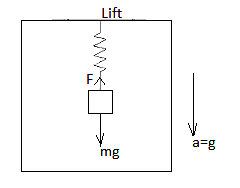
$A$ body of mass $50 \ kg$ is suspended using a spring balance inside a lift at rest. If the lift starts falling freely,the reading of the spring balance is:
A
$50 \ kg$
B
$> 50 \ kg$
C
$60 \ kg$
D
$0 \ kg$
Solution
(D) When a body of mass $m$ is suspended in a lift,the spring balance measures the apparent weight of the body.
When the lift is at rest,the reading is $m \times g$.
When the lift falls freely under gravity,its acceleration $a = g$ (downwards).
The apparent weight $W_{app} = m(g - a)$.
Substituting $a = g$,we get $W_{app} = m(g - g) = 0$.
Therefore,the reading of the spring balance is $0 \ kg$.
When the lift is at rest,the reading is $m \times g$.
When the lift falls freely under gravity,its acceleration $a = g$ (downwards).
The apparent weight $W_{app} = m(g - a)$.
Substituting $a = g$,we get $W_{app} = m(g - g) = 0$.
Therefore,the reading of the spring balance is $0 \ kg$.
0 likesView Solution
11
PhysicsEasyMCQKCET · 2017
Two balls are thrown simultaneously in the air. The acceleration of the centre of mass of the two balls when in the air,
A
depends on the masses of the two balls
B
depends on the speeds of the two balls
C
is equal to $g$ (acceleration due to gravity)
D
depends on the direction of motion of the two balls.
Solution
(C) The acceleration of the centre of mass $a_{cm}$ is given by the formula: $a_{cm} = \frac{m_1 a_1 + m_2 a_2}{m_1 + m_2}$.
Since both balls are in the air,they are under the influence of gravity alone,so $a_1 = -g$ and $a_2 = -g$.
Substituting these values: $a_{cm} = \frac{m_1(-g) + m_2(-g)}{m_1 + m_2}$.
$a_{cm} = -g \frac{(m_1 + m_2)}{(m_1 + m_2)} = -g$.
Therefore,the magnitude of the acceleration of the centre of mass is equal to $g$,which is the acceleration due to gravity.
Since both balls are in the air,they are under the influence of gravity alone,so $a_1 = -g$ and $a_2 = -g$.
Substituting these values: $a_{cm} = \frac{m_1(-g) + m_2(-g)}{m_1 + m_2}$.
$a_{cm} = -g \frac{(m_1 + m_2)}{(m_1 + m_2)} = -g$.
Therefore,the magnitude of the acceleration of the centre of mass is equal to $g$,which is the acceleration due to gravity.
0 likesView Solution
12
PhysicsMediumMCQKCET · 2017
The $S.I.$ unit of specific heat capacity is
A
$J \ mol^{-1} \ K^{-1}$
B
$J \ kg^{-1} \ K^{-1}$
C
$J \ K^{-1}$
D
$J \ kg^{-1}$
Solution
(B) Specific heat capacity is defined as the amount of heat energy required to raise the temperature of $1 \ kg$ of a substance by $1 \ K$.
We use the formula $Q = m \cdot c \cdot \Delta T$,where $Q$ is the heat energy $(J)$,$m$ is the mass $(kg)$,$c$ is the specific heat capacity,and $\Delta T$ is the change in temperature $(K)$.
Rearranging for $c$,we get $c = \frac{Q}{m \cdot \Delta T}$.
Substituting the units,the $S.I.$ unit of specific heat capacity is $\frac{J}{kg \cdot K}$,which is written as $J \ kg^{-1} \ K^{-1}$.
We use the formula $Q = m \cdot c \cdot \Delta T$,where $Q$ is the heat energy $(J)$,$m$ is the mass $(kg)$,$c$ is the specific heat capacity,and $\Delta T$ is the change in temperature $(K)$.
Rearranging for $c$,we get $c = \frac{Q}{m \cdot \Delta T}$.
Substituting the units,the $S.I.$ unit of specific heat capacity is $\frac{J}{kg \cdot K}$,which is written as $J \ kg^{-1} \ K^{-1}$.
0 likesView Solution
13
PhysicsEasyMCQKCET · 2017
The angle between velocity and acceleration of a particle describing uniform circular motion is (in $^{\circ}$)
A
$45$
B
$60$
C
$90$
D
$180$
Solution
(C) In uniform circular motion,the speed of the particle remains constant,but the direction of velocity changes continuously.
This change in the direction of velocity is caused by centripetal acceleration,which is always directed towards the center of the circular path.
The velocity vector is always tangent to the circular path at any given point.
Since the tangent to a circle is always perpendicular to the radius at the point of contact,the angle between the velocity vector (tangent) and the centripetal acceleration vector (radius) is $90^{\circ}$.
This change in the direction of velocity is caused by centripetal acceleration,which is always directed towards the center of the circular path.
The velocity vector is always tangent to the circular path at any given point.
Since the tangent to a circle is always perpendicular to the radius at the point of contact,the angle between the velocity vector (tangent) and the centripetal acceleration vector (radius) is $90^{\circ}$.
0 likesView Solution
14
PhysicsEasyMCQKCET · 2017
The waves set up in a closed pipe are
A
Transverse and Progressive
B
Longitudinal and Stationary
C
Transverse and Stationary
D
Longitudinal and Progressive
Solution
(B) In a closed pipe,sound waves travel through the air column and reflect off the closed end.
These reflected waves interfere with the incident waves to form stationary (standing) waves.
Since sound waves are pressure waves,they are longitudinal in nature.
Therefore,the waves set up in a closed pipe are longitudinal and stationary.
These reflected waves interfere with the incident waves to form stationary (standing) waves.
Since sound waves are pressure waves,they are longitudinal in nature.
Therefore,the waves set up in a closed pipe are longitudinal and stationary.
0 likesView Solution
15
PhysicsEasyMCQKCET · 2017
Two simple pendulums $A$ and $B$ are made to oscillate simultaneously. It is found that $A$ completes $10$ oscillations in $20 \ s$ and $B$ completes $8$ oscillations in $10 \ s$. The ratio of the lengths of $A$ and $B$ is
A
$8/5$
B
$64/25$
C
$5/4$
D
$25/64$
Solution
(B) The time period of a simple pendulum is given by $T = 2\pi \sqrt{\frac{l}{g}}$,where $l$ is the length of the pendulum and $g$ is the acceleration due to gravity.
For pendulum $A$: It completes $10$ oscillations in $20 \ s$.
Therefore,the time period $T_A = \frac{20}{10} = 2 \ s$.
$2\pi \sqrt{\frac{l_A}{g}} = 2 \quad (1)$
For pendulum $B$: It completes $8$ oscillations in $10 \ s$.
Therefore,the time period $T_B = \frac{10}{8} = \frac{5}{4} \ s$.
$2\pi \sqrt{\frac{l_B}{g}} = \frac{5}{4} \quad (2)$
Dividing equation $(1)$ by equation $(2)$:
$\frac{2\pi \sqrt{l_A/g}}{2\pi \sqrt{l_B/g}} = \frac{2}{5/4}$
$\sqrt{\frac{l_A}{l_B}} = \frac{2 \times 4}{5} = \frac{8}{5}$
Squaring both sides:
$\frac{l_A}{l_B} = \left(\frac{8}{5}\right)^2 = \frac{64}{25}$
For pendulum $A$: It completes $10$ oscillations in $20 \ s$.
Therefore,the time period $T_A = \frac{20}{10} = 2 \ s$.
$2\pi \sqrt{\frac{l_A}{g}} = 2 \quad (1)$
For pendulum $B$: It completes $8$ oscillations in $10 \ s$.
Therefore,the time period $T_B = \frac{10}{8} = \frac{5}{4} \ s$.
$2\pi \sqrt{\frac{l_B}{g}} = \frac{5}{4} \quad (2)$
Dividing equation $(1)$ by equation $(2)$:
$\frac{2\pi \sqrt{l_A/g}}{2\pi \sqrt{l_B/g}} = \frac{2}{5/4}$
$\sqrt{\frac{l_A}{l_B}} = \frac{2 \times 4}{5} = \frac{8}{5}$
Squaring both sides:
$\frac{l_A}{l_B} = \left(\frac{8}{5}\right)^2 = \frac{64}{25}$
0 likesView Solution
16
PhysicsDifficultMCQKCET · 2017
The minimum value of effective capacitance that can be obtained by combining $3$ capacitors of capacitances $1 \ pF, 2 \ pF$ and $4 \ pF$ is
A
$4/7 \ pF$
B
$1 \ pF$
C
$7/4 \ pF$
D
$2 \ pF$
Solution
(A) The effective capacitance is minimum when all capacitors are connected in series.
For capacitors connected in series,the equivalent capacitance $C_{eff}$ is given by the formula:
$\frac{1}{C_{eff}} = \frac{1}{C_1} + \frac{1}{C_2} + \frac{1}{C_3}$
Given $C_1 = 1 \ pF$,$C_2 = 2 \ pF$,and $C_3 = 4 \ pF$.
Substituting the values:
$\frac{1}{C_{eff}} = \frac{1}{1} + \frac{1}{2} + \frac{1}{4}$
$\frac{1}{C_{eff}} = \frac{4 + 2 + 1}{4} = \frac{7}{4} \ pF^{-1}$
Therefore,$C_{eff} = \frac{4}{7} \ pF$.
For capacitors connected in series,the equivalent capacitance $C_{eff}$ is given by the formula:
$\frac{1}{C_{eff}} = \frac{1}{C_1} + \frac{1}{C_2} + \frac{1}{C_3}$
Given $C_1 = 1 \ pF$,$C_2 = 2 \ pF$,and $C_3 = 4 \ pF$.
Substituting the values:
$\frac{1}{C_{eff}} = \frac{1}{1} + \frac{1}{2} + \frac{1}{4}$
$\frac{1}{C_{eff}} = \frac{4 + 2 + 1}{4} = \frac{7}{4} \ pF^{-1}$
Therefore,$C_{eff} = \frac{4}{7} \ pF$.
0 likesView Solution
17
PhysicsEasyMCQKCET · 2017
$A$ particle is dropped from a height $H$. The de Broglie wavelength of the particle depends on height as
A
$H$
B
$H^{0}$
C
$H^{\frac{1}{2}}$
D
$H^{-\frac{1}{2}}$
Solution
(D) According to the de Broglie equation,the wavelength $\lambda$ of a particle is given by:
$\lambda = \frac{h}{mv}$
When a particle is dropped from a height $H$,its velocity $v$ at the ground is given by the equation of motion:
$v = \sqrt{2gH}$
Substituting the expression for velocity into the de Broglie equation:
$\lambda = \frac{h}{m\sqrt{2gH}}$
Since $h$,$m$,and $g$ are constants,we can write:
$\lambda \propto \frac{1}{\sqrt{H}}$
Therefore,the de Broglie wavelength depends on height as:
$\lambda \propto H^{-\frac{1}{2}}$
$\lambda = \frac{h}{mv}$
When a particle is dropped from a height $H$,its velocity $v$ at the ground is given by the equation of motion:
$v = \sqrt{2gH}$
Substituting the expression for velocity into the de Broglie equation:
$\lambda = \frac{h}{m\sqrt{2gH}}$
Since $h$,$m$,and $g$ are constants,we can write:
$\lambda \propto \frac{1}{\sqrt{H}}$
Therefore,the de Broglie wavelength depends on height as:
$\lambda \propto H^{-\frac{1}{2}}$
0 likesView Solution
18
PhysicsMediumMCQKCET · 2017
The particles emitted in the decay of $ { }_{92}^{238} U $ to $ { }_{92}^{234} U $ are:
A
$1 \alpha$ and $2 \beta$
B
$1 \alpha$ only
C
$1 \alpha$ and $1 \beta$
D
$2 \alpha$ and $2 \beta$
Solution
(A) The given decay reaction is $ { }_{92}^{238} U \rightarrow { }_{92}^{234} U $.
An $\alpha$-decay is represented as $ { }_{Z}^{A} X \rightarrow { }_{Z-2}^{A-4} Y + { }_{2}^{4} \text{He} $.
$A$ $\beta$-decay is represented as $ { }_{Z}^{A} X \rightarrow { }_{Z+1}^{A} Y + { }_{-1}^{0} e $.
In the decay of $ { }_{92}^{238} U $ to $ { }_{92}^{234} U $,the change in mass number $\Delta A = 238 - 234 = 4$.
Since each $\alpha$-particle carries a mass number of $4$,the number of $\alpha$-particles emitted is $4/4 = 1$.
Emission of $1$ $\alpha$-particle reduces the atomic number $Z$ by $2$,so the atomic number becomes $92 - 2 = 90$.
However,the final atomic number is $92$. To increase the atomic number from $90$ to $92$,we need $2$ $\beta$-decays,as each $\beta$-decay increases $Z$ by $1$.
Therefore,$1$ $\alpha$ and $2$ $\beta$ particles are emitted.
An $\alpha$-decay is represented as $ { }_{Z}^{A} X \rightarrow { }_{Z-2}^{A-4} Y + { }_{2}^{4} \text{He} $.
$A$ $\beta$-decay is represented as $ { }_{Z}^{A} X \rightarrow { }_{Z+1}^{A} Y + { }_{-1}^{0} e $.
In the decay of $ { }_{92}^{238} U $ to $ { }_{92}^{234} U $,the change in mass number $\Delta A = 238 - 234 = 4$.
Since each $\alpha$-particle carries a mass number of $4$,the number of $\alpha$-particles emitted is $4/4 = 1$.
Emission of $1$ $\alpha$-particle reduces the atomic number $Z$ by $2$,so the atomic number becomes $92 - 2 = 90$.
However,the final atomic number is $92$. To increase the atomic number from $90$ to $92$,we need $2$ $\beta$-decays,as each $\beta$-decay increases $Z$ by $1$.
Therefore,$1$ $\alpha$ and $2$ $\beta$ particles are emitted.
0 likesView Solution
19
PhysicsEasyMCQKCET · 2017
The magnetic field at the center of a current-carrying loop of radius $0.1 \ m$ is $5\sqrt{5}$ times that at a point along its axis. The distance of this point from the center of the loop is: (in $m$)
A
$0.2$
B
$0.1$
C
$0.05$
D
$0.25$
Solution
(A) The magnetic field at the center of a current-carrying loop is given by $B_{C} = \frac{\mu_{0}I}{2r}$.
The magnetic field at a point on the axis at a distance $x$ from the center is given by $B_{A} = \frac{\mu_{0}Ir^{2}}{2(x^{2} + r^{2})^{3/2}}$.
Given that $B_{C} = 5\sqrt{5} B_{A}$,we substitute the expressions:
$\frac{\mu_{0}I}{2r} = 5\sqrt{5} \left( \frac{\mu_{0}Ir^{2}}{2(x^{2} + r^{2})^{3/2}} \right)$.
Simplifying the equation:
$\frac{1}{r} = \frac{5\sqrt{5}r^{2}}{(x^{2} + r^{2})^{3/2}}$.
$(x^{2} + r^{2})^{3/2} = 5\sqrt{5}r^{3} = (5^{1/2})^{3}r^{3} = (5^{1/2}r)^{3}$.
Taking the cube root on both sides:
$(x^{2} + r^{2})^{1/2} = 5^{1/2}r$.
Squaring both sides:
$x^{2} + r^{2} = 5r^{2}$.
$x^{2} = 4r^{2} \Rightarrow x = 2r$.
Given $r = 0.1 \ m$,we get $x = 2 \times 0.1 \ m = 0.2 \ m$.
The magnetic field at a point on the axis at a distance $x$ from the center is given by $B_{A} = \frac{\mu_{0}Ir^{2}}{2(x^{2} + r^{2})^{3/2}}$.
Given that $B_{C} = 5\sqrt{5} B_{A}$,we substitute the expressions:
$\frac{\mu_{0}I}{2r} = 5\sqrt{5} \left( \frac{\mu_{0}Ir^{2}}{2(x^{2} + r^{2})^{3/2}} \right)$.
Simplifying the equation:
$\frac{1}{r} = \frac{5\sqrt{5}r^{2}}{(x^{2} + r^{2})^{3/2}}$.
$(x^{2} + r^{2})^{3/2} = 5\sqrt{5}r^{3} = (5^{1/2})^{3}r^{3} = (5^{1/2}r)^{3}$.
Taking the cube root on both sides:
$(x^{2} + r^{2})^{1/2} = 5^{1/2}r$.
Squaring both sides:
$x^{2} + r^{2} = 5r^{2}$.
$x^{2} = 4r^{2} \Rightarrow x = 2r$.
Given $r = 0.1 \ m$,we get $x = 2 \times 0.1 \ m = 0.2 \ m$.
0 likesView Solution
20
PhysicsEasyMCQKCET · 2017
$4 \times 10^{10}$ electrons are removed from a neutral metal sphere of diameter $20 \text{ cm}$ placed in air. The magnitude of the electric field (in $\text{N C}^{-1}$) at a distance of $20 \text{ cm}$ from its centre is:
A
$5760$
B
$1440$
C
$640$
D
Zero
Solution
(B) Given: Number of electrons removed $n = 4 \times 10^{10}$.
Diameter of the sphere $= 20 \text{ cm}$,so radius $R = 10 \text{ cm} = 0.1 \text{ m}$.
Distance from the centre $r = 20 \text{ cm} = 0.2 \text{ m}$.
The charge $q$ on the sphere is $q = n \times e = 4 \times 10^{10} \times 1.6 \times 10^{-19} \text{ C} = 6.4 \times 10^{-9} \text{ C}$.
Since the point is outside the sphere $(r > R)$,the sphere acts as a point charge at its centre.
The electric field $E$ is given by $E = \frac{1}{4 \pi \epsilon_0} \frac{q}{r^2}$.
Substituting the values: $E = (9 \times 10^9) \times \frac{6.4 \times 10^{-9}}{(0.2)^2}$.
$E = \frac{9 \times 6.4}{0.04} = \frac{57.6}{0.04} = 1440 \text{ N C}^{-1}$.
Diameter of the sphere $= 20 \text{ cm}$,so radius $R = 10 \text{ cm} = 0.1 \text{ m}$.
Distance from the centre $r = 20 \text{ cm} = 0.2 \text{ m}$.
The charge $q$ on the sphere is $q = n \times e = 4 \times 10^{10} \times 1.6 \times 10^{-19} \text{ C} = 6.4 \times 10^{-9} \text{ C}$.
Since the point is outside the sphere $(r > R)$,the sphere acts as a point charge at its centre.
The electric field $E$ is given by $E = \frac{1}{4 \pi \epsilon_0} \frac{q}{r^2}$.
Substituting the values: $E = (9 \times 10^9) \times \frac{6.4 \times 10^{-9}}{(0.2)^2}$.
$E = \frac{9 \times 6.4}{0.04} = \frac{57.6}{0.04} = 1440 \text{ N C}^{-1}$.
0 likesView Solution
21
PhysicsDifficultMCQKCET · 2017
The energy gap in case of which of the following is less than $ 3 eV $?
A
Copper
B
Iron
C
Aluminium
D
Germanium
Solution
(D) The energy gap $(E_g)$ of a semiconductor is typically less than $3 eV$.
Copper,Iron,and Aluminium are metals (conductors) where the valence and conduction bands overlap,meaning they do not have an energy gap in the traditional sense.
Germanium is a semiconductor with an energy gap of approximately $0.7 eV$.
Since $0.7 eV < 3 eV$,Germanium is the correct answer.
Copper,Iron,and Aluminium are metals (conductors) where the valence and conduction bands overlap,meaning they do not have an energy gap in the traditional sense.
Germanium is a semiconductor with an energy gap of approximately $0.7 eV$.
Since $0.7 eV < 3 eV$,Germanium is the correct answer.
0 likesView Solution
22
PhysicsEasyMCQKCET · 2017
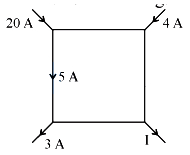
The value of $I$ in the figure shown below is: (in $\text{ A}$)
A
$8$
B
$21$
C
$19$
D
$44$
Solution
(B) According to Kirchhoff's current law $(KCL)$, the algebraic sum of currents at any junction is zero. This means the sum of currents entering a junction must equal the sum of currents leaving it.
Let us analyze the top-left junction: $20 \text{ A}$ enters, and $5 \text{ A}$ leaves downwards. Therefore, $15 \text{ A}$ must flow to the right.
Now, consider the top-right junction: $15 \text{ A}$ enters from the left and $4 \text{ A}$ enters from the top. Thus, $19 \text{ A}$ must flow downwards.
Finally, consider the bottom-right junction: $19 \text{ A}$ enters from the top and $3 \text{ A}$ enters from the bottom-left branch (as $5 \text{ A}$ entered the bottom-left junction and $3 \text{ A}$ left it, $2 \text{ A}$ must have flowed right, but let's simplify by looking at the whole circuit).
Total current entering the circuit = $20 \text{ A} + 4 \text{ A} + 3 \text{ A} = 27 \text{ A}$.
Total current leaving the circuit = $I + 6 \text{ A}$ (where $6 \text{ A}$ is the remaining exit). Based on the diagram, the sum of currents entering = sum of currents leaving.
$20 + 4 + 3 = I + 6 \Rightarrow 27 = I + 6 \Rightarrow I = 21 \text{ A}$.
Let us analyze the top-left junction: $20 \text{ A}$ enters, and $5 \text{ A}$ leaves downwards. Therefore, $15 \text{ A}$ must flow to the right.
Now, consider the top-right junction: $15 \text{ A}$ enters from the left and $4 \text{ A}$ enters from the top. Thus, $19 \text{ A}$ must flow downwards.
Finally, consider the bottom-right junction: $19 \text{ A}$ enters from the top and $3 \text{ A}$ enters from the bottom-left branch (as $5 \text{ A}$ entered the bottom-left junction and $3 \text{ A}$ left it, $2 \text{ A}$ must have flowed right, but let's simplify by looking at the whole circuit).
Total current entering the circuit = $20 \text{ A} + 4 \text{ A} + 3 \text{ A} = 27 \text{ A}$.
Total current leaving the circuit = $I + 6 \text{ A}$ (where $6 \text{ A}$ is the remaining exit). Based on the diagram, the sum of currents entering = sum of currents leaving.
$20 + 4 + 3 = I + 6 \Rightarrow 27 = I + 6 \Rightarrow I = 21 \text{ A}$.
0 likesView Solution
23
PhysicsMediumMCQKCET · 2017
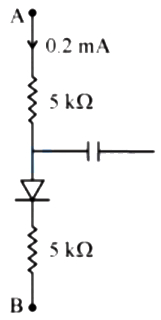
In the figure shown, if the diode forward voltage drop is $0.2 \, V$, the voltage difference between $A$ and $B$ is (in $V$)
A
$1.3$
B
$2.2$
C
$0$
D
$0.5$
Solution
(B) Given current $I = 0.2 \, mA = 0.2 \times 10^{-3} \, A$.
Voltage drop across the diode $V_d = 0.2 \, V$.
Resistors $R_1 = R_2 = 5 \, k\Omega = 5 \times 10^3 \, \Omega$.
The circuit consists of a resistor $R_1$, a diode, and a resistor $R_2$ in series.
The voltage drop across resistor $R_1$ is $V_{R1} = I \times R_1 = (0.2 \times 10^{-3} \, A) \times (5 \times 10^3 \, \Omega) = 1 \, V$.
The voltage drop across resistor $R_2$ is $V_{R2} = I \times R_2 = (0.2 \times 10^{-3} \, A) \times (5 \times 10^3 \, \Omega) = 1 \, V$.
The total voltage difference between $A$ and $B$ is the sum of the voltage drops across the components: $V_{AB} = V_{R1} + V_d + V_{R2} = 1 \, V + 0.2 \, V + 1 \, V = 2.2 \, V$.
Voltage drop across the diode $V_d = 0.2 \, V$.
Resistors $R_1 = R_2 = 5 \, k\Omega = 5 \times 10^3 \, \Omega$.
The circuit consists of a resistor $R_1$, a diode, and a resistor $R_2$ in series.
The voltage drop across resistor $R_1$ is $V_{R1} = I \times R_1 = (0.2 \times 10^{-3} \, A) \times (5 \times 10^3 \, \Omega) = 1 \, V$.
The voltage drop across resistor $R_2$ is $V_{R2} = I \times R_2 = (0.2 \times 10^{-3} \, A) \times (5 \times 10^3 \, \Omega) = 1 \, V$.
The total voltage difference between $A$ and $B$ is the sum of the voltage drops across the components: $V_{AB} = V_{R1} + V_d + V_{R2} = 1 \, V + 0.2 \, V + 1 \, V = 2.2 \, V$.
0 likesView Solution
24
PhysicsMediumMCQKCET · 2017
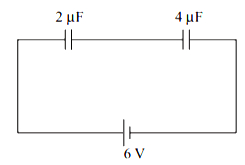
$A$ system of $2$ capacitors of capacitance $2 \mu F$ and $4 \mu F$ is connected in series across a potential difference of $6 \text{ V}$. The electric charge and energy stored in the system are
A
$10 \mu C$ and $30 \mu J$
B
$36 \mu C$ and $108 \mu J$
C
$8 \mu C$ and $24 \mu J$
D
$1 \mu C$ and $3 \mu J$
Solution
(C) The effective capacitance $C$ of two capacitors connected in series is given by $\frac{1}{C} = \frac{1}{C_1} + \frac{1}{C_2}$.
Substituting the given values: $\frac{1}{C} = \frac{1}{2 \mu F} + \frac{1}{4 \mu F} = \frac{2+1}{4 \mu F} = \frac{3}{4 \mu F}$.
Thus,$C = \frac{4}{3} \mu F = \frac{4}{3} \times 10^{-6} \text{ F}$.
The electric charge $Q$ stored in the series combination is $Q = C V$.
$Q = (\frac{4}{3} \times 10^{-6} \text{ F}) \times 6 \text{ V} = 8 \times 10^{-6} \text{ C} = 8 \mu C$.
The energy $U$ stored in the system is $U = \frac{1}{2} C V^2$.
$U = \frac{1}{2} \times (\frac{4}{3} \times 10^{-6} \text{ F}) \times (6 \text{ V})^2 = \frac{1}{2} \times \frac{4}{3} \times 10^{-6} \times 36 = 24 \times 10^{-6} \text{ J} = 24 \mu J$.
Substituting the given values: $\frac{1}{C} = \frac{1}{2 \mu F} + \frac{1}{4 \mu F} = \frac{2+1}{4 \mu F} = \frac{3}{4 \mu F}$.
Thus,$C = \frac{4}{3} \mu F = \frac{4}{3} \times 10^{-6} \text{ F}$.
The electric charge $Q$ stored in the series combination is $Q = C V$.
$Q = (\frac{4}{3} \times 10^{-6} \text{ F}) \times 6 \text{ V} = 8 \times 10^{-6} \text{ C} = 8 \mu C$.
The energy $U$ stored in the system is $U = \frac{1}{2} C V^2$.
$U = \frac{1}{2} \times (\frac{4}{3} \times 10^{-6} \text{ F}) \times (6 \text{ V})^2 = \frac{1}{2} \times \frac{4}{3} \times 10^{-6} \times 36 = 24 \times 10^{-6} \text{ J} = 24 \mu J$.
0 likesView Solution
25
PhysicsMediumMCQKCET · 2017
$A$ basic communication system consists of:
$(a)$ Transmitter
$(b)$ Information source
$(c)$ User of information
$(d)$ Channel
$(e)$ Receiver
The correct sequence of the arrangement is:
$(a)$ Transmitter
$(b)$ Information source
$(c)$ User of information
$(d)$ Channel
$(e)$ Receiver
The correct sequence of the arrangement is:
A
$(b)$ $\rightarrow$ $(a)$ $\rightarrow$ $(d)$ $\rightarrow$ $(e)$ $\rightarrow$ $(c)$
B
$(b)$ $\rightarrow$ $(a)$ $\rightarrow$ $(e)$ $\rightarrow$ $(d)$ $\rightarrow$ $(c)$
C
$(a)$ $\rightarrow$ $(b)$ $\rightarrow$ $(d)$ $\rightarrow$ $(e)$ $\rightarrow$ $(c)$
D
$(b)$ $\rightarrow$ $(d)$ $\rightarrow$ $(a)$ $\rightarrow$ $(e)$ $\rightarrow$ $(c)$
Solution
(A) basic communication system is designed to transfer information from one point to another.
The process follows a specific sequence:
$1$. Information source: The origin of the message.
$2$. Transmitter: Converts the information into a signal suitable for transmission.
$3$. Channel: The medium through which the signal travels.
$4$. Receiver: Extracts the original signal from the channel.
$5$. User of information: The final destination or recipient of the message.
Therefore,the correct sequence is: Information source $\rightarrow$ Transmitter $\rightarrow$ Channel $\rightarrow$ Receiver $\rightarrow$ User of information,which corresponds to $(b)$ $\rightarrow$ $(a)$ $\rightarrow$ $(d)$ $\rightarrow$ $(e)$ $\rightarrow$ $(c)$.
The process follows a specific sequence:
$1$. Information source: The origin of the message.
$2$. Transmitter: Converts the information into a signal suitable for transmission.
$3$. Channel: The medium through which the signal travels.
$4$. Receiver: Extracts the original signal from the channel.
$5$. User of information: The final destination or recipient of the message.
Therefore,the correct sequence is: Information source $\rightarrow$ Transmitter $\rightarrow$ Channel $\rightarrow$ Receiver $\rightarrow$ User of information,which corresponds to $(b)$ $\rightarrow$ $(a)$ $\rightarrow$ $(d)$ $\rightarrow$ $(e)$ $\rightarrow$ $(c)$.
0 likesView Solution
26
PhysicsEasyMCQKCET · 2017
According to Huygens' principle,during the refraction of light from air to a denser medium,
A
Wavelength and speed decrease
B
Wavelength and speed increase
C
Wavelength increases but speed decreases
D
Wavelength decreases but speed increases
Solution
(A) According to Huygens' principle,when light travels from a rarer medium (air) to a denser medium,the frequency of light remains constant.
Since the refractive index $\mu$ of a denser medium is greater than that of air,the speed of light $v$ decreases because $v = \frac{c}{\mu}$,where $c$ is the speed of light in a vacuum.
Furthermore,the relationship between wavelength $\lambda$,speed $v$,and frequency $f$ is given by $v = f \lambda$.
Since $f$ is constant and $v$ decreases,the wavelength $\lambda$ must also decrease in the denser medium.
Thus,both the wavelength and the speed of light decrease.
Since the refractive index $\mu$ of a denser medium is greater than that of air,the speed of light $v$ decreases because $v = \frac{c}{\mu}$,where $c$ is the speed of light in a vacuum.
Furthermore,the relationship between wavelength $\lambda$,speed $v$,and frequency $f$ is given by $v = f \lambda$.
Since $f$ is constant and $v$ decreases,the wavelength $\lambda$ must also decrease in the denser medium.
Thus,both the wavelength and the speed of light decrease.
0 likesView Solution
27
PhysicsDifficultMCQKCET · 2017
The mass defect of $ { }_{2}^{4} He $ is $ 0.03 \ u $. The binding energy per nucleon of helium (in $ MeV $ ) is
A
$ 27.93 $
B
$ 6.9825 $
C
$ 2.793 $
D
$ 69.825 $
Solution
(B) The binding energy per nucleon is the total binding energy of the nucleus divided by the mass number $ A $.
Binding energy $ B.E. = (\Delta m \times 931) \ MeV $.
Given mass defect $ \Delta m = 0.03 \ u $.
Total binding energy $ = 0.03 \times 931 = 27.93 \ MeV $.
For helium $ { }_{2}^{4} He $,the mass number $ A = 4 $.
Binding energy per nucleon $ = \frac{B.E.}{A} = \frac{27.93}{4} = 6.9825 \ MeV $.
Binding energy $ B.E. = (\Delta m \times 931) \ MeV $.
Given mass defect $ \Delta m = 0.03 \ u $.
Total binding energy $ = 0.03 \times 931 = 27.93 \ MeV $.
For helium $ { }_{2}^{4} He $,the mass number $ A = 4 $.
Binding energy per nucleon $ = \frac{B.E.}{A} = \frac{27.93}{4} = 6.9825 \ MeV $.
0 likesView Solution
28
PhysicsMediumMCQKCET · 2017
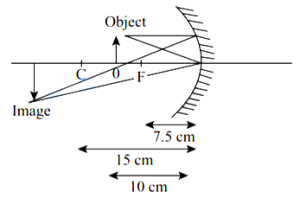
$A$ linear object of height $10 \text{ cm}$ is kept in front of a concave mirror of radius of curvature $15 \text{ cm}$,at a distance of $10 \text{ cm}$. The image formed is
A
magnified and erect
B
magnified and inverted
C
diminished and erect
D
diminished and inverted
Solution
(B) Given: Height of object $h = 10 \text{ cm}$,radius of curvature $R = 15 \text{ cm}$,object distance $u = -10 \text{ cm}$.
Focal length $f = R/2 = 15/2 = 7.5 \text{ cm}$. For a concave mirror,$f = -7.5 \text{ cm}$.
Since the object is placed at $u = -10 \text{ cm}$,and the focal length is $f = -7.5 \text{ cm}$,the object is placed between the focus $(F)$ and the centre of curvature $(C)$ because $f < |u| < R$ (i.e.,$7.5 \text{ cm} < 10 \text{ cm} < 15 \text{ cm}$).
When an object is placed between $F$ and $C$ in front of a concave mirror,the image formed is real,inverted,and magnified.
Focal length $f = R/2 = 15/2 = 7.5 \text{ cm}$. For a concave mirror,$f = -7.5 \text{ cm}$.
Since the object is placed at $u = -10 \text{ cm}$,and the focal length is $f = -7.5 \text{ cm}$,the object is placed between the focus $(F)$ and the centre of curvature $(C)$ because $f < |u| < R$ (i.e.,$7.5 \text{ cm} < 10 \text{ cm} < 15 \text{ cm}$).
When an object is placed between $F$ and $C$ in front of a concave mirror,the image formed is real,inverted,and magnified.
0 likesView Solution
29
PhysicsMediumMCQKCET · 2017
Two spheres of electric charges $+2 \ nC$ and $-8 \ nC$ are placed at a distance '$d$' apart. If they are allowed to touch each other,what is the new distance between them to get a repulsive force of the same magnitude as before?
A
$\frac{4d}{3}$
B
$\frac{3d}{4}$
C
$d$
D
$\frac{d}{2}$
Solution
(B) Initial charges are $q_1 = +2 \ nC$ and $q_2 = -8 \ nC$. The magnitude of the initial attractive force is $|F| = \frac{k |q_1 q_2|}{d^2} = \frac{k (2 \times 8) \times 10^{-18}}{d^2} = \frac{16k \times 10^{-18}}{d^2}$.
When the spheres touch,the total charge is shared equally: $q_{new} = \frac{q_1 + q_2}{2} = \frac{2 - 8}{2} = -3 \ nC$. Both spheres now have a charge of $-3 \ nC$.
Let the new distance be $d'$. The new repulsive force is $|F'| = \frac{k |q_{new} q_{new}|}{(d')^2} = \frac{k (3 \times 3) \times 10^{-18}}{(d')^2} = \frac{9k \times 10^{-18}}{(d')^2}$.
Given $|F| = |F'|$,we have $\frac{16k \times 10^{-18}}{d^2} = \frac{9k \times 10^{-18}}{(d')^2}$.
$\frac{16}{d^2} = \frac{9}{(d')^2} \Rightarrow (d')^2 = \frac{9}{16} d^2$.
Taking the square root,$d' = \frac{3}{4} d$.
When the spheres touch,the total charge is shared equally: $q_{new} = \frac{q_1 + q_2}{2} = \frac{2 - 8}{2} = -3 \ nC$. Both spheres now have a charge of $-3 \ nC$.
Let the new distance be $d'$. The new repulsive force is $|F'| = \frac{k |q_{new} q_{new}|}{(d')^2} = \frac{k (3 \times 3) \times 10^{-18}}{(d')^2} = \frac{9k \times 10^{-18}}{(d')^2}$.
Given $|F| = |F'|$,we have $\frac{16k \times 10^{-18}}{d^2} = \frac{9k \times 10^{-18}}{(d')^2}$.
$\frac{16}{d^2} = \frac{9}{(d')^2} \Rightarrow (d')^2 = \frac{9}{16} d^2$.
Taking the square root,$d' = \frac{3}{4} d$.
0 likesView Solution
30
PhysicsDifficultMCQKCET · 2017
$A$ piece of copper is to be shaped into a conducting wire of maximum resistance. If the initial length is $L$ and diameter is $d$,what should be the new length and diameter to achieve maximum resistance?
A
$L$ and $d$
B
$2L$ and $d$
C
$L/2$ and $2d$
D
$2L$ and $d/2$
Solution
(D) The resistance $R$ of a wire is given by the formula $R = \rho \frac{L}{A}$,where $\rho$ is the resistivity,$L$ is the length,and $A$ is the cross-sectional area.
Since the volume $V$ of the copper piece remains constant,$V = A \times L$.
Substituting $A = \frac{V}{L}$ into the resistance formula,we get $R = \rho \frac{L}{V/L} = \rho \frac{L^2}{V}$.
Since $\rho$ and $V$ are constant,$R \propto L^2$.
Also,$A = \pi r^2 = \pi (d/2)^2 = \frac{\pi d^2}{4}$.
Substituting this into the resistance formula,$R = \rho \frac{L}{\pi d^2 / 4} = \frac{4 \rho L}{\pi d^2}$.
To maximize resistance,we need to increase the length $L$ and decrease the diameter $d$.
Comparing the given options,the configuration $2L$ and $d/2$ provides the maximum resistance because $R \propto \frac{L}{d^2}$.
Substituting $L' = 2L$ and $d' = d/2$,we get $R' \propto \frac{2L}{(d/2)^2} = \frac{2L}{d^2/4} = 8 \frac{L}{d^2}$,which is the highest value among the choices.
Since the volume $V$ of the copper piece remains constant,$V = A \times L$.
Substituting $A = \frac{V}{L}$ into the resistance formula,we get $R = \rho \frac{L}{V/L} = \rho \frac{L^2}{V}$.
Since $\rho$ and $V$ are constant,$R \propto L^2$.
Also,$A = \pi r^2 = \pi (d/2)^2 = \frac{\pi d^2}{4}$.
Substituting this into the resistance formula,$R = \rho \frac{L}{\pi d^2 / 4} = \frac{4 \rho L}{\pi d^2}$.
To maximize resistance,we need to increase the length $L$ and decrease the diameter $d$.
Comparing the given options,the configuration $2L$ and $d/2$ provides the maximum resistance because $R \propto \frac{L}{d^2}$.
Substituting $L' = 2L$ and $d' = d/2$,we get $R' \propto \frac{2L}{(d/2)^2} = \frac{2L}{d^2/4} = 8 \frac{L}{d^2}$,which is the highest value among the choices.
0 likesView Solution
31
PhysicsMediumMCQKCET · 2017
During the scattering of light, the amount of scattering is inversely proportional to the . . . . . . of the wavelength of light.
A
Cube
B
Square
C
Fourth power
D
Half
Solution
(C) According to Rayleigh's law of scattering, the intensity of scattered light $(I)$ is inversely proportional to the fourth power of its wavelength $(\lambda)$.
Mathematically, this is expressed as:
$I \propto \frac{1}{\lambda^4}$
This phenomenon is known as Rayleigh Scattering.
Mathematically, this is expressed as:
$I \propto \frac{1}{\lambda^4}$
This phenomenon is known as Rayleigh Scattering.
0 likesView Solution
32
PhysicsDifficultMCQKCET · 2017
$A$ straight wire of length $50 \text{ cm}$ carrying a current of $2.5 \text{ A}$ is suspended in mid-air by a uniform magnetic field of $0.5 \text{ T}$. Calculate the mass of the wire. (Take $g = 10 \text{ m s}^{-2}$) (in $\text{ g}$)
A
$62.5$
B
$250$
C
$125$
D
$100$
Solution
(A) For the wire to be suspended in mid-air,the magnetic force acting on it must balance the gravitational force acting downwards.
$F_B = F_g$
$I B l = m g$
Where $I = 2.5 \text{ A}$,$B = 0.5 \text{ T}$,$l = 50 \text{ cm} = 0.5 \text{ m}$,and $g = 10 \text{ m s}^{-2}$.
$m = \frac{I B l}{g}$
$m = \frac{2.5 \times 0.5 \times 0.5}{10}$
$m = \frac{0.625}{10} = 0.0625 \text{ kg}$
Converting to grams: $0.0625 \text{ kg} \times 1000 = 62.5 \text{ g}$.
Thus,the mass of the wire is $62.5 \text{ g}$.
$F_B = F_g$
$I B l = m g$
Where $I = 2.5 \text{ A}$,$B = 0.5 \text{ T}$,$l = 50 \text{ cm} = 0.5 \text{ m}$,and $g = 10 \text{ m s}^{-2}$.
$m = \frac{I B l}{g}$
$m = \frac{2.5 \times 0.5 \times 0.5}{10}$
$m = \frac{0.625}{10} = 0.0625 \text{ kg}$
Converting to grams: $0.0625 \text{ kg} \times 1000 = 62.5 \text{ g}$.
Thus,the mass of the wire is $62.5 \text{ g}$.
0 likesView Solution
33
PhysicsEasyMCQKCET · 2017
Which of the following properties is 'False' for a bar magnet?
A
Its poles cannot be separated.
B
It points in North-South direction when suspended.
C
Its like poles repel and unlike poles attract.
D
It does not produce a magnetic field.
Solution
(D) bar magnet is a permanent magnet that creates its own magnetic field. Therefore,the statement that it does not produce a magnetic field is false. The other properties listed are fundamental characteristics of bar magnets: poles always exist in pairs,they align in the North-South direction when freely suspended,and like poles repel while unlike poles attract.
0 likesView Solution
34
PhysicsMediumMCQKCET · 2017
Which of the following semi-conducting devices is used as a voltage regulator?
A
Photo diode
B
$LASER$ diode
C
Zener diode
D
Solar cell
Solution
(C) voltage regulator is an electronic circuit that provides a stable $DC$ voltage independent of load current,temperature,and $AC$ line voltage variations.
Specifically,a $Zener$ diode is designed to operate in the reverse breakdown region,allowing it to maintain a constant voltage across its terminals despite changes in input voltage or load current.
Therefore,the $Zener$ diode is widely used as a voltage regulator.
Specifically,a $Zener$ diode is designed to operate in the reverse breakdown region,allowing it to maintain a constant voltage across its terminals despite changes in input voltage or load current.
Therefore,the $Zener$ diode is widely used as a voltage regulator.
0 likesView Solution
35
PhysicsEasyMCQKCET · 2017
The output of a step-down transformer is measured to be $48 \,V$ when connected to a $12 \,W$ bulb. The value of peak current is
A
$1/\sqrt{2} \,A$
B
$\sqrt{2} \,A$
C
$1/(2\sqrt{2}) \,A$
D
$1/4 \,A$
Solution
(C) Given, the output voltage of the step-down transformer is $V_{rms} = 48 \,V$.
The power consumed by the bulb is $P = 12 \,W$.
The root mean square $(RMS)$ current is given by $I_{rms} = P / V_{rms} = 12 / 48 = 0.25 \,A$.
The peak current $I_0$ is related to the $RMS$ current by the formula $I_0 = I_{rms} \times \sqrt{2}$.
Substituting the values, $I_0 = 0.25 \times \sqrt{2} = (1/4) \times \sqrt{2} = \sqrt{2}/4 = 1/(2\sqrt{2}) \,A$.
The power consumed by the bulb is $P = 12 \,W$.
The root mean square $(RMS)$ current is given by $I_{rms} = P / V_{rms} = 12 / 48 = 0.25 \,A$.
The peak current $I_0$ is related to the $RMS$ current by the formula $I_0 = I_{rms} \times \sqrt{2}$.
Substituting the values, $I_0 = 0.25 \times \sqrt{2} = (1/4) \times \sqrt{2} = \sqrt{2}/4 = 1/(2\sqrt{2}) \,A$.
0 likesView Solution
36
PhysicsDifficultMCQKCET · 2017
$A$ cylindrical conductor of diameter $0.1 \text{ mm}$ carries a current of $90 \text{ mA}$. The current density (in $\text{Am}^{-2}$) is (take $\pi \simeq 3$):
A
$1.2 \times 10^{7}$
B
$2.4 \times 10^{7}$
C
$3 \times 10^{6}$
D
$6 \times 10^{6}$
Solution
(A) The diameter of the conductor is $d = 0.1 \text{ mm} = 10^{-4} \text{ m}$.
The cross-sectional area $A$ of the cylindrical conductor is given by $A = \frac{\pi d^2}{4}$.
Using $\pi \simeq 3$,we get $A = \frac{3 \times (10^{-4})^2}{4} = \frac{3 \times 10^{-8}}{4} = 0.75 \times 10^{-8} \text{ m}^2$.
The current flowing through the conductor is $I = 90 \text{ mA} = 90 \times 10^{-3} \text{ A}$.
The current density $J$ is defined as $J = \frac{I}{A}$.
Substituting the values,$J = \frac{90 \times 10^{-3}}{0.75 \times 10^{-8}} = \frac{90}{0.75} \times 10^{5} = 120 \times 10^{5} = 1.2 \times 10^{7} \text{ Am}^{-2}$.
The cross-sectional area $A$ of the cylindrical conductor is given by $A = \frac{\pi d^2}{4}$.
Using $\pi \simeq 3$,we get $A = \frac{3 \times (10^{-4})^2}{4} = \frac{3 \times 10^{-8}}{4} = 0.75 \times 10^{-8} \text{ m}^2$.
The current flowing through the conductor is $I = 90 \text{ mA} = 90 \times 10^{-3} \text{ A}$.
The current density $J$ is defined as $J = \frac{I}{A}$.
Substituting the values,$J = \frac{90 \times 10^{-3}}{0.75 \times 10^{-8}} = \frac{90}{0.75} \times 10^{5} = 120 \times 10^{5} = 1.2 \times 10^{7} \text{ Am}^{-2}$.
0 likesView Solution
37
PhysicsMediumMCQKCET · 2017
In the three parts of a transistor,'Emitter' is of
A
moderate size and heavily doped
B
large size and lightly doped
C
thin size and heavily doped
D
large size and moderately doped
Solution
(A) Among the three parts of a transistor,namely emitter,base,and collector:
$\rightarrow$ Emitter is moderate in size and heavily doped.
$\rightarrow$ Base is thin in size and lightly doped.
$\rightarrow$ Collector is large in size and moderately doped.
Therefore,the emitter is of moderate size and heavily doped.
$\rightarrow$ Emitter is moderate in size and heavily doped.
$\rightarrow$ Base is thin in size and lightly doped.
$\rightarrow$ Collector is large in size and moderately doped.
Therefore,the emitter is of moderate size and heavily doped.
0 likesView Solution
38
PhysicsDifficultMCQKCET · 2017
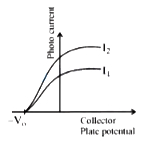
From the following graph of photo-current against collector plate potential,for two different intensities of light $I_{1}$ and $I_{2}$,one can conclude:
A
$I_{1} = I_{2}$
B
$I_{1} > I_{2}$
C
$I_{1} < I_{2}$
D
Comparison is not possible.
Solution
(C) For a fixed frequency of incident light,the saturation photo-current is directly proportional to the intensity of the incident light.
From the given graph,the saturation photo-current for light of intensity $I_{2}$ is higher than that for light of intensity $I_{1}$.
Therefore,we can conclude that $I_{1} < I_{2}$.
From the given graph,the saturation photo-current for light of intensity $I_{2}$ is higher than that for light of intensity $I_{1}$.
Therefore,we can conclude that $I_{1} < I_{2}$.
0 likesView Solution
39
PhysicsEasyMCQKCET · 2017
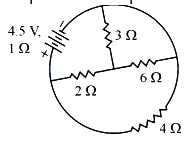
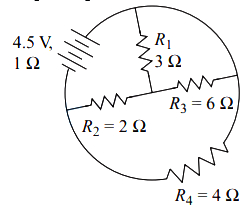
The power dissipated in the $ 3 \Omega $ resistance in the following circuit is: (in $W$)
A
$0.75$
B
$0.25$
C
$1$
D
$0.5$
Solution
(A) First, we identify the circuit structure. The $ 3 \Omega $ and $ 6 \Omega $ resistors are in parallel. Their equivalent resistance $ R_p $ is given by: $ R_p = \frac{3 \times 6}{3 + 6} = \frac{18}{9} = 2 \ \Omega $.
This $ R_p $ is in series with the $ 2 \ \Omega $ resistor. So, the resistance of this branch is $ R_{branch} = 2 + 2 = 4 \ \Omega $.
This branch is in parallel with the $ 4 \ \Omega $ resistor. The total equivalent resistance of the external circuit $ R_{eq} $ is: $ R_{eq} = \frac{4 \times 4}{4 + 4} = 2 \ \Omega $.
Including the internal resistance $ r = 1 \ \Omega $, the total resistance of the circuit is $ R_{total} = R_{eq} + r = 2 + 1 = 3 \ \Omega $.
The total current $ I $ from the battery is $ I = \frac{V}{R_{total}} = \frac{4.5}{3} = 1.5 \ A $.
The voltage across the parallel combination of the $ 4 \ \Omega $ resistor and the $ 4 \ \Omega $ branch is $ V_{parallel} = I \times R_{eq} = 1.5 \times 2 = 3 \ V $.
Since the $ 3 \ \Omega $ and $ 6 \ \Omega $ resistors are in the $ 4 \ \Omega $ branch, the voltage across them is $ 3 \ V $.
The current through the $ 3 \ \Omega $ resistor is $ I_3 = \frac{V_{parallel}}{3} = \frac{3}{3} = 1 \ A $.
The power dissipated in the $ 3 \ \Omega $ resistor is $ P = I_3^2 \times R = (1)^2 \times 3 = 3 \ W $.
Wait, re-evaluating the circuit: The $ 3 \ \Omega $ and $ 6 \ \Omega $ are in series with the $ 2 \ \Omega $ resistor? No, looking at the diagram, the $ 3 \ \Omega $ and $ 6 \ \Omega $ are in parallel, and that combination is in series with the $ 2 \ \Omega $ resistor. The total branch resistance is $ 4 \ \Omega $. This branch is in parallel with the $ 4 \ \Omega $ resistor. The voltage across the $ 4 \ \Omega $ branch is $ 3 \ V $. The current through the $ 3 \ \Omega $ resistor branch is $ I_{branch} = \frac{3 \ V}{4 \ \Omega} = 0.75 \ A $.
The voltage across the $ 3 \ \Omega $ resistor is $ V_3 = I_{branch} \times 3 = 0.75 \times 3 = 2.25 \ V $.
The power dissipated is $ P = \frac{V_3^2}{3} = \frac{2.25^2}{3} = \frac{5.0625}{3} = 1.6875 \ W $.
Correction: Let's use current division. $ I_{branch} = 0.75 \ A $. The current through the $ 3 \ \Omega $ resistor is $ I_3 = I_{branch} \times \frac{6}{3+6} = 0.75 \times \frac{6}{9} = 0.75 \times \frac{2}{3} = 0.5 \ A $.
Power $ P = I_3^2 \times 3 = (0.5)^2 \times 3 = 0.25 \times 3 = 0.75 \ W $.
This $ R_p $ is in series with the $ 2 \ \Omega $ resistor. So, the resistance of this branch is $ R_{branch} = 2 + 2 = 4 \ \Omega $.
This branch is in parallel with the $ 4 \ \Omega $ resistor. The total equivalent resistance of the external circuit $ R_{eq} $ is: $ R_{eq} = \frac{4 \times 4}{4 + 4} = 2 \ \Omega $.
Including the internal resistance $ r = 1 \ \Omega $, the total resistance of the circuit is $ R_{total} = R_{eq} + r = 2 + 1 = 3 \ \Omega $.
The total current $ I $ from the battery is $ I = \frac{V}{R_{total}} = \frac{4.5}{3} = 1.5 \ A $.
The voltage across the parallel combination of the $ 4 \ \Omega $ resistor and the $ 4 \ \Omega $ branch is $ V_{parallel} = I \times R_{eq} = 1.5 \times 2 = 3 \ V $.
Since the $ 3 \ \Omega $ and $ 6 \ \Omega $ resistors are in the $ 4 \ \Omega $ branch, the voltage across them is $ 3 \ V $.
The current through the $ 3 \ \Omega $ resistor is $ I_3 = \frac{V_{parallel}}{3} = \frac{3}{3} = 1 \ A $.
The power dissipated in the $ 3 \ \Omega $ resistor is $ P = I_3^2 \times R = (1)^2 \times 3 = 3 \ W $.
Wait, re-evaluating the circuit: The $ 3 \ \Omega $ and $ 6 \ \Omega $ are in series with the $ 2 \ \Omega $ resistor? No, looking at the diagram, the $ 3 \ \Omega $ and $ 6 \ \Omega $ are in parallel, and that combination is in series with the $ 2 \ \Omega $ resistor. The total branch resistance is $ 4 \ \Omega $. This branch is in parallel with the $ 4 \ \Omega $ resistor. The voltage across the $ 4 \ \Omega $ branch is $ 3 \ V $. The current through the $ 3 \ \Omega $ resistor branch is $ I_{branch} = \frac{3 \ V}{4 \ \Omega} = 0.75 \ A $.
The voltage across the $ 3 \ \Omega $ resistor is $ V_3 = I_{branch} \times 3 = 0.75 \times 3 = 2.25 \ V $.
The power dissipated is $ P = \frac{V_3^2}{3} = \frac{2.25^2}{3} = \frac{5.0625}{3} = 1.6875 \ W $.
Correction: Let's use current division. $ I_{branch} = 0.75 \ A $. The current through the $ 3 \ \Omega $ resistor is $ I_3 = I_{branch} \times \frac{6}{3+6} = 0.75 \times \frac{6}{9} = 0.75 \times \frac{2}{3} = 0.5 \ A $.
Power $ P = I_3^2 \times 3 = (0.5)^2 \times 3 = 0.25 \times 3 = 0.75 \ W $.
0 likesView Solution
40
PhysicsEasyMCQKCET · 2017
$A$ jet plane of wing span $20 \,m$ is travelling towards west at a speed of $400 \,ms^{-1}$. If the earth's total magnetic field is $4 \times 10^{-4} \,T$ and the dip angle is $30^{\circ}$ at that place, the voltage difference developed across the ends of the wing is (in $\,V$)
A
$1.6$
B
$3.2$
C
$0.8$
D
$6.4$
Solution
(A) Given: Wing span $l = 20 \,m$, speed of jet plane $v = 400 \,ms^{-1}$, Earth's total magnetic field $B = 4 \times 10^{-4} \,T$, and angle of dip $\theta = 30^{\circ}$.
The motional electromotive force (emf) induced across the wings is given by $e = B_v l v$, where $B_v$ is the vertical component of the Earth's magnetic field.
The vertical component $B_v$ is calculated as:
$B_v = B \sin \theta = 4 \times 10^{-4} \times \sin 30^{\circ} = 4 \times 10^{-4} \times 0.5 = 2 \times 10^{-4} \,T$.
Now, substituting the values into the emf formula:
$e = (2 \times 10^{-4} \,T) \times (20 \,m) \times (400 \,ms^{-1})$
$e = 16000 \times 10^{-4} \,V = 1.6 \,V$.
Thus, the voltage difference developed across the ends of the wing is $1.6 \,V$.
The motional electromotive force (emf) induced across the wings is given by $e = B_v l v$, where $B_v$ is the vertical component of the Earth's magnetic field.
The vertical component $B_v$ is calculated as:
$B_v = B \sin \theta = 4 \times 10^{-4} \times \sin 30^{\circ} = 4 \times 10^{-4} \times 0.5 = 2 \times 10^{-4} \,T$.
Now, substituting the values into the emf formula:
$e = (2 \times 10^{-4} \,T) \times (20 \,m) \times (400 \,ms^{-1})$
$e = 16000 \times 10^{-4} \,V = 1.6 \,V$.
Thus, the voltage difference developed across the ends of the wing is $1.6 \,V$.
0 likesView Solution
41
PhysicsEasyMCQKCET · 2017
The scientist who is credited with the discovery of the 'nucleus' in an atom is
A
$J$.$J$. Thomson
B
Rutherford
C
Niels Bohr
D
Balmer
Solution
(B) Ernest Rutherford is the scientist credited with the discovery of the atomic nucleus.
In $1911$,he conducted the famous alpha-particle scattering experiment (Gold Foil Experiment).
He observed that a small fraction of alpha particles were deflected by large angles,which led him to conclude that the positive charge and most of the mass of the atom are concentrated in a very small central region called the nucleus.
In $1911$,he conducted the famous alpha-particle scattering experiment (Gold Foil Experiment).
He observed that a small fraction of alpha particles were deflected by large angles,which led him to conclude that the positive charge and most of the mass of the atom are concentrated in a very small central region called the nucleus.
0 likesView Solution
42
PhysicsEasyMCQKCET · 2017
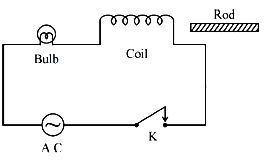
In the $A$.$C$. circuit shown,keeping switch $K$ closed,if an iron rod is inserted into the coil,the bulb in the circuit:
A
glows more brightly
B
glows less brightly
C
glows with the same brightness (as before the rod is inserted)
D
gets damaged
Solution
(B) When an iron rod is inserted into the coil,the permeability of the core increases,which significantly increases the self-inductance $(L)$ of the coil.
The inductive reactance of the circuit is given by $X_L = \omega L$.
As $L$ increases,the inductive reactance $X_L$ increases.
The total impedance of the circuit is $Z = \sqrt{R^2 + X_L^2}$,where $R$ is the resistance of the bulb.
Since $X_L$ increases,the total impedance $Z$ of the circuit increases.
According to Ohm's law for $A$.$C$. circuits,the current $I = V / Z$. As the impedance $Z$ increases,the current $I$ flowing through the circuit decreases.
The brightness of the bulb depends on the power dissipated,given by $P = I^2 R$. Since the current $I$ decreases,the power dissipated in the bulb decreases.
Therefore,the bulb glows less brightly.
The inductive reactance of the circuit is given by $X_L = \omega L$.
As $L$ increases,the inductive reactance $X_L$ increases.
The total impedance of the circuit is $Z = \sqrt{R^2 + X_L^2}$,where $R$ is the resistance of the bulb.
Since $X_L$ increases,the total impedance $Z$ of the circuit increases.
According to Ohm's law for $A$.$C$. circuits,the current $I = V / Z$. As the impedance $Z$ increases,the current $I$ flowing through the circuit decreases.
The brightness of the bulb depends on the power dissipated,given by $P = I^2 R$. Since the current $I$ decreases,the power dissipated in the bulb decreases.
Therefore,the bulb glows less brightly.
0 likesView Solution
43
PhysicsEasyMCQKCET · 2017
Of the following graphs,the one that correctly represents the $I-V$ characteristics of an 'Ohmic device' is:
A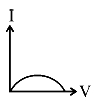
B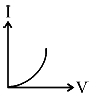
C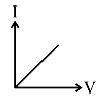
D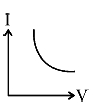
Solution
(C) Ohmic devices obey Ohm's law,which states that the current $I$ flowing through a conductor is directly proportional to the potential difference $V$ applied across its ends,provided the physical conditions (like temperature) remain constant.
This is expressed as $V = IR$,where $R$ is the resistance of the device.
Since $R$ is constant for an Ohmic device,we have $I = (1/R)V$.
This equation represents a straight line passing through the origin $(0,0)$ with a slope of $1/R$.
Among the given options,the graph that shows a straight line passing through the origin is Graph $C$.
This is expressed as $V = IR$,where $R$ is the resistance of the device.
Since $R$ is constant for an Ohmic device,we have $I = (1/R)V$.
This equation represents a straight line passing through the origin $(0,0)$ with a slope of $1/R$.
Among the given options,the graph that shows a straight line passing through the origin is Graph $C$.
0 likesView Solution
44
PhysicsEasyMCQKCET · 2017
The energy (in $eV$) required to excite an electron from $n=2$ to $n=4$ state in a hydrogen atom is:
A
+ $2.55$
B
- $3.4$
C
- $0.85$
D
+ $4.25$
Solution
(A) In a hydrogen atom,the energy of an electron in a state $n$ is given by the formula $E_n = -\frac{13.6}{n^2} \text{ eV}$.
To excite an electron from state $n_i = 2$ to state $n_f = 4$,the energy required is $\Delta E = E_4 - E_2$.
First,calculate the energy of the $n=2$ state: $E_2 = -\frac{13.6}{2^2} = -\frac{13.6}{4} = -3.4 \text{ eV}$.
Next,calculate the energy of the $n=4$ state: $E_4 = -\frac{13.6}{4^2} = -\frac{13.6}{16} = -0.85 \text{ eV}$.
The energy required is $\Delta E = -0.85 - (-3.4) = 3.4 - 0.85 = 2.55 \text{ eV}$.
To excite an electron from state $n_i = 2$ to state $n_f = 4$,the energy required is $\Delta E = E_4 - E_2$.
First,calculate the energy of the $n=2$ state: $E_2 = -\frac{13.6}{2^2} = -\frac{13.6}{4} = -3.4 \text{ eV}$.
Next,calculate the energy of the $n=4$ state: $E_4 = -\frac{13.6}{4^2} = -\frac{13.6}{16} = -0.85 \text{ eV}$.
The energy required is $\Delta E = -0.85 - (-3.4) = 3.4 - 0.85 = 2.55 \text{ eV}$.
0 likesView Solution
45
PhysicsEasyMCQKCET · 2017
In a nuclear reactor,the function of the moderator is to decrease
A
number of neutrons
B
speed of neutrons
C
escape of neutrons
D
temperature of the reactor
Solution
(B) In a nuclear reactor,the function of the moderator is to slow down the fast-moving neutrons produced during fission.
By colliding with the nuclei of the moderator material (such as heavy water or graphite),the kinetic energy of the neutrons is reduced.
This process converts fast neutrons into thermal neutrons,which have a much higher probability of causing further fission in $U^{235}$ nuclei,thereby sustaining the nuclear chain reaction.
By colliding with the nuclei of the moderator material (such as heavy water or graphite),the kinetic energy of the neutrons is reduced.
This process converts fast neutrons into thermal neutrons,which have a much higher probability of causing further fission in $U^{235}$ nuclei,thereby sustaining the nuclear chain reaction.
0 likesView Solution
46
PhysicsMediumMCQKCET · 2017
$A$ magnetic dipole of magnetic moment $ 6 \times 10^{-2} \text{ A m}^2 $ and moment of inertia $ 12 \times 10^{-6} \text{ kg m}^2 $ performs oscillations in a magnetic field of $ 2 \times 10^{-2} \text{ T} $. The time taken by the dipole to complete $ 20 $ oscillations is (assume $ \pi \simeq 3 $). (in $\text{ s}$)
A
$36$
B
$06$
C
$12$
D
$18$
Solution
(C) Given: Magnetic moment $ M = 6 \times 10^{-2} \text{ A m}^2 $, Moment of inertia $ I = 12 \times 10^{-6} \text{ kg m}^2 $, Magnetic field $ B = 2 \times 10^{-2} \text{ T} $.
The time period $ t $ of a magnetic dipole oscillating in a magnetic field is given by $ t = 2 \pi \sqrt{\frac{I}{MB}} $.
Substituting the values: $ t = 2 \pi \sqrt{\frac{12 \times 10^{-6}}{(6 \times 10^{-2}) \times (2 \times 10^{-2})}} $.
$ t = 2 \pi \sqrt{\frac{12 \times 10^{-6}}{12 \times 10^{-4}}} = 2 \pi \sqrt{10^{-2}} = 2 \pi \times 10^{-1} \text{ s} $.
Given $ \pi \simeq 3 $, so $ t = 2 \times 3 \times 0.1 = 0.6 \text{ s} $.
The time taken to complete $ 20 $ oscillations is $ T = 20 \times t = 20 \times 0.6 = 12 \text{ s} $.
The time period $ t $ of a magnetic dipole oscillating in a magnetic field is given by $ t = 2 \pi \sqrt{\frac{I}{MB}} $.
Substituting the values: $ t = 2 \pi \sqrt{\frac{12 \times 10^{-6}}{(6 \times 10^{-2}) \times (2 \times 10^{-2})}} $.
$ t = 2 \pi \sqrt{\frac{12 \times 10^{-6}}{12 \times 10^{-4}}} = 2 \pi \sqrt{10^{-2}} = 2 \pi \times 10^{-1} \text{ s} $.
Given $ \pi \simeq 3 $, so $ t = 2 \times 3 \times 0.1 = 0.6 \text{ s} $.
The time taken to complete $ 20 $ oscillations is $ T = 20 \times t = 20 \times 0.6 = 12 \text{ s} $.
0 likesView Solution
47
PhysicsMediumMCQKCET · 2017
In a metre bridge experiment,with a standard resistance in the right gap and a resistance coil dipped in water (in a beaker) in the left gap,the balancing length obtained is $l$. If the temperature of water is increased,the new balancing length is:
A
$> l$
B
$< l$
C
$= l$
D
$= 0$
Solution
(A) In a metre bridge,the unknown resistance $X$ in the left gap and the standard resistance $R$ in the right gap are related to the balancing length $l$ by the formula: $X = R \frac{l}{100 - l}$.
Here,the resistance coil is made of a metal. When the temperature of the water increases,the resistance $X$ of the coil increases because the resistance of metals increases with temperature.
From the formula $X = R \frac{l}{100 - l}$,we can see that $X$ is directly proportional to $l$. As $X$ increases,the balancing length $l$ must also increase to maintain the balance of the bridge.
Therefore,the new balancing length will be greater than $l$ (i.e.,$> l$).
Here,the resistance coil is made of a metal. When the temperature of the water increases,the resistance $X$ of the coil increases because the resistance of metals increases with temperature.
From the formula $X = R \frac{l}{100 - l}$,we can see that $X$ is directly proportional to $l$. As $X$ increases,the balancing length $l$ must also increase to maintain the balance of the bridge.
Therefore,the new balancing length will be greater than $l$ (i.e.,$> l$).
0 likesView Solution
48
PhysicsMediumMCQKCET · 2017
$A$ proton, a deuteron, and an $\alpha$-particle are projected perpendicular to the direction of a uniform magnetic field with the same kinetic energy. The ratio of the radii of the circular paths described by them is
A
$1: \sqrt{2}: 1$
B
$1: \sqrt{2}: \sqrt{2}$
C
$\sqrt{2}: 1: 1$
D
$\sqrt{2}: \sqrt{2}: 1$
Solution
(A) The radius $R$ of the circular path of a charged particle in a uniform magnetic field is given by $R = \frac{mv}{qB}$.
Since kinetic energy $E = \frac{1}{2}mv^2$, we have $mv = \sqrt{2mE}$.
Thus, $R = \frac{\sqrt{2mE}}{qB}$.
For a proton $(p)$: $m_p = m$, $q_p = e$, so $R_p = \frac{\sqrt{2mE}}{eB}$.
For a deuteron $(d)$: $m_d = 2m$, $q_d = e$, so $R_d = \frac{\sqrt{2(2m)E}}{eB} = \sqrt{2} \frac{\sqrt{2mE}}{eB}$.
For an $\alpha$-particle $(\alpha)$: $m_{\alpha} = 4m$, $q_{\alpha} = 2e$, so $R_{\alpha} = \frac{\sqrt{2(4m)E}}{2eB} = \frac{2\sqrt{2mE}}{2eB} = \frac{\sqrt{2mE}}{eB}$.
Comparing the radii: $R_p : R_d : R_{\alpha} = 1 : \sqrt{2} : 1$.
Since kinetic energy $E = \frac{1}{2}mv^2$, we have $mv = \sqrt{2mE}$.
Thus, $R = \frac{\sqrt{2mE}}{qB}$.
For a proton $(p)$: $m_p = m$, $q_p = e$, so $R_p = \frac{\sqrt{2mE}}{eB}$.
For a deuteron $(d)$: $m_d = 2m$, $q_d = e$, so $R_d = \frac{\sqrt{2(2m)E}}{eB} = \sqrt{2} \frac{\sqrt{2mE}}{eB}$.
For an $\alpha$-particle $(\alpha)$: $m_{\alpha} = 4m$, $q_{\alpha} = 2e$, so $R_{\alpha} = \frac{\sqrt{2(4m)E}}{2eB} = \frac{2\sqrt{2mE}}{2eB} = \frac{\sqrt{2mE}}{eB}$.
Comparing the radii: $R_p : R_d : R_{\alpha} = 1 : \sqrt{2} : 1$.
0 likesView Solution
49
PhysicsMediumMCQKCET · 2017
The working of magnetic braking of trains is based on
A
Alternating current
B
Eddy current
C
Steady current
D
Pulsating current
Solution
(B) The working of magnetic braking of trains is based on $Eddy$ currents.
When a conductor moves through a magnetic field,the change in magnetic flux induces $Eddy$ currents within the conductor.
These currents create a magnetic field that opposes the motion of the conductor,according to $Lenz's$ law.
This opposing force acts as a braking mechanism,effectively slowing down or stopping the train.
When a conductor moves through a magnetic field,the change in magnetic flux induces $Eddy$ currents within the conductor.
These currents create a magnetic field that opposes the motion of the conductor,according to $Lenz's$ law.
This opposing force acts as a braking mechanism,effectively slowing down or stopping the train.
0 likesView Solution
50
PhysicsEasyMCQKCET · 2017
$A$ galvanometer of resistance $50 \Omega$ is connected to a battery of $3 \text{ V}$ along with a resistance of $2950 \Omega$ in series,showing a full-scale deflection of $30$ divisions. The additional series resistance required to reduce the deflection to $20$ divisions is: (in $Omega$)
A
$1500$
B
$4440$
C
$7400$
D
$2950$
Solution
(A) Given: Galvanometer resistance $R_G = 50 \Omega$,battery voltage $V = 3 \text{ V}$,initial series resistance $R_1 = 2950 \Omega$,initial deflection $\theta_1 = 30$ divisions.
First,calculate the current $I_1$ for $30$ divisions:
$I_1 = \frac{V}{R_G + R_1} = \frac{3}{50 + 2950} = \frac{3}{3000} = 10^{-3} \text{ A}$.
The current per division is $k = \frac{I_1}{30} = \frac{10^{-3}}{30} \text{ A/division}$.
For a deflection of $\theta_2 = 20$ divisions,the required current $I_2$ is:
$I_2 = 20 \times k = 20 \times \frac{10^{-3}}{30} = \frac{2}{3} \times 10^{-3} \text{ A}$.
Let the total resistance in the circuit be $R_{total} = R_G + R_{new}$.
Using Ohm's law: $I_2 = \frac{V}{R_{total}} \Rightarrow \frac{2}{3} \times 10^{-3} = \frac{3}{50 + R_{new}}$.
$50 + R_{new} = \frac{3 \times 3}{2 \times 10^{-3}} = 4.5 \times 1000 = 4500 \Omega$.
$R_{new} = 4500 - 50 = 4450 \Omega$.
The additional resistance required is $R_{add} = R_{new} - R_1 = 4450 - 2950 = 1500 \Omega$.
First,calculate the current $I_1$ for $30$ divisions:
$I_1 = \frac{V}{R_G + R_1} = \frac{3}{50 + 2950} = \frac{3}{3000} = 10^{-3} \text{ A}$.
The current per division is $k = \frac{I_1}{30} = \frac{10^{-3}}{30} \text{ A/division}$.
For a deflection of $\theta_2 = 20$ divisions,the required current $I_2$ is:
$I_2 = 20 \times k = 20 \times \frac{10^{-3}}{30} = \frac{2}{3} \times 10^{-3} \text{ A}$.
Let the total resistance in the circuit be $R_{total} = R_G + R_{new}$.
Using Ohm's law: $I_2 = \frac{V}{R_{total}} \Rightarrow \frac{2}{3} \times 10^{-3} = \frac{3}{50 + R_{new}}$.
$50 + R_{new} = \frac{3 \times 3}{2 \times 10^{-3}} = 4.5 \times 1000 = 4500 \Omega$.
$R_{new} = 4500 - 50 = 4450 \Omega$.
The additional resistance required is $R_{add} = R_{new} - R_1 = 4450 - 2950 = 1500 \Omega$.
0 likesView Solution
51
PhysicsEasyMCQKCET · 2017
According to the Cartesian sign convention in ray optics,
A
all distances are taken positive.
B
all distances are taken negative.
C
all distances measured in the direction of the incident ray are taken positive.
D
all distances measured in the direction of the incident ray are taken negative.
Solution
(C) According to the Cartesian sign convention used in ray optics,the pole of the mirror or the optical center of the lens is taken as the origin $(0,0)$.
All distances measured in the direction of the incident light ray are considered positive.
Conversely,all distances measured in the direction opposite to the incident light ray are considered negative.
All distances measured in the direction of the incident light ray are considered positive.
Conversely,all distances measured in the direction opposite to the incident light ray are considered negative.
0 likesView Solution
52
PhysicsEasyMCQKCET · 2017
If $\vec{E}$ and $\vec{B}$ represent electric and magnetic field vectors of an electromagnetic wave,the direction of propagation of the wave is along
A
$\vec{E}$
B
$\vec{B}$
C
$\vec{E} \times \vec{B}$
D
$\vec{B} \times \vec{E}$
Solution
(C) In an electromagnetic wave,the electric field vector $\vec{E}$ and the magnetic field vector $\vec{B}$ oscillate in phase and are perpendicular to each other.
According to the properties of electromagnetic waves,the direction of wave propagation is given by the direction of the Poynting vector $\vec{S}$,which is defined as $\vec{S} = \frac{1}{\mu_0} (\vec{E} \times \vec{B})$.
Therefore,the direction of propagation of the wave is along the direction of the cross product $\vec{E} \times \vec{B}$.
According to the properties of electromagnetic waves,the direction of wave propagation is given by the direction of the Poynting vector $\vec{S}$,which is defined as $\vec{S} = \frac{1}{\mu_0} (\vec{E} \times \vec{B})$.
Therefore,the direction of propagation of the wave is along the direction of the cross product $\vec{E} \times \vec{B}$.
0 likesView Solution
53
PhysicsEasyMCQKCET · 2017
Three point charges of $+2q, +2q$ and $-4q$ are placed at the corners $A, B$ and $C$ of an equilateral triangle $ABC$ of side '$x$'. The magnitude of the electric dipole moment of this system is
A
$2qx$
B
$2\sqrt{3}qx$
C
$3\sqrt{2}qx$
D
$3qx$
Solution
(B) The system consists of three charges: $+2q$ at $A$,$+2q$ at $B$,and $-4q$ at $C$. We can split the $-4q$ charge at $C$ into two charges of $-2q$ each.
Now,we have two electric dipoles:
$1$. One dipole formed by $+2q$ at $A$ and $-2q$ at $C$,with dipole moment $p_1 = (2q)(x)$ directed from $C$ to $A$.
$2$. Another dipole formed by $+2q$ at $B$ and $-2q$ at $C$,with dipole moment $p_2 = (2q)(x)$ directed from $C$ to $B$.
The angle between these two dipole moments $p_1$ and $p_2$ is $60^{\circ}$.
The magnitude of the resultant dipole moment $p_{net}$ is given by:
$p_{net} = \sqrt{p_1^2 + p_2^2 + 2p_1p_2 \cos 60^{\circ}}$
Since $p_1 = p_2 = p = 2qx$:
$p_{net} = \sqrt{p^2 + p^2 + 2p^2 \cos 60^{\circ}} = \sqrt{2p^2 + 2p^2(1/2)} = \sqrt{3p^2} = p\sqrt{3}$
Substituting $p = 2qx$:
$p_{net} = (2qx)\sqrt{3} = 2\sqrt{3}qx$.
Now,we have two electric dipoles:
$1$. One dipole formed by $+2q$ at $A$ and $-2q$ at $C$,with dipole moment $p_1 = (2q)(x)$ directed from $C$ to $A$.
$2$. Another dipole formed by $+2q$ at $B$ and $-2q$ at $C$,with dipole moment $p_2 = (2q)(x)$ directed from $C$ to $B$.
The angle between these two dipole moments $p_1$ and $p_2$ is $60^{\circ}$.
The magnitude of the resultant dipole moment $p_{net}$ is given by:
$p_{net} = \sqrt{p_1^2 + p_2^2 + 2p_1p_2 \cos 60^{\circ}}$
Since $p_1 = p_2 = p = 2qx$:
$p_{net} = \sqrt{p^2 + p^2 + 2p^2 \cos 60^{\circ}} = \sqrt{2p^2 + 2p^2(1/2)} = \sqrt{3p^2} = p\sqrt{3}$
Substituting $p = 2qx$:
$p_{net} = (2qx)\sqrt{3} = 2\sqrt{3}qx$.
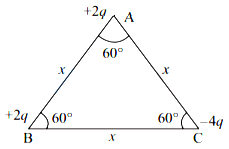
0 likesView Solution
54
PhysicsMediumMCQKCET · 2017
In Young's double-slit experiment,if yellow light is replaced by blue light,the interference fringes become
A
wider
B
narrower
C
brighter
D
darker
Solution
(B) In Young's double-slit experiment,the fringe width $\beta$ is given by the formula $\beta = \frac{\lambda D}{d}$.
From this relation,we can see that the fringe width is directly proportional to the wavelength of the light used,i.e.,$\beta \propto \lambda$.
The wavelength of yellow light $(\lambda_{yellow})$ is greater than the wavelength of blue light $(\lambda_{blue})$.
Since the wavelength decreases when replacing yellow light with blue light,the fringe width $\beta$ will also decrease.
Therefore,the interference fringes become narrower.
From this relation,we can see that the fringe width is directly proportional to the wavelength of the light used,i.e.,$\beta \propto \lambda$.
The wavelength of yellow light $(\lambda_{yellow})$ is greater than the wavelength of blue light $(\lambda_{blue})$.
Since the wavelength decreases when replacing yellow light with blue light,the fringe width $\beta$ will also decrease.
Therefore,the interference fringes become narrower.
0 likesView Solution
55
PhysicsMediumMCQKCET · 2017
In a system of two crossed polarisers,it is found that the intensity of light from the second polariser is half of that from the first polariser. The angle between their pass axes is (in $^{\circ}$)
A
$45$
B
$60$
C
$30$
D
$0$
Solution
(A) According to Malus's Law,the intensity of light transmitted through a polariser is given by:
$I = I_{0} \cos^{2} \theta$
Where $I_{0}$ is the intensity of light incident on the second polariser (which is the intensity of light emerging from the first polariser),and $\theta$ is the angle between the pass axes of the two polarisers.
Given that the intensity of light from the second polariser $(I)$ is half of the intensity from the first polariser $(I_{0})$,we have:
$I = \frac{I_{0}}{2}$
Substituting this into Malus's Law:
$\frac{I_{0}}{2} = I_{0} \cos^{2} \theta$
$\frac{1}{2} = \cos^{2} \theta$
$\cos \theta = \frac{1}{\sqrt{2}}$
$\theta = \cos^{-1}\left(\frac{1}{\sqrt{2}}\right) = 45^{\circ}$
Therefore,the angle between the pass axes of the polarisers is $45^{\circ}$.
$I = I_{0} \cos^{2} \theta$
Where $I_{0}$ is the intensity of light incident on the second polariser (which is the intensity of light emerging from the first polariser),and $\theta$ is the angle between the pass axes of the two polarisers.
Given that the intensity of light from the second polariser $(I)$ is half of the intensity from the first polariser $(I_{0})$,we have:
$I = \frac{I_{0}}{2}$
Substituting this into Malus's Law:
$\frac{I_{0}}{2} = I_{0} \cos^{2} \theta$
$\frac{1}{2} = \cos^{2} \theta$
$\cos \theta = \frac{1}{\sqrt{2}}$
$\theta = \cos^{-1}\left(\frac{1}{\sqrt{2}}\right) = 45^{\circ}$
Therefore,the angle between the pass axes of the polarisers is $45^{\circ}$.
0 likesView Solution
56
PhysicsEasyMCQKCET · 2017
Two point charges $A = +3 \text{ nC}$ and $B = +1 \text{ nC}$ are placed $5 \text{ cm}$ apart in air. The work done to move charge $B$ towards $A$ by $1 \text{ cm}$ is
A
$1.35 \times 10^{-7} \text{ J}$
B
$2.7 \times 10^{-7} \text{ J}$
C
$2.0 \times 10^{-7} \text{ J}$
D
$12.1 \times 10^{-7} \text{ J}$
Solution
(A) Given: $q_A = 3 \times 10^{-9} \text{ C}$,$q_B = 1 \times 10^{-9} \text{ C}$,initial distance $d_i = 5 \times 10^{-2} \text{ m}$.
Initial potential energy $U_i = \frac{1}{4\pi\epsilon_0} \frac{q_A q_B}{d_i} = (9 \times 10^9) \frac{(3 \times 10^{-9})(1 \times 10^{-9})}{5 \times 10^{-2}} = \frac{27 \times 10^{-9}}{5 \times 10^{-2}} = 5.4 \times 10^{-7} \text{ J}$.
After moving charge $B$ towards $A$ by $1 \text{ cm}$,the new distance $d_f = 4 \times 10^{-2} \text{ m}$.
Final potential energy $U_f = \frac{1}{4\pi\epsilon_0} \frac{q_A q_B}{d_f} = (9 \times 10^9) \frac{(3 \times 10^{-9})(1 \times 10^{-9})}{4 \times 10^{-2}} = \frac{27 \times 10^{-9}}{4 \times 10^{-2}} = 6.75 \times 10^{-7} \text{ J}$.
Work done $W = U_f - U_i = (6.75 - 5.4) \times 10^{-7} \text{ J} = 1.35 \times 10^{-7} \text{ J}$.
Initial potential energy $U_i = \frac{1}{4\pi\epsilon_0} \frac{q_A q_B}{d_i} = (9 \times 10^9) \frac{(3 \times 10^{-9})(1 \times 10^{-9})}{5 \times 10^{-2}} = \frac{27 \times 10^{-9}}{5 \times 10^{-2}} = 5.4 \times 10^{-7} \text{ J}$.
After moving charge $B$ towards $A$ by $1 \text{ cm}$,the new distance $d_f = 4 \times 10^{-2} \text{ m}$.
Final potential energy $U_f = \frac{1}{4\pi\epsilon_0} \frac{q_A q_B}{d_f} = (9 \times 10^9) \frac{(3 \times 10^{-9})(1 \times 10^{-9})}{4 \times 10^{-2}} = \frac{27 \times 10^{-9}}{4 \times 10^{-2}} = 6.75 \times 10^{-7} \text{ J}$.
Work done $W = U_f - U_i = (6.75 - 5.4) \times 10^{-7} \text{ J} = 1.35 \times 10^{-7} \text{ J}$.
0 likesView Solution
57
PhysicsEasyMCQKCET · 2017
$A$ coil of inductive reactance $ \frac{1}{\sqrt{3}} \Omega $ and resistance $ 1 \Omega $ is connected to a $ 200 \ V, 50 \ Hz $ $AC$ supply. The time lag between maximum voltage and current is
A
$ \frac{1}{300} \ s $
B
$ \frac{1}{600} \ s $
C
$ \frac{1}{500} \ s $
D
$ \frac{1}{200} \ s $
Solution
(B) Given: Inductive reactance $ X_L = \omega L = \frac{1}{\sqrt{3}} \ \Omega $,Resistance $ R = 1 \ \Omega $,Frequency $ f = 50 \ Hz $.
In an $ RL $ circuit,the phase difference $ \phi $ between voltage and current is given by $ \tan \phi = \frac{X_L}{R} $.
Substituting the values,$ \tan \phi = \frac{1/\sqrt{3}}{1} = \frac{1}{\sqrt{3}} $.
Thus,$ \phi = 30^{\circ} = \frac{\pi}{6} \text{ radians} $.
The phase difference $ \phi $ is related to time lag $ t $ by the relation $ \phi = \omega t $.
Since $ \omega = 2\pi f = 2\pi \times 50 = 100\pi \ rad/s $.
Therefore,$ t = \frac{\phi}{\omega} = \frac{\pi/6}{100\pi} = \frac{1}{600} \ s $.
The time lag between maximum voltage and current is $ \frac{1}{600} \ s $.
In an $ RL $ circuit,the phase difference $ \phi $ between voltage and current is given by $ \tan \phi = \frac{X_L}{R} $.
Substituting the values,$ \tan \phi = \frac{1/\sqrt{3}}{1} = \frac{1}{\sqrt{3}} $.
Thus,$ \phi = 30^{\circ} = \frac{\pi}{6} \text{ radians} $.
The phase difference $ \phi $ is related to time lag $ t $ by the relation $ \phi = \omega t $.
Since $ \omega = 2\pi f = 2\pi \times 50 = 100\pi \ rad/s $.
Therefore,$ t = \frac{\phi}{\omega} = \frac{\pi/6}{100\pi} = \frac{1}{600} \ s $.
The time lag between maximum voltage and current is $ \frac{1}{600} \ s $.
0 likesView Solution
58
PhysicsEasyMCQKCET · 2017
Which of the following logic gates is considered as 'universal'?
A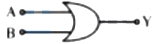
B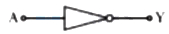
C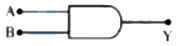
D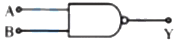
Solution
(D) universal gate is a logic gate that can be used to implement any other logic gate without the need for any other type of gate. The $NAND$ gate and the $NOR$ gate are known as universal gates. In the given options,the $NAND$ gate is a universal gate because any basic logic gate ($AND$,$OR$,$NOT$) can be constructed using only $NAND$ gates.
0 likesView Solution
59
PhysicsEasyMCQKCET · 2017
$A$ bar magnet is allowed to fall vertically through a copper coil placed in a horizontal plane. The magnet falls with a net acceleration:
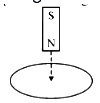
A
$=g$
B
$ > g$
C
$ < g$
D
Zero
Solution
(C) As the bar magnet falls through the copper coil, the magnetic flux linked with the coil changes.
According to Faraday's law of electromagnetic induction, this change in magnetic flux induces an electromotive force (emf) and consequently an induced current in the coil.
According to Lenz's law, the direction of this induced current is such that it opposes the cause that produces it, which is the motion of the falling magnet.
This induced current creates a magnetic field that exerts an upward repulsive force on the falling magnet.
Therefore, the net downward force on the magnet is $F_{net} = mg - F_{repulsive}$.
Since there is an upward force opposing gravity, the net acceleration $a$ of the magnet is given by $a = \frac{F_{net}}{m} = g - \frac{F_{repulsive}}{m}$.
Thus, the net acceleration of the magnet is less than $g$.
According to Faraday's law of electromagnetic induction, this change in magnetic flux induces an electromotive force (emf) and consequently an induced current in the coil.
According to Lenz's law, the direction of this induced current is such that it opposes the cause that produces it, which is the motion of the falling magnet.
This induced current creates a magnetic field that exerts an upward repulsive force on the falling magnet.
Therefore, the net downward force on the magnet is $F_{net} = mg - F_{repulsive}$.
Since there is an upward force opposing gravity, the net acceleration $a$ of the magnet is given by $a = \frac{F_{net}}{m} = g - \frac{F_{repulsive}}{m}$.
Thus, the net acceleration of the magnet is less than $g$.
0 likesView Solution
60
PhysicsMediumMCQKCET · 2017
The magnetic susceptibility of a ferromagnetic substance is
A
$>> 1$
B
$> 1$
C
$< 1$
D
Zero
Solution
(A) Magnetic susceptibility $(\chi)$ is a measure of how easily a substance can be magnetized in an external magnetic field.
For ferromagnetic substances,the atoms possess a permanent magnetic dipole moment,and they align strongly in the direction of the external magnetic field.
Due to this strong alignment,ferromagnetic materials exhibit a very large and positive magnetic susceptibility.
Therefore,for a ferromagnetic substance,$\chi >> 1$.
For ferromagnetic substances,the atoms possess a permanent magnetic dipole moment,and they align strongly in the direction of the external magnetic field.
Due to this strong alignment,ferromagnetic materials exhibit a very large and positive magnetic susceptibility.
Therefore,for a ferromagnetic substance,$\chi >> 1$.
0 likesView Solution
Vedclass Products
For Students
Vedclass Test Series
Mock tests in real KCET style covering Physics with performance analysis. 5-day free trial.
Start Free TrialFor Teachers
Exam Paper Generator
Generate Set A/B/C/D Physics papers from 7.5L+ questions in 2 minutes. 3 chapters free.
Try FreeFor Institutes
Online Exam Module
Run live KCET mock exams with unlimited students, 360° analytics & white-label branding.
See DemoFrequently Asked Questions
How many Physics questions are in KCET 2017?
There are 60 Physics questions from the KCET 2017 paper on Vedclass, each with a detailed step-by-step solution in English.
Are KCET 2017 Physics solutions available in English?
Yes. All solutions on this page are in English. You can also switch to English or Hindi using the language buttons above the questions.
Can I practice KCET 2017 Physics as a timed test?
Yes. Use the Vedclass Test Series to attempt a full KCET mock test covering Physics with time limits and instant score analysis.
Can teachers create Physics papers from KCET previous year questions?
Yes. The Vedclass Exam Paper Generator lets teachers mix KCET Physics questions and generate Set A/B/C/D papers in minutes.
For Teachers & Institutes
Build a Custom Physics Paper
Pick KCET 2017 Physics questions, set difficulty, and generate Set A/B/C/D in 2 minutes.