
PhysicsQ1–59 of 59 questions
Page 1 of 1 · English
1
PhysicsEasyMCQKCET · 2011
Two satellites of mass $m$ and $9m$ are orbiting a planet in orbits of radius $R$. Their periods of revolution will be in the ratio of
A
$9: 1$
B
$3: 1$
C
$1: 1$
D
$1: 3$
Solution
(C) According to Kepler's third law of planetary motion,the square of the time period $T$ of a satellite is proportional to the cube of the orbital radius $R$,given by $T^2 \propto R^3$.
This implies $T = 2\pi \sqrt{\frac{R^3}{GM}}$,where $G$ is the gravitational constant and $M$ is the mass of the planet.
Note that the time period $T$ depends only on the radius of the orbit $R$ and the mass of the central planet $M$.
It is independent of the mass of the satellite $m$.
Since both satellites orbit the same planet at the same radius $R$,their time periods will be equal.
Therefore,the ratio of their periods of revolution is $1: 1$.
This implies $T = 2\pi \sqrt{\frac{R^3}{GM}}$,where $G$ is the gravitational constant and $M$ is the mass of the planet.
Note that the time period $T$ depends only on the radius of the orbit $R$ and the mass of the central planet $M$.
It is independent of the mass of the satellite $m$.
Since both satellites orbit the same planet at the same radius $R$,their time periods will be equal.
Therefore,the ratio of their periods of revolution is $1: 1$.
0 likesView Solution
2
PhysicsMediumMCQKCET · 2011
The quantities of heat required to raise the temperatures of two copper spheres of radii $r_{1}$ and $r_{2}$ $(r_{1} = 1.5 r_{2})$ through $1 \ K$ are in the ratio of:
A
$27/8$
B
$9/4$
C
$3/2$
D
$1$
Solution
(A) The heat required to raise the temperature of a body is given by $Q = mc\Delta T$,where $m$ is the mass,$c$ is the specific heat capacity,and $\Delta T$ is the change in temperature.
Since the spheres are made of the same material (copper),$c$ is constant. For a given $\Delta T = 1 \ K$,$Q \propto m$.
The mass $m$ of a sphere is given by $m = \rho V$,where $\rho$ is the density and $V$ is the volume.
$V = \frac{4}{3}\pi r^3$,so $m \propto r^3$.
Therefore,$Q \propto r^3$.
The ratio of heat required is $\frac{Q_1}{Q_2} = \frac{r_1^3}{r_2^3} = \left(\frac{r_1}{r_2}\right)^3$.
Given $r_1 = 1.5 r_2$,we have $\frac{r_1}{r_2} = 1.5 = \frac{3}{2}$.
Thus,$\frac{Q_1}{Q_2} = \left(\frac{3}{2}\right)^3 = \frac{27}{8}$.
Since the spheres are made of the same material (copper),$c$ is constant. For a given $\Delta T = 1 \ K$,$Q \propto m$.
The mass $m$ of a sphere is given by $m = \rho V$,where $\rho$ is the density and $V$ is the volume.
$V = \frac{4}{3}\pi r^3$,so $m \propto r^3$.
Therefore,$Q \propto r^3$.
The ratio of heat required is $\frac{Q_1}{Q_2} = \frac{r_1^3}{r_2^3} = \left(\frac{r_1}{r_2}\right)^3$.
Given $r_1 = 1.5 r_2$,we have $\frac{r_1}{r_2} = 1.5 = \frac{3}{2}$.
Thus,$\frac{Q_1}{Q_2} = \left(\frac{3}{2}\right)^3 = \frac{27}{8}$.
0 likesView Solution
3
PhysicsEasyMCQKCET · 2011
$A$ perfect gas at $27^{\circ} C$ is heated at constant pressure so as to double its volume. The increase in temperature of the gas will be (in $^{\circ} C$)
A
$600$
B
$327$
C
$54$
D
$300$
Solution
(D) According to Charles's Law,for a fixed mass of gas at constant pressure,the volume is directly proportional to its absolute temperature: $V \propto T$ or $\frac{V_1}{T_1} = \frac{V_2}{T_2}$.
Given initial temperature $T_1 = 27^{\circ} C = 27 + 273 = 300 \ K$.
Let initial volume $V_1 = V$. Then final volume $V_2 = 2V$.
Substituting these values into the formula: $\frac{V}{300} = \frac{2V}{T_2}$.
Solving for $T_2$: $T_2 = 300 \times 2 = 600 \ K$.
Converting the final temperature to Celsius: $T_2 = 600 - 273 = 327^{\circ} C$.
The increase in temperature is $\Delta T = T_2 - T_1 = 327^{\circ} C - 27^{\circ} C = 300^{\circ} C$.
Given initial temperature $T_1 = 27^{\circ} C = 27 + 273 = 300 \ K$.
Let initial volume $V_1 = V$. Then final volume $V_2 = 2V$.
Substituting these values into the formula: $\frac{V}{300} = \frac{2V}{T_2}$.
Solving for $T_2$: $T_2 = 300 \times 2 = 600 \ K$.
Converting the final temperature to Celsius: $T_2 = 600 - 273 = 327^{\circ} C$.
The increase in temperature is $\Delta T = T_2 - T_1 = 327^{\circ} C - 27^{\circ} C = 300^{\circ} C$.
0 likesView Solution
4
PhysicsDifficultMCQKCET · 2011
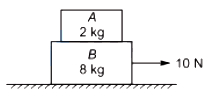
Block $A$ of mass $2 \, kg$ is placed over block $B$ of mass $8 \, kg$. The combination is placed over a rough horizontal surface. The coefficient of friction between block $B$ and the floor is $0.5$. The coefficient of friction between blocks $A$ and $B$ is $0.4$. A horizontal force of $10 \, N$ is applied on block $B$. Find the force of friction between blocks $A$ and $B$. (Take $g = 10 \, ms^{-2}$)
A
$100 \, N$
B
$40 \, N$
C
$50 \, N$
D
Zero
Solution
(D) $1$. Total mass of the system $(A + B) = 2 \, kg + 8 \, kg = 10 \, kg$.
$2$. The maximum static friction (limiting friction) between block $B$ and the horizontal floor is given by $f_{max} = \mu_s N$, where $N$ is the normal reaction force from the floor.
$3$. The normal reaction $N = (m_A + m_B)g = 10 \, kg \times 10 \, ms^{-2} = 100 \, N$.
$4$. Therefore, $f_{max} = 0.5 \times 100 \, N = 50 \, N$.
$5$. The applied horizontal force on block $B$ is $F_{app} = 10 \, N$.
$6$. Since $F_{app} < f_{max}$ $(10 \, N < 50 \, N)$, the entire system remains at rest.
$7$. Because the system is at rest and no external force is acting on block $A$ to cause relative motion between $A$ and $B$, the static friction force between blocks $A$ and $B$ is zero.
$2$. The maximum static friction (limiting friction) between block $B$ and the horizontal floor is given by $f_{max} = \mu_s N$, where $N$ is the normal reaction force from the floor.
$3$. The normal reaction $N = (m_A + m_B)g = 10 \, kg \times 10 \, ms^{-2} = 100 \, N$.
$4$. Therefore, $f_{max} = 0.5 \times 100 \, N = 50 \, N$.
$5$. The applied horizontal force on block $B$ is $F_{app} = 10 \, N$.
$6$. Since $F_{app} < f_{max}$ $(10 \, N < 50 \, N)$, the entire system remains at rest.
$7$. Because the system is at rest and no external force is acting on block $A$ to cause relative motion between $A$ and $B$, the static friction force between blocks $A$ and $B$ is zero.
0 likesView Solution
5
PhysicsEasyMCQKCET · 2011
The resultant of two forces acting at an angle of $120^{\circ}$ is $10 \,kg$-wt and is perpendicular to one of the forces. That force is
A
$10 \sqrt{3} \,kg$-wt
B
$20 \sqrt{3} \,kg$-wt
C
$10 \,kg$-wt
D
$\frac{10}{\sqrt{3}} \,kg$-wt
Solution
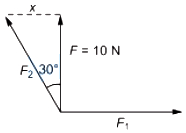
(D) Let the two forces be $F_1$ and $F_2$. The angle between them is $\theta = 120^{\circ}$.
Let the resultant $R = 10 \,kg$-wt be perpendicular to force $F_1$.
Using the formula for the angle $\alpha$ that the resultant makes with force $F_1$:
$\tan \alpha = \frac{F_2 \sin \theta}{F_1 + F_2 \cos \theta}$
Since the resultant is perpendicular to $F_1$, $\alpha = 90^{\circ}$, so $\tan 90^{\circ} = \infty$.
This implies the denominator must be zero: $F_1 + F_2 \cos 120^{\circ} = 0$.
$F_1 + F_2 (-0.5) = 0 \implies F_1 = 0.5 F_2 \implies F_2 = 2 F_1$.
The magnitude of the resultant is given by $R^2 = F_1^2 + F_2^2 + 2 F_1 F_2 \cos 120^{\circ}$.
$10^2 = F_1^2 + (2 F_1)^2 + 2 F_1 (2 F_1) (-0.5)$.
$100 = F_1^2 + 4 F_1^2 - 2 F_1^2 = 3 F_1^2$.
$F_1^2 = \frac{100}{3} \implies F_1 = \frac{10}{\sqrt{3}} \,kg$-wt.
Thus, the force perpendicular to the resultant is $\frac{10}{\sqrt{3}} \,kg$-wt.
Let the resultant $R = 10 \,kg$-wt be perpendicular to force $F_1$.
Using the formula for the angle $\alpha$ that the resultant makes with force $F_1$:
$\tan \alpha = \frac{F_2 \sin \theta}{F_1 + F_2 \cos \theta}$
Since the resultant is perpendicular to $F_1$, $\alpha = 90^{\circ}$, so $\tan 90^{\circ} = \infty$.
This implies the denominator must be zero: $F_1 + F_2 \cos 120^{\circ} = 0$.
$F_1 + F_2 (-0.5) = 0 \implies F_1 = 0.5 F_2 \implies F_2 = 2 F_1$.
The magnitude of the resultant is given by $R^2 = F_1^2 + F_2^2 + 2 F_1 F_2 \cos 120^{\circ}$.
$10^2 = F_1^2 + (2 F_1)^2 + 2 F_1 (2 F_1) (-0.5)$.
$100 = F_1^2 + 4 F_1^2 - 2 F_1^2 = 3 F_1^2$.
$F_1^2 = \frac{100}{3} \implies F_1 = \frac{10}{\sqrt{3}} \,kg$-wt.
Thus, the force perpendicular to the resultant is $\frac{10}{\sqrt{3}} \,kg$-wt.
0 likesView Solution
6
PhysicsEasyMCQKCET · 2011
Two capillary tubes of different diameters are dipped in water. The rise of water is
A
the same in both tubes
B
greater in the tube of larger diameter
C
greater in the tube of smaller diameter
D
independent of the diameter of the tube
Solution
(C) The height of water in a capillary tube is given by the formula:
$h = \frac{2T \cos \theta}{r \rho g}$
where $T$ is the surface tension,$\theta$ is the angle of contact,$r$ is the radius of the capillary tube,$\rho$ is the density of the liquid,and $g$ is the acceleration due to gravity.
From this formula,we can see that $h \propto \frac{1}{r}$.
Since the height $h$ is inversely proportional to the radius $r$ of the tube,the rise of water will be greater in the tube with the smaller diameter (smaller radius).
$h = \frac{2T \cos \theta}{r \rho g}$
where $T$ is the surface tension,$\theta$ is the angle of contact,$r$ is the radius of the capillary tube,$\rho$ is the density of the liquid,and $g$ is the acceleration due to gravity.
From this formula,we can see that $h \propto \frac{1}{r}$.
Since the height $h$ is inversely proportional to the radius $r$ of the tube,the rise of water will be greater in the tube with the smaller diameter (smaller radius).
0 likesView Solution
7
PhysicsDifficultMCQKCET · 2011
Eight equal drops of water are falling through air with a steady velocity of $10 \,cm \,s^{-1}$. If the drops combine to form a single drop, then the terminal velocity of this big drop is:
A
$40 \,cm \,s^{-1}$
B
$10 \,cm \,s^{-1}$
C
$30 \,cm \,s^{-1}$
D
$80 \,cm \,s^{-1}$
Solution
(A) Let the radius of each small drop be $r$ and the radius of the big drop be $R$. Since the volume remains constant, the volume of $8$ small drops equals the volume of the big drop:
$8 \cdot (\frac{4}{3} \pi r^3) = \frac{4}{3} \pi R^3$
$R^3 = 8r^3 \implies R = 2r$.
Terminal velocity $v_t$ is given by the formula $v_t = \frac{2}{9} \frac{r^2(\rho - \sigma)g}{\eta}$, which implies $v_t \propto r^2$.
Let $v_1$ be the terminal velocity of the small drop and $v_2$ be the terminal velocity of the big drop.
$\frac{v_2}{v_1} = \frac{R^2}{r^2} = \frac{(2r)^2}{r^2} = 4$.
Given $v_1 = 10 \,cm \,s^{-1}$, we have $v_2 = 4 \cdot 10 \,cm \,s^{-1} = 40 \,cm \,s^{-1}$.
$8 \cdot (\frac{4}{3} \pi r^3) = \frac{4}{3} \pi R^3$
$R^3 = 8r^3 \implies R = 2r$.
Terminal velocity $v_t$ is given by the formula $v_t = \frac{2}{9} \frac{r^2(\rho - \sigma)g}{\eta}$, which implies $v_t \propto r^2$.
Let $v_1$ be the terminal velocity of the small drop and $v_2$ be the terminal velocity of the big drop.
$\frac{v_2}{v_1} = \frac{R^2}{r^2} = \frac{(2r)^2}{r^2} = 4$.
Given $v_1 = 10 \,cm \,s^{-1}$, we have $v_2 = 4 \cdot 10 \,cm \,s^{-1} = 40 \,cm \,s^{-1}$.
0 likesView Solution
8
PhysicsMediumMCQKCET · 2011
The following four wires of length $L$ and radius $r$ are made of the same material. Which of these will have the largest extension,when the same tension is applied?
A
$L=100 \ cm, r=0.2 \ mm$
B
$L=200 \ cm, r=0.4 \ mm$
C
$L=300 \ cm, r=0.6 \ mm$
D
$L=400 \ cm, r=0.8 \ mm$
Solution
(A) The extension $e$ of a wire is given by the formula $e = \frac{FL}{AY}$,where $F$ is the applied force,$L$ is the length,$A$ is the cross-sectional area,and $Y$ is Young's modulus.
Since $A = \pi r^2$,we have $e = \frac{FL}{\pi r^2 Y}$.
Given that $F$ and $Y$ are the same for all wires,the extension is proportional to the ratio $\frac{L}{r^2}$,i.e.,$e \propto \frac{L}{r^2}$.
Let us calculate the value of $\frac{L}{r^2}$ for each case:
For option $A$: $\frac{100}{(0.2)^2} = \frac{100}{0.04} = 2500$.
For option $B$: $\frac{200}{(0.4)^2} = \frac{200}{0.16} = 1250$.
For option $C$: $\frac{300}{(0.6)^2} = \frac{300}{0.36} \approx 833.3$.
For option $D$: $\frac{400}{(0.8)^2} = \frac{400}{0.64} = 625$.
Comparing these values,the wire in option $A$ has the largest value of $\frac{L}{r^2}$,and therefore,it will have the largest extension.
Since $A = \pi r^2$,we have $e = \frac{FL}{\pi r^2 Y}$.
Given that $F$ and $Y$ are the same for all wires,the extension is proportional to the ratio $\frac{L}{r^2}$,i.e.,$e \propto \frac{L}{r^2}$.
Let us calculate the value of $\frac{L}{r^2}$ for each case:
For option $A$: $\frac{100}{(0.2)^2} = \frac{100}{0.04} = 2500$.
For option $B$: $\frac{200}{(0.4)^2} = \frac{200}{0.16} = 1250$.
For option $C$: $\frac{300}{(0.6)^2} = \frac{300}{0.36} \approx 833.3$.
For option $D$: $\frac{400}{(0.8)^2} = \frac{400}{0.64} = 625$.
Comparing these values,the wire in option $A$ has the largest value of $\frac{L}{r^2}$,and therefore,it will have the largest extension.
0 likesView Solution
9
PhysicsEasyMCQKCET · 2011
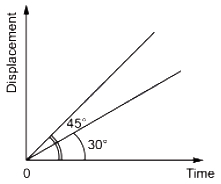
The displacement-time graph of two moving particles makes angles of $30^{\circ}$ and $45^{\circ}$ with the time axis ($X$-axis). The ratio of their velocities is
A
$\sqrt{3}: 2$
B
$1: 1$
C
$1: 2$
D
$1: \sqrt{3}$
Solution
(D) By definition,the slope of a displacement-time graph represents the velocity of the particle.
$v = \tan \theta$
Given the angles $\theta_1 = 30^{\circ}$ and $\theta_2 = 45^{\circ}$.
The ratio of their velocities is given by:
$\frac{v_1}{v_2} = \frac{\tan \theta_1}{\tan \theta_2}$
Substituting the values:
$\frac{v_1}{v_2} = \frac{\tan 30^{\circ}}{\tan 45^{\circ}}$
Since $\tan 30^{\circ} = \frac{1}{\sqrt{3}}$ and $\tan 45^{\circ} = 1$,we get:
$\frac{v_1}{v_2} = \frac{1/\sqrt{3}}{1} = \frac{1}{\sqrt{3}}$
Thus,the ratio is $1: \sqrt{3}$.
$v = \tan \theta$
Given the angles $\theta_1 = 30^{\circ}$ and $\theta_2 = 45^{\circ}$.
The ratio of their velocities is given by:
$\frac{v_1}{v_2} = \frac{\tan \theta_1}{\tan \theta_2}$
Substituting the values:
$\frac{v_1}{v_2} = \frac{\tan 30^{\circ}}{\tan 45^{\circ}}$
Since $\tan 30^{\circ} = \frac{1}{\sqrt{3}}$ and $\tan 45^{\circ} = 1$,we get:
$\frac{v_1}{v_2} = \frac{1/\sqrt{3}}{1} = \frac{1}{\sqrt{3}}$
Thus,the ratio is $1: \sqrt{3}$.
0 likesView Solution
10
PhysicsMediumMCQKCET · 2011
The height $y$ and the distance $x$ along the horizontal plane of a projectile on a certain planet (with no surrounding atmosphere) are given by $y = 8t - 5t^2 \text{ m}$ and $x = 6t \text{ m}$,where $t$ is in seconds. The velocity with which the projectile is projected is (in $\text{ m/s}$)
A
$6$
B
$8$
C
$10$
D
$14$
Solution
(C) The equations of motion for the projectile are given as:
$x = 6t$ $(i)$
$y = 8t - 5t^2$ (ii)
Comparing these with the standard equations of motion for a projectile:
$x = (u \cos \theta)t$
$y = (u \sin \theta)t - \frac{1}{2}gt^2$
From equation $(i)$,the horizontal component of velocity is $u_x = u \cos \theta = 6 \text{ m/s}$.
From equation (ii),the vertical component of velocity is $u_y = u \sin \theta = 8 \text{ m/s}$.
The magnitude of the initial projection velocity $u$ is given by:
$u = \sqrt{u_x^2 + u_y^2}$
$u = \sqrt{6^2 + 8^2}$
$u = \sqrt{36 + 64}$
$u = \sqrt{100}$
$u = 10 \text{ m/s}$.
$x = 6t$ $(i)$
$y = 8t - 5t^2$ (ii)
Comparing these with the standard equations of motion for a projectile:
$x = (u \cos \theta)t$
$y = (u \sin \theta)t - \frac{1}{2}gt^2$
From equation $(i)$,the horizontal component of velocity is $u_x = u \cos \theta = 6 \text{ m/s}$.
From equation (ii),the vertical component of velocity is $u_y = u \sin \theta = 8 \text{ m/s}$.
The magnitude of the initial projection velocity $u$ is given by:
$u = \sqrt{u_x^2 + u_y^2}$
$u = \sqrt{6^2 + 8^2}$
$u = \sqrt{36 + 64}$
$u = \sqrt{100}$
$u = 10 \text{ m/s}$.
0 likesView Solution
11
PhysicsDifficultMCQKCET · 2011
$A$ particle executing a simple harmonic motion has a period of $6 \,s$. The time taken by the particle to move from the mean position to half the amplitude, starting from the mean position is
A
$3/2 \,s$
B
$1/2 \,s$
C
$3/4 \,s$
D
$1/4 \,s$
Solution
(B) The displacement equation for a particle executing simple harmonic motion starting from the mean position is given by $y = a \sin(\omega t)$, where $\omega = \frac{2\pi}{T}$.
Given that the particle moves from the mean position $(y = 0)$ to half the amplitude $(y = a/2)$, we substitute these values into the equation:
$\frac{a}{2} = a \sin\left(\frac{2\pi}{T} t\right)$
$\frac{1}{2} = \sin\left(\frac{2\pi}{T} t\right)$
Since $\sin(\pi/6) = 1/2$, we have:
$\frac{2\pi}{T} t = \frac{\pi}{6}$
Solving for $t$:
$t = \frac{T}{12}$
Given the period $T = 6 \,s$:
$t = \frac{6}{12} = 0.5 \,s = \frac{1}{2} \,s$.
Given that the particle moves from the mean position $(y = 0)$ to half the amplitude $(y = a/2)$, we substitute these values into the equation:
$\frac{a}{2} = a \sin\left(\frac{2\pi}{T} t\right)$
$\frac{1}{2} = \sin\left(\frac{2\pi}{T} t\right)$
Since $\sin(\pi/6) = 1/2$, we have:
$\frac{2\pi}{T} t = \frac{\pi}{6}$
Solving for $t$:
$t = \frac{T}{12}$
Given the period $T = 6 \,s$:
$t = \frac{6}{12} = 0.5 \,s = \frac{1}{2} \,s$.
0 likesView Solution
12
PhysicsDifficultMCQKCET · 2011
$A$ solid sphere of mass $m$ rolls down an inclined plane without slipping,starting from rest at the top of an inclined plane. The linear speed of the sphere at the bottom of the inclined plane is $v$. The kinetic energy of the sphere at the bottom is
A
$\frac{1}{2} m v^{2}$
B
$\frac{5}{3} m v^{2}$
C
$\frac{2}{5} m v^{2}$
D
$\frac{7}{10} m v^{2}$
Solution
(D) The total kinetic energy $(KE)$ of a body rolling without slipping is the sum of its translational kinetic energy and rotational kinetic energy.
$KE = KE_{\text{trans}} + KE_{\text{rot}}$
$KE = \frac{1}{2} m v^{2} + \frac{1}{2} I \omega^{2}$
For a solid sphere,the moment of inertia $I = \frac{2}{5} m R^{2}$ and the condition for rolling without slipping is $v = R \omega$,which implies $\omega = \frac{v}{R}$.
Substituting these into the equation:
$KE = \frac{1}{2} m v^{2} + \frac{1}{2} (\frac{2}{5} m R^{2}) (\frac{v}{R})^{2}$
$KE = \frac{1}{2} m v^{2} + \frac{1}{2} (\frac{2}{5} m v^{2})$
$KE = \frac{1}{2} m v^{2} (1 + \frac{2}{5})$
$KE = \frac{1}{2} m v^{2} (\frac{7}{5})$
$KE = \frac{7}{10} m v^{2}$
$KE = KE_{\text{trans}} + KE_{\text{rot}}$
$KE = \frac{1}{2} m v^{2} + \frac{1}{2} I \omega^{2}$
For a solid sphere,the moment of inertia $I = \frac{2}{5} m R^{2}$ and the condition for rolling without slipping is $v = R \omega$,which implies $\omega = \frac{v}{R}$.
Substituting these into the equation:
$KE = \frac{1}{2} m v^{2} + \frac{1}{2} (\frac{2}{5} m R^{2}) (\frac{v}{R})^{2}$
$KE = \frac{1}{2} m v^{2} + \frac{1}{2} (\frac{2}{5} m v^{2})$
$KE = \frac{1}{2} m v^{2} (1 + \frac{2}{5})$
$KE = \frac{1}{2} m v^{2} (\frac{7}{5})$
$KE = \frac{7}{10} m v^{2}$
0 likesView Solution
13
PhysicsDifficultMCQKCET · 2011
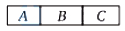
Three identical rods $A, B$ and $C$ are placed end to end. $A$ temperature difference is maintained between the free ends of $A$ and $C$. The thermal conductivity of $B$ is thrice that of $C$ and half of that of $A$. The effective thermal conductivity of the system will be ($K_{A}$ is the thermal conductivity of rod $A$).
A
$\frac{1}{3} K_{A}$
B
$3 K_{A}$
C
$2 K_{A}$
D
$\frac{2}{3} K_{A}$
Solution
(A) Given that the rods are identical,let the length of each rod be $l$ and the cross-sectional area be $A_{area}$.
Let $K_{A}, K_{B}, K_{C}$ be the thermal conductivities of rods $A, B, C$ respectively.
According to the problem:
$K_{B} = \frac{1}{2} K_{A}$
$K_{B} = 3 K_{C} \implies K_{C} = \frac{K_{B}}{3} = \frac{K_{A}}{6}$
Since the rods are connected in series,the equivalent thermal resistance $R_{eq}$ is the sum of individual resistances:
$R_{eq} = R_{A} + R_{B} + R_{C}$
$\frac{3l}{K_{eq} A_{area}} = \frac{l}{K_{A} A_{area}} + \frac{l}{K_{B} A_{area}} + \frac{l}{K_{C} A_{area}}$
$\frac{3}{K_{eq}} = \frac{1}{K_{A}} + \frac{1}{K_{A}/2} + \frac{1}{K_{A}/6}$
$\frac{3}{K_{eq}} = \frac{1}{K_{A}} + \frac{2}{K_{A}} + \frac{6}{K_{A}}$
$\frac{3}{K_{eq}} = \frac{9}{K_{A}}$
$K_{eq} = \frac{3 K_{A}}{9} = \frac{1}{3} K_{A}$
Let $K_{A}, K_{B}, K_{C}$ be the thermal conductivities of rods $A, B, C$ respectively.
According to the problem:
$K_{B} = \frac{1}{2} K_{A}$
$K_{B} = 3 K_{C} \implies K_{C} = \frac{K_{B}}{3} = \frac{K_{A}}{6}$
Since the rods are connected in series,the equivalent thermal resistance $R_{eq}$ is the sum of individual resistances:
$R_{eq} = R_{A} + R_{B} + R_{C}$
$\frac{3l}{K_{eq} A_{area}} = \frac{l}{K_{A} A_{area}} + \frac{l}{K_{B} A_{area}} + \frac{l}{K_{C} A_{area}}$
$\frac{3}{K_{eq}} = \frac{1}{K_{A}} + \frac{1}{K_{A}/2} + \frac{1}{K_{A}/6}$
$\frac{3}{K_{eq}} = \frac{1}{K_{A}} + \frac{2}{K_{A}} + \frac{6}{K_{A}}$
$\frac{3}{K_{eq}} = \frac{9}{K_{A}}$
$K_{eq} = \frac{3 K_{A}}{9} = \frac{1}{3} K_{A}$
0 likesView Solution
14
PhysicsMediumMCQKCET · 2011
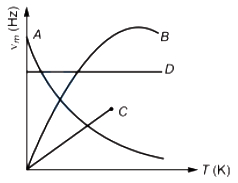
Which one of the following is the $\nu_{m}-T$ graph for a perfectly black body? Here, $\nu_{m}$ is the frequency of radiation with maximum intensity and $T$ is the absolute temperature.
A
$A$
B
$B$
C
$C$
D
$D$
Solution
(C) According to Wien's displacement law, the wavelength corresponding to maximum intensity $(\lambda_{m})$ is inversely proportional to the absolute temperature $(T)$, i.e., $\lambda_{m} T = \text{constant}$.
Since the frequency $\nu_{m}$ is related to wavelength by $\nu_{m} = c / \lambda_{m}$, we can substitute $\lambda_{m} = c / \nu_{m}$ into the displacement law.
This gives $(c / \nu_{m}) T = \text{constant}$, which simplifies to $\nu_{m} / T = \text{constant}'$ or $\nu_{m} \propto T$.
Therefore, the graph of $\nu_{m}$ versus $T$ for a perfectly black body is a straight line passing through the origin, which corresponds to line $C$ in the given figure.
Since the frequency $\nu_{m}$ is related to wavelength by $\nu_{m} = c / \lambda_{m}$, we can substitute $\lambda_{m} = c / \nu_{m}$ into the displacement law.
This gives $(c / \nu_{m}) T = \text{constant}$, which simplifies to $\nu_{m} / T = \text{constant}'$ or $\nu_{m} \propto T$.
Therefore, the graph of $\nu_{m}$ versus $T$ for a perfectly black body is a straight line passing through the origin, which corresponds to line $C$ in the given figure.
0 likesView Solution
15
PhysicsEasyMCQKCET · 2011
The equation of a wave is given by $y = 10 \sin \left( \frac{2 \pi}{45} t + \alpha \right)$. If the displacement is $5 \text{ cm}$ at $t = 0$,then the total phase at $t = 7.5 \text{ s}$ is
A
$\frac{\pi}{3}$
B
$\frac{\pi}{2}$
C
$\frac{\pi}{6}$
D
$\pi$
Solution
(B) The given wave equation is $y = 10 \sin \left( \frac{2 \pi}{45} t + \alpha \right)$.
At $t = 0$,the displacement $y = 5 \text{ cm}$.
Substituting these values: $5 = 10 \sin \left( \frac{2 \pi}{45} \times 0 + \alpha \right) = 10 \sin \alpha$.
Thus,$\sin \alpha = \frac{5}{10} = \frac{1}{2}$,which gives $\alpha = \frac{\pi}{6}$.
The total phase of the wave is given by $\phi = \frac{2 \pi}{45} t + \alpha$.
At $t = 7.5 \text{ s} = \frac{15}{2} \text{ s}$,the total phase is:
$\phi = \frac{2 \pi}{45} \times \frac{15}{2} + \frac{\pi}{6} = \frac{\pi}{3} + \frac{\pi}{6}$.
$\phi = \frac{2 \pi + \pi}{6} = \frac{3 \pi}{6} = \frac{\pi}{2}$.
At $t = 0$,the displacement $y = 5 \text{ cm}$.
Substituting these values: $5 = 10 \sin \left( \frac{2 \pi}{45} \times 0 + \alpha \right) = 10 \sin \alpha$.
Thus,$\sin \alpha = \frac{5}{10} = \frac{1}{2}$,which gives $\alpha = \frac{\pi}{6}$.
The total phase of the wave is given by $\phi = \frac{2 \pi}{45} t + \alpha$.
At $t = 7.5 \text{ s} = \frac{15}{2} \text{ s}$,the total phase is:
$\phi = \frac{2 \pi}{45} \times \frac{15}{2} + \frac{\pi}{6} = \frac{\pi}{3} + \frac{\pi}{6}$.
$\phi = \frac{2 \pi + \pi}{6} = \frac{3 \pi}{6} = \frac{\pi}{2}$.
0 likesView Solution
16
PhysicsDifficultMCQKCET · 2011
Two tuning forks $A$ and $B$ produce notes of frequencies $258 \,Hz$ and $262 \,Hz$. An unknown note sounded with $A$ produces certain beats. When the same note is sounded with $B$, the beat frequency gets doubled. The unknown frequency is (in $\,Hz$)
A
$250$
B
$252$
C
$254$
D
$256$
Solution
(C) Let the unknown frequency be $n \,Hz$.
The beat frequency with $A$ $(n_A = 258 \,Hz)$ is $x = |n - 258|$.
The beat frequency with $B$ $(n_B = 262 \,Hz)$ is $2x = |n - 262|$.
If $n < 258$, then $x = 258 - n$.
Then $2x = |n - 262| = 262 - n$.
Substituting $x$: $2(258 - n) = 262 - n$.
$516 - 2n = 262 - n$.
$n = 516 - 262 = 254 \,Hz$.
Checking the condition: If $n = 254 \,Hz$, beats with $A$ is $|254 - 258| = 4 \,Hz$.
Beats with $B$ is $|254 - 262| = 8 \,Hz$.
Since $8 = 2 \times 4$, the condition is satisfied.
The beat frequency with $A$ $(n_A = 258 \,Hz)$ is $x = |n - 258|$.
The beat frequency with $B$ $(n_B = 262 \,Hz)$ is $2x = |n - 262|$.
If $n < 258$, then $x = 258 - n$.
Then $2x = |n - 262| = 262 - n$.
Substituting $x$: $2(258 - n) = 262 - n$.
$516 - 2n = 262 - n$.
$n = 516 - 262 = 254 \,Hz$.
Checking the condition: If $n = 254 \,Hz$, beats with $A$ is $|254 - 258| = 4 \,Hz$.
Beats with $B$ is $|254 - 262| = 8 \,Hz$.
Since $8 = 2 \times 4$, the condition is satisfied.
0 likesView Solution
17
PhysicsMediumMCQKCET · 2011
$A$ wire under tension vibrates with a fundamental frequency of $600 \,Hz$. If the length of the wire is doubled, the radius is halved and the wire is made to vibrate under one-ninth the tension. Then the fundamental frequency will become (in $\,Hz$)
A
$200$
B
$300$
C
$600$
D
$400$
Solution
$(A)$ The fundamental frequency of a stretched wire is given by the formula: $f = \frac{1}{2l} \sqrt{\frac{T}{\mu}}$, where $\mu = \pi r^2 \rho$ is the linear mass density.
Substituting $\mu$, we get: $f = \frac{1}{2lr} \sqrt{\frac{T}{\pi \rho}}$.
Given the initial conditions: $f_1 = 600 \,Hz$, length $l_1 = l$, radius $r_1 = r$, and tension $T_1 = T$.
New conditions: $l_2 = 2l$, $r_2 = r/2$, and $T_2 = T/9$.
The ratio of frequencies is: $\frac{f_2}{f_1} = \frac{l_1}{l_2} \times \frac{r_1}{r_2} \times \sqrt{\frac{T_2}{T_1}}$.
Substituting the values: $\frac{f_2}{600} = \frac{l}{2l} \times \frac{r}{r/2} \times \sqrt{\frac{T/9}{T}}$.
$\frac{f_2}{600} = \frac{1}{2} \times 2 \times \sqrt{\frac{1}{9}} = 1 \times \frac{1}{3} = \frac{1}{3}$.
Therefore, $f_2 = \frac{600}{3} = 200 \,Hz$.
Substituting $\mu$, we get: $f = \frac{1}{2lr} \sqrt{\frac{T}{\pi \rho}}$.
Given the initial conditions: $f_1 = 600 \,Hz$, length $l_1 = l$, radius $r_1 = r$, and tension $T_1 = T$.
New conditions: $l_2 = 2l$, $r_2 = r/2$, and $T_2 = T/9$.
The ratio of frequencies is: $\frac{f_2}{f_1} = \frac{l_1}{l_2} \times \frac{r_1}{r_2} \times \sqrt{\frac{T_2}{T_1}}$.
Substituting the values: $\frac{f_2}{600} = \frac{l}{2l} \times \frac{r}{r/2} \times \sqrt{\frac{T/9}{T}}$.
$\frac{f_2}{600} = \frac{1}{2} \times 2 \times \sqrt{\frac{1}{9}} = 1 \times \frac{1}{3} = \frac{1}{3}$.
Therefore, $f_2 = \frac{600}{3} = 200 \,Hz$.
0 likesView Solution
18
PhysicsEasyMCQKCET · 2011
$A$ body of mass $5 \,kg$ is thrown vertically up with a kinetic energy of $490 \,J$. The height at which the kinetic energy of the body becomes half of the original value is (acceleration due to gravity $=9.8 \,ms^{-2}$) (in $\,m$)
A
$5$
B
$2.5$
C
$10$
D
$12.5$
Solution
(A) Given: Mass $m = 5 \,kg$,Initial Kinetic Energy $KE_i = 490 \,J$,Acceleration due to gravity $g = 9.8 \,ms^{-2}$.
At the required height $h$,the kinetic energy $KE_f$ becomes half of the initial value:
$KE_f = \frac{1}{2} KE_i = \frac{490}{2} = 245 \,J$.
According to the law of conservation of energy,the total mechanical energy remains constant:
$KE_i = KE_f + PE_f$
$KE_i = KE_f + mgh$
Substituting the values:
$490 = 245 + 5 \times 9.8 \times h$
$490 - 245 = 49 \times h$
$245 = 49h$
$h = \frac{245}{49} = 5 \,m$.
Therefore,the height is $5 \,m$.
At the required height $h$,the kinetic energy $KE_f$ becomes half of the initial value:
$KE_f = \frac{1}{2} KE_i = \frac{490}{2} = 245 \,J$.
According to the law of conservation of energy,the total mechanical energy remains constant:
$KE_i = KE_f + PE_f$
$KE_i = KE_f + mgh$
Substituting the values:
$490 = 245 + 5 \times 9.8 \times h$
$490 - 245 = 49 \times h$
$245 = 49h$
$h = \frac{245}{49} = 5 \,m$.
Therefore,the height is $5 \,m$.
0 likesView Solution
19
PhysicsEasyMCQKCET · 2011
$A$ transformer works on the principle of
A
magnetic effect of electric current
B
self-induction
C
heat transfer
D
mutual induction
Solution
(D) transformer is an electrical device that transfers electrical energy between two or more circuits through electromagnetic induction.
It consists of two coils,the primary coil and the secondary coil,which are magnetically coupled.
When an alternating current flows through the primary coil,it produces a changing magnetic flux.
This changing magnetic flux is linked to the secondary coil,inducing an electromotive force $(EMF)$ in it.
This phenomenon,where a change in current in one coil induces an $EMF$ in a nearby coil,is known as mutual induction.
Therefore,a transformer works on the principle of mutual induction.
It consists of two coils,the primary coil and the secondary coil,which are magnetically coupled.
When an alternating current flows through the primary coil,it produces a changing magnetic flux.
This changing magnetic flux is linked to the secondary coil,inducing an electromotive force $(EMF)$ in it.
This phenomenon,where a change in current in one coil induces an $EMF$ in a nearby coil,is known as mutual induction.
Therefore,a transformer works on the principle of mutual induction.
0 likesView Solution
20
PhysicsEasyMCQKCET · 2011
In an $AC$ circuit,$V$ and $I$ are given by $V = 150 \sin(150t) \text{ V}$ and $I = 150 \sin(150t + \pi/3) \text{ A}$. The power dissipated in the circuit is: (in $\text{ W}$)
A
$5625$
B
$11250$
C
$2812.5$
D
$106$
Solution
(A) The given equations are $V = V_0 \sin(\omega t)$ and $I = I_0 \sin(\omega t + \phi)$.
Comparing with the given values,$V_0 = 150 \text{ V}$,$I_0 = 150 \text{ A}$,and the phase difference $\phi = \pi/3 = 60^\circ$.
The average power dissipated in an $AC$ circuit is given by $P = V_{rms} I_{rms} \cos \phi$.
Since $V_{rms} = V_0 / \sqrt{2}$ and $I_{rms} = I_0 / \sqrt{2}$,the formula becomes $P = \frac{1}{2} V_0 I_0 \cos \phi$.
Substituting the values: $P = \frac{1}{2} \times 150 \times 150 \times \cos(60^\circ)$.
Since $\cos(60^\circ) = 0.5$,we get $P = 0.5 \times 150 \times 150 \times 0.5$.
$P = 0.25 \times 22500 = 5625 \text{ W}$.
Comparing with the given values,$V_0 = 150 \text{ V}$,$I_0 = 150 \text{ A}$,and the phase difference $\phi = \pi/3 = 60^\circ$.
The average power dissipated in an $AC$ circuit is given by $P = V_{rms} I_{rms} \cos \phi$.
Since $V_{rms} = V_0 / \sqrt{2}$ and $I_{rms} = I_0 / \sqrt{2}$,the formula becomes $P = \frac{1}{2} V_0 I_0 \cos \phi$.
Substituting the values: $P = \frac{1}{2} \times 150 \times 150 \times \cos(60^\circ)$.
Since $\cos(60^\circ) = 0.5$,we get $P = 0.5 \times 150 \times 150 \times 0.5$.
$P = 0.25 \times 22500 = 5625 \text{ W}$.
0 likesView Solution
21
PhysicsEasyMCQKCET · 2011
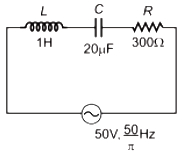
In the series $L-C-R$ circuit shown,the impedance is (in $Omega$)
A
$200$
B
$100$
C
$300$
D
$500$
Solution
(D) Given: Inductance $L = 1 \text{ H}$,Capacitance $C = 20 \mu\text{F} = 20 \times 10^{-6} \text{ F}$,Resistance $R = 300 \Omega$,Frequency $f = \frac{50}{\pi} \text{ Hz}$.
First,calculate the inductive reactance $X_{L}$:
$X_{L} = 2 \pi f L = 2 \pi \left(\frac{50}{\pi}\right) \times 1 = 100 \Omega$.
Next,calculate the capacitive reactance $X_{C}$:
$X_{C} = \frac{1}{2 \pi f C} = \frac{1}{2 \pi \left(\frac{50}{\pi}\right) \times 20 \times 10^{-6}} = \frac{1}{100 \times 20 \times 10^{-6}} = \frac{1}{2 \times 10^{-3}} = 500 \Omega$.
The impedance $Z$ of a series $L-C-R$ circuit is given by:
$Z = \sqrt{R^{2} + (X_{C} - X_{L})^{2}}$.
Substituting the values:
$Z = \sqrt{(300)^{2} + (500 - 100)^{2}} = \sqrt{300^{2} + 400^{2}} = \sqrt{90000 + 160000} = \sqrt{250000} = 500 \Omega$.
First,calculate the inductive reactance $X_{L}$:
$X_{L} = 2 \pi f L = 2 \pi \left(\frac{50}{\pi}\right) \times 1 = 100 \Omega$.
Next,calculate the capacitive reactance $X_{C}$:
$X_{C} = \frac{1}{2 \pi f C} = \frac{1}{2 \pi \left(\frac{50}{\pi}\right) \times 20 \times 10^{-6}} = \frac{1}{100 \times 20 \times 10^{-6}} = \frac{1}{2 \times 10^{-3}} = 500 \Omega$.
The impedance $Z$ of a series $L-C-R$ circuit is given by:
$Z = \sqrt{R^{2} + (X_{C} - X_{L})^{2}}$.
Substituting the values:
$Z = \sqrt{(300)^{2} + (500 - 100)^{2}} = \sqrt{300^{2} + 400^{2}} = \sqrt{90000 + 160000} = \sqrt{250000} = 500 \Omega$.
0 likesView Solution
22
PhysicsEasyMCQKCET · 2011
The flash spectrum confirms a/an:
A
total solar eclipse
B
lunar eclipse
C
earthquake
D
magnetic storm
Solution
(A) The flash spectrum is a series of bright emission lines observed in the solar spectrum for a few seconds during a total solar eclipse. When the moon completely covers the bright photosphere of the sun,the thin layer of the chromosphere becomes visible,producing this unique emission spectrum.
0 likesView Solution
23
PhysicsMediumMCQKCET · 2011
When an electron jumps from the orbit $n=2$ to $n=4$,the wavelength of the radiation absorbed will be ($R$ is Rydberg's constant).
A
$\frac{16}{3 R}$
B
$\frac{16}{5 R}$
C
$\frac{5 R}{16}$
D
$\frac{3 R}{16}$
Solution
(A) The wavelength $\lambda$ of the radiation absorbed when an electron transitions from orbit $n_1$ to $n_2$ is given by the Rydberg formula:
$\frac{1}{\lambda} = R \left[ \frac{1}{n_1^2} - \frac{1}{n_2^2} \right]$
Given $n_1 = 2$ and $n_2 = 4$:
$\frac{1}{\lambda} = R \left[ \frac{1}{2^2} - \frac{1}{4^2} \right]$
$\frac{1}{\lambda} = R \left[ \frac{1}{4} - \frac{1}{16} \right]$
$\frac{1}{\lambda} = R \left[ \frac{4 - 1}{16} \right]$
$\frac{1}{\lambda} = \frac{3 R}{16}$
Therefore,the wavelength is $\lambda = \frac{16}{3 R}$.
$\frac{1}{\lambda} = R \left[ \frac{1}{n_1^2} - \frac{1}{n_2^2} \right]$
Given $n_1 = 2$ and $n_2 = 4$:
$\frac{1}{\lambda} = R \left[ \frac{1}{2^2} - \frac{1}{4^2} \right]$
$\frac{1}{\lambda} = R \left[ \frac{1}{4} - \frac{1}{16} \right]$
$\frac{1}{\lambda} = R \left[ \frac{4 - 1}{16} \right]$
$\frac{1}{\lambda} = \frac{3 R}{16}$
Therefore,the wavelength is $\lambda = \frac{16}{3 R}$.
0 likesView Solution
24
PhysicsEasyMCQKCET · 2011
Rutherford's atomic model could account for
A
stability of atoms
B
origin of spectra
C
the positively charged central core of an atom
D
concept of stationary orbits
Solution
(C) Rutherford's alpha-particle scattering experiment led to the discovery of the nucleus. His atomic model proposed that the entire positive charge and most of the mass of an atom are concentrated in a very small central region called the nucleus. Therefore,it could successfully account for the positively charged central core of an atom. It failed to explain the stability of atoms and the origin of line spectra,which were later addressed by Bohr's model.
0 likesView Solution
25
PhysicsMediumMCQKCET · 2011
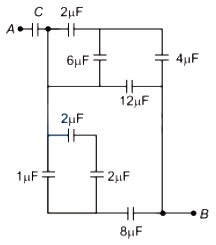
In the given network, the value of $C$, so that an equivalent capacitance between points $A$ and $B$ is $3 \mu F$, is
A
$\frac{1}{5} \mu F$
B
$\frac{31}{5} \mu F$
C
$48 \mu F$
D
$36 \mu F$
Solution
(C) First, simplify the network to the of capacitor $C$. The $6 \mu F$ and $12 \mu F$ capacitors are in series, giving $C_{6,12} = \frac{6 \times 12}{6 + 12} = 4 \mu F$. This $4 \mu F$ is in parallel with the $2 \mu F$ capacitor, giving $C_{p1} = 4 + 2 = 6 \mu F$. This $6 \mu F$ is in series with the $4 \mu F$ capacitor, giving $C_{s1} = \frac{6 \times 4}{6 + 4} = 2.4 \mu F$.
Next, the $1 \mu F$ and $2 \mu F$ capacitors are in series, giving $C_{1,2} = \frac{1 \times 2}{1 + 2} = \frac{2}{3} \mu F$. This is in parallel with the $2 \mu F$ capacitor, giving $C_{p2} = \frac{2}{3} + 2 = \frac{8}{3} \mu F$.
These two branches are in parallel, so $C_{eq_rest} = 2.4 + \frac{8}{3} = \frac{12}{5} + \frac{8}{3} = \frac{36 + 40}{15} = \frac{76}{15} \mu F$.
Finally, this is in series with the $8 \mu F$ capacitor, giving $C_{total_rest} = \frac{(\frac{76}{15}) \times 8}{(\frac{76}{15}) + 8} = \frac{608}{76 + 120} = \frac{608}{196} = \frac{152}{49} \mu F$.
Given the total equivalent capacitance is $3 \mu F$, we have $\frac{C \times (152/49)}{C + (152/49)} = 3$. Solving for $C$ gives $C = 48 \mu F$.
Next, the $1 \mu F$ and $2 \mu F$ capacitors are in series, giving $C_{1,2} = \frac{1 \times 2}{1 + 2} = \frac{2}{3} \mu F$. This is in parallel with the $2 \mu F$ capacitor, giving $C_{p2} = \frac{2}{3} + 2 = \frac{8}{3} \mu F$.
These two branches are in parallel, so $C_{eq_rest} = 2.4 + \frac{8}{3} = \frac{12}{5} + \frac{8}{3} = \frac{36 + 40}{15} = \frac{76}{15} \mu F$.
Finally, this is in series with the $8 \mu F$ capacitor, giving $C_{total_rest} = \frac{(\frac{76}{15}) \times 8}{(\frac{76}{15}) + 8} = \frac{608}{76 + 120} = \frac{608}{196} = \frac{152}{49} \mu F$.
Given the total equivalent capacitance is $3 \mu F$, we have $\frac{C \times (152/49)}{C + (152/49)} = 3$. Solving for $C$ gives $C = 48 \mu F$.
0 likesView Solution
26
PhysicsEasyMCQKCET · 2011
$A$ resistor has a colour code of green,blue,brown and silver. What is its resistance?
A
$56 \Omega \pm 5 \%$
B
$560 \Omega \pm 10 \%$
C
$560 \Omega \pm 5 \%$
D
$5600 \Omega \pm 10 \%$
Solution
(B) The color code for resistors is determined by the sequence: Green,Blue,Brown,Silver.
$1$. The first color (Green) represents the first digit: $5$.
$2$. The second color (Blue) represents the second digit: $6$.
$3$. The third color (Brown) represents the multiplier: $10^1$.
$4$. The fourth color (Silver) represents the tolerance: $\pm 10 \%$.
Combining these,the resistance $R = 56 \times 10^1 \Omega \pm 10 \% = 560 \Omega \pm 10 \%$.
$1$. The first color (Green) represents the first digit: $5$.
$2$. The second color (Blue) represents the second digit: $6$.
$3$. The third color (Brown) represents the multiplier: $10^1$.
$4$. The fourth color (Silver) represents the tolerance: $\pm 10 \%$.
Combining these,the resistance $R = 56 \times 10^1 \Omega \pm 10 \% = 560 \Omega \pm 10 \%$.
0 likesView Solution
27
PhysicsEasyMCQKCET · 2011
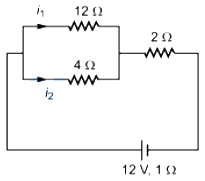
In the circuit shown,the currents $i_{1}$ and $i_{2}$ are
A
$i_{1}=1.5 \text{ A}, i_{2}=0.5 \text{ A}$
B
$i_{1}=0.5 \text{ A}, i_{2}=1.5 \text{ A}$
C
$i_{1}=1 \text{ A}, i_{2}=3 \text{ A}$
D
$i_{1}=3 \text{ A}, i_{2}=1 \text{ A}$
Solution
(B) First,calculate the equivalent resistance of the parallel combination of $12 \Omega$ and $4 \Omega$ resistors:
$R_p = \frac{12 \times 4}{12 + 4} = \frac{48}{16} = 3 \Omega$
Now,calculate the total resistance of the circuit including the series resistor and internal resistance:
$R_{total} = R_p + 2 \Omega + 1 \Omega = 3 \Omega + 2 \Omega + 1 \Omega = 6 \Omega$
The total current $I$ flowing from the battery is:
$I = \frac{V}{R_{total}} = \frac{12 \text{ V}}{6 \Omega} = 2 \text{ A}$
Using the current divider rule for parallel resistors:
$i_1 = I \times \frac{R_2}{R_1 + R_2} = 2 \times \frac{4}{12 + 4} = 2 \times \frac{4}{16} = 0.5 \text{ A}$
$i_2 = I \times \frac{R_1}{R_1 + R_2} = 2 \times \frac{12}{12 + 4} = 2 \times \frac{12}{16} = 1.5 \text{ A}$
Thus,$i_1 = 0.5 \text{ A}$ and $i_2 = 1.5 \text{ A}$.
$R_p = \frac{12 \times 4}{12 + 4} = \frac{48}{16} = 3 \Omega$
Now,calculate the total resistance of the circuit including the series resistor and internal resistance:
$R_{total} = R_p + 2 \Omega + 1 \Omega = 3 \Omega + 2 \Omega + 1 \Omega = 6 \Omega$
The total current $I$ flowing from the battery is:
$I = \frac{V}{R_{total}} = \frac{12 \text{ V}}{6 \Omega} = 2 \text{ A}$
Using the current divider rule for parallel resistors:
$i_1 = I \times \frac{R_2}{R_1 + R_2} = 2 \times \frac{4}{12 + 4} = 2 \times \frac{4}{16} = 0.5 \text{ A}$
$i_2 = I \times \frac{R_1}{R_1 + R_2} = 2 \times \frac{12}{12 + 4} = 2 \times \frac{12}{16} = 1.5 \text{ A}$
Thus,$i_1 = 0.5 \text{ A}$ and $i_2 = 1.5 \text{ A}$.
0 likesView Solution
28
PhysicsMediumMCQKCET · 2011
$A$ conductor wire having $10^{29}$ free electrons $/ m^{3}$ carries a current of $20 \,A$. If the cross-section of the wire is $1 \,mm^{2}$, then the drift velocity of electrons will be. $\left(e=1.6 \times 10^{-19} \,C\right)$
A
$1.25 \times 10^{-4} \,ms^{-1}$
B
$1.25 \times 10^{-3} \,ms^{-1}$
C
$1.25 \times 10^{-5} \,ms^{-1}$
D
$6.25 \times 10^{-3} \,ms^{-1}$
Solution
(B) The relationship between current $I$ and drift velocity $v_{d}$ is given by the formula: $I = n A e v_{d}$.
Here, $n = 10^{29} \,m^{-3}$ is the electron density, $A = 1 \,mm^{2} = 10^{-6} \,m^{2}$ is the cross-sectional area, $e = 1.6 \times 10^{-19} \,C$ is the charge of an electron, and $I = 20 \,A$.
Rearranging the formula for drift velocity: $v_{d} = \frac{I}{n A e}$.
Substituting the values: $v_{d} = \frac{20}{10^{29} \times 10^{-6} \times 1.6 \times 10^{-19}}$.
$v_{d} = \frac{20}{1.6 \times 10^{4}} = \frac{20}{16000} = 1.25 \times 10^{-3} \,ms^{-1}$.
Here, $n = 10^{29} \,m^{-3}$ is the electron density, $A = 1 \,mm^{2} = 10^{-6} \,m^{2}$ is the cross-sectional area, $e = 1.6 \times 10^{-19} \,C$ is the charge of an electron, and $I = 20 \,A$.
Rearranging the formula for drift velocity: $v_{d} = \frac{I}{n A e}$.
Substituting the values: $v_{d} = \frac{20}{10^{29} \times 10^{-6} \times 1.6 \times 10^{-19}}$.
$v_{d} = \frac{20}{1.6 \times 10^{4}} = \frac{20}{16000} = 1.25 \times 10^{-3} \,ms^{-1}$.
0 likesView Solution
29
PhysicsEasyMCQKCET · 2011
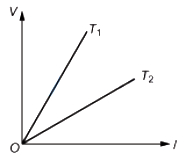
The voltage $V$ and current $I$ graph for a conductor at two different temperatures $T_{1}$ and $T_{2}$ is shown in the figure. The relation between $T_{1}$ and $T_{2}$ is
A
$T_{1} > T_{2}$
B
$T_{1} < T_{2}$
C
$T_{1} = T_{2}$
D
$T_{1} = \frac{1}{T_{2}}$
Solution
(A) For a conductor,the resistance $R$ is given by the slope of the $V-I$ graph,where $R = \frac{V}{I}$.
From the figure,the slope of the line corresponding to $T_{1}$ is greater than the slope of the line corresponding to $T_{2}$.
Therefore,$R_{1} > R_{2}$.
For a metallic conductor,the resistance increases with an increase in temperature $(R \propto T)$.
Since $R_{1} > R_{2}$,it follows that $T_{1} > T_{2}$.
From the figure,the slope of the line corresponding to $T_{1}$ is greater than the slope of the line corresponding to $T_{2}$.
Therefore,$R_{1} > R_{2}$.
For a metallic conductor,the resistance increases with an increase in temperature $(R \propto T)$.
Since $R_{1} > R_{2}$,it follows that $T_{1} > T_{2}$.
0 likesView Solution
30
PhysicsMediumMCQKCET · 2011
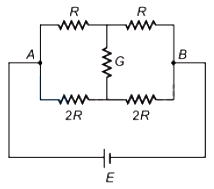
Consider the following statements regarding the network shown in the figure.
$(1)$ The equivalent resistance of the network between points $A$ and $B$ is independent of the value of $G$.
$(2)$ The equivalent resistance of the network between points $A$ and $B$ is $\frac{4}{3} R$.
$(3)$ The current through $G$ is zero.
Which of the above statements is/are true?
$(1)$ The equivalent resistance of the network between points $A$ and $B$ is independent of the value of $G$.
$(2)$ The equivalent resistance of the network between points $A$ and $B$ is $\frac{4}{3} R$.
$(3)$ The current through $G$ is zero.
Which of the above statements is/are true?
A
$(1)$ alone
B
$(2)$ alone
C
$(2)$ and $(3)$
D
$(1)$,$(2)$ and $(3)$
Solution
(D) Let the potential at point $A$ be $V_A$ and at point $B$ be $V_B$. Let the potential at the top junction be $V_1$ and at the bottom junction be $V_2$.
By applying Kirchhoff's Current Law $(KCL)$ at the top junction:
$\frac{V_1 - V_A}{R} + \frac{V_1 - V_B}{R} + \frac{V_1 - V_2}{G} = 0$
By applying $KCL$ at the bottom junction:
$\frac{V_2 - V_A}{2R} + \frac{V_2 - V_B}{2R} + \frac{V_2 - V_1}{G} = 0$
Adding these two equations,the terms involving $G$ cancel out:
$\frac{V_1 - V_A}{R} + \frac{V_1 - V_B}{R} + \frac{V_2 - V_A}{2R} + \frac{V_2 - V_B}{2R} = 0$
$\frac{2(V_1 - V_A) + 2(V_1 - V_B) + (V_2 - V_A) + (V_2 - V_B)}{2R} = 0$
$2V_1 + 2V_1 + V_2 + V_2 = 3V_A + 3V_B$
$4V_1 + 2V_2 = 3(V_A + V_B)$
Since the ratio of resistances in the two branches is $\frac{R}{2R} = \frac{1}{2}$,the bridge is balanced if the potentials at the nodes connected by $G$ are equal. However,here the ratio is $\frac{R}{2R} = \frac{1}{2}$ on both sides,so the bridge is balanced. Thus,$V_1 = V_2$,and the current through $G$ is zero. Statement $(3)$ is true.
Since the current through $G$ is zero,we can remove $G$. The circuit becomes two parallel branches: one with $R+R = 2R$ and one with $2R+2R = 4R$.
$R_{\text{eff}} = \frac{(2R)(4R)}{2R + 4R} = \frac{8R^2}{6R} = \frac{4}{3} R$. Statement $(2)$ is true.
Since the equivalent resistance is independent of $G$ when the bridge is balanced,statement $(1)$ is also true.
By applying Kirchhoff's Current Law $(KCL)$ at the top junction:
$\frac{V_1 - V_A}{R} + \frac{V_1 - V_B}{R} + \frac{V_1 - V_2}{G} = 0$
By applying $KCL$ at the bottom junction:
$\frac{V_2 - V_A}{2R} + \frac{V_2 - V_B}{2R} + \frac{V_2 - V_1}{G} = 0$
Adding these two equations,the terms involving $G$ cancel out:
$\frac{V_1 - V_A}{R} + \frac{V_1 - V_B}{R} + \frac{V_2 - V_A}{2R} + \frac{V_2 - V_B}{2R} = 0$
$\frac{2(V_1 - V_A) + 2(V_1 - V_B) + (V_2 - V_A) + (V_2 - V_B)}{2R} = 0$
$2V_1 + 2V_1 + V_2 + V_2 = 3V_A + 3V_B$
$4V_1 + 2V_2 = 3(V_A + V_B)$
Since the ratio of resistances in the two branches is $\frac{R}{2R} = \frac{1}{2}$,the bridge is balanced if the potentials at the nodes connected by $G$ are equal. However,here the ratio is $\frac{R}{2R} = \frac{1}{2}$ on both sides,so the bridge is balanced. Thus,$V_1 = V_2$,and the current through $G$ is zero. Statement $(3)$ is true.
Since the current through $G$ is zero,we can remove $G$. The circuit becomes two parallel branches: one with $R+R = 2R$ and one with $2R+2R = 4R$.
$R_{\text{eff}} = \frac{(2R)(4R)}{2R + 4R} = \frac{8R^2}{6R} = \frac{4}{3} R$. Statement $(2)$ is true.
Since the equivalent resistance is independent of $G$ when the bridge is balanced,statement $(1)$ is also true.
0 likesView Solution
31
PhysicsMediumMCQKCET · 2011
An electron of mass $m_{e}$ and a proton of mass $m_{p}$ are moving with the same speed. The ratio of their de-Broglie's wavelengths $\lambda_{e} / \lambda_{p}$ is
A
$1$
B
$1836$
C
$\frac{1}{1836}$
D
$918$
Solution
(B) The de-Broglie wavelength $\lambda$ is given by the formula: $\lambda = \frac{h}{mv}$,where $h$ is Planck's constant,$m$ is the mass,and $v$ is the speed.
For an electron,the wavelength is $\lambda_{e} = \frac{h}{m_{e}v}$.
For a proton,the wavelength is $\lambda_{p} = \frac{h}{m_{p}v}$.
Taking the ratio of the two wavelengths:
$\frac{\lambda_{e}}{\lambda_{p}} = \frac{h / m_{e}v}{h / m_{p}v} = \frac{m_{p}}{m_{e}}$.
Given that the mass of a proton $m_{p} \approx 1.67 \times 10^{-27} \ kg$ and the mass of an electron $m_{e} \approx 9.11 \times 10^{-31} \ kg$,the ratio is:
$\frac{\lambda_{e}}{\lambda_{p}} = \frac{1.67 \times 10^{-27}}{9.11 \times 10^{-31}} \approx 1833 \approx 1836$ (using standard mass ratios).
Thus,the ratio $\lambda_{e} / \lambda_{p} = 1836$.
For an electron,the wavelength is $\lambda_{e} = \frac{h}{m_{e}v}$.
For a proton,the wavelength is $\lambda_{p} = \frac{h}{m_{p}v}$.
Taking the ratio of the two wavelengths:
$\frac{\lambda_{e}}{\lambda_{p}} = \frac{h / m_{e}v}{h / m_{p}v} = \frac{m_{p}}{m_{e}}$.
Given that the mass of a proton $m_{p} \approx 1.67 \times 10^{-27} \ kg$ and the mass of an electron $m_{e} \approx 9.11 \times 10^{-31} \ kg$,the ratio is:
$\frac{\lambda_{e}}{\lambda_{p}} = \frac{1.67 \times 10^{-27}}{9.11 \times 10^{-31}} \approx 1833 \approx 1836$ (using standard mass ratios).
Thus,the ratio $\lambda_{e} / \lambda_{p} = 1836$.
0 likesView Solution
32
PhysicsDifficultMCQKCET · 2011
The photoelectric threshold wavelength for silver is $\lambda_{0}$. The energy of the electron ejected from the surface of silver by an incident wavelength $\lambda$ (where $\lambda < \lambda_{0}$) will be:
A
$h c(\lambda_{0}-\lambda)$
B
$\frac{h c}{\lambda_{0}-\lambda}$
C
$\frac{h}{c}(\frac{\lambda_{0}-\lambda}{\lambda \lambda_{0}})$
D
$h c(\frac{\lambda_{0}-\lambda}{\lambda \lambda_{0}})$
Solution
(D) According to Einstein's photoelectric equation,the energy of the incident photon is equal to the sum of the work function $(W)$ and the maximum kinetic energy $(KE)$ of the ejected electron.
$E = W + KE$
$KE = E - W$
Since $E = \frac{hc}{\lambda}$ and $W = \frac{hc}{\lambda_{0}}$,we have:
$KE = \frac{hc}{\lambda} - \frac{hc}{\lambda_{0}}$
$KE = hc \left( \frac{1}{\lambda} - \frac{1}{\lambda_{0}} \right)$
$KE = hc \left( \frac{\lambda_{0} - \lambda}{\lambda \lambda_{0}} \right)$
$E = W + KE$
$KE = E - W$
Since $E = \frac{hc}{\lambda}$ and $W = \frac{hc}{\lambda_{0}}$,we have:
$KE = \frac{hc}{\lambda} - \frac{hc}{\lambda_{0}}$
$KE = hc \left( \frac{1}{\lambda} - \frac{1}{\lambda_{0}} \right)$
$KE = hc \left( \frac{\lambda_{0} - \lambda}{\lambda \lambda_{0}} \right)$
0 likesView Solution
33
PhysicsEasyMCQKCET · 2011
The energy stored in an inductor of self-inductance $L$ henry carrying a current of $I$ ampere is:
A
$\frac{1}{2} L^{2} I$
B
$\frac{1}{2} L I^{2}$
C
$L I^{2}$
D
$L^{2} I$
Solution
(B) The magnetic potential energy $U$ stored in an inductor with self-inductance $L$ carrying a current $I$ is given by the formula:
$U = \frac{1}{2} L I^{2}$
This energy is stored in the magnetic field generated by the current flowing through the inductor.
$U = \frac{1}{2} L I^{2}$
This energy is stored in the magnetic field generated by the current flowing through the inductor.
0 likesView Solution
34
PhysicsDifficultMCQKCET · 2011
Two identical charged spheres of material density $\rho$,suspended from the same point by inextensible strings of equal length,make an angle $\theta$ between the strings. When suspended in a liquid of density $\sigma$,the angle $\theta$ remains the same. The dielectric constant $K$ of the liquid is
A
$\frac{\rho}{\rho-\sigma}$
B
$\frac{\rho-\sigma}{\rho}$
C
$\frac{\rho}{\rho+\sigma}$
D
$\frac{\rho+\sigma}{\rho}$
Solution
(A) Let $m$ be the mass of each sphere and $V$ be its volume. The density of the sphere is $\rho = m/V$,so $m = V\rho$.
In air,the forces acting on the sphere are tension $T$,weight $mg$,and electrostatic force $F_e = \frac{1}{4\pi\epsilon_0} \frac{q^2}{r^2}$.
For equilibrium,$\tan(\theta/2) = \frac{F_e}{mg} = \frac{q^2}{4\pi\epsilon_0 r^2 mg}$.
In a liquid of density $\sigma$,the sphere experiences an upthrust $F_b = V\sigma g$. The effective weight is $mg' = mg - V\sigma g = Vg(\rho - \sigma)$.
The electrostatic force in the liquid is $F_e' = \frac{F_e}{K}$.
Since the angle $\theta$ remains the same,$\tan(\theta/2) = \frac{F_e'}{mg'} = \frac{F_e}{K Vg(\rho - \sigma)}$.
Equating the two expressions for $\tan(\theta/2)$:
$\frac{F_e}{V\rho g} = \frac{F_e}{K Vg(\rho - \sigma)}$.
Solving for $K$,we get $K = \frac{\rho}{\rho - \sigma}$.
In air,the forces acting on the sphere are tension $T$,weight $mg$,and electrostatic force $F_e = \frac{1}{4\pi\epsilon_0} \frac{q^2}{r^2}$.
For equilibrium,$\tan(\theta/2) = \frac{F_e}{mg} = \frac{q^2}{4\pi\epsilon_0 r^2 mg}$.
In a liquid of density $\sigma$,the sphere experiences an upthrust $F_b = V\sigma g$. The effective weight is $mg' = mg - V\sigma g = Vg(\rho - \sigma)$.
The electrostatic force in the liquid is $F_e' = \frac{F_e}{K}$.
Since the angle $\theta$ remains the same,$\tan(\theta/2) = \frac{F_e'}{mg'} = \frac{F_e}{K Vg(\rho - \sigma)}$.
Equating the two expressions for $\tan(\theta/2)$:
$\frac{F_e}{V\rho g} = \frac{F_e}{K Vg(\rho - \sigma)}$.
Solving for $K$,we get $K = \frac{\rho}{\rho - \sigma}$.
0 likesView Solution
35
PhysicsMediumMCQKCET · 2011
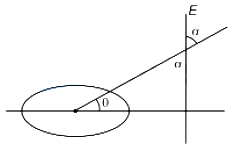
The electric field at a point due to an electric dipole,on an axis inclined at an angle $\theta$ $(< 90^{\circ})$ to the dipole axis,is perpendicular to the dipole axis,if the angle $\theta$ is
A
$\tan ^{-1}(2)$
B
$\tan ^{-1}\left(\frac{1}{2}\right)$
C
$\tan ^{-1}(\sqrt{2})$
D
$\tan ^{-1}\left(\frac{1}{\sqrt{2}}\right)$
Solution
(C) Let the electric dipole be along the $x$-axis. The electric field $\vec{E}$ at a point $(r, \theta)$ makes an angle $\alpha$ with the radial vector $\vec{r}$,given by $\tan \alpha = \frac{1}{2} \tan \theta$.
Here,$\theta$ is the angle the position vector makes with the dipole axis.
The angle that the electric field vector makes with the dipole axis is $\phi = \theta + \alpha$.
For the electric field to be perpendicular to the dipole axis,the angle $\phi$ must be $90^{\circ}$.
Therefore,$\theta + \alpha = 90^{\circ}$,which implies $\alpha = 90^{\circ} - \theta$.
Substituting this into the relation $\tan \alpha = \frac{1}{2} \tan \theta$,we get:
$\tan(90^{\circ} - \theta) = \frac{1}{2} \tan \theta$
$\cot \theta = \frac{1}{2} \tan \theta$
$\tan^2 \theta = 2$
$\tan \theta = \sqrt{2}$
$\theta = \tan^{-1}(\sqrt{2})$.
Here,$\theta$ is the angle the position vector makes with the dipole axis.
The angle that the electric field vector makes with the dipole axis is $\phi = \theta + \alpha$.
For the electric field to be perpendicular to the dipole axis,the angle $\phi$ must be $90^{\circ}$.
Therefore,$\theta + \alpha = 90^{\circ}$,which implies $\alpha = 90^{\circ} - \theta$.
Substituting this into the relation $\tan \alpha = \frac{1}{2} \tan \theta$,we get:
$\tan(90^{\circ} - \theta) = \frac{1}{2} \tan \theta$
$\cot \theta = \frac{1}{2} \tan \theta$
$\tan^2 \theta = 2$
$\tan \theta = \sqrt{2}$
$\theta = \tan^{-1}(\sqrt{2})$.
0 likesView Solution
36
PhysicsEasyMCQKCET · 2011
The faintest stars visible to the naked eye are called:
A
zero magnitude stars
B
second magnitude stars
C
sixth magnitude stars
D
dwarfs
Solution
(C) In the astronomical magnitude scale,the brightness of stars is classified by their apparent magnitude. The brightest stars have lower (or negative) magnitude values,while the faintest stars visible to the human eye under ideal conditions are classified as sixth magnitude stars.
0 likesView Solution
37
PhysicsDifficultMCQKCET · 2011
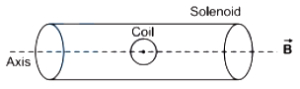
The torque required to hold a small circular coil of $10$ turns, area $1 \,mm^{2}$ and carrying a current of $\left(\frac{21}{44}\right) \,A$ in the middle of a long solenoid of $10^{3} \,turns/m$ carrying a current of $2.5 \,A$, with its axis perpendicular to the axis of the solenoid is
A
$1.5 \times 10^{-6} \,N-m$
B
$1.5 \times 10^{-8} \,N-m$
C
$1.5 \times 10^{+6} \,N-m$
D
$1.5 \times 10^{+8} \,N-m$
Solution
(B) The magnetic moment of the coil is $M = N I A$.
Given: $N = 10$, $I = \frac{21}{44} \,A$, $A = 1 \,mm^{2} = 10^{-6} \,m^{2}$.
$M = 10 \times \frac{21}{44} \times 10^{-6} \,A-m^{2}$.
The magnetic field inside the solenoid is $B = \mu_{0} n I_{s}$.
Given: $n = 10^{3} \,turns/m$, $I_{s} = 2.5 \,A$, $\mu_{0} = 4\pi \times 10^{-7} \,T-m/A$.
$B = (4 \times \frac{22}{7} \times 10^{-7}) \times 10^{3} \times 2.5 \,T$.
The torque $\tau$ required to hold the coil with its axis perpendicular to the magnetic field is $\tau = M B \sin(90^{\circ}) = M B$.
$\tau = (10 \times \frac{21}{44} \times 10^{-6}) \times (4 \times \frac{22}{7} \times 10^{-7} \times 10^{3} \times 2.5)$.
$\tau = (10 \times \frac{21}{44} \times 10^{-6}) \times (4 \times \frac{22}{7} \times 2.5 \times 10^{-4})$.
$\tau = (10 \times \frac{21}{44} \times 10^{-6}) \times (22 \times 10^{-4}) = 1.5 \times 10^{-8} \,N-m$.
Given: $N = 10$, $I = \frac{21}{44} \,A$, $A = 1 \,mm^{2} = 10^{-6} \,m^{2}$.
$M = 10 \times \frac{21}{44} \times 10^{-6} \,A-m^{2}$.
The magnetic field inside the solenoid is $B = \mu_{0} n I_{s}$.
Given: $n = 10^{3} \,turns/m$, $I_{s} = 2.5 \,A$, $\mu_{0} = 4\pi \times 10^{-7} \,T-m/A$.
$B = (4 \times \frac{22}{7} \times 10^{-7}) \times 10^{3} \times 2.5 \,T$.
The torque $\tau$ required to hold the coil with its axis perpendicular to the magnetic field is $\tau = M B \sin(90^{\circ}) = M B$.
$\tau = (10 \times \frac{21}{44} \times 10^{-6}) \times (4 \times \frac{22}{7} \times 10^{-7} \times 10^{3} \times 2.5)$.
$\tau = (10 \times \frac{21}{44} \times 10^{-6}) \times (4 \times \frac{22}{7} \times 2.5 \times 10^{-4})$.
$\tau = (10 \times \frac{21}{44} \times 10^{-6}) \times (22 \times 10^{-4}) = 1.5 \times 10^{-8} \,N-m$.
0 likesView Solution
38
PhysicsEasyMCQKCET · 2011
The deflection in a moving coil galvanometer is reduced to half when it is shunted with a $40 \Omega$ coil. The resistance of the galvanometer is (in $Omega$)
A
$80$
B
$40$
C
$20$
D
$15$
Solution
(B) Let $G$ be the resistance of the galvanometer and $I$ be the total current.
When the galvanometer is shunted with a resistance $S = 40 \Omega$,the current flowing through the galvanometer $I_G$ is given by the current divider rule:
$I_G = I \left( \frac{S}{G + S} \right)$
Given that the deflection is reduced to half,the current through the galvanometer becomes half of the total current,i.e.,$I_G = \frac{I}{2}$.
Substituting this into the equation:
$\frac{I}{2} = I \left( \frac{40}{G + 40} \right)$
$\frac{1}{2} = \frac{40}{G + 40}$
$G + 40 = 80$
$G = 40 \Omega$
Therefore,the resistance of the galvanometer is $40 \Omega$.
When the galvanometer is shunted with a resistance $S = 40 \Omega$,the current flowing through the galvanometer $I_G$ is given by the current divider rule:
$I_G = I \left( \frac{S}{G + S} \right)$
Given that the deflection is reduced to half,the current through the galvanometer becomes half of the total current,i.e.,$I_G = \frac{I}{2}$.
Substituting this into the equation:
$\frac{I}{2} = I \left( \frac{40}{G + 40} \right)$
$\frac{1}{2} = \frac{40}{G + 40}$
$G + 40 = 80$
$G = 40 \Omega$
Therefore,the resistance of the galvanometer is $40 \Omega$.
0 likesView Solution
39
PhysicsEasyMCQKCET · 2011
$A$ particle of charge $e$ and mass $m$ moves with a velocity $v$ in a magnetic field $B$ applied perpendicular to the motion of the particle. The radius $r$ of its path in the field is
A
$\frac{m v}{B e}$
B
$\frac{B e}{m v}$
C
$\frac{e v}{B m}$
D
$\frac{B v}{e m}$
Solution
(A) When a charged particle moves perpendicular to a uniform magnetic field,the magnetic Lorentz force provides the necessary centripetal force for circular motion.
$F_m = F_c$
$q v B = \frac{m v^2}{r}$
Here,the charge $q = e$.
Substituting $q = e$ into the equation:
$e v B = \frac{m v^2}{r}$
Solving for $r$:
$r = \frac{m v^2}{e v B}$
$r = \frac{m v}{e B}$
$F_m = F_c$
$q v B = \frac{m v^2}{r}$
Here,the charge $q = e$.
Substituting $q = e$ into the equation:
$e v B = \frac{m v^2}{r}$
Solving for $r$:
$r = \frac{m v^2}{e v B}$
$r = \frac{m v}{e B}$
0 likesView Solution
40
PhysicsEasyMCQKCET · 2011
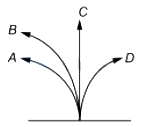
$A$ neutron,a proton,an electron,and an $\alpha$-particle enter a region of uniform magnetic field with the same velocities. The magnetic field is perpendicular and directed into the plane of the paper. The tracks of the particles are labeled in the figure. Which track does the electron follow?
A
$A$
B
$B$
C
$C$
D
$D$
Solution
(D) The radius of the circular path of a charged particle moving in a uniform magnetic field is given by $r = \frac{mv}{qB}$.
Since the particles enter with the same velocity $v$ in the same magnetic field $B$,the radius $r$ is directly proportional to the mass-to-charge ratio,i.e.,$r \propto \frac{m}{q}$.
$1$. $A$ neutron is neutral $(q=0)$,so it experiences no magnetic force and follows a straight path,which is track $C$.
$2$. The electron is negatively charged,while the proton and $\alpha$-particle are positively charged. According to Fleming's Left-Hand Rule,the electron will deflect in the opposite direction to the positively charged particles.
$3$. Among the charged particles,the electron has the smallest mass-to-charge ratio $(m/q)$. Therefore,it will have the smallest radius of curvature.
$4$. Since the electron is negatively charged and has the smallest radius,it follows track $D$.
Since the particles enter with the same velocity $v$ in the same magnetic field $B$,the radius $r$ is directly proportional to the mass-to-charge ratio,i.e.,$r \propto \frac{m}{q}$.
$1$. $A$ neutron is neutral $(q=0)$,so it experiences no magnetic force and follows a straight path,which is track $C$.
$2$. The electron is negatively charged,while the proton and $\alpha$-particle are positively charged. According to Fleming's Left-Hand Rule,the electron will deflect in the opposite direction to the positively charged particles.
$3$. Among the charged particles,the electron has the smallest mass-to-charge ratio $(m/q)$. Therefore,it will have the smallest radius of curvature.
$4$. Since the electron is negatively charged and has the smallest radius,it follows track $D$.
0 likesView Solution
41
PhysicsMediumMCQKCET · 2011
$A$ current of $\left(\frac{2}{\sqrt{3}}\right) \text{ A}$ produces a deflection of $60^{\circ}$ in a tangent galvanometer. The reduction factor is:
A
$\left(\frac{2}{\sqrt{3}}\right) \text{ A}$
B
$\left(\frac{2}{3}\right) \text{ A}$
C
$2 \text{ A}$
D
$\left(\frac{3}{2}\right) \text{ A}$
Solution
(B) The principle of a tangent galvanometer is given by the formula $I = K \tan \theta$,where $I$ is the current,$K$ is the reduction factor,and $\theta$ is the deflection angle.
Given current $I = \frac{2}{\sqrt{3}} \text{ A}$ and deflection $\theta = 60^{\circ}$.
Rearranging the formula to solve for the reduction factor $K$:
$K = \frac{I}{\tan \theta}$
Substituting the given values:
$K = \frac{2 / \sqrt{3}}{\tan 60^{\circ}}$
Since $\tan 60^{\circ} = \sqrt{3}$,we have:
$K = \frac{2 / \sqrt{3}}{\sqrt{3}} = \frac{2}{\sqrt{3} \times \sqrt{3}} = \frac{2}{3} \text{ A}$.
Thus,the reduction factor is $\frac{2}{3} \text{ A}$.
Given current $I = \frac{2}{\sqrt{3}} \text{ A}$ and deflection $\theta = 60^{\circ}$.
Rearranging the formula to solve for the reduction factor $K$:
$K = \frac{I}{\tan \theta}$
Substituting the given values:
$K = \frac{2 / \sqrt{3}}{\tan 60^{\circ}}$
Since $\tan 60^{\circ} = \sqrt{3}$,we have:
$K = \frac{2 / \sqrt{3}}{\sqrt{3}} = \frac{2}{\sqrt{3} \times \sqrt{3}} = \frac{2}{3} \text{ A}$.
Thus,the reduction factor is $\frac{2}{3} \text{ A}$.
0 likesView Solution
42
PhysicsEasyMCQKCET · 2011
The thermonuclear reaction of hydrogen inside the stars takes place by a cycle of operations. The particular element which acts as a catalyst is
A
Nitrogen
B
Oxygen
C
Helium
D
Carbon
Solution
(D) In the $CNO$ cycle (Carbon-Nitrogen-Oxygen cycle),hydrogen nuclei fuse to form helium nuclei within stars.
Carbon acts as a catalyst in this process.
It is consumed in the initial steps to form nitrogen and oxygen isotopes,but it is regenerated at the end of the cycle.
Therefore,the net reaction is the fusion of four hydrogen nuclei into one helium nucleus,with carbon remaining unchanged in total quantity.
Carbon acts as a catalyst in this process.
It is consumed in the initial steps to form nitrogen and oxygen isotopes,but it is regenerated at the end of the cycle.
Therefore,the net reaction is the fusion of four hydrogen nuclei into one helium nucleus,with carbon remaining unchanged in total quantity.
0 likesView Solution
43
PhysicsDifficultMCQKCET · 2011
The fraction of the initial number of radioactive nuclei which remain undecayed after half of a half-life of the radioactive sample is
A
$\frac{1}{4}$
B
$\frac{1}{2 \sqrt{2}}$
C
$\frac{1}{2}$
D
$\frac{1}{\sqrt{2}}$
Solution
(D) The law of radioactive decay is given by $N(t) = N_{0} e^{-\lambda t}$.
We know that the half-life $T_{1/2} = \frac{\ln 2}{\lambda}$,which implies $\lambda = \frac{\ln 2}{T_{1/2}}$.
Given time $t = \frac{1}{2} T_{1/2}$.
Substituting these into the decay equation:
$N(t) = N_{0} e^{-(\frac{\ln 2}{T_{1/2}}) (\frac{1}{2} T_{1/2})}$
$N(t) = N_{0} e^{-\frac{1}{2} \ln 2} = N_{0} e^{\ln(2^{-1/2})}$
$N(t) = N_{0} (2^{-1/2}) = \frac{N_{0}}{\sqrt{2}}$.
The fraction remaining is $\frac{N(t)}{N_{0}} = \frac{1}{\sqrt{2}}$.
We know that the half-life $T_{1/2} = \frac{\ln 2}{\lambda}$,which implies $\lambda = \frac{\ln 2}{T_{1/2}}$.
Given time $t = \frac{1}{2} T_{1/2}$.
Substituting these into the decay equation:
$N(t) = N_{0} e^{-(\frac{\ln 2}{T_{1/2}}) (\frac{1}{2} T_{1/2})}$
$N(t) = N_{0} e^{-\frac{1}{2} \ln 2} = N_{0} e^{\ln(2^{-1/2})}$
$N(t) = N_{0} (2^{-1/2}) = \frac{N_{0}}{\sqrt{2}}$.
The fraction remaining is $\frac{N(t)}{N_{0}} = \frac{1}{\sqrt{2}}$.
0 likesView Solution
44
PhysicsEasyMCQKCET · 2011
$1$ curie represents
A
$3.7 \times 10^{7}$ disintegrations per second
B
$3.7 \times 10^{10}$ disintegrations per second
C
$10^{6}$ disintegrations per second
D
$1$ disintegration per second
Solution
(B) The unit of radioactivity,the curie $(Ci)$,is defined as the activity of $1 \ g$ of radium-$226$.
By definition,$1$ curie is equal to $3.7 \times 10^{10}$ disintegrations per second.
This value is based on the activity of $1 \ gram$ of radium-$226$ in equilibrium with its decay products.
By definition,$1$ curie is equal to $3.7 \times 10^{10}$ disintegrations per second.
This value is based on the activity of $1 \ gram$ of radium-$226$ in equilibrium with its decay products.
0 likesView Solution
45
PhysicsEasyMCQKCET · 2011
The wavelengths of given light waves in air and in a medium are $6000 \ Å$ and $4000 \ Å$ respectively. The critical angle is
A
$\tan ^{-1}\left(\frac{2}{3}\right)$
B
$\tan ^{-1}\left(\frac{3}{2}\right)$
C
$\sin ^{-1}\left(\frac{2}{3}\right)$
D
$\sin ^{-1}\left(\frac{3}{2}\right)$
Solution
(C) The refractive index $\mu$ of a medium is given by the ratio of the wavelength in vacuum (or air) $\lambda_a$ to the wavelength in the medium $\lambda_m$:
$\mu = \frac{\lambda_a}{\lambda_m} = \frac{6000 \ Å}{4000 \ Å} = \frac{6}{4} = \frac{3}{2}$.
The relationship between the critical angle $C$ and the refractive index $\mu$ is given by:
$\sin C = \frac{1}{\mu}$.
Substituting the value of $\mu$:
$\sin C = \frac{1}{3/2} = \frac{2}{3}$.
Therefore,the critical angle is:
$C = \sin ^{-1}\left(\frac{2}{3}\right)$.
$\mu = \frac{\lambda_a}{\lambda_m} = \frac{6000 \ Å}{4000 \ Å} = \frac{6}{4} = \frac{3}{2}$.
The relationship between the critical angle $C$ and the refractive index $\mu$ is given by:
$\sin C = \frac{1}{\mu}$.
Substituting the value of $\mu$:
$\sin C = \frac{1}{3/2} = \frac{2}{3}$.
Therefore,the critical angle is:
$C = \sin ^{-1}\left(\frac{2}{3}\right)$.
0 likesView Solution
46
PhysicsMediumMCQKCET · 2011
Two thin lenses have a combined power of $+9 \text{ D}$. When they are separated by a distance of $20 \text{ cm}$,their equivalent power becomes $+\frac{27}{5} \text{ D}$. Their individual powers (in dioptre) are
A
$1, 8$
B
$2, 7$
C
$3, 6$
D
$4, 5$
Solution
(C) Given,the sum of powers of two thin lenses is $P_1 + P_2 = 9 \text{ D}$.
When separated by a distance $d = 20 \text{ cm} = 0.2 \text{ m}$,the equivalent power $P$ is given by the formula:
$P = P_1 + P_2 - d P_1 P_2$
Substituting the given values:
$\frac{27}{5} = 9 - 0.2 \times P_1 P_2$
$5.4 = 9 - 0.2 \times P_1 P_2$
$0.2 \times P_1 P_2 = 9 - 5.4 = 3.6$
$P_1 P_2 = \frac{3.6}{0.2} = 18$
We have $P_1 + P_2 = 9$ and $P_1 P_2 = 18$. The quadratic equation $x^2 - (P_1+P_2)x + P_1 P_2 = 0$ becomes $x^2 - 9x + 18 = 0$.
Solving this,$(x-3)(x-6) = 0$,so $x = 3$ or $x = 6$.
Thus,the individual powers are $3 \text{ D}$ and $6 \text{ D}$.
When separated by a distance $d = 20 \text{ cm} = 0.2 \text{ m}$,the equivalent power $P$ is given by the formula:
$P = P_1 + P_2 - d P_1 P_2$
Substituting the given values:
$\frac{27}{5} = 9 - 0.2 \times P_1 P_2$
$5.4 = 9 - 0.2 \times P_1 P_2$
$0.2 \times P_1 P_2 = 9 - 5.4 = 3.6$
$P_1 P_2 = \frac{3.6}{0.2} = 18$
We have $P_1 + P_2 = 9$ and $P_1 P_2 = 18$. The quadratic equation $x^2 - (P_1+P_2)x + P_1 P_2 = 0$ becomes $x^2 - 9x + 18 = 0$.
Solving this,$(x-3)(x-6) = 0$,so $x = 3$ or $x = 6$.
Thus,the individual powers are $3 \text{ D}$ and $6 \text{ D}$.
0 likesView Solution
47
PhysicsDifficultMCQKCET · 2011
$A$ prism having a refractive index $1.414$ and a refracting angle $30^{\circ}$ has one of its refracting surfaces silvered. $A$ beam of light incident on the other refracting surface will retrace its path if the angle of incidence is: (in $^{\circ}$)
A
$0$
B
$30$
C
$60$
D
$45$
Solution
(D) For a light ray to retrace its path after reflection from a silvered surface,it must strike the silvered surface normally (at an angle of $90^{\circ}$ to the surface).
Since the light ray strikes the silvered surface normally,the angle of refraction at the second surface is $r_{2} = 0^{\circ}$.
In a prism,the sum of the angles of refraction is equal to the prism angle: $r_{1} + r_{2} = A$.
Given $A = 30^{\circ}$ and $r_{2} = 0^{\circ}$,we get $r_{1} = 30^{\circ}$.
Applying Snell's Law at the first surface: $n = \frac{\sin i}{\sin r_{1}}$.
Given $n = 1.414 = \sqrt{2}$,we have $\sqrt{2} = \frac{\sin i}{\sin 30^{\circ}}$.
$\sin i = \sqrt{2} \times \sin 30^{\circ} = \sqrt{2} \times \frac{1}{2} = \frac{1}{\sqrt{2}}$.
Therefore,$i = 45^{\circ}$.
Since the light ray strikes the silvered surface normally,the angle of refraction at the second surface is $r_{2} = 0^{\circ}$.
In a prism,the sum of the angles of refraction is equal to the prism angle: $r_{1} + r_{2} = A$.
Given $A = 30^{\circ}$ and $r_{2} = 0^{\circ}$,we get $r_{1} = 30^{\circ}$.
Applying Snell's Law at the first surface: $n = \frac{\sin i}{\sin r_{1}}$.
Given $n = 1.414 = \sqrt{2}$,we have $\sqrt{2} = \frac{\sin i}{\sin 30^{\circ}}$.
$\sin i = \sqrt{2} \times \sin 30^{\circ} = \sqrt{2} \times \frac{1}{2} = \frac{1}{\sqrt{2}}$.
Therefore,$i = 45^{\circ}$.
0 likesView Solution
48
PhysicsMediumMCQKCET · 2011
The time required for the light to pass through a glass slab (refractive index $= 1.5$) of thickness $4 \,mm$ is ($c = 3 \times 10^{8} \,m/s$, speed of light in free space).
A
$10^{-11} \,s$
B
$2 \times 10^{-11} \,s$
C
$2 \times 10^{11} \,s$
D
$2 \times 10^{-5} \,s$
Solution
(B) The refractive index $n$ of a medium is defined as the ratio of the speed of light in vacuum $(c)$ to the speed of light in the medium $(v)$: $n = c/v$.
Given, $n = 1.5$ and $c = 3 \times 10^{8} \,m/s$.
Therefore, the speed of light in the glass slab is $v = c/n = (3 \times 10^{8}) / 1.5 = 2 \times 10^{8} \,m/s$.
The thickness of the glass slab is $d = 4 \,mm = 4 \times 10^{-3} \,m$.
The time $t$ taken to pass through the slab is given by $t = d/v$.
Substituting the values: $t = (4 \times 10^{-3} \,m) / (2 \times 10^{8} \,m/s) = 2 \times 10^{-11} \,s$.
Given, $n = 1.5$ and $c = 3 \times 10^{8} \,m/s$.
Therefore, the speed of light in the glass slab is $v = c/n = (3 \times 10^{8}) / 1.5 = 2 \times 10^{8} \,m/s$.
The thickness of the glass slab is $d = 4 \,mm = 4 \times 10^{-3} \,m$.
The time $t$ taken to pass through the slab is given by $t = d/v$.
Substituting the values: $t = (4 \times 10^{-3} \,m) / (2 \times 10^{8} \,m/s) = 2 \times 10^{-11} \,s$.
0 likesView Solution
49
PhysicsDifficultMCQKCET · 2011
$A$ planoconvex lens has a maximum thickness of $6 \,cm$. When placed on a horizontal table with the curved surface in contact with the table surface, the apparent depth of the bottommost point of the lens is found to be $4 \,cm$. If the lens is inverted such that the plane face of the lens is in contact with the surface of the table, the apparent depth of the centre of the plane face is found to be $\left(\frac{17}{4}\right) \,cm$. The radius of curvature of the lens is (in $\,cm$)
A
$68$
B
$75$
C
$128$
D
$34$
Solution
(D) Case $1$: Curved surface in contact with the table.
The real depth of the lens is $t = 6 \,cm$. The apparent depth is $d' = 4 \,cm$.
The refractive index $n$ is given by $n = \frac{\text{Real depth}}{\text{Apparent depth}} = \frac{6}{4} = 1.5$.
Case $2$: Plane surface in contact with the table.
We use the refraction formula at a spherical surface: $\frac{n_2}{v} - \frac{n_1}{u} = \frac{n_2 - n_1}{R}$.
Here, the light travels from the lens $(n = 1.5)$ to the air $(n = 1)$.
Real depth $u = 6 \,cm$, apparent depth $v = -\frac{17}{4} \,cm$ (virtual image).
Using the formula $\frac{1}{v} - \frac{1.5}{u} = \frac{1 - 1.5}{R}$:
$\frac{1}{-17/4} - \frac{1.5}{6} = \frac{-0.5}{R}$
$-\frac{4}{17} - 0.25 = -\frac{0.5}{R}$
$-\frac{4}{17} - \frac{1}{4} = -\frac{1}{2R}$
$-\frac{16 + 17}{68} = -\frac{1}{2R}$
$\frac{33}{68} = \frac{1}{2R} \implies R = \frac{68}{66} \times 33 = 34 \,cm$.
The real depth of the lens is $t = 6 \,cm$. The apparent depth is $d' = 4 \,cm$.
The refractive index $n$ is given by $n = \frac{\text{Real depth}}{\text{Apparent depth}} = \frac{6}{4} = 1.5$.
Case $2$: Plane surface in contact with the table.
We use the refraction formula at a spherical surface: $\frac{n_2}{v} - \frac{n_1}{u} = \frac{n_2 - n_1}{R}$.
Here, the light travels from the lens $(n = 1.5)$ to the air $(n = 1)$.
Real depth $u = 6 \,cm$, apparent depth $v = -\frac{17}{4} \,cm$ (virtual image).
Using the formula $\frac{1}{v} - \frac{1.5}{u} = \frac{1 - 1.5}{R}$:
$\frac{1}{-17/4} - \frac{1.5}{6} = \frac{-0.5}{R}$
$-\frac{4}{17} - 0.25 = -\frac{0.5}{R}$
$-\frac{4}{17} - \frac{1}{4} = -\frac{1}{2R}$
$-\frac{16 + 17}{68} = -\frac{1}{2R}$
$\frac{33}{68} = \frac{1}{2R} \implies R = \frac{68}{66} \times 33 = 34 \,cm$.
0 likesView Solution
50
PhysicsEasyMCQKCET · 2011
In the case of forward biasing of a $p-n$ junction diode,which one of the following figures correctly depicts the direction of conventional current (indicated by an arrow mark)?
A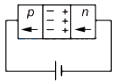
B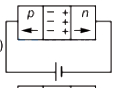
C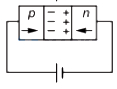
D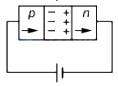
Solution
(D) In forward biasing,the positive terminal of the battery is connected to the $p$-region and the negative terminal to the $n$-region.
Conventional current flows from the positive terminal to the negative terminal through the diode.
Inside the $p$-region,the majority charge carriers are holes,and the conventional current flows in the same direction as the flow of holes (towards the junction).
Inside the $n$-region,the majority charge carriers are electrons,and the conventional current flows in the direction opposite to the flow of electrons (towards the junction).
Therefore,in both regions,the conventional current is directed towards the depletion layer.
This corresponds to the arrows pointing towards the junction in both the $p$ and $n$ regions,which is shown in figure $D$.
Conventional current flows from the positive terminal to the negative terminal through the diode.
Inside the $p$-region,the majority charge carriers are holes,and the conventional current flows in the same direction as the flow of holes (towards the junction).
Inside the $n$-region,the majority charge carriers are electrons,and the conventional current flows in the direction opposite to the flow of electrons (towards the junction).
Therefore,in both regions,the conventional current is directed towards the depletion layer.
This corresponds to the arrows pointing towards the junction in both the $p$ and $n$ regions,which is shown in figure $D$.
0 likesView Solution
51
PhysicsMediumMCQKCET · 2011
An $n-p-n$ transistor can be considered to be equivalent to two diodes connected back-to-back. Which of the following figures is the correct one?
A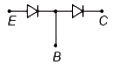
B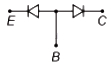
C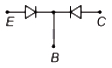
D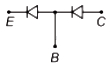
Solution
(B) An $n-p-n$ transistor consists of two $p-n$ junctions.
In an $n-p-n$ transistor,the emitter-base junction is a $p-n$ junction and the collector-base junction is also a $p-n$ junction.
The base is the common $p$-type region.
For an $n-p-n$ transistor,the emitter is $n$-type,the base is $p$-type,and the collector is $n$-type.
This means the emitter-base diode has its $n$-side at the emitter and $p$-side at the base.
The collector-base diode has its $n$-side at the collector and $p$-side at the base.
Therefore,the two diodes are connected with their cathodes (n-sides) facing outwards and their anodes (p-sides) connected together at the base.
Looking at the provided figures,option $B$ correctly shows two diodes with their anodes connected at the base $B$ and cathodes pointing towards the emitter $E$ and collector $C$ respectively.
In an $n-p-n$ transistor,the emitter-base junction is a $p-n$ junction and the collector-base junction is also a $p-n$ junction.
The base is the common $p$-type region.
For an $n-p-n$ transistor,the emitter is $n$-type,the base is $p$-type,and the collector is $n$-type.
This means the emitter-base diode has its $n$-side at the emitter and $p$-side at the base.
The collector-base diode has its $n$-side at the collector and $p$-side at the base.
Therefore,the two diodes are connected with their cathodes (n-sides) facing outwards and their anodes (p-sides) connected together at the base.
Looking at the provided figures,option $B$ correctly shows two diodes with their anodes connected at the base $B$ and cathodes pointing towards the emitter $E$ and collector $C$ respectively.
0 likesView Solution
52
PhysicsMediumMCQKCET · 2011
The output of the given logic circuit is
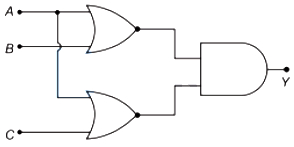
A
$A \cdot(B+C)$
B
$A \cdot(B \cdot C)$
C
$(A+B) \cdot(A+C)$
D
$A+B+C$
Solution
(C) The given circuit consists of two $OR$ gates followed by an $AND$ gate.
$1$. The inputs to the first $OR$ gate are $A$ and $B$. Therefore,its output is $(A+B)$.
$2$. The inputs to the second $OR$ gate are $A$ and $C$. Therefore,its output is $(A+C)$.
$3$. These two outputs $(A+B)$ and $(A+C)$ are fed as inputs to the final $AND$ gate.
$4$. The output $Y$ of the $AND$ gate is the product of its inputs: $Y = (A+B) \cdot (A+C)$.
$1$. The inputs to the first $OR$ gate are $A$ and $B$. Therefore,its output is $(A+B)$.
$2$. The inputs to the second $OR$ gate are $A$ and $C$. Therefore,its output is $(A+C)$.
$3$. These two outputs $(A+B)$ and $(A+C)$ are fed as inputs to the final $AND$ gate.
$4$. The output $Y$ of the $AND$ gate is the product of its inputs: $Y = (A+B) \cdot (A+C)$.
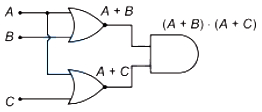
0 likesView Solution
53
PhysicsEasyMCQKCET · 2011
If $C$ is the capacitance and $V$ is the electric potential,then the dimensional formula of $C V^{2}$ is
A
$[ML^{2} T^{-2} A^{0}]$
B
$[MLT^{-2} A^{-1}]$
C
$[M^{0} L^{2} T^{-2} A^{0}]$
D
$[ML^{3} T A]$
Solution
(A) The energy stored in a capacitor is given by the formula $U = \frac{1}{2} C V^{2}$.
Since $\frac{1}{2}$ is a dimensionless constant,the dimensional formula of $C V^{2}$ is equivalent to the dimensional formula of energy $(U)$.
The dimensional formula for energy is $[Work] = [Force \times Displacement] = [MLT^{-2} \times L] = [ML^{2} T^{-2}]$.
Therefore,the dimensional formula of $C V^{2}$ is $[ML^{2} T^{-2} A^{0}]$.
Since $\frac{1}{2}$ is a dimensionless constant,the dimensional formula of $C V^{2}$ is equivalent to the dimensional formula of energy $(U)$.
The dimensional formula for energy is $[Work] = [Force \times Displacement] = [MLT^{-2} \times L] = [ML^{2} T^{-2}]$.
Therefore,the dimensional formula of $C V^{2}$ is $[ML^{2} T^{-2} A^{0}]$.
0 likesView Solution
54
PhysicsEasyMCQKCET · 2011
$A$ parallel beam of light of wavelength $6000 \text{ Å}$ is diffracted by a single slit of width $0.3 \text{ mm}$. The angular position of the first minima of the diffracted light is
A
$2 \times 10^{-3} \text{ rad}$
B
$3 \times 10^{-3} \text{ rad}$
C
$1.8 \times 10^{-3} \text{ rad}$
D
$6 \times 10^{-3} \text{ rad}$
Solution
(A) For a single slit diffraction, the condition for the $n^{th}$ minima is given by $a \sin \theta = n \lambda$, where $a$ is the slit width, $\lambda$ is the wavelength, and $\theta$ is the angular position.
Given: $\lambda = 6000 \text{ Å} = 6000 \times 10^{-10} \text{ m} = 6 \times 10^{-7} \text{ m}$ and $a = 0.3 \text{ mm} = 0.3 \times 10^{-3} \text{ m} = 3 \times 10^{-4} \text{ m}$.
For the first minima, $n = 1$.
Substituting the values: $3 \times 10^{-4} \sin \theta = 1 \times 6 \times 10^{-7}$.
$\sin \theta = \frac{6 \times 10^{-7}}{3 \times 10^{-4}} = 2 \times 10^{-3}$.
Since $\theta$ is very small, $\sin \theta \approx \theta$.
Therefore, $\theta = 2 \times 10^{-3} \text{ rad}$.
Given: $\lambda = 6000 \text{ Å} = 6000 \times 10^{-10} \text{ m} = 6 \times 10^{-7} \text{ m}$ and $a = 0.3 \text{ mm} = 0.3 \times 10^{-3} \text{ m} = 3 \times 10^{-4} \text{ m}$.
For the first minima, $n = 1$.
Substituting the values: $3 \times 10^{-4} \sin \theta = 1 \times 6 \times 10^{-7}$.
$\sin \theta = \frac{6 \times 10^{-7}}{3 \times 10^{-4}} = 2 \times 10^{-3}$.
Since $\theta$ is very small, $\sin \theta \approx \theta$.
Therefore, $\theta = 2 \times 10^{-3} \text{ rad}$.
0 likesView Solution
55
PhysicsMediumMCQKCET · 2011
Two monochromatic light waves of amplitudes $3 A$ and $2 A$ interfering at a point have a phase difference of $60^{\circ}$. The intensity at that point will be proportional to (in $A^{2}$)
A
$5$
B
$13$
C
$7$
D
$19$
Solution
(D) The resultant amplitude $R$ of two interfering waves with amplitudes $A_1$ and $A_2$ and phase difference $\phi$ is given by $R = \sqrt{A_1^2 + A_2^2 + 2 A_1 A_2 \cos \phi}$.
Given $A_1 = 3 A$,$A_2 = 2 A$,and $\phi = 60^{\circ}$.
The intensity $I$ is proportional to the square of the resultant amplitude,$I \propto R^2$.
$R^2 = (3 A)^2 + (2 A)^2 + 2(3 A)(2 A) \cos(60^{\circ})$.
$R^2 = 9 A^2 + 4 A^2 + 12 A^2 \times (0.5)$.
$R^2 = 13 A^2 + 6 A^2 = 19 A^2$.
Therefore,the intensity is proportional to $19 A^2$.
Given $A_1 = 3 A$,$A_2 = 2 A$,and $\phi = 60^{\circ}$.
The intensity $I$ is proportional to the square of the resultant amplitude,$I \propto R^2$.
$R^2 = (3 A)^2 + (2 A)^2 + 2(3 A)(2 A) \cos(60^{\circ})$.
$R^2 = 9 A^2 + 4 A^2 + 12 A^2 \times (0.5)$.
$R^2 = 13 A^2 + 6 A^2 = 19 A^2$.
Therefore,the intensity is proportional to $19 A^2$.
0 likesView Solution
56
PhysicsEasyMCQKCET · 2011
The critical angle of a certain medium is $\sin^{-1}\left(\frac{3}{5}\right)$. The polarizing angle of the medium is
A
$\sin^{-1}\left(\frac{4}{5}\right)$
B
$\tan^{-1}\left(\frac{5}{3}\right)$
C
$\tan^{-1}\left(\frac{3}{4}\right)$
D
$\tan^{-1}\left(\frac{4}{3}\right)$
Solution
(B) The critical angle $C$ is given by $\sin C = \frac{3}{5}$.
We know that the refractive index $\mu$ of the medium is given by $\mu = \frac{1}{\sin C} = \frac{1}{3/5} = \frac{5}{3}$.
According to Brewster's Law,the polarizing angle $i_p$ is related to the refractive index $\mu$ by the formula $\tan i_p = \mu$.
Substituting the value of $\mu$,we get $\tan i_p = \frac{5}{3}$.
Therefore,the polarizing angle is $i_p = \tan^{-1}\left(\frac{5}{3}\right)$.
We know that the refractive index $\mu$ of the medium is given by $\mu = \frac{1}{\sin C} = \frac{1}{3/5} = \frac{5}{3}$.
According to Brewster's Law,the polarizing angle $i_p$ is related to the refractive index $\mu$ by the formula $\tan i_p = \mu$.
Substituting the value of $\mu$,we get $\tan i_p = \frac{5}{3}$.
Therefore,the polarizing angle is $i_p = \tan^{-1}\left(\frac{5}{3}\right)$.
0 likesView Solution
57
PhysicsEasyMCQKCET · 2011
$A$ wavefront is the locus of all points where the particles of the medium vibrate with the same:
A
phase
B
amplitude
C
frequency
D
period
Solution
(A) By definition,a wavefront is the locus of all points in a medium that are in the same state of vibration,which means they have the same phase.
As the wave propagates,all points on a wavefront reach their maximum displacement at the same time,maintaining a constant phase difference of zero between them.
Therefore,the correct option is $A$.
As the wave propagates,all points on a wavefront reach their maximum displacement at the same time,maintaining a constant phase difference of zero between them.
Therefore,the correct option is $A$.
0 likesView Solution
58
PhysicsEasyMCQKCET · 2011
Consider the following statements in the case of Young's double slit experiment.
$(1)$ $A$ slit $S$ is necessary if we use an ordinary extended source of light.
$(2)$ $A$ slit $S$ is not needed if we use an ordinary but well-collimated beam of light.
$(3)$ $A$ slit $S$ is not needed if we use a spatially coherent source of light.
Which of the above statements are correct?
$(1)$ $A$ slit $S$ is necessary if we use an ordinary extended source of light.
$(2)$ $A$ slit $S$ is not needed if we use an ordinary but well-collimated beam of light.
$(3)$ $A$ slit $S$ is not needed if we use a spatially coherent source of light.
Which of the above statements are correct?
A
$(1)$,$(2)$ and $(3)$
B
$(1)$ and $(2)$
C
$(2)$ and $(3)$
D
$(1)$ and $(3)$
Solution
(D) In Young's double slit experiment,the primary requirement for interference is the presence of coherent sources.
Statement $(1)$ is correct: An ordinary extended source of light is incoherent,so a single slit $S$ is required to act as a point source to ensure spatial coherence.
Statement $(2)$ is incorrect: Even if a beam is well-collimated,it does not guarantee the spatial coherence required for the two slits to act as secondary coherent sources.
Statement $(3)$ is correct: If the source is already spatially coherent,the light waves arriving at the two slits maintain a constant phase difference,making the initial slit $S$ redundant.
Therefore,statements $(1)$ and $(3)$ are correct.
Statement $(1)$ is correct: An ordinary extended source of light is incoherent,so a single slit $S$ is required to act as a point source to ensure spatial coherence.
Statement $(2)$ is incorrect: Even if a beam is well-collimated,it does not guarantee the spatial coherence required for the two slits to act as secondary coherent sources.
Statement $(3)$ is correct: If the source is already spatially coherent,the light waves arriving at the two slits maintain a constant phase difference,making the initial slit $S$ redundant.
Therefore,statements $(1)$ and $(3)$ are correct.
0 likesView Solution
59
PhysicsDifficultMCQKCET · 2011
If the scattering intensity of a liquid is $8 \text{ units}$ at a wavelength of $500 \text{ nm}$, then the scattering intensity at a wavelength of $400 \text{ nm}$ will be approximately: (in $\text{ units}$)
A
$13$
B
$16$
C
$20$
D
$24$
Solution
(C) According to Rayleigh's law of scattering, the scattering intensity $I$ is inversely proportional to the fourth power of the wavelength $\lambda$:
$I \propto \frac{1}{\lambda^{4}}$
Given $I_{1} = 8 \text{ units}$ at $\lambda_{1} = 500 \text{ nm}$ and we need to find $I_{2}$ at $\lambda_{2} = 400 \text{ nm}$.
Using the ratio formula:
$\frac{I_{2}}{I_{1}} = \left(\frac{\lambda_{1}}{\lambda_{2}}\right)^{4}$
$\frac{I_{2}}{8} = \left(\frac{500}{400}\right)^{4} = (1.25)^{4}$
$(1.25)^{4} = 2.4414 \approx 2.5$
$I_{2} = 8 \times 2.4414 \approx 19.53 \text{ units}$
Rounding to the nearest provided option, $I_{2} \approx 20 \text{ units}$.
$I \propto \frac{1}{\lambda^{4}}$
Given $I_{1} = 8 \text{ units}$ at $\lambda_{1} = 500 \text{ nm}$ and we need to find $I_{2}$ at $\lambda_{2} = 400 \text{ nm}$.
Using the ratio formula:
$\frac{I_{2}}{I_{1}} = \left(\frac{\lambda_{1}}{\lambda_{2}}\right)^{4}$
$\frac{I_{2}}{8} = \left(\frac{500}{400}\right)^{4} = (1.25)^{4}$
$(1.25)^{4} = 2.4414 \approx 2.5$
$I_{2} = 8 \times 2.4414 \approx 19.53 \text{ units}$
Rounding to the nearest provided option, $I_{2} \approx 20 \text{ units}$.
0 likesView Solution
Vedclass Products
For Students
Vedclass Test Series
Mock tests in real KCET style covering Physics with performance analysis. 5-day free trial.
Start Free TrialFor Teachers
Exam Paper Generator
Generate Set A/B/C/D Physics papers from 7.5L+ questions in 2 minutes. 3 chapters free.
Try FreeFor Institutes
Online Exam Module
Run live KCET mock exams with unlimited students, 360° analytics & white-label branding.
See DemoFrequently Asked Questions
How many Physics questions are in KCET 2011?
There are 59 Physics questions from the KCET 2011 paper on Vedclass, each with a detailed step-by-step solution in English.
Are KCET 2011 Physics solutions available in English?
Yes. All solutions on this page are in English. You can also switch to English or Hindi using the language buttons above the questions.
Can I practice KCET 2011 Physics as a timed test?
Yes. Use the Vedclass Test Series to attempt a full KCET mock test covering Physics with time limits and instant score analysis.
Can teachers create Physics papers from KCET previous year questions?
Yes. The Vedclass Exam Paper Generator lets teachers mix KCET Physics questions and generate Set A/B/C/D papers in minutes.
For Teachers & Institutes
Build a Custom Physics Paper
Pick KCET 2011 Physics questions, set difficulty, and generate Set A/B/C/D in 2 minutes.