
ChemistryQ1–70 of 70 questions
Page 1 of 1 · English
1
ChemistryMCQKCET · 2011
The following four wires of length $L$ and radius $r$ are made of the same material. Which of these will have the largest extension,when the same tension is applied?
A
$L = 100 \ cm, r = 0.2 \ mm$
B
$L = 200 \ cm, r = 0.4 \ mm$
C
$L = 300 \ cm, r = 0.6 \ mm$
D
$L = 400 \ cm, r = 0.8 \ mm$
Solution
(A) The extension $\Delta \ell$ of a wire is given by the formula $\Delta \ell = \frac{F L}{A Y}$,where $F$ is the tension,$L$ is the length,$A$ is the cross-sectional area,and $Y$ is Young's modulus.
Since $A = \pi r^2$,we have $\Delta \ell = \frac{F L}{\pi r^2 Y}$.
Given that $F$ and $Y$ are constant for all wires,the extension $\Delta \ell$ is proportional to $\frac{L}{r^2}$.
Calculating the ratio $\frac{L}{r^2}$ for each option:
$A: \frac{100}{(0.2)^2} = \frac{100}{0.04} = 2500 \ cm/mm^2$
$B: \frac{200}{(0.4)^2} = \frac{200}{0.16} = 1250 \ cm/mm^2$
$C: \frac{300}{(0.6)^2} = \frac{300}{0.36} \approx 833.33 \ cm/mm^2$
$D: \frac{400}{(0.8)^2} = \frac{400}{0.64} = 625 \ cm/mm^2$
Comparing these values,the ratio is largest for option $A$.
Since $A = \pi r^2$,we have $\Delta \ell = \frac{F L}{\pi r^2 Y}$.
Given that $F$ and $Y$ are constant for all wires,the extension $\Delta \ell$ is proportional to $\frac{L}{r^2}$.
Calculating the ratio $\frac{L}{r^2}$ for each option:
$A: \frac{100}{(0.2)^2} = \frac{100}{0.04} = 2500 \ cm/mm^2$
$B: \frac{200}{(0.4)^2} = \frac{200}{0.16} = 1250 \ cm/mm^2$
$C: \frac{300}{(0.6)^2} = \frac{300}{0.36} \approx 833.33 \ cm/mm^2$
$D: \frac{400}{(0.8)^2} = \frac{400}{0.64} = 625 \ cm/mm^2$
Comparing these values,the ratio is largest for option $A$.
0 likesView Solution
2
ChemistryMCQKCET · 2011
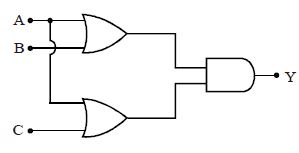
The output of the given logic circuit is
A
$A \cdot (B + C)$
B
$A \cdot (B \cdot C)$
C
$(A + B) \cdot (A + C)$
D
$A + B + C$
Solution
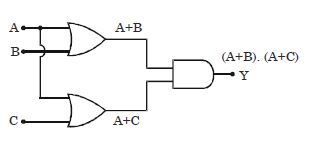
(C) $1$. The circuit consists of two $OR$ gates followed by an $AND$ gate.
$2$. The inputs to the first $OR$ gate are $A$ and $B$. Therefore,its output is $(A + B)$.
$3$. The inputs to the second $OR$ gate are $A$ and $C$. Therefore,its output is $(A + C)$.
$4$. These two outputs are fed into an $AND$ gate.
$5$. The final output $Y$ of the $AND$ gate is the product of its inputs: $Y = (A + B) \cdot (A + C)$.
$2$. The inputs to the first $OR$ gate are $A$ and $B$. Therefore,its output is $(A + B)$.
$3$. The inputs to the second $OR$ gate are $A$ and $C$. Therefore,its output is $(A + C)$.
$4$. These two outputs are fed into an $AND$ gate.
$5$. The final output $Y$ of the $AND$ gate is the product of its inputs: $Y = (A + B) \cdot (A + C)$.
0 likesView Solution
3
ChemistryMCQKCET · 2011
$A$ parallel beam of light of wavelength $6000 \, \mathring{A}$ is diffracted by a single slit of width $0.3 \, \text{mm}$. The angular position of the first minima of the diffracted light is:
A
$2 \times 10^{-3} \, \text{rad}$
B
$3 \times 10^{-3} \, \text{rad}$
C
$1.8 \times 10^{-3} \, \text{rad}$
D
$6 \times 10^{-3} \, \text{rad}$
Solution
(A) The condition for the first minima in a single-slit diffraction pattern is given by $a \sin \theta = n \lambda$,where $n = 1$ for the first minima.
Given:
Wavelength $\lambda = 6000 \, \mathring{A} = 6000 \times 10^{-10} \, \text{m} = 6 \times 10^{-7} \, \text{m}$.
Slit width $a = 0.3 \, \text{mm} = 0.3 \times 10^{-3} \, \text{m} = 3 \times 10^{-4} \, \text{m}$.
For small angles,$\sin \theta \approx \theta$.
Therefore,$\theta = \frac{\lambda}{a} = \frac{6 \times 10^{-7}}{3 \times 10^{-4}} = 2 \times 10^{-3} \, \text{rad}$.
Given:
Wavelength $\lambda = 6000 \, \mathring{A} = 6000 \times 10^{-10} \, \text{m} = 6 \times 10^{-7} \, \text{m}$.
Slit width $a = 0.3 \, \text{mm} = 0.3 \times 10^{-3} \, \text{m} = 3 \times 10^{-4} \, \text{m}$.
For small angles,$\sin \theta \approx \theta$.
Therefore,$\theta = \frac{\lambda}{a} = \frac{6 \times 10^{-7}}{3 \times 10^{-4}} = 2 \times 10^{-3} \, \text{rad}$.
0 likesView Solution
4
ChemistryMCQKCET · 2011
Gametophyte is the dominant phase in the life cycle of
A
Hibiscus
B
Nephrolepis
C
Cycas
D
Riccia
Solution
(D) In the life cycle of plants,the dominant phase refers to the stage that is independent,photosynthetic,and longer-lived.
$A$. $Hibiscus$ is an Angiosperm,where the sporophyte is the dominant phase.
$B$. $Nephrolepis$ is a Pteridophyte,where the sporophyte is the dominant phase.
$C$. $Cycas$ is a Gymnosperm,where the sporophyte is the dominant phase.
$D$. $Riccia$ is a Bryophyte. In Bryophytes,the main plant body is a haploid gametophyte,which is the dominant,independent,and photosynthetic phase,while the sporophyte is dependent on the gametophyte for nutrition.
$A$. $Hibiscus$ is an Angiosperm,where the sporophyte is the dominant phase.
$B$. $Nephrolepis$ is a Pteridophyte,where the sporophyte is the dominant phase.
$C$. $Cycas$ is a Gymnosperm,where the sporophyte is the dominant phase.
$D$. $Riccia$ is a Bryophyte. In Bryophytes,the main plant body is a haploid gametophyte,which is the dominant,independent,and photosynthetic phase,while the sporophyte is dependent on the gametophyte for nutrition.
0 likesView Solution
5
ChemistryMCQKCET · 2011
Which one of the following reactions is an example of oxidative decarboxylation?
A
Conversion of succinate to fumarate
B
Conversion of fumarate to malate
C
Conversion of pyruvate to acetyl $Co-A$
D
Conversion of citrate to isocitrate
Solution
(C) Oxidative decarboxylation is a process where a carboxyl group is removed from a molecule as $CO_2$ along with the oxidation of the substrate.
During aerobic respiration, the pyruvic acid formed during glycolysis enters the mitochondrial matrix.
Here, it undergoes oxidative decarboxylation to form acetyl $Co-A$.
This reaction is catalyzed by the pyruvate dehydrogenase complex in the presence of $NAD^+$ and coenzyme-$A$.
The chemical equation is: $\text{Pyruvic acid} + NAD^+ + CoA \xrightarrow{\text{Pyruvate dehydrogenase}} \text{Acetyl } Co-A + NADH + H^+ + CO_2$.
During aerobic respiration, the pyruvic acid formed during glycolysis enters the mitochondrial matrix.
Here, it undergoes oxidative decarboxylation to form acetyl $Co-A$.
This reaction is catalyzed by the pyruvate dehydrogenase complex in the presence of $NAD^+$ and coenzyme-$A$.
The chemical equation is: $\text{Pyruvic acid} + NAD^+ + CoA \xrightarrow{\text{Pyruvate dehydrogenase}} \text{Acetyl } Co-A + NADH + H^+ + CO_2$.
0 likesView Solution
6
ChemistryMCQKCET · 2011
The rosette habit of cabbage can be changed by application of
A
$IAA$
B
$GA$
C
$ABA$
D
Ethephon
Solution
(B) Gibberellic acids $(GA)$ induce the sub-apical meristem to develop faster.
This process causes the elongation of the reduced stem,a phenomenon known as bolting,which is observed in rosette plants like cabbage (e.g.,$Brassica$ $oleracea$ var. $capitata$) and root crops like radish.
This process causes the elongation of the reduced stem,a phenomenon known as bolting,which is observed in rosette plants like cabbage (e.g.,$Brassica$ $oleracea$ var. $capitata$) and root crops like radish.
0 likesView Solution
7
ChemistryMCQKCET · 2011
$A$ transformer works on the principle of
A
self-induction
B
electrical inertia
C
mutual induction
D
magnetic effect of the electrical current
Solution
(C) transformer consists of two coils,the primary coil and the secondary coil,wound on a common magnetic core. When an alternating current flows through the primary coil,it produces a time-varying magnetic flux in the core. This changing flux is linked with the secondary coil,inducing an electromotive force $(EMF)$ in it. This phenomenon,where a change in current in one coil induces an $EMF$ in a neighboring coil,is known as mutual induction. Therefore,a transformer works on the principle of mutual induction.
0 likesView Solution
8
ChemistryMCQKCET · 2011
The ratio of minimum wavelengths of Lyman and Balmer series will be
A
$1.25$
B
$0.25$
C
$5$
D
$10$
Solution
(B) The wavelength of spectral lines in the hydrogen atom is given by the Rydberg formula: $\frac{1}{\lambda} = R \left( \frac{1}{n_1^2} - \frac{1}{n_2^2} \right)$.
For the minimum wavelength,the transition must be from $n_2 = \infty$ to $n_1$.
For the Lyman series,$n_1 = 1$,so $\frac{1}{\lambda_L} = R \left( \frac{1}{1^2} - \frac{1}{\infty^2} \right) = R$,which gives $\lambda_L = \frac{1}{R}$.
For the Balmer series,$n_1 = 2$,so $\frac{1}{\lambda_B} = R \left( \frac{1}{2^2} - \frac{1}{\infty^2} \right) = \frac{R}{4}$,which gives $\lambda_B = \frac{4}{R}$.
The ratio of the minimum wavelengths is $\frac{\lambda_L}{\lambda_B} = \frac{1/R}{4/R} = \frac{1}{4} = 0.25$.
For the minimum wavelength,the transition must be from $n_2 = \infty$ to $n_1$.
For the Lyman series,$n_1 = 1$,so $\frac{1}{\lambda_L} = R \left( \frac{1}{1^2} - \frac{1}{\infty^2} \right) = R$,which gives $\lambda_L = \frac{1}{R}$.
For the Balmer series,$n_1 = 2$,so $\frac{1}{\lambda_B} = R \left( \frac{1}{2^2} - \frac{1}{\infty^2} \right) = \frac{R}{4}$,which gives $\lambda_B = \frac{4}{R}$.
The ratio of the minimum wavelengths is $\frac{\lambda_L}{\lambda_B} = \frac{1/R}{4/R} = \frac{1}{4} = 0.25$.
0 likesView Solution
9
ChemistryEasyMCQKCET · 2011
When $O_{2}$ is converted into $O_{2}^{+}$,what happens to its paramagnetic character and bond order?
A
Both paramagnetic character and bond order increase
B
Bond order decreases
C
Paramagnetic character increases
D
Paramagnetic character decreases and the bond order increases
Solution
(D) The molecular orbital configuration of $O_{2}$ is $(\sigma 1s)^{2}(\sigma^{*} 1s)^{2}(\sigma 2s)^{2}(\sigma^{*} 2s)^{2}(\sigma 2p_{z})^{2}(\pi 2p_{x})^{2}(\pi 2p_{y})^{2}(\pi^{*} 2p_{x})^{1}(\pi^{*} 2p_{y})^{1}$.
Bond order $= \frac{N_{b} - N_{a}}{2} = \frac{10 - 6}{2} = 2$. It has $2$ unpaired electrons.
For $O_{2}^{+}$,the configuration is $(\sigma 1s)^{2}(\sigma^{*} 1s)^{2}(\sigma 2s)^{2}(\sigma^{*} 2s)^{2}(\sigma 2p_{z})^{2}(\pi 2p_{x})^{2}(\pi 2p_{y})^{2}(\pi^{*} 2p_{x})^{1}$.
Bond order $= \frac{10 - 5}{2} = 2.5$. It has $1$ unpaired electron.
Thus,when $O_{2}$ is converted into $O_{2}^{+}$,the paramagnetic character decreases and the bond order increases.
Bond order $= \frac{N_{b} - N_{a}}{2} = \frac{10 - 6}{2} = 2$. It has $2$ unpaired electrons.
For $O_{2}^{+}$,the configuration is $(\sigma 1s)^{2}(\sigma^{*} 1s)^{2}(\sigma 2s)^{2}(\sigma^{*} 2s)^{2}(\sigma 2p_{z})^{2}(\pi 2p_{x})^{2}(\pi 2p_{y})^{2}(\pi^{*} 2p_{x})^{1}$.
Bond order $= \frac{10 - 5}{2} = 2.5$. It has $1$ unpaired electron.
Thus,when $O_{2}$ is converted into $O_{2}^{+}$,the paramagnetic character decreases and the bond order increases.
0 likesView Solution
10
ChemistryEasyMCQKCET · 2011
The increasing order of carbon-carbon bond length for the following is:

A
$C < B < A < D$
B
$B < C < A < D$
C
$D < C < A < B$
D
$B < A < C < D$
Solution
(D) The bond length depends on the bond order; higher bond order results in shorter bond length.
$A: C_2H_4$ (double bond,$1.34 \ \mathring{A}$)
$B: C_2H_2$ (triple bond,$1.20 \ \mathring{A}$)
$C: C_6H_6$ (partial double bond,$1.39 \ \mathring{A}$)
$D: C_2H_6$ (single bond,$1.54 \ \mathring{A}$)
Comparing the values: $1.20 \ \mathring{A} (B) < 1.34 \ \mathring{A} (A) < 1.39 \ \mathring{A} (C) < 1.54 \ \mathring{A} (D)$.
Thus,the increasing order is $B < A < C < D$.
$A: C_2H_4$ (double bond,$1.34 \ \mathring{A}$)
$B: C_2H_2$ (triple bond,$1.20 \ \mathring{A}$)
$C: C_6H_6$ (partial double bond,$1.39 \ \mathring{A}$)
$D: C_2H_6$ (single bond,$1.54 \ \mathring{A}$)
Comparing the values: $1.20 \ \mathring{A} (B) < 1.34 \ \mathring{A} (A) < 1.39 \ \mathring{A} (C) < 1.54 \ \mathring{A} (D)$.
Thus,the increasing order is $B < A < C < D$.
0 likesView Solution
11
ChemistryEasyMCQKCET · 2011
Consider the following gaseous equilibria with equilibrium constants $K_{1}$ and $K_{2}$ respectively:
$SO_{2(g)} + \frac{1}{2} O_{2(g)} \rightleftharpoons SO_{3(g)}$
$2 SO_{3(g)} \rightleftharpoons 2 SO_{2(g)} + O_{2(g)}$
The equilibrium constants are related as:
$SO_{2(g)} + \frac{1}{2} O_{2(g)} \rightleftharpoons SO_{3(g)}$
$2 SO_{3(g)} \rightleftharpoons 2 SO_{2(g)} + O_{2(g)}$
The equilibrium constants are related as:
A
$2 K_{1} = K_{2}^{2}$
B
$K_{1}^{2} = \frac{1}{K_{2}}$
C
$K_{2}^{2} = \frac{1}{K_{1}}$
D
$K_{2} = \frac{2}{K_{1}^{2}}$
Solution
(B) For the first reaction: $SO_{2(g)} + \frac{1}{2} O_{2(g)} \rightleftharpoons SO_{3(g)}$; $K_{1} = \frac{[SO_{3}]}{[SO_{2}][O_{2}]^{1/2}}$
For the second reaction: $2 SO_{3(g)} \rightleftharpoons 2 SO_{2(g)} + O_{2(g)}$; $K_{2} = \frac{[SO_{2}]^{2}[O_{2}]}{[SO_{3}]^{2}}$
Comparing the two expressions,we can see that $K_{2} = \left( \frac{[SO_{2}][O_{2}]^{1/2}}{[SO_{3}]} \right)^{2} = \left( \frac{1}{K_{1}} \right)^{2} = \frac{1}{K_{1}^{2}}$
Therefore,$K_{1}^{2} = \frac{1}{K_{2}}$.
For the second reaction: $2 SO_{3(g)} \rightleftharpoons 2 SO_{2(g)} + O_{2(g)}$; $K_{2} = \frac{[SO_{2}]^{2}[O_{2}]}{[SO_{3}]^{2}}$
Comparing the two expressions,we can see that $K_{2} = \left( \frac{[SO_{2}][O_{2}]^{1/2}}{[SO_{3}]} \right)^{2} = \left( \frac{1}{K_{1}} \right)^{2} = \frac{1}{K_{1}^{2}}$
Therefore,$K_{1}^{2} = \frac{1}{K_{2}}$.
0 likesView Solution
12
ChemistryEasyMCQKCET · 2011
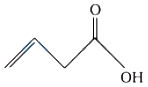
The $IUPAC$ name of $CH_2=CH-CH_2-COOH$ is
A
but$-3-$enoic acid
B
but$-1-$enoic acid
C
pent$-4-$enoic acid
D
prop$-2-$enoic acid
Solution
(A) The given compound is $CH_2=CH-CH_2-COOH$.
$1$. Identify the longest carbon chain containing the principal functional group (carboxylic acid). The chain has $4$ carbon atoms,so the root word is $but$.
$2$. Number the chain starting from the carboxylic acid carbon as $C-1$. Thus,the double bond starts at $C-3$.
$3$. The suffix for the carboxylic acid is $-oic \ acid$ and for the double bond is $-ene$.
$4$. Combining these,the $IUPAC$ name is $but-3-enoic \ acid$.
$1$. Identify the longest carbon chain containing the principal functional group (carboxylic acid). The chain has $4$ carbon atoms,so the root word is $but$.
$2$. Number the chain starting from the carboxylic acid carbon as $C-1$. Thus,the double bond starts at $C-3$.
$3$. The suffix for the carboxylic acid is $-oic \ acid$ and for the double bond is $-ene$.
$4$. Combining these,the $IUPAC$ name is $but-3-enoic \ acid$.
0 likesView Solution
13
ChemistryMediumMCQKCET · 2011
Formic acid is a stronger acid than acetic acid. This can be explained using
A
$+M$ effect
B
$-I$ effect
C
$+I$ effect
D
$-M$ effect
Solution
(C) In acetic acid $(CH_3COOH)$,the methyl group $(-CH_3)$ releases electrons due to the $+I$ effect,which increases the electron density on the carboxylate group and destabilizes the conjugate base,thereby decreasing its acidic character.
Formic acid $(HCOOH)$ does not contain any such electron-donating group attached to the carboxyl group.
Hence,due to the $+I$ effect of the methyl group in acetic acid,formic acid is a stronger acid than acetic acid.
Formic acid $(HCOOH)$ does not contain any such electron-donating group attached to the carboxyl group.
Hence,due to the $+I$ effect of the methyl group in acetic acid,formic acid is a stronger acid than acetic acid.
0 likesView Solution
14
ChemistryEasyMCQKCET · 2011
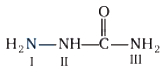
Which one of the nitrogen atoms in $H_2N-NH-CO-NH_2$ (where the atoms are labeled $I, II, III$ as shown in the structure) is the most nucleophilic?
A
$III$
B
$I$
C
$II$
D
All three nitrogen atoms are equally strong nucleophilic centres
Solution
(B) The nucleophilicity of a nitrogen atom depends on the availability of its lone pair of electrons for donation.
In the given molecule,$H_2N-NH-CO-NH_2$ (semicarbazide/urea derivative structure):
- The nitrogen atom labeled $III$ has its lone pair involved in resonance with the adjacent carbonyl group $(C=O)$,making it less available.
- The nitrogen atom labeled $II$ has its lone pair involved in resonance with the carbonyl group,and it is also attached to another nitrogen atom,which further reduces its availability.
- The nitrogen atom labeled $I$ has its lone pair available for donation because it is not directly involved in resonance with the carbonyl group. Although it is attached to another nitrogen atom,its lone pair is the most available among the three for acting as a nucleophile.
Therefore,the nitrogen atom labeled $I$ is the most nucleophilic.
In the given molecule,$H_2N-NH-CO-NH_2$ (semicarbazide/urea derivative structure):
- The nitrogen atom labeled $III$ has its lone pair involved in resonance with the adjacent carbonyl group $(C=O)$,making it less available.
- The nitrogen atom labeled $II$ has its lone pair involved in resonance with the carbonyl group,and it is also attached to another nitrogen atom,which further reduces its availability.
- The nitrogen atom labeled $I$ has its lone pair available for donation because it is not directly involved in resonance with the carbonyl group. Although it is attached to another nitrogen atom,its lone pair is the most available among the three for acting as a nucleophile.
Therefore,the nitrogen atom labeled $I$ is the most nucleophilic.
0 likesView Solution
15
ChemistryDifficultMCQKCET · 2011
The maximum number of possible optical isomers in $1-$bromo$-2-$methylcyclobutane is
A
$4$
B
$2$
C
$8$
D
$16$
Solution
(A) The molecule $1-$bromo$-2-$methylcyclobutane contains two chiral centers at $C1$ and $C2$.
Since the ring is not symmetric,the number of stereoisomers is given by $2^n$,where $n$ is the number of chiral centers.
Here,$n = 2$,so the total number of stereoisomers is $2^2 = 4$.
These $4$ stereoisomers consist of two pairs of enantiomers (cis-isomer pair and trans-isomer pair),all of which are optically active.
Therefore,the maximum number of possible optical isomers is $4$.
Since the ring is not symmetric,the number of stereoisomers is given by $2^n$,where $n$ is the number of chiral centers.
Here,$n = 2$,so the total number of stereoisomers is $2^2 = 4$.
These $4$ stereoisomers consist of two pairs of enantiomers (cis-isomer pair and trans-isomer pair),all of which are optically active.
Therefore,the maximum number of possible optical isomers is $4$.
0 likesView Solution
16
ChemistryMediumMCQKCET · 2011
Which one of the following is the most energetic conformation of cyclohexane?
A
Boat
B
Twisted boat
C
Chair
D
Half chair
Solution
(D) The stability of cyclohexane conformations is determined by their potential energy. The order of stability is: $Chair > Twisted \ boat > Boat > Half \ chair$.
Conversely,the order of energy is: $Half \ chair > Boat > Twisted \ boat > Chair$.
The $Half \ chair$ conformation is the most energetic (least stable) due to significant torsional strain and steric interactions.
Conversely,the order of energy is: $Half \ chair > Boat > Twisted \ boat > Chair$.
The $Half \ chair$ conformation is the most energetic (least stable) due to significant torsional strain and steric interactions.
0 likesView Solution
17
ChemistryMediumMCQKCET · 2011
$1.2 \ g$ of an organic compound on Kjeldahlization liberates ammonia which consumes $30 \ cm^3$ of $1 \ N \ HCl$. The percentage of nitrogen in the organic compound is:
A
$30$
B
$35$
C
$46.67$
D
$20.8$
Solution
(B) The formula for the percentage of nitrogen in the Kjeldahl method is:
$\text{Percentage of Nitrogen} = \frac{1.4 \times N \times V}{W}$
Where:
$N = \text{Normality of } HCl = 1 \ N$
$V = \text{Volume of } HCl \text{ consumed} = 30 \ cm^3$
$W = \text{Weight of organic compound} = 1.2 \ g$
Substituting the values:
$\text{Percentage of Nitrogen} = \frac{1.4 \times 1 \times 30}{1.2} = \frac{42}{1.2} = 35 \%$
$\text{Percentage of Nitrogen} = \frac{1.4 \times N \times V}{W}$
Where:
$N = \text{Normality of } HCl = 1 \ N$
$V = \text{Volume of } HCl \text{ consumed} = 30 \ cm^3$
$W = \text{Weight of organic compound} = 1.2 \ g$
Substituting the values:
$\text{Percentage of Nitrogen} = \frac{1.4 \times 1 \times 30}{1.2} = \frac{42}{1.2} = 35 \%$
0 likesView Solution
18
ChemistryMediumMCQKCET · 2011
In chromite ore,the oxidation number of iron and chromium are respectively
A
$+3, +2$
B
$+3, +6$
C
$+2, +6$
D
$+2, +3$
Solution
(D) Chromite ore is $FeCr_2O_4$,which can be represented as $FeO \cdot Cr_2O_3$.
In this compound,the oxidation number of $Fe$ is $+2$ and the oxidation number of $Cr$ is $+3$.
In this compound,the oxidation number of $Fe$ is $+2$ and the oxidation number of $Cr$ is $+3$.
0 likesView Solution
19
ChemistryMediumMCQKCET · 2011
$Ethyl$ benzene cannot be prepared by:
A
Wurtz reaction
B
Wurtz-Fittig reaction
C
Friedel-Craft's reaction
D
Clemmensen reduction
Solution
(A) $Ethyl$ benzene cannot be prepared by the $Wurtz$ reaction.
The $Wurtz$ reaction involves the coupling of two alkyl halides to form a higher symmetric alkane.
It is not suitable for the synthesis of alkyl-substituted aromatic compounds like $Ethyl$ benzene.
$Wurtz-Fittig$ reaction,$Friedel-Crafts$ alkylation,and $Clemmensen$ reduction are all valid methods for preparing $Ethyl$ benzene.
The $Wurtz$ reaction involves the coupling of two alkyl halides to form a higher symmetric alkane.
It is not suitable for the synthesis of alkyl-substituted aromatic compounds like $Ethyl$ benzene.
$Wurtz-Fittig$ reaction,$Friedel-Crafts$ alkylation,and $Clemmensen$ reduction are all valid methods for preparing $Ethyl$ benzene.
0 likesView Solution
20
ChemistryEasyMCQKCET · 2011
Which one of the following is an electrophilic intermediate in the reaction of benzene with $CH_3Cl$ in the presence of anhydrous $AlCl_3$?
A
$Cl^{-}$
B
$CH_3^{-}$
C
$CH_3^{+}$
D
Phenyl carbocation
Solution
(C) The reaction of benzene with $CH_3Cl$ in the presence of anhydrous $AlCl_3$ is a Friedel-Crafts alkylation reaction.
In the first step,the Lewis acid $AlCl_3$ reacts with $CH_3Cl$ to generate the electrophile,which is the methyl carbocation $(CH_3^{+})$.
The reaction is as follows:
$CH_3Cl + AlCl_3 \rightarrow CH_3^{+} + [AlCl_4]^{-}$
Thus,$CH_3^{+}$ is the electrophilic intermediate formed during the reaction.
In the first step,the Lewis acid $AlCl_3$ reacts with $CH_3Cl$ to generate the electrophile,which is the methyl carbocation $(CH_3^{+})$.
The reaction is as follows:
$CH_3Cl + AlCl_3 \rightarrow CH_3^{+} + [AlCl_4]^{-}$
Thus,$CH_3^{+}$ is the electrophilic intermediate formed during the reaction.
0 likesView Solution
21
ChemistryMediumMCQKCET · 2011
Which one of these is not true for benzene?
A
It forms only one type of monosubstituted product
B
There are three carbon-carbon single bonds and three carbon-carbon double bonds
C
Heat of hydrogenation of benzene is less than its theoretical value
D
The bond angle between carbon-carbon bonds is $120^{\circ}$
Solution
(B) Benzene does not contain $3$ distinct single bonds and $3$ distinct double bonds. Due to resonance,all carbon-carbon bonds in benzene are equivalent,having a bond order of $1.5$.
0 likesView Solution
22
ChemistryDifficultMCQKCET · 2011
The $pH$ value of which one of the following is not equal to $1$?
A
$0.1 \ M \ CH_3COOH$
B
$0.1 \ M \ HNO_3$
C
$0.05 \ M \ H_2SO_4$
D
$50 \ cm^3 \ 0.4 \ M \ HCl + 50 \ cm^3 \ 0.2 \ M \ NaOH$
Solution
(A) For a solution to have $pH = 1$,the concentration of $[H^+]$ must be $0.1 \ M$.
$(A)$ $0.1 \ M \ CH_3COOH$ is a weak acid and does not dissociate completely,so $[H^+] < 0.1 \ M$,hence $pH > 1$.
$(B)$ $0.1 \ M \ HNO_3$ is a strong acid,$[H^+] = 0.1 \ M$,so $pH = -\log(0.1) = 1$.
$(C)$ $0.05 \ M \ H_2SO_4$ is a strong acid,$[H^+] = 2 \times 0.05 = 0.1 \ M$,so $pH = -\log(0.1) = 1$.
$(D)$ For the mixture: $n(H^+) = 50 \times 0.4 = 20 \ mmol$,$n(OH^-) = 50 \times 0.2 = 10 \ mmol$. Remaining $n(H^+) = 20 - 10 = 10 \ mmol$. Total volume = $100 \ cm^3$. $[H^+] = 10 / 100 = 0.1 \ M$,so $pH = 1$.
$(A)$ $0.1 \ M \ CH_3COOH$ is a weak acid and does not dissociate completely,so $[H^+] < 0.1 \ M$,hence $pH > 1$.
$(B)$ $0.1 \ M \ HNO_3$ is a strong acid,$[H^+] = 0.1 \ M$,so $pH = -\log(0.1) = 1$.
$(C)$ $0.05 \ M \ H_2SO_4$ is a strong acid,$[H^+] = 2 \times 0.05 = 0.1 \ M$,so $pH = -\log(0.1) = 1$.
$(D)$ For the mixture: $n(H^+) = 50 \times 0.4 = 20 \ mmol$,$n(OH^-) = 50 \times 0.2 = 10 \ mmol$. Remaining $n(H^+) = 20 - 10 = 10 \ mmol$. Total volume = $100 \ cm^3$. $[H^+] = 10 / 100 = 0.1 \ M$,so $pH = 1$.
0 likesView Solution
23
ChemistryMediumMCQKCET · 2011
$0.023 \ g$ of sodium metal is reacted with $100 \ cm^{3}$ of water. The $pH$ of the resulting solution is
A
$10$
B
$8$
C
$9$
D
$12$
Solution
(D) The chemical reaction is: $2Na + 2H_{2}O \longrightarrow 2NaOH + H_{2}$
Molar mass of $Na = 23 \ g/mol$.
Moles of $Na = \frac{0.023 \ g}{23 \ g/mol} = 0.001 \ mol$.
According to the stoichiometry,$2 \ mol$ of $Na$ produces $2 \ mol$ of $NaOH$.
Therefore,$0.001 \ mol$ of $Na$ produces $0.001 \ mol$ of $NaOH$.
The volume of the solution is $100 \ cm^{3} = 0.1 \ L$.
Concentration of $[OH^{-}] = \frac{0.001 \ mol}{0.1 \ L} = 0.01 \ M = 10^{-2} \ M$.
$pOH = -\log[OH^{-}] = -\log(10^{-2}) = 2$.
Since $pH + pOH = 14$,then $pH = 14 - 2 = 12$.
Molar mass of $Na = 23 \ g/mol$.
Moles of $Na = \frac{0.023 \ g}{23 \ g/mol} = 0.001 \ mol$.
According to the stoichiometry,$2 \ mol$ of $Na$ produces $2 \ mol$ of $NaOH$.
Therefore,$0.001 \ mol$ of $Na$ produces $0.001 \ mol$ of $NaOH$.
The volume of the solution is $100 \ cm^{3} = 0.1 \ L$.
Concentration of $[OH^{-}] = \frac{0.001 \ mol}{0.1 \ L} = 0.01 \ M = 10^{-2} \ M$.
$pOH = -\log[OH^{-}] = -\log(10^{-2}) = 2$.
Since $pH + pOH = 14$,then $pH = 14 - 2 = 12$.
0 likesView Solution
24
ChemistryDifficultMCQKCET · 2011
$A$ buffer solution contains $0.1 \ mol$ of sodium acetate dissolved in $1000 \ cm^{3}$ of $0.1 \ M$ acetic acid. To the above buffer solution,$0.1 \ mol$ of sodium acetate is further added and dissolved. The $pH$ of the resulting buffer is
A
$p K_{a}$
B
$p K_{a} + 2$
C
$p K_{a} - \log 2$
D
$p K_{a} + \log 2$
Solution
(D) The $pH$ of a buffer solution is given by the Henderson-Hasselbalch equation: $pH = p K_{a} + \log \frac{[salt]}{[acid]}$.
Initially,the solution contains $0.1 \ mol$ of sodium acetate in $1000 \ cm^{3}$ $(1 \ L)$ of $0.1 \ M$ acetic acid.
After adding an additional $0.1 \ mol$ of sodium acetate,the total amount of salt becomes $0.1 + 0.1 = 0.2 \ mol$.
The concentration of salt $[salt] = \frac{0.2 \ mol}{1 \ L} = 0.2 \ M$.
The concentration of acid $[acid] = 0.1 \ M$.
Substituting these values into the equation: $pH = p K_{a} + \log \frac{0.2}{0.1}$.
$pH = p K_{a} + \log 2$.
Initially,the solution contains $0.1 \ mol$ of sodium acetate in $1000 \ cm^{3}$ $(1 \ L)$ of $0.1 \ M$ acetic acid.
After adding an additional $0.1 \ mol$ of sodium acetate,the total amount of salt becomes $0.1 + 0.1 = 0.2 \ mol$.
The concentration of salt $[salt] = \frac{0.2 \ mol}{1 \ L} = 0.2 \ M$.
The concentration of acid $[acid] = 0.1 \ M$.
Substituting these values into the equation: $pH = p K_{a} + \log \frac{0.2}{0.1}$.
$pH = p K_{a} + \log 2$.
0 likesView Solution
25
ChemistryMediumMCQKCET · 2011
$H_{2}S$ is passed into $1 \ L$ of a solution containing $0.1 \ mole$ of $Zn^{2+}$ and $0.01 \ mole$ of $Cu^{2+}$ until the sulphide ion concentration reaches $8.1 \times 10^{-19} \ M$. Which one of the following statements is true? $[K_{sp}$ of $ZnS$ and $CuS$ are $3 \times 10^{-22}$ and $8 \times 10^{-36}$ respectively.$]$
A
Only $ZnS$ precipitates
B
Both $CuS$ and $ZnS$ precipitate
C
Only $CuS$ precipitates
D
No precipitation occurs
Solution
(B) The ionic product $(IP)$ for $ZnS$ is $[Zn^{2+}][S^{2-}] = 0.1 \times 8.1 \times 10^{-19} = 8.1 \times 10^{-20}$. Since $8.1 \times 10^{-20} > 3 \times 10^{-22}$ ($K_{sp}$ of $ZnS$),$ZnS$ precipitates.
The ionic product $(IP)$ for $CuS$ is $[Cu^{2+}][S^{2-}] = 0.01 \times 8.1 \times 10^{-19} = 8.1 \times 10^{-21}$. Since $8.1 \times 10^{-21} > 8 \times 10^{-36}$ ($K_{sp}$ of $CuS$),$CuS$ precipitates.
Therefore,both $CuS$ and $ZnS$ precipitate.
The ionic product $(IP)$ for $CuS$ is $[Cu^{2+}][S^{2-}] = 0.01 \times 8.1 \times 10^{-19} = 8.1 \times 10^{-21}$. Since $8.1 \times 10^{-21} > 8 \times 10^{-36}$ ($K_{sp}$ of $CuS$),$CuS$ precipitates.
Therefore,both $CuS$ and $ZnS$ precipitate.
0 likesView Solution
26
ChemistryDifficultMCQKCET · 2011
Out of the given two compounds,the vapour pressure of $B$ at a particular temperature is:
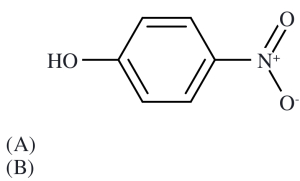
A
higher than that of $A$
B
lower than that of $A$
C
higher or lower than $A$ depending on the size of the vessel
D
same as that of $A$
Solution
(B) Compound $A$ is $o$-nitrophenol and compound $B$ is $p$-nitrophenol.
$o$-Nitrophenol exhibits intramolecular hydrogen bonding,which reduces its intermolecular attraction,making it more volatile.
$p$-Nitrophenol exhibits intermolecular hydrogen bonding,which leads to association of molecules,making it less volatile.
Therefore,the vapour pressure of $o$-nitrophenol $(A)$ is higher than that of $p$-nitrophenol $(B)$.
Thus,the vapour pressure of $B$ is lower than that of $A$.
$o$-Nitrophenol exhibits intramolecular hydrogen bonding,which reduces its intermolecular attraction,making it more volatile.
$p$-Nitrophenol exhibits intermolecular hydrogen bonding,which leads to association of molecules,making it less volatile.
Therefore,the vapour pressure of $o$-nitrophenol $(A)$ is higher than that of $p$-nitrophenol $(B)$.
Thus,the vapour pressure of $B$ is lower than that of $A$.
0 likesView Solution
27
ChemistryDifficultMCQKCET · 2011
$A$ mixture of $CaCl_2$ and $NaCl$ weighing $4.44 \ g$ is treated with sodium carbonate solution to precipitate all the calcium ions as calcium carbonate. The calcium carbonate so obtained is heated strongly to get $0.56 \ g$ of $CaO$. The percentage of $NaCl$ in the mixture is (atomic mass of $Ca=40$)
A
$75$
B
$31.5$
C
$40.2$
D
$25$
Solution
(A) The chemical reactions involved are:
$CaCl_2 + Na_2CO_3 \rightarrow CaCO_3 + 2NaCl$
$CaCO_3 \xrightarrow{\Delta} CaO + CO_2$
From the stoichiometry,$1 \ mol$ of $CaO$ is obtained from $1 \ mol$ of $CaCO_3$,which in turn comes from $1 \ mol$ of $CaCl_2$.
Molar mass of $CaO = 40 + 16 = 56 \ g/mol$.
Molar mass of $CaCl_2 = 40 + 2 \times 35.5 = 111 \ g/mol$.
Given mass of $CaO = 0.56 \ g$,which is $0.56 / 56 = 0.01 \ mol$.
Therefore,moles of $CaCl_2 = 0.01 \ mol$.
Mass of $CaCl_2 = 0.01 \times 111 = 1.11 \ g$.
Mass of $NaCl$ in the mixture = Total mass - Mass of $CaCl_2 = 4.44 \ g - 1.11 \ g = 3.33 \ g$.
Percentage of $NaCl = (3.33 / 4.44) \times 100 = 75\%$.
$CaCl_2 + Na_2CO_3 \rightarrow CaCO_3 + 2NaCl$
$CaCO_3 \xrightarrow{\Delta} CaO + CO_2$
From the stoichiometry,$1 \ mol$ of $CaO$ is obtained from $1 \ mol$ of $CaCO_3$,which in turn comes from $1 \ mol$ of $CaCl_2$.
Molar mass of $CaO = 40 + 16 = 56 \ g/mol$.
Molar mass of $CaCl_2 = 40 + 2 \times 35.5 = 111 \ g/mol$.
Given mass of $CaO = 0.56 \ g$,which is $0.56 / 56 = 0.01 \ mol$.
Therefore,moles of $CaCl_2 = 0.01 \ mol$.
Mass of $CaCl_2 = 0.01 \times 111 = 1.11 \ g$.
Mass of $NaCl$ in the mixture = Total mass - Mass of $CaCl_2 = 4.44 \ g - 1.11 \ g = 3.33 \ g$.
Percentage of $NaCl = (3.33 / 4.44) \times 100 = 75\%$.
0 likesView Solution
28
ChemistryEasyMCQKCET · 2011
The rms velocity of hydrogen is $\sqrt{7}$ times the rms velocity of nitrogen. If $T$ is the temperature of the gas,which of the following is true?
A
$T_{H_{2}} = \sqrt{7} T_{N_{2}}$
B
$T_{N_{2}} = T_{H_{2}}$
C
$T_{N_{2}} = \sqrt{7} T_{H_{2}}$
D
$T_{N_{2}} = 2 T_{H_{2}}$
Solution
(D) The formula for rms velocity is $v_{rms} = \sqrt{\frac{3RT}{M}}$.
Given that $v_{rms(H_{2})} = \sqrt{7} v_{rms(N_{2})}$.
Substituting the formula: $\sqrt{\frac{3RT_{H_{2}}}{M_{H_{2}}}} = \sqrt{7} \sqrt{\frac{3RT_{N_{2}}}{M_{N_{2}}}}$.
Squaring both sides: $\frac{T_{H_{2}}}{2} = 7 \times \frac{T_{N_{2}}}{28}$.
Simplifying: $\frac{T_{H_{2}}}{2} = \frac{T_{N_{2}}}{4}$.
Therefore,$T_{N_{2}} = 2 T_{H_{2}}$.
Given that $v_{rms(H_{2})} = \sqrt{7} v_{rms(N_{2})}$.
Substituting the formula: $\sqrt{\frac{3RT_{H_{2}}}{M_{H_{2}}}} = \sqrt{7} \sqrt{\frac{3RT_{N_{2}}}{M_{N_{2}}}}$.
Squaring both sides: $\frac{T_{H_{2}}}{2} = 7 \times \frac{T_{N_{2}}}{28}$.
Simplifying: $\frac{T_{H_{2}}}{2} = \frac{T_{N_{2}}}{4}$.
Therefore,$T_{N_{2}} = 2 T_{H_{2}}$.
0 likesView Solution
29
ChemistryEasyMCQKCET · 2011
$25 \ g$ of each of the following gases are taken at $27^{\circ}C$ and $600 \ mm$ pressure. Which of these will have the least volume?
A
$HCl$
B
$HBr$
C
$HI$
D
$HF$
Solution
(C) According to the ideal gas equation,$PV = nRT$,where $n = \frac{m}{M}$.
Since $P$,$V$,$T$,and $m$ are given,$V = \frac{mRT}{PM}$.
For a fixed mass $(m = 25 \ g)$,temperature $(T)$,and pressure $(P)$,the volume $V$ is inversely proportional to the molar mass $M$ $(V \propto \frac{1}{M})$.
The molar masses of the gases are: $M(HF) = 20 \ g/mol$,$M(HCl) = 36.5 \ g/mol$,$M(HBr) = 81 \ g/mol$,and $M(HI) = 128 \ g/mol$.
Since $HI$ has the highest molar mass,it will have the least number of moles and consequently the least volume.
Since $P$,$V$,$T$,and $m$ are given,$V = \frac{mRT}{PM}$.
For a fixed mass $(m = 25 \ g)$,temperature $(T)$,and pressure $(P)$,the volume $V$ is inversely proportional to the molar mass $M$ $(V \propto \frac{1}{M})$.
The molar masses of the gases are: $M(HF) = 20 \ g/mol$,$M(HCl) = 36.5 \ g/mol$,$M(HBr) = 81 \ g/mol$,and $M(HI) = 128 \ g/mol$.
Since $HI$ has the highest molar mass,it will have the least number of moles and consequently the least volume.
0 likesView Solution
30
ChemistryMediumMCQKCET · 2011
If the energies of two photons are in the ratio of $3:2$,their wavelengths will be in the ratio of
A
$2:3$
B
$9:4$
C
$3:2$
D
$1:2$
Solution
(A) The energy of a photon is given by the formula $E = \frac{hc}{\lambda}$,where $h$ is Planck's constant,$c$ is the speed of light,and $\lambda$ is the wavelength.
Since $h$ and $c$ are constants,$E \propto \frac{1}{\lambda}$.
Therefore,the ratio of energies is inversely proportional to the ratio of their wavelengths:
$\frac{E_1}{E_2} = \frac{\lambda_2}{\lambda_1}$
Given $\frac{E_1}{E_2} = \frac{3}{2}$,we have $\frac{3}{2} = \frac{\lambda_2}{\lambda_1}$.
Thus,the ratio of wavelengths $\lambda_1 : \lambda_2 = 2:3$.
Since $h$ and $c$ are constants,$E \propto \frac{1}{\lambda}$.
Therefore,the ratio of energies is inversely proportional to the ratio of their wavelengths:
$\frac{E_1}{E_2} = \frac{\lambda_2}{\lambda_1}$
Given $\frac{E_1}{E_2} = \frac{3}{2}$,we have $\frac{3}{2} = \frac{\lambda_2}{\lambda_1}$.
Thus,the ratio of wavelengths $\lambda_1 : \lambda_2 = 2:3$.
0 likesView Solution
31
ChemistryEasyMCQKCET · 2011
Which one of the following sets of quantum numbers represents the highest energy level in an atom?
A
$n=4, l=0, m=0, s=+\frac{1}{2}$
B
$n=3, l=1, m=1, s=+\frac{1}{2}$
C
$n=3, l=2, m=-2, s=+\frac{1}{2}$
D
$n=3, l=0, m=0, s=+\frac{1}{2}$
Solution
(C) According to the $(n+l)$ rule,the energy of an orbital increases as the value of $(n+l)$ increases.
For option $A$: $n+l = 4+0 = 4$.
For option $B$: $n+l = 3+1 = 4$.
For option $C$: $n+l = 3+2 = 5$.
For option $D$: $n+l = 3+0 = 3$.
Since the value of $(n+l)$ is maximum for option $C$,it represents the highest energy level.
For option $A$: $n+l = 4+0 = 4$.
For option $B$: $n+l = 3+1 = 4$.
For option $C$: $n+l = 3+2 = 5$.
For option $D$: $n+l = 3+0 = 3$.
Since the value of $(n+l)$ is maximum for option $C$,it represents the highest energy level.
0 likesView Solution
32
ChemistryEasyMCQKCET · 2011
Based on the first law of thermodynamics,which one of the following is correct?
A
For an isothermal process,$Q = +W$
B
For an isochoric process,$\Delta U = -Q$
C
For an adiabatic process,$\Delta U = -W$
D
For a cyclic process,$Q = -W$
Solution
(D) The first law of thermodynamics is given by the equation: $\Delta U = Q + W$.
For a cyclic process,the system returns to its initial state,so the change in internal energy is zero: $\Delta U = 0$.
Substituting this into the first law equation: $0 = Q + W$,which simplifies to $Q = -W$.
Therefore,the correct statement is that for a cyclic process,$Q = -W$.
For a cyclic process,the system returns to its initial state,so the change in internal energy is zero: $\Delta U = 0$.
Substituting this into the first law equation: $0 = Q + W$,which simplifies to $Q = -W$.
Therefore,the correct statement is that for a cyclic process,$Q = -W$.
0 likesView Solution
33
ChemistryEasyMCQKCET · 2011
Generally,the first ionisation energy increases along a period. But there are some exceptions. The one which is not an exception is
A
$Be$ and $B$
B
$Na$ and $Mg$
C
$Mg$ and $Al$
D
$N$ and $O$
Solution
(B) The first ionisation energy generally increases across a period due to an increase in effective nuclear charge.
Exceptions occur when a more stable electronic configuration (like fully filled or half-filled orbitals) is present in the preceding element.
$Be$ $(2s^2)$ has a higher ionisation energy than $B$ $(2s^2 2p^1)$.
$Mg$ $(3s^2)$ has a higher ionisation energy than $Al$ $(3s^2 3p^1)$.
$N$ $(2s^2 2p^3)$ has a higher ionisation energy than $O$ $(2s^2 2p^4)$.
$Na$ $(3s^1)$ has a lower ionisation energy than $Mg$ $(3s^2)$,which follows the general trend.
Therefore,$Na$ and $Mg$ is not an exception.
Exceptions occur when a more stable electronic configuration (like fully filled or half-filled orbitals) is present in the preceding element.
$Be$ $(2s^2)$ has a higher ionisation energy than $B$ $(2s^2 2p^1)$.
$Mg$ $(3s^2)$ has a higher ionisation energy than $Al$ $(3s^2 3p^1)$.
$N$ $(2s^2 2p^3)$ has a higher ionisation energy than $O$ $(2s^2 2p^4)$.
$Na$ $(3s^1)$ has a lower ionisation energy than $Mg$ $(3s^2)$,which follows the general trend.
Therefore,$Na$ and $Mg$ is not an exception.
0 likesView Solution
34
ChemistryDifficultMCQKCET · 2011
The amount of heat evolved when $500 \ cm^{3}$ of $0.1 \ M \ HCl$ is mixed with $200 \ cm^{3}$ of $0.2 \ M \ NaOH$ is (in $kJ$)
A
$2.292$
B
$1.292$
C
$22.9$
D
$0.292$
Solution
(A) The reaction between $HCl$ and $NaOH$ is a neutralization reaction: $HCl + NaOH \rightarrow NaCl + H_{2}O$.
The heat of neutralization for a strong acid and a strong base is $-57.3 \ kJ \ mol^{-1}$.
Number of moles of $HCl = M \times V(L) = 0.1 \times 0.5 = 0.05 \ mol$.
Number of moles of $NaOH = M \times V(L) = 0.2 \times 0.2 = 0.04 \ mol$.
Since $NaOH$ is the limiting reagent,the amount of heat evolved depends on the moles of $NaOH$ reacted.
Heat evolved $= 0.04 \ mol \times 57.3 \ kJ \ mol^{-1} = 2.292 \ kJ$.
The heat of neutralization for a strong acid and a strong base is $-57.3 \ kJ \ mol^{-1}$.
Number of moles of $HCl = M \times V(L) = 0.1 \times 0.5 = 0.05 \ mol$.
Number of moles of $NaOH = M \times V(L) = 0.2 \times 0.2 = 0.04 \ mol$.
Since $NaOH$ is the limiting reagent,the amount of heat evolved depends on the moles of $NaOH$ reacted.
Heat evolved $= 0.04 \ mol \times 57.3 \ kJ \ mol^{-1} = 2.292 \ kJ$.
0 likesView Solution
35
ChemistryMediumMCQKCET · 2011
The enthalpy of vaporization of benzene is $+35.3 \ kJ/mol$ at its boiling point,$80^{\circ} C$. The entropy change in the transition of vapour to liquid at its boiling point is
A
$-100 \ J/mol \cdot K$
B
$+100 \ J/mol \cdot K$
C
$+342 \ J/mol \cdot K$
D
$-342 \ J/mol \cdot K$
Solution
(A) The enthalpy of vaporization $(\Delta H_{vap})$ is $+35.3 \ kJ/mol = +35300 \ J/mol$.
The boiling point $(T)$ is $80^{\circ} C = 80 + 273 = 353 \ K$.
For the transition of liquid to vapour,the entropy change is $\Delta S_{vap} = \frac{\Delta H_{vap}}{T} = \frac{35300 \ J/mol}{353 \ K} = +100 \ J/mol \cdot K$.
The question asks for the entropy change in the transition of vapour to liquid (condensation),which is the reverse process.
Therefore,$\Delta S_{cond} = -\Delta S_{vap} = -100 \ J/mol \cdot K$.
The boiling point $(T)$ is $80^{\circ} C = 80 + 273 = 353 \ K$.
For the transition of liquid to vapour,the entropy change is $\Delta S_{vap} = \frac{\Delta H_{vap}}{T} = \frac{35300 \ J/mol}{353 \ K} = +100 \ J/mol \cdot K$.
The question asks for the entropy change in the transition of vapour to liquid (condensation),which is the reverse process.
Therefore,$\Delta S_{cond} = -\Delta S_{vap} = -100 \ J/mol \cdot K$.
0 likesView Solution
36
ChemistryMediumMCQKCET · 2011
For the reversible reaction,$A_{(s)} + B_{(g)} \rightleftharpoons C_{(g)} + D_{(g)}$,$\Delta G^{\circ} = -350 \ kJ$,which one of the following statements is true?
A
The reaction is thermodynamically non-feasible
B
The entropy change is negative
C
Equilibrium constant is greater than one
D
The reaction should be instantaneous
Solution
(C) For the reaction $A_{(s)} + B_{(g)} \rightleftharpoons C_{(g)} + D_{(g)}$,the standard Gibbs free energy change is $\Delta G^{\circ} = -350 \ kJ$.
The relationship between $\Delta G^{\circ}$ and the equilibrium constant $K_{eq}$ is given by the equation: $\Delta G^{\circ} = -RT \ln K_{eq}$.
Since $\Delta G^{\circ}$ is negative $(-350 \ kJ)$,the value of $\ln K_{eq}$ must be positive,which implies that $K_{eq} > 1$.
Therefore,the equilibrium constant is greater than one.
The relationship between $\Delta G^{\circ}$ and the equilibrium constant $K_{eq}$ is given by the equation: $\Delta G^{\circ} = -RT \ln K_{eq}$.
Since $\Delta G^{\circ}$ is negative $(-350 \ kJ)$,the value of $\ln K_{eq}$ must be positive,which implies that $K_{eq} > 1$.
Therefore,the equilibrium constant is greater than one.
0 likesView Solution
37
ChemistryMCQKCET · 2011
$A$ transformer works on the principle of
A
self-induction
B
electrical inertia
C
mutual induction
D
magnetic effect of electric current
Solution
(C) transformer works on the principle of mutual induction.
Mutual induction is a phenomenon where a change in current in one coil induces an electromotive force $(emf)$ in an adjacent coil due to the change in magnetic flux linked with it.
Mutual induction is a phenomenon where a change in current in one coil induces an electromotive force $(emf)$ in an adjacent coil due to the change in magnetic flux linked with it.
0 likesView Solution
38
ChemistryMCQKCET · 2011
$A$ transformer works on the principle of
A
self-induction
B
electrical inertia
C
magnetic effect of electric current
D
mutual induction
Solution
(D) transformer is a device that transfers electrical energy between two or more circuits through electromagnetic induction.
It consists of two coils,the primary and the secondary,wound on a common magnetic core.
When an alternating current flows through the primary coil,it creates a changing magnetic flux in the core.
This changing flux links with the secondary coil and induces an electromotive force $(EMF)$ in it,which is the phenomenon of mutual induction.
Therefore,a transformer works on the principle of mutual induction.
It consists of two coils,the primary and the secondary,wound on a common magnetic core.
When an alternating current flows through the primary coil,it creates a changing magnetic flux in the core.
This changing flux links with the secondary coil and induces an electromotive force $(EMF)$ in it,which is the phenomenon of mutual induction.
Therefore,a transformer works on the principle of mutual induction.
0 likesView Solution
39
ChemistryEasyMCQKCET · 2011
The compound which gives turbidity immediately with Lucas reagent at room temperature is
A
butan$-1-$ol
B
butan$-2-$ol
C
$2-$methyl propan$-2-$ol
D
$2-$methyl propan$-1-$ol
Solution
(C) Lucas reagent is a mixture of concentrated $HCl$ and anhydrous $ZnCl_2$.
Tertiary $(3^{\circ})$ alcohols react immediately with Lucas reagent at room temperature to form alkyl chlorides,which appear as turbidity.
Secondary $(2^{\circ})$ alcohols react within $5-10$ minutes.
Primary $(1^{\circ})$ alcohols do not react at room temperature.
Among the given options,$2-$methyl propan$-2-$ol is a tertiary alcohol,so it gives turbidity immediately.
Tertiary $(3^{\circ})$ alcohols react immediately with Lucas reagent at room temperature to form alkyl chlorides,which appear as turbidity.
Secondary $(2^{\circ})$ alcohols react within $5-10$ minutes.
Primary $(1^{\circ})$ alcohols do not react at room temperature.
Among the given options,$2-$methyl propan$-2-$ol is a tertiary alcohol,so it gives turbidity immediately.
0 likesView Solution
40
ChemistryEasyMCQKCET · 2011
The reagent with which both acetaldehyde and acetone react is
A
Fehling's solution
B
$I_{2} / NaOH$
C
Tollen's reagent
D
Carbonic acid
Solution
(B) Both acetaldehyde $(CH_{3}CHO)$ and acetone $(CH_{3}COCH_{3})$ contain the methyl ketone group $(CH_{3}CO-)$,which makes them undergo the iodoform reaction.
When treated with iodine $(I_{2})$ in the presence of sodium hydroxide $(NaOH)$,they form a yellow precipitate of iodoform $(CHI_{3})$.
Acetaldehyde reaction:
$CH_{3}CHO + 3I_{2} + 4NaOH \longrightarrow CHI_{3} + HCOONa + 3NaI + 3H_{2}O$
Acetone reaction:
$CH_{3}COCH_{3} + 3I_{2} + 4NaOH \longrightarrow CHI_{3} + CH_{3}COONa + 3NaI + 3H_{2}O$
Fehling's solution and Tollen's reagent only react with aldehydes (like acetaldehyde) and not with ketones (like acetone).
When treated with iodine $(I_{2})$ in the presence of sodium hydroxide $(NaOH)$,they form a yellow precipitate of iodoform $(CHI_{3})$.
Acetaldehyde reaction:
$CH_{3}CHO + 3I_{2} + 4NaOH \longrightarrow CHI_{3} + HCOONa + 3NaI + 3H_{2}O$
Acetone reaction:
$CH_{3}COCH_{3} + 3I_{2} + 4NaOH \longrightarrow CHI_{3} + CH_{3}COONa + 3NaI + 3H_{2}O$
Fehling's solution and Tollen's reagent only react with aldehydes (like acetaldehyde) and not with ketones (like acetone).
0 likesView Solution
41
ChemistryMediumMCQKCET · 2011
$\alpha$-maltose consists of
A
one $\alpha$-$D$-glucopyranose unit and one $\beta$-$D$-glucopyranose unit with $1-2$ glycosidic linkage
B
two $\alpha$-$D$-glucopyranose units with $1-2$ glycosidic linkage
C
two $\beta$-$D$-glucopyranose units with $1-4$ glycosidic linkage
D
two $\alpha$-$D$-glucopyranose units with $1-4$ glycosidic linkage
Solution
(D) Maltose is a disaccharide composed of two $\alpha$-$D$-glucopyranose units.
These two units are joined together by an $\alpha$-glycosidic linkage between the $C1$ of one glucose unit and the $C4$ of the other glucose unit,known as a $1-4$ glycosidic linkage.
These two units are joined together by an $\alpha$-glycosidic linkage between the $C1$ of one glucose unit and the $C4$ of the other glucose unit,known as a $1-4$ glycosidic linkage.
0 likesView Solution
42
ChemistryEasyMCQKCET · 2011
In an alkaline medium,glycine predominantly exists as/in a/an
A
$cation$
B
$anion$
C
$Zwitter \ ion$
D
$covalent \ form$
Solution
(B) In an alkaline medium (high $pH$),the amino acid glycine exists as a negatively charged particle because the carboxyl group $(-COOH)$ loses a proton to form a carboxylate ion $(-COO^-)$.
$H_2N-CH_2-COOH + OH^- \rightarrow H_2N-CH_2-COO^- + H_2O$
Thus,it exists as an $anion$.
$H_2N-CH_2-COOH + OH^- \rightarrow H_2N-CH_2-COO^- + H_2O$
Thus,it exists as an $anion$.
0 likesView Solution
43
ChemistryMediumMCQKCET · 2011
The time required for $100 \%$ completion of a zero order reaction is
A
$a k$
B
$\frac{a}{2 k}$
C
$\frac{a}{k}$
D
$\frac{2 k}{a}$
Solution
(C) For a zero order reaction,the integrated rate equation is $[A] = [A]_0 - kt$.
At $100 \%$ completion,the final concentration $[A] = 0$.
Given initial concentration $[A]_0 = a$.
Substituting these values: $0 = a - kt$.
Therefore,$kt = a$,which gives $t = \frac{a}{k}$.
At $100 \%$ completion,the final concentration $[A] = 0$.
Given initial concentration $[A]_0 = a$.
Substituting these values: $0 = a - kt$.
Therefore,$kt = a$,which gives $t = \frac{a}{k}$.
0 likesView Solution
44
ChemistryEasyMCQKCET · 2011
The activation energy of a reaction at a given temperature is found to be $2.303 \ RT \ J \ mol^{-1}$. The ratio of rate constant to the Arrhenius factor is
A
$0.01$
B
$0.1$
C
$0.02$
D
$0.001$
Solution
(B) The Arrhenius equation is given by $k = A e^{-E_{a} / RT}$.
Taking the ratio of rate constant $k$ to the Arrhenius factor $A$,we get $k/A = e^{-E_{a} / RT}$.
Given the activation energy $E_{a} = 2.303 \ RT \ J \ mol^{-1}$.
Substituting $E_{a}$ into the equation: $k/A = e^{-(2.303 \ RT) / RT} = e^{-2.303}$.
Taking the natural logarithm on both sides: $\ln(k/A) = -2.303$.
Since $\ln(x) = 2.303 \log_{10}(x)$,we have $2.303 \log_{10}(k/A) = -2.303$.
Dividing by $2.303$,we get $\log_{10}(k/A) = -1$.
Therefore,$k/A = 10^{-1} = 0.1$.
Taking the ratio of rate constant $k$ to the Arrhenius factor $A$,we get $k/A = e^{-E_{a} / RT}$.
Given the activation energy $E_{a} = 2.303 \ RT \ J \ mol^{-1}$.
Substituting $E_{a}$ into the equation: $k/A = e^{-(2.303 \ RT) / RT} = e^{-2.303}$.
Taking the natural logarithm on both sides: $\ln(k/A) = -2.303$.
Since $\ln(x) = 2.303 \log_{10}(x)$,we have $2.303 \log_{10}(k/A) = -2.303$.
Dividing by $2.303$,we get $\log_{10}(k/A) = -1$.
Therefore,$k/A = 10^{-1} = 0.1$.
0 likesView Solution
45
ChemistryMediumMCQKCET · 2011
Which one of the following does not correctly match with each other?
A
Silk-polyamide
B
Lipase-enzyme
C
Butter-fat
D
Oxytocin-enzyme
Solution
(D) Oxytocin is a peptide hormone,not an enzyme.
Silk is a natural polyamide (protein).
Lipase is an enzyme.
Butter is a fat (lipid).
Therefore,the incorrect match is $D$.
Silk is a natural polyamide (protein).
Lipase is an enzyme.
Butter is a fat (lipid).
Therefore,the incorrect match is $D$.
0 likesView Solution
46
ChemistryEasyMCQKCET · 2011
The number of naturally occurring $p$-block elements that are diamagnetic is
A
$18$
B
$6$
C
$5$
D
$7$
Solution
(C) The group $18$ elements (noble gases) have completely filled valence subshells ($ns^2 np^6$,except $He$ which is $1s^2$).
Due to the presence of paired electrons in all orbitals,these elements are diamagnetic.
The naturally occurring group $18$ elements are $He, Ne, Ar, Kr, Xe,$ and $Rn$.
Since $Rn$ is radioactive,the number of naturally occurring stable $p$-block elements that are diamagnetic is $5$ $(He, Ne, Ar, Kr, Xe)$.
Due to the presence of paired electrons in all orbitals,these elements are diamagnetic.
The naturally occurring group $18$ elements are $He, Ne, Ar, Kr, Xe,$ and $Rn$.
Since $Rn$ is radioactive,the number of naturally occurring stable $p$-block elements that are diamagnetic is $5$ $(He, Ne, Ar, Kr, Xe)$.
0 likesView Solution
47
ChemistryEasyMCQKCET · 2011
The $IUPAC$ name of the complex $[Co(NH_3)_4 Cl_2] Cl$ is:
A
dichloro tetraammine cobalt chloride
B
tetraammine dichloro cobalt $(III)$ chloride
C
tetraammine dichloro cobalt $(II)$ chloride
D
tetraammine dichloro cobalt $(IV)$ chloride
Solution
(B) In the complex $[Co(NH_3)_4 Cl_2] Cl$,the ligands are $4$ ammine $(NH_3)$ and $2$ chloro $(Cl^-)$ groups.
According to $IUPAC$ nomenclature,ligands are named in alphabetical order: ammine before chloro.
Thus,the name is tetraammine dichloro.
The oxidation state of cobalt $(Co)$ is calculated as: $x + 4(0) + 2(-1) + (-1) = 0$,which gives $x = +3$.
Therefore,the $IUPAC$ name is tetraammine dichloro cobalt $(III)$ chloride.
According to $IUPAC$ nomenclature,ligands are named in alphabetical order: ammine before chloro.
Thus,the name is tetraammine dichloro.
The oxidation state of cobalt $(Co)$ is calculated as: $x + 4(0) + 2(-1) + (-1) = 0$,which gives $x = +3$.
Therefore,the $IUPAC$ name is tetraammine dichloro cobalt $(III)$ chloride.
0 likesView Solution
48
ChemistryEasyMCQKCET · 2011
The spin-only magnetic moment of $Fe^{2+}$ ion (in $BM$) is approximately
A
$4$
B
$7$
C
$5$
D
$6$
Solution
(C) The electronic configuration of $Fe^{2+}$ is $[Ar] 3d^{6}$.
It has $4$ unpaired electrons as shown in the $d$-orbital diagram:
$d^{6} = [\uparrow\downarrow] [\uparrow] [\uparrow] [\uparrow] [\uparrow]$
The spin-only magnetic moment is calculated using the formula:
$\mu = \sqrt{n(n+2)} \ BM$
Where $n$ is the number of unpaired electrons.
$\mu = \sqrt{4(4+2)} = \sqrt{24} \approx 4.89 \ BM$
Rounding to the nearest integer,the value is $5 \ BM$.
It has $4$ unpaired electrons as shown in the $d$-orbital diagram:
$d^{6} = [\uparrow\downarrow] [\uparrow] [\uparrow] [\uparrow] [\uparrow]$
The spin-only magnetic moment is calculated using the formula:
$\mu = \sqrt{n(n+2)} \ BM$
Where $n$ is the number of unpaired electrons.
$\mu = \sqrt{4(4+2)} = \sqrt{24} \approx 4.89 \ BM$
Rounding to the nearest integer,the value is $5 \ BM$.
0 likesView Solution
49
ChemistryMediumMCQKCET · 2011
The yellow precipitate formed during the chromyl chloride test is chemically
A
chromic acid
B
lead chromate
C
lead acetate
D
sodium chromate
Solution
(B) The chromyl chloride test is used to detect the presence of chloride ions.
When a chloride salt is heated with potassium dichromate $(K_2Cr_2O_7)$ and concentrated sulfuric acid $(H_2SO_4)$,red vapors of chromyl chloride $(CrO_2Cl_2)$ are evolved.
When these vapors are passed into a solution of sodium hydroxide $(NaOH)$,a yellow solution of sodium chromate $(Na_2CrO_4)$ is formed.
Upon adding lead acetate $(CH_3COO)_2Pb$ to this yellow solution,a yellow precipitate of lead chromate $(PbCrO_4)$ is obtained.
When a chloride salt is heated with potassium dichromate $(K_2Cr_2O_7)$ and concentrated sulfuric acid $(H_2SO_4)$,red vapors of chromyl chloride $(CrO_2Cl_2)$ are evolved.
When these vapors are passed into a solution of sodium hydroxide $(NaOH)$,a yellow solution of sodium chromate $(Na_2CrO_4)$ is formed.
Upon adding lead acetate $(CH_3COO)_2Pb$ to this yellow solution,a yellow precipitate of lead chromate $(PbCrO_4)$ is obtained.
0 likesView Solution
50
ChemistryEasyMCQKCET · 2011
$E_{1}$,$E_{2}$ and $E_{3}$ are the emfs of the following three galvanic cells respectively.
A
$E_{2} > E_{1} > E_{3}$
B
$E_{1} > E_{2} > E_{3}$
C
$E_{3} > E_{1} > E_{2}$
D
$E_{3} > E_{2} > E_{1}$
Solution
(B) The emf of a galvanic cell is given by the Nernst equation: $E_{cell} = E^{\circ}_{cell} - \frac{0.0591}{n} \log \frac{[Product]}{[Reactant]}$.
For the reaction $Zn(s) + Cu^{2+}(aq) \rightarrow Zn^{2+}(aq) + Cu(s)$,the equation is $E = E^{\circ} - \frac{0.0591}{2} \log \frac{[Zn^{2+}]}{[Cu^{2+}]} = E^{\circ} + \frac{0.0591}{2} \log \frac{[Cu^{2+}]}{[Zn^{2+}]}$.
As the ratio $\frac{[Cu^{2+}]}{[Zn^{2+}]}$ increases,the value of $E$ increases.
Based on the standard cell configurations,the order of emf values is $E_{1} > E_{2} > E_{3}$.
For the reaction $Zn(s) + Cu^{2+}(aq) \rightarrow Zn^{2+}(aq) + Cu(s)$,the equation is $E = E^{\circ} - \frac{0.0591}{2} \log \frac{[Zn^{2+}]}{[Cu^{2+}]} = E^{\circ} + \frac{0.0591}{2} \log \frac{[Cu^{2+}]}{[Zn^{2+}]}$.
As the ratio $\frac{[Cu^{2+}]}{[Zn^{2+}]}$ increases,the value of $E$ increases.
Based on the standard cell configurations,the order of emf values is $E_{1} > E_{2} > E_{3}$.
0 likesView Solution
51
ChemistryEasyMCQKCET · 2011
The standard $emf$ of a galvanic cell involving $2$ moles of electrons in its redox reaction is $0.59 \ V$. The equilibrium constant for the redox reaction of the cell is
A
$10^{20}$
B
$10^{5}$
C
$10$
D
$10^{10}$
Solution
(A) The relationship between the standard $emf$ $(E^{\circ})$ and the equilibrium constant $(K_{eq})$ is given by the Nernst equation at equilibrium:
$E^{\circ} = \frac{0.0591}{n} \log K_{eq}$ at $298 \ K$.
Given:
$n = 2$
$E^{\circ} = 0.59 \ V$
Substituting the values:
$0.59 = \frac{0.059}{2} \log K_{eq}$
$\log K_{eq} = \frac{0.59 \times 2}{0.059}$
$\log K_{eq} = 10 \times 2 = 20$
$K_{eq} = 10^{20}$
$E^{\circ} = \frac{0.0591}{n} \log K_{eq}$ at $298 \ K$.
Given:
$n = 2$
$E^{\circ} = 0.59 \ V$
Substituting the values:
$0.59 = \frac{0.059}{2} \log K_{eq}$
$\log K_{eq} = \frac{0.59 \times 2}{0.059}$
$\log K_{eq} = 10 \times 2 = 20$
$K_{eq} = 10^{20}$
0 likesView Solution
52
ChemistryMediumMCQKCET · 2011
$9.65 \ C$ of electric current is passed through fused anhydrous $MgCl_2$. The magnesium metal thus obtained is completely converted into a Grignard reagent. The number of moles of Grignard reagent obtained is
A
$5 \times 10^{-4}$
B
$1 \times 10^{-4}$
C
$5 \times 10^{-5}$
D
$1 \times 10^{-5}$
Solution
(C) The reaction for the deposition of magnesium is: $Mg^{2+} + 2e^- \rightarrow Mg(s)$.
$2 \times 96500 \ C$ of charge is required to deposit $1 \text{ mole}$ $(24 \ g)$ of $Mg$.
Charge passed $= 9.65 \ C$.
Moles of $Mg$ deposited $= \frac{9.65}{2 \times 96500} = \frac{1}{2 \times 10000} = 0.5 \times 10^{-4} = 5 \times 10^{-5} \text{ moles}$.
Since $1 \text{ mole}$ of $Mg$ produces $1 \text{ mole}$ of Grignard reagent $(R-Mg-X)$,the moles of Grignard reagent obtained is $5 \times 10^{-5}$.
$2 \times 96500 \ C$ of charge is required to deposit $1 \text{ mole}$ $(24 \ g)$ of $Mg$.
Charge passed $= 9.65 \ C$.
Moles of $Mg$ deposited $= \frac{9.65}{2 \times 96500} = \frac{1}{2 \times 10000} = 0.5 \times 10^{-4} = 5 \times 10^{-5} \text{ moles}$.
Since $1 \text{ mole}$ of $Mg$ produces $1 \text{ mole}$ of Grignard reagent $(R-Mg-X)$,the moles of Grignard reagent obtained is $5 \times 10^{-5}$.
0 likesView Solution
53
ChemistryEasyMCQKCET · 2011
The conversion of $m$-nitrophenol to resorcinol involves respectively
A
hydrolysis,diazotization and reduction
B
diazotization,reduction and hydrolysis
C
hydrolysis,reduction and diazotization
D
reduction,diazotization and hydrolysis
Solution
(D) The conversion of $m$-nitrophenol to resorcinol proceeds through the following steps:
$1$. Reduction: $m$-nitrophenol is reduced to $m$-aminophenol using a reducing agent like $[H]$.
$2$. Diazotization: $m$-aminophenol is treated with $HNO_2$ at $0-5 \ ^{\circ}C$ to form a diazonium salt.
$3$. Hydrolysis: The diazonium salt is hydrolyzed with $H_2O$ to yield resorcinol,releasing $N_2$ and $HCl$ as byproducts.
Thus,the sequence is reduction,diazotization,and hydrolysis.
$1$. Reduction: $m$-nitrophenol is reduced to $m$-aminophenol using a reducing agent like $[H]$.
$2$. Diazotization: $m$-aminophenol is treated with $HNO_2$ at $0-5 \ ^{\circ}C$ to form a diazonium salt.
$3$. Hydrolysis: The diazonium salt is hydrolyzed with $H_2O$ to yield resorcinol,releasing $N_2$ and $HCl$ as byproducts.
Thus,the sequence is reduction,diazotization,and hydrolysis.
0 likesView Solution
54
ChemistryEasyMCQKCET · 2011
Which of the following gives an aldehyde on dry distillation?
A
Calcium formate $+$ calcium acetate
B
Calcium acetate $+$ calcium benzoate
C
Calcium acetate
D
Calcium benzoate
Solution
(A) Dry distillation of a mixture of calcium formate and another calcium salt of a carboxylic acid yields an aldehyde.
Specifically,the reaction between calcium formate $(HCOO)_2Ca$ and calcium acetate $(CH_3COO)_2Ca$ produces acetaldehyde $(CH_3CHO)$ along with calcium carbonate $(CaCO_3)$.
The reaction is: $(HCOO)_2Ca + (CH_3COO)_2Ca \xrightarrow{400^{\circ}C} 2CH_3CHO + 2CaCO_3$.
Specifically,the reaction between calcium formate $(HCOO)_2Ca$ and calcium acetate $(CH_3COO)_2Ca$ produces acetaldehyde $(CH_3CHO)$ along with calcium carbonate $(CaCO_3)$.
The reaction is: $(HCOO)_2Ca + (CH_3COO)_2Ca \xrightarrow{400^{\circ}C} 2CH_3CHO + 2CaCO_3$.
0 likesView Solution
55
ChemistryEasyMCQKCET · 2011
Which one of the following is true?
A
$NaOH$ is used in the concentration of bauxite ore
B
$NaOH$ is a primary standard in volumetric analysis
C
Manganous hydroxide is soluble in excess of $NaOH$ solution
D
$NaOH$ solution does not react with $Cl_2$
Solution
(A) In the Bayer's process,$NaOH$ is used to leach bauxite ore $(Al_2O_3 \cdot 2H_2O)$ to separate it from impurities like $Fe_2O_3$ and $SiO_2$.
$NaOH$ is not a primary standard because it is hygroscopic and absorbs $CO_2$ from the air.
Manganous hydroxide,$Mn(OH)_2$,is insoluble in excess $NaOH$.
$NaOH$ reacts with $Cl_2$ to form sodium chloride and sodium hypochlorite or chlorate depending on the temperature.
$NaOH$ is not a primary standard because it is hygroscopic and absorbs $CO_2$ from the air.
Manganous hydroxide,$Mn(OH)_2$,is insoluble in excess $NaOH$.
$NaOH$ reacts with $Cl_2$ to form sodium chloride and sodium hypochlorite or chlorate depending on the temperature.
0 likesView Solution
56
ChemistryMediumMCQKCET · 2011
Carbon cannot reduce $Fe_2O_3$ to $Fe$ at a temperature below $983 \ K$ because
A
free energy change for the formation of $CO$ is more negative than that of $Fe_2O_3$
B
$CO$ is thermodynamically more stable than $Fe_2O_3$
C
carbon has higher affinity towards oxygen than iron
D
iron has higher affinity towards oxygen than carbon
Solution
(D) According to the Ellingham diagram,the line for the formation of $Fe_2O_3$ lies below the line for the formation of $CO$ at temperatures below $983 \ K$.
This indicates that the formation of $Fe_2O_3$ is more spontaneous (more negative $\Delta G^\circ$) than the formation of $CO$ in this temperature range.
Therefore,iron has a higher affinity for oxygen than carbon below $983 \ K$,making the reduction of $Fe_2O_3$ by carbon non-spontaneous.
This indicates that the formation of $Fe_2O_3$ is more spontaneous (more negative $\Delta G^\circ$) than the formation of $CO$ in this temperature range.
Therefore,iron has a higher affinity for oxygen than carbon below $983 \ K$,making the reduction of $Fe_2O_3$ by carbon non-spontaneous.
0 likesView Solution
57
ChemistryMediumMCQKCET · 2011
Which one of the following statements is false?
A
During roasting,moisture is removed from the ore
B
The ore is freed from almost all non-metallic impurities
C
Calcination of ore is carried out in the absence of any blast of air
D
The concentrated zinc blende is subjected to calcination during its extraction by pyrometallurgy
Solution
(D) Roasting is the process of heating an ore in a regular supply of air in a furnace at a temperature below the melting point of the metal. $ZnS$ (zinc blende) is a sulfide ore,and sulfide ores are always subjected to roasting,not calcination,to convert them into their respective oxides. Therefore,the statement that zinc blende is subjected to calcination is false.
0 likesView Solution
58
ChemistryMediumMCQKCET · 2011
Which one of the following is not true for the hydrolysis of $t$-butyl bromide with aqueous $NaOH$?
A
Reaction occurs through the $S_{N}1$ mechanism
B
The intermediate formed is a carbocation
C
Rate of the reaction doubles when the concentration of alkali is doubled
D
Rate of the reaction doubles when the concentration of $t$-butyl bromide is doubled
Solution
(C) The hydrolysis of $t$-butyl bromide $((CH_3)_3CBr)$ with aqueous $NaOH$ follows the $S_{N}1$ mechanism.
In the $S_{N}1$ mechanism,the rate-determining step is the formation of a carbocation intermediate,which depends only on the concentration of the substrate ($t$-butyl bromide).
Rate $= k[(CH_3)_3CBr]$.
Since the rate is independent of the concentration of the nucleophile $(OH^-)$,the rate of the reaction does not change when the concentration of alkali is doubled.
Therefore,the statement that the rate of the reaction doubles when the concentration of alkali is doubled is false.
In the $S_{N}1$ mechanism,the rate-determining step is the formation of a carbocation intermediate,which depends only on the concentration of the substrate ($t$-butyl bromide).
Rate $= k[(CH_3)_3CBr]$.
Since the rate is independent of the concentration of the nucleophile $(OH^-)$,the rate of the reaction does not change when the concentration of alkali is doubled.
Therefore,the statement that the rate of the reaction doubles when the concentration of alkali is doubled is false.
0 likesView Solution
59
ChemistryEasyMCQKCET · 2011
The following is a substitution reaction in which $-CN$ replaces $-Cl$:
$R-Cl \xrightarrow[\text{alcoholic}]{KCN, \Delta} R-CN + KCl$
To obtain propanenitrile,$R-Cl$ should be:
$R-Cl \xrightarrow[\text{alcoholic}]{KCN, \Delta} R-CN + KCl$
To obtain propanenitrile,$R-Cl$ should be:
A
chloroethane
B
$1-$chloropropane
C
chloromethane
D
$2-$chloropropane
Solution
(A) The general reaction is $R-Cl + KCN \rightarrow R-CN + KCl$.
Propanenitrile is $CH_3CH_2CN$.
For this to form,the alkyl group $R$ must be $CH_3CH_2-$.
Therefore,$R-Cl$ is $CH_3CH_2Cl$,which is chloroethane.
Propanenitrile is $CH_3CH_2CN$.
For this to form,the alkyl group $R$ must be $CH_3CH_2-$.
Therefore,$R-Cl$ is $CH_3CH_2Cl$,which is chloroethane.
0 likesView Solution
60
ChemistryMediumMCQKCET · 2011
In Ramsay and Rayleigh's isolation of noble gases from air,the nitrogen of the air is finally converted into
A
$NaNO_{2}$ only
B
$NO$ and $NO_{2}$
C
$NaNO_{3}$ only
D
$NaNO_{2}$ and $NaNO_{3}$
Solution
(D) In Ramsay and Rayleigh's isolation of noble gases from air,the nitrogen of the air is finally converted into $NaNO_{2}$ and $NaNO_{3}$.
$N_{2} + O_{2} \xrightarrow{\text{Electric discharge}} 2 NO$
$2 NO + O_{2} \longrightarrow 2 NO_{2(g)}$
$2 NO_{2} + 2 NaOH \longrightarrow NaNO_{2} + NaNO_{3} + H_{2}O$
$N_{2} + O_{2} \xrightarrow{\text{Electric discharge}} 2 NO$
$2 NO + O_{2} \longrightarrow 2 NO_{2(g)}$
$2 NO_{2} + 2 NaOH \longrightarrow NaNO_{2} + NaNO_{3} + H_{2}O$
0 likesView Solution
61
ChemistryMediumMCQKCET · 2011
$50 \ cm^{3}$ of $0.2 \ N \ HCl$ is titrated against $0.1 \ N \ NaOH$ solution. The titration was discontinued after adding $50 \ cm^{3}$ of $NaOH$. The remaining titration is completed by adding $0.5 \ N \ KOH$. The volume of $KOH$ required for completing the titration is (in $cm^{3}$)
A
$12$
B
$10$
C
$21.0$
D
$16.2$
Solution
(B) Initial equivalents of $HCl = N_1 V_1 = 0.2 \ N \times 50 \ cm^{3} = 10 \ meq$.
Equivalents of $NaOH$ added $= N_2 V_2 = 0.1 \ N \times 50 \ cm^{3} = 5 \ meq$.
Equivalents of $HCl$ remaining $= 10 \ meq - 5 \ meq = 5 \ meq$.
To neutralize the remaining $5 \ meq$ of $HCl$,we use $0.5 \ N \ KOH$.
Volume of $KOH$ required $= \frac{\text{Equivalents}}{\text{Normality}} = \frac{5 \ meq}{0.5 \ N} = 10 \ cm^{3}$.
Equivalents of $NaOH$ added $= N_2 V_2 = 0.1 \ N \times 50 \ cm^{3} = 5 \ meq$.
Equivalents of $HCl$ remaining $= 10 \ meq - 5 \ meq = 5 \ meq$.
To neutralize the remaining $5 \ meq$ of $HCl$,we use $0.5 \ N \ KOH$.
Volume of $KOH$ required $= \frac{\text{Equivalents}}{\text{Normality}} = \frac{5 \ meq}{0.5 \ N} = 10 \ cm^{3}$.
0 likesView Solution
62
ChemistryEasyMCQKCET · 2011
Identify $B$ and $D$ in the following sequence of reactions.
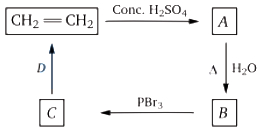
A
methanol and bromoethane
B
ethyl hydrogen sulphate and alcoholic $KOH$
C
ethyl hydrogen sulphate and aqueous $KOH$
D
ethanol and alcoholic $KOH$
Solution
(D) $CH_{2}=CH_{2} \xrightarrow{\text{Conc. } H_{2}SO_{4}} CH_{3}CH_{2}HSO_{4} \text{ (A)}$
$CH_{3}CH_{2}HSO_{4} \xrightarrow{\Delta, H_{2}O} CH_{3}CH_{2}OH \text{ (B)}$
$CH_{3}CH_{2}OH \xrightarrow{PBr_{3}} CH_{3}CH_{2}Br \text{ (C)}$
$CH_{3}CH_{2}Br \xrightarrow{\text{Alc. } KOH, \Delta} CH_{2}=CH_{2} \text{ (D)}$
Thus,$B$ is ethanol $(CH_{3}CH_{2}OH)$ and $D$ is alcoholic $KOH$.
$CH_{3}CH_{2}HSO_{4} \xrightarrow{\Delta, H_{2}O} CH_{3}CH_{2}OH \text{ (B)}$
$CH_{3}CH_{2}OH \xrightarrow{PBr_{3}} CH_{3}CH_{2}Br \text{ (C)}$
$CH_{3}CH_{2}Br \xrightarrow{\text{Alc. } KOH, \Delta} CH_{2}=CH_{2} \text{ (D)}$
Thus,$B$ is ethanol $(CH_{3}CH_{2}OH)$ and $D$ is alcoholic $KOH$.
0 likesView Solution
63
ChemistryEasyMCQKCET · 2011
Which one of the following is a covalent crystal?
A
Rock salt
B
Ice
C
Quartz
D
Dry ice
Solution
(C) In quartz $(SiO_2)$,the lattice points are occupied by silicon and oxygen atoms,which are held together by a continuous network of covalent bonds.
Therefore,quartz is classified as a covalent or network crystal.
Therefore,quartz is classified as a covalent or network crystal.
0 likesView Solution
64
ChemistryEasyMCQKCET · 2011
$A$ solution of two liquids boils at a temperature higher than the boiling point of either of them. Hence,the binary solution shows:
A
negative deviation from Raoult's law
B
positive deviation from Raoult's law
C
no deviation from Raoult's law
D
positive or negative deviation from Raoult's law depending upon the composition
Solution
(A) When a solution boils at a temperature higher than the boiling points of its individual components,it indicates that the vapour pressure of the solution is lower than what is expected from Raoult's law. This decrease in vapour pressure is characteristic of a negative deviation from Raoult's law.
0 likesView Solution
65
ChemistryMediumMCQKCET · 2011
The empirical formula of a non-electrolyte is $CH_2O$. $A$ solution containing $3 \ g$ of the compound exerts the same osmotic pressure as that of $0.05 \ M$ glucose solution. The molecular formula of the compound is
A
$CH_2O$
B
$C_2H_4O_2$
C
$C_4H_8O_4$
D
$C_3H_6O_3$
Solution
(B) For isotonic solutions,the molar concentration is the same,so $C_1 = C_2$.
Given that $0.05 \ M$ glucose solution has the same osmotic pressure as the compound solution,the molarity of the compound solution is $0.05 \ M$.
Assuming the volume of the solution is $V \ L$,the number of moles of the compound is $n = M \times V = 0.05 \times V$.
Also,$n = \frac{\text{mass}}{\text{molar mass}} = \frac{3}{M_X}$.
Equating these,$\frac{3}{M_X} = 0.05 \times V$.
Assuming the volume is $1 \ L$ for standard comparison,$M_X = \frac{3}{0.05} = 60 \ g/mol$.
The empirical formula mass of $CH_2O$ is $12 + 2(1) + 16 = 30 \ g/mol$.
The value of $n$ is $\frac{\text{molecular mass}}{\text{empirical formula mass}} = \frac{60}{30} = 2$.
Therefore,the molecular formula is $2 \times CH_2O = C_2H_4O_2$.
Given that $0.05 \ M$ glucose solution has the same osmotic pressure as the compound solution,the molarity of the compound solution is $0.05 \ M$.
Assuming the volume of the solution is $V \ L$,the number of moles of the compound is $n = M \times V = 0.05 \times V$.
Also,$n = \frac{\text{mass}}{\text{molar mass}} = \frac{3}{M_X}$.
Equating these,$\frac{3}{M_X} = 0.05 \times V$.
Assuming the volume is $1 \ L$ for standard comparison,$M_X = \frac{3}{0.05} = 60 \ g/mol$.
The empirical formula mass of $CH_2O$ is $12 + 2(1) + 16 = 30 \ g/mol$.
The value of $n$ is $\frac{\text{molecular mass}}{\text{empirical formula mass}} = \frac{60}{30} = 2$.
Therefore,the molecular formula is $2 \times CH_2O = C_2H_4O_2$.
0 likesView Solution
66
ChemistryMediumMCQKCET · 2011
Excess of silver nitrate solution is added to $100 \ mL$ of $0.01 \ M$ pentaaqua chloro chromium $(III)$ chloride solution. The mass of silver chloride obtained in grams is [Atomic mass of silver is $108$].
A
$287 \times 10^{-3}$
B
$143.5 \times 10^{-3}$
C
$143.5 \times 10^{-2}$
D
$287 \times 10^{-2}$
Solution
(A) The formula of the complex is $[Cr(H_2O)_5Cl]Cl_2$.
Each mole of the complex releases $2 \ mol$ of ionizable $Cl^-$ ions.
Number of moles of complex = $Molarity \times Volume (L) = 0.01 \ M \times 0.1 \ L = 0.001 \ mol$.
Number of moles of $Cl^-$ ions = $2 \times 0.001 \ mol = 0.002 \ mol$.
Reaction: $Ag^+(aq) + Cl^-(aq) \rightarrow AgCl(s)$.
Moles of $AgCl$ formed = $0.002 \ mol$.
Molar mass of $AgCl = 108 + 35.5 = 143.5 \ g/mol$.
Mass of $AgCl = 0.002 \ mol \times 143.5 \ g/mol = 0.287 \ g = 287 \times 10^{-3} \ g$.
Each mole of the complex releases $2 \ mol$ of ionizable $Cl^-$ ions.
Number of moles of complex = $Molarity \times Volume (L) = 0.01 \ M \times 0.1 \ L = 0.001 \ mol$.
Number of moles of $Cl^-$ ions = $2 \times 0.001 \ mol = 0.002 \ mol$.
Reaction: $Ag^+(aq) + Cl^-(aq) \rightarrow AgCl(s)$.
Moles of $AgCl$ formed = $0.002 \ mol$.
Molar mass of $AgCl = 108 + 35.5 = 143.5 \ g/mol$.
Mass of $AgCl = 0.002 \ mol \times 143.5 \ g/mol = 0.287 \ g = 287 \times 10^{-3} \ g$.
0 likesView Solution
67
ChemistryMediumMCQKCET · 2011
The following data were obtained during the first-order decomposition of $2 A_{(g)} \rightarrow B_{(g)} + C_{(s)}$ at a constant volume and at a particular temperature. The rate constant in $min^{-1}$ is:
| $S$.no. | Time | Total pressure in Pascal |
|---|---|---|
| $1.$ | At the end of $10 \ min$ | $300$ |
| $2.$ | After completion | $200$ |
A
$0.0693$
B
$69.3$
C
$6.93$
D
$6.93 \times 10^{-4}$
Solution
(A) The reaction is $2 A_{(g)} \rightarrow B_{(g)} + C_{(s)}$.
Let the initial pressure of $A$ be $P_0$.
At $t = \infty$ (completion),only $B_{(g)}$ is present,so $P_B = P_0 / 2 = 200 \ Pa$,which means $P_0 = 400 \ Pa$.
At $t = 10 \ min$,let the pressure of $A$ reacted be $2x$.
Initial: $P_A = 400, P_B = 0, P_C = 0$.
At $t = 10$: $P_A = 400 - 2x, P_B = x, P_C = 0$ (since $C$ is solid).
Total pressure $P_t = (400 - 2x) + x = 400 - x = 300 \ Pa$.
Therefore,$x = 100 \ Pa$.
The partial pressure of $A$ at $t = 10 \ min$ is $P_A = 400 - 2(100) = 200 \ Pa$.
For a first-order reaction,$k = \frac{2.303}{t} \log \left( \frac{P_0}{P_A} \right)$.
$k = \frac{2.303}{10} \log \left( \frac{400}{200} \right) = \frac{2.303}{10} \log 2$.
$k = \frac{2.303 \times 0.3010}{10} \approx 0.0693 \ min^{-1}$.
Let the initial pressure of $A$ be $P_0$.
At $t = \infty$ (completion),only $B_{(g)}$ is present,so $P_B = P_0 / 2 = 200 \ Pa$,which means $P_0 = 400 \ Pa$.
At $t = 10 \ min$,let the pressure of $A$ reacted be $2x$.
Initial: $P_A = 400, P_B = 0, P_C = 0$.
At $t = 10$: $P_A = 400 - 2x, P_B = x, P_C = 0$ (since $C$ is solid).
Total pressure $P_t = (400 - 2x) + x = 400 - x = 300 \ Pa$.
Therefore,$x = 100 \ Pa$.
The partial pressure of $A$ at $t = 10 \ min$ is $P_A = 400 - 2(100) = 200 \ Pa$.
For a first-order reaction,$k = \frac{2.303}{t} \log \left( \frac{P_0}{P_A} \right)$.
$k = \frac{2.303}{10} \log \left( \frac{400}{200} \right) = \frac{2.303}{10} \log 2$.
$k = \frac{2.303 \times 0.3010}{10} \approx 0.0693 \ min^{-1}$.
0 likesView Solution
68
ChemistryEasyMCQKCET · 2011
$1 \ g$ of silver gets distributed between $10 \ cm^{3}$ of molten zinc and $100 \ cm^{3}$ of molten lead at $800^{\circ} C$. The percentage of silver still left in the lead layer is approximately
A
$2$
B
$5$
C
$3$
D
$1$
Solution
(C) The partition coefficient $(K)$ for silver between molten zinc and molten lead is $300$.
Let $x$ be the mass of $Ag$ in $Zn$ and $(1 - x)$ be the mass of $Ag$ in $Pb$.
Partition coefficient $= \frac{\text{Conc. of } Ag \text{ in molten } Zn}{\text{Conc. of } Ag \text{ in molten } Pb} = \frac{x / 10}{(1 - x) / 100} = 300$.
Solving for $x$: $\frac{10x}{1 - x} = 300 \implies 10x = 300 - 300x \implies 310x = 300 \implies x = \frac{30}{31}$.
Amount of silver in molten lead $= 1 - x = 1 - \frac{30}{31} = \frac{1}{31} \ g$.
Percentage of silver in lead $= \frac{1/31}{1} \times 100 \approx 3.22 \% \approx 3 \%$.
Let $x$ be the mass of $Ag$ in $Zn$ and $(1 - x)$ be the mass of $Ag$ in $Pb$.
Partition coefficient $= \frac{\text{Conc. of } Ag \text{ in molten } Zn}{\text{Conc. of } Ag \text{ in molten } Pb} = \frac{x / 10}{(1 - x) / 100} = 300$.
Solving for $x$: $\frac{10x}{1 - x} = 300 \implies 10x = 300 - 300x \implies 310x = 300 \implies x = \frac{30}{31}$.
Amount of silver in molten lead $= 1 - x = 1 - \frac{30}{31} = \frac{1}{31} \ g$.
Percentage of silver in lead $= \frac{1/31}{1} \times 100 \approx 3.22 \% \approx 3 \%$.
0 likesView Solution
69
ChemistryMediumMCQKCET · 2011
Which one of the following does not involve coagulation?
A
Clotting of blood by the use of ferric chloride
B
Formation of delta region
C
Treatment of drinking water by potash alum
D
Peptization
Solution
(D) Coagulation is the process of aggregating colloidal particles to form a precipitate.
$A$,$B$,and $C$ involve the aggregation of particles (coagulation).
Peptization is the reverse process,where a freshly prepared precipitate is converted into a colloidal sol by adding a suitable electrolyte (peptizing agent).
Therefore,peptization does not involve coagulation.
$A$,$B$,and $C$ involve the aggregation of particles (coagulation).
Peptization is the reverse process,where a freshly prepared precipitate is converted into a colloidal sol by adding a suitable electrolyte (peptizing agent).
Therefore,peptization does not involve coagulation.
0 likesView Solution
70
ChemistryMediumMCQKCET · 2011
During the adsorption of krypton on activated charcoal at low temperature,which of the following thermodynamic conditions is true?
A
$\Delta H < 0$ and $\Delta S < 0$
B
$\Delta H > 0$ and $\Delta S < 0$
C
$\Delta H > 0$ and $\Delta S > 0$
D
$\Delta H < 0$ and $\Delta S > 0$
Solution
(A) Adsorption is a spontaneous exothermic process.
Since it is exothermic,the enthalpy change $(\Delta H)$ is negative $(\Delta H < 0)$.
As gas molecules are adsorbed on the solid surface,their freedom of movement decreases,leading to a decrease in entropy $(\Delta S < 0)$.
Since it is exothermic,the enthalpy change $(\Delta H)$ is negative $(\Delta H < 0)$.
As gas molecules are adsorbed on the solid surface,their freedom of movement decreases,leading to a decrease in entropy $(\Delta S < 0)$.
0 likesView Solution
Vedclass Products
For Students
Vedclass Test Series
Mock tests in real KCET style covering Chemistry with performance analysis. 5-day free trial.
Start Free TrialFor Teachers
Exam Paper Generator
Generate Set A/B/C/D Chemistry papers from 7.5L+ questions in 2 minutes. 3 chapters free.
Try FreeFor Institutes
Online Exam Module
Run live KCET mock exams with unlimited students, 360° analytics & white-label branding.
See DemoFrequently Asked Questions
How many Chemistry questions are in KCET 2011?
There are 70 Chemistry questions from the KCET 2011 paper on Vedclass, each with a detailed step-by-step solution in English.
Are KCET 2011 Chemistry solutions available in English?
Yes. All solutions on this page are in English. You can also switch to English or Hindi using the language buttons above the questions.
Can I practice KCET 2011 Chemistry as a timed test?
Yes. Use the Vedclass Test Series to attempt a full KCET mock test covering Chemistry with time limits and instant score analysis.
Can teachers create Chemistry papers from KCET previous year questions?
Yes. The Vedclass Exam Paper Generator lets teachers mix KCET Chemistry questions and generate Set A/B/C/D papers in minutes.
For Teachers & Institutes
Build a Custom Chemistry Paper
Pick KCET 2011 Chemistry questions, set difficulty, and generate Set A/B/C/D in 2 minutes.