
BiologyQ1–25 of 25 questions
Page 1 of 1 · English
1
BiologyEasyMCQKCET · 2011
Arrange the following in the ascending order of the Linnaean hierarchy.
A
Kingdom - Order - Species - Genus - Class - Family - Phylum
B
Kingdom - Family - Genus - Species - Class - Phylum - Order
C
Kingdom - Phylum - Class - Order - Family - Genus - Species
D
Species - Genus - Family - Order - Class - Phylum - Kingdom
Solution
(D) The correct answer is $D$.
The ascending order of the Linnaean hierarchy is: $\text{Species} \rightarrow \text{Genus} \rightarrow \text{Family} \rightarrow \text{Order} \rightarrow \text{Class} \rightarrow \text{Phylum} \rightarrow \text{Kingdom}$.
This sequence represents an arrangement from the most specific level (Species) to the most inclusive level (Kingdom),which is the standard hierarchical structure used in biological classification.
The ascending order of the Linnaean hierarchy is: $\text{Species} \rightarrow \text{Genus} \rightarrow \text{Family} \rightarrow \text{Order} \rightarrow \text{Class} \rightarrow \text{Phylum} \rightarrow \text{Kingdom}$.
This sequence represents an arrangement from the most specific level (Species) to the most inclusive level (Kingdom),which is the standard hierarchical structure used in biological classification.
0 likesView Solution
2
BiologyEasyMCQKCET · 2011
Which one of the following reactions is an example of oxidative decarboxylation?
A
Conversion of succinate to fumarate
B
Conversion of fumarate to malate
C
Conversion of pyruvate to acetyl CoA
D
Conversion of citrate to isocitrate
Solution
(C) The correct answer is $C$. The conversion of pyruvate to acetyl CoA is a classic example of oxidative decarboxylation.
In this reaction,pyruvate $(3C)$ undergoes both oxidation and decarboxylation (loss of $CO_2$) to form acetyl CoA $(2C)$.
Simultaneously,$NAD^+$ is reduced to $NADH + H^+$.
This reaction is catalyzed by the pyruvate dehydrogenase complex and serves as a vital link between glycolysis and the Krebs cycle.
In this reaction,pyruvate $(3C)$ undergoes both oxidation and decarboxylation (loss of $CO_2$) to form acetyl CoA $(2C)$.
Simultaneously,$NAD^+$ is reduced to $NADH + H^+$.
This reaction is catalyzed by the pyruvate dehydrogenase complex and serves as a vital link between glycolysis and the Krebs cycle.
0 likesView Solution
3
BiologyEasyMCQKCET · 2011
The number of $ATP$ produced when a molecule of glucose undergoes fermentation is
A
$4$
B
$36$
C
$2$
D
$38$
Solution
(C) The correct answer is $C$.
During fermentation,whether it is lactic acid fermentation or alcoholic fermentation,only $2$ $ATP$ molecules are produced per molecule of glucose.
This is because fermentation is an anaerobic process,which only includes glycolysis.
Glycolysis results in a net gain of $2$ $ATP$ molecules,as the subsequent steps of fermentation do not produce any additional $ATP$.
During fermentation,whether it is lactic acid fermentation or alcoholic fermentation,only $2$ $ATP$ molecules are produced per molecule of glucose.
This is because fermentation is an anaerobic process,which only includes glycolysis.
Glycolysis results in a net gain of $2$ $ATP$ molecules,as the subsequent steps of fermentation do not produce any additional $ATP$.
0 likesView Solution
4
BiologyEasyMCQKCET · 2011
The rosette habit of cabbage can be changed by the application of
A
$IAA$
B
$GA$
C
$ABA$
D
ethephon
Solution
(B) $GA$.
The rosette habit of cabbage is characterized by short internodes and a cluster of leaves.
The application of gibberellins $(GA)$ promotes internode elongation,which causes the stem to grow longer and changes the rosette growth form into an elongated habit.
This process is known as bolting.
The rosette habit of cabbage is characterized by short internodes and a cluster of leaves.
The application of gibberellins $(GA)$ promotes internode elongation,which causes the stem to grow longer and changes the rosette growth form into an elongated habit.
This process is known as bolting.
0 likesView Solution
5
BiologyEasyMCQKCET · 2011
When the blood contains a high percentage of $CO_2$ and a very low percentage of $O_2$,the breathing stops and the person becomes unconscious. This condition is known as:
A
suffocation
B
asphyxia
C
emphysema
D
eupnea
Solution
(B) asphyxia.
Asphyxia is a medical condition characterized by a severe deficiency of oxygen in the body $(hypoxia)$ and an excess of carbon dioxide in the blood $(hypercapnia)$.
This state leads to the cessation of breathing and loss of consciousness.
$Suffocation$ is a general term for oxygen deprivation,$emphysema$ is a chronic lung disease,and $eupnea$ refers to normal,quiet breathing.
Asphyxia is a medical condition characterized by a severe deficiency of oxygen in the body $(hypoxia)$ and an excess of carbon dioxide in the blood $(hypercapnia)$.
This state leads to the cessation of breathing and loss of consciousness.
$Suffocation$ is a general term for oxygen deprivation,$emphysema$ is a chronic lung disease,and $eupnea$ refers to normal,quiet breathing.
0 likesView Solution
6
BiologyEasyMCQKCET · 2011
In a typical heart,if $EDV$ is $120 \ mL$ of blood and $ESV$ is $50 \ mL$ of blood,the stroke volume $(SV)$ is:
A
$120 - 50 = 70 \ mL$
B
$120 + 50 = 170 \ mL$
C
$120 \times 50 = 6000 \ mL$
D
$120 \div 50 = 2.4 \ mL$
Solution
(A) The stroke volume $(SV)$ is the volume of blood pumped out by each ventricle during each cardiac cycle.
It is calculated using the formula: $SV = EDV - ESV$.
Given:
End-diastolic volume $(EDV)$ = $120 \ mL$
End-systolic volume $(ESV)$ = $50 \ mL$
Therefore,$SV = 120 \ mL - 50 \ mL = 70 \ mL$.
Thus,the correct option is $A$.
It is calculated using the formula: $SV = EDV - ESV$.
Given:
End-diastolic volume $(EDV)$ = $120 \ mL$
End-systolic volume $(ESV)$ = $50 \ mL$
Therefore,$SV = 120 \ mL - 50 \ mL = 70 \ mL$.
Thus,the correct option is $A$.
0 likesView Solution
7
BiologyEasyMCQKCET · 2011
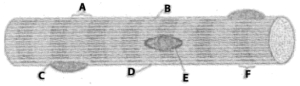
The diagram given below represents the structure of a striated muscle fiber. Label the parts $A, B, C, D, E$ and $F$.
A
$A$-Sarcoplasm,$B$-Nucleus,$C$-Sarcolemma,$D$-Myofibril,$E$-Dark band,$F$-Light band
B
$A$-Sarcoplasm,$B$-Light band,$C$-Myofibril,$D$-Sarcolemma,$E$-Nucleus,$F$-Dark band
C
$A$-Light band,$B$-Sarcoplasm,$C$-Myofibril,$D$-Sarcolemma,$E$-Nucleus,$F$-Dark band
D
$A$-Sarcolemma,$B$-Nucleus,$C$-Dark band,$D$-Light band,$E$-Sarcoplasm,$F$-Myofibril
Solution
(C) The correct answer is $C$.
In a striated muscle fiber,the parts are labeled as follows:
$A$ represents the Light band ($I$-band).
$B$ represents the Sarcoplasm (cytoplasm of the muscle cell).
$C$ represents the Myofibril (contractile unit).
$D$ represents the Sarcolemma (plasma membrane of the muscle fiber).
$E$ represents the Nucleus (located at the periphery).
$F$ represents the Dark band ($A$-band).
In a striated muscle fiber,the parts are labeled as follows:
$A$ represents the Light band ($I$-band).
$B$ represents the Sarcoplasm (cytoplasm of the muscle cell).
$C$ represents the Myofibril (contractile unit).
$D$ represents the Sarcolemma (plasma membrane of the muscle fiber).
$E$ represents the Nucleus (located at the periphery).
$F$ represents the Dark band ($A$-band).
0 likesView Solution
8
BiologyEasyMCQKCET · 2011
The brain stem is made up of
A
midbrain,pons,cerebellum
B
midbrain,pons,medulla oblongata
C
diencephalon,medulla oblongata,cerebellum
D
cerebellum,cerebrum,medulla oblongata
Solution
(B) midbrain,pons,medulla oblongata.
The brainstem is composed of three main structures: the midbrain,pons,and medulla oblongata.
The brainstem forms the vital connection between the brain and the spinal cord.
The brainstem is composed of three main structures: the midbrain,pons,and medulla oblongata.
The brainstem forms the vital connection between the brain and the spinal cord.
0 likesView Solution
9
BiologyEasyMCQKCET · 2011
Which of the following hormones is a steroid?
A
Estrogen
B
Insulin
C
Glucagon
D
Thyroxine
Solution
(A) Estrogen.
Steroid hormones are derived from cholesterol. Examples include estrogens,androgens,and glucocorticoids.
Estrogens are involved in regulating secondary sexual characteristics in females,the menstrual cycle,and the overall health of the reproductive system.
Insulin and Glucagon are peptide hormones,while Thyroxine is an amino acid derivative (iodinated tyrosine).
Steroid hormones are derived from cholesterol. Examples include estrogens,androgens,and glucocorticoids.
Estrogens are involved in regulating secondary sexual characteristics in females,the menstrual cycle,and the overall health of the reproductive system.
Insulin and Glucagon are peptide hormones,while Thyroxine is an amino acid derivative (iodinated tyrosine).
0 likesView Solution
10
BiologyEasyMCQKCET · 2011
With reference to the pituitary gland,which of the following statements is true?
A
Neurohypophysis secretes vasopressin and oxytocin
B
Neurohypophysis secretes $TSH$ and $STH$
C
Neurohypophysis collects and stores vasopressin and oxytocin
D
Adenohypophysis secretes vasopressin and oxytocin
Solution
(C) is the correct answer.
The neurohypophysis (posterior pituitary) stores and releases oxytocin and vasopressin.
These hormones are synthesized in the hypothalamus and transported axonally to the neurohypophysis,where they are stored and later released into the bloodstream.
The neurohypophysis (posterior pituitary) stores and releases oxytocin and vasopressin.
These hormones are synthesized in the hypothalamus and transported axonally to the neurohypophysis,where they are stored and later released into the bloodstream.
0 likesView Solution
11
BiologyEasyMCQKCET · 2011
Column-$I$ contains some terms and Column-$II$ contains their meanings. Match them properly and choose the right answer.
| Column-$I$ | Column-$II$ |
|---|---|
| $A$. Glycogenesis | $1$. Conversion of glycogen to glucose |
| $B$. Glycosuria | $2$. Conversion of glucose to glycogen |
| $C$. Gluconeogenesis | $3$. Excretion of glucose in urine |
| $D$. Glycogenolysis | $4$. Conversion of non-carbohydrate sources to glucose |
| $5$. Conversion of glucose to starch |
A
$A-2, B-3, C-4, D-1$
B
$A-1, B-3, C-4, D-2$
C
$A-2, B-1, C-3, D-4$
D
$A-1, B-5, C-2, D-4$
Solution
(A) The correct matching is $A-2, B-3, C-4, D-1$.
• Glycogenesis $(A-2)$: The process of conversion of glucose to glycogen for storage in the liver and muscles.
• Glycosuria $(B-3)$: The presence of excess glucose in the urine,often associated with diabetes mellitus.
• Gluconeogenesis $(C-4)$: The synthesis of glucose from non-carbohydrate precursors like amino acids,glycerol,and lactate.
• Glycogenolysis $(D-1)$: The breakdown of stored glycogen into glucose to maintain blood sugar levels.
• Glycogenesis $(A-2)$: The process of conversion of glucose to glycogen for storage in the liver and muscles.
• Glycosuria $(B-3)$: The presence of excess glucose in the urine,often associated with diabetes mellitus.
• Gluconeogenesis $(C-4)$: The synthesis of glucose from non-carbohydrate precursors like amino acids,glycerol,and lactate.
• Glycogenolysis $(D-1)$: The breakdown of stored glycogen into glucose to maintain blood sugar levels.
0 likesView Solution
12
BiologyEasyMCQKCET · 2011
Which one of the following is an example of a chlorophyllous thallophyte?
A
Volvariella
B
Spirogyra
C
Nephrolepis
D
Gnetum
Solution
(B) - $Spirogyra$.
$Spirogyra$ is a chlorophyllous thallophyte because it belongs to the group of green algae,which possess chlorophyll pigments for the process of photosynthesis.
$Volvariella$ is a fungus (non-chlorophyllous),$Nephrolepis$ is a pteridophyte,and $Gnetum$ is a gymnosperm.
$Spirogyra$ is a chlorophyllous thallophyte because it belongs to the group of green algae,which possess chlorophyll pigments for the process of photosynthesis.
$Volvariella$ is a fungus (non-chlorophyllous),$Nephrolepis$ is a pteridophyte,and $Gnetum$ is a gymnosperm.
0 likesView Solution
13
BiologyEasyMCQKCET · 2011
Gametophyte is the dominant phase in the life cycle of
A
Hibiscus
B
Nephrolepis
C
Cycas
D
Riccia
Solution
(D) $Riccia$,a liverwort within the $Bryophyta$,exhibits a dominant gametophyte phase in its life cycle.
In bryophytes,the gametophyte is the main stage,whereas the sporophyte is smaller and dependent on the gametophyte for nutrition.
In bryophytes,the gametophyte is the main stage,whereas the sporophyte is smaller and dependent on the gametophyte for nutrition.
0 likesView Solution
14
BiologyEasyMCQKCET · 2011
How do you differentiate a frog from a toad?
A
Frog has no exoskeleton but toad has scales
B
Frog respires through lungs but toad respires through skin
C
Frog has a tail but toad has no tail.
D
Frog has no parotid glands but toad has a pair of parotid glands
Solution
(D) The correct answer is $D$.
Frogs and toads are both amphibians belonging to the order $Anura$.
They can be differentiated by several morphological features:
$1$. Frogs typically have smooth,moist skin,while toads have dry,warty skin.
$2$. Frogs have long,powerful hind legs for jumping,whereas toads have shorter legs and tend to walk or hop.
$3$. The most distinct anatomical difference is that toads possess a pair of large,prominent parotid glands behind their eyes,which secrete toxins for defense,whereas frogs lack these specific glands.
Frogs and toads are both amphibians belonging to the order $Anura$.
They can be differentiated by several morphological features:
$1$. Frogs typically have smooth,moist skin,while toads have dry,warty skin.
$2$. Frogs have long,powerful hind legs for jumping,whereas toads have shorter legs and tend to walk or hop.
$3$. The most distinct anatomical difference is that toads possess a pair of large,prominent parotid glands behind their eyes,which secrete toxins for defense,whereas frogs lack these specific glands.
0 likesView Solution
15
BiologyEasyMCQKCET · 2011
In some chordates,the notochord is replaced by the vertebral column. Such animals are called vertebrates. Which one of the following statements is correct?
A
All chordates are vertebrates but all vertebrates are not chordates.
B
All vertebrates are chordates and all chordates are vertebrates.
C
All vertebrates are chordates but all chordates are not vertebrates.
D
Chordates are not vertebrates and vertebrates are not chordates.
Solution
(C) The correct statement is that all vertebrates are chordates,but all chordates are not vertebrates.
This is because the phylum $Chordata$ is a larger group that includes organisms with a notochord at some stage of their life cycle.
Vertebrates are a subphylum within $Chordata$ where the notochord is replaced by a vertebral column in the adult stage.
Therefore,while every vertebrate is a chordate,not every chordate (such as $Urochordata$ or $Cephalochordata$) possesses a vertebral column.
This is because the phylum $Chordata$ is a larger group that includes organisms with a notochord at some stage of their life cycle.
Vertebrates are a subphylum within $Chordata$ where the notochord is replaced by a vertebral column in the adult stage.
Therefore,while every vertebrate is a chordate,not every chordate (such as $Urochordata$ or $Cephalochordata$) possesses a vertebral column.
0 likesView Solution
16
BiologyEasyMCQKCET · 2011
Pick the mammal with a true placenta.
A
Kangaroo
B
Flying fox
C
Platypus
D
Mongoose
Solution
(D) The correct answer is $D$ (Mongoose).
$1$. Mammals are classified into three groups: Prototherians (egg-laying mammals like Platypus),Metatherians (marsupials like Kangaroo),and Eutherians (placental mammals).
$2$. $A$ true placenta is a characteristic feature of Eutherians,which allows for the exchange of nutrients and waste between the mother and the fetus.
$3$. Mongoose is a Eutherian mammal and thus possesses a true placenta.
$4$. Kangaroo is a marsupial (Metatherian) with a short-lived yolk-sac placenta,and Platypus is a monotreme (Prototherian) that lays eggs.
$1$. Mammals are classified into three groups: Prototherians (egg-laying mammals like Platypus),Metatherians (marsupials like Kangaroo),and Eutherians (placental mammals).
$2$. $A$ true placenta is a characteristic feature of Eutherians,which allows for the exchange of nutrients and waste between the mother and the fetus.
$3$. Mongoose is a Eutherian mammal and thus possesses a true placenta.
$4$. Kangaroo is a marsupial (Metatherian) with a short-lived yolk-sac placenta,and Platypus is a monotreme (Prototherian) that lays eggs.
0 likesView Solution
17
BiologyEasyMCQKCET · 2011
With reference to enzymes, which one of the following statements is true?
A
Apoenzyme = Holoenzyme + Coenzyme
B
Holoenzyme = Apoenzyme + Coenzyme
C
Coenzyme = Apoenzyme + Holoenzyme
D
Holoenzyme = Coenzyme - Apoenzyme
Solution
(B) The correct answer is $B$.
An enzyme is composed of an apoenzyme (the protein part) and a coenzyme (a non-protein organic molecule).
Together, they form the holoenzyme, which is the active form of the enzyme capable of catalyzing biochemical reactions.
Therefore, the relationship is defined as: $\text{Holoenzyme} = \text{Apoenzyme} + \text{Coenzyme}$.
An enzyme is composed of an apoenzyme (the protein part) and a coenzyme (a non-protein organic molecule).
Together, they form the holoenzyme, which is the active form of the enzyme capable of catalyzing biochemical reactions.
Therefore, the relationship is defined as: $\text{Holoenzyme} = \text{Apoenzyme} + \text{Coenzyme}$.
0 likesView Solution
18
BiologyEasyMCQKCET · 2011
Four children belonging to the same parents have the following blood groups $A$,$B$,$AB$ and $O$. Hence,the genotypes of the two parents are:
A
Both parents are homozygous for $A$ group.
B
One parent is homozygous for $A$ group.
C
One parent is heterozygous for $A$ and the other parent is heterozygous for $B$.
D
Both parents are homozygous for $B$ group.
Solution
(C) The inheritance of $ABO$ blood groups is controlled by the gene $I$. The gene $I$ has three alleles: $I^A$,$I^B$,and $i$.
Since the children have blood groups $A$,$B$,$AB$,and $O$,the parents must be heterozygous.
For a child to have blood group $O$ (genotype $ii$),both parents must contribute an $i$ allele.
For a child to have blood group $AB$ (genotype $I^A I^B$),one parent must contribute $I^A$ and the other must contribute $I^B$.
Therefore,the genotypes of the parents must be $I^A i$ (Blood group $A$) and $I^B i$ (Blood group $B$).
This cross $(I^A i \times I^B i)$ results in offspring with genotypes $I^A I^B$ $(AB)$,$I^A i$ $(A)$,$I^B i$ $(B)$,and $ii$ $(O)$.
Thus,both parents are heterozygous for blood groups $A$ and $B$ respectively.
Since the children have blood groups $A$,$B$,$AB$,and $O$,the parents must be heterozygous.
For a child to have blood group $O$ (genotype $ii$),both parents must contribute an $i$ allele.
For a child to have blood group $AB$ (genotype $I^A I^B$),one parent must contribute $I^A$ and the other must contribute $I^B$.
Therefore,the genotypes of the parents must be $I^A i$ (Blood group $A$) and $I^B i$ (Blood group $B$).
This cross $(I^A i \times I^B i)$ results in offspring with genotypes $I^A I^B$ $(AB)$,$I^A i$ $(A)$,$I^B i$ $(B)$,and $ii$ $(O)$.
Thus,both parents are heterozygous for blood groups $A$ and $B$ respectively.
0 likesView Solution
19
BiologyEasyMCQKCET · 2011
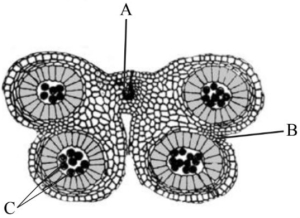
The following is the diagram of $T.S.$ of anther. Identify the parts labelled $A$,$B$ and $C$.
A
$A$-Connective tissue,$B$-Endothecium,$C$-Pollen grain
B
$A$-Endothecium,$B$-Connective tissue,$C$-Pollen grain
C
$A$-Pollen grain,$B$-Connective tissue,$C$-Endothecium
D
$A$-Connective tissue,$B$-Endothecium,$C$-Pollen grain
Solution
(A) Based on the $T.S.$ of anther diagram:
$A$ points to the central region connecting the two lobes,which is the Connective tissue.
$B$ points to the layer just inside the epidermis,which is the Endothecium.
$C$ points to the microspores or Pollen grains located within the microsporangium.
Therefore,the correct identification is $A$-Connective tissue,$B$-Endothecium,$C$-Pollen grain. The correct option is $A$.
$A$ points to the central region connecting the two lobes,which is the Connective tissue.
$B$ points to the layer just inside the epidermis,which is the Endothecium.
$C$ points to the microspores or Pollen grains located within the microsporangium.
Therefore,the correct identification is $A$-Connective tissue,$B$-Endothecium,$C$-Pollen grain. The correct option is $A$.
0 likesView Solution
20
BiologyEasyMCQKCET · 2011
Column-$I$ contains terms and Column-$II$ contains definitions. Match them correctly and choose the right answer.
| Column-$I$ | Column-$II$ |
| $A$. Parturition | $1$. Attachment of blastocyst to endometrium |
| $B$. Gestation | $2$. Release of egg from Graafian follicle |
| $C$. Ovulation | $3$. Delivery of baby from uterus |
| $D$. Implantation | $4$. Duration between pregnancy and birth |
| $E$. Conception | $5$. Formation of zygote by fusion of the egg and sperm |
A
$A-2, B-4, C-1, D-5, E-3$
B
$A-2, B-3, C-1, D-5, E-2$
C
$A-5, B-1, C-2, D-3, E-4$
D
$A-3, B-4, C-2, D-1, E-5$
Solution
(D) The correct matching is as follows:
$A$. Parturition: $3$. Delivery of the baby from the uterus.
$B$. Gestation: $4$. The duration between pregnancy and birth.
$C$. Ovulation: $2$. The release of the egg (ovum) from the Graafian follicle.
$D$. Implantation: $1$. The attachment of the blastocyst to the uterine endometrium.
$E$. Conception: $5$. The formation of the zygote by the fusion of the egg and sperm.
Therefore, the correct sequence is $A-3, B-4, C-2, D-1, E-5$.
$A$. Parturition: $3$. Delivery of the baby from the uterus.
$B$. Gestation: $4$. The duration between pregnancy and birth.
$C$. Ovulation: $2$. The release of the egg (ovum) from the Graafian follicle.
$D$. Implantation: $1$. The attachment of the blastocyst to the uterine endometrium.
$E$. Conception: $5$. The formation of the zygote by the fusion of the egg and sperm.
Therefore, the correct sequence is $A-3, B-4, C-2, D-1, E-5$.
0 likesView Solution
21
BiologyEasyMCQKCET · 2011
More men suffer from colour blindness than women because
A
women are more resistant to disease than men
B
the male sex hormone testosterone causes the disease
C
the colour blind gene is carried on the '$Y$' chromosome
D
men are hemizygous and one defective gene is enough to make them colour blind.
Solution
(D) men are hemizygous and one defective gene is enough to make them colour blind.
More men suffer from colour blindness than women because men are hemizygous for the $X$ chromosome.
Since men have only one $X$ chromosome,a single recessive allele on this chromosome is sufficient to express the trait of colour blindness.
In contrast,women have two $X$ chromosomes,so they require two defective copies of the gene to express the condition,making it significantly less common in women.
More men suffer from colour blindness than women because men are hemizygous for the $X$ chromosome.
Since men have only one $X$ chromosome,a single recessive allele on this chromosome is sufficient to express the trait of colour blindness.
In contrast,women have two $X$ chromosomes,so they require two defective copies of the gene to express the condition,making it significantly less common in women.
0 likesView Solution
22
BiologyEasyMCQKCET · 2011
In a typical Mendelian dihybrid cross,one parent is homozygous for both dominant traits and another parent is homozygous for both recessive traits. In the $F_2$ generation,both parental combinations and recombinations appear. The phenotypic ratio of parental combinations to recombinations is
A
$10$:$6$
B
$12$:$4$
C
$9$:$7$
D
$15$:$1$
Solution
(A) In a typical Mendelian dihybrid cross,the $F_2$ phenotypic ratio is $9:3:3:1$.
Here,the parental combinations are the phenotypes that resemble the original parents (homozygous dominant and homozygous recessive),which are represented by the $9$ (both dominant) and $1$ (both recessive) classes.
Total parental combinations = $9 + 1 = 10$.
The recombinations are the new phenotypes that differ from the parents,represented by the two $3$ classes (one dominant and one recessive trait each).
Total recombinations = $3 + 3 = 6$.
Therefore,the ratio of parental combinations to recombinations is $10:6$.
Here,the parental combinations are the phenotypes that resemble the original parents (homozygous dominant and homozygous recessive),which are represented by the $9$ (both dominant) and $1$ (both recessive) classes.
Total parental combinations = $9 + 1 = 10$.
The recombinations are the new phenotypes that differ from the parents,represented by the two $3$ classes (one dominant and one recessive trait each).
Total recombinations = $3 + 3 = 6$.
Therefore,the ratio of parental combinations to recombinations is $10:6$.
0 likesView Solution
23
BiologyEasyMCQKCET · 2011
In the genetic code,$61$ codons code for $20$ different types of amino acids. This is called:
A
collinearity
B
commaless
C
degeneracy
D
nonambiguity
Solution
(C) The correct answer is $C$.
In the genetic code,the phenomenon where $61$ codons code for only $20$ different amino acids is known as degeneracy.
This occurs because some amino acids are specified by more than one codon.
This redundancy provides a protective mechanism against mutations,as a change in the third base of a codon (wobble position) often does not result in a change to the amino acid being incorporated.
In the genetic code,the phenomenon where $61$ codons code for only $20$ different amino acids is known as degeneracy.
This occurs because some amino acids are specified by more than one codon.
This redundancy provides a protective mechanism against mutations,as a change in the third base of a codon (wobble position) often does not result in a change to the amino acid being incorporated.
0 likesView Solution
24
BiologyEasyMCQKCET · 2011
The term,genetic $RNA$ refers to
A
genetic material of $RNA$ viruses
B
$RNA$ that carries genetic message
C
$RNA$ that helps gene regulation in lac-operon
D
$RNA$ present in mitochondria
Solution
(A) genetic material of $RNA$ viruses.
In $RNA$ viruses,genetic $RNA$ refers to the $RNA$ that encodes the virus's genetic information,allowing it to replicate and produce new viral particles.
This $RNA$ acts as the virus's genetic blueprint,serving the same function as $DNA$ does in other organisms.
In $RNA$ viruses,genetic $RNA$ refers to the $RNA$ that encodes the virus's genetic information,allowing it to replicate and produce new viral particles.
This $RNA$ acts as the virus's genetic blueprint,serving the same function as $DNA$ does in other organisms.
0 likesView Solution
25
BiologyEasyMCQKCET · 2011
By the statement 'Survival of the Fittest', Darwin meant that . . . . . .
A
the strongest of all species survives
B
the most intelligent of the species survives
C
the cleverest of the species survives
D
the most adaptable of the species to changes survives
Solution
(D) is the correct answer.
By the statement "Survival of the Fittest," Darwin meant that the individuals of a species that are best adapted to their environment, through favorable variations and advantageous traits, are more likely to survive and reproduce in the struggle for existence.
By the statement "Survival of the Fittest," Darwin meant that the individuals of a species that are best adapted to their environment, through favorable variations and advantageous traits, are more likely to survive and reproduce in the struggle for existence.
0 likesView Solution
Vedclass Products
For Students
Vedclass Test Series
Mock tests in real KCET style covering Biology with performance analysis. 5-day free trial.
Start Free TrialFor Teachers
Exam Paper Generator
Generate Set A/B/C/D Biology papers from 7.5L+ questions in 2 minutes. 3 chapters free.
Try FreeFor Institutes
Online Exam Module
Run live KCET mock exams with unlimited students, 360° analytics & white-label branding.
See DemoFrequently Asked Questions
How many Biology questions are in KCET 2011?
There are 25 Biology questions from the KCET 2011 paper on Vedclass, each with a detailed step-by-step solution in English.
Are KCET 2011 Biology solutions available in English?
Yes. All solutions on this page are in English. You can also switch to English or Hindi using the language buttons above the questions.
Can I practice KCET 2011 Biology as a timed test?
Yes. Use the Vedclass Test Series to attempt a full KCET mock test covering Biology with time limits and instant score analysis.
Can teachers create Biology papers from KCET previous year questions?
Yes. The Vedclass Exam Paper Generator lets teachers mix KCET Biology questions and generate Set A/B/C/D papers in minutes.
For Teachers & Institutes
Build a Custom Biology Paper
Pick KCET 2011 Biology questions, set difficulty, and generate Set A/B/C/D in 2 minutes.