
ChemistryQ101–200 of 389 questions
Page 3 of 4 · English
101
ChemistryMediumMCQAP EAMCET · 2024
Which of the following oxides is acidic in nature?
A
$GeO_2$
B
$CO$
C
$PbO_2$
D
$SnO$
Solution
(A) $GeO_2$ is acidic in nature.
$CO$ is a neutral oxide.
$PbO_2$ is amphoteric in nature.
$SnO$ is amphoteric in nature.
$CO$ is a neutral oxide.
$PbO_2$ is amphoteric in nature.
$SnO$ is amphoteric in nature.
0 likesView Solution
102
ChemistryMediumMCQAP EAMCET · 2024
Two statements are given below.
Statement $I$: $SnF_4$ and $PbF_4$ are ionic in nature.
Statement $II$: $GeCl_2$ is more stable than $GeCl_4$.
The correct answer is:
Statement $I$: $SnF_4$ and $PbF_4$ are ionic in nature.
Statement $II$: $GeCl_2$ is more stable than $GeCl_4$.
The correct answer is:
A
Both statements $I$ and $II$ are correct.
B
Both statements $I$ and $II$ are not correct.
C
Statement $I$ is correct,but statement $II$ is not correct.
D
Statement $I$ is not correct,but statement $II$ is correct.
Solution
(C) In group $14$,most $MX_4$ halides are covalent. However,$SnF_4$ and $PbF_4$ are ionic due to the large electronegativity difference between the metal and fluorine. Thus,Statement $I$ is correct.
For group $14$ elements,the stability of the $+2$ oxidation state increases down the group due to the inert pair effect. $Ge$ is at the top of the group,so the $+4$ oxidation state is more stable than the $+2$ oxidation state. Therefore,$GeCl_4$ is more stable than $GeCl_2$. Thus,Statement $II$ is incorrect.
For group $14$ elements,the stability of the $+2$ oxidation state increases down the group due to the inert pair effect. $Ge$ is at the top of the group,so the $+4$ oxidation state is more stable than the $+2$ oxidation state. Therefore,$GeCl_4$ is more stable than $GeCl_2$. Thus,Statement $II$ is incorrect.
0 likesView Solution
103
ChemistryMediumMCQAP EAMCET · 2024
Which of the following is/are ionic in nature?
$(i)$ $GeF_4$ $(ii)$ $SnF_4$ $(iii)$ $PbF_4$
$(i)$ $GeF_4$ $(ii)$ $SnF_4$ $(iii)$ $PbF_4$
A
$iii$ only
B
$ii, iii$ only
C
$i$ only
D
$i, ii$ only
Solution
(B) Most of the $MX_4$ $(X = F, Cl, Br, I)$ compounds of group $14$ elements are covalent in nature.
However,$SnF_4$ and $PbF_4$ are exceptions as they exhibit ionic character due to the high electronegativity of fluorine and the size of the central metal atoms.
However,$SnF_4$ and $PbF_4$ are exceptions as they exhibit ionic character due to the high electronegativity of fluorine and the size of the central metal atoms.
0 likesView Solution
104
ChemistryMediumMCQAP EAMCET · 2024
Identify the correct statements from the following:
$i$. Reaction of hydrogen with fluorine occurs even in dark.
$ii$. Manufacture of ammonia by Haber process is an endothermic reaction.
$iii$. $HF$ is an electron-rich hydride.
$i$. Reaction of hydrogen with fluorine occurs even in dark.
$ii$. Manufacture of ammonia by Haber process is an endothermic reaction.
$iii$. $HF$ is an electron-rich hydride.
A
$i, iii$ only
B
$i, ii, iii$
C
$ii, iii$ only
D
$i, ii$ only
Solution
(A) $i$. The reaction $H_{2(g)} + F_{2(g)} \longrightarrow 2HF_{(g)}$ is highly spontaneous and occurs even in the dark due to the high reactivity of $F_2$.
$ii$. The Haber process,$N_{2(g)} + 3H_{2(g)} \rightleftharpoons 2NH_{3(g)}$,is an exothermic reaction $(\Delta H = -92.4 \ kJ/mol)$,not endothermic.
$iii$. $HF$ is an electron-rich hydride because the fluorine atom has three lone pairs of electrons.
Therefore,statements $i$ and $iii$ are correct.
$ii$. The Haber process,$N_{2(g)} + 3H_{2(g)} \rightleftharpoons 2NH_{3(g)}$,is an exothermic reaction $(\Delta H = -92.4 \ kJ/mol)$,not endothermic.
$iii$. $HF$ is an electron-rich hydride because the fluorine atom has three lone pairs of electrons.
Therefore,statements $i$ and $iii$ are correct.
0 likesView Solution
105
ChemistryMediumMCQAP EAMCET · 2024
The shape of the colourless neutral gas formed on thermal decomposition of ammonium nitrate is
A
Angular
B
Linear
C
Trigonal planar
D
Trigonal pyramidal
Solution
(B) Ammonium nitrate $(NH_4NO_3)$ on thermal decomposition produces nitrous oxide $(N_2O)$ and water $(H_2O)$.
$NH_4NO_3 \longrightarrow N_2O + 2H_2O$
$N_2O$ is a colourless,neutral gas (laughing gas).
The structure of $N_2O$ is $N \equiv N^+ - O^-$,which is linear in shape.
$NH_4NO_3 \longrightarrow N_2O + 2H_2O$
$N_2O$ is a colourless,neutral gas (laughing gas).
The structure of $N_2O$ is $N \equiv N^+ - O^-$,which is linear in shape.
0 likesView Solution
106
ChemistryMediumMCQAP EAMCET · 2024
The disproportionation products of $ortho-phosphorous$ acid are
A
$H_3PO_4, PH_3$
B
$H_3PO_2, H_3PO_3$
C
$H_3PO_4, HPO_3$
D
$H_3PO_2, P_2H_4$
Solution
(A) $Ortho-phosphorous$ acid $(H_3PO_3)$ on heating undergoes disproportionation to give $ortho-phosphoric$ acid $(H_3PO_4)$ and phosphine $(PH_3)$.
The chemical equation is:
$4H_3PO_3 \xrightarrow{\Delta} 3H_3PO_4 + PH_3$
The chemical equation is:
$4H_3PO_3 \xrightarrow{\Delta} 3H_3PO_4 + PH_3$
0 likesView Solution
107
ChemistryEasyMCQAP EAMCET · 2024
Observe the following stoichiometric equation:
$P_4 + 3 OH^{-} + 3 H_2 O \rightarrow PH_3 + 3 X^{-}$
What is the conjugate acid of $X^{-}$?
$P_4 + 3 OH^{-} + 3 H_2 O \rightarrow PH_3 + 3 X^{-}$
What is the conjugate acid of $X^{-}$?
A
Phosphorous acid
B
Hypophosphorous acid
C
Phosphoric acid
D
Pyrophosphoric acid
Solution
(B) The balanced stoichiometric equation is:
$P_4 + 3 OH^{-} + 3 H_2 O \rightarrow PH_3 + 3 H_2 PO_2^{-}$
Comparing this to the given equation,$X^{-}$ is $H_2 PO_2^{-}$.
The conjugate acid is formed by adding a proton $(H^{+})$ to the base.
Conjugate acid of $H_2 PO_2^{-}$ is $H_3 PO_2$.
$H_3 PO_2$ is known as hypophosphorous acid.
$P_4 + 3 OH^{-} + 3 H_2 O \rightarrow PH_3 + 3 H_2 PO_2^{-}$
Comparing this to the given equation,$X^{-}$ is $H_2 PO_2^{-}$.
The conjugate acid is formed by adding a proton $(H^{+})$ to the base.
Conjugate acid of $H_2 PO_2^{-}$ is $H_3 PO_2$.
$H_3 PO_2$ is known as hypophosphorous acid.
0 likesView Solution
108
ChemistryMediumMCQAP EAMCET · 2024
Which of the following reactions of $KMnO_4$ occurs in acidic medium?
A
Oxidation of thiosulphate to sulphate
B
Precipitation of sulphur from $H_2S$
C
Oxidation of iodide to iodate
D
Oxidation of manganous salt to $MnO_2$
Solution
(B) In acidic medium,$KMnO_4$ acts as a strong oxidizing agent.
When $H_2S$ reacts with $KMnO_4$ in an acidic medium,$H_2S$ is oxidized to elemental sulphur,which precipitates out.
The reaction is:
$5H_2S + 2MnO_4^- + 6H^+ \longrightarrow 2Mn^{2+} + 8H_2O + 5S$
Thus,the precipitation of sulphur from $H_2S$ is a characteristic reaction of $KMnO_4$ in acidic medium.
When $H_2S$ reacts with $KMnO_4$ in an acidic medium,$H_2S$ is oxidized to elemental sulphur,which precipitates out.
The reaction is:
$5H_2S + 2MnO_4^- + 6H^+ \longrightarrow 2Mn^{2+} + 8H_2O + 5S$
Thus,the precipitation of sulphur from $H_2S$ is a characteristic reaction of $KMnO_4$ in acidic medium.
0 likesView Solution
109
ChemistryMediumMCQAP EAMCET · 2024
Which of the following occurs with $KMnO_4$ in neutral or faintly alkaline medium?
A
Oxidation of oxalate ion
B
Precipitation of sulphur from hydrogen sulphide
C
Oxidation of $Fe^{2+}$ to $Fe^{3+}$
D
Oxidation of iodide to iodate
Solution
(D) In neutral or faintly alkaline solutions,$KMnO_4$ acts as an oxidizing agent where $Mn$ is reduced from $+7$ to $+4$ (forming $MnO_2$).
One of the characteristic reactions in this medium is the oxidation of iodide $(I^-)$ to iodate $(IO_3^-)$.
The balanced chemical equation is:
$2MnO_4^- + H_2O + I^- \rightarrow 2MnO_2 + 2OH^- + IO_3^-$
One of the characteristic reactions in this medium is the oxidation of iodide $(I^-)$ to iodate $(IO_3^-)$.
The balanced chemical equation is:
$2MnO_4^- + H_2O + I^- \rightarrow 2MnO_2 + 2OH^- + IO_3^-$
0 likesView Solution
110
ChemistryMCQAP EAMCET · 2024
If a polygon of $n$ sides has $275$ diagonals,then $n$ is equal to
A
$25$
B
$35$
C
$20$
D
$15$
Solution
(A) polygon of $n$ sides has the number of diagonals given by the formula: $\frac{n(n-3)}{2} = 275$.
Multiplying by $2$,we get $n(n-3) = 550$.
$n^2 - 3n - 550 = 0$.
Factoring the quadratic equation: $n^2 - 25n + 22n - 550 = 0$.
$n(n - 25) + 22(n - 25) = 0$.
$(n - 25)(n + 22) = 0$.
Since the number of sides $n$ must be positive,$n = 25$ (as $n = -22$ is not possible).
Multiplying by $2$,we get $n(n-3) = 550$.
$n^2 - 3n - 550 = 0$.
Factoring the quadratic equation: $n^2 - 25n + 22n - 550 = 0$.
$n(n - 25) + 22(n - 25) = 0$.
$(n - 25)(n + 22) = 0$.
Since the number of sides $n$ must be positive,$n = 25$ (as $n = -22$ is not possible).
0 likesView Solution
111
ChemistryMCQAP EAMCET · 2024
$\frac{\sin 1^{\circ}+\sin 2^{\circ}+\ldots+\sin 89^{\circ}}{2(\cos 1^{\circ}+\cos 2^{\circ}+\ldots+\cos 44^{\circ})+1} = $
A
$\sqrt{2}$
B
$\frac{1}{\sqrt{2}}$
C
$2$
D
$\frac{1}{2}$
Solution
(B) Let $S = \sin 1^{\circ} + \sin 2^{\circ} + \ldots + \sin 89^{\circ}$.
We can pair terms as $(\sin 1^{\circ} + \sin 89^{\circ}) + (\sin 2^{\circ} + \sin 88^{\circ}) + \ldots + (\sin 44^{\circ} + \sin 46^{\circ}) + \sin 45^{\circ}$.
Using the identity $\sin A + \sin B = 2 \sin(\frac{A+B}{2}) \cos(\frac{A-B}{2})$,we have $\sin k^{\circ} + \sin(90-k)^{\circ} = 2 \sin 45^{\circ} \cos(\frac{90-2k}{2}) = 2 \cdot \frac{1}{\sqrt{2}} \cos(45-k)^{\circ} = \sqrt{2} \cos(45-k)^{\circ}$.
Alternatively,$\sin k^{\circ} + \sin(90-k)^{\circ} = \sin k^{\circ} + \cos k^{\circ}$.
Actually,$\sin k^{\circ} + \sin(90-k)^{\circ} = 2 \sin 45^{\circ} \cos(k-45)^{\circ} = \sqrt{2} \cos(k-45)^{\circ}$.
Using $\sin A + \sin B = 2 \sin 45^{\circ} \cos(\frac{A-B}{2})$,the numerator becomes $\sqrt{2} \cos 44^{\circ} + \sqrt{2} \cos 43^{\circ} + \ldots + \sqrt{2} \cos 1^{\circ} + \sin 45^{\circ}$.
Numerator $= \sqrt{2} (\cos 1^{\circ} + \cos 2^{\circ} + \ldots + \cos 44^{\circ}) + \frac{1}{\sqrt{2}}$.
Numerator $= \frac{1}{\sqrt{2}} [2(\cos 1^{\circ} + \cos 2^{\circ} + \ldots + \cos 44^{\circ}) + 1]$.
Thus,the expression simplifies to $\frac{1}{\sqrt{2}}$.
We can pair terms as $(\sin 1^{\circ} + \sin 89^{\circ}) + (\sin 2^{\circ} + \sin 88^{\circ}) + \ldots + (\sin 44^{\circ} + \sin 46^{\circ}) + \sin 45^{\circ}$.
Using the identity $\sin A + \sin B = 2 \sin(\frac{A+B}{2}) \cos(\frac{A-B}{2})$,we have $\sin k^{\circ} + \sin(90-k)^{\circ} = 2 \sin 45^{\circ} \cos(\frac{90-2k}{2}) = 2 \cdot \frac{1}{\sqrt{2}} \cos(45-k)^{\circ} = \sqrt{2} \cos(45-k)^{\circ}$.
Alternatively,$\sin k^{\circ} + \sin(90-k)^{\circ} = \sin k^{\circ} + \cos k^{\circ}$.
Actually,$\sin k^{\circ} + \sin(90-k)^{\circ} = 2 \sin 45^{\circ} \cos(k-45)^{\circ} = \sqrt{2} \cos(k-45)^{\circ}$.
Using $\sin A + \sin B = 2 \sin 45^{\circ} \cos(\frac{A-B}{2})$,the numerator becomes $\sqrt{2} \cos 44^{\circ} + \sqrt{2} \cos 43^{\circ} + \ldots + \sqrt{2} \cos 1^{\circ} + \sin 45^{\circ}$.
Numerator $= \sqrt{2} (\cos 1^{\circ} + \cos 2^{\circ} + \ldots + \cos 44^{\circ}) + \frac{1}{\sqrt{2}}$.
Numerator $= \frac{1}{\sqrt{2}} [2(\cos 1^{\circ} + \cos 2^{\circ} + \ldots + \cos 44^{\circ}) + 1]$.
Thus,the expression simplifies to $\frac{1}{\sqrt{2}}$.
0 likesView Solution
112
ChemistryMCQAP EAMCET · 2024
If the line $2x - 3y + 5 = 0$ is the perpendicular bisector of the line segment joining $(1, -2)$ and $(\alpha, \beta)$,then $\alpha + \beta =$
A
$7$
B
$1$
C
$-1$
D
$-7$
Solution
(B) Let the points be $A(1, -2)$ and $B(\alpha, \beta)$. The midpoint of $AB$ is $M = \left(\frac{1+\alpha}{2}, \frac{-2+\beta}{2}\right)$.
Since $M$ lies on the line $2x - 3y + 5 = 0$,we have $2\left(\frac{1+\alpha}{2}\right) - 3\left(\frac{-2+\beta}{2}\right) + 5 = 0$,which simplifies to $1 + \alpha + 3 - 1.5\beta + 5 = 0$,or $2\alpha - 3\beta = -18$.
The slope of $AB$ is $m_{AB} = \frac{\beta - (-2)}{\alpha - 1} = \frac{\beta + 2}{\alpha - 1}$.
The slope of the given line $2x - 3y + 5 = 0$ is $m_L = \frac{2}{3}$.
Since the line is the perpendicular bisector,$m_{AB} \times m_L = -1$,so $\left(\frac{\beta + 2}{\alpha - 1}\right) \times \left(\frac{2}{3}\right) = -1$.
This gives $2\beta + 4 = -3\alpha + 3$,or $3\alpha + 2\beta = -1$.
Solving the system of equations $2\alpha - 3\beta = -18$ and $3\alpha + 2\beta = -1$:
Multiply the first by $2$ and the second by $3$: $4\alpha - 6\beta = -36$ and $9\alpha + 6\beta = -3$.
Adding them gives $13\alpha = -39$,so $\alpha = -3$.
Substituting $\alpha = -3$ into $3\alpha + 2\beta = -1$ gives $3(-3) + 2\beta = -1$,so $2\beta = 8$,$\beta = 4$.
Thus,$\alpha + \beta = -3 + 4 = 1$.
Since $M$ lies on the line $2x - 3y + 5 = 0$,we have $2\left(\frac{1+\alpha}{2}\right) - 3\left(\frac{-2+\beta}{2}\right) + 5 = 0$,which simplifies to $1 + \alpha + 3 - 1.5\beta + 5 = 0$,or $2\alpha - 3\beta = -18$.
The slope of $AB$ is $m_{AB} = \frac{\beta - (-2)}{\alpha - 1} = \frac{\beta + 2}{\alpha - 1}$.
The slope of the given line $2x - 3y + 5 = 0$ is $m_L = \frac{2}{3}$.
Since the line is the perpendicular bisector,$m_{AB} \times m_L = -1$,so $\left(\frac{\beta + 2}{\alpha - 1}\right) \times \left(\frac{2}{3}\right) = -1$.
This gives $2\beta + 4 = -3\alpha + 3$,or $3\alpha + 2\beta = -1$.
Solving the system of equations $2\alpha - 3\beta = -18$ and $3\alpha + 2\beta = -1$:
Multiply the first by $2$ and the second by $3$: $4\alpha - 6\beta = -36$ and $9\alpha + 6\beta = -3$.
Adding them gives $13\alpha = -39$,so $\alpha = -3$.
Substituting $\alpha = -3$ into $3\alpha + 2\beta = -1$ gives $3(-3) + 2\beta = -1$,so $2\beta = 8$,$\beta = 4$.
Thus,$\alpha + \beta = -3 + 4 = 1$.
0 likesView Solution
113
ChemistryMCQAP EAMCET · 2024
If the slope of one line of the pair of lines $2x^2 + hxy + 6y^2 = 0$ is thrice the slope of the other line,then $h =$
A
$\pm 16$
B
$\pm 9$
C
$\pm 18$
D
$\pm 8$
Solution
(D) Given the equation of the pair of lines is $2x^2 + hxy + 6y^2 = 0$.
Comparing this with the general form $ax^2 + 2h'xy + by^2 = 0$,we have $a = 2$,$2h' = h$,and $b = 6$.
Let the slopes of the two lines be $m_1$ and $m_2$.
We know that $m_1 + m_2 = -\frac{2h'}{b} = -\frac{h}{6}$ and $m_1 m_2 = \frac{a}{b} = \frac{2}{6} = \frac{1}{3}$.
Given that one slope is thrice the other,let $m_1 = 3m_2$.
Substituting this into the product equation: $(3m_2) \cdot m_2 = \frac{1}{3}$ $\Rightarrow 3m_2^2 = \frac{1}{3}$ $\Rightarrow m_2^2 = \frac{1}{9}$ $\Rightarrow m_2 = \pm \frac{1}{3}$.
If $m_2 = \frac{1}{3}$,then $m_1 = 1$.
If $m_2 = -\frac{1}{3}$,then $m_1 = -1$.
Using the sum of slopes: $m_1 + m_2 = 4m_2 = -\frac{h}{6}$.
For $m_2 = \frac{1}{3}$,$4(\frac{1}{3}) = -\frac{h}{6}$ $\Rightarrow \frac{4}{3} = -\frac{h}{6}$ $\Rightarrow h = -8$.
For $m_2 = -\frac{1}{3}$,$4(-\frac{1}{3}) = -\frac{h}{6}$ $\Rightarrow -\frac{4}{3} = -\frac{h}{6}$ $\Rightarrow h = 8$.
Thus,$h = \pm 8$.
Comparing this with the general form $ax^2 + 2h'xy + by^2 = 0$,we have $a = 2$,$2h' = h$,and $b = 6$.
Let the slopes of the two lines be $m_1$ and $m_2$.
We know that $m_1 + m_2 = -\frac{2h'}{b} = -\frac{h}{6}$ and $m_1 m_2 = \frac{a}{b} = \frac{2}{6} = \frac{1}{3}$.
Given that one slope is thrice the other,let $m_1 = 3m_2$.
Substituting this into the product equation: $(3m_2) \cdot m_2 = \frac{1}{3}$ $\Rightarrow 3m_2^2 = \frac{1}{3}$ $\Rightarrow m_2^2 = \frac{1}{9}$ $\Rightarrow m_2 = \pm \frac{1}{3}$.
If $m_2 = \frac{1}{3}$,then $m_1 = 1$.
If $m_2 = -\frac{1}{3}$,then $m_1 = -1$.
Using the sum of slopes: $m_1 + m_2 = 4m_2 = -\frac{h}{6}$.
For $m_2 = \frac{1}{3}$,$4(\frac{1}{3}) = -\frac{h}{6}$ $\Rightarrow \frac{4}{3} = -\frac{h}{6}$ $\Rightarrow h = -8$.
For $m_2 = -\frac{1}{3}$,$4(-\frac{1}{3}) = -\frac{h}{6}$ $\Rightarrow -\frac{4}{3} = -\frac{h}{6}$ $\Rightarrow h = 8$.
Thus,$h = \pm 8$.
0 likesView Solution
114
ChemistryMCQAP EAMCET · 2024
The equation of a line which makes an angle of $45^{\circ}$ with each of the pair of lines $xy-x-y+1=0$ is
A
$x-y=5$
B
$2x+y=3$
C
$x+7y=8$
D
$3x-y=2$
Solution
(A) The given pair of lines is $xy-x-y+1=0$.
Factorizing the equation: $x(y-1)-1(y-1)=0$,which gives $(x-1)(y-1)=0$.
Thus,the lines are $x=1$ (a vertical line) and $y=1$ (a horizontal line).
Let the required line be $y=mx+c$.
The angle between the line $y=mx+c$ and $y=1$ (slope $m_1=0$) is $45^{\circ}$.
Using $\tan \theta = |\frac{m-m_1}{1+mm_1}|$,we get $\tan 45^{\circ} = |\frac{m-0}{1+0}| = 1$,so $m=1$ or $m=-1$.
If $m=1$,the line is $y=x+c$,or $x-y+c'=0$.
Checking the options,$x-y=5$ (or $x-y-5=0$) is a line with slope $m=1$.
This line makes an angle of $45^{\circ}$ with both $x=1$ and $y=1$.
Factorizing the equation: $x(y-1)-1(y-1)=0$,which gives $(x-1)(y-1)=0$.
Thus,the lines are $x=1$ (a vertical line) and $y=1$ (a horizontal line).
Let the required line be $y=mx+c$.
The angle between the line $y=mx+c$ and $y=1$ (slope $m_1=0$) is $45^{\circ}$.
Using $\tan \theta = |\frac{m-m_1}{1+mm_1}|$,we get $\tan 45^{\circ} = |\frac{m-0}{1+0}| = 1$,so $m=1$ or $m=-1$.
If $m=1$,the line is $y=x+c$,or $x-y+c'=0$.
Checking the options,$x-y=5$ (or $x-y-5=0$) is a line with slope $m=1$.
This line makes an angle of $45^{\circ}$ with both $x=1$ and $y=1$.
0 likesView Solution
115
ChemistryMCQAP EAMCET · 2024
If the slope of one of the lines in the pair of lines $8x^2 + axy + y^2 = 0$ is thrice the slope of the other line,then $a =$
A
$8 \sqrt{\frac{2}{3}}$
B
$6$
C
$16 \sqrt{2}$
D
$3 \frac{\sqrt{2}}{5}$
Solution
(A) Given the equation of the pair of lines is $8x^2 + axy + y^2 = 0$.
Let the slopes of the two lines be $m_1$ and $m_2$.
For a homogeneous equation $Ax^2 + Bxy + Cy^2 = 0$,the sum of slopes is $m_1 + m_2 = -\frac{B}{C}$ and the product of slopes is $m_1 m_2 = \frac{A}{C}$.
Here,$A = 8$,$B = a$,and $C = 1$.
So,$m_1 + m_2 = -a$ and $m_1 m_2 = 8$.
Given that one slope is thrice the other,let $m_1 = 3m_2$.
Substituting this into the product equation: $(3m_2) \times m_2 = 8$ $\Rightarrow 3m_2^2 = 8$ $\Rightarrow m_2^2 = \frac{8}{3}$ $\Rightarrow m_2 = \pm \sqrt{\frac{8}{3}}$.
Substituting into the sum equation: $3m_2 + m_2 = -a$ $\Rightarrow 4m_2 = -a$ $\Rightarrow a = -4m_2$.
Thus,$a = -4 \left( \pm \sqrt{\frac{8}{3}} \right) = \pm 4 \times 2 \sqrt{\frac{2}{3}} = \pm 8 \sqrt{\frac{2}{3}}$.
Considering the positive value,$a = 8 \sqrt{\frac{2}{3}}$.
Let the slopes of the two lines be $m_1$ and $m_2$.
For a homogeneous equation $Ax^2 + Bxy + Cy^2 = 0$,the sum of slopes is $m_1 + m_2 = -\frac{B}{C}$ and the product of slopes is $m_1 m_2 = \frac{A}{C}$.
Here,$A = 8$,$B = a$,and $C = 1$.
So,$m_1 + m_2 = -a$ and $m_1 m_2 = 8$.
Given that one slope is thrice the other,let $m_1 = 3m_2$.
Substituting this into the product equation: $(3m_2) \times m_2 = 8$ $\Rightarrow 3m_2^2 = 8$ $\Rightarrow m_2^2 = \frac{8}{3}$ $\Rightarrow m_2 = \pm \sqrt{\frac{8}{3}}$.
Substituting into the sum equation: $3m_2 + m_2 = -a$ $\Rightarrow 4m_2 = -a$ $\Rightarrow a = -4m_2$.
Thus,$a = -4 \left( \pm \sqrt{\frac{8}{3}} \right) = \pm 4 \times 2 \sqrt{\frac{2}{3}} = \pm 8 \sqrt{\frac{2}{3}}$.
Considering the positive value,$a = 8 \sqrt{\frac{2}{3}}$.
0 likesView Solution
116
ChemistryMCQAP EAMCET · 2024
If the slope of one of the pair of lines represented by $2x^2 + 3xy + Ky^2 = 0$ is $2$,then the angle between the pair of lines is
A
$\frac{\pi}{2}$
B
$\frac{\pi}{3}$
C
$\frac{\pi}{6}$
D
$\frac{\pi}{4}$
Solution
(A) The given equation is $2x^2 + 3xy + Ky^2 = 0$. Dividing by $Ky^2$ (assuming $K \neq 0$),we get the quadratic in terms of slope $m = \frac{y}{x}$ as $Km^2 + 3m + 2 = 0$.
Since one slope $m_1 = 2$,it must satisfy the equation: $K(2)^2 + 3(2) + 2 = 0$ $\Rightarrow 4K + 8 = 0$ $\Rightarrow K = -2$.
Substituting $K = -2$ into the equation,we get $2x^2 + 3xy - 2y^2 = 0$.
Factoring this,we get $(2x - y)(x + 2y) = 0$.
The slopes of the two lines are $m_1 = 2$ and $m_2 = -\frac{1}{2}$.
Since $m_1 \times m_2 = 2 \times (-\frac{1}{2}) = -1$,the lines are perpendicular to each other.
Therefore,the angle between the pair of lines is $\theta = \frac{\pi}{2}$.
Since one slope $m_1 = 2$,it must satisfy the equation: $K(2)^2 + 3(2) + 2 = 0$ $\Rightarrow 4K + 8 = 0$ $\Rightarrow K = -2$.
Substituting $K = -2$ into the equation,we get $2x^2 + 3xy - 2y^2 = 0$.
Factoring this,we get $(2x - y)(x + 2y) = 0$.
The slopes of the two lines are $m_1 = 2$ and $m_2 = -\frac{1}{2}$.
Since $m_1 \times m_2 = 2 \times (-\frac{1}{2}) = -1$,the lines are perpendicular to each other.
Therefore,the angle between the pair of lines is $\theta = \frac{\pi}{2}$.
0 likesView Solution
117
ChemistryMCQAP EAMCET · 2024
The length of the $x$-intercept made by the pair of lines $2x^2 + xy - 6y^2 - 2x + 17y - 12 = 0$ is
A
$2$
B
$10$
C
$5$
D
$20$
Solution
(C) The given equation is $2x^2 + xy - 6y^2 - 2x + 17y - 12 = 0$.
Comparing this with the general equation of a pair of lines $ax^2 + 2hxy + by^2 + 2gx + 2fy + c = 0$,we get $a = 2$,$g = -1$,and $c = -12$.
The length of the $x$-intercept made by the pair of lines is given by the formula $\frac{2\sqrt{g^2 - ac}}{|a|}$.
Substituting the values,we get $\text{Length} = \frac{2\sqrt{(-1)^2 - 2(-12)}}{2} = \frac{2\sqrt{1 + 24}}{2} = \sqrt{25} = 5$.
Comparing this with the general equation of a pair of lines $ax^2 + 2hxy + by^2 + 2gx + 2fy + c = 0$,we get $a = 2$,$g = -1$,and $c = -12$.
The length of the $x$-intercept made by the pair of lines is given by the formula $\frac{2\sqrt{g^2 - ac}}{|a|}$.
Substituting the values,we get $\text{Length} = \frac{2\sqrt{(-1)^2 - 2(-12)}}{2} = \frac{2\sqrt{1 + 24}}{2} = \sqrt{25} = 5$.
0 likesView Solution
118
ChemistryMCQAP EAMCET · 2024
The combined equation of the bisectors of the angles between the lines joining the origin to the points of intersection of the curve $x^2+y^2+xy+x+3y+1=0$ and the line $x+y+2=0$ is
A
$x^2+4xy-y^2=0$
B
$x^2-4xy-y^2=0$
C
$x^2-3xy+y^2=0$
D
$x^2+2xy-3y^2=0$
Solution
(A) Given equation: $x^2+y^2+xy+x+3y+1=0$ ...$(i)$
And $x+y+2=0 \Rightarrow \frac{x+y}{-2}=1$ ...(ii)
Homogenizing $(i)$ with (ii):
$x^2+xy+y^2+x(1)+3y(1)+1(1)^2=0$
Substituting (ii) into the equation:
$x^2+xy+y^2+x(\frac{x+y}{-2})+3y(\frac{x+y}{-2})+(\frac{x+y}{-2})^2=0$
Multiplying by $4$ to clear the denominator:
$4x^2+4xy+4y^2-2x(x+y)-6y(x+y)+(x+y)^2=0$
$4x^2+4xy+4y^2-2x^2-2xy-6xy-6y^2+x^2+2xy+y^2=0$
$3x^2-2xy-y^2=0$
Comparing with $ax^2+2hxy+by^2=0$,we get $a=3, 2h=-2, b=-1$.
The equation of the angle bisectors is given by $\frac{x^2-y^2}{a-b} = \frac{xy}{h}$.
$\frac{x^2-y^2}{3-(-1)} = \frac{xy}{-1}$
$\frac{x^2-y^2}{4} = -xy$
$x^2-y^2 = -4xy$
$x^2+4xy-y^2=0$.
And $x+y+2=0 \Rightarrow \frac{x+y}{-2}=1$ ...(ii)
Homogenizing $(i)$ with (ii):
$x^2+xy+y^2+x(1)+3y(1)+1(1)^2=0$
Substituting (ii) into the equation:
$x^2+xy+y^2+x(\frac{x+y}{-2})+3y(\frac{x+y}{-2})+(\frac{x+y}{-2})^2=0$
Multiplying by $4$ to clear the denominator:
$4x^2+4xy+4y^2-2x(x+y)-6y(x+y)+(x+y)^2=0$
$4x^2+4xy+4y^2-2x^2-2xy-6xy-6y^2+x^2+2xy+y^2=0$
$3x^2-2xy-y^2=0$
Comparing with $ax^2+2hxy+by^2=0$,we get $a=3, 2h=-2, b=-1$.
The equation of the angle bisectors is given by $\frac{x^2-y^2}{a-b} = \frac{xy}{h}$.
$\frac{x^2-y^2}{3-(-1)} = \frac{xy}{-1}$
$\frac{x^2-y^2}{4} = -xy$
$x^2-y^2 = -4xy$
$x^2+4xy-y^2=0$.
0 likesView Solution
119
ChemistryMCQAP EAMCET · 2024
If the axes are rotated through an angle $\alpha$,then the number of values of $\alpha$ such that the transformed equation of $x^2+y^2+2x+2y-5=0$ contains no linear terms is
A
$0$
B
$1$
C
$2$
D
infinite
Solution
(A) The given equation is $x^2+y^2+2x+2y-5=0$.
Let the axes be rotated by an angle $\alpha$. The transformation equations are $x = X \cos \alpha - Y \sin \alpha$ and $y = X \sin \alpha + Y \cos \alpha$.
Substituting these into the equation:
$(X \cos \alpha - Y \sin \alpha)^2 + (X \sin \alpha + Y \cos \alpha)^2 + 2(X \cos \alpha - Y \sin \alpha) + 2(X \sin \alpha + Y \cos \alpha) - 5 = 0$.
Simplifying,we get $X^2 + Y^2 + 2X(\cos \alpha + \sin \alpha) + 2Y(\cos \alpha - \sin \alpha) - 5 = 0$.
For the equation to contain no linear terms,the coefficients of $X$ and $Y$ must be zero:
$1) \cos \alpha + \sin \alpha = 0$ $\Rightarrow \tan \alpha = -1$ $\Rightarrow \alpha = n\pi - \frac{\pi}{4}$.
$2) \cos \alpha - \sin \alpha = 0$ $\Rightarrow \tan \alpha = 1$ $\Rightarrow \alpha = n\pi + \frac{\pi}{4}$.
Since there is no value of $\alpha$ that satisfies both conditions simultaneously,the number of such values is $0$.
Let the axes be rotated by an angle $\alpha$. The transformation equations are $x = X \cos \alpha - Y \sin \alpha$ and $y = X \sin \alpha + Y \cos \alpha$.
Substituting these into the equation:
$(X \cos \alpha - Y \sin \alpha)^2 + (X \sin \alpha + Y \cos \alpha)^2 + 2(X \cos \alpha - Y \sin \alpha) + 2(X \sin \alpha + Y \cos \alpha) - 5 = 0$.
Simplifying,we get $X^2 + Y^2 + 2X(\cos \alpha + \sin \alpha) + 2Y(\cos \alpha - \sin \alpha) - 5 = 0$.
For the equation to contain no linear terms,the coefficients of $X$ and $Y$ must be zero:
$1) \cos \alpha + \sin \alpha = 0$ $\Rightarrow \tan \alpha = -1$ $\Rightarrow \alpha = n\pi - \frac{\pi}{4}$.
$2) \cos \alpha - \sin \alpha = 0$ $\Rightarrow \tan \alpha = 1$ $\Rightarrow \alpha = n\pi + \frac{\pi}{4}$.
Since there is no value of $\alpha$ that satisfies both conditions simultaneously,the number of such values is $0$.
0 likesView Solution
120
ChemistryMCQAP EAMCET · 2024
If $A(1, 0, 2)$,$B(2, 1, 0)$,$C(2, -5, 3)$,and $D(0, 3, 2)$ are four points and the point of intersection of the lines $AB$ and $CD$ is $P(a, b, c)$,then $a+b+c=$
A
$3$
B
$-5$
C
$5$
D
$-3$
Solution
(A) The equation of line $AB$ passing through $A(1, 0, 2)$ and $B(2, 1, 0)$ is given by $\frac{x-1}{2-1} = \frac{y-0}{1-0} = \frac{z-2}{0-2} = \lambda$ $\Rightarrow \frac{x-1}{1} = \frac{y}{1} = \frac{z-2}{-2} = \lambda$.
Thus,any point on $AB$ is $(\lambda+1, \lambda, -2\lambda+2)$.
The equation of line $CD$ passing through $C(2, -5, 3)$ and $D(0, 3, 2)$ is given by $\frac{x-2}{0-2} = \frac{y+5}{3-(-5)} = \frac{z-3}{2-3} = \mu$ $\Rightarrow \frac{x-2}{-2} = \frac{y+5}{8} = \frac{z-3}{-1} = \mu$.
Thus,any point on $CD$ is $(-2\mu+2, 8\mu-5, -\mu+3)$.
For the intersection point $P$,we equate the coordinates:
$1) \lambda+1 = -2\mu+2 \Rightarrow \lambda + 2\mu = 1$
$2) \lambda = 8\mu-5 \Rightarrow \lambda - 8\mu = -5$
Subtracting $(2)$ from $(1)$: $10\mu = 6 \Rightarrow \mu = \frac{3}{5}$.
Substituting $\mu$ in $(1)$: $\lambda + 2(\frac{3}{5}) = 1 \Rightarrow \lambda = 1 - \frac{6}{5} = -\frac{1}{5}$.
Wait,checking the intersection:
$x = -\frac{1}{5} + 1 = \frac{4}{5}$,$y = -\frac{1}{5}$,$z = -2(-\frac{1}{5}) + 2 = \frac{12}{5}$.
Using $\mu = \frac{3}{5}$: $x = -2(\frac{3}{5}) + 2 = \frac{4}{5}$,$y = 8(\frac{3}{5}) - 5 = -\frac{1}{5}$,$z = -(\frac{3}{5}) + 3 = \frac{12}{5}$.
So $P = (\frac{4}{5}, -\frac{1}{5}, \frac{12}{5})$.
Then $a+b+c = \frac{4-1+12}{5} = \frac{15}{5} = 3$.
Thus,any point on $AB$ is $(\lambda+1, \lambda, -2\lambda+2)$.
The equation of line $CD$ passing through $C(2, -5, 3)$ and $D(0, 3, 2)$ is given by $\frac{x-2}{0-2} = \frac{y+5}{3-(-5)} = \frac{z-3}{2-3} = \mu$ $\Rightarrow \frac{x-2}{-2} = \frac{y+5}{8} = \frac{z-3}{-1} = \mu$.
Thus,any point on $CD$ is $(-2\mu+2, 8\mu-5, -\mu+3)$.
For the intersection point $P$,we equate the coordinates:
$1) \lambda+1 = -2\mu+2 \Rightarrow \lambda + 2\mu = 1$
$2) \lambda = 8\mu-5 \Rightarrow \lambda - 8\mu = -5$
Subtracting $(2)$ from $(1)$: $10\mu = 6 \Rightarrow \mu = \frac{3}{5}$.
Substituting $\mu$ in $(1)$: $\lambda + 2(\frac{3}{5}) = 1 \Rightarrow \lambda = 1 - \frac{6}{5} = -\frac{1}{5}$.
Wait,checking the intersection:
$x = -\frac{1}{5} + 1 = \frac{4}{5}$,$y = -\frac{1}{5}$,$z = -2(-\frac{1}{5}) + 2 = \frac{12}{5}$.
Using $\mu = \frac{3}{5}$: $x = -2(\frac{3}{5}) + 2 = \frac{4}{5}$,$y = 8(\frac{3}{5}) - 5 = -\frac{1}{5}$,$z = -(\frac{3}{5}) + 3 = \frac{12}{5}$.
So $P = (\frac{4}{5}, -\frac{1}{5}, \frac{12}{5})$.
Then $a+b+c = \frac{4-1+12}{5} = \frac{15}{5} = 3$.
0 likesView Solution
121
ChemistryMCQAP EAMCET · 2024
If the pair of lines represented by $3 x^2 - 5 x y + P y^2 = 0$ and $6 x^2 - x y - 5 y^2 = 0$ have one line in common,then the sum of all possible values of $P$ is
A
$\frac{33}{4}$
B
$\frac{17}{4}$
C
$-\frac{33}{4}$
D
$-\frac{17}{4}$
Solution
(D) The second equation is $6 x^2 - x y - 5 y^2 = 0$.
Factoring this,we get $(6 x + 5 y)(x - y) = 0$,which gives two lines: $y = x$ and $y = -\frac{6 x}{5}$.
Case $1$: If $y = x$ is a common line,substitute $y = x$ into $3 x^2 - 5 x y + P y^2 = 0$:
$3 x^2 - 5 x^2 + P x^2 = 0 \Rightarrow (P - 2) x^2 = 0$.
For this to hold for all $x$,$P = 2$.
Case $2$: If $y = -\frac{6 x}{5}$ is a common line,substitute $y = -\frac{6 x}{5}$ into $3 x^2 - 5 x y + P y^2 = 0$:
$3 x^2 - 5 x(-\frac{6 x}{5}) + P(-\frac{6 x}{5})^2 = 0$
$3 x^2 + 6 x^2 + P(\frac{36 x^2}{25}) = 0$
$9 x^2 + \frac{36 P x^2}{25} = 0 \Rightarrow 9 + \frac{36 P}{25} = 0$
$36 P = -225 \Rightarrow P = -\frac{225}{36} = -\frac{25}{4}$.
The sum of all possible values of $P$ is $2 + (-\frac{25}{4}) = \frac{8 - 25}{4} = -\frac{17}{4}$.
Factoring this,we get $(6 x + 5 y)(x - y) = 0$,which gives two lines: $y = x$ and $y = -\frac{6 x}{5}$.
Case $1$: If $y = x$ is a common line,substitute $y = x$ into $3 x^2 - 5 x y + P y^2 = 0$:
$3 x^2 - 5 x^2 + P x^2 = 0 \Rightarrow (P - 2) x^2 = 0$.
For this to hold for all $x$,$P = 2$.
Case $2$: If $y = -\frac{6 x}{5}$ is a common line,substitute $y = -\frac{6 x}{5}$ into $3 x^2 - 5 x y + P y^2 = 0$:
$3 x^2 - 5 x(-\frac{6 x}{5}) + P(-\frac{6 x}{5})^2 = 0$
$3 x^2 + 6 x^2 + P(\frac{36 x^2}{25}) = 0$
$9 x^2 + \frac{36 P x^2}{25} = 0 \Rightarrow 9 + \frac{36 P}{25} = 0$
$36 P = -225 \Rightarrow P = -\frac{225}{36} = -\frac{25}{4}$.
The sum of all possible values of $P$ is $2 + (-\frac{25}{4}) = \frac{8 - 25}{4} = -\frac{17}{4}$.
0 likesView Solution
122
ChemistryMediumMCQAP EAMCET · 2024
Given below are two statements.
Statement-$I$: In the decomposition of potassium chlorate,$Cl$ is reduced.
Statement-$II$: Reaction of $Na$ with $O_2$ to form $Na_2O$ is a redox reaction.
The correct answer is
Statement-$I$: In the decomposition of potassium chlorate,$Cl$ is reduced.
Statement-$II$: Reaction of $Na$ with $O_2$ to form $Na_2O$ is a redox reaction.
The correct answer is
A
Both statements-$I$ and $II$ are correct
B
Both statements-$I$ and $II$ are not correct
C
Statement-$I$ is correct but statement-$II$ is not correct
D
Statement-$I$ is not correct but statement-$II$ is correct
Solution
(A) Decomposition of potassium chlorate: $2 KClO_{3(s)} \xrightarrow{\Delta} 2 KCl_{(s)} + 3 O_{2(g)}$.
In $KClO_3$,the oxidation state of $Cl$ is $+5$,and in $KCl$,it is $-1$. Since the oxidation state decreases,$Cl$ is reduced. Thus,Statement-$I$ is correct.
Reaction of $Na$ with $O_2$: $4 Na_{(s)} + O_{2(g)} \rightarrow 2 Na_2O_{(s)}$.
Here,$Na$ is oxidized from $0$ to $+1$ and $O$ is reduced from $0$ to $-2$. Since both oxidation and reduction occur,it is a redox reaction. Thus,Statement-$II$ is correct.
In $KClO_3$,the oxidation state of $Cl$ is $+5$,and in $KCl$,it is $-1$. Since the oxidation state decreases,$Cl$ is reduced. Thus,Statement-$I$ is correct.
Reaction of $Na$ with $O_2$: $4 Na_{(s)} + O_{2(g)} \rightarrow 2 Na_2O_{(s)}$.
Here,$Na$ is oxidized from $0$ to $+1$ and $O$ is reduced from $0$ to $-2$. Since both oxidation and reduction occur,it is a redox reaction. Thus,Statement-$II$ is correct.
0 likesView Solution
123
ChemistryMediumMCQAP EAMCET · 2024
In the reaction of sulphur with concentrated sulphuric acid,the oxidised product is $X$ and the reduced product is $Y$. $X$ and $Y$ are respectively:
A
$SO_3, SO_2$
B
$SO_2, SO_2$
C
$SO_2, H_2S$
D
$SO_2, H_2O$
Solution
(B) The balanced chemical equation for the reaction is:
$S + 2H_2SO_4 \rightarrow 3SO_2 + 2H_2O$
In this reaction,the oxidation state of sulphur $(S)$ changes from $0$ to $+4$ in $SO_2$,which is an oxidation process.
The oxidation state of sulphur in $H_2SO_4$ changes from $+6$ to $+4$ in $SO_2$,which is a reduction process.
Therefore,both the oxidised product and the reduced product are $SO_2$.
$S + 2H_2SO_4 \rightarrow 3SO_2 + 2H_2O$
In this reaction,the oxidation state of sulphur $(S)$ changes from $0$ to $+4$ in $SO_2$,which is an oxidation process.
The oxidation state of sulphur in $H_2SO_4$ changes from $+6$ to $+4$ in $SO_2$,which is a reduction process.
Therefore,both the oxidised product and the reduced product are $SO_2$.
0 likesView Solution
124
ChemistryMediumMCQAP EAMCET · 2024
Observe the following reactions:
$(i)$ $2 KClO_{3(s)} \xrightarrow{\Delta} 2 KCl_{(s)} + 3 O_{2(g)}$
$(ii)$ $2 H_2O_{2(aq)} \xrightarrow{\Delta} 2 H_2O_{(l)} + O_{2(g)}$
$(iii)$ $AgNO_{3(aq)} + KCl_{(aq)} \longrightarrow AgCl_{(s)} + KNO_{3(aq)}$
$(iv)$ $2 Na_{(s)} + \frac{1}{2} O_{2(g)} \longrightarrow Na_2O_{(s)}$
The number of redox reactions in this list is
$(i)$ $2 KClO_{3(s)} \xrightarrow{\Delta} 2 KCl_{(s)} + 3 O_{2(g)}$
$(ii)$ $2 H_2O_{2(aq)} \xrightarrow{\Delta} 2 H_2O_{(l)} + O_{2(g)}$
$(iii)$ $AgNO_{3(aq)} + KCl_{(aq)} \longrightarrow AgCl_{(s)} + KNO_{3(aq)}$
$(iv)$ $2 Na_{(s)} + \frac{1}{2} O_{2(g)} \longrightarrow Na_2O_{(s)}$
The number of redox reactions in this list is
A
$3$
B
$4$
C
$2$
D
$1$
Solution
(A) In reaction $(i)$,the oxidation state of $Cl$ changes from $+5$ to $-1$ and $O$ changes from $-2$ to $0$. It is a redox reaction.
In reaction $(ii)$,the oxidation state of $O$ in $H_2O_2$ changes from $-1$ to $-2$ (in $H_2O$) and $0$ (in $O_2$). It is a redox reaction.
In reaction $(iii)$,there is no change in the oxidation states of any elements. It is a precipitation reaction,not a redox reaction.
In reaction $(iv)$,the oxidation state of $Na$ changes from $0$ to $+1$ and $O$ changes from $0$ to $-2$. It is a redox reaction.
Therefore,reactions $(i)$,$(ii)$,and $(iv)$ are redox reactions. The total number of redox reactions is $3$.
In reaction $(ii)$,the oxidation state of $O$ in $H_2O_2$ changes from $-1$ to $-2$ (in $H_2O$) and $0$ (in $O_2$). It is a redox reaction.
In reaction $(iii)$,there is no change in the oxidation states of any elements. It is a precipitation reaction,not a redox reaction.
In reaction $(iv)$,the oxidation state of $Na$ changes from $0$ to $+1$ and $O$ changes from $0$ to $-2$. It is a redox reaction.
Therefore,reactions $(i)$,$(ii)$,and $(iv)$ are redox reactions. The total number of redox reactions is $3$.
0 likesView Solution
125
ChemistryMediumMCQAP EAMCET · 2024
$100 \ mL$ of $0.1 \ M$ $Fe^{2+}$ solution was titrated with $\frac{1}{60} \ M$ $Cr_2O_7^{2-}$ solution in acid medium. What is the volume (in $L$) of $Cr_2O_7^{2-}$ solution consumed?
A
$100$
B
$10$
C
$1$
D
$0.1$
Solution
(D) The balanced redox reaction is: $Cr_2O_7^{2-} + 14 H^{+} + 6 Fe^{2+} \longrightarrow 2 Cr^{3+} + 6 Fe^{3+} + 7 H_2O$
At equivalence point,the number of equivalents of $Cr_2O_7^{2-}$ equals the number of equivalents of $Fe^{2+}$.
Equivalents = $Molarity \times n\text{-factor} \times Volume (L)$.
For $Fe^{2+}$,$n\text{-factor} = 1$ (as $Fe^{2+} \rightarrow Fe^{3+} + e^-$).
For $Cr_2O_7^{2-}$,$n\text{-factor} = 6$ (as $Cr_2O_7^{2-} + 14 H^+ + 6e^- \rightarrow 2 Cr^{3+} + 7 H_2O$).
Let $V$ be the volume in $L$ of $Cr_2O_7^{2-}$ solution.
$\frac{1}{60} \times 6 \times V = 0.1 \times 1 \times 0.1$
$0.1 \times V = 0.01$
$V = 0.1 \ L$.
At equivalence point,the number of equivalents of $Cr_2O_7^{2-}$ equals the number of equivalents of $Fe^{2+}$.
Equivalents = $Molarity \times n\text{-factor} \times Volume (L)$.
For $Fe^{2+}$,$n\text{-factor} = 1$ (as $Fe^{2+} \rightarrow Fe^{3+} + e^-$).
For $Cr_2O_7^{2-}$,$n\text{-factor} = 6$ (as $Cr_2O_7^{2-} + 14 H^+ + 6e^- \rightarrow 2 Cr^{3+} + 7 H_2O$).
Let $V$ be the volume in $L$ of $Cr_2O_7^{2-}$ solution.
$\frac{1}{60} \times 6 \times V = 0.1 \times 1 \times 0.1$
$0.1 \times V = 0.01$
$V = 0.1 \ L$.
0 likesView Solution
126
ChemistryMediumMCQAP EAMCET · 2024
Lithium forms an alloy with '$X$'. This alloy is used to make armour plates. What is '$X$'?
A
$Mg$
B
$Pb$
C
$Al$
D
$Cr$
Solution
(A) The alloy of lithium and magnesium $(Li-Mg)$ is used to make armour plates.
This alloy is known for being extremely light and strong,possessing one of the lowest densities among metallic materials.
This alloy is known for being extremely light and strong,possessing one of the lowest densities among metallic materials.
0 likesView Solution
127
ChemistryMediumMCQAP EAMCET · 2024
Two of the products formed by the reaction of '$X$' with $HCl$ are gases. What is '$X$'?
A
$NaNO_2$
B
$Na_2S$
C
$Ca_3P_2$
D
$Na_2SO_3$
Solution
(A) The reaction of $Na_2SO_3$ with $HCl$ is: $Na_2SO_3(s) + 2HCl(aq) \longrightarrow 2NaCl(aq) + H_2O(l) + SO_2(g)$.
However,the question implies a reaction where two gaseous products are formed.
Consider $Na_2S_2O_3 + 2HCl \longrightarrow 2NaCl + H_2O + SO_2(g) + S(s)$ (not two gases).
Consider $Na_2SO_3 + 2HCl \longrightarrow 2NaCl + H_2O + SO_2(g)$.
Actually,for $Na_2SO_3$,only $SO_2$ is a gas.
Let us re-evaluate: $Na_2S + 2HCl \longrightarrow 2NaCl + H_2S(g)$. Only one gas.
Let us check $NaNO_2 + HCl \longrightarrow NaCl + HNO_2$. $HNO_2$ decomposes to $NO(g)$ and $NO_2(g)$ and $H_2O$. Thus,$NO$ and $NO_2$ are two gases.
Therefore,'$X$' is $NaNO_2$.
However,the question implies a reaction where two gaseous products are formed.
Consider $Na_2S_2O_3 + 2HCl \longrightarrow 2NaCl + H_2O + SO_2(g) + S(s)$ (not two gases).
Consider $Na_2SO_3 + 2HCl \longrightarrow 2NaCl + H_2O + SO_2(g)$.
Actually,for $Na_2SO_3$,only $SO_2$ is a gas.
Let us re-evaluate: $Na_2S + 2HCl \longrightarrow 2NaCl + H_2S(g)$. Only one gas.
Let us check $NaNO_2 + HCl \longrightarrow NaCl + HNO_2$. $HNO_2$ decomposes to $NO(g)$ and $NO_2(g)$ and $H_2O$. Thus,$NO$ and $NO_2$ are two gases.
Therefore,'$X$' is $NaNO_2$.
0 likesView Solution
128
ChemistryEasyMCQAP EAMCET · 2024
The correct order of decomposition temperature of $MgCO_3$ $(X)$,$BaCO_3$ $(Y)$,$CaCO_3$ $(Z)$ is
A
$Y > Z > X$
B
$X > Y > Z$
C
$Y > X > Z$
D
$X > Z > Y$
Solution
(A) The thermal stability of alkaline earth metal carbonates increases as the size of the cation increases down the group.
As the size of the cation increases,the polarizing power of the cation decreases,making the $CO_3^{2-}$ ion more stable.
The ionic radii order is $Mg^{2+} < Ca^{2+} < Ba^{2+}$.
Therefore,the thermal stability order is $MgCO_3 < CaCO_3 < BaCO_3$,which corresponds to $X < Z < Y$ or $Y > Z > X$.
As the size of the cation increases,the polarizing power of the cation decreases,making the $CO_3^{2-}$ ion more stable.
The ionic radii order is $Mg^{2+} < Ca^{2+} < Ba^{2+}$.
Therefore,the thermal stability order is $MgCO_3 < CaCO_3 < BaCO_3$,which corresponds to $X < Z < Y$ or $Y > Z > X$.
0 likesView Solution
129
ChemistryEasyMCQAP EAMCET · 2024
The correct order of density of $Be, Mg, Ca, Sr$ is
A
$Sr > Be > Mg > Ca$
B
$Be > Mg > Ca > Sr$
C
$Mg > Ca > Sr > Be$
D
$Ca > Sr > Be > Mg$
Solution
(A) The densities of the alkaline earth metals are as follows:
$Be: 1.84 \ g \ cm^{-3}$
$Mg: 1.74 \ g \ cm^{-3}$
$Ca: 1.55 \ g \ cm^{-3}$
$Sr: 2.63 \ g \ cm^{-3}$
Comparing these values,the order of density is $Sr (2.63) > Be (1.84) > Mg (1.74) > Ca (1.55)$.
Therefore,the correct order is $Sr > Be > Mg > Ca$.
$Be: 1.84 \ g \ cm^{-3}$
$Mg: 1.74 \ g \ cm^{-3}$
$Ca: 1.55 \ g \ cm^{-3}$
$Sr: 2.63 \ g \ cm^{-3}$
Comparing these values,the order of density is $Sr (2.63) > Be (1.84) > Mg (1.74) > Ca (1.55)$.
Therefore,the correct order is $Sr > Be > Mg > Ca$.
0 likesView Solution
130
ChemistryMediumMCQAP EAMCET · 2024
Which one of the following statements is $NOT$ correct about the compounds of alkaline earth metals?
A
Basic nature increases from $Mg(OH)_2$ to $Ba(OH)_2$
B
Thermal stability decreases from $BeCO_3$ to $BaCO_3$
C
Solubility of sulphates in water decreases from $BeSO_4$ to $BaSO_4$
D
Nitrates of these on heating give oxides
Solution
(B) $Be(OH)_2$ is amphoteric,but the hydroxides of $Mg$,$Ca$,$Sr$ and $Ba$ are basic. The strength increases from $Mg$ to $Ba$.
Carbonates of group $2$ elements become more thermally stable down the group. The larger compounds require more heat than the lighter compounds in order to decompose.
The solubility of the sulphates in water decreases down the group. $Be > Mg \gg Ca > Sr > Ba$. The higher solubilities of $BeSO_4$ and $MgSO_4$ are due to the high enthalpy of solvation of the smaller $Be^{2+}$ and $Mg^{2+}$ ions.
On heating,the alkaline earth metal nitrates decompose to give metal oxide,nitrogen dioxide and oxygen.
$2 M(NO_3)_2 \xrightarrow{\Delta} 2 MO + 4 NO_2 + O_2$ $(M = Be, Mg, Ca, Sr, Ba)$
Carbonates of group $2$ elements become more thermally stable down the group. The larger compounds require more heat than the lighter compounds in order to decompose.
| $BeCO_3$ | $< 100 \ ^\circ C$ |
| $MgCO_3$ | $540 \ ^\circ C$ |
| $CaCO_3$ | $900 \ ^\circ C$ |
| $SrCO_3$ | $1290 \ ^\circ C$ |
| $BaCO_3$ | $1360 \ ^\circ C$ |
The solubility of the sulphates in water decreases down the group. $Be > Mg \gg Ca > Sr > Ba$. The higher solubilities of $BeSO_4$ and $MgSO_4$ are due to the high enthalpy of solvation of the smaller $Be^{2+}$ and $Mg^{2+}$ ions.
On heating,the alkaline earth metal nitrates decompose to give metal oxide,nitrogen dioxide and oxygen.
$2 M(NO_3)_2 \xrightarrow{\Delta} 2 MO + 4 NO_2 + O_2$ $(M = Be, Mg, Ca, Sr, Ba)$
0 likesView Solution
131
ChemistryEasyMCQAP EAMCET · 2024
Which one of the following alkaline earth metals does not form hydride when it is heated with hydrogen directly?
A
$Be$
B
$Mg$
C
$Ca$
D
$Sr$
Solution
(A) Among the alkaline earth metals,$Be$ (Beryllium) is the only element that does not react directly with hydrogen to form its hydride $(BeH_2)$.
This is due to the high ionization energy and small size of the $Be^{2+}$ ion,which makes the formation of the ionic hydride energetically unfavorable.
Other alkaline earth metals like $Mg$,$Ca$,$Sr$,and $Ba$ react directly with hydrogen upon heating to form their respective ionic hydrides $(MH_2)$.
This is due to the high ionization energy and small size of the $Be^{2+}$ ion,which makes the formation of the ionic hydride energetically unfavorable.
Other alkaline earth metals like $Mg$,$Ca$,$Sr$,and $Ba$ react directly with hydrogen upon heating to form their respective ionic hydrides $(MH_2)$.
0 likesView Solution
132
ChemistryDifficultMCQAP EAMCET · 2024
Which of the following,on thermal decomposition,form both acidic and basic oxides along with $O_2$?
$(i)$ $NaNO_3$ $(ii)$ $Ca(NO_3)_2$ $(iii)$ $Be(NO_3)_2$ $(iv)$ $LiNO_3$
The correct option is
$(i)$ $NaNO_3$ $(ii)$ $Ca(NO_3)_2$ $(iii)$ $Be(NO_3)_2$ $(iv)$ $LiNO_3$
The correct option is
A
$ii$,$iv$ only
B
$iii$,$iv$ only
C
$i$,$ii$ only
D
$i$,$ii$,$iii$
Solution
(A) $2 NaNO_3 \longrightarrow 2 NaNO_2 + O_2$ ($Na_2O$ is not formed).
$4 LiNO_3 \longrightarrow 2 Li_2O \text{ (basic)} + 4 NO_2 \text{ (acidic)} + O_2$.
$2 Be(NO_3)_2 \longrightarrow 2 BeO \text{ (amphoteric)} + 4 NO_2 \text{ (acidic)} + O_2$.
$2 Ca(NO_3)_2 \longrightarrow 2 CaO \text{ (basic)} + 4 NO_2 \text{ (acidic)} + O_2$.
$NO_2$ is an acidic oxide. $Li_2O$ and $CaO$ are basic oxides. $BeO$ is amphoteric. Thus,$Ca(NO_3)_2$ and $LiNO_3$ produce both acidic and basic oxides along with $O_2$.
$4 LiNO_3 \longrightarrow 2 Li_2O \text{ (basic)} + 4 NO_2 \text{ (acidic)} + O_2$.
$2 Be(NO_3)_2 \longrightarrow 2 BeO \text{ (amphoteric)} + 4 NO_2 \text{ (acidic)} + O_2$.
$2 Ca(NO_3)_2 \longrightarrow 2 CaO \text{ (basic)} + 4 NO_2 \text{ (acidic)} + O_2$.
$NO_2$ is an acidic oxide. $Li_2O$ and $CaO$ are basic oxides. $BeO$ is amphoteric. Thus,$Ca(NO_3)_2$ and $LiNO_3$ produce both acidic and basic oxides along with $O_2$.
0 likesView Solution
133
ChemistryMediumMCQAP EAMCET · 2024
The enamel present on teeth becomes much harder due to the conversion of $[3 Ca_3(PO_4)_2, X]$ into $[3 Ca_3(PO_4)_2, Y]$. What are $X$ and $Y$?
A
$X = Ca(OH)_2, Y = CaF_2$
B
$X = Ca(OH)_2, Y = CaCl_2$
C
$X = Ca(OH)_2, Y = NaCl$
D
$X = CaO, Y = CaCl_2$
Solution
(A) The enamel on teeth is composed of hydroxyapatite,which is represented as $3 Ca_3(PO_4)_2 \cdot Ca(OH)_2$.
When fluoride ions $(F^-)$ are present in water or toothpaste,they react with the hydroxyapatite to form fluorapatite,which is much harder and more resistant to acid decay.
The chemical reaction is: $3 Ca_3(PO_4)_2 \cdot Ca(OH)_2 + 2 F^- \rightarrow 3 Ca_3(PO_4)_2 \cdot CaF_2 + 2 OH^-$.
Comparing this to the given formula,we identify $X = Ca(OH)_2$ and $Y = CaF_2$.
When fluoride ions $(F^-)$ are present in water or toothpaste,they react with the hydroxyapatite to form fluorapatite,which is much harder and more resistant to acid decay.
The chemical reaction is: $3 Ca_3(PO_4)_2 \cdot Ca(OH)_2 + 2 F^- \rightarrow 3 Ca_3(PO_4)_2 \cdot CaF_2 + 2 OH^-$.
Comparing this to the given formula,we identify $X = Ca(OH)_2$ and $Y = CaF_2$.
0 likesView Solution
134
ChemistryMCQAP EAMCET · 2024
If the vectors $a \hat{i}+\hat{j}+\hat{k}$,$\hat{i}+b \hat{j}+\hat{k}$,and $\hat{i}+\hat{j}+c \hat{k}$ $(a \neq 1, b \neq 1, c \neq 1, a \neq b \neq c)$ are coplanar,then the value of $\frac{1}{1-a}+\frac{1}{1-b}+\frac{1}{1-c}$ is:
A
$0$
B
$1$
C
$2$
D
$-1$
Solution
(B) Since the vectors are coplanar,their scalar triple product is zero:
$\begin{vmatrix} a & 1 & 1 \\ 1 & b & 1 \\ 1 & 1 & c \end{vmatrix} = 0$
Applying row operations $R_2 \rightarrow R_2 - R_1$ and $R_3 \rightarrow R_3 - R_1$:
$\begin{vmatrix} a & 1 & 1 \\ 1-a & b-1 & 0 \\ 1-a & 0 & c-1 \end{vmatrix} = 0$
Expanding along the first row:
$a((b-1)(c-1) - 0) - 1((1-a)(c-1) - 0) + 1(0 - (1-a)(b-1)) = 0$
$a(b-1)(c-1) - (1-a)(c-1) - (1-a)(b-1) = 0$
Divide the entire equation by $(1-a)(1-b)(1-c)$ (noting $a, b, c \neq 1$):
$\frac{a(b-1)(c-1)}{(1-a)(1-b)(1-c)} - \frac{(1-a)(c-1)}{(1-a)(1-b)(1-c)} - \frac{(1-a)(b-1)}{(1-a)(1-b)(1-c)} = 0$
$\frac{-a}{(1-a)} - \frac{1}{(1-b)} - \frac{1}{(1-c)} = 0$
Since $\frac{-a}{1-a} = \frac{1-a-1}{1-a} = 1 - \frac{1}{1-a}$,we substitute:
$1 - \frac{1}{1-a} - \frac{1}{1-b} - \frac{1}{1-c} = 0$
Therefore,$\frac{1}{1-a} + \frac{1}{1-b} + \frac{1}{1-c} = 1$.
$\begin{vmatrix} a & 1 & 1 \\ 1 & b & 1 \\ 1 & 1 & c \end{vmatrix} = 0$
Applying row operations $R_2 \rightarrow R_2 - R_1$ and $R_3 \rightarrow R_3 - R_1$:
$\begin{vmatrix} a & 1 & 1 \\ 1-a & b-1 & 0 \\ 1-a & 0 & c-1 \end{vmatrix} = 0$
Expanding along the first row:
$a((b-1)(c-1) - 0) - 1((1-a)(c-1) - 0) + 1(0 - (1-a)(b-1)) = 0$
$a(b-1)(c-1) - (1-a)(c-1) - (1-a)(b-1) = 0$
Divide the entire equation by $(1-a)(1-b)(1-c)$ (noting $a, b, c \neq 1$):
$\frac{a(b-1)(c-1)}{(1-a)(1-b)(1-c)} - \frac{(1-a)(c-1)}{(1-a)(1-b)(1-c)} - \frac{(1-a)(b-1)}{(1-a)(1-b)(1-c)} = 0$
$\frac{-a}{(1-a)} - \frac{1}{(1-b)} - \frac{1}{(1-c)} = 0$
Since $\frac{-a}{1-a} = \frac{1-a-1}{1-a} = 1 - \frac{1}{1-a}$,we substitute:
$1 - \frac{1}{1-a} - \frac{1}{1-b} - \frac{1}{1-c} = 0$
Therefore,$\frac{1}{1-a} + \frac{1}{1-b} + \frac{1}{1-c} = 1$.
0 likesView Solution
135
ChemistryMCQAP EAMCET · 2024
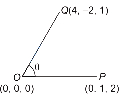
If $P=(0,1,2)$,$Q=(4,-2,1)$,and $O=(0,0,0)$,then $\angle POQ$ is equal to
A
$\frac{\pi}{2}$
B
$\frac{\pi}{4}$
C
$\frac{\pi}{6}$
D
$\frac{\pi}{3}$
Solution
(A) The direction ratios of the line segment $OQ$ are $(4-0, -2-0, 1-0)$,which are $(4, -2, 1)$.
The direction ratios of the line segment $OP$ are $(0-0, 1-0, 2-0)$,which are $(0, 1, 2)$.
Let $\theta$ be the angle between $OP$ and $OQ$. The formula for the cosine of the angle between two vectors with direction ratios $(a_1, b_1, c_1)$ and $(a_2, b_2, c_2)$ is given by:
$\cos \theta = \frac{|a_1 a_2 + b_1 b_2 + c_1 c_2|}{\sqrt{a_1^2 + b_1^2 + c_1^2} \sqrt{a_2^2 + b_2^2 + c_2^2}}$
Substituting the values:
$\cos \theta = \frac{|(4)(0) + (-2)(1) + (1)(2)|}{\sqrt{4^2 + (-2)^2 + 1^2} \sqrt{0^2 + 1^2 + 2^2}}$
$\cos \theta = \frac{|0 - 2 + 2|}{\sqrt{16 + 4 + 1} \sqrt{0 + 1 + 4}}$
$\cos \theta = \frac{0}{\sqrt{21} \sqrt{5}} = 0$
Since $\cos \theta = 0$,we have $\theta = \frac{\pi}{2}$.
The direction ratios of the line segment $OP$ are $(0-0, 1-0, 2-0)$,which are $(0, 1, 2)$.
Let $\theta$ be the angle between $OP$ and $OQ$. The formula for the cosine of the angle between two vectors with direction ratios $(a_1, b_1, c_1)$ and $(a_2, b_2, c_2)$ is given by:
$\cos \theta = \frac{|a_1 a_2 + b_1 b_2 + c_1 c_2|}{\sqrt{a_1^2 + b_1^2 + c_1^2} \sqrt{a_2^2 + b_2^2 + c_2^2}}$
Substituting the values:
$\cos \theta = \frac{|(4)(0) + (-2)(1) + (1)(2)|}{\sqrt{4^2 + (-2)^2 + 1^2} \sqrt{0^2 + 1^2 + 2^2}}$
$\cos \theta = \frac{|0 - 2 + 2|}{\sqrt{16 + 4 + 1} \sqrt{0 + 1 + 4}}$
$\cos \theta = \frac{0}{\sqrt{21} \sqrt{5}} = 0$
Since $\cos \theta = 0$,we have $\theta = \frac{\pi}{2}$.
0 likesView Solution
136
ChemistryMediumMCQAP EAMCET · 2024
At $290 \ K$,a vessel $(I)$ contains equal moles of three liquids $(A, B, C)$. The boiling points of $A, B$ and $C$ are $350 \ K, 373 \ K$ and $308 \ K$ respectively. Vessel $(I)$ is heated to $300 \ K$ and vapours were collected into vessel $(II)$. Identify the correct statements. (Assume vessel $(I)$ contains liquids and vapours and vessel $(II)$ contains only vapours)
$I.$ Vessel $- I$ is rich in liquid $B$
$II.$ Vessel $- II$ is rich in vapour of $C$
$III.$ The vapour pressures of $A, B, C$ in Vessel $(I)$ at $290 \ K$ follows the order $C > A > B$.
$I.$ Vessel $- I$ is rich in liquid $B$
$II.$ Vessel $- II$ is rich in vapour of $C$
$III.$ The vapour pressures of $A, B, C$ in Vessel $(I)$ at $290 \ K$ follows the order $C > A > B$.
A
$I, II, III$
B
$I, II$ only
C
$I, III$ only
D
$II, III$ only
Solution
(A) The boiling point is inversely proportional to the vapour pressure at a given temperature.
Given boiling points: $C (308 \ K) < A (350 \ K) < B (373 \ K)$.
Therefore,the order of vapour pressure at any temperature is $C > A > B$.
$I.$ Since $B$ has the highest boiling point,it has the lowest vapour pressure,meaning it remains primarily in the liquid phase in vessel $(I)$. Thus,vessel $(I)$ is rich in liquid $B$. This statement is correct.
$II.$ Since $C$ has the lowest boiling point,it has the highest vapour pressure,meaning it vaporizes most easily. Thus,vessel $(II)$ will be rich in the vapour of $C$. This statement is correct.
$III.$ As established,the order of vapour pressure is $C > A > B$. This statement is correct.
All statements $I, II,$ and $III$ are correct.
Given boiling points: $C (308 \ K) < A (350 \ K) < B (373 \ K)$.
Therefore,the order of vapour pressure at any temperature is $C > A > B$.
$I.$ Since $B$ has the highest boiling point,it has the lowest vapour pressure,meaning it remains primarily in the liquid phase in vessel $(I)$. Thus,vessel $(I)$ is rich in liquid $B$. This statement is correct.
$II.$ Since $C$ has the lowest boiling point,it has the highest vapour pressure,meaning it vaporizes most easily. Thus,vessel $(II)$ will be rich in the vapour of $C$. This statement is correct.
$III.$ As established,the order of vapour pressure is $C > A > B$. This statement is correct.
All statements $I, II,$ and $III$ are correct.
0 likesView Solution
137
ChemistryMediumMCQAP EAMCET · 2024
$0.1 \text{ mole}$ of potassium permanganate was heated at $300^{\circ}C$. What is the weight (in $g$) of the residue? ($Mn = 55 \text{ u}$,$K = 39 \text{ u}$,$O = 16 \text{ u}$)
A
$14.2$
B
$1.6$
C
$15.8$
D
$7.1$
Solution
(A) The thermal decomposition of potassium permanganate is: $2KMnO_4 \xrightarrow{\Delta} K_2MnO_4 + MnO_2 + O_2 \uparrow$.
Molar mass of $KMnO_4 = 39 + 55 + (16 \times 4) = 158 \text{ g/mol}$.
Mass of $0.1 \text{ mole}$ of $KMnO_4 = 0.1 \times 158 = 15.8 \text{ g}$.
From the reaction stoichiometry,$2 \text{ moles}$ of $KMnO_4$ produce $1 \text{ mole}$ of $O_2$ gas.
So,$0.1 \text{ mole}$ of $KMnO_4$ produces $0.05 \text{ mole}$ of $O_2$.
Mass of $O_2$ gas $= 0.05 \times 32 = 1.6 \text{ g}$.
Weight of residue = Initial weight - Weight of $O_2$ gas $= 15.8 - 1.6 = 14.2 \text{ g}$.
Molar mass of $KMnO_4 = 39 + 55 + (16 \times 4) = 158 \text{ g/mol}$.
Mass of $0.1 \text{ mole}$ of $KMnO_4 = 0.1 \times 158 = 15.8 \text{ g}$.
From the reaction stoichiometry,$2 \text{ moles}$ of $KMnO_4$ produce $1 \text{ mole}$ of $O_2$ gas.
So,$0.1 \text{ mole}$ of $KMnO_4$ produces $0.05 \text{ mole}$ of $O_2$.
Mass of $O_2$ gas $= 0.05 \times 32 = 1.6 \text{ g}$.
Weight of residue = Initial weight - Weight of $O_2$ gas $= 15.8 - 1.6 = 14.2 \text{ g}$.
0 likesView Solution
138
ChemistryMediumMCQAP EAMCET · 2024
$A$ flask contains $98 \ mg$ of $H_2SO_4$. If $3.01 \times 10^{20}$ molecules of $H_2SO_4$ are removed from the flask,the number of moles of $H_2SO_4$ remaining in the flask is $\left(N_A = 6.02 \times 10^{23}\right)$
A
$1 \times 10^{-4}$
B
$5 \times 10^{-4}$
C
$1.66 \times 10^{-4}$
D
$9.95 \times 10^{-3}$
Solution
(B) Initial weight of $H_2SO_4$ $(W)$ = $98 \ mg = 98 \times 10^{-3} \ g$.
Initial number of moles $(n_1)$ = $\frac{98 \times 10^{-3} \ g}{98 \ g/mol} = 10^{-3} \ mol$.
Number of moles removed $(n_2)$ = $\frac{\text{Number of molecules}}{N_A} = \frac{3.01 \times 10^{20}}{6.02 \times 10^{23}} = 0.5 \times 10^{-3} \ mol$.
Remaining moles = $n_1 - n_2 = 10^{-3} - 0.5 \times 10^{-3} = 0.5 \times 10^{-3} \ mol = 5 \times 10^{-4} \ mol$.
Initial number of moles $(n_1)$ = $\frac{98 \times 10^{-3} \ g}{98 \ g/mol} = 10^{-3} \ mol$.
Number of moles removed $(n_2)$ = $\frac{\text{Number of molecules}}{N_A} = \frac{3.01 \times 10^{20}}{6.02 \times 10^{23}} = 0.5 \times 10^{-3} \ mol$.
Remaining moles = $n_1 - n_2 = 10^{-3} - 0.5 \times 10^{-3} = 0.5 \times 10^{-3} \ mol = 5 \times 10^{-4} \ mol$.
0 likesView Solution
139
ChemistryDifficultMCQAP EAMCET · 2024
$A$ hydrocarbon containing $C$ and $H$ has $92.3 \% C$. When $39 \ g$ of hydrocarbon was completely burnt in $O_2$,$x$ moles of water and $y$ moles of $CO_2$ were formed. $x$ moles of water is sufficient to liberate $0.75$ moles of $H_2$ with $Na$ metal. What is the weight (in $g$) of oxygen consumed? $(C=12 \ u; H=1 \ u)$
A
$120$
B
$240$
C
$360$
D
$480$
Solution
(A) $1$. Determine the empirical formula:
$C = 92.3 \%, H = 7.7 \%$.
Moles of $C = \frac{92.3}{12} = 7.69$,Moles of $H = \frac{7.7}{1} = 7.7$.
Ratio $C:H = 1:1$. Empirical formula is $CH$.
$2$. Calculate moles of hydrocarbon:
Given mass $= 39 \ g$. Molar mass of $CH = 13 \ g/mol$.
Moles of $CH = \frac{39}{13} = 3 \ mol$.
$3$. Determine moles of water $(x)$:
Reaction: $2H_2O + 2Na \rightarrow 2NaOH + H_2$.
$2 \ mol$ of $H_2O$ produces $1 \ mol$ of $H_2$.
To produce $0.75 \ mol$ of $H_2$,we need $x = 0.75 \times 2 = 1.5 \ mol$ of $H_2O$.
$4$. Combustion reaction:
For $CH$ (or $C_2H_2$ unit),the combustion is $C_2H_2 + 2.5 O_2 \rightarrow 2 CO_2 + H_2O$.
Since we have $3 \ mol$ of $CH$ (which is $1.5 \ mol$ of $C_2H_2$),the reaction is:
$1.5 C_2H_2 + 3.75 O_2 \rightarrow 3 CO_2 + 1.5 H_2O$.
$5$. Calculate mass of $O_2$:
Moles of $O_2 = 3.75 \ mol$.
Mass of $O_2 = 3.75 \times 32 = 120 \ g$.
$C = 92.3 \%, H = 7.7 \%$.
Moles of $C = \frac{92.3}{12} = 7.69$,Moles of $H = \frac{7.7}{1} = 7.7$.
Ratio $C:H = 1:1$. Empirical formula is $CH$.
$2$. Calculate moles of hydrocarbon:
Given mass $= 39 \ g$. Molar mass of $CH = 13 \ g/mol$.
Moles of $CH = \frac{39}{13} = 3 \ mol$.
$3$. Determine moles of water $(x)$:
Reaction: $2H_2O + 2Na \rightarrow 2NaOH + H_2$.
$2 \ mol$ of $H_2O$ produces $1 \ mol$ of $H_2$.
To produce $0.75 \ mol$ of $H_2$,we need $x = 0.75 \times 2 = 1.5 \ mol$ of $H_2O$.
$4$. Combustion reaction:
For $CH$ (or $C_2H_2$ unit),the combustion is $C_2H_2 + 2.5 O_2 \rightarrow 2 CO_2 + H_2O$.
Since we have $3 \ mol$ of $CH$ (which is $1.5 \ mol$ of $C_2H_2$),the reaction is:
$1.5 C_2H_2 + 3.75 O_2 \rightarrow 3 CO_2 + 1.5 H_2O$.
$5$. Calculate mass of $O_2$:
Moles of $O_2 = 3.75 \ mol$.
Mass of $O_2 = 3.75 \times 32 = 120 \ g$.
0 likesView Solution
140
ChemistryMediumMCQAP EAMCET · 2024
At $STP$,'$x$' $g$ of a metal hydrogen carbonate $(MHCO_3)$ (molar mass $84 \ g \ mol^{-1}$) on heating gives $CO_2$,which can completely react with $0.2 \ mol$ of $MOH$ (molar mass $40 \ g \ mol^{-1}$) to give $MHCO_3$. The value of '$x$' is
A
$67.2$
B
$33.6$
C
$11.2$
D
$22.4$
Solution
(B) The reaction between $CO_2$ and $MOH$ is: $CO_2 + MOH \rightarrow MHCO_3$.
Since $0.2 \ mol$ of $MOH$ reacts completely,$0.2 \ mol$ of $CO_2$ is produced.
The thermal decomposition of metal hydrogen carbonate is: $2MHCO_3 \xrightarrow{\Delta} M_2CO_3 + CO_2 + H_2O$.
From the stoichiometry,$1 \ mol$ of $CO_2$ is produced from $2 \ mol$ of $MHCO_3$.
Therefore,$0.2 \ mol$ of $CO_2$ is produced from $2 \times 0.2 = 0.4 \ mol$ of $MHCO_3$.
The mass '$x$' is calculated as: $x = \text{moles} \times \text{molar mass} = 0.4 \ mol \times 84 \ g \ mol^{-1} = 33.6 \ g$.
Since $0.2 \ mol$ of $MOH$ reacts completely,$0.2 \ mol$ of $CO_2$ is produced.
The thermal decomposition of metal hydrogen carbonate is: $2MHCO_3 \xrightarrow{\Delta} M_2CO_3 + CO_2 + H_2O$.
From the stoichiometry,$1 \ mol$ of $CO_2$ is produced from $2 \ mol$ of $MHCO_3$.
Therefore,$0.2 \ mol$ of $CO_2$ is produced from $2 \times 0.2 = 0.4 \ mol$ of $MHCO_3$.
The mass '$x$' is calculated as: $x = \text{moles} \times \text{molar mass} = 0.4 \ mol \times 84 \ g \ mol^{-1} = 33.6 \ g$.
0 likesView Solution
141
ChemistryDifficultMCQAP EAMCET · 2024
$10 \text{ g}$ of a metal $(M)$ reacts with oxygen to form $11.6 \text{ g}$ of oxide. What is the equivalent weight of $M$?
A
$50 \text{ g}$
B
$0.02$
C
$0.02 \text{ g}$
D
$50$
Solution
(D) Mass of metal $= 10 \text{ g}$.
Mass of oxide $= 11.6 \text{ g}$.
Mass of oxygen $= 11.6 \text{ g} - 10 \text{ g} = 1.6 \text{ g}$.
Equivalent weight of metal $= \frac{\text{Mass of metal}}{\text{Mass of oxygen}} \times 8$.
Equivalent weight of metal $= \frac{10}{1.6} \times 8 = 50$.
Mass of oxide $= 11.6 \text{ g}$.
Mass of oxygen $= 11.6 \text{ g} - 10 \text{ g} = 1.6 \text{ g}$.
Equivalent weight of metal $= \frac{\text{Mass of metal}}{\text{Mass of oxygen}} \times 8$.
Equivalent weight of metal $= \frac{10}{1.6} \times 8 = 50$.
0 likesView Solution
142
ChemistryMediumMCQAP EAMCET · 2024
At $T \ (K)$ for one mole of an ideal gas,the graph of $P$ (on $y$-axis) and $V^{-1}$ (on $x$-axis) gave a straight line with a slope of $32.8 \ L \ atm \ mol^{-1}$. What is the temperature (in $K$)? $\left(R=0.082 \ L \ atm \ K^{-1} \ mol^{-1}\right)$
A
$600$
B
$200$
C
$800$
D
$400$
Solution
(D) The ideal gas equation is $PV = nRT$.
For $n = 1 \ mol$,the equation becomes $P = (RT) \times (V^{-1})$.
Comparing this with the equation of a straight line $y = mx + c$,where $y = P$ and $x = V^{-1}$,we get the slope $m = RT$.
Given that the slope $m = 32.8 \ L \ atm \ mol^{-1}$ and $R = 0.082 \ L \ atm \ K^{-1} \ mol^{-1}$.
Therefore,$RT = 32.8 \ L \ atm \ mol^{-1}$.
$T = \frac{32.8 \ L \ atm \ mol^{-1}}{0.082 \ L \ atm \ K^{-1} \ mol^{-1}} = 400 \ K$.
For $n = 1 \ mol$,the equation becomes $P = (RT) \times (V^{-1})$.
Comparing this with the equation of a straight line $y = mx + c$,where $y = P$ and $x = V^{-1}$,we get the slope $m = RT$.
Given that the slope $m = 32.8 \ L \ atm \ mol^{-1}$ and $R = 0.082 \ L \ atm \ K^{-1} \ mol^{-1}$.
Therefore,$RT = 32.8 \ L \ atm \ mol^{-1}$.
$T = \frac{32.8 \ L \ atm \ mol^{-1}}{0.082 \ L \ atm \ K^{-1} \ mol^{-1}} = 400 \ K$.
0 likesView Solution
143
ChemistryEasyMCQAP EAMCET · 2024
At $STP$,a closed vessel contains $1 \ mole$ each of $He$ and $CH_4$. Through a small hole,$2 \ L$ of $He$ and $1 \ L$ of $CH_4$ escaped from the vessel in '$t$' minutes. What are the mole fractions of $He$ and $CH_4$ respectively remaining in the vessel? (Assume $He$ and $CH_4$ as ideal gases. At $STP$,one mole of an ideal gas occupies $22.4 \ L$ of volume.)
A
$0.512, 0.488$
B
$0.5, 0.5$
C
$0.329, 0.671$
D
$0.488, 0.512$
Solution
(D) Initial moles of $He \ (n_1) = 1 \ mol$.
Initial moles of $CH_4 \ (n_2) = 1 \ mol$.
Moles of $He$ escaped $(n_1') = \frac{2 \ L}{22.4 \ L/mol} \approx 0.089 \ mol$.
Moles of $CH_4$ escaped $(n_2') = \frac{1 \ L}{22.4 \ L/mol} \approx 0.044 \ mol$.
Remaining moles of $He \ (n_1'') = 1 - 0.089 = 0.911 \ mol$.
Remaining moles of $CH_4 \ (n_2'') = 1 - 0.044 = 0.956 \ mol$.
Total remaining moles $= 0.911 + 0.956 = 1.867 \ mol$.
Mole fraction of $He \ (\chi_{He}) = \frac{0.911}{1.867} \approx 0.488$.
Mole fraction of $CH_4 \ (\chi_{CH_4}) = \frac{0.956}{1.867} \approx 0.512$.
Initial moles of $CH_4 \ (n_2) = 1 \ mol$.
Moles of $He$ escaped $(n_1') = \frac{2 \ L}{22.4 \ L/mol} \approx 0.089 \ mol$.
Moles of $CH_4$ escaped $(n_2') = \frac{1 \ L}{22.4 \ L/mol} \approx 0.044 \ mol$.
Remaining moles of $He \ (n_1'') = 1 - 0.089 = 0.911 \ mol$.
Remaining moles of $CH_4 \ (n_2'') = 1 - 0.044 = 0.956 \ mol$.
Total remaining moles $= 0.911 + 0.956 = 1.867 \ mol$.
Mole fraction of $He \ (\chi_{He}) = \frac{0.911}{1.867} \approx 0.488$.
Mole fraction of $CH_4 \ (\chi_{CH_4}) = \frac{0.956}{1.867} \approx 0.512$.
0 likesView Solution
144
ChemistryMediumMCQAP EAMCET · 2024
$60 \ cm^3$ of $SO_2$ gas diffused through a porous membrane in '$x$' min. Under similar conditions $360 \ cm^3$ of another gas (molar mass $4 \ g \ mol^{-1}$) diffused in '$y$' min. The ratio of $x$ and $y$ is
A
$3: 2$
B
$2: 3$
C
$1: 3$
D
$3: 1$
Solution
(B) According to Graham's Law of diffusion,the rate of diffusion $r$ is given by $r = \frac{V}{t} \propto \frac{1}{\sqrt{M}}$.
Therefore,$\frac{r_1}{r_2} = \frac{V_1/t_1}{V_2/t_2} = \sqrt{\frac{M_2}{M_1}}$.
Given: $V_1 = 60 \ cm^3, M_1 = 64 \ g \ mol^{-1}, t_1 = x$.
$V_2 = 360 \ cm^3, M_2 = 4 \ g \ mol^{-1}, t_2 = y$.
Substituting the values: $\frac{60/x}{360/y} = \sqrt{\frac{4}{64}}$.
$\frac{60}{x} \times \frac{y}{360} = \frac{2}{8} = \frac{1}{4}$.
$\frac{y}{6x} = \frac{1}{4}$.
$\frac{y}{x} = \frac{6}{4} = \frac{3}{2}$.
Therefore,the ratio $\frac{x}{y} = \frac{2}{3}$.
Therefore,$\frac{r_1}{r_2} = \frac{V_1/t_1}{V_2/t_2} = \sqrt{\frac{M_2}{M_1}}$.
Given: $V_1 = 60 \ cm^3, M_1 = 64 \ g \ mol^{-1}, t_1 = x$.
$V_2 = 360 \ cm^3, M_2 = 4 \ g \ mol^{-1}, t_2 = y$.
Substituting the values: $\frac{60/x}{360/y} = \sqrt{\frac{4}{64}}$.
$\frac{60}{x} \times \frac{y}{360} = \frac{2}{8} = \frac{1}{4}$.
$\frac{y}{6x} = \frac{1}{4}$.
$\frac{y}{x} = \frac{6}{4} = \frac{3}{2}$.
Therefore,the ratio $\frac{x}{y} = \frac{2}{3}$.
0 likesView Solution
145
ChemistryDifficultMCQAP EAMCET · 2024
$RMS$ velocity of one mole of an ideal gas was measured at different temperatures. $A$ graph of $(u_{rms})^2$ (on y-axis) and $T(K)$ (on x-axis) gave a straight line passing through the origin and its slope is $249 \ m^2 \ s^{-2} \ K^{-1}$. What is the molar mass (in $kg \ mol^{-1}$) of the ideal gas? $(R=8.3 \ J \ mol^{-1} \ K^{-1})$
A
$10$
B
$1.0$
C
$24.9$
D
$1 \times 10^{-1}$
Solution
(D) The formula for $RMS$ velocity is $v_{rms} = \sqrt{\frac{3RT}{M}}$.
Squaring both sides,we get $v_{rms}^2 = \frac{3RT}{M}$.
Comparing this with the equation of a straight line $y = mx + C$,where $y = v_{rms}^2$ and $x = T$:
The slope $m = \frac{3R}{M}$.
Given slope $m = 249 \ m^2 \ s^{-2} \ K^{-1}$ and $R = 8.3 \ J \ mol^{-1} \ K^{-1}$.
Substituting the values: $249 = \frac{3 \times 8.3}{M}$.
$M = \frac{3 \times 8.3}{249} = \frac{24.9}{249} = 0.1 \ kg \ mol^{-1}$.
Thus,$M = 1 \times 10^{-1} \ kg \ mol^{-1}$.
Squaring both sides,we get $v_{rms}^2 = \frac{3RT}{M}$.
Comparing this with the equation of a straight line $y = mx + C$,where $y = v_{rms}^2$ and $x = T$:
The slope $m = \frac{3R}{M}$.
Given slope $m = 249 \ m^2 \ s^{-2} \ K^{-1}$ and $R = 8.3 \ J \ mol^{-1} \ K^{-1}$.
Substituting the values: $249 = \frac{3 \times 8.3}{M}$.
$M = \frac{3 \times 8.3}{249} = \frac{24.9}{249} = 0.1 \ kg \ mol^{-1}$.
Thus,$M = 1 \times 10^{-1} \ kg \ mol^{-1}$.
0 likesView Solution
146
ChemistryMediumMCQAP EAMCET · 2024
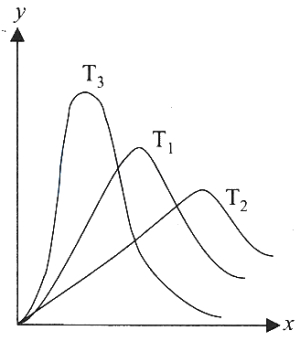
The following graph is obtained for a gas at different temperatures $T_1$,$T_2$,$T_3$. What is the correct order of temperature? ($x$-axis $=$ velocity; $y$-axis $=$ number of molecules)
A
$T_2 > T_1 > T_3$
B
$T_2 > T_3 > T_1$
C
$T_3 > T_1 > T_2$
D
$T_3 > T_2 > T_1$
Solution
(A) According to the Maxwell-Boltzmann distribution of molecular speeds,as the temperature increases,the peak of the curve shifts towards higher velocities and the curve becomes broader and flatter.
In the given graph,the peak for $T_2$ is at the highest velocity,followed by $T_1$,and then $T_3$.
Therefore,the correct order of temperature is $T_2 > T_1 > T_3$.
In the given graph,the peak for $T_2$ is at the highest velocity,followed by $T_1$,and then $T_3$.
Therefore,the correct order of temperature is $T_2 > T_1 > T_3$.
0 likesView Solution
147
ChemistryEasyMCQAP EAMCET · 2024
At $133.33 \ K$,the $RMS$ velocity of an ideal gas is $(M = 0.083 \ kg \ mol^{-1}; R = 8.3 \ J \ mol^{-1} \ K^{-1})$ (in $m \ s^{-1}$)
A
$200$
B
$150$
C
$2000$
D
$400$
Solution
(A) Given: $T = 133.33 \ K$,$M = 0.083 \ kg \ mol^{-1}$,$R = 8.3 \ J \ mol^{-1} \ K^{-1}$.
The formula for the root mean square $(RMS)$ velocity of an ideal gas is $v_{rms} = \sqrt{\frac{3RT}{M}}$.
Substituting the given values into the formula:
$v_{rms} = \sqrt{\frac{3 \times 8.3 \times 133.33}{0.083}}$
$v_{rms} = \sqrt{\frac{3323.917}{0.083}}$
$v_{rms} = \sqrt{40047.19} \approx 200.12 \ m \ s^{-1}$.
Thus,the $RMS$ velocity is approximately $200 \ m \ s^{-1}$.
The formula for the root mean square $(RMS)$ velocity of an ideal gas is $v_{rms} = \sqrt{\frac{3RT}{M}}$.
Substituting the given values into the formula:
$v_{rms} = \sqrt{\frac{3 \times 8.3 \times 133.33}{0.083}}$
$v_{rms} = \sqrt{\frac{3323.917}{0.083}}$
$v_{rms} = \sqrt{40047.19} \approx 200.12 \ m \ s^{-1}$.
Thus,the $RMS$ velocity is approximately $200 \ m \ s^{-1}$.
0 likesView Solution
148
ChemistryEasyMCQAP EAMCET · 2024
What is the kinetic energy (in $J \ mol^{-1}$) of one mole of an ideal gas (molar mass $= 0.1 \ kg \ mol^{-1}$) if its rms velocity is $4 \times 10^2 \ ms^{-1}$ at $T(K)$?
A
$2 \times 10^5$
B
$8 \times 10^4$
C
$8 \times 10^2$
D
$8 \times 10^3$
Solution
(D) The kinetic energy $(K.E.)$ for one mole of an ideal gas is given by the formula: $K.E. = \frac{1}{2} M v_{rms}^2$
Given:
Molar mass $(M)$ $= 0.1 \ kg \ mol^{-1}$
$v_{rms} = 4 \times 10^2 \ ms^{-1}$
Substituting the values:
$K.E. = \frac{1}{2} \times (0.1 \ kg \ mol^{-1}) \times (4 \times 10^2 \ ms^{-1})^2$
$K.E. = 0.05 \times (16 \times 10^4)$
$K.E. = 0.8 \times 10^4 = 8 \times 10^3 \ J \ mol^{-1}$
Given:
Molar mass $(M)$ $= 0.1 \ kg \ mol^{-1}$
$v_{rms} = 4 \times 10^2 \ ms^{-1}$
Substituting the values:
$K.E. = \frac{1}{2} \times (0.1 \ kg \ mol^{-1}) \times (4 \times 10^2 \ ms^{-1})^2$
$K.E. = 0.05 \times (16 \times 10^4)$
$K.E. = 0.8 \times 10^4 = 8 \times 10^3 \ J \ mol^{-1}$
0 likesView Solution
149
ChemistryEasyMCQAP EAMCET · 2024
What is the ratio of kinetic energies of $3 \ g$ of hydrogen and $4 \ g$ of oxygen at a certain temperature?
A
$3: 4$
B
$6: 1$
C
$12: 1$
D
$1: 12$
Solution
(C) The kinetic energy $(KE)$ of an ideal gas is given by the formula: $KE = \frac{3}{2} nRT$.
Since the temperature $(T)$ is constant,the kinetic energy is directly proportional to the number of moles $(n)$,i.e.,$KE \propto n$.
Therefore,the ratio of kinetic energies is: $\frac{KE_{H_2}}{KE_{O_2}} = \frac{n_{H_2}}{n_{O_2}}$.
Calculate the number of moles for each gas:
$n_{H_2} = \frac{\text{mass}}{\text{molar mass}} = \frac{3 \ g}{2 \ g/mol} = 1.5 \ mol$.
$n_{O_2} = \frac{\text{mass}}{\text{molar mass}} = \frac{4 \ g}{32 \ g/mol} = 0.125 \ mol$.
Now,find the ratio: $\frac{KE_{H_2}}{KE_{O_2}} = \frac{1.5}{0.125} = \frac{12}{1}$.
Thus,the ratio is $12: 1$.
Since the temperature $(T)$ is constant,the kinetic energy is directly proportional to the number of moles $(n)$,i.e.,$KE \propto n$.
Therefore,the ratio of kinetic energies is: $\frac{KE_{H_2}}{KE_{O_2}} = \frac{n_{H_2}}{n_{O_2}}$.
Calculate the number of moles for each gas:
$n_{H_2} = \frac{\text{mass}}{\text{molar mass}} = \frac{3 \ g}{2 \ g/mol} = 1.5 \ mol$.
$n_{O_2} = \frac{\text{mass}}{\text{molar mass}} = \frac{4 \ g}{32 \ g/mol} = 0.125 \ mol$.
Now,find the ratio: $\frac{KE_{H_2}}{KE_{O_2}} = \frac{1.5}{0.125} = \frac{12}{1}$.
Thus,the ratio is $12: 1$.
0 likesView Solution
150
ChemistryEasyMCQAP EAMCET · 2024
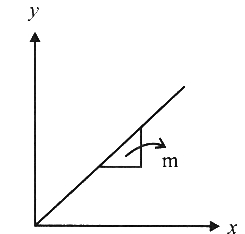
The $RMS$ velocity $(u_{rms})$ of one mole of an ideal gas was measured at different temperatures and the following graph is obtained. What is the slope $(m)$ of the straight line?
($x$-axis $= T$ $(K)$; $y$-axis $= (u_{rms})^2$; $M =$ molar mass; $R =$ gas constant)
($x$-axis $= T$ $(K)$; $y$-axis $= (u_{rms})^2$; $M =$ molar mass; $R =$ gas constant)
A
$(\frac{3 R}{M})^{1 / 2}$
B
$(\frac{M}{3 R})^{1 / 2}$
C
$\frac{M}{3 R}$
D
$\frac{3 R}{M}$
Solution
(D) $RMS$ velocity $(u_{rms})$ is given by the formula: $u_{rms} = \sqrt{\frac{3 RT}{M}}$
Squaring both sides,we get: $(u_{rms})^2 = \frac{3 RT}{M}$
Comparing this with the equation of a straight line passing through the origin,$y = mx + C$,where $y = (u_{rms})^2$ and $x = T$:
$(u_{rms})^2 = (\frac{3 R}{M}) \cdot T + 0$
Here,the slope $(m)$ is equal to $\frac{3 R}{M}$.
Squaring both sides,we get: $(u_{rms})^2 = \frac{3 RT}{M}$
Comparing this with the equation of a straight line passing through the origin,$y = mx + C$,where $y = (u_{rms})^2$ and $x = T$:
$(u_{rms})^2 = (\frac{3 R}{M}) \cdot T + 0$
Here,the slope $(m)$ is equal to $\frac{3 R}{M}$.
0 likesView Solution
151
ChemistryMediumMCQAP EAMCET · 2024
Which of the following is not an example of an allylic halide?
A
$4-$chlorobut$-1-$ene
B
$1-$chlorobut$-2-$ene
C
$3-$chloro$-2-$methylbut$-1-$ene
D
$4-$chloropent$-2-$ene
Solution
(A) An allylic halide is a compound in which the halogen atom is bonded to an $sp^3$ hybridized carbon atom that is adjacent to a carbon-carbon double bond $(C=C)$.
Let us analyze the structures:
$A$. $4-$chlorobut$-1-$ene $(CH_2=CH-CH_2-CH_2-Cl)$: The $Cl$ atom is attached to a carbon atom that is not adjacent to the double bond. This is a primary alkyl halide,not an allylic halide.
$B$. $1-$chlorobut$-2-$ene $(CH_3-CH=CH-CH_2-Cl)$: The $Cl$ atom is attached to a carbon atom adjacent to the double bond. This is an allylic halide.
$C$. $3-$chloro$-2-$methylbut$-1-$ene $(CH_2=C(CH_3)-CHCl-CH_3)$: The $Cl$ atom is attached to a carbon atom adjacent to the double bond. This is an allylic halide.
$D$. $4-$chloropent$-2-$ene $(CH_3-CH=CH-CH_2-CH_2-Cl)$: The $Cl$ atom is attached to a carbon atom that is not adjacent to the double bond. This is not an allylic halide.
Note: Both $A$ and $D$ are not allylic halides. However,$4-$chlorobut$-1-$ene is the most common example provided in textbooks to illustrate a non-allylic halide.
Let us analyze the structures:
$A$. $4-$chlorobut$-1-$ene $(CH_2=CH-CH_2-CH_2-Cl)$: The $Cl$ atom is attached to a carbon atom that is not adjacent to the double bond. This is a primary alkyl halide,not an allylic halide.
$B$. $1-$chlorobut$-2-$ene $(CH_3-CH=CH-CH_2-Cl)$: The $Cl$ atom is attached to a carbon atom adjacent to the double bond. This is an allylic halide.
$C$. $3-$chloro$-2-$methylbut$-1-$ene $(CH_2=C(CH_3)-CHCl-CH_3)$: The $Cl$ atom is attached to a carbon atom adjacent to the double bond. This is an allylic halide.
$D$. $4-$chloropent$-2-$ene $(CH_3-CH=CH-CH_2-CH_2-Cl)$: The $Cl$ atom is attached to a carbon atom that is not adjacent to the double bond. This is not an allylic halide.
Note: Both $A$ and $D$ are not allylic halides. However,$4-$chlorobut$-1-$ene is the most common example provided in textbooks to illustrate a non-allylic halide.
0 likesView Solution
152
ChemistryDifficultMCQAP EAMCET · 2024
Assertion $(A)$: Carboxylic acids are more acidic than Phenols.
Reason $(R)$: Resonance structures of carboxylate ion are equivalent,while resonance structures of phenoxide ion are not equivalent.
Reason $(R)$: Resonance structures of carboxylate ion are equivalent,while resonance structures of phenoxide ion are not equivalent.
A
Both $(A)$ and $(R)$ are correct and $(R)$ is the correct explanation of $(A)$
B
Both $(A)$ and $(R)$ are correct but $(R)$ is not the correct explanation of $(A)$
C
$(A)$ is correct but $(R)$ is incorrect
D
$(A)$ is incorrect but $(R)$ is correct
Solution
(A) Carboxylic acids are stronger acids than phenols because the carboxylate ion formed after the loss of a proton is more stable than the phenoxide ion.
In the carboxylate ion $(RCOO^-)$,the negative charge is delocalized over two highly electronegative oxygen atoms,resulting in two equivalent resonance structures.
In the phenoxide ion $(C_6H_5O^-)$,the negative charge is delocalized over the aromatic ring,placing the negative charge on the less electronegative carbon atoms in some resonance structures.
Since equivalent resonance structures provide greater stability,the carboxylate ion is more stable,making carboxylic acids more acidic.
In the carboxylate ion $(RCOO^-)$,the negative charge is delocalized over two highly electronegative oxygen atoms,resulting in two equivalent resonance structures.
In the phenoxide ion $(C_6H_5O^-)$,the negative charge is delocalized over the aromatic ring,placing the negative charge on the less electronegative carbon atoms in some resonance structures.
Since equivalent resonance structures provide greater stability,the carboxylate ion is more stable,making carboxylic acids more acidic.
0 likesView Solution
153
ChemistryMediumMCQAP EAMCET · 2024
Number of deactivating groups in the following is $-Cl, -SO_3H, -OH, -NHC_2H_5, -COOCH_3, -CH_3$.
A
$4$
B
$3$
C
$2$
D
$1$
Solution
(B) Deactivating groups are those that withdraw electron density from the benzene ring through inductive or resonance effects, making the ring less reactive towards electrophilic substitution reactions.
Among the given groups:
$1$. $-Cl$: Deactivating (due to strong $-I$ effect).
$2$. $-SO_3H$: Deactivating (due to strong $-I$ and $-M$ effects).
$3$. $-OH$: Activating (due to $+M$ effect).
$4$. $-NHC_2H_5$: Activating (due to $+M$ effect).
$5$. $-COOCH_3$: Deactivating (due to $-I$ and $-M$ effects).
$6$. $-CH_3$: Activating (due to $+I$ and hyperconjugation).
Therefore, the deactivating groups are $-Cl, -SO_3H, \text{ and } -COOCH_3$.
The total number of deactivating groups is $3$.
Among the given groups:
$1$. $-Cl$: Deactivating (due to strong $-I$ effect).
$2$. $-SO_3H$: Deactivating (due to strong $-I$ and $-M$ effects).
$3$. $-OH$: Activating (due to $+M$ effect).
$4$. $-NHC_2H_5$: Activating (due to $+M$ effect).
$5$. $-COOCH_3$: Deactivating (due to $-I$ and $-M$ effects).
$6$. $-CH_3$: Activating (due to $+I$ and hyperconjugation).
Therefore, the deactivating groups are $-Cl, -SO_3H, \text{ and } -COOCH_3$.
The total number of deactivating groups is $3$.
0 likesView Solution
154
ChemistryMediumMCQAP EAMCET · 2024
$A$ mixture of substances $A, B, C, D$ is subjected to column chromatography. The degree of adsorption is in the order of $D > B > C > A$. The column is eluted with a suitable solvent. Identify the correct statement with respect to the separation of the mixture.
A
$D$ comes out first from the column
B
$A$ comes out first from the column
C
$C$ comes out after $B$ from the column
D
$B$ comes out after $D$ from the column
Solution
(B) In column chromatography,the substance with the least degree of adsorption is eluted first because it has the weakest interaction with the stationary phase.
Given the order of adsorption: $D > B > C > A$.
Since $A$ has the lowest degree of adsorption,it will be eluted first.
Conversely,$D$ has the highest degree of adsorption,so it will be eluted last.
The elution order is $A, C, B, D$.
Given the order of adsorption: $D > B > C > A$.
Since $A$ has the lowest degree of adsorption,it will be eluted first.
Conversely,$D$ has the highest degree of adsorption,so it will be eluted last.
The elution order is $A, C, B, D$.
0 likesView Solution
155
ChemistryEasyMCQAP EAMCET · 2024
Which one of the following sets is not correctly matched?
A
Cuprite,haematite - oxide ores
B
Calamine,siderite - carbonate ores
C
Magnetite,malachite - silicate ores
D
Sphalerite,fool's gold - sulphide ores
Solution
(C) Let us analyze the given options based on the chemical composition of the ores:
$A$. Cuprite $(Cu_2O)$ and haematite $(Fe_2O_3)$ are both oxide ores. This is correctly matched.
$B$. Calamine $(ZnCO_3)$ and siderite $(FeCO_3)$ are both carbonate ores. This is correctly matched.
$C$. Magnetite $(Fe_3O_4)$ is an oxide ore,and malachite $(CuCO_3 \cdot Cu(OH)_2)$ is a carbonate ore. Neither is a silicate ore. This is not correctly matched.
$D$. Sphalerite $(ZnS)$ and fool's gold (pyrite,$FeS_2$) are both sulphide ores. This is correctly matched.
Therefore,the set that is not correctly matched is $C$.
$A$. Cuprite $(Cu_2O)$ and haematite $(Fe_2O_3)$ are both oxide ores. This is correctly matched.
$B$. Calamine $(ZnCO_3)$ and siderite $(FeCO_3)$ are both carbonate ores. This is correctly matched.
$C$. Magnetite $(Fe_3O_4)$ is an oxide ore,and malachite $(CuCO_3 \cdot Cu(OH)_2)$ is a carbonate ore. Neither is a silicate ore. This is not correctly matched.
$D$. Sphalerite $(ZnS)$ and fool's gold (pyrite,$FeS_2$) are both sulphide ores. This is correctly matched.
Therefore,the set that is not correctly matched is $C$.
0 likesView Solution
156
ChemistryEasyMCQAP EAMCET · 2024
In which of the following metals extraction,impurities are removed as slag?
$i.$ $Al$ $\quad$ $ii.$ $Fe$
$iii.$ $Cu$ $\quad$ $iv.$ $Zn$
The correct option is
$i.$ $Al$ $\quad$ $ii.$ $Fe$
$iii.$ $Cu$ $\quad$ $iv.$ $Zn$
The correct option is
A
$i, ii, iv$ only
B
$i, ii$ only
C
$ii, iii$ only
D
$ii, iii, iv$ only
Solution
(D) In the extraction of $Fe$ (iron),silica $(SiO_2)$ is added as a flux to remove $FeO$ impurity as iron silicate slag $(FeSiO_3)$.
In the extraction of $Cu$ (copper),$FeS$ present as an impurity is removed as iron silicate slag $(FeSiO_3)$ by adding $SiO_2$ flux.
In the extraction of $Zn$ (zinc),$FeO$ impurity is removed as iron silicate slag $(FeSiO_3)$ by adding $SiO_2$ flux.
Therefore,$Fe$,$Cu$,and $Zn$ involve the removal of impurities as slag.
In the extraction of $Cu$ (copper),$FeS$ present as an impurity is removed as iron silicate slag $(FeSiO_3)$ by adding $SiO_2$ flux.
In the extraction of $Zn$ (zinc),$FeO$ impurity is removed as iron silicate slag $(FeSiO_3)$ by adding $SiO_2$ flux.
Therefore,$Fe$,$Cu$,and $Zn$ involve the removal of impurities as slag.
0 likesView Solution
157
ChemistryEasyMCQAP EAMCET · 2024
The anode and cathode used in electrolytic refining of copper respectively are
A
Pure copper,impure copper
B
Impure copper,pure copper
C
Pure copper,pure zinc
D
Impure copper,pure zinc
Solution
(B) During the electrolytic refining of copper,a block of impure copper is used as the anode,and a thin strip of pure copper is used as the cathode.
0 likesView Solution
158
ChemistryEasyMCQAP EAMCET · 2024
The flux used in the preparation of wrought iron from cast iron in a reverberatory furnace is
A
$SiO_2$
B
$CaCO_3$
C
$C$
D
$NaCN$
Solution
(B) In the process of manufacturing wrought iron from cast iron,a reverberatory furnace is lined with limestone $(CaCO_3)$.
$CaCO_3$ acts as a flux to remove impurities like silicon,which is oxidized to $SiO_2$.
$CaO + SiO_2 \longrightarrow CaSiO_3$ (slag).
Thus,$CaCO_3$ is the flux used.
$CaCO_3$ acts as a flux to remove impurities like silicon,which is oxidized to $SiO_2$.
$CaO + SiO_2 \longrightarrow CaSiO_3$ (slag).
Thus,$CaCO_3$ is the flux used.
0 likesView Solution
159
ChemistryMediumMCQAP EAMCET · 2024
The reactions which occur in a blast furnace at $500-800 \ K$ during the extraction of iron from haematite are:
$(i)$ $3 Fe_2O_3 + CO \rightarrow 2 Fe_3O_4 + CO_2$
$(ii)$ $Fe_2O_3 + 3 C \rightarrow 2 Fe + 3 CO$
$(iii)$ $Fe_3O_4 + 4 CO \rightarrow 3 Fe + 4 CO_2$
$(iv)$ $Fe_2O_3 + CO \rightarrow 2 FeO + CO_2$
$(i)$ $3 Fe_2O_3 + CO \rightarrow 2 Fe_3O_4 + CO_2$
$(ii)$ $Fe_2O_3 + 3 C \rightarrow 2 Fe + 3 CO$
$(iii)$ $Fe_3O_4 + 4 CO \rightarrow 3 Fe + 4 CO_2$
$(iv)$ $Fe_2O_3 + CO \rightarrow 2 FeO + CO_2$
A
$(i)$,$(ii)$,$(iii)$,$(iv)$
B
$(i)$,$(ii)$,$(iii)$ only
C
$(i)$,$(iv)$ only
D
$(i)$,$(iii)$,$(iv)$ only
Solution
(D) In the blast furnace,the temperature range of $500-800 \ K$ is the lower temperature zone.
In this zone,the following reduction reactions occur:
$(i)$ $3 Fe_2O_3 + CO \rightarrow 2 Fe_3O_4 + CO_2$
$(iii)$ $Fe_3O_4 + 4 CO \rightarrow 3 Fe + 4 CO_2$
$(iv)$ $Fe_2O_3 + CO \rightarrow 2 FeO + CO_2$
Reaction $(ii)$ is not a primary reduction step in this specific temperature range.
Therefore,the correct reactions are $(i)$,$(iii)$,and $(iv)$.
In this zone,the following reduction reactions occur:
$(i)$ $3 Fe_2O_3 + CO \rightarrow 2 Fe_3O_4 + CO_2$
$(iii)$ $Fe_3O_4 + 4 CO \rightarrow 3 Fe + 4 CO_2$
$(iv)$ $Fe_2O_3 + CO \rightarrow 2 FeO + CO_2$
Reaction $(ii)$ is not a primary reduction step in this specific temperature range.
Therefore,the correct reactions are $(i)$,$(iii)$,and $(iv)$.
0 likesView Solution
160
ChemistryEasyMCQAP EAMCET · 2024
The type of iron obtained from a blast furnace in the extraction of iron is:
A
Wrought iron
B
Pig iron
C
Cast iron
D
Steel
Solution
(B) The iron obtained from a blast furnace contains about $4 \%$ carbon and many impurities in smaller amounts (e.g.,$S, P, Si, Mn$).
This form of iron is known as pig iron.
This form of iron is known as pig iron.
0 likesView Solution
161
ChemistryMediumMCQAP EAMCET · 2024
In the extraction of iron,the reaction which occurs at $900-1500 \ K$ in the blast furnace is:
A
$Fe_2O_3 + 3C \rightarrow 2Fe + 3CO$
B
$FeO + CO \rightarrow Fe + CO_2$
C
$3Fe_2O_3 + CO \rightarrow 2Fe_3O_4 + CO_2$
D
$Fe_3O_4 + 4CO \rightarrow 3Fe + 4CO_2$
Solution
(B) In the blast furnace,the reduction of iron oxides occurs at different temperature ranges.
At the temperature range of $900-1500 \ K$ (lower part of the furnace),the following reactions take place:
$FeO + CO \rightarrow Fe + CO_2$
$C + CO_2 \rightarrow 2CO$
$CaO + SiO_2 \rightarrow CaSiO_3$ (slag formation).
Thus,the reaction $FeO + CO \rightarrow Fe + CO_2$ occurs in this zone.
At the temperature range of $900-1500 \ K$ (lower part of the furnace),the following reactions take place:
$FeO + CO \rightarrow Fe + CO_2$
$C + CO_2 \rightarrow 2CO$
$CaO + SiO_2 \rightarrow CaSiO_3$ (slag formation).
Thus,the reaction $FeO + CO \rightarrow Fe + CO_2$ occurs in this zone.
0 likesView Solution
162
ChemistryMediumMCQAP EAMCET · 2024
An alkyl halide $C_3H_7Cl$,on reaction with a reagent $X$ gave the major product $Y$ $(C_4H_7N)$. $Y$ on hydrolysis released a gas,which turns red litmus to blue. What are $X$ and $Y$?
A
$KCN/C_2H_5OH$,$CH_3CH_2CH_2NC$
B
$KCN/C_2H_5OH$,$CH_3CH_2CH_2CN$
C
$AgCN/C_2H_5OH$,$CH_3CH_2CH_2CN$
D
$AgCN/C_2H_5OH$,$CH_3CH_2CH_2NC$
Solution
(B) The reaction of alkyl halide $C_3H_7Cl$ with $KCN$ in the presence of $C_2H_5OH$ (an alcoholic solvent) leads to the formation of an alkyl cyanide (nitrile) as the major product via an $S_N2$ mechanism.
$CH_3CH_2CH_2Cl + KCN \xrightarrow{C_2H_5OH} CH_3CH_2CH_2CN + KCl$
Here,$X = KCN/C_2H_5OH$ and $Y = CH_3CH_2CH_2CN$.
Hydrolysis of alkyl cyanide $(Y)$ yields a carboxylic acid and ammonia gas $(NH_3)$:
$CH_3CH_2CH_2CN + 2H_2O + H^+ \rightarrow CH_3CH_2CH_2COOH + NH_3 \uparrow$
The ammonia gas $(NH_3)$ released is basic in nature and turns red litmus paper blue.
$CH_3CH_2CH_2Cl + KCN \xrightarrow{C_2H_5OH} CH_3CH_2CH_2CN + KCl$
Here,$X = KCN/C_2H_5OH$ and $Y = CH_3CH_2CH_2CN$.
Hydrolysis of alkyl cyanide $(Y)$ yields a carboxylic acid and ammonia gas $(NH_3)$:
$CH_3CH_2CH_2CN + 2H_2O + H^+ \rightarrow CH_3CH_2CH_2COOH + NH_3 \uparrow$
The ammonia gas $(NH_3)$ released is basic in nature and turns red litmus paper blue.
0 likesView Solution
163
ChemistryEasyMCQAP EAMCET · 2024
Identify the Swarts reaction from the following:
A
$R-CH_2-Br + NaI \xrightarrow[\text{acetone}]{\text{dry}} R-CH_2-I + NaBr$
B
$2 R-CH_2-Br + 2 Na \xrightarrow[\text{ether}]{\text{dry}} R-(CH_2)_2-R + 2 NaBr$
C
$2 C_6H_5Cl + 2 Na \xrightarrow[\text{ether}]{\text{dry}} C_6H_5-C_6H_5 + 2 NaCl$
D
$2 R-CH_2-Br + CoF_2 \longrightarrow 2 R-CH_2-F + CoBr_2$
Solution
(D) The Swarts reaction is a method used for the synthesis of alkyl fluorides.
It involves the heating of an alkyl chloride or alkyl bromide in the presence of a metallic fluoride such as $AgF$,$Hg_2F_2$,$CoF_2$,or $SbF_3$.
In the given options,$2 R-CH_2-Br + CoF_2 \longrightarrow 2 R-CH_2-F + CoBr_2$ represents the Swarts reaction as it involves the exchange of a halogen atom with fluorine using a metallic fluoride.
It involves the heating of an alkyl chloride or alkyl bromide in the presence of a metallic fluoride such as $AgF$,$Hg_2F_2$,$CoF_2$,or $SbF_3$.
In the given options,$2 R-CH_2-Br + CoF_2 \longrightarrow 2 R-CH_2-F + CoBr_2$ represents the Swarts reaction as it involves the exchange of a halogen atom with fluorine using a metallic fluoride.
0 likesView Solution
164
ChemistryDifficultMCQAP EAMCET · 2024
The major product $(X)$ formed in the given reaction is an example of
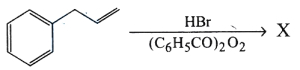
A
Secondary alkyl halide
B
Primary alkyl halide
C
Tertiary alkyl halide
D
Benzylic halide
Solution
(B) The reaction of allylbenzene with $HBr$ in the presence of benzoyl peroxide $((C_6H_5CO)_2O_2)$ proceeds via the peroxide effect (Kharasch effect),which follows Anti-Markovnikov addition.
In this reaction,the $Br$ atom attaches to the less substituted carbon atom of the double bond.
The product formed is $C_6H_5-CH_2-CH_2-CH_2Br$.
Since the bromine atom is attached to a primary carbon atom,the product is a primary alkyl halide.
In this reaction,the $Br$ atom attaches to the less substituted carbon atom of the double bond.
The product formed is $C_6H_5-CH_2-CH_2-CH_2Br$.
Since the bromine atom is attached to a primary carbon atom,the product is a primary alkyl halide.
0 likesView Solution
165
ChemistryMediumMCQAP EAMCET · 2024
The product of which of the following reactions undergoes hydrolysis by the $S_N 1$ mechanism?
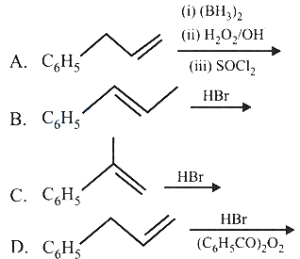
A
$C, D$ only
B
$A, B, C$ only
C
$B, C$ only
D
$A, D$ only
Solution
(C) The $S_N 1$ mechanism proceeds via the formation of a stable carbocation intermediate. The stability of the carbocation determines the ease of the $S_N 1$ reaction. Benzylic carbocations are highly stable due to resonance.
$(A)$ The product is $C_6H_5CH_2CH_2CH_2Cl$ (a primary alkyl halide),which undergoes hydrolysis via $S_N 2$.
$(B)$ The product is $C_6H_5CH(Br)CH_2CH_3$,which forms a stable benzylic carbocation $(C_6H_5CH^+CH_2CH_3)$ upon ionization,thus favoring $S_N 1$.
$(C)$ The product is $C_6H_5C(Br)(CH_3)_2$,which forms a stable benzylic carbocation $(C_6H_5C^+(CH_3)_2)$ upon ionization,thus favoring $S_N 1$.
$(D)$ The product is $C_6H_5CH_2CH_2Br$ (a primary alkyl halide),which undergoes hydrolysis via $S_N 2$.
Therefore,only $(B)$ and $(C)$ form stable benzylic carbocations and undergo hydrolysis by the $S_N 1$ mechanism.
$(A)$ The product is $C_6H_5CH_2CH_2CH_2Cl$ (a primary alkyl halide),which undergoes hydrolysis via $S_N 2$.
$(B)$ The product is $C_6H_5CH(Br)CH_2CH_3$,which forms a stable benzylic carbocation $(C_6H_5CH^+CH_2CH_3)$ upon ionization,thus favoring $S_N 1$.
$(C)$ The product is $C_6H_5C(Br)(CH_3)_2$,which forms a stable benzylic carbocation $(C_6H_5C^+(CH_3)_2)$ upon ionization,thus favoring $S_N 1$.
$(D)$ The product is $C_6H_5CH_2CH_2Br$ (a primary alkyl halide),which undergoes hydrolysis via $S_N 2$.
Therefore,only $(B)$ and $(C)$ form stable benzylic carbocations and undergo hydrolysis by the $S_N 1$ mechanism.
0 likesView Solution
166
ChemistryMediumMCQAP EAMCET · 2024
Which of the following are general methods for the preparation of $1-$iodopropane?
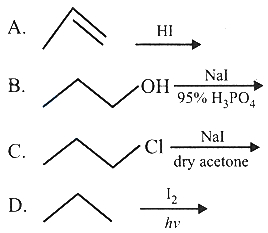
A
$A, B$
B
$B, C$
C
$C, D$
D
$A, D$
Solution
(B) The reactions are analyzed as follows:
$A$: Propene reacts with $HI$ to form $2-$iodopropane via Markovnikov addition.
$B$: Propan-$1-$ol reacts with $NaI$ and $H_3PO_4$ to form $1-$iodopropane.
$C$: $1-$chloropropane reacts with $NaI$ in dry acetone (Finkelstein reaction) to form $1-$iodopropane.
$D$: Propane reacts with $I_2$ in the presence of $hv$ to form $2-$iodopropane as the major product due to the stability of the secondary free radical.
Thus,$B$ and $C$ are the correct methods for the preparation of $1-$iodopropane.
$A$: Propene reacts with $HI$ to form $2-$iodopropane via Markovnikov addition.
$B$: Propan-$1-$ol reacts with $NaI$ and $H_3PO_4$ to form $1-$iodopropane.
$C$: $1-$chloropropane reacts with $NaI$ in dry acetone (Finkelstein reaction) to form $1-$iodopropane.
$D$: Propane reacts with $I_2$ in the presence of $hv$ to form $2-$iodopropane as the major product due to the stability of the secondary free radical.
Thus,$B$ and $C$ are the correct methods for the preparation of $1-$iodopropane.
0 likesView Solution
167
ChemistryDifficultMCQAP EAMCET · 2024
What are the major products $X$ and $Y$ respectively in the following reactions?
$(CH_3)_3CONa + CH_3CH_2Br \rightarrow X$
$(CH_3)_3CBr + CH_3CH_2ONa \rightarrow Y$
$(CH_3)_3CONa + CH_3CH_2Br \rightarrow X$
$(CH_3)_3CBr + CH_3CH_2ONa \rightarrow Y$
A
$CH_2=CH_2, (CH_3)_3COCH_2CH_3$
B
$(CH_3)_3COCH_2CH_3, (CH_3)_3COCH_2CH_3$
C
$CH_2=CH_2, (CH_3)_2C=CH_2$
D
$(CH_3)_3COCH_2CH_3, (CH_3)_2C=CH_2$
Solution
(D) In the first reaction,$(CH_3)_3CONa$ is a strong nucleophile and $CH_3CH_2Br$ is a primary alkyl halide. This undergoes an $S_N2$ reaction to form the ether $(CH_3)_3COCH_2CH_3$ $(X)$.
In the second reaction,$(CH_3)_3CBr$ is a tertiary alkyl halide and $CH_3CH_2ONa$ is a strong base. Tertiary alkyl halides with strong bases undergo an $E2$ elimination reaction to form an alkene,which is $(CH_3)_2C=CH_2$ $(Y)$.
In the second reaction,$(CH_3)_3CBr$ is a tertiary alkyl halide and $CH_3CH_2ONa$ is a strong base. Tertiary alkyl halides with strong bases undergo an $E2$ elimination reaction to form an alkene,which is $(CH_3)_2C=CH_2$ $(Y)$.
0 likesView Solution
168
ChemistryMediumMCQAP EAMCET · 2024
An isomer of $C_5H_{12}$ on reaction with $Br_2 / \text{light}$ gave only one isomer $C_5H_{11}Br(X)$. Reaction of $X$ with $AgNO_2$ gave $Y$ as the major product. What is $Y$?
A
$2,2-$dimethyl$-1-$nitropropane
B
$2,2-$dimethylpropyl nitrite
C
$1,1-$dimethylpropyl nitrite
D
$2,2-$dimethyl$-1-$nitropropane (structure shown)
Solution
(D) $1$. The isomer of $C_5H_{12}$ that gives only one monobrominated product $C_5H_{11}Br$ upon reaction with $Br_2 / \text{light}$ is neopentane $(2,2-\text{dimethylpropane})$. This is because all $12$ hydrogen atoms in neopentane are equivalent.
$2$. Neopentane reacts with $Br_2 / \text{light}$ to form $1-\text{bromo}-2,2-\text{dimethylpropane}$ $(X)$.
$3$. The reaction of a primary alkyl halide $(X)$ with $AgNO_2$ proceeds via an $S_N2$ mechanism,where the nucleophile is the nitrite ion $(NO_2^-)$. Since $AgNO_2$ is largely covalent,the nitrogen atom acts as the nucleophile,leading to the formation of a nitroalkane $(R-NO_2)$ as the major product.
$4$. Therefore,the reaction of $1-\text{bromo}-2,2-\text{dimethylpropane}$ with $AgNO_2$ yields $2,2-\text{dimethyl}-1-\text{nitropropane}$ $(Y)$ as the major product.
$2$. Neopentane reacts with $Br_2 / \text{light}$ to form $1-\text{bromo}-2,2-\text{dimethylpropane}$ $(X)$.
$3$. The reaction of a primary alkyl halide $(X)$ with $AgNO_2$ proceeds via an $S_N2$ mechanism,where the nucleophile is the nitrite ion $(NO_2^-)$. Since $AgNO_2$ is largely covalent,the nitrogen atom acts as the nucleophile,leading to the formation of a nitroalkane $(R-NO_2)$ as the major product.
$4$. Therefore,the reaction of $1-\text{bromo}-2,2-\text{dimethylpropane}$ with $AgNO_2$ yields $2,2-\text{dimethyl}-1-\text{nitropropane}$ $(Y)$ as the major product.
0 likesView Solution
169
ChemistryMediumMCQAP EAMCET · 2024
The major products $X$ and $Y$ respectively from the following reactions are:

A
$CH_3CH_2CH_3, CH_3CH_2CH_2OCH_2CH_3$
B
$CH_3CH_2CH_3, CH_3CH=CH_2$
C
$CH_3CH_2CH_2OH, CH_3CH=CH_2$
D
$CH_3CH_2CH_2OH, CH_3CH_2CH_2OCH_2CH_3$
Solution
(A) $1$. For the formation of $X$: The reaction of $CH_3CH_2CH_2Br$ with $Mg$ in dry ether forms a Grignard reagent,$CH_3CH_2CH_2MgBr$. Subsequent hydrolysis with $H_2O$ yields propane,$CH_3CH_2CH_3$,as product $X$.
$2$. For the formation of $Y$: The reaction of $CH_3CH_2CH_2Br$ with $NaOEt$ (a strong nucleophile/base) in ethanol follows an $S_N2$ mechanism to produce an ether,$CH_3CH_2CH_2OCH_2CH_3$,as the major product $Y$.
$2$. For the formation of $Y$: The reaction of $CH_3CH_2CH_2Br$ with $NaOEt$ (a strong nucleophile/base) in ethanol follows an $S_N2$ mechanism to produce an ether,$CH_3CH_2CH_2OCH_2CH_3$,as the major product $Y$.
0 likesView Solution
170
ChemistryMediumMCQAP EAMCET · 2024
Hydrolysis of an alkyl bromide $X$ $(C_5H_{11}Br)$ follows first-order kinetics. Reaction of $X$ with $Mg$ in dry ether followed by treatment with $D_2O$ gives $Y$. What is $Y$?
A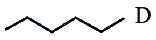
B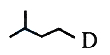
C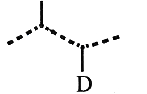
D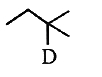
Solution
(D) The hydrolysis of an alkyl bromide $C_5H_{11}Br$ following first-order kinetics indicates an $S_N1$ mechanism,which proceeds via the formation of a stable carbocation. For a $C_5$ alkyl bromide to form a stable carbocation,it is likely a tertiary alkyl bromide,specifically $2$-bromo-$2$-methylbutane.
$1$. Formation of Grignard reagent: $CH_3CH_2C(CH_3)_2Br + Mg \xrightarrow{\text{dry ether}} CH_3CH_2C(CH_3)_2MgBr$.
$2$. Reaction with $D_2O$: The Grignard reagent reacts with $D_2O$ to replace the $MgBr$ group with a deuterium atom $(D)$: $CH_3CH_2C(CH_3)_2MgBr + D_2O \rightarrow CH_3CH_2C(CH_3)_2D + Mg(OD)Br$.
Thus,the product $Y$ is $2$-deuterio-$2$-methylbutane,which matches the structure shown in option $D$.
$1$. Formation of Grignard reagent: $CH_3CH_2C(CH_3)_2Br + Mg \xrightarrow{\text{dry ether}} CH_3CH_2C(CH_3)_2MgBr$.
$2$. Reaction with $D_2O$: The Grignard reagent reacts with $D_2O$ to replace the $MgBr$ group with a deuterium atom $(D)$: $CH_3CH_2C(CH_3)_2MgBr + D_2O \rightarrow CH_3CH_2C(CH_3)_2D + Mg(OD)Br$.
Thus,the product $Y$ is $2$-deuterio-$2$-methylbutane,which matches the structure shown in option $D$.
0 likesView Solution
171
ChemistryDifficultMCQAP EAMCET · 2024
The product $(C)$ in the following reaction sequence is:
$4-\text{Bromoethylbenzene}$ $\xrightarrow[\Delta]{Br_2} B$ $\xrightarrow{\text{aq. } KOH} C$
$4-\text{Bromoethylbenzene}$ $\xrightarrow[\Delta]{Br_2} B$ $\xrightarrow{\text{aq. } KOH} C$
A
$1-$($4$-Bromophenyl)ethanol
B
$1-$($4$-Hydroxyphenyl)ethanol
C
$4-$Bromostyrene
D
$1-$($4$-Bromophenyl)ethanol
Solution
(D) $1$. The reaction of $4-\text{bromoethylbenzene}$ with $Br_2$ in the presence of heat $(\Delta)$ undergoes free-radical substitution at the benzylic position to form $1-(4-\text{bromophenyl})\text{bromoethane}$ (compound $B$).
$2$. The subsequent reaction of compound $B$ with aqueous $KOH$ is a nucleophilic substitution reaction ($S_N1$ or $S_N2$),where the bromine atom at the benzylic position is replaced by a hydroxyl group $(-OH)$ to form $1-(4-\text{bromophenyl})\text{ethanol}$ (compound $C$).
$2$. The subsequent reaction of compound $B$ with aqueous $KOH$ is a nucleophilic substitution reaction ($S_N1$ or $S_N2$),where the bromine atom at the benzylic position is replaced by a hydroxyl group $(-OH)$ to form $1-(4-\text{bromophenyl})\text{ethanol}$ (compound $C$).
0 likesView Solution
172
ChemistryEasyMCQAP EAMCET · 2024
Match the following reactions in List-$I$ with the products obtained in List-$II$:
| List-$I$ | List-$II$ |
|---|---|
| $(A)$ Sandmeyer reaction | $(I)$ $R-I$ |
| $(B)$ Finkelstein reaction | $(II)$ $R-F$ |
| $(C)$ Swarts reaction | $(III)$ $Ar-Br$ |
| $(IV)$ $R-Br$ |
A
$A-III, B-I, C-IV$
B
$A-IV, B-II, C-I$
C
$A-III, B-IV, C-II$
D
$A-III, B-I, C-II$
Solution
(D) The correct matches are:
$(A)$ Sandmeyer reaction: Used to prepare aryl halides like $Ar-Cl$ or $Ar-Br$ from diazonium salts. Thus,$(A-III)$.
$(B)$ Finkelstein reaction: $R-X + NaI \longrightarrow R-I + NaX$ (where $X = Cl, Br$). Thus,$(B-I)$.
$(C)$ Swarts reaction: $R-X + AgF \longrightarrow R-F + AgX$. Thus,$(C-II)$.
Therefore,the correct sequence is $A-III, B-I, C-II$.
$(A)$ Sandmeyer reaction: Used to prepare aryl halides like $Ar-Cl$ or $Ar-Br$ from diazonium salts. Thus,$(A-III)$.
$(B)$ Finkelstein reaction: $R-X + NaI \longrightarrow R-I + NaX$ (where $X = Cl, Br$). Thus,$(B-I)$.
$(C)$ Swarts reaction: $R-X + AgF \longrightarrow R-F + AgX$. Thus,$(C-II)$.
Therefore,the correct sequence is $A-III, B-I, C-II$.
0 likesView Solution
173
ChemistryEasyMCQAP EAMCET · 2024
Chlorobenzene $(X)$ when reacted with reagent '$A$' gets converted to phenol $(Y)$. The major product obtained from nitration of $X$ gets converted to $p$-nitrophenol $(Z)$ by reaction with reagent $B$. What are $A$ and $B$ respectively?
A
$A = (i) \ NaOH, 623 \ K, 300 \ atm \ (ii) \ H^{+}; \ B = (i) \ NaOH, 443 \ K \ (ii) \ H^{+}$
B
$A = (i) \ NaOH, 443 \ K \ (ii) \ H^{+}; \ B = H_2O, \Delta$
C
$A = (i) \ NaOH, 323 \ K \ (ii) \ H^{+}; \ B = (i) \ NaOH, 443 \ K \ (ii) \ H^{+}$
D
$A = (i) \ NaOH, 623 \ K, 300 \ atm \ (ii) \ H^{+}; \ B = H_2O, \Delta$
Solution
(A) $1$. Conversion of chlorobenzene to phenol is done by Dow's process,which requires $NaOH$ at $623 \ K$ and $300 \ atm$ pressure,followed by acidification with $H^+$.
$2$. The major product of nitration of chlorobenzene is $p$-nitrochlorobenzene. This compound is more reactive towards nucleophilic substitution due to the electron-withdrawing $-NO_2$ group at the para position. It can be converted to $p$-nitrophenol using $NaOH$ at a milder condition of $443 \ K$,followed by acidification with $H^+$.
$3$. Thus,$A = (i) \ NaOH, 623 \ K, 300 \ atm \ (ii) \ H^+$ and $B = (i) \ NaOH, 443 \ K \ (ii) \ H^+$.
$2$. The major product of nitration of chlorobenzene is $p$-nitrochlorobenzene. This compound is more reactive towards nucleophilic substitution due to the electron-withdrawing $-NO_2$ group at the para position. It can be converted to $p$-nitrophenol using $NaOH$ at a milder condition of $443 \ K$,followed by acidification with $H^+$.
$3$. Thus,$A = (i) \ NaOH, 623 \ K, 300 \ atm \ (ii) \ H^+$ and $B = (i) \ NaOH, 443 \ K \ (ii) \ H^+$.
0 likesView Solution
174
ChemistryDifficultMCQAP EAMCET · 2024
The two reactions involved in the conversion of benzene diazonium chloride to diphenyl are respectively:
A
Swarts,Fittig
B
Gatterman,Swarts
C
Sandmeyer,Wurtz
D
Sandmeyer,Fittig
Solution
(D) The conversion of benzene diazonium chloride to diphenyl occurs in two steps:
$1$. The conversion of benzene diazonium chloride to chlorobenzene using $CuCl$ is known as the $Sandmeyer$ reaction.
$2$. The coupling of two aryl halide molecules (chlorobenzene) in the presence of sodium $(Na)$ and dry ether to form diphenyl is known as the $Fittig$ reaction.
Therefore,the correct sequence is $Sandmeyer$ and $Fittig$.
$1$. The conversion of benzene diazonium chloride to chlorobenzene using $CuCl$ is known as the $Sandmeyer$ reaction.
$2$. The coupling of two aryl halide molecules (chlorobenzene) in the presence of sodium $(Na)$ and dry ether to form diphenyl is known as the $Fittig$ reaction.
Therefore,the correct sequence is $Sandmeyer$ and $Fittig$.
0 likesView Solution
175
ChemistryMediumMCQAP EAMCET · 2024
What are $Y$ and $Z$ respectively in the following reaction sequence?
Chlorobenzene $\xrightarrow[Conc. H_2SO_4]{HNO_3}$ $X$ (major product) $\xrightarrow{Y}$ $Z$
Chlorobenzene $\xrightarrow[Conc. H_2SO_4]{HNO_3}$ $X$ (major product) $\xrightarrow{Y}$ $Z$
A
$(i)$ $NaOH, 443 \ K, H^+$; $3-$nitrophenol
B
$(i)$ $NaOH, 443 \ K, (ii) H^+$; $4-$nitrophenol
C
$H_2O, \Delta$; $4-$nitrophenol
D
$H_2O, \Delta$; $2-$nitrophenol
Solution
(B) $1$. The nitration of chlorobenzene with $conc. HNO_3$ and $conc. H_2SO_4$ yields $1$-chloro-$4$-nitrobenzene as the major product $(X)$ because the $-Cl$ group is ortho/para directing and the para-isomer is sterically favored.
$2$. The conversion of $1$-chloro-$4$-nitrobenzene to $4$-nitrophenol involves nucleophilic aromatic substitution.
$3$. The reaction requires strong nucleophilic conditions,which are provided by $(i) NaOH$ at $443 \ K$ followed by $(ii) H^+$ (acidification) to convert the phenoxide ion to the phenol.
$4$. Thus,$Y$ is $(i) NaOH, 443 \ K, (ii) H^+$ and $Z$ is $4$-nitrophenol.
$2$. The conversion of $1$-chloro-$4$-nitrobenzene to $4$-nitrophenol involves nucleophilic aromatic substitution.
$3$. The reaction requires strong nucleophilic conditions,which are provided by $(i) NaOH$ at $443 \ K$ followed by $(ii) H^+$ (acidification) to convert the phenoxide ion to the phenol.
$4$. Thus,$Y$ is $(i) NaOH, 443 \ K, (ii) H^+$ and $Z$ is $4$-nitrophenol.
0 likesView Solution
176
ChemistryEasyMCQAP EAMCET · 2024
What are $X$ and $Y$ respectively in the following reaction sequence?
$C_3H_6$ $\xrightarrow[\text{(C}_6\text{H}_5\text{CO)}_2\text{O}_2]{\text{HBr}} X$ $\xrightarrow{\text{Na/ dry ether}} Y$
$C_3H_6$ $\xrightarrow[\text{(C}_6\text{H}_5\text{CO)}_2\text{O}_2]{\text{HBr}} X$ $\xrightarrow{\text{Na/ dry ether}} Y$
A
$CH_3CH(Br)CH_3$,propylbenzene
B
$CH_3CH(Br)CH_3$,isopropylbenzene
C
$CH_3CH_2CH_2Br$,isopropylbenzene
D
$CH_3CH_2CH_2Br$,propylbenzene
Solution
(D) The first step is the addition of $HBr$ to propene $(C_3H_6)$ in the presence of benzoyl peroxide,which follows the anti-Markovnikov rule. This results in the formation of $1$-bromopropane $(CH_3CH_2CH_2Br)$ as $X$.
In the second step,$1$-bromopropane reacts with bromobenzene in the presence of $Na$ and dry ether. This is a Wurtz-Fittig reaction,which couples the alkyl group to the benzene ring,forming propylbenzene as $Y$.
In the second step,$1$-bromopropane reacts with bromobenzene in the presence of $Na$ and dry ether. This is a Wurtz-Fittig reaction,which couples the alkyl group to the benzene ring,forming propylbenzene as $Y$.
0 likesView Solution
177
ChemistryEasyMCQAP EAMCET · 2024
In the Wurtz-Fittig reaction,a compound $X$ reacts with an alkyl halide. What is $X$?
A
Benzene
B
Chlorobenzene
C
Phenol
D
Nitrobenzene
Solution
(B) The Wurtz-Fittig reaction involves the reaction of an aryl halide with an alkyl halide in the presence of sodium metal and dry ether to form an alkyl-substituted aromatic compound.
The general reaction is:
$Ar-X + R-X + 2Na \xrightarrow{\text{dry ether}} Ar-R + 2NaX$
In this reaction,the compound $X$ must be an aryl halide (such as chlorobenzene) to react with the alkyl halide $(R-X)$ to form the substituted benzene product.
Therefore,the correct compound $X$ is chlorobenzene.
The general reaction is:
$Ar-X + R-X + 2Na \xrightarrow{\text{dry ether}} Ar-R + 2NaX$
In this reaction,the compound $X$ must be an aryl halide (such as chlorobenzene) to react with the alkyl halide $(R-X)$ to form the substituted benzene product.
Therefore,the correct compound $X$ is chlorobenzene.
0 likesView Solution
178
ChemistryEasyMCQAP EAMCET · 2024
$\text{Benzene} + Cl_2$ $\xrightarrow{FeCl_3} X$ $\xrightarrow{R-X, \text{ Na/dry ether }} Y$
Conversion of $X$ to $Y$ is an example of:
Conversion of $X$ to $Y$ is an example of:
A
Wurtz reaction
B
Fittig reaction
C
Wurtz-Fittig reaction
D
Friedel-Crafts reaction
Solution
(C) The reaction sequence is as follows:
$1$. Benzene reacts with $Cl_2$ in the presence of $FeCl_3$ (a Lewis acid) to form chlorobenzene $(X)$ via electrophilic aromatic substitution.
$2$. Chlorobenzene $(X)$ reacts with an alkyl halide $(R-X)$ in the presence of sodium metal and dry ether to form an alkylbenzene $(Y)$.
This specific reaction between an aryl halide and an alkyl halide in the presence of sodium metal and dry ether is known as the Wurtz-Fittig reaction.
$1$. Benzene reacts with $Cl_2$ in the presence of $FeCl_3$ (a Lewis acid) to form chlorobenzene $(X)$ via electrophilic aromatic substitution.
$2$. Chlorobenzene $(X)$ reacts with an alkyl halide $(R-X)$ in the presence of sodium metal and dry ether to form an alkylbenzene $(Y)$.
This specific reaction between an aryl halide and an alkyl halide in the presence of sodium metal and dry ether is known as the Wurtz-Fittig reaction.
0 likesView Solution
179
ChemistryMediumMCQAP EAMCET · 2024
What are $X$ and $Y$ respectively in the following reactions?
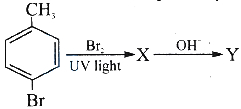
A
$X = \text{4-bromobenzyl bromide}, Y = \text{4-bromobenzyl alcohol}$
B
$X = \text{2-bromo-4-bromotoluene}, Y = \text{2-hydroxy-4-bromotoluene}$
C
$X = \text{2-bromo-4-bromotoluene}, Y = \text{4-bromo-2-hydroxytoluene}$
D
$X = \text{4-bromobenzyl bromide}, Y = \text{4-bromophenol}$
Solution
(A) The reaction of $4$-bromotoluene with $Br_2$ in the presence of $UV$ light is a free radical substitution reaction. This reaction occurs at the benzylic position,not on the aromatic ring. Therefore,$X$ is $4$-bromobenzyl bromide $(Br-C_6H_4-CH_2Br)$.
When $4$-bromobenzyl bromide is treated with $OH^-$,it undergoes a nucleophilic substitution reaction $(S_N2)$ where the $Br$ atom on the side chain is replaced by an $OH$ group. Therefore,$Y$ is $4$-bromobenzyl alcohol $(Br-C_6H_4-CH_2OH)$.
When $4$-bromobenzyl bromide is treated with $OH^-$,it undergoes a nucleophilic substitution reaction $(S_N2)$ where the $Br$ atom on the side chain is replaced by an $OH$ group. Therefore,$Y$ is $4$-bromobenzyl alcohol $(Br-C_6H_4-CH_2OH)$.
0 likesView Solution
180
ChemistryEasyMCQAP EAMCET · 2024
Which of the following sequence of reagents converts $3-$hexene to propane?
A
$(i) KMnO_4 | H^{+}; (ii) NaOH, CaO$
B
$(i) O_3; (ii) Zn, H_2O; NaBH_4$
C
$(i) O_3; (ii) Zn, H_2O; Zn(Hg), HCl$
D
$(i) KMnO_4 | H^{+}; (ii) LiAlH_4, H_2O$
Solution
(C) The conversion of $3-$hexene to propane involves two main steps:
Step-$I$: Ozonolysis of $3-$hexene $(CH_3CH_2CH=CHCH_2CH_3)$ using $(i) O_3$ followed by $(ii) Zn, H_2O$ yields two molecules of propanal $(CH_3CH_2CHO)$.
Step-$II$: Reduction of propanal $(CH_3CH_2CHO)$ to propane $(CH_3CH_2CH_3)$ is achieved using Clemmensen reduction,which employs $Zn(Hg)$ and $HCl$.
Step-$I$: Ozonolysis of $3-$hexene $(CH_3CH_2CH=CHCH_2CH_3)$ using $(i) O_3$ followed by $(ii) Zn, H_2O$ yields two molecules of propanal $(CH_3CH_2CHO)$.
Step-$II$: Reduction of propanal $(CH_3CH_2CHO)$ to propane $(CH_3CH_2CH_3)$ is achieved using Clemmensen reduction,which employs $Zn(Hg)$ and $HCl$.
0 likesView Solution
181
ChemistryDifficultMCQAP EAMCET · 2024
What is the final product of the following reaction sequence?
$C_4H_8$ $\xrightarrow[\text{peroxide}]{\text{HBr}} X$ $\xrightarrow[\text{(ii) } CO_2]{\text{(i) Mg/dry ether, (iii) } H_3O^+} Y$
$C_4H_8$ $\xrightarrow[\text{peroxide}]{\text{HBr}} X$ $\xrightarrow[\text{(ii) } CO_2]{\text{(i) Mg/dry ether, (iii) } H_3O^+} Y$
A
$3-$methylbutanal
B
$2-$methylbutanoic acid
C
$2,2-$dimethylpropanoic acid
D
$3-$methylbutanoic acid
Solution
(D) $1$. The ozonolysis of $C_4H_8$ gives acetone $(CH_3COCH_3)$ and formaldehyde $(HCHO)$. This confirms that $C_4H_8$ is isobutylene,$(CH_3)_2C=CH_2$.
$2$. Reaction of isobutylene with $HBr$ in the presence of peroxide follows anti-Markovnikov addition: $(CH_3)_2C=CH_2 + HBr \xrightarrow{\text{peroxide}} (CH_3)_2CH-CH_2Br$ ($X$ is $1-$bromo$-2-$methylpropane).
$3$. $X$ reacts with $Mg$ in dry ether to form the Grignard reagent: $(CH_3)_2CH-CH_2MgBr$.
$4$. The Grignard reagent reacts with $CO_2$ followed by acid hydrolysis to form a carboxylic acid: $(CH_3)_2CH-CH_2MgBr + CO_2$ $\rightarrow (CH_3)_2CH-CH_2COOMgBr$ $\xrightarrow{H_3O^+} (CH_3)_2CH-CH_2COOH$.
$5$. The final product $Y$ is $3-$methylbutanoic acid.
$2$. Reaction of isobutylene with $HBr$ in the presence of peroxide follows anti-Markovnikov addition: $(CH_3)_2C=CH_2 + HBr \xrightarrow{\text{peroxide}} (CH_3)_2CH-CH_2Br$ ($X$ is $1-$bromo$-2-$methylpropane).
$3$. $X$ reacts with $Mg$ in dry ether to form the Grignard reagent: $(CH_3)_2CH-CH_2MgBr$.
$4$. The Grignard reagent reacts with $CO_2$ followed by acid hydrolysis to form a carboxylic acid: $(CH_3)_2CH-CH_2MgBr + CO_2$ $\rightarrow (CH_3)_2CH-CH_2COOMgBr$ $\xrightarrow{H_3O^+} (CH_3)_2CH-CH_2COOH$.
$5$. The final product $Y$ is $3-$methylbutanoic acid.
0 likesView Solution
182
ChemistryMediumMCQAP EAMCET · 2024
An alkene $X$ $(C_4H_8)$ on reaction with $HBr$ gave $Y$ $(C_4H_9Br)$. Reaction of $Y$ with benzene in the presence of anhydrous $AlCl_3$ gave $Z$,which is resistant to oxidation with $KMnO_4-KOH$. What are $X, Y, Z$ respectively?
A
$2-$methylpropene,tert-butyl bromide,tert-butylbenzene
B
$2-$methylpropene,isobutyl bromide,isobutylbenzene
C
$1-$butene,$2$-bromobutane,sec-butylbenzene
D
$1-$butene,$1$-bromobutane,n-butylbenzene
Solution
(A) $1$. The alkene $X$ is $2$-methylpropene $(CH_3-C(CH_3)=CH_2)$.
$2$. Reaction of $2$-methylpropene with $HBr$ follows Markovnikov's rule to give $Y$,which is $tert$-butyl bromide $(CH_3-C(Br)(CH_3)-CH_3)$.
$3$. Reaction of $tert$-butyl bromide with benzene in the presence of anhydrous $AlCl_3$ (Friedel-Crafts alkylation) gives $Z$,which is $tert$-butylbenzene $(C_6H_5-C(CH_3)_3)$.
$4$. $tert$-butylbenzene has no benzylic hydrogen atoms,so it is resistant to oxidation by $KMnO_4-KOH$.
$2$. Reaction of $2$-methylpropene with $HBr$ follows Markovnikov's rule to give $Y$,which is $tert$-butyl bromide $(CH_3-C(Br)(CH_3)-CH_3)$.
$3$. Reaction of $tert$-butyl bromide with benzene in the presence of anhydrous $AlCl_3$ (Friedel-Crafts alkylation) gives $Z$,which is $tert$-butylbenzene $(C_6H_5-C(CH_3)_3)$.
$4$. $tert$-butylbenzene has no benzylic hydrogen atoms,so it is resistant to oxidation by $KMnO_4-KOH$.
0 likesView Solution
183
ChemistryMediumMCQAP EAMCET · 2024
Which of the following reactions give phosphine $(PH_3)$?
$(i)$ Reaction of calcium phosphide with water
$(ii)$ Heating white phosphorus with concentrated $NaOH$ solution in an inert atmosphere
$(iii)$ Heating red phosphorus with alkali
$(i)$ Reaction of calcium phosphide with water
$(ii)$ Heating white phosphorus with concentrated $NaOH$ solution in an inert atmosphere
$(iii)$ Heating red phosphorus with alkali
A
$(i), (ii)$ only
B
$(i), (ii), (iii)$
C
$(ii), (iii)$ only
D
$(i), (iii)$ only
Solution
(A) $(i)$ Calcium phosphide reacts with water to produce phosphine: $Ca_3P_2 + 6H_2O \rightarrow 3Ca(OH)_2 + 2PH_3$.
$(ii)$ White phosphorus reacts with concentrated $NaOH$ solution in an inert atmosphere to produce phosphine: $P_4 + 3NaOH + 3H_2O \rightarrow PH_3 + 3NaH_2PO_2$.
$(iii)$ Red phosphorus is much less reactive than white phosphorus and does not react with alkali to give phosphine under these conditions.
$(ii)$ White phosphorus reacts with concentrated $NaOH$ solution in an inert atmosphere to produce phosphine: $P_4 + 3NaOH + 3H_2O \rightarrow PH_3 + 3NaH_2PO_2$.
$(iii)$ Red phosphorus is much less reactive than white phosphorus and does not react with alkali to give phosphine under these conditions.
0 likesView Solution
184
ChemistryMediumMCQAP EAMCET · 2024
$P_2O_3 + H_2O \rightarrow X$
$Red \ P_4 + \text{alkali} \rightarrow Y$
$X$ and $Y$ are oxoacids of phosphorus. The number of $P-OH$ bonds in $X$ and $Y$ respectively is:
$Red \ P_4 + \text{alkali} \rightarrow Y$
$X$ and $Y$ are oxoacids of phosphorus. The number of $P-OH$ bonds in $X$ and $Y$ respectively is:
A
$1, 4$
B
$4, 1$
C
$2, 4$
D
$1, 1$
Solution
(C) $1$. The reaction of $P_2O_3$ with water is: $P_2O_3 + 3H_2O \rightarrow 2H_3PO_3$ ($X = H_3PO_3$,Phosphorous acid).
$2$. The structure of $H_3PO_3$ contains two $P-OH$ bonds.
$3$. The reaction of $Red \ P_4$ with alkali is: $P_4 + 3NaOH + 3H_2O \rightarrow PH_3 + 3NaH_2PO_2$ ($Y = H_3PO_2$,Hypophosphorous acid).
$4$. The structure of $H_3PO_2$ contains one $P-OH$ bond.
$5$. Therefore,the number of $P-OH$ bonds in $X$ $(H_3PO_3)$ and $Y$ $(H_3PO_2)$ are $2$ and $1$ respectively. Note: The provided options do not match this result exactly. Re-evaluating the question,if $X$ is $H_3PO_3$ ($2$ $P-OH$) and $Y$ is $H_3PO_2$ ($1$ $P-OH$),the answer should be $2, 1$. Given the options,there might be a typo in the question or options. Based on standard chemistry,$H_3PO_3$ has $2$ $P-OH$ and $H_3PO_2$ has $1$ $P-OH$.
$2$. The structure of $H_3PO_3$ contains two $P-OH$ bonds.
$3$. The reaction of $Red \ P_4$ with alkali is: $P_4 + 3NaOH + 3H_2O \rightarrow PH_3 + 3NaH_2PO_2$ ($Y = H_3PO_2$,Hypophosphorous acid).
$4$. The structure of $H_3PO_2$ contains one $P-OH$ bond.
$5$. Therefore,the number of $P-OH$ bonds in $X$ $(H_3PO_3)$ and $Y$ $(H_3PO_2)$ are $2$ and $1$ respectively. Note: The provided options do not match this result exactly. Re-evaluating the question,if $X$ is $H_3PO_3$ ($2$ $P-OH$) and $Y$ is $H_3PO_2$ ($1$ $P-OH$),the answer should be $2, 1$. Given the options,there might be a typo in the question or options. Based on standard chemistry,$H_3PO_3$ has $2$ $P-OH$ and $H_3PO_2$ has $1$ $P-OH$.
0 likesView Solution
185
ChemistryMediumMCQAP EAMCET · 2024
The basicity of $H_3PO_2, H_3PO_3, H_3PO_4$ respectively is
A
$2, 2, 3$
B
$2, 3, 3$
C
$1, 3, 3$
D
$1, 2, 3$
Solution
(D) The basicity of an oxoacid of phosphorus is determined by the number of $P-OH$ groups present in its structure.
$1$. $H_3PO_2$ (Hypophosphorous acid): It has one $P-OH$ group,so its basicity is $1$.
$2$. $H_3PO_3$ (Orthophosphorous acid): It has two $P-OH$ groups,so its basicity is $2$.
$3$. $H_3PO_4$ (Orthophosphoric acid): It has three $P-OH$ groups,so its basicity is $3$.
Therefore,the basicity of $H_3PO_2, H_3PO_3, H_3PO_4$ is $1, 2, 3$ respectively.
$1$. $H_3PO_2$ (Hypophosphorous acid): It has one $P-OH$ group,so its basicity is $1$.
$2$. $H_3PO_3$ (Orthophosphorous acid): It has two $P-OH$ groups,so its basicity is $2$.
$3$. $H_3PO_4$ (Orthophosphoric acid): It has three $P-OH$ groups,so its basicity is $3$.
Therefore,the basicity of $H_3PO_2, H_3PO_3, H_3PO_4$ is $1, 2, 3$ respectively.
0 likesView Solution
186
ChemistryMediumMCQAP EAMCET · 2024
When chlorine reacts with hot and conc. $NaOH$,the products formed are
A
$NaCl, NaClO_3, H_2 O$
B
$NaCl, NaOCl, H_2 O$
C
$NaCl, H_2 O$ only
D
$NaOCl, H_2 O$
Solution
(A) When chlorine reacts with hot and concentrated $NaOH$,it undergoes a disproportionation reaction.
The balanced chemical equation is:
$3 Cl_2 + 6 NaOH \longrightarrow 5 NaCl + NaClO_3 + 3 H_2 O$
Thus,the products formed are sodium chloride $(NaCl)$,sodium chlorate $(NaClO_3)$,and water $(H_2 O)$.
The balanced chemical equation is:
$3 Cl_2 + 6 NaOH \longrightarrow 5 NaCl + NaClO_3 + 3 H_2 O$
Thus,the products formed are sodium chloride $(NaCl)$,sodium chlorate $(NaClO_3)$,and water $(H_2 O)$.
0 likesView Solution
187
ChemistryMediumMCQAP EAMCET · 2024
$Xe_{(g)} + 2 F_{2(g)} \xrightarrow[7 \text{ bar }]{873 \text{ K}} XeF_{4(s)}$
The ratio of $Xe : F_2$ required in the above reaction is
The ratio of $Xe : F_2$ required in the above reaction is
A
$1 : 2$
B
$1 : 5$
C
$1 : 20$
D
$1 : 12$
Solution
(B) Xenon reacts with fluorine under different conditions to form $XeF_2$,$XeF_4$,and $XeF_6$.
The reaction for the formation of $XeF_4$ is given by:
$Xe_{(g)} + 2 F_{2(g)} \xrightarrow{873 \text{ K}, 7 \text{ bar }} XeF_{4(s)}$
In this reaction,$1 \text{ mole}$ of $Xe$ reacts with $2 \text{ moles}$ of $F_2$ to form $XeF_4$.
However,in the industrial preparation of $XeF_4$,a mixture of $Xe$ and $F_2$ in a $1 : 5$ ratio is used to ensure the complete conversion of $Xe$ to $XeF_4$ and to prevent the formation of $XeF_2$ or $XeF_6$ as impurities.
Therefore,the required ratio is $1 : 5$.
The reaction for the formation of $XeF_4$ is given by:
$Xe_{(g)} + 2 F_{2(g)} \xrightarrow{873 \text{ K}, 7 \text{ bar }} XeF_{4(s)}$
In this reaction,$1 \text{ mole}$ of $Xe$ reacts with $2 \text{ moles}$ of $F_2$ to form $XeF_4$.
However,in the industrial preparation of $XeF_4$,a mixture of $Xe$ and $F_2$ in a $1 : 5$ ratio is used to ensure the complete conversion of $Xe$ to $XeF_4$ and to prevent the formation of $XeF_2$ or $XeF_6$ as impurities.
Therefore,the required ratio is $1 : 5$.
0 likesView Solution
188
ChemistryMediumMCQAP EAMCET · 2024
Hydrolysis of $XeF_4$ gives $HF$,$O_2$,$Xe$ and '$X$'. The structure of '$X$' is
A
pyramidal
B
Square pyramidal
C
octahedral
D
Square planar
Solution
(A) The hydrolysis reaction of $XeF_4$ is given by:
$6XeF_4 + 12H_2O \longrightarrow 4Xe + 2XeO_3 + 24HF + 3O_2$
Here,'$X$' is $XeO_3$.
In $XeO_3$,the central atom $Xe$ has $8$ valence electrons. It forms $3$ double bonds with $O$ atoms and has $1$ lone pair.
According to $VSEPR$ theory,the hybridization is $sp^3$ with one lone pair,resulting in a pyramidal geometry.
$6XeF_4 + 12H_2O \longrightarrow 4Xe + 2XeO_3 + 24HF + 3O_2$
Here,'$X$' is $XeO_3$.
In $XeO_3$,the central atom $Xe$ has $8$ valence electrons. It forms $3$ double bonds with $O$ atoms and has $1$ lone pair.
According to $VSEPR$ theory,the hybridization is $sp^3$ with one lone pair,resulting in a pyramidal geometry.
0 likesView Solution
189
ChemistryMediumMCQAP EAMCET · 2024
$A$ polymer $X$ is biodegradable and is obtained from the monomers $Y$ and $Z$. What are $Y$ and $Z$?
A
$H_2N-CH_2-CH_2-COOH$ and $H_2N-(CH_2)_5-COOH$
B
$H_2N-CH(CH_3)-COOH$ and $H_2N-(CH_2)_5-COOH$
C
$CH_3-CH(OH)-CH_2-COOH$ and $CH_3-CH_2-CH(OH)-CH_2-COOH$
D
$HO-CH(CH_3)-CH_2-COOH$ and $HO-CH(CH_2CH_3)-CH_2-COOH$
Solution
(C) The biodegradable polymer $PHBV$ (poly $\beta$-hydroxybutyrate-co-$\beta$-hydroxyvalerate) is obtained by the copolymerization of $3$-hydroxybutanoic acid and $3$-hydroxypentanoic acid.
The monomers are:
$Y = CH_3-CH(OH)-CH_2-COOH$ ($3$-hydroxybutanoic acid)
$Z = CH_3-CH_2-CH(OH)-CH_2-COOH$ ($3$-hydroxypentanoic acid)
Thus,option $C$ is the correct answer.
The monomers are:
$Y = CH_3-CH(OH)-CH_2-COOH$ ($3$-hydroxybutanoic acid)
$Z = CH_3-CH_2-CH(OH)-CH_2-COOH$ ($3$-hydroxypentanoic acid)
Thus,option $C$ is the correct answer.
0 likesView Solution
190
ChemistryMediumMCQAP EAMCET · 2024
$PHBV$ is a biodegradable polymer of two monomers $X$ and $Y$. $X$ and $Y$ respectively are
A
$X=C_2H_5-CH(OH)-CH_2CO_2H$; $Y=C_2H_5-CH(OH)-CO_2H$
B
$X=CH_3-CH(OH)-CH_2CO_2H$; $Y=C_2H_5-CH(OH)-CH_2CO_2H$
C
$X=CH_3-CH(OH)-CH_2OH$; $Y=C_2H_5-CH(OH)-CH_2CO_2H$
D
$X=H_2N-(CH_2)_5-CO_2H$; $Y=CH_3-CH(OH)-CH_2CO_2H$
Solution
(B) $PHBV$ (Poly-$\beta$-hydroxybutyrate-co-$\beta$-hydroxyvalerate) is a copolymer formed by the condensation polymerization of two hydroxy acids:
$1$. $3$-Hydroxybutanoic acid $(CH_3-CH(OH)-CH_2-COOH)$
$2$. $3$-Hydroxypentanoic acid $(CH_3-CH_2-CH(OH)-CH_2-COOH)$
Thus,$X$ is $3$-hydroxybutanoic acid and $Y$ is $3$-hydroxypentanoic acid.
Comparing this with the given options,option $B$ matches these structures.
$1$. $3$-Hydroxybutanoic acid $(CH_3-CH(OH)-CH_2-COOH)$
$2$. $3$-Hydroxypentanoic acid $(CH_3-CH_2-CH(OH)-CH_2-COOH)$
Thus,$X$ is $3$-hydroxybutanoic acid and $Y$ is $3$-hydroxypentanoic acid.
Comparing this with the given options,option $B$ matches these structures.
0 likesView Solution
191
ChemistryMediumMCQAP EAMCET · 2024
The correctly matched set of the following is:
A
$Polystyrene$ - copolymer - thermoplastic
B
$Bakelite$ - addition polymer - thermosetting
C
$Nylon$ $6$ - Homopolymer - fibre
D
$Buna-N$ - Homopolymer - elastomer
Solution
(C) Let us analyze the given polymers based on their type and classification:
$1$. $Polystyrene$ is a homopolymer of styrene and is a thermoplastic.
$2$. $Bakelite$ is a condensation polymer (phenol-formaldehyde resin) and is thermosetting.
$3$. $Nylon$ $6$ is a homopolymer of caprolactam and is classified as a fibre due to strong intermolecular forces like hydrogen bonding.
$4$. $Buna-N$ is a copolymer of $1,3-butadiene$ and $acrylonitrile$ and is an elastomer.
Comparing these with the options:
- Option $A$: $Polystyrene$ is a homopolymer,not a copolymer.
- Option $B$: $Bakelite$ is a condensation polymer,not an addition polymer.
- Option $C$: $Nylon$ $6$ is a homopolymer and is a fibre. This is correct.
- Option $D$: $Buna-N$ is a copolymer,not a homopolymer.
Therefore,the correct set is $Nylon$ $6$ - Homopolymer - fibre.
$1$. $Polystyrene$ is a homopolymer of styrene and is a thermoplastic.
$2$. $Bakelite$ is a condensation polymer (phenol-formaldehyde resin) and is thermosetting.
$3$. $Nylon$ $6$ is a homopolymer of caprolactam and is classified as a fibre due to strong intermolecular forces like hydrogen bonding.
$4$. $Buna-N$ is a copolymer of $1,3-butadiene$ and $acrylonitrile$ and is an elastomer.
Comparing these with the options:
- Option $A$: $Polystyrene$ is a homopolymer,not a copolymer.
- Option $B$: $Bakelite$ is a condensation polymer,not an addition polymer.
- Option $C$: $Nylon$ $6$ is a homopolymer and is a fibre. This is correct.
- Option $D$: $Buna-N$ is a copolymer,not a homopolymer.
Therefore,the correct set is $Nylon$ $6$ - Homopolymer - fibre.
0 likesView Solution
192
ChemistryEasyMCQAP EAMCET · 2024
Match the following:
| List-$I$ (Polymers) | List-$II$ (Type) |
|---|---|
| $A$. Buna-$N$-Rubber | $I$. Fibre |
| $B$. Terylene | $II$. Thermosetting polymer |
| $C$. Polystyrene | $III$. Elastomer |
| $D$. Urea-Formaldehyde resin | $IV$. Thermoplastic polymer |
A
$A-III, B-I, C-IV, D-II$
B
$A-III, B-IV, C-I, D-II$
C
$A-I, B-II, C-III, D-IV$
D
$A-IV, B-III, C-II, D-I$
Solution
(A) The correct matches are as follows:
$A$. Buna-$N$-Rubber is an Elastomer $(III)$.
$B$. Terylene is a Fibre $(I)$.
$C$. Polystyrene is a Thermoplastic polymer $(IV)$.
$D$. Urea-Formaldehyde resin is a Thermosetting polymer $(II)$.
Thus,the correct sequence is $A-III, B-I, C-IV, D-II$.
$A$. Buna-$N$-Rubber is an Elastomer $(III)$.
$B$. Terylene is a Fibre $(I)$.
$C$. Polystyrene is a Thermoplastic polymer $(IV)$.
$D$. Urea-Formaldehyde resin is a Thermosetting polymer $(II)$.
Thus,the correct sequence is $A-III, B-I, C-IV, D-II$.
0 likesView Solution
193
ChemistryEasyMCQAP EAMCET · 2024
Polymers that can be softened on heating and hardened on cooling are called:
A
Thermosetting polymers
B
Bakelite
C
Fibres
D
Thermoplastic polymers
Solution
(D) Thermoplastic polymers are linear or slightly branched long-chain molecules that are capable of repeatedly softening on heating and hardening on cooling.
Examples include $Polythene$,$polystyrene$,and $polyvinyls$.
Examples include $Polythene$,$polystyrene$,and $polyvinyls$.
0 likesView Solution
194
ChemistryMediumMCQAP EAMCET · 2024
Which of the following is an example of a fibre?
A
$[-CH_2-CH(Cl)-]_n$
B
$[-CH_2-CH_2-]_n$
C
$[-CH_2-C(Cl)=CH-CH_2-]_n$
D
$[-OC-C_6H_4-CO-O-CH_2-CH_2-O-]_n$
Solution
(D) Fibres are polymers that have strong intermolecular forces between the chains,such as hydrogen bonds or dipole-dipole interactions. These forces lead to close packing,which imparts crystalline character and makes them long,thin,and thread-like,suitable for weaving into fabrics. Examples include nylon-$66$,silk,and terylene (also known as dacron). The structure given in option $D$ represents terylene (dacron),which is a polyester fibre formed by the condensation polymerization of ethylene glycol and terephthalic acid.
0 likesView Solution
195
ChemistryEasyMCQAP EAMCET · 2024
Which of the following polymerisation reactions leads to the formation of neoprene?
A
$n CH_2=C(Cl)-CH=CH_2 \xrightarrow{AlCl_3}$
B
$n CH_2=C(CH_3)-CH=CH_2 \xrightarrow{(C_6H_5CO)_2O_2}$
C
$n CH_2=C(Cl)-CH=CH_2 \xrightarrow{(C_6H_5CO)_2O_2}$
D
$n CH_2=C(CH_3)-CH=CH_2 \xrightarrow{AlCl_3}$
Solution
(C) Neoprene (polychloroprene) is prepared by the free radical polymerisation of chloroprene ($2$-chloro-buta-$1,3$-diene) in the presence of a peroxide initiator like benzoyl peroxide,$(C_6H_5CO)_2O_2$.
The reaction is:
$n CH_2=C(Cl)-CH=CH_2 \xrightarrow{(C_6H_5CO)_2O_2} [-CH_2-C(Cl)=CH-CH_2-]_n$
Thus,option $C$ represents the correct polymerisation reaction.
The reaction is:
$n CH_2=C(Cl)-CH=CH_2 \xrightarrow{(C_6H_5CO)_2O_2} [-CH_2-C(Cl)=CH-CH_2-]_n$
Thus,option $C$ represents the correct polymerisation reaction.
0 likesView Solution
196
ChemistryMediumMCQAP EAMCET · 2024
The common monomer for both Terylene and glyptal is
A
$HO-CH_2-CH_2-OH$
B
$HO-CH_2-CH_2-CH_2-OH$
C
$HO-CH_2-CH_2-C_6H_5$
D
$H_2N-CH_2-CH_2-NH_2$
Solution
(A) $Terylene$:
The monomers for $Terylene$ are ethylene glycol and terephthalic acid. $Terylene$ is also known as $Dacron$ or polyester.
$Glyptal$:
The monomers for $Glyptal$ are ethylene glycol and phthalic acid. $Glyptal$ is an alkyd resin and a polyester.
$\therefore$ Ethylene glycol $(HO-CH_2-CH_2-OH)$ is the common monomer for both.
The monomers for $Terylene$ are ethylene glycol and terephthalic acid. $Terylene$ is also known as $Dacron$ or polyester.
$Glyptal$:
The monomers for $Glyptal$ are ethylene glycol and phthalic acid. $Glyptal$ is an alkyd resin and a polyester.
$\therefore$ Ethylene glycol $(HO-CH_2-CH_2-OH)$ is the common monomer for both.
0 likesView Solution
197
ChemistryEasyMCQAP EAMCET · 2024
The $X$ formed in the following reaction sequence and its structural type are respectively:

A
$Novolac$ - linear polymer
B
$Bakelite$ - cross linked polymer
C
$Novolac$ - cross linked polymer
D
$Bakelite$ - linear polymer
Solution
(B) The reaction of phenol with formaldehyde in the presence of a base $(OH^-)$ and heat leads to the formation of $Bakelite$.
$Bakelite$ is a thermosetting polymer formed by the condensation polymerization of phenol and formaldehyde.
It has a highly branched,three-dimensional structure,which is classified as a cross-linked polymer.
Therefore,$X$ is $Bakelite$ and it is a cross-linked polymer.
$Bakelite$ is a thermosetting polymer formed by the condensation polymerization of phenol and formaldehyde.
It has a highly branched,three-dimensional structure,which is classified as a cross-linked polymer.
Therefore,$X$ is $Bakelite$ and it is a cross-linked polymer.
0 likesView Solution
198
ChemistryMediumMCQAP EAMCET · 2024
Which one of the following is used as a piezoelectric material?
A
tridymite
B
quartz
C
zeolite
D
mica
Solution
(B) $Quartz$ is a piezoelectric material.
Piezoelectric materials develop an electric charge due to the displacement of ions or movement of electrons upon the application of mechanical stress.
Piezoelectric materials develop an electric charge due to the displacement of ions or movement of electrons upon the application of mechanical stress.
0 likesView Solution
199
ChemistryEasyMCQAP EAMCET · 2024
The diffraction pattern of a crystalline solid gave a peak at $2 \theta = 60^{\circ}$. What is the distance (in $cm$) between the layers which gave this peak? ($\lambda$ of $X$-rays is $1.54 \mathring{A}$) ($\sin 30^{\circ} = 0.5$,$\sin 60^{\circ} = 0.866$; $n = 1$)
A
$8.89 \times 10^{-9}$
B
$8.89 \times 10^{-1}$
C
$1.54 \times 10^{-8}$
D
$1.54$
Solution
(C) According to Bragg's law: $n \lambda = 2 d \sin \theta$.
Given: $n = 1$,$\lambda = 1.54 \mathring{A}$,and $2 \theta = 60^{\circ}$,so $\theta = 30^{\circ}$.
Substituting the values into the formula: $1 \times 1.54 \mathring{A} = 2 \times d \times \sin 30^{\circ}$.
Since $\sin 30^{\circ} = 0.5$,we have: $1.54 \mathring{A} = 2 \times d \times 0.5$.
$1.54 \mathring{A} = d$.
Converting $\mathring{A}$ to $cm$ $(1 \mathring{A} = 10^{-8} \ cm)$:
$d = 1.54 \times 10^{-8} \ cm$.
Given: $n = 1$,$\lambda = 1.54 \mathring{A}$,and $2 \theta = 60^{\circ}$,so $\theta = 30^{\circ}$.
Substituting the values into the formula: $1 \times 1.54 \mathring{A} = 2 \times d \times \sin 30^{\circ}$.
Since $\sin 30^{\circ} = 0.5$,we have: $1.54 \mathring{A} = 2 \times d \times 0.5$.
$1.54 \mathring{A} = d$.
Converting $\mathring{A}$ to $cm$ $(1 \mathring{A} = 10^{-8} \ cm)$:
$d = 1.54 \times 10^{-8} \ cm$.
0 likesView Solution
200
ChemistryEasyMCQAP EAMCET · 2024
$A$ solid compound is formed by atoms of $A$ (cations),$B$ (cations),and $O$ (anions). Atoms of $O$ form an $hcp$ lattice. Atoms of $A$ occupy $25\%$ of the tetrahedral voids,and atoms of $B$ occupy $50\%$ of the octahedral voids. What is the molecular formula of the solid?
A
$AB_2O_4$
B
$ABO_3$
C
$ABO_2$
D
$A_2BO_4$
Solution
(C) In an $hcp$ lattice,the number of atoms of $O$ is $N = 6$.
Number of octahedral voids $= N = 6$.
Number of tetrahedral voids $= 2N = 12$.
Atoms of $A$ occupy $25\%$ of tetrahedral voids: $A = 0.25 \times 12 = 3$.
Atoms of $B$ occupy $50\%$ of octahedral voids: $B = 0.50 \times 6 = 3$.
Atoms of $O$ in $hcp$ lattice $= 6$.
The ratio of atoms $A:B:O$ is $3:3:6$,which simplifies to $1:1:2$.
Therefore,the molecular formula is $ABO_2$.
Number of octahedral voids $= N = 6$.
Number of tetrahedral voids $= 2N = 12$.
Atoms of $A$ occupy $25\%$ of tetrahedral voids: $A = 0.25 \times 12 = 3$.
Atoms of $B$ occupy $50\%$ of octahedral voids: $B = 0.50 \times 6 = 3$.
Atoms of $O$ in $hcp$ lattice $= 6$.
The ratio of atoms $A:B:O$ is $3:3:6$,which simplifies to $1:1:2$.
Therefore,the molecular formula is $ABO_2$.
0 likesView Solution
Vedclass Products
For Students
Vedclass Test Series
Mock tests in real AP EAMCET style covering Chemistry with performance analysis. 5-day free trial.
Start Free TrialFor Teachers
Exam Paper Generator
Generate Set A/B/C/D Chemistry papers from 7.5L+ questions in 2 minutes. 3 chapters free.
Try FreeFor Institutes
Online Exam Module
Run live AP EAMCET mock exams with unlimited students, 360° analytics & white-label branding.
See DemoFrequently Asked Questions
How many Chemistry questions are in AP EAMCET 2024?
There are 389 Chemistry questions from the AP EAMCET 2024 paper on Vedclass, each with a detailed step-by-step solution in English.
Are AP EAMCET 2024 Chemistry solutions available in English?
Yes. All solutions on this page are in English. You can also switch to English or Hindi using the language buttons above the questions.
Can I practice AP EAMCET 2024 Chemistry as a timed test?
Yes. Use the Vedclass Test Series to attempt a full AP EAMCET mock test covering Chemistry with time limits and instant score analysis.
Can teachers create Chemistry papers from AP EAMCET previous year questions?
Yes. The Vedclass Exam Paper Generator lets teachers mix AP EAMCET Chemistry questions and generate Set A/B/C/D papers in minutes.
For Teachers & Institutes
Build a Custom Chemistry Paper
Pick AP EAMCET 2024 Chemistry questions, set difficulty, and generate Set A/B/C/D in 2 minutes.