
ChemistryQ151–250 of 435 questions
Page 4 of 5 · English
151
ChemistryEasyMCQAP EAMCET · 2022
Among the given group $14$ elements,the one with highest density is
A
Carbon
B
Silicon
C
Tin
D
Lead
Solution
(D) Density is defined as mass per unit volume. In a group,as we move down,the atomic mass increases significantly more than the atomic volume. Therefore,the density increases down the group. Among the given elements $(C, Si, Sn, Pb)$,$Pb$ (Lead) is at the bottom of the group and has the highest atomic mass,resulting in the highest density.
0 likesView Solution
152
ChemistryMediumMCQAP EAMCET · 2022
Observe the following reactions:
$Dimer \longleftarrow \text{Vapour phase } MCl_2 \xrightarrow{1200 \ K} \text{linear monomer}$.
What is $M$?
$Dimer \longleftarrow \text{Vapour phase } MCl_2 \xrightarrow{1200 \ K} \text{linear monomer}$.
What is $M$?
A
$Ca$
B
$Sr$
C
$Mg$
D
$Be$
Solution
(D) The compound $BeCl_2$ exists as a polymeric chain in the solid state.
In the vapour phase at lower temperatures,it exists as a chloro-bridged dimer.
At high temperatures (around $1200 \ K$),the dimer dissociates into a linear monomeric molecule,$Cl-Be-Cl$.
Therefore,the metal $M$ is $Be$ (Beryllium).
In the vapour phase at lower temperatures,it exists as a chloro-bridged dimer.
At high temperatures (around $1200 \ K$),the dimer dissociates into a linear monomeric molecule,$Cl-Be-Cl$.
Therefore,the metal $M$ is $Be$ (Beryllium).
0 likesView Solution
153
ChemistryDifficultMCQAP EAMCET · 2022
The two major constituents of Portland cement are
A
$CaO, SiO_2$
B
$CaO, Al_2O_3$
C
$SiO_2, MgO$
D
$CaO, MgO$
Solution
(A) Portland cement is primarily composed of calcium silicates and aluminates.
The main constituents are tricalcium silicate $(3CaO \cdot SiO_2)$,dicalcium silicate $(2CaO \cdot SiO_2)$,tricalcium aluminate $(3CaO \cdot Al_2O_3)$,and tetracalcium aluminoferrite $(4CaO \cdot Al_2O_3 \cdot Fe_2O_3)$.
Among these,$CaO$ and $SiO_2$ are the most abundant components,with $CaO$ typically accounting for approximately $64 \%$ and $SiO_2$ for approximately $21 \%$ of the composition.
The main constituents are tricalcium silicate $(3CaO \cdot SiO_2)$,dicalcium silicate $(2CaO \cdot SiO_2)$,tricalcium aluminate $(3CaO \cdot Al_2O_3)$,and tetracalcium aluminoferrite $(4CaO \cdot Al_2O_3 \cdot Fe_2O_3)$.
Among these,$CaO$ and $SiO_2$ are the most abundant components,with $CaO$ typically accounting for approximately $64 \%$ and $SiO_2$ for approximately $21 \%$ of the composition.
0 likesView Solution
154
ChemistryMediumMCQAP EAMCET · 2022
$CaCO_3$ was reacted with dil $HCl$ to form three products. One of the products formed,when passed into slaked lime,gave $X$. What is $X$?
A
$CaCl_2$
B
$CaCO_3$
C
$Ca(OH)_2$
D
$Ca(HCO_3)_2$
Solution
(B) The reaction between $CaCO_3$ and $HCl$ is:
$CaCO_3(s) + 2HCl(aq) \rightarrow CaCl_2(aq) + H_2O(l) + CO_2(g)$
Among the products,$CO_2$ gas is passed into slaked lime $(Ca(OH)_2)$.
The reaction is:
$Ca(OH)_2(aq) + CO_2(g) \rightarrow CaCO_3(s) + H_2O(l)$
Thus,the product $X$ formed is $CaCO_3$ (calcium carbonate).
$CaCO_3(s) + 2HCl(aq) \rightarrow CaCl_2(aq) + H_2O(l) + CO_2(g)$
Among the products,$CO_2$ gas is passed into slaked lime $(Ca(OH)_2)$.
The reaction is:
$Ca(OH)_2(aq) + CO_2(g) \rightarrow CaCO_3(s) + H_2O(l)$
Thus,the product $X$ formed is $CaCO_3$ (calcium carbonate).
0 likesView Solution
155
ChemistryEasyMCQAP EAMCET · 2022
Lithium shows diagonal relationship with element $X$ and aluminum with $Y$. $X$ and $Y$ respectively are
A
$Mg, Be$
B
$Be, Mg$
C
$Na, Si$
D
$B, Be$
Solution
(A) diagonal relationship exists between certain pairs of diagonally adjacent elements in the second and third periods of the periodic table.
These pairs are lithium $(Li)$ and magnesium $(Mg)$,beryllium $(Be)$ and aluminum $(Al)$,and boron $(B)$ and silicon $(Si)$.
These similarities in properties are due to the similar polarizing power and similar ionic charge-to-size ratio of the diagonally adjacent elements.
Therefore,lithium shows a diagonal relationship with magnesium $(X = Mg)$ and aluminum shows a diagonal relationship with beryllium $(Y = Be)$.
These pairs are lithium $(Li)$ and magnesium $(Mg)$,beryllium $(Be)$ and aluminum $(Al)$,and boron $(B)$ and silicon $(Si)$.
These similarities in properties are due to the similar polarizing power and similar ionic charge-to-size ratio of the diagonally adjacent elements.
Therefore,lithium shows a diagonal relationship with magnesium $(X = Mg)$ and aluminum shows a diagonal relationship with beryllium $(Y = Be)$.
0 likesView Solution
156
ChemistryEasyMCQAP EAMCET · 2022
The statement related to the law of definite proportions is:
A
The ratio of oxygen in $H_2O$ and $H_2O_2$ with respect to a fixed mass of Hydrogen atom is a whole number.
B
The $\%$ of oxygen in $H_2O$ is constant irrespective of the source.
C
Equal volumes of all gases at the same temperature and pressure contain an equal number of molecules.
D
Matter can neither be created nor destroyed.
Solution
(B) The law of definite proportions states that every chemical compound contains fixed and constant proportions (by mass) of its constituent elements.
The statement that the $\%$ of oxygen in $H_2O$ is constant irrespective of the source is in accordance with the law of definite proportions.
The ratio of oxygen in $H_2O$ and $H_2O_2$ with respect to a fixed mass of Hydrogen is related to the law of multiple proportions.
The statement regarding equal volumes of gases containing equal molecules is Avogadro's law.
The statement that matter can neither be created nor destroyed is the law of conservation of mass.
The statement that the $\%$ of oxygen in $H_2O$ is constant irrespective of the source is in accordance with the law of definite proportions.
The ratio of oxygen in $H_2O$ and $H_2O_2$ with respect to a fixed mass of Hydrogen is related to the law of multiple proportions.
The statement regarding equal volumes of gases containing equal molecules is Avogadro's law.
The statement that matter can neither be created nor destroyed is the law of conservation of mass.
0 likesView Solution
157
ChemistryEasyMCQAP EAMCET · 2022
Match the following types of reactions in List-$I$ with their corresponding unbalanced equations in List-$II$.
| List-$I$ (Type of reaction) | List-$II$ (Unbalanced equation) |
|---|---|
| $A$. Combination reaction | $(i)$ $AgNO_3 + CaCl_2 \longrightarrow AgCl + Ca(NO_3)_2$ |
| $B$. Decomposition reaction | $(ii)$ $Cl_2 \longrightarrow Cl^- + ClO_3^-$ |
| $C$. Disproportionation reaction | $(iii)$ $Mg + N_2 \longrightarrow Mg_3N_2$ |
| $D$. Displacement reaction | $(iv)$ $KClO_3 \xrightarrow{\Delta} KCl + O_2$ |
A
$A-III, B-II, C-IV, D-I$
B
$A-I, B-IV, C-II, D-III$
C
$A-I, B-II, C-III, D-IV$
D
$A-III, B-IV, C-II, D-I$
Solution
(D) $1$. Combination reaction: Two or more reactants combine to form a single product. $Mg + N_2 \longrightarrow Mg_3N_2$ matches with $(iii)$.
$2$. Decomposition reaction: $A$ single reactant breaks down into two or more products. $KClO_3 \xrightarrow{\Delta} KCl + O_2$ matches with $(iv)$.
$3$. Disproportionation reaction: $A$ redox reaction where the same element is simultaneously oxidized and reduced. $Cl_2 \longrightarrow Cl^- + ClO_3^-$ matches with $(ii)$.
$4$. Displacement reaction (Double displacement): Ions are exchanged between two compounds. $AgNO_3 + CaCl_2 \longrightarrow AgCl + Ca(NO_3)_2$ matches with $(i)$.
Therefore,the correct match is $A-III, B-IV, C-II, D-I$.
$2$. Decomposition reaction: $A$ single reactant breaks down into two or more products. $KClO_3 \xrightarrow{\Delta} KCl + O_2$ matches with $(iv)$.
$3$. Disproportionation reaction: $A$ redox reaction where the same element is simultaneously oxidized and reduced. $Cl_2 \longrightarrow Cl^- + ClO_3^-$ matches with $(ii)$.
$4$. Displacement reaction (Double displacement): Ions are exchanged between two compounds. $AgNO_3 + CaCl_2 \longrightarrow AgCl + Ca(NO_3)_2$ matches with $(i)$.
Therefore,the correct match is $A-III, B-IV, C-II, D-I$.
0 likesView Solution
158
ChemistryEasyMCQAP EAMCET · 2022
What is the atomic mass of $Fe$?
Given abundance of ${}^{54}Fe = 10\%$,${}^{56}Fe = 85\%$,and ${}^{57}Fe = 5\%$.
Given abundance of ${}^{54}Fe = 10\%$,${}^{56}Fe = 85\%$,and ${}^{57}Fe = 5\%$.
A
$55.65$
B
$55.75$
C
$55.85$
D
$55.95$
Solution
(C) The average atomic mass is calculated by the weighted average of the isotopic masses:
Average atomic mass of $Fe = (54 \times 0.10) + (56 \times 0.85) + (57 \times 0.05)$
$= 5.4 + 47.6 + 2.85$
$= 55.85 \ u$
Average atomic mass of $Fe = (54 \times 0.10) + (56 \times 0.85) + (57 \times 0.05)$
$= 5.4 + 47.6 + 2.85$
$= 55.85 \ u$
0 likesView Solution
159
ChemistryEasyMCQAP EAMCET · 2022
The mass of hydrogen (in grams) present in $1.0 \text{ L}$ of pure water of density $1.0 \text{ g cm}^{-3}$ is
A
$1.11 \times 10^2$
B
$5.55 \times 10^2$
C
$2.22 \times 10^2$
D
$3.33 \times 10^2$
Solution
(A) Density of water = $1.0 \text{ g cm}^{-3}$.
Volume of water = $1.0 \text{ L} = 1000 \text{ mL}$.
Mass of $1.0 \text{ L}$ of water = $1000 \text{ mL} \times 1.0 \text{ g mL}^{-1} = 1000 \text{ g}$.
Molar mass of $H_2O = (2 \times 1.008) + 16.00 = 18.016 \text{ g mol}^{-1} \approx 18 \text{ g mol}^{-1}$.
In $18 \text{ g}$ of $H_2O$,the mass of hydrogen is $2 \text{ g}$.
Therefore,the mass of hydrogen in $1000 \text{ g}$ of $H_2O = (2 \text{ g} / 18 \text{ g}) \times 1000 \text{ g} = 111.11 \text{ g}$.
This is equal to $1.11 \times 10^2 \text{ g}$.
Volume of water = $1.0 \text{ L} = 1000 \text{ mL}$.
Mass of $1.0 \text{ L}$ of water = $1000 \text{ mL} \times 1.0 \text{ g mL}^{-1} = 1000 \text{ g}$.
Molar mass of $H_2O = (2 \times 1.008) + 16.00 = 18.016 \text{ g mol}^{-1} \approx 18 \text{ g mol}^{-1}$.
In $18 \text{ g}$ of $H_2O$,the mass of hydrogen is $2 \text{ g}$.
Therefore,the mass of hydrogen in $1000 \text{ g}$ of $H_2O = (2 \text{ g} / 18 \text{ g}) \times 1000 \text{ g} = 111.11 \text{ g}$.
This is equal to $1.11 \times 10^2 \text{ g}$.
0 likesView Solution
160
ChemistryEasyMCQAP EAMCET · 2022
The mass $\%$ of carbon in $C_{57}H_{110}O_6$ is
A
$57.95$
B
$62.35$
C
$73.45$
D
$76.85$
Solution
(D) Molecular mass of $C_{57}H_{110}O_6 = (12 \times 57) + (110 \times 1) + (6 \times 16) = 684 + 110 + 96 = 890$.
Mass $\%$ of $C = \frac{\text{Mass of } C}{\text{Molecular mass of compound}} \times 100 = \frac{684}{890} \times 100 = 76.85 \%$
Mass $\%$ of $C = \frac{\text{Mass of } C}{\text{Molecular mass of compound}} \times 100 = \frac{684}{890} \times 100 = 76.85 \%$
0 likesView Solution
161
ChemistryEasyMCQAP EAMCET · 2022
The empirical formula of Calgon is
A
$Na_2PO_3$
B
$NaP_2O_3$
C
$NaPO_3$
D
$Na_3PO_3$
Solution
(C) The chemical formula of Calgon is $Na_2[Na_4(PO_3)_6]$.
Calgon is the trade name for sodium hexametaphosphate,which has the molecular formula $(NaPO_3)_6$.
An empirical formula represents the simplest whole-number ratio of atoms of each element in a compound.
For $(NaPO_3)_6$,the ratio of $Na:P:O$ is $6:6:18$,which simplifies to $1:1:3$.
Therefore,the empirical formula is $NaPO_3$.
Calgon is the trade name for sodium hexametaphosphate,which has the molecular formula $(NaPO_3)_6$.
An empirical formula represents the simplest whole-number ratio of atoms of each element in a compound.
For $(NaPO_3)_6$,the ratio of $Na:P:O$ is $6:6:18$,which simplifies to $1:1:3$.
Therefore,the empirical formula is $NaPO_3$.
0 likesView Solution
162
ChemistryMediumMCQAP EAMCET · 2022
How many grams of $Mg$ is required to completely reduce $100 \ mL$ of $0.1 \ M$ $NO_3^{-}$ solution using the following reaction:
$NO_3^{-} + Mg \longrightarrow Mg^{2+} + NH_3$
$NO_3^{-} + Mg \longrightarrow Mg^{2+} + NH_3$
A
$0.96$
B
$0.62$
C
$0.24$
D
$0.75$
Solution
(A) The balanced redox reaction is:
$NO_3^{-} + 4Mg + 10H^{+} \longrightarrow 4Mg^{2+} + NH_4^{+} + 3H_2O$ (or similar reduction to $NH_3$ in basic medium).
In the reduction of $NO_3^{-}$ to $NH_3$,the oxidation state of $N$ changes from $+5$ to $-3$,so the $n$-factor for $NO_3^{-}$ is $8$.
The oxidation of $Mg$ from $0$ to $+2$ gives an $n$-factor of $2$.
According to the Law of Equivalents:
$Eq. \text{ of } NO_3^{-} = Eq. \text{ of } Mg$
$(n\text{-factor}) \times M \times V(L) = (n\text{-factor}) \times \frac{\text{Mass of } Mg}{\text{Molar mass of } Mg}$
$8 \times 0.1 \times 0.1 = 2 \times \frac{\text{Mass}}{24}$
$0.8 = \frac{\text{Mass}}{12}$
$\text{Mass} = 0.8 \times 1.2 = 0.96 \ g$
$NO_3^{-} + 4Mg + 10H^{+} \longrightarrow 4Mg^{2+} + NH_4^{+} + 3H_2O$ (or similar reduction to $NH_3$ in basic medium).
In the reduction of $NO_3^{-}$ to $NH_3$,the oxidation state of $N$ changes from $+5$ to $-3$,so the $n$-factor for $NO_3^{-}$ is $8$.
The oxidation of $Mg$ from $0$ to $+2$ gives an $n$-factor of $2$.
According to the Law of Equivalents:
$Eq. \text{ of } NO_3^{-} = Eq. \text{ of } Mg$
$(n\text{-factor}) \times M \times V(L) = (n\text{-factor}) \times \frac{\text{Mass of } Mg}{\text{Molar mass of } Mg}$
$8 \times 0.1 \times 0.1 = 2 \times \frac{\text{Mass}}{24}$
$0.8 = \frac{\text{Mass}}{12}$
$\text{Mass} = 0.8 \times 1.2 = 0.96 \ g$
0 likesView Solution
163
ChemistryMediumMCQAP EAMCET · 2022
$A$ reaction gas mixture contains $50 \%$,$30 \%$,and $20 \%$ of $A$,$B$,and $C$ by volume,respectively. The mixture undergoes the following reactions:
$1. A + 2B \rightarrow P_1$
$2. 4P_1 + 3C \rightarrow P_2$
$P_1$ and $P_2$ are two products of the reactions. Choose the correct answer if the reaction completes.
$1. A + 2B \rightarrow P_1$
$2. 4P_1 + 3C \rightarrow P_2$
$P_1$ and $P_2$ are two products of the reactions. Choose the correct answer if the reaction completes.
A
$C$ will be completely exhausted.
B
$A$ will be completely exhausted.
C
$B$ will not be completely exhausted.
D
$P_1$ will be completely exhausted.
Solution
(D) Assume $100 \text{ moles}$ of the mixture. Then,$n_A = 50 \text{ mol}$,$n_B = 30 \text{ mol}$,and $n_C = 20 \text{ mol}$.
In reaction $1$: $A + 2B \rightarrow P_1$.
For $50 \text{ mol}$ of $A$,we need $100 \text{ mol}$ of $B$. Since we only have $30 \text{ mol}$ of $B$,$B$ is the limiting reagent.
$30 \text{ mol}$ of $B$ will react with $15 \text{ mol}$ of $A$ to produce $15 \text{ mol}$ of $P_1$.
Remaining $A = 50 - 15 = 35 \text{ mol}$.
In reaction $2$: $4P_1 + 3C \rightarrow P_2$.
We have $15 \text{ mol}$ of $P_1$ and $20 \text{ mol}$ of $C$.
For $15 \text{ mol}$ of $P_1$,the required amount of $C$ is $\frac{3}{4} \times 15 = 11.25 \text{ mol}$.
Since we have $20 \text{ mol}$ of $C$,$P_1$ is the limiting reagent in the second reaction.
$15 \text{ mol}$ of $P_1$ will react with $11.25 \text{ mol}$ of $C$ to produce $P_2$.
Remaining $C = 20 - 11.25 = 8.75 \text{ mol}$.
Remaining $A = 35 \text{ mol}$.
Since $P_1$ is completely consumed in the second reaction,$P_1$ will be completely exhausted.
In reaction $1$: $A + 2B \rightarrow P_1$.
For $50 \text{ mol}$ of $A$,we need $100 \text{ mol}$ of $B$. Since we only have $30 \text{ mol}$ of $B$,$B$ is the limiting reagent.
$30 \text{ mol}$ of $B$ will react with $15 \text{ mol}$ of $A$ to produce $15 \text{ mol}$ of $P_1$.
Remaining $A = 50 - 15 = 35 \text{ mol}$.
In reaction $2$: $4P_1 + 3C \rightarrow P_2$.
We have $15 \text{ mol}$ of $P_1$ and $20 \text{ mol}$ of $C$.
For $15 \text{ mol}$ of $P_1$,the required amount of $C$ is $\frac{3}{4} \times 15 = 11.25 \text{ mol}$.
Since we have $20 \text{ mol}$ of $C$,$P_1$ is the limiting reagent in the second reaction.
$15 \text{ mol}$ of $P_1$ will react with $11.25 \text{ mol}$ of $C$ to produce $P_2$.
Remaining $C = 20 - 11.25 = 8.75 \text{ mol}$.
Remaining $A = 35 \text{ mol}$.
Since $P_1$ is completely consumed in the second reaction,$P_1$ will be completely exhausted.
0 likesView Solution
164
ChemistryMediumMCQAP EAMCET · 2022
The ratio of the rate of diffusion of $SO_2$ to $CH_4$ is
A
$1: 1$
B
$1: 2$
C
$2: 1$
D
$4: 1$
Solution
(B) According to Graham's Law of diffusion,the rate of diffusion $(r)$ is inversely proportional to the square root of the molar mass $(M)$ of the gas: $r \propto \frac{1}{\sqrt{M}}$.
The molar mass of $SO_2$ is $32 + (16 \times 2) = 64 \ g/mol$.
The molar mass of $CH_4$ is $12 + (1 \times 4) = 16 \ g/mol$.
Therefore,the ratio of the rate of diffusion of $SO_2$ to $CH_4$ is:
$\frac{r_{SO_2}}{r_{CH_4}} = \sqrt{\frac{M_{CH_4}}{M_{SO_2}}} = \sqrt{\frac{16}{64}} = \sqrt{\frac{1}{4}} = \frac{1}{2}$.
Thus,the ratio is $1: 2$.
The molar mass of $SO_2$ is $32 + (16 \times 2) = 64 \ g/mol$.
The molar mass of $CH_4$ is $12 + (1 \times 4) = 16 \ g/mol$.
Therefore,the ratio of the rate of diffusion of $SO_2$ to $CH_4$ is:
$\frac{r_{SO_2}}{r_{CH_4}} = \sqrt{\frac{M_{CH_4}}{M_{SO_2}}} = \sqrt{\frac{16}{64}} = \sqrt{\frac{1}{4}} = \frac{1}{2}$.
Thus,the ratio is $1: 2$.
0 likesView Solution
165
ChemistryMediumMCQAP EAMCET · 2022
$20 \ mL$ of gas $A$ and $10 \ mL$ of gas $B$ diffuse through a porous membrane separately in $1 \ minute$. If the vapour density of $B$ is $x$,what is the vapour density of $A$?
A
$2x$
B
$4x$
C
$\frac{x}{4}$
D
$\frac{x}{2}$
Solution
(C) According to Graham's Law of Diffusion,the rate of diffusion $r$ is inversely proportional to the square root of the vapour density $(VD)$:
$r \propto \frac{1}{\sqrt{VD}}$
Therefore,$\frac{r_A}{r_B} = \sqrt{\frac{VD_B}{VD_A}}$
Given that $r_A = \frac{20 \ mL}{1 \ min} = 20 \ mL/min$ and $r_B = \frac{10 \ mL}{1 \ min} = 10 \ mL/min$.
Substituting the values:
$\frac{20}{10} = \sqrt{\frac{x}{VD_A}}$
$2 = \sqrt{\frac{x}{VD_A}}$
Squaring both sides:
$4 = \frac{x}{VD_A}$
$VD_A = \frac{x}{4}$
$r \propto \frac{1}{\sqrt{VD}}$
Therefore,$\frac{r_A}{r_B} = \sqrt{\frac{VD_B}{VD_A}}$
Given that $r_A = \frac{20 \ mL}{1 \ min} = 20 \ mL/min$ and $r_B = \frac{10 \ mL}{1 \ min} = 10 \ mL/min$.
Substituting the values:
$\frac{20}{10} = \sqrt{\frac{x}{VD_A}}$
$2 = \sqrt{\frac{x}{VD_A}}$
Squaring both sides:
$4 = \frac{x}{VD_A}$
$VD_A = \frac{x}{4}$
0 likesView Solution
166
ChemistryEasyMCQAP EAMCET · 2022
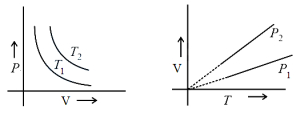
From the following plots,find the correct option.
A
$T_1 > T_2 ; P_1 > P_2$
B
$T_1 > T_2 ; P_2 > P_1$
C
$T_2 > T_1 ; P_2 > P_1$
D
$T_2 > T_1 ; P_1 > P_2$
Solution
(C) For the $P-V$ graph,draw a line parallel to the $V$-axis (constant $P$). At a constant pressure,the volume $V$ is directly proportional to the temperature $T$ $(V \propto T)$. Since the curve for $T_2$ is at a higher volume than $T_1$ for the same pressure,we have $T_2 > T_1$.
For the $V-T$ graph,the equation is $V = (\frac{nR}{P})T$. The slope of the line is $\frac{nR}{P}$,which is inversely proportional to the pressure $P$. Since the slope of the line for $P_1$ is smaller than the slope of the line for $P_2$,it follows that $P_1 > P_2$.
For the $V-T$ graph,the equation is $V = (\frac{nR}{P})T$. The slope of the line is $\frac{nR}{P}$,which is inversely proportional to the pressure $P$. Since the slope of the line for $P_1$ is smaller than the slope of the line for $P_2$,it follows that $P_1 > P_2$.
0 likesView Solution
167
ChemistryMediumMCQAP EAMCET · 2022
What is the density of one mole of $He$ (molar mass $= 4 \ g \ mol^{-1}$) at $300 \ K$ and a pressure of $0.82 \ atm$? $(R = 0.082 \ L \ atm \ mol^{-1} \ K^{-1})$
A
$1.33 \times 10^{-2} \ g \ mL^{-1}$
B
$1.33 \times 10^{-2} \ g \ L^{-1}$
C
$1.33 \times 10^{-1} \ g \ L^{-1}$
D
$1.33 \times 10^{-1} \ g \ mL^{-1}$
Solution
(C) From the ideal gas equation,$PV = nRT$.
Since $n = \frac{m}{M}$,we have $PV = \frac{m}{M} RT$.
Rearranging for density $d = \frac{m}{V}$,we get $d = \frac{PM}{RT}$.
Given: $P = 0.82 \ atm$,$M = 4 \ g \ mol^{-1}$,$R = 0.082 \ L \ atm \ mol^{-1} \ K^{-1}$,and $T = 300 \ K$.
Substituting the values: $d = \frac{0.82 \times 4}{0.082 \times 300} = \frac{4}{30} = 0.1333 \ g \ L^{-1} = 1.33 \times 10^{-1} \ g \ L^{-1}$.
Since $n = \frac{m}{M}$,we have $PV = \frac{m}{M} RT$.
Rearranging for density $d = \frac{m}{V}$,we get $d = \frac{PM}{RT}$.
Given: $P = 0.82 \ atm$,$M = 4 \ g \ mol^{-1}$,$R = 0.082 \ L \ atm \ mol^{-1} \ K^{-1}$,and $T = 300 \ K$.
Substituting the values: $d = \frac{0.82 \times 4}{0.082 \times 300} = \frac{4}{30} = 0.1333 \ g \ L^{-1} = 1.33 \times 10^{-1} \ g \ L^{-1}$.
0 likesView Solution
168
ChemistryEasyMCQAP EAMCET · 2022
The ratio of rates of diffusion of helium $(He)$ to hydrogen $(H_2)$.
A
$1 : \sqrt{2}$
B
$1 : 2$
C
$1 : 4$
D
$1 : 1.229$
Solution
(A) According to Graham's Law of diffusion,the rate of diffusion $(r)$ is inversely proportional to the square root of the molar mass $(M)$: $r \propto \frac{1}{\sqrt{M}}$.
Molecular mass of $H_2$ $(M_{H_2})$ = $2 \ g/mol$.
Molecular mass of $He$ $(M_{He})$ = $4 \ g/mol$.
$\frac{r_{He}}{r_{H_2}} = \sqrt{\frac{M_{H_2}}{M_{He}}} = \sqrt{\frac{2}{4}} = \sqrt{\frac{1}{2}} = \frac{1}{\sqrt{2}}$.
Therefore,the ratio is $1 : \sqrt{2}$.
Molecular mass of $H_2$ $(M_{H_2})$ = $2 \ g/mol$.
Molecular mass of $He$ $(M_{He})$ = $4 \ g/mol$.
$\frac{r_{He}}{r_{H_2}} = \sqrt{\frac{M_{H_2}}{M_{He}}} = \sqrt{\frac{2}{4}} = \sqrt{\frac{1}{2}} = \frac{1}{\sqrt{2}}$.
Therefore,the ratio is $1 : \sqrt{2}$.
0 likesView Solution
169
ChemistryMediumMCQAP EAMCET · 2022
The density of methane is maximum under which conditions?
A
$0^{\circ} C$,$2 \ bar$
B
$273^{\circ} C$,$1 \ bar$
C
$273^{\circ} C$,$2 \ bar$
D
$0^{\circ} C$,$3 \ bar$
Solution
(D) The density $(d)$ of an ideal gas is given by the formula $d = \frac{PM}{RT}$,where $P$ is pressure,$M$ is molar mass,$R$ is the gas constant,and $T$ is temperature in Kelvin.
From this relation,$d \propto \frac{P}{T}$.
To maximize density,we need the highest pressure $(P)$ and the lowest temperature $(T)$.
Comparing the options:
$A$: $T = 273 \ K, P = 2 \ bar \implies \frac{P}{T} = \frac{2}{273} \approx 0.0073$
$B$: $T = 546 \ K, P = 1 \ bar \implies \frac{P}{T} = \frac{1}{546} \approx 0.0018$
$C$: $T = 546 \ K, P = 2 \ bar \implies \frac{P}{T} = \frac{2}{546} \approx 0.0036$
$D$: $T = 273 \ K, P = 3 \ bar \implies \frac{P}{T} = \frac{3}{273} \approx 0.0109$
Thus,the density is maximum at $0^{\circ} C$ and $3 \ bar$.
From this relation,$d \propto \frac{P}{T}$.
To maximize density,we need the highest pressure $(P)$ and the lowest temperature $(T)$.
Comparing the options:
$A$: $T = 273 \ K, P = 2 \ bar \implies \frac{P}{T} = \frac{2}{273} \approx 0.0073$
$B$: $T = 546 \ K, P = 1 \ bar \implies \frac{P}{T} = \frac{1}{546} \approx 0.0018$
$C$: $T = 546 \ K, P = 2 \ bar \implies \frac{P}{T} = \frac{2}{546} \approx 0.0036$
$D$: $T = 273 \ K, P = 3 \ bar \implies \frac{P}{T} = \frac{3}{273} \approx 0.0109$
Thus,the density is maximum at $0^{\circ} C$ and $3 \ bar$.
0 likesView Solution
170
ChemistryDifficultMCQAP EAMCET · 2022
$300 \ mL$ of a gas '$x$' of molar mass $32 \ g \ mol^{-1}$ is effused in $25 \ s$. What volume of methane would effuse in the same time (in $mL$)?
A
$624$
B
$524$
C
$32$
D
$424$
Solution
(D) According to Graham's Law of diffusion,the rate of effusion $(r)$ is inversely proportional to the square root of the molar mass $(M)$: $r \propto \frac{1}{\sqrt{M}}$.
Since the time taken is the same for both gases,the ratio of the rates of effusion is equal to the ratio of the volumes effused $(V)$: $\frac{r_x}{r_{CH_4}} = \frac{V_x}{V_{CH_4}}$.
Therefore,$\frac{V_x}{V_{CH_4}} = \sqrt{\frac{M_{CH_4}}{M_x}}$.
Given: $V_x = 300 \ mL$,$M_x = 32 \ g \ mol^{-1}$,$M_{CH_4} = 16 \ g \ mol^{-1}$.
Substituting the values: $\frac{300}{V_{CH_4}} = \sqrt{\frac{16}{32}} = \sqrt{\frac{1}{2}} = \frac{1}{1.414}$.
$V_{CH_4} = 300 \times 1.414 = 424.26 \ mL \approx 424 \ mL$.
Since the time taken is the same for both gases,the ratio of the rates of effusion is equal to the ratio of the volumes effused $(V)$: $\frac{r_x}{r_{CH_4}} = \frac{V_x}{V_{CH_4}}$.
Therefore,$\frac{V_x}{V_{CH_4}} = \sqrt{\frac{M_{CH_4}}{M_x}}$.
Given: $V_x = 300 \ mL$,$M_x = 32 \ g \ mol^{-1}$,$M_{CH_4} = 16 \ g \ mol^{-1}$.
Substituting the values: $\frac{300}{V_{CH_4}} = \sqrt{\frac{16}{32}} = \sqrt{\frac{1}{2}} = \frac{1}{1.414}$.
$V_{CH_4} = 300 \times 1.414 = 424.26 \ mL \approx 424 \ mL$.
0 likesView Solution
171
ChemistryEasyMCQAP EAMCET · 2022
Find the false statement for ideal gases.
A
Kinetic energy of $1 \ mol$ of gas depends on mass of the gas molecule.
B
Kinetic energy increases with increase in temperature.
C
Kinetic energy of $1 \ g$ of $H_2$ is higher than that of $8 \ g$ of $O_2$ at the same temperature.
D
At a given temperature,kinetic energy does not depend on the pressure of the gas.
Solution
(A) The average kinetic energy of an ideal gas is given by $K.E. = \frac{3}{2} nRT$ for $n$ moles of gas.
For $1 \ mol$ of any ideal gas,$K.E. = \frac{3}{2} RT$.
This shows that the kinetic energy of $1 \ mol$ of an ideal gas depends only on the temperature $T$ and is independent of the nature of the gas (mass of the molecule).
Therefore,the statement that kinetic energy depends on the mass of the gas molecule is false.
For $1 \ mol$ of any ideal gas,$K.E. = \frac{3}{2} RT$.
This shows that the kinetic energy of $1 \ mol$ of an ideal gas depends only on the temperature $T$ and is independent of the nature of the gas (mass of the molecule).
Therefore,the statement that kinetic energy depends on the mass of the gas molecule is false.
0 likesView Solution
172
ChemistryMediumMCQAP EAMCET · 2022
If two gases $CH_4$ and $SO_2$ are allowed to enter from the two ends of a $1 \ km$ long vacuum tube at the same time,where will the gases meet from the $CH_4$ end (in $m$)?
A
$500$
B
$620$
C
$667$
D
$720$
Solution
(C) According to Graham's Law of Diffusion,the rate of diffusion $r$ is inversely proportional to the square root of the molar mass $M$: $r \propto \frac{1}{\sqrt{M}}$.
Let $d_1$ be the distance traveled by $CH_4$ and $d_2$ be the distance traveled by $SO_2$.
Since they start at the same time and meet at time $t$,the ratio of distances is equal to the ratio of their rates of diffusion: $\frac{d_1}{d_2} = \frac{r_{CH_4}}{r_{SO_2}} = \sqrt{\frac{M_{SO_2}}{M_{CH_4}}}$.
Given $M_{CH_4} = 16 \ g/mol$ and $M_{SO_2} = 64 \ g/mol$.
$\frac{d_1}{d_2} = \sqrt{\frac{64}{16}} = \sqrt{4} = 2$.
So,$d_1 = 2d_2$.
Since the total length is $1 \ km = 1000 \ m$,$d_1 + d_2 = 1000$.
Substituting $d_2 = \frac{d_1}{2}$,we get $d_1 + \frac{d_1}{2} = 1000$.
$\frac{3d_1}{2} = 1000 \implies d_1 = \frac{2000}{3} \approx 667 \ m$.
Let $d_1$ be the distance traveled by $CH_4$ and $d_2$ be the distance traveled by $SO_2$.
Since they start at the same time and meet at time $t$,the ratio of distances is equal to the ratio of their rates of diffusion: $\frac{d_1}{d_2} = \frac{r_{CH_4}}{r_{SO_2}} = \sqrt{\frac{M_{SO_2}}{M_{CH_4}}}$.
Given $M_{CH_4} = 16 \ g/mol$ and $M_{SO_2} = 64 \ g/mol$.
$\frac{d_1}{d_2} = \sqrt{\frac{64}{16}} = \sqrt{4} = 2$.
So,$d_1 = 2d_2$.
Since the total length is $1 \ km = 1000 \ m$,$d_1 + d_2 = 1000$.
Substituting $d_2 = \frac{d_1}{2}$,we get $d_1 + \frac{d_1}{2} = 1000$.
$\frac{3d_1}{2} = 1000 \implies d_1 = \frac{2000}{3} \approx 667 \ m$.
0 likesView Solution
173
ChemistryMediumMCQAP EAMCET · 2022
$A$ car airbag is inflated by $N_2$ produced during rapid decomposition of $NaN_{3(s)}$. What will be the pressure of the inflated airbag if $130 \ g$ of $NaN_3$ is used (in $atm$)? The volume of the airbag is $10 \ L$ $(T = 300 \ K, R = 0.082 \ L \ atm \ K^{-1} \ mol^{-1})$.
A
$7.38$
B
$4.92$
C
$3.0$
D
$9.84$
Solution
(A) The chemical equation for the decomposition of sodium azide is: $2 NaN_{3(s)} \rightarrow 2 Na_{(s)} + 3 N_{2(g)}$.
Given mass of $NaN_3 = 130 \ g$. Molar mass of $NaN_3 = 23 + (3 \times 14) = 65 \ g \ mol^{-1}$.
Number of moles of $NaN_3 = \frac{130 \ g}{65 \ g \ mol^{-1}} = 2 \ mol$.
According to the stoichiometry,$2 \ mol$ of $NaN_3$ produces $3 \ mol$ of $N_2$ gas.
Using the ideal gas equation $PV = nRT$,where $n = 3 \ mol$,$V = 10 \ L$,$T = 300 \ K$,and $R = 0.082 \ L \ atm \ K^{-1} \ mol^{-1}$:
$P = \frac{nRT}{V} = \frac{3 \times 0.082 \times 300}{10} = \frac{73.8}{10} = 7.38 \ atm$.
Given mass of $NaN_3 = 130 \ g$. Molar mass of $NaN_3 = 23 + (3 \times 14) = 65 \ g \ mol^{-1}$.
Number of moles of $NaN_3 = \frac{130 \ g}{65 \ g \ mol^{-1}} = 2 \ mol$.
According to the stoichiometry,$2 \ mol$ of $NaN_3$ produces $3 \ mol$ of $N_2$ gas.
Using the ideal gas equation $PV = nRT$,where $n = 3 \ mol$,$V = 10 \ L$,$T = 300 \ K$,and $R = 0.082 \ L \ atm \ K^{-1} \ mol^{-1}$:
$P = \frac{nRT}{V} = \frac{3 \times 0.082 \times 300}{10} = \frac{73.8}{10} = 7.38 \ atm$.
0 likesView Solution
174
ChemistryEasyMCQAP EAMCET · 2022
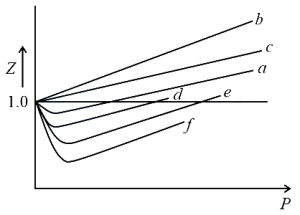
Among the gases $a$,$b$,$c$,$d$,$e$ and $f$,the gases that show only positive deviation from ideal behavior at all pressures in the graph are
A
$a$,$b$,$c$ only
B
$b$,$c$ only
C
$d$,$e$ only
D
$d$,$e$,$f$ only
Solution
(A) In the graph of compressibility factor $Z$ versus pressure $P$,a positive deviation from ideal behavior occurs when $Z > 1$.
This indicates that the gas is less compressible than an ideal gas.
From the given graph,the curves for gases $a$,$b$,and $c$ lie entirely above the line $Z = 1$ for all pressures.
Therefore,gases $a$,$b$,and $c$ show only positive deviation from ideal behavior.
This indicates that the gas is less compressible than an ideal gas.
From the given graph,the curves for gases $a$,$b$,and $c$ lie entirely above the line $Z = 1$ for all pressures.
Therefore,gases $a$,$b$,and $c$ show only positive deviation from ideal behavior.
0 likesView Solution
175
ChemistryMediumMCQAP EAMCET · 2022
Identify the correct variation of pressure $(p)$ and volume $(V)$ of a real gas $(A)$ and an ideal gas $(B)$ at constant temperature. ($y = p$; $x = V$)
A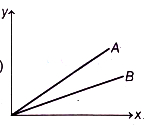
B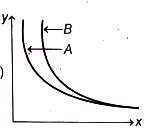
C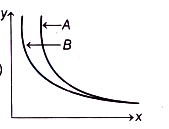
D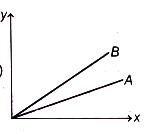
Solution
(C) The ideal gas equation is $pV = nRT$. At constant temperature,$p = \frac{nRT}{V}$,which represents a rectangular hyperbola $(p \propto \frac{1}{V})$.
For a real gas,the behavior deviates from the ideal gas law due to intermolecular forces and finite molecular volume.
At high pressures,the volume of a real gas is greater than that of an ideal gas because of the excluded volume effect ($V_{real} > V_{ideal}$ for a given $p$).
Therefore,for a fixed pressure,the curve for the real gas $(A)$ lies above the curve for the ideal gas $(B)$ in the $p$ vs $V$ plot.
This corresponds to the plot shown in option $C$.
For a real gas,the behavior deviates from the ideal gas law due to intermolecular forces and finite molecular volume.
At high pressures,the volume of a real gas is greater than that of an ideal gas because of the excluded volume effect ($V_{real} > V_{ideal}$ for a given $p$).
Therefore,for a fixed pressure,the curve for the real gas $(A)$ lies above the curve for the ideal gas $(B)$ in the $p$ vs $V$ plot.
This corresponds to the plot shown in option $C$.
0 likesView Solution
176
ChemistryEasyMCQAP EAMCET · 2022
While passing through an applied magnetic field,which of the following undergoes the maximum deflection?
A
Stream of $\alpha$-particles
B
Stream of $\beta$-particles
C
$\gamma$-rays
D
Stream of neutrons
Solution
(B) The deflection of a charged particle in a magnetic field is given by the Lorentz force,$F = qvB \sin \theta$,and the resulting acceleration is $a = F/m = (qvB \sin \theta)/m$.
Since the deflection is proportional to the charge-to-mass ratio $(q/m)$,the particle with the highest $q/m$ ratio will undergo the maximum deflection.
$\alpha$-particles $(He^{2+})$ have a mass of approximately $4 \ amu$ and a charge of $+2$.
$\beta$-particles $(e^-)$ have a mass of approximately $1/1837 \ amu$ and a charge of $-1$.
$\gamma$-rays are electromagnetic radiation with no charge and no mass,so they show no deflection.
Neutrons have no charge,so they show no deflection.
Comparing the $q/m$ ratios,the $\beta$-particle has a significantly higher $q/m$ ratio than the $\alpha$-particle,leading to maximum deflection.
Since the deflection is proportional to the charge-to-mass ratio $(q/m)$,the particle with the highest $q/m$ ratio will undergo the maximum deflection.
$\alpha$-particles $(He^{2+})$ have a mass of approximately $4 \ amu$ and a charge of $+2$.
$\beta$-particles $(e^-)$ have a mass of approximately $1/1837 \ amu$ and a charge of $-1$.
$\gamma$-rays are electromagnetic radiation with no charge and no mass,so they show no deflection.
Neutrons have no charge,so they show no deflection.
Comparing the $q/m$ ratios,the $\beta$-particle has a significantly higher $q/m$ ratio than the $\alpha$-particle,leading to maximum deflection.
0 likesView Solution
177
ChemistryEasyMCQAP EAMCET · 2022
Among the ions $O^{2-}, Na^{+}, F^{-}, N^{3-}, Mg^{2+}$,the ions with the smallest and largest radii are respectively:
A
$F^{-}, N^{3-}$
B
$Mg^{2+}, N^{3-}$
C
$Na^{+}, F^{-}$
D
$F^{-}, Na^{+}$
Solution
(B) The given ions $O^{2-}, Na^{+}, F^{-}, N^{3-}, Mg^{2+}$ are isoelectronic species,as each contains $10$ electrons.
For isoelectronic species,the ionic radius decreases as the nuclear charge (number of protons) increases.
The number of protons in these ions are: $N^{3-} (7), O^{2-} (8), F^{-} (9), Na^{+} (11), Mg^{2+} (12)$.
Since $Mg^{2+}$ has the highest nuclear charge ($12$ protons),it has the smallest ionic radius.
Since $N^{3-}$ has the lowest nuclear charge ($7$ protons),it has the largest ionic radius.
Therefore,the ions with the smallest and largest radii are $Mg^{2+}$ and $N^{3-}$ respectively.
For isoelectronic species,the ionic radius decreases as the nuclear charge (number of protons) increases.
The number of protons in these ions are: $N^{3-} (7), O^{2-} (8), F^{-} (9), Na^{+} (11), Mg^{2+} (12)$.
Since $Mg^{2+}$ has the highest nuclear charge ($12$ protons),it has the smallest ionic radius.
Since $N^{3-}$ has the lowest nuclear charge ($7$ protons),it has the largest ionic radius.
Therefore,the ions with the smallest and largest radii are $Mg^{2+}$ and $N^{3-}$ respectively.
0 likesView Solution
178
ChemistryEasyMCQAP EAMCET · 2022
The correct order of atomic radii of the elements $O$,$N$,$S$ and $P$ is
A
$N < P < S < O$
B
$N < O < P < S$
C
$O < N < P < S$
D
$O < N < S < P$
Solution
(D) The atomic radius decreases on moving from left to right in a period because the effective nuclear charge increases while the number of shells remains the same. Thus,the size of $O < N$ and $S < P$.
On moving down a group,the atomic radius increases due to the addition of a new shell. Thus,the size of $O < S$ and $N < P$.
Combining these trends,we compare the elements: $O$ and $N$ are in the $2^{nd}$ period,while $S$ and $P$ are in the $3^{rd}$ period.
Since $O < N$ and $S < P$,and elements in the $2^{nd}$ period are smaller than those in the $3^{rd}$ period,the overall order is $O < N < S < P$.
On moving down a group,the atomic radius increases due to the addition of a new shell. Thus,the size of $O < S$ and $N < P$.
Combining these trends,we compare the elements: $O$ and $N$ are in the $2^{nd}$ period,while $S$ and $P$ are in the $3^{rd}$ period.
Since $O < N$ and $S < P$,and elements in the $2^{nd}$ period are smaller than those in the $3^{rd}$ period,the overall order is $O < N < S < P$.
0 likesView Solution
179
ChemistryEasyMCQAP EAMCET · 2022
The energy required (in $eV$) to excite an electron of $H$-atom from the ground state to the third excited state is
A
$+0.85$
B
$-3.4$
C
$12.1$
D
$-12.1$
Solution
(C) The energy of an electron in the $n^{th}$ orbit of a hydrogen-like atom is given by $E_n = \frac{-13.6 \ Z^2}{n^2} \ eV$.
For the ground state $(n=1)$ of $H$-atom $(Z=1)$: $E_1 = \frac{-13.6 \times 1^2}{1^2} = -13.6 \ eV$.
The third excited state corresponds to $n=4$ (since $n=1$ is ground,$n=2$ is first excited,$n=3$ is second excited,and $n=4$ is third excited).
$E_4 = \frac{-13.6 \times 1^2}{4^2} = \frac{-13.6}{16} = -0.85 \ eV$.
The energy required for excitation is $\Delta E = E_4 - E_1 = -0.85 - (-13.6) = 12.75 \ eV$.
Note: If the question implies the third state $(n=3)$,then $\Delta E = E_3 - E_1 = -1.51 - (-13.6) = 12.09 \ eV \approx 12.1 \ eV$. Given the options,the question refers to the third state $(n=3)$.
For the ground state $(n=1)$ of $H$-atom $(Z=1)$: $E_1 = \frac{-13.6 \times 1^2}{1^2} = -13.6 \ eV$.
The third excited state corresponds to $n=4$ (since $n=1$ is ground,$n=2$ is first excited,$n=3$ is second excited,and $n=4$ is third excited).
$E_4 = \frac{-13.6 \times 1^2}{4^2} = \frac{-13.6}{16} = -0.85 \ eV$.
The energy required for excitation is $\Delta E = E_4 - E_1 = -0.85 - (-13.6) = 12.75 \ eV$.
Note: If the question implies the third state $(n=3)$,then $\Delta E = E_3 - E_1 = -1.51 - (-13.6) = 12.09 \ eV \approx 12.1 \ eV$. Given the options,the question refers to the third state $(n=3)$.
0 likesView Solution
180
ChemistryEasyMCQAP EAMCET · 2022
The wavelength associated with the electron moving in the first orbit of hydrogen atom with velocity $2.2 \times 10^6 \ ms^{-1}$ (in $nm$) is $\left(m_e=9.0 \times 10^{-31} \ kg, h=6.6 \times 10^{-34} \ Js\right)$
A
$0.66$
B
$0.33$
C
$0.22$
D
$0.44$
Solution
(B) According to de-Broglie's equation,$\lambda = \frac{h}{mv}$.
Given:
$h = 6.6 \times 10^{-34} \ Js$
$m = 9.0 \times 10^{-31} \ kg$
$v = 2.2 \times 10^6 \ ms^{-1}$
Substituting the values:
$\lambda = \frac{6.6 \times 10^{-34}}{9.0 \times 10^{-31} \times 2.2 \times 10^6}$
$\lambda = \frac{6.6}{19.8} \times 10^{-34+31-6} \ m$
$\lambda = 0.333 \times 10^{-9} \ m$
Since $1 \ nm = 10^{-9} \ m$,the wavelength is $0.33 \ nm$.
Given:
$h = 6.6 \times 10^{-34} \ Js$
$m = 9.0 \times 10^{-31} \ kg$
$v = 2.2 \times 10^6 \ ms^{-1}$
Substituting the values:
$\lambda = \frac{6.6 \times 10^{-34}}{9.0 \times 10^{-31} \times 2.2 \times 10^6}$
$\lambda = \frac{6.6}{19.8} \times 10^{-34+31-6} \ m$
$\lambda = 0.333 \times 10^{-9} \ m$
Since $1 \ nm = 10^{-9} \ m$,the wavelength is $0.33 \ nm$.
0 likesView Solution
181
ChemistryDifficultMCQAP EAMCET · 2022
The wavelength of the electron in the ground state of a hydrogen atom is $y \ \mathring{A}$. What is the wavelength of the electron in the fourth orbit of $He^{+}$ ion (in $\mathring{A}$)?
A
$2 y$
B
$3 y$
C
$y$
D
$\frac{3 y}{2}$
Solution
(A) The de Broglie wavelength is given by $\lambda = \frac{h}{mv}$.
For an electron in the $n^{th}$ orbit of a hydrogen-like species,the velocity $v$ is proportional to $\frac{Z}{n}$.
Since the circumference of the orbit is $2 \pi r = n \lambda$ and $r \propto \frac{n^2}{Z}$,we have $\lambda = \frac{2 \pi r}{n} \propto \frac{n^2/Z}{n} = \frac{n}{Z}$.
For the $H$-atom $(Z=1)$ in the ground state $(n=1)$: $\lambda_1 \propto \frac{1}{1} = 1$. Given $\lambda_1 = y$.
For the $He^{+}$ ion $(Z=2)$ in the fourth orbit $(n=4)$: $\lambda_2 \propto \frac{4}{2} = 2$.
Therefore,$\frac{\lambda_2}{\lambda_1} = \frac{2}{1} = 2$,which implies $\lambda_2 = 2 y$.
For an electron in the $n^{th}$ orbit of a hydrogen-like species,the velocity $v$ is proportional to $\frac{Z}{n}$.
Since the circumference of the orbit is $2 \pi r = n \lambda$ and $r \propto \frac{n^2}{Z}$,we have $\lambda = \frac{2 \pi r}{n} \propto \frac{n^2/Z}{n} = \frac{n}{Z}$.
For the $H$-atom $(Z=1)$ in the ground state $(n=1)$: $\lambda_1 \propto \frac{1}{1} = 1$. Given $\lambda_1 = y$.
For the $He^{+}$ ion $(Z=2)$ in the fourth orbit $(n=4)$: $\lambda_2 \propto \frac{4}{2} = 2$.
Therefore,$\frac{\lambda_2}{\lambda_1} = \frac{2}{1} = 2$,which implies $\lambda_2 = 2 y$.
0 likesView Solution
182
ChemistryMediumMCQAP EAMCET · 2022
The velocity of the electron in Bohr's first orbit is $x \times 10^6 \ m \ s^{-1}$. The de-Broglie wavelength associated with it (in $nm$) is $(m_e = 9 \times 10^{-31} \ kg, h = 6.6 \times 10^{-34} \ J \ s)$
A
$\frac{x}{1.43}$
B
$\frac{x}{0.73}$
C
$\frac{0.73}{x}$
D
$\frac{0.073}{x}$
Solution
(C) According to de-Broglie's equation,$\lambda = \frac{h}{m_e v}$.
Given values are $h = 6.6 \times 10^{-34} \ J \ s$,$m_e = 9 \times 10^{-31} \ kg$,and $v = x \times 10^6 \ m \ s^{-1}$.
Substituting these values into the equation:
$\lambda = \frac{6.6 \times 10^{-34}}{9 \times 10^{-31} \times x \times 10^6} \ m$
$\lambda = \frac{6.6}{9} \times 10^{-34 + 31 - 6} \times \frac{1}{x} \ m$
$\lambda = 0.733 \times 10^{-9} \times \frac{1}{x} \ m$
Since $1 \ m = 10^9 \ nm$,we have:
$\lambda = 0.733 \times 10^{-9} \times \frac{1}{x} \times 10^9 \ nm$
$\lambda = \frac{0.733}{x} \ nm \approx \frac{0.73}{x} \ nm$.
Given values are $h = 6.6 \times 10^{-34} \ J \ s$,$m_e = 9 \times 10^{-31} \ kg$,and $v = x \times 10^6 \ m \ s^{-1}$.
Substituting these values into the equation:
$\lambda = \frac{6.6 \times 10^{-34}}{9 \times 10^{-31} \times x \times 10^6} \ m$
$\lambda = \frac{6.6}{9} \times 10^{-34 + 31 - 6} \times \frac{1}{x} \ m$
$\lambda = 0.733 \times 10^{-9} \times \frac{1}{x} \ m$
Since $1 \ m = 10^9 \ nm$,we have:
$\lambda = 0.733 \times 10^{-9} \times \frac{1}{x} \times 10^9 \ nm$
$\lambda = \frac{0.733}{x} \ nm \approx \frac{0.73}{x} \ nm$.
0 likesView Solution
183
ChemistryEasyMCQAP EAMCET · 2022
The ratio of radii of the second orbit of a hydrogen atom to the fourth orbit of a $He^{+}$ ion is:
A
$1: 4$
B
$2: 1$
C
$1: 2$
D
$2: 3$
Solution
(C) For hydrogen and hydrogen-like atoms,the radius of the $n^{th}$ orbit is given by the formula: $r_n \propto \frac{n^2}{Z}$,where $n$ is the orbit number and $Z$ is the atomic number.
For a hydrogen atom $(H)$,$Z = 1$. The radius of the second orbit $(n = 2)$ is $r_2 = \frac{2^2}{1} = 4$.
For a helium ion $(He^{+})$,$Z = 2$. The radius of the fourth orbit $(n = 4)$ is $r_4 = \frac{4^2}{2} = \frac{16}{2} = 8$.
The ratio of the radii is $\frac{r_2}{r_4} = \frac{4}{8} = \frac{1}{2}$,which is $1: 2$.
For a hydrogen atom $(H)$,$Z = 1$. The radius of the second orbit $(n = 2)$ is $r_2 = \frac{2^2}{1} = 4$.
For a helium ion $(He^{+})$,$Z = 2$. The radius of the fourth orbit $(n = 4)$ is $r_4 = \frac{4^2}{2} = \frac{16}{2} = 8$.
The ratio of the radii is $\frac{r_2}{r_4} = \frac{4}{8} = \frac{1}{2}$,which is $1: 2$.
0 likesView Solution
184
ChemistryMediumMCQAP EAMCET · 2022
The radius of the first orbit of $Li^{2+}$ is $X \mathring{A}$. The radius of the third orbit of $He^{+}$ (in $\mathring{A}$) is (in $X$)
A
$9$
B
$6$
C
$13.5$
D
$4.5$
Solution
(C) The radius of the $n^{th}$ orbit of a hydrogen-like species is given by $r_n = 0.529 \times \frac{n^2}{Z} \mathring{A}$.
For $Li^{2+}$,$n = 1$ and $Z = 3$,so $r_{Li^{2+}} = 0.529 \times \frac{1^2}{3} = X \mathring{A}$.
This implies $0.529 = 3X$.
For $He^{+}$,$n = 3$ and $Z = 2$,so $r_{He^{+}} = 0.529 \times \frac{3^2}{2} = 0.529 \times \frac{9}{2} \mathring{A}$.
Substituting $0.529 = 3X$ into the expression for $r_{He^{+}}$:
$r_{He^{+}} = (3X) \times \frac{9}{2} = \frac{27}{2} X = 13.5X \mathring{A}$.
For $Li^{2+}$,$n = 1$ and $Z = 3$,so $r_{Li^{2+}} = 0.529 \times \frac{1^2}{3} = X \mathring{A}$.
This implies $0.529 = 3X$.
For $He^{+}$,$n = 3$ and $Z = 2$,so $r_{He^{+}} = 0.529 \times \frac{3^2}{2} = 0.529 \times \frac{9}{2} \mathring{A}$.
Substituting $0.529 = 3X$ into the expression for $r_{He^{+}}$:
$r_{He^{+}} = (3X) \times \frac{9}{2} = \frac{27}{2} X = 13.5X \mathring{A}$.
0 likesView Solution
185
ChemistryEasyMCQAP EAMCET · 2022
The spectral series formed when electrons of excited hydrogen atoms return to the third orbit from higher energy orbits is
A
Lyman series
B
Paschen series
C
Brackett series
D
Pfund series
Solution
(B)
When electrons return to the $n = 3$ orbit from higher energy levels $(n_2 > 3)$,the resulting spectral series is known as the Paschen series.
| \text{Name of spectral series} | \text{Excited electrons of hydrogen return to orbit number} |
|---|---|
| \text{Lyman series} | $1$ |
| \text{Balmer series} | $2$ |
| \text{Paschen series} | $3$ |
| \text{Brackett series} | $4$ |
| \text{Pfund series} | $5$ |
When electrons return to the $n = 3$ orbit from higher energy levels $(n_2 > 3)$,the resulting spectral series is known as the Paschen series.
0 likesView Solution
186
ChemistryMediumMCQAP EAMCET · 2022
If $\Delta x$ is the uncertainty in position and $\Delta v$ is the uncertainty in velocity of a particle are equal,the correct expression for uncertainty in momentum for the same particle is
A
$\frac{1}{4} \sqrt{\frac{m h}{\pi}}$
B
$\frac{1}{3} \sqrt{\frac{m h}{2 \pi}}$
C
$\frac{1}{2} \sqrt{\frac{m h}{\pi}}$
D
$\frac{1}{2} \sqrt{\frac{h}{m \pi}}$
Solution
(C) According to Heisenberg's uncertainty principle,$\Delta x \cdot \Delta p \geq \frac{h}{4 \pi}$.
Given that the uncertainty in position $\Delta x$ is equal to the uncertainty in velocity $\Delta v$,so $\Delta x = \Delta v$.
Since $\Delta p = m \Delta v$,we can substitute $\Delta v = \Delta x$ into the uncertainty relation:
$\Delta x \cdot (m \Delta x) = \frac{h}{4 \pi}$
$m (\Delta x)^2 = \frac{h}{4 \pi}$
$(\Delta x)^2 = \frac{h}{4 \pi m}$
$\Delta x = \frac{1}{2} \sqrt{\frac{h}{\pi m}}$
Since $\Delta p = m \Delta v$ and $\Delta v = \Delta x$,then $\Delta p = m \Delta x$.
Substituting the value of $\Delta x$:
$\Delta p = m \cdot \frac{1}{2} \sqrt{\frac{h}{\pi m}}$
$\Delta p = \frac{1}{2} \sqrt{\frac{m^2 h}{\pi m}}$
$\Delta p = \frac{1}{2} \sqrt{\frac{m h}{\pi}}$
Given that the uncertainty in position $\Delta x$ is equal to the uncertainty in velocity $\Delta v$,so $\Delta x = \Delta v$.
Since $\Delta p = m \Delta v$,we can substitute $\Delta v = \Delta x$ into the uncertainty relation:
$\Delta x \cdot (m \Delta x) = \frac{h}{4 \pi}$
$m (\Delta x)^2 = \frac{h}{4 \pi}$
$(\Delta x)^2 = \frac{h}{4 \pi m}$
$\Delta x = \frac{1}{2} \sqrt{\frac{h}{\pi m}}$
Since $\Delta p = m \Delta v$ and $\Delta v = \Delta x$,then $\Delta p = m \Delta x$.
Substituting the value of $\Delta x$:
$\Delta p = m \cdot \frac{1}{2} \sqrt{\frac{h}{\pi m}}$
$\Delta p = \frac{1}{2} \sqrt{\frac{m^2 h}{\pi m}}$
$\Delta p = \frac{1}{2} \sqrt{\frac{m h}{\pi}}$
0 likesView Solution
187
ChemistryMediumMCQAP EAMCET · 2022
The wavelength of an electron in the first orbit of a hydrogen atom is $3.3 \times 10^{-10} \ m$. The kinetic energy of the electron (in $J$) is:
$(h = 6.6 \times 10^{-34} \ Js, m_{e} = 9.0 \times 10^{-31} \ kg)$
$(h = 6.6 \times 10^{-34} \ Js, m_{e} = 9.0 \times 10^{-31} \ kg)$
A
$3.33 \times 10^{-17}$
B
$1.11 \times 10^{-18}$
C
$2.22 \times 10^{-18}$
D
$2.22 \times 10^{-17}$
Solution
(C) From de-Broglie's equation:
$p = \frac{h}{\lambda}$ or $v = \frac{h}{m \lambda}$
Kinetic Energy ($K$.$E$.) $= \frac{1}{2} mv^2 = \frac{1}{2} m \left(\frac{h}{m \lambda}\right)^2 = \frac{h^2}{2m \lambda^2}$
Substituting the given values:
$K$.$E$. $= \frac{(6.6 \times 10^{-34})^2}{2 \times 9.0 \times 10^{-31} \times (3.3 \times 10^{-10})^2}$
$K$.$E$. $= \frac{43.56 \times 10^{-68}}{18.0 \times 10^{-31} \times 10.89 \times 10^{-20}}$
$K$.$E$. $= \frac{43.56 \times 10^{-68}}{196.02 \times 10^{-51}} \approx 0.222 \times 10^{-17} \ J$
$K$.$E$. $= 2.22 \times 10^{-18} \ J$
$p = \frac{h}{\lambda}$ or $v = \frac{h}{m \lambda}$
Kinetic Energy ($K$.$E$.) $= \frac{1}{2} mv^2 = \frac{1}{2} m \left(\frac{h}{m \lambda}\right)^2 = \frac{h^2}{2m \lambda^2}$
Substituting the given values:
$K$.$E$. $= \frac{(6.6 \times 10^{-34})^2}{2 \times 9.0 \times 10^{-31} \times (3.3 \times 10^{-10})^2}$
$K$.$E$. $= \frac{43.56 \times 10^{-68}}{18.0 \times 10^{-31} \times 10.89 \times 10^{-20}}$
$K$.$E$. $= \frac{43.56 \times 10^{-68}}{196.02 \times 10^{-51}} \approx 0.222 \times 10^{-17} \ J$
$K$.$E$. $= 2.22 \times 10^{-18} \ J$
0 likesView Solution
188
ChemistryEasyMCQAP EAMCET · 2022
The value of the work function of a metal $X$ is $3.1 \ eV$. What is its threshold frequency (in $Hz$)? (Given: $h = 6.62 \times 10^{-34} \ J \cdot s$)
A
$6.49 \times 10^{13}$
B
$5.49 \times 10^{13}$
C
$6.49 \times 10^{14}$
D
$7.49 \times 10^{14}$
Solution
(D) The work function $(\phi)$ is given by $\phi = h \nu_0$,where $\nu_0$ is the threshold frequency.
First,convert the work function from $eV$ to Joules:
$\phi = 3.1 \ eV = 3.1 \times 1.602 \times 10^{-19} \ J = 4.966 \times 10^{-19} \ J$.
Now,calculate the threshold frequency $\nu_0$:
$\nu_0 = \frac{\phi}{h} = \frac{4.966 \times 10^{-19} \ J}{6.62 \times 10^{-34} \ J \cdot s} \approx 7.49 \times 10^{14} \ Hz$.
First,convert the work function from $eV$ to Joules:
$\phi = 3.1 \ eV = 3.1 \times 1.602 \times 10^{-19} \ J = 4.966 \times 10^{-19} \ J$.
Now,calculate the threshold frequency $\nu_0$:
$\nu_0 = \frac{\phi}{h} = \frac{4.966 \times 10^{-19} \ J}{6.62 \times 10^{-34} \ J \cdot s} \approx 7.49 \times 10^{14} \ Hz$.
0 likesView Solution
189
ChemistryEasyMCQAP EAMCET · 2022
The work function of a metal $M$ is $6.3 \ eV$. The wavelength of the incident radiation required to just eject the electrons from its surface (in $nm$) is
A
$102$
B
$330$
C
$197$
D
$310$
Solution
(C) The work function $(\Phi)$ of the metal $M$ is $6.3 \ eV$.
To eject electrons,the energy of the incident radiation $(E)$ must be equal to the work function: $E = \Phi = 6.3 \ eV$.
Using the relation between energy in $eV$ and wavelength in $nm$:
$E (eV) = \frac{1240}{\lambda (nm)}$
Therefore,$\lambda (nm) = \frac{1240}{E (eV)} = \frac{1240}{6.3} \approx 196.8 \ nm$.
Rounding to the nearest integer,we get $197 \ nm$.
To eject electrons,the energy of the incident radiation $(E)$ must be equal to the work function: $E = \Phi = 6.3 \ eV$.
Using the relation between energy in $eV$ and wavelength in $nm$:
$E (eV) = \frac{1240}{\lambda (nm)}$
Therefore,$\lambda (nm) = \frac{1240}{E (eV)} = \frac{1240}{6.3} \approx 196.8 \ nm$.
Rounding to the nearest integer,we get $197 \ nm$.
0 likesView Solution
190
ChemistryEasyMCQAP EAMCET · 2022
Work function $(W_0)$ values of six metals (in $eV$) are given below: $Li: 2.42, Mg: 3.7, Cu: 4.8, Ag: 4.3, K: 2.25, Na: 2.3$. How many of the above metals do not eject the electrons when they are made to strike with radiation of wavelength $400 \text{ nm}$? $(h = 6.62 \times 10^{-34} \text{ Js})$
A
$4$
B
$2$
C
$3$
D
$5$
Solution
(C) The energy of the incident radiation $(E)$ is calculated using the formula: $E = \frac{hc}{\lambda}$.
Substituting the values: $E = \frac{6.62 \times 10^{-34} \times 3 \times 10^8}{400 \times 10^{-9} \times 1.6 \times 10^{-19}} \text{ eV} \approx 3.1 \text{ eV}$.
For photoemission to occur,the energy of the incident radiation must be greater than or equal to the work function $(E \ge W_0)$.
Conversely,electrons will not be ejected if the work function is greater than the incident energy $(W_0 > E)$.
Comparing the given work functions with $3.1 \text{ eV}$:
$Mg (3.7 > 3.1)$,$Cu (4.8 > 3.1)$,and $Ag (4.3 > 3.1)$ have work functions greater than $3.1 \text{ eV}$.
Therefore,$3$ metals will not eject electrons.
Substituting the values: $E = \frac{6.62 \times 10^{-34} \times 3 \times 10^8}{400 \times 10^{-9} \times 1.6 \times 10^{-19}} \text{ eV} \approx 3.1 \text{ eV}$.
For photoemission to occur,the energy of the incident radiation must be greater than or equal to the work function $(E \ge W_0)$.
Conversely,electrons will not be ejected if the work function is greater than the incident energy $(W_0 > E)$.
Comparing the given work functions with $3.1 \text{ eV}$:
$Mg (3.7 > 3.1)$,$Cu (4.8 > 3.1)$,and $Ag (4.3 > 3.1)$ have work functions greater than $3.1 \text{ eV}$.
Therefore,$3$ metals will not eject electrons.
0 likesView Solution
191
ChemistryMediumMCQAP EAMCET · 2022
The number of radial nodes and angular nodes of a $4f$-orbital are respectively:
A
$0, 3$
B
$1, 2$
C
$2, 1$
D
$2, 0$
Solution
(A) For any orbital,the number of angular nodes is equal to the azimuthal quantum number $(l)$.
For a $4f$-orbital,the principal quantum number $n = 4$ and the azimuthal quantum number $l = 3$.
Angular nodes $= l = 3$.
The number of radial nodes is given by the formula: $\text{Radial nodes} = n - l - 1$.
Substituting the values: $\text{Radial nodes} = 4 - 3 - 1 = 0$.
Therefore,the number of radial nodes is $0$ and the number of angular nodes is $3$.
For a $4f$-orbital,the principal quantum number $n = 4$ and the azimuthal quantum number $l = 3$.
Angular nodes $= l = 3$.
The number of radial nodes is given by the formula: $\text{Radial nodes} = n - l - 1$.
Substituting the values: $\text{Radial nodes} = 4 - 3 - 1 = 0$.
Therefore,the number of radial nodes is $0$ and the number of angular nodes is $3$.
0 likesView Solution
192
ChemistryMediumMCQAP EAMCET · 2022
Which quantum number provides information about the shape of an orbital?
A
Spin quantum number
B
Azimuthal quantum number
C
Magnetic quantum number
D
Principal quantum number
Solution
(B) The azimuthal quantum number $(l)$ determines the shape of the orbital.
It is a quantum number for an atomic orbital that determines its orbital angular momentum and describes its shape.
The azimuthal quantum number is the second of a set of quantum numbers representing an electron's unique quantum state.
For example,$l = 0$ represents a spherical orbital ($s$-orbital),and $l = 1$ represents a dumbbell-shaped orbital ($p$-orbital).
Hence,option $B$ is the correct answer.
It is a quantum number for an atomic orbital that determines its orbital angular momentum and describes its shape.
The azimuthal quantum number is the second of a set of quantum numbers representing an electron's unique quantum state.
For example,$l = 0$ represents a spherical orbital ($s$-orbital),and $l = 1$ represents a dumbbell-shaped orbital ($p$-orbital).
Hence,option $B$ is the correct answer.
0 likesView Solution
193
ChemistryMediumMCQAP EAMCET · 2022
The maximum number of electrons present in an orbital with $n=4, l=3$ is
A
$6$
B
$14$
C
$10$
D
$2$
Solution
(D) According to the $Pauli$ exclusion principle,any single orbital can hold a maximum of $2$ electrons with opposite spins.
The quantum numbers $n=4$ and $l=3$ specify a $4f$ subshell,which contains $7$ distinct orbitals.
However,the question asks for the maximum number of electrons in an orbital (singular),not the entire subshell.
Therefore,regardless of the values of $n$ and $l$,any single orbital can accommodate a maximum of $2$ electrons.
The quantum numbers $n=4$ and $l=3$ specify a $4f$ subshell,which contains $7$ distinct orbitals.
However,the question asks for the maximum number of electrons in an orbital (singular),not the entire subshell.
Therefore,regardless of the values of $n$ and $l$,any single orbital can accommodate a maximum of $2$ electrons.
0 likesView Solution
194
ChemistryMediumMCQAP EAMCET · 2022
Maximum number of electrons possible with spin quantum number $+\frac{1}{2}$ with principal quantum number $n=4$ in an atom is
A
$16$
B
$9$
C
$4$
D
$25$
Solution
(A) The total number of electrons in a shell with principal quantum number $n$ is given by $2n^2$.
For $n=4$,the total number of electrons is $2 \times 4^2 = 32$.
Since each orbital can hold a maximum of $2$ electrons with opposite spins ($+\frac{1}{2}$ and $-\frac{1}{2}$),exactly half of the total electrons will have a spin quantum number of $+\frac{1}{2}$.
Therefore,the number of electrons with spin $+\frac{1}{2}$ is $\frac{32}{2} = 16$.
For $n=4$,the total number of electrons is $2 \times 4^2 = 32$.
Since each orbital can hold a maximum of $2$ electrons with opposite spins ($+\frac{1}{2}$ and $-\frac{1}{2}$),exactly half of the total electrons will have a spin quantum number of $+\frac{1}{2}$.
Therefore,the number of electrons with spin $+\frac{1}{2}$ is $\frac{32}{2} = 16$.
0 likesView Solution
195
ChemistryEasyMCQAP EAMCET · 2022
The incorrect set of quantum numbers $(n, l, m, s)$ for an electron in $3p$ orbital is
A
$3, 1, -1, 1/2$
B
$3, 1, -2, -1/2$
C
$3, 1, 1, 1/2$
D
$3, 1, +1, -1/2$
Solution
(B) For an electron in a $3p$-orbital,the principal quantum number $n = 3$.
For a $p$-orbital,the azimuthal quantum number $l = 1$.
The magnetic quantum number $m$ can take values from $-l$ to $+l$,which means $m = -1, 0, +1$.
The spin quantum number $s$ can be $+1/2$ or $-1/2$.
Comparing these with the given options,in option $(b)$,the value of $m$ is given as $-2$,which is not possible for $l = 1$.
Therefore,the set $(3, 1, -2, -1/2)$ is incorrect.
For a $p$-orbital,the azimuthal quantum number $l = 1$.
The magnetic quantum number $m$ can take values from $-l$ to $+l$,which means $m = -1, 0, +1$.
The spin quantum number $s$ can be $+1/2$ or $-1/2$.
Comparing these with the given options,in option $(b)$,the value of $m$ is given as $-2$,which is not possible for $l = 1$.
Therefore,the set $(3, 1, -2, -1/2)$ is incorrect.
0 likesView Solution
196
ChemistryMediumMCQAP EAMCET · 2022
Which of the following elements has two electrons in the $Q$ shell in its ground state?
A
$Ba$
B
$Ra$
C
$La$
D
$Pb$
Solution
(B) The $Q$ shell corresponds to the principal quantum number $n=7$,which indicates the element is in the $7^{th}$ period of the periodic table.
$Ra$ (Radium) has the electronic configuration $[Rn] 7s^2$,meaning it has two electrons in the $7^{th}$ $(Q)$ shell.
$Ra$ (Radium) has the electronic configuration $[Rn] 7s^2$,meaning it has two electrons in the $7^{th}$ $(Q)$ shell.
0 likesView Solution
197
ChemistryEasyMCQAP EAMCET · 2022
The sum of electrons present in all subshells of an atom with $m_s$ value of $+\frac{1}{2}$ for $n=4$ and $m_s$ value of $-\frac{1}{2}$ for $n=3$ is
A
$25$
B
$16$
C
$09$
D
$32$
Solution
(A) The maximum number of electrons in a shell with principal quantum number $n$ is given by $2n^2$.
For $n=4$,the total number of electrons is $2(4)^2 = 32$. The number of electrons with $m_s = +\frac{1}{2}$ is $32/2 = 16$.
For $n=3$,the total number of electrons is $2(3)^2 = 18$. The number of electrons with $m_s = -\frac{1}{2}$ is $18/2 = 9$.
The sum of these electrons is $16 + 9 = 25$.
For $n=4$,the total number of electrons is $2(4)^2 = 32$. The number of electrons with $m_s = +\frac{1}{2}$ is $32/2 = 16$.
For $n=3$,the total number of electrons is $2(3)^2 = 18$. The number of electrons with $m_s = -\frac{1}{2}$ is $18/2 = 9$.
The sum of these electrons is $16 + 9 = 25$.
0 likesView Solution
198
ChemistryEasyMCQAP EAMCET · 2022
An element has $d^5$ configuration. The total number of electron exchanges possible for it is
A
$18$
B
$10$
C
$12$
D
$15$
Solution
(B) The total number of electron exchanges is given by the formula $\frac{n(n-1)}{2}$,where $n$ is the number of electrons with the same spin in the same subshell.
For a $d^5$ configuration,all $5$ electrons have the same spin (parallel spin) in $5$ different orbitals.
Substituting $n = 5$ into the formula:
$\text{Total exchanges} = \frac{5(5-1)}{2} = \frac{5 \times 4}{2} = \frac{20}{2} = 10$.
For a $d^5$ configuration,all $5$ electrons have the same spin (parallel spin) in $5$ different orbitals.
Substituting $n = 5$ into the formula:
$\text{Total exchanges} = \frac{5(5-1)}{2} = \frac{5 \times 4}{2} = \frac{20}{2} = 10$.
0 likesView Solution
199
ChemistryEasyMCQAP EAMCET · 2022
The general formula of zeolite is $Na_2 Z$. In this,'$Z$' represents:
A
$AlSi_2 O_8 \cdot x H_2 O$
B
$Al_3 Si_2 O_8 \cdot x H_2 O$
C
$Al_2 Si_2 O_8 \cdot x H_2 O$
D
$AlO_2 \cdot x H_2 O$
Solution
(C) Zeolites are hydrated sodium alumino silicates which can be represented by the general formula $Na_2 Z$,where $Z = Al_2 Si_2 O_8 \cdot x H_2 O$.
Thus,the correct representation for '$Z$' is $Al_2 Si_2 O_8 \cdot x H_2 O$.
Thus,the correct representation for '$Z$' is $Al_2 Si_2 O_8 \cdot x H_2 O$.
0 likesView Solution
200
ChemistryEasyMCQAP EAMCET · 2022
Observe the following properties: Volume,enthalpy,density,temperature,heat capacity,pressure,internal energy. The number of extensive properties in the above list is
A
$4$
B
$5$
C
$6$
D
$3$
Solution
(A) Extensive properties are those that depend on the quantity or size of the matter present in the system. Their values change if the amount of matter changes.
Among the given properties:
$1$. Volume: Extensive
$2$. Enthalpy: Extensive
$3$. Density: Intensive (ratio of mass to volume)
$4$. Temperature: Intensive
$5$. Heat capacity: Extensive
$6$. Pressure: Intensive
$7$. Internal energy: Extensive
The extensive properties are Volume,Enthalpy,Heat capacity,and Internal energy.
Therefore,the total number of extensive properties is $4$.
Among the given properties:
$1$. Volume: Extensive
$2$. Enthalpy: Extensive
$3$. Density: Intensive (ratio of mass to volume)
$4$. Temperature: Intensive
$5$. Heat capacity: Extensive
$6$. Pressure: Intensive
$7$. Internal energy: Extensive
The extensive properties are Volume,Enthalpy,Heat capacity,and Internal energy.
Therefore,the total number of extensive properties is $4$.
0 likesView Solution
201
ChemistryDifficultMCQAP EAMCET · 2022
Elements $A$ and $B$ have $fcc$ and $bcc$ structures respectively with a unit cell edge length of $3 \mathring{A}$ for both elements. The number of atoms in $210 \ g$ of $A$ is equal to the number of atoms in $594 \ g$ of $B$. If the density of $A$ is $7 \ g \ cm^{-3}$,what is the density of $B$ (in $g \ cm^{-3}$)?
A
$9.9$
B
$4.5$
C
$6.8$
D
$11.2$
Solution
(A) The number of atoms in $210 \ g$ of $A$ is $\frac{210}{M_A} \times N_A$ and in $594 \ g$ of $B$ is $\frac{594}{M_B} \times N_A$,where $M_A$ and $M_B$ are molar masses.
Given: $\frac{210}{M_A} = \frac{594}{M_B} \implies \frac{M_B}{M_A} = \frac{594}{210} = 2.828$.
Density formula: $d = \frac{Z \times M}{N_A \times a^3}$.
For $A$ ($fcc$,$Z=4$): $7 = \frac{4 \times M_A}{N_A \times a^3}$.
For $B$ ($bcc$,$Z=2$): $d_B = \frac{2 \times M_B}{N_A \times a^3}$.
Taking the ratio: $\frac{d_B}{7} = \frac{2 \times M_B}{4 \times M_A} = \frac{1}{2} \times \frac{M_B}{M_A}$.
Substituting the ratio: $\frac{d_B}{7} = \frac{1}{2} \times \frac{594}{210} = \frac{1}{2} \times 2.828 = 1.414$.
$d_B = 7 \times 1.414 = 9.9 \ g \ cm^{-3}$.
Given: $\frac{210}{M_A} = \frac{594}{M_B} \implies \frac{M_B}{M_A} = \frac{594}{210} = 2.828$.
Density formula: $d = \frac{Z \times M}{N_A \times a^3}$.
For $A$ ($fcc$,$Z=4$): $7 = \frac{4 \times M_A}{N_A \times a^3}$.
For $B$ ($bcc$,$Z=2$): $d_B = \frac{2 \times M_B}{N_A \times a^3}$.
Taking the ratio: $\frac{d_B}{7} = \frac{2 \times M_B}{4 \times M_A} = \frac{1}{2} \times \frac{M_B}{M_A}$.
Substituting the ratio: $\frac{d_B}{7} = \frac{1}{2} \times \frac{594}{210} = \frac{1}{2} \times 2.828 = 1.414$.
$d_B = 7 \times 1.414 = 9.9 \ g \ cm^{-3}$.
0 likesView Solution
202
ChemistryMediumMCQAP EAMCET · 2022
The anions $(A)$ of a $C_{p}A_{q}$ molecule form an $fcc$ lattice. Cations $(C)$ are positioned at the body center and half of the edge centers. The formula of the molecule is:
A
$CA$
B
$CA_{2}$
C
$C_{3}A_{4}$
D
$C_{5}A_{8}$
Solution
(D) In an $fcc$ unit cell,anions $(A)$ are present at $8$ corners and $6$ face centers.
Effective number of $A = (\frac{1}{8} \times 8) + (\frac{1}{2} \times 6) = 1 + 3 = 4$.
Cations $(C)$ are present at the body center $(1)$ and half of the edge centers ($12 \times \frac{1}{2} = 6$ edges).
Effective number of $C = 1 + (6 \times \frac{1}{4}) = 1 + 1.5 = 2.5 = \frac{5}{2}$.
The ratio of $C:A = \frac{5}{2} : 4 = 5 : 8$.
Thus,the formula of the molecule is $C_{5}A_{8}$.
Effective number of $A = (\frac{1}{8} \times 8) + (\frac{1}{2} \times 6) = 1 + 3 = 4$.
Cations $(C)$ are present at the body center $(1)$ and half of the edge centers ($12 \times \frac{1}{2} = 6$ edges).
Effective number of $C = 1 + (6 \times \frac{1}{4}) = 1 + 1.5 = 2.5 = \frac{5}{2}$.
The ratio of $C:A = \frac{5}{2} : 4 = 5 : 8$.
Thus,the formula of the molecule is $C_{5}A_{8}$.
0 likesView Solution
203
ChemistryEasyMCQAP EAMCET · 2022
Which of the following statements is not correct?
A
Packing efficiency of $hcp$ and $ccp$ lattices are identical
B
Packing efficiency of $fcc$ lattice $>$ Packing efficiency of $ccp$ lattice
C
Packing efficiency of $fcc$ lattice $=$ Packing efficiency of $ccp$ lattice
D
Packing efficiency of $hcp$ lattice $=$ Packing efficiency of $fcc$ lattice
Solution
(B) The packing efficiency of $hcp$,$ccp$,and $fcc$ lattices are all equal to $74\%$.
Since $fcc$ and $ccp$ are the same arrangement (cubic close packing),their packing efficiencies are identical.
Therefore,the statement that the packing efficiency of $fcc$ lattice $>$ packing efficiency of $ccp$ lattice is incorrect.
Since $fcc$ and $ccp$ are the same arrangement (cubic close packing),their packing efficiencies are identical.
Therefore,the statement that the packing efficiency of $fcc$ lattice $>$ packing efficiency of $ccp$ lattice is incorrect.
0 likesView Solution
204
ChemistryEasyMCQAP EAMCET · 2022
$A$ cubic lattice has atoms of $A$ at the body centre,atoms of $B$ at the corners of the cube and atoms $C$ at all the face centres. What is its formula?
A
$A B C_3$
B
$A B C_2$
C
$A B_2 C$
D
$A_2 B C_3$
Solution
(A) Number of atoms of $A = 1$ (since $1$ atom is present at the body centre of the unit cell).
Number of atoms of $B = 8 \text{ (corners)} \times \frac{1}{8} \text{ (contribution per corner)} = 1$.
Number of atoms of $C = 6 \text{ (faces)} \times \frac{1}{2} \text{ (contribution per face)} = 3$.
Therefore,the formula of the compound is $A B C_3$.
Number of atoms of $B = 8 \text{ (corners)} \times \frac{1}{8} \text{ (contribution per corner)} = 1$.
Number of atoms of $C = 6 \text{ (faces)} \times \frac{1}{2} \text{ (contribution per face)} = 3$.
Therefore,the formula of the compound is $A B C_3$.
0 likesView Solution
205
ChemistryEasyMCQAP EAMCET · 2022
$A$ cubic lattice has $A$ atoms at the body centre,$B$ atoms at the corners,and $C$ atoms at half of the face centres. The formula of the lattice is:
A
$A B C_2$
B
$A B_2 C_4$
C
$A_2 B_2 C_3$
D
$A B C_3$
Solution
(C) atoms are at the body centre. Contribution $= 1 \times 1 = 1$.
$B$ atoms are at the corners. Contribution $= 8 \times \frac{1}{8} = 1$.
$C$ atoms are at half of the face centres. Total face centres $= 6$,so $C$ atoms $= 3$. Contribution $= 3 \times \frac{1}{2} = \frac{3}{2}$.
The ratio of $A:B:C$ is $1:1:\frac{3}{2}$.
Multiplying by $2$,we get $A_2 B_2 C_3$.
Thus,the formula is $A_2 B_2 C_3$.
$B$ atoms are at the corners. Contribution $= 8 \times \frac{1}{8} = 1$.
$C$ atoms are at half of the face centres. Total face centres $= 6$,so $C$ atoms $= 3$. Contribution $= 3 \times \frac{1}{2} = \frac{3}{2}$.
The ratio of $A:B:C$ is $1:1:\frac{3}{2}$.
Multiplying by $2$,we get $A_2 B_2 C_3$.
Thus,the formula is $A_2 B_2 C_3$.
0 likesView Solution
206
ChemistryEasyMCQAP EAMCET · 2022
The ratio of the effective number of atoms in a unit cell of $fcc$ and $bcc$ lattices is
A
$1: 2$
B
$4: 1$
C
$1: 4$
D
$2: 1$
Solution
(D) The face-centered cubic $(fcc)$ unit cell contains $4$ atoms per unit cell.
The body-centered cubic $(bcc)$ unit cell contains $2$ atoms per unit cell.
The ratio of the effective number of atoms in $fcc$ to $bcc$ is $\frac{4}{2} = 2: 1$.
The body-centered cubic $(bcc)$ unit cell contains $2$ atoms per unit cell.
The ratio of the effective number of atoms in $fcc$ to $bcc$ is $\frac{4}{2} = 2: 1$.
0 likesView Solution
207
ChemistryMediumMCQAP EAMCET · 2022
$Ag$ crystallises in $fcc$ lattice. What is the total number of tetrahedral voids present in $540 \ g$ of $Ag$ metal (in $N_A$)? $(N_A = \text{Avogadro number}; Ag \text{ atomic weight} = 108 \ g \ mol^{-1})$
A
$10$
B
$20$
C
$40$
D
$60$
Solution
(A) $Ag$ crystallises in $fcc$ lattice. Each unit cell contains $4$ atoms and $8$ tetrahedral voids.
Number of moles of $Ag = \frac{540 \ g}{108 \ g \ mol^{-1}} = 5 \ mol$.
Number of $Ag$ atoms = $5 N_A$.
Since $Ag$ crystallises in $fcc$,the number of unit cells = $\frac{\text{Total atoms}}{4} = \frac{5 N_A}{4} = 1.25 N_A$.
Number of tetrahedral voids = $8 \times \text{Number of unit cells} = 8 \times 1.25 N_A = 10 N_A$.
Number of moles of $Ag = \frac{540 \ g}{108 \ g \ mol^{-1}} = 5 \ mol$.
Number of $Ag$ atoms = $5 N_A$.
Since $Ag$ crystallises in $fcc$,the number of unit cells = $\frac{\text{Total atoms}}{4} = \frac{5 N_A}{4} = 1.25 N_A$.
Number of tetrahedral voids = $8 \times \text{Number of unit cells} = 8 \times 1.25 N_A = 10 N_A$.
0 likesView Solution
208
ChemistryMediumMCQAP EAMCET · 2022
The crystal structure of an element has an $fcc$ lattice. If the edge length of the crystal is $4 \ \mathring{A}$,what is the atomic weight (in $g \ mol^{-1}$) of the element,if the density of the crystal is $11.21 \ g \ cm^{-3}$ $(N_{A} = 6.023 \times 10^{23} \ mol^{-1})$?
A
$63.5$
B
$85.5$
C
$108.0$
D
$197.0$
Solution
(C) The effective number of atoms in an $fcc$ unit cell is $Z = 4$.
The formula for density is $d = \frac{Z \times M}{N_{A} \times a^3}$.
Given: $d = 11.21 \ g \ cm^{-3}$,$a = 4 \ \mathring{A} = 4 \times 10^{-8} \ cm$,$N_{A} = 6.023 \times 10^{23} \ mol^{-1}$.
Rearranging for molar mass $(M)$: $M = \frac{d \times N_{A} \times a^3}{Z}$.
$M = \frac{11.21 \times 6.023 \times 10^{23} \times (4 \times 10^{-8})^3}{4}$.
$M = \frac{11.21 \times 6.023 \times 10^{23} \times 64 \times 10^{-24}}{4}$.
$M = 11.21 \times 6.023 \times 16 \times 0.1 = 108.0 \ g \ mol^{-1}$.
The formula for density is $d = \frac{Z \times M}{N_{A} \times a^3}$.
Given: $d = 11.21 \ g \ cm^{-3}$,$a = 4 \ \mathring{A} = 4 \times 10^{-8} \ cm$,$N_{A} = 6.023 \times 10^{23} \ mol^{-1}$.
Rearranging for molar mass $(M)$: $M = \frac{d \times N_{A} \times a^3}{Z}$.
$M = \frac{11.21 \times 6.023 \times 10^{23} \times (4 \times 10^{-8})^3}{4}$.
$M = \frac{11.21 \times 6.023 \times 10^{23} \times 64 \times 10^{-24}}{4}$.
$M = 11.21 \times 6.023 \times 16 \times 0.1 = 108.0 \ g \ mol^{-1}$.
0 likesView Solution
209
ChemistryEasyMCQAP EAMCET · 2022
In a crystal lattice,anions $A$ form an $hcp$ array,and $2/3$ of the tetrahedral voids are occupied by cations $C$. What is the formula of the crystal?
A
$C_3 A_4$
B
$C_4 A_3$
C
$C_2 A_3$
D
$C_3 A_2$
Solution
(B) In an $hcp$ lattice,the number of atoms per unit cell is $6$.
Since anions $A$ form the $hcp$ array,the number of anions $A = 6$.
The number of tetrahedral voids is equal to $2 \times$ (number of atoms in the lattice) $= 2 \times 6 = 12$.
Given that $2/3$ of the tetrahedral voids are occupied by cations $C$,the number of cations $C = \frac{2}{3} \times 12 = 8$.
The ratio of $C : A = 8 : 6$,which simplifies to $4 : 3$.
Therefore,the formula of the crystal is $C_4 A_3$.
Since anions $A$ form the $hcp$ array,the number of anions $A = 6$.
The number of tetrahedral voids is equal to $2 \times$ (number of atoms in the lattice) $= 2 \times 6 = 12$.
Given that $2/3$ of the tetrahedral voids are occupied by cations $C$,the number of cations $C = \frac{2}{3} \times 12 = 8$.
The ratio of $C : A = 8 : 6$,which simplifies to $4 : 3$.
Therefore,the formula of the crystal is $C_4 A_3$.
0 likesView Solution
210
ChemistryEasyMCQAP EAMCET · 2022
$A$ and $B$ atoms in a crystal are positioned at the corners and face centers respectively. What is the formula of the crystal?
A
$A B_3$
B
$A B_2$
C
$A_3 B$
D
$A_2 B_3$
Solution
(A) Atoms of $A$ are placed at the corners of the unit cell. The number of corners in a cube is $8$,and the contribution of each corner atom is $\frac{1}{8}$.
Number of $A$ atoms $= 8 \times \frac{1}{8} = 1$.
Atoms of $B$ are placed at the face centers. The number of faces in a cube is $6$,and the contribution of each face-centered atom is $\frac{1}{2}$.
Number of $B$ atoms $= 6 \times \frac{1}{2} = 3$.
Therefore,the ratio of $A:B$ is $1:3$,and the formula of the crystal is $A B_3$.
Number of $A$ atoms $= 8 \times \frac{1}{8} = 1$.
Atoms of $B$ are placed at the face centers. The number of faces in a cube is $6$,and the contribution of each face-centered atom is $\frac{1}{2}$.
Number of $B$ atoms $= 6 \times \frac{1}{2} = 3$.
Therefore,the ratio of $A:B$ is $1:3$,and the formula of the crystal is $A B_3$.
0 likesView Solution
211
ChemistryEasyMCQAP EAMCET · 2022
Match List-$I$ with List-$II$.
| List-$I$ (Defect) | List-$II$ (Examples) |
|---|---|
| $A$. Frenkel defects | $1$. $FeO$ |
| $B$. Schottky defects | $2$. $NaCl$ |
| $C$. Vacancy defects | $3$. $AgCl$ |
| $D$. Metal deficiency defects | $4$. Crystals with vacant lattice sites |
A
$A-4, B-3, C-2, D-1$
B
$A-3, B-2, C-4, D-1$
C
$A-1, B-2, C-3, D-4$
D
$A-2, B-3, C-4, D-1$
Solution
(B) . Frenkel defect: Shown by ionic substances with a large difference in ion sizes,e.g.,$AgCl$.
$B$. Schottky defect: Shown by ionic substances with similar cation and anion sizes,e.g.,$NaCl$.
$C$. Vacancy defect: Occurs when some lattice sites are vacant,leading to decreased density.
$D$. Metal deficiency defect: Occurs in non-stoichiometric solids like $FeO$ (often $Fe_{0.95}O$).
$B$. Schottky defect: Shown by ionic substances with similar cation and anion sizes,e.g.,$NaCl$.
$C$. Vacancy defect: Occurs when some lattice sites are vacant,leading to decreased density.
$D$. Metal deficiency defect: Occurs in non-stoichiometric solids like $FeO$ (often $Fe_{0.95}O$).
0 likesView Solution
212
ChemistryEasyMCQAP EAMCET · 2022
$F$-centres are formed in $NaCl$ crystal if it is heated with $Na$ vapour. The above is due to
A
Schottky defect
B
Dislocation defect
C
Metal excess defect
D
Metal deficiency defect
Solution
(C) When $NaCl$ crystals are heated in an atmosphere of $Na$ vapour,the $Na$ atoms deposit on the surface of the crystal.
$Cl^-$ ions diffuse to the surface and combine with $Na$ atoms to form $NaCl$,which releases electrons into the crystal lattice.
These electrons occupy the vacant anionic sites,known as $F$-centres ($F$ stands for the German word 'Farbe',meaning colour).
This phenomenon is a type of metal excess defect caused by anionic vacancies.
$Cl^-$ ions diffuse to the surface and combine with $Na$ atoms to form $NaCl$,which releases electrons into the crystal lattice.
These electrons occupy the vacant anionic sites,known as $F$-centres ($F$ stands for the German word 'Farbe',meaning colour).
This phenomenon is a type of metal excess defect caused by anionic vacancies.
0 likesView Solution
213
ChemistryEasyMCQAP EAMCET · 2022
Which of the following molecular formula and type of defect are correct for the following statement?
"In $FeO$ crystal,some $Fe^{2+}$ ions are missing and the loss of positive charge is made up by the presence of $Fe^{3+}$ ions".
"In $FeO$ crystal,some $Fe^{2+}$ ions are missing and the loss of positive charge is made up by the presence of $Fe^{3+}$ ions".
A
$Fe_{0.95} O$ and metal excess defect.
B
$Fe_{1.05} O$ and metal deficiency defect.
C
$Fe_{0.95} O$ and metal deficiency defect.
D
$Fe_{1.05} O$ and metal excess defect.
Solution
(C) The crystal of $FeO$ exhibits a metal deficiency defect because some $Fe^{2+}$ ions are missing from their lattice sites.
To maintain electrical neutrality,the loss of positive charge is compensated by the presence of $Fe^{3+}$ ions.
Since the number of metal ions is less than the stoichiometric ratio,it is a metal deficiency defect.
Typically,the formula is represented as $Fe_{0.95} O$.
To maintain electrical neutrality,the loss of positive charge is compensated by the presence of $Fe^{3+}$ ions.
Since the number of metal ions is less than the stoichiometric ratio,it is a metal deficiency defect.
Typically,the formula is represented as $Fe_{0.95} O$.
0 likesView Solution
214
ChemistryDifficultMCQAP EAMCET · 2022
The molality and molarity of a solution of glucose in water which is labelled as $10 \% (w/w)$ are respectively (density of solution $= 1.2 \ g \ mL^{-1}$)
A
$0.57 \ m, 0.517 \ M$
B
$0.67 \ m, 0.617 \ M$
C
$0.617 \ m, 0.67 \ M$
D
$0.517 \ m, 0.57 \ M$
Solution
(C) Mass by mass percentage is the mass of solute dissolved in $100 \ g$ of the solution.
Mass of solution $= 100 \ g$
Mass of glucose $= 10 \ g$
Mass of solvent $= 90 \ g$
Molar mass of glucose $(C_6H_{12}O_6) = 12 \times 6 + 1 \times 12 + 16 \times 6 = 180 \ g \ mol^{-1}$
Molality $= \frac{\text{Mass of solute}}{\text{Molar mass of solute}} \times \frac{1000}{\text{Mass of solvent (in g)}}$
$= \frac{10}{180} \times \frac{1000}{90} = 0.617 \ m$
Volume of solution $= \frac{\text{Mass of solution}}{\text{Density of solution}} = \frac{100 \ g}{1.2 \ g \ mL^{-1}} = 83.33 \ mL$
Molarity $= \frac{\text{Mass of solute}}{\text{Molar mass of solute}} \times \frac{1000}{\text{Volume of solution (in mL)}}$
$= \frac{10}{180} \times \frac{1000}{83.33} = 0.67 \ M$
Mass of solution $= 100 \ g$
Mass of glucose $= 10 \ g$
Mass of solvent $= 90 \ g$
Molar mass of glucose $(C_6H_{12}O_6) = 12 \times 6 + 1 \times 12 + 16 \times 6 = 180 \ g \ mol^{-1}$
Molality $= \frac{\text{Mass of solute}}{\text{Molar mass of solute}} \times \frac{1000}{\text{Mass of solvent (in g)}}$
$= \frac{10}{180} \times \frac{1000}{90} = 0.617 \ m$
Volume of solution $= \frac{\text{Mass of solution}}{\text{Density of solution}} = \frac{100 \ g}{1.2 \ g \ mL^{-1}} = 83.33 \ mL$
Molarity $= \frac{\text{Mass of solute}}{\text{Molar mass of solute}} \times \frac{1000}{\text{Volume of solution (in mL)}}$
$= \frac{10}{180} \times \frac{1000}{83.33} = 0.67 \ M$
0 likesView Solution
215
ChemistryMediumMCQAP EAMCET · 2022
$3.1 \ g$ of a compound,'$X$' (molar mass $= 62 \ g \ mol^{-1}$) is dissolved in $19.5 \ g$ of other compound,$Y$ (molar mass $= 78 \ g \ mol^{-1}$). The ratio of mole fractions of $X$ and $Y$ in the solution is
A
$1:5$
B
$5:1$
C
$4:1$
D
$1:4$
Solution
(A) The number of moles of $X = \frac{W_X}{M_X} = \frac{3.1 \ g}{62 \ g \ mol^{-1}} = 0.05 \ mol$.
The number of moles of $Y = \frac{W_Y}{M_Y} = \frac{19.5 \ g}{78 \ g \ mol^{-1}} = 0.25 \ mol$.
The ratio of mole fractions of $X$ and $Y$ is equal to the ratio of their number of moles:
$\frac{\chi_X}{\chi_Y} = \frac{n_X}{n_Y} = \frac{0.05}{0.25} = \frac{1}{5} = 1:5$.
The number of moles of $Y = \frac{W_Y}{M_Y} = \frac{19.5 \ g}{78 \ g \ mol^{-1}} = 0.25 \ mol$.
The ratio of mole fractions of $X$ and $Y$ is equal to the ratio of their number of moles:
$\frac{\chi_X}{\chi_Y} = \frac{n_X}{n_Y} = \frac{0.05}{0.25} = \frac{1}{5} = 1:5$.
0 likesView Solution
216
ChemistryDifficultMCQAP EAMCET · 2022
At $T \ (K)$ the molarity of $CO_2$ (in $mol \ L^{-1}$) in $200 \ mL$ of soda water packed under a pressure of $3.4 \ bar$ is ($K_H$ of $CO_2$ in water is $1.7 \times 10^3 \ bar$ at $T \ (K)$).
A
$2.0 \times 10^{-2}$
B
$1.11 \times 10^{-1}$
C
$2.22 \times 10^{-1}$
D
$5.1 \times 10^{-2}$
Solution
(B) According to Henry's law,$p = K_H \cdot \chi$,where $\chi$ is the mole fraction of $CO_2$.
Given $p = 3.4 \ bar$ and $K_H = 1.7 \times 10^3 \ bar$.
$\chi = \frac{p}{K_H} = \frac{3.4}{1.7 \times 10^3} = 2 \times 10^{-3}$.
Since the solution is dilute,$\chi = \frac{n_{CO_2}}{n_{H_2O}}$.
$n_{H_2O} = \frac{200 \ g}{18 \ g \ mol^{-1}} = 11.11 \ mol$.
$n_{CO_2} = \chi \times n_{H_2O} = 2 \times 10^{-3} \times 11.11 = 2.222 \times 10^{-2} \ mol$.
Molarity $= \frac{n_{CO_2}}{\text{Volume in } L} = \frac{2.222 \times 10^{-2} \ mol}{0.2 \ L} = 0.1111 \ mol \ L^{-1} = 1.11 \times 10^{-1} \ mol \ L^{-1}$.
Given $p = 3.4 \ bar$ and $K_H = 1.7 \times 10^3 \ bar$.
$\chi = \frac{p}{K_H} = \frac{3.4}{1.7 \times 10^3} = 2 \times 10^{-3}$.
Since the solution is dilute,$\chi = \frac{n_{CO_2}}{n_{H_2O}}$.
$n_{H_2O} = \frac{200 \ g}{18 \ g \ mol^{-1}} = 11.11 \ mol$.
$n_{CO_2} = \chi \times n_{H_2O} = 2 \times 10^{-3} \times 11.11 = 2.222 \times 10^{-2} \ mol$.
Molarity $= \frac{n_{CO_2}}{\text{Volume in } L} = \frac{2.222 \times 10^{-2} \ mol}{0.2 \ L} = 0.1111 \ mol \ L^{-1} = 1.11 \times 10^{-1} \ mol \ L^{-1}$.
0 likesView Solution
217
ChemistryEasyMCQAP EAMCET · 2022
Assertion $(A)$: Molality of a solution increases with temperature.
Reason $(R)$: Molality expression does not involve any volume term.
Reason $(R)$: Molality expression does not involve any volume term.
A
Both $A$ and $R$ are correct,$R$ is the correct explanation of $A$.
B
Both $A$ and $R$ are correct,$R$ is not the correct explanation of $A$.
C
$A$ is correct,$R$ is not correct.
D
$A$ is not correct,$R$ is correct.
Solution
(D) Molality $(m)$ is defined as the number of moles of solute per kilogram of solvent.
$m = \frac{\text{moles of solute}}{\text{mass of solvent in kg}}$
Since mass is independent of temperature,molality does not change with temperature.
Therefore,the Assertion $(A)$ is incorrect.
The Reason $(R)$ is correct because the expression for molality involves only mass,not volume.
$m = \frac{\text{moles of solute}}{\text{mass of solvent in kg}}$
Since mass is independent of temperature,molality does not change with temperature.
Therefore,the Assertion $(A)$ is incorrect.
The Reason $(R)$ is correct because the expression for molality involves only mass,not volume.
0 likesView Solution
218
ChemistryDifficultMCQAP EAMCET · 2022
$x \% (w/v)$ solution of urea is isotonic with $4 \% (w/v)$ solution of a non-volatile solute of molar mass $120 \ g \ mol^{-1}$. The value of $x$ is
A
$2$
B
$4$
C
$3$
D
$5$
Solution
(A) Two solutions having the same osmotic pressure at a given temperature are called isotonic solutions.
For isotonic solutions,the molar concentrations are equal: $C_{\text{urea}} = C_{\text{solute}}$.
$x \% (w/v)$ solution of urea means $x \ g$ of urea in $100 \ mL$ of solution. The molar mass of urea $(NH_2CONH_2)$ is $60 \ g \ mol^{-1}$.
$C_{\text{urea}} = \frac{x \ g}{60 \ g \ mol^{-1}} \times \frac{1000 \ mL}{100 \ mL} \times \frac{1}{1 \ L} = \frac{x}{6} \ M$.
$4 \% (w/v)$ solution of non-volatile solute means $4 \ g$ of solute in $100 \ mL$ of solution. The molar mass of the solute is $120 \ g \ mol^{-1}$.
$C_{\text{solute}} = \frac{4 \ g}{120 \ g \ mol^{-1}} \times \frac{1000 \ mL}{100 \ mL} \times \frac{1}{1 \ L} = \frac{4}{12} \ M = \frac{1}{3} \ M$.
Equating the concentrations: $\frac{x}{6} = \frac{1}{3}$.
Solving for $x$: $x = \frac{6}{3} = 2$.
For isotonic solutions,the molar concentrations are equal: $C_{\text{urea}} = C_{\text{solute}}$.
$x \% (w/v)$ solution of urea means $x \ g$ of urea in $100 \ mL$ of solution. The molar mass of urea $(NH_2CONH_2)$ is $60 \ g \ mol^{-1}$.
$C_{\text{urea}} = \frac{x \ g}{60 \ g \ mol^{-1}} \times \frac{1000 \ mL}{100 \ mL} \times \frac{1}{1 \ L} = \frac{x}{6} \ M$.
$4 \% (w/v)$ solution of non-volatile solute means $4 \ g$ of solute in $100 \ mL$ of solution. The molar mass of the solute is $120 \ g \ mol^{-1}$.
$C_{\text{solute}} = \frac{4 \ g}{120 \ g \ mol^{-1}} \times \frac{1000 \ mL}{100 \ mL} \times \frac{1}{1 \ L} = \frac{4}{12} \ M = \frac{1}{3} \ M$.
Equating the concentrations: $\frac{x}{6} = \frac{1}{3}$.
Solving for $x$: $x = \frac{6}{3} = 2$.
0 likesView Solution
219
ChemistryEasyMCQAP EAMCET · 2022
Which of the following form an ideal solution?
$I$. Chloroethane and bromoethane
$II$. Benzene and toluene
$III$. $n$-hexane and $n$-heptane
$IV$. Phenol and aniline
$I$. Chloroethane and bromoethane
$II$. Benzene and toluene
$III$. $n$-hexane and $n$-heptane
$IV$. Phenol and aniline
A
$I$ and $II$
B
$I, II$ and $III$
C
$II, III$ and $IV$
D
$I$ and $IV$
Solution
(B) Ideal solutions are those that obey Raoult's law at all temperatures and concentrations.
In these solutions,the solute-solute,solvent-solvent,and solute-solvent interactions are nearly identical.
$I$. Chloroethane and bromoethane have similar structures and polarities,forming an ideal solution.
$II$. Benzene and toluene have similar structures and intermolecular forces,forming an ideal solution.
$III$. $n$-hexane and $n$-heptane are homologous alkanes with similar intermolecular forces,forming an ideal solution.
$IV$. Phenol and aniline form a non-ideal solution showing negative deviation from Raoult's law due to strong hydrogen bonding between phenol and aniline molecules,resulting in $\Delta H_{mix} < 0$ and $\Delta V_{mix} < 0$.
Therefore,$I, II$ and $III$ form an ideal solution.
In these solutions,the solute-solute,solvent-solvent,and solute-solvent interactions are nearly identical.
$I$. Chloroethane and bromoethane have similar structures and polarities,forming an ideal solution.
$II$. Benzene and toluene have similar structures and intermolecular forces,forming an ideal solution.
$III$. $n$-hexane and $n$-heptane are homologous alkanes with similar intermolecular forces,forming an ideal solution.
$IV$. Phenol and aniline form a non-ideal solution showing negative deviation from Raoult's law due to strong hydrogen bonding between phenol and aniline molecules,resulting in $\Delta H_{mix} < 0$ and $\Delta V_{mix} < 0$.
Therefore,$I, II$ and $III$ form an ideal solution.
0 likesView Solution
220
ChemistryMediumMCQAP EAMCET · 2022
At $298 \ K$,vapour pressures of two pure liquids $A$ and $B$ are $200 \ mm \ Hg$ and $400 \ mm \ Hg$ respectively. If mole fractions of $A$ and $B$ in solution are $0.7$ and $0.3$ respectively,what is the mole fraction of $B$ in vapour phase?
A
$0.279$
B
$0.721$
C
$0.538$
D
$0.462$
Solution
(D) Given,
$p_A^{\circ} = 200 \ mm \ Hg$,$p_B^{\circ} = 400 \ mm \ Hg$
Mole fraction of $A$ in solution $= \chi_A = 0.7$
Mole fraction of $B$ in solution $= \chi_B = 0.3$
$p_{\text{Total}} = \chi_A p_A^{\circ} + \chi_B p_B^{\circ}$
$p_{\text{Total}} = (0.7 \times 200) + (0.3 \times 400) = 140 + 120 = 260 \ mm \ Hg$
Mole fraction of $B$ in vapour phase $= y_B = \frac{p_B}{p_{\text{Total}}} = \frac{p_B^{\circ} \chi_B}{p_{\text{Total}}} = \frac{400 \times 0.3}{260} = \frac{120}{260} \approx 0.462$
$p_A^{\circ} = 200 \ mm \ Hg$,$p_B^{\circ} = 400 \ mm \ Hg$
Mole fraction of $A$ in solution $= \chi_A = 0.7$
Mole fraction of $B$ in solution $= \chi_B = 0.3$
$p_{\text{Total}} = \chi_A p_A^{\circ} + \chi_B p_B^{\circ}$
$p_{\text{Total}} = (0.7 \times 200) + (0.3 \times 400) = 140 + 120 = 260 \ mm \ Hg$
Mole fraction of $B$ in vapour phase $= y_B = \frac{p_B}{p_{\text{Total}}} = \frac{p_B^{\circ} \chi_B}{p_{\text{Total}}} = \frac{400 \times 0.3}{260} = \frac{120}{260} \approx 0.462$
0 likesView Solution
221
ChemistryEasyMCQAP EAMCET · 2022
For which of the following liquid mixtures $\Delta_{\text{mix}}H=0$ and $\Delta_{\text{mix}}V=0$?
A
Ethyl chloride,ethyl bromide
B
Ethanol,acetone
C
Phenol,aniline
D
Chloroform,acetone
Solution
(A) Ideal solutions are formed when the solute and solvent molecules have similar sizes,identical polarity,and comparable intermolecular forces.
Ethyl chloride and ethyl bromide form an ideal solution because their molecular structures and intermolecular interactions are very similar.
For an ideal solution,the enthalpy change of mixing is $\Delta_{\text{mix}}H = 0$ and the volume change of mixing is $\Delta_{\text{mix}}V = 0$.
Ethyl chloride and ethyl bromide form an ideal solution because their molecular structures and intermolecular interactions are very similar.
For an ideal solution,the enthalpy change of mixing is $\Delta_{\text{mix}}H = 0$ and the volume change of mixing is $\Delta_{\text{mix}}V = 0$.
0 likesView Solution
222
ChemistryMediumMCQAP EAMCET · 2022
$A$ solution containing $6.0 \ g$ of urea is isotonic with a solution containing $10 \ g$ of a non-electrolytic solute $X$. The molar mass of $X$ (in $g \ mol^{-1}$) is
A
$50.0$
B
$100$
C
$75.0$
D
$68.0$
Solution
(B) Two solutions having the same osmotic pressure at a given temperature are called isotonic solutions.
For isotonic solutions,the molar concentrations are equal: $C_{urea} = C_{X}$.
The formula for molar concentration is $C = \frac{W}{M \times V(L)}$.
Since the volumes are the same,we have $\frac{W_{urea}}{M_{urea}} = \frac{W_{X}}{M_{X}}$.
The molar mass of urea $(NH_2CONH_2)$ is $60 \ g \ mol^{-1}$.
Substituting the given values: $\frac{6.0}{60} = \frac{10}{M_{X}}$.
$0.1 = \frac{10}{M_{X}}$.
$M_{X} = \frac{10}{0.1} = 100 \ g \ mol^{-1}$.
Thus,the molar mass of $X$ is $100 \ g \ mol^{-1}$.
For isotonic solutions,the molar concentrations are equal: $C_{urea} = C_{X}$.
The formula for molar concentration is $C = \frac{W}{M \times V(L)}$.
Since the volumes are the same,we have $\frac{W_{urea}}{M_{urea}} = \frac{W_{X}}{M_{X}}$.
The molar mass of urea $(NH_2CONH_2)$ is $60 \ g \ mol^{-1}$.
Substituting the given values: $\frac{6.0}{60} = \frac{10}{M_{X}}$.
$0.1 = \frac{10}{M_{X}}$.
$M_{X} = \frac{10}{0.1} = 100 \ g \ mol^{-1}$.
Thus,the molar mass of $X$ is $100 \ g \ mol^{-1}$.
0 likesView Solution
223
ChemistryMediumMCQAP EAMCET · 2022
At $298 \ K$,the vapour pressure of pure water is $25 \ torr$. The vapour pressure of water,when $12 \ g$ of urea (molar mass,$60 \ g \ mol^{-1}$) and $36 \ g$ of glucose (molar mass,$180 \ g \ mol^{-1}$) is dissolved in $100 \ g$ of water at the same temperature (in $torr$) is
A
$25.02$
B
$24.12$
C
$23.92$
D
$23.32$
Solution
(D) Given: $P_{H_2O}^{\circ} = 25 \ torr$.
Moles of urea $(n_{u})$ = $\frac{12 \ g}{60 \ g \ mol^{-1}} = 0.2 \ mol$.
Moles of glucose $(n_{g})$ = $\frac{36 \ g}{180 \ g \ mol^{-1}} = 0.2 \ mol$.
Moles of water $(n_{H_2O})$ = $\frac{100 \ g}{18 \ g \ mol^{-1}} = 5.55 \ mol$.
Mole fraction of water $(\chi_{H_2O})$ = $\frac{n_{H_2O}}{n_{H_2O} + n_{u} + n_{g}} = \frac{5.55}{5.55 + 0.2 + 0.2} = \frac{5.55}{5.95} \approx 0.9328$.
Vapour pressure of solution $(P_{H_2O})$ = $\chi_{H_2O} \times P_{H_2O}^{\circ} = 0.9328 \times 25 \ torr = 23.32 \ torr$.
Moles of urea $(n_{u})$ = $\frac{12 \ g}{60 \ g \ mol^{-1}} = 0.2 \ mol$.
Moles of glucose $(n_{g})$ = $\frac{36 \ g}{180 \ g \ mol^{-1}} = 0.2 \ mol$.
Moles of water $(n_{H_2O})$ = $\frac{100 \ g}{18 \ g \ mol^{-1}} = 5.55 \ mol$.
Mole fraction of water $(\chi_{H_2O})$ = $\frac{n_{H_2O}}{n_{H_2O} + n_{u} + n_{g}} = \frac{5.55}{5.55 + 0.2 + 0.2} = \frac{5.55}{5.95} \approx 0.9328$.
Vapour pressure of solution $(P_{H_2O})$ = $\chi_{H_2O} \times P_{H_2O}^{\circ} = 0.9328 \times 25 \ torr = 23.32 \ torr$.
0 likesView Solution
224
ChemistryDifficultMCQAP EAMCET · 2022
At $T(K)$,the partial pressure of dissolved oxygen in $1 \ L$ water is $1 \ bar$. The concentration of oxygen in $ppm$ is ($K_{H}$ of $O_2$ at $T(K)$ is $50 \ kbar$)
A
$71.0$
B
$35.50$
C
$17.75$
D
$81.10$
Solution
(B) According to Henry's Law,$P_{O_2} = K_{H} \chi_{O_2}$.
Given: $P_{O_2} = 1 \ bar$,$K_{H} = 50 \ kbar = 50 \times 10^3 \ bar$.
$\chi_{O_2} = \frac{P_{O_2}}{K_{H}} = \frac{1}{50 \times 10^3} = 2 \times 10^{-5}$.
Since $\chi_{O_2} = \frac{n_{O_2}}{n_{O_2} + n_{H_2O}} \approx \frac{n_{O_2}}{n_{H_2O}}$,and $n_{H_2O} = \frac{1000 \ g}{18 \ g/mol} \approx 55.5 \ mol$.
$n_{O_2} = \chi_{O_2} \times 55.5 = 2 \times 10^{-5} \times 55.5 = 1.11 \times 10^{-3} \ mol$.
Mass of $O_2 = 1.11 \times 10^{-3} \ mol \times 32 \ g/mol = 0.03552 \ g$.
Concentration in $ppm = \frac{\text{mass of solute}}{\text{mass of solution}} \times 10^6 = \frac{0.03552 \ g}{1000 \ g} \times 10^6 = 35.52 \ ppm \approx 35.50 \ ppm$.
Given: $P_{O_2} = 1 \ bar$,$K_{H} = 50 \ kbar = 50 \times 10^3 \ bar$.
$\chi_{O_2} = \frac{P_{O_2}}{K_{H}} = \frac{1}{50 \times 10^3} = 2 \times 10^{-5}$.
Since $\chi_{O_2} = \frac{n_{O_2}}{n_{O_2} + n_{H_2O}} \approx \frac{n_{O_2}}{n_{H_2O}}$,and $n_{H_2O} = \frac{1000 \ g}{18 \ g/mol} \approx 55.5 \ mol$.
$n_{O_2} = \chi_{O_2} \times 55.5 = 2 \times 10^{-5} \times 55.5 = 1.11 \times 10^{-3} \ mol$.
Mass of $O_2 = 1.11 \times 10^{-3} \ mol \times 32 \ g/mol = 0.03552 \ g$.
Concentration in $ppm = \frac{\text{mass of solute}}{\text{mass of solution}} \times 10^6 = \frac{0.03552 \ g}{1000 \ g} \times 10^6 = 35.52 \ ppm \approx 35.50 \ ppm$.
0 likesView Solution
225
ChemistryDifficultMCQAP EAMCET · 2022
At $T$ $(K)$,$x \ g$ of a non-volatile solid (molar mass $78 \ g \ mol^{-1}$) when added to $0.5 \ kg$ water,lowered its freezing point by $1.0^{\circ} C$. What is $x$ (in $g$)? ($K_{f}$ of water at $T$ $(K)$ = $1.86 \ K \ kg \ mol^{-1}$)
A
$10.48$
B
$20.96$
C
$41.92$
D
$5.24$
Solution
(B) Depression in freezing point is a colligative property,which depends on the molality of the solution.
$\Delta T_{f} = K_{f} \times m$
Where $\Delta T_{f} = 1.0 \ K$,$K_{f} = 1.86 \ K \ kg \ mol^{-1}$,and $m = \frac{x / 78}{0.5 \ kg}$.
Substituting the values: $1.0 = 1.86 \times \frac{x}{78 \times 0.5}$.
$1.0 = 1.86 \times \frac{x}{39}$.
$x = \frac{39}{1.86} \approx 20.96 \ g$.
$\Delta T_{f} = K_{f} \times m$
Where $\Delta T_{f} = 1.0 \ K$,$K_{f} = 1.86 \ K \ kg \ mol^{-1}$,and $m = \frac{x / 78}{0.5 \ kg}$.
Substituting the values: $1.0 = 1.86 \times \frac{x}{78 \times 0.5}$.
$1.0 = 1.86 \times \frac{x}{39}$.
$x = \frac{39}{1.86} \approx 20.96 \ g$.
0 likesView Solution
226
ChemistryEasyMCQAP EAMCET · 2022
$0.05 \ mol$ of a non-volatile solute is dissolved in $500 \ g$ of water. What is the depression in freezing point of the resultant solution (in $K$)? $(K_f(H_2O) = 1.86 \ K \ kg \ mol^{-1})$
A
$0.047$
B
$0.372$
C
$0.093$
D
$0.186$
Solution
(D) Given: $n = 0.05 \ mol$
Weight of solvent $(W) = 500 \ g = 0.5 \ kg$
$K_f = 1.86 \ K \ kg \ mol^{-1}$
Depression in freezing point $(\Delta T_f) = ?$
Molality $(m) = \frac{\text{Number of moles of solute}}{\text{Weight of solvent in } kg} = \frac{0.05}{0.5} = 0.1 \ m$
Using the formula: $\Delta T_f = m \times K_f$
$\Delta T_f = 0.1 \times 1.86 = 0.186 \ K$
Weight of solvent $(W) = 500 \ g = 0.5 \ kg$
$K_f = 1.86 \ K \ kg \ mol^{-1}$
Depression in freezing point $(\Delta T_f) = ?$
Molality $(m) = \frac{\text{Number of moles of solute}}{\text{Weight of solvent in } kg} = \frac{0.05}{0.5} = 0.1 \ m$
Using the formula: $\Delta T_f = m \times K_f$
$\Delta T_f = 0.1 \times 1.86 = 0.186 \ K$
0 likesView Solution
227
ChemistryDifficultMCQAP EAMCET · 2022
Which of the following pairs of solutions is isotonic?
$A$. $18 \ g/L$ of glucose solution and $6 \ g/L$ of urea solution
$B$. $10 \ g/L$ of glucose solution and $10 \ g/L$ of urea solution
$C$. $0.01 \ M \ NaOH$ solution and $0.02 \ M$ glucose solution
$D$. $0.01 \ M \ NaCl$ solution and $0.01 \ M$ glucose solution
(Assume that $NaCl$ undergoes complete dissociation)
$A$. $18 \ g/L$ of glucose solution and $6 \ g/L$ of urea solution
$B$. $10 \ g/L$ of glucose solution and $10 \ g/L$ of urea solution
$C$. $0.01 \ M \ NaOH$ solution and $0.02 \ M$ glucose solution
$D$. $0.01 \ M \ NaCl$ solution and $0.01 \ M$ glucose solution
(Assume that $NaCl$ undergoes complete dissociation)
A
$A$ and $B$
B
$A$ and $C$
C
$B$ and $D$
D
$B$ and $C$
Solution
(B) Two solutions are isotonic if they have the same osmotic pressure $(\pi)$. For a solution,$\pi = iCRT$,where $i$ is the van't Hoff factor,$C$ is molarity,$R$ is the gas constant,and $T$ is temperature.
For non-electrolytes like glucose and urea,$i = 1$. For electrolytes,$i$ is the number of ions produced.
$(A)$ Glucose $(18 \ g/L)$: $C = 18/180 = 0.1 \ M$. Urea $(6 \ g/L)$: $C = 6/60 = 0.1 \ M$. Since $C_1 = C_2$,$\pi_1 = \pi_2$. Thus,$A$ is isotonic.
$(B)$ Glucose $(10 \ g/L)$: $C = 10/180 \approx 0.056 \ M$. Urea $(10 \ g/L)$: $C = 10/60 \approx 0.167 \ M$. $\pi_1 \neq \pi_2$.
$(C)$ $NaOH$ $(0.01 \ M)$: $i = 2$ $(Na^+ + OH^-)$,so $\pi = 2 \times 0.01 \times RT = 0.02 \ RT$. Glucose $(0.02 \ M)$: $i = 1$,so $\pi = 1 \times 0.02 \times RT = 0.02 \ RT$. Since $\pi_1 = \pi_2$,$C$ is isotonic.
$(D)$ $NaCl$ $(0.01 \ M)$: $i = 2$,so $\pi = 2 \times 0.01 \times RT = 0.02 \ RT$. Glucose $(0.01 \ M)$: $i = 1$,so $\pi = 0.01 \times RT$. $\pi_1 \neq \pi_2$.
Therefore,both $A$ and $C$ are isotonic pairs.
For non-electrolytes like glucose and urea,$i = 1$. For electrolytes,$i$ is the number of ions produced.
$(A)$ Glucose $(18 \ g/L)$: $C = 18/180 = 0.1 \ M$. Urea $(6 \ g/L)$: $C = 6/60 = 0.1 \ M$. Since $C_1 = C_2$,$\pi_1 = \pi_2$. Thus,$A$ is isotonic.
$(B)$ Glucose $(10 \ g/L)$: $C = 10/180 \approx 0.056 \ M$. Urea $(10 \ g/L)$: $C = 10/60 \approx 0.167 \ M$. $\pi_1 \neq \pi_2$.
$(C)$ $NaOH$ $(0.01 \ M)$: $i = 2$ $(Na^+ + OH^-)$,so $\pi = 2 \times 0.01 \times RT = 0.02 \ RT$. Glucose $(0.02 \ M)$: $i = 1$,so $\pi = 1 \times 0.02 \times RT = 0.02 \ RT$. Since $\pi_1 = \pi_2$,$C$ is isotonic.
$(D)$ $NaCl$ $(0.01 \ M)$: $i = 2$,so $\pi = 2 \times 0.01 \times RT = 0.02 \ RT$. Glucose $(0.01 \ M)$: $i = 1$,so $\pi = 0.01 \times RT$. $\pi_1 \neq \pi_2$.
Therefore,both $A$ and $C$ are isotonic pairs.
0 likesView Solution
228
ChemistryMediumMCQAP EAMCET · 2022
Which of the following conditions is correct for reverse osmosis? [$C =$ Concentration of solution in $mol \ L^{-1}$; $T =$ Temperature in Kelvin scale; $P_{ext} =$ External pressure; $\pi = CRT =$ Osmotic pressure]
A
$P_{ext} = CRT$
B
$P_{ext} > CRT$
C
$P_{ext} < CRT$
D
$P_{ext} > nRT$
Solution
(B) Osmotic pressure $(\pi)$ is given by the formula $\pi = CRT$.
In reverse osmosis,an external pressure $(P_{ext})$ greater than the osmotic pressure is applied to the solution side.
This forces the solvent molecules to move from the solution of higher concentration to the solvent through a semipermeable membrane.
Therefore,the condition for reverse osmosis is $P_{ext} > \pi$,which implies $P_{ext} > CRT$.
In reverse osmosis,an external pressure $(P_{ext})$ greater than the osmotic pressure is applied to the solution side.
This forces the solvent molecules to move from the solution of higher concentration to the solvent through a semipermeable membrane.
Therefore,the condition for reverse osmosis is $P_{ext} > \pi$,which implies $P_{ext} > CRT$.
0 likesView Solution
229
ChemistryMediumMCQAP EAMCET · 2022
Which of the following solutions has the highest freezing point?
A
$0.1 \ mol \ KCl$ in $1 \ kg$ water
B
$0.1 \ mol \ K_2SO_4$ in $1 \ kg$ water
C
$0.1 \ mol$ Urea in $1 \ kg$ water
D
$30 \ g$ of glucose in $1 \ kg$ water
Solution
(C) The freezing point depression is a colligative property,given by the formula $\Delta T_f = i \cdot K_f \cdot m$,where $i$ is the van't Hoff factor and $m$ is the molality.
Freezing point $T_f = T_f^0 - \Delta T_f$. To have the highest freezing point,the depression $\Delta T_f$ must be the minimum.
$1$. For $0.1 \ mol \ KCl$: $i = 2$,$m = 0.1$,so $\Delta T_f \propto 2 \times 0.1 = 0.2$.
$2$. For $0.1 \ mol \ K_2SO_4$: $i = 3$,$m = 0.1$,so $\Delta T_f \propto 3 \times 0.1 = 0.3$.
$3$. For $0.1 \ mol$ Urea: $i = 1$,$m = 0.1$,so $\Delta T_f \propto 1 \times 0.1 = 0.1$.
$4$. For $30 \ g$ Glucose $(M = 180 \ g/mol)$: $m = \frac{30}{180} = 0.167 \ mol/kg$,$i = 1$,so $\Delta T_f \propto 1 \times 0.167 = 0.167$.
Comparing the values,the minimum $\Delta T_f$ is for $0.1 \ mol$ Urea. Thus,it has the highest freezing point.
Freezing point $T_f = T_f^0 - \Delta T_f$. To have the highest freezing point,the depression $\Delta T_f$ must be the minimum.
$1$. For $0.1 \ mol \ KCl$: $i = 2$,$m = 0.1$,so $\Delta T_f \propto 2 \times 0.1 = 0.2$.
$2$. For $0.1 \ mol \ K_2SO_4$: $i = 3$,$m = 0.1$,so $\Delta T_f \propto 3 \times 0.1 = 0.3$.
$3$. For $0.1 \ mol$ Urea: $i = 1$,$m = 0.1$,so $\Delta T_f \propto 1 \times 0.1 = 0.1$.
$4$. For $30 \ g$ Glucose $(M = 180 \ g/mol)$: $m = \frac{30}{180} = 0.167 \ mol/kg$,$i = 1$,so $\Delta T_f \propto 1 \times 0.167 = 0.167$.
Comparing the values,the minimum $\Delta T_f$ is for $0.1 \ mol$ Urea. Thus,it has the highest freezing point.
0 likesView Solution
230
ChemistryEasyMCQAP EAMCET · 2022
The freezing point depression of a solution containing $0.6 \ g$ of urea (molar mass $= 60 \ g \ mol^{-1}$) in $100 \ mL$ of benzene (in $K$) is ($K_f$ of benzene $= 4.0 \ K \ kg \ mol^{-1}$).
A
$0.3$
B
$0.58$
C
$0.4$
D
$0.24$
Solution
(C) Given: $\text{Mass of urea} = 0.6 \ g$
$\text{Molar mass of urea} = 60 \ g \ mol^{-1}$
$K_f \text{ of benzene} = 4.0 \ K \ kg \ mol^{-1}$
$\text{Volume of benzene} = 100 \ mL$.
Assuming the density of benzene is $1 \ g \ mL^{-1}$,the mass of the solvent is $100 \ g = 0.1 \ kg$.
$\text{Moles of urea} = \frac{0.6 \ g}{60 \ g \ mol^{-1}} = 0.01 \ mol$.
$\text{Molality } (m) = \frac{\text{moles of solute}}{\text{mass of solvent in kg}} = \frac{0.01 \ mol}{0.1 \ kg} = 0.1 \ mol \ kg^{-1}$.
$\text{Freezing point depression } (\Delta T_f) = K_f \times m = 4.0 \ K \ kg \ mol^{-1} \times 0.1 \ mol \ kg^{-1} = 0.4 \ K$.
Therefore,option $C$ is correct.
$\text{Molar mass of urea} = 60 \ g \ mol^{-1}$
$K_f \text{ of benzene} = 4.0 \ K \ kg \ mol^{-1}$
$\text{Volume of benzene} = 100 \ mL$.
Assuming the density of benzene is $1 \ g \ mL^{-1}$,the mass of the solvent is $100 \ g = 0.1 \ kg$.
$\text{Moles of urea} = \frac{0.6 \ g}{60 \ g \ mol^{-1}} = 0.01 \ mol$.
$\text{Molality } (m) = \frac{\text{moles of solute}}{\text{mass of solvent in kg}} = \frac{0.01 \ mol}{0.1 \ kg} = 0.1 \ mol \ kg^{-1}$.
$\text{Freezing point depression } (\Delta T_f) = K_f \times m = 4.0 \ K \ kg \ mol^{-1} \times 0.1 \ mol \ kg^{-1} = 0.4 \ K$.
Therefore,option $C$ is correct.
0 likesView Solution
231
ChemistryMediumMCQAP EAMCET · 2022
$1.8 \ g$ of glucose (molar mass $180 \ g \ mol^{-1}$) is dissolved in $0.1 \ kg$ of water. The freezing point of the solution (in $^{\circ}C$) is ($K_f$ for water $= 1.86 \ K \ kg \ mol^{-1}$)
A
$+0.186$
B
$-0.372$
C
$-0.186$
D
$+0.372$
Solution
(C) Depression in freezing point is given as $\Delta T_f = i \times K_f \times m$.
Here,$i = 1$ (for glucose,a non-electrolyte).
$K_f = 1.86 \ K \ kg \ mol^{-1}$.
Molality $(m)$ is calculated as:
$m = \frac{\text{mass of solute}}{\text{molar mass of solute}} \times \frac{1}{\text{mass of solvent in kg}} = \frac{1.8 \ g}{180 \ g \ mol^{-1}} \times \frac{1}{0.1 \ kg} = 0.01 \ mol \times 10 \ kg^{-1} = 0.1 \ m$.
Now,$\Delta T_f = 1 \times 1.86 \ K \ kg \ mol^{-1} \times 0.1 \ m = 0.186 \ K$ (or $0.186^{\circ}C$).
Freezing point of solution = Freezing point of pure solvent - $\Delta T_f$.
Freezing point of solution = $0^{\circ}C - 0.186^{\circ}C = -0.186^{\circ}C$.
Here,$i = 1$ (for glucose,a non-electrolyte).
$K_f = 1.86 \ K \ kg \ mol^{-1}$.
Molality $(m)$ is calculated as:
$m = \frac{\text{mass of solute}}{\text{molar mass of solute}} \times \frac{1}{\text{mass of solvent in kg}} = \frac{1.8 \ g}{180 \ g \ mol^{-1}} \times \frac{1}{0.1 \ kg} = 0.01 \ mol \times 10 \ kg^{-1} = 0.1 \ m$.
Now,$\Delta T_f = 1 \times 1.86 \ K \ kg \ mol^{-1} \times 0.1 \ m = 0.186 \ K$ (or $0.186^{\circ}C$).
Freezing point of solution = Freezing point of pure solvent - $\Delta T_f$.
Freezing point of solution = $0^{\circ}C - 0.186^{\circ}C = -0.186^{\circ}C$.
0 likesView Solution
232
ChemistryMediumMCQAP EAMCET · 2022
The depression in freezing point of a solution of molality $0.01 \ mol \ kg^{-1}$ is highest with respect to which of the following solvents? (The $K_f$ value is given in brackets)
A
Water $(1.86)$
B
Benzene $(5.12)$
C
Carbon tetrachloride $(31.8)$
D
Cyclohexane $(20.0)$
Solution
(C) The depression in freezing point is given by the formula: $\Delta T_f = i \times K_f \times m$.
Since the molality $(m = 0.01 \ mol \ kg^{-1})$ is constant and the van't Hoff factor $(i)$ is $1$ for non-electrolytic solutes in these solvents,the depression in freezing point is directly proportional to the cryoscopic constant $(K_f)$: $\Delta T_f \propto K_f$.
Comparing the given $K_f$ values:
Water: $1.86$
Benzene: $5.12$
Carbon tetrachloride: $31.8$
Cyclohexane: $20.0$
Since carbon tetrachloride has the highest $K_f$ value $(31.8)$,the depression in freezing point will be the highest for this solvent.
Since the molality $(m = 0.01 \ mol \ kg^{-1})$ is constant and the van't Hoff factor $(i)$ is $1$ for non-electrolytic solutes in these solvents,the depression in freezing point is directly proportional to the cryoscopic constant $(K_f)$: $\Delta T_f \propto K_f$.
Comparing the given $K_f$ values:
Water: $1.86$
Benzene: $5.12$
Carbon tetrachloride: $31.8$
Cyclohexane: $20.0$
Since carbon tetrachloride has the highest $K_f$ value $(31.8)$,the depression in freezing point will be the highest for this solvent.
0 likesView Solution
233
ChemistryEasyMCQAP EAMCET · 2022
What is the total charge of one mole of electrons?
A
$9.65 \times 10^4 \ C$
B
$9.65 \times 10^3 \ C$
C
$1.93 \times 10^5 \ C$
D
$1.602 \times 10^{-19} \ C$
Solution
(A) The charge of one electron is approximately $1.602 \times 10^{-19} \ C$.
To find the charge of one mole of electrons,we multiply this value by Avogadro's number $(N_A = 6.022 \times 10^{23} \ mol^{-1})$.
Charge $= (1.602 \times 10^{-19} \ C) \times (6.022 \times 10^{23} \ mol^{-1}) \approx 96485 \ C \ mol^{-1}$.
This value is known as one Faraday $(F)$,which is approximately $9.65 \times 10^4 \ C$.
To find the charge of one mole of electrons,we multiply this value by Avogadro's number $(N_A = 6.022 \times 10^{23} \ mol^{-1})$.
Charge $= (1.602 \times 10^{-19} \ C) \times (6.022 \times 10^{23} \ mol^{-1}) \approx 96485 \ C \ mol^{-1}$.
This value is known as one Faraday $(F)$,which is approximately $9.65 \times 10^4 \ C$.
0 likesView Solution
234
ChemistryMediumMCQAP EAMCET · 2022
$50 \ g$ of a substance is dissolved in $1 \ kg$ of water at $90^{\circ} C$. The temperature is reduced to $10^{\circ} C$. The density is increased from $1.1 \ g \ cm^{-3}$ to $1.15 \ g \ cm^{-3}$. What is the $\%$ change of molarity of the solution?
A
$10$
B
$4.5$
C
$5$
D
$7.3$
Solution
(B) Molarity $(M) = \frac{\text{mass of solute (g)}}{\text{molar mass (g/mol)}} \times \frac{1000}{\text{volume of solution (mL)}}$.
Mass of solution $= \text{mass of solute} + \text{mass of solvent} = 50 \ g + 1000 \ g = 1050 \ g$.
Volume of solution $(V) = \frac{\text{mass of solution}}{\text{density}}$.
At $90^{\circ} C$,$V_1 = \frac{1050}{1.1} \ mL$,so $M_1 = \frac{50}{M_w} \times \frac{1000}{1050/1.1} = \frac{50 \times 1000 \times 1.1}{M_w \times 1050} = \frac{52.38}{M_w}$.
At $10^{\circ} C$,$V_2 = \frac{1050}{1.15} \ mL$,so $M_2 = \frac{50}{M_w} \times \frac{1000}{1050/1.15} = \frac{50 \times 1000 \times 1.15}{M_w \times 1050} = \frac{54.76}{M_w}$.
$\%$ change in molarity $= \frac{M_2 - M_1}{M_1} \times 100 = \frac{54.76/M_w - 52.38/M_w}{52.38/M_w} \times 100 = \frac{2.38}{52.38} \times 100 \approx 4.54 \% \approx 4.5 \%$.
Mass of solution $= \text{mass of solute} + \text{mass of solvent} = 50 \ g + 1000 \ g = 1050 \ g$.
Volume of solution $(V) = \frac{\text{mass of solution}}{\text{density}}$.
At $90^{\circ} C$,$V_1 = \frac{1050}{1.1} \ mL$,so $M_1 = \frac{50}{M_w} \times \frac{1000}{1050/1.1} = \frac{50 \times 1000 \times 1.1}{M_w \times 1050} = \frac{52.38}{M_w}$.
At $10^{\circ} C$,$V_2 = \frac{1050}{1.15} \ mL$,so $M_2 = \frac{50}{M_w} \times \frac{1000}{1050/1.15} = \frac{50 \times 1000 \times 1.15}{M_w \times 1050} = \frac{54.76}{M_w}$.
$\%$ change in molarity $= \frac{M_2 - M_1}{M_1} \times 100 = \frac{54.76/M_w - 52.38/M_w}{52.38/M_w} \times 100 = \frac{2.38}{52.38} \times 100 \approx 4.54 \% \approx 4.5 \%$.
0 likesView Solution
235
ChemistryMediumMCQAP EAMCET · 2022
If $50 \%$ of $1 \ M \ Na_2SO_4$ is dissociated in an aqueous solution of density $1.2 \ g \ mL^{-1}$,what is the molality of $Na^{+}$ ion in the solution?
A
$0.95$
B
$1.89$
C
$1$
D
$2$
Solution
(A) Given: $1 \ M \ Na_2SO_4$ solution means $1 \ mol$ of $Na_2SO_4$ in $1000 \ mL$ of solution.
Density of solution $= 1.2 \ g \ mL^{-1}$.
Mass of $1000 \ mL$ solution $= 1000 \ mL \times 1.2 \ g \ mL^{-1} = 1200 \ g$.
Dissociation reaction: $Na_2SO_4 \rightarrow 2Na^{+} + SO_4^{2-}$.
Since $50 \%$ of $1 \ mol$ of $Na_2SO_4$ dissociates,the amount of $Na_2SO_4$ dissociated $= 0.5 \ mol$.
From the stoichiometry,$1 \ mol$ of $Na_2SO_4$ produces $2 \ mol$ of $Na^{+}$,so $0.5 \ mol$ of $Na_2SO_4$ produces $1 \ mol$ of $Na^{+}$.
Mass of $Na_2SO_4$ remaining $= (1 - 0.5) \times 142 \ g = 71 \ g$.
Mass of solvent $= \text{Mass of solution} - \text{Mass of } Na_2SO_4 = 1200 \ g - 71 \ g = 1129 \ g$.
Molality of $Na^{+}$ ion $= \frac{\text{moles of } Na^{+}}{\text{mass of solvent in } kg} = \frac{1 \ mol}{1.129 \ kg} \approx 0.885 \ m$.
Note: Based on standard calculation,the closest provided option is $0.95 \ m$.
Density of solution $= 1.2 \ g \ mL^{-1}$.
Mass of $1000 \ mL$ solution $= 1000 \ mL \times 1.2 \ g \ mL^{-1} = 1200 \ g$.
Dissociation reaction: $Na_2SO_4 \rightarrow 2Na^{+} + SO_4^{2-}$.
Since $50 \%$ of $1 \ mol$ of $Na_2SO_4$ dissociates,the amount of $Na_2SO_4$ dissociated $= 0.5 \ mol$.
From the stoichiometry,$1 \ mol$ of $Na_2SO_4$ produces $2 \ mol$ of $Na^{+}$,so $0.5 \ mol$ of $Na_2SO_4$ produces $1 \ mol$ of $Na^{+}$.
Mass of $Na_2SO_4$ remaining $= (1 - 0.5) \times 142 \ g = 71 \ g$.
Mass of solvent $= \text{Mass of solution} - \text{Mass of } Na_2SO_4 = 1200 \ g - 71 \ g = 1129 \ g$.
Molality of $Na^{+}$ ion $= \frac{\text{moles of } Na^{+}}{\text{mass of solvent in } kg} = \frac{1 \ mol}{1.129 \ kg} \approx 0.885 \ m$.
Note: Based on standard calculation,the closest provided option is $0.95 \ m$.
0 likesView Solution
236
ChemistryMediumMCQAP EAMCET · 2022
Identify the isoelectronic pair of ions from the following.
A
$Pr^{3+}, Nd^{3+}$
B
$Tb^{3+}, Dy^{2+}$
C
$Eu^{2+}, Gd^{3+}$
D
$Pr^{3+}, Ce^{4+}$
Solution
(C) Isoelectronic species are those that have the same number of electrons.
$(A)$ $Pr^{3+}$: Number of electrons $= 59 - 3 = 56$. $Nd^{3+}$: Number of electrons $= 60 - 3 = 57$. Thus,they are not isoelectronic.
$(B)$ $Tb^{3+}$: Number of electrons $= 65 - 3 = 62$. $Dy^{2+}$: Number of electrons $= 66 - 2 = 64$. Thus,they are not isoelectronic.
$(C)$ $Eu^{2+}$: Number of electrons $= 63 - 2 = 61$. $Gd^{3+}$: Number of electrons $= 64 - 3 = 61$. Since both have $61$ electrons,they are isoelectronic.
$(D)$ $Pr^{3+}$: Number of electrons $= 59 - 3 = 56$. $Ce^{4+}$: Number of electrons $= 58 - 4 = 54$. Thus,they are not isoelectronic.
$(A)$ $Pr^{3+}$: Number of electrons $= 59 - 3 = 56$. $Nd^{3+}$: Number of electrons $= 60 - 3 = 57$. Thus,they are not isoelectronic.
$(B)$ $Tb^{3+}$: Number of electrons $= 65 - 3 = 62$. $Dy^{2+}$: Number of electrons $= 66 - 2 = 64$. Thus,they are not isoelectronic.
$(C)$ $Eu^{2+}$: Number of electrons $= 63 - 2 = 61$. $Gd^{3+}$: Number of electrons $= 64 - 3 = 61$. Since both have $61$ electrons,they are isoelectronic.
$(D)$ $Pr^{3+}$: Number of electrons $= 59 - 3 = 56$. $Ce^{4+}$: Number of electrons $= 58 - 4 = 54$. Thus,they are not isoelectronic.
0 likesView Solution
237
ChemistryEasyMCQAP EAMCET · 2022
The correct electronic configuration of the element $Au$ is
A
$[Xe] 4f^{14} 5d^{10} 6s^2$
B
$[Xe] 4f^{14} 5d^9 6s^2$
C
$[Xe] 4f^{14} 5d^{10} 6s^1$
D
$[Xe] 4f^{14} 5d^9 6s^1$
Solution
(C) The atomic number of gold $(Au)$ is $79$.
Following the Aufbau principle and considering the stability of the fully filled $d$-subshell,the electronic configuration is written as $[Xe] 4f^{14} 5d^{10} 6s^1$.
Following the Aufbau principle and considering the stability of the fully filled $d$-subshell,the electronic configuration is written as $[Xe] 4f^{14} 5d^{10} 6s^1$.
0 likesView Solution
238
ChemistryEasyMCQAP EAMCET · 2022
Assertion $(A)$: Finely divided charcoal can act as an adsorbent.
Reason $(R)$: Finely divided material has a small surface area.
Reason $(R)$: Finely divided material has a small surface area.
A
Both $A$ and $R$ are correct and $R$ is the correct explanation of $A$.
B
Both $A$ and $R$ are correct and $R$ is not the correct explanation of $A$.
C
$A$ is correct but $R$ is incorrect.
D
$A$ is incorrect but $R$ is correct.
Solution
(C) Adsorption is a surface phenomenon,and the extent of adsorption depends on the surface area of the adsorbent.
Finely divided substances have a much larger surface area per unit mass compared to bulk materials.
Therefore,finely divided charcoal acts as an effective adsorbent due to its large surface area.
Assertion $(A)$ is correct,but Reason $(R)$ is incorrect because finely divided material has a large,not small,surface area.
Finely divided substances have a much larger surface area per unit mass compared to bulk materials.
Therefore,finely divided charcoal acts as an effective adsorbent due to its large surface area.
Assertion $(A)$ is correct,but Reason $(R)$ is incorrect because finely divided material has a large,not small,surface area.
0 likesView Solution
239
ChemistryEasyMCQAP EAMCET · 2022
The correct order of adsorption of the following gases on the surface of charcoal is: $H_2$ $(I)$,$CH_4$ $(II)$,$SO_2$ $(III)$.
A
$III > II > I$
B
$III > I > II$
C
$II > I > III$
D
$II > III > I$
Solution
(A) The extent of adsorption of a gas on a solid surface depends on its critical temperature $(T_c)$.
Greater the critical temperature of a gas,more easily it can be liquefied and hence more strongly it is adsorbed on the solid surface.
The critical temperatures of the given gases are: $SO_2$ $(430 \ K)$,$CH_4$ $(190 \ K)$,and $H_2$ $(33 \ K)$.
Thus,the order of critical temperatures is $SO_2 > CH_4 > H_2$.
Therefore,the correct order of adsorption is $III > II > I$.
Greater the critical temperature of a gas,more easily it can be liquefied and hence more strongly it is adsorbed on the solid surface.
The critical temperatures of the given gases are: $SO_2$ $(430 \ K)$,$CH_4$ $(190 \ K)$,and $H_2$ $(33 \ K)$.
Thus,the order of critical temperatures is $SO_2 > CH_4 > H_2$.
Therefore,the correct order of adsorption is $III > II > I$.
0 likesView Solution
240
ChemistryEasyMCQAP EAMCET · 2022
Assertion $(A)$: Adsorption is an exothermic process.
Reason $(R)$: Physisorption of a gas on a solid surface is normally reversible.
Reason $(R)$: Physisorption of a gas on a solid surface is normally reversible.
A
Both $A$ and $R$ are correct and $R$ is the correct explanation of $A$.
B
Both $A$ and $R$ are correct but $R$ is not the correct explanation of $A$.
C
$A$ is correct but $R$ is incorrect.
D
$A$ is incorrect but $R$ is correct.
Solution
(B) Both Assertion $(A)$ and Reason $(R)$ are correct,but Reason $(R)$ is not the correct explanation of Assertion $(A)$.
Adsorption is an exothermic process because when a gas is adsorbed on a solid surface,the residual forces of the surface decrease,leading to a decrease in enthalpy $(\Delta H < 0)$.
The spontaneity of the process is governed by the Gibbs free energy equation: $\Delta G = \Delta H - T \Delta S$.
Since the movement of gas molecules is restricted upon adsorption,entropy decreases $(\Delta S < 0)$. For $\Delta G$ to be negative,$\Delta H$ must be negative,confirming that adsorption is exothermic.
The reversibility of physisorption (Reason) is a characteristic property of physical adsorption but does not explain why the process is exothermic.
Adsorption is an exothermic process because when a gas is adsorbed on a solid surface,the residual forces of the surface decrease,leading to a decrease in enthalpy $(\Delta H < 0)$.
The spontaneity of the process is governed by the Gibbs free energy equation: $\Delta G = \Delta H - T \Delta S$.
Since the movement of gas molecules is restricted upon adsorption,entropy decreases $(\Delta S < 0)$. For $\Delta G$ to be negative,$\Delta H$ must be negative,confirming that adsorption is exothermic.
The reversibility of physisorption (Reason) is a characteristic property of physical adsorption but does not explain why the process is exothermic.
0 likesView Solution
241
ChemistryEasyMCQAP EAMCET · 2022
Freundlich adsorption isotherm fails at which of the following condition?
A
High temperature
B
Low temperature
C
High pressure
D
Low pressure
Solution
(C) The Freundlich adsorption isotherm is the mathematical representation for the variation of the extent of adsorption $(x/m)$ with pressure $(p)$ at a given temperature.
$x/m = k \cdot p^{1/n}$ where $n > 1$.
Here,'$x$' is the mass of the gas adsorbed on mass '$m$' of the adsorbent at pressure '$p$'.
'$k$' and '$n$' are constants that depend on the nature of the adsorbent and the gas at a particular temperature.
Experimentally,it was determined that the extent of gas adsorption varies with pressure raised to the power $1/n$ until saturation pressure $p_s$ is reached.
At high pressure,the value of $x/m$ becomes independent of pressure,meaning the equation $x/m = k \cdot p^{1/n}$ no longer holds as $1/n$ approaches $0$.
Thus,the Freundlich adsorption isotherm fails at high pressure.
$x/m = k \cdot p^{1/n}$ where $n > 1$.
Here,'$x$' is the mass of the gas adsorbed on mass '$m$' of the adsorbent at pressure '$p$'.
'$k$' and '$n$' are constants that depend on the nature of the adsorbent and the gas at a particular temperature.
Experimentally,it was determined that the extent of gas adsorption varies with pressure raised to the power $1/n$ until saturation pressure $p_s$ is reached.
At high pressure,the value of $x/m$ becomes independent of pressure,meaning the equation $x/m = k \cdot p^{1/n}$ no longer holds as $1/n$ approaches $0$.
Thus,the Freundlich adsorption isotherm fails at high pressure.
0 likesView Solution
242
ChemistryEasyMCQAP EAMCET · 2022
The diameter range of colloidal particles is approximately.
A
$1$ to $1000 \ nm$
B
$1000$ to $2000 \ nm$
C
$2000$ to $3000 \ nm$
D
$3000$ to $4000 \ nm$
Solution
(A) colloid is a heterogeneous system in which one substance is dispersed (dispersed phase) as very fine particles in another substance called the dispersion medium.
The essential difference between a true solution and a colloid is the particle size.
In a true solution,the constituent particles are ions or small molecules.
In a colloid,the dispersed phase consists of particles of a single macromolecule or an aggregate of many atoms,ions,or molecules.
Colloidal particles are larger than simple molecules but small enough to remain suspended.
Their range of diameters is between $1 \ nm$ and $1000 \ nm$ ($10^{-9} \ m$ to $10^{-6} \ m$).
The essential difference between a true solution and a colloid is the particle size.
In a true solution,the constituent particles are ions or small molecules.
In a colloid,the dispersed phase consists of particles of a single macromolecule or an aggregate of many atoms,ions,or molecules.
Colloidal particles are larger than simple molecules but small enough to remain suspended.
Their range of diameters is between $1 \ nm$ and $1000 \ nm$ ($10^{-9} \ m$ to $10^{-6} \ m$).
0 likesView Solution
243
ChemistryEasyMCQAP EAMCET · 2022
The macromolecular colloids among the following are:
$I$. Starch solution
$II$. Sulphur sol
$III$. Synthetic detergent
$IV$. Synthetic rubber
$I$. Starch solution
$II$. Sulphur sol
$III$. Synthetic detergent
$IV$. Synthetic rubber
A
$I, II$
B
$II, III$
C
$III, IV$
D
$I, IV$
Solution
(D) Macromolecules in suitable solvents form solutions in which the size of the macromolecules may be in the colloidal range. Such systems are called macromolecular colloids.
These colloids are quite stable and resemble true solutions in many respects.
Examples of naturally occurring macromolecules are starch,cellulose,proteins,and enzymes.
Examples of man-made macromolecules are polythene,nylon,polystyrene,synthetic rubber,etc.
Therefore,$I$ (Starch solution) and $IV$ (Synthetic rubber) are examples of macromolecular colloids.
$II$ (Sulphur sol) is a multimolecular colloid,and $III$ (Synthetic detergent) is an associated colloid (micelle).
These colloids are quite stable and resemble true solutions in many respects.
Examples of naturally occurring macromolecules are starch,cellulose,proteins,and enzymes.
Examples of man-made macromolecules are polythene,nylon,polystyrene,synthetic rubber,etc.
Therefore,$I$ (Starch solution) and $IV$ (Synthetic rubber) are examples of macromolecular colloids.
$II$ (Sulphur sol) is a multimolecular colloid,and $III$ (Synthetic detergent) is an associated colloid (micelle).
0 likesView Solution
244
ChemistryEasyMCQAP EAMCET · 2022
The correct statements with respect to dialysis of colloidal solution are
$I$. Colloidal particles can pass through the membrane.
$II$. Animal bladder can be used as membrane.
$III$. Cellophane is not used as membrane.
$IV$. Ions or small molecules can diffuse through membrane into water.
$I$. Colloidal particles can pass through the membrane.
$II$. Animal bladder can be used as membrane.
$III$. Cellophane is not used as membrane.
$IV$. Ions or small molecules can diffuse through membrane into water.
A
$I$,$II$ only
B
$II$,$III$ only
C
$III$,$IV$ only
D
$II$,$IV$ only
Solution
(D) $I$. The size of colloidal particles is larger than the size of the pores present in the membrane. Hence,colloidal particles cannot pass through the membrane.
$II$. Animal bladder can be used as a semi-permeable membrane.
$III$. Cellophane is a thin transparent sheet made of cellulose and is commonly used as a membrane for dialysis.
$IV$. Ions or small molecules (crystalloids) can easily diffuse through the membrane into the surrounding water.
Therefore,the correct statements are $II$ and $IV$.
$II$. Animal bladder can be used as a semi-permeable membrane.
$III$. Cellophane is a thin transparent sheet made of cellulose and is commonly used as a membrane for dialysis.
$IV$. Ions or small molecules (crystalloids) can easily diffuse through the membrane into the surrounding water.
Therefore,the correct statements are $II$ and $IV$.
0 likesView Solution
245
ChemistryEasyMCQAP EAMCET · 2022
Assertion: Animal skins are colloidal in nature.
Reason: Animal skin has positively charged particles.
Reason: Animal skin has positively charged particles.
A
Assertion is true. Reason is true and Reason is the correct explanation for Assertion.
B
Assertion is true. Reason is true but Reason is not the correct explanation for Assertion.
C
Assertion is true but Reason is false.
D
Assertion is false but Reason is true.
Solution
(A) Animal skins are colloidal in nature and possess positively charged particles.
When animal skin is soaked in tannin,which contains negatively charged colloidal particles,mutual coagulation occurs.
This process is known as tanning,which hardens the leather.
Since the assertion states the nature of the skin and the reason explains the charge responsible for the tanning process,the reason is the correct explanation for the assertion.
When animal skin is soaked in tannin,which contains negatively charged colloidal particles,mutual coagulation occurs.
This process is known as tanning,which hardens the leather.
Since the assertion states the nature of the skin and the reason explains the charge responsible for the tanning process,the reason is the correct explanation for the assertion.
0 likesView Solution
246
ChemistryMediumMCQAP EAMCET · 2022
The correct order of coagulating power of the following ions to coagulate the positive sol is
$I. [Fe(CN)_6]^{4-}, II. Cl^{-}, III. SO_4^{2-}$
$I. [Fe(CN)_6]^{4-}, II. Cl^{-}, III. SO_4^{2-}$
A
$I > II > III$
B
$III > II > I$
C
$I > II > III$
D
$I > III > II$
Solution
(D) According to the $HARDY-SCHULZE$ law,the coagulating power of an ion is directly proportional to the magnitude of the charge on the ion.
The magnitudes of the charges on the given ions are:
$I. [Fe(CN)_6]^{4-} = 4$
$II. Cl^{-} = 1$
$III. SO_4^{2-} = 2$
Comparing the magnitudes: $4 > 2 > 1$.
Therefore,the correct order of coagulating power is $I > III > II$.
The magnitudes of the charges on the given ions are:
$I. [Fe(CN)_6]^{4-} = 4$
$II. Cl^{-} = 1$
$III. SO_4^{2-} = 2$
Comparing the magnitudes: $4 > 2 > 1$.
Therefore,the correct order of coagulating power is $I > III > II$.
0 likesView Solution
247
ChemistryEasyMCQAP EAMCET · 2022
The colloidal solution used to treat stomach disorders is
A
Silver sol
B
Antimony sol
C
Milk of magnesia
D
Gold sol
Solution
(C) Milk of magnesia is a colloidal suspension of $Mg(OH)_2$ in water.
It is widely used as an antacid to neutralize excess stomach acid and as a saline laxative to treat constipation.
It is widely used as an antacid to neutralize excess stomach acid and as a saline laxative to treat constipation.
0 likesView Solution
248
ChemistryEasyMCQAP EAMCET · 2022
The sol formed in the following unbalanced equation is $As_2O_3 + H_2S \rightarrow$
A
$As_2S_2$
B
$As_2S_3$
C
$As$
D
$S$
Solution
(B) The reaction between $As_2O_3$ and $H_2S$ is a double decomposition reaction used to prepare arsenic sulfide sol.
The balanced chemical equation is:
$As_2O_3 + 3H_2S \rightarrow As_2S_3 (sol) + 3H_2O$
Thus,the sol formed is $As_2S_3$.
The balanced chemical equation is:
$As_2O_3 + 3H_2S \rightarrow As_2S_3 (sol) + 3H_2O$
Thus,the sol formed is $As_2S_3$.
0 likesView Solution
249
ChemistryEasyMCQAP EAMCET · 2022
$A$ milk-water mixture,when viewed by reflected light,appears in which colour?
A
Yellow
B
Green
C
Blue
D
Red
Solution
(C) Milk is a colloidal system (emulsion) where fat globules are dispersed in water.
When light falls on this mixture,the shorter wavelengths (blue) are scattered more effectively by the colloidal particles due to the $Tyndall \ effect$.
Therefore,when viewed by reflected light,the mixture appears blue.
When light falls on this mixture,the shorter wavelengths (blue) are scattered more effectively by the colloidal particles due to the $Tyndall \ effect$.
Therefore,when viewed by reflected light,the mixture appears blue.
0 likesView Solution
250
ChemistryDifficultMCQAP EAMCET · 2022
In the following reaction for the preparation of gold sol,$a, b, c, x, y$ and $z$ are $a AuCl_3 + b HCHO + c H_2 O \longrightarrow x Au (\text{sol}) + y HCO_2 H + z HCl$. Find the correct values for the coefficients.
A
$a=2, b=3, c=3, x=2, y=3, z=6$
B
$a=2, b=3, c=2, x=2, y=3, z=4$
C
$a=2, b=2, c=2, x=2, y=2, z=4$
D
$a=3, b=2, c=2, x=3, y=2, z=6$
Solution
(A) The balanced chemical equation for the reduction of gold$(III)$ chloride by formaldehyde is:
$2 AuCl_3 + 3 HCHO + 3 H_2 O \longrightarrow 2 Au (\text{sol}) + 3 HCO_2 H + 6 HCl$
Comparing this with the given equation $a AuCl_3 + b HCHO + c H_2 O \longrightarrow x Au + y HCO_2 H + z HCl$,we get:
$a=2, b=3, c=3, x=2, y=3, z=6$.
$2 AuCl_3 + 3 HCHO + 3 H_2 O \longrightarrow 2 Au (\text{sol}) + 3 HCO_2 H + 6 HCl$
Comparing this with the given equation $a AuCl_3 + b HCHO + c H_2 O \longrightarrow x Au + y HCO_2 H + z HCl$,we get:
$a=2, b=3, c=3, x=2, y=3, z=6$.
0 likesView Solution
Vedclass Products
For Students
Vedclass Test Series
Mock tests in real AP EAMCET style covering Chemistry with performance analysis. 5-day free trial.
Start Free TrialFor Teachers
Exam Paper Generator
Generate Set A/B/C/D Chemistry papers from 7.5L+ questions in 2 minutes. 3 chapters free.
Try FreeFor Institutes
Online Exam Module
Run live AP EAMCET mock exams with unlimited students, 360° analytics & white-label branding.
See DemoFrequently Asked Questions
How many Chemistry questions are in AP EAMCET 2022?
There are 435 Chemistry questions from the AP EAMCET 2022 paper on Vedclass, each with a detailed step-by-step solution in English.
Are AP EAMCET 2022 Chemistry solutions available in English?
Yes. All solutions on this page are in English. You can also switch to English or Hindi using the language buttons above the questions.
Can I practice AP EAMCET 2022 Chemistry as a timed test?
Yes. Use the Vedclass Test Series to attempt a full AP EAMCET mock test covering Chemistry with time limits and instant score analysis.
Can teachers create Chemistry papers from AP EAMCET previous year questions?
Yes. The Vedclass Exam Paper Generator lets teachers mix AP EAMCET Chemistry questions and generate Set A/B/C/D papers in minutes.
For Teachers & Institutes
Build a Custom Chemistry Paper
Pick AP EAMCET 2022 Chemistry questions, set difficulty, and generate Set A/B/C/D in 2 minutes.