
ChemistryQ101–200 of 435 questions
Page 3 of 5 · English
101
ChemistryMediumMCQAP EAMCET · 2022
$A$ few grams of sodium carbonate $(Na_2CO_3)$ is added to $1 \ L$ of water. What is the $pH$ or $pH$ range of the resultant solution?
A
$7-14$
B
$7$
C
$1$
D
$1-4$
Solution
(A) $Na_2CO_3$ is a salt of a strong base $(NaOH)$ and a weak acid $(H_2CO_3)$.
When dissolved in water,it undergoes anionic hydrolysis to produce $OH^{-}$ ions,making the solution basic.
The hydrolysis reaction is: $CO_3^{2-} + H_2O \rightleftharpoons HCO_3^{-} + OH^{-}$.
Since the solution contains excess $OH^{-}$ ions,it is basic in nature.
Therefore,the $pH$ of the solution will be greater than $7$,falling in the range of $7-14$.
When dissolved in water,it undergoes anionic hydrolysis to produce $OH^{-}$ ions,making the solution basic.
The hydrolysis reaction is: $CO_3^{2-} + H_2O \rightleftharpoons HCO_3^{-} + OH^{-}$.
Since the solution contains excess $OH^{-}$ ions,it is basic in nature.
Therefore,the $pH$ of the solution will be greater than $7$,falling in the range of $7-14$.
0 likesView Solution
102
ChemistryMediumMCQAP EAMCET · 2022
$1 \ L$ of $0.02 \ M$ aqueous $HCl$ is mixed with $1 \ L$ of $0.01 \ M$ aqueous $H_2SO_4$ solution. Assuming complete dissociation and no change in the volume upon mixing,the $pH$ of the resultant solution is $(\log_{10} 2 = 0.3)$.
A
$1.7$
B
$2.7$
C
$3.7$
D
$2$
Solution
(A) Moles of $H^{+}$ from $HCl = 1 \ L \times 0.02 \ M = 0.02 \ mol$.
Moles of $H^{+}$ from $H_2SO_4 = 1 \ L \times 0.01 \ M \times 2 = 0.02 \ mol$.
Total moles of $H^{+} = 0.02 + 0.02 = 0.04 \ mol$.
Total volume of the mixture $= 1 \ L + 1 \ L = 2 \ L$.
Concentration of $[H^{+}] = \frac{0.04 \ mol}{2 \ L} = 0.02 \ M$.
$pH = -\log_{10}[H^{+}] = -\log_{10}(0.02) = -\log_{10}(2 \times 10^{-2})$.
$pH = -(\log_{10} 2 + \log_{10} 10^{-2}) = -(0.3 - 2) = 1.7$.
Moles of $H^{+}$ from $H_2SO_4 = 1 \ L \times 0.01 \ M \times 2 = 0.02 \ mol$.
Total moles of $H^{+} = 0.02 + 0.02 = 0.04 \ mol$.
Total volume of the mixture $= 1 \ L + 1 \ L = 2 \ L$.
Concentration of $[H^{+}] = \frac{0.04 \ mol}{2 \ L} = 0.02 \ M$.
$pH = -\log_{10}[H^{+}] = -\log_{10}(0.02) = -\log_{10}(2 \times 10^{-2})$.
$pH = -(\log_{10} 2 + \log_{10} 10^{-2}) = -(0.3 - 2) = 1.7$.
0 likesView Solution
103
ChemistryMediumMCQAP EAMCET · 2022
Equal volumes of $0.5 \ N$ acetic acid and $0.5 \ N$ sodium acetate are mixed. What is the $pH$ of the resultant solution? $(pK_{a}$ of acetic acid $= 4.75)$
A
$4.85$
B
$4.65$
C
$4.75$
D
$7.0$
Solution
(C) The mixture of acetic acid and sodium acetate acts as an acidic buffer.
The $pH$ of the solution can be calculated using the Henderson-Hasselbalch equation:
$pH = pK_{a} + \log \frac{[\text{salt}]}{[\text{acid}]} = pK_{a} + \log \frac{[\text{sodium acetate}]}{[\text{acetic acid}]}$
Since equal volumes of solutions with equal normality are mixed,the concentrations of the salt and acid in the final mixture remain equal,i.e.,$[\text{sodium acetate}] = [\text{acetic acid}]$.
Therefore,$pH = pK_{a} + \log(1) = pK_{a} + 0$.
Given $pK_{a} = 4.75$,the $pH$ of the resultant solution is $4.75$.
The $pH$ of the solution can be calculated using the Henderson-Hasselbalch equation:
$pH = pK_{a} + \log \frac{[\text{salt}]}{[\text{acid}]} = pK_{a} + \log \frac{[\text{sodium acetate}]}{[\text{acetic acid}]}$
Since equal volumes of solutions with equal normality are mixed,the concentrations of the salt and acid in the final mixture remain equal,i.e.,$[\text{sodium acetate}] = [\text{acetic acid}]$.
Therefore,$pH = pK_{a} + \log(1) = pK_{a} + 0$.
Given $pK_{a} = 4.75$,the $pH$ of the resultant solution is $4.75$.
0 likesView Solution
104
ChemistryEasyMCQAP EAMCET · 2022
Statement $A$: $pH$ of a buffer increases with increasing temperature. Statement $B$: The value of $K_W$ of water decreases with decreasing temperature.
A
$A$ is correct,but $B$ is wrong.
B
Both $A$ and $B$ are correct.
C
Both $A$ and $B$ are wrong.
D
$A$ is wrong,but $B$ is correct.
Solution
(B) The dissociation of water is an endothermic process. Therefore,as temperature increases,the ionic product of water $(K_W)$ increases. Conversely,as temperature decreases,$K_W$ decreases. Thus,Statement $B$ is correct.
For a buffer solution,the $pH$ is given by the Henderson-Hasselbalch equation: $pH = pK_a + \log(\frac{[Salt]}{[Acid]})$. As temperature increases,the $pK_a$ value generally decreases,leading to an increase in the $pH$ of the buffer solution. Thus,Statement $A$ is also correct.
For a buffer solution,the $pH$ is given by the Henderson-Hasselbalch equation: $pH = pK_a + \log(\frac{[Salt]}{[Acid]})$. As temperature increases,the $pK_a$ value generally decreases,leading to an increase in the $pH$ of the buffer solution. Thus,Statement $A$ is also correct.
0 likesView Solution
105
ChemistryDifficultMCQAP EAMCET · 2022
The solubility products of $NiS$,$ZnS$,$CdS$,and $HgS$ are $4.7 \times 10^{-5}$,$1.6 \times 10^{-24}$,$8 \times 10^{-27}$,and $4 \times 10^{-53}$ respectively. An aqueous solution contains $Ni^{2+}$,$Zn^{2+}$,$Cd^{2+}$,and $Hg^{2+}$ of equal concentration. $H_2S$ gas was passed into this solution very slowly. The first and the last ions that precipitate as sulphides are respectively.
A
$Ni^{2+}$,$Hg^{2+}$
B
$Hg^{2+}$,$Cd^{2+}$
C
$Zn^{2+}$,$Hg^{2+}$
D
$Hg^{2+}$,$Ni^{2+}$
Solution
(D) The precipitation of a metal sulphide $MS$ occurs when the ionic product $[M^{2+}][S^{2-}]$ exceeds the solubility product $K_{sp}$.
Given that the concentrations of all metal ions are equal,the ion with the lowest $K_{sp}$ will require the lowest concentration of $S^{2-}$ to exceed its $K_{sp}$ and precipitate first.
Comparing the $K_{sp}$ values:
$K_{sp}(HgS) = 4 \times 10^{-53}$
$K_{sp}(CdS) = 8 \times 10^{-27}$
$K_{sp}(ZnS) = 1.6 \times 10^{-24}$
$K_{sp}(NiS) = 4.7 \times 10^{-5}$
Since $HgS$ has the lowest $K_{sp}$,$Hg^{2+}$ will precipitate first.
Since $NiS$ has the highest $K_{sp}$,$Ni^{2+}$ will precipitate last.
Therefore,the first and last ions to precipitate are $Hg^{2+}$ and $Ni^{2+}$ respectively.
Given that the concentrations of all metal ions are equal,the ion with the lowest $K_{sp}$ will require the lowest concentration of $S^{2-}$ to exceed its $K_{sp}$ and precipitate first.
Comparing the $K_{sp}$ values:
$K_{sp}(HgS) = 4 \times 10^{-53}$
$K_{sp}(CdS) = 8 \times 10^{-27}$
$K_{sp}(ZnS) = 1.6 \times 10^{-24}$
$K_{sp}(NiS) = 4.7 \times 10^{-5}$
Since $HgS$ has the lowest $K_{sp}$,$Hg^{2+}$ will precipitate first.
Since $NiS$ has the highest $K_{sp}$,$Ni^{2+}$ will precipitate last.
Therefore,the first and last ions to precipitate are $Hg^{2+}$ and $Ni^{2+}$ respectively.
0 likesView Solution
106
ChemistryMediumMCQAP EAMCET · 2022
At $25^{\circ} C$,the solubility product of $MCl$ is $1 \times 10^{-10}$. What is its molar solubility in $0.1 \ M \ NaCl$ solution at the same temperature?
A
$0.1$
B
$0.05$
C
$10^{-9}$
D
$10^{-5}$
Solution
(C) $K_{sp}$ of $MCl = 1 \times 10^{-10}$.
Let the molar solubility of $MCl$ in $0.1 \ M \ NaCl$ be $S \ mol \ L^{-1}$.
$MCl \rightleftharpoons M^{+} + Cl^{-}$
The concentration of $Cl^{-}$ will be $(S + 0.1) \ mol \ L^{-1}$,as $0.1 \ mol \ L^{-1}$ is provided by $0.1 \ M \ NaCl$.
$K_{sp} = [M^{+}][Cl^{-}]$
$K_{sp} = S \times (S + 0.1) = 1 \times 10^{-10}$
Since $K_{sp}$ is very small,$S \ll 0.1$,so $S$ can be neglected in the term $(S + 0.1)$.
$S \times 0.1 = 1 \times 10^{-10} \Rightarrow S = 10^{-9} \ mol \ L^{-1}$.
Let the molar solubility of $MCl$ in $0.1 \ M \ NaCl$ be $S \ mol \ L^{-1}$.
$MCl \rightleftharpoons M^{+} + Cl^{-}$
The concentration of $Cl^{-}$ will be $(S + 0.1) \ mol \ L^{-1}$,as $0.1 \ mol \ L^{-1}$ is provided by $0.1 \ M \ NaCl$.
$K_{sp} = [M^{+}][Cl^{-}]$
$K_{sp} = S \times (S + 0.1) = 1 \times 10^{-10}$
Since $K_{sp}$ is very small,$S \ll 0.1$,so $S$ can be neglected in the term $(S + 0.1)$.
$S \times 0.1 = 1 \times 10^{-10} \Rightarrow S = 10^{-9} \ mol \ L^{-1}$.
0 likesView Solution
107
ChemistryEasyMCQAP EAMCET · 2022
Identify the correct statements about Boron.
$I.$ It has a high melting point.
$II.$ It has a high density.
$III.$ It has high electrical conductivity.
$IV.$ The $^{10}B$ isotope of it has a high ability to absorb neutrons.
$I.$ It has a high melting point.
$II.$ It has a high density.
$III.$ It has high electrical conductivity.
$IV.$ The $^{10}B$ isotope of it has a high ability to absorb neutrons.
A
$I, II$ only
B
$II, III$ only
C
$III, IV$ only
D
$I, IV$ only
Solution
(D) Boron exists as a very hard,black,non-metallic solid with a very strong crystalline lattice,which gives it an unusually high melting point.
Boron is a non-metal and is a poor conductor of electricity,whereas other members of the group are metals and conduct electricity.
The density of boron is relatively low compared to other elements in the group.
The $^{10}B$ isotope has a high ability to absorb neutrons,making it useful in nuclear reactors as control rods and protective shields.
Boron is a non-metal and is a poor conductor of electricity,whereas other members of the group are metals and conduct electricity.
The density of boron is relatively low compared to other elements in the group.
The $^{10}B$ isotope has a high ability to absorb neutrons,making it useful in nuclear reactors as control rods and protective shields.
0 likesView Solution
108
ChemistryEasyMCQAP EAMCET · 2022
Identify the correct statements about the anomalous behaviour of Boron:
$I$. Boron trihalides can form dimeric structures.
$II$. Boron shows $+1$ as a stable oxidation state.
$III$. Maximum covalency of Boron is four.
$IV$. Boron does not form $BF_{6}^{3-}$ ion.
$I$. Boron trihalides can form dimeric structures.
$II$. Boron shows $+1$ as a stable oxidation state.
$III$. Maximum covalency of Boron is four.
$IV$. Boron does not form $BF_{6}^{3-}$ ion.
A
$I, II$ only
B
$II, III$ only
C
$III, IV$ only
D
$I, IV$ only
Solution
(C) Due to its smaller size and unavailability of $d$-orbitals,boron exhibits properties that contrast with other elements of the boron family.
$I$. Boron trihalides do not form dimeric structures; they complete their octet through back bonding. Other members of this group can form dimeric structures.
$II$. Boron does not show $+1$ as a stable oxidation state. As we move down the group,the stability of the $+1$ oxidation state increases due to the inert pair effect. The $+1$ oxidation state of Boron is highly unstable.
$III$. The maximum covalency of Boron is four,as it lacks $d$-orbitals and cannot accommodate more than eight electrons in its valence shell.
$IV$. Boron does not form $BF_{6}^{3-}$ ion because it cannot expand its octet beyond eight electrons.
$I$. Boron trihalides do not form dimeric structures; they complete their octet through back bonding. Other members of this group can form dimeric structures.
$II$. Boron does not show $+1$ as a stable oxidation state. As we move down the group,the stability of the $+1$ oxidation state increases due to the inert pair effect. The $+1$ oxidation state of Boron is highly unstable.
$III$. The maximum covalency of Boron is four,as it lacks $d$-orbitals and cannot accommodate more than eight electrons in its valence shell.
$IV$. Boron does not form $BF_{6}^{3-}$ ion because it cannot expand its octet beyond eight electrons.
0 likesView Solution
109
ChemistryMediumMCQAP EAMCET · 2022
Identify the $P$ and $Q$ of the following reaction: $P + Q \longrightarrow [B(OH)_4]^{-} + H_3O^{+}$
A
$P = H_3BO_3 ; Q = 3H_2O$
B
$P = H_3BO_3 ; Q = 2H_2O$
C
$P = HBO_2 ; Q = 2H_2O$
D
$P = 2H_3BO_3 ; Q = H_2O$
Solution
(B) The given reaction is the hydrolysis of boric acid in water:
$H_3BO_3 + 2H_2O \longrightarrow [B(OH)_4]^{-} + H_3O^{+}$
Comparing this with the given equation $P + Q \longrightarrow [B(OH)_4]^{-} + H_3O^{+}$,we get:
$P = H_3BO_3$
$Q = 2H_2O$
In this reaction,$H_3BO_3$ acts as a Lewis acid by accepting an $OH^{-}$ ion from water.
$H_3BO_3 + 2H_2O \longrightarrow [B(OH)_4]^{-} + H_3O^{+}$
Comparing this with the given equation $P + Q \longrightarrow [B(OH)_4]^{-} + H_3O^{+}$,we get:
$P = H_3BO_3$
$Q = 2H_2O$
In this reaction,$H_3BO_3$ acts as a Lewis acid by accepting an $OH^{-}$ ion from water.
0 likesView Solution
110
ChemistryEasyMCQAP EAMCET · 2022
The reaction of diborane in diethylether with $\underline{X}$ gives metal borohydride. $X$ is a
A
$Metal$
B
$Metal \ halide$
C
$Metal \ hydride$
D
$Metal \ oxide$
Solution
(C) The reaction of diborane $(B_2H_6)$ with metal hydrides $(MH)$ in the presence of diethyl ether yields metal borohydrides $(MBH_4)$.
For example: $B_2H_6 + 2LiH \longrightarrow 2LiBH_4$.
Therefore,$X$ is a metal hydride.
For example: $B_2H_6 + 2LiH \longrightarrow 2LiBH_4$.
Therefore,$X$ is a metal hydride.
0 likesView Solution
111
ChemistryEasyMCQAP EAMCET · 2022
Borax dissolves in water and forms a product of boron $(X)$. Identify the compound $X$.
A
$HBO_2$
B
$B_2O_3$
C
$NaBO_2$
D
$H_3BO_3$
Solution
(D) Borax $(Na_2B_4O_7 \cdot 10H_2O)$ dissolves in water to form an alkaline solution due to hydrolysis.
The reaction is: $Na_2B_4O_7 \cdot 10H_2O + 7H_2O \rightarrow 2NaOH + 4H_3BO_3$.
Here,$H_3BO_3$ is orthoboric acid,which is the product of boron $(X)$.
The reaction is: $Na_2B_4O_7 \cdot 10H_2O + 7H_2O \rightarrow 2NaOH + 4H_3BO_3$.
Here,$H_3BO_3$ is orthoboric acid,which is the product of boron $(X)$.
0 likesView Solution
112
ChemistryEasyMCQAP EAMCET · 2022
The hybridizations of carbon in graphite,diamond and $C_{60}$ are respectively
A
$sp^2, sp^3, sp$
B
$sp^2, sp^3, sp^2$
C
$sp, sp^2, sp^3$
D
$sp, sp^3, sp$
Solution
(B) Diamond,graphite,and $C_{60}$ are allotropes of carbon.
In diamond,each carbon atom is bonded to four other carbon atoms in a tetrahedral geometry,resulting in $sp^3$ hybridization.
In graphite,each carbon atom is bonded to three other carbon atoms in a planar hexagonal network,resulting in $sp^2$ hybridization.
In $C_{60}$ (buckminsterfullerene),each carbon atom is also bonded to three other carbon atoms in a spherical structure,resulting in $sp^2$ hybridization.
Therefore,the hybridizations are $sp^2, sp^3, sp^2$ respectively.
In diamond,each carbon atom is bonded to four other carbon atoms in a tetrahedral geometry,resulting in $sp^3$ hybridization.
In graphite,each carbon atom is bonded to three other carbon atoms in a planar hexagonal network,resulting in $sp^2$ hybridization.
In $C_{60}$ (buckminsterfullerene),each carbon atom is also bonded to three other carbon atoms in a spherical structure,resulting in $sp^2$ hybridization.
Therefore,the hybridizations are $sp^2, sp^3, sp^2$ respectively.
0 likesView Solution
113
ChemistryEasyMCQAP EAMCET · 2022
The number of six-membered carbon rings and five-membered carbon rings present in Buckminsterfullerene are $x$ and $y$ respectively. The sum of $x$ and $y$ is:
A
$32$
B
$23$
C
$30$
D
$42$
Solution
(A) Buckminsterfullerene $(C_{60})$ consists of $20$ six-membered rings and $12$ five-membered rings.
Therefore,$x = 20$ and $y = 12$.
The sum $x + y = 20 + 12 = 32$.
Therefore,$x = 20$ and $y = 12$.
The sum $x + y = 20 + 12 = 32$.
0 likesView Solution
114
ChemistryEasyMCQAP EAMCET · 2022
The hybridisation of elements present in fullerene and graphite are respectively.
A
$sp^3, sp^2$
B
$sp^2, sp^2$
C
$sp, sp^2$
D
$sp^2, sp$
Solution
(B) Fullerene and graphite are crystalline allotropes of carbon.
In fullerene $(C_{60})$,each carbon atom is bonded to three other carbon atoms,resulting in $sp^2$ hybridisation.
Similarly,in graphite,each carbon atom is bonded to three other carbon atoms in a hexagonal planar structure,which also results in $sp^2$ hybridisation.
In fullerene $(C_{60})$,each carbon atom is bonded to three other carbon atoms,resulting in $sp^2$ hybridisation.
Similarly,in graphite,each carbon atom is bonded to three other carbon atoms in a hexagonal planar structure,which also results in $sp^2$ hybridisation.
0 likesView Solution
115
ChemistryEasyMCQAP EAMCET · 2022
The two stable isotopes of carbon present in naturally occurring carbon are
A
$^{12}C$ and $^{14}C$
B
$^{12}C$ and $^{13}C$
C
$^{12}C$ and $^{15}C$
D
$^{11}C$ and $^{12}C$
Solution
(B) Naturally occurring carbon consists of two stable isotopes,which are $^{12}C$ and $^{13}C$.
Among these,$^{12}C$ is the most abundant isotope.
Among these,$^{12}C$ is the most abundant isotope.
0 likesView Solution
116
ChemistryEasyMCQAP EAMCET · 2022
Silicon $(IV)$ chloride on hydrolysis gives an acid $X$. The number of $-OH$ groups present in $X$ is
A
$2$
B
$3$
C
$6$
D
$4$
Solution
(D) Silicon $(IV)$ chloride $(SiCl_4)$ undergoes hydrolysis to form silicic acid,which is $Si(OH)_4$ or $H_4SiO_4$.
The chemical reaction is as follows:
$SiCl_4 + 4H_2O \rightarrow Si(OH)_4 + 4HCl$
In the structure of silicic acid $(Si(OH)_4)$,the silicon atom is bonded to four $-OH$ groups.
Therefore,the number of $-OH$ groups present in $X$ is $4$.
The chemical reaction is as follows:
$SiCl_4 + 4H_2O \rightarrow Si(OH)_4 + 4HCl$
In the structure of silicic acid $(Si(OH)_4)$,the silicon atom is bonded to four $-OH$ groups.
Therefore,the number of $-OH$ groups present in $X$ is $4$.
0 likesView Solution
117
ChemistryMediumMCQAP EAMCET · 2022
What are $x$ and $y$ in the following reaction?
$x Pb_3O_4 \rightarrow y PbO + O_2$
$x Pb_3O_4 \rightarrow y PbO + O_2$
A
$x=3, y=6$
B
$x=2, y=4$
C
$x=2, y=5$
D
$x=2, y=6$
Solution
(D) The given chemical reaction is the thermal decomposition of lead$(II, IV)$ oxide $(Pb_3O_4)$.
To balance the equation $x Pb_3O_4 \rightarrow y PbO + O_2$:
$1$. Balance the lead $(Pb)$ atoms: On the left,there are $3x$ atoms of $Pb$. On the right,there are $y$ atoms of $Pb$. So,$3x = y$.
$2$. Balance the oxygen $(O)$ atoms: On the left,there are $4x$ atoms of $O$. On the right,there are $y + 2$ atoms of $O$.
$3$. Substitute $y = 3x$ into the oxygen balance equation: $4x = 3x + 2$.
$4$. Solving for $x$: $4x - 3x = 2$,which gives $x = 2$.
$5$. Now find $y$: $y = 3x = 3(2) = 6$.
Thus,the balanced equation is $2 Pb_3O_4 \rightarrow 6 PbO + O_2$.
To balance the equation $x Pb_3O_4 \rightarrow y PbO + O_2$:
$1$. Balance the lead $(Pb)$ atoms: On the left,there are $3x$ atoms of $Pb$. On the right,there are $y$ atoms of $Pb$. So,$3x = y$.
$2$. Balance the oxygen $(O)$ atoms: On the left,there are $4x$ atoms of $O$. On the right,there are $y + 2$ atoms of $O$.
$3$. Substitute $y = 3x$ into the oxygen balance equation: $4x = 3x + 2$.
$4$. Solving for $x$: $4x - 3x = 2$,which gives $x = 2$.
$5$. Now find $y$: $y = 3x = 3(2) = 6$.
Thus,the balanced equation is $2 Pb_3O_4 \rightarrow 6 PbO + O_2$.
0 likesView Solution
118
ChemistryMediumMCQAP EAMCET · 2022
Identify the species,which does not exist?
A
$[SiF_6]^{2-}$
B
$[SiCl_6]^{2-}$
C
$[GeCl_6]^{2-}$
D
$[Sn(OH)_6]^{2-}$
Solution
(B) The presence of vacant $d$-orbitals in $Si$,$Ge$,and $Sn$ allows for the formation of octahedral complexes.
However,$[SiCl_6]^{2-}$ does not exist because the six large $Cl^{-}$ ions cannot be accommodated around the small $Si^{4+}$ cation due to steric hindrance.
However,$[SiCl_6]^{2-}$ does not exist because the six large $Cl^{-}$ ions cannot be accommodated around the small $Si^{4+}$ cation due to steric hindrance.
0 likesView Solution
119
ChemistryMediumMCQAP EAMCET · 2022
In the reaction of phosphorus with concentrated $HNO_3$,the oxidized and reduced products respectively are
A
$H_3PO_4, NO_2$
B
$H_3PO_2, NO$
C
$H_3PO_3, N_2O$
D
$HPO_3, NO$
Solution
(A) Concentrated nitric acid acts as a strong oxidizing agent and oxidizes non-metals to their highest oxidation state.
Phosphorus $(P_4)$ is oxidized to phosphoric acid $(H_3PO_4)$,where the oxidation state of phosphorus increases from $0$ to $+5$.
Simultaneously,concentrated nitric acid $(HNO_3)$ is reduced to nitrogen dioxide $(NO_2)$,where the oxidation state of nitrogen decreases from $+5$ to $+4$.
The balanced chemical equation is:
$P_4 + 20 \ HNO_3 \rightarrow 4 \ H_3PO_4 + 20 \ NO_2 + 4 \ H_2O$
Phosphorus $(P_4)$ is oxidized to phosphoric acid $(H_3PO_4)$,where the oxidation state of phosphorus increases from $0$ to $+5$.
Simultaneously,concentrated nitric acid $(HNO_3)$ is reduced to nitrogen dioxide $(NO_2)$,where the oxidation state of nitrogen decreases from $+5$ to $+4$.
The balanced chemical equation is:
$P_4 + 20 \ HNO_3 \rightarrow 4 \ H_3PO_4 + 20 \ NO_2 + 4 \ H_2O$
0 likesView Solution
120
ChemistryMediumMCQAP EAMCET · 2022
The compound that is used in smoke screens is
A
$Mg_3N_2$
B
$MgO$
C
$NaN_3$
D
$Ca_3P_2$
Solution
(D) smoke screen is a dense cloud of smoke used to conceal military positions.
Calcium phosphide $(Ca_3P_2)$ reacts with water to produce phosphine $(PH_3)$ gas:
$Ca_3P_2 + 6H_2O \rightarrow 3Ca(OH)_2 + 2PH_3$
Phosphine $(PH_3)$ is spontaneously flammable in air and burns to form phosphorus pentoxide $(P_2O_5)$:
$2PH_3 + 4O_2 \rightarrow P_2O_5 + 3H_2O$
The resulting $P_2O_5$ forms a dense white smoke screen.
Calcium phosphide $(Ca_3P_2)$ reacts with water to produce phosphine $(PH_3)$ gas:
$Ca_3P_2 + 6H_2O \rightarrow 3Ca(OH)_2 + 2PH_3$
Phosphine $(PH_3)$ is spontaneously flammable in air and burns to form phosphorus pentoxide $(P_2O_5)$:
$2PH_3 + 4O_2 \rightarrow P_2O_5 + 3H_2O$
The resulting $P_2O_5$ forms a dense white smoke screen.
0 likesView Solution
121
ChemistryMediumMCQAP EAMCET · 2022
What are the oxidation numbers of $S$ atoms in $S_4O_6^{2-}$?
A
$6, -1, -1, 6$
B
$5, 0, 0, 5$
C
$2.5, 2.5, 2.5, 2.5$
D
$7, -2, -2, 7$
Solution
(B) The structure of the tetrathionate ion $(S_4O_6^{2-})$ consists of a chain of four sulphur atoms.
In this structure,the two central sulphur atoms are bonded to each other and to other sulphur atoms,so their oxidation state is $0$.
The two terminal sulphur atoms are each bonded to three oxygen atoms (two via double bonds and one via a single bond) and one sulphur atom.
For each terminal sulphur atom: $x + 2(-2) + 1(-1) = -1$ (since the terminal group is $-SO_3^-$),which simplifies to $x - 5 = -1$,so $x = +5$.
Thus,the oxidation numbers of the four $S$ atoms are $+5, 0, 0, +5$.
In this structure,the two central sulphur atoms are bonded to each other and to other sulphur atoms,so their oxidation state is $0$.
The two terminal sulphur atoms are each bonded to three oxygen atoms (two via double bonds and one via a single bond) and one sulphur atom.
For each terminal sulphur atom: $x + 2(-2) + 1(-1) = -1$ (since the terminal group is $-SO_3^-$),which simplifies to $x - 5 = -1$,so $x = +5$.
Thus,the oxidation numbers of the four $S$ atoms are $+5, 0, 0, +5$.
0 likesView Solution
122
ChemistryMediumMCQAP EAMCET · 2022
Assertion $(A)$: $HCl$ gas is dried by passing through concentrated $H_2SO_4$.
Reason $(R)$: $HCl$ gas reacts with $NH_3$ that gives white fumes.
Reason $(R)$: $HCl$ gas reacts with $NH_3$ that gives white fumes.
A
Both $(A)$ and $(R)$ are correct and $(R)$ is the correct explanation of $(A)$
B
Both $(A)$ and $(R)$ are correct and $(R)$ is not the correct explanation of $(A)$
C
$(A)$ is correct but $(R)$ is incorrect
D
$(A)$ is incorrect but $(R)$ is correct
Solution
(B) $HCl$ gas is dried by passing it through concentrated $H_2SO_4$ because concentrated $H_2SO_4$ is a strong dehydrating agent and absorbs moisture from the gas.
$HCl$ gas reacts with $NH_3$ to form white fumes of $NH_4Cl$ $(NH_3 + HCl \rightarrow NH_4Cl)$.
Both statements are chemically correct,but the reaction of $HCl$ with $NH_3$ is not the reason why $H_2SO_4$ is used to dry $HCl$ gas. Therefore,$(R)$ is not the correct explanation of $(A)$.
$HCl$ gas reacts with $NH_3$ to form white fumes of $NH_4Cl$ $(NH_3 + HCl \rightarrow NH_4Cl)$.
Both statements are chemically correct,but the reaction of $HCl$ with $NH_3$ is not the reason why $H_2SO_4$ is used to dry $HCl$ gas. Therefore,$(R)$ is not the correct explanation of $(A)$.
0 likesView Solution
123
ChemistryMediumMCQAP EAMCET · 2022
Which of the following reactions is not an example of a hydrolysis reaction?
A
$P_4O_{10} + 6H_2O \rightarrow 4H_3PO_4$
B
$Mg_3N_2 + 6H_2O \rightarrow 3Mg(OH)_2 + 2NH_3$
C
$SiCl_4 + 2H_2O \rightarrow SiO_2 + 4HCl$
D
$2F_2 + 2H_2O \rightarrow 4HF + O_2$
Solution
(D) Hydrolysis is a reaction where water acts as a reactant to break bonds in a compound.
In the reaction $2F_2 + 2H_2O \rightarrow 4HF + O_2$,fluorine is being oxidized from $0$ to $-1$ and oxygen is being oxidized from $-2$ to $0$.
This is a redox reaction,not a simple hydrolysis reaction.
In the other options,water acts as a nucleophile to break bonds in the substrate without changing the oxidation states of the central atoms.
In the reaction $2F_2 + 2H_2O \rightarrow 4HF + O_2$,fluorine is being oxidized from $0$ to $-1$ and oxygen is being oxidized from $-2$ to $0$.
This is a redox reaction,not a simple hydrolysis reaction.
In the other options,water acts as a nucleophile to break bonds in the substrate without changing the oxidation states of the central atoms.
0 likesView Solution
124
ChemistryMCQAP EAMCET · 2022
The equations of the perpendicular bisectors of sides $AB$ and $AC$ of a $\triangle ABC$ are $x-y+5=0$ and $x+2y=0$ respectively. If the coordinates of vertex $A$ are $(1, -2)$,then the equation of $BC$ is
A
$14x+23y-40=0$
B
$14x-23y+40=0$
C
$23x+14y-40=0$
D
$23x-14y+40=0$
Solution
(A) Let $B(x_1, y_1)$ and $C(x_2, y_2)$ be the vertices of the triangle.
Since the perpendicular bisector of $AB$ is $x-y+5=0$,the reflection of $A(1, -2)$ across this line gives the coordinates of $B$.
Using the formula for reflection of a point $(x_0, y_0)$ across $ax+by+c=0$ as $\frac{x-x_0}{a} = \frac{y-y_0}{b} = -2\frac{ax_0+by_0+c}{a^2+b^2}$:
$\frac{x_1-1}{1} = \frac{y_1+2}{-1} = -2\frac{1-(-2)+5}{1^2+(-1)^2} = -2\frac{8}{2} = -8$.
$x_1-1 = -8 \Rightarrow x_1 = -7$.
$y_1+2 = 8 \Rightarrow y_1 = 6$.
So,$B = (-7, 6)$.
Similarly,the reflection of $A(1, -2)$ across the perpendicular bisector of $AC$,which is $x+2y=0$,gives $C(x_2, y_2)$:
$\frac{x_2-1}{1} = \frac{y_2+2}{2} = -2\frac{1+2(-2)}{1^2+2^2} = -2\frac{-3}{5} = \frac{6}{5}$.
$x_2-1 = \frac{6}{5} \Rightarrow x_2 = \frac{11}{5}$.
$y_2+2 = \frac{12}{5} \Rightarrow y_2 = \frac{2}{5}$.
So,$C = (\frac{11}{5}, \frac{2}{5})$.
The equation of line $BC$ passing through $(-7, 6)$ and $(\frac{11}{5}, \frac{2}{5})$ is:
$y-6 = \frac{\frac{2}{5}-6}{\frac{11}{5}-(-7)}(x+7) = \frac{-28/5}{46/5}(x+7) = -\frac{14}{23}(x+7)$.
$23(y-6) = -14(x+7) \Rightarrow 23y-138 = -14x-98$.
$14x+23y-40=0$.
Since the perpendicular bisector of $AB$ is $x-y+5=0$,the reflection of $A(1, -2)$ across this line gives the coordinates of $B$.
Using the formula for reflection of a point $(x_0, y_0)$ across $ax+by+c=0$ as $\frac{x-x_0}{a} = \frac{y-y_0}{b} = -2\frac{ax_0+by_0+c}{a^2+b^2}$:
$\frac{x_1-1}{1} = \frac{y_1+2}{-1} = -2\frac{1-(-2)+5}{1^2+(-1)^2} = -2\frac{8}{2} = -8$.
$x_1-1 = -8 \Rightarrow x_1 = -7$.
$y_1+2 = 8 \Rightarrow y_1 = 6$.
So,$B = (-7, 6)$.
Similarly,the reflection of $A(1, -2)$ across the perpendicular bisector of $AC$,which is $x+2y=0$,gives $C(x_2, y_2)$:
$\frac{x_2-1}{1} = \frac{y_2+2}{2} = -2\frac{1+2(-2)}{1^2+2^2} = -2\frac{-3}{5} = \frac{6}{5}$.
$x_2-1 = \frac{6}{5} \Rightarrow x_2 = \frac{11}{5}$.
$y_2+2 = \frac{12}{5} \Rightarrow y_2 = \frac{2}{5}$.
So,$C = (\frac{11}{5}, \frac{2}{5})$.
The equation of line $BC$ passing through $(-7, 6)$ and $(\frac{11}{5}, \frac{2}{5})$ is:
$y-6 = \frac{\frac{2}{5}-6}{\frac{11}{5}-(-7)}(x+7) = \frac{-28/5}{46/5}(x+7) = -\frac{14}{23}(x+7)$.
$23(y-6) = -14(x+7) \Rightarrow 23y-138 = -14x-98$.
$14x+23y-40=0$.
0 likesView Solution
125
ChemistryMCQAP EAMCET · 2022
For $a, b, h > 0$,if the slope of one of the lines represented by $a^2 x^2 + 2hxy + b^2 y^2 = 0$ is twice that of the other,then the value of $\frac{h}{ab}$ is
A
$\frac{3 \sqrt{2}}{4}$
B
$\frac{2 \sqrt{3}}{4}$
C
$\frac{-2 \sqrt{3}}{4}$
D
$\frac{-3 \sqrt{2}}{4}$
Solution
(A) Given the pair of lines $a^2 x^2 + 2hxy + b^2 y^2 = 0$.
Let the slopes of the lines be $m$ and $2m$.
From the properties of quadratic equations in $m$ (where $y = mx$),we have:
Sum of slopes: $m + 2m = -\frac{2h}{b^2}$ $\Rightarrow 3m = -\frac{2h}{b^2}$ $\Rightarrow m = -\frac{2h}{3b^2} \dots (i)$
Product of slopes: $m \times 2m = \frac{a^2}{b^2} \Rightarrow 2m^2 = \frac{a^2}{b^2} \dots (ii)$
Substituting $(i)$ into $(ii)$:
$2 \left(-\frac{2h}{3b^2}\right)^2 = \frac{a^2}{b^2}$
$2 \left(\frac{4h^2}{9b^4}\right) = \frac{a^2}{b^2}$
$\frac{8h^2}{9b^4} = \frac{a^2}{b^2}$
$\frac{h^2}{a^2 b^2} = \frac{9}{8}$
Taking the square root (since $a, b, h > 0$):
$\frac{h}{ab} = \sqrt{\frac{9}{8}} = \frac{3}{2\sqrt{2}} = \frac{3\sqrt{2}}{4}$.
Let the slopes of the lines be $m$ and $2m$.
From the properties of quadratic equations in $m$ (where $y = mx$),we have:
Sum of slopes: $m + 2m = -\frac{2h}{b^2}$ $\Rightarrow 3m = -\frac{2h}{b^2}$ $\Rightarrow m = -\frac{2h}{3b^2} \dots (i)$
Product of slopes: $m \times 2m = \frac{a^2}{b^2} \Rightarrow 2m^2 = \frac{a^2}{b^2} \dots (ii)$
Substituting $(i)$ into $(ii)$:
$2 \left(-\frac{2h}{3b^2}\right)^2 = \frac{a^2}{b^2}$
$2 \left(\frac{4h^2}{9b^4}\right) = \frac{a^2}{b^2}$
$\frac{8h^2}{9b^4} = \frac{a^2}{b^2}$
$\frac{h^2}{a^2 b^2} = \frac{9}{8}$
Taking the square root (since $a, b, h > 0$):
$\frac{h}{ab} = \sqrt{\frac{9}{8}} = \frac{3}{2\sqrt{2}} = \frac{3\sqrt{2}}{4}$.
0 likesView Solution
126
ChemistryMCQAP EAMCET · 2022
The two pairs of straight lines $12x^2+7xy-12y^2=0$ and $12x^2+7xy-12y^2-x+7y-1=0$ constitute a
A
area of square $\frac{1}{25}$ sq units
B
area of square $\frac{1}{5}$ sq units
C
area of rectangle $\frac{1}{10}$ sq units
D
area of rectangle $\frac{1}{15}$ sq units
Solution
(A) The first pair of lines is $12x^2+7xy-12y^2=0$. Factoring this,we get $12x^2+16xy-9xy-12y^2=0$,which simplifies to $(4x-3y)(3x+4y)=0$. Thus,the lines are $4x-3y=0$ and $3x+4y=0$. Their slopes are $m_1 = \frac{4}{3}$ and $m_2 = -\frac{3}{4}$. Since $m_1 \times m_2 = -1$,these lines are perpendicular.
The second pair of lines is $12x^2+7xy-12y^2-x+7y-1=0$. Factoring this quadratic in $x$,we solve for $x$ using the quadratic formula: $x = \frac{-(7y-1) \pm \sqrt{(7y-1)^2 - 4(12)(-12y^2+7y-1)}}{24}$. Simplifying the discriminant gives $\sqrt{625y^2-350y+49} = \sqrt{(25y-7)^2} = 25y-7$. This yields the lines $24x-18y+6=0$ (or $4x-3y+1=0$) and $24x+32y-8=0$ (or $3x+4y-1=0$).
The lines $4x-3y=0$ and $4x-3y+1=0$ are parallel,and $3x+4y=0$ and $3x+4y-1=0$ are parallel. The distance between the parallel lines $4x-3y=0$ and $4x-3y+1=0$ is $d_1 = \frac{|1-0|}{\sqrt{4^2+(-3)^2}} = \frac{1}{5}$. The distance between $3x+4y=0$ and $3x+4y-1=0$ is $d_2 = \frac{|-1-0|}{\sqrt{3^2+4^2}} = \frac{1}{5}$. Since the lines are perpendicular and the distances between parallel pairs are equal,the figure is a square with side length $\frac{1}{5}$. The area is $(\frac{1}{5})^2 = \frac{1}{25}$ sq units.
The second pair of lines is $12x^2+7xy-12y^2-x+7y-1=0$. Factoring this quadratic in $x$,we solve for $x$ using the quadratic formula: $x = \frac{-(7y-1) \pm \sqrt{(7y-1)^2 - 4(12)(-12y^2+7y-1)}}{24}$. Simplifying the discriminant gives $\sqrt{625y^2-350y+49} = \sqrt{(25y-7)^2} = 25y-7$. This yields the lines $24x-18y+6=0$ (or $4x-3y+1=0$) and $24x+32y-8=0$ (or $3x+4y-1=0$).
The lines $4x-3y=0$ and $4x-3y+1=0$ are parallel,and $3x+4y=0$ and $3x+4y-1=0$ are parallel. The distance between the parallel lines $4x-3y=0$ and $4x-3y+1=0$ is $d_1 = \frac{|1-0|}{\sqrt{4^2+(-3)^2}} = \frac{1}{5}$. The distance between $3x+4y=0$ and $3x+4y-1=0$ is $d_2 = \frac{|-1-0|}{\sqrt{3^2+4^2}} = \frac{1}{5}$. Since the lines are perpendicular and the distances between parallel pairs are equal,the figure is a square with side length $\frac{1}{5}$. The area is $(\frac{1}{5})^2 = \frac{1}{25}$ sq units.
0 likesView Solution
127
ChemistryMCQAP EAMCET · 2022
The distance between the lines represented by $4x^2 + 20xy + 25y^2 + 2x + 5y - 12 = 0$ is equal to
A
$\frac{7}{\sqrt{29}}$
B
$0$
C
$\frac{7}{29}$
D
$\frac{49}{29}$
Solution
(A) The given equation is $4x^2 + 20xy + 25y^2 + 2x + 5y - 12 = 0$.
We can rewrite this as $(2x + 5y)^2 + (2x + 5y) - 12 = 0$.
Let $t = 2x + 5y$. Then the equation becomes $t^2 + t - 12 = 0$.
Factoring the quadratic equation: $(t + 4)(t - 3) = 0$.
So,$t = -4$ or $t = 3$.
This gives us two parallel lines: $2x + 5y + 4 = 0$ and $2x + 5y - 3 = 0$.
The distance $d$ between two parallel lines $Ax + By + C_1 = 0$ and $Ax + By + C_2 = 0$ is given by $d = \frac{|C_1 - C_2|}{\sqrt{A^2 + B^2}}$.
Here,$A = 2, B = 5, C_1 = 4, C_2 = -3$.
$d = \frac{|4 - (-3)|}{\sqrt{2^2 + 5^2}} = \frac{|7|}{\sqrt{4 + 25}} = \frac{7}{\sqrt{29}}$.
We can rewrite this as $(2x + 5y)^2 + (2x + 5y) - 12 = 0$.
Let $t = 2x + 5y$. Then the equation becomes $t^2 + t - 12 = 0$.
Factoring the quadratic equation: $(t + 4)(t - 3) = 0$.
So,$t = -4$ or $t = 3$.
This gives us two parallel lines: $2x + 5y + 4 = 0$ and $2x + 5y - 3 = 0$.
The distance $d$ between two parallel lines $Ax + By + C_1 = 0$ and $Ax + By + C_2 = 0$ is given by $d = \frac{|C_1 - C_2|}{\sqrt{A^2 + B^2}}$.
Here,$A = 2, B = 5, C_1 = 4, C_2 = -3$.
$d = \frac{|4 - (-3)|}{\sqrt{2^2 + 5^2}} = \frac{|7|}{\sqrt{4 + 25}} = \frac{7}{\sqrt{29}}$.
0 likesView Solution
128
ChemistryMCQAP EAMCET · 2022
If $ax^2-34xy-5y^2+2x+26y-5=0$ represents a pair of straight lines,then the value of $a$ is
A
$7$
B
$5$
C
$2$
D
$13$
Solution
(A) The general equation of a second-degree curve $ax^2+2hxy+by^2+2gx+2fy+c=0$ represents a pair of straight lines if the determinant $\Delta = 0$,where $\Delta = \begin{vmatrix} a & h & g \\ h & b & f \\ g & f & c \end{vmatrix} = 0$.
Comparing the given equation $ax^2-34xy-5y^2+2x+26y-5=0$ with the general form,we have $a=a$,$h=-17$,$b=-5$,$g=1$,$f=13$,and $c=-5$.
Substituting these values into the determinant condition:
$\begin{vmatrix} a & -17 & 1 \\ -17 & -5 & 13 \\ 1 & 13 & -5 \end{vmatrix} = 0$
Expanding along the first row:
$a((-5)(-5) - (13)(13)) - (-17)((-17)(-5) - (13)(1)) + 1((-17)(13) - (-5)(1)) = 0$
$a(25 - 169) + 17(85 - 13) + 1(-221 + 5) = 0$
$a(-144) + 17(72) - 216 = 0$
$-144a + 1224 - 216 = 0$
$-144a + 1008 = 0$
$144a = 1008$
$a = \frac{1008}{144} = 7$.
Comparing the given equation $ax^2-34xy-5y^2+2x+26y-5=0$ with the general form,we have $a=a$,$h=-17$,$b=-5$,$g=1$,$f=13$,and $c=-5$.
Substituting these values into the determinant condition:
$\begin{vmatrix} a & -17 & 1 \\ -17 & -5 & 13 \\ 1 & 13 & -5 \end{vmatrix} = 0$
Expanding along the first row:
$a((-5)(-5) - (13)(13)) - (-17)((-17)(-5) - (13)(1)) + 1((-17)(13) - (-5)(1)) = 0$
$a(25 - 169) + 17(85 - 13) + 1(-221 + 5) = 0$
$a(-144) + 17(72) - 216 = 0$
$-144a + 1224 - 216 = 0$
$-144a + 1008 = 0$
$144a = 1008$
$a = \frac{1008}{144} = 7$.
0 likesView Solution
129
ChemistryMCQAP EAMCET · 2022
Suppose $A$ and $B$ are the points at which the line $x+y-\lambda=0$ meets the pair of straight lines $x^2+y^2-2x-4y+2=0$. If $\angle AOB=90^{\circ}$,then a value of $\lambda$ is
A
$2$
B
$3$
C
$4$
D
$0$
Solution
(A) Given,the line is $x+y-\lambda=0$,so $\frac{x+y}{\lambda}=1$ ... $(i)$.
Given the pair of lines $x^2+y^2-2x-4y+2=0$.
To find the equation of the lines joining the origin to the points of intersection,we homogenize the equation of the curve using $(i)$:
$x^2+y^2-2x(1)-4y(1)+2(1)^2=0$
$x^2+y^2-2x(\frac{x+y}{\lambda})-4y(\frac{x+y}{\lambda})+2(\frac{x+y}{\lambda})^2=0$
Multiplying by $\lambda^2$:
$\lambda^2(x^2+y^2)-2x\lambda(x+y)-4y\lambda(x+y)+2(x+y)^2=0$
$\lambda^2x^2+\lambda^2y^2-2x^2\lambda-2xy\lambda-4xy\lambda-4y^2\lambda+2x^2+2y^2+4xy=0$
$(\lambda^2-2\lambda+2)x^2+(4-6\lambda)xy+(\lambda^2-4\lambda+2)y^2=0$
Since $\angle AOB=90^{\circ}$,the sum of the coefficients of $x^2$ and $y^2$ must be zero:
$(\lambda^2-2\lambda+2)+(\lambda^2-4\lambda+2)=0$
$2\lambda^2-6\lambda+4=0$
$\lambda^2-3\lambda+2=0$
$(\lambda-1)(\lambda-2)=0$
Thus,$\lambda=1$ or $\lambda=2$. Since $2$ is an option,the correct choice is $A$.
Given the pair of lines $x^2+y^2-2x-4y+2=0$.
To find the equation of the lines joining the origin to the points of intersection,we homogenize the equation of the curve using $(i)$:
$x^2+y^2-2x(1)-4y(1)+2(1)^2=0$
$x^2+y^2-2x(\frac{x+y}{\lambda})-4y(\frac{x+y}{\lambda})+2(\frac{x+y}{\lambda})^2=0$
Multiplying by $\lambda^2$:
$\lambda^2(x^2+y^2)-2x\lambda(x+y)-4y\lambda(x+y)+2(x+y)^2=0$
$\lambda^2x^2+\lambda^2y^2-2x^2\lambda-2xy\lambda-4xy\lambda-4y^2\lambda+2x^2+2y^2+4xy=0$
$(\lambda^2-2\lambda+2)x^2+(4-6\lambda)xy+(\lambda^2-4\lambda+2)y^2=0$
Since $\angle AOB=90^{\circ}$,the sum of the coefficients of $x^2$ and $y^2$ must be zero:
$(\lambda^2-2\lambda+2)+(\lambda^2-4\lambda+2)=0$
$2\lambda^2-6\lambda+4=0$
$\lambda^2-3\lambda+2=0$
$(\lambda-1)(\lambda-2)=0$
Thus,$\lambda=1$ or $\lambda=2$. Since $2$ is an option,the correct choice is $A$.
0 likesView Solution
130
ChemistryMCQAP EAMCET · 2022
If the line $ax + by + c = 0$ is a normal to the curve $xy = 1$,then
A
$a > 0, b > 0$
B
$a > 0, b < 0$
C
$a > 0, b = 0$
D
$a < 0, b < 0$
Solution
(B) Given curve is $xy = 1$,so $y = \frac{1}{x}$.
Differentiating with respect to $x$,we get $\frac{dy}{dx} = -\frac{y}{x} = -\frac{1}{x^2}$.
The slope of the tangent at any point $(x, y)$ is $-\frac{1}{x^2}$.
The slope of the normal at any point $(x, y)$ is the negative reciprocal of the tangent slope,which is $x^2$.
The given line is $ax + by + c = 0$,which can be written as $y = -\frac{a}{b}x - \frac{c}{b}$.
The slope of this line is $-\frac{a}{b}$.
Since the line is a normal to the curve,its slope must equal the slope of the normal at some point $(x, y)$ on the curve.
Thus,$-\frac{a}{b} = x^2$.
Since $x^2$ is always non-negative for real $x$,and $x^2$ cannot be zero (as the normal exists at points on the curve),we must have $x^2 > 0$.
Therefore,$-\frac{a}{b} > 0$,which implies $\frac{a}{b} < 0$.
This means $a$ and $b$ must have opposite signs,i.e.,$a > 0, b < 0$ or $a < 0, b > 0$.
Differentiating with respect to $x$,we get $\frac{dy}{dx} = -\frac{y}{x} = -\frac{1}{x^2}$.
The slope of the tangent at any point $(x, y)$ is $-\frac{1}{x^2}$.
The slope of the normal at any point $(x, y)$ is the negative reciprocal of the tangent slope,which is $x^2$.
The given line is $ax + by + c = 0$,which can be written as $y = -\frac{a}{b}x - \frac{c}{b}$.
The slope of this line is $-\frac{a}{b}$.
Since the line is a normal to the curve,its slope must equal the slope of the normal at some point $(x, y)$ on the curve.
Thus,$-\frac{a}{b} = x^2$.
Since $x^2$ is always non-negative for real $x$,and $x^2$ cannot be zero (as the normal exists at points on the curve),we must have $x^2 > 0$.
Therefore,$-\frac{a}{b} > 0$,which implies $\frac{a}{b} < 0$.
This means $a$ and $b$ must have opposite signs,i.e.,$a > 0, b < 0$ or $a < 0, b > 0$.
0 likesView Solution
131
ChemistryMediumMCQAP EAMCET · 2022
Among $P_4$,$S_8$ and $N_2$,the elements which undergo disproportionation when heated with $NaOH$ solution are:
A
$P_4, S_8$ only
B
$N_2, S_8$ only
C
$N_2, P_4$ only
D
$P_4, N_2, S_8$
Solution
(A) Disproportionation reactions are those in which the same element undergoes both oxidation and reduction.
Among the given options,$P_4$ and $S_8$ undergo disproportionation in a strong basic medium according to the following reactions:
$P_4 + 3 NaOH + 3 H_2 O \longrightarrow PH_3 + 3 NaH_2 PO_2$
$S_8 + 12 NaOH \xrightarrow{\Delta} 2 Na_2 S_2 O_3 + 4 Na_2 S + 6 H_2 O$
$N_2$ is very stable and almost inert,therefore it does not undergo this reaction.
Among the given options,$P_4$ and $S_8$ undergo disproportionation in a strong basic medium according to the following reactions:
$P_4 + 3 NaOH + 3 H_2 O \longrightarrow PH_3 + 3 NaH_2 PO_2$
$S_8 + 12 NaOH \xrightarrow{\Delta} 2 Na_2 S_2 O_3 + 4 Na_2 S + 6 H_2 O$
$N_2$ is very stable and almost inert,therefore it does not undergo this reaction.
0 likesView Solution
132
ChemistryMediumMCQAP EAMCET · 2022
Which of the following is not a disproportionation reaction?
A
$Hg_2Cl_2 \longrightarrow Hg + HgCl_2$
B
$4H_3PO_3 \longrightarrow 3H_3PO_4 + PH_3$
C
$Cl_2 + 2NaOH \longrightarrow NaCl + NaOCl + H_2O$
D
$BaO_2 + H_2SO_4 \longrightarrow BaSO_4 + H_2O_2$
Solution
(D) disproportionation reaction is a redox reaction in which the same element is simultaneously oxidized and reduced.
In option $A$,$Hg_2Cl_2$ undergoes disproportionation where $Hg$ is oxidized from $+1$ to $+2$ and reduced from $+1$ to $0$.
In option $B$,$H_3PO_3$ undergoes disproportionation where $P$ is oxidized from $+3$ to $+5$ and reduced from $+3$ to $-3$.
In option $C$,$Cl_2$ undergoes disproportionation where $Cl$ is oxidized from $0$ to $+1$ and reduced from $0$ to $-1$.
In option $D$,$BaO_2 + H_2SO_4 \longrightarrow BaSO_4 + H_2O_2$ is a double displacement reaction,not a redox reaction,as there is no change in oxidation states of any element.
In option $A$,$Hg_2Cl_2$ undergoes disproportionation where $Hg$ is oxidized from $+1$ to $+2$ and reduced from $+1$ to $0$.
In option $B$,$H_3PO_3$ undergoes disproportionation where $P$ is oxidized from $+3$ to $+5$ and reduced from $+3$ to $-3$.
In option $C$,$Cl_2$ undergoes disproportionation where $Cl$ is oxidized from $0$ to $+1$ and reduced from $0$ to $-1$.
In option $D$,$BaO_2 + H_2SO_4 \longrightarrow BaSO_4 + H_2O_2$ is a double displacement reaction,not a redox reaction,as there is no change in oxidation states of any element.
0 likesView Solution
133
ChemistryMediumMCQAP EAMCET · 2022
Which of the following reactions is not a disproportionation reaction?
A
$CaCO_3 \longrightarrow CaO + CO_2$
B
$P_4 + 3 NaOH + 3 H_2O \longrightarrow 3 NaH_2PO_2 + PH_3$
C
$2 H_2O_2 \longrightarrow 2 H_2O + O_2$
D
$2 Cu^+ \longrightarrow Cu^{2+} + Cu$
Solution
(A) disproportionation reaction is a redox reaction where the same element is simultaneously oxidized and reduced.
$1$. In $CaCO_3 \longrightarrow CaO + CO_2$,the oxidation states of $Ca$ $(+2)$,$C$ $(+4)$,and $O$ $(-2)$ remain unchanged. This is a thermal decomposition reaction,not a redox reaction.
$2$. In $P_4 + 3 NaOH + 3 H_2O \longrightarrow 3 NaH_2PO_2 + PH_3$,$P$ goes from $0$ to $+1$ (oxidation) and $0$ to $-3$ (reduction).
$3$. In $2 H_2O_2 \longrightarrow 2 H_2O + O_2$,$O$ in $H_2O_2$ $(-1)$ goes to $-2$ in $H_2O$ (reduction) and $0$ in $O_2$ (oxidation).
$4$. In $2 Cu^+ \longrightarrow Cu^{2+} + Cu$,$Cu$ goes from $+1$ to $+2$ (oxidation) and $+1$ to $0$ (reduction).
Therefore,the reaction in option $A$ is not a disproportionation reaction.
$1$. In $CaCO_3 \longrightarrow CaO + CO_2$,the oxidation states of $Ca$ $(+2)$,$C$ $(+4)$,and $O$ $(-2)$ remain unchanged. This is a thermal decomposition reaction,not a redox reaction.
$2$. In $P_4 + 3 NaOH + 3 H_2O \longrightarrow 3 NaH_2PO_2 + PH_3$,$P$ goes from $0$ to $+1$ (oxidation) and $0$ to $-3$ (reduction).
$3$. In $2 H_2O_2 \longrightarrow 2 H_2O + O_2$,$O$ in $H_2O_2$ $(-1)$ goes to $-2$ in $H_2O$ (reduction) and $0$ in $O_2$ (oxidation).
$4$. In $2 Cu^+ \longrightarrow Cu^{2+} + Cu$,$Cu$ goes from $+1$ to $+2$ (oxidation) and $+1$ to $0$ (reduction).
Therefore,the reaction in option $A$ is not a disproportionation reaction.
0 likesView Solution
134
ChemistryMediumMCQAP EAMCET · 2022
Which of the following does not show a disproportionation reaction?
A
$ClO_2^{-}$
B
$ClO_3^{-}$
C
$ClO_4^{-}$
D
$ClO^{-}$
Solution
(C) disproportionation reaction is a type of redox reaction in which the same element is simultaneously oxidized and reduced.
For an element to undergo disproportionation,it must be in an intermediate oxidation state.
In $ClO_4^{-}$,the oxidation state of $Cl$ is calculated as: $x + 4(-2) = -1$,which gives $x = +7$.
Since $+7$ is the maximum possible oxidation state for chlorine (as it has $7$ valence electrons),it cannot be further oxidized.
Therefore,$ClO_4^{-}$ cannot undergo a disproportionation reaction.
For an element to undergo disproportionation,it must be in an intermediate oxidation state.
In $ClO_4^{-}$,the oxidation state of $Cl$ is calculated as: $x + 4(-2) = -1$,which gives $x = +7$.
Since $+7$ is the maximum possible oxidation state for chlorine (as it has $7$ valence electrons),it cannot be further oxidized.
Therefore,$ClO_4^{-}$ cannot undergo a disproportionation reaction.
0 likesView Solution
135
ChemistryEasyMCQAP EAMCET · 2022
Which species among the following does not show disproportionation reactions?
A
$ClO_2^{-}$
B
$ClO_3^{-}$
C
$ClO^{-}$
D
$ClO_4^{-}$
Solution
(D) Disproportionation is a specific type of redox reaction in which a species is simultaneously reduced and oxidized to form two different products.
In a disproportionation reaction,the central atom must be in an intermediate oxidation state so that it can both increase and decrease its oxidation number.
The oxidation state of $Cl$ in the given species is:
$ClO^{-}$: $+1$
$ClO_2^{-}$: $+3$
$ClO_3^{-}$: $+5$
$ClO_4^{-}$: $+7$
Since $Cl$ in $ClO_4^{-}$ is already in its maximum oxidation state of $+7$,it cannot be further oxidized.
Therefore,$ClO_4^{-}$ cannot undergo a disproportionation reaction.
Hence,the correct option is $(D)$.
In a disproportionation reaction,the central atom must be in an intermediate oxidation state so that it can both increase and decrease its oxidation number.
The oxidation state of $Cl$ in the given species is:
$ClO^{-}$: $+1$
$ClO_2^{-}$: $+3$
$ClO_3^{-}$: $+5$
$ClO_4^{-}$: $+7$
Since $Cl$ in $ClO_4^{-}$ is already in its maximum oxidation state of $+7$,it cannot be further oxidized.
Therefore,$ClO_4^{-}$ cannot undergo a disproportionation reaction.
Hence,the correct option is $(D)$.
0 likesView Solution
136
ChemistryMediumMCQAP EAMCET · 2022
Which one of the following does not undergo disproportionation reaction?
A
$ClO^{-}$
B
$ClO_3^{-}$
C
$ClO_2^{-}$
D
$ClO_4^{-}$
Solution
(D) disproportionation reaction is a redox reaction in which the same element is simultaneously oxidized and reduced.
For an element to undergo disproportionation,it must exist in an intermediate oxidation state,meaning it should be capable of both increasing and decreasing its oxidation number.
In $ClO_4^-$,the oxidation state of chlorine is $+7$.
Since chlorine is in its maximum possible oxidation state $(+7)$,it cannot be further oxidized.
Therefore,$ClO_4^-$ cannot undergo a disproportionation reaction.
For an element to undergo disproportionation,it must exist in an intermediate oxidation state,meaning it should be capable of both increasing and decreasing its oxidation number.
In $ClO_4^-$,the oxidation state of chlorine is $+7$.
Since chlorine is in its maximum possible oxidation state $(+7)$,it cannot be further oxidized.
Therefore,$ClO_4^-$ cannot undergo a disproportionation reaction.
0 likesView Solution
137
ChemistryMediumMCQAP EAMCET · 2022
What are the oxidation states of three $Br$ atoms in $Br_3O_8$ molecule?
A
$+5, +6, +5$
B
$+6, +4, +6$
C
$+7, +2, +7$
D
$+6, +3, +7$
Solution
(B) The structure of $Br_3O_8$ consists of three bromine atoms linked in a chain,with oxygen atoms bonded to them.
Terminal bromine atoms ($I$ and $III$) are each bonded to three oxygen atoms via double bonds. Since oxygen is more electronegative than bromine,each $Br-O$ bond contributes $+2$ to the oxidation state of bromine. Thus,for terminal bromine atoms: $3 \times (+2) = +6$.
The central bromine atom $(II)$ is bonded to two oxygen atoms via double bonds. Thus,its oxidation state is $2 \times (+2) = +4$.
Therefore,the oxidation states of the three $Br$ atoms are $+6, +4, +6$.
Terminal bromine atoms ($I$ and $III$) are each bonded to three oxygen atoms via double bonds. Since oxygen is more electronegative than bromine,each $Br-O$ bond contributes $+2$ to the oxidation state of bromine. Thus,for terminal bromine atoms: $3 \times (+2) = +6$.
The central bromine atom $(II)$ is bonded to two oxygen atoms via double bonds. Thus,its oxidation state is $2 \times (+2) = +4$.
Therefore,the oxidation states of the three $Br$ atoms are $+6, +4, +6$.
0 likesView Solution
138
ChemistryEasyMCQAP EAMCET · 2022
What is the oxidation state of $S$ in the sulphur-containing product of the following reaction?
$SO_3^{2-}{_{\text{(aq)}}} + Br_{2\text{(l)}} + H_2O_{\text{(l)}} \rightarrow $
$SO_3^{2-}{_{\text{(aq)}}} + Br_{2\text{(l)}} + H_2O_{\text{(l)}} \rightarrow $
A
$+6$
B
$+4$
C
$+2.5$
D
$+2$
Solution
(A) This is a redox reaction in which sulphur is oxidized and bromine is reduced according to the following balanced equation:
$SO_3^{2-}{_{\text{(aq)}}} + Br_{2\text{(l)}} + H_2O_{\text{(l)}} \rightarrow SO_4^{2-}{_{\text{(aq)}}} + 2Br^{-}{_{\text{(aq)}}} + 2H^{+}{_{\text{(aq)}}}$
The sulphur-containing product is the sulphate ion,$SO_4^{2-}$.
To find the oxidation state of $S$ in $SO_4^{2-}$,let it be $x$.
The sum of oxidation states of all atoms in an ion is equal to the charge on the ion:
$x + (4 \times -2) = -2$
$x - 8 = -2$
$x = +6$
Therefore,the oxidation state of $S$ in the product is $+6$.
$SO_3^{2-}{_{\text{(aq)}}} + Br_{2\text{(l)}} + H_2O_{\text{(l)}} \rightarrow SO_4^{2-}{_{\text{(aq)}}} + 2Br^{-}{_{\text{(aq)}}} + 2H^{+}{_{\text{(aq)}}}$
The sulphur-containing product is the sulphate ion,$SO_4^{2-}$.
To find the oxidation state of $S$ in $SO_4^{2-}$,let it be $x$.
The sum of oxidation states of all atoms in an ion is equal to the charge on the ion:
$x + (4 \times -2) = -2$
$x - 8 = -2$
$x = +6$
Therefore,the oxidation state of $S$ in the product is $+6$.
0 likesView Solution
139
ChemistryEasyMCQAP EAMCET · 2022
Equivalent weights of $KMnO_4$ and $K_2Cr_2O_7$ in acidic medium are respectively. (Molecular weight of $KMnO_4 = M_A$ and Molecular weight of $K_2Cr_2O_7 = M_B$).
A
$\frac{M_A}{3}, \frac{M_B}{6}$
B
$\frac{M_A}{6}, \frac{M_B}{5}$
C
$\frac{M_A}{3}, \frac{M_B}{5}$
D
$\frac{M_A}{5}, \frac{M_B}{6}$
Solution
(D) In acidic medium,the reduction half-reaction for $KMnO_4$ is:
$MnO_4^{-} + 8H^{+} + 5e^{-} \longrightarrow Mn^{2+} + 4H_2O$
Since $5$ electrons are involved,the n-factor is $5$.
Therefore,the equivalent weight of $KMnO_4 = \frac{M_A}{5}$.
Similarly,the reduction half-reaction for $K_2Cr_2O_7$ in acidic medium is:
$Cr_2O_7^{2-} + 14H^{+} + 6e^{-} \longrightarrow 2Cr^{3+} + 7H_2O$
Since $6$ electrons are involved,the n-factor is $6$.
Therefore,the equivalent weight of $K_2Cr_2O_7 = \frac{M_B}{6}$.
$MnO_4^{-} + 8H^{+} + 5e^{-} \longrightarrow Mn^{2+} + 4H_2O$
Since $5$ electrons are involved,the n-factor is $5$.
Therefore,the equivalent weight of $KMnO_4 = \frac{M_A}{5}$.
Similarly,the reduction half-reaction for $K_2Cr_2O_7$ in acidic medium is:
$Cr_2O_7^{2-} + 14H^{+} + 6e^{-} \longrightarrow 2Cr^{3+} + 7H_2O$
Since $6$ electrons are involved,the n-factor is $6$.
Therefore,the equivalent weight of $K_2Cr_2O_7 = \frac{M_B}{6}$.
0 likesView Solution
140
ChemistryEasyMCQAP EAMCET · 2022
Observe the following reaction: $I_2 + 10 HNO_3 \rightarrow 2 HIO_3 + 10 NO_2 + 4 H_2O$. The equivalent weight of $HNO_3$ is (molar mass of $HNO_3 = M$).
A
$M$
B
$\frac{M}{4}$
C
$\frac{M}{2}$
D
$\frac{M}{5}$
Solution
(A) In the given reaction: $I_2 + 10 HNO_3 \rightarrow 2 HIO_3 + 10 NO_2 + 4 H_2O$.
First,determine the change in the oxidation state of nitrogen in $HNO_3$.
In $HNO_3$,the oxidation state of $N$ is $+5$.
In $NO_2$,the oxidation state of $N$ is $+4$.
The change in oxidation state per molecule of $HNO_3$ is $|5 - 4| = 1$.
Since the change in oxidation state (n-factor) for $HNO_3$ is $1$,the equivalent weight is calculated as:
$\text{Equivalent weight} = \frac{\text{Molar mass}}{\text{n-factor}} = \frac{M}{1} = M$.
First,determine the change in the oxidation state of nitrogen in $HNO_3$.
In $HNO_3$,the oxidation state of $N$ is $+5$.
In $NO_2$,the oxidation state of $N$ is $+4$.
The change in oxidation state per molecule of $HNO_3$ is $|5 - 4| = 1$.
Since the change in oxidation state (n-factor) for $HNO_3$ is $1$,the equivalent weight is calculated as:
$\text{Equivalent weight} = \frac{\text{Molar mass}}{\text{n-factor}} = \frac{M}{1} = M$.
0 likesView Solution
141
ChemistryEasyMCQAP EAMCET · 2022
Identify $A$ and $B$ from the following reaction: $NaNO_3 \xrightarrow{\Delta} A + B$
A
$NaNO_2, O_2$
B
$Na_2O, NO_2$
C
$Na_2O, NO$
D
$Na, NO_2$
Solution
(A) Most metal nitrates decompose to form metal oxides,nitrogen dioxide,and oxygen gas upon heating.
However,alkali metal nitrates (except $LiNO_3$) decompose to form metal nitrites and oxygen gas.
Therefore,the thermal decomposition of sodium nitrate is represented as:
$NaNO_3 \xrightarrow{\Delta} NaNO_2 + \frac{1}{2} O_2$.
Thus,$A$ is $NaNO_2$ and $B$ is $O_2$.
However,alkali metal nitrates (except $LiNO_3$) decompose to form metal nitrites and oxygen gas.
Therefore,the thermal decomposition of sodium nitrate is represented as:
$NaNO_3 \xrightarrow{\Delta} NaNO_2 + \frac{1}{2} O_2$.
Thus,$A$ is $NaNO_2$ and $B$ is $O_2$.
0 likesView Solution
142
ChemistryEasyMCQAP EAMCET · 2022
The correct order of the metallic character of the elements $Be, Al, Na, K$ is
A
$K > Na > Al > Be$
B
$K > Al > Na > Be$
C
$Al > K > Na > Be$
D
$Na > K > Be > Al$
Solution
(A) Metallic character is defined by the ease with which an element can lose electrons.
Across a period (from left to right),the metallic character decreases due to an increase in effective nuclear charge.
Down a group,the metallic character increases due to an increase in atomic size and decrease in ionization enthalpy.
Comparing the given elements:
$K$ (Potassium) is in Group $1$,Period $4$.
$Na$ (Sodium) is in Group $1$,Period $3$.
$Al$ (Aluminium) is in Group $13$,Period $3$.
$Be$ (Beryllium) is in Group $2$,Period $2$.
Since $K$ is below $Na$,$K > Na$.
Since $Na$ is to the left of $Al$ in the same period,$Na > Al$.
Since $Al$ is in the $3^{rd}$ period and $Be$ is in the $2^{nd}$ period,$Al > Be$.
Thus,the correct order of metallic character is $K > Na > Al > Be$.
Across a period (from left to right),the metallic character decreases due to an increase in effective nuclear charge.
Down a group,the metallic character increases due to an increase in atomic size and decrease in ionization enthalpy.
Comparing the given elements:
$K$ (Potassium) is in Group $1$,Period $4$.
$Na$ (Sodium) is in Group $1$,Period $3$.
$Al$ (Aluminium) is in Group $13$,Period $3$.
$Be$ (Beryllium) is in Group $2$,Period $2$.
Since $K$ is below $Na$,$K > Na$.
Since $Na$ is to the left of $Al$ in the same period,$Na > Al$.
Since $Al$ is in the $3^{rd}$ period and $Be$ is in the $2^{nd}$ period,$Al > Be$.
Thus,the correct order of metallic character is $K > Na > Al > Be$.
0 likesView Solution
143
ChemistryEasyMCQAP EAMCET · 2022
The metal '$M$' in the following reaction is:
$2 MNO_3 \rightarrow M_2 O + 2 NO_2 + \frac{1}{2} O_2$
$2 MNO_3 \rightarrow M_2 O + 2 NO_2 + \frac{1}{2} O_2$
A
$Cs$
B
$K$
C
$Na$
D
$Li$
Solution
(D) The thermal decomposition of alkali metal nitrates follows different pathways depending on the metal.
Lithium nitrate $(LiNO_3)$ decomposes to form its oxide,nitrogen dioxide,and oxygen gas:
$2 LiNO_3 \rightarrow Li_2 O + 2 NO_2 + \frac{1}{2} O_2$
Other alkali metal nitrates (like $NaNO_3$,$KNO_3$,etc.) decompose to form nitrites and oxygen gas:
$2 MNO_3 \rightarrow 2 MNO_2 + O_2$
Therefore,the metal '$M$' is $Li$.
Lithium nitrate $(LiNO_3)$ decomposes to form its oxide,nitrogen dioxide,and oxygen gas:
$2 LiNO_3 \rightarrow Li_2 O + 2 NO_2 + \frac{1}{2} O_2$
Other alkali metal nitrates (like $NaNO_3$,$KNO_3$,etc.) decompose to form nitrites and oxygen gas:
$2 MNO_3 \rightarrow 2 MNO_2 + O_2$
Therefore,the metal '$M$' is $Li$.
0 likesView Solution
144
ChemistryEasyMCQAP EAMCET · 2022
Which of the following is Indian saltpetre?
A
$NaNO_3$
B
$KNO_3$
C
$CsNO_3$
D
$Mg(NO_3)_2$
Solution
(B) Potassium nitrate $(KNO_3)$ is known as Indian saltpetre.
It is a nitrogen-containing compound and is historically significant as a crude salt in India.
It is also commonly referred to as niter.
It is a nitrogen-containing compound and is historically significant as a crude salt in India.
It is also commonly referred to as niter.
0 likesView Solution
145
ChemistryEasyMCQAP EAMCET · 2022
Identify the correct statements from the following.
$A$: Alkali metals are strong reducing agents.
$B$: $KO_2$ is a diamagnetic oxide.
$C$: Hydration enthalpy of $Li^{+}$ is the highest among alkali metal ions.
$A$: Alkali metals are strong reducing agents.
$B$: $KO_2$ is a diamagnetic oxide.
$C$: Hydration enthalpy of $Li^{+}$ is the highest among alkali metal ions.
A
$A, B$ only
B
$A, C$ only
C
$B, C$ only
D
$A, B, C$
Solution
(B) Statement $A$ is correct: Alkali metals are strong reducing agents because they easily lose their valence electron $(ns^1)$ to achieve a stable noble gas configuration $(n-1)p^6$.
Statement $B$ is incorrect: $KO_2$ (potassium superoxide) contains the superoxide ion $(O_2^{-})$,which has $17$ electrons. Its molecular orbital configuration is $\sigma 1s^2, \sigma * 1s^2, \sigma 2s^2, \sigma * 2s^2, \sigma 2p_z^2, \pi 2p_x^2 = \pi 2p_y^2, \pi * 2p_x^2 = \pi * 2p_y^1$. Due to the presence of one unpaired electron in the $\pi * 2p_y$ orbital,$KO_2$ is paramagnetic,not diamagnetic.
Statement $C$ is correct: Hydration enthalpy is inversely proportional to the ionic size. Since $Li^{+}$ has the smallest ionic size among alkali metals,it has the highest hydration enthalpy.
Therefore,statements $A$ and $C$ are correct.
Statement $B$ is incorrect: $KO_2$ (potassium superoxide) contains the superoxide ion $(O_2^{-})$,which has $17$ electrons. Its molecular orbital configuration is $\sigma 1s^2, \sigma * 1s^2, \sigma 2s^2, \sigma * 2s^2, \sigma 2p_z^2, \pi 2p_x^2 = \pi 2p_y^2, \pi * 2p_x^2 = \pi * 2p_y^1$. Due to the presence of one unpaired electron in the $\pi * 2p_y$ orbital,$KO_2$ is paramagnetic,not diamagnetic.
Statement $C$ is correct: Hydration enthalpy is inversely proportional to the ionic size. Since $Li^{+}$ has the smallest ionic size among alkali metals,it has the highest hydration enthalpy.
Therefore,statements $A$ and $C$ are correct.
0 likesView Solution
146
ChemistryEasyMCQAP EAMCET · 2022
The nitrate of which metal does not give nitrogen dioxide on strong heating?
A
$Li$
B
$Na$
C
$Mg$
D
$Ca$
Solution
(B) Alkali metal nitrates (except $LiNO_3$) decompose on strong heating to form metal nitrites and oxygen gas.
$2NaNO_3 \xrightarrow{\Delta} 2NaNO_2 + O_2$
Lithium nitrate $(LiNO_3)$ and alkaline earth metal nitrates (like $Mg(NO_3)_2$ and $Ca(NO_3)_2$) decompose to give metal oxides,nitrogen dioxide $(NO_2)$,and oxygen $(O_2)$.
$2NaNO_3 \xrightarrow{\Delta} 2NaNO_2 + O_2$
Lithium nitrate $(LiNO_3)$ and alkaline earth metal nitrates (like $Mg(NO_3)_2$ and $Ca(NO_3)_2$) decompose to give metal oxides,nitrogen dioxide $(NO_2)$,and oxygen $(O_2)$.
0 likesView Solution
147
ChemistryEasyMCQAP EAMCET · 2022
Match the following:
| List-$I$ | List-$II$ |
|---|---|
| $I$. $CaSO_4 \cdot 2H_2O$ | $A$. Knee cement |
| $II$. $CaSO_4 \cdot 0.5H_2O$ | $B$. Gypsum |
| $III$. $CaSO_4$ | $C$. Plaster of Paris |
| $D$. Dead burnt plaster |
A
$I-B, II-C, III-A$
B
$I-B, II-C, III-D$
C
$I-B, II-A, III-D$
D
$I-A, II-D, III-C$
Solution
(B) The correct matches are:
$I$. $CaSO_4 \cdot 2H_2O$ is Gypsum $(B)$.
$II$. $CaSO_4 \cdot 0.5H_2O$ is Plaster of Paris $(C)$.
$III$. $CaSO_4$ is Dead burnt plaster $(D)$.
Therefore,the correct sequence is $I-B, II-C, III-D$.
$I$. $CaSO_4 \cdot 2H_2O$ is Gypsum $(B)$.
$II$. $CaSO_4 \cdot 0.5H_2O$ is Plaster of Paris $(C)$.
$III$. $CaSO_4$ is Dead burnt plaster $(D)$.
Therefore,the correct sequence is $I-B, II-C, III-D$.
0 likesView Solution
148
ChemistryEasyMCQAP EAMCET · 2022
Assertion $(A):- MgSO_{4}$ is readily soluble in water.
Reason $(R):-$ The greater hydration enthalpy of $Mg^{2+}$ ions overcomes its lattice enthalpy.
Reason $(R):-$ The greater hydration enthalpy of $Mg^{2+}$ ions overcomes its lattice enthalpy.
A
$A$ and $R$ both are correct and $R$ is the correct explanation of $A$.
B
$A$ and $R$ both are correct but $R$ is not the correct explanation of $A$.
C
$A$ is correct but $R$ is not correct.
D
$A$ is incorrect but $R$ is correct.
Solution
(A) For a compound to be soluble in water,the hydration enthalpy must be greater than the lattice enthalpy.
In $MgSO_{4}$,the $Mg^{2+}$ ion has a relatively small size,which results in a high hydration enthalpy.
This high hydration enthalpy of $Mg^{2+}$ ions is sufficient to overcome the lattice enthalpy of $MgSO_{4}$.
Therefore,$MgSO_{4}$ is readily soluble in water.
Thus,both $A$ and $R$ are correct and $R$ is the correct explanation of $A$.
In $MgSO_{4}$,the $Mg^{2+}$ ion has a relatively small size,which results in a high hydration enthalpy.
This high hydration enthalpy of $Mg^{2+}$ ions is sufficient to overcome the lattice enthalpy of $MgSO_{4}$.
Therefore,$MgSO_{4}$ is readily soluble in water.
Thus,both $A$ and $R$ are correct and $R$ is the correct explanation of $A$.
0 likesView Solution
149
ChemistryEasyMCQAP EAMCET · 2022
The pair of elements that form both oxides and nitrides when burnt in air are
A
$Na, Mg$
B
$Na, Be$
C
$Mg, Ca$
D
$Be, Mn$
Solution
(C) When alkaline earth metals like magnesium $(Mg)$ and calcium $(Ca)$ are burnt in air,they react with both oxygen and nitrogen present in the air.
Reaction with oxygen: $2 Mg + O_2 \longrightarrow 2 MgO$ and $2 Ca + O_2 \longrightarrow 2 CaO$.
Reaction with nitrogen: $3 Mg + N_2 \longrightarrow Mg_3N_2$ and $3 Ca + N_2 \longrightarrow Ca_3N_2$.
Thus,the pair of elements that form both oxides and nitrides is $Mg$ and $Ca$.
Reaction with oxygen: $2 Mg + O_2 \longrightarrow 2 MgO$ and $2 Ca + O_2 \longrightarrow 2 CaO$.
Reaction with nitrogen: $3 Mg + N_2 \longrightarrow Mg_3N_2$ and $3 Ca + N_2 \longrightarrow Ca_3N_2$.
Thus,the pair of elements that form both oxides and nitrides is $Mg$ and $Ca$.
0 likesView Solution
150
ChemistryMediumMCQAP EAMCET · 2022
Identify the correct statements from the following.
$(A)$ $BeSO_4$ is soluble in water.
$(B)$ $BeO$ is an amphoteric oxide.
$(C)$ $CO$ can be obtained by heating $CaCO_3$ at $1070-1270 \ K$.
$(A)$ $BeSO_4$ is soluble in water.
$(B)$ $BeO$ is an amphoteric oxide.
$(C)$ $CO$ can be obtained by heating $CaCO_3$ at $1070-1270 \ K$.
A
$A, B, C$
B
$A$ and $B$
C
$A$ and $C$
D
$B$ and $C$
Solution
(B) $BeSO_4$ is soluble in water due to the high hydration energy of the $Be^{2+}$ ion,which overcomes the lattice energy. Thus,the statement is correct.
$(B)$ $BeO$ is an amphoteric oxide because it reacts with both acids and bases. Thus,the statement is correct.
$(C)$ Heating $CaCO_3$ at $1070-1270 \ K$ yields $CaO$ and $CO_2$,not $CO$. The reaction is: $CaCO_3 \xrightarrow{\Delta} CaO + CO_2 \uparrow$. Thus,the statement is incorrect.
Therefore,the correct statements are $A$ and $B$.
$(B)$ $BeO$ is an amphoteric oxide because it reacts with both acids and bases. Thus,the statement is correct.
$(C)$ Heating $CaCO_3$ at $1070-1270 \ K$ yields $CaO$ and $CO_2$,not $CO$. The reaction is: $CaCO_3 \xrightarrow{\Delta} CaO + CO_2 \uparrow$. Thus,the statement is incorrect.
Therefore,the correct statements are $A$ and $B$.
0 likesView Solution
151
ChemistryEasyMCQAP EAMCET · 2022
The reaction of $1$-bromohexane with aqueous $NaOH$ solution follows the order
A
zero order kinetics
B
first order kinetics
C
second order kinetics
D
third order kinetics
Solution
(C) The reaction of $1$-bromohexane with aqueous $NaOH$ is a nucleophilic substitution reaction.
Since $1$-bromohexane is a primary alkyl halide,the reaction proceeds via the $S_N2$ mechanism.
In an $S_N2$ mechanism,the rate of reaction depends on the concentration of both the substrate ($1$-bromohexane) and the nucleophile $(OH^-)$.
Therefore,the rate law is $Rate = k[CH_3(CH_2)_5Br][OH^-]$.
This indicates that the reaction follows second order kinetics.
Since $1$-bromohexane is a primary alkyl halide,the reaction proceeds via the $S_N2$ mechanism.
In an $S_N2$ mechanism,the rate of reaction depends on the concentration of both the substrate ($1$-bromohexane) and the nucleophile $(OH^-)$.
Therefore,the rate law is $Rate = k[CH_3(CH_2)_5Br][OH^-]$.
This indicates that the reaction follows second order kinetics.
0 likesView Solution
152
ChemistryMediumMCQAP EAMCET · 2022
Identify the product formed in the following reaction sequence:
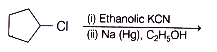
A
$1,4-$butanediamine
B
cyclopentylmethanamine
C
cyclopentanamine
D
$N$-methylpyrrolidine
Solution
(B) The reaction sequence is as follows:
$1$. The reaction of chlorocyclopentane with ethanolic $KCN$ undergoes a nucleophilic substitution $(S_N2)$ reaction to form cyclopentanecarbonitrile $(C_5H_9CN)$.
$2$. The reduction of the nitrile group $(-CN)$ using sodium amalgam $(Na(Hg))$ in the presence of ethanol $(C_2H_5OH)$ yields a primary amine. This is a standard reduction reaction for nitriles to primary amines,resulting in cyclopentylmethanamine $(C_5H_9CH_2NH_2)$.
$1$. The reaction of chlorocyclopentane with ethanolic $KCN$ undergoes a nucleophilic substitution $(S_N2)$ reaction to form cyclopentanecarbonitrile $(C_5H_9CN)$.
$2$. The reduction of the nitrile group $(-CN)$ using sodium amalgam $(Na(Hg))$ in the presence of ethanol $(C_2H_5OH)$ yields a primary amine. This is a standard reduction reaction for nitriles to primary amines,resulting in cyclopentylmethanamine $(C_5H_9CH_2NH_2)$.

0 likesView Solution
153
ChemistryEasyMCQAP EAMCET · 2022
Identify the major product formed when propene is treated with hydrogen chloride followed by Swarts reaction.
A
$1-$fluoropropane
B
$1-$nitropropane
C
$2-$fluoropropane
D
$2-$nitropropane
Solution
(C) Propene $(CH_3-CH=CH_2)$ reacts with $HCl$ according to Markovnikov's rule to form $2-$chloropropane $(CH_3-CHCl-CH_3)$.
$2-$chloropropane then undergoes the Swarts reaction (using reagents like $SbF_3$ or $AgF$) to replace the chlorine atom with a fluorine atom,resulting in the formation of $2-$fluoropropane $(CH_3-CHF-CH_3)$.
$2-$chloropropane then undergoes the Swarts reaction (using reagents like $SbF_3$ or $AgF$) to replace the chlorine atom with a fluorine atom,resulting in the formation of $2-$fluoropropane $(CH_3-CHF-CH_3)$.
0 likesView Solution
154
ChemistryEasyMCQAP EAMCET · 2022
$S_N1$ reactions are generally carried out in which type of solvents?
A
Polar aprotic solvent.
B
Non-polar aprotic solvent.
C
Polar protic solvent.
D
Non-polar protic solvent.
Solution
(C) polar protic solvent favours $S_N1$ mechanism.
Polar protic solvents stabilise the carbocation formed as an intermediate through solvation and also stabilise the leaving group,thereby facilitating the ionisation step.
Additionally,they reduce the reactivity of the nucleophile by hydrogen bonding,which prevents it from attacking the substrate before the carbocation is formed.
Polar protic solvents stabilise the carbocation formed as an intermediate through solvation and also stabilise the leaving group,thereby facilitating the ionisation step.
Additionally,they reduce the reactivity of the nucleophile by hydrogen bonding,which prevents it from attacking the substrate before the carbocation is formed.
0 likesView Solution
155
ChemistryEasyMCQAP EAMCET · 2022
The rate of reaction of $t-$butyl bromide and $NaOH$ in water depends on the concentration of
A
both $t-$butyl bromide and $NaOH$
B
$NaOH$
C
independent of concentration
D
$t-$butyl bromide
Solution
(D) The hydrolysis of $t-$butyl bromide with aqueous $NaOH$ is an example of an $S_N1$ reaction.
Step $I$: The formation of the carbocation is the slow step and therefore the rate-determining step.
$(CH_3)_3C-Br \rightarrow (CH_3)_3C^+ + Br^-$
Step $II$: The nucleophile $(OH^-)$ attacks the carbocation in a fast step.
$(CH_3)_3C^+ + OH^- \rightarrow (CH_3)_3C-OH$
Since the rate-determining step involves only the $t-$butyl bromide molecule,the rate of the reaction depends only on the concentration of $t-$butyl bromide.
Step $I$: The formation of the carbocation is the slow step and therefore the rate-determining step.
$(CH_3)_3C-Br \rightarrow (CH_3)_3C^+ + Br^-$
Step $II$: The nucleophile $(OH^-)$ attacks the carbocation in a fast step.
$(CH_3)_3C^+ + OH^- \rightarrow (CH_3)_3C-OH$
Since the rate-determining step involves only the $t-$butyl bromide molecule,the rate of the reaction depends only on the concentration of $t-$butyl bromide.
0 likesView Solution
156
ChemistryMediumMCQAP EAMCET · 2022
Which among the following is most reactive via $S_N2$ mechanism?
A
$3-$bromo$-2-$methylpentane
B
$1-$bromo$-3-$methylbutane
C
$2-$bromo$-3,3-$dimethylbutane
D
$3-$bromopentane
Solution
(B) The reactivity of alkyl halides towards $S_N2$ mechanism follows the order: $Primary > Secondary > Tertiary$.
This order is primarily governed by steric hindrance,where less hindered substrates are more reactive.
- Option $A$ is a secondary alkyl halide.
- Option $B$ is a primary alkyl halide $(CH_3-CH(CH_3)-CH_2-CH_2-Br)$.
- Option $C$ is a secondary alkyl halide with significant steric hindrance.
- Option $D$ is a secondary alkyl halide.
Since $S_N2$ reactions are highly sensitive to steric bulk,the primary alkyl halide in option $B$ is the most reactive.
This order is primarily governed by steric hindrance,where less hindered substrates are more reactive.
- Option $A$ is a secondary alkyl halide.
- Option $B$ is a primary alkyl halide $(CH_3-CH(CH_3)-CH_2-CH_2-Br)$.
- Option $C$ is a secondary alkyl halide with significant steric hindrance.
- Option $D$ is a secondary alkyl halide.
Since $S_N2$ reactions are highly sensitive to steric bulk,the primary alkyl halide in option $B$ is the most reactive.
0 likesView Solution
157
ChemistryMediumMCQAP EAMCET · 2022
Identify the starting compound '$P$' in the following reaction.
$P \stackrel{Na / \text{dry ether}}{\longrightarrow} (H_3C)_2CHCH_2CH_2CH(CH_3)_2$
$P \stackrel{Na / \text{dry ether}}{\longrightarrow} (H_3C)_2CHCH_2CH_2CH(CH_3)_2$
A
$1-$Bromo$-2-$methylpropane
B
$1-$Bromobutane
C
$2-$Bromopropene
D
$2-$Bromobutane
Solution
(A) The given reaction is the Wurtz reaction,where two molecules of an alkyl halide react with sodium metal in the presence of dry ether to form a symmetrical alkane.
The product is $2,5-$dimethylhexane,which has the structure $(H_3C)_2CHCH_2CH_2CH(CH_3)_2$.
This alkane is formed by the coupling of two $1-$bromo$-2-$methylpropane units $(CH_3CH(CH_3)CH_2Br)$.
Therefore,the starting compound '$P$' is $1-$bromo$-2-$methylpropane.
The product is $2,5-$dimethylhexane,which has the structure $(H_3C)_2CHCH_2CH_2CH(CH_3)_2$.
This alkane is formed by the coupling of two $1-$bromo$-2-$methylpropane units $(CH_3CH(CH_3)CH_2Br)$.
Therefore,the starting compound '$P$' is $1-$bromo$-2-$methylpropane.
0 likesView Solution
158
ChemistryDifficultMCQAP EAMCET · 2022
Identify the major product $Y$ from the following reaction:

A
$1-$phenylethanol
B
Benzoic acid
C
$2-$phenylethanol
D
Phenylacetic acid
Solution
(C) The reaction proceeds as follows:
$1$. Benzyl chloride reacts with $Mg$ in dry ether to form benzylmagnesium chloride.
$2$. Benzylmagnesium chloride reacts with $CO_2$ followed by acidic workup $(H_3O^+)$ to produce phenylacetic acid $(X)$: $C_6H_5CH_2Cl$ $\xrightarrow{Mg/dry ether} C_6H_5CH_2MgCl$ $\xrightarrow{CO_2, H_3O^+} C_6H_5CH_2COOH$.
$3$. Phenylacetic acid $(X)$ is then reduced by $LiAlH_4$ in ether followed by acidic workup $(H_3O^+)$ to yield $2-$phenylethanol $(Y)$: $C_6H_5CH_2COOH \xrightarrow{LiAlH_4, H_3O^+} C_6H_5CH_2CH_2OH$.
$1$. Benzyl chloride reacts with $Mg$ in dry ether to form benzylmagnesium chloride.
$2$. Benzylmagnesium chloride reacts with $CO_2$ followed by acidic workup $(H_3O^+)$ to produce phenylacetic acid $(X)$: $C_6H_5CH_2Cl$ $\xrightarrow{Mg/dry ether} C_6H_5CH_2MgCl$ $\xrightarrow{CO_2, H_3O^+} C_6H_5CH_2COOH$.
$3$. Phenylacetic acid $(X)$ is then reduced by $LiAlH_4$ in ether followed by acidic workup $(H_3O^+)$ to yield $2-$phenylethanol $(Y)$: $C_6H_5CH_2COOH \xrightarrow{LiAlH_4, H_3O^+} C_6H_5CH_2CH_2OH$.
0 likesView Solution
159
ChemistryMediumMCQAP EAMCET · 2022
Identify the major product of the following reaction: $C_6H_5Cl + Br_2 \xrightarrow{\text{Anhyd. } FeCl_3} ?$
A
$1-$chloro$-2-$bromobenzene
B
$1-$chloro$-2-$bromobenzene
C
$1,3,5-$tribromo$-2-$chlorobenzene
D
$1-$chloro$-4-$bromobenzene
Solution
(D) The reaction of chlorobenzene with $Br_2$ in the presence of anhydrous $FeCl_3$ is an electrophilic aromatic substitution reaction (halogenation).
$Cl$ is an ortho/para-directing group due to its $+R$ effect,which increases electron density at the ortho and para positions.
Due to steric hindrance at the ortho position,the para-substituted product is formed as the major product.
Therefore,the major product is $1$-chloro-$4$-bromobenzene.
$Cl$ is an ortho/para-directing group due to its $+R$ effect,which increases electron density at the ortho and para positions.
Due to steric hindrance at the ortho position,the para-substituted product is formed as the major product.
Therefore,the major product is $1$-chloro-$4$-bromobenzene.
0 likesView Solution
160
ChemistryEasyMCQAP EAMCET · 2022
With reference to the carbonyl group,which statement$(s)$ is/are correct?
$A$. Carbonyl carbon is electrophilic
$B$. Carbonyl carbon is nucleophilic
$C$. Carbonyl oxygen is electrophilic
$D$. Carbonyl oxygen is nucleophilic
$A$. Carbonyl carbon is electrophilic
$B$. Carbonyl carbon is nucleophilic
$C$. Carbonyl oxygen is electrophilic
$D$. Carbonyl oxygen is nucleophilic
A
$A, D$
B
$B, C$
C
$B$ Only
D
$C$ Only
Solution
(A) In the carbonyl group $(C=O)$,the oxygen atom is more electronegative than the carbon atom. This causes the $\pi$-electrons to shift towards the oxygen atom,resulting in a partial positive charge on the carbon atom and a partial negative charge on the oxygen atom.
The carbon atom,being electron-deficient (partial positive charge),acts as an electrophile.
The oxygen atom,having lone pairs and a partial negative charge,acts as a nucleophile.
Therefore,statements $A$ and $D$ are correct.
The carbon atom,being electron-deficient (partial positive charge),acts as an electrophile.
The oxygen atom,having lone pairs and a partial negative charge,acts as a nucleophile.
Therefore,statements $A$ and $D$ are correct.
0 likesView Solution
161
ChemistryMediumMCQAP EAMCET · 2022
Identify the major product formed from the following reaction sequence:

A
$1-$iodopropane
B
$2,3-$dimethylbutane
C
$1,2-$diiodopropane
D
$n-$hexane
Solution
(D) The reaction sequence is as follows:
$1.$ Propan$-1-$ol reacts with Lucas reagent $(HCl / ZnCl_2)$ to form $1-$chloropropane.
$2.$ $1-$chloropropane undergoes Finkelstein reaction with $NaI$ in dry acetone to form $1-$iodopropane.
$3.$ $1-$iodopropane undergoes Wurtz reaction in the presence of $Na$ and dry ether to form $n-$hexane $(CH_3CH_2CH_2CH_2CH_2CH_3)$.
$1.$ Propan$-1-$ol reacts with Lucas reagent $(HCl / ZnCl_2)$ to form $1-$chloropropane.
$2.$ $1-$chloropropane undergoes Finkelstein reaction with $NaI$ in dry acetone to form $1-$iodopropane.
$3.$ $1-$iodopropane undergoes Wurtz reaction in the presence of $Na$ and dry ether to form $n-$hexane $(CH_3CH_2CH_2CH_2CH_2CH_3)$.
0 likesView Solution
162
ChemistryDifficultMCQAP EAMCET · 2022
Identify the major product of the following reaction:
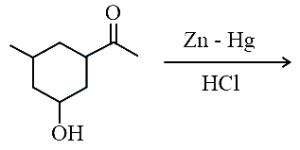
A
$3-$ethyl$-5-$methylcyclohexan$-1-$ol
B
$1-$($5$-methylcyclohexyl)ethanol
C
$1-$chloro$-3-$ethyl$-5-$methylcyclohexane
D
$1-$chloro$-3-$methyl$-5-$acetylcyclohexane
Solution
(C) The Clemmensen reduction uses zinc-amalgam $(Zn-Hg)$ and concentrated hydrochloric acid $(HCl)$ to reduce carbonyl groups $(C=O)$ of aldehydes and ketones to methylene groups $(CH_2)$.
Additionally,under these acidic conditions,secondary and tertiary alcohols can undergo substitution reactions with $HCl$ to form alkyl chlorides.
In the given molecule,the ketone group is reduced to an ethyl group $(-CH_2CH_3)$,and the secondary alcohol group is converted into a chloro group $(-Cl)$.
Therefore,the major product is $1$-chloro-$3$-ethyl-$5$-methylcyclohexane.
Additionally,under these acidic conditions,secondary and tertiary alcohols can undergo substitution reactions with $HCl$ to form alkyl chlorides.
In the given molecule,the ketone group is reduced to an ethyl group $(-CH_2CH_3)$,and the secondary alcohol group is converted into a chloro group $(-Cl)$.
Therefore,the major product is $1$-chloro-$3$-ethyl-$5$-methylcyclohexane.
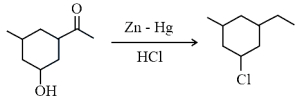
0 likesView Solution
163
ChemistryEasyMCQAP EAMCET · 2022
Which among the following will have the highest density?
A
$CCl_4$
B
$n-C_3H_7I$
C
$n-C_3H_7Br$
D
$n-C_3H_7Cl$
Solution
(B) The density of haloalkanes increases with an increase in the number of carbon atoms,the number of halogen atoms,and the atomic mass of the halogen atoms.
Among the given compounds,$n-C_3H_7I$ contains iodine,which has the highest atomic mass among the halogens listed $(Cl, Br, I)$.
Among the given compounds,$n-C_3H_7I$ contains iodine,which has the highest atomic mass among the halogens listed $(Cl, Br, I)$.
| Compound | Density in $g/mL$ |
| $CCl_4$ | $1.595$ |
| $n-C_3H_7I$ | $1.747$ |
| $n-C_3H_7Br$ | $1.335$ |
| $n-C_3H_7Cl$ | $0.89$ |
0 likesView Solution
164
ChemistryMediumMCQAP EAMCET · 2022
Identify the major product of the following reaction.
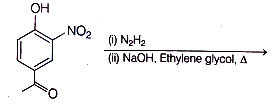
A
$4-$ethyl$-2-$nitrophenol
B
$1-$($4$-hydroxy$-3-$nitrophenyl)ethanol
C
$4-$hydroxy$-3-$nitrobenzoic acid
D
$2-$amino$-4-$hydroxyphenol
Solution
(A) The reaction conditions $(i) \ N_2H_4, (ii) \ NaOH, \text{Ethylene glycol}, \Delta$ represent the Wolff-Kishner reduction. This reaction specifically reduces a carbonyl group $(C=O)$ to a methylene group $(CH_2)$. In the given substrate,the acetyl group $(-COCH_3)$ is reduced to an ethyl group $(-CH_2CH_3)$,while the phenolic $-OH$ and nitro $-NO_2$ groups remain unaffected.
0 likesView Solution
165
ChemistryDifficultMCQAP EAMCET · 2022
Identify the major product from the following reaction sequence.
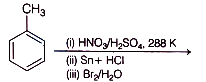
A
$4-$methylaniline
B
$2,6-$dibromo$-4-$methylaniline
C
$3,5-$dibromo$-4-$methylaniline
D
$2,4-$dibromo$-6-$methylaniline
Solution
(B) Step $1$: Toluene undergoes nitration with $HNO_3/H_2SO_4$ at $288 \ K$ to give $p$-nitrotoluene as the major product.
Step $2$: Reduction of $p$-nitrotoluene using $Sn/HCl$ gives $4$-methylaniline ($p$-toluidine).
Step $3$: The $-NH_2$ group is a strong activating group. Bromination of $4$-methylaniline with $Br_2/H_2O$ results in the substitution of bromine atoms at both ortho positions relative to the $-NH_2$ group,yielding $2,6$-dibromo-$4$-methylaniline as the major product.
Step $2$: Reduction of $p$-nitrotoluene using $Sn/HCl$ gives $4$-methylaniline ($p$-toluidine).
Step $3$: The $-NH_2$ group is a strong activating group. Bromination of $4$-methylaniline with $Br_2/H_2O$ results in the substitution of bromine atoms at both ortho positions relative to the $-NH_2$ group,yielding $2,6$-dibromo-$4$-methylaniline as the major product.
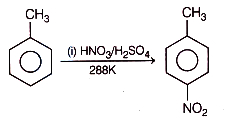
0 likesView Solution
166
ChemistryEasyMCQAP EAMCET · 2022
Identify the correct reagent for the Etard reaction.
A
$CrO_2Cl_2, H_3O^+$
B
$Pd-BaSO_4$
C
$CrO_3, H_3O^+$
D
$SnCl_2, HCl$
Solution
(A) The correct reagent for the Etard reaction is $CrO_2Cl_2$ followed by hydrolysis $(H_3O^+)$.
In the Etard reaction,toluene is oxidized to benzaldehyde using chromyl chloride $(CrO_2Cl_2)$.
The reaction proceeds through the formation of a chromium complex intermediate which upon hydrolysis yields the aldehyde.
The reaction is represented as:
$C_6H_5CH_3 \xrightarrow{CrO_2Cl_2, CCl_4 / H_3O^+} C_6H_5CHO$.
In the Etard reaction,toluene is oxidized to benzaldehyde using chromyl chloride $(CrO_2Cl_2)$.
The reaction proceeds through the formation of a chromium complex intermediate which upon hydrolysis yields the aldehyde.
The reaction is represented as:
$C_6H_5CH_3 \xrightarrow{CrO_2Cl_2, CCl_4 / H_3O^+} C_6H_5CHO$.
0 likesView Solution
167
ChemistryMediumMCQAP EAMCET · 2022
Identify the major product of the following reaction sequence:
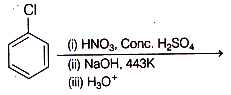
A
Phenol
B
$2,4-$Dinitrophenol
C
$2-$Nitrophenol
D
$4-$Nitrophenol
Solution
(D) The reaction proceeds as follows:
$1$. Electrophilic aromatic substitution (nitration) of chlorobenzene with $Conc. \ HNO_3$ and $Conc. \ H_2SO_4$ yields a mixture of $o$-nitrochlorobenzene (minor) and $p$-nitrochlorobenzene (major).
$2$. Nucleophilic aromatic substitution of the major product,$p$-nitrochlorobenzene,with $NaOH$ at $443 \ K$ followed by acidification $(H_3O^+)$ replaces the $-Cl$ group with an $-OH$ group.
$3$. The final major product is $p$-nitrophenol ($4$-nitrophenol).
$1$. Electrophilic aromatic substitution (nitration) of chlorobenzene with $Conc. \ HNO_3$ and $Conc. \ H_2SO_4$ yields a mixture of $o$-nitrochlorobenzene (minor) and $p$-nitrochlorobenzene (major).
$2$. Nucleophilic aromatic substitution of the major product,$p$-nitrochlorobenzene,with $NaOH$ at $443 \ K$ followed by acidification $(H_3O^+)$ replaces the $-Cl$ group with an $-OH$ group.
$3$. The final major product is $p$-nitrophenol ($4$-nitrophenol).
0 likesView Solution
168
ChemistryDifficultMCQAP EAMCET · 2022
In the presence of peroxide,styrene reacts with $HBr$ to give $X$. When $X$ is reacted with magnesium in dry ether followed by $CO_2$ and hydrolysis,it gives $Y$. Treatment of $Y$ with $PCl_5$ and then with $H_2, Pd-BaSO_4$ gives $Z$. What is $Z$?
A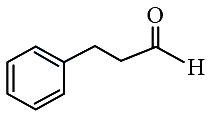
B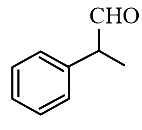
C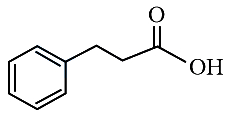
D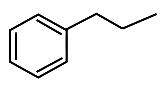
Solution
(A) The reaction sequence is as follows:
$1$. Styrene $(C_6H_5CH=CH_2)$ reacts with $HBr$ in the presence of peroxide via anti-Markovnikov addition to form $1-$bromo$-2-$phenylethane ($X$,$C_6H_5CH_2CH_2Br$).
$2$. $X$ reacts with $Mg$ in dry ether to form the Grignard reagent $C_6H_5CH_2CH_2MgBr$. This reacts with $CO_2$ followed by hydrolysis to yield $3-$phenylpropanoic acid ($Y$,$C_6H_5CH_2CH_2COOH$).
$3$. $Y$ reacts with $PCl_5$ to form $3-$phenylpropanoyl chloride $(C_6H_5CH_2CH_2COCl)$.
$4$. $3-$phenylpropanoyl chloride undergoes Rosenmund reduction with $H_2, Pd-BaSO_4$ to form $3-$phenylpropan$-1-$al ($Z$,$C_6H_5CH_2CH_2CHO$).
The structure of $Z$ corresponds to the image provided in option $A$.
$1$. Styrene $(C_6H_5CH=CH_2)$ reacts with $HBr$ in the presence of peroxide via anti-Markovnikov addition to form $1-$bromo$-2-$phenylethane ($X$,$C_6H_5CH_2CH_2Br$).
$2$. $X$ reacts with $Mg$ in dry ether to form the Grignard reagent $C_6H_5CH_2CH_2MgBr$. This reacts with $CO_2$ followed by hydrolysis to yield $3-$phenylpropanoic acid ($Y$,$C_6H_5CH_2CH_2COOH$).
$3$. $Y$ reacts with $PCl_5$ to form $3-$phenylpropanoyl chloride $(C_6H_5CH_2CH_2COCl)$.
$4$. $3-$phenylpropanoyl chloride undergoes Rosenmund reduction with $H_2, Pd-BaSO_4$ to form $3-$phenylpropan$-1-$al ($Z$,$C_6H_5CH_2CH_2CHO$).
The structure of $Z$ corresponds to the image provided in option $A$.
0 likesView Solution
169
ChemistryDifficultMCQAP EAMCET · 2022
Identify the major product formed from the following reaction sequence:
$CH_3-CH=CH_2$ $\xrightarrow[(i) HBr]{(ii) NaOH}$ ${\xrightarrow[(iii) Cu/573 \ K]{(iv) Ba(OH)_2, \Delta}} ?$
$CH_3-CH=CH_2$ $\xrightarrow[(i) HBr]{(ii) NaOH}$ ${\xrightarrow[(iii) Cu/573 \ K]{(iv) Ba(OH)_2, \Delta}} ?$
A
$4-$methylpent$-3-$en$-2-$one
B
Phloroglucinol
C
Mesitylene
D
Pent$-3-$en$-2-$one
Solution
(A) The reaction sequence is as follows:
$1$. $CH_3-CH=CH_2 + HBr \rightarrow CH_3-CH(Br)-CH_3$ (Markovnikov addition).
$2$. $CH_3-CH(Br)-CH_3 + NaOH(aq) \rightarrow CH_3-CH(OH)-CH_3$ (Nucleophilic substitution to form propan$-2-$ol).
$3$. $CH_3-CH(OH)-CH_3 \xrightarrow{Cu/573 \ K} CH_3-CO-CH_3$ (Dehydrogenation of secondary alcohol to acetone).
$4$. $2 CH_3-CO-CH_3 \xrightarrow{Ba(OH)_2, \Delta} (CH_3)_2C=CH-CO-CH_3$ (Aldol condensation of acetone to form mesityl oxide,which is $4-$methylpent$-3-$en$-2-$one).
$1$. $CH_3-CH=CH_2 + HBr \rightarrow CH_3-CH(Br)-CH_3$ (Markovnikov addition).
$2$. $CH_3-CH(Br)-CH_3 + NaOH(aq) \rightarrow CH_3-CH(OH)-CH_3$ (Nucleophilic substitution to form propan$-2-$ol).
$3$. $CH_3-CH(OH)-CH_3 \xrightarrow{Cu/573 \ K} CH_3-CO-CH_3$ (Dehydrogenation of secondary alcohol to acetone).
$4$. $2 CH_3-CO-CH_3 \xrightarrow{Ba(OH)_2, \Delta} (CH_3)_2C=CH-CO-CH_3$ (Aldol condensation of acetone to form mesityl oxide,which is $4-$methylpent$-3-$en$-2-$one).
0 likesView Solution
170
ChemistryDifficultMCQAP EAMCET · 2022
Identify the major product formed from the following reaction sequence.
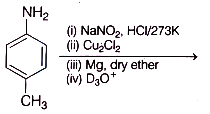
A
$4$-methylphenyl-deuteride
B
$2$-deuterotoluene
C
$2,6$-dideuterotoluene
D
$2,4,6$-trideuterotoluene
Solution
(A) $Step$ $1$: $p$-toluidine ($4$-methylaniline) reacts with $NaNO_2$ and $HCl$ at $273-278 \ K$ to form $4$-methylbenzenediazonium chloride.
$Step$ $2$: The diazonium salt reacts with $Cu_2Cl_2$ (Sandmeyer reaction) to form $4$-chlorotoluene.
$Step$ $3$: $4$-chlorotoluene reacts with $Mg$ in dry ether to form $4$-methylphenylmagnesium chloride (a Grignard reagent).
$Step$ $4$: The Grignard reagent reacts with $D_3O^+$ to replace the $-MgCl$ group with a deuterium atom,resulting in $4$-deuterotoluene (also known as $4$-methylphenyl-deuteride).
$Step$ $2$: The diazonium salt reacts with $Cu_2Cl_2$ (Sandmeyer reaction) to form $4$-chlorotoluene.
$Step$ $3$: $4$-chlorotoluene reacts with $Mg$ in dry ether to form $4$-methylphenylmagnesium chloride (a Grignard reagent).
$Step$ $4$: The Grignard reagent reacts with $D_3O^+$ to replace the $-MgCl$ group with a deuterium atom,resulting in $4$-deuterotoluene (also known as $4$-methylphenyl-deuteride).
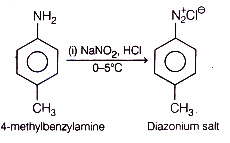
0 likesView Solution
171
ChemistryMediumMCQAP EAMCET · 2022
Arrange the following in increasing order of their reactivity for nucleophilic addition reaction:
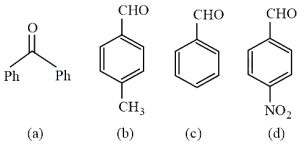
A
$a < b < c < d$
B
$a < d < c < b$
C
$c < b < a < d$
D
$c < a < b < d$
Solution
(A) Aldehydes are generally more reactive than ketones in nucleophilic addition reactions due to steric and electronic factors. Sterically,the presence of two relatively large substituents in ketones hinders the approach of the nucleophile to the carbonyl carbon more than in aldehydes,which have only one such substituent. Electronically,aldehydes are more reactive because the two alkyl groups in ketones reduce the electrophilicity of the carbonyl carbon more effectively than in aldehydes. Benzophenone $(a)$ is a ketone and is the least reactive. Among the aldehydes,$p$-tolualdehyde $(b)$ is less reactive than benzaldehyde $(c)$ because the $CH_3$ group at the para position increases electron density on the carbonyl carbon through the hyperconjugation effect,making it less electrophilic. In $p$-nitrobenzaldehyde $(d)$,the $NO_2$ group is strongly electron-withdrawing due to both $-I$ and $-R$ effects,which decreases electron density on the carbonyl carbon and significantly increases its reactivity towards nucleophilic attack. Therefore,the increasing order of reactivity is $a < b < c < d$.
0 likesView Solution
172
ChemistryDifficultMCQAP EAMCET · 2022
Identify the major product formed in the following reaction sequence:
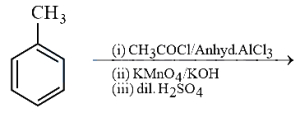
A
Phthalic acid
B
$4-$Methylacetophenone
C
Benzoic acid
D
Terephthalic acid
Solution
(D) The reaction sequence is as follows:
$1$. The first step is the Friedel-Crafts acylation of toluene with $CH_3COCl$ in the presence of anhydrous $AlCl_3$. Since the $-CH_3$ group is ortho/para directing,and the para position is sterically less hindered,the major product formed is $4-$methylacetophenone.
$2$. The second step involves the oxidation of both the $-CH_3$ group and the $-COCH_3$ group using alkaline $KMnO_4$ followed by acidic workup with dilute $H_2SO_4$. Both alkyl and acyl side chains attached to the benzene ring are oxidized to carboxylic acid groups $(-COOH)$.
$3$. Thus,$4-$methylacetophenone is converted into benzene-$1,4-$dicarboxylic acid,which is commonly known as Terephthalic acid.
$1$. The first step is the Friedel-Crafts acylation of toluene with $CH_3COCl$ in the presence of anhydrous $AlCl_3$. Since the $-CH_3$ group is ortho/para directing,and the para position is sterically less hindered,the major product formed is $4-$methylacetophenone.
$2$. The second step involves the oxidation of both the $-CH_3$ group and the $-COCH_3$ group using alkaline $KMnO_4$ followed by acidic workup with dilute $H_2SO_4$. Both alkyl and acyl side chains attached to the benzene ring are oxidized to carboxylic acid groups $(-COOH)$.
$3$. Thus,$4-$methylacetophenone is converted into benzene-$1,4-$dicarboxylic acid,which is commonly known as Terephthalic acid.
0 likesView Solution
173
ChemistryDifficultMCQAP EAMCET · 2022
Identify the major product formed from the following reaction: $1$-methylcyclohex-$1$-ene $\xrightarrow[(ii) AgNO_2]{(i) HCl} ?$
A
$1-$methyl$-1-$nitrocyclohexane
B
$1-$chloro$-2-$methylcyclohexane
C
$1-$methyl$-2-$nitritocyclohexane
D
$1-$methyl$-1-$nitritocyclohexane
Solution
(D) The reaction proceeds in two steps:
$1$. Electrophilic addition of $HCl$ to $1$-methylcyclohex-$1$-ene follows Markovnikov's rule. The proton $(H^+)$ adds to the carbon with more hydrogens,and the chloride ion $(Cl^-)$ adds to the more substituted carbon (the one with the methyl group),forming $1$-chloro-$1$-methylcyclohexane.
$2$. The reaction of $1$-chloro-$1$-methylcyclohexane with $AgNO_2$ is a nucleophilic substitution reaction ($S_N1$ mechanism). The $Cl^-$ is replaced by the nitrite group $(-ONO)$ or nitro group $(-NO_2)$. Since $AgNO_2$ is an ionic reagent,it primarily acts as a source of nitrite ions $(NO_2^-)$,which can bond through oxygen to form a nitrite ester $(-ONO)$ or through nitrogen to form a nitro compound $(-NO_2)$. In the case of tertiary alkyl halides,the formation of the nitrite ester $(-ONO)$ is often the major product due to the ambident nature of the nitrite ion and the stability of the tertiary carbocation intermediate. Thus,the major product is $1$-methyl-$1$-nitritocyclohexane.
$1$. Electrophilic addition of $HCl$ to $1$-methylcyclohex-$1$-ene follows Markovnikov's rule. The proton $(H^+)$ adds to the carbon with more hydrogens,and the chloride ion $(Cl^-)$ adds to the more substituted carbon (the one with the methyl group),forming $1$-chloro-$1$-methylcyclohexane.
$2$. The reaction of $1$-chloro-$1$-methylcyclohexane with $AgNO_2$ is a nucleophilic substitution reaction ($S_N1$ mechanism). The $Cl^-$ is replaced by the nitrite group $(-ONO)$ or nitro group $(-NO_2)$. Since $AgNO_2$ is an ionic reagent,it primarily acts as a source of nitrite ions $(NO_2^-)$,which can bond through oxygen to form a nitrite ester $(-ONO)$ or through nitrogen to form a nitro compound $(-NO_2)$. In the case of tertiary alkyl halides,the formation of the nitrite ester $(-ONO)$ is often the major product due to the ambident nature of the nitrite ion and the stability of the tertiary carbocation intermediate. Thus,the major product is $1$-methyl-$1$-nitritocyclohexane.
0 likesView Solution
174
ChemistryDifficultMCQAP EAMCET · 2022
The product '$Q$' of the following reaction is:

A
Propylbenzene
B
Isopropylbenzene
C
$1-$Phenylpropan$-1-$ol
D
$1-$Phenylprop$-1-$ene
Solution
(A) The reaction proceeds in two steps:
$1$. Friedel-Crafts acylation of benzene with $CH_3CH_2COCl$ in the presence of anhydrous $AlCl_3$ gives propiophenone $(C_6H_5COCH_2CH_3)$.
$2$. Clemmensen reduction of the ketone using $Zn-Hg$ and concentrated $HCl$ reduces the carbonyl group $(C=O)$ to a methylene group $(-CH_2-)$,yielding propylbenzene $(C_6H_5CH_2CH_2CH_3)$.
$1$. Friedel-Crafts acylation of benzene with $CH_3CH_2COCl$ in the presence of anhydrous $AlCl_3$ gives propiophenone $(C_6H_5COCH_2CH_3)$.
$2$. Clemmensen reduction of the ketone using $Zn-Hg$ and concentrated $HCl$ reduces the carbonyl group $(C=O)$ to a methylene group $(-CH_2-)$,yielding propylbenzene $(C_6H_5CH_2CH_2CH_3)$.
0 likesView Solution
175
ChemistryDifficultMCQAP EAMCET · 2022
The major product formed in the following reaction sequence is:
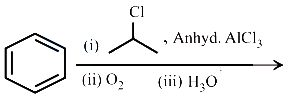
A
Phenol
B
$2-$Phenylpropan$-2-$ol
C
$4-$Isopropylphenol
D
$2-$Isopropylphenol
Solution
(A) The given reaction sequence is the industrial method for the preparation of phenol,known as the cumene process.
Step $(i)$: Benzene reacts with isopropyl chloride in the presence of anhydrous $AlCl_3$ (Friedel-Crafts alkylation) to form cumene (isopropylbenzene).
Step (ii): Cumene is oxidized by $O_2$ to form cumene hydroperoxide.
Step (iii): Acid-catalyzed hydrolysis of cumene hydroperoxide yields phenol and acetone $(CH_3COCH_3)$ as products.
Therefore,the major organic product formed is phenol.
Step $(i)$: Benzene reacts with isopropyl chloride in the presence of anhydrous $AlCl_3$ (Friedel-Crafts alkylation) to form cumene (isopropylbenzene).
Step (ii): Cumene is oxidized by $O_2$ to form cumene hydroperoxide.
Step (iii): Acid-catalyzed hydrolysis of cumene hydroperoxide yields phenol and acetone $(CH_3COCH_3)$ as products.
Therefore,the major organic product formed is phenol.
0 likesView Solution
176
ChemistryMediumMCQAP EAMCET · 2022
The product$(s)$ formed when toluene is reacted with $Cl_2$ in the presence of $Fe$ in the dark is/are:
A
$o-$chlorotoluene and $p-$chlorotoluene
B
benzyl chloride
C
benzal chloride
D
benzotrichloride
Solution
(A) In the presence of $Fe$ in the dark,the reaction follows electrophilic aromatic substitution,which occurs at the ortho and para positions of the toluene ring.
Therefore,the products formed are $o-$chlorotoluene and $p-$chlorotoluene.
In the presence of $UV$ light with the same reagent,the $C(sp^3)-H$ bond breaks down and forms a free radical,resulting in side-chain chlorination.
Therefore,the products formed are $o-$chlorotoluene and $p-$chlorotoluene.
In the presence of $UV$ light with the same reagent,the $C(sp^3)-H$ bond breaks down and forms a free radical,resulting in side-chain chlorination.
0 likesView Solution
177
ChemistryEasyMCQAP EAMCET · 2022
Assertion $(A)$: Blood cells collapse when suspended in saline water.
Reason $(R)$: Cell membrane dissolves in saline water.
Reason $(R)$: Cell membrane dissolves in saline water.
A
Both $(A)$ and $(R)$ are correct and $(R)$ is the correct explanation of $(A)$
B
Both $(A)$ and $(R)$ are correct,but $(R)$ is not the correct explanation of $(A)$
C
$(A)$ is correct but $(R)$ is not correct
D
$(A)$ is incorrect but $(R)$ is correct
Solution
(C) The osmotic pressure associated with the fluid inside the blood cell is equivalent to that of $0.9\% \ (\text{mass/volume})$ sodium chloride solution,which is known as normal saline solution.
If blood cells are placed in a solution containing more than $0.9\% \ (\text{mass/volume})$ sodium chloride (a hypertonic solution),water flows out of the cells due to osmosis,causing them to shrink or collapse.
If the salt concentration is less than $0.9\% \ (\text{mass/volume})$ (a hypotonic solution),water flows into the cells,causing them to swell.
The cell membrane does not dissolve in saline water.
Therefore,assertion $(A)$ is correct,but reason $(R)$ is incorrect.
If blood cells are placed in a solution containing more than $0.9\% \ (\text{mass/volume})$ sodium chloride (a hypertonic solution),water flows out of the cells due to osmosis,causing them to shrink or collapse.
If the salt concentration is less than $0.9\% \ (\text{mass/volume})$ (a hypotonic solution),water flows into the cells,causing them to swell.
The cell membrane does not dissolve in saline water.
Therefore,assertion $(A)$ is correct,but reason $(R)$ is incorrect.
0 likesView Solution
178
ChemistryEasyMCQAP EAMCET · 2022
For which of the following is the $+3$ oxidation state highly oxidising in character?
A
$Al$
B
$Ga$
C
$In$
D
$Tl$
Solution
(D) Among the given elements of group $13$,$Tl$ in the $+3$ oxidation state is highly oxidising in nature.
This is because,as we move down the group,the inert pair effect becomes more and more prominent.
This causes a decrease in the stability of elements in the $+3$ oxidation state and an increase in the stability of the $+1$ oxidation state.
Therefore,$Tl^{3+}$ ions have a strong tendency to gain two electrons to form $Tl^{+}$ ions,making them strong oxidising agents.
This is because,as we move down the group,the inert pair effect becomes more and more prominent.
This causes a decrease in the stability of elements in the $+3$ oxidation state and an increase in the stability of the $+1$ oxidation state.
Therefore,$Tl^{3+}$ ions have a strong tendency to gain two electrons to form $Tl^{+}$ ions,making them strong oxidising agents.
0 likesView Solution
179
ChemistryEasyMCQAP EAMCET · 2022
The percentage of abundance of three elements $X, Y$ and $Z$ in the earth's crust are about $27.7$,$8.3$ and $46.0$ by mass respectively. $X, Y$ and $Z$ are
A
$O, Si, Al$
B
$Al, Si, O$
C
$Si, Al, O$
D
$Al, O, Si$
Solution
(C) The percentage abundance of elements in the earth's crust by mass is as follows:
$1$. Oxygen $(O)$: $46.0\%$
$2$. Silicon $(Si)$: $27.7\%$
$3$. Aluminium $(Al)$: $8.3\%$
Given that $X = 27.7\%$,$Y = 8.3\%$,and $Z = 46.0\%$,we have:
$X = Si$
$Y = Al$
$Z = O$
Therefore,$X, Y$ and $Z$ are $Si, Al$ and $O$ respectively.
$1$. Oxygen $(O)$: $46.0\%$
$2$. Silicon $(Si)$: $27.7\%$
$3$. Aluminium $(Al)$: $8.3\%$
Given that $X = 27.7\%$,$Y = 8.3\%$,and $Z = 46.0\%$,we have:
$X = Si$
$Y = Al$
$Z = O$
Therefore,$X, Y$ and $Z$ are $Si, Al$ and $O$ respectively.
0 likesView Solution
180
ChemistryEasyMCQAP EAMCET · 2022
Arrange the following oxides in the correct order of their acidic character:
$N_2O_3$ $(I)$,$P_2O_3$ $(II)$,$N_2O_5$ $(III)$,$As_2O_3$ $(IV)$
$N_2O_3$ $(I)$,$P_2O_3$ $(II)$,$N_2O_5$ $(III)$,$As_2O_3$ $(IV)$
A
$I > III > II > IV$
B
$III > I > II > IV$
C
$IV > II > I > III$
D
$III > I > IV > II$
Solution
(B) The acidic character of oxides of group $15$ elements depends on the oxidation state of the central atom and its electronegativity.
$1$. Higher oxidation state leads to higher acidic character. $N_2O_5$ $(III)$ has $N$ in $+5$ oxidation state,while $N_2O_3$ $(I)$,$P_2O_3$ $(II)$,and $As_2O_3$ $(IV)$ have the central atom in $+3$ oxidation state.
$2$. Among oxides with the same oxidation state $(+3)$,the acidic character decreases down the group as electronegativity decreases and atomic size increases.
$3$. Comparing the $+3$ oxides: $N_2O_3 > P_2O_3 > As_2O_3$ $(I > II > IV)$.
$4$. Combining these,the overall order is $N_2O_5 > N_2O_3 > P_2O_3 > As_2O_3$,which corresponds to $III > I > II > IV$.
$1$. Higher oxidation state leads to higher acidic character. $N_2O_5$ $(III)$ has $N$ in $+5$ oxidation state,while $N_2O_3$ $(I)$,$P_2O_3$ $(II)$,and $As_2O_3$ $(IV)$ have the central atom in $+3$ oxidation state.
$2$. Among oxides with the same oxidation state $(+3)$,the acidic character decreases down the group as electronegativity decreases and atomic size increases.
$3$. Comparing the $+3$ oxides: $N_2O_3 > P_2O_3 > As_2O_3$ $(I > II > IV)$.
$4$. Combining these,the overall order is $N_2O_5 > N_2O_3 > P_2O_3 > As_2O_3$,which corresponds to $III > I > II > IV$.
0 likesView Solution
181
ChemistryEasyMCQAP EAMCET · 2022
Small quantities of $NO$ and $HNO_3$ are formed as impurities when $N_2$ is prepared from $NH_4Cl_{(aq)}$ and $NaNO_{2(aq)}$. These impurities can be removed by passing the $N_2$ gas through which of the following?
A
$H_2SO_{4(aq)}$ containing $SO_3$
B
$H_2SO_{4(aq)}$ containing $K_2Cr_2O_7$
C
$H_2SO_{4(aq)}$ containing $KMnO_4$
D
$HCl_{(aq)}$ containing $KMnO_4$
Solution
(B) The preparation reaction is: $NH_4Cl_{(aq)} + NaNO_{2(aq)} \rightarrow N_2(g) + 2H_2O(l) + NaCl(aq)$.
During this process,small amounts of $NO$ and $HNO_3$ are formed as impurities.
These impurities are removed by passing the $N_2$ gas through an aqueous solution of $H_2SO_4$ containing $K_2Cr_2O_7$,which acts as an oxidizing agent to oxidize $NO$ to $NO_2$ or $HNO_3$ and subsequently trap them.
During this process,small amounts of $NO$ and $HNO_3$ are formed as impurities.
These impurities are removed by passing the $N_2$ gas through an aqueous solution of $H_2SO_4$ containing $K_2Cr_2O_7$,which acts as an oxidizing agent to oxidize $NO$ to $NO_2$ or $HNO_3$ and subsequently trap them.
0 likesView Solution
182
ChemistryEasyMCQAP EAMCET · 2022
The element that can form multiple bonds with itself from the following is
A
antimony
B
arsenic
C
phosphorus
D
nitrogen
Solution
(D) Among the given group-$15$ elements,nitrogen can form multiple bonds with itself.
Strong multiple bonds are formed only when the overlapping is effective,i.e.,overlapping orbitals are of similar energy and same symmetry.
Nitrogen has a small size and has $2p$ orbitals (lower energy),which allows it to show $p\pi-p\pi$ bonding.
Whereas,in the heavier elements,the overlapping orbitals are larger and have higher energy as atomic size increases down the group.
Thus,in these cases,effective overlapping for $p\pi-p\pi$ bond does not take place.
Strong multiple bonds are formed only when the overlapping is effective,i.e.,overlapping orbitals are of similar energy and same symmetry.
Nitrogen has a small size and has $2p$ orbitals (lower energy),which allows it to show $p\pi-p\pi$ bonding.
Whereas,in the heavier elements,the overlapping orbitals are larger and have higher energy as atomic size increases down the group.
Thus,in these cases,effective overlapping for $p\pi-p\pi$ bond does not take place.
0 likesView Solution
183
ChemistryEasyMCQAP EAMCET · 2022
Which one among the following has the $S-O-S$ bonding?
A
$H_2S_2O_5$
B
$H_2S_2O_8$
C
$H_2S_2O_7$
D
$H_2S_2O_4$
Solution
(C) $H_2S_2O_7$ (pyrosulphuric acid) has an $S-O-S$ linkage in its structure. The structure consists of two $SO_3$ units joined by an oxygen atom,represented as $HO-SO_2-O-SO_2-OH$.
0 likesView Solution
184
ChemistryEasyMCQAP EAMCET · 2022
Which of the following is formed when $SO_3$ is absorbed by concentrated $H_2SO_4$?
A
$H_2S_2O_8$
B
$H_2S_2O_3$
C
$H_2S_2O_7$
D
$H_2S_2O_5$
Solution
(C) The absorption of sulphur trioxide $(SO_3)$ in concentrated sulphuric acid $(H_2SO_4)$ results in the formation of oleum,also known as pyrosulphuric acid.
The chemical reaction is: $SO_3 + H_2SO_4 \rightarrow H_2S_2O_7$.
The chemical reaction is: $SO_3 + H_2SO_4 \rightarrow H_2S_2O_7$.
0 likesView Solution
185
ChemistryMediumMCQAP EAMCET · 2022
Which of the following source materials generate $SO_2$ that is used in the contact process?
A
$S, FeS_2$
B
$S, FeS$
C
$H_2S, FeS_2$
D
$Na_2S, FeS_2$
Solution
(A) In the contact process,$SO_2$ is primarily obtained by burning sulfur or sulfide ores in excess of air.
$1$. Burning of sulfur: $S(s) + O_2(g) \rightarrow SO_2(g)$
$2$. Roasting of iron pyrites: $4FeS_2(s) + 11O_2(g) \rightarrow 2Fe_2O_3(s) + 8SO_2(g)$
Thus,$S$ and $FeS_2$ are the common source materials.
$1$. Burning of sulfur: $S(s) + O_2(g) \rightarrow SO_2(g)$
$2$. Roasting of iron pyrites: $4FeS_2(s) + 11O_2(g) \rightarrow 2Fe_2O_3(s) + 8SO_2(g)$
Thus,$S$ and $FeS_2$ are the common source materials.
0 likesView Solution
186
ChemistryEasyMCQAP EAMCET · 2022
Which of the following compounds has reducing character?
A
$SO_2$
B
$TeO_2$
C
$SO_3$
D
$TeO_3$
Solution
(A) $SO_2$ acts as a reducing agent because the $+6$ oxidation state of $S$ is more stable than its $+4$ oxidation state.
$TeO_2$ acts as an oxidizing agent because its $+4$ oxidation state is more stable due to the inert pair effect.
$SO_3$ and $TeO_3$ do not show reducing character because $S$ and $Te$ are in their highest oxidation state of $+6$.
$TeO_2$ acts as an oxidizing agent because its $+4$ oxidation state is more stable due to the inert pair effect.
$SO_3$ and $TeO_3$ do not show reducing character because $S$ and $Te$ are in their highest oxidation state of $+6$.
0 likesView Solution
187
ChemistryMediumMCQAP EAMCET · 2022
Identify $A, B, C$ and $D$ in the reactions:
$(I)$ $x Cl_2 + y NaOH \longrightarrow A + B + H_2 O_{(l)}$ (Cold,dil.)
$(II)$ $x Cl_2 + y NaOH \longrightarrow C + D + H_2 O_{(l)}$ (Hot,conc.)
$(I)$ $x Cl_2 + y NaOH \longrightarrow A + B + H_2 O_{(l)}$ (Cold,dil.)
$(II)$ $x Cl_2 + y NaOH \longrightarrow C + D + H_2 O_{(l)}$ (Hot,conc.)
A
$NaCl, HCl, NaOCl, NaClO_3$
B
$NaCl, NaOCl, NaCl, NaClO_3$
C
$NaCl, NaOCl_3, NaCl, NaOCl$
D
$NaOCl, Na_2 O, NaOCl, NaO_2$
Solution
(B) When chlorine reacts with $NaOH$,different products are formed depending upon the temperature and concentration of $NaOH$.
For cold and dilute $NaOH$:
$Cl_2 + 2 NaOH \longrightarrow NaCl + NaOCl + H_2 O$
Here,$A = NaCl$ and $B = NaOCl$.
For hot and concentrated $NaOH$:
$3 Cl_2 + 6 NaOH \longrightarrow 5 NaCl + NaClO_3 + 3 H_2 O$
Here,$C = NaCl$ and $D = NaClO_3$.
Therefore,the correct sequence is $A = NaCl, B = NaOCl, C = NaCl, D = NaClO_3$.
For cold and dilute $NaOH$:
$Cl_2 + 2 NaOH \longrightarrow NaCl + NaOCl + H_2 O$
Here,$A = NaCl$ and $B = NaOCl$.
For hot and concentrated $NaOH$:
$3 Cl_2 + 6 NaOH \longrightarrow 5 NaCl + NaClO_3 + 3 H_2 O$
Here,$C = NaCl$ and $D = NaClO_3$.
Therefore,the correct sequence is $A = NaCl, B = NaOCl, C = NaCl, D = NaClO_3$.
0 likesView Solution
188
ChemistryEasyMCQAP EAMCET · 2022
Which of the following represents the correct order of oxidising power of halogens in water?
A
$I_2 > Br_2 > Cl_2 > F_2$
B
$Cl_2 > F_2 > Br_2 > I_2$
C
$F_2 > Cl_2 > I_2 > Br_2$
D
$F_2 > Cl_2 > Br_2 > I_2$
Solution
(D) The oxidising power of halogens in aqueous solution depends on the standard electrode potential $(E^{\circ})$,which is determined by the sum of enthalpy changes: sublimation,dissociation,electron gain,and hydration enthalpy.
For halogens,the reaction is: $X_{2(g/l/s)} + 2e^{-} \longrightarrow 2X^{-}_{(aq)}$.
Due to the very high hydration enthalpy of the fluoride ion $(F^{-})$,the overall reduction process for $F_2$ is the most spontaneous.
The hydration energy follows the order: $F^{-} > Cl^{-} > Br^{-} > I^{-}$.
Consequently,the ease of reduction follows the order: $F_2 > Cl_2 > Br_2 > I_2$.
Thus,the correct order of oxidising power is $F_2 > Cl_2 > Br_2 > I_2$.
For halogens,the reaction is: $X_{2(g/l/s)} + 2e^{-} \longrightarrow 2X^{-}_{(aq)}$.
Due to the very high hydration enthalpy of the fluoride ion $(F^{-})$,the overall reduction process for $F_2$ is the most spontaneous.
The hydration energy follows the order: $F^{-} > Cl^{-} > Br^{-} > I^{-}$.
Consequently,the ease of reduction follows the order: $F_2 > Cl_2 > Br_2 > I_2$.
Thus,the correct order of oxidising power is $F_2 > Cl_2 > Br_2 > I_2$.
0 likesView Solution
189
ChemistryEasyMCQAP EAMCET · 2022
Assertion $(A)$: All noble gases are monoatomic.
Reason $(R)$: All noble gases have very low melting and boiling points.
Reason $(R)$: All noble gases have very low melting and boiling points.
A
Both $A$ and $R$ are correct and $R$ is the correct explanation of $A$.
B
Both $A$ and $R$ are correct but $R$ is not the correct explanation of $A$.
C
$A$ is correct but $R$ is incorrect.
D
$A$ is incorrect but $R$ is correct.
Solution
(B) All noble gases have completely filled valence shells,which makes them stable and chemically inert. Therefore,they do not form bonds with other atoms and exist as monoatomic gases.
Noble gases have very weak van der Waals forces of attraction between their atoms,which leads to their very low melting and boiling points.
While both statements are scientifically correct,the monoatomic nature is due to the stable electronic configuration,not due to their melting or boiling points. Thus,$R$ is not the correct explanation of $A$.
Noble gases have very weak van der Waals forces of attraction between their atoms,which leads to their very low melting and boiling points.
While both statements are scientifically correct,the monoatomic nature is due to the stable electronic configuration,not due to their melting or boiling points. Thus,$R$ is not the correct explanation of $A$.
0 likesView Solution
190
ChemistryEasyMCQAP EAMCET · 2022
The catalyst used in the manufacture of high density polyethylene is a mixture of
A
$TiAl(CH_3)_3$
B
$Ti, CH_3MgBr$
C
$TiCl_3, Si(CH_3)_4$
D
$TiCl_4, Al(CH_3)_3$
Solution
(D) High density polyethylene $(HDP)$ is produced by the addition polymerization of ethene in a hydrocarbon solvent in the presence of a Ziegler-Natta catalyst.
This catalyst is a mixture of trialkylaluminium,such as $Al(CH_3)_3$,and titanium tetrachloride,$TiCl_4$.
This process occurs at a temperature of $333 \ K$ to $343 \ K$ and a pressure of $6-7 \ \text{atmospheres}$.
The resulting polymer consists of linear molecules,which allows for close packing and high density.
This catalyst is a mixture of trialkylaluminium,such as $Al(CH_3)_3$,and titanium tetrachloride,$TiCl_4$.
This process occurs at a temperature of $333 \ K$ to $343 \ K$ and a pressure of $6-7 \ \text{atmospheres}$.
The resulting polymer consists of linear molecules,which allows for close packing and high density.
0 likesView Solution
191
ChemistryMediumMCQAP EAMCET · 2022
If the total electricity required to deposit $1$ mole of a metal $M$ is equal to that of $10.7$ amperes of current for $10$ hours,the equivalent weight of the metal is (atomic weight $= M \ u$):
A
$M$
B
$\frac{M}{2}$
C
$\frac{M}{3}$
D
$\frac{M}{4}$
Solution
(D) We know that,$q = i \times t$,where $q$ is the charge in Coulombs,$i$ is the current in Amperes,and $t$ is the time in seconds.
$q = 10.7 \ A \times 10 \ h \times 3600 \ s \ h^{-1} = 385,200 \ C$.
Since $96,500 \ C$ corresponds to $1$ mole of electrons,the number of moles of electrons is $\frac{385,200}{96,500} \approx 4$.
Since $4$ moles of electrons are required to deposit $1$ mole of metal $M$,the valency of the metal is $4$.
Equivalent weight $= \frac{\text{Atomic weight}}{\text{Valency}} = \frac{M}{4}$.
$q = 10.7 \ A \times 10 \ h \times 3600 \ s \ h^{-1} = 385,200 \ C$.
Since $96,500 \ C$ corresponds to $1$ mole of electrons,the number of moles of electrons is $\frac{385,200}{96,500} \approx 4$.
Since $4$ moles of electrons are required to deposit $1$ mole of metal $M$,the valency of the metal is $4$.
Equivalent weight $= \frac{\text{Atomic weight}}{\text{Valency}} = \frac{M}{4}$.
0 likesView Solution
192
ChemistryEasyMCQAP EAMCET · 2022
When $KI$ is reacted with $O_3$ under aqueous condition,the product formed is:
A
$I_2 O_4$
B
$I_2 O_5$
C
$I_4 O_9$
D
$I_2$
Solution
(D) When ozone $(O_3)$ reacts with potassium iodide $(KI)$ in an aqueous medium,it acts as an oxidizing agent.
The chemical reaction is:
$2 KI_{(aq)} + H_2O_{(l)} + O_{3(g)} \rightarrow 2 KOH_{(aq)} + I_{2(s)} + O_{2(g)}$
The ionic form of this reaction is:
$2 I^{-}_{(aq)} + H_2O_{(l)} + O_{3(g)} \rightarrow 2 OH^{-}_{(aq)} + I_{2(s)} + O_{2(g)}$
Thus,the product formed is iodine $(I_2)$.
The chemical reaction is:
$2 KI_{(aq)} + H_2O_{(l)} + O_{3(g)} \rightarrow 2 KOH_{(aq)} + I_{2(s)} + O_{2(g)}$
The ionic form of this reaction is:
$2 I^{-}_{(aq)} + H_2O_{(l)} + O_{3(g)} \rightarrow 2 OH^{-}_{(aq)} + I_{2(s)} + O_{2(g)}$
Thus,the product formed is iodine $(I_2)$.
0 likesView Solution
193
ChemistryEasyMCQAP EAMCET · 2022
The moisture present in ammonia can be removed by using which of the following?
A
$P_4O_{10}$
B
Conc. $H_2SO_4$
C
$CaCl_2$ (anhydrous)
D
$CaO$
Solution
(D) $NH_3$ is basic in nature.
Therefore,a drying agent used for $NH_3$ must be basic in nature so that it does not react with the gas.
$P_4O_{10}$ is acidic,Conc. $H_2SO_4$ is acidic,and $CaCl_2$ forms an adduct with $NH_3$ $(CaCl_2 \cdot 8NH_3)$.
$CaO$ (quicklime) is basic and does not react with $NH_3$,making it the correct drying agent.
Therefore,a drying agent used for $NH_3$ must be basic in nature so that it does not react with the gas.
$P_4O_{10}$ is acidic,Conc. $H_2SO_4$ is acidic,and $CaCl_2$ forms an adduct with $NH_3$ $(CaCl_2 \cdot 8NH_3)$.
$CaO$ (quicklime) is basic and does not react with $NH_3$,making it the correct drying agent.
0 likesView Solution
194
ChemistryEasyMCQAP EAMCET · 2022
The colour of $Mg(OH)_2$ precipitate formed when it is precipitated in the presence of magneson reagent is
A
Green
B
Yellow
C
Brown
D
Blue
Solution
(D) Magneson reagent is a dye used in the qualitative analysis of $Mg^{2+}$ ions.
In an alkaline medium,$Mg^{2+}$ ions form a blue-coloured lake (precipitate) with the magneson reagent.
This reaction is used as a confirmatory test for magnesium,where $Mg(OH)_2$ adsorbs the dye to form a deep blue precipitate.
In an alkaline medium,$Mg^{2+}$ ions form a blue-coloured lake (precipitate) with the magneson reagent.
This reaction is used as a confirmatory test for magnesium,where $Mg(OH)_2$ adsorbs the dye to form a deep blue precipitate.
0 likesView Solution
195
ChemistryEasyMCQAP EAMCET · 2022
Which of the following solids is not a molecular solid?
A
$HCl$
B
$H_2O$
C
$CCl_4$
D
$SiO_2$
Solution
(D) Molecules are the constituent particles of molecular solids. These are further subdivided into three categories: $1$. Non-polar molecular solids,$2$. Polar molecular solids,$3$. Hydrogen-bonded molecular solids. $HCl$,$H_2O$ (ice),and $CCl_4$ are examples of molecular solids.
Silicon dioxide $(SiO_2)$ is a covalent or network solid. In this structure,each silicon atom is covalently bonded in a tetrahedral manner to four oxygen atoms. Each oxygen atom is further bonded to another silicon atom,creating a giant three-dimensional network. Therefore,it is not a molecular solid.
Silicon dioxide $(SiO_2)$ is a covalent or network solid. In this structure,each silicon atom is covalently bonded in a tetrahedral manner to four oxygen atoms. Each oxygen atom is further bonded to another silicon atom,creating a giant three-dimensional network. Therefore,it is not a molecular solid.
0 likesView Solution
196
ChemistryEasyMCQAP EAMCET · 2022
Match List-$I$ with List-$II$ based on the type of solid and its example:
| List-$I$ (Type of solid) | List-$II$ (Example) |
|---|---|
| $(A)$ Metallic | $(1)$ Diamond |
| $(B)$ Ionic | $(2)$ Ice |
| $(C)$ Molecular | $(3)$ $NaCl$ |
| $(D)$ Covalent | $(4)$ $Cu$ |
A
$A-4, B-3, C-2, D-1$
B
$A-4, B-3, C-1, D-2$
C
$A-3, B-4, C-2, D-1$
D
$A-3, B-4, C-1, D-2$
Solution
(A) The correct matching is as follows:
$(A)$ Metallic solid: $Cu$ $(4)$
$(B)$ Ionic solid: $NaCl$ $(3)$
$(C)$ Molecular solid: Ice $(2)$
$(D)$ Covalent (Network) solid: Diamond $(1)$
Therefore,the correct sequence is $A-4, B-3, C-2, D-1$.
$(A)$ Metallic solid: $Cu$ $(4)$
$(B)$ Ionic solid: $NaCl$ $(3)$
$(C)$ Molecular solid: Ice $(2)$
$(D)$ Covalent (Network) solid: Diamond $(1)$
Therefore,the correct sequence is $A-4, B-3, C-2, D-1$.
0 likesView Solution
197
ChemistryMediumMCQAP EAMCET · 2022
The density of $Na$ is $0.613 \ g \ cm^{-3}$. If the edge length of the unit cell of $Na$ is $5 \ \mathring{A}$,the effective number of atoms of $Na$ per unit cell is (Atomic weight of $Na = 23 \ u$)
A
$8$
B
$1$
C
$2$
D
$4$
Solution
(C) The formula for density $(d)$ of a unit cell is given by: $d = \frac{Z \times M}{a^3 \times N_A}$
Where $Z$ is the number of atoms per unit cell,$M$ is the molar mass $(23 \ g \ mol^{-1})$,$a$ is the edge length $(5 \ \mathring{A} = 5 \times 10^{-8} \ cm)$,and $N_A$ is Avogadro's number $(6.022 \times 10^{23} \ mol^{-1})$.
Rearranging for $Z$: $Z = \frac{d \times a^3 \times N_A}{M}$
Substituting the values: $Z = \frac{0.613 \times (5 \times 10^{-8})^3 \times 6.022 \times 10^{23}}{23}$
$Z = \frac{0.613 \times 125 \times 10^{-24} \times 6.022 \times 10^{23}}{23}$
$Z = \frac{0.613 \times 125 \times 0.6022}{23} \approx \frac{46.14}{23} \approx 2$
Thus,the effective number of atoms per unit cell is $2$.
Where $Z$ is the number of atoms per unit cell,$M$ is the molar mass $(23 \ g \ mol^{-1})$,$a$ is the edge length $(5 \ \mathring{A} = 5 \times 10^{-8} \ cm)$,and $N_A$ is Avogadro's number $(6.022 \times 10^{23} \ mol^{-1})$.
Rearranging for $Z$: $Z = \frac{d \times a^3 \times N_A}{M}$
Substituting the values: $Z = \frac{0.613 \times (5 \times 10^{-8})^3 \times 6.022 \times 10^{23}}{23}$
$Z = \frac{0.613 \times 125 \times 10^{-24} \times 6.022 \times 10^{23}}{23}$
$Z = \frac{0.613 \times 125 \times 0.6022}{23} \approx \frac{46.14}{23} \approx 2$
Thus,the effective number of atoms per unit cell is $2$.
0 likesView Solution
198
ChemistryMediumMCQAP EAMCET · 2022
If molten $NaCl$ contains $SrCl_2$ as impurity,crystallization can generate
A
Anionic vacancies
B
Cationic vacancies
C
Metal excess defects
D
Metal deficiency defects
Solution
(B) When molten $NaCl$ containing a small amount of $SrCl_2$ is crystallized,some $Na^{+}$ ion sites are occupied by $Sr^{2+}$ ions.
Each $Sr^{2+}$ ion replaces two $Na^{+}$ ions to maintain electrical neutrality.
One $Sr^{2+}$ ion occupies the site of one $Na^{+}$ ion,while the other site remains vacant.
Thus,the number of cationic vacancies produced is equal to the number of $Sr^{2+}$ ions incorporated into the crystal lattice.
Each $Sr^{2+}$ ion replaces two $Na^{+}$ ions to maintain electrical neutrality.
One $Sr^{2+}$ ion occupies the site of one $Na^{+}$ ion,while the other site remains vacant.
Thus,the number of cationic vacancies produced is equal to the number of $Sr^{2+}$ ions incorporated into the crystal lattice.
0 likesView Solution
199
ChemistryDifficultMCQAP EAMCET · 2022
Which of the following statements is correct for an $fcc$ lattice?
A
There are an equal number of octahedral and tetrahedral voids in a unit cell.
B
The tetrahedral voids are present at the edge centers.
C
Octahedral voids are present at the body center and edge centers.
D
Its packing efficiency $(PE)$ is higher than the $hcp$ lattice $PE$.
Solution
(C) In an $fcc$ unit cell,the number of atoms $(Z)$ is $4$.
The number of octahedral voids is equal to $Z = 4$,and the number of tetrahedral voids is equal to $2Z = 8$. Thus,statement $(a)$ is incorrect.
Tetrahedral voids are located on the body diagonals,not at the edge centers. Thus,statement $(b)$ is incorrect.
In an $fcc$ lattice,octahedral voids are located at the body center $(1)$ and at the centers of each of the $12$ edges $(12 \times 1/4 = 3)$,totaling $4$. Thus,statement $(c)$ is correct.
The packing efficiency of both $fcc$ and $hcp$ lattices is $74 \%$. Thus,statement $(d)$ is incorrect.
The number of octahedral voids is equal to $Z = 4$,and the number of tetrahedral voids is equal to $2Z = 8$. Thus,statement $(a)$ is incorrect.
Tetrahedral voids are located on the body diagonals,not at the edge centers. Thus,statement $(b)$ is incorrect.
In an $fcc$ lattice,octahedral voids are located at the body center $(1)$ and at the centers of each of the $12$ edges $(12 \times 1/4 = 3)$,totaling $4$. Thus,statement $(c)$ is correct.
The packing efficiency of both $fcc$ and $hcp$ lattices is $74 \%$. Thus,statement $(d)$ is incorrect.
0 likesView Solution
200
ChemistryEasyMCQAP EAMCET · 2022
An element crystallising in $fcc$ lattice has a density of $8.92 \ g \ cm^{-3}$ and edge length of $3.61 \times 10^{-8} \ cm$. What is the atomic weight of the element (in $u$)? $(N_A = 6.022 \times 10^{23} \ mol^{-1})$
A
$126.356$
B
$63.178$
C
$31.589$
D
$47.383$
Solution
(B) Given: Density $(d) = 8.92 \ g \ cm^{-3}$,Edge length $(a) = 3.61 \times 10^{-8} \ cm$,Avogadro's number $(N_A) = 6.022 \times 10^{23} \ mol^{-1}$.
For an $fcc$ lattice,the number of atoms per unit cell $(Z) = 4$.
The formula for density is $d = \frac{Z \times M}{a^3 \times N_A}$,where $M$ is the atomic weight.
Rearranging for $M$: $M = \frac{d \times a^3 \times N_A}{Z}$.
Substituting the values: $M = \frac{8.92 \times (3.61 \times 10^{-8})^3 \times 6.022 \times 10^{23}}{4}$.
$M = \frac{8.92 \times 47.0458 \times 10^{-24} \times 6.022 \times 10^{23}}{4}$.
$M = \frac{252.712}{4} = 63.178 \ u$.
For an $fcc$ lattice,the number of atoms per unit cell $(Z) = 4$.
The formula for density is $d = \frac{Z \times M}{a^3 \times N_A}$,where $M$ is the atomic weight.
Rearranging for $M$: $M = \frac{d \times a^3 \times N_A}{Z}$.
Substituting the values: $M = \frac{8.92 \times (3.61 \times 10^{-8})^3 \times 6.022 \times 10^{23}}{4}$.
$M = \frac{8.92 \times 47.0458 \times 10^{-24} \times 6.022 \times 10^{23}}{4}$.
$M = \frac{252.712}{4} = 63.178 \ u$.
0 likesView Solution
Vedclass Products
For Students
Vedclass Test Series
Mock tests in real AP EAMCET style covering Chemistry with performance analysis. 5-day free trial.
Start Free TrialFor Teachers
Exam Paper Generator
Generate Set A/B/C/D Chemistry papers from 7.5L+ questions in 2 minutes. 3 chapters free.
Try FreeFor Institutes
Online Exam Module
Run live AP EAMCET mock exams with unlimited students, 360° analytics & white-label branding.
See DemoFrequently Asked Questions
How many Chemistry questions are in AP EAMCET 2022?
There are 435 Chemistry questions from the AP EAMCET 2022 paper on Vedclass, each with a detailed step-by-step solution in English.
Are AP EAMCET 2022 Chemistry solutions available in English?
Yes. All solutions on this page are in English. You can also switch to English or Hindi using the language buttons above the questions.
Can I practice AP EAMCET 2022 Chemistry as a timed test?
Yes. Use the Vedclass Test Series to attempt a full AP EAMCET mock test covering Chemistry with time limits and instant score analysis.
Can teachers create Chemistry papers from AP EAMCET previous year questions?
Yes. The Vedclass Exam Paper Generator lets teachers mix AP EAMCET Chemistry questions and generate Set A/B/C/D papers in minutes.
For Teachers & Institutes
Build a Custom Chemistry Paper
Pick AP EAMCET 2022 Chemistry questions, set difficulty, and generate Set A/B/C/D in 2 minutes.