
MathematicsQ1–24 of 24 questions
Page 1 of 1 · English
1
MathematicsMediumMCQAIEEE · 2010
If $\cos(\alpha + \beta) = \frac{4}{5}$ and $\sin(\alpha - \beta) = \frac{5}{13}$,where $0 \le \alpha, \beta \le \frac{\pi}{4}$,then $\tan 2\alpha = $
A
$\frac{16}{63}$
B
$\frac{56}{33}$
C
$\frac{28}{33}$
D
None of these
Solution
(B) Given $\cos(\alpha + \beta) = \frac{4}{5}$. Since $0 \le \alpha, \beta \le \frac{\pi}{4}$,$0 \le \alpha + \beta \le \frac{\pi}{2}$,so $\tan(\alpha + \beta) = \sqrt{\sec^2(\alpha + \beta) - 1} = \sqrt{(\frac{5}{4})^2 - 1} = \frac{3}{4}$.
Given $\sin(\alpha - \beta) = \frac{5}{13}$. Since $0 \le \alpha, \beta \le \frac{\pi}{4}$,$-\frac{\pi}{4} \le \alpha - \beta \le \frac{\pi}{4}$,so $\tan(\alpha - \beta) = \frac{\sin(\alpha - \beta)}{\sqrt{1 - \sin^2(\alpha - \beta)}} = \frac{5/13}{\sqrt{1 - (5/13)^2}} = \frac{5/13}{12/13} = \frac{5}{12}$.
Now,$\tan 2\alpha = \tan((\alpha + \beta) + (\alpha - \beta))$.
Using the formula $\tan(A + B) = \frac{\tan A + \tan B}{1 - \tan A \tan B}$:
$\tan 2\alpha = \frac{\frac{3}{4} + \frac{5}{12}}{1 - (\frac{3}{4} \times \frac{5}{12})} = \frac{\frac{9+5}{12}}{1 - \frac{15}{48}} = \frac{14/12}{33/48} = \frac{14}{12} \times \frac{48}{33} = \frac{14 \times 4}{33} = \frac{56}{33}$.
Given $\sin(\alpha - \beta) = \frac{5}{13}$. Since $0 \le \alpha, \beta \le \frac{\pi}{4}$,$-\frac{\pi}{4} \le \alpha - \beta \le \frac{\pi}{4}$,so $\tan(\alpha - \beta) = \frac{\sin(\alpha - \beta)}{\sqrt{1 - \sin^2(\alpha - \beta)}} = \frac{5/13}{\sqrt{1 - (5/13)^2}} = \frac{5/13}{12/13} = \frac{5}{12}$.
Now,$\tan 2\alpha = \tan((\alpha + \beta) + (\alpha - \beta))$.
Using the formula $\tan(A + B) = \frac{\tan A + \tan B}{1 - \tan A \tan B}$:
$\tan 2\alpha = \frac{\frac{3}{4} + \frac{5}{12}}{1 - (\frac{3}{4} \times \frac{5}{12})} = \frac{\frac{9+5}{12}}{1 - \frac{15}{48}} = \frac{14/12}{33/48} = \frac{14}{12} \times \frac{48}{33} = \frac{14 \times 4}{33} = \frac{56}{33}$.
0 likesView Solution
2
MathematicsMediumMCQAIEEE · 2010
The number of complex numbers $z$ such that $|z - 1| = |z + 1| = |z - i|$ is equal to
A
$1$
B
$2$
C
$\infty$
D
$0$
Solution
(A) Let $z = x + iy$. The given condition is $|z - 1| = |z + 1| = |z - i|$.
From $|z - 1| = |z + 1|$,we have $|x - 1 + iy| = |x + 1 + iy|$,which implies $(x - 1)^2 + y^2 = (x + 1)^2 + y^2$.
Expanding this,$x^2 - 2x + 1 + y^2 = x^2 + 2x + 1 + y^2$,which simplifies to $4x = 0$,so $x = 0$.
Now,from $|z + 1| = |z - i|$,we have $|x + 1 + iy| = |x + i(y - 1)|$,which implies $(x + 1)^2 + y^2 = x^2 + (y - 1)^2$.
Substituting $x = 0$,we get $(0 + 1)^2 + y^2 = 0^2 + (y - 1)^2$.
$1 + y^2 = y^2 - 2y + 1$.
This simplifies to $-2y = 0$,so $y = 0$.
Thus,the only complex number satisfying the condition is $z = 0 + 0i = 0$.
Therefore,there is only $1$ such complex number.
From $|z - 1| = |z + 1|$,we have $|x - 1 + iy| = |x + 1 + iy|$,which implies $(x - 1)^2 + y^2 = (x + 1)^2 + y^2$.
Expanding this,$x^2 - 2x + 1 + y^2 = x^2 + 2x + 1 + y^2$,which simplifies to $4x = 0$,so $x = 0$.
Now,from $|z + 1| = |z - i|$,we have $|x + 1 + iy| = |x + i(y - 1)|$,which implies $(x + 1)^2 + y^2 = x^2 + (y - 1)^2$.
Substituting $x = 0$,we get $(0 + 1)^2 + y^2 = 0^2 + (y - 1)^2$.
$1 + y^2 = y^2 - 2y + 1$.
This simplifies to $-2y = 0$,so $y = 0$.
Thus,the only complex number satisfying the condition is $z = 0 + 0i = 0$.
Therefore,there is only $1$ such complex number.
0 likesView Solution
3
MathematicsDifficultMCQAIEEE · 2010
There are two urns. Urn $A$ has $3$ distinct red balls and urn $B$ has $9$ distinct blue balls. From each urn,two balls are taken out at random and then transferred to the other. The number of ways in which this can be done is
A
$36$
B
$66$
C
$108$
D
$3$
Solution
(C) Urn $A$ contains $3$ distinct red balls. The number of ways to select $2$ balls from urn $A$ is $^3C_2 = \frac{3!}{2!1!} = 3$.
Urn $B$ contains $9$ distinct blue balls. The number of ways to select $2$ balls from urn $B$ is $^9C_2 = \frac{9 \times 8}{2 \times 1} = 36$.
Since the selection of balls from urn $A$ and urn $B$ are independent events,the total number of ways to perform these transfers is the product of the number of ways to select balls from each urn.
Total ways $= ^3C_2 \times ^9C_2 = 3 \times 36 = 108$.
Urn $B$ contains $9$ distinct blue balls. The number of ways to select $2$ balls from urn $B$ is $^9C_2 = \frac{9 \times 8}{2 \times 1} = 36$.
Since the selection of balls from urn $A$ and urn $B$ are independent events,the total number of ways to perform these transfers is the product of the number of ways to select balls from each urn.
Total ways $= ^3C_2 \times ^9C_2 = 3 \times 36 = 108$.
0 likesView Solution
4
MathematicsDifficultMCQAIEEE · 2010
Let $s_1 = \sum_{j=1}^{10} j(j-1) \binom{10}{j}$,$s_2 = \sum_{j=1}^{10} j \binom{10}{j}$,and $s_3 = \sum_{j=1}^{10} j^2 \binom{10}{j}$.
Statement $-1$: $s_3 = 55 \times 2^9$
Statement $-2$: $s_1 = 90 \times 2^8$ and $s_2 = 10 \times 2^8$
Statement $-1$: $s_3 = 55 \times 2^9$
Statement $-2$: $s_1 = 90 \times 2^8$ and $s_2 = 10 \times 2^8$
A
Statement $-1$ is true,Statement $-2$ is true; Statement $-2$ is not a correct explanation for Statement $-1$
B
Statement $-1$ is true,Statement $-2$ is true; Statement $-2$ is a correct explanation for Statement $-1$
C
Statement $-1$ is false,Statement $-2$ is true
D
Statement $-1$ is true,Statement $-2$ is false
Solution
(D) We know that $\sum_{j=0}^{n} \binom{n}{j} = 2^n$.
For $s_1 = \sum_{j=2}^{10} j(j-1) \binom{10}{j} = \sum_{j=2}^{10} 10 \times 9 \binom{8}{j-2} = 90 \times 2^8$.
For $s_2 = \sum_{j=1}^{10} j \binom{10}{j} = \sum_{j=1}^{10} 10 \binom{9}{j-1} = 10 \times 2^9$.
For $s_3 = \sum_{j=1}^{10} j^2 \binom{10}{j} = \sum_{j=1}^{10} (j(j-1) + j) \binom{10}{j} = s_1 + s_2$.
$s_3 = 90 \times 2^8 + 10 \times 2^9 = 45 \times 2^9 + 10 \times 2^9 = 55 \times 2^9$.
Comparing with the statements:
Statement $-1$ is $55 \times 2^9$,which is true.
Statement $-2$ claims $s_2 = 10 \times 2^8$,but we found $s_2 = 10 \times 2^9$,so Statement $-2$ is false.
Thus,Statement $-1$ is true and Statement $-2$ is false.
For $s_1 = \sum_{j=2}^{10} j(j-1) \binom{10}{j} = \sum_{j=2}^{10} 10 \times 9 \binom{8}{j-2} = 90 \times 2^8$.
For $s_2 = \sum_{j=1}^{10} j \binom{10}{j} = \sum_{j=1}^{10} 10 \binom{9}{j-1} = 10 \times 2^9$.
For $s_3 = \sum_{j=1}^{10} j^2 \binom{10}{j} = \sum_{j=1}^{10} (j(j-1) + j) \binom{10}{j} = s_1 + s_2$.
$s_3 = 90 \times 2^8 + 10 \times 2^9 = 45 \times 2^9 + 10 \times 2^9 = 55 \times 2^9$.
Comparing with the statements:
Statement $-1$ is $55 \times 2^9$,which is true.
Statement $-2$ claims $s_2 = 10 \times 2^8$,but we found $s_2 = 10 \times 2^9$,so Statement $-2$ is false.
Thus,Statement $-1$ is true and Statement $-2$ is false.
0 likesView Solution
5
MathematicsDifficultMCQAIEEE · 2010
$A$ person is to count $4500$ currency notes. Let $a_n$ denote the number of notes he counts in the $n^{th}$ minute. If $a_1 = a_2 = \ldots = a_{10} = 150$ and $a_{10}, a_{11}, \ldots$ are in an $A.P.$ with common difference $-2$,then the time taken by him to count all notes is ............... $minutes$.
A
$34$
B
$125$
C
$135$
D
$24$
Solution
(A) Notes counted in the first $10$ minutes $= 150 \times 10 = 1500$.
Remaining notes to be counted $= 4500 - 1500 = 3000$.
Let $n$ be the number of minutes after the first $10$ minutes.
The sequence of notes counted from the $11^{th}$ minute onwards is an $A.P.$ with first term $a = 148$ and common difference $d = -2$.
The sum of $n$ terms is given by $S_n = \frac{n}{2}[2a + (n-1)d]$.
$3000 = \frac{n}{2}[2(148) + (n-1)(-2)]$.
$3000 = \frac{n}{2}[296 - 2n + 2] = \frac{n}{2}[298 - 2n] = 149n - n^2$.
$n^2 - 149n + 3000 = 0$.
$(n - 24)(n - 125) = 0$.
Since $a_{10+n} = 148 + (n-1)(-2) = 150 - 2n$,for $n=125$,$a_{135} = 150 - 250 = -100$,which is impossible as the number of notes cannot be negative.
Thus,$n = 24$.
Total time $= 10 + 24 = 34$ minutes.
Remaining notes to be counted $= 4500 - 1500 = 3000$.
Let $n$ be the number of minutes after the first $10$ minutes.
The sequence of notes counted from the $11^{th}$ minute onwards is an $A.P.$ with first term $a = 148$ and common difference $d = -2$.
The sum of $n$ terms is given by $S_n = \frac{n}{2}[2a + (n-1)d]$.
$3000 = \frac{n}{2}[2(148) + (n-1)(-2)]$.
$3000 = \frac{n}{2}[296 - 2n + 2] = \frac{n}{2}[298 - 2n] = 149n - n^2$.
$n^2 - 149n + 3000 = 0$.
$(n - 24)(n - 125) = 0$.
Since $a_{10+n} = 148 + (n-1)(-2) = 150 - 2n$,for $n=125$,$a_{135} = 150 - 250 = -100$,which is impossible as the number of notes cannot be negative.
Thus,$n = 24$.
Total time $= 10 + 24 = 34$ minutes.
1 likesView Solution
6
MathematicsDifficultMCQAIEEE · 2010
The line $L$ is given by $\frac{x}{5} + \frac{y}{b} = 1$ and passes through the point $(13, 32)$. The line $K$ is parallel to $L$ and has the equation $\frac{x}{c} + \frac{y}{3} = 1$. Then the distance between $L$ and $K$ is
A
$\sqrt{17}$
B
$\frac{17}{\sqrt{15}}$
C
$\frac{23}{\sqrt{17}}$
D
$\frac{23}{\sqrt{15}}$
Solution
(C) Since the line $L$ passes through $(13, 32)$,we have:
$\frac{13}{5} + \frac{32}{b} = 1$ $\Rightarrow \frac{32}{b} = 1 - \frac{13}{5} = -\frac{8}{5}$ $\Rightarrow b = -20$.
Thus,the equation of line $L$ is $\frac{x}{5} - \frac{y}{20} = 1$,which simplifies to $4x - y = 20$.
Since line $K$ is parallel to $L$,its equation is of the form $4x - y = k$.
Given the equation of $K$ is $\frac{x}{c} + \frac{y}{3} = 1$,we can rewrite it as $y = -\frac{3}{c}x + 3$,or $3x + cy = 3c$. Comparing slopes,the slope of $L$ is $4$,so the slope of $K$ is $-\frac{3}{c} = 4$,which gives $c = -\frac{3}{4}$.
Substituting $c$ into the equation $\frac{x}{c} + \frac{y}{3} = 1$,we get $\frac{x}{-3/4} + \frac{y}{3} = 1$ $\Rightarrow -\frac{4x}{3} + \frac{y}{3} = 1$ $\Rightarrow -4x + y = 3$,or $4x - y = -3$.
The distance between two parallel lines $Ax + By + C_1 = 0$ and $Ax + By + C_2 = 0$ is given by $d = \frac{|C_1 - C_2|}{\sqrt{A^2 + B^2}}$.
Here,$A = 4, B = -1, C_1 = -20, C_2 = 3$.
$d = \frac{|-20 - 3|}{\sqrt{4^2 + (-1)^2}} = \frac{|-23|}{\sqrt{16 + 1}} = \frac{23}{\sqrt{17}}$.
$\frac{13}{5} + \frac{32}{b} = 1$ $\Rightarrow \frac{32}{b} = 1 - \frac{13}{5} = -\frac{8}{5}$ $\Rightarrow b = -20$.
Thus,the equation of line $L$ is $\frac{x}{5} - \frac{y}{20} = 1$,which simplifies to $4x - y = 20$.
Since line $K$ is parallel to $L$,its equation is of the form $4x - y = k$.
Given the equation of $K$ is $\frac{x}{c} + \frac{y}{3} = 1$,we can rewrite it as $y = -\frac{3}{c}x + 3$,or $3x + cy = 3c$. Comparing slopes,the slope of $L$ is $4$,so the slope of $K$ is $-\frac{3}{c} = 4$,which gives $c = -\frac{3}{4}$.
Substituting $c$ into the equation $\frac{x}{c} + \frac{y}{3} = 1$,we get $\frac{x}{-3/4} + \frac{y}{3} = 1$ $\Rightarrow -\frac{4x}{3} + \frac{y}{3} = 1$ $\Rightarrow -4x + y = 3$,or $4x - y = -3$.
The distance between two parallel lines $Ax + By + C_1 = 0$ and $Ax + By + C_2 = 0$ is given by $d = \frac{|C_1 - C_2|}{\sqrt{A^2 + B^2}}$.
Here,$A = 4, B = -1, C_1 = -20, C_2 = 3$.
$d = \frac{|-20 - 3|}{\sqrt{4^2 + (-1)^2}} = \frac{|-23|}{\sqrt{16 + 1}} = \frac{23}{\sqrt{17}}$.
0 likesView Solution
7
MathematicsDifficultMCQAIEEE · 2010
The circle $x^2 + y^2 = 4x + 8y + 5$ intersects the line $3x - 4y = m$ at two distinct points if:
A
$ - 35 < m < 15$
B
$ 15 < m < 65$
C
$ 35 < m < 85$
D
$ - 85 < m < - 35$
Solution
(A) The given equation of the circle is $x^2 + y^2 - 4x - 8y - 5 = 0$.
Comparing this with the general form $x^2 + y^2 + 2gx + 2fy + c = 0$,we get $g = -2$,$f = -4$,and $c = -5$.
The centre of the circle is $(-g, -f) = (2, 4)$.
The radius $r$ is given by $\sqrt{g^2 + f^2 - c} = \sqrt{(-2)^2 + (-4)^2 - (-5)} = \sqrt{4 + 16 + 5} = \sqrt{25} = 5$.
For the line $3x - 4y - m = 0$ to intersect the circle at two distinct points,the perpendicular distance $d$ from the centre $(2, 4)$ to the line must be less than the radius $r$.
$d = \frac{|3(2) - 4(4) - m|}{\sqrt{3^2 + (-4)^2}} = \frac{|6 - 16 - m|}{\sqrt{9 + 16}} = \frac{|-10 - m|}{5} = \frac{|10 + m|}{5}$.
Setting $d < r$,we have $\frac{|10 + m|}{5} < 5$.
$|10 + m| < 25$.
This implies $-25 < 10 + m < 25$.
Subtracting $10$ from all parts,we get $-35 < m < 15$.
Comparing this with the general form $x^2 + y^2 + 2gx + 2fy + c = 0$,we get $g = -2$,$f = -4$,and $c = -5$.
The centre of the circle is $(-g, -f) = (2, 4)$.
The radius $r$ is given by $\sqrt{g^2 + f^2 - c} = \sqrt{(-2)^2 + (-4)^2 - (-5)} = \sqrt{4 + 16 + 5} = \sqrt{25} = 5$.
For the line $3x - 4y - m = 0$ to intersect the circle at two distinct points,the perpendicular distance $d$ from the centre $(2, 4)$ to the line must be less than the radius $r$.
$d = \frac{|3(2) - 4(4) - m|}{\sqrt{3^2 + (-4)^2}} = \frac{|6 - 16 - m|}{\sqrt{9 + 16}} = \frac{|-10 - m|}{5} = \frac{|10 + m|}{5}$.
Setting $d < r$,we have $\frac{|10 + m|}{5} < 5$.
$|10 + m| < 25$.
This implies $-25 < 10 + m < 25$.
Subtracting $10$ from all parts,we get $-35 < m < 15$.
0 likesView Solution
8
MathematicsEasyMCQAIEEE · 2010
If two tangents drawn from a point $P$ to the parabola $y^2 = 4x$ are at right angles,then the locus of $P$ is:
A
$2x - 1 = 0$
B
$x = 1$
C
$2x + 1 = 0$
D
$x = -1$
Solution
(D) The locus of the point of intersection of two perpendicular tangents to a parabola is its directrix.
For the parabola $y^2 = 4ax$,the equation of the directrix is $x = -a$.
Given the equation $y^2 = 4x$,we have $4a = 4$,which implies $a = 1$.
Therefore,the equation of the directrix is $x = -1$.
Thus,the locus of $P$ is $x = -1$.
For the parabola $y^2 = 4ax$,the equation of the directrix is $x = -a$.
Given the equation $y^2 = 4x$,we have $4a = 4$,which implies $a = 1$.
Therefore,the equation of the directrix is $x = -1$.
Thus,the locus of $P$ is $x = -1$.
0 likesView Solution
9
MathematicsDifficultMCQAIEEE · 2010
Let $f: R \to R$ be a positive increasing function with $\lim_{x \to \infty} \frac{f(3x)}{f(x)} = 1$. Then $\lim_{x \to \infty} \frac{f(2x)}{f(x)} = $
A
$2/3$
B
$3/2$
C
$3$
D
$1$
Solution
(D) Since $f(x)$ is a positive increasing function,for $x > 0$,we have $f(x) < f(2x) < f(3x)$.
Dividing by $f(x) > 0$,we get $1 < \frac{f(2x)}{f(x)} < \frac{f(3x)}{f(x)}$.
Taking the limit as $x \to \infty$,we have $\lim_{x \to \infty} 1 \le \lim_{x \to \infty} \frac{f(2x)}{f(x)} \le \lim_{x \to \infty} \frac{f(3x)}{f(x)}$.
Given that $\lim_{x \to \infty} \frac{f(3x)}{f(x)} = 1$,by the Sandwich theorem,we have $1 \le \lim_{x \to \infty} \frac{f(2x)}{f(x)} \le 1$.
Therefore,$\lim_{x \to \infty} \frac{f(2x)}{f(x)} = 1$.
Dividing by $f(x) > 0$,we get $1 < \frac{f(2x)}{f(x)} < \frac{f(3x)}{f(x)}$.
Taking the limit as $x \to \infty$,we have $\lim_{x \to \infty} 1 \le \lim_{x \to \infty} \frac{f(2x)}{f(x)} \le \lim_{x \to \infty} \frac{f(3x)}{f(x)}$.
Given that $\lim_{x \to \infty} \frac{f(3x)}{f(x)} = 1$,by the Sandwich theorem,we have $1 \le \lim_{x \to \infty} \frac{f(2x)}{f(x)} \le 1$.
Therefore,$\lim_{x \to \infty} \frac{f(2x)}{f(x)} = 1$.
0 likesView Solution
10
MathematicsDifficultMCQAIEEE · 2010
For two data sets,each of size $5$,the variances are given to be $4$ and $5$ and the corresponding means are given to be $2$ and $4$,respectively. The variance of the combined data set is
A
$\frac{11}{2}$
B
$6$
C
$\frac{13}{2}$
D
$\frac{5}{2}$
Solution
(A) Given: $\sigma_{x}^{2} = 4$ and $\sigma_{y}^{2} = 5$ for two sets of size $n_1 = 5$ and $n_2 = 5$.
Means are $\bar{x} = 2$ and $\bar{y} = 4$.
Using the formula $\sigma^2 = \frac{\Sigma x_i^2}{n} - (\bar{x})^2$,we have:
$\Sigma x_i^2 = n(\sigma_x^2 + \bar{x}^2) = 5(4 + 2^2) = 5(8) = 40$.
$\Sigma y_i^2 = n(\sigma_y^2 + \bar{y}^2) = 5(5 + 4^2) = 5(21) = 105$.
Combined mean $\bar{z} = \frac{n_1\bar{x} + n_2\bar{y}}{n_1 + n_2} = \frac{5(2) + 5(4)}{10} = \frac{30}{10} = 3$.
Combined variance $\sigma_z^2 = \frac{\Sigma x_i^2 + \Sigma y_i^2}{n_1 + n_2} - (\bar{z})^2$.
$\sigma_z^2 = \frac{40 + 105}{10} - (3)^2$.
$\sigma_z^2 = \frac{145}{10} - 9 = 14.5 - 9 = 5.5 = \frac{11}{2}$.
Means are $\bar{x} = 2$ and $\bar{y} = 4$.
Using the formula $\sigma^2 = \frac{\Sigma x_i^2}{n} - (\bar{x})^2$,we have:
$\Sigma x_i^2 = n(\sigma_x^2 + \bar{x}^2) = 5(4 + 2^2) = 5(8) = 40$.
$\Sigma y_i^2 = n(\sigma_y^2 + \bar{y}^2) = 5(5 + 4^2) = 5(21) = 105$.
Combined mean $\bar{z} = \frac{n_1\bar{x} + n_2\bar{y}}{n_1 + n_2} = \frac{5(2) + 5(4)}{10} = \frac{30}{10} = 3$.
Combined variance $\sigma_z^2 = \frac{\Sigma x_i^2 + \Sigma y_i^2}{n_1 + n_2} - (\bar{z})^2$.
$\sigma_z^2 = \frac{40 + 105}{10} - (3)^2$.
$\sigma_z^2 = \frac{145}{10} - 9 = 14.5 - 9 = 5.5 = \frac{11}{2}$.
0 likesView Solution
11
MathematicsDifficultMCQAIEEE · 2010
If $\alpha$ and $\beta$ are roots of the equation $x^2 - x + 1 = 0$,then $\alpha^{2009} + \beta^{2009} = \dots$
A
$-1$
B
$1$
C
$2$
D
$-2$
Solution
(B) The given equation is $x^2 - x + 1 = 0$.
Multiplying by $(x + 1)$,we get $(x + 1)(x^2 - x + 1) = 0$,which implies $x^3 + 1 = 0$,so $x^3 = -1$.
Since $\alpha$ and $\beta$ are roots of the equation,they satisfy $x^3 = -1$,so $\alpha^3 = -1$ and $\beta^3 = -1$.
We need to find $\alpha^{2009} + \beta^{2009}$.
$\alpha^{2009} = (\alpha^3)^{669} \cdot \alpha^2 = (-1)^{669} \cdot \alpha^2 = -\alpha^2$.
Similarly,$\beta^{2009} = -\beta^2$.
Thus,$\alpha^{2009} + \beta^{2009} = -(\alpha^2 + \beta^2)$.
From the equation $x^2 - x + 1 = 0$,we have $\alpha + \beta = 1$ and $\alpha\beta = 1$.
We know $\alpha^2 + \beta^2 = (\alpha + \beta)^2 - 2\alpha\beta = (1)^2 - 2(1) = 1 - 2 = -1$.
Therefore,$\alpha^{2009} + \beta^{2009} = -(-1) = 1$.
Multiplying by $(x + 1)$,we get $(x + 1)(x^2 - x + 1) = 0$,which implies $x^3 + 1 = 0$,so $x^3 = -1$.
Since $\alpha$ and $\beta$ are roots of the equation,they satisfy $x^3 = -1$,so $\alpha^3 = -1$ and $\beta^3 = -1$.
We need to find $\alpha^{2009} + \beta^{2009}$.
$\alpha^{2009} = (\alpha^3)^{669} \cdot \alpha^2 = (-1)^{669} \cdot \alpha^2 = -\alpha^2$.
Similarly,$\beta^{2009} = -\beta^2$.
Thus,$\alpha^{2009} + \beta^{2009} = -(\alpha^2 + \beta^2)$.
From the equation $x^2 - x + 1 = 0$,we have $\alpha + \beta = 1$ and $\alpha\beta = 1$.
We know $\alpha^2 + \beta^2 = (\alpha + \beta)^2 - 2\alpha\beta = (1)^2 - 2(1) = 1 - 2 = -1$.
Therefore,$\alpha^{2009} + \beta^{2009} = -(-1) = 1$.
0 likesView Solution
12
MathematicsDifficultMCQAIEEE · 2010
Four numbers are chosen at random (without replacement) from the set $\{1, 2, 3, ..., 20\}$.
Statement-$1$: The probability that the chosen numbers when arranged in some order will form an $A.P.$ is $\frac{1}{85}$.
Statement-$2$: If the four chosen numbers form an $A.P.$,then the set of all possible values of common difference is $\{\pm 1, \pm 2, \pm 3, \pm 4, \pm 5, \pm 6\}$.
Statement-$1$: The probability that the chosen numbers when arranged in some order will form an $A.P.$ is $\frac{1}{85}$.
Statement-$2$: If the four chosen numbers form an $A.P.$,then the set of all possible values of common difference is $\{\pm 1, \pm 2, \pm 3, \pm 4, \pm 5, \pm 6\}$.
A
Statement-$1$ is true,Statement-$2$ is true; Statement-$2$ is a correct explanation for Statement-$1$.
B
Statement-$1$ is true,Statement-$2$ is true; Statement-$2$ is not a correct explanation for Statement-$1$.
C
Statement-$1$ is true,Statement-$2$ is false.
D
Statement-$1$ is false,Statement-$2$ is true.
Solution
(C) Total ways to choose $4$ numbers from $20$ is $n(S) = {}^{20}C_4 = \frac{20 \times 19 \times 18 \times 17}{4 \times 3 \times 2 \times 1} = 4845$.
Let the $A.P.$ be $a, a+d, a+2d, a+3d$. Since $1 \le a$ and $a+3d \le 20$,we have $3d \le 20-a \le 19$,so $d \le 6$.
For a fixed $d$,the number of $A.P.s$ is $20-3d$.
For $d=1$: $20-3(1) = 17$.
For $d=2$: $20-3(2) = 14$.
For $d=3$: $20-3(3) = 11$.
For $d=4$: $20-3(4) = 8$.
For $d=5$: $20-3(5) = 5$.
For $d=6$: $20-3(6) = 2$.
Total $A.P.s = 17+14+11+8+5+2 = 57$.
Probability $= \frac{57}{4845} = \frac{1}{85}$.
Statement-$1$ is true.
Statement-$2$ claims the common difference $d$ can only be $\pm 1, \pm 2, \pm 3, \pm 4, \pm 5$. However,$d=6$ is also possible (e.g.,$1, 7, 13, 19$). Thus,Statement-$2$ is false.
Let the $A.P.$ be $a, a+d, a+2d, a+3d$. Since $1 \le a$ and $a+3d \le 20$,we have $3d \le 20-a \le 19$,so $d \le 6$.
For a fixed $d$,the number of $A.P.s$ is $20-3d$.
For $d=1$: $20-3(1) = 17$.
For $d=2$: $20-3(2) = 14$.
For $d=3$: $20-3(3) = 11$.
For $d=4$: $20-3(4) = 8$.
For $d=5$: $20-3(5) = 5$.
For $d=6$: $20-3(6) = 2$.
Total $A.P.s = 17+14+11+8+5+2 = 57$.
Probability $= \frac{57}{4845} = \frac{1}{85}$.
Statement-$1$ is true.
Statement-$2$ claims the common difference $d$ can only be $\pm 1, \pm 2, \pm 3, \pm 4, \pm 5$. However,$d=6$ is also possible (e.g.,$1, 7, 13, 19$). Thus,Statement-$2$ is false.
0 likesView Solution
13
MathematicsMediumMCQAIEEE · 2010
Statement $-1:$ The point $A(3,1,6)$ is the mirror image of the point $B(1,3,4)$ in the plane $x-y+z=5.$
Statement $-2:$ The plane $x-y+z=5$ bisects the line segment joining $A(3,1,6)$ and $B(1,3,4).$
Statement $-2:$ The plane $x-y+z=5$ bisects the line segment joining $A(3,1,6)$ and $B(1,3,4).$
A
Statement $-1$ is false,Statement $-2$ is true.
B
Statement $-1$ is true,Statement $-2$ is false.
C
Statement $-1$ is true,Statement $-2$ is true; Statement $-2$ is not a correct explanation for Statement $-1$.
D
Statement $-1$ is true,Statement $-2$ is true; Statement $-2$ is a correct explanation for Statement $-1$.
Solution
(D) To check Statement $-1$,we find the mirror image of point $B(1,3,4)$ in the plane $x-y+z-5=0.$
Using the formula $\frac{x-x_1}{a} = \frac{y-y_1}{b} = \frac{z-z_1}{c} = -2 \frac{ax_1+by_1+cz_1+d}{a^2+b^2+c^2}$,we get:
$\frac{x-1}{1} = \frac{y-3}{-1} = \frac{z-4}{1} = -2 \frac{1-3+4-5}{1^2+(-1)^2+1^2} = -2 \frac{-3}{3} = 2.$
Thus,$x-1=2 \Rightarrow x=3$,$y-3=-2 \Rightarrow y=1$,$z-4=2 \Rightarrow z=6$.
The image is $(3,1,6)$,which is point $A$. So,Statement $-1$ is true.
For Statement $-2$,the midpoint of $AB$ is $(\frac{3+1}{2}, \frac{1+3}{2}, \frac{6+4}{2}) = (2,2,5)$.
Checking if this point lies on the plane: $2-2+5 = 5$. Since it satisfies the equation,the plane bisects the segment $AB$. So,Statement $-2$ is true.
Since the mirror image definition requires the line segment $AB$ to be perpendicular to the plane $AND$ the midpoint to lie on the plane,Statement $-2$ (which only confirms the midpoint) is a necessary condition but not the complete definition of a mirror image. However,in the context of these types of questions,Statement $-2$ provides the geometric basis for the bisection property,which is part of the mirror image condition. Thus,Statement $-2$ is a correct explanation.
Using the formula $\frac{x-x_1}{a} = \frac{y-y_1}{b} = \frac{z-z_1}{c} = -2 \frac{ax_1+by_1+cz_1+d}{a^2+b^2+c^2}$,we get:
$\frac{x-1}{1} = \frac{y-3}{-1} = \frac{z-4}{1} = -2 \frac{1-3+4-5}{1^2+(-1)^2+1^2} = -2 \frac{-3}{3} = 2.$
Thus,$x-1=2 \Rightarrow x=3$,$y-3=-2 \Rightarrow y=1$,$z-4=2 \Rightarrow z=6$.
The image is $(3,1,6)$,which is point $A$. So,Statement $-1$ is true.
For Statement $-2$,the midpoint of $AB$ is $(\frac{3+1}{2}, \frac{1+3}{2}, \frac{6+4}{2}) = (2,2,5)$.
Checking if this point lies on the plane: $2-2+5 = 5$. Since it satisfies the equation,the plane bisects the segment $AB$. So,Statement $-2$ is true.
Since the mirror image definition requires the line segment $AB$ to be perpendicular to the plane $AND$ the midpoint to lie on the plane,Statement $-2$ (which only confirms the midpoint) is a necessary condition but not the complete definition of a mirror image. However,in the context of these types of questions,Statement $-2$ provides the geometric basis for the bisection property,which is part of the mirror image condition. Thus,Statement $-2$ is a correct explanation.
0 likesView Solution
14
MathematicsEasyMCQAIEEE · 2010
$A$ line $AB$ in three-dimensional space makes angles $45^{\circ}$ and $120^{\circ}$ with the positive $x$-axis and the positive $y$-axis respectively. If $AB$ makes an acute angle $\theta$ with the positive $z$-axis,then $\theta$ equals
A
$\frac{\pi}{4}$
B
$\frac{\pi}{2}$
C
$\frac{\pi}{6}$
D
$\frac{\pi}{3}$
Solution
(D) Let the direction angles of the line $AB$ be $\alpha, \beta, \gamma$ with the $x, y, z$ axes respectively.
Given $\alpha = 45^{\circ}$ and $\beta = 120^{\circ}$.
The relation between direction cosines is $\cos^{2} \alpha + \cos^{2} \beta + \cos^{2} \gamma = 1$.
Substituting the values: $\cos^{2} 45^{\circ} + \cos^{2} 120^{\circ} + \cos^{2} \gamma = 1$.
$\left(\frac{1}{\sqrt{2}}\right)^{2} + \left(-\frac{1}{2}\right)^{2} + \cos^{2} \gamma = 1$.
$\frac{1}{2} + \frac{1}{4} + \cos^{2} \gamma = 1$.
$\frac{3}{4} + \cos^{2} \gamma = 1$.
$\cos^{2} \gamma = 1 - \frac{3}{4} = \frac{1}{4}$.
Since $\theta = \gamma$ is an acute angle,$\cos \gamma = \frac{1}{2}$.
Therefore,$\gamma = 60^{\circ} = \frac{\pi}{3}$.
Given $\alpha = 45^{\circ}$ and $\beta = 120^{\circ}$.
The relation between direction cosines is $\cos^{2} \alpha + \cos^{2} \beta + \cos^{2} \gamma = 1$.
Substituting the values: $\cos^{2} 45^{\circ} + \cos^{2} 120^{\circ} + \cos^{2} \gamma = 1$.
$\left(\frac{1}{\sqrt{2}}\right)^{2} + \left(-\frac{1}{2}\right)^{2} + \cos^{2} \gamma = 1$.
$\frac{1}{2} + \frac{1}{4} + \cos^{2} \gamma = 1$.
$\frac{3}{4} + \cos^{2} \gamma = 1$.
$\cos^{2} \gamma = 1 - \frac{3}{4} = \frac{1}{4}$.
Since $\theta = \gamma$ is an acute angle,$\cos \gamma = \frac{1}{2}$.
Therefore,$\gamma = 60^{\circ} = \frac{\pi}{3}$.
0 likesView Solution
15
MathematicsDifficultMCQAIEEE · 2010
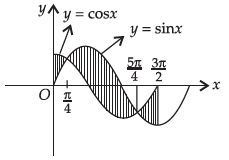
The area bounded by the curves $y = \cos x$ and $y = \sin x$ between the ordinates $x = 0$ and $x = \frac{3\pi}{2}$ is:
A
$4\sqrt{2} + 2$
B
$4\sqrt{2} - 1$
C
$4\sqrt{2} + 1$
D
$4\sqrt{2} - 2$
Solution
(D) The area $A$ is given by the integral of the absolute difference between the two functions over the interval $[0, \frac{3\pi}{2}]$.
$A = \int_{0}^{\frac{3\pi}{2}} |\cos x - \sin x| dx$
We find the intersection points where $\cos x = \sin x$,which occurs at $x = \frac{\pi}{4}$ and $x = \frac{5\pi}{4}$ within the given range.
$A = \int_{0}^{\frac{\pi}{4}} (\cos x - \sin x) dx + \int_{\frac{\pi}{4}}^{\frac{5\pi}{4}} (\sin x - \cos x) dx + \int_{\frac{5\pi}{4}}^{\frac{3\pi}{2}} (\cos x - \sin x) dx$
Evaluating the integrals:
$1$) $\int_{0}^{\frac{\pi}{4}} (\cos x - \sin x) dx = [\sin x + \cos x]_{0}^{\frac{\pi}{4}} = (\frac{1}{\sqrt{2}} + \frac{1}{\sqrt{2}}) - (0 + 1) = \sqrt{2} - 1$
$2$) $\int_{\frac{\pi}{4}}^{\frac{5\pi}{4}} (\sin x - \cos x) dx = [-\cos x - \sin x]_{\frac{\pi}{4}}^{\frac{5\pi}{4}} = (\frac{1}{\sqrt{2}} + \frac{1}{\sqrt{2}}) - (-\frac{1}{\sqrt{2}} - \frac{1}{\sqrt{2}}) = \sqrt{2} + \sqrt{2} = 2\sqrt{2}$
$3$) $\int_{\frac{5\pi}{4}}^{\frac{3\pi}{2}} (\cos x - \sin x) dx = [\sin x + \cos x]_{\frac{5\pi}{4}}^{\frac{3\pi}{2}} = (-1 + 0) - (-\frac{1}{\sqrt{2}} - \frac{1}{\sqrt{2}}) = -1 + \sqrt{2}$
Total Area $A = (\sqrt{2} - 1) + 2\sqrt{2} + (\sqrt{2} - 1) = 4\sqrt{2} - 2$.
$A = \int_{0}^{\frac{3\pi}{2}} |\cos x - \sin x| dx$
We find the intersection points where $\cos x = \sin x$,which occurs at $x = \frac{\pi}{4}$ and $x = \frac{5\pi}{4}$ within the given range.
$A = \int_{0}^{\frac{\pi}{4}} (\cos x - \sin x) dx + \int_{\frac{\pi}{4}}^{\frac{5\pi}{4}} (\sin x - \cos x) dx + \int_{\frac{5\pi}{4}}^{\frac{3\pi}{2}} (\cos x - \sin x) dx$
Evaluating the integrals:
$1$) $\int_{0}^{\frac{\pi}{4}} (\cos x - \sin x) dx = [\sin x + \cos x]_{0}^{\frac{\pi}{4}} = (\frac{1}{\sqrt{2}} + \frac{1}{\sqrt{2}}) - (0 + 1) = \sqrt{2} - 1$
$2$) $\int_{\frac{\pi}{4}}^{\frac{5\pi}{4}} (\sin x - \cos x) dx = [-\cos x - \sin x]_{\frac{\pi}{4}}^{\frac{5\pi}{4}} = (\frac{1}{\sqrt{2}} + \frac{1}{\sqrt{2}}) - (-\frac{1}{\sqrt{2}} - \frac{1}{\sqrt{2}}) = \sqrt{2} + \sqrt{2} = 2\sqrt{2}$
$3$) $\int_{\frac{5\pi}{4}}^{\frac{3\pi}{2}} (\cos x - \sin x) dx = [\sin x + \cos x]_{\frac{5\pi}{4}}^{\frac{3\pi}{2}} = (-1 + 0) - (-\frac{1}{\sqrt{2}} - \frac{1}{\sqrt{2}}) = -1 + \sqrt{2}$
Total Area $A = (\sqrt{2} - 1) + 2\sqrt{2} + (\sqrt{2} - 1) = 4\sqrt{2} - 2$.
0 likesView Solution
16
MathematicsDifficultMCQAIEEE · 2010
Let $p(x)$ be a function defined on $R$ such that $p'(x) = p'(1 - x)$ for all $x \in [0, 1]$,$p(0) = 1$,and $p(1) = 41$. Then $\int_{0}^{1} p(x) dx = $
A
$21$
B
$41$
C
$42$
D
$\sqrt{41}$
Solution
(A) Given $p'(x) = p'(1 - x)$.
Integrating both sides with respect to $x$,we get $p(x) = -p(1 - x) + C$.
At $x = 0$,$p(0) = -p(1) + C$.
Substituting the given values $p(0) = 1$ and $p(1) = 41$,we have $1 = -41 + C$,which implies $C = 42$.
Thus,$p(x) + p(1 - x) = 42$.
Let $I = \int_{0}^{1} p(x) dx$. Using the property $\int_{0}^{a} f(x) dx = \int_{0}^{a} f(a - x) dx$,we have $I = \int_{0}^{1} p(1 - x) dx$.
Adding the two expressions for $I$,we get $2I = \int_{0}^{1} (p(x) + p(1 - x)) dx$.
Substituting $p(x) + p(1 - x) = 42$,we get $2I = \int_{0}^{1} 42 dx = 42[x]_{0}^{1} = 42$.
Therefore,$I = 21$.
Integrating both sides with respect to $x$,we get $p(x) = -p(1 - x) + C$.
At $x = 0$,$p(0) = -p(1) + C$.
Substituting the given values $p(0) = 1$ and $p(1) = 41$,we have $1 = -41 + C$,which implies $C = 42$.
Thus,$p(x) + p(1 - x) = 42$.
Let $I = \int_{0}^{1} p(x) dx$. Using the property $\int_{0}^{a} f(x) dx = \int_{0}^{a} f(a - x) dx$,we have $I = \int_{0}^{1} p(1 - x) dx$.
Adding the two expressions for $I$,we get $2I = \int_{0}^{1} (p(x) + p(1 - x)) dx$.
Substituting $p(x) + p(1 - x) = 42$,we get $2I = \int_{0}^{1} 42 dx = 42[x]_{0}^{1} = 42$.
Therefore,$I = 21$.
0 likesView Solution
17
MathematicsMediumMCQAIEEE · 2010
The number of $3 \times 3$ non-singular matrices,with four entries as $1$ and all other entries as $0$,is
A
$5$
B
$6$
C
at least $7$
D
less than $4$
Solution
(C) $3 \times 3$ matrix with four $1$s and five $0$s is non-singular if its determinant is non-zero.
Consider matrices of the form:
$\begin{bmatrix} 1 & a & b \\ c & 1 & d \\ e & f & 1 \end{bmatrix}$
where exactly one of $\{a, b, c, d, e, f\}$ is $1$ and the rest are $0$. The determinant of such a matrix is $1 - (\text{product of two elements})$. Since only one element is $1$,the product is $0$,so the determinant is $1 \neq 0$. There are $6$ such matrices.
Additionally,consider the matrix:
$\begin{bmatrix} 1 & 0 & 1 \\ 0 & 1 & 0 \\ 1 & 0 & 0 \end{bmatrix}$
The determinant is $1(0-0) - 0(0-0) + 1(0-1) = -1 \neq 0$. This is a valid non-singular matrix.
Thus,there are at least $6 + 1 = 7$ such matrices.
Consider matrices of the form:
$\begin{bmatrix} 1 & a & b \\ c & 1 & d \\ e & f & 1 \end{bmatrix}$
where exactly one of $\{a, b, c, d, e, f\}$ is $1$ and the rest are $0$. The determinant of such a matrix is $1 - (\text{product of two elements})$. Since only one element is $1$,the product is $0$,so the determinant is $1 \neq 0$. There are $6$ such matrices.
Additionally,consider the matrix:
$\begin{bmatrix} 1 & 0 & 1 \\ 0 & 1 & 0 \\ 1 & 0 & 0 \end{bmatrix}$
The determinant is $1(0-0) - 0(0-0) + 1(0-1) = -1 \neq 0$. This is a valid non-singular matrix.
Thus,there are at least $6 + 1 = 7$ such matrices.
0 likesView Solution
18
MathematicsMediumMCQAIEEE · 2010
Let $A$ be a $2 \times 2$ matrix with non-zero entries and let $A^2 = I$,where $I$ is the $2 \times 2$ identity matrix. Define $tr(A) = \text{sum of diagonal elements of } A$ and $|A| = \text{determinant of matrix } A$.
Statement $-1: tr(A) = 0$
Statement $-2: \det(A) = 1$
Statement $-1: tr(A) = 0$
Statement $-2: \det(A) = 1$
A
Statement $-1$ is false,Statement $-2$ is true.
B
Statement $-1$ is true,Statement $-2$ is true; Statement $-2$ is a correct explanation for Statement $-1$.
C
Statement $-1$ is true,Statement $-2$ is true; Statement $-2$ is not a correct explanation for Statement $-1$.
D
Statement $-1$ is true,Statement $-2$ is false.
Solution
(D) Let $A = \begin{bmatrix} a & b \\ c & d \end{bmatrix}$.
Given $A^2 = I$,we have:
$\begin{bmatrix} a & b \\ c & d \end{bmatrix} \begin{bmatrix} a & b \\ c & d \end{bmatrix} = \begin{bmatrix} 1 & 0 \\ 0 & 1 \end{bmatrix}$
$\begin{bmatrix} a^2 + bc & b(a+d) \\ c(a+d) & bc + d^2 \end{bmatrix} = \begin{bmatrix} 1 & 0 \\ 0 & 1 \end{bmatrix}$
From $b(a+d) = 0$,since $b \neq 0$,we get $a+d = 0$,which implies $d = -a$.
Thus,$tr(A) = a + d = a - a = 0$. So,Statement $-1$ is true.
Now,$|A| = ad - bc = a(-a) - bc = -(a^2 + bc)$.
From the matrix multiplication,$a^2 + bc = 1$,so $|A| = -1$.
Therefore,Statement $-2$ is false.
Given $A^2 = I$,we have:
$\begin{bmatrix} a & b \\ c & d \end{bmatrix} \begin{bmatrix} a & b \\ c & d \end{bmatrix} = \begin{bmatrix} 1 & 0 \\ 0 & 1 \end{bmatrix}$
$\begin{bmatrix} a^2 + bc & b(a+d) \\ c(a+d) & bc + d^2 \end{bmatrix} = \begin{bmatrix} 1 & 0 \\ 0 & 1 \end{bmatrix}$
From $b(a+d) = 0$,since $b \neq 0$,we get $a+d = 0$,which implies $d = -a$.
Thus,$tr(A) = a + d = a - a = 0$. So,Statement $-1$ is true.
Now,$|A| = ad - bc = a(-a) - bc = -(a^2 + bc)$.
From the matrix multiplication,$a^2 + bc = 1$,so $|A| = -1$.
Therefore,Statement $-2$ is false.
0 likesView Solution
19
MathematicsDifficultMCQAIEEE · 2010
Let $f: (-1, 1) \to R$ be a differentiable function with $f(0) = -1$ and $f'(0) = 1$. Let $g(x) = [f(2f(x) + 2)]^2$. Then $g'(0) = $
A
$-4$
B
$0$
C
$-2$
D
$4$
Solution
(A) Given $g(x) = [f(2f(x) + 2)]^2$.
Using the chain rule,we differentiate $g(x)$ with respect to $x$:
$g'(x) = 2[f(2f(x) + 2)] \cdot \frac{d}{dx}[f(2f(x) + 2)]$
$g'(x) = 2[f(2f(x) + 2)] \cdot f'(2f(x) + 2) \cdot \frac{d}{dx}(2f(x) + 2)$
$g'(x) = 2[f(2f(x) + 2)] \cdot f'(2f(x) + 2) \cdot 2f'(x)$
$g'(x) = 4[f(2f(x) + 2)] \cdot f'(2f(x) + 2) \cdot f'(x)$
Now,substitute $x = 0$:
$g'(0) = 4[f(2f(0) + 2)] \cdot f'(2f(0) + 2) \cdot f'(0)$
Given $f(0) = -1$ and $f'(0) = 1$:
$g'(0) = 4[f(2(-1) + 2)] \cdot f'(2(-1) + 2) \cdot f'(0)$
$g'(0) = 4[f(0)] \cdot f'(0) \cdot f'(0)$
$g'(0) = 4(-1) \cdot (1) \cdot (1) = -4$.
Using the chain rule,we differentiate $g(x)$ with respect to $x$:
$g'(x) = 2[f(2f(x) + 2)] \cdot \frac{d}{dx}[f(2f(x) + 2)]$
$g'(x) = 2[f(2f(x) + 2)] \cdot f'(2f(x) + 2) \cdot \frac{d}{dx}(2f(x) + 2)$
$g'(x) = 2[f(2f(x) + 2)] \cdot f'(2f(x) + 2) \cdot 2f'(x)$
$g'(x) = 4[f(2f(x) + 2)] \cdot f'(2f(x) + 2) \cdot f'(x)$
Now,substitute $x = 0$:
$g'(0) = 4[f(2f(0) + 2)] \cdot f'(2f(0) + 2) \cdot f'(0)$
Given $f(0) = -1$ and $f'(0) = 1$:
$g'(0) = 4[f(2(-1) + 2)] \cdot f'(2(-1) + 2) \cdot f'(0)$
$g'(0) = 4[f(0)] \cdot f'(0) \cdot f'(0)$
$g'(0) = 4(-1) \cdot (1) \cdot (1) = -4$.
0 likesView Solution
20
MathematicsDifficultMCQAIEEE · 2010
Let $f:R \to R$ be a continuous function defined by $f(x) = \frac{1}{e^x + 2e^{-x}}$.
Statement-$1$: $f(c) = \frac{1}{3}$ for some $c \in R$.
Statement-$2$: $0 < f(x) < \frac{1}{2\sqrt{2}}$ for all $x \in R$.
Statement-$1$: $f(c) = \frac{1}{3}$ for some $c \in R$.
Statement-$2$: $0 < f(x) < \frac{1}{2\sqrt{2}}$ for all $x \in R$.
A
Statement-$1$ is false,Statement-$2$ is true.
B
Statement-$1$ is true,Statement-$2$ is false.
C
Statement-$1$ is true,Statement-$2$ is true; Statement-$2$ is not a correct explanation for Statement-$1$.
D
Statement-$1$ is true,Statement-$2$ is true; Statement-$2$ is a correct explanation for Statement-$1$.
Solution
(B) Given $f(x) = \frac{1}{e^x + 2e^{-x}} = \frac{e^x}{e^{2x} + 2}$.
To find the range,we find the maximum value of $f(x)$.
$f'(x) = \frac{e^x(e^{2x} + 2) - e^x(2e^{2x})}{(e^{2x} + 2)^2} = \frac{e^x(2 - e^{2x})}{(e^{2x} + 2)^2}$.
Setting $f'(x) = 0$,we get $e^{2x} = 2$,so $e^x = \sqrt{2}$.
The maximum value is $f(\ln \sqrt{2}) = \frac{\sqrt{2}}{2 + 2} = \frac{\sqrt{2}}{4} = \frac{1}{2\sqrt{2}}$.
Since $e^x + 2e^{-x} > 0$,$f(x) > 0$. Thus,$0 < f(x) \le \frac{1}{2\sqrt{2}}$.
Statement-$2$ claims $0 < f(x) < \frac{1}{2\sqrt{2}}$,which is false because $f(x)$ attains the value $\frac{1}{2\sqrt{2}}$.
For Statement-$1$,we check if $\frac{1}{3}$ is in the range $(0, \frac{1}{2\sqrt{2}}]$.
Since $\sqrt{2} \approx 1.414$,$2\sqrt{2} \approx 2.828$. Thus $\frac{1}{2\sqrt{2}} \approx \frac{1}{2.828} \approx 0.353$.
Since $\frac{1}{3} \approx 0.333$,we have $0 < \frac{1}{3} < \frac{1}{2\sqrt{2}}$.
By the Intermediate Value Theorem,there exists $c$ such that $f(c) = \frac{1}{3}$.
Thus,Statement-$1$ is true and Statement-$2$ is false.
To find the range,we find the maximum value of $f(x)$.
$f'(x) = \frac{e^x(e^{2x} + 2) - e^x(2e^{2x})}{(e^{2x} + 2)^2} = \frac{e^x(2 - e^{2x})}{(e^{2x} + 2)^2}$.
Setting $f'(x) = 0$,we get $e^{2x} = 2$,so $e^x = \sqrt{2}$.
The maximum value is $f(\ln \sqrt{2}) = \frac{\sqrt{2}}{2 + 2} = \frac{\sqrt{2}}{4} = \frac{1}{2\sqrt{2}}$.
Since $e^x + 2e^{-x} > 0$,$f(x) > 0$. Thus,$0 < f(x) \le \frac{1}{2\sqrt{2}}$.
Statement-$2$ claims $0 < f(x) < \frac{1}{2\sqrt{2}}$,which is false because $f(x)$ attains the value $\frac{1}{2\sqrt{2}}$.
For Statement-$1$,we check if $\frac{1}{3}$ is in the range $(0, \frac{1}{2\sqrt{2}}]$.
Since $\sqrt{2} \approx 1.414$,$2\sqrt{2} \approx 2.828$. Thus $\frac{1}{2\sqrt{2}} \approx \frac{1}{2.828} \approx 0.353$.
Since $\frac{1}{3} \approx 0.333$,we have $0 < \frac{1}{3} < \frac{1}{2\sqrt{2}}$.
By the Intermediate Value Theorem,there exists $c$ such that $f(c) = \frac{1}{3}$.
Thus,Statement-$1$ is true and Statement-$2$ is false.
0 likesView Solution
21
MathematicsMediumMCQAIEEE · 2010
The equation of the tangent to the curve $y = x + \frac{4}{x^{2}}$ that is parallel to the $x$-axis is:
A
$y=2$
B
$y=3$
C
$y=0$
D
$y=1$
Solution
(B) Given the curve equation: $y = x + \frac{4}{x^{2}}$.
To find the slope of the tangent,we differentiate with respect to $x$:
$\frac{dy}{dx} = 1 - \frac{8}{x^{3}}$.
Since the tangent is parallel to the $x$-axis,its slope must be $0$:
$1 - \frac{8}{x^{3}} = 0$.
Solving for $x$:
$\frac{8}{x^{3}} = 1 \Rightarrow x^{3} = 8 \Rightarrow x = 2$.
Now,find the corresponding $y$-coordinate by substituting $x = 2$ into the original curve equation:
$y = 2 + \frac{4}{2^{2}} = 2 + \frac{4}{4} = 2 + 1 = 3$.
The point of contact is $(2, 3)$.
Since the tangent is parallel to the $x$-axis,its equation is of the form $y = k$. Substituting the $y$-coordinate of the point of contact,we get $y = 3$.
To find the slope of the tangent,we differentiate with respect to $x$:
$\frac{dy}{dx} = 1 - \frac{8}{x^{3}}$.
Since the tangent is parallel to the $x$-axis,its slope must be $0$:
$1 - \frac{8}{x^{3}} = 0$.
Solving for $x$:
$\frac{8}{x^{3}} = 1 \Rightarrow x^{3} = 8 \Rightarrow x = 2$.
Now,find the corresponding $y$-coordinate by substituting $x = 2$ into the original curve equation:
$y = 2 + \frac{4}{2^{2}} = 2 + \frac{4}{4} = 2 + 1 = 3$.
The point of contact is $(2, 3)$.
Since the tangent is parallel to the $x$-axis,its equation is of the form $y = k$. Substituting the $y$-coordinate of the point of contact,we get $y = 3$.
0 likesView Solution
22
MathematicsDifficultMCQAIEEE · 2010
The solution of the differential equation $\cos x \, dy = y(\sin x - y) \, dx$ for $0 < x < \frac{\pi}{2}$ is:
A
$y \sec x = \tan x + c$
B
$y \tan x = \sec x + c$
C
$\tan x = (\sec x + c)y$
D
$\sec x = (\tan x + c)y$
Solution
(D) Given the differential equation: $\cos x \, dy = y(\sin x - y) \, dx$
Divide both sides by $\cos x \, dx$:
$\frac{dy}{dx} = y \tan x - y^2 \sec x$
Rearrange the terms:
$\frac{dy}{dx} - y \tan x = -y^2 \sec x$
Divide by $y^2$:
$y^{-2} \frac{dy}{dx} - y^{-1} \tan x = -\sec x \quad \dots(1)$
Let $v = y^{-1} = \frac{1}{y}$. Then $\frac{dv}{dx} = -y^{-2} \frac{dy}{dx}$,or $y^{-2} \frac{dy}{dx} = -\frac{dv}{dx}$.
Substituting into equation $(1)$:
$-\frac{dv}{dx} - v \tan x = -\sec x$
$\frac{dv}{dx} + v \tan x = \sec x$
This is a linear differential equation of the form $\frac{dv}{dx} + Pv = Q$,where $P = \tan x$ and $Q = \sec x$.
The Integrating Factor ($I$.$F$.) is $e^{\int P \, dx} = e^{\int \tan x \, dx} = e^{\ln|\sec x|} = \sec x$.
The general solution is $v \cdot (I.F.) = \int Q \cdot (I.F.) \, dx + c$.
$v \sec x = \int \sec x \cdot \sec x \, dx + c$
$v \sec x = \int \sec^2 x \, dx + c$
$v \sec x = \tan x + c$
Since $v = \frac{1}{y}$,we have:
$\frac{1}{y} \sec x = \tan x + c$
$\sec x = y(\tan x + c)$
Divide both sides by $\cos x \, dx$:
$\frac{dy}{dx} = y \tan x - y^2 \sec x$
Rearrange the terms:
$\frac{dy}{dx} - y \tan x = -y^2 \sec x$
Divide by $y^2$:
$y^{-2} \frac{dy}{dx} - y^{-1} \tan x = -\sec x \quad \dots(1)$
Let $v = y^{-1} = \frac{1}{y}$. Then $\frac{dv}{dx} = -y^{-2} \frac{dy}{dx}$,or $y^{-2} \frac{dy}{dx} = -\frac{dv}{dx}$.
Substituting into equation $(1)$:
$-\frac{dv}{dx} - v \tan x = -\sec x$
$\frac{dv}{dx} + v \tan x = \sec x$
This is a linear differential equation of the form $\frac{dv}{dx} + Pv = Q$,where $P = \tan x$ and $Q = \sec x$.
The Integrating Factor ($I$.$F$.) is $e^{\int P \, dx} = e^{\int \tan x \, dx} = e^{\ln|\sec x|} = \sec x$.
The general solution is $v \cdot (I.F.) = \int Q \cdot (I.F.) \, dx + c$.
$v \sec x = \int \sec x \cdot \sec x \, dx + c$
$v \sec x = \int \sec^2 x \, dx + c$
$v \sec x = \tan x + c$
Since $v = \frac{1}{y}$,we have:
$\frac{1}{y} \sec x = \tan x + c$
$\sec x = y(\tan x + c)$
0 likesView Solution
23
MathematicsMediumMCQAIEEE · 2010
Let $\vec{a} = \vec{j} - \vec{k}$ and $\vec{c} = \vec{i} - \vec{j} - \vec{k}$. Find the vector $\vec{b}$ satisfying $\vec{a} \times \vec{b} + \vec{c} = 0$ and $\vec{a} \cdot \vec{b} = 3$.
A
$2\vec{i} - \vec{j} + 2\vec{k}$
B
$\vec{i} - \vec{j} - 2\vec{k}$
C
$\vec{i} + \vec{j} - 2\vec{k}$
D
$-\vec{i} + \vec{j} - 2\vec{k}$
Solution
(D) Let $\vec{b} = x\vec{i} + y\vec{j} + z\vec{k}$.
Given $\vec{a} \cdot \vec{b} = 3$,where $\vec{a} = 0\vec{i} + 1\vec{j} - 1\vec{k}$.
So,$(0)(x) + (1)(y) + (-1)(z) = 3 \Rightarrow y - z = 3 \quad \dots(1)$.
Also,$\vec{a} \times \vec{b} = -\vec{c}$.
$\vec{a} \times \vec{b} = \begin{vmatrix} \vec{i} & \vec{j} & \vec{k} \\ 0 & 1 & -1 \\ x & y & z \end{vmatrix} = \vec{i}(z + y) - \vec{j}(z) + \vec{k}(-x) = (y + z)\vec{i} - z\vec{j} - x\vec{k}$.
Given $\vec{a} \times \vec{b} = -\vec{c} = -(\vec{i} - \vec{j} - \vec{k}) = -\vec{i} + \vec{j} + \vec{k}$.
Comparing components:
$y + z = -1 \quad \dots(2)$
$-z = 1 \Rightarrow z = -1$
$-x = 1 \Rightarrow x = -1$
From $(1)$,$y - (-1) = 3 \Rightarrow y + 1 = 3 \Rightarrow y = 2$.
Wait,checking the cross product again: $\vec{a} \times \vec{b} = (z + y)\vec{i} - (z)\vec{j} - (x)\vec{k}$.
Given $\vec{a} \times \vec{b} = -\vec{c} = -\vec{i} + \vec{j} + \vec{k}$.
$y + z = -1$,$-z = 1 \Rightarrow z = -1$,$-x = 1 \Rightarrow x = -1$.
Then $y - 1 = -1 \Rightarrow y = 0$. Check $\vec{a} \cdot \vec{b} = y - z = 0 - (-1) = 1 \neq 3$.
Re-evaluating: $\vec{a} \times \vec{b} + \vec{c} = 0 \Rightarrow \vec{a} \times \vec{b} = -\vec{c} = -\vec{i} + \vec{j} + \vec{k}$.
Correct calculation: $\vec{a} \times \vec{b} = (z+y)\vec{i} - (z)\vec{j} - (x)\vec{k}$.
Equating: $z+y = -1$,$-z = 1 \Rightarrow z = -1$,$-x = 1 \Rightarrow x = -1$.
$y - 1 = -1 \Rightarrow y = 0$. This contradicts $\vec{a} \cdot \vec{b} = 3$.
Let's re-read the cross product: $\vec{a} \times \vec{b} = \begin{vmatrix} \vec{i} & \vec{j} & \vec{k} \\ 0 & 1 & -1 \\ x & y & z \end{vmatrix} = (z+y)\vec{i} - (z)\vec{j} - (x)\vec{k}$.
If $\vec{a} \times \vec{b} = -\vec{c} = -\vec{i} + \vec{j} + \vec{k}$,then $z+y = -1, -z = 1, -x = 1$. Result $\vec{b} = -\vec{i} + 0\vec{j} - \vec{k}$.
Given the options,let's check $\vec{b} = -\vec{i} + \vec{j} - 2\vec{k}$ (Option $D$).
$\vec{a} \cdot \vec{b} = (1)(1) + (-1)(-2) = 1 + 2 = 3$. (Matches)
$\vec{a} \times \vec{b} = \begin{vmatrix} \vec{i} & \vec{j} & \vec{k} \\ 0 & 1 & -1 \\ -1 & 1 & -2 \end{vmatrix} = \vec{i}(-2 + 1) - \vec{j}(0 - 1) + \vec{k}(0 - (-1)) = -\vec{i} + \vec{j} + \vec{k}$.
$\vec{a} \times \vec{b} + \vec{c} = (-\vec{i} + \vec{j} + \vec{k}) + (\vec{i} - \vec{j} - \vec{k}) = 0$. (Matches)
Thus,$\vec{b} = -\vec{i} + \vec{j} - 2\vec{k}$.
Given $\vec{a} \cdot \vec{b} = 3$,where $\vec{a} = 0\vec{i} + 1\vec{j} - 1\vec{k}$.
So,$(0)(x) + (1)(y) + (-1)(z) = 3 \Rightarrow y - z = 3 \quad \dots(1)$.
Also,$\vec{a} \times \vec{b} = -\vec{c}$.
$\vec{a} \times \vec{b} = \begin{vmatrix} \vec{i} & \vec{j} & \vec{k} \\ 0 & 1 & -1 \\ x & y & z \end{vmatrix} = \vec{i}(z + y) - \vec{j}(z) + \vec{k}(-x) = (y + z)\vec{i} - z\vec{j} - x\vec{k}$.
Given $\vec{a} \times \vec{b} = -\vec{c} = -(\vec{i} - \vec{j} - \vec{k}) = -\vec{i} + \vec{j} + \vec{k}$.
Comparing components:
$y + z = -1 \quad \dots(2)$
$-z = 1 \Rightarrow z = -1$
$-x = 1 \Rightarrow x = -1$
From $(1)$,$y - (-1) = 3 \Rightarrow y + 1 = 3 \Rightarrow y = 2$.
Wait,checking the cross product again: $\vec{a} \times \vec{b} = (z + y)\vec{i} - (z)\vec{j} - (x)\vec{k}$.
Given $\vec{a} \times \vec{b} = -\vec{c} = -\vec{i} + \vec{j} + \vec{k}$.
$y + z = -1$,$-z = 1 \Rightarrow z = -1$,$-x = 1 \Rightarrow x = -1$.
Then $y - 1 = -1 \Rightarrow y = 0$. Check $\vec{a} \cdot \vec{b} = y - z = 0 - (-1) = 1 \neq 3$.
Re-evaluating: $\vec{a} \times \vec{b} + \vec{c} = 0 \Rightarrow \vec{a} \times \vec{b} = -\vec{c} = -\vec{i} + \vec{j} + \vec{k}$.
Correct calculation: $\vec{a} \times \vec{b} = (z+y)\vec{i} - (z)\vec{j} - (x)\vec{k}$.
Equating: $z+y = -1$,$-z = 1 \Rightarrow z = -1$,$-x = 1 \Rightarrow x = -1$.
$y - 1 = -1 \Rightarrow y = 0$. This contradicts $\vec{a} \cdot \vec{b} = 3$.
Let's re-read the cross product: $\vec{a} \times \vec{b} = \begin{vmatrix} \vec{i} & \vec{j} & \vec{k} \\ 0 & 1 & -1 \\ x & y & z \end{vmatrix} = (z+y)\vec{i} - (z)\vec{j} - (x)\vec{k}$.
If $\vec{a} \times \vec{b} = -\vec{c} = -\vec{i} + \vec{j} + \vec{k}$,then $z+y = -1, -z = 1, -x = 1$. Result $\vec{b} = -\vec{i} + 0\vec{j} - \vec{k}$.
Given the options,let's check $\vec{b} = -\vec{i} + \vec{j} - 2\vec{k}$ (Option $D$).
$\vec{a} \cdot \vec{b} = (1)(1) + (-1)(-2) = 1 + 2 = 3$. (Matches)
$\vec{a} \times \vec{b} = \begin{vmatrix} \vec{i} & \vec{j} & \vec{k} \\ 0 & 1 & -1 \\ -1 & 1 & -2 \end{vmatrix} = \vec{i}(-2 + 1) - \vec{j}(0 - 1) + \vec{k}(0 - (-1)) = -\vec{i} + \vec{j} + \vec{k}$.
$\vec{a} \times \vec{b} + \vec{c} = (-\vec{i} + \vec{j} + \vec{k}) + (\vec{i} - \vec{j} - \vec{k}) = 0$. (Matches)
Thus,$\vec{b} = -\vec{i} + \vec{j} - 2\vec{k}$.
0 likesView Solution
24
MathematicsMediumMCQAIEEE · 2010
If the vectors $\vec{a} = \hat{i} - \hat{j} + 2\hat{k}$,$\vec{b} = 2\hat{i} + 4\hat{j} + \hat{k}$,and $\vec{c} = \alpha\hat{i} + \hat{j} + \beta\hat{k}$ are mutually orthogonal,then $(\alpha, \beta) = $
A
$(2, -3)$
B
$(-2, 3)$
C
$(3, -2)$
D
$(-3, 2)$
Solution
(D) Given vectors are $\vec{a} = \hat{i} - \hat{j} + 2\hat{k}$,$\vec{b} = 2\hat{i} + 4\hat{j} + \hat{k}$,and $\vec{c} = \alpha\hat{i} + \hat{j} + \beta\hat{k}$.
Since the vectors are mutually orthogonal,their dot products are zero: $\vec{a} \cdot \vec{c} = 0$ and $\vec{b} \cdot \vec{c} = 0$.
For $\vec{a} \cdot \vec{c} = 0$: $(\hat{i} - \hat{j} + 2\hat{k}) \cdot (\alpha\hat{i} + \hat{j} + \beta\hat{k}) = \alpha - 1 + 2\beta = 0 \implies \alpha + 2\beta = 1$ (Equation $1$).
For $\vec{b} \cdot \vec{c} = 0$: $(2\hat{i} + 4\hat{j} + \hat{k}) \cdot (\alpha\hat{i} + \hat{j} + \beta\hat{k}) = 2\alpha + 4 + \beta = 0 \implies 2\alpha + \beta = -4$ (Equation $2$).
From Equation $2$,$\beta = -4 - 2\alpha$. Substituting this into Equation $1$:
$\alpha + 2(-4 - 2\alpha) = 1 \implies \alpha - 8 - 4\alpha = 1 \implies -3\alpha = 9 \implies \alpha = -3$.
Substituting $\alpha = -3$ into $\beta = -4 - 2\alpha$: $\beta = -4 - 2(-3) = -4 + 6 = 2$.
Thus,$(\alpha, \beta) = (-3, 2)$.
Since the vectors are mutually orthogonal,their dot products are zero: $\vec{a} \cdot \vec{c} = 0$ and $\vec{b} \cdot \vec{c} = 0$.
For $\vec{a} \cdot \vec{c} = 0$: $(\hat{i} - \hat{j} + 2\hat{k}) \cdot (\alpha\hat{i} + \hat{j} + \beta\hat{k}) = \alpha - 1 + 2\beta = 0 \implies \alpha + 2\beta = 1$ (Equation $1$).
For $\vec{b} \cdot \vec{c} = 0$: $(2\hat{i} + 4\hat{j} + \hat{k}) \cdot (\alpha\hat{i} + \hat{j} + \beta\hat{k}) = 2\alpha + 4 + \beta = 0 \implies 2\alpha + \beta = -4$ (Equation $2$).
From Equation $2$,$\beta = -4 - 2\alpha$. Substituting this into Equation $1$:
$\alpha + 2(-4 - 2\alpha) = 1 \implies \alpha - 8 - 4\alpha = 1 \implies -3\alpha = 9 \implies \alpha = -3$.
Substituting $\alpha = -3$ into $\beta = -4 - 2\alpha$: $\beta = -4 - 2(-3) = -4 + 6 = 2$.
Thus,$(\alpha, \beta) = (-3, 2)$.
0 likesView Solution
Vedclass Products
For Students
Vedclass Test Series
Mock tests in real AIEEE style covering Mathematics with performance analysis. 5-day free trial.
Start Free TrialFor Teachers
Exam Paper Generator
Generate Set A/B/C/D Mathematics papers from 7.5L+ questions in 2 minutes. 3 chapters free.
Try FreeFor Institutes
Online Exam Module
Run live AIEEE mock exams with unlimited students, 360° analytics & white-label branding.
See DemoFrequently Asked Questions
How many Mathematics questions are in AIEEE 2010?
There are 24 Mathematics questions from the AIEEE 2010 paper on Vedclass, each with a detailed step-by-step solution in English.
Are AIEEE 2010 Mathematics solutions available in English?
Yes. All solutions on this page are in English. You can also switch to English or Hindi using the language buttons above the questions.
Can I practice AIEEE 2010 Mathematics as a timed test?
Yes. Use the Vedclass Test Series to attempt a full AIEEE mock test covering Mathematics with time limits and instant score analysis.
Can teachers create Mathematics papers from AIEEE previous year questions?
Yes. The Vedclass Exam Paper Generator lets teachers mix AIEEE Mathematics questions and generate Set A/B/C/D papers in minutes.
For Teachers & Institutes
Build a Custom Mathematics Paper
Pick AIEEE 2010 Mathematics questions, set difficulty, and generate Set A/B/C/D in 2 minutes.