
PhysicsQ1–30 of 30 questions
Page 1 of 1 · English
1
PhysicsEasyMCQAIEEE · 2010
The respective number of significant figures for the numbers $23.023$,$0.0003$,and $2.1 \times 10^3$ are:
A
$5, 1, 2$
B
$5, 1, 5$
C
$5, 5, 2$
D
$4, 4, 2$
Solution
(A) To determine the number of significant figures,we follow these rules:
$(i)$ All non-zero digits are significant.
$(ii)$ All zeros between two non-zero digits are significant.
$(iii)$ For numbers less than $1$,zeros to the right of the decimal point but to the left of the first non-zero digit are not significant.
$(iv)$ The power of $10$ is not considered for significant figures.
Applying these rules:
$1$. For $23.023$: All $5$ digits are significant. So,significant figures $= 5$.
$2$. For $0.0003$: The zeros before the $3$ are not significant. Only the digit $3$ is significant. So,significant figures $= 1$.
$3$. For $2.1 \times 10^3$: The power of $10$ is ignored. The digits $2$ and $1$ are significant. So,significant figures $= 2$.
Thus,the number of significant figures are $5, 1, 2$ respectively.
$(i)$ All non-zero digits are significant.
$(ii)$ All zeros between two non-zero digits are significant.
$(iii)$ For numbers less than $1$,zeros to the right of the decimal point but to the left of the first non-zero digit are not significant.
$(iv)$ The power of $10$ is not considered for significant figures.
Applying these rules:
$1$. For $23.023$: All $5$ digits are significant. So,significant figures $= 5$.
$2$. For $0.0003$: The zeros before the $3$ are not significant. Only the digit $3$ is significant. So,significant figures $= 1$.
$3$. For $2.1 \times 10^3$: The power of $10$ is ignored. The digits $2$ and $1$ are significant. So,significant figures $= 2$.
Thus,the number of significant figures are $5, 1, 2$ respectively.
0 likesView Solution
2
PhysicsDifficultMCQAIEEE · 2010
$A$ particle is moving with velocity $\vec v = K(y\hat i + x\hat j)$ where $K$ is a constant. The general equation for its path is
A
$y^2 = x^2 + \text{constant}$
B
$y = x^2 + \text{constant}$
C
$y^2 = x + \text{constant}$
D
$xy = \text{constant}$
Solution
(A) Given the velocity vector $\vec v = K(y\hat i + x\hat j)$.
We know that $\vec v = v_x \hat i + v_y \hat j = \frac{dx}{dt} \hat i + \frac{dy}{dt} \hat j$.
Comparing the components,we get $\frac{dx}{dt} = Ky$ and $\frac{dy}{dt} = Kx$.
To find the path of the particle,we divide the two equations: $\frac{dy/dt}{dx/dt} = \frac{Kx}{Ky}$.
This simplifies to $\frac{dy}{dx} = \frac{x}{y}$.
Rearranging the terms,we get $y \, dy = x \, dx$.
Integrating both sides,we obtain $\int y \, dy = \int x \, dx$.
This results in $\frac{y^2}{2} = \frac{x^2}{2} + C'$,where $C'$ is a constant.
Multiplying by $2$,we get $y^2 = x^2 + C$,where $C = 2C'$ is another constant.
Thus,the equation of the path is $y^2 = x^2 + \text{constant}$.
We know that $\vec v = v_x \hat i + v_y \hat j = \frac{dx}{dt} \hat i + \frac{dy}{dt} \hat j$.
Comparing the components,we get $\frac{dx}{dt} = Ky$ and $\frac{dy}{dt} = Kx$.
To find the path of the particle,we divide the two equations: $\frac{dy/dt}{dx/dt} = \frac{Kx}{Ky}$.
This simplifies to $\frac{dy}{dx} = \frac{x}{y}$.
Rearranging the terms,we get $y \, dy = x \, dx$.
Integrating both sides,we obtain $\int y \, dy = \int x \, dx$.
This results in $\frac{y^2}{2} = \frac{x^2}{2} + C'$,where $C'$ is a constant.
Multiplying by $2$,we get $y^2 = x^2 + C$,where $C = 2C'$ is another constant.
Thus,the equation of the path is $y^2 = x^2 + \text{constant}$.
0 likesView Solution
3
PhysicsMediumMCQAIEEE · 2010
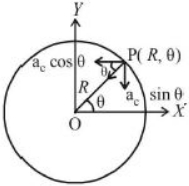
For a particle in uniform circular motion,the acceleration $\vec{a}$ at a point $P(R, \theta)$ on the circle of radius $R$ is (Here $\theta$ is measured from the $x$-axis):
A
$\frac{V^2}{R}\hat{i} + \frac{V^2}{R}\hat{j}$
B
$-\frac{V^2}{R}\cos\theta\hat{i} + \frac{V^2}{R}\sin\theta\hat{j}$
C
$-\frac{V^2}{R}\sin\theta\hat{i} + \frac{V^2}{R}\cos\theta\hat{j}$
D
$-\frac{V^2}{R}\cos\theta\hat{i} - \frac{V^2}{R}\sin\theta\hat{j}$
Solution
(D) In uniform circular motion,the acceleration is the centripetal acceleration $\vec{a}_c$,which is always directed towards the center of the circle.
For a point $P$ at an angle $\theta$ with the $x$-axis,the position vector makes an angle $\theta$ with the $x$-axis.
The centripetal acceleration vector $\vec{a}_c$ points from $P$ towards the origin $O$.
The magnitude of centripetal acceleration is $a_c = \frac{V^2}{R}$.
Resolving this vector into components:
The $x$-component is $a_x = -a_c \cos\theta = -\frac{V^2}{R} \cos\theta$.
The $y$-component is $a_y = -a_c \sin\theta = -\frac{V^2}{R} \sin\theta$.
Thus,the acceleration vector is $\vec{a} = -\frac{V^2}{R} \cos\theta \hat{i} - \frac{V^2}{R} \sin\theta \hat{j}$.
For a point $P$ at an angle $\theta$ with the $x$-axis,the position vector makes an angle $\theta$ with the $x$-axis.
The centripetal acceleration vector $\vec{a}_c$ points from $P$ towards the origin $O$.
The magnitude of centripetal acceleration is $a_c = \frac{V^2}{R}$.
Resolving this vector into components:
The $x$-component is $a_x = -a_c \cos\theta = -\frac{V^2}{R} \cos\theta$.
The $y$-component is $a_y = -a_c \sin\theta = -\frac{V^2}{R} \sin\theta$.
Thus,the acceleration vector is $\vec{a} = -\frac{V^2}{R} \cos\theta \hat{i} - \frac{V^2}{R} \sin\theta \hat{j}$.
0 likesView Solution
4
PhysicsMediumMCQAIEEE · 2010
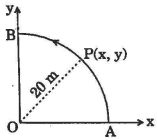
$A$ point $P$ moves in a counter-clockwise direction on a circular path as shown in the figure. The movement of $P$ is such that it sweeps out a length $s = t^3 + 5$,where $s$ is in meters and $t$ is in seconds. The radius of the path is $20 \ m$. The acceleration of $P$ when $t = 2 \ s$ is nearly .......... $m/s^2$.
A
$14$
B
$13$
C
$12$
D
$7.2$
Solution
(A) Given,the path length $s = t^3 + 5$.
Velocity $v = \frac{ds}{dt} = \frac{d}{dt}(t^3 + 5) = 3t^2 \ m/s$.
Tangential acceleration $a_t = \frac{dv}{dt} = \frac{d}{dt}(3t^2) = 6t \ m/s^2$.
Radial (centripetal) acceleration $a_c = \frac{v^2}{R} = \frac{(3t^2)^2}{R} = \frac{9t^4}{R} \ m/s^2$.
At $t = 2 \ s$:
$a_t = 6 \times 2 = 12 \ m/s^2$.
$a_c = \frac{9 \times (2)^4}{20} = \frac{9 \times 16}{20} = \frac{144}{20} = 7.2 \ m/s^2$.
The resultant acceleration $a = \sqrt{a_t^2 + a_c^2}$.
$a = \sqrt{(12)^2 + (7.2)^2} = \sqrt{144 + 51.84} = \sqrt{195.84} \approx 14 \ m/s^2$.
Velocity $v = \frac{ds}{dt} = \frac{d}{dt}(t^3 + 5) = 3t^2 \ m/s$.
Tangential acceleration $a_t = \frac{dv}{dt} = \frac{d}{dt}(3t^2) = 6t \ m/s^2$.
Radial (centripetal) acceleration $a_c = \frac{v^2}{R} = \frac{(3t^2)^2}{R} = \frac{9t^4}{R} \ m/s^2$.
At $t = 2 \ s$:
$a_t = 6 \times 2 = 12 \ m/s^2$.
$a_c = \frac{9 \times (2)^4}{20} = \frac{9 \times 16}{20} = \frac{144}{20} = 7.2 \ m/s^2$.
The resultant acceleration $a = \sqrt{a_t^2 + a_c^2}$.
$a = \sqrt{(12)^2 + (7.2)^2} = \sqrt{144 + 51.84} = \sqrt{195.84} \approx 14 \ m/s^2$.
0 likesView Solution
5
PhysicsEasyMCQAIEEE · 2010
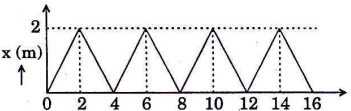
The figure shows the position-time $(x-t)$ graph of one-dimensional motion of a body of mass $0.4 \; kg$. The magnitude of each impulse is:
A
$0.2 \; N \cdot s$
B
$0.4 \; N \cdot s$
C
$0.8 \; N \cdot s$
D
$1.6 \; N \cdot s$
Solution
(C) The impulse $J$ is equal to the change in linear momentum,$\Delta p = m(v_f - v_i)$.
From the graph,the motion consists of segments with constant velocity.
For the interval $t = 0$ to $t = 2 \; s$,the displacement is $2 \; m$. Thus,initial velocity $v_i = \frac{2 \; m}{2 \; s} = 1 \; m/s$.
For the interval $t = 2 \; s$ to $t = 4 \; s$,the displacement is $-2 \; m$. Thus,final velocity $v_f = \frac{-2 \; m}{2 \; s} = -1 \; m/s$.
The mass of the body is $m = 0.4 \; kg$.
The impulse $J$ at each collision (at $t = 2, 6, 10, 14 \; s$) is given by:
$J = m(v_f - v_i) = 0.4 \; kg \times (-1 \; m/s - 1 \; m/s) = 0.4 \times (-2) = -0.8 \; kg \cdot m/s$.
The magnitude of the impulse is $|J| = |-0.8| = 0.8 \; N \cdot s$.
From the graph,the motion consists of segments with constant velocity.
For the interval $t = 0$ to $t = 2 \; s$,the displacement is $2 \; m$. Thus,initial velocity $v_i = \frac{2 \; m}{2 \; s} = 1 \; m/s$.
For the interval $t = 2 \; s$ to $t = 4 \; s$,the displacement is $-2 \; m$. Thus,final velocity $v_f = \frac{-2 \; m}{2 \; s} = -1 \; m/s$.
The mass of the body is $m = 0.4 \; kg$.
The impulse $J$ at each collision (at $t = 2, 6, 10, 14 \; s$) is given by:
$J = m(v_f - v_i) = 0.4 \; kg \times (-1 \; m/s - 1 \; m/s) = 0.4 \times (-2) = -0.8 \; kg \cdot m/s$.
The magnitude of the impulse is $|J| = |-0.8| = 0.8 \; N \cdot s$.
0 likesView Solution
6
PhysicsMediumMCQAIEEE · 2010
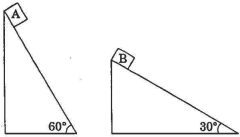
Two fixed frictionless inclined planes making an angle $30^\circ$ and $60^\circ$ with the vertical are shown in the figure. Two blocks $A$ and $B$ are placed on the two planes. What is the relative vertical acceleration of $A$ with respect to $B$?
A
$4.9 \ m/s^2$ in horizontal direction
B
$4.9 \ m/s^2$ in vertical direction
C
$9.8 \ m/s^2$ in vertical direction
D
Zero
Solution
(B) For a block on a frictionless inclined plane making an angle $\theta$ with the horizontal,the acceleration along the plane is $a = g \sin \theta$.
The vertical component of this acceleration is $a_v = a \sin \theta = (g \sin \theta) \sin \theta = g \sin^2 \theta$.
For block $A$,the angle with the horizontal is $90^\circ - 60^\circ = 30^\circ$. Thus,its vertical acceleration is $a_{vA} = g \sin^2(30^\circ) = g(1/2)^2 = g/4$.
For block $B$,the angle with the horizontal is $90^\circ - 30^\circ = 60^\circ$. Thus,its vertical acceleration is $a_{vB} = g \sin^2(60^\circ) = g(\sqrt{3}/2)^2 = 3g/4$.
The relative vertical acceleration of $A$ with respect to $B$ is $a_{rel} = a_{vA} - a_{vB} = g/4 - 3g/4 = -g/2 = -4.9 \ m/s^2$.
The magnitude is $4.9 \ m/s^2$ in the downward vertical direction.
The vertical component of this acceleration is $a_v = a \sin \theta = (g \sin \theta) \sin \theta = g \sin^2 \theta$.
For block $A$,the angle with the horizontal is $90^\circ - 60^\circ = 30^\circ$. Thus,its vertical acceleration is $a_{vA} = g \sin^2(30^\circ) = g(1/2)^2 = g/4$.
For block $B$,the angle with the horizontal is $90^\circ - 30^\circ = 60^\circ$. Thus,its vertical acceleration is $a_{vB} = g \sin^2(60^\circ) = g(\sqrt{3}/2)^2 = 3g/4$.
The relative vertical acceleration of $A$ with respect to $B$ is $a_{rel} = a_{vA} - a_{vB} = g/4 - 3g/4 = -g/2 = -4.9 \ m/s^2$.
The magnitude is $4.9 \ m/s^2$ in the downward vertical direction.
0 likesView Solution
7
PhysicsEasyMCQAIEEE · 2010
Statement $-1$: Two particles moving in the same direction do not lose all their energy in a completely inelastic collision.
Statement $-2$: Principle of conservation of momentum holds true for all kinds of collisions.
Statement $-2$: Principle of conservation of momentum holds true for all kinds of collisions.
A
Statement $-1$ is true,Statement $-2$ is false
B
Statement $-1$ is true,Statement $-2$ is true; Statement $-2$ is the correct explanation of Statement $-1$
C
Statement $-1$ is true,Statement $-2$ is true; Statement $-2$ is not the correct explanation of Statement $-1$
D
Statement $-1$ is false,Statement $-2$ is true
Solution
(B) In a completely inelastic collision,the particles stick together and move with a common velocity. The kinetic energy of the system is not entirely lost because the final system retains some kinetic energy due to the conservation of momentum. Thus,Statement $-1$ is true.
The principle of conservation of linear momentum is a fundamental law that applies to all types of collisions (elastic or inelastic) in the absence of external forces. Thus,Statement $-2$ is true.
Statement $-2$ provides the physical basis for why the system retains energy after a collision,as the conservation of momentum allows us to calculate the final common velocity and the remaining kinetic energy of the combined mass. Therefore,Statement $-2$ is the correct explanation of Statement $-1$.
The principle of conservation of linear momentum is a fundamental law that applies to all types of collisions (elastic or inelastic) in the absence of external forces. Thus,Statement $-2$ is true.
Statement $-2$ provides the physical basis for why the system retains energy after a collision,as the conservation of momentum allows us to calculate the final common velocity and the remaining kinetic energy of the combined mass. Therefore,Statement $-2$ is the correct explanation of Statement $-1$.
0 likesView Solution
8
PhysicsMediumMCQAIEEE · 2010
The potential energy function for the force between two atoms in a diatomic molecule is approximately given by $U(x) = \frac{a}{x^{12}} - \frac{b}{x^6}$,where $a$ and $b$ are constants and $x$ is the distance between the atoms. If the dissociation energy of the molecule is $D = [U(x = \infty) - U_{\text{at equilibrium}}]$,then $D$ is:
A
$\frac{b^2}{2a}$
B
$\frac{b^2}{6a}$
C
$\frac{b^2}{4a}$
D
$\frac{b^2}{12a}$
Solution
(C) At equilibrium,the force is zero,which means the derivative of the potential energy with respect to distance is zero: $\frac{dU(x)}{dx} = 0$.
Given $U(x) = ax^{-12} - bx^{-6}$,we differentiate:
$\frac{dU}{dx} = -12ax^{-13} + 6bx^{-7} = 0$.
$12ax^{-13} = 6bx^{-7} \Rightarrow \frac{2a}{x^6} = b \Rightarrow x^6 = \frac{2a}{b}$.
Now,substitute $x^6 = \frac{2a}{b}$ into the potential energy function to find $U_{\text{at equilibrium}}$:
$U_{\text{at equilibrium}} = \frac{a}{(x^6)^2} - \frac{b}{x^6} = \frac{a}{(2a/b)^2} - \frac{b}{(2a/b)} = \frac{a}{4a^2/b^2} - \frac{b^2}{2a} = \frac{b^2}{4a} - \frac{2b^2}{4a} = -\frac{b^2}{4a}$.
Since $U(x = \infty) = 0$,the dissociation energy $D$ is:
$D = U(\infty) - U_{\text{at equilibrium}} = 0 - (-\frac{b^2}{4a}) = \frac{b^2}{4a}$.
Given $U(x) = ax^{-12} - bx^{-6}$,we differentiate:
$\frac{dU}{dx} = -12ax^{-13} + 6bx^{-7} = 0$.
$12ax^{-13} = 6bx^{-7} \Rightarrow \frac{2a}{x^6} = b \Rightarrow x^6 = \frac{2a}{b}$.
Now,substitute $x^6 = \frac{2a}{b}$ into the potential energy function to find $U_{\text{at equilibrium}}$:
$U_{\text{at equilibrium}} = \frac{a}{(x^6)^2} - \frac{b}{x^6} = \frac{a}{(2a/b)^2} - \frac{b}{(2a/b)} = \frac{a}{4a^2/b^2} - \frac{b^2}{2a} = \frac{b^2}{4a} - \frac{2b^2}{4a} = -\frac{b^2}{4a}$.
Since $U(x = \infty) = 0$,the dissociation energy $D$ is:
$D = U(\infty) - U_{\text{at equilibrium}} = 0 - (-\frac{b^2}{4a}) = \frac{b^2}{4a}$.
0 likesView Solution
9
PhysicsMediumMCQAIEEE · 2010
$A$ ball is made of a material of density $\rho$ where $\rho_{\text{oil}} < \rho < \rho_{\text{water}}$,with $\rho_{\text{oil}}$ and $\rho_{\text{water}}$ representing the densities of oil and water,respectively. The oil and water are immiscible. If the above ball is in equilibrium in a mixture of this oil and water,which of the following pictures represents its equilibrium position?
A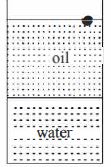
B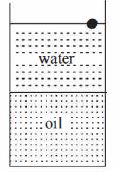
C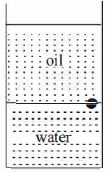
D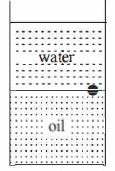
Solution
(C) Given the density condition: $\rho_{\text{oil}} < \rho < \rho_{\text{water}}$.
$1$. Since oil is less dense than water,it will float on top of the water layer.
$2$. The ball has a density $\rho$ that is greater than the density of oil $(\rho > \rho_{\text{oil}})$,so it will sink through the oil layer.
$3$. The ball has a density $\rho$ that is less than the density of water $(\rho < \rho_{\text{water}})$,so it will float on the water layer.
$4$. Consequently,the ball will come to rest at the interface between the oil and the water,partially submerged in both. This corresponds to the configuration where the oil is on top and the water is at the bottom,with the ball at the boundary.
$1$. Since oil is less dense than water,it will float on top of the water layer.
$2$. The ball has a density $\rho$ that is greater than the density of oil $(\rho > \rho_{\text{oil}})$,so it will sink through the oil layer.
$3$. The ball has a density $\rho$ that is less than the density of water $(\rho < \rho_{\text{water}})$,so it will float on the water layer.
$4$. Consequently,the ball will come to rest at the interface between the oil and the water,partially submerged in both. This corresponds to the configuration where the oil is on top and the water is at the bottom,with the ball at the boundary.
0 likesView Solution
10
PhysicsDifficultMCQAIEEE · 2010
The equation of a wave on a string of linear mass density $0.04 \ kg \ m^{-1}$ is given by $y = 0.02 \sin \left[ 2\pi \left( \frac{t}{0.04 \ s} - \frac{x}{0.50 \ m} \right) \right] \ m$. The tension in the string is .... $N$.
A
$6.25$
B
$4$
C
$12.5$
D
$0.5$
Solution
(A) The given wave equation is $y = 0.02 \sin \left[ 2\pi \left( \frac{t}{0.04} - \frac{x}{0.50} \right) \right]$.
Comparing this with the standard wave equation $y = A \sin (\omega t - kx)$,we get:
Angular frequency $\omega = \frac{2\pi}{0.04} \ rad/s$ and wave number $k = \frac{2\pi}{0.50} \ rad/m$.
The wave velocity $v$ is given by $v = \frac{\omega}{k} = \frac{2\pi / 0.04}{2\pi / 0.50} = \frac{0.50}{0.04} = 12.5 \ m/s$.
The velocity of a wave on a stretched string is $v = \sqrt{\frac{T}{\mu}}$,where $T$ is the tension and $\mu$ is the linear mass density.
Given $\mu = 0.04 \ kg/m$,we have $T = v^2 \mu$.
Substituting the values,$T = (12.5)^2 \times 0.04 = 156.25 \times 0.04 = 6.25 \ N$.
Comparing this with the standard wave equation $y = A \sin (\omega t - kx)$,we get:
Angular frequency $\omega = \frac{2\pi}{0.04} \ rad/s$ and wave number $k = \frac{2\pi}{0.50} \ rad/m$.
The wave velocity $v$ is given by $v = \frac{\omega}{k} = \frac{2\pi / 0.04}{2\pi / 0.50} = \frac{0.50}{0.04} = 12.5 \ m/s$.
The velocity of a wave on a stretched string is $v = \sqrt{\frac{T}{\mu}}$,where $T$ is the tension and $\mu$ is the linear mass density.
Given $\mu = 0.04 \ kg/m$,we have $T = v^2 \mu$.
Substituting the values,$T = (12.5)^2 \times 0.04 = 156.25 \times 0.04 = 6.25 \ N$.
0 likesView Solution
11
PhysicsDifficultMCQAIEEE · 2010
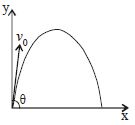
$A$ small particle of mass $m$ is projected at an angle $\theta$ with the $x$-axis with an initial velocity $v_0$ in the $x-y$ plane as shown in the figure. At a time $t < \frac{v_0 \sin \theta}{g}$,the angular momentum of the particle is
A
$-mg v_0 t^2 \cos \theta \hat{j}$
B
$mg v_0 t \cos \theta \hat{k}$
C
$-\frac{1}{2} mg v_0 t^2 \cos \theta \hat{k}$
D
$\frac{1}{2} mg v_0 t^2 \cos \theta \hat{i}$
Solution
(C) The position vector of the particle at time $t$ is given by:
$\vec{r} = (v_0 \cos \theta) t \hat{i} + ((v_0 \sin \theta) t - \frac{1}{2} g t^2) \hat{j}$
The velocity vector of the particle at time $t$ is given by:
$\vec{v} = (v_0 \cos \theta) \hat{i} + (v_0 \sin \theta - gt) \hat{j}$
The angular momentum $\vec{L}$ is defined as $\vec{L} = m(\vec{r} \times \vec{v})$:
$\vec{L} = m [((v_0 \cos \theta) t \hat{i} + ((v_0 \sin \theta) t - \frac{1}{2} g t^2) \hat{j}) \times ((v_0 \cos \theta) \hat{i} + (v_0 \sin \theta - gt) \hat{j})]$
Performing the cross product:
$\vec{L} = m [((v_0 \cos \theta) t) (v_0 \sin \theta - gt) (\hat{i} \times \hat{j}) + ((v_0 \sin \theta) t - \frac{1}{2} g t^2) (v_0 \cos \theta) (\hat{j} \times \hat{i})]$
Since $\hat{i} \times \hat{j} = \hat{k}$ and $\hat{j} \times \hat{i} = -\hat{k}$:
$\vec{L} = m [((v_0^2 \sin \theta \cos \theta) t - v_0 g t^2 \cos \theta) \hat{k} - ((v_0^2 \sin \theta \cos \theta) t - \frac{1}{2} v_0 g t^2 \cos \theta) \hat{k}]$
$\vec{L} = m [v_0^2 \sin \theta \cos \theta t - v_0 g t^2 \cos \theta - v_0^2 \sin \theta \cos \theta t + \frac{1}{2} v_0 g t^2 \cos \theta] \hat{k}$
$\vec{L} = m [-\frac{1}{2} v_0 g t^2 \cos \theta] \hat{k} = -\frac{1}{2} mg v_0 t^2 \cos \theta \hat{k}$
$\vec{r} = (v_0 \cos \theta) t \hat{i} + ((v_0 \sin \theta) t - \frac{1}{2} g t^2) \hat{j}$
The velocity vector of the particle at time $t$ is given by:
$\vec{v} = (v_0 \cos \theta) \hat{i} + (v_0 \sin \theta - gt) \hat{j}$
The angular momentum $\vec{L}$ is defined as $\vec{L} = m(\vec{r} \times \vec{v})$:
$\vec{L} = m [((v_0 \cos \theta) t \hat{i} + ((v_0 \sin \theta) t - \frac{1}{2} g t^2) \hat{j}) \times ((v_0 \cos \theta) \hat{i} + (v_0 \sin \theta - gt) \hat{j})]$
Performing the cross product:
$\vec{L} = m [((v_0 \cos \theta) t) (v_0 \sin \theta - gt) (\hat{i} \times \hat{j}) + ((v_0 \sin \theta) t - \frac{1}{2} g t^2) (v_0 \cos \theta) (\hat{j} \times \hat{i})]$
Since $\hat{i} \times \hat{j} = \hat{k}$ and $\hat{j} \times \hat{i} = -\hat{k}$:
$\vec{L} = m [((v_0^2 \sin \theta \cos \theta) t - v_0 g t^2 \cos \theta) \hat{k} - ((v_0^2 \sin \theta \cos \theta) t - \frac{1}{2} v_0 g t^2 \cos \theta) \hat{k}]$
$\vec{L} = m [v_0^2 \sin \theta \cos \theta t - v_0 g t^2 \cos \theta - v_0^2 \sin \theta \cos \theta t + \frac{1}{2} v_0 g t^2 \cos \theta] \hat{k}$
$\vec{L} = m [-\frac{1}{2} v_0 g t^2 \cos \theta] \hat{k} = -\frac{1}{2} mg v_0 t^2 \cos \theta \hat{k}$
0 likesView Solution
12
PhysicsMediumMCQAIEEE · 2010
$A$ diatomic ideal gas is used in a Carnot engine as a working substance. If during the adiabatic expansion part of the cycle,the volume of the gas increases from $V$ to $32V$,the efficiency of the engine is:
A
$0.25$
B
$0.5$
C
$0.75$
D
$0.9$
Solution
(C) For an adiabatic process,the relationship between temperature $T$ and volume $V$ is given by $TV^{\gamma-1} = \text{constant}$.
Thus,$T_H V_1^{\gamma-1} = T_C V_2^{\gamma-1}$,where $T_H$ is the source temperature and $T_C$ is the sink temperature.
Given that the gas is diatomic,the adiabatic index $\gamma = 1.4$.
The volume changes from $V_1 = V$ to $V_2 = 32V$.
Substituting these values:
$\frac{T_C}{T_H} = \left(\frac{V_1}{V_2}\right)^{\gamma-1} = \left(\frac{V}{32V}\right)^{1.4-1} = \left(\frac{1}{32}\right)^{0.4}$.
Since $32 = 2^5$,we have $\left(\frac{1}{2^5}\right)^{0.4} = \left(\frac{1}{2^5}\right)^{2/5} = \left(\frac{1}{2}\right)^2 = \frac{1}{4} = 0.25$.
The efficiency of the Carnot engine is $\eta = 1 - \frac{T_C}{T_H}$.
$\eta = 1 - 0.25 = 0.75$.
Thus,$T_H V_1^{\gamma-1} = T_C V_2^{\gamma-1}$,where $T_H$ is the source temperature and $T_C$ is the sink temperature.
Given that the gas is diatomic,the adiabatic index $\gamma = 1.4$.
The volume changes from $V_1 = V$ to $V_2 = 32V$.
Substituting these values:
$\frac{T_C}{T_H} = \left(\frac{V_1}{V_2}\right)^{\gamma-1} = \left(\frac{V}{32V}\right)^{1.4-1} = \left(\frac{1}{32}\right)^{0.4}$.
Since $32 = 2^5$,we have $\left(\frac{1}{2^5}\right)^{0.4} = \left(\frac{1}{2^5}\right)^{2/5} = \left(\frac{1}{2}\right)^2 = \frac{1}{4} = 0.25$.
The efficiency of the Carnot engine is $\eta = 1 - \frac{T_C}{T_H}$.
$\eta = 1 - 0.25 = 0.75$.
0 likesView Solution
13
PhysicsDifficultMCQAIEEE · 2010
Two long parallel wires are at a distance $2d$ apart. They carry steady equal currents flowing out of the plane of the paper,as shown. The variation of the magnetic field $B$ along the line $XX'$ is given by
A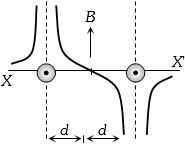
B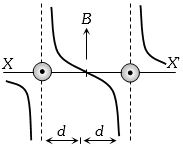
C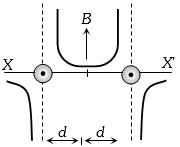
D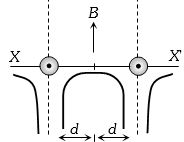
Solution
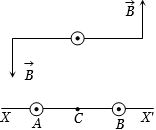
(B) If the current flows out of the paper,the magnetic field at points to the right of the wire will be upwards and to the left will be downward. Let the wires be at $A$ and $B$,and the midpoint be $C$. The magnetic field at $C$ is zero because the fields from $A$ and $B$ cancel each other out.
In the region to the right of $B$,the magnetic field is upwards $(+ve)$ because all points are to the right of both wires. Similarly,in the region to the left of $A$,the magnetic field is downwards $(-ve)$.
In the region $AC$,the points are closer to $A$ than to $B$,so the field due to $A$ dominates and is upwards $(+ve)$.
In the region $BC$,the points are closer to $B$ than to $A$,so the field due to $B$ dominates and is downwards $(-ve)$.
Graph $(b)$ correctly represents these variations in the magnetic field.
In the region to the right of $B$,the magnetic field is upwards $(+ve)$ because all points are to the right of both wires. Similarly,in the region to the left of $A$,the magnetic field is downwards $(-ve)$.
In the region $AC$,the points are closer to $A$ than to $B$,so the field due to $A$ dominates and is upwards $(+ve)$.
In the region $BC$,the points are closer to $B$ than to $A$,so the field due to $B$ dominates and is downwards $(-ve)$.
Graph $(b)$ correctly represents these variations in the magnetic field.
0 likesView Solution
14
PhysicsDifficultMCQAIEEE · 2010
Let $C$ be the capacitance of a capacitor discharging through a resistor $R$. Suppose $t_{1}$ is the time taken for the energy stored in the capacitor to reduce to half its initial value and $t_{2}$ is the time taken for the charge to reduce to one-fourth its initial value. Then the ratio $t_{1} / t_{2}$ will be
A
$2$
B
$1$
C
$0.5$
D
$0.25$
Solution
(D) The energy stored in a capacitor is given by $U = \frac{q^2}{2C}$.
For energy to reduce to half its initial value: $\frac{U_0}{2} = \frac{q^2}{2C} \Rightarrow \frac{q_0^2}{2} = q^2 \Rightarrow q = \frac{q_0}{\sqrt{2}}$.
Using the discharging equation $q = q_0 e^{-t/RC}$,we have $\frac{q_0}{\sqrt{2}} = q_0 e^{-t_1/RC}$.
Taking the natural logarithm: $-\frac{t_1}{RC} = \ln(1/\sqrt{2}) = -\frac{1}{2} \ln 2$,so $t_1 = \frac{RC \ln 2}{2}$.
For charge to reduce to one-fourth its initial value: $\frac{q_0}{4} = q_0 e^{-t_2/RC}$.
Taking the natural logarithm: $-\frac{t_2}{RC} = \ln(1/4) = -2 \ln 2$,so $t_2 = 2RC \ln 2$.
The ratio $\frac{t_1}{t_2} = \frac{(RC \ln 2) / 2}{2RC \ln 2} = \frac{1}{4} = 0.25$.
For energy to reduce to half its initial value: $\frac{U_0}{2} = \frac{q^2}{2C} \Rightarrow \frac{q_0^2}{2} = q^2 \Rightarrow q = \frac{q_0}{\sqrt{2}}$.
Using the discharging equation $q = q_0 e^{-t/RC}$,we have $\frac{q_0}{\sqrt{2}} = q_0 e^{-t_1/RC}$.
Taking the natural logarithm: $-\frac{t_1}{RC} = \ln(1/\sqrt{2}) = -\frac{1}{2} \ln 2$,so $t_1 = \frac{RC \ln 2}{2}$.
For charge to reduce to one-fourth its initial value: $\frac{q_0}{4} = q_0 e^{-t_2/RC}$.
Taking the natural logarithm: $-\frac{t_2}{RC} = \ln(1/4) = -2 \ln 2$,so $t_2 = 2RC \ln 2$.
The ratio $\frac{t_1}{t_2} = \frac{(RC \ln 2) / 2}{2RC \ln 2} = \frac{1}{4} = 0.25$.
0 likesView Solution
15
PhysicsDifficultMCQAIEEE · 2010
Two identical charged spheres are suspended by strings of equal lengths. The strings make an angle of $30^{\circ}$ with each other. When suspended in a liquid of density $0.8 \; g \, cm^{-3}$,the angle remains the same. If the density of the material of the sphere is $1.6 \; g \, cm^{-3}$,the dielectric constant of the liquid is:
A
$2$
B
$1$
C
$4$
D
$3$
Solution
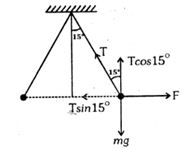
(A) Let $\theta$ be the angle each string makes with the vertical. Since the total angle between the strings is $30^{\circ}$,$\theta = 15^{\circ}$.
In air,the forces acting on the sphere are tension $T$,electrostatic force $F = \frac{1}{4\pi\epsilon_0} \frac{q^2}{r^2}$,and weight $mg$. Balancing forces:
$T \sin \theta = F$
$T \cos \theta = mg$
Dividing the two equations: $\tan \theta = \frac{F}{mg}$.
When the spheres are immersed in a liquid of density $\rho_l = 0.8 \; g \, cm^{-3}$ and the material density is $\rho_s = 1.6 \; g \, cm^{-3}$,the effective weight becomes $mg' = mg(1 - \frac{\rho_l}{\rho_s})$ and the electrostatic force becomes $F' = \frac{F}{K}$.
Since the angle remains the same,$\tan \theta = \frac{F'}{mg'} = \frac{F/K}{mg(1 - \frac{\rho_l}{\rho_s})}$.
Equating the two expressions for $\tan \theta$:
$\frac{F}{mg} = \frac{F}{K mg (1 - \frac{\rho_l}{\rho_s})}$
$K = \frac{1}{1 - \frac{\rho_l}{\rho_s}} = \frac{1}{1 - \frac{0.8}{1.6}} = \frac{1}{1 - 0.5} = \frac{1}{0.5} = 2$.
In air,the forces acting on the sphere are tension $T$,electrostatic force $F = \frac{1}{4\pi\epsilon_0} \frac{q^2}{r^2}$,and weight $mg$. Balancing forces:
$T \sin \theta = F$
$T \cos \theta = mg$
Dividing the two equations: $\tan \theta = \frac{F}{mg}$.
When the spheres are immersed in a liquid of density $\rho_l = 0.8 \; g \, cm^{-3}$ and the material density is $\rho_s = 1.6 \; g \, cm^{-3}$,the effective weight becomes $mg' = mg(1 - \frac{\rho_l}{\rho_s})$ and the electrostatic force becomes $F' = \frac{F}{K}$.
Since the angle remains the same,$\tan \theta = \frac{F'}{mg'} = \frac{F/K}{mg(1 - \frac{\rho_l}{\rho_s})}$.
Equating the two expressions for $\tan \theta$:
$\frac{F}{mg} = \frac{F}{K mg (1 - \frac{\rho_l}{\rho_s})}$
$K = \frac{1}{1 - \frac{\rho_l}{\rho_s}} = \frac{1}{1 - \frac{0.8}{1.6}} = \frac{1}{1 - 0.5} = \frac{1}{0.5} = 2$.
0 likesView Solution
16
PhysicsDifficultMCQAIEEE · 2010
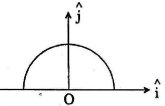
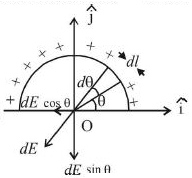
$A$ thin semi-circular ring of radius $r$ has a positive charge $q$ distributed uniformly over it. The net electric field $\vec{E}$ at the centre $O$ is
A
$\frac{q}{2\pi^2\varepsilon_0 r^2}\hat{j}$
B
$\frac{q}{4\pi^2\varepsilon_0 r^2}\hat{j}$
C
$-\frac{q}{4\pi^2\varepsilon_0 r^2}\hat{j}$
D
$-\frac{q}{2\pi^2\varepsilon_0 r^2}\hat{j}$
Solution
(D) Consider a small differential element $dl$ on the semi-circular ring. The charge $dq$ on this element is given by $dq = \lambda dl$,where $\lambda = \frac{q}{\pi r}$ is the linear charge density.
Since $dl = r d\theta$,we have $dq = \left(\frac{q}{\pi r}\right) (r d\theta) = \frac{q}{\pi} d\theta$.
The magnitude of the electric field $dE$ at the centre $O$ due to this element is $dE = \frac{1}{4\pi\varepsilon_0} \frac{dq}{r^2} = \frac{1}{4\pi\varepsilon_0} \frac{q}{\pi r^2} d\theta = \frac{q}{4\pi^2\varepsilon_0 r^2} d\theta$.
Due to symmetry,the horizontal components $(dE \cos\theta)$ of the electric field from elements on opposite sides of the vertical axis cancel each other out.
The net electric field is the integral of the vertical components $(dE \sin\theta)$ from $\theta = 0$ to $\pi$.
$E = \int_0^{\pi} dE \sin\theta = \int_0^{\pi} \frac{q}{4\pi^2\varepsilon_0 r^2} \sin\theta d\theta$.
$E = \frac{q}{4\pi^2\varepsilon_0 r^2} [-\cos\theta]_0^{\pi} = \frac{q}{4\pi^2\varepsilon_0 r^2} (-(-1) - (-1)) = \frac{q}{4\pi^2\varepsilon_0 r^2} (2) = \frac{q}{2\pi^2\varepsilon_0 r^2}$.
Since the charge is positive and distributed on the upper semi-circle,the field at the centre points downwards,i.e.,in the $-\hat{j}$ direction.
Therefore,$\vec{E} = -\frac{q}{2\pi^2\varepsilon_0 r^2} \hat{j}$.
Since $dl = r d\theta$,we have $dq = \left(\frac{q}{\pi r}\right) (r d\theta) = \frac{q}{\pi} d\theta$.
The magnitude of the electric field $dE$ at the centre $O$ due to this element is $dE = \frac{1}{4\pi\varepsilon_0} \frac{dq}{r^2} = \frac{1}{4\pi\varepsilon_0} \frac{q}{\pi r^2} d\theta = \frac{q}{4\pi^2\varepsilon_0 r^2} d\theta$.
Due to symmetry,the horizontal components $(dE \cos\theta)$ of the electric field from elements on opposite sides of the vertical axis cancel each other out.
The net electric field is the integral of the vertical components $(dE \sin\theta)$ from $\theta = 0$ to $\pi$.
$E = \int_0^{\pi} dE \sin\theta = \int_0^{\pi} \frac{q}{4\pi^2\varepsilon_0 r^2} \sin\theta d\theta$.
$E = \frac{q}{4\pi^2\varepsilon_0 r^2} [-\cos\theta]_0^{\pi} = \frac{q}{4\pi^2\varepsilon_0 r^2} (-(-1) - (-1)) = \frac{q}{4\pi^2\varepsilon_0 r^2} (2) = \frac{q}{2\pi^2\varepsilon_0 r^2}$.
Since the charge is positive and distributed on the upper semi-circle,the field at the centre points downwards,i.e.,in the $-\hat{j}$ direction.
Therefore,$\vec{E} = -\frac{q}{2\pi^2\varepsilon_0 r^2} \hat{j}$.
0 likesView Solution
17
PhysicsDifficultMCQAIEEE · 2010
Let there be a spherically symmetric charge distribution with charge density varying as $\rho (r) = \rho _0 \left( \frac{5}{4} - \frac{r}{R} \right)$ for $r \le R$,and $\rho (r) = 0$ for $r > R$,where $r$ is the distance from the origin. The electric field at a distance $r (r < R)$ from the origin is given by:
A
$\frac{\rho _0 r}{3 \varepsilon _0} \left( \frac{5}{4} - \frac{r}{R} \right)$
B
$\frac{4 \pi \rho _0 r}{3 \varepsilon _0} \left( \frac{5}{3} - \frac{r}{R} \right)$
C
$\frac{\rho _0 r}{4 \varepsilon _0} \left( \frac{5}{3} - \frac{r}{R} \right)$
D
$\frac{4 \pi \rho _0 r}{3 \varepsilon _0} \left( \frac{5}{4} - \frac{r}{R} \right)$
Solution
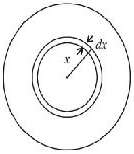
(C) Consider a spherical shell of radius $x$ and thickness $dx$. The charge on this shell is given by $dq = \rho(x) \cdot 4 \pi x^2 dx = \rho_0 \left( \frac{5}{4} - \frac{x}{R} \right) \cdot 4 \pi x^2 dx$.
The total charge $q$ enclosed within a sphere of radius $r$ $(r < R)$ is:
$q = \int_0^r dq = 4 \pi \rho_0 \int_0^r \left( \frac{5}{4} x^2 - \frac{x^3}{R} \right) dx$
$q = 4 \pi \rho_0 \left[ \frac{5}{4} \cdot \frac{r^3}{3} - \frac{1}{R} \cdot \frac{r^4}{4} \right] = 4 \pi \rho_0 \left( \frac{5 r^3}{12} - \frac{r^4}{4R} \right) = \pi \rho_0 r^3 \left( \frac{5}{3} - \frac{r}{R} \right)$.
Using Gauss's Law,the electric field $E$ at distance $r$ is:
$E \cdot 4 \pi r^2 = \frac{q}{\varepsilon_0}$
$E = \frac{1}{4 \pi \varepsilon_0 r^2} \cdot \left[ \pi \rho_0 r^3 \left( \frac{5}{3} - \frac{r}{R} \right) \right]$
$E = \frac{\rho_0 r}{4 \varepsilon_0} \left( \frac{5}{3} - \frac{r}{R} \right)$.
The total charge $q$ enclosed within a sphere of radius $r$ $(r < R)$ is:
$q = \int_0^r dq = 4 \pi \rho_0 \int_0^r \left( \frac{5}{4} x^2 - \frac{x^3}{R} \right) dx$
$q = 4 \pi \rho_0 \left[ \frac{5}{4} \cdot \frac{r^3}{3} - \frac{1}{R} \cdot \frac{r^4}{4} \right] = 4 \pi \rho_0 \left( \frac{5 r^3}{12} - \frac{r^4}{4R} \right) = \pi \rho_0 r^3 \left( \frac{5}{3} - \frac{r}{R} \right)$.
Using Gauss's Law,the electric field $E$ at distance $r$ is:
$E \cdot 4 \pi r^2 = \frac{q}{\varepsilon_0}$
$E = \frac{1}{4 \pi \varepsilon_0 r^2} \cdot \left[ \pi \rho_0 r^3 \left( \frac{5}{3} - \frac{r}{R} \right) \right]$
$E = \frac{\rho_0 r}{4 \varepsilon_0} \left( \frac{5}{3} - \frac{r}{R} \right)$.
0 likesView Solution
18
PhysicsDifficultMCQAIEEE · 2010
Two conductors have the same resistance at $0\,^{\circ}C$ but their temperature coefficients of resistance are $\alpha_1$ and $\alpha_2$. The respective temperature coefficients of their series and parallel combinations are nearly
A
$\frac{\alpha_1 + \alpha_2}{2}, \frac{\alpha_1 + \alpha_2}{2}$
B
$\frac{\alpha_1 + \alpha_2}{2}, \alpha_1 + \alpha_2$
C
$\alpha_1 + \alpha_2, \frac{\alpha_1 + \alpha_2}{2}$
D
$\alpha_1 + \alpha_2, \frac{\alpha_1 \alpha_2}{\alpha_1 + \alpha_2}$
Solution
(A) Let the resistance of both conductors at $0\,^{\circ}C$ be $R_0$. The resistance at temperature $\Delta t$ is given by $R = R_0(1 + \alpha \Delta t)$.
For the series combination: $R_s = R_1 + R_2 = R_0(1 + \alpha_1 \Delta t) + R_0(1 + \alpha_2 \Delta t) = 2R_0(1 + \frac{\alpha_1 + \alpha_2}{2} \Delta t)$. Comparing this with $R_s = 2R_0(1 + \alpha_s \Delta t)$,we get $\alpha_s = \frac{\alpha_1 + \alpha_2}{2}$.
For the parallel combination: $\frac{1}{R_p} = \frac{1}{R_1} + \frac{1}{R_2} = \frac{1}{R_0(1 + \alpha_1 \Delta t)} + \frac{1}{R_0(1 + \alpha_2 \Delta t)}$. Using the binomial approximation $(1+x)^{-1} \approx 1-x$,we get $\frac{1}{R_p} \approx \frac{1}{R_0}(1 - \alpha_1 \Delta t + 1 - \alpha_2 \Delta t) = \frac{2}{R_0}(1 - \frac{\alpha_1 + \alpha_2}{2} \Delta t)$.
Thus,$R_p \approx \frac{R_0}{2}(1 + \frac{\alpha_1 + \alpha_2}{2} \Delta t)$. Comparing this with $R_p = \frac{R_0}{2}(1 + \alpha_p \Delta t)$,we get $\alpha_p = \frac{\alpha_1 + \alpha_2}{2}$.
For the series combination: $R_s = R_1 + R_2 = R_0(1 + \alpha_1 \Delta t) + R_0(1 + \alpha_2 \Delta t) = 2R_0(1 + \frac{\alpha_1 + \alpha_2}{2} \Delta t)$. Comparing this with $R_s = 2R_0(1 + \alpha_s \Delta t)$,we get $\alpha_s = \frac{\alpha_1 + \alpha_2}{2}$.
For the parallel combination: $\frac{1}{R_p} = \frac{1}{R_1} + \frac{1}{R_2} = \frac{1}{R_0(1 + \alpha_1 \Delta t)} + \frac{1}{R_0(1 + \alpha_2 \Delta t)}$. Using the binomial approximation $(1+x)^{-1} \approx 1-x$,we get $\frac{1}{R_p} \approx \frac{1}{R_0}(1 - \alpha_1 \Delta t + 1 - \alpha_2 \Delta t) = \frac{2}{R_0}(1 - \frac{\alpha_1 + \alpha_2}{2} \Delta t)$.
Thus,$R_p \approx \frac{R_0}{2}(1 + \frac{\alpha_1 + \alpha_2}{2} \Delta t)$. Comparing this with $R_p = \frac{R_0}{2}(1 + \alpha_p \Delta t)$,we get $\alpha_p = \frac{\alpha_1 + \alpha_2}{2}$.
0 likesView Solution
19
PhysicsMediumMCQAIEEE · 2010
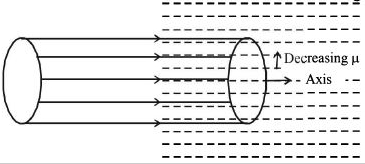
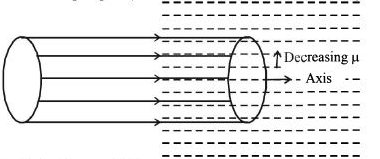
An initially parallel cylindrical beam travels in a medium of refractive index $\mu(I) = \mu_0 + \mu_2I$,where $\mu_0$ and $\mu_2$ are positive constants and $I$ is the intensity of the light beam. The intensity of the beam is decreasing with increasing radius. As the beam enters the medium,it will:
A
travel as a cylindrical beam
B
diverge
C
converge
D
diverge near the axis and converge near the periphery
Solution
(C) The refractive index of the medium is given by $\mu(I) = \mu_0 + \mu_2I$.
Since the intensity $I$ of the beam is maximum at the axis and decreases as the radius increases,the refractive index $\mu$ will also be maximum at the axis and decrease towards the periphery.
Light rays always bend towards the region of higher refractive index.
Since the refractive index is higher near the axis and lower towards the periphery,the light rays will bend towards the axis.
Therefore,the beam will converge.
Since the intensity $I$ of the beam is maximum at the axis and decreases as the radius increases,the refractive index $\mu$ will also be maximum at the axis and decrease towards the periphery.
Light rays always bend towards the region of higher refractive index.
Since the refractive index is higher near the axis and lower towards the periphery,the light rays will bend towards the axis.
Therefore,the beam will converge.
0 likesView Solution
20
PhysicsMediumMCQAIEEE · 2010
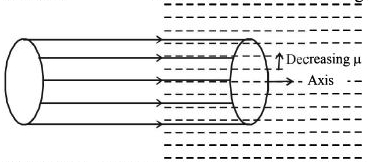
An initially parallel cylindrical beam travels in a medium of refractive index $\mu(I) = \mu_0 + \mu_2I$,where $\mu_0$ and $\mu_2$ are positive constants and $I$ is the intensity of the light beam. The intensity of the beam is decreasing with increasing radius. The initial shape of the wavefront of the beam is
A
planar
B
Convex
C
Concave
D
convex near the axis and concave near the periphery
Solution
(A) The refractive index of the medium is given by $\mu(I) = \mu_0 + \mu_2I$. Since the intensity $I$ of the beam decreases as the radius increases,the refractive index $\mu$ also decreases from the axis towards the periphery.
Because the beam is initially parallel and cylindrical,the rays of light are parallel to each other. By definition,the wavefront of a parallel beam of light is a plane perpendicular to the direction of propagation.
Therefore,the initial shape of the wavefront is planar.
Because the beam is initially parallel and cylindrical,the rays of light are parallel to each other. By definition,the wavefront of a parallel beam of light is a plane perpendicular to the direction of propagation.
Therefore,the initial shape of the wavefront is planar.
0 likesView Solution
21
PhysicsMediumMCQAIEEE · 2010
An initially parallel cylindrical beam travels in a medium of refractive index $\mu(I) = \mu_0 + \mu_2I$,where $\mu_0$ and $\mu_2$ are positive constants and $I$ is the intensity of the light beam. The intensity of the beam is decreasing with increasing radius. The speed of light in the medium is
A
maximum on the axis of the beam
B
minimum on the axis of the beam
C
the same everywhere in the beam
D
directly proportional to the intensity $I$
Solution
(B) The refractive index of the medium is given by $\mu(I) = \mu_0 + \mu_2I$.
The speed of light $v$ in a medium with refractive index $\mu$ is given by $v = \frac{c_0}{\mu}$,where $c_0$ is the speed of light in vacuum.
Substituting the expression for $\mu$,we get $v = \frac{c_0}{\mu_0 + \mu_2I}$.
Since the intensity $I$ of the beam is maximum on the axis and decreases as the radius increases,the denominator $(\mu_0 + \mu_2I)$ will be maximum on the axis.
Consequently,the speed of light $v$ will be minimum on the axis of the beam.
The speed of light $v$ in a medium with refractive index $\mu$ is given by $v = \frac{c_0}{\mu}$,where $c_0$ is the speed of light in vacuum.
Substituting the expression for $\mu$,we get $v = \frac{c_0}{\mu_0 + \mu_2I}$.
Since the intensity $I$ of the beam is maximum on the axis and decreases as the radius increases,the denominator $(\mu_0 + \mu_2I)$ will be maximum on the axis.
Consequently,the speed of light $v$ will be minimum on the axis of the beam.
0 likesView Solution
22
PhysicsMediumMCQAIEEE · 2010
Statement $-1$: When ultraviolet light is incident on a photocell, its stopping potential is $V_0$ and the maximum kinetic energy of the photoelectrons is $K_{max}$. When the ultraviolet light is replaced by $X$-rays, both $V_0$ and $K_{max}$ increase.
Statement $-2$: Photoelectrons are emitted with speeds ranging from zero to a maximum value because of the range of frequencies present in the incident light.
Statement $-2$: Photoelectrons are emitted with speeds ranging from zero to a maximum value because of the range of frequencies present in the incident light.
A
Statement $-1$ is true, Statement $-2$ is false.
B
Statement $-1$ is true, Statement $-2$ is true; Statement $-2$ is the correct explanation of Statement $-1$.
C
Statement $-1$ is true, Statement $-2$ is true; Statement $-2$ is not the correct explanation of Statement $-1$.
D
Statement $-1$ is false, Statement $-2$ is true.
Solution
(A) According to Einstein's photoelectric equation, $eV_0 = K_{max} = h\nu - \phi$, where $\phi$ is the work function of the metal surface.
Since the frequency of $X$-rays $(\nu_X)$ is much higher than the frequency of ultraviolet light $(\nu_{UV})$, the maximum kinetic energy $K_{max} = h\nu - \phi$ increases when $X$-rays are used.
Consequently, the stopping potential $V_0 = K_{max}/e$ also increases. Thus, Statement $-1$ is true.
Statement $-2$ is false because photoelectrons are emitted with a range of speeds from zero to a maximum value due to the loss of energy during collisions of electrons within the metal before they are emitted, not because of a range of frequencies in the incident light (which is monochromatic).
Since the frequency of $X$-rays $(\nu_X)$ is much higher than the frequency of ultraviolet light $(\nu_{UV})$, the maximum kinetic energy $K_{max} = h\nu - \phi$ increases when $X$-rays are used.
Consequently, the stopping potential $V_0 = K_{max}/e$ also increases. Thus, Statement $-1$ is true.
Statement $-2$ is false because photoelectrons are emitted with a range of speeds from zero to a maximum value due to the loss of energy during collisions of electrons within the metal before they are emitted, not because of a range of frequencies in the incident light (which is monochromatic).
0 likesView Solution
23
PhysicsDifficultMCQAIEEE · 2010
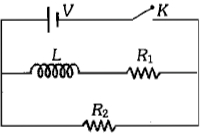
In the circuit shown below,the key $K$ is closed at $t = 0$. The current through the battery is
A
$\frac{V}{R_2}$ at $t = 0$ and $\frac{V(R_1 + R_2)}{R_1 R_2}$ at $t = \infty$
B
$\frac{V R_1 R_2}{\sqrt{R_1^2 + R_2^2}}$ at $t = 0$ and $\frac{V}{R_2}$ at $t = \infty$
C
$\frac{V(R_1 + R_2)}{R_1 R_2}$ at $t = 0$ and $\frac{V}{R_2}$ at $t = \infty$
D
$\frac{V}{R_2}$ at $t = 0$ and $\frac{V R_1 R_2}{\sqrt{R_1^2 + R_2^2}}$ at $t = \infty$
Solution
(A) At $t = 0$,the inductor $L$ acts as an open circuit because it opposes any change in current. Therefore,no current flows through the branch containing $L$ and $R_1$.
Thus,the current through the battery is $I = \frac{V}{R_2}$.
At $t = \infty$,the inductor $L$ acts as a short circuit (ideal inductor with zero resistance). The resistors $R_1$ and $R_2$ are now in parallel.
The effective resistance of the circuit is $R_{eff} = \frac{R_1 R_2}{R_1 + R_2}$.
Therefore,the current through the battery is $I = \frac{V}{R_{eff}} = \frac{V(R_1 + R_2)}{R_1 R_2}$.
Thus,the current through the battery is $I = \frac{V}{R_2}$.
At $t = \infty$,the inductor $L$ acts as a short circuit (ideal inductor with zero resistance). The resistors $R_1$ and $R_2$ are now in parallel.
The effective resistance of the circuit is $R_{eff} = \frac{R_1 R_2}{R_1 + R_2}$.
Therefore,the current through the battery is $I = \frac{V}{R_{eff}} = \frac{V(R_1 + R_2)}{R_1 R_2}$.
0 likesView Solution
24
PhysicsDifficultMCQAIEEE · 2010
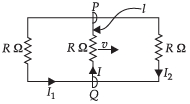
$A$ rectangular loop has a sliding connector $PQ$ of length $l$ and resistance $R \ \Omega$ and it is moving with a speed $v$ as shown. The set-up is placed in a uniform magnetic field going into the plane of the paper. The three currents $I_1, I_2$ and $I$ are:
A
$I_1 = I_2 = \frac{Bvl}{6R}, I = \frac{Blv}{R}$
B
$I_1 = -I_2 = \frac{Bvl}{R}, I = 2\frac{Blv}{R}$
C
$I_1 = I_2 = \frac{Bvl}{3R}, I = \frac{2Blv}{3R}$
D
$I_1 = I_2 = I = \frac{Blv}{R}$
Solution
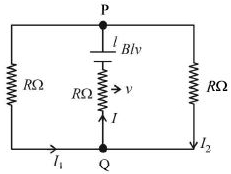
(C) The moving rod $PQ$ acts as a source of induced $emf$ $\varepsilon = Blv$ with internal resistance $R$.
The circuit consists of this $emf$ source in series with a resistor $R$,which is then connected in parallel to two other branches,each containing a resistor $R$.
Let the potential at $Q$ be $V_Q$ and at $P$ be $V_P$. The total resistance of the circuit is the internal resistance $R$ plus the equivalent resistance of the two parallel branches,which is $R/2$.
Total resistance $R_{eq} = R + \frac{R \times R}{R + R} = R + \frac{R}{2} = \frac{3R}{2}$.
The total current $I$ flowing through the rod is $I = \frac{\varepsilon}{R_{eq}} = \frac{Blv}{3R/2} = \frac{2Blv}{3R}$.
Since the two parallel branches have equal resistance $R$,the current $I$ splits equally between them: $I_1 = I_2 = \frac{I}{2} = \frac{1}{2} \times \frac{2Blv}{3R} = \frac{Blv}{3R}$.
Thus,$I_1 = I_2 = \frac{Blv}{3R}$ and $I = \frac{2Blv}{3R}$.
The circuit consists of this $emf$ source in series with a resistor $R$,which is then connected in parallel to two other branches,each containing a resistor $R$.
Let the potential at $Q$ be $V_Q$ and at $P$ be $V_P$. The total resistance of the circuit is the internal resistance $R$ plus the equivalent resistance of the two parallel branches,which is $R/2$.
Total resistance $R_{eq} = R + \frac{R \times R}{R + R} = R + \frac{R}{2} = \frac{3R}{2}$.
The total current $I$ flowing through the rod is $I = \frac{\varepsilon}{R_{eq}} = \frac{Blv}{3R/2} = \frac{2Blv}{3R}$.
Since the two parallel branches have equal resistance $R$,the current $I$ splits equally between them: $I_1 = I_2 = \frac{I}{2} = \frac{1}{2} \times \frac{2Blv}{3R} = \frac{Blv}{3R}$.
Thus,$I_1 = I_2 = \frac{Blv}{3R}$ and $I = \frac{2Blv}{3R}$.
0 likesView Solution
25
PhysicsDifficultMCQAIEEE · 2010
In a series $LCR$ circuit,$R = 200 \, \Omega$ and the voltage and frequency of the main supply are $220 \, V$ and $50 \, Hz$ respectively. On taking out the capacitance from the circuit,the current lags behind the voltage by $30^\circ$. On taking out the inductor from the circuit,the current leads the voltage by $30^\circ$. The power dissipated in the $LCR$ circuit is......$W$.
A
$242$
B
$305$
C
$210$
D
$0$
Solution
(A) When capacitance is removed,the circuit becomes an $LR$ circuit.
Given the phase angle $\phi = 30^\circ$,we have $\tan \phi = \frac{\omega L}{R}$.
$\omega L = R \tan 30^\circ = 200 \times \frac{1}{\sqrt{3}} = \frac{200}{\sqrt{3}} \, \Omega$.
When the inductor is removed,the circuit becomes a $CR$ circuit.
Given the phase angle $\phi = 30^\circ$,we have $\tan \phi = \frac{1}{\omega C R}$.
$\frac{1}{\omega C} = R \tan 30^\circ = 200 \times \frac{1}{\sqrt{3}} = \frac{200}{\sqrt{3}} \, \Omega$.
In the original $LCR$ circuit,the impedance $Z$ is given by $Z = \sqrt{R^2 + (\omega L - \frac{1}{\omega C})^2}$.
Substituting the values: $Z = \sqrt{200^2 + (\frac{200}{\sqrt{3}} - \frac{200}{\sqrt{3}})^2} = \sqrt{200^2 + 0} = 200 \, \Omega$.
The power dissipated in an $AC$ circuit is $P = V_{rms} I_{rms} \cos \phi$,where $\cos \phi = \frac{R}{Z}$.
Since $\omega L = \frac{1}{\omega C}$,the circuit is in resonance,so $\phi = 0^\circ$ and $\cos \phi = 1$.
$P = \frac{V_{rms}^2}{Z^2} \times R = \frac{220^2}{200^2} \times 200 = \frac{220 \times 220}{200} = 242 \, W$.
Given the phase angle $\phi = 30^\circ$,we have $\tan \phi = \frac{\omega L}{R}$.
$\omega L = R \tan 30^\circ = 200 \times \frac{1}{\sqrt{3}} = \frac{200}{\sqrt{3}} \, \Omega$.
When the inductor is removed,the circuit becomes a $CR$ circuit.
Given the phase angle $\phi = 30^\circ$,we have $\tan \phi = \frac{1}{\omega C R}$.
$\frac{1}{\omega C} = R \tan 30^\circ = 200 \times \frac{1}{\sqrt{3}} = \frac{200}{\sqrt{3}} \, \Omega$.
In the original $LCR$ circuit,the impedance $Z$ is given by $Z = \sqrt{R^2 + (\omega L - \frac{1}{\omega C})^2}$.
Substituting the values: $Z = \sqrt{200^2 + (\frac{200}{\sqrt{3}} - \frac{200}{\sqrt{3}})^2} = \sqrt{200^2 + 0} = 200 \, \Omega$.
The power dissipated in an $AC$ circuit is $P = V_{rms} I_{rms} \cos \phi$,where $\cos \phi = \frac{R}{Z}$.
Since $\omega L = \frac{1}{\omega C}$,the circuit is in resonance,so $\phi = 0^\circ$ and $\cos \phi = 1$.
$P = \frac{V_{rms}^2}{Z^2} \times R = \frac{220^2}{200^2} \times 200 = \frac{220 \times 220}{200} = 242 \, W$.
0 likesView Solution
26
PhysicsMediumMCQAIEEE · 2010
If a source of power $4 \ kW$ produces $10^{20}$ photons/second,the radiation belongs to a part of the spectrum called
A
$\gamma$-rays
B
$X$-rays
C
Ultraviolet rays
D
Microwaves
Solution
(B) The power $P$ of the source is given by $P = n \cdot E_{photon} = n \cdot h \nu$,where $n$ is the number of photons per second,$h$ is Planck's constant,and $\nu$ is the frequency.
Given $P = 4 \ kW = 4 \times 10^3 \ W$ and $n = 10^{20} \ photons/s$.
Rearranging for frequency: $\nu = \frac{P}{n \cdot h}$.
Substituting the values: $\nu = \frac{4 \times 10^3}{10^{20} \times 6.63 \times 10^{-34}} \approx 6.03 \times 10^{16} \ Hz$.
The frequency range $6 \times 10^{16} \ Hz$ falls within the $X$-ray region of the electromagnetic spectrum.
Given $P = 4 \ kW = 4 \times 10^3 \ W$ and $n = 10^{20} \ photons/s$.
Rearranging for frequency: $\nu = \frac{P}{n \cdot h}$.
Substituting the values: $\nu = \frac{4 \times 10^3}{10^{20} \times 6.63 \times 10^{-34}} \approx 6.03 \times 10^{16} \ Hz$.
The frequency range $6 \times 10^{16} \ Hz$ falls within the $X$-ray region of the electromagnetic spectrum.
0 likesView Solution
27
PhysicsMediumMCQAIEEE · 2010
$A$ nucleus of mass $M + \Delta m$ is at rest and decays into two daughter nuclei of equal mass $\frac{M}{2}$ each. The speed of light is $c$. The speed of the daughter nuclei is:
A
$c \sqrt{\frac{\Delta m}{M + \Delta m}}$
B
$c \frac{\Delta m}{M + \Delta m}$
C
$c \sqrt{\frac{2 \Delta m}{M}}$
D
$c \sqrt{\frac{\Delta m}{M}}$
Solution
(C) According to the law of conservation of energy,the total energy before decay equals the total energy after decay.
The initial energy is the rest mass energy: $E_i = (M + \Delta m)c^2$.
The final energy consists of the rest mass energy of the two daughter nuclei and their kinetic energy: $E_f = 2 \times (\frac{M}{2})c^2 + 2 \times (\frac{1}{2} \times \frac{M}{2} \times v^2)$.
Equating $E_i = E_f$:
$(M + \Delta m)c^2 = Mc^2 + \frac{M}{2}v^2$.
Subtracting $Mc^2$ from both sides:
$\Delta m c^2 = \frac{M}{2}v^2$.
Solving for $v$:
$v^2 = \frac{2 \Delta m c^2}{M} \Rightarrow v = c \sqrt{\frac{2 \Delta m}{M}}$.
The initial energy is the rest mass energy: $E_i = (M + \Delta m)c^2$.
The final energy consists of the rest mass energy of the two daughter nuclei and their kinetic energy: $E_f = 2 \times (\frac{M}{2})c^2 + 2 \times (\frac{1}{2} \times \frac{M}{2} \times v^2)$.
Equating $E_i = E_f$:
$(M + \Delta m)c^2 = Mc^2 + \frac{M}{2}v^2$.
Subtracting $Mc^2$ from both sides:
$\Delta m c^2 = \frac{M}{2}v^2$.
Solving for $v$:
$v^2 = \frac{2 \Delta m c^2}{M} \Rightarrow v = c \sqrt{\frac{2 \Delta m}{M}}$.
0 likesView Solution
28
PhysicsEasyMCQAIEEE · 2010
$A$ nucleus of mass $M + \Delta m$ is at rest and decays into two daughter nuclei of equal mass $\frac{M}{2}$ each. The speed of light is $c$. The binding energy per nucleon for the parent nucleus is $E_1$ and that for the daughter nuclei is $E_2$. Then:
A
$E_1 = 2E_2$
B
$E_2 = 2E_1$
C
$E_1 > E_2$
D
$E_2 > E_1$
Solution
(D) In a nuclear decay or fission process,the system moves toward a more stable state.
Stability is determined by the binding energy per nucleon.
$A$ nucleus with a higher binding energy per nucleon is more stable.
Since the parent nucleus decays into two daughter nuclei,the daughter nuclei must be more stable than the parent nucleus to satisfy the energy release condition.
Therefore,the binding energy per nucleon of the daughter nuclei $(E_2)$ must be greater than that of the parent nucleus $(E_1)$.
Thus,$E_2 > E_1$.
Stability is determined by the binding energy per nucleon.
$A$ nucleus with a higher binding energy per nucleon is more stable.
Since the parent nucleus decays into two daughter nuclei,the daughter nuclei must be more stable than the parent nucleus to satisfy the energy release condition.
Therefore,the binding energy per nucleon of the daughter nuclei $(E_2)$ must be greater than that of the parent nucleus $(E_1)$.
Thus,$E_2 > E_1$.
0 likesView Solution
29
PhysicsMediumMCQAIEEE · 2010
$A$ radioactive nucleus (initial mass number $A$ and atomic number $Z$) emits $3$ $\alpha$-particles and $2$ positrons. The ratio of the number of neutrons to that of protons in the final nucleus will be:
A
$\frac{A - Z - 4}{Z - 8}$
B
$\frac{A - Z - 8}{Z - 4}$
C
$\frac{A - Z - 4}{Z - 4}$
D
$\frac{A - Z - 12}{Z - 4}$
Solution
(B) The initial nucleus is represented as $_Z^AX$.
An $\alpha$-particle is $_2^4He$ and a positron is $_1^0e^+$.
After emitting $3$ $\alpha$-particles and $2$ positrons, the final nucleus $_Z^AY$ is formed.
The new mass number $A' = A - (3 \times 4) = A - 12$.
The new atomic number $Z' = Z - (3 \times 2) + (2 \times 1) = Z - 6 + 2 = Z - 4$.
The number of protons in the final nucleus is $P = Z' = Z - 4$.
The number of neutrons in the final nucleus is $N = A' - Z' = (A - 12) - (Z - 4) = A - Z - 8$.
The ratio of neutrons to protons is $\frac{N}{P} = \frac{A - Z - 8}{Z - 4}$.
An $\alpha$-particle is $_2^4He$ and a positron is $_1^0e^+$.
After emitting $3$ $\alpha$-particles and $2$ positrons, the final nucleus $_Z^AY$ is formed.
The new mass number $A' = A - (3 \times 4) = A - 12$.
The new atomic number $Z' = Z - (3 \times 2) + (2 \times 1) = Z - 6 + 2 = Z - 4$.
The number of protons in the final nucleus is $P = Z' = Z - 4$.
The number of neutrons in the final nucleus is $N = A' - Z' = (A - 12) - (Z - 4) = A - Z - 8$.
The ratio of neutrons to protons is $\frac{N}{P} = \frac{A - Z - 8}{Z - 4}$.
0 likesView Solution
30
PhysicsMediumMCQAIEEE · 2010
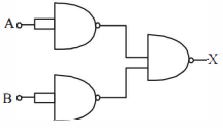
The combination of gates shown below yields:
A
$NAND$ gate
B
$OR$ gate
C
$NOT$ gate
D
$XOR$ gate
Solution
(B) The circuit consists of two $NAND$ gates acting as $NOT$ gates (since their inputs are shorted) followed by a $NAND$ gate.
Let the inputs be $A$ and $B$.
The output of the first $NAND$ gate is $\bar{A}$.
The output of the second $NAND$ gate is $\bar{B}$.
These two outputs are fed into the third $NAND$ gate.
The final output $X$ is given by the boolean expression:
$X = \overline{\bar{A} \cdot \bar{B}}$
Using De Morgan's theorem,$\overline{\bar{A} \cdot \bar{B}} = \overline{\bar{A}} + \overline{\bar{B}} = A + B$.
Since the expression $X = A + B$ represents an $OR$ gate,the correct option is $B$.
Let the inputs be $A$ and $B$.
The output of the first $NAND$ gate is $\bar{A}$.
The output of the second $NAND$ gate is $\bar{B}$.
These two outputs are fed into the third $NAND$ gate.
The final output $X$ is given by the boolean expression:
$X = \overline{\bar{A} \cdot \bar{B}}$
Using De Morgan's theorem,$\overline{\bar{A} \cdot \bar{B}} = \overline{\bar{A}} + \overline{\bar{B}} = A + B$.
Since the expression $X = A + B$ represents an $OR$ gate,the correct option is $B$.
0 likesView Solution
Vedclass Products
For Students
Vedclass Test Series
Mock tests in real AIEEE style covering Physics with performance analysis. 5-day free trial.
Start Free TrialFor Teachers
Exam Paper Generator
Generate Set A/B/C/D Physics papers from 7.5L+ questions in 2 minutes. 3 chapters free.
Try FreeFor Institutes
Online Exam Module
Run live AIEEE mock exams with unlimited students, 360° analytics & white-label branding.
See DemoFrequently Asked Questions
How many Physics questions are in AIEEE 2010?
There are 30 Physics questions from the AIEEE 2010 paper on Vedclass, each with a detailed step-by-step solution in English.
Are AIEEE 2010 Physics solutions available in English?
Yes. All solutions on this page are in English. You can also switch to English or Hindi using the language buttons above the questions.
Can I practice AIEEE 2010 Physics as a timed test?
Yes. Use the Vedclass Test Series to attempt a full AIEEE mock test covering Physics with time limits and instant score analysis.
Can teachers create Physics papers from AIEEE previous year questions?
Yes. The Vedclass Exam Paper Generator lets teachers mix AIEEE Physics questions and generate Set A/B/C/D papers in minutes.
For Teachers & Institutes
Build a Custom Physics Paper
Pick AIEEE 2010 Physics questions, set difficulty, and generate Set A/B/C/D in 2 minutes.