
PhysicsQ1–30 of 30 questions
Page 1 of 1 · English
1
PhysicsMediumMCQAIEEE · 2009
Two wires are made of the same material and have the same volume. The first wire has cross-sectional area $A$ and the second wire has cross-sectional area $3A$. If the length of the first wire is increased by $\Delta l$ on applying a force $F$,how much force is needed to stretch the second wire by the same amount?
A
$9F$
B
$6F$
C
$F$
D
$4F$
Solution
(A) Young's modulus is given by $Y = \frac{Fl}{A\Delta l}$.
Since the volume $V = A \times L$ is the same for both wires,and the cross-sectional areas are $A_1 = A$ and $A_2 = 3A$,their lengths must be $L_1 = 3l$ and $L_2 = l$ respectively.
For the first wire:
$\Delta l = \frac{F \cdot (3l)}{A \cdot Y} = \frac{3Fl}{AY} \quad ...(i)$
For the second wire,let the required force be $F'$. The extension is the same $\Delta l$:
$\Delta l = \frac{F' \cdot l}{(3A) \cdot Y} = \frac{F'l}{3AY} \quad ...(ii)$
Equating $(i)$ and $(ii)$:
$\frac{3Fl}{AY} = \frac{F'l}{3AY}$
$3F = \frac{F'}{3}$
$F' = 9F$
Since the volume $V = A \times L$ is the same for both wires,and the cross-sectional areas are $A_1 = A$ and $A_2 = 3A$,their lengths must be $L_1 = 3l$ and $L_2 = l$ respectively.
For the first wire:
$\Delta l = \frac{F \cdot (3l)}{A \cdot Y} = \frac{3Fl}{AY} \quad ...(i)$
For the second wire,let the required force be $F'$. The extension is the same $\Delta l$:
$\Delta l = \frac{F' \cdot l}{(3A) \cdot Y} = \frac{F'l}{3AY} \quad ...(ii)$
Equating $(i)$ and $(ii)$:
$\frac{3Fl}{AY} = \frac{F'l}{3AY}$
$3F = \frac{F'}{3}$
$F' = 9F$
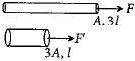
0 likesView Solution
2
PhysicsMediumMCQAIEEE · 2009
Three sound waves of equal amplitudes have frequencies $(n - 1)$,$n$,and $(n + 1)$. They superimpose to produce beats. The number of beats produced per second is:
A
$3$
B
$2$
C
$1$
D
$4$
Solution
(B) The frequencies of the three sound waves are $f_1 = n - 1$,$f_2 = n$,and $f_3 = n + 1$.
Beats are produced by the superposition of waves with different frequencies.
The beat frequencies between pairs of waves are:
$|f_2 - f_1| = |n - (n - 1)| = 1 \text{ Hz}$
$|f_3 - f_2| = |(n + 1) - n| = 1 \text{ Hz}$
$|f_3 - f_1| = |(n + 1) - (n - 1)| = 2 \text{ Hz}$
The resultant beat frequency is the greatest common divisor or the effective frequency of the superposition,which is determined by the difference between the extreme frequencies.
The number of beats produced per second is the difference between the maximum and minimum frequencies: $(n + 1) - (n - 1) = 2 \text{ Hz}$.
Beats are produced by the superposition of waves with different frequencies.
The beat frequencies between pairs of waves are:
$|f_2 - f_1| = |n - (n - 1)| = 1 \text{ Hz}$
$|f_3 - f_2| = |(n + 1) - n| = 1 \text{ Hz}$
$|f_3 - f_1| = |(n + 1) - (n - 1)| = 2 \text{ Hz}$
The resultant beat frequency is the greatest common divisor or the effective frequency of the superposition,which is determined by the difference between the extreme frequencies.
The number of beats produced per second is the difference between the maximum and minimum frequencies: $(n + 1) - (n - 1) = 2 \text{ Hz}$.
0 likesView Solution
3
PhysicsMediumMCQAIEEE · 2009
In an experiment,the angles are required to be measured using an instrument where $29$ divisions of the main scale exactly coincide with $30$ divisions of the vernier scale. If the smallest division of the main scale is half a degree $(= 0.5^\circ)$,then the least count of the instrument is:
A
$1^\circ$
B
$\frac{1}{2}^\circ$
C
$1'$
D
$(\frac{1}{2})'$
Solution
(C) Given that $30$ divisions of the vernier scale coincide with $29$ divisions of the main scale.
Therefore,$1$ Vernier Scale Division $(VSD) = \frac{29}{30}$ Main Scale Division $(MSD)$.
The least count of the instrument is defined as the difference between one main scale division and one vernier scale division.
Least Count $= 1\,MSD - 1\,VSD$.
Least Count $= 1\,MSD - \frac{29}{30}\,MSD = \frac{1}{30}\,MSD$.
Given that $1\,MSD = 0.5^\circ$.
Least Count $= \frac{1}{30} \times 0.5^\circ = \frac{0.5}{30}^\circ = \frac{1}{60}^\circ$.
Since $1^\circ = 60$ minutes $(')$,
Least Count $= \frac{1}{60} \times 60' = 1'$.
Therefore,$1$ Vernier Scale Division $(VSD) = \frac{29}{30}$ Main Scale Division $(MSD)$.
The least count of the instrument is defined as the difference between one main scale division and one vernier scale division.
Least Count $= 1\,MSD - 1\,VSD$.
Least Count $= 1\,MSD - \frac{29}{30}\,MSD = \frac{1}{30}\,MSD$.
Given that $1\,MSD = 0.5^\circ$.
Least Count $= \frac{1}{30} \times 0.5^\circ = \frac{0.5}{30}^\circ = \frac{1}{60}^\circ$.
Since $1^\circ = 60$ minutes $(')$,
Least Count $= \frac{1}{60} \times 60' = 1'$.
0 likesView Solution
4
PhysicsMediumMCQAIEEE · 2009
Consider a rubber ball freely falling from a height $h = 4.9 \ m$ onto a horizontal elastic plate. Assume that the duration of collision is negligible and the collision with the plate is totally elastic. Then the velocity as a function of time and the height as a function of time will be represented by which of the following graphs?
A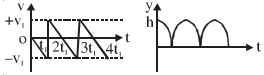
B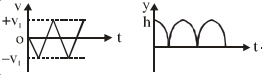
C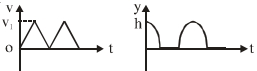
D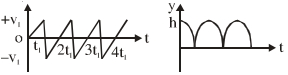
Solution
(B) For downward motion,the velocity is given by $v = -gt$. The velocity increases in the downward direction,resulting in a straight line between $v$ and $t$ with a negative slope.
Applying the equation of motion $y - y_0 = ut + \frac{1}{2}at^2$,we get $y - h = -\frac{1}{2}gt^2$,which simplifies to $y = h - \frac{1}{2}gt^2$. This represents a downward-opening parabola starting at $y = h$ at $t = 0$.
For upward motion after the elastic collision,the velocity direction is reversed,and its magnitude remains the same. The velocity follows $v = u - gt$,where $u$ is the velocity just after the collision. As $t$ increases,$v$ decreases linearly with a negative slope.
The height $y$ as a function of time for the upward motion follows $y = ut - \frac{1}{2}gt^2$,which is an upward-opening parabola segment. Combining these,the velocity-time graph shows a sawtooth pattern with negative slopes,and the height-time graph shows a series of parabolic arcs. Graph $B$ correctly represents these physical behaviors.
Applying the equation of motion $y - y_0 = ut + \frac{1}{2}at^2$,we get $y - h = -\frac{1}{2}gt^2$,which simplifies to $y = h - \frac{1}{2}gt^2$. This represents a downward-opening parabola starting at $y = h$ at $t = 0$.
For upward motion after the elastic collision,the velocity direction is reversed,and its magnitude remains the same. The velocity follows $v = u - gt$,where $u$ is the velocity just after the collision. As $t$ increases,$v$ decreases linearly with a negative slope.
The height $y$ as a function of time for the upward motion follows $y = ut - \frac{1}{2}gt^2$,which is an upward-opening parabola segment. Combining these,the velocity-time graph shows a sawtooth pattern with negative slopes,and the height-time graph shows a series of parabolic arcs. Graph $B$ correctly represents these physical behaviors.
0 likesView Solution
5
PhysicsMediumMCQAIEEE · 2009
$A$ particle has an initial velocity of $(3\hat i + 4\hat j) \; ms^{-1}$ and an acceleration of $(0.4\hat i + 0.3\hat j) \; ms^{-2}$. Its speed after $10 \; s$ is:
A
$7$ unit
B
$8.5$ unit
C
$10$ unit
D
$7\sqrt{2}$ unit
Solution
(D) Given: Initial velocity $\vec{u} = (3\hat{i} + 4\hat{j}) \; ms^{-1}$,acceleration $\vec{a} = (0.4\hat{i} + 0.3\hat{j}) \; ms^{-2}$,and time $t = 10 \; s$.
Using the first equation of motion for vectors: $\vec{v} = \vec{u} + \vec{a}t$.
Substituting the values: $\vec{v} = (3\hat{i} + 4\hat{j}) + (0.4\hat{i} + 0.3\hat{j}) \times 10$.
$\vec{v} = (3\hat{i} + 4\hat{j}) + (4\hat{i} + 3\hat{j}) = 7\hat{i} + 7\hat{j}$.
The speed is the magnitude of the velocity vector $\vec{v}$.
$|\vec{v}| = \sqrt{7^2 + 7^2} = \sqrt{49 + 49} = \sqrt{98} = 7\sqrt{2} \; ms^{-1}$.
Using the first equation of motion for vectors: $\vec{v} = \vec{u} + \vec{a}t$.
Substituting the values: $\vec{v} = (3\hat{i} + 4\hat{j}) + (0.4\hat{i} + 0.3\hat{j}) \times 10$.
$\vec{v} = (3\hat{i} + 4\hat{j}) + (4\hat{i} + 3\hat{j}) = 7\hat{i} + 7\hat{j}$.
The speed is the magnitude of the velocity vector $\vec{v}$.
$|\vec{v}| = \sqrt{7^2 + 7^2} = \sqrt{49 + 49} = \sqrt{98} = 7\sqrt{2} \; ms^{-1}$.
0 likesView Solution
6
PhysicsMediumMCQAIEEE · 2009
$A$ long metallic bar is carrying heat from one of its ends to the other end under steady-state. The variation of temperature $\theta$ along the length $x$ of the bar from its hot end is best described by which of the following figures?
A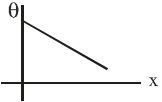
B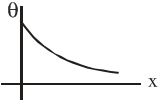
C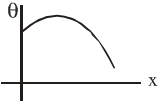
D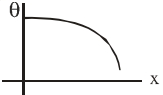
Solution
(A) In steady-state heat conduction through a uniform metallic bar,the rate of heat flow $\frac{dQ}{dt}$ is constant throughout the bar.
According to Fourier's law of heat conduction:
$\frac{dQ}{dt} = -kA \frac{d\theta}{dx}$
Where $k$ is the thermal conductivity,$A$ is the cross-sectional area,and $\frac{d\theta}{dx}$ is the temperature gradient.
Since $\frac{dQ}{dt}$,$k$,and $A$ are constants,the temperature gradient $\frac{d\theta}{dx} = -\frac{1}{kA} \frac{dQ}{dt}$ must also be a constant.
This implies that the temperature $\theta$ decreases linearly with distance $x$ from the hot end.
Therefore,the graph of $\theta$ versus $x$ is a straight line with a negative slope,which corresponds to figure $A$.
According to Fourier's law of heat conduction:
$\frac{dQ}{dt} = -kA \frac{d\theta}{dx}$
Where $k$ is the thermal conductivity,$A$ is the cross-sectional area,and $\frac{d\theta}{dx}$ is the temperature gradient.
Since $\frac{dQ}{dt}$,$k$,and $A$ are constants,the temperature gradient $\frac{d\theta}{dx} = -\frac{1}{kA} \frac{dQ}{dt}$ must also be a constant.
This implies that the temperature $\theta$ decreases linearly with distance $x$ from the hot end.
Therefore,the graph of $\theta$ versus $x$ is a straight line with a negative slope,which corresponds to figure $A$.
0 likesView Solution
7
PhysicsMediumMCQAIEEE · 2009
One kg of a diatomic gas is at a pressure of $8 \times 10^4 \; N/m^2$. The density of the gas is $4 \; kg/m^3$. What is the energy (in $\times 10^4 \; J$) of the gas due to its thermal motion?
A
$3$
B
$5$
C
$6$
D
$7$
Solution
(B) The volume $V$ of the gas is given by the ratio of mass $m$ to density $\rho$:
$V = \frac{m}{\rho} = \frac{1 \; kg}{4 \; kg/m^3} = 0.25 \; m^3$.
For a diatomic gas,the internal energy $U$ (or energy due to thermal motion) is given by the formula:
$U = \frac{f}{2} PV$,where $f$ is the degrees of freedom.
For a diatomic gas,$f = 5$.
Substituting the values:
$U = \frac{5}{2} \times (8 \times 10^4 \; N/m^2) \times (0.25 \; m^3)$
$U = \frac{5}{2} \times 8 \times 10^4 \times \frac{1}{4}$
$U = 5 \times 10^4 \; J$.
Thus,the energy is $5 \times 10^4 \; J$.
$V = \frac{m}{\rho} = \frac{1 \; kg}{4 \; kg/m^3} = 0.25 \; m^3$.
For a diatomic gas,the internal energy $U$ (or energy due to thermal motion) is given by the formula:
$U = \frac{f}{2} PV$,where $f$ is the degrees of freedom.
For a diatomic gas,$f = 5$.
Substituting the values:
$U = \frac{5}{2} \times (8 \times 10^4 \; N/m^2) \times (0.25 \; m^3)$
$U = \frac{5}{2} \times 8 \times 10^4 \times \frac{1}{4}$
$U = 5 \times 10^4 \; J$.
Thus,the energy is $5 \times 10^4 \; J$.
0 likesView Solution
8
PhysicsMediumMCQAIEEE · 2009
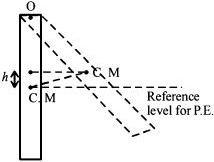
$A$ thin uniform rod of length $l$ and mass $m$ is swinging freely about a horizontal axis passing through its end. Its maximum angular speed is $\omega$. Its centre of mass rises to a maximum height of:
A
$\frac{1}{3} \frac{l^2 \omega^2}{g}$
B
$\frac{1}{6} \frac{l \omega}{g}$
C
$\frac{1}{2} \frac{l^2 \omega^2}{g}$
D
$\frac{1}{6} \frac{l^2 \omega^2}{g}$
Solution
(D) The moment of inertia of the rod about the axis passing through its end $O$ is $I = \frac{1}{3} m l^2$.
When the rod is in its lowest position,it has maximum angular speed $\omega$. The rotational kinetic energy at this point is $K = \frac{1}{2} I \omega^2 = \frac{1}{2} (\frac{1}{3} m l^2) \omega^2 = \frac{1}{6} m l^2 \omega^2$.
At the maximum height $h$,the angular velocity of the rod becomes zero momentarily. By the principle of conservation of energy,the rotational kinetic energy at the lowest point is equal to the gain in gravitational potential energy of the centre of mass $(C.M.)$ at the highest point.
Therefore,$mgh = \frac{1}{6} m l^2 \omega^2$.
Solving for $h$,we get $h = \frac{l^2 \omega^2}{6g}$.
When the rod is in its lowest position,it has maximum angular speed $\omega$. The rotational kinetic energy at this point is $K = \frac{1}{2} I \omega^2 = \frac{1}{2} (\frac{1}{3} m l^2) \omega^2 = \frac{1}{6} m l^2 \omega^2$.
At the maximum height $h$,the angular velocity of the rod becomes zero momentarily. By the principle of conservation of energy,the rotational kinetic energy at the lowest point is equal to the gain in gravitational potential energy of the centre of mass $(C.M.)$ at the highest point.
Therefore,$mgh = \frac{1}{6} m l^2 \omega^2$.
Solving for $h$,we get $h = \frac{l^2 \omega^2}{6g}$.
0 likesView Solution
9
PhysicsMediumMCQAIEEE · 2009
The height at which the acceleration due to gravity becomes $\frac{g}{9}$ (where $g$ = the acceleration due to gravity on the surface of the earth) in terms of $R$,the radius of the earth,is
A
$2R$
B
$\frac{R}{\sqrt{2}}$
C
$\frac{R}{2}$
D
$\sqrt{2}R$
Solution
(A) The acceleration due to gravity at a height $h$ above the surface of the earth is given by the formula: $g' = g \left( \frac{R}{R+h} \right)^2$.
Given that $g' = \frac{g}{9}$,we substitute this into the equation:
$\frac{g}{9} = g \left( \frac{R}{R+h} \right)^2$.
Dividing both sides by $g$,we get: $\frac{1}{9} = \left( \frac{R}{R+h} \right)^2$.
Taking the square root of both sides: $\frac{1}{3} = \frac{R}{R+h}$.
Cross-multiplying gives: $R + h = 3R$.
Therefore,$h = 3R - R = 2R$.
Given that $g' = \frac{g}{9}$,we substitute this into the equation:
$\frac{g}{9} = g \left( \frac{R}{R+h} \right)^2$.
Dividing both sides by $g$,we get: $\frac{1}{9} = \left( \frac{R}{R+h} \right)^2$.
Taking the square root of both sides: $\frac{1}{3} = \frac{R}{R+h}$.
Cross-multiplying gives: $R + h = 3R$.
Therefore,$h = 3R - R = 2R$.
0 likesView Solution
10
PhysicsMediumMCQAIEEE · 2009
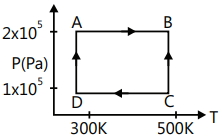
Two moles of helium gas are taken over the cycle $ABCDA$,as shown in the $P-T$ diagram. Assuming the gas to be ideal,the work done on the gas in taking it from $A$ to $B$ is ...... $R$.
A
$300$
B
$400$
C
$600$
D
$200$
Solution
(B) The process from $A$ to $B$ is an isobaric process because the pressure $P$ remains constant at $2 \times 10^5 \text{ Pa}$.
For an ideal gas,the work done by the gas is given by $W_{\text{by}} = nR\Delta T$.
Here,$n = 2 \text{ moles}$,$T_A = 300 \text{ K}$,and $T_B = 500 \text{ K}$.
$W_{\text{by}} = 2 \times R \times (500 - 300) = 400R$.
The question asks for the work done $ON$ the gas.
Work done on the gas is $W_{\text{on}} = -W_{\text{by}} = -400R$.
However,in the context of such physics problems,the magnitude is often expected. Given the options,the magnitude $400R$ is the correct answer.
For an ideal gas,the work done by the gas is given by $W_{\text{by}} = nR\Delta T$.
Here,$n = 2 \text{ moles}$,$T_A = 300 \text{ K}$,and $T_B = 500 \text{ K}$.
$W_{\text{by}} = 2 \times R \times (500 - 300) = 400R$.
The question asks for the work done $ON$ the gas.
Work done on the gas is $W_{\text{on}} = -W_{\text{by}} = -400R$.
However,in the context of such physics problems,the magnitude is often expected. Given the options,the magnitude $400R$ is the correct answer.
0 likesView Solution
11
PhysicsMediumMCQAIEEE · 2009
Two moles of helium gas are taken over the cycle $ABCDA$,as shown in the $P-T$ diagram. The work done on the gas in taking it from $D$ to $A$ is
A
$+414 R$
B
$-690 R$
C
$-690 R$
D
$-414 R$
Solution
(A) The process $DA$ is an isochoric process because the temperature $T$ is constant at $300 \text{ K}$ while the pressure changes from $1 \times 10^5 \text{ Pa}$ to $2 \times 10^5 \text{ Pa}$.
However,looking at the $P-T$ diagram,the line $DA$ is vertical,meaning it is an isothermal process at $T = 300 \text{ K}$.
For an isothermal process,the work done by the gas is given by $W_{\text{by}} = nRT \ln\left(\frac{V_f}{V_i}\right)$.
Using the ideal gas law $PV = nRT$,we have $V = \frac{nRT}{P}$,so $\frac{V_f}{V_i} = \frac{P_i}{P_f}$.
Thus,$W_{\text{by}} = nRT \ln\left(\frac{P_D}{P_A}\right) = 2.303 nRT \log_{10}\left(\frac{P_D}{P_A}\right)$.
Given $n = 2$,$T = 300 \text{ K}$,$P_D = 1 \times 10^5 \text{ Pa}$,and $P_A = 2 \times 10^5 \text{ Pa}$.
$W_{\text{by}} = 2.303 \times 2 \times R \times 300 \times \log_{10}\left(\frac{1 \times 10^5}{2 \times 10^5}\right) = 2.303 \times 600 \times R \times \log_{10}(0.5)$.
$W_{\text{by}} = 1381.8 \times R \times (-0.301) \approx -416 R$ (using $\log_{10}(0.5) \approx -0.301$).
Using the standard approximation $\log_{10}(0.5) \approx -0.3$,$W_{\text{by}} = 2.303 \times 600 \times R \times (-0.3) = -414.54 R \approx -414 R$.
The work done $ON$ the gas is $W_{\text{on}} = -W_{\text{by}} = -(-414 R) = +414 R$.
However,looking at the $P-T$ diagram,the line $DA$ is vertical,meaning it is an isothermal process at $T = 300 \text{ K}$.
For an isothermal process,the work done by the gas is given by $W_{\text{by}} = nRT \ln\left(\frac{V_f}{V_i}\right)$.
Using the ideal gas law $PV = nRT$,we have $V = \frac{nRT}{P}$,so $\frac{V_f}{V_i} = \frac{P_i}{P_f}$.
Thus,$W_{\text{by}} = nRT \ln\left(\frac{P_D}{P_A}\right) = 2.303 nRT \log_{10}\left(\frac{P_D}{P_A}\right)$.
Given $n = 2$,$T = 300 \text{ K}$,$P_D = 1 \times 10^5 \text{ Pa}$,and $P_A = 2 \times 10^5 \text{ Pa}$.
$W_{\text{by}} = 2.303 \times 2 \times R \times 300 \times \log_{10}\left(\frac{1 \times 10^5}{2 \times 10^5}\right) = 2.303 \times 600 \times R \times \log_{10}(0.5)$.
$W_{\text{by}} = 1381.8 \times R \times (-0.301) \approx -416 R$ (using $\log_{10}(0.5) \approx -0.301$).
Using the standard approximation $\log_{10}(0.5) \approx -0.3$,$W_{\text{by}} = 2.303 \times 600 \times R \times (-0.3) = -414.54 R \approx -414 R$.
The work done $ON$ the gas is $W_{\text{on}} = -W_{\text{by}} = -(-414 R) = +414 R$.
0 likesView Solution
12
PhysicsMediumMCQAIEEE · 2009
Two moles of helium gas are taken over the cycle $ABCDA$, as shown in the $P-T$ diagram. The net work done on the gas in the cycle $ABCDA$ is ...... $R$.
A
$279$
B
$1076$
C
$1904$
D
$0$
Solution
(D) In a $P-T$ diagram, the work done $W$ for a process is given by $W = \int P dV$. Using the ideal gas law $PV = nRT$, we have $V = \frac{nRT}{P}$, so $dV = nR \left( \frac{dT}{P} - \frac{T}{P^2} dP \right)$.
For an isochoric process $(V = \text{constant})$, $W = 0$. For an isobaric process $(P = \text{constant})$, $W = P \Delta V = nR \Delta T$.
Process $AB$: Isobaric expansion at $P = 2 \times 10^5 \text{ Pa}$. $T$ goes from $300 \text{ K}$ to $500 \text{ K}$. $W_{AB} = nR(T_B - T_A) = 2 \times R \times (500 - 300) = 400R$.
Process $BC$: Isochoric cooling at $T = 500 \text{ K}$. $W_{BC} = 0$.
Process $CD$: Isobaric compression at $P = 1 \times 10^5 \text{ Pa}$. $T$ goes from $500 \text{ K}$ to $300 \text{ K}$. $W_{CD} = nR(T_D - T_C) = 2 \times R \times (300 - 500) = -400R$.
Process $DA$: Isochoric heating at $T = 300 \text{ K}$. $W_{DA} = 0$.
The net work done by the gas is $W_{net} = W_{AB} + W_{BC} + W_{CD} + W_{DA} = 400R + 0 - 400R + 0 = 0$.
Since the cycle is traversed in the clockwise direction, the work done by the gas is positive, but the question asks for the work done $ON$ the gas, which is $W_{on} = -W_{by} = 0$.
For an isochoric process $(V = \text{constant})$, $W = 0$. For an isobaric process $(P = \text{constant})$, $W = P \Delta V = nR \Delta T$.
Process $AB$: Isobaric expansion at $P = 2 \times 10^5 \text{ Pa}$. $T$ goes from $300 \text{ K}$ to $500 \text{ K}$. $W_{AB} = nR(T_B - T_A) = 2 \times R \times (500 - 300) = 400R$.
Process $BC$: Isochoric cooling at $T = 500 \text{ K}$. $W_{BC} = 0$.
Process $CD$: Isobaric compression at $P = 1 \times 10^5 \text{ Pa}$. $T$ goes from $500 \text{ K}$ to $300 \text{ K}$. $W_{CD} = nR(T_D - T_C) = 2 \times R \times (300 - 500) = -400R$.
Process $DA$: Isochoric heating at $T = 300 \text{ K}$. $W_{DA} = 0$.
The net work done by the gas is $W_{net} = W_{AB} + W_{BC} + W_{CD} + W_{DA} = 400R + 0 - 400R + 0 = 0$.
Since the cycle is traversed in the clockwise direction, the work done by the gas is positive, but the question asks for the work done $ON$ the gas, which is $W_{on} = -W_{by} = 0$.
0 likesView Solution
13
PhysicsMediumMCQAIEEE · 2009
If $x, v$ and $a$ denote the displacement,the velocity and the acceleration of a particle executing simple harmonic motion of time period $T$,then,which of the following does not change with time?
A
$a^2T^2 + 4\pi^2v^2$
B
$\frac{aT}{x}$
C
$aT + 2\pi f$
D
$\frac{aT}{v}$
Solution
(B) For a particle executing Simple Harmonic Motion $(SHM)$,the displacement is given by $x = A \sin(\omega t + \phi)$.
The velocity is $v = \frac{dx}{dt} = A\omega \cos(\omega t + \phi)$.
The acceleration is $a = \frac{dv}{dt} = -A\omega^2 \sin(\omega t + \phi) = -\omega^2 x$.
From the acceleration equation,we have $\frac{a}{x} = -\omega^2$.
Since $\omega = \frac{2\pi}{T}$,we have $\omega^2 = \frac{4\pi^2}{T^2}$.
Substituting this into the ratio,we get $\frac{a}{x} = -\frac{4\pi^2}{T^2}$.
Rearranging this,we get $\frac{aT^2}{x} = -4\pi^2$,which is a constant.
However,looking at the options provided,we evaluate $\frac{a}{x} = -\omega^2$. Since $\omega$ and $T$ are constants for a given $SHM$,the ratio $\frac{a}{x}$ is constant. Thus,$\frac{aT}{x}$ is also a constant because $T$ is constant.
The velocity is $v = \frac{dx}{dt} = A\omega \cos(\omega t + \phi)$.
The acceleration is $a = \frac{dv}{dt} = -A\omega^2 \sin(\omega t + \phi) = -\omega^2 x$.
From the acceleration equation,we have $\frac{a}{x} = -\omega^2$.
Since $\omega = \frac{2\pi}{T}$,we have $\omega^2 = \frac{4\pi^2}{T^2}$.
Substituting this into the ratio,we get $\frac{a}{x} = -\frac{4\pi^2}{T^2}$.
Rearranging this,we get $\frac{aT^2}{x} = -4\pi^2$,which is a constant.
However,looking at the options provided,we evaluate $\frac{a}{x} = -\omega^2$. Since $\omega$ and $T$ are constants for a given $SHM$,the ratio $\frac{a}{x}$ is constant. Thus,$\frac{aT}{x}$ is also a constant because $T$ is constant.
1 likesView Solution
14
PhysicsDifficultMCQAIEEE · 2009
$A$ motorcycle starts from rest and accelerates along a straight path at $2 \; m/s^2$. At the starting point of the motorcycle,there is a stationary electric siren. How far has the motorcycle gone when the driver hears the frequency of the siren at $94 \%$ of its original value (in $; m$)? (Speed of sound $= 330 \; m/s$)
A
$49$
B
$98$
C
$147$
D
$196$
Solution
(B) The observer (motorcycle) is in motion and the source (siren) is at rest. The Doppler effect formula is given by $n' = n \left( \frac{v - v_O}{v} \right)$,where $v$ is the speed of sound and $v_O$ is the speed of the observer.
Given $n' = 0.94n$,we have $0.94n = n \left( \frac{330 - v_O}{330} \right)$.
Simplifying this,$0.94 \times 330 = 330 - v_O$.
$v_O = 330 - 310.2 = 19.8 \; m/s$.
The motorcycle starts from rest $(u = 0)$ and accelerates at $a = 2 \; m/s^2$. Using the equation of motion $v_O^2 = u^2 + 2as$:
$(19.8)^2 = 0^2 + 2 \times 2 \times s$.
$392.04 = 4s$.
$s = 98.01 \; m \approx 98 \; m$.
Given $n' = 0.94n$,we have $0.94n = n \left( \frac{330 - v_O}{330} \right)$.
Simplifying this,$0.94 \times 330 = 330 - v_O$.
$v_O = 330 - 310.2 = 19.8 \; m/s$.
The motorcycle starts from rest $(u = 0)$ and accelerates at $a = 2 \; m/s^2$. Using the equation of motion $v_O^2 = u^2 + 2as$:
$(19.8)^2 = 0^2 + 2 \times 2 \times s$.
$392.04 = 4s$.
$s = 98.01 \; m \approx 98 \; m$.
0 likesView Solution
15
PhysicsDifficultMCQAIEEE · 2009
This question contains statement-$1$ and statement-$2$. Of the four choices given after the statements,choose the one that best describes the two statements.
statement-$1$: The temperature dependence of resistance is usually given as $R=R_{0}(1+\alpha \Delta t)$. The resistance of a wire changes from $100 \; \Omega$ to $150 \; \Omega$ when its temperature is increased from $27^{\circ} C$ to $227^{\circ} C$. This implies that $\alpha=2.5 \times 10^{-3} /^{\circ} C$.
statement-$2$: $R=R_{0}(1+\alpha \Delta t)$ is valid only when the change in the temperature $\Delta t$ is small and $\Delta R=(R-R_{0}) << R_{0}$.
statement-$1$: The temperature dependence of resistance is usually given as $R=R_{0}(1+\alpha \Delta t)$. The resistance of a wire changes from $100 \; \Omega$ to $150 \; \Omega$ when its temperature is increased from $27^{\circ} C$ to $227^{\circ} C$. This implies that $\alpha=2.5 \times 10^{-3} /^{\circ} C$.
statement-$2$: $R=R_{0}(1+\alpha \Delta t)$ is valid only when the change in the temperature $\Delta t$ is small and $\Delta R=(R-R_{0}) << R_{0}$.
A
Statement-$1$ is true,statement-$2$ is false.
B
Statement-$1$ is true,statement-$2$ is true; statement-$2$ is the correct explanation of Statement-$1$.
C
Statement-$1$ is true,statement-$2$ is true; statement-$2$ is not the correct explanation of Statement-$1$.
D
Statement-$1$ is false,statement-$2$ is true.
Solution
(B) Given: $R = 150 \; \Omega$,$R_{0} = 100 \; \Omega$,and $\Delta t = 227^{\circ} C - 27^{\circ} C = 200^{\circ} C$.
Using the formula $R = R_{0}(1 + \alpha \Delta t)$:
$150 = 100(1 + \alpha \times 200)$
$1.5 = 1 + 200\alpha$
$0.5 = 200\alpha$
$\alpha = 0.5 / 200 = 2.5 \times 10^{-3} /^{\circ} C$.
Thus,Statement-$1$ is true.
Regarding Statement-$2$: The linear approximation $R = R_{0}(1 + \alpha \Delta t)$ is derived from the Taylor expansion $R = R_{0} e^{\alpha \Delta t} \approx R_{0}(1 + \alpha \Delta t + \dots)$,which is valid only when $\alpha \Delta t << 1$. In this problem,$\Delta R = 50 \; \Omega$,which is $50\%$ of $R_{0}$. Since $\Delta R$ is not much smaller than $R_{0}$,the linear approximation is technically inaccurate for large temperature changes. However,the statement claims the formula is *only* valid for small changes,which is a standard physical constraint for linear approximations. Therefore,Statement-$2$ is also true and provides the theoretical basis for the limitations of the formula used in Statement-$1$.
Using the formula $R = R_{0}(1 + \alpha \Delta t)$:
$150 = 100(1 + \alpha \times 200)$
$1.5 = 1 + 200\alpha$
$0.5 = 200\alpha$
$\alpha = 0.5 / 200 = 2.5 \times 10^{-3} /^{\circ} C$.
Thus,Statement-$1$ is true.
Regarding Statement-$2$: The linear approximation $R = R_{0}(1 + \alpha \Delta t)$ is derived from the Taylor expansion $R = R_{0} e^{\alpha \Delta t} \approx R_{0}(1 + \alpha \Delta t + \dots)$,which is valid only when $\alpha \Delta t << 1$. In this problem,$\Delta R = 50 \; \Omega$,which is $50\%$ of $R_{0}$. Since $\Delta R$ is not much smaller than $R_{0}$,the linear approximation is technically inaccurate for large temperature changes. However,the statement claims the formula is *only* valid for small changes,which is a standard physical constraint for linear approximations. Therefore,Statement-$2$ is also true and provides the theoretical basis for the limitations of the formula used in Statement-$1$.
0 likesView Solution
16
PhysicsDifficultMCQAIEEE · 2009
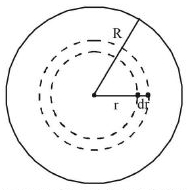
Let $\rho (r) = \frac{Q}{\pi R^4} r$ be the charge density distribution for a solid sphere of radius $R$ and total charge $Q$. For a point $p$ inside the sphere at distance $r_1$ from the centre of the sphere,the magnitude of the electric field is:
A
$0$
B
$\frac{Q}{4\pi \varepsilon_0 r_1^2}$
C
$\frac{Q r_1^2}{4\pi \varepsilon_0 R^4}$
D
$\frac{Q r_1^2}{4\pi \varepsilon_0 R^4}$
Solution
(C) To find the electric field at a distance $r_1$ from the center,we use Gauss's Law: $\oint E \cdot dA = \frac{q_{enc}}{\varepsilon_0}$.
For a spherical Gaussian surface of radius $r_1$,$E(4\pi r_1^2) = \frac{q_{enc}}{\varepsilon_0}$.
The charge enclosed $q_{enc}$ is the integral of the charge density $\rho(r)$ over the volume of the sphere of radius $r_1$:
$q_{enc} = \int_0^{r_1} \rho(r) (4\pi r^2) dr = \int_0^{r_1} \left( \frac{Q}{\pi R^4} r \right) (4\pi r^2) dr = \frac{4Q}{R^4} \int_0^{r_1} r^3 dr = \frac{4Q}{R^4} \left[ \frac{r^4}{4} \right]_0^{r_1} = \frac{Q r_1^4}{R^4}$.
Substituting this into Gauss's Law:
$E(4\pi r_1^2) = \frac{Q r_1^4}{\varepsilon_0 R^4} \implies E = \frac{Q r_1^4}{4\pi \varepsilon_0 R^4 r_1^2} = \frac{Q r_1^2}{4\pi \varepsilon_0 R^4}$.
For a spherical Gaussian surface of radius $r_1$,$E(4\pi r_1^2) = \frac{q_{enc}}{\varepsilon_0}$.
The charge enclosed $q_{enc}$ is the integral of the charge density $\rho(r)$ over the volume of the sphere of radius $r_1$:
$q_{enc} = \int_0^{r_1} \rho(r) (4\pi r^2) dr = \int_0^{r_1} \left( \frac{Q}{\pi R^4} r \right) (4\pi r^2) dr = \frac{4Q}{R^4} \int_0^{r_1} r^3 dr = \frac{4Q}{R^4} \left[ \frac{r^4}{4} \right]_0^{r_1} = \frac{Q r_1^4}{R^4}$.
Substituting this into Gauss's Law:
$E(4\pi r_1^2) = \frac{Q r_1^4}{\varepsilon_0 R^4} \implies E = \frac{Q r_1^4}{4\pi \varepsilon_0 R^4 r_1^2} = \frac{Q r_1^2}{4\pi \varepsilon_0 R^4}$.
0 likesView Solution
17
PhysicsMediumMCQAIEEE · 2009
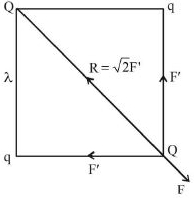
$A$ charge $Q$ is placed at each of the opposite corners of a square. $A$ charge $q$ is placed at each of the other two corners. If the net electrical force on $Q$ is zero,then $\frac{Q}{q} = $ . . . . . .
A
$-2 \sqrt{2}$
B
$-1$
C
$1$
D
$-\frac{1}{\sqrt{2}}$
Solution
(A) Let the side length of the square be $a$. Consider one of the corners where charge $Q$ is placed.
The forces acting on this charge $Q$ are:
$1$. The repulsive force due to the other charge $Q$ placed at the diagonally opposite corner: $F = k \frac{Q^2}{(\sqrt{2}a)^2} = \frac{kQ^2}{2a^2}$ (directed away from the diagonal).
$2$. The two attractive forces due to the two charges $q$ placed at the adjacent corners: $F' = k \frac{Qq}{a^2}$ (directed along the sides).
The resultant of these two forces $F'$ is $R = \sqrt{F'^2 + F'^2} = \sqrt{2} F' = \sqrt{2} \frac{kQq}{a^2}$ (directed along the diagonal).
For the net force on $Q$ to be zero,the magnitude of the resultant force $R$ must be equal to the magnitude of force $F$,and they must act in opposite directions.
$\sqrt{2} \frac{kQq}{a^2} = - \frac{kQ^2}{2a^2}$
$\sqrt{2} q = - \frac{Q}{2}$
$\frac{Q}{q} = -2\sqrt{2}$
The forces acting on this charge $Q$ are:
$1$. The repulsive force due to the other charge $Q$ placed at the diagonally opposite corner: $F = k \frac{Q^2}{(\sqrt{2}a)^2} = \frac{kQ^2}{2a^2}$ (directed away from the diagonal).
$2$. The two attractive forces due to the two charges $q$ placed at the adjacent corners: $F' = k \frac{Qq}{a^2}$ (directed along the sides).
The resultant of these two forces $F'$ is $R = \sqrt{F'^2 + F'^2} = \sqrt{2} F' = \sqrt{2} \frac{kQq}{a^2}$ (directed along the diagonal).
For the net force on $Q$ to be zero,the magnitude of the resultant force $R$ must be equal to the magnitude of force $F$,and they must act in opposite directions.
$\sqrt{2} \frac{kQq}{a^2} = - \frac{kQ^2}{2a^2}$
$\sqrt{2} q = - \frac{Q}{2}$
$\frac{Q}{q} = -2\sqrt{2}$
0 likesView Solution
18
PhysicsEasyMCQAIEEE · 2009
Two points $P$ and $Q$ are maintained at the potentials of $10 \ V$ and $-4 \ V$,respectively. The work done in moving $100$ electrons from $P$ to $Q$ is
A
$-9.6 \times 10^{-17} \ J$
B
$9.6 \times 10^{-17} \ J$
C
$-2.24 \times 10^{-16} \ J$
D
$2.24 \times 10^{-16} \ J$
Solution
(D) The work done $W$ in moving a charge $q$ from point $P$ to point $Q$ is given by the formula: $W = q(V_Q - V_P)$.
Here,the charge $q$ is the total charge of $100$ electrons. Since the charge of one electron is $-1.6 \times 10^{-19} \ C$,the total charge is $q = 100 \times (-1.6 \times 10^{-19} \ C) = -1.6 \times 10^{-17} \ C$.
The potentials are $V_P = 10 \ V$ and $V_Q = -4 \ V$.
Substituting these values into the formula:
$W = (-1.6 \times 10^{-17} \ C) \times (-4 \ V - 10 \ V)$
$W = (-1.6 \times 10^{-17}) \times (-14) \ J$
$W = 22.4 \times 10^{-17} \ J = 2.24 \times 10^{-16} \ J$.
Here,the charge $q$ is the total charge of $100$ electrons. Since the charge of one electron is $-1.6 \times 10^{-19} \ C$,the total charge is $q = 100 \times (-1.6 \times 10^{-19} \ C) = -1.6 \times 10^{-17} \ C$.
The potentials are $V_P = 10 \ V$ and $V_Q = -4 \ V$.
Substituting these values into the formula:
$W = (-1.6 \times 10^{-17} \ C) \times (-4 \ V - 10 \ V)$
$W = (-1.6 \times 10^{-17}) \times (-14) \ J$
$W = 22.4 \times 10^{-17} \ J = 2.24 \times 10^{-16} \ J$.
0 likesView Solution
19
PhysicsMediumMCQAIEEE · 2009
This question contains Statement-$1$ and Statement-$2$. Of the four choices given after the statements,choose the one that best describes the two statements.
Statement-$1$ : For a charged particle moving from point $P$ to point $Q$,the net work done by an electrostatic field on the particle is independent of the path connecting point $P$ to point $Q$.
Statement-$2$ : The net work done by a conservative force on an object moving along a closed loop is zero.
Statement-$1$ : For a charged particle moving from point $P$ to point $Q$,the net work done by an electrostatic field on the particle is independent of the path connecting point $P$ to point $Q$.
Statement-$2$ : The net work done by a conservative force on an object moving along a closed loop is zero.
A
Statement-$1$ is true,Statement-$2$ is true; Statement-$2$ is the correct explanation of Statement-$1$.
B
Statement-$1$ is true,Statement-$2$ is true; Statement-$2$ is not the correct explanation of Statement-$1$.
C
Statement-$1$ is true,Statement-$2$ is false.
D
Statement-$1$ is false,Statement-$2$ is true.
Solution
(A) An electrostatic force is a conservative force.
By definition,a force is conservative if the work done by it on a particle moving between two points is independent of the path taken.
This property is equivalent to the statement that the net work done by a conservative force on an object moving along any closed loop is zero.
Since the electrostatic field is conservative,Statement-$1$ is true because it describes path independence.
Statement-$2$ is also true as it defines the fundamental property of conservative forces.
Statement-$2$ correctly explains why Statement-$1$ is true,as path independence is a direct consequence of the work done in a closed loop being zero.
By definition,a force is conservative if the work done by it on a particle moving between two points is independent of the path taken.
This property is equivalent to the statement that the net work done by a conservative force on an object moving along any closed loop is zero.
Since the electrostatic field is conservative,Statement-$1$ is true because it describes path independence.
Statement-$2$ is also true as it defines the fundamental property of conservative forces.
Statement-$2$ correctly explains why Statement-$1$ is true,as path independence is a direct consequence of the work done in a closed loop being zero.
0 likesView Solution
20
PhysicsDifficultMCQAIEEE · 2009
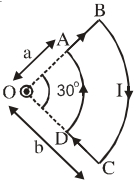
$A$ current loop $ABCD$ is held fixed on the plane of the paper as shown in the figure. The arcs $BC$ (radius $= b$) and $DA$ (radius $= a$) of the loop are joined by two straight wires $AB$ and $CD$. $A$ steady current $I$ is flowing in the loop. The angle made by $AB$ and $CD$ at the origin $O$ is $30^\circ$. Another straight thin wire with steady current $I_1$ flowing out of the plane of the paper is kept at the origin. The magnitude of the magnetic field $(B)$ due to the loop $ABCD$ at the origin $(O)$ is:
A
$0$
B
$\frac{{\mu _0}I(b - a)}{{24ab}}$
C
$\frac{{\mu _0}I}{{4\pi }}\left[ {\frac{{b - a}}{{ab}}} \right]$
D
$\frac{{\mu _0}I}{{4\pi }}\left[ {2(b - a) + \frac{{\pi (a + b)}}{3}} \right]$
Solution
(B) The magnetic field at $O$ due to the current in arc $DA$ is $B_1 = \frac{\mu_0}{4\pi} \frac{I}{a} \times \theta$,where $\theta = 30^\circ = \frac{\pi}{6}$ radians. Using the right-hand rule,the direction is perpendicular to the plane of the paper (outwards).
The magnetic field at $O$ due to the current in arc $BC$ is $B_2 = \frac{\mu_0}{4\pi} \frac{I}{b} \times \theta$,where $\theta = \frac{\pi}{6}$ radians. Using the right-hand rule,the direction is perpendicular to the plane of the paper (inwards).
The magnetic field at $O$ due to the straight segments $AB$ and $CD$ is zero because the origin $O$ lies on the line of these segments.
The net magnetic field $B$ is the difference between $B_1$ and $B_2$:
$B = B_1 - B_2 = \frac{\mu_0 I}{4\pi} \left( \frac{1}{a} - \frac{1}{b} \right) \times \frac{\pi}{6}$
$B = \frac{\mu_0 I}{24} \left( \frac{b - a}{ab} \right) = \frac{\mu_0 I (b - a)}{24ab}$
The magnetic field at $O$ due to the current in arc $BC$ is $B_2 = \frac{\mu_0}{4\pi} \frac{I}{b} \times \theta$,where $\theta = \frac{\pi}{6}$ radians. Using the right-hand rule,the direction is perpendicular to the plane of the paper (inwards).
The magnetic field at $O$ due to the straight segments $AB$ and $CD$ is zero because the origin $O$ lies on the line of these segments.
The net magnetic field $B$ is the difference between $B_1$ and $B_2$:
$B = B_1 - B_2 = \frac{\mu_0 I}{4\pi} \left( \frac{1}{a} - \frac{1}{b} \right) \times \frac{\pi}{6}$
$B = \frac{\mu_0 I}{24} \left( \frac{b - a}{ab} \right) = \frac{\mu_0 I (b - a)}{24ab}$
0 likesView Solution
21
PhysicsMediumMCQAIEEE · 2009
$A$ current loop $ABCD$ is held fixed on the plane of the paper as shown in the figure. The arcs $BC$ (radius $= b$) and $DA$ (radius $= a$) of the loop are joined by two straight wires $AB$ and $CD$. $A$ steady current $I$ is flowing in the loop. The angle made by $AB$ and $CD$ at the origin $O$ is $30^o$. Another straight thin wire with a steady current $I_1$ flowing out of the plane of the paper is kept at the origin. Due to the presence of the current $I_1$ at the origin:
A
The forces on $AB$ and $DC$ are zero.
B
The forces on $AD$ and $BC$ are zero.
C
The magnitude of the net force on the loop is given by $\frac{I_1 I \mu_0}{4\pi} \left[ 2(b - a) + \frac{\pi}{3}(a + b) \right]$.
D
The magnitude of the net force on the loop is given by $\frac{\mu_0 I I_1}{24ab}(b - a)$.
Solution
(B) $1$. The magnetic field $\vec{B}$ produced by the wire at the origin carrying current $I_1$ (out of the plane) is tangential to circles centered at $O$.
$2$. For the straight segments $AB$ and $CD$,the current element $I \vec{dl}$ is directed radially outward or inward. Since $\vec{B}$ is tangential,$\vec{dl} \perp \vec{B}$,so there is a force on these segments.
$3$. For the arcs $AD$ and $BC$,the current element $I \vec{dl}$ is tangential to the arc,which is parallel to the magnetic field $\vec{B}$ produced by the wire at $O$.
$4$. Since $\vec{F} = I(\vec{dl} \times \vec{B})$ and $\vec{dl} \parallel \vec{B}$,the force on the arcs $AD$ and $BC$ is zero.
$5$. Thus,option $B$ is correct.
$2$. For the straight segments $AB$ and $CD$,the current element $I \vec{dl}$ is directed radially outward or inward. Since $\vec{B}$ is tangential,$\vec{dl} \perp \vec{B}$,so there is a force on these segments.
$3$. For the arcs $AD$ and $BC$,the current element $I \vec{dl}$ is tangential to the arc,which is parallel to the magnetic field $\vec{B}$ produced by the wire at $O$.
$4$. Since $\vec{F} = I(\vec{dl} \times \vec{B})$ and $\vec{dl} \parallel \vec{B}$,the force on the arcs $AD$ and $BC$ is zero.
$5$. Thus,option $B$ is correct.
0 likesView Solution
22
PhysicsDifficultMCQAIEEE · 2009
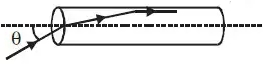
$A$ transparent solid cylindrical rod has a refractive index of $\frac{2}{\sqrt{3}}$. It is surrounded by air. $A$ light ray is incident at the mid-point of one end of the rod as shown in the figure. The incident angle $\theta$ for which the light ray grazes along the wall of the rod is
A
$sin^{-1}\left( \frac{1}{2} \right)$
B
$sin^{-1}\left( \frac{\sqrt{3}}{2} \right)$
C
$sin^{-1}\left( \frac{2}{\sqrt{3}} \right)$
D
$sin^{-1}\left( \frac{1}{\sqrt{3}} \right)$
Solution
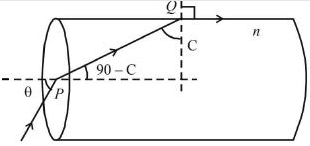
(D) Let the refractive index of the rod be $n = \frac{2}{\sqrt{3}}$.
At the point $Q$ on the wall of the rod,the light ray grazes the surface,meaning the angle of refraction is $90^{\circ}$. Let $C$ be the critical angle.
Using Snell's law at $Q$: $n \sin C = 1 \cdot \sin 90^{\circ} = 1$.
$\sin C = \frac{1}{n} = \frac{1}{2/\sqrt{3}} = \frac{\sqrt{3}}{2}$.
Thus,$C = 60^{\circ}$.
Now,consider the refraction at the point $P$ on the end face. The angle of incidence is $\theta$ and the angle of refraction is $r = 90^{\circ} - C$.
Using Snell's law at $P$: $1 \cdot \sin \theta = n \cdot \sin(90^{\circ} - C) = n \cos C$.
Substituting the values: $\sin \theta = \frac{2}{\sqrt{3}} \cdot \cos 60^{\circ} = \frac{2}{\sqrt{3}} \cdot \frac{1}{2} = \frac{1}{\sqrt{3}}$.
Therefore,$\theta = \sin^{-1}\left( \frac{1}{\sqrt{3}} \right)$.
At the point $Q$ on the wall of the rod,the light ray grazes the surface,meaning the angle of refraction is $90^{\circ}$. Let $C$ be the critical angle.
Using Snell's law at $Q$: $n \sin C = 1 \cdot \sin 90^{\circ} = 1$.
$\sin C = \frac{1}{n} = \frac{1}{2/\sqrt{3}} = \frac{\sqrt{3}}{2}$.
Thus,$C = 60^{\circ}$.
Now,consider the refraction at the point $P$ on the end face. The angle of incidence is $\theta$ and the angle of refraction is $r = 90^{\circ} - C$.
Using Snell's law at $P$: $1 \cdot \sin \theta = n \cdot \sin(90^{\circ} - C) = n \cos C$.
Substituting the values: $\sin \theta = \frac{2}{\sqrt{3}} \cdot \cos 60^{\circ} = \frac{2}{\sqrt{3}} \cdot \frac{1}{2} = \frac{1}{\sqrt{3}}$.
Therefore,$\theta = \sin^{-1}\left( \frac{1}{\sqrt{3}} \right)$.
0 likesView Solution
23
PhysicsDifficultMCQAIEEE · 2009
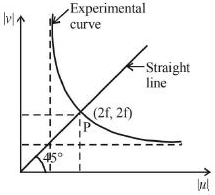
In an optics experiment,with the position of the object fixed,a student varies the position of a convex lens and for each position,the screen is adjusted to get a clear image of the object. $A$ graph between the object distance $|u|$ and the image distance $|v|$,from the lens,is plotted using the same scale for the two axes. $A$ straight line passing through the origin and making an angle of $45^{\circ}$ with the $x$-axis meets the experimental curve at $P$. The coordinates of $P$ will be
A
$(2f, 2f)$
B
$(f/2, f/2)$
C
$(f, f)$
D
$(4f, 4f)$
Solution
(A) For a convex lens,the lens formula is given by $\frac{1}{v} - \frac{1}{u} = \frac{1}{f}$.
Using sign convention,$u$ is negative,so let $u = -|u|$ and $v = |v|$.
The equation becomes $\frac{1}{|v|} - \frac{1}{-|u|} = \frac{1}{f}$,which simplifies to $\frac{1}{|v|} + \frac{1}{|u|} = \frac{1}{f}$.
$A$ straight line passing through the origin making an angle of $45^{\circ}$ with the $x$-axis has the equation $|v| = |u|$.
At the intersection point $P$,we substitute $|v| = |u|$ into the lens formula:
$\frac{1}{|u|} + \frac{1}{|u|} = \frac{1}{f}$
$\frac{2}{|u|} = \frac{1}{f}$
$|u| = 2f$.
Since $|v| = |u|$,we have $|v| = 2f$.
Thus,the coordinates of point $P$ are $(2f, 2f)$.
Using sign convention,$u$ is negative,so let $u = -|u|$ and $v = |v|$.
The equation becomes $\frac{1}{|v|} - \frac{1}{-|u|} = \frac{1}{f}$,which simplifies to $\frac{1}{|v|} + \frac{1}{|u|} = \frac{1}{f}$.
$A$ straight line passing through the origin making an angle of $45^{\circ}$ with the $x$-axis has the equation $|v| = |u|$.
At the intersection point $P$,we substitute $|v| = |u|$ into the lens formula:
$\frac{1}{|u|} + \frac{1}{|u|} = \frac{1}{f}$
$\frac{2}{|u|} = \frac{1}{f}$
$|u| = 2f$.
Since $|v| = |u|$,we have $|v| = 2f$.
Thus,the coordinates of point $P$ are $(2f, 2f)$.
0 likesView Solution
24
PhysicsMediumMCQAIEEE · 2009
The surface of a metal is illuminated with light of $400 \ nm$. The kinetic energy of the ejected photoelectrons was found to be $1.68 \ eV$. The work function of the metal is ............ $eV$ $(hc = 1240 \ eV \ nm)$.
A
$1.41$
B
$1.51$
C
$1.68$
D
$3.09$
Solution
(A) Given: Wavelength $\lambda = 400 \ nm$,Energy constant $hc = 1240 \ eV \ nm$,Kinetic energy $K.E. = 1.68 \ eV$.
According to Einstein's photoelectric equation: $E = W + K.E._{max}$,where $E = \frac{hc}{\lambda}$.
Substituting the values: $E = \frac{1240}{400} = 3.1 \ eV$.
Now,calculate the work function $W$: $W = E - K.E._{max} = 3.1 \ eV - 1.68 \ eV = 1.42 \ eV$.
Note: The closest option provided is $1.41 \ eV$ (Option $A$). Assuming a slight rounding in the question's provided options,$1.42 \ eV$ is the calculated result.
According to Einstein's photoelectric equation: $E = W + K.E._{max}$,where $E = \frac{hc}{\lambda}$.
Substituting the values: $E = \frac{1240}{400} = 3.1 \ eV$.
Now,calculate the work function $W$: $W = E - K.E._{max} = 3.1 \ eV - 1.68 \ eV = 1.42 \ eV$.
Note: The closest option provided is $1.41 \ eV$ (Option $A$). Assuming a slight rounding in the question's provided options,$1.42 \ eV$ is the calculated result.
0 likesView Solution
25
PhysicsDifficultMCQAIEEE · 2009
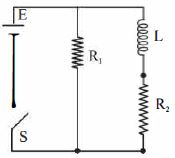
An inductor of inductance $L = 400 \ mH$ and resistors of resistance $R_1 = 2 \ \Omega$ and $R_2 = 2 \ \Omega$ are connected to a battery of emf $E = 12 \ V$ as shown in the figure. The internal resistance of the battery is negligible. The switch $S$ is closed at $t = 0$. The potential drop across $L$ as a function of time is:
A
$6e^{-5t} \ V$
B
$\frac{12}{t}e^{-3t} \ V$
C
$6(1 - e^{-t/0.2}) \ V$
D
$12e^{-5t} \ V$
Solution
(D) When the switch $S$ is closed at $t = 0$,the branch containing $R_1$ is in parallel with the branch containing $L$ and $R_2$. The potential difference across the $L-R_2$ branch is equal to the emf of the battery,$E = 12 \ V$.
The current $i$ in the $L-R_2$ branch grows according to the equation: $i = \frac{E}{R_2}(1 - e^{-R_2 t / L})$.
The potential drop across the inductor $L$ is given by $V_L = L \frac{di}{dt}$.
Differentiating the current expression with respect to time $t$:
$\frac{di}{dt} = \frac{E}{R_2} \cdot \frac{R_2}{L} e^{-R_2 t / L} = \frac{E}{L} e^{-R_2 t / L}$.
Substituting this into the expression for $V_L$:
$V_L = L \left( \frac{E}{L} e^{-R_2 t / L} \right) = E e^{-R_2 t / L}$.
Given $E = 12 \ V$,$R_2 = 2 \ \Omega$,and $L = 400 \ mH = 0.4 \ H$,the time constant $\tau = \frac{L}{R_2} = \frac{0.4}{2} = 0.2 \ s$.
Thus,$V_L = 12 e^{-t / 0.2} = 12 e^{-5t} \ V$.
The current $i$ in the $L-R_2$ branch grows according to the equation: $i = \frac{E}{R_2}(1 - e^{-R_2 t / L})$.
The potential drop across the inductor $L$ is given by $V_L = L \frac{di}{dt}$.
Differentiating the current expression with respect to time $t$:
$\frac{di}{dt} = \frac{E}{R_2} \cdot \frac{R_2}{L} e^{-R_2 t / L} = \frac{E}{L} e^{-R_2 t / L}$.
Substituting this into the expression for $V_L$:
$V_L = L \left( \frac{E}{L} e^{-R_2 t / L} \right) = E e^{-R_2 t / L}$.
Given $E = 12 \ V$,$R_2 = 2 \ \Omega$,and $L = 400 \ mH = 0.4 \ H$,the time constant $\tau = \frac{L}{R_2} = \frac{0.4}{2} = 0.2 \ s$.
Thus,$V_L = 12 e^{-t / 0.2} = 12 e^{-5t} \ V$.
0 likesView Solution
26
PhysicsMediumMCQAIEEE · 2009
$A$ mixture of light,consisting of wavelengths $590 \ nm$ and an unknown wavelength,illuminates Young's double slit and gives rise to two overlapping interference patterns on the screen. The central maximum of both lights coincide. Further,it is observed that the $3^{rd}$ bright fringe of the known light coincides with the $4^{th}$ bright fringe of the unknown light. From this data,the wavelength of the unknown light is ...... $nm$.
A
$393.4$
B
$885$
C
$442.5$
D
$776.8$
Solution
(C) The condition for the $n^{th}$ bright fringe in Young's double slit experiment is given by $y_n = \frac{n \lambda D}{d}$.
Given that the $3^{rd}$ bright fringe of the known light $(\lambda_1 = 590 \ nm)$ coincides with the $4^{th}$ bright fringe of the unknown light $(\lambda_2 = \lambda)$:
$\frac{3 \lambda_1 D}{d} = \frac{4 \lambda_2 D}{d}$
$3 \lambda_1 = 4 \lambda_2$
$\lambda_2 = \frac{3}{4} \times 590 \ nm$
$\lambda_2 = 0.75 \times 590 \ nm = 442.5 \ nm$.
Given that the $3^{rd}$ bright fringe of the known light $(\lambda_1 = 590 \ nm)$ coincides with the $4^{th}$ bright fringe of the unknown light $(\lambda_2 = \lambda)$:
$\frac{3 \lambda_1 D}{d} = \frac{4 \lambda_2 D}{d}$
$3 \lambda_1 = 4 \lambda_2$
$\lambda_2 = \frac{3}{4} \times 590 \ nm$
$\lambda_2 = 0.75 \times 590 \ nm = 442.5 \ nm$.
0 likesView Solution
27
PhysicsEasyMCQAIEEE · 2009
The transition from the state $n = 4$ to $n = 3$ in a hydrogen-like atom results in ultraviolet radiation. Infrared radiation will be obtained in the transition from:
A
$2 \rightarrow 1$
B
$3 \rightarrow 2$
C
$4 \rightarrow 2$
D
$5 \rightarrow 4$
Solution
(D) The energy of a photon emitted during a transition between energy levels $n_i$ and $n_f$ is given by $\Delta E = 13.6 Z^2 (\frac{1}{n_f^2} - \frac{1}{n_i^2}) \text{ eV}$.
Ultraviolet radiation corresponds to higher energy transitions (Lyman series),while infrared radiation corresponds to lower energy transitions (Paschen,Brackett,or Pfund series).
Given that the transition $n=4 \rightarrow n=3$ results in ultraviolet radiation for this specific atom,it implies that the energy gap $\Delta E_{4 \rightarrow 3}$ is quite large.
To obtain infrared radiation,we need a transition with a significantly smaller energy gap than $\Delta E_{4 \rightarrow 3}$.
Comparing the options:
$(A)$ $2 \rightarrow 1$: This is a transition between lower energy levels,resulting in a larger energy gap than $4 \rightarrow 3$.
$(B)$ $3 \rightarrow 2$: This is also a transition between lower energy levels,resulting in a larger energy gap than $4 \rightarrow 3$.
$(C)$ $4 \rightarrow 2$: This involves a larger jump in quantum numbers,resulting in a larger energy gap.
$(D)$ $5 \rightarrow 4$: This transition occurs between higher energy levels where the energy difference between consecutive levels is much smaller. Thus,$5 \rightarrow 4$ will have the smallest energy gap and will result in infrared radiation.
Ultraviolet radiation corresponds to higher energy transitions (Lyman series),while infrared radiation corresponds to lower energy transitions (Paschen,Brackett,or Pfund series).
Given that the transition $n=4 \rightarrow n=3$ results in ultraviolet radiation for this specific atom,it implies that the energy gap $\Delta E_{4 \rightarrow 3}$ is quite large.
To obtain infrared radiation,we need a transition with a significantly smaller energy gap than $\Delta E_{4 \rightarrow 3}$.
Comparing the options:
$(A)$ $2 \rightarrow 1$: This is a transition between lower energy levels,resulting in a larger energy gap than $4 \rightarrow 3$.
$(B)$ $3 \rightarrow 2$: This is also a transition between lower energy levels,resulting in a larger energy gap than $4 \rightarrow 3$.
$(C)$ $4 \rightarrow 2$: This involves a larger jump in quantum numbers,resulting in a larger energy gap.
$(D)$ $5 \rightarrow 4$: This transition occurs between higher energy levels where the energy difference between consecutive levels is much smaller. Thus,$5 \rightarrow 4$ will have the smallest energy gap and will result in infrared radiation.
0 likesView Solution
28
PhysicsMediumMCQAIEEE · 2009
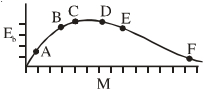
The figure shows a plot of binding energy per nucleon $E_b$ against the nuclear mass number $A$. $A, B, C, D, E, F$ correspond to different nuclei. Consider four reactions:
$(i) A + B \to C + \varepsilon$
$(ii) C \to A + B + \varepsilon$
$(iii) D + E \to F + \varepsilon$
$(iv) F \to D + E + \varepsilon$
Here, $\varepsilon$ is the energy released. In which reactions is $\varepsilon$ > 0?
$(i) A + B \to C + \varepsilon$
$(ii) C \to A + B + \varepsilon$
$(iii) D + E \to F + \varepsilon$
$(iv) F \to D + E + \varepsilon$
Here, $\varepsilon$ is the energy released. In which reactions is $\varepsilon$ > 0?
A
$(i)$ and $(iv)$
B
$(i)$ and $(iii)$
C
$(ii)$ and $(iv)$
D
$(iv)$ and $(iii)$
Solution
(A) Energy is released $(\varepsilon > 0)$ in a nuclear reaction if the total binding energy of the products is greater than the total binding energy of the reactants.
$1$. For reaction $(i)$, $A + B \to C + \varepsilon$: The nucleus $C$ has a higher binding energy per nucleon than $A$ and $B$. Thus, the total binding energy of the product $C$ is greater than the sum of the binding energies of $A$ and $B$. Therefore, $\varepsilon > 0$.
$2$. For reaction $(iv)$, $F \to D + E + \varepsilon$: The nuclei $D$ and $E$ have higher binding energy per nucleon than $F$. Thus, the total binding energy of the products $D$ and $E$ is greater than the binding energy of the reactant $F$. Therefore, $\varepsilon > 0$.
Hence, $\varepsilon$ is positive in reactions $(i)$ and $(iv)$.
$1$. For reaction $(i)$, $A + B \to C + \varepsilon$: The nucleus $C$ has a higher binding energy per nucleon than $A$ and $B$. Thus, the total binding energy of the product $C$ is greater than the sum of the binding energies of $A$ and $B$. Therefore, $\varepsilon > 0$.
$2$. For reaction $(iv)$, $F \to D + E + \varepsilon$: The nuclei $D$ and $E$ have higher binding energy per nucleon than $F$. Thus, the total binding energy of the products $D$ and $E$ is greater than the binding energy of the reactant $F$. Therefore, $\varepsilon > 0$.
Hence, $\varepsilon$ is positive in reactions $(i)$ and $(iv)$.
0 likesView Solution
29
PhysicsMediumMCQAIEEE · 2009
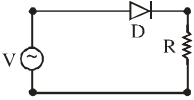
$A$ $p-n$ junction diode $(D)$ shown in the figure can act as a rectifier. An alternating current source $(V)$ is connected in the circuit. The current $(I)$ in the resistor $(R)$ can be shown by:
A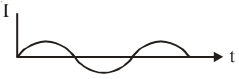
B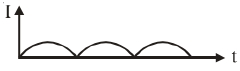
C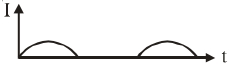
D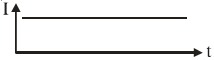
Solution
(C) single $p-n$ junction diode connected in series with an alternating current $(A.C.)$ source and a load resistor $(R)$ acts as a half-wave rectifier.
During the positive half-cycle of the input $A.C.$,the diode is forward-biased and conducts current through the resistor $(R)$.
During the negative half-cycle of the input $A.C.$,the diode is reverse-biased and does not conduct,resulting in zero current through the resistor $(R)$.
Therefore,the output current waveform consists of only the positive half-cycles,with gaps where the negative half-cycles would have been. This corresponds to the graph shown in option $C$.
During the positive half-cycle of the input $A.C.$,the diode is forward-biased and conducts current through the resistor $(R)$.
During the negative half-cycle of the input $A.C.$,the diode is reverse-biased and does not conduct,resulting in zero current through the resistor $(R)$.
Therefore,the output current waveform consists of only the positive half-cycles,with gaps where the negative half-cycles would have been. This corresponds to the graph shown in option $C$.
0 likesView Solution
30
PhysicsMediumMCQAIEEE · 2009
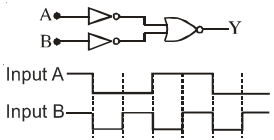
The logic circuit shown below has the input waveforms $A$ and $B$ as shown. Pick out the correct output waveform.
A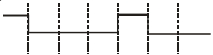
B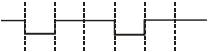
C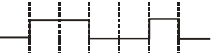
D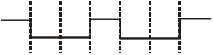
Solution
(D) The given circuit consists of two $NOT$ gates followed by a $NOR$ gate.
Let the inputs be $A$ and $B$. The outputs of the $NOT$ gates are $\bar{A}$ and $\bar{B}$.
These are fed into a $NOR$ gate,so the final output $Y$ is:
$Y = \overline{\bar{A} + \bar{B}}$
Using De Morgan's theorem,$\overline{\bar{A} + \bar{B}} = \overline{\bar{A}} \cdot \overline{\bar{B}} = A \cdot B$.
Thus,the circuit acts as an $AND$ gate.
The truth table for an $AND$ gate is:
Comparing the input waveforms $A$ and $B$ with the $AND$ gate logic,the output $Y$ is high $(1)$ only when both $A$ and $B$ are high $(1)$. Looking at the provided waveforms,this corresponds to option $D$.
Let the inputs be $A$ and $B$. The outputs of the $NOT$ gates are $\bar{A}$ and $\bar{B}$.
These are fed into a $NOR$ gate,so the final output $Y$ is:
$Y = \overline{\bar{A} + \bar{B}}$
Using De Morgan's theorem,$\overline{\bar{A} + \bar{B}} = \overline{\bar{A}} \cdot \overline{\bar{B}} = A \cdot B$.
Thus,the circuit acts as an $AND$ gate.
The truth table for an $AND$ gate is:
| $A$ | $B$ | $Y$ |
| $0$ | $0$ | $0$ |
| $0$ | $1$ | $0$ |
| $1$ | $0$ | $0$ |
| $1$ | $1$ | $1$ |
Comparing the input waveforms $A$ and $B$ with the $AND$ gate logic,the output $Y$ is high $(1)$ only when both $A$ and $B$ are high $(1)$. Looking at the provided waveforms,this corresponds to option $D$.
0 likesView Solution
Vedclass Products
For Students
Vedclass Test Series
Mock tests in real AIEEE style covering Physics with performance analysis. 5-day free trial.
Start Free TrialFor Teachers
Exam Paper Generator
Generate Set A/B/C/D Physics papers from 7.5L+ questions in 2 minutes. 3 chapters free.
Try FreeFor Institutes
Online Exam Module
Run live AIEEE mock exams with unlimited students, 360° analytics & white-label branding.
See DemoFrequently Asked Questions
How many Physics questions are in AIEEE 2009?
There are 30 Physics questions from the AIEEE 2009 paper on Vedclass, each with a detailed step-by-step solution in English.
Are AIEEE 2009 Physics solutions available in English?
Yes. All solutions on this page are in English. You can also switch to English or Hindi using the language buttons above the questions.
Can I practice AIEEE 2009 Physics as a timed test?
Yes. Use the Vedclass Test Series to attempt a full AIEEE mock test covering Physics with time limits and instant score analysis.
Can teachers create Physics papers from AIEEE previous year questions?
Yes. The Vedclass Exam Paper Generator lets teachers mix AIEEE Physics questions and generate Set A/B/C/D papers in minutes.
For Teachers & Institutes
Build a Custom Physics Paper
Pick AIEEE 2009 Physics questions, set difficulty, and generate Set A/B/C/D in 2 minutes.