
MathematicsQ1–28 of 28 questions
Page 1 of 1 · English
1
MathematicsEasyMCQAIEEE · 2009
If $A, B$ and $C$ are three sets such that $A \cap B = A \cap C$ and $A \cup B = A \cup C$,then:
A
$A = C$
B
$B = C$
C
$A \cap B = \emptyset$
D
$A = B$
Solution
(B) Given $A \cap B = A \cap C$ and $A \cup B = A \cup C$.
Consider $B = B \cap (A \cup B)$.
Since $A \cup B = A \cup C$,we have $B = B \cap (A \cup C)$.
Using the distributive law,$B = (B \cap A) \cup (B \cap C)$.
Since $A \cap B = A \cap C$,we have $B = (A \cap C) \cup (B \cap C)$.
$B = (A \cup B) \cap C$.
Since $A \cup B = A \cup C$,we have $B = (A \cup C) \cap C$.
Since $(A \cup C) \cap C = C$,it follows that $B = C$.
Consider $B = B \cap (A \cup B)$.
Since $A \cup B = A \cup C$,we have $B = B \cap (A \cup C)$.
Using the distributive law,$B = (B \cap A) \cup (B \cap C)$.
Since $A \cap B = A \cap C$,we have $B = (A \cap C) \cup (B \cap C)$.
$B = (A \cup B) \cap C$.
Since $A \cup B = A \cup C$,we have $B = (A \cup C) \cap C$.
Since $(A \cup C) \cap C = C$,it follows that $B = C$.
0 likesView Solution
2
MathematicsDifficultMCQAIEEE · 2009
Let $A$ and $B$ denote the statements:
$A: \cos \alpha + \cos \beta + \cos \gamma = 0$
$B: \sin \alpha + \sin \beta + \sin \gamma = 0$
If $\cos (\alpha - \beta) + \cos (\beta - \gamma) + \cos (\gamma - \alpha) = -\frac{3}{2}$,then:
$A: \cos \alpha + \cos \beta + \cos \gamma = 0$
$B: \sin \alpha + \sin \beta + \sin \gamma = 0$
If $\cos (\alpha - \beta) + \cos (\beta - \gamma) + \cos (\gamma - \alpha) = -\frac{3}{2}$,then:
A
$A$ is false and $B$ is true
B
both are true
C
both are false
D
$B$ is false and $A$ is true
Solution
(B) Given $\cos (\alpha - \beta) + \cos (\beta - \gamma) + \cos (\gamma - \alpha) = -\frac{3}{2}$.
Multiplying by $2$,we get $2[\cos (\alpha - \beta) + \cos (\beta - \gamma) + \cos (\gamma - \alpha)] = -3$.
Adding $3$ to both sides: $2[\cos (\alpha - \beta) + \cos (\beta - \gamma) + \cos (\gamma - \alpha)] + 3 = 0$.
Since $\sin^2 \theta + \cos^2 \theta = 1$,we can write $3 = (\sin^2 \alpha + \cos^2 \alpha) + (\sin^2 \beta + \cos^2 \beta) + (\sin^2 \gamma + \cos^2 \gamma)$.
Substituting this into the equation:
$(\sin^2 \alpha + \sin^2 \beta + \sin^2 \gamma + 2\sin \alpha \sin \beta + 2\sin \beta \sin \gamma + 2\sin \gamma \sin \alpha) + (\cos^2 \alpha + \cos^2 \beta + \cos^2 \gamma + 2\cos \alpha \cos \beta + 2\cos \beta \cos \gamma + 2\cos \gamma \cos \alpha) = 0$.
This simplifies to $(\sin \alpha + \sin \beta + \sin \gamma)^2 + (\cos \alpha + \cos \beta + \cos \gamma)^2 = 0$.
Since the sum of squares is zero,each term must be zero:
$\sin \alpha + \sin \beta + \sin \gamma = 0$ and $\cos \alpha + \cos \beta + \cos \gamma = 0$.
Therefore,both statements $A$ and $B$ are true.
Multiplying by $2$,we get $2[\cos (\alpha - \beta) + \cos (\beta - \gamma) + \cos (\gamma - \alpha)] = -3$.
Adding $3$ to both sides: $2[\cos (\alpha - \beta) + \cos (\beta - \gamma) + \cos (\gamma - \alpha)] + 3 = 0$.
Since $\sin^2 \theta + \cos^2 \theta = 1$,we can write $3 = (\sin^2 \alpha + \cos^2 \alpha) + (\sin^2 \beta + \cos^2 \beta) + (\sin^2 \gamma + \cos^2 \gamma)$.
Substituting this into the equation:
$(\sin^2 \alpha + \sin^2 \beta + \sin^2 \gamma + 2\sin \alpha \sin \beta + 2\sin \beta \sin \gamma + 2\sin \gamma \sin \alpha) + (\cos^2 \alpha + \cos^2 \beta + \cos^2 \gamma + 2\cos \alpha \cos \beta + 2\cos \beta \cos \gamma + 2\cos \gamma \cos \alpha) = 0$.
This simplifies to $(\sin \alpha + \sin \beta + \sin \gamma)^2 + (\cos \alpha + \cos \beta + \cos \gamma)^2 = 0$.
Since the sum of squares is zero,each term must be zero:
$\sin \alpha + \sin \beta + \sin \gamma = 0$ and $\cos \alpha + \cos \beta + \cos \gamma = 0$.
Therefore,both statements $A$ and $B$ are true.
0 likesView Solution
3
MathematicsDifficultMCQAIEEE · 2009
From $6$ different novels and $3$ different dictionaries,$4$ novels and $1$ dictionary are to be selected and arranged in a row on a shelf so that the dictionary is always in the middle. The number of such arrangements is :
A
less than $500$
B
at least $500$ but less than $750$
C
at least $1000$
D
at least $750$ but less than $1000$
Solution
(C) Step $1$: Select $4$ novels from $6$ different novels in $^6C_4$ ways.
$^6C_4 = \frac{6 \times 5}{2 \times 1} = 15$ ways.
Step $2$: Select $1$ dictionary from $3$ different dictionaries in $^3C_1$ ways.
$^3C_1 = 3$ ways.
Step $3$: Arrange the $4$ selected novels and $1$ dictionary in a row such that the dictionary is always in the middle.
Since the dictionary is fixed in the middle,we only need to arrange the $4$ novels in the remaining $4$ positions.
The number of ways to arrange $4$ novels is $4! = 24$.
Step $4$: Total number of arrangements = $^6C_4 \times ^3C_1 \times 4! = 15 \times 3 \times 24 = 1080$.
$^6C_4 = \frac{6 \times 5}{2 \times 1} = 15$ ways.
Step $2$: Select $1$ dictionary from $3$ different dictionaries in $^3C_1$ ways.
$^3C_1 = 3$ ways.
Step $3$: Arrange the $4$ selected novels and $1$ dictionary in a row such that the dictionary is always in the middle.
Since the dictionary is fixed in the middle,we only need to arrange the $4$ novels in the remaining $4$ positions.
The number of ways to arrange $4$ novels is $4! = 24$.
Step $4$: Total number of arrangements = $^6C_4 \times ^3C_1 \times 4! = 15 \times 3 \times 24 = 1080$.
1 likesView Solution
4
MathematicsDifficultMCQAIEEE · 2009
The remainder left when $8^{2n} - 62^{2n+1}$ is divided by $9$ is:
A
$2$
B
$7$
C
$8$
D
$0$
Solution
(A) We need to find the remainder when $8^{2n} - 62^{2n+1}$ is divided by $9$.
Note that $8 \equiv -1 \pmod{9}$ and $62 \equiv 8 \equiv -1 \pmod{9}$.
Substituting these into the expression:
$8^{2n} - 62^{2n+1} \equiv (-1)^{2n} - (-1)^{2n+1} \pmod{9}$.
Since $2n$ is an even integer,$(-1)^{2n} = 1$.
Since $2n+1$ is an odd integer,$(-1)^{2n+1} = -1$.
Therefore,$1 - (-1) = 1 + 1 = 2$.
Thus,the remainder is $2$.
Note that $8 \equiv -1 \pmod{9}$ and $62 \equiv 8 \equiv -1 \pmod{9}$.
Substituting these into the expression:
$8^{2n} - 62^{2n+1} \equiv (-1)^{2n} - (-1)^{2n+1} \pmod{9}$.
Since $2n$ is an even integer,$(-1)^{2n} = 1$.
Since $2n+1$ is an odd integer,$(-1)^{2n+1} = -1$.
Therefore,$1 - (-1) = 1 + 1 = 2$.
Thus,the remainder is $2$.
0 likesView Solution
5
MathematicsDifficultMCQAIEEE · 2009
The sum to infinite terms of the series $1 + \frac{2}{3} + \frac{6}{3^2} + \frac{10}{3^3} + \frac{14}{3^4} + \dots$ is
A
$3$
B
$4$
C
$6$
D
$2$
Solution
(A) Let the sum be $S = 1 + \frac{2}{3} + \frac{6}{3^2} + \frac{10}{3^3} + \frac{14}{3^4} + \dots$ $(1)$
Multiply by $\frac{1}{3}$: $\frac{1}{3}S = \frac{1}{3} + \frac{2}{3^2} + \frac{6}{3^3} + \frac{10}{3^4} + \dots$ $(2)$
Subtracting $(2)$ from $(1)$:
$S - \frac{1}{3}S = 1 + (\frac{2}{3} - \frac{1}{3}) + (\frac{6}{3^2} - \frac{2}{3^2}) + (\frac{10}{3^3} - \frac{6}{3^3}) + (\frac{14}{3^4} - \frac{10}{3^4}) + \dots$
$\frac{2}{3}S = 1 + \frac{1}{3} + \frac{4}{3^2} + \frac{4}{3^3} + \frac{4}{3^4} + \dots$
$\frac{2}{3}S = 1 + \frac{1}{3} + [\frac{4}{3^2} + \frac{4}{3^3} + \frac{4}{3^4} + \dots]$
The term in the bracket is an infinite geometric series with $a = \frac{4}{9}$ and $r = \frac{1}{3}$.
Sum $= \frac{a}{1-r} = \frac{4/9}{1 - 1/3} = \frac{4/9}{2/3} = \frac{4}{9} \times \frac{3}{2} = \frac{2}{3}$.
So,$\frac{2}{3}S = 1 + \frac{1}{3} + \frac{2}{3} = 1 + 1 = 2$.
$S = 2 \times \frac{3}{2} = 3$.
Multiply by $\frac{1}{3}$: $\frac{1}{3}S = \frac{1}{3} + \frac{2}{3^2} + \frac{6}{3^3} + \frac{10}{3^4} + \dots$ $(2)$
Subtracting $(2)$ from $(1)$:
$S - \frac{1}{3}S = 1 + (\frac{2}{3} - \frac{1}{3}) + (\frac{6}{3^2} - \frac{2}{3^2}) + (\frac{10}{3^3} - \frac{6}{3^3}) + (\frac{14}{3^4} - \frac{10}{3^4}) + \dots$
$\frac{2}{3}S = 1 + \frac{1}{3} + \frac{4}{3^2} + \frac{4}{3^3} + \frac{4}{3^4} + \dots$
$\frac{2}{3}S = 1 + \frac{1}{3} + [\frac{4}{3^2} + \frac{4}{3^3} + \frac{4}{3^4} + \dots]$
The term in the bracket is an infinite geometric series with $a = \frac{4}{9}$ and $r = \frac{1}{3}$.
Sum $= \frac{a}{1-r} = \frac{4/9}{1 - 1/3} = \frac{4/9}{2/3} = \frac{4}{9} \times \frac{3}{2} = \frac{2}{3}$.
So,$\frac{2}{3}S = 1 + \frac{1}{3} + \frac{2}{3} = 1 + 1 = 2$.
$S = 2 \times \frac{3}{2} = 3$.
0 likesView Solution
6
MathematicsDifficultMCQAIEEE · 2009
The lines $p(p^2 + 1)x - y + q = 0$ and $(p^2 + 1)^2x + (p^2 + 1)y + 2q = 0$ are perpendicular to a common line for :
A
exactly one value of $p$
B
exactly two values of $p$
C
more than two values of $p$
D
no value of $p$
Solution
(A) If two lines are perpendicular to a common line,they must be parallel to each other.
Let the slopes of the lines be $m_1$ and $m_2$.
For the first line $p(p^2 + 1)x - y + q = 0$,the slope $m_1 = \frac{p(p^2 + 1)}{1} = p(p^2 + 1)$.
For the second line $(p^2 + 1)^2x + (p^2 + 1)y + 2q = 0$,the slope $m_2 = -\frac{(p^2 + 1)^2}{p^2 + 1} = -(p^2 + 1)$.
Since the lines are parallel,$m_1 = m_2$.
$p(p^2 + 1) = -(p^2 + 1)$.
Since $p^2 + 1 \neq 0$ for any real $p$,we can divide by $(p^2 + 1)$.
$p = -1$.
Thus,there is exactly one value of $p$.
Let the slopes of the lines be $m_1$ and $m_2$.
For the first line $p(p^2 + 1)x - y + q = 0$,the slope $m_1 = \frac{p(p^2 + 1)}{1} = p(p^2 + 1)$.
For the second line $(p^2 + 1)^2x + (p^2 + 1)y + 2q = 0$,the slope $m_2 = -\frac{(p^2 + 1)^2}{p^2 + 1} = -(p^2 + 1)$.
Since the lines are parallel,$m_1 = m_2$.
$p(p^2 + 1) = -(p^2 + 1)$.
Since $p^2 + 1 \neq 0$ for any real $p$,we can divide by $(p^2 + 1)$.
$p = -1$.
Thus,there is exactly one value of $p$.
0 likesView Solution
7
MathematicsDifficultMCQAIEEE · 2009
If $P$ and $Q$ are the points of intersection of the circles $x^2 + y^2 + 3x + 7y + 2p - 5 = 0$ and $x^2 + y^2 + 2x + 2y - p^2 = 0$,then there is a circle passing through $P, Q$ and $(1, 1)$ for:
A
all except one value of $p$
B
all except two values of $p$
C
exactly one value of $p$
D
all values of $p$
Solution
(A) The equation of the common chord (radical axis) of the two circles $S_1: x^2 + y^2 + 3x + 7y + 2p - 5 = 0$ and $S_2: x^2 + y^2 + 2x + 2y - p^2 = 0$ is given by $S_1 - S_2 = 0$.
$(x^2 + y^2 + 3x + 7y + 2p - 5) - (x^2 + y^2 + 2x + 2y - p^2) = 0$
$x + 5y + 2p - 5 + p^2 = 0 \quad \dots(i)$
For a circle to pass through the intersection points $P$ and $Q$ and the point $(1, 1)$,the point $(1, 1)$ must not lie on the common chord $PQ$.
Substituting $(1, 1)$ into equation $(i)$:
$1 + 5(1) + 2p - 5 + p^2 \neq 0$
$p^2 + 2p + 1 \neq 0$
$(p + 1)^2 \neq 0$
$p \neq -1$
Thus,there exists a circle passing through $P, Q$ and $(1, 1)$ for all values of $p$ except $p = -1$.
$(x^2 + y^2 + 3x + 7y + 2p - 5) - (x^2 + y^2 + 2x + 2y - p^2) = 0$
$x + 5y + 2p - 5 + p^2 = 0 \quad \dots(i)$
For a circle to pass through the intersection points $P$ and $Q$ and the point $(1, 1)$,the point $(1, 1)$ must not lie on the common chord $PQ$.
Substituting $(1, 1)$ into equation $(i)$:
$1 + 5(1) + 2p - 5 + p^2 \neq 0$
$p^2 + 2p + 1 \neq 0$
$(p + 1)^2 \neq 0$
$p \neq -1$
Thus,there exists a circle passing through $P, Q$ and $(1, 1)$ for all values of $p$ except $p = -1$.
0 likesView Solution
8
MathematicsDifficultMCQAIEEE · 2009
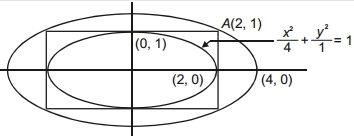
The ellipse $x^2 + 4y^2 = 4$ is inscribed in a rectangle aligned with the coordinate axes,which in turn is inscribed in another ellipse that passes through the point $(4,0)$. Then the equation of the outer ellipse is:
A
$x^2 + 12y^2 = 16$
B
$4x^2 + 48y^2 = 48$
C
$4x^2 + 64y^2 = 48$
D
$x^2 + 16y^2 = 16$
Solution
(A) The given ellipse is $x^2 + 4y^2 = 4$,which can be written as $\frac{x^2}{4} + \frac{y^2}{1} = 1$.
This ellipse has semi-axes $a = 2$ and $b = 1$.
The rectangle inscribed around this ellipse has vertices at $(\pm 2, \pm 1)$.
The outer ellipse is inscribed in this rectangle,meaning it passes through the points $(\pm 2, \pm 1)$.
Let the equation of the outer ellipse be $\frac{x^2}{A^2} + \frac{y^2}{B^2} = 1$.
Since it passes through $(4,0)$,we have $\frac{4^2}{A^2} + \frac{0^2}{B^2} = 1$,which gives $A^2 = 16$.
Since it also passes through $(2,1)$,we have $\frac{2^2}{16} + \frac{1^2}{B^2} = 1$.
$\frac{4}{16} + \frac{1}{B^2} = 1 \implies \frac{1}{4} + \frac{1}{B^2} = 1 \implies \frac{1}{B^2} = \frac{3}{4} \implies B^2 = \frac{4}{3}$.
Substituting $A^2$ and $B^2$ into the equation: $\frac{x^2}{16} + \frac{y^2}{4/3} = 1$.
$\frac{x^2}{16} + \frac{3y^2}{4} = 1$.
Multiplying by $16$,we get $x^2 + 12y^2 = 16$.
This ellipse has semi-axes $a = 2$ and $b = 1$.
The rectangle inscribed around this ellipse has vertices at $(\pm 2, \pm 1)$.
The outer ellipse is inscribed in this rectangle,meaning it passes through the points $(\pm 2, \pm 1)$.
Let the equation of the outer ellipse be $\frac{x^2}{A^2} + \frac{y^2}{B^2} = 1$.
Since it passes through $(4,0)$,we have $\frac{4^2}{A^2} + \frac{0^2}{B^2} = 1$,which gives $A^2 = 16$.
Since it also passes through $(2,1)$,we have $\frac{2^2}{16} + \frac{1^2}{B^2} = 1$.
$\frac{4}{16} + \frac{1}{B^2} = 1 \implies \frac{1}{4} + \frac{1}{B^2} = 1 \implies \frac{1}{B^2} = \frac{3}{4} \implies B^2 = \frac{4}{3}$.
Substituting $A^2$ and $B^2$ into the equation: $\frac{x^2}{16} + \frac{y^2}{4/3} = 1$.
$\frac{x^2}{16} + \frac{3y^2}{4} = 1$.
Multiplying by $16$,we get $x^2 + 12y^2 = 16$.
0 likesView Solution
9
MathematicsDifficultMCQAIEEE · 2009
If the mean deviation of the numbers $1, 1+d, 1+2d, \dots, 1+100d$ from their mean is $255$,then $d$ is equal to:
A
$20$
B
$10.1$
C
$20.2$
D
$10$
Solution
(B) The given series $1, 1+d, 1+2d, \dots, 1+100d$ is an $A.P.$ with $n = 101$ terms.
The mean of this series is $\bar{x} = \frac{\sum_{r=0}^{100} (1+rd)}{101} = \frac{101 + d \frac{100 \times 101}{2}}{101} = 1 + 50d$.
The mean deviation from the mean is given by $\frac{1}{101} \sum_{r=0}^{100} |(1+rd) - (1+50d)| = \frac{1}{101} \sum_{r=0}^{100} |(r-50)d|$.
Assuming $d > 0$,this becomes $\frac{d}{101} [\sum_{r=0}^{50} (50-r) + \sum_{r=51}^{100} (r-50)]$.
$= \frac{d}{101} [ (50+49+\dots+0) + (1+2+\dots+50) ] = \frac{d}{101} [ 2 \times \frac{50 \times 51}{2} ] = \frac{50 \times 51 \times d}{101}$.
Given the mean deviation is $255$,we have $\frac{50 \times 51 \times d}{101} = 255$.
$d = \frac{255 \times 101}{50 \times 51} = \frac{5 \times 101}{50} = \frac{101}{10} = 10.1$.
The mean of this series is $\bar{x} = \frac{\sum_{r=0}^{100} (1+rd)}{101} = \frac{101 + d \frac{100 \times 101}{2}}{101} = 1 + 50d$.
The mean deviation from the mean is given by $\frac{1}{101} \sum_{r=0}^{100} |(1+rd) - (1+50d)| = \frac{1}{101} \sum_{r=0}^{100} |(r-50)d|$.
Assuming $d > 0$,this becomes $\frac{d}{101} [\sum_{r=0}^{50} (50-r) + \sum_{r=51}^{100} (r-50)]$.
$= \frac{d}{101} [ (50+49+\dots+0) + (1+2+\dots+50) ] = \frac{d}{101} [ 2 \times \frac{50 \times 51}{2} ] = \frac{50 \times 51 \times d}{101}$.
Given the mean deviation is $255$,we have $\frac{50 \times 51 \times d}{101} = 255$.
$d = \frac{255 \times 101}{50 \times 51} = \frac{5 \times 101}{50} = \frac{101}{10} = 10.1$.
0 likesView Solution
10
MathematicsDifficultMCQAIEEE · 2009
If the roots of the equation $bx^2 + cx + a = 0$ are imaginary,then for all real values of $x,$ the expression $3b^2x^2 + 6bcx + 2c^2$ is :
A
$> 4ab$
B
$< 4ab$
C
$> -4ab$
D
$< -4ab$
Solution
(C) Given that the equation $bx^2 + cx + a = 0$ has imaginary roots,the discriminant $D < 0$.
Therefore,$c^2 - 4ab < 0$,which implies $c^2 < 4ab$.
Multiplying by $-1$,we get $-c^2 > -4ab$.
Now,consider the expression $E = 3b^2x^2 + 6bcx + 2c^2$.
$E = 3(b^2x^2 + 2bcx + c^2) - c^2$.
$E = 3(bx + c)^2 - c^2$.
Since $(bx + c)^2 \geq 0$,it follows that $3(bx + c)^2 \geq 0$.
Thus,$E \geq -c^2$.
Since $-c^2 > -4ab$,we have $E > -4ab$.
Therefore,$c^2 - 4ab < 0$,which implies $c^2 < 4ab$.
Multiplying by $-1$,we get $-c^2 > -4ab$.
Now,consider the expression $E = 3b^2x^2 + 6bcx + 2c^2$.
$E = 3(b^2x^2 + 2bcx + c^2) - c^2$.
$E = 3(bx + c)^2 - c^2$.
Since $(bx + c)^2 \geq 0$,it follows that $3(bx + c)^2 \geq 0$.
Thus,$E \geq -c^2$.
Since $-c^2 > -4ab$,we have $E > -4ab$.
0 likesView Solution
11
MathematicsDifficultMCQAIEEE · 2009
Statement $-1 :$ $\sim (p \leftrightarrow \sim q)$ is equivalent to $p \leftrightarrow q$.
Statement $-2 :$ $\sim (p \leftrightarrow \sim q)$ is a tautology.
Statement $-2 :$ $\sim (p \leftrightarrow \sim q)$ is a tautology.
A
Statement $-1$ is true,Statement $-2$ is true; Statement $-2$ is a correct explanation for Statement $-1$.
B
Statement $-1$ is true,Statement $-2$ is true; Statement $-2$ is not a correct explanation for Statement $-1$.
C
Statement $-1$ is false,Statement $-2$ is true.
D
Statement $-1$ is true,Statement $-2$ is false.
Solution
(D) To evaluate Statement $-1$,we analyze the truth table for $\sim (p \leftrightarrow \sim q)$.
Recall that $(p \leftrightarrow \sim q)$ is true when $p$ and $\sim q$ have the same truth value,which means $p$ and $q$ have opposite truth values.
Thus,$(p \leftrightarrow \sim q)$ is equivalent to $\sim (p \leftrightarrow q)$.
Therefore,$\sim (p \leftrightarrow \sim q)$ is equivalent to $\sim (\sim (p \leftrightarrow q))$,which simplifies to $(p \leftrightarrow q)$.
So,Statement $-1$ is true.
To evaluate Statement $-2$,we check if $\sim (p \leftrightarrow \sim q)$ is a tautology.
Since $\sim (p \leftrightarrow \sim q) \equiv (p \leftrightarrow q)$,and $(p \leftrightarrow q)$ is not true for all values of $p$ and $q$ (it is false when $p$ and $q$ have different truth values),the expression is not a tautology.
Thus,Statement $-2$ is false.
Recall that $(p \leftrightarrow \sim q)$ is true when $p$ and $\sim q$ have the same truth value,which means $p$ and $q$ have opposite truth values.
Thus,$(p \leftrightarrow \sim q)$ is equivalent to $\sim (p \leftrightarrow q)$.
Therefore,$\sim (p \leftrightarrow \sim q)$ is equivalent to $\sim (\sim (p \leftrightarrow q))$,which simplifies to $(p \leftrightarrow q)$.
So,Statement $-1$ is true.
To evaluate Statement $-2$,we check if $\sim (p \leftrightarrow \sim q)$ is a tautology.
Since $\sim (p \leftrightarrow \sim q) \equiv (p \leftrightarrow q)$,and $(p \leftrightarrow q)$ is not true for all values of $p$ and $q$ (it is false when $p$ and $q$ have different truth values),the expression is not a tautology.
Thus,Statement $-2$ is false.
0 likesView Solution
12
MathematicsMediumMCQAIEEE · 2009
Consider
Statement-$1$: $(p \wedge \sim q) \wedge (\sim p \wedge q)$ is a fallacy.
Statement-$2$: $(p \rightarrow q) \leftrightarrow (\sim q \rightarrow \sim p)$ is a tautology.
Statement-$1$: $(p \wedge \sim q) \wedge (\sim p \wedge q)$ is a fallacy.
Statement-$2$: $(p \rightarrow q) \leftrightarrow (\sim q \rightarrow \sim p)$ is a tautology.
A
Statement-$1$ is false,Statement-$2$ is true
B
Statement-$1$ is true,Statement-$2$ is false
C
Statement-$1$ is true,Statement-$2$ is true; Statement-$2$ is a correct explanation for Statement-$1$
D
Statement-$1$ is true,Statement-$2$ is true; Statement-$2$ is not a correct explanation for Statement-$1$
Solution
(D) Statement-$2$: $(p \rightarrow q) \leftrightarrow (\sim q \rightarrow \sim p)$
Since $(\sim q \rightarrow \sim p)$ is the contrapositive of $(p \rightarrow q)$,they have the same truth values.
Thus,$(p \rightarrow q) \leftrightarrow (p \rightarrow q)$ is always true,which means it is a tautology.
So,Statement-$2$ is true.
Statement-$1$: $(p \wedge \sim q) \wedge (\sim p \wedge q)$
Using the associative and commutative laws:
$= (p \wedge \sim p) \wedge (\sim q \wedge q)$
$= F \wedge F = F$
Since the result is always false,it is a fallacy.
So,Statement-$1$ is true.
Both statements are true,and Statement-$2$ is not an explanation for Statement-$1$.
Since $(\sim q \rightarrow \sim p)$ is the contrapositive of $(p \rightarrow q)$,they have the same truth values.
Thus,$(p \rightarrow q) \leftrightarrow (p \rightarrow q)$ is always true,which means it is a tautology.
So,Statement-$2$ is true.
Statement-$1$: $(p \wedge \sim q) \wedge (\sim p \wedge q)$
Using the associative and commutative laws:
$= (p \wedge \sim p) \wedge (\sim q \wedge q)$
$= F \wedge F = F$
Since the result is always false,it is a fallacy.
So,Statement-$1$ is true.
Both statements are true,and Statement-$2$ is not an explanation for Statement-$1$.
0 likesView Solution
13
MathematicsDifficultMCQAIEEE · 2009
The quadratic equations $x^2-6x+a=0$ and $x^2-cx+6=0$ have one root in common. If the other roots of the first and second equations are integers and are in the ratio $4:3$,then their common root is
A
$4$
B
$3$
C
$2$
D
$1$
Solution
(C) Let the common root be $\alpha$. The equations are $x^2-6x+a=0$ and $x^2-cx+6=0$.
Let the other roots be $\beta_1$ and $\beta_2$ respectively. Given $\beta_1 : \beta_2 = 4:3$,so $\beta_1 = 4k$ and $\beta_2 = 3k$ for some constant $k$.
From the properties of roots:
For the first equation: $\alpha + 4k = 6$ and $\alpha \cdot 4k = a$.
For the second equation: $\alpha + 3k = c$ and $\alpha \cdot 3k = 6$.
From $\alpha \cdot 3k = 6$,we have $k = \frac{2}{\alpha}$.
Substitute $k$ into the first equation: $\alpha + 4(\frac{2}{\alpha}) = 6 \Rightarrow \alpha + \frac{8}{\alpha} = 6$.
Multiplying by $\alpha$: $\alpha^2 - 6\alpha + 8 = 0$.
Factoring: $(\alpha - 4)(\alpha - 2) = 0$,so $\alpha = 4$ or $\alpha = 2$.
If $\alpha = 4$,then $4k = 6 - 4 = 2 \Rightarrow k = 0.5$. Then $\beta_1 = 4(0.5) = 2$ and $\beta_2 = 3(0.5) = 1.5$. Since $\beta_2$ must be an integer,this is rejected.
If $\alpha = 2$,then $4k = 6 - 2 = 4 \Rightarrow k = 1$. Then $\beta_1 = 4(1) = 4$ and $\beta_2 = 3(1) = 3$. Both are integers.
Thus,the common root is $2$.
Let the other roots be $\beta_1$ and $\beta_2$ respectively. Given $\beta_1 : \beta_2 = 4:3$,so $\beta_1 = 4k$ and $\beta_2 = 3k$ for some constant $k$.
From the properties of roots:
For the first equation: $\alpha + 4k = 6$ and $\alpha \cdot 4k = a$.
For the second equation: $\alpha + 3k = c$ and $\alpha \cdot 3k = 6$.
From $\alpha \cdot 3k = 6$,we have $k = \frac{2}{\alpha}$.
Substitute $k$ into the first equation: $\alpha + 4(\frac{2}{\alpha}) = 6 \Rightarrow \alpha + \frac{8}{\alpha} = 6$.
Multiplying by $\alpha$: $\alpha^2 - 6\alpha + 8 = 0$.
Factoring: $(\alpha - 4)(\alpha - 2) = 0$,so $\alpha = 4$ or $\alpha = 2$.
If $\alpha = 4$,then $4k = 6 - 4 = 2 \Rightarrow k = 0.5$. Then $\beta_1 = 4(0.5) = 2$ and $\beta_2 = 3(0.5) = 1.5$. Since $\beta_2$ must be an integer,this is rejected.
If $\alpha = 2$,then $4k = 6 - 2 = 4 \Rightarrow k = 1$. Then $\beta_1 = 4(1) = 4$ and $\beta_2 = 3(1) = 3$. Both are integers.
Thus,the common root is $2$.
0 likesView Solution
14
MathematicsMediumMCQAIEEE · 2009
Let the line $\frac{x - 2}{3} = \frac{y - 1}{-5} = \frac{z + 2}{2}$ lie in the plane $x + 3y - \alpha z + \beta = 0$. Then $(\alpha, \beta)$ equals.
A
$(-6, 7)$
B
$(5, -15)$
C
$(-5, 5)$
D
$(6, -17)$
Solution
(A) The line $\frac{x - 2}{3} = \frac{y - 1}{-5} = \frac{z + 2}{2}$ lies on the plane $x + 3y - \alpha z + \beta = 0$.
Since the line is parallel to the plane,the normal vector of the plane $(1, 3, -\alpha)$ must be perpendicular to the direction vector of the line $(3, -5, 2)$.
Thus,$1(3) + 3(-5) + (-\alpha)(2) = 0$.
$3 - 15 - 2\alpha = 0$.
$-12 - 2\alpha = 0 \implies \alpha = -6$.
Now,the plane equation is $x + 3y + 6z + \beta = 0$.
Since the line lies on the plane,any point on the line must satisfy the plane equation. The point $(2, 1, -2)$ lies on the line.
Substituting $(2, 1, -2)$ into the plane equation: $2 + 3(1) + 6(-2) + \beta = 0$.
$2 + 3 - 12 + \beta = 0$.
$-7 + \beta = 0 \implies \beta = 7$.
Therefore,$(\alpha, \beta) = (-6, 7)$.
Since the line is parallel to the plane,the normal vector of the plane $(1, 3, -\alpha)$ must be perpendicular to the direction vector of the line $(3, -5, 2)$.
Thus,$1(3) + 3(-5) + (-\alpha)(2) = 0$.
$3 - 15 - 2\alpha = 0$.
$-12 - 2\alpha = 0 \implies \alpha = -6$.
Now,the plane equation is $x + 3y + 6z + \beta = 0$.
Since the line lies on the plane,any point on the line must satisfy the plane equation. The point $(2, 1, -2)$ lies on the line.
Substituting $(2, 1, -2)$ into the plane equation: $2 + 3(1) + 6(-2) + \beta = 0$.
$2 + 3 - 12 + \beta = 0$.
$-7 + \beta = 0 \implies \beta = 7$.
Therefore,$(\alpha, \beta) = (-6, 7)$.
0 likesView Solution
15
MathematicsDifficultMCQAIEEE · 2009
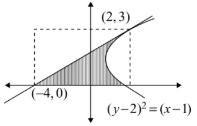
Find the area of the region bounded by the parabola $(y-2)^2 = x-1$,the tangent to the parabola at the point $(2,3)$,and the $x$-axis.
A
$6$
B
$9$
C
$12$
D
$3$
Solution
(B) The equation of the parabola is $(y-2)^2 = x-1$.
The tangent at the point $(2,3)$ is found using the formula $y-y_1 = m(x-x_1)$.
First,differentiate the parabola equation with respect to $x$: $2(y-2) \frac{dy}{dx} = 1$,so $\frac{dy}{dx} = \frac{1}{2(y-2)}$.
At $(2,3)$,the slope $m = \frac{1}{2(3-2)} = \frac{1}{2}$.
The equation of the tangent is $y-3 = \frac{1}{2}(x-2)$,which simplifies to $2y-6 = x-2$,or $x = 2y-4$.
The region is bounded by the parabola $x = (y-2)^2 + 1$,the tangent $x = 2y-4$,and the $x$-axis $(y=0)$.
The intersection of the tangent with the $x$-axis occurs at $y=0$,which gives $x = 2(0)-4 = -4$.
The intersection of the parabola with the $x$-axis occurs at $y=0$,which gives $x = (0-2)^2 + 1 = 5$.
However,the region is bounded by the tangent and the parabola up to the point $(2,3)$. Integrating with respect to $y$ from $y=0$ to $y=3$:
Area $A = \int_{0}^{3} [x_{parabola} - x_{tangent}] dy = \int_{0}^{3} [((y-2)^2 + 1) - (2y-4)] dy$
$A = \int_{0}^{3} [y^2 - 4y + 4 + 1 - 2y + 4] dy = \int_{0}^{3} [y^2 - 6y + 9] dy$
$A = \int_{0}^{3} (y-3)^2 dy = \left[ \frac{(y-3)^3}{3} \right]_{0}^{3} = 0 - \left( \frac{-27}{3} \right) = 9$.
The tangent at the point $(2,3)$ is found using the formula $y-y_1 = m(x-x_1)$.
First,differentiate the parabola equation with respect to $x$: $2(y-2) \frac{dy}{dx} = 1$,so $\frac{dy}{dx} = \frac{1}{2(y-2)}$.
At $(2,3)$,the slope $m = \frac{1}{2(3-2)} = \frac{1}{2}$.
The equation of the tangent is $y-3 = \frac{1}{2}(x-2)$,which simplifies to $2y-6 = x-2$,or $x = 2y-4$.
The region is bounded by the parabola $x = (y-2)^2 + 1$,the tangent $x = 2y-4$,and the $x$-axis $(y=0)$.
The intersection of the tangent with the $x$-axis occurs at $y=0$,which gives $x = 2(0)-4 = -4$.
The intersection of the parabola with the $x$-axis occurs at $y=0$,which gives $x = (0-2)^2 + 1 = 5$.
However,the region is bounded by the tangent and the parabola up to the point $(2,3)$. Integrating with respect to $y$ from $y=0$ to $y=3$:
Area $A = \int_{0}^{3} [x_{parabola} - x_{tangent}] dy = \int_{0}^{3} [((y-2)^2 + 1) - (2y-4)] dy$
$A = \int_{0}^{3} [y^2 - 4y + 4 + 1 - 2y + 4] dy = \int_{0}^{3} [y^2 - 6y + 9] dy$
$A = \int_{0}^{3} (y-3)^2 dy = \left[ \frac{(y-3)^3}{3} \right]_{0}^{3} = 0 - \left( \frac{-27}{3} \right) = 9$.
0 likesView Solution
16
MathematicsDifficultMCQAIEEE · 2009
$\int_{0}^{\pi} [\cot x] dx = $
A
$1$
B
$-1$
C
$-\frac{\pi}{2}$
D
$\frac{\pi}{2}$
Solution
(C) Let $I = \int_{0}^{\pi} [\cot x] dx$.
Using the property $\int_{0}^{a} f(x) dx = \int_{0}^{a} f(a-x) dx$,we get:
$I = \int_{0}^{\pi} [\cot(\pi - x)] dx = \int_{0}^{\pi} [-\cot x] dx$.
Adding the two expressions for $I$:
$2I = \int_{0}^{\pi} ([\cot x] + [-\cot x]) dx$.
We know that for any $y \notin \mathbb{Z}$,$[y] + [-y] = -1$,and for $y \in \mathbb{Z}$,$[y] + [-y] = 0$.
The function $\cot x$ is not defined at $x=0, \pi/2, \pi$. At $x=\pi/2$,$\cot x = 0$,so $[0] + [0] = 0$.
For all other $x \in (0, \pi)$,$\cot x$ is not an integer.
Thus,$[\cot x] + [-\cot x] = -1$ almost everywhere in $(0, \pi)$.
$2I = \int_{0}^{\pi} (-1) dx = -\pi$.
Therefore,$I = -\frac{\pi}{2}$.
Using the property $\int_{0}^{a} f(x) dx = \int_{0}^{a} f(a-x) dx$,we get:
$I = \int_{0}^{\pi} [\cot(\pi - x)] dx = \int_{0}^{\pi} [-\cot x] dx$.
Adding the two expressions for $I$:
$2I = \int_{0}^{\pi} ([\cot x] + [-\cot x]) dx$.
We know that for any $y \notin \mathbb{Z}$,$[y] + [-y] = -1$,and for $y \in \mathbb{Z}$,$[y] + [-y] = 0$.
The function $\cot x$ is not defined at $x=0, \pi/2, \pi$. At $x=\pi/2$,$\cot x = 0$,so $[0] + [0] = 0$.
For all other $x \in (0, \pi)$,$\cot x$ is not an integer.
Thus,$[\cot x] + [-\cot x] = -1$ almost everywhere in $(0, \pi)$.
$2I = \int_{0}^{\pi} (-1) dx = -\pi$.
Therefore,$I = -\frac{\pi}{2}$.
0 likesView Solution
17
MathematicsEasyMCQAIEEE · 2009
Let $A$ be a $2 \times 2$ matrix.
$Statement-1: adj(adj A) = A$
$Statement-2: |adj A| = |A|$
$Statement-1: adj(adj A) = A$
$Statement-2: |adj A| = |A|$
A
$Statement-1$ is true,$Statement-2$ is false
B
$Statement-1$ is false,$Statement-2$ is true
C
$Statement-1$ is true,$Statement-2$ is true; $Statement-2$ is a correct explanation for $Statement-1$
D
$Statement-1$ is true,$Statement-2$ is true; $Statement-2$ is not a correct explanation for $Statement-1$
Solution
(C) For any $n \times n$ matrix $A$,the property of the adjoint is $adj(adj A) = |A|^{n-2} A$.
Given $n = 2$,we have $adj(adj A) = |A|^{2-2} A = |A|^0 A = I \cdot A = A$. Thus,$Statement-1$ is true.
For $Statement-2$,we know that $|adj A| = |A|^{n-1}$.
Given $n = 2$,we have $|adj A| = |A|^{2-1} = |A|^1 = |A|$. Thus,$Statement-2$ is true.
Since $adj(adj A) = |A|^{n-2} A$,the result $adj(adj A) = A$ depends on the property $|A| = 1$ or the general identity for $n=2$. However,the standard property $adj(adj A) = |A|^{n-2} A$ is the fundamental reason why $adj(adj A) = A$ for $n=2$. Therefore,$Statement-2$ provides the necessary context for the identity in $Statement-1$.
Given $n = 2$,we have $adj(adj A) = |A|^{2-2} A = |A|^0 A = I \cdot A = A$. Thus,$Statement-1$ is true.
For $Statement-2$,we know that $|adj A| = |A|^{n-1}$.
Given $n = 2$,we have $|adj A| = |A|^{2-1} = |A|^1 = |A|$. Thus,$Statement-2$ is true.
Since $adj(adj A) = |A|^{n-2} A$,the result $adj(adj A) = A$ depends on the property $|A| = 1$ or the general identity for $n=2$. However,the standard property $adj(adj A) = |A|^{n-2} A$ is the fundamental reason why $adj(adj A) = A$ for $n=2$. Therefore,$Statement-2$ provides the necessary context for the identity in $Statement-1$.
0 likesView Solution
18
MathematicsMediumMCQAIEEE · 2009
Let $a, b, c$ be such that $b + c \ne 0$. If $\left| \begin{array}{ccc} a & a+1 & a-1 \\ -b & b+1 & b-1 \\ c & c-1 & c+1 \end{array} \right| + \left| \begin{array}{ccc} a+1 & b+1 & c-1 \\ a-1 & b-1 & c+1 \\ (-1)^{n+2} \cdot a & (-1)^{n+1} \cdot b & (-1)^n \cdot c \end{array} \right| = 0$,then $n$ is equal to:
A
Zero
B
any even integer
C
any odd integer
D
any integer
Solution
(C) Let the given equation be $D_1 + D_2 = 0$.
First,we observe that the second determinant $D_2$ can be transposed without changing its value.
$D_2 = \left| \begin{array}{ccc} a+1 & a-1 & (-1)^{n+2}a \\ b+1 & b-1 & (-1)^{n+1}b \\ c-1 & c+1 & (-1)^n c \end{array} \right|$.
By adding the two determinants,we find that for the sum to be zero for arbitrary $a, b, c$,the columns must cancel out.
Specifically,if $n$ is an odd integer,then $(-1)^{n+2} = -1$,$(-1)^{n+1} = 1$,and $(-1)^n = -1$.
Substituting these into the sum of determinants,the terms cancel out to zero.
Thus,$n$ must be any odd integer.
First,we observe that the second determinant $D_2$ can be transposed without changing its value.
$D_2 = \left| \begin{array}{ccc} a+1 & a-1 & (-1)^{n+2}a \\ b+1 & b-1 & (-1)^{n+1}b \\ c-1 & c+1 & (-1)^n c \end{array} \right|$.
By adding the two determinants,we find that for the sum to be zero for arbitrary $a, b, c$,the columns must cancel out.
Specifically,if $n$ is an odd integer,then $(-1)^{n+2} = -1$,$(-1)^{n+1} = 1$,and $(-1)^n = -1$.
Substituting these into the sum of determinants,the terms cancel out to zero.
Thus,$n$ must be any odd integer.
0 likesView Solution
19
MathematicsMediumMCQAIEEE · 2009
Let $y$ be an implicit function of $x$ defined by ${x^{2x}} - 2{x^x}\cot y - 1 = 0$. Then $y'(1)$ equals
A
$1$
B
$\ln 2$
C
$-\ln 2$
D
$-1$
Solution
(D) Given the equation: ${x^{2x}} - 2{x^x}\cot y - 1 = 0$ ........$(i)$
At $x = 1$,we have:
$1^{2(1)} - 2(1^1)\cot y - 1 = 0$
$1 - 2\cot y - 1 = 0$
$\Rightarrow \cot y = 0 \quad \therefore \quad y = \frac{\pi}{2}$
Differentiating $(i)$ with respect to $x$:
$\frac{d}{dx}(x^{2x}) - 2 \frac{d}{dx}(x^x \cot y) = 0$
$x^{2x} \cdot \frac{d}{dx}(2x \ln x) - 2 \left[ x^x \ln x \cdot \cot y + x^x \cdot (-\csc^2 y) \frac{dy}{dx} + \cot y \cdot x^x(1 + \ln x) \right] = 0$
Using $\frac{d}{dx}(x^x) = x^x(1 + \ln x)$:
$2x^{2x}(1 + \ln x) - 2 \left[ x^x(1 + \ln x) \cot y - x^x \csc^2 y \frac{dy}{dx} \right] = 0$
At $P(1, \frac{\pi}{2})$,we have $x = 1, y = \frac{\pi}{2}, \cot y = 0, \csc^2 y = 1, \ln 1 = 0$:
$2(1)^{2}(1 + 0) - 2 \left[ 1(1 + 0)(0) - 1(1) \left(\frac{dy}{dx}\right)_{P} \right] = 0$
$2 - 2 \left[ -\left(\frac{dy}{dx}\right)_{P} \right] = 0$
$2 + 2 \left(\frac{dy}{dx}\right)_{P} = 0$
$\left(\frac{dy}{dx}\right)_{P} = -1$
At $x = 1$,we have:
$1^{2(1)} - 2(1^1)\cot y - 1 = 0$
$1 - 2\cot y - 1 = 0$
$\Rightarrow \cot y = 0 \quad \therefore \quad y = \frac{\pi}{2}$
Differentiating $(i)$ with respect to $x$:
$\frac{d}{dx}(x^{2x}) - 2 \frac{d}{dx}(x^x \cot y) = 0$
$x^{2x} \cdot \frac{d}{dx}(2x \ln x) - 2 \left[ x^x \ln x \cdot \cot y + x^x \cdot (-\csc^2 y) \frac{dy}{dx} + \cot y \cdot x^x(1 + \ln x) \right] = 0$
Using $\frac{d}{dx}(x^x) = x^x(1 + \ln x)$:
$2x^{2x}(1 + \ln x) - 2 \left[ x^x(1 + \ln x) \cot y - x^x \csc^2 y \frac{dy}{dx} \right] = 0$
At $P(1, \frac{\pi}{2})$,we have $x = 1, y = \frac{\pi}{2}, \cot y = 0, \csc^2 y = 1, \ln 1 = 0$:
$2(1)^{2}(1 + 0) - 2 \left[ 1(1 + 0)(0) - 1(1) \left(\frac{dy}{dx}\right)_{P} \right] = 0$
$2 - 2 \left[ -\left(\frac{dy}{dx}\right)_{P} \right] = 0$
$2 + 2 \left(\frac{dy}{dx}\right)_{P} = 0$
$\left(\frac{dy}{dx}\right)_{P} = -1$
0 likesView Solution
20
MathematicsDifficultMCQAIEEE · 2009
Let $f(x) = x|x|$ and $g(x) = \sin x$.
Statement-$1$: $gof$ is differentiable at $x=0$ and its derivative is continuous at that point.
Statement-$2$: $gof$ is twice differentiable at $x=0$.
Statement-$1$: $gof$ is differentiable at $x=0$ and its derivative is continuous at that point.
Statement-$2$: $gof$ is twice differentiable at $x=0$.
A
Statement-$1$ is true,Statement-$2$ is true; Statement-$2$ is not a correct explanation for Statement-$1$.
B
Statement-$1$ is true,Statement-$2$ is true; Statement-$2$ is a correct explanation for Statement-$1$.
C
Statement-$1$ is false,Statement-$2$ is true.
D
Statement-$1$ is true,Statement-$2$ is false.
Solution
(D) We have $f(x) = x|x|$ and $g(x) = \sin x$.
Therefore,$(gof)(x) = \sin(x|x|) = \begin{cases} -\sin(x^2), & x < 0 \\ \sin(x^2), & x \ge 0 \end{cases}$.
$LHD$ of $gof$ at $x=0$: $\lim_{x \to 0^-} \frac{-\sin(x^2) - 0}{x - 0} = \lim_{x \to 0^-} -x \left(\frac{\sin(x^2)}{x^2}\right) = 0$.
$RHD$ of $gof$ at $x=0$: $\lim_{x \to 0^+} \frac{\sin(x^2) - 0}{x - 0} = \lim_{x \to 0^+} x \left(\frac{\sin(x^2)}{x^2}\right) = 0$.
Since $LHD = RHD = 0$,$gof$ is differentiable at $x=0$ and $(gof)'(0) = 0$.
The derivative is $(gof)'(x) = \begin{cases} -2x\cos(x^2), & x < 0 \\ 2x\cos(x^2), & x \ge 0 \end{cases}$.
Since $\lim_{x \to 0^-} (gof)'(x) = 0$ and $\lim_{x \to 0^+} (gof)'(x) = 0$,the derivative is continuous at $x=0$. Thus,Statement-$1$ is true.
Now,check for second differentiability at $x=0$:
$LHD$ of $(gof)'$ at $x=0$: $\lim_{x \to 0^-} \frac{-2x\cos(x^2) - 0}{x - 0} = -2\cos(0) = -2$.
$RHD$ of $(gof)'$ at $x=0$: $\lim_{x \to 0^+} \frac{2x\cos(x^2) - 0}{x - 0} = 2\cos(0) = 2$.
Since $LHD \neq RHD$,$gof$ is not twice differentiable at $x=0$. Thus,Statement-$2$ is false.
Therefore,$(gof)(x) = \sin(x|x|) = \begin{cases} -\sin(x^2), & x < 0 \\ \sin(x^2), & x \ge 0 \end{cases}$.
$LHD$ of $gof$ at $x=0$: $\lim_{x \to 0^-} \frac{-\sin(x^2) - 0}{x - 0} = \lim_{x \to 0^-} -x \left(\frac{\sin(x^2)}{x^2}\right) = 0$.
$RHD$ of $gof$ at $x=0$: $\lim_{x \to 0^+} \frac{\sin(x^2) - 0}{x - 0} = \lim_{x \to 0^+} x \left(\frac{\sin(x^2)}{x^2}\right) = 0$.
Since $LHD = RHD = 0$,$gof$ is differentiable at $x=0$ and $(gof)'(0) = 0$.
The derivative is $(gof)'(x) = \begin{cases} -2x\cos(x^2), & x < 0 \\ 2x\cos(x^2), & x \ge 0 \end{cases}$.
Since $\lim_{x \to 0^-} (gof)'(x) = 0$ and $\lim_{x \to 0^+} (gof)'(x) = 0$,the derivative is continuous at $x=0$. Thus,Statement-$1$ is true.
Now,check for second differentiability at $x=0$:
$LHD$ of $(gof)'$ at $x=0$: $\lim_{x \to 0^-} \frac{-2x\cos(x^2) - 0}{x - 0} = -2\cos(0) = -2$.
$RHD$ of $(gof)'$ at $x=0$: $\lim_{x \to 0^+} \frac{2x\cos(x^2) - 0}{x - 0} = 2\cos(0) = 2$.
Since $LHD \neq RHD$,$gof$ is not twice differentiable at $x=0$. Thus,Statement-$2$ is false.
0 likesView Solution
21
MathematicsDifficultMCQAIEEE · 2009
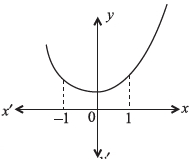
Given $P(x) = x^4 + ax^3 + bx^2 + cx + d$ such that $x=0$ is the only real root of $P'(x) = 0$. If $P(-1) < P(1)$,then in the interval $[-1, 1]$:
A
$P(-1)$ is the minimum but $P(1)$ is the maximum of $P$.
B
$P(-1)$ is not the minimum but $P(1)$ is the maximum of $P$.
C
$P(-1)$ is the minimum but $P(1)$ is not the maximum of $P$.
D
$P(-1)$ is not the minimum and $P(1)$ is not the maximum of $P$.
Solution
(B) Given $P(x) = x^4 + ax^3 + bx^2 + cx + d$.
$P'(x) = 4x^3 + 3ax^2 + 2bx + c$.
Since $x=0$ is the only real root of $P'(x)=0$,we have $P'(0) = 0$,which implies $c=0$.
Thus,$P'(x) = x(4x^2 + 3ax + 2b)$.
Since $x=0$ is the only real root,the quadratic factor $4x^2 + 3ax + 2b$ must have no real roots,meaning its discriminant $D < 0$.
$D = (3a)^2 - 4(4)(2b) = 9a^2 - 32b < 0$.
Since the leading coefficient $4 > 0$,the quadratic $4x^2 + 3ax + 2b > 0$ for all $x \in \mathbb{R}$.
Therefore,the sign of $P'(x)$ is determined by the sign of $x$.
For $x \in [-1, 0)$,$P'(x) < 0$,so $P(x)$ is strictly decreasing.
For $x \in (0, 1]$,$P'(x) > 0$,so $P(x)$ is strictly increasing.
Since $P(x)$ decreases on $[-1, 0]$ and increases on $[0, 1]$,the global minimum on $[-1, 1]$ occurs at $x=0$.
Thus,$P(-1)$ is not the minimum.
Since $P(x)$ is increasing on $(0, 1]$ and $P(-1) < P(1)$,the maximum value on $[-1, 1]$ must be $P(1)$.
Therefore,$P(-1)$ is not the minimum,but $P(1)$ is the maximum.
$P'(x) = 4x^3 + 3ax^2 + 2bx + c$.
Since $x=0$ is the only real root of $P'(x)=0$,we have $P'(0) = 0$,which implies $c=0$.
Thus,$P'(x) = x(4x^2 + 3ax + 2b)$.
Since $x=0$ is the only real root,the quadratic factor $4x^2 + 3ax + 2b$ must have no real roots,meaning its discriminant $D < 0$.
$D = (3a)^2 - 4(4)(2b) = 9a^2 - 32b < 0$.
Since the leading coefficient $4 > 0$,the quadratic $4x^2 + 3ax + 2b > 0$ for all $x \in \mathbb{R}$.
Therefore,the sign of $P'(x)$ is determined by the sign of $x$.
For $x \in [-1, 0)$,$P'(x) < 0$,so $P(x)$ is strictly decreasing.
For $x \in (0, 1]$,$P'(x) > 0$,so $P(x)$ is strictly increasing.
Since $P(x)$ decreases on $[-1, 0]$ and increases on $[0, 1]$,the global minimum on $[-1, 1]$ occurs at $x=0$.
Thus,$P(-1)$ is not the minimum.
Since $P(x)$ is increasing on $(0, 1]$ and $P(-1) < P(1)$,the maximum value on $[-1, 1]$ must be $P(1)$.
Therefore,$P(-1)$ is not the minimum,but $P(1)$ is the maximum.
0 likesView Solution
22
MathematicsMediumMCQAIEEE · 2009
The differential equation which represents the family of curves $y = c_1 e^{c_2 x}$,where $c_1$ and $c_2$ are arbitrary constants is:
A
$y'' = y' y$
B
$y y'' = y'$
C
$y y'' = (y')^2$
D
$y' = y^2$
Solution
(C) Given the family of curves: $y = c_1 e^{c_2 x} \dots (i)$
Differentiating with respect to $x$,we get:
$y' = c_1 c_2 e^{c_2 x} = c_2 y \dots (ii)$
Again,differentiating with respect to $x$,we get:
$y'' = c_2 y' \dots (iii)$
From equation $(ii)$,we have $c_2 = \frac{y'}{y}$.
Substituting this value of $c_2$ into equation $(iii)$:
$y'' = \left( \frac{y'}{y} \right) y'$
Multiplying both sides by $y$:
$y y'' = (y')^2$
This is the required differential equation.
Differentiating with respect to $x$,we get:
$y' = c_1 c_2 e^{c_2 x} = c_2 y \dots (ii)$
Again,differentiating with respect to $x$,we get:
$y'' = c_2 y' \dots (iii)$
From equation $(ii)$,we have $c_2 = \frac{y'}{y}$.
Substituting this value of $c_2$ into equation $(iii)$:
$y'' = \left( \frac{y'}{y} \right) y'$
Multiplying both sides by $y$:
$y y'' = (y')^2$
This is the required differential equation.
0 likesView Solution
23
MathematicsMediumMCQAIEEE · 2009
One ticket is selected at random from $50$ tickets numbered $00, 01, 02, \ldots, 49$. The probability that the sum of the digits on the selected ticket is $8$,given that the product of these digits is zero,equals:
A
$\frac{1}{50}$
B
$\frac{14}{50}$
C
$\frac{5}{14}$
D
$\frac{1}{14}$
Solution
(D) Let $S = \{00, 01, 02, \ldots, 49\}$ be the sample space. The total number of tickets is $50$.
Let $A$ be the event that the sum of the digits on the selected ticket is $8$.
$A = \{08, 17, 26, 35, 44\}$.
Let $B$ be the event that the product of the digits is zero.
This occurs if at least one digit is $0$. The tickets are $\{00, 01, 02, 03, 04, 05, 06, 07, 08, 09, 10, 20, 30, 40\}$.
There are $14$ such tickets,so $n(B) = 14$.
We need to find the conditional probability $P(A|B) = \frac{n(A \cap B)}{n(B)}$.
$A \cap B$ is the set of tickets where the sum of digits is $8$ $AND$ the product of digits is $0$.
Looking at set $A = \{08, 17, 26, 35, 44\}$,only $08$ has a product of digits equal to $0$ $(0 \times 8 = 0)$.
Thus,$A \cap B = \{08\}$,so $n(A \cap B) = 1$.
Therefore,$P(A|B) = \frac{1}{14}$.
Let $A$ be the event that the sum of the digits on the selected ticket is $8$.
$A = \{08, 17, 26, 35, 44\}$.
Let $B$ be the event that the product of the digits is zero.
This occurs if at least one digit is $0$. The tickets are $\{00, 01, 02, 03, 04, 05, 06, 07, 08, 09, 10, 20, 30, 40\}$.
There are $14$ such tickets,so $n(B) = 14$.
We need to find the conditional probability $P(A|B) = \frac{n(A \cap B)}{n(B)}$.
$A \cap B$ is the set of tickets where the sum of digits is $8$ $AND$ the product of digits is $0$.
Looking at set $A = \{08, 17, 26, 35, 44\}$,only $08$ has a product of digits equal to $0$ $(0 \times 8 = 0)$.
Thus,$A \cap B = \{08\}$,so $n(A \cap B) = 1$.
Therefore,$P(A|B) = \frac{1}{14}$.
0 likesView Solution
24
MathematicsDifficultMCQAIEEE · 2009
In a binomial distribution $B(n, p = \frac{1}{4})$,if the probability of at least one success is greater than or equal to $\frac{9}{10}$,then $n$ is greater than:
A
$\frac{1}{\log_{10} 4 - \log_{10} 3}$
B
$\frac{1}{\log_{10} 4 + \log_{10} 3}$
C
$\frac{9}{\log_{10} 4 - \log_{10} 3}$
D
$\frac{4}{\log_{10} 4 - \log_{10} 3}$
Solution
(A) The probability of at least one success is given by $P(X \geq 1) = 1 - P(X = 0)$.
In a binomial distribution $B(n, p)$,$P(X = 0) = q^n$,where $q = 1 - p$.
Given $p = \frac{1}{4}$,we have $q = 1 - \frac{1}{4} = \frac{3}{4}$.
The condition is $1 - (\frac{3}{4})^n \geq \frac{9}{10}$.
Rearranging the inequality,we get $1 - \frac{9}{10} \geq (\frac{3}{4})^n$,which simplifies to $\frac{1}{10} \geq (\frac{3}{4})^n$.
Taking the logarithm with base $10$ on both sides: $\log_{10}(\frac{1}{10}) \geq \log_{10}((\frac{3}{4})^n)$.
$-1 \geq n(\log_{10} 3 - \log_{10} 4)$.
Multiplying by $-1$ reverses the inequality sign: $1 \leq n(\log_{10} 4 - \log_{10} 3)$.
Therefore,$n \geq \frac{1}{\log_{10} 4 - \log_{10} 3}$.
In a binomial distribution $B(n, p)$,$P(X = 0) = q^n$,where $q = 1 - p$.
Given $p = \frac{1}{4}$,we have $q = 1 - \frac{1}{4} = \frac{3}{4}$.
The condition is $1 - (\frac{3}{4})^n \geq \frac{9}{10}$.
Rearranging the inequality,we get $1 - \frac{9}{10} \geq (\frac{3}{4})^n$,which simplifies to $\frac{1}{10} \geq (\frac{3}{4})^n$.
Taking the logarithm with base $10$ on both sides: $\log_{10}(\frac{1}{10}) \geq \log_{10}((\frac{3}{4})^n)$.
$-1 \geq n(\log_{10} 3 - \log_{10} 4)$.
Multiplying by $-1$ reverses the inequality sign: $1 \leq n(\log_{10} 4 - \log_{10} 3)$.
Therefore,$n \geq \frac{1}{\log_{10} 4 - \log_{10} 3}$.
0 likesView Solution
25
MathematicsMediumMCQAIEEE · 2009
For real $x,$ let $f(x) = x^3 + 5x + 1,$ then
A
$f$ is one-one but not onto $R$
B
$f$ is onto $R$ but not one-one
C
$f$ is onto and one-one $R$
D
$f$ is neither onto nor one-one $R$
Solution
(C) Given $f(x) = x^3 + 5x + 1.$
First,we find the derivative: $f'(x) = 3x^2 + 5.$
Since $x^2 \ge 0$ for all $x \in R,$ it follows that $3x^2 + 5 \ge 5 > 0$ for all $x \in R.$
Because $f'(x) > 0$ for all $x,$ the function $f(x)$ is strictly increasing on $R.$
$A$ strictly increasing function is always one-one.
Next,we check if the function is onto. Since $f(x)$ is a polynomial of odd degree,its range is $(-\infty, \infty).$
Specifically,$\lim_{x \to -\infty} f(x) = -\infty$ and $\lim_{x \to \infty} f(x) = \infty.$
Since $f(x)$ is continuous and its range is the set of all real numbers $R,$ the function is onto.
Therefore,$f$ is both one-one and onto.
First,we find the derivative: $f'(x) = 3x^2 + 5.$
Since $x^2 \ge 0$ for all $x \in R,$ it follows that $3x^2 + 5 \ge 5 > 0$ for all $x \in R.$
Because $f'(x) > 0$ for all $x,$ the function $f(x)$ is strictly increasing on $R.$
$A$ strictly increasing function is always one-one.
Next,we check if the function is onto. Since $f(x)$ is a polynomial of odd degree,its range is $(-\infty, \infty).$
Specifically,$\lim_{x \to -\infty} f(x) = -\infty$ and $\lim_{x \to \infty} f(x) = \infty.$
Since $f(x)$ is continuous and its range is the set of all real numbers $R,$ the function is onto.
Therefore,$f$ is both one-one and onto.
0 likesView Solution
26
MathematicsMediumMCQAIEEE · 2009
Let $f(x)=(x+1)^2-1$ for $x \geq -1$.
Statement-$1$: $S=\{x:f(x)=f^{-1}(x)\}=\{0, -1\}$
Statement-$2$: $f$ is a bijection.
Statement-$1$: $S=\{x:f(x)=f^{-1}(x)\}=\{0, -1\}$
Statement-$2$: $f$ is a bijection.
A
Statement-$1$ is true,Statement-$2$ is true; Statement-$2$ is a correct explanation for Statement-$1$
B
Statement-$1$ is true,Statement-$2$ is true; Statement-$2$ is not a correct explanation for Statement-$1$
C
Statement-$1$ is false,Statement-$2$ is true;
D
Statement-$1$ is true,Statement-$2$ is false
Solution
(A) Given $f(x) = (x+1)^2 - 1$ for $x \geq -1$.
To find $f^{-1}(x)$,set $y = (x+1)^2 - 1$. Since $x \geq -1$,$y \geq -1$.
Solving for $x$: $(x+1)^2 = y+1 \Rightarrow x+1 = \sqrt{y+1} \Rightarrow x = \sqrt{y+1} - 1$.
Thus,$f^{-1}(x) = \sqrt{x+1} - 1$. Since $f$ is strictly increasing on $[-1, \infty)$,it is a bijection (one-one and onto). So,Statement-$2$ is true.
To find $S = \{x : f(x) = f^{-1}(x)\}$,we solve $f(x) = x$ because $f$ is increasing.
$(x+1)^2 - 1 = x \Rightarrow x^2 + 2x + 1 - 1 = x \Rightarrow x^2 + x = 0 \Rightarrow x(x+1) = 0$.
Thus,$x = 0$ or $x = -1$. So,$S = \{0, -1\}$. Statement-$1$ is true.
Since $f(x) = f^{-1}(x)$ is equivalent to $f(x) = x$ for increasing functions,Statement-$2$ explains Statement-$1$.
To find $f^{-1}(x)$,set $y = (x+1)^2 - 1$. Since $x \geq -1$,$y \geq -1$.
Solving for $x$: $(x+1)^2 = y+1 \Rightarrow x+1 = \sqrt{y+1} \Rightarrow x = \sqrt{y+1} - 1$.
Thus,$f^{-1}(x) = \sqrt{x+1} - 1$. Since $f$ is strictly increasing on $[-1, \infty)$,it is a bijection (one-one and onto). So,Statement-$2$ is true.
To find $S = \{x : f(x) = f^{-1}(x)\}$,we solve $f(x) = x$ because $f$ is increasing.
$(x+1)^2 - 1 = x \Rightarrow x^2 + 2x + 1 - 1 = x \Rightarrow x^2 + x = 0 \Rightarrow x(x+1) = 0$.
Thus,$x = 0$ or $x = -1$. So,$S = \{0, -1\}$. Statement-$1$ is true.
Since $f(x) = f^{-1}(x)$ is equivalent to $f(x) = x$ for increasing functions,Statement-$2$ explains Statement-$1$.
0 likesView Solution
27
MathematicsEasyMCQAIEEE · 2009
The projections of a vector on the three coordinate axes are $6, -3, 2$ respectively. The direction cosines of the vector are:
A
$\frac{6}{5}, - \frac{3}{5}, \frac{2}{5}$
B
$\frac{6}{7}, - \frac{3}{7}, \frac{2}{7}$
C
$-\frac{6}{7}, - \frac{3}{7}, \frac{2}{7}$
D
$6, -3, 2$
Solution
(B) Let the vector be $\vec{v} = (a, b, c) = (6, -3, 2)$.
The magnitude of the vector is given by $|\vec{v}| = \sqrt{a^2 + b^2 + c^2}$.
$|\vec{v}| = \sqrt{6^2 + (-3)^2 + 2^2} = \sqrt{36 + 9 + 4} = \sqrt{49} = 7$.
The direction cosines $(l, m, n)$ of a vector are given by dividing the components by the magnitude of the vector:
$l = \frac{a}{|\vec{v}|} = \frac{6}{7}$,
$m = \frac{b}{|\vec{v}|} = \frac{-3}{7}$,
$n = \frac{c}{|\vec{v}|} = \frac{2}{7}$.
Thus,the direction cosines are $\left(\frac{6}{7}, -\frac{3}{7}, \frac{2}{7}\right)$.
The magnitude of the vector is given by $|\vec{v}| = \sqrt{a^2 + b^2 + c^2}$.
$|\vec{v}| = \sqrt{6^2 + (-3)^2 + 2^2} = \sqrt{36 + 9 + 4} = \sqrt{49} = 7$.
The direction cosines $(l, m, n)$ of a vector are given by dividing the components by the magnitude of the vector:
$l = \frac{a}{|\vec{v}|} = \frac{6}{7}$,
$m = \frac{b}{|\vec{v}|} = \frac{-3}{7}$,
$n = \frac{c}{|\vec{v}|} = \frac{2}{7}$.
Thus,the direction cosines are $\left(\frac{6}{7}, -\frac{3}{7}, \frac{2}{7}\right)$.
0 likesView Solution
28
MathematicsMediumMCQAIEEE · 2009
If $\vec{u}, \vec{v}, \vec{w}$ are non-coplanar vectors and $p, q$ are real numbers,then the equality $[3\vec{u}, p\vec{v}, p\vec{w}] - [p\vec{v}, \vec{w}, q\vec{u}] - [2\vec{w}, q\vec{v}, q\vec{u}] = 0$ holds for:
A
exactly two values of $(p, q)$
B
more than two but not all values of $(p, q)$
C
all values of $(p, q)$
D
exactly one value of $(p, q)$
Solution
(D) Given the equation: $[3\vec{u}, p\vec{v}, p\vec{w}] - [p\vec{v}, \vec{w}, q\vec{u}] - [2\vec{w}, q\vec{v}, q\vec{u}] = 0$
Using the property of scalar triple product $[k\vec{a}, l\vec{b}, m\vec{c}] = klm[\vec{a}, \vec{b}, \vec{c}]$,we get:
$3p^2[\vec{u}, \vec{v}, \vec{w}] - pq[\vec{v}, \vec{w}, \vec{u}] - 2q^2[\vec{w}, \vec{v}, \vec{u}] = 0$
Since $[\vec{v}, \vec{w}, \vec{u}] = [\vec{u}, \vec{v}, \vec{w}]$ and $[\vec{w}, \vec{v}, \vec{u}] = -[\vec{u}, \vec{v}, \vec{w}]$,the equation becomes:
$3p^2[\vec{u}, \vec{v}, \vec{w}] - pq[\vec{u}, \vec{v}, \vec{w}] + 2q^2[\vec{u}, \vec{v}, \vec{w}] = 0$
$(3p^2 - pq + 2q^2)[\vec{u}, \vec{v}, \vec{w}] = 0$
Since $\vec{u}, \vec{v}, \vec{w}$ are non-coplanar,$[\vec{u}, \vec{v}, \vec{w}] \neq 0$. Therefore:
$3p^2 - pq + 2q^2 = 0$
This is a quadratic equation in $p$. For $p$ to be a real number,the discriminant $D$ must be $\geq 0$:
$D = (-q)^2 - 4(3)(2q^2) = q^2 - 24q^2 = -23q^2$
For $D \geq 0$,we must have $-23q^2 \geq 0$,which implies $q^2 \leq 0$. Since $q$ is a real number,this is only possible if $q = 0$.
Substituting $q = 0$ into $3p^2 - pq + 2q^2 = 0$,we get $3p^2 = 0$,so $p = 0$.
Thus,the only solution is $(p, q) = (0, 0)$.
Using the property of scalar triple product $[k\vec{a}, l\vec{b}, m\vec{c}] = klm[\vec{a}, \vec{b}, \vec{c}]$,we get:
$3p^2[\vec{u}, \vec{v}, \vec{w}] - pq[\vec{v}, \vec{w}, \vec{u}] - 2q^2[\vec{w}, \vec{v}, \vec{u}] = 0$
Since $[\vec{v}, \vec{w}, \vec{u}] = [\vec{u}, \vec{v}, \vec{w}]$ and $[\vec{w}, \vec{v}, \vec{u}] = -[\vec{u}, \vec{v}, \vec{w}]$,the equation becomes:
$3p^2[\vec{u}, \vec{v}, \vec{w}] - pq[\vec{u}, \vec{v}, \vec{w}] + 2q^2[\vec{u}, \vec{v}, \vec{w}] = 0$
$(3p^2 - pq + 2q^2)[\vec{u}, \vec{v}, \vec{w}] = 0$
Since $\vec{u}, \vec{v}, \vec{w}$ are non-coplanar,$[\vec{u}, \vec{v}, \vec{w}] \neq 0$. Therefore:
$3p^2 - pq + 2q^2 = 0$
This is a quadratic equation in $p$. For $p$ to be a real number,the discriminant $D$ must be $\geq 0$:
$D = (-q)^2 - 4(3)(2q^2) = q^2 - 24q^2 = -23q^2$
For $D \geq 0$,we must have $-23q^2 \geq 0$,which implies $q^2 \leq 0$. Since $q$ is a real number,this is only possible if $q = 0$.
Substituting $q = 0$ into $3p^2 - pq + 2q^2 = 0$,we get $3p^2 = 0$,so $p = 0$.
Thus,the only solution is $(p, q) = (0, 0)$.
0 likesView Solution
Vedclass Products
For Students
Vedclass Test Series
Mock tests in real AIEEE style covering Mathematics with performance analysis. 5-day free trial.
Start Free TrialFor Teachers
Exam Paper Generator
Generate Set A/B/C/D Mathematics papers from 7.5L+ questions in 2 minutes. 3 chapters free.
Try FreeFor Institutes
Online Exam Module
Run live AIEEE mock exams with unlimited students, 360° analytics & white-label branding.
See DemoFrequently Asked Questions
How many Mathematics questions are in AIEEE 2009?
There are 28 Mathematics questions from the AIEEE 2009 paper on Vedclass, each with a detailed step-by-step solution in English.
Are AIEEE 2009 Mathematics solutions available in English?
Yes. All solutions on this page are in English. You can also switch to English or Hindi using the language buttons above the questions.
Can I practice AIEEE 2009 Mathematics as a timed test?
Yes. Use the Vedclass Test Series to attempt a full AIEEE mock test covering Mathematics with time limits and instant score analysis.
Can teachers create Mathematics papers from AIEEE previous year questions?
Yes. The Vedclass Exam Paper Generator lets teachers mix AIEEE Mathematics questions and generate Set A/B/C/D papers in minutes.
For Teachers & Institutes
Build a Custom Mathematics Paper
Pick AIEEE 2009 Mathematics questions, set difficulty, and generate Set A/B/C/D in 2 minutes.