
PhysicsQ1–73 of 73 questions
Page 1 of 1 · English
1
PhysicsEasyMCQAIEEE · 2004
If $\overrightarrow{A} \times \overrightarrow{B} = \overrightarrow{B} \times \overrightarrow{A}$,then the angle between $\overrightarrow{A}$ and $\overrightarrow{B}$ is
A
$\pi / 2$
B
$\pi / 3$
C
$\pi$
D
$\pi / 4$
Solution
(C) The cross product of two vectors is anti-commutative,meaning $\overrightarrow{A} \times \overrightarrow{B} = -(\overrightarrow{B} \times \overrightarrow{A})$.
Given the condition $\overrightarrow{A} \times \overrightarrow{B} = \overrightarrow{B} \times \overrightarrow{A}$,we can substitute the anti-commutative property into the equation:
$-(\overrightarrow{B} \times \overrightarrow{A}) = \overrightarrow{B} \times \overrightarrow{A}$.
This implies $2(\overrightarrow{B} \times \overrightarrow{A}) = 0$,or $\overrightarrow{A} \times \overrightarrow{B} = 0$.
The magnitude of the cross product is given by $|\overrightarrow{A} \times \overrightarrow{B}| = |A||B| \sin \theta$,where $\theta$ is the angle between the vectors.
For the cross product to be zero,$\sin \theta$ must be $0$,which occurs when $\theta = 0$ or $\theta = \pi$.
However,the vector product $\overrightarrow{A} \times \overrightarrow{B} = \overrightarrow{B} \times \overrightarrow{A}$ is only possible if both sides are zero vectors,which happens when $\theta = 0$ or $\theta = \pi$. Among the given options,$\pi$ is the correct choice.
Given the condition $\overrightarrow{A} \times \overrightarrow{B} = \overrightarrow{B} \times \overrightarrow{A}$,we can substitute the anti-commutative property into the equation:
$-(\overrightarrow{B} \times \overrightarrow{A}) = \overrightarrow{B} \times \overrightarrow{A}$.
This implies $2(\overrightarrow{B} \times \overrightarrow{A}) = 0$,or $\overrightarrow{A} \times \overrightarrow{B} = 0$.
The magnitude of the cross product is given by $|\overrightarrow{A} \times \overrightarrow{B}| = |A||B| \sin \theta$,where $\theta$ is the angle between the vectors.
For the cross product to be zero,$\sin \theta$ must be $0$,which occurs when $\theta = 0$ or $\theta = \pi$.
However,the vector product $\overrightarrow{A} \times \overrightarrow{B} = \overrightarrow{B} \times \overrightarrow{A}$ is only possible if both sides are zero vectors,which happens when $\theta = 0$ or $\theta = \pi$. Among the given options,$\pi$ is the correct choice.
0 likesView Solution
2
PhysicsMediumMCQAIEEE · 2004
Dimensions of the coefficient of viscosity are
A
$M L^2 T^{-2}$
B
$M L^2 T^{-1}$
C
$M L^{-1} T^{-1}$
D
$M L T$
Solution
(C) The viscous force $F$ acting on a fluid layer is given by Newton's law of viscosity: $F = -\eta A \frac{dv}{dx}$.
Here,$F$ is the force,$\eta$ is the coefficient of viscosity,$A$ is the area,and $\frac{dv}{dx}$ is the velocity gradient.
Rearranging for $\eta$: $\eta = \frac{F}{A (dv/dx)}$.
Substituting the dimensions: $[F] = [M L T^{-2}]$,$[A] = [L^2]$,$[dv] = [L T^{-1}]$,and $[dx] = [L]$.
Thus,$[\eta] = \frac{[M L T^{-2}]}{[L^2] [L T^{-1} / L]} = \frac{[M L T^{-2}]}{[L^2] [T^{-1}]} = [M L^{-1} T^{-1}]$.
Therefore,the correct option is $C$.
Here,$F$ is the force,$\eta$ is the coefficient of viscosity,$A$ is the area,and $\frac{dv}{dx}$ is the velocity gradient.
Rearranging for $\eta$: $\eta = \frac{F}{A (dv/dx)}$.
Substituting the dimensions: $[F] = [M L T^{-2}]$,$[A] = [L^2]$,$[dv] = [L T^{-1}]$,and $[dx] = [L]$.
Thus,$[\eta] = \frac{[M L T^{-2}]}{[L^2] [L T^{-1} / L]} = \frac{[M L T^{-2}]}{[L^2] [T^{-1}]} = [M L^{-1} T^{-1}]$.
Therefore,the correct option is $C$.
0 likesView Solution
3
PhysicsDifficultMCQAIEEE · 2004
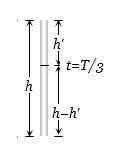
$A$ ball is released from the top of a tower of height $h$ meters. It takes $T$ seconds to reach the ground. What is the position of the ball in $\frac{T}{3}$ seconds?
A
$\frac{h}{9}$ meters from the ground
B
$\frac{7h}{9}$ meters from the ground
C
$\frac{8h}{9}$ meters from the ground
D
$\frac{17h}{18}$ meters from the ground
Solution
(C) For a ball released from rest,the total height $h$ covered in time $T$ is given by the equation of motion:
$h = ut + \frac{1}{2}gT^2$
Since the initial velocity $u = 0$,we have:
$h = \frac{1}{2}gT^2$ --- $(1)$
After time $t = \frac{T}{3}$,the distance $h'$ covered by the ball from the top is:
$h' = \frac{1}{2}g\left(\frac{T}{3}\right)^2 = \frac{1}{2}g\left(\frac{T^2}{9}\right) = \frac{1}{9} \left(\frac{1}{2}gT^2\right)$
Substituting equation $(1)$ into this expression:
$h' = \frac{h}{9}$
The position of the ball from the ground is the total height minus the distance covered from the top:
$\text{Position from ground} = h - h' = h - \frac{h}{9} = \frac{8h}{9} \text{ meters}$.
$h = ut + \frac{1}{2}gT^2$
Since the initial velocity $u = 0$,we have:
$h = \frac{1}{2}gT^2$ --- $(1)$
After time $t = \frac{T}{3}$,the distance $h'$ covered by the ball from the top is:
$h' = \frac{1}{2}g\left(\frac{T}{3}\right)^2 = \frac{1}{2}g\left(\frac{T^2}{9}\right) = \frac{1}{9} \left(\frac{1}{2}gT^2\right)$
Substituting equation $(1)$ into this expression:
$h' = \frac{h}{9}$
The position of the ball from the ground is the total height minus the distance covered from the top:
$\text{Position from ground} = h - h' = h - \frac{h}{9} = \frac{8h}{9} \text{ meters}$.
0 likesView Solution
4
PhysicsMediumMCQAIEEE · 2004
Which of the following statements is false for a particle moving in a circle with a constant angular speed?
A
The velocity vector is tangent to the circle.
B
The acceleration vector is tangent to the circle.
C
The acceleration vector points to the centre of the circle.
D
The velocity and acceleration vectors are perpendicular to each other.
Solution
(B) For a particle moving in a circle with constant angular speed (Uniform Circular Motion),the velocity vector is always tangent to the circular path at any given point.
Since the motion is uniform,the tangential acceleration is zero,and the net acceleration is purely centripetal.
The centripetal acceleration vector always points towards the centre of the circle.
Because the velocity vector is tangent (along the circumference) and the acceleration vector is radial (towards the centre),they are always perpendicular to each other.
Therefore,the statement that the acceleration vector is tangent to the circle is false.
Since the motion is uniform,the tangential acceleration is zero,and the net acceleration is purely centripetal.
The centripetal acceleration vector always points towards the centre of the circle.
Because the velocity vector is tangent (along the circumference) and the acceleration vector is radial (towards the centre),they are always perpendicular to each other.
Therefore,the statement that the acceleration vector is tangent to the circle is false.
0 likesView Solution
5
PhysicsDifficultMCQAIEEE · 2004
For a given velocity,a projectile has the same range $R$ for two angles of projection. If $t_1$ and $t_2$ are the times of flight in the two cases,then:
A
${t_1}{t_2} \propto {R^2}$
B
${t_1}{t_2} \propto R$
C
${t_1}{t_2} \propto \frac{1}{R}$
D
${t_1}{t_2} \propto \frac{1}{R^2}$
Solution
(B) For a given velocity $u$,the range $R$ is the same for two angles of projection,$\theta$ and $(90^\circ - \theta)$.
The time of flight for angle $\theta$ is $t_1 = \frac{2u \sin \theta}{g}$.
The time of flight for angle $(90^\circ - \theta)$ is $t_2 = \frac{2u \sin(90^\circ - \theta)}{g} = \frac{2u \cos \theta}{g}$.
Multiplying the two times of flight:
$t_1 t_2 = \left( \frac{2u \sin \theta}{g} \right) \left( \frac{2u \cos \theta}{g} \right) = \frac{4u^2 \sin \theta \cos \theta}{g^2}$.
Using the identity $\sin 2\theta = 2 \sin \theta \cos \theta$,we get:
$t_1 t_2 = \frac{2u^2 (2 \sin \theta \cos \theta)}{g^2} = \frac{2(u^2 \sin 2\theta)}{g^2}$.
Since the range $R = \frac{u^2 \sin 2\theta}{g}$,we can substitute this into the equation:
$t_1 t_2 = \frac{2R}{g}$.
Since $g$ is constant,we conclude that $t_1 t_2 \propto R$.
The time of flight for angle $\theta$ is $t_1 = \frac{2u \sin \theta}{g}$.
The time of flight for angle $(90^\circ - \theta)$ is $t_2 = \frac{2u \sin(90^\circ - \theta)}{g} = \frac{2u \cos \theta}{g}$.
Multiplying the two times of flight:
$t_1 t_2 = \left( \frac{2u \sin \theta}{g} \right) \left( \frac{2u \cos \theta}{g} \right) = \frac{4u^2 \sin \theta \cos \theta}{g^2}$.
Using the identity $\sin 2\theta = 2 \sin \theta \cos \theta$,we get:
$t_1 t_2 = \frac{2u^2 (2 \sin \theta \cos \theta)}{g^2} = \frac{2(u^2 \sin 2\theta)}{g^2}$.
Since the range $R = \frac{u^2 \sin 2\theta}{g}$,we can substitute this into the equation:
$t_1 t_2 = \frac{2R}{g}$.
Since $g$ is constant,we conclude that $t_1 t_2 \propto R$.
0 likesView Solution
6
PhysicsMediumMCQAIEEE · 2004
$A$ ball is thrown from a point with a speed $v_0$ at an angle of projection $\theta$. From the same point and at the same instant,a person starts running with a constant speed $v_0/2$ to catch the ball. Will the person be able to catch the ball? If yes,what should be the angle of projection?
A
Yes,$60^\circ$
B
Yes,$30^\circ$
C
No
D
Yes,$45^\circ$
Solution
(A) The person can catch the ball if their constant speed is equal to the horizontal component of the ball's velocity,as the ball will land at a distance determined by its horizontal motion.
The horizontal component of the ball's velocity is $v_x = v_0 \cos \theta$.
The person's speed is $v_p = v_0/2$.
For the person to catch the ball at the point of impact,their speeds must match: $v_0/2 = v_0 \cos \theta$.
Dividing both sides by $v_0$,we get: $\cos \theta = 1/2$.
Therefore,$\theta = \cos^{-1}(1/2) = 60^\circ$.
The horizontal component of the ball's velocity is $v_x = v_0 \cos \theta$.
The person's speed is $v_p = v_0/2$.
For the person to catch the ball at the point of impact,their speeds must match: $v_0/2 = v_0 \cos \theta$.
Dividing both sides by $v_0$,we get: $\cos \theta = 1/2$.
Therefore,$\theta = \cos^{-1}(1/2) = 60^\circ$.
1 likesView Solution
7
PhysicsMediumMCQAIEEE · 2004
$A$ machine gun fires a bullet of mass $40\,g$ with a velocity $1200\,m/s$. The man holding it can exert a maximum force of $144\,N$ on the gun. How many bullets can he fire per second at the most?
A
$1$
B
$4$
C
$2$
D
$3$
Solution
(D) The force exerted by the machine gun is equal to the rate of change of momentum of the bullets fired.
$F = \frac{dp}{dt} = v \cdot \frac{dm}{dt}$
Here,$v = 1200\,m/s$ is the velocity of the bullet.
Let $n$ be the number of bullets fired per second.
The mass of one bullet is $m = 40\,g = 40 \times 10^{-3}\,kg = 0.04\,kg$.
The total mass fired per second is $\frac{dm}{dt} = n \times m$.
Given the maximum force $F = 144\,N$,we have:
$144 = 1200 \times (n \times 0.04)$
$144 = 1200 \times 0.04 \times n$
$144 = 48 \times n$
$n = \frac{144}{48} = 3$.
Therefore,the man can fire at most $3$ bullets per second.
$F = \frac{dp}{dt} = v \cdot \frac{dm}{dt}$
Here,$v = 1200\,m/s$ is the velocity of the bullet.
Let $n$ be the number of bullets fired per second.
The mass of one bullet is $m = 40\,g = 40 \times 10^{-3}\,kg = 0.04\,kg$.
The total mass fired per second is $\frac{dm}{dt} = n \times m$.
Given the maximum force $F = 144\,N$,we have:
$144 = 1200 \times (n \times 0.04)$
$144 = 1200 \times 0.04 \times n$
$144 = 48 \times n$
$n = \frac{144}{48} = 3$.
Therefore,the man can fire at most $3$ bullets per second.
1 likesView Solution
8
PhysicsMediumMCQAIEEE · 2004
An automobile travelling with a speed of $60\,km/h$ can brake to stop within a distance of $20\,m$. If the car is going twice as fast,i.e.,$120\,km/h$,the stopping distance will be ........... $m$.
A
$20$
B
$40$
C
$60$
D
$80$
Solution
(D) The stopping distance $S$ of a vehicle is given by the relation $v^2 = u^2 + 2as$. Since the final velocity $v = 0$,we have $0 = u^2 - 2a|S|$,which implies $S = \frac{u^2}{2|a|}$.
Since the deceleration $a$ is constant,the stopping distance is directly proportional to the square of the initial velocity: $S \propto u^2$.
Given $S_1 = 20\,m$ at $u_1 = 60\,km/h$ and $u_2 = 120\,km/h$.
Using the ratio: $\frac{S_2}{S_1} = \left(\frac{u_2}{u_1}\right)^2 = \left(\frac{120}{60}\right)^2 = (2)^2 = 4$.
Therefore,$S_2 = 4 \times S_1 = 4 \times 20\,m = 80\,m$.
Since the deceleration $a$ is constant,the stopping distance is directly proportional to the square of the initial velocity: $S \propto u^2$.
Given $S_1 = 20\,m$ at $u_1 = 60\,km/h$ and $u_2 = 120\,km/h$.
Using the ratio: $\frac{S_2}{S_1} = \left(\frac{u_2}{u_1}\right)^2 = \left(\frac{120}{60}\right)^2 = (2)^2 = 4$.
Therefore,$S_2 = 4 \times S_1 = 4 \times 20\,m = 80\,m$.
1 likesView Solution
9
PhysicsMediumMCQAIEEE · 2004
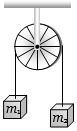
Two masses $m_1 = 5\,kg$ and $m_2 = 4.8\,kg$ tied to a string are hanging over a light frictionless pulley. What is the acceleration of the masses when they are free to move (in $,m/s^2$)? $(g = 9.8\,m/s^2)$
A
$0.2$
B
$9.8$
C
$5$
D
$4.8$
Solution
(A) For an Atwood machine with two masses $m_1$ and $m_2$ connected by a string over a frictionless pulley,the acceleration $a$ of the system is given by the formula:
$a = \left( \frac{m_1 - m_2}{m_1 + m_2} \right) g$
Given:
$m_1 = 5\,kg$
$m_2 = 4.8\,kg$
$g = 9.8\,m/s^2$
Substituting the values into the formula:
$a = \left( \frac{5 - 4.8}{5 + 4.8} \right) \times 9.8$
$a = \left( \frac{0.2}{9.8} \right) \times 9.8$
$a = 0.2\,m/s^2$
Therefore,the acceleration of the masses is $0.2\,m/s^2$.
$a = \left( \frac{m_1 - m_2}{m_1 + m_2} \right) g$
Given:
$m_1 = 5\,kg$
$m_2 = 4.8\,kg$
$g = 9.8\,m/s^2$
Substituting the values into the formula:
$a = \left( \frac{5 - 4.8}{5 + 4.8} \right) \times 9.8$
$a = \left( \frac{0.2}{9.8} \right) \times 9.8$
$a = 0.2\,m/s^2$
Therefore,the acceleration of the masses is $0.2\,m/s^2$.
0 likesView Solution
10
PhysicsMediumMCQAIEEE · 2004
$A$ block rests on a rough inclined plane making an angle of $30^{\circ}$ with the horizontal. The coefficient of static friction between the block and the plane is $0.8$. If the frictional force on the block is $10 \, N$,the mass of the block (in $kg$) is (take $g = 10 \, m/s^2$).
A
$2$
B
$4$
C
$1.6$
D
$2.5$
Solution
(A) The angle of repose is given by $\alpha = \tan^{-1}(\mu) = \tan^{-1}(0.8) \approx 38.6^{\circ}$.
Since the angle of the inclined plane $\theta = 30^{\circ}$ is less than the angle of repose $\alpha$,the block remains at rest.
For a block at rest on an inclined plane,the static frictional force $f_s$ balances the component of gravity acting down the plane:
$f_s = mg \sin \theta$
Given $f_s = 10 \, N$,$g = 10 \, m/s^2$,and $\theta = 30^{\circ}$:
$10 = m \times 10 \times \sin(30^{\circ})$
$10 = m \times 10 \times 0.5$
$10 = 5m$
$m = 2 \, kg$.
Since the angle of the inclined plane $\theta = 30^{\circ}$ is less than the angle of repose $\alpha$,the block remains at rest.
For a block at rest on an inclined plane,the static frictional force $f_s$ balances the component of gravity acting down the plane:
$f_s = mg \sin \theta$
Given $f_s = 10 \, N$,$g = 10 \, m/s^2$,and $\theta = 30^{\circ}$:
$10 = m \times 10 \times \sin(30^{\circ})$
$10 = m \times 10 \times 0.5$
$10 = 5m$
$m = 2 \, kg$.
1 likesView Solution
11
PhysicsDifficultMCQAIEEE · 2004
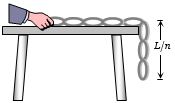
$A$ uniform chain of length $2\,m$ is kept on a table such that a length of $60\,cm$ hangs freely from the edge of the table. The total mass of the chain is $4\,kg$. What is the work done in pulling the entire chain onto the table? (Take $g = 10\,m/s^2$) ................ $J$
A
$7.2$
B
$3.6$
C
$120$
D
$1200$
Solution
(B) Let the total length of the chain be $L = 2\,m$ and total mass be $M = 4\,kg$.
The length of the hanging part is $l = 60\,cm = 0.6\,m$.
The mass per unit length of the chain is $\lambda = \frac{M}{L} = \frac{4}{2} = 2\,kg/m$.
The mass of the hanging part is $m = \lambda \times l = 2 \times 0.6 = 1.2\,kg$.
The center of mass of the hanging part is at a distance $h = \frac{l}{2} = \frac{0.6}{2} = 0.3\,m$ below the edge of the table.
The work done in pulling the chain onto the table is equal to the increase in the potential energy of the hanging part,which is $W = mgh$.
Substituting the values: $W = 1.2 \times 10 \times 0.3 = 3.6\,J$.
The length of the hanging part is $l = 60\,cm = 0.6\,m$.
The mass per unit length of the chain is $\lambda = \frac{M}{L} = \frac{4}{2} = 2\,kg/m$.
The mass of the hanging part is $m = \lambda \times l = 2 \times 0.6 = 1.2\,kg$.
The center of mass of the hanging part is at a distance $h = \frac{l}{2} = \frac{0.6}{2} = 0.3\,m$ below the edge of the table.
The work done in pulling the chain onto the table is equal to the increase in the potential energy of the hanging part,which is $W = mgh$.
Substituting the values: $W = 1.2 \times 10 \times 0.3 = 3.6\,J$.
0 likesView Solution
12
PhysicsEasyMCQAIEEE · 2004
$A$ particle is acted upon by a force of constant magnitude which is always perpendicular to the velocity of the particle. The motion of the particle takes place in a plane. It follows that:
A
Its velocity is constant
B
Its acceleration is constant
C
Its kinetic energy is constant
D
It moves in a straight line
Solution
(C) The work done by a force $F$ on a particle is given by $W = \int \vec{F} \cdot d\vec{r} = \int \vec{F} \cdot \vec{v} dt$.
Since the force is always perpendicular to the velocity,$\vec{F} \cdot \vec{v} = 0$.
Therefore,the work done $W = 0$.
According to the work-energy theorem,the change in kinetic energy $\Delta K = W$.
Since $W = 0$,the change in kinetic energy $\Delta K = 0$,which implies that the kinetic energy of the particle remains constant.
Since the force is always perpendicular to the velocity,$\vec{F} \cdot \vec{v} = 0$.
Therefore,the work done $W = 0$.
According to the work-energy theorem,the change in kinetic energy $\Delta K = W$.
Since $W = 0$,the change in kinetic energy $\Delta K = 0$,which implies that the kinetic energy of the particle remains constant.
0 likesView Solution
13
PhysicsEasyMCQAIEEE · 2004
$A$ force $\vec F = (5\hat i + 3\hat j + 2\hat k) \, N$ is applied to a particle which displaces it from its origin to the point $\vec r = (2\hat i - \hat j) \, m$. The work done on the particle in joules is
A
$-7$
B
$+7$
C
$+10$
D
$+13$
Solution
(B) The work done $W$ by a constant force $\vec F$ during a displacement $\vec r$ is given by the dot product of the force and displacement vectors:
$W = \vec F \cdot \vec r$
Given $\vec F = (5\hat i + 3\hat j + 2\hat k) \, N$ and $\vec r = (2\hat i - \hat j + 0\hat k) \, m$.
$W = (5\hat i + 3\hat j + 2\hat k) \cdot (2\hat i - 1\hat j + 0\hat k)$
$W = (5 \times 2) + (3 \times -1) + (2 \times 0)$
$W = 10 - 3 + 0 = 7 \, J$
Therefore,the work done is $+7 \, J$.
$W = \vec F \cdot \vec r$
Given $\vec F = (5\hat i + 3\hat j + 2\hat k) \, N$ and $\vec r = (2\hat i - \hat j + 0\hat k) \, m$.
$W = (5\hat i + 3\hat j + 2\hat k) \cdot (2\hat i - 1\hat j + 0\hat k)$
$W = (5 \times 2) + (3 \times -1) + (2 \times 0)$
$W = 10 - 3 + 0 = 7 \, J$
Therefore,the work done is $+7 \, J$.
1 likesView Solution
14
PhysicsMediumMCQAIEEE · 2004
$A$ particle moves in a straight line with retardation proportional to its displacement. Its loss of kinetic energy for any displacement $x$ is proportional to
A
$x^2$
B
$e^x$
C
$x$
D
$\log_e x$
Solution
(A) The retardation $a$ is proportional to displacement $x$,so $a = -kx$ where $k$ is a positive constant.
According to Newton's second law,the force $F = ma = -mkx$.
The work done by this force for a displacement $x$ is $W = \int_0^x F \, dx = \int_0^x (-mkx) \, dx = -\frac{1}{2}mkx^2$.
According to the work-energy theorem,the change in kinetic energy $\Delta K = W$.
The loss in kinetic energy is $-\Delta K = -W = \frac{1}{2}mkx^2$.
Since $m$ and $k$ are constants,the loss in kinetic energy is proportional to $x^2$.
According to Newton's second law,the force $F = ma = -mkx$.
The work done by this force for a displacement $x$ is $W = \int_0^x F \, dx = \int_0^x (-mkx) \, dx = -\frac{1}{2}mkx^2$.
According to the work-energy theorem,the change in kinetic energy $\Delta K = W$.
The loss in kinetic energy is $-\Delta K = -W = \frac{1}{2}mkx^2$.
Since $m$ and $k$ are constants,the loss in kinetic energy is proportional to $x^2$.
0 likesView Solution
15
PhysicsDifficultMCQAIEEE · 2004
$A$ body of mass $m$ accelerates uniformly from rest to $v_1$ in time $t_1$. As a function of time $t$,the instantaneous power delivered to the body is
A
$\frac{mv_1t}{t_1}$
B
$\frac{mv_1^2t}{t_1}$
C
$\frac{mv_1t^2}{t_1}$
D
$\frac{mv_1^2t}{t_1^2}$
Solution
(D) The body starts from rest $(u = 0)$ and accelerates uniformly to $v_1$ in time $t_1$.
The acceleration $a$ is given by $a = \frac{v_1 - u}{t_1} = \frac{v_1}{t_1}$.
At any time $t$,the velocity of the body is $v = at = \left( \frac{v_1}{t_1} \right)t$.
The force acting on the body is $F = ma = m \left( \frac{v_1}{t_1} \right)$.
The instantaneous power $P$ delivered to the body is $P = F \cdot v$.
Substituting the expressions for $F$ and $v$:
$P = \left( m \frac{v_1}{t_1} \right) \times \left( \frac{v_1}{t_1} t \right) = \frac{mv_1^2t}{t_1^2}$.
The acceleration $a$ is given by $a = \frac{v_1 - u}{t_1} = \frac{v_1}{t_1}$.
At any time $t$,the velocity of the body is $v = at = \left( \frac{v_1}{t_1} \right)t$.
The force acting on the body is $F = ma = m \left( \frac{v_1}{t_1} \right)$.
The instantaneous power $P$ delivered to the body is $P = F \cdot v$.
Substituting the expressions for $F$ and $v$:
$P = \left( m \frac{v_1}{t_1} \right) \times \left( \frac{v_1}{t_1} t \right) = \frac{mv_1^2t}{t_1^2}$.
0 likesView Solution
16
PhysicsEasyMCQAIEEE · 2004
The period of a satellite in a circular orbit around a planet is independent of
A
radius of its orbit
B
both the mass and radius of the orbit
C
the mass of the satellite
D
neither the mass of the satellite nor the radius of its orbit
Solution
(C) The orbital period $T$ of a satellite is given by the ratio of the circumference of the orbit to the orbital velocity:
$T = \frac{2 \pi r}{v_o}$
Since the orbital velocity $v_o = \sqrt{\frac{GM}{r}}$,we substitute this into the equation:
$T = \frac{2 \pi r}{\sqrt{\frac{GM}{r}}} = 2 \pi \sqrt{\frac{r^3}{GM}}$
Here,$M$ is the mass of the planet,$r$ is the radius of the orbit,and $G$ is the gravitational constant.
From the formula,it is clear that $T$ depends on the radius of the orbit $(r)$ and the mass of the planet $(M)$,but it does not depend on the mass of the satellite $(m)$.
Therefore,the period is independent of the mass of the satellite.
$T = \frac{2 \pi r}{v_o}$
Since the orbital velocity $v_o = \sqrt{\frac{GM}{r}}$,we substitute this into the equation:
$T = \frac{2 \pi r}{\sqrt{\frac{GM}{r}}} = 2 \pi \sqrt{\frac{r^3}{GM}}$
Here,$M$ is the mass of the planet,$r$ is the radius of the orbit,and $G$ is the gravitational constant.
From the formula,it is clear that $T$ depends on the radius of the orbit $(r)$ and the mass of the planet $(M)$,but it does not depend on the mass of the satellite $(m)$.
Therefore,the period is independent of the mass of the satellite.
0 likesView Solution
17
PhysicsDifficultMCQAIEEE · 2004
Suppose the gravitational force varies inversely as the $n^{th}$ power of distance. Then the time period of a planet in a circular orbit of radius $R$ around the sun will be proportional to
A
$R^{\left( \frac{n+1}{2} \right)}$
B
$R^{\left( \frac{n-1}{2} \right)}$
C
$R^n$
D
$R^{\left( \frac{n-2}{2} \right)}$
Solution
(A) The gravitational force $F$ is given by $F \propto \frac{1}{R^n}$.
For a planet in a circular orbit,this force provides the necessary centripetal force:
$F = m\omega^2 R = m\left( \frac{4\pi^2}{T^2} \right) R$.
Equating the two expressions:
$m\left( \frac{4\pi^2}{T^2} \right) R \propto \frac{1}{R^n}$.
Since $m$ and $4\pi^2$ are constants,we have:
$\frac{R}{T^2} \propto \frac{1}{R^n}$.
Rearranging for $T^2$:
$T^2 \propto R \cdot R^n = R^{n+1}$.
Taking the square root on both sides:
$T \propto R^{\left( \frac{n+1}{2} \right)}$.
For a planet in a circular orbit,this force provides the necessary centripetal force:
$F = m\omega^2 R = m\left( \frac{4\pi^2}{T^2} \right) R$.
Equating the two expressions:
$m\left( \frac{4\pi^2}{T^2} \right) R \propto \frac{1}{R^n}$.
Since $m$ and $4\pi^2$ are constants,we have:
$\frac{R}{T^2} \propto \frac{1}{R^n}$.
Rearranging for $T^2$:
$T^2 \propto R \cdot R^n = R^{n+1}$.
Taking the square root on both sides:
$T \propto R^{\left( \frac{n+1}{2} \right)}$.
0 likesView Solution
18
PhysicsEasyMCQAIEEE · 2004
If two soap bubbles of different radii are connected by a tube,
A
air flows from the bigger bubble to the smaller bubble till the sizes are interchanged.
B
the size of the bubbles remains the same.
C
air flows from the smaller bubble to the bigger bubble.
D
there is no flow of air.
Solution
(C) The excess pressure inside a soap bubble of radius $R$ is given by $\Delta P = \frac{4T}{R}$,where $T$ is the surface tension of the soap solution.
Since $\Delta P \propto \frac{1}{R}$,the smaller bubble has a higher excess pressure compared to the larger bubble.
When the two bubbles are connected by a tube,air flows from the region of higher pressure to the region of lower pressure.
Therefore,air flows from the smaller bubble to the larger bubble,causing the smaller bubble to shrink and the larger bubble to grow.
Since $\Delta P \propto \frac{1}{R}$,the smaller bubble has a higher excess pressure compared to the larger bubble.
When the two bubbles are connected by a tube,air flows from the region of higher pressure to the region of lower pressure.
Therefore,air flows from the smaller bubble to the larger bubble,causing the smaller bubble to shrink and the larger bubble to grow.
0 likesView Solution
19
PhysicsEasyMCQAIEEE · 2004
Spherical balls of radius $r$ are falling in a viscous fluid of viscosity $\eta$ with a velocity $v$. The retarding viscous force acting on the spherical ball is
A
Inversely proportional to $r$ but directly proportional to velocity $v$
B
Directly proportional to both radius $r$ and velocity $v$
C
Inversely proportional to both radius $r$ and velocity $v$
D
Directly proportional to $r$ but inversely proportional to $v$
Solution
(B) According to Stoke's Law,the viscous drag force $F$ acting on a spherical object of radius $r$ moving with a velocity $v$ through a fluid of viscosity $\eta$ is given by the formula:
$F = 6\,\pi \eta \,rv$
From this expression,it is clear that the force $F$ is directly proportional to the radius $r$ and the velocity $v$ of the spherical ball.
Therefore,the correct option is $B$.
$F = 6\,\pi \eta \,rv$
From this expression,it is clear that the force $F$ is directly proportional to the radius $r$ and the velocity $v$ of the spherical ball.
Therefore,the correct option is $B$.
0 likesView Solution
20
PhysicsMediumMCQAIEEE · 2004
Two thermally insulated vessels $1$ and $2$ are filled with air at temperatures $(T_1, T_2)$,volumes $(V_1, V_2)$,and pressures $(P_1, P_2)$ respectively. If the valve joining the two vessels is opened,the temperature inside the vessel at equilibrium will be
A
$T_1 + T_2$
B
$(T_1 + T_2) / 2$
C
$\frac{T_1 T_2 (P_1 V_1 + P_2 V_2)}{P_1 V_1 T_2 + P_2 V_2 T_1}$
D
$\frac{T_1 T_2 (P_1 V_1 + P_2 V_2)}{P_1 V_1 T_1 + P_2 V_2 T_2}$
Solution
(C) The total number of moles $n$ is conserved when the valve is opened.
$n = n_1 + n_2$
Using the ideal gas law $PV = nRT$,we have $n = \frac{PV}{RT}$.
So,$\frac{P_1 V_1}{R T_1} + \frac{P_2 V_2}{R T_2} = \frac{P(V_1 + V_2)}{R T}$
Since the system is thermally insulated,the total internal energy is conserved. For an ideal gas,$U = \frac{f}{2} nRT$. Thus,$n_1 T_1 + n_2 T_2 = (n_1 + n_2) T$.
Substituting $n = \frac{PV}{RT}$,we get $\frac{P_1 V_1}{R T_1} T_1 + \frac{P_2 V_2}{R T_2} T_2 = (n_1 + n_2) T$.
$n_1 + n_2 = \frac{P_1 V_1}{R T_1} + \frac{P_2 V_2}{R T_2} = \frac{P_1 V_1 T_2 + P_2 V_2 T_1}{R T_1 T_2}$.
Also,the final pressure $P$ is given by $P = \frac{(n_1 + n_2)RT}{V_1 + V_2}$.
Substituting the values into the energy conservation equation: $P_1 V_1 + P_2 V_2 = (n_1 + n_2) RT$.
Therefore,$T = \frac{P_1 V_1 + P_2 V_2}{n_1 + n_2} = \frac{(P_1 V_1 + P_2 V_2) T_1 T_2}{P_1 V_1 T_2 + P_2 V_2 T_1}$.
$n = n_1 + n_2$
Using the ideal gas law $PV = nRT$,we have $n = \frac{PV}{RT}$.
So,$\frac{P_1 V_1}{R T_1} + \frac{P_2 V_2}{R T_2} = \frac{P(V_1 + V_2)}{R T}$
Since the system is thermally insulated,the total internal energy is conserved. For an ideal gas,$U = \frac{f}{2} nRT$. Thus,$n_1 T_1 + n_2 T_2 = (n_1 + n_2) T$.
Substituting $n = \frac{PV}{RT}$,we get $\frac{P_1 V_1}{R T_1} T_1 + \frac{P_2 V_2}{R T_2} T_2 = (n_1 + n_2) T$.
$n_1 + n_2 = \frac{P_1 V_1}{R T_1} + \frac{P_2 V_2}{R T_2} = \frac{P_1 V_1 T_2 + P_2 V_2 T_1}{R T_1 T_2}$.
Also,the final pressure $P$ is given by $P = \frac{(n_1 + n_2)RT}{V_1 + V_2}$.
Substituting the values into the energy conservation equation: $P_1 V_1 + P_2 V_2 = (n_1 + n_2) RT$.
Therefore,$T = \frac{P_1 V_1 + P_2 V_2}{n_1 + n_2} = \frac{(P_1 V_1 + P_2 V_2) T_1 T_2}{P_1 V_1 T_2 + P_2 V_2 T_1}$.
0 likesView Solution
21
PhysicsMediumMCQAIEEE · 2004
One mole of an ideal monoatomic gas $(\gamma = 5/3)$ is mixed with one mole of a diatomic gas $(\gamma = 7/5).$ What is $\gamma$ for the mixture? $\gamma$ denotes the ratio of specific heat at constant pressure to that at constant volume.
A
$3/2$
B
$23/15$
C
$35/23$
D
$4/3$
Solution
(A) For a mixture of gases,the adiabatic index $\gamma_{\text{mix}}$ is given by the formula:
$\gamma_{\text{mix}} = \frac{n_1 C_{p,1} + n_2 C_{p,2}}{n_1 C_{v,1} + n_2 C_{v,2}}$
Alternatively,using the relation $C_v = \frac{R}{\gamma - 1}$,we have:
$\gamma_{\text{mix}} = \frac{n_1 + n_2}{\frac{n_1}{\gamma_1 - 1} + \frac{n_2}{\gamma_2 - 1}}$
Given $n_1 = 1, \gamma_1 = 5/3$ and $n_2 = 1, \gamma_2 = 7/5$:
$\gamma_{\text{mix}} = \frac{1 + 1}{\frac{1}{5/3 - 1} + \frac{1}{7/5 - 1}} = \frac{2}{\frac{1}{2/3} + \frac{1}{2/5}} = \frac{2}{3/2 + 5/2} = \frac{2}{8/2} = \frac{2}{4} = 1/2$ (Wait,re-calculating).
Correct calculation:
$C_{v,1} = \frac{R}{5/3 - 1} = \frac{3R}{2}$,$C_{v,2} = \frac{R}{7/5 - 1} = \frac{5R}{2}$.
$C_{v,\text{mix}} = \frac{n_1 C_{v,1} + n_2 C_{v,2}}{n_1 + n_2} = \frac{1(1.5R) + 1(2.5R)}{2} = 2R$.
$C_{p,\text{mix}} = C_{v,\text{mix}} + R = 2R + R = 3R$.
$\gamma_{\text{mix}} = \frac{C_{p,\text{mix}}}{C_{v,\text{mix}}} = \frac{3R}{2R} = 1.5 = 3/2$.
$\gamma_{\text{mix}} = \frac{n_1 C_{p,1} + n_2 C_{p,2}}{n_1 C_{v,1} + n_2 C_{v,2}}$
Alternatively,using the relation $C_v = \frac{R}{\gamma - 1}$,we have:
$\gamma_{\text{mix}} = \frac{n_1 + n_2}{\frac{n_1}{\gamma_1 - 1} + \frac{n_2}{\gamma_2 - 1}}$
Given $n_1 = 1, \gamma_1 = 5/3$ and $n_2 = 1, \gamma_2 = 7/5$:
$\gamma_{\text{mix}} = \frac{1 + 1}{\frac{1}{5/3 - 1} + \frac{1}{7/5 - 1}} = \frac{2}{\frac{1}{2/3} + \frac{1}{2/5}} = \frac{2}{3/2 + 5/2} = \frac{2}{8/2} = \frac{2}{4} = 1/2$ (Wait,re-calculating).
Correct calculation:
$C_{v,1} = \frac{R}{5/3 - 1} = \frac{3R}{2}$,$C_{v,2} = \frac{R}{7/5 - 1} = \frac{5R}{2}$.
$C_{v,\text{mix}} = \frac{n_1 C_{v,1} + n_2 C_{v,2}}{n_1 + n_2} = \frac{1(1.5R) + 1(2.5R)}{2} = 2R$.
$C_{p,\text{mix}} = C_{v,\text{mix}} + R = 2R + R = 3R$.
$\gamma_{\text{mix}} = \frac{C_{p,\text{mix}}}{C_{v,\text{mix}}} = \frac{3R}{2R} = 1.5 = 3/2$.
0 likesView Solution
22
PhysicsEasyMCQAIEEE · 2004
Which of the following statements is correct for any thermodynamic system?
A
The internal energy changes in all processes
B
Internal energy and entropy are state functions
C
The change in entropy can never be zero
D
The work done in an adiabatic process is always zero
Solution
(B) In thermodynamics,a state function is a property whose value depends only on the current state of the system and not on the path taken to reach that state.
Internal energy $(U)$ and entropy $(S)$ are both state functions because they are defined by the macroscopic variables of the system (such as pressure,volume,and temperature) at a given equilibrium state.
Therefore,the statement that internal energy and entropy are state functions is correct.
Internal energy $(U)$ and entropy $(S)$ are both state functions because they are defined by the macroscopic variables of the system (such as pressure,volume,and temperature) at a given equilibrium state.
Therefore,the statement that internal energy and entropy are state functions is correct.
0 likesView Solution
23
PhysicsMediumMCQAIEEE · 2004
If the temperature of the sun were to be increased from $T$ to $2T$ and its radius from $R$ to $2R$,then the ratio of the radiant energy received on the earth to what it was previously will be
A
$4$
B
$16$
C
$32$
D
$64$
Solution
(D) According to the Stefan-Boltzmann law,the total power radiated by a spherical body of radius $R$ and temperature $T$ is given by $P = \sigma (4\pi R^2) T^4$.
Since the radiant energy $Q$ received on Earth is proportional to the power radiated by the sun,we have $Q \propto R^2 T^4$.
Let the initial energy be $Q_1 = k R^2 T^4$ and the final energy be $Q_2 = k (2R)^2 (2T)^4$.
Taking the ratio,we get $\frac{Q_2}{Q_1} = \left( \frac{2R}{R} \right)^2 \times \left( \frac{2T}{T} \right)^4$.
$\frac{Q_2}{Q_1} = (2)^2 \times (2)^4 = 4 \times 16 = 64$.
Therefore,the ratio of the radiant energy received on the earth is $64$.
Since the radiant energy $Q$ received on Earth is proportional to the power radiated by the sun,we have $Q \propto R^2 T^4$.
Let the initial energy be $Q_1 = k R^2 T^4$ and the final energy be $Q_2 = k (2R)^2 (2T)^4$.
Taking the ratio,we get $\frac{Q_2}{Q_1} = \left( \frac{2R}{R} \right)^2 \times \left( \frac{2T}{T} \right)^4$.
$\frac{Q_2}{Q_1} = (2)^2 \times (2)^4 = 4 \times 16 = 64$.
Therefore,the ratio of the radiant energy received on the earth is $64$.
0 likesView Solution
24
PhysicsDifficultMCQAIEEE · 2004
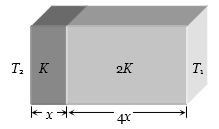
The temperatures of the two outer surfaces of a composite slab,consisting of two materials having coefficients of thermal conductivity $K$ and $2K$ and thicknesses $x$ and $4x$ respectively,are $T_2$ and $T_1$ $(T_2 > T_1)$. The rate of heat transfer through the slab in a steady state is $\left( \frac{A(T_2 - T_1)K}{x} \right)f$,where $f$ is equal to:
A
$1$
B
$\frac{1}{2}$
C
$\frac{2}{3}$
D
$\frac{1}{3}$
Solution
(D) In a steady state,the rate of heat flow $H$ through a composite slab of two materials in series is given by $H = \frac{A(T_2 - T_1)}{R_1 + R_2}$,where $R_1 = \frac{x}{KA}$ and $R_2 = \frac{4x}{(2K)A} = \frac{2x}{KA}$.
The total thermal resistance is $R_{eq} = R_1 + R_2 = \frac{x}{KA} + \frac{2x}{KA} = \frac{3x}{KA}$.
Therefore,the rate of heat transfer is $H = \frac{A(T_2 - T_1)}{\frac{3x}{KA}} = \frac{1}{3} \frac{AK(T_2 - T_1)}{x}$.
Comparing this with the given expression $\left( \frac{A(T_2 - T_1)K}{x} \right)f$,we find that $f = \frac{1}{3}$.
The total thermal resistance is $R_{eq} = R_1 + R_2 = \frac{x}{KA} + \frac{2x}{KA} = \frac{3x}{KA}$.
Therefore,the rate of heat transfer is $H = \frac{A(T_2 - T_1)}{\frac{3x}{KA}} = \frac{1}{3} \frac{AK(T_2 - T_1)}{x}$.
Comparing this with the given expression $\left( \frac{A(T_2 - T_1)K}{x} \right)f$,we find that $f = \frac{1}{3}$.
0 likesView Solution
25
PhysicsEasyMCQAIEEE · 2004
The total energy of a particle,executing simple harmonic motion is
A
$ \propto x $
B
$ \propto x^2 $
C
Independent of $ x $
D
$ \propto x^{1/2} $
Solution
(C) The total energy $(E)$ of a particle executing simple harmonic motion $(SHM)$ is given by the sum of its kinetic energy $(K)$ and potential energy $(U)$.
$E = K + U = \frac{1}{2}m\omega^2(a^2 - x^2) + \frac{1}{2}m\omega^2x^2$
$E = \frac{1}{2}m\omega^2a^2$
Since $m$ (mass),$\omega$ (angular frequency),and $a$ (amplitude) are constants for a given $SHM$,the total energy is constant and independent of the displacement $x$.
$E = K + U = \frac{1}{2}m\omega^2(a^2 - x^2) + \frac{1}{2}m\omega^2x^2$
$E = \frac{1}{2}m\omega^2a^2$
Since $m$ (mass),$\omega$ (angular frequency),and $a$ (amplitude) are constants for a given $SHM$,the total energy is constant and independent of the displacement $x$.
0 likesView Solution
26
PhysicsMediumMCQAIEEE · 2004
$A$ particle at the end of a spring executes simple harmonic motion with a period $t_1$,while the corresponding period for another spring is $t_2$. If the period of oscillation with the two springs in series is $T$,then
A
$T = t_1 + t_2$
B
$T^2 = t_1^2 + t_2^2$
C
$T^{-1} = t_1^{-1} + t_2^{-1}$
D
$T^{-2} = t_1^{-2} + t_2^{-2}$
Solution
(B) The time period of a spring-mass system is given by $t = 2\pi \sqrt{\frac{m}{k}}$.
For the two springs,we have $t_1 = 2\pi \sqrt{\frac{m}{k_1}}$ and $t_2 = 2\pi \sqrt{\frac{m}{k_2}}$.
Squaring these,we get $t_1^2 = 4\pi^2 \frac{m}{k_1}$ and $t_2^2 = 4\pi^2 \frac{m}{k_2}$.
When two springs are connected in series,the effective spring constant $k$ is given by $\frac{1}{k} = \frac{1}{k_1} + \frac{1}{k_2}$,which implies $k = \frac{k_1 k_2}{k_1 + k_2}$.
The time period $T$ for the series combination is $T = 2\pi \sqrt{\frac{m}{k}}$.
Squaring this,$T^2 = 4\pi^2 \frac{m}{k} = 4\pi^2 m \left( \frac{1}{k} \right) = 4\pi^2 m \left( \frac{1}{k_1} + \frac{1}{k_2} \right)$.
Substituting the expressions for $t_1^2$ and $t_2^2$,we get $T^2 = 4\pi^2 \frac{m}{k_1} + 4\pi^2 \frac{m}{k_2} = t_1^2 + t_2^2$.
For the two springs,we have $t_1 = 2\pi \sqrt{\frac{m}{k_1}}$ and $t_2 = 2\pi \sqrt{\frac{m}{k_2}}$.
Squaring these,we get $t_1^2 = 4\pi^2 \frac{m}{k_1}$ and $t_2^2 = 4\pi^2 \frac{m}{k_2}$.
When two springs are connected in series,the effective spring constant $k$ is given by $\frac{1}{k} = \frac{1}{k_1} + \frac{1}{k_2}$,which implies $k = \frac{k_1 k_2}{k_1 + k_2}$.
The time period $T$ for the series combination is $T = 2\pi \sqrt{\frac{m}{k}}$.
Squaring this,$T^2 = 4\pi^2 \frac{m}{k} = 4\pi^2 m \left( \frac{1}{k} \right) = 4\pi^2 m \left( \frac{1}{k_1} + \frac{1}{k_2} \right)$.
Substituting the expressions for $t_1^2$ and $t_2^2$,we get $T^2 = 4\pi^2 \frac{m}{k_1} + 4\pi^2 \frac{m}{k_2} = t_1^2 + t_2^2$.
0 likesView Solution
27
PhysicsDifficultMCQAIEEE · 2004
The bob of a simple pendulum executes simple harmonic motion in water with a period $t$,while the period of oscillation of the bob is ${t_0}$ in air. Neglecting the frictional force of water and given that the density of the bob is $(4/3) \times 1000 \ kg/m^3$. What relationship between $t$ and ${t_0}$ is true?
A
$t = {t_0}$
B
$t = {t_0}/2$
C
$t = 2{t_0}$
D
$t = 4{t_0}$
Solution
(C) The period of a simple pendulum in air is given by ${t_0} = 2\pi \sqrt{\frac{l}{g}}$.
When the bob is submerged in water,it experiences an upward buoyant force. The effective acceleration due to gravity ${g_{eff}}$ is given by:
${g_{eff}} = g \left(1 - \frac{\rho_{water}}{\rho_{bob}}\right)$.
Given $\rho_{bob} = \frac{4}{3} \times 10^3 \ kg/m^3$ and $\rho_{water} = 10^3 \ kg/m^3$,we have:
$\frac{\rho_{water}}{\rho_{bob}} = \frac{10^3}{(4/3) \times 10^3} = \frac{3}{4}$.
Thus,${g_{eff}} = g \left(1 - \frac{3}{4}\right) = \frac{g}{4}$.
The period in water is $t = 2\pi \sqrt{\frac{l}{g_{eff}}} = 2\pi \sqrt{\frac{l}{g/4}} = 2 \times 2\pi \sqrt{\frac{l}{g}}$.
Substituting ${t_0}$,we get $t = 2{t_0}$.
When the bob is submerged in water,it experiences an upward buoyant force. The effective acceleration due to gravity ${g_{eff}}$ is given by:
${g_{eff}} = g \left(1 - \frac{\rho_{water}}{\rho_{bob}}\right)$.
Given $\rho_{bob} = \frac{4}{3} \times 10^3 \ kg/m^3$ and $\rho_{water} = 10^3 \ kg/m^3$,we have:
$\frac{\rho_{water}}{\rho_{bob}} = \frac{10^3}{(4/3) \times 10^3} = \frac{3}{4}$.
Thus,${g_{eff}} = g \left(1 - \frac{3}{4}\right) = \frac{g}{4}$.
The period in water is $t = 2\pi \sqrt{\frac{l}{g_{eff}}} = 2\pi \sqrt{\frac{l}{g/4}} = 2 \times 2\pi \sqrt{\frac{l}{g}}$.
Substituting ${t_0}$,we get $t = 2{t_0}$.
0 likesView Solution
28
PhysicsMediumMCQAIEEE · 2004
$A$ particle of mass $m$ is attached to a spring (of spring constant $k$) and has a natural angular frequency $\omega_0$. An external force $F(t)$ proportional to $\cos \omega t$ (where $\omega \neq \omega_0$) is applied to the oscillator. The displacement of the oscillator will be proportional to:
A
$\frac{m}{\omega_0^2 - \omega^2}$
B
$\frac{1}{m(\omega_0^2 - \omega^2)}$
C
$\frac{1}{m(\omega_0^2 + \omega^2)}$
D
$\frac{m}{\omega_0^2 + \omega^2}$
Solution
(B) For a forced oscillator,the equation of motion is given by $m \frac{d^2x}{dt^2} + kx = F_0 \cos \omega t$.
Substituting $x = x_0 \cos \omega t$,we get $-m \omega^2 x_0 + k x_0 = F_0$.
Since the natural angular frequency is $\omega_0 = \sqrt{k/m}$,we have $k = m \omega_0^2$.
Substituting this,we get $m x_0 (\omega_0^2 - \omega^2) = F_0$.
Thus,the amplitude $x_0 = \frac{F_0}{m(\omega_0^2 - \omega^2)}$.
Therefore,the displacement $x$ is proportional to $\frac{1}{m(\omega_0^2 - \omega^2)}$.
Substituting $x = x_0 \cos \omega t$,we get $-m \omega^2 x_0 + k x_0 = F_0$.
Since the natural angular frequency is $\omega_0 = \sqrt{k/m}$,we have $k = m \omega_0^2$.
Substituting this,we get $m x_0 (\omega_0^2 - \omega^2) = F_0$.
Thus,the amplitude $x_0 = \frac{F_0}{m(\omega_0^2 - \omega^2)}$.
Therefore,the displacement $x$ is proportional to $\frac{1}{m(\omega_0^2 - \omega^2)}$.
0 likesView Solution
29
PhysicsEasyMCQAIEEE · 2004
The displacement $y$ of a particle in a medium can be expressed as: $y = 10^{-6} \sin(100t + 20x + \pi/4) \ m$,where $t$ is in seconds and $x$ is in meters. The speed of the wave is ... $m/s$.
A
$2000$
B
$5$
C
$20$
D
$5\pi$
Solution
(B) The standard wave equation is given by $y = A \sin(\omega t + kx + \phi)$.
Comparing the given equation $y = 10^{-6} \sin(100t + 20x + \pi/4)$ with the standard equation,we get:
Angular frequency $\omega = 100 \ rad/s$
Wave number $k = 20 \ rad/m$
The speed of the wave $v$ is given by the ratio of the coefficient of $t$ to the coefficient of $x$:
$v = \frac{\omega}{k} = \frac{100}{20} = 5 \ m/s$.
Comparing the given equation $y = 10^{-6} \sin(100t + 20x + \pi/4)$ with the standard equation,we get:
Angular frequency $\omega = 100 \ rad/s$
Wave number $k = 20 \ rad/m$
The speed of the wave $v$ is given by the ratio of the coefficient of $t$ to the coefficient of $x$:
$v = \frac{\omega}{k} = \frac{100}{20} = 5 \ m/s$.
0 likesView Solution
30
PhysicsMediumMCQAIEEE · 2004
Time taken by a $836\; W$ heater to heat $1\; litre$ of water from $10^{\circ} C$ to $40^{\circ} C$ is (in $; s$)
A
$200$
B
$150$
C
$836$
D
$418$
Solution
(B) The heat energy $H$ required to raise the temperature of water is given by $H = m \cdot c \cdot \Delta \theta$.
Given: Power $P = 836\; W$,mass $m = 1\; kg$ (since $1\; litre$ of water = $1\; kg$),specific heat capacity $c = 4200\; J/kg\cdot^{\circ}C$,and temperature change $\Delta \theta = 40^{\circ}C - 10^{\circ}C = 30^{\circ}C$.
The energy supplied by the heater in time $t$ is $E = P \times t$.
Equating energy supplied to heat required: $P \times t = m \cdot c \cdot \Delta \theta$.
$t = \frac{m \cdot c \cdot \Delta \theta}{P} = \frac{1 \times 4200 \times 30}{836}$.
Using $J = 4.18\; J/cal$,we can also write $c = 4180\; J/kg\cdot^{\circ}C$.
$t = \frac{1 \times 4180 \times 30}{836} = 5 \times 30 = 150\; s$.
Given: Power $P = 836\; W$,mass $m = 1\; kg$ (since $1\; litre$ of water = $1\; kg$),specific heat capacity $c = 4200\; J/kg\cdot^{\circ}C$,and temperature change $\Delta \theta = 40^{\circ}C - 10^{\circ}C = 30^{\circ}C$.
The energy supplied by the heater in time $t$ is $E = P \times t$.
Equating energy supplied to heat required: $P \times t = m \cdot c \cdot \Delta \theta$.
$t = \frac{m \cdot c \cdot \Delta \theta}{P} = \frac{1 \times 4200 \times 30}{836}$.
Using $J = 4.18\; J/cal$,we can also write $c = 4180\; J/kg\cdot^{\circ}C$.
$t = \frac{1 \times 4180 \times 30}{836} = 5 \times 30 = 150\; s$.
0 likesView Solution
31
PhysicsDifficultMCQAIEEE · 2004
The thermo $e.m.f.$ of a thermocouple varies with the temperature $\theta$ of the hot junction as $E = a\theta + b\theta^2$ in volts,where the ratio $a/b$ is $700\,^{\circ}C$. If the cold junction is kept at $0\,^{\circ}C$,then the neutral temperature is:
A
$700\,^{\circ}C$
B
$350\,^{\circ}C$
C
$1400\,^{\circ}C$
D
No neutral temperature is possible for this thermocouple
Solution
(D) The thermo $e.m.f.$ is given by $E = a\theta + b\theta^2$.
The neutral temperature $\theta_n$ is the temperature at which the thermo $e.m.f.$ is maximum,i.e.,$\frac{dE}{d\theta} = 0$.
$\frac{dE}{d\theta} = a + 2b\theta = 0$.
$\theta_n = -\frac{a}{2b}$.
Given that $\frac{a}{b} = 700\,^{\circ}C$,we substitute this into the equation:
$\theta_n = -\frac{1}{2} \times (700\,^{\circ}C) = -350\,^{\circ}C$.
Since the neutral temperature must be greater than the cold junction temperature $(0\,^{\circ}C)$ for a standard thermocouple,a negative value indicates that no neutral temperature is physically possible for this specific thermocouple configuration.
The neutral temperature $\theta_n$ is the temperature at which the thermo $e.m.f.$ is maximum,i.e.,$\frac{dE}{d\theta} = 0$.
$\frac{dE}{d\theta} = a + 2b\theta = 0$.
$\theta_n = -\frac{a}{2b}$.
Given that $\frac{a}{b} = 700\,^{\circ}C$,we substitute this into the equation:
$\theta_n = -\frac{1}{2} \times (700\,^{\circ}C) = -350\,^{\circ}C$.
Since the neutral temperature must be greater than the cold junction temperature $(0\,^{\circ}C)$ for a standard thermocouple,a negative value indicates that no neutral temperature is physically possible for this specific thermocouple configuration.
0 likesView Solution
32
PhysicsEasyMCQAIEEE · 2004
One solid sphere $A$ and another hollow sphere $B$ have the same mass and the same outer radii. Their moments of inertia about their diameters are $I_{A}$ and $I_{B}$ respectively. Which of the following relations is correct?
A
$I_{A} < I_{B}$
B
$I_{A} = I_{B}$
C
$I_{A} > I_{B}$
D
$\frac{I_{A}}{I_{B}}=\frac{d_{A}}{d_{B}}$
Solution
(A) The moment of inertia of a solid sphere of mass $M$ and radius $R$ about its diameter is given by $I_A = \frac{2}{5} M R^2$.
The moment of inertia of a hollow sphere of mass $M$ and radius $R$ about its diameter is given by $I_B = \frac{2}{3} M R^2$.
Comparing the two expressions,since $M$ and $R$ are the same for both spheres,we compare the coefficients $\frac{2}{5}$ and $\frac{2}{3}$.
Since $\frac{2}{5} = 0.4$ and $\frac{2}{3} \approx 0.67$,it is clear that $\frac{2}{5} < \frac{2}{3}$.
Therefore,$I_A < I_B$.
The moment of inertia of a hollow sphere of mass $M$ and radius $R$ about its diameter is given by $I_B = \frac{2}{3} M R^2$.
Comparing the two expressions,since $M$ and $R$ are the same for both spheres,we compare the coefficients $\frac{2}{5}$ and $\frac{2}{3}$.
Since $\frac{2}{5} = 0.4$ and $\frac{2}{3} \approx 0.67$,it is clear that $\frac{2}{5} < \frac{2}{3}$.
Therefore,$I_A < I_B$.
1 likesView Solution
33
PhysicsEasyMCQAIEEE · 2004
$A$ solid sphere is rotating freely about its symmetry axis in free space. The radius of the sphere is increased keeping its mass same. Which of the following physical quantities would remain constant for the sphere $?$
A
Angular velocity
B
Moment of inertia
C
Angular momentum
D
Rotational kinetic energy
Solution
(C) According to the principle of conservation of angular momentum,if the net external torque acting on a system is zero,the total angular momentum of the system remains constant.
In this case,the sphere is rotating freely in free space,meaning there is no external torque acting on it $({\tau_{ext}} = 0)$.
Since ${\tau_{ext}} = \frac{dL}{dt} = 0$,the angular momentum $(L)$ must remain constant.
When the radius of the sphere increases,its moment of inertia $(I = \frac{2}{5}MR^2)$ increases. Since $L = I\omega$ is constant,the angular velocity $(\omega)$ will decrease,and the rotational kinetic energy $(K = \frac{L^2}{2I})$ will also change. Therefore,only the angular momentum remains constant.
In this case,the sphere is rotating freely in free space,meaning there is no external torque acting on it $({\tau_{ext}} = 0)$.
Since ${\tau_{ext}} = \frac{dL}{dt} = 0$,the angular momentum $(L)$ must remain constant.
When the radius of the sphere increases,its moment of inertia $(I = \frac{2}{5}MR^2)$ increases. Since $L = I\omega$ is constant,the angular velocity $(\omega)$ will decrease,and the rotational kinetic energy $(K = \frac{L^2}{2I})$ will also change. Therefore,only the angular momentum remains constant.
1 likesView Solution
34
PhysicsEasyMCQAIEEE · 2004
$A$ wire fixed at the upper end stretches by length $l$ by applying a force $F$. The work done in stretching is
A
$\frac{F}{2l}$
B
$Fl$
C
$2Fl$
D
$\frac{Fl}{2}$
Solution
(D) The force applied to the wire increases linearly from $0$ to $F$ as it stretches from $0$ to $l$.
The average force applied during the stretching process is given by $F_{av} = \frac{0 + F}{2} = \frac{F}{2}$.
The work done $(W)$ in stretching the wire is the product of the average force and the total extension:
$W = F_{av} \times l = \left(\frac{F}{2}\right) \times l = \frac{Fl}{2}$.
The average force applied during the stretching process is given by $F_{av} = \frac{0 + F}{2} = \frac{F}{2}$.
The work done $(W)$ in stretching the wire is the product of the average force and the total extension:
$W = F_{av} \times l = \left(\frac{F}{2}\right) \times l = \frac{Fl}{2}$.
0 likesView Solution
35
PhysicsMediumMCQAIEEE · 2004
$A$ satellite of mass $m$ revolves around the earth of radius $R$ at a height $x$ from its surface. If $g$ is the acceleration due to gravity on the surface of the earth,the orbital speed of the satellite is
A
$gx$
B
$\frac{gR}{R - x}$
C
$\frac{gR^2}{R + x}$
D
$\left( \frac{gR^2}{R + x} \right)^{1/2}$
Solution
(D) The gravitational force acting on the satellite provides the necessary centripetal force for its circular orbit.
Let $M_e$ be the mass of the earth. The gravitational force is $F_g = \frac{G M_e m}{(R + x)^2}$.
The centripetal force required is $F_c = \frac{m v_0^2}{R + x}$.
Equating these,we get $\frac{G M_e m}{(R + x)^2} = \frac{m v_0^2}{R + x}$,which simplifies to $v_0^2 = \frac{G M_e}{R + x}$.
We know that the acceleration due to gravity on the earth's surface is $g = \frac{G M_e}{R^2}$,which implies $G M_e = g R^2$.
Substituting this into the expression for $v_0^2$,we get $v_0^2 = \frac{g R^2}{R + x}$.
Therefore,the orbital speed is $v_0 = \sqrt{\frac{g R^2}{R + x}} = \left( \frac{g R^2}{R + x} \right)^{1/2}$.
Let $M_e$ be the mass of the earth. The gravitational force is $F_g = \frac{G M_e m}{(R + x)^2}$.
The centripetal force required is $F_c = \frac{m v_0^2}{R + x}$.
Equating these,we get $\frac{G M_e m}{(R + x)^2} = \frac{m v_0^2}{R + x}$,which simplifies to $v_0^2 = \frac{G M_e}{R + x}$.
We know that the acceleration due to gravity on the earth's surface is $g = \frac{G M_e}{R^2}$,which implies $G M_e = g R^2$.
Substituting this into the expression for $v_0^2$,we get $v_0^2 = \frac{g R^2}{R + x}$.
Therefore,the orbital speed is $v_0 = \sqrt{\frac{g R^2}{R + x}} = \left( \frac{g R^2}{R + x} \right)^{1/2}$.
0 likesView Solution
36
PhysicsMediumMCQAIEEE · 2004
In forced oscillation of a particle,the amplitude is maximum for a frequency $\omega_{1}$ of the driving force,while the energy is maximum for a frequency $\omega_{2}$ of the driving force. Then:
A
$\omega_{1} = \omega_{2}$
B
$\omega_{1} > \omega_{2}$
C
$\omega_{1} < \omega_{2}$ when damping is small and $\omega_{1} > \omega_{2}$ when damping is large
D
$\omega_{1} < \omega_{2}$
Solution
(D) For a damped forced oscillator,the amplitude $A$ is given by $A = \frac{F_0}{\sqrt{m^2(\omega_0^2 - \omega^2)^2 + b^2\omega^2}}$.
The amplitude is maximum when the denominator is minimum,which occurs at $\omega_1 = \sqrt{\omega_0^2 - 2\gamma^2}$,where $\gamma = \frac{b}{2m}$.
The energy of the oscillator is proportional to the square of the amplitude $(E \propto A^2)$.
The energy is maximum when the amplitude is maximum,which occurs at $\omega_2 = \omega_0$ (the natural frequency) in the context of power absorption,or specifically,the resonance frequency for energy is $\omega_2 = \omega_0$.
Comparing the two,since $\omega_1 = \sqrt{\omega_0^2 - 2\gamma^2}$,it is clear that $\omega_1 < \omega_0$.
Therefore,$\omega_1 < \omega_2$.
The amplitude is maximum when the denominator is minimum,which occurs at $\omega_1 = \sqrt{\omega_0^2 - 2\gamma^2}$,where $\gamma = \frac{b}{2m}$.
The energy of the oscillator is proportional to the square of the amplitude $(E \propto A^2)$.
The energy is maximum when the amplitude is maximum,which occurs at $\omega_2 = \omega_0$ (the natural frequency) in the context of power absorption,or specifically,the resonance frequency for energy is $\omega_2 = \omega_0$.
Comparing the two,since $\omega_1 = \sqrt{\omega_0^2 - 2\gamma^2}$,it is clear that $\omega_1 < \omega_0$.
Therefore,$\omega_1 < \omega_2$.
0 likesView Solution
37
PhysicsMediumMCQAIEEE · 2004
If $g$ is the acceleration due to gravity on the earth's surface,the gain in the potential energy of an object of mass $m$ raised from the surface of the earth to a height equal to the radius $R$ of the earth is
A
$2 mgR$
B
$mgR$
C
$\frac{1}{2} mgR$
D
$\frac{1}{4} mgR$
Solution
(C) The gravitational potential energy of an object of mass $m$ at the surface of the earth is given by $U_{1} = -\frac{GMm}{R}$.
At a height $h = R$ from the surface,the distance from the center of the earth is $r = R + h = R + R = 2R$.
The potential energy at this height is $U_{2} = -\frac{GMm}{2R}$.
The gain in potential energy is $\Delta U = U_{2} - U_{1} = -\frac{GMm}{2R} - (-\frac{GMm}{R}) = \frac{GMm}{R} - \frac{GMm}{2R} = \frac{GMm}{2R}$.
Since the acceleration due to gravity at the surface is $g = \frac{GM}{R^{2}}$,we have $GM = gR^{2}$.
Substituting this into the expression for $\Delta U$:
$\Delta U = \frac{1}{2} \frac{(gR^{2})m}{R} = \frac{1}{2} mgR$.
At a height $h = R$ from the surface,the distance from the center of the earth is $r = R + h = R + R = 2R$.
The potential energy at this height is $U_{2} = -\frac{GMm}{2R}$.
The gain in potential energy is $\Delta U = U_{2} - U_{1} = -\frac{GMm}{2R} - (-\frac{GMm}{R}) = \frac{GMm}{R} - \frac{GMm}{2R} = \frac{GMm}{2R}$.
Since the acceleration due to gravity at the surface is $g = \frac{GM}{R^{2}}$,we have $GM = gR^{2}$.
Substituting this into the expression for $\Delta U$:
$\Delta U = \frac{1}{2} \frac{(gR^{2})m}{R} = \frac{1}{2} mgR$.
0 likesView Solution
38
PhysicsDifficultMCQAIEEE · 2004
Two spherical conductors $B$ and $C$ having equal radii and carrying equal charges $Q$ repel each other with a force $F$ when kept apart at a distance $r$. $A$ third spherical conductor having the same radius as that of $B$ but uncharged is brought in contact with $B$,then brought in contact with $C$,and finally removed away from both. The new force of repulsion between $B$ and $C$ is
A
$F/4$
B
$3F/4$
C
$F/8$
D
$3F/8$
Solution
(D) Initially,the force between $B$ and $C$ is given by Coulomb's law: $F = k \frac{Q^2}{r^2}$.
When the uncharged conductor (let's call it $D$) is brought in contact with $B$,the charge $Q$ is shared equally between them because they have equal radii. Thus,the charge on $B$ becomes $Q_B = Q/2$.
Next,the conductor $D$ (now carrying charge $Q/2$) is brought in contact with $C$ (which has charge $Q$). The total charge $(Q/2 + Q) = 3Q/2$ is shared equally between $C$ and $D$. Thus,the new charge on $C$ becomes $Q_C = (3Q/2) / 2 = 3Q/4$.
The new force of repulsion between $B$ and $C$ is $F' = k \frac{Q_B \cdot Q_C}{r^2} = k \frac{(Q/2) \cdot (3Q/4)}{r^2} = \frac{3}{8} \left( k \frac{Q^2}{r^2} \right) = \frac{3}{8} F$.
When the uncharged conductor (let's call it $D$) is brought in contact with $B$,the charge $Q$ is shared equally between them because they have equal radii. Thus,the charge on $B$ becomes $Q_B = Q/2$.
Next,the conductor $D$ (now carrying charge $Q/2$) is brought in contact with $C$ (which has charge $Q$). The total charge $(Q/2 + Q) = 3Q/2$ is shared equally between $C$ and $D$. Thus,the new charge on $C$ becomes $Q_C = (3Q/2) / 2 = 3Q/4$.
The new force of repulsion between $B$ and $C$ is $F' = k \frac{Q_B \cdot Q_C}{r^2} = k \frac{(Q/2) \cdot (3Q/4)}{r^2} = \frac{3}{8} \left( k \frac{Q^2}{r^2} \right) = \frac{3}{8} F$.
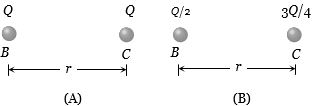
0 likesView Solution
39
PhysicsMediumMCQAIEEE · 2004
$A$ charged particle $q$ is shot towards another charged particle $Q$ which is fixed,with a speed $v$. It approaches $Q$ up to a closest distance $r$ and then returns. If $q$ were given a speed $2v$,the closest distance of approach would be

A
$r$
B
$2r$
C
$r/2$
D
$r/4$
Solution
(D) By the law of conservation of energy,the initial kinetic energy of the particle $q$ is converted into electrostatic potential energy at the point of closest approach,where the particle momentarily comes to rest.
Initial kinetic energy = $\frac{1}{2}mv^2$
Electrostatic potential energy at distance $r$ = $\frac{1}{4\pi\varepsilon_0} \cdot \frac{qQ}{r}$
Equating the two: $\frac{1}{2}mv^2 = \frac{1}{4\pi\varepsilon_0} \cdot \frac{qQ}{r}$
From this,we can see that $r = \frac{qQ}{2\pi\varepsilon_0 mv^2}$,which implies $r \propto \frac{1}{v^2}$.
If the speed is doubled $(v' = 2v)$,the new distance of closest approach $r'$ will be:
$r' = r \cdot \left(\frac{v}{v'}\right)^2 = r \cdot \left(\frac{v}{2v}\right)^2 = r \cdot \frac{1}{4} = \frac{r}{4}$.
Thus,the closest distance of approach becomes $r/4$.
Initial kinetic energy = $\frac{1}{2}mv^2$
Electrostatic potential energy at distance $r$ = $\frac{1}{4\pi\varepsilon_0} \cdot \frac{qQ}{r}$
Equating the two: $\frac{1}{2}mv^2 = \frac{1}{4\pi\varepsilon_0} \cdot \frac{qQ}{r}$
From this,we can see that $r = \frac{qQ}{2\pi\varepsilon_0 mv^2}$,which implies $r \propto \frac{1}{v^2}$.
If the speed is doubled $(v' = 2v)$,the new distance of closest approach $r'$ will be:
$r' = r \cdot \left(\frac{v}{v'}\right)^2 = r \cdot \left(\frac{v}{2v}\right)^2 = r \cdot \frac{1}{4} = \frac{r}{4}$.
Thus,the closest distance of approach becomes $r/4$.
0 likesView Solution
40
PhysicsMediumMCQAIEEE · 2004
The total current supplied to the circuit by the battery is ............. $A$.
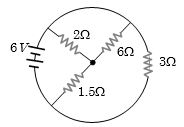
A
$1$
B
$2$
C
$4$
D
$6$
Solution
(C) The given circuit can be simplified by identifying the series and parallel combinations of resistors.
First, the $2 \, \Omega$ and $6 \, \Omega$ resistors are in series, giving an equivalent resistance of $R_1 = 2 + 6 = 8 \, \Omega$.
However, looking at the circuit diagram, the $2 \, \Omega$ and $6 \, \Omega$ resistors are connected in series with each other, and this combination is in series with the $3 \, \Omega$ resistor, while the $1.5 \, \Omega$ resistor is in parallel with the battery.
Wait, let us re-examine the circuit: The $2 \, \Omega$ and $6 \, \Omega$ resistors are in series, forming $8 \, \Omega$. This $8 \, \Omega$ is in parallel with the $3 \, \Omega$ resistor. This entire block is in series with the $1.5 \, \Omega$ resistor.
Actually, based on the provided solution image, the circuit is simplified as follows:
$1$. The $2 \, \Omega$ and $6 \, \Omega$ resistors are in series, giving $8 \, \Omega$. This is in parallel with $3 \, \Omega$ (Wait, the image shows a different simplification).
Let's follow the provided solution image logic: The circuit is equivalent to a $6 \, V$ battery connected to two parallel branches, each having an equivalent resistance of $3 \, \Omega$.
Total resistance $R_{eq} = \frac{3 \times 3}{3 + 3} = 1.5 \, \Omega$.
Therefore, the total current $i = \frac{V}{R_{eq}} = \frac{6 \, V}{1.5 \, \Omega} = 4 \, A$.
First, the $2 \, \Omega$ and $6 \, \Omega$ resistors are in series, giving an equivalent resistance of $R_1 = 2 + 6 = 8 \, \Omega$.
However, looking at the circuit diagram, the $2 \, \Omega$ and $6 \, \Omega$ resistors are connected in series with each other, and this combination is in series with the $3 \, \Omega$ resistor, while the $1.5 \, \Omega$ resistor is in parallel with the battery.
Wait, let us re-examine the circuit: The $2 \, \Omega$ and $6 \, \Omega$ resistors are in series, forming $8 \, \Omega$. This $8 \, \Omega$ is in parallel with the $3 \, \Omega$ resistor. This entire block is in series with the $1.5 \, \Omega$ resistor.
Actually, based on the provided solution image, the circuit is simplified as follows:
$1$. The $2 \, \Omega$ and $6 \, \Omega$ resistors are in series, giving $8 \, \Omega$. This is in parallel with $3 \, \Omega$ (Wait, the image shows a different simplification).
Let's follow the provided solution image logic: The circuit is equivalent to a $6 \, V$ battery connected to two parallel branches, each having an equivalent resistance of $3 \, \Omega$.
Total resistance $R_{eq} = \frac{3 \times 3}{3 + 3} = 1.5 \, \Omega$.
Therefore, the total current $i = \frac{V}{R_{eq}} = \frac{6 \, V}{1.5 \, \Omega} = 4 \, A$.
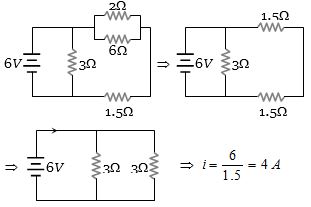
0 likesView Solution
41
PhysicsEasyMCQAIEEE · 2004
An electric current is passed through a circuit containing two wires of the same material,connected in parallel. If the lengths and radii of the wires are in the ratio of $4/3$ and $2/3$ respectively,then the ratio of the currents passing through the wires will be:
A
$3$
B
$1/3$
C
$8/9$
D
$2$
Solution
(B) For wires connected in parallel,the potential difference $V$ across each wire is the same.
The current $i$ in a wire is given by $i = V/R$,where $R$ is the resistance.
Resistance $R$ is given by $R = \rho \frac{l}{A} = \rho \frac{l}{\pi r^2}$.
Since the material is the same,the resistivity $\rho$ is constant.
Therefore,the ratio of currents is $\frac{i_1}{i_2} = \frac{R_2}{R_1} = \frac{l_2}{l_1} \times \left( \frac{r_1}{r_2} \right)^2$.
Given $\frac{l_1}{l_2} = \frac{4}{3}$ and $\frac{r_1}{r_2} = \frac{2}{3}$.
Substituting these values: $\frac{i_1}{i_2} = \frac{3}{4} \times \left( \frac{2}{3} \right)^2 = \frac{3}{4} \times \frac{4}{9} = \frac{1}{3}$.
The current $i$ in a wire is given by $i = V/R$,where $R$ is the resistance.
Resistance $R$ is given by $R = \rho \frac{l}{A} = \rho \frac{l}{\pi r^2}$.
Since the material is the same,the resistivity $\rho$ is constant.
Therefore,the ratio of currents is $\frac{i_1}{i_2} = \frac{R_2}{R_1} = \frac{l_2}{l_1} \times \left( \frac{r_1}{r_2} \right)^2$.
Given $\frac{l_1}{l_2} = \frac{4}{3}$ and $\frac{r_1}{r_2} = \frac{2}{3}$.
Substituting these values: $\frac{i_1}{i_2} = \frac{3}{4} \times \left( \frac{2}{3} \right)^2 = \frac{3}{4} \times \frac{4}{9} = \frac{1}{3}$.
0 likesView Solution
42
PhysicsMediumMCQAIEEE · 2004
In a meter bridge experiment,a null point is obtained at $20 \ cm$ from one end of the wire when resistance $X$ is balanced against another resistance $Y$. If $X < Y$,then where will be the new position of the null point from the same end,if one decides to balance a resistance of $4X$ against $Y$ (in $cm$)?
A
$50$
B
$80$
C
$40$
D
$70$
Solution
(A) In a meter bridge,the balancing condition is given by $\frac{R_1}{R_2} = \frac{l}{100 - l}$.
For the first case,$\frac{X}{Y} = \frac{20}{100 - 20} = \frac{20}{80} = \frac{1}{4}$.
So,$\frac{X}{Y} = \frac{1}{4}$,which implies $Y = 4X$.
In the second case,we balance $4X$ against $Y$. Let the new null point be at $l \ cm$.
Then,$\frac{4X}{Y} = \frac{l}{100 - l}$.
Substituting $Y = 4X$ into the equation,we get $\frac{4X}{4X} = \frac{l}{100 - l}$.
$1 = \frac{l}{100 - l} \Rightarrow 100 - l = l \Rightarrow 2l = 100 \Rightarrow l = 50 \ cm$.
For the first case,$\frac{X}{Y} = \frac{20}{100 - 20} = \frac{20}{80} = \frac{1}{4}$.
So,$\frac{X}{Y} = \frac{1}{4}$,which implies $Y = 4X$.
In the second case,we balance $4X$ against $Y$. Let the new null point be at $l \ cm$.
Then,$\frac{4X}{Y} = \frac{l}{100 - l}$.
Substituting $Y = 4X$ into the equation,we get $\frac{4X}{4X} = \frac{l}{100 - l}$.
$1 = \frac{l}{100 - l} \Rightarrow 100 - l = l \Rightarrow 2l = 100 \Rightarrow l = 50 \ cm$.
0 likesView Solution
43
PhysicsDifficultMCQAIEEE · 2004
The resistance of the series combination of two resistances is $S$. When they are joined in parallel,the total resistance is $P$. If $S = nP$,then the minimum possible value of $n$ is
A
$4$
B
$3$
C
$2$
D
$1$
Solution
(A) Let the two resistances be $R_1$ and $R_2$.
In series,the equivalent resistance is $S = R_1 + R_2$.
In parallel,the equivalent resistance is $P = \frac{R_1 R_2}{R_1 + R_2}$.
Given the condition $S = nP$,we substitute the expressions:
$R_1 + R_2 = n \left( \frac{R_1 R_2}{R_1 + R_2} \right)$.
Rearranging the terms,we get $(R_1 + R_2)^2 = n R_1 R_2$.
Using the algebraic identity $(R_1 + R_2)^2 = (R_1 - R_2)^2 + 4 R_1 R_2$,we have:
$(R_1 - R_2)^2 + 4 R_1 R_2 = n R_1 R_2$.
Dividing by $R_1 R_2$,we get $n = 4 + \frac{(R_1 - R_2)^2}{R_1 R_2}$.
Since the term $\frac{(R_1 - R_2)^2}{R_1 R_2}$ is always greater than or equal to $0$,the minimum value of $n$ occurs when $R_1 = R_2$,which gives $n = 4$.
In series,the equivalent resistance is $S = R_1 + R_2$.
In parallel,the equivalent resistance is $P = \frac{R_1 R_2}{R_1 + R_2}$.
Given the condition $S = nP$,we substitute the expressions:
$R_1 + R_2 = n \left( \frac{R_1 R_2}{R_1 + R_2} \right)$.
Rearranging the terms,we get $(R_1 + R_2)^2 = n R_1 R_2$.
Using the algebraic identity $(R_1 + R_2)^2 = (R_1 - R_2)^2 + 4 R_1 R_2$,we have:
$(R_1 - R_2)^2 + 4 R_1 R_2 = n R_1 R_2$.
Dividing by $R_1 R_2$,we get $n = 4 + \frac{(R_1 - R_2)^2}{R_1 R_2}$.
Since the term $\frac{(R_1 - R_2)^2}{R_1 R_2}$ is always greater than or equal to $0$,the minimum value of $n$ occurs when $R_1 = R_2$,which gives $n = 4$.
0 likesView Solution
44
PhysicsMediumMCQAIEEE · 2004
The magnetic field due to a current-carrying circular loop of radius $3 \ cm$ at a point on the axis at a distance of $4 \ cm$ from the centre is $54 \ \mu T$. What will be its value at the centre of the loop? (in $\mu T$)
A
$250$
B
$150$
C
$125$
D
$75$
Solution
(A) The magnetic field on the axis of a circular loop is given by $B_{axis} = \frac{\mu_0 I r^2}{2(r^2 + x^2)^{3/2}}$.
The magnetic field at the center of the loop is given by $B_{center} = \frac{\mu_0 I}{2r}$.
Taking the ratio,we get $\frac{B_{center}}{B_{axis}} = \frac{(r^2 + x^2)^{3/2}}{r^3} = \left( 1 + \frac{x^2}{r^2} \right)^{3/2}$.
Given $r = 3 \ cm$,$x = 4 \ cm$,and $B_{axis} = 54 \ \mu T$.
Substituting the values: $\frac{B_{center}}{54} = \left( 1 + \left( \frac{4}{3} \right)^2 \right)^{3/2} = \left( 1 + \frac{16}{9} \right)^{3/2} = \left( \frac{25}{9} \right)^{3/2} = \frac{125}{27}$.
Therefore,$B_{center} = 54 \times \frac{125}{27} = 2 \times 125 = 250 \ \mu T$.
The magnetic field at the center of the loop is given by $B_{center} = \frac{\mu_0 I}{2r}$.
Taking the ratio,we get $\frac{B_{center}}{B_{axis}} = \frac{(r^2 + x^2)^{3/2}}{r^3} = \left( 1 + \frac{x^2}{r^2} \right)^{3/2}$.
Given $r = 3 \ cm$,$x = 4 \ cm$,and $B_{axis} = 54 \ \mu T$.
Substituting the values: $\frac{B_{center}}{54} = \left( 1 + \left( \frac{4}{3} \right)^2 \right)^{3/2} = \left( 1 + \frac{16}{9} \right)^{3/2} = \left( \frac{25}{9} \right)^{3/2} = \frac{125}{27}$.
Therefore,$B_{center} = 54 \times \frac{125}{27} = 2 \times 125 = 250 \ \mu T$.
0 likesView Solution
45
PhysicsMediumMCQAIEEE · 2004
Two long parallel conductors,separated by a distance $d$,carry currents $I_1$ and $I_2$ in the same direction. They exert a force $F$ on each other. Now,the current in one of them is increased to $2I$ and its direction is reversed. The distance between them is also increased to $3d$. The new value of the force between them is:
A
$-2F$
B
$F/3$
C
$-2F/3$
D
$F/3$
Solution
(C) The force per unit length between two long parallel conductors is given by $F = \frac{\mu_0 I_1 I_2}{2 \pi d}$.
Initially,the force is $F = k \frac{I_1 I_2}{d}$,where $k = \frac{\mu_0}{2 \pi}$.
In the new scenario,the current $I_1$ becomes $2I_1$ and the direction is reversed,so the new current is $-2I_1$. The distance $d$ becomes $3d$.
The new force $F'$ is given by $F' = k \frac{(-2I_1) I_2}{3d} = -\frac{2}{3} \left( k \frac{I_1 I_2}{d} \right)$.
Substituting the initial force $F$,we get $F' = -\frac{2}{3} F$.
Initially,the force is $F = k \frac{I_1 I_2}{d}$,where $k = \frac{\mu_0}{2 \pi}$.
In the new scenario,the current $I_1$ becomes $2I_1$ and the direction is reversed,so the new current is $-2I_1$. The distance $d$ becomes $3d$.
The new force $F'$ is given by $F' = k \frac{(-2I_1) I_2}{3d} = -\frac{2}{3} \left( k \frac{I_1 I_2}{d} \right)$.
Substituting the initial force $F$,we get $F' = -\frac{2}{3} F$.
0 likesView Solution
46
PhysicsDifficultMCQAIEEE · 2004
The length of a magnet is large compared to its width and breadth. The time period of its oscillation in a vibration magnetometer is $2 \, s$. The magnet is cut along its length into three equal parts and these three parts are then placed on each other with their like poles together. The time period of this combination will be
A
$2 \, s$
B
$2/3 \, s$
C
$2\sqrt{3} \, s$
D
$2/\sqrt{3} \, s$
Solution
(B) The time period of a magnet in a vibration magnetometer is given by $T = 2\pi \sqrt{\frac{I}{MB}}$,where $I$ is the moment of inertia and $M$ is the magnetic moment.
Initially,$T = 2 \, s = 2\pi \sqrt{\frac{I}{MB}}$.
When the magnet is cut into three equal parts along its length,for each part,the mass $m' = m/3$ and length $l' = l/3$.
The moment of inertia of each part about the center is $I' = \frac{1}{12} m' (l')^2 = \frac{1}{12} (m/3) (l/3)^2 = \frac{1}{27} I$.
The magnetic moment of each part is $M' = M/3$.
When three such parts are placed on each other,the total moment of inertia $I_s = 3 \times I' = 3 \times (I/27) = I/9$.
The total magnetic moment $M_s = 3 \times M' = 3 \times (M/3) = M$.
The new time period $T_s = 2\pi \sqrt{\frac{I_s}{M_s B}} = 2\pi \sqrt{\frac{I/9}{MB}} = \frac{1}{3} \times 2\pi \sqrt{\frac{I}{MB}} = \frac{T}{3}$.
Substituting $T = 2 \, s$,we get $T_s = 2/3 \, s$.
Initially,$T = 2 \, s = 2\pi \sqrt{\frac{I}{MB}}$.
When the magnet is cut into three equal parts along its length,for each part,the mass $m' = m/3$ and length $l' = l/3$.
The moment of inertia of each part about the center is $I' = \frac{1}{12} m' (l')^2 = \frac{1}{12} (m/3) (l/3)^2 = \frac{1}{27} I$.
The magnetic moment of each part is $M' = M/3$.
When three such parts are placed on each other,the total moment of inertia $I_s = 3 \times I' = 3 \times (I/27) = I/9$.
The total magnetic moment $M_s = 3 \times M' = 3 \times (M/3) = M$.
The new time period $T_s = 2\pi \sqrt{\frac{I_s}{M_s B}} = 2\pi \sqrt{\frac{I/9}{MB}} = \frac{1}{3} \times 2\pi \sqrt{\frac{I}{MB}} = \frac{T}{3}$.
Substituting $T = 2 \, s$,we get $T_s = 2/3 \, s$.
0 likesView Solution
47
PhysicsEasyMCQAIEEE · 2004
The materials suitable for making electromagnets should have
A
High retentivity and high coercivity
B
High retentivity and low coercivity
C
Low retentivity and low coercivity
D
Low retentivity and high coercivity
Solution
(C) An electromagnet requires a material that can be easily magnetized and demagnetized.
To achieve this,the material must have low retentivity so that it does not retain magnetism when the current is switched off.
Additionally,it must have low coercivity so that it can be easily demagnetized by a small reverse magnetic field.
Therefore,the correct choice is low retentivity and low coercivity.
To achieve this,the material must have low retentivity so that it does not retain magnetism when the current is switched off.
Additionally,it must have low coercivity so that it can be easily demagnetized by a small reverse magnetic field.
Therefore,the correct choice is low retentivity and low coercivity.
0 likesView Solution
48
PhysicsMediumMCQAIEEE · 2004
$A$ coil having $n$ turns and resistance $R \, \Omega$ is connected with a galvanometer of resistance $4 \, R \, \Omega$. This combination is moved in time $t$ seconds from a magnetic field $W_1$ weber to $W_2$ weber. The induced current in the circuit is
A
$ - \frac{W_2 - W_1}{5 R n t}$
B
$ - \frac{n(W_2 - W_1)}{5 R t}$
C
$ - \frac{W_2 - W_1}{R n t}$
D
$ - \frac{n(W_2 - W_1)}{R t}$
Solution
(B) According to Faraday's law of electromagnetic induction,the induced electromotive force $(e)$ is given by $e = -n \frac{\Delta \phi}{\Delta t}$,where $n$ is the number of turns and $\Delta \phi = W_2 - W_1$ is the change in magnetic flux.
Total resistance of the circuit $R_{total} = R + 4R = 5R \, \Omega$.
The induced current $i$ is given by $i = \frac{e}{R_{total}}$.
Substituting the values,we get $i = \frac{-n(W_2 - W_1)}{5Rt}$.
Total resistance of the circuit $R_{total} = R + 4R = 5R \, \Omega$.
The induced current $i$ is given by $i = \frac{e}{R_{total}}$.
Substituting the values,we get $i = \frac{-n(W_2 - W_1)}{5Rt}$.
1 likesView Solution
49
PhysicsMediumMCQAIEEE · 2004
$A$ metal conductor of length $1\;m$ rotates vertically about one of its ends at an angular velocity of $5\;rad/s$. If the horizontal component of the Earth's magnetic field is $0.2 \times 10^{-4}\;T$,then the $e.m.f.$ developed between the two ends of the conductor is:
A
$5\;mV$
B
$5 \times 10^{-4}\;V$
C
$50\;mV$
D
$50\;\mu V$
Solution
(D) The induced $e.m.f.$ $(e)$ in a conductor of length $l$ rotating about one end in a magnetic field $B$ with angular velocity $\omega$ is given by the formula:
$e = \frac{1}{2} B \omega l^2$
Given:
$l = 1\;m$
$\omega = 5\;rad/s$
$B = 0.2 \times 10^{-4}\;T$
Substituting these values into the formula:
$e = \frac{1}{2} \times (0.2 \times 10^{-4}) \times 5 \times (1)^2$
$e = 0.1 \times 10^{-4} \times 5$
$e = 0.5 \times 10^{-4}\;V$
$e = 50 \times 10^{-6}\;V = 50\;\mu V$
Therefore,the correct option is $D$.
$e = \frac{1}{2} B \omega l^2$
Given:
$l = 1\;m$
$\omega = 5\;rad/s$
$B = 0.2 \times 10^{-4}\;T$
Substituting these values into the formula:
$e = \frac{1}{2} \times (0.2 \times 10^{-4}) \times 5 \times (1)^2$
$e = 0.1 \times 10^{-4} \times 5$
$e = 0.5 \times 10^{-4}\;V$
$e = 50 \times 10^{-6}\;V = 50\;\mu V$
Therefore,the correct option is $D$.
0 likesView Solution
50
PhysicsEasyMCQAIEEE · 2004
Alternating current cannot be measured by a $DC$ ammeter because:
A
$AC$ cannot pass through a $DC$ ammeter.
B
The average value of a complete cycle is zero.
C
$DC$ ammeter will get damaged.
D
$AC$ changes its direction.
Solution
(B) In a $DC$ ammeter,a coil is free to rotate in the magnetic field of a fixed magnet.
If an alternating current is passed through such a coil,the torque will reverse its direction each time the current changes direction.
Since the frequency of $AC$ is typically high,the coil cannot follow the rapid changes in torque due to its inertia.
Consequently,the average value of the torque over a complete cycle is zero,and the pointer remains at the zero position.
If an alternating current is passed through such a coil,the torque will reverse its direction each time the current changes direction.
Since the frequency of $AC$ is typically high,the coil cannot follow the rapid changes in torque due to its inertia.
Consequently,the average value of the torque over a complete cycle is zero,and the pointer remains at the zero position.
0 likesView Solution
51
PhysicsEasyMCQAIEEE · 2004
In an $LCR$ circuit,the capacitance is changed from $C$ to $2C$. For the resonant frequency to remain unchanged,the inductance should be changed from $L$ to:
A
$4L$
B
$2L$
C
$L/2$
D
$L/4$
Solution
(C) The resonant frequency of an $LCR$ circuit is given by the formula: $\nu_0 = \frac{1}{2\pi\sqrt{LC}}$.
To keep the resonant frequency $\nu_0$ constant,the product $LC$ must remain constant.
Let the new inductance be $L'$. Given that the new capacitance is $C' = 2C$,we have:
$L' \cdot C' = L \cdot C$
$L' \cdot (2C) = L \cdot C$
$L' = \frac{L \cdot C}{2C} = \frac{L}{2}$.
Therefore,the inductance should be changed from $L$ to $L/2$.
To keep the resonant frequency $\nu_0$ constant,the product $LC$ must remain constant.
Let the new inductance be $L'$. Given that the new capacitance is $C' = 2C$,we have:
$L' \cdot C' = L \cdot C$
$L' \cdot (2C) = L \cdot C$
$L' = \frac{L \cdot C}{2C} = \frac{L}{2}$.
Therefore,the inductance should be changed from $L$ to $L/2$.
0 likesView Solution
52
PhysicsEasyMCQAIEEE · 2004
In an $LCR$ series $ac$ circuit,the voltage across each of the components,$L, C$ and $R$ is $50\,V$. The voltage across the $LC$ combination will be........$V$.
A
$50$
B
$50\sqrt{2}$
C
$100$
D
$0$
Solution
(D) In an $LCR$ series $ac$ circuit,the voltage across the inductor $(V_L)$ and the voltage across the capacitor $(V_C)$ are $180^{\circ}$ out of phase with each other.
Given that $V_L = 50\,V$ and $V_C = 50\,V$.
The net voltage across the $LC$ combination is given by the phasor sum: $V_{LC} = |V_L - V_C|$.
Substituting the values: $V_{LC} = |50\,V - 50\,V| = 0\,V$.
Therefore,the voltage across the $LC$ combination is $0\,V$.
Given that $V_L = 50\,V$ and $V_C = 50\,V$.
The net voltage across the $LC$ combination is given by the phasor sum: $V_{LC} = |V_L - V_C|$.
Substituting the values: $V_{LC} = |50\,V - 50\,V| = 0\,V$.
Therefore,the voltage across the $LC$ combination is $0\,V$.
0 likesView Solution
53
PhysicsEasyMCQAIEEE · 2004
The work function of a substance is $4.0 \,eV$. The longest wavelength of light that can cause photoelectron emission from this substance is approximately ......... $nm$.
A
$540$
B
$400$
C
$310$
D
$220$
Solution
(C) The work function $W_0$ is given as $4.0 \,eV$.
The threshold wavelength $\lambda_0$ is the longest wavelength capable of causing photoelectric emission.
It is calculated using the formula: $\lambda_0 = \frac{hc}{W_0}$.
Using the approximation $hc \approx 12400 \,eV \cdot \mathring{A}$:
$\lambda_0 = \frac{12400 \,eV \cdot \mathring{A}}{4.0 \,eV} = 3100 \,\mathring{A}$.
Since $1 \,nm = 10 \,\mathring{A}$,we have $\lambda_0 = 310 \,nm$.
The threshold wavelength $\lambda_0$ is the longest wavelength capable of causing photoelectric emission.
It is calculated using the formula: $\lambda_0 = \frac{hc}{W_0}$.
Using the approximation $hc \approx 12400 \,eV \cdot \mathring{A}$:
$\lambda_0 = \frac{12400 \,eV \cdot \mathring{A}}{4.0 \,eV} = 3100 \,\mathring{A}$.
Since $1 \,nm = 10 \,\mathring{A}$,we have $\lambda_0 = 310 \,nm$.
0 likesView Solution
54
PhysicsEasyMCQAIEEE · 2004
According to Einstein's photoelectric equation,the plot of the maximum kinetic energy of the emitted photoelectrons from a metal versus the frequency of the incident radiation gives a straight line whose slope:
A
Is the same for all metals and independent of the intensity of the radiation
B
Depends on the intensity of the radiation
C
Depends both on the intensity of the radiation and the metal used
D
Depends on the nature of the metals used
Solution
(A) Einstein's photoelectric equation is given by: $K{E_{\max }} = h\nu - \Phi$,where $\Phi = h{\nu _0}$ is the work function of the metal.
Comparing this with the equation of a straight line $y = mx + c$,where $y = K{E_{\max }}$ and $x = \nu$ (frequency):
$K{E_{\max }} = h\nu - h{\nu _0}$
The slope $m$ of this line is equal to $h$ (Planck's constant).
Since $h$ is a universal constant,the slope is the same for all metals and is independent of the intensity of the incident radiation.
Comparing this with the equation of a straight line $y = mx + c$,where $y = K{E_{\max }}$ and $x = \nu$ (frequency):
$K{E_{\max }} = h\nu - h{\nu _0}$
The slope $m$ of this line is equal to $h$ (Planck's constant).
Since $h$ is a universal constant,the slope is the same for all metals and is independent of the intensity of the incident radiation.
0 likesView Solution
55
PhysicsDifficultMCQAIEEE · 2004
$A$ nucleus ruptures into two nuclear parts which have their velocity ratio equal to $2 : 1$. What will be the ratio of their nuclear size (nuclear radius)?
A
$2^{1/3} : 1$
B
$1 : 2^{1/3}$
C
$3^{1/2} : 1$
D
$1 : 3^{1/2}$
Solution
(B) According to the law of conservation of linear momentum,the initial momentum of the nucleus is zero,so the final momenta of the two parts must be equal and opposite: $m_1 v_1 = m_2 v_2$.
Given the velocity ratio $\frac{v_1}{v_2} = \frac{2}{1}$,we have $\frac{m_2}{m_1} = \frac{v_1}{v_2} = \frac{2}{1}$.
Since the density $\rho$ of nuclear matter is constant,the mass $m$ is proportional to the volume $V$,where $V = \frac{4}{3} \pi r^3$. Thus,$\frac{m_2}{m_1} = \frac{r_2^3}{r_1^3}$.
Equating the ratios: $\frac{r_2^3}{r_1^3} = \frac{2}{1}$.
Taking the cube root on both sides: $\frac{r_2}{r_1} = 2^{1/3}$.
Therefore,the ratio of their radii $r_1 : r_2 = 1 : 2^{1/3}$.
Given the velocity ratio $\frac{v_1}{v_2} = \frac{2}{1}$,we have $\frac{m_2}{m_1} = \frac{v_1}{v_2} = \frac{2}{1}$.
Since the density $\rho$ of nuclear matter is constant,the mass $m$ is proportional to the volume $V$,where $V = \frac{4}{3} \pi r^3$. Thus,$\frac{m_2}{m_1} = \frac{r_2^3}{r_1^3}$.
Equating the ratios: $\frac{r_2^3}{r_1^3} = \frac{2}{1}$.
Taking the cube root on both sides: $\frac{r_2}{r_1} = 2^{1/3}$.
Therefore,the ratio of their radii $r_1 : r_2 = 1 : 2^{1/3}$.
0 likesView Solution
56
PhysicsMediumMCQAIEEE · 2004
An $\alpha$-particle of $5 \; MeV$ energy strikes a stationary uranium nucleus at a scattering angle of $180^o$. The distance of closest approach of the $\alpha$-particle to the nucleus will be of the order of:
A
$1 \; \mathring{A}$
B
$10^{-10} \; cm$
C
$10^{-12} \; cm$
D
$10^{-15} \; cm$
Solution
(C) At the distance of closest approach,the initial kinetic energy of the $\alpha$-particle is entirely converted into electrostatic potential energy.
$K.E. = P.E.$
$5 \; MeV = \frac{1}{4\pi\epsilon_0} \cdot \frac{(Ze)(2e)}{r_0}$
Given:
$K.E. = 5 \times 10^6 \times 1.6 \times 10^{-19} \; J = 8 \times 10^{-13} \; J$
$Z = 92$ (for Uranium)
$e = 1.6 \times 10^{-19} \; C$
$\frac{1}{4\pi\epsilon_0} = 9 \times 10^9 \; N \cdot m^2/C^2$
Substituting the values:
$8 \times 10^{-13} = \frac{9 \times 10^9 \times 92 \times 2 \times (1.6 \times 10^{-19})^2}{r_0}$
Solving for $r_0$:
$r_0 = \frac{9 \times 10^9 \times 184 \times 2.56 \times 10^{-38}}{8 \times 10^{-13}}$
$r_0 \approx 5.3 \times 10^{-14} \; m = 5.3 \times 10^{-12} \; cm$
Thus,the order of magnitude is $10^{-12} \; cm$.
$K.E. = P.E.$
$5 \; MeV = \frac{1}{4\pi\epsilon_0} \cdot \frac{(Ze)(2e)}{r_0}$
Given:
$K.E. = 5 \times 10^6 \times 1.6 \times 10^{-19} \; J = 8 \times 10^{-13} \; J$
$Z = 92$ (for Uranium)
$e = 1.6 \times 10^{-19} \; C$
$\frac{1}{4\pi\epsilon_0} = 9 \times 10^9 \; N \cdot m^2/C^2$
Substituting the values:
$8 \times 10^{-13} = \frac{9 \times 10^9 \times 92 \times 2 \times (1.6 \times 10^{-19})^2}{r_0}$
Solving for $r_0$:
$r_0 = \frac{9 \times 10^9 \times 184 \times 2.56 \times 10^{-38}}{8 \times 10^{-13}}$
$r_0 \approx 5.3 \times 10^{-14} \; m = 5.3 \times 10^{-12} \; cm$
Thus,the order of magnitude is $10^{-12} \; cm$.
0 likesView Solution
57
PhysicsEasyMCQAIEEE · 2004
$A$ piece of copper and another of germanium are cooled from room temperature to $80\, K$. Which of the following is a correct statement?
A
Resistance of each increases
B
Resistance of each decreases
C
Resistance of copper increases while that of germanium decreases
D
Resistance of copper decreases while that of germanium increases
Solution
(D) Copper $(Cu)$ is a conductor,and its resistance decreases as the temperature decreases because the scattering of electrons by lattice vibrations reduces.
Germanium $(Ge)$ is a semiconductor,and its resistance increases as the temperature decreases because the number of free charge carriers (electrons and holes) decreases exponentially with a decrease in temperature.
Therefore,the resistance of copper decreases while that of germanium increases.
Germanium $(Ge)$ is a semiconductor,and its resistance increases as the temperature decreases because the number of free charge carriers (electrons and holes) decreases exponentially with a decrease in temperature.
Therefore,the resistance of copper decreases while that of germanium increases.
0 likesView Solution
58
PhysicsMediumMCQAIEEE · 2004
The manifestation of band structure in solids is due to
A
Boltzmann's law
B
Pauli's exclusion principle
C
Bohr's theory
D
Heisenberg's uncertainty principle
Solution
(B) The formation of energy bands in solids is a direct consequence of $Pauli's$ exclusion principle. According to this principle,no two electrons in an atom can have the same set of four quantum numbers. When atoms are brought together to form a solid,their discrete energy levels split into closely spaced energy bands due to the interaction between electrons and the requirement that each electron must occupy a unique quantum state.
0 likesView Solution
59
PhysicsEasyMCQAIEEE · 2004
When a $p-n$ junction diode is forward biased,
A
the depletion region is reduced and barrier height is increased.
B
the depletion region is widened and barrier height is reduced.
C
both the depletion region and barrier height are increased.
D
both the depletion region and barrier height are reduced.
Solution
(D) In forward biasing,the positive terminal of the battery is connected to the $p$-side and the negative terminal to the $n$-side of the $p-n$ junction diode.
This external electric field opposes the internal electric field of the junction.
As a result,the width of the depletion region $(x)$ decreases and the potential barrier height $(V_B)$ also decreases.
Therefore,the correct option is $D$.
This external electric field opposes the internal electric field of the junction.
As a result,the width of the depletion region $(x)$ decreases and the potential barrier height $(V_B)$ also decreases.
Therefore,the correct option is $D$.
0 likesView Solution
60
PhysicsEasyMCQAIEEE · 2004
When $NPN$ transistor is used as an amplifier,
A
Electrons move from base to collector
B
Holes move from emitter to base
C
Electrons move from collector to base
D
Holes move from base to emitter
Solution
(A) In an $NPN$ transistor,the emitter is $N-$type,the base is $P-$type,and the collector is $N-$type. When used as an amplifier,the emitter-base junction is forward-biased and the collector-base junction is reverse-biased. Electrons,being the majority charge carriers in the $N-$type emitter,are injected into the base. Due to the thin base region,most of these electrons diffuse through the base and are collected by the collector. Thus,electrons move from the emitter to the base and then from the base to the collector.
0 likesView Solution
61
PhysicsMediumMCQAIEEE · 2004
For a transistor amplifier in common emitter configuration with a load impedance of $1 \ k\Omega$ ($h_{fe} = 50$ and $h_{oe} = 25 \ \mu A/V$),the current gain is:
A
$-5.2$
B
$-15.7$
C
$-24.8$
D
$-48.78$
Solution
(D) In a common emitter configuration,the current gain $A_i$ is given by the formula:
$A_i = \frac{-h_{fe}}{1 + h_{oe} R_L}$
Given:
$h_{fe} = 50$
$h_{oe} = 25 \ \mu A/V = 25 \times 10^{-6} \ S$
$R_L = 1 \ k\Omega = 10^3 \ \Omega$
Substituting the values:
$A_i = \frac{-50}{1 + (25 \times 10^{-6}) \times 10^3}$
$A_i = \frac{-50}{1 + 0.025}$
$A_i = \frac{-50}{1.025}$
$A_i \approx -48.78$
$A_i = \frac{-h_{fe}}{1 + h_{oe} R_L}$
Given:
$h_{fe} = 50$
$h_{oe} = 25 \ \mu A/V = 25 \times 10^{-6} \ S$
$R_L = 1 \ k\Omega = 10^3 \ \Omega$
Substituting the values:
$A_i = \frac{-50}{1 + (25 \times 10^{-6}) \times 10^3}$
$A_i = \frac{-50}{1 + 0.025}$
$A_i = \frac{-50}{1.025}$
$A_i \approx -48.78$
0 likesView Solution
62
PhysicsMediumMCQAIEEE · 2004
$A$ plano-convex lens of refractive index $1.5$ and radius of curvature $30 \ cm$ is silvered at the curved surface. Now this lens has been used to form the image of an object. At what distance from this lens should an object be placed in order to have a real image of the same size as the object? $(... \ cm)$
A
$20$
B
$30$
C
$60$
D
$80$
Solution
(A) The silvered plano-convex lens acts as a concave mirror.
The effective focal length $F$ of the silvered lens is given by the formula $F = \frac{R}{2\mu}$,where $R$ is the radius of curvature and $\mu$ is the refractive index.
Substituting the given values: $F = \frac{30 \ cm}{2 \times 1.5} = \frac{30}{3} = 10 \ cm$.
Since the system acts as a concave mirror,for a real image of the same size as the object,the object must be placed at the center of curvature.
The distance of the center of curvature from the mirror is $2F$.
Therefore,the object distance $u = 2F = 2 \times 10 \ cm = 20 \ cm$.
The effective focal length $F$ of the silvered lens is given by the formula $F = \frac{R}{2\mu}$,where $R$ is the radius of curvature and $\mu$ is the refractive index.
Substituting the given values: $F = \frac{30 \ cm}{2 \times 1.5} = \frac{30}{3} = 10 \ cm$.
Since the system acts as a concave mirror,for a real image of the same size as the object,the object must be placed at the center of curvature.
The distance of the center of curvature from the mirror is $2F$.
Therefore,the object distance $u = 2F = 2 \times 10 \ cm = 20 \ cm$.
0 likesView Solution
63
PhysicsMediumMCQAIEEE · 2004
$A$ triangular prism of glass is shown in the figure. $A$ ray incident normally to one face is totally reflected,if $\theta = 45^o$. The index of refraction of glass is
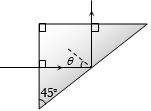
A
$n < \frac{1}{2}$
B
$n > \frac{1}{\sqrt{2}}$
C
$n > \sqrt{2}$
D
$n < \sqrt{2}$
Solution
(C) For total internal reflection,the angle of incidence $i$ must be greater than the critical angle $C$,i.e.,$i > C$.
From the figure,the ray strikes the hypotenuse at an angle of incidence $i = \theta = 45^o$.
For total internal reflection to occur,we must have $\theta > C$.
Taking the sine on both sides,$\sin \theta > \sin C$.
Since $\sin C = \frac{1}{n}$,where $n$ is the refractive index of the glass relative to air,we have $\sin \theta > \frac{1}{n}$.
Rearranging for $n$,we get $n > \frac{1}{\sin \theta}$.
Substituting $\theta = 45^o$,we get $n > \frac{1}{\sin 45^o} = \frac{1}{1/\sqrt{2}} = \sqrt{2}$.
Thus,the refractive index of the glass must be $n > \sqrt{2}$.
From the figure,the ray strikes the hypotenuse at an angle of incidence $i = \theta = 45^o$.
For total internal reflection to occur,we must have $\theta > C$.
Taking the sine on both sides,$\sin \theta > \sin C$.
Since $\sin C = \frac{1}{n}$,where $n$ is the refractive index of the glass relative to air,we have $\sin \theta > \frac{1}{n}$.
Rearranging for $n$,we get $n > \frac{1}{\sin \theta}$.
Substituting $\theta = 45^o$,we get $n > \frac{1}{\sin 45^o} = \frac{1}{1/\sqrt{2}} = \sqrt{2}$.
Thus,the refractive index of the glass must be $n > \sqrt{2}$.
0 likesView Solution
64
PhysicsMediumMCQAIEEE · 2004
The angle of incidence at which reflected light is totally polarized for reflection from air to glass (refractive index $n$) is
A
$\sin^{-1}(n)$
B
$\sin^{-1}(1/n)$
C
$\tan^{-1}(1/n)$
D
$\tan^{-1}(n)$
Solution
(D) According to Brewster's Law,when light is incident at the polarizing angle (Brewster's angle,$\theta_p$),the reflected light is completely plane-polarized.
Brewster's Law states that the refractive index $n$ of the medium is equal to the tangent of the polarizing angle $\theta_p$.
Mathematically,$n = \tan(\theta_p)$.
Therefore,the polarizing angle is $\theta_p = \tan^{-1}(n)$.
Brewster's Law states that the refractive index $n$ of the medium is equal to the tangent of the polarizing angle $\theta_p$.
Mathematically,$n = \tan(\theta_p)$.
Therefore,the polarizing angle is $\theta_p = \tan^{-1}(n)$.
0 likesView Solution
65
PhysicsEasyMCQAIEEE · 2004
An electromagnetic wave of frequency $\nu = 3.0\,MHz$ passes from vacuum into a dielectric medium with permittivity $\varepsilon = 4.0\varepsilon_0$. Then
A
Wavelength is doubled and the frequency remains unchanged
B
Wavelength is doubled and frequency becomes half
C
Wavelength is halved and frequency remains unchanged
D
Wavelength and frequency both remain unchanged
Solution
(C) The refractive index $n$ of a medium is given by $n = \sqrt{\frac{\mu\varepsilon}{\mu_0\varepsilon_0}}$.
Assuming the medium is non-magnetic,$\mu = \mu_0$,so $n = \sqrt{\frac{\varepsilon}{\varepsilon_0}}$.
Given the relative permittivity (dielectric constant) $K = \frac{\varepsilon}{\varepsilon_0} = 4.0$,we have $n = \sqrt{4.0} = 2$.
The frequency $\nu$ of an electromagnetic wave depends only on the source and remains unchanged when passing through different media.
The speed of the wave in the medium is $v = \frac{c}{n} = \frac{c}{2}$.
Since $v = \nu\lambda$,the new wavelength $\lambda' = \frac{v}{\nu} = \frac{c/2}{\nu} = \frac{\lambda}{2}$.
Thus,the wavelength is halved and the frequency remains unchanged.
Assuming the medium is non-magnetic,$\mu = \mu_0$,so $n = \sqrt{\frac{\varepsilon}{\varepsilon_0}}$.
Given the relative permittivity (dielectric constant) $K = \frac{\varepsilon}{\varepsilon_0} = 4.0$,we have $n = \sqrt{4.0} = 2$.
The frequency $\nu$ of an electromagnetic wave depends only on the source and remains unchanged when passing through different media.
The speed of the wave in the medium is $v = \frac{c}{n} = \frac{c}{2}$.
Since $v = \nu\lambda$,the new wavelength $\lambda' = \frac{v}{\nu} = \frac{c/2}{\nu} = \frac{\lambda}{2}$.
Thus,the wavelength is halved and the frequency remains unchanged.
0 likesView Solution
66
PhysicsDifficultMCQAIEEE · 2004
The maximum number of possible interference maxima for slit-separation equal to twice the wavelength in Young's double-slit experiment is
A
Infinite
B
$5$
C
$3$
D
$0$
Solution
(B) For interference maxima,the path difference is given by $\Delta = d \sin \theta = n\lambda$,where $n$ is an integer.
Given that the slit separation $d = 2\lambda$.
Substituting this into the equation: $2\lambda \sin \theta = n\lambda$,which simplifies to $\sin \theta = \frac{n}{2}$.
Since the value of $\sin \theta$ must lie in the range $[-1, 1]$,we have $-1 \le \frac{n}{2} \le 1$,which implies $-2 \le n \le 2$.
The possible integer values for $n$ are $-2, -1, 0, 1, 2$.
Counting these values,we get a total of $5$ maxima.
Given that the slit separation $d = 2\lambda$.
Substituting this into the equation: $2\lambda \sin \theta = n\lambda$,which simplifies to $\sin \theta = \frac{n}{2}$.
Since the value of $\sin \theta$ must lie in the range $[-1, 1]$,we have $-1 \le \frac{n}{2} \le 1$,which implies $-2 \le n \le 2$.
The possible integer values for $n$ are $-2, -1, 0, 1, 2$.
Counting these values,we get a total of $5$ maxima.
0 likesView Solution
67
PhysicsEasyMCQAIEEE · 2004
$A$ radiation of energy $E$ falls normally on a perfectly reflecting surface. The momentum transferred to the surface is ($C =$ velocity of light).
A
$E/C$
B
$2E/C$
C
$2E/C^2$
D
$E/C^2$
Solution
(B) The energy of a photon is given by $E = pc$,where $p$ is the momentum of the photon and $C$ is the speed of light.
Therefore,the initial momentum of the radiation incident on the surface is $p_i = E/C$.
Since the surface is perfectly reflecting,the radiation reflects back with the same magnitude of momentum but in the opposite direction.
Thus,the final momentum of the radiation is $p_f = -E/C$.
The momentum transferred to the surface is the change in momentum of the radiation,given by $\Delta p = p_i - p_f$.
Substituting the values,we get $\Delta p = E/C - (-E/C) = E/C + E/C = 2E/C$.
Therefore,the initial momentum of the radiation incident on the surface is $p_i = E/C$.
Since the surface is perfectly reflecting,the radiation reflects back with the same magnitude of momentum but in the opposite direction.
Thus,the final momentum of the radiation is $p_f = -E/C$.
The momentum transferred to the surface is the change in momentum of the radiation,given by $\Delta p = p_i - p_f$.
Substituting the values,we get $\Delta p = E/C - (-E/C) = E/C + E/C = 2E/C$.
0 likesView Solution
68
PhysicsMediumMCQAIEEE · 2004
The binding energy per nucleon in deuterium and helium nuclei are $1.1 \, MeV$ and $7.0 \, MeV,$ respectively. When two deuterium nuclei fuse to form a helium nucleus,the energy released in the fusion is ........... $MeV$.
A
$19.2$
B
$23.6$
C
$26.9$
D
$13.9$
Solution
(B) The nuclear fusion reaction is given by: $_1H^2 + _1H^2 \to _2He^4 + \Delta E$.
The binding energy per nucleon of a deuteron is $1.1 \, MeV$.
Since a deuteron has $2$ nucleons,the total binding energy of one deuteron is $2 \times 1.1 = 2.2 \, MeV$.
For two deuterium nuclei,the total initial binding energy is $2 \times 2.2 = 4.4 \, MeV$.
The binding energy per nucleon of a helium nucleus $(He^4)$ is $7.0 \, MeV$.
Since a helium nucleus has $4$ nucleons,the total binding energy is $4 \times 7.0 = 28.0 \, MeV$.
The energy released in the fusion process is the difference between the total binding energy of the product and the total binding energy of the reactants:
$\Delta E = 28.0 \, MeV - 4.4 \, MeV = 23.6 \, MeV$.
The binding energy per nucleon of a deuteron is $1.1 \, MeV$.
Since a deuteron has $2$ nucleons,the total binding energy of one deuteron is $2 \times 1.1 = 2.2 \, MeV$.
For two deuterium nuclei,the total initial binding energy is $2 \times 2.2 = 4.4 \, MeV$.
The binding energy per nucleon of a helium nucleus $(He^4)$ is $7.0 \, MeV$.
Since a helium nucleus has $4$ nucleons,the total binding energy is $4 \times 7.0 = 28.0 \, MeV$.
The energy released in the fusion process is the difference between the total binding energy of the product and the total binding energy of the reactants:
$\Delta E = 28.0 \, MeV - 4.4 \, MeV = 23.6 \, MeV$.
0 likesView Solution
69
PhysicsMediumMCQAIEEE · 2004
$A$ charged oil drop is suspended in a uniform electric field of $3 \times 10^{4} \; V/m$ so that it neither falls nor rises. The charge on the drop will be $..... \times 10^{-18} \; C$. (Take the mass of the drop $= 9.9 \times 10^{-15} \; kg$ and $g = 10 \; m/s^{2}$)
A
$3.3$
B
$3.2$
C
$1.6$
D
$4.8$
Solution
(A) Since the oil drop is suspended in equilibrium,the gravitational force acting downwards is balanced by the upward electric force.
$F_{e} = F_{g}$
$qE = mg$
$q = \frac{mg}{E}$
Substituting the given values:
$q = \frac{9.9 \times 10^{-15} \times 10}{3 \times 10^{4}}$
$q = \frac{9.9 \times 10^{-14}}{3 \times 10^{4}}$
$q = 3.3 \times 10^{-18} \; C$
Thus,the charge on the drop is $3.3 \times 10^{-18} \; C$.
$F_{e} = F_{g}$
$qE = mg$
$q = \frac{mg}{E}$
Substituting the given values:
$q = \frac{9.9 \times 10^{-15} \times 10}{3 \times 10^{4}}$
$q = \frac{9.9 \times 10^{-14}}{3 \times 10^{4}}$
$q = 3.3 \times 10^{-18} \; C$
Thus,the charge on the drop is $3.3 \times 10^{-18} \; C$.
1 likesView Solution
70
PhysicsEasyMCQAIEEE · 2004
$A$ current $i$ $A$ flows along an infinitely long straight thin-walled tube. The magnetic induction at any point inside the tube is:
A
$\infty$
B
Zero
C
$\frac{\mu_0}{4\pi} \cdot \frac{2i}{r} \text{ T}$
D
$\frac{2i}{r} \text{ T}$
Solution
(B) According to Ampere's circuital law,the line integral of the magnetic field $\vec{B}$ around any closed loop is equal to $\mu_0$ times the net current $I_{\text{en}}$ enclosed by the loop: $\oint \vec{B} \cdot d\vec{l} = \mu_0 I_{\text{en}}$.
For any point inside an infinitely long thin-walled tube,we can consider a circular Amperian loop of radius $r$ (where $r < R$,the radius of the tube).
Since the current $i$ flows only along the surface of the tube,the current enclosed by this Amperian loop is $I_{\text{en}} = 0$.
Therefore,$\oint \vec{B} \cdot d\vec{l} = \mu_0(0) = 0$.
This implies that the magnetic induction $B$ at any point inside the tube is $0$.
For any point inside an infinitely long thin-walled tube,we can consider a circular Amperian loop of radius $r$ (where $r < R$,the radius of the tube).
Since the current $i$ flows only along the surface of the tube,the current enclosed by this Amperian loop is $I_{\text{en}} = 0$.
Therefore,$\oint \vec{B} \cdot d\vec{l} = \mu_0(0) = 0$.
This implies that the magnetic induction $B$ at any point inside the tube is $0$.
0 likesView Solution
71
PhysicsDifficultMCQAIEEE · 2004
In a uniform magnetic field of induction $B$,a wire in the form of a semicircle of radius $r$ rotates about the diameter of the circle with angular frequency $\omega$. The axis of rotation is perpendicular to the field. If the total resistance of the circuit is $R$,the mean power generated per period of rotation is
A
$\frac{B \pi r^{2} \omega}{2 R}$
B
$\frac{(B \pi r^{2} \omega)^{2}}{8 R}$
C
$\frac{(B \pi r \omega)^{2}}{2 R}$
D
$\frac{(B \pi r \omega^{2})^{2}}{8 R}$
Solution
(B) The area of the semicircle is $A = \frac{1}{2} \pi r^{2}$.
The magnetic flux linked with the loop at time $t$ is $\phi = B A \cos(\omega t) = B \left(\frac{1}{2} \pi r^{2}\right) \cos(\omega t)$.
The induced electromotive force $(EMF)$ is given by Faraday's law: $\varepsilon = -\frac{d\phi}{dt} = \frac{1}{2} B \pi r^{2} \omega \sin(\omega t)$.
The instantaneous power generated is $P(t) = \frac{\varepsilon^{2}}{R} = \frac{(\frac{1}{2} B \pi r^{2} \omega \sin(\omega t))^{2}}{R} = \frac{B^{2} \pi^{2} r^{4} \omega^{2} \sin^{2}(\omega t)}{4 R}$.
The mean power over a full period is $\langle P \rangle = \frac{B^{2} \pi^{2} r^{4} \omega^{2}}{4 R} \langle \sin^{2}(\omega t) \rangle$.
Since the mean value of $\sin^{2}(\omega t)$ over a period is $\frac{1}{2}$,we have $\langle P \rangle = \frac{B^{2} \pi^{2} r^{4} \omega^{2}}{4 R} \cdot \frac{1}{2} = \frac{(B \pi r^{2} \omega)^{2}}{8 R}$.
The magnetic flux linked with the loop at time $t$ is $\phi = B A \cos(\omega t) = B \left(\frac{1}{2} \pi r^{2}\right) \cos(\omega t)$.
The induced electromotive force $(EMF)$ is given by Faraday's law: $\varepsilon = -\frac{d\phi}{dt} = \frac{1}{2} B \pi r^{2} \omega \sin(\omega t)$.
The instantaneous power generated is $P(t) = \frac{\varepsilon^{2}}{R} = \frac{(\frac{1}{2} B \pi r^{2} \omega \sin(\omega t))^{2}}{R} = \frac{B^{2} \pi^{2} r^{4} \omega^{2} \sin^{2}(\omega t)}{4 R}$.
The mean power over a full period is $\langle P \rangle = \frac{B^{2} \pi^{2} r^{4} \omega^{2}}{4 R} \langle \sin^{2}(\omega t) \rangle$.
Since the mean value of $\sin^{2}(\omega t)$ over a period is $\frac{1}{2}$,we have $\langle P \rangle = \frac{B^{2} \pi^{2} r^{4} \omega^{2}}{4 R} \cdot \frac{1}{2} = \frac{(B \pi r^{2} \omega)^{2}}{8 R}$.
0 likesView Solution
72
PhysicsMediumMCQAIEEE · 2004
$A$ long wire carries a steady current. It is bent into a circle of one turn and the magnetic field at the centre of the coil is $B$. It is then bent into a circular loop of $n$ turns. The magnetic field at the centre of the coil for the same current will be
A
$n B$
B
$n^{2} B$
C
$2 n B$
D
$2 n^{2} B$
Solution
(B) Let the length of the wire be $L$. For a single turn loop of radius $r$,the circumference is $2 \pi r = L$,so $r = \frac{L}{2 \pi}$.
The magnetic field at the centre of a single turn loop is $B = \frac{\mu_{0} I}{2 r} = \frac{\mu_{0} I}{2 (L / 2 \pi)} = \frac{\mu_{0} I \pi}{L}$.
When the same wire is bent into $n$ turns,the new radius $r'$ satisfies $n (2 \pi r') = L$,so $r' = \frac{L}{2 \pi n} = \frac{r}{n}$.
The magnetic field at the centre of the $n$-turn loop is $B_{n} = n \times \frac{\mu_{0} I}{2 r'} = n \times \frac{\mu_{0} I}{2 (r / n)} = n^{2} \times \frac{\mu_{0} I}{2 r}$.
Since $B = \frac{\mu_{0} I}{2 r}$,we have $B_{n} = n^{2} B$.
The magnetic field at the centre of a single turn loop is $B = \frac{\mu_{0} I}{2 r} = \frac{\mu_{0} I}{2 (L / 2 \pi)} = \frac{\mu_{0} I \pi}{L}$.
When the same wire is bent into $n$ turns,the new radius $r'$ satisfies $n (2 \pi r') = L$,so $r' = \frac{L}{2 \pi n} = \frac{r}{n}$.
The magnetic field at the centre of the $n$-turn loop is $B_{n} = n \times \frac{\mu_{0} I}{2 r'} = n \times \frac{\mu_{0} I}{2 (r / n)} = n^{2} \times \frac{\mu_{0} I}{2 r}$.
Since $B = \frac{\mu_{0} I}{2 r}$,we have $B_{n} = n^{2} B$.
0 likesView Solution
73
PhysicsMediumMCQAIEEE · 2004
Four charges equal to $-Q$ are placed at the four corners of a square and a charge $q$ is at its centre. If the system is in equilibrium,the value of $q$ is
A
$\frac{-Q}{4}(1+2 \sqrt{2})$
B
$\frac{Q}{4}(1+2 \sqrt{2})$
C
$\frac{-Q}{2}(1+2 \sqrt{2})$
D
$\frac{Q}{2}(1+2 \sqrt{2})$
Solution
(B) Let the side of the square be $a$. The distance of the center from each corner is $r = \frac{a}{\sqrt{2}}$.
For the system to be in equilibrium,the net force on any charge at the corner must be zero.
Consider a charge $-Q$ at one corner. The forces acting on it are:
$1$. Repulsive forces from the other three charges $-Q$ at the corners.
Let $F = \frac{1}{4 \pi \epsilon_0} \frac{Q^2}{a^2}$.
The resultant of the two forces along the sides is $F_{res} = \sqrt{F^2 + F^2} = \sqrt{2} F$.
The force from the diagonal charge is $F_{diag} = \frac{1}{4 \pi \epsilon_0} \frac{Q^2}{(\sqrt{2}a)^2} = \frac{F}{2}$.
Total repulsive force $F_{total} = \sqrt{2} F + \frac{F}{2} = F(\sqrt{2} + \frac{1}{2})$.
$2$. Attractive force from the central charge $q$: $F_q = \frac{1}{4 \pi \epsilon_0} \frac{q Q}{r^2} = \frac{1}{4 \pi \epsilon_0} \frac{q Q}{(a/\sqrt{2})^2} = \frac{2 q Q}{4 \pi \epsilon_0 a^2}$.
For equilibrium,$F_q = F_{total} \implies \frac{2 q Q}{4 \pi \epsilon_0 a^2} = \frac{Q^2}{4 \pi \epsilon_0 a^2} (\sqrt{2} + \frac{1}{2})$.
$2q = Q(\sqrt{2} + 0.5) = Q(\frac{2\sqrt{2}+1}{2})$.
$q = \frac{Q}{4}(1 + 2\sqrt{2})$.
Since the force must be attractive,$q$ must have a sign opposite to $-Q$,so $q$ is positive.
For the system to be in equilibrium,the net force on any charge at the corner must be zero.
Consider a charge $-Q$ at one corner. The forces acting on it are:
$1$. Repulsive forces from the other three charges $-Q$ at the corners.
Let $F = \frac{1}{4 \pi \epsilon_0} \frac{Q^2}{a^2}$.
The resultant of the two forces along the sides is $F_{res} = \sqrt{F^2 + F^2} = \sqrt{2} F$.
The force from the diagonal charge is $F_{diag} = \frac{1}{4 \pi \epsilon_0} \frac{Q^2}{(\sqrt{2}a)^2} = \frac{F}{2}$.
Total repulsive force $F_{total} = \sqrt{2} F + \frac{F}{2} = F(\sqrt{2} + \frac{1}{2})$.
$2$. Attractive force from the central charge $q$: $F_q = \frac{1}{4 \pi \epsilon_0} \frac{q Q}{r^2} = \frac{1}{4 \pi \epsilon_0} \frac{q Q}{(a/\sqrt{2})^2} = \frac{2 q Q}{4 \pi \epsilon_0 a^2}$.
For equilibrium,$F_q = F_{total} \implies \frac{2 q Q}{4 \pi \epsilon_0 a^2} = \frac{Q^2}{4 \pi \epsilon_0 a^2} (\sqrt{2} + \frac{1}{2})$.
$2q = Q(\sqrt{2} + 0.5) = Q(\frac{2\sqrt{2}+1}{2})$.
$q = \frac{Q}{4}(1 + 2\sqrt{2})$.
Since the force must be attractive,$q$ must have a sign opposite to $-Q$,so $q$ is positive.
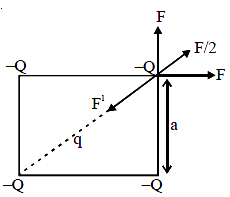
0 likesView Solution
Vedclass Products
For Students
Vedclass Test Series
Mock tests in real AIEEE style covering Physics with performance analysis. 5-day free trial.
Start Free TrialFor Teachers
Exam Paper Generator
Generate Set A/B/C/D Physics papers from 7.5L+ questions in 2 minutes. 3 chapters free.
Try FreeFor Institutes
Online Exam Module
Run live AIEEE mock exams with unlimited students, 360° analytics & white-label branding.
See DemoFrequently Asked Questions
How many Physics questions are in AIEEE 2004?
There are 73 Physics questions from the AIEEE 2004 paper on Vedclass, each with a detailed step-by-step solution in English.
Are AIEEE 2004 Physics solutions available in English?
Yes. All solutions on this page are in English. You can also switch to English or Hindi using the language buttons above the questions.
Can I practice AIEEE 2004 Physics as a timed test?
Yes. Use the Vedclass Test Series to attempt a full AIEEE mock test covering Physics with time limits and instant score analysis.
Can teachers create Physics papers from AIEEE previous year questions?
Yes. The Vedclass Exam Paper Generator lets teachers mix AIEEE Physics questions and generate Set A/B/C/D papers in minutes.
For Teachers & Institutes
Build a Custom Physics Paper
Pick AIEEE 2004 Physics questions, set difficulty, and generate Set A/B/C/D in 2 minutes.