
PhysicsQ1–40 of 40 questions
Page 1 of 1 · English
1
PhysicsMediumMCQAIEEE · 2007
The velocity of a particle is $v = v_0 + gt + ft^2$. If its position is $x = 0$ at $t = 0$,then its displacement after unit time $(t = 1)$ is
A
$v_0 + \frac{g}{2} + f$
B
$v_0 + 2g + 3f$
C
$v_0 + \frac{g}{2} + \frac{f}{3}$
D
$v_0 + g + f$
Solution
(C) We know that velocity $v = \frac{dx}{dt}$,which implies $dx = v \, dt$.
Integrating both sides with initial condition $x = 0$ at $t = 0$:
$x = \int_{0}^{t} v \, dt = \int_{0}^{t} (v_0 + gt + ft^2) \, dt$.
Performing the integration:
$x = \left[ v_0 t + \frac{gt^2}{2} + \frac{ft^3}{3} \right]_{0}^{t} = v_0 t + \frac{gt^2}{2} + \frac{ft^3}{3}$.
To find the displacement at unit time $(t = 1)$,substitute $t = 1$ into the expression:
$x = v_0(1) + \frac{g(1)^2}{2} + \frac{f(1)^3}{3} = v_0 + \frac{g}{2} + \frac{f}{3}$.
Integrating both sides with initial condition $x = 0$ at $t = 0$:
$x = \int_{0}^{t} v \, dt = \int_{0}^{t} (v_0 + gt + ft^2) \, dt$.
Performing the integration:
$x = \left[ v_0 t + \frac{gt^2}{2} + \frac{ft^3}{3} \right]_{0}^{t} = v_0 t + \frac{gt^2}{2} + \frac{ft^3}{3}$.
To find the displacement at unit time $(t = 1)$,substitute $t = 1$ into the expression:
$x = v_0(1) + \frac{g(1)^2}{2} + \frac{f(1)^3}{3} = v_0 + \frac{g}{2} + \frac{f}{3}$.
0 likesView Solution
2
PhysicsMediumMCQAIEEE · 2007
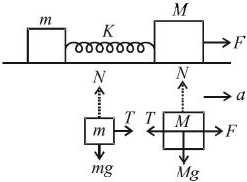
$A$ block of mass $m$ is connected to another block of mass $M$ by a massless spring of spring constant $k$. The blocks are kept on a smooth horizontal plane. Initially,the blocks are at rest and the spring is unstretched. Then a constant force $F$ starts acting on the block of mass $M$ to pull it. Find the force acting on the block of mass $m$.
A
$\frac{MF}{m + M}$
B
$\frac{mF}{M}$
C
$\frac{(m + M)F}{m}$
D
$\frac{mF}{m + M}$
Solution
(D) Let the acceleration of the system be $a$. Since the blocks are connected by a spring and move together on a smooth horizontal surface,both blocks will have the same acceleration $a$.
For the system of two blocks,the net force is $F$. According to Newton's second law,$F = (m + M)a$,which gives $a = \frac{F}{m + M}$.
The force acting on the block of mass $m$ is the spring force $T$. Applying Newton's second law to the block of mass $m$,we get $T = ma$.
Substituting the value of $a$,we get $T = m \left( \frac{F}{m + M} \right) = \frac{mF}{m + M}$.
For the system of two blocks,the net force is $F$. According to Newton's second law,$F = (m + M)a$,which gives $a = \frac{F}{m + M}$.
The force acting on the block of mass $m$ is the spring force $T$. Applying Newton's second law to the block of mass $m$,we get $T = ma$.
Substituting the value of $a$,we get $T = m \left( \frac{F}{m + M} \right) = \frac{mF}{m + M}$.
0 likesView Solution
3
PhysicsMediumMCQAIEEE · 2007
$A$ $2 \ kg$ block slides on a horizontal floor with a speed of $4 \ m/s$. It strikes an uncompressed spring and compresses it until the block is motionless. The kinetic friction force is $15 \ N$ and the spring constant is $10,000 \ N/m$. The spring compresses by ............. $cm$.
A
$5.5$
B
$2.5$
C
$11$
D
$8.5$
Solution
(A) Let the block compress the spring by $x$ meters before coming to rest.
According to the work-energy theorem,the initial kinetic energy of the block is equal to the sum of the potential energy stored in the spring and the work done against friction.
Initial Kinetic Energy $(K_i)$ = $\frac{1}{2} m v^2 = \frac{1}{2} \times 2 \times (4)^2 = 16 \ J$.
Work done against friction $(W_f)$ = $f_k \times x = 15x$.
Potential energy of the spring $(U_s)$ = $\frac{1}{2} k x^2 = \frac{1}{2} \times 10,000 \times x^2 = 5,000x^2$.
Applying the energy balance: $K_i = U_s + W_f$.
$16 = 5,000x^2 + 15x$.
$5,000x^2 + 15x - 16 = 0$.
Using the quadratic formula $x = \frac{-b \pm \sqrt{b^2 - 4ac}}{2a}$:
$x = \frac{-15 + \sqrt{15^2 - 4(5,000)(-16)}}{2 \times 5,000} = \frac{-15 + \sqrt{225 + 320,000}}{10,000} = \frac{-15 + \sqrt{320,225}}{10,000} \approx \frac{-15 + 565.88}{10,000} \approx 0.055 \ m$.
$x = 5.5 \ cm$.
According to the work-energy theorem,the initial kinetic energy of the block is equal to the sum of the potential energy stored in the spring and the work done against friction.
Initial Kinetic Energy $(K_i)$ = $\frac{1}{2} m v^2 = \frac{1}{2} \times 2 \times (4)^2 = 16 \ J$.
Work done against friction $(W_f)$ = $f_k \times x = 15x$.
Potential energy of the spring $(U_s)$ = $\frac{1}{2} k x^2 = \frac{1}{2} \times 10,000 \times x^2 = 5,000x^2$.
Applying the energy balance: $K_i = U_s + W_f$.
$16 = 5,000x^2 + 15x$.
$5,000x^2 + 15x - 16 = 0$.
Using the quadratic formula $x = \frac{-b \pm \sqrt{b^2 - 4ac}}{2a}$:
$x = \frac{-15 + \sqrt{15^2 - 4(5,000)(-16)}}{2 \times 5,000} = \frac{-15 + \sqrt{225 + 320,000}}{10,000} = \frac{-15 + \sqrt{320,225}}{10,000} \approx \frac{-15 + 565.88}{10,000} \approx 0.055 \ m$.
$x = 5.5 \ cm$.
0 likesView Solution
4
PhysicsMediumMCQAIEEE · 2007
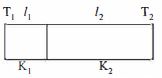
One end of a thermally insulated rod is kept at a temperature $T_1$ and the other at $T_2$. The rod is composed of two sections of length $l_1$ and $l_2$ and thermal conductivities $K_1$ and $K_2$ respectively. The temperature at the interface of the two sections is
A
$\frac{K_1 l_2 T_1 + K_2 l_1 T_2}{K_1 l_2 + K_2 l_1}$
B
$\frac{K_2 l_1 T_1 + K_1 l_2 T_2}{K_2 l_1 + K_1 l_2}$
C
$\frac{K_1 l_1 T_1 + K_2 l_2 T_2}{K_1 l_1 + K_2 l_2}$
D
$\frac{K_2 l_2 T_1 + K_1 l_1 T_2}{K_1 l_1 + K_2 l_2}$
Solution
(A) In steady state,the rate of heat flow through both sections is the same.
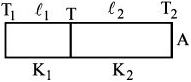
Let $T$ be the temperature at the interface.
The rate of heat flow $H$ is given by $H = \frac{KA(T_{high} - T_{low})}{l}$.
For the first section: $H = \frac{K_1 A(T_1 - T)}{l_1}$.
For the second section: $H = \frac{K_2 A(T - T_2)}{l_2}$.
Equating the two rates: $\frac{K_1 A(T_1 - T)}{l_1} = \frac{K_2 A(T - T_2)}{l_2}$.
$\frac{K_1(T_1 - T)}{l_1} = \frac{K_2(T - T_2)}{l_2}$.
$K_1 l_2(T_1 - T) = K_2 l_1(T - T_2)$.
$K_1 l_2 T_1 - K_1 l_2 T = K_2 l_1 T - K_2 l_1 T_2$.
$K_1 l_2 T_1 + K_2 l_1 T_2 = T(K_1 l_2 + K_2 l_1)$.
$T = \frac{K_1 l_2 T_1 + K_2 l_1 T_2}{K_1 l_2 + K_2 l_1}$.
Let $T$ be the temperature at the interface.
The rate of heat flow $H$ is given by $H = \frac{KA(T_{high} - T_{low})}{l}$.
For the first section: $H = \frac{K_1 A(T_1 - T)}{l_1}$.
For the second section: $H = \frac{K_2 A(T - T_2)}{l_2}$.
Equating the two rates: $\frac{K_1 A(T_1 - T)}{l_1} = \frac{K_2 A(T - T_2)}{l_2}$.
$\frac{K_1(T_1 - T)}{l_1} = \frac{K_2(T - T_2)}{l_2}$.
$K_1 l_2(T_1 - T) = K_2 l_1(T - T_2)$.
$K_1 l_2 T_1 - K_1 l_2 T = K_2 l_1 T - K_2 l_1 T_2$.
$K_1 l_2 T_1 + K_2 l_1 T_2 = T(K_1 l_2 + K_2 l_1)$.
$T = \frac{K_1 l_2 T_1 + K_2 l_1 T_2}{K_1 l_2 + K_2 l_1}$.
0 likesView Solution
5
PhysicsMediumMCQAIEEE · 2007
$A$ round uniform body of radius $R$,mass $M$,and moment of inertia $I$ rolls down (without slipping) an inclined plane making an angle $\theta$ with the horizontal. Then its acceleration is
A
$\frac{g \sin \theta}{1 + \frac{M R^2}{I}}$
B
$\frac{g \sin \theta}{1 + \frac{I}{M R^2}}$
C
$\frac{g \sin \theta}{1 - \frac{M R^2}{I}}$
D
$\frac{g \sin \theta}{1 - \frac{I}{M R^2}}$
Solution
(B) For a body rolling down an inclined plane without slipping,the forces acting on it are the component of gravity $Mg \sin \theta$ down the plane and the static friction $f$ acting up the plane.
Applying Newton's second law for linear motion: $Mg \sin \theta - f = Ma$ (where $a$ is the linear acceleration).
Applying Newton's second law for rotational motion about the center of mass: $\tau = I \alpha = fR$,where $\alpha = a/R$ is the angular acceleration.
Substituting $f = I \alpha / R = I a / R^2$ into the linear equation:
$Mg \sin \theta - \frac{I a}{R^2} = Ma$
$Mg \sin \theta = Ma + \frac{I a}{R^2} = Ma(1 + \frac{I}{M R^2})$
Solving for $a$,we get: $a = \frac{g \sin \theta}{1 + \frac{I}{M R^2}}$.
Applying Newton's second law for linear motion: $Mg \sin \theta - f = Ma$ (where $a$ is the linear acceleration).
Applying Newton's second law for rotational motion about the center of mass: $\tau = I \alpha = fR$,where $\alpha = a/R$ is the angular acceleration.
Substituting $f = I \alpha / R = I a / R^2$ into the linear equation:
$Mg \sin \theta - \frac{I a}{R^2} = Ma$
$Mg \sin \theta = Ma + \frac{I a}{R^2} = Ma(1 + \frac{I}{M R^2})$
Solving for $a$,we get: $a = \frac{g \sin \theta}{1 + \frac{I}{M R^2}}$.
0 likesView Solution
6
PhysicsEasyMCQAIEEE · 2007
Angular momentum of a particle rotating under a central force is constant due to
A
constant torque
B
constant force
C
constant linear momentum
D
zero torque
Solution
(D) We know that the torque $\vec{\tau}$ is defined as the rate of change of angular momentum $\vec{L}$,given by $\vec{\tau} = \frac{d\vec{L}}{dt}$.
$A$ central force is a force that acts along the line joining the particle to the center of force (origin). Since the position vector $\vec{r}$ and the force vector $\vec{F}$ are collinear,the torque $\vec{\tau} = \vec{r} \times \vec{F}$ is equal to zero.
Since $\vec{\tau} = 0$,it follows from the relation $\frac{d\vec{L}}{dt} = 0$ that the angular momentum $\vec{L}$ remains constant over time.
$A$ central force is a force that acts along the line joining the particle to the center of force (origin). Since the position vector $\vec{r}$ and the force vector $\vec{F}$ are collinear,the torque $\vec{\tau} = \vec{r} \times \vec{F}$ is equal to zero.
Since $\vec{\tau} = 0$,it follows from the relation $\frac{d\vec{L}}{dt} = 0$ that the angular momentum $\vec{L}$ remains constant over time.
0 likesView Solution
7
PhysicsMediumMCQAIEEE · 2007
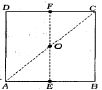
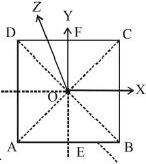
For the given uniform square lamina $ABCD$,whose centre is $O$,which of the following relations is correct?
A
$I_{AC} = \sqrt{2} I_{EF}$
B
$\sqrt{2} I_{AC} = I_{EF}$
C
$I_{AO} = 3 I_{EF}$
D
$I_{AC} = I_{EF}$
Solution
(D) Let the square lamina have mass $M$ and side length $a$. The moment of inertia of a square lamina about an axis passing through its centre $O$ and perpendicular to its plane $(I_z)$ is given by $I_z = I_x + I_y$,where $I_x$ and $I_y$ are moments of inertia about the axes passing through the centre and parallel to the sides. By symmetry,$I_x = I_y = I_{EF} = I_{GH}$ (where $EF$ and $GH$ are axes passing through the midpoints of opposite sides). Thus,$I_z = 2 I_{EF}$.
Similarly,the moment of inertia about the diagonal axes $AC$ and $BD$ are equal by symmetry,so $I_{AC} = I_{BD}$. According to the perpendicular axes theorem,$I_z = I_{AC} + I_{BD} = 2 I_{AC}$.
Equating the two expressions for $I_z$,we get $2 I_{EF} = 2 I_{AC}$,which simplifies to $I_{AC} = I_{EF}$.
Similarly,the moment of inertia about the diagonal axes $AC$ and $BD$ are equal by symmetry,so $I_{AC} = I_{BD}$. According to the perpendicular axes theorem,$I_z = I_{AC} + I_{BD} = 2 I_{AC}$.
Equating the two expressions for $I_z$,we get $2 I_{EF} = 2 I_{AC}$,which simplifies to $I_{AC} = I_{EF}$.
0 likesView Solution
8
PhysicsMediumMCQAIEEE · 2007
If $C_p$ and $C_v$ denote the specific heats of nitrogen per unit mass at constant pressure and constant volume respectively,then
A
$C_p - C_v = \frac{R}{14}$
B
$C_p - C_v = R$
C
$C_p - C_v = 28R$
D
$C_p - C_v = \frac{R}{28}$
Solution
(D) According to $Mayer's$ relation,the difference between molar specific heats is given by $C_{p,m} - C_{v,m} = R$.
To find the specific heat per unit mass,we divide the molar specific heats by the molar mass $M$ of the gas.
For nitrogen gas $(N_2)$,the molar mass $M = 28 \ g/mol = 28 \times 10^{-3} \ kg/mol$.
Therefore,the specific heat difference is $C_p - C_v = \frac{C_{p,m}}{M} - \frac{C_{v,m}}{M} = \frac{R}{M}$.
Substituting $M = 28$,we get $C_p - C_v = \frac{R}{28}$.
To find the specific heat per unit mass,we divide the molar specific heats by the molar mass $M$ of the gas.
For nitrogen gas $(N_2)$,the molar mass $M = 28 \ g/mol = 28 \times 10^{-3} \ kg/mol$.
Therefore,the specific heat difference is $C_p - C_v = \frac{C_{p,m}}{M} - \frac{C_{v,m}}{M} = \frac{R}{M}$.
Substituting $M = 28$,we get $C_p - C_v = \frac{R}{28}$.
0 likesView Solution
9
PhysicsMediumMCQAIEEE · 2007
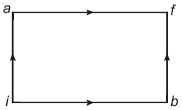
When a system is taken from state $i$ to state $f$ along the path $iaf$,it is found that $Q = 50 \ cal$ and $W = 20 \ cal$. Along the path $ibf$,$Q = 36 \ cal$. The work done $W$ along the path $ibf$ is ....... $cal$.
A
$14$
B
$6$
C
$16$
D
$66$
Solution
(B) According to the first law of thermodynamics,the change in internal energy $\Delta U$ is a state function and depends only on the initial and final states,not on the path taken.
For the path $iaf$:
$\Delta U = Q_{iaf} - W_{iaf}$
$\Delta U = 50 \, cal - 20 \, cal = 30 \, cal$.
Since the initial state $i$ and final state $f$ are the same for the path $ibf$,the change in internal energy $\Delta U$ remains the same.
For the path $ibf$:
$\Delta U = Q_{ibf} - W_{ibf}$
$30 \, cal = 36 \, cal - W_{ibf}$
$W_{ibf} = 36 \, cal - 30 \, cal = 6 \, cal$.
For the path $iaf$:
$\Delta U = Q_{iaf} - W_{iaf}$
$\Delta U = 50 \, cal - 20 \, cal = 30 \, cal$.
Since the initial state $i$ and final state $f$ are the same for the path $ibf$,the change in internal energy $\Delta U$ remains the same.
For the path $ibf$:
$\Delta U = Q_{ibf} - W_{ibf}$
$30 \, cal = 36 \, cal - W_{ibf}$
$W_{ibf} = 36 \, cal - 30 \, cal = 6 \, cal$.
0 likesView Solution
10
PhysicsDifficultMCQAIEEE · 2007
$A$ Carnot engine,having an efficiency of $\eta = 1/10$ as a heat engine,is used as a refrigerator. If the work done on the system is $10 \ J$,the amount of energy absorbed from the reservoir at a lower temperature is ....... $J$.
A
$100$
B
$99$
C
$90$
D
$1$
Solution
(C) The efficiency $(\eta)$ of a Carnot engine and the coefficient of performance $(\beta)$ of a refrigerator are related as:
$\beta = \frac{1 - \eta}{\eta}$
Given $\eta = 1/10$,we calculate the coefficient of performance:
$\beta = \frac{1 - 1/10}{1/10} = \frac{9/10}{1/10} = 9$
The coefficient of performance $(\beta)$ is also defined as the ratio of heat absorbed from the cold reservoir $(Q_2)$ to the work done $(W)$ on the system:
$\beta = \frac{Q_2}{W}$
Given $W = 10 \ J$ and $\beta = 9$,we have:
$9 = \frac{Q_2}{10 \ J}$
$Q_2 = 9 \times 10 \ J = 90 \ J$
Therefore,the energy absorbed from the reservoir at a lower temperature is $90 \ J$.
$\beta = \frac{1 - \eta}{\eta}$
Given $\eta = 1/10$,we calculate the coefficient of performance:
$\beta = \frac{1 - 1/10}{1/10} = \frac{9/10}{1/10} = 9$
The coefficient of performance $(\beta)$ is also defined as the ratio of heat absorbed from the cold reservoir $(Q_2)$ to the work done $(W)$ on the system:
$\beta = \frac{Q_2}{W}$
Given $W = 10 \ J$ and $\beta = 9$,we have:
$9 = \frac{Q_2}{10 \ J}$
$Q_2 = 9 \times 10 \ J = 90 \ J$
Therefore,the energy absorbed from the reservoir at a lower temperature is $90 \ J$.
0 likesView Solution
11
PhysicsMediumMCQAIEEE · 2007
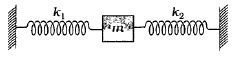
Two springs,of force constants $k_1$ and $k_2$ are connected to a mass $m$ as shown. The frequency of oscillation of the mass is $f$. If both $k_1$ and $k_2$ are made four times their original values,the frequency of oscillation becomes
A
$2f$
B
$f/2$
C
$f/4$
D
$4f$
Solution
(A) The two springs are connected in parallel to the mass $m$.
The effective spring constant $k_{eff}$ is given by $k_{eff} = k_1 + k_2$.
The frequency of oscillation is $f = \frac{1}{2\pi} \sqrt{\frac{k_1 + k_2}{m}}$ ... $(i)$
When both $k_1$ and $k_2$ are made four times their original values,the new spring constants are $k_1' = 4k_1$ and $k_2' = 4k_2$.
The new effective spring constant is $k_{eff}' = 4k_1 + 4k_2 = 4(k_1 + k_2)$.
The new frequency of oscillation $f'$ is given by $f' = \frac{1}{2\pi} \sqrt{\frac{k_{eff}'}{m}} = \frac{1}{2\pi} \sqrt{\frac{4(k_1 + k_2)}{m}}$.
$f' = 2 \times \left( \frac{1}{2\pi} \sqrt{\frac{k_1 + k_2}{m}} \right) = 2f$.
The effective spring constant $k_{eff}$ is given by $k_{eff} = k_1 + k_2$.
The frequency of oscillation is $f = \frac{1}{2\pi} \sqrt{\frac{k_1 + k_2}{m}}$ ... $(i)$
When both $k_1$ and $k_2$ are made four times their original values,the new spring constants are $k_1' = 4k_1$ and $k_2' = 4k_2$.
The new effective spring constant is $k_{eff}' = 4k_1 + 4k_2 = 4(k_1 + k_2)$.
The new frequency of oscillation $f'$ is given by $f' = \frac{1}{2\pi} \sqrt{\frac{k_{eff}'}{m}} = \frac{1}{2\pi} \sqrt{\frac{4(k_1 + k_2)}{m}}$.
$f' = 2 \times \left( \frac{1}{2\pi} \sqrt{\frac{k_1 + k_2}{m}} \right) = 2f$.
0 likesView Solution
12
PhysicsDifficultMCQAIEEE · 2007
$A$ particle of mass $m$ executes simple harmonic motion with amplitude $a$ and frequency $v$. The average kinetic energy during its motion from the position of equilibrium to the end is
A
$2\pi^2 m a^2 v^2$
B
$\pi^2 m a^2 v^2$
C
$\frac{1}{4} m a^2 v^2$
D
$4\pi^2 m a^2 v^2$
Solution
(B) The instantaneous kinetic energy $K$ of a particle executing $S.H.M.$ is given by $K = \frac{1}{2} m v_{inst}^2 = \frac{1}{2} m \omega^2 a^2 \cos^2(\omega t + \phi)$.
At the equilibrium position,the displacement is $x = 0$,so $x = a \sin(\omega t)$,which implies $\omega t = 0$. At the extreme position,$x = a$,so $\omega t = \pi/2$.
The average kinetic energy over an interval is defined as $\langle K \rangle = \frac{1}{T'} \int_0^{T'} K dt$,where $T'$ is the time taken to move from equilibrium to the extreme position $(T' = T/4 = 1/(4v))$.
$\langle K \rangle = \frac{1}{T/4} \int_0^{T/4} \frac{1}{2} m \omega^2 a^2 \cos^2(\omega t) dt$
Using $\cos^2 \theta = \frac{1 + \cos 2\theta}{2}$:
$\langle K \rangle = \frac{4}{T} \cdot \frac{1}{2} m \omega^2 a^2 \int_0^{T/4} \frac{1 + \cos(2\omega t)}{2} dt$
$\langle K \rangle = \frac{m \omega^2 a^2}{T} [t + \frac{\sin(2\omega t)}{2\omega}]_0^{T/4}$
Since $\omega = 2\pi v$ and $T = 1/v$,at $t = T/4$,$2\omega t = 2(2\pi v)(1/4v) = \pi$.
$\langle K \rangle = \frac{m \omega^2 a^2}{T} [T/4 + 0 - 0] = \frac{m \omega^2 a^2}{4} = \frac{m (2\pi v)^2 a^2}{4} = \pi^2 m a^2 v^2$.
At the equilibrium position,the displacement is $x = 0$,so $x = a \sin(\omega t)$,which implies $\omega t = 0$. At the extreme position,$x = a$,so $\omega t = \pi/2$.
The average kinetic energy over an interval is defined as $\langle K \rangle = \frac{1}{T'} \int_0^{T'} K dt$,where $T'$ is the time taken to move from equilibrium to the extreme position $(T' = T/4 = 1/(4v))$.
$\langle K \rangle = \frac{1}{T/4} \int_0^{T/4} \frac{1}{2} m \omega^2 a^2 \cos^2(\omega t) dt$
Using $\cos^2 \theta = \frac{1 + \cos 2\theta}{2}$:
$\langle K \rangle = \frac{4}{T} \cdot \frac{1}{2} m \omega^2 a^2 \int_0^{T/4} \frac{1 + \cos(2\omega t)}{2} dt$
$\langle K \rangle = \frac{m \omega^2 a^2}{T} [t + \frac{\sin(2\omega t)}{2\omega}]_0^{T/4}$
Since $\omega = 2\pi v$ and $T = 1/v$,at $t = T/4$,$2\omega t = 2(2\pi v)(1/4v) = \pi$.
$\langle K \rangle = \frac{m \omega^2 a^2}{T} [T/4 + 0 - 0] = \frac{m \omega^2 a^2}{4} = \frac{m (2\pi v)^2 a^2}{4} = \pi^2 m a^2 v^2$.
0 likesView Solution
13
PhysicsMediumMCQAIEEE · 2007
The displacement of an object attached to a spring and executing simple harmonic motion is given by $x = 2 \times 10^{-2} \cos(\pi t) \text{ m}$. The time at which the maximum speed first occurs is (in $\text{ s}$)
A
$0.25$
B
$0.5$
C
$0.75$
D
$0.125$
Solution
(B) The displacement equation is given by $x = 2 \times 10^{-2} \cos(\pi t)$.
To find the velocity $v$, we differentiate the displacement with respect to time $t$:
$v = \frac{dx}{dt} = \frac{d}{dt} [2 \times 10^{-2} \cos(\pi t)] = -2 \times 10^{-2} \pi \sin(\pi t)$.
The speed is the magnitude of velocity, $|v| = |2 \times 10^{-2} \pi \sin(\pi t)|$.
For the speed to be maximum, the value of $|\sin(\pi t)|$ must be $1$.
This occurs when $\sin(\pi t) = 1$ or $\sin(\pi t) = -1$.
The first time this occurs is when $\sin(\pi t) = 1$, which corresponds to $\pi t = \frac{\pi}{2}$.
Solving for $t$, we get $t = \frac{1}{2} = 0.5 \text{ s}$.
To find the velocity $v$, we differentiate the displacement with respect to time $t$:
$v = \frac{dx}{dt} = \frac{d}{dt} [2 \times 10^{-2} \cos(\pi t)] = -2 \times 10^{-2} \pi \sin(\pi t)$.
The speed is the magnitude of velocity, $|v| = |2 \times 10^{-2} \pi \sin(\pi t)|$.
For the speed to be maximum, the value of $|\sin(\pi t)|$ must be $1$.
This occurs when $\sin(\pi t) = 1$ or $\sin(\pi t) = -1$.
The first time this occurs is when $\sin(\pi t) = 1$, which corresponds to $\pi t = \frac{\pi}{2}$.
Solving for $t$, we get $t = \frac{1}{2} = 0.5 \text{ s}$.
0 likesView Solution
14
PhysicsMediumMCQAIEEE · 2007
$A$ point mass oscillates along the $x$-axis according to the law $x=x_0 \cos(\omega t - \frac{\pi}{4})$. If the acceleration of the particle is written as $a=A \cos(\omega t + \delta)$,then:
A
$A=x_0 \omega^2, \delta = \frac{3\pi}{4}$
B
$A=x_0, \delta = -\frac{\pi}{4}$
C
$A=x_0 \omega^2, \delta = \frac{\pi}{4}$
D
$A=x_0 \omega^2, \delta = -\frac{\pi}{4}$
Solution
(A) Given the displacement equation: $x = x_0 \cos(\omega t - \frac{\pi}{4})$.
Velocity $v = \frac{dx}{dt} = -x_0 \omega \sin(\omega t - \frac{\pi}{4})$.
Acceleration $a = \frac{dv}{dt} = -x_0 \omega^2 \cos(\omega t - \frac{\pi}{4})$.
Using the trigonometric identity $\cos(\theta + \pi) = -\cos(\theta)$,we can rewrite the acceleration as:
$a = x_0 \omega^2 \cos(\omega t - \frac{\pi}{4} + \pi) = x_0 \omega^2 \cos(\omega t + \frac{3\pi}{4})$.
Comparing this with the given form $a = A \cos(\omega t + \delta)$,we find:
$A = x_0 \omega^2$ and $\delta = \frac{3\pi}{4}$.
Velocity $v = \frac{dx}{dt} = -x_0 \omega \sin(\omega t - \frac{\pi}{4})$.
Acceleration $a = \frac{dv}{dt} = -x_0 \omega^2 \cos(\omega t - \frac{\pi}{4})$.
Using the trigonometric identity $\cos(\theta + \pi) = -\cos(\theta)$,we can rewrite the acceleration as:
$a = x_0 \omega^2 \cos(\omega t - \frac{\pi}{4} + \pi) = x_0 \omega^2 \cos(\omega t + \frac{3\pi}{4})$.
Comparing this with the given form $a = A \cos(\omega t + \delta)$,we find:
$A = x_0 \omega^2$ and $\delta = \frac{3\pi}{4}$.
0 likesView Solution
15
PhysicsMediumMCQAIEEE · 2007
$A$ sound absorber attenuates the sound level by $20 \ dB$. The intensity decreases by a factor of
A
$10000$
B
$10$
C
$100$
D
$1000$
Solution
(C) The sound level $L$ in decibels $(dB)$ is given by $L = 10 \log_{10} \left( \frac{I}{I_0} \right)$,where $I$ is the intensity and $I_0$ is the reference intensity.
The change in sound level is given by $\Delta L = L_1 - L_2 = 20 \ dB$.
Substituting the formula,we get $\Delta L = 10 \log_{10} \left( \frac{I_1}{I_0} \right) - 10 \log_{10} \left( \frac{I_2}{I_0} \right) = 10 \log_{10} \left( \frac{I_1}{I_2} \right)$.
Given $\Delta L = 20$,we have $20 = 10 \log_{10} \left( \frac{I_1}{I_2} \right)$.
Dividing by $10$,we get $2 = \log_{10} \left( \frac{I_1}{I_2} \right)$.
Taking the antilog,we get $\frac{I_1}{I_2} = 10^2 = 100$.
Therefore,the intensity decreases by a factor of $100$.
The change in sound level is given by $\Delta L = L_1 - L_2 = 20 \ dB$.
Substituting the formula,we get $\Delta L = 10 \log_{10} \left( \frac{I_1}{I_0} \right) - 10 \log_{10} \left( \frac{I_2}{I_0} \right) = 10 \log_{10} \left( \frac{I_1}{I_2} \right)$.
Given $\Delta L = 20$,we have $20 = 10 \log_{10} \left( \frac{I_1}{I_2} \right)$.
Dividing by $10$,we get $2 = \log_{10} \left( \frac{I_1}{I_2} \right)$.
Taking the antilog,we get $\frac{I_1}{I_2} = 10^2 = 100$.
Therefore,the intensity decreases by a factor of $100$.
0 likesView Solution
16
PhysicsMediumMCQAIEEE · 2007
If $g_E$ and $g_M$ are the accelerations due to gravity on the surfaces of the earth and the moon respectively and if Millikan's oil drop experiment could be performed on the two surfaces,one will find the ratio (electronic charge on the moon / electronic charge on the earth) to be
A
$1$
B
$0$
C
$\frac{g_E}{g_M}$
D
$\frac{g_M}{g_E}$
Solution
(A) The electronic charge is a fundamental physical constant and is an intrinsic property of an electron.
It does not depend on the gravitational field or the location where the measurement is performed.
Millikan's oil drop experiment determines the value of the elementary charge $e$,which is approximately $1.602 \times 10^{-19} \ C$.
Since the charge of an electron remains constant regardless of the acceleration due to gravity ($g_E$ or $g_M$),the ratio of the electronic charge on the moon to the electronic charge on the earth is $1$.
It does not depend on the gravitational field or the location where the measurement is performed.
Millikan's oil drop experiment determines the value of the elementary charge $e$,which is approximately $1.602 \times 10^{-19} \ C$.
Since the charge of an electron remains constant regardless of the acceleration due to gravity ($g_E$ or $g_M$),the ratio of the electronic charge on the moon to the electronic charge on the earth is $1$.
0 likesView Solution
17
PhysicsMediumMCQAIEEE · 2007
$A$ ball having kinetic energy $KE$ is projected at an angle of $60^{\circ}$ from the horizontal. What will be the kinetic energy of the ball at the highest point of its flight?
A
$\frac{KE}{8}$
B
$\frac{KE}{4}$
C
$\frac{KE}{16}$
D
$\frac{KE}{2}$
Solution
(B) The initial kinetic energy is given by $KE = \frac{1}{2} m u^2$,where $u$ is the initial velocity.
At the highest point of the trajectory,the vertical component of velocity becomes zero,and the velocity of the ball is equal to its horizontal component.
$v_x = u \cos \theta = u \cos 60^{\circ} = u \times \frac{1}{2} = \frac{u}{2}$.
The kinetic energy at the highest point $(KE_{top})$ is given by:
$KE_{top} = \frac{1}{2} m v_x^2 = \frac{1}{2} m \left( \frac{u}{2} \right)^2$.
$KE_{top} = \frac{1}{2} m \left( \frac{u^2}{4} \right) = \frac{1}{4} \left( \frac{1}{2} m u^2 \right)$.
Since $KE = \frac{1}{2} m u^2$,we have $KE_{top} = \frac{KE}{4}$.
At the highest point of the trajectory,the vertical component of velocity becomes zero,and the velocity of the ball is equal to its horizontal component.
$v_x = u \cos \theta = u \cos 60^{\circ} = u \times \frac{1}{2} = \frac{u}{2}$.
The kinetic energy at the highest point $(KE_{top})$ is given by:
$KE_{top} = \frac{1}{2} m v_x^2 = \frac{1}{2} m \left( \frac{u}{2} \right)^2$.
$KE_{top} = \frac{1}{2} m \left( \frac{u^2}{4} \right) = \frac{1}{4} \left( \frac{1}{2} m u^2 \right)$.
Since $KE = \frac{1}{2} m u^2$,we have $KE_{top} = \frac{KE}{4}$.
0 likesView Solution
18
PhysicsMediumMCQAIEEE · 2007
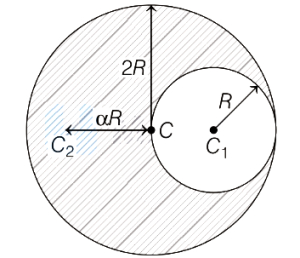
$A$ circular disc of radius $R$ is removed from one end of a bigger circular disc of radius $2R$. The centre of mass of the new disc is at a distance $\alpha R$ from the centre of the bigger disc. The value of $\alpha$ is
A
$\frac{1}{2}$
B
$\frac{1}{3}$
C
$\frac{1}{4}$
D
$\frac{1}{6}$
Solution
(B) Let the mass of the entire disc be $M$.
The mass per unit area is $\sigma = \frac{M}{\pi(2R)^2} = \frac{M}{4\pi R^2}$.
The mass of the removed circular disc of radius $R$ is $M_1 = \sigma \cdot \pi R^2 = \frac{M}{4\pi R^2} \cdot \pi R^2 = \frac{M}{4}$.
The mass of the remaining disc is $M_2 = M - M_1 = M - \frac{M}{4} = \frac{3M}{4}$.
Let the centre of the bigger disc be the origin $(0,0)$. The centre of mass of the removed disc is at $x_1 = R$ and the centre of mass of the remaining disc is at $x_2 = -\alpha R$.
Since the centre of mass of the original disc was at the origin,we have:
$M_1 x_1 + M_2 x_2 = 0$
$\frac{M}{4} \cdot R + \frac{3M}{4} \cdot (-\alpha R) = 0$
$\frac{M}{4} \cdot R = \frac{3M}{4} \cdot \alpha R$
$\alpha = \frac{1}{3}$.
The mass per unit area is $\sigma = \frac{M}{\pi(2R)^2} = \frac{M}{4\pi R^2}$.
The mass of the removed circular disc of radius $R$ is $M_1 = \sigma \cdot \pi R^2 = \frac{M}{4\pi R^2} \cdot \pi R^2 = \frac{M}{4}$.
The mass of the remaining disc is $M_2 = M - M_1 = M - \frac{M}{4} = \frac{3M}{4}$.
Let the centre of the bigger disc be the origin $(0,0)$. The centre of mass of the removed disc is at $x_1 = R$ and the centre of mass of the remaining disc is at $x_2 = -\alpha R$.
Since the centre of mass of the original disc was at the origin,we have:
$M_1 x_1 + M_2 x_2 = 0$
$\frac{M}{4} \cdot R + \frac{3M}{4} \cdot (-\alpha R) = 0$
$\frac{M}{4} \cdot R = \frac{3M}{4} \cdot \alpha R$
$\alpha = \frac{1}{3}$.
0 likesView Solution
19
PhysicsMediumMCQAIEEE · 2007
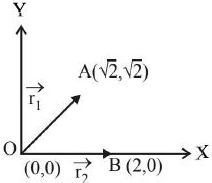
An electric charge $10^{-3} \mu C$ is placed at the origin $(0, 0)$ of an $X-Y$ coordinate system. Two points $A$ and $B$ are situated at $(\sqrt{2}, \sqrt{2})$ and $(2, 0)$ respectively. The potential difference between the points $A$ and $B$ will be.......$V$.
A
$4.5$
B
$9$
C
$0$
D
$2$
Solution
(C) The distance of point $A(\sqrt{2}, \sqrt{2})$ from the origin is:
$OA = \sqrt{(\sqrt{2})^2 + (\sqrt{2})^2} = \sqrt{2 + 2} = \sqrt{4} = 2 \text{ units}$.
The distance of point $B(2, 0)$ from the origin is:
$OB = \sqrt{(2)^2 + (0)^2} = \sqrt{4} = 2 \text{ units}$.
The electric potential $V$ at a distance $r$ from a point charge $Q$ is given by $V = \frac{1}{4\pi\epsilon_0} \frac{Q}{r}$.
Since both points $A$ and $B$ are at the same distance $r = 2 \text{ units}$ from the charge $Q = 10^{-3} \mu C$ placed at the origin,the potentials at these points are equal:
$V_A = \frac{1}{4\pi\epsilon_0} \frac{Q}{OA}$ and $V_B = \frac{1}{4\pi\epsilon_0} \frac{Q}{OB}$.
Since $OA = OB = 2$,it follows that $V_A = V_B$.
Therefore,the potential difference between points $A$ and $B$ is:
$V_A - V_B = 0 \text{ V}$.
$OA = \sqrt{(\sqrt{2})^2 + (\sqrt{2})^2} = \sqrt{2 + 2} = \sqrt{4} = 2 \text{ units}$.
The distance of point $B(2, 0)$ from the origin is:
$OB = \sqrt{(2)^2 + (0)^2} = \sqrt{4} = 2 \text{ units}$.
The electric potential $V$ at a distance $r$ from a point charge $Q$ is given by $V = \frac{1}{4\pi\epsilon_0} \frac{Q}{r}$.
Since both points $A$ and $B$ are at the same distance $r = 2 \text{ units}$ from the charge $Q = 10^{-3} \mu C$ placed at the origin,the potentials at these points are equal:
$V_A = \frac{1}{4\pi\epsilon_0} \frac{Q}{OA}$ and $V_B = \frac{1}{4\pi\epsilon_0} \frac{Q}{OB}$.
Since $OA = OB = 2$,it follows that $V_A = V_B$.
Therefore,the potential difference between points $A$ and $B$ is:
$V_A - V_B = 0 \text{ V}$.
0 likesView Solution
20
PhysicsEasyMCQAIEEE · 2007
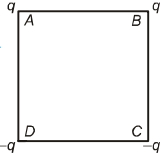
Charges are placed on the vertices of a square as shown. Let $\vec E$ be the electric field and $V$ be the potential at the centre. If the charges on $A$ and $B$ are interchanged with those on $D$ and $C$ respectively,then
A
$\vec E$ changes,$V$ remains unchanged
B
$\vec E$ remains unchanged,$V$ changes
C
Both $\vec E$ and $V$ change
D
$\vec E$ and $V$ remain unchanged
Solution
(A) The electric potential $V$ at the centre of the square is the algebraic sum of the potentials due to individual charges: $V = \sum \frac{kq}{r}$. Since the distance $r$ from each vertex to the centre is the same,$V = \frac{k}{r} (q_A + q_B + q_C + q_D)$. Interchanging the charges does not change the sum $(q_A + q_B + q_C + q_D)$,so $V$ remains unchanged.
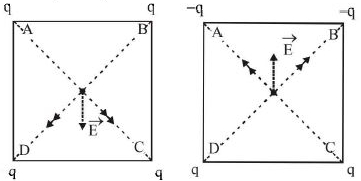
The electric field $\vec E$ is a vector quantity. The resultant electric field at the centre is the vector sum of the fields due to individual charges. Initially,the charges are $q$ at $A, B$ and $-q$ at $C, D$. After interchanging $A$ with $D$ and $B$ with $C$,the charges at $A$ and $B$ become $-q$,and at $C$ and $D$ become $q$. This effectively reverses the direction of the resultant electric field vector at the centre. Thus,$\vec E$ changes.
The electric field $\vec E$ is a vector quantity. The resultant electric field at the centre is the vector sum of the fields due to individual charges. Initially,the charges are $q$ at $A, B$ and $-q$ at $C, D$. After interchanging $A$ with $D$ and $B$ with $C$,the charges at $A$ and $B$ become $-q$,and at $C$ and $D$ become $q$. This effectively reverses the direction of the resultant electric field vector at the centre. Thus,$\vec E$ changes.
0 likesView Solution
21
PhysicsMediumMCQAIEEE · 2007
The potential at a point $x$ (measured in $\mu m$) due to some charges situated on the $x$-axis is given by $V(x) = \frac{20}{x^2 - 4} \text{ volt}$. The electric field $E$ at $x = 4 \mu m$ is given by:
A
$\frac{10}{9} \text{ V/}\mu m$ and in the $+ve \ x$ direction
B
$\frac{5}{3} \text{ V/}\mu m$ and in the $-ve \ x$ direction
C
$\frac{5}{3} \text{ V/}\mu m$ and in the $+ve \ x$ direction
D
$\frac{10}{9} \text{ V/}\mu m$ and in the $-ve \ x$ direction
Solution
(A) Given the potential function $V(x) = \frac{20}{x^2 - 4} \text{ volt}$.
The electric field $E$ is related to the potential $V$ by the relation $E = -\frac{dV}{dx}$.
$E = -\frac{d}{dx} \left( 20(x^2 - 4)^{-1} \right) = -20 \cdot (-1)(x^2 - 4)^{-2} \cdot (2x) = \frac{40x}{(x^2 - 4)^2}$.
Now,substituting $x = 4 \mu m$ into the expression for $E$:
$E = \frac{40(4)}{(4^2 - 4)^2} = \frac{160}{(16 - 4)^2} = \frac{160}{12^2} = \frac{160}{144}$.
Simplifying the fraction by dividing both numerator and denominator by $16$,we get $E = \frac{10}{9} \text{ V/}\mu m$.
Since the result is positive,the electric field is in the $+ve \ x$ direction.
The electric field $E$ is related to the potential $V$ by the relation $E = -\frac{dV}{dx}$.
$E = -\frac{d}{dx} \left( 20(x^2 - 4)^{-1} \right) = -20 \cdot (-1)(x^2 - 4)^{-2} \cdot (2x) = \frac{40x}{(x^2 - 4)^2}$.
Now,substituting $x = 4 \mu m$ into the expression for $E$:
$E = \frac{40(4)}{(4^2 - 4)^2} = \frac{160}{(16 - 4)^2} = \frac{160}{12^2} = \frac{160}{144}$.
Simplifying the fraction by dividing both numerator and denominator by $16$,we get $E = \frac{10}{9} \text{ V/}\mu m$.
Since the result is positive,the electric field is in the $+ve \ x$ direction.
0 likesView Solution
22
PhysicsEasyMCQAIEEE · 2007
$A$ parallel plate capacitor with a dielectric of dielectric constant $K$ between the plates has a capacitance $C$ and is charged to a potential $V \ volt$. The dielectric slab is slowly removed from between the plates and then reinserted. The net work done by the system in this process is
A
Zero
B
$\frac{1}{2}(K - 1)CV^2$
C
$\frac{CV^2(K - 1)}{K}$
D
$(K - 1)CV^2$
Solution
(A) Let the initial capacitance be $C = \frac{K \epsilon_0 A}{d}$. The charge on the capacitor is $Q = CV = \frac{K \epsilon_0 A V}{d}$.
When the dielectric is removed,the capacitance becomes $C_0 = \frac{\epsilon_0 A}{d} = \frac{C}{K}$.
Since the capacitor is disconnected from the battery (implied by the process of removing/reinserting),the charge $Q$ remains constant.
The initial potential energy is $U_i = \frac{Q^2}{2C}$.
When the dielectric is removed,the potential energy becomes $U_{removed} = \frac{Q^2}{2C_0} = \frac{Q^2}{2(C/K)} = K \frac{Q^2}{2C} = K U_i$.
When the dielectric is reinserted,the capacitance returns to $C$,and the potential energy returns to $U_f = \frac{Q^2}{2C} = U_i$.
The net work done by the system is the change in potential energy: $W = -(U_f - U_i) = -(U_i - U_i) = 0$.
Thus,the net work done by the system in this process is zero.
When the dielectric is removed,the capacitance becomes $C_0 = \frac{\epsilon_0 A}{d} = \frac{C}{K}$.
Since the capacitor is disconnected from the battery (implied by the process of removing/reinserting),the charge $Q$ remains constant.
The initial potential energy is $U_i = \frac{Q^2}{2C}$.
When the dielectric is removed,the potential energy becomes $U_{removed} = \frac{Q^2}{2C_0} = \frac{Q^2}{2(C/K)} = K \frac{Q^2}{2C} = K U_i$.
When the dielectric is reinserted,the capacitance returns to $C$,and the potential energy returns to $U_f = \frac{Q^2}{2C} = U_i$.
The net work done by the system is the change in potential energy: $W = -(U_f - U_i) = -(U_i - U_i) = 0$.
Thus,the net work done by the system in this process is zero.
0 likesView Solution
23
PhysicsMediumMCQAIEEE · 2007
The resistance of a wire is $5\, \Omega$ at $50\, ^\circ C$ and $6\, \Omega$ at $100\, ^\circ C$. The resistance of the wire at $0\, ^\circ C$ will be .............. $\Omega$.
A
$3$
B
$2$
C
$1$
D
$4$
Solution
(D) We know that the resistance at temperature $t$ is given by the formula:
$R_{t} = R_{0}(1 + \alpha t)$
where $R_{t}$ is the resistance at $t\, ^\circ C$,$R_{0}$ is the resistance at $0\, ^\circ C$,and $\alpha$ is the temperature coefficient of resistance.
For $t = 50\, ^\circ C$:
$5 = R_{0}(1 + 50\alpha)$ ......$(i)$
For $t = 100\, ^\circ C$:
$6 = R_{0}(1 + 100\alpha)$ ......$(ii)$
Dividing equation $(i)$ by equation $(ii)$:
$\frac{5}{6} = \frac{R_{0}(1 + 50\alpha)}{R_{0}(1 + 100\alpha)}$
$\frac{5}{6} = \frac{1 + 50\alpha}{1 + 100\alpha}$
Cross-multiplying:
$5(1 + 100\alpha) = 6(1 + 50\alpha)$
$5 + 500\alpha = 6 + 300\alpha$
$200\alpha = 1$
$\alpha = \frac{1}{200} = 0.005\, ^\circ C^{-1}$
Now,substitute $\alpha$ back into equation $(i)$ to find $R_{0}$:
$5 = R_{0}(1 + 50 \times 0.005)$
$5 = R_{0}(1 + 0.25)$
$5 = R_{0}(1.25)$
$R_{0} = \frac{5}{1.25} = 4\, \Omega$
Thus,the resistance at $0\, ^\circ C$ is $4\, \Omega$.
$R_{t} = R_{0}(1 + \alpha t)$
where $R_{t}$ is the resistance at $t\, ^\circ C$,$R_{0}$ is the resistance at $0\, ^\circ C$,and $\alpha$ is the temperature coefficient of resistance.
For $t = 50\, ^\circ C$:
$5 = R_{0}(1 + 50\alpha)$ ......$(i)$
For $t = 100\, ^\circ C$:
$6 = R_{0}(1 + 100\alpha)$ ......$(ii)$
Dividing equation $(i)$ by equation $(ii)$:
$\frac{5}{6} = \frac{R_{0}(1 + 50\alpha)}{R_{0}(1 + 100\alpha)}$
$\frac{5}{6} = \frac{1 + 50\alpha}{1 + 100\alpha}$
Cross-multiplying:
$5(1 + 100\alpha) = 6(1 + 50\alpha)$
$5 + 500\alpha = 6 + 300\alpha$
$200\alpha = 1$
$\alpha = \frac{1}{200} = 0.005\, ^\circ C^{-1}$
Now,substitute $\alpha$ back into equation $(i)$ to find $R_{0}$:
$5 = R_{0}(1 + 50 \times 0.005)$
$5 = R_{0}(1 + 0.25)$
$5 = R_{0}(1.25)$
$R_{0} = \frac{5}{1.25} = 4\, \Omega$
Thus,the resistance at $0\, ^\circ C$ is $4\, \Omega$.
0 likesView Solution
24
PhysicsEasyMCQAIEEE · 2007
$A$ current $I$ flows along the length of an infinitely long,straight,thin-walled pipe. Then:
A
the magnetic field is different at different points inside the pipe
B
the magnetic field at any point inside the pipe is zero
C
the magnetic field at all points inside the pipe is the same,but not zero
D
the magnetic field is zero only on the axis of the pipe
Solution
(B) According to Ampere's circuital law,the line integral of the magnetic field $\vec{B}$ around any closed loop is equal to $\mu_0$ times the net current $I_{\text{enclosed}}$ passing through the surface bounded by the loop.
$\oint \vec{B} \cdot d\vec{l} = \mu_0 I_{\text{enclosed}}$
For a thin-walled pipe carrying current $I$ along its length,any closed loop drawn inside the pipe encloses zero net current $(I_{\text{enclosed}} = 0)$.
Since the current is distributed only on the surface of the pipe,there is no current flowing through the interior region.
Therefore,$\oint \vec{B} \cdot d\vec{l} = 0$,which implies that the magnetic field $\vec{B}$ at any point inside the pipe is zero.
$\oint \vec{B} \cdot d\vec{l} = \mu_0 I_{\text{enclosed}}$
For a thin-walled pipe carrying current $I$ along its length,any closed loop drawn inside the pipe encloses zero net current $(I_{\text{enclosed}} = 0)$.
Since the current is distributed only on the surface of the pipe,there is no current flowing through the interior region.
Therefore,$\oint \vec{B} \cdot d\vec{l} = 0$,which implies that the magnetic field $\vec{B}$ at any point inside the pipe is zero.
0 likesView Solution
25
PhysicsDifficultMCQAIEEE · 2007
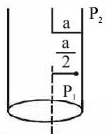
$A$ long straight wire of radius $a$ carries a steady current $i$. The current is uniformly distributed across its cross-section. The ratio of the magnetic field at $a/2$ and $2a$ is:
A
$0.5$
B
$1$
C
$4$
D
$0.25$
Solution
(B) For a long straight wire with a steady current $i$ uniformly distributed across its cross-section:
$1$. Magnetic field inside the wire at a distance $r < a$ is given by $B_{in} = \frac{\mu_0 i r}{2 \pi a^2}$.
At $r = a/2$, $B_1 = \frac{\mu_0 i (a/2)}{2 \pi a^2} = \frac{\mu_0 i}{4 \pi a}$.
$2$. Magnetic field outside the wire at a distance $r > a$ is given by $B_{out} = \frac{\mu_0 i}{2 \pi r}$.
At $r = 2a$, $B_2 = \frac{\mu_0 i}{2 \pi (2a)} = \frac{\mu_0 i}{4 \pi a}$.
$3$. The ratio of the magnetic field at $a/2$ and $2a$ is:
$\frac{B_1}{B_2} = \frac{\frac{\mu_0 i}{4 \pi a}}{\frac{\mu_0 i}{4 \pi a}} = 1$.
$1$. Magnetic field inside the wire at a distance $r < a$ is given by $B_{in} = \frac{\mu_0 i r}{2 \pi a^2}$.
At $r = a/2$, $B_1 = \frac{\mu_0 i (a/2)}{2 \pi a^2} = \frac{\mu_0 i}{4 \pi a}$.
$2$. Magnetic field outside the wire at a distance $r > a$ is given by $B_{out} = \frac{\mu_0 i}{2 \pi r}$.
At $r = 2a$, $B_2 = \frac{\mu_0 i}{2 \pi (2a)} = \frac{\mu_0 i}{4 \pi a}$.
$3$. The ratio of the magnetic field at $a/2$ and $2a$ is:
$\frac{B_1}{B_2} = \frac{\frac{\mu_0 i}{4 \pi a}}{\frac{\mu_0 i}{4 \pi a}} = 1$.
0 likesView Solution
26
PhysicsMediumMCQAIEEE · 2007
$A$ charged particle with charge $q$ enters a region of constant,uniform,and mutually orthogonal fields $\vec{E}$ and $\vec{B}$ with a velocity $\vec{v}$ perpendicular to both $\vec{E}$ and $\vec{B}$,and comes out without any change in the magnitude or direction of $\vec{v}$. Then:
A
$\vec{v} = \frac{(\vec{B} \times \vec{E})}{E^2}$
B
$\vec{v} = \frac{(\vec{E} \times \vec{B})}{B^2}$
C
$\vec{v} = \frac{(\vec{B} \times \vec{E})}{B^2}$
D
$\vec{v} = \frac{(\vec{E} \times \vec{B})}{E^2}$
Solution
(B) The net Lorentz force on the particle is $\vec{F} = q(\vec{E} + \vec{v} \times \vec{B})$.
Since the particle passes through the region without any change in velocity,the net force must be zero,so $\vec{E} + \vec{v} \times \vec{B} = 0$,which implies $\vec{E} = -(\vec{v} \times \vec{B}) = \vec{B} \times \vec{v}$.
Taking the cross product with $\vec{B}$ on both sides: $\vec{E} \times \vec{B} = (\vec{B} \times \vec{v}) \times \vec{B}$.
Using the vector triple product identity $(\vec{A} \times \vec{B}) \times \vec{C} = \vec{B}(\vec{A} \cdot \vec{C}) - \vec{A}(\vec{B} \cdot \vec{C})$,we get $\vec{E} \times \vec{B} = \vec{v}(\vec{B} \cdot \vec{B}) - \vec{B}(\vec{v} \cdot \vec{B})$.
Since $\vec{v} \perp \vec{B}$,$\vec{v} \cdot \vec{B} = 0$,so $\vec{E} \times \vec{B} = \vec{v} B^2$.
Therefore,$\vec{v} = \frac{\vec{E} \times \vec{B}}{B^2}$.
Since the particle passes through the region without any change in velocity,the net force must be zero,so $\vec{E} + \vec{v} \times \vec{B} = 0$,which implies $\vec{E} = -(\vec{v} \times \vec{B}) = \vec{B} \times \vec{v}$.
Taking the cross product with $\vec{B}$ on both sides: $\vec{E} \times \vec{B} = (\vec{B} \times \vec{v}) \times \vec{B}$.
Using the vector triple product identity $(\vec{A} \times \vec{B}) \times \vec{C} = \vec{B}(\vec{A} \cdot \vec{C}) - \vec{A}(\vec{B} \cdot \vec{C})$,we get $\vec{E} \times \vec{B} = \vec{v}(\vec{B} \cdot \vec{B}) - \vec{B}(\vec{v} \cdot \vec{B})$.
Since $\vec{v} \perp \vec{B}$,$\vec{v} \cdot \vec{B} = 0$,so $\vec{E} \times \vec{B} = \vec{v} B^2$.
Therefore,$\vec{v} = \frac{\vec{E} \times \vec{B}}{B^2}$.
0 likesView Solution
27
PhysicsDifficultMCQAIEEE · 2007
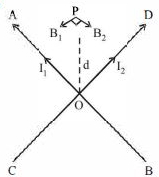
Two identical conducting wires $AOB$ and $COD$ are placed at right angles to each other. The wire $AOB$ carries an electric current $I_1$ and $COD$ carries a current $I_2$. The magnetic field at a point lying at a distance $d$ from $O$,in a direction perpendicular to the plane of the wires $AOB$ and $COD$,will be given by
A
$\frac{\mu_0}{2\pi d} (I_1^2 + I_2^2)$
B
$\frac{\mu_0}{2\pi} \left( \frac{I_1 + I_2}{d} \right)^{\frac{1}{2}}$
C
$\frac{\mu_0}{2\pi d} (I_1^2 + I_2^2)^{\frac{1}{2}}$
D
$\frac{\mu_0}{2\pi d} (I_1 + I_2)$
Solution
(C) The magnetic field produced by a long straight current-carrying wire at a distance $d$ is given by $B = \frac{\mu_0 I}{2 \pi d}$.
Since the wires $AOB$ and $COD$ are placed at right angles to each other,the magnetic fields $B_1$ and $B_2$ produced by them at a point $P$ (at distance $d$ from $O$ along the normal to the plane) will also be perpendicular to each other.
Thus,the magnitude of the resultant magnetic field $B$ is given by $B = \sqrt{B_1^2 + B_2^2}$.
Substituting the values,$B_1 = \frac{\mu_0 I_1}{2 \pi d}$ and $B_2 = \frac{\mu_0 I_2}{2 \pi d}$.
Therefore,$B = \sqrt{\left( \frac{\mu_0 I_1}{2 \pi d} \right)^2 + \left( \frac{\mu_0 I_2}{2 \pi d} \right)^2}$.
$B = \frac{\mu_0}{2 \pi d} \sqrt{I_1^2 + I_2^2} = \frac{\mu_0}{2 \pi d} (I_1^2 + I_2^2)^{1/2}$.
Since the wires $AOB$ and $COD$ are placed at right angles to each other,the magnetic fields $B_1$ and $B_2$ produced by them at a point $P$ (at distance $d$ from $O$ along the normal to the plane) will also be perpendicular to each other.
Thus,the magnitude of the resultant magnetic field $B$ is given by $B = \sqrt{B_1^2 + B_2^2}$.
Substituting the values,$B_1 = \frac{\mu_0 I_1}{2 \pi d}$ and $B_2 = \frac{\mu_0 I_2}{2 \pi d}$.
Therefore,$B = \sqrt{\left( \frac{\mu_0 I_1}{2 \pi d} \right)^2 + \left( \frac{\mu_0 I_2}{2 \pi d} \right)^2}$.
$B = \frac{\mu_0}{2 \pi d} \sqrt{I_1^2 + I_2^2} = \frac{\mu_0}{2 \pi d} (I_1^2 + I_2^2)^{1/2}$.
0 likesView Solution
28
PhysicsEasyMCQAIEEE · 2007
Two lenses of power $-15 \ D$ and $+5 \ D$ are in contact with each other. The focal length of the combination is ....... $cm$.
A
$+10$
B
$-20$
C
$-10$
D
$+20$
Solution
(C) The power of the combination of lenses in contact is given by the algebraic sum of their individual powers:
$P = P_{1} + P_{2}$
Given $P_{1} = -15 \ D$ and $P_{2} = +5 \ D$,we have:
$P = (-15 + 5) \ D = -10 \ D$
Since the power $P$ is related to the focal length $f$ (in meters) by the formula $P = \frac{1}{f}$,we can find the focal length as:
$f = \frac{1}{P} = \frac{1}{-10} \ m$
To convert the focal length into centimeters,we multiply by $100$:
$f = \left( \frac{1}{-10} \times 100 \right) \ cm = -10 \ cm$
Thus,the focal length of the combination is $-10 \ cm$.
$P = P_{1} + P_{2}$
Given $P_{1} = -15 \ D$ and $P_{2} = +5 \ D$,we have:
$P = (-15 + 5) \ D = -10 \ D$
Since the power $P$ is related to the focal length $f$ (in meters) by the formula $P = \frac{1}{f}$,we can find the focal length as:
$f = \frac{1}{P} = \frac{1}{-10} \ m$
To convert the focal length into centimeters,we multiply by $100$:
$f = \left( \frac{1}{-10} \times 100 \right) \ cm = -10 \ cm$
Thus,the focal length of the combination is $-10 \ cm$.
0 likesView Solution
29
PhysicsEasyMCQAIEEE · 2007
$A$ photon of frequency $f$ has a momentum associated with it. If $c$ is the velocity of light,the momentum is:
A
$\frac{hf}{c}$
B
$\frac{hc}{E}$
C
$\frac{hf}{c^2}$
D
$hf$
Solution
(A) The energy $E$ of a photon with frequency $f$ is given by the Planck-Einstein relation: $E = hf$.
According to Einstein's mass-energy equivalence principle,the energy of a photon is also given by $E = mc^2$,where $m$ is the relativistic mass of the photon.
Equating the two expressions for energy: $mc^2 = hf$.
We know that the momentum $p$ of a particle is given by $p = mc$.
Rearranging the energy equation: $mc = \frac{hf}{c}$.
Therefore,the momentum of the photon is $p = \frac{hf}{c}$.
According to Einstein's mass-energy equivalence principle,the energy of a photon is also given by $E = mc^2$,where $m$ is the relativistic mass of the photon.
Equating the two expressions for energy: $mc^2 = hf$.
We know that the momentum $p$ of a particle is given by $p = mc$.
Rearranging the energy equation: $mc = \frac{hf}{c}$.
Therefore,the momentum of the photon is $p = \frac{hf}{c}$.
0 likesView Solution
30
PhysicsMediumMCQAIEEE · 2007
An ideal coil of $10 \ H$ is connected in series with a resistance of $5 \ \Omega$ and a battery of $5 \ V$. $2 \ s$ after the connection is made,the current flowing in the circuit in amperes is:
A
$e^{-1}$
B
$(1 - e^{-1})$
C
$(1 - e)$
D
$e$
Solution
(B) The growth of current in an $LR$ circuit is given by the formula: $I = I_0(1 - e^{-\frac{R}{L}t})$.
Here,$I_0 = \frac{E}{R}$ is the maximum steady-state current.
Given: $L = 10 \ H$,$R = 5 \ \Omega$,$E = 5 \ V$,and $t = 2 \ s$.
First,calculate the maximum current: $I_0 = \frac{5 \ V}{5 \ \Omega} = 1 \ A$.
Now,substitute the values into the growth equation:
$I = 1 \times (1 - e^{-\frac{5}{10} \times 2})$
$I = 1 - e^{-1} \ A$.
Here,$I_0 = \frac{E}{R}$ is the maximum steady-state current.
Given: $L = 10 \ H$,$R = 5 \ \Omega$,$E = 5 \ V$,and $t = 2 \ s$.
First,calculate the maximum current: $I_0 = \frac{5 \ V}{5 \ \Omega} = 1 \ A$.
Now,substitute the values into the growth equation:
$I = 1 \times (1 - e^{-\frac{5}{10} \times 2})$
$I = 1 - e^{-1} \ A$.
0 likesView Solution
31
PhysicsEasyMCQAIEEE · 2007
In an $a.c.$ circuit,the voltage applied is $E = E_o \sin \omega t$. The resulting current in the circuit is $I = I_o \sin \left( \omega t - \frac{\pi}{2} \right)$. The power consumption in the circuit is given by:
A
$P = \sqrt{3} E_o I_o$
B
$P = \frac{E_o I_o}{\sqrt{2}}$
C
$P = 0$
D
$P = \frac{E_o I_o}{2}$
Solution
(C) $KEY$ $CONCEPT$: The average power consumed in an $a.c.$ circuit is given by the formula: $P = E_{rms} I_{rms} \cos \phi$.
Given:
Voltage $E = E_o \sin \omega t$
Current $I = I_o \sin \left( \omega t - \frac{\pi}{2} \right)$
Comparing these with the standard forms $E = E_o \sin \omega t$ and $I = I_o \sin (\omega t - \phi)$,we find the phase difference $\phi = \frac{\pi}{2}$.
Substituting the value of $\phi$ into the power formula:
$P = E_{rms} I_{rms} \cos \left( \frac{\pi}{2} \right)$
Since $\cos \left( \frac{\pi}{2} \right) = 0$,the power consumption is:
$P = E_{rms} I_{rms} \times 0 = 0$.
Given:
Voltage $E = E_o \sin \omega t$
Current $I = I_o \sin \left( \omega t - \frac{\pi}{2} \right)$
Comparing these with the standard forms $E = E_o \sin \omega t$ and $I = I_o \sin (\omega t - \phi)$,we find the phase difference $\phi = \frac{\pi}{2}$.
Substituting the value of $\phi$ into the power formula:
$P = E_{rms} I_{rms} \cos \left( \frac{\pi}{2} \right)$
Since $\cos \left( \frac{\pi}{2} \right) = 0$,the power consumption is:
$P = E_{rms} I_{rms} \times 0 = 0$.
0 likesView Solution
32
PhysicsMediumMCQAIEEE · 2007
In a Young's double slit experiment,the intensity at a point where the path difference is $\frac{\lambda}{6}$ ($\lambda$ being the wavelength of light used) is $I$. If $I_0$ denotes the maximum intensity,then $\frac{I}{I_0} = $ . . . . . .
A
$\frac{3}{4}$
B
$\frac{1}{\sqrt{2}}$
C
$\frac{\sqrt{3}}{2}$
D
$\frac{1}{2}$
Solution
(A) The intensity $I$ at a point on the screen in a Young's double slit experiment is given by the formula $I = I_0 \cos^2 \left( \frac{\phi}{2} \right)$,where $I_0$ is the maximum intensity and $\phi$ is the phase difference.
The relationship between phase difference $\phi$ and path difference $\Delta x$ is given by $\phi = \frac{2\pi}{\lambda} \Delta x$.
Given the path difference $\Delta x = \frac{\lambda}{6}$,we calculate the phase difference:
$\phi = \frac{2\pi}{\lambda} \times \frac{\lambda}{6} = \frac{\pi}{3}$.
Now,substitute $\phi$ into the intensity formula:
$\frac{I}{I_0} = \cos^2 \left( \frac{\pi/3}{2} \right) = \cos^2 \left( \frac{\pi}{6} \right)$.
Since $\cos \left( \frac{\pi}{6} \right) = \frac{\sqrt{3}}{2}$,we have:
$\frac{I}{I_0} = \left( \frac{\sqrt{3}}{2} \right)^2 = \frac{3}{4}$.
The relationship between phase difference $\phi$ and path difference $\Delta x$ is given by $\phi = \frac{2\pi}{\lambda} \Delta x$.
Given the path difference $\Delta x = \frac{\lambda}{6}$,we calculate the phase difference:
$\phi = \frac{2\pi}{\lambda} \times \frac{\lambda}{6} = \frac{\pi}{3}$.
Now,substitute $\phi$ into the intensity formula:
$\frac{I}{I_0} = \cos^2 \left( \frac{\pi/3}{2} \right) = \cos^2 \left( \frac{\pi}{6} \right)$.
Since $\cos \left( \frac{\pi}{6} \right) = \frac{\sqrt{3}}{2}$,we have:
$\frac{I}{I_0} = \left( \frac{\sqrt{3}}{2} \right)^2 = \frac{3}{4}$.
0 likesView Solution
33
PhysicsMediumMCQAIEEE · 2007
Which of the following transitions in hydrogen atoms emit photons of highest frequency?
A
$n = 2$ to $n = 1$
B
$n = 1$ to $n = 2$
C
$n = 6$ to $n = 2$
D
$n = 2$ to $n = 6$
Solution
(A) The energy of a photon emitted during an electronic transition is given by $\Delta E = E_{initial} - E_{final} = h\nu$,where $\nu$ is the frequency.
For emission to occur,the electron must transition from a higher energy level to a lower energy level. Thus,options $(b)$ and $(d)$ are excluded as they represent absorption.
Comparing the energy differences for the remaining transitions:
For $n = 2$ to $n = 1$: $\Delta E_1 = 13.6 \left( \frac{1}{1^2} - \frac{1}{2^2} \right) = 13.6 \left( 1 - 0.25 \right) = 13.6 \times 0.75 = 10.2 \text{ eV}$.
For $n = 6$ to $n = 2$: $\Delta E_2 = 13.6 \left( \frac{1}{2^2} - \frac{1}{6^2} \right) = 13.6 \left( 0.25 - 0.0277 \right) = 13.6 \times 0.2223 \approx 3.02 \text{ eV}$.
Since $\nu = \frac{\Delta E}{h}$,the transition with the largest energy difference will emit the photon with the highest frequency.
Comparing $\Delta E_1$ and $\Delta E_2$,we see that $\Delta E_1 > \Delta E_2$.
Therefore,the transition from $n = 2$ to $n = 1$ emits the photon of the highest frequency.
For emission to occur,the electron must transition from a higher energy level to a lower energy level. Thus,options $(b)$ and $(d)$ are excluded as they represent absorption.
Comparing the energy differences for the remaining transitions:
For $n = 2$ to $n = 1$: $\Delta E_1 = 13.6 \left( \frac{1}{1^2} - \frac{1}{2^2} \right) = 13.6 \left( 1 - 0.25 \right) = 13.6 \times 0.75 = 10.2 \text{ eV}$.
For $n = 6$ to $n = 2$: $\Delta E_2 = 13.6 \left( \frac{1}{2^2} - \frac{1}{6^2} \right) = 13.6 \left( 0.25 - 0.0277 \right) = 13.6 \times 0.2223 \approx 3.02 \text{ eV}$.
Since $\nu = \frac{\Delta E}{h}$,the transition with the largest energy difference will emit the photon with the highest frequency.
Comparing $\Delta E_1$ and $\Delta E_2$,we see that $\Delta E_1 > \Delta E_2$.
Therefore,the transition from $n = 2$ to $n = 1$ emits the photon of the highest frequency.
0 likesView Solution
34
PhysicsEasyMCQAIEEE · 2007
In gamma ray emission from a nucleus,
A
there is no change in the proton number and the neutron number
B
only the neutron number changes
C
only the proton number changes
D
both the neutron number and the proton number change
Solution
(A) Gamma $(\gamma)$ emission occurs when a nucleus in an excited state transitions to a lower energy state or the ground state. During this process,the nucleus emits a high-energy photon known as a $\gamma$-ray. Since $\gamma$-rays have zero charge and zero rest mass,the emission does not alter the atomic number $(Z)$ or the mass number $(A)$ of the nucleus. Therefore,the number of protons and neutrons remains unchanged.
0 likesView Solution
35
PhysicsMediumMCQAIEEE · 2007
If $M_o$ is the mass of an oxygen isotope $_8O^{17}$,$M_p$ and $M_N$ are the masses of a proton and a neutron respectively,the nuclear binding energy of the isotope is
A
$(M_o - 17 M_n) c^2$
B
$(M_o - 8 M_p) c^2$
C
$(8 M_p + 9 M_n - M_o) c^2$
D
$M_o c^2$
Solution
(C) The nuclear binding energy of a nucleus is defined as the energy equivalent of the mass defect,given by the formula:
$B.E. = \Delta m c^2 = (\text{mass of nucleons} - \text{mass of nucleus}) c^2$
where $\Delta m$ is the mass defect.
For the oxygen isotope $_8O^{17}$:
Number of protons $(p)$ = $8$
Number of neutrons $(n)$ = $17 - 8 = 9$
Mass of nucleons = $8 M_p + 9 M_n$
Mass of the nucleus = $M_o$
Therefore,the binding energy is:
$B.E. = (8 M_p + 9 M_n - M_o) c^2$
$B.E. = \Delta m c^2 = (\text{mass of nucleons} - \text{mass of nucleus}) c^2$
where $\Delta m$ is the mass defect.
For the oxygen isotope $_8O^{17}$:
Number of protons $(p)$ = $8$
Number of neutrons $(n)$ = $17 - 8 = 9$
Mass of nucleons = $8 M_p + 9 M_n$
Mass of the nucleus = $M_o$
Therefore,the binding energy is:
$B.E. = (8 M_p + 9 M_n - M_o) c^2$
0 likesView Solution
36
PhysicsEasyMCQAIEEE · 2007
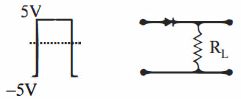
If in a $p-n$ junction diode,a square input signal of $5 \ V$ to $-5 \ V$ is applied as shown,which of the following represents the output signal across $R_L$?
A
B
C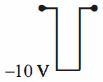
D
Solution
(A) The circuit shown is a half-wave rectifier configuration.
When the input signal is at $+5 \ V$,the $p-n$ junction diode is forward-biased and acts as a closed switch. Thus,the output voltage across the load resistor $R_L$ is $+5 \ V$.
When the input signal is at $-5 \ V$,the $p-n$ junction diode is reverse-biased and acts as an open switch. Thus,no current flows through $R_L$,and the output voltage across $R_L$ is $0 \ V$.
Therefore,the output signal is a square pulse of $+5 \ V$ during the positive half-cycle and $0 \ V$ during the negative half-cycle,which matches the shape shown in option $A$.
When the input signal is at $+5 \ V$,the $p-n$ junction diode is forward-biased and acts as a closed switch. Thus,the output voltage across the load resistor $R_L$ is $+5 \ V$.
When the input signal is at $-5 \ V$,the $p-n$ junction diode is reverse-biased and acts as an open switch. Thus,no current flows through $R_L$,and the output voltage across $R_L$ is $0 \ V$.
Therefore,the output signal is a square pulse of $+5 \ V$ during the positive half-cycle and $0 \ V$ during the negative half-cycle,which matches the shape shown in option $A$.
0 likesView Solution
37
PhysicsEasyMCQAIEEE · 2007
Carbon,silicon and germanium have four valence electrons each. At room temperature,which one of the following statements is most appropriate?
A
The number of free electrons for conduction is significant only in $Si$ and $Ge$ but small in $C$.
B
The number of free conduction electrons is significant in $C$ but small in $Si$ and $Ge$.
C
The number of free conduction electrons is negligibly small in all the three.
D
The number of free electrons for conduction is significant in all the three.
Solution
(A) Carbon $(C)$,Silicon $(Si)$,and Germanium $(Ge)$ all belong to group $14$ of the periodic table and have $4$ valence electrons.
At room temperature,the energy band gap $(E_g)$ for Carbon (diamond) is approximately $5.4 \ eV$,which is very large,making it an insulator.
The energy band gap for Silicon is approximately $1.1 \ eV$ and for Germanium is approximately $0.7 \ eV$.
Because these band gaps are relatively small,thermal energy at room temperature is sufficient to excite a significant number of electrons from the valence band to the conduction band in $Si$ and $Ge$.
Therefore,$Si$ and $Ge$ act as semiconductors,while $C$ acts as an insulator due to its large band gap.
At room temperature,the energy band gap $(E_g)$ for Carbon (diamond) is approximately $5.4 \ eV$,which is very large,making it an insulator.
The energy band gap for Silicon is approximately $1.1 \ eV$ and for Germanium is approximately $0.7 \ eV$.
Because these band gaps are relatively small,thermal energy at room temperature is sufficient to excite a significant number of electrons from the valence band to the conduction band in $Si$ and $Ge$.
Therefore,$Si$ and $Ge$ act as semiconductors,while $C$ acts as an insulator due to its large band gap.
0 likesView Solution
38
PhysicsDifficultMCQAIEEE · 2007
The half-life period of a radioactive element $x$ is the same as the mean life time of another radioactive element $y$. Initially,they have the same number of atoms. Then:
A
$x$ will decay faster than $y$.
B
$y$ will decay faster than $x$.
C
$x$ and $y$ have the same decay rate initially and later on different decay rates.
D
$x$ and $y$ decay at the same rate always.
Solution
(B) Given that the half-life of $x$ is equal to the mean life of $y$:
$(t_{1/2})_x = (\tau)_y$
Since $(t_{1/2})_x = \frac{\ln 2}{\lambda_x}$ and $(\tau)_y = \frac{1}{\lambda_y}$,we have:
$\frac{\ln 2}{\lambda_x} = \frac{1}{\lambda_y} \Rightarrow \lambda_x = \lambda_y \ln 2 \approx 0.693 \lambda_y$.
This implies $\lambda_x < \lambda_y$.
Initially,the number of atoms is the same: $N_x = N_y = N_0$.
The decay rate (activity) is given by $A = \lambda N$.
Since $\lambda_x < \lambda_y$ and $N_x = N_y$,it follows that $A_x < A_y$.
Therefore,element $y$ will decay faster than element $x$.
$(t_{1/2})_x = (\tau)_y$
Since $(t_{1/2})_x = \frac{\ln 2}{\lambda_x}$ and $(\tau)_y = \frac{1}{\lambda_y}$,we have:
$\frac{\ln 2}{\lambda_x} = \frac{1}{\lambda_y} \Rightarrow \lambda_x = \lambda_y \ln 2 \approx 0.693 \lambda_y$.
This implies $\lambda_x < \lambda_y$.
Initially,the number of atoms is the same: $N_x = N_y = N_0$.
The decay rate (activity) is given by $A = \lambda N$.
Since $\lambda_x < \lambda_y$ and $N_x = N_y$,it follows that $A_x < A_y$.
Therefore,element $y$ will decay faster than element $x$.
0 likesView Solution
39
PhysicsEasyMCQAIEEE · 2007
$A$ battery is used to charge a parallel plate capacitor until the potential difference between the plates becomes equal to the e.m.f. of the battery. The ratio of the energy stored in the capacitor to the work done by the battery will be
A
$2$
B
$1$/$2$
C
$1$
D
$1$/$4$
Solution
(B) Let the capacitance of the capacitor be $C$ and the e.m.f. of the battery be $V$.
When the capacitor is fully charged,the potential difference across the plates is $V$.
The charge stored on the capacitor is $q = CV$.
The energy stored in the capacitor is $U = \frac{1}{2} CV^2 = \frac{1}{2} qV$.
The work done by the battery in supplying charge $q$ is $W = qV = CV^2$.
The ratio of the energy stored in the capacitor to the work done by the battery is $\frac{U}{W} = \frac{\frac{1}{2} qV}{qV} = \frac{1}{2}$.
When the capacitor is fully charged,the potential difference across the plates is $V$.
The charge stored on the capacitor is $q = CV$.
The energy stored in the capacitor is $U = \frac{1}{2} CV^2 = \frac{1}{2} qV$.
The work done by the battery in supplying charge $q$ is $W = qV = CV^2$.
The ratio of the energy stored in the capacitor to the work done by the battery is $\frac{U}{W} = \frac{\frac{1}{2} qV}{qV} = \frac{1}{2}$.
0 likesView Solution
40
PhysicsMediumMCQAIEEE · 2007
$A$ charged particle moves through a magnetic field perpendicular to its direction. Then
A
kinetic energy changes but the momentum is constant
B
the momentum changes but the kinetic energy is constant
C
both momentum and kinetic energy of the particle are not constant
D
both momentum and kinetic energy of the particle are constant
Solution
(B) When a charged particle moves in a magnetic field perpendicular to its velocity,the magnetic force $F = q(v \times B)$ acts perpendicular to the velocity vector at every instant.
Since the force is always perpendicular to the velocity,the work done by the magnetic force is $W = F \cdot ds = 0$.
According to the work-energy theorem,the change in kinetic energy is equal to the work done,so the kinetic energy remains constant.
However,because the direction of the velocity vector changes continuously as the particle moves in a circular path,the momentum $p = mv$ changes because momentum is a vector quantity.
Therefore,the momentum changes while the kinetic energy remains constant.
Since the force is always perpendicular to the velocity,the work done by the magnetic force is $W = F \cdot ds = 0$.
According to the work-energy theorem,the change in kinetic energy is equal to the work done,so the kinetic energy remains constant.
However,because the direction of the velocity vector changes continuously as the particle moves in a circular path,the momentum $p = mv$ changes because momentum is a vector quantity.
Therefore,the momentum changes while the kinetic energy remains constant.
0 likesView Solution
Vedclass Products
For Students
Vedclass Test Series
Mock tests in real AIEEE style covering Physics with performance analysis. 5-day free trial.
Start Free TrialFor Teachers
Exam Paper Generator
Generate Set A/B/C/D Physics papers from 7.5L+ questions in 2 minutes. 3 chapters free.
Try FreeFor Institutes
Online Exam Module
Run live AIEEE mock exams with unlimited students, 360° analytics & white-label branding.
See DemoFrequently Asked Questions
How many Physics questions are in AIEEE 2007?
There are 40 Physics questions from the AIEEE 2007 paper on Vedclass, each with a detailed step-by-step solution in English.
Are AIEEE 2007 Physics solutions available in English?
Yes. All solutions on this page are in English. You can also switch to English or Hindi using the language buttons above the questions.
Can I practice AIEEE 2007 Physics as a timed test?
Yes. Use the Vedclass Test Series to attempt a full AIEEE mock test covering Physics with time limits and instant score analysis.
Can teachers create Physics papers from AIEEE previous year questions?
Yes. The Vedclass Exam Paper Generator lets teachers mix AIEEE Physics questions and generate Set A/B/C/D papers in minutes.
For Teachers & Institutes
Build a Custom Physics Paper
Pick AIEEE 2007 Physics questions, set difficulty, and generate Set A/B/C/D in 2 minutes.