
PhysicsQ1–35 of 35 questions
Page 1 of 1 · English
1
PhysicsMediumMCQAIEEE · 2008
Two full turns of the circular scale of a screw gauge cover a distance of $1 \ mm$ on its main scale. The total number of divisions on the circular scale is $50$. Further,it is found that the screw gauge has a zero error of $-0.03 \ mm$. While measuring the diameter of a thin wire,a student notes the main scale reading of $3 \ mm$ and the number of circular scale divisions in line with the main scale as $35$. The diameter of the wire is ....... $mm$
A
$3.38$
B
$3.32$
C
$3.73$
D
$3.67$
Solution
(A) The pitch of the screw gauge is the distance moved in one full rotation. Since $2$ full turns cover $1 \ mm$,the pitch $= \frac{1 \ mm}{2} = 0.5 \ mm$.
The least count $(LC)$ is given by $\frac{\text{pitch}}{\text{total number of divisions}} = \frac{0.5 \ mm}{50} = 0.01 \ mm$.
The observed reading is calculated as: $\text{Main Scale Reading} + (\text{Circular Scale Division} \times LC) = 3 \ mm + (35 \times 0.01 \ mm) = 3.35 \ mm$.
The actual diameter is calculated by subtracting the zero error from the observed reading: $\text{Diameter} = \text{Observed Reading} - (\text{Zero Error}) = 3.35 \ mm - (-0.03 \ mm) = 3.35 \ mm + 0.03 \ mm = 3.38 \ mm$.
The least count $(LC)$ is given by $\frac{\text{pitch}}{\text{total number of divisions}} = \frac{0.5 \ mm}{50} = 0.01 \ mm$.
The observed reading is calculated as: $\text{Main Scale Reading} + (\text{Circular Scale Division} \times LC) = 3 \ mm + (35 \times 0.01 \ mm) = 3.35 \ mm$.
The actual diameter is calculated by subtracting the zero error from the observed reading: $\text{Diameter} = \text{Observed Reading} - (\text{Zero Error}) = 3.35 \ mm - (-0.03 \ mm) = 3.35 \ mm + 0.03 \ mm = 3.38 \ mm$.
0 likesView Solution
2
PhysicsMediumMCQAIEEE · 2008
$A$ body is at rest at $x=0$. At $t=0$,it starts moving in the positive $x-$direction with a constant acceleration. At the same instant,another body passes through $x=0$ moving in the positive $x$ direction with a constant speed. The position of the first body is given by $x_{1}(t)$ after time $t$ and that of the second body by $x_{2}(t)$ after the same time interval. Which of the following graphs correctly describes $(x_{1}-x_{2})$ as a function of time $t$?
A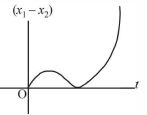
B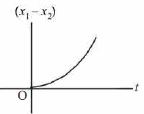
C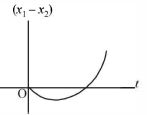
D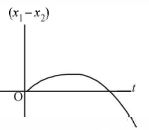
Solution
(C) For the body starting from rest at $x=0$ with constant acceleration $a$:
$x_{1} = \frac{1}{2}at^{2}$
For the body moving with constant speed $v$ starting from $x=0$:
$x_{2} = vt$
Let $f(t) = x_{1} - x_{2} = \frac{1}{2}at^{2} - vt$.
This is a quadratic equation in $t$ representing a parabola opening upwards.
At $t=0$,$f(0) = 0$.
The derivative is $f'(t) = at - v$.
Setting $f'(t) = 0$ gives $t = \frac{v}{a}$.
At $t = \frac{v}{a}$,the function reaches its minimum value: $f(\frac{v}{a}) = \frac{1}{2}a(\frac{v}{a})^{2} - v(\frac{v}{a}) = \frac{v^{2}}{2a} - \frac{v^{2}}{a} = -\frac{v^{2}}{2a}$.
Since the minimum value is negative and the parabola opens upwards,the graph starts at the origin,goes below the $t$-axis,reaches a minimum at $t = \frac{v}{a}$,and then increases,crossing the $t$-axis at $t = \frac{2v}{a}$.
This matches the graph shown in the solution image.
$x_{1} = \frac{1}{2}at^{2}$
For the body moving with constant speed $v$ starting from $x=0$:
$x_{2} = vt$
Let $f(t) = x_{1} - x_{2} = \frac{1}{2}at^{2} - vt$.
This is a quadratic equation in $t$ representing a parabola opening upwards.
At $t=0$,$f(0) = 0$.
The derivative is $f'(t) = at - v$.
Setting $f'(t) = 0$ gives $t = \frac{v}{a}$.
At $t = \frac{v}{a}$,the function reaches its minimum value: $f(\frac{v}{a}) = \frac{1}{2}a(\frac{v}{a})^{2} - v(\frac{v}{a}) = \frac{v^{2}}{2a} - \frac{v^{2}}{a} = -\frac{v^{2}}{2a}$.
Since the minimum value is negative and the parabola opens upwards,the graph starts at the origin,goes below the $t$-axis,reaches a minimum at $t = \frac{v}{a}$,and then increases,crossing the $t$-axis at $t = \frac{2v}{a}$.
This matches the graph shown in the solution image.
0 likesView Solution
3
PhysicsMediumMCQAIEEE · 2008
$A$ body of mass $m = 3.513 \; kg$ is moving along the $x$-axis with a speed of $5.00 \; ms^{-1}$. The magnitude of its momentum is recorded as (Consider significant figures):
A
$17.57 \; kg \; ms^{-1}$
B
$17.6 \; kg \; ms^{-1}$
C
$17.565 \; kg \; ms^{-1}$
D
$17.56 \; kg \; ms^{-1}$
Solution
(B) The momentum $p$ is given by the product of mass $m$ and velocity $v$: $p = m \times v$.
Given $m = 3.513 \; kg$ (which has $4$ significant figures) and $v = 5.00 \; ms^{-1}$ (which has $3$ significant figures).
Calculating the product: $p = 3.513 \times 5.00 = 17.565 \; kg \; ms^{-1}$.
According to the rules of significant figures,the result of a multiplication should have the same number of significant figures as the measurement with the fewest significant figures.
Since $5.00$ has $3$ significant figures,the final result must be rounded to $3$ significant figures.
Rounding $17.565$ to $3$ significant figures gives $17.6 \; kg \; ms^{-1}$.
Given $m = 3.513 \; kg$ (which has $4$ significant figures) and $v = 5.00 \; ms^{-1}$ (which has $3$ significant figures).
Calculating the product: $p = 3.513 \times 5.00 = 17.565 \; kg \; ms^{-1}$.
According to the rules of significant figures,the result of a multiplication should have the same number of significant figures as the measurement with the fewest significant figures.
Since $5.00$ has $3$ significant figures,the final result must be rounded to $3$ significant figures.
Rounding $17.565$ to $3$ significant figures gives $17.6 \; kg \; ms^{-1}$.
0 likesView Solution
4
PhysicsMediumMCQAIEEE · 2008
An athlete in the Olympic games covers a distance of $100 \ m$ in $10 \ s$. His kinetic energy can be estimated to be in the range
A
$2000 \ J - 5000 \ J$
B
$200 \ J - 500 \ J$
C
$2 \times 10^5 \ J - 3 \times 10^5 \ J$
D
$20,000 \ J - 50,000 \ J$
Solution
(A) The average speed of the athlete is $v = \frac{100 \ m}{10 \ s} = 10 \ m/s$.
The kinetic energy $(K.E.)$ is given by the formula $K.E. = \frac{1}{2}mv^2$.
Assuming the mass $(m)$ of an athlete typically ranges between $40 \ kg$ and $100 \ kg$:
For $m = 40 \ kg$: $K.E. = \frac{1}{2} \times 40 \times (10)^2 = 20 \times 100 = 2000 \ J$.
For $m = 100 \ kg$: $K.E. = \frac{1}{2} \times 100 \times (10)^2 = 50 \times 100 = 5000 \ J$.
Thus,the range of kinetic energy is $2000 \ J - 5000 \ J$.
The kinetic energy $(K.E.)$ is given by the formula $K.E. = \frac{1}{2}mv^2$.
Assuming the mass $(m)$ of an athlete typically ranges between $40 \ kg$ and $100 \ kg$:
For $m = 40 \ kg$: $K.E. = \frac{1}{2} \times 40 \times (10)^2 = 20 \times 100 = 2000 \ J$.
For $m = 100 \ kg$: $K.E. = \frac{1}{2} \times 100 \times (10)^2 = 50 \times 100 = 5000 \ J$.
Thus,the range of kinetic energy is $2000 \ J - 5000 \ J$.
0 likesView Solution
5
PhysicsMediumMCQAIEEE · 2008
$A$ block of mass $0.50 \ kg$ is moving with a speed of $2.00 \ m/s$ on a smooth surface. It strikes another mass of $1.00 \ kg$ at rest and then they move together as a single body. The energy loss during the collision is ............. $J$.
A
$0.34$
B
$0.16$
C
$1.00$
D
$0.67$
Solution
(D) Given: $m_1 = 0.50 \ kg$,$u_1 = 2.00 \ m/s$,$m_2 = 1.00 \ kg$,$u_2 = 0 \ m/s$.
Since the bodies move together after the collision,it is a perfectly inelastic collision.
The formula for energy loss in a perfectly inelastic collision is given by:
$\Delta K = \frac{m_1 m_2}{2(m_1 + m_2)} (u_1 - u_2)^2$
Substituting the values:
$\Delta K = \frac{0.50 \times 1.00}{2(0.50 + 1.00)} (2.00 - 0)^2$
$\Delta K = \frac{0.50}{2(1.50)} (4)$
$\Delta K = \frac{0.50}{3.00} \times 4 = \frac{2}{3} \approx 0.67 \ J$.
Since the bodies move together after the collision,it is a perfectly inelastic collision.
The formula for energy loss in a perfectly inelastic collision is given by:
$\Delta K = \frac{m_1 m_2}{2(m_1 + m_2)} (u_1 - u_2)^2$
Substituting the values:
$\Delta K = \frac{0.50 \times 1.00}{2(0.50 + 1.00)} (2.00 - 0)^2$
$\Delta K = \frac{0.50}{2(1.50)} (4)$
$\Delta K = \frac{0.50}{3.00} \times 4 = \frac{2}{3} \approx 0.67 \ J$.
0 likesView Solution
6
PhysicsMediumMCQAIEEE · 2008
An insulated container of gas has two chambers separated by an insulating partition. One of the chambers has volume $V_1$ and contains ideal gas at pressure $P_1$ and temperature $T_1$. The other chamber has volume $V_2$ and contains ideal gas at pressure $P_2$ and temperature $T_2$. If the partition is removed without doing any work on the gas,the final equilibrium temperature of the gas in the container will be
A
$\frac{{{T_1}{T_2}\left( {{P_1}{V_1} + {P_2}{V_2}} \right)}}{{{P_1}{V_1}{T_1} + {P_2}{V_2}{T_2}}}$
B
$\frac{{{T_1}{T_2}\left( {{P_1}{V_1} + {P_2}{V_2}} \right)}}{{{P_1}{V_1}{T_2} + {P_2}{V_2}{T_1}}}$
C
$\frac{{{P_1}{V_1}{T_1} + {P_2}{V_2}{T_2}}}{{{P_1}{V_1} + {P_2}{V_2}}}$
D
$\frac{{{P_1}{V_1}{T_2} + {P_2}{V_2}{T_1}}}{{{P_1}{V_1} + {P_2}{V_2}}}$
Solution
(B) Since the container is insulated,$Q = 0$. Since the partition is removed without doing any work,$W = 0$.
According to the first law of thermodynamics,$\Delta U = Q + W = 0$.
This implies that the total internal energy remains constant: $U_{initial} = U_{final}$.
For an ideal gas,the internal energy is $U = n C_v T$.
Thus,$n_1 C_v T_1 + n_2 C_v T_2 = (n_1 + n_2) C_v T$.
Canceling $C_v$ from both sides,we get $T = \frac{n_1 T_1 + n_2 T_2}{n_1 + n_2}$.
Using the ideal gas law $PV = nRT$,we have $n_1 = \frac{P_1 V_1}{R T_1}$ and $n_2 = \frac{P_2 V_2}{R T_2}$.
Substituting these into the expression for $T$:
$T = \frac{(\frac{P_1 V_1}{R T_1}) T_1 + (\frac{P_2 V_2}{R T_2}) T_2}{\frac{P_1 V_1}{R T_1} + \frac{P_2 V_2}{R T_2}} = \frac{P_1 V_1 + P_2 V_2}{\frac{P_1 V_1}{R T_1} + \frac{P_2 V_2}{R T_2}}$.
Simplifying the denominator:
$T = \frac{R(P_1 V_1 + P_2 V_2)}{\frac{P_1 V_1 T_2 + P_2 V_2 T_1}{T_1 T_2}} = \frac{T_1 T_2 (P_1 V_1 + P_2 V_2)}{P_1 V_1 T_2 + P_2 V_2 T_1}$.
According to the first law of thermodynamics,$\Delta U = Q + W = 0$.
This implies that the total internal energy remains constant: $U_{initial} = U_{final}$.
For an ideal gas,the internal energy is $U = n C_v T$.
Thus,$n_1 C_v T_1 + n_2 C_v T_2 = (n_1 + n_2) C_v T$.
Canceling $C_v$ from both sides,we get $T = \frac{n_1 T_1 + n_2 T_2}{n_1 + n_2}$.
Using the ideal gas law $PV = nRT$,we have $n_1 = \frac{P_1 V_1}{R T_1}$ and $n_2 = \frac{P_2 V_2}{R T_2}$.
Substituting these into the expression for $T$:
$T = \frac{(\frac{P_1 V_1}{R T_1}) T_1 + (\frac{P_2 V_2}{R T_2}) T_2}{\frac{P_1 V_1}{R T_1} + \frac{P_2 V_2}{R T_2}} = \frac{P_1 V_1 + P_2 V_2}{\frac{P_1 V_1}{R T_1} + \frac{P_2 V_2}{R T_2}}$.
Simplifying the denominator:
$T = \frac{R(P_1 V_1 + P_2 V_2)}{\frac{P_1 V_1 T_2 + P_2 V_2 T_1}{T_1 T_2}} = \frac{T_1 T_2 (P_1 V_1 + P_2 V_2)}{P_1 V_1 T_2 + P_2 V_2 T_1}$.
0 likesView Solution
7
PhysicsMediumMCQAIEEE · 2008
$A$ thin rod of length '$L$' lies along the $x$-axis with its ends at $x = 0$ and $x = L$. Its linear mass density $\lambda$ varies with $x$ as $\lambda = k{\left( {\frac{x}{L}} \right)^n}$,where $n$ is a non-negative constant. If the position $x_{CM}$ of the center of mass of the rod is plotted against '$n$',which of the following graphs best approximates the dependence of $x_{CM}$ on $n$?
A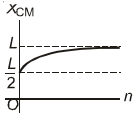
B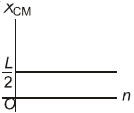
C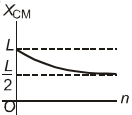
D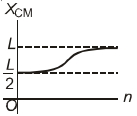
Solution
(A) The center of mass $x_{CM}$ of a rod with linear mass density $\lambda(x)$ is given by:
$x_{CM} = \frac{\int_0^L x \lambda(x) dx}{\int_0^L \lambda(x) dx}$
Substituting $\lambda(x) = k(\frac{x}{L})^n$:
$x_{CM} = \frac{\int_0^L x \cdot k(\frac{x}{L})^n dx}{\int_0^L k(\frac{x}{L})^n dx} = \frac{\frac{k}{L^n} \int_0^L x^{n+1} dx}{\frac{k}{L^n} \int_0^L x^n dx} = \frac{[\frac{x^{n+2}}{n+2}]_0^L}{[\frac{x^{n+1}}{n+1}]_0^L} = \frac{L^{n+2}/(n+2)}{L^{n+1}/(n+1)} = L \frac{n+1}{n+2}$
Analyzing the function $f(n) = L \frac{n+1}{n+2} = L (1 - \frac{1}{n+2})$:
$1$. For $n = 0$,$x_{CM} = L(1 - 1/2) = L/2$.
$2$. As $n \to \infty$,$x_{CM} \to L$.
$3$. The derivative $\frac{dx_{CM}}{dn} = L \frac{(n+2) - (n+1)}{(n+2)^2} = \frac{L}{(n+2)^2} > 0$,so $x_{CM}$ is an increasing function.
$4$. The second derivative $\frac{d^2x_{CM}}{dn^2} = -\frac{2L}{(n+2)^3} < 0$,so the graph is concave down.
These properties match the graph in option $(A)$.
$x_{CM} = \frac{\int_0^L x \lambda(x) dx}{\int_0^L \lambda(x) dx}$
Substituting $\lambda(x) = k(\frac{x}{L})^n$:
$x_{CM} = \frac{\int_0^L x \cdot k(\frac{x}{L})^n dx}{\int_0^L k(\frac{x}{L})^n dx} = \frac{\frac{k}{L^n} \int_0^L x^{n+1} dx}{\frac{k}{L^n} \int_0^L x^n dx} = \frac{[\frac{x^{n+2}}{n+2}]_0^L}{[\frac{x^{n+1}}{n+1}]_0^L} = \frac{L^{n+2}/(n+2)}{L^{n+1}/(n+1)} = L \frac{n+1}{n+2}$
Analyzing the function $f(n) = L \frac{n+1}{n+2} = L (1 - \frac{1}{n+2})$:
$1$. For $n = 0$,$x_{CM} = L(1 - 1/2) = L/2$.
$2$. As $n \to \infty$,$x_{CM} \to L$.
$3$. The derivative $\frac{dx_{CM}}{dn} = L \frac{(n+2) - (n+1)}{(n+2)^2} = \frac{L}{(n+2)^2} > 0$,so $x_{CM}$ is an increasing function.
$4$. The second derivative $\frac{d^2x_{CM}}{dn^2} = -\frac{2L}{(n+2)^3} < 0$,so the graph is concave down.
These properties match the graph in option $(A)$.
0 likesView Solution
8
PhysicsMediumMCQAIEEE · 2008
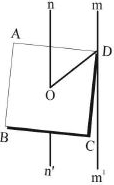
Consider a uniform square plate of side '$a$' and mass '$m$'. The moment of inertia of this plate about an axis perpendicular to its plane and passing through one of its corners is
A
$\frac{2}{3}ma^2$
B
$\frac{5}{6}ma^2$
C
$\frac{1}{12}ma^2$
D
$\frac{7}{12}ma^2$
Solution
(A) The moment of inertia of a square plate of side '$a$' and mass '$m$' about an axis passing through its center of mass and perpendicular to its plane is given by:
$I_{cm} = \frac{1}{12}m(a^2 + a^2) = \frac{ma^2}{6}$
According to the parallel axis theorem,the moment of inertia about an axis passing through a corner and perpendicular to the plane is:
$I = I_{cm} + md^2$
Here,'$d$' is the distance from the center of the square to the corner. For a square of side '$a$',the diagonal is '$a\sqrt{2}$',so the distance from the center to a corner is:
$d = \frac{a\sqrt{2}}{2} = \frac{a}{\sqrt{2}}$
Substituting the values:
$I = \frac{ma^2}{6} + m\left(\frac{a}{\sqrt{2}}\right)^2$
$I = \frac{ma^2}{6} + \frac{ma^2}{2}$
$I = \frac{ma^2 + 3ma^2}{6} = \frac{4ma^2}{6} = \frac{2}{3}ma^2$
$I_{cm} = \frac{1}{12}m(a^2 + a^2) = \frac{ma^2}{6}$
According to the parallel axis theorem,the moment of inertia about an axis passing through a corner and perpendicular to the plane is:
$I = I_{cm} + md^2$
Here,'$d$' is the distance from the center of the square to the corner. For a square of side '$a$',the diagonal is '$a\sqrt{2}$',so the distance from the center to a corner is:
$d = \frac{a\sqrt{2}}{2} = \frac{a}{\sqrt{2}}$
Substituting the values:
$I = \frac{ma^2}{6} + m\left(\frac{a}{\sqrt{2}}\right)^2$
$I = \frac{ma^2}{6} + \frac{ma^2}{2}$
$I = \frac{ma^2 + 3ma^2}{6} = \frac{4ma^2}{6} = \frac{2}{3}ma^2$
0 likesView Solution
9
PhysicsMediumMCQAIEEE · 2008
$A$ planet in a distant solar system is $10$ times more massive than the earth and its radius is $10$ times smaller. Given that the escape velocity from the earth is $11 \ km/s$,the escape velocity from the surface of the planet would be ........ $km/s$.
A
$1.1$
B
$11$
C
$110$
D
$0.11$
Solution
(C) The formula for escape velocity is $v_e = \sqrt{\frac{2GM}{R}}$.
Let $M_e$ and $R_e$ be the mass and radius of the Earth,and $M_p$ and $R_p$ be the mass and radius of the planet.
Given: $M_p = 10 M_e$ and $R_p = \frac{R_e}{10}$.
The ratio of escape velocities is given by:
$\frac{(v_e)_p}{(v_e)_e} = \sqrt{\frac{M_p}{M_e} \times \frac{R_e}{R_p}}$
Substituting the given values:
$\frac{(v_e)_p}{(v_e)_e} = \sqrt{\frac{10 M_e}{M_e} \times \frac{R_e}{R_e/10}} = \sqrt{10 \times 10} = \sqrt{100} = 10$.
Therefore,$(v_e)_p = 10 \times (v_e)_e = 10 \times 11 \ km/s = 110 \ km/s$.
Let $M_e$ and $R_e$ be the mass and radius of the Earth,and $M_p$ and $R_p$ be the mass and radius of the planet.
Given: $M_p = 10 M_e$ and $R_p = \frac{R_e}{10}$.
The ratio of escape velocities is given by:
$\frac{(v_e)_p}{(v_e)_e} = \sqrt{\frac{M_p}{M_e} \times \frac{R_e}{R_p}}$
Substituting the given values:
$\frac{(v_e)_p}{(v_e)_e} = \sqrt{\frac{10 M_e}{M_e} \times \frac{R_e}{R_e/10}} = \sqrt{10 \times 10} = \sqrt{100} = 10$.
Therefore,$(v_e)_p = 10 \times (v_e)_e = 10 \times 11 \ km/s = 110 \ km/s$.
0 likesView Solution
10
PhysicsMediumMCQAIEEE · 2008
This question contains Statement-$1$ and Statement-$2$. Of the four choices given after the statements,choose the one that best describes the two statements.
Statement-$1$: For a mass $M$ kept at the centre of a cube of side '$a$',the flux of the gravitational field passing through its sides is $-4\pi GM$.
Statement-$2$: If the direction of a field due to a point source is radial and its dependence on the distance '$r$' from the source is given as $\frac{1}{r^2}$,its flux through a closed surface depends only on the strength of the source enclosed by the surface and not on the size or shape of the surface.
Statement-$1$: For a mass $M$ kept at the centre of a cube of side '$a$',the flux of the gravitational field passing through its sides is $-4\pi GM$.
Statement-$2$: If the direction of a field due to a point source is radial and its dependence on the distance '$r$' from the source is given as $\frac{1}{r^2}$,its flux through a closed surface depends only on the strength of the source enclosed by the surface and not on the size or shape of the surface.
A
Statement-$1$ is false,Statement-$2$ is true.
B
Statement-$1$ is true,Statement-$2$ is true; Statement-$2$ is a correct explanation for Statement-$1$.
C
Statement-$1$ is true,Statement-$2$ is true; Statement-$2$ is not a correct explanation for Statement-$1$.
D
Statement-$1$ is true,Statement-$2$ is false.
Solution
(A) According to Gauss's Law for gravitation,the gravitational flux $\Phi_g$ through any closed surface is given by $\Phi_g = \oint \vec{E_g} \cdot d\vec{S} = -4\pi GM_{enclosed}$.
Statement-$1$ states the flux is $4\pi GM$,but the correct value is $-4\pi GM$ (due to the attractive nature of gravity). Thus,Statement-$1$ is false.
Statement-$2$ describes the general principle of Gauss's Law,which applies to any field following the inverse-square law (like gravity or electrostatics). This statement is true.
Therefore,Statement-$1$ is false and Statement-$2$ is true.
Statement-$1$ states the flux is $4\pi GM$,but the correct value is $-4\pi GM$ (due to the attractive nature of gravity). Thus,Statement-$1$ is false.
Statement-$2$ describes the general principle of Gauss's Law,which applies to any field following the inverse-square law (like gravity or electrostatics). This statement is true.
Therefore,Statement-$1$ is false and Statement-$2$ is true.
0 likesView Solution
11
PhysicsMediumMCQAIEEE · 2008
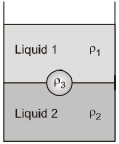
$A$ jar is filled with two non-mixing liquids $1$ and $2$ having densities $\rho_1$ and $\rho_2$ respectively. $A$ solid ball,made of a material of density $\rho_3$,is dropped in the jar. It comes to equilibrium in the position shown in the figure. Which of the following is true for $\rho_1, \rho_2$ and $\rho_3$?
A
$\rho_1 < \rho_3 < \rho_2$
B
$\rho_3 < \rho_1 < \rho_2$
C
$\rho_1 > \rho_3 > \rho_2$
D
$\rho_1 < \rho_2 < \rho_3$
Solution
(A) From the figure,it is clear that liquid $1$ floats on liquid $2$.
Since the lighter liquid floats over the heavier liquid,we can conclude that $\rho_1 < \rho_2$.
The ball is in equilibrium at the interface of the two liquids.
For an object to float in a liquid,its density must be less than the density of the liquid.
Since the ball is partially submerged in liquid $1$ and partially in liquid $2$,its density $\rho_3$ must be greater than the density of the upper liquid $(\rho_1)$ and less than the density of the lower liquid $(\rho_2)$.
Therefore,the condition for equilibrium is $\rho_1 < \rho_3 < \rho_2$.
Since the lighter liquid floats over the heavier liquid,we can conclude that $\rho_1 < \rho_2$.
The ball is in equilibrium at the interface of the two liquids.
For an object to float in a liquid,its density must be less than the density of the liquid.
Since the ball is partially submerged in liquid $1$ and partially in liquid $2$,its density $\rho_3$ must be greater than the density of the upper liquid $(\rho_1)$ and less than the density of the lower liquid $(\rho_2)$.
Therefore,the condition for equilibrium is $\rho_1 < \rho_3 < \rho_2$.
0 likesView Solution
12
PhysicsDifficultMCQAIEEE · 2008
$A$ spherical solid ball of volume $V$ is made of a material of density $\rho_1$. It is falling through a liquid of density $\rho_2$ $(\rho_2 < \rho_1)$. Assume that the liquid applies a viscous force on the ball that is proportional to the square of its speed $v$,i.e.,$F_{viscous} = -kv^2$ $(k > 0)$. The terminal speed of the ball is:
A
$\frac{Vg(\rho_1 - \rho_2)}{k}$
B
$\sqrt{\frac{Vg(\rho_1 - \rho_2)}{k}}$
C
$\frac{Vg\rho_1}{k}$
D
$\sqrt{\frac{Vg\rho_1}{k}}$
Solution
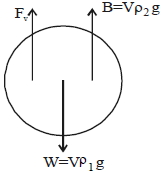
(B) At terminal speed $(v_t)$,the net force on the ball is zero.
Therefore,the downward weight of the ball is balanced by the upward buoyant force and the viscous force.
$Weight = \text{Buoyant force} + \text{Viscous force}$
$V\rho_1 g = V\rho_2 g + kv_t^2$
$kv_t^2 = Vg(\rho_1 - \rho_2)$
$v_t^2 = \frac{Vg(\rho_1 - \rho_2)}{k}$
$v_t = \sqrt{\frac{Vg(\rho_1 - \rho_2)}{k}}$
Therefore,the downward weight of the ball is balanced by the upward buoyant force and the viscous force.
$Weight = \text{Buoyant force} + \text{Viscous force}$
$V\rho_1 g = V\rho_2 g + kv_t^2$
$kv_t^2 = Vg(\rho_1 - \rho_2)$
$v_t^2 = \frac{Vg(\rho_1 - \rho_2)}{k}$
$v_t = \sqrt{\frac{Vg(\rho_1 - \rho_2)}{k}}$
0 likesView Solution
13
PhysicsMediumMCQAIEEE · 2008
$A$ capillary tube $(A)$ is dipped in water. Another identical tube $(B)$ is dipped in a soap-water solution. Which of the following shows the relative nature of the liquid columns in the two tubes?
A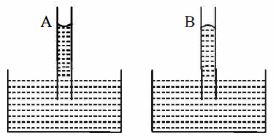
B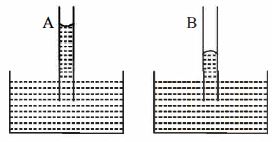
C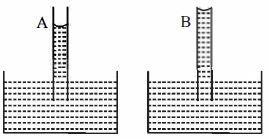
D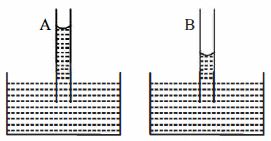
Solution
(D) The height of the liquid column in a capillary tube is given by the ascent formula: $h = \frac{2T \cos \theta}{r \rho g}$.
Here,$T$ is the surface tension,$\theta$ is the angle of contact,$r$ is the radius of the tube,$\rho$ is the density of the liquid,and $g$ is the acceleration due to gravity.
For water,the angle of contact $\theta$ is acute,resulting in a concave meniscus and a positive height $h$ (rise).
For a soap-water solution,the surface tension $T$ is significantly lower than that of pure water. Since $h \propto T$,the height of the soap solution column will be less than the height of the water column.
Both water and soap solution wet the glass,so both will form a concave meniscus (concave upwards) in the capillary tube.
Therefore,the correct representation shows both tubes with concave menisci,but with the liquid level in tube $(B)$ lower than in tube $(A)$.
Here,$T$ is the surface tension,$\theta$ is the angle of contact,$r$ is the radius of the tube,$\rho$ is the density of the liquid,and $g$ is the acceleration due to gravity.
For water,the angle of contact $\theta$ is acute,resulting in a concave meniscus and a positive height $h$ (rise).
For a soap-water solution,the surface tension $T$ is significantly lower than that of pure water. Since $h \propto T$,the height of the soap solution column will be less than the height of the water column.
Both water and soap solution wet the glass,so both will form a concave meniscus (concave upwards) in the capillary tube.
Therefore,the correct representation shows both tubes with concave menisci,but with the liquid level in tube $(B)$ lower than in tube $(A)$.
0 likesView Solution
14
PhysicsMediumMCQAIEEE · 2008
While measuring the speed of sound by performing a resonance column experiment,a student gets the first resonance condition at a column length of $18 \ cm$ during winter. Repeating the same experiment during summer,she measures the column length to be $x \ cm$ for the second resonance. Then
A
$18 \ cm > x$
B
$x > 54 \ cm$
C
$54 \ cm > x > 36 \ cm$
D
$36 \ cm > x > 18 \ cm$
Solution
(B) In a resonance column experiment,the frequency of the tuning fork $f$ remains constant.
For the first resonance in winter,the length is $\ell_1 = 18 \ cm$. The frequency is given by $f = \frac{v}{4 \ell_1} = \frac{v}{4 \times 18}$,where $v$ is the speed of sound in winter.
For the second resonance in summer,the length is $\ell_2 = x \ cm$. The frequency is given by $f = \frac{3v'}{4 \ell_2} = \frac{3v'}{4x}$,where $v'$ is the speed of sound in summer.
Equating the frequencies: $\frac{v}{4 \times 18} = \frac{3v'}{4x}$.
Solving for $x$: $x = 54 \times \frac{v'}{v} \ cm$.
Since the temperature in summer is higher than in winter,the speed of sound $v' > v$ (because $v \propto \sqrt{T}$).
Therefore,$x > 54 \ cm$.
For the first resonance in winter,the length is $\ell_1 = 18 \ cm$. The frequency is given by $f = \frac{v}{4 \ell_1} = \frac{v}{4 \times 18}$,where $v$ is the speed of sound in winter.
For the second resonance in summer,the length is $\ell_2 = x \ cm$. The frequency is given by $f = \frac{3v'}{4 \ell_2} = \frac{3v'}{4x}$,where $v'$ is the speed of sound in summer.
Equating the frequencies: $\frac{v}{4 \times 18} = \frac{3v'}{4x}$.
Solving for $x$: $x = 54 \times \frac{v'}{v} \ cm$.
Since the temperature in summer is higher than in winter,the speed of sound $v' > v$ (because $v \propto \sqrt{T}$).
Therefore,$x > 54 \ cm$.
0 likesView Solution
15
PhysicsMediumMCQAIEEE · 2008
$A$ wave travelling along the $x$-axis is described by the equation $y(x, t) = 0.005 \cos(\alpha x - \beta t)$. If the wavelength and the time period of the wave are $0.08 \ m$ and $2.0 \ s$,respectively,then $\alpha$ and $\beta$ in appropriate units are:
A
$\alpha = 12.5\pi, \beta = \frac{\pi}{2}$
B
$\alpha = 25\pi, \beta = \pi$
C
$\alpha = \frac{0.08}{\pi}, \beta = \frac{2}{\pi}$
D
$\alpha = \frac{0.04}{\pi}, \beta = \frac{1}{\pi}$
Solution
(B) The given wave equation is $y(x, t) = 0.005 \cos(\alpha x - \beta t)$.
Comparing this with the standard wave equation $y(x, t) = a \cos(kx - \omega t)$,we identify the wave number $k = \alpha$ and the angular frequency $\omega = \beta$.
The wave number is defined as $k = \frac{2\pi}{\lambda}$. Given $\lambda = 0.08 \ m$,we have $\alpha = \frac{2\pi}{0.08} = 25\pi \ rad/m$.
The angular frequency is defined as $\omega = \frac{2\pi}{T}$. Given $T = 2.0 \ s$,we have $\beta = \frac{2\pi}{2.0} = \pi \ rad/s$.
Thus,$\alpha = 25\pi$ and $\beta = \pi$.
Comparing this with the standard wave equation $y(x, t) = a \cos(kx - \omega t)$,we identify the wave number $k = \alpha$ and the angular frequency $\omega = \beta$.
The wave number is defined as $k = \frac{2\pi}{\lambda}$. Given $\lambda = 0.08 \ m$,we have $\alpha = \frac{2\pi}{0.08} = 25\pi \ rad/m$.
The angular frequency is defined as $\omega = \frac{2\pi}{T}$. Given $T = 2.0 \ s$,we have $\beta = \frac{2\pi}{2.0} = \pi \ rad/s$.
Thus,$\alpha = 25\pi$ and $\beta = \pi$.
0 likesView Solution
16
PhysicsEasyMCQAIEEE · 2008
An experiment is performed to find the refractive index of glass using a travelling microscope. In this experiment,distances are measured by
A
a meter scale provided on the microscope
B
a vernier scale provided on the microscope
C
a screw gauge provided on the microscope
D
a standard laboratory scale
Solution
(B) travelling microscope is a precision instrument used to measure small distances.
It consists of a main scale and a vernier scale attached to the microscope assembly.
When measuring the refractive index of a glass slab,the microscope is focused on a mark on the table,then on the mark through the glass slab,and finally on a dust particle on the top surface of the slab.
The vertical displacement is measured accurately using the vernier scale provided on the microscope.
It consists of a main scale and a vernier scale attached to the microscope assembly.
When measuring the refractive index of a glass slab,the microscope is focused on a mark on the table,then on the mark through the glass slab,and finally on a dust particle on the top surface of the slab.
The vertical displacement is measured accurately using the vernier scale provided on the microscope.
0 likesView Solution
17
PhysicsMediumMCQAIEEE · 2008
The speed of sound in oxygen $(O_2)$ at a certain temperature is $460 \,ms^{-1}$. The speed of sound in helium $(He)$ at the same temperature will be (assume both gases to be ideal): (in $\,ms^{-1}$)
A
$330$
B
$1420$
C
$500$
D
$650$
Solution
(B) For oxygen $(O_2)$:
Molar mass,$M_1 = 32 \,g/mol$.
Heat capacity ratio,$\gamma_1 = C_p / C_V = 7/5$ (for diatomic gas).
Speed of sound,$v_1 = 460 \,ms^{-1}$.
For helium $(He)$:
Molar mass,$M_2 = 4 \,g/mol$.
Heat capacity ratio,$\gamma_2 = C_p / C_V = 5/3$ (for monoatomic gas).
The speed of sound in an ideal gas is given by $v = \sqrt{\frac{\gamma RT}{M}}$.
Taking the ratio of speeds: $\frac{v_1}{v_2} = \sqrt{\frac{\gamma_1 / M_1}{\gamma_2 / M_2}} = \sqrt{\frac{\gamma_1}{\gamma_2} \cdot \frac{M_2}{M_1}}$.
Substituting the values: $\frac{460}{v_2} = \sqrt{\frac{7/5}{5/3} \cdot \frac{4}{32}} = \sqrt{\frac{21}{25} \cdot \frac{1}{8}} = \sqrt{\frac{21}{200}} \approx 0.324$.
Wait,re-calculating: $\frac{460}{v_2} = \sqrt{\frac{7}{5} \cdot \frac{3}{5} \cdot \frac{4}{32}} = \sqrt{\frac{21}{25} \cdot \frac{1}{8}} = \sqrt{\frac{21}{200}} \approx 0.324$.
Actually,$\frac{v_2}{v_1} = \sqrt{\frac{\gamma_2}{\gamma_1} \cdot \frac{M_1}{M_2}} = \sqrt{\frac{5/3}{7/5} \cdot \frac{32}{4}} = \sqrt{\frac{25}{21} \cdot 8} = \sqrt{\frac{200}{21}} \approx \sqrt{9.52} \approx 3.085$.
$v_2 = 460 \times 3.085 \approx 1419.1 \,ms^{-1} \approx 1420 \,ms^{-1}$.
Molar mass,$M_1 = 32 \,g/mol$.
Heat capacity ratio,$\gamma_1 = C_p / C_V = 7/5$ (for diatomic gas).
Speed of sound,$v_1 = 460 \,ms^{-1}$.
For helium $(He)$:
Molar mass,$M_2 = 4 \,g/mol$.
Heat capacity ratio,$\gamma_2 = C_p / C_V = 5/3$ (for monoatomic gas).
The speed of sound in an ideal gas is given by $v = \sqrt{\frac{\gamma RT}{M}}$.
Taking the ratio of speeds: $\frac{v_1}{v_2} = \sqrt{\frac{\gamma_1 / M_1}{\gamma_2 / M_2}} = \sqrt{\frac{\gamma_1}{\gamma_2} \cdot \frac{M_2}{M_1}}$.
Substituting the values: $\frac{460}{v_2} = \sqrt{\frac{7/5}{5/3} \cdot \frac{4}{32}} = \sqrt{\frac{21}{25} \cdot \frac{1}{8}} = \sqrt{\frac{21}{200}} \approx 0.324$.
Wait,re-calculating: $\frac{460}{v_2} = \sqrt{\frac{7}{5} \cdot \frac{3}{5} \cdot \frac{4}{32}} = \sqrt{\frac{21}{25} \cdot \frac{1}{8}} = \sqrt{\frac{21}{200}} \approx 0.324$.
Actually,$\frac{v_2}{v_1} = \sqrt{\frac{\gamma_2}{\gamma_1} \cdot \frac{M_1}{M_2}} = \sqrt{\frac{5/3}{7/5} \cdot \frac{32}{4}} = \sqrt{\frac{25}{21} \cdot 8} = \sqrt{\frac{200}{21}} \approx \sqrt{9.52} \approx 3.085$.
$v_2 = 460 \times 3.085 \approx 1419.1 \,ms^{-1} \approx 1420 \,ms^{-1}$.
0 likesView Solution
18
PhysicsMediumMCQAIEEE · 2008
The dimension of magnetic field in $M, L, T$ and $C$ (coulomb) is given as:
A
$MT^{-2}C^{-1}$
B
$MLT^{-1}C^{-1}$
C
$M^1T^{-1}C^{-1}$
D
$M^1T^{-2}C^{-2}$
Solution
(C) The magnetic force $F$ on a charge $q$ moving with velocity $v$ in a magnetic field $B$ is given by the Lorentz force formula: $F = qvB \sin \theta$.
Considering dimensions,we have $[F] = [q][v][B]$.
The dimensions are: $[F] = MLT^{-2}$,$[q] = C$,and $[v] = LT^{-1}$.
Rearranging for $B$,we get: $[B] = \frac{[F]}{[q][v]} = \frac{MLT^{-2}}{C \cdot LT^{-1}}$.
Simplifying the expression: $[B] = M \cdot L^1 L^{-1} \cdot T^{-2} T^1 \cdot C^{-1} = MT^{-1}C^{-1}$.
Considering dimensions,we have $[F] = [q][v][B]$.
The dimensions are: $[F] = MLT^{-2}$,$[q] = C$,and $[v] = LT^{-1}$.
Rearranging for $B$,we get: $[B] = \frac{[F]}{[q][v]} = \frac{MLT^{-2}}{C \cdot LT^{-1}}$.
Simplifying the expression: $[B] = M \cdot L^1 L^{-1} \cdot T^{-2} T^1 \cdot C^{-1} = MT^{-1}C^{-1}$.
0 likesView Solution
19
PhysicsMediumMCQAIEEE · 2008
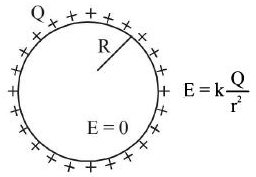
$A$ thin spherical shell of radius $R$ has charge $Q$ spread uniformly over its surface. Which of the following graphs most closely represents the electric field $E(r)$ produced by the shell in the range $0 \le r < \infty$,where $r$ is the distance from the centre of the shell?
A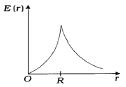
B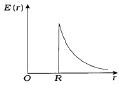
C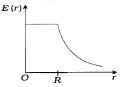
D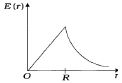
Solution
(B) According to Gauss's Law,for a thin spherical shell of radius $R$ with a uniformly distributed charge $Q$:
$1$. Inside the shell $(r < R)$: The electric field $E$ is zero because there is no enclosed charge.
$2$. Outside the shell $(r \ge R)$: The shell acts as a point charge located at its center,so the electric field is given by $E = k\frac{Q}{r^2}$,where $k = \frac{1}{4\pi\epsilon_0}$.
Thus,the graph of $E(r)$ versus $r$ should show $E = 0$ for $0 \le r < R$ and a $1/r^2$ decay for $r \ge R$. This corresponds to the graph shown in option $B$.
$1$. Inside the shell $(r < R)$: The electric field $E$ is zero because there is no enclosed charge.
$2$. Outside the shell $(r \ge R)$: The shell acts as a point charge located at its center,so the electric field is given by $E = k\frac{Q}{r^2}$,where $k = \frac{1}{4\pi\epsilon_0}$.
Thus,the graph of $E(r)$ versus $r$ should show $E = 0$ for $0 \le r < R$ and a $1/r^2$ decay for $r \ge R$. This corresponds to the graph shown in option $B$.
0 likesView Solution
20
PhysicsMediumMCQAIEEE · 2008
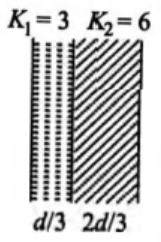
$A$ parallel plate capacitor with air between the plates has a capacitance of $9 \ pF$. The separation between its plates is $d$. The space between the plates is now filled with two dielectrics. One of the dielectrics has a dielectric constant $k_1 = 3$ and thickness $d/3$,while the other one has a dielectric constant $k_2 = 6$ and thickness $2d/3$. The capacitance of the capacitor is now . . . . . . $pF$.
A
$20.25$
B
$1.8$
C
$45$
D
$40.5$
Solution
(D) The initial capacitance of the air-filled capacitor is $C_0 = \frac{\epsilon_0 A}{d} = 9 \ pF$.
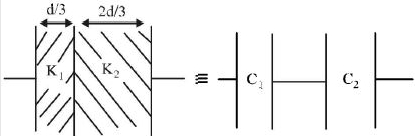
When the space is filled with two dielectrics of thicknesses $d_1 = d/3$ and $d_2 = 2d/3$,the system acts as two capacitors connected in series.
The capacitance of the first part is $C_1 = \frac{k_1 \epsilon_0 A}{d_1} = \frac{3 \epsilon_0 A}{d/3} = 9 \frac{\epsilon_0 A}{d} = 9 C_0 = 9 \times 9 = 81 \ pF$.
The capacitance of the second part is $C_2 = \frac{k_2 \epsilon_0 A}{d_2} = \frac{6 \epsilon_0 A}{2d/3} = 9 \frac{\epsilon_0 A}{d} = 9 C_0 = 9 \times 9 = 81 \ pF$.
Since they are in series,the equivalent capacitance $C_{eq}$ is given by $\frac{1}{C_{eq}} = \frac{1}{C_1} + \frac{1}{C_2}$.
$\frac{1}{C_{eq}} = \frac{1}{81} + \frac{1}{81} = \frac{2}{81}$.
Therefore,$C_{eq} = \frac{81}{2} = 40.5 \ pF$.
When the space is filled with two dielectrics of thicknesses $d_1 = d/3$ and $d_2 = 2d/3$,the system acts as two capacitors connected in series.
The capacitance of the first part is $C_1 = \frac{k_1 \epsilon_0 A}{d_1} = \frac{3 \epsilon_0 A}{d/3} = 9 \frac{\epsilon_0 A}{d} = 9 C_0 = 9 \times 9 = 81 \ pF$.
The capacitance of the second part is $C_2 = \frac{k_2 \epsilon_0 A}{d_2} = \frac{6 \epsilon_0 A}{2d/3} = 9 \frac{\epsilon_0 A}{d} = 9 C_0 = 9 \times 9 = 81 \ pF$.
Since they are in series,the equivalent capacitance $C_{eq}$ is given by $\frac{1}{C_{eq}} = \frac{1}{C_1} + \frac{1}{C_2}$.
$\frac{1}{C_{eq}} = \frac{1}{81} + \frac{1}{81} = \frac{2}{81}$.
Therefore,$C_{eq} = \frac{81}{2} = 40.5 \ pF$.
0 likesView Solution
21
PhysicsMediumMCQAIEEE · 2008
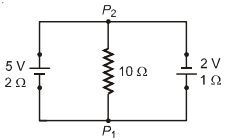
$A$ $5\ V$ battery with internal resistance $2\,\Omega$ and a $2\,V$ battery with internal resistance $1\,\Omega$ are connected to a $10\,\Omega$ resistor as shown in the figure. Find the current through the $10\,\Omega$ resistor.
A
$0.27\,A$,$P_1$ to $P_2$
B
$0.27\,A$,$P_2$ to $P_1$
C
$0.03\,A$,$P_1$ to $P_2$
D
$0.03\,A$,$P_2$ to $P_1$
Solution
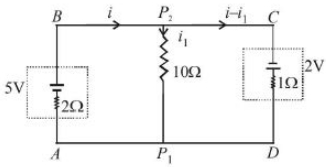
(B) Let $V_{P1} = 0\,V$. Then the potential at $P_2$ is $V$.
Using nodal analysis at node $P_2$:
$\frac{V - 5}{2} + \frac{V}{10} + \frac{V - 2}{1} = 0$
Multiply by $10$:
$5(V - 5) + V + 10(V - 2) = 0$
$5V - 25 + V + 10V - 20 = 0$
$16V = 45$
$V = \frac{45}{16} = 2.8125\,V$
The current through the $10\,\Omega$ resistor is $I = \frac{V}{R} = \frac{2.8125}{10} = 0.28125\,A \approx 0.28\,A$.
Given the options,the closest value is $0.27\,A$. Since $V_{P2} > V_{P1}$,the current flows from $P_2$ to $P_1$.
Using nodal analysis at node $P_2$:
$\frac{V - 5}{2} + \frac{V}{10} + \frac{V - 2}{1} = 0$
Multiply by $10$:
$5(V - 5) + V + 10(V - 2) = 0$
$5V - 25 + V + 10V - 20 = 0$
$16V = 45$
$V = \frac{45}{16} = 2.8125\,V$
The current through the $10\,\Omega$ resistor is $I = \frac{V}{R} = \frac{2.8125}{10} = 0.28125\,A \approx 0.28\,A$.
Given the options,the closest value is $0.27\,A$. Since $V_{P2} > V_{P1}$,the current flows from $P_2$ to $P_1$.
0 likesView Solution
22
PhysicsEasyMCQAIEEE · 2008
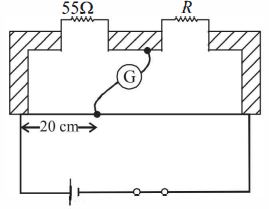
Shown in the figure below is a meter-bridge set up with null deflection in the galvanometer. The value of the unknown resistor $R$ is ............. $\Omega$.
A
$55$
B
$13.75$
C
$220$
D
$110$
Solution
(C) In a meter bridge,the balancing condition is given by the formula: $\frac{P}{Q} = \frac{l_1}{l_2}$,where $P$ and $Q$ are the resistances in the two gaps,and $l_1$ and $l_2$ are the corresponding lengths of the wire.
Given,$P = 55 \, \Omega$ and $l_1 = 20 \, \text{cm}$.
The total length of the meter bridge wire is $100 \, \text{cm}$,so $l_2 = 100 - 20 = 80 \, \text{cm}$.
Substituting these values into the balancing condition:
$\frac{55}{R} = \frac{20}{80}$
$\frac{55}{R} = \frac{1}{4}$
$R = 55 \times 4 = 220 \, \Omega$.
Given,$P = 55 \, \Omega$ and $l_1 = 20 \, \text{cm}$.
The total length of the meter bridge wire is $100 \, \text{cm}$,so $l_2 = 100 - 20 = 80 \, \text{cm}$.
Substituting these values into the balancing condition:
$\frac{55}{R} = \frac{20}{80}$
$\frac{55}{R} = \frac{1}{4}$
$R = 55 \times 4 = 220 \, \Omega$.
0 likesView Solution
23
PhysicsDifficultMCQAIEEE · 2008
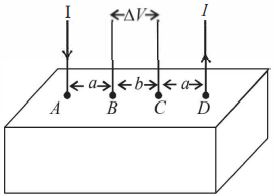
Consider a block of conducting material of resistivity $\rho$ shown in the figure. Current $I$ enters at $A$ and leaves from $D$. We apply the superposition principle to find the voltage $\Delta V$ developed between $B$ and $C$. The calculation is done in the following steps: $(i)$ Take current $I$ entering from $A$ and assume it to spread over a hemispherical surface in the block. $(ii)$ Calculate the field $E(r)$ at distance $r$ from $A$ by using Ohm's law $E=\rho j$,where $j$ is the current per unit area at $r$. $(iii)$ From the $r$ dependence of $E(r)$,obtain the potential $V(r)$ at $r$. $(iv)$ Repeat $(i), (ii)$ and $(iii)$ for current $I$ leaving $D$ and superpose results for $A$ and $D$. $\Delta V$ measured between $B$ and $C$ is
A
$\frac{\rho I}{2 \pi(a-b)}$
B
$\frac{\rho I}{\pi a}-\frac{\rho I}{\pi(a+b)}$
C
$\frac{\rho I}{a}-\frac{\rho I}{(a+b)}$
D
$\frac{\rho I}{2 \pi a}-\frac{\rho I}{2 \pi(a+b)}$
Solution
(B) Let $j$ be the current density.
Since the current $I$ spreads over a hemispherical surface,$j \times 2 \pi r^2 = I$,which gives $j = \frac{I}{2 \pi r^2}$.
Using Ohm's law,the electric field is $E = \rho j = \frac{\rho I}{2 \pi r^2}$.
The potential difference due to current $I$ entering at $A$ between points $B$ and $C$ is $\Delta V_{BC, A} = V_B - V_C = \int_{r_B}^{r_C} E dr = \int_{a}^{a+b} \frac{\rho I}{2 \pi r^2} dr = \frac{\rho I}{2 \pi} \left[ -\frac{1}{r} \right]_{a}^{a+b} = \frac{\rho I}{2 \pi} \left( \frac{1}{a} - \frac{1}{a+b} \right)$.
Similarly,for current $I$ leaving at $D$,the potential difference $\Delta V_{BC, D}$ is also $\frac{\rho I}{2 \pi} \left( \frac{1}{a} - \frac{1}{a+b} \right)$.
By the superposition principle,the total potential difference is $\Delta V = \Delta V_{BC, A} + \Delta V_{BC, D} = 2 \times \frac{\rho I}{2 \pi} \left( \frac{1}{a} - \frac{1}{a+b} \right) = \frac{\rho I}{\pi a} - \frac{\rho I}{\pi(a+b)}$.
Since the current $I$ spreads over a hemispherical surface,$j \times 2 \pi r^2 = I$,which gives $j = \frac{I}{2 \pi r^2}$.
Using Ohm's law,the electric field is $E = \rho j = \frac{\rho I}{2 \pi r^2}$.
The potential difference due to current $I$ entering at $A$ between points $B$ and $C$ is $\Delta V_{BC, A} = V_B - V_C = \int_{r_B}^{r_C} E dr = \int_{a}^{a+b} \frac{\rho I}{2 \pi r^2} dr = \frac{\rho I}{2 \pi} \left[ -\frac{1}{r} \right]_{a}^{a+b} = \frac{\rho I}{2 \pi} \left( \frac{1}{a} - \frac{1}{a+b} \right)$.
Similarly,for current $I$ leaving at $D$,the potential difference $\Delta V_{BC, D}$ is also $\frac{\rho I}{2 \pi} \left( \frac{1}{a} - \frac{1}{a+b} \right)$.
By the superposition principle,the total potential difference is $\Delta V = \Delta V_{BC, A} + \Delta V_{BC, D} = 2 \times \frac{\rho I}{2 \pi} \left( \frac{1}{a} - \frac{1}{a+b} \right) = \frac{\rho I}{\pi a} - \frac{\rho I}{\pi(a+b)}$.
0 likesView Solution
24
PhysicsDifficultMCQAIEEE · 2008
Consider a block of conducting material of resistivity $\rho$ shown in the figure. Current $I$ enters at $A$ and leaves from $D$. We apply the superposition principle to find the voltage $\Delta V$ developed between $B$ and $C$. The calculation is done in the following steps:
$(i)$ Take current $I$ entering from $A$ and assume it to spread over a hemispherical surface in the block.
$(ii)$ Calculate field $E(r)$ at distance $r$ from $A$ by using Ohm's law $E = \rho j$,where $j$ is the current per unit area at $r$.
$(iii)$ From the $r$ dependence of $E(r)$,obtain the potential $V(r)$ at $r$.
$(iv)$ Repeat $(i)$,$(ii)$ and $(iii)$ for current $I$ leaving $D$ and superpose results for $A$ and $D$.
For current entering at $A$,the electric field at a distance $r$ from $A$ is
$(i)$ Take current $I$ entering from $A$ and assume it to spread over a hemispherical surface in the block.
$(ii)$ Calculate field $E(r)$ at distance $r$ from $A$ by using Ohm's law $E = \rho j$,where $j$ is the current per unit area at $r$.
$(iii)$ From the $r$ dependence of $E(r)$,obtain the potential $V(r)$ at $r$.
$(iv)$ Repeat $(i)$,$(ii)$ and $(iii)$ for current $I$ leaving $D$ and superpose results for $A$ and $D$.
For current entering at $A$,the electric field at a distance $r$ from $A$ is
A
$\frac{\rho I}{4 \pi r^2}$
B
$\frac{\rho I}{8 \pi r^2}$
C
$\frac{\rho I}{r^2}$
D
$\frac{\rho I}{2 \pi r^2}$
Solution
(D) Let $j$ be the current density.
Since the current $I$ spreads over a hemispherical surface of area $2 \pi r^2$,the current density is $j = \frac{I}{2 \pi r^2}$.
Using Ohm's law in the form $E = \rho j$,we get:
$E = \rho \left( \frac{I}{2 \pi r^2} \right) = \frac{\rho I}{2 \pi r^2}$.
Since the current $I$ spreads over a hemispherical surface of area $2 \pi r^2$,the current density is $j = \frac{I}{2 \pi r^2}$.
Using Ohm's law in the form $E = \rho j$,we get:
$E = \rho \left( \frac{I}{2 \pi r^2} \right) = \frac{\rho I}{2 \pi r^2}$.
0 likesView Solution
25
PhysicsMediumMCQAIEEE · 2008
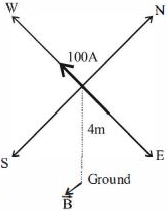
$A$ horizontal overhead powerline is at a height of $4\ m$ from the ground and carries a current of $100\ A$ from east to west. The magnetic field directly below it on the ground is: (Given: $\mu_0 = 4\pi \times 10^{-7} \, T \cdot m/A$)
A
$2.5 \times 10^{-7} \, T$ Northward
B
$2.5 \times 10^{-7} \, T$ Southward
C
$5 \times 10^{-6} \, T$ Northward
D
$5 \times 10^{-6} \, T$ Southward
Solution
(D) The magnetic field $B$ due to a long straight current-carrying wire at a distance $r$ is given by the formula:
$B = \frac{\mu_0 I}{2 \pi r}$
Given:
$I = 100 \, A$
$r = 4 \, m$
$\mu_0 = 4\pi \times 10^{-7} \, T \cdot m/A$
Substituting the values:
$B = \frac{(4\pi \times 10^{-7}) \times 100}{2 \pi \times 4}$
$B = \frac{2 \times 10^{-7} \times 100}{4}$
$B = \frac{2 \times 10^{-5}}{4} = 0.5 \times 10^{-5} = 5 \times 10^{-6} \, T$
According to the Right-Hand Thumb Rule,if the thumb points in the direction of the current (West),the curled fingers at the point below the wire will point towards the South.
$B = \frac{\mu_0 I}{2 \pi r}$
Given:
$I = 100 \, A$
$r = 4 \, m$
$\mu_0 = 4\pi \times 10^{-7} \, T \cdot m/A$
Substituting the values:
$B = \frac{(4\pi \times 10^{-7}) \times 100}{2 \pi \times 4}$
$B = \frac{2 \times 10^{-7} \times 100}{4}$
$B = \frac{2 \times 10^{-5}}{4} = 0.5 \times 10^{-5} = 5 \times 10^{-6} \, T$
According to the Right-Hand Thumb Rule,if the thumb points in the direction of the current (West),the curled fingers at the point below the wire will point towards the South.
0 likesView Solution
26
PhysicsEasyMCQAIEEE · 2008
Relative permittivity and permeability of a material are $\varepsilon_r$ and $\mu_r$ respectively. Which of the following values of these quantities are allowed for a diamagnetic material?
A
$\varepsilon_r = 1.5, \mu_r = 1.5$
B
$\varepsilon_r = 0.5, \mu_r = 1.5$
C
$\varepsilon_r = 1.5, \mu_r = 0.5$
D
$\varepsilon_r = 0.5, \mu_r = 0.5$
Solution
(C) For a diamagnetic material,the relative permeability $\mu_r$ is always less than $1$ (i.e.,$\mu_r < 1$).
For any dielectric material,the relative permittivity $\varepsilon_r$ is always greater than $1$ (i.e.,$\varepsilon_r > 1$).
Comparing these conditions with the given options,we find that option $C$ satisfies both conditions: $\varepsilon_r = 1.5 > 1$ and $\mu_r = 0.5 < 1$.
For any dielectric material,the relative permittivity $\varepsilon_r$ is always greater than $1$ (i.e.,$\varepsilon_r > 1$).
Comparing these conditions with the given options,we find that option $C$ satisfies both conditions: $\varepsilon_r = 1.5 > 1$ and $\mu_r = 0.5 < 1$.
0 likesView Solution
27
PhysicsEasyMCQAIEEE · 2008
$A$ student measures the focal length of a convex lens by placing an object pin at a distance '$u$' from the lens and measuring the distance '$v$' of the image pin. The graph between '$u$' and '$v$' plotted by the student should look like:
A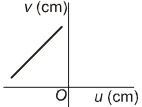
B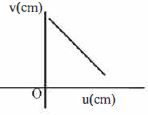
C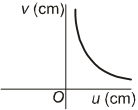
D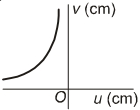
Solution
(C) The lens equation is given by $\frac{1}{v} - \frac{1}{u} = \frac{1}{f}$.
Using sign convention for a convex lens,the object distance is negative,so we take $u = -x$ (where $x > 0$).
The equation becomes $\frac{1}{v} - \frac{1}{-x} = \frac{1}{f}$,which simplifies to $\frac{1}{v} + \frac{1}{x} = \frac{1}{f}$.
Rearranging for $v$,we get $\frac{1}{v} = \frac{1}{f} - \frac{1}{x} = \frac{x - f}{xf}$,so $v = \frac{xf}{x - f}$.
As $x$ increases from $f$ to $\infty$,$v$ decreases from $\infty$ to $f$. This represents a hyperbolic curve in the first quadrant of the $v-u$ plane (considering magnitudes of $u$ and $v$),which corresponds to the shape shown in option $C$.
Using sign convention for a convex lens,the object distance is negative,so we take $u = -x$ (where $x > 0$).
The equation becomes $\frac{1}{v} - \frac{1}{-x} = \frac{1}{f}$,which simplifies to $\frac{1}{v} + \frac{1}{x} = \frac{1}{f}$.
Rearranging for $v$,we get $\frac{1}{v} = \frac{1}{f} - \frac{1}{x} = \frac{x - f}{xf}$,so $v = \frac{xf}{x - f}$.
As $x$ increases from $f$ to $\infty$,$v$ decreases from $\infty$ to $f$. This represents a hyperbolic curve in the first quadrant of the $v-u$ plane (considering magnitudes of $u$ and $v$),which corresponds to the shape shown in option $C$.
0 likesView Solution
28
PhysicsEasyMCQAIEEE · 2008
Two coaxial solenoids are made by winding thin insulated wire over a pipe of cross-sectional area $A = 10 \ cm^2$ and length $\ell = 20 \ cm$. If one of the solenoids has $N_1 = 300$ turns and the other has $N_2 = 400$ turns,their mutual inductance is (given $\mu_0 = 4\pi \times 10^{-7} \ T \ m \ A^{-1}$):
A
$2.4\pi \times 10^{-4} \ H$
B
$2.4\pi \times 10^{-5} \ H$
C
$4.8\pi \times 10^{-4} \ H$
D
$4.8\pi \times 10^{-5} \ H$
Solution
(A) The formula for the mutual inductance $M$ of two coaxial solenoids is given by $M = \frac{\mu_0 N_1 N_2 A}{\ell}$.
Given values are:
$A = 10 \ cm^2 = 10 \times 10^{-4} \ m^2 = 10^{-3} \ m^2$
$\ell = 20 \ cm = 0.2 \ m$
$N_1 = 300$
$N_2 = 400$
$\mu_0 = 4\pi \times 10^{-7} \ T \ m \ A^{-1}$
Substituting these values into the formula:
$M = \frac{(4\pi \times 10^{-7}) \times 300 \times 400 \times 10^{-3}}{0.2}$
$M = \frac{4\pi \times 10^{-7} \times 120000 \times 10^{-3}}{0.2}$
$M = \frac{4\pi \times 10^{-7} \times 120}{0.2}$
$M = 4\pi \times 10^{-7} \times 600$
$M = 2400\pi \times 10^{-7} \ H = 2.4\pi \times 10^{-4} \ H$.
Given values are:
$A = 10 \ cm^2 = 10 \times 10^{-4} \ m^2 = 10^{-3} \ m^2$
$\ell = 20 \ cm = 0.2 \ m$
$N_1 = 300$
$N_2 = 400$
$\mu_0 = 4\pi \times 10^{-7} \ T \ m \ A^{-1}$
Substituting these values into the formula:
$M = \frac{(4\pi \times 10^{-7}) \times 300 \times 400 \times 10^{-3}}{0.2}$
$M = \frac{4\pi \times 10^{-7} \times 120000 \times 10^{-3}}{0.2}$
$M = \frac{4\pi \times 10^{-7} \times 120}{0.2}$
$M = 4\pi \times 10^{-7} \times 600$
$M = 2400\pi \times 10^{-7} \ H = 2.4\pi \times 10^{-4} \ H$.
0 likesView Solution
29
PhysicsMediumMCQAIEEE · 2008
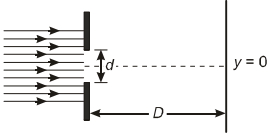
In an experiment, electrons are made to pass through a narrow slit of width '$d$' comparable to their de Broglie wavelength. They are detected on a screen at a distance '$D$' from the slit (see figure). Which of the following graphs can be expected to represent the number of electrons '$N$' detected as a function of the detector position '$y$' ($y = 0$ corresponds to the middle of the slit)?
A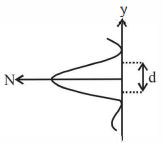
B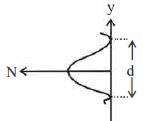
C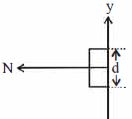
D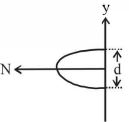
Solution
(A) When electrons pass through a narrow slit of width '$d$' comparable to their de Broglie wavelength, they exhibit wave-like behavior and undergo diffraction.
According to the single-slit diffraction pattern, the intensity (or number of electrons '$N$') is maximum at the center $(y = 0)$.
The first minima occur at positions given by the condition $d \sin \theta = \lambda$, where $\theta \approx y/D$.
Thus, $y = \pm \lambda D / d$.
Since the wavelength $\lambda$ is comparable to '$d$', the width of the central maximum is significant, and the diffraction pattern spreads out.
Graph $A$ represents the standard intensity distribution for single-slit diffraction, where the central maximum is at $y = 0$ and the intensity drops to zero at $y = \pm \lambda D / d$.
According to the single-slit diffraction pattern, the intensity (or number of electrons '$N$') is maximum at the center $(y = 0)$.
The first minima occur at positions given by the condition $d \sin \theta = \lambda$, where $\theta \approx y/D$.
Thus, $y = \pm \lambda D / d$.
Since the wavelength $\lambda$ is comparable to '$d$', the width of the central maximum is significant, and the diffraction pattern spreads out.
Graph $A$ represents the standard intensity distribution for single-slit diffraction, where the central maximum is at $y = 0$ and the intensity drops to zero at $y = \pm \lambda D / d$.
0 likesView Solution
30
PhysicsMediumMCQAIEEE · 2008
Suppose an electron is attracted towards the origin by a force $F = \frac{k}{r}$,where $k$ is a constant and $r$ is the distance of the electron from the origin. By applying the Bohr model to this system,the radius of the $n^{th}$ orbital of the electron is found to be $r_n$ and the kinetic energy of the electron is $K_n$. Then which of the following is true?
A
$K_n \propto \frac{1}{n}, r_n \propto n^2$
B
$K_n \propto \frac{1}{n^2}, r_n \propto n^2$
C
$K_n$ is independent of $n, r_n \propto n$
D
$K_n \propto \frac{1}{n}, r_n \propto n$
Solution
(C) The force acting on the electron is $F = \frac{k}{r}$.
For circular motion,this force provides the necessary centripetal force: $\frac{k}{r} = \frac{mv^2}{r}$.
This implies $mv^2 = k$,which means the kinetic energy $K_n = \frac{1}{2}mv^2 = \frac{k}{2}$ is constant and independent of $n$.
According to the Bohr quantization condition,$mvr = \frac{nh}{2\pi}$.
Since $v = \sqrt{\frac{k}{m}}$ is constant,we have $m \sqrt{\frac{k}{m}} r_n = \frac{nh}{2\pi}$.
Therefore,$r_n \propto n$.
For circular motion,this force provides the necessary centripetal force: $\frac{k}{r} = \frac{mv^2}{r}$.
This implies $mv^2 = k$,which means the kinetic energy $K_n = \frac{1}{2}mv^2 = \frac{k}{2}$ is constant and independent of $n$.
According to the Bohr quantization condition,$mvr = \frac{nh}{2\pi}$.
Since $v = \sqrt{\frac{k}{m}}$ is constant,we have $m \sqrt{\frac{k}{m}} r_n = \frac{nh}{2\pi}$.
Therefore,$r_n \propto n$.
0 likesView Solution
31
PhysicsMediumMCQAIEEE · 2008
This question contains Statement-$1$ and Statement-$2$. Of the four choices given after the statements,choose the one that best describes the two statements.
Statement-$1$: Energy is released when heavy nuclei undergo fission or light nuclei undergo fusion.
Statement-$2$: For heavy nuclei,binding energy per nucleon increases with increasing $Z$,while for light nuclei,it decreases with increasing $Z$.
Statement-$1$: Energy is released when heavy nuclei undergo fission or light nuclei undergo fusion.
Statement-$2$: For heavy nuclei,binding energy per nucleon increases with increasing $Z$,while for light nuclei,it decreases with increasing $Z$.
A
Statement-$1$ is true,Statement-$2$ is false.
B
Statement-$1$ is false,Statement-$2$ is true.
C
Statement-$1$ is true,Statement-$2$ is true; Statement-$2$ is a correct explanation for Statement-$1$.
D
Statement-$1$ is true,Statement-$2$ is true; Statement-$2$ is not a correct explanation for Statement-$1$.
Solution
(A) Statement-$1$ is true. Energy is released in nuclear fission of heavy nuclei and nuclear fusion of light nuclei because the binding energy per nucleon of the product nuclei is higher than that of the reactant nuclei,leading to a more stable configuration.
Statement-$2$ is false. According to the binding energy per nucleon curve,for heavy nuclei (mass number $A > 170$),the binding energy per nucleon decreases as $Z$ increases. For light nuclei (mass number $A < 30$),the binding energy per nucleon generally increases as $Z$ increases. The statement provided in Statement-$2$ is the exact opposite of this physical reality.
Statement-$2$ is false. According to the binding energy per nucleon curve,for heavy nuclei (mass number $A > 170$),the binding energy per nucleon decreases as $Z$ increases. For light nuclei (mass number $A < 30$),the binding energy per nucleon generally increases as $Z$ increases. The statement provided in Statement-$2$ is the exact opposite of this physical reality.
0 likesView Solution
32
PhysicsEasyMCQAIEEE · 2008
$A$ working transistor with its three legs marked $P, Q$ and $R$ is tested using a multimeter. No conduction is found between $P$ and $Q$. By connecting the common (negative) terminal of the multimeter to $R$ and the other (positive) terminal to $P$ or $Q$,some resistance is seen on the multimeter. Which of the following is true for the transistor?
A
It is an $npn$ transistor with $R$ as collector
B
It is an $npn$ transistor with $R$ as base
C
It is a $pnp$ transistor with $R$ as collector
D
It is a $pnp$ transistor with $R$ as emitter
Solution
(B) transistor consists of two $pn$ junctions.
$1$. No conduction between $P$ and $Q$ implies that $P$ and $Q$ are the collector and emitter terminals (or vice versa),as there is no direct $pn$ junction between them.
$2$. When the negative terminal of the multimeter is connected to $R$ and the positive terminal is connected to $P$ or $Q$,conduction (resistance) is observed.
$3$. In a multimeter,the common (negative) terminal is connected to the internal battery's negative pole,and the positive terminal is connected to the positive pole.
$4$. Conduction occurs when the $pn$ junction is forward-biased.
$5$. Since the negative terminal is at $R$ and the positive terminal is at $P$ or $Q$,$R$ must be the $p$-type material (base) and $P, Q$ must be $n$-type materials.
$6$. This configuration corresponds to an $npn$ transistor where $R$ is the base.
$1$. No conduction between $P$ and $Q$ implies that $P$ and $Q$ are the collector and emitter terminals (or vice versa),as there is no direct $pn$ junction between them.
$2$. When the negative terminal of the multimeter is connected to $R$ and the positive terminal is connected to $P$ or $Q$,conduction (resistance) is observed.
$3$. In a multimeter,the common (negative) terminal is connected to the internal battery's negative pole,and the positive terminal is connected to the positive pole.
$4$. Conduction occurs when the $pn$ junction is forward-biased.
$5$. Since the negative terminal is at $R$ and the positive terminal is at $P$ or $Q$,$R$ must be the $p$-type material (base) and $P, Q$ must be $n$-type materials.
$6$. This configuration corresponds to an $npn$ transistor where $R$ is the base.
0 likesView Solution
33
PhysicsMediumMCQAIEEE · 2008
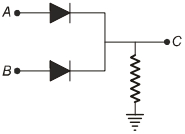
In the circuit below,$A$ and $B$ represent two inputs and $C$ represents the output.
A
$OR$ gate
B
$NOR$ gate
C
$AND$ gate
D
$NAND$ gate
Solution
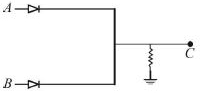
(A) The given circuit consists of two diodes connected in parallel with a common resistor connected to the ground.
Let us analyze the truth table for this circuit:
$1$. When both inputs $A$ and $B$ are at low potential $(0)$,both diodes are reverse-biased (or non-conducting),so the output $C$ is at ground potential $(0)$.
$2$. When either $A$ or $B$ is at high potential $(1)$,the corresponding diode becomes forward-biased and conducts,pulling the output $C$ to a high potential $(1)$.
$3$. This behavior corresponds to the Boolean expression $C = A + B$,which is the characteristic operation of an $OR$ gate.
Let us analyze the truth table for this circuit:
| $A$ | $B$ | $C$ |
| $0$ | $0$ | $0$ |
| $0$ | $1$ | $1$ |
| $1$ | $0$ | $1$ |
| $1$ | $1$ | $1$ |
$1$. When both inputs $A$ and $B$ are at low potential $(0)$,both diodes are reverse-biased (or non-conducting),so the output $C$ is at ground potential $(0)$.
$2$. When either $A$ or $B$ is at high potential $(1)$,the corresponding diode becomes forward-biased and conducts,pulling the output $C$ to a high potential $(1)$.
$3$. This behavior corresponds to the Boolean expression $C = A + B$,which is the characteristic operation of an $OR$ gate.
0 likesView Solution
34
PhysicsDifficultMCQAIEEE · 2008
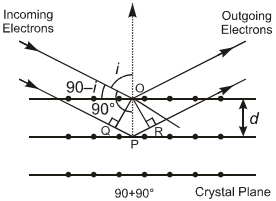
The wave property of electrons implies that they will show diffraction effects. Davisson and Germer demonstrated this by diffracting electrons from crystals. The law governing the diffraction from a crystal is obtained by requiring that electron waves reflected from the planes of atoms in a crystal interfere constructively (see figure).
Electrons accelerated by potential $V$ are diffracted from a crystal. If $d = 1\; \text{\AA}$, and $i = 30^{\circ}$, $V$ should be about ....... $V$.
$(h = 6.6 \times 10^{-34}\; J-s, m = 9.1 \times 10^{-31}\; kg, e = 1.6 \times 10^{-19}\; C)$
Electrons accelerated by potential $V$ are diffracted from a crystal. If $d = 1\; \text{\AA}$, and $i = 30^{\circ}$, $V$ should be about ....... $V$.
$(h = 6.6 \times 10^{-34}\; J-s, m = 9.1 \times 10^{-31}\; kg, e = 1.6 \times 10^{-19}\; C)$
A
$500$
B
$50$
C
$1000$
D
$2000$
Solution
(B) The condition for constructive interference in crystal diffraction (Bragg's Law) is given by $2d \sin \theta = n \lambda$, where $\theta$ is the glancing angle.
From the figure, the angle of incidence $i$ is measured with respect to the normal. The glancing angle $\theta$ is the angle between the incident ray and the crystal plane, so $\theta = 90^{\circ} - i$.
Given $i = 30^{\circ}$, we have $\theta = 90^{\circ} - 30^{\circ} = 60^{\circ}$.
For first-order diffraction, $n = 1$. Substituting the values:
$2 \times (1 \times 10^{-10}\; m) \times \sin(60^{\circ}) = 1 \times \lambda$
$\lambda = 2 \times 10^{-10} \times \frac{\sqrt{3}}{2} = \sqrt{3} \times 10^{-10}\; m \approx 1.732 \times 10^{-10}\; m$.
The de-Broglie wavelength of an electron accelerated by potential $V$ is given by $\lambda = \frac{h}{\sqrt{2meV}}$.
Squaring both sides:
$\lambda^2 = \frac{h^2}{2meV} \Rightarrow V = \frac{h^2}{2me\lambda^2}$.
Substituting the values:
$V = \frac{(6.6 \times 10^{-34})^2}{2 \times 9.1 \times 10^{-31} \times 1.6 \times 10^{-19} \times (\sqrt{3} \times 10^{-10})^2}$
$V = \frac{43.56 \times 10^{-68}}{29.12 \times 10^{-50} \times 3} = \frac{43.56 \times 10^{-68}}{87.36 \times 10^{-50}} \approx 0.4986 \times 10^{18} \times 10^{-68} \times 10^{50} \approx 49.86\; V$.
Thus, $V$ should be about $50\; V$.
From the figure, the angle of incidence $i$ is measured with respect to the normal. The glancing angle $\theta$ is the angle between the incident ray and the crystal plane, so $\theta = 90^{\circ} - i$.
Given $i = 30^{\circ}$, we have $\theta = 90^{\circ} - 30^{\circ} = 60^{\circ}$.
For first-order diffraction, $n = 1$. Substituting the values:
$2 \times (1 \times 10^{-10}\; m) \times \sin(60^{\circ}) = 1 \times \lambda$
$\lambda = 2 \times 10^{-10} \times \frac{\sqrt{3}}{2} = \sqrt{3} \times 10^{-10}\; m \approx 1.732 \times 10^{-10}\; m$.
The de-Broglie wavelength of an electron accelerated by potential $V$ is given by $\lambda = \frac{h}{\sqrt{2meV}}$.
Squaring both sides:
$\lambda^2 = \frac{h^2}{2meV} \Rightarrow V = \frac{h^2}{2me\lambda^2}$.
Substituting the values:
$V = \frac{(6.6 \times 10^{-34})^2}{2 \times 9.1 \times 10^{-31} \times 1.6 \times 10^{-19} \times (\sqrt{3} \times 10^{-10})^2}$
$V = \frac{43.56 \times 10^{-68}}{29.12 \times 10^{-50} \times 3} = \frac{43.56 \times 10^{-68}}{87.36 \times 10^{-50}} \approx 0.4986 \times 10^{18} \times 10^{-68} \times 10^{50} \approx 49.86\; V$.
Thus, $V$ should be about $50\; V$.
0 likesView Solution
35
PhysicsDifficultMCQAIEEE · 2008
The wave property of electrons implies that they will show diffraction effects. Davisson and Germer demonstrated this by diffracting electrons from crystals. The law governing the diffraction from a crystal is obtained by requiring that electron waves reflected from the planes of atoms in a crystal interfere constructively (see figure).
A
$d \cos i = n \lambda_{dB}$
B
$d \sin i = n \lambda_{dB}$
C
$2 d \sin i = n \lambda_{dB}$
D
$2 d \cos i = n \lambda_{dB}$
Solution
(D) For constructive interference,the path difference between waves reflected from successive atomic planes must be an integral multiple of the wavelength,which is given by Bragg's Law: $2d \sin \theta = n \lambda_{dB}$,where $\theta$ is the glancing angle (the angle between the incident ray and the crystal plane).
From the provided figure,the angle $i$ is the angle between the incident ray and the normal to the crystal plane. Therefore,the glancing angle $\theta$ is given by $\theta = 90^{\circ} - i$.
Substituting this into Bragg's Law:
$2d \sin(90^{\circ} - i) = n \lambda_{dB}$
Since $\sin(90^{\circ} - i) = \cos i$,we get:
$2d \cos i = n \lambda_{dB}$
From the provided figure,the angle $i$ is the angle between the incident ray and the normal to the crystal plane. Therefore,the glancing angle $\theta$ is given by $\theta = 90^{\circ} - i$.
Substituting this into Bragg's Law:
$2d \sin(90^{\circ} - i) = n \lambda_{dB}$
Since $\sin(90^{\circ} - i) = \cos i$,we get:
$2d \cos i = n \lambda_{dB}$
0 likesView Solution
Vedclass Products
For Students
Vedclass Test Series
Mock tests in real AIEEE style covering Physics with performance analysis. 5-day free trial.
Start Free TrialFor Teachers
Exam Paper Generator
Generate Set A/B/C/D Physics papers from 7.5L+ questions in 2 minutes. 3 chapters free.
Try FreeFor Institutes
Online Exam Module
Run live AIEEE mock exams with unlimited students, 360° analytics & white-label branding.
See DemoFrequently Asked Questions
How many Physics questions are in AIEEE 2008?
There are 35 Physics questions from the AIEEE 2008 paper on Vedclass, each with a detailed step-by-step solution in English.
Are AIEEE 2008 Physics solutions available in English?
Yes. All solutions on this page are in English. You can also switch to English or Hindi using the language buttons above the questions.
Can I practice AIEEE 2008 Physics as a timed test?
Yes. Use the Vedclass Test Series to attempt a full AIEEE mock test covering Physics with time limits and instant score analysis.
Can teachers create Physics papers from AIEEE previous year questions?
Yes. The Vedclass Exam Paper Generator lets teachers mix AIEEE Physics questions and generate Set A/B/C/D papers in minutes.
For Teachers & Institutes
Build a Custom Physics Paper
Pick AIEEE 2008 Physics questions, set difficulty, and generate Set A/B/C/D in 2 minutes.