
A English
Junction Transistor Questions in English
Class 12 Physics · Semiconductor Electronics · Junction Transistor
399+
Questions
English
Language
100%
With Solutions
Showing 49 of 399 questions in English
251
EasyMCQ
Given below are two statements:
Statement $I:$ In a typical transistor,all three regions emitter,base and collector have same doping level.
Statement $II:$ In a transistor,collector is the thickest and base is the thinnest segment.
In the light of the above statements,choose the most appropriate answer from the options given below.
Statement $I:$ In a typical transistor,all three regions emitter,base and collector have same doping level.
Statement $II:$ In a transistor,collector is the thickest and base is the thinnest segment.
In the light of the above statements,choose the most appropriate answer from the options given below.
A
Both Statement $I$ and Statement $II$ are correct
B
Both Statement $I$ and Statement $II$ are incorrect
C
Statement $I$ is incorrect but Statement $II$ is correct
D
Statement $I$ is correct but Statement $II$ is incorrect
Solution
(C) Statement $I$ is incorrect because in a transistor,the three regions have different doping levels. The emitter is heavily doped,the base is lightly doped,and the collector is moderately doped.
Statement $II$ is correct because the collector is made the largest (thickest) to dissipate the heat generated during operation,and the base is made very thin to allow the majority of charge carriers from the emitter to pass through to the collector.
Therefore,Statement $I$ is incorrect and Statement $II$ is correct.
Statement $II$ is correct because the collector is made the largest (thickest) to dissipate the heat generated during operation,and the base is made very thin to allow the majority of charge carriers from the emitter to pass through to the collector.
Therefore,Statement $I$ is incorrect and Statement $II$ is correct.
0 likes
View Solution252
MediumMCQ
The collector current in a common base amplifier using $n-p-n$ transistor is $24\; mA$. If $80\%$ of the electrons released by the emitter are accepted by the collector,then the base current is numerically
A
$6\,mA$ and leaving the base
B
$3\,mA$ and leaving the base
C
$6\,mA$ and entering the base
D
$3\,mA$ and entering the base
Solution
(C) Given collector current $I_C = 24\,mA$.
The current gain $\alpha$ is the ratio of collector current to emitter current,which is given as $80\% = 0.8$.
We know that $I_C = \alpha I_E$,so $I_E = \frac{I_C}{\alpha}$.
Substituting the values: $I_E = \frac{24\,mA}{0.8} = 30\,mA$.
Using Kirchhoff's current law for a transistor,$I_E = I_B + I_C$,so $I_B = I_E - I_C$.
$I_B = 30\,mA - 24\,mA = 6\,mA$.
In an $n-p-n$ transistor,the emitter current enters the transistor,while the collector and base currents leave the transistor. However,the question asks for the base current magnitude and direction relative to the base terminal. Since $I_E = I_B + I_C$,the base current $I_B$ flows into the base region to compensate for the recombination of charge carriers. Thus,the current is $6\,mA$ and entering the base.
The current gain $\alpha$ is the ratio of collector current to emitter current,which is given as $80\% = 0.8$.
We know that $I_C = \alpha I_E$,so $I_E = \frac{I_C}{\alpha}$.
Substituting the values: $I_E = \frac{24\,mA}{0.8} = 30\,mA$.
Using Kirchhoff's current law for a transistor,$I_E = I_B + I_C$,so $I_B = I_E - I_C$.
$I_B = 30\,mA - 24\,mA = 6\,mA$.
In an $n-p-n$ transistor,the emitter current enters the transistor,while the collector and base currents leave the transistor. However,the question asks for the base current magnitude and direction relative to the base terminal. Since $I_E = I_B + I_C$,the base current $I_B$ flows into the base region to compensate for the recombination of charge carriers. Thus,the current is $6\,mA$ and entering the base.
0 likes
View Solution253
MediumMCQ
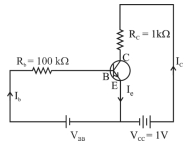
For a given transistor amplifier circuit in $CE$ configuration with $V_{CC} = 1 \text{ V}$,$R_c = 1 \text{ k}\Omega$,$R_b = 100 \text{ k}\Omega$,and $\beta = 100$,the value of the base current $I_b$ is:
A
$I_b = 1.0 \text{ } \mu\text{A}$
B
$I_b = 0.10 \text{ } \mu\text{A}$
C
$I_b = 100 \text{ } \mu\text{A}$
D
$I_b = 10 \text{ } \mu\text{A}$
Solution
(D) In the input circuit,applying Kirchhoff's Voltage Law $(KVL)$ to the base-emitter loop:
$V_{BB} - I_b R_b - V_{BE} = 0$
Assuming the transistor is in the active region and $V_{BE} \approx 0.7 \text{ V}$,we need $V_{BB}$ to find $I_b$. However,looking at the circuit,the base current is determined by the input bias. Given the standard approach for such problems where $V_{BB}$ is often assumed to be equal to $V_{CC}$ if not specified,or by calculating the required $I_b$ to reach saturation:
For saturation,$V_{CE} = 0 \text{ V}$.
Applying $KVL$ to the output loop:
$V_{CC} - I_c R_c - V_{CE} = 0$
$1 \text{ V} - I_c (1 \times 10^3 \text{ } \Omega) - 0 = 0$
$I_c = \frac{1}{1000} \text{ A} = 1 \text{ mA} = 1000 \text{ } \mu\text{A}$.
Since $\beta = \frac{I_c}{I_b}$,the base current required for saturation is:
$I_b = \frac{I_c}{\beta} = \frac{1000 \text{ } \mu\text{A}}{100} = 10 \text{ } \mu\text{A}$.
$V_{BB} - I_b R_b - V_{BE} = 0$
Assuming the transistor is in the active region and $V_{BE} \approx 0.7 \text{ V}$,we need $V_{BB}$ to find $I_b$. However,looking at the circuit,the base current is determined by the input bias. Given the standard approach for such problems where $V_{BB}$ is often assumed to be equal to $V_{CC}$ if not specified,or by calculating the required $I_b$ to reach saturation:
For saturation,$V_{CE} = 0 \text{ V}$.
Applying $KVL$ to the output loop:
$V_{CC} - I_c R_c - V_{CE} = 0$
$1 \text{ V} - I_c (1 \times 10^3 \text{ } \Omega) - 0 = 0$
$I_c = \frac{1}{1000} \text{ A} = 1 \text{ mA} = 1000 \text{ } \mu\text{A}$.
Since $\beta = \frac{I_c}{I_b}$,the base current required for saturation is:
$I_b = \frac{I_c}{\beta} = \frac{1000 \text{ } \mu\text{A}}{100} = 10 \text{ } \mu\text{A}$.
0 likes
View Solution254
EasyMCQ
In an $n-p-n$ common emitter $(CE)$ transistor,the collector current changes from $5\,mA$ to $16\,mA$ for a change in base current from $100\,\mu A$ to $200\,\mu A$,respectively. The current gain of the transistor is:
A
$110$
B
$0.9$
C
$210$
D
$9$
Solution
(A) The current gain $(\beta)$ in a common emitter $(CE)$ transistor is defined as the ratio of the change in collector current $(\Delta I_C)$ to the change in base current $(\Delta I_B)$.
Given:
$\Delta I_C = 16\,mA - 5\,mA = 11\,mA = 11 \times 10^{-3}\,A$
$\Delta I_B = 200\,\mu A - 100\,\mu A = 100\,\mu A = 100 \times 10^{-6}\,A$
Using the formula:
$\beta = \frac{\Delta I_C}{\Delta I_B} = \frac{11 \times 10^{-3}\,A}{100 \times 10^{-6}\,A} = \frac{11 \times 10^{-3}}{10^{-4}} = 11 \times 10^1 = 110$
Thus,the current gain of the transistor is $110$.
Given:
$\Delta I_C = 16\,mA - 5\,mA = 11\,mA = 11 \times 10^{-3}\,A$
$\Delta I_B = 200\,\mu A - 100\,\mu A = 100\,\mu A = 100 \times 10^{-6}\,A$
Using the formula:
$\beta = \frac{\Delta I_C}{\Delta I_B} = \frac{11 \times 10^{-3}\,A}{100 \times 10^{-6}\,A} = \frac{11 \times 10^{-3}}{10^{-4}} = 11 \times 10^1 = 110$
Thus,the current gain of the transistor is $110$.
0 likes
View Solution255
DifficultMCQ
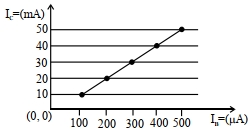
From the given transfer characteristic of a transistor in $CE$ configuration,the value of power gain of this configuration is $10^x$,for $R_B = 10\,k\Omega$ and $R_C = 1\,k\Omega$. The value of $x$ is $.....$.
A
$6$
B
$9$
C
$3$
D
$12$
Solution
(C) The current gain $\beta$ is defined as the slope of the $I_C$ versus $I_B$ graph: $\beta = \frac{\Delta I_C}{\Delta I_B}$.
From the graph,taking two points $(100\,\mu A, 10\,mA)$ and $(200\,\mu A, 20\,mA)$:
$\beta = \frac{(20 - 10) \times 10^{-3} \, A}{(200 - 100) \times 10^{-6} \, A} = \frac{10 \times 10^{-3}}{100 \times 10^{-6}} = 100$.
The power gain $A_P$ is given by $A_P = \beta^2 \times \frac{R_C}{R_B}$.
Substituting the values: $A_P = (100)^2 \times \frac{1 \times 10^3 \, \Omega}{10 \times 10^3 \, \Omega} = 10000 \times 0.1 = 1000 = 10^3$.
Comparing this with $10^x$,we get $x = 3$.
From the graph,taking two points $(100\,\mu A, 10\,mA)$ and $(200\,\mu A, 20\,mA)$:
$\beta = \frac{(20 - 10) \times 10^{-3} \, A}{(200 - 100) \times 10^{-6} \, A} = \frac{10 \times 10^{-3}}{100 \times 10^{-6}} = 100$.
The power gain $A_P$ is given by $A_P = \beta^2 \times \frac{R_C}{R_B}$.
Substituting the values: $A_P = (100)^2 \times \frac{1 \times 10^3 \, \Omega}{10 \times 10^3 \, \Omega} = 10000 \times 0.1 = 1000 = 10^3$.
Comparing this with $10^x$,we get $x = 3$.
0 likes
View Solution256
EasyMCQ
In the case of a transistor,what is the relationship between the current gain parameters $\alpha$ and $\beta$?
A
$\beta < 1, \alpha > 1$
B
$\beta > 1, \alpha < 1$
C
$\alpha = \beta$
D
$\alpha = \beta^2$
Solution
(B) For a transistor,the current gain $\alpha$ is defined as the ratio of collector current $(I_C)$ to emitter current $(I_E)$,i.e.,$\alpha = \frac{I_C}{I_E}$. Since $I_E = I_C + I_B$ and $I_B > 0$,it follows that $I_C < I_E$,which implies $\alpha < 1$.
The current gain $\beta$ is defined as the ratio of collector current $(I_C)$ to base current $(I_B)$,i.e.,$\beta = \frac{I_C}{I_B}$.
Since the base current $I_B$ is typically very small compared to the collector current $I_C$,the ratio $\beta = \frac{I_C}{I_B}$ is always greater than $1$.
Therefore,the correct relationship is $\beta > 1$ and $\alpha < 1$.
The current gain $\beta$ is defined as the ratio of collector current $(I_C)$ to base current $(I_B)$,i.e.,$\beta = \frac{I_C}{I_B}$.
Since the base current $I_B$ is typically very small compared to the collector current $I_C$,the ratio $\beta = \frac{I_C}{I_B}$ is always greater than $1$.
Therefore,the correct relationship is $\beta > 1$ and $\alpha < 1$.
0 likes
View Solution257
EasyMCQ
For a common emitter transistor,if $\frac{I_{C}}{I_{E}}=0.95$,then the current gain is
A
$47.5$
B
$44$
C
$19$
D
$15$
Solution
(C) Given that the ratio of collector current to emitter current is $\alpha = \frac{I_{C}}{I_{E}} = 0.95$.
For a common emitter transistor,the current gain $\beta$ is defined as the ratio of collector current to base current,given by the formula $\beta = \frac{\alpha}{1 - \alpha}$.
Substituting the value of $\alpha$ into the formula:
$\beta = \frac{0.95}{1 - 0.95} = \frac{0.95}{0.05}$.
$\beta = \frac{95}{5} = 19$.
Therefore,the current gain is $19$.
For a common emitter transistor,the current gain $\beta$ is defined as the ratio of collector current to base current,given by the formula $\beta = \frac{\alpha}{1 - \alpha}$.
Substituting the value of $\alpha$ into the formula:
$\beta = \frac{0.95}{1 - 0.95} = \frac{0.95}{0.05}$.
$\beta = \frac{95}{5} = 19$.
Therefore,the current gain is $19$.
0 likes
View Solution258
EasyMCQ
In a transistor amplifier, $AC$ current gain is $64$, the load resistance is $5400 \ \Omega$ and the input resistance of the transistor is $540 \ \Omega$. The voltage gain is
A
$540$
B
$600$
C
$640$
D
$6400$
Solution
(C) The voltage gain $(A_v)$ of a transistor amplifier is given by the product of the current gain $(\beta)$ and the ratio of the load resistance $(R_L)$ to the input resistance $(R_{in})$.
Formula: $A_v = \beta \times \frac{R_L}{R_{in}}$
Given:
$AC$ current gain $(\beta)$ = $64$
Load resistance $(R_L)$ = $5400 \ \Omega$
Input resistance $(R_{in})$ = $540 \ \Omega$
Substituting the values:
$A_v = 64 \times \frac{5400}{540}$
$A_v = 64 \times 10$
$A_v = 640$
Therefore, the voltage gain is $640$.
Formula: $A_v = \beta \times \frac{R_L}{R_{in}}$
Given:
$AC$ current gain $(\beta)$ = $64$
Load resistance $(R_L)$ = $5400 \ \Omega$
Input resistance $(R_{in})$ = $540 \ \Omega$
Substituting the values:
$A_v = 64 \times \frac{5400}{540}$
$A_v = 64 \times 10$
$A_v = 640$
Therefore, the voltage gain is $640$.
0 likes
View Solution259
EasyMCQ
In a transistor (common emitter configuration) the ratio of power gain to voltage gain is ($\alpha$ and $\beta$ are current ratios)
A
$\frac{\beta}{\alpha}$
B
$\alpha \beta$
C
$\alpha$
D
$\beta$
Solution
(D) The power gain $(A_p)$ of a transistor is defined as the product of voltage gain $(A_v)$ and current gain $(A_i)$.
Mathematically,$A_p = A_v \times A_i$.
Therefore,the ratio of power gain to voltage gain is $\frac{A_p}{A_v} = A_i$.
In a common emitter configuration,the current gain is defined as $\beta = \frac{I_c}{I_b}$.
Thus,the ratio is equal to $\beta$.
Mathematically,$A_p = A_v \times A_i$.
Therefore,the ratio of power gain to voltage gain is $\frac{A_p}{A_v} = A_i$.
In a common emitter configuration,the current gain is defined as $\beta = \frac{I_c}{I_b}$.
Thus,the ratio is equal to $\beta$.
0 likes
View Solution260
MediumMCQ
When an $n-p-n$ junction transistor is used as an amplifier in common emitter mode,
A
the base-emitter junction is reverse biased.
B
the input impedance is high and the output impedance is low.
C
input signal is applied between the base and emitter and the output is obtained between collector and emitter.
D
the input voltage and the output voltage are in phase.
Solution
(C) In a common emitter $(CE)$ amplifier configuration using an $n-p-n$ transistor:
$1$. The base-emitter junction is forward biased to allow current flow, and the collector-base junction is reverse biased.
$2$. The input signal is applied between the base and the emitter, while the output is taken across the collector and the emitter.
$3$. The input impedance is generally low, and the output impedance is high.
$4$. There is a phase difference of $180^{\circ}$ between the input and output signals.
Therefore, option $C$ is the correct statement.
$1$. The base-emitter junction is forward biased to allow current flow, and the collector-base junction is reverse biased.
$2$. The input signal is applied between the base and the emitter, while the output is taken across the collector and the emitter.
$3$. The input impedance is generally low, and the output impedance is high.
$4$. There is a phase difference of $180^{\circ}$ between the input and output signals.
Therefore, option $C$ is the correct statement.
0 likes
View Solution261
MediumMCQ
In an $n-p-n$ transistor amplifier,the collector current is $9 \ mA$. If $90 \%$ of the electrons emitted reach the collector,then
A
$\alpha=9, \beta=0.9$
B
$\alpha=0.9, \beta=90$
C
$\alpha=0.9, \beta=9$
D
$\alpha=90, \beta=0.9$
Solution
(C) Given that $90 \%$ of the electrons emitted reach the collector,the current gain $\alpha$ (common base) is defined as the ratio of collector current to emitter current. Since $90 \%$ of the emitter current $(I_E)$ reaches the collector $(I_C)$,we have $I_C = 0.9 \ I_E$. Thus,$\alpha = \frac{I_C}{I_E} = 0.9$.
The current gain $\beta$ (common emitter) is related to $\alpha$ by the formula $\beta = \frac{\alpha}{1 - \alpha}$.
Substituting the value of $\alpha$: $\beta = \frac{0.9}{1 - 0.9} = \frac{0.9}{0.1} = 9$.
Therefore,$\alpha = 0.9$ and $\beta = 9$.
The current gain $\beta$ (common emitter) is related to $\alpha$ by the formula $\beta = \frac{\alpha}{1 - \alpha}$.
Substituting the value of $\alpha$: $\beta = \frac{0.9}{1 - 0.9} = \frac{0.9}{0.1} = 9$.
Therefore,$\alpha = 0.9$ and $\beta = 9$.
0 likes
View Solution262
MediumMCQ
In an $n-p-n$ transistor amplifier,the collector current is $8 \ mA$. If $80 \%$ of the electrons from the emitter reach the collector,then ($\alpha$ and $\beta$ are current ratios):
A
the base current is $20 \ mA$.
B
the emitter current is $2 \ mA$.
C
$\alpha=0.8, \beta=4.0$
D
$\alpha=4.0, \beta=0.8$
Solution
(C) Given: Collector current $I_C = 8 \ mA$.
Since $80 \%$ of the electrons from the emitter reach the collector,the current gain $\alpha$ is given by the ratio of collector current to emitter current,which is $0.8$.
Thus,$\alpha = \frac{I_C}{I_E} = 0.8$.
We can find the emitter current $I_E$ as $I_E = \frac{I_C}{\alpha} = \frac{8 \ mA}{0.8} = 10 \ mA$.
The base current $I_B$ is given by $I_E - I_C = 10 \ mA - 8 \ mA = 2 \ mA$.
The current gain $\beta$ is calculated as $\beta = \frac{\alpha}{1 - \alpha} = \frac{0.8}{1 - 0.8} = \frac{0.8}{0.2} = 4.0$.
Therefore,$\alpha = 0.8$ and $\beta = 4.0$.
Since $80 \%$ of the electrons from the emitter reach the collector,the current gain $\alpha$ is given by the ratio of collector current to emitter current,which is $0.8$.
Thus,$\alpha = \frac{I_C}{I_E} = 0.8$.
We can find the emitter current $I_E$ as $I_E = \frac{I_C}{\alpha} = \frac{8 \ mA}{0.8} = 10 \ mA$.
The base current $I_B$ is given by $I_E - I_C = 10 \ mA - 8 \ mA = 2 \ mA$.
The current gain $\beta$ is calculated as $\beta = \frac{\alpha}{1 - \alpha} = \frac{0.8}{1 - 0.8} = \frac{0.8}{0.2} = 4.0$.
Therefore,$\alpha = 0.8$ and $\beta = 4.0$.
0 likes
View Solution263
MediumMCQ
In common emitter mode of a transistor, the current gain is $8$. The input impedance is $25 \, k\Omega$ and load resistance is $75 \, k\Omega$. The power gain is
A
$19200$
B
$24000$
C
$18000$
D
$21600$
Solution
(B) The power gain $(A_p)$ of a transistor is given by the product of current gain $(\beta)$ and voltage gain $(A_v)$.
$A_p = \beta \times A_v$
Voltage gain $(A_v)$ is defined as the product of current gain $(\beta)$ and the ratio of load resistance $(R_L)$ to input impedance $(R_i)$.
$A_v = \beta \times \frac{R_L}{R_i}$
Given:
Current gain $(\beta)$ = $8$
Input impedance $(R_i)$ = $25 \, k\Omega$
Load resistance $(R_L)$ = $75 \, k\Omega$
First, calculate the voltage gain:
$A_v = 8 \times \frac{75 \, k\Omega}{25 \, k\Omega} = 8 \times 3 = 24$
Now, calculate the power gain:
$A_p = \beta \times A_v = 8 \times 24 = 192$
Note: The provided options in the original prompt appear to be incorrect based on the standard formula. The calculated power gain is $192$.
$A_p = \beta \times A_v$
Voltage gain $(A_v)$ is defined as the product of current gain $(\beta)$ and the ratio of load resistance $(R_L)$ to input impedance $(R_i)$.
$A_v = \beta \times \frac{R_L}{R_i}$
Given:
Current gain $(\beta)$ = $8$
Input impedance $(R_i)$ = $25 \, k\Omega$
Load resistance $(R_L)$ = $75 \, k\Omega$
First, calculate the voltage gain:
$A_v = 8 \times \frac{75 \, k\Omega}{25 \, k\Omega} = 8 \times 3 = 24$
Now, calculate the power gain:
$A_p = \beta \times A_v = 8 \times 24 = 192$
Note: The provided options in the original prompt appear to be incorrect based on the standard formula. The calculated power gain is $192$.
0 likes
View Solution264
EasyMCQ
In a common emitter transistor amplifier,the output voltage and input voltage have a phase difference of
A
$0^c$
B
$\frac{\pi^c}{2}$
C
$\frac{3 \pi^c}{4}$
D
$\pi^c$
Solution
(D) In a common emitter $(CE)$ configuration of a transistor amplifier,the input signal is applied between the base and the emitter,while the output is taken across the collector and the emitter.
When the input signal voltage increases,the base current increases,which in turn increases the collector current.
Due to the voltage drop across the load resistor $R_L$ connected in the collector circuit $(V_{out} = V_{CC} - I_C R_L)$,an increase in collector current $I_C$ leads to a decrease in the output voltage $V_{out}$.
Since an increase in input voltage results in a decrease in output voltage,the output signal is inverted with respect to the input signal.
An inverted signal corresponds to a phase shift of $180^\circ$ or $\pi^c$ radians.
When the input signal voltage increases,the base current increases,which in turn increases the collector current.
Due to the voltage drop across the load resistor $R_L$ connected in the collector circuit $(V_{out} = V_{CC} - I_C R_L)$,an increase in collector current $I_C$ leads to a decrease in the output voltage $V_{out}$.
Since an increase in input voltage results in a decrease in output voltage,the output signal is inverted with respect to the input signal.
An inverted signal corresponds to a phase shift of $180^\circ$ or $\pi^c$ radians.
0 likes
View Solution265
EasyMCQ
In the case of a common emitter transistor amplifier,the ratio of collector current to emitter current is $0.96$. Then,the current gain $(\beta)$ of the amplifier is:
A
$6$
B
$48$
C
$24$
D
$12$
Solution
(C) Given,the ratio of collector current $(I_C)$ to emitter current $(I_E)$ is the current amplification factor $\alpha$.
So,$\alpha = \frac{I_C}{I_E} = 0.96$.
The relationship between current gain $\beta$ and $\alpha$ is given by the formula:
$\beta = \frac{\alpha}{1 - \alpha}$.
Substituting the value of $\alpha$:
$\beta = \frac{0.96}{1 - 0.96} = \frac{0.96}{0.04}$.
$\beta = \frac{96}{4} = 24$.
Therefore,the current gain $\beta$ is $24$.
So,$\alpha = \frac{I_C}{I_E} = 0.96$.
The relationship between current gain $\beta$ and $\alpha$ is given by the formula:
$\beta = \frac{\alpha}{1 - \alpha}$.
Substituting the value of $\alpha$:
$\beta = \frac{0.96}{1 - 0.96} = \frac{0.96}{0.04}$.
$\beta = \frac{96}{4} = 24$.
Therefore,the current gain $\beta$ is $24$.
0 likes
View Solution266
EasyMCQ
In a common emitter transistor amplifier circuit,the current gain $\alpha = 0.8$. If the base current changes by $3 \mu A$,then the collector current changes by: (in $\mu A$)
A
$4$
B
$6$
C
$12$
D
$24$
Solution
(C) Given that the current gain $\alpha = 0.8$.
First,we calculate the current gain $\beta$ for the common emitter configuration using the relation $\beta = \frac{\alpha}{1 - \alpha}$.
Substituting the value of $\alpha$: $\beta = \frac{0.8}{1 - 0.8} = \frac{0.8}{0.2} = 4$.
The relationship between collector current change $(\Delta I_C)$ and base current change $(\Delta I_B)$ is given by $\Delta I_C = \beta \times \Delta I_B$.
Given $\Delta I_B = 3 \mu A$,we have $\Delta I_C = 4 \times 3 \mu A = 12 \mu A$.
Therefore,the collector current changes by $12 \mu A$.
First,we calculate the current gain $\beta$ for the common emitter configuration using the relation $\beta = \frac{\alpha}{1 - \alpha}$.
Substituting the value of $\alpha$: $\beta = \frac{0.8}{1 - 0.8} = \frac{0.8}{0.2} = 4$.
The relationship between collector current change $(\Delta I_C)$ and base current change $(\Delta I_B)$ is given by $\Delta I_C = \beta \times \Delta I_B$.
Given $\Delta I_B = 3 \mu A$,we have $\Delta I_C = 4 \times 3 \mu A = 12 \mu A$.
Therefore,the collector current changes by $12 \mu A$.
0 likes
View Solution267
MediumMCQ
In a common emitter amplifier configuration, the current gain is $62$. The collector resistance and input resistance are $5 \text{ k}\Omega$ and $500 \text{ }\Omega$ respectively. If the input voltage is $0.01 \text{ V}$, the output voltage will be (in $V$)
A
$0.62$
B
$6.2$
C
$62$
D
$620$
Solution
(B) Given: Current gain $(\beta)$ = $62$, Collector resistance $(R_C)$ = $5 \text{ k}\Omega = 5000 \text{ }\Omega$, Input resistance $(R_i)$ = $500 \text{ }\Omega$, Input voltage $(V_i)$ = $0.01 \text{ V}$.
First, calculate the voltage gain $(A_v)$ of the amplifier:
$A_v = \beta \times \frac{R_C}{R_i} = 62 \times \frac{5000}{500} = 62 \times 10 = 620$.
The output voltage $(V_o)$ is given by the product of voltage gain and input voltage:
$V_o = A_v \times V_i = 620 \times 0.01 \text{ V} = 6.2 \text{ V}$.
Therefore, the correct option is $B$.
First, calculate the voltage gain $(A_v)$ of the amplifier:
$A_v = \beta \times \frac{R_C}{R_i} = 62 \times \frac{5000}{500} = 62 \times 10 = 620$.
The output voltage $(V_o)$ is given by the product of voltage gain and input voltage:
$V_o = A_v \times V_i = 620 \times 0.01 \text{ V} = 6.2 \text{ V}$.
Therefore, the correct option is $B$.
0 likes
View Solution268
MediumMCQ
In a common emitter transistor amplifier circuit,the input resistance is $1.8 \text{ k}\Omega$ and the output is obtained across a load resistance of $9 \text{ k}\Omega$. The alternating current gain is $70$. Corresponding to an a.c. input voltage of $6 \text{ mV}$,the output voltage will be: (in $\text{ V}$)
A
$0.7$
B
$1.4$
C
$2.1$
D
$4.2$
Solution
(C) Given:
Input resistance,$R_i = 1.8 \text{ k}\Omega = 1800 \Omega$
Load resistance,$R_L = 9 \text{ k}\Omega = 9000 \Omega$
Current gain,$\beta = 70$
Input voltage,$V_i = 6 \text{ mV} = 6 \times 10^{-3} \text{ V}$
Step $1$: Calculate the input current $(I_b)$:
$I_b = \frac{V_i}{R_i} = \frac{6 \times 10^{-3}}{1800} = \frac{1}{3} \times 10^{-5} \text{ A}$
Step $2$: Calculate the output current $(I_c)$:
$I_c = \beta \times I_b = 70 \times \frac{1}{3} \times 10^{-5} = \frac{7}{3} \times 10^{-4} \text{ A}$
Step $3$: Calculate the output voltage $(V_o)$:
$V_o = I_c \times R_L = (\frac{7}{3} \times 10^{-4}) \times 9000 = 7 \times 3 \times 10^{-1} = 2.1 \text{ V}$
Alternatively,Voltage Gain $A_v = \beta \times \frac{R_L}{R_i} = 70 \times \frac{9000}{1800} = 70 \times 5 = 350$.
$V_o = A_v \times V_i = 350 \times 6 \text{ mV} = 2100 \text{ mV} = 2.1 \text{ V}$.
Input resistance,$R_i = 1.8 \text{ k}\Omega = 1800 \Omega$
Load resistance,$R_L = 9 \text{ k}\Omega = 9000 \Omega$
Current gain,$\beta = 70$
Input voltage,$V_i = 6 \text{ mV} = 6 \times 10^{-3} \text{ V}$
Step $1$: Calculate the input current $(I_b)$:
$I_b = \frac{V_i}{R_i} = \frac{6 \times 10^{-3}}{1800} = \frac{1}{3} \times 10^{-5} \text{ A}$
Step $2$: Calculate the output current $(I_c)$:
$I_c = \beta \times I_b = 70 \times \frac{1}{3} \times 10^{-5} = \frac{7}{3} \times 10^{-4} \text{ A}$
Step $3$: Calculate the output voltage $(V_o)$:
$V_o = I_c \times R_L = (\frac{7}{3} \times 10^{-4}) \times 9000 = 7 \times 3 \times 10^{-1} = 2.1 \text{ V}$
Alternatively,Voltage Gain $A_v = \beta \times \frac{R_L}{R_i} = 70 \times \frac{9000}{1800} = 70 \times 5 = 350$.
$V_o = A_v \times V_i = 350 \times 6 \text{ mV} = 2100 \text{ mV} = 2.1 \text{ V}$.
0 likes
View Solution269
EasyMCQ
For a transistor,$\alpha_{dc}$ and $\beta_{dc}$ are the current ratios,then the value of $\frac{\beta_{dc}-\alpha_{dc}}{\alpha_{dc} \times \beta_{dc}}$ is:
A
$0.5$
B
$1$
C
$1.5$
D
$2$
Solution
(B) We know the relationship between the current gain parameters $\alpha_{dc}$ and $\beta_{dc}$ of a transistor is given by $\beta_{dc} = \frac{\alpha_{dc}}{1 - \alpha_{dc}}$.
Rearranging this,we get $\frac{1}{\beta_{dc}} = \frac{1 - \alpha_{dc}}{\alpha_{dc}} = \frac{1}{\alpha_{dc}} - 1$.
This implies $\frac{1}{\alpha_{dc}} - \frac{1}{\beta_{dc}} = 1$.
Taking the common denominator,we get $\frac{\beta_{dc} - \alpha_{dc}}{\alpha_{dc} \times \beta_{dc}} = 1$.
Rearranging this,we get $\frac{1}{\beta_{dc}} = \frac{1 - \alpha_{dc}}{\alpha_{dc}} = \frac{1}{\alpha_{dc}} - 1$.
This implies $\frac{1}{\alpha_{dc}} - \frac{1}{\beta_{dc}} = 1$.
Taking the common denominator,we get $\frac{\beta_{dc} - \alpha_{dc}}{\alpha_{dc} \times \beta_{dc}} = 1$.
0 likes
View Solution270
DifficultMCQ
In an $NPN$ transistor,$10^{10}$ electrons enter the emitter in $10^{-6} \ s$ and $2 \%$ of electrons recombine with holes in the base. The current ratios $\alpha$ and $\beta$ of the transistor are respectively (nearly):
A
$0.98, 49$
B
$49, 0.98$
C
$0.49, 98$
D
$98, 0.49$
Solution
(A) The emitter current $I_e$ is given by $I_e = \frac{n_e \times e}{t}$.
Since $2 \%$ of electrons recombine in the base,the number of electrons reaching the collector is $98 \%$ of the emitter electrons.
Thus,the collector current $I_c = 0.98 \ I_e$.
The current gain $\alpha$ is defined as $\alpha = \frac{I_c}{I_e} = \frac{0.98 \ I_e}{I_e} = 0.98$.
The current gain $\beta$ is defined as $\beta = \frac{\alpha}{1 - \alpha}$.
Substituting the value of $\alpha$: $\beta = \frac{0.98}{1 - 0.98} = \frac{0.98}{0.02} = 49$.
Therefore,the values are $\alpha = 0.98$ and $\beta = 49$.
Since $2 \%$ of electrons recombine in the base,the number of electrons reaching the collector is $98 \%$ of the emitter electrons.
Thus,the collector current $I_c = 0.98 \ I_e$.
The current gain $\alpha$ is defined as $\alpha = \frac{I_c}{I_e} = \frac{0.98 \ I_e}{I_e} = 0.98$.
The current gain $\beta$ is defined as $\beta = \frac{\alpha}{1 - \alpha}$.
Substituting the value of $\alpha$: $\beta = \frac{0.98}{1 - 0.98} = \frac{0.98}{0.02} = 49$.
Therefore,the values are $\alpha = 0.98$ and $\beta = 49$.
0 likes
View Solution271
MediumMCQ
In a common emitter transistor amplifier,the load resistance is $6.5 \text{ k}\Omega$ and the input resistance is $1.3 \text{ k}\Omega$. If the current gain is $78$,the voltage gain is:
A
$780$
B
$390$
C
$260$
D
$50$
Solution
(B) The voltage gain $(A_v)$ of a common emitter transistor amplifier is given by the product of the current gain $(\beta)$ and the ratio of the load resistance $(R_L)$ to the input resistance $(R_{in})$.
$A_v = \beta \times \frac{R_L}{R_{in}}$
Given:
$\beta = 78$
$R_L = 6.5 \text{ k}\Omega = 6.5 \times 10^3 \Omega$
$R_{in} = 1.3 \text{ k}\Omega = 1.3 \times 10^3 \Omega$
Substituting the values:
$A_v = 78 \times \frac{6.5 \times 10^3}{1.3 \times 10^3}$
$A_v = 78 \times 5$
$A_v = 390$
$A_v = \beta \times \frac{R_L}{R_{in}}$
Given:
$\beta = 78$
$R_L = 6.5 \text{ k}\Omega = 6.5 \times 10^3 \Omega$
$R_{in} = 1.3 \text{ k}\Omega = 1.3 \times 10^3 \Omega$
Substituting the values:
$A_v = 78 \times \frac{6.5 \times 10^3}{1.3 \times 10^3}$
$A_v = 78 \times 5$
$A_v = 390$
0 likes
View Solution272
EasyMCQ
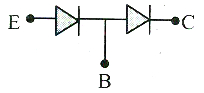
An $n-p-n$ transistor can be considered to be equivalent to two diodes connected back-to-back. Which of the following figures correctly represents this equivalent circuit?
A
Two diodes with their cathodes connected to the base terminal.
B
Two diodes with their anodes connected to the base terminal.
C
Two diodes with their cathodes connected to the emitter and collector terminals respectively.
D
Two diodes with their anodes connected to the emitter and collector terminals respectively.
Solution
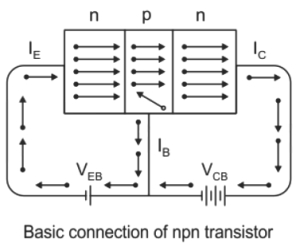
(B) An $n-p-n$ transistor consists of a $p$-type base sandwiched between two $n$-type regions (emitter and collector).
This structure creates two $p-n$ junctions: the emitter-base junction and the collector-base junction.
In an $n-p-n$ transistor,the base is $p$-type and both the emitter and collector are $n$-type.
When represented as two diodes,the $p$-type base acts as the common terminal for the anodes of both diodes.
Therefore,the two diodes are connected such that their anodes are joined at the base terminal $(B)$,while their cathodes point towards the emitter $(E)$ and collector $(C)$ terminals respectively.
This configuration is correctly represented by two diodes with their anodes connected to the base terminal.
This structure creates two $p-n$ junctions: the emitter-base junction and the collector-base junction.
In an $n-p-n$ transistor,the base is $p$-type and both the emitter and collector are $n$-type.
When represented as two diodes,the $p$-type base acts as the common terminal for the anodes of both diodes.
Therefore,the two diodes are connected such that their anodes are joined at the base terminal $(B)$,while their cathodes point towards the emitter $(E)$ and collector $(C)$ terminals respectively.
This configuration is correctly represented by two diodes with their anodes connected to the base terminal.
0 likes
View Solution273
EasyMCQ
The collector supply voltage is $6 \text{ V}$ and a voltage drop across a resistor of $600 \Omega$ in the collector circuit is $0.6 \text{ V}$,in a circuit of a transistor connected in common emitter mode. If the current gain is $20$,then the base current is: (in $\text{ mA}$)
A
$0.25$
B
$0.05$
C
$0.12$
D
$0.02$
Solution
(B) Given: Collector voltage drop $V_C = 0.6 \text{ V}$,Resistance $R_C = 600 \Omega$,Current gain $\beta = 20$.
First,calculate the collector current $I_C$ using Ohm's law: $I_C = \frac{V_C}{R_C} = \frac{0.6}{600} = 0.001 \text{ A} = 1 \text{ mA}$.
Using the formula for current gain in common emitter configuration: $\beta = \frac{I_C}{I_B}$.
Substituting the values: $20 = \frac{1 \text{ mA}}{I_B}$.
Therefore,$I_B = \frac{1}{20} \text{ mA} = 0.05 \text{ mA}$.
First,calculate the collector current $I_C$ using Ohm's law: $I_C = \frac{V_C}{R_C} = \frac{0.6}{600} = 0.001 \text{ A} = 1 \text{ mA}$.
Using the formula for current gain in common emitter configuration: $\beta = \frac{I_C}{I_B}$.
Substituting the values: $20 = \frac{1 \text{ mA}}{I_B}$.
Therefore,$I_B = \frac{1}{20} \text{ mA} = 0.05 \text{ mA}$.
0 likes
View Solution274
MediumMCQ
The current amplification factor of a transistor is $50$. The input resistance when used in common emitter mode is $1 \text{ k}\Omega$. The peak value of the collector current for an a.c. input voltage of $0.01 \text{ V}$ peak is:
A
$100 \mu\text{A}$
B
$0.01 \text{ mA}$
C
$0.25 \text{ mA}$
D
$500 \mu\text{A}$
Solution
(D) Given: Current amplification factor $\beta = 50$,Input resistance $R_i = 1 \text{ k}\Omega = 10^3 \Omega$,Input voltage $V_i = 0.01 \text{ V}$.
Using Ohm's law for the input circuit,the base current $I_B$ is given by:
$I_B = \frac{V_i}{R_i} = \frac{0.01 \text{ V}}{10^3 \Omega} = 10^{-5} \text{ A}$.
The relationship between collector current $I_C$ and base current $I_B$ is $I_C = \beta \times I_B$.
Substituting the values:
$I_C = 50 \times 10^{-5} \text{ A} = 500 \times 10^{-6} \text{ A} = 500 \mu\text{A}$.
Using Ohm's law for the input circuit,the base current $I_B$ is given by:
$I_B = \frac{V_i}{R_i} = \frac{0.01 \text{ V}}{10^3 \Omega} = 10^{-5} \text{ A}$.
The relationship between collector current $I_C$ and base current $I_B$ is $I_C = \beta \times I_B$.
Substituting the values:
$I_C = 50 \times 10^{-5} \text{ A} = 500 \times 10^{-6} \text{ A} = 500 \mu\text{A}$.
0 likes
View Solution275
MediumMCQ
When $n-p-n$ junction transistor is used as an amplifier in common emitter mode,
A
the input impedance is high and the output impedance is low.
B
the base emitter junction is reverse biased.
C
input signal is applied between the base and emitter and output is obtained between collector and emitter.
D
the input voltage and output voltage are in phase.
Solution
(C) Common Emitter Configuration:
In this configuration,the emitter terminal is common to both the input and output sides of the circuit.
The input signal is applied across the base-emitter junction.
The output is taken across the collector-emitter junction.
Biasing:
For proper operation,the base-emitter junction should be forward-biased,not reverse-biased as mentioned in Option $B$. Therefore,Option $B$ is incorrect.
Phase Relationship:
The output voltage is inverted with respect to the input voltage,meaning they are $180^{\circ}$ out of phase. Hence,Option $D$ is incorrect.
Impedance Characteristics:
The input impedance is generally low to moderate,not high,and the output impedance is generally moderate to high. Thus,Option $A$ is incorrect.
In summary,the common emitter configuration is widely used due to its ability to amplify the input signal with phase inversion,making Option $C$ the accurate description.
In this configuration,the emitter terminal is common to both the input and output sides of the circuit.
The input signal is applied across the base-emitter junction.
The output is taken across the collector-emitter junction.
Biasing:
For proper operation,the base-emitter junction should be forward-biased,not reverse-biased as mentioned in Option $B$. Therefore,Option $B$ is incorrect.
Phase Relationship:
The output voltage is inverted with respect to the input voltage,meaning they are $180^{\circ}$ out of phase. Hence,Option $D$ is incorrect.
Impedance Characteristics:
The input impedance is generally low to moderate,not high,and the output impedance is generally moderate to high. Thus,Option $A$ is incorrect.
In summary,the common emitter configuration is widely used due to its ability to amplify the input signal with phase inversion,making Option $C$ the accurate description.
0 likes
View Solution276
EasyMCQ
For a transistor,current gain $(\beta) = 50$. To change the collector current by $350 \mu A$,the base current should be changed by:
A
$(\frac{50}{350}) \mu A$
B
$(350 - 50) \mu A$
C
$(350 + 50) \mu A$
D
$(\frac{350}{50}) \mu A$
Solution
(D) The current gain $(\beta)$ of a transistor is defined as the ratio of the change in collector current $(\Delta I_C)$ to the change in base current $(\Delta I_B)$.
$\beta = \frac{\Delta I_C}{\Delta I_B}$
Given that $\beta = 50$ and the change in collector current $\Delta I_C = 350 \mu A$.
Rearranging the formula to solve for the change in base current $(\Delta I_B)$:
$\Delta I_B = \frac{\Delta I_C}{\beta}$
Substituting the given values:
$\Delta I_B = \frac{350 \mu A}{50} = 7 \mu A$.
Thus,the base current should be changed by $(\frac{350}{50}) \mu A$.
$\beta = \frac{\Delta I_C}{\Delta I_B}$
Given that $\beta = 50$ and the change in collector current $\Delta I_C = 350 \mu A$.
Rearranging the formula to solve for the change in base current $(\Delta I_B)$:
$\Delta I_B = \frac{\Delta I_C}{\beta}$
Substituting the given values:
$\Delta I_B = \frac{350 \mu A}{50} = 7 \mu A$.
Thus,the base current should be changed by $(\frac{350}{50}) \mu A$.
0 likes
View Solution277
MediumMCQ
The input signal given to a $C.E.$ amplifier having a voltage gain of $126$ is $V_i = 2 \cos \left(12 t + \frac{\pi}{3}\right)$. The corresponding output signal will be
A
$252 \cos \left(12 t + \frac{4 \pi}{3}\right)$
B
$252 \cos \left(12 t + \frac{\pi}{3}\right)$
C
$63 \cos \left(12 t + \frac{2 \pi}{3}\right)$
D
$2 \cos \left(12 t + \frac{5 \pi}{3}\right)$
Solution
(A) Given input signal: $V_i = 2 \cos \left(12 t + \frac{\pi}{3}\right)$.
Voltage gain $A_v = 126$.
In a Common Emitter $(C.E.)$ amplifier,the output signal is phase-shifted by $\pi$ radians $(180^\circ)$ relative to the input signal.
The output voltage $V_o$ is given by $V_o = A_v \times V_i$ with a phase shift of $\pi$.
$V_o = 126 \times 2 \cos \left(12 t + \frac{\pi}{3} + \pi\right)$.
$V_o = 252 \cos \left(12 t + \frac{4 \pi}{3}\right)$.
Voltage gain $A_v = 126$.
In a Common Emitter $(C.E.)$ amplifier,the output signal is phase-shifted by $\pi$ radians $(180^\circ)$ relative to the input signal.
The output voltage $V_o$ is given by $V_o = A_v \times V_i$ with a phase shift of $\pi$.
$V_o = 126 \times 2 \cos \left(12 t + \frac{\pi}{3} + \pi\right)$.
$V_o = 252 \cos \left(12 t + \frac{4 \pi}{3}\right)$.
0 likes
View Solution278
MediumMCQ
In a transistor,in common emitter configuration,the ratio of power gain to voltage gain is
A
$\alpha$
B
$\frac{\beta}{\alpha}$
C
$\beta \alpha$
D
$\beta$
Solution
(D) The power gain of an amplifier is defined as the product of voltage gain and current gain.
$\text{Power Gain} = \text{Voltage Gain} \times \text{Current Gain}$
Therefore,the ratio of power gain to voltage gain is equal to the current gain.
In a common emitter configuration,the current gain is denoted by $\beta$.
Thus,$\frac{\text{Power Gain}}{\text{Voltage Gain}} = \beta$.
$\text{Power Gain} = \text{Voltage Gain} \times \text{Current Gain}$
Therefore,the ratio of power gain to voltage gain is equal to the current gain.
In a common emitter configuration,the current gain is denoted by $\beta$.
Thus,$\frac{\text{Power Gain}}{\text{Voltage Gain}} = \beta$.
0 likes
View Solution279
EasyMCQ
Which one of the operations of $n-p-n$ transistor differs from that of $p-n-p$ transistor?
A
The emitter-base junction is reverse biased in $n-p-n$ transistor.
B
The emitter injects minority carriers into the base region of the $p-n-p$ transistor.
C
The emitter injects holes into the base of the $p-n-p$ transistor and electrons into the base region of $n-p-n$ transistor.
D
The emitter injects holes into the base of $n-p-n$ transistor.
Solution
(C) In a transistor,the emitter-base junction is always forward-biased to allow charge carriers to move into the base.
In an $n-p-n$ transistor,the emitter is $n$-type,so it injects electrons (majority carriers) into the base.
In a $p-n-p$ transistor,the emitter is $p$-type,so it injects holes (majority carriers) into the base.
Therefore,the primary difference in operation is the type of charge carrier injected by the emitter into the base region: $p-n-p$ injects holes,while $n-p-n$ injects electrons.
In an $n-p-n$ transistor,the emitter is $n$-type,so it injects electrons (majority carriers) into the base.
In a $p-n-p$ transistor,the emitter is $p$-type,so it injects holes (majority carriers) into the base.
Therefore,the primary difference in operation is the type of charge carrier injected by the emitter into the base region: $p-n-p$ injects holes,while $n-p-n$ injects electrons.
0 likes
View Solution280
MediumMCQ
In the study of a transistor as an amplifier,if $\alpha = \frac{I_C}{I_E} = 0.98$ and $\beta = \frac{I_C}{I_B} = 49$,where $I_C, I_B,$ and $I_E$ are collector,base,and emitter currents respectively,then $\left(\frac{1}{\alpha} - \frac{1}{\beta}\right)$ is equal to:
A
zero
B
$\frac{1}{2}$
C
$2$
D
$1$
Solution
(D) We know the relationship between current gains $\alpha$ and $\beta$ is given by $\beta = \frac{\alpha}{1 - \alpha}$.
Alternatively,we can use the fundamental current relation $I_E = I_C + I_B$.
Dividing by $I_C$,we get $\frac{I_E}{I_C} = 1 + \frac{I_B}{I_C}$.
This implies $\frac{1}{\alpha} = 1 + \frac{1}{\beta}$.
Rearranging the terms,we get $\frac{1}{\alpha} - \frac{1}{\beta} = 1$.
Substituting the given values: $\frac{1}{0.98} - \frac{1}{49} \approx 1.0204 - 0.0204 = 1$.
Alternatively,we can use the fundamental current relation $I_E = I_C + I_B$.
Dividing by $I_C$,we get $\frac{I_E}{I_C} = 1 + \frac{I_B}{I_C}$.
This implies $\frac{1}{\alpha} = 1 + \frac{1}{\beta}$.
Rearranging the terms,we get $\frac{1}{\alpha} - \frac{1}{\beta} = 1$.
Substituting the given values: $\frac{1}{0.98} - \frac{1}{49} \approx 1.0204 - 0.0204 = 1$.
0 likes
View Solution281
MediumMCQ
In an $n-p-n$ transistor, the collector current is $28 \,mA$. If $80 \%$ of electrons reach the collector, its base current in $mA$ is
A
$35$
B
$24$
C
$14$
D
$7$
Solution
(D) It is given that $80 \%$ of the emitted electrons reach the collector, which means the collector current $I_c$ is $80 \%$ of the emitter current $I_e$.
$I_c = 0.80 \times I_e$
Given $I_c = 28 \,mA$, we have $28 = 0.80 \times I_e$.
$I_e = \frac{28}{0.80} = 35 \,mA$.
Using the relation for transistor currents, $I_e = I_c + I_b$, we can find the base current $I_b$.
$I_b = I_e - I_c = 35 \,mA - 28 \,mA = 7 \,mA$.
$I_c = 0.80 \times I_e$
Given $I_c = 28 \,mA$, we have $28 = 0.80 \times I_e$.
$I_e = \frac{28}{0.80} = 35 \,mA$.
Using the relation for transistor currents, $I_e = I_c + I_b$, we can find the base current $I_b$.
$I_b = I_e - I_c = 35 \,mA - 28 \,mA = 7 \,mA$.
0 likes
View Solution282
MediumMCQ
$A$ transistor is used as a common emitter amplifier with a load resistance $2 \ k\Omega$. The input resistance is $150 \ \Omega$. The base current is changed by $20 \ \mu A$,which results in a change in collector current by $1.5 \ mA$. The voltage gain of the amplifier is
A
$1100$
B
$1000$
C
$900$
D
$12000$
Solution
(B) The correct option is $B$.
Concept: The current gain $\beta$ is given by $\beta = \frac{\Delta I_C}{\Delta I_B}$.
Given: $\Delta I_C = 1.5 \ mA = 1.5 \times 10^{-3} \ A$ and $\Delta I_B = 20 \ \mu A = 20 \times 10^{-6} \ A$.
Calculating $\beta$: $\beta = \frac{1.5 \times 10^{-3}}{20 \times 10^{-6}} = \frac{1500}{20} = 75$.
The voltage gain $A_v$ is given by $A_v = \beta \times \frac{R_L}{R_i}$.
Given: Load resistance $R_L = 2 \ k\Omega = 2000 \ \Omega$ and input resistance $R_i = 150 \ \Omega$.
Substituting the values: $A_v = 75 \times \frac{2000}{150} = 75 \times \frac{40}{3} = 25 \times 40 = 1000$.
Concept: The current gain $\beta$ is given by $\beta = \frac{\Delta I_C}{\Delta I_B}$.
Given: $\Delta I_C = 1.5 \ mA = 1.5 \times 10^{-3} \ A$ and $\Delta I_B = 20 \ \mu A = 20 \times 10^{-6} \ A$.
Calculating $\beta$: $\beta = \frac{1.5 \times 10^{-3}}{20 \times 10^{-6}} = \frac{1500}{20} = 75$.
The voltage gain $A_v$ is given by $A_v = \beta \times \frac{R_L}{R_i}$.
Given: Load resistance $R_L = 2 \ k\Omega = 2000 \ \Omega$ and input resistance $R_i = 150 \ \Omega$.
Substituting the values: $A_v = 75 \times \frac{2000}{150} = 75 \times \frac{40}{3} = 25 \times 40 = 1000$.
0 likes
View Solution283
EasyMCQ
In a common emitter transistor amplifier,the output voltage and input voltage have a phase difference of
A
$\pi$
B
$\frac{5 \pi}{6}$
C
$0$
D
$\frac{\pi}{2}$
Solution
(A) In a common emitter $(CE)$ configuration of a transistor amplifier,the input signal is applied to the base-emitter junction and the output is taken from the collector-emitter junction.
When the input signal voltage increases,the base current increases,which leads to an increase in the collector current.
Due to the voltage drop across the load resistor $R_C$ connected in the collector circuit,the collector voltage decreases.
Thus,an increase in input voltage results in a decrease in output voltage,and vice versa.
This inverse relationship corresponds to a phase shift of $180^{\circ}$ or $\pi$ radians between the input and output signals.
When the input signal voltage increases,the base current increases,which leads to an increase in the collector current.
Due to the voltage drop across the load resistor $R_C$ connected in the collector circuit,the collector voltage decreases.
Thus,an increase in input voltage results in a decrease in output voltage,and vice versa.
This inverse relationship corresponds to a phase shift of $180^{\circ}$ or $\pi$ radians between the input and output signals.
0 likes
View Solution284
EasyMCQ
An $n-p-n$ transistor is biased to work as an amplifier. Which of the following statements is $NOT$ correct?
A
The electrons go from emitter region to base region.
B
The holes go from base region to collector region.
C
The electrons go from base region to collector region.
D
The electrons go from collector region to base region.
Solution
(D) In an $n-p-n$ transistor,the emitter is $n$-type,the base is $p$-type,and the collector is $n$-type.
$1$. Electrons are the majority charge carriers in the emitter and they move from the emitter to the base.
$2$. In the base,electrons recombine with holes,but since the base is very thin and lightly doped,most electrons cross into the collector region.
$3$. The collector is reverse-biased,which attracts the electrons coming from the base.
$4$. Holes are the majority charge carriers in the base,but they do not move from the base to the collector in significant numbers to constitute the main current; rather,the collector current is primarily due to the flow of electrons from the emitter through the base to the collector.
$5$. Statement $D$ is incorrect because electrons move from the emitter to the collector,not from the collector to the base.
$1$. Electrons are the majority charge carriers in the emitter and they move from the emitter to the base.
$2$. In the base,electrons recombine with holes,but since the base is very thin and lightly doped,most electrons cross into the collector region.
$3$. The collector is reverse-biased,which attracts the electrons coming from the base.
$4$. Holes are the majority charge carriers in the base,but they do not move from the base to the collector in significant numbers to constitute the main current; rather,the collector current is primarily due to the flow of electrons from the emitter through the base to the collector.
$5$. Statement $D$ is incorrect because electrons move from the emitter to the collector,not from the collector to the base.
0 likes
View Solution285
MediumMCQ
The output characteristics of a transistor in common emitter $(CE)$ mode is the graph obtained by plotting
A
$I_C$ against $V_{BE}$ at constant $I_B$
B
$I_C$ against $I_B$ at constant $V_{BE}$
C
$I_C$ against $V_{CE}$ at constant $I_B$
D
$I_C$ against $I_B$ at constant $V_{CE}$
Solution
(C) The output characteristics of a transistor in common emitter $(CE)$ configuration represent the relationship between the output current $(I_C)$ and the output voltage $(V_{CE})$ while keeping the input current $(I_B)$ constant.
In this configuration,the collector current $I_C$ is plotted on the $y$-axis and the collector-emitter voltage $V_{CE}$ is plotted on the $x$-axis for different fixed values of base current $I_B$.
Therefore,the correct graph is obtained by plotting $I_C$ against $V_{CE}$ at constant $I_B$.
In this configuration,the collector current $I_C$ is plotted on the $y$-axis and the collector-emitter voltage $V_{CE}$ is plotted on the $x$-axis for different fixed values of base current $I_B$.
Therefore,the correct graph is obtained by plotting $I_C$ against $V_{CE}$ at constant $I_B$.
0 likes
View Solution286
EasyMCQ
In the common emitter mode of a transistor, when the collector-emitter voltage is changed by $0.4 \, V$, the collector current changes by $0.04 \, mA$. The output resistance is
A
$20 \, k\Omega$
B
$10 \, k\Omega$
C
$5 \, k\Omega$
D
$1 \, k\Omega$
Solution
(B) The output resistance $(R_o)$ of a transistor in common emitter configuration is defined as the ratio of the change in collector-emitter voltage $(\Delta V_{CE})$ to the change in collector current $(\Delta I_C)$ at a constant base current.
$R_o = \frac{\Delta V_{CE}}{\Delta I_C}$
Given:
$\Delta V_{CE} = 0.4 \, V$
$\Delta I_C = 0.04 \, mA = 0.04 \times 10^{-3} \, A$
Substituting the values:
$R_o = \frac{0.4}{0.04 \times 10^{-3}} = \frac{0.4}{4 \times 10^{-5}} = 0.1 \times 10^5 \, \Omega = 10,000 \, \Omega = 10 \, k\Omega$
$R_o = \frac{\Delta V_{CE}}{\Delta I_C}$
Given:
$\Delta V_{CE} = 0.4 \, V$
$\Delta I_C = 0.04 \, mA = 0.04 \times 10^{-3} \, A$
Substituting the values:
$R_o = \frac{0.4}{0.04 \times 10^{-3}} = \frac{0.4}{4 \times 10^{-5}} = 0.1 \times 10^5 \, \Omega = 10,000 \, \Omega = 10 \, k\Omega$
0 likes
View Solution287
DifficultMCQ
For a transistor,$\frac{1}{\alpha_{DC}} - \frac{1}{\beta_{DC}}$ is equal to [where $\alpha_{DC}$ and $\beta_{DC}$ are current amplification factors].
A
three
B
two
C
zero
D
one
Solution
(D) We know that for a transistor,the current amplification factors are defined as $\alpha_{DC} = \frac{I_C}{I_E}$ and $\beta_{DC} = \frac{I_C}{I_B}$.
Substituting these into the expression:
$\frac{1}{\alpha_{DC}} - \frac{1}{\beta_{DC}} = \frac{I_E}{I_C} - \frac{I_B}{I_C}$
Since $I_E = I_C + I_B$,we have $I_E - I_B = I_C$.
Therefore,$\frac{I_E - I_B}{I_C} = \frac{I_C}{I_C} = 1$.
Substituting these into the expression:
$\frac{1}{\alpha_{DC}} - \frac{1}{\beta_{DC}} = \frac{I_E}{I_C} - \frac{I_B}{I_C}$
Since $I_E = I_C + I_B$,we have $I_E - I_B = I_C$.
Therefore,$\frac{I_E - I_B}{I_C} = \frac{I_C}{I_C} = 1$.
0 likes
View Solution288
DifficultMCQ
In an $n-p-n$ transistor,$200$ electrons enter the emitter in $10^{-8} \ s$. If $1 \%$ of electrons are lost in the base,then the current that enters the emitter and the current amplification factor are respectively $\left[e=1.6 \times 10^{-19} \ C\right]$
A
$2 \times 10^{-10} \ A$ and $49$
B
$3.2 \times 10^{-9} \ A$ and $99$
C
$1.6 \times 10^{-19} \ A$ and $90$
D
$1.7 \times 10^{-11} \ A$ and $70$
Solution
(B) The total charge $q$ entering the emitter is given by $q = n \times e = 200 \times 1.6 \times 10^{-19} \ C = 3.2 \times 10^{-17} \ C$.
The emitter current $I_e$ is calculated as $I_e = \frac{q}{t} = \frac{3.2 \times 10^{-17} \ C}{10^{-8} \ s} = 3.2 \times 10^{-9} \ A$.
Given that $1 \%$ of electrons are lost in the base,the base current $I_b = 0.01 \times I_e$.
The collector current $I_c$ is the remaining current,so $I_c = I_e - I_b = 0.99 \times I_e$.
The current amplification factor $\beta$ is defined as $\beta = \frac{I_c}{I_b} = \frac{0.99 \times I_e}{0.01 \times I_e} = 99$.
The emitter current $I_e$ is calculated as $I_e = \frac{q}{t} = \frac{3.2 \times 10^{-17} \ C}{10^{-8} \ s} = 3.2 \times 10^{-9} \ A$.
Given that $1 \%$ of electrons are lost in the base,the base current $I_b = 0.01 \times I_e$.
The collector current $I_c$ is the remaining current,so $I_c = I_e - I_b = 0.99 \times I_e$.
The current amplification factor $\beta$ is defined as $\beta = \frac{I_c}{I_b} = \frac{0.99 \times I_e}{0.01 \times I_e} = 99$.
0 likes
View Solution289
MediumMCQ
For a common-emitter amplifier, the voltage gain is $40$. Its input and output impedances are $100 \ \Omega$ and $400 \ \Omega$, respectively. The power gain of the $CE$ amplifier will be
A
$450$
B
$400$
C
$300$
D
$500$
Solution
(B) The power gain of an amplifier is given by the product of voltage gain and current gain.
$\text{Power Gain} = \text{Voltage Gain} \times \text{Current Gain}$
Given:
Voltage Gain $(A_v)$ = $40$
Input Impedance $(Z_i)$ = $100 \ \Omega$
Output Impedance $(Z_o)$ = $400 \ \Omega$
First, we calculate the current gain $(\beta)$:
$\text{Current Gain} = \frac{\text{Output Current}}{\text{Input Current}} = \frac{V_o / Z_o}{V_i / Z_i} = \left( \frac{V_o}{V_i} \right) \times \left( \frac{Z_i}{Z_o} \right)$
$\text{Current Gain} = A_v \times \left( \frac{Z_i}{Z_o} \right) = 40 \times \left( \frac{100}{400} \right) = 40 \times 0.25 = 10$
Now, calculate the power gain:
$\text{Power Gain} = 40 \times 10 = 400$
$\text{Power Gain} = \text{Voltage Gain} \times \text{Current Gain}$
Given:
Voltage Gain $(A_v)$ = $40$
Input Impedance $(Z_i)$ = $100 \ \Omega$
Output Impedance $(Z_o)$ = $400 \ \Omega$
First, we calculate the current gain $(\beta)$:
$\text{Current Gain} = \frac{\text{Output Current}}{\text{Input Current}} = \frac{V_o / Z_o}{V_i / Z_i} = \left( \frac{V_o}{V_i} \right) \times \left( \frac{Z_i}{Z_o} \right)$
$\text{Current Gain} = A_v \times \left( \frac{Z_i}{Z_o} \right) = 40 \times \left( \frac{100}{400} \right) = 40 \times 0.25 = 10$
Now, calculate the power gain:
$\text{Power Gain} = 40 \times 10 = 400$
0 likes
View Solution290
MediumMCQ
In a common emitter amplifier,a change of $0.2 \text{ mA}$ in the base current causes a change of $5 \text{ mA}$ in the collector current. If the input resistance is $2 \text{ k}\Omega$ and the voltage gain is $75$,what is the load resistance used in the circuit?
A
$8 \text{ k}\Omega$
B
$4 \text{ k}\Omega$
C
$12 \text{ k}\Omega$
D
$6 \text{ k}\Omega$
Solution
(D) The current gain $\beta$ is defined as the ratio of the change in collector current to the change in base current:
$\beta = \frac{\Delta I_C}{\Delta I_b} = \frac{5 \text{ mA}}{0.2 \text{ mA}} = 25$
The voltage gain $A_v$ for a common emitter amplifier is given by the formula:
$A_v = \beta \times \frac{R_L}{R_i}$
Given that $A_v = 75$,$R_i = 2 \text{ k}\Omega$,and $\beta = 25$,we can solve for the load resistance $R_L$:
$75 = 25 \times \frac{R_L}{2 \text{ k}\Omega}$
Rearranging the equation to solve for $R_L$:
$R_L = \frac{75 \times 2 \text{ k}\Omega}{25}$
$R_L = 3 \times 2 \text{ k}\Omega = 6 \text{ k}\Omega$
Therefore,the load resistance is $6 \text{ k}\Omega$.
$\beta = \frac{\Delta I_C}{\Delta I_b} = \frac{5 \text{ mA}}{0.2 \text{ mA}} = 25$
The voltage gain $A_v$ for a common emitter amplifier is given by the formula:
$A_v = \beta \times \frac{R_L}{R_i}$
Given that $A_v = 75$,$R_i = 2 \text{ k}\Omega$,and $\beta = 25$,we can solve for the load resistance $R_L$:
$75 = 25 \times \frac{R_L}{2 \text{ k}\Omega}$
Rearranging the equation to solve for $R_L$:
$R_L = \frac{75 \times 2 \text{ k}\Omega}{25}$
$R_L = 3 \times 2 \text{ k}\Omega = 6 \text{ k}\Omega$
Therefore,the load resistance is $6 \text{ k}\Omega$.
0 likes
View Solution291
MediumMCQ
In a $CE$ transistor, a change of $8.0 \,mA$ in the emitter current produces a change of $7.8 \,mA$ in the collector current. What change in the base current is necessary to produce the same change in the collector current (in $\mu A$)?
A
$200$
B
$50$
C
$100$
D
$150$
Solution
(A) The relationship between emitter current, collector current, and base current is given by the equation: $\Delta I_{E} = \Delta I_{C} + \Delta I_{B}$.
Given values are $\Delta I_{E} = 8.0 \,mA$ and $\Delta I_{C} = 7.8 \,mA$.
Substituting these values into the equation: $8.0 \,mA = 7.8 \,mA + \Delta I_{B}$.
Therefore, $\Delta I_{B} = 8.0 \,mA - 7.8 \,mA = 0.2 \,mA$.
Converting to microamperes: $0.2 \,mA = 0.2 \times 1000 \mu A = 200 \mu A$.
Given values are $\Delta I_{E} = 8.0 \,mA$ and $\Delta I_{C} = 7.8 \,mA$.
Substituting these values into the equation: $8.0 \,mA = 7.8 \,mA + \Delta I_{B}$.
Therefore, $\Delta I_{B} = 8.0 \,mA - 7.8 \,mA = 0.2 \,mA$.
Converting to microamperes: $0.2 \,mA = 0.2 \times 1000 \mu A = 200 \mu A$.
0 likes
View Solution292
EasyMCQ
For a transistor,the current ratio $\alpha_{dc} = \frac{69}{70}$,the current gain $\beta_{dc}$ is
A
$67$
B
$69$
C
$71$
D
$66$
Solution
(B) The relationship between the current gain $\beta_{dc}$ and the current ratio $\alpha_{dc}$ is given by the formula: $\beta_{dc} = \frac{\alpha_{dc}}{1 - \alpha_{dc}}$.
Given $\alpha_{dc} = \frac{69}{70}$.
Substituting the value: $\beta_{dc} = \frac{69/70}{1 - 69/70} = \frac{69/70}{1/70} = 69$.
Therefore,the current gain $\beta_{dc}$ is $69$.
Given $\alpha_{dc} = \frac{69}{70}$.
Substituting the value: $\beta_{dc} = \frac{69/70}{1 - 69/70} = \frac{69/70}{1/70} = 69$.
Therefore,the current gain $\beta_{dc}$ is $69$.
0 likes
View Solution293
MediumMCQ
In a transistor amplifier,the base-emitter junction is forward-biased and the collector-emitter junction is reverse-biased. The current gain is defined as:
A
$\frac{\Delta I_{E}}{\Delta I_{B}}$
B
$\frac{\Delta I_{B}}{\Delta I_{E}}$
C
$\frac{\Delta I_{B}}{\Delta I_{C}}$
D
$\frac{\Delta I_{C}}{\Delta I_{B}}$
Solution
(D) In a common-emitter transistor amplifier configuration,the current gain (denoted by $\beta$) is defined as the ratio of the change in collector current $(\Delta I_{C})$ to the change in base current $(\Delta I_{B})$ while keeping the collector-emitter voltage $(V_{CE})$ constant.
Mathematically,$\beta = \frac{\Delta I_{C}}{\Delta I_{B}}$.
Therefore,the correct option is $D$.
Mathematically,$\beta = \frac{\Delta I_{C}}{\Delta I_{B}}$.
Therefore,the correct option is $D$.
0 likes
View Solution294
EasyMCQ
In common emitter mode of a transistor, the d.c. current gain is $20$, and the emitter current is $7 \,mA$. The collector current is (in $/ 3 \,mA$)
A
$16$
B
$13$
C
$8$
D
$20$
Solution
(D) Given: $\beta = 20$, $I_{E} = 7 \,mA$.
We know that the current gain in common emitter mode is defined as $\beta = \frac{I_{C}}{I_{B}}$.
Also, the relationship between emitter current, collector current, and base current is $I_{E} = I_{C} + I_{B}$, which implies $I_{B} = I_{E} - I_{C}$.
Substituting $I_{B}$ in the gain formula: $\beta = \frac{I_{C}}{I_{E} - I_{C}}$.
Rearranging the equation: $20 = \frac{I_{C}}{7 - I_{C}}$.
$20(7 - I_{C}) = I_{C}$.
$140 - 20I_{C} = I_{C}$.
$140 = 21I_{C}$.
$I_{C} = \frac{140}{21} = \frac{20}{3} \,mA$.
We know that the current gain in common emitter mode is defined as $\beta = \frac{I_{C}}{I_{B}}$.
Also, the relationship between emitter current, collector current, and base current is $I_{E} = I_{C} + I_{B}$, which implies $I_{B} = I_{E} - I_{C}$.
Substituting $I_{B}$ in the gain formula: $\beta = \frac{I_{C}}{I_{E} - I_{C}}$.
Rearranging the equation: $20 = \frac{I_{C}}{7 - I_{C}}$.
$20(7 - I_{C}) = I_{C}$.
$140 - 20I_{C} = I_{C}$.
$140 = 21I_{C}$.
$I_{C} = \frac{140}{21} = \frac{20}{3} \,mA$.
0 likes
View Solution295
MediumMCQ
In a common emitter amplifier,the input resistance is $1000 \Omega$,the peak value of the input signal voltage is $5 mV$,and $\beta = 60$. The peak value of the output current is:
A
$0.5 \times 10^{-4} \text{ A}$
B
$3 \times 10^{-4} \text{ A}$
C
$2 \times 10^{-5} \text{ A}$
D
$1 \times 10^{-5} \text{ A}$
Solution
(B) Given: Input resistance $R_{i} = 1000 \Omega$,Input signal voltage $v_{i} = 5 mV = 5 \times 10^{-3} V$,and current gain $\beta = 60$.
First,calculate the input current $I_{b}$ using Ohm's law: $I_{b} = \frac{v_{i}}{R_{i}} = \frac{5 \times 10^{-3} V}{1000 \Omega} = 5 \times 10^{-6} A$.
The output current in a common emitter amplifier is the collector current $I_{c}$.
Using the relation $I_{c} = \beta \times I_{b}$,we get: $I_{c} = 60 \times 5 \times 10^{-6} A = 300 \times 10^{-6} A$.
Therefore,the peak value of the output current is $3 \times 10^{-4} A$.
First,calculate the input current $I_{b}$ using Ohm's law: $I_{b} = \frac{v_{i}}{R_{i}} = \frac{5 \times 10^{-3} V}{1000 \Omega} = 5 \times 10^{-6} A$.
The output current in a common emitter amplifier is the collector current $I_{c}$.
Using the relation $I_{c} = \beta \times I_{b}$,we get: $I_{c} = 60 \times 5 \times 10^{-6} A = 300 \times 10^{-6} A$.
Therefore,the peak value of the output current is $3 \times 10^{-4} A$.
0 likes
View Solution296
EasyMCQ
$A$ transistor has a voltage gain '$A$'. If a fraction '$\beta$' of its output is fed back to the input of the transistor,then the transistor becomes an oscillator when:
A
$\beta = 0$
B
$\beta A = 1$
C
$\beta A = \infty$
D
$\beta A = 0$
Solution
(B) The voltage gain of an amplifier with feedback is given by $A_f = \frac{A}{1 - A\beta}$,where $A$ is the open-loop voltage gain and $\beta$ is the feedback factor.
For an oscillator to produce sustained oscillations,the Barkhausen criterion must be satisfied.
The Barkhausen criterion states that the loop gain must be equal to unity,which is expressed as $A\beta = 1$.
For an oscillator to produce sustained oscillations,the Barkhausen criterion must be satisfied.
The Barkhausen criterion states that the loop gain must be equal to unity,which is expressed as $A\beta = 1$.
0 likes
View Solution297
EasyMCQ
$A$ transistor having $\alpha=0.8$ is connected in a common-emitter configuration. When the base current changes by $6 \text{ mA}$, the change in collector current is: (in $\text{ mA}$)
A
$12$
B
$1.5$
C
$24$
D
$0.66$
Solution
(C) Given: $\alpha = 0.8$ and $\Delta I_B = 6 \text{ mA}$.
First, we calculate the current gain $\beta$ for the common-emitter configuration using the relation $\beta = \frac{\alpha}{1 - \alpha}$.
Substituting the value of $\alpha$: $\beta = \frac{0.8}{1 - 0.8} = \frac{0.8}{0.2} = 4$.
The relationship between the change in collector current $\Delta I_C$ and the change in base current $\Delta I_B$ is given by $\Delta I_C = \beta \times \Delta I_B$.
Substituting the values: $\Delta I_C = 4 \times 6 \text{ mA} = 24 \text{ mA}$.
Therefore, the change in collector current is $24 \text{ mA}$.
First, we calculate the current gain $\beta$ for the common-emitter configuration using the relation $\beta = \frac{\alpha}{1 - \alpha}$.
Substituting the value of $\alpha$: $\beta = \frac{0.8}{1 - 0.8} = \frac{0.8}{0.2} = 4$.
The relationship between the change in collector current $\Delta I_C$ and the change in base current $\Delta I_B$ is given by $\Delta I_C = \beta \times \Delta I_B$.
Substituting the values: $\Delta I_C = 4 \times 6 \text{ mA} = 24 \text{ mA}$.
Therefore, the change in collector current is $24 \text{ mA}$.
0 likes
View Solution298
EasyMCQ
In the common emitter configuration of a transistor,the current gain is more than $1$. Given that $I_{b}$,$I_{e}$,and $I_{c}$ are the base,emitter,and collector currents respectively,which of the following relations is correct?
A
$I_{c} < I_{b}$
B
$I_{b} < I_{e}$
C
$I_{c} < I_{e}$
D
$I_{c} > I_{b}$
Solution
(D) In a transistor,the emitter current is the sum of the base current and the collector current: $I_{e} = I_{b} + I_{c}$.
Since $I_{b}$ and $I_{c}$ are both positive currents,it follows that $I_{c} < I_{e}$ and $I_{b} < I_{e}$.
The current gain in common emitter configuration is defined as $\beta = \frac{I_{c}}{I_{b}}$.
For a transistor,$I_{c}$ is typically much larger than $I_{b}$ (since the base region is very thin and lightly doped),which makes $\beta > 1$.
Therefore,the condition $I_{c} > I_{b}$ is the fundamental reason why the current gain $\beta$ is greater than $1$.
Since $I_{b}$ and $I_{c}$ are both positive currents,it follows that $I_{c} < I_{e}$ and $I_{b} < I_{e}$.
The current gain in common emitter configuration is defined as $\beta = \frac{I_{c}}{I_{b}}$.
For a transistor,$I_{c}$ is typically much larger than $I_{b}$ (since the base region is very thin and lightly doped),which makes $\beta > 1$.
Therefore,the condition $I_{c} > I_{b}$ is the fundamental reason why the current gain $\beta$ is greater than $1$.
0 likes
View Solution299
EasyMCQ
In a study of a transistor as an amplifier,the ratio of collector current to emitter current is $0.98$. If the collector current is $3 \text{ mA}$,then the base current will be approximately:
A
$6 \text{ mA}$
B
$60 \text{ mA}$
C
$6 \mu\text{A}$
D
$60 \mu\text{A}$
Solution
(D) Given: The ratio of collector current $(i_c)$ to emitter current $(i_e)$ is $\alpha = \frac{i_c}{i_e} = 0.98$.
The collector current is $i_c = 3 \text{ mA}$.
We know that the emitter current is the sum of collector current and base current: $i_e = i_c + i_b$.
Substituting this into the ratio: $\frac{i_c}{i_c + i_b} = 0.98$.
Rearranging the equation: $\frac{i_c + i_b}{i_c} = \frac{1}{0.98} = \frac{100}{98}$.
$1 + \frac{i_b}{i_c} = \frac{100}{98} \implies \frac{i_b}{i_c} = \frac{100}{98} - 1 = \frac{2}{98} = \frac{1}{49}$.
Therefore,$i_b = \frac{i_c}{49} = \frac{3 \text{ mA}}{49} = \frac{3000 \mu\text{A}}{49} \approx 61.22 \mu\text{A}$.
Rounding to the nearest given option,the base current is approximately $60 \mu\text{A}$.
The collector current is $i_c = 3 \text{ mA}$.
We know that the emitter current is the sum of collector current and base current: $i_e = i_c + i_b$.
Substituting this into the ratio: $\frac{i_c}{i_c + i_b} = 0.98$.
Rearranging the equation: $\frac{i_c + i_b}{i_c} = \frac{1}{0.98} = \frac{100}{98}$.
$1 + \frac{i_b}{i_c} = \frac{100}{98} \implies \frac{i_b}{i_c} = \frac{100}{98} - 1 = \frac{2}{98} = \frac{1}{49}$.
Therefore,$i_b = \frac{i_c}{49} = \frac{3 \text{ mA}}{49} = \frac{3000 \mu\text{A}}{49} \approx 61.22 \mu\text{A}$.
Rounding to the nearest given option,the base current is approximately $60 \mu\text{A}$.
0 likes
View SolutionSemiconductor Electronics — Junction Transistor · Frequently Asked Questions
1Are these Semiconductor Electronics questions useful for JEE and NEET?
Yes. All questions in this section are mapped to JEE Main and NEET exam patterns. Previous year questions from JEE Main, NEET, GUJCET and state-level exams are included with full solutions.
2Can I switch to Hindi or Gujarati for these questions?
Yes. Use the language tabs in the hero section or the sidebar to view the same questions and solutions in English, Hindi or Gujarati.
3How do I generate a question paper from this subtopic?
Use the Vedclass Exam Paper Generator — select the chapter and subtopic, set difficulty, and generate Sets A, B, C, D automatically. First 3 chapters of every subject are free.
Vedclass Products
For Students
Vedclass Test Series
Mock tests in real JEE/NEET style with performance analysis. 5-day free trial.
Start Free TrialFor Teachers
Exam Paper Generator
Generate Set A/B/C/D papers from this chapter in 2 minutes. 3 chapters free.
Try FreeFor Institutes
Online Exam Module
Live online exams with unlimited students, 360° analytics & white-label branding.
See DemoFor Teachers & Institutes
Generate a Semiconductor Electronics Exam Paper in 2 Minutes
Select subtopic & difficulty — Sets A, B, C, D auto-generated with No Repeat logic.
First 3 chapters of every subject are free — no payment required.