
A English
Types Semiconductors (P type and N type) Questions in English
Class 12 Physics · Semiconductor Electronics · Types Semiconductors (P type and N type)
236+
Questions
English
Language
100%
With Solutions
Showing 50 of 236 questions in English
1
EasyMCQ
Through a semiconductor,an electric current is due to the drift of
A
Free electrons
B
Free electrons and holes
C
Positive and negative ions
D
Protons
Solution
(B) In a semiconductor,the charge carriers responsible for the flow of electric current are both free electrons (in the conduction band) and holes (in the valence band).
When an external electric field is applied,these charge carriers undergo drift,resulting in an electric current.
Therefore,the current in a semiconductor is due to the drift of both free electrons and holes.
When an external electric field is applied,these charge carriers undergo drift,resulting in an electric current.
Therefore,the current in a semiconductor is due to the drift of both free electrons and holes.
0 likes
View Solution2
EasyMCQ
In $p-$type semiconductor,the majority charge carriers are
A
Electrons
B
Protons
C
Holes
D
Neutrons
Solution
(C) In a $p-$type semiconductor,the material is doped with trivalent impurity atoms (like Boron,Aluminum,etc.).
These trivalent atoms create vacancies in the valence band of the semiconductor crystal lattice.
These vacancies are known as holes.
Since the number of holes created by the doping process is significantly higher than the number of thermally generated electrons,holes act as the majority charge carriers in $p-$type semiconductors.
These trivalent atoms create vacancies in the valence band of the semiconductor crystal lattice.
These vacancies are known as holes.
Since the number of holes created by the doping process is significantly higher than the number of thermally generated electrons,holes act as the majority charge carriers in $p-$type semiconductors.
0 likes
View Solution3
EasyMCQ
$A$ $P-$ type semiconductor can be obtained by adding
A
Arsenic to pure silicon
B
Gallium to pure silicon
C
Antimony to pure germanium
D
Phosphorous to pure germanium
Solution
(B) $P-$ type semiconductor is formed by doping an intrinsic semiconductor (like Silicon or Germanium) with a trivalent impurity atom.
Gallium $(Ga)$ belongs to Group $13$ of the periodic table and has a valency of $3$.
When Gallium is added to pure Silicon (a Group $14$ element),it creates a deficiency of electrons,known as a hole,which acts as a charge carrier,resulting in a $P-$ type semiconductor.
Arsenic,Antimony,and Phosphorus are pentavalent impurities (Group $15$) and would result in an $N-$ type semiconductor.
Gallium $(Ga)$ belongs to Group $13$ of the periodic table and has a valency of $3$.
When Gallium is added to pure Silicon (a Group $14$ element),it creates a deficiency of electrons,known as a hole,which acts as a charge carrier,resulting in a $P-$ type semiconductor.
Arsenic,Antimony,and Phosphorus are pentavalent impurities (Group $15$) and would result in an $N-$ type semiconductor.
0 likes
View Solution4
EasyMCQ
The valence of an impurity added to germanium crystal in order to convert it into a $P-$type semiconductor is
A
$6$
B
$5$
C
$4$
D
$3$
Solution
(D) To convert an intrinsic semiconductor like germanium $(Ge)$ into a $P-$type semiconductor,we must add an impurity atom that has fewer valence electrons than germanium.
Germanium is a group $14$ element with $4$ valence electrons.
By adding a trivalent impurity (an element from group $13$,such as Boron,Aluminum,or Gallium) which has $3$ valence electrons,we create a hole in the crystal lattice.
This hole acts as a charge carrier,resulting in a $P-$type semiconductor.
Therefore,the valence of the impurity is $3$.
Germanium is a group $14$ element with $4$ valence electrons.
By adding a trivalent impurity (an element from group $13$,such as Boron,Aluminum,or Gallium) which has $3$ valence electrons,we create a hole in the crystal lattice.
This hole acts as a charge carrier,resulting in a $P-$type semiconductor.
Therefore,the valence of the impurity is $3$.
0 likes
View Solution5
EasyMCQ
In a semiconductor,the concentration of electrons is $8 \times 10^{14} \text{ cm}^{-3}$ and that of the holes is $5 \times 10^{12} \text{ cm}^{-3}$. The semiconductor is
A
$P$-type
B
$N$-type
C
Intrinsic
D
$PNP$-type
Solution
(B) Given:
Electron concentration $(n_e)$ = $8 \times 10^{14} \text{ cm}^{-3}$
Hole concentration $(n_h)$ = $5 \times 10^{12} \text{ cm}^{-3}$
Since $n_e > n_h$,the number of free electrons is significantly greater than the number of holes.
In a semiconductor,if the concentration of electrons is greater than the concentration of holes,it is classified as an $N$-type semiconductor.
Therefore,the correct option is $B$.
Electron concentration $(n_e)$ = $8 \times 10^{14} \text{ cm}^{-3}$
Hole concentration $(n_h)$ = $5 \times 10^{12} \text{ cm}^{-3}$
Since $n_e > n_h$,the number of free electrons is significantly greater than the number of holes.
In a semiconductor,if the concentration of electrons is greater than the concentration of holes,it is classified as an $N$-type semiconductor.
Therefore,the correct option is $B$.
0 likes
View Solution6
EasyMCQ
In a $P$-type semiconductor,there is
A
An excess of one electron
B
Absence of one electron
C
$A$ missing atom
D
$A$ donor level
Solution
(B) In a $P$-type semiconductor,trivalent impurity atoms are doped into an intrinsic semiconductor (like $Si$ or $Ge$).
These trivalent atoms have three valence electrons,which form covalent bonds with three neighboring atoms.
The fourth bond remains incomplete,creating a vacancy known as a 'hole'.
This hole represents the absence of an electron,which acts as a positive charge carrier with a magnitude equal to the electronic charge.
Therefore,the correct option is $(b)$.
These trivalent atoms have three valence electrons,which form covalent bonds with three neighboring atoms.
The fourth bond remains incomplete,creating a vacancy known as a 'hole'.
This hole represents the absence of an electron,which acts as a positive charge carrier with a magnitude equal to the electronic charge.
Therefore,the correct option is $(b)$.
0 likes
View Solution7
EasyMCQ
The valence of the impurity atom that is to be added to a germanium crystal to make it an $N$-type semiconductor is:
A
$6$
B
$5$
C
$4$
D
$3$
Solution
(B) To create an $N$-type semiconductor,we need to add a pentavalent impurity (an element with $5$ valence electrons) to an intrinsic semiconductor like germanium $(Ge)$.
When a pentavalent atom (such as phosphorus,arsenic,or antimony) is added,$4$ of its valence electrons form covalent bonds with the neighboring germanium atoms,while the $5$th electron remains free to conduct electricity.
Therefore,the valence of the impurity atom must be $5$.
When a pentavalent atom (such as phosphorus,arsenic,or antimony) is added,$4$ of its valence electrons form covalent bonds with the neighboring germanium atoms,while the $5$th electron remains free to conduct electricity.
Therefore,the valence of the impurity atom must be $5$.
0 likes
View Solution8
EasyMCQ
Silicon is a semiconductor. If a small amount of $As$ is added to it,then its electrical conductivity . . . . . . .
A
Increases
B
Remains unchanged
C
Becomes zero
D
Decreases
Solution
(A) When a pentavalent impurity like Arsenic $(As)$ is added to Silicon $(Si)$,it introduces free electrons into the crystal lattice.
This process,called doping,creates an $n$-type semiconductor.
The addition of these extra charge carriers significantly increases the electrical conductivity of the material.
This process,called doping,creates an $n$-type semiconductor.
The addition of these extra charge carriers significantly increases the electrical conductivity of the material.
0 likes
View Solution9
EasyMCQ
To obtain $P$-type $Si$ semiconductor,we need to dope pure $Si$ with
A
Aluminium
B
Phosphorous
C
Oxygen
D
Germanium
Solution
(A) To obtain a $P$-type semiconductor,we must dope the intrinsic semiconductor $(Si)$ with a trivalent impurity atom.
$Si$ belongs to group $14$ of the periodic table and has $4$ valence electrons.
Aluminium $(Al)$ belongs to group $13$ and has $3$ valence electrons.
When $Al$ is added to $Si$,it creates a hole (vacancy) in the crystal lattice,which acts as a charge carrier,resulting in a $P$-type semiconductor.
Phosphorous is a pentavalent impurity used for $N$-type semiconductors.
$Si$ belongs to group $14$ of the periodic table and has $4$ valence electrons.
Aluminium $(Al)$ belongs to group $13$ and has $3$ valence electrons.
When $Al$ is added to $Si$,it creates a hole (vacancy) in the crystal lattice,which acts as a charge carrier,resulting in a $P$-type semiconductor.
Phosphorous is a pentavalent impurity used for $N$-type semiconductors.
0 likes
View Solution10
EasyMCQ
$A$ $N-$ type semiconductor is
A
Negatively charged
B
Positively charged
C
Neutral
D
None of these
Solution
(C) An $N-$ type semiconductor is electrically neutral.
During the doping process,pentavalent impurity atoms (like Phosphorus or Arsenic) are added to the intrinsic semiconductor (like Silicon or Germanium).
Since the impurity atoms themselves are electrically neutral and the host semiconductor crystal is also neutral,the resulting $N-$ type semiconductor remains electrically neutral overall,despite having an excess of free electrons.
During the doping process,pentavalent impurity atoms (like Phosphorus or Arsenic) are added to the intrinsic semiconductor (like Silicon or Germanium).
Since the impurity atoms themselves are electrically neutral and the host semiconductor crystal is also neutral,the resulting $N-$ type semiconductor remains electrically neutral overall,despite having an excess of free electrons.
0 likes
View Solution11
EasyMCQ
Which of the following statements is correct regarding the charge of semiconductors?
A
$N-$type germanium is negatively charged and $P-$type germanium is positively charged.
B
Both $N-$type and $P-$type germanium are neutral.
C
$N-$type germanium is positively charged and $P-$type germanium is negatively charged.
D
Both $N-$type and $P-$type germanium are negatively charged.
Solution
(B) Semiconductors,whether $N-$type or $P-$type,are electrically neutral.
During the process of doping,neutral impurity atoms are added to the intrinsic semiconductor crystal.
Since the total number of protons equals the total number of electrons in the added impurity atoms and the host crystal atoms,the net charge of the resulting semiconductor material remains zero.
During the process of doping,neutral impurity atoms are added to the intrinsic semiconductor crystal.
Since the total number of protons equals the total number of electrons in the added impurity atoms and the host crystal atoms,the net charge of the resulting semiconductor material remains zero.
0 likes
View Solution12
EasyMCQ
When $Ge$ crystals are doped with phosphorus atoms,then it becomes
A
Insulator
B
$P$-type
C
$N$-type
D
Superconductor
Solution
(C) Germanium $(Ge)$ is a tetravalent semiconductor element belonging to group $14$ of the periodic table.
Phosphorus $(P)$ is a pentavalent impurity atom belonging to group $15$ of the periodic table.
When a pentavalent impurity is added to a tetravalent semiconductor,it provides an extra electron for conduction.
This results in an excess of electrons,creating an $N$-type semiconductor.
Therefore,the correct option is $C$.
Phosphorus $(P)$ is a pentavalent impurity atom belonging to group $15$ of the periodic table.
When a pentavalent impurity is added to a tetravalent semiconductor,it provides an extra electron for conduction.
This results in an excess of electrons,creating an $N$-type semiconductor.
Therefore,the correct option is $C$.
0 likes
View Solution13
EasyMCQ
Let ${n_h}$ and ${n_e}$ be the number of holes and conduction electrons respectively in a semiconductor. Then
A
${n_h} > {n_e}$ in an intrinsic semiconductor
B
${n_h} = {n_e}$ in an extrinsic semiconductor
C
${n_h} = {n_e}$ in an intrinsic semiconductor
D
${n_e} > {n_h}$ in an intrinsic semiconductor
Solution
(C) In an intrinsic semiconductor,the material is pure and contains no dopants.
Thermal energy at room temperature causes some valence electrons to break their covalent bonds and move to the conduction band,leaving behind a vacancy known as a hole.
Since each electron-hole pair is generated simultaneously,the number of free electrons $({n_e})$ must be equal to the number of holes $({n_h})$.
Therefore,${n_e} = {n_h}$ in an intrinsic semiconductor.
Thermal energy at room temperature causes some valence electrons to break their covalent bonds and move to the conduction band,leaving behind a vacancy known as a hole.
Since each electron-hole pair is generated simultaneously,the number of free electrons $({n_e})$ must be equal to the number of holes $({n_h})$.
Therefore,${n_e} = {n_h}$ in an intrinsic semiconductor.
0 likes
View Solution14
EasyMCQ
The impurity atoms which are mixed with pure silicon to make a $P$-type semiconductor are those of:
A
Phosphorus
B
Boron
C
Antimony
D
Copper
Solution
(B) To create a $P$-type semiconductor,a pure semiconductor like silicon (which is tetravalent) must be doped with trivalent impurity atoms.
These trivalent atoms have $3$ valence electrons.
When they replace a silicon atom in the crystal lattice,they create a vacancy or 'hole' because they can only form $3$ covalent bonds with the surrounding silicon atoms.
Among the given options,Boron $(B)$ is a trivalent element (Group $13$ element),while Phosphorus $(P)$ and Antimony $(Sb)$ are pentavalent (Group $15$ elements) and Copper $(Cu)$ is a transition metal.
Therefore,Boron is the correct impurity used to make a $P$-type semiconductor.
These trivalent atoms have $3$ valence electrons.
When they replace a silicon atom in the crystal lattice,they create a vacancy or 'hole' because they can only form $3$ covalent bonds with the surrounding silicon atoms.
Among the given options,Boron $(B)$ is a trivalent element (Group $13$ element),while Phosphorus $(P)$ and Antimony $(Sb)$ are pentavalent (Group $15$ elements) and Copper $(Cu)$ is a transition metal.
Therefore,Boron is the correct impurity used to make a $P$-type semiconductor.
0 likes
View Solution15
EasyMCQ
Holes are charge carriers in
A
Intrinsic semiconductors
B
Ionic solids
C
$P-$ type semiconductors
D
Both $(a)$ and $(c)$
Solution
(D) In intrinsic semiconductors,both electrons and holes act as charge carriers due to thermal excitation.
In $P-$ type semiconductors,holes are the majority charge carriers.
Therefore,holes are charge carriers in both intrinsic and $P-$ type semiconductors.
Thus,the correct option is $(d)$.
In $P-$ type semiconductors,holes are the majority charge carriers.
Therefore,holes are charge carriers in both intrinsic and $P-$ type semiconductors.
Thus,the correct option is $(d)$.
0 likes
View Solution16
EasyMCQ
In extrinsic $P$ and $N$-type semiconductor materials,the ratio of the impurity atoms to the pure semiconductor atoms is about
A
$1$
B
$10^{-1}$
C
$10^{-4}$
D
$10^{-7}$
Solution
(D) In extrinsic semiconductors,the doping concentration is typically very low compared to the number of host semiconductor atoms.
Typically,for every $10^{6}$ to $10^{8}$ host atoms,one impurity atom is added.
Therefore,the ratio of impurity atoms to pure semiconductor atoms is approximately $10^{-6}$ to $10^{-8}$.
Among the given options,$10^{-7}$ is the most appropriate value representing this ratio.
Typically,for every $10^{6}$ to $10^{8}$ host atoms,one impurity atom is added.
Therefore,the ratio of impurity atoms to pure semiconductor atoms is approximately $10^{-6}$ to $10^{-8}$.
Among the given options,$10^{-7}$ is the most appropriate value representing this ratio.
0 likes
View Solution17
EasyMCQ
$A$ hole in a $P-$type semiconductor is
A
An excess electron
B
$A$ missing electron
C
$A$ missing atom
D
$A$ donor level
Solution
(B) In a semiconductor,a hole represents the absence of an electron in the valence band. When an electron moves from the valence band to the conduction band or is captured by an impurity atom,it leaves behind a vacancy in the covalent bond structure. This vacancy is referred to as a hole,which acts as a positive charge carrier. Therefore,a hole in a $P-$type semiconductor is a missing electron.
0 likes
View Solution18
EasyMCQ
In $P$-type semiconductors,the majority and minority charge carriers are respectively:
A
Protons and electrons
B
Electrons and protons
C
Electrons and holes
D
Holes and electrons
Solution
(D) In $P$-type semiconductors,the doping is done with trivalent impurities,which create an abundance of holes in the valence band.
Therefore,holes are the majority charge carriers.
Due to thermal excitation,a small number of electrons are also present in the conduction band,which act as the minority charge carriers.
Thus,the correct order is holes and electrons.
Therefore,holes are the majority charge carriers.
Due to thermal excitation,a small number of electrons are also present in the conduction band,which act as the minority charge carriers.
Thus,the correct order is holes and electrons.
0 likes
View Solution19
EasyMCQ
The electronic configuration of germanium is $2, 8, 18, 4$. To make it an extrinsic semiconductor,a small quantity of antimony is added. What is the nature of the resulting material?
A
The material obtained will be $N$-type germanium in which electrons and holes are equal in number.
B
The material obtained will be $P$-type germanium.
C
The material obtained will be $N$-type germanium which has more electrons than holes at room temperature.
D
The material obtained will be $N$-type germanium which has less electrons than holes at room temperature.
Solution
(C) Germanium is a group $14$ element with $4$ valence electrons.
Antimony $(Sb)$ is a group $15$ element,which means it has $5$ valence electrons.
When antimony is added to germanium as a dopant,$4$ of its valence electrons form covalent bonds with the surrounding germanium atoms.
The $5$th electron remains loosely bound and becomes a free charge carrier.
Since the added impurity provides extra electrons,it acts as a donor impurity,resulting in an $N$-type semiconductor.
In an $N$-type semiconductor,the number of free electrons is significantly greater than the number of holes at room temperature.
Antimony $(Sb)$ is a group $15$ element,which means it has $5$ valence electrons.
When antimony is added to germanium as a dopant,$4$ of its valence electrons form covalent bonds with the surrounding germanium atoms.
The $5$th electron remains loosely bound and becomes a free charge carrier.
Since the added impurity provides extra electrons,it acts as a donor impurity,resulting in an $N$-type semiconductor.
In an $N$-type semiconductor,the number of free electrons is significantly greater than the number of holes at room temperature.
0 likes
View Solution20
EasyMCQ
If $N_h$ and $N_e$ are the numbers of holes and conduction electrons in an extrinsic semiconductor,respectively,then:
A
$N_h > N_e$
B
$N_h = N_e$
C
$N_h < N_e$
D
$N_h > N_e$ or $N_h < N_e$ depending on the nature of the impurity.
Solution
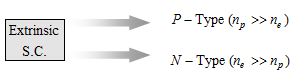
(D) An extrinsic semiconductor is formed by adding impurities to an intrinsic semiconductor. There are two types of extrinsic semiconductors:
$1$. $P$-type semiconductor: Formed by adding trivalent impurity atoms. In this case,holes are the majority charge carriers,so $N_h \gg N_e$.
$2$. $N$-type semiconductor: Formed by adding pentavalent impurity atoms. In this case,electrons are the majority charge carriers,so $N_e \gg N_h$.
Therefore,the relationship between $N_h$ and $N_e$ depends on the type of impurity added to the semiconductor. Thus,option $(d)$ is correct.
$1$. $P$-type semiconductor: Formed by adding trivalent impurity atoms. In this case,holes are the majority charge carriers,so $N_h \gg N_e$.
$2$. $N$-type semiconductor: Formed by adding pentavalent impurity atoms. In this case,electrons are the majority charge carriers,so $N_e \gg N_h$.
Therefore,the relationship between $N_h$ and $N_e$ depends on the type of impurity added to the semiconductor. Thus,option $(d)$ is correct.
0 likes
View Solution21
EasyMCQ
Indium impurity in germanium makes
A
$N-$ type
B
$P-$ type
C
Insulator
D
Intrinsic
Solution
(B) Indium $(In)$ is a group $13$ element,which means it is trivalent (has $3$ valence electrons).
Germanium $(Ge)$ is a group $14$ element,which is tetravalent (has $4$ valence electrons).
When trivalent Indium is added as an impurity to tetravalent Germanium,it creates a deficiency of electrons in the crystal lattice,known as a hole.
Since holes act as positive charge carriers,the resulting semiconductor is a $P-$ type semiconductor.
Germanium $(Ge)$ is a group $14$ element,which is tetravalent (has $4$ valence electrons).
When trivalent Indium is added as an impurity to tetravalent Germanium,it creates a deficiency of electrons in the crystal lattice,known as a hole.
Since holes act as positive charge carriers,the resulting semiconductor is a $P-$ type semiconductor.
0 likes
View Solution22
EasyMCQ
The addition of antimony atoms to a sample of intrinsic germanium transforms it into a material which is:
A
Superconductor
B
An insulator
C
$N$-type semiconductor
D
$P$-type semiconductor
Solution
(C) Antimony $(Sb)$ is a pentavalent element (Group $15$ of the periodic table).
When antimony atoms are added as an impurity to intrinsic germanium (a Group $14$ element),they provide extra electrons to the crystal lattice.
Since the impurity atoms donate electrons to the conduction band,the resulting material is an $N$-type semiconductor.
When antimony atoms are added as an impurity to intrinsic germanium (a Group $14$ element),they provide extra electrons to the crystal lattice.
Since the impurity atoms donate electrons to the conduction band,the resulting material is an $N$-type semiconductor.
0 likes
View Solution23
EasyMCQ
The impurity atom added to germanium to make it $N-$type semiconductor is
A
Arsenic
B
Iridium
C
Aluminium
D
Iodine
Solution
(A) To create an $N-$type semiconductor,a pentavalent impurity (an element from Group $15$ of the periodic table) must be added to an intrinsic semiconductor like Germanium $(Ge)$.
Arsenic $(As)$ is a pentavalent element,meaning it has $5$ valence electrons.
When Arsenic is doped into Germanium,$4$ of its valence electrons form covalent bonds with the surrounding Germanium atoms,and the $5$th electron becomes a free charge carrier,contributing to the $N-$type conductivity.
Therefore,Arsenic is the correct impurity.
Arsenic $(As)$ is a pentavalent element,meaning it has $5$ valence electrons.
When Arsenic is doped into Germanium,$4$ of its valence electrons form covalent bonds with the surrounding Germanium atoms,and the $5$th electron becomes a free charge carrier,contributing to the $N-$type conductivity.
Therefore,Arsenic is the correct impurity.
0 likes
View Solution24
EasyMCQ
When an $N-$type semiconductor is heated,what happens to the charge carriers?
A
Number of electrons increases while that of holes decreases
B
Number of holes increases while that of electrons decreases
C
Number of electrons and holes remains the same
D
Number of electrons and holes increases equally
Solution
(D) In an $N-$type semiconductor,the majority charge carriers are electrons and the minority charge carriers are holes.
When the semiconductor is heated,thermal energy provides enough energy to break covalent bonds in the crystal lattice.
Each broken bond creates an electron-hole pair.
Therefore,the number of electrons and the number of holes both increase by the same amount due to thermal generation.
Thus,the correct option is $(d)$.
When the semiconductor is heated,thermal energy provides enough energy to break covalent bonds in the crystal lattice.
Each broken bond creates an electron-hole pair.
Therefore,the number of electrons and the number of holes both increase by the same amount due to thermal generation.
Thus,the correct option is $(d)$.
0 likes
View Solution25
EasyMCQ
To obtain a $P$-type germanium semiconductor,it must be doped with
A
Arsenic
B
Antimony
C
Indium
D
Phosphorus
Solution
(C) To obtain a $P$-type semiconductor,the intrinsic semiconductor (like Germanium or Silicon) must be doped with a trivalent impurity atom.
Among the given options,Arsenic $(As)$,Antimony $(Sb)$,and Phosphorus $(P)$ are pentavalent elements (Group $15$),which are used to create $N$-type semiconductors.
Indium $(In)$ is a trivalent element (Group $13$),which creates a deficiency of electrons (holes) when added to Germanium,thus forming a $P$-type semiconductor.
Therefore,the correct option is $C$.
Among the given options,Arsenic $(As)$,Antimony $(Sb)$,and Phosphorus $(P)$ are pentavalent elements (Group $15$),which are used to create $N$-type semiconductors.
Indium $(In)$ is a trivalent element (Group $13$),which creates a deficiency of electrons (holes) when added to Germanium,thus forming a $P$-type semiconductor.
Therefore,the correct option is $C$.
0 likes
View Solution26
EasyMCQ
$P-$type semiconductor is formed when:
A
$A$ and $C$
B
$A$ and $D$
C
$B$ and $C$
D
$B$ and $D$
Solution
(C) $P-$type semiconductor is formed by doping an intrinsic semiconductor (like $Si$ or $Ge$ from Group $14$) with a trivalent impurity (from Group $13$).
$Al$ (Aluminum) and $B$ (Boron) are trivalent elements.
$As$ (Arsenic) and $P$ (Phosphorus) are pentavalent elements,which form $N-$type semiconductors.
Therefore,mixing $Al$ in $Si$ (Option $B$) and $B$ in $Ge$ (Option $C$) results in $P-$type semiconductors.
Thus,the correct combination is $B$ and $C$.
$Al$ (Aluminum) and $B$ (Boron) are trivalent elements.
$As$ (Arsenic) and $P$ (Phosphorus) are pentavalent elements,which form $N-$type semiconductors.
Therefore,mixing $Al$ in $Si$ (Option $B$) and $B$ in $Ge$ (Option $C$) results in $P-$type semiconductors.
Thus,the correct combination is $B$ and $C$.
0 likes
View Solution27
EasyMCQ
In a $P-$type semiconductor,
A
Current is mainly carried by holes
B
Current is mainly carried by electrons
C
The material is always positively charged
D
Doping is done by pentavalent material
Solution
(A) In a $P-$type semiconductor,the doping is done using trivalent impurities,which create an excess of holes.
Since holes are the majority charge carriers,the current in a $P-$type semiconductor is mainly carried by holes.
Therefore,option $A$ is correct.
Since holes are the majority charge carriers,the current in a $P-$type semiconductor is mainly carried by holes.
Therefore,option $A$ is correct.
0 likes
View Solution28
EasyMCQ
In $N$-type semiconductors,the majority charge carriers are
A
Holes
B
Protons
C
Neutrons
D
Electrons
Solution
(D) In an $N$-type semiconductor,pentavalent impurity atoms (like Phosphorus or Arsenic) are added to the intrinsic semiconductor (like Silicon or Germanium).
These impurity atoms provide extra electrons to the conduction band.
Therefore,in $N$-type semiconductors,electrons are the majority charge carriers,while holes are the minority charge carriers.
These impurity atoms provide extra electrons to the conduction band.
Therefore,in $N$-type semiconductors,electrons are the majority charge carriers,while holes are the minority charge carriers.
0 likes
View Solution29
EasyMCQ
If ${n_e}$ and ${n_h}$ are the number of electrons and holes in a semiconductor heavily doped with phosphorus,then
A
${n_e} \gg {n_h}$
B
${n_e} \ll {n_h}$
C
${n_e} \le {n_h}$
D
${n_e} = {n_h}$
Solution
(A) Phosphorus is a pentavalent impurity (Group $15$ element).
When a semiconductor is doped with a pentavalent impurity,it becomes an $n$-type semiconductor.
In an $n$-type semiconductor,the number of electrons $({n_e})$ is much greater than the number of holes $({n_h})$ because the impurity atoms donate extra electrons to the conduction band.
Therefore,${n_e} \gg {n_h}$.
When a semiconductor is doped with a pentavalent impurity,it becomes an $n$-type semiconductor.
In an $n$-type semiconductor,the number of electrons $({n_e})$ is much greater than the number of holes $({n_h})$ because the impurity atoms donate extra electrons to the conduction band.
Therefore,${n_e} \gg {n_h}$.
0 likes
View Solution30
EasyMCQ
An $N-$type and $P-$type silicon can be obtained by doping pure silicon with
A
Arsenic and Phosphorous
B
Indium and Aluminium
C
Phosphorous and Indium
D
Aluminium and Boron
Solution
(C) To obtain an $N-$type semiconductor,pure silicon (a group $14$ element) is doped with a pentavalent impurity (group $15$ element),such as Phosphorus $(P)$.
To obtain a $P-$type semiconductor,pure silicon is doped with a trivalent impurity (group $13$ element),such as Indium $(In)$.
Therefore,the correct combination is Phosphorus for $N-$type and Indium for $P-$type.
To obtain a $P-$type semiconductor,pure silicon is doped with a trivalent impurity (group $13$ element),such as Indium $(In)$.
Therefore,the correct combination is Phosphorus for $N-$type and Indium for $P-$type.
0 likes
View Solution31
EasyMCQ
$N-$ type semiconductors are obtained when germanium is doped with:
A
Phosphorus
B
Aluminium
C
Arsenic
D
Both $(a)$ and $(c)$
Solution
(D) To obtain an $N-$ type semiconductor,an intrinsic semiconductor like germanium (a group $14$ element) must be doped with a pentavalent impurity (a group $15$ element).
Pentavalent impurities have $5$ valence electrons.
When added to the germanium crystal lattice,$4$ electrons form covalent bonds with neighboring germanium atoms,and the $5$th electron becomes a free charge carrier (electron).
Both Phosphorus $(P)$ and Arsenic $(As)$ are pentavalent elements.
Therefore,doping germanium with either Phosphorus or Arsenic results in an $N-$ type semiconductor.
Thus,the correct option is $(d)$.
Pentavalent impurities have $5$ valence electrons.
When added to the germanium crystal lattice,$4$ electrons form covalent bonds with neighboring germanium atoms,and the $5$th electron becomes a free charge carrier (electron).
Both Phosphorus $(P)$ and Arsenic $(As)$ are pentavalent elements.
Therefore,doping germanium with either Phosphorus or Arsenic results in an $N-$ type semiconductor.
Thus,the correct option is $(d)$.
0 likes
View Solution32
EasyMCQ
To obtain electrons as majority charge carriers in a semiconductor,the impurity mixed is
A
Monovalent
B
Divalent
C
Trivalent
D
Pentavalent
Solution
(D) To obtain electrons as majority charge carriers in a semiconductor,we need to create an $n$-type semiconductor.
This is achieved by doping an intrinsic semiconductor (like $Si$ or $Ge$) with pentavalent impurity atoms (such as $P$,$As$,or $Sb$).
These pentavalent atoms have $5$ valence electrons,where $4$ electrons form covalent bonds with the host atoms and the $5$th electron becomes free to conduct electricity,thus making electrons the majority charge carriers.
This is achieved by doping an intrinsic semiconductor (like $Si$ or $Ge$) with pentavalent impurity atoms (such as $P$,$As$,or $Sb$).
These pentavalent atoms have $5$ valence electrons,where $4$ electrons form covalent bonds with the host atoms and the $5$th electron becomes free to conduct electricity,thus making electrons the majority charge carriers.
0 likes
View Solution33
EasyMCQ
$P$-type semiconductors are made by adding which impurity element?
A
$As$
B
$P$
C
$B$
D
$Bi$
Solution
(C) $P$-type semiconductors are formed by doping an intrinsic semiconductor (like Silicon or Germanium) with trivalent impurity atoms. Among the given options,Boron $(B)$ is a trivalent element (Group $13$),while Arsenic $(As)$,Phosphorus $(P)$,and Bismuth $(Bi)$ are pentavalent elements (Group $15$). Therefore,adding Boron creates holes,resulting in a $P$-type semiconductor.
0 likes
View Solution34
EasyMCQ
In an intrinsic semiconductor at room temperature,the number of electrons and holes are
A
Unequal
B
Equal
C
Infinite
D
Zero
Solution
(B) In an intrinsic semiconductor,thermal energy at room temperature is sufficient to excite electrons from the valence band to the conduction band.
For every electron excited to the conduction band,a corresponding hole is created in the valence band.
Therefore,the number density of electrons $(n_e)$ is equal to the number density of holes $(n_h)$,such that $n_e = n_h = n_i$,where $n_i$ is the intrinsic carrier concentration.
For every electron excited to the conduction band,a corresponding hole is created in the valence band.
Therefore,the number density of electrons $(n_e)$ is equal to the number density of holes $(n_h)$,such that $n_e = n_h = n_i$,where $n_i$ is the intrinsic carrier concentration.
0 likes
View Solution35
EasyMCQ
Which impurity is doped in $Si$ to form an $N$-type semiconductor?
A
$Al$
B
$B$
C
$As$
D
None of these
Solution
(C) To form an $N$-type semiconductor,a pentavalent impurity (an element from Group $15$) must be added to an intrinsic semiconductor like $Si$ (Silicon).
$As$ (Arsenic) is a pentavalent element,meaning it has $5$ valence electrons.
When $As$ is doped into $Si$,$4$ of its valence electrons form covalent bonds with $Si$ atoms,and the $5$th electron becomes a free charge carrier,contributing to $N$-type conductivity.
$Al$ (Aluminum) and $B$ (Boron) are trivalent impurities (Group $13$) and are used to create $P$-type semiconductors.
$As$ (Arsenic) is a pentavalent element,meaning it has $5$ valence electrons.
When $As$ is doped into $Si$,$4$ of its valence electrons form covalent bonds with $Si$ atoms,and the $5$th electron becomes a free charge carrier,contributing to $N$-type conductivity.
$Al$ (Aluminum) and $B$ (Boron) are trivalent impurities (Group $13$) and are used to create $P$-type semiconductors.
0 likes
View Solution36
EasyMCQ
The process of adding impurities to a pure semiconductor is called
A
Drouping
B
Drooping
C
Doping
D
None of these
Solution
(C) The process of intentionally adding small amounts of specific impurities to an extremely pure (intrinsic) semiconductor to modify its electrical properties is known as doping.
By adding these impurities,the concentration of charge carriers (electrons or holes) increases,which significantly enhances the conductivity of the semiconductor.
Therefore,the correct option is $C$.
By adding these impurities,the concentration of charge carriers (electrons or holes) increases,which significantly enhances the conductivity of the semiconductor.
Therefore,the correct option is $C$.
0 likes
View Solution37
EasyMCQ
When phosphorus and antimony are mixed in germanium,then:
A
$P$-type semiconductor is formed
B
$N$-type semiconductor is formed
C
Both $(a)$ and $(b)$
D
None of these
Solution
(B) Germanium $(Ge)$ is a tetravalent semiconductor. Phosphorus $(P)$ and Antimony $(Sb)$ are both pentavalent elements (Group $15$ elements). When a pentavalent impurity is added to a tetravalent semiconductor,it provides an extra electron for conduction. This results in the formation of an $N$-type semiconductor.
0 likes
View Solution38
EasyMCQ
To a germanium sample,traces of gallium are added as an impurity. The resultant sample would behave like
A
$A$ conductor
B
$A$ $P-$ type semiconductor
C
An $N-$ type semiconductor
D
An insulator
Solution
(B) Germanium $(Ge)$ is a group $14$ element with $4$ valence electrons.
Gallium $(Ga)$ is a group $13$ element,which means it has $3$ valence electrons.
When a trivalent impurity like Gallium is added to a tetravalent semiconductor like Germanium,it creates a vacancy or a 'hole' in the crystal lattice.
Since the majority charge carriers in this doped semiconductor are holes (positive charge carriers),the material behaves as a $P-$ type semiconductor.
Gallium $(Ga)$ is a group $13$ element,which means it has $3$ valence electrons.
When a trivalent impurity like Gallium is added to a tetravalent semiconductor like Germanium,it creates a vacancy or a 'hole' in the crystal lattice.
Since the majority charge carriers in this doped semiconductor are holes (positive charge carriers),the material behaves as a $P-$ type semiconductor.
0 likes
View Solution39
EasyMCQ
Donor type impurity is found in
A
Trivalent elements
B
Pentavalent elements
C
In both the above
D
None of these
Solution
(B) Donor impurities are elements that have $5$ valence electrons,known as pentavalent elements (e.g.,Phosphorus,Arsenic,Antimony).
When these atoms are doped into a semiconductor like Silicon or Germanium,$4$ of their valence electrons form covalent bonds with the host atoms,while the $5$th electron remains free to conduct electricity.
Since these atoms donate an extra electron to the conduction band,they are called donor-type impurities.
When these atoms are doped into a semiconductor like Silicon or Germanium,$4$ of their valence electrons form covalent bonds with the host atoms,while the $5$th electron remains free to conduct electricity.
Since these atoms donate an extra electron to the conduction band,they are called donor-type impurities.
0 likes
View Solution40
EasyMCQ
The charge on a hole is equal to the charge of
A
Zero
B
Proton
C
Neutron
D
Electron
Solution
(B) In semiconductor physics,a hole is defined as the absence of an electron in the valence band.
Since an electron has a negative charge of $-e$,the absence of an electron creates a vacancy that acts as a positive charge carrier.
The magnitude of the charge on a hole is exactly equal to the magnitude of the charge on an electron,which is $+e$.
This is equivalent to the charge of a proton,which is also $+e$.
Therefore,the charge on a hole is equal to the charge of a proton.
Since an electron has a negative charge of $-e$,the absence of an electron creates a vacancy that acts as a positive charge carrier.
The magnitude of the charge on a hole is exactly equal to the magnitude of the charge on an electron,which is $+e$.
This is equivalent to the charge of a proton,which is also $+e$.
Therefore,the charge on a hole is equal to the charge of a proton.
0 likes
View Solution41
EasyMCQ
When germanium is doped with phosphorus,the doped material has
A
Excess positive charge
B
Excess negative charge
C
More negative current carriers
D
More positive current carriers
Solution
(C) Germanium $(Ge)$ is a tetravalent semiconductor. Phosphorus $(P)$ is a pentavalent impurity (donor atom).
When $Ge$ is doped with $P$,each $P$ atom provides one extra free electron to the crystal lattice.
These free electrons act as negative current carriers.
Therefore,the doped material has more negative current carriers (electrons) compared to holes,making it an $n$-type semiconductor.
Since the crystal remains electrically neutral as a whole,option $(c)$ is the most appropriate description of the carrier concentration.
When $Ge$ is doped with $P$,each $P$ atom provides one extra free electron to the crystal lattice.
These free electrons act as negative current carriers.
Therefore,the doped material has more negative current carriers (electrons) compared to holes,making it an $n$-type semiconductor.
Since the crystal remains electrically neutral as a whole,option $(c)$ is the most appropriate description of the carrier concentration.
0 likes
View Solution42
EasyMCQ
$A$ $Ge$ specimen is doped with $Al$. The concentration of acceptor atoms is $10^{21} \text{ atoms}/m^3$. Given that the intrinsic concentration of electron-hole pairs is $10^{19} /m^3$, the concentration of electrons in the specimen is:
A
$10^{17} /m^3$
B
$10^{15} /m^3$
C
$10^4 /m^3$
D
$10^2 /m^3$
Solution
(A) In a $p$-type semiconductor, the concentration of holes $(n_h)$ is approximately equal to the concentration of acceptor atoms $(N_A)$.
Given: $n_h \approx N_A = 10^{21} /m^3$.
The intrinsic concentration of electron-hole pairs is $n_i = 10^{19} /m^3$.
Using the law of mass action for semiconductors: $n_e \cdot n_h = n_i^2$.
Substituting the values: $n_e \cdot 10^{21} = (10^{19})^2$.
$n_e \cdot 10^{21} = 10^{38}$.
$n_e = 10^{38} / 10^{21} = 10^{17} /m^3$.
Therefore, the concentration of electrons is $10^{17} /m^3$.
Given: $n_h \approx N_A = 10^{21} /m^3$.
The intrinsic concentration of electron-hole pairs is $n_i = 10^{19} /m^3$.
Using the law of mass action for semiconductors: $n_e \cdot n_h = n_i^2$.
Substituting the values: $n_e \cdot 10^{21} = (10^{19})^2$.
$n_e \cdot 10^{21} = 10^{38}$.
$n_e = 10^{38} / 10^{21} = 10^{17} /m^3$.
Therefore, the concentration of electrons is $10^{17} /m^3$.
0 likes
View Solution43
EasyMCQ
Which of the following statements is true for an $N$-type semiconductor?
A
The donor level lies closely below the bottom of the conduction band.
B
The donor level lies closely above the top of the valence band.
C
The donor level lies at the halfway mark of the forbidden energy gap.
D
None of the above.
Solution
(A) In an $N$-type semiconductor,pentavalent impurity atoms are added to a pure semiconductor (like $Si$ or $Ge$).
These impurity atoms provide extra electrons to the conduction band.
The energy levels of these donor electrons are called donor energy levels $(E_d)$.
These donor energy levels are located just below the conduction band $(E_c)$,typically at a distance of about $0.01 \ eV$ for $Ge$ and $0.05 \ eV$ for $Si$.
Therefore,the donor level lies closely below the bottom of the conduction band.
These impurity atoms provide extra electrons to the conduction band.
The energy levels of these donor electrons are called donor energy levels $(E_d)$.
These donor energy levels are located just below the conduction band $(E_c)$,typically at a distance of about $0.01 \ eV$ for $Ge$ and $0.05 \ eV$ for $Si$.
Therefore,the donor level lies closely below the bottom of the conduction band.
0 likes
View Solution44
EasyMCQ
In a $P-$type semiconductor,germanium is doped with
A
Gallium
B
Boron
C
Aluminium
D
All of these
Solution
(D) To form a $P-$type semiconductor,an intrinsic semiconductor like germanium $(Ge)$ must be doped with a trivalent impurity atom.
Gallium $(Ga)$,Boron $(B)$,and Aluminium $(Al)$ are all elements of Group $13$ in the periodic table,meaning they have $3$ valence electrons.
When these atoms are added to germanium,they create holes in the crystal lattice,resulting in $P-$type conductivity.
Therefore,all the given options are correct.
Gallium $(Ga)$,Boron $(B)$,and Aluminium $(Al)$ are all elements of Group $13$ in the periodic table,meaning they have $3$ valence electrons.
When these atoms are added to germanium,they create holes in the crystal lattice,resulting in $P-$type conductivity.
Therefore,all the given options are correct.
0 likes
View Solution45
EasyMCQ
An intrinsic semiconductor is electrically neutral. An extrinsic semiconductor having a large number of current carriers would be:
A
Positively charged
B
Negatively charged
C
Positively charged or negatively charged depending upon the type of impurity that has been added
D
Electrically neutral
Solution
(D) An extrinsic semiconductor,whether it is $N$-type or $P$-type,is formed by adding a small amount of impurity to a pure (intrinsic) semiconductor.
Although the impurity atoms provide extra charge carriers (electrons or holes),the impurity atoms themselves are electrically neutral before they are added to the crystal lattice.
When these atoms are incorporated into the lattice,the total number of protons equals the total number of electrons in the entire crystal structure.
Therefore,the net charge of an extrinsic semiconductor remains zero,making it electrically neutral.
Although the impurity atoms provide extra charge carriers (electrons or holes),the impurity atoms themselves are electrically neutral before they are added to the crystal lattice.
When these atoms are incorporated into the lattice,the total number of protons equals the total number of electrons in the entire crystal structure.
Therefore,the net charge of an extrinsic semiconductor remains zero,making it electrically neutral.
0 likes
View Solution46
EasyMCQ
If $n_e$ and $v_d$ are the number density of electrons and drift velocity in a semiconductor,respectively,what happens when the temperature is increased?
A
$n_e$ increases and $v_d$ decreases
B
$n_e$ decreases and $v_d$ increases
C
Both $n_e$ and $v_d$ increase
D
Both $n_e$ and $v_d$ decrease
Solution
(A) In a semiconductor,as the temperature increases,more covalent bonds break,leading to an increase in the number density of charge carriers $(n_e)$. Thus,$n_e$ increases.
However,the drift velocity $(v_d)$ is given by the relation $v_d = \mu E$,where $\mu$ is the mobility. Mobility is inversely proportional to the relaxation time $(\tau)$,which decreases as temperature increases due to more frequent collisions. Therefore,the mobility $\mu$ decreases,causing the drift velocity $v_d$ to decrease.
Thus,$n_e$ increases and $v_d$ decreases.
However,the drift velocity $(v_d)$ is given by the relation $v_d = \mu E$,where $\mu$ is the mobility. Mobility is inversely proportional to the relaxation time $(\tau)$,which decreases as temperature increases due to more frequent collisions. Therefore,the mobility $\mu$ decreases,causing the drift velocity $v_d$ to decrease.
Thus,$n_e$ increases and $v_d$ decreases.
0 likes
View Solution47
MediumMCQ
Which of the following energy band diagrams shows the $N$-type semiconductor?
A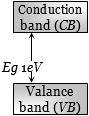
B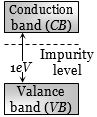
C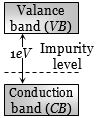
D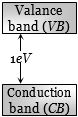
Solution
(B) In an $N$-type semiconductor,the donor impurity energy level lies just below the conduction band $(CB)$.
This allows electrons to be easily excited from the donor level to the conduction band,increasing the conductivity of the semiconductor.
Looking at the provided diagrams,option $B$ correctly illustrates the impurity energy level positioned just below the conduction band $(CB)$.
This allows electrons to be easily excited from the donor level to the conduction band,increasing the conductivity of the semiconductor.
Looking at the provided diagrams,option $B$ correctly illustrates the impurity energy level positioned just below the conduction band $(CB)$.
0 likes
View Solution48
EasyMCQ
The mobility of free electrons is greater than that of free holes because
A
They carry negative charge
B
They are lighter
C
They collide less frequently
D
They require less energy to continue their motion
Solution
(B) Mobility $(\mu)$ is defined as the drift velocity per unit electric field, given by $\mu = \frac{e\tau}{m^*}$, where $\tau$ is the relaxation time and $m^*$ is the effective mass. Electrons have a smaller effective mass compared to holes and experience less scattering within the crystal lattice. Consequently, electrons have a higher relaxation time and lower effective mass, leading to higher mobility than holes.
0 likes
View Solution49
MediumMCQ
The electron mobility in $N$-type germanium is $3900 \ cm^2/V \cdot s$ and its conductivity is $6.24 \ mho/cm$. If the effect of holes is negligible,what is the impurity concentration?
A
$10^{15} \ cm^{-3}$
B
$10^{13} \ cm^{-3}$
C
$10^{12} \ cm^{-3}$
D
$10^{16} \ cm^{-3}$
Solution
(D) The conductivity $\sigma$ of an $N$-type semiconductor is given by the formula: $\sigma = e n_e \mu_e$,where $e$ is the elementary charge,$n_e$ is the electron concentration (impurity concentration),and $\mu_e$ is the electron mobility.
Given: $\sigma = 6.24 \ mho/cm$,$\mu_e = 3900 \ cm^2/V \cdot s$,and $e = 1.6 \times 10^{-19} \ C$.
Rearranging the formula to solve for $n_e$:
$n_e = \frac{\sigma}{e \mu_e}$
Substituting the values:
$n_e = \frac{6.24}{1.6 \times 10^{-19} \times 3900}$
$n_e = \frac{6.24}{6240 \times 10^{-19}}$
$n_e = \frac{6.24}{6.24 \times 10^{-16}}$
$n_e = 10^{16} \ cm^{-3}$.
Given: $\sigma = 6.24 \ mho/cm$,$\mu_e = 3900 \ cm^2/V \cdot s$,and $e = 1.6 \times 10^{-19} \ C$.
Rearranging the formula to solve for $n_e$:
$n_e = \frac{\sigma}{e \mu_e}$
Substituting the values:
$n_e = \frac{6.24}{1.6 \times 10^{-19} \times 3900}$
$n_e = \frac{6.24}{6240 \times 10^{-19}}$
$n_e = \frac{6.24}{6.24 \times 10^{-16}}$
$n_e = 10^{16} \ cm^{-3}$.
0 likes
View Solution50
EasyMCQ
$A$ semiconductor doped with a donor impurity is
A
$P-type$
B
$N-type$
C
$NPN$ type
D
$PNP$ type
Solution
(B) The correct answer is $B$ $(N-type)$.
When a pentavalent impurity (donor impurity) is added to an intrinsic semiconductor like Silicon or Germanium,it provides extra free electrons to the crystal lattice.
These electrons act as majority charge carriers.
Since the charge carriers are negatively charged electrons,the resulting semiconductor is known as an $N-type$ semiconductor.
When a pentavalent impurity (donor impurity) is added to an intrinsic semiconductor like Silicon or Germanium,it provides extra free electrons to the crystal lattice.
These electrons act as majority charge carriers.
Since the charge carriers are negatively charged electrons,the resulting semiconductor is known as an $N-type$ semiconductor.
0 likes
View SolutionSemiconductor Electronics — Types Semiconductors (P type and N type) · Frequently Asked Questions
1Are these Semiconductor Electronics questions useful for JEE and NEET?
Yes. All questions in this section are mapped to JEE Main and NEET exam patterns. Previous year questions from JEE Main, NEET, GUJCET and state-level exams are included with full solutions.
2Can I switch to Hindi or Gujarati for these questions?
Yes. Use the language tabs in the hero section or the sidebar to view the same questions and solutions in English, Hindi or Gujarati.
3How do I generate a question paper from this subtopic?
Use the Vedclass Exam Paper Generator — select the chapter and subtopic, set difficulty, and generate Sets A, B, C, D automatically. First 3 chapters of every subject are free.
Vedclass Products
For Students
Vedclass Test Series
Mock tests in real JEE/NEET style with performance analysis. 5-day free trial.
Start Free TrialFor Teachers
Exam Paper Generator
Generate Set A/B/C/D papers from this chapter in 2 minutes. 3 chapters free.
Try FreeFor Institutes
Online Exam Module
Live online exams with unlimited students, 360° analytics & white-label branding.
See DemoFor Teachers & Institutes
Generate a Semiconductor Electronics Exam Paper in 2 Minutes
Select subtopic & difficulty — Sets A, B, C, D auto-generated with No Repeat logic.
First 3 chapters of every subject are free — no payment required.