
A English
Valve Electronics Questions in English
Class 12 Physics · Semiconductor Electronics · Valve Electronics
84+
Questions
English
Language
100%
With Solutions
Showing 50 of 84 questions in English
1
EasyMCQ
In an electron gun,the control grid is given a negative potential relative to the cathode in order to:
A
Decelerate electrons
B
Repel electrons and thus to control the number of electrons passing through it
C
Select electrons of the same velocity and converge them along the axis
D
Decrease the kinetic energy of electrons
Solution
(B) The control grid in an electron gun is maintained at a negative potential with respect to the cathode.
Since electrons are negatively charged,this negative potential creates an electric field that opposes the motion of electrons.
By adjusting the magnitude of this negative potential,the grid can repel a portion of the electrons back toward the cathode.
Consequently,this mechanism allows for the precise control of the number of electrons (beam intensity) that pass through the aperture of the grid.
Since electrons are negatively charged,this negative potential creates an electric field that opposes the motion of electrons.
By adjusting the magnitude of this negative potential,the grid can repel a portion of the electrons back toward the cathode.
Consequently,this mechanism allows for the precise control of the number of electrons (beam intensity) that pass through the aperture of the grid.
0 likes
View Solution2
EasyMCQ
The current conduction in a discharge tube is due to
A
Electrons only
B
$+ve$ ions and electrons
C
$-ve$ ions and electrons
D
$+ve$ ions,$-ve$ ions and electrons
Solution
(D) In a discharge tube,gas molecules are ionized due to various factors like cosmic rays or high potential differences.
When a high potential difference is applied,the electric field accelerates these charged particles.
Collisions between these accelerated particles and neutral gas molecules lead to further ionization,creating a cascade of charge carriers.
Specifically,electrons are detached from molecules,forming positive ions.
At low pressures,these electrons can travel significant distances and may attach to other neutral molecules to form negative ions.
Therefore,the current conduction in a discharge tube is carried by positive ions,negative ions,and electrons.
When a high potential difference is applied,the electric field accelerates these charged particles.
Collisions between these accelerated particles and neutral gas molecules lead to further ionization,creating a cascade of charge carriers.
Specifically,electrons are detached from molecules,forming positive ions.
At low pressures,these electrons can travel significant distances and may attach to other neutral molecules to form negative ions.
Therefore,the current conduction in a discharge tube is carried by positive ions,negative ions,and electrons.
0 likes
View Solution3
EasyMCQ
$A$ serious drawback of semiconductor devices is:
A
They cannot be used with high voltage
B
They pollute the environment
C
They are costly
D
They do not last for a long time
Solution
(A) Semiconductor devices,such as transistors and diodes,are designed to operate at low power levels and low voltage ranges,typically between $0 \ V$ and $15 \ V$. They are highly sensitive to high voltage and can be permanently damaged if subjected to voltages beyond their rated limits. Therefore,their inability to handle high voltage is a significant limitation compared to vacuum tubes.
0 likes
View Solution4
EasyMCQ
What is the effect of $SCR$ (Space Charge Region) in a vacuum tube?
A
$I_p \to$ Decrease
B
$I_p \to$ Increase
C
$V_p \to$ Increase
D
$V_g \to$ Increase
Solution
(A) In a vacuum tube,the $SCR$ (Space Charge Region) consists of a cloud of electrons that accumulate near the cathode.
These electrons create a negative potential barrier that repels other emitted electrons back toward the cathode.
As a result,the number of electrons reaching the plate (anode) is reduced.
Therefore,the plate current $(I_p)$ decreases.
These electrons create a negative potential barrier that repels other emitted electrons back toward the cathode.
As a result,the number of electrons reaching the plate (anode) is reduced.
Therefore,the plate current $(I_p)$ decreases.
0 likes
View Solution5
EasyMCQ
In a diode,when there is saturation current,the plate resistance $({r_p})$ is
A
Zero
B
Infinite
C
Some finite quantity
D
Data is insufficient
Solution
(B) The plate resistance $({r_p})$ is defined as the ratio of the change in plate voltage $(\delta V)$ to the change in plate current $(\delta I)$,expressed as $r_p = \frac{\delta V}{\delta I}$.
At the saturation point,the current reaches its maximum value and does not change with further increases in voltage,meaning the change in current $\delta I = 0$.
Substituting this into the formula,we get $r_p = \frac{\delta V}{0} = \infty$.
Therefore,at saturation,the plate resistance is infinite.
At the saturation point,the current reaches its maximum value and does not change with further increases in voltage,meaning the change in current $\delta I = 0$.
Substituting this into the formula,we get $r_p = \frac{\delta V}{0} = \infty$.
Therefore,at saturation,the plate resistance is infinite.
0 likes
View Solution6
MediumMCQ
The grid voltage of any triode valve is changed from $-1 \, V$ to $-3 \, V$ and the mutual conductance is $3 \times 10^{-4} \, \text{mho}$. The change in plate circuit current will be ..... $mA$.
A
$0.8$
B
$0.6$
C
$0.4$
D
$1$
Solution
(B) The mutual conductance $(g_m)$ of a triode valve is defined as the ratio of the change in plate current $(\Delta i_p)$ to the change in grid voltage $(\Delta v_g)$ at a constant plate voltage.
Formula: $g_m = \frac{\Delta i_p}{\Delta v_g}$
Given:
$g_m = 3 \times 10^{-4} \, \text{mho}$
$\Delta v_g = |(-3) - (-1)| = |-2| = 2 \, V$
Substituting the values:
$3 \times 10^{-4} = \frac{\Delta i_p}{2}$
$\Delta i_p = 3 \times 10^{-4} \times 2 = 6 \times 10^{-4} \, A$
Converting to milliamperes $(mA)$:
$\Delta i_p = 6 \times 10^{-4} \times 10^3 \, mA = 0.6 \, mA$
Therefore, the change in plate circuit current is $0.6 \, mA$.
Formula: $g_m = \frac{\Delta i_p}{\Delta v_g}$
Given:
$g_m = 3 \times 10^{-4} \, \text{mho}$
$\Delta v_g = |(-3) - (-1)| = |-2| = 2 \, V$
Substituting the values:
$3 \times 10^{-4} = \frac{\Delta i_p}{2}$
$\Delta i_p = 3 \times 10^{-4} \times 2 = 6 \times 10^{-4} \, A$
Converting to milliamperes $(mA)$:
$\Delta i_p = 6 \times 10^{-4} \times 10^3 \, mA = 0.6 \, mA$
Therefore, the change in plate circuit current is $0.6 \, mA$.
0 likes
View Solution7
MediumMCQ
In a triode,${g_m} = 2 \times 10^{-3} \, \Omega^{-1}$,$\mu = 42$,and the resistance load $R_L = 50 \, \text{k}\Omega$. The voltage amplification obtained from this triode will be:
A
$30.42$
B
$29.57$
C
$28.18$
D
$27.15$
Solution
(B) The voltage gain ${A_v}$ of a triode amplifier is given by the formula: ${A_v} = \frac{\mu R_L}{r_p + R_L} = \frac{\mu}{1 + \frac{r_p}{R_L}}$.
Given that $\mu = r_p \times g_m$,we can calculate the plate resistance ${r_p}$ as:
${r_p} = \frac{\mu}{g_m} = \frac{42}{2 \times 10^{-3}} = 21000 \, \Omega = 21 \, \text{k}\Omega$.
Now,substituting the values into the voltage gain formula:
${A_v} = \frac{42}{1 + \frac{21 \, \text{k}\Omega}{50 \, \text{k}\Omega}} = \frac{42}{1 + 0.42} = \frac{42}{1.42} \approx 29.57$.
Given that $\mu = r_p \times g_m$,we can calculate the plate resistance ${r_p}$ as:
${r_p} = \frac{\mu}{g_m} = \frac{42}{2 \times 10^{-3}} = 21000 \, \Omega = 21 \, \text{k}\Omega$.
Now,substituting the values into the voltage gain formula:
${A_v} = \frac{42}{1 + \frac{21 \, \text{k}\Omega}{50 \, \text{k}\Omega}} = \frac{42}{1 + 0.42} = \frac{42}{1.42} \approx 29.57$.
0 likes
View Solution8
MediumMCQ
In an amplifier,the load resistance ${R_L}$ is equal to the plate resistance ${r_p}$. The voltage amplification is equal to:
A
$\mu$
B
$2\mu$
C
$\mu / 2$
D
$\mu / 4$
Solution
(C) The voltage amplification (voltage gain) ${A_v}$ of an amplifier is given by the formula: ${A_v} = \frac{\mu}{1 + \frac{r_p}{R_L}}$.
Given that the load resistance ${R_L}$ is equal to the plate resistance ${r_p}$,i.e.,${R_L} = {r_p}$.
Substituting this into the formula: ${A_v} = \frac{\mu}{1 + \frac{r_p}{r_p}} = \frac{\mu}{1 + 1} = \frac{\mu}{2}$.
Therefore,the voltage amplification is equal to $\mu / 2$.
Given that the load resistance ${R_L}$ is equal to the plate resistance ${r_p}$,i.e.,${R_L} = {r_p}$.
Substituting this into the formula: ${A_v} = \frac{\mu}{1 + \frac{r_p}{r_p}} = \frac{\mu}{1 + 1} = \frac{\mu}{2}$.
Therefore,the voltage amplification is equal to $\mu / 2$.
0 likes
View Solution9
MediumMCQ
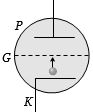
For a given plate-voltage,the plate current in a triode is maximum when the potential of
A
The grid is positive and plate is negative
B
The grid is positive and plate is positive
C
The grid is zero and plate is positive
D
The grid is negative and plate is positive
Solution
(B) In a triode,the plate current is determined by the number of electrons reaching the plate $P$ from the cathode $K$.
When the grid $G$ is given a positive potential,it exerts an attractive force on the electrons emitted from the cathode,helping them pass through the grid mesh towards the plate.
Since the plate $P$ must also be at a positive potential to attract these electrons,having both the grid and the plate at positive potentials results in the maximum flow of electrons to the plate,thereby maximizing the plate current.
Therefore,the correct option is $B$.
When the grid $G$ is given a positive potential,it exerts an attractive force on the electrons emitted from the cathode,helping them pass through the grid mesh towards the plate.
Since the plate $P$ must also be at a positive potential to attract these electrons,having both the grid and the plate at positive potentials results in the maximum flow of electrons to the plate,thereby maximizing the plate current.
Therefore,the correct option is $B$.
0 likes
View Solution10
MediumMCQ
If ${R_p} = 7 \text{ k}\Omega$ and ${g_m} = 2.5 \text{ millimho}$, then on increasing the plate voltage by $50 \text{ V}$, how much must the grid voltage be changed so that the plate current remains the same? (in $V$)
A
$-2.86$
B
$-4$
C
$+4$
D
$+2$
Solution
(A) The amplification factor $\mu$ is given by the product of plate resistance ${R_p}$ and transconductance ${g_m}$.
$\mu = {R_p} \times {g_m} = 7 \times 10^3 \Omega \times 2.5 \times 10^{-3} \text{ mho} = 17.5$.
Also, the amplification factor is defined as $\mu = - \frac{\Delta {V_p}}{\Delta {V_g}}$ for a constant plate current.
Given $\Delta {V_p} = 50 \text{ V}$, we have $17.5 = - \frac{50}{\Delta {V_g}}$.
Therefore, $\Delta {V_g} = - \frac{50}{17.5} \approx - 2.86 \text{ V}$.
$\mu = {R_p} \times {g_m} = 7 \times 10^3 \Omega \times 2.5 \times 10^{-3} \text{ mho} = 17.5$.
Also, the amplification factor is defined as $\mu = - \frac{\Delta {V_p}}{\Delta {V_g}}$ for a constant plate current.
Given $\Delta {V_p} = 50 \text{ V}$, we have $17.5 = - \frac{50}{\Delta {V_g}}$.
Therefore, $\Delta {V_g} = - \frac{50}{17.5} \approx - 2.86 \text{ V}$.
0 likes
View Solution11
MediumMCQ
The amplification factor of a triode is $20$,the trans-conductance is $3 \text{ mS}$ (milli mho),and the load resistance is $3 \times 10^4 \ \Omega$. Calculate the voltage gain.
A
$16.36$
B
$28$
C
$78$
D
$108$
Solution
(A) Given:
Amplification factor $\mu = 20$
Trans-conductance $g_m = 3 \text{ mS} = 3 \times 10^{-3} \ \Omega^{-1}$
Load resistance $R_L = 3 \times 10^4 \ \Omega$
First,we find the plate resistance $r_p$ using the relation $\mu = g_m \times r_p$:
$r_p = \frac{\mu}{g_m} = \frac{20}{3 \times 10^{-3}} = \frac{20000}{3} \ \Omega$
The formula for voltage gain $A_v$ is:
$A_v = \frac{\mu \times R_L}{r_p + R_L}$
Substituting the values:
$A_v = \frac{20 \times 3 \times 10^4}{\frac{20000}{3} + 30000}$
$A_v = \frac{600000}{\frac{20000 + 90000}{3}} = \frac{600000 \times 3}{110000}$
$A_v = \frac{180}{11} \approx 16.36$
Amplification factor $\mu = 20$
Trans-conductance $g_m = 3 \text{ mS} = 3 \times 10^{-3} \ \Omega^{-1}$
Load resistance $R_L = 3 \times 10^4 \ \Omega$
First,we find the plate resistance $r_p$ using the relation $\mu = g_m \times r_p$:
$r_p = \frac{\mu}{g_m} = \frac{20}{3 \times 10^{-3}} = \frac{20000}{3} \ \Omega$
The formula for voltage gain $A_v$ is:
$A_v = \frac{\mu \times R_L}{r_p + R_L}$
Substituting the values:
$A_v = \frac{20 \times 3 \times 10^4}{\frac{20000}{3} + 30000}$
$A_v = \frac{600000}{\frac{20000 + 90000}{3}} = \frac{600000 \times 3}{110000}$
$A_v = \frac{180}{11} \approx 16.36$
0 likes
View Solution12
MediumMCQ
In a triode amplifier,$\mu = 25$,$r_p = 40 \text{ k}\Omega$,and load resistance $R_L = 10 \text{ k}\Omega$. If the input signal voltage is $0.5 \text{ V}$,then the output signal voltage will be.....$\text{V}$.
A
$1.25$
B
$5$
C
$2.5$
D
$10$
Solution
(C) The voltage gain $A_v$ of a triode amplifier is given by the formula: $A_v = \frac{\mu R_L}{r_p + R_L} = \frac{\mu}{1 + \frac{r_p}{R_L}}$.
Given: $\mu = 25$,$r_p = 40 \text{ k}\Omega$,$R_L = 10 \text{ k}\Omega$,and $V_{\text{in}} = 0.5 \text{ V}$.
Substituting the values into the gain formula:
$A_v = \frac{25}{1 + \frac{40}{10}} = \frac{25}{1 + 4} = \frac{25}{5} = 5$.
Since voltage gain $A_v = \frac{V_{\text{out}}}{V_{\text{in}}}$,we have $V_{\text{out}} = A_v \times V_{\text{in}}$.
$V_{\text{out}} = 5 \times 0.5 \text{ V} = 2.5 \text{ V}$.
Given: $\mu = 25$,$r_p = 40 \text{ k}\Omega$,$R_L = 10 \text{ k}\Omega$,and $V_{\text{in}} = 0.5 \text{ V}$.
Substituting the values into the gain formula:
$A_v = \frac{25}{1 + \frac{40}{10}} = \frac{25}{1 + 4} = \frac{25}{5} = 5$.
Since voltage gain $A_v = \frac{V_{\text{out}}}{V_{\text{in}}}$,we have $V_{\text{out}} = A_v \times V_{\text{in}}$.
$V_{\text{out}} = 5 \times 0.5 \text{ V} = 2.5 \text{ V}$.
0 likes
View Solution13
EasyMCQ
The amplification factor of a triode is $20$. If the grid potential is reduced by $0.2\, V$,then to keep the plate current constant,its plate voltage must be increased by how many volts?
A
$10$
B
$4$
C
$40$
D
$100$
Solution
(B) The amplification factor $\mu$ of a triode is defined as the ratio of the change in plate voltage to the change in grid voltage for a constant plate current: $\mu = -\frac{\Delta V_p}{\Delta V_G}$.
Given: $\mu = 20$ and $\Delta V_G = -0.2\, V$ (since the potential is reduced).
To keep the plate current constant,we rearrange the formula: $\Delta V_p = -\mu \times \Delta V_G$.
Substituting the values: $\Delta V_p = -20 \times (-0.2\, V) = 4\, V$.
Therefore,the plate voltage must be increased by $4\, V$.
Given: $\mu = 20$ and $\Delta V_G = -0.2\, V$ (since the potential is reduced).
To keep the plate current constant,we rearrange the formula: $\Delta V_p = -\mu \times \Delta V_G$.
Substituting the values: $\Delta V_p = -20 \times (-0.2\, V) = 4\, V$.
Therefore,the plate voltage must be increased by $4\, V$.
0 likes
View Solution14
MediumMCQ
For a triode, ${r_p} = 10 \text{ k}\Omega$ and ${g_m} = 3 \text{ m}\mho$. If the load resistance is double the plate resistance, then the value of the voltage gain will be:
A
$10$
B
$20$
C
$15$
D
$30$
Solution
(B) The voltage gain ${A_V}$ of a triode is given by the formula: ${A_V} = \frac{\mu}{1 + \frac{r_p}{R_L}}.$
First, we calculate the amplification factor $\mu$ using the relation $\mu = {r_p} \times {g_m}.$
Given ${r_p} = 10 \times 10^3 \ \Omega$ and ${g_m} = 3 \times 10^{-3} \ \mho$, we get $\mu = (10 \times 10^3) \times (3 \times 10^{-3}) = 30.$
It is given that the load resistance ${R_L} = 2{r_p}.$
Substituting these values into the voltage gain formula:
${A_V} = \frac{30}{1 + \frac{r_p}{2r_p}} = \frac{30}{1 + 0.5} = \frac{30}{1.5} = 20.$
Therefore, the voltage gain is $20$.
First, we calculate the amplification factor $\mu$ using the relation $\mu = {r_p} \times {g_m}.$
Given ${r_p} = 10 \times 10^3 \ \Omega$ and ${g_m} = 3 \times 10^{-3} \ \mho$, we get $\mu = (10 \times 10^3) \times (3 \times 10^{-3}) = 30.$
It is given that the load resistance ${R_L} = 2{r_p}.$
Substituting these values into the voltage gain formula:
${A_V} = \frac{30}{1 + \frac{r_p}{2r_p}} = \frac{30}{1 + 0.5} = \frac{30}{1.5} = 20.$
Therefore, the voltage gain is $20$.
0 likes
View Solution15
EasyMCQ
The amplification produced by a triode is due to the action of
A
Filament
B
Cathode
C
Grid
D
Plate
Solution
(C) The amplification produced by a triode is due to the action of the control grid. $A$ triode consists of three electrodes mounted inside an evacuated glass or metal container: a cathode,a control grid,and an anode (plate). The control grid is placed between the cathode and the anode. $A$ small change in the potential of the control grid causes a large change in the plate current,which is the fundamental principle behind the amplification factor of a triode.
0 likes
View Solution16
EasyMCQ
In a triode amplifier,the value of maximum gain is equal to
A
Half the amplification factor
B
Amplification factor
C
Twice the amplification factor
D
Infinity
Solution
(B) The voltage gain $(A_v)$ of a triode amplifier is given by the formula: $A_v = \frac{\mu R_L}{r_p + R_L}$,where $\mu$ is the amplification factor,$r_p$ is the plate resistance,and $R_L$ is the load resistance.
To find the maximum gain,we consider the limit as the load resistance $R_L$ approaches infinity $(R_L \to \infty)$.
$(A_v)_{max} = \lim_{R_L \to \infty} \frac{\mu R_L}{r_p + R_L} = \lim_{R_L \to \infty} \frac{\mu}{\frac{r_p}{R_L} + 1} = \frac{\mu}{0 + 1} = \mu$.
Therefore,the maximum gain is equal to the amplification factor $\mu$.
To find the maximum gain,we consider the limit as the load resistance $R_L$ approaches infinity $(R_L \to \infty)$.
$(A_v)_{max} = \lim_{R_L \to \infty} \frac{\mu R_L}{r_p + R_L} = \lim_{R_L \to \infty} \frac{\mu}{\frac{r_p}{R_L} + 1} = \frac{\mu}{0 + 1} = \mu$.
Therefore,the maximum gain is equal to the amplification factor $\mu$.
0 likes
View Solution17
MediumMCQ
For a given triode,$\mu = 20$. The load resistance is $1.5$ times the anode resistance. The voltage gain will be:
A
$16$
B
$12$
C
$10$
D
None of the above
Solution
(B) The voltage gain $A_v$ of a triode amplifier is given by the formula: $A_v = \frac{\mu}{1 + \frac{r_p}{R_L}}$.
Given that the load resistance $R_L = 1.5 \, r_p$,where $r_p$ is the anode resistance.
Substituting the value of $R_L$ into the formula:
$A_v = \frac{\mu}{1 + \frac{r_p}{1.5 \, r_p}} = \frac{\mu}{1 + \frac{1}{1.5}} = \frac{\mu}{1 + \frac{2}{3}} = \frac{\mu}{\frac{5}{3}} = \frac{3}{5} \mu$.
Given $\mu = 20$,we calculate:
$A_v = \frac{3}{5} \times 20 = 3 \times 4 = 12$.
Given that the load resistance $R_L = 1.5 \, r_p$,where $r_p$ is the anode resistance.
Substituting the value of $R_L$ into the formula:
$A_v = \frac{\mu}{1 + \frac{r_p}{1.5 \, r_p}} = \frac{\mu}{1 + \frac{1}{1.5}} = \frac{\mu}{1 + \frac{2}{3}} = \frac{\mu}{\frac{5}{3}} = \frac{3}{5} \mu$.
Given $\mu = 20$,we calculate:
$A_v = \frac{3}{5} \times 20 = 3 \times 4 = 12$.
0 likes
View Solution18
EasyMCQ
The voltage gain of a triode depends upon
A
Filament voltage
B
Plate voltage
C
Plate resistance
D
Plate current
Solution
(C) The voltage gain $(A_v)$ of a triode is given by the formula $A_v = \mu \times \frac{R_L}{r_p + R_L}$,where $\mu$ is the amplification factor,$r_p$ is the plate resistance,and $R_L$ is the load resistance. Since the amplification factor $\mu$ and the plate resistance $r_p$ are intrinsic properties of the triode,the voltage gain depends directly on the plate resistance $r_p$ and the load resistance.
0 likes
View Solution19
EasyMCQ
In a triode valve,which of the following statements is correct?
A
If the grid voltage is zero,then the plate current will be zero.
B
If the temperature of the filament is doubled,then the thermionic current will also be doubled.
C
If the temperature of the filament is doubled,then the thermionic current will nearly be four times.
D
At a definite grid voltage,the plate current varies with plate voltage according to Ohm’s law.
Solution
(C) The thermionic emission current $I$ is given by Richardson-Dushman equation: $I = AT^2 e^{-\phi/kT}$,where $A$ is a constant,$T$ is the absolute temperature,$\phi$ is the work function,and $k$ is the Boltzmann constant.
Since $I \propto T^2$,if the temperature $T$ is doubled $(T' = 2T)$,the new current $I'$ becomes $I' \propto (2T)^2 = 4T^2$.
Therefore,the thermionic current becomes nearly four times the original value.
Thus,option $C$ is correct.
Since $I \propto T^2$,if the temperature $T$ is doubled $(T' = 2T)$,the new current $I'$ becomes $I' \propto (2T)^2 = 4T^2$.
Therefore,the thermionic current becomes nearly four times the original value.
Thus,option $C$ is correct.
0 likes
View Solution20
EasyMCQ
The amplification factor of a triode valve is $15$. If the grid voltage is changed by $0.3 \,V$,what is the change in plate voltage required to keep the plate current constant (in $V$)?
A
$0.02$
B
$0.002$
C
$4.5$
D
$5$
Solution
(C) The amplification factor $\mu$ of a triode valve is defined as the ratio of the change in plate voltage to the change in grid voltage for a constant plate current.
Mathematically,$\mu = \left| \frac{\Delta V_p}{\Delta V_g} \right|$.
Given: $\mu = 15$ and $\Delta V_g = 0.3 \,V$.
To keep the plate current constant,the change in plate voltage $\Delta V_p$ is given by:
$\Delta V_p = \mu \times \Delta V_g$
$\Delta V_p = 15 \times 0.3 = 4.5 \,V$.
Therefore,the change in plate voltage is $4.5 \,V$.
Mathematically,$\mu = \left| \frac{\Delta V_p}{\Delta V_g} \right|$.
Given: $\mu = 15$ and $\Delta V_g = 0.3 \,V$.
To keep the plate current constant,the change in plate voltage $\Delta V_p$ is given by:
$\Delta V_p = \mu \times \Delta V_g$
$\Delta V_p = 15 \times 0.3 = 4.5 \,V$.
Therefore,the change in plate voltage is $4.5 \,V$.
0 likes
View Solution21
MediumMCQ
The slope of the plate characteristic of a vacuum tube diode for a certain operating point on the curve is $10^{-3} \text{ mA/V}$. The plate resistance of the diode and its nature are respectively:
A
$100 \text{ k}\Omega$,static
B
$1000 \text{ k}\Omega$,static
C
$1000 \text{ k}\Omega$,dynamic
D
$100 \text{ k}\Omega$,dynamic
Solution
(C) The plate resistance $(r_p)$ of a vacuum tube diode is defined as the reciprocal of the slope of the plate characteristic curve at a given operating point.
Given slope = $10^{-3} \text{ mA/V} = 10^{-3} \times 10^{-3} \text{ A/V} = 10^{-6} \text{ S}$ (Siemens).
Plate resistance $r_p = \frac{1}{\text{slope}} = \frac{1}{10^{-6} \text{ S}} = 10^6 \, \Omega$.
$10^6 \, \Omega = 1000 \text{ k}\Omega$.
Since the resistance is calculated at a specific operating point on the curve,it represents the dynamic (or $AC$) resistance of the diode.
Given slope = $10^{-3} \text{ mA/V} = 10^{-3} \times 10^{-3} \text{ A/V} = 10^{-6} \text{ S}$ (Siemens).
Plate resistance $r_p = \frac{1}{\text{slope}} = \frac{1}{10^{-6} \text{ S}} = 10^6 \, \Omega$.
$10^6 \, \Omega = 1000 \text{ k}\Omega$.
Since the resistance is calculated at a specific operating point on the curve,it represents the dynamic (or $AC$) resistance of the diode.
0 likes
View Solution22
MediumMCQ
$A$ triode has a mutual conductance of $2 \times 10^{-3} \text{ mho}$ and an amplification factor of $50$. The anode is connected through a resistance of $25 \times 10^3 \, \Omega$ to a $250 \, \text{V}$ supply. The voltage gain of this amplifier is
A
$50$
B
$25$
C
$100$
D
$12.5$
Solution
(B) Given:
Mutual conductance $(g_m)$ = $2 \times 10^{-3} \, \text{mho}$
Amplification factor $(\mu)$ = $50$
Load resistance $(R_L)$ = $25 \times 10^3 \, \Omega$
First,calculate the plate resistance $(r_p)$ using the relation $\mu = r_p \times g_m$:
$r_p = \frac{\mu}{g_m} = \frac{50}{2 \times 10^{-3}} = 25 \times 10^3 \, \Omega$
The voltage gain $(A_V)$ of a triode amplifier is given by the formula:
$A_V = \frac{\mu \times R_L}{r_p + R_L} = \frac{\mu}{1 + \frac{r_p}{R_L}}$
Substituting the values:
$A_V = \frac{50}{1 + \frac{25 \times 10^3}{25 \times 10^3}} = \frac{50}{1 + 1} = \frac{50}{2} = 25$
Therefore,the voltage gain is $25$.
Mutual conductance $(g_m)$ = $2 \times 10^{-3} \, \text{mho}$
Amplification factor $(\mu)$ = $50$
Load resistance $(R_L)$ = $25 \times 10^3 \, \Omega$
First,calculate the plate resistance $(r_p)$ using the relation $\mu = r_p \times g_m$:
$r_p = \frac{\mu}{g_m} = \frac{50}{2 \times 10^{-3}} = 25 \times 10^3 \, \Omega$
The voltage gain $(A_V)$ of a triode amplifier is given by the formula:
$A_V = \frac{\mu \times R_L}{r_p + R_L} = \frac{\mu}{1 + \frac{r_p}{R_L}}$
Substituting the values:
$A_V = \frac{50}{1 + \frac{25 \times 10^3}{25 \times 10^3}} = \frac{50}{1 + 1} = \frac{50}{2} = 25$
Therefore,the voltage gain is $25$.
0 likes
View Solution23
MediumMCQ
$14 \times 10^{15}$ electrons reach the anode per second. If the power consumed is $448 \text{ mW}$,then the plate (anode) voltage is .... $V$.
A
$150$
B
$200$
C
$14 \times 448$
D
$448/14$
Solution
(B) The current $i$ is given by the rate of flow of charge: $i = n \times e$,where $n = 14 \times 10^{15} \text{ electrons/s}$ and $e = 1.6 \times 10^{-19} \text{ C}$.
$i = (14 \times 10^{15}) \times (1.6 \times 10^{-19}) = 22.4 \times 10^{-4} \text{ A} = 2.24 \times 10^{-3} \text{ A}$.
The power consumed is $P = 448 \text{ mW} = 448 \times 10^{-3} \text{ W}$.
Using the formula $P = V \times i$,we find the voltage $V = \frac{P}{i}$.
$V = \frac{448 \times 10^{-3}}{2.24 \times 10^{-3}} = \frac{448}{2.24} = 200 \text{ V}$.
$i = (14 \times 10^{15}) \times (1.6 \times 10^{-19}) = 22.4 \times 10^{-4} \text{ A} = 2.24 \times 10^{-3} \text{ A}$.
The power consumed is $P = 448 \text{ mW} = 448 \times 10^{-3} \text{ W}$.
Using the formula $P = V \times i$,we find the voltage $V = \frac{P}{i}$.
$V = \frac{448 \times 10^{-3}}{2.24 \times 10^{-3}} = \frac{448}{2.24} = 200 \text{ V}$.
0 likes
View Solution24
MediumMCQ
In the circuit of a triode valve,there is no change in the plate current when the plate potential is increased from $200 \ V$ to $220 \ V$ and the grid potential is decreased from $-0.5 \ V$ to $-1.3 \ V$. The amplification factor of this valve is
A
$15$
B
$20$
C
$25$
D
$35$
Solution
(C) The amplification factor $\mu$ is defined as the ratio of the change in plate potential to the change in grid potential for a constant plate current.
$\mu = -\left( \frac{\Delta V_p}{\Delta V_g} \right)_{I_p = \text{constant}}$
Given:
Initial plate potential $V_{p1} = 200 \ V$,Final plate potential $V_{p2} = 220 \ V$.
Change in plate potential $\Delta V_p = V_{p2} - V_{p1} = 220 - 200 = 20 \ V$.
Initial grid potential $V_{g1} = -0.5 \ V$,Final grid potential $V_{g2} = -1.3 \ V$.
Change in grid potential $\Delta V_g = V_{g2} - V_{g1} = -1.3 - (-0.5) = -0.8 \ V$.
Since the plate current remains constant,the amplification factor is:
$\mu = -\frac{20}{-0.8} = \frac{20}{0.8} = 25$.
$\mu = -\left( \frac{\Delta V_p}{\Delta V_g} \right)_{I_p = \text{constant}}$
Given:
Initial plate potential $V_{p1} = 200 \ V$,Final plate potential $V_{p2} = 220 \ V$.
Change in plate potential $\Delta V_p = V_{p2} - V_{p1} = 220 - 200 = 20 \ V$.
Initial grid potential $V_{g1} = -0.5 \ V$,Final grid potential $V_{g2} = -1.3 \ V$.
Change in grid potential $\Delta V_g = V_{g2} - V_{g1} = -1.3 - (-0.5) = -0.8 \ V$.
Since the plate current remains constant,the amplification factor is:
$\mu = -\frac{20}{-0.8} = \frac{20}{0.8} = 25$.
0 likes
View Solution25
MediumMCQ
If the amplification factor of a triode $(\mu)$ is $22$ and its plate resistance is $6600 \, \Omega$,then the mutual conductance of this valve in mho is:
A
$\frac{1}{300}$
B
$25 \times 10^{-2}$
C
$2.5 \times 10^{-2}$
D
$0.25 \times 10^{-2}$
Solution
(A) The relationship between the amplification factor $(\mu)$,plate resistance $(r_p)$,and mutual conductance $(g_m)$ is given by: $\mu = r_p \times g_m$.
Rearranging the formula to solve for $g_m$: $g_m = \frac{\mu}{r_p}$.
Given: $\mu = 22$ and $r_p = 6600 \, \Omega$.
Substituting the values: $g_m = \frac{22}{6600} = \frac{1}{300} \, \text{mho}$.
Rearranging the formula to solve for $g_m$: $g_m = \frac{\mu}{r_p}$.
Given: $\mu = 22$ and $r_p = 6600 \, \Omega$.
Substituting the values: $g_m = \frac{22}{6600} = \frac{1}{300} \, \text{mho}$.
0 likes
View Solution26
MediumMCQ
For a triode,at ${V_g} = -1 \text{ V}$,the following observations were taken: ${V_p} = 75 \text{ V}, {I_p} = 2 \text{ mA}$ and ${V_p} = 100 \text{ V}, {I_p} = 4 \text{ mA}$. The value of plate resistance will be ...... $k\Omega$.
A
$25$
B
$20.8$
C
$12.5$
D
$100$
Solution
(C) The plate resistance ${r_p}$ of a triode is defined as the ratio of the change in plate voltage to the change in plate current at a constant grid voltage.
${r_p} = \left( \frac{\Delta V_p}{\Delta I_p} \right)_{V_g = \text{constant}}$
Given:
${V_{p1}} = 75 \text{ V}, {I_{p1}} = 2 \text{ mA} = 2 \times 10^{-3} \text{ A}$
${V_{p2}} = 100 \text{ V}, {I_{p2}} = 4 \text{ mA} = 4 \times 10^{-3} \text{ A}$
Calculating the change:
$\Delta V_p = 100 - 75 = 25 \text{ V}$
$\Delta I_p = (4 - 2) \text{ mA} = 2 \text{ mA} = 2 \times 10^{-3} \text{ A}$
Substituting the values:
${r_p} = \frac{25}{2 \times 10^{-3}} = 12.5 \times 10^3 \Omega = 12.5 \text{ k}\Omega$.
${r_p} = \left( \frac{\Delta V_p}{\Delta I_p} \right)_{V_g = \text{constant}}$
Given:
${V_{p1}} = 75 \text{ V}, {I_{p1}} = 2 \text{ mA} = 2 \times 10^{-3} \text{ A}$
${V_{p2}} = 100 \text{ V}, {I_{p2}} = 4 \text{ mA} = 4 \times 10^{-3} \text{ A}$
Calculating the change:
$\Delta V_p = 100 - 75 = 25 \text{ V}$
$\Delta I_p = (4 - 2) \text{ mA} = 2 \text{ mA} = 2 \times 10^{-3} \text{ A}$
Substituting the values:
${r_p} = \frac{25}{2 \times 10^{-3}} = 12.5 \times 10^3 \Omega = 12.5 \text{ k}\Omega$.
0 likes
View Solution27
EasyMCQ
Which of the following are triode constants?
A
Plate resistance
B
Amplification factor
C
Mutual conductance
D
All of the above
Solution
(D) triode is an electronic device with three electrodes: a cathode, an anode, and a control grid. The performance of a triode is characterized by three fundamental constants:
$1$. Plate resistance $(r_p)$: The ratio of change in plate voltage to the change in plate current at a constant grid voltage.
$2$. Amplification factor $(\mu)$: The ratio of change in plate voltage to the change in grid voltage at a constant plate current.
$3$. Mutual conductance $(g_m)$: The ratio of change in plate current to the change in grid voltage at a constant plate voltage.
These three parameters are related by the equation $\mu = g_m \times r_p$. Therefore, all the listed options are triode constants.
$1$. Plate resistance $(r_p)$: The ratio of change in plate voltage to the change in plate current at a constant grid voltage.
$2$. Amplification factor $(\mu)$: The ratio of change in plate voltage to the change in grid voltage at a constant plate current.
$3$. Mutual conductance $(g_m)$: The ratio of change in plate current to the change in grid voltage at a constant plate voltage.
These three parameters are related by the equation $\mu = g_m \times r_p$. Therefore, all the listed options are triode constants.
0 likes
View Solution28
EasyMCQ
The unit of mutual conductance of a triode valve is
A
Siemen
B
Ohm
C
Ohm metre
D
Joule Coulomb$^{-1}$
Solution
(A) Mutual conductance $(g_m)$ is defined as the ratio of the change in plate current $(\Delta I_p)$ to the change in grid voltage $(\Delta V_g)$ while keeping the plate voltage constant.
Mathematically, $g_m = \frac{\Delta I_p}{\Delta V_g}$.
Since current is measured in Amperes $(A)$ and voltage in Volts $(V)$, the unit is $A/V$, which is equivalent to Siemens $(S)$ or Mho $(\Omega^{-1})$.
Therefore, the correct unit is Siemen.
Mathematically, $g_m = \frac{\Delta I_p}{\Delta V_g}$.
Since current is measured in Amperes $(A)$ and voltage in Volts $(V)$, the unit is $A/V$, which is equivalent to Siemens $(S)$ or Mho $(\Omega^{-1})$.
Therefore, the correct unit is Siemen.
0 likes
View Solution29
MediumMCQ
With a change of load resistance of a triode, used as an amplifier, from $50 \, k\Omega$ to $100 \, k\Omega$, its voltage amplification changes from $25$ to $30$. The plate resistance of the triode is.....$k\Omega$.
A
$25$
B
$75$
C
$7.5$
D
$2.5$
Solution
(A) The voltage amplification $A_v$ of a triode amplifier is given by the formula: $A_v = \frac{\mu}{1 + \frac{r_p}{R_L}}$, where $\mu$ is the amplification factor, $r_p$ is the plate resistance, and $R_L$ is the load resistance.
For the first case: $25 = \frac{\mu}{1 + \frac{r_p}{50}}$ (where $r_p$ and $R_L$ are in $k\Omega$).
$\Rightarrow \mu = 25 \left(1 + \frac{r_p}{50}\right) = 25 + 0.5 r_p$......$(i)$
For the second case: $30 = \frac{\mu}{1 + \frac{r_p}{100}}$.
$\Rightarrow \mu = 30 \left(1 + \frac{r_p}{100}\right) = 30 + 0.3 r_p$......$(ii)$
Equating $(i)$ and $(ii)$:
$25 + 0.5 r_p = 30 + 0.3 r_p$
$0.2 r_p = 5$
$r_p = \frac{5}{0.2} = 25 \, k\Omega$.
For the first case: $25 = \frac{\mu}{1 + \frac{r_p}{50}}$ (where $r_p$ and $R_L$ are in $k\Omega$).
$\Rightarrow \mu = 25 \left(1 + \frac{r_p}{50}\right) = 25 + 0.5 r_p$......$(i)$
For the second case: $30 = \frac{\mu}{1 + \frac{r_p}{100}}$.
$\Rightarrow \mu = 30 \left(1 + \frac{r_p}{100}\right) = 30 + 0.3 r_p$......$(ii)$
Equating $(i)$ and $(ii)$:
$25 + 0.5 r_p = 30 + 0.3 r_p$
$0.2 r_p = 5$
$r_p = \frac{5}{0.2} = 25 \, k\Omega$.
0 likes
View Solution30
EasyMCQ
The introduction of a grid in a triode valve affects plate current by
A
Making the thermionic emission easier at low temperature
B
Releasing more electrons from the plate
C
By increasing plate voltage
D
By neutralising space charge
Solution
(D) In a triode valve,a cloud of electrons forms near the cathode due to thermionic emission,known as the space charge. This negative space charge repels other electrons emitted from the cathode,thereby limiting the plate current. When a grid is introduced between the cathode and the plate,it can be biased to control the electric field. By applying a positive potential to the grid,it neutralizes the negative space charge,allowing more electrons to reach the plate and thus increasing the plate current.
0 likes
View Solution31
EasyMCQ
Before the saturation state of a diode,at plate voltages of $400 \, V$ and $200 \, V$,the currents are $i_1$ and $i_2$ respectively. The ratio $i_1/i_2$ will be:
A
$1/2$
B
$2$
C
$2\sqrt{2}$
D
$\sqrt{2}/4$
Solution
(C) In a vacuum diode,before reaching the saturation state,the current follows the Child-Langmuir law,which states that the plate current $i_p$ is proportional to the power of the plate voltage $V_p$ (specifically $i_p \propto V_p^{3/2}$).
However,in many textbook contexts for this specific problem type,it is assumed that the diode operates in the space-charge limited region where the relationship is often simplified or evaluated based on the given parameters.
Given $V_1 = 400 \, V$ and $V_2 = 200 \, V$,using the relation $i \propto V^{3/2}$:
$\frac{i_1}{i_2} = \left( \frac{V_1}{V_2} \right)^{3/2} = \left( \frac{400}{200} \right)^{3/2} = (2)^{3/2} = 2\sqrt{2}$.
Thus,the correct ratio is $2\sqrt{2}$.
However,in many textbook contexts for this specific problem type,it is assumed that the diode operates in the space-charge limited region where the relationship is often simplified or evaluated based on the given parameters.
Given $V_1 = 400 \, V$ and $V_2 = 200 \, V$,using the relation $i \propto V^{3/2}$:
$\frac{i_1}{i_2} = \left( \frac{V_1}{V_2} \right)^{3/2} = \left( \frac{400}{200} \right)^{3/2} = (2)^{3/2} = 2\sqrt{2}$.
Thus,the correct ratio is $2\sqrt{2}$.
0 likes
View Solution32
EasyMCQ
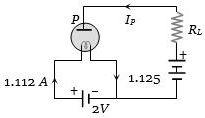
The value of plate current $I_P$ in the given circuit diagram will be in $mA$.
A
$3$
B
$8$
C
$13$
D
$18$
Solution
(C) In the given circuit,the total current flowing from the battery is $1.125 \, A$.
Part of this current flows through the filament circuit,which is given as $1.112 \, A$.
The plate current $I_P$ is the difference between the total current and the filament current.
$I_P = 1.125 \, A - 1.112 \, A = 0.013 \, A$.
To convert this into milliamperes $(mA)$,we multiply by $1000$:
$I_P = 0.013 \times 1000 \, mA = 13 \, mA$.
Part of this current flows through the filament circuit,which is given as $1.112 \, A$.
The plate current $I_P$ is the difference between the total current and the filament current.
$I_P = 1.125 \, A - 1.112 \, A = 0.013 \, A$.
To convert this into milliamperes $(mA)$,we multiply by $1000$:
$I_P = 0.013 \times 1000 \, mA = 13 \, mA$.
0 likes
View Solution33
EasyMCQ
Coating of strontium oxide on a tungsten cathode in a valve is good for thermionic emission because:
A
Work function decreases
B
Work function increases
C
Conductivity of cathode increases
D
Cathode can be heated to high temperature
Solution
(A) The coating of strontium oxide on a tungsten cathode reduces the work function of the surface.
According to Richardson-Dushman equation,the thermionic emission current density $J$ is given by $J = AT^2 e^{-\phi/kT}$,where $\phi$ is the work function.
Since the work function $\phi$ decreases due to the oxide coating,the thermionic emission increases significantly at a given temperature.
According to Richardson-Dushman equation,the thermionic emission current density $J$ is given by $J = AT^2 e^{-\phi/kT}$,where $\phi$ is the work function.
Since the work function $\phi$ decreases due to the oxide coating,the thermionic emission increases significantly at a given temperature.
0 likes
View Solution34
EasyMCQ
The correct relation for a triode is:
A
$\mu = g_m \times r_p$
B
$\mu = \frac{g_m}{r_p}$
C
$\mu = 2g_m \times r_p$
D
None of these
Solution
(A) In a triode valve,the three parameters are the amplification factor $(\mu)$,the mutual conductance $(g_m)$,and the plate resistance $(r_p)$.
These parameters are related by the fundamental equation: $\mu = g_m \times r_p$.
Here,$g_m$ is defined as the change in plate current for a change in grid voltage at a constant plate voltage,and $r_p$ is the change in plate voltage for a change in plate current at a constant grid voltage.
These parameters are related by the fundamental equation: $\mu = g_m \times r_p$.
Here,$g_m$ is defined as the change in plate current for a change in grid voltage at a constant plate voltage,and $r_p$ is the change in plate voltage for a change in plate current at a constant grid voltage.
0 likes
View Solution35
MediumMCQ
When the plate voltage in a diode valve is increased from $100 \, V$ to $150 \, V$, the plate current increases from $7.5 \, mA$ to $12 \, mA$. The dynamic plate resistance will be.... $k \, \Omega$.
A
$10$
B
$11$
C
$15$
D
$11.1$
Solution
(D) The dynamic plate resistance $(r_p)$ is defined as the ratio of the change in plate voltage $(\Delta V_p)$ to the change in plate current $(\Delta i_p)$.
Given:
$\Delta V_p = 150 \, V - 100 \, V = 50 \, V$
$\Delta i_p = 12 \, mA - 7.5 \, mA = 4.5 \, mA = 4.5 \times 10^{-3} \, A$
Using the formula:
$r_p = \frac{\Delta V_p}{\Delta i_p} = \frac{50}{4.5 \times 10^{-3}} \, \Omega$
$r_p = \frac{50}{4.5} \times 10^3 \, \Omega$
$r_p \approx 11.1 \times 10^3 \, \Omega = 11.1 \, k\Omega$.
Given:
$\Delta V_p = 150 \, V - 100 \, V = 50 \, V$
$\Delta i_p = 12 \, mA - 7.5 \, mA = 4.5 \, mA = 4.5 \times 10^{-3} \, A$
Using the formula:
$r_p = \frac{\Delta V_p}{\Delta i_p} = \frac{50}{4.5 \times 10^{-3}} \, \Omega$
$r_p = \frac{50}{4.5} \times 10^3 \, \Omega$
$r_p \approx 11.1 \times 10^3 \, \Omega = 11.1 \, k\Omega$.
0 likes
View Solution36
EasyMCQ
In a diode valve,the state of saturation can be obtained easily by
A
High plate voltage and high filament current
B
Low filament current and high plate voltage
C
Low plate voltage and high cathode temperature
D
High filament current and high plate voltage
Solution
(B) In a diode valve,the saturation current is limited by the number of electrons emitted from the cathode per second.
Saturation occurs when all electrons emitted by the cathode are collected by the anode (plate).
This state is reached more easily when the plate voltage is high (to pull all electrons) and the filament current is relatively low (limiting the total emission to a level that the plate can easily collect).
Saturation occurs when all electrons emitted by the cathode are collected by the anode (plate).
This state is reached more easily when the plate voltage is high (to pull all electrons) and the filament current is relatively low (limiting the total emission to a level that the plate can easily collect).
0 likes
View Solution37
MediumMCQ
The plate resistance of two triode valves is $2 \, k\Omega$ and $4 \, k\Omega$. The amplification factor of each valve is $40$. The ratio of voltage amplification,when used with a $4 \, k\Omega$ load resistance,will be:
A
$10$
B
$4/3$
C
$3/4$
D
$16/3$
Solution
(B) The voltage amplification $A_V$ for a triode valve is given by the formula: $A_V = \frac{\mu R_L}{r_p + R_L}$,where $\mu$ is the amplification factor,$r_p$ is the plate resistance,and $R_L$ is the load resistance.
Given $\mu = 40$ and $R_L = 4 \, k\Omega$.
For the first valve,$r_{p1} = 2 \, k\Omega$,so $A_1 = \frac{40 \times 4}{2 + 4} = \frac{160}{6} = \frac{80}{3}$.
For the second valve,$r_{p2} = 4 \, k\Omega$,so $A_2 = \frac{40 \times 4}{4 + 4} = \frac{160}{8} = 20$.
The ratio of voltage amplification is $\frac{A_1}{A_2} = \frac{80/3}{20} = \frac{80}{3 \times 20} = \frac{4}{3}$.
Wait,re-evaluating the ratio: $\frac{A_1}{A_2} = \frac{r_{p2} + R_L}{r_{p1} + R_L} = \frac{4 + 4}{2 + 4} = \frac{8}{6} = \frac{4}{3}$.
Given $\mu = 40$ and $R_L = 4 \, k\Omega$.
For the first valve,$r_{p1} = 2 \, k\Omega$,so $A_1 = \frac{40 \times 4}{2 + 4} = \frac{160}{6} = \frac{80}{3}$.
For the second valve,$r_{p2} = 4 \, k\Omega$,so $A_2 = \frac{40 \times 4}{4 + 4} = \frac{160}{8} = 20$.
The ratio of voltage amplification is $\frac{A_1}{A_2} = \frac{80/3}{20} = \frac{80}{3 \times 20} = \frac{4}{3}$.
Wait,re-evaluating the ratio: $\frac{A_1}{A_2} = \frac{r_{p2} + R_L}{r_{p1} + R_L} = \frac{4 + 4}{2 + 4} = \frac{8}{6} = \frac{4}{3}$.
0 likes
View Solution38
EasyMCQ
Which of the following does not vary with plate or grid voltages in a vacuum triode?
A
$g_m$
B
$R_p$
C
$\mu$
D
Each of them varies
Solution
(C) In a vacuum triode,the amplification factor $\mu$ is defined as the ratio of the change in plate voltage to the change in grid voltage for a constant plate current: $\mu = -\left( \frac{\Delta V_p}{\Delta V_g} \right)_{I_p = \text{constant}}$.
This parameter $\mu$ is primarily determined by the physical geometry of the triode (the spacing between the cathode,grid,and plate).
While the transconductance $g_m$ and the plate resistance $R_p$ are dependent on the operating point (plate voltage and grid voltage),the amplification factor $\mu$ remains approximately constant over a wide range of operating conditions.
Therefore,$\mu$ does not vary significantly with plate or grid voltages.
This parameter $\mu$ is primarily determined by the physical geometry of the triode (the spacing between the cathode,grid,and plate).
While the transconductance $g_m$ and the plate resistance $R_p$ are dependent on the operating point (plate voltage and grid voltage),the amplification factor $\mu$ remains approximately constant over a wide range of operating conditions.
Therefore,$\mu$ does not vary significantly with plate or grid voltages.
0 likes
View Solution39
EasyMCQ
The grid in a triode valve is used
A
To increase the thermionic emission
B
To control the plate to cathode current
C
To reduce the inter-electrode capacity
D
To keep cathode at constant potential
Solution
(B) triode valve consists of three electrodes: the cathode,the anode (plate),and the control grid. The control grid is placed between the cathode and the anode. By applying a negative potential to the grid relative to the cathode,it creates an electric field that opposes the flow of electrons from the cathode to the anode. Thus,the grid acts as a gate to control the magnitude of the plate current.
0 likes
View Solution40
MediumMCQ
In a triode valve,the amplification factor is $20$ and the mutual conductance is $10^{-3} \text{ mho}$. The plate resistance is:
A
$2 \times 10^{3} \ \Omega$
B
$4 \times 10^{3} \ \Omega$
C
$2 \times 10^{4} \ \Omega$
D
$2 \times 10^{5} \ \Omega$
Solution
(C) The relationship between amplification factor $(\mu)$,plate resistance $(r_p)$,and mutual conductance $(g_m)$ is given by the formula: $\mu = r_p \times g_m$.
Given: $\mu = 20$ and $g_m = 10^{-3} \text{ mho}$.
Rearranging the formula to solve for plate resistance $(r_p)$: $r_p = \frac{\mu}{g_m}$.
Substituting the values: $r_p = \frac{20}{10^{-3}} = 20 \times 10^{3} \ \Omega = 2 \times 10^{4} \ \Omega$.
Therefore,the plate resistance is $2 \times 10^{4} \ \Omega$.
Given: $\mu = 20$ and $g_m = 10^{-3} \text{ mho}$.
Rearranging the formula to solve for plate resistance $(r_p)$: $r_p = \frac{\mu}{g_m}$.
Substituting the values: $r_p = \frac{20}{10^{-3}} = 20 \times 10^{3} \ \Omega = 2 \times 10^{4} \ \Omega$.
Therefore,the plate resistance is $2 \times 10^{4} \ \Omega$.
0 likes
View Solution41
MediumMCQ
The amplification factor of a triode is $50$. If the grid potential is decreased by $0.20\, V$,what increase in plate potential will keep the plate current unchanged?
A
$5$
B
$10$
C
$0.2$
D
$50$
Solution
(B) The amplification factor $\mu$ of a triode is defined as the ratio of the change in plate potential to the change in grid potential for a constant plate current,with a negative sign indicating that the potentials must change in opposite directions to maintain the same current.
$\mu = - \frac{\Delta V_p}{\Delta V_g}$
Given: $\mu = 50$ and $\Delta V_g = -0.20\, V$.
To keep the plate current unchanged,we need to find the required increase in plate potential $\Delta V_p$.
$\Delta V_p = - \mu \times \Delta V_g$
$\Delta V_p = -50 \times (-0.20\, V) = 10\, V$.
Therefore,an increase of $10\, V$ in plate potential is required.
$\mu = - \frac{\Delta V_p}{\Delta V_g}$
Given: $\mu = 50$ and $\Delta V_g = -0.20\, V$.
To keep the plate current unchanged,we need to find the required increase in plate potential $\Delta V_p$.
$\Delta V_p = - \mu \times \Delta V_g$
$\Delta V_p = -50 \times (-0.20\, V) = 10\, V$.
Therefore,an increase of $10\, V$ in plate potential is required.
0 likes
View Solution42
MediumMCQ
The slope of the plate characteristic of a vacuum diode is $2 \times 10^{-2} \, mA/V$. The plate resistance of the diode will be:
A
$50 \, \Omega$
B
$50 \, k\Omega$
C
$500 \, \Omega$
D
$500 \, k\Omega$
Solution
(B) The plate resistance $(r_p)$ of a vacuum diode is defined as the reciprocal of the slope of its plate characteristic curve.
Given slope = $2 \times 10^{-2} \, mA/V$.
To convert the slope to $A/V$ (or $S$): $2 \times 10^{-2} \times 10^{-3} \, A/V = 2 \times 10^{-5} \, A/V$.
Therefore,$r_p = \frac{1}{\text{slope}} = \frac{1}{2 \times 10^{-5}} \, \Omega$.
$r_p = 0.5 \times 10^5 \, \Omega = 50,000 \, \Omega = 50 \, k\Omega$.
Thus,the correct option is $B$.
Given slope = $2 \times 10^{-2} \, mA/V$.
To convert the slope to $A/V$ (or $S$): $2 \times 10^{-2} \times 10^{-3} \, A/V = 2 \times 10^{-5} \, A/V$.
Therefore,$r_p = \frac{1}{\text{slope}} = \frac{1}{2 \times 10^{-5}} \, \Omega$.
$r_p = 0.5 \times 10^5 \, \Omega = 50,000 \, \Omega = 50 \, k\Omega$.
Thus,the correct option is $B$.
0 likes
View Solution43
MediumMCQ
The transconductance of a triode amplifier is $2.5 \, \text{mS}$ (milli-mho) and its plate resistance is $20 \, \text{k}\Omega$. If the voltage amplification is $10$, find the load resistance in $\text{k}\Omega$.
A
$5$
B
$25$
C
$20$
D
$50$
Solution
(A) The voltage amplification $A_v$ of a triode amplifier is given by the formula: $A_v = \frac{\mu R_L}{r_p + R_L}$, where $\mu = g_m \times r_p$.
Given: Transconductance $g_m = 2.5 \times 10^{-3} \, \Omega^{-1}$, Plate resistance $r_p = 20 \times 10^3 \, \Omega$, and Voltage amplification $A_v = 10$.
First, calculate the amplification factor $\mu$: $\mu = g_m \times r_p = (2.5 \times 10^{-3}) \times (20 \times 10^3) = 50$.
Now, substitute the values into the amplification formula: $10 = \frac{50 \times R_L}{20 \times 10^3 + R_L}$.
$10(20 \times 10^3 + R_L) = 50 R_L$.
$200 \times 10^3 + 10 R_L = 50 R_L$.
$40 R_L = 200 \times 10^3$.
$R_L = \frac{200 \times 10^3}{40} = 5 \times 10^3 \, \Omega = 5 \, \text{k}\Omega$.
Given: Transconductance $g_m = 2.5 \times 10^{-3} \, \Omega^{-1}$, Plate resistance $r_p = 20 \times 10^3 \, \Omega$, and Voltage amplification $A_v = 10$.
First, calculate the amplification factor $\mu$: $\mu = g_m \times r_p = (2.5 \times 10^{-3}) \times (20 \times 10^3) = 50$.
Now, substitute the values into the amplification formula: $10 = \frac{50 \times R_L}{20 \times 10^3 + R_L}$.
$10(20 \times 10^3 + R_L) = 50 R_L$.
$200 \times 10^3 + 10 R_L = 50 R_L$.
$40 R_L = 200 \times 10^3$.
$R_L = \frac{200 \times 10^3}{40} = 5 \times 10^3 \, \Omega = 5 \, \text{k}\Omega$.
0 likes
View Solution44
MediumMCQ
The amplification factor of a triode is $18$ and its plate resistance is $8 \times 10^{3} \ \Omega$. $A$ load resistance of $10^{4} \ \Omega$ is connected in the plate circuit. The voltage gain will be
A
$30$
B
$20$
C
$10$
D
$1$
Solution
(C) The voltage gain $A_V$ of a triode amplifier is given by the formula:
$A_V = \frac{\mu R_L}{r_p + R_L} = \frac{\mu}{1 + \frac{r_p}{R_L}}$
Given:
Amplification factor $\mu = 18$
Plate resistance $r_p = 8 \times 10^{3} \ \Omega$
Load resistance $R_L = 10^{4} \ \Omega = 10 \times 10^{3} \ \Omega$
Substituting the values:
$A_V = \frac{18}{1 + \frac{8 \times 10^{3}}{10 \times 10^{3}}} = \frac{18}{1 + 0.8} = \frac{18}{1.8} = 10$
Therefore,the voltage gain is $10$.
$A_V = \frac{\mu R_L}{r_p + R_L} = \frac{\mu}{1 + \frac{r_p}{R_L}}$
Given:
Amplification factor $\mu = 18$
Plate resistance $r_p = 8 \times 10^{3} \ \Omega$
Load resistance $R_L = 10^{4} \ \Omega = 10 \times 10^{3} \ \Omega$
Substituting the values:
$A_V = \frac{18}{1 + \frac{8 \times 10^{3}}{10 \times 10^{3}}} = \frac{18}{1 + 0.8} = \frac{18}{1.8} = 10$
Therefore,the voltage gain is $10$.
0 likes
View Solution45
EasyMCQ
The correct relation for a triode is
A
$g_m = \left. \frac{\Delta I_p}{\Delta V_p} \right|_{V_g = \text{const.}}$
B
$g_m = \left. \frac{\Delta I_p}{\Delta V_g} \right|_{V_p = \text{const.}}$
C
Both
D
None of these
Solution
(B) In a triode valve, the transconductance $(g_m)$ is defined as the ratio of the change in plate current $(\Delta I_p)$ to the change in grid voltage $(\Delta V_g)$ while keeping the plate voltage $(V_p)$ constant.
Mathematically, this is expressed as: $g_m = \left. \frac{\Delta I_p}{\Delta V_g} \right|_{V_p = \text{const.}}$
Therefore, option $B$ is the correct relation.
Mathematically, this is expressed as: $g_m = \left. \frac{\Delta I_p}{\Delta V_g} \right|_{V_p = \text{const.}}$
Therefore, option $B$ is the correct relation.
0 likes
View Solution46
EasyMCQ
In a diode valve,the cathode temperature must be ($\phi$ = work function):
A
High and $\phi$ should be high
B
High and $\phi$ should be low
C
Low and $\phi$ should be high
D
Low and $\phi$ should be low
Solution
(B) In a diode valve,thermionic emission is used to release electrons from the cathode.
To facilitate easier emission of electrons,the cathode must be heated to a high temperature to provide sufficient thermal energy.
Additionally,the work function $\phi$ (the minimum energy required to remove an electron from the surface) should be as low as possible.
Therefore,the cathode temperature must be high and $\phi$ should be low.
To facilitate easier emission of electrons,the cathode must be heated to a high temperature to provide sufficient thermal energy.
Additionally,the work function $\phi$ (the minimum energy required to remove an electron from the surface) should be as low as possible.
Therefore,the cathode temperature must be high and $\phi$ should be low.
0 likes
View Solution47
EasyMCQ
The plate resistance of a triode is $2.5 \times 10^{4} \ \Omega$ and mutual conductance is $2 \times 10^{-3} \ \text{mho}$. What will be the value of the amplification factor?
A
$50$
B
$1.25 \times 10^7$
C
$75$
D
$2.25 \times 10^7$
Solution
(A) The amplification factor $(\mu)$ of a triode is defined as the product of plate resistance $(r_p)$ and mutual conductance $(g_m)$.
Given:
Plate resistance $(r_p)$ = $2.5 \times 10^{4} \ \Omega$
Mutual conductance $(g_m)$ = $2 \times 10^{-3} \ \text{mho}$
Formula:
$\mu = r_p \times g_m$
Calculation:
$\mu = (2.5 \times 10^{4}) \times (2 \times 10^{-3})$
$\mu = 5.0 \times 10^{1} = 50$
Therefore,the amplification factor is $50$.
Given:
Plate resistance $(r_p)$ = $2.5 \times 10^{4} \ \Omega$
Mutual conductance $(g_m)$ = $2 \times 10^{-3} \ \text{mho}$
Formula:
$\mu = r_p \times g_m$
Calculation:
$\mu = (2.5 \times 10^{4}) \times (2 \times 10^{-3})$
$\mu = 5.0 \times 10^{1} = 50$
Therefore,the amplification factor is $50$.
0 likes
View Solution48
EasyMCQ
The plate voltage of a triode is increased from $200 \, V$ to $225 \, V$. To maintain the plate current,a change in grid voltage from $5 \, V$ to $5.75 \, V$ is required. The amplification factor is:
A
$40$
B
$45$
C
$33.3$
D
$25$
Solution
(C) The amplification factor $\mu$ of a triode is defined as the ratio of the change in plate voltage to the change in grid voltage required to keep the plate current constant.
$\mu = \left( \frac{\Delta V_p}{\Delta V_g} \right)_{i_p = \text{constant}}$
Given:
$\Delta V_p = 225 \, V - 200 \, V = 25 \, V$
$\Delta V_g = 5.75 \, V - 5 \, V = 0.75 \, V$
Substituting the values:
$\mu = \frac{25}{0.75} = \frac{2500}{75} = 33.33$
Thus,the amplification factor is $33.3$.
$\mu = \left( \frac{\Delta V_p}{\Delta V_g} \right)_{i_p = \text{constant}}$
Given:
$\Delta V_p = 225 \, V - 200 \, V = 25 \, V$
$\Delta V_g = 5.75 \, V - 5 \, V = 0.75 \, V$
Substituting the values:
$\mu = \frac{25}{0.75} = \frac{2500}{75} = 33.33$
Thus,the amplification factor is $33.3$.
0 likes
View Solution49
MediumMCQ
The current in a triode at anode potential $100 \, V$ and grid potential $-1.2 \, V$ is $7.5 \, mA$. If the grid potential is changed to $-2.2 \, V$, the current becomes $5.5 \, mA$. The value of transconductance $(g_m)$ will be .... $mili \, mho$.
A
$2$
B
$3$
C
$4$
D
$0.2$
Solution
(A) Transconductance $(g_m)$ is defined as the ratio of the change in anode current $(\Delta I_p)$ to the change in grid potential $(\Delta V_g)$ at a constant anode potential $(V_p)$.
$g_m = \left( \frac{\Delta I_p}{\Delta V_g} \right)_{V_p = \text{constant}}$
Given:
Initial current $I_1 = 7.5 \, mA$, Initial grid potential $V_{g1} = -1.2 \, V$
Final current $I_2 = 5.5 \, mA$, Final grid potential $V_{g2} = -2.2 \, V$
Change in current $\Delta I_p = I_1 - I_2 = 7.5 \, mA - 5.5 \, mA = 2.0 \, mA$
Change in grid potential $\Delta V_g = V_{g1} - V_{g2} = -1.2 \, V - (-2.2 \, V) = 1.0 \, V$
$g_m = \frac{2.0 \, mA}{1.0 \, V} = 2 \, mA/V = 2 \, m \, mho$.
$g_m = \left( \frac{\Delta I_p}{\Delta V_g} \right)_{V_p = \text{constant}}$
Given:
Initial current $I_1 = 7.5 \, mA$, Initial grid potential $V_{g1} = -1.2 \, V$
Final current $I_2 = 5.5 \, mA$, Final grid potential $V_{g2} = -2.2 \, V$
Change in current $\Delta I_p = I_1 - I_2 = 7.5 \, mA - 5.5 \, mA = 2.0 \, mA$
Change in grid potential $\Delta V_g = V_{g1} - V_{g2} = -1.2 \, V - (-2.2 \, V) = 1.0 \, V$
$g_m = \frac{2.0 \, mA}{1.0 \, V} = 2 \, mA/V = 2 \, m \, mho$.
0 likes
View Solution50
EasyMCQ
The amplification factor of a triode is $20$. Its plate resistance is $10 \, k\Omega$. The mutual conductance is:
A
$2 \times 10^5 \, \text{mho}$
B
$2 \times 10^4 \, \text{mho}$
C
$500 \, \text{mho}$
D
$2 \times 10^{-3} \, \text{mho}$
Solution
(D) The relationship between amplification factor $\mu$, plate resistance $r_p$, and mutual conductance $g_m$ is given by the formula: $\mu = r_p \times g_m$.
Given: $\mu = 20$ and $r_p = 10 \, k\Omega = 10 \times 10^3 \, \Omega = 10^4 \, \Omega$.
Rearranging the formula to solve for $g_m$: $g_m = \frac{\mu}{r_p}$.
Substituting the values: $g_m = \frac{20}{10 \times 10^3} = \frac{20}{10000} = 2 \times 10^{-3} \, \text{mho}$ (or Siemens).
Therefore, the correct option is $D$.
Given: $\mu = 20$ and $r_p = 10 \, k\Omega = 10 \times 10^3 \, \Omega = 10^4 \, \Omega$.
Rearranging the formula to solve for $g_m$: $g_m = \frac{\mu}{r_p}$.
Substituting the values: $g_m = \frac{20}{10 \times 10^3} = \frac{20}{10000} = 2 \times 10^{-3} \, \text{mho}$ (or Siemens).
Therefore, the correct option is $D$.
0 likes
View SolutionSemiconductor Electronics — Valve Electronics · Frequently Asked Questions
1Are these Semiconductor Electronics questions useful for JEE and NEET?
Yes. All questions in this section are mapped to JEE Main and NEET exam patterns. Previous year questions from JEE Main, NEET, GUJCET and state-level exams are included with full solutions.
2Can I switch to Hindi or Gujarati for these questions?
Yes. Use the language tabs in the hero section or the sidebar to view the same questions and solutions in English, Hindi or Gujarati.
3How do I generate a question paper from this subtopic?
Use the Vedclass Exam Paper Generator — select the chapter and subtopic, set difficulty, and generate Sets A, B, C, D automatically. First 3 chapters of every subject are free.
Vedclass Products
For Students
Vedclass Test Series
Mock tests in real JEE/NEET style with performance analysis. 5-day free trial.
Start Free TrialFor Teachers
Exam Paper Generator
Generate Set A/B/C/D papers from this chapter in 2 minutes. 3 chapters free.
Try FreeFor Institutes
Online Exam Module
Live online exams with unlimited students, 360° analytics & white-label branding.
See DemoFor Teachers & Institutes
Generate a Semiconductor Electronics Exam Paper in 2 Minutes
Select subtopic & difficulty — Sets A, B, C, D auto-generated with No Repeat logic.
First 3 chapters of every subject are free — no payment required.