
A English
Junction Transistor Questions in English
Class 12 Physics · Semiconductor Electronics · Junction Transistor
399+
Questions
English
Language
100%
With Solutions
Showing 50 of 399 questions in English
301
EasyMCQ
Which of the following regions of transistors are,respectively,heavily doped and lightly doped?
A
Collector and emitter
B
Base and emitter
C
Emitter and base
D
Emitter and collector
Solution
(C) In a transistor,the emitter region is heavily doped because its primary function is to inject a large number of charge carriers into the base.
The base region is very lightly doped and kept thin to minimize the recombination of charge carriers,allowing most of them to reach the collector.
The collector region is moderately doped compared to the emitter and base.
Therefore,the emitter is heavily doped and the base is lightly doped.
The base region is very lightly doped and kept thin to minimize the recombination of charge carriers,allowing most of them to reach the collector.
The collector region is moderately doped compared to the emitter and base.
Therefore,the emitter is heavily doped and the base is lightly doped.
0 likes
View Solution302
MediumMCQ
In the study of a transistor as an amplifier,the ratio of collector current to emitter current is $0.98$. Then,the ratio of collector current to base current will be:
A
$99$
B
$49$
C
$50$
D
$98$
Solution
(B) The ratio of collector current $(I_C)$ to emitter current $(I_E)$ is known as the common-base current amplification factor,denoted by $\alpha$. Given: $\alpha = \frac{I_C}{I_E} = 0.98$.
The ratio of collector current $(I_C)$ to base current $(I_B)$ is known as the common-emitter current amplification factor,denoted by $\beta$.
The relationship between $\alpha$ and $\beta$ is given by the formula: $\beta = \frac{\alpha}{1 - \alpha}$.
Substituting the given value: $\beta = \frac{0.98}{1 - 0.98} = \frac{0.98}{0.02} = 49$.
Therefore,the ratio of collector current to base current is $49$.
The ratio of collector current $(I_C)$ to base current $(I_B)$ is known as the common-emitter current amplification factor,denoted by $\beta$.
The relationship between $\alpha$ and $\beta$ is given by the formula: $\beta = \frac{\alpha}{1 - \alpha}$.
Substituting the given value: $\beta = \frac{0.98}{1 - 0.98} = \frac{0.98}{0.02} = 49$.
Therefore,the ratio of collector current to base current is $49$.
0 likes
View Solution303
EasyMCQ
For a transistor,the current ratio $\beta_{dc}$ is defined as the ratio of:
A
collector current to emitter current
B
collector current to base current
C
base current to collector current
D
emitter current to collector current
Solution
(B) The current gain $\beta_{dc}$ for a common-emitter transistor configuration is defined as the ratio of the collector current $(i_c)$ to the base current $(i_b)$.
Mathematically,$\beta_{dc} = \frac{i_c}{i_b} = \frac{\text{Collector current}}{\text{Base current}}$.
Mathematically,$\beta_{dc} = \frac{i_c}{i_b} = \frac{\text{Collector current}}{\text{Base current}}$.
0 likes
View Solution304
MediumMCQ
For a transistor,$\alpha_{dc}$ and $\beta_{dc}$ are the current ratios. Then the value of $\frac{\beta_{dc}-\alpha_{dc}}{\alpha_{dc} \cdot \beta_{dc}}$ is
A
$1$
B
$1.5$
C
$2$
D
$2.5$
Solution
(A) We know the relationship between the current gain parameters $\alpha_{dc}$ and $\beta_{dc}$ is given by $\beta_{dc} = \frac{\alpha_{dc}}{1 - \alpha_{dc}}$.
Rearranging this equation,we get $1 - \alpha_{dc} = \frac{\alpha_{dc}}{\beta_{dc}}$.
Now,we need to evaluate the expression $\frac{\beta_{dc} - \alpha_{dc}}{\alpha_{dc} \cdot \beta_{dc}}$.
This can be written as $\frac{\beta_{dc}}{\alpha_{dc} \cdot \beta_{dc}} - \frac{\alpha_{dc}}{\alpha_{dc} \cdot \beta_{dc}} = \frac{1}{\alpha_{dc}} - \frac{1}{\beta_{dc}}$.
Substituting $\frac{1}{\alpha_{dc}} = \frac{1 + \beta_{dc}}{\beta_{dc}}$ is not necessary here; instead,use $\frac{1}{\alpha_{dc}} - \frac{1}{\beta_{dc}} = \frac{\beta_{dc} - \alpha_{dc}}{\alpha_{dc} \cdot \beta_{dc}}$.
From the relation $\beta_{dc} = \frac{\alpha_{dc}}{1 - \alpha_{dc}}$,we have $\frac{1}{\beta_{dc}} = \frac{1 - \alpha_{dc}}{\alpha_{dc}} = \frac{1}{\alpha_{dc}} - 1$.
Therefore,$\frac{1}{\alpha_{dc}} - \frac{1}{\beta_{dc}} = 1$.
Thus,the value of the expression is $1$.
Rearranging this equation,we get $1 - \alpha_{dc} = \frac{\alpha_{dc}}{\beta_{dc}}$.
Now,we need to evaluate the expression $\frac{\beta_{dc} - \alpha_{dc}}{\alpha_{dc} \cdot \beta_{dc}}$.
This can be written as $\frac{\beta_{dc}}{\alpha_{dc} \cdot \beta_{dc}} - \frac{\alpha_{dc}}{\alpha_{dc} \cdot \beta_{dc}} = \frac{1}{\alpha_{dc}} - \frac{1}{\beta_{dc}}$.
Substituting $\frac{1}{\alpha_{dc}} = \frac{1 + \beta_{dc}}{\beta_{dc}}$ is not necessary here; instead,use $\frac{1}{\alpha_{dc}} - \frac{1}{\beta_{dc}} = \frac{\beta_{dc} - \alpha_{dc}}{\alpha_{dc} \cdot \beta_{dc}}$.
From the relation $\beta_{dc} = \frac{\alpha_{dc}}{1 - \alpha_{dc}}$,we have $\frac{1}{\beta_{dc}} = \frac{1 - \alpha_{dc}}{\alpha_{dc}} = \frac{1}{\alpha_{dc}} - 1$.
Therefore,$\frac{1}{\alpha_{dc}} - \frac{1}{\beta_{dc}} = 1$.
Thus,the value of the expression is $1$.
0 likes
View Solution305
MediumMCQ
To use a transistor as an amplifier,
A
the emitter-base junction is forward biased and the base-collector junction is reverse biased
B
no bias voltage is required
C
both junctions are forward biased
D
both junctions are reverse biased
Solution
(A) For a transistor to operate as an amplifier,it must be in the active region.
In the active region,the emitter-base junction is forward-biased,which allows charge carriers to flow from the emitter into the base.
The base-collector junction is reverse-biased,which allows the collector to collect the majority of the charge carriers injected from the emitter.
Therefore,the correct configuration is that the emitter-base junction is forward-biased and the base-collector junction is reverse-biased.
In the active region,the emitter-base junction is forward-biased,which allows charge carriers to flow from the emitter into the base.
The base-collector junction is reverse-biased,which allows the collector to collect the majority of the charge carriers injected from the emitter.
Therefore,the correct configuration is that the emitter-base junction is forward-biased and the base-collector junction is reverse-biased.
0 likes
View Solution306
DifficultMCQ
$A$ change of $8.0 \,mA$ in the emitter current brings a change of $7.9 \,mA$ in the collector current. The values of $\alpha$ and $\beta$ are
A
$0.99, 90$
B
$0.96, 79$
C
$0.97, 99$
D
$0.99, 79$
Solution
(D) Given that, the change in emitter current is $\Delta I_{E} = 8.0 \,mA$.
The change in collector current is $\Delta I_{C} = 7.9 \,mA$.
We know that the current gain $\alpha$ is defined as the ratio of change in collector current to the change in emitter current:
$\alpha = \frac{\Delta I_{C}}{\Delta I_{E}} = \frac{7.9}{8.0} = 0.9875 \approx 0.99$.
We also know the relationship between $\alpha$ and $\beta$ is given by $\beta = \frac{\alpha}{1 - \alpha}$.
Alternatively, using the currents directly: $\beta = \frac{\Delta I_{C}}{\Delta I_{B}}$.
Since $\Delta I_{E} = \Delta I_{C} + \Delta I_{B}$, we have $\Delta I_{B} = \Delta I_{E} - \Delta I_{C} = 8.0 \,mA - 7.9 \,mA = 0.1 \,mA$.
Therefore, $\beta = \frac{7.9 \,mA}{0.1 \,mA} = 79$.
Thus, the values are $\alpha = 0.99$ and $\beta = 79$.
The change in collector current is $\Delta I_{C} = 7.9 \,mA$.
We know that the current gain $\alpha$ is defined as the ratio of change in collector current to the change in emitter current:
$\alpha = \frac{\Delta I_{C}}{\Delta I_{E}} = \frac{7.9}{8.0} = 0.9875 \approx 0.99$.
We also know the relationship between $\alpha$ and $\beta$ is given by $\beta = \frac{\alpha}{1 - \alpha}$.
Alternatively, using the currents directly: $\beta = \frac{\Delta I_{C}}{\Delta I_{B}}$.
Since $\Delta I_{E} = \Delta I_{C} + \Delta I_{B}$, we have $\Delta I_{B} = \Delta I_{E} - \Delta I_{C} = 8.0 \,mA - 7.9 \,mA = 0.1 \,mA$.
Therefore, $\beta = \frac{7.9 \,mA}{0.1 \,mA} = 79$.
Thus, the values are $\alpha = 0.99$ and $\beta = 79$.
0 likes
View Solution307
MediumMCQ
For a common emitter configuration,if $\alpha$ and $\beta$ have their usual meanings,the incorrect relation between $\alpha$ and $\beta$ is
A
$\frac{1}{\alpha} = \frac{1}{\beta} + 1$
B
$\alpha = \frac{\beta}{1 - \beta}$
C
$\alpha = \frac{\beta}{1 + \beta}$
D
$\frac{1}{\beta} = \frac{1}{\alpha} - 1$
Solution
(B) In a transistor,the current gain parameters are defined as $\beta = \frac{I_C}{I_B}$ and $\alpha = \frac{I_C}{I_E}$.
Since $I_E = I_B + I_C$,we can write $\alpha = \frac{I_C}{I_B + I_C}$.
Dividing the numerator and denominator by $I_C$,we get $\alpha = \frac{1}{\frac{I_B}{I_C} + 1} = \frac{1}{\frac{1}{\beta} + 1} = \frac{\beta}{1 + \beta}$.
From this,we can derive $\frac{1}{\alpha} = \frac{1 + \beta}{\beta} = \frac{1}{\beta} + 1$,which implies $\frac{1}{\beta} = \frac{1}{\alpha} - 1$.
Comparing these with the given options,the relation $\alpha = \frac{\beta}{1 - \beta}$ is incorrect.
Since $I_E = I_B + I_C$,we can write $\alpha = \frac{I_C}{I_B + I_C}$.
Dividing the numerator and denominator by $I_C$,we get $\alpha = \frac{1}{\frac{I_B}{I_C} + 1} = \frac{1}{\frac{1}{\beta} + 1} = \frac{\beta}{1 + \beta}$.
From this,we can derive $\frac{1}{\alpha} = \frac{1 + \beta}{\beta} = \frac{1}{\beta} + 1$,which implies $\frac{1}{\beta} = \frac{1}{\alpha} - 1$.
Comparing these with the given options,the relation $\alpha = \frac{\beta}{1 - \beta}$ is incorrect.
0 likes
View Solution308
EasyMCQ
If $ \alpha $-current gain of a transistor is $ 0.98 $,what is the value of $ \beta $-current gain of the transistor?
A
$ 0.49 $
B
$ 49 $
C
$ 4.9 $
D
$ 55 $
Solution
(B) For a transistor,the $ \beta $-current gain and $ \alpha $-current gain are related by the formula:
$\beta = \frac{\alpha}{1 - \alpha}$
Given that the $ \alpha $-current gain is $ 0.98 $.
Substituting the value into the formula:
$\beta = \frac{0.98}{1 - 0.98} = \frac{0.98}{0.02} = 49$
Thus,the $ \beta $-current gain of the transistor is $ 49 $.
$\beta = \frac{\alpha}{1 - \alpha}$
Given that the $ \alpha $-current gain is $ 0.98 $.
Substituting the value into the formula:
$\beta = \frac{0.98}{1 - 0.98} = \frac{0.98}{0.02} = 49$
Thus,the $ \beta $-current gain of the transistor is $ 49 $.
0 likes
View Solution309
MediumMCQ
In the three parts of a transistor,'Emitter' is of
A
moderate size and heavily doped
B
large size and lightly doped
C
thin size and heavily doped
D
large size and moderately doped
Solution
(A) Among the three parts of a transistor,namely emitter,base,and collector:
$\rightarrow$ Emitter is moderate in size and heavily doped.
$\rightarrow$ Base is thin in size and lightly doped.
$\rightarrow$ Collector is large in size and moderately doped.
Therefore,the emitter is of moderate size and heavily doped.
$\rightarrow$ Emitter is moderate in size and heavily doped.
$\rightarrow$ Base is thin in size and lightly doped.
$\rightarrow$ Collector is large in size and moderately doped.
Therefore,the emitter is of moderate size and heavily doped.
0 likes
View Solution310
EasyMCQ
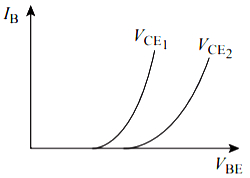
The input characteristics of a transistor in $CE$ mode is the graph obtained by plotting
A
$I_{B}$ against $V_{BE}$ at constant $V_{CE}$
B
$I_{B}$ against $V_{CE}$ at constant $V_{BE}$
C
$I_{B}$ against $I_{C}$ at constant $V_{CE}$
D
$I_{B}$ against $I_{C}$ at constant $V_{BE}$
Solution
(A) The input characteristics of a transistor in common emitter $(CE)$ configuration describe the relationship between the input current and the input voltage.
Specifically,it is the curve obtained by plotting the base current $(I_{B})$ against the base-emitter voltage $(V_{BE})$ while keeping the collector-emitter voltage $(V_{CE})$ constant.
This graph shows how the base current changes as the input voltage increases for different fixed values of the output voltage.
Specifically,it is the curve obtained by plotting the base current $(I_{B})$ against the base-emitter voltage $(V_{BE})$ while keeping the collector-emitter voltage $(V_{CE})$ constant.
This graph shows how the base current changes as the input voltage increases for different fixed values of the output voltage.
0 likes
View Solution311
MediumMCQ
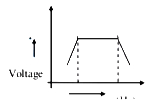
For a transistor amplifier,the voltage gain:
A
is low at high and low frequencies and constant at mid frequencies
B
remains constant for all frequencies
C
constant at high frequencies and low at low frequencies
D
is high at high and low frequencies and constant in the middle frequency range
Solution
(A) The frequency response curve of a transistor amplifier shows that the voltage gain is not uniform across all frequencies.
At low frequencies,the coupling and bypass capacitors have high reactance,which reduces the gain.
At high frequencies,the internal junction capacitances of the transistor and stray capacitances become significant,providing a low-impedance path that shunts the signal,thereby reducing the gain.
In the mid-frequency range,these effects are negligible,and the amplifier provides a stable and maximum voltage gain.
Therefore,the voltage gain is low at both low and high frequencies and remains constant in the mid-frequency range.
At low frequencies,the coupling and bypass capacitors have high reactance,which reduces the gain.
At high frequencies,the internal junction capacitances of the transistor and stray capacitances become significant,providing a low-impedance path that shunts the signal,thereby reducing the gain.
In the mid-frequency range,these effects are negligible,and the amplifier provides a stable and maximum voltage gain.
Therefore,the voltage gain is low at both low and high frequencies and remains constant in the mid-frequency range.
0 likes
View Solution312
MediumMCQ
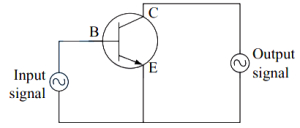
In a $CE$ amplifier,the input $ac$ signal to be amplified is applied across
A
Forward biased emitter-base junction
B
Reverse biased collector-base junction
C
Reverse biased emitter-base junction
D
Forward biased collector-base junction
Solution
(A) In a Common Emitter $(CE)$ amplifier configuration,the transistor is biased such that the emitter-base junction is forward biased and the collector-base junction is reverse biased.
To amplify an input $ac$ signal,it is superimposed on the $dc$ bias voltage at the input side.
Therefore,the input $ac$ signal is applied across the forward biased emitter-base junction to control the flow of charge carriers from the emitter to the collector.
To amplify an input $ac$ signal,it is superimposed on the $dc$ bias voltage at the input side.
Therefore,the input $ac$ signal is applied across the forward biased emitter-base junction to control the flow of charge carriers from the emitter to the collector.
0 likes
View Solution313
DifficultMCQ
The dc common emitter current gain of an $n-p-n$ transistor is $50$. The potential difference applied across the collector and emitter of a transistor used in $CE$ configuration is $V_{CE} = 2 \ V$. If the collector resistance $R_{C} = 4 \ k\Omega$,the base current $(I_{B})$ and the collector current $(I_{C})$ are:
A
$I_{B} = 10 \ \mu A, I_{C} = 0.5 \ mA$
B
$I_{B} = 0.5 \ \mu A, I_{C} = 10 \ mA$
C
$I_{B} = 5 \ \mu A, I_{C} = 1 \ mA$
D
$I_{B} = 1 \ \mu A, I_{C} = 0.5 \ mA$
Solution
(A) Given: Current gain $\beta = 50$,$V_{CE} = 2 \ V$,and $R_{C} = 4 \ k\Omega$.
The collector current $I_{C}$ is determined by the output circuit loop: $I_{C} = \frac{V_{CE}}{R_{C}} = \frac{2 \ V}{4 \times 10^{3} \ \Omega} = 0.5 \times 10^{-3} \ A = 0.5 \ mA$.
The base current $I_{B}$ is related to the collector current by the current gain formula: $\beta = \frac{I_{C}}{I_{B}}$.
Rearranging for $I_{B}$: $I_{B} = \frac{I_{C}}{\beta} = \frac{0.5 \times 10^{-3} \ A}{50} = 0.01 \times 10^{-3} \ A = 10 \times 10^{-6} \ A = 10 \ \mu A$.
Thus,$I_{B} = 10 \ \mu A$ and $I_{C} = 0.5 \ mA$.
The collector current $I_{C}$ is determined by the output circuit loop: $I_{C} = \frac{V_{CE}}{R_{C}} = \frac{2 \ V}{4 \times 10^{3} \ \Omega} = 0.5 \times 10^{-3} \ A = 0.5 \ mA$.
The base current $I_{B}$ is related to the collector current by the current gain formula: $\beta = \frac{I_{C}}{I_{B}}$.
Rearranging for $I_{B}$: $I_{B} = \frac{I_{C}}{\beta} = \frac{0.5 \times 10^{-3} \ A}{50} = 0.01 \times 10^{-3} \ A = 10 \times 10^{-6} \ A = 10 \ \mu A$.
Thus,$I_{B} = 10 \ \mu A$ and $I_{C} = 0.5 \ mA$.
0 likes
View Solution314
EasyMCQ
In a transistor,the collector current varies by $ 0.49 \,mA $ and emitter current varies by $ 0.50 \,mA $. Current gain $ \beta $ measured is
A
$ 49 $
B
$ 150 $
C
$ 99 $
D
$ 100 $
Solution
(A) Given,collector current variation,$ \Delta I_{C} = 0.49 \,mA $.
Emitter current variation,$ \Delta I_{E} = 0.50 \,mA $.
We know that the base current variation is given by $ \Delta I_{B} = \Delta I_{E} - \Delta I_{C} $.
Substituting the values,$ \Delta I_{B} = 0.50 \,mA - 0.49 \,mA = 0.01 \,mA $.
The current gain $ \beta $ is defined as the ratio of collector current change to base current change:
$ \beta = \frac{\Delta I_{C}}{\Delta I_{B}} $.
Substituting the values,$ \beta = \frac{0.49 \,mA}{0.01 \,mA} = 49 $.
Therefore,the current gain $ \beta $ is $ 49 $.
Emitter current variation,$ \Delta I_{E} = 0.50 \,mA $.
We know that the base current variation is given by $ \Delta I_{B} = \Delta I_{E} - \Delta I_{C} $.
Substituting the values,$ \Delta I_{B} = 0.50 \,mA - 0.49 \,mA = 0.01 \,mA $.
The current gain $ \beta $ is defined as the ratio of collector current change to base current change:
$ \beta = \frac{\Delta I_{C}}{\Delta I_{B}} $.
Substituting the values,$ \beta = \frac{0.49 \,mA}{0.01 \,mA} = 49 $.
Therefore,the current gain $ \beta $ is $ 49 $.
0 likes
View Solution315
EasyMCQ
When the transistor is used as an amplifier,
A
Emitter-base junction must be reverse biased,Collector-base junction must be forward biased
B
Emitter-base junction must be forward biased,Collector-base junction must be forward biased
C
Emitter-base junction must be reverse biased,Collector-base junction must be reverse biased
D
Emitter-base junction must be forward biased,Collector-base junction must be reverse biased
Solution
(D) To use a transistor as an amplifier,the input circuit (emitter-base junction) must be forward biased to allow current flow,and the output circuit (collector-base junction) must be reverse biased to provide high resistance and voltage gain.
Therefore,the emitter-base junction is forward biased,and the collector-base junction is reverse biased.
Therefore,the emitter-base junction is forward biased,and the collector-base junction is reverse biased.
0 likes
View Solution316
EasyMCQ
For a transistor,$\beta = 100$. The value of $\alpha$ is
A
$0.01$
B
$1.01$
C
$0.99$
D
$100$
Solution
(C) The relationship between the current gain $\alpha$ (common-base) and $\beta$ (common-emitter) is given by the formula: $\alpha = \frac{\beta}{1 + \beta}$.
Given that $\beta = 100$,we substitute this value into the formula:
$\alpha = \frac{100}{1 + 100} = \frac{100}{101}$.
Performing the division,we get $\alpha \approx 0.99$.
Given that $\beta = 100$,we substitute this value into the formula:
$\alpha = \frac{100}{1 + 100} = \frac{100}{101}$.
Performing the division,we get $\alpha \approx 0.99$.
0 likes
View Solution317
MediumMCQ
An $n-p-n$ transistor can be considered to be equivalent to two diodes connected back-to-back. Which of the following figures is the correct one?
A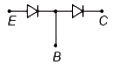
B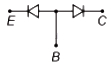
C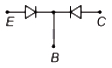
D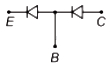
Solution
(B) An $n-p-n$ transistor consists of two $p-n$ junctions.
In an $n-p-n$ transistor,the emitter-base junction is a $p-n$ junction and the collector-base junction is also a $p-n$ junction.
The base is the common $p$-type region.
For an $n-p-n$ transistor,the emitter is $n$-type,the base is $p$-type,and the collector is $n$-type.
This means the emitter-base diode has its $n$-side at the emitter and $p$-side at the base.
The collector-base diode has its $n$-side at the collector and $p$-side at the base.
Therefore,the two diodes are connected with their cathodes (n-sides) facing outwards and their anodes (p-sides) connected together at the base.
Looking at the provided figures,option $B$ correctly shows two diodes with their anodes connected at the base $B$ and cathodes pointing towards the emitter $E$ and collector $C$ respectively.
In an $n-p-n$ transistor,the emitter-base junction is a $p-n$ junction and the collector-base junction is also a $p-n$ junction.
The base is the common $p$-type region.
For an $n-p-n$ transistor,the emitter is $n$-type,the base is $p$-type,and the collector is $n$-type.
This means the emitter-base diode has its $n$-side at the emitter and $p$-side at the base.
The collector-base diode has its $n$-side at the collector and $p$-side at the base.
Therefore,the two diodes are connected with their cathodes (n-sides) facing outwards and their anodes (p-sides) connected together at the base.
Looking at the provided figures,option $B$ correctly shows two diodes with their anodes connected at the base $B$ and cathodes pointing towards the emitter $E$ and collector $C$ respectively.
0 likes
View Solution318
EasyMCQ
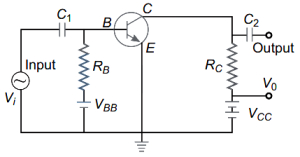
In a common emitter amplifier,the input signal is applied across
A
anywhere
B
emitter-collector
C
collector-base
D
base-emitter
Solution
(D) In a common emitter $(CE)$ amplifier,the input signal $(V_i)$ is applied between the base $(B)$ and the emitter $(E)$ terminals of the transistor.
As shown in the circuit diagram,the input signal is coupled through a capacitor $(C_1)$ to the base,while the emitter is common to both the input and output circuits and is typically grounded.
Therefore,the input voltage is applied across the base-emitter junction.
As shown in the circuit diagram,the input signal is coupled through a capacitor $(C_1)$ to the base,while the emitter is common to both the input and output circuits and is typically grounded.
Therefore,the input voltage is applied across the base-emitter junction.
0 likes
View Solution319
EasyMCQ
$A$ transistor works as an amplifier when
A
emitter-base junction is forward biased and base-collector junction is reverse biased
B
both emitter-base and base-collector junctions are forward biased.
C
both emitter-base and base-collector junctions are reverse biased.
D
emitter-base junction is reverse biased and base-collector junction is forward biased.
Solution
(A) For a transistor to operate in the active region,which is required for amplification,the emitter-base junction must be forward biased and the base-collector junction must be reverse biased.
In the forward-biased emitter-base junction,charge carriers are injected from the emitter into the base.
In the reverse-biased base-collector junction,these carriers are collected by the collector,allowing for current control and signal amplification.
In the forward-biased emitter-base junction,charge carriers are injected from the emitter into the base.
In the reverse-biased base-collector junction,these carriers are collected by the collector,allowing for current control and signal amplification.
0 likes
View Solution320
MediumMCQ
The voltage gain and the current amplification factor of a transistor in common emitter configuration are $300$ and $60$ respectively. If the collector resistance is $5 \, k\Omega$, then the base resistance is:
A
$5 \, k\Omega$
B
$25 \, k\Omega$
C
$2 \, k\Omega$
D
$1 \, k\Omega$
Solution
(D) Given:
Voltage gain $(A_v)$ = $300$
Current amplification factor $(\beta)$ = $60$
Collector resistance $(R_C)$ = $5 \, k\Omega$
We know that the voltage gain $(A_v)$ in a common emitter configuration is given by:
$A_v = \beta \times \frac{R_C}{R_B}$
Rearranging the formula to find the base resistance $(R_B)$:
$R_B = \beta \times \frac{R_C}{A_v}$
Substituting the given values:
$R_B = 60 \times \frac{5 \, k\Omega}{300}$
$R_B = 60 \times \frac{5}{300} \, k\Omega$
$R_B = \frac{300}{300} \, k\Omega$
$R_B = 1 \, k\Omega$
Therefore, the base resistance is $1 \, k\Omega$.
Voltage gain $(A_v)$ = $300$
Current amplification factor $(\beta)$ = $60$
Collector resistance $(R_C)$ = $5 \, k\Omega$
We know that the voltage gain $(A_v)$ in a common emitter configuration is given by:
$A_v = \beta \times \frac{R_C}{R_B}$
Rearranging the formula to find the base resistance $(R_B)$:
$R_B = \beta \times \frac{R_C}{A_v}$
Substituting the given values:
$R_B = 60 \times \frac{5 \, k\Omega}{300}$
$R_B = 60 \times \frac{5}{300} \, k\Omega$
$R_B = \frac{300}{300} \, k\Omega$
$R_B = 1 \, k\Omega$
Therefore, the base resistance is $1 \, k\Omega$.
0 likes
View Solution321
MediumMCQ
In a common emitter amplifier of a transistor,if the ratio of the voltage gain and current amplification factor is $4$,then the ratio of the collector and base resistances is
A
$16 : 1$
B
$1 : 16$
C
$1 : 4$
D
$4 : 1$
Solution
(D) For a common emitter amplifier,the voltage gain $(A_v)$ is given by the formula: $A_v = \beta \times \frac{R_C}{R_B}$,where $\beta$ is the current amplification factor,$R_C$ is the collector resistance,and $R_B$ is the base resistance.
Given that the ratio of voltage gain $(A_v)$ to the current amplification factor $(\beta)$ is $4$,we have: $\frac{A_v}{\beta} = 4$.
Substituting the expression for $A_v$ into the given ratio: $\frac{\beta \times (R_C / R_B)}{\beta} = 4$.
This simplifies to: $\frac{R_C}{R_B} = 4$.
Therefore,the ratio of the collector resistance to the base resistance is $4 : 1$.
Given that the ratio of voltage gain $(A_v)$ to the current amplification factor $(\beta)$ is $4$,we have: $\frac{A_v}{\beta} = 4$.
Substituting the expression for $A_v$ into the given ratio: $\frac{\beta \times (R_C / R_B)}{\beta} = 4$.
This simplifies to: $\frac{R_C}{R_B} = 4$.
Therefore,the ratio of the collector resistance to the base resistance is $4 : 1$.
0 likes
View Solution322
EasyMCQ
If $X, Y$ and $Z$ are the sizes of the emitter,base and collector of a transistor respectively,then
A
$X > Z > Y$
B
$X > Y > Z$
C
$Z > X > Y$
D
$Z > Y > X$
Solution
(C) In a standard bipolar junction transistor $(BJT)$,the three regions are designed with specific physical dimensions to optimize performance.
$1$. The $Base$ $(Y)$ is made very thin and lightly doped to allow most charge carriers to pass through to the collector.
$2$. The $Collector$ $(Z)$ is made the largest in size to handle the heat dissipation generated by the power collected from the emitter.
$3$. The $Emitter$ $(X)$ is of moderate size,larger than the base but smaller than the collector,and is heavily doped to provide a large number of charge carriers.
Therefore,the order of sizes is $Collector > Emitter > Base$,which corresponds to $Z > X > Y$.
$1$. The $Base$ $(Y)$ is made very thin and lightly doped to allow most charge carriers to pass through to the collector.
$2$. The $Collector$ $(Z)$ is made the largest in size to handle the heat dissipation generated by the power collected from the emitter.
$3$. The $Emitter$ $(X)$ is of moderate size,larger than the base but smaller than the collector,and is heavily doped to provide a large number of charge carriers.
Therefore,the order of sizes is $Collector > Emitter > Base$,which corresponds to $Z > X > Y$.
0 likes
View Solution323
MediumMCQ
In a common emitter transistor amplifier,the resistance of the collector is $3 \ k\Omega$. If the current amplification factor is $100$ and the base resistance is $2 \ k\Omega$,then the power gain of the transistor is:
A
$150$
B
$10000$
C
$1500$
D
$15000$
Solution
(D) The power gain $(A_p)$ of a transistor amplifier is given by the product of the current gain $(\beta)$ and the voltage gain $(A_v)$.
$A_p = \beta \times A_v$
Voltage gain $(A_v)$ is defined as the product of the current gain $(\beta)$ and the ratio of output resistance $(R_c)$ to input resistance $(R_b)$:
$A_v = \beta \times \frac{R_c}{R_b}$
Given:
$\beta = 100$
$R_c = 3 \ k\Omega$
$R_b = 2 \ k\Omega$
Calculating $A_v$:
$A_v = 100 \times \frac{3 \ k\Omega}{2 \ k\Omega} = 100 \times 1.5 = 150$
Now,calculating power gain $(A_p)$:
$A_p = \beta \times A_v = 100 \times 150 = 15000$
Therefore,the power gain is $15000$.
$A_p = \beta \times A_v$
Voltage gain $(A_v)$ is defined as the product of the current gain $(\beta)$ and the ratio of output resistance $(R_c)$ to input resistance $(R_b)$:
$A_v = \beta \times \frac{R_c}{R_b}$
Given:
$\beta = 100$
$R_c = 3 \ k\Omega$
$R_b = 2 \ k\Omega$
Calculating $A_v$:
$A_v = 100 \times \frac{3 \ k\Omega}{2 \ k\Omega} = 100 \times 1.5 = 150$
Now,calculating power gain $(A_p)$:
$A_p = \beta \times A_v = 100 \times 150 = 15000$
Therefore,the power gain is $15000$.
0 likes
View Solution324
EasyMCQ
In a transistor,if the collector current is $98 \%$ of emitter current,then the ratio of the base and collector currents is
A
$1: 98$
B
$1: 1$
C
$1: 49$
D
$1: 99$
Solution
(C) Given that the collector current $I_C = 0.98 I_E$.
We know that the emitter current is the sum of the base current and the collector current: $I_E = I_B + I_C$.
Substituting the value of $I_C$,we get $I_E = I_B + 0.98 I_E$.
Rearranging the terms to find $I_B$: $I_B = I_E - 0.98 I_E = 0.02 I_E$.
Now,we need to find the ratio of the base current to the collector current: $\frac{I_B}{I_C} = \frac{0.02 I_E}{0.98 I_E}$.
Simplifying the ratio: $\frac{I_B}{I_C} = \frac{2}{98} = \frac{1}{49}$.
Therefore,the ratio is $1: 49$.
We know that the emitter current is the sum of the base current and the collector current: $I_E = I_B + I_C$.
Substituting the value of $I_C$,we get $I_E = I_B + 0.98 I_E$.
Rearranging the terms to find $I_B$: $I_B = I_E - 0.98 I_E = 0.02 I_E$.
Now,we need to find the ratio of the base current to the collector current: $\frac{I_B}{I_C} = \frac{0.02 I_E}{0.98 I_E}$.
Simplifying the ratio: $\frac{I_B}{I_C} = \frac{2}{98} = \frac{1}{49}$.
Therefore,the ratio is $1: 49$.
0 likes
View Solution325
EasyMCQ
When a signal is applied to the input of a transistor,it is found that the output signal is phase-shifted by $180^{\circ}$. The transistor configuration is:
A
$CB$ - configuration
B
$CE$ - configuration
C
$CC$ - configuration
D
Both $CB$ and $CC$ - configuration
Solution
(B) In a common-emitter $(CE)$ configuration of a transistor,the output signal is phase-shifted by $180^{\circ}$ relative to the input signal. This occurs because the input signal is applied to the base-emitter junction,and the output is taken from the collector-emitter junction,resulting in an inversion of the signal polarity.
0 likes
View Solution326
MediumMCQ
The voltage gain and current gain of a transistor amplifier in common emitter configuration are respectively $150$ and $50$. If the resistance in the base circuit is $850 \Omega$, then the resistance in the collector circuit is: (in $\Omega$)
A
$1700$
B
$2250$
C
$2550$
D
$3000$
Solution
(C) For a common emitter $(CE)$ configuration of a transistor:
Given: Voltage gain $(A_v)$ = $150$, Current gain $(\beta)$ = $50$, Base resistance $(R_B)$ = $850 \Omega$.
The formula for voltage gain in a $CE$ amplifier is given by:
$A_v = \beta \times \left( \frac{R_C}{R_B} \right)$
Substituting the given values into the formula:
$150 = 50 \times \left( \frac{R_C}{850} \right)$
Rearranging to solve for collector resistance $(R_C)$:
$\frac{R_C}{850} = \frac{150}{50}$
$\frac{R_C}{850} = 3$
$R_C = 3 \times 850 = 2550 \Omega$
Therefore, the resistance in the collector circuit is $2550 \Omega$.
Given: Voltage gain $(A_v)$ = $150$, Current gain $(\beta)$ = $50$, Base resistance $(R_B)$ = $850 \Omega$.
The formula for voltage gain in a $CE$ amplifier is given by:
$A_v = \beta \times \left( \frac{R_C}{R_B} \right)$
Substituting the given values into the formula:
$150 = 50 \times \left( \frac{R_C}{850} \right)$
Rearranging to solve for collector resistance $(R_C)$:
$\frac{R_C}{850} = \frac{150}{50}$
$\frac{R_C}{850} = 3$
$R_C = 3 \times 850 = 2550 \Omega$
Therefore, the resistance in the collector circuit is $2550 \Omega$.
0 likes
View Solution327
MediumMCQ
In a common emitter amplifier,a.c. current gain is $40$ and input resistance is $2 \ k\Omega$. The load resistance is given as $10 \ k\Omega$. Then the voltage gain is
A
$52$
B
$125$
C
$178$
D
$200$
Solution
(D) For a common emitter $(CE)$ amplifier,the voltage gain $(A_v)$ is defined as the product of the current gain $(\beta)$ and the ratio of the output load resistance $(R_o)$ to the input resistance $(R_i)$.
Given:
$\beta = 40$
$R_i = 2 \ k\Omega$
$R_o = 10 \ k\Omega$
Using the formula:
$A_v = \beta \times \left( \frac{R_o}{R_i} \right)$
$A_v = 40 \times \left( \frac{10 \ k\Omega}{2 \ k\Omega} \right)$
$A_v = 40 \times 5$
$A_v = 200$
Given:
$\beta = 40$
$R_i = 2 \ k\Omega$
$R_o = 10 \ k\Omega$
Using the formula:
$A_v = \beta \times \left( \frac{R_o}{R_i} \right)$
$A_v = 40 \times \left( \frac{10 \ k\Omega}{2 \ k\Omega} \right)$
$A_v = 40 \times 5$
$A_v = 200$
0 likes
View Solution328
DifficultMCQ
In an $n-p-n$ transistor circuit,the collector current is $10 \text{ mA}$. If $95\%$ of the electrons emitted reach the collector,then the base current is nearly: (in $mA$)
A
$5.3$
B
$53$
C
$35$
D
$0.53$
Solution
(D) In an $n-p-n$ transistor,the relationship between emitter current $(I_E)$,collector current $(I_C)$,and base current $(I_B)$ is given by $I_E = I_B + I_C$.
Given that $95\%$ of the emitted electrons reach the collector,we have $I_C = 0.95 \times I_E$.
Given $I_C = 10 \text{ mA}$,we can find $I_E$ as:
$I_E = \frac{I_C}{0.95} = \frac{10}{0.95} \approx 10.53 \text{ mA}$.
Now,calculating the base current:
$I_B = I_E - I_C = 10.53 \text{ mA} - 10 \text{ mA} = 0.53 \text{ mA}$.
Given that $95\%$ of the emitted electrons reach the collector,we have $I_C = 0.95 \times I_E$.
Given $I_C = 10 \text{ mA}$,we can find $I_E$ as:
$I_E = \frac{I_C}{0.95} = \frac{10}{0.95} \approx 10.53 \text{ mA}$.
Now,calculating the base current:
$I_B = I_E - I_C = 10.53 \text{ mA} - 10 \text{ mA} = 0.53 \text{ mA}$.
0 likes
View Solution329
EasyMCQ
The current gain of a transistor in common emitter configuration is $80$. The resistances in collector and base sides of the circuit are $5 \text{ k}\Omega$ and $1 \text{ k}\Omega$ respectively. If the input voltage is $2 \text{ mV}$, the output voltage is: (in $\text{ V}$)
A
$4$
B
$0.4$
C
$0.8$
D
$8$
Solution
(C) Given: Current gain $\beta = 80$, Collector resistance $R_C = 5 \text{ k}\Omega$, Base resistance $R_B = 1 \text{ k}\Omega$, Input voltage $V_I = 2 \text{ mV} = 2 \times 10^{-3} \text{ V}$.
The voltage gain $A_V$ for a common emitter transistor is given by the formula:
$A_V = \frac{V_O}{V_I} = \beta \times \frac{R_C}{R_B}$
Substituting the given values:
$V_O = V_I \times \beta \times \frac{R_C}{R_B}$
$V_O = (2 \times 10^{-3} \text{ V}) \times 80 \times \frac{5 \text{ k}\Omega}{1 \text{ k}\Omega}$
$V_O = 2 \times 10^{-3} \times 80 \times 5$
$V_O = 800 \times 10^{-3} \text{ V}$
$V_O = 0.8 \text{ V}$.
The voltage gain $A_V$ for a common emitter transistor is given by the formula:
$A_V = \frac{V_O}{V_I} = \beta \times \frac{R_C}{R_B}$
Substituting the given values:
$V_O = V_I \times \beta \times \frac{R_C}{R_B}$
$V_O = (2 \times 10^{-3} \text{ V}) \times 80 \times \frac{5 \text{ k}\Omega}{1 \text{ k}\Omega}$
$V_O = 2 \times 10^{-3} \times 80 \times 5$
$V_O = 800 \times 10^{-3} \text{ V}$
$V_O = 0.8 \text{ V}$.
0 likes
View Solution330
DifficultMCQ
If $R_C$ and $R_B$ are respectively the resistances of the collector and base sides of the circuit,and $\beta$ is the current amplification factor,then the voltage gain of a transistor amplifier in common emitter configuration is
A
$\beta R_C R_B$
B
$\frac{\beta}{R_C R_B}$
C
$\frac{\beta R_B}{R_C}$
D
$\frac{\beta R_C}{R_B}$
Solution
(D) The voltage gain $A_V$ of a transistor amplifier in common emitter configuration is defined as the ratio of output voltage $V_O$ to input voltage $V_I$.
$A_V = \frac{V_O}{V_I} = \frac{V_C}{V_B}$
Since $V_C = I_C R_C$ and $V_B = I_B R_B$,we can write:
$A_V = \frac{I_C R_C}{I_B R_B}$
Rearranging the terms,we get:
$A_V = \left(\frac{I_C}{I_B}\right) \left(\frac{R_C}{R_B}\right)$
Given that the current amplification factor $\beta = \frac{I_C}{I_B}$,substituting this into the equation gives:
$A_V = \beta \cdot \frac{R_C}{R_B}$
$A_V = \frac{V_O}{V_I} = \frac{V_C}{V_B}$
Since $V_C = I_C R_C$ and $V_B = I_B R_B$,we can write:
$A_V = \frac{I_C R_C}{I_B R_B}$
Rearranging the terms,we get:
$A_V = \left(\frac{I_C}{I_B}\right) \left(\frac{R_C}{R_B}\right)$
Given that the current amplification factor $\beta = \frac{I_C}{I_B}$,substituting this into the equation gives:
$A_V = \beta \cdot \frac{R_C}{R_B}$
0 likes
View Solution331
EasyMCQ
In a $p-n-p$ transistor,
A
emitter is heavily doped and collector is moderately doped.
B
emitter is moderately doped and collector is heavily doped.
C
both emitter and collector are heavily doped.
D
both emitter and collector are moderately doped.
Solution
(A) In a $p-n-p$ transistor,the emitter is heavily doped to provide a large number of charge carriers for current flow. The base is very thin and lightly doped to allow most carriers to pass through to the collector. The collector is moderately doped and has a larger physical area compared to the emitter to dissipate heat generated during operation.
0 likes
View Solution332
EasyMCQ
In a transistor,when the emitter current changes by $9.85 \,mA$,the collector current changes by $9.5 \,mA$. Then the base current is (in $\,mA$)
A
$0.05$
B
$0.85$
C
$0.8$
D
$0.35$
Solution
(D) The relationship between emitter current $(I_E)$,collector current $(I_C)$,and base current $(I_B)$ in a transistor is given by the equation:
$I_E = I_B + I_C$
Given:
$I_E = 9.85 \,mA$
$I_C = 9.5 \,mA$
To find the base current $(I_B)$,we rearrange the formula:
$I_B = I_E - I_C$
Substituting the given values:
$I_B = 9.85 \,mA - 9.5 \,mA = 0.35 \,mA$
Therefore,the base current is $0.35 \,mA$.
$I_E = I_B + I_C$
Given:
$I_E = 9.85 \,mA$
$I_C = 9.5 \,mA$
To find the base current $(I_B)$,we rearrange the formula:
$I_B = I_E - I_C$
Substituting the given values:
$I_B = 9.85 \,mA - 9.5 \,mA = 0.35 \,mA$
Therefore,the base current is $0.35 \,mA$.
0 likes
View Solution333
MediumMCQ
For a $CE$ transistor amplifier, the current amplification factor is $59$ and the emitter current is $6.6 \, mA$. Then the base current is
A
$0.11 \, mA$
B
$1.1 \, mA$
C
$11 \, \mu A$
D
$0.11 \, A$
Solution
(A) Given: Emitter current, $I_{E} = 6.6 \, mA$.
Current amplification factor, $\beta = 59$.
We know that the relationship between emitter current $(I_{E})$, collector current $(I_{C})$, and base current $(I_{B})$ is $I_{E} = I_{C} + I_{B}$.
Since $I_{C} = \beta I_{B}$, we can write $I_{E} = \beta I_{B} + I_{B} = I_{B}(\beta + 1)$.
Therefore, the base current is $I_{B} = \frac{I_{E}}{\beta + 1}$.
Substituting the values: $I_{B} = \frac{6.6 \, mA}{59 + 1} = \frac{6.6 \, mA}{60} = 0.11 \, mA$.
Current amplification factor, $\beta = 59$.
We know that the relationship between emitter current $(I_{E})$, collector current $(I_{C})$, and base current $(I_{B})$ is $I_{E} = I_{C} + I_{B}$.
Since $I_{C} = \beta I_{B}$, we can write $I_{E} = \beta I_{B} + I_{B} = I_{B}(\beta + 1)$.
Therefore, the base current is $I_{B} = \frac{I_{E}}{\beta + 1}$.
Substituting the values: $I_{B} = \frac{6.6 \, mA}{59 + 1} = \frac{6.6 \, mA}{60} = 0.11 \, mA$.
0 likes
View Solution334
EasyMCQ
The load resistance and the base-emitter voltage of a transistor in $CE$ configuration are $5 \ k\Omega$ and $0.02 \ V$ respectively. If the collector current is $2 \ mA$,then its voltage gain is
A
$1000$
B
$500$
C
$1500$
D
$50$
Solution
(B) Given: Load resistance $R_C = 5 \ k\Omega = 5 \times 10^3 \ \Omega$.
Base-emitter voltage $V_{BE} = 0.02 \ V$.
Collector current $I_C = 2 \ mA = 2 \times 10^{-3} \ A$.
The output voltage $V_{CE}$ is given by $V_{CE} = I_C \times R_C$.
Substituting the values: $V_{CE} = (2 \times 10^{-3} \ A) \times (5 \times 10^3 \ \Omega) = 10 \ V$.
The voltage gain $A_v$ is defined as the ratio of output voltage to input voltage: $A_v = \frac{V_{CE}}{V_{BE}}$.
Calculating the gain: $A_v = \frac{10 \ V}{0.02 \ V} = 500$.
Base-emitter voltage $V_{BE} = 0.02 \ V$.
Collector current $I_C = 2 \ mA = 2 \times 10^{-3} \ A$.
The output voltage $V_{CE}$ is given by $V_{CE} = I_C \times R_C$.
Substituting the values: $V_{CE} = (2 \times 10^{-3} \ A) \times (5 \times 10^3 \ \Omega) = 10 \ V$.
The voltage gain $A_v$ is defined as the ratio of output voltage to input voltage: $A_v = \frac{V_{CE}}{V_{BE}}$.
Calculating the gain: $A_v = \frac{10 \ V}{0.02 \ V} = 500$.
0 likes
View Solution335
MediumMCQ
In a transistor amplifier,the voltage gain is
A
same for all frequencies.
B
high for high frequencies and low for low frequencies.
C
low for high frequencies and high for low frequencies.
D
low for high and low frequencies and constant at mid frequencies.
Solution
(D) The frequency response curve of a transistor amplifier indicates that the voltage gain is constant only within the mid-frequency range.
At very low frequencies,the gain drops due to the reactance of coupling capacitors.
At very high frequencies,the gain drops due to the internal junction capacitances of the transistor.
Therefore,the gain is low at both high and low frequencies and remains constant at mid-frequencies.
At very low frequencies,the gain drops due to the reactance of coupling capacitors.
At very high frequencies,the gain drops due to the internal junction capacitances of the transistor.
Therefore,the gain is low at both high and low frequencies and remains constant at mid-frequencies.
0 likes
View Solution336
MediumMCQ
The current amplification factor and the collector current in a $CE$ transistor circuit are $100$ and $2.2 \text{ mA}$ respectively. Then the base current is (in $\mu A$)
A
$0.22$
B
$22$
C
$220$
D
$2.2$
Solution
(B) Given: Current amplification factor, $\beta = 100$
Collector current, $I_C = 2.2 \text{ mA} = 2.2 \times 10^{-3} \text{ A}$
We know the relation between collector current and base current in a $CE$ configuration is given by:
$\beta = \frac{I_C}{I_B}$
Rearranging the formula to solve for base current $(I_B)$:
$I_B = \frac{I_C}{\beta}$
Substituting the given values:
$I_B = \frac{2.2 \times 10^{-3} \text{ A}}{100} = 2.2 \times 10^{-5} \text{ A}$
Converting to microamperes $(\mu A)$:
$I_B = 2.2 \times 10^{-5} \times 10^6 \mu A = 22 \mu A$
Therefore, the base current is $22 \mu A$.
Collector current, $I_C = 2.2 \text{ mA} = 2.2 \times 10^{-3} \text{ A}$
We know the relation between collector current and base current in a $CE$ configuration is given by:
$\beta = \frac{I_C}{I_B}$
Rearranging the formula to solve for base current $(I_B)$:
$I_B = \frac{I_C}{\beta}$
Substituting the given values:
$I_B = \frac{2.2 \times 10^{-3} \text{ A}}{100} = 2.2 \times 10^{-5} \text{ A}$
Converting to microamperes $(\mu A)$:
$I_B = 2.2 \times 10^{-5} \times 10^6 \mu A = 22 \mu A$
Therefore, the base current is $22 \mu A$.
0 likes
View Solution337
DifficultMCQ
In a transistor circuit, if emitter and collector connections are interchanged, then:
A
emitter current will increase.
B
base current decreases.
C
collector current increases.
D
no current flows in the circuit.
Solution
(B) In a transistor, the emitter is heavily doped to inject charge carriers into the base, while the collector is lightly doped and has a larger area to collect them.
If the emitter and collector connections are interchanged, the collector (which is lightly doped) acts as the emitter and the emitter (which is heavily doped) acts as the collector.
This mismatch in doping levels and physical structure significantly reduces the current gain $(\beta)$ of the transistor.
Consequently, for a given base current, the collector current drops significantly, and the base current itself decreases due to the change in the effective operation of the junction.
Therefore, the correct observation is that the base current decreases.
If the emitter and collector connections are interchanged, the collector (which is lightly doped) acts as the emitter and the emitter (which is heavily doped) acts as the collector.
This mismatch in doping levels and physical structure significantly reduces the current gain $(\beta)$ of the transistor.
Consequently, for a given base current, the collector current drops significantly, and the base current itself decreases due to the change in the effective operation of the junction.
Therefore, the correct observation is that the base current decreases.
0 likes
View Solution338
MediumMCQ
In a $CE$ transistor,when the base current increases by $60 \mu A$,the change in base-emitter voltage is $1.2 \ V$. Then the input resistance is: (in $Omega$)
A
$1000$
B
$5000$
C
$2000$
D
$20000$
Solution
(D) The input resistance $R_{\text{in}}$ of a transistor is defined as the ratio of the change in base-emitter voltage $(\Delta V_{BE})$ to the change in base current $(\Delta I_b)$.
Given:
$\Delta I_b = 60 \mu A = 60 \times 10^{-6} \ A$
$\Delta V_{BE} = 1.2 \ V$
Using the formula:
$R_{\text{in}} = \frac{\Delta V_{BE}}{\Delta I_b}$
$R_{\text{in}} = \frac{1.2}{60 \times 10^{-6}}$
$R_{\text{in}} = \frac{1.2 \times 10^6}{60}$
$R_{\text{in}} = \frac{1200000}{60} = 20000 \ \Omega$
Therefore,the input resistance is $20000 \ \Omega$.
Given:
$\Delta I_b = 60 \mu A = 60 \times 10^{-6} \ A$
$\Delta V_{BE} = 1.2 \ V$
Using the formula:
$R_{\text{in}} = \frac{\Delta V_{BE}}{\Delta I_b}$
$R_{\text{in}} = \frac{1.2}{60 \times 10^{-6}}$
$R_{\text{in}} = \frac{1.2 \times 10^6}{60}$
$R_{\text{in}} = \frac{1200000}{60} = 20000 \ \Omega$
Therefore,the input resistance is $20000 \ \Omega$.
0 likes
View Solution339
MediumMCQ
In a $CE$ transistor amplifier,the signal voltage across the collector resistance is $2.5 \ V$. The input signal voltage is $0.02 \ V$. If the base and collector resistances are $1.5 \ k\Omega$ and $2.5 \ k\Omega$,then the current amplification factor is
A
$100$
B
$50$
C
$75$
D
$125$
Solution
(C) The voltage gain $A_v$ is defined as the ratio of output signal voltage to input signal voltage:
$A_v = \frac{V_{out}}{V_{in}} = \frac{2.5 \ V}{0.02 \ V} = 125$.
We also know that the voltage gain for a $CE$ amplifier is given by $A_v = \beta \times \frac{R_c}{R_b}$,where $\beta$ is the current amplification factor,$R_c$ is the collector resistance,and $R_b$ is the base resistance.
Substituting the given values:
$125 = \beta \times \frac{2.5 \ k\Omega}{1.5 \ k\Omega}$.
$125 = \beta \times \frac{5}{3}$.
$\beta = 125 \times \frac{3}{5} = 25 \times 3 = 75$.
Thus,the current amplification factor is $75$.
$A_v = \frac{V_{out}}{V_{in}} = \frac{2.5 \ V}{0.02 \ V} = 125$.
We also know that the voltage gain for a $CE$ amplifier is given by $A_v = \beta \times \frac{R_c}{R_b}$,where $\beta$ is the current amplification factor,$R_c$ is the collector resistance,and $R_b$ is the base resistance.
Substituting the given values:
$125 = \beta \times \frac{2.5 \ k\Omega}{1.5 \ k\Omega}$.
$125 = \beta \times \frac{5}{3}$.
$\beta = 125 \times \frac{3}{5} = 25 \times 3 = 75$.
Thus,the current amplification factor is $75$.
0 likes
View Solution340
MediumMCQ
$A$ transistor is connected in common emitter configuration. The collector supply is $8 V$ and the voltage drop across a resistor of $800 \Omega$ in the collector circuit is $0.5 V$. If the current gain factor $\alpha$ is $0.96$,the base current is
A
$2.6 \times 10^{-5} A$
B
$3.6 \times 10^{-5} A$
C
$5.6 \times 10^{-5} A$
D
$6.6 \times 10^{-5} A$
Solution
(A) Given,collector resistance $R_C = 800 \Omega$ and voltage drop across it $V_R = 0.5 V$.
Collector current $I_C = \frac{V_R}{R_C} = \frac{0.5}{800} = 6.25 \times 10^{-4} A = 0.625 \times 10^{-3} A$.
We know that the current gain $\alpha = \frac{I_C}{I_E}$,so emitter current $I_E = \frac{I_C}{\alpha} = \frac{0.625 \times 10^{-3}}{0.96} \approx 6.51 \times 10^{-4} A$.
The base current $I_B = I_E - I_C = I_C \left( \frac{1}{\alpha} - 1 \right) = I_C \left( \frac{1 - \alpha}{\alpha} \right)$.
Substituting the values: $I_B = 0.625 \times 10^{-3} \times \left( \frac{1 - 0.96}{0.96} \right) = 0.625 \times 10^{-3} \times \left( \frac{0.04}{0.96} \right) = 0.625 \times 10^{-3} \times \frac{1}{24} \approx 0.02604 \times 10^{-3} A = 2.6 \times 10^{-5} A$.
Collector current $I_C = \frac{V_R}{R_C} = \frac{0.5}{800} = 6.25 \times 10^{-4} A = 0.625 \times 10^{-3} A$.
We know that the current gain $\alpha = \frac{I_C}{I_E}$,so emitter current $I_E = \frac{I_C}{\alpha} = \frac{0.625 \times 10^{-3}}{0.96} \approx 6.51 \times 10^{-4} A$.
The base current $I_B = I_E - I_C = I_C \left( \frac{1}{\alpha} - 1 \right) = I_C \left( \frac{1 - \alpha}{\alpha} \right)$.
Substituting the values: $I_B = 0.625 \times 10^{-3} \times \left( \frac{1 - 0.96}{0.96} \right) = 0.625 \times 10^{-3} \times \left( \frac{0.04}{0.96} \right) = 0.625 \times 10^{-3} \times \frac{1}{24} \approx 0.02604 \times 10^{-3} A = 2.6 \times 10^{-5} A$.
0 likes
View Solution341
DifficultMCQ
$A$ change of $0.04 \ V$ takes place between the base and the emitter when an input signal is connected to the common emitter transistor amplifier. As a result,a $20 \ \mu A$ change takes place in the base current and a change of $2 \ mA$ takes place in the collector current. The input resistance and $AC$ current gain are:
A
$1 \ k\Omega \ \& \ 100$
B
$2 \ k\Omega \ \& \ 100$
C
$2 \ k\Omega \ \& \ 1000$
D
$1 \ k\Omega \ \& \ 200$
Solution
(B) Given: $\Delta I_b = 20 \ \mu A = 20 \times 10^{-6} \ A$,$\Delta I_c = 2 \ mA = 2 \times 10^{-3} \ A$,and $\Delta V_{BE} = 0.04 \ V$.
The input resistance $R_{\text{input}}$ is defined as the ratio of the change in base-emitter voltage to the change in base current:
$R_{\text{input}} = \frac{\Delta V_{BE}}{\Delta I_b} = \frac{0.04}{20 \times 10^{-6}} = \frac{0.04 \times 10^6}{20} = 2 \times 10^3 \ \Omega = 2 \ k\Omega$.
The $AC$ current gain $\beta$ is defined as the ratio of the change in collector current to the change in base current:
$\beta = \frac{\Delta I_c}{\Delta I_b} = \frac{2 \times 10^{-3}}{20 \times 10^{-6}} = \frac{2000}{20} = 100$.
Thus,the input resistance is $2 \ k\Omega$ and the $AC$ current gain is $100$.
The input resistance $R_{\text{input}}$ is defined as the ratio of the change in base-emitter voltage to the change in base current:
$R_{\text{input}} = \frac{\Delta V_{BE}}{\Delta I_b} = \frac{0.04}{20 \times 10^{-6}} = \frac{0.04 \times 10^6}{20} = 2 \times 10^3 \ \Omega = 2 \ k\Omega$.
The $AC$ current gain $\beta$ is defined as the ratio of the change in collector current to the change in base current:
$\beta = \frac{\Delta I_c}{\Delta I_b} = \frac{2 \times 10^{-3}}{20 \times 10^{-6}} = \frac{2000}{20} = 100$.
Thus,the input resistance is $2 \ k\Omega$ and the $AC$ current gain is $100$.
0 likes
View Solution342
MediumMCQ
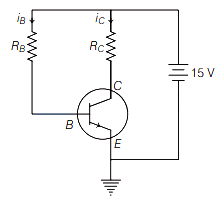
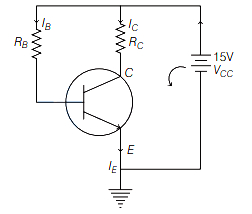
In the following common emitter circuit, if $\beta=100$, $V_{CE}=7 \, V$, $V_{BE}$ is negligible, and $R_C=2 \, k\Omega$, then $I_B=$ (in $\, mA$)?
A
$0.01$
B
$0.04$
C
$0.02$
D
$0.03$
Solution
(B) Given that, $V_{CE}=7 \, V$, $\beta=100$, $R_C=2 \, k\Omega = 2000 \, \Omega$, and $V_{CC}=15 \, V$.
We know that the current gain in a common emitter circuit is given by:
$\beta = \frac{I_C}{I_B} \dots (i)$
Applying Kirchhoff's Voltage Law $(KVL)$ in the output loop (collector-emitter loop):
$V_{CC} - I_C R_C - V_{CE} = 0$
Substituting the given values:
$15 - I_C(2000) - 7 = 0$
$8 = I_C(2000)$
$I_C = \frac{8}{2000} \, A = 4 \times 10^{-3} \, A = 4 \, mA \dots (ii)$
Now, substituting the value of $I_C$ from equation $(ii)$ into equation $(i)$:
$100 = \frac{4 \, mA}{I_B}$
$I_B = \frac{4}{100} \, mA = 0.04 \, mA$.
We know that the current gain in a common emitter circuit is given by:
$\beta = \frac{I_C}{I_B} \dots (i)$
Applying Kirchhoff's Voltage Law $(KVL)$ in the output loop (collector-emitter loop):
$V_{CC} - I_C R_C - V_{CE} = 0$
Substituting the given values:
$15 - I_C(2000) - 7 = 0$
$8 = I_C(2000)$
$I_C = \frac{8}{2000} \, A = 4 \times 10^{-3} \, A = 4 \, mA \dots (ii)$
Now, substituting the value of $I_C$ from equation $(ii)$ into equation $(i)$:
$100 = \frac{4 \, mA}{I_B}$
$I_B = \frac{4}{100} \, mA = 0.04 \, mA$.
0 likes
View Solution343
MediumMCQ
The current gain for a transistor working as a common base amplifier is $0.96$. If the emitter current is $7.2 \,mA$, then the base current is (in $\,mA$)
A
$0.29$
B
$0.35$
C
$0.39$
D
$10$
Solution
(A) Given, current gain, $\alpha = 0.96$.
Emitter current, $I_E = 7.2 \,mA = 7.2 \times 10^{-3} \,A$.
We know that, $\alpha = I_C / I_E$.
Therefore, $I_C = \alpha \times I_E = 0.96 \times 7.2 \,mA = 6.912 \,mA$.
Also, the relation between emitter, collector, and base current is $I_E = I_C + I_B$.
Thus, $I_B = I_E - I_C = 7.2 \,mA - 6.912 \,mA = 0.288 \,mA \approx 0.29 \,mA$.
Emitter current, $I_E = 7.2 \,mA = 7.2 \times 10^{-3} \,A$.
We know that, $\alpha = I_C / I_E$.
Therefore, $I_C = \alpha \times I_E = 0.96 \times 7.2 \,mA = 6.912 \,mA$.
Also, the relation between emitter, collector, and base current is $I_E = I_C + I_B$.
Thus, $I_B = I_E - I_C = 7.2 \,mA - 6.912 \,mA = 0.288 \,mA \approx 0.29 \,mA$.
0 likes
View Solution344
MediumMCQ
In a $p-n-p$ transistor working as a common base amplifier, when the current gain is $0.96$ and emitter current is $7.2 \,mA$, the base current is (in $\,mA$)
A
$0.4$
B
$0.2$
C
$0.29$
D
$0.35$
Solution
(C) In a common base amplifier for a $p-n-p$ transistor, the current gain is given by $\alpha = 0.96$.
Given emitter current, $I_E = 7.2 \,mA$.
We know the relation for current gain: $\alpha = \frac{I_C}{I_E}$.
Substituting the values: $0.96 = \frac{I_C}{7.2}$.
Calculating collector current: $I_C = 0.96 \times 7.2 = 6.912 \,mA$.
We also know that the emitter current is the sum of collector current and base current: $I_E = I_C + I_B$.
Therefore, base current $I_B = I_E - I_C$.
$I_B = 7.2 \,mA - 6.912 \,mA = 0.288 \,mA$.
Rounding to two decimal places, we get $I_B \simeq 0.29 \,mA$.
Given emitter current, $I_E = 7.2 \,mA$.
We know the relation for current gain: $\alpha = \frac{I_C}{I_E}$.
Substituting the values: $0.96 = \frac{I_C}{7.2}$.
Calculating collector current: $I_C = 0.96 \times 7.2 = 6.912 \,mA$.
We also know that the emitter current is the sum of collector current and base current: $I_E = I_C + I_B$.
Therefore, base current $I_B = I_E - I_C$.
$I_B = 7.2 \,mA - 6.912 \,mA = 0.288 \,mA$.
Rounding to two decimal places, we get $I_B \simeq 0.29 \,mA$.
0 likes
View Solution345
EasyMCQ
In a transistor,the value of $\alpha$ varies between $\frac{20}{21}$ and $\frac{100}{101}$. Then the value of $\beta$ varies between
A
$1$ and $10$
B
$0.95$ and $0.99$
C
$20$ and $100$
D
$200$ and $300$
Solution
(C) In a transistor,the common base current gain $\alpha$ is related to the common emitter current gain $\beta$ by the formula: $\beta = \frac{\alpha}{1 - \alpha}$.
Case $I$: When $\alpha = \frac{20}{21}$,
$\beta = \frac{20/21}{1 - 20/21} = \frac{20/21}{1/21} = 20$.
Case $II$: When $\alpha = \frac{100}{101}$,
$\beta = \frac{100/101}{1 - 100/101} = \frac{100/101}{1/101} = 100$.
Therefore,the value of $\beta$ varies between $20$ and $100$.
Case $I$: When $\alpha = \frac{20}{21}$,
$\beta = \frac{20/21}{1 - 20/21} = \frac{20/21}{1/21} = 20$.
Case $II$: When $\alpha = \frac{100}{101}$,
$\beta = \frac{100/101}{1 - 100/101} = \frac{100/101}{1/101} = 100$.
Therefore,the value of $\beta$ varies between $20$ and $100$.
0 likes
View Solution346
EasyMCQ
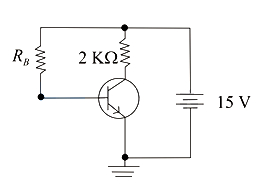
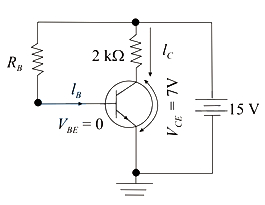
In the following common emitter circuit,$\beta=100$ and $V_{CE}=7 \text{ V}$. If $V_{BE}$ is negligible,then the base current is (in $\text{ mA}$)
A
$0.01$
B
$0.04$
C
$0.02$
D
$0.03$
Solution
(B) For the output loop of the common emitter circuit,applying Kirchhoff's voltage law $(KVL)$:
$15 \text{ V} - I_C \times (2 \text{ k}\Omega) - V_{CE} = 0$
Given $V_{CE} = 7 \text{ V}$,we have:
$15 - I_C \times 2000 - 7 = 0$
$8 = I_C \times 2000$
$I_C = \frac{8}{2000} \text{ A} = 4 \times 10^{-3} \text{ A} = 4 \text{ mA}$
Now,using the current gain relation $\beta = \frac{I_C}{I_B}$:
$100 = \frac{4 \text{ mA}}{I_B}$
$I_B = \frac{4 \text{ mA}}{100} = 0.04 \text{ mA}$
$15 \text{ V} - I_C \times (2 \text{ k}\Omega) - V_{CE} = 0$
Given $V_{CE} = 7 \text{ V}$,we have:
$15 - I_C \times 2000 - 7 = 0$
$8 = I_C \times 2000$
$I_C = \frac{8}{2000} \text{ A} = 4 \times 10^{-3} \text{ A} = 4 \text{ mA}$
Now,using the current gain relation $\beta = \frac{I_C}{I_B}$:
$100 = \frac{4 \text{ mA}}{I_B}$
$I_B = \frac{4 \text{ mA}}{100} = 0.04 \text{ mA}$
0 likes
View Solution347
MediumMCQ
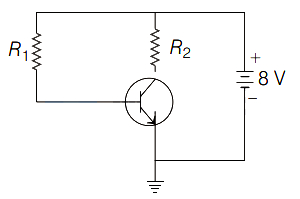
An $n-p-n$ transistor is connected in common-emitter configuration as shown in the figure. If the collector current is $5 \text{ mA}$,$V_{BE} = 0.6 \text{ V}$,$V_{CE} = 3 \text{ V}$,and the common-emitter current amplification factor $\beta = 50$,then the values of $R_1$ and $R_2$ are respectively.
A
$1 \text{ k}\Omega, 74 \text{ k}\Omega$
B
$74 \text{ k}\Omega, 1 \text{ k}\Omega$
C
$37 \text{ k}\Omega, 2 \text{ k}\Omega$
D
$2 \text{ k}\Omega, 37 \text{ k}\Omega$
Solution
(B) In the given circuit,the base loop equation is $V_{CC} = i_B R_1 + V_{BE}$.
Given $V_{CC} = 8 \text{ V}$,$V_{BE} = 0.6 \text{ V}$,and $i_C = 5 \text{ mA}$.
The base current is $i_B = \frac{i_C}{\beta} = \frac{5 \times 10^{-3} \text{ A}}{50} = 1 \times 10^{-4} \text{ A}$.
Substituting the values into the base loop equation:
$8 = (1 \times 10^{-4}) R_1 + 0.6$
$R_1 = \frac{8 - 0.6}{1 \times 10^{-4}} = \frac{7.4}{10^{-4}} = 74 \times 10^3 \Omega = 74 \text{ k}\Omega$.
Now,for the collector loop,the $KVL$ equation is $V_{CC} = i_C R_2 + V_{CE}$.
Substituting the values:
$8 = (5 \times 10^{-3}) R_2 + 3$
$5 = (5 \times 10^{-3}) R_2$
$R_2 = \frac{5}{5 \times 10^{-3}} = 10^3 \Omega = 1 \text{ k}\Omega$.
Thus,$R_1 = 74 \text{ k}\Omega$ and $R_2 = 1 \text{ k}\Omega$.
Given $V_{CC} = 8 \text{ V}$,$V_{BE} = 0.6 \text{ V}$,and $i_C = 5 \text{ mA}$.
The base current is $i_B = \frac{i_C}{\beta} = \frac{5 \times 10^{-3} \text{ A}}{50} = 1 \times 10^{-4} \text{ A}$.
Substituting the values into the base loop equation:
$8 = (1 \times 10^{-4}) R_1 + 0.6$
$R_1 = \frac{8 - 0.6}{1 \times 10^{-4}} = \frac{7.4}{10^{-4}} = 74 \times 10^3 \Omega = 74 \text{ k}\Omega$.
Now,for the collector loop,the $KVL$ equation is $V_{CC} = i_C R_2 + V_{CE}$.
Substituting the values:
$8 = (5 \times 10^{-3}) R_2 + 3$
$5 = (5 \times 10^{-3}) R_2$
$R_2 = \frac{5}{5 \times 10^{-3}} = 10^3 \Omega = 1 \text{ k}\Omega$.
Thus,$R_1 = 74 \text{ k}\Omega$ and $R_2 = 1 \text{ k}\Omega$.
0 likes
View Solution348
MediumMCQ
In the common-base configuration,a transistor has a current amplification factor of $0.95$. If the transistor is used in a common-emitter configuration and the base current changes by $2 \mu A$,then the change in the collector current is: (in $\mu A$)
A
$19$
B
$0.91$
C
$1.9$
D
$38$
Solution
(D) Given,current amplification factor in common-base configuration,$\alpha = 0.95$.
We know that the relationship between $\alpha$ and $\beta$ (current amplification factor in common-emitter configuration) is given by $\beta = \frac{\alpha}{1 - \alpha}$.
Substituting the value of $\alpha$:
$\beta = \frac{0.95}{1 - 0.95} = \frac{0.95}{0.05} = 19$.
In common-emitter configuration,the current gain $\beta$ is defined as the ratio of change in collector current $(\Delta I_C)$ to the change in base current $(\Delta I_B)$:
$\beta = \frac{\Delta I_C}{\Delta I_B}$.
Given $\Delta I_B = 2 \mu A$,we can calculate $\Delta I_C$:
$\Delta I_C = \beta \times \Delta I_B = 19 \times 2 \mu A = 38 \mu A$.
We know that the relationship between $\alpha$ and $\beta$ (current amplification factor in common-emitter configuration) is given by $\beta = \frac{\alpha}{1 - \alpha}$.
Substituting the value of $\alpha$:
$\beta = \frac{0.95}{1 - 0.95} = \frac{0.95}{0.05} = 19$.
In common-emitter configuration,the current gain $\beta$ is defined as the ratio of change in collector current $(\Delta I_C)$ to the change in base current $(\Delta I_B)$:
$\beta = \frac{\Delta I_C}{\Delta I_B}$.
Given $\Delta I_B = 2 \mu A$,we can calculate $\Delta I_C$:
$\Delta I_C = \beta \times \Delta I_B = 19 \times 2 \mu A = 38 \mu A$.
0 likes
View Solution349
DifficultMCQ
In a common emitter amplifier,the output resistance is $5000 \Omega$ and the input resistance is $2000 \Omega$. If the peak value of input signal voltage is $100 mV$ and $\beta=50$,then the peak value of output voltage is
A
$5 \times 10^{-6} \ V$
B
$12.5 \times 10^{-4} \ V$
C
$12.5 \ V$
D
$1.25 \ V$
Solution
(C) The input current $i_i$ is given by $i_i = \frac{V_i}{R_i}$,where $V_i = 100 \ mV = 0.1 \ V$ and $R_i = 2000 \ \Omega$.
$i_i = \frac{0.1}{2000} = 5 \times 10^{-5} \ A$.
The output current $i_o$ is given by $i_o = \beta \times i_i$.
$i_o = 50 \times 5 \times 10^{-5} = 250 \times 10^{-5} = 2.5 \times 10^{-3} \ A$.
The output voltage $V_o$ is given by $V_o = i_o \times R_o$,where $R_o = 5000 \ \Omega$.
$V_o = 2.5 \times 10^{-3} \times 5000 = 12.5 \ V$.
Thus,the peak value of the output voltage is $12.5 \ V$.
$i_i = \frac{0.1}{2000} = 5 \times 10^{-5} \ A$.
The output current $i_o$ is given by $i_o = \beta \times i_i$.
$i_o = 50 \times 5 \times 10^{-5} = 250 \times 10^{-5} = 2.5 \times 10^{-3} \ A$.
The output voltage $V_o$ is given by $V_o = i_o \times R_o$,where $R_o = 5000 \ \Omega$.
$V_o = 2.5 \times 10^{-3} \times 5000 = 12.5 \ V$.
Thus,the peak value of the output voltage is $12.5 \ V$.
0 likes
View Solution350
EasyMCQ
In a $CE$-transistor feedback oscillator circuit,the phase difference between input and output signal is
A
$\pi$
B
$\frac{\pi}{4}$
C
$\frac{\pi}{2}$
D
$0$
Solution
(A) In a Common Emitter $(CE)$ amplifier configuration,the output signal is inverted with respect to the input signal,meaning there is a phase shift of $\pi$ radians $(180^{\circ})$ between them.
For an oscillator to sustain oscillations,the Barkhausen criterion requires the total phase shift around the loop to be $0$ or $2n\pi$.
Since the $CE$ amplifier provides a phase shift of $\pi$,the feedback network must provide an additional phase shift of $\pi$ to satisfy the condition for oscillation.
Therefore,the phase difference between the input and output signal of the $CE$-transistor stage itself is $\pi$.
For an oscillator to sustain oscillations,the Barkhausen criterion requires the total phase shift around the loop to be $0$ or $2n\pi$.
Since the $CE$ amplifier provides a phase shift of $\pi$,the feedback network must provide an additional phase shift of $\pi$ to satisfy the condition for oscillation.
Therefore,the phase difference between the input and output signal of the $CE$-transistor stage itself is $\pi$.
0 likes
View SolutionSemiconductor Electronics — Junction Transistor · Frequently Asked Questions
1Are these Semiconductor Electronics questions useful for JEE and NEET?
Yes. All questions in this section are mapped to JEE Main and NEET exam patterns. Previous year questions from JEE Main, NEET, GUJCET and state-level exams are included with full solutions.
2Can I switch to Hindi or Gujarati for these questions?
Yes. Use the language tabs in the hero section or the sidebar to view the same questions and solutions in English, Hindi or Gujarati.
3How do I generate a question paper from this subtopic?
Use the Vedclass Exam Paper Generator — select the chapter and subtopic, set difficulty, and generate Sets A, B, C, D automatically. First 3 chapters of every subject are free.
Vedclass Products
For Students
Vedclass Test Series
Mock tests in real JEE/NEET style with performance analysis. 5-day free trial.
Start Free TrialFor Teachers
Exam Paper Generator
Generate Set A/B/C/D papers from this chapter in 2 minutes. 3 chapters free.
Try FreeFor Institutes
Online Exam Module
Live online exams with unlimited students, 360° analytics & white-label branding.
See DemoFor Teachers & Institutes
Generate a Semiconductor Electronics Exam Paper in 2 Minutes
Select subtopic & difficulty — Sets A, B, C, D auto-generated with No Repeat logic.
First 3 chapters of every subject are free — no payment required.