
A English
Boolean Algebra and Logic Gates Questions in English
Class 12 Physics · Semiconductor Electronics · Boolean Algebra and Logic Gates
483+
Questions
English
Language
100%
With Solutions
Showing 43 of 483 questions in English
1
EasyMCQ
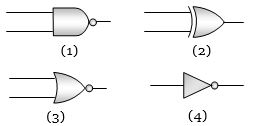
Given below are symbols for some logic gates. The $XOR$ gate and $NOR$ gate respectively are:
A
$1$ and $2$
B
$2$ and $3$
C
$3$ and $4$
D
$1$ and $4$
Solution
(B) By observing the provided symbols:
$(1)$ represents a $NAND$ gate.
$(2)$ represents an $XOR$ gate.
$(3)$ represents a $NOR$ gate.
$(4)$ represents a $NOT$ gate.
Therefore,the $XOR$ gate is represented by symbol $2$ and the $NOR$ gate is represented by symbol $3$.
Thus,the correct option is $B$.
$(1)$ represents a $NAND$ gate.
$(2)$ represents an $XOR$ gate.
$(3)$ represents a $NOR$ gate.
$(4)$ represents a $NOT$ gate.
Therefore,the $XOR$ gate is represented by symbol $2$ and the $NOR$ gate is represented by symbol $3$.
Thus,the correct option is $B$.
0 likes
View Solution2
MediumMCQ
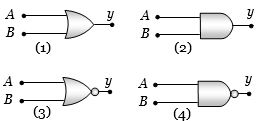
Given below are four logic gate symbols (figure). Those for $OR$,$NOR$ and $NAND$ are respectively:
A
$1, 4, 3$
B
$4, 1, 2$
C
$1, 3, 4$
D
$4, 2, 1$
Solution
(C) By observing the given logic gate symbols:
$(1)$ represents an $OR$ gate.
$(2)$ represents an $AND$ gate.
$(3)$ represents a $NOR$ gate.
$(4)$ represents a $NAND$ gate.
Therefore,the symbols for $OR$,$NOR$,and $NAND$ gates are $1$,$3$,and $4$ respectively.
Thus,the correct option is $C$.
$(1)$ represents an $OR$ gate.
$(2)$ represents an $AND$ gate.
$(3)$ represents a $NOR$ gate.
$(4)$ represents a $NAND$ gate.
Therefore,the symbols for $OR$,$NOR$,and $NAND$ gates are $1$,$3$,and $4$ respectively.
Thus,the correct option is $C$.
0 likes
View Solution3
EasyMCQ
The following truth table corresponds to which logic gate?
$A: 0, 0, 1, 1$
$B: 0, 1, 0, 1$
$X: 0, 1, 1, 1$
$A: 0, 0, 1, 1$
$B: 0, 1, 0, 1$
$X: 0, 1, 1, 1$
A
$NAND$
B
$OR$
C
$AND$
D
$XOR$
Solution
(B) The truth table provided is:
$A=0, B=0 \implies X=0$
$A=0, B=1 \implies X=1$
$A=1, B=0 \implies X=1$
$A=1, B=1 \implies X=1$
This behavior corresponds to the $OR$ gate,where the output $X$ is $1$ if at least one of the inputs $A$ or $B$ is $1$. The Boolean expression for an $OR$ gate is $X = A + B$.
$A=0, B=0 \implies X=0$
$A=0, B=1 \implies X=1$
$A=1, B=0 \implies X=1$
$A=1, B=1 \implies X=1$
This behavior corresponds to the $OR$ gate,where the output $X$ is $1$ if at least one of the inputs $A$ or $B$ is $1$. The Boolean expression for an $OR$ gate is $X = A + B$.
0 likes
View Solution4
EasyMCQ
$A$ truth table is given below. Which of the following logic gates corresponds to this truth table?
$A: 0, 1, 0, 1$
$B: 0, 0, 1, 1$
$Y: 1, 0, 0, 0$
$A: 0, 1, 0, 1$
$B: 0, 0, 1, 1$
$Y: 1, 0, 0, 0$
A
$XOR$ gate
B
$NOR$ gate
C
$AND$ gate
D
$OR$ gate
Solution
(B) The given truth table is:
$A=0, B=0 \implies Y=1$
$A=1, B=0 \implies Y=0$
$A=0, B=1 \implies Y=0$
$A=1, B=1 \implies Y=0$
For a $NOR$ gate,the output is defined by the Boolean expression $Y = \overline{A + B}$.
Calculating for each case:
$1$. For $A=0, B=0$: $Y = \overline{0+0} = \overline{0} = 1$.
$2$. For $A=1, B=0$: $Y = \overline{1+0} = \overline{1} = 0$.
$3$. For $A=0, B=1$: $Y = \overline{0+1} = \overline{1} = 0$.
$4$. For $A=1, B=1$: $Y = \overline{1+1} = \overline{1} = 0$.
This matches the given truth table. Therefore,the correct option is $B$.
$A=0, B=0 \implies Y=1$
$A=1, B=0 \implies Y=0$
$A=0, B=1 \implies Y=0$
$A=1, B=1 \implies Y=0$
For a $NOR$ gate,the output is defined by the Boolean expression $Y = \overline{A + B}$.
Calculating for each case:
$1$. For $A=0, B=0$: $Y = \overline{0+0} = \overline{0} = 1$.
$2$. For $A=1, B=0$: $Y = \overline{1+0} = \overline{1} = 0$.
$3$. For $A=0, B=1$: $Y = \overline{0+1} = \overline{1} = 0$.
$4$. For $A=1, B=1$: $Y = \overline{1+1} = \overline{1} = 0$.
This matches the given truth table. Therefore,the correct option is $B$.
0 likes
View Solution5
MediumMCQ
The truth table shown below is for which logic gate?
$A: 0, 0, 1, 1$
$B: 0, 1, 0, 1$
$Y: 1, 0, 0, 1$
$A: 0, 0, 1, 1$
$B: 0, 1, 0, 1$
$Y: 1, 0, 0, 1$
A
$XOR$
B
$AND$
C
$XNOR$
D
$OR$
Solution
(C) The truth table represents the output $Y$ for inputs $A$ and $B$ as follows:
For $A=0, B=0$,$Y=1$.
For $A=0, B=1$,$Y=0$.
For $A=1, B=0$,$Y=0$.
For $A=1, B=1$,$Y=1$.
This truth table corresponds to the $XNOR$ gate,which outputs $1$ only when both inputs are the same.
The Boolean expression for an $XNOR$ gate is $Y = A \odot B = \overline{A \oplus B} = \bar{A}\bar{B} + AB$.
Checking the values:
$1$. For $(0, 0): Y = \bar{0}\cdot\bar{0} + 0\cdot 0 = 1\cdot 1 + 0 = 1$.
$2$. For $(0, 1): Y = \bar{0}\cdot\bar{1} + 0\cdot 1 = 1\cdot 0 + 0 = 0$.
$3$. For $(1, 0): Y = \bar{1}\cdot\bar{0} + 1\cdot 0 = 0\cdot 1 + 0 = 0$.
$4$. For $(1, 1): Y = \bar{1}\cdot\bar{1} + 1\cdot 1 = 0\cdot 0 + 1 = 1$.
Thus,the correct option is $C$.
For $A=0, B=0$,$Y=1$.
For $A=0, B=1$,$Y=0$.
For $A=1, B=0$,$Y=0$.
For $A=1, B=1$,$Y=1$.
This truth table corresponds to the $XNOR$ gate,which outputs $1$ only when both inputs are the same.
The Boolean expression for an $XNOR$ gate is $Y = A \odot B = \overline{A \oplus B} = \bar{A}\bar{B} + AB$.
Checking the values:
$1$. For $(0, 0): Y = \bar{0}\cdot\bar{0} + 0\cdot 0 = 1\cdot 1 + 0 = 1$.
$2$. For $(0, 1): Y = \bar{0}\cdot\bar{1} + 0\cdot 1 = 1\cdot 0 + 0 = 0$.
$3$. For $(1, 0): Y = \bar{1}\cdot\bar{0} + 1\cdot 0 = 0\cdot 1 + 0 = 0$.
$4$. For $(1, 1): Y = \bar{1}\cdot\bar{1} + 1\cdot 1 = 0\cdot 0 + 1 = 1$.
Thus,the correct option is $C$.
0 likes
View Solution6
MediumMCQ
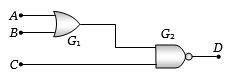
For the given combination of logic gates, if the logic states of inputs $A, B, C$ are as follows: $A = B = C = 0$ and $A = B = 1, C = 0$, then the logic states of output $D$ are:
A
$0, 0$
B
$0, 1$
C
$1, 0$
D
$1, 1$
Solution
(D) The given circuit consists of an $OR$ gate $(G_1)$ followed by a $NAND$ gate $(G_2)$.
Let the output of the $OR$ gate be $Y$. Then $Y = A + B$.
The final output $D$ is the output of the $NAND$ gate with inputs $Y$ and $C$, so $D = \overline{Y \cdot C} = \overline{(A + B) \cdot C}$.
Case $1$: $A = 0, B = 0, C = 0$.
$Y = A + B = 0 + 0 = 0$.
$D = \overline{Y \cdot C} = \overline{0 \cdot 0} = \overline{0} = 1$.
Case $2$: $A = 1, B = 1, C = 0$.
$Y = A + B = 1 + 1 = 1$.
$D = \overline{Y \cdot C} = \overline{1 \cdot 0} = \overline{0} = 1$.
Thus, the output states are $1, 1$.
Let the output of the $OR$ gate be $Y$. Then $Y = A + B$.
The final output $D$ is the output of the $NAND$ gate with inputs $Y$ and $C$, so $D = \overline{Y \cdot C} = \overline{(A + B) \cdot C}$.
Case $1$: $A = 0, B = 0, C = 0$.
$Y = A + B = 0 + 0 = 0$.
$D = \overline{Y \cdot C} = \overline{0 \cdot 0} = \overline{0} = 1$.
Case $2$: $A = 1, B = 1, C = 0$.
$Y = A + B = 1 + 1 = 1$.
$D = \overline{Y \cdot C} = \overline{1 \cdot 0} = \overline{0} = 1$.
Thus, the output states are $1, 1$.
0 likes
View Solution7
EasyMCQ
Boolean algebra is essentially based on
A
Truth
B
Logic
C
Symbol
D
Numbers
Solution
(B) Boolean algebra is a branch of algebra in which the values of the variables are the truth values $true$ and $false$,usually denoted by $1$ and $0$ respectively.
It is essentially based on logic,as it deals with logical operations such as $AND$,$OR$,and $NOT$ to manipulate these truth values.
Therefore,the correct option is $B$.
It is essentially based on logic,as it deals with logical operations such as $AND$,$OR$,and $NOT$ to manipulate these truth values.
Therefore,the correct option is $B$.
0 likes
View Solution8
EasyMCQ
$A$ logic gate is an electronic circuit which
A
Makes logic decisions
B
Allows electrons flow only in one direction
C
Works binary algebra
D
Alternates between $0$ and $1$ values
Solution
(A) logic gate is an electronic circuit that makes logic decisions.
$A$ digital logic gate is an electronic device that makes logical decisions based on the different combinations of digital signals present on its inputs.
Digital logic gates may have more than one input ($A, B, C$,etc.) but generally have only one digital output $(Q)$.
Individual logic gates can be connected together to form combinational or sequential circuits or larger logic gate functions.
$A$ logic gate is an elementary building block of a digital circuit.
Most logic gates have two inputs and one output.
At any given moment,every terminal is in one of the two binary conditions: low $(0)$ or high $(1)$,represented by different voltage levels.
Therefore,the correct answer is $A$.
$A$ digital logic gate is an electronic device that makes logical decisions based on the different combinations of digital signals present on its inputs.
Digital logic gates may have more than one input ($A, B, C$,etc.) but generally have only one digital output $(Q)$.
Individual logic gates can be connected together to form combinational or sequential circuits or larger logic gate functions.
$A$ logic gate is an elementary building block of a digital circuit.
Most logic gates have two inputs and one output.
At any given moment,every terminal is in one of the two binary conditions: low $(0)$ or high $(1)$,represented by different voltage levels.
Therefore,the correct answer is $A$.
0 likes
View Solution9
EasyMCQ
The given truth table is correct for:
$P: 1, 1, 0, 0$
$Q: 1, 0, 1, 0$
$R: 1, 0, 0, 0$
$P: 1, 1, 0, 0$
$Q: 1, 0, 1, 0$
$R: 1, 0, 0, 0$
A
$NOR$
B
$OR$
C
$NAND$
D
$AND$
Solution
(D) The Boolean expression for an $AND$ gate is $R = P \cdot Q$.
Checking the values from the truth table:
For $P=1, Q=1$,$R = 1 \cdot 1 = 1$.
For $P=1, Q=0$,$R = 1 \cdot 0 = 0$.
For $P=0, Q=1$,$R = 0 \cdot 1 = 0$.
For $P=0, Q=0$,$R = 0 \cdot 0 = 0$.
Since the calculated values match the given truth table,the gate is an $AND$ gate.
Checking the values from the truth table:
For $P=1, Q=1$,$R = 1 \cdot 1 = 1$.
For $P=1, Q=0$,$R = 1 \cdot 0 = 0$.
For $P=0, Q=1$,$R = 0 \cdot 1 = 0$.
For $P=0, Q=0$,$R = 0 \cdot 0 = 0$.
Since the calculated values match the given truth table,the gate is an $AND$ gate.
0 likes
View Solution10
MediumMCQ
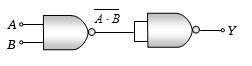
How many $NAND$ gates are used to form an $AND$ gate?
A
$1$
B
$2$
C
$3$
D
$4$
Solution
(B) To form an $AND$ gate using $NAND$ gates,we need two $NAND$ gates.
First,the inputs $A$ and $B$ are fed into the first $NAND$ gate,which produces an output of $\overline{A \cdot B}$.
This output is then fed into the second $NAND$ gate,which acts as a $NOT$ gate (since its inputs are shorted together).
The final output $Y$ is given by:
$Y = \overline{(\overline{A \cdot B}) \cdot (\overline{A \cdot B})} = \overline{\overline{A \cdot B}} = A \cdot B$
Thus,two $NAND$ gates are required to realize an $AND$ gate.
First,the inputs $A$ and $B$ are fed into the first $NAND$ gate,which produces an output of $\overline{A \cdot B}$.
This output is then fed into the second $NAND$ gate,which acts as a $NOT$ gate (since its inputs are shorted together).
The final output $Y$ is given by:
$Y = \overline{(\overline{A \cdot B}) \cdot (\overline{A \cdot B})} = \overline{\overline{A \cdot B}} = A \cdot B$
Thus,two $NAND$ gates are required to realize an $AND$ gate.
0 likes
View Solution11
MediumMCQ
Which of the following logic gates will have an output of $1$?
A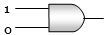
B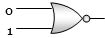
C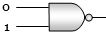
D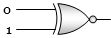
Solution
(C) Let us analyze the output for each gate with the given inputs:
$(A)$ For an $AND$ gate,the output $Y = A \cdot B$. With inputs $1$ and $0$,$Y = 1 \cdot 0 = 0$.
$(B)$ For a $NOR$ gate,the output $Y = \overline{A + B}$. With inputs $0$ and $1$,$Y = \overline{0 + 1} = \overline{1} = 0$.
$(C)$ For a $NAND$ gate,the output $Y = \overline{A \cdot B}$. With inputs $0$ and $1$,$Y = \overline{0 \cdot 1} = \overline{0} = 1$.
$(D)$ For an $XNOR$ gate,the output $Y = A \odot B$ (or $\overline{A \oplus B}$). With inputs $0$ and $1$,$Y = \overline{0 \oplus 1} = \overline{1} = 0$.
Thus,the $NAND$ gate produces an output of $1$.
$(A)$ For an $AND$ gate,the output $Y = A \cdot B$. With inputs $1$ and $0$,$Y = 1 \cdot 0 = 0$.
$(B)$ For a $NOR$ gate,the output $Y = \overline{A + B}$. With inputs $0$ and $1$,$Y = \overline{0 + 1} = \overline{1} = 0$.
$(C)$ For a $NAND$ gate,the output $Y = \overline{A \cdot B}$. With inputs $0$ and $1$,$Y = \overline{0 \cdot 1} = \overline{0} = 1$.
$(D)$ For an $XNOR$ gate,the output $Y = A \odot B$ (or $\overline{A \oplus B}$). With inputs $0$ and $1$,$Y = \overline{0 \oplus 1} = \overline{1} = 0$.
Thus,the $NAND$ gate produces an output of $1$.
0 likes
View Solution12
MediumMCQ
Which of the following represents a $NAND$ gate?
A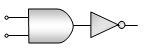
B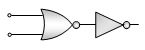
C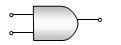
D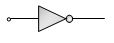
Solution
(A) $NAND$ gate is defined as the logical combination of an $AND$ gate followed by a $NOT$ gate.
Mathematically,if the inputs are $A$ and $B$,the output of the $AND$ gate is $Y' = A \cdot B$.
Passing this through a $NOT$ gate results in the final output $Y = \overline{A \cdot B}$.
Therefore,the correct representation is an $AND$ gate followed by a $NOT$ gate.
Mathematically,if the inputs are $A$ and $B$,the output of the $AND$ gate is $Y' = A \cdot B$.
Passing this through a $NOT$ gate results in the final output $Y = \overline{A \cdot B}$.
Therefore,the correct representation is an $AND$ gate followed by a $NOT$ gate.
0 likes
View Solution13
EasyMCQ
The given truth table is of:
| $A$ | $X$ |
| $0$ | $1$ |
| $1$ | $0$ |
A
$OR$ gate
B
$AND$ gate
C
$NOT$ gate
D
None of above
Solution
(C) $NOT$ gate is a logic gate that implements logical negation. It inverts the input signal.
If the input $A = 0$,the output $X = 1$.
If the input $A = 1$,the output $X = 0$.
This behavior is represented by the Boolean expression $X = \bar{A}$.
Comparing this with the given truth table,it matches the operation of a $NOT$ gate.
If the input $A = 0$,the output $X = 1$.
If the input $A = 1$,the output $X = 0$.
This behavior is represented by the Boolean expression $X = \bar{A}$.
Comparing this with the given truth table,it matches the operation of a $NOT$ gate.
0 likes
View Solution14
EasyMCQ
If $A$ and $B$ are two inputs in an $AND$ gate,then the $AND$ gate has an output of $1$ when the values of $A$ and $B$ are:
A
$A = 0, B = 0$
B
$A = 1, B = 1$
C
$A = 1, B = 0$
D
$A = 0, B = 1$
Solution
(B) For an $AND$ gate,the output $Y$ is defined by the Boolean expression $Y = A \cdot B$.
This means the output is $1$ if and only if both inputs $A$ and $B$ are $1$.
If any input is $0$,the output will be $0$.
Therefore,the output is $1$ only when $A = 1$ and $B = 1$.
This means the output is $1$ if and only if both inputs $A$ and $B$ are $1$.
If any input is $0$,the output will be $0$.
Therefore,the output is $1$ only when $A = 1$ and $B = 1$.
0 likes
View Solution15
EasyMCQ
The Boolean equation of a $NOR$ gate is:
A
$C = A + B$
B
$C = \overline{A + B}$
C
$C = A \cdot B$
D
$C = \overline{A \cdot B}$
Solution
(B) $NOR$ gate is a combination of an $OR$ gate followed by a $NOT$ gate.
$1$. The output of an $OR$ gate for inputs $A$ and $B$ is given by $Y = A + B$.
$2$. The $NOT$ gate inverts this output,resulting in $C = \overline{Y}$.
$3$. Substituting the $OR$ gate output into the $NOT$ gate expression,we get $C = \overline{A + B}$.
Therefore,the correct option is $B$.
$1$. The output of an $OR$ gate for inputs $A$ and $B$ is given by $Y = A + B$.
$2$. The $NOT$ gate inverts this output,resulting in $C = \overline{Y}$.
$3$. Substituting the $OR$ gate output into the $NOT$ gate expression,we get $C = \overline{A + B}$.
Therefore,the correct option is $B$.
0 likes
View Solution16
EasyMCQ
This symbol represents
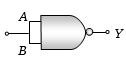
A
$NOT$ gate
B
$OR$ gate
C
$AND$ gate
D
$NOR$ gate
Solution
$(A)$ The given symbol shows a $NAND$ gate where the two inputs $A$ and $B$ are shorted together to form a single input.
For a $NAND$ gate, the output is $Y = \overline{A \cdot B}$.
Since the inputs are shorted, $A = B = X$.
Therefore, the output becomes $Y = \overline{X \cdot X} = \overline{X}$.
This is the Boolean expression for a $NOT$ gate.
Thus, the combination acts as a $NOT$ gate.
For a $NAND$ gate, the output is $Y = \overline{A \cdot B}$.
Since the inputs are shorted, $A = B = X$.
Therefore, the output becomes $Y = \overline{X \cdot X} = \overline{X}$.
This is the Boolean expression for a $NOT$ gate.
Thus, the combination acts as a $NOT$ gate.
0 likes
View Solution17
EasyMCQ
Which logic gate is represented by the following diagram?

A
$AND$
B
$OR$
C
$NOR$
D
$XOR$
Solution
(A) The provided diagram shows the standard symbol for an $AND$ gate.
An $AND$ gate is a digital logic gate that implements logical conjunction; it behaves according to the truth table where the output is high $(1)$ only if all its inputs are high $(1)$.
An $AND$ gate is a digital logic gate that implements logical conjunction; it behaves according to the truth table where the output is high $(1)$ only if all its inputs are high $(1)$.
0 likes
View Solution18
EasyMCQ
The given symbol represents:

A
$NAND$ gate
B
$NOR$ gate
C
$NOT$ gate
D
$XNOR$ gate
Solution
(B) The provided symbol consists of an $OR$ gate followed by a small circle (inversion bubble) at the output.
This combination of an $OR$ gate and a $NOT$ gate is known as a $NOR$ gate.
Therefore,the correct option is $B$.
This combination of an $OR$ gate and a $NOT$ gate is known as a $NOR$ gate.
Therefore,the correct option is $B$.
0 likes
View Solution19
MediumMCQ
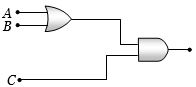
To get an output $Y = 1$ in the given circuit,which of the following inputs will be correct?
A
$A = 0, B = 1, C = 0$
B
$A = 1, B = 0, C = 0$
C
$A = 1, B = 0, C = 1$
D
$A = 1, B = 1, C = 0$
Solution
(C) The given circuit consists of an $OR$ gate followed by an $AND$ gate. The output of the $OR$ gate is $(A + B)$. This output is then fed into an $AND$ gate along with input $C$. Thus,the final Boolean expression for the output $Y$ is $Y = (A + B) \cdot C$.
To get an output $Y = 1$,both inputs to the $AND$ gate must be $1$. This means $(A + B) = 1$ and $C = 1$.
For $(A + B) = 1$,at least one of $A$ or $B$ must be $1$.
Checking the options:
- For option $A$: $A=0, B=1, C=0 \implies Y = (0+1) \cdot 0 = 0$.
- For option $B$: $A=1, B=0, C=0 \implies Y = (1+0) \cdot 0 = 0$.
- For option $C$: $A=1, B=0, C=1 \implies Y = (1+0) \cdot 1 = 1$.
- For option $D$: $A=1, B=1, C=0 \implies Y = (1+1) \cdot 0 = 0$.
Thus,the correct input is $A = 1, B = 0, C = 1$.
To get an output $Y = 1$,both inputs to the $AND$ gate must be $1$. This means $(A + B) = 1$ and $C = 1$.
For $(A + B) = 1$,at least one of $A$ or $B$ must be $1$.
Checking the options:
- For option $A$: $A=0, B=1, C=0 \implies Y = (0+1) \cdot 0 = 0$.
- For option $B$: $A=1, B=0, C=0 \implies Y = (1+0) \cdot 0 = 0$.
- For option $C$: $A=1, B=0, C=1 \implies Y = (1+0) \cdot 1 = 1$.
- For option $D$: $A=1, B=1, C=0 \implies Y = (1+1) \cdot 0 = 0$.
Thus,the correct input is $A = 1, B = 0, C = 1$.
0 likes
View Solution20
MediumMCQ
The output of a $NAND$ gate is $0$:
A
If both inputs are $0$
B
If one input is $0$ and the other input is $1$
C
If both inputs are $1$
D
If one input is $1$ and the other input is $0$
Solution
(C) The output $Y$ of a $NAND$ gate for inputs $A$ and $B$ is given by the Boolean expression $Y = \overline{A \cdot B}$.
For the output to be $0$,we must have $\overline{A \cdot B} = 0$,which implies $A \cdot B = 1$.
This condition is satisfied only when both inputs $A$ and $B$ are $1$.
Therefore,if $A = 1$ and $B = 1$,then $Y = \overline{1 \cdot 1} = \overline{1} = 0$.
For the output to be $0$,we must have $\overline{A \cdot B} = 0$,which implies $A \cdot B = 1$.
This condition is satisfied only when both inputs $A$ and $B$ are $1$.
Therefore,if $A = 1$ and $B = 1$,then $Y = \overline{1 \cdot 1} = \overline{1} = 0$.
0 likes
View Solution21
MediumMCQ
$A$ gate in which all the inputs must be low to get a high output is called:
A
$A$ $NAND$ gate
B
An inverter
C
$A$ $NOR$ gate
D
An $AND$ gate
Solution
(C) For a $NOR$ gate, the output is high $(1)$ only when all inputs are low $(0)$.
If inputs are $A$ and $B$, the output $Y = \overline{A+B}$.
If $A=0$ and $B=0$, then $Y = \overline{0+0} = \overline{0} = 1$.
Thus, the correct gate is a $NOR$ gate.
Therefore, the correct option is $C$.
If inputs are $A$ and $B$, the output $Y = \overline{A+B}$.
If $A=0$ and $B=0$, then $Y = \overline{0+0} = \overline{0} = 1$.
Thus, the correct gate is a $NOR$ gate.
Therefore, the correct option is $C$.
0 likes
View Solution22
EasyMCQ
The output of an $OR$ gate is $1$:
A
If both inputs are $0$
B
If either or both inputs are $1$
C
Only if both inputs are $1$
D
If either input is $0$
Solution
(B) The output $Y$ of an $OR$ gate is given by the Boolean expression $Y = A + B$.
According to the logic of the $OR$ gate,the output is $1$ if at least one of the inputs ($A$ or $B$) is $1$.
Therefore,if either input is $1$ or both inputs are $1$,the output is $1$.
According to the logic of the $OR$ gate,the output is $1$ if at least one of the inputs ($A$ or $B$) is $1$.
Therefore,if either input is $1$ or both inputs are $1$,the output is $1$.
0 likes
View Solution23
EasyMCQ
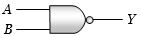
Which logic gate is represented by this figure?
A
$NAND$ gate
B
$AND$ gate
C
$NOT$ gate
D
$OR$ gate
Solution
(A) The given figure shows an $AND$ gate followed by a small circle at the output,which represents an inversion ($NOT$ operation).
An $AND$ gate combined with a $NOT$ gate is known as a $NAND$ gate.
Therefore,the correct option is $A$.
An $AND$ gate combined with a $NOT$ gate is known as a $NAND$ gate.
Therefore,the correct option is $A$.
0 likes
View Solution24
MediumMCQ
Sum of the two binary numbers $(100010)_2$ and $(11011)_2$ is
A
$(111101)_2$
B
$(111111)_2$
C
$(101111)_2$
D
$(111001)_2$
Solution
(A) First,convert the binary numbers to decimal:
$(100010)_2 = (1 \times 2^5) + (0 \times 2^4) + (0 \times 2^3) + (0 \times 2^2) + (1 \times 2^1) + (0 \times 2^0) = 32 + 0 + 0 + 0 + 2 + 0 = (34)_{10}$
$(11011)_2 = (1 \times 2^4) + (1 \times 2^3) + (0 \times 2^2) + (1 \times 2^1) + (1 \times 2^0) = 16 + 8 + 0 + 2 + 1 = (27)_{10}$
Sum in decimal: $(34)_{10} + (27)_{10} = (61)_{10}$
Now,convert $(61)_{10}$ back to binary:
Reading remainders from bottom to top,we get $(111101)_2$.
$(100010)_2 = (1 \times 2^5) + (0 \times 2^4) + (0 \times 2^3) + (0 \times 2^2) + (1 \times 2^1) + (0 \times 2^0) = 32 + 0 + 0 + 0 + 2 + 0 = (34)_{10}$
$(11011)_2 = (1 \times 2^4) + (1 \times 2^3) + (0 \times 2^2) + (1 \times 2^1) + (1 \times 2^0) = 16 + 8 + 0 + 2 + 1 = (27)_{10}$
Sum in decimal: $(34)_{10} + (27)_{10} = (61)_{10}$
Now,convert $(61)_{10}$ back to binary:
| $61 \div 2 = 30$ | Remainder $1$ $(LSD)$ |
| $30 \div 2 = 15$ | Remainder $0$ |
| $15 \div 2 = 7$ | Remainder $1$ |
| $7 \div 2 = 3$ | Remainder $1$ |
| $3 \div 2 = 1$ | Remainder $1$ |
| $1 \div 2 = 0$ | Remainder $1$ $(MSD)$ |
Reading remainders from bottom to top,we get $(111101)_2$.
0 likes
View Solution25
MediumMCQ
The truth table given below is for which gate?
$A: 0, 0, 1, 1$
$B: 0, 1, 0, 1$
$C: 1, 1, 1, 0$
$A: 0, 0, 1, 1$
$B: 0, 1, 0, 1$
$C: 1, 1, 1, 0$
A
$XOR$
B
$OR$
C
$AND$
D
$NAND$
Solution
(D) For a $NAND$ gate,the output $C$ is given by the Boolean expression $C = \overline{A \cdot B}$.
Checking the values:
$1$. For $A = 0, B = 0$: $C = \overline{0 \cdot 0} = \overline{0} = 1$.
$2$. For $A = 0, B = 1$: $C = \overline{0 \cdot 1} = \overline{0} = 1$.
$3$. For $A = 1, B = 0$: $C = \overline{1 \cdot 0} = \overline{0} = 1$.
$4$. For $A = 1, B = 1$: $C = \overline{1 \cdot 1} = \overline{1} = 0$.
Comparing these results with the given table,the output matches the $NAND$ gate logic.
Checking the values:
$1$. For $A = 0, B = 0$: $C = \overline{0 \cdot 0} = \overline{0} = 1$.
$2$. For $A = 0, B = 1$: $C = \overline{0 \cdot 1} = \overline{0} = 1$.
$3$. For $A = 1, B = 0$: $C = \overline{1 \cdot 0} = \overline{0} = 1$.
$4$. For $A = 1, B = 1$: $C = \overline{1 \cdot 1} = \overline{1} = 0$.
Comparing these results with the given table,the output matches the $NAND$ gate logic.
0 likes
View Solution26
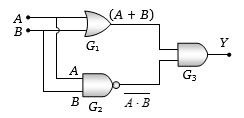
DifficultMCQ
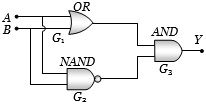
The following configuration of gate is equivalent to
A
$NAND$
B
$XOR$
C
$OR$
D
$NOR$
Solution
(B) The output of the $OR$ gate $(G_1)$ is $(A + B)$.
The output of the $NAND$ gate $(G_2)$ is $\overline{A \cdot B}$.
These two outputs are fed into the $AND$ gate $(G_3)$,so the final output $Y$ is:
$Y = (A + B) \cdot (\overline{A \cdot B})$
Using De Morgan's theorem,$\overline{A \cdot B} = \bar{A} + \bar{B}$.
Substituting this into the equation:
$Y = (A + B) \cdot (\bar{A} + \bar{B})$
$Y = A \cdot \bar{A} + A \cdot \bar{B} + B \cdot \bar{A} + B \cdot \bar{B}$
Since $A \cdot \bar{A} = 0$ and $B \cdot \bar{B} = 0$,the expression simplifies to:
$Y = 0 + A \cdot \bar{B} + \bar{A} \cdot B + 0$
$Y = A \cdot \bar{B} + \bar{A} \cdot B$
This is the Boolean expression for an $XOR$ gate.
The output of the $NAND$ gate $(G_2)$ is $\overline{A \cdot B}$.
These two outputs are fed into the $AND$ gate $(G_3)$,so the final output $Y$ is:
$Y = (A + B) \cdot (\overline{A \cdot B})$
Using De Morgan's theorem,$\overline{A \cdot B} = \bar{A} + \bar{B}$.
Substituting this into the equation:
$Y = (A + B) \cdot (\bar{A} + \bar{B})$
$Y = A \cdot \bar{A} + A \cdot \bar{B} + B \cdot \bar{A} + B \cdot \bar{B}$
Since $A \cdot \bar{A} = 0$ and $B \cdot \bar{B} = 0$,the expression simplifies to:
$Y = 0 + A \cdot \bar{B} + \bar{A} \cdot B + 0$
$Y = A \cdot \bar{B} + \bar{A} \cdot B$
This is the Boolean expression for an $XOR$ gate.
0 likes
View Solution27
DifficultMCQ
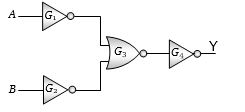
The combination of gates shown below produces
A
$AND$ gate
B
$XOR$ gate
C
$NOR$ gate
D
$NAND$ gate
Solution
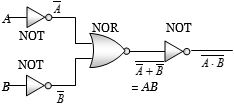
(D) The given circuit consists of two $NOT$ gates ($G_1$ and $G_2$) at the inputs $A$ and $B$,followed by a $NOR$ gate $(G_3)$ and another $NOT$ gate $(G_4)$.
$1$. The outputs of $G_1$ and $G_2$ are $\bar{A}$ and $\bar{B}$ respectively.
$2$. These are fed into the $NOR$ gate $G_3$,which produces the output: $Y' = \overline{\bar{A} + \bar{B}}$.
$3$. Using De Morgan's theorem,$\overline{\bar{A} + \bar{B}} = \overline{\bar{A}} \cdot \overline{\bar{B}} = A \cdot B$.
$4$. This output $Y'$ is then passed through the final $NOT$ gate $G_4$,resulting in $Y = \overline{Y'} = \overline{A \cdot B}$.
$5$. The expression $\overline{A \cdot B}$ represents the output of a $NAND$ gate.
Therefore,option $(d)$ is correct.
$1$. The outputs of $G_1$ and $G_2$ are $\bar{A}$ and $\bar{B}$ respectively.
$2$. These are fed into the $NOR$ gate $G_3$,which produces the output: $Y' = \overline{\bar{A} + \bar{B}}$.
$3$. Using De Morgan's theorem,$\overline{\bar{A} + \bar{B}} = \overline{\bar{A}} \cdot \overline{\bar{B}} = A \cdot B$.
$4$. This output $Y'$ is then passed through the final $NOT$ gate $G_4$,resulting in $Y = \overline{Y'} = \overline{A \cdot B}$.
$5$. The expression $\overline{A \cdot B}$ represents the output of a $NAND$ gate.
Therefore,option $(d)$ is correct.
0 likes
View Solution28
DifficultMCQ
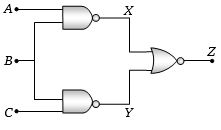
The figure shows two $NAND$ gates followed by a $NOR$ gate. The system is equivalent to the following logic gate:
A
$OR$
B
$AND$
C
$NAND$
D
None of these
Solution
(B) The circuit consists of two $NAND$ gates whose outputs $X$ and $Y$ are fed into a $NOR$ gate to produce output $Z$.
Inputs are $A, B, C$. The outputs of the $NAND$ gates are $X = \overline{AB}$ and $Y = \overline{BC}$.
The output of the $NOR$ gate is $Z = \overline{X + Y}$.
Substituting $X$ and $Y$: $Z = \overline{\overline{AB} + \overline{BC}}$.
Using De Morgan's Law: $Z = \overline{\overline{AB}} \cdot \overline{\overline{BC}} = AB \cdot BC = ABC$.
Since the output $Z = ABC$ corresponds to a $3$-input $AND$ gate,the system is equivalent to an $AND$ gate.
Inputs are $A, B, C$. The outputs of the $NAND$ gates are $X = \overline{AB}$ and $Y = \overline{BC}$.
The output of the $NOR$ gate is $Z = \overline{X + Y}$.
Substituting $X$ and $Y$: $Z = \overline{\overline{AB} + \overline{BC}}$.
Using De Morgan's Law: $Z = \overline{\overline{AB}} \cdot \overline{\overline{BC}} = AB \cdot BC = ABC$.
Since the output $Z = ABC$ corresponds to a $3$-input $AND$ gate,the system is equivalent to an $AND$ gate.
| $A$ | $B$ | $C$ | $X = \overline{AB}$ | $Y = \overline{BC}$ | $Z = \overline{X+Y}$ |
|---|---|---|---|---|---|
| $0$ | $0$ | $0$ | $1$ | $1$ | $0$ |
| $1$ | $0$ | $0$ | $1$ | $1$ | $0$ |
| $0$ | $0$ | $1$ | $1$ | $1$ | $0$ |
| $1$ | $0$ | $1$ | $1$ | $1$ | $0$ |
| $0$ | $1$ | $0$ | $1$ | $1$ | $0$ |
| $1$ | $1$ | $0$ | $0$ | $1$ | $0$ |
| $0$ | $1$ | $1$ | $1$ | $0$ | $0$ |
| $1$ | $1$ | $1$ | $0$ | $0$ | $1$ |
0 likes
View Solution29
MediumMCQ
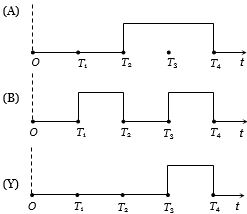
The given figure shows the waveforms for two inputs $A$ and $B$ and that for the output $Y$ of a logic circuit. The logic circuit is
A
An $AND$ gate
B
An $OR$ gate
C
$A$ $NAND$ gate
D
$A$ $NOR$ gate
Solution
(A) From the given waveforms,the following truth table can be constructed:
Comparing this truth table with the standard logic gates,we observe that the output $Y$ is $1$ only when both inputs $A$ and $B$ are $1$. This behavior corresponds to an $AND$ gate.
| Time interval | Input $A$ | Input $B$ | Output $Y$ |
|---|---|---|---|
| $0 \to T_1$ | $0$ | $0$ | $0$ |
| $T_1 \to T_2$ | $0$ | $1$ | $0$ |
| $T_2 \to T_3$ | $1$ | $0$ | $0$ |
| $T_3 \to T_4$ | $1$ | $1$ | $1$ |
Comparing this truth table with the standard logic gates,we observe that the output $Y$ is $1$ only when both inputs $A$ and $B$ are $1$. This behavior corresponds to an $AND$ gate.
0 likes
View Solution30
MediumMCQ
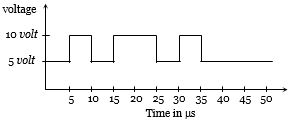
In a negative logic system,the following waveform corresponds to which binary sequence?
A
$0000000000$
B
$101101000$
C
$1111111111$
D
$1010010111$
Solution
(D) In a negative logic system,the lower voltage level $(5 \text{ V})$ is assigned the logic state '$0$' and the higher voltage level $(10 \text{ V})$ is assigned the logic state '$1$'.
However,in negative logic,the interpretation is inverted: a low signal $(5 \text{ V})$ represents logic '$1$' and a high signal $(10 \text{ V})$ represents logic '$0$'.
Let us divide the time axis into intervals of $5 \text{ } \mu\text{s}$ each.
The voltage levels for each interval are:
$0-5 \text{ } \mu\text{s}: 5 \text{ V} \rightarrow \text{Logic } 1$
$5-10 \text{ } \mu\text{s}: 10 \text{ V} \rightarrow \text{Logic } 0$
$10-15 \text{ } \mu\text{s}: 5 \text{ V} \rightarrow \text{Logic } 1$
$15-20 \text{ } \mu\text{s}: 10 \text{ V} \rightarrow \text{Logic } 0$
$20-25 \text{ } \mu\text{s}: 10 \text{ V} \rightarrow \text{Logic } 0$
$25-30 \text{ } \mu\text{s}: 5 \text{ V} \rightarrow \text{Logic } 1$
$30-35 \text{ } \mu\text{s}: 10 \text{ V} \rightarrow \text{Logic } 0$
$35-40 \text{ } \mu\text{s}: 5 \text{ V} \rightarrow \text{Logic } 1$
$40-45 \text{ } \mu\text{s}: 5 \text{ V} \rightarrow \text{Logic } 1$
$45-50 \text{ } \mu\text{s}: 5 \text{ V} \rightarrow \text{Logic } 1$
Combining these,we get the sequence: $1010010111$.
However,in negative logic,the interpretation is inverted: a low signal $(5 \text{ V})$ represents logic '$1$' and a high signal $(10 \text{ V})$ represents logic '$0$'.
Let us divide the time axis into intervals of $5 \text{ } \mu\text{s}$ each.
The voltage levels for each interval are:
$0-5 \text{ } \mu\text{s}: 5 \text{ V} \rightarrow \text{Logic } 1$
$5-10 \text{ } \mu\text{s}: 10 \text{ V} \rightarrow \text{Logic } 0$
$10-15 \text{ } \mu\text{s}: 5 \text{ V} \rightarrow \text{Logic } 1$
$15-20 \text{ } \mu\text{s}: 10 \text{ V} \rightarrow \text{Logic } 0$
$20-25 \text{ } \mu\text{s}: 10 \text{ V} \rightarrow \text{Logic } 0$
$25-30 \text{ } \mu\text{s}: 5 \text{ V} \rightarrow \text{Logic } 1$
$30-35 \text{ } \mu\text{s}: 10 \text{ V} \rightarrow \text{Logic } 0$
$35-40 \text{ } \mu\text{s}: 5 \text{ V} \rightarrow \text{Logic } 1$
$40-45 \text{ } \mu\text{s}: 5 \text{ V} \rightarrow \text{Logic } 1$
$45-50 \text{ } \mu\text{s}: 5 \text{ V} \rightarrow \text{Logic } 1$
Combining these,we get the sequence: $1010010111$.
0 likes
View Solution31
MediumMCQ
Digital signals are characterized by which of the following statements?
$(i)$ They do not provide continuous values.
$(ii)$ They represent values in discrete steps.
$(iii)$ They can be represented by a binary system.
$(iv)$ They represent both binary and decimal systems.
$(i)$ They do not provide continuous values.
$(ii)$ They represent values in discrete steps.
$(iii)$ They can be represented by a binary system.
$(iv)$ They represent both binary and decimal systems.
A
$(i)$ and $(ii)$
B
$(i), (ii)$ and $(iii)$
C
$(ii), (iii)$ and $(iv)$
D
All of the above
Solution
(B) Digital signals are signals that represent data as a sequence of discrete values at any given time.
$(i)$ Unlike analog signals,digital signals do not provide continuous values; they are discontinuous.
$(ii)$ They represent information in discrete steps (e.g.,$0$ and $1$).
$(iii)$ Digital signals are typically represented using a binary system ($0$ and $1$).
$(iv)$ While they can be used to encode decimal numbers,the fundamental nature of a digital signal is binary.
Therefore,statements $(i), (ii),$ and $(iii)$ are correct descriptions of digital signals.
$(i)$ Unlike analog signals,digital signals do not provide continuous values; they are discontinuous.
$(ii)$ They represent information in discrete steps (e.g.,$0$ and $1$).
$(iii)$ Digital signals are typically represented using a binary system ($0$ and $1$).
$(iv)$ While they can be used to encode decimal numbers,the fundamental nature of a digital signal is binary.
Therefore,statements $(i), (ii),$ and $(iii)$ are correct descriptions of digital signals.
0 likes
View Solution32
MediumMCQ
Which of the following logic gates has an output of $1$?

A
$a$
B
$b$
C
$c$
D
$d$
Solution
(C) Let us analyze each logic gate:
$(a)$ This is a $NOR$ gate with inputs $1$ and $1$. The output of a $NOR$ gate is $Y = \overline{A+B}$. For inputs $1, 1$,$Y = \overline{1+1} = \overline{1} = 0$.
$(b)$ This is a $NOR$ gate with inputs $0$ and $1$. For inputs $0, 1$,$Y = \overline{0+1} = \overline{1} = 0$.
$(c)$ This is a $NAND$ gate with inputs $0$ and $1$. The output of a $NAND$ gate is $Y = \overline{A \cdot B}$. For inputs $0, 1$,$Y = \overline{0 \cdot 1} = \overline{0} = 1$.
$(d)$ This is an $XOR$ gate with inputs $0$ and $0$. The output of an $XOR$ gate is $Y = A \oplus B$. For inputs $0, 0$,$Y = 0 \oplus 0 = 0$.
Therefore,only gate $(c)$ has an output of $1$.
$(a)$ This is a $NOR$ gate with inputs $1$ and $1$. The output of a $NOR$ gate is $Y = \overline{A+B}$. For inputs $1, 1$,$Y = \overline{1+1} = \overline{1} = 0$.
$(b)$ This is a $NOR$ gate with inputs $0$ and $1$. For inputs $0, 1$,$Y = \overline{0+1} = \overline{1} = 0$.
$(c)$ This is a $NAND$ gate with inputs $0$ and $1$. The output of a $NAND$ gate is $Y = \overline{A \cdot B}$. For inputs $0, 1$,$Y = \overline{0 \cdot 1} = \overline{0} = 1$.
$(d)$ This is an $XOR$ gate with inputs $0$ and $0$. The output of an $XOR$ gate is $Y = A \oplus B$. For inputs $0, 0$,$Y = 0 \oplus 0 = 0$.
Therefore,only gate $(c)$ has an output of $1$.
0 likes
View Solution33
EasyMCQ
The Boolean equation $A + \bar{A} = .......$
A
$0$
B
$1$
C
$A$
D
$\bar{A}$
Solution
(B) In Boolean algebra,the $OR$ operation between a variable and its complement always results in $1$.
Case $1$: If $A = 1$,then $\bar{A} = 0$. Therefore,$A + \bar{A} = 1 + 0 = 1$.
Case $2$: If $A = 0$,then $\bar{A} = 1$. Therefore,$A + \bar{A} = 0 + 1 = 1$.
Thus,for any value of $A$,$A + \bar{A} = 1$.
Case $1$: If $A = 1$,then $\bar{A} = 0$. Therefore,$A + \bar{A} = 1 + 0 = 1$.
Case $2$: If $A = 0$,then $\bar{A} = 1$. Therefore,$A + \bar{A} = 0 + 1 = 1$.
Thus,for any value of $A$,$A + \bar{A} = 1$.
0 likes
View Solution34
MediumMCQ
The output of an $OR$ gate is connected to both inputs of a $NAND$ gate. This combination is equivalent to a:
A
$OR$ gate
B
$NOT$ gate
C
$NOR$ gate
D
$AND$ gate
Solution
(C) Let the inputs of the $OR$ gate be $A$ and $B$. The output of the $OR$ gate is $Y_1 = A + B$.
This output $Y_1$ is connected to both inputs of a $NAND$ gate. Let the inputs of the $NAND$ gate be $X_1$ and $X_2$,where $X_1 = X_2 = Y_1 = A + B$.
The output of the $NAND$ gate is $Y = \overline{X_1 \cdot X_2} = \overline{(A + B) \cdot (A + B)} = \overline{A + B}$.
The expression $\overline{A + B}$ represents the Boolean operation of a $NOR$ gate.
Therefore,the combination is equivalent to a $NOR$ gate.
This output $Y_1$ is connected to both inputs of a $NAND$ gate. Let the inputs of the $NAND$ gate be $X_1$ and $X_2$,where $X_1 = X_2 = Y_1 = A + B$.
The output of the $NAND$ gate is $Y = \overline{X_1 \cdot X_2} = \overline{(A + B) \cdot (A + B)} = \overline{A + B}$.
The expression $\overline{A + B}$ represents the Boolean operation of a $NOR$ gate.
Therefore,the combination is equivalent to a $NOR$ gate.
0 likes
View Solution35
EasyMCQ
Which of the following pairs are universal gates?
A
$NAND, NOT$
B
$NAND, AND$
C
$NOR, OR$
D
$NAND, NOR$
Solution
(D) universal gate is a logic gate that can be used to implement any other logic gate or Boolean function.
$NAND$ and $NOR$ gates are known as universal gates because any basic logic gate (like $AND, OR, NOT$) can be constructed using only $NAND$ gates or only $NOR$ gates.
Therefore,the correct pair is $NAND$ and $NOR$.
$NAND$ and $NOR$ gates are known as universal gates because any basic logic gate (like $AND, OR, NOT$) can be constructed using only $NAND$ gates or only $NOR$ gates.
Therefore,the correct pair is $NAND$ and $NOR$.
0 likes
View Solution36
MediumMCQ
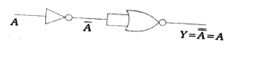
Find the Boolean expression for the logic circuit shown below.

A
$Y = A$
B
$Y = \bar{A}$
C
$Y = \bar{\bar{A}}$
D
$Y = 0$
Solution
(A) The given circuit consists of a $NOT$ gate followed by a $NOR$ gate where both inputs of the $NOR$ gate are connected to the output of the $NOT$ gate.
$1$. The input $A$ passes through the $NOT$ gate,producing an output of $\bar{A}$.
$2$. This signal $\bar{A}$ is fed into both inputs of the $NOR$ gate.
$3$. The output of a $NOR$ gate with inputs $X$ and $Y$ is $\overline{X + Y}$.
$4$. Here,both inputs are $\bar{A}$,so the output $Y = \overline{\bar{A} + \bar{A}}$.
$5$. Using Boolean algebra,$\bar{A} + \bar{A} = \bar{A}$.
$6$. Therefore,$Y = \overline{\bar{A}} = A$.
$1$. The input $A$ passes through the $NOT$ gate,producing an output of $\bar{A}$.
$2$. This signal $\bar{A}$ is fed into both inputs of the $NOR$ gate.
$3$. The output of a $NOR$ gate with inputs $X$ and $Y$ is $\overline{X + Y}$.
$4$. Here,both inputs are $\bar{A}$,so the output $Y = \overline{\bar{A} + \bar{A}}$.
$5$. Using Boolean algebra,$\bar{A} + \bar{A} = \bar{A}$.
$6$. Therefore,$Y = \overline{\bar{A}} = A$.
0 likes
View Solution37
EasyMCQ
Which of the following is the Boolean expression for a $NOR$ gate?
A
$Y = \overline{A}$
B
$Y = \overline{A \cdot B}$
C
$Y = A \cdot B$
D
$Y = \overline{A + B}$
Solution
(D) $NOR$ gate is the combination of an $OR$ gate followed by a $NOT$ gate.
The Boolean expression for an $OR$ gate is $Y = A + B$.
By applying the $NOT$ operation (inversion) to the output of the $OR$ gate,we get the expression for the $NOR$ gate:
$Y = \overline{A + B}$
The Boolean expression for an $OR$ gate is $Y = A + B$.
By applying the $NOT$ operation (inversion) to the output of the $OR$ gate,we get the expression for the $NOR$ gate:
$Y = \overline{A + B}$
0 likes
View Solution38
MediumMCQ
To obtain a $NOR$ gate,what is the minimum number of $NAND$ gates required?
A
$3$
B
$2$
C
$1$
D
$4$
Solution
(D) $NOR$ gate can be constructed using $NAND$ gates by following these steps:
$1$. Connect the inputs of two $NAND$ gates together to act as $NOT$ gates (inverters).
$2$. Feed the inputs $A$ and $B$ into these two $NOT$ gates to get $\bar{A}$ and $\bar{B}$.
$3$. Connect $\bar{A}$ and $\bar{B}$ to the inputs of a third $NAND$ gate.
$4$. The output of this third $NAND$ gate will be $\overline{\bar{A} \cdot \bar{B}}$.
$5$. By De Morgan's Law,$\overline{\bar{A} \cdot \bar{B}} = A + B$,which is the output of an $OR$ gate.
$6$. To get a $NOR$ gate,we need to invert this output,requiring a fourth $NAND$ gate used as a $NOT$ gate.
$7$. However,a more efficient configuration exists using $4$ $NAND$ gates to realize a $NOR$ gate. Thus,the minimum number of $NAND$ gates required is $4$.
$1$. Connect the inputs of two $NAND$ gates together to act as $NOT$ gates (inverters).
$2$. Feed the inputs $A$ and $B$ into these two $NOT$ gates to get $\bar{A}$ and $\bar{B}$.
$3$. Connect $\bar{A}$ and $\bar{B}$ to the inputs of a third $NAND$ gate.
$4$. The output of this third $NAND$ gate will be $\overline{\bar{A} \cdot \bar{B}}$.
$5$. By De Morgan's Law,$\overline{\bar{A} \cdot \bar{B}} = A + B$,which is the output of an $OR$ gate.
$6$. To get a $NOR$ gate,we need to invert this output,requiring a fourth $NAND$ gate used as a $NOT$ gate.
$7$. However,a more efficient configuration exists using $4$ $NAND$ gates to realize a $NOR$ gate. Thus,the minimum number of $NAND$ gates required is $4$.
0 likes
View Solution39
EasyMCQ
Which gate is used in digital circuits to perform universal logic operations?
A
$OR$ gate
B
$AND$ gate
C
$NOT$ gate
D
$NAND$ gate
Solution
(D) In digital electronics,$NAND$ and $NOR$ gates are known as universal gates. This is because any basic logic gate (such as $AND$,$OR$,or $NOT$) can be implemented using only $NAND$ gates or only $NOR$ gates. Among the given options,the $NAND$ gate is a universal gate,making it the fundamental building block for complex digital circuits.
0 likes
View Solution40
EasyMCQ
The $XOR$ gate gives an output of $1$ only when the two inputs are . . . . .
A
Same
B
Different
C
Low
D
High
Solution
(B) The $XOR$ (Exclusive $OR$) gate is a digital logic gate that implements exclusive disjunction.
Its Boolean expression is $Y = A \oplus B$,which is equivalent to $Y = A\bar{B} + \bar{A}B$.
The truth table for a two-input $XOR$ gate is:
If $A=0, B=0$,then $Y=0$.
If $A=0, B=1$,then $Y=1$.
If $A=1, B=0$,then $Y=1$.
If $A=1, B=1$,then $Y=0$.
From the truth table,it is clear that the output is $1$ (High) only when the inputs $A$ and $B$ are different.
Its Boolean expression is $Y = A \oplus B$,which is equivalent to $Y = A\bar{B} + \bar{A}B$.
The truth table for a two-input $XOR$ gate is:
If $A=0, B=0$,then $Y=0$.
If $A=0, B=1$,then $Y=1$.
If $A=1, B=0$,then $Y=1$.
If $A=1, B=1$,then $Y=0$.
From the truth table,it is clear that the output is $1$ (High) only when the inputs $A$ and $B$ are different.
0 likes
View Solution41
EasyMCQ
Which of the following relations is correct according to Boolean algebra?
A
$A + \overline{A} = 0$
B
$A + A = 2A$
C
$A + \overline{A} = 1$
D
$A + \overline{A} = A$
Solution
(C) In Boolean algebra,the variable $A$ can only take two values: $0$ or $1$.
If $A = 0$,then $\overline{A} = 1$. Thus,$A + \overline{A} = 0 + 1 = 1$.
If $A = 1$,then $\overline{A} = 0$. Thus,$A + \overline{A} = 1 + 0 = 1$.
Therefore,for any value of $A$,the relation $A + \overline{A} = 1$ always holds true.
If $A = 0$,then $\overline{A} = 1$. Thus,$A + \overline{A} = 0 + 1 = 1$.
If $A = 1$,then $\overline{A} = 0$. Thus,$A + \overline{A} = 1 + 0 = 1$.
Therefore,for any value of $A$,the relation $A + \overline{A} = 1$ always holds true.
0 likes
View Solution42
MediumMCQ
Which of the following Boolean equations is incorrect?
A
$\overline {\overline A .\,\overline B } \,\, = \,\,A\,\, + \,\,B$
B
$\overline {\overline A \,\, + \,\overline B } \,\, = \,\,A.B$
C
$\overline {\left( {\overline {A.B} } \right)\,.\,\left( {\overline {A.B} } \right)} \,\, = \,AB$
D
$\overline A \, + \,\,\overline A \, = \,\,\,1$
Solution
(D) According to De Morgan's Laws:
$1$. $\overline{A.B} = \overline{A} + \overline{B}$
$2$. $\overline{A+B} = \overline{A}.\overline{B}$
Let's evaluate each option:
Option $A$: $\overline{\overline{A}.\overline{B}} = \overline{\overline{A}} + \overline{\overline{B}} = A + B$. (Correct)
Option $B$: $\overline{\overline{A} + \overline{B}} = \overline{\overline{A}} . \overline{\overline{B}} = A.B$. (Correct)
Option $C$: $\overline{(\overline{A.B}).(\overline{A.B})} = \overline{\overline{A.B}} = A.B$. (Correct)
Option $D$: $\overline{A} + \overline{A} = \overline{A}$. The equation states $\overline{A} + \overline{A} = 1$,which is incorrect because it is only true if $A=0$. Therefore,option $D$ is the incorrect equation.
$1$. $\overline{A.B} = \overline{A} + \overline{B}$
$2$. $\overline{A+B} = \overline{A}.\overline{B}$
Let's evaluate each option:
Option $A$: $\overline{\overline{A}.\overline{B}} = \overline{\overline{A}} + \overline{\overline{B}} = A + B$. (Correct)
Option $B$: $\overline{\overline{A} + \overline{B}} = \overline{\overline{A}} . \overline{\overline{B}} = A.B$. (Correct)
Option $C$: $\overline{(\overline{A.B}).(\overline{A.B})} = \overline{\overline{A.B}} = A.B$. (Correct)
Option $D$: $\overline{A} + \overline{A} = \overline{A}$. The equation states $\overline{A} + \overline{A} = 1$,which is incorrect because it is only true if $A=0$. Therefore,option $D$ is the incorrect equation.
0 likes
View Solution43
MediumMCQ
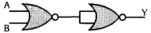
Which logic gate is represented by the given arrangement?
A
$OR$
B
$AND$
C
$NAND$
D
$NOT$
Solution
(A) The given circuit consists of a $NOR$ gate followed by another $NOR$ gate where both inputs are tied together.
$1$. The first gate is a $NOR$ gate with inputs $A$ and $B$. Its output is $Y_1 = \overline{A+B}$.
$2$. The second gate is also a $NOR$ gate with both inputs connected to $Y_1$. $A$ $NOR$ gate with both inputs tied together acts as a $NOT$ gate.
$3$. Therefore,the final output is $Y = \overline{Y_1} = \overline{(\overline{A+B})} = A+B$.
$4$. The Boolean expression $Y = A+B$ represents an $OR$ gate.
$1$. The first gate is a $NOR$ gate with inputs $A$ and $B$. Its output is $Y_1 = \overline{A+B}$.
$2$. The second gate is also a $NOR$ gate with both inputs connected to $Y_1$. $A$ $NOR$ gate with both inputs tied together acts as a $NOT$ gate.
$3$. Therefore,the final output is $Y = \overline{Y_1} = \overline{(\overline{A+B})} = A+B$.
$4$. The Boolean expression $Y = A+B$ represents an $OR$ gate.
0 likes
View SolutionSemiconductor Electronics — Boolean Algebra and Logic Gates · Frequently Asked Questions
1Are these Semiconductor Electronics questions useful for JEE and NEET?
Yes. All questions in this section are mapped to JEE Main and NEET exam patterns. Previous year questions from JEE Main, NEET, GUJCET and state-level exams are included with full solutions.
2Can I switch to Hindi or Gujarati for these questions?
Yes. Use the language tabs in the hero section or the sidebar to view the same questions and solutions in English, Hindi or Gujarati.
3How do I generate a question paper from this subtopic?
Use the Vedclass Exam Paper Generator — select the chapter and subtopic, set difficulty, and generate Sets A, B, C, D automatically. First 3 chapters of every subject are free.
Vedclass Products
For Students
Vedclass Test Series
Mock tests in real JEE/NEET style with performance analysis. 5-day free trial.
Start Free TrialFor Teachers
Exam Paper Generator
Generate Set A/B/C/D papers from this chapter in 2 minutes. 3 chapters free.
Try FreeFor Institutes
Online Exam Module
Live online exams with unlimited students, 360° analytics & white-label branding.
See DemoFor Teachers & Institutes
Generate a Semiconductor Electronics Exam Paper in 2 Minutes
Select subtopic & difficulty — Sets A, B, C, D auto-generated with No Repeat logic.
First 3 chapters of every subject are free — no payment required.