
A English
Junction Transistor Questions in English
Class 12 Physics · Semiconductor Electronics · Junction Transistor
399+
Questions
English
Language
100%
With Solutions
Showing 38 of 399 questions in English
351
EasyMCQ
For a common-emitter transistor amplifier, the current gain is $60$. If the emitter current is $6.6 \,mA$, then its base current is (in $\,mA$)
A
$6.492$
B
$0.108$
C
$4.208$
D
$0.343$
Solution
(B) In a common-emitter configuration, the current gain $\beta$ is defined as $\beta = \frac{I_C}{I_B}$.
Given $\beta = 60$, we have $I_C = 60 I_B$.
We know that the emitter current $I_E$ is the sum of the base current $I_B$ and the collector current $I_C$:
$I_E = I_B + I_C$
Substituting $I_C = 60 I_B$ into the equation:
$I_E = I_B + 60 I_B = 61 I_B$
Given $I_E = 6.6 \,mA$, we can solve for $I_B$:
$6.6 \,mA = 61 I_B$
$I_B = \frac{6.6}{61} \,mA \approx 0.108 \,mA$.
Given $\beta = 60$, we have $I_C = 60 I_B$.
We know that the emitter current $I_E$ is the sum of the base current $I_B$ and the collector current $I_C$:
$I_E = I_B + I_C$
Substituting $I_C = 60 I_B$ into the equation:
$I_E = I_B + 60 I_B = 61 I_B$
Given $I_E = 6.6 \,mA$, we can solve for $I_B$:
$6.6 \,mA = 61 I_B$
$I_B = \frac{6.6}{61} \,mA \approx 0.108 \,mA$.
0 likes
View Solution352
EasyMCQ
In an $n-p-n$ transistor,in $CE$ configuration:
A
$1$ and $2$ are correct
B
$1$ and $3$ are correct
C
$1$ and $4$ are correct
D
$2$ and $3$ are correct
Solution
(C) $1$. The emitter is heavily doped compared to the collector to provide a large number of charge carriers. This statement is correct.
$2$. Emitter and collector cannot be interchanged because they are designed differently in terms of doping concentration and physical size. This statement is incorrect.
$3$. The base region is very thin but is lightly doped to minimize recombination of charge carriers. This statement is incorrect.
$4$. In an $n-p-n$ transistor,the conventional current flows from the base to the emitter (as electrons flow from emitter to base). This statement is correct.
Therefore,statements $1$ and $4$ are correct.
$2$. Emitter and collector cannot be interchanged because they are designed differently in terms of doping concentration and physical size. This statement is incorrect.
$3$. The base region is very thin but is lightly doped to minimize recombination of charge carriers. This statement is incorrect.
$4$. In an $n-p-n$ transistor,the conventional current flows from the base to the emitter (as electrons flow from emitter to base). This statement is correct.
Therefore,statements $1$ and $4$ are correct.
0 likes
View Solution353
EasyMCQ
$A$ transistor has $3$ impurity regions of different doping levels. In the order of increasing doping level,the regions are
A
$Emitter, Base, Collector$
B
$Collector, Base, Emitter$
C
$Base, Emitter, Collector$
D
$Base, Collector, Emitter$
Solution
(D) In a transistor,the three regions are the emitter,base,and collector.
$1$. The $Base$ is very thin and lightly doped to allow most charge carriers to pass through to the collector.
$2$. The $Collector$ is moderately doped and larger in size to dissipate heat.
$3$. The $Emitter$ is heavily doped to provide a large number of charge carriers.
Therefore,the order of increasing doping level is $Base < Collector < Emitter$.
$1$. The $Base$ is very thin and lightly doped to allow most charge carriers to pass through to the collector.
$2$. The $Collector$ is moderately doped and larger in size to dissipate heat.
$3$. The $Emitter$ is heavily doped to provide a large number of charge carriers.
Therefore,the order of increasing doping level is $Base < Collector < Emitter$.
0 likes
View Solution354
EasyMCQ
The phase difference between the input voltage and the output voltage in a common emitter amplifier is (in $^{\circ}$)
A
$0$
B
$90$
C
$120$
D
$180$
Solution
(D) In a common emitter amplifier configuration,the input signal is applied to the base-emitter junction and the output is taken from the collector-emitter junction.
When the input voltage increases,the base current increases,which in turn increases the collector current.
Due to the voltage drop across the load resistor in the collector circuit,an increase in collector current leads to a decrease in the output voltage.
Because the output voltage decreases as the input voltage increases,they are in opposite phases.
Therefore,the phase difference between the input voltage and the output voltage in a common emitter amplifier is $180^{\circ}$.
When the input voltage increases,the base current increases,which in turn increases the collector current.
Due to the voltage drop across the load resistor in the collector circuit,an increase in collector current leads to a decrease in the output voltage.
Because the output voltage decreases as the input voltage increases,they are in opposite phases.
Therefore,the phase difference between the input voltage and the output voltage in a common emitter amplifier is $180^{\circ}$.
0 likes
View Solution355
EasyMCQ
In a transistor circuit,the collector current is changed by $8.9 \ mA$,if the emitter current is changed by $9.0 \ mA$. The value of current amplification factor,$\beta$ is
A
$89$
B
$92$
C
$84$
D
$96$
Solution
(A) Given:
Change in collector current,$\Delta I_C = 8.9 \ mA$
Change in emitter current,$\Delta I_E = 9.0 \ mA$
We know that the emitter current is the sum of collector current and base current: $\Delta I_E = \Delta I_C + \Delta I_B$
Therefore,the change in base current is: $\Delta I_B = \Delta I_E - \Delta I_C = 9.0 \ mA - 8.9 \ mA = 0.1 \ mA$
The current amplification factor $\beta$ is defined as the ratio of change in collector current to the change in base current:
$\beta = \frac{\Delta I_C}{\Delta I_B} = \frac{8.9 \ mA}{0.1 \ mA} = 89$
Change in collector current,$\Delta I_C = 8.9 \ mA$
Change in emitter current,$\Delta I_E = 9.0 \ mA$
We know that the emitter current is the sum of collector current and base current: $\Delta I_E = \Delta I_C + \Delta I_B$
Therefore,the change in base current is: $\Delta I_B = \Delta I_E - \Delta I_C = 9.0 \ mA - 8.9 \ mA = 0.1 \ mA$
The current amplification factor $\beta$ is defined as the ratio of change in collector current to the change in base current:
$\beta = \frac{\Delta I_C}{\Delta I_B} = \frac{8.9 \ mA}{0.1 \ mA} = 89$
0 likes
View Solution356
MediumMCQ
The power gain and voltage gain of a transistor connected in common emitter configuration are $1800$ and $60$ respectively. If the change in the emitter current is $0.62 \text{ mA}$, then the change in the collector current is: (in $\text{ mA}$)
A
$0.60$
B
$0.58$
C
$0.52$
D
$0.48$
Solution
(A) Given: Power gain $(A_p)$ = $1800$, Voltage gain $(A_v)$ = $60$, Change in emitter current $(\Delta I_e)$ = $0.62 \text{ mA}$.
We know that Power gain $(A_p)$ = Current gain $(\beta)$ $\times$ Voltage gain $(A_v)$.
Therefore, $\beta = A_p / A_v = 1800 / 60 = 30$.
We also know that the current gain in common emitter configuration is $\beta = \Delta I_c / \Delta I_b$, and $\Delta I_e = \Delta I_b + \Delta I_c$.
Substituting $\Delta I_b = \Delta I_c / \beta$, we get $\Delta I_e = \Delta I_c / \beta + \Delta I_c = \Delta I_c (1 + 1/\beta) = \Delta I_c ((\beta + 1) / \beta)$.
Rearranging for $\Delta I_c$: $\Delta I_c = \Delta I_e \times (\beta / (\beta + 1))$.
Substituting the values: $\Delta I_c = 0.62 \times (30 / 31) = 0.62 \times (0.9677) \approx 0.60 \text{ mA}$.
We know that Power gain $(A_p)$ = Current gain $(\beta)$ $\times$ Voltage gain $(A_v)$.
Therefore, $\beta = A_p / A_v = 1800 / 60 = 30$.
We also know that the current gain in common emitter configuration is $\beta = \Delta I_c / \Delta I_b$, and $\Delta I_e = \Delta I_b + \Delta I_c$.
Substituting $\Delta I_b = \Delta I_c / \beta$, we get $\Delta I_e = \Delta I_c / \beta + \Delta I_c = \Delta I_c (1 + 1/\beta) = \Delta I_c ((\beta + 1) / \beta)$.
Rearranging for $\Delta I_c$: $\Delta I_c = \Delta I_e \times (\beta / (\beta + 1))$.
Substituting the values: $\Delta I_c = 0.62 \times (30 / 31) = 0.62 \times (0.9677) \approx 0.60 \text{ mA}$.
0 likes
View Solution357
MediumMCQ
$10^{10}$ electrons enter the emitter of a junction transistor in a time of $0.4 \mu s$. If $5 \%$ of the electrons are lost in the base, then the collector current is (in $\text{ mA}$)
A
$3.0$
B
$3.2$
C
$3.6$
D
$3.8$
Solution
(D) The emitter current $I_E$ is given by the rate of flow of charge: $I_E = \frac{q}{t} = \frac{n \cdot e}{t}$.
Given $n = 10^{10}$, $e = 1.6 \times 10^{-19} \text{ C}$, and $t = 0.4 \times 10^{-6} \text{ s}$.
$I_E = \frac{10^{10} \times 1.6 \times 10^{-19}}{0.4 \times 10^{-6}} = \frac{1.6 \times 10^{-9}}{0.4 \times 10^{-6}} = 4 \times 10^{-3} \text{ A} = 4 \text{ mA}$.
Since $5 \%$ of the electrons are lost in the base, the collector current $I_C$ is $95 \%$ of the emitter current $I_E$.
$I_C = 0.95 \times I_E = 0.95 \times 4 \text{ mA} = 3.8 \text{ mA}$.
Given $n = 10^{10}$, $e = 1.6 \times 10^{-19} \text{ C}$, and $t = 0.4 \times 10^{-6} \text{ s}$.
$I_E = \frac{10^{10} \times 1.6 \times 10^{-19}}{0.4 \times 10^{-6}} = \frac{1.6 \times 10^{-9}}{0.4 \times 10^{-6}} = 4 \times 10^{-3} \text{ A} = 4 \text{ mA}$.
Since $5 \%$ of the electrons are lost in the base, the collector current $I_C$ is $95 \%$ of the emitter current $I_E$.
$I_C = 0.95 \times I_E = 0.95 \times 4 \text{ mA} = 3.8 \text{ mA}$.
0 likes
View Solution358
MediumMCQ
According to a graph drawn between the input and output voltages of a transistor connected in common emitter configuration,the region in which the transistor acts as a switch is
A
Cutoff or saturation region
B
Active region
C
Active or saturation region
D
Cutoff or active region
Solution
(A) transistor acts as a switch when it is operated between two states: the $OFF$ state and the $ON$ state.
In the $OFF$ state,the transistor is in the cutoff region,where the collector current is zero.
In the $ON$ state,the transistor is in the saturation region,where the collector current is maximum and the output voltage is very low.
The active region is used for amplification,not for switching.
Therefore,the transistor acts as a switch in the cutoff or saturation region.
In the $OFF$ state,the transistor is in the cutoff region,where the collector current is zero.
In the $ON$ state,the transistor is in the saturation region,where the collector current is maximum and the output voltage is very low.
The active region is used for amplification,not for switching.
Therefore,the transistor acts as a switch in the cutoff or saturation region.
0 likes
View Solution359
MediumMCQ
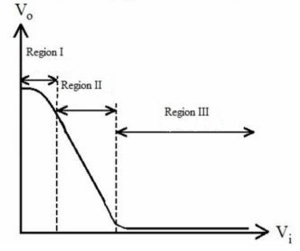
The graph between the input voltage $(V_{i})$ and the output voltage $(V_{o})$ of a transistor connected in common emitter configuration is shown in the figure. The active,saturation and cutoff regions of the transistor are respectively
A
$I, II$ and $III$
B
$II, III$ and $I$
C
$I, III$ and $II$
D
$III, I$ and $II$
Solution
(B) In a common emitter transistor configuration,the transfer characteristic curve shows three distinct regions:
$1$. Cutoff Region: When the input voltage $(V_{i})$ is low,the transistor is in the cutoff region,and the output voltage $(V_{o})$ is high (near $V_{CC}$). This corresponds to Region $I$.
$2$. Active Region: As $(V_{i})$ increases,the transistor enters the active region where the output voltage $(V_{o})$ decreases linearly with $(V_{i})$. This corresponds to Region $II$.
$3$. Saturation Region: When $(V_{i})$ is high,the transistor enters the saturation region,and the output voltage $(V_{o})$ becomes very low (near $0$). This corresponds to Region $III$.
Therefore,the active,saturation,and cutoff regions are represented by $II, III$ and $I$ respectively.
$1$. Cutoff Region: When the input voltage $(V_{i})$ is low,the transistor is in the cutoff region,and the output voltage $(V_{o})$ is high (near $V_{CC}$). This corresponds to Region $I$.
$2$. Active Region: As $(V_{i})$ increases,the transistor enters the active region where the output voltage $(V_{o})$ decreases linearly with $(V_{i})$. This corresponds to Region $II$.
$3$. Saturation Region: When $(V_{i})$ is high,the transistor enters the saturation region,and the output voltage $(V_{o})$ becomes very low (near $0$). This corresponds to Region $III$.
Therefore,the active,saturation,and cutoff regions are represented by $II, III$ and $I$ respectively.
0 likes
View Solution360
EasyMCQ
The current amplification factor of a transistor in common emitter configuration is $80$. If the emitter current is $2.43 \text{ mA}$,then the base current is (in $\mu \text{A}$)
A
$15$
B
$1.5$
C
$3$
D
$30$
Solution
(D) In a common emitter configuration,the current amplification factor is given by $\beta = 80$.
The relationship between emitter current $(I_E)$,collector current $(I_C)$,and base current $(I_B)$ is $I_E = I_C + I_B$.
We also know that $\beta = \frac{I_C}{I_B}$,which implies $I_C = \beta I_B$.
Substituting $I_C$ in the first equation: $I_E = \beta I_B + I_B = I_B(\beta + 1)$.
Given $I_E = 2.43 \text{ mA} = 2430 \mu \text{A}$ and $\beta = 80$.
$I_B = \frac{I_E}{\beta + 1} = \frac{2430 \mu \text{A}}{80 + 1} = \frac{2430 \mu \text{A}}{81}$.
$I_B = 30 \mu \text{A}$.
The relationship between emitter current $(I_E)$,collector current $(I_C)$,and base current $(I_B)$ is $I_E = I_C + I_B$.
We also know that $\beta = \frac{I_C}{I_B}$,which implies $I_C = \beta I_B$.
Substituting $I_C$ in the first equation: $I_E = \beta I_B + I_B = I_B(\beta + 1)$.
Given $I_E = 2.43 \text{ mA} = 2430 \mu \text{A}$ and $\beta = 80$.
$I_B = \frac{I_E}{\beta + 1} = \frac{2430 \mu \text{A}}{80 + 1} = \frac{2430 \mu \text{A}}{81}$.
$I_B = 30 \mu \text{A}$.
0 likes
View Solution361
EasyMCQ
The region in the output voltage versus input voltage graph where a transistor can be used as an amplifier is
A
active region
B
cut off region
C
saturation region
D
passive region
Solution
(A) transistor operates as an amplifier in its active region.
In the active region,the emitter-base junction is forward-biased and the collector-base junction is reverse-biased.
This configuration allows the transistor to provide current and voltage gain,making it suitable for amplification purposes.
In contrast,the cut-off region acts as an open switch ($OFF$ state),and the saturation region acts as a closed switch ($ON$ state).
In the active region,the emitter-base junction is forward-biased and the collector-base junction is reverse-biased.
This configuration allows the transistor to provide current and voltage gain,making it suitable for amplification purposes.
In contrast,the cut-off region acts as an open switch ($OFF$ state),and the saturation region acts as a closed switch ($ON$ state).
0 likes
View Solution362
DifficultMCQ
The voltage gain of a transistor in common emitter configuration is $160$. The resistances in base and collector sides of the circuit are $1 \text{ k}\Omega$ and $4 \text{ k}\Omega$ respectively. If the change in base current is $100 \mu A$, then the change in output current is:
A
$4 \text{ mA}$
B
$4 \mu A$
C
$40 \text{ mA}$
D
$40 \mu A$
Solution
(A) For a transistor in common emitter configuration, the voltage gain $A_V$ is given by the product of current gain $\beta$ and resistance gain $R_C/R_B$.
$A_V = \beta \times \frac{R_C}{R_B}$
Given: $A_V = 160$, $R_B = 1 \text{ k}\Omega$, $R_C = 4 \text{ k}\Omega$, and $\Delta I_B = 100 \mu A$.
We know that $\beta = \frac{\Delta I_C}{\Delta I_B}$.
Substituting this into the voltage gain formula:
$A_V = \left(\frac{\Delta I_C}{\Delta I_B}\right) \times \frac{R_C}{R_B}$
$160 = \left(\frac{\Delta I_C}{100 \times 10^{-6} \text{ A}}\right) \times \left(\frac{4 \text{ k}\Omega}{1 \text{ k}\Omega}\right)$
$160 = \left(\frac{\Delta I_C}{100 \times 10^{-6}}\right) \times 4$
$40 = \frac{\Delta I_C}{100 \times 10^{-6}}$
$\Delta I_C = 40 \times 100 \times 10^{-6} \text{ A} = 4000 \times 10^{-6} \text{ A} = 4 \times 10^{-3} \text{ A} = 4 \text{ mA}$.
Thus, the change in output current is $4 \text{ mA}$.
$A_V = \beta \times \frac{R_C}{R_B}$
Given: $A_V = 160$, $R_B = 1 \text{ k}\Omega$, $R_C = 4 \text{ k}\Omega$, and $\Delta I_B = 100 \mu A$.
We know that $\beta = \frac{\Delta I_C}{\Delta I_B}$.
Substituting this into the voltage gain formula:
$A_V = \left(\frac{\Delta I_C}{\Delta I_B}\right) \times \frac{R_C}{R_B}$
$160 = \left(\frac{\Delta I_C}{100 \times 10^{-6} \text{ A}}\right) \times \left(\frac{4 \text{ k}\Omega}{1 \text{ k}\Omega}\right)$
$160 = \left(\frac{\Delta I_C}{100 \times 10^{-6}}\right) \times 4$
$40 = \frac{\Delta I_C}{100 \times 10^{-6}}$
$\Delta I_C = 40 \times 100 \times 10^{-6} \text{ A} = 4000 \times 10^{-6} \text{ A} = 4 \times 10^{-3} \text{ A} = 4 \text{ mA}$.
Thus, the change in output current is $4 \text{ mA}$.
0 likes
View Solution363
MediumMCQ
In a transistor,the base current is $10 \mu A$ and the emitter current is $1 \text{ mA}$. Then,the collector current is: (in $\mu A$)
A
$990$
B
$100$
C
$1010$
D
$90$
Solution
(A) Given: Base current,$i_B = 10 \mu A$.
Emitter current,$i_E = 1 \text{ mA} = 1000 \mu A$.
According to the fundamental relation for a transistor,the emitter current is the sum of the base current and the collector current: $i_E = i_B + i_C$.
Rearranging the formula to find the collector current: $i_C = i_E - i_B$.
Substituting the values: $i_C = 1000 \mu A - 10 \mu A = 990 \mu A$.
Emitter current,$i_E = 1 \text{ mA} = 1000 \mu A$.
According to the fundamental relation for a transistor,the emitter current is the sum of the base current and the collector current: $i_E = i_B + i_C$.
Rearranging the formula to find the collector current: $i_C = i_E - i_B$.
Substituting the values: $i_C = 1000 \mu A - 10 \mu A = 990 \mu A$.
0 likes
View Solution364
EasyMCQ
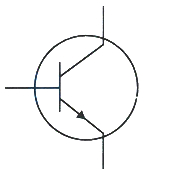
The symbol given below represents:
A
$A$ $p-n-p$ transistor
B
An $n-p-n$ transistor
C
$A$ $p-n$ junction diode
D
An inductor
Solution
(B) In the circuit symbol of a transistor,the arrow on the emitter terminal indicates the direction of conventional current flow.
For an $n-p-n$ transistor,the current flows from the base to the emitter,so the arrow on the emitter points outwards.
For a $p-n-p$ transistor,the current flows from the emitter to the base,so the arrow on the emitter points inwards.
In the given symbol,the arrow on the emitter is pointing outwards,which confirms that it is an $n-p-n$ transistor.
For an $n-p-n$ transistor,the current flows from the base to the emitter,so the arrow on the emitter points outwards.
For a $p-n-p$ transistor,the current flows from the emitter to the base,so the arrow on the emitter points inwards.
In the given symbol,the arrow on the emitter is pointing outwards,which confirms that it is an $n-p-n$ transistor.
0 likes
View Solution365
EasyMCQ
For an $n-p-n$ transistor structure,which of the following statements is $NOT$ true?
A
Emitter is heavily doped and moderate in size
B
Base is lightly doped and thin in size
C
Collector is lightly doped and large in size
D
Collector is moderately doped and large in size
Solution
(C) In an $n-p-n$ transistor,the emitter is heavily doped to provide a large number of charge carriers. The base is very thin and lightly doped to allow most of the charge carriers from the emitter to pass through to the collector. The collector is moderately doped and is the largest in size to dissipate the heat generated during operation. Therefore,the statement that the collector is lightly doped is incorrect.
0 likes
View Solution366
MediumMCQ
In a $p-n-p$ transistor,the collector current is
A
equal to emitter current
B
slightly less than emitter current
C
greater than emitter current
D
half of emitter current
Solution
(B) In a $p-n-p$ transistor,the collector current $(I_C)$ is slightly less than the emitter current $(I_E)$.
This is because the emitter-base junction is forward-biased,causing the majority charge carriers (holes) from the emitter to move towards the base.
Since the base is very thin and lightly doped,only a small fraction of these holes recombine with the electrons in the base,resulting in a small base current $(I_B)$.
The majority of the holes cross the collector-base junction to reach the collector.
According to Kirchhoff's current law for a transistor,the relationship is $I_E = I_B + I_C$.
Since $I_B > 0$,it follows that $I_C < I_E$.
This is because the emitter-base junction is forward-biased,causing the majority charge carriers (holes) from the emitter to move towards the base.
Since the base is very thin and lightly doped,only a small fraction of these holes recombine with the electrons in the base,resulting in a small base current $(I_B)$.
The majority of the holes cross the collector-base junction to reach the collector.
According to Kirchhoff's current law for a transistor,the relationship is $I_E = I_B + I_C$.
Since $I_B > 0$,it follows that $I_C < I_E$.
0 likes
View Solution367
EasyMCQ
In a $p-n-p$ transistor,the current carriers are
A
acceptor ions
B
donor ions
C
free electrons
D
holes
Solution
(D) In a $p-n-p$ transistor,the majority charge carriers are holes.
When the transistor is connected to an external circuit,the current is primarily carried by the movement of these holes through the semiconductor material.
When the transistor is connected to an external circuit,the current is primarily carried by the movement of these holes through the semiconductor material.
0 likes
View Solution368
DifficultMCQ
The current gain of a transistor is $0.98$. If the transistor is used in a common emitter arrangement, what would be the change in collector current corresponding to a change of $0.5 \,mA$ in the base current (in $\,mA$)?
A
$24.5$
B
$47.5$
C
$32.5$
D
$28.5$
Solution
(A) Given, the current gain $\alpha = 0.98$ (since $\alpha < 1$, it refers to the common base configuration).
For a common emitter configuration, the current gain $\beta$ is given by the formula:
$\beta = \frac{\alpha}{1 - \alpha} = \frac{0.98}{1 - 0.98} = \frac{0.98}{0.02} = 49$.
We know that the relationship between collector current change $\Delta I_C$ and base current change $\Delta I_B$ in a common emitter configuration is:
$\beta = \frac{\Delta I_C}{\Delta I_B}$.
Given $\Delta I_B = 0.5 \,mA$, we can calculate $\Delta I_C$ as:
$\Delta I_C = \beta \times \Delta I_B = 49 \times 0.5 \,mA = 24.5 \,mA$.
For a common emitter configuration, the current gain $\beta$ is given by the formula:
$\beta = \frac{\alpha}{1 - \alpha} = \frac{0.98}{1 - 0.98} = \frac{0.98}{0.02} = 49$.
We know that the relationship between collector current change $\Delta I_C$ and base current change $\Delta I_B$ in a common emitter configuration is:
$\beta = \frac{\Delta I_C}{\Delta I_B}$.
Given $\Delta I_B = 0.5 \,mA$, we can calculate $\Delta I_C$ as:
$\Delta I_C = \beta \times \Delta I_B = 49 \times 0.5 \,mA = 24.5 \,mA$.
0 likes
View Solution369
EasyMCQ
In an $n-p-n$ transistor, $95 \%$ of emitted electrons reach the collector. If the base current is $2 \text{ mA}$, then the collector current is (in $\text{ mA}$)
A
$19$
B
$38$
C
$9.5$
D
$48$
Solution
(B) Given, base current in $n-p-n$ transistor, $I_B = 2 \text{ mA} = 2 \times 10^{-3} \text{ A}$.
Since $95 \%$ of emitted electrons reach the collector, the collector current $I_C$ is related to the emitter current $I_E$ as:
$I_C = 0.95 I_E \Rightarrow I_E = \frac{I_C}{0.95} \dots (i)$
We know that the relationship between emitter, collector, and base current is:
$I_E = I_C + I_B$
Substituting the value of $I_E$ from equation $(i)$:
$\frac{I_C}{0.95} = I_C + 2 \times 10^{-3}$
$\frac{I_C}{0.95} - I_C = 2 \times 10^{-3}$
$I_C \left( \frac{1}{0.95} - 1 \right) = 2 \times 10^{-3}$
$I_C \left( \frac{1 - 0.95}{0.95} \right) = 2 \times 10^{-3}$
$I_C \left( \frac{0.05}{0.95} \right) = 2 \times 10^{-3}$
$I_C \left( \frac{1}{19} \right) = 2 \times 10^{-3}$
$I_C = 38 \times 10^{-3} \text{ A} = 38 \text{ mA}$.
Since $95 \%$ of emitted electrons reach the collector, the collector current $I_C$ is related to the emitter current $I_E$ as:
$I_C = 0.95 I_E \Rightarrow I_E = \frac{I_C}{0.95} \dots (i)$
We know that the relationship between emitter, collector, and base current is:
$I_E = I_C + I_B$
Substituting the value of $I_E$ from equation $(i)$:
$\frac{I_C}{0.95} = I_C + 2 \times 10^{-3}$
$\frac{I_C}{0.95} - I_C = 2 \times 10^{-3}$
$I_C \left( \frac{1}{0.95} - 1 \right) = 2 \times 10^{-3}$
$I_C \left( \frac{1 - 0.95}{0.95} \right) = 2 \times 10^{-3}$
$I_C \left( \frac{0.05}{0.95} \right) = 2 \times 10^{-3}$
$I_C \left( \frac{1}{19} \right) = 2 \times 10^{-3}$
$I_C = 38 \times 10^{-3} \text{ A} = 38 \text{ mA}$.

0 likes
View Solution370
MediumMCQ
Consider an amplifier circuit in which a transistor is used in common-emitter mode. The load resistance is $3 k \Omega$. When a signal of $30 mV$ is added to the base-emitter voltage, the base current changes by $30 \mu A$ and the collector current changes by $3 mA$. The power gain in this circuit will be:
A
$10000$
B
$20000$
C
$30000$
D
$40000$
Solution
(C) Given: Load resistance $R_L = 3 k\Omega = 3000 \Omega$.
Input voltage $V_i = 30 mV = 30 \times 10^{-3} V$.
Change in base current $\Delta I_B = 30 \mu A = 30 \times 10^{-6} A = 3 \times 10^{-5} A$.
Change in collector current $\Delta I_C = 3 mA = 3 \times 10^{-3} A$.
First, calculate the current gain $\beta$:
$\beta = \frac{\Delta I_C}{\Delta I_B} = \frac{3 \times 10^{-3}}{3 \times 10^{-5}} = 100$.
Next, calculate the input resistance $R_{in}$:
$R_{in} = \frac{V_i}{\Delta I_B} = \frac{30 \times 10^{-3}}{30 \times 10^{-6}} = 1000 \Omega$.
The power gain $A_P$ is given by the formula:
$A_P = \beta^2 \times \frac{R_L}{R_{in}}$.
Substituting the values:
$A_P = (100)^2 \times \frac{3000}{1000} = 10000 \times 3 = 30000$.
Thus, the power gain is $30000$.
Input voltage $V_i = 30 mV = 30 \times 10^{-3} V$.
Change in base current $\Delta I_B = 30 \mu A = 30 \times 10^{-6} A = 3 \times 10^{-5} A$.
Change in collector current $\Delta I_C = 3 mA = 3 \times 10^{-3} A$.
First, calculate the current gain $\beta$:
$\beta = \frac{\Delta I_C}{\Delta I_B} = \frac{3 \times 10^{-3}}{3 \times 10^{-5}} = 100$.
Next, calculate the input resistance $R_{in}$:
$R_{in} = \frac{V_i}{\Delta I_B} = \frac{30 \times 10^{-3}}{30 \times 10^{-6}} = 1000 \Omega$.
The power gain $A_P$ is given by the formula:
$A_P = \beta^2 \times \frac{R_L}{R_{in}}$.
Substituting the values:
$A_P = (100)^2 \times \frac{3000}{1000} = 10000 \times 3 = 30000$.
Thus, the power gain is $30000$.
0 likes
View Solution371
EasyMCQ
Consider an amplifier circuit wherein a transistor is used in common emitter mode. The change in collector current and base current respectively are $4 mA$ and $20 \mu A$ when a signal of $40 mV$ is added to the base-emitter voltage. If the load resistance is $10 k\Omega$,then the power gain in the circuit is:
A
$1 \times 10^4$
B
$2 \times 10^5$
C
$8 \times 10^5$
D
$1 \times 10^6$
Solution
(B) The voltage gain $(A_v)$ is given by:
$A_v = \frac{\Delta V_o}{\Delta V_i} = \frac{\Delta I_c \times R_L}{\Delta V_i} = \frac{4 \times 10^{-3} \times 10 \times 10^3}{40 \times 10^{-3}} = 1000$
The current gain $(A_i)$ is given by:
$A_i = \frac{\Delta I_c}{\Delta I_b} = \frac{4 \times 10^{-3}}{20 \times 10^{-6}} = 200$
The power gain $(P)$ is the product of voltage gain and current gain:
$P = A_v \times A_i = 1000 \times 200 = 2 \times 10^5$
$A_v = \frac{\Delta V_o}{\Delta V_i} = \frac{\Delta I_c \times R_L}{\Delta V_i} = \frac{4 \times 10^{-3} \times 10 \times 10^3}{40 \times 10^{-3}} = 1000$
The current gain $(A_i)$ is given by:
$A_i = \frac{\Delta I_c}{\Delta I_b} = \frac{4 \times 10^{-3}}{20 \times 10^{-6}} = 200$
The power gain $(P)$ is the product of voltage gain and current gain:
$P = A_v \times A_i = 1000 \times 200 = 2 \times 10^5$
0 likes
View Solution372
MediumMCQ
In a junction transistor,the collector current changes by $6.8 \,mA$,if the emitter current is changed by $7 \,mA$. For such a transistor,the current amplification factor is
A
$30$
B
$34$
C
$40$
D
$45$
Solution
(B) Given: Change in collector current $\Delta I_C = 6.8 \,mA$ and change in emitter current $\Delta I_E = 7 \,mA$.
Since $\Delta I_E = \Delta I_C + \Delta I_B$,the change in base current is $\Delta I_B = \Delta I_E - \Delta I_C = 7 \,mA - 6.8 \,mA = 0.2 \,mA$.
The current amplification factor $\beta$ for a common-emitter configuration is defined as $\beta = \frac{\Delta I_C}{\Delta I_B}$.
Substituting the values: $\beta = \frac{6.8 \,mA}{0.2 \,mA} = 34$.
Thus,the current amplification factor is $34$.
Since $\Delta I_E = \Delta I_C + \Delta I_B$,the change in base current is $\Delta I_B = \Delta I_E - \Delta I_C = 7 \,mA - 6.8 \,mA = 0.2 \,mA$.
The current amplification factor $\beta$ for a common-emitter configuration is defined as $\beta = \frac{\Delta I_C}{\Delta I_B}$.
Substituting the values: $\beta = \frac{6.8 \,mA}{0.2 \,mA} = 34$.
Thus,the current amplification factor is $34$.
0 likes
View Solution373
MediumMCQ
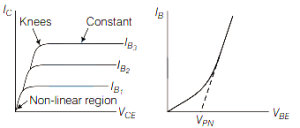
The output characteristics of an $n-p-n$ transistor represent,($I_C =$ collector current,$V_{CE} =$ potential difference between collector and emitter,$I_B =$ base current,$V_{BB} =$ voltage given to base,$V_{BE} =$ the potential difference between base and emitter)
A
changes in $I_C$ as $I_B$ and $V_{BB}$ are changed
B
changes in $I_C$ with changes in $V_{CE}$ ($I_B =$ constant)
C
changes in $I_B$ with changes in $V_{CE}$
D
change in $I_C$ as $V_{BE}$ is changed
Solution
(B) The output characteristics of a transistor are defined as the variation of the collector current $(I_C)$ with the collector-emitter voltage $(V_{CE})$ while keeping the base current $(I_B)$ constant.
This relationship is graphically represented by plotting $I_C$ on the y-axis and $V_{CE}$ on the x-axis for different fixed values of $I_B$.
This relationship is graphically represented by plotting $I_C$ on the y-axis and $V_{CE}$ on the x-axis for different fixed values of $I_B$.
0 likes
View Solution374
EasyMCQ
The base current in a transistor circuit changes from $45 \mu A$ to $140 \mu A$. Accordingly,the collector current changes from $0.2 \text{ mA}$ to $4.0 \text{ mA}$. The gain in current is
A
$9.5$
B
$1$
C
$40$
D
$20$
Solution
(C) The current gain $\beta$ of a transistor in common-emitter configuration is defined as the ratio of the change in collector current to the change in base current.
$\beta = \frac{\Delta I_C}{\Delta I_B}$
Given:
$\Delta I_B = 140 \mu A - 45 \mu A = 95 \mu A = 95 \times 10^{-6} \text{ A}$
$\Delta I_C = 4.0 \text{ mA} - 0.2 \text{ mA} = 3.8 \text{ mA} = 3.8 \times 10^{-3} \text{ A}$
Substituting the values:
$\beta = \frac{3.8 \times 10^{-3}}{95 \times 10^{-6}}$
$\beta = \frac{3800 \times 10^{-6}}{95 \times 10^{-6}}$
$\beta = 40$
$\beta = \frac{\Delta I_C}{\Delta I_B}$
Given:
$\Delta I_B = 140 \mu A - 45 \mu A = 95 \mu A = 95 \times 10^{-6} \text{ A}$
$\Delta I_C = 4.0 \text{ mA} - 0.2 \text{ mA} = 3.8 \text{ mA} = 3.8 \times 10^{-3} \text{ A}$
Substituting the values:
$\beta = \frac{3.8 \times 10^{-3}}{95 \times 10^{-6}}$
$\beta = \frac{3800 \times 10^{-6}}{95 \times 10^{-6}}$
$\beta = 40$
0 likes
View Solution375
DifficultMCQ
In a transistor,if $\frac{I_C}{I_E} = \alpha$ and $\frac{I_C}{I_B} = \beta$. If $\alpha$ varies between $\frac{20}{21}$ and $\frac{100}{101}$,then the value of $\beta$ lies between:
A
$1-10$
B
$0.95-0.99$
C
$20-100$
D
$200-300$
Solution
(C) The relationship between $\alpha$ and $\beta$ is given by $\beta = \frac{\alpha}{1 - \alpha}$.
For $\alpha_1 = \frac{20}{21}$,$\beta_1 = \frac{20/21}{1 - 20/21} = \frac{20/21}{1/21} = 20$.
For $\alpha_2 = \frac{100}{101}$,$\beta_2 = \frac{100/101}{1 - 100/101} = \frac{100/101}{1/101} = 100$.
Therefore,the value of $\beta$ lies between $20$ and $100$.
For $\alpha_1 = \frac{20}{21}$,$\beta_1 = \frac{20/21}{1 - 20/21} = \frac{20/21}{1/21} = 20$.
For $\alpha_2 = \frac{100}{101}$,$\beta_2 = \frac{100/101}{1 - 100/101} = \frac{100/101}{1/101} = 100$.
Therefore,the value of $\beta$ lies between $20$ and $100$.
0 likes
View Solution376
EasyMCQ
$A$ transistor having a $\beta$ equal to $80$ has a change in base current of $250 \mu A$. What is the change in collector current?
A
$20,000 \text{ mA}$
B
$200 \text{ mA}$
C
$2000 \text{ mA}$
D
$20 \text{ mA}$
Solution
(D) The current gain $\beta$ of a transistor in common-emitter configuration is defined as the ratio of the change in collector current $(\Delta i_C)$ to the change in base current $(\Delta i_B)$.
$\beta = \frac{\Delta i_C}{\Delta i_B}$
Given: $\beta = 80$ and $\Delta i_B = 250 \mu A = 250 \times 10^{-6} \text{ A}$.
Substituting the values into the formula:
$80 = \frac{\Delta i_C}{250 \times 10^{-6} \text{ A}}$
$\Delta i_C = 80 \times 250 \times 10^{-6} \text{ A}$
$\Delta i_C = 20,000 \times 10^{-6} \text{ A}$
$\Delta i_C = 20 \times 10^{-3} \text{ A} = 20 \text{ mA}$.
Therefore,the change in collector current is $20 \text{ mA}$.
$\beta = \frac{\Delta i_C}{\Delta i_B}$
Given: $\beta = 80$ and $\Delta i_B = 250 \mu A = 250 \times 10^{-6} \text{ A}$.
Substituting the values into the formula:
$80 = \frac{\Delta i_C}{250 \times 10^{-6} \text{ A}}$
$\Delta i_C = 80 \times 250 \times 10^{-6} \text{ A}$
$\Delta i_C = 20,000 \times 10^{-6} \text{ A}$
$\Delta i_C = 20 \times 10^{-3} \text{ A} = 20 \text{ mA}$.
Therefore,the change in collector current is $20 \text{ mA}$.
0 likes
View Solution377
MediumMCQ
An $n-p-n$ transistor power amplifier in $C-E$ configuration gives
A
voltage amplification only
B
current amplification only
C
both current and voltage amplifications
D
only power gain of unity
Solution
(C) In a Common-Emitter $(C-E)$ configuration, the transistor acts as an amplifier for both current and voltage.
$1$. Current gain $(\beta = I_C / I_B)$ is typically much greater than $1$.
$2$. Voltage gain $(A_V = \beta \times (R_L / R_{in}))$ is also significantly greater than $1$ because the output resistance $(R_L)$ is much higher than the input resistance $(R_{in})$.
$3$. Since both current and voltage are amplified, the power gain $(A_P = A_V \times \beta)$ is also significantly greater than $1$.
Therefore, the $C-E$ configuration provides both current and voltage amplification.
$1$. Current gain $(\beta = I_C / I_B)$ is typically much greater than $1$.
$2$. Voltage gain $(A_V = \beta \times (R_L / R_{in}))$ is also significantly greater than $1$ because the output resistance $(R_L)$ is much higher than the input resistance $(R_{in})$.
$3$. Since both current and voltage are amplified, the power gain $(A_P = A_V \times \beta)$ is also significantly greater than $1$.
Therefore, the $C-E$ configuration provides both current and voltage amplification.
0 likes
View Solution378
MediumMCQ
In $n-p-n$ transistor,in $CE$ configuration:
A
$1$ and $2$ are correct
B
$1$ and $3$ are correct
C
$1$ and $4$ are correct
D
$2$ and $3$ are correct
Solution
(C) $1$. The emitter is heavily doped compared to the collector to provide a large number of charge carriers. This statement is correct.
$2$. Emitter and collector cannot be interchanged because they have different doping levels and physical dimensions. This statement is incorrect.
$3$. The base region is very thin and lightly doped to allow most charge carriers from the emitter to pass through to the collector. This statement is incorrect.
$4$. In an $n-p-n$ transistor,the conventional current flows from the collector to the base and from the base to the emitter (or simply,the emitter current $I_E$ flows out of the emitter). The conventional current direction is from base to emitter in the $n-p-n$ transistor structure. This statement is correct.
Therefore,statements $1$ and $4$ are correct.
$2$. Emitter and collector cannot be interchanged because they have different doping levels and physical dimensions. This statement is incorrect.
$3$. The base region is very thin and lightly doped to allow most charge carriers from the emitter to pass through to the collector. This statement is incorrect.
$4$. In an $n-p-n$ transistor,the conventional current flows from the collector to the base and from the base to the emitter (or simply,the emitter current $I_E$ flows out of the emitter). The conventional current direction is from base to emitter in the $n-p-n$ transistor structure. This statement is correct.
Therefore,statements $1$ and $4$ are correct.
0 likes
View Solution379
EasyMCQ
When $n-p-n$ transistor is used as an amplifier :
A
electrons move from base to collector
B
holes move from emitter to base
C
holes move from collector to base
D
holes move from base to emitter
Solution
(A) In an $n-p-n$ transistor,the emitter is $n$-type,the base is $p$-type,and the collector is $n$-type.
When used as an amplifier,the base-emitter junction is forward-biased and the base-collector junction is reverse-biased.
Due to the forward bias,electrons are injected from the $n$-type emitter into the $p$-type base.
Because the base is very thin and lightly doped,most of these electrons diffuse through the base into the collector region.
The collector is kept at a positive potential relative to the base,which attracts these electrons from the base to the collector.
Therefore,electrons move from the base to the collector.
When used as an amplifier,the base-emitter junction is forward-biased and the base-collector junction is reverse-biased.
Due to the forward bias,electrons are injected from the $n$-type emitter into the $p$-type base.
Because the base is very thin and lightly doped,most of these electrons diffuse through the base into the collector region.
The collector is kept at a positive potential relative to the base,which attracts these electrons from the base to the collector.
Therefore,electrons move from the base to the collector.
0 likes
View Solution380
DifficultMCQ
$A$ common emitter transistor amplifier has a current gain of $50$. If the load resistance is $4 \ k\Omega$ and input resistance is $500 \ \Omega$, the voltage gain of the amplifier is
A
$100$
B
$200$
C
$300$
D
$400$
Solution
(D) Given:
$Current \ gain \ (\beta) = 50$
$Load \ resistance \ (R_L) = 4 \ k\Omega = 4000 \ \Omega$
$Input \ resistance \ (R_i) = 500 \ \Omega$
The voltage gain $(A_v)$ of a common emitter amplifier is given by the formula:
$A_v = \beta \times \frac{R_L}{R_i}$
Substituting the values:
$A_v = 50 \times \frac{4000}{500}$
$A_v = 50 \times 8$
$A_v = 400$
Therefore, the voltage gain of the amplifier is $400$.
$Current \ gain \ (\beta) = 50$
$Load \ resistance \ (R_L) = 4 \ k\Omega = 4000 \ \Omega$
$Input \ resistance \ (R_i) = 500 \ \Omega$
The voltage gain $(A_v)$ of a common emitter amplifier is given by the formula:
$A_v = \beta \times \frac{R_L}{R_i}$
Substituting the values:
$A_v = 50 \times \frac{4000}{500}$
$A_v = 50 \times 8$
$A_v = 400$
Therefore, the voltage gain of the amplifier is $400$.
0 likes
View Solution381
DifficultMCQ
In a transistor circuit,when the base current is increased by $50 \mu A$ keeping the collector voltage fixed at $2 \ V$,the collector current increases by $1 \ mA$. The current gain of the transistor is
A
$20$
B
$40$
C
$60$
D
$80$
Solution
(A) Given:
Increase in base current,$\Delta I_b = 50 \mu A = 50 \times 10^{-6} \ A$.
Increase in collector current,$\Delta I_c = 1 \ mA = 1 \times 10^{-3} \ A$.
The collector voltage is kept constant,which is the condition for calculating the common-emitter current gain $\beta$.
The current gain $\beta$ is defined as the ratio of the change in collector current to the change in base current:
$\beta = \frac{\Delta I_c}{\Delta I_b}$
Substituting the values:
$\beta = \frac{1 \times 10^{-3} \ A}{50 \times 10^{-6} \ A}$
$\beta = \frac{1000}{50} = 20$.
Therefore,the current gain of the transistor is $20$.
Increase in base current,$\Delta I_b = 50 \mu A = 50 \times 10^{-6} \ A$.
Increase in collector current,$\Delta I_c = 1 \ mA = 1 \times 10^{-3} \ A$.
The collector voltage is kept constant,which is the condition for calculating the common-emitter current gain $\beta$.
The current gain $\beta$ is defined as the ratio of the change in collector current to the change in base current:
$\beta = \frac{\Delta I_c}{\Delta I_b}$
Substituting the values:
$\beta = \frac{1 \times 10^{-3} \ A}{50 \times 10^{-6} \ A}$
$\beta = \frac{1000}{50} = 20$.
Therefore,the current gain of the transistor is $20$.
0 likes
View Solution382
DifficultMCQ
While a collector to emitter voltage is constant in a transistor,the collector current changes by $8.2 \,mA$ when the emitter current changes by $8.3 \,mA$. The value of forward current ratio is
A
$82$
B
$83$
C
$8.2$
D
$8.3$
Solution
(A) Given:
Change in collector current,$\Delta I_c = 8.2 \,mA$
Change in emitter current,$\Delta I_e = 8.3 \,mA$
We know that the emitter current is the sum of base current and collector current: $\Delta I_e = \Delta I_b + \Delta I_c$
Therefore,the change in base current is: $\Delta I_b = \Delta I_e - \Delta I_c = 8.3 \,mA - 8.2 \,mA = 0.1 \,mA$
The forward current ratio (current gain $\beta$) is defined as the ratio of the change in collector current to the change in base current:
$\beta = \frac{\Delta I_c}{\Delta I_b} = \frac{8.2 \,mA}{0.1 \,mA} = 82$
Change in collector current,$\Delta I_c = 8.2 \,mA$
Change in emitter current,$\Delta I_e = 8.3 \,mA$
We know that the emitter current is the sum of base current and collector current: $\Delta I_e = \Delta I_b + \Delta I_c$
Therefore,the change in base current is: $\Delta I_b = \Delta I_e - \Delta I_c = 8.3 \,mA - 8.2 \,mA = 0.1 \,mA$
The forward current ratio (current gain $\beta$) is defined as the ratio of the change in collector current to the change in base current:
$\beta = \frac{\Delta I_c}{\Delta I_b} = \frac{8.2 \,mA}{0.1 \,mA} = 82$
0 likes
View Solution383
EasyMCQ
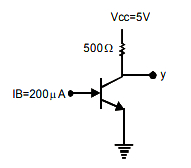
In the circuit shown,the value of $\beta$ of the transistor is $48$. If the base current supplied is $200 \mu A$,what is the voltage at the terminal $Y$ (in $V$)?
A
$0.2$
B
$0.5$
C
$4$
D
$4.8$
Solution
(A) Given:
$\beta = 48$
$I_{B} = 200 \mu A = 200 \times 10^{-6} \ A$
$R_{C} = 500 \ \Omega$
$V_{CC} = 5 \ V$
Step $1$: Calculate the collector current $I_{C}$.
$I_{C} = \beta I_{B} = 48 \times 200 \times 10^{-6} \ A = 9600 \times 10^{-6} \ A = 9.6 \times 10^{-3} \ A = 9.6 \ mA$.
Step $2$: Apply Kirchhoff's voltage law to the output loop.
$V_{CC} = I_{C} R_{C} + V_{CE}$
$V_{Y} = V_{CE} = V_{CC} - I_{C} R_{C}$
$V_{Y} = 5 \ V - (9.6 \times 10^{-3} \ A) \times (500 \ \Omega)$
$V_{Y} = 5 \ V - 4.8 \ V = 0.2 \ V$.
Thus,the voltage at terminal $Y$ is $0.2 \ V$.
$\beta = 48$
$I_{B} = 200 \mu A = 200 \times 10^{-6} \ A$
$R_{C} = 500 \ \Omega$
$V_{CC} = 5 \ V$
Step $1$: Calculate the collector current $I_{C}$.
$I_{C} = \beta I_{B} = 48 \times 200 \times 10^{-6} \ A = 9600 \times 10^{-6} \ A = 9.6 \times 10^{-3} \ A = 9.6 \ mA$.
Step $2$: Apply Kirchhoff's voltage law to the output loop.
$V_{CC} = I_{C} R_{C} + V_{CE}$
$V_{Y} = V_{CE} = V_{CC} - I_{C} R_{C}$
$V_{Y} = 5 \ V - (9.6 \times 10^{-3} \ A) \times (500 \ \Omega)$
$V_{Y} = 5 \ V - 4.8 \ V = 0.2 \ V$.
Thus,the voltage at terminal $Y$ is $0.2 \ V$.
0 likes
View Solution384
MediumMCQ
In case of a bipolar transistor,$\beta = 45$. The potential drop across the collector resistance of $1 \ k\Omega$ is $5 \ V$. The base current is approximately: (in $\mu A$)
A
$222$
B
$55$
C
$111$
D
$45$
Solution
(C) Given: Current gain $\beta = 45$,Collector resistance $R_C = 1 \ k\Omega = 1000 \ \Omega$,Potential drop across collector resistance $V_C = 5 \ V$.
We know that the collector current $I_C$ is given by $I_C = \frac{V_C}{R_C}$.
Substituting the values: $I_C = \frac{5 \ V}{1000 \ \Omega} = 5 \times 10^{-3} \ A = 5 \ mA$.
The relationship between collector current $I_C$ and base current $I_B$ is given by $\beta = \frac{I_C}{I_B}$.
Therefore,$I_B = \frac{I_C}{\beta}$.
Substituting the values: $I_B = \frac{5 \times 10^{-3} \ A}{45} = \frac{1}{9} \times 10^{-3} \ A \approx 0.111 \times 10^{-3} \ A$.
Converting to microamperes: $I_B \approx 111 \ \mu A$.
We know that the collector current $I_C$ is given by $I_C = \frac{V_C}{R_C}$.
Substituting the values: $I_C = \frac{5 \ V}{1000 \ \Omega} = 5 \times 10^{-3} \ A = 5 \ mA$.
The relationship between collector current $I_C$ and base current $I_B$ is given by $\beta = \frac{I_C}{I_B}$.
Therefore,$I_B = \frac{I_C}{\beta}$.
Substituting the values: $I_B = \frac{5 \times 10^{-3} \ A}{45} = \frac{1}{9} \times 10^{-3} \ A \approx 0.111 \times 10^{-3} \ A$.
Converting to microamperes: $I_B \approx 111 \ \mu A$.
0 likes
View Solution385
MediumMCQ
In a transistor output characteristic commonly used in common emitter configuration,the base current $I_{B}$,the collector current $I_{C}$,and the collector-emitter voltage $V_{CE}$ have values of the following orders of magnitude in the active region:
A
$I_{B}$ and $I_{C}$ both are in $\mu A$ and $V_{CE}$ in volt
B
$I_{B}$ is in $\mu A$ and $I_{C}$ is in $mA$ and $V_{CE}$ in volt
C
$I_{B}$ is in $mA$ and $I_{C}$ is in $\mu A$ and $V_{CE}$ in $mV$
D
$I_{B}$ is in $mA$ and $I_{C}$ is in $mA$ and $V_{CE}$ in $mV$
Solution
(B) In a common emitter configuration of a transistor,the base current $I_{B}$ is very small and is typically in the order of microamperes $(\mu A)$.
Since the collector current $I_{C} = \beta I_{B}$ and the current gain $\beta$ is typically large (around $100$),the collector current $I_{C}$ is in the order of milliamperes $(mA)$.
The collector-emitter voltage $V_{CE}$ is typically maintained in the order of volts $(V)$ to keep the transistor in the active region.
Therefore,the correct order of magnitude is $I_{B}$ in $\mu A$,$I_{C}$ in $mA$,and $V_{CE}$ in volts.
Since the collector current $I_{C} = \beta I_{B}$ and the current gain $\beta$ is typically large (around $100$),the collector current $I_{C}$ is in the order of milliamperes $(mA)$.
The collector-emitter voltage $V_{CE}$ is typically maintained in the order of volts $(V)$ to keep the transistor in the active region.
Therefore,the correct order of magnitude is $I_{B}$ in $\mu A$,$I_{C}$ in $mA$,and $V_{CE}$ in volts.
0 likes
View Solution386
EasyMCQ
In an $n-p-n$ transistor,
A
the emitter has higher degree of doping compared to that of the collector
B
the collector has higher degree of doping compared to that of the emitter
C
both the emitter and collector have same degree of doping
D
the base region is most heavily doped
Solution
(A) In an $n-p-n$ or $p-n-p$ transistor,the emitter is heavily doped to provide a large number of majority charge carriers. The base is very thin and lightly doped to minimize recombination. The collector is moderately doped and is physically larger than the emitter to handle the power dissipation. Therefore,the emitter has a higher degree of doping compared to the collector.
0 likes
View Solution387
EasyMCQ
In a common emitter configuration,a transistor has $\beta=50$ and input resistance $1 \text{ k}\Omega$. If the peak value of a.c. input is $0.01 \text{ V}$,then the peak value of collector current is: (in $\mu\text{A}$)
A
$0.01$
B
$0.25$
C
$100$
D
$500$
Solution
(D) Given:
$\beta = 50$
Input resistance $R_i = 1 \text{ k}\Omega = 10^3 \Omega$
Peak input voltage $V_i = 0.01 \text{ V}$
Step $1$: Calculate the peak value of base current $(\Delta I_B)$:
$\Delta I_B = \frac{V_i}{R_i} = \frac{0.01 \text{ V}}{10^3 \Omega} = 10^{-5} \text{ A}$
Step $2$: Calculate the peak value of collector current $(\Delta I_C)$:
Using the relation $\beta = \frac{\Delta I_C}{\Delta I_B}$,we get:
$\Delta I_C = \beta \times \Delta I_B$
$\Delta I_C = 50 \times 10^{-5} \text{ A}$
$\Delta I_C = 5 \times 10^{-4} \text{ A} = 500 \times 10^{-6} \text{ A} = 500 \mu\text{A}$
$\beta = 50$
Input resistance $R_i = 1 \text{ k}\Omega = 10^3 \Omega$
Peak input voltage $V_i = 0.01 \text{ V}$
Step $1$: Calculate the peak value of base current $(\Delta I_B)$:
$\Delta I_B = \frac{V_i}{R_i} = \frac{0.01 \text{ V}}{10^3 \Omega} = 10^{-5} \text{ A}$
Step $2$: Calculate the peak value of collector current $(\Delta I_C)$:
Using the relation $\beta = \frac{\Delta I_C}{\Delta I_B}$,we get:
$\Delta I_C = \beta \times \Delta I_B$
$\Delta I_C = 50 \times 10^{-5} \text{ A}$
$\Delta I_C = 5 \times 10^{-4} \text{ A} = 500 \times 10^{-6} \text{ A} = 500 \mu\text{A}$
0 likes
View Solution388
MediumMCQ
$A$ common emitter transistor amplifier is connected with a load resistance of $6 k\Omega$. When a small a.c. signal of $15 mV$ is added to the base-emitter voltage, the alternating base current is $20 \mu A$ and the alternating collector current is $1.8 mA$. What is the voltage gain of the amplifier?
A
$90$
B
$640$
C
$900$
D
$720$
Solution
(D) The voltage gain $A_v$ of a common emitter amplifier is defined as the ratio of the change in output voltage to the change in input voltage.
$A_v = \frac{\Delta V_{out}}{\Delta V_{in}} = \frac{\Delta I_C \times R_L}{\Delta V_{BE}}$
Given:
Load resistance $R_L = 6 k\Omega = 6000 \Omega$
Input signal voltage $\Delta V_{BE} = 15 mV = 15 \times 10^{-3} V$
Change in collector current $\Delta I_C = 1.8 mA = 1.8 \times 10^{-3} A$
Substituting the values into the formula:
$A_v = \frac{1.8 \times 10^{-3} A \times 6000 \Omega}{15 \times 10^{-3} V}$
$A_v = \frac{1.8 \times 6000}{15} = \frac{10800}{15} = 720$
Thus, the voltage gain of the amplifier is $720$.
$A_v = \frac{\Delta V_{out}}{\Delta V_{in}} = \frac{\Delta I_C \times R_L}{\Delta V_{BE}}$
Given:
Load resistance $R_L = 6 k\Omega = 6000 \Omega$
Input signal voltage $\Delta V_{BE} = 15 mV = 15 \times 10^{-3} V$
Change in collector current $\Delta I_C = 1.8 mA = 1.8 \times 10^{-3} A$
Substituting the values into the formula:
$A_v = \frac{1.8 \times 10^{-3} A \times 6000 \Omega}{15 \times 10^{-3} V}$
$A_v = \frac{1.8 \times 6000}{15} = \frac{10800}{15} = 720$
Thus, the voltage gain of the amplifier is $720$.
0 likes
View SolutionSemiconductor Electronics — Junction Transistor · Frequently Asked Questions
1Are these Semiconductor Electronics questions useful for JEE and NEET?
Yes. All questions in this section are mapped to JEE Main and NEET exam patterns. Previous year questions from JEE Main, NEET, GUJCET and state-level exams are included with full solutions.
2Can I switch to Hindi or Gujarati for these questions?
Yes. Use the language tabs in the hero section or the sidebar to view the same questions and solutions in English, Hindi or Gujarati.
3How do I generate a question paper from this subtopic?
Use the Vedclass Exam Paper Generator — select the chapter and subtopic, set difficulty, and generate Sets A, B, C, D automatically. First 3 chapters of every subject are free.
Vedclass Products
For Students
Vedclass Test Series
Mock tests in real JEE/NEET style with performance analysis. 5-day free trial.
Start Free TrialFor Teachers
Exam Paper Generator
Generate Set A/B/C/D papers from this chapter in 2 minutes. 3 chapters free.
Try FreeFor Institutes
Online Exam Module
Live online exams with unlimited students, 360° analytics & white-label branding.
See DemoFor Teachers & Institutes
Generate a Semiconductor Electronics Exam Paper in 2 Minutes
Select subtopic & difficulty — Sets A, B, C, D auto-generated with No Repeat logic.
First 3 chapters of every subject are free — no payment required.