
A English
Energy Stored in a Capacitor Questions in English
Class 12 Physics · Electric Potential and Capacitance · Energy Stored in a Capacitor
147+
Questions
English
Language
100%
With Solutions
Showing 48 of 147 questions in English
51
MediumMCQ
For a capacitor with area $A$ and potential difference $V$ separated by a distance $d$,the energy per unit volume is:
A
$\frac{1}{2}{\varepsilon _0}\frac{{{V^2}}}{{{d^2}}}$
B
$\frac{1}{{2{\varepsilon _0}}}\frac{{{V^2}}}{{{d^2}}}$
C
$\frac{1}{2}C{V^2}$
D
$\frac{{{Q^2}}}{{2C}}$
Solution
(A) The energy density (energy per unit volume) $u$ of an electric field $E$ is given by the formula: $u = \frac{1}{2}{\varepsilon _0}{E^2}$.
For a parallel plate capacitor,the electric field $E$ between the plates is related to the potential difference $V$ and the distance $d$ by the relation: $E = \frac{V}{d}$.
Substituting this value of $E$ into the energy density formula,we get: $u = \frac{1}{2}{\varepsilon _0}{\left( \frac{V}{d} \right)^2} = \frac{1}{2}{\varepsilon _0}\frac{{{V^2}}}{{{d^2}}}$.
For a parallel plate capacitor,the electric field $E$ between the plates is related to the potential difference $V$ and the distance $d$ by the relation: $E = \frac{V}{d}$.
Substituting this value of $E$ into the energy density formula,we get: $u = \frac{1}{2}{\varepsilon _0}{\left( \frac{V}{d} \right)^2} = \frac{1}{2}{\varepsilon _0}\frac{{{V^2}}}{{{d^2}}}$.
0 likes
View Solution52
MediumMCQ
$A$ parallel plate capacitor is charged by a battery until the potential difference between the plates equals the electromotive force of the battery. What is the ratio of the energy stored in the capacitor to the work done by the battery?
A
$1$
B
$2$
C
$0.25$
D
$0.5$
Solution
(D) The work done by the battery $(W_b)$ in charging a capacitor to a potential $V$ is given by $W_b = Q \cdot V = (CV) \cdot V = CV^2$.
The energy stored in the capacitor $(U)$ is given by $U = \frac{1}{2} CV^2$.
Therefore,the ratio of the energy stored in the capacitor to the work done by the battery is:
$\frac{U}{W_b} = \frac{\frac{1}{2} CV^2}{CV^2} = \frac{1}{2} = 0.5$.
The energy stored in the capacitor $(U)$ is given by $U = \frac{1}{2} CV^2$.
Therefore,the ratio of the energy stored in the capacitor to the work done by the battery is:
$\frac{U}{W_b} = \frac{\frac{1}{2} CV^2}{CV^2} = \frac{1}{2} = 0.5$.
0 likes
View Solution53
EasyMCQ
$A$ capacitor of $6 \ \mu F$ is charged from $10 \ V$ to $20 \ V$. The increase in its stored energy is:
A
$18 \times 10^{-4} \ J$
B
$9 \times 10^{-4} \ J$
C
$4.5 \times 10^{-4} \ J$
D
$9 \times 10^{-6} \ J$
Solution
(B) The energy stored in a capacitor is given by $E = \frac{1}{2} C V^2$.
The increase in energy is given by $\Delta E = E_{final} - E_{initial} = \frac{1}{2} C (V_{final}^2 - V_{initial}^2)$.
Given: $C = 6 \ \mu F = 6 \times 10^{-6} \ F$,$V_{initial} = 10 \ V$,and $V_{final} = 20 \ V$.
Substituting the values:
$\Delta E = \frac{1}{2} \times (6 \times 10^{-6}) \times (20^2 - 10^2)$
$\Delta E = 3 \times 10^{-6} \times (400 - 100)$
$\Delta E = 3 \times 10^{-6} \times 300$
$\Delta E = 900 \times 10^{-6} \ J = 9 \times 10^{-4} \ J$.
The increase in energy is given by $\Delta E = E_{final} - E_{initial} = \frac{1}{2} C (V_{final}^2 - V_{initial}^2)$.
Given: $C = 6 \ \mu F = 6 \times 10^{-6} \ F$,$V_{initial} = 10 \ V$,and $V_{final} = 20 \ V$.
Substituting the values:
$\Delta E = \frac{1}{2} \times (6 \times 10^{-6}) \times (20^2 - 10^2)$
$\Delta E = 3 \times 10^{-6} \times (400 - 100)$
$\Delta E = 3 \times 10^{-6} \times 300$
$\Delta E = 900 \times 10^{-6} \ J = 9 \times 10^{-4} \ J$.
0 likes
View Solution54
MediumMCQ
Two capacitors of capacitance $2 \ \mu F$ and $4 \ \mu F$ are connected in series. If a potential difference of $10 \ V$ is applied across this combination,what will be the ratio of the energy stored in these capacitors?
A
$2 : 1$
B
$1 : 2$
C
$1 : 4$
D
$4 : 1$
Solution
(A) When capacitors are connected in series,the charge $Q$ stored on each capacitor is the same.
The energy stored in a capacitor is given by the formula $U = \frac{Q^2}{2C}$.
Since $Q$ is constant for both capacitors in a series connection,the energy $U$ is inversely proportional to the capacitance $C$ $(U \propto \frac{1}{C})$.
Therefore,the ratio of the energy stored in the two capacitors is:
$\frac{U_1}{U_2} = \frac{C_2}{C_1}$
Given $C_1 = 2 \ \mu F$ and $C_2 = 4 \ \mu F$:
$\frac{U_1}{U_2} = \frac{4 \ \mu F}{2 \ \mu F} = \frac{2}{1}$
Thus,the ratio of the energy stored is $2 : 1$.
The energy stored in a capacitor is given by the formula $U = \frac{Q^2}{2C}$.
Since $Q$ is constant for both capacitors in a series connection,the energy $U$ is inversely proportional to the capacitance $C$ $(U \propto \frac{1}{C})$.
Therefore,the ratio of the energy stored in the two capacitors is:
$\frac{U_1}{U_2} = \frac{C_2}{C_1}$
Given $C_1 = 2 \ \mu F$ and $C_2 = 4 \ \mu F$:
$\frac{U_1}{U_2} = \frac{4 \ \mu F}{2 \ \mu F} = \frac{2}{1}$
Thus,the ratio of the energy stored is $2 : 1$.
0 likes
View Solution55
DifficultMCQ
If the energy density in a parallel plate capacitor is given as $1.8 \times 10^{-9} \ J/m^3$,then the value of the electric field in the region between the plates is ....... $NC^{-1}$. (Given: $\epsilon_0 = 9 \times 10^{-12} \ C^2/N \cdot m^2$)
A
$6.6$
B
$20$
C
$66$
D
$2$
Solution
(B) The energy density $u$ of an electric field is given by the formula: $u = \frac{1}{2} \epsilon_0 E^2$.
Given: $u = 1.8 \times 10^{-9} \ J/m^3$ and $\epsilon_0 = 9 \times 10^{-12} \ C^2/N \cdot m^2$.
Substituting the values into the formula:
$1.8 \times 10^{-9} = \frac{1}{2} \times (9 \times 10^{-12}) \times E^2$.
$1.8 \times 10^{-9} = 4.5 \times 10^{-12} \times E^2$.
$E^2 = \frac{1.8 \times 10^{-9}}{4.5 \times 10^{-12}}$.
$E^2 = \frac{1.8}{4.5} \times 10^3 = 0.4 \times 1000 = 400$.
$E = \sqrt{400} = 20 \ NC^{-1}$.
Therefore,the correct option is $B$.
Given: $u = 1.8 \times 10^{-9} \ J/m^3$ and $\epsilon_0 = 9 \times 10^{-12} \ C^2/N \cdot m^2$.
Substituting the values into the formula:
$1.8 \times 10^{-9} = \frac{1}{2} \times (9 \times 10^{-12}) \times E^2$.
$1.8 \times 10^{-9} = 4.5 \times 10^{-12} \times E^2$.
$E^2 = \frac{1.8 \times 10^{-9}}{4.5 \times 10^{-12}}$.
$E^2 = \frac{1.8}{4.5} \times 10^3 = 0.4 \times 1000 = 400$.
$E = \sqrt{400} = 20 \ NC^{-1}$.
Therefore,the correct option is $B$.
0 likes
View Solution56
MediumMCQ
The area of a cloud is $25 \times 10^6\ m^2$ and the electric potential is $10^5\ V$. If the height of the cloud is $0.75\ km$, then the energy stored between the cloud and the earth is.....$J$
A
$250$
B
$750$
C
$1225$
D
$1475$
Solution
(D) The cloud and the earth form a parallel plate capacitor.
The energy stored in the electric field is given by $U = \frac{1}{2} \epsilon_0 E^2 \times \text{Volume}$.
Here, $E = \frac{V}{d}$, where $V = 10^5\ V$ and $d = 0.75\ km = 750\ m$.
The volume of the space between the cloud and the earth is $V_{ol} = A \times d$, where $A = 25 \times 10^6\ m^2$.
Substituting these values into the energy formula:
$U = \frac{1}{2} \epsilon_0 \left( \frac{V}{d} \right)^2 \times (A \times d) = \frac{1}{2} \epsilon_0 \frac{V^2 A}{d}$.
$U = \frac{1}{2} \times (8.85 \times 10^{-12}) \times \frac{(10^5)^2 \times 25 \times 10^6}{750}$.
$U = \frac{1}{2} \times 8.85 \times 10^{-12} \times \frac{10^{10} \times 25 \times 10^6}{750} = \frac{8.85 \times 25 \times 10^4}{1500} \approx 1475\ J$.
The energy stored in the electric field is given by $U = \frac{1}{2} \epsilon_0 E^2 \times \text{Volume}$.
Here, $E = \frac{V}{d}$, where $V = 10^5\ V$ and $d = 0.75\ km = 750\ m$.
The volume of the space between the cloud and the earth is $V_{ol} = A \times d$, where $A = 25 \times 10^6\ m^2$.
Substituting these values into the energy formula:
$U = \frac{1}{2} \epsilon_0 \left( \frac{V}{d} \right)^2 \times (A \times d) = \frac{1}{2} \epsilon_0 \frac{V^2 A}{d}$.
$U = \frac{1}{2} \times (8.85 \times 10^{-12}) \times \frac{(10^5)^2 \times 25 \times 10^6}{750}$.
$U = \frac{1}{2} \times 8.85 \times 10^{-12} \times \frac{10^{10} \times 25 \times 10^6}{750} = \frac{8.85 \times 25 \times 10^4}{1500} \approx 1475\ J$.
0 likes
View Solution57
EasyMCQ
If $n$ capacitors are connected in parallel with a source of $V$ volts,the stored energy is equal to ........
A
$CV$
B
$\frac{1}{2}nCV^2$
C
$CV^2$
D
$\frac{1}{2n}CV^2$
Solution
(B) When $n$ capacitors,each of capacitance $C$,are connected in parallel to a voltage source $V$,the potential difference across each capacitor is $V$.
The energy stored in a single capacitor is given by $U_i = \frac{1}{2}CV^2$.
Since the capacitors are in parallel,the total energy $U$ is the sum of the energies stored in each individual capacitor:
$U = U_1 + U_2 + ... + U_n$
$U = \frac{1}{2}CV^2 + \frac{1}{2}CV^2 + ... + \frac{1}{2}CV^2$ ($n$ times)
$U = n \times (\frac{1}{2}CV^2)$
$U = \frac{1}{2}nCV^2$.
The energy stored in a single capacitor is given by $U_i = \frac{1}{2}CV^2$.
Since the capacitors are in parallel,the total energy $U$ is the sum of the energies stored in each individual capacitor:
$U = U_1 + U_2 + ... + U_n$
$U = \frac{1}{2}CV^2 + \frac{1}{2}CV^2 + ... + \frac{1}{2}CV^2$ ($n$ times)
$U = n \times (\frac{1}{2}CV^2)$
$U = \frac{1}{2}nCV^2$.
0 likes
View Solution58
EasyMCQ
$A$ capacitor of capacitance $C$ has stored energy $W$ and charge $Q$. If the charge is increased to $2Q$,what will be the new stored energy?
A
$2W$
B
$W/2$
C
$4W$
D
$W/4$
Solution
(C) The energy stored in a capacitor is given by the formula $W = \frac{Q^2}{2C}$.
When the charge is increased from $Q$ to $Q' = 2Q$,the new energy $W'$ becomes:
$W' = \frac{(Q')^2}{2C} = \frac{(2Q)^2}{2C} = \frac{4Q^2}{2C}$.
Since $W = \frac{Q^2}{2C}$,we can substitute this into the equation:
$W' = 4 \times \left( \frac{Q^2}{2C} \right) = 4W$.
Therefore,the new stored energy is $4W$.
When the charge is increased from $Q$ to $Q' = 2Q$,the new energy $W'$ becomes:
$W' = \frac{(Q')^2}{2C} = \frac{(2Q)^2}{2C} = \frac{4Q^2}{2C}$.
Since $W = \frac{Q^2}{2C}$,we can substitute this into the equation:
$W' = 4 \times \left( \frac{Q^2}{2C} \right) = 4W$.
Therefore,the new stored energy is $4W$.
0 likes
View Solution59
MediumMCQ
If the distance between the plates of a capacitor with capacitance $C$ and charge $Q$ is doubled,the work done is:
A
$\frac{Q^2}{4C}$
B
$\frac{Q^2}{2C}$
C
$\frac{Q^2}{C}$
D
$\frac{2Q^2}{C}$
Solution
(B) The capacitance of a parallel plate capacitor is given by $C = \frac{\epsilon_0 A}{d}$. If the distance $d$ is doubled $(d' = 2d)$,the new capacitance becomes $C' = \frac{C}{2}$.
Since the capacitor is disconnected from the battery,the charge $Q$ remains constant.
The initial energy stored is $U_1 = \frac{Q^2}{2C}$.
The final energy stored is $U_2 = \frac{Q^2}{2C'} = \frac{Q^2}{2(C/2)} = \frac{Q^2}{C}$.
The work done $W$ is equal to the change in potential energy: $W = U_2 - U_1 = \frac{Q^2}{C} - \frac{Q^2}{2C} = \frac{Q^2}{2C}$.
Since the capacitor is disconnected from the battery,the charge $Q$ remains constant.
The initial energy stored is $U_1 = \frac{Q^2}{2C}$.
The final energy stored is $U_2 = \frac{Q^2}{2C'} = \frac{Q^2}{2(C/2)} = \frac{Q^2}{C}$.
The work done $W$ is equal to the change in potential energy: $W = U_2 - U_1 = \frac{Q^2}{C} - \frac{Q^2}{2C} = \frac{Q^2}{2C}$.
0 likes
View Solution60
EasyMCQ
The work done in placing a charge of $8 \times 10^{-18} \ C$ on a capacitor of $800 \ \mu F$ is:
A
$16 \times 10^{-32} \ J$
B
$3.1 \times 10^{-26} \ J$
C
$32 \times 10^{-32} \ J$
D
$4 \times 10^{-32} \ J$
Solution
(D) The energy stored in a capacitor,which is equal to the work done to charge it,is given by the formula: $W = \frac{Q^2}{2C}$.
Given:
Charge $Q = 8 \times 10^{-18} \ C$
Capacitance $C = 800 \ \mu F = 800 \times 10^{-6} \ F = 8 \times 10^{-4} \ F$.
Substituting the values into the formula:
$W = \frac{(8 \times 10^{-18})^2}{2 \times (8 \times 10^{-4})}$
$W = \frac{64 \times 10^{-36}}{16 \times 10^{-4}}$
$W = 4 \times 10^{-32} \ J$.
Given:
Charge $Q = 8 \times 10^{-18} \ C$
Capacitance $C = 800 \ \mu F = 800 \times 10^{-6} \ F = 8 \times 10^{-4} \ F$.
Substituting the values into the formula:
$W = \frac{(8 \times 10^{-18})^2}{2 \times (8 \times 10^{-4})}$
$W = \frac{64 \times 10^{-36}}{16 \times 10^{-4}}$
$W = 4 \times 10^{-32} \ J$.
0 likes
View Solution61
DifficultMCQ
$A$ fully charged capacitor with capacitance $C$ is discharged through a small resistance coil embedded in a thermally insulated block of mass $m$ and specific heat $s$. If the temperature of the block increases by $\Delta T$,then the potential difference across the capacitor is:
A
$\frac{ms\Delta T}{C}$
B
$\sqrt{\frac{2ms\Delta T}{C}}$
C
$\sqrt{\frac{2mC\Delta T}{s}}$
D
$\frac{mC\Delta T}{s}$
Solution
(B) The energy stored in a fully charged capacitor is given by $U = \frac{1}{2}CV^2$,where $V$ is the potential difference across the capacitor.
Since the capacitor is discharged through a resistance coil in a thermally insulated block,the entire electrical energy stored in the capacitor is converted into heat energy absorbed by the block.
The heat energy absorbed by the block is given by $Q = ms\Delta T$.
Equating the energy stored to the heat energy absorbed:
$\frac{1}{2}CV^2 = ms\Delta T$
$V^2 = \frac{2ms\Delta T}{C}$
$V = \sqrt{\frac{2ms\Delta T}{C}}$
Since the capacitor is discharged through a resistance coil in a thermally insulated block,the entire electrical energy stored in the capacitor is converted into heat energy absorbed by the block.
The heat energy absorbed by the block is given by $Q = ms\Delta T$.
Equating the energy stored to the heat energy absorbed:
$\frac{1}{2}CV^2 = ms\Delta T$
$V^2 = \frac{2ms\Delta T}{C}$
$V = \sqrt{\frac{2ms\Delta T}{C}}$
0 likes
View Solution62
DifficultMCQ
In a defibrillator,a $40\ \mu F$ capacitor is charged to $3000\ V$. If the stored energy of the capacitor is discharged through the patient during a pulse of duration $2\ ms$,what is the power delivered to the patient in $kW$?
A
$45$
B
$90$
C
$180$
D
$360$
Solution
(B) The energy stored in a capacitor is given by $U = \frac{1}{2}CV^2$.
Given: $C = 40\ \mu F = 40 \times 10^{-6}\ F$,$V = 3000\ V$,and $t = 2\ ms = 2 \times 10^{-3}\ s$.
Substituting the values:
$U = \frac{1}{2} \times (40 \times 10^{-6}) \times (3000)^2 = 20 \times 10^{-6} \times 9 \times 10^6 = 180\ J$.
The power delivered is $P = \frac{U}{t} = \frac{180\ J}{2 \times 10^{-3}\ s} = 90 \times 10^3\ W = 90\ kW$.
Given: $C = 40\ \mu F = 40 \times 10^{-6}\ F$,$V = 3000\ V$,and $t = 2\ ms = 2 \times 10^{-3}\ s$.
Substituting the values:
$U = \frac{1}{2} \times (40 \times 10^{-6}) \times (3000)^2 = 20 \times 10^{-6} \times 9 \times 10^6 = 180\ J$.
The power delivered is $P = \frac{U}{t} = \frac{180\ J}{2 \times 10^{-3}\ s} = 90 \times 10^3\ W = 90\ kW$.
0 likes
View Solution63
EasyMCQ
Two capacitors,each of value $10 \ \mu F$,are connected in parallel and charged to $200 \ V \ DC$. What is the energy stored in the combination in Joules?
A
$0.1$
B
$0.2$
C
$0.4$
D
$0.6$
Solution
(C) For capacitors connected in parallel,the equivalent capacitance $C_{eq}$ is given by $C_{eq} = C_1 + C_2$.
Given $C_1 = C_2 = 10 \ \mu F$,the equivalent capacitance is $C_{eq} = 10 \ \mu F + 10 \ \mu F = 20 \ \mu F = 20 \times 10^{-6} \ F$.
The energy $U$ stored in a capacitor is given by the formula $U = \frac{1}{2} C_{eq} V^2$.
Substituting the values $C_{eq} = 20 \times 10^{-6} \ F$ and $V = 200 \ V$:
$U = \frac{1}{2} \times (20 \times 10^{-6}) \times (200)^2$
$U = 10 \times 10^{-6} \times 40000$
$U = 10 \times 10^{-6} \times 4 \times 10^4$
$U = 40 \times 10^{-2} = 0.4 \ J$.
Given $C_1 = C_2 = 10 \ \mu F$,the equivalent capacitance is $C_{eq} = 10 \ \mu F + 10 \ \mu F = 20 \ \mu F = 20 \times 10^{-6} \ F$.
The energy $U$ stored in a capacitor is given by the formula $U = \frac{1}{2} C_{eq} V^2$.
Substituting the values $C_{eq} = 20 \times 10^{-6} \ F$ and $V = 200 \ V$:
$U = \frac{1}{2} \times (20 \times 10^{-6}) \times (200)^2$
$U = 10 \times 10^{-6} \times 40000$
$U = 10 \times 10^{-6} \times 4 \times 10^4$
$U = 40 \times 10^{-2} = 0.4 \ J$.
0 likes
View Solution64
EasyMCQ
$A$ parallel plate capacitor has a plate separation $d$ and plate area $A$. If it is charged to a potential $V$ and then disconnected from the battery,calculate the work done in increasing the separation between the plates to $2d$.
A
$\frac{\varepsilon_0 A V^2}{2 d^2}$
B
$\frac{\varepsilon_0 A^2 V^2}{d}$
C
$\frac{\varepsilon_0 A V^2}{2 d}$
D
$\frac{\varepsilon_0 A V}{2 d}$
Solution
(C) The initial capacitance is $C = \frac{\varepsilon_0 A}{d}$.
Since the capacitor is disconnected from the battery,the charge $Q$ on the plates remains constant.
The initial energy stored is $U_i = \frac{Q^2}{2C}$.
When the separation is increased to $2d$,the new capacitance becomes $C' = \frac{\varepsilon_0 A}{2d} = \frac{C}{2}$.
The final energy stored is $U_f = \frac{Q^2}{2C'} = \frac{Q^2}{2(C/2)} = \frac{Q^2}{C}$.
The work done $W$ is the change in potential energy: $W = U_f - U_i = \frac{Q^2}{C} - \frac{Q^2}{2C} = \frac{Q^2}{2C}$.
Substituting $Q = CV$,we get $W = \frac{(CV)^2}{2C} = \frac{1}{2} C V^2$.
Substituting $C = \frac{\varepsilon_0 A}{d}$,we get $W = \frac{1}{2} \left( \frac{\varepsilon_0 A}{d} \right) V^2 = \frac{\varepsilon_0 A V^2}{2d}$.
Since the capacitor is disconnected from the battery,the charge $Q$ on the plates remains constant.
The initial energy stored is $U_i = \frac{Q^2}{2C}$.
When the separation is increased to $2d$,the new capacitance becomes $C' = \frac{\varepsilon_0 A}{2d} = \frac{C}{2}$.
The final energy stored is $U_f = \frac{Q^2}{2C'} = \frac{Q^2}{2(C/2)} = \frac{Q^2}{C}$.
The work done $W$ is the change in potential energy: $W = U_f - U_i = \frac{Q^2}{C} - \frac{Q^2}{2C} = \frac{Q^2}{2C}$.
Substituting $Q = CV$,we get $W = \frac{(CV)^2}{2C} = \frac{1}{2} C V^2$.
Substituting $C = \frac{\varepsilon_0 A}{d}$,we get $W = \frac{1}{2} \left( \frac{\varepsilon_0 A}{d} \right) V^2 = \frac{\varepsilon_0 A V^2}{2d}$.
0 likes
View Solution65
MediumMCQ
$A$ capacitor has two circular plates,each of radius $8\,cm$,separated by a distance of $1\,mm$. $A$ dielectric slab (dielectric constant $K = 6$) is inserted between the plates. Calculate the energy stored in the capacitor when it is connected to a $150\,V$ potential difference.
A
$1.2 \times 10^{-7}\,J$
B
$1.2 \times 10^{-5}\,J$
C
$5.2 \times 10^{-5}\,J$
D
$1.2 \times 10^{3}\,J$
Solution
(B) The area of the plates is $A = \pi r^2 = \pi \times (8 \times 10^{-2})^2 \approx 0.0201\,m^2$ and the distance is $d = 1\,mm = 1 \times 10^{-3}\,m$.
The capacitance of the capacitor with the dielectric is given by $C = \frac{K \varepsilon_0 A}{d}$.
Substituting the values: $C = \frac{6 \times 8.854 \times 10^{-12} \times 0.0201}{1 \times 10^{-3}} \approx 1.068 \times 10^{-9}\,F$.
The potential difference is $V = 150\,V$.
The energy stored in the capacitor is $U = \frac{1}{2}CV^2$.
$U = \frac{1}{2} \times (1.068 \times 10^{-9}) \times (150)^2$.
$U = 0.5 \times 1.068 \times 10^{-9} \times 22500$.
$U \approx 1.2 \times 10^{-5}\,J$.
The capacitance of the capacitor with the dielectric is given by $C = \frac{K \varepsilon_0 A}{d}$.
Substituting the values: $C = \frac{6 \times 8.854 \times 10^{-12} \times 0.0201}{1 \times 10^{-3}} \approx 1.068 \times 10^{-9}\,F$.
The potential difference is $V = 150\,V$.
The energy stored in the capacitor is $U = \frac{1}{2}CV^2$.
$U = \frac{1}{2} \times (1.068 \times 10^{-9}) \times (150)^2$.
$U = 0.5 \times 1.068 \times 10^{-9} \times 22500$.
$U \approx 1.2 \times 10^{-5}\,J$.
0 likes
View Solution66
MediumMCQ
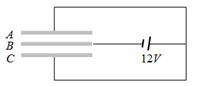
Three plates $A, B, C$ each have an area of $50 \, cm^2$ and the distance between them is $3 \, mm$. Find the energy stored in the system when the plates are fully charged.
A
$1.6 \times 10^{-9} \, J$
B
$2.1 \times 10^{-9} \, J$
C
$5 \times 10^{-9} \, J$
D
$7 \times 10^{-9} \, J$
Solution
(B) The system consists of two capacitors connected in parallel.
Each capacitor has capacitance $C = \frac{\varepsilon_0 A}{d}$.
Since there are two such capacitors in parallel,the total capacitance is $C_{eq} = 2 \times \frac{\varepsilon_0 A}{d} = \frac{2 \varepsilon_0 A}{d}$.
The energy stored in the system is given by $U = \frac{1}{2} C_{eq} V^2 = \frac{1}{2} \left( \frac{2 \varepsilon_0 A}{d} \right) V^2 = \frac{\varepsilon_0 A V^2}{d}$.
Given: $\varepsilon_0 = 8.854 \times 10^{-12} \, F/m$,$A = 50 \times 10^{-4} \, m^2$,$d = 3 \times 10^{-3} \, m$,$V = 12 \, V$.
$U = \frac{8.854 \times 10^{-12} \times 50 \times 10^{-4} \times (12)^2}{3 \times 10^{-3}}$.
$U = \frac{8.854 \times 50 \times 144 \times 10^{-16}}{3 \times 10^{-3}} = \frac{63748.8 \times 10^{-16}}{3 \times 10^{-3}} \approx 2.125 \times 10^{-9} \, J$.
Thus,the energy stored is approximately $2.1 \times 10^{-9} \, J$.
Each capacitor has capacitance $C = \frac{\varepsilon_0 A}{d}$.
Since there are two such capacitors in parallel,the total capacitance is $C_{eq} = 2 \times \frac{\varepsilon_0 A}{d} = \frac{2 \varepsilon_0 A}{d}$.
The energy stored in the system is given by $U = \frac{1}{2} C_{eq} V^2 = \frac{1}{2} \left( \frac{2 \varepsilon_0 A}{d} \right) V^2 = \frac{\varepsilon_0 A V^2}{d}$.
Given: $\varepsilon_0 = 8.854 \times 10^{-12} \, F/m$,$A = 50 \times 10^{-4} \, m^2$,$d = 3 \times 10^{-3} \, m$,$V = 12 \, V$.
$U = \frac{8.854 \times 10^{-12} \times 50 \times 10^{-4} \times (12)^2}{3 \times 10^{-3}}$.
$U = \frac{8.854 \times 50 \times 144 \times 10^{-16}}{3 \times 10^{-3}} = \frac{63748.8 \times 10^{-16}}{3 \times 10^{-3}} \approx 2.125 \times 10^{-9} \, J$.
Thus,the energy stored is approximately $2.1 \times 10^{-9} \, J$.
0 likes
View Solution67
EasyMCQ
$A$ cylindrical capacitor has charge $Q$ and length $L$. If both the length and the charge are doubled (keeping other parameters constant),the energy stored in the capacitor will:
A
remain the same.
B
become double.
C
become half.
D
become $4$ times.
Solution
(B) The capacitance of a cylindrical capacitor is given by $C = \frac{2\pi \varepsilon_0 L}{\ln(b/a)}$.
The energy stored in the capacitor is $U = \frac{1}{2} \frac{Q^2}{C}$.
Substituting the expression for $C$,we get $U = \frac{1}{2} \frac{Q^2 \ln(b/a)}{2\pi \varepsilon_0 L}$.
Since $\ln(b/a)$,$\pi$,and $\varepsilon_0$ are constants,the energy $U$ is proportional to $\frac{Q^2}{L}$,i.e.,$U \propto \frac{Q^2}{L}$.
Let the new charge be $Q' = 2Q$ and the new length be $L' = 2L$.
The new energy $U'$ is proportional to $\frac{(Q')^2}{L'} = \frac{(2Q)^2}{2L} = \frac{4Q^2}{2L} = 2 \left( \frac{Q^2}{L} \right)$.
Therefore,the energy becomes $2$ times the original energy.
The energy stored in the capacitor is $U = \frac{1}{2} \frac{Q^2}{C}$.
Substituting the expression for $C$,we get $U = \frac{1}{2} \frac{Q^2 \ln(b/a)}{2\pi \varepsilon_0 L}$.
Since $\ln(b/a)$,$\pi$,and $\varepsilon_0$ are constants,the energy $U$ is proportional to $\frac{Q^2}{L}$,i.e.,$U \propto \frac{Q^2}{L}$.
Let the new charge be $Q' = 2Q$ and the new length be $L' = 2L$.
The new energy $U'$ is proportional to $\frac{(Q')^2}{L'} = \frac{(2Q)^2}{2L} = \frac{4Q^2}{2L} = 2 \left( \frac{Q^2}{L} \right)$.
Therefore,the energy becomes $2$ times the original energy.
0 likes
View Solution68
EasyMCQ
The capacitance of a capacitor is $4 \times 10^{-6} \ F$ and it is charged to a potential difference of $100 \ V$. The energy required to completely discharge it is . . . . . . $J$.
A
$0.02$
B
$0.04$
C
$0.05$
D
$0.025$
Solution
(A) The energy stored in a capacitor is given by the formula $U = \frac{1}{2} CV^2$.
Given:
Capacitance $C = 4 \times 10^{-6} \ F$
Potential difference $V = 100 \ V$
Substituting the values into the formula:
$U = \frac{1}{2} \times (4 \times 10^{-6}) \times (100)^2$
$U = \frac{1}{2} \times 4 \times 10^{-6} \times 10000$
$U = 2 \times 10^{-6} \times 10^4$
$U = 2 \times 10^{-2} \ J$
$U = 0.02 \ J$
Therefore,the energy required to discharge the capacitor is $0.02 \ J$.
Given:
Capacitance $C = 4 \times 10^{-6} \ F$
Potential difference $V = 100 \ V$
Substituting the values into the formula:
$U = \frac{1}{2} \times (4 \times 10^{-6}) \times (100)^2$
$U = \frac{1}{2} \times 4 \times 10^{-6} \times 10000$
$U = 2 \times 10^{-6} \times 10^4$
$U = 2 \times 10^{-2} \ J$
$U = 0.02 \ J$
Therefore,the energy required to discharge the capacitor is $0.02 \ J$.
0 likes
View Solution69
DifficultMCQ
How much work is required to increase the voltage of a $6\,\mu F$ capacitor from $10\ V$ to $20\ V$?
A
$2 \times 10^{-4}\ J$
B
$4 \times 10^{-4}\ J$
C
$3 \times 10^{-4}\ J$
D
$9 \times 10^{-4}\ J$
Solution
(D) The work done to change the potential energy of a capacitor is equal to the change in its stored energy.
Initial energy $U_i = \frac{1}{2} C V_1^2 = \frac{1}{2} \times (6 \times 10^{-6}\ F) \times (10\ V)^2 = 3 \times 10^{-4}\ J$.
Final energy $U_f = \frac{1}{2} C V_2^2 = \frac{1}{2} \times (6 \times 10^{-6}\ F) \times (20\ V)^2 = 12 \times 10^{-4}\ J$.
Work done $W = \Delta U = U_f - U_i = (12 - 3) \times 10^{-4}\ J = 9 \times 10^{-4}\ J$.
Initial energy $U_i = \frac{1}{2} C V_1^2 = \frac{1}{2} \times (6 \times 10^{-6}\ F) \times (10\ V)^2 = 3 \times 10^{-4}\ J$.
Final energy $U_f = \frac{1}{2} C V_2^2 = \frac{1}{2} \times (6 \times 10^{-6}\ F) \times (20\ V)^2 = 12 \times 10^{-4}\ J$.
Work done $W = \Delta U = U_f - U_i = (12 - 3) \times 10^{-4}\ J = 9 \times 10^{-4}\ J$.
0 likes
View Solution70
EasyMCQ
$A$ $4\ \mu F$ capacitor is charged to $400\ V$ and then connected to a $1\ k\Omega$ resistor. How much heat energy in $J$ is produced?
A
$0.16$
B
$1.28$
C
$0.64$
D
$0.32$
Solution
(D) When a charged capacitor is connected to a resistor,the total energy stored in the capacitor is dissipated as heat in the resistor.
The energy stored in a capacitor is given by the formula $U = \frac{1}{2}CV^2$.
Given:
Capacitance $C = 4\ \mu F = 4 \times 10^{-6}\ F$
Voltage $V = 400\ V$
Substituting the values:
$U = \frac{1}{2} \times (4 \times 10^{-6}) \times (400)^2$
$U = 2 \times 10^{-6} \times 160000$
$U = 2 \times 10^{-6} \times 1.6 \times 10^5$
$U = 3.2 \times 10^{-1} = 0.32\ J$.
Thus,the total heat energy produced is $0.32\ J$.
The energy stored in a capacitor is given by the formula $U = \frac{1}{2}CV^2$.
Given:
Capacitance $C = 4\ \mu F = 4 \times 10^{-6}\ F$
Voltage $V = 400\ V$
Substituting the values:
$U = \frac{1}{2} \times (4 \times 10^{-6}) \times (400)^2$
$U = 2 \times 10^{-6} \times 160000$
$U = 2 \times 10^{-6} \times 1.6 \times 10^5$
$U = 3.2 \times 10^{-1} = 0.32\ J$.
Thus,the total heat energy produced is $0.32\ J$.
0 likes
View Solution71
MediumMCQ
If $W$ amount of work is required to increase the voltage of a capacitor from $5\ V$ to $10\ V$,how much work is required to increase the voltage from $10\ V$ to $15\ V$ (in $W$)?
A
$0.6$
B
$1$
C
$1.25$
D
$1.67$
Solution
(D) The work done $W$ to change the potential of a capacitor from $V_1$ to $V_2$ is given by the change in stored energy: $W = U_f - U_i = \frac{1}{2} C (V_2^2 - V_1^2)$.
For the first case,$W = \frac{1}{2} C (10^2 - 5^2) = \frac{1}{2} C (100 - 25) = \frac{1}{2} C (75) = 37.5 C$.
For the second case,$W' = \frac{1}{2} C (15^2 - 10^2) = \frac{1}{2} C (225 - 100) = \frac{1}{2} C (125) = 62.5 C$.
Taking the ratio: $\frac{W'}{W} = \frac{62.5 C}{37.5 C} = \frac{62.5}{37.5} = \frac{625}{375} = \frac{5}{3} \approx 1.67$.
Therefore,$W' = 1.67\ W$.
For the first case,$W = \frac{1}{2} C (10^2 - 5^2) = \frac{1}{2} C (100 - 25) = \frac{1}{2} C (75) = 37.5 C$.
For the second case,$W' = \frac{1}{2} C (15^2 - 10^2) = \frac{1}{2} C (225 - 100) = \frac{1}{2} C (125) = 62.5 C$.
Taking the ratio: $\frac{W'}{W} = \frac{62.5 C}{37.5 C} = \frac{62.5}{37.5} = \frac{625}{375} = \frac{5}{3} \approx 1.67$.
Therefore,$W' = 1.67\ W$.
0 likes
View Solution72
EasyMCQ
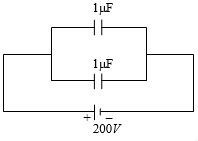
What is the total energy of the given system in $joules$?
A
$0.01$
B
$0.02$
C
$0.04$
D
$0.06$
Solution
(C) The two capacitors are connected in parallel.
The equivalent capacitance is given by $C_{eq} = C_1 + C_2 = 1 \ \mu F + 1 \ \mu F = 2 \ \mu F = 2 \times 10^{-6} \ F$.
The potential difference across the capacitors is $V = 200 \ V$.
The total energy stored in the system is given by the formula $U = \frac{1}{2} C_{eq} V^2$.
Substituting the values,we get $U = \frac{1}{2} \times (2 \times 10^{-6} \ F) \times (200 \ V)^2$.
$U = 10^{-6} \times 40000 = 0.04 \ J$.
The equivalent capacitance is given by $C_{eq} = C_1 + C_2 = 1 \ \mu F + 1 \ \mu F = 2 \ \mu F = 2 \times 10^{-6} \ F$.
The potential difference across the capacitors is $V = 200 \ V$.
The total energy stored in the system is given by the formula $U = \frac{1}{2} C_{eq} V^2$.
Substituting the values,we get $U = \frac{1}{2} \times (2 \times 10^{-6} \ F) \times (200 \ V)^2$.
$U = 10^{-6} \times 40000 = 0.04 \ J$.
0 likes
View Solution73
DifficultMCQ
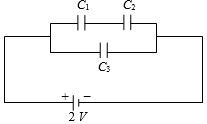
Given $C_1 = 2\ \mu F$,$C_2 = 6\ \mu F$,and $C_3 = 4\ \mu F$. What is the total energy of the system?
A
$22 \times 10^{-6}\ J$
B
$11 \times 10^{-6}\ J$
C
$\left( \frac{32}{3} \right) \times 10^{-6}\ J$
D
$\left( \frac{16}{3} \right) \times 10^{-6}\ J$
Solution
(B) From the circuit diagram,$C_1$ and $C_2$ are in series,and their combination is in parallel with $C_3$.
First,calculate the equivalent capacitance of $C_1$ and $C_2$ in series:
$C_{12} = \frac{C_1 C_2}{C_1 + C_2} = \frac{2 \times 6}{2 + 6} = \frac{12}{8} = 1.5\ \mu F$.
Now,$C_{12}$ is in parallel with $C_3$,so the total equivalent capacitance $C_{eq}$ is:
$C_{eq} = C_{12} + C_3 = 1.5 + 4 = 5.5\ \mu F$.
The total energy $U$ stored in the system is given by:
$U = \frac{1}{2} C_{eq} V^2 = \frac{1}{2} \times 5.5 \times 10^{-6} \times (2)^2$
$U = \frac{1}{2} \times 5.5 \times 10^{-6} \times 4 = 11 \times 10^{-6}\ J$.
First,calculate the equivalent capacitance of $C_1$ and $C_2$ in series:
$C_{12} = \frac{C_1 C_2}{C_1 + C_2} = \frac{2 \times 6}{2 + 6} = \frac{12}{8} = 1.5\ \mu F$.
Now,$C_{12}$ is in parallel with $C_3$,so the total equivalent capacitance $C_{eq}$ is:
$C_{eq} = C_{12} + C_3 = 1.5 + 4 = 5.5\ \mu F$.
The total energy $U$ stored in the system is given by:
$U = \frac{1}{2} C_{eq} V^2 = \frac{1}{2} \times 5.5 \times 10^{-6} \times (2)^2$
$U = \frac{1}{2} \times 5.5 \times 10^{-6} \times 4 = 11 \times 10^{-6}\ J$.
0 likes
View Solution74
MediumMCQ
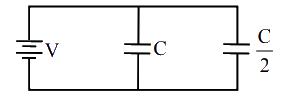
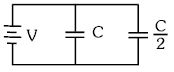
Two capacitors,one of capacity $C$ and other of capacity $C/2$ are connected to a $V$ volt battery,as shown in the figure. The work done in charging fully both the capacitors is
A
$\frac{1}{4} C V^2$
B
$\frac{3}{4} C V^2$
C
$\frac{1}{2} C V^2$
D
$3 C V^2$
Solution
(B) The capacitors are connected in parallel to the battery of potential $V$.
The equivalent capacitance of the parallel combination is $C_{eq} = C + \frac{C}{2} = \frac{3}{2} C$.
The work done $W$ in charging a capacitor is equal to the energy stored in the capacitor,which is given by $W = \frac{1}{2} C_{eq} V^2$.
Substituting the value of $C_{eq}$:
$W = \frac{1}{2} \times \left( \frac{3}{2} C \right) V^2 = \frac{3}{4} C V^2$.
The equivalent capacitance of the parallel combination is $C_{eq} = C + \frac{C}{2} = \frac{3}{2} C$.
The work done $W$ in charging a capacitor is equal to the energy stored in the capacitor,which is given by $W = \frac{1}{2} C_{eq} V^2$.
Substituting the value of $C_{eq}$:
$W = \frac{1}{2} \times \left( \frac{3}{2} C \right) V^2 = \frac{3}{4} C V^2$.
0 likes
View Solution75
MediumMCQ
$A$ parallel plate capacitor has a uniform electric field $E$ in the space between the plates. If the distance between the plates is $d$ and the area of each plate is $A,$ the energy stored in the capacitor is
A
$\varepsilon_0 EAd$
B
$\frac{1}{2} \varepsilon_0 \frac{E^2}{Ad}$
C
$\frac{1}{2} \varepsilon_0 E^2 Ad$
D
$\varepsilon_0 \frac{E^2}{Ad}$
Solution
(C) The potential difference $V$ between the plates of a parallel plate capacitor in a uniform electric field $E$ is given by $V = Ed$.
The capacitance $C$ of a parallel plate capacitor is given by $C = \frac{\varepsilon_0 A}{d}$.
The energy $U$ stored in a capacitor is given by the formula $U = \frac{1}{2} CV^2$.
Substituting the expressions for $C$ and $V$ into the energy formula:
$U = \frac{1}{2} \left( \frac{\varepsilon_0 A}{d} \right) (Ed)^2$
$U = \frac{1}{2} \left( \frac{\varepsilon_0 A}{d} \right) E^2 d^2$
$U = \frac{1}{2} \varepsilon_0 E^2 Ad$.
The capacitance $C$ of a parallel plate capacitor is given by $C = \frac{\varepsilon_0 A}{d}$.
The energy $U$ stored in a capacitor is given by the formula $U = \frac{1}{2} CV^2$.
Substituting the expressions for $C$ and $V$ into the energy formula:
$U = \frac{1}{2} \left( \frac{\varepsilon_0 A}{d} \right) (Ed)^2$
$U = \frac{1}{2} \left( \frac{\varepsilon_0 A}{d} \right) E^2 d^2$
$U = \frac{1}{2} \varepsilon_0 E^2 Ad$.
0 likes
View Solution76
MediumMCQ
$A$ parallel plate air capacitor has capacity $C$,distance of separation between plates is $d$,and potential difference $V$ is applied between the plates. The force of attraction between the plates of the parallel plate air capacitor is
A
$\frac{C^2 V^2}{2d^2}$
B
$\frac{C^2 V^2}{2d}$
C
$\frac{C V^2}{2d}$
D
$\frac{C V^2}{d}$
Solution
(C) The force of attraction $F$ between the plates of a parallel plate capacitor is given by the formula:
$F = \frac{Q^2}{2 \varepsilon_0 A}$
where $Q$ is the charge on the capacitor,$\varepsilon_0$ is the permittivity of free space,and $A$ is the area of each plate.
We know that the charge $Q$ is related to capacitance $C$ and potential difference $V$ by:
$Q = CV$
Also,the capacitance of a parallel plate capacitor is given by:
$C = \frac{\varepsilon_0 A}{d} \implies \varepsilon_0 A = Cd$
Substituting these expressions into the force formula:
$F = \frac{(CV)^2}{2(Cd)}$
$F = \frac{C^2 V^2}{2Cd}$
$F = \frac{CV^2}{2d}$
$F = \frac{Q^2}{2 \varepsilon_0 A}$
where $Q$ is the charge on the capacitor,$\varepsilon_0$ is the permittivity of free space,and $A$ is the area of each plate.
We know that the charge $Q$ is related to capacitance $C$ and potential difference $V$ by:
$Q = CV$
Also,the capacitance of a parallel plate capacitor is given by:
$C = \frac{\varepsilon_0 A}{d} \implies \varepsilon_0 A = Cd$
Substituting these expressions into the force formula:
$F = \frac{(CV)^2}{2(Cd)}$
$F = \frac{C^2 V^2}{2Cd}$
$F = \frac{CV^2}{2d}$
0 likes
View Solution77
DifficultMCQ
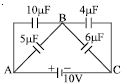
In the circuit shown in the figure,four capacitors are connected to a battery. The maximum energy is stored in the capacitor of.....$\mu F$
A
$10$
B
$6$
C
$5$
D
$4$
Solution
(B) The energy stored in a capacitor is given by $U = \frac{1}{2} CV^2 = \frac{Q^2}{2C}$.
Let the potential at $A$ be $0 \ V$ and at $C$ be $10 \ V$. Let the potential at node $B$ be $V_B$.
Using Kirchhoff's current law at node $B$,the sum of charges on the plates connected to $B$ must be zero (assuming initial charge is zero): $10(V_B - 0) + 5(V_B - 0) + 4(V_B - 10) + 6(V_B - 10) = 0$.
$15V_B + 10V_B - 40 - 60 = 0 \implies 25V_B = 100 \implies V_B = 4 \ V$.
Now,calculate the energy $U = \frac{1}{2} C(V_{diff})^2$ for each capacitor:
For $10 \ \mu F$: $U = \frac{1}{2} \times 10 \times (4 - 0)^2 = 5 \times 16 = 80 \ \mu J$.
For $5 \ \mu F$: $U = \frac{1}{2} \times 5 \times (4 - 0)^2 = 2.5 \times 16 = 40 \ \mu J$.
For $4 \ \mu F$: $U = \frac{1}{2} \times 4 \times (4 - 10)^2 = 2 \times 36 = 72 \ \mu J$.
For $6 \ \mu F$: $U = \frac{1}{2} \times 6 \times (4 - 10)^2 = 3 \times 36 = 108 \ \mu J$.
The maximum energy is stored in the $6 \ \mu F$ capacitor.
Let the potential at $A$ be $0 \ V$ and at $C$ be $10 \ V$. Let the potential at node $B$ be $V_B$.
Using Kirchhoff's current law at node $B$,the sum of charges on the plates connected to $B$ must be zero (assuming initial charge is zero): $10(V_B - 0) + 5(V_B - 0) + 4(V_B - 10) + 6(V_B - 10) = 0$.
$15V_B + 10V_B - 40 - 60 = 0 \implies 25V_B = 100 \implies V_B = 4 \ V$.
Now,calculate the energy $U = \frac{1}{2} C(V_{diff})^2$ for each capacitor:
For $10 \ \mu F$: $U = \frac{1}{2} \times 10 \times (4 - 0)^2 = 5 \times 16 = 80 \ \mu J$.
For $5 \ \mu F$: $U = \frac{1}{2} \times 5 \times (4 - 0)^2 = 2.5 \times 16 = 40 \ \mu J$.
For $4 \ \mu F$: $U = \frac{1}{2} \times 4 \times (4 - 10)^2 = 2 \times 36 = 72 \ \mu J$.
For $6 \ \mu F$: $U = \frac{1}{2} \times 6 \times (4 - 10)^2 = 3 \times 36 = 108 \ \mu J$.
The maximum energy is stored in the $6 \ \mu F$ capacitor.
0 likes
View Solution78
MediumMCQ
When a parallel plate capacitor is fully charged by a battery,the potential difference between the two plates becomes equal to the electromotive force $(EMF)$ of the battery. What is the ratio of the energy stored in the capacitor to the work done by the battery?
A
$0.5$
B
$1$
C
$2$
D
$0.25$
Solution
(A) Let the capacitance of the capacitor be $C$ and the $EMF$ of the battery be $V$.
When the capacitor is fully charged,the charge stored on the plates is $Q = CV$.
The energy stored in the capacitor is given by $U = \frac{1}{2} CV^2$.
The work done by the battery in charging the capacitor is $W = Q \times V = (CV) \times V = CV^2$.
The ratio of the energy stored in the capacitor to the work done by the battery is $\frac{U}{W} = \frac{\frac{1}{2} CV^2}{CV^2} = \frac{1}{2} = 0.5$.
When the capacitor is fully charged,the charge stored on the plates is $Q = CV$.
The energy stored in the capacitor is given by $U = \frac{1}{2} CV^2$.
The work done by the battery in charging the capacitor is $W = Q \times V = (CV) \times V = CV^2$.
The ratio of the energy stored in the capacitor to the work done by the battery is $\frac{U}{W} = \frac{\frac{1}{2} CV^2}{CV^2} = \frac{1}{2} = 0.5$.
0 likes
View Solution79
MediumMCQ
$A$ parallel plate capacitor has a uniform electric field $E$ in the space between the plates. If the distance between the plates is $d$ and the area of each plate is $A$,the energy stored in the capacitor is:
A
$\frac{1}{2} \varepsilon_{0} E^{2} Ad$
B
$\varepsilon_{0} E Ad$
C
$\frac{1}{2} \varepsilon_{0} E^{2}$
D
$\frac{E^{2} Ad}{\varepsilon_{0}}$
Solution
(A) The energy density $u$ (energy per unit volume) in a region with an electric field $E$ is given by the formula: $u = \frac{1}{2} \varepsilon_{0} E^{2}$.
The volume $V$ of the space between the plates of the capacitor is the product of the area $A$ and the distance $d$,so $V = Ad$.
The total energy $U$ stored in the capacitor is the product of the energy density and the volume:
$U = u \times V$
$U = (\frac{1}{2} \varepsilon_{0} E^{2}) \times (Ad)$
$U = \frac{1}{2} \varepsilon_{0} E^{2} Ad$.
The volume $V$ of the space between the plates of the capacitor is the product of the area $A$ and the distance $d$,so $V = Ad$.
The total energy $U$ stored in the capacitor is the product of the energy density and the volume:
$U = u \times V$
$U = (\frac{1}{2} \varepsilon_{0} E^{2}) \times (Ad)$
$U = \frac{1}{2} \varepsilon_{0} E^{2} Ad$.
0 likes
View Solution80
EasyMCQ
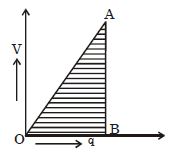
The charge $q$ on a capacitor varies with voltage $V$ as shown in the figure. The area of the triangle $AOB$ represents:
A
electric field between the plates
B
electric flux between the plates
C
energy density
D
energy stored by the capacitor
Solution
(D) The graph shows the variation of voltage $V$ (on the y-axis) with charge $q$ (on the x-axis) for a capacitor.
The area under the $V-q$ graph represents the work done in charging the capacitor,which is stored as potential energy.
The area of the triangle $AOB$ is given by:
$\text{Area} = \frac{1}{2} \times \text{base} \times \text{height}$
$\text{Area} = \frac{1}{2} \times q \times V$
Since the energy stored in a capacitor is $U = \frac{1}{2} qV$,the area of the triangle $AOB$ represents the energy stored by the capacitor.
The area under the $V-q$ graph represents the work done in charging the capacitor,which is stored as potential energy.
The area of the triangle $AOB$ is given by:
$\text{Area} = \frac{1}{2} \times \text{base} \times \text{height}$
$\text{Area} = \frac{1}{2} \times q \times V$
Since the energy stored in a capacitor is $U = \frac{1}{2} qV$,the area of the triangle $AOB$ represents the energy stored by the capacitor.
0 likes
View Solution81
DifficultMCQ
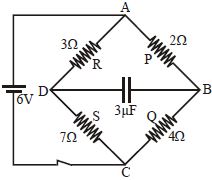
In steady state,the energy stored in the capacitor as shown in the figure is ..... $nJ$.
A
$80$
B
$20$
C
$100$
D
$60$
Solution
(D) In steady state,the capacitor acts as an open circuit,so no current flows through it.
The circuit consists of two parallel branches connected across the $6 \, V$ battery.
Branch $1$ (left side) consists of resistors $3 \, \Omega$ and $7 \, \Omega$ in series. The potential at $D$ relative to $A$ is given by the voltage divider rule: $V_{A} - V_{D} = \frac{3}{3+7} \times 6 = 1.8 \, V$.
Branch $2$ (right side) consists of resistors $2 \, \Omega$ and $4 \, \Omega$ in series. The potential at $B$ relative to $A$ is: $V_{A} - V_{B} = \frac{2}{2+4} \times 6 = 2 \, V$.
The potential difference across the capacitor (between points $D$ and $B$) is $V_{DB} = |V_{A} - V_{B} - (V_{A} - V_{D})| = |2 - 1.8| = 0.2 \, V$.
The energy stored in the capacitor is $U = \frac{1}{2} CV^{2}$.
Given $C = 3 \, \mu F = 3 \times 10^{-6} \, F$ and $V = 0.2 \, V$.
$U = \frac{1}{2} \times (3 \times 10^{-6}) \times (0.2)^{2} = \frac{1}{2} \times 3 \times 10^{-6} \times 0.04 = 6 \times 10^{-8} \, J = 60 \times 10^{-9} \, J = 60 \, nJ$.
The circuit consists of two parallel branches connected across the $6 \, V$ battery.
Branch $1$ (left side) consists of resistors $3 \, \Omega$ and $7 \, \Omega$ in series. The potential at $D$ relative to $A$ is given by the voltage divider rule: $V_{A} - V_{D} = \frac{3}{3+7} \times 6 = 1.8 \, V$.
Branch $2$ (right side) consists of resistors $2 \, \Omega$ and $4 \, \Omega$ in series. The potential at $B$ relative to $A$ is: $V_{A} - V_{B} = \frac{2}{2+4} \times 6 = 2 \, V$.
The potential difference across the capacitor (between points $D$ and $B$) is $V_{DB} = |V_{A} - V_{B} - (V_{A} - V_{D})| = |2 - 1.8| = 0.2 \, V$.
The energy stored in the capacitor is $U = \frac{1}{2} CV^{2}$.
Given $C = 3 \, \mu F = 3 \times 10^{-6} \, F$ and $V = 0.2 \, V$.
$U = \frac{1}{2} \times (3 \times 10^{-6}) \times (0.2)^{2} = \frac{1}{2} \times 3 \times 10^{-6} \times 0.04 = 6 \times 10^{-8} \, J = 60 \times 10^{-9} \, J = 60 \, nJ$.
0 likes
View Solution82
DifficultMCQ
If the distance between the plates of a capacitor having capacity $C$ and charge $Q$ is doubled,then the work done will be:
A
$\frac{Q^2}{4C}$
B
$\frac{Q^2}{2C}$
C
$\frac{Q^2}{C}$
D
$\frac{2Q^2}{C}$
Solution
(B) The capacitance of a parallel plate capacitor is given by $C = \frac{\epsilon_0 A}{d}$.
If the distance $d$ is doubled $(d' = 2d)$,the new capacitance becomes $C' = \frac{\epsilon_0 A}{2d} = \frac{C}{2}$.
The charge $Q$ remains constant as the capacitor is isolated.
The initial energy stored is $U_i = \frac{Q^2}{2C}$.
The final energy stored is $U_f = \frac{Q^2}{2C'} = \frac{Q^2}{2(C/2)} = \frac{Q^2}{C}$.
The work done by the external agent is equal to the change in potential energy: $W = U_f - U_i$.
$W = \frac{Q^2}{C} - \frac{Q^2}{2C} = \frac{Q^2}{2C}$.
If the distance $d$ is doubled $(d' = 2d)$,the new capacitance becomes $C' = \frac{\epsilon_0 A}{2d} = \frac{C}{2}$.
The charge $Q$ remains constant as the capacitor is isolated.
The initial energy stored is $U_i = \frac{Q^2}{2C}$.
The final energy stored is $U_f = \frac{Q^2}{2C'} = \frac{Q^2}{2(C/2)} = \frac{Q^2}{C}$.
The work done by the external agent is equal to the change in potential energy: $W = U_f - U_i$.
$W = \frac{Q^2}{C} - \frac{Q^2}{2C} = \frac{Q^2}{2C}$.
0 likes
View Solution83
DifficultMCQ
The energy stored in the electric field produced by a metal sphere is $4.5\, J$. If the sphere contains $4\,\mu C$ charge,its radius will be.......$mm$. [Take: $\frac{1}{4\pi\varepsilon_0} = 9 \times 10^9\, N\cdot m^2/C^2$]
A
$20$
B
$32$
C
$28$
D
$16$
Solution
(D) The energy stored in a charged spherical conductor is given by $U = \frac{Q^2}{2C}$.
Given: $U = 4.5\, J$ and $Q = 4\,\mu C = 4 \times 10^{-6}\, C$.
Substituting the values: $4.5 = \frac{(4 \times 10^{-6})^2}{2C} = \frac{16 \times 10^{-12}}{2C}$.
$C = \frac{16 \times 10^{-12}}{9} = 1.77 \times 10^{-12}\, F$.
The capacitance of a spherical conductor is $C = 4\pi\varepsilon_0 R$.
Therefore,$R = \frac{C}{4\pi\varepsilon_0} = C \times (9 \times 10^9)$.
$R = \frac{16 \times 10^{-12}}{9} \times 9 \times 10^9 = 16 \times 10^{-3}\, m$.
Converting to millimeters: $R = 16\, mm$.
Given: $U = 4.5\, J$ and $Q = 4\,\mu C = 4 \times 10^{-6}\, C$.
Substituting the values: $4.5 = \frac{(4 \times 10^{-6})^2}{2C} = \frac{16 \times 10^{-12}}{2C}$.
$C = \frac{16 \times 10^{-12}}{9} = 1.77 \times 10^{-12}\, F$.
The capacitance of a spherical conductor is $C = 4\pi\varepsilon_0 R$.
Therefore,$R = \frac{C}{4\pi\varepsilon_0} = C \times (9 \times 10^9)$.
$R = \frac{16 \times 10^{-12}}{9} \times 9 \times 10^9 = 16 \times 10^{-3}\, m$.
Converting to millimeters: $R = 16\, mm$.
0 likes
View Solution84
MediumMCQ
$A$ capacitor with capacitance $5\,\mu F$ is charged to $5\,\mu C.$ If the plates are pulled apart to reduce the capacitance to $2\,\mu F,$ how much work is done?
A
$3.75\times 10^{-6}\,J$
B
$2.55\times 10^{-6}\,J$
C
$6.25\times 10^{-6}\,J$
D
$2.16\times 10^{-6}\,J$
Solution
(A) The charge $q$ on the capacitor remains constant because the capacitor is isolated after charging.
Initial capacitance $C_i = 5\,\mu F = 5 \times 10^{-6}\,F$.
Final capacitance $C_f = 2\,\mu F = 2 \times 10^{-6}\,F$.
Charge $q = 5\,\mu C = 5 \times 10^{-6}\,C$.
The energy stored in a capacitor is given by $U = \frac{q^2}{2C}$.
Work done $W = \Delta U = U_f - U_i = \frac{q^2}{2C_f} - \frac{q^2}{2C_i} = \frac{q^2}{2} \left( \frac{1}{C_f} - \frac{1}{C_i} \right)$.
Substituting the values:
$W = \frac{(5 \times 10^{-6})^2}{2} \left( \frac{1}{2 \times 10^{-6}} - \frac{1}{5 \times 10^{-6}} \right)$.
$W = \frac{25 \times 10^{-12}}{2} \left( \frac{5 - 2}{10 \times 10^{-6}} \right) = \frac{25 \times 10^{-12}}{2} \left( \frac{3}{10 \times 10^{-6}} \right)$.
$W = \frac{75 \times 10^{-12}}{20 \times 10^{-6}} = 3.75 \times 10^{-6}\,J$.
Initial capacitance $C_i = 5\,\mu F = 5 \times 10^{-6}\,F$.
Final capacitance $C_f = 2\,\mu F = 2 \times 10^{-6}\,F$.
Charge $q = 5\,\mu C = 5 \times 10^{-6}\,C$.
The energy stored in a capacitor is given by $U = \frac{q^2}{2C}$.
Work done $W = \Delta U = U_f - U_i = \frac{q^2}{2C_f} - \frac{q^2}{2C_i} = \frac{q^2}{2} \left( \frac{1}{C_f} - \frac{1}{C_i} \right)$.
Substituting the values:
$W = \frac{(5 \times 10^{-6})^2}{2} \left( \frac{1}{2 \times 10^{-6}} - \frac{1}{5 \times 10^{-6}} \right)$.
$W = \frac{25 \times 10^{-12}}{2} \left( \frac{5 - 2}{10 \times 10^{-6}} \right) = \frac{25 \times 10^{-12}}{2} \left( \frac{3}{10 \times 10^{-6}} \right)$.
$W = \frac{75 \times 10^{-12}}{20 \times 10^{-6}} = 3.75 \times 10^{-6}\,J$.
0 likes
View Solution85
EasyMCQ
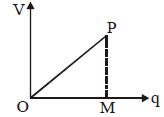
The charge $q$ on a capacitor varies with voltage $V$ as shown in the graph. The area of $\Delta OPM$ represents:
A
capacitance
B
capacitive reactance
C
magnetic field between the plates
D
energy stored in the capacitor
Solution
(D) The energy stored in a capacitor is given by the work done in charging it. For a capacitor,the charge $q$ is directly proportional to the potential difference $V$,i.e.,$q = CV$.
The graph shows a linear relationship between $V$ and $q$.
The area under the $V-q$ graph represents the work done,which is stored as potential energy $U$ in the capacitor.
Area of $\Delta OPM = \frac{1}{2} \times \text{base} \times \text{height} = \frac{1}{2} \times q \times V$.
Since $U = \frac{1}{2} qV$,the area of $\Delta OPM$ represents the energy stored in the capacitor.
The graph shows a linear relationship between $V$ and $q$.
The area under the $V-q$ graph represents the work done,which is stored as potential energy $U$ in the capacitor.
Area of $\Delta OPM = \frac{1}{2} \times \text{base} \times \text{height} = \frac{1}{2} \times q \times V$.
Since $U = \frac{1}{2} qV$,the area of $\Delta OPM$ represents the energy stored in the capacitor.
0 likes
View Solution86
MediumMCQ
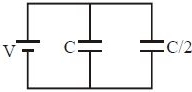
Two capacitors,one of capacity $C$ and the other of capacity $\frac{C}{2}$,are connected to a $V \text{ volt}$ battery,as shown. The work done in charging fully both the capacitors is
A
$\frac{1}{2}CV^2$
B
$2CV^2$
C
$\frac{1}{4}CV^2$
D
$\frac{3}{4}CV^2$
Solution
(D) The two capacitors are connected in parallel to the battery of potential $V$.
The equivalent capacitance $C_{eq}$ for capacitors in parallel is given by $C_{eq} = C_1 + C_2$.
Here,$C_{eq} = C + \frac{C}{2} = \frac{3C}{2}$.
The work done $W$ in charging a capacitor is equal to the energy stored in the capacitor,which is given by $W = \frac{1}{2} C_{eq} V^2$.
Substituting the value of $C_{eq}$,we get $W = \frac{1}{2} \left( \frac{3C}{2} \right) V^2 = \frac{3}{4} CV^2$.
The equivalent capacitance $C_{eq}$ for capacitors in parallel is given by $C_{eq} = C_1 + C_2$.
Here,$C_{eq} = C + \frac{C}{2} = \frac{3C}{2}$.
The work done $W$ in charging a capacitor is equal to the energy stored in the capacitor,which is given by $W = \frac{1}{2} C_{eq} V^2$.
Substituting the value of $C_{eq}$,we get $W = \frac{1}{2} \left( \frac{3C}{2} \right) V^2 = \frac{3}{4} CV^2$.
0 likes
View Solution87
MediumMCQ
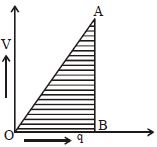
The charge $q$ on a capacitor varies with voltage $V$ as shown in the figure. The area of the triangle $AOB$ is proportional to
A
electric field between the plates
B
electric flux between the plates
C
energy density
D
energy stored by the capacitor
Solution
(D) The area of the triangle $AOB$ in the $V-q$ graph is given by:
Area $= \frac{1}{2} \times \text{base} \times \text{height}$
Area $= \frac{1}{2} \times q \times V$
We know that the energy stored in a capacitor is given by $U = \frac{1}{2} qV$.
Therefore,the area of the triangle $AOB$ is equal to the energy stored by the capacitor.
Thus,the area is proportional to the energy stored by the capacitor.
Area $= \frac{1}{2} \times \text{base} \times \text{height}$
Area $= \frac{1}{2} \times q \times V$
We know that the energy stored in a capacitor is given by $U = \frac{1}{2} qV$.
Therefore,the area of the triangle $AOB$ is equal to the energy stored by the capacitor.
Thus,the area is proportional to the energy stored by the capacitor.
0 likes
View Solution88
MediumMCQ
$A$ parallel plate capacitor has a uniform electric field $E \ (V/m)$ in the space between the plates. If the distance between the plates is $d \ (m)$ and the area of each plate is $A \ (m^2)$,then the energy (joules) stored in the capacitor is:
A
$E^2 Ad / \epsilon_0$
B
$\frac{1}{2} \epsilon_0 E^2$
C
$\epsilon_0 EAd$
D
$\frac{1}{2} \epsilon_0 E^2 Ad$
Solution
(D) The capacitance of a parallel plate capacitor is given by $C = \frac{\epsilon_0 A}{d}$.
The potential difference between the plates is $V = Ed$.
The energy stored in the capacitor is $U = \frac{1}{2} C V^2$.
Substituting the values of $C$ and $V$:
$U = \frac{1}{2} \left( \frac{\epsilon_0 A}{d} \right) (Ed)^2$.
$U = \frac{1}{2} \left( \frac{\epsilon_0 A}{d} \right) E^2 d^2$.
$U = \frac{1}{2} \epsilon_0 E^2 Ad$.
The potential difference between the plates is $V = Ed$.
The energy stored in the capacitor is $U = \frac{1}{2} C V^2$.
Substituting the values of $C$ and $V$:
$U = \frac{1}{2} \left( \frac{\epsilon_0 A}{d} \right) (Ed)^2$.
$U = \frac{1}{2} \left( \frac{\epsilon_0 A}{d} \right) E^2 d^2$.
$U = \frac{1}{2} \epsilon_0 E^2 Ad$.
0 likes
View Solution89
EasyMCQ
$A$ $12 \;pF$ capacitor is connected to a $50 \;V$ battery. How much electrostatic energy is stored in the capacitor?
A
$9.4 \times 10^{-7} \;J$
B
$6.4 \times 10^{-7} \;J$
C
$7.5 \times 10^{-8} \;J$
D
$1.5 \times 10^{-8} \;J$
Solution
(D) Given capacitance,$C = 12 \;pF = 12 \times 10^{-12} \;F$.
Potential difference,$V = 50 \;V$.
The electrostatic energy $E$ stored in a capacitor is given by the formula:
$E = \frac{1}{2} C V^2$
Substituting the values:
$E = \frac{1}{2} \times (12 \times 10^{-12} \;F) \times (50 \;V)^2$
$E = 6 \times 10^{-12} \times 2500 \;J$
$E = 15000 \times 10^{-12} \;J$
$E = 1.5 \times 10^{-8} \;J$
Therefore,the electrostatic energy stored in the capacitor is $1.5 \times 10^{-8} \;J$.
Potential difference,$V = 50 \;V$.
The electrostatic energy $E$ stored in a capacitor is given by the formula:
$E = \frac{1}{2} C V^2$
Substituting the values:
$E = \frac{1}{2} \times (12 \times 10^{-12} \;F) \times (50 \;V)^2$
$E = 6 \times 10^{-12} \times 2500 \;J$
$E = 15000 \times 10^{-12} \;J$
$E = 1.5 \times 10^{-8} \;J$
Therefore,the electrostatic energy stored in the capacitor is $1.5 \times 10^{-8} \;J$.
0 likes
View Solution90
Medium
The plates of a parallel plate capacitor have an area of $90 \,cm^{2}$ each and are separated by $2.5 \,mm$. The capacitor is charged by connecting it to a $400 \,V$ supply.
$(a)$ How much electrostatic energy is stored by the capacitor?
$(b)$ View this energy as stored in the electrostatic field between the plates,and obtain the energy per unit volume $u$. Hence arrive at a relation between $u$ and the magnitude of electric field $E$ between the plates.
$(a)$ How much electrostatic energy is stored by the capacitor?
$(b)$ View this energy as stored in the electrostatic field between the plates,and obtain the energy per unit volume $u$. Hence arrive at a relation between $u$ and the magnitude of electric field $E$ between the plates.
Solution
(N/A) Given:
Area $A = 90 \,cm^{2} = 90 \times 10^{-4} \,m^{2}$
Distance $d = 2.5 \,mm = 2.5 \times 10^{-3} \,m$
Potential $V = 400 \,V$
Permittivity $\epsilon_{0} = 8.85 \times 10^{-12} \,C^{2} \,N^{-1} \,m^{-2}$
$(a)$ Capacitance $C = \frac{\epsilon_{0} A}{d} = \frac{8.85 \times 10^{-12} \times 90 \times 10^{-4}}{2.5 \times 10^{-3}} = 3.186 \times 10^{-11} \,F$
Energy $U = \frac{1}{2} C V^{2} = \frac{1}{2} \times 3.186 \times 10^{-11} \times (400)^{2} = 2.55 \times 10^{-6} \,J$
$(b)$ Volume $V' = A \times d = 90 \times 10^{-4} \times 2.5 \times 10^{-3} = 2.25 \times 10^{-5} \,m^{3}$
Energy density $u = \frac{U}{V'} = \frac{2.55 \times 10^{-6}}{2.25 \times 10^{-5}} = 0.113 \,J \,m^{-3}$
Relation: $u = \frac{U}{Ad} = \frac{\frac{1}{2} (\frac{\epsilon_{0} A}{d}) V^{2}}{Ad} = \frac{1}{2} \epsilon_{0} (\frac{V}{d})^{2} = \frac{1}{2} \epsilon_{0} E^{2}$
Area $A = 90 \,cm^{2} = 90 \times 10^{-4} \,m^{2}$
Distance $d = 2.5 \,mm = 2.5 \times 10^{-3} \,m$
Potential $V = 400 \,V$
Permittivity $\epsilon_{0} = 8.85 \times 10^{-12} \,C^{2} \,N^{-1} \,m^{-2}$
$(a)$ Capacitance $C = \frac{\epsilon_{0} A}{d} = \frac{8.85 \times 10^{-12} \times 90 \times 10^{-4}}{2.5 \times 10^{-3}} = 3.186 \times 10^{-11} \,F$
Energy $U = \frac{1}{2} C V^{2} = \frac{1}{2} \times 3.186 \times 10^{-11} \times (400)^{2} = 2.55 \times 10^{-6} \,J$
$(b)$ Volume $V' = A \times d = 90 \times 10^{-4} \times 2.5 \times 10^{-3} = 2.25 \times 10^{-5} \,m^{3}$
Energy density $u = \frac{U}{V'} = \frac{2.55 \times 10^{-6}}{2.25 \times 10^{-5}} = 0.113 \,J \,m^{-3}$
Relation: $u = \frac{U}{Ad} = \frac{\frac{1}{2} (\frac{\epsilon_{0} A}{d}) V^{2}}{Ad} = \frac{1}{2} \epsilon_{0} (\frac{V}{d})^{2} = \frac{1}{2} \epsilon_{0} E^{2}$
0 likes
View Solution91
Difficult
How does a capacitor store energy? Obtain the formula for the energy stored in a capacitor.
Solution
(N/A) capacitor stores energy in the form of an electrostatic field between its plates. When charging a capacitor,work is done by an external agent to move charge from one plate to the other against the existing potential difference.
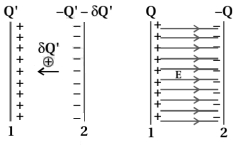
Consider two uncharged conductors $1$ and $2$ as shown in the figure.
Imagine a process of transferring charge from conductor $2$ to conductor $1$ bit by bit. As charge is transferred,conductor $1$ becomes positively charged and conductor $2$ becomes negatively charged.
In transferring positive charge from conductor $2$ to conductor $1$,external work must be done because conductor $1$ is at a higher potential than conductor $2$.
Consider the situation when the conductors $1$ and $2$ have charges $Q'$ and $-Q'$ respectively.
The potential difference $V'$ between conductors $1$ and $2$ is $V' = \frac{Q'}{C}$,where $C$ is the capacitance of the system.
If a small charge $\delta Q'$ is transferred from conductor $2$ to $1$,the work done is $\delta W = V' \delta Q'$.
Substituting $V'$,we get $\delta W = \frac{Q' \delta Q'}{C}$.
The total work done $W$ to bring a total charge $Q$ from conductor $2$ to $1$ is obtained by integrating the work done for small charge transfers from $0$ to $Q$:
$W = \int_{0}^{Q} \frac{Q'}{C} dQ' = \frac{1}{C} \left[ \frac{(Q')^2}{2} \right]_{0}^{Q} = \frac{Q^2}{2C}$.
Since $Q = CV$,the energy stored can also be expressed as $U = \frac{1}{2}CV^2$ or $U = \frac{1}{2}QV$.
Consider two uncharged conductors $1$ and $2$ as shown in the figure.
Imagine a process of transferring charge from conductor $2$ to conductor $1$ bit by bit. As charge is transferred,conductor $1$ becomes positively charged and conductor $2$ becomes negatively charged.
In transferring positive charge from conductor $2$ to conductor $1$,external work must be done because conductor $1$ is at a higher potential than conductor $2$.
Consider the situation when the conductors $1$ and $2$ have charges $Q'$ and $-Q'$ respectively.
The potential difference $V'$ between conductors $1$ and $2$ is $V' = \frac{Q'}{C}$,where $C$ is the capacitance of the system.
If a small charge $\delta Q'$ is transferred from conductor $2$ to $1$,the work done is $\delta W = V' \delta Q'$.
Substituting $V'$,we get $\delta W = \frac{Q' \delta Q'}{C}$.
The total work done $W$ to bring a total charge $Q$ from conductor $2$ to $1$ is obtained by integrating the work done for small charge transfers from $0$ to $Q$:
$W = \int_{0}^{Q} \frac{Q'}{C} dQ' = \frac{1}{C} \left[ \frac{(Q')^2}{2} \right]_{0}^{Q} = \frac{Q^2}{2C}$.
Since $Q = CV$,the energy stored can also be expressed as $U = \frac{1}{2}CV^2$ or $U = \frac{1}{2}QV$.
0 likes
View Solution92
Medium
Obtain the expression for the energy stored per unit volume in a charged capacitor.
Solution
Energy stored per unit volume is known as energy density. The energy stored in a capacitor is given by $U = \frac{1}{2} \frac{Q^2}{C}$.
Substituting $Q = \sigma A$ and $C = \frac{\epsilon_0 A}{d}$,we get:
$U = \frac{1}{2} \frac{(\sigma A)^2}{\epsilon_0 A / d} = \frac{1}{2} \frac{\sigma^2 A^2 d}{\epsilon_0 A} = \frac{1}{2} \frac{\sigma^2 A d}{\epsilon_0}$.
Since the electric field between the plates is $E = \frac{\sigma}{\epsilon_0}$,we have $\sigma = \epsilon_0 E$.
Substituting this into the expression for $U$:
$U = \frac{1}{2} \frac{(\epsilon_0 E)^2 A d}{\epsilon_0} = \frac{1}{2} \epsilon_0 E^2 (A d)$.
Here,$A d$ represents the volume $V$ of the region between the plates.
Therefore,the energy stored per unit volume $(u)$ is:
$u = \frac{U}{V} = \frac{U}{A d} = \frac{1}{2} \epsilon_0 E^2$.
Substituting $Q = \sigma A$ and $C = \frac{\epsilon_0 A}{d}$,we get:
$U = \frac{1}{2} \frac{(\sigma A)^2}{\epsilon_0 A / d} = \frac{1}{2} \frac{\sigma^2 A^2 d}{\epsilon_0 A} = \frac{1}{2} \frac{\sigma^2 A d}{\epsilon_0}$.
Since the electric field between the plates is $E = \frac{\sigma}{\epsilon_0}$,we have $\sigma = \epsilon_0 E$.
Substituting this into the expression for $U$:
$U = \frac{1}{2} \frac{(\epsilon_0 E)^2 A d}{\epsilon_0} = \frac{1}{2} \epsilon_0 E^2 (A d)$.
Here,$A d$ represents the volume $V$ of the region between the plates.
Therefore,the energy stored per unit volume $(u)$ is:
$u = \frac{U}{V} = \frac{U}{A d} = \frac{1}{2} \epsilon_0 E^2$.
0 likes
View Solution93
EasyMCQ
Energy is stored in what form in a capacitor?
A
Magnetic field
B
Electric field
C
Kinetic energy
D
Potential energy of the plates
Solution
(B) capacitor is a device that stores electrical energy in an electric field.
When a potential difference is applied across the plates of a capacitor,charges are separated,creating an electric field between the plates.
The energy stored in the capacitor is given by the formula $U = \frac{1}{2} CV^2 = \frac{Q^2}{2C}$,where $C$ is the capacitance,$V$ is the potential difference,and $Q$ is the charge.
This energy is stored in the space between the plates in the form of an electric field.
When a potential difference is applied across the plates of a capacitor,charges are separated,creating an electric field between the plates.
The energy stored in the capacitor is given by the formula $U = \frac{1}{2} CV^2 = \frac{Q^2}{2C}$,where $C$ is the capacitance,$V$ is the potential difference,and $Q$ is the charge.
This energy is stored in the space between the plates in the form of an electric field.
0 likes
View Solution94
Easy
Write three different formulas for the energy stored in a capacitor.
Solution
(N/A) The energy stored $(U)$ in a capacitor with capacitance $C$,charge $Q$,and potential difference $V$ is given by the following three formulas:
$1$. $U = \frac{1}{2} CV^2$
$2$. $U = \frac{Q^2}{2C}$
$3$. $U = \frac{1}{2} QV$
These formulas are derived using the relationship $Q = CV$.
$1$. $U = \frac{1}{2} CV^2$
$2$. $U = \frac{Q^2}{2C}$
$3$. $U = \frac{1}{2} QV$
These formulas are derived using the relationship $Q = CV$.
0 likes
View Solution95
Medium
What is energy density? Write its formula.
Solution
(N/A) Energy density is defined as the energy stored per unit volume in an electric field.
For a parallel plate capacitor,the energy stored $U$ is given by $U = \frac{1}{2} CV^2$.
Since $C = \frac{\epsilon_0 A}{d}$ and $V = Ed$,we have $U = \frac{1}{2} (\frac{\epsilon_0 A}{d}) (Ed)^2 = \frac{1}{2} \epsilon_0 A d E^2$.
The volume of the space between the plates is $V_{vol} = Ad$.
Therefore,the energy density $u$ is $u = \frac{U}{V_{vol}} = \frac{\frac{1}{2} \epsilon_0 A d E^2}{Ad} = \frac{1}{2} \epsilon_0 E^2$.
For a parallel plate capacitor,the energy stored $U$ is given by $U = \frac{1}{2} CV^2$.
Since $C = \frac{\epsilon_0 A}{d}$ and $V = Ed$,we have $U = \frac{1}{2} (\frac{\epsilon_0 A}{d}) (Ed)^2 = \frac{1}{2} \epsilon_0 A d E^2$.
The volume of the space between the plates is $V_{vol} = Ad$.
Therefore,the energy density $u$ is $u = \frac{U}{V_{vol}} = \frac{\frac{1}{2} \epsilon_0 A d E^2}{Ad} = \frac{1}{2} \epsilon_0 E^2$.
0 likes
View Solution96
MediumMCQ
$A$ $5.0 \mu F$ capacitor is charged to a potential difference of $800 V$ and discharged through a conductor. The energy (in $J$) given to the conductor during the discharge is:
A
$1.6 \times 10^{-2}$
B
$3.2$
C
$1.6$
D
$4.2$
Solution
(C) The energy $U$ stored in a capacitor is given by the formula:
$U = \frac{1}{2} C V^2$
Given:
Capacitance $C = 5.0 \mu F = 5.0 \times 10^{-6} F$
Potential difference $V = 800 V$
Substituting the values into the formula:
$U = \frac{1}{2} \times (5.0 \times 10^{-6} F) \times (800 V)^2$
$U = \frac{1}{2} \times 5.0 \times 10^{-6} \times 640000$
$U = 2.5 \times 10^{-6} \times 6.4 \times 10^5$
$U = 16 \times 10^{-1} = 1.6 J$
Thus,the energy given to the conductor is $1.6 J$.
$U = \frac{1}{2} C V^2$
Given:
Capacitance $C = 5.0 \mu F = 5.0 \times 10^{-6} F$
Potential difference $V = 800 V$
Substituting the values into the formula:
$U = \frac{1}{2} \times (5.0 \times 10^{-6} F) \times (800 V)^2$
$U = \frac{1}{2} \times 5.0 \times 10^{-6} \times 640000$
$U = 2.5 \times 10^{-6} \times 6.4 \times 10^5$
$U = 16 \times 10^{-1} = 1.6 J$
Thus,the energy given to the conductor is $1.6 J$.
0 likes
View Solution97
MediumMCQ
$A$ parallel plate capacitor has a uniform electric field $\overrightarrow{E}$ in the space between the plates. If the distance between the plates is $d$ and the area of each plate is $A$,the energy stored in the capacitor is: ($\varepsilon_{0} =$ permittivity of free space)
A
$\frac{1}{2} \varepsilon_{0} E^{2}$
B
$\varepsilon_{0} EAd$
C
$\frac{1}{2} \varepsilon_{0} E^{2} Ad$
D
$\frac{E^{2} Ad}{\varepsilon_{0}}$
Solution
(C) The energy density $u$ (energy per unit volume) in a parallel plate capacitor is given by the formula: $u = \frac{1}{2} \varepsilon_{0} E^{2}$.
The volume $V$ of the space between the plates is the product of the area $A$ and the distance $d$,so $V = Ad$.
The total energy $U$ stored in the capacitor is the product of the energy density and the volume:
$U = u \times V$
$U = (\frac{1}{2} \varepsilon_{0} E^{2}) \times (Ad)$
$U = \frac{1}{2} \varepsilon_{0} E^{2} Ad$.
The volume $V$ of the space between the plates is the product of the area $A$ and the distance $d$,so $V = Ad$.
The total energy $U$ stored in the capacitor is the product of the energy density and the volume:
$U = u \times V$
$U = (\frac{1}{2} \varepsilon_{0} E^{2}) \times (Ad)$
$U = \frac{1}{2} \varepsilon_{0} E^{2} Ad$.
0 likes
View Solution98
MediumMCQ
If the charge on a capacitor is increased by $2 \ C$,the energy stored in it increases by $44 \%$. The original charge on the capacitor is (in $C$):
A
$10$
B
$20$
C
$30$
D
$40$
Solution
(A) The energy stored in a capacitor is given by $U = \frac{q^2}{2C}$,where $q$ is the charge and $C$ is the capacitance.
Since $C$ is constant,$U \propto q^2$.
Let the initial charge be $q$ and the initial energy be $U_i = \frac{q^2}{2C}$.
When the charge is increased by $2 \ C$,the new charge is $q' = q + 2$.
The new energy is $U_f = \frac{(q+2)^2}{2C}$.
Given that the energy increases by $44 \%$,the new energy is $U_f = U_i + 0.44 \, U_i = 1.44 \, U_i$.
Substituting the expressions for $U_f$ and $U_i$:
$\frac{(q+2)^2}{2C} = 1.44 \times \frac{q^2}{2C}$.
$(q+2)^2 = 1.44 \, q^2$.
Taking the square root on both sides:
$q + 2 = \sqrt{1.44} \, q$.
$q + 2 = 1.2 \, q$.
$0.2 \, q = 2$.
$q = \frac{2}{0.2} = 10 \ C$.
Since $C$ is constant,$U \propto q^2$.
Let the initial charge be $q$ and the initial energy be $U_i = \frac{q^2}{2C}$.
When the charge is increased by $2 \ C$,the new charge is $q' = q + 2$.
The new energy is $U_f = \frac{(q+2)^2}{2C}$.
Given that the energy increases by $44 \%$,the new energy is $U_f = U_i + 0.44 \, U_i = 1.44 \, U_i$.
Substituting the expressions for $U_f$ and $U_i$:
$\frac{(q+2)^2}{2C} = 1.44 \times \frac{q^2}{2C}$.
$(q+2)^2 = 1.44 \, q^2$.
Taking the square root on both sides:
$q + 2 = \sqrt{1.44} \, q$.
$q + 2 = 1.2 \, q$.
$0.2 \, q = 2$.
$q = \frac{2}{0.2} = 10 \ C$.
0 likes
View SolutionElectric Potential and Capacitance — Energy Stored in a Capacitor · Frequently Asked Questions
1Are these Electric Potential and Capacitance questions useful for JEE and NEET?
Yes. All questions in this section are mapped to JEE Main and NEET exam patterns. Previous year questions from JEE Main, NEET, GUJCET and state-level exams are included with full solutions.
2Can I switch to Hindi or Gujarati for these questions?
Yes. Use the language tabs in the hero section or the sidebar to view the same questions and solutions in English, Hindi or Gujarati.
3How do I generate a question paper from this subtopic?
Use the Vedclass Exam Paper Generator — select the chapter and subtopic, set difficulty, and generate Sets A, B, C, D automatically. First 3 chapters of every subject are free.
Vedclass Products
For Students
Vedclass Test Series
Mock tests in real JEE/NEET style with performance analysis. 5-day free trial.
Start Free TrialFor Teachers
Exam Paper Generator
Generate Set A/B/C/D papers from this chapter in 2 minutes. 3 chapters free.
Try FreeFor Institutes
Online Exam Module
Live online exams with unlimited students, 360° analytics & white-label branding.
See DemoFor Teachers & Institutes
Generate a Electric Potential and Capacitance Exam Paper in 2 Minutes
Select subtopic & difficulty — Sets A, B, C, D auto-generated with No Repeat logic.
First 3 chapters of every subject are free — no payment required.