
A English
Dielectric and Polarisation Questions in English
Class 12 Physics · Electric Potential and Capacitance · Dielectric and Polarisation
49+
Questions
English
Language
100%
With Solutions
Showing 49 of 49 questions in English
1
EasyMCQ
The dielectric constant of pure water is $81$. Its permittivity will be:
A
$7.17 \times 10^{-10} \text{ MKS units}$
B
$8.86 \times 10^{-12} \text{ MKS units}$
C
$1.02 \times 10^{13} \text{ MKS units}$
D
Cannot be calculated
Solution
(A) The permittivity $\varepsilon$ of a medium is given by the formula $\varepsilon = K \varepsilon_0$,where $K$ is the dielectric constant and $\varepsilon_0$ is the permittivity of free space.
Given $K = 81$ and $\varepsilon_0 \approx 8.854 \times 10^{-12} \text{ C}^2/\text{N}\cdot\text{m}^2$.
Substituting the values: $\varepsilon = 81 \times 8.854 \times 10^{-12} \text{ C}^2/\text{N}\cdot\text{m}^2$.
$\varepsilon \approx 717.174 \times 10^{-12} \text{ C}^2/\text{N}\cdot\text{m}^2$.
$\varepsilon \approx 7.17 \times 10^{-10} \text{ C}^2/\text{N}\cdot\text{m}^2$ (or $MKS$ units).
Given $K = 81$ and $\varepsilon_0 \approx 8.854 \times 10^{-12} \text{ C}^2/\text{N}\cdot\text{m}^2$.
Substituting the values: $\varepsilon = 81 \times 8.854 \times 10^{-12} \text{ C}^2/\text{N}\cdot\text{m}^2$.
$\varepsilon \approx 717.174 \times 10^{-12} \text{ C}^2/\text{N}\cdot\text{m}^2$.
$\varepsilon \approx 7.17 \times 10^{-10} \text{ C}^2/\text{N}\cdot\text{m}^2$ (or $MKS$ units).
0 likes
View Solution2
EasyMCQ
With the rise in temperature,the dielectric constant $K$ of a liquid
A
Increases
B
Decreases
C
Remains unchanged
D
Changes erratically
Solution
(B) The dielectric constant $K$ of a liquid is primarily due to the orientation of polar molecules.
As the temperature increases,the thermal agitation of the molecules increases,which opposes the alignment of the dipoles in an external electric field.
Consequently,the polarization of the liquid decreases,leading to a decrease in the dielectric constant $K$.
As the temperature increases,the thermal agitation of the molecules increases,which opposes the alignment of the dipoles in an external electric field.
Consequently,the polarization of the liquid decreases,leading to a decrease in the dielectric constant $K$.
0 likes
View Solution3
EasyMCQ
Two charges placed in air repel each other by a force of $10^{-4} \ N$. When oil is introduced between the charges,the force becomes $2.5 \times 10^{-5} \ N$. The dielectric constant of oil is:
A
$2.5$
B
$0.25$
C
$2$
D
$4$
Solution
(D) The force between two charges in air is given by $F_a = \frac{1}{4\pi\epsilon_0} \frac{q_1q_2}{r^2} = 10^{-4} \ N$.
When a medium (oil) with dielectric constant $K$ is introduced,the force becomes $F_m = \frac{1}{4\pi\epsilon_0 K} \frac{q_1q_2}{r^2} = 2.5 \times 10^{-5} \ N$.
The ratio of the force in air to the force in the medium is given by $K = \frac{F_a}{F_m}$.
Substituting the values: $K = \frac{10^{-4}}{2.5 \times 10^{-5}} = \frac{10}{2.5} = 4$.
Therefore,the dielectric constant of oil is $4$.
When a medium (oil) with dielectric constant $K$ is introduced,the force becomes $F_m = \frac{1}{4\pi\epsilon_0 K} \frac{q_1q_2}{r^2} = 2.5 \times 10^{-5} \ N$.
The ratio of the force in air to the force in the medium is given by $K = \frac{F_a}{F_m}$.
Substituting the values: $K = \frac{10^{-4}}{2.5 \times 10^{-5}} = \frac{10}{2.5} = 4$.
Therefore,the dielectric constant of oil is $4$.
0 likes
View Solution4
EasyMCQ
The dielectric constant for a metal is
A
Zero
B
Infinite
C
$1$
D
Greater than $1$
Solution
(B) The dielectric constant $K$ (or relative permittivity $\varepsilon_r$) is defined as the ratio of the permittivity of the medium $\varepsilon$ to the permittivity of free space $\varepsilon_0$, i.e., $K = \frac{\varepsilon}{\varepsilon_0}$.
For a metal, the electric field inside the material in an electrostatic condition is zero $(E_{in} = 0)$.
Since the induced electric field exactly cancels the external electric field, the effective permittivity of a metal is considered to be infinite.
Therefore, the dielectric constant for a metal is infinite.
For a metal, the electric field inside the material in an electrostatic condition is zero $(E_{in} = 0)$.
Since the induced electric field exactly cancels the external electric field, the effective permittivity of a metal is considered to be infinite.
Therefore, the dielectric constant for a metal is infinite.
0 likes
View Solution5
EasyMCQ
The potential gradient at which the dielectric of a condenser just gets punctured is called
A
Dielectric constant
B
Dielectric strength
C
Dielectric resistance
D
Dielectric number
Solution
(B) The maximum electric field intensity that a dielectric material can withstand without breaking down (i.e.,becoming conducting) is known as its dielectric strength.
Since the electric field $E$ is defined as the potential gradient,$E = -\frac{dV}{dr}$.
When the potential gradient reaches a critical value,the dielectric material undergoes electrical breakdown,which is referred to as the dielectric strength of the material.
Since the electric field $E$ is defined as the potential gradient,$E = -\frac{dV}{dr}$.
When the potential gradient reaches a critical value,the dielectric material undergoes electrical breakdown,which is referred to as the dielectric strength of the material.
1 likes
View Solution6
EasyMCQ
If the dielectric constant and dielectric strength are denoted by $k$ and $x$ respectively,then a material suitable for use as a dielectric in a capacitor must have
A
High $k$ and high $x$
B
High $k$ and low $x$
C
Low $k$ and low $x$
D
Low $k$ and high $x$
Solution
(A) The capacitance of a parallel plate capacitor is given by $C = \frac{k \epsilon_0 A}{d}$,where $k$ is the dielectric constant. To maximize capacitance,we require a high value of $k$.
Dielectric strength $x$ is the maximum electric field a material can withstand without breaking down. To prevent the capacitor from short-circuiting under high voltage,the material must have a high dielectric strength $x$.
Therefore,a suitable dielectric material must have both high $k$ and high $x$.
Dielectric strength $x$ is the maximum electric field a material can withstand without breaking down. To prevent the capacitor from short-circuiting under high voltage,the material must have a high dielectric strength $x$.
Therefore,a suitable dielectric material must have both high $k$ and high $x$.
0 likes
View Solution7
EasyMCQ
Can a metal be used as a medium for a dielectric?
A
Yes
B
No
C
Depends on its shape
D
Depends on the dielectric
Solution
(B) The correct answer is $B$. $A$ dielectric is defined as an insulating material that can be polarized by an external electric field. Metals are excellent conductors of electricity,meaning they contain free electrons that move to cancel out any internal electric field. Therefore,metals cannot act as dielectrics because they do not support the existence of an internal electric field,which is a fundamental requirement for a dielectric material.
0 likes
View Solution8
EasyMCQ
The dielectric constant $K$ of an insulator cannot be
A
$3$
B
$6$
C
$8$
D
$\infty$
Solution
(D) The dielectric constant $K$ (also known as relative permittivity $\epsilon_r$) is a measure of a material's ability to store electrical energy in an electric field.
For an insulator (dielectric),the value of $K$ is always greater than or equal to $1$ $(K \ge 1)$.
For a perfect conductor (metal),the dielectric constant is defined as $K = \infty$.
Since the question asks for the value that an insulator cannot have,the correct answer is $\infty$,as this value is characteristic of conductors,not insulators.
For an insulator (dielectric),the value of $K$ is always greater than or equal to $1$ $(K \ge 1)$.
For a perfect conductor (metal),the dielectric constant is defined as $K = \infty$.
Since the question asks for the value that an insulator cannot have,the correct answer is $\infty$,as this value is characteristic of conductors,not insulators.
0 likes
View Solution9
EasyMCQ
If the dielectric constant and dielectric strength are represented by $k$ and $x$ respectively,what properties should a suitable material have to be used as a dielectric in a capacitor?
A
High $k$ and high $x$
B
High $k$ and low $x$
C
Low $k$ and low $x$
D
Low $k$ and high $x$
Solution
(A) The dielectric constant $k$ (also denoted as $\epsilon_r$) determines the ability of a material to store electrical energy in an electric field. $A$ higher $k$ increases the capacitance of the capacitor $(C = k C_0)$.
The dielectric strength $x$ is the maximum electric field that a material can withstand without undergoing electrical breakdown. $A$ higher $x$ allows the capacitor to operate at higher voltages without failing.
Therefore,for an ideal capacitor,we require a material with both a high dielectric constant $(k)$ and high dielectric strength $(x)$.
The dielectric strength $x$ is the maximum electric field that a material can withstand without undergoing electrical breakdown. $A$ higher $x$ allows the capacitor to operate at higher voltages without failing.
Therefore,for an ideal capacitor,we require a material with both a high dielectric constant $(k)$ and high dielectric strength $(x)$.
0 likes
View Solution10
MediumMCQ
What is the dimensional formula for the intensity of polarization?
A
$M^0L^1T^1A^1$
B
$M^0L^2T^1A^1$
C
$M^0L^{-2}T^1A^1$
D
$M^0L^2T^2A^2$
Solution
(C) The intensity of polarization $(P)$ is defined as the electric dipole moment per unit volume.
$P = \frac{p}{V}$
Where $p$ is the electric dipole moment $(q \times 2a)$ and $V$ is the volume $(L^3)$.
The dimensions of dipole moment $(p)$ are $[A T L]$.
The dimensions of volume $(V)$ are $[L^3]$.
Therefore,the dimensional formula for polarization is:
$P = \frac{[A T L]}{[L^3]} = [M^0 L^{-2} T^1 A^1]$.
$P = \frac{p}{V}$
Where $p$ is the electric dipole moment $(q \times 2a)$ and $V$ is the volume $(L^3)$.
The dimensions of dipole moment $(p)$ are $[A T L]$.
The dimensions of volume $(V)$ are $[L^3]$.
Therefore,the dimensional formula for polarization is:
$P = \frac{[A T L]}{[L^3]} = [M^0 L^{-2} T^1 A^1]$.
0 likes
View Solution11
EasyMCQ
The dielectric constant of a metal is ........ .
A
$\infty$
B
$0$
C
$1$
D
None of these
Solution
(A) $1$. The dielectric constant $(K)$ of a substance is defined as the ratio of the permittivity of the substance $(\varepsilon)$ to the permittivity of free space $(\varepsilon_0)$,given by $K = \varepsilon / \varepsilon_0$.
$2$. For a metal,the net electric field $(E_{net})$ inside the material is always zero when placed in an external electric field $(E_{ext})$.
$3$. The induced electric field $(E_{ind})$ inside the metal exactly cancels the external electric field,such that $E_{net} = E_{ext} - E_{ind} = 0$.
$4$. Since $K = E_{ext} / E_{net}$,and $E_{net} = 0$,the dielectric constant $K$ for a metal is $K = E_{ext} / 0 = \infty$.
$5$. Therefore,the dielectric constant of a metal is infinite.
$2$. For a metal,the net electric field $(E_{net})$ inside the material is always zero when placed in an external electric field $(E_{ext})$.
$3$. The induced electric field $(E_{ind})$ inside the metal exactly cancels the external electric field,such that $E_{net} = E_{ext} - E_{ind} = 0$.
$4$. Since $K = E_{ext} / E_{net}$,and $E_{net} = 0$,the dielectric constant $K$ for a metal is $K = E_{ext} / 0 = \infty$.
$5$. Therefore,the dielectric constant of a metal is infinite.
0 likes
View Solution12
EasyMCQ
The dielectric constant of pure water is $81$. Its permittivity will be ........
A
$7.16 \times 10^{-10} \text{ MKS units}$
B
$8.86 \times 10^{-12} \text{ MKS units}$
C
$1.02 \times 10^{13} \text{ MKS units}$
D
Cannot be calculated
Solution
(A) The permittivity of a medium is given by the formula $\epsilon = \epsilon_0 \epsilon_r$,where $\epsilon_0$ is the permittivity of free space $(8.854 \times 10^{-12} \text{ C}^2/\text{N} \cdot \text{m}^2)$ and $\epsilon_r$ is the dielectric constant.
Given $\epsilon_r = 81$.
Therefore,$\epsilon = (8.854 \times 10^{-12}) \times 81$.
$\epsilon \approx 7.17 \times 10^{-10} \text{ C}^2/\text{N} \cdot \text{m}^2$ (or $MKS$ units).
Thus,the correct option is $A$.
Given $\epsilon_r = 81$.
Therefore,$\epsilon = (8.854 \times 10^{-12}) \times 81$.
$\epsilon \approx 7.17 \times 10^{-10} \text{ C}^2/\text{N} \cdot \text{m}^2$ (or $MKS$ units).
Thus,the correct option is $A$.
0 likes
View Solution13
EasyMCQ
Why can a metal not be used as a dielectric in a capacitor?
A
Metal is a conductor.
B
It conducts electricity.
C
The potential difference becomes zero.
D
All of the above.
Solution
(D) metal is a conductor. When it is placed between the plates of a capacitor,it conducts electricity. Due to the redistribution of charges,the electric field inside the metal becomes zero,which implies that the potential difference between the plates also becomes zero. Consequently,the capacitor fails to store charge and does not function as intended.
0 likes
View Solution14
MediumMCQ
In a medium of dielectric constant $K$,the electric field is $\vec E$. If $\varepsilon_0$ is the permittivity of free space,the electric displacement vector is:
A
$\frac{K\vec E}{\varepsilon_0}$
B
$\frac{\vec E}{K\varepsilon_0}$
C
$\frac{\varepsilon_0\vec E}{K}$
D
$K\varepsilon_0\vec E$
Solution
(D) The electric displacement vector $\vec D$ is defined as the product of the permittivity of the medium $\varepsilon$ and the electric field $\vec E$.
$\vec D = \varepsilon \vec E$
We know that the permittivity of a medium $\varepsilon$ is related to the permittivity of free space $\varepsilon_0$ and the dielectric constant $K$ by the relation:
$\varepsilon = K\varepsilon_0$
Substituting this into the expression for $\vec D$:
$\vec D = (K\varepsilon_0)\vec E$
Therefore,the electric displacement vector is $K\varepsilon_0\vec E$.
$\vec D = \varepsilon \vec E$
We know that the permittivity of a medium $\varepsilon$ is related to the permittivity of free space $\varepsilon_0$ and the dielectric constant $K$ by the relation:
$\varepsilon = K\varepsilon_0$
Substituting this into the expression for $\vec D$:
$\vec D = (K\varepsilon_0)\vec E$
Therefore,the electric displacement vector is $K\varepsilon_0\vec E$.
0 likes
View Solution15
EasyMCQ
Assertion : In the absence of an external electric field,the dipole moment per unit volume of a polar dielectric is zero.
Reason : The dipoles of a polar dielectric are randomly oriented.
Reason : The dipoles of a polar dielectric are randomly oriented.
A
If both Assertion and Reason are correct and Reason is the correct explanation of Assertion.
B
If both Assertion and Reason are correct,but Reason is not the correct explanation of Assertion.
C
If Assertion is correct but Reason is incorrect.
D
If both the Assertion and Reason are incorrect.
Solution
(A) polar dielectric consists of molecules that have a permanent electric dipole moment.
In the absence of an external electric field,these dipoles are randomly oriented due to thermal agitation.
Because of this random orientation,the vector sum of the dipole moments of all molecules in a given volume is zero.
Therefore,the net dipole moment per unit volume (polarization $\vec{P}$) is zero.
Since the Reason correctly explains that the random orientation leads to the cancellation of individual dipole moments,the Reason is the correct explanation of the Assertion.
In the absence of an external electric field,these dipoles are randomly oriented due to thermal agitation.
Because of this random orientation,the vector sum of the dipole moments of all molecules in a given volume is zero.
Therefore,the net dipole moment per unit volume (polarization $\vec{P}$) is zero.
Since the Reason correctly explains that the random orientation leads to the cancellation of individual dipole moments,the Reason is the correct explanation of the Assertion.
0 likes
View Solution16
Easy
What are polar and non-polar molecules? Give their examples.
Solution
(N/A) Non-polar molecules: These are molecules in which the centers of positive and negative charges coincide,resulting in a net dipole moment of zero. Examples include $CO_{2}$ and $CH_{4}$. These molecules develop an induced dipole moment only when placed in an external electric field.
Polar molecules: These are molecules in which the centers of positive and negative charges do not coincide. Consequently,they possess a permanent electric dipole moment even in the absence of an external electric field. Examples include $H_{2}O$ and $HCl$.
Polar molecules: These are molecules in which the centers of positive and negative charges do not coincide. Consequently,they possess a permanent electric dipole moment even in the absence of an external electric field. Examples include $H_{2}O$ and $HCl$.
0 likes
View Solution17
Medium
Explain the difference in the behaviour of a conductor and a dielectric in the presence of an external electric field.
Solution
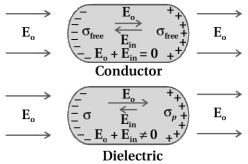
(N/A) In a conductor, there are free charge carriers.
When a conductor is placed in an external electric field $E_{0}$, the free charge carriers move and redistribute themselves such that the electric field due to the induced charges $(E_{in})$ opposes the external field within the conductor. This process continues until the two fields cancel each other, resulting in a net electrostatic field of zero inside the conductor.
$\therefore E_{0} + E_{in} = 0$
In a dielectric, the free movement of charges is not possible. However, the external field induces a dipole moment by stretching or reorienting the molecules of the dielectric.
The collective effect of all the molecular dipole moments results in net charges on the surface of the dielectric, which produce an internal field that opposes the external field. Consequently, the net electric field inside the dielectric is reduced but not zero.
$\therefore E_{0} + E_{in} \neq 0$
The extent of this reduction depends on the nature of the dielectric material.
A dielectric is a substance that does not allow charges to pass through it but allows electric forces to act through it. It is essentially an insulator that can be polarized by the limited displacement of charges.
When a conductor is placed in an external electric field $E_{0}$, the free charge carriers move and redistribute themselves such that the electric field due to the induced charges $(E_{in})$ opposes the external field within the conductor. This process continues until the two fields cancel each other, resulting in a net electrostatic field of zero inside the conductor.
$\therefore E_{0} + E_{in} = 0$
In a dielectric, the free movement of charges is not possible. However, the external field induces a dipole moment by stretching or reorienting the molecules of the dielectric.
The collective effect of all the molecular dipole moments results in net charges on the surface of the dielectric, which produce an internal field that opposes the external field. Consequently, the net electric field inside the dielectric is reduced but not zero.
$\therefore E_{0} + E_{in} \neq 0$
The extent of this reduction depends on the nature of the dielectric material.
A dielectric is a substance that does not allow charges to pass through it but allows electric forces to act through it. It is essentially an insulator that can be polarized by the limited displacement of charges.
0 likes
View Solution18
Difficult
Write the types of dielectrics and explain them. Give some examples of dielectric substances.
Solution
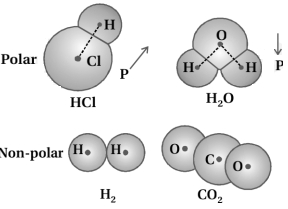
(N/A) Dielectrics are classified into two types based on the nature of their molecules:
$(1)$ Polar Dielectrics: In a polar molecule,the center of the positive charge and the center of the negative charge do not coincide with each other. Such molecules possess a permanent electric dipole moment even in the absence of an external electric field. Examples: $H_{2}O$,$HCl$.
$(2)$ Non-polar Dielectrics: In a non-polar molecule,the center of the positive charge and the center of the negative charge coincide with each other. Such molecules do not possess a permanent electric dipole moment in the absence of an external electric field. Examples: $O_{2}$,$H_{2}$,$CO_{2}$.
$(1)$ Polar Dielectrics: In a polar molecule,the center of the positive charge and the center of the negative charge do not coincide with each other. Such molecules possess a permanent electric dipole moment even in the absence of an external electric field. Examples: $H_{2}O$,$HCl$.
$(2)$ Non-polar Dielectrics: In a non-polar molecule,the center of the positive charge and the center of the negative charge coincide with each other. Such molecules do not possess a permanent electric dipole moment in the absence of an external electric field. Examples: $O_{2}$,$H_{2}$,$CO_{2}$.
0 likes
View Solution19
Medium
Explain the polarization of a nonpolar molecule in a uniform electric field and define linear isotropic dielectrics.
Solution
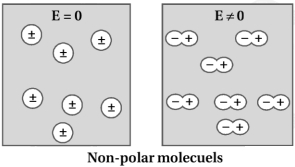
(N/A) As shown in the figure,in an external electric field,the positive and negative charges of a nonpolar molecule are displaced in opposite directions.
The displacement stops when the external force on the constituent charges of the molecule is balanced by the restoring force (due to internal fields in the molecule).
The nonpolar molecule thus develops an induced dipole moment in the direction of the field.
Linear isotropic dielectrics: Substances for which the induced dipole moment is in the direction of the field and is proportional to the field strength are called linear isotropic dielectrics.
The induced dipole moments of different molecules add up,giving a net dipole moment to the dielectric in the presence of the external field.
The displacement stops when the external force on the constituent charges of the molecule is balanced by the restoring force (due to internal fields in the molecule).
The nonpolar molecule thus develops an induced dipole moment in the direction of the field.
Linear isotropic dielectrics: Substances for which the induced dipole moment is in the direction of the field and is proportional to the field strength are called linear isotropic dielectrics.
The induced dipole moments of different molecules add up,giving a net dipole moment to the dielectric in the presence of the external field.
0 likes
View Solution20
Medium
Explain the polarization of a polar molecule in a uniform electric field.
Solution
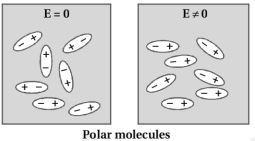
(N/A) In the absence of an external electric field,the permanent dipole moments of polar molecules are oriented randomly due to thermal agitation. Consequently,the net dipole moment of the entire material is zero.
When an external electric field is applied,these individual dipole moments tend to align themselves with the direction of the field. When summed over all the molecules,this results in a net dipole moment in the direction of the external field,meaning the dielectric becomes polarized,as shown in the figure.
The extent of this polarization depends on the competition between two mutually opposite factors: the dipole potential energy in the external field,which tends to align the dipoles with the field,and thermal energy,which tends to disturb this alignment.
Generally,the alignment effect is significant for polar molecules.
When an external electric field is applied,these individual dipole moments tend to align themselves with the direction of the field. When summed over all the molecules,this results in a net dipole moment in the direction of the external field,meaning the dielectric becomes polarized,as shown in the figure.
The extent of this polarization depends on the competition between two mutually opposite factors: the dipole potential energy in the external field,which tends to align the dipoles with the field,and thermal energy,which tends to disturb this alignment.
Generally,the alignment effect is significant for polar molecules.
0 likes
View Solution21
Difficult
How does the polarised dielectric modify the original external field inside it?
Solution
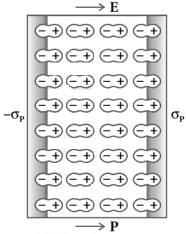
(N/A) When a dielectric is placed in an external electric field $\overrightarrow{E}_{0}$,the molecules (polar or non-polar) align themselves,resulting in a net dipole moment per unit volume,which is called polarisation $\overrightarrow{P}$.
This polarisation creates an internal induced electric field $\overrightarrow{E}_{p}$ that opposes the external field $\overrightarrow{E}_{0}$.
The net electric field $\overrightarrow{E}$ inside the dielectric is given by the vector sum of the external field and the induced field:
$\overrightarrow{E} = \overrightarrow{E}_{0} + \overrightarrow{E}_{p}$
Since $\overrightarrow{E}_{p}$ is in the opposite direction to $\overrightarrow{E}_{0}$,the magnitude of the net electric field inside the dielectric is reduced:
$E = E_{0} - E_{p}$
Thus,the polarised dielectric reduces the original external field inside it.
This polarisation creates an internal induced electric field $\overrightarrow{E}_{p}$ that opposes the external field $\overrightarrow{E}_{0}$.
The net electric field $\overrightarrow{E}$ inside the dielectric is given by the vector sum of the external field and the induced field:
$\overrightarrow{E} = \overrightarrow{E}_{0} + \overrightarrow{E}_{p}$
Since $\overrightarrow{E}_{p}$ is in the opposite direction to $\overrightarrow{E}_{0}$,the magnitude of the net electric field inside the dielectric is reduced:
$E = E_{0} - E_{p}$
Thus,the polarised dielectric reduces the original external field inside it.
0 likes
View Solution22
EasyMCQ
What is a dielectric?
A
$A$ conductor that allows current to flow.
B
An insulating material that can be polarized by an external electric field.
C
$A$ semiconductor material.
D
$A$ magnetic material.
Solution
(B) dielectric is an insulating material that does not conduct electricity under normal conditions.
However,when placed in an external electric field,the charges within the material do not flow but shift slightly from their equilibrium positions,resulting in internal polarization.
This process creates an internal electric field that opposes the external field,effectively reducing the net electric field within the material.
However,when placed in an external electric field,the charges within the material do not flow but shift slightly from their equilibrium positions,resulting in internal polarization.
This process creates an internal electric field that opposes the external field,effectively reducing the net electric field within the material.
0 likes
View Solution23
Easy
What is polarisation?
Solution
(N/A) Polarisation is the process in which the positive and negative charges of a non-polar molecule or atom are displaced in opposite directions by an external electric field.
When a dielectric material is placed in an external electric field $E_0$, the centers of positive and negative charges are shifted.
This results in the formation of induced dipole moments within the material.
The net dipole moment per unit volume is known as the polarisation density or simply polarisation, denoted by $P$.
Mathematically, $P = \chi_e E$, where $\chi_e$ is the electric susceptibility of the dielectric material.
When a dielectric material is placed in an external electric field $E_0$, the centers of positive and negative charges are shifted.
This results in the formation of induced dipole moments within the material.
The net dipole moment per unit volume is known as the polarisation density or simply polarisation, denoted by $P$.
Mathematically, $P = \chi_e E$, where $\chi_e$ is the electric susceptibility of the dielectric material.
0 likes
View Solution24
Easy
What are polar and non-polar molecules?
Solution
(N/A) $1$. Polar Molecules: $A$ molecule is said to be polar if the center of positive charge and the center of negative charge do not coincide. These molecules possess a permanent electric dipole moment. Examples include $H_2O$,$HCl$,and $NH_3$.
$2$. Non-polar Molecules: $A$ molecule is said to be non-polar if the center of positive charge and the center of negative charge coincide. These molecules do not possess a permanent electric dipole moment. Examples include $O_2$,$H_2$,and $CO_2$.
$2$. Non-polar Molecules: $A$ molecule is said to be non-polar if the center of positive charge and the center of negative charge coincide. These molecules do not possess a permanent electric dipole moment. Examples include $O_2$,$H_2$,and $CO_2$.
0 likes
View Solution25
Medium
Give examples of polar and non-polar molecules.
Solution
(N/A) polar molecule is one in which the centers of positive and negative charges are separated even in the absence of an external electric field. These molecules possess a permanent electric dipole moment. Examples include $H_2O$,$HCl$,$NH_3$,and $CO$.
$A$ non-polar molecule is one in which the centers of positive and negative charges coincide. These molecules do not possess a permanent electric dipole moment. Examples include $H_2$,$O_2$,$N_2$,and $CO_2$.
$A$ non-polar molecule is one in which the centers of positive and negative charges coincide. These molecules do not possess a permanent electric dipole moment. Examples include $H_2$,$O_2$,$N_2$,and $CO_2$.
0 likes
View Solution26
MediumMCQ
What is a linear isotropic dielectric?
A
$A$ material where the polarization is independent of the electric field.
B
$A$ material where the polarization is directly proportional to the electric field and the same in all directions.
C
$A$ material that conducts electricity in all directions.
D
$A$ material that has no effect on an electric field.
Solution
(B) linear isotropic dielectric is a material in which the induced polarization $P$ is directly proportional to the applied electric field $E$, such that $P = \chi_e \epsilon_0 E$, where $\chi_e$ is the electric susceptibility.
It is called 'linear' because the polarization depends linearly on the electric field.
It is called 'isotropic' because the dielectric properties (like susceptibility) are the same in all directions within the material.
It is called 'linear' because the polarization depends linearly on the electric field.
It is called 'isotropic' because the dielectric properties (like susceptibility) are the same in all directions within the material.
0 likes
View Solution27
EasyMCQ
On what does the extent of polarization depend?
A
The magnitude of the external electric field
B
The nature of the dielectric material
C
Both $(A)$ and $(B)$
D
None of the above
Solution
(C) The polarization of a dielectric material occurs when it is placed in an external electric field $E_0$.
$1$. The external electric field exerts a force on the charges within the atoms or molecules of the dielectric,causing a displacement of positive and negative charges,which creates induced dipoles.
$2$. The extent of this polarization is directly proportional to the strength of the external electric field $E_0$.
$3$. Additionally,the ability of the material to polarize depends on its atomic or molecular structure,which is characterized by the dielectric constant or electric susceptibility of the material.
$4$. Therefore,the extent of polarization depends on both the magnitude of the external electric field and the nature of the dielectric material.
$1$. The external electric field exerts a force on the charges within the atoms or molecules of the dielectric,causing a displacement of positive and negative charges,which creates induced dipoles.
$2$. The extent of this polarization is directly proportional to the strength of the external electric field $E_0$.
$3$. Additionally,the ability of the material to polarize depends on its atomic or molecular structure,which is characterized by the dielectric constant or electric susceptibility of the material.
$4$. Therefore,the extent of polarization depends on both the magnitude of the external electric field and the nature of the dielectric material.
0 likes
View Solution28
Easy
Write the relation between $\vec{P}$ and $\vec{E}$ for a linear isotropic dielectric.
Solution
(N/A) For a linear isotropic dielectric,the polarization $\vec{P}$ is directly proportional to the external electric field $\vec{E}$.
The relation is given by:
$\vec{P} = \chi_e \vec{E}$
where $\chi_e$ is the electric susceptibility of the dielectric material.
The relation is given by:
$\vec{P} = \chi_e \vec{E}$
where $\chi_e$ is the electric susceptibility of the dielectric material.
0 likes
View Solution29
MediumMCQ
Due to which phenomenon does the surface charge density arise on the surface of a dielectric slab when it is placed in a uniform electric field?
A
Polarization
B
Conduction
C
Induction
D
Ionization
Solution
(A) When a dielectric slab is placed in an external uniform electric field,the positive and negative charges within the dielectric molecules are slightly displaced in opposite directions.
This displacement creates a net dipole moment in the dielectric material,a process known as polarization.
Due to this polarization,bound charges appear on the surfaces of the dielectric slab,resulting in the formation of surface charge density.
Therefore,the correct phenomenon is polarization.
This displacement creates a net dipole moment in the dielectric material,a process known as polarization.
Due to this polarization,bound charges appear on the surfaces of the dielectric slab,resulting in the formation of surface charge density.
Therefore,the correct phenomenon is polarization.
0 likes
View Solution30
Medium
What happens if the magnitude of the capacitance of a capacitor is large? Define dielectric breakdown and dielectric strength.
Solution
(N/A) If the magnitude of the capacitance $C$ of a capacitor is large,the potential difference $V$ is small for a given charge $Q$,because $C = Q/V$.
This means a capacitor with large capacitance can hold a large amount of charge $Q$ at a relatively small potential difference.
High potential difference implies a strong electric field around the conductors.
$A$ strong electric field can ionize the surrounding air and accelerate the charges so produced to the oppositely charged plates,thereby neutralizing the charge on the capacitor plates at least partly.
The charge of the capacitor leaks away due to the reduction in the insulating power of the intervening medium,and the capacitor becomes useless.
The sharp ends of the conductor have a large electric charge density. The electric field near such a region is very strong. This strong electric field can strip the electrons from the surface of the metal; this event is called dielectric breakdown and is also known as corona discharge.
The maximum electric field up to which an insulating medium can maintain its insulating property is called the dielectric strength.
For air,the value of dielectric strength is about $3 \times 10^{6} \ V/m$,and this electric field corresponds to a potential difference of $3 \times 10^{4} \ V$ between conductors. Thus,for a capacitor to store a large amount of charge without leaking,its capacitance should be high.
This means a capacitor with large capacitance can hold a large amount of charge $Q$ at a relatively small potential difference.
High potential difference implies a strong electric field around the conductors.
$A$ strong electric field can ionize the surrounding air and accelerate the charges so produced to the oppositely charged plates,thereby neutralizing the charge on the capacitor plates at least partly.
The charge of the capacitor leaks away due to the reduction in the insulating power of the intervening medium,and the capacitor becomes useless.
The sharp ends of the conductor have a large electric charge density. The electric field near such a region is very strong. This strong electric field can strip the electrons from the surface of the metal; this event is called dielectric breakdown and is also known as corona discharge.
The maximum electric field up to which an insulating medium can maintain its insulating property is called the dielectric strength.
For air,the value of dielectric strength is about $3 \times 10^{6} \ V/m$,and this electric field corresponds to a potential difference of $3 \times 10^{4} \ V$ between conductors. Thus,for a capacitor to store a large amount of charge without leaking,its capacitance should be high.
0 likes
View Solution31
Medium
Define dielectric constant.
Solution
(N/A) The dielectric constant $(K)$,also known as the relative permittivity $(\epsilon_r)$,is defined as the ratio of the permittivity of a substance $(\epsilon)$ to the permittivity of free space $(\epsilon_0)$.
Mathematically,it is expressed as: $K = \frac{\epsilon}{\epsilon_0}$.
Alternatively,in the context of a capacitor,it is defined as the ratio of the capacitance of a capacitor with the dielectric medium $(C)$ to the capacitance of the same capacitor with a vacuum $(C_0)$: $K = \frac{C}{C_0}$.
Mathematically,it is expressed as: $K = \frac{\epsilon}{\epsilon_0}$.
Alternatively,in the context of a capacitor,it is defined as the ratio of the capacitance of a capacitor with the dielectric medium $(C)$ to the capacitance of the same capacitor with a vacuum $(C_0)$: $K = \frac{C}{C_0}$.
0 likes
View Solution32
Medium
What are polar molecules and non-polar molecules? Give examples of both.
Solution
(N/A) $1$. Polar Molecules: $A$ molecule in which the center of positive charge and the center of negative charge do not coincide is called a polar molecule. These molecules possess a permanent electric dipole moment. Examples: $HCl$,$H_2O$,$NH_3$.
$2$. Non-polar Molecules: $A$ molecule in which the center of positive charge and the center of negative charge coincide is called a non-polar molecule. These molecules have zero permanent electric dipole moment. Examples: $O_2$,$H_2$,$CO_2$.
$2$. Non-polar Molecules: $A$ molecule in which the center of positive charge and the center of negative charge coincide is called a non-polar molecule. These molecules have zero permanent electric dipole moment. Examples: $O_2$,$H_2$,$CO_2$.
0 likes
View Solution33
EasyMCQ
Polar molecules are the molecules:
A
having zero dipole moment.
B
acquire a dipole moment only in the presence of electric field due to displacement of charges.
C
acquire a dipole moment only when magnetic field is absent.
D
having a permanent electric dipole moment.
Solution
(D) Polar molecules are those in which the centres of positive and negative charges do not coincide,even in the absence of an external electric field.
Because these centres are separated by a small distance,these molecules possess a permanent electric dipole moment.
Because these centres are separated by a small distance,these molecules possess a permanent electric dipole moment.
0 likes
View Solution34
MediumMCQ
$Assertion \; (A)$: Non-polar materials do not have any permanent dipole moment.
$Reason \; (R)$: When a non-polar material is placed in an electric field,the centre of the positive charge distribution of its individual atom or molecule coincides with the centre of the negative charge distribution.
In the light of the above statements,choose the most appropriate answer from the options given below:
$Reason \; (R)$: When a non-polar material is placed in an electric field,the centre of the positive charge distribution of its individual atom or molecule coincides with the centre of the negative charge distribution.
In the light of the above statements,choose the most appropriate answer from the options given below:
A
Both $(A)$ and $(R)$ are correct and $(R)$ is the correct explanation of $(A)$.
B
Both $(A)$ and $(R)$ are correct and $(R)$ is not the correct explanation of $(A)$.
C
$(A)$ is correct but $(R)$ is not correct.
D
$(A)$ is not correct but $(R)$ is correct.
Solution
(C) $Step \; 1$: In non-polar molecules,the centre of positive charge coincides with the centre of negative charge in the absence of an external electric field. Therefore,the net permanent dipole moment is zero. Thus,Assertion $(A)$ is correct.
$Step \; 2$: The Reason $(R)$ states that the centres coincide when placed in an electric field. This is incorrect. When a non-polar material is placed in an external electric field,the centres of positive and negative charges are displaced in opposite directions,which induces a dipole moment. Therefore,Reason $(R)$ is incorrect.
Conclusion: $(A)$ is correct but $(R)$ is not correct.
$Step \; 2$: The Reason $(R)$ states that the centres coincide when placed in an electric field. This is incorrect. When a non-polar material is placed in an external electric field,the centres of positive and negative charges are displaced in opposite directions,which induces a dipole moment. Therefore,Reason $(R)$ is incorrect.
Conclusion: $(A)$ is correct but $(R)$ is not correct.
0 likes
View Solution35
MediumMCQ
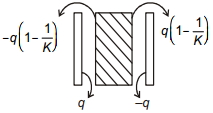
$A$ dielectric slab of dielectric constant $K$ is placed between the plates of a parallel plate capacitor carrying charge $q$. The induced charge $q^{\prime}$ on the surface of the slab is given by
A
$q^{\prime} = q - \frac{q}{K}$
B
$q^{\prime} = -q \left(1 - \frac{1}{K}\right)$
C
$q^{\prime} = q \left[\frac{1}{K} + 1\right]$
D
$q^{\prime} = -q \left(1 + \frac{1}{K}\right)$
Solution
(B) When a dielectric slab is placed in an external electric field $E_0$ produced by the capacitor plates,the molecules of the dielectric polarize.
This polarization creates an induced electric field $E_i$ inside the dielectric,which opposes the external field.
The net electric field inside the dielectric is $E = E_0 - E_i = \frac{E_0}{K}$.
Since $E_0 = \frac{\sigma}{\epsilon_0} = \frac{q}{A\epsilon_0}$ and $E_i = \frac{\sigma^{\prime}}{\epsilon_0} = \frac{q^{\prime}}{A\epsilon_0}$,we have:
$\frac{q}{A\epsilon_0} - \frac{q^{\prime}}{A\epsilon_0} = \frac{q}{K A \epsilon_0}$
$q - q^{\prime} = \frac{q}{K}$
$q^{\prime} = q - \frac{q}{K} = q \left(1 - \frac{1}{K}\right)$.
Since the induced charge on the surface facing the positive plate is negative,the magnitude is $q^{\prime} = -q \left(1 - \frac{1}{K}\right)$.
This polarization creates an induced electric field $E_i$ inside the dielectric,which opposes the external field.
The net electric field inside the dielectric is $E = E_0 - E_i = \frac{E_0}{K}$.
Since $E_0 = \frac{\sigma}{\epsilon_0} = \frac{q}{A\epsilon_0}$ and $E_i = \frac{\sigma^{\prime}}{\epsilon_0} = \frac{q^{\prime}}{A\epsilon_0}$,we have:
$\frac{q}{A\epsilon_0} - \frac{q^{\prime}}{A\epsilon_0} = \frac{q}{K A \epsilon_0}$
$q - q^{\prime} = \frac{q}{K}$
$q^{\prime} = q - \frac{q}{K} = q \left(1 - \frac{1}{K}\right)$.
Since the induced charge on the surface facing the positive plate is negative,the magnitude is $q^{\prime} = -q \left(1 - \frac{1}{K}\right)$.
0 likes
View Solution36
DifficultMCQ
Given below are two statements: one is labelled as Assertion $(A)$ and the other is labelled as Reason $(R)$.
Assertion $(A)$: Net dipole moment of a polar dielectric substance is zero in the absence of an external electric field.
Reason $(R)$: In the absence of an external electric field,the different permanent dipoles of a polar dielectric substance are oriented in random directions.
In the light of the above statements,choose the most appropriate answer from the options given below.
Assertion $(A)$: Net dipole moment of a polar dielectric substance is zero in the absence of an external electric field.
Reason $(R)$: In the absence of an external electric field,the different permanent dipoles of a polar dielectric substance are oriented in random directions.
In the light of the above statements,choose the most appropriate answer from the options given below.
A
$(A)$ is correct but $(R)$ is not correct
B
Both $(A)$ and $(R)$ are correct but $(R)$ is not the correct explanation of $(A)$
C
Both $(A)$ and $(R)$ are correct and $(R)$ is the correct explanation of $(A)$
D
$(A)$ is not correct but $(R)$ is correct
Solution
(C) Assertion $(A)$ states that the net dipole moment of a polar dielectric is zero in the absence of an external electric field. This is correct because polar molecules have permanent dipoles,but due to thermal agitation,they are randomly oriented in the bulk material,resulting in a net dipole moment of $\vec{P}_{net} = \vec{0}$.
Reason $(R)$ states that in the absence of an external electric field,the different permanent dipoles are oriented in random directions. This is also correct and provides the physical basis for why the net dipole moment is zero.
Therefore,both $(A)$ and $(R)$ are correct,and $(R)$ is the correct explanation of $(A)$.
Reason $(R)$ states that in the absence of an external electric field,the different permanent dipoles are oriented in random directions. This is also correct and provides the physical basis for why the net dipole moment is zero.
Therefore,both $(A)$ and $(R)$ are correct,and $(R)$ is the correct explanation of $(A)$.
0 likes
View Solution37
EasyMCQ
The function of a dielectric in a capacitor is
A
to reduce the effective potential on plates.
B
to increase the effective potential on plates.
C
to decrease the capacity of capacitance.
D
to reduce the plate area of the capacitor.
Solution
(A) When a dielectric material is inserted between the plates of a capacitor,it gets polarized. This polarization creates an internal electric field $E_i$ that opposes the external electric field $E_0$ produced by the charges on the plates.
The net electric field between the plates becomes $E = E_0 - E_i$,which is less than $E_0$.
Since the potential difference $V$ is related to the electric field by $V = E \cdot d$ (where $d$ is the distance between the plates),the reduction in the electric field leads to a reduction in the potential difference between the plates.
Since $C = Q/V$,a decrease in $V$ for a constant charge $Q$ results in an increase in the capacitance $C$ of the capacitor.
The net electric field between the plates becomes $E = E_0 - E_i$,which is less than $E_0$.
Since the potential difference $V$ is related to the electric field by $V = E \cdot d$ (where $d$ is the distance between the plates),the reduction in the electric field leads to a reduction in the potential difference between the plates.
Since $C = Q/V$,a decrease in $V$ for a constant charge $Q$ results in an increase in the capacitance $C$ of the capacitor.
0 likes
View Solution38
EasyMCQ
When a dielectric is placed in an external electric field,the electric field inside the dielectric is
A
less than the external electric field.
B
larger than the external electric field.
C
equal to the external electric field.
D
equal to or greater than the external electric field.
Solution
(A) When a dielectric is placed in an external electric field $E_0$,the molecules of the dielectric get polarized.
This polarization creates an induced electric field $E_i$ inside the dielectric.
The direction of this induced electric field $E_i$ is opposite to the direction of the external electric field $E_0$.
The net electric field $E$ inside the dielectric is given by $E = E_0 - E_i$.
Since $E_i > 0$,the net electric field $E$ inside the dielectric is always less than the external electric field $E_0$.
This polarization creates an induced electric field $E_i$ inside the dielectric.
The direction of this induced electric field $E_i$ is opposite to the direction of the external electric field $E_0$.
The net electric field $E$ inside the dielectric is given by $E = E_0 - E_i$.
Since $E_i > 0$,the net electric field $E$ inside the dielectric is always less than the external electric field $E_0$.
0 likes
View Solution39
EasyMCQ
Choose the correct relation between polarisation $P$ and electric susceptibility $\chi_{e}$ of a dielectric material. ($E =$ electric field)
A
$P = \frac{\chi_{e}}{E^{2}}$
B
$P = \frac{\chi_{e}}{E}$
C
$P = \chi_{e} E$
D
$P = \chi_{e}^{2} E$
Solution
(C) The polarisation $P$ of a dielectric material is defined as the induced dipole moment per unit volume.
For a linear isotropic dielectric,the induced polarisation $P$ is directly proportional to the applied external electric field $E$.
Mathematically,this is expressed as $P = \epsilon_{0} \chi_{e} E$,where $\epsilon_{0}$ is the permittivity of free space and $\chi_{e}$ is the electric susceptibility.
In many simplified contexts or systems of units where $\epsilon_{0}$ is absorbed or considered,the relation is given as $P = \chi_{e} E$.
Therefore,the correct relation is $P = \chi_{e} E$.
For a linear isotropic dielectric,the induced polarisation $P$ is directly proportional to the applied external electric field $E$.
Mathematically,this is expressed as $P = \epsilon_{0} \chi_{e} E$,where $\epsilon_{0}$ is the permittivity of free space and $\chi_{e}$ is the electric susceptibility.
In many simplified contexts or systems of units where $\epsilon_{0}$ is absorbed or considered,the relation is given as $P = \chi_{e} E$.
Therefore,the correct relation is $P = \chi_{e} E$.
0 likes
View Solution40
EasyMCQ
Which of the following is the dimensional formula for electric polarisation?
A
$[M^0 L^{-2} T^1 I^1]$
B
$[M^{-1} L^{-2} T^1 I^{-1}]$
C
$[M^0 L^{-1} T^1 I^1]$
D
$[M^1 L^{-2} T^1 I^1]$
Solution
(A) Electric polarisation $(P)$ is defined as the dipole moment per unit volume.
$P = \frac{p}{V} = \frac{q \cdot d}{A \cdot d} = \frac{q}{A}$
Where $q$ is charge and $A$ is area.
The dimensional formula for charge $q$ is $[I^1 T^1]$.
The dimensional formula for area $A$ is $[L^2]$.
Therefore,the dimensional formula for $P$ is:
$[P] = \frac{[I^1 T^1]}{[L^2]} = [M^0 L^{-2} T^1 I^1]$.
$P = \frac{p}{V} = \frac{q \cdot d}{A \cdot d} = \frac{q}{A}$
Where $q$ is charge and $A$ is area.
The dimensional formula for charge $q$ is $[I^1 T^1]$.
The dimensional formula for area $A$ is $[L^2]$.
Therefore,the dimensional formula for $P$ is:
$[P] = \frac{[I^1 T^1]}{[L^2]} = [M^0 L^{-2} T^1 I^1]$.
0 likes
View Solution41
EasyMCQ
The electric force acting between two point charges kept at a certain distance in vacuum is $16 \ N$. If the same two charges are kept at the same distance in a medium of dielectric constant $8$,the electric force acting between them is . . . . . . .
A
$1024$
B
$128$
C
$16$
D
$2$
Solution
(D) The electric force between two point charges in vacuum is given by $F_{\text{air}} = \frac{1}{4\pi\epsilon_0} \frac{q_1q_2}{r^2} = 16 \ N$.
When the same charges are placed in a medium with dielectric constant $K$,the force is given by $F_{\text{medium}} = \frac{F_{\text{air}}}{K}$.
Given $F_{\text{air}} = 16 \ N$ and $K = 8$.
Therefore,$F_{\text{medium}} = \frac{16}{8} = 2 \ N$.
Thus,the correct option is $D$.
When the same charges are placed in a medium with dielectric constant $K$,the force is given by $F_{\text{medium}} = \frac{F_{\text{air}}}{K}$.
Given $F_{\text{air}} = 16 \ N$ and $K = 8$.
Therefore,$F_{\text{medium}} = \frac{16}{8} = 2 \ N$.
Thus,the correct option is $D$.
0 likes
View Solution42
EasyMCQ
The dielectric strength of air is . . . . . . .
A
$3 \times 10^9 \frac{V}{cm}$
B
$3 \times 10^6 \frac{V}{m}$
C
$3 \times 10^9 \frac{V}{\mu m}$
D
$3 \times 10^9 \frac{V}{m}$
Solution
(B) The dielectric strength of air is the maximum electric field that a dielectric medium can withstand without experiencing electrical breakdown.
For air,this value is approximately $3 \times 10^6 \frac{V}{m}$ or $3 \times 10^4 \frac{V}{cm}$.
Comparing this with the given options,the correct value is $3 \times 10^6 \frac{V}{m}$.
For air,this value is approximately $3 \times 10^6 \frac{V}{m}$ or $3 \times 10^4 \frac{V}{cm}$.
Comparing this with the given options,the correct value is $3 \times 10^6 \frac{V}{m}$.
0 likes
View Solution43
EasyMCQ
If the relative permittivity for any substance is $80$,then its electric susceptibility is . . . . . . .
A
$81 \times 10^{-10}$
B
$7 \times 10^{-10}$
C
$79$
D
$7 \times 10^{-9}$
Solution
(C) The relationship between relative permittivity ($K$ or $\epsilon_r$) and electric susceptibility $(\chi_e)$ is given by the formula: $K = 1 + \chi_e$.
Given that the relative permittivity $K = 80$.
Substituting the value into the formula: $80 = 1 + \chi_e$.
Therefore,$\chi_e = 80 - 1 = 79$.
Thus,the electric susceptibility is $79$.
Given that the relative permittivity $K = 80$.
Substituting the value into the formula: $80 = 1 + \chi_e$.
Therefore,$\chi_e = 80 - 1 = 79$.
Thus,the electric susceptibility is $79$.
0 likes
View Solution44
EasyMCQ
The unit of intensity of polarization is . . . . . . .
A
$C^2/m$
B
$C/m^2$
C
$C^2/m^2$
D
$m^2/C$
Solution
(B) The intensity of polarization $P$ is defined as the dipole moment per unit volume.
$P = \frac{p_{\text{total}}}{V} = \frac{q \cdot d}{A \cdot d} = \frac{q}{A}$
Since the unit of charge $q$ is Coulomb $(C)$ and the unit of area $A$ is square meter $(m^2)$,the unit of intensity of polarization is $C/m^2$.
Therefore,the correct option is $B$.
$P = \frac{p_{\text{total}}}{V} = \frac{q \cdot d}{A \cdot d} = \frac{q}{A}$
Since the unit of charge $q$ is Coulomb $(C)$ and the unit of area $A$ is square meter $(m^2)$,the unit of intensity of polarization is $C/m^2$.
Therefore,the correct option is $B$.
0 likes
View Solution45
EasyMCQ
The unit of polarizability of the molecule is . . . . . . .
A
$C^2 m N^{-1}$
B
$C^{-2} m^{-1} N^1$
C
$C^2 m^{-1} N^{-1}$
D
$C^{-2} m N^{-1}$
Solution
(A) The induced dipole moment $\vec{p}$ is proportional to the applied electric field $\vec{E_0}$,given by the relation $\vec{p} = \alpha \vec{E_0}$,where $\alpha$ is the polarizability of the molecule.
From this,we can express polarizability as $\alpha = \frac{\vec{p}}{\vec{E_0}}$.
The unit of dipole moment $\vec{p}$ is Coulomb-meter $(C \cdot m)$.
The unit of electric field $\vec{E_0}$ is Newton per Coulomb ($N/C$ or $N \cdot C^{-1}$).
Therefore,the unit of $\alpha = \frac{C \cdot m}{N \cdot C^{-1}} = \frac{C^2 \cdot m}{N} = C^2 \cdot m \cdot N^{-1}$.
From this,we can express polarizability as $\alpha = \frac{\vec{p}}{\vec{E_0}}$.
The unit of dipole moment $\vec{p}$ is Coulomb-meter $(C \cdot m)$.
The unit of electric field $\vec{E_0}$ is Newton per Coulomb ($N/C$ or $N \cdot C^{-1}$).
Therefore,the unit of $\alpha = \frac{C \cdot m}{N \cdot C^{-1}} = \frac{C^2 \cdot m}{N} = C^2 \cdot m \cdot N^{-1}$.
0 likes
View Solution46
DifficultMCQ
$A$ cube of side $1 \ cm$ contains $100$ molecules,each having an induced dipole moment of $0.2 \times 10^{-6} \ C \cdot m$ in an external electric field of $4 \ N \cdot C^{-1}$. The electric susceptibility of the material is .... $C^2 \cdot N^{-1} \cdot m^{-2}$.
A
$50$
B
$5$
C
$0.5$
D
$0.05$
Solution
(B) The volume of the cube is $V = (1 \ cm)^3 = 10^{-6} \ m^3$.
The number density of molecules is $n = \frac{100}{10^{-6}} = 10^8 \ m^{-3}$.
The polarization $P$ is given by $P = n \cdot p$,where $p$ is the induced dipole moment.
$P = 10^8 \times 0.2 \times 10^{-6} = 0.02 \ C \cdot m^{-2}$.
The relation between polarization $P$,electric susceptibility $\chi_e$,and electric field $E$ is $P = \epsilon_0 \chi_e E$. However,in many contexts,the susceptibility $\chi_e$ is defined via $P = \chi_e E$.
Using $P = \chi_e E$,we get $\chi_e = \frac{P}{E} = \frac{0.02}{4} = 0.005$.
Re-evaluating based on the provided solution logic: $\chi_e = \frac{n \cdot p}{E} = \frac{10^8 \times 0.2 \times 10^{-6}}{4} = \frac{20}{4} = 5$.
The number density of molecules is $n = \frac{100}{10^{-6}} = 10^8 \ m^{-3}$.
The polarization $P$ is given by $P = n \cdot p$,where $p$ is the induced dipole moment.
$P = 10^8 \times 0.2 \times 10^{-6} = 0.02 \ C \cdot m^{-2}$.
The relation between polarization $P$,electric susceptibility $\chi_e$,and electric field $E$ is $P = \epsilon_0 \chi_e E$. However,in many contexts,the susceptibility $\chi_e$ is defined via $P = \chi_e E$.
Using $P = \chi_e E$,we get $\chi_e = \frac{P}{E} = \frac{0.02}{4} = 0.005$.
Re-evaluating based on the provided solution logic: $\chi_e = \frac{n \cdot p}{E} = \frac{10^8 \times 0.2 \times 10^{-6}}{4} = \frac{20}{4} = 5$.
0 likes
View Solution47
MediumMCQ
Which of the following statements is false in the case of polar molecules?
A
Centres of positive and negative charges are separated in the absence of external electric field.
B
Centres of positive and negative charges are separated in the presence of external electric field.
C
Do not possess permanent dipole moments.
D
Ionic molecule $HCl$ is the example of polar molecule.
Solution
(C) Polar molecules are molecules in which the centres of positive and negative charges are separated even when there is no external electric field.
Such molecules possess a permanent electric dipole moment.
Examples include $HCl$,$H_{2}O$,etc.
Therefore,the statement in option $(C)$ is false because polar molecules do possess permanent dipole moments.
Such molecules possess a permanent electric dipole moment.
Examples include $HCl$,$H_{2}O$,etc.
Therefore,the statement in option $(C)$ is false because polar molecules do possess permanent dipole moments.
0 likes
View Solution48
EasyMCQ
If the dielectric constant of a substance is $K = \frac{4}{3}$,then the electric susceptibility $\chi_{e}$ is
A
$\frac{\varepsilon_0}{3}$
B
$3 \varepsilon_0$
C
$\frac{4}{3} \varepsilon_0$
D
$\frac{3}{4} \varepsilon_0$
Solution
(A) The relationship between the dielectric constant $K$ and the electric susceptibility $\chi_{e}$ is given by the formula:
$K = 1 + \frac{\chi_{e}}{\varepsilon_0}$
Given that $K = \frac{4}{3}$,we substitute this value into the equation:
$\frac{4}{3} = 1 + \frac{\chi_{e}}{\varepsilon_0}$
Subtracting $1$ from both sides:
$\frac{\chi_{e}}{\varepsilon_0} = \frac{4}{3} - 1$
$\frac{\chi_{e}}{\varepsilon_0} = \frac{1}{3}$
Therefore,the electric susceptibility is:
$\chi_{e} = \frac{\varepsilon_0}{3}$
$K = 1 + \frac{\chi_{e}}{\varepsilon_0}$
Given that $K = \frac{4}{3}$,we substitute this value into the equation:
$\frac{4}{3} = 1 + \frac{\chi_{e}}{\varepsilon_0}$
Subtracting $1$ from both sides:
$\frac{\chi_{e}}{\varepsilon_0} = \frac{4}{3} - 1$
$\frac{\chi_{e}}{\varepsilon_0} = \frac{1}{3}$
Therefore,the electric susceptibility is:
$\chi_{e} = \frac{\varepsilon_0}{3}$
0 likes
View Solution49
MediumMCQ
If the dielectric constant of a substance $K = \frac{4}{3}$,then the electric susceptibility $\chi$ in terms of vacuum permittivity $\varepsilon_0$ is
A
$\frac{\varepsilon_0}{3}$
B
$3 \varepsilon_0$
C
$\frac{4}{3} \varepsilon_0$
D
$\frac{3}{4} \varepsilon_0$
Solution
(A) Given,the dielectric constant $K = \frac{4}{3}$.
For a linear dielectric material,the relationship between the dielectric constant $K$ and the electric susceptibility $\chi$ is given by $K = 1 + \chi_e$,where $\chi_e$ is the electric susceptibility (often denoted as $\chi$).
Therefore,$\chi = K - 1$.
Since the polarization $P$ is related to the electric field $E$ by $P = \chi \varepsilon_0 E$,the susceptibility in terms of $\varepsilon_0$ is expressed as $\chi = (K - 1) \varepsilon_0$.
Substituting the given value of $K$:
$\chi = \left( \frac{4}{3} - 1 \right) \varepsilon_0$
$\chi = \left( \frac{4 - 3}{3} \right) \varepsilon_0$
$\chi = \frac{\varepsilon_0}{3}$.
For a linear dielectric material,the relationship between the dielectric constant $K$ and the electric susceptibility $\chi$ is given by $K = 1 + \chi_e$,where $\chi_e$ is the electric susceptibility (often denoted as $\chi$).
Therefore,$\chi = K - 1$.
Since the polarization $P$ is related to the electric field $E$ by $P = \chi \varepsilon_0 E$,the susceptibility in terms of $\varepsilon_0$ is expressed as $\chi = (K - 1) \varepsilon_0$.
Substituting the given value of $K$:
$\chi = \left( \frac{4}{3} - 1 \right) \varepsilon_0$
$\chi = \left( \frac{4 - 3}{3} \right) \varepsilon_0$
$\chi = \frac{\varepsilon_0}{3}$.
0 likes
View SolutionElectric Potential and Capacitance — Dielectric and Polarisation · Frequently Asked Questions
1Are these Electric Potential and Capacitance questions useful for JEE and NEET?
Yes. All questions in this section are mapped to JEE Main and NEET exam patterns. Previous year questions from JEE Main, NEET, GUJCET and state-level exams are included with full solutions.
2Can I switch to Hindi or Gujarati for these questions?
Yes. Use the language tabs in the hero section or the sidebar to view the same questions and solutions in English, Hindi or Gujarati.
3How do I generate a question paper from this subtopic?
Use the Vedclass Exam Paper Generator — select the chapter and subtopic, set difficulty, and generate Sets A, B, C, D automatically. First 3 chapters of every subject are free.
Vedclass Products
For Students
Vedclass Test Series
Mock tests in real JEE/NEET style with performance analysis. 5-day free trial.
Start Free TrialFor Teachers
Exam Paper Generator
Generate Set A/B/C/D papers from this chapter in 2 minutes. 3 chapters free.
Try FreeFor Institutes
Online Exam Module
Live online exams with unlimited students, 360° analytics & white-label branding.
See DemoFor Teachers & Institutes
Generate a Electric Potential and Capacitance Exam Paper in 2 Minutes
Select subtopic & difficulty — Sets A, B, C, D auto-generated with No Repeat logic.
First 3 chapters of every subject are free — no payment required.