
A English
Relation between Electric Field and Potential and Potential Gradient Questions in English
Class 12 Physics · Electric Potential and Capacitance · Relation between Electric Field and Potential and Potential Gradient
126+
Questions
English
Language
100%
With Solutions
Showing 50 of 126 questions in English
1
MediumMCQ
The electric potential $V$ at any point $(x, y, z)$ (all in metres) in space is given by $V = 4x^2 \text{ volt}$. The electric field at the point $(1 \text{ m}, 0, 2 \text{ m})$ in $\text{volt/metre}$ is
A
$8$ along negative $X$-axis
B
$8$ along positive $X$-axis
C
$16$ along negative $X$-axis
D
$16$ along positive $Z$-axis
Solution
(A) The electric potential is given by $V(x, y, z) = 4x^2 \text{ volt}$.
The electric field $\vec{E}$ is related to the potential $V$ by the relation $\vec{E} = -\nabla V = -\left( \hat{i} \frac{\partial V}{\partial x} + \hat{j} \frac{\partial V}{\partial y} + \hat{k} \frac{\partial V}{\partial z} \right)$.
Calculating the partial derivatives:
$\frac{\partial V}{\partial x} = \frac{d}{dx}(4x^2) = 8x$
$\frac{\partial V}{\partial y} = 0$
$\frac{\partial V}{\partial z} = 0$
Substituting these into the expression for $\vec{E}$:
$\vec{E} = -(8x \hat{i} + 0 \hat{j} + 0 \hat{k}) = -8x \hat{i} \text{ V/m}$.
At the point $(1 \text{ m}, 0, 2 \text{ m})$,the $x$-coordinate is $1 \text{ m}$.
Therefore,$\vec{E} = -8(1) \hat{i} = -8 \hat{i} \text{ V/m}$.
The negative sign indicates that the electric field is directed along the negative $X$-axis with a magnitude of $8 \text{ V/m}$.
The electric field $\vec{E}$ is related to the potential $V$ by the relation $\vec{E} = -\nabla V = -\left( \hat{i} \frac{\partial V}{\partial x} + \hat{j} \frac{\partial V}{\partial y} + \hat{k} \frac{\partial V}{\partial z} \right)$.
Calculating the partial derivatives:
$\frac{\partial V}{\partial x} = \frac{d}{dx}(4x^2) = 8x$
$\frac{\partial V}{\partial y} = 0$
$\frac{\partial V}{\partial z} = 0$
Substituting these into the expression for $\vec{E}$:
$\vec{E} = -(8x \hat{i} + 0 \hat{j} + 0 \hat{k}) = -8x \hat{i} \text{ V/m}$.
At the point $(1 \text{ m}, 0, 2 \text{ m})$,the $x$-coordinate is $1 \text{ m}$.
Therefore,$\vec{E} = -8(1) \hat{i} = -8 \hat{i} \text{ V/m}$.
The negative sign indicates that the electric field is directed along the negative $X$-axis with a magnitude of $8 \text{ V/m}$.
0 likes
View Solution2
EasyMCQ
$A$ uniform electric field having a magnitude $E_0$ and direction along the positive $X$-axis exists. If the potential $V$ is zero at $x = 0$,then its value at $x = +x$ will be:
A
$V_x = +x E_0$
B
$V_x = -x E_0$
C
$V_x = +x^2 E_0$
D
$V_x = -x^2 E_0$
Solution
(B) The relationship between electric field $E$ and electric potential $V$ is given by the formula $E = -\frac{dV}{dx}$.
Given that the electric field is uniform and directed along the positive $X$-axis,we have $E = E_0$.
Substituting this into the formula: $E_0 = -\frac{dV}{dx}$.
Rearranging the terms to integrate: $dV = -E_0 dx$.
Integrating both sides from the reference point $x = 0$ (where $V = 0$) to a point $x$ (where potential is $V_x$):
$\int_{0}^{V_x} dV = -\int_{0}^{x} E_0 dx$.
$[V]_{0}^{V_x} = -E_0 [x]_{0}^{x}$.
$V_x - 0 = -E_0 (x - 0)$.
$V_x = -x E_0$.
Therefore,the potential at $x$ is $-x E_0$.
Given that the electric field is uniform and directed along the positive $X$-axis,we have $E = E_0$.
Substituting this into the formula: $E_0 = -\frac{dV}{dx}$.
Rearranging the terms to integrate: $dV = -E_0 dx$.
Integrating both sides from the reference point $x = 0$ (where $V = 0$) to a point $x$ (where potential is $V_x$):
$\int_{0}^{V_x} dV = -\int_{0}^{x} E_0 dx$.
$[V]_{0}^{V_x} = -E_0 [x]_{0}^{x}$.
$V_x - 0 = -E_0 (x - 0)$.
$V_x = -x E_0$.
Therefore,the potential at $x$ is $-x E_0$.
0 likes
View Solution3
EasyMCQ
Two plates are $2\,cm$ apart,a potential difference of $10\,V$ is applied between them. The electric field between the plates is ......... $N/C$.
A
$20$
B
$500$
C
$5$
D
$250$
Solution
(B) The electric field $E$ between two parallel plates with a potential difference $V$ and separation distance $d$ is given by the formula $E = \frac{V}{d}$.
Given:
Potential difference $V = 10\,V$
Distance $d = 2\,cm = 2 \times 10^{-2}\,m$
Substituting the values:
$E = \frac{10}{2 \times 10^{-2}} = 5 \times 10^2 = 500\,N/C$.
Therefore,the correct option is $B$.
Given:
Potential difference $V = 10\,V$
Distance $d = 2\,cm = 2 \times 10^{-2}\,m$
Substituting the values:
$E = \frac{10}{2 \times 10^{-2}} = 5 \times 10^2 = 500\,N/C$.
Therefore,the correct option is $B$.
0 likes
View Solution4
EasyMCQ
$A$ charge of $5\,C$ experiences a force of $5000\,N$ when it is kept in a uniform electric field. What is the potential difference $V$ (in volts) between two points separated by a distance of $1\,cm$?
A
$10$
B
$250$
C
$1000$
D
$2500$
Solution
(A) Given: Charge $Q = 5\,C$,Force $F = 5000\,N$,Distance $d = 1\,cm = 10^{-2}\,m$.
We know that the electric field $E = \frac{F}{Q} = \frac{5000}{5} = 1000\,N/C$.
The relationship between electric field $E$,potential difference $V$,and distance $d$ is $E = \frac{V}{d}$.
Therefore,$V = E \times d$.
Substituting the values: $V = 1000 \times 10^{-2} = 10\,V$.
Thus,the potential difference is $10\,V$.
We know that the electric field $E = \frac{F}{Q} = \frac{5000}{5} = 1000\,N/C$.
The relationship between electric field $E$,potential difference $V$,and distance $d$ is $E = \frac{V}{d}$.
Therefore,$V = E \times d$.
Substituting the values: $V = 1000 \times 10^{-2} = 10\,V$.
Thus,the potential difference is $10\,V$.
0 likes
View Solution5
EasyMCQ
The electric potential $V$ is given as a function of distance $x$ (metre) by $V = (5x^2 + 10x - 9) \text{ V}$. The value of the electric field at $x = 1 \text{ m}$ is ...... $V/m$.
A
-$20$
B
$6$
C
$11$
D
-$23$
Solution
(A) The relationship between electric field $E$ and electric potential $V$ is given by the formula $E = -\frac{dV}{dx}$.
Given $V = 5x^2 + 10x - 9$.
Now,differentiate $V$ with respect to $x$:
$\frac{dV}{dx} = \frac{d}{dx}(5x^2 + 10x - 9) = 10x + 10$.
Substituting this into the electric field formula:
$E = -(10x + 10) = -10x - 10$.
To find the electric field at $x = 1 \text{ m}$,substitute $x = 1$ into the expression:
$E = -10(1) - 10 = -10 - 10 = -20 \text{ V/m}$.
Given $V = 5x^2 + 10x - 9$.
Now,differentiate $V$ with respect to $x$:
$\frac{dV}{dx} = \frac{d}{dx}(5x^2 + 10x - 9) = 10x + 10$.
Substituting this into the electric field formula:
$E = -(10x + 10) = -10x - 10$.
To find the electric field at $x = 1 \text{ m}$,substitute $x = 1$ into the expression:
$E = -10(1) - 10 = -10 - 10 = -20 \text{ V/m}$.
0 likes
View Solution6
EasyMCQ
Two plates are at potentials $-10\, V$ and $+30\, V$. If the separation between the plates is $2\, cm$,the electric field between them is.......$V/m$.
A
$2000$
B
$1000$
C
$500$
D
$3000$
Solution
(A) The electric field $E$ between two parallel plates is given by the formula $E = \frac{\Delta V}{d}$,where $\Delta V$ is the potential difference and $d$ is the separation distance.
Given: Potential difference $\Delta V = V_2 - V_1 = 30\, V - (-10\, V) = 40\, V$.
Separation $d = 2\, cm = 2 \times 10^{-2}\, m$.
Substituting these values into the formula:
$E = \frac{40}{2 \times 10^{-2}} = 20 \times 10^2 = 2000\, V/m$.
Therefore,the electric field is $2000\, V/m$.
Given: Potential difference $\Delta V = V_2 - V_1 = 30\, V - (-10\, V) = 40\, V$.
Separation $d = 2\, cm = 2 \times 10^{-2}\, m$.
Substituting these values into the formula:
$E = \frac{40}{2 \times 10^{-2}} = 20 \times 10^2 = 2000\, V/m$.
Therefore,the electric field is $2000\, V/m$.
0 likes
View Solution7
MediumMCQ
Electric potential is given by $V = 6x - 8xy^2 - 8y + 6yz - 4z^2$. Then,the electric force acting on a $2 \, C$ point charge placed at the origin will be......$N$.
A
$2$
B
$6$
C
$8$
D
$20$
Solution
(D) The electric field components are given by the negative gradient of the potential: $E_x = -\frac{\partial V}{\partial x}$,$E_y = -\frac{\partial V}{\partial y}$,and $E_z = -\frac{\partial V}{\partial z}$.
Calculating the partial derivatives:
$E_x = -\frac{\partial}{\partial x}(6x - 8xy^2 - 8y + 6yz - 4z^2) = -(6 - 8y^2) = 8y^2 - 6$.
$E_y = -\frac{\partial}{\partial y}(6x - 8xy^2 - 8y + 6yz - 4z^2) = -(-16xy - 8 + 6z) = 16xy + 8 - 6z$.
$E_z = -\frac{\partial}{\partial z}(6x - 8xy^2 - 8y + 6yz - 4z^2) = -(6y - 8z) = 8z - 6y$.
At the origin $(x=0, y=0, z=0)$:
$E_x = 8(0)^2 - 6 = -6 \, V/m$.
$E_y = 16(0)(0) + 8 - 6(0) = 8 \, V/m$.
$E_z = 8(0) - 6(0) = 0 \, V/m$.
The magnitude of the electric field is $E = \sqrt{E_x^2 + E_y^2 + E_z^2} = \sqrt{(-6)^2 + 8^2 + 0^2} = \sqrt{36 + 64} = \sqrt{100} = 10 \, N/C$.
The electric force $F$ on a charge $q = 2 \, C$ is $F = qE = 2 \times 10 = 20 \, N$.
Calculating the partial derivatives:
$E_x = -\frac{\partial}{\partial x}(6x - 8xy^2 - 8y + 6yz - 4z^2) = -(6 - 8y^2) = 8y^2 - 6$.
$E_y = -\frac{\partial}{\partial y}(6x - 8xy^2 - 8y + 6yz - 4z^2) = -(-16xy - 8 + 6z) = 16xy + 8 - 6z$.
$E_z = -\frac{\partial}{\partial z}(6x - 8xy^2 - 8y + 6yz - 4z^2) = -(6y - 8z) = 8z - 6y$.
At the origin $(x=0, y=0, z=0)$:
$E_x = 8(0)^2 - 6 = -6 \, V/m$.
$E_y = 16(0)(0) + 8 - 6(0) = 8 \, V/m$.
$E_z = 8(0) - 6(0) = 0 \, V/m$.
The magnitude of the electric field is $E = \sqrt{E_x^2 + E_y^2 + E_z^2} = \sqrt{(-6)^2 + 8^2 + 0^2} = \sqrt{36 + 64} = \sqrt{100} = 10 \, N/C$.
The electric force $F$ on a charge $q = 2 \, C$ is $F = qE = 2 \times 10 = 20 \, N$.
0 likes
View Solution8
MediumMCQ
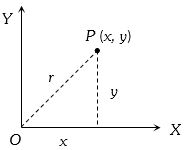
The electric potential at a point $(x, y)$ in the $x-y$ plane is given by $V = -kxy$. The field intensity at a distance $r$ from the origin varies as
A
$r^2$
B
$r$
C
$\frac{1}{r}$
D
$\frac{1}{r^2}$
Solution
(B) The electric field components are given by the negative gradient of the potential:
$E_x = -\frac{\partial V}{\partial x} = -\frac{\partial}{\partial x}(-kxy) = ky$
$E_y = -\frac{\partial V}{\partial y} = -\frac{\partial}{\partial y}(-kxy) = kx$
The magnitude of the electric field intensity $E$ is given by:
$E = \sqrt{E_x^2 + E_y^2} = \sqrt{(ky)^2 + (kx)^2}$
$E = k\sqrt{x^2 + y^2}$
Since the distance from the origin is $r = \sqrt{x^2 + y^2}$,we have:
$E = kr$
Therefore,the field intensity varies directly with the distance $r$ from the origin,i.e.,$E \propto r$.
$E_x = -\frac{\partial V}{\partial x} = -\frac{\partial}{\partial x}(-kxy) = ky$
$E_y = -\frac{\partial V}{\partial y} = -\frac{\partial}{\partial y}(-kxy) = kx$
The magnitude of the electric field intensity $E$ is given by:
$E = \sqrt{E_x^2 + E_y^2} = \sqrt{(ky)^2 + (kx)^2}$
$E = k\sqrt{x^2 + y^2}$
Since the distance from the origin is $r = \sqrt{x^2 + y^2}$,we have:
$E = kr$
Therefore,the field intensity varies directly with the distance $r$ from the origin,i.e.,$E \propto r$.
0 likes
View Solution9
MediumMCQ
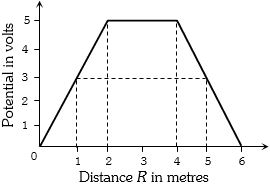
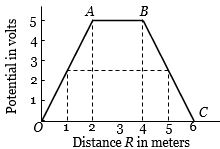
The variation of potential with distance $R$ from a fixed point is as shown in the graph. The electric field at $R = 5\,m$ is......$V/m$.
A
$2.5$
B
$-2.5$
C
$2/5$
D
$-2/5$
Solution
(A) The electric field $E$ is related to the potential $V$ by the relation $E = -\frac{dV}{dR}$, which represents the negative of the slope of the $V-R$ graph.
For the region between $R = 4\,m$ and $R = 6\,m$, the graph is a straight line passing through $(4, 5)$ and $(6, 0)$.
The slope of this line is $m = \frac{V_2 - V_1}{R_2 - R_1} = \frac{0 - 5}{6 - 4} = \frac{-5}{2} = -2.5\,V/m$.
Therefore, the electric field at $R = 5\,m$ is $E = -(\text{slope}) = -(-2.5) = 2.5\,V/m$.
For the region between $R = 4\,m$ and $R = 6\,m$, the graph is a straight line passing through $(4, 5)$ and $(6, 0)$.
The slope of this line is $m = \frac{V_2 - V_1}{R_2 - R_1} = \frac{0 - 5}{6 - 4} = \frac{-5}{2} = -2.5\,V/m$.
Therefore, the electric field at $R = 5\,m$ is $E = -(\text{slope}) = -(-2.5) = 2.5\,V/m$.
0 likes
View Solution10
EasyMCQ
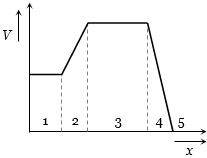
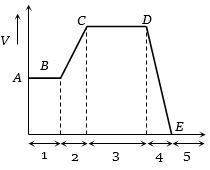
The figure shows the electric potential $V$ as a function of distance through five regions on the $x$-axis. Which of the following is true for the electric field $E$ in these regions?
A
${E_1} > {E_2} > {E_3} > {E_4} > {E_5}$
B
${E_1} = {E_3} = {E_5} = 0$ and ${E_2} < {E_4}$
C
${E_2} = {E_4} = {E_5}$ and ${E_1} < {E_3}$
D
${E_1} < {E_2} < {E_3} < {E_4} < {E_5}$
Solution
(B) The electric field $E$ is related to the potential $V$ by the relation $E = -\frac{dV}{dx}$. This means the magnitude of the electric field is equal to the slope of the $V-x$ graph.
In regions $1$,$3$,and $5$,the potential $V$ is constant,so the slope $\frac{dV}{dx} = 0$. Thus,${E_1} = {E_3} = {E_5} = 0$.
In regions $2$ and $4$,the potential changes linearly. The magnitude of the electric field is given by the slope of the lines in these regions.
From the graph,the slope of the line in region $4$ is steeper than the slope of the line in region $2$. Therefore,the magnitude of the electric field in region $4$ is greater than in region $2$,i.e.,${E_2} < {E_4}$.
Thus,the correct relation is ${E_1} = {E_3} = {E_5} = 0$ and ${E_2} < {E_4}$.
In regions $1$,$3$,and $5$,the potential $V$ is constant,so the slope $\frac{dV}{dx} = 0$. Thus,${E_1} = {E_3} = {E_5} = 0$.
In regions $2$ and $4$,the potential changes linearly. The magnitude of the electric field is given by the slope of the lines in these regions.
From the graph,the slope of the line in region $4$ is steeper than the slope of the line in region $2$. Therefore,the magnitude of the electric field in region $4$ is greater than in region $2$,i.e.,${E_2} < {E_4}$.
Thus,the correct relation is ${E_1} = {E_3} = {E_5} = 0$ and ${E_2} < {E_4}$.
0 likes
View Solution11
EasyMCQ
Potential gradient is defined as
A
Fall of potential per unit length of the wire
B
Fall of potential per unit area of the wire
C
Fall of potential between two ends of the wire
D
Potential at any one end of the wire
Solution
(A) The potential gradient is defined as the fall of potential per unit length along the wire.
Mathematically,it is expressed as:
Potential gradient $ = \frac{\text{Potential difference}}{\text{Length}}$
Therefore,option $A$ is correct.
Mathematically,it is expressed as:
Potential gradient $ = \frac{\text{Potential difference}}{\text{Length}}$
Therefore,option $A$ is correct.
0 likes
View Solution12
MediumMCQ
If the potential energy of an electron and a proton at a distance $r$ is given by the formula $U = - \left( \frac{ke^2}{3r^3} \right)$,then which law of force applies?
A
$F = \frac{ke^2}{r^2}$
B
$F = - \frac{3}{4} \frac{ke^2}{r^4}$
C
$F = - \frac{ke^2}{r^4}$
D
$F = \frac{ke^2}{r}$
Solution
(C) The relationship between force $F$ and potential energy $U$ is given by $F = - \frac{dU}{dr}$.
Given $U = - \frac{ke^2}{3r^3} = - \frac{ke^2}{3} r^{-3}$.
Now,differentiating $U$ with respect to $r$:
$F = - \frac{d}{dr} \left( - \frac{ke^2}{3} r^{-3} \right)$
$F = \frac{ke^2}{3} \frac{d}{dr} (r^{-3})$
$F = \frac{ke^2}{3} (-3 r^{-4})$
$F = - \frac{ke^2}{r^4}$.
Given $U = - \frac{ke^2}{3r^3} = - \frac{ke^2}{3} r^{-3}$.
Now,differentiating $U$ with respect to $r$:
$F = - \frac{d}{dr} \left( - \frac{ke^2}{3} r^{-3} \right)$
$F = \frac{ke^2}{3} \frac{d}{dr} (r^{-3})$
$F = \frac{ke^2}{3} (-3 r^{-4})$
$F = - \frac{ke^2}{r^4}$.
0 likes
View Solution13
MediumMCQ
If the electric potential in a region is given by $V = 4x^2$ volts,then the electric field at the point $(1, 0, 2) \ m$ is:
A
$8 \ V/m$ in the direction of the $(-x)$ axis.
B
$8 \ V/m$ in the direction of the $(+x)$ axis.
C
$4 \ V/m$ in the direction of the $(-x)$ axis.
D
$4 \ V/m$ in the direction of the $(+x)$ axis.
Solution
(A) Step $1$: The electric field $\vec{E}$ is related to the potential $V$ by the gradient formula: $\vec{E} = -\nabla V = -\left( \frac{\partial V}{\partial x} \hat{i} + \frac{\partial V}{\partial y} \hat{j} + \frac{\partial V}{\partial z} \hat{k} \right)$.
Given $V = 4x^2$,we calculate the partial derivatives:
$\frac{\partial V}{\partial x} = \frac{d}{dx}(4x^2) = 8x$,$\frac{\partial V}{\partial y} = 0$,and $\frac{\partial V}{\partial z} = 0$.
Substituting these into the formula,we get $\vec{E} = -(8x) \hat{i} = -8x \hat{i} \ V/m$.
Step $2$: Evaluate the electric field at the point $(1, 0, 2)$.
At $x = 1$,$\vec{E} = -8(1) \hat{i} = -8 \hat{i} \ V/m$.
The negative sign indicates that the electric field is directed along the negative $x$-axis with a magnitude of $8 \ V/m$.
Given $V = 4x^2$,we calculate the partial derivatives:
$\frac{\partial V}{\partial x} = \frac{d}{dx}(4x^2) = 8x$,$\frac{\partial V}{\partial y} = 0$,and $\frac{\partial V}{\partial z} = 0$.
Substituting these into the formula,we get $\vec{E} = -(8x) \hat{i} = -8x \hat{i} \ V/m$.
Step $2$: Evaluate the electric field at the point $(1, 0, 2)$.
At $x = 1$,$\vec{E} = -8(1) \hat{i} = -8 \hat{i} \ V/m$.
The negative sign indicates that the electric field is directed along the negative $x$-axis with a magnitude of $8 \ V/m$.
0 likes
View Solution14
EasyMCQ
$A$ parallel plate capacitor has a potential of $20 \ kV$ and a capacitance of $2 \times 10^{-4} \ \mu F$. If the area of the plate is $0.01 \ m^2$ and the distance between the plates is $2 \ mm$,find the potential gradient.
A
$10^{-7} \ V/m$
B
$10^{-5} \ V/m$
C
$10^7 \ V/m$
D
$10^3 \ V/m$
Solution
(C) The potential gradient is defined as the rate of change of potential with respect to distance,given by the formula: $E = \frac{V}{d}$.
Given:
Potential $V = 20 \ kV = 20,000 \ V = 2 \times 10^4 \ V$.
Distance $d = 2 \ mm = 2 \times 10^{-3} \ m$.
Substituting the values into the formula:
$E = \frac{2 \times 10^4 \ V}{2 \times 10^{-3} \ m} = 1 \times 10^{4 - (-3)} \ V/m = 10^7 \ V/m$.
Thus,the potential gradient is $10^7 \ V/m$.
Given:
Potential $V = 20 \ kV = 20,000 \ V = 2 \times 10^4 \ V$.
Distance $d = 2 \ mm = 2 \times 10^{-3} \ m$.
Substituting the values into the formula:
$E = \frac{2 \times 10^4 \ V}{2 \times 10^{-3} \ m} = 1 \times 10^{4 - (-3)} \ V/m = 10^7 \ V/m$.
Thus,the potential gradient is $10^7 \ V/m$.
0 likes
View Solution15
EasyMCQ
If $V$ is the electric potential at a given point,then the electric field $E_x$ in the $x$-direction at that point is:
A
$\int_0^\infty V\,dx$
B
$-\frac{dV}{dt}$
C
$-\frac{dV}{dx}$
D
$-V\frac{dV}{dx}$
Solution
(C) The relationship between the electric field $E$ and the electric potential $V$ is given by the negative gradient of the potential.
For the $x$-component of the electric field,the relation is $E_x = -\frac{dV}{dx}$.
This represents the rate of change of potential with respect to distance in the $x$-direction.
For the $x$-component of the electric field,the relation is $E_x = -\frac{dV}{dx}$.
This represents the rate of change of potential with respect to distance in the $x$-direction.
0 likes
View Solution16
DifficultMCQ
The electric potential inside a charged sphere is given by $\phi = ar^2 + b$,where $r$ is the distance from the center,and $a$ and $b$ are constants. The charge density inside the sphere is .......
A
$-24\pi a\varepsilon_0$
B
$-6a\varepsilon_0$
C
$-24\pi a\varepsilon_0 r$
D
$-6a\varepsilon_0 r$
Solution
(B) The electric field $E_r$ is related to the potential $\phi$ by $E_r = -\frac{d\phi}{dr}$.
Given $\phi = ar^2 + b$,we have $E_r = -\frac{d}{dr}(ar^2 + b) = -2ar$.
According to Gauss's Law in differential form,the charge density $\rho$ is given by $\rho = \varepsilon_0 (\nabla \cdot E)$.
In spherical coordinates,for a radial field $E_r$,the divergence is $\nabla \cdot E = \frac{1}{r^2} \frac{d}{dr}(r^2 E_r)$.
Substituting $E_r = -2ar$:
$\nabla \cdot E = \frac{1}{r^2} \frac{d}{dr}(r^2 (-2ar)) = \frac{1}{r^2} \frac{d}{dr}(-2ar^3) = \frac{1}{r^2} (-6ar^2) = -6a$.
Therefore,the charge density is $\rho = \varepsilon_0 (-6a) = -6a\varepsilon_0$.
Given $\phi = ar^2 + b$,we have $E_r = -\frac{d}{dr}(ar^2 + b) = -2ar$.
According to Gauss's Law in differential form,the charge density $\rho$ is given by $\rho = \varepsilon_0 (\nabla \cdot E)$.
In spherical coordinates,for a radial field $E_r$,the divergence is $\nabla \cdot E = \frac{1}{r^2} \frac{d}{dr}(r^2 E_r)$.
Substituting $E_r = -2ar$:
$\nabla \cdot E = \frac{1}{r^2} \frac{d}{dr}(r^2 (-2ar)) = \frac{1}{r^2} \frac{d}{dr}(-2ar^3) = \frac{1}{r^2} (-6ar^2) = -6a$.
Therefore,the charge density is $\rho = \varepsilon_0 (-6a) = -6a\varepsilon_0$.
0 likes
View Solution17
EasyMCQ
Two parallel plates are separated by a distance of $5 \, mm$. The potential difference between them is $50 \, V$. $A$ particle of mass $10^{-15} \, kg$ and charge $10^{-11} \, C$ enters the region with a velocity of $10^7 \, m/s$. The acceleration of the particle will be:
A
$10^8 \, m/s^2$
B
$5 \times 10^5 \, m/s^2$
C
$10^5 \, m/s^2$
D
$2 \times 10^3 \, m/s^2$
Solution
(A) Given: Distance $d = 5 \, mm = 5 \times 10^{-3} \, m$,Potential difference $V = 50 \, V$,Mass $m = 10^{-15} \, kg$,Charge $q = 10^{-11} \, C$.
Electric field $E = \frac{V}{d} = \frac{50}{5 \times 10^{-3}} = 10^4 \, V/m$.
The force on the particle is $F = qE$.
Using Newton's second law,$F = ma$,so $a = \frac{qE}{m}$.
Substituting the values: $a = \frac{10^{-11} \times 10^4}{10^{-15}} = \frac{10^{-7}}{10^{-15}} = 10^8 \, m/s^2$.
Electric field $E = \frac{V}{d} = \frac{50}{5 \times 10^{-3}} = 10^4 \, V/m$.
The force on the particle is $F = qE$.
Using Newton's second law,$F = ma$,so $a = \frac{qE}{m}$.
Substituting the values: $a = \frac{10^{-11} \times 10^4}{10^{-15}} = \frac{10^{-7}}{10^{-15}} = 10^8 \, m/s^2$.
0 likes
View Solution18
EasyMCQ
Two plates are separated by a distance of $20 \, cm$. The potential difference between them is $10 \, V$. The electric field between the two plates is ...... $V m^{-1}$.
A
$0.5$
B
$20$
C
$50$
D
$500$
Solution
(C) The relationship between electric field $E$,potential difference $V$,and distance $d$ is given by $E = \frac{V}{d}$.
Given: $V = 10 \, V$ and $d = 20 \, cm = 0.2 \, m$.
Substituting the values:
$E = \frac{10}{0.2} = \frac{100}{2} = 50 \, V m^{-1}$.
Therefore,the electric field is $50 \, V m^{-1}$.
Given: $V = 10 \, V$ and $d = 20 \, cm = 0.2 \, m$.
Substituting the values:
$E = \frac{10}{0.2} = \frac{100}{2} = 50 \, V m^{-1}$.
Therefore,the electric field is $50 \, V m^{-1}$.
0 likes
View Solution19
DifficultMCQ
Due to some charges on the $x$-axis,the potential at a point on the $x$-axis is given by $V(x) = 20/(x^2 - 4) \ V$. The electric field at $x = 4 \ \mu m$ is given by:
A
$5/3 \ V/\mu m$ and in $-ve \ x$-direction
B
$5/3 \ V/\mu m$ and in $+ve \ x$-direction
C
$10/9 \ V/\mu m$ and in $-ve \ x$-direction
D
$10/9 \ V/\mu m$ and in $+ve \ x$-direction
Solution
(D) The relation between electric field $E$ and potential $V$ is given by $E = -\frac{dV}{dx}$.
Given $V(x) = 20(x^2 - 4)^{-1}$.
Differentiating with respect to $x$:
$\frac{dV}{dx} = 20 \cdot (-1) \cdot (x^2 - 4)^{-2} \cdot (2x) = -\frac{40x}{(x^2 - 4)^2}$.
Therefore,$E = -\left(-\frac{40x}{(x^2 - 4)^2}\right) = \frac{40x}{(x^2 - 4)^2}$.
At $x = 4 \ \mu m$:
$E = \frac{40(4)}{(4^2 - 4)^2} = \frac{160}{(16 - 4)^2} = \frac{160}{12^2} = \frac{160}{144}$.
Simplifying the fraction by dividing by $16$:
$E = \frac{10}{9} \ V/\mu m$.
Since the value is positive,the electric field is in the $+ve \ x$-direction.
Given $V(x) = 20(x^2 - 4)^{-1}$.
Differentiating with respect to $x$:
$\frac{dV}{dx} = 20 \cdot (-1) \cdot (x^2 - 4)^{-2} \cdot (2x) = -\frac{40x}{(x^2 - 4)^2}$.
Therefore,$E = -\left(-\frac{40x}{(x^2 - 4)^2}\right) = \frac{40x}{(x^2 - 4)^2}$.
At $x = 4 \ \mu m$:
$E = \frac{40(4)}{(4^2 - 4)^2} = \frac{160}{(16 - 4)^2} = \frac{160}{12^2} = \frac{160}{144}$.
Simplifying the fraction by dividing by $16$:
$E = \frac{10}{9} \ V/\mu m$.
Since the value is positive,the electric field is in the $+ve \ x$-direction.
0 likes
View Solution20
EasyMCQ
If $V = -5x + 3y + \sqrt{15}z$,then find the magnitude of the electric field $E(x, y, z)$ in units.
A
$8$
B
$6.7$
C
$7.7$
D
$7$
Solution
(D) The electric field $\vec{E}$ is given by the negative gradient of the potential $V$: $\vec{E} = -\nabla V = -\left( \frac{\partial V}{\partial x}\hat{i} + \frac{\partial V}{\partial y}\hat{j} + \frac{\partial V}{\partial z}\hat{k} \right)$.
Calculating the partial derivatives:
$\frac{\partial V}{\partial x} = -5$,$\frac{\partial V}{\partial y} = 3$,and $\frac{\partial V}{\partial z} = \sqrt{15}$.
Substituting these into the expression for $\vec{E}$:
$\vec{E} = -(-5\hat{i} + 3\hat{j} + \sqrt{15}\hat{k}) = 5\hat{i} - 3\hat{j} - \sqrt{15}\hat{k}$.
The magnitude of the electric field is $|\vec{E}| = \sqrt{(5)^2 + (-3)^2 + (-\sqrt{15})^2}$.
$|\vec{E}| = \sqrt{25 + 9 + 15} = \sqrt{49} = 7$ units.
Calculating the partial derivatives:
$\frac{\partial V}{\partial x} = -5$,$\frac{\partial V}{\partial y} = 3$,and $\frac{\partial V}{\partial z} = \sqrt{15}$.
Substituting these into the expression for $\vec{E}$:
$\vec{E} = -(-5\hat{i} + 3\hat{j} + \sqrt{15}\hat{k}) = 5\hat{i} - 3\hat{j} - \sqrt{15}\hat{k}$.
The magnitude of the electric field is $|\vec{E}| = \sqrt{(5)^2 + (-3)^2 + (-\sqrt{15})^2}$.
$|\vec{E}| = \sqrt{25 + 9 + 15} = \sqrt{49} = 7$ units.
0 likes
View Solution21
EasyMCQ
The electric potentials of two plates are $-10\, V$ and $+30\, V$ respectively. If the distance between the two plates is $2\, cm$,then the electric field between them is ... $V/m$.
A
$2000$
B
$1000$
C
$500$
D
$3000$
Solution
(A) The electric field $E$ between two parallel plates is given by the potential gradient: $E = \frac{|\Delta V|}{d}$.
Given,$V_1 = -10\, V$ and $V_2 = +30\, V$.
The potential difference $\Delta V = V_2 - V_1 = 30 - (-10) = 40\, V$.
The distance $d = 2\, cm = 2 \times 10^{-2}\, m$.
Substituting these values into the formula:
$E = \frac{40}{2 \times 10^{-2}} = 20 \times 10^2 = 2000\, V/m$.
Given,$V_1 = -10\, V$ and $V_2 = +30\, V$.
The potential difference $\Delta V = V_2 - V_1 = 30 - (-10) = 40\, V$.
The distance $d = 2\, cm = 2 \times 10^{-2}\, m$.
Substituting these values into the formula:
$E = \frac{40}{2 \times 10^{-2}} = 20 \times 10^2 = 2000\, V/m$.
0 likes
View Solution22
MediumMCQ
Two points $A$ and $B$ on the $Y$-axis are at distances of $12.3 \ cm$ and $12.5 \ cm$ from the origin,respectively. The potentials at these points are $56 \ V$ and $54.8 \ V$,respectively. What is the component of the force on a charge of $4 \ \mu C$ placed at point $A$ on the $Y$-axis?
A
$2.4 \times 10^{-4} \ N$
B
$24 \times 10^{-4} \ N$
C
$2 \times 10^{-4} \ N$
D
$24 \times 10^{-8} \ N$
Solution
(B) The electric field component $E_y$ along the $Y$-axis is given by the negative potential gradient: $E_y = -\frac{\Delta V}{\Delta y}$.
Given: $q = 4 \ \mu C = 4 \times 10^{-6} \ C$,$\Delta V = V_B - V_A = 54.8 \ V - 56 \ V = -1.2 \ V$,and $\Delta y = y_B - y_A = 12.5 \ cm - 12.3 \ cm = 0.2 \ cm = 0.2 \times 10^{-2} \ m$.
The electric field is $E_y = -\frac{-1.2}{0.2 \times 10^{-2}} = \frac{1.2}{0.002} = 600 \ V/m$.
The force component $F_y$ on the charge $q$ is $F_y = q E_y = (4 \times 10^{-6} \ C) \times (600 \ V/m) = 2400 \times 10^{-6} \ N = 24 \times 10^{-4} \ N$.
Given: $q = 4 \ \mu C = 4 \times 10^{-6} \ C$,$\Delta V = V_B - V_A = 54.8 \ V - 56 \ V = -1.2 \ V$,and $\Delta y = y_B - y_A = 12.5 \ cm - 12.3 \ cm = 0.2 \ cm = 0.2 \times 10^{-2} \ m$.
The electric field is $E_y = -\frac{-1.2}{0.2 \times 10^{-2}} = \frac{1.2}{0.002} = 600 \ V/m$.
The force component $F_y$ on the charge $q$ is $F_y = q E_y = (4 \times 10^{-6} \ C) \times (600 \ V/m) = 2400 \times 10^{-6} \ N = 24 \times 10^{-4} \ N$.

0 likes
View Solution23
DifficultMCQ
In a certain region,the electric potential is given by $V = 6x - 8xy^2 - 8y + 6yz - 4z^2 \, V$. The magnitude of the force on a charge of $2 \, C$ at the origin is ........ $N$.
A
$2$
B
$6$
C
$8$
D
$20$
Solution
(D) The electric field $\overrightarrow{E}$ is related to the potential $V$ by $\overrightarrow{E} = -\nabla V = -\left( \frac{\partial V}{\partial x} \hat{i} + \frac{\partial V}{\partial y} \hat{j} + \frac{\partial V}{\partial z} \hat{k} \right)$.
Calculating the partial derivatives:
$\frac{\partial V}{\partial x} = 6 - 8y^2$
$\frac{\partial V}{\partial y} = -16xy - 8 + 6z$
$\frac{\partial V}{\partial z} = 6y - 8z$
At the origin $(0, 0, 0)$:
$\frac{\partial V}{\partial x} = 6 - 0 = 6$
$\frac{\partial V}{\partial y} = 0 - 8 + 0 = -8$
$\frac{\partial V}{\partial z} = 0 - 0 = 0$
Thus,the electric field at the origin is $\overrightarrow{E} = -(6 \hat{i} - 8 \hat{j} + 0 \hat{k}) = -6 \hat{i} + 8 \hat{j} \, N/C$.
The magnitude of the electric field is $|\overrightarrow{E}| = \sqrt{(-6)^2 + 8^2} = \sqrt{36 + 64} = \sqrt{100} = 10 \, N/C$.
The force on the charge $q = 2 \, C$ is $F = q|\overrightarrow{E}| = 2 \times 10 = 20 \, N$.
Calculating the partial derivatives:
$\frac{\partial V}{\partial x} = 6 - 8y^2$
$\frac{\partial V}{\partial y} = -16xy - 8 + 6z$
$\frac{\partial V}{\partial z} = 6y - 8z$
At the origin $(0, 0, 0)$:
$\frac{\partial V}{\partial x} = 6 - 0 = 6$
$\frac{\partial V}{\partial y} = 0 - 8 + 0 = -8$
$\frac{\partial V}{\partial z} = 0 - 0 = 0$
Thus,the electric field at the origin is $\overrightarrow{E} = -(6 \hat{i} - 8 \hat{j} + 0 \hat{k}) = -6 \hat{i} + 8 \hat{j} \, N/C$.
The magnitude of the electric field is $|\overrightarrow{E}| = \sqrt{(-6)^2 + 8^2} = \sqrt{36 + 64} = \sqrt{100} = 10 \, N/C$.
The force on the charge $q = 2 \, C$ is $F = q|\overrightarrow{E}| = 2 \times 10 = 20 \, N$.
0 likes
View Solution24
DifficultMCQ
The electric field at a distance $x$ from the origin is given by $E = 100/x^2$. The potential difference between the points at $x = 10 \, m$ and $x = 20 \, m$ is ...... $V$.
A
$5$
B
$10$
C
$15$
D
$4$
Solution
(A) The potential difference $V_B - V_A$ is given by the relation $V_B - V_A = - \int_{A}^{B} E \cdot dx$.
Here,$A = 10 \, m$ and $B = 20 \, m$.
$V_{20} - V_{10} = - \int_{10}^{20} \frac{100}{x^2} \, dx$.
$V_{20} - V_{10} = - 100 \left[ -\frac{1}{x} \right]_{10}^{20}$.
$V_{20} - V_{10} = 100 \left[ \frac{1}{20} - \frac{1}{10} \right]$.
$V_{20} - V_{10} = 100 \left[ \frac{1 - 2}{20} \right] = 100 \left( -\frac{1}{20} \right) = -5 \, V$.
The magnitude of the potential difference is $|V_{10} - V_{20}| = 5 \, V$.
Here,$A = 10 \, m$ and $B = 20 \, m$.
$V_{20} - V_{10} = - \int_{10}^{20} \frac{100}{x^2} \, dx$.
$V_{20} - V_{10} = - 100 \left[ -\frac{1}{x} \right]_{10}^{20}$.
$V_{20} - V_{10} = 100 \left[ \frac{1}{20} - \frac{1}{10} \right]$.
$V_{20} - V_{10} = 100 \left[ \frac{1 - 2}{20} \right] = 100 \left( -\frac{1}{20} \right) = -5 \, V$.
The magnitude of the potential difference is $|V_{10} - V_{20}| = 5 \, V$.
0 likes
View Solution25
DifficultMCQ
The electric potential is given by $V = 6x - 8xy^2 - 8y + 6yz - 4z^2$. Find the electric force in $N$ acting on a point charge of $2 \ C$ placed at the origin.
A
$2$
B
$6$
C
$8$
D
$20$
Solution
(D) The electric field components are given by $E_x = -\frac{\partial V}{\partial x}$,$E_y = -\frac{\partial V}{\partial y}$,and $E_z = -\frac{\partial V}{\partial z}$.
Calculating the partial derivatives:
$E_x = -\frac{\partial}{\partial x}(6x - 8xy^2 - 8y + 6yz - 4z^2) = -(6 - 8y^2) = 8y^2 - 6$
$E_y = -\frac{\partial}{\partial y}(6x - 8xy^2 - 8y + 6yz - 4z^2) = -(-16xy - 8 + 6z) = 16xy + 8 - 6z$
$E_z = -\frac{\partial}{\partial z}(6x - 8xy^2 - 8y + 6yz - 4z^2) = -(6y - 8z) = 8z - 6y$
At the origin $(x=0, y=0, z=0)$:
$E_x = 8(0)^2 - 6 = -6 \ V/m$
$E_y = 16(0)(0) + 8 - 6(0) = 8 \ V/m$
$E_z = 8(0) - 6(0) = 0 \ V/m$
The magnitude of the electric field is $E = \sqrt{E_x^2 + E_y^2 + E_z^2} = \sqrt{(-6)^2 + 8^2 + 0^2} = \sqrt{36 + 64} = \sqrt{100} = 10 \ N/C$.
The electric force is $F = qE = 2 \ C \times 10 \ N/C = 20 \ N$.
Calculating the partial derivatives:
$E_x = -\frac{\partial}{\partial x}(6x - 8xy^2 - 8y + 6yz - 4z^2) = -(6 - 8y^2) = 8y^2 - 6$
$E_y = -\frac{\partial}{\partial y}(6x - 8xy^2 - 8y + 6yz - 4z^2) = -(-16xy - 8 + 6z) = 16xy + 8 - 6z$
$E_z = -\frac{\partial}{\partial z}(6x - 8xy^2 - 8y + 6yz - 4z^2) = -(6y - 8z) = 8z - 6y$
At the origin $(x=0, y=0, z=0)$:
$E_x = 8(0)^2 - 6 = -6 \ V/m$
$E_y = 16(0)(0) + 8 - 6(0) = 8 \ V/m$
$E_z = 8(0) - 6(0) = 0 \ V/m$
The magnitude of the electric field is $E = \sqrt{E_x^2 + E_y^2 + E_z^2} = \sqrt{(-6)^2 + 8^2 + 0^2} = \sqrt{36 + 64} = \sqrt{100} = 10 \ N/C$.
The electric force is $F = qE = 2 \ C \times 10 \ N/C = 20 \ N$.
0 likes
View Solution26
DifficultMCQ
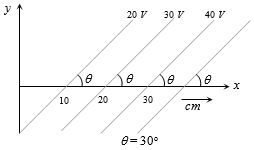
For the given figure,the value of the electric field is ......... $V/m$.
A
$100$
B
$300$
C
$200$
D
$400$
Solution
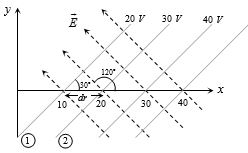
(C) The relationship between electric field $E$ and potential difference $dV$ is given by $dV = -\vec{E} \cdot d\vec{r} = -E \, dr \cos \theta$.
Here,the potential increases in the direction of the electric field. The distance between the equipotential lines of $20 \, V$ and $30 \, V$ along the $x$-axis is $dr = (20 - 10) \, cm = 10 \times 10^{-2} \, m$.
The angle between the electric field vector $\vec{E}$ and the displacement vector $d\vec{r}$ along the $x$-axis is $\theta = 180^\circ - 30^\circ = 150^\circ$ (or using the perpendicular distance method,$E = \frac{dV}{dr_{\perp}}$ where $dr_{\perp} = dr \sin 30^\circ$).
Using $E = \frac{\Delta V}{\Delta r \sin \theta} = \frac{30 - 20}{0.1 \times \sin 30^\circ} = \frac{10}{0.1 \times 0.5} = \frac{10}{0.05} = 200 \, V/m$.
Here,the potential increases in the direction of the electric field. The distance between the equipotential lines of $20 \, V$ and $30 \, V$ along the $x$-axis is $dr = (20 - 10) \, cm = 10 \times 10^{-2} \, m$.
The angle between the electric field vector $\vec{E}$ and the displacement vector $d\vec{r}$ along the $x$-axis is $\theta = 180^\circ - 30^\circ = 150^\circ$ (or using the perpendicular distance method,$E = \frac{dV}{dr_{\perp}}$ where $dr_{\perp} = dr \sin 30^\circ$).
Using $E = \frac{\Delta V}{\Delta r \sin \theta} = \frac{30 - 20}{0.1 \times \sin 30^\circ} = \frac{10}{0.1 \times 0.5} = \frac{10}{0.05} = 200 \, V/m$.
0 likes
View Solution27
MediumMCQ
If the electric potential at a point $P(x, y)$ is given by $V = axy$,then the electric field at a distance $r$ from the origin is proportional to:
A
$r$
B
$r^{-1}$
C
$r^{-2}$
D
$r^2$
Solution
(A) The electric field $\vec{E}$ is related to the potential $V$ by the relation $\vec{E} = -\nabla V$.
Given $V = axy$,the components of the electric field are:
$E_x = -\frac{\partial V}{\partial x} = -ay$
$E_y = -\frac{\partial V}{\partial y} = -ax$
The magnitude of the electric field is $E = \sqrt{E_x^2 + E_y^2}$.
Substituting the components,we get $E = \sqrt{(-ay)^2 + (-ax)^2} = \sqrt{a^2y^2 + a^2x^2} = a\sqrt{x^2 + y^2}$.
Since the distance $r$ from the origin is defined as $r = \sqrt{x^2 + y^2}$,we have $E = ar$.
Therefore,the electric field $E$ is proportional to $r$ $(E \propto r)$.
Given $V = axy$,the components of the electric field are:
$E_x = -\frac{\partial V}{\partial x} = -ay$
$E_y = -\frac{\partial V}{\partial y} = -ax$
The magnitude of the electric field is $E = \sqrt{E_x^2 + E_y^2}$.
Substituting the components,we get $E = \sqrt{(-ay)^2 + (-ax)^2} = \sqrt{a^2y^2 + a^2x^2} = a\sqrt{x^2 + y^2}$.
Since the distance $r$ from the origin is defined as $r = \sqrt{x^2 + y^2}$,we have $E = ar$.
Therefore,the electric field $E$ is proportional to $r$ $(E \propto r)$.
0 likes
View Solution28
MediumMCQ
The electric potential is given by $V = 4x^2 \ V$. What is the electric field at the point $(1 \ m, 0, 2 \ m)$?
A
$8 \ V/m$ along $-X$-axis
B
$8 \ V/m$ along $+X$-axis
C
$16 \ V/m$ along $-X$-axis
D
$16 \ V/m$ along $+Z$-axis
Solution
(A) The electric field $E$ is related to the potential $V$ by the relation $E = -\frac{dV}{dx}$.
Given $V = 4x^2$.
Calculating the derivative: $E = -\frac{d}{dx}(4x^2) = -8x$.
At the point $(1 \ m, 0, 2 \ m)$,the $x$-coordinate is $1 \ m$.
Substituting $x = 1$ into the expression for $E$: $E = -8(1) = -8 \ V/m$.
The negative sign indicates that the electric field is directed along the negative $X$-axis.
Therefore,the magnitude is $8 \ V/m$ along the $-X$-axis.
Given $V = 4x^2$.
Calculating the derivative: $E = -\frac{d}{dx}(4x^2) = -8x$.
At the point $(1 \ m, 0, 2 \ m)$,the $x$-coordinate is $1 \ m$.
Substituting $x = 1$ into the expression for $E$: $E = -8(1) = -8 \ V/m$.
The negative sign indicates that the electric field is directed along the negative $X$-axis.
Therefore,the magnitude is $8 \ V/m$ along the $-X$-axis.
0 likes
View Solution29
MediumMCQ
If the electric potential is given by $V = (5x^2 + 10x - 9) \ V$,what is the electric field at $x = 1 \ m$ in $V/m$?
A
$-20$
B
$6$
C
$11$
D
$-23$
Solution
(A) The relationship between electric field $E$ and electric potential $V$ is given by $E = -\frac{dV}{dx}$.
Given $V = 5x^2 + 10x - 9$.
Taking the derivative with respect to $x$: $\frac{dV}{dx} = \frac{d}{dx}(5x^2 + 10x - 9) = 10x + 10$.
Therefore,$E = -(10x + 10)$.
At $x = 1 \ m$,substitute the value into the expression:
$E = -(10(1) + 10) = -(10 + 10) = -20 \ V/m$.
Given $V = 5x^2 + 10x - 9$.
Taking the derivative with respect to $x$: $\frac{dV}{dx} = \frac{d}{dx}(5x^2 + 10x - 9) = 10x + 10$.
Therefore,$E = -(10x + 10)$.
At $x = 1 \ m$,substitute the value into the expression:
$E = -(10(1) + 10) = -(10 + 10) = -20 \ V/m$.
0 likes
View Solution30
EasyMCQ
If the electric potential is given by $V = 4x + 3y$,what is the electric field at the point $(2, 1)$?
A
$11$
B
$5$
C
$7$
D
$1$
Solution
(B) The electric field $\vec{E}$ is related to the potential $V$ by the relation $\vec{E} = -\nabla V = -\left( \frac{\partial V}{\partial x} \hat{i} + \frac{\partial V}{\partial y} \hat{j} \right)$.
Given $V = 4x + 3y$.
The $x$-component of the electric field is $E_x = -\frac{\partial V}{\partial x} = -\frac{\partial}{\partial x}(4x + 3y) = -4 \, \text{V/m}$.
The $y$-component of the electric field is $E_y = -\frac{\partial V}{\partial y} = -\frac{\partial}{\partial y}(4x + 3y) = -3 \, \text{V/m}$.
The magnitude of the electric field is $E = \sqrt{E_x^2 + E_y^2}$.
Substituting the values,$E = \sqrt{(-4)^2 + (-3)^2} = \sqrt{16 + 9} = \sqrt{25} = 5 \, \text{V/m}$ (or $\text{N/C}$).
Given $V = 4x + 3y$.
The $x$-component of the electric field is $E_x = -\frac{\partial V}{\partial x} = -\frac{\partial}{\partial x}(4x + 3y) = -4 \, \text{V/m}$.
The $y$-component of the electric field is $E_y = -\frac{\partial V}{\partial y} = -\frac{\partial}{\partial y}(4x + 3y) = -3 \, \text{V/m}$.
The magnitude of the electric field is $E = \sqrt{E_x^2 + E_y^2}$.
Substituting the values,$E = \sqrt{(-4)^2 + (-3)^2} = \sqrt{16 + 9} = \sqrt{25} = 5 \, \text{V/m}$ (or $\text{N/C}$).
0 likes
View Solution31
DifficultMCQ
What is the potential gradient in a wire of resistivity $40 \times 10^{-8} \, \Omega \, m$ and cross-sectional area $8 \times 10^{-6} \, m^2$ when a current of $0.2 \, A$ flows through it?
A
$10^{-2} \, V/m$
B
$10^{-1} \, V/m$
C
$3.2 \times 10^{-2} \, V/m$
D
$1 \, V/m$
Solution
(A) The potential gradient is defined as the potential drop per unit length,given by $E = \frac{V}{L}$.
From Ohm's law,$V = iR$,where $R = \rho \frac{L}{A}$.
Substituting $R$ into the potential gradient formula:
$E = \frac{i \rho L}{A L} = \frac{i \rho}{A}$.
Given values: $i = 0.2 \, A$,$\rho = 40 \times 10^{-8} \, \Omega \, m$,and $A = 8 \times 10^{-6} \, m^2$.
Substituting these values:
$E = \frac{0.2 \times 40 \times 10^{-8}}{8 \times 10^{-6}}$.
$E = \frac{8 \times 10^{-8}}{8 \times 10^{-6}} = 10^{-2} \, V/m$.
From Ohm's law,$V = iR$,where $R = \rho \frac{L}{A}$.
Substituting $R$ into the potential gradient formula:
$E = \frac{i \rho L}{A L} = \frac{i \rho}{A}$.
Given values: $i = 0.2 \, A$,$\rho = 40 \times 10^{-8} \, \Omega \, m$,and $A = 8 \times 10^{-6} \, m^2$.
Substituting these values:
$E = \frac{0.2 \times 40 \times 10^{-8}}{8 \times 10^{-6}}$.
$E = \frac{8 \times 10^{-8}}{8 \times 10^{-6}} = 10^{-2} \, V/m$.
0 likes
View Solution32
MediumMCQ
The electric potential at a point in free space due to charge $Q$ coulomb is $V = Q \times 10^{11} \, V$. The electric field at that point is:
A
$4\pi \varepsilon_0 Q \times 10^{20} \, V/m$
B
$12\pi \varepsilon_0 Q \times 10^{22} \, V/m$
C
$4\pi \varepsilon_0 Q \times 10^{22} \, V/m$
D
$12\pi \varepsilon_0 Q \times 10^{20} \, V/m$
Solution
(C) The electric potential $V$ due to a point charge $Q$ at a distance $r$ is given by $V = \frac{1}{4 \pi \varepsilon_0} \cdot \frac{Q}{r}$.
Given $V = Q \times 10^{11} \, V$,we have $\frac{1}{4 \pi \varepsilon_0} \cdot \frac{Q}{r} = Q \times 10^{11}$.
This simplifies to $\frac{1}{r} = 4 \pi \varepsilon_0 \times 10^{11}$.
The electric field $E$ at that point is given by $E = \frac{1}{4 \pi \varepsilon_0} \cdot \frac{Q}{r^2} = \left( \frac{1}{4 \pi \varepsilon_0} \cdot \frac{Q}{r} \right) \cdot \frac{1}{r}$.
Substituting the values,$E = (Q \times 10^{11}) \times (4 \pi \varepsilon_0 \times 10^{11})$.
Therefore,$E = 4 \pi \varepsilon_0 Q \times 10^{22} \, V/m$.
Given $V = Q \times 10^{11} \, V$,we have $\frac{1}{4 \pi \varepsilon_0} \cdot \frac{Q}{r} = Q \times 10^{11}$.
This simplifies to $\frac{1}{r} = 4 \pi \varepsilon_0 \times 10^{11}$.
The electric field $E$ at that point is given by $E = \frac{1}{4 \pi \varepsilon_0} \cdot \frac{Q}{r^2} = \left( \frac{1}{4 \pi \varepsilon_0} \cdot \frac{Q}{r} \right) \cdot \frac{1}{r}$.
Substituting the values,$E = (Q \times 10^{11}) \times (4 \pi \varepsilon_0 \times 10^{11})$.
Therefore,$E = 4 \pi \varepsilon_0 Q \times 10^{22} \, V/m$.
0 likes
View Solution33
EasyMCQ
The electric potential at a point $(x, y, z)$ is given by $V = -x^2y - xz^3 + 4$. The electric field at that point is:
A
$\vec{E} = 2xy\hat{i} + (x^2 + y^2)\hat{j} + (3xz - y^2)\hat{k}$
B
$\vec{E} = z^3\hat{i} + xyz\hat{j} + z^2\hat{k}$
C
$\vec{E} = (2xy - z^3)\hat{i} + xy^2\hat{j} + 3z^2x\hat{k}$
D
$\vec{E} = (2xy + z^3)\hat{i} + x^2\hat{j} + 3xz^2\hat{k}$
Solution
(D) The electric potential is given by $V = -x^2y - xz^3 + 4$.
The electric field $\vec{E}$ is related to the potential $V$ by the relation $\vec{E} = -\vec{\nabla} V = -\left( \frac{\partial V}{\partial x}\hat{i} + \frac{\partial V}{\partial y}\hat{j} + \frac{\partial V}{\partial z}\hat{k} \right)$.
Calculating the partial derivatives:
$\frac{\partial V}{\partial x} = \frac{\partial}{\partial x}(-x^2y - xz^3 + 4) = -2xy - z^3$
$\frac{\partial V}{\partial y} = \frac{\partial}{\partial y}(-x^2y - xz^3 + 4) = -x^2$
$\frac{\partial V}{\partial z} = \frac{\partial}{\partial z}(-x^2y - xz^3 + 4) = -3xz^2$
Substituting these into the expression for $\vec{E}$:
$\vec{E} = -[(-2xy - z^3)\hat{i} + (-x^2)\hat{j} + (-3xz^2)\hat{k}]$
$\vec{E} = (2xy + z^3)\hat{i} + x^2\hat{j} + 3xz^2\hat{k}$.
The electric field $\vec{E}$ is related to the potential $V$ by the relation $\vec{E} = -\vec{\nabla} V = -\left( \frac{\partial V}{\partial x}\hat{i} + \frac{\partial V}{\partial y}\hat{j} + \frac{\partial V}{\partial z}\hat{k} \right)$.
Calculating the partial derivatives:
$\frac{\partial V}{\partial x} = \frac{\partial}{\partial x}(-x^2y - xz^3 + 4) = -2xy - z^3$
$\frac{\partial V}{\partial y} = \frac{\partial}{\partial y}(-x^2y - xz^3 + 4) = -x^2$
$\frac{\partial V}{\partial z} = \frac{\partial}{\partial z}(-x^2y - xz^3 + 4) = -3xz^2$
Substituting these into the expression for $\vec{E}$:
$\vec{E} = -[(-2xy - z^3)\hat{i} + (-x^2)\hat{j} + (-3xz^2)\hat{k}]$
$\vec{E} = (2xy + z^3)\hat{i} + x^2\hat{j} + 3xz^2\hat{k}$.
0 likes
View Solution34
EasyMCQ
The electric potential $V$ at any point $(x, y, z),$ all in metres in space is given by $V = 4x^2$ volt. The electric field at the point $(1, 0, 2)$ in volt/meter,is
A
$8$,along negative $X-$ axis
B
$8$,along positive $X-$ axis
C
$16$ along negative $X-$ axis
D
$16$ along positive $X-$ axis
Solution
(A) The electric field $\vec{E}$ is related to the electric potential $V$ by the relation $\vec{E} = -\nabla V$.
Where $\nabla = \hat{i} \frac{\partial}{\partial x} + \hat{j} \frac{\partial}{\partial y} + \hat{k} \frac{\partial}{\partial z}$.
Therefore,$\vec{E} = -\left[ \hat{i} \frac{\partial V}{\partial x} + \hat{j} \frac{\partial V}{\partial y} + \hat{k} \frac{\partial V}{\partial z} \right]$.
Given $V = 4x^2$,we calculate the partial derivatives:
$\frac{\partial V}{\partial x} = 8x$,$\frac{\partial V}{\partial y} = 0$,and $\frac{\partial V}{\partial z} = 0$.
Substituting these into the expression for $\vec{E}$:
$\vec{E} = -(8x \hat{i} + 0 \hat{j} + 0 \hat{k}) = -8x \hat{i} \text{ V/m}$.
At the point $(1, 0, 2)$,we substitute $x = 1$:
$\vec{E} = -8(1) \hat{i} = -8 \hat{i} \text{ V/m}$.
The negative sign indicates that the electric field is directed along the negative $X-$ axis with a magnitude of $8 \text{ V/m}$.
Where $\nabla = \hat{i} \frac{\partial}{\partial x} + \hat{j} \frac{\partial}{\partial y} + \hat{k} \frac{\partial}{\partial z}$.
Therefore,$\vec{E} = -\left[ \hat{i} \frac{\partial V}{\partial x} + \hat{j} \frac{\partial V}{\partial y} + \hat{k} \frac{\partial V}{\partial z} \right]$.
Given $V = 4x^2$,we calculate the partial derivatives:
$\frac{\partial V}{\partial x} = 8x$,$\frac{\partial V}{\partial y} = 0$,and $\frac{\partial V}{\partial z} = 0$.
Substituting these into the expression for $\vec{E}$:
$\vec{E} = -(8x \hat{i} + 0 \hat{j} + 0 \hat{k}) = -8x \hat{i} \text{ V/m}$.
At the point $(1, 0, 2)$,we substitute $x = 1$:
$\vec{E} = -8(1) \hat{i} = -8 \hat{i} \text{ V/m}$.
The negative sign indicates that the electric field is directed along the negative $X-$ axis with a magnitude of $8 \text{ V/m}$.
0 likes
View Solution35
MediumMCQ
In a region,the potential is represented by $V(x, y, z) = 6x - 8xy - 8y + 6yz$,where $V$ is in volts and $x, y, z$ are in metres. The electric force experienced by a charge of $2 \ C$ situated at point $(1, 1, 1)$ is
A
$6\sqrt{5} \ N$
B
$30 \ N$
C
$24 \ N$
D
$4\sqrt{35} \ N$
Solution
(D) The electric field $\vec{E}$ is given by the negative gradient of the potential $V$: $\vec{E} = -\nabla V = -\left( \frac{\partial V}{\partial x} \hat{i} + \frac{\partial V}{\partial y} \hat{j} + \frac{\partial V}{\partial z} \hat{k} \right)$.
Given $V(x, y, z) = 6x - 8xy - 8y + 6yz$.
Calculating partial derivatives:
$E_x = -\frac{\partial V}{\partial x} = -(6 - 8y) = -6 + 8y$.
$E_y = -\frac{\partial V}{\partial y} = -(-8x - 8 + 6z) = 8x + 8 - 6z$.
$E_z = -\frac{\partial V}{\partial z} = -(6y) = -6y$.
At point $(1, 1, 1)$:
$E_x = -6 + 8(1) = 2 \ V/m$.
$E_y = 8(1) + 8 - 6(1) = 10 \ V/m$.
$E_z = -6(1) = -6 \ V/m$.
Thus,$\vec{E} = 2\hat{i} + 10\hat{j} - 6\hat{k} \ V/m$.
The magnitude of the electric field is $|\vec{E}| = \sqrt{2^2 + 10^2 + (-6)^2} = \sqrt{4 + 100 + 36} = \sqrt{140} = 2\sqrt{35} \ V/m$.
The electric force $\vec{F} = q\vec{E}$. Given $q = 2 \ C$,the magnitude of the force is $F = q|\vec{E}| = 2 \times 2\sqrt{35} = 4\sqrt{35} \ N$.
Given $V(x, y, z) = 6x - 8xy - 8y + 6yz$.
Calculating partial derivatives:
$E_x = -\frac{\partial V}{\partial x} = -(6 - 8y) = -6 + 8y$.
$E_y = -\frac{\partial V}{\partial y} = -(-8x - 8 + 6z) = 8x + 8 - 6z$.
$E_z = -\frac{\partial V}{\partial z} = -(6y) = -6y$.
At point $(1, 1, 1)$:
$E_x = -6 + 8(1) = 2 \ V/m$.
$E_y = 8(1) + 8 - 6(1) = 10 \ V/m$.
$E_z = -6(1) = -6 \ V/m$.
Thus,$\vec{E} = 2\hat{i} + 10\hat{j} - 6\hat{k} \ V/m$.
The magnitude of the electric field is $|\vec{E}| = \sqrt{2^2 + 10^2 + (-6)^2} = \sqrt{4 + 100 + 36} = \sqrt{140} = 2\sqrt{35} \ V/m$.
The electric force $\vec{F} = q\vec{E}$. Given $q = 2 \ C$,the magnitude of the force is $F = q|\vec{E}| = 2 \times 2\sqrt{35} = 4\sqrt{35} \ N$.
0 likes
View Solution36
EasyMCQ
If potential (in volts) in a region is expressed as $V(x, y, z) = 6xy - y + 2yz$,the electric field (in $N/C$) at point $(1, 1, 0)$ is:
A
$-(6\hat{i} + 9\hat{j} + \hat{k})$
B
$-(3\hat{i} + 5\hat{j} + 3\hat{k})$
C
$-(6\hat{i} + 5\hat{j} + 2\hat{k})$
D
$-(2\hat{i} + 3\hat{j} + \hat{k})$
Solution
(C) Given the potential function: $V = 6xy - y + 2yz$.
The electric field $\vec{E}$ is related to the potential $V$ by the relation: $\vec{E} = -\nabla V = -\left( \frac{\partial V}{\partial x} \hat{i} + \frac{\partial V}{\partial y} \hat{j} + \frac{\partial V}{\partial z} \hat{k} \right)$.
Calculating the partial derivatives:
$\frac{\partial V}{\partial x} = \frac{\partial}{\partial x}(6xy - y + 2yz) = 6y$
$\frac{\partial V}{\partial y} = \frac{\partial}{\partial y}(6xy - y + 2yz) = 6x - 1 + 2z$
$\frac{\partial V}{\partial z} = \frac{\partial}{\partial z}(6xy - y + 2yz) = 2y$
Substituting these into the expression for $\vec{E}$:
$\vec{E} = -[ (6y)\hat{i} + (6x - 1 + 2z)\hat{j} + (2y)\hat{k} ]$.
Now,evaluating at the point $(1, 1, 0)$:
$\vec{E}_{(1, 1, 0)} = -[ (6 \times 1)\hat{i} + (6 \times 1 - 1 + 2 \times 0)\hat{j} + (2 \times 1)\hat{k} ]$
$\vec{E}_{(1, 1, 0)} = -(6\hat{i} + 5\hat{j} + 2\hat{k}) \ N/C$.
The electric field $\vec{E}$ is related to the potential $V$ by the relation: $\vec{E} = -\nabla V = -\left( \frac{\partial V}{\partial x} \hat{i} + \frac{\partial V}{\partial y} \hat{j} + \frac{\partial V}{\partial z} \hat{k} \right)$.
Calculating the partial derivatives:
$\frac{\partial V}{\partial x} = \frac{\partial}{\partial x}(6xy - y + 2yz) = 6y$
$\frac{\partial V}{\partial y} = \frac{\partial}{\partial y}(6xy - y + 2yz) = 6x - 1 + 2z$
$\frac{\partial V}{\partial z} = \frac{\partial}{\partial z}(6xy - y + 2yz) = 2y$
Substituting these into the expression for $\vec{E}$:
$\vec{E} = -[ (6y)\hat{i} + (6x - 1 + 2z)\hat{j} + (2y)\hat{k} ]$.
Now,evaluating at the point $(1, 1, 0)$:
$\vec{E}_{(1, 1, 0)} = -[ (6 \times 1)\hat{i} + (6 \times 1 - 1 + 2 \times 0)\hat{j} + (2 \times 1)\hat{k} ]$
$\vec{E}_{(1, 1, 0)} = -(6\hat{i} + 5\hat{j} + 2\hat{k}) \ N/C$.
0 likes
View Solution37
EasyMCQ
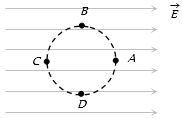
The electric field in a region surrounding the origin is uniform and along the $x$-axis. $A$ small circle is drawn with the centre at the origin,cutting the axes at points $A, B, C, D$ having coordinates $(a, 0), (0, a), (-a, 0), (0, -a)$ respectively,as shown in the figure. Then,the potential is minimum at the point:
A
$A$
B
$B$
C
$C$
D
$D$
Solution
(A) The electric field $\vec{E}$ is uniform and directed along the positive $x$-axis.
The relationship between electric field and electric potential is given by $\vec{E} = -\nabla V$,which implies that the electric potential $V$ decreases in the direction of the electric field.
Since the electric field is directed towards the positive $x$-axis,the potential decreases as we move from left to right along the $x$-axis.
Comparing the $x$-coordinates of the given points:
Point $C$ is at $x = -a$
Points $B$ and $D$ are at $x = 0$
Point $A$ is at $x = a$
Since the potential decreases as $x$ increases,the potential will be maximum at $C$ and minimum at $A$.
The relationship between electric field and electric potential is given by $\vec{E} = -\nabla V$,which implies that the electric potential $V$ decreases in the direction of the electric field.
Since the electric field is directed towards the positive $x$-axis,the potential decreases as we move from left to right along the $x$-axis.
Comparing the $x$-coordinates of the given points:
Point $C$ is at $x = -a$
Points $B$ and $D$ are at $x = 0$
Point $A$ is at $x = a$
Since the potential decreases as $x$ increases,the potential will be maximum at $C$ and minimum at $A$.
0 likes
View Solution38
MediumMCQ
In a certain region of space,the potential is given by: $V = k[2x^2 - y^2 + z^2]$. The electric field at the point $(1, 1, 1)$ has magnitude =
A
$k\sqrt{6}$
B
$2k\sqrt{6}$
C
$2k\sqrt{3}$
D
$4k\sqrt{3}$
Solution
(B) Given,$V = k[2x^2 - y^2 + z^2]$.
The electric field is given by the negative gradient of the potential: $\vec{E} = -\nabla V = -\left(\frac{\partial V}{\partial x} \hat{i} + \frac{\partial V}{\partial y} \hat{j} + \frac{\partial V}{\partial z} \hat{k}\right)$.
Calculating the partial derivatives:
$\frac{\partial V}{\partial x} = k(4x)$
$\frac{\partial V}{\partial y} = k(-2y)$
$\frac{\partial V}{\partial z} = k(2z)$
Thus,$\vec{E} = -k(4x \hat{i} - 2y \hat{j} + 2z \hat{k})$.
At the point $(1, 1, 1)$,the electric field is:
$\vec{E}_{(1,1,1)} = -k(4(1) \hat{i} - 2(1) \hat{j} + 2(1) \hat{k}) = -k(4 \hat{i} - 2 \hat{j} + 2 \hat{k})$.
The magnitude of the electric field is:
$|\vec{E}| = \sqrt{(-4k)^2 + (2k)^2 + (-2k)^2} = \sqrt{16k^2 + 4k^2 + 4k^2} = \sqrt{24k^2} = 2k\sqrt{6}$.
The electric field is given by the negative gradient of the potential: $\vec{E} = -\nabla V = -\left(\frac{\partial V}{\partial x} \hat{i} + \frac{\partial V}{\partial y} \hat{j} + \frac{\partial V}{\partial z} \hat{k}\right)$.
Calculating the partial derivatives:
$\frac{\partial V}{\partial x} = k(4x)$
$\frac{\partial V}{\partial y} = k(-2y)$
$\frac{\partial V}{\partial z} = k(2z)$
Thus,$\vec{E} = -k(4x \hat{i} - 2y \hat{j} + 2z \hat{k})$.
At the point $(1, 1, 1)$,the electric field is:
$\vec{E}_{(1,1,1)} = -k(4(1) \hat{i} - 2(1) \hat{j} + 2(1) \hat{k}) = -k(4 \hat{i} - 2 \hat{j} + 2 \hat{k})$.
The magnitude of the electric field is:
$|\vec{E}| = \sqrt{(-4k)^2 + (2k)^2 + (-2k)^2} = \sqrt{16k^2 + 4k^2 + 4k^2} = \sqrt{24k^2} = 2k\sqrt{6}$.
0 likes
View Solution39
MediumMCQ
The variation of electrostatic potential $V$ along the $x$-direction is shown in the graph. Which of the following statements about the electric field is correct?
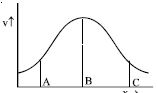
A
$x$-component at point $B$ is maximum.
B
$x$-component at point $A$ is towards the positive $x$-axis.
C
$x$-component at point $C$ is along the negative $x$-axis.
D
$x$-component at point $C$ is along the positive $x$-axis.
Solution
(D) The relationship between electric field $E_x$ and potential $V$ is given by $E_x = -\frac{dV}{dx}$.
This means the electric field is the negative of the slope of the $V-x$ graph.
At point $A$, the slope $\frac{dV}{dx}$ is positive, so $E_x = -(\text{positive}) = \text{negative}$. Thus, the electric field at $A$ is along the negative $x$-axis.
At point $B$, the graph reaches its peak, so the slope $\frac{dV}{dx} = 0$, which means $E_x = 0$.
At point $C$, the slope $\frac{dV}{dx}$ is negative, so $E_x = -(\text{negative}) = \text{positive}$. Thus, the electric field at $C$ is along the positive $x$-axis.
Therefore, the correct statement is that the $x$-component at point $C$ is along the positive $x$-axis.
This means the electric field is the negative of the slope of the $V-x$ graph.
At point $A$, the slope $\frac{dV}{dx}$ is positive, so $E_x = -(\text{positive}) = \text{negative}$. Thus, the electric field at $A$ is along the negative $x$-axis.
At point $B$, the graph reaches its peak, so the slope $\frac{dV}{dx} = 0$, which means $E_x = 0$.
At point $C$, the slope $\frac{dV}{dx}$ is negative, so $E_x = -(\text{negative}) = \text{positive}$. Thus, the electric field at $C$ is along the positive $x$-axis.
Therefore, the correct statement is that the $x$-component at point $C$ is along the positive $x$-axis.
0 likes
View Solution40
MediumMCQ
The potential at a point $x$ (measured in $\mu m$) due to some charges situated on the $x$-axis is given by $V(x) = \frac{20}{x^2 - 4} \text{ volt}$. The electric field $E$ at $x = 4 \mu m$ is given by:
A
$\frac{10}{9} \text{ V/}\mu m$ and in the $+ve \ x$ direction
B
$\frac{5}{3} \text{ V/}\mu m$ and in the $-ve \ x$ direction
C
$\frac{5}{3} \text{ V/}\mu m$ and in the $+ve \ x$ direction
D
$\frac{10}{9} \text{ V/}\mu m$ and in the $-ve \ x$ direction
Solution
(A) Given the potential function $V(x) = \frac{20}{x^2 - 4} \text{ volt}$.
The electric field $E$ is related to the potential $V$ by the relation $E = -\frac{dV}{dx}$.
$E = -\frac{d}{dx} \left( 20(x^2 - 4)^{-1} \right) = -20 \cdot (-1)(x^2 - 4)^{-2} \cdot (2x) = \frac{40x}{(x^2 - 4)^2}$.
Now,substituting $x = 4 \mu m$ into the expression for $E$:
$E = \frac{40(4)}{(4^2 - 4)^2} = \frac{160}{(16 - 4)^2} = \frac{160}{12^2} = \frac{160}{144}$.
Simplifying the fraction by dividing both numerator and denominator by $16$,we get $E = \frac{10}{9} \text{ V/}\mu m$.
Since the result is positive,the electric field is in the $+ve \ x$ direction.
The electric field $E$ is related to the potential $V$ by the relation $E = -\frac{dV}{dx}$.
$E = -\frac{d}{dx} \left( 20(x^2 - 4)^{-1} \right) = -20 \cdot (-1)(x^2 - 4)^{-2} \cdot (2x) = \frac{40x}{(x^2 - 4)^2}$.
Now,substituting $x = 4 \mu m$ into the expression for $E$:
$E = \frac{40(4)}{(4^2 - 4)^2} = \frac{160}{(16 - 4)^2} = \frac{160}{12^2} = \frac{160}{144}$.
Simplifying the fraction by dividing both numerator and denominator by $16$,we get $E = \frac{10}{9} \text{ V/}\mu m$.
Since the result is positive,the electric field is in the $+ve \ x$ direction.
0 likes
View Solution41
MediumMCQ
Assume that an electric field $\vec{E} = 30x^2 \hat{i}$ exists in space. Then the potential difference $V_A - V_O$,where $V_O$ is the potential at the origin and $V_A$ is the potential at $x = 2 \ m$,is....$V$
A
$-120$
B
$-80$
C
$80$
D
$120$
Solution
(B) The potential difference between two points in an electric field is given by the relation $dV = -\vec{E} \cdot d\vec{x}$.
Integrating this expression from the origin $(x = 0)$ to the point $x = 2 \ m$:
$V_A - V_O = -\int_{0}^{2} 30x^2 dx$
$V_A - V_O = -[10x^3]_{0}^{2}$
$V_A - V_O = -(10(2)^3 - 10(0)^3)$
$V_A - V_O = -(10 \times 8) = -80 \ V$.
Integrating this expression from the origin $(x = 0)$ to the point $x = 2 \ m$:
$V_A - V_O = -\int_{0}^{2} 30x^2 dx$
$V_A - V_O = -[10x^3]_{0}^{2}$
$V_A - V_O = -(10(2)^3 - 10(0)^3)$
$V_A - V_O = -(10 \times 8) = -80 \ V$.
0 likes
View Solution42
MediumMCQ
In which region is the magnitude of the $x$-component of the electric field maximum,if the potential $(V)$ versus distance $(X)$ graph is as shown?
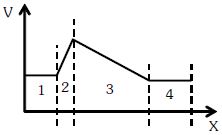
A
$1$
B
$2$
C
$3$
D
$4$
Solution
(B) The relationship between the electric field $(E)$ and the potential $(V)$ is given by the formula $E_x = -\frac{dV}{dx}$.
This means the magnitude of the $x$-component of the electric field,$|E_x|$,is equal to the absolute value of the slope of the $V-X$ graph,i.e.,$|E_x| = |\frac{dV}{dx}|$.
To find the region where the magnitude of the electric field is maximum,we need to identify the region where the slope of the $V-X$ graph is steepest (i.e.,has the largest absolute value).
Looking at the graph:
- In regions $1$ and $4$,the potential is constant,so the slope is $0$,which means $E_x = 0$.
- In regions $2$ and $3$,the potential changes with distance,so the slope is non-zero.
- Comparing the steepness of the lines in regions $2$ and $3$,the line in region $2$ is much steeper than the line in region $3$.
Therefore,the magnitude of the slope is maximum in region $2$,which implies the magnitude of the electric field is maximum in region $2$.
This means the magnitude of the $x$-component of the electric field,$|E_x|$,is equal to the absolute value of the slope of the $V-X$ graph,i.e.,$|E_x| = |\frac{dV}{dx}|$.
To find the region where the magnitude of the electric field is maximum,we need to identify the region where the slope of the $V-X$ graph is steepest (i.e.,has the largest absolute value).
Looking at the graph:
- In regions $1$ and $4$,the potential is constant,so the slope is $0$,which means $E_x = 0$.
- In regions $2$ and $3$,the potential changes with distance,so the slope is non-zero.
- Comparing the steepness of the lines in regions $2$ and $3$,the line in region $2$ is much steeper than the line in region $3$.
Therefore,the magnitude of the slope is maximum in region $2$,which implies the magnitude of the electric field is maximum in region $2$.
0 likes
View Solution43
DifficultMCQ
Electric potential at any point is given by $V = -5x + 3y + \sqrt{15}z$. The magnitude of the electric field is:
A
$3\sqrt{2}$
B
$4\sqrt{2}$
C
$5\sqrt{2}$
D
$7$
Solution
(D) The electric field $\vec{E}$ is related to the electric potential $V$ by the relation $\vec{E} = -\nabla V = -\left( \frac{\partial V}{\partial x} \hat{i} + \frac{\partial V}{\partial y} \hat{j} + \frac{\partial V}{\partial z} \hat{k} \right)$.
Given $V = -5x + 3y + \sqrt{15}z$.
Calculating the partial derivatives:
$E_x = -\frac{\partial V}{\partial x} = -(-5) = 5$
$E_y = -\frac{\partial V}{\partial y} = -(3) = -3$
$E_z = -\frac{\partial V}{\partial z} = -(\sqrt{15}) = -\sqrt{15}$
Thus,$\vec{E} = 5\hat{i} - 3\hat{j} - \sqrt{15}\hat{k}$.
The magnitude of the electric field is $|\vec{E}| = \sqrt{E_x^2 + E_y^2 + E_z^2}$.
$|\vec{E}| = \sqrt{(5)^2 + (-3)^2 + (-\sqrt{15})^2} = \sqrt{25 + 9 + 15} = \sqrt{49} = 7$.
Given $V = -5x + 3y + \sqrt{15}z$.
Calculating the partial derivatives:
$E_x = -\frac{\partial V}{\partial x} = -(-5) = 5$
$E_y = -\frac{\partial V}{\partial y} = -(3) = -3$
$E_z = -\frac{\partial V}{\partial z} = -(\sqrt{15}) = -\sqrt{15}$
Thus,$\vec{E} = 5\hat{i} - 3\hat{j} - \sqrt{15}\hat{k}$.
The magnitude of the electric field is $|\vec{E}| = \sqrt{E_x^2 + E_y^2 + E_z^2}$.
$|\vec{E}| = \sqrt{(5)^2 + (-3)^2 + (-\sqrt{15})^2} = \sqrt{25 + 9 + 15} = \sqrt{49} = 7$.
0 likes
View Solution44
MediumMCQ
The diagram below shows electric field lines in a region of space. Which of the following diagrams best shows the variation with distance $d$ of the potential $V$ along the line $XY$ as we move from $X$ to $Y$?
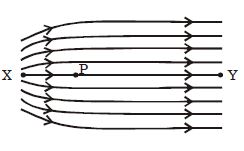
A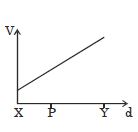
B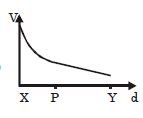
C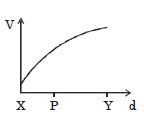
D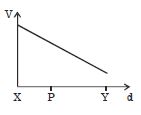
Solution
(B) The electric field $E$ is related to the potential $V$ by the relation $E = -\frac{dV}{dx}$.
This implies that the magnitude of the electric field is equal to the magnitude of the potential gradient,$|E| = |\frac{dV}{dx}|$.
In the given diagram,the electric field lines are closer together near $X$ and become more spread out (uniform) as we move towards $Y$.
This indicates that the electric field strength $|E|$ is higher near $X$ and decreases as we move towards $Y$.
Since $|E| = |\frac{dV}{dx}|$,the slope of the potential $V$ versus distance $d$ graph must be steeper near $X$ and become less steep as we move towards $Y$.
Among the given options,the graph in option $B$ shows a steep decrease in $V$ near $X$ (high slope) and a shallower decrease as we move towards $Y$ (lower slope),which correctly represents the variation of potential.
This implies that the magnitude of the electric field is equal to the magnitude of the potential gradient,$|E| = |\frac{dV}{dx}|$.
In the given diagram,the electric field lines are closer together near $X$ and become more spread out (uniform) as we move towards $Y$.
This indicates that the electric field strength $|E|$ is higher near $X$ and decreases as we move towards $Y$.
Since $|E| = |\frac{dV}{dx}|$,the slope of the potential $V$ versus distance $d$ graph must be steeper near $X$ and become less steep as we move towards $Y$.
Among the given options,the graph in option $B$ shows a steep decrease in $V$ near $X$ (high slope) and a shallower decrease as we move towards $Y$ (lower slope),which correctly represents the variation of potential.
0 likes
View Solution45
DifficultMCQ
The electric potential $V(x, y, z)$ for a planar charge distribution is given by:
$V(x, y, z) = \begin{cases} 0 & \text{for } x < -d \\ -V_0(1 + \frac{x}{d})^2 & \text{for } -d \le x < 0 \\ -V_0(1 + 2\frac{x}{d}) & \text{for } 0 \le x < d \\ -3V_0 & \text{for } x \ge d \end{cases}$
where $-V_0$ is the potential at the origin and $d$ is a distance. The graph of the electric field as a function of position is:
$V(x, y, z) = \begin{cases} 0 & \text{for } x < -d \\ -V_0(1 + \frac{x}{d})^2 & \text{for } -d \le x < 0 \\ -V_0(1 + 2\frac{x}{d}) & \text{for } 0 \le x < d \\ -3V_0 & \text{for } x \ge d \end{cases}$
where $-V_0$ is the potential at the origin and $d$ is a distance. The graph of the electric field as a function of position is:
A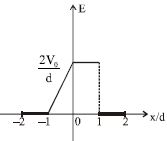
B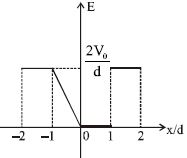
C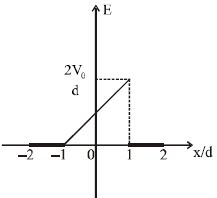
D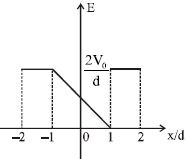
Solution
(A) The electric field $E_x$ is related to the potential $V$ by the relation $E_x = -\frac{dV}{dx}$.
$1$. For $x < -d$,$V = 0$,so $E_x = -\frac{d(0)}{dx} = 0$.
$2$. For $-d \le x < 0$,$V = -V_0(1 + \frac{x}{d})^2$.
$E_x = -\frac{d}{dx}[-V_0(1 + \frac{x}{d})^2] = V_0 \cdot 2(1 + \frac{x}{d}) \cdot \frac{1}{d} = \frac{2V_0}{d}(1 + \frac{x}{d})$.
At $x = -d$,$E_x = 0$. At $x = 0$,$E_x = \frac{2V_0}{d}$.
$3$. For $0 \le x < d$,$V = -V_0(1 + 2\frac{x}{d})$.
$E_x = -\frac{d}{dx}[-V_0(1 + 2\frac{x}{d})] = V_0 \cdot \frac{2}{d} = \frac{2V_0}{d}$.
This is a constant value.
$4$. For $x \ge d$,$V = -3V_0$,so $E_x = -\frac{d(-3V_0)}{dx} = 0$.
Comparing these results with the given options,the graph in option $A$ correctly represents $E_x$ as a function of $x$.
$1$. For $x < -d$,$V = 0$,so $E_x = -\frac{d(0)}{dx} = 0$.
$2$. For $-d \le x < 0$,$V = -V_0(1 + \frac{x}{d})^2$.
$E_x = -\frac{d}{dx}[-V_0(1 + \frac{x}{d})^2] = V_0 \cdot 2(1 + \frac{x}{d}) \cdot \frac{1}{d} = \frac{2V_0}{d}(1 + \frac{x}{d})$.
At $x = -d$,$E_x = 0$. At $x = 0$,$E_x = \frac{2V_0}{d}$.
$3$. For $0 \le x < d$,$V = -V_0(1 + 2\frac{x}{d})$.
$E_x = -\frac{d}{dx}[-V_0(1 + 2\frac{x}{d})] = V_0 \cdot \frac{2}{d} = \frac{2V_0}{d}$.
This is a constant value.
$4$. For $x \ge d$,$V = -3V_0$,so $E_x = -\frac{d(-3V_0)}{dx} = 0$.
Comparing these results with the given options,the graph in option $A$ correctly represents $E_x$ as a function of $x$.
0 likes
View Solution46
MediumMCQ
The figure shows two equipotential lines in the $x, y$ plane for an electric field. The scales are marked in $\text{cm}$. The $x$-component $E_x$ and $y$-component $E_y$ of the electric field in the space between these equipotential lines are respectively:
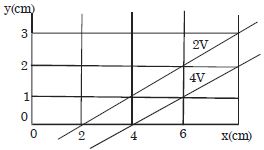
A
$+100 \, V/m, -200 \, V/m$
B
$-100 \, V/m, +200 \, V/m$
C
$+200 \, V/m, +100 \, V/m$
D
$-200 \, V/m, -100 \, V/m$
Solution
(B) The equation of the equipotential lines is $V = ax + by + c$. From the graph,for $V = 2 \, V$,the line passes through $(6, 2)$ and $(4, 1)$. The slope is $m = \frac{1-2}{4-6} = \frac{-1}{-2} = 0.5$. The equation is $y - 1 = 0.5(x - 4) \Rightarrow y = 0.5x - 1 \Rightarrow 0.5x - y = 1$. Multiplying by $2$,we get $x - 2y = 2$. Thus,$V = k(x - 2y)$. For $V = 2$,$2 = k(6 - 2(2)) = 2k \Rightarrow k = 1$. So,$V = x - 2y$.
The electric field components are $E_x = -\frac{\partial V}{\partial x} = -1 \, V/\text{cm} = -100 \, V/m$ and $E_y = -\frac{\partial V}{\partial y} = -(-2) = +2 \, V/\text{cm} = +200 \, V/m$.
Thus,$E_x = -100 \, V/m$ and $E_y = +200 \, V/m$.
The electric field components are $E_x = -\frac{\partial V}{\partial x} = -1 \, V/\text{cm} = -100 \, V/m$ and $E_y = -\frac{\partial V}{\partial y} = -(-2) = +2 \, V/\text{cm} = +200 \, V/m$.
Thus,$E_x = -100 \, V/m$ and $E_y = +200 \, V/m$.
0 likes
View Solution47
DifficultMCQ
$A$ uniform electric field of $400 \, V/m$ is directed $45^\circ$ above the $x$-axis. The potential difference $V_A - V_B$ is: (Coordinates are in cm) (in $, V$)
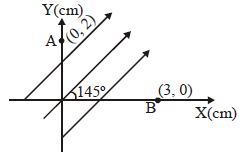
A
$0$
B
$4$
C
$6.4$
D
$2.8$
Solution
(D) The electric field vector is given by $\vec{E} = E \cos 45^\circ \hat{i} + E \sin 45^\circ \hat{j} = \frac{400}{\sqrt{2}} (\hat{i} + \hat{j}) \, V/m$.
The potential difference between two points $A(0, 0.02 \, m)$ and $B(0.03 \, m, 0)$ is given by $V_A - V_B = \int_{B}^{A} \vec{E} \cdot d\vec{r}$.
Alternatively,using $V_A - V_B = \vec{E} \cdot \vec{r}_{BA}$,where $\vec{r}_{BA} = \vec{r}_A - \vec{r}_B = (0 - 0.03) \hat{i} + (0.02 - 0) \hat{j} = -0.03 \hat{i} + 0.02 \hat{j} \, m$.
$V_A - V_B = \left[ \frac{400}{\sqrt{2}} (\hat{i} + \hat{j}) \right] \cdot (-0.03 \hat{i} + 0.02 \hat{j})$
$V_A - V_B = \frac{400}{\sqrt{2}} (-0.03 + 0.02) = \frac{400}{\sqrt{2}} (-0.01) = -\frac{4}{\sqrt{2}} = -2\sqrt{2} \approx -2.828 \, V$.
Given the options,the magnitude or the closest value is $2.8 \, V$ (considering the path direction or potential drop definition).
The potential difference between two points $A(0, 0.02 \, m)$ and $B(0.03 \, m, 0)$ is given by $V_A - V_B = \int_{B}^{A} \vec{E} \cdot d\vec{r}$.
Alternatively,using $V_A - V_B = \vec{E} \cdot \vec{r}_{BA}$,where $\vec{r}_{BA} = \vec{r}_A - \vec{r}_B = (0 - 0.03) \hat{i} + (0.02 - 0) \hat{j} = -0.03 \hat{i} + 0.02 \hat{j} \, m$.
$V_A - V_B = \left[ \frac{400}{\sqrt{2}} (\hat{i} + \hat{j}) \right] \cdot (-0.03 \hat{i} + 0.02 \hat{j})$
$V_A - V_B = \frac{400}{\sqrt{2}} (-0.03 + 0.02) = \frac{400}{\sqrt{2}} (-0.01) = -\frac{4}{\sqrt{2}} = -2\sqrt{2} \approx -2.828 \, V$.
Given the options,the magnitude or the closest value is $2.8 \, V$ (considering the path direction or potential drop definition).
0 likes
View Solution48
DifficultMCQ
The electric potential $V$ at any point $(x, y, z)$ in space is given by the equation $V = 4x^2 \, V$,where $x, y$,and $z$ are all in meters. The electric field at the point $(1 \, m, 0, 2 \, m)$ in $V/m$ is:
A
$8$ along negative $x$-axis
B
$8$ along positive $x$-axis
C
$16$ along negative $x$-axis
D
$16$ along positive $x$-axis
Solution
(A) The electric field $\overrightarrow{E}$ is related to the electric potential $V$ by the gradient formula: $\overrightarrow{E} = -\nabla V = -\left[ \hat{i} \frac{\partial V}{\partial x} + \hat{j} \frac{\partial V}{\partial y} + \hat{k} \frac{\partial V}{\partial z} \right]$.
Given $V = 4x^2$.
Calculating the partial derivatives:
$\frac{\partial V}{\partial x} = \frac{d}{dx}(4x^2) = 8x$
$\frac{\partial V}{\partial y} = 0$
$\frac{\partial V}{\partial z} = 0$
Substituting these into the electric field formula:
$\overrightarrow{E} = -[\hat{i}(8x) + \hat{j}(0) + \hat{k}(0)] = -8x \hat{i}$.
At the point $(1 \, m, 0, 2 \, m)$,the value of $x$ is $1 \, m$.
Therefore,$\overrightarrow{E} = -8(1) \hat{i} = -8 \hat{i} \, V/m$.
The negative sign indicates that the electric field is directed along the negative $x$-axis with a magnitude of $8 \, V/m$.
Given $V = 4x^2$.
Calculating the partial derivatives:
$\frac{\partial V}{\partial x} = \frac{d}{dx}(4x^2) = 8x$
$\frac{\partial V}{\partial y} = 0$
$\frac{\partial V}{\partial z} = 0$
Substituting these into the electric field formula:
$\overrightarrow{E} = -[\hat{i}(8x) + \hat{j}(0) + \hat{k}(0)] = -8x \hat{i}$.
At the point $(1 \, m, 0, 2 \, m)$,the value of $x$ is $1 \, m$.
Therefore,$\overrightarrow{E} = -8(1) \hat{i} = -8 \hat{i} \, V/m$.
The negative sign indicates that the electric field is directed along the negative $x$-axis with a magnitude of $8 \, V/m$.
0 likes
View Solution49
MediumMCQ
The electrostatic potential inside a charged spherical ball is given by $V = b - ar^2$,where $r$ is the distance from the centre; $a$ and $b$ are constants. Then,the charge density inside the ball is:
A
$24\pi a\varepsilon_0 r$
B
$6 a\varepsilon_0 r$
C
$24\pi a\varepsilon_0$
D
$-6 a\varepsilon_0$
Solution
(D) The electric field $E$ is related to the potential $V$ by the relation $E = -\frac{dV}{dr}$.
Given $V = b - ar^2$,we have $E = -\frac{d}{dr}(b - ar^2) = 2ar$.
According to Gauss's Law in differential form,the charge density $\rho$ is given by $\rho = \varepsilon_0 (\nabla \cdot E)$.
In spherical coordinates,for a radial field $E(r)$,the divergence is $\nabla \cdot E = \frac{1}{r^2} \frac{d}{dr}(r^2 E)$.
Substituting $E = 2ar$,we get $\nabla \cdot E = \frac{1}{r^2} \frac{d}{dr}(r^2 \cdot 2ar) = \frac{1}{r^2} \frac{d}{dr}(2ar^3) = \frac{1}{r^2} (6ar^2) = 6a$.
Therefore,the charge density is $\rho = \varepsilon_0 (6a) = 6a\varepsilon_0$.
Given $V = b - ar^2$,we have $E = -\frac{d}{dr}(b - ar^2) = 2ar$.
According to Gauss's Law in differential form,the charge density $\rho$ is given by $\rho = \varepsilon_0 (\nabla \cdot E)$.
In spherical coordinates,for a radial field $E(r)$,the divergence is $\nabla \cdot E = \frac{1}{r^2} \frac{d}{dr}(r^2 E)$.
Substituting $E = 2ar$,we get $\nabla \cdot E = \frac{1}{r^2} \frac{d}{dr}(r^2 \cdot 2ar) = \frac{1}{r^2} \frac{d}{dr}(2ar^3) = \frac{1}{r^2} (6ar^2) = 6a$.
Therefore,the charge density is $\rho = \varepsilon_0 (6a) = 6a\varepsilon_0$.
0 likes
View Solution50
DifficultMCQ
Potential in the $x-y$ plane is given as $V = 5(x^2 + xy) \, V$. The electric field at the point $(1, -2)$ will be
A
$3 \hat{j} \, V/m$
B
$-5 \hat{j} \, V/m$
C
$5 \hat{j} \, V/m$
D
$-3 \hat{j} \, V/m$
Solution
(B) The electric field $\vec{E}$ is related to the potential $V$ by the relation $\vec{E} = -\nabla V = -\left( \frac{\partial V}{\partial x} \hat{i} + \frac{\partial V}{\partial y} \hat{j} \right)$.
Given $V = 5x^2 + 5xy$.
Calculating the partial derivatives:
$E_x = -\frac{\partial V}{\partial x} = -(10x + 5y)$.
At point $(1, -2)$,$E_x = -(10(1) + 5(-2)) = -(10 - 10) = 0$.
$E_y = -\frac{\partial V}{\partial y} = -(5x) = -5x$.
At point $(1, -2)$,$E_y = -5(1) = -5$.
Therefore,the electric field at $(1, -2)$ is $\vec{E} = 0 \hat{i} - 5 \hat{j} = -5 \hat{j} \, V/m$.
Given $V = 5x^2 + 5xy$.
Calculating the partial derivatives:
$E_x = -\frac{\partial V}{\partial x} = -(10x + 5y)$.
At point $(1, -2)$,$E_x = -(10(1) + 5(-2)) = -(10 - 10) = 0$.
$E_y = -\frac{\partial V}{\partial y} = -(5x) = -5x$.
At point $(1, -2)$,$E_y = -5(1) = -5$.
Therefore,the electric field at $(1, -2)$ is $\vec{E} = 0 \hat{i} - 5 \hat{j} = -5 \hat{j} \, V/m$.
0 likes
View SolutionElectric Potential and Capacitance — Relation between Electric Field and Potential and Potential Gradient · Frequently Asked Questions
1Are these Electric Potential and Capacitance questions useful for JEE and NEET?
Yes. All questions in this section are mapped to JEE Main and NEET exam patterns. Previous year questions from JEE Main, NEET, GUJCET and state-level exams are included with full solutions.
2Can I switch to Hindi or Gujarati for these questions?
Yes. Use the language tabs in the hero section or the sidebar to view the same questions and solutions in English, Hindi or Gujarati.
3How do I generate a question paper from this subtopic?
Use the Vedclass Exam Paper Generator — select the chapter and subtopic, set difficulty, and generate Sets A, B, C, D automatically. First 3 chapters of every subject are free.
Vedclass Products
For Students
Vedclass Test Series
Mock tests in real JEE/NEET style with performance analysis. 5-day free trial.
Start Free TrialFor Teachers
Exam Paper Generator
Generate Set A/B/C/D papers from this chapter in 2 minutes. 3 chapters free.
Try FreeFor Institutes
Online Exam Module
Live online exams with unlimited students, 360° analytics & white-label branding.
See DemoFor Teachers & Institutes
Generate a Electric Potential and Capacitance Exam Paper in 2 Minutes
Select subtopic & difficulty — Sets A, B, C, D auto-generated with No Repeat logic.
First 3 chapters of every subject are free — no payment required.