
A English
Equipotential Surface Questions in English
Class 12 Physics · Electric Potential and Capacitance · Equipotential Surface
89+
Questions
English
Language
100%
With Solutions
Showing 50 of 89 questions in English
1
EasyMCQ
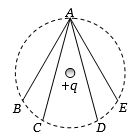
In the electric field of a point charge $+q$, a certain charge is carried from point $A$ to points $B, C, D$ and $E$ along the paths shown in the figure. Then the work done:
A
Is least along the path $AB$
B
Is least along the path $AD$
C
Is zero along all the paths $AB, AC, AD$ and $AE$
D
Is least along $AE$
Solution
(C) The electric potential $V$ at a distance $r$ from a point charge $+q$ is given by $V = \frac{kq}{r}$.
Since points $A, B, C, D$ and $E$ are all at the same distance $r$ from the point charge $+q$, they all lie on the same equipotential surface.
The work done in moving a charge $q_0$ between any two points on an equipotential surface is given by $W = q_0(V_{final} - V_{initial})$.
Since $V_{final} = V_{initial}$ for any two points on this surface, the work done $W = 0$.
Therefore, the work done is zero along all the paths $AB, AC, AD$ and $AE$.
Since points $A, B, C, D$ and $E$ are all at the same distance $r$ from the point charge $+q$, they all lie on the same equipotential surface.
The work done in moving a charge $q_0$ between any two points on an equipotential surface is given by $W = q_0(V_{final} - V_{initial})$.
Since $V_{final} = V_{initial}$ for any two points on this surface, the work done $W = 0$.
Therefore, the work done is zero along all the paths $AB, AC, AD$ and $AE$.
0 likes
View Solution2
EasyMCQ
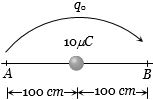
$A$ metallic sphere has a charge of $10\,\mu C$. $A$ unit negative charge is brought from $A$ to $B$,both $100\,cm$ away from the sphere,with $A$ being east of it and $B$ being west of it. The net work done is........$joule$.
A
$0$
B
$2/10$
C
$-2/10$
D
$-1/10$
Solution
(A) The electric potential $V$ at a distance $r$ from a point charge $Q$ is given by $V = \frac{kQ}{r}$.
Since points $A$ and $B$ are at the same distance $r = 100\,cm = 1\,m$ from the metallic sphere,the electric potential at both points is equal,i.e.,$V_A = V_B$.
The work done $W$ in moving a charge $q$ from point $A$ to point $B$ is given by $W = q(V_B - V_A)$.
Since $V_A = V_B$,the potential difference $V_B - V_A = 0$.
Therefore,the net work done $W = q(0) = 0\,joule$.
Since points $A$ and $B$ are at the same distance $r = 100\,cm = 1\,m$ from the metallic sphere,the electric potential at both points is equal,i.e.,$V_A = V_B$.
The work done $W$ in moving a charge $q$ from point $A$ to point $B$ is given by $W = q(V_B - V_A)$.
Since $V_A = V_B$,the potential difference $V_B - V_A = 0$.
Therefore,the net work done $W = q(0) = 0\,joule$.
0 likes
View Solution3
EasyMCQ
On rotating a point charge having a charge $q$ around a charge $Q$ in a circle of radius $r$,the work done will be:
A
$q \times 2\pi r$
B
$\frac{q \times 2\pi Q}{r}$
C
Zero
D
$\frac{Q}{2\varepsilon_0 r}$
Solution
(C) The electric potential $V$ at a distance $r$ from a point charge $Q$ is given by $V = \frac{1}{4\pi\varepsilon_0} \frac{Q}{r}$.
Since the charge $q$ is moved in a circle of radius $r$ around the charge $Q$,every point on the circular path is at the same distance $r$ from $Q$.
Therefore,the entire circular path acts as an equipotential surface.
The work done $W$ in moving a charge $q$ between two points on an equipotential surface is given by $W = q(V_f - V_i)$.
Since $V_f = V_i$,the work done $W = 0$.
Since the charge $q$ is moved in a circle of radius $r$ around the charge $Q$,every point on the circular path is at the same distance $r$ from $Q$.
Therefore,the entire circular path acts as an equipotential surface.
The work done $W$ in moving a charge $q$ between two points on an equipotential surface is given by $W = q(V_f - V_i)$.
Since $V_f = V_i$,the work done $W = 0$.
0 likes
View Solution4
EasyMCQ
The angle between an equipotential surface and the electric lines of force is .......$^o$.
A
$0$
B
$180$
C
$90$
D
$45$
Solution
(C) The electric lines of force are always perpendicular to the equipotential surface at every point.
This is because if there were a component of the electric field parallel to the surface,work would be done in moving a charge along the surface,which contradicts the definition of an equipotential surface (where potential difference is zero).
Therefore,the angle between the electric lines of force and the equipotential surface is $90^o$.
This is because if there were a component of the electric field parallel to the surface,work would be done in moving a charge along the surface,which contradicts the definition of an equipotential surface (where potential difference is zero).
Therefore,the angle between the electric lines of force and the equipotential surface is $90^o$.
0 likes
View Solution5
EasyMCQ
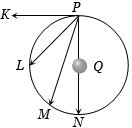
In the figure,the charge $Q$ is at the centre of the circle. Work done is maximum when another charge is taken from point $P$ to:
A
$K$
B
$L$
C
$M$
D
$N$
Solution
(A) The work done in moving a charge $q$ from a point $A$ to $B$ in an electric field is given by $W = q(V_B - V_A)$,where $V_A$ and $V_B$ are the electric potentials at points $A$ and $B$ respectively.
Since the charge $Q$ is at the centre of the circle,all points on the circumference of the circle $(P, L, M, N)$ are at the same distance from $Q$. Therefore,they are at the same electric potential.
Moving a charge between any two points on the circumference ($P$ to $L$,$P$ to $M$,or $P$ to $N$) results in zero work done because the potential difference is zero.
Point $K$ is outside the circle,meaning it is at a different potential than point $P$. Moving a charge from $P$ to $K$ involves a change in potential,resulting in non-zero work done. Thus,the work done is maximum when moving the charge to $K$.
Since the charge $Q$ is at the centre of the circle,all points on the circumference of the circle $(P, L, M, N)$ are at the same distance from $Q$. Therefore,they are at the same electric potential.
Moving a charge between any two points on the circumference ($P$ to $L$,$P$ to $M$,or $P$ to $N$) results in zero work done because the potential difference is zero.
Point $K$ is outside the circle,meaning it is at a different potential than point $P$. Moving a charge from $P$ to $K$ involves a change in potential,resulting in non-zero work done. Thus,the work done is maximum when moving the charge to $K$.
0 likes
View Solution6
EasyMCQ
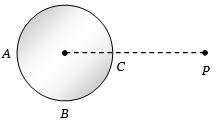
$A$ hollow conducting sphere is placed in an electric field produced by a point charge placed at $P$ as shown in the figure. Let $V_A, V_B, V_C$ be the potentials at points $A, B,$ and $C$ respectively. Then:
A
$V_C > V_B$
B
$V_B > V_C$
C
$V_A > V_B$
D
$V_A = V_C$
Solution
(D) The entire surface of a conductor in electrostatic equilibrium is an equipotential surface. This means that the electric potential at every point on the surface of the conductor is the same. Since points $A, B,$ and $C$ all lie on the surface of the hollow conducting sphere,the potentials at these points must be equal. Therefore,$V_A = V_B = V_C$. Thus,the correct relation is $V_A = V_C$.
0 likes
View Solution7
EasyMCQ
Work done in moving a positive charge on an equipotential surface is
A
Finite,positive but not zero
B
Finite,negative but not zero
C
Zero
D
Infinite
Solution
(C) The work done $W$ in moving a charge $q$ between two points with potential difference $\Delta V$ is given by $W = q \Delta V$.
By definition,an equipotential surface is a surface where the electric potential is the same at every point.
Therefore,for any two points on an equipotential surface,the potential difference $\Delta V = 0$.
Substituting this into the formula,$W = q \times 0 = 0$.
Thus,the work done in moving a charge on an equipotential surface is zero.
By definition,an equipotential surface is a surface where the electric potential is the same at every point.
Therefore,for any two points on an equipotential surface,the potential difference $\Delta V = 0$.
Substituting this into the formula,$W = q \times 0 = 0$.
Thus,the work done in moving a charge on an equipotential surface is zero.
0 likes
View Solution8
EasyMCQ
There are two equipotential surfaces as shown in the figure. The distance between them is $r$. If a charge of $-q \text{ C}$ is moved from surface $A$ to surface $B$,the resultant work done will be:
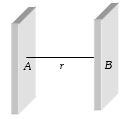
A
$W = \frac{1}{4\pi \varepsilon_0} \frac{q}{r}$
B
$W = \frac{1}{4\pi \varepsilon_0} \frac{q}{r^2}$
C
$W = -\frac{1}{4\pi \varepsilon_0} \frac{q}{r^2}$
D
$W = 0$
Solution
(D) By definition,an equipotential surface is a surface where the electric potential is the same at every point.
Let the potential of surface $A$ be $V_A$ and the potential of surface $B$ be $V_B$.
Since both $A$ and $B$ are equipotential surfaces,the potential difference between any two points on the same surface is zero.
However,the question implies moving a charge between two distinct equipotential surfaces. If the surfaces are at different potentials,work is done. But in standard physics problems of this type,if the surfaces are defined as part of a system where no potential difference is specified or if they are meant to be at the same potential,the work done is zero.
Given the options,the correct answer is $W = 0$,which implies $V_A = V_B$ or that the work done in moving a charge along an equipotential surface is zero. Since the charge is moved from one equipotential surface to another,and the options suggest zero,we conclude $V_A = V_B$.
Let the potential of surface $A$ be $V_A$ and the potential of surface $B$ be $V_B$.
Since both $A$ and $B$ are equipotential surfaces,the potential difference between any two points on the same surface is zero.
However,the question implies moving a charge between two distinct equipotential surfaces. If the surfaces are at different potentials,work is done. But in standard physics problems of this type,if the surfaces are defined as part of a system where no potential difference is specified or if they are meant to be at the same potential,the work done is zero.
Given the options,the correct answer is $W = 0$,which implies $V_A = V_B$ or that the work done in moving a charge along an equipotential surface is zero. Since the charge is moved from one equipotential surface to another,and the options suggest zero,we conclude $V_A = V_B$.
0 likes
View Solution9
EasyMCQ
There is $10$ units of charge at the centre of a circle of radius $10\,m$. The work done in moving $1\,unit$ of charge around the circle once is...........$units$.
A
$0$
B
$10$
C
$100$
D
$1$
Solution
(A) The electric potential $V$ at any point on a circle of radius $r$ due to a charge $q$ at its center is given by $V = \frac{kq}{r}$.
Since the radius $r$ is constant for all points on the circle, the electric potential is the same at every point on the circumference.
Therefore, the circle acts as an equipotential surface.
The work done $W$ in moving a charge $q_0$ between two points with potential difference $\Delta V$ is given by $W = q_0 \Delta V$.
Since the charge is moved around the circle once, the initial and final points are the same, so $\Delta V = 0$.
Thus, the work done $W = 1 \times 0 = 0\,units$.
Since the radius $r$ is constant for all points on the circle, the electric potential is the same at every point on the circumference.
Therefore, the circle acts as an equipotential surface.
The work done $W$ in moving a charge $q_0$ between two points with potential difference $\Delta V$ is given by $W = q_0 \Delta V$.
Since the charge is moved around the circle once, the initial and final points are the same, so $\Delta V = 0$.
Thus, the work done $W = 1 \times 0 = 0\,units$.
0 likes
View Solution10
MediumMCQ
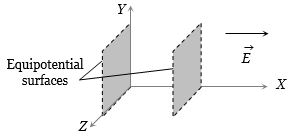
Equipotential surfaces associated with an electric field which is increasing in magnitude along the $x$-direction are
A
Planes parallel to $yz$-plane
B
Planes parallel to $xy$-plane
C
Planes parallel to $xz$-plane
D
Coaxial cylinders of increasing radii around the $x$-axis
Solution
(A) The electric field $\vec{E}$ is directed along the $x$-axis. The relation between electric field and potential is given by $\vec{E} = -\nabla V$.
Since the electric field is only in the $x$-direction, the potential $V$ depends only on $x$, i.e., $V = V(x)$.
An equipotential surface is a surface where the potential $V$ is constant.
For $V(x) = \text{constant}$, $x$ must be constant.
A surface defined by $x = \text{constant}$ is a plane parallel to the $yz$-plane.
Even if the magnitude of the electric field increases along the $x$-direction, the equipotential surfaces remain planes perpendicular to the direction of the electric field (i.e., parallel to the $yz$-plane), although their spacing will decrease as the field strength increases.
Since the electric field is only in the $x$-direction, the potential $V$ depends only on $x$, i.e., $V = V(x)$.
An equipotential surface is a surface where the potential $V$ is constant.
For $V(x) = \text{constant}$, $x$ must be constant.
A surface defined by $x = \text{constant}$ is a plane parallel to the $yz$-plane.
Even if the magnitude of the electric field increases along the $x$-direction, the equipotential surfaces remain planes perpendicular to the direction of the electric field (i.e., parallel to the $yz$-plane), although their spacing will decrease as the field strength increases.
0 likes
View Solution11
EasyMCQ
The points having equal potentials are:
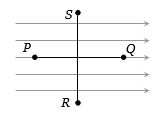
A
$P$ and $Q$
B
$S$ and $Q$
C
$S$ and $R$
D
$P$ and $R$
Solution
(C) In a uniform electric field,the electric potential decreases in the direction of the electric field lines.
Equipotential surfaces are planes perpendicular to the direction of the electric field lines.
In the given figure,the line segment $SR$ is perpendicular to the uniform electric field lines.
Therefore,all points on the line segment $SR$ are at the same electric potential.
Thus,the points $S$ and $R$ have equal potentials.
Equipotential surfaces are planes perpendicular to the direction of the electric field lines.
In the given figure,the line segment $SR$ is perpendicular to the uniform electric field lines.
Therefore,all points on the line segment $SR$ are at the same electric potential.
Thus,the points $S$ and $R$ have equal potentials.
0 likes
View Solution12
EasyMCQ
The figure shows three points $A$,$B$,and $C$ in a region of uniform electric field $\overrightarrow{E}$. The line $AB$ is perpendicular and $BC$ is parallel to the field lines. Which of the following relations holds good? Let $V_A$,$V_B$,and $V_C$ represent the electric potential at points $A$,$B$,and $C$ respectively.
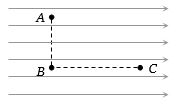
A
$V_A = V_B = V_C$
B
$V_A = V_B > V_C$
C
$V_A = V_B < V_C$
D
$V_A > V_B = V_C$
Solution
(B) $1$. In a uniform electric field,the potential does not change along a direction perpendicular to the field lines. Since $AB$ is perpendicular to the electric field lines,the potential at $A$ is equal to the potential at $B$,i.e.,$V_A = V_B$.
$2$. The electric potential decreases in the direction of the electric field. Since $BC$ is parallel to the electric field lines and points in the direction of the field,the potential at $C$ is less than the potential at $B$,i.e.,$V_B > V_C$.
$3$. Combining these two results,we get $V_A = V_B > V_C$.
$2$. The electric potential decreases in the direction of the electric field. Since $BC$ is parallel to the electric field lines and points in the direction of the field,the potential at $C$ is less than the potential at $B$,i.e.,$V_B > V_C$.
$3$. Combining these two results,we get $V_A = V_B > V_C$.
0 likes
View Solution13
EasyMCQ
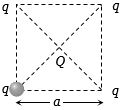
$A$ square of side $a$ has a charge $Q$ at its centre. $A$ charge $q$ is placed at one of the corners. The work required to be done in moving the charge $q$ from this corner to the diagonally opposite corner is
A
Zero
B
$\frac{Qq}{4\pi \epsilon_0 a}$
C
$\frac{Qq\sqrt{2}}{4\pi \epsilon_0 a}$
D
$\frac{Qq}{2\pi \epsilon_0 a}$
Solution
(A) The electric potential $V$ at any corner of the square due to the charge $Q$ at the centre is given by $V = \frac{1}{4\pi \epsilon_0} \frac{Q}{r}$,where $r$ is the distance from the centre to any corner.
In a square of side $a$,the diagonal is $a\sqrt{2}$,so the distance from the centre to any corner is $r = \frac{a\sqrt{2}}{2} = \frac{a}{\sqrt{2}}$.
Since the distance $r$ is the same for all four corners,the electric potential $V$ is the same at all corners.
The work done $W$ in moving a charge $q$ between two points is given by $W = q(V_{final} - V_{initial})$.
Since $V_{final} = V_{initial}$,the work done $W = q(V - V) = 0$.
In a square of side $a$,the diagonal is $a\sqrt{2}$,so the distance from the centre to any corner is $r = \frac{a\sqrt{2}}{2} = \frac{a}{\sqrt{2}}$.
Since the distance $r$ is the same for all four corners,the electric potential $V$ is the same at all corners.
The work done $W$ in moving a charge $q$ between two points is given by $W = q(V_{final} - V_{initial})$.
Since $V_{final} = V_{initial}$,the work done $W = q(V - V) = 0$.
0 likes
View Solution14
EasyMCQ
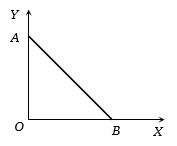
As per the diagram,a point charge $+q$ is placed at the origin $O$. The work done in taking another point charge $-Q$ from point $A$ [coordinates $(0, a)$] to point $B$ [coordinates $(a, 0)$] along the straight path $AB$ is:
A
$Zero$
B
$\left( \frac{-qQ}{4\pi \varepsilon_0} \cdot \frac{1}{a^2} \right) \sqrt{2}a$
C
$\left( \frac{qQ}{4\pi \varepsilon_0} \cdot \frac{1}{a^2} \right) \frac{a}{\sqrt{2}}$
D
$\left( \frac{qQ}{4\pi \varepsilon_0} \cdot \frac{1}{a^2} \right) \sqrt{2}a$
Solution
(A) The electric potential $V$ at a distance $r$ from a point charge $q$ is given by $V = \frac{1}{4\pi \varepsilon_0} \frac{q}{r}$.
Point $A$ is at coordinates $(0, a)$,so its distance from the origin $O$ is $r_A = \sqrt{0^2 + a^2} = a$.
Point $B$ is at coordinates $(a, 0)$,so its distance from the origin $O$ is $r_B = \sqrt{a^2 + 0^2} = a$.
The potential at $A$ is $V_A = \frac{1}{4\pi \varepsilon_0} \frac{q}{a}$.
The potential at $B$ is $V_B = \frac{1}{4\pi \varepsilon_0} \frac{q}{a}$.
Since $V_A = V_B$,the potential difference $\Delta V = V_B - V_A = 0$.
The work done $W$ in moving a charge $-Q$ from $A$ to $B$ is given by $W = (-Q) \cdot \Delta V$.
Substituting $\Delta V = 0$,we get $W = (-Q) \cdot 0 = 0$.
Point $A$ is at coordinates $(0, a)$,so its distance from the origin $O$ is $r_A = \sqrt{0^2 + a^2} = a$.
Point $B$ is at coordinates $(a, 0)$,so its distance from the origin $O$ is $r_B = \sqrt{a^2 + 0^2} = a$.
The potential at $A$ is $V_A = \frac{1}{4\pi \varepsilon_0} \frac{q}{a}$.
The potential at $B$ is $V_B = \frac{1}{4\pi \varepsilon_0} \frac{q}{a}$.
Since $V_A = V_B$,the potential difference $\Delta V = V_B - V_A = 0$.
The work done $W$ in moving a charge $-Q$ from $A$ to $B$ is given by $W = (-Q) \cdot \Delta V$.
Substituting $\Delta V = 0$,we get $W = (-Q) \cdot 0 = 0$.
0 likes
View Solution15
EasyMCQ
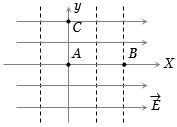
$A$ uniform electric field pointing in the positive $x$-direction exists in a region. Let $A$ be the origin,$B$ be the point on the $x$-axis at $x = +1 \, cm$,and $C$ be the point on the $y$-axis at $y = +1 \, cm$. Then the potentials at the points $A$,$B$,and $C$ satisfy
A
$V_A < V_B$
B
$V_A > V_B$
C
$V_A < V_C$
D
$V_A > V_C$
Solution
(B) The electric potential decreases in the direction of the electric field.
Since the electric field $\vec{E}$ is in the positive $x$-direction,the potential decreases as $x$ increases.
Point $A$ is at $x = 0$ and point $B$ is at $x = +1 \, cm$. Since $A$ is at a smaller $x$-coordinate than $B$,$V_A > V_B$.
Points $A$ and $C$ lie on the same equipotential line (a line perpendicular to the electric field lines),therefore $V_A = V_C$.
Thus,the correct relationship is $V_A > V_B$ and $V_A = V_C$.
Since the electric field $\vec{E}$ is in the positive $x$-direction,the potential decreases as $x$ increases.
Point $A$ is at $x = 0$ and point $B$ is at $x = +1 \, cm$. Since $A$ is at a smaller $x$-coordinate than $B$,$V_A > V_B$.
Points $A$ and $C$ lie on the same equipotential line (a line perpendicular to the electric field lines),therefore $V_A = V_C$.
Thus,the correct relationship is $V_A > V_B$ and $V_A = V_C$.
0 likes
View Solution16
DifficultMCQ
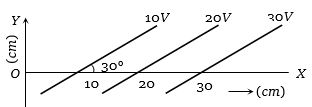
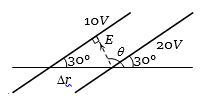
Equipotential surfaces are shown in the figure. Then the electric field strength will be
A
$100 \, Vm^{-1}$ along $X$-axis
B
$100 \, Vm^{-1}$ along $Y$-axis
C
$200 \, Vm^{-1}$ at an angle $120^\circ$ with $X$-axis
D
$50 \, Vm^{-1}$ at an angle $120^\circ$ with $X$-axis
Solution
(C) The electric field $E$ is related to the potential difference $dV$ and displacement $dr$ by the relation $dV = -\vec{E} \cdot d\vec{r}$.
For a uniform electric field,this can be written as $\Delta V = -E \Delta r \cos \theta$,where $\theta$ is the angle between the electric field vector and the displacement vector.
The magnitude of the electric field is $E = \frac{|\Delta V|}{\Delta r \cos \alpha}$,where $\alpha$ is the angle between the normal to the equipotential surface and the direction of displacement.
From the figure,the distance between the $10 \, V$ and $20 \, V$ equipotential surfaces along the $X$-axis is $\Delta x = 10 \, cm = 0.1 \, m$.
The perpendicular distance between these surfaces is $\Delta r = \Delta x \sin 30^\circ = 0.1 \times 0.5 = 0.05 \, m$.
The magnitude of the electric field is $E = \frac{\Delta V}{\Delta r} = \frac{20 - 10}{0.05} = \frac{10}{0.05} = 200 \, V/m$.
The electric field is always perpendicular to the equipotential surfaces. Since the surfaces make an angle of $30^\circ$ with the $X$-axis,the normal to these surfaces makes an angle of $90^\circ + 30^\circ = 120^\circ$ with the positive $X$-axis.
For a uniform electric field,this can be written as $\Delta V = -E \Delta r \cos \theta$,where $\theta$ is the angle between the electric field vector and the displacement vector.
The magnitude of the electric field is $E = \frac{|\Delta V|}{\Delta r \cos \alpha}$,where $\alpha$ is the angle between the normal to the equipotential surface and the direction of displacement.
From the figure,the distance between the $10 \, V$ and $20 \, V$ equipotential surfaces along the $X$-axis is $\Delta x = 10 \, cm = 0.1 \, m$.
The perpendicular distance between these surfaces is $\Delta r = \Delta x \sin 30^\circ = 0.1 \times 0.5 = 0.05 \, m$.
The magnitude of the electric field is $E = \frac{\Delta V}{\Delta r} = \frac{20 - 10}{0.05} = \frac{10}{0.05} = 200 \, V/m$.
The electric field is always perpendicular to the equipotential surfaces. Since the surfaces make an angle of $30^\circ$ with the $X$-axis,the normal to these surfaces makes an angle of $90^\circ + 30^\circ = 120^\circ$ with the positive $X$-axis.
0 likes
View Solution17
MediumMCQ
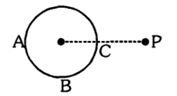
$A$ point charge is placed at point $P$ as shown in the figure. $A$ hollow conducting sphere is placed in the electric field produced by it. If $V_A$,$V_B$,and $V_C$ are the potentials at points $A$,$B$,and $C$ respectively,then:
A
$V_C > V_B$
B
$V_B > V_C$
C
$V_A > V_B$
D
$V_A = V_B = V_C$
Solution
(D) hollow conducting sphere is an equipotential surface.
Since $A$,$B$,and $C$ are all points on the surface of the same conducting sphere,the electric potential at these points must be equal.
Therefore,$V_A = V_B = V_C$.
Since $A$,$B$,and $C$ are all points on the surface of the same conducting sphere,the electric potential at these points must be equal.
Therefore,$V_A = V_B = V_C$.
0 likes
View Solution18
MediumMCQ
The angle between electric field lines and an equipotential surface is .........$^o$.
A
$0$
B
$180$
C
$90$
D
$45$
Solution
(C) The electric field $\vec{E}$ is related to the potential $V$ by the relation $\vec{E} = -\nabla V$.
For an equipotential surface,the potential $V$ is constant at every point on the surface.
Therefore,the change in potential $dV$ along any displacement $d\vec{l}$ on the surface is zero $(dV = 0)$.
Since $dV = -\vec{E} \cdot d\vec{l} = 0$,it implies that the electric field vector $\vec{E}$ must be perpendicular to the displacement vector $d\vec{l}$ on the surface.
Thus,the electric field lines are always normal (at an angle of $90^{\circ}$) to the equipotential surface.
For an equipotential surface,the potential $V$ is constant at every point on the surface.
Therefore,the change in potential $dV$ along any displacement $d\vec{l}$ on the surface is zero $(dV = 0)$.
Since $dV = -\vec{E} \cdot d\vec{l} = 0$,it implies that the electric field vector $\vec{E}$ must be perpendicular to the displacement vector $d\vec{l}$ on the surface.
Thus,the electric field lines are always normal (at an angle of $90^{\circ}$) to the equipotential surface.
0 likes
View Solution19
EasyMCQ
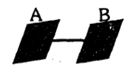
Surfaces $A$ and $B$ are at the same potential $V'$. The work done in moving a charge $q$ from $A$ to $B$ is ........
A
$0$
B
$qV'$
C
$-qV'$
D
$qV'/2$
Solution
(A) The work done $W$ in moving a charge $q$ from a point $A$ to a point $B$ in an electric field is given by the formula:
$W = q(V_B - V_A)$
where $V_A$ and $V_B$ are the electric potentials at points $A$ and $B$ respectively.
Given that both surfaces $A$ and $B$ are at the same potential $V'$,we have $V_A = V_B = V'$.
Substituting these values into the formula:
$W = q(V' - V') = q(0) = 0$
Therefore,the work done in moving the charge from $A$ to $B$ is $0$.
$W = q(V_B - V_A)$
where $V_A$ and $V_B$ are the electric potentials at points $A$ and $B$ respectively.
Given that both surfaces $A$ and $B$ are at the same potential $V'$,we have $V_A = V_B = V'$.
Substituting these values into the formula:
$W = q(V' - V') = q(0) = 0$
Therefore,the work done in moving the charge from $A$ to $B$ is $0$.
0 likes
View Solution20
DifficultMCQ
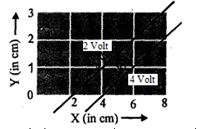
The figure shows two equipotential lines in the $XY$ plane for an electric field. The scale is shown. The $X$-component $E_x$ and $Y$-component $E_y$ of the electric field in the space between the equipotential lines are respectively:
A
$+100 \ V/m, -200 \ V/m$
B
$+200 \ V/m, +100 \ V/m$
C
$-100 \ V/m, +200 \ V/m$
D
$-200 \ V/m, -100 \ V/m$
Solution
(C) The parallel equipotential lines represent a uniform electric field in the region.
The electric field $\vec{E}$ is perpendicular to the equipotential surfaces and points from higher potential to lower potential.
The slope of the equipotential lines is $m = \frac{\Delta y}{\Delta x} = \frac{2-1}{6-4} = \frac{1}{2}$.
Let $\theta$ be the angle the equipotential line makes with the $X$-axis. Then $\tan \theta = \frac{1}{2}$.
This implies $\sin \theta = \frac{1}{\sqrt{5}}$ and $\cos \theta = \frac{2}{\sqrt{5}}$.
The perpendicular distance $d$ between the two equipotential lines (potential difference $\Delta V = 4 \ V - 2 \ V = 2 \ V$) is calculated using the geometry. The horizontal distance between the lines at a constant $Y$ is $\Delta x = 6 - 4 = 2 \ cm = 0.02 \ m$.
Thus,$d = \Delta x \sin \theta = 0.02 \times \frac{1}{\sqrt{5}} = \frac{0.02}{\sqrt{5}} \ m$.
Using $\Delta V = E d$,we get $2 = E \times \frac{0.02}{\sqrt{5}}$,which gives $E = \frac{2 \sqrt{5}}{0.02} = 100 \sqrt{5} \ V/m$.
The electric field vector points from $4 \ V$ to $2 \ V$ (towards the origin). The angle $\alpha$ that the electric field vector makes with the negative $X$-axis is $\theta$. Thus,$E_x = -E \sin \theta = -(100 \sqrt{5}) \times \frac{1}{\sqrt{5}} = -100 \ V/m$.
And $E_y = E \cos \theta = (100 \sqrt{5}) \times \frac{2}{\sqrt{5}} = 200 \ V/m$.
Therefore,$E_x = -100 \ V/m$ and $E_y = 200 \ V/m$. The correct option is $(C)$.
The electric field $\vec{E}$ is perpendicular to the equipotential surfaces and points from higher potential to lower potential.
The slope of the equipotential lines is $m = \frac{\Delta y}{\Delta x} = \frac{2-1}{6-4} = \frac{1}{2}$.
Let $\theta$ be the angle the equipotential line makes with the $X$-axis. Then $\tan \theta = \frac{1}{2}$.
This implies $\sin \theta = \frac{1}{\sqrt{5}}$ and $\cos \theta = \frac{2}{\sqrt{5}}$.
The perpendicular distance $d$ between the two equipotential lines (potential difference $\Delta V = 4 \ V - 2 \ V = 2 \ V$) is calculated using the geometry. The horizontal distance between the lines at a constant $Y$ is $\Delta x = 6 - 4 = 2 \ cm = 0.02 \ m$.
Thus,$d = \Delta x \sin \theta = 0.02 \times \frac{1}{\sqrt{5}} = \frac{0.02}{\sqrt{5}} \ m$.
Using $\Delta V = E d$,we get $2 = E \times \frac{0.02}{\sqrt{5}}$,which gives $E = \frac{2 \sqrt{5}}{0.02} = 100 \sqrt{5} \ V/m$.
The electric field vector points from $4 \ V$ to $2 \ V$ (towards the origin). The angle $\alpha$ that the electric field vector makes with the negative $X$-axis is $\theta$. Thus,$E_x = -E \sin \theta = -(100 \sqrt{5}) \times \frac{1}{\sqrt{5}} = -100 \ V/m$.
And $E_y = E \cos \theta = (100 \sqrt{5}) \times \frac{2}{\sqrt{5}} = 200 \ V/m$.
Therefore,$E_x = -100 \ V/m$ and $E_y = 200 \ V/m$. The correct option is $(C)$.
0 likes
View Solution21
EasyMCQ
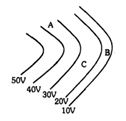
The figure shows lines of constant potential in a region where an electric field is present. The electric field at point $B$ is............
A
Minimum
B
Neutral
C
Maximum
D
Information is incomplete
Solution
(C) The relationship between the electric field $E$ and the potential difference $dV$ over a distance $dr$ is given by $E = -\frac{dV}{dr}$.
In the given figure,the potential difference between any two consecutive equipotential lines is constant,i.e.,$dV = 10 \ V$.
Therefore,the electric field $E$ is inversely proportional to the distance $dr$ between the equipotential lines $(E \propto \frac{1}{dr})$.
At point $B$,the equipotential lines are closest to each other,meaning the distance $dr$ is minimum.
Since $dr$ is minimum at $B$,the electric field $E$ is maximum at point $B$.
In the given figure,the potential difference between any two consecutive equipotential lines is constant,i.e.,$dV = 10 \ V$.
Therefore,the electric field $E$ is inversely proportional to the distance $dr$ between the equipotential lines $(E \propto \frac{1}{dr})$.
At point $B$,the equipotential lines are closest to each other,meaning the distance $dr$ is minimum.
Since $dr$ is minimum at $B$,the electric field $E$ is maximum at point $B$.
0 likes
View Solution22
EasyMCQ
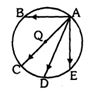
$A$ charge is moved from point $A$ to points $B, C, D,$ and $E$ in the electric field of a charge $Q$ placed at the center of a circle. The work done will be:
A
Minimum along path $AB$
B
Minimum along path $AD$
C
Minimum along path $AE$
D
Zero along all paths
Solution
(D) The electric potential $V$ at a distance $r$ from a point charge $Q$ is given by $V = \frac{1}{4\pi\epsilon_0} \frac{Q}{r}$.
Since points $A, B, C, D,$ and $E$ all lie on the circumference of the same circle centered at $Q$, they are all at the same distance $r$ from the charge $Q$.
Therefore, all these points lie on an equipotential surface, meaning the potential at each point is the same $(V_A = V_B = V_C = V_D = V_E)$.
The work done $W$ in moving a charge $q$ between two points is given by $W = q(V_{final} - V_{initial})$.
Since the potential difference $\Delta V = V_{final} - V_{initial} = 0$ for any path between these points, the work done $W = q \times 0 = 0$.
Thus, the work done is zero along all paths.
Since points $A, B, C, D,$ and $E$ all lie on the circumference of the same circle centered at $Q$, they are all at the same distance $r$ from the charge $Q$.
Therefore, all these points lie on an equipotential surface, meaning the potential at each point is the same $(V_A = V_B = V_C = V_D = V_E)$.
The work done $W$ in moving a charge $q$ between two points is given by $W = q(V_{final} - V_{initial})$.
Since the potential difference $\Delta V = V_{final} - V_{initial} = 0$ for any path between these points, the work done $W = q \times 0 = 0$.
Thus, the work done is zero along all paths.
0 likes
View Solution23
EasyMCQ
For an electric field that increases in magnitude along the $x$-direction,what is the nature of the equipotential surfaces?
A
Planes parallel to the $yz$-plane
B
Planes parallel to the $xy$-plane
C
Planes parallel to the $xz$-plane
D
Coaxial cylinders with increasing radii around the $x$-axis
Solution
(A) We know that the electric field $\overrightarrow{E}$ is related to the electric potential $\phi$ by the relation $\overrightarrow{E} = -\nabla \phi$.
The equipotential surface is defined as a surface where the potential $\phi$ is constant,which implies that the electric field $\overrightarrow{E}$ must be perpendicular to the surface at every point.
Since the electric field is directed along the $x$-axis,the surfaces perpendicular to this field must lie in the plane formed by the other two axes,which are the $y$ and $z$ axes.
Therefore,the equipotential surfaces are planes parallel to the $yz$-plane.
The equipotential surface is defined as a surface where the potential $\phi$ is constant,which implies that the electric field $\overrightarrow{E}$ must be perpendicular to the surface at every point.
Since the electric field is directed along the $x$-axis,the surfaces perpendicular to this field must lie in the plane formed by the other two axes,which are the $y$ and $z$ axes.
Therefore,the equipotential surfaces are planes parallel to the $yz$-plane.
0 likes
View Solution24
DifficultMCQ
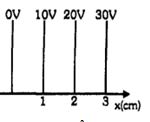
Equipotential surfaces are given as shown. The electric field intensity is ........
A
$+ 10 \,\, \hat{i} \,\, V/cm$
B
$+ 10 \,\, \hat{i} \,\, V/m$
C
$- 100 \,\, \hat{i} \,\, V/cm$
D
$- 1000 \,\, \hat{i} \,\, V/cm$
Solution
(D) The relation between electric field $E$ and potential $V$ is given by $E = -\frac{dV}{dx}$.
From the given figure,the potential increases in the positive $x$-direction.
The change in potential $\Delta V = 10 \,\, V - 0 \,\, V = 10 \,\, V$.
The change in distance $\Delta x = 1 \,\, cm - 0 \,\, cm = 1 \,\, cm = 10^{-2} \,\, m$.
The magnitude of the electric field is $E = \frac{\Delta V}{\Delta x} = \frac{10 \,\, V}{1 \,\, cm} = 10 \,\, V/cm$.
Since the electric field always points from higher potential to lower potential,and here the potential increases as $x$ increases,the electric field must point in the negative $x$-direction.
Therefore,$\vec{E} = -10 \,\, \hat{i} \,\, V/cm = -1000 \,\, \hat{i} \,\, V/m$.
From the given figure,the potential increases in the positive $x$-direction.
The change in potential $\Delta V = 10 \,\, V - 0 \,\, V = 10 \,\, V$.
The change in distance $\Delta x = 1 \,\, cm - 0 \,\, cm = 1 \,\, cm = 10^{-2} \,\, m$.
The magnitude of the electric field is $E = \frac{\Delta V}{\Delta x} = \frac{10 \,\, V}{1 \,\, cm} = 10 \,\, V/cm$.
Since the electric field always points from higher potential to lower potential,and here the potential increases as $x$ increases,the electric field must point in the negative $x$-direction.
Therefore,$\vec{E} = -10 \,\, \hat{i} \,\, V/cm = -1000 \,\, \hat{i} \,\, V/m$.
0 likes
View Solution25
EasyMCQ
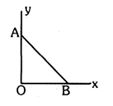
$A$ point charge $+q$ is placed at the origin. The work done in moving another point charge $-Q$ along the straight line path $AB$ from point $A$ with coordinates $(0, a)$ to point $B$ with coordinates $(a, 0)$ is .......
A
$(\frac{-qQ}{4\pi \epsilon_0} \cdot \frac{1}{a^2})$
B
Zero
C
$(\frac{qQ}{4\pi \epsilon_0} \cdot \frac{1}{a^2}) \cdot \frac{1}{\sqrt{2}}$
D
$(\frac{qQ}{4\pi \epsilon_0} \cdot \frac{1}{a^2}) \cdot \sqrt{2}a$
Solution
(B) The electric potential $V$ due to a point charge $+q$ at a distance $r$ is given by $V = \frac{1}{4\pi \epsilon_0} \cdot \frac{q}{r}$.
At point $A(0, a)$,the distance from the origin is $r_A = a$. Thus,the potential is $V_A = \frac{1}{4\pi \epsilon_0} \cdot \frac{q}{a}$.
At point $B(a, 0)$,the distance from the origin is $r_B = a$. Thus,the potential is $V_B = \frac{1}{4\pi \epsilon_0} \cdot \frac{q}{a}$.
The work done $W$ in moving a charge $-Q$ from $A$ to $B$ is given by $W = (-Q)(V_B - V_A)$.
Since $V_A = V_B$,the potential difference $(V_B - V_A) = 0$.
Therefore,the work done $W = (-Q)(0) = 0$.
At point $A(0, a)$,the distance from the origin is $r_A = a$. Thus,the potential is $V_A = \frac{1}{4\pi \epsilon_0} \cdot \frac{q}{a}$.
At point $B(a, 0)$,the distance from the origin is $r_B = a$. Thus,the potential is $V_B = \frac{1}{4\pi \epsilon_0} \cdot \frac{q}{a}$.
The work done $W$ in moving a charge $-Q$ from $A$ to $B$ is given by $W = (-Q)(V_B - V_A)$.
Since $V_A = V_B$,the potential difference $(V_B - V_A) = 0$.
Therefore,the work done $W = (-Q)(0) = 0$.
0 likes
View Solution26
MediumMCQ
$A$ hollow conducting sphere is placed in an electric field produced by a point charge at point $P$. If the electric potentials at points $A$,$B$,and $C$ are $V_A$,$V_B$,and $V_C$ respectively,as shown in the figure,then:
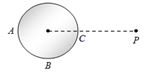
A
$V_C > V_B$
B
$V_B > V_C$
C
$V_A > V_B$
D
$V_A = V_C$
Solution
(D) hollow conducting sphere is an equipotential body.
Since points $A$,$B$,and $C$ all lie on the surface of the same conducting sphere,the electric potential at all these points must be equal.
Therefore,$V_A = V_B = V_C$.
Looking at the given options,the statement $V_A = V_C$ is correct.
Since points $A$,$B$,and $C$ all lie on the surface of the same conducting sphere,the electric potential at all these points must be equal.
Therefore,$V_A = V_B = V_C$.
Looking at the given options,the statement $V_A = V_C$ is correct.
0 likes
View Solution27
EasyMCQ
$A$ circle of radius $R$ is drawn in a uniform electric field as shown in the figure. If the potentials at points $A, B, C,$ and $D$ on the circumference of the circle are $V_A, V_B, V_C,$ and $V_D$ respectively,then:
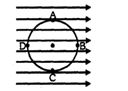
A
$V_A > V_C, V_B = V_D$
B
$V_A < V_C, V_B = V_D$
C
$V_A = V_C, V_B < V_D$
D
Only $V_A = V_C$
Solution
(C) The electric field lines point from higher potential to lower potential.
Since the electric field is uniform and directed towards the right,the potential decreases as we move along the direction of the electric field.
Points $A$ and $C$ lie on the same vertical line perpendicular to the electric field lines,so they are at the same potential,i.e.,$V_A = V_C$.
Point $D$ is at a position where the potential is higher than at point $B$ because the electric field is directed from $D$ towards $B$. Therefore,$V_D > V_B$ or $V_B < V_D$.
Combining these,we get $V_A = V_C$ and $V_B < V_D$.
Since the electric field is uniform and directed towards the right,the potential decreases as we move along the direction of the electric field.
Points $A$ and $C$ lie on the same vertical line perpendicular to the electric field lines,so they are at the same potential,i.e.,$V_A = V_C$.
Point $D$ is at a position where the potential is higher than at point $B$ because the electric field is directed from $D$ towards $B$. Therefore,$V_D > V_B$ or $V_B < V_D$.
Combining these,we get $V_A = V_C$ and $V_B < V_D$.
0 likes
View Solution28
EasyMCQ
At which point is the electric field maximum?
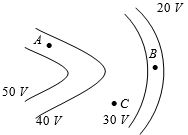
A
$B$
B
$A$
C
$C$
D
Same everywhere
Solution
(B) The electric field $E$ is related to the potential gradient by the relation $E = -\frac{dV}{dr}$.
This implies that the electric field is inversely proportional to the distance between the equipotential surfaces,i.e.,$E \propto \frac{1}{dr}$.
Looking at the provided equipotential lines,the distance between the equipotential surfaces is smallest near point $A$ (where the lines are most crowded).
Since the lines are closest together at point $A$,the potential gradient is steepest,and therefore the electric field is maximum at point $A$.
This implies that the electric field is inversely proportional to the distance between the equipotential surfaces,i.e.,$E \propto \frac{1}{dr}$.
Looking at the provided equipotential lines,the distance between the equipotential surfaces is smallest near point $A$ (where the lines are most crowded).
Since the lines are closest together at point $A$,the potential gradient is steepest,and therefore the electric field is maximum at point $A$.
0 likes
View Solution29
MediumMCQ
How much work is required to move a charge $(-q)$ from point $A$ to point $C$ in the presence of a charge $+Q$ at point $B$ as shown in the figure?
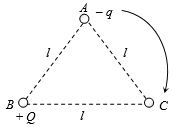
A
$\frac{1}{4\pi\varepsilon_0}\frac{Qq}{l}$
B
$\frac{1}{4\pi\varepsilon_0}\frac{Qq}{l^2}$
C
$\frac{1}{4\pi\varepsilon_0}Qql$
D
$0$
Solution
(D) The electric potential $V$ at a distance $r$ from a point charge $Q$ is given by $V = \frac{1}{4\pi\varepsilon_0}\frac{Q}{r}$.
Point $A$ is at a distance $l$ from point $B$ (where charge $+Q$ is located),so the potential at $A$ is $V_A = \frac{1}{4\pi\varepsilon_0}\frac{Q}{l}$.
Point $C$ is also at a distance $l$ from point $B$,so the potential at $C$ is $V_C = \frac{1}{4\pi\varepsilon_0}\frac{Q}{l}$.
Since $V_A = V_C$,the potential difference between points $A$ and $C$ is $\Delta V = V_C - V_A = 0$.
The work done $W$ in moving a charge $q'$ between two points is given by $W = q' \Delta V$.
Therefore,the work done in moving charge $(-q)$ from $A$ to $C$ is $W = (-q) \times 0 = 0$.
Point $A$ is at a distance $l$ from point $B$ (where charge $+Q$ is located),so the potential at $A$ is $V_A = \frac{1}{4\pi\varepsilon_0}\frac{Q}{l}$.
Point $C$ is also at a distance $l$ from point $B$,so the potential at $C$ is $V_C = \frac{1}{4\pi\varepsilon_0}\frac{Q}{l}$.
Since $V_A = V_C$,the potential difference between points $A$ and $C$ is $\Delta V = V_C - V_A = 0$.
The work done $W$ in moving a charge $q'$ between two points is given by $W = q' \Delta V$.
Therefore,the work done in moving charge $(-q)$ from $A$ to $C$ is $W = (-q) \times 0 = 0$.
0 likes
View Solution30
EasyMCQ
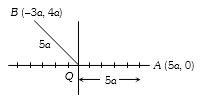
$A$ charge of $20 \, \mu C$ is placed at the origin. What is the potential difference between the points $(5a, 0)$ and $(-3a, 4a)$?
A
$a$
B
$2a$
C
$0$
D
$\frac{a}{\sqrt{2}}$
Solution
(C) The electric potential $V$ due to a point charge $Q$ at a distance $r$ is given by $V = \frac{kQ}{r}$.
For point $A(5a, 0)$,the distance from the origin $(0, 0)$ is $r_A = \sqrt{(5a)^2 + 0^2} = 5a$.
Thus,the potential at $A$ is $V_A = \frac{kQ}{5a}$.
For point $B(-3a, 4a)$,the distance from the origin $(0, 0)$ is $r_B = \sqrt{(-3a)^2 + (4a)^2} = \sqrt{9a^2 + 16a^2} = \sqrt{25a^2} = 5a$.
Thus,the potential at $B$ is $V_B = \frac{kQ}{5a}$.
The potential difference between points $A$ and $B$ is $V_A - V_B = \frac{kQ}{5a} - \frac{kQ}{5a} = 0$.
For point $A(5a, 0)$,the distance from the origin $(0, 0)$ is $r_A = \sqrt{(5a)^2 + 0^2} = 5a$.
Thus,the potential at $A$ is $V_A = \frac{kQ}{5a}$.
For point $B(-3a, 4a)$,the distance from the origin $(0, 0)$ is $r_B = \sqrt{(-3a)^2 + (4a)^2} = \sqrt{9a^2 + 16a^2} = \sqrt{25a^2} = 5a$.
Thus,the potential at $B$ is $V_B = \frac{kQ}{5a}$.
The potential difference between points $A$ and $B$ is $V_A - V_B = \frac{kQ}{5a} - \frac{kQ}{5a} = 0$.
0 likes
View Solution31
MediumMCQ
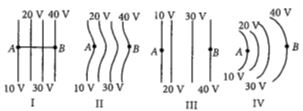
The diagrams below show regions of equipotentials. $A$ positive charge $q$ is moved from $A$ to $B$ in each diagram.
A
In all the four cases the work done is the same.
B
Minimum work is required to move $q$ in figure $(I).$
C
Maximum work is required to move $q$ in figure $(II).$
D
Maximum work is required to move $q$ in figure $(III).$
Solution
(A) The work done in moving a charge $q$ from point $A$ to point $B$ is given by the formula $W = q(V_B - V_A) = q \Delta V$.
In each of the four diagrams provided:
- Figure $(I)$: $V_A = 10 \text{ V}$ and $V_B = 40 \text{ V}$,so $\Delta V = 40 - 10 = 30 \text{ V}$.
- Figure $(II)$: $V_A = 10 \text{ V}$ and $V_B = 40 \text{ V}$,so $\Delta V = 40 - 10 = 30 \text{ V}$.
- Figure $(III)$: $V_A = 10 \text{ V}$ and $V_B = 40 \text{ V}$,so $\Delta V = 40 - 10 = 30 \text{ V}$.
- Figure $(IV)$: $V_A = 10 \text{ V}$ and $V_B = 40 \text{ V}$,so $\Delta V = 40 - 10 = 30 \text{ V}$.
Since the potential difference $\Delta V$ is $30 \text{ V}$ in all four cases,the work done $W = q(30 \text{ V})$ is the same for all diagrams.
In each of the four diagrams provided:
- Figure $(I)$: $V_A = 10 \text{ V}$ and $V_B = 40 \text{ V}$,so $\Delta V = 40 - 10 = 30 \text{ V}$.
- Figure $(II)$: $V_A = 10 \text{ V}$ and $V_B = 40 \text{ V}$,so $\Delta V = 40 - 10 = 30 \text{ V}$.
- Figure $(III)$: $V_A = 10 \text{ V}$ and $V_B = 40 \text{ V}$,so $\Delta V = 40 - 10 = 30 \text{ V}$.
- Figure $(IV)$: $V_A = 10 \text{ V}$ and $V_B = 40 \text{ V}$,so $\Delta V = 40 - 10 = 30 \text{ V}$.
Since the potential difference $\Delta V$ is $30 \text{ V}$ in all four cases,the work done $W = q(30 \text{ V})$ is the same for all diagrams.
0 likes
View Solution32
MediumMCQ
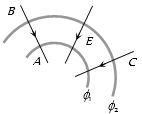
In moving from $A$ to $B$ along an electric field line,the electric field does $6.4 \times 10^{-19} \, J$ of work on an electron. If $\phi_1$ and $\phi_2$ are equipotential surfaces,then the potential difference $(V_C - V_A)$ is.....$V$.
A
$-4$
B
$4$
C
$0$
D
$64$
Solution
(B) The work done by the electric field on a charge $q$ in moving from point $A$ to point $B$ is given by $W = q(V_A - V_B)$.
For an electron,$q = -e$,where $e = 1.6 \times 10^{-19} \, C$.
Given $W = 6.4 \times 10^{-19} \, J$ for moving from $A$ to $B$.
Since $B$ and $C$ lie on the same equipotential surface $\phi_2$,we have $V_B = V_C$.
Thus,$W = -e(V_A - V_B) = e(V_B - V_A) = e(V_C - V_A)$.
Substituting the values: $6.4 \times 10^{-19} = (1.6 \times 10^{-19}) \times (V_C - V_A)$.
Therefore,$(V_C - V_A) = \frac{6.4 \times 10^{-19}}{1.6 \times 10^{-19}} = 4 \, V$.
For an electron,$q = -e$,where $e = 1.6 \times 10^{-19} \, C$.
Given $W = 6.4 \times 10^{-19} \, J$ for moving from $A$ to $B$.
Since $B$ and $C$ lie on the same equipotential surface $\phi_2$,we have $V_B = V_C$.
Thus,$W = -e(V_A - V_B) = e(V_B - V_A) = e(V_C - V_A)$.
Substituting the values: $6.4 \times 10^{-19} = (1.6 \times 10^{-19}) \times (V_C - V_A)$.
Therefore,$(V_C - V_A) = \frac{6.4 \times 10^{-19}}{1.6 \times 10^{-19}} = 4 \, V$.
0 likes
View Solution33
AdvancedMCQ
The equation of an equipotential line in an electric field is $y = 2x$. The electric field strength vector at $(1, 2)$ may be:
A
$4 \hat{i} + 3 \hat{j}$
B
$4 \hat{i} + 8 \hat{j}$
C
$8 \hat{i} + 4 \hat{j}$
D
$-8 \hat{i} + 4 \hat{j}$
Solution
(D) The electric field vector $\vec{E}$ is always perpendicular to the equipotential line.
The equation of the equipotential line is $y = 2x$.
The slope of this line is $m_1 = \frac{dy}{dx} = 2$.
Since the electric field vector $\vec{E} = E_x \hat{i} + E_y \hat{j}$ is perpendicular to the line,its slope $m_2$ must satisfy $m_1 \cdot m_2 = -1$.
Therefore,$m_2 = -\frac{1}{2}$.
The slope of the electric field vector is given by $\frac{E_y}{E_x} = -\frac{1}{2}$.
Checking the options:
For option $D$,$\vec{E} = -8 \hat{i} + 4 \hat{j}$,the slope is $\frac{4}{-8} = -\frac{1}{2}$.
Thus,the electric field vector can be $-8 \hat{i} + 4 \hat{j}$.
The equation of the equipotential line is $y = 2x$.
The slope of this line is $m_1 = \frac{dy}{dx} = 2$.
Since the electric field vector $\vec{E} = E_x \hat{i} + E_y \hat{j}$ is perpendicular to the line,its slope $m_2$ must satisfy $m_1 \cdot m_2 = -1$.
Therefore,$m_2 = -\frac{1}{2}$.
The slope of the electric field vector is given by $\frac{E_y}{E_x} = -\frac{1}{2}$.
Checking the options:
For option $D$,$\vec{E} = -8 \hat{i} + 4 \hat{j}$,the slope is $\frac{4}{-8} = -\frac{1}{2}$.
Thus,the electric field vector can be $-8 \hat{i} + 4 \hat{j}$.
0 likes
View Solution34
MediumMCQ
$A$ uniform electric field of magnitude $100 \ V/m$ in space is directed along the line $y = 3 + x$. Find the potential difference between point $A(3, 1)$ and $B(1, 3)$ in Volts.
A
$100$
B
$200$
C
$300$
D
$0$
Solution
(D) The electric field is given as $\vec{E} = E_x \hat{i} + E_y \hat{j}$.
The line is $y = x + 3$,which can be written as $x - y + 3 = 0$. The slope of this line is $1$,so the angle $\theta = 45^\circ$.
The electric field vector is $\vec{E} = 100 \cos(45^\circ) \hat{i} + 100 \sin(45^\circ) \hat{j} = 50\sqrt{2} \hat{i} + 50\sqrt{2} \hat{j}$.
The potential difference $V_B - V_A = -\int_A^B \vec{E} \cdot d\vec{r}$.
Here,$d\vec{r} = (x_B - x_A) \hat{i} + (y_B - y_A) \hat{j} = (1 - 3) \hat{i} + (3 - 1) \hat{j} = -2 \hat{i} + 2 \hat{j}$.
$V_B - V_A = -[(50\sqrt{2} \hat{i} + 50\sqrt{2} \hat{j}) \cdot (-2 \hat{i} + 2 \hat{j})]$.
$V_B - V_A = -[50\sqrt{2}(-2) + 50\sqrt{2}(2)] = -[-100\sqrt{2} + 100\sqrt{2}] = 0 \ V$.
Thus,the potential difference is $0 \ V$.
The line is $y = x + 3$,which can be written as $x - y + 3 = 0$. The slope of this line is $1$,so the angle $\theta = 45^\circ$.
The electric field vector is $\vec{E} = 100 \cos(45^\circ) \hat{i} + 100 \sin(45^\circ) \hat{j} = 50\sqrt{2} \hat{i} + 50\sqrt{2} \hat{j}$.
The potential difference $V_B - V_A = -\int_A^B \vec{E} \cdot d\vec{r}$.
Here,$d\vec{r} = (x_B - x_A) \hat{i} + (y_B - y_A) \hat{j} = (1 - 3) \hat{i} + (3 - 1) \hat{j} = -2 \hat{i} + 2 \hat{j}$.
$V_B - V_A = -[(50\sqrt{2} \hat{i} + 50\sqrt{2} \hat{j}) \cdot (-2 \hat{i} + 2 \hat{j})]$.
$V_B - V_A = -[50\sqrt{2}(-2) + 50\sqrt{2}(2)] = -[-100\sqrt{2} + 100\sqrt{2}] = 0 \ V$.
Thus,the potential difference is $0 \ V$.
0 likes
View Solution35
MediumMCQ
$A$ conducting sphere of radius $r$ has a charge. Then
A
The charge is uniformly distributed over its surface,if there is an external electric field.
B
Distribution of charge over its surface will be non-uniform if no external electric field exists in space.
C
Electric field strength inside the sphere will be equal to zero only when no external electric field exists.
D
Potential at every point of the sphere must be same.
Solution
(D) For a conducting sphere,the charge resides on the surface.
In the absence of an external electric field,the charge is distributed uniformly over the surface due to mutual repulsion.
However,the property that the entire conductor is an equipotential volume (and thus the surface is an equipotential surface) holds true regardless of the presence of an external electric field.
Therefore,the potential at every point on the surface of the conducting sphere must be the same.
In the absence of an external electric field,the charge is distributed uniformly over the surface due to mutual repulsion.
However,the property that the entire conductor is an equipotential volume (and thus the surface is an equipotential surface) holds true regardless of the presence of an external electric field.
Therefore,the potential at every point on the surface of the conducting sphere must be the same.
0 likes
View Solution36
MediumMCQ
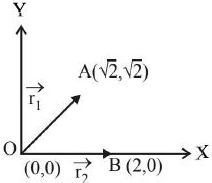
An electric charge $10^{-3} \mu C$ is placed at the origin $(0, 0)$ of an $X-Y$ coordinate system. Two points $A$ and $B$ are situated at $(\sqrt{2}, \sqrt{2})$ and $(2, 0)$ respectively. The potential difference between the points $A$ and $B$ will be.......$V$.
A
$4.5$
B
$9$
C
$0$
D
$2$
Solution
(C) The distance of point $A(\sqrt{2}, \sqrt{2})$ from the origin is:
$OA = \sqrt{(\sqrt{2})^2 + (\sqrt{2})^2} = \sqrt{2 + 2} = \sqrt{4} = 2 \text{ units}$.
The distance of point $B(2, 0)$ from the origin is:
$OB = \sqrt{(2)^2 + (0)^2} = \sqrt{4} = 2 \text{ units}$.
The electric potential $V$ at a distance $r$ from a point charge $Q$ is given by $V = \frac{1}{4\pi\epsilon_0} \frac{Q}{r}$.
Since both points $A$ and $B$ are at the same distance $r = 2 \text{ units}$ from the charge $Q = 10^{-3} \mu C$ placed at the origin,the potentials at these points are equal:
$V_A = \frac{1}{4\pi\epsilon_0} \frac{Q}{OA}$ and $V_B = \frac{1}{4\pi\epsilon_0} \frac{Q}{OB}$.
Since $OA = OB = 2$,it follows that $V_A = V_B$.
Therefore,the potential difference between points $A$ and $B$ is:
$V_A - V_B = 0 \text{ V}$.
$OA = \sqrt{(\sqrt{2})^2 + (\sqrt{2})^2} = \sqrt{2 + 2} = \sqrt{4} = 2 \text{ units}$.
The distance of point $B(2, 0)$ from the origin is:
$OB = \sqrt{(2)^2 + (0)^2} = \sqrt{4} = 2 \text{ units}$.
The electric potential $V$ at a distance $r$ from a point charge $Q$ is given by $V = \frac{1}{4\pi\epsilon_0} \frac{Q}{r}$.
Since both points $A$ and $B$ are at the same distance $r = 2 \text{ units}$ from the charge $Q = 10^{-3} \mu C$ placed at the origin,the potentials at these points are equal:
$V_A = \frac{1}{4\pi\epsilon_0} \frac{Q}{OA}$ and $V_B = \frac{1}{4\pi\epsilon_0} \frac{Q}{OB}$.
Since $OA = OB = 2$,it follows that $V_A = V_B$.
Therefore,the potential difference between points $A$ and $B$ is:
$V_A - V_B = 0 \text{ V}$.
0 likes
View Solution37
MediumMCQ
$A$ uniform electric field of magnitude $E = 100 \ V/m$ is directed along the line $y = x + 3$. Find the potential difference $V_A - V_B$ between points $A(3, 1)$ and $B(1, 3)$.
A
$100 \ V$
B
$200 \sqrt{2} \ V$
C
$200 \ V$
D
$0 \ V$
Solution
(D) The electric field vector $\vec{E}$ is directed along the line $y = x + 3$,which has a slope $m_1 = 1$. The unit vector in the direction of the electric field is $\hat{n} = \frac{\hat{i} + \hat{j}}{\sqrt{2}}$.
Thus,$\vec{E} = 100 \left( \frac{\hat{i} + \hat{j}}{\sqrt{2}} \right) = 50\sqrt{2}(\hat{i} + \hat{j}) \ V/m$.
The displacement vector $\vec{r}_{AB} = \vec{r}_B - \vec{r}_A = (1 - 3)\hat{i} + (3 - 1)\hat{j} = -2\hat{i} + 2\hat{j}$.
The potential difference is given by $V_A - V_B = \vec{E} \cdot \vec{r}_{AB}$.
$V_A - V_B = [50\sqrt{2}(\hat{i} + \hat{j})] \cdot [-2\hat{i} + 2\hat{j}] = 50\sqrt{2}(-2 + 2) = 0 \ V$.
Since the displacement vector is perpendicular to the electric field vector,the points $A$ and $B$ lie on the same equipotential line.
Thus,$\vec{E} = 100 \left( \frac{\hat{i} + \hat{j}}{\sqrt{2}} \right) = 50\sqrt{2}(\hat{i} + \hat{j}) \ V/m$.
The displacement vector $\vec{r}_{AB} = \vec{r}_B - \vec{r}_A = (1 - 3)\hat{i} + (3 - 1)\hat{j} = -2\hat{i} + 2\hat{j}$.
The potential difference is given by $V_A - V_B = \vec{E} \cdot \vec{r}_{AB}$.
$V_A - V_B = [50\sqrt{2}(\hat{i} + \hat{j})] \cdot [-2\hat{i} + 2\hat{j}] = 50\sqrt{2}(-2 + 2) = 0 \ V$.
Since the displacement vector is perpendicular to the electric field vector,the points $A$ and $B$ lie on the same equipotential line.
0 likes
View Solution38
DifficultMCQ
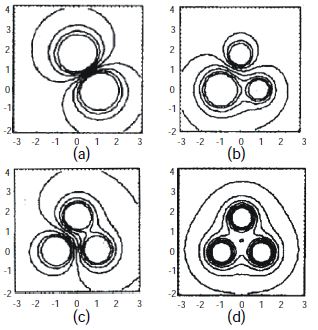
Three equal charges are placed at the corners of an equilateral triangle. Which of the graphs below correctly depicts the equally-spaced equipotential surfaces in the plane of the triangle? (All graphs have the same scale.)
A
$a$
B
$b$
C
$c$
D
$d$
Solution
(D) Equipotential surfaces represent regions where the electric potential is constant. For a system of three equal charges placed at the vertices of an equilateral triangle,the symmetry of the charge distribution must be reflected in the equipotential lines.
$1$. Near each individual charge,the equipotential surfaces are approximately circular,as the potential is dominated by the nearest charge.
$2$. As we move further away from the charges,the individual equipotential surfaces merge due to the superposition of the potentials from all three charges.
$3$. Because the charges are equal and arranged in an equilateral triangle,the resulting equipotential pattern must exhibit $C_3$ rotational symmetry about the centroid of the triangle.
$4$. Graph $(d)$ is the only one that shows this threefold symmetry,where the equipotential lines surround all three charges collectively at larger distances while maintaining distinct circular patterns near each charge.
Therefore,graph $(d)$ is the correct representation.
$1$. Near each individual charge,the equipotential surfaces are approximately circular,as the potential is dominated by the nearest charge.
$2$. As we move further away from the charges,the individual equipotential surfaces merge due to the superposition of the potentials from all three charges.
$3$. Because the charges are equal and arranged in an equilateral triangle,the resulting equipotential pattern must exhibit $C_3$ rotational symmetry about the centroid of the triangle.
$4$. Graph $(d)$ is the only one that shows this threefold symmetry,where the equipotential lines surround all three charges collectively at larger distances while maintaining distinct circular patterns near each charge.
Therefore,graph $(d)$ is the correct representation.
0 likes
View Solution39
MediumMCQ
Which of the following figures shows the correct equipotential surfaces of a system of two positive charges?
A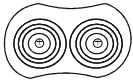
B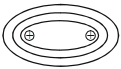
C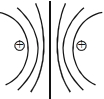
D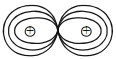
Solution
(B) For a system of two identical positive charges,the electric field lines originate from each charge and repel each other.
Equipotential surfaces are surfaces where the electric potential is constant.
Near each individual charge,the equipotential surfaces are approximately spherical.
As we move further away from the charges,the surfaces become distorted and eventually merge to form a single,larger,roughly oval-shaped surface that encloses both charges.
Figure $B$ correctly depicts this behavior,where the inner surfaces are centered around each charge,and the outer surfaces encompass both charges,reflecting the repulsive nature of the two positive charges.
Equipotential surfaces are surfaces where the electric potential is constant.
Near each individual charge,the equipotential surfaces are approximately spherical.
As we move further away from the charges,the surfaces become distorted and eventually merge to form a single,larger,roughly oval-shaped surface that encloses both charges.
Figure $B$ correctly depicts this behavior,where the inner surfaces are centered around each charge,and the outer surfaces encompass both charges,reflecting the repulsive nature of the two positive charges.
0 likes
View Solution40
MediumMCQ
$S_1$ and $S_2$ are two equipotential surfaces on which the potentials are not equal. Which of the following statements is incorrect?
A
$S_1$ and $S_2$ cannot intersect each other.
B
$S_1$ and $S_2$ cannot be plane surfaces.
C
In the region between $S_1$ and $S_2$,the electric field is maximum where they are closest to each other.
D
$A$ line of force from $S_1$ to $S_2$ must be perpendicular to both surfaces.
Solution
(B) $1$. Two equipotential surfaces can never intersect because if they did,the point of intersection would have two different potential values,which is physically impossible.
$2$. Equipotential surfaces can indeed be plane surfaces (e.g.,for a uniform electric field). Therefore,the statement that they cannot be plane surfaces is incorrect.
$3$. The relationship between the electric field $E$ and potential $V$ is given by $E = -dV/dx$. This implies that for a fixed potential difference $dV$,the electric field $E$ is inversely proportional to the distance $dx$ between the surfaces. Thus,where the surfaces are closest,the electric field is maximum.
$4$. By definition,electric field lines (lines of force) are always perpendicular to equipotential surfaces.
$5$. Since statement $(B)$ is the only incorrect statement,it is the correct choice.
$2$. Equipotential surfaces can indeed be plane surfaces (e.g.,for a uniform electric field). Therefore,the statement that they cannot be plane surfaces is incorrect.
$3$. The relationship between the electric field $E$ and potential $V$ is given by $E = -dV/dx$. This implies that for a fixed potential difference $dV$,the electric field $E$ is inversely proportional to the distance $dx$ between the surfaces. Thus,where the surfaces are closest,the electric field is maximum.
$4$. By definition,electric field lines (lines of force) are always perpendicular to equipotential surfaces.
$5$. Since statement $(B)$ is the only incorrect statement,it is the correct choice.
0 likes
View Solution41
MediumMCQ
The figure shows two parallel equipotential surfaces $A$ and $B$ kept a small distance $r$ apart from each other. $A$ point charge of $q$ coulomb is taken from the surface $A$ to $B$. The amount of net work done will be
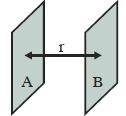
A
$ - \frac{1}{{4\pi {\varepsilon _0}}}\frac{q}{r}$
B
$ \frac{1}{{4\pi {\varepsilon _0}}}\frac{q}{r^2}$
C
$- \frac{1}{{4\pi {\varepsilon _0}}}\frac{q}{r^2}$
D
Zero
Solution
(D) By definition,an equipotential surface is a surface where the electric potential is the same at every point.
Since $A$ and $B$ are two distinct equipotential surfaces,the potential at any point on surface $A$ is constant (let it be $V_A$) and the potential at any point on surface $B$ is constant (let it be $V_B$).
However,the question implies moving a charge between two equipotential surfaces. If the surfaces are at different potentials,work is done. But if the question implies moving a charge along an equipotential surface,work is zero.
Re-evaluating the standard physics problem context: If $A$ and $B$ are equipotential surfaces,the work done in moving a charge $q$ from $A$ to $B$ is $W = q(V_B - V_A)$.
If the question implies moving the charge *along* the surface or if the surfaces are at the same potential,the work is zero. Given the options,the standard interpretation for this specific textbook problem is that the work done in moving a charge between two points on the same equipotential surface is zero. If moving between two different surfaces,it depends on the potential difference. Assuming the question asks for work done *along* an equipotential surface or that the surfaces are at the same potential,the answer is Zero.
Since $A$ and $B$ are two distinct equipotential surfaces,the potential at any point on surface $A$ is constant (let it be $V_A$) and the potential at any point on surface $B$ is constant (let it be $V_B$).
However,the question implies moving a charge between two equipotential surfaces. If the surfaces are at different potentials,work is done. But if the question implies moving a charge along an equipotential surface,work is zero.
Re-evaluating the standard physics problem context: If $A$ and $B$ are equipotential surfaces,the work done in moving a charge $q$ from $A$ to $B$ is $W = q(V_B - V_A)$.
If the question implies moving the charge *along* the surface or if the surfaces are at the same potential,the work is zero. Given the options,the standard interpretation for this specific textbook problem is that the work done in moving a charge between two points on the same equipotential surface is zero. If moving between two different surfaces,it depends on the potential difference. Assuming the question asks for work done *along* an equipotential surface or that the surfaces are at the same potential,the answer is Zero.
0 likes
View Solution42
DifficultMCQ
This question has Statement-$1$ and Statement-$2$. Of the four choices given after the Statements,choose the one that best describes the two Statements.
Statement-$1$: No work is required to be done to move a test charge between any two points on an equipotential surface.
Statement-$2$: Electric lines of force at the equipotential surfaces are mutually perpendicular to each other.
Statement-$1$: No work is required to be done to move a test charge between any two points on an equipotential surface.
Statement-$2$: Electric lines of force at the equipotential surfaces are mutually perpendicular to each other.
A
Statement-$1$ is true,Statement-$2$ is true,Statement-$2$ is the correct explanation of Statement-$1$.
B
Statement-$1$ is true,Statement-$2$ is true,Statement-$2$ is not the correct explanation of Statement-$1$.
C
Statement-$1$ is true,Statement-$2$ is false.
D
Statement-$1$ is false,Statement-$2$ is true.
Solution
(C) Statement-$1$ is true: By definition,an equipotential surface is a surface where the electric potential $V$ is constant at all points. The work done $W$ in moving a charge $q$ between two points $A$ and $B$ is given by $W = q(V_B - V_A)$. Since $V_A = V_B$ on an equipotential surface,$W = 0$.
Statement-$2$ is false: The electric field lines are perpendicular to the equipotential surface,not to each other. The statement claims that electric lines of force at the equipotential surfaces are mutually perpendicular to each other,which is incorrect.
Statement-$2$ is false: The electric field lines are perpendicular to the equipotential surface,not to each other. The statement claims that electric lines of force at the equipotential surfaces are mutually perpendicular to each other,which is incorrect.
0 likes
View Solution43
MediumMCQ
The figure shows a family of parallel equipotential surfaces and four paths along which an electron is made to move from one surface to another.
$(I)$ What is the direction of the electric field?
$(II)$ Rank the paths according to the magnitude of work done,greatest first.
$(I)$ What is the direction of the electric field?
$(II)$ Rank the paths according to the magnitude of work done,greatest first.
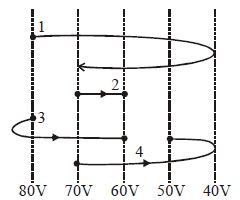
A
Rightward; $4 > 3 > 2 > 1$
B
Leftward; $1 > 2 > 3 > 4$
C
Rightward; $3 = 4 > 2 = 1$
D
Leftward; $1 > 2 > 3 = 4$
Solution
(A) The electric field $\vec{E}$ always points in the direction of decreasing electric potential. Since the potential decreases from $80 \text{ V}$ to $40 \text{ V}$ as we move from left to right,the electric field is directed towards the right.
The work done in moving a charge $q$ between two points is given by $W = q \Delta V$. For an electron,$q = -e$,so the magnitude of work done is $|W| = e |\Delta V|$.
Calculating the potential difference $|\Delta V|$ for each path:
Path $1$: Starts at $80 \text{ V}$,ends at $40 \text{ V}$. $|\Delta V_1| = |40 - 80| = 40 \text{ V}$.
Path $2$: Starts at $70 \text{ V}$,ends at $60 \text{ V}$. $|\Delta V_2| = |60 - 70| = 10 \text{ V}$.
Path $3$: Starts at $80 \text{ V}$,ends at $60 \text{ V}$. $|\Delta V_3| = |60 - 80| = 20 \text{ V}$.
Path $4$: Starts at $70 \text{ V}$,ends at $50 \text{ V}$. $|\Delta V_4| = |50 - 70| = 20 \text{ V}$.
Comparing the magnitudes: $|\Delta V_1| = 40 \text{ V}$,$|\Delta V_3| = 20 \text{ V}$,$|\Delta V_4| = 20 \text{ V}$,$|\Delta V_2| = 10 \text{ V}$.
Therefore,the order of magnitude of work done is $1 > 3 = 4 > 2$.
The work done in moving a charge $q$ between two points is given by $W = q \Delta V$. For an electron,$q = -e$,so the magnitude of work done is $|W| = e |\Delta V|$.
Calculating the potential difference $|\Delta V|$ for each path:
Path $1$: Starts at $80 \text{ V}$,ends at $40 \text{ V}$. $|\Delta V_1| = |40 - 80| = 40 \text{ V}$.
Path $2$: Starts at $70 \text{ V}$,ends at $60 \text{ V}$. $|\Delta V_2| = |60 - 70| = 10 \text{ V}$.
Path $3$: Starts at $80 \text{ V}$,ends at $60 \text{ V}$. $|\Delta V_3| = |60 - 80| = 20 \text{ V}$.
Path $4$: Starts at $70 \text{ V}$,ends at $50 \text{ V}$. $|\Delta V_4| = |50 - 70| = 20 \text{ V}$.
Comparing the magnitudes: $|\Delta V_1| = 40 \text{ V}$,$|\Delta V_3| = 20 \text{ V}$,$|\Delta V_4| = 20 \text{ V}$,$|\Delta V_2| = 10 \text{ V}$.
Therefore,the order of magnitude of work done is $1 > 3 = 4 > 2$.
0 likes
View Solution44
EasyMCQ
In the electric field of a point charge $q$,a certain charge is carried from point $A$ to points $B, C, D$ and $E$ as shown in the figure. Then the work done:
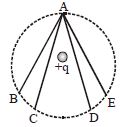
A
Is least along the path $AB$
B
Is least along the path $AD$
C
Is zero along all the paths $AB, AC, AD$ and $AE$
D
Is least along $AE$
Solution
(C) The electric potential $V$ at a distance $r$ from a point charge $q$ is given by $V = \frac{kq}{r}$.
Since points $A, B, C, D$ and $E$ all lie on the circumference of a circle centered at the point charge $q$,they are all at the same distance $r$ from the charge.
Therefore,all these points are at the same electric potential,making the path $ABCDE$ an equipotential surface.
By definition,the work done $W$ in moving a charge $q_0$ between two points at the same potential is $W = q_0(V_f - V_i) = q_0(V - V) = 0$.
Thus,the work done in moving a charge from point $A$ to any of the points $B, C, D$ or $E$ is zero.
Since points $A, B, C, D$ and $E$ all lie on the circumference of a circle centered at the point charge $q$,they are all at the same distance $r$ from the charge.
Therefore,all these points are at the same electric potential,making the path $ABCDE$ an equipotential surface.
By definition,the work done $W$ in moving a charge $q_0$ between two points at the same potential is $W = q_0(V_f - V_i) = q_0(V - V) = 0$.
Thus,the work done in moving a charge from point $A$ to any of the points $B, C, D$ or $E$ is zero.
0 likes
View Solution45
EasyMCQ
Charge $q_{2}$ is at the centre of a circular path with radius $r$. Work done in carrying charge $q_{1}$,once around this equipotential path,would be
A
$\frac{1}{4 \pi \varepsilon_{0}} \times \frac{q_{1} q_{2}}{r^{2}}$
B
zero
C
$\frac{1}{4 \pi \varepsilon_{0}} \times \frac{q_{1} q_{2}}{r}$
D
infinity
Solution
(B) The electric potential $V$ at any point on a circular path of radius $r$ due to a charge $q_{2}$ at the center is given by $V = \frac{1}{4 \pi \varepsilon_{0}} \frac{q_{2}}{r}$.
Since $q_{2}$ and $r$ are constant,the potential $V$ is constant at all points on the circular path,making it an equipotential surface.
The work done $W$ in moving a charge $q_{1}$ between two points $A$ and $B$ is given by $W = q_{1}(V_{B} - V_{A})$.
Since the path is equipotential,the potential at the starting point and the ending point (after one full rotation) is the same,i.e.,$V_{A} = V_{B}$.
Therefore,the work done $W = q_{1}(V - V) = 0$.
Since $q_{2}$ and $r$ are constant,the potential $V$ is constant at all points on the circular path,making it an equipotential surface.
The work done $W$ in moving a charge $q_{1}$ between two points $A$ and $B$ is given by $W = q_{1}(V_{B} - V_{A})$.
Since the path is equipotential,the potential at the starting point and the ending point (after one full rotation) is the same,i.e.,$V_{A} = V_{B}$.
Therefore,the work done $W = q_{1}(V - V) = 0$.
0 likes
View Solution46
EasyMCQ
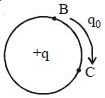
$A$ circle of radius $R$ is drawn with a charge $+q$ at the centre. $A$ charge $q_0$ is moved from point $B$ to $C$ along the circumference of the circle. The work done is:
A
positive
B
negative
C
zero
D
infinite
Solution
(C) The electric potential $V$ at any point on the circumference of a circle of radius $R$ due to a charge $+q$ at its centre is given by $V = \frac{kq}{R}$.
Since the potential is the same at all points on the circumference,the circle represents an equipotential surface.
The work done $W$ in moving a charge $q_0$ between two points $B$ and $C$ on an equipotential surface is given by $W = q_0(V_C - V_B)$.
Since $V_B = V_C$,the work done $W = q_0(0) = 0$.
Since the potential is the same at all points on the circumference,the circle represents an equipotential surface.
The work done $W$ in moving a charge $q_0$ between two points $B$ and $C$ on an equipotential surface is given by $W = q_0(V_C - V_B)$.
Since $V_B = V_C$,the work done $W = q_0(0) = 0$.
0 likes
View Solution47
EasyMCQ
Assertion: Two equipotential surfaces cannot cut each other.
Reason: Two equipotential surfaces are parallel to each other.
Reason: Two equipotential surfaces are parallel to each other.
A
If both Assertion and Reason are correct and Reason is the correct explanation of Assertion.
B
If both Assertion and Reason are correct,but Reason is not the correct explanation of Assertion.
C
If Assertion is correct but Reason is incorrect.
D
If both the Assertion and Reason are incorrect.
Solution
(C) The Assertion is correct because if two equipotential surfaces were to intersect,the point of intersection would have two different values of electric potential,which is physically impossible.
The Reason is incorrect because equipotential surfaces are not necessarily parallel to each other. For example,for a point charge,the equipotential surfaces are concentric spheres,and for a line charge,they are coaxial cylinders. They can have any shape depending on the charge distribution.
The Reason is incorrect because equipotential surfaces are not necessarily parallel to each other. For example,for a point charge,the equipotential surfaces are concentric spheres,and for a line charge,they are coaxial cylinders. They can have any shape depending on the charge distribution.
0 likes
View Solution48
Easy
Two charges $2 \; \mu C$ and $-2 \; \mu C$ are placed at points $A$ and $B$ which are $6 \; cm$ apart.
$(a)$ Identify an equipotential surface of the system.
$(b)$ What is the direction of the electric field at every point on this surface?
$(a)$ Identify an equipotential surface of the system.
$(b)$ What is the direction of the electric field at every point on this surface?

Solution
(N/A) The system consists of two equal and opposite charges separated by a distance of $6 \; cm$.
An equipotential surface is defined as a surface where the electric potential is the same at every point.
For a system of two equal and opposite charges (an electric dipole),the plane that perpendicularly bisects the line joining the two charges is an equipotential surface with a potential of $0 \; V$.
This plane is located at the mid-point of the line $AB$,i.e.,at a distance of $3 \; cm$ from each charge.
$(b)$ The electric field lines always originate from the positive charge and terminate at the negative charge.
At any point on the equipotential surface (the perpendicular bisector plane),the electric field vector is directed from the positive charge towards the negative charge.
Therefore,the direction of the electric field at every point on this surface is normal to the plane and directed along the line $AB$ (from $A$ to $B$).
An equipotential surface is defined as a surface where the electric potential is the same at every point.
For a system of two equal and opposite charges (an electric dipole),the plane that perpendicularly bisects the line joining the two charges is an equipotential surface with a potential of $0 \; V$.
This plane is located at the mid-point of the line $AB$,i.e.,at a distance of $3 \; cm$ from each charge.
$(b)$ The electric field lines always originate from the positive charge and terminate at the negative charge.
At any point on the equipotential surface (the perpendicular bisector plane),the electric field vector is directed from the positive charge towards the negative charge.
Therefore,the direction of the electric field at every point on this surface is normal to the plane and directed along the line $AB$ (from $A$ to $B$).
0 likes
View Solution49
Medium
Describe schematically the equipotential surfaces corresponding to
$(a)$ a constant electric field in the $z$-direction,
$(b)$ a field that uniformly increases in magnitude but remains in a constant (say,$z$) direction,
$(c)$ a single positive charge at the origin,and
$(d)$ a uniform grid consisting of long equally spaced parallel charged wires in a plane.
$(a)$ a constant electric field in the $z$-direction,
$(b)$ a field that uniformly increases in magnitude but remains in a constant (say,$z$) direction,
$(c)$ a single positive charge at the origin,and
$(d)$ a uniform grid consisting of long equally spaced parallel charged wires in a plane.
Solution
(N/A) Equidistant planes parallel to the $x-y$ plane are the equipotential surfaces.
$(b)$ Planes parallel to the $x-y$ plane are the equipotential surfaces,but the spacing between them decreases as the field magnitude increases.
$(c)$ Concentric spheres centered at the origin are the equipotential surfaces.
$(d)$ Near the grid,the equipotential surfaces have a periodically varying shape. At large distances from the grid,these surfaces gradually become planes parallel to the grid.
$(b)$ Planes parallel to the $x-y$ plane are the equipotential surfaces,but the spacing between them decreases as the field magnitude increases.
$(c)$ Concentric spheres centered at the origin are the equipotential surfaces.
$(d)$ Near the grid,the equipotential surfaces have a periodically varying shape. At large distances from the grid,these surfaces gradually become planes parallel to the grid.
0 likes
View Solution50
Medium
What is an equipotential surface? Draw equipotential surfaces for:
$(1)$ $A$ single point charge
$(2)$ $A$ dipole (charges $+q$ and $-q$ at a small distance)
$(3)$ Two $+q$ charges at a small distance
$(4)$ $A$ uniform electric field.
$(1)$ $A$ single point charge
$(2)$ $A$ dipole (charges $+q$ and $-q$ at a small distance)
$(3)$ Two $+q$ charges at a small distance
$(4)$ $A$ uniform electric field.
Solution
(N/A) An equipotential surface is an imaginary surface in an electric field where the electric potential is the same at every point.
$(1)$ For a single point charge $q$,the potential at a distance $r$ is $V = \frac{kq}{r}$. Since $V$ is constant for a constant $r$,the equipotential surfaces are concentric spheres centered at the charge.
$(2)$ For a dipole ($+q$ and $-q$),the potential is zero at the mid-plane. The equipotential surfaces are distorted spheres,closer together near the charges and further apart in the middle.
$(3)$ For two like charges ($+q$ and $+q$),the potential is high near the charges. The equipotential surfaces are distorted spheres that do not intersect the mid-plane.
$(4)$ For a uniform electric field,the equipotential surfaces are a set of parallel planes perpendicular to the direction of the electric field lines.
$(1)$ For a single point charge $q$,the potential at a distance $r$ is $V = \frac{kq}{r}$. Since $V$ is constant for a constant $r$,the equipotential surfaces are concentric spheres centered at the charge.
$(2)$ For a dipole ($+q$ and $-q$),the potential is zero at the mid-plane. The equipotential surfaces are distorted spheres,closer together near the charges and further apart in the middle.
$(3)$ For two like charges ($+q$ and $+q$),the potential is high near the charges. The equipotential surfaces are distorted spheres that do not intersect the mid-plane.
$(4)$ For a uniform electric field,the equipotential surfaces are a set of parallel planes perpendicular to the direction of the electric field lines.
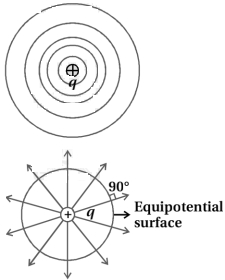
0 likes
View SolutionElectric Potential and Capacitance — Equipotential Surface · Frequently Asked Questions
1Are these Electric Potential and Capacitance questions useful for JEE and NEET?
Yes. All questions in this section are mapped to JEE Main and NEET exam patterns. Previous year questions from JEE Main, NEET, GUJCET and state-level exams are included with full solutions.
2Can I switch to Hindi or Gujarati for these questions?
Yes. Use the language tabs in the hero section or the sidebar to view the same questions and solutions in English, Hindi or Gujarati.
3How do I generate a question paper from this subtopic?
Use the Vedclass Exam Paper Generator — select the chapter and subtopic, set difficulty, and generate Sets A, B, C, D automatically. First 3 chapters of every subject are free.
Vedclass Products
For Students
Vedclass Test Series
Mock tests in real JEE/NEET style with performance analysis. 5-day free trial.
Start Free TrialFor Teachers
Exam Paper Generator
Generate Set A/B/C/D papers from this chapter in 2 minutes. 3 chapters free.
Try FreeFor Institutes
Online Exam Module
Live online exams with unlimited students, 360° analytics & white-label branding.
See DemoFor Teachers & Institutes
Generate a Electric Potential and Capacitance Exam Paper in 2 Minutes
Select subtopic & difficulty — Sets A, B, C, D auto-generated with No Repeat logic.
First 3 chapters of every subject are free — no payment required.