
A English
Parallel Plate Capacitor Questions in English
Class 12 Physics · Electric Potential and Capacitance · Parallel Plate Capacitor
130+
Questions
English
Language
100%
With Solutions
Showing 50 of 130 questions in English
1
MediumMCQ
The unit of absolute permittivity is
A
$F \cdot m$
B
$F \cdot m^{-1}$
C
$F \cdot m^{-2}$
D
$F$
Solution
(B) The formula for the capacitance of a parallel plate capacitor is $C = \frac{\epsilon A}{d}$,where $\epsilon$ is the absolute permittivity,$A$ is the area,and $d$ is the distance between plates.
Rearranging for $\epsilon$,we get $\epsilon = \frac{C \cdot d}{A}$.
The unit of capacitance $C$ is Farad $(F)$,the unit of distance $d$ is meter $(m)$,and the unit of area $A$ is square meter $(m^2)$.
Substituting these units: $\text{Unit of } \epsilon = \frac{F \cdot m}{m^2} = F \cdot m^{-1}$.
Therefore,the unit of absolute permittivity is $F \cdot m^{-1}$.
Rearranging for $\epsilon$,we get $\epsilon = \frac{C \cdot d}{A}$.
The unit of capacitance $C$ is Farad $(F)$,the unit of distance $d$ is meter $(m)$,and the unit of area $A$ is square meter $(m^2)$.
Substituting these units: $\text{Unit of } \epsilon = \frac{F \cdot m}{m^2} = F \cdot m^{-1}$.
Therefore,the unit of absolute permittivity is $F \cdot m^{-1}$.
0 likes
View Solution2
EasyMCQ
Two parallel plates separated by a distance of $5\,mm$ are kept at a potential difference of $50\,V.$ $A$ particle of mass $10^{-15}\,kg$ and charge $10^{-11}\,C$ enters in it with a velocity $10^7\,m/s.$ The acceleration of the particle will be
A
$10^8\,m/s^2$
B
$5 \times 10^5\,m/s^2$
C
$10^5\,m/s^2$
D
$2 \times 10^3\,m/s^2$
Solution
(A) The electric field $E$ between two parallel plates is given by $E = \frac{V}{d}$,where $V$ is the potential difference and $d$ is the distance between the plates.
Given: $V = 50\,V$,$d = 5\,mm = 5 \times 10^{-3}\,m$.
$E = \frac{50}{5 \times 10^{-3}} = 10^4\,V/m$.
The force $F$ on the particle is $F = qE$.
The acceleration $a$ is given by $a = \frac{F}{m} = \frac{qE}{m}$.
Given: $q = 10^{-11}\,C$,$m = 10^{-15}\,kg$.
$a = \frac{10^{-11} \times 10^4}{10^{-15}} = \frac{10^{-7}}{10^{-15}} = 10^8\,m/s^2$.
Given: $V = 50\,V$,$d = 5\,mm = 5 \times 10^{-3}\,m$.
$E = \frac{50}{5 \times 10^{-3}} = 10^4\,V/m$.
The force $F$ on the particle is $F = qE$.
The acceleration $a$ is given by $a = \frac{F}{m} = \frac{qE}{m}$.
Given: $q = 10^{-11}\,C$,$m = 10^{-15}\,kg$.
$a = \frac{10^{-11} \times 10^4}{10^{-15}} = \frac{10^{-7}}{10^{-15}} = 10^8\,m/s^2$.
0 likes
View Solution3
EasyMCQ
The capacity of a parallel plate capacitor depends on:
A
The type of metal used
B
The thickness of the plates
C
The potential applied across the plates
D
The separation between the plates
Solution
(D) The capacitance $C$ of a parallel plate capacitor is given by the formula $C = \frac{K\varepsilon_0 A}{d}$,where $K$ is the dielectric constant of the medium between the plates,$\varepsilon_0$ is the permittivity of free space,$A$ is the area of each plate,and $d$ is the separation distance between the plates.
From this formula,it is clear that the capacitance depends on the area of the plates,the distance between them,and the dielectric medium,but it does not depend on the thickness of the plates,the material of the plates,or the potential difference applied across them.
Therefore,among the given options,the capacity depends on the separation between the plates.
From this formula,it is clear that the capacitance depends on the area of the plates,the distance between them,and the dielectric medium,but it does not depend on the thickness of the plates,the material of the plates,or the potential difference applied across them.
Therefore,among the given options,the capacity depends on the separation between the plates.
0 likes
View Solution4
EasyMCQ
The capacity of a parallel plate capacitor is $C$. What will be its capacity when the separation between the plates is halved?
A
$4C$
B
$2C$
C
$C/2$
D
$C/4$
Solution
(B) The capacitance of a parallel plate capacitor is given by the formula $C = \frac{\varepsilon_0 A}{d}$,where $\varepsilon_0$ is the permittivity of free space,$A$ is the area of the plates,and $d$ is the separation between them.
When the separation between the plates is halved,the new separation becomes $d' = d/2$.
The new capacitance $C'$ is given by $C' = \frac{\varepsilon_0 A}{d'} = \frac{\varepsilon_0 A}{d/2}$.
This simplifies to $C' = 2 \times \frac{\varepsilon_0 A}{d} = 2C$.
Therefore,the new capacity is $2C$.
When the separation between the plates is halved,the new separation becomes $d' = d/2$.
The new capacitance $C'$ is given by $C' = \frac{\varepsilon_0 A}{d'} = \frac{\varepsilon_0 A}{d/2}$.
This simplifies to $C' = 2 \times \frac{\varepsilon_0 A}{d} = 2C$.
Therefore,the new capacity is $2C$.
0 likes
View Solution5
EasyMCQ
The capacity of a parallel plate capacitor increases with the
A
Decrease of its area
B
Increase of its distance
C
Increase of its area
D
None of the above
Solution
(C) The capacitance $C$ of a parallel plate capacitor is given by the formula $C = \frac{\varepsilon_0 A}{d}$,where $\varepsilon_0$ is the permittivity of free space,$A$ is the area of the plates,and $d$ is the distance between the plates.
From this relation,it is clear that the capacitance $C$ is directly proportional to the area $A$ of the plates $(C \propto A)$.
Therefore,if the area $A$ of the plates increases,the capacity $C$ of the capacitor also increases.
From this relation,it is clear that the capacitance $C$ is directly proportional to the area $A$ of the plates $(C \propto A)$.
Therefore,if the area $A$ of the plates increases,the capacity $C$ of the capacitor also increases.
0 likes
View Solution6
MediumMCQ
The area of each plate of a parallel plate capacitor is $100 \, cm^2$ and the distance between the plates is $1 \, mm$. It is filled with mica of dielectric constant $6$. The radius of the equivalent capacity of the sphere will be.......$m$.
A
$47.7$
B
$4.77$
C
$477$
D
None of the above
Solution
(B) The capacitance of a parallel plate capacitor filled with a dielectric is given by $C = \frac{K \varepsilon_0 A}{d}$.
For a spherical conductor of radius $r$,the capacitance is $C = 4 \pi \varepsilon_0 r$.
Equating the two capacitances: $4 \pi \varepsilon_0 r = \frac{K \varepsilon_0 A}{d}$.
Solving for $r$: $r = \frac{KA}{4 \pi d}$.
Given: $A = 100 \, cm^2 = 100 \times 10^{-4} \, m^2 = 10^{-2} \, m^2$,$d = 1 \, mm = 10^{-3} \, m$,and $K = 6$.
Substituting the values: $r = \frac{6 \times 10^{-2}}{4 \times 3.14 \times 10^{-3}} = \frac{6 \times 10}{12.56} = \frac{60}{12.56} \approx 4.77 \, m$.
For a spherical conductor of radius $r$,the capacitance is $C = 4 \pi \varepsilon_0 r$.
Equating the two capacitances: $4 \pi \varepsilon_0 r = \frac{K \varepsilon_0 A}{d}$.
Solving for $r$: $r = \frac{KA}{4 \pi d}$.
Given: $A = 100 \, cm^2 = 100 \times 10^{-4} \, m^2 = 10^{-2} \, m^2$,$d = 1 \, mm = 10^{-3} \, m$,and $K = 6$.
Substituting the values: $r = \frac{6 \times 10^{-2}}{4 \times 3.14 \times 10^{-3}} = \frac{6 \times 10}{12.56} = \frac{60}{12.56} \approx 4.77 \, m$.
0 likes
View Solution7
EasyMCQ
The distance between the plates of a parallel plate capacitor is $4 \ mm$ and the potential difference is $60 \ V$. If the distance between the plates is increased to $12 \ mm$,then:
A
The potential difference of the capacitor will become $180 \ V$
B
The $P.D.$ will become $20 \ V$
C
The $P.D.$ will remain unchanged
D
The charge on the capacitor will reduce to one third
Solution
(A) For a parallel plate capacitor,the capacitance is given by $C = \frac{\epsilon_0 A}{d}$.
Assuming the capacitor is disconnected from the battery,the charge $Q$ remains constant.
Since $Q = CV$,we have $V = \frac{Q}{C} = \frac{Qd}{\epsilon_0 A}$.
This implies $V \propto d$.
Therefore,$\frac{V_1}{V_2} = \frac{d_1}{d_2}$.
Given $V_1 = 60 \ V$,$d_1 = 4 \ mm$,and $d_2 = 12 \ mm$.
$V_2 = \frac{V_1 \times d_2}{d_1} = \frac{60 \times 12}{4} = 180 \ V$.
Assuming the capacitor is disconnected from the battery,the charge $Q$ remains constant.
Since $Q = CV$,we have $V = \frac{Q}{C} = \frac{Qd}{\epsilon_0 A}$.
This implies $V \propto d$.
Therefore,$\frac{V_1}{V_2} = \frac{d_1}{d_2}$.
Given $V_1 = 60 \ V$,$d_1 = 4 \ mm$,and $d_2 = 12 \ mm$.
$V_2 = \frac{V_1 \times d_2}{d_1} = \frac{60 \times 12}{4} = 180 \ V$.
0 likes
View Solution8
EasyMCQ
Which of the following statements is true when the distance between the plates of a parallel plate capacitor is increased?
A
The electric intensity between the plates will decrease.
B
The electric intensity between the plates will increase.
C
The electric intensity between the plates will remain unchanged.
D
The potential difference between the plates will decrease.
Solution
(C) The electric field $E$ between the plates of a parallel plate capacitor is given by the formula $E = \frac{\sigma}{\varepsilon_0} = \frac{Q}{A\varepsilon_0}$,where $Q$ is the charge on the plates,$A$ is the area of the plates,and $\varepsilon_0$ is the permittivity of free space.
Since the electric field $E$ depends only on the charge density $\sigma$ (or charge $Q$ and area $A$) and is independent of the distance $d$ between the plates,the electric intensity remains unchanged when the distance is increased,assuming the charge $Q$ remains constant.
Therefore,$E \propto d^0$.
Since the electric field $E$ depends only on the charge density $\sigma$ (or charge $Q$ and area $A$) and is independent of the distance $d$ between the plates,the electric intensity remains unchanged when the distance is increased,assuming the charge $Q$ remains constant.
Therefore,$E \propto d^0$.
0 likes
View Solution9
MediumMCQ
The force of attraction between the plates of a parallel plate capacitor is
A
$\frac{q^2}{2\varepsilon_0 AK}$
B
$\frac{q^2}{\varepsilon_0 AK}$
C
$\frac{q}{2\varepsilon_0 A}$
D
$\frac{q^2}{2\varepsilon_0 A^2 K}$
Solution
(A) The electric field $E$ produced by one plate of a parallel plate capacitor at the location of the other plate is given by $E = \frac{\sigma}{2\varepsilon_0 K}$,where $\sigma = \frac{q}{A}$ is the surface charge density.
Substituting $\sigma$,we get $E = \frac{q}{2A\varepsilon_0 K}$.
The force $F$ on a charge $q$ placed in this electric field is $F = qE$.
Therefore,$F = q \times \left( \frac{q}{2A\varepsilon_0 K} \right) = \frac{q^2}{2\varepsilon_0 AK}$.
Substituting $\sigma$,we get $E = \frac{q}{2A\varepsilon_0 K}$.
The force $F$ on a charge $q$ placed in this electric field is $F = qE$.
Therefore,$F = q \times \left( \frac{q}{2A\varepsilon_0 K} \right) = \frac{q^2}{2\varepsilon_0 AK}$.
0 likes
View Solution10
EasyMCQ
One plate of a parallel plate capacitor is smaller than the other. What can be said about the charge on the smaller plate?
A
Less than the other
B
More than the other
C
Equal to the other
D
Will depend upon the medium between them
Solution
(C) In a parallel plate capacitor,the charge on the plates is induced by the electric field between them.
According to the principle of electrostatic induction,the magnitude of the induced charge on the plates must be equal and opposite to maintain the charge neutrality of the capacitor system as a whole.
Even if the physical dimensions (area) of the plates are different,the magnitude of the charge $q$ on both plates remains equal in magnitude ($+q$ and $-q$).
Therefore,the charge on the smaller plate is equal to the charge on the larger plate.
According to the principle of electrostatic induction,the magnitude of the induced charge on the plates must be equal and opposite to maintain the charge neutrality of the capacitor system as a whole.
Even if the physical dimensions (area) of the plates are different,the magnitude of the charge $q$ on both plates remains equal in magnitude ($+q$ and $-q$).
Therefore,the charge on the smaller plate is equal to the charge on the larger plate.
0 likes
View Solution11
MediumMCQ
The force acting on a charged particle placed between the plates of a charged parallel plate capacitor is $F$. If one plate of the capacitor is removed,then the force acting on the same particle will become:
A
$0$
B
$F/2$
C
$F$
D
$2F$
Solution
(B) Initially,the electric field between the plates of a parallel plate capacitor is $E = \frac{\sigma}{\varepsilon_0}$,where $\sigma$ is the surface charge density. The force on the particle is $F = qE = \frac{q\sigma}{\varepsilon_0}$.
When one plate is removed,the capacitor effectively becomes a single charged sheet. The electric field due to a single charged sheet is given by $E' = \frac{\sigma}{2\varepsilon_0}$.
Therefore,the new force acting on the particle is $F' = qE' = q \left( \frac{\sigma}{2\varepsilon_0} \right) = \frac{1}{2} \left( \frac{q\sigma}{\varepsilon_0} \right) = \frac{F}{2}$.
When one plate is removed,the capacitor effectively becomes a single charged sheet. The electric field due to a single charged sheet is given by $E' = \frac{\sigma}{2\varepsilon_0}$.
Therefore,the new force acting on the particle is $F' = qE' = q \left( \frac{\sigma}{2\varepsilon_0} \right) = \frac{1}{2} \left( \frac{q\sigma}{\varepsilon_0} \right) = \frac{F}{2}$.
0 likes
View Solution12
MediumMCQ
The distance between the circular plates of a parallel plate capacitor $40\,mm$ in diameter,in order to have the same capacity as a sphere of radius $1\,m$,is....$mm$.
A
$0.01$
B
$0.1$
C
$1.0$
D
$10$
Solution
(B) The capacitance of a sphere of radius $R$ is given by $C_{sphere} = 4\pi \varepsilon_0 R$.
Given $R = 1\,m$,so $C_{sphere} = 4\pi \varepsilon_0 \times 1 = 4\pi \varepsilon_0$.
The capacitance of a parallel plate capacitor is given by $C_{parallel} = \frac{\varepsilon_0 A}{d}$,where $A = \pi r^2$ is the area of the plates and $d$ is the distance between them.
The diameter of the plate is $40\,mm$,so the radius $r = 20\,mm = 20 \times 10^{-3}\,m$.
Equating the two capacitances: $4\pi \varepsilon_0 = \frac{\varepsilon_0 \pi r^2}{d}$.
Canceling $\pi \varepsilon_0$ from both sides,we get $4 = \frac{r^2}{d}$,which implies $d = \frac{r^2}{4}$.
Substituting the value of $r$: $d = \frac{(20 \times 10^{-3})^2}{4} = \frac{400 \times 10^{-6}}{4} = 100 \times 10^{-6}\,m = 0.1 \times 10^{-3}\,m = 0.1\,mm$.
Given $R = 1\,m$,so $C_{sphere} = 4\pi \varepsilon_0 \times 1 = 4\pi \varepsilon_0$.
The capacitance of a parallel plate capacitor is given by $C_{parallel} = \frac{\varepsilon_0 A}{d}$,where $A = \pi r^2$ is the area of the plates and $d$ is the distance between them.
The diameter of the plate is $40\,mm$,so the radius $r = 20\,mm = 20 \times 10^{-3}\,m$.
Equating the two capacitances: $4\pi \varepsilon_0 = \frac{\varepsilon_0 \pi r^2}{d}$.
Canceling $\pi \varepsilon_0$ from both sides,we get $4 = \frac{r^2}{d}$,which implies $d = \frac{r^2}{4}$.
Substituting the value of $r$: $d = \frac{(20 \times 10^{-3})^2}{4} = \frac{400 \times 10^{-6}}{4} = 100 \times 10^{-6}\,m = 0.1 \times 10^{-3}\,m = 0.1\,mm$.
0 likes
View Solution13
EasyMCQ
The capacitance of a parallel plate capacitor does not depend on:
A
Area of the plates
B
Medium between the plates
C
Distance between the plates
D
Metal of the plates
Solution
(D) The capacitance $C$ of a parallel plate capacitor is given by the formula:
$C = \frac{K \varepsilon_0 A}{d}$
Where:
$K$ is the dielectric constant of the medium between the plates.
$\varepsilon_0$ is the permittivity of free space.
$A$ is the area of each plate.
$d$ is the distance between the plates.
From this formula,it is evident that the capacitance depends on the area of the plates $(A)$,the medium between the plates $(K)$,and the distance between the plates $(d)$.
It does not depend on the material (metal) of the plates,provided the plates are good conductors.
$C = \frac{K \varepsilon_0 A}{d}$
Where:
$K$ is the dielectric constant of the medium between the plates.
$\varepsilon_0$ is the permittivity of free space.
$A$ is the area of each plate.
$d$ is the distance between the plates.
From this formula,it is evident that the capacitance depends on the area of the plates $(A)$,the medium between the plates $(K)$,and the distance between the plates $(d)$.
It does not depend on the material (metal) of the plates,provided the plates are good conductors.
0 likes
View Solution14
EasyMCQ
Between the plates of a parallel plate capacitor,there is a $1\,mm$ thick paper of dielectric constant $4$. It is charged to $100\,V$. The electric field in $V/m$ between the plates of the capacitor is:
A
$100$
B
$100,000$
C
$25,000$
D
$400,000$
Solution
(B) The electric field $E$ between the plates of a capacitor is given by the formula $E = \frac{V}{d}$,where $V$ is the potential difference and $d$ is the distance between the plates.
Given:
Potential difference $V = 100\,V$
Distance $d = 1\,mm = 1 \times 10^{-3}\,m$
Substituting the values:
$E = \frac{100}{1 \times 10^{-3}} = 100 \times 10^3 = 100,000\,V/m$.
Note: The dielectric constant does not affect the electric field calculation when the potential difference $V$ is maintained constant across the plates.
Given:
Potential difference $V = 100\,V$
Distance $d = 1\,mm = 1 \times 10^{-3}\,m$
Substituting the values:
$E = \frac{100}{1 \times 10^{-3}} = 100 \times 10^3 = 100,000\,V/m$.
Note: The dielectric constant does not affect the electric field calculation when the potential difference $V$ is maintained constant across the plates.
0 likes
View Solution15
MediumMCQ
The diameter of each plate of an air capacitor is $4\,cm$. To make the capacity of this parallel plate capacitor equal to that of a sphere of diameter $20\,cm$,the distance between the plates will be:
A
$4 \times 10^{-3}\,m$
B
$1 \times 10^{-3}\,m$
C
$1\,cm$
D
$1 \times 10^{-3}\,cm$
Solution
(A) The capacitance of a spherical conductor of radius $R$ is given by $C_1 = 4\pi \varepsilon_0 R$. Given diameter $D = 20\,cm$,so radius $R = 10\,cm = 0.1\,m$. Thus,$C_1 = 4\pi \varepsilon_0 (0.1)$.
The capacitance of a parallel plate capacitor is given by $C_2 = \frac{\varepsilon_0 A}{d}$,where $A = \pi r^2$ and $r$ is the radius of the plate. Given diameter of the plate is $4\,cm$,so $r = 2\,cm = 0.02\,m$. Thus,$A = \pi (0.02)^2 = 4\pi \times 10^{-4}\,m^2$.
Equating the two capacitances,$C_1 = C_2$:
$4\pi \varepsilon_0 (0.1) = \frac{\varepsilon_0 (4\pi \times 10^{-4})}{d}$
$0.1 = \frac{4 \times 10^{-4}}{d}$
$d = \frac{4 \times 10^{-4}}{0.1} = 4 \times 10^{-3}\,m$.
The capacitance of a parallel plate capacitor is given by $C_2 = \frac{\varepsilon_0 A}{d}$,where $A = \pi r^2$ and $r$ is the radius of the plate. Given diameter of the plate is $4\,cm$,so $r = 2\,cm = 0.02\,m$. Thus,$A = \pi (0.02)^2 = 4\pi \times 10^{-4}\,m^2$.
Equating the two capacitances,$C_1 = C_2$:
$4\pi \varepsilon_0 (0.1) = \frac{\varepsilon_0 (4\pi \times 10^{-4})}{d}$
$0.1 = \frac{4 \times 10^{-4}}{d}$
$d = \frac{4 \times 10^{-4}}{0.1} = 4 \times 10^{-3}\,m$.
0 likes
View Solution16
EasyMCQ
The intensity of the electric field at a point between the plates of a charged parallel plate capacitor:
A
Is directly proportional to the distance between the plates.
B
Is inversely proportional to the distance between the plates.
C
Is inversely proportional to the square of the distance between the plates.
D
Does not depend upon the distance between the plates.
Solution
(D) The electric field $E$ between the plates of a parallel plate capacitor is given by the formula $E = \frac{\sigma}{\epsilon_0}$,where $\sigma$ is the surface charge density and $\epsilon_0$ is the permittivity of free space.
Since $\sigma = \frac{Q}{A}$,the electric field can be expressed as $E = \frac{Q}{A\epsilon_0}$.
In this expression,$Q$ is the charge on the plates,$A$ is the area of the plates,and $\epsilon_0$ is a constant.
As the formula does not contain the distance $d$ between the plates,the electric field is uniform and independent of the distance between the plates.
Since $\sigma = \frac{Q}{A}$,the electric field can be expressed as $E = \frac{Q}{A\epsilon_0}$.
In this expression,$Q$ is the charge on the plates,$A$ is the area of the plates,and $\epsilon_0$ is a constant.
As the formula does not contain the distance $d$ between the plates,the electric field is uniform and independent of the distance between the plates.
0 likes
View Solution17
MediumMCQ
The plates of a parallel plate capacitor of capacity $50\,\mu F$ are charged to a potential of $100\;V$ and then disconnected from the battery. The distance between the plates is then doubled. How much work is done in doing so?
A
$25 \times 10^{-2}\,J$
B
$-12.5 \times 10^{-2}\,J$
C
$-25 \times 10^{-2}\,J$
D
$12.5 \times 10^{-2}\,J$
Solution
(A) Initial capacitance $C = 50\,\mu F = 50 \times 10^{-6}\,F$ and initial potential $V = 100\;V$.
Initial charge $Q = CV = 50 \times 10^{-6} \times 100 = 5 \times 10^{-3}\,C$.
Since the capacitor is disconnected from the battery,the charge $Q$ remains constant.
When the distance between the plates is doubled,the new capacitance $C' = C/2 = 25\,\mu F$.
The new potential $V' = Q/C' = Q/(C/2) = 2V = 200\;V$.
The work done by the external agent is the change in stored energy: $W = U_f - U_i$.
$U_i = \frac{1}{2}CV^2 = \frac{1}{2} \times 50 \times 10^{-6} \times (100)^2 = 0.25\;J$.
$U_f = \frac{1}{2}C'V'^2 = \frac{1}{2} \times (C/2) \times (2V)^2 = \frac{1}{2} \times (C/2) \times 4V^2 = CV^2 = 0.50\;J$.
$W = 0.50 - 0.25 = 0.25\;J = 25 \times 10^{-2}\,J$.
Initial charge $Q = CV = 50 \times 10^{-6} \times 100 = 5 \times 10^{-3}\,C$.
Since the capacitor is disconnected from the battery,the charge $Q$ remains constant.
When the distance between the plates is doubled,the new capacitance $C' = C/2 = 25\,\mu F$.
The new potential $V' = Q/C' = Q/(C/2) = 2V = 200\;V$.
The work done by the external agent is the change in stored energy: $W = U_f - U_i$.
$U_i = \frac{1}{2}CV^2 = \frac{1}{2} \times 50 \times 10^{-6} \times (100)^2 = 0.25\;J$.
$U_f = \frac{1}{2}C'V'^2 = \frac{1}{2} \times (C/2) \times (2V)^2 = \frac{1}{2} \times (C/2) \times 4V^2 = CV^2 = 0.50\;J$.
$W = 0.50 - 0.25 = 0.25\;J = 25 \times 10^{-2}\,J$.
0 likes
View Solution18
EasyMCQ
What is the area of the plates of a $3\,F$ parallel plate capacitor,if the separation between the plates is $5\,mm$?
A
$1.694 \times 10^9\,m^2$
B
$4.529 \times 10^9\,m^2$
C
$9.281 \times 10^9\,m^2$
D
$12.981 \times 10^9\,m^2$
Solution
(A) The capacitance of a parallel plate capacitor is given by the formula $C = \frac{\varepsilon_0 A}{d}$.
Rearranging the formula to solve for the area $A$,we get $A = \frac{Cd}{\varepsilon_0}$.
Given values are $C = 3\,F$,$d = 5\,mm = 5 \times 10^{-3}\,m$,and $\varepsilon_0 = 8.854 \times 10^{-12}\,F/m$.
Substituting these values into the formula:
$A = \frac{3 \times 5 \times 10^{-3}}{8.854 \times 10^{-12}}$
$A = \frac{15 \times 10^{-3}}{8.854 \times 10^{-12}}$
$A \approx 1.694 \times 10^9\,m^2$.
Rearranging the formula to solve for the area $A$,we get $A = \frac{Cd}{\varepsilon_0}$.
Given values are $C = 3\,F$,$d = 5\,mm = 5 \times 10^{-3}\,m$,and $\varepsilon_0 = 8.854 \times 10^{-12}\,F/m$.
Substituting these values into the formula:
$A = \frac{3 \times 5 \times 10^{-3}}{8.854 \times 10^{-12}}$
$A = \frac{15 \times 10^{-3}}{8.854 \times 10^{-12}}$
$A \approx 1.694 \times 10^9\,m^2$.
0 likes
View Solution19
EasyMCQ
$A$ parallel plate capacitor has circular plates of $0.08\,m$ radius and $1.0 \times 10^{-3}\,m$ separation. If a potential difference of $100\,V$ is applied,the charge on the capacitor will be:
A
$1.8 \times 10^{-10}\,C$
B
$1.8 \times 10^{-8}\,C$
C
$1.8 \times 10^{-20}\,C$
D
None of these
Solution
(B) The capacitance $C$ of a parallel plate capacitor is given by $C = \frac{\varepsilon_0 A}{d}$,where $A = \pi r^2$.
Given: $r = 0.08\,m$,$d = 1.0 \times 10^{-3}\,m$,$V = 100\,V$,and $\varepsilon_0 = 8.854 \times 10^{-12}\,F/m$.
First,calculate the area $A = \pi (0.08)^2 = \pi \times 0.0064\,m^2$.
Now,calculate the capacitance $C = \frac{8.854 \times 10^{-12} \times \pi \times 0.0064}{1.0 \times 10^{-3}} \approx 1.78 \times 10^{-10}\,F$.
The charge $Q$ is given by $Q = CV = (1.78 \times 10^{-10}) \times 100 = 1.78 \times 10^{-8}\,C \approx 1.8 \times 10^{-8}\,C$.
Given: $r = 0.08\,m$,$d = 1.0 \times 10^{-3}\,m$,$V = 100\,V$,and $\varepsilon_0 = 8.854 \times 10^{-12}\,F/m$.
First,calculate the area $A = \pi (0.08)^2 = \pi \times 0.0064\,m^2$.
Now,calculate the capacitance $C = \frac{8.854 \times 10^{-12} \times \pi \times 0.0064}{1.0 \times 10^{-3}} \approx 1.78 \times 10^{-10}\,F$.
The charge $Q$ is given by $Q = CV = (1.78 \times 10^{-10}) \times 100 = 1.78 \times 10^{-8}\,C \approx 1.8 \times 10^{-8}\,C$.
0 likes
View Solution20
EasyMCQ
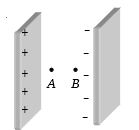
Two protons $A$ and $B$ are placed in the space between the plates of a parallel plate capacitor charged up to $V$ volts (see figure). If the forces on the protons are $F_A$ and $F_B$ respectively,then:
A
$F_A > F_B$
B
$F_A < F_B$
C
$F_A = F_B$
D
Nothing can be said
Solution
(C) The electric field between the plates of a parallel plate capacitor is uniform,meaning its magnitude and direction are the same at every point between the plates.
The force $F$ experienced by a charge $q$ in an electric field $E$ is given by $F = qE$.
Since both $A$ and $B$ are protons,they have the same charge $q = e$.
Because the electric field $E$ is uniform throughout the region between the plates,both protons experience the same force.
Therefore,$F_A = F_B$.
The force $F$ experienced by a charge $q$ in an electric field $E$ is given by $F = qE$.
Since both $A$ and $B$ are protons,they have the same charge $q = e$.
Because the electric field $E$ is uniform throughout the region between the plates,both protons experience the same force.
Therefore,$F_A = F_B$.
0 likes
View Solution21
EasyMCQ
The capacity of a parallel plate capacitor is $15\,\mu F$,when the distance between its plates is $6\,cm$. If the distance between the plates is reduced to $2\,cm$,then the capacity of this parallel plate capacitor will be......$\mu F$.
A
$15$
B
$30$
C
$45$
D
$60$
Solution
(C) The capacitance of a parallel plate capacitor is given by the formula $C = \frac{\epsilon_0 A}{d}$,where $A$ is the area of the plates and $d$ is the distance between them.
From this formula,we can see that $C \propto \frac{1}{d}$.
Given initial capacitance $C_1 = 15\,\mu F$ at distance $d_1 = 6\,cm$.
New distance $d_2 = 2\,cm$.
Using the ratio $\frac{C_2}{C_1} = \frac{d_1}{d_2}$,we get:
$\frac{C_2}{15} = \frac{6}{2}$
$\frac{C_2}{15} = 3$
$C_2 = 15 \times 3 = 45\,\mu F$.
Therefore,the new capacity is $45\,\mu F$.
From this formula,we can see that $C \propto \frac{1}{d}$.
Given initial capacitance $C_1 = 15\,\mu F$ at distance $d_1 = 6\,cm$.
New distance $d_2 = 2\,cm$.
Using the ratio $\frac{C_2}{C_1} = \frac{d_1}{d_2}$,we get:
$\frac{C_2}{15} = \frac{6}{2}$
$\frac{C_2}{15} = 3$
$C_2 = 15 \times 3 = 45\,\mu F$.
Therefore,the new capacity is $45\,\mu F$.
0 likes
View Solution22
MediumMCQ
The capacity of a parallel plate capacitor is $10\,\mu F$,when the distance between its plates is $8\,cm$. If the distance between the plates is reduced to $4\,cm$,then the capacity of this parallel plate capacitor will be.........$\mu F$.
A
$5$
B
$10$
C
$20$
D
$40$
Solution
(C) The capacitance $C$ of a parallel plate capacitor is given by the formula $C = \frac{\epsilon_0 A}{d}$,where $A$ is the area of the plates and $d$ is the distance between them.
From this relation,we can see that $C \propto \frac{1}{d}$.
Therefore,the ratio of the capacitances is $\frac{C_1}{C_2} = \frac{d_2}{d_1}$.
Given: $C_1 = 10\,\mu F$,$d_1 = 8\,cm$,and $d_2 = 4\,cm$.
Substituting these values into the ratio formula: $\frac{10}{C_2} = \frac{4}{8}$.
This simplifies to $\frac{10}{C_2} = \frac{1}{2}$.
Solving for $C_2$,we get $C_2 = 10 \times 2 = 20\,\mu F$.
From this relation,we can see that $C \propto \frac{1}{d}$.
Therefore,the ratio of the capacitances is $\frac{C_1}{C_2} = \frac{d_2}{d_1}$.
Given: $C_1 = 10\,\mu F$,$d_1 = 8\,cm$,and $d_2 = 4\,cm$.
Substituting these values into the ratio formula: $\frac{10}{C_2} = \frac{4}{8}$.
This simplifies to $\frac{10}{C_2} = \frac{1}{2}$.
Solving for $C_2$,we get $C_2 = 10 \times 2 = 20\,\mu F$.
0 likes
View Solution23
EasyMCQ
$A$ parallel plate capacitor has an electric field of $10^5 \, V/m$ between the plates. If the charge on the capacitor plate is $1 \, \mu C$,the force on each capacitor plate is ...... $N$.
A
$0.5$
B
$0.05$
C
$0.005$
D
None of these
Solution
(B) The force $F$ on one plate of a parallel plate capacitor due to the electric field $E$ created by the other plate is given by $F = Q \times E_{plate}$.
Since the total electric field between the plates is $E = E_{plate} + E_{plate} = 2 E_{plate}$,the field due to one plate is $E_{plate} = E/2$.
Therefore,the force on each plate is $F = Q \times (E/2) = (Q \times E) / 2$.
Given $Q = 1 \, \mu C = 10^{-6} \, C$ and $E = 10^5 \, V/m$.
Substituting the values: $F = (10^{-6} \times 10^5) / 2 = 10^{-1} / 2 = 0.1 / 2 = 0.05 \, N$.
Since the total electric field between the plates is $E = E_{plate} + E_{plate} = 2 E_{plate}$,the field due to one plate is $E_{plate} = E/2$.
Therefore,the force on each plate is $F = Q \times (E/2) = (Q \times E) / 2$.
Given $Q = 1 \, \mu C = 10^{-6} \, C$ and $E = 10^5 \, V/m$.
Substituting the values: $F = (10^{-6} \times 10^5) / 2 = 10^{-1} / 2 = 0.1 / 2 = 0.05 \, N$.
0 likes
View Solution24
EasyMCQ
The capacitance of a parallel plate capacitor is $12\,\mu F$. If the distance between the plates is doubled and the area is halved,then the new capacitance will be.........$\mu F$.
A
$8$
B
$6$
C
$4$
D
$3$
Solution
(D) The capacitance of a parallel plate capacitor is given by the formula $C = \frac{\varepsilon_0 A}{d}$.
Given initial capacitance $C = 12\,\mu F$.
When the distance between the plates is doubled,$d' = 2d$.
When the area of the plates is halved,$A' = \frac{A}{2}$.
The new capacitance $C'$ is given by $C' = \frac{\varepsilon_0 A'}{d'} = \frac{\varepsilon_0 (A/2)}{2d} = \frac{1}{4} \left( \frac{\varepsilon_0 A}{d} \right) = \frac{1}{4} C$.
Substituting the value of $C$,we get $C' = \frac{1}{4} \times 12\,\mu F = 3\,\mu F$.
Given initial capacitance $C = 12\,\mu F$.
When the distance between the plates is doubled,$d' = 2d$.
When the area of the plates is halved,$A' = \frac{A}{2}$.
The new capacitance $C'$ is given by $C' = \frac{\varepsilon_0 A'}{d'} = \frac{\varepsilon_0 (A/2)}{2d} = \frac{1}{4} \left( \frac{\varepsilon_0 A}{d} \right) = \frac{1}{4} C$.
Substituting the value of $C$,we get $C' = \frac{1}{4} \times 12\,\mu F = 3\,\mu F$.
0 likes
View Solution25
EasyMCQ
$A$ parallel plate capacitor is made by stacking $n$ equally spaced plates connected alternately. If the capacitance between any two plates is $C$, then the resultant capacitance is:
A
$C$
B
$nC$
C
$(n - 1)C$
D
$(n + 1)C$
Solution
(C) In a stack of $n$ plates connected alternately, the plates form $(n - 1)$ capacitors connected in parallel.
Each pair of adjacent plates acts as a single capacitor with capacitance $C$.
Since these $(n - 1)$ capacitors are connected in parallel, the equivalent capacitance $C_R$ is the sum of individual capacitances.
Therefore, $C_R = C + C + ... + (n - 1) \text{ times} = (n - 1)C$.
Each pair of adjacent plates acts as a single capacitor with capacitance $C$.
Since these $(n - 1)$ capacitors are connected in parallel, the equivalent capacitance $C_R$ is the sum of individual capacitances.
Therefore, $C_R = C + C + ... + (n - 1) \text{ times} = (n - 1)C$.
0 likes
View Solution26
MediumMCQ
The capacitance of a capacitor made by a thin metal foil is $2\,\mu F$. If the foil is folded with paper of thickness $0.15\,mm$,the dielectric constant of the paper is $2.5$,and the width of the paper is $400\,mm$,then the length of the foil will be.....$m$.
A
$0.34$
B
$1.33$
C
$13.4$
D
$33.9$
Solution
(D) The capacitance of a parallel plate capacitor is given by the formula $C = \frac{K \varepsilon_0 A}{d}$,where $A = l \times b$.
Given:
Capacitance $C = 2 \times 10^{-6}\,F$
Dielectric constant $K = 2.5$
Thickness $d = 0.15 \times 10^{-3}\,m$
Width $b = 400 \times 10^{-3}\,m = 0.4\,m$
Permittivity of free space $\varepsilon_0 = 8.85 \times 10^{-12}\,F/m$
Substituting the values into the formula:
$2 \times 10^{-6} = \frac{2.5 \times 8.85 \times 10^{-12} \times (l \times 0.4)}{0.15 \times 10^{-3}}$
$2 \times 10^{-6} = \frac{2.5 \times 8.85 \times 10^{-12} \times 0.4 \times l}{0.15 \times 10^{-3}}$
$2 \times 10^{-6} = \frac{8.85 \times 10^{-12} \times l}{0.15 \times 10^{-3}}$
$l = \frac{2 \times 10^{-6} \times 0.15 \times 10^{-3}}{8.85 \times 10^{-12}}$
$l = \frac{0.3 \times 10^{-9}}{8.85 \times 10^{-12}} = \frac{300}{8.85} \approx 33.9\,m$.
Given:
Capacitance $C = 2 \times 10^{-6}\,F$
Dielectric constant $K = 2.5$
Thickness $d = 0.15 \times 10^{-3}\,m$
Width $b = 400 \times 10^{-3}\,m = 0.4\,m$
Permittivity of free space $\varepsilon_0 = 8.85 \times 10^{-12}\,F/m$
Substituting the values into the formula:
$2 \times 10^{-6} = \frac{2.5 \times 8.85 \times 10^{-12} \times (l \times 0.4)}{0.15 \times 10^{-3}}$
$2 \times 10^{-6} = \frac{2.5 \times 8.85 \times 10^{-12} \times 0.4 \times l}{0.15 \times 10^{-3}}$
$2 \times 10^{-6} = \frac{8.85 \times 10^{-12} \times l}{0.15 \times 10^{-3}}$
$l = \frac{2 \times 10^{-6} \times 0.15 \times 10^{-3}}{8.85 \times 10^{-12}}$
$l = \frac{0.3 \times 10^{-9}}{8.85 \times 10^{-12}} = \frac{300}{8.85} \approx 33.9\,m$.
0 likes
View Solution27
DifficultMCQ
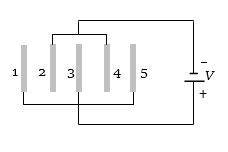
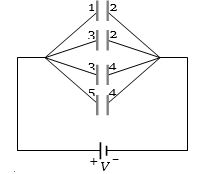
Five identical plates each of area $A$ are joined as shown in the figure. The distance between the plates is $d$. The plates are connected to a potential difference of $V \text{ volts}$. The charge on plates $1$ and $4$ will be
A
$\frac{\varepsilon_0 AV}{d}, \frac{2\varepsilon_0 AV}{d}$
B
$\frac{\varepsilon_0 AV}{d}, \frac{\varepsilon_0 AV}{d}$
C
$\frac{\varepsilon_0 AV}{d}, \frac{-2\varepsilon_0 AV}{d}$
D
$\frac{-\varepsilon_0 AV}{d}, \frac{-2\varepsilon_0 AV}{d}$
Solution
(C) The given circuit consists of $4$ capacitors connected in parallel. Each capacitor is formed by two adjacent plates with area $A$ and separation $d$. The capacitance of each capacitor is $C = \frac{\varepsilon_0 A}{d}$.
Plate $1$ is connected to the positive terminal of the battery. It forms one capacitor with plate $2$. The charge on plate $1$ is $q_1 = +CV = +\frac{\varepsilon_0 AV}{d}$.
Plate $4$ is connected to the negative terminal of the battery. It acts as one plate for two capacitors: one with plate $3$ and one with plate $5$. Since plate $4$ is connected to the negative terminal,the charge on both sides of plate $4$ will be negative. The total charge on plate $4$ is $q_4 = -CV - CV = -2CV = -\frac{2\varepsilon_0 AV}{d}$.
Thus,the charges on plates $1$ and $4$ are $\frac{\varepsilon_0 AV}{d}$ and $-\frac{2\varepsilon_0 AV}{d}$ respectively.
Plate $1$ is connected to the positive terminal of the battery. It forms one capacitor with plate $2$. The charge on plate $1$ is $q_1 = +CV = +\frac{\varepsilon_0 AV}{d}$.
Plate $4$ is connected to the negative terminal of the battery. It acts as one plate for two capacitors: one with plate $3$ and one with plate $5$. Since plate $4$ is connected to the negative terminal,the charge on both sides of plate $4$ will be negative. The total charge on plate $4$ is $q_4 = -CV - CV = -2CV = -\frac{2\varepsilon_0 AV}{d}$.
Thus,the charges on plates $1$ and $4$ are $\frac{\varepsilon_0 AV}{d}$ and $-\frac{2\varepsilon_0 AV}{d}$ respectively.
0 likes
View Solution28
MediumMCQ
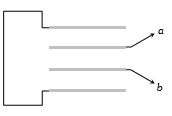
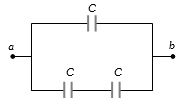
Four metallic plates,each with a surface area of one side $A$,are placed at a distance $d$ from each other. The plates are connected as shown in the circuit diagram. Then the capacitance of the system between $a$ and $b$ is
A
$\frac{3{\varepsilon _0}A}{d}$
B
$\frac{2{\varepsilon _0}A}{d}$
C
$\frac{2{\varepsilon _0}A}{3d}$
D
$\frac{3{\varepsilon _0}A}{2d}$
Solution
(D) Let the capacitance of each pair of adjacent plates be $C = \frac{{\varepsilon _0}A}{d}$.
From the given circuit diagram,we can identify the arrangement of capacitors.
The top plate and the second plate form one capacitor $C_1$.
The second plate and the third plate form another capacitor $C_2$.
The third plate and the fourth plate form a third capacitor $C_3$.
Based on the connections,the capacitor $C_1$ is in parallel with the series combination of $C_2$ and $C_3$.
Thus,the equivalent capacitance is $C_{eq} = C_1 + \frac{C_2 \cdot C_3}{C_2 + C_3} = C + \frac{C \cdot C}{C + C} = C + \frac{C}{2} = \frac{3C}{2}$.
Substituting $C = \frac{{\varepsilon _0}A}{d}$,we get $C_{eq} = \frac{3{\varepsilon _0}A}{2d}$.
From the given circuit diagram,we can identify the arrangement of capacitors.
The top plate and the second plate form one capacitor $C_1$.
The second plate and the third plate form another capacitor $C_2$.
The third plate and the fourth plate form a third capacitor $C_3$.
Based on the connections,the capacitor $C_1$ is in parallel with the series combination of $C_2$ and $C_3$.
Thus,the equivalent capacitance is $C_{eq} = C_1 + \frac{C_2 \cdot C_3}{C_2 + C_3} = C + \frac{C \cdot C}{C + C} = C + \frac{C}{2} = \frac{3C}{2}$.
Substituting $C = \frac{{\varepsilon _0}A}{d}$,we get $C_{eq} = \frac{3{\varepsilon _0}A}{2d}$.
0 likes
View Solution29
DifficultMCQ
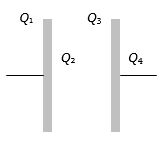
In an isolated parallel plate capacitor of capacitance $C$,the four surfaces have charges $Q_1$,$Q_2$,$Q_3$,and $Q_4$ as shown. The potential difference between the plates is
A
$\frac{Q_1 + Q_2 + Q_3 + Q_4}{2C}$
B
$\frac{Q_2 + Q_3}{2C}$
C
$\frac{Q_2 - Q_3}{2C}$
D
$\frac{Q_1 + Q_4}{2C}$
Solution
(C) For a parallel plate capacitor,the charges on the inner surfaces facing each other must be equal in magnitude and opposite in sign. Therefore,$Q_2 = -Q_3$.
The potential difference $V$ between the plates of a capacitor is given by the ratio of the charge on the inner surface of the positive plate to the capacitance $C$.
$V = \frac{Q_2}{C}$
Since $Q_3 = -Q_2$,we can write $Q_2 = \frac{Q_2 - Q_3}{2}$.
Substituting this into the potential difference formula:
$V = \frac{Q_2 - Q_3}{2C}$
The potential difference $V$ between the plates of a capacitor is given by the ratio of the charge on the inner surface of the positive plate to the capacitance $C$.
$V = \frac{Q_2}{C}$
Since $Q_3 = -Q_2$,we can write $Q_2 = \frac{Q_2 - Q_3}{2}$.
Substituting this into the potential difference formula:
$V = \frac{Q_2 - Q_3}{2C}$
0 likes
View Solution30
DifficultMCQ
The plates of a parallel plate capacitor are pulled apart with a velocity $v$. If at any instant their mutual distance of separation is $d$,then the magnitude of the time rate of change of capacity depends on $d$ as follows:
A
$1/d$
B
$1/d^2$
C
$d^2$
D
$d$
Solution
(B) The capacitance $C$ of a parallel plate capacitor is given by $C = \frac{\varepsilon_0 A}{d}$,where $\varepsilon_0$ is the permittivity of free space,$A$ is the area of the plates,and $d$ is the separation distance.
To find the rate of change of capacitance with respect to time $t$,we differentiate $C$ with respect to $t$:
$\frac{dC}{dt} = \frac{d}{dt} \left( \frac{\varepsilon_0 A}{d} \right) = \varepsilon_0 A \frac{d}{dt} (d^{-1})$.
Using the chain rule,$\frac{dC}{dt} = \varepsilon_0 A (-d^{-2}) \frac{dd}{dt}$.
Since the plates are pulled apart with velocity $v$,the rate of change of separation is $\frac{dd}{dt} = v$.
Substituting this,we get $\frac{dC}{dt} = -\frac{\varepsilon_0 A}{d^2} v$.
The magnitude of the rate of change is $\left| \frac{dC}{dt} \right| = \frac{\varepsilon_0 A v}{d^2}$.
Thus,$\left| \frac{dC}{dt} \right| \propto \frac{1}{d^2}$.
To find the rate of change of capacitance with respect to time $t$,we differentiate $C$ with respect to $t$:
$\frac{dC}{dt} = \frac{d}{dt} \left( \frac{\varepsilon_0 A}{d} \right) = \varepsilon_0 A \frac{d}{dt} (d^{-1})$.
Using the chain rule,$\frac{dC}{dt} = \varepsilon_0 A (-d^{-2}) \frac{dd}{dt}$.
Since the plates are pulled apart with velocity $v$,the rate of change of separation is $\frac{dd}{dt} = v$.
Substituting this,we get $\frac{dC}{dt} = -\frac{\varepsilon_0 A}{d^2} v$.
The magnitude of the rate of change is $\left| \frac{dC}{dt} \right| = \frac{\varepsilon_0 A v}{d^2}$.
Thus,$\left| \frac{dC}{dt} \right| \propto \frac{1}{d^2}$.
0 likes
View Solution31
MediumMCQ
$A$ thin aluminum sheet of negligible thickness is placed between the plates of a parallel plate capacitor. The capacitance of the capacitor:
A
decreases
B
remains unchanged
C
becomes infinite
D
increases
Solution
(D) The capacitance of a parallel plate capacitor with a dielectric slab of thickness $t$ is given by $C = \frac{\epsilon_0 A}{d - t + (t/K)}$.
For a metal sheet (aluminum),the dielectric constant $K$ is infinite $(K = \infty)$.
Given that the thickness $t$ is negligible $(t \approx 0)$,we analyze the effect.
However,if we place a conducting sheet of thickness $t$ inside,the effective distance between the plates becomes $(d - t)$.
The new capacitance is $C' = \frac{\epsilon_0 A}{d - t}$.
Since $(d - t) < d$,the denominator decreases,which means the capacitance $C'$ increases.
Even if the thickness is negligible,the presence of a conducting plate effectively reduces the separation distance between the plates,leading to an increase in capacitance.
For a metal sheet (aluminum),the dielectric constant $K$ is infinite $(K = \infty)$.
Given that the thickness $t$ is negligible $(t \approx 0)$,we analyze the effect.
However,if we place a conducting sheet of thickness $t$ inside,the effective distance between the plates becomes $(d - t)$.
The new capacitance is $C' = \frac{\epsilon_0 A}{d - t}$.
Since $(d - t) < d$,the denominator decreases,which means the capacitance $C'$ increases.
Even if the thickness is negligible,the presence of a conducting plate effectively reduces the separation distance between the plates,leading to an increase in capacitance.
0 likes
View Solution32
EasyMCQ
$A$ parallel plate capacitor is connected to a battery,which maintains a constant potential difference. If the plates of the capacitor are moved further apart,the electric field intensity...
A
decreases and the charge on the plates also decreases.
B
remains constant but the charge on the plates decreases.
C
remains constant but the charge on the plates increases.
D
increases and the charge on the plates decreases.
Solution
(A) The potential difference $V$ across the plates remains constant because the capacitor is connected to a battery.
The electric field $E$ between the plates is given by $E = V/d$,where $d$ is the distance between the plates.
As the plates are moved further apart,$d$ increases,so $E = V/d$ decreases.
The capacitance $C$ of a parallel plate capacitor is given by $C = \epsilon_0 A / d$.
As $d$ increases,the capacitance $C$ decreases.
The charge $Q$ on the plates is given by $Q = CV$.
Since $C$ decreases and $V$ is constant,the charge $Q$ on the plates also decreases.
Therefore,both the electric field intensity and the charge on the plates decrease.
The electric field $E$ between the plates is given by $E = V/d$,where $d$ is the distance between the plates.
As the plates are moved further apart,$d$ increases,so $E = V/d$ decreases.
The capacitance $C$ of a parallel plate capacitor is given by $C = \epsilon_0 A / d$.
As $d$ increases,the capacitance $C$ decreases.
The charge $Q$ on the plates is given by $Q = CV$.
Since $C$ decreases and $V$ is constant,the charge $Q$ on the plates also decreases.
Therefore,both the electric field intensity and the charge on the plates decrease.
0 likes
View Solution33
MediumMCQ
When a test charge placed in the middle of a parallel plate capacitor experiences a force $F$,what will be the force experienced by the same test charge if one plate is removed?
A
$0$
B
$F/2$
C
$F$
D
$2F$
Solution
(B) The electric field $E$ between the plates of a parallel plate capacitor is given by $E = \frac{\sigma}{\epsilon_0}$,where $\sigma$ is the surface charge density.
This field is the superposition of the fields produced by the two individual plates,each contributing $E_{plate} = \frac{\sigma}{2\epsilon_0}$.
Since $F = qE$,the force $F$ experienced by a test charge $q$ is $F = q \left( \frac{\sigma}{\epsilon_0} \right)$.
When one plate is removed,the electric field becomes $E' = \frac{\sigma}{2\epsilon_0}$,which is half of the original field.
Therefore,the new force $F'$ experienced by the test charge is $F' = qE' = q \left( \frac{\sigma}{2\epsilon_0} \right) = \frac{F}{2}$.
This field is the superposition of the fields produced by the two individual plates,each contributing $E_{plate} = \frac{\sigma}{2\epsilon_0}$.
Since $F = qE$,the force $F$ experienced by a test charge $q$ is $F = q \left( \frac{\sigma}{\epsilon_0} \right)$.
When one plate is removed,the electric field becomes $E' = \frac{\sigma}{2\epsilon_0}$,which is half of the original field.
Therefore,the new force $F'$ experienced by the test charge is $F' = qE' = q \left( \frac{\sigma}{2\epsilon_0} \right) = \frac{F}{2}$.
0 likes
View Solution34
EasyMCQ
$A$ parallel plate capacitor is charged by a battery and then the battery is disconnected. If the distance between the plates is increased using an insulated handle,then:
A
The charge on the capacitor increases and the capacitance decreases.
B
The potential difference between the plates increases.
C
The capacitance of the capacitor increases.
D
The energy stored in the capacitor decreases.
Solution
(B) The capacitance of a parallel plate capacitor is given by $C = \frac{\varepsilon_0 A}{d}$.
Since the battery is disconnected,the charge $Q$ on the plates remains constant.
When the distance $d$ between the plates is increased,the capacitance $C$ decreases because $C \propto \frac{1}{d}$.
The potential difference $V$ between the plates is given by $V = \frac{Q}{C}$.
Since $Q$ is constant and $C$ decreases,the potential difference $V$ must increase.
Therefore,the correct statement is that the potential difference between the plates increases.
Since the battery is disconnected,the charge $Q$ on the plates remains constant.
When the distance $d$ between the plates is increased,the capacitance $C$ decreases because $C \propto \frac{1}{d}$.
The potential difference $V$ between the plates is given by $V = \frac{Q}{C}$.
Since $Q$ is constant and $C$ decreases,the potential difference $V$ must increase.
Therefore,the correct statement is that the potential difference between the plates increases.
0 likes
View Solution35
EasyMCQ
The capacitance of a parallel plate capacitor does not depend on which of the following?
A
Area of the plates
B
Medium between the plates
C
Distance between the plates
D
Metal of the plates
Solution
(D) The capacitance $C$ of a parallel plate capacitor is given by the formula:
$C = \frac{K \varepsilon_0 A}{d}$
Where:
$A$ is the area of the plates,
$d$ is the distance between the plates,
$K$ is the dielectric constant of the medium between the plates,
$\varepsilon_0$ is the permittivity of free space.
From this formula,it is evident that the capacitance depends on the area of the plates,the distance between them,and the dielectric medium,but it does not depend on the material (metal) of the plates.
$C = \frac{K \varepsilon_0 A}{d}$
Where:
$A$ is the area of the plates,
$d$ is the distance between the plates,
$K$ is the dielectric constant of the medium between the plates,
$\varepsilon_0$ is the permittivity of free space.
From this formula,it is evident that the capacitance depends on the area of the plates,the distance between them,and the dielectric medium,but it does not depend on the material (metal) of the plates.
0 likes
View Solution36
EasyMCQ
$A$ parallel plate capacitor has rectangular plates of area $400 \, cm^2$ separated by a distance of $2 \, mm$ with air as the medium. If a potential difference of $200 \, V$ is applied across the capacitor,what is the charge on the plates?
A
$3.54 \times 10^{-6} \, C$
B
$3.54 \times 10^{-8} \, C$
C
$3.54 \times 10^{-10} \, C$
D
$1770.8 \times 10^{-13} \, C$
Solution
(B) Given: Area $A = 400 \, cm^2 = 400 \times 10^{-4} \, m^2 = 4 \times 10^{-2} \, m^2$.
Distance $d = 2 \, mm = 2 \times 10^{-3} \, m$.
Potential difference $V = 200 \, V$.
Permittivity of free space $\epsilon_0 = 8.854 \times 10^{-12} \, F/m$.
The capacitance $C$ is given by $C = \frac{\epsilon_0 A}{d}$.
Substituting the values: $C = \frac{8.854 \times 10^{-12} \times 4 \times 10^{-2}}{2 \times 10^{-3}} = 17.708 \times 10^{-11} \, F$.
The charge $Q$ is given by $Q = CV$.
$Q = (17.708 \times 10^{-11}) \times 200 = 3541.6 \times 10^{-11} \, C = 3.5416 \times 10^{-8} \, C$.
Thus,the charge on the plates is approximately $3.54 \times 10^{-8} \, C$.
Distance $d = 2 \, mm = 2 \times 10^{-3} \, m$.
Potential difference $V = 200 \, V$.
Permittivity of free space $\epsilon_0 = 8.854 \times 10^{-12} \, F/m$.
The capacitance $C$ is given by $C = \frac{\epsilon_0 A}{d}$.
Substituting the values: $C = \frac{8.854 \times 10^{-12} \times 4 \times 10^{-2}}{2 \times 10^{-3}} = 17.708 \times 10^{-11} \, F$.
The charge $Q$ is given by $Q = CV$.
$Q = (17.708 \times 10^{-11}) \times 200 = 3541.6 \times 10^{-11} \, C = 3.5416 \times 10^{-8} \, C$.
Thus,the charge on the plates is approximately $3.54 \times 10^{-8} \, C$.
0 likes
View Solution37
MediumMCQ
If the distance between the plates of a capacitor is halved and the area of the plates is doubled,what will be the new capacitance?
A
$C_1$
B
$4C_1$
C
$2C_1$
D
$7C_1$
Solution
(B) The capacitance of a parallel plate capacitor is given by $C = \frac{\varepsilon_0 A}{d}$.
Let the initial capacitance be $C_1 = \frac{\varepsilon_0 A_1}{d_1}$.
Given: New area $A_2 = 2A_1$ and new distance $d_2 = \frac{d_1}{2}$.
The new capacitance $C_2$ is given by $C_2 = \frac{\varepsilon_0 A_2}{d_2}$.
Substituting the values: $C_2 = \frac{\varepsilon_0 (2A_1)}{(d_1/2)} = 4 \times \frac{\varepsilon_0 A_1}{d_1} = 4C_1$.
Let the initial capacitance be $C_1 = \frac{\varepsilon_0 A_1}{d_1}$.
Given: New area $A_2 = 2A_1$ and new distance $d_2 = \frac{d_1}{2}$.
The new capacitance $C_2$ is given by $C_2 = \frac{\varepsilon_0 A_2}{d_2}$.
Substituting the values: $C_2 = \frac{\varepsilon_0 (2A_1)}{(d_1/2)} = 4 \times \frac{\varepsilon_0 A_1}{d_1} = 4C_1$.
0 likes
View Solution38
EasyMCQ
When the distance between the two plates of a parallel plate capacitor is $6\, cm$,its capacitance is $15\ \mu F$. If the distance between the plates is reduced to $2\, cm$,the capacitance of the parallel plate capacitor becomes ... $\mu F$.
A
$15$
B
$30$
C
$45$
D
$60$
Solution
(C) The capacitance of a parallel plate capacitor is given by the formula $C = \frac{\epsilon_0 A}{d}$.
From this,we can see that $C \propto \frac{1}{d}$.
Therefore,the ratio of the capacitances is $\frac{C_1}{C_2} = \frac{d_2}{d_1}$.
Given: $C_1 = 15\ \mu F$,$d_1 = 6\, cm$,and $d_2 = 2\, cm$.
Substituting these values into the ratio formula:
$\frac{15}{C_2} = \frac{2}{6}$
$\frac{15}{C_2} = \frac{1}{3}$
$C_2 = 15 \times 3 = 45\ \mu F$.
Thus,the new capacitance is $45\ \mu F$.
From this,we can see that $C \propto \frac{1}{d}$.
Therefore,the ratio of the capacitances is $\frac{C_1}{C_2} = \frac{d_2}{d_1}$.
Given: $C_1 = 15\ \mu F$,$d_1 = 6\, cm$,and $d_2 = 2\, cm$.
Substituting these values into the ratio formula:
$\frac{15}{C_2} = \frac{2}{6}$
$\frac{15}{C_2} = \frac{1}{3}$
$C_2 = 15 \times 3 = 45\ \mu F$.
Thus,the new capacitance is $45\ \mu F$.
0 likes
View Solution39
MediumMCQ
Find the distance $d$ (in $mm$) between the plates of a parallel plate capacitor with a plate diameter of $40\, mm$,such that its capacitance is equal to the capacitance of a metallic sphere of radius $1\, mm$.
A
$0.01$
B
$0.1$
C
$1$
D
$10$
Solution
(B) The capacitance of a parallel plate capacitor is given by $C_p = \frac{\epsilon_0 A}{d}$,where $A = \pi r^2$ is the area of the plates and $r$ is the radius of the plates.
Given diameter $= 40\, mm$,so radius $r = 20\, mm = 20 \times 10^{-3}\, m$.
The capacitance of an isolated metallic sphere is given by $C_s = 4\pi \epsilon_0 R$,where $R = 1\, mm = 1 \times 10^{-3}\, m$.
Equating the two capacitances: $\frac{\epsilon_0 A}{d} = 4\pi \epsilon_0 R$.
Substituting $A = \pi r^2$: $\frac{\pi r^2}{d} = 4\pi R$.
Solving for $d$: $d = \frac{r^2}{4R}$.
Substituting the values: $d = \frac{(20 \times 10^{-3})^2}{4 \times 1 \times 10^{-3}} = \frac{400 \times 10^{-6}}{4 \times 10^{-3}} = 100 \times 10^{-3}\, m = 0.1\, mm$.
Given diameter $= 40\, mm$,so radius $r = 20\, mm = 20 \times 10^{-3}\, m$.
The capacitance of an isolated metallic sphere is given by $C_s = 4\pi \epsilon_0 R$,where $R = 1\, mm = 1 \times 10^{-3}\, m$.
Equating the two capacitances: $\frac{\epsilon_0 A}{d} = 4\pi \epsilon_0 R$.
Substituting $A = \pi r^2$: $\frac{\pi r^2}{d} = 4\pi R$.
Solving for $d$: $d = \frac{r^2}{4R}$.
Substituting the values: $d = \frac{(20 \times 10^{-3})^2}{4 \times 1 \times 10^{-3}} = \frac{400 \times 10^{-6}}{4 \times 10^{-3}} = 100 \times 10^{-3}\, m = 0.1\, mm$.
0 likes
View Solution40
EasyMCQ
The capacitance of a parallel plate capacitor is $12 \ \mu F$. If the distance between the plates is doubled and the area of the plates is halved,then the new capacitance will be ... $\mu F$.
A
$8$
B
$6$
C
$4$
D
$3$
Solution
(D) The capacitance of a parallel plate capacitor is given by the formula $C = \frac{\varepsilon_0 A}{d}$.
Given initial capacitance $C = 12 \ \mu F$.
When the area $A$ is halved $(A' = A/2)$ and the distance $d$ is doubled $(d' = 2d)$,the new capacitance $C'$ becomes:
$C' = \frac{\varepsilon_0 A'}{d'} = \frac{\varepsilon_0 (A/2)}{2d} = \frac{1}{4} \left( \frac{\varepsilon_0 A}{d} \right)$.
Substituting the initial value of $C$:
$C' = \frac{1}{4} C = \frac{12 \ \mu F}{4} = 3 \ \mu F$.
Given initial capacitance $C = 12 \ \mu F$.
When the area $A$ is halved $(A' = A/2)$ and the distance $d$ is doubled $(d' = 2d)$,the new capacitance $C'$ becomes:
$C' = \frac{\varepsilon_0 A'}{d'} = \frac{\varepsilon_0 (A/2)}{2d} = \frac{1}{4} \left( \frac{\varepsilon_0 A}{d} \right)$.
Substituting the initial value of $C$:
$C' = \frac{1}{4} C = \frac{12 \ \mu F}{4} = 3 \ \mu F$.
0 likes
View Solution41
MediumMCQ
$A$ parallel plate capacitor is to be designed,using a dielectric of dielectric constant $5$,so as to have a dielectric strength of $10^9 \; Vm^{-1}$. If the voltage rating of the capacitor is $12 \; kV$,the minimum area of each plate required to have a capacitance of $80 \; pF$ is
A
$10.5 \times 10^{-6} \; m^2$
B
$25.0 \times 10^{-5} \; m^2$
C
$12.5 \times 10^{-5} \; m^2$
D
$21.7 \times 10^{-6} \; m^2$
Solution
(D) The dielectric strength $E$ is the maximum electric field the dielectric can withstand. The separation $d$ between the plates is given by $d = \frac{V}{E}$.
Substituting the given values,$V = 12 \times 10^3 \; V$ and $E = 10^9 \; Vm^{-1}$,we get $d = \frac{12 \times 10^3}{10^9} = 12 \times 10^{-6} \; m$.
The capacitance of a parallel plate capacitor is $C = \frac{K \varepsilon_0 A}{d}$.
Rearranging for area $A$,we get $A = \frac{C d}{K \varepsilon_0} = \frac{C V}{K E \varepsilon_0}$.
Substituting the values $C = 80 \times 10^{-12} \; F$,$V = 12 \times 10^3 \; V$,$K = 5$,$E = 10^9 \; Vm^{-1}$,and $\varepsilon_0 = 8.85 \times 10^{-12} \; Fm^{-1}$:
$A = \frac{80 \times 10^{-12} \times 12 \times 10^3}{5 \times 10^9 \times 8.85 \times 10^{-12}} = \frac{960 \times 10^{-9}}{44.25 \times 10^{-3}} \approx 21.69 \times 10^{-6} \; m^2$.
Thus,the minimum area is approximately $21.7 \times 10^{-6} \; m^2$.
Substituting the given values,$V = 12 \times 10^3 \; V$ and $E = 10^9 \; Vm^{-1}$,we get $d = \frac{12 \times 10^3}{10^9} = 12 \times 10^{-6} \; m$.
The capacitance of a parallel plate capacitor is $C = \frac{K \varepsilon_0 A}{d}$.
Rearranging for area $A$,we get $A = \frac{C d}{K \varepsilon_0} = \frac{C V}{K E \varepsilon_0}$.
Substituting the values $C = 80 \times 10^{-12} \; F$,$V = 12 \times 10^3 \; V$,$K = 5$,$E = 10^9 \; Vm^{-1}$,and $\varepsilon_0 = 8.85 \times 10^{-12} \; Fm^{-1}$:
$A = \frac{80 \times 10^{-12} \times 12 \times 10^3}{5 \times 10^9 \times 8.85 \times 10^{-12}} = \frac{960 \times 10^{-9}}{44.25 \times 10^{-3}} \approx 21.69 \times 10^{-6} \; m^2$.
Thus,the minimum area is approximately $21.7 \times 10^{-6} \; m^2$.
0 likes
View Solution42
EasyMCQ
$A$ parallel plate capacitor has a plate separation of $2 \ mm$ and is charged by connecting it to a $300 \ V$ battery. What is the energy density in $J/m^3$?
A
$0.01$
B
$0.1$
C
$100$
D
$10$
Solution
(B) The energy density $(u)$ of a parallel plate capacitor is given by the formula:
$u = \frac{1}{2} \epsilon_0 E^2 = \frac{1}{2} \epsilon_0 \left( \frac{V}{d} \right)^2$
Given:
$V = 300 \ V$
$d = 2 \ mm = 2 \times 10^{-3} \ m$
$\epsilon_0 = 8.85 \times 10^{-12} \ F/m$
Substituting the values:
$u = \frac{1}{2} \times 8.85 \times 10^{-12} \times \left( \frac{300}{2 \times 10^{-3}} \right)^2$
$u = 0.5 \times 8.85 \times 10^{-12} \times (1.5 \times 10^5)^2$
$u = 0.5 \times 8.85 \times 10^{-12} \times 2.25 \times 10^{10}$
$u \approx 0.1 \ J/m^3$
$u = \frac{1}{2} \epsilon_0 E^2 = \frac{1}{2} \epsilon_0 \left( \frac{V}{d} \right)^2$
Given:
$V = 300 \ V$
$d = 2 \ mm = 2 \times 10^{-3} \ m$
$\epsilon_0 = 8.85 \times 10^{-12} \ F/m$
Substituting the values:
$u = \frac{1}{2} \times 8.85 \times 10^{-12} \times \left( \frac{300}{2 \times 10^{-3}} \right)^2$
$u = 0.5 \times 8.85 \times 10^{-12} \times (1.5 \times 10^5)^2$
$u = 0.5 \times 8.85 \times 10^{-12} \times 2.25 \times 10^{10}$
$u \approx 0.1 \ J/m^3$
1 likes
View Solution43
EasyMCQ
What is the area of the plates of a capacitor with a capacitance of $3 \ F$? The distance between the two plates is $5 \ mm$.
A
$1.694 \times 10^9 \ m^2$
B
$4.529 \times 10^9 \ m^2$
C
$9.281 \times 10^9 \ m^2$
D
$12.981 \times 10^9 \ m^2$
Solution
(A) The capacitance of a parallel plate capacitor is given by the formula $C = \frac{\varepsilon_0 A}{d}$.
Rearranging the formula to solve for the area $A$,we get $A = \frac{Cd}{\varepsilon_0}$.
Given values are $C = 3 \ F$,$d = 5 \ mm = 5 \times 10^{-3} \ m$,and $\varepsilon_0 = 8.85 \times 10^{-12} \ F/m$.
Substituting these values into the equation:
$A = \frac{3 \times 5 \times 10^{-3}}{8.85 \times 10^{-12}}$
$A = \frac{15 \times 10^{-3}}{8.85 \times 10^{-12}}$
$A \approx 1.694 \times 10^9 \ m^2$.
Rearranging the formula to solve for the area $A$,we get $A = \frac{Cd}{\varepsilon_0}$.
Given values are $C = 3 \ F$,$d = 5 \ mm = 5 \times 10^{-3} \ m$,and $\varepsilon_0 = 8.85 \times 10^{-12} \ F/m$.
Substituting these values into the equation:
$A = \frac{3 \times 5 \times 10^{-3}}{8.85 \times 10^{-12}}$
$A = \frac{15 \times 10^{-3}}{8.85 \times 10^{-12}}$
$A \approx 1.694 \times 10^9 \ m^2$.
0 likes
View Solution44
MediumMCQ
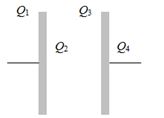
The charges on the four surfaces of two isolated plates with capacitance $C$ are $Q_1$,$Q_2$,$Q_3$,and $Q_4$ as shown in the figure. The potential difference between the plates is:
A
$\frac{Q_1 + Q_2 + Q_3 + Q_4}{2C}$
B
$\frac{Q_2 + Q_3}{2C}$
C
$\frac{Q_2 - Q_3}{2C}$
D
$\frac{Q_1 + Q_4}{2C}$
Solution
(C) For a parallel plate capacitor,the charges on the facing surfaces are equal in magnitude and opposite in sign. Thus,$Q_2 = -Q_3$.
The potential difference $V$ between the plates of a capacitor is given by $V = \frac{Q}{C}$,where $Q$ is the charge on the inner surface of the positive plate.
Here,the charge on the inner surface of the first plate is $Q_2$. Therefore,the potential difference is $V = \frac{Q_2}{C}$.
Since $Q_2 = -Q_3$,we can write $Q_2 = \frac{Q_2 - Q_3}{2}$.
Substituting this into the potential formula:
$V = \frac{Q_2 - Q_3}{2C}$.
The potential difference $V$ between the plates of a capacitor is given by $V = \frac{Q}{C}$,where $Q$ is the charge on the inner surface of the positive plate.
Here,the charge on the inner surface of the first plate is $Q_2$. Therefore,the potential difference is $V = \frac{Q_2}{C}$.
Since $Q_2 = -Q_3$,we can write $Q_2 = \frac{Q_2 - Q_3}{2}$.
Substituting this into the potential formula:
$V = \frac{Q_2 - Q_3}{2C}$.
0 likes
View Solution45
MediumMCQ
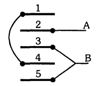
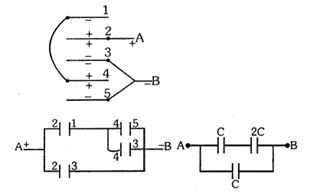
Five identical metal plates,each of area $A$,are arranged parallel to each other at a constant distance $d$ apart. Plates $1$ and $4$ are connected by a wire,and plates $3$ and $5$ are connected by a wire as shown in the figure. Find the equivalent capacitance of the system between points $A$ and $B$.
A
$\frac{5{\varepsilon _0}A}{d}$
B
$\frac{4{\varepsilon _0}A}{d}$
C
$\frac{5{\varepsilon _0}A}{3d}$
D
None of these
Solution
(B) Let $C = \frac{{\varepsilon _0}A}{d}$ be the capacitance of a single pair of adjacent plates.
From the circuit diagram,we identify the capacitors formed between the plates:
$1$. Capacitor between plate $2$ and $1$ (connected to $A$ and $B$ respectively).
$2$. Capacitor between plate $2$ and $3$ (connected to $A$ and $B$ respectively).
$3$. Capacitor between plate $4$ and $3$ (connected to $A$ and $B$ respectively).
$4$. Capacitor between plate $4$ and $5$ (connected to $A$ and $B$ respectively).
Analyzing the connections: Plate $2$ is at potential $A$. Plates $1, 3, 5$ are connected to $B$. Plate $4$ is connected to $1$,so it is also at potential $B$.
Thus,we have capacitors between $(2,1)$,$(2,3)$,$(4,3)$,and $(4,5)$.
Since $1, 3, 5$ are all at potential $B$ and $2$ is at $A$,we have capacitors $C_{21}, C_{23}$ in parallel. Also,$4$ is at $B$,so $C_{43}$ and $C_{45}$ are in parallel.
Wait,looking at the diagram: $2$ is connected to $A$. $1, 3, 4, 5$ are connected to $B$.
Actually,the plates form capacitors: $C_{21}$ (between $2$ and $1$),$C_{23}$ (between $2$ and $3$),$C_{43}$ (between $4$ and $3$),$C_{45}$ (between $4$ and $5$).
Since $1, 3, 5$ are connected to $B$ and $4$ is connected to $1$,all plates $1, 3, 4, 5$ are at potential $B$. Plate $2$ is at $A$.
This results in $4$ capacitors in parallel: $C_{eq} = C_{21} + C_{23} + C_{43} + C_{45} = 4C = \frac{4{\varepsilon _0}A}{d}$.
From the circuit diagram,we identify the capacitors formed between the plates:
$1$. Capacitor between plate $2$ and $1$ (connected to $A$ and $B$ respectively).
$2$. Capacitor between plate $2$ and $3$ (connected to $A$ and $B$ respectively).
$3$. Capacitor between plate $4$ and $3$ (connected to $A$ and $B$ respectively).
$4$. Capacitor between plate $4$ and $5$ (connected to $A$ and $B$ respectively).
Analyzing the connections: Plate $2$ is at potential $A$. Plates $1, 3, 5$ are connected to $B$. Plate $4$ is connected to $1$,so it is also at potential $B$.
Thus,we have capacitors between $(2,1)$,$(2,3)$,$(4,3)$,and $(4,5)$.
Since $1, 3, 5$ are all at potential $B$ and $2$ is at $A$,we have capacitors $C_{21}, C_{23}$ in parallel. Also,$4$ is at $B$,so $C_{43}$ and $C_{45}$ are in parallel.
Wait,looking at the diagram: $2$ is connected to $A$. $1, 3, 4, 5$ are connected to $B$.
Actually,the plates form capacitors: $C_{21}$ (between $2$ and $1$),$C_{23}$ (between $2$ and $3$),$C_{43}$ (between $4$ and $3$),$C_{45}$ (between $4$ and $5$).
Since $1, 3, 5$ are connected to $B$ and $4$ is connected to $1$,all plates $1, 3, 4, 5$ are at potential $B$. Plate $2$ is at $A$.
This results in $4$ capacitors in parallel: $C_{eq} = C_{21} + C_{23} + C_{43} + C_{45} = 4C = \frac{4{\varepsilon _0}A}{d}$.
0 likes
View Solution46
MediumMCQ
$A$ parallel plate capacitor is formed by connecting $n$ plates placed at equal distances alternately. If the capacitance between any two adjacent plates is $C$,find the resultant capacitance.
A
$(n - 1)C$
B
$(n + 1)C$
C
$C$
D
$nC$
Solution
(A) In a system of $n$ plates connected alternately,we form $(n - 1)$ capacitors in parallel.
Each capacitor is formed by two adjacent plates,and the capacitance of each such pair is given as $C$.
Since the plates are connected alternately,all these $(n - 1)$ capacitors are connected in parallel.
The equivalent capacitance $C_{eq}$ for capacitors in parallel is the sum of individual capacitances:
$C_{eq} = C_1 + C_2 + ... + C_{n-1}$
Since each $C_i = C$,we have:
$C_{eq} = (n - 1)C$.
Each capacitor is formed by two adjacent plates,and the capacitance of each such pair is given as $C$.
Since the plates are connected alternately,all these $(n - 1)$ capacitors are connected in parallel.
The equivalent capacitance $C_{eq}$ for capacitors in parallel is the sum of individual capacitances:
$C_{eq} = C_1 + C_2 + ... + C_{n-1}$
Since each $C_i = C$,we have:
$C_{eq} = (n - 1)C$.
0 likes
View Solution47
EasyMCQ
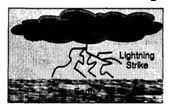
$A$ large cloud of size $5 \, km \times 5 \, km$ is hovering over the Earth at a height of $1 \, km$. Assuming the cloud and the Earth form a parallel plate capacitor with air as the dielectric,calculate the capacitance of the cloud-Earth system in $\mu F$.
A
$0$
B
Infinite
C
$0.22$
D
$711$
Solution
(C) The capacitance $C$ of a parallel plate capacitor is given by the formula $C = \frac{\epsilon_0 A}{d}$.
Here,the area $A = 5 \, km \times 5 \, km = (5 \times 10^3 \, m) \times (5 \times 10^3 \, m) = 25 \times 10^6 \, m^2$.
The distance $d = 1 \, km = 10^3 \, m$.
The permittivity of free space $\epsilon_0 = 8.854 \times 10^{-12} \, F/m$.
Substituting these values into the formula:
$C = \frac{8.854 \times 10^{-12} \times 25 \times 10^6}{10^3}$
$C = 8.854 \times 25 \times 10^{-12+6-3}$
$C = 221.35 \times 10^{-9} \, F$
$C = 0.22135 \times 10^{-6} \, F = 0.22 \, \mu F$.
Here,the area $A = 5 \, km \times 5 \, km = (5 \times 10^3 \, m) \times (5 \times 10^3 \, m) = 25 \times 10^6 \, m^2$.
The distance $d = 1 \, km = 10^3 \, m$.
The permittivity of free space $\epsilon_0 = 8.854 \times 10^{-12} \, F/m$.
Substituting these values into the formula:
$C = \frac{8.854 \times 10^{-12} \times 25 \times 10^6}{10^3}$
$C = 8.854 \times 25 \times 10^{-12+6-3}$
$C = 221.35 \times 10^{-9} \, F$
$C = 0.22135 \times 10^{-6} \, F = 0.22 \, \mu F$.
0 likes
View Solution48
DifficultMCQ
$A$ parallel plate capacitor is made of two plates with a diameter of $4 \ cm$. What should be the distance between the two plates so that its capacitance is equal to the capacitance of a sphere with a diameter of $20 \ cm$?
A
$4 \times 10^{-3} \ m$
B
$1 \times 10^{-3} \ m$
C
$1 \ cm$
D
$1 \times 10^{-3} \ cm$
Solution
(B) The capacitance of a parallel plate capacitor is given by $C = \frac{\varepsilon_0 A}{d}$,where $A = \pi r^2$ is the area of the plate.
Given diameter of the plate is $4 \ cm$,so radius $r = 2 \ cm = 2 \times 10^{-2} \ m$.
Area $A = \pi (2 \times 10^{-2})^2 = 4\pi \times 10^{-4} \ m^2$.
The capacitance of a sphere of radius $R$ is $C = 4\pi \varepsilon_0 R$.
Given diameter of the sphere is $20 \ cm$,so radius $R = 10 \ cm = 0.1 \ m$.
Equating the two capacitances: $\frac{\varepsilon_0 A}{d} = 4\pi \varepsilon_0 R$.
$\frac{A}{d} = 4\pi R$.
$d = \frac{A}{4\pi R} = \frac{4\pi \times 10^{-4}}{4\pi \times 0.1} = \frac{10^{-4}}{10^{-1}} = 10^{-3} \ m$.
Given diameter of the plate is $4 \ cm$,so radius $r = 2 \ cm = 2 \times 10^{-2} \ m$.
Area $A = \pi (2 \times 10^{-2})^2 = 4\pi \times 10^{-4} \ m^2$.
The capacitance of a sphere of radius $R$ is $C = 4\pi \varepsilon_0 R$.
Given diameter of the sphere is $20 \ cm$,so radius $R = 10 \ cm = 0.1 \ m$.
Equating the two capacitances: $\frac{\varepsilon_0 A}{d} = 4\pi \varepsilon_0 R$.
$\frac{A}{d} = 4\pi R$.
$d = \frac{A}{4\pi R} = \frac{4\pi \times 10^{-4}}{4\pi \times 0.1} = \frac{10^{-4}}{10^{-1}} = 10^{-3} \ m$.
0 likes
View Solution49
EasyMCQ
What is the energy density of a parallel plate capacitor with area $A$ and charge $Q$?
A
$\frac{Q^2}{2\varepsilon_0 A^2}$
B
$\frac{Q}{2\varepsilon_0 A^2}$
C
$\frac{Q^2}{2\varepsilon_0 A}$
D
None of these
Solution
(A) The energy density $u$ of an electric field is given by $u = \frac{1}{2} \varepsilon_0 E^2$.
For a parallel plate capacitor,the electric field $E$ between the plates is $E = \frac{\sigma}{\varepsilon_0} = \frac{Q}{A \varepsilon_0}$.
Substituting this value of $E$ into the energy density formula:
$u = \frac{1}{2} \varepsilon_0 \left( \frac{Q}{A \varepsilon_0} \right)^2$
$u = \frac{1}{2} \varepsilon_0 \left( \frac{Q^2}{A^2 \varepsilon_0^2} \right)$
$u = \frac{Q^2}{2 \varepsilon_0 A^2}$.
For a parallel plate capacitor,the electric field $E$ between the plates is $E = \frac{\sigma}{\varepsilon_0} = \frac{Q}{A \varepsilon_0}$.
Substituting this value of $E$ into the energy density formula:
$u = \frac{1}{2} \varepsilon_0 \left( \frac{Q}{A \varepsilon_0} \right)^2$
$u = \frac{1}{2} \varepsilon_0 \left( \frac{Q^2}{A^2 \varepsilon_0^2} \right)$
$u = \frac{Q^2}{2 \varepsilon_0 A^2}$.
0 likes
View Solution50
DifficultMCQ
$A$ capacitor of capacitance $C$ with a distance $d$ between its plates is connected to a battery of $V$ volts. What is the force acting between the two plates?
A
$\frac{CV^2}{2d}$
B
$\frac{C^2V^2}{2d^2}$
C
$\frac{C^2V^2}{d^2}$
D
$\frac{V^2d}{C}$
Solution
(A) The force $F$ between the plates of a parallel plate capacitor is given by $F = \frac{Q^2}{2\varepsilon_0 A}$.
Since the charge $Q = CV$,we substitute this into the formula:
$F = \frac{(CV)^2}{2\varepsilon_0 A} = \frac{C^2V^2}{2\varepsilon_0 A}$.
We know that the capacitance $C = \frac{\varepsilon_0 A}{d}$,which implies $\varepsilon_0 A = Cd$.
Substituting $\varepsilon_0 A = Cd$ into the force equation:
$F = \frac{C^2V^2}{2(Cd)} = \frac{CV^2}{2d}$.
Thus,the force acting between the plates is $\frac{CV^2}{2d}$.
Since the charge $Q = CV$,we substitute this into the formula:
$F = \frac{(CV)^2}{2\varepsilon_0 A} = \frac{C^2V^2}{2\varepsilon_0 A}$.
We know that the capacitance $C = \frac{\varepsilon_0 A}{d}$,which implies $\varepsilon_0 A = Cd$.
Substituting $\varepsilon_0 A = Cd$ into the force equation:
$F = \frac{C^2V^2}{2(Cd)} = \frac{CV^2}{2d}$.
Thus,the force acting between the plates is $\frac{CV^2}{2d}$.
0 likes
View SolutionElectric Potential and Capacitance — Parallel Plate Capacitor · Frequently Asked Questions
1Are these Electric Potential and Capacitance questions useful for JEE and NEET?
Yes. All questions in this section are mapped to JEE Main and NEET exam patterns. Previous year questions from JEE Main, NEET, GUJCET and state-level exams are included with full solutions.
2Can I switch to Hindi or Gujarati for these questions?
Yes. Use the language tabs in the hero section or the sidebar to view the same questions and solutions in English, Hindi or Gujarati.
3How do I generate a question paper from this subtopic?
Use the Vedclass Exam Paper Generator — select the chapter and subtopic, set difficulty, and generate Sets A, B, C, D automatically. First 3 chapters of every subject are free.
Vedclass Products
For Students
Vedclass Test Series
Mock tests in real JEE/NEET style with performance analysis. 5-day free trial.
Start Free TrialFor Teachers
Exam Paper Generator
Generate Set A/B/C/D papers from this chapter in 2 minutes. 3 chapters free.
Try FreeFor Institutes
Online Exam Module
Live online exams with unlimited students, 360° analytics & white-label branding.
See DemoFor Teachers & Institutes
Generate a Electric Potential and Capacitance Exam Paper in 2 Minutes
Select subtopic & difficulty — Sets A, B, C, D auto-generated with No Repeat logic.
First 3 chapters of every subject are free — no payment required.