
A English
Electric potential Questions in English
Class 12 Physics · Electric Potential and Capacitance · Electric potential
432+
Questions
English
Language
100%
With Solutions
Showing 50 of 432 questions in English
1
EasyMCQ
Electron volt is a unit of
A
Charge
B
Potential difference
C
Momentum
D
Energy
Solution
(D) The electron volt (symbol $eV$) is a unit of energy equal to approximately $1.602 \times 10^{-19} \text{ J}$.
By definition,it is the amount of energy gained by the charge of a single electron when it is moved across an electric potential difference of $1 \text{ V}$.
Since it represents the work done or energy transferred,it is a unit of energy.
Hence,the correct option is $D$.
By definition,it is the amount of energy gained by the charge of a single electron when it is moved across an electric potential difference of $1 \text{ V}$.
Since it represents the work done or energy transferred,it is a unit of energy.
Hence,the correct option is $D$.
0 likes
View Solution2
EasyMCQ
$1\,eV$ is
A
Same as one joule
B
$1.6 \times 10^{-19}\,J$
C
$1\,V$
D
$1.6 \times 10^{-19}\,C$
Solution
(B) The electron volt $(eV)$ is a unit of energy.
By definition,$1\,eV$ is the amount of kinetic energy gained by a single electron accelerating from rest through an electric potential difference of $1\,volt$.
Since the charge of an electron is $q = 1.6 \times 10^{-19}\,C$ and the potential difference is $V = 1\,V$,the energy $E$ is given by:
$E = q \times V = (1.6 \times 10^{-19}\,C) \times (1\,V) = 1.6 \times 10^{-19}\,J$.
Therefore,the correct option is $B$.
By definition,$1\,eV$ is the amount of kinetic energy gained by a single electron accelerating from rest through an electric potential difference of $1\,volt$.
Since the charge of an electron is $q = 1.6 \times 10^{-19}\,C$ and the potential difference is $V = 1\,V$,the energy $E$ is given by:
$E = q \times V = (1.6 \times 10^{-19}\,C) \times (1\,V) = 1.6 \times 10^{-19}\,J$.
Therefore,the correct option is $B$.
0 likes
View Solution3
MediumMCQ
The dimensions of electric potential are
A
$[M L^2 T^{-2} Q^{-1}]$
B
$[M L T^{-2} Q^{-1}]$
C
$[M L^2 T^{-1} Q]$
D
$[M L^2 T^{-2} Q]$
Solution
(A) Electric potential $V$ is defined as the work done $W$ per unit charge $Q$,given by the formula $V = \frac{W}{Q}$.
The dimensional formula for work $W$ is $[M L^2 T^{-2}]$.
The dimensional formula for charge $Q$ is $[Q]$.
Substituting these into the formula:
$V = \frac{[M L^2 T^{-2}]}{[Q]} = [M L^2 T^{-2} Q^{-1}]$.
Therefore,the correct option is $A$.
The dimensional formula for work $W$ is $[M L^2 T^{-2}]$.
The dimensional formula for charge $Q$ is $[Q]$.
Substituting these into the formula:
$V = \frac{[M L^2 T^{-2}]}{[Q]} = [M L^2 T^{-2} Q^{-1}]$.
Therefore,the correct option is $A$.
0 likes
View Solution4
EasyMCQ
The energy which an $e^-$ acquires when accelerated through a potential difference of $1 \, V$ is called:
A
$1 \, J$
B
$1 \, eV$
C
$1 \, erg$
D
$1 \, W$
Solution
(B) The kinetic energy $K.E.$ acquired by a charged particle accelerated through a potential difference $V$ is given by the formula $K.E. = qV$.
For an electron,the charge $q = e = 1.6 \times 10^{-19} \, C$.
Given the potential difference $V = 1 \, V$.
Therefore,the energy acquired is $K.E. = (1.6 \times 10^{-19} \, C) \times (1 \, V) = 1.6 \times 10^{-19} \, J$.
By definition,this amount of energy is known as $1 \, eV$ (electron volt).
For an electron,the charge $q = e = 1.6 \times 10^{-19} \, C$.
Given the potential difference $V = 1 \, V$.
Therefore,the energy acquired is $K.E. = (1.6 \times 10^{-19} \, C) \times (1 \, V) = 1.6 \times 10^{-19} \, J$.
By definition,this amount of energy is known as $1 \, eV$ (electron volt).
0 likes
View Solution5
EasyMCQ
$A$ particle of mass $m$ and charge $q$ is accelerated through a potential difference of $V$ volt. Its energy is
A
$qV$
B
$mqV$
C
$(q/m)V$
D
$q/(mV)$
Solution
(A) When a particle of charge $q$ is accelerated through a potential difference $V$,the work done on the particle by the electric field is given by $W = qV$.
According to the work-energy theorem,this work done is equal to the change in the kinetic energy of the particle.
Assuming the particle starts from rest,its final kinetic energy $K$ is equal to the work done.
Therefore,$K = qV$.
According to the work-energy theorem,this work done is equal to the change in the kinetic energy of the particle.
Assuming the particle starts from rest,its final kinetic energy $K$ is equal to the work done.
Therefore,$K = qV$.
0 likes
View Solution6
EasyMCQ
Inside a hollow charged spherical conductor,the potential
A
Is constant
B
Varies directly as the distance from the centre
C
Varies inversely as the distance from the centre
D
Varies inversely as the square of the distance from the centre
Solution
(A) For a hollow charged spherical conductor of radius $R$ and charge $Q$,the electric field $E$ inside the conductor is zero $(E = 0)$.
Since the electric field is the negative gradient of the potential $(E = -dV/dr)$,if $E = 0$,then $dV/dr = 0$.
This implies that the potential $V$ is constant throughout the interior of the conductor.
The value of this constant potential is equal to the potential at the surface,which is $V = \frac{1}{4\pi\epsilon_0} \frac{Q}{R}$.
Since the electric field is the negative gradient of the potential $(E = -dV/dr)$,if $E = 0$,then $dV/dr = 0$.
This implies that the potential $V$ is constant throughout the interior of the conductor.
The value of this constant potential is equal to the potential at the surface,which is $V = \frac{1}{4\pi\epsilon_0} \frac{Q}{R}$.
0 likes
View Solution7
EasyMCQ
Two charged spheres of radii $10\, cm$ and $15\, cm$ are connected by a thin wire. No current will flow,if they have
A
The same charge on each
B
The same potential
C
The same energy
D
The same field on their surfaces
Solution
(B) Electric charge flows between two conductors only when there is a potential difference between them.
When two charged spheres are connected by a thin wire,charge will flow from the sphere at a higher potential to the sphere at a lower potential.
This flow of charge continues until both spheres reach the same electrical potential.
Once the potentials are equal,the potential difference becomes zero,and consequently,no further current (charge flow) will occur.
Therefore,no current will flow if they have the same potential.
When two charged spheres are connected by a thin wire,charge will flow from the sphere at a higher potential to the sphere at a lower potential.
This flow of charge continues until both spheres reach the same electrical potential.
Once the potentials are equal,the potential difference becomes zero,and consequently,no further current (charge flow) will occur.
Therefore,no current will flow if they have the same potential.
0 likes
View Solution8
EasyMCQ
$A$ hollow metal sphere of radius $5\, cm$ is charged such that the potential on its surface is $10\, V$. The potential at the centre of the sphere is
A
$0\, V$
B
$10\, V$
C
Same as at a point $5\, cm$ away from the surface
D
Same as at a point $25\, cm$ away from the surface
Solution
(B) For a charged hollow metal sphere,the electric field inside the sphere is zero $(E = 0)$.
Since the electric field is the negative gradient of the potential $(E = -dV/dr)$,if $E = 0$,then the potential $V$ must be constant throughout the interior of the sphere.
Therefore,the potential at any point inside the sphere,including the centre,is equal to the potential on its surface.
Given that the potential on the surface is $10\, V$,the potential at the centre is also $10\, V$.
Since the electric field is the negative gradient of the potential $(E = -dV/dr)$,if $E = 0$,then the potential $V$ must be constant throughout the interior of the sphere.
Therefore,the potential at any point inside the sphere,including the centre,is equal to the potential on its surface.
Given that the potential on the surface is $10\, V$,the potential at the centre is also $10\, V$.
0 likes
View Solution9
MediumMCQ
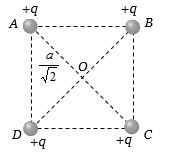
Charges of $+ \frac{10}{3} \times 10^{-9} \, C$ are placed at each of the four corners of a square of side $8 \, cm$. The potential at the intersection of the diagonals is
A
$150\sqrt{2} \, V$
B
$1500\sqrt{2} \, V$
C
$900\sqrt{2} \, V$
D
$900 \, V$
Solution
(B) The potential $V$ at the center $O$ of the square due to four identical charges $q$ at the corners is given by the sum of potentials due to each charge.
$V = 4 \times \frac{1}{4\pi \varepsilon_0} \cdot \frac{q}{r}$,where $r$ is the distance from each corner to the center.
For a square of side $a = 8 \, cm = 8 \times 10^{-2} \, m$,the distance $r$ from the corner to the center is half the diagonal length:
$r = \frac{a\sqrt{2}}{2} = \frac{a}{\sqrt{2}} = \frac{8 \times 10^{-2}}{\sqrt{2}} \, m$.
Given $q = \frac{10}{3} \times 10^{-9} \, C$ and $\frac{1}{4\pi \varepsilon_0} = 9 \times 10^9 \, N \cdot m^2/C^2$.
Substituting the values:
$V = 4 \times (9 \times 10^9) \times \frac{\frac{10}{3} \times 10^{-9}}{\frac{8 \times 10^{-2}}{\sqrt{2}}}$
$V = 4 \times 9 \times 10^9 \times \frac{10}{3} \times 10^{-9} \times \frac{\sqrt{2}}{8 \times 10^{-2}}$
$V = 120 \times \frac{\sqrt{2}}{8 \times 10^{-2}} = 15 \times 10^2 \times \sqrt{2} = 1500\sqrt{2} \, V$.
$V = 4 \times \frac{1}{4\pi \varepsilon_0} \cdot \frac{q}{r}$,where $r$ is the distance from each corner to the center.
For a square of side $a = 8 \, cm = 8 \times 10^{-2} \, m$,the distance $r$ from the corner to the center is half the diagonal length:
$r = \frac{a\sqrt{2}}{2} = \frac{a}{\sqrt{2}} = \frac{8 \times 10^{-2}}{\sqrt{2}} \, m$.
Given $q = \frac{10}{3} \times 10^{-9} \, C$ and $\frac{1}{4\pi \varepsilon_0} = 9 \times 10^9 \, N \cdot m^2/C^2$.
Substituting the values:
$V = 4 \times (9 \times 10^9) \times \frac{\frac{10}{3} \times 10^{-9}}{\frac{8 \times 10^{-2}}{\sqrt{2}}}$
$V = 4 \times 9 \times 10^9 \times \frac{10}{3} \times 10^{-9} \times \frac{\sqrt{2}}{8 \times 10^{-2}}$
$V = 120 \times \frac{\sqrt{2}}{8 \times 10^{-2}} = 15 \times 10^2 \times \sqrt{2} = 1500\sqrt{2} \, V$.
0 likes
View Solution10
EasyMCQ
$A$ conductor with a positive charge:
A
Is always at $ +ve $ potential
B
Is always at zero potential
C
Is always at negative potential
D
May be at $ +ve $,zero or $ -ve $ potential
Solution
(D) The electric potential of a conductor depends on the reference point chosen for zero potential.
If a positively charged conductor is placed in the vicinity of other charges,its potential is determined by the superposition of the potential due to its own charge and the potential due to external charges.
By choosing an appropriate reference point or placing the conductor in an external electric field,the potential of a positively charged conductor can be made positive,zero,or even negative.
Therefore,the correct option is $(d)$.
If a positively charged conductor is placed in the vicinity of other charges,its potential is determined by the superposition of the potential due to its own charge and the potential due to external charges.
By choosing an appropriate reference point or placing the conductor in an external electric field,the potential of a positively charged conductor can be made positive,zero,or even negative.
Therefore,the correct option is $(d)$.
0 likes
View Solution11
MediumMCQ
Three particles,each having a charge of $10\,\mu C$,are placed at the corners of an equilateral triangle of side $10\,cm$. The electrostatic potential energy of the system is.....$J$ (Given $\frac{1}{4\pi\varepsilon_0} = 9 \times 10^9\,N\cdot m^2/C^2$).
A
$0$
B
Infinite
C
$27$
D
$100$
Solution
(C) The electrostatic potential energy of a system of point charges is given by the sum of the potential energies of all distinct pairs of charges: $U = \sum \frac{1}{4\pi\varepsilon_0} \frac{q_i q_j}{r_{ij}}$.
For an equilateral triangle with three identical charges $q = 10\,\mu C = 10^{-5}\,C$ and side length $r = 10\,cm = 0.1\,m$,there are three identical pairs.
$U_{system} = 3 \times \left( \frac{1}{4\pi\varepsilon_0} \frac{q^2}{r} \right)$.
Substituting the values: $U_{system} = 3 \times (9 \times 10^9) \times \frac{(10^{-5})^2}{0.1}$.
$U_{system} = 27 \times 10^9 \times \frac{10^{-10}}{0.1} = 27 \times 10^9 \times 10^{-9} = 27\,J$.
For an equilateral triangle with three identical charges $q = 10\,\mu C = 10^{-5}\,C$ and side length $r = 10\,cm = 0.1\,m$,there are three identical pairs.
$U_{system} = 3 \times \left( \frac{1}{4\pi\varepsilon_0} \frac{q^2}{r} \right)$.
Substituting the values: $U_{system} = 3 \times (9 \times 10^9) \times \frac{(10^{-5})^2}{0.1}$.
$U_{system} = 27 \times 10^9 \times \frac{10^{-10}}{0.1} = 27 \times 10^9 \times 10^{-9} = 27\,J$.
0 likes
View Solution12
MediumMCQ
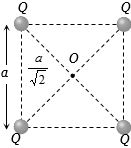
Four equal charges $Q$ are placed at the four corners of a square of side length $a$. The work done in removing a charge $-Q$ from its center to infinity is
A
$0$
B
$\frac{\sqrt{2} Q^2}{4\pi \varepsilon_0 a}$
C
$\frac{\sqrt{2} Q^2}{\pi \varepsilon_0 a}$
D
$\frac{Q^2}{2\pi \varepsilon_0 a}$
Solution
(C) The distance of each corner from the center $O$ of the square is $r = \frac{a}{\sqrt{2}}$.
The electric potential $V_O$ at the center $O$ due to the four charges $Q$ at the corners is:
$V_O = 4 \times \left( \frac{1}{4\pi \varepsilon_0} \cdot \frac{Q}{r} \right) = 4 \times \left( \frac{Q}{4\pi \varepsilon_0 (a/\sqrt{2})} \right) = \frac{4\sqrt{2} Q}{4\pi \varepsilon_0 a} = \frac{\sqrt{2} Q}{\pi \varepsilon_0 a}$.
The work done $W$ in moving a charge $q = -Q$ from the center to infinity is given by $W = q(V_{\infty} - V_O)$.
Since the potential at infinity $V_{\infty} = 0$,we have:
$W = (-Q)(0 - V_O) = Q V_O$.
Substituting the value of $V_O$:
$W = Q \times \left( \frac{\sqrt{2} Q}{\pi \varepsilon_0 a} \right) = \frac{\sqrt{2} Q^2}{\pi \varepsilon_0 a}$.
The electric potential $V_O$ at the center $O$ due to the four charges $Q$ at the corners is:
$V_O = 4 \times \left( \frac{1}{4\pi \varepsilon_0} \cdot \frac{Q}{r} \right) = 4 \times \left( \frac{Q}{4\pi \varepsilon_0 (a/\sqrt{2})} \right) = \frac{4\sqrt{2} Q}{4\pi \varepsilon_0 a} = \frac{\sqrt{2} Q}{\pi \varepsilon_0 a}$.
The work done $W$ in moving a charge $q = -Q$ from the center to infinity is given by $W = q(V_{\infty} - V_O)$.
Since the potential at infinity $V_{\infty} = 0$,we have:
$W = (-Q)(0 - V_O) = Q V_O$.
Substituting the value of $V_O$:
$W = Q \times \left( \frac{\sqrt{2} Q}{\pi \varepsilon_0 a} \right) = \frac{\sqrt{2} Q^2}{\pi \varepsilon_0 a}$.
0 likes
View Solution13
MediumMCQ
Four identical charges $+50\,\mu C$ each are placed,one at each corner of a square of side $2\,m$. How much external energy is required to bring another charge of $+50\,\mu C$ from infinity to the centre of the square? (Given $\frac{1}{4\pi\varepsilon_0} = 9 \times 10^9\,\frac{N\cdot m^2}{C^2}$)
A
$64$
B
$41$
C
$16$
D
$10$
Solution
(A) The side of the square is $a = 2\,m$. The distance from any corner to the centre of the square is $r = \frac{a}{\sqrt{2}} = \frac{2}{\sqrt{2}} = \sqrt{2}\,m$.
Potential at the centre due to one charge $q = 50\,\mu C$ is $V_1 = \frac{1}{4\pi\varepsilon_0} \frac{q}{r} = 9 \times 10^9 \times \frac{50 \times 10^{-6}}{\sqrt{2}} = \frac{45 \times 10^4}{\sqrt{2}}\,V$.
Since there are four identical charges at the corners,the total potential at the centre is $V = 4 \times V_1 = 4 \times \frac{45 \times 10^4}{\sqrt{2}} = 180 \times 10^4 \times \frac{1}{\sqrt{2}} = 90\sqrt{2} \times 10^4\,V$.
The work done $W$ to bring a charge $q' = 50\,\mu C$ from infinity to the centre is $W = q'V$.
$W = (50 \times 10^{-6}) \times (90\sqrt{2} \times 10^4) = 4500\sqrt{2} \times 10^{-2} = 45\sqrt{2} \approx 45 \times 1.414 = 63.63\,J \approx 64\,J$.
Potential at the centre due to one charge $q = 50\,\mu C$ is $V_1 = \frac{1}{4\pi\varepsilon_0} \frac{q}{r} = 9 \times 10^9 \times \frac{50 \times 10^{-6}}{\sqrt{2}} = \frac{45 \times 10^4}{\sqrt{2}}\,V$.
Since there are four identical charges at the corners,the total potential at the centre is $V = 4 \times V_1 = 4 \times \frac{45 \times 10^4}{\sqrt{2}} = 180 \times 10^4 \times \frac{1}{\sqrt{2}} = 90\sqrt{2} \times 10^4\,V$.
The work done $W$ to bring a charge $q' = 50\,\mu C$ from infinity to the centre is $W = q'V$.
$W = (50 \times 10^{-6}) \times (90\sqrt{2} \times 10^4) = 4500\sqrt{2} \times 10^{-2} = 45\sqrt{2} \approx 45 \times 1.414 = 63.63\,J \approx 64\,J$.
0 likes
View Solution14
EasyMCQ
Equal charges are given to two spheres of different radii. The potential will
A
Be more on the smaller sphere
B
Be more on the bigger sphere
C
Be equal on both the spheres
D
Depend on the nature of the materials of the spheres
Solution
(A) The electric potential $V$ of a charged conducting sphere of radius $R$ carrying a charge $q$ is given by the formula $V = \frac{kq}{R}$,where $k$ is Coulomb's constant.
Since the charges $q$ on both spheres are equal,the potential $V$ is inversely proportional to the radius $R$ $(V \propto \frac{1}{R})$.
Therefore,the sphere with the smaller radius will have a higher potential compared to the sphere with the larger radius.
Since the charges $q$ on both spheres are equal,the potential $V$ is inversely proportional to the radius $R$ $(V \propto \frac{1}{R})$.
Therefore,the sphere with the smaller radius will have a higher potential compared to the sphere with the larger radius.
0 likes
View Solution15
EasyMCQ
$A$ charge of $5\,C$ is given a displacement of $0.5\,m$. The work done in the process is $10\,J$. The potential difference between the two points will be.......$V$
A
$2$
B
$0.25$
C
$1$
D
$25$
Solution
(A) The work done $W$ in moving a charge $q$ between two points with a potential difference $V$ is given by the formula: $W = qV$.
Given:
Charge $q = 5\,C$
Work done $W = 10\,J$
We need to find the potential difference $V$.
Using the formula $V = W / q$,we get:
$V = 10\,J / 5\,C = 2\,V$.
Therefore,the potential difference between the two points is $2\,V$.
Given:
Charge $q = 5\,C$
Work done $W = 10\,J$
We need to find the potential difference $V$.
Using the formula $V = W / q$,we get:
$V = 10\,J / 5\,C = 2\,V$.
Therefore,the potential difference between the two points is $2\,V$.
0 likes
View Solution16
EasyMCQ
$A$ sphere of radius $1\,cm$ has a potential of $8000\,V$. The energy density near its surface will be:
A
$64 \times 10^5\,J/m^3$
B
$8 \times 10^3\,J/m^3$
C
$32\,J/m^3$
D
$2.83\,J/m^3$
Solution
(D) The electric field $E$ at the surface of a sphere of radius $r$ with potential $V$ is given by $E = \frac{V}{r}$.
Given $V = 8000\,V$ and $r = 1\,cm = 0.01\,m$.
So,$E = \frac{8000}{0.01} = 8 \times 10^5\,V/m$.
The energy density $u_e$ is given by the formula $u_e = \frac{1}{2} \varepsilon_0 E^2$.
Substituting the values: $u_e = \frac{1}{2} \times 8.854 \times 10^{-12} \times (8 \times 10^5)^2$.
$u_e = 0.5 \times 8.854 \times 10^{-12} \times 64 \times 10^{10}$.
$u_e = 283.328 \times 10^{-2} = 2.833\,J/m^3$.
Thus,the correct option is $D$.
Given $V = 8000\,V$ and $r = 1\,cm = 0.01\,m$.
So,$E = \frac{8000}{0.01} = 8 \times 10^5\,V/m$.
The energy density $u_e$ is given by the formula $u_e = \frac{1}{2} \varepsilon_0 E^2$.
Substituting the values: $u_e = \frac{1}{2} \times 8.854 \times 10^{-12} \times (8 \times 10^5)^2$.
$u_e = 0.5 \times 8.854 \times 10^{-12} \times 64 \times 10^{10}$.
$u_e = 283.328 \times 10^{-2} = 2.833\,J/m^3$.
Thus,the correct option is $D$.
0 likes
View Solution17
EasyMCQ
How much kinetic energy will be gained by an $\alpha$-particle in going from a point at $70\,V$ to another point at $50\,V$?
A
$40\,eV$
B
$40\,keV$
C
$40\,MeV$
D
$0\,eV$
Solution
(A) The kinetic energy gained by a charged particle moving through a potential difference is given by the formula: $\Delta KE = q \times \Delta V$.
An $\alpha$-particle has a charge of $q = +2e$,where $e$ is the elementary charge.
The potential difference between the two points is $\Delta V = V_1 - V_2 = 70\,V - 50\,V = 20\,V$.
Substituting these values into the formula:
$\Delta KE = 2e \times 20\,V = 40\,eV$.
Therefore,the kinetic energy gained by the $\alpha$-particle is $40\,eV$.
An $\alpha$-particle has a charge of $q = +2e$,where $e$ is the elementary charge.
The potential difference between the two points is $\Delta V = V_1 - V_2 = 70\,V - 50\,V = 20\,V$.
Substituting these values into the formula:
$\Delta KE = 2e \times 20\,V = 40\,eV$.
Therefore,the kinetic energy gained by the $\alpha$-particle is $40\,eV$.
0 likes
View Solution18
EasyMCQ
If a charged spherical conductor of radius $10\,cm$ has potential $V$ at a point distant $5\,cm$ from its centre,then the potential at a point distant $15\,cm$ from the centre will be
A
$\frac{1}{3}\,V$
B
$\frac{2}{3}\,V$
C
$\frac{3}{2}\,V$
D
$3\,V$
Solution
(B) For a charged spherical conductor of radius $R = 10\,cm$,the potential inside the sphere (at $r < R$) is constant and equal to the potential at the surface.
Given,potential at $r_1 = 5\,cm$ is $V$. Since $5\,cm < 10\,cm$,this is the potential at the surface: $V = \frac{kQ}{R} = \frac{kQ}{10}$.
For a point outside the sphere (at $r_2 = 15\,cm$),the potential is given by $V_{out} = \frac{kQ}{r_2} = \frac{kQ}{15}$.
Taking the ratio: $\frac{V_{out}}{V} = \frac{kQ/15}{kQ/10} = \frac{10}{15} = \frac{2}{3}$.
Therefore,$V_{out} = \frac{2}{3}\,V$.
Given,potential at $r_1 = 5\,cm$ is $V$. Since $5\,cm < 10\,cm$,this is the potential at the surface: $V = \frac{kQ}{R} = \frac{kQ}{10}$.
For a point outside the sphere (at $r_2 = 15\,cm$),the potential is given by $V_{out} = \frac{kQ}{r_2} = \frac{kQ}{15}$.
Taking the ratio: $\frac{V_{out}}{V} = \frac{kQ/15}{kQ/10} = \frac{10}{15} = \frac{2}{3}$.
Therefore,$V_{out} = \frac{2}{3}\,V$.
1 likes
View Solution19
EasyMCQ
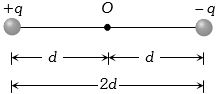
Two unlike charges of magnitude $q$ are separated by a distance $2d$. The potential at a point midway between them is
A
Zero
B
$\frac{1}{4\pi \varepsilon_0}$
C
$\frac{1}{4\pi \varepsilon_0} \cdot \frac{q}{d}$
D
$\frac{1}{4\pi \varepsilon_0} \cdot \frac{2q}{d^2}$
Solution
(A) The electric potential $V$ due to a point charge $Q$ at a distance $r$ is given by $V = \frac{1}{4\pi \varepsilon_0} \frac{Q}{r}$.
Let the two charges be $+q$ and $-q$,separated by a distance $2d$. The midpoint $O$ is at a distance $d$ from both charges.
The potential at the midpoint $O$ is the algebraic sum of the potentials due to both charges:
$V_O = V_{+q} + V_{-q}$
$V_O = \frac{1}{4\pi \varepsilon_0} \frac{q}{d} + \frac{1}{4\pi \varepsilon_0} \frac{(-q)}{d}$
$V_O = \frac{1}{4\pi \varepsilon_0} \left( \frac{q}{d} - \frac{q}{d} \right) = 0$
Therefore,the potential at the midpoint is zero.
Let the two charges be $+q$ and $-q$,separated by a distance $2d$. The midpoint $O$ is at a distance $d$ from both charges.
The potential at the midpoint $O$ is the algebraic sum of the potentials due to both charges:
$V_O = V_{+q} + V_{-q}$
$V_O = \frac{1}{4\pi \varepsilon_0} \frac{q}{d} + \frac{1}{4\pi \varepsilon_0} \frac{(-q)}{d}$
$V_O = \frac{1}{4\pi \varepsilon_0} \left( \frac{q}{d} - \frac{q}{d} \right) = 0$
Therefore,the potential at the midpoint is zero.
0 likes
View Solution20
EasyMCQ
$A$ proton is accelerated through $50,000 \, V$. Its energy will increase by
A
$5000 \, eV$
B
$8 \times 10^{-15} \, J$
C
$5000 \, J$
D
$50,000 \, J$
Solution
(B) The kinetic energy $K$ gained by a charged particle accelerated through a potential difference $V$ is given by the formula $K = Q \cdot V$.
For a proton,the charge $Q = +e = 1.6 \times 10^{-19} \, C$.
The potential difference $V = 50,000 \, V$.
Substituting these values into the formula:
$K = (1.6 \times 10^{-19} \, C) \times (50,000 \, V)$
$K = 1.6 \times 10^{-19} \times 5 \times 10^4 \, J$
$K = 8 \times 10^{-15} \, J$.
Therefore,the energy increases by $8 \times 10^{-15} \, J$.
For a proton,the charge $Q = +e = 1.6 \times 10^{-19} \, C$.
The potential difference $V = 50,000 \, V$.
Substituting these values into the formula:
$K = (1.6 \times 10^{-19} \, C) \times (50,000 \, V)$
$K = 1.6 \times 10^{-19} \times 5 \times 10^4 \, J$
$K = 8 \times 10^{-15} \, J$.
Therefore,the energy increases by $8 \times 10^{-15} \, J$.
0 likes
View Solution21
EasyMCQ
Two metal spheres of radii $R_1$ and $R_2$ are charged to the same potential. The ratio of charges on the spheres is
A
$\sqrt{R_1} : \sqrt{R_2}$
B
$R_1 : R_2$
C
$R_1^2 : R_2^2$
D
$R_1^3 : R_2^3$
Solution
(B) The electric potential $V$ of a charged conducting sphere of radius $R$ carrying charge $Q$ is given by $V = k \frac{Q}{R}$,where $k = \frac{1}{4 \pi \epsilon_0}$.
Since both spheres are charged to the same potential $V$,we have:
$V_1 = V_2$
$k \frac{Q_1}{R_1} = k \frac{Q_2}{R_2}$
Dividing both sides by $k$,we get:
$\frac{Q_1}{R_1} = \frac{Q_2}{R_2}$
Rearranging the terms to find the ratio of charges $\frac{Q_1}{Q_2}$:
$\frac{Q_1}{Q_2} = \frac{R_1}{R_2}$
Thus,the ratio of charges on the spheres is $R_1 : R_2$.
Since both spheres are charged to the same potential $V$,we have:
$V_1 = V_2$
$k \frac{Q_1}{R_1} = k \frac{Q_2}{R_2}$
Dividing both sides by $k$,we get:
$\frac{Q_1}{R_1} = \frac{Q_2}{R_2}$
Rearranging the terms to find the ratio of charges $\frac{Q_1}{Q_2}$:
$\frac{Q_1}{Q_2} = \frac{R_1}{R_2}$
Thus,the ratio of charges on the spheres is $R_1 : R_2$.
0 likes
View Solution22
MediumMCQ
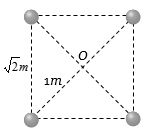
Electric charges of $+10\,\mu C, +5\,\mu C, -3\,\mu C$ and $+8\,\mu C$ are placed at the corners of a square of side $\sqrt{2}\,m$. The potential at the centre of the square is:
A
$1.8\,V$
B
$1.8 \times 10^6\,V$
C
$1.8 \times 10^5\,V$
D
$1.8 \times 10^4\,V$
Solution
(C) The length of each side of the square is $a = \sqrt{2}\,m$. The diagonal of the square is $d = a\sqrt{2} = \sqrt{2} \times \sqrt{2} = 2\,m$. The distance of the centre from each corner is $r = d/2 = 2/2 = 1\,m$.
The electric potential $V$ at the centre due to multiple charges is given by the sum of potentials due to individual charges: $V = \frac{1}{4\pi\epsilon_0} \sum \frac{q_i}{r_i}$.
Here,$\frac{1}{4\pi\epsilon_0} = 9 \times 10^9\,N\cdot m^2/C^2$ and $r = 1\,m$ for all charges.
$V = (9 \times 10^9) \times \left[ \frac{10 \times 10^{-6}}{1} + \frac{5 \times 10^{-6}}{1} + \frac{-3 \times 10^{-6}}{1} + \frac{8 \times 10^{-6}}{1} \right]$
$V = 9 \times 10^9 \times (10 + 5 - 3 + 8) \times 10^{-6}$
$V = 9 \times 10^9 \times 20 \times 10^{-6}$
$V = 180 \times 10^3 = 1.8 \times 10^5\,V$.
The electric potential $V$ at the centre due to multiple charges is given by the sum of potentials due to individual charges: $V = \frac{1}{4\pi\epsilon_0} \sum \frac{q_i}{r_i}$.
Here,$\frac{1}{4\pi\epsilon_0} = 9 \times 10^9\,N\cdot m^2/C^2$ and $r = 1\,m$ for all charges.
$V = (9 \times 10^9) \times \left[ \frac{10 \times 10^{-6}}{1} + \frac{5 \times 10^{-6}}{1} + \frac{-3 \times 10^{-6}}{1} + \frac{8 \times 10^{-6}}{1} \right]$
$V = 9 \times 10^9 \times (10 + 5 - 3 + 8) \times 10^{-6}$
$V = 9 \times 10^9 \times 20 \times 10^{-6}$
$V = 180 \times 10^3 = 1.8 \times 10^5\,V$.
0 likes
View Solution23
EasyMCQ
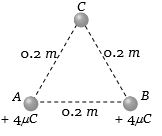
Two charges of $4\,\mu C$ each are placed at the corners $A$ and $B$ of an equilateral triangle of side length $0.2\, m$ in air. Find the electric potential at $C$. $\left[ {\frac{1}{{4\pi {\varepsilon _0}}} = 9 \times {{10}^9}\,\text{N m}^2/\text{C}^2} \right]$
A
$9 \times {10^4}\,V$
B
$18 \times {10^4}\,V$
C
$36 \times {10^4}\,V$
D
$36 \times {10^{ - 4}}\,V$
Solution
(C) The electric potential $V$ due to a point charge $q$ at a distance $r$ is given by $V = \frac{1}{4\pi \varepsilon_0} \frac{q}{r}$.
Since the triangle is equilateral with side length $0.2\, m$,the distance from both charges at $A$ and $B$ to point $C$ is $r = 0.2\, m$.
The total potential at $C$ is the sum of potentials due to both charges:
$V_C = V_A + V_B = \frac{1}{4\pi \varepsilon_0} \frac{q_A}{r} + \frac{1}{4\pi \varepsilon_0} \frac{q_B}{r}$
Given $q_A = q_B = 4\,\mu C = 4 \times 10^{-6}\, C$ and $r = 0.2\, m$:
$V_C = 2 \times \left( 9 \times 10^9 \times \frac{4 \times 10^{-6}}{0.2} \right)$
$V_C = 2 \times (9 \times 10^9 \times 20 \times 10^{-6})$
$V_C = 2 \times 18 \times 10^4 = 36 \times 10^4\, V$.
Since the triangle is equilateral with side length $0.2\, m$,the distance from both charges at $A$ and $B$ to point $C$ is $r = 0.2\, m$.
The total potential at $C$ is the sum of potentials due to both charges:
$V_C = V_A + V_B = \frac{1}{4\pi \varepsilon_0} \frac{q_A}{r} + \frac{1}{4\pi \varepsilon_0} \frac{q_B}{r}$
Given $q_A = q_B = 4\,\mu C = 4 \times 10^{-6}\, C$ and $r = 0.2\, m$:
$V_C = 2 \times \left( 9 \times 10^9 \times \frac{4 \times 10^{-6}}{0.2} \right)$
$V_C = 2 \times (9 \times 10^9 \times 20 \times 10^{-6})$
$V_C = 2 \times 18 \times 10^4 = 36 \times 10^4\, V$.
0 likes
View Solution24
EasyMCQ
Ten electrons are equally spaced and fixed around a circle of radius $R$. Relative to $V = 0$ at infinity,the electrostatic potential $V$ and the electric field $E$ at the centre $C$ are
A
$V \ne 0$ and $\vec{E} \ne 0$
B
$V \ne 0$ and $\vec{E} = 0$
C
$V = 0$ and $\vec{E} = 0$
D
$V = 0$ and $\vec{E} \ne 0$
Solution
(B) The electric potential $V$ at the centre of a circle due to a charge $q$ at distance $R$ is given by $V = \frac{kq}{R}$. Since there are $10$ electrons,each with charge $-e$,the total potential at the centre is $V = 10 \times \frac{k(-e)}{R} = -\frac{10ke}{R}$. Since $V \ne 0$,the potential is non-zero.
For the electric field,because the electrons are equally spaced around the circle,the electric field vector produced by each electron is cancelled by the electric field vector produced by the electron diametrically opposite to it. Therefore,the net electric field $\vec{E}$ at the centre is $0$.
For the electric field,because the electrons are equally spaced around the circle,the electric field vector produced by each electron is cancelled by the electric field vector produced by the electron diametrically opposite to it. Therefore,the net electric field $\vec{E}$ at the centre is $0$.
0 likes
View Solution25
EasyMCQ
The potential at a point,due to a positive charge of $100\,\mu C$ at a distance of $9\,m$,is
A
$10^4\,V$
B
$10^5\,V$
C
$10^6\,V$
D
$10^7\,V$
Solution
(B) The electric potential $V$ at a distance $r$ from a point charge $Q$ is given by the formula:
$V = \frac{1}{4\pi\epsilon_0} \cdot \frac{Q}{r}$
Given:
$Q = 100\,\mu C = 100 \times 10^{-6}\,C = 10^{-4}\,C$
$r = 9\,m$
$\frac{1}{4\pi\epsilon_0} = 9 \times 10^9\,N\cdot m^2/C^2$
Substituting the values:
$V = (9 \times 10^9) \times \frac{10^{-4}}{9}$
$V = 10^9 \times 10^{-4} = 10^5\,V$
Therefore,the correct option is $B$.
$V = \frac{1}{4\pi\epsilon_0} \cdot \frac{Q}{r}$
Given:
$Q = 100\,\mu C = 100 \times 10^{-6}\,C = 10^{-4}\,C$
$r = 9\,m$
$\frac{1}{4\pi\epsilon_0} = 9 \times 10^9\,N\cdot m^2/C^2$
Substituting the values:
$V = (9 \times 10^9) \times \frac{10^{-4}}{9}$
$V = 10^9 \times 10^{-4} = 10^5\,V$
Therefore,the correct option is $B$.
0 likes
View Solution26
EasyMCQ
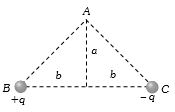
As shown in the figure,charges $+q$ and $-q$ are placed at the vertices $B$ and $C$ of an isosceles triangle. The potential at the vertex $A$ is
A
$\frac{1}{4\pi\varepsilon_0} \cdot \frac{2q}{\sqrt{a^2 + b^2}}$
B
Zero
C
$\frac{1}{4\pi\varepsilon_0} \cdot \frac{q}{\sqrt{a^2 + b^2}}$
D
$\frac{1}{4\pi\varepsilon_0} \cdot \frac{-q}{\sqrt{a^2 + b^2}}$
Solution
(B) The electric potential $V$ at a point due to a point charge $Q$ at a distance $r$ is given by $V = \frac{1}{4\pi\varepsilon_0} \cdot \frac{Q}{r}$.
In the given isosceles triangle,the distance from vertex $A$ to both vertices $B$ and $C$ is $r = \sqrt{a^2 + b^2}$ by the Pythagorean theorem.
The potential at vertex $A$ is the algebraic sum of the potentials due to charges at $B$ and $C$:
$V_A = V_B + V_C$
$V_A = \frac{1}{4\pi\varepsilon_0} \cdot \frac{q}{\sqrt{a^2 + b^2}} + \frac{1}{4\pi\varepsilon_0} \cdot \frac{-q}{\sqrt{a^2 + b^2}}$
$V_A = \frac{1}{4\pi\varepsilon_0} \cdot \frac{q - q}{\sqrt{a^2 + b^2}} = 0$.
In the given isosceles triangle,the distance from vertex $A$ to both vertices $B$ and $C$ is $r = \sqrt{a^2 + b^2}$ by the Pythagorean theorem.
The potential at vertex $A$ is the algebraic sum of the potentials due to charges at $B$ and $C$:
$V_A = V_B + V_C$
$V_A = \frac{1}{4\pi\varepsilon_0} \cdot \frac{q}{\sqrt{a^2 + b^2}} + \frac{1}{4\pi\varepsilon_0} \cdot \frac{-q}{\sqrt{a^2 + b^2}}$
$V_A = \frac{1}{4\pi\varepsilon_0} \cdot \frac{q - q}{\sqrt{a^2 + b^2}} = 0$.
0 likes
View Solution27
MediumMCQ
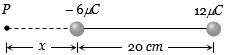
Two electric charges $12\,\mu C$ and $-6\,\mu C$ are placed $20\, cm$ apart in air. There will be a point $P$ on the line joining these charges and outside the region between them,at which the electric potential is zero. The distance of $P$ from the $-6\,\mu C$ charge is.......$m$.
A
$0.10$
B
$0.15$
C
$0.20$
D
$0.25$
Solution
(C) Let the distance of point $P$ from the $-6\,\mu C$ charge be $x$ meters. The distance of point $P$ from the $12\,\mu C$ charge is $(0.2 + x)$ meters.
The electric potential $V$ at point $P$ due to both charges is given by:
$V = \frac{1}{4\pi\varepsilon_0} \left[ \frac{-6 \times 10^{-6}}{x} + \frac{12 \times 10^{-6}}{0.2 + x} \right] = 0$
Since $V = 0$,we have:
$\frac{6 \times 10^{-6}}{x} = \frac{12 \times 10^{-6}}{0.2 + x}$
Dividing both sides by $6 \times 10^{-6}$:
$\frac{1}{x} = \frac{2}{0.2 + x}$
Cross-multiplying gives:
$0.2 + x = 2x$
$x = 0.2\, m$
Thus,the distance of point $P$ from the $-6\,\mu C$ charge is $0.20\, m$.
The electric potential $V$ at point $P$ due to both charges is given by:
$V = \frac{1}{4\pi\varepsilon_0} \left[ \frac{-6 \times 10^{-6}}{x} + \frac{12 \times 10^{-6}}{0.2 + x} \right] = 0$
Since $V = 0$,we have:
$\frac{6 \times 10^{-6}}{x} = \frac{12 \times 10^{-6}}{0.2 + x}$
Dividing both sides by $6 \times 10^{-6}$:
$\frac{1}{x} = \frac{2}{0.2 + x}$
Cross-multiplying gives:
$0.2 + x = 2x$
$x = 0.2\, m$
Thus,the distance of point $P$ from the $-6\,\mu C$ charge is $0.20\, m$.
0 likes
View Solution28
EasyMCQ
The radius of a soap bubble whose potential is $16\,V$ is doubled. The new potential of the bubble will be.....$V$
A
$2$
B
$4$
C
$8$
D
$16$
Solution
(C) The electric potential $V$ of a charged spherical conductor (like a soap bubble) is given by the formula $V = \frac{1}{4\pi\epsilon_0} \cdot \frac{q}{r}$,where $q$ is the charge and $r$ is the radius.
Since the charge $q$ on the soap bubble remains constant when its radius is changed,we have $V \propto \frac{1}{r}$.
Given the initial potential $V_1 = 16\,V$ and initial radius $r_1 = r$.
The new radius is $r_2 = 2r$.
Using the proportionality $V_1 r_1 = V_2 r_2$,we get:
$16 \times r = V_2 \times (2r)$
$V_2 = \frac{16}{2} = 8\,V$.
Therefore,the new potential of the bubble will be $8\,V$.
Since the charge $q$ on the soap bubble remains constant when its radius is changed,we have $V \propto \frac{1}{r}$.
Given the initial potential $V_1 = 16\,V$ and initial radius $r_1 = r$.
The new radius is $r_2 = 2r$.
Using the proportionality $V_1 r_1 = V_2 r_2$,we get:
$16 \times r = V_2 \times (2r)$
$V_2 = \frac{16}{2} = 8\,V$.
Therefore,the new potential of the bubble will be $8\,V$.
0 likes
View Solution29
DifficultMCQ
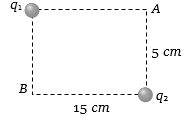
In the rectangle shown below,two corners have charges $q_1 = -5\,\mu C$ and $q_2 = +2.0\,\mu C$. The work done in moving a charge $q_0 = +3.0\,\mu C$ from $B$ to $A$ is ......... $J$. (Given: $1/4\pi\varepsilon_0 = 10^{10}\,N\cdot m^2/C^2$)
A
$2.8$
B
$3.5$
C
$4.5$
D
$5.5$
Solution
(A) The work done $W$ in moving a charge $q_0$ from point $B$ to $A$ is given by $W = q_0(V_A - V_B)$.
Given: $q_1 = -5 \times 10^{-6}\,C$,$q_2 = +2.0 \times 10^{-6}\,C$,$q_0 = +3.0 \times 10^{-6}\,C$,$k = 10^{10}\,N\cdot m^2/C^2$.
From the geometry of the rectangle:
At point $A$: distance from $q_1$ is $15\,cm = 0.15\,m$,distance from $q_2$ is $5\,cm = 0.05\,m$.
$V_A = k \left( \frac{q_1}{0.15} + \frac{q_2}{0.05} \right) = 10^{10} \left( \frac{-5 \times 10^{-6}}{0.15} + \frac{2 \times 10^{-6}}{0.05} \right) = 10^4 \left( -\frac{5}{0.15} + \frac{2}{0.05} \right) = 10^4 \left( -33.33 + 40 \right) = 6.67 \times 10^4\,V$.
At point $B$: distance from $q_1$ is $5\,cm = 0.05\,m$,distance from $q_2$ is $15\,cm = 0.15\,m$.
$V_B = k \left( \frac{q_1}{0.05} + \frac{q_2}{0.15} \right) = 10^{10} \left( \frac{-5 \times 10^{-6}}{0.05} + \frac{2 \times 10^{-6}}{0.15} \right) = 10^4 \left( -100 + 13.33 \right) = -86.67 \times 10^4\,V$.
$W = 3.0 \times 10^{-6} \times (6.67 \times 10^4 - (-86.67 \times 10^4)) = 3.0 \times 10^{-6} \times (93.34 \times 10^4) = 2.8\,J$.
Given: $q_1 = -5 \times 10^{-6}\,C$,$q_2 = +2.0 \times 10^{-6}\,C$,$q_0 = +3.0 \times 10^{-6}\,C$,$k = 10^{10}\,N\cdot m^2/C^2$.
From the geometry of the rectangle:
At point $A$: distance from $q_1$ is $15\,cm = 0.15\,m$,distance from $q_2$ is $5\,cm = 0.05\,m$.
$V_A = k \left( \frac{q_1}{0.15} + \frac{q_2}{0.05} \right) = 10^{10} \left( \frac{-5 \times 10^{-6}}{0.15} + \frac{2 \times 10^{-6}}{0.05} \right) = 10^4 \left( -\frac{5}{0.15} + \frac{2}{0.05} \right) = 10^4 \left( -33.33 + 40 \right) = 6.67 \times 10^4\,V$.
At point $B$: distance from $q_1$ is $5\,cm = 0.05\,m$,distance from $q_2$ is $15\,cm = 0.15\,m$.
$V_B = k \left( \frac{q_1}{0.05} + \frac{q_2}{0.15} \right) = 10^{10} \left( \frac{-5 \times 10^{-6}}{0.05} + \frac{2 \times 10^{-6}}{0.15} \right) = 10^4 \left( -100 + 13.33 \right) = -86.67 \times 10^4\,V$.
$W = 3.0 \times 10^{-6} \times (6.67 \times 10^4 - (-86.67 \times 10^4)) = 3.0 \times 10^{-6} \times (93.34 \times 10^4) = 2.8\,J$.
0 likes
View Solution30
EasyMCQ
$A$ hollow conducting sphere of radius $R$ has a charge $(+Q)$ on its surface. What is the electric potential within the sphere at a distance $r = \frac{R}{3}$ from its centre?
A
Zero
B
$\frac{1}{4\pi \varepsilon_0} \frac{Q}{r}$
C
$\frac{1}{4\pi \varepsilon_0} \frac{Q}{R}$
D
$\frac{1}{4\pi \varepsilon_0} \frac{Q}{r^2}$
Solution
(C) For a hollow conducting sphere,the electric field inside the sphere is zero because the charge resides only on the outer surface.
Since the electric field $E = -\frac{dV}{dr} = 0$,the potential $V$ must be constant throughout the interior of the sphere.
The potential at any point inside the sphere is equal to the potential at its surface.
The potential at the surface of a sphere of radius $R$ with charge $Q$ is given by $V = \frac{1}{4\pi \varepsilon_0} \frac{Q}{R}$.
Therefore,at a distance $r = \frac{R}{3}$ from the centre,the potential is $\frac{1}{4\pi \varepsilon_0} \frac{Q}{R}$.
Since the electric field $E = -\frac{dV}{dr} = 0$,the potential $V$ must be constant throughout the interior of the sphere.
The potential at any point inside the sphere is equal to the potential at its surface.
The potential at the surface of a sphere of radius $R$ with charge $Q$ is given by $V = \frac{1}{4\pi \varepsilon_0} \frac{Q}{R}$.
Therefore,at a distance $r = \frac{R}{3}$ from the centre,the potential is $\frac{1}{4\pi \varepsilon_0} \frac{Q}{R}$.
0 likes
View Solution31
EasyMCQ
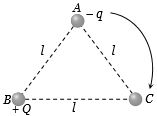
$A$ charge $(-q)$ and another charge $(+Q)$ are kept at two points $A$ and $B$ respectively. Keeping the charge $(+Q)$ fixed at $B$,the charge $(-q)$ at $A$ is moved to another point $C$ such that $ABC$ forms an equilateral triangle of side $l$. The net work done in moving the charge $(-q)$ is
A
$\frac{1}{4\pi \varepsilon_0} \frac{Qq}{l}$
B
$\frac{1}{4\pi \varepsilon_0} \frac{Qq}{l^2}$
C
$\frac{1}{4\pi \varepsilon_0} Qql$
D
Zero
Solution
(D) The work done $W$ in moving a charge $q_0$ from point $A$ to point $C$ in the presence of a source charge $Q$ at $B$ is given by $W = q_0(V_C - V_A)$.
Here,the source charge is $Q$ at $B$. The distance $BA = l$ and $BC = l$.
The electric potential at point $A$ due to charge $Q$ is $V_A = \frac{1}{4\pi \varepsilon_0} \frac{Q}{l}$.
The electric potential at point $C$ due to charge $Q$ is $V_C = \frac{1}{4\pi \varepsilon_0} \frac{Q}{l}$.
Since $V_A = V_C$,the potential difference $\Delta V = V_C - V_A = 0$.
Therefore,the work done $W = (-q) \times (0) = 0$.
Here,the source charge is $Q$ at $B$. The distance $BA = l$ and $BC = l$.
The electric potential at point $A$ due to charge $Q$ is $V_A = \frac{1}{4\pi \varepsilon_0} \frac{Q}{l}$.
The electric potential at point $C$ due to charge $Q$ is $V_C = \frac{1}{4\pi \varepsilon_0} \frac{Q}{l}$.
Since $V_A = V_C$,the potential difference $\Delta V = V_C - V_A = 0$.
Therefore,the work done $W = (-q) \times (0) = 0$.
0 likes
View Solution32
EasyMCQ
$A$ particle of mass $m$ and charge $q$ is accelerated through a potential difference of $V$ volt. Its energy will be:
A
$qV$
B
$mqV$
C
$\frac{q}{m}V$
D
$\frac{q}{mV}$
Solution
(A) When a particle of charge $q$ is accelerated through a potential difference $V$,the work done on the particle by the electric field is given by $W = qV$.
According to the work-energy theorem,this work done is equal to the change in the kinetic energy of the particle.
Therefore,the kinetic energy gained by the particle is $KE = qV$.
According to the work-energy theorem,this work done is equal to the change in the kinetic energy of the particle.
Therefore,the kinetic energy gained by the particle is $KE = qV$.
0 likes
View Solution33
MediumMCQ
Two spheres $A$ and $B$ of radius $a$ and $b$ respectively are at the same electric potential. The ratio of the surface charge densities of $A$ and $B$ is
A
$a/b$
B
$b/a$
C
$a^2/b^2$
D
$b^2/a^2$
Solution
(B) Given that the electric potential of both spheres is the same,i.e.,$V_A = V_B$.
Using the formula for the potential of a charged sphere $V = \frac{1}{4\pi\epsilon_0} \cdot \frac{Q}{r}$,we have:
$\frac{1}{4\pi\epsilon_0} \cdot \frac{Q_A}{a} = \frac{1}{4\pi\epsilon_0} \cdot \frac{Q_B}{b} \implies \frac{Q_A}{Q_B} = \frac{a}{b}$......$(i)$
Surface charge density $\sigma$ is defined as $\sigma = \frac{Q}{4\pi r^2}$.
Therefore,the ratio of surface charge densities is:
$\frac{\sigma_A}{\sigma_B} = \frac{Q_A}{4\pi a^2} \cdot \frac{4\pi b^2}{Q_B} = \frac{Q_A}{Q_B} \cdot \frac{b^2}{a^2}$
Substituting the ratio from equation $(i)$:
$\frac{\sigma_A}{\sigma_B} = \frac{a}{b} \cdot \frac{b^2}{a^2} = \frac{b}{a}$.
Using the formula for the potential of a charged sphere $V = \frac{1}{4\pi\epsilon_0} \cdot \frac{Q}{r}$,we have:
$\frac{1}{4\pi\epsilon_0} \cdot \frac{Q_A}{a} = \frac{1}{4\pi\epsilon_0} \cdot \frac{Q_B}{b} \implies \frac{Q_A}{Q_B} = \frac{a}{b}$......$(i)$
Surface charge density $\sigma$ is defined as $\sigma = \frac{Q}{4\pi r^2}$.
Therefore,the ratio of surface charge densities is:
$\frac{\sigma_A}{\sigma_B} = \frac{Q_A}{4\pi a^2} \cdot \frac{4\pi b^2}{Q_B} = \frac{Q_A}{Q_B} \cdot \frac{b^2}{a^2}$
Substituting the ratio from equation $(i)$:
$\frac{\sigma_A}{\sigma_B} = \frac{a}{b} \cdot \frac{b^2}{a^2} = \frac{b}{a}$.
0 likes
View Solution34
EasyMCQ
The electric potential at a point at a distance $x$ from the center inside a conducting sphere of radius $R$ charged with charge $Q$ is:
A
$\frac{Q}{4\pi\epsilon_0 R}$
B
$\frac{Q}{4\pi\epsilon_0 x}$
C
$\frac{Q}{4\pi\epsilon_0 x^2}$
D
$\frac{Qx}{4\pi\epsilon_0 R^2}$
Solution
(A) For a charged conducting sphere,the charge $Q$ resides entirely on its outer surface.
Inside the conductor,the electric field $E = 0$.
Since the electric field is zero inside,the potential $V$ remains constant throughout the interior and is equal to the potential at the surface.
The potential at the surface of a sphere of radius $R$ is given by $V = \frac{Q}{4\pi\epsilon_0 R}$.
Therefore,at any point $x$ inside the sphere (where $x < R$),the potential is $V = \frac{Q}{4\pi\epsilon_0 R}$.
Inside the conductor,the electric field $E = 0$.
Since the electric field is zero inside,the potential $V$ remains constant throughout the interior and is equal to the potential at the surface.
The potential at the surface of a sphere of radius $R$ is given by $V = \frac{Q}{4\pi\epsilon_0 R}$.
Therefore,at any point $x$ inside the sphere (where $x < R$),the potential is $V = \frac{Q}{4\pi\epsilon_0 R}$.
0 likes
View Solution35
MediumMCQ
$A$ ball of mass $1\, g$ and charge $10^{-8}\, C$ moves from a point $A$,where the potential is $600\, V$,to a point $B$,where the potential is $0\, V$. The velocity of the ball at point $B$ is $20\, cm/s$. The velocity of the ball at point $A$ will be:
A
$22.8\, cm/s$
B
$228\, cm/s$
C
$16.8\, cm/s$
D
$16.8\, m/s$
Solution
(C) According to the work-energy theorem,the change in kinetic energy is equal to the work done by the electric field.
$W = q(V_A - V_B) = \Delta K$
$q(V_A - V_B) = \frac{1}{2}m(v_B^2 - v_A^2)$
Given: $m = 1\, g = 10^{-3}\, kg$,$q = 10^{-8}\, C$,$V_A = 600\, V$,$V_B = 0\, V$,$v_B = 20\, cm/s = 0.2\, m/s$.
Substituting the values:
$10^{-8}(600 - 0) = \frac{1}{2} \times 10^{-3} \times ((0.2)^2 - v_A^2)$
$6 \times 10^{-6} = 0.5 \times 10^{-3} \times (0.04 - v_A^2)$
$12 \times 10^{-3} = 0.04 - v_A^2$
$v_A^2 = 0.04 - 0.012 = 0.028$
$v_A = \sqrt{0.028} \approx 0.1673\, m/s \approx 16.73\, cm/s \approx 16.8\, cm/s$.
$W = q(V_A - V_B) = \Delta K$
$q(V_A - V_B) = \frac{1}{2}m(v_B^2 - v_A^2)$
Given: $m = 1\, g = 10^{-3}\, kg$,$q = 10^{-8}\, C$,$V_A = 600\, V$,$V_B = 0\, V$,$v_B = 20\, cm/s = 0.2\, m/s$.
Substituting the values:
$10^{-8}(600 - 0) = \frac{1}{2} \times 10^{-3} \times ((0.2)^2 - v_A^2)$
$6 \times 10^{-6} = 0.5 \times 10^{-3} \times (0.04 - v_A^2)$
$12 \times 10^{-3} = 0.04 - v_A^2$
$v_A^2 = 0.04 - 0.012 = 0.028$
$v_A = \sqrt{0.028} \approx 0.1673\, m/s \approx 16.73\, cm/s \approx 16.8\, cm/s$.
0 likes
View Solution36
EasyMCQ
On moving a charge of $20 \; C$ by $2 \; cm$,$2 \; J$ of work is done. The potential difference between the points is (in $V$):
A
$0.2$
B
$8$
C
$0.1$
D
$0.4$
Solution
(C) The work done $W$ in moving a charge $Q$ between two points with a potential difference $\Delta V$ is given by the formula:
$W = Q \cdot \Delta V$
Given:
Charge $Q = 20 \; C$
Work done $W = 2 \; J$
We need to find the potential difference $\Delta V$.
Rearranging the formula for $\Delta V$:
$\Delta V = \frac{W}{Q}$
Substituting the given values:
$\Delta V = \frac{2 \; J}{20 \; C} = 0.1 \; V$
Therefore,the potential difference between the points is $0.1 \; V$.
$W = Q \cdot \Delta V$
Given:
Charge $Q = 20 \; C$
Work done $W = 2 \; J$
We need to find the potential difference $\Delta V$.
Rearranging the formula for $\Delta V$:
$\Delta V = \frac{W}{Q}$
Substituting the given values:
$\Delta V = \frac{2 \; J}{20 \; C} = 0.1 \; V$
Therefore,the potential difference between the points is $0.1 \; V$.
0 likes
View Solution37
EasyMCQ
If $4 \times 10^{20} \text{ eV}$ of energy is required to move a charge of $0.25 \text{ C}$ between two points,what will be the potential difference between them in volts?
A
$178$
B
$256$
C
$356$
D
None of these
Solution
(B) The energy required to move a charge $q$ through a potential difference $V$ is given by the formula $W = qV$.
Given energy $W = 4 \times 10^{20} \text{ eV}$.
Since $1 \text{ eV} = 1.6 \times 10^{-19} \text{ J}$,the energy in Joules is $W = (4 \times 10^{20}) \times (1.6 \times 10^{-19}) \text{ J} = 6.4 \times 10 = 64 \text{ J}$.
The charge $q = 0.25 \text{ C}$.
Using the formula $V = W / q$,we get $V = 64 / 0.25$.
$V = 64 \times 4 = 256 \text{ V}$.
Thus,the potential difference is $256 \text{ V}$.
Given energy $W = 4 \times 10^{20} \text{ eV}$.
Since $1 \text{ eV} = 1.6 \times 10^{-19} \text{ J}$,the energy in Joules is $W = (4 \times 10^{20}) \times (1.6 \times 10^{-19}) \text{ J} = 6.4 \times 10 = 64 \text{ J}$.
The charge $q = 0.25 \text{ C}$.
Using the formula $V = W / q$,we get $V = 64 / 0.25$.
$V = 64 \times 4 = 256 \text{ V}$.
Thus,the potential difference is $256 \text{ V}$.
0 likes
View Solution38
EasyMCQ
If $3$ charges of magnitude $q$ each are placed at the vertices of an equilateral triangle of side $l \ cm$,what is the net potential energy of the system?
A
$\frac{1}{4\pi \varepsilon_0} \frac{q^2}{l}$
B
$\frac{1}{4\pi \varepsilon_0} \frac{2q^2}{l}$
C
$\frac{1}{4\pi \varepsilon_0} \frac{3q^2}{l}$
D
$\frac{1}{4\pi \varepsilon_0} \frac{4q^2}{l}$
Solution
(C) The potential energy $U$ of a system of point charges is given by the sum of potential energies of all unique pairs of charges: $U = \sum \frac{1}{4\pi \varepsilon_0} \frac{q_i q_j}{r_{ij}}$.
For an equilateral triangle with $3$ charges $q$ at each vertex and side length $l$,there are $3$ pairs of charges,each separated by distance $l$.
The potential energy for each pair is $U_{pair} = \frac{1}{4\pi \varepsilon_0} \frac{q^2}{l}$.
Since there are $3$ such pairs,the total net potential energy is $U_{net} = 3 \times \frac{1}{4\pi \varepsilon_0} \frac{q^2}{l} = \frac{1}{4\pi \varepsilon_0} \frac{3q^2}{l}$.
For an equilateral triangle with $3$ charges $q$ at each vertex and side length $l$,there are $3$ pairs of charges,each separated by distance $l$.
The potential energy for each pair is $U_{pair} = \frac{1}{4\pi \varepsilon_0} \frac{q^2}{l}$.
Since there are $3$ such pairs,the total net potential energy is $U_{net} = 3 \times \frac{1}{4\pi \varepsilon_0} \frac{q^2}{l} = \frac{1}{4\pi \varepsilon_0} \frac{3q^2}{l}$.
0 likes
View Solution39
MediumMCQ
If identical charges $(-q)$ are placed at each corner of a cube of side $b$,then the electric potential energy of charge $(+q)$ which is placed at the center of the cube will be:
A
$\frac{8\sqrt{2}q^2}{4\pi\varepsilon_0b}$
B
$\frac{-8\sqrt{2}q^2}{\pi\varepsilon_0b}$
C
$\frac{-4\sqrt{2}q^2}{\pi\varepsilon_0b}$
D
$\frac{-4q^2}{\sqrt{3}\pi\varepsilon_0b}$
Solution
(D) The length of the body diagonal of a cube with side $b$ is $\sqrt{3}b$.
The distance of the center of the cube from each vertex is $r = \frac{\sqrt{3}b}{2}$.
The electric potential energy $U$ of a charge $q$ at the center due to $8$ charges of $-q$ at the corners is given by the sum of individual potential energies:
$U = \sum_{i=1}^{8} \frac{1}{4\pi\varepsilon_0} \frac{(-q)(q)}{r}$
$U = 8 \times \left( \frac{1}{4\pi\varepsilon_0} \cdot \frac{-q^2}{\sqrt{3}b/2} \right)$
$U = 8 \times \left( \frac{-2q^2}{4\pi\varepsilon_0\sqrt{3}b} \right)$
$U = \frac{-16q^2}{4\pi\varepsilon_0\sqrt{3}b} = \frac{-4q^2}{\sqrt{3}\pi\varepsilon_0b}$
The distance of the center of the cube from each vertex is $r = \frac{\sqrt{3}b}{2}$.
The electric potential energy $U$ of a charge $q$ at the center due to $8$ charges of $-q$ at the corners is given by the sum of individual potential energies:
$U = \sum_{i=1}^{8} \frac{1}{4\pi\varepsilon_0} \frac{(-q)(q)}{r}$
$U = 8 \times \left( \frac{1}{4\pi\varepsilon_0} \cdot \frac{-q^2}{\sqrt{3}b/2} \right)$
$U = 8 \times \left( \frac{-2q^2}{4\pi\varepsilon_0\sqrt{3}b} \right)$
$U = \frac{-16q^2}{4\pi\varepsilon_0\sqrt{3}b} = \frac{-4q^2}{\sqrt{3}\pi\varepsilon_0b}$
0 likes
View Solution40
EasyMCQ
$A$ proton is about $1840$ times heavier than an electron. When it is accelerated by a potential difference of $1\, kV$,its kinetic energy will be......$keV$.
A
$1840$
B
$1/1840$
C
$1$
D
$920$
Solution
(C) The kinetic energy $(KE)$ gained by a charged particle when accelerated through a potential difference $(V)$ is given by the formula: $KE = qV$.
Here,the charge of a proton $(q)$ is equal to the elementary charge $(e)$.
The potential difference $(V)$ is given as $1\, kV$.
Substituting these values into the formula:
$KE = e \times 1\, kV = 1\, keV$.
Therefore,the kinetic energy of the proton is $1\, keV$.
Here,the charge of a proton $(q)$ is equal to the elementary charge $(e)$.
The potential difference $(V)$ is given as $1\, kV$.
Substituting these values into the formula:
$KE = e \times 1\, kV = 1\, keV$.
Therefore,the kinetic energy of the proton is $1\, keV$.
0 likes
View Solution41
MediumMCQ
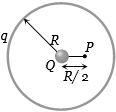
$A$ thin spherical conducting shell of radius $R$ has a charge $q$. Another charge $Q$ is placed at the centre of the shell. The electrostatic potential at a point $P$ at a distance $\frac{R}{2}$ from the centre of the shell is
A
$\frac{(q + Q)}{4\pi \varepsilon_0} \cdot \frac{2}{R}$
B
$\frac{2Q}{4\pi \varepsilon_0 R}$
C
$\frac{2Q}{4\pi \varepsilon_0 R} - \frac{2q}{4\pi \varepsilon_0 R}$
D
$\frac{2Q}{4\pi \varepsilon_0 R} + \frac{q}{4\pi \varepsilon_0 R}$
Solution
(D) The total electrostatic potential at point $P$ is the sum of the potential due to the point charge $Q$ at the centre and the potential due to the spherical shell of charge $q$.
$1$. The potential due to the point charge $Q$ at a distance $r = \frac{R}{2}$ is given by $V_Q = \frac{1}{4\pi \varepsilon_0} \cdot \frac{Q}{R/2} = \frac{2Q}{4\pi \varepsilon_0 R}$.
$2$. For a spherical conducting shell of radius $R$ with charge $q$,the potential at any point inside the shell (including the centre) is constant and equal to the potential at its surface. Thus,the potential at distance $r = \frac{R}{2}$ due to the shell is $V_q = \frac{1}{4\pi \varepsilon_0} \cdot \frac{q}{R}$.
$3$. The total potential at point $P$ is $V = V_Q + V_q = \frac{2Q}{4\pi \varepsilon_0 R} + \frac{q}{4\pi \varepsilon_0 R}$.
Therefore,the correct option is $(d)$.
$1$. The potential due to the point charge $Q$ at a distance $r = \frac{R}{2}$ is given by $V_Q = \frac{1}{4\pi \varepsilon_0} \cdot \frac{Q}{R/2} = \frac{2Q}{4\pi \varepsilon_0 R}$.
$2$. For a spherical conducting shell of radius $R$ with charge $q$,the potential at any point inside the shell (including the centre) is constant and equal to the potential at its surface. Thus,the potential at distance $r = \frac{R}{2}$ due to the shell is $V_q = \frac{1}{4\pi \varepsilon_0} \cdot \frac{q}{R}$.
$3$. The total potential at point $P$ is $V = V_Q + V_q = \frac{2Q}{4\pi \varepsilon_0 R} + \frac{q}{4\pi \varepsilon_0 R}$.
Therefore,the correct option is $(d)$.
0 likes
View Solution42
EasyMCQ
An electron enters a high potential region $V_2$ from a lower potential region $V_1$. What happens to its velocity?
A
Will increase
B
Will change in direction but not in magnitude
C
No change in direction of field
D
No change in direction perpendicular to field
Solution
(A) The potential energy of a charge $q$ is given by $U = qV$.
Since the electron has a negative charge $(q = -e)$,its potential energy $U = -eV$ decreases as it moves from a lower potential region $V_1$ to a higher potential region $V_2$ (where $V_2 > V_1$).
According to the law of conservation of energy,the decrease in potential energy results in an increase in kinetic energy $(K = \frac{1}{2}mv^2)$.
Therefore,the velocity of the electron will increase.
Since the electron has a negative charge $(q = -e)$,its potential energy $U = -eV$ decreases as it moves from a lower potential region $V_1$ to a higher potential region $V_2$ (where $V_2 > V_1$).
According to the law of conservation of energy,the decrease in potential energy results in an increase in kinetic energy $(K = \frac{1}{2}mv^2)$.
Therefore,the velocity of the electron will increase.
0 likes
View Solution43
EasyMCQ
$A$ pellet carrying a charge of $0.5\, C$ is accelerated through a potential difference of $2,000\, V$. What is the kinetic energy attained by the pellet?
A
$1000\, ergs$
B
$1000\, J$
C
$1000\, kWh$
D
$500\, ergs$
Solution
(B) The kinetic energy $(K)$ gained by a charge $(q)$ accelerated through a potential difference $(V)$ is given by the formula:
$K = q \times V$
Given:
Charge $(q)$ = $0.5\, C$
Potential difference $(V)$ = $2,000\, V$
Substituting the values:
$K = 0.5\, C \times 2,000\, V$
$K = 1,000\, J$
Therefore,the kinetic energy attained by the pellet is $1,000\, J$.
$K = q \times V$
Given:
Charge $(q)$ = $0.5\, C$
Potential difference $(V)$ = $2,000\, V$
Substituting the values:
$K = 0.5\, C \times 2,000\, V$
$K = 1,000\, J$
Therefore,the kinetic energy attained by the pellet is $1,000\, J$.
0 likes
View Solution44
EasyMCQ
$A$ particle has a mass $400$ times that of an electron and a charge double that of an electron. It is accelerated by a potential difference of $5 \ V$. If the particle was initially at rest,what will be its final kinetic energy in $eV$?
A
$5$
B
$10$
C
$100$
D
$2000$
Solution
(B) The kinetic energy $K$ gained by a charged particle accelerated through a potential difference $V$ is given by the formula $K = qV$.
Here,the charge of the particle is $q = 2e$,where $e$ is the elementary charge of an electron.
The potential difference is $V = 5 \ V$.
Substituting these values into the formula:
$K = (2e) \times (5 \ V) = 10 \ eV$.
Since the particle was initially at rest,its final kinetic energy is equal to the work done on it by the electric field,which is $10 \ eV$.
Here,the charge of the particle is $q = 2e$,where $e$ is the elementary charge of an electron.
The potential difference is $V = 5 \ V$.
Substituting these values into the formula:
$K = (2e) \times (5 \ V) = 10 \ eV$.
Since the particle was initially at rest,its final kinetic energy is equal to the work done on it by the electric field,which is $10 \ eV$.
0 likes
View Solution45
EasyMCQ
An electron (charge = $1.6 \times 10^{-19} \text{ C}$) is accelerated through a potential difference of $1,00,000 \text{ V}$. The energy acquired by the electron is:
A
$1.6 \times 10^{-24} \text{ J}$
B
$1.6 \times 10^{-14} \text{ erg}$
C
$0.53 \times 10^{-14} \text{ J}$
D
$1.6 \times 10^{-14} \text{ J}$
Solution
(D) The energy $E$ acquired by a charged particle accelerated through a potential difference $V$ is given by the formula $E = qV$.
Here,the charge of the electron is $q = 1.6 \times 10^{-19} \text{ C}$.
The potential difference is $V = 1,00,000 \text{ V} = 10^5 \text{ V}$.
Substituting these values into the formula:
$E = (1.6 \times 10^{-19} \text{ C}) \times (10^5 \text{ V})$
$E = 1.6 \times 10^{-19+5} \text{ J}$
$E = 1.6 \times 10^{-14} \text{ J}$.
Therefore,the correct option is $D$.
Here,the charge of the electron is $q = 1.6 \times 10^{-19} \text{ C}$.
The potential difference is $V = 1,00,000 \text{ V} = 10^5 \text{ V}$.
Substituting these values into the formula:
$E = (1.6 \times 10^{-19} \text{ C}) \times (10^5 \text{ V})$
$E = 1.6 \times 10^{-19+5} \text{ J}$
$E = 1.6 \times 10^{-14} \text{ J}$.
Therefore,the correct option is $D$.
0 likes
View Solution46
EasyMCQ
The charge given to a hollow sphere of radius $10\, cm$ is $3.2 \times 10^{-19}\, C$. At a distance of $4\, cm$ from its centre,the electric potential will be
A
$2.88 \times 10^{-8}\, V$
B
$288\, V$
C
$2.88\, V$
D
$2.88 \times 10^{-9}\, V$
Solution
(A) For a hollow conducting sphere of radius $R$,the electric potential at any point inside the sphere (where distance $r < R$) is constant and equal to the potential at the surface.
Given: Radius $R = 10\, cm = 0.1\, m$,Charge $q = 3.2 \times 10^{-19}\, C$.
The potential $V$ inside the sphere is given by $V = \frac{1}{4\pi\epsilon_0} \frac{q}{R}$.
Substituting the values: $V = (9 \times 10^9) \times \frac{3.2 \times 10^{-19}}{0.1}$.
$V = 9 \times 3.2 \times 10^{-9} \times 10 = 28.8 \times 10^{-9}\, V$ or $2.88 \times 10^{-8}\, V$.
Given: Radius $R = 10\, cm = 0.1\, m$,Charge $q = 3.2 \times 10^{-19}\, C$.
The potential $V$ inside the sphere is given by $V = \frac{1}{4\pi\epsilon_0} \frac{q}{R}$.
Substituting the values: $V = (9 \times 10^9) \times \frac{3.2 \times 10^{-19}}{0.1}$.
$V = 9 \times 3.2 \times 10^{-9} \times 10 = 28.8 \times 10^{-9}\, V$ or $2.88 \times 10^{-8}\, V$.
0 likes
View Solution47
EasyMCQ
$A$ charge of $10\, e.s.u.$ is placed at a distance of $2\, cm$ from a charge of $40\, e.s.u.$ and $4\, cm$ from another charge of $20\, e.s.u.$ The potential energy of the charge $10\, e.s.u.$ is (in $ergs$)
A
$87.5$
B
$112.5$
C
$150$
D
$250$
Solution
(D) The potential energy $U$ of a system of point charges in the $CGS$ system (where $k = 1$) is given by $U = \sum \frac{q_i q_j}{r_{ij}}$.
Here,the charge $q_1 = 10\, e.s.u.$ is interacting with $q_2 = 40\, e.s.u.$ at a distance $r_1 = 2\, cm$ and $q_3 = 20\, e.s.u.$ at a distance $r_2 = 4\, cm$.
The total potential energy of the $10\, e.s.u.$ charge is the sum of the interaction energies with the other two charges:
$U = \frac{q_1 q_2}{r_1} + \frac{q_1 q_3}{r_2}$
$U = \frac{10 \times 40}{2} + \frac{10 \times 20}{4}$
$U = \frac{400}{2} + \frac{200}{4}$
$U = 200 + 50 = 250\, ergs$.
Here,the charge $q_1 = 10\, e.s.u.$ is interacting with $q_2 = 40\, e.s.u.$ at a distance $r_1 = 2\, cm$ and $q_3 = 20\, e.s.u.$ at a distance $r_2 = 4\, cm$.
The total potential energy of the $10\, e.s.u.$ charge is the sum of the interaction energies with the other two charges:
$U = \frac{q_1 q_2}{r_1} + \frac{q_1 q_3}{r_2}$
$U = \frac{10 \times 40}{2} + \frac{10 \times 20}{4}$
$U = \frac{400}{2} + \frac{200}{4}$
$U = 200 + 50 = 250\, ergs$.
0 likes
View Solution48
EasyMCQ
State which of the following is correct.
A
$Joule = coulomb \times volt$
B
$Joule = coulomb / volt$
C
$Joule = volt \times ampere$
D
$Joule = volt / ampere$
Solution
(A) The electric potential $V$ is defined as the work done $W$ per unit charge $q$ in moving a charge from infinity to a point.
Mathematically,$V = W / q$.
Rearranging this formula,we get $W = V \times q$.
Here,$W$ is measured in Joules $(J)$,$V$ is measured in Volts $(V)$,and $q$ is measured in Coulombs $(C)$.
Therefore,$1 \ Joule = 1 \ Volt \times 1 \ Coulomb$.
Thus,the correct relation is $Joule = coulomb \times volt$.
Mathematically,$V = W / q$.
Rearranging this formula,we get $W = V \times q$.
Here,$W$ is measured in Joules $(J)$,$V$ is measured in Volts $(V)$,and $q$ is measured in Coulombs $(C)$.
Therefore,$1 \ Joule = 1 \ Volt \times 1 \ Coulomb$.
Thus,the correct relation is $Joule = coulomb \times volt$.
0 likes
View Solution49
EasyMCQ
When a positive $q$ charge is taken from a lower potential point to a higher potential point,its potential energy will
A
Decrease
B
Increase
C
Remain unchanged
D
Become zero
Solution
(B) The change in potential energy $(\Delta U)$ of a charge $q$ moved between two points is given by $\Delta U = q(V_f - V_i)$,where $V_f$ is the final potential and $V_i$ is the initial potential.
Since the charge is moved from a lower potential to a higher potential,$V_f > V_i$,which implies $(V_f - V_i) > 0$.
Given that $q$ is a positive charge,the product $q(V_f - V_i)$ is positive.
Therefore,the potential energy of the charge increases.
Since the charge is moved from a lower potential to a higher potential,$V_f > V_i$,which implies $(V_f - V_i) > 0$.
Given that $q$ is a positive charge,the product $q(V_f - V_i)$ is positive.
Therefore,the potential energy of the charge increases.
0 likes
View Solution50
MediumMCQ
$A$ hollow metal sphere of radius $5\,cm$ is charged such that the potential on its surface is $10\,V$. The potential at a distance of $2\,cm$ from the centre of the sphere is.......$V$.
A
$0$
B
$10$
C
$4$
D
$3.34$
Solution
(B) For a charged hollow metal sphere,the electric potential inside the sphere is constant and equal to the potential at its surface.
Given,the radius of the sphere $R = 5\,cm$.
The potential on the surface $V_{surface} = 10\,V$.
Since $2\,cm < 5\,cm$,the point at $2\,cm$ from the centre lies inside the sphere.
Therefore,the potential at $2\,cm$ is the same as the potential on the surface,which is $10\,V$.
Given,the radius of the sphere $R = 5\,cm$.
The potential on the surface $V_{surface} = 10\,V$.
Since $2\,cm < 5\,cm$,the point at $2\,cm$ from the centre lies inside the sphere.
Therefore,the potential at $2\,cm$ is the same as the potential on the surface,which is $10\,V$.
0 likes
View SolutionElectric Potential and Capacitance — Electric potential · Frequently Asked Questions
1Are these Electric Potential and Capacitance questions useful for JEE and NEET?
Yes. All questions in this section are mapped to JEE Main and NEET exam patterns. Previous year questions from JEE Main, NEET, GUJCET and state-level exams are included with full solutions.
2Can I switch to Hindi or Gujarati for these questions?
Yes. Use the language tabs in the hero section or the sidebar to view the same questions and solutions in English, Hindi or Gujarati.
3How do I generate a question paper from this subtopic?
Use the Vedclass Exam Paper Generator — select the chapter and subtopic, set difficulty, and generate Sets A, B, C, D automatically. First 3 chapters of every subject are free.
Vedclass Products
For Students
Vedclass Test Series
Mock tests in real JEE/NEET style with performance analysis. 5-day free trial.
Start Free TrialFor Teachers
Exam Paper Generator
Generate Set A/B/C/D papers from this chapter in 2 minutes. 3 chapters free.
Try FreeFor Institutes
Online Exam Module
Live online exams with unlimited students, 360° analytics & white-label branding.
See DemoFor Teachers & Institutes
Generate a Electric Potential and Capacitance Exam Paper in 2 Minutes
Select subtopic & difficulty — Sets A, B, C, D auto-generated with No Repeat logic.
First 3 chapters of every subject are free — no payment required.