
A English
Energy Stored in a Capacitor Questions in English
Class 12 Physics · Electric Potential and Capacitance · Energy Stored in a Capacitor
147+
Questions
English
Language
100%
With Solutions
Showing 42 of 147 questions in English
101
MediumMCQ
$A$ battery does $200 \, J$ of work in charging a capacitor. The energy stored in the capacitor is ......... $J$.
A
$200$
B
$100$
C
$50$
D
$400$
Solution
(B) When a capacitor is charged by a battery,the work done by the battery is $W = qV = CV^2$.
The energy stored in the capacitor is given by $U = \frac{1}{2} CV^2$.
Comparing the two expressions,we find that $U = \frac{W}{2}$.
Given that the work done $W = 200 \, J$,the energy stored is $U = \frac{200}{2} = 100 \, J$.
The remaining $100 \, J$ of energy is dissipated as heat in the circuit during the charging process.
The energy stored in the capacitor is given by $U = \frac{1}{2} CV^2$.
Comparing the two expressions,we find that $U = \frac{W}{2}$.
Given that the work done $W = 200 \, J$,the energy stored is $U = \frac{200}{2} = 100 \, J$.
The remaining $100 \, J$ of energy is dissipated as heat in the circuit during the charging process.
0 likes
View Solution102
MediumMCQ
Consider a parallel plate capacitor of area $A$ (of each plate) and separation $d$ between the plates. If $E$ is the electric field and $\varepsilon_0$ is the permittivity of free space between the plates,then the potential energy stored in the capacitor is $:-$
A
$\frac{1}{2} \varepsilon_0 E^2 Ad$
B
$\frac{3}{4} \varepsilon_0 E^2 Ad$
C
$\frac{1}{4} \varepsilon_0 E^2 Ad$
D
$\varepsilon_0 E^2 Ad$
Solution
(A) The energy density $u$ (energy per unit volume) stored in an electric field $E$ is given by the formula: $u = \frac{1}{2} \varepsilon_0 E^2$.
The total volume $V$ of the space between the plates of a parallel plate capacitor is the product of the area $A$ and the separation $d$,so $V = Ad$.
The total potential energy $U$ stored in the capacitor is the product of the energy density and the volume: $U = u \times V$.
Substituting the expressions,we get: $U = (\frac{1}{2} \varepsilon_0 E^2) \times (Ad)$.
Therefore,the potential energy stored is $U = \frac{1}{2} \varepsilon_0 E^2 Ad$.
The total volume $V$ of the space between the plates of a parallel plate capacitor is the product of the area $A$ and the separation $d$,so $V = Ad$.
The total potential energy $U$ stored in the capacitor is the product of the energy density and the volume: $U = u \times V$.
Substituting the expressions,we get: $U = (\frac{1}{2} \varepsilon_0 E^2) \times (Ad)$.
Therefore,the potential energy stored is $U = \frac{1}{2} \varepsilon_0 E^2 Ad$.
0 likes
View Solution103
MediumMCQ
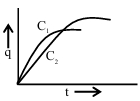
Two capacitors $C_1$ and $C_2$ are connected in parallel to a battery. The charge-time graph is shown below for the two capacitors. The energy stored in them is $U_1$ and $U_2$,respectively. Which of the given statements is true?
A
$C_1 > C_2, U_1 > U_2$
B
$C_2 > C_1, U_2 < U_1$
C
$C_1 > C_2, U_1 < U_2$
D
$C_2 > C_1, U_2 > U_1$
Solution
(D) Since the capacitors are connected in parallel to the same battery,the potential difference $V$ across both capacitors is the same.
From the charge-time graph,we observe the maximum charge $q$ stored on the capacitors. As $t \to \infty$,the charge on the capacitor reaches its maximum value $q = CV$.
From the graph,it is clear that the steady-state charge $q_2$ for capacitor $C_2$ is greater than the steady-state charge $q_1$ for capacitor $C_1$ (i.e.,$q_2 > q_1$).
Since $q = CV$ and $V$ is constant,$q \propto C$. Therefore,$C_2 > C_1$.
The energy stored in a capacitor is given by $U = \frac{1}{2} CV^2 = \frac{q^2}{2C}$. Alternatively,using $U = \frac{1}{2} qV$,since $V$ is constant and $q_2 > q_1$,it follows that $U_2 > U_1$.
Thus,$C_2 > C_1$ and $U_2 > U_1$.
From the charge-time graph,we observe the maximum charge $q$ stored on the capacitors. As $t \to \infty$,the charge on the capacitor reaches its maximum value $q = CV$.
From the graph,it is clear that the steady-state charge $q_2$ for capacitor $C_2$ is greater than the steady-state charge $q_1$ for capacitor $C_1$ (i.e.,$q_2 > q_1$).
Since $q = CV$ and $V$ is constant,$q \propto C$. Therefore,$C_2 > C_1$.
The energy stored in a capacitor is given by $U = \frac{1}{2} CV^2 = \frac{q^2}{2C}$. Alternatively,using $U = \frac{1}{2} qV$,since $V$ is constant and $q_2 > q_1$,it follows that $U_2 > U_1$.
Thus,$C_2 > C_1$ and $U_2 > U_1$.
0 likes
View Solution104
MediumMCQ
$A$ parallel plate capacitor of capacitance $1 \ \mu F$ is charged to a potential difference of $20 \ V$. The distance between the plates is $1 \ \mu m$. The energy density between the plates of the capacitor is:
A
$1.8 \times 10^3 \ J/m^3$
B
$2 \times 10^{-4} \ J/m^3$
C
$2 \times 10^2 \ J/m^3$
D
$1.8 \times 10^5 \ J/m^3$
Solution
(A) Given: Capacitance $C = 1 \ \mu F = 10^{-6} \ F$,Potential difference $V = 20 \ V$,Distance $d = 1 \ \mu m = 10^{-6} \ m$.
The electric field $E$ between the plates is given by $E = \frac{V}{d} = \frac{20}{10^{-6}} = 20 \times 10^6 \ V/m$.
The energy density $u$ is given by the formula $u = \frac{1}{2} \epsilon_0 E^2$.
Substituting the values: $u = \frac{1}{2} \times (8.854 \times 10^{-12}) \times (20 \times 10^6)^2$.
$u = 0.5 \times 8.854 \times 10^{-12} \times 400 \times 10^{12}$.
$u = 0.5 \times 8.854 \times 400 = 1770.8 \ J/m^3 \approx 1.8 \times 10^3 \ J/m^3$.
The electric field $E$ between the plates is given by $E = \frac{V}{d} = \frac{20}{10^{-6}} = 20 \times 10^6 \ V/m$.
The energy density $u$ is given by the formula $u = \frac{1}{2} \epsilon_0 E^2$.
Substituting the values: $u = \frac{1}{2} \times (8.854 \times 10^{-12}) \times (20 \times 10^6)^2$.
$u = 0.5 \times 8.854 \times 10^{-12} \times 400 \times 10^{12}$.
$u = 0.5 \times 8.854 \times 400 = 1770.8 \ J/m^3 \approx 1.8 \times 10^3 \ J/m^3$.
0 likes
View Solution105
EasyMCQ
$A$ capacitor is charged by a battery and the energy stored in it is $U$. The battery is now removed and the separation distance between the plates is doubled. The energy stored now is:
A
$U / 2$
B
$U$
C
$2 U$
D
$4 U$
Solution
(C) The capacitance of a parallel plate capacitor is given by $C = \frac{\epsilon_0 A}{d}$.
Since the battery is removed,the charge $q$ on the plates remains constant.
The energy stored in a capacitor is given by $U = \frac{q^2}{2C} = \frac{q^2 d}{2 \epsilon_0 A}$.
When the separation distance $d$ is doubled $(d' = 2d)$,the new capacitance becomes $C' = \frac{\epsilon_0 A}{2d} = \frac{C}{2}$.
The new energy stored is $U' = \frac{q^2}{2C'} = \frac{q^2}{2(C/2)} = 2 \times \frac{q^2}{2C} = 2U$.
Therefore,the energy stored becomes $2U$.
Since the battery is removed,the charge $q$ on the plates remains constant.
The energy stored in a capacitor is given by $U = \frac{q^2}{2C} = \frac{q^2 d}{2 \epsilon_0 A}$.
When the separation distance $d$ is doubled $(d' = 2d)$,the new capacitance becomes $C' = \frac{\epsilon_0 A}{2d} = \frac{C}{2}$.
The new energy stored is $U' = \frac{q^2}{2C'} = \frac{q^2}{2(C/2)} = 2 \times \frac{q^2}{2C} = 2U$.
Therefore,the energy stored becomes $2U$.
0 likes
View Solution106
MediumMCQ
If potential difference across a capacitor is changed from $15 \ V$ to $30 \ V,$ work done is $W.$ The work done,when potential difference is changed from $30 \ V$ to $60 \ V,$ will be $.......W$
A
$1$
B
$4$
C
$3$
D
$2$
Solution
(B) The work done in changing the potential difference across a capacitor is given by the change in stored energy: $\Delta U = \frac{1}{2} C(V_f^2 - V_i^2).$
In the first case,the potential changes from $15 \ V$ to $30 \ V$:
$W = \frac{1}{2} C(30^2 - 15^2) = \frac{1}{2} C(900 - 225) = \frac{1}{2} C(675) = 337.5 C.$
So,$C = \frac{W}{337.5}.$
In the second case,the potential changes from $30 \ V$ to $60 \ V$:
$W' = \frac{1}{2} C(60^2 - 30^2) = \frac{1}{2} C(3600 - 900) = \frac{1}{2} C(2700) = 1350 C.$
Substituting $C = \frac{W}{337.5}$ into the equation for $W'$:
$W' = 1350 \times \left( \frac{W}{337.5} \right) = 4W.$
In the first case,the potential changes from $15 \ V$ to $30 \ V$:
$W = \frac{1}{2} C(30^2 - 15^2) = \frac{1}{2} C(900 - 225) = \frac{1}{2} C(675) = 337.5 C.$
So,$C = \frac{W}{337.5}.$
In the second case,the potential changes from $30 \ V$ to $60 \ V$:
$W' = \frac{1}{2} C(60^2 - 30^2) = \frac{1}{2} C(3600 - 900) = \frac{1}{2} C(2700) = 1350 C.$
Substituting $C = \frac{W}{337.5}$ into the equation for $W'$:
$W' = 1350 \times \left( \frac{W}{337.5} \right) = 4W.$
0 likes
View Solution107
MediumMCQ
An uncharged capacitor is connected to a battery. While charging the capacitor,how much is the energy lost,from the energy supplied by the battery (in $\%$)?
A
$50$
B
$75$
C
$100$
D
$25$
Solution
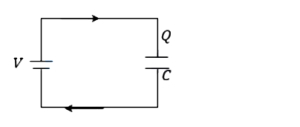
(A) Consider the circuit where a capacitor of capacitance $C$ is charged by a battery of voltage $V$.
When the capacitor is fully charged,the charge on it is $Q = CV$.
The energy stored in the capacitor is $E_{\text{capacitor}} = \frac{1}{2} CV^2$.
The total work done by the battery in supplying this charge is $W = QV = (CV)V = CV^2$.
The energy lost as heat in the circuit is the difference between the work done by the battery and the energy stored in the capacitor:
$E_{\text{loss}} = W - E_{\text{capacitor}} = CV^2 - \frac{1}{2} CV^2 = \frac{1}{2} CV^2$.
Comparing this to the total energy supplied by the battery $(W = CV^2)$:
$\text{Percentage loss} = \frac{E_{\text{loss}}}{W} \times 100\% = \frac{\frac{1}{2} CV^2}{CV^2} \times 100\% = 50\%$.
Thus,$50\%$ of the energy supplied by the battery is lost.
When the capacitor is fully charged,the charge on it is $Q = CV$.
The energy stored in the capacitor is $E_{\text{capacitor}} = \frac{1}{2} CV^2$.
The total work done by the battery in supplying this charge is $W = QV = (CV)V = CV^2$.
The energy lost as heat in the circuit is the difference between the work done by the battery and the energy stored in the capacitor:
$E_{\text{loss}} = W - E_{\text{capacitor}} = CV^2 - \frac{1}{2} CV^2 = \frac{1}{2} CV^2$.
Comparing this to the total energy supplied by the battery $(W = CV^2)$:
$\text{Percentage loss} = \frac{E_{\text{loss}}}{W} \times 100\% = \frac{\frac{1}{2} CV^2}{CV^2} \times 100\% = 50\%$.
Thus,$50\%$ of the energy supplied by the battery is lost.
0 likes
View Solution108
MediumMCQ
$A$ parallel plate capacitor having plate area $A$ and separation $d$ is charged to a potential difference $V$. The charging battery is disconnected and the plates are pulled apart to four times the initial separation. The work required to increase the distance between the plates is ($\epsilon_0 =$ permittivity of free space).
A
$\frac{3 \epsilon_0 A V^2}{2 d}$
B
$\frac{\epsilon_0 A V^2}{4 d}$
C
$\frac{2 \epsilon_0 A V^2}{d}$
D
$\frac{3 \epsilon_0 A V^2}{8 d}$
Solution
(A) Initial capacitance $C_i = \frac{\epsilon_0 A}{d}$.
Initial charge $Q = C_i V = \frac{\epsilon_0 A V}{d}$.
Since the battery is disconnected, the charge $Q$ remains constant.
Final separation $d_f = 4d$.
Final capacitance $C_f = \frac{\epsilon_0 A}{4d} = \frac{C_i}{4}$.
Initial energy $U_i = \frac{Q^2}{2C_i} = \frac{1}{2} C_i V^2 = \frac{\epsilon_0 A V^2}{2d}$.
Final energy $U_f = \frac{Q^2}{2C_f} = \frac{Q^2}{2(C_i/4)} = 4 \left( \frac{Q^2}{2C_i} \right) = 4 U_i$.
Work done $W = U_f - U_i = 4 U_i - U_i = 3 U_i$.
Substituting $U_i$, $W = 3 \left( \frac{\epsilon_0 A V^2}{2d} \right) = \frac{3 \epsilon_0 A V^2}{2d}$.
Initial charge $Q = C_i V = \frac{\epsilon_0 A V}{d}$.
Since the battery is disconnected, the charge $Q$ remains constant.
Final separation $d_f = 4d$.
Final capacitance $C_f = \frac{\epsilon_0 A}{4d} = \frac{C_i}{4}$.
Initial energy $U_i = \frac{Q^2}{2C_i} = \frac{1}{2} C_i V^2 = \frac{\epsilon_0 A V^2}{2d}$.
Final energy $U_f = \frac{Q^2}{2C_f} = \frac{Q^2}{2(C_i/4)} = 4 \left( \frac{Q^2}{2C_i} \right) = 4 U_i$.
Work done $W = U_f - U_i = 4 U_i - U_i = 3 U_i$.
Substituting $U_i$, $W = 3 \left( \frac{\epsilon_0 A V^2}{2d} \right) = \frac{3 \epsilon_0 A V^2}{2d}$.
0 likes
View Solution109
MediumMCQ
If the charge on the capacitor is increased by $3 \ C$,the energy stored in it increases by $21 \%$. The original charge on the capacitor is (in $C$)
A
$6$
B
$3$
C
$30$
D
$90$
Solution
(C) The energy stored in a capacitor is given by $U = \frac{Q^2}{2C}$,where $Q$ is the charge and $C$ is the capacitance.
Let the original charge be $Q$. The original energy is $U_1 = \frac{Q^2}{2C}$.
When the charge is increased by $3 \ C$,the new charge is $Q' = Q + 3$.
The new energy is $U_2 = \frac{(Q+3)^2}{2C}$.
Given that the energy increases by $21 \%$,we have $U_2 = U_1 + 0.21 U_1 = 1.21 U_1$.
Substituting the expressions for $U_1$ and $U_2$:
$\frac{(Q+3)^2}{2C} = 1.21 \times \frac{Q^2}{2C}$.
$(Q+3)^2 = 1.21 Q^2$.
Taking the square root on both sides:
$Q+3 = 1.1 Q$.
$3 = 1.1 Q - Q$.
$3 = 0.1 Q$.
$Q = \frac{3}{0.1} = 30 \ C$.
Therefore,the original charge on the capacitor is $30 \ C$.
Let the original charge be $Q$. The original energy is $U_1 = \frac{Q^2}{2C}$.
When the charge is increased by $3 \ C$,the new charge is $Q' = Q + 3$.
The new energy is $U_2 = \frac{(Q+3)^2}{2C}$.
Given that the energy increases by $21 \%$,we have $U_2 = U_1 + 0.21 U_1 = 1.21 U_1$.
Substituting the expressions for $U_1$ and $U_2$:
$\frac{(Q+3)^2}{2C} = 1.21 \times \frac{Q^2}{2C}$.
$(Q+3)^2 = 1.21 Q^2$.
Taking the square root on both sides:
$Q+3 = 1.1 Q$.
$3 = 1.1 Q - Q$.
$3 = 0.1 Q$.
$Q = \frac{3}{0.1} = 30 \ C$.
Therefore,the original charge on the capacitor is $30 \ C$.
0 likes
View Solution110
MediumMCQ
If the charge on the capacitor is increased by $2 \text{ C}$, the energy stored in it increases by $21 \%$. The original charge on the capacitor is (in $\text{ C}$)
A
$20$
B
$15$
C
$10$
D
$5$
Solution
(A) Let the original charge on the capacitor be $Q$ and the capacitance be $C$. The energy stored in the capacitor is given by $U = \frac{Q^2}{2C}$.
When the charge is increased by $2 \text{ C}$, the new charge becomes $Q' = Q + 2$.
The new energy stored is $U' = \frac{(Q + 2)^2}{2C}$.
Given that the energy increases by $21 \%$, we have $U' = U + 0.21U = 1.21U$.
Substituting the expressions for $U$ and $U'$, we get $\frac{(Q + 2)^2}{2C} = 1.21 \times \frac{Q^2}{2C}$.
Canceling $\frac{1}{2C}$ from both sides, we get $(Q + 2)^2 = 1.21Q^2$.
Taking the square root of both sides, $Q + 2 = 1.1Q$.
Rearranging the terms, $0.1Q = 2$, which gives $Q = \frac{2}{0.1} = 20 \text{ C}$.
When the charge is increased by $2 \text{ C}$, the new charge becomes $Q' = Q + 2$.
The new energy stored is $U' = \frac{(Q + 2)^2}{2C}$.
Given that the energy increases by $21 \%$, we have $U' = U + 0.21U = 1.21U$.
Substituting the expressions for $U$ and $U'$, we get $\frac{(Q + 2)^2}{2C} = 1.21 \times \frac{Q^2}{2C}$.
Canceling $\frac{1}{2C}$ from both sides, we get $(Q + 2)^2 = 1.21Q^2$.
Taking the square root of both sides, $Q + 2 = 1.1Q$.
Rearranging the terms, $0.1Q = 2$, which gives $Q = \frac{2}{0.1} = 20 \text{ C}$.
0 likes
View Solution111
EasyMCQ
The amount of work done in increasing the voltage across the plates of a capacitor from $5 \ V$ to $10 \ V$ is $W$. The work done in increasing it from $10 \ V$ to $15 \ V$ will be (nearly):
A
$0.6 \ W$
B
$W$
C
$1.25 \ W$
D
$1.67 \ W$
Solution
(D) The energy stored in a capacitor is given by $U = \frac{1}{2} CV^2$.
The work done $W$ in changing the potential difference from $V_i$ to $V_f$ is the change in potential energy: $W = \Delta U = \frac{1}{2} C(V_f^2 - V_i^2)$.
For the first case,$V_1 = 5 \ V$ to $V_2 = 10 \ V$:
$W = \frac{1}{2} C(10^2 - 5^2) = \frac{1}{2} C(100 - 25) = \frac{75}{2} C$.
For the second case,$V_2 = 10 \ V$ to $V_3 = 15 \ V$:
$W' = \frac{1}{2} C(15^2 - 10^2) = \frac{1}{2} C(225 - 100) = \frac{125}{2} C$.
Taking the ratio:
$\frac{W'}{W} = \frac{125/2 C}{75/2 C} = \frac{125}{75} = \frac{5}{3} \approx 1.67$.
Therefore,$W' = 1.67 \ W$.
The work done $W$ in changing the potential difference from $V_i$ to $V_f$ is the change in potential energy: $W = \Delta U = \frac{1}{2} C(V_f^2 - V_i^2)$.
For the first case,$V_1 = 5 \ V$ to $V_2 = 10 \ V$:
$W = \frac{1}{2} C(10^2 - 5^2) = \frac{1}{2} C(100 - 25) = \frac{75}{2} C$.
For the second case,$V_2 = 10 \ V$ to $V_3 = 15 \ V$:
$W' = \frac{1}{2} C(15^2 - 10^2) = \frac{1}{2} C(225 - 100) = \frac{125}{2} C$.
Taking the ratio:
$\frac{W'}{W} = \frac{125/2 C}{75/2 C} = \frac{125}{75} = \frac{5}{3} \approx 1.67$.
Therefore,$W' = 1.67 \ W$.
0 likes
View Solution112
MediumMCQ
The mean electrical energy density between the plates of a charged air capacitor is (where $q=$ charge on capacitor,$A=$ area of capacitor plate):
A
$\frac{q^2}{2 \varepsilon_0 A^2}$
B
$\frac{q}{2 \varepsilon_0 A^2}$
C
$\frac{q^2}{2 \varepsilon_0 A}$
D
$\frac{\varepsilon_0 A}{q^2}$
Solution
(A) For a parallel plate capacitor,the energy density $u = \frac{1}{2} \varepsilon_0 E^2$.
Since the electric field $E$ between the plates is given by $E = \frac{\sigma}{\varepsilon_0}$,where $\sigma = \frac{q}{A}$ is the surface charge density.
Substituting the value of $E$ in the energy density formula:
$u = \frac{1}{2} \varepsilon_0 \left( \frac{\sigma}{\varepsilon_0} \right)^2 = \frac{\sigma^2}{2 \varepsilon_0}$.
Now,substituting $\sigma = \frac{q}{A}$:
$u = \frac{(q/A)^2}{2 \varepsilon_0} = \frac{q^2}{2 \varepsilon_0 A^2}$.
Since the electric field $E$ between the plates is given by $E = \frac{\sigma}{\varepsilon_0}$,where $\sigma = \frac{q}{A}$ is the surface charge density.
Substituting the value of $E$ in the energy density formula:
$u = \frac{1}{2} \varepsilon_0 \left( \frac{\sigma}{\varepsilon_0} \right)^2 = \frac{\sigma^2}{2 \varepsilon_0}$.
Now,substituting $\sigma = \frac{q}{A}$:
$u = \frac{(q/A)^2}{2 \varepsilon_0} = \frac{q^2}{2 \varepsilon_0 A^2}$.
0 likes
View Solution113
MediumMCQ
$A$ parallel plate capacitor has plate area $A$ and separation between plates is $d$. It is charged to a potential difference of $V_0$ volt. The charging battery is then disconnected and plates are pulled apart to three times the initial distance. The work done to increase the distance between the plates is $(\varepsilon_0 = \text{permittivity of free space})$
A
$\frac{3 \varepsilon_0 A V_0^2}{d}$
B
$\frac{\varepsilon_0 A V_0^2}{2 d}$
C
$\frac{\varepsilon_0 A V_0^2}{3 d}$
D
$\frac{\varepsilon_0 A V_0^2}{d}$
Solution
(D) Initial capacitance $C_0 = \frac{\varepsilon_0 A}{d}$.
Initial charge $Q = C_0 V_0$.
Since the battery is disconnected,the charge $Q$ remains constant.
Final separation $d' = 3d$.
Final capacitance $C' = \frac{\varepsilon_0 A}{3d} = \frac{C_0}{3}$.
Initial potential energy $U_i = \frac{Q^2}{2C_0} = \frac{1}{2} C_0 V_0^2$.
Final potential energy $U_f = \frac{Q^2}{2C'} = \frac{Q^2}{2(C_0/3)} = \frac{3Q^2}{2C_0} = \frac{3}{2} C_0 V_0^2$.
Work done $W = U_f - U_i = \frac{3}{2} C_0 V_0^2 - \frac{1}{2} C_0 V_0^2 = C_0 V_0^2$.
Substituting $C_0 = \frac{\varepsilon_0 A}{d}$,we get $W = \frac{\varepsilon_0 A V_0^2}{d}$.
Initial charge $Q = C_0 V_0$.
Since the battery is disconnected,the charge $Q$ remains constant.
Final separation $d' = 3d$.
Final capacitance $C' = \frac{\varepsilon_0 A}{3d} = \frac{C_0}{3}$.
Initial potential energy $U_i = \frac{Q^2}{2C_0} = \frac{1}{2} C_0 V_0^2$.
Final potential energy $U_f = \frac{Q^2}{2C'} = \frac{Q^2}{2(C_0/3)} = \frac{3Q^2}{2C_0} = \frac{3}{2} C_0 V_0^2$.
Work done $W = U_f - U_i = \frac{3}{2} C_0 V_0^2 - \frac{1}{2} C_0 V_0^2 = C_0 V_0^2$.
Substituting $C_0 = \frac{\varepsilon_0 A}{d}$,we get $W = \frac{\varepsilon_0 A V_0^2}{d}$.
0 likes
View Solution114
MediumMCQ
If the charge on the capacitor is increased by $3 \ C$,the energy stored in it increases by $44 \%$. The original charge on the capacitor is (in $C$)
A
$10$
B
$15$
C
$20$
D
$25$
Solution
(B) The energy stored in a capacitor is given by $U = \frac{Q^2}{2C}$.
Since $C$ is constant,$U \propto Q^2$.
Let the initial charge be $Q_1$ and the initial energy be $U_1$.
When the charge is increased by $3 \ C$,the new charge is $Q_2 = Q_1 + 3$.
The new energy $U_2$ is $U_1 + 44\% \text{ of } U_1 = 1.44 \ U_1$.
Using the proportionality $U \propto Q^2$,we have:
$\frac{U_2}{U_1} = \left( \frac{Q_2}{Q_1} \right)^2$
$1.44 = \left( \frac{Q_1 + 3}{Q_1} \right)^2$
Taking the square root on both sides:
$1.2 = \frac{Q_1 + 3}{Q_1}$
$1.2 \ Q_1 = Q_1 + 3$
$0.2 \ Q_1 = 3$
$Q_1 = \frac{3}{0.2} = 15 \ C$.
Since $C$ is constant,$U \propto Q^2$.
Let the initial charge be $Q_1$ and the initial energy be $U_1$.
When the charge is increased by $3 \ C$,the new charge is $Q_2 = Q_1 + 3$.
The new energy $U_2$ is $U_1 + 44\% \text{ of } U_1 = 1.44 \ U_1$.
Using the proportionality $U \propto Q^2$,we have:
$\frac{U_2}{U_1} = \left( \frac{Q_2}{Q_1} \right)^2$
$1.44 = \left( \frac{Q_1 + 3}{Q_1} \right)^2$
Taking the square root on both sides:
$1.2 = \frac{Q_1 + 3}{Q_1}$
$1.2 \ Q_1 = Q_1 + 3$
$0.2 \ Q_1 = 3$
$Q_1 = \frac{3}{0.2} = 15 \ C$.
0 likes
View Solution115
MediumMCQ
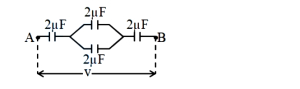
Four capacitors each of capacity $2 \mu F$ are connected as shown in the figure. If $V_{A}-V_{B}=10 \,V$,the energy stored in the system is:
A
$40 \times 10^{-8} \,J$
B
$625 \times 10^{-6} \,J$
C
$6250 \times 10^{-7} \,J$
D
$400 \times 10^{-7} \,J$
Solution
(D) The circuit consists of two capacitors in parallel connected in series with two other capacitors.
First,calculate the equivalent capacitance of the two parallel capacitors:
$C_{\|} = 2 \mu F + 2 \mu F = 4 \mu F$
Now,the circuit is equivalent to three capacitors in series: $2 \mu F$,$4 \mu F$,and $2 \mu F$.
The equivalent capacitance $C_{eq}$ is given by:
$\frac{1}{C_{eq}} = \frac{1}{2 \mu F} + \frac{1}{4 \mu F} + \frac{1}{2 \mu F} = \frac{2 + 1 + 2}{4 \mu F} = \frac{5}{4 \mu F}$
$C_{eq} = \frac{4}{5} \mu F = 0.8 \times 10^{-6} \,F$
The energy stored $U$ is given by:
$U = \frac{1}{2} C_{eq} V^2$
$U = \frac{1}{2} \times (0.8 \times 10^{-6} \,F) \times (10 \,V)^2$
$U = 0.4 \times 10^{-6} \times 100 \,J = 40 \times 10^{-6} \,J = 400 \times 10^{-7} \,J$
First,calculate the equivalent capacitance of the two parallel capacitors:
$C_{\|} = 2 \mu F + 2 \mu F = 4 \mu F$
Now,the circuit is equivalent to three capacitors in series: $2 \mu F$,$4 \mu F$,and $2 \mu F$.
The equivalent capacitance $C_{eq}$ is given by:
$\frac{1}{C_{eq}} = \frac{1}{2 \mu F} + \frac{1}{4 \mu F} + \frac{1}{2 \mu F} = \frac{2 + 1 + 2}{4 \mu F} = \frac{5}{4 \mu F}$
$C_{eq} = \frac{4}{5} \mu F = 0.8 \times 10^{-6} \,F$
The energy stored $U$ is given by:
$U = \frac{1}{2} C_{eq} V^2$
$U = \frac{1}{2} \times (0.8 \times 10^{-6} \,F) \times (10 \,V)^2$
$U = 0.4 \times 10^{-6} \times 100 \,J = 40 \times 10^{-6} \,J = 400 \times 10^{-7} \,J$
0 likes
View Solution116
MediumMCQ
$A$ parallel plate capacitor having plate area $A$ and separation $d$ is charged to a potential difference $V$. The charging battery is disconnected and the plates are pulled apart to four times the initial separation. The work required to increase the distance between plates is:
A
$\frac{\varepsilon_0 A V^2}{4 d}$
B
$\frac{2 \varepsilon_0 A V^2}{4 d}$
C
$\frac{\varepsilon_0 A V^2}{3 d}$
D
$\frac{3 \varepsilon_0 A V^2}{2 d}$
Solution
(D) Initial capacitance $C = \frac{\varepsilon_0 A}{d}$. Initial charge $q = CV = \frac{\varepsilon_0 A V}{d}$.
Initial energy $U_i = \frac{q^2}{2C} = \frac{1}{2} CV^2 = \frac{\varepsilon_0 A V^2}{2d}$.
When the battery is disconnected,the charge $q$ remains constant.
The new separation is $d' = 4d$,so the new capacitance is $C' = \frac{\varepsilon_0 A}{4d} = \frac{C}{4}$.
Final energy $U_f = \frac{q^2}{2C'} = \frac{q^2}{2(C/4)} = \frac{4q^2}{2C} = 4U_i$.
Work done $W = U_f - U_i = 4U_i - U_i = 3U_i$.
Substituting $U_i = \frac{\varepsilon_0 A V^2}{2d}$,we get $W = 3 \times \frac{\varepsilon_0 A V^2}{2d} = \frac{3 \varepsilon_0 A V^2}{2d}$.
Initial energy $U_i = \frac{q^2}{2C} = \frac{1}{2} CV^2 = \frac{\varepsilon_0 A V^2}{2d}$.
When the battery is disconnected,the charge $q$ remains constant.
The new separation is $d' = 4d$,so the new capacitance is $C' = \frac{\varepsilon_0 A}{4d} = \frac{C}{4}$.
Final energy $U_f = \frac{q^2}{2C'} = \frac{q^2}{2(C/4)} = \frac{4q^2}{2C} = 4U_i$.
Work done $W = U_f - U_i = 4U_i - U_i = 3U_i$.
Substituting $U_i = \frac{\varepsilon_0 A V^2}{2d}$,we get $W = 3 \times \frac{\varepsilon_0 A V^2}{2d} = \frac{3 \varepsilon_0 A V^2}{2d}$.
0 likes
View Solution117
EasyMCQ
$A$ parallel plate air capacitor has a uniform electric field $E$ in the space between the plates. The area of each plate is $A$ and the distance between the plates is $d$. The energy stored in the capacitor is $[\varepsilon_0 = \text{permittivity of free space}]$
A
$2 \varepsilon_0 E A d$
B
$\frac{\varepsilon_0 E^2}{2 A d}$
C
$\frac{1}{2} \varepsilon_0 E^2 A d$
D
$\frac{E^2 A d}{2 \varepsilon_0}$
Solution
(C) The energy density $u$ in a parallel plate capacitor is given by $u = \frac{1}{2} \varepsilon_0 E^2$.
The volume $V$ of the space between the plates is $V = A \times d$.
The total energy $U$ stored in the capacitor is the product of energy density and volume.
$U = u \times V = (\frac{1}{2} \varepsilon_0 E^2) \times (A d) = \frac{1}{2} \varepsilon_0 E^2 A d$.
The volume $V$ of the space between the plates is $V = A \times d$.
The total energy $U$ stored in the capacitor is the product of energy density and volume.
$U = u \times V = (\frac{1}{2} \varepsilon_0 E^2) \times (A d) = \frac{1}{2} \varepsilon_0 E^2 A d$.
0 likes
View Solution118
EasyMCQ
If the potential difference across a capacitor is increased from $5 \,V$ to $15 \,V$, then the ratio of final energy to initial energy stored in the capacitor is
A
$1$ : $3$
B
$27$ : $1$
C
$3$ : $1$
D
$9$ : $1$
Solution
(D) The energy stored in a capacitor is given by the formula $W = \frac{1}{2} CV^2$, where $C$ is the capacitance and $V$ is the potential difference.
Initial energy $W_1 = \frac{1}{2} CV_1^2$, where $V_1 = 5 \,V$.
Final energy $W_2 = \frac{1}{2} CV_2^2$, where $V_2 = 15 \,V$.
The ratio of final energy to initial energy is $\frac{W_2}{W_1} = \frac{\frac{1}{2} CV_2^2}{\frac{1}{2} CV_1^2} = \left(\frac{V_2}{V_1}\right)^2$.
Substituting the values, we get $\frac{W_2}{W_1} = \left(\frac{15}{5}\right)^2 = (3)^2 = 9$.
Therefore, the ratio is $9 : 1$.
Initial energy $W_1 = \frac{1}{2} CV_1^2$, where $V_1 = 5 \,V$.
Final energy $W_2 = \frac{1}{2} CV_2^2$, where $V_2 = 15 \,V$.
The ratio of final energy to initial energy is $\frac{W_2}{W_1} = \frac{\frac{1}{2} CV_2^2}{\frac{1}{2} CV_1^2} = \left(\frac{V_2}{V_1}\right)^2$.
Substituting the values, we get $\frac{W_2}{W_1} = \left(\frac{15}{5}\right)^2 = (3)^2 = 9$.
Therefore, the ratio is $9 : 1$.
0 likes
View Solution119
EasyMCQ
$A$ battery is used to charge a parallel plate capacitor until the potential difference between the plates becomes equal to the e.m.f. of the battery. The ratio of the energy stored in the capacitor to the work done by the battery will be
A
$2$
B
$1$/$2$
C
$1$
D
$1$/$4$
Solution
(B) Let the capacitance of the capacitor be $C$ and the e.m.f. of the battery be $V$.
When the capacitor is fully charged,the potential difference across the plates is $V$.
The charge stored on the capacitor is $q = CV$.
The energy stored in the capacitor is $U = \frac{1}{2} CV^2 = \frac{1}{2} qV$.
The work done by the battery in supplying charge $q$ is $W = qV = CV^2$.
The ratio of the energy stored in the capacitor to the work done by the battery is $\frac{U}{W} = \frac{\frac{1}{2} qV}{qV} = \frac{1}{2}$.
When the capacitor is fully charged,the potential difference across the plates is $V$.
The charge stored on the capacitor is $q = CV$.
The energy stored in the capacitor is $U = \frac{1}{2} CV^2 = \frac{1}{2} qV$.
The work done by the battery in supplying charge $q$ is $W = qV = CV^2$.
The ratio of the energy stored in the capacitor to the work done by the battery is $\frac{U}{W} = \frac{\frac{1}{2} qV}{qV} = \frac{1}{2}$.
0 likes
View Solution120
EasyMCQ
$A$ parallel plate capacitor has a uniform electric field $E$ in the space between the plates. If the distance between the plates is $d$ and the area of each plate is $A$,the energy stored in the capacitor is (where $\epsilon_{0}$ is the permittivity of free space).
A
$\frac{1}{2} \frac{\epsilon_{0} EA}{d}$
B
$\frac{1}{2} \epsilon_{0} E^{2} Ad$
C
$\frac{1}{2} \frac{\epsilon_{0} Ad}{E^{2}}$
D
$\frac{1}{2} \frac{\epsilon_{0} E^{2} A}{d}$
Solution
(B) The energy density $u$ of an electric field $E$ is given by $u = \frac{1}{2} \epsilon_{0} E^{2}$.
The volume $V$ of the space between the plates of a parallel plate capacitor is the product of the area $A$ and the distance $d$,so $V = Ad$.
The total energy $U$ stored in the capacitor is the product of the energy density and the volume.
Therefore,$U = u \times V = (\frac{1}{2} \epsilon_{0} E^{2}) \times (Ad) = \frac{1}{2} \epsilon_{0} E^{2} Ad$.
The volume $V$ of the space between the plates of a parallel plate capacitor is the product of the area $A$ and the distance $d$,so $V = Ad$.
The total energy $U$ stored in the capacitor is the product of the energy density and the volume.
Therefore,$U = u \times V = (\frac{1}{2} \epsilon_{0} E^{2}) \times (Ad) = \frac{1}{2} \epsilon_{0} E^{2} Ad$.
0 likes
View Solution121
MediumMCQ
The amount of work done in increasing the voltage across the plates of a capacitor from $5 V$ to $10 V$ is $W$. The work done in increasing it from $10 V$ to $15 V$ will be
A
$W$
B
$0.6 W$
C
$1.25 W$
D
$1.67 W$
Solution
(D) The energy stored in a capacitor is given by $U = \frac{1}{2} C V^2$.
The work done in increasing the potential from $V_i$ to $V_f$ is $\Delta U = \frac{1}{2} C (V_f^2 - V_i^2)$.
For the first case,$W = \frac{1}{2} C (10^2 - 5^2) = \frac{1}{2} C (100 - 25) = \frac{75}{2} C$.
For the second case,$W_2 = \frac{1}{2} C (15^2 - 10^2) = \frac{1}{2} C (225 - 100) = \frac{125}{2} C$.
Taking the ratio: $\frac{W_2}{W} = \frac{125/2 C}{75/2 C} = \frac{125}{75} = \frac{5}{3} \approx 1.67$.
Therefore,$W_2 = 1.67 W$.
The work done in increasing the potential from $V_i$ to $V_f$ is $\Delta U = \frac{1}{2} C (V_f^2 - V_i^2)$.
For the first case,$W = \frac{1}{2} C (10^2 - 5^2) = \frac{1}{2} C (100 - 25) = \frac{75}{2} C$.
For the second case,$W_2 = \frac{1}{2} C (15^2 - 10^2) = \frac{1}{2} C (225 - 100) = \frac{125}{2} C$.
Taking the ratio: $\frac{W_2}{W} = \frac{125/2 C}{75/2 C} = \frac{125}{75} = \frac{5}{3} \approx 1.67$.
Therefore,$W_2 = 1.67 W$.
0 likes
View Solution122
MediumMCQ
Energy per unit volume for a capacitor having area $A$ and separation $d$ kept at potential difference $V$ is given by
A
$\frac{1}{2} \varepsilon_{0} \frac{V^{2}}{d^{2}}$
B
$\frac{1}{2 \varepsilon_{0}} \frac{V^{2}}{d^{2}}$
C
$\frac{1}{2} C V^{2}$
D
$\frac{Q^{2}}{2 C}$
Solution
(A) The energy density $u$ (energy per unit volume) of a capacitor is given by the formula $u = \frac{1}{2} \varepsilon_{0} E^{2}$.
Since the electric field $E$ between the plates of a capacitor is related to the potential difference $V$ and separation $d$ by $E = \frac{V}{d}$,
Substituting this into the energy density formula,we get $u = \frac{1}{2} \varepsilon_{0} (\frac{V}{d})^{2} = \frac{1}{2} \varepsilon_{0} \frac{V^{2}}{d^{2}}$.
Since the electric field $E$ between the plates of a capacitor is related to the potential difference $V$ and separation $d$ by $E = \frac{V}{d}$,
Substituting this into the energy density formula,we get $u = \frac{1}{2} \varepsilon_{0} (\frac{V}{d})^{2} = \frac{1}{2} \varepsilon_{0} \frac{V^{2}}{d^{2}}$.
0 likes
View Solution123
MediumMCQ
Capacity of a capacitor is $48 \mu F$. When it is charged from $0.1 C$ to $0.5 C$,the change in the energy stored is:
A
$2500 \ J$
B
$2.5 \times 10^{-3} \ J$
C
$2.5 \times 10^{6} \ J$
D
$2.42 \times 10^{-2} \ J$
Solution
(A) The energy stored in a capacitor is given by $U = \frac{q^2}{2C}$.
Given: $C = 48 \mu F = 48 \times 10^{-6} \ F$,$q_1 = 0.1 \ C$,$q_2 = 0.5 \ C$.
The change in energy $\Delta U$ is given by:
$\Delta U = U_2 - U_1 = \frac{q_2^2}{2C} - \frac{q_1^2}{2C} = \frac{1}{2C} (q_2^2 - q_1^2)$
Substituting the values:
$\Delta U = \frac{1}{2 \times 48 \times 10^{-6}} ((0.5)^2 - (0.1)^2)$
$\Delta U = \frac{1}{96 \times 10^{-6}} (0.25 - 0.01)$
$\Delta U = \frac{0.24}{96 \times 10^{-6}}$
$\Delta U = \frac{0.24 \times 10^6}{96} = \frac{240000}{96} = 2500 \ J$.
Given: $C = 48 \mu F = 48 \times 10^{-6} \ F$,$q_1 = 0.1 \ C$,$q_2 = 0.5 \ C$.
The change in energy $\Delta U$ is given by:
$\Delta U = U_2 - U_1 = \frac{q_2^2}{2C} - \frac{q_1^2}{2C} = \frac{1}{2C} (q_2^2 - q_1^2)$
Substituting the values:
$\Delta U = \frac{1}{2 \times 48 \times 10^{-6}} ((0.5)^2 - (0.1)^2)$
$\Delta U = \frac{1}{96 \times 10^{-6}} (0.25 - 0.01)$
$\Delta U = \frac{0.24}{96 \times 10^{-6}}$
$\Delta U = \frac{0.24 \times 10^6}{96} = \frac{240000}{96} = 2500 \ J$.
0 likes
View Solution124
MediumMCQ
The energy required to charge a parallel plate capacitor with plate separation $d$ and plate area $A$ such that the uniform electric field between the plates is $E$,is
A
$\frac{1}{2} \varepsilon_{0} E^{2} / A d$
B
$\varepsilon_{0} E^{2} / A d$
C
$\varepsilon_{0} E^{2} A d$
D
$\frac{1}{2} \varepsilon_{0} E^{2} A d$
Solution
(D) The energy stored in a parallel plate capacitor is given by the formula $U = \frac{1}{2} C V^{2}$.
Here,the capacitance $C = \frac{\varepsilon_{0} A}{d}$.
The potential difference $V$ between the plates is related to the electric field $E$ and separation $d$ by $V = E d$.
Substituting these values into the energy formula:
$U = \frac{1}{2} \left( \frac{\varepsilon_{0} A}{d} \right) (E d)^{2}$
$U = \frac{1}{2} \left( \frac{\varepsilon_{0} A}{d} \right) (E^{2} d^{2})$
$U = \frac{1}{2} \varepsilon_{0} E^{2} A d$.
Here,the capacitance $C = \frac{\varepsilon_{0} A}{d}$.
The potential difference $V$ between the plates is related to the electric field $E$ and separation $d$ by $V = E d$.
Substituting these values into the energy formula:
$U = \frac{1}{2} \left( \frac{\varepsilon_{0} A}{d} \right) (E d)^{2}$
$U = \frac{1}{2} \left( \frac{\varepsilon_{0} A}{d} \right) (E^{2} d^{2})$
$U = \frac{1}{2} \varepsilon_{0} E^{2} A d$.
0 likes
View Solution125
EasyMCQ
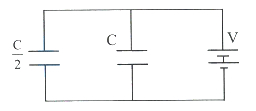
Two capacitors,one of capacity $\frac{C}{2}$ and the other of capacity $C$,are connected to a battery of voltage $V$ as shown. The work done in charging both the capacitors fully is
A
$\frac{1}{2} CV^2$
B
$\frac{3}{4} CV^2$
C
$\frac{3}{2} CV^2$
D
$2 CV^2$
Solution
(B) The two capacitors are connected in parallel to the battery.
In a parallel combination,the equivalent capacitance $C_{eq}$ is the sum of individual capacitances:
$C_{eq} = C + \frac{C}{2} = \frac{3C}{2}$
The work done $W$ by the battery to charge the capacitors is equal to the energy stored in the equivalent capacitor:
$W = \frac{1}{2} C_{eq} V^2$
Substituting the value of $C_{eq}$:
$W = \frac{1}{2} \left( \frac{3C}{2} \right) V^2$
$W = \frac{3}{4} CV^2$
In a parallel combination,the equivalent capacitance $C_{eq}$ is the sum of individual capacitances:
$C_{eq} = C + \frac{C}{2} = \frac{3C}{2}$
The work done $W$ by the battery to charge the capacitors is equal to the energy stored in the equivalent capacitor:
$W = \frac{1}{2} C_{eq} V^2$
Substituting the value of $C_{eq}$:
$W = \frac{1}{2} \left( \frac{3C}{2} \right) V^2$
$W = \frac{3}{4} CV^2$
0 likes
View Solution126
MediumMCQ
An air-filled parallel plate capacitor has a uniform electric field $E$ in the space between the plates. If the distance between the plates is $d$ and the area of each plate is $A$,the energy stored in the capacitor is ($\epsilon_{0} =$ permittivity of free space).
A
$\frac{1}{2} \epsilon_{0} E^{2} Ad$
B
$E^{2} \frac{Ad}{\epsilon_{0}}$
C
$\frac{1}{2} \epsilon_{0} E^{2}$
D
$\epsilon_{0} E Ad$
Solution
(A) The energy density (energy per unit volume) in an electric field is given by $u = \frac{1}{2} \epsilon_{0} E^{2}$.
The volume of the space between the plates is $V = Ad$.
Therefore,the total energy stored in the capacitor is $U = u \times V = \left( \frac{1}{2} \epsilon_{0} E^{2} \right) \times (Ad) = \frac{1}{2} \epsilon_{0} E^{2} Ad$.
The volume of the space between the plates is $V = Ad$.
Therefore,the total energy stored in the capacitor is $U = u \times V = \left( \frac{1}{2} \epsilon_{0} E^{2} \right) \times (Ad) = \frac{1}{2} \epsilon_{0} E^{2} Ad$.
0 likes
View Solution127
MediumMCQ
If a capacitor of capacity $900 \mu F$ is charged to $100 \ V$ and its total energy is transferred to a capacitor of capacity $100 \mu F$, then its potential will be (in $V$)
A
$30$
B
$200$
C
$300$
D
$400$
Solution
(C) The energy stored in a capacitor is given by the formula $U = \frac{1}{2} CV^2$.
Given for the first capacitor: $C_1 = 900 \mu F$ and $V_1 = 100 \ V$.
The energy stored in the first capacitor is $U_1 = \frac{1}{2} C_1 V_1^2$.
When this energy is transferred to a second capacitor of capacity $C_2 = 100 \mu F$, let the new potential be $V_u$.
Since the total energy is transferred, $U_1 = U_2$, where $U_2 = \frac{1}{2} C_2 V_u^2$.
Equating the energies: $\frac{1}{2} C_1 V_1^2 = \frac{1}{2} C_2 V_u^2$.
Substituting the values: $\frac{1}{2} \times 900 \times 10^{-6} \times (100)^2 = \frac{1}{2} \times 100 \times 10^{-6} \times V_u^2$.
Simplifying the equation: $900 \times 100^2 = 100 \times V_u^2$.
$V_u^2 = \frac{900 \times 10000}{100} = 90000$.
$V_u = \sqrt{90000} = 300 \ V$.
Given for the first capacitor: $C_1 = 900 \mu F$ and $V_1 = 100 \ V$.
The energy stored in the first capacitor is $U_1 = \frac{1}{2} C_1 V_1^2$.
When this energy is transferred to a second capacitor of capacity $C_2 = 100 \mu F$, let the new potential be $V_u$.
Since the total energy is transferred, $U_1 = U_2$, where $U_2 = \frac{1}{2} C_2 V_u^2$.
Equating the energies: $\frac{1}{2} C_1 V_1^2 = \frac{1}{2} C_2 V_u^2$.
Substituting the values: $\frac{1}{2} \times 900 \times 10^{-6} \times (100)^2 = \frac{1}{2} \times 100 \times 10^{-6} \times V_u^2$.
Simplifying the equation: $900 \times 100^2 = 100 \times V_u^2$.
$V_u^2 = \frac{900 \times 10000}{100} = 90000$.
$V_u = \sqrt{90000} = 300 \ V$.
0 likes
View Solution128
EasyMCQ
Work done in placing a charge of $8 \times 10^{-18} \text{ C}$ on a capacitor of capacitance $800 \mu\text{F}$ is . . . . . . .
A
$4 \times 10^{-32} \text{ J}$
B
$32 \times 10^{-32} \text{ J}$
C
$3.1 \times 10^{-26} \text{ J}$
D
$16 \times 10^{-32} \text{ J}$
Solution
(A) The work done $W$ in charging a capacitor is equal to the potential energy $U$ stored in it.
The formula for energy stored in a capacitor is $W = U = \frac{Q^2}{2C}$.
Given:
Charge $Q = 8 \times 10^{-18} \text{ C}$
Capacitance $C = 800 \mu\text{F} = 800 \times 10^{-6} \text{ F} = 8 \times 10^{-4} \text{ F}$.
Substituting the values:
$W = \frac{(8 \times 10^{-18})^2}{2 \times 8 \times 10^{-4}}$
$W = \frac{64 \times 10^{-36}}{16 \times 10^{-4}}$
$W = 4 \times 10^{-32} \text{ J}$.
The formula for energy stored in a capacitor is $W = U = \frac{Q^2}{2C}$.
Given:
Charge $Q = 8 \times 10^{-18} \text{ C}$
Capacitance $C = 800 \mu\text{F} = 800 \times 10^{-6} \text{ F} = 8 \times 10^{-4} \text{ F}$.
Substituting the values:
$W = \frac{(8 \times 10^{-18})^2}{2 \times 8 \times 10^{-4}}$
$W = \frac{64 \times 10^{-36}}{16 \times 10^{-4}}$
$W = 4 \times 10^{-32} \text{ J}$.
0 likes
View Solution129
EasyMCQ
$A$ $12 \text{ pF}$ capacitor is connected to a $50 \text{ V}$ battery. The electrostatic energy stored in the capacitor will be . . . . . . $\text{J}$.
A
$1.5 \times 10^{-8}$
B
$1.5 \times 10^{-10}$
C
$2.5 \times 10^{-8}$
D
$2.5 \times 10^{-10}$
Solution
(A) Given:
Capacitance $C = 12 \text{ pF} = 12 \times 10^{-12} \text{ F}$
Potential difference $V = 50 \text{ V}$
The electrostatic energy $U$ stored in a capacitor is given by the formula:
$U = \frac{1}{2} C V^2$
Substituting the given values:
$U = \frac{1}{2} \times (12 \times 10^{-12} \text{ F}) \times (50 \text{ V})^2$
$U = 6 \times 10^{-12} \times 2500$
$U = 15000 \times 10^{-12} \text{ J}$
$U = 1.5 \times 10^4 \times 10^{-12} \text{ J}$
$U = 1.5 \times 10^{-8} \text{ J}$
Therefore,the energy stored is $1.5 \times 10^{-8} \text{ J}$.
Capacitance $C = 12 \text{ pF} = 12 \times 10^{-12} \text{ F}$
Potential difference $V = 50 \text{ V}$
The electrostatic energy $U$ stored in a capacitor is given by the formula:
$U = \frac{1}{2} C V^2$
Substituting the given values:
$U = \frac{1}{2} \times (12 \times 10^{-12} \text{ F}) \times (50 \text{ V})^2$
$U = 6 \times 10^{-12} \times 2500$
$U = 15000 \times 10^{-12} \text{ J}$
$U = 1.5 \times 10^4 \times 10^{-12} \text{ J}$
$U = 1.5 \times 10^{-8} \text{ J}$
Therefore,the energy stored is $1.5 \times 10^{-8} \text{ J}$.
0 likes
View Solution130
EasyMCQ
If a $12 \ pF$ capacitor is connected to a $50 \ V$ battery,then the electrostatic energy stored in the capacitor is . . . . . . .
A
$1.5 \times 10^{-12} \ J$
B
$1.5 \times 10^{-8} \ J$
C
$1.5 \times 10^{-6} \ J$
D
$3 \times 10^{-8} \ J$
Solution
(B) The energy $U$ stored in a capacitor is given by the formula $U = \frac{1}{2} CV^2$.
Given:
Capacitance $C = 12 \ pF = 12 \times 10^{-12} \ F$
Potential difference $V = 50 \ V$
Substituting the values into the formula:
$U = \frac{1}{2} \times (12 \times 10^{-12} \ F) \times (50 \ V)^2$
$U = 6 \times 10^{-12} \times 2500 \ J$
$U = 15000 \times 10^{-12} \ J$
$U = 1.5 \times 10^4 \times 10^{-12} \ J$
$U = 1.5 \times 10^{-8} \ J$
Therefore,the correct option is $B$.
Given:
Capacitance $C = 12 \ pF = 12 \times 10^{-12} \ F$
Potential difference $V = 50 \ V$
Substituting the values into the formula:
$U = \frac{1}{2} \times (12 \times 10^{-12} \ F) \times (50 \ V)^2$
$U = 6 \times 10^{-12} \times 2500 \ J$
$U = 15000 \times 10^{-12} \ J$
$U = 1.5 \times 10^4 \times 10^{-12} \ J$
$U = 1.5 \times 10^{-8} \ J$
Therefore,the correct option is $B$.
0 likes
View Solution131
DifficultMCQ
$A$ capacitor of capacitance $5 \mu F$ is charged by a battery of emf $10 \text{ V}$. At an instant of time,the potential difference across the capacitor is $4 \text{ V}$ and the time rate of change of potential difference across the capacitor is $0.6 \text{ Vs}^{-1}$. Then,the time rate at which energy is stored in the capacitor at that instant is:
A
$12 \mu \text{W}$
B
$3 \mu \text{W}$
C
Zero
D
$30 \mu \text{W}$
Solution
(A) Given: Capacitance $C = 5 \mu \text{F} = 5 \times 10^{-6} \text{ F}$.
Potential difference $V = 4 \text{ V}$.
Rate of change of potential difference $\frac{dV}{dt} = 0.6 \text{ Vs}^{-1}$.
The energy stored in a capacitor is given by $U = \frac{1}{2}CV^2$.
To find the time rate at which energy is stored,we differentiate $U$ with respect to time $t$:
$\frac{dU}{dt} = \frac{d}{dt} (\frac{1}{2}CV^2) = \frac{1}{2}C \cdot 2V \cdot \frac{dV}{dt} = CV \frac{dV}{dt}$.
Substituting the given values:
$\frac{dU}{dt} = (5 \times 10^{-6} \text{ F}) \times (4 \text{ V}) \times (0.6 \text{ Vs}^{-1})$.
$\frac{dU}{dt} = 20 \times 0.6 \times 10^{-6} \text{ W} = 12 \times 10^{-6} \text{ W} = 12 \mu \text{W}$.
Potential difference $V = 4 \text{ V}$.
Rate of change of potential difference $\frac{dV}{dt} = 0.6 \text{ Vs}^{-1}$.
The energy stored in a capacitor is given by $U = \frac{1}{2}CV^2$.
To find the time rate at which energy is stored,we differentiate $U$ with respect to time $t$:
$\frac{dU}{dt} = \frac{d}{dt} (\frac{1}{2}CV^2) = \frac{1}{2}C \cdot 2V \cdot \frac{dV}{dt} = CV \frac{dV}{dt}$.
Substituting the given values:
$\frac{dU}{dt} = (5 \times 10^{-6} \text{ F}) \times (4 \text{ V}) \times (0.6 \text{ Vs}^{-1})$.
$\frac{dU}{dt} = 20 \times 0.6 \times 10^{-6} \text{ W} = 12 \times 10^{-6} \text{ W} = 12 \mu \text{W}$.
0 likes
View Solution132
MediumMCQ
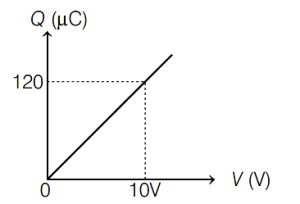
In the figure,the charge on the capacitor is plotted against the potential difference across the capacitor. The capacitance and energy stored in the capacitor are respectively:
A
$12 \mu F, 1200 \mu J$
B
$12 \mu F, 600 \mu J$
C
$24 \mu F, 600 \mu J$
D
$24 \mu F, 1200 \mu J$
Solution
(B) The energy stored in a capacitor is given by the formula:
$U = \frac{1}{2} C V^{2} \dots (i)$
where $C$ is the capacitance and $V$ is the potential difference.
From the given graph,the slope is:
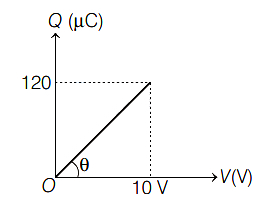
$\text{Slope} = \tan \theta = \frac{Q}{V} = \frac{120 \mu C}{10 \text{ V}} = 12 \mu F \dots (ii)$
Since the capacitance $C = \frac{Q}{V}$,we have:
$C = 12 \mu F = 12 \times 10^{-6} \text{ F}$
Now,substituting the values of $C = 12 \times 10^{-6} \text{ F}$ and $V = 10 \text{ V}$ into Eq. $(i)$:
$U = \frac{1}{2} \times (12 \times 10^{-6} \text{ F}) \times (10 \text{ V})^{2}$
$U = \frac{1}{2} \times 12 \times 10^{-6} \times 100$
$U = 6 \times 10^{-4} \text{ J} = 600 \times 10^{-6} \text{ J} = 600 \mu J$
Thus,the capacitance is $12 \mu F$ and the energy stored is $600 \mu J$.
$U = \frac{1}{2} C V^{2} \dots (i)$
where $C$ is the capacitance and $V$ is the potential difference.
From the given graph,the slope is:
$\text{Slope} = \tan \theta = \frac{Q}{V} = \frac{120 \mu C}{10 \text{ V}} = 12 \mu F \dots (ii)$
Since the capacitance $C = \frac{Q}{V}$,we have:
$C = 12 \mu F = 12 \times 10^{-6} \text{ F}$
Now,substituting the values of $C = 12 \times 10^{-6} \text{ F}$ and $V = 10 \text{ V}$ into Eq. $(i)$:
$U = \frac{1}{2} \times (12 \times 10^{-6} \text{ F}) \times (10 \text{ V})^{2}$
$U = \frac{1}{2} \times 12 \times 10^{-6} \times 100$
$U = 6 \times 10^{-4} \text{ J} = 600 \times 10^{-6} \text{ J} = 600 \mu J$
Thus,the capacitance is $12 \mu F$ and the energy stored is $600 \mu J$.
0 likes
View Solution133
EasyMCQ
When an additional charge of $2 \text{ C}$ is given to a capacitor,the energy stored in it increases by $21 \%$. The original charge of the capacitor is: (in $\text{ C}$)
A
$30$
B
$40$
C
$10$
D
$20$
Solution
(D) The energy stored in a capacitor is given by $U = \frac{q^2}{2C}$.
Let the initial charge be $q_1 = q$ and the final charge be $q_2 = q + 2 \text{ C}$.
The initial energy is $U_1 = \frac{q^2}{2C}$ and the final energy is $U_2 = \frac{(q+2)^2}{2C}$.
Given that the energy increases by $21 \%$,we have $U_2 = U_1 + 0.21 U_1 = 1.21 U_1$.
Substituting the expressions for $U_1$ and $U_2$:
$\frac{(q+2)^2}{2C} = 1.21 \times \frac{q^2}{2C}$.
Canceling $\frac{1}{2C}$ from both sides,we get $(q+2)^2 = 1.21 q^2$.
Taking the square root of both sides: $q + 2 = 1.1 q$.
Rearranging the terms: $1.1 q - q = 2$,which gives $0.1 q = 2$.
Therefore,$q = \frac{2}{0.1} = 20 \text{ C}$.
Let the initial charge be $q_1 = q$ and the final charge be $q_2 = q + 2 \text{ C}$.
The initial energy is $U_1 = \frac{q^2}{2C}$ and the final energy is $U_2 = \frac{(q+2)^2}{2C}$.
Given that the energy increases by $21 \%$,we have $U_2 = U_1 + 0.21 U_1 = 1.21 U_1$.
Substituting the expressions for $U_1$ and $U_2$:
$\frac{(q+2)^2}{2C} = 1.21 \times \frac{q^2}{2C}$.
Canceling $\frac{1}{2C}$ from both sides,we get $(q+2)^2 = 1.21 q^2$.
Taking the square root of both sides: $q + 2 = 1.1 q$.
Rearranging the terms: $1.1 q - q = 2$,which gives $0.1 q = 2$.
Therefore,$q = \frac{2}{0.1} = 20 \text{ C}$.
0 likes
View Solution134
EasyMCQ
$A$ capacitor of capacitance $10 \mu F$ is charged to $10 \text{ V}$. The energy stored in it is (in $\mu J$)
A
$1$
B
$100$
C
$500$
D
$1000$
Solution
(C) The energy $U$ stored in a capacitor is given by the formula:
$U = \frac{1}{2} CV^2$
Given:
Capacitance $C = 10 \mu F = 10 \times 10^{-6} \text{ F}$
Potential difference $V = 10 \text{ V}$
Substituting the values into the formula:
$U = \frac{1}{2} \times (10 \times 10^{-6} \text{ F}) \times (10 \text{ V})^2$
$U = \frac{1}{2} \times 10 \times 10^{-6} \times 100$
$U = 500 \times 10^{-6} \text{ J}$
$U = 500 \mu J$
$U = \frac{1}{2} CV^2$
Given:
Capacitance $C = 10 \mu F = 10 \times 10^{-6} \text{ F}$
Potential difference $V = 10 \text{ V}$
Substituting the values into the formula:
$U = \frac{1}{2} \times (10 \times 10^{-6} \text{ F}) \times (10 \text{ V})^2$
$U = \frac{1}{2} \times 10 \times 10^{-6} \times 100$
$U = 500 \times 10^{-6} \text{ J}$
$U = 500 \mu J$
0 likes
View Solution135
DifficultMCQ
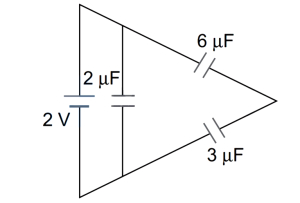
The total energy stored in the capacitor system shown in the figure will be (in $\mu J$)
A
$2$
B
$4$
C
$8$
D
$16$
Solution
(C) The $6 \mu F$ and $3 \mu F$ capacitors are connected in series.
Therefore,the equivalent capacitance $C_1$ is given by $\frac{1}{C_1} = \frac{1}{6} + \frac{1}{3} = \frac{1+2}{6} = \frac{3}{6} = \frac{1}{2}$.
Thus,$C_1 = 2 \mu F$.
This equivalent capacitor $C_1$ is in parallel with the $2 \mu F$ capacitor.
Therefore,the total equivalent capacitance of the system is $C_{eq} = C_1 + 2 \mu F = 2 \mu F + 2 \mu F = 4 \mu F$.
The total energy $U$ stored in the system is given by $U = \frac{1}{2} C_{eq} V^2$.
Given $V = 2 \text{ V}$,we have $U = \frac{1}{2} \times 4 \mu F \times (2 \text{ V})^2 = 2 \times 4 = 8 \mu J$.
Therefore,the equivalent capacitance $C_1$ is given by $\frac{1}{C_1} = \frac{1}{6} + \frac{1}{3} = \frac{1+2}{6} = \frac{3}{6} = \frac{1}{2}$.
Thus,$C_1 = 2 \mu F$.
This equivalent capacitor $C_1$ is in parallel with the $2 \mu F$ capacitor.
Therefore,the total equivalent capacitance of the system is $C_{eq} = C_1 + 2 \mu F = 2 \mu F + 2 \mu F = 4 \mu F$.
The total energy $U$ stored in the system is given by $U = \frac{1}{2} C_{eq} V^2$.
Given $V = 2 \text{ V}$,we have $U = \frac{1}{2} \times 4 \mu F \times (2 \text{ V})^2 = 2 \times 4 = 8 \mu J$.
0 likes
View Solution136
EasyMCQ
If $C$ is the capacitance and $V$ is the electric potential,then the dimensional formula of $C V^{2}$ is
A
$[ML^{2} T^{-2} A^{0}]$
B
$[MLT^{-2} A^{-1}]$
C
$[M^{0} L^{2} T^{-2} A^{0}]$
D
$[ML^{3} T A]$
Solution
(A) The energy stored in a capacitor is given by the formula $U = \frac{1}{2} C V^{2}$.
Since $\frac{1}{2}$ is a dimensionless constant,the dimensional formula of $C V^{2}$ is equivalent to the dimensional formula of energy $(U)$.
The dimensional formula for energy is $[Work] = [Force \times Displacement] = [MLT^{-2} \times L] = [ML^{2} T^{-2}]$.
Therefore,the dimensional formula of $C V^{2}$ is $[ML^{2} T^{-2} A^{0}]$.
Since $\frac{1}{2}$ is a dimensionless constant,the dimensional formula of $C V^{2}$ is equivalent to the dimensional formula of energy $(U)$.
The dimensional formula for energy is $[Work] = [Force \times Displacement] = [MLT^{-2} \times L] = [ML^{2} T^{-2}]$.
Therefore,the dimensional formula of $C V^{2}$ is $[ML^{2} T^{-2} A^{0}]$.
0 likes
View Solution137
MediumMCQ
The energy stored in a capacitor is $W$. To double the charge on the plates of the capacitor,the additional work to be done is
A
$W$
B
$4W$
C
$\frac{4}{3} W$
D
$3W$
Solution
(D) The energy stored in a capacitor with capacitance $C$ and charge $Q$ is given by $W = \frac{Q^2}{2C}$.
When the charge is doubled,the new charge becomes $Q' = 2Q$.
The new energy stored in the capacitor is $W' = \frac{(2Q)^2}{2C} = \frac{4Q^2}{2C} = 4W$.
The additional work to be done is the change in energy,which is $\Delta W = W' - W$.
Substituting the values,we get $\Delta W = 4W - W = 3W$.
When the charge is doubled,the new charge becomes $Q' = 2Q$.
The new energy stored in the capacitor is $W' = \frac{(2Q)^2}{2C} = \frac{4Q^2}{2C} = 4W$.
The additional work to be done is the change in energy,which is $\Delta W = W' - W$.
Substituting the values,we get $\Delta W = 4W - W = 3W$.
0 likes
View Solution138
EasyMCQ
The energy stored in a capacitor of capacitance $10 \mu F$ when charged to a potential of $6 \text{ kV}$ is: (in $\text{ J}$)
A
$100$
B
$200$
C
$180$
D
$160$
Solution
(C) The energy $U$ stored in a capacitor is given by the formula $U = \frac{1}{2} C V^2$.
Given:
Capacitance $C = 10 \mu F = 10 \times 10^{-6} \text{ F} = 10^{-5} \text{ F}$.
Potential $V = 6 \text{ kV} = 6 \times 10^3 \text{ V}$.
Substituting the values into the formula:
$U = \frac{1}{2} \times (10^{-5} \text{ F}) \times (6 \times 10^3 \text{ V})^2$
$U = \frac{1}{2} \times 10^{-5} \times 36 \times 10^6$
$U = 18 \times 10^1 \text{ J} = 180 \text{ J}$.
Therefore,the energy stored is $180 \text{ J}$.
Given:
Capacitance $C = 10 \mu F = 10 \times 10^{-6} \text{ F} = 10^{-5} \text{ F}$.
Potential $V = 6 \text{ kV} = 6 \times 10^3 \text{ V}$.
Substituting the values into the formula:
$U = \frac{1}{2} \times (10^{-5} \text{ F}) \times (6 \times 10^3 \text{ V})^2$
$U = \frac{1}{2} \times 10^{-5} \times 36 \times 10^6$
$U = 18 \times 10^1 \text{ J} = 180 \text{ J}$.
Therefore,the energy stored is $180 \text{ J}$.
0 likes
View Solution139
DifficultMCQ
The energy of a parallel plate capacitor when connected to a battery is $E$. With the battery still in connection,if the plates of the capacitor are separated so that the distance between them is twice the original distance,then the electrostatic energy becomes
A
$2\ E$
B
$\frac{E}{4}$
C
$\frac{E}{2}$
D
$4\ E$
Solution
(C) The energy stored in a capacitor is given by $E = \frac{1}{2} C V^2$.
Since the battery remains connected,the potential difference $V$ across the plates remains constant.
The capacitance of a parallel plate capacitor is $C = \frac{A \epsilon_0}{d}$,which implies $C \propto \frac{1}{d}$.
If the distance $d$ is doubled $(d' = 2d)$,the new capacitance $C'$ becomes $C' = \frac{C}{2}$.
The new energy $E'$ is given by $E' = \frac{1}{2} C' V^2$.
Substituting $C' = \frac{C}{2}$,we get $E' = \frac{1}{2} (\frac{C}{2}) V^2 = \frac{1}{2} (\frac{1}{2} C V^2) = \frac{E}{2}$.
Since the battery remains connected,the potential difference $V$ across the plates remains constant.
The capacitance of a parallel plate capacitor is $C = \frac{A \epsilon_0}{d}$,which implies $C \propto \frac{1}{d}$.
If the distance $d$ is doubled $(d' = 2d)$,the new capacitance $C'$ becomes $C' = \frac{C}{2}$.
The new energy $E'$ is given by $E' = \frac{1}{2} C' V^2$.
Substituting $C' = \frac{C}{2}$,we get $E' = \frac{1}{2} (\frac{C}{2}) V^2 = \frac{1}{2} (\frac{1}{2} C V^2) = \frac{E}{2}$.
0 likes
View Solution140
DifficultMCQ
$A$ fully charged capacitor has a capacitance $C$. It is discharged through a small coil of resistance wire,embedded in a block of specific heat $s$ and mass $m$ under thermally isolated conditions. If the temperature of the block is raised by $\Delta T$,the potential difference $V$ across the capacitor initially is
A
$\left(\frac{2 m s \Delta T}{C}\right)^2$
B
$\left(\frac{2 m s \Delta T}{C}\right)^{1 / 2}$
C
$\left(\frac{2 m s \Delta T}{C}\right)$
D
$2 m s \Delta T C$
Solution
(B) Let $V$ be the potential across the capacitor when it is fully charged. The energy stored in the capacitor is given by $U = \frac{1}{2} C V^2$.
When the capacitor is fully discharged through the resistance coil,the entire stored energy is dissipated as heat $\Delta H$ in the block.
Since the system is thermally isolated,the heat gained by the block is equal to the energy lost by the capacitor: $\Delta H = \frac{1}{2} C V^2$.
The heat gained by the block is also given by $\Delta H = m s \Delta T$,where $m$ is the mass and $s$ is the specific heat.
Equating the two expressions for $\Delta H$:
$\frac{1}{2} C V^2 = m s \Delta T$
$V^2 = \frac{2 m s \Delta T}{C}$
$V = \left(\frac{2 m s \Delta T}{C}\right)^{1 / 2}$
When the capacitor is fully discharged through the resistance coil,the entire stored energy is dissipated as heat $\Delta H$ in the block.
Since the system is thermally isolated,the heat gained by the block is equal to the energy lost by the capacitor: $\Delta H = \frac{1}{2} C V^2$.
The heat gained by the block is also given by $\Delta H = m s \Delta T$,where $m$ is the mass and $s$ is the specific heat.
Equating the two expressions for $\Delta H$:
$\frac{1}{2} C V^2 = m s \Delta T$
$V^2 = \frac{2 m s \Delta T}{C}$
$V = \left(\frac{2 m s \Delta T}{C}\right)^{1 / 2}$
0 likes
View Solution141
DifficultMCQ
If the charge on a body is increased by $2 \ C$,the energy stored in it increases by $21 \%$. The original charge on the body in coulomb is:
A
$10$
B
$20$
C
$30$
D
$40$
Solution
(B) The energy stored in a charged body (like a capacitor) is given by $E = \frac{q^2}{2C}$,where $q$ is the charge and $C$ is the capacitance. Thus,$E \propto q^2$.
Let the original charge be $q_1 = q$ and the original energy be $E_1 = E$.
When the charge is increased by $2 \ C$,the new charge is $q_2 = q + 2$.
The new energy $E_2$ increases by $21 \%$,so $E_2 = E + 0.21E = 1.21E$.
Using the ratio: $\frac{E_2}{E_1} = \left(\frac{q_2}{q_1}\right)^2$.
Substituting the values: $\frac{1.21E}{E} = \left(\frac{q+2}{q}\right)^2$.
$1.21 = \left(\frac{q+2}{q}\right)^2$.
Taking the square root on both sides: $1.1 = \frac{q+2}{q}$.
$1.1q = q + 2$.
$0.1q = 2$.
$q = \frac{2}{0.1} = 20 \ C$.
Let the original charge be $q_1 = q$ and the original energy be $E_1 = E$.
When the charge is increased by $2 \ C$,the new charge is $q_2 = q + 2$.
The new energy $E_2$ increases by $21 \%$,so $E_2 = E + 0.21E = 1.21E$.
Using the ratio: $\frac{E_2}{E_1} = \left(\frac{q_2}{q_1}\right)^2$.
Substituting the values: $\frac{1.21E}{E} = \left(\frac{q+2}{q}\right)^2$.
$1.21 = \left(\frac{q+2}{q}\right)^2$.
Taking the square root on both sides: $1.1 = \frac{q+2}{q}$.
$1.1q = q + 2$.
$0.1q = 2$.
$q = \frac{2}{0.1} = 20 \ C$.
0 likes
View Solution142
DifficultMCQ
If the charge on a capacitor is increased by $2 \ C$,the energy stored in it increases by $21 \%$. The original charge on the capacitor is (in $C$)
A
$10$
B
$20$
C
$30$
D
$40$
Solution
(B) The energy stored in a capacitor is given by $U = \frac{q^2}{2C}$,where $q$ is the charge and $C$ is the capacitance.
Let the initial charge be $q_i = q$ and the final charge be $q_f = q + 2$.
The initial energy is $U_i = \frac{q^2}{2C}$ and the final energy is $U_f = \frac{(q+2)^2}{2C}$.
Given that the energy increases by $21 \%$,we have $U_f = U_i + 0.21 U_i = 1.21 U_i$.
Substituting the expressions for energy: $\frac{(q+2)^2}{2C} = 1.21 \times \frac{q^2}{2C}$.
Canceling $\frac{1}{2C}$ from both sides,we get $(q+2)^2 = 1.21 q^2$.
Taking the square root of both sides: $q + 2 = 1.1 q$.
Rearranging the terms: $1.1 q - q = 2$,which gives $0.1 q = 2$.
Therefore,$q = \frac{2}{0.1} = 20 \ C$.
Let the initial charge be $q_i = q$ and the final charge be $q_f = q + 2$.
The initial energy is $U_i = \frac{q^2}{2C}$ and the final energy is $U_f = \frac{(q+2)^2}{2C}$.
Given that the energy increases by $21 \%$,we have $U_f = U_i + 0.21 U_i = 1.21 U_i$.
Substituting the expressions for energy: $\frac{(q+2)^2}{2C} = 1.21 \times \frac{q^2}{2C}$.
Canceling $\frac{1}{2C}$ from both sides,we get $(q+2)^2 = 1.21 q^2$.
Taking the square root of both sides: $q + 2 = 1.1 q$.
Rearranging the terms: $1.1 q - q = 2$,which gives $0.1 q = 2$.
Therefore,$q = \frac{2}{0.1} = 20 \ C$.
0 likes
View SolutionElectric Potential and Capacitance — Energy Stored in a Capacitor · Frequently Asked Questions
1Are these Electric Potential and Capacitance questions useful for JEE and NEET?
Yes. All questions in this section are mapped to JEE Main and NEET exam patterns. Previous year questions from JEE Main, NEET, GUJCET and state-level exams are included with full solutions.
2Can I switch to Hindi or Gujarati for these questions?
Yes. Use the language tabs in the hero section or the sidebar to view the same questions and solutions in English, Hindi or Gujarati.
3How do I generate a question paper from this subtopic?
Use the Vedclass Exam Paper Generator — select the chapter and subtopic, set difficulty, and generate Sets A, B, C, D automatically. First 3 chapters of every subject are free.
Vedclass Products
For Students
Vedclass Test Series
Mock tests in real JEE/NEET style with performance analysis. 5-day free trial.
Start Free TrialFor Teachers
Exam Paper Generator
Generate Set A/B/C/D papers from this chapter in 2 minutes. 3 chapters free.
Try FreeFor Institutes
Online Exam Module
Live online exams with unlimited students, 360° analytics & white-label branding.
See DemoFor Teachers & Institutes
Generate a Electric Potential and Capacitance Exam Paper in 2 Minutes
Select subtopic & difficulty — Sets A, B, C, D auto-generated with No Repeat logic.
First 3 chapters of every subject are free — no payment required.