
A English
Effect of Dielectric Inside Capacitor Questions in English
Class 12 Physics · Electric Potential and Capacitance · Effect of Dielectric Inside Capacitor
347+
Questions
English
Language
100%
With Solutions
Showing 49 of 347 questions in English
1
MediumMCQ
Two parallel plates have equal and opposite charges. When the space between them is evacuated,the electric field between the plates is $2 \times 10^5 \ V/m$. When the space is filled with a dielectric,the electric field becomes $1 \times 10^5 \ V/m$. Find the dielectric constant of the dielectric material.
A
$1/2$
B
$1$
C
$2$
D
$3$
Solution
(C) The dielectric constant $K$ is defined as the ratio of the electric field in a vacuum $(E_0)$ to the electric field in the dielectric medium $(E)$.
Given:
Electric field in vacuum,$E_0 = 2 \times 10^5 \ V/m$
Electric field in dielectric,$E = 1 \times 10^5 \ V/m$
Formula:
$K = \frac{E_0}{E}$
Calculation:
$K = \frac{2 \times 10^5}{1 \times 10^5} = 2$
Therefore,the dielectric constant of the material is $2$.
Given:
Electric field in vacuum,$E_0 = 2 \times 10^5 \ V/m$
Electric field in dielectric,$E = 1 \times 10^5 \ V/m$
Formula:
$K = \frac{E_0}{E}$
Calculation:
$K = \frac{2 \times 10^5}{1 \times 10^5} = 2$
Therefore,the dielectric constant of the material is $2$.
0 likes
View Solution2
EasyMCQ
The capacity of a parallel plate capacitor is $5\,\mu F$. When a glass plate is placed between the plates of the capacitor,its potential becomes $1/8^{th}$ of the original value. The value of the dielectric constant will be
A
$1.6$
B
$5$
C
$8$
D
$40$
Solution
(C) The capacitance of a parallel plate capacitor is given by $C = \frac{Q}{V}$.
When a dielectric slab is inserted between the plates,the charge $Q$ remains constant if the capacitor is isolated.
The new potential $V'$ is related to the original potential $V$ by the dielectric constant $K$ as $V' = \frac{V}{K}$.
Given that the new potential $V' = \frac{V}{8}$,we have $\frac{V}{K} = \frac{V}{8}$.
Comparing both sides,we get $K = 8$.
When a dielectric slab is inserted between the plates,the charge $Q$ remains constant if the capacitor is isolated.
The new potential $V'$ is related to the original potential $V$ by the dielectric constant $K$ as $V' = \frac{V}{K}$.
Given that the new potential $V' = \frac{V}{8}$,we have $\frac{V}{K} = \frac{V}{8}$.
Comparing both sides,we get $K = 8$.
0 likes
View Solution3
EasyMCQ
$A$ capacitor is charged by using a battery which is then disconnected. $A$ dielectric slab is then inserted between the plates. What is the result?
A
Reduction of charge on the plates and increase of potential difference across the plates
B
Increase in the potential difference across the plates,reduction in stored energy,but no change in the charge on the plates
C
Decrease in the potential difference across the plates,reduction in the stored energy,but no change in the charge on the plates
D
None of the above
Solution
(C) When the battery is disconnected,the charge $Q$ on the plates remains constant because there is no path for the charge to flow.
When a dielectric slab of dielectric constant $K > 1$ is inserted,the capacitance $C$ increases according to the relation $C' = KC$.
Since $Q = CV$,the potential difference $V$ across the plates is given by $V = Q/C$. As $C$ increases and $Q$ remains constant,the potential difference $V$ decreases.
The energy stored in the capacitor is given by $U = Q^2 / (2C)$. Since $C$ increases and $Q$ is constant,the stored energy $U$ decreases.
Therefore,the potential difference decreases,the stored energy decreases,and the charge remains unchanged.
When a dielectric slab of dielectric constant $K > 1$ is inserted,the capacitance $C$ increases according to the relation $C' = KC$.
Since $Q = CV$,the potential difference $V$ across the plates is given by $V = Q/C$. As $C$ increases and $Q$ remains constant,the potential difference $V$ decreases.
The energy stored in the capacitor is given by $U = Q^2 / (2C)$. Since $C$ increases and $Q$ is constant,the stored energy $U$ decreases.
Therefore,the potential difference decreases,the stored energy decreases,and the charge remains unchanged.
0 likes
View Solution4
EasyMCQ
Which one statement is correct? $A$ parallel plate air condenser is connected to a battery. Its charge,potential,electric field,and energy are ${Q_0}$,${V_0}$,${E_0}$,and ${U_0}$ respectively. $A$ dielectric slab is inserted to fill the complete space between the plates while the battery remains connected. Now,the corresponding values $Q$,$V$,$E$,and $U$ are related to the initial values as:
A
$Q > {Q_0}$
B
$U > {U_0}$
C
$E > {E_0}$
D
Both $(a)$ and $(b)$
Solution
(D) When a dielectric slab is inserted into a parallel plate capacitor while the battery remains connected,the potential difference $V$ across the plates remains constant,i.e.,$V = {V_0}$.
Since the capacitance $C$ increases by a factor of $K$ (dielectric constant),where $C = KC_0$,the charge $Q$ on the plates increases according to $Q = CV = K C_0 V_0 = K Q_0$. Thus,$Q > {Q_0}$.
The electric field $E$ between the plates is given by $E = V/d$. Since $V$ and $d$ remain constant,$E = {E_0}$.
The energy stored in the capacitor is $U = \frac{1}{2}CV^2$. Since $C$ increases and $V$ remains constant,$U$ increases,i.e.,$U > {U_0}$.
Therefore,both statements $(a)$ and $(b)$ are correct.
Since the capacitance $C$ increases by a factor of $K$ (dielectric constant),where $C = KC_0$,the charge $Q$ on the plates increases according to $Q = CV = K C_0 V_0 = K Q_0$. Thus,$Q > {Q_0}$.
The electric field $E$ between the plates is given by $E = V/d$. Since $V$ and $d$ remain constant,$E = {E_0}$.
The energy stored in the capacitor is $U = \frac{1}{2}CV^2$. Since $C$ increases and $V$ remains constant,$U$ increases,i.e.,$U > {U_0}$.
Therefore,both statements $(a)$ and $(b)$ are correct.
0 likes
View Solution5
EasyMCQ
$A$ parallel plate capacitor has a capacitance of $50\,\mu F$ in air and $110\,\mu F$ when immersed in an oil. The dielectric constant $K$ of the oil is:
A
$0.45$
B
$0.55$
C
$1.1$
D
$2.2$
Solution
(D) The capacitance of a parallel plate capacitor in a medium is given by the formula $C_{medium} = K \cdot C_{air}$,where $K$ is the dielectric constant of the medium.
Given:
$C_{air} = 50\,\mu F$
$C_{medium} = 110\,\mu F$
Rearranging the formula to solve for $K$:
$K = \frac{C_{medium}}{C_{air}}$
Substituting the values:
$K = \frac{110}{50} = 2.2$
Therefore,the dielectric constant of the oil is $2.2$.
Given:
$C_{air} = 50\,\mu F$
$C_{medium} = 110\,\mu F$
Rearranging the formula to solve for $K$:
$K = \frac{C_{medium}}{C_{air}}$
Substituting the values:
$K = \frac{110}{50} = 2.2$
Therefore,the dielectric constant of the oil is $2.2$.
0 likes
View Solution6
DifficultMCQ
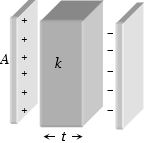
The separation between the plates of a parallel plate capacitor is $d$ and the area of each plate is $A$. When a slab of material of dielectric constant $k$ and thickness $t$ $(t < d)$ is introduced between the plates,its capacitance becomes
A
$\frac{\varepsilon_0 A}{d + t(1 - \frac{1}{k})}$
B
$\frac{\varepsilon_0 A}{d + t(1 + \frac{1}{k})}$
C
$\frac{\varepsilon_0 A}{d - t(1 - \frac{1}{k})}$
D
$\frac{\varepsilon_0 A}{d - t(1 + \frac{1}{k})}$
Solution
(C) The potential difference $V$ between the plates is the sum of the potential drop across the air gap and the dielectric slab.
$V = V_{\text{air}} + V_{\text{medium}}$
$V = E_0(d - t) + E_{\text{medium}}t$
Since $E_0 = \frac{\sigma}{\varepsilon_0}$ and $E_{\text{medium}} = \frac{\sigma}{k\varepsilon_0}$,where $\sigma = \frac{Q}{A}$:
$V = \frac{\sigma}{\varepsilon_0}(d - t) + \frac{\sigma}{k\varepsilon_0}t$
$V = \frac{Q}{A\varepsilon_0} \left( d - t + \frac{t}{k} \right)$
$V = \frac{Q}{A\varepsilon_0} \left( d - t(1 - \frac{1}{k}) \right)$
The capacitance $C$ is given by $C = \frac{Q}{V}$:
$C = \frac{Q}{\frac{Q}{A\varepsilon_0} \left( d - t(1 - \frac{1}{k}) \right)}$
$C = \frac{\varepsilon_0 A}{d - t(1 - \frac{1}{k})}$
$V = V_{\text{air}} + V_{\text{medium}}$
$V = E_0(d - t) + E_{\text{medium}}t$
Since $E_0 = \frac{\sigma}{\varepsilon_0}$ and $E_{\text{medium}} = \frac{\sigma}{k\varepsilon_0}$,where $\sigma = \frac{Q}{A}$:
$V = \frac{\sigma}{\varepsilon_0}(d - t) + \frac{\sigma}{k\varepsilon_0}t$
$V = \frac{Q}{A\varepsilon_0} \left( d - t + \frac{t}{k} \right)$
$V = \frac{Q}{A\varepsilon_0} \left( d - t(1 - \frac{1}{k}) \right)$
The capacitance $C$ is given by $C = \frac{Q}{V}$:
$C = \frac{Q}{\frac{Q}{A\varepsilon_0} \left( d - t(1 - \frac{1}{k}) \right)}$
$C = \frac{\varepsilon_0 A}{d - t(1 - \frac{1}{k})}$
0 likes
View Solution7
EasyMCQ
$A$ parallel plate capacitor is immersed in an oil of dielectric constant $K = 2$. The electric field between the plates is:
A
Increased proportional to $2$
B
Decreased proportional to $\frac{1}{2}$
C
Increased proportional to $\sqrt{2}$
D
Decreased proportional to $\frac{1}{\sqrt{2}}$
Solution
(B) The electric field between the plates of a capacitor in a vacuum or air is given by $E = \frac{\sigma}{\epsilon_0}$.
When the capacitor is immersed in a dielectric medium with dielectric constant $K$,the electric field is reduced by a factor of $K$.
The new electric field $E_{medium}$ is given by $E_{medium} = \frac{E}{K}$.
Given $K = 2$,the new electric field is $E_{medium} = \frac{E}{2}$.
Therefore,the electric field is decreased proportional to $\frac{1}{2}$.
When the capacitor is immersed in a dielectric medium with dielectric constant $K$,the electric field is reduced by a factor of $K$.
The new electric field $E_{medium}$ is given by $E_{medium} = \frac{E}{K}$.
Given $K = 2$,the new electric field is $E_{medium} = \frac{E}{2}$.
Therefore,the electric field is decreased proportional to $\frac{1}{2}$.
0 likes
View Solution8
EasyMCQ
When air in a capacitor is replaced by a medium of dielectric constant $K$,the capacity
A
Decreases $K$ times
B
Increases $K$ times
C
Increases $K^2$ times
D
Remains constant
Solution
(B) The capacitance of a parallel plate capacitor with air as the medium is given by $C_{air} = \frac{\epsilon_0 A}{d}$.
When a dielectric medium of dielectric constant $K$ is introduced between the plates,the new capacitance becomes $C_{medium} = \frac{K \epsilon_0 A}{d}$.
Comparing the two expressions,we get $C_{medium} = K \times C_{air}$.
Therefore,the capacity increases $K$ times.
When a dielectric medium of dielectric constant $K$ is introduced between the plates,the new capacitance becomes $C_{medium} = \frac{K \epsilon_0 A}{d}$.
Comparing the two expressions,we get $C_{medium} = K \times C_{air}$.
Therefore,the capacity increases $K$ times.
0 likes
View Solution9
MediumMCQ
$A$ parallel plate capacitor is connected to the terminals of a battery. The distance between the plates is $6\,mm$. If a glass plate (dielectric constant $K = 9$) of thickness $4.5\,mm$ is introduced between them,then the capacity will become how many times the original capacity?
A
$2$
B
The same
C
$3$
D
$4$
Solution
(C) The capacitance of a parallel plate capacitor with air is $C_0 = \frac{\epsilon_0 A}{d}$.
When a dielectric slab of thickness $t$ and dielectric constant $K$ is introduced,the new capacitance $C$ is given by $C = \frac{\epsilon_0 A}{d - t + \frac{t}{K}}$.
The ratio of the new capacitance to the original capacitance is $\frac{C}{C_0} = \frac{d}{d - t + \frac{t}{K}}$.
Given $d = 6\,mm$,$t = 4.5\,mm$,and $K = 9$.
Substituting the values: $\frac{C}{C_0} = \frac{6}{6 - 4.5 + \frac{4.5}{9}} = \frac{6}{1.5 + 0.5} = \frac{6}{2} = 3$.
Therefore,the capacity becomes $3$ times the original capacity.
When a dielectric slab of thickness $t$ and dielectric constant $K$ is introduced,the new capacitance $C$ is given by $C = \frac{\epsilon_0 A}{d - t + \frac{t}{K}}$.
The ratio of the new capacitance to the original capacitance is $\frac{C}{C_0} = \frac{d}{d - t + \frac{t}{K}}$.
Given $d = 6\,mm$,$t = 4.5\,mm$,and $K = 9$.
Substituting the values: $\frac{C}{C_0} = \frac{6}{6 - 4.5 + \frac{4.5}{9}} = \frac{6}{1.5 + 0.5} = \frac{6}{2} = 3$.
Therefore,the capacity becomes $3$ times the original capacity.
0 likes
View Solution10
MediumMCQ
Between the plates of a parallel plate capacitor,a plate of thickness $t_1$ and dielectric constant $k_1$ is placed. In the rest of the space,there is another plate of thickness $t_2$ and dielectric constant $k_2$. The potential difference across the capacitor will be
A
$\frac{Q}{A\varepsilon_0} \left( \frac{t_1}{k_1} + \frac{t_2}{k_2} \right)$
B
$\frac{\varepsilon_0 Q}{A} \left( \frac{t_1}{k_1} + \frac{t_2}{k_2} \right)$
C
$\frac{Q}{A\varepsilon_0} \left( \frac{k_1}{t_1} + \frac{k_2}{t_2} \right)$
D
$\frac{\varepsilon_0 Q}{A} (k_1 t_1 + k_2 t_2)$
Solution
(A) The potential difference $V$ across a capacitor with multiple dielectric slabs is the sum of the potential drops across each slab.
$V = V_1 + V_2 = E_1 t_1 + E_2 t_2$
Since the electric field in a dielectric is $E = \frac{\sigma}{k\varepsilon_0} = \frac{Q}{Ak\varepsilon_0}$,we substitute this into the equation:
$V = \left( \frac{Q}{A k_1 \varepsilon_0} \right) t_1 + \left( \frac{Q}{A k_2 \varepsilon_0} \right) t_2$
$V = \frac{Q}{A\varepsilon_0} \left( \frac{t_1}{k_1} + \frac{t_2}{k_2} \right)$
$V = V_1 + V_2 = E_1 t_1 + E_2 t_2$
Since the electric field in a dielectric is $E = \frac{\sigma}{k\varepsilon_0} = \frac{Q}{Ak\varepsilon_0}$,we substitute this into the equation:
$V = \left( \frac{Q}{A k_1 \varepsilon_0} \right) t_1 + \left( \frac{Q}{A k_2 \varepsilon_0} \right) t_2$
$V = \frac{Q}{A\varepsilon_0} \left( \frac{t_1}{k_1} + \frac{t_2}{k_2} \right)$
0 likes
View Solution11
DifficultMCQ
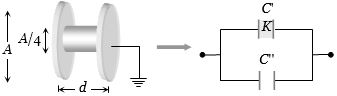
Two metallic plates of radius $r$ are placed at a distance $d$ apart,and the capacitance is $C$. If a plate of radius $r/2$ and thickness $d$ with a dielectric constant $6$ is placed between the plates of the capacitor,then its new capacitance will be
A
$7C/2$
B
$3C/7$
C
$7C/3$
D
$9C/4$
Solution
(D) The initial capacitance of the parallel plate capacitor is $C = \frac{\varepsilon_0 A}{d}$,where $A = \pi r^2$.
When a dielectric slab of radius $r/2$ and thickness $d$ is inserted,the area covered by the dielectric is $A' = \pi (r/2)^2 = A/4$.
The remaining area of the capacitor is filled with air,which is $A'' = A - A/4 = 3A/4$.
This arrangement is equivalent to two capacitors connected in parallel.
The capacitance of the part filled with the dielectric is $C' = \frac{K \varepsilon_0 A'}{d} = \frac{6 \varepsilon_0 (A/4)}{d} = \frac{6}{4} C = \frac{3}{2} C$.
The capacitance of the air-filled part is $C'' = \frac{\varepsilon_0 A''}{d} = \frac{\varepsilon_0 (3A/4)}{d} = \frac{3}{4} C$.
The total capacitance is $C_{eq} = C' + C'' = \frac{3}{2} C + \frac{3}{4} C = \frac{6+3}{4} C = \frac{9}{4} C$.
When a dielectric slab of radius $r/2$ and thickness $d$ is inserted,the area covered by the dielectric is $A' = \pi (r/2)^2 = A/4$.
The remaining area of the capacitor is filled with air,which is $A'' = A - A/4 = 3A/4$.
This arrangement is equivalent to two capacitors connected in parallel.
The capacitance of the part filled with the dielectric is $C' = \frac{K \varepsilon_0 A'}{d} = \frac{6 \varepsilon_0 (A/4)}{d} = \frac{6}{4} C = \frac{3}{2} C$.
The capacitance of the air-filled part is $C'' = \frac{\varepsilon_0 A''}{d} = \frac{\varepsilon_0 (3A/4)}{d} = \frac{3}{4} C$.
The total capacitance is $C_{eq} = C' + C'' = \frac{3}{2} C + \frac{3}{4} C = \frac{6+3}{4} C = \frac{9}{4} C$.
0 likes
View Solution12
MediumMCQ
The distance between the plates of a parallel plate capacitor is $8\,mm$ and the potential difference $(P.D.)$ is $120\,V$. If a $6\,mm$ thick slab of dielectric constant $K = 6$ is introduced between its plates,then:
A
The charge on the capacitor will be doubled
B
The charge on the capacitor will be reduced to half
C
The $P.D.$ across the capacitor will be $320\,V$
D
The $P.D.$ across the capacitor will be $45\,V$
Solution
(D) When a dielectric slab is introduced into a capacitor after disconnecting the battery,the charge $(Q)$ on the plates remains constant.
Initial capacitance $C_0 = \frac{\varepsilon_0 A}{d}$.
Initial potential difference $V_0 = 120\,V$.
When the dielectric slab of thickness $t = 6\,mm$ and dielectric constant $K = 6$ is inserted into the gap $d = 8\,mm$,the new capacitance $C'$ is given by $C' = \frac{\varepsilon_0 A}{d - t + \frac{t}{K}}$.
Since the charge $Q$ is constant,$Q = C_0 V_0 = C' V'$,where $V'$ is the new potential difference.
Therefore,$V' = V_0 \times \frac{C_0}{C'} = V_0 \times \frac{d - t + \frac{t}{K}}{d}$.
Substituting the values: $V' = 120 \times \frac{8 - 6 + \frac{6}{6}}{8} = 120 \times \frac{2 + 1}{8} = 120 \times \frac{3}{8} = 15 \times 3 = 45\,V$.
Initial capacitance $C_0 = \frac{\varepsilon_0 A}{d}$.
Initial potential difference $V_0 = 120\,V$.
When the dielectric slab of thickness $t = 6\,mm$ and dielectric constant $K = 6$ is inserted into the gap $d = 8\,mm$,the new capacitance $C'$ is given by $C' = \frac{\varepsilon_0 A}{d - t + \frac{t}{K}}$.
Since the charge $Q$ is constant,$Q = C_0 V_0 = C' V'$,where $V'$ is the new potential difference.
Therefore,$V' = V_0 \times \frac{C_0}{C'} = V_0 \times \frac{d - t + \frac{t}{K}}{d}$.
Substituting the values: $V' = 120 \times \frac{8 - 6 + \frac{6}{6}}{8} = 120 \times \frac{2 + 1}{8} = 120 \times \frac{3}{8} = 15 \times 3 = 45\,V$.
0 likes
View Solution13
MediumMCQ
In a parallel plate capacitor, the radius of each circular plate is $12\,cm$ and the distance between the plates is $5\,mm$. A glass slab of $3\,mm$ thickness and radius $12\,cm$ with a dielectric constant of $6$ is placed between the plates. The capacitance of the capacitor will be:
A
$144 \times 10^{-9}\,F$
B
$40\,pF$
C
$160\,pF$
D
$1.44\,\mu F$
Solution
(C) The capacitance $C$ of a parallel plate capacitor with a dielectric slab of thickness $t$ and dielectric constant $K$ is given by the formula: $C = \frac{\varepsilon_0 A}{d - t + \frac{t}{K}}$.
Here, $A = \pi r^2 = \pi (0.12)^2\,m^2$, $d = 5 \times 10^{-3}\,m$, $t = 3 \times 10^{-3}\,m$, and $K = 6$.
Substituting the values:
$C = \frac{\varepsilon_0 \pi (0.12)^2}{5 \times 10^{-3} - 3 \times 10^{-3} + \frac{3 \times 10^{-3}}{6}}$
$C = \frac{\varepsilon_0 \pi (0.0144)}{2 \times 10^{-3} + 0.5 \times 10^{-3}} = \frac{\varepsilon_0 \pi (0.0144)}{2.5 \times 10^{-3}}$
Using $\frac{1}{4\pi\varepsilon_0} = 9 \times 10^9$, so $\varepsilon_0 = \frac{1}{36\pi \times 10^9}$.
$C = \frac{0.0144 \pi}{36\pi \times 10^9 \times 2.5 \times 10^{-3}} = \frac{0.0144}{90 \times 10^6} = 0.16 \times 10^{-9}\,F = 160\,pF$.
Here, $A = \pi r^2 = \pi (0.12)^2\,m^2$, $d = 5 \times 10^{-3}\,m$, $t = 3 \times 10^{-3}\,m$, and $K = 6$.
Substituting the values:
$C = \frac{\varepsilon_0 \pi (0.12)^2}{5 \times 10^{-3} - 3 \times 10^{-3} + \frac{3 \times 10^{-3}}{6}}$
$C = \frac{\varepsilon_0 \pi (0.0144)}{2 \times 10^{-3} + 0.5 \times 10^{-3}} = \frac{\varepsilon_0 \pi (0.0144)}{2.5 \times 10^{-3}}$
Using $\frac{1}{4\pi\varepsilon_0} = 9 \times 10^9$, so $\varepsilon_0 = \frac{1}{36\pi \times 10^9}$.
$C = \frac{0.0144 \pi}{36\pi \times 10^9 \times 2.5 \times 10^{-3}} = \frac{0.0144}{90 \times 10^6} = 0.16 \times 10^{-9}\,F = 160\,pF$.
0 likes
View Solution14
MediumMCQ
There is an air-filled $1\,pF$ parallel plate capacitor. When the plate separation is doubled and the space is filled with wax,the capacitance increases to $2\,pF$. The dielectric constant of wax is
A
$2$
B
$4$
C
$6$
D
$8$
Solution
(B) The capacitance of an air-filled parallel plate capacitor is given by $C = \frac{\varepsilon_0 A}{d} = 1\,pF$.
When the plate separation is doubled $(d' = 2d)$ and the space is filled with a dielectric material (wax) of constant $K$,the new capacitance is $C' = \frac{K \varepsilon_0 A}{d'}$.
Substituting $d' = 2d$,we get $C' = \frac{K \varepsilon_0 A}{2d} = \frac{K}{2} \left( \frac{\varepsilon_0 A}{d} \right) = \frac{K}{2} C$.
Given $C' = 2\,pF$ and $C = 1\,pF$,we have $2 = \frac{K}{2} \times 1$.
Therefore,$K = 4$.
When the plate separation is doubled $(d' = 2d)$ and the space is filled with a dielectric material (wax) of constant $K$,the new capacitance is $C' = \frac{K \varepsilon_0 A}{d'}$.
Substituting $d' = 2d$,we get $C' = \frac{K \varepsilon_0 A}{2d} = \frac{K}{2} \left( \frac{\varepsilon_0 A}{d} \right) = \frac{K}{2} C$.
Given $C' = 2\,pF$ and $C = 1\,pF$,we have $2 = \frac{K}{2} \times 1$.
Therefore,$K = 4$.
0 likes
View Solution15
MediumMCQ
The capacity and the energy stored in a parallel plate condenser with air between its plates are respectively $C_0$ and $W_0$. If the air is replaced by glass (dielectric constant $K = 5$) between the plates,the capacity of the plates and the energy stored in it will respectively be
A
$5C_0, 5W_0$
B
$5C_0, \frac{W_0}{5}$
C
$\frac{C_0}{5}, 5W_0$
D
$\frac{C_0}{5}, \frac{W_0}{5}$
Solution
(B) When a dielectric of constant $K$ is introduced between the plates of a parallel plate capacitor,its capacity increases by a factor of $K$. Therefore,the new capacity $C' = K \times C_0 = 5C_0$.
Assuming the charge $q$ on the plates remains constant (isolated capacitor),the energy stored is given by $W = \frac{q^2}{2C}$.
The initial energy is $W_0 = \frac{q^2}{2C_0}$.
The new energy $W'$ is given by $W' = \frac{q^2}{2C'} = \frac{q^2}{2(5C_0)} = \frac{1}{5} \left( \frac{q^2}{2C_0} \right) = \frac{W_0}{5}$.
Thus,the new capacity is $5C_0$ and the new energy is $\frac{W_0}{5}$.
Assuming the charge $q$ on the plates remains constant (isolated capacitor),the energy stored is given by $W = \frac{q^2}{2C}$.
The initial energy is $W_0 = \frac{q^2}{2C_0}$.
The new energy $W'$ is given by $W' = \frac{q^2}{2C'} = \frac{q^2}{2(5C_0)} = \frac{1}{5} \left( \frac{q^2}{2C_0} \right) = \frac{W_0}{5}$.
Thus,the new capacity is $5C_0$ and the new energy is $\frac{W_0}{5}$.
0 likes
View Solution16
EasyMCQ
$A$ sheet of aluminium foil of negligible thickness is introduced between the plates of a capacitor. The capacitance of the capacitor
A
increases
B
decreases
C
remains unchanged
D
becomes infinite
Solution
(C) The capacitance of a parallel plate capacitor with a dielectric slab of thickness $t$ is given by:
$C = \frac{A \epsilon_0}{(d - t) + \frac{t}{K}}$
where $A$ is the area of the plates,$d$ is the distance between them,and $K$ is the dielectric constant.
When a metal sheet (aluminium foil) of thickness $t$ is introduced,the dielectric constant $K$ for a conductor is $\infty$.
Substituting $K = \infty$ into the formula:
$C' = \frac{A \epsilon_0}{(d - t) + \frac{t}{\infty}} = \frac{A \epsilon_0}{d - t}$
If the thickness $t$ of the foil is negligible $(t \approx 0)$,then:
$C' = \frac{A \epsilon_0}{d - 0} = \frac{A \epsilon_0}{d}$
Since the original capacitance was $C = \frac{A \epsilon_0}{d}$,the capacitance remains unchanged.
$C = \frac{A \epsilon_0}{(d - t) + \frac{t}{K}}$
where $A$ is the area of the plates,$d$ is the distance between them,and $K$ is the dielectric constant.
When a metal sheet (aluminium foil) of thickness $t$ is introduced,the dielectric constant $K$ for a conductor is $\infty$.
Substituting $K = \infty$ into the formula:
$C' = \frac{A \epsilon_0}{(d - t) + \frac{t}{\infty}} = \frac{A \epsilon_0}{d - t}$
If the thickness $t$ of the foil is negligible $(t \approx 0)$,then:
$C' = \frac{A \epsilon_0}{d - 0} = \frac{A \epsilon_0}{d}$
Since the original capacitance was $C = \frac{A \epsilon_0}{d}$,the capacitance remains unchanged.
0 likes
View Solution17
EasyMCQ
The outer sphere of a spherical air capacitor is earthed. For increasing its capacitance:
A
Vacuum is created between two spheres
B
Dielectric material is filled between the two spheres
C
The space between two spheres is increased
D
The earthing of the outer sphere is removed
Solution
(B) The capacitance of a spherical capacitor is given by the formula $C = 4\pi \varepsilon_0 K \left( \frac{ab}{b-a} \right)$,where $a$ and $b$ are the radii of the inner and outer spheres,respectively,and $K$ is the dielectric constant of the material between them.
From this formula,it is clear that $C \propto K$.
When a dielectric material is filled between the two spheres,the dielectric constant $K$ increases (since $K > 1$ for any dielectric material compared to vacuum where $K = 1$).
Therefore,filling the space with a dielectric material increases the capacitance of the capacitor.
From this formula,it is clear that $C \propto K$.
When a dielectric material is filled between the two spheres,the dielectric constant $K$ increases (since $K > 1$ for any dielectric material compared to vacuum where $K = 1$).
Therefore,filling the space with a dielectric material increases the capacitance of the capacitor.
0 likes
View Solution18
EasyMCQ
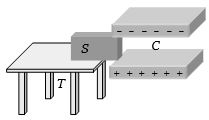
$A$ frictionless dielectric plate $S$ is placed on a frictionless table $T$. $A$ charged parallel plate capacitor $C$ (whose plates are also frictionless) is kept near it. The plate $S$ is partially between the plates of the capacitor. When the plate $S$ is released, what happens?
A
It will remain stationary on the table.
B
It is pulled by the capacitor and will pass through to the other end.
C
It is pulled into the space between the plates and will remain there.
D
All the above statements are false.
Solution
(C) When a dielectric slab is placed near the plates of a charged capacitor, it experiences an attractive force directed into the region between the plates. This is because the electric field of the capacitor induces polarization charges on the dielectric, creating an attractive interaction. The potential energy of the system $U = \frac{Q^2}{2C}$ decreases as the dielectric enters the capacitor because the capacitance $C$ increases. Since every physical system tends to move towards a state of minimum potential energy, the dielectric slab is pulled into the region between the plates. Once it is fully inside, the force becomes zero (assuming a uniform field), and it remains there in equilibrium. Therefore, the correct option is $(c)$.
0 likes
View Solution19
EasyMCQ
$A$ parallel plate capacitor is charged and the charging battery is then disconnected. If the plates of the capacitor are moved further apart by means of insulating handles,then
A
The charge on the capacitor increases
B
The voltage across the plates decreases
C
The capacitance increases
D
The electrostatic energy stored in the capacitor increases
Solution
(D) When the battery is disconnected,the charge $q$ on the capacitor remains constant because there is no path for the charge to flow.
The capacitance of a parallel plate capacitor is given by $C = \frac{\varepsilon_0 A}{d}$.
When the distance $d$ between the plates is increased,the capacitance $C$ decreases.
Since $q = CV$,the voltage $V = \frac{q}{C}$ must increase as $C$ decreases.
The electrostatic energy stored in the capacitor is given by $U = \frac{q^2}{2C}$.
Since $q$ is constant and $C$ decreases,the energy $U$ increases.
The capacitance of a parallel plate capacitor is given by $C = \frac{\varepsilon_0 A}{d}$.
When the distance $d$ between the plates is increased,the capacitance $C$ decreases.
Since $q = CV$,the voltage $V = \frac{q}{C}$ must increase as $C$ decreases.
The electrostatic energy stored in the capacitor is given by $U = \frac{q^2}{2C}$.
Since $q$ is constant and $C$ decreases,the energy $U$ increases.
0 likes
View Solution20
EasyMCQ
$A$ capacitor with air as the dielectric is charged to a potential of $100\;V$. If the space between the plates is now filled with a dielectric of dielectric constant $K = 10$,the potential difference between the plates will be: (in $;V$)
A
$1000$
B
$100$
C
$10$
D
$0$
Solution
(C) When a capacitor is charged and then disconnected from the battery,the charge $Q$ on the plates remains constant.
The capacitance of a parallel plate capacitor with air is $C_0 = \frac{\epsilon_0 A}{d}$.
When a dielectric of constant $K$ is introduced,the new capacitance becomes $C = K C_0$.
Since the charge $Q$ is constant,the relation between potential $V$ and capacitance $C$ is $V = \frac{Q}{C}$.
The new potential difference $V'$ is given by $V' = \frac{Q}{C} = \frac{Q}{K C_0} = \frac{V_0}{K}$.
Given $V_0 = 100\;V$ and $K = 10$,we get $V' = \frac{100}{10} = 10\;V$.
The capacitance of a parallel plate capacitor with air is $C_0 = \frac{\epsilon_0 A}{d}$.
When a dielectric of constant $K$ is introduced,the new capacitance becomes $C = K C_0$.
Since the charge $Q$ is constant,the relation between potential $V$ and capacitance $C$ is $V = \frac{Q}{C}$.
The new potential difference $V'$ is given by $V' = \frac{Q}{C} = \frac{Q}{K C_0} = \frac{V_0}{K}$.
Given $V_0 = 100\;V$ and $K = 10$,we get $V' = \frac{100}{10} = 10\;V$.
1 likes
View Solution21
EasyMCQ
When a slab of dielectric material is introduced between the parallel plates of a capacitor which remains connected to a battery,then the charge on the plates relative to the earlier charge:
A
Is less
B
Is same
C
Is more
D
May be less or more depending on the nature of the material introduced
Solution
(C) When a dielectric slab is introduced between the plates of a capacitor,the capacitance $C$ increases by a factor of $K$ (dielectric constant),where $C' = KC$.
Since the capacitor remains connected to the battery,the potential difference $V$ across the plates remains constant.
According to the relation $Q = CV$,if $C$ increases and $V$ remains constant,the charge $Q$ on the plates must increase.
Therefore,the new charge is more than the earlier charge.
Since the capacitor remains connected to the battery,the potential difference $V$ across the plates remains constant.
According to the relation $Q = CV$,if $C$ increases and $V$ remains constant,the charge $Q$ on the plates must increase.
Therefore,the new charge is more than the earlier charge.
0 likes
View Solution22
EasyMCQ
The distance between the plates of a parallel plate capacitor is $d$. $A$ metal plate of thickness $d/2$ is introduced between the plates. The capacitance will then be
A
Unchanged
B
Halved
C
Zero
D
Doubled
Solution
(D) The capacitance of a parallel plate capacitor with plate separation $d$ and area $A$ is given by $C_0 = \frac{\varepsilon_0 A}{d}$.
When a metal plate of thickness $t$ is introduced between the plates,the new capacitance $C$ is given by the formula $C = \frac{\varepsilon_0 A}{d - t}$.
Given $t = d/2$,we substitute this into the formula:
$C = \frac{\varepsilon_0 A}{d - d/2} = \frac{\varepsilon_0 A}{d/2} = 2 \frac{\varepsilon_0 A}{d}$.
Since $C_0 = \frac{\varepsilon_0 A}{d}$,we get $C = 2 C_0$.
Therefore,the capacitance is doubled.
When a metal plate of thickness $t$ is introduced between the plates,the new capacitance $C$ is given by the formula $C = \frac{\varepsilon_0 A}{d - t}$.
Given $t = d/2$,we substitute this into the formula:
$C = \frac{\varepsilon_0 A}{d - d/2} = \frac{\varepsilon_0 A}{d/2} = 2 \frac{\varepsilon_0 A}{d}$.
Since $C_0 = \frac{\varepsilon_0 A}{d}$,we get $C = 2 C_0$.
Therefore,the capacitance is doubled.
0 likes
View Solution23
EasyMCQ
$A$ capacitor is kept connected to the battery and a dielectric slab is inserted between the plates. During this process
A
No work is done
B
Work is done at the cost of the energy already stored in the capacitor before the slab is inserted
C
Work is done at the cost of the battery
D
Work is done at the cost of both the capacitor and the battery
Solution
(C) When a dielectric slab is inserted into a capacitor while it remains connected to a battery, the potential difference $V$ across the plates remains constant.
Since the capacitance $C$ increases $(C = K C_0)$, the charge $Q$ on the plates increases $(Q = CV)$.
The battery must supply additional charge to the capacitor to maintain the constant potential difference.
The work done by the battery is $W_{battery} = \Delta Q \cdot V = (Q_{final} - Q_{initial})V$.
The change in energy stored in the capacitor is $\Delta U = \frac{1}{2} C_{final} V^2 - \frac{1}{2} C_{initial} V^2 = \frac{1}{2} \Delta C V^2$.
Since $W_{battery} = \Delta C V^2$, the work done by the battery is twice the increase in stored energy.
The remaining half of the energy supplied by the battery is converted into the work done by the external agent inserting the slab.
Thus, the work is done at the cost of the battery.
Since the capacitance $C$ increases $(C = K C_0)$, the charge $Q$ on the plates increases $(Q = CV)$.
The battery must supply additional charge to the capacitor to maintain the constant potential difference.
The work done by the battery is $W_{battery} = \Delta Q \cdot V = (Q_{final} - Q_{initial})V$.
The change in energy stored in the capacitor is $\Delta U = \frac{1}{2} C_{final} V^2 - \frac{1}{2} C_{initial} V^2 = \frac{1}{2} \Delta C V^2$.
Since $W_{battery} = \Delta C V^2$, the work done by the battery is twice the increase in stored energy.
The remaining half of the energy supplied by the battery is converted into the work done by the external agent inserting the slab.
Thus, the work is done at the cost of the battery.
0 likes
View Solution24
MediumMCQ
The capacitance of an air capacitor is $15\,\mu F$ and the separation between the parallel plates is $6\,mm$. $A$ copper plate of $3\,mm$ thickness is introduced symmetrically between the plates. The capacitance now becomes.........$\mu F$.
A
$5$
B
$7.5$
C
$22.5$
D
$30$
Solution
(D) The capacitance of an air-filled parallel plate capacitor is given by $C_{air} = \frac{\varepsilon_0 A}{d} = 15\,\mu F$.
When a conducting plate (copper) of thickness $t$ is introduced between the plates,the new capacitance $C_{medium}$ is given by the formula $C_{medium} = \frac{\varepsilon_0 A}{d - t + \frac{t}{K}}$.
For a conductor,the dielectric constant $K = \infty$,so the term $\frac{t}{K} = 0$.
Thus,the new capacitance is $C_{medium} = \frac{\varepsilon_0 A}{d - t}$.
Taking the ratio,we get $\frac{C_{medium}}{C_{air}} = \frac{d}{d - t}$.
Substituting the given values: $d = 6\,mm$ and $t = 3\,mm$,we have $\frac{C_{medium}}{15} = \frac{6}{6 - 3} = \frac{6}{3} = 2$.
Therefore,$C_{medium} = 15 \times 2 = 30\,\mu F$.
When a conducting plate (copper) of thickness $t$ is introduced between the plates,the new capacitance $C_{medium}$ is given by the formula $C_{medium} = \frac{\varepsilon_0 A}{d - t + \frac{t}{K}}$.
For a conductor,the dielectric constant $K = \infty$,so the term $\frac{t}{K} = 0$.
Thus,the new capacitance is $C_{medium} = \frac{\varepsilon_0 A}{d - t}$.
Taking the ratio,we get $\frac{C_{medium}}{C_{air}} = \frac{d}{d - t}$.
Substituting the given values: $d = 6\,mm$ and $t = 3\,mm$,we have $\frac{C_{medium}}{15} = \frac{6}{6 - 3} = \frac{6}{3} = 2$.
Therefore,$C_{medium} = 15 \times 2 = 30\,\mu F$.
0 likes
View Solution25
EasyMCQ
An air capacitor is connected to a battery. The effect of filling the space between the plates with a dielectric is to increase:
A
The charge and the potential difference
B
The potential difference and the electric field
C
The electric field and the capacitance
D
The charge and the capacitance
Solution
(D) When a dielectric material with dielectric constant $K$ is inserted between the plates of a capacitor while it remains connected to a battery,the potential difference $V$ across the plates remains constant because it is fixed by the battery.
The capacitance of the capacitor increases according to the formula $C = \frac{K{\varepsilon _0}A}{d}$,where $K > 1$.
Since the charge $Q$ on the capacitor is given by $Q = CV$,and $V$ is constant while $C$ increases,the charge $Q$ also increases.
The electric field $E$ between the plates is given by $E = \frac{V}{d}$. Since $V$ and $d$ remain constant,the electric field $E$ remains constant.
Therefore,both the charge $Q$ and the capacitance $C$ increase.
The capacitance of the capacitor increases according to the formula $C = \frac{K{\varepsilon _0}A}{d}$,where $K > 1$.
Since the charge $Q$ on the capacitor is given by $Q = CV$,and $V$ is constant while $C$ increases,the charge $Q$ also increases.
The electric field $E$ between the plates is given by $E = \frac{V}{d}$. Since $V$ and $d$ remain constant,the electric field $E$ remains constant.
Therefore,both the charge $Q$ and the capacitance $C$ increase.
0 likes
View Solution26
MediumMCQ
$A$ parallel plate capacitor has a capacity $C$. The separation between the plates is doubled and a dielectric medium is introduced between the plates. If the capacity now becomes $2C$,the dielectric constant of the medium is
A
$2$
B
$1$
C
$4$
D
$8$
Solution
(C) The initial capacity of the parallel plate capacitor is given by $C = \frac{\varepsilon_0 A}{d}$.
When the separation is doubled $(d' = 2d)$ and a dielectric medium of constant $K$ is introduced,the new capacity $C'$ is given by $C' = \frac{K \varepsilon_0 A}{d'}$.
Substituting $d' = 2d$ into the equation,we get $C' = \frac{K \varepsilon_0 A}{2d} = \frac{K}{2} C$.
Given that the new capacity $C' = 2C$,we equate the two expressions: $2C = \frac{K}{2} C$.
Solving for $K$,we get $K = 2 \times 2 = 4$.
When the separation is doubled $(d' = 2d)$ and a dielectric medium of constant $K$ is introduced,the new capacity $C'$ is given by $C' = \frac{K \varepsilon_0 A}{d'}$.
Substituting $d' = 2d$ into the equation,we get $C' = \frac{K \varepsilon_0 A}{2d} = \frac{K}{2} C$.
Given that the new capacity $C' = 2C$,we equate the two expressions: $2C = \frac{K}{2} C$.
Solving for $K$,we get $K = 2 \times 2 = 4$.
0 likes
View Solution27
EasyMCQ
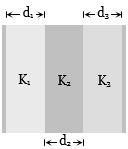
The expression for the capacity of the capacitor formed by compound dielectric placed between the plates of a parallel plate capacitor as shown in the figure,will be (area of plate $= A$)
A
$\frac{{\varepsilon _0}A}{{\left( {\frac{{{d_1}}}{{{K_1}}} + \frac{{{d_2}}}{{{K_2}}} + \frac{{{d_3}}}{{{K_3}}}} \right)}}$
B
$\frac{{\varepsilon _0}A}{{\left( {\frac{{{d_1} + {d_2} + {d_3}}}{{{K_1} + {K_2} + {K_3}}}} \right)}}$
C
$\frac{{\varepsilon _0}A({K_1}{K_2}{K_3})}{{{d_1}{d_2}{d_3}}}$
D
${\varepsilon _0}\left( {\frac{{A{K_1}}}{{{d_1}}} + \frac{{A{K_2}}}{{{d_2}}} + \frac{{A{K_3}}}{{{d_3}}}} \right)$
Solution
(A) The given arrangement consists of three capacitors in series,each with dielectric constant $K_1, K_2, K_3$ and thickness $d_1, d_2, d_3$ respectively.
The capacitance of a parallel plate capacitor with a dielectric is given by $C = \frac{K \varepsilon_0 A}{d}$.
For the three capacitors in series,the equivalent capacitance $C_{eq}$ is given by:
$\frac{1}{C_{eq}} = \frac{1}{C_1} + \frac{1}{C_2} + \frac{1}{C_3}$
Substituting the values:
$\frac{1}{C_{eq}} = \frac{d_1}{K_1 \varepsilon_0 A} + \frac{d_2}{K_2 \varepsilon_0 A} + \frac{d_3}{K_3 \varepsilon_0 A}$
$\frac{1}{C_{eq}} = \frac{1}{\varepsilon_0 A} \left[ \frac{d_1}{K_1} + \frac{d_2}{K_2} + \frac{d_3}{K_3} \right]$
Therefore,the equivalent capacitance is:
$C_{eq} = \frac{\varepsilon_0 A}{\left( \frac{d_1}{K_1} + \frac{d_2}{K_2} + \frac{d_3}{K_3} \right)}$
The capacitance of a parallel plate capacitor with a dielectric is given by $C = \frac{K \varepsilon_0 A}{d}$.
For the three capacitors in series,the equivalent capacitance $C_{eq}$ is given by:
$\frac{1}{C_{eq}} = \frac{1}{C_1} + \frac{1}{C_2} + \frac{1}{C_3}$
Substituting the values:
$\frac{1}{C_{eq}} = \frac{d_1}{K_1 \varepsilon_0 A} + \frac{d_2}{K_2 \varepsilon_0 A} + \frac{d_3}{K_3 \varepsilon_0 A}$
$\frac{1}{C_{eq}} = \frac{1}{\varepsilon_0 A} \left[ \frac{d_1}{K_1} + \frac{d_2}{K_2} + \frac{d_3}{K_3} \right]$
Therefore,the equivalent capacitance is:
$C_{eq} = \frac{\varepsilon_0 A}{\left( \frac{d_1}{K_1} + \frac{d_2}{K_2} + \frac{d_3}{K_3} \right)}$
0 likes
View Solution28
EasyMCQ
The capacity of a condenser in which a dielectric of dielectric constant $5$ has been used,is $C$. If the dielectric is replaced by another with dielectric constant $20$,the capacity will become
A
$C/4$
B
$4C$
C
$C/2$
D
$2C$
Solution
(B) The capacitance of a parallel plate capacitor with a dielectric is given by $C = \frac{K \varepsilon_0 A}{d}$.
Since $C \propto K$,we can write the ratio as $\frac{C_1}{C_2} = \frac{K_1}{K_2}$.
Given $K_1 = 5$,$C_1 = C$,and $K_2 = 20$.
Substituting these values: $\frac{C}{C_2} = \frac{5}{20}$.
$\frac{C}{C_2} = \frac{1}{4}$.
Therefore,$C_2 = 4C$.
Since $C \propto K$,we can write the ratio as $\frac{C_1}{C_2} = \frac{K_1}{K_2}$.
Given $K_1 = 5$,$C_1 = C$,and $K_2 = 20$.
Substituting these values: $\frac{C}{C_2} = \frac{5}{20}$.
$\frac{C}{C_2} = \frac{1}{4}$.
Therefore,$C_2 = 4C$.
0 likes
View Solution29
EasyMCQ
$A$ capacitor, when filled with a dielectric $K = 3$, has charge $Q_0$, voltage $V_0$, and electric field $E_0$. If the dielectric is replaced with another one having $K = 9$, the new values of charge, voltage, and field will be respectively:
A
$3Q_0, 3V_0, 3E_0$
B
$Q_0, 3V_0, 3E_0$
C
$Q_0, V_0/3, 3E_0$
D
$Q_0, V_0/3, E_0/3$
Solution
(D) When a capacitor is disconnected from a battery, the charge $Q$ on the plates remains constant because there is no path for the charge to flow.
Given initial dielectric constant $K_1 = 3$ and final dielectric constant $K_2 = 9$.
The charge remains constant: $Q' = Q_0$.
The potential difference $V$ across a capacitor is given by $V = Q/C$. Since $C = K \epsilon_0 A/d$, we have $V \propto 1/K$. Therefore, $V' = V_0 \times (K_1 / K_2) = V_0 \times (3 / 9) = V_0 / 3$.
The electric field $E$ is given by $E = V/d$. Since $V' = V_0 / 3$, the new electric field is $E' = E_0 / 3$.
Given initial dielectric constant $K_1 = 3$ and final dielectric constant $K_2 = 9$.
The charge remains constant: $Q' = Q_0$.
The potential difference $V$ across a capacitor is given by $V = Q/C$. Since $C = K \epsilon_0 A/d$, we have $V \propto 1/K$. Therefore, $V' = V_0 \times (K_1 / K_2) = V_0 \times (3 / 9) = V_0 / 3$.
The electric field $E$ is given by $E = V/d$. Since $V' = V_0 / 3$, the new electric field is $E' = E_0 / 3$.
0 likes
View Solution30
MediumMCQ
The area of the plates of a parallel plate capacitor is $A$ and the distance between the plates is $10\,mm$. There are two dielectric sheets in it,one of dielectric constant $10$ and thickness $6\,mm$ and the other of dielectric constant $5$ and thickness $4\,mm$. The capacity of the capacitor is
A
$\frac{12}{35}{\varepsilon _0}A$
B
$\frac{2}{3}{\varepsilon _0}A$
C
$\frac{5000}{7}{\varepsilon _0}A$
D
$1500\,{\varepsilon _0}A$
Solution
(C) The capacitance $C$ of a parallel plate capacitor with multiple dielectric slabs is given by the formula:
$C = \frac{{\varepsilon _0 A}}{{\sum \frac{t_i}{k_i}}}$
Given:
$t_1 = 6\,mm = 6 \times 10^{-3}\,m$,$k_1 = 10$
$t_2 = 4\,mm = 4 \times 10^{-3}\,m$,$k_2 = 5$
Substituting the values:
$C = \frac{{\varepsilon _0 A}}{{\frac{6 \times 10^{-3}}{10} + \frac{4 \times 10^{-3}}{5}}}$
$C = \frac{{\varepsilon _0 A}}{{0.6 \times 10^{-3} + 0.8 \times 10^{-3}}}$
$C = \frac{{\varepsilon _0 A}}{{1.4 \times 10^{-3}}}$
$C = \frac{1000}{1.4} \varepsilon _0 A = \frac{10000}{14} \varepsilon _0 A = \frac{5000}{7} \varepsilon _0 A$
$C = \frac{{\varepsilon _0 A}}{{\sum \frac{t_i}{k_i}}}$
Given:
$t_1 = 6\,mm = 6 \times 10^{-3}\,m$,$k_1 = 10$
$t_2 = 4\,mm = 4 \times 10^{-3}\,m$,$k_2 = 5$
Substituting the values:
$C = \frac{{\varepsilon _0 A}}{{\frac{6 \times 10^{-3}}{10} + \frac{4 \times 10^{-3}}{5}}}$
$C = \frac{{\varepsilon _0 A}}{{0.6 \times 10^{-3} + 0.8 \times 10^{-3}}}$
$C = \frac{{\varepsilon _0 A}}{{1.4 \times 10^{-3}}}$
$C = \frac{1000}{1.4} \varepsilon _0 A = \frac{10000}{14} \varepsilon _0 A = \frac{5000}{7} \varepsilon _0 A$
0 likes
View Solution31
MediumMCQ
An air capacitor of capacity $C = 10\,\mu F$ is connected to a constant voltage battery of $12\,V$. Now,the space between the plates is filled with a liquid of dielectric constant $K = 5$. The charge that flows from the battery to the capacitor is......$\mu C$.
A
$120$
B
$699$
C
$480$
D
$24$
Solution
(C) Initially,the charge on the air capacitor is given by $Q = C \times V = 10\,\mu F \times 12\,V = 120\,\mu C$.
When the space between the plates is filled with a dielectric of constant $K = 5$,the new capacitance becomes $C' = K \times C = 5 \times 10\,\mu F = 50\,\mu F$.
The new charge on the capacitor is $Q' = C' \times V = 50\,\mu F \times 12\,V = 600\,\mu C$.
The additional charge that flows from the battery to the capacitor is $\Delta Q = Q' - Q = 600\,\mu C - 120\,\mu C = 480\,\mu C$.
When the space between the plates is filled with a dielectric of constant $K = 5$,the new capacitance becomes $C' = K \times C = 5 \times 10\,\mu F = 50\,\mu F$.
The new charge on the capacitor is $Q' = C' \times V = 50\,\mu F \times 12\,V = 600\,\mu C$.
The additional charge that flows from the battery to the capacitor is $\Delta Q = Q' - Q = 600\,\mu C - 120\,\mu C = 480\,\mu C$.
0 likes
View Solution32
EasyMCQ
$A$ parallel plate capacitor is first charged and then a dielectric slab is introduced between the plates. The quantity that remains unchanged is
A
Charge $Q$
B
Potential $V$
C
Capacity $C$
D
Energy $U$
Solution
(A) When a capacitor is charged and then disconnected from the battery,it becomes an isolated system.
According to the law of conservation of charge,the total charge $Q$ on the plates of an isolated capacitor cannot change.
When a dielectric slab is introduced,the capacitance $C$ increases $(C = K C_0)$,the potential difference $V$ decreases $(V = V_0 / K)$,and the stored energy $U$ decreases $(U = U_0 / K)$.
Therefore,the charge $Q$ remains constant.
According to the law of conservation of charge,the total charge $Q$ on the plates of an isolated capacitor cannot change.
When a dielectric slab is introduced,the capacitance $C$ increases $(C = K C_0)$,the potential difference $V$ decreases $(V = V_0 / K)$,and the stored energy $U$ decreases $(U = U_0 / K)$.
Therefore,the charge $Q$ remains constant.
0 likes
View Solution33
EasyMCQ
$A$ parallel plate capacitor with oil between the plates (dielectric constant of oil $K = 2$) has a capacitance $C$. If the oil is removed,then the capacitance of the capacitor becomes:
A
$\sqrt{2} C$
B
$2C$
C
$\frac{C}{\sqrt{2}}$
D
$\frac{C}{2}$
Solution
(D) The capacitance of a parallel plate capacitor filled with a dielectric medium is given by $C_{medium} = \frac{K \epsilon_0 A}{d} = KC_0$,where $C_0$ is the capacitance with air/vacuum between the plates.
Given that $C_{medium} = C$ and $K = 2$,we have $C = 2C_0$.
Therefore,the capacitance with air (when oil is removed) is $C_0 = \frac{C}{2}$.
Thus,the correct option is $D$.
Given that $C_{medium} = C$ and $K = 2$,we have $C = 2C_0$.
Therefore,the capacitance with air (when oil is removed) is $C_0 = \frac{C}{2}$.
Thus,the correct option is $D$.
0 likes
View Solution34
MediumMCQ
The capacity of a parallel plate capacitor is $10\,\mu F$ without a dielectric. If a dielectric of constant $K = 2$ is used to fill half the distance between the plates,the new capacitance in $\mu F$ is:
A
$10$
B
$20$
C
$15$
D
$13.33$
Solution
(D) The initial capacitance of the parallel plate capacitor is given by $C = \frac{A\varepsilon_0}{d} = 10\,\mu F$.
When a dielectric slab of thickness $t$ and dielectric constant $K$ is inserted between the plates,the new capacitance is given by $C' = \frac{A\varepsilon_0}{d - t + \frac{t}{K}}$.
Here,the dielectric fills half the distance,so $t = \frac{d}{2}$ and $K = 2$.
Substituting these values: $C' = \frac{A\varepsilon_0}{d - \frac{d}{2} + \frac{d/2}{2}} = \frac{A\varepsilon_0}{\frac{d}{2} + \frac{d}{4}} = \frac{A\varepsilon_0}{\frac{3d}{4}} = \frac{4}{3} \times \frac{A\varepsilon_0}{d}$.
Since $\frac{A\varepsilon_0}{d} = 10\,\mu F$,we have $C' = \frac{4}{3} \times 10 = 13.33\,\mu F$.
When a dielectric slab of thickness $t$ and dielectric constant $K$ is inserted between the plates,the new capacitance is given by $C' = \frac{A\varepsilon_0}{d - t + \frac{t}{K}}$.
Here,the dielectric fills half the distance,so $t = \frac{d}{2}$ and $K = 2$.
Substituting these values: $C' = \frac{A\varepsilon_0}{d - \frac{d}{2} + \frac{d/2}{2}} = \frac{A\varepsilon_0}{\frac{d}{2} + \frac{d}{4}} = \frac{A\varepsilon_0}{\frac{3d}{4}} = \frac{4}{3} \times \frac{A\varepsilon_0}{d}$.
Since $\frac{A\varepsilon_0}{d} = 10\,\mu F$,we have $C' = \frac{4}{3} \times 10 = 13.33\,\mu F$.
0 likes
View Solution35
MediumMCQ
The capacitance of an air-filled parallel plate capacitor is $10 \, pF$. The separation between the plates is doubled and the space between the plates is then filled with wax,giving the capacitance a new value of $40 \times 10^{-12} \, F$. The dielectric constant of wax is:
A
$12$
B
$10$
C
$8$
D
$4.2$
Solution
(C) The initial capacitance of the air-filled capacitor is given by $C_1 = \frac{\varepsilon_0 A}{d} = 10 \, pF = 10 \times 10^{-12} \, F$.
When the separation is doubled $(d' = 2d)$ and the space is filled with a dielectric of constant $K$,the new capacitance $C_2$ is given by $C_2 = \frac{K \varepsilon_0 A}{d'} = \frac{K \varepsilon_0 A}{2d}$.
Taking the ratio of the two capacitances: $\frac{C_2}{C_1} = \frac{K \varepsilon_0 A / 2d}{\varepsilon_0 A / d} = \frac{K}{2}$.
Given $C_2 = 40 \times 10^{-12} \, F$,we have $\frac{40 \times 10^{-12}}{10 \times 10^{-12}} = \frac{K}{2}$.
$4 = \frac{K}{2} \implies K = 8$.
When the separation is doubled $(d' = 2d)$ and the space is filled with a dielectric of constant $K$,the new capacitance $C_2$ is given by $C_2 = \frac{K \varepsilon_0 A}{d'} = \frac{K \varepsilon_0 A}{2d}$.
Taking the ratio of the two capacitances: $\frac{C_2}{C_1} = \frac{K \varepsilon_0 A / 2d}{\varepsilon_0 A / d} = \frac{K}{2}$.
Given $C_2 = 40 \times 10^{-12} \, F$,we have $\frac{40 \times 10^{-12}}{10 \times 10^{-12}} = \frac{K}{2}$.
$4 = \frac{K}{2} \implies K = 8$.
0 likes
View Solution36
EasyMCQ
When a dielectric material is introduced between the plates of a charged condenser,what happens to the electric field between the plates?
A
Decreases
B
Increases
C
Remains constant
D
First $(b)$ then $(a)$
Solution
(A) When a dielectric material with dielectric constant $K$ is introduced between the plates of a charged capacitor,the induced charges on the dielectric surface create an internal electric field that opposes the original external electric field.
As a result,the net electric field $E_{medium}$ between the plates decreases and is given by the formula:
$E_{medium} = \frac{E_{air}}{K}$
Since $K > 1$ for any dielectric material,the electric field $E_{medium}$ will be less than the original electric field $E_{air}$.
As a result,the net electric field $E_{medium}$ between the plates decreases and is given by the formula:
$E_{medium} = \frac{E_{air}}{K}$
Since $K > 1$ for any dielectric material,the electric field $E_{medium}$ will be less than the original electric field $E_{air}$.
0 likes
View Solution37
EasyMCQ
$A$ parallel plate capacitor has a plate separation of $0.01\, mm$ and uses a dielectric (whose dielectric strength is $19\, kV/mm$) as an insulator. The maximum potential difference that can be applied to the terminals of the capacitor is......$V$
A
$190$
B
$290$
C
$95$
D
$350$
Solution
(A) The maximum potential difference $(V_{max})$ that can be applied across a capacitor is given by the product of the dielectric strength $(E_{max})$ and the plate separation $(d)$.
Given:
Dielectric strength $(E_{max})$ = $19\, kV/mm = 19,000\, V/mm$.
Plate separation $(d)$ = $0.01\, mm$.
Calculation:
$V_{max} = E_{max} \times d$
$V_{max} = 19,000\, V/mm \times 0.01\, mm$
$V_{max} = 190\, V$.
Therefore,the maximum potential difference is $190\, V$.
Given:
Dielectric strength $(E_{max})$ = $19\, kV/mm = 19,000\, V/mm$.
Plate separation $(d)$ = $0.01\, mm$.
Calculation:
$V_{max} = E_{max} \times d$
$V_{max} = 19,000\, V/mm \times 0.01\, mm$
$V_{max} = 190\, V$.
Therefore,the maximum potential difference is $190\, V$.
0 likes
View Solution38
MediumMCQ
In a capacitor of capacitance $20\,\mu F$,the distance between the plates is $2\,mm$. If a dielectric slab of width $1\,mm$ and dielectric constant $2$ is inserted between the plates,then the new capacitance is......$\mu F$.
A
$2$
B
$15.5$
C
$26.6$
D
$32$
Solution
(C) The initial capacitance of the parallel plate capacitor is given by $C = \frac{\varepsilon_0 A}{d} = 20\,\mu F$.
When a dielectric slab of thickness $t$ and dielectric constant $K$ is inserted,the new capacitance $C'$ is given by the formula:
$C' = \frac{\varepsilon_0 A}{d - t + \frac{t}{K}}$
Dividing the expression for $C'$ by $C$,we get:
$\frac{C'}{C} = \frac{d}{d - t + \frac{t}{K}}$
Given $d = 2\,mm$,$t = 1\,mm$,and $K = 2$:
$C' = C \times \frac{d}{d - t + \frac{t}{K}} = 20 \times \frac{2}{2 - 1 + \frac{1}{2}} = 20 \times \frac{2}{1.5} = 20 \times \frac{2}{3/2} = 20 \times \frac{4}{3} = \frac{80}{3} \approx 26.67\,\mu F$.
Thus,the new capacitance is approximately $26.6\,\mu F$.
When a dielectric slab of thickness $t$ and dielectric constant $K$ is inserted,the new capacitance $C'$ is given by the formula:
$C' = \frac{\varepsilon_0 A}{d - t + \frac{t}{K}}$
Dividing the expression for $C'$ by $C$,we get:
$\frac{C'}{C} = \frac{d}{d - t + \frac{t}{K}}$
Given $d = 2\,mm$,$t = 1\,mm$,and $K = 2$:
$C' = C \times \frac{d}{d - t + \frac{t}{K}} = 20 \times \frac{2}{2 - 1 + \frac{1}{2}} = 20 \times \frac{2}{1.5} = 20 \times \frac{2}{3/2} = 20 \times \frac{4}{3} = \frac{80}{3} \approx 26.67\,\mu F$.
Thus,the new capacitance is approximately $26.6\,\mu F$.
0 likes
View Solution39
MediumMCQ
The capacity of a parallel plate capacitor with no dielectric substance but with a separation of $0.4 \,cm$ is $2 \,\mu F$. The separation is reduced to half and it is filled with a dielectric substance of value $2.8$. The final capacity of the capacitor is.......$\mu F$.
A
$11.2$
B
$15.6$
C
$19.2$
D
$22.4$
Solution
(A) The capacitance of a parallel plate capacitor is given by $C = \frac{K \varepsilon_0 A}{d}$.
Initially,$K_1 = 1$ (air),$d_1 = 0.4 \, cm$,and $C_1 = 2 \, \mu F$.
Finally,$K_2 = 2.8$,$d_2 = \frac{d_1}{2} = 0.2 \, cm$,and we need to find $C_2$.
Using the ratio: $\frac{C_2}{C_1} = \frac{K_2}{K_1} \times \frac{d_1}{d_2}$.
Substituting the values: $\frac{C_2}{2} = \frac{2.8}{1} \times \frac{0.4}{0.2}$.
$\frac{C_2}{2} = 2.8 \times 2 = 5.6$.
$C_2 = 5.6 \times 2 = 11.2 \, \mu F$.
Initially,$K_1 = 1$ (air),$d_1 = 0.4 \, cm$,and $C_1 = 2 \, \mu F$.
Finally,$K_2 = 2.8$,$d_2 = \frac{d_1}{2} = 0.2 \, cm$,and we need to find $C_2$.
Using the ratio: $\frac{C_2}{C_1} = \frac{K_2}{K_1} \times \frac{d_1}{d_2}$.
Substituting the values: $\frac{C_2}{2} = \frac{2.8}{1} \times \frac{0.4}{0.2}$.
$\frac{C_2}{2} = 2.8 \times 2 = 5.6$.
$C_2 = 5.6 \times 2 = 11.2 \, \mu F$.
0 likes
View Solution40
MediumMCQ
In a parallel plate capacitor of capacitance $C$,a metal sheet is inserted between the plates,parallel to them. If the thickness of the sheet is half of the separation between the plates,the new capacitance will be:
A
$C/2$
B
$3C/4$
C
$4C$
D
$2C$
Solution
(D) The initial capacitance of the parallel plate capacitor is given by $C = \frac{\varepsilon_0 A}{d}$,where $A$ is the area of the plates and $d$ is the separation between them.
When a metal sheet of thickness $t$ is inserted between the plates,the effective separation between the plates decreases. The new capacitance $C'$ is given by the formula $C' = \frac{\varepsilon_0 A}{d - t + \frac{t}{K}}$,where $K$ is the dielectric constant.
For a metal sheet,the dielectric constant $K = \infty$.
Given that the thickness of the sheet $t = d/2$,we substitute these values into the formula:
$C' = \frac{\varepsilon_0 A}{d - d/2 + \frac{d/2}{\infty}}$
Since $\frac{d/2}{\infty} = 0$,the expression simplifies to:
$C' = \frac{\varepsilon_0 A}{d - d/2} = \frac{\varepsilon_0 A}{d/2} = 2 \left( \frac{\varepsilon_0 A}{d} \right)$
Substituting $C = \frac{\varepsilon_0 A}{d}$,we get $C' = 2C$.
When a metal sheet of thickness $t$ is inserted between the plates,the effective separation between the plates decreases. The new capacitance $C'$ is given by the formula $C' = \frac{\varepsilon_0 A}{d - t + \frac{t}{K}}$,where $K$ is the dielectric constant.
For a metal sheet,the dielectric constant $K = \infty$.
Given that the thickness of the sheet $t = d/2$,we substitute these values into the formula:
$C' = \frac{\varepsilon_0 A}{d - d/2 + \frac{d/2}{\infty}}$
Since $\frac{d/2}{\infty} = 0$,the expression simplifies to:
$C' = \frac{\varepsilon_0 A}{d - d/2} = \frac{\varepsilon_0 A}{d/2} = 2 \left( \frac{\varepsilon_0 A}{d} \right)$
Substituting $C = \frac{\varepsilon_0 A}{d}$,we get $C' = 2C$.
0 likes
View Solution41
EasyMCQ
While a capacitor remains connected to a battery and a dielectric slab is inserted between the plates,then:
A
Potential difference between the plates is changed
B
Charge flows from the battery to the capacitor
C
Electric field between the plates increases
D
Energy stored in the capacitor decreases
Solution
(B) When a dielectric slab is inserted between the plates of a capacitor while it remains connected to a battery,the potential difference $(V)$ across the plates remains constant because it is fixed by the battery.
Since the capacitance $(C)$ increases by a factor of $K$ (where $K$ is the dielectric constant),the charge on the plates $(Q = CV)$ must increase.
Therefore,additional charge flows from the battery to the capacitor to maintain the potential difference.
Thus,option $(B)$ is correct.
Since the capacitance $(C)$ increases by a factor of $K$ (where $K$ is the dielectric constant),the charge on the plates $(Q = CV)$ must increase.
Therefore,additional charge flows from the battery to the capacitor to maintain the potential difference.
Thus,option $(B)$ is correct.
0 likes
View Solution42
EasyMCQ
The electric field between the plates of a parallel plate capacitor when connected to a certain battery is $E_0$. If the space between the plates of the capacitor is filled by introducing a material of dielectric constant $K$ without disturbing the battery connections,the field between the plates shall be
A
$K E_0$
B
$E_0$
C
$\frac{E_0}{K}$
D
None of the above
Solution
(B) When a parallel plate capacitor is connected to a battery,the potential difference $V$ across its plates remains constant because it is maintained by the battery.
The electric field $E$ between the plates is given by the relation $E = \frac{V}{d}$,where $d$ is the distance between the plates.
Since the battery remains connected,$V$ is constant,and the distance $d$ between the plates does not change.
Therefore,the electric field $E$ remains equal to its initial value $E_0$,regardless of the introduction of a dielectric material.
The electric field $E$ between the plates is given by the relation $E = \frac{V}{d}$,where $d$ is the distance between the plates.
Since the battery remains connected,$V$ is constant,and the distance $d$ between the plates does not change.
Therefore,the electric field $E$ remains equal to its initial value $E_0$,regardless of the introduction of a dielectric material.
0 likes
View Solution43
MediumMCQ
If the distance between parallel plates of a capacitor is halved and the dielectric constant is doubled,then the capacitance:
A
Decreases two times
B
Increases two times
C
Increases four times
D
Remains the same
Solution
(C) The capacitance of a parallel plate capacitor is given by $C = \frac{K \epsilon_0 A}{d}$,where $K$ is the dielectric constant,$A$ is the area of the plates,and $d$ is the distance between them.
Initially,$C_1 = \frac{K \epsilon_0 A}{d}$.
According to the problem,the new distance $d' = \frac{d}{2}$ and the new dielectric constant $K' = 2K$.
The new capacitance $C_2$ is given by $C_2 = \frac{K' \epsilon_0 A}{d'} = \frac{(2K) \epsilon_0 A}{d/2}$.
Simplifying this,$C_2 = 4 \times \frac{K \epsilon_0 A}{d} = 4C_1$.
Therefore,the capacitance increases four times.
Initially,$C_1 = \frac{K \epsilon_0 A}{d}$.
According to the problem,the new distance $d' = \frac{d}{2}$ and the new dielectric constant $K' = 2K$.
The new capacitance $C_2$ is given by $C_2 = \frac{K' \epsilon_0 A}{d'} = \frac{(2K) \epsilon_0 A}{d/2}$.
Simplifying this,$C_2 = 4 \times \frac{K \epsilon_0 A}{d} = 4C_1$.
Therefore,the capacitance increases four times.
0 likes
View Solution44
EasyMCQ
When a dielectric substance is placed between the two plates of a capacitor,what happens to its capacitance,potential difference,and potential energy,respectively?
A
Increase,decrease,decrease
B
Decrease,increase,increase
C
Increase,increase,increase
D
Decrease,decrease,decrease
Solution
(A) When a dielectric material with dielectric constant $K > 1$ is inserted between the plates of a capacitor (assuming the capacitor is disconnected from the battery,so charge $Q$ remains constant):
$1$. Capacitance $(C)$: The new capacitance is $C' = KC$. Since $K > 1$,the capacitance increases.
$2$. Potential Difference $(V)$: Since $V = Q/C$,and $C$ increases while $Q$ is constant,the potential difference $V$ decreases.
$3$. Potential Energy $(U)$: The potential energy is given by $U = Q^2 / (2C)$. Since $C$ increases and $Q$ is constant,the potential energy $U$ decreases.
Therefore,the correct sequence is: Increase,decrease,decrease.
$1$. Capacitance $(C)$: The new capacitance is $C' = KC$. Since $K > 1$,the capacitance increases.
$2$. Potential Difference $(V)$: Since $V = Q/C$,and $C$ increases while $Q$ is constant,the potential difference $V$ decreases.
$3$. Potential Energy $(U)$: The potential energy is given by $U = Q^2 / (2C)$. Since $C$ increases and $Q$ is constant,the potential energy $U$ decreases.
Therefore,the correct sequence is: Increase,decrease,decrease.
0 likes
View Solution45
EasyMCQ
$A$ thin metal plate $P$ is inserted halfway between the plates of a parallel plate capacitor of capacitance $C$ in such a way that it is parallel to the two plates. The capacitance now becomes
A
$C$
B
$C/2$
C
$4C$
D
None of these
Solution
(A) When a thin metal plate is inserted between the plates of a parallel plate capacitor,it acts as an equipotential surface.
This effectively divides the original capacitor into two capacitors in series,each with a plate separation of $d/2$.
The capacitance of each new capacitor is $C' = \frac{\epsilon_0 A}{d/2} = 2C$.
Since these two capacitors are in series,the equivalent capacitance $C_{eq}$ is given by $\frac{1}{C_{eq}} = \frac{1}{C'} + \frac{1}{C'} = \frac{1}{2C} + \frac{1}{2C} = \frac{1}{C}$.
Therefore,$C_{eq} = C$.
Thus,the capacitance remains unchanged.
This effectively divides the original capacitor into two capacitors in series,each with a plate separation of $d/2$.
The capacitance of each new capacitor is $C' = \frac{\epsilon_0 A}{d/2} = 2C$.
Since these two capacitors are in series,the equivalent capacitance $C_{eq}$ is given by $\frac{1}{C_{eq}} = \frac{1}{C'} + \frac{1}{C'} = \frac{1}{2C} + \frac{1}{2C} = \frac{1}{C}$.
Therefore,$C_{eq} = C$.
Thus,the capacitance remains unchanged.
0 likes
View Solution46
EasyMCQ
$A$ parallel plate air capacitor is charged and then isolated. When a dielectric material is inserted between the plates of the capacitor,which of the following does not change?
A
Electric field between the plates
B
Potential difference across the plates
C
Charge on the plates
D
Energy stored in the capacitor
Solution
(C) When a capacitor is charged and then isolated,the total charge $Q$ on the plates remains constant because there is no external source or path for the charge to flow.
When a dielectric material is inserted,the capacitance $C$ increases to $C' = KC$,where $K$ is the dielectric constant.
Since $Q$ is constant and $C$ increases,the potential difference $V = Q/C$ decreases.
The electric field $E = V/d$ also decreases.
The energy stored $U = Q^2/(2C)$ decreases because $C$ increases.
Therefore,the charge on the plates remains unchanged.
When a dielectric material is inserted,the capacitance $C$ increases to $C' = KC$,where $K$ is the dielectric constant.
Since $Q$ is constant and $C$ increases,the potential difference $V = Q/C$ decreases.
The electric field $E = V/d$ also decreases.
The energy stored $U = Q^2/(2C)$ decreases because $C$ increases.
Therefore,the charge on the plates remains unchanged.
0 likes
View Solution47
MediumMCQ
Capacitance of a parallel plate capacitor becomes $4/3$ times its original value if a dielectric slab of thickness $t = d/2$ is inserted between the plates ($d$ is the separation between the plates). The dielectric constant of the slab is
A
$8$
B
$4$
C
$6$
D
$2$
Solution
(D) The capacitance of a parallel plate capacitor with air is given by $C = \frac{\varepsilon_0 A}{d}$.
When a dielectric slab of thickness $t$ and dielectric constant $K$ is inserted,the new capacitance $C'$ is given by $C' = \frac{\varepsilon_0 A}{d - t + \frac{t}{K}}$.
Given that $C' = \frac{4}{3}C$ and $t = \frac{d}{2}$,we substitute these values:
$\frac{\varepsilon_0 A}{d - \frac{d}{2} + \frac{d/2}{K}} = \frac{4}{3} \times \frac{\varepsilon_0 A}{d}$.
Simplifying the equation:
$\frac{1}{\frac{d}{2} + \frac{d}{2K}} = \frac{4}{3d} \Rightarrow \frac{1}{\frac{d}{2}(1 + \frac{1}{K})} = \frac{4}{3d}$.
$\frac{2}{d(1 + 1/K)} = \frac{4}{3d} \Rightarrow \frac{2}{1 + 1/K} = \frac{4}{3}$.
$6 = 4(1 + 1/K) \Rightarrow 6 = 4 + \frac{4}{K}$.
$2 = \frac{4}{K} \Rightarrow K = 2$.
When a dielectric slab of thickness $t$ and dielectric constant $K$ is inserted,the new capacitance $C'$ is given by $C' = \frac{\varepsilon_0 A}{d - t + \frac{t}{K}}$.
Given that $C' = \frac{4}{3}C$ and $t = \frac{d}{2}$,we substitute these values:
$\frac{\varepsilon_0 A}{d - \frac{d}{2} + \frac{d/2}{K}} = \frac{4}{3} \times \frac{\varepsilon_0 A}{d}$.
Simplifying the equation:
$\frac{1}{\frac{d}{2} + \frac{d}{2K}} = \frac{4}{3d} \Rightarrow \frac{1}{\frac{d}{2}(1 + \frac{1}{K})} = \frac{4}{3d}$.
$\frac{2}{d(1 + 1/K)} = \frac{4}{3d} \Rightarrow \frac{2}{1 + 1/K} = \frac{4}{3}$.
$6 = 4(1 + 1/K) \Rightarrow 6 = 4 + \frac{4}{K}$.
$2 = \frac{4}{K} \Rightarrow K = 2$.
0 likes
View Solution48
EasyMCQ
If a dielectric substance is introduced between the plates of a charged air-gap capacitor,the energy of the capacitor will:
A
Increase
B
Decrease
C
Remain unchanged
D
First decrease and then increase
Solution
(B) The energy stored in a capacitor is given by the formula $U = \frac{Q^2}{2C}$,where $Q$ is the charge on the plates and $C$ is the capacitance.
When a dielectric substance is introduced between the plates of a charged capacitor (assuming the capacitor is isolated,so $Q$ remains constant),the capacitance $C$ increases because $C = \frac{K \epsilon_0 A}{d}$,where $K > 1$.
Since $U$ is inversely proportional to $C$ $(U \propto \frac{1}{C})$,an increase in capacitance $C$ leads to a decrease in the stored energy $U$.
When a dielectric substance is introduced between the plates of a charged capacitor (assuming the capacitor is isolated,so $Q$ remains constant),the capacitance $C$ increases because $C = \frac{K \epsilon_0 A}{d}$,where $K > 1$.
Since $U$ is inversely proportional to $C$ $(U \propto \frac{1}{C})$,an increase in capacitance $C$ leads to a decrease in the stored energy $U$.
0 likes
View Solution49
MediumMCQ
An air-filled parallel plate capacitor has capacity $C$. If the distance between the plates is doubled and it is immersed in a liquid,the capacity becomes twice. The dielectric constant of the liquid is:
A
$1$
B
$2$
C
$3$
D
$4$
Solution
(D) The capacitance of an air-filled parallel plate capacitor is given by $C = \frac{\varepsilon_0 A}{d}$ ... $(i)$.
When the distance between the plates is doubled $(d' = 2d)$ and it is immersed in a liquid of dielectric constant $K$,the new capacitance $C'$ is given by $C' = \frac{K \varepsilon_0 A}{d'} = \frac{K \varepsilon_0 A}{2d}$ ... $(ii)$.
Given that the new capacity is twice the original capacity,i.e.,$C' = 2C$.
Substituting the expressions from $(i)$ and $(ii)$ into this relation:
$\frac{K \varepsilon_0 A}{2d} = 2 \left( \frac{\varepsilon_0 A}{d} \right)$.
Simplifying the equation:
$\frac{K}{2} = 2$.
Therefore,$K = 4$.
When the distance between the plates is doubled $(d' = 2d)$ and it is immersed in a liquid of dielectric constant $K$,the new capacitance $C'$ is given by $C' = \frac{K \varepsilon_0 A}{d'} = \frac{K \varepsilon_0 A}{2d}$ ... $(ii)$.
Given that the new capacity is twice the original capacity,i.e.,$C' = 2C$.
Substituting the expressions from $(i)$ and $(ii)$ into this relation:
$\frac{K \varepsilon_0 A}{2d} = 2 \left( \frac{\varepsilon_0 A}{d} \right)$.
Simplifying the equation:
$\frac{K}{2} = 2$.
Therefore,$K = 4$.
0 likes
View SolutionElectric Potential and Capacitance — Effect of Dielectric Inside Capacitor · Frequently Asked Questions
1Are these Electric Potential and Capacitance questions useful for JEE and NEET?
Yes. All questions in this section are mapped to JEE Main and NEET exam patterns. Previous year questions from JEE Main, NEET, GUJCET and state-level exams are included with full solutions.
2Can I switch to Hindi or Gujarati for these questions?
Yes. Use the language tabs in the hero section or the sidebar to view the same questions and solutions in English, Hindi or Gujarati.
3How do I generate a question paper from this subtopic?
Use the Vedclass Exam Paper Generator — select the chapter and subtopic, set difficulty, and generate Sets A, B, C, D automatically. First 3 chapters of every subject are free.
Vedclass Products
For Students
Vedclass Test Series
Mock tests in real JEE/NEET style with performance analysis. 5-day free trial.
Start Free TrialFor Teachers
Exam Paper Generator
Generate Set A/B/C/D papers from this chapter in 2 minutes. 3 chapters free.
Try FreeFor Institutes
Online Exam Module
Live online exams with unlimited students, 360° analytics & white-label branding.
See DemoFor Teachers & Institutes
Generate a Electric Potential and Capacitance Exam Paper in 2 Minutes
Select subtopic & difficulty — Sets A, B, C, D auto-generated with No Repeat logic.
First 3 chapters of every subject are free — no payment required.