
A English
Energy Stored in a Capacitor Questions in English
Class 12 Physics · Electric Potential and Capacitance · Energy Stored in a Capacitor
147+
Questions
English
Language
100%
With Solutions
Showing 49 of 147 questions in English
1
MediumMCQ
If $V$ denotes the potential difference across the plates of a capacitor of capacitance $C$,the dimensions of $CV^2$ are
A
Not expressible in $MLT$
B
$MLT^{-2}$
C
$M^2LT^{-1}$
D
$ML^2T^{-2}$
Solution
(D) The energy stored in a capacitor is given by the formula $U = \frac{1}{2}CV^2$.
Since $\frac{1}{2}$ is a dimensionless constant,the dimensions of $CV^2$ are the same as the dimensions of energy.
Energy is defined as force multiplied by displacement,so its dimensional formula is $[M L T^{-2}] \times [L] = [M L^2 T^{-2}]$.
Therefore,the dimensions of $CV^2$ are $[M L^2 T^{-2}]$.
Since $\frac{1}{2}$ is a dimensionless constant,the dimensions of $CV^2$ are the same as the dimensions of energy.
Energy is defined as force multiplied by displacement,so its dimensional formula is $[M L T^{-2}] \times [L] = [M L^2 T^{-2}]$.
Therefore,the dimensions of $CV^2$ are $[M L^2 T^{-2}]$.
0 likes
View Solution2
EasyMCQ
If $E$ is the electric field intensity of an electrostatic field,then the electrostatic energy density is proportional to
A
$E$
B
$E^2$
C
$1/E^2$
D
$E^3$
Solution
(B) The electrostatic energy density $u$ is defined as the energy stored per unit volume in an electric field.
The formula for electrostatic energy density is given by $u = \frac{dU}{dV} = \frac{1}{2} \epsilon_0 E^2$,where $\epsilon_0$ is the permittivity of free space and $E$ is the electric field intensity.
From this expression,it is clear that the electrostatic energy density is directly proportional to the square of the electric field intensity,i.e.,$u \propto E^2$.
The formula for electrostatic energy density is given by $u = \frac{dU}{dV} = \frac{1}{2} \epsilon_0 E^2$,where $\epsilon_0$ is the permittivity of free space and $E$ is the electric field intensity.
From this expression,it is clear that the electrostatic energy density is directly proportional to the square of the electric field intensity,i.e.,$u \propto E^2$.
0 likes
View Solution3
EasyMCQ
The energy of a charged capacitor is given by the expression ($q$ = charge on the conductor and $C$ = its capacity).
A
$\frac{q^2}{2C}$
B
$\frac{q^2}{C}$
C
$2qC$
D
$\frac{q}{2C^2}$
Solution
(A) The energy $U$ stored in a capacitor is given by the formula $U = \frac{1}{2}CV^2$.
Since the charge $q$ on the capacitor is given by $q = CV$,we can write $V = \frac{q}{C}$.
Substituting this value of $V$ into the energy formula:
$U = \frac{1}{2}C\left(\frac{q}{C}\right)^2 = \frac{1}{2}C\left(\frac{q^2}{C^2}\right) = \frac{q^2}{2C}$.
Therefore,the correct expression is $\frac{q^2}{2C}$.
Since the charge $q$ on the capacitor is given by $q = CV$,we can write $V = \frac{q}{C}$.
Substituting this value of $V$ into the energy formula:
$U = \frac{1}{2}C\left(\frac{q}{C}\right)^2 = \frac{1}{2}C\left(\frac{q^2}{C^2}\right) = \frac{q^2}{2C}$.
Therefore,the correct expression is $\frac{q^2}{2C}$.
0 likes
View Solution4
EasyMCQ
The capacity of a capacitor is $4 \times 10^{-6} \, F$ and its potential is $100 \, V$. The energy released on discharging it fully will be ....... $J$.
A
$0.02$
B
$0.04$
C
$0.025$
D
$0.05$
Solution
(A) The energy stored in a capacitor is given by the formula $U = \frac{1}{2} C V^2$.
Given:
Capacitance $C = 4 \times 10^{-6} \, F$
Potential $V = 100 \, V$
Substituting the values into the formula:
$U = \frac{1}{2} \times (4 \times 10^{-6}) \times (100)^2$
$U = \frac{1}{2} \times 4 \times 10^{-6} \times 10000$
$U = 2 \times 10^{-6} \times 10^4$
$U = 2 \times 10^{-2} \, J$
$U = 0.02 \, J$
Therefore,the energy released is $0.02 \, J$.
Given:
Capacitance $C = 4 \times 10^{-6} \, F$
Potential $V = 100 \, V$
Substituting the values into the formula:
$U = \frac{1}{2} \times (4 \times 10^{-6}) \times (100)^2$
$U = \frac{1}{2} \times 4 \times 10^{-6} \times 10000$
$U = 2 \times 10^{-6} \times 10^4$
$U = 2 \times 10^{-2} \, J$
$U = 0.02 \, J$
Therefore,the energy released is $0.02 \, J$.
0 likes
View Solution5
EasyMCQ
In a charged capacitor,the energy resides in:
A
The positive charges
B
Both the positive and negative charges
C
The field between the plates
D
Around the edge of the capacitor plates
Solution
(C) The energy stored in a capacitor is given by the expression $U = \frac{1}{2} CV^2$ or $U = \frac{1}{2} \frac{Q^2}{C}$.
In terms of the electric field $E$ between the plates,the energy density $u$ is given by $u = \frac{1}{2} \epsilon_0 E^2$.
Since the electric field outside an ideal parallel plate capacitor is zero and the field exists only in the region between the plates,the total energy resides in the electric field between the plates.
In terms of the electric field $E$ between the plates,the energy density $u$ is given by $u = \frac{1}{2} \epsilon_0 E^2$.
Since the electric field outside an ideal parallel plate capacitor is zero and the field exists only in the region between the plates,the total energy resides in the electric field between the plates.
0 likes
View Solution6
EasyMCQ
The energy stored in a capacitor of capacity $C$ which has been raised to a potential $V$ is given by
A
$\frac{1}{2} CV$
B
$\frac{1}{2} CV^2$
C
$CV$
D
$\frac{1}{2VC}$
Solution
(B) The energy stored in a capacitor is the work done in charging it.
If a capacitor of capacity $C$ is charged to a potential $V$,the work done $dW$ to bring an additional charge $dq$ is given by $dW = V' dq$,where $V' = q/C$.
Integrating this from $0$ to $Q$ (where $Q = CV$):
$U = \int_{0}^{Q} \frac{q}{C} dq = \frac{1}{C} \left[ \frac{q^2}{2} \right]_{0}^{Q} = \frac{Q^2}{2C}$.
Substituting $Q = CV$,we get $U = \frac{(CV)^2}{2C} = \frac{1}{2} CV^2$.
If a capacitor of capacity $C$ is charged to a potential $V$,the work done $dW$ to bring an additional charge $dq$ is given by $dW = V' dq$,where $V' = q/C$.
Integrating this from $0$ to $Q$ (where $Q = CV$):
$U = \int_{0}^{Q} \frac{q}{C} dq = \frac{1}{C} \left[ \frac{q^2}{2} \right]_{0}^{Q} = \frac{Q^2}{2C}$.
Substituting $Q = CV$,we get $U = \frac{(CV)^2}{2C} = \frac{1}{2} CV^2$.
0 likes
View Solution7
EasyMCQ
$A$ capacitor of capacity $50\,\mu F$ is charged to $10\;V$. Its energy is equal to:
A
$2.5 \times 10^{-3}\,J$
B
$2.5 \times 10^{-4}\,J$
C
$5 \times 10^{-2}\,J$
D
$1.2 \times 10^{-8}\,J$
Solution
(A) The energy $U$ stored in a capacitor is given by the formula $U = \frac{1}{2}CV^2$.
Given:
Capacitance $C = 50\,\mu F = 50 \times 10^{-6}\,F$.
Potential difference $V = 10\;V$.
Substituting the values into the formula:
$U = \frac{1}{2} \times (50 \times 10^{-6}) \times (10)^2$
$U = \frac{1}{2} \times 50 \times 10^{-6} \times 100$
$U = 25 \times 10^{-4} = 2.5 \times 10^{-3}\,J$.
Therefore,the energy stored is $2.5 \times 10^{-3}\,J$.
Given:
Capacitance $C = 50\,\mu F = 50 \times 10^{-6}\,F$.
Potential difference $V = 10\;V$.
Substituting the values into the formula:
$U = \frac{1}{2} \times (50 \times 10^{-6}) \times (10)^2$
$U = \frac{1}{2} \times 50 \times 10^{-6} \times 100$
$U = 25 \times 10^{-4} = 2.5 \times 10^{-3}\,J$.
Therefore,the energy stored is $2.5 \times 10^{-3}\,J$.
0 likes
View Solution8
EasyMCQ
The energy of a charged capacitor resides in
A
The electric field only
B
The magnetic field only
C
Both the electric and magnetic field
D
Neither in electric nor magnetic field
Solution
(A) charged capacitor stores energy in the form of an electrostatic field between its plates.
Since the charges on the capacitor plates are stationary,they produce only an electric field.
There is no current flowing through the capacitor in a steady state,so there is no magnetic field.
Therefore,the energy of a charged capacitor resides in the electric field only.
Since the charges on the capacitor plates are stationary,they produce only an electric field.
There is no current flowing through the capacitor in a steady state,so there is no magnetic field.
Therefore,the energy of a charged capacitor resides in the electric field only.
0 likes
View Solution9
EasyMCQ
$A$ capacitor of capacity $C$ has charge $Q$ and stored energy is $W$. If the charge is increased to $2Q$,the stored energy will be
A
$2W$
B
$W/2$
C
$4W$
D
$W/4$
Solution
(C) The energy stored in a capacitor is given by the formula $W = \frac{Q^2}{2C}$.
When the charge is increased to $2Q$,the new energy $W'$ becomes:
$W' = \frac{(2Q)^2}{2C} = \frac{4Q^2}{2C}$.
Since $W = \frac{Q^2}{2C}$,we can substitute this into the equation:
$W' = 4 \times \left( \frac{Q^2}{2C} \right) = 4W$.
Therefore,the stored energy becomes $4W$.
When the charge is increased to $2Q$,the new energy $W'$ becomes:
$W' = \frac{(2Q)^2}{2C} = \frac{4Q^2}{2C}$.
Since $W = \frac{Q^2}{2C}$,we can substitute this into the equation:
$W' = 4 \times \left( \frac{Q^2}{2C} \right) = 4W$.
Therefore,the stored energy becomes $4W$.
0 likes
View Solution10
EasyMCQ
$A$ $6\,\mu F$ capacitor is charged from $10\,V$ to $20\,V$. The increase in energy will be:
A
$18 \times 10^{-4}\,J$
B
$9 \times 10^{-4}\,J$
C
$4.5 \times 10^{-4}\,J$
D
$9 \times 10^{-6}\,J$
Solution
(B) The energy stored in a capacitor is given by $E = \frac{1}{2}CV^2$.
The increase in energy $\Delta E$ is given by $\Delta E = E_{Final} - E_{Initial} = \frac{1}{2}C(V_{Final}^2 - V_{Initial}^2)$.
Given: $C = 6\,\mu F = 6 \times 10^{-6}\,F$,$V_{Initial} = 10\,V$,$V_{Final} = 20\,V$.
Substituting the values:
$\Delta E = \frac{1}{2} \times (6 \times 10^{-6}) \times (20^2 - 10^2)$
$\Delta E = 3 \times 10^{-6} \times (400 - 100)$
$\Delta E = 3 \times 10^{-6} \times 300$
$\Delta E = 900 \times 10^{-6}\,J = 9 \times 10^{-4}\,J$.
The increase in energy $\Delta E$ is given by $\Delta E = E_{Final} - E_{Initial} = \frac{1}{2}C(V_{Final}^2 - V_{Initial}^2)$.
Given: $C = 6\,\mu F = 6 \times 10^{-6}\,F$,$V_{Initial} = 10\,V$,$V_{Final} = 20\,V$.
Substituting the values:
$\Delta E = \frac{1}{2} \times (6 \times 10^{-6}) \times (20^2 - 10^2)$
$\Delta E = 3 \times 10^{-6} \times (400 - 100)$
$\Delta E = 3 \times 10^{-6} \times 300$
$\Delta E = 900 \times 10^{-6}\,J = 9 \times 10^{-4}\,J$.
0 likes
View Solution11
EasyMCQ
An uncharged capacitor is connected to a battery. On charging the capacitor,
A
All the energy supplied is stored in the capacitor
B
Half the energy supplied is stored in the capacitor
C
The energy stored depends upon the capacity of the capacitor only
D
The energy stored depends upon the time for which the capacitor is charged
Solution
(B) When a capacitor of capacitance $C$ is charged by a battery of $EMF$ $V$,the total work done by the battery is $W = QV = (CV)V = CV^2$.
However,the energy stored in the capacitor is given by $U = \frac{1}{2}CV^2$.
Comparing these,we see that the energy stored in the capacitor is exactly half of the total work done (energy supplied) by the battery.
The remaining half of the energy is dissipated as heat in the connecting wires or internal resistance of the circuit.
However,the energy stored in the capacitor is given by $U = \frac{1}{2}CV^2$.
Comparing these,we see that the energy stored in the capacitor is exactly half of the total work done (energy supplied) by the battery.
The remaining half of the energy is dissipated as heat in the connecting wires or internal resistance of the circuit.
0 likes
View Solution12
EasyMCQ
$A$ $2\,\mu F$ capacitor is charged to $100\,V$ and then its plates are connected by a conducting wire. The heat produced is........$J$.
A
$1$
B
$0.1$
C
$0.01$
D
$0.001$
Solution
(C) The energy stored in a charged capacitor is given by the formula $U = \frac{1}{2}CV^2$.
When the plates of the capacitor are connected by a conducting wire,the entire stored energy is dissipated as heat.
Given: $C = 2\,\mu F = 2 \times 10^{-6}\,F$ and $V = 100\,V$.
Substituting the values into the formula:
$U = \frac{1}{2} \times (2 \times 10^{-6}) \times (100)^2$
$U = 10^{-6} \times 10^4$
$U = 10^{-2}\,J = 0.01\,J$.
Therefore,the heat produced is $0.01\,J$.
When the plates of the capacitor are connected by a conducting wire,the entire stored energy is dissipated as heat.
Given: $C = 2\,\mu F = 2 \times 10^{-6}\,F$ and $V = 100\,V$.
Substituting the values into the formula:
$U = \frac{1}{2} \times (2 \times 10^{-6}) \times (100)^2$
$U = 10^{-6} \times 10^4$
$U = 10^{-2}\,J = 0.01\,J$.
Therefore,the heat produced is $0.01\,J$.
0 likes
View Solution13
EasyMCQ
The energy stored in the capacitor is
A
$QV$
B
$\frac{1}{2}QV$
C
$\frac{1}{2}C$
D
$\frac{1}{2}\frac{Q}{C}$
Solution
(B) The energy $U$ stored in a capacitor is given by the work done in charging it.
When a charge $Q$ is transferred to a capacitor of capacitance $C$ at a potential $V$,the average potential during the process is $\frac{V}{2}$.
Therefore,the energy stored $U = \text{average potential} \times \text{charge}$.
$U = \frac{1}{2}V \times Q = \frac{1}{2}QV$.
When a charge $Q$ is transferred to a capacitor of capacitance $C$ at a potential $V$,the average potential during the process is $\frac{V}{2}$.
Therefore,the energy stored $U = \text{average potential} \times \text{charge}$.
$U = \frac{1}{2}V \times Q = \frac{1}{2}QV$.
0 likes
View Solution14
MediumMCQ
$A$ capacitor having a capacity of $2.0 \; \mu F$ is charged to $200 \; V$ and then the plates of the capacitor are connected to a resistance wire. The heat produced in joules will be:
A
$4 \times 10^4 \; J$
B
$4 \times 10^{10} \; J$
C
$4 \times 10^{-2} \; J$
D
$2 \times 10^{-2} \; J$
Solution
(C) The energy stored in a capacitor is given by the formula $U = \frac{1}{2} C V^2$.
Given:
Capacitance $C = 2.0 \; \mu F = 2.0 \times 10^{-6} \; F$
Potential difference $V = 200 \; V$
Substituting the values into the formula:
$U = \frac{1}{2} \times (2.0 \times 10^{-6} \; F) \times (200 \; V)^2$
$U = 1.0 \times 10^{-6} \times 40000$
$U = 4 \times 10^{-2} \; J$
When the capacitor is discharged through a resistance wire,the entire stored energy is dissipated as heat. Therefore,the heat produced is $4 \times 10^{-2} \; J$.
Given:
Capacitance $C = 2.0 \; \mu F = 2.0 \times 10^{-6} \; F$
Potential difference $V = 200 \; V$
Substituting the values into the formula:
$U = \frac{1}{2} \times (2.0 \times 10^{-6} \; F) \times (200 \; V)^2$
$U = 1.0 \times 10^{-6} \times 40000$
$U = 4 \times 10^{-2} \; J$
When the capacitor is discharged through a resistance wire,the entire stored energy is dissipated as heat. Therefore,the heat produced is $4 \times 10^{-2} \; J$.
0 likes
View Solution15
EasyMCQ
$A$ $10 \, pF$ capacitor is connected to a $50 \, V$ battery. How much electrostatic energy is stored in the capacitor?
A
$1.25 \times 10^{-8} \, J$
B
$2.5 \times 10^{-7} \, J$
C
$3.5 \times 10^{-5} \, J$
D
$4.5 \times 10^{-2} \, J$
Solution
(A) The energy $U$ stored in a capacitor is given by the formula $U = \frac{1}{2} C V^2$.
Given:
Capacitance $C = 10 \, pF = 10 \times 10^{-12} \, F = 10^{-11} \, F$.
Potential difference $V = 50 \, V$.
Substituting the values into the formula:
$U = \frac{1}{2} \times (10 \times 10^{-12} \, F) \times (50 \, V)^2$
$U = \frac{1}{2} \times 10^{-11} \times 2500$
$U = 0.5 \times 2.5 \times 10^{-8} \, J$
$U = 1.25 \times 10^{-8} \, J$.
Therefore,the correct option is $A$.
Given:
Capacitance $C = 10 \, pF = 10 \times 10^{-12} \, F = 10^{-11} \, F$.
Potential difference $V = 50 \, V$.
Substituting the values into the formula:
$U = \frac{1}{2} \times (10 \times 10^{-12} \, F) \times (50 \, V)^2$
$U = \frac{1}{2} \times 10^{-11} \times 2500$
$U = 0.5 \times 2.5 \times 10^{-8} \, J$
$U = 1.25 \times 10^{-8} \, J$.
Therefore,the correct option is $A$.
0 likes
View Solution16
EasyMCQ
$A$ $700\,pF$ capacitor is charged by a $50\,V$ battery. The electrostatic energy stored by it is
A
$17.0 \times 10^{-8}\,J$
B
$13.6 \times 10^{-9}\,J$
C
$9.5 \times 10^{-9}\,J$
D
$8.75 \times 10^{-7}\,J$
Solution
(D) The energy $U$ stored in a capacitor is given by the formula $U = \frac{1}{2}CV^2$.
Given:
Capacitance $C = 700\,pF = 700 \times 10^{-12}\,F = 7 \times 10^{-10}\,F$.
Potential difference $V = 50\,V$.
Substituting the values:
$U = \frac{1}{2} \times (700 \times 10^{-12}) \times (50)^2$
$U = \frac{1}{2} \times 700 \times 10^{-12} \times 2500$
$U = 350 \times 2500 \times 10^{-12}$
$U = 875000 \times 10^{-12}\,J$
$U = 8.75 \times 10^{-7}\,J$.
Given:
Capacitance $C = 700\,pF = 700 \times 10^{-12}\,F = 7 \times 10^{-10}\,F$.
Potential difference $V = 50\,V$.
Substituting the values:
$U = \frac{1}{2} \times (700 \times 10^{-12}) \times (50)^2$
$U = \frac{1}{2} \times 700 \times 10^{-12} \times 2500$
$U = 350 \times 2500 \times 10^{-12}$
$U = 875000 \times 10^{-12}\,J$
$U = 8.75 \times 10^{-7}\,J$.
0 likes
View Solution17
MediumMCQ
$A$ variable condenser is permanently connected to a $100 \ V$ battery. If the capacity is changed from $2 \ \mu F$ to $10 \ \mu F$,then the change in energy is equal to:
A
$2 \times 10^{-2} \ J$
B
$2.5 \times 10^{-2} \ J$
C
$3.5 \times 10^{-2} \ J$
D
$4 \times 10^{-2} \ J$
Solution
(D) The energy stored in a capacitor is given by the formula $U = \frac{1}{2}CV^2$.
Since the capacitor is connected to a constant voltage source of $V = 100 \ V$,the change in energy $\Delta U$ is given by:
$\Delta U = U_2 - U_1 = \frac{1}{2}C_2V^2 - \frac{1}{2}C_1V^2 = \frac{1}{2}V^2(C_2 - C_1)$.
Given $C_1 = 2 \ \mu F = 2 \times 10^{-6} \ F$,$C_2 = 10 \ \mu F = 10 \times 10^{-6} \ F$,and $V = 100 \ V$.
Substituting the values:
$\Delta U = \frac{1}{2} \times (100)^2 \times (10 - 2) \times 10^{-6} \ J$
$\Delta U = \frac{1}{2} \times 10000 \times 8 \times 10^{-6} \ J$
$\Delta U = 5000 \times 8 \times 10^{-6} \ J = 40000 \times 10^{-6} \ J = 4 \times 10^{-2} \ J$.
Since the capacitor is connected to a constant voltage source of $V = 100 \ V$,the change in energy $\Delta U$ is given by:
$\Delta U = U_2 - U_1 = \frac{1}{2}C_2V^2 - \frac{1}{2}C_1V^2 = \frac{1}{2}V^2(C_2 - C_1)$.
Given $C_1 = 2 \ \mu F = 2 \times 10^{-6} \ F$,$C_2 = 10 \ \mu F = 10 \times 10^{-6} \ F$,and $V = 100 \ V$.
Substituting the values:
$\Delta U = \frac{1}{2} \times (100)^2 \times (10 - 2) \times 10^{-6} \ J$
$\Delta U = \frac{1}{2} \times 10000 \times 8 \times 10^{-6} \ J$
$\Delta U = 5000 \times 8 \times 10^{-6} \ J = 40000 \times 10^{-6} \ J = 4 \times 10^{-2} \ J$.
0 likes
View Solution18
EasyMCQ
$A$ $12\,pF$ capacitor is connected to a $50\,V$ battery. How much electrostatic energy is stored in the capacitor?
A
$1.5 \times 10^{-8}\,J$
B
$2.5 \times 10^{-7}\,J$
C
$3.5 \times 10^{-5}\,J$
D
$4.5 \times 10^{-2}\,J$
Solution
(A) The electrostatic energy $U$ stored in a capacitor is given by the formula: $U = \frac{1}{2}CV^2$.
Given:
Capacitance $C = 12\,pF = 12 \times 10^{-12}\,F$.
Potential difference $V = 50\,V$.
Substituting the values into the formula:
$U = \frac{1}{2} \times (12 \times 10^{-12}) \times (50)^2$
$U = 6 \times 10^{-12} \times 2500$
$U = 6 \times 2500 \times 10^{-12}$
$U = 15000 \times 10^{-12}\,J$
$U = 1.5 \times 10^4 \times 10^{-12}\,J$
$U = 1.5 \times 10^{-8}\,J$.
Given:
Capacitance $C = 12\,pF = 12 \times 10^{-12}\,F$.
Potential difference $V = 50\,V$.
Substituting the values into the formula:
$U = \frac{1}{2} \times (12 \times 10^{-12}) \times (50)^2$
$U = 6 \times 10^{-12} \times 2500$
$U = 6 \times 2500 \times 10^{-12}$
$U = 15000 \times 10^{-12}\,J$
$U = 1.5 \times 10^4 \times 10^{-12}\,J$
$U = 1.5 \times 10^{-8}\,J$.
0 likes
View Solution19
EasyMCQ
$A$ capacitor is used to store $24 \, \text{watt-hour}$ of energy at $1200 \, \text{V}$. What should be the capacitance of the capacitor?
A
$120 \, \text{mF}$
B
$120 \, \mu\text{F}$
C
$24 \, \mu\text{F}$
D
$24 \, \text{mF}$
Solution
(A) The energy stored in a capacitor is given by the formula $U = \frac{1}{2}CV^2$.
Given energy $U = 24 \, \text{watt-hour}$.
Convert energy to Joules: $U = 24 \times 60 \times 60 \, \text{J} = 86400 \, \text{J}$.
Given voltage $V = 1200 \, \text{V}$.
Substituting the values into the formula: $86400 = \frac{1}{2} \times C \times (1200)^2$.
$86400 = \frac{1}{2} \times C \times 1440000$.
$86400 = C \times 720000$.
$C = \frac{86400}{720000} \, \text{F} = 0.12 \, \text{F}$.
Converting to millifarads: $C = 0.12 \times 1000 \, \text{mF} = 120 \, \text{mF}$.
Given energy $U = 24 \, \text{watt-hour}$.
Convert energy to Joules: $U = 24 \times 60 \times 60 \, \text{J} = 86400 \, \text{J}$.
Given voltage $V = 1200 \, \text{V}$.
Substituting the values into the formula: $86400 = \frac{1}{2} \times C \times (1200)^2$.
$86400 = \frac{1}{2} \times C \times 1440000$.
$86400 = C \times 720000$.
$C = \frac{86400}{720000} \, \text{F} = 0.12 \, \text{F}$.
Converting to millifarads: $C = 0.12 \times 1000 \, \text{mF} = 120 \, \text{mF}$.
0 likes
View Solution20
MediumMCQ
The mean electric energy density between the plates of a charged capacitor is (here $q$ = charge on the capacitor and $A$ = area of the capacitor plate).
A
$\frac{q^2}{2\varepsilon_0 A^2}$
B
$\frac{q}{2\varepsilon_0 A^2}$
C
$\frac{q^2}{2\varepsilon_0 A}$
D
None of the above
Solution
(A) The electric energy density $u$ is defined as the energy per unit volume,given by $u = \frac{1}{2} \varepsilon_0 E^2$.
For a parallel plate capacitor,the electric field $E$ between the plates is given by $E = \frac{\sigma}{\varepsilon_0}$,where $\sigma = \frac{q}{A}$ is the surface charge density.
Substituting $E$ into the energy density formula:
$u = \frac{1}{2} \varepsilon_0 \left( \frac{\sigma}{\varepsilon_0} \right)^2 = \frac{\sigma^2}{2\varepsilon_0}$.
Substituting $\sigma = \frac{q}{A}$:
$u = \frac{(q/A)^2}{2\varepsilon_0} = \frac{q^2}{2\varepsilon_0 A^2}$.
Thus,the correct option is $A$.
For a parallel plate capacitor,the electric field $E$ between the plates is given by $E = \frac{\sigma}{\varepsilon_0}$,where $\sigma = \frac{q}{A}$ is the surface charge density.
Substituting $E$ into the energy density formula:
$u = \frac{1}{2} \varepsilon_0 \left( \frac{\sigma}{\varepsilon_0} \right)^2 = \frac{\sigma^2}{2\varepsilon_0}$.
Substituting $\sigma = \frac{q}{A}$:
$u = \frac{(q/A)^2}{2\varepsilon_0} = \frac{q^2}{2\varepsilon_0 A^2}$.
Thus,the correct option is $A$.
0 likes
View Solution21
MediumMCQ
$A$ charge of $40\,\mu C$ is given to a capacitor having capacitance $C = 10\,\mu F$. The stored energy in ergs is
A
$80 \times 10^{-6}$
B
$800$
C
$80$
D
$8000$
Solution
(B) The energy stored in a capacitor is given by the formula $U = \frac{Q^2}{2C}$.
Given,$Q = 40\,\mu C = 40 \times 10^{-6}\,C$ and $C = 10\,\mu F = 10 \times 10^{-6}\,F$.
Substituting the values,$U = \frac{(40 \times 10^{-6})^2}{2 \times 10 \times 10^{-6}} = \frac{1600 \times 10^{-12}}{20 \times 10^{-6}} = 80 \times 10^{-6}\,J = 8 \times 10^{-5}\,J$.
Since $1\,J = 10^7\,erg$,the energy in ergs is $U = 8 \times 10^{-5} \times 10^7\,erg = 800\,erg$.
Given,$Q = 40\,\mu C = 40 \times 10^{-6}\,C$ and $C = 10\,\mu F = 10 \times 10^{-6}\,F$.
Substituting the values,$U = \frac{(40 \times 10^{-6})^2}{2 \times 10 \times 10^{-6}} = \frac{1600 \times 10^{-12}}{20 \times 10^{-6}} = 80 \times 10^{-6}\,J = 8 \times 10^{-5}\,J$.
Since $1\,J = 10^7\,erg$,the energy in ergs is $U = 8 \times 10^{-5} \times 10^7\,erg = 800\,erg$.
0 likes
View Solution22
EasyMCQ
Work done by an external agent in separating the plates of a parallel plate capacitor (disconnected from the battery) is:
A
$CV$
B
$\frac{1}{2}C^2V$
C
$\frac{1}{2}CV^2$
D
None of these
Solution
(C) When a capacitor is disconnected from the battery,the charge $Q$ on its plates remains constant.
The capacitance of a parallel plate capacitor is given by $C = \frac{\epsilon_0 A}{d}$.
As the plates are separated,the distance $d$ increases,so the capacitance $C$ decreases.
The energy stored in a capacitor is given by $U = \frac{Q^2}{2C}$.
Since $Q$ is constant and $C$ decreases,the energy $U$ increases.
The work done by the external agent is equal to the change in the potential energy of the capacitor: $W = \Delta U = U_f - U_i$.
If the capacitance changes from $C$ to $C'$,the work done is $W = \frac{Q^2}{2C'} - \frac{Q^2}{2C}$.
Given the options provided,the standard expression for energy stored in a capacitor is $\frac{1}{2}CV^2$.
The capacitance of a parallel plate capacitor is given by $C = \frac{\epsilon_0 A}{d}$.
As the plates are separated,the distance $d$ increases,so the capacitance $C$ decreases.
The energy stored in a capacitor is given by $U = \frac{Q^2}{2C}$.
Since $Q$ is constant and $C$ decreases,the energy $U$ increases.
The work done by the external agent is equal to the change in the potential energy of the capacitor: $W = \Delta U = U_f - U_i$.
If the capacitance changes from $C$ to $C'$,the work done is $W = \frac{Q^2}{2C'} - \frac{Q^2}{2C}$.
Given the options provided,the standard expression for energy stored in a capacitor is $\frac{1}{2}CV^2$.
0 likes
View Solution23
MediumMCQ
$A$ parallel plate capacitor has plate area $A$ and separation $d$. It is charged to a potential difference $V_0$. The charging battery is disconnected and the plates are pulled apart to three times the initial separation. The work required to separate the plates is
A
$\frac{3\varepsilon_0 AV_0^2}{d}$
B
$\frac{\varepsilon_0 AV_0^2}{2d}$
C
$\frac{\varepsilon_0 AV_0^2}{3d}$
D
$\frac{\varepsilon_0 AV_0^2}{d}$
Solution
(D) Initial capacitance $C_i = \frac{\varepsilon_0 A}{d}$. Initial energy $U_i = \frac{1}{2} C_i V_0^2 = \frac{1}{2} \frac{\varepsilon_0 A}{d} V_0^2$.
Since the battery is disconnected,the charge $Q$ on the plates remains constant. $Q = C_i V_0 = \frac{\varepsilon_0 A V_0}{d}$.
New separation $d' = 3d$. New capacitance $C_f = \frac{\varepsilon_0 A}{3d} = \frac{C_i}{3}$.
Final energy $U_f = \frac{Q^2}{2 C_f} = \frac{(C_i V_0)^2}{2 (C_i/3)} = \frac{3}{2} C_i V_0^2 = 3 U_i$.
Work done $W = U_f - U_i = 3 U_i - U_i = 2 U_i$.
$W = 2 \times (\frac{1}{2} \frac{\varepsilon_0 A}{d} V_0^2) = \frac{\varepsilon_0 A V_0^2}{d}$.
Since the battery is disconnected,the charge $Q$ on the plates remains constant. $Q = C_i V_0 = \frac{\varepsilon_0 A V_0}{d}$.
New separation $d' = 3d$. New capacitance $C_f = \frac{\varepsilon_0 A}{3d} = \frac{C_i}{3}$.
Final energy $U_f = \frac{Q^2}{2 C_f} = \frac{(C_i V_0)^2}{2 (C_i/3)} = \frac{3}{2} C_i V_0^2 = 3 U_i$.
Work done $W = U_f - U_i = 3 U_i - U_i = 2 U_i$.
$W = 2 \times (\frac{1}{2} \frac{\varepsilon_0 A}{d} V_0^2) = \frac{\varepsilon_0 A V_0^2}{d}$.
0 likes
View Solution24
EasyMCQ
$A$ capacitor has a capacity of $2\,\mu F$ and is charged to a voltage of $50\,V$. The energy stored is:
A
$25 \times 10^5\,J$
B
$25\,J$
C
$25 \times 10\,erg$
D
$25 \times 10^3\,erg$
Solution
(D) The energy stored in a capacitor is given by the formula $U = \frac{1}{2}CV^2$.
Given: $C = 2\,\mu F = 2 \times 10^{-6}\,F$ and $V = 50\,V$.
Substituting the values: $U = \frac{1}{2} \times (2 \times 10^{-6}) \times (50)^2$.
$U = 10^{-6} \times 2500 = 2500 \times 10^{-6} = 2.5 \times 10^{-3}\,J$.
Since $1\,J = 10^7\,erg$,we convert the energy to $erg$:
$U = 2.5 \times 10^{-3} \times 10^7\,erg = 2.5 \times 10^4\,erg$.
Note: Based on the provided options,the intended calculation likely assumes $1\,J = 10^6\,erg$ or a specific unit conversion context. Recalculating with the provided option $25 \times 10^3\,erg$ as the target: $2.5 \times 10^{-3}\,J = 25 \times 10^{-4}\,J$. Converting to $erg$ using $1\,J = 10^7\,erg$ gives $25 \times 10^3\,erg$.
Given: $C = 2\,\mu F = 2 \times 10^{-6}\,F$ and $V = 50\,V$.
Substituting the values: $U = \frac{1}{2} \times (2 \times 10^{-6}) \times (50)^2$.
$U = 10^{-6} \times 2500 = 2500 \times 10^{-6} = 2.5 \times 10^{-3}\,J$.
Since $1\,J = 10^7\,erg$,we convert the energy to $erg$:
$U = 2.5 \times 10^{-3} \times 10^7\,erg = 2.5 \times 10^4\,erg$.
Note: Based on the provided options,the intended calculation likely assumes $1\,J = 10^6\,erg$ or a specific unit conversion context. Recalculating with the provided option $25 \times 10^3\,erg$ as the target: $2.5 \times 10^{-3}\,J = 25 \times 10^{-4}\,J$. Converting to $erg$ using $1\,J = 10^7\,erg$ gives $25 \times 10^3\,erg$.
0 likes
View Solution25
EasyMCQ
The energy required to charge a capacitor of $5\,\mu F$ by connecting a $d.c.$ source of $20\,kV$ is......$kJ$.
A
$10$
B
$5$
C
$2$
D
$1$
Solution
(D) The energy $U$ stored in a capacitor is given by the formula $U = \frac{1}{2}CV^2$.
Given:
Capacitance $C = 5\,\mu F = 5 \times 10^{-6}\,F$.
Potential difference $V = 20\,kV = 20 \times 10^3\,V$.
Substituting these values into the formula:
$U = \frac{1}{2} \times (5 \times 10^{-6}) \times (20 \times 10^3)^2$
$U = \frac{1}{2} \times 5 \times 10^{-6} \times 400 \times 10^6$
$U = \frac{1}{2} \times 5 \times 400 \times 10^0$
$U = 1000\,J = 1\,kJ$.
Therefore,the correct option is $D$.
Given:
Capacitance $C = 5\,\mu F = 5 \times 10^{-6}\,F$.
Potential difference $V = 20\,kV = 20 \times 10^3\,V$.
Substituting these values into the formula:
$U = \frac{1}{2} \times (5 \times 10^{-6}) \times (20 \times 10^3)^2$
$U = \frac{1}{2} \times 5 \times 10^{-6} \times 400 \times 10^6$
$U = \frac{1}{2} \times 5 \times 400 \times 10^0$
$U = 1000\,J = 1\,kJ$.
Therefore,the correct option is $D$.
0 likes
View Solution26
EasyMCQ
$A$ capacitor of capacitance $6 \, \mu F$ is charged up to $100 \, V$. The energy stored in the capacitor is ........ $J$.
A
$0.6$
B
$0.06$
C
$0.03$
D
$0.3$
Solution
(C) The energy stored in a capacitor is given by the formula $U = \frac{1}{2} C V^2$.
Given:
Capacitance $C = 6 \, \mu F = 6 \times 10^{-6} \, F$
Potential difference $V = 100 \, V$
Substituting the values into the formula:
$U = \frac{1}{2} \times (6 \times 10^{-6}) \times (100)^2$
$U = 3 \times 10^{-6} \times 10,000$
$U = 3 \times 10^{-6} \times 10^4$
$U = 3 \times 10^{-2} \, J$
$U = 0.03 \, J$
Therefore,the energy stored in the capacitor is $0.03 \, J$.
Given:
Capacitance $C = 6 \, \mu F = 6 \times 10^{-6} \, F$
Potential difference $V = 100 \, V$
Substituting the values into the formula:
$U = \frac{1}{2} \times (6 \times 10^{-6}) \times (100)^2$
$U = 3 \times 10^{-6} \times 10,000$
$U = 3 \times 10^{-6} \times 10^4$
$U = 3 \times 10^{-2} \, J$
$U = 0.03 \, J$
Therefore,the energy stored in the capacitor is $0.03 \, J$.
0 likes
View Solution27
EasyMCQ
$A$ $10\, \mu F$ capacitor is charged to $500\, V$ and then its plates are joined together through a resistance of $10\, \Omega$. The heat produced in the resistance is ........ $J$.
A
$500$
B
$250$
C
$125$
D
$1.25$
Solution
(D) When a charged capacitor is discharged through a resistance, the entire electrostatic potential energy stored in the capacitor is dissipated as heat in the resistance.
The energy stored in a capacitor is given by the formula $U = \frac{1}{2}CV^2$.
Given:
Capacitance $C = 10\, \mu F = 10 \times 10^{-6}\, F = 10^{-5}\, F$.
Potential difference $V = 500\, V$.
Substituting the values into the formula:
$U = \frac{1}{2} \times (10^{-5}) \times (500)^2$
$U = \frac{1}{2} \times 10^{-5} \times 250,000$
$U = 0.5 \times 2.5 = 1.25\, J$.
Therefore, the heat produced in the resistance is $1.25\, J$.
The energy stored in a capacitor is given by the formula $U = \frac{1}{2}CV^2$.
Given:
Capacitance $C = 10\, \mu F = 10 \times 10^{-6}\, F = 10^{-5}\, F$.
Potential difference $V = 500\, V$.
Substituting the values into the formula:
$U = \frac{1}{2} \times (10^{-5}) \times (500)^2$
$U = \frac{1}{2} \times 10^{-5} \times 250,000$
$U = 0.5 \times 2.5 = 1.25\, J$.
Therefore, the heat produced in the resistance is $1.25\, J$.
0 likes
View Solution28
EasyMCQ
The work done in placing a charge of $8 \times 10^{-18} \, C$ on a condenser of capacity $100 \, \mu F$ is:
A
$32 \times 10^{-32} \, J$
B
$16 \times 10^{-32} \, J$
C
$3.1 \times 10^{-26} \, J$
D
$4 \times 10^{-10} \, J$
Solution
(A) The energy stored in a capacitor,which is equal to the work done in charging it,is given by the formula $W = \frac{Q^2}{2C}$.
Given:
Charge $Q = 8 \times 10^{-18} \, C$
Capacitance $C = 100 \, \mu F = 100 \times 10^{-6} \, F = 10^{-4} \, F$
Substituting the values into the formula:
$W = \frac{(8 \times 10^{-18})^2}{2 \times 10^{-4}}$
$W = \frac{64 \times 10^{-36}}{2 \times 10^{-4}}$
$W = 32 \times 10^{-32} \, J$
Thus,the correct option is $A$.
Given:
Charge $Q = 8 \times 10^{-18} \, C$
Capacitance $C = 100 \, \mu F = 100 \times 10^{-6} \, F = 10^{-4} \, F$
Substituting the values into the formula:
$W = \frac{(8 \times 10^{-18})^2}{2 \times 10^{-4}}$
$W = \frac{64 \times 10^{-36}}{2 \times 10^{-4}}$
$W = 32 \times 10^{-32} \, J$
Thus,the correct option is $A$.
0 likes
View Solution29
EasyMCQ
$A$ parallel plate capacitor carries a charge $q$. The distance between the plates is doubled by the application of a force. The work done by the force is
A
Zero
B
$\frac{q^2}{C}$
C
$\frac{q^2}{2C}$
D
$\frac{q^2}{4C}$
Solution
(C) The initial capacitance of the parallel plate capacitor is $C = \frac{\epsilon_0 A}{d}$. The initial energy stored is $U_i = \frac{q^2}{2C}$.
When the distance between the plates is doubled $(d' = 2d)$,the new capacitance becomes $C' = \frac{\epsilon_0 A}{2d} = \frac{C}{2}$.
Since the capacitor is isolated,the charge $q$ remains constant. The new energy stored is $U_f = \frac{q^2}{2C'} = \frac{q^2}{2(C/2)} = \frac{q^2}{C}$.
The work done by the external force is equal to the change in potential energy: $W = U_f - U_i$.
$W = \frac{q^2}{C} - \frac{q^2}{2C} = \frac{q^2}{2C}$.
When the distance between the plates is doubled $(d' = 2d)$,the new capacitance becomes $C' = \frac{\epsilon_0 A}{2d} = \frac{C}{2}$.
Since the capacitor is isolated,the charge $q$ remains constant. The new energy stored is $U_f = \frac{q^2}{2C'} = \frac{q^2}{2(C/2)} = \frac{q^2}{C}$.
The work done by the external force is equal to the change in potential energy: $W = U_f - U_i$.
$W = \frac{q^2}{C} - \frac{q^2}{2C} = \frac{q^2}{2C}$.
0 likes
View Solution30
MediumMCQ
$A$ capacitor is charged to $200\,V$. It has $0.1\,C$ of charge. When it is discharged,the energy released will be $J$.
A
$1$
B
$4$
C
$10$
D
$20$
Solution
(C) Given: Potential difference $V = 200\,V$ and charge $Q = 0.1\,C$.
The energy $U$ stored in a capacitor is given by the formula $U = \frac{1}{2}QV$.
Substituting the given values:
$U = \frac{0.1 \times 200}{2}$
$U = \frac{20}{2}$
$U = 10\,J$.
Therefore,the energy released upon discharge is $10\,J$.
The energy $U$ stored in a capacitor is given by the formula $U = \frac{1}{2}QV$.
Substituting the given values:
$U = \frac{0.1 \times 200}{2}$
$U = \frac{20}{2}$
$U = 10\,J$.
Therefore,the energy released upon discharge is $10\,J$.
0 likes
View Solution31
MediumMCQ
$A$ $40 \, \mu F$ capacitor in a defibrillator is charged to $3000 \, V$. The energy stored in the capacitor is sent through the patient during a pulse of duration $2 \, ms$. The power delivered to the patient is ...... $kW$.
A
$45$
B
$90$
C
$180$
D
$360$
Solution
(B) The energy $U$ stored in a capacitor is given by the formula $U = \frac{1}{2} C V^2$.
Given: $C = 40 \, \mu F = 40 \times 10^{-6} \, F$,$V = 3000 \, V$,and $t = 2 \, ms = 2 \times 10^{-3} \, s$.
First,calculate the energy stored:
$U = \frac{1}{2} \times (40 \times 10^{-6}) \times (3000)^2$
$U = 20 \times 10^{-6} \times 9 \times 10^6 = 180 \, J$.
Power $P$ is defined as the energy delivered per unit time:
$P = \frac{U}{t} = \frac{180 \, J}{2 \times 10^{-3} \, s} = 90 \times 10^3 \, W = 90 \, kW$.
Given: $C = 40 \, \mu F = 40 \times 10^{-6} \, F$,$V = 3000 \, V$,and $t = 2 \, ms = 2 \times 10^{-3} \, s$.
First,calculate the energy stored:
$U = \frac{1}{2} \times (40 \times 10^{-6}) \times (3000)^2$
$U = 20 \times 10^{-6} \times 9 \times 10^6 = 180 \, J$.
Power $P$ is defined as the energy delivered per unit time:
$P = \frac{U}{t} = \frac{180 \, J}{2 \times 10^{-3} \, s} = 90 \times 10^3 \, W = 90 \, kW$.
0 likes
View Solution32
EasyMCQ
On increasing the plate separation of a charged condenser,the energy
A
Increases
B
Decreases
C
Remains unchanged
D
Becomes zero
Solution
(A) The energy stored in a capacitor is given by the formula $U = \frac{Q^2}{2C}$.
When a charged capacitor is disconnected from the battery,the charge $Q$ on its plates remains constant.
The capacitance $C$ of a parallel plate capacitor is given by $C = \frac{\epsilon_0 A}{d}$,where $d$ is the separation between the plates.
As the plate separation $d$ increases,the capacitance $C$ decreases because $C \propto \frac{1}{d}$.
Since $U = \frac{Q^2}{2C}$ and $C$ is in the denominator,a decrease in $C$ leads to an increase in the stored energy $U$.
Therefore,the energy increases.
When a charged capacitor is disconnected from the battery,the charge $Q$ on its plates remains constant.
The capacitance $C$ of a parallel plate capacitor is given by $C = \frac{\epsilon_0 A}{d}$,where $d$ is the separation between the plates.
As the plate separation $d$ increases,the capacitance $C$ decreases because $C \propto \frac{1}{d}$.
Since $U = \frac{Q^2}{2C}$ and $C$ is in the denominator,a decrease in $C$ leads to an increase in the stored energy $U$.
Therefore,the energy increases.
0 likes
View Solution33
EasyMCQ
The energy stored in a capacitor is in the form of
A
Kinetic energy
B
Potential energy
C
Elastic energy
D
Magnetic energy
Solution
(B) When a capacitor of capacitance $C$ is charged to a potential $V$ by giving it a charge $q$,the work done in the process is stored as energy.
The potential $V$ is given by $V = \frac{q}{C}$.
The work done $dW$ to bring an additional charge $dq$ is $dW = V dq = \frac{q}{C} dq$.
Integrating this from $0$ to $Q$,the total energy $U$ stored is $U = \int_{0}^{Q} \frac{q}{C} dq = \frac{1}{2} \frac{Q^2}{C} = \frac{1}{2} CV^2$.
This energy is stored in the form of electrostatic potential energy within the electric field between the plates of the capacitor.
The potential $V$ is given by $V = \frac{q}{C}$.
The work done $dW$ to bring an additional charge $dq$ is $dW = V dq = \frac{q}{C} dq$.
Integrating this from $0$ to $Q$,the total energy $U$ stored is $U = \int_{0}^{Q} \frac{q}{C} dq = \frac{1}{2} \frac{Q^2}{C} = \frac{1}{2} CV^2$.
This energy is stored in the form of electrostatic potential energy within the electric field between the plates of the capacitor.
0 likes
View Solution34
MediumMCQ
If the potential of a capacitor having capacity of $6\,\mu F$ is increased from $10\,V$ to $20\,V$,then the increase in its energy will be:
A
$12 \times 10^{-6} \,J$
B
$9 \times 10^{-4} \,J$
C
$4 \times 10^{-6} \,J$
D
$4 \times 10^{-9} \,J$
Solution
(B) The energy stored in a capacitor is given by $U = \frac{1}{2}CV^2$.
Given: Capacitance $C = 6 \times 10^{-6} \,F$,initial potential $V_1 = 10 \,V$,and final potential $V_2 = 20 \,V$.
The increase in energy $\Delta U$ is given by $\Delta U = U_2 - U_1 = \frac{1}{2}C(V_2^2 - V_1^2)$.
Substituting the values: $\Delta U = \frac{1}{2} \times (6 \times 10^{-6}) \times (20^2 - 10^2)$.
$\Delta U = 3 \times 10^{-6} \times (400 - 100)$.
$\Delta U = 3 \times 10^{-6} \times 300 = 900 \times 10^{-6} \,J$.
$\Delta U = 9 \times 10^{-4} \,J$.
Given: Capacitance $C = 6 \times 10^{-6} \,F$,initial potential $V_1 = 10 \,V$,and final potential $V_2 = 20 \,V$.
The increase in energy $\Delta U$ is given by $\Delta U = U_2 - U_1 = \frac{1}{2}C(V_2^2 - V_1^2)$.
Substituting the values: $\Delta U = \frac{1}{2} \times (6 \times 10^{-6}) \times (20^2 - 10^2)$.
$\Delta U = 3 \times 10^{-6} \times (400 - 100)$.
$\Delta U = 3 \times 10^{-6} \times 300 = 900 \times 10^{-6} \,J$.
$\Delta U = 9 \times 10^{-4} \,J$.
0 likes
View Solution35
EasyMCQ
$A$ $4\, \mu F$ capacitor is charged to $400\, V$ and then its plates are connected through a resistance. The heat produced in the resistance is ....... $J$.
A
$0.16$
B
$0.32$
C
$0.64$
D
$1.28$
Solution
(B) When a charged capacitor is connected through a resistance,the energy stored in the capacitor is dissipated as heat in the resistance.
The energy stored in a capacitor is given by the formula $U = \frac{1}{2} C V^2$.
Given:
Capacitance $C = 4\, \mu F = 4 \times 10^{-6}\, F$
Potential difference $V = 400\, V$
Substituting the values:
$U = \frac{1}{2} \times (4 \times 10^{-6}) \times (400)^2$
$U = 2 \times 10^{-6} \times 160000$
$U = 2 \times 10^{-6} \times 1.6 \times 10^5$
$U = 3.2 \times 10^{-1} = 0.32\, J$.
Thus,the heat produced in the resistance is $0.32\, J$.
The energy stored in a capacitor is given by the formula $U = \frac{1}{2} C V^2$.
Given:
Capacitance $C = 4\, \mu F = 4 \times 10^{-6}\, F$
Potential difference $V = 400\, V$
Substituting the values:
$U = \frac{1}{2} \times (4 \times 10^{-6}) \times (400)^2$
$U = 2 \times 10^{-6} \times 160000$
$U = 2 \times 10^{-6} \times 1.6 \times 10^5$
$U = 3.2 \times 10^{-1} = 0.32\, J$.
Thus,the heat produced in the resistance is $0.32\, J$.
0 likes
View Solution36
MediumMCQ
$A$ parallel plate capacitor having a plate separation of $2\, mm$ is charged by connecting it to a $300\, V$ supply. The energy density is.....$J/m^3$
A
$0.01$
B
$0.1$
C
$1$
D
$10$
Solution
(B) The energy density $u$ of a parallel plate capacitor is given by the formula: $u = \frac{1}{2} \varepsilon_0 E^2$.
Since the electric field $E = \frac{V}{d}$,we can write the energy density as $u = \frac{1}{2} \varepsilon_0 \left( \frac{V}{d} \right)^2$.
Given values: $\varepsilon_0 = 8.85 \times 10^{-12} \, F/m$,$V = 300 \, V$,and $d = 2 \times 10^{-3} \, m$.
Substituting these values: $u = \frac{1}{2} \times 8.85 \times 10^{-12} \times \left( \frac{300}{2 \times 10^{-3}} \right)^2$.
$u = 0.5 \times 8.85 \times 10^{-12} \times (1.5 \times 10^5)^2$.
$u = 4.425 \times 10^{-12} \times 2.25 \times 10^{10}$.
$u \approx 9.956 \times 10^{-2} \approx 0.1 \, J/m^3$.
Since the electric field $E = \frac{V}{d}$,we can write the energy density as $u = \frac{1}{2} \varepsilon_0 \left( \frac{V}{d} \right)^2$.
Given values: $\varepsilon_0 = 8.85 \times 10^{-12} \, F/m$,$V = 300 \, V$,and $d = 2 \times 10^{-3} \, m$.
Substituting these values: $u = \frac{1}{2} \times 8.85 \times 10^{-12} \times \left( \frac{300}{2 \times 10^{-3}} \right)^2$.
$u = 0.5 \times 8.85 \times 10^{-12} \times (1.5 \times 10^5)^2$.
$u = 4.425 \times 10^{-12} \times 2.25 \times 10^{10}$.
$u \approx 9.956 \times 10^{-2} \approx 0.1 \, J/m^3$.
0 likes
View Solution37
EasyMCQ
Three identical capacitors are combined in different ways. For the same voltage applied to each combination,the one that stores the greatest energy is:
A
Two in parallel and the third in series with them
B
Three in series
C
Three in parallel
D
Two in series and the third in parallel with them
Solution
(C) The energy stored in a capacitor is given by the formula $U = \frac{1}{2} C_{eq} V^2$.
Since the voltage $V$ is constant for all combinations,the energy $U$ is directly proportional to the equivalent capacitance $C_{eq}$.
To maximize the energy $U$,we must maximize the equivalent capacitance $C_{eq}$.
For $n$ identical capacitors of capacitance $C$:
$1$. In series: $C_{eq} = \frac{C}{n} = \frac{C}{3}$.
$2$. In parallel: $C_{eq} = nC = 3C$.
$3$. Two in parallel and one in series: $C_{eq} = \frac{(2C) \cdot C}{2C + C} = \frac{2}{3}C$.
$4$. Two in series and one in parallel: $C_{eq} = \frac{C}{2} + C = 1.5C$.
Comparing these values,the parallel combination $(3C)$ provides the maximum equivalent capacitance. Therefore,the combination with three capacitors in parallel stores the greatest energy.
Since the voltage $V$ is constant for all combinations,the energy $U$ is directly proportional to the equivalent capacitance $C_{eq}$.
To maximize the energy $U$,we must maximize the equivalent capacitance $C_{eq}$.
For $n$ identical capacitors of capacitance $C$:
$1$. In series: $C_{eq} = \frac{C}{n} = \frac{C}{3}$.
$2$. In parallel: $C_{eq} = nC = 3C$.
$3$. Two in parallel and one in series: $C_{eq} = \frac{(2C) \cdot C}{2C + C} = \frac{2}{3}C$.
$4$. Two in series and one in parallel: $C_{eq} = \frac{C}{2} + C = 1.5C$.
Comparing these values,the parallel combination $(3C)$ provides the maximum equivalent capacitance. Therefore,the combination with three capacitors in parallel stores the greatest energy.
0 likes
View Solution38
MediumMCQ
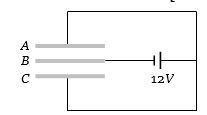
Three plates $A, B, C$ each of area $50 \, cm^2$ have a separation of $3 \, mm$ between $A$ and $B$ and $3 \, mm$ between $B$ and $C$. The energy stored when the plates are fully charged is (as shown in the figure):
A
$1.6 \times 10^{-9} \, J$
B
$2.1 \times 10^{-9} \, J$
C
$5 \times 10^{-9} \, J$
D
$7 \times 10^{-9} \, J$
Solution
(B) From the figure, plates $A$ and $C$ are connected together, and plate $B$ is connected to the other terminal of the battery. This forms two capacitors in parallel, one between $A$ and $B$, and another between $B$ and $C$.
Given: Area $A = 50 \, cm^2 = 50 \times 10^{-4} \, m^2$, separation $d = 3 \, mm = 3 \times 10^{-3} \, m$, and voltage $V = 12 \, V$.
The capacitance of each capacitor is $C_0 = \frac{\varepsilon_0 A}{d}$.
Since they are in parallel, the total capacitance is $C_{eq} = C_0 + C_0 = \frac{2 \varepsilon_0 A}{d}$.
Substituting the values:
$C_{eq} = \frac{2 \times 8.854 \times 10^{-12} \times 50 \times 10^{-4}}{3 \times 10^{-3}} \approx 2.95 \times 10^{-11} \, F$.
The energy stored $U = \frac{1}{2} C_{eq} V^2 = \frac{1}{2} \times (2.95 \times 10^{-11}) \times (12)^2$.
$U = 0.5 \times 2.95 \times 10^{-11} \times 144 = 2.124 \times 10^{-9} \, J \approx 2.1 \times 10^{-9} \, J$.
Given: Area $A = 50 \, cm^2 = 50 \times 10^{-4} \, m^2$, separation $d = 3 \, mm = 3 \times 10^{-3} \, m$, and voltage $V = 12 \, V$.
The capacitance of each capacitor is $C_0 = \frac{\varepsilon_0 A}{d}$.
Since they are in parallel, the total capacitance is $C_{eq} = C_0 + C_0 = \frac{2 \varepsilon_0 A}{d}$.
Substituting the values:
$C_{eq} = \frac{2 \times 8.854 \times 10^{-12} \times 50 \times 10^{-4}}{3 \times 10^{-3}} \approx 2.95 \times 10^{-11} \, F$.
The energy stored $U = \frac{1}{2} C_{eq} V^2 = \frac{1}{2} \times (2.95 \times 10^{-11}) \times (12)^2$.
$U = 0.5 \times 2.95 \times 10^{-11} \times 144 = 2.124 \times 10^{-9} \, J \approx 2.1 \times 10^{-9} \, J$.
0 likes
View Solution39
MediumMCQ
$A$ piece of cloud having an area of $25 \times 10^6 \, m^2$ and an electric potential of $10^5 \, V$. If the height of the cloud is $0.75 \, km$,then the energy of the electric field between the earth and the cloud will be.....$J$
A
$250$
B
$750$
C
$1225$
D
$1475$
Solution
(D) The energy density of an electric field is given by $u = \frac{1}{2} \varepsilon_0 E^2$.
The electric field $E$ between the cloud and the earth is $E = \frac{V}{d}$,where $V = 10^5 \, V$ and $d = 0.75 \, km = 750 \, m$.
The volume of the space between the cloud and the earth is $Volume = A \times d$,where $A = 25 \times 10^6 \, m^2$.
The total energy $U$ is $U = u \times Volume = \frac{1}{2} \varepsilon_0 \left( \frac{V}{d} \right)^2 \times (A \times d) = \frac{1}{2} \varepsilon_0 \frac{V^2 A}{d}$.
Substituting the values: $U = \frac{1}{2} \times (8.85 \times 10^{-12}) \times \frac{(10^5)^2 \times 25 \times 10^6}{750}$.
$U = \frac{1}{2} \times 8.85 \times 10^{-12} \times \frac{10^{10} \times 25 \times 10^6}{750} = \frac{8.85 \times 25 \times 10^4}{1500} = \frac{221.25 \times 10^4}{1500} \approx 1475 \, J$.
The electric field $E$ between the cloud and the earth is $E = \frac{V}{d}$,where $V = 10^5 \, V$ and $d = 0.75 \, km = 750 \, m$.
The volume of the space between the cloud and the earth is $Volume = A \times d$,where $A = 25 \times 10^6 \, m^2$.
The total energy $U$ is $U = u \times Volume = \frac{1}{2} \varepsilon_0 \left( \frac{V}{d} \right)^2 \times (A \times d) = \frac{1}{2} \varepsilon_0 \frac{V^2 A}{d}$.
Substituting the values: $U = \frac{1}{2} \times (8.85 \times 10^{-12}) \times \frac{(10^5)^2 \times 25 \times 10^6}{750}$.
$U = \frac{1}{2} \times 8.85 \times 10^{-12} \times \frac{10^{10} \times 25 \times 10^6}{750} = \frac{8.85 \times 25 \times 10^4}{1500} = \frac{221.25 \times 10^4}{1500} \approx 1475 \, J$.
0 likes
View Solution40
MediumMCQ
$A$ parallel plate capacitor is connected to a battery. The plates are pulled apart with a uniform speed. If $x$ is the separation between the plates,the time rate of change of electrostatic energy of the capacitor is proportional to
A
$x^{-2}$
B
$x$
C
$x^{-1}$
D
$x^{2}$
Solution
(A) The electrostatic energy $U$ stored in a parallel plate capacitor connected to a battery of voltage $V$ is given by $U = \frac{1}{2}CV^2$.
Since the capacitance $C = \frac{\varepsilon_0 A}{x}$,we have $U = \frac{1}{2} \left( \frac{\varepsilon_0 A}{x} \right) V^2$.
To find the time rate of change of energy,we differentiate $U$ with respect to time $t$:
$\frac{dU}{dt} = \frac{d}{dt} \left( \frac{\varepsilon_0 A V^2}{2x} \right) = \frac{\varepsilon_0 A V^2}{2} \frac{d}{dt} (x^{-1})$.
Using the chain rule,$\frac{dU}{dt} = \frac{\varepsilon_0 A V^2}{2} (-x^{-2}) \frac{dx}{dt}$.
Since the plates are pulled apart at a uniform speed,$\frac{dx}{dt} = v$ (a constant).
Therefore,$\frac{dU}{dt} = -\frac{\varepsilon_0 A V^2 v}{2} x^{-2}$.
This shows that $\frac{dU}{dt} \propto x^{-2}$.
Since the capacitance $C = \frac{\varepsilon_0 A}{x}$,we have $U = \frac{1}{2} \left( \frac{\varepsilon_0 A}{x} \right) V^2$.
To find the time rate of change of energy,we differentiate $U$ with respect to time $t$:
$\frac{dU}{dt} = \frac{d}{dt} \left( \frac{\varepsilon_0 A V^2}{2x} \right) = \frac{\varepsilon_0 A V^2}{2} \frac{d}{dt} (x^{-1})$.
Using the chain rule,$\frac{dU}{dt} = \frac{\varepsilon_0 A V^2}{2} (-x^{-2}) \frac{dx}{dt}$.
Since the plates are pulled apart at a uniform speed,$\frac{dx}{dt} = v$ (a constant).
Therefore,$\frac{dU}{dt} = -\frac{\varepsilon_0 A V^2 v}{2} x^{-2}$.
This shows that $\frac{dU}{dt} \propto x^{-2}$.
0 likes
View Solution41
EasyMCQ
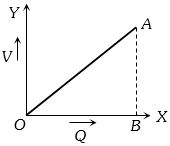
The charge $Q$ on a capacitor varies with voltage $V$ as shown in the figure,where $Q$ is taken along the $X$-axis and $V$ along the $Y$-axis. The area of triangle $OAB$ represents
A
Capacitance
B
Capacitive reactance
C
Magnetic field between the plates
D
Energy stored in the capacitor
Solution
(D) The energy stored in a capacitor is given by the formula $U = \frac{1}{2}QV$.
In the given graph,$Q$ is plotted on the $X$-axis and $V$ is plotted on the $Y$-axis.
The area of the triangle $OAB$ is given by $\text{Area} = \frac{1}{2} \times \text{base} \times \text{height}$.
Here,the base is $OB = Q$ and the height is $AB = V$.
Therefore,$\text{Area} = \frac{1}{2} \times Q \times V = \frac{1}{2}QV$.
This expression represents the energy stored in the capacitor.
In the given graph,$Q$ is plotted on the $X$-axis and $V$ is plotted on the $Y$-axis.
The area of the triangle $OAB$ is given by $\text{Area} = \frac{1}{2} \times \text{base} \times \text{height}$.
Here,the base is $OB = Q$ and the height is $AB = V$.
Therefore,$\text{Area} = \frac{1}{2} \times Q \times V = \frac{1}{2}QV$.
This expression represents the energy stored in the capacitor.
0 likes
View Solution42
MediumMCQ
The heat generated through $2 \, \Omega$ and $8 \, \Omega$ resistances separately, when a capacitor of $200 \, \mu F$ capacity charged to $200 \, V$ is discharged one by one, will be
A
$4 \, J$ and $16 \, J$ respectively
B
$16 \, J$ and $4 \, J$ respectively
C
$4 \, J$ and $8 \, J$ respectively
D
$4 \, J$ and $4 \, J$ respectively
Solution
(D) The energy stored in a capacitor is given by the formula $U = \frac{1}{2} C V^2$.
Substituting the given values: $C = 200 \, \mu F = 200 \times 10^{-6} \, F$ and $V = 200 \, V$.
$U = \frac{1}{2} \times (200 \times 10^{-6}) \times (200)^2 = 100 \times 10^{-6} \times 40000 = 4 \, J$.
When a capacitor discharges through a resistor, the entire stored energy is dissipated as heat in the resistor, regardless of the resistance value.
Therefore, the heat generated in both cases is $4 \, J$.
Substituting the given values: $C = 200 \, \mu F = 200 \times 10^{-6} \, F$ and $V = 200 \, V$.
$U = \frac{1}{2} \times (200 \times 10^{-6}) \times (200)^2 = 100 \times 10^{-6} \times 40000 = 4 \, J$.
When a capacitor discharges through a resistor, the entire stored energy is dissipated as heat in the resistor, regardless of the resistance value.
Therefore, the heat generated in both cases is $4 \, J$.
0 likes
View Solution43
MediumMCQ
The energy stored in a capacitor of capacitance $C$ charged to a potential $V$ is:
A
$\frac{1}{2}CV$
B
$\frac{1}{2}CV^2$
C
$CV$
D
$\frac{1}{2VC}$
Solution
(B) The work done in charging a capacitor is stored as potential energy $U$ in the electric field.
For a capacitor with capacitance $C$ charged to a potential $V$,the energy $U$ is given by the integral of the work done to bring small charge $dq$ to the plates:
$U = \int_0^V q \, dV = \int_0^V (CV) \, dV$
$U = C \int_0^V V \, dV$
$U = C \left[ \frac{V^2}{2} \right]_0^V$
$U = \frac{1}{2}CV^2$
Therefore,the correct option is $B$.
For a capacitor with capacitance $C$ charged to a potential $V$,the energy $U$ is given by the integral of the work done to bring small charge $dq$ to the plates:
$U = \int_0^V q \, dV = \int_0^V (CV) \, dV$
$U = C \int_0^V V \, dV$
$U = C \left[ \frac{V^2}{2} \right]_0^V$
$U = \frac{1}{2}CV^2$
Therefore,the correct option is $B$.
0 likes
View Solution44
EasyMCQ
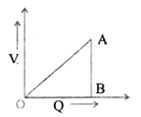
The $V-Q$ graph is shown below. What does the area of $\triangle OAB$ represent in this graph?
A
Capacitance
B
Magnetic field between the plates
C
Electric flux between the plates
D
Energy stored in the capacitor
Solution
(D) The area of $\triangle OAB$ is given by $Area = \frac{1}{2} \times \text{base} \times \text{height}$.
$Area = \frac{1}{2} \times OB \times AB = \frac{1}{2} \times Q \times V$.
Since the energy stored in a capacitor is $U = \frac{1}{2} QV$, the area under the $V-Q$ graph represents the energy stored in the capacitor.
$Area = \frac{1}{2} \times OB \times AB = \frac{1}{2} \times Q \times V$.
Since the energy stored in a capacitor is $U = \frac{1}{2} QV$, the area under the $V-Q$ graph represents the energy stored in the capacitor.
0 likes
View Solution45
MediumMCQ
Which formula gives the energy stored in a charged capacitor?
A
$\frac{q^2}{2C}$
B
$\frac{q^2}{C}$
C
$2qC$
D
$\frac{q}{2C^2}$
Solution
(A) The energy stored in a capacitor is given by $U = \frac{1}{2}CV^2$.
Since the charge $q = CV$,we can substitute $V = \frac{q}{C}$ into the energy formula.
$U = \frac{1}{2} C \left( \frac{q}{C} \right)^2 = \frac{1}{2} C \left( \frac{q^2}{C^2} \right) = \frac{q^2}{2C}$.
Therefore,the correct formula is $\frac{q^2}{2C}$.
Since the charge $q = CV$,we can substitute $V = \frac{q}{C}$ into the energy formula.
$U = \frac{1}{2} C \left( \frac{q}{C} \right)^2 = \frac{1}{2} C \left( \frac{q^2}{C^2} \right) = \frac{q^2}{2C}$.
Therefore,the correct formula is $\frac{q^2}{2C}$.
0 likes
View Solution46
EasyMCQ
When an uncharged capacitor is connected to a battery to charge it fully,
A
The total energy supplied is stored in the capacitor.
B
Half of the energy supplied is stored in the capacitor.
C
The stored energy depends on the capacitance of the capacitor.
D
The stored energy depends on the time taken to charge the capacitor.
Solution
(B) Let the capacitance of the capacitor be $C$ and the electromotive force of the battery be $V$.
When the capacitor is connected to the battery,the total work done by the battery is $W = QV = (CV)V = CV^2$.
The energy stored in the capacitor is $U = \frac{1}{2} CV^2$.
Comparing the two,we see that the energy stored in the capacitor is exactly half of the total energy supplied by the battery $(U = \frac{1}{2} W)$.
The remaining half of the energy is dissipated as heat in the connecting wires or during the charging process.
When the capacitor is connected to the battery,the total work done by the battery is $W = QV = (CV)V = CV^2$.
The energy stored in the capacitor is $U = \frac{1}{2} CV^2$.
Comparing the two,we see that the energy stored in the capacitor is exactly half of the total energy supplied by the battery $(U = \frac{1}{2} W)$.
The remaining half of the energy is dissipated as heat in the connecting wires or during the charging process.
0 likes
View Solution47
MediumMCQ
What is the average electric energy density between the plates of a charged capacitor? (Here,$q$ = charge on the capacitor and $A$ = area of the capacitor plates.)
A
$\frac{q^2}{2 \epsilon_0 A^2}$
B
$\frac{q}{2 \epsilon_0 A^2}$
C
$\frac{q^2}{\epsilon_0 A^2}$
D
None of these
Solution
(A) The electric field $E$ produced by a single charged plate with surface charge density $\sigma = q/A$ is given by $E = \frac{\sigma}{2 \epsilon_0} = \frac{q}{2 A \epsilon_0}$.
In a parallel plate capacitor,the electric field between the plates is the sum of the fields due to both plates: $E_{total} = \frac{q}{2 A \epsilon_0} + \frac{q}{2 A \epsilon_0} = \frac{q}{A \epsilon_0}$.
The electric energy density $u$ is defined as $u = \frac{1}{2} \epsilon_0 E^2$.
Substituting the value of $E_{total}$ into the energy density formula:
$u = \frac{1}{2} \epsilon_0 \left( \frac{q}{A \epsilon_0} \right)^2 = \frac{1}{2} \epsilon_0 \left( \frac{q^2}{A^2 \epsilon_0^2} \right) = \frac{q^2}{2 \epsilon_0 A^2}$.
In a parallel plate capacitor,the electric field between the plates is the sum of the fields due to both plates: $E_{total} = \frac{q}{2 A \epsilon_0} + \frac{q}{2 A \epsilon_0} = \frac{q}{A \epsilon_0}$.
The electric energy density $u$ is defined as $u = \frac{1}{2} \epsilon_0 E^2$.
Substituting the value of $E_{total}$ into the energy density formula:
$u = \frac{1}{2} \epsilon_0 \left( \frac{q}{A \epsilon_0} \right)^2 = \frac{1}{2} \epsilon_0 \left( \frac{q^2}{A^2 \epsilon_0^2} \right) = \frac{q^2}{2 \epsilon_0 A^2}$.
0 likes
View Solution48
EasyMCQ
$A$ parallel plate capacitor has a potential of $20 \, kV$ and a capacitance of $2 \times 10^{-4} \, \mu F$. If the area of the plates is $0.01 \, m^2$ and the distance between the plates is $2 \, mm$,find the energy stored in the capacitor.
A
$4 \times 10^{-7} \, J$
B
$2 \times 10^{-5} \, J$
C
$5 \times 10^{-5} \, J$
D
$4 \times 10^{-2} \, J$
Solution
(D) The energy stored in a capacitor is given by the formula $U = \frac{1}{2} C V^2$.
Given:
Capacitance $C = 2 \times 10^{-4} \, \mu F = 2 \times 10^{-4} \times 10^{-6} \, F = 2 \times 10^{-10} \, F$.
Potential $V = 20 \, kV = 20 \times 10^3 \, V = 2 \times 10^4 \, V$.
Substituting the values into the formula:
$U = \frac{1}{2} \times (2 \times 10^{-10}) \times (2 \times 10^4)^2$
$U = 10^{-10} \times (4 \times 10^8)$
$U = 4 \times 10^{-2} \, J$.
Given:
Capacitance $C = 2 \times 10^{-4} \, \mu F = 2 \times 10^{-4} \times 10^{-6} \, F = 2 \times 10^{-10} \, F$.
Potential $V = 20 \, kV = 20 \times 10^3 \, V = 2 \times 10^4 \, V$.
Substituting the values into the formula:
$U = \frac{1}{2} \times (2 \times 10^{-10}) \times (2 \times 10^4)^2$
$U = 10^{-10} \times (4 \times 10^8)$
$U = 4 \times 10^{-2} \, J$.
0 likes
View Solution49
DifficultMCQ
$A$ capacitor of capacitance $C$ is fully charged. It is discharged through a small coil of negligible resistance embedded in a thermally insulated block of mass $m$ and specific heat capacity $S$. If the temperature of the block rises by $\Delta T$,find the potential difference across the capacitor.
A
$\sqrt{\frac{2mS\Delta T}{C}}$
B
$\frac{mC\Delta T}{S}$
C
$\frac{mS\Delta T}{C}$
D
$\sqrt{\frac{2mC\Delta T}{S}}$
Solution
(A) The energy stored in the capacitor is completely converted into heat energy in the block.
The energy stored in a capacitor is given by $U = \frac{1}{2}CV^2$.
The heat energy absorbed by the block is given by $Q = mS\Delta T$.
Equating the two energies: $\frac{1}{2}CV^2 = mS\Delta T$.
Solving for the potential difference $V$: $V^2 = \frac{2mS\Delta T}{C}$.
Therefore,$V = \sqrt{\frac{2mS\Delta T}{C}}$.
The energy stored in a capacitor is given by $U = \frac{1}{2}CV^2$.
The heat energy absorbed by the block is given by $Q = mS\Delta T$.
Equating the two energies: $\frac{1}{2}CV^2 = mS\Delta T$.
Solving for the potential difference $V$: $V^2 = \frac{2mS\Delta T}{C}$.
Therefore,$V = \sqrt{\frac{2mS\Delta T}{C}}$.
0 likes
View SolutionElectric Potential and Capacitance — Energy Stored in a Capacitor · Frequently Asked Questions
1Are these Electric Potential and Capacitance questions useful for JEE and NEET?
Yes. All questions in this section are mapped to JEE Main and NEET exam patterns. Previous year questions from JEE Main, NEET, GUJCET and state-level exams are included with full solutions.
2Can I switch to Hindi or Gujarati for these questions?
Yes. Use the language tabs in the hero section or the sidebar to view the same questions and solutions in English, Hindi or Gujarati.
3How do I generate a question paper from this subtopic?
Use the Vedclass Exam Paper Generator — select the chapter and subtopic, set difficulty, and generate Sets A, B, C, D automatically. First 3 chapters of every subject are free.
Vedclass Products
For Students
Vedclass Test Series
Mock tests in real JEE/NEET style with performance analysis. 5-day free trial.
Start Free TrialFor Teachers
Exam Paper Generator
Generate Set A/B/C/D papers from this chapter in 2 minutes. 3 chapters free.
Try FreeFor Institutes
Online Exam Module
Live online exams with unlimited students, 360° analytics & white-label branding.
See DemoFor Teachers & Institutes
Generate a Electric Potential and Capacitance Exam Paper in 2 Minutes
Select subtopic & difficulty — Sets A, B, C, D auto-generated with No Repeat logic.
First 3 chapters of every subject are free — no payment required.