
A English
Effect of Dielectric Inside Capacitor Questions in English
Class 12 Physics · Electric Potential and Capacitance · Effect of Dielectric Inside Capacitor
347+
Questions
English
Language
100%
With Solutions
Showing 50 of 347 questions in English
151
MediumMCQ
$A$ capacitor is connected to a $10\,V$ battery. The charge on the plates is $10\,\mu C$ when the medium between the plates is air. The charge on the plates becomes $100\,\mu C$ when the space between the plates is filled with oil. The dielectric constant of the oil is:
A
$2.5$
B
$4$
C
$6.25$
D
$10$
Solution
(D) The capacitance of a parallel plate capacitor with air as the medium is given by $C = \frac{Q}{V}$.
Given $Q = 10\,\mu C$ and $V = 10\,V$,we have $C = \frac{10\,\mu C}{10\,V} = 1\,\mu F$.
When the space is filled with a dielectric medium of constant $K$,the new capacitance becomes $C' = KC$.
The new charge is $Q' = C'V = KCV = KQ$.
Given $Q' = 100\,\mu C$ and $Q = 10\,\mu C$,we have $100\,\mu C = K \times 10\,\mu C$.
Therefore,$K = \frac{100}{10} = 10$.
The dielectric constant of the oil is $10$.
Given $Q = 10\,\mu C$ and $V = 10\,V$,we have $C = \frac{10\,\mu C}{10\,V} = 1\,\mu F$.
When the space is filled with a dielectric medium of constant $K$,the new capacitance becomes $C' = KC$.
The new charge is $Q' = C'V = KCV = KQ$.
Given $Q' = 100\,\mu C$ and $Q = 10\,\mu C$,we have $100\,\mu C = K \times 10\,\mu C$.
Therefore,$K = \frac{100}{10} = 10$.
The dielectric constant of the oil is $10$.
0 likes
View Solution152
EasyMCQ
$A$ parallel plate capacitor is connected to a battery. If a dielectric slab is inserted between the plates,which of the following quantities increases?
A
Potential difference
B
Electric field
C
Stored energy
D
$EMF$ of the battery
Solution
(C) When a dielectric slab is inserted into a parallel plate capacitor while it remains connected to a battery,the potential difference $V$ across the plates remains constant because it is equal to the $EMF$ of the battery.
The capacitance $C$ of the capacitor increases by a factor of $K$ (dielectric constant),where $C = K C_0$.
The energy stored in the capacitor is given by the formula $U = \frac{1}{2} C V^2$.
Since $V$ is constant and $C$ increases,the stored energy $U$ must increase.
The capacitance $C$ of the capacitor increases by a factor of $K$ (dielectric constant),where $C = K C_0$.
The energy stored in the capacitor is given by the formula $U = \frac{1}{2} C V^2$.
Since $V$ is constant and $C$ increases,the stored energy $U$ must increase.
0 likes
View Solution153
DifficultMCQ
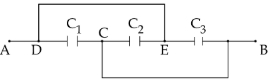
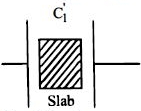
$A$ combination of parallel plate capacitors is maintained at a certain potential difference. When a $3 \, mm$ thick slab is introduced between all the plates,in order to maintain the same potential difference,the distance between the plates is increased by $2.4 \, mm$. Find the dielectric constant of the slab.
A
$3$
B
$4$
C
$5$
D
$6$
Solution
(C) Let the initial distance between the plates be $d$. The capacitance of a parallel plate capacitor is $C = \frac{\varepsilon_0 A}{d}$.
When a dielectric slab of thickness $t = 3 \, mm$ and dielectric constant $K$ is introduced,the new capacitance $C'$ is given by $C' = \frac{\varepsilon_0 A}{d - t + \frac{t}{K}}$.
To maintain the same potential difference,the effective capacitance must remain the same. The problem states that the distance between the plates is increased by $\Delta d = 2.4 \, mm$,so the new distance is $d' = d + 2.4$.
The new capacitance with the slab is $C' = \frac{\varepsilon_0 A}{d' - t + \frac{t}{K}} = \frac{\varepsilon_0 A}{d + 2.4 - 3 + \frac{3}{K}} = \frac{\varepsilon_0 A}{d - 0.6 + \frac{3}{K}}$.
For the capacitance to remain unchanged,we must have $d = d - 0.6 + \frac{3}{K}$.
This simplifies to $0.6 = \frac{3}{K}$.
Therefore,$K = \frac{3}{0.6} = 5$.
When a dielectric slab of thickness $t = 3 \, mm$ and dielectric constant $K$ is introduced,the new capacitance $C'$ is given by $C' = \frac{\varepsilon_0 A}{d - t + \frac{t}{K}}$.
To maintain the same potential difference,the effective capacitance must remain the same. The problem states that the distance between the plates is increased by $\Delta d = 2.4 \, mm$,so the new distance is $d' = d + 2.4$.
The new capacitance with the slab is $C' = \frac{\varepsilon_0 A}{d' - t + \frac{t}{K}} = \frac{\varepsilon_0 A}{d + 2.4 - 3 + \frac{3}{K}} = \frac{\varepsilon_0 A}{d - 0.6 + \frac{3}{K}}$.
For the capacitance to remain unchanged,we must have $d = d - 0.6 + \frac{3}{K}$.
This simplifies to $0.6 = \frac{3}{K}$.
Therefore,$K = \frac{3}{0.6} = 5$.
0 likes
View Solution154
DifficultMCQ
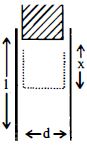
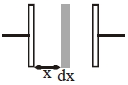
$A$ parallel plate capacitor is made of two plates of length $l$,width $w$ and separated by distance $d$. $A$ dielectric slab (dielectric constant $K$) that fits exactly between the plates is held near the edge of the plates. It is pulled into the capacitor by a force $F = -\frac{\partial U}{\partial x}$ where $U$ is the energy of the capacitor when the dielectric is inside the capacitor up to distance $x$ (See figure). If the charge on the capacitor is $Q$,then the force on the dielectric when it is near the edge is
A
$\frac{{{Q^2}d}}{{2w{l^2}{\varepsilon _0}}}K$
B
$\frac{{{Q^2}w}}{{2d{l^2}{\varepsilon _0}}}\left( {K - 1} \right)$
C
$\frac{{{Q^2}d}}{{2w{l^2}{\varepsilon _0}}}\left( {K - 1} \right)$
D
$\frac{{{Q^2}w}}{{2d{l^2}{\varepsilon _0}}}K$
Solution
(C) The electric force on the slab is given by $F = -\frac{dU}{dx}$.
The energy stored in the capacitor is $U = \frac{Q^2}{2C}$.
The capacitor can be viewed as two capacitors in parallel: one with the dielectric of length $x$ and one without of length $(l-x)$.
$C = C_1 + C_2 = \frac{K \varepsilon_0 w x}{d} + \frac{\varepsilon_0 w (l-x)}{d} = \frac{\varepsilon_0 w}{d} [x(K-1) + l]$.
Substituting $C$ into the energy formula:
$U = \frac{Q^2 d}{2 \varepsilon_0 w [x(K-1) + l]}$.
Now,differentiate with respect to $x$:
$F = -\frac{dU}{dx} = -\frac{Q^2 d}{2 \varepsilon_0 w} \cdot \frac{d}{dx} [x(K-1) + l]^{-1}$.
$F = -\frac{Q^2 d}{2 \varepsilon_0 w} \cdot (-1) [x(K-1) + l]^{-2} \cdot (K-1)$.
$F = \frac{Q^2 d (K-1)}{2 \varepsilon_0 w [x(K-1) + l]^2}$.
At the edge $(x=0)$:
$F = \frac{Q^2 d (K-1)}{2 \varepsilon_0 w l^2}$.
The energy stored in the capacitor is $U = \frac{Q^2}{2C}$.
The capacitor can be viewed as two capacitors in parallel: one with the dielectric of length $x$ and one without of length $(l-x)$.
$C = C_1 + C_2 = \frac{K \varepsilon_0 w x}{d} + \frac{\varepsilon_0 w (l-x)}{d} = \frac{\varepsilon_0 w}{d} [x(K-1) + l]$.
Substituting $C$ into the energy formula:
$U = \frac{Q^2 d}{2 \varepsilon_0 w [x(K-1) + l]}$.
Now,differentiate with respect to $x$:
$F = -\frac{dU}{dx} = -\frac{Q^2 d}{2 \varepsilon_0 w} \cdot \frac{d}{dx} [x(K-1) + l]^{-1}$.
$F = -\frac{Q^2 d}{2 \varepsilon_0 w} \cdot (-1) [x(K-1) + l]^{-2} \cdot (K-1)$.
$F = \frac{Q^2 d (K-1)}{2 \varepsilon_0 w [x(K-1) + l]^2}$.
At the edge $(x=0)$:
$F = \frac{Q^2 d (K-1)}{2 \varepsilon_0 w l^2}$.
0 likes
View Solution155
DifficultMCQ
The space between the plates of a parallel plate capacitor is filled with a dielectric whose dielectric constant varies with distance $x$ as per the relation: $K(x) = K_0 + \lambda x$ (where $\lambda$ is a constant). The capacitance $C$ of the capacitor would be related to its vacuum capacitance $C_0$ by the relation:
A
$C = \frac{\lambda d}{\ln(1 + K_0 \lambda d)} C_0$
B
$C = \frac{\lambda}{d \ln(1 + K_0 \lambda d)} C_0$
C
$C = \frac{\lambda d}{\ln(1 + \lambda d / K_0)} C_0$
D
$C = \frac{\lambda}{d \ln(1 + K_0 / \lambda d)} C_0$
Solution
(C) The dielectric constant is given by $K(x) = K_0 + \lambda x$.
Consider a small element of thickness $dx$ at distance $x$. This acts as a capacitor with capacitance $dC = \frac{\epsilon_0 K(x) A}{dx}$.
Since these elements are in series,the total capacitance $C$ is given by $\frac{1}{C} = \int_0^d \frac{1}{dC} = \int_0^d \frac{dx}{\epsilon_0 A (K_0 + \lambda x)}$.
Evaluating the integral: $\frac{1}{C} = \frac{1}{\epsilon_0 A} \int_0^d \frac{dx}{K_0 + \lambda x} = \frac{1}{\epsilon_0 A \lambda} [\ln(K_0 + \lambda x)]_0^d$.
$\frac{1}{C} = \frac{1}{\epsilon_0 A \lambda} \ln \left( \frac{K_0 + \lambda d}{K_0} \right) = \frac{1}{\epsilon_0 A \lambda} \ln \left( 1 + \frac{\lambda d}{K_0} \right)$.
Since vacuum capacitance $C_0 = \frac{\epsilon_0 A}{d}$,we have $\epsilon_0 A = C_0 d$.
Substituting this: $\frac{1}{C} = \frac{1}{C_0 d \lambda} \ln \left( 1 + \frac{\lambda d}{K_0} \right)$.
Therefore,$C = \frac{\lambda d}{\ln(1 + \lambda d / K_0)} C_0$.
Consider a small element of thickness $dx$ at distance $x$. This acts as a capacitor with capacitance $dC = \frac{\epsilon_0 K(x) A}{dx}$.
Since these elements are in series,the total capacitance $C$ is given by $\frac{1}{C} = \int_0^d \frac{1}{dC} = \int_0^d \frac{dx}{\epsilon_0 A (K_0 + \lambda x)}$.
Evaluating the integral: $\frac{1}{C} = \frac{1}{\epsilon_0 A} \int_0^d \frac{dx}{K_0 + \lambda x} = \frac{1}{\epsilon_0 A \lambda} [\ln(K_0 + \lambda x)]_0^d$.
$\frac{1}{C} = \frac{1}{\epsilon_0 A \lambda} \ln \left( \frac{K_0 + \lambda d}{K_0} \right) = \frac{1}{\epsilon_0 A \lambda} \ln \left( 1 + \frac{\lambda d}{K_0} \right)$.
Since vacuum capacitance $C_0 = \frac{\epsilon_0 A}{d}$,we have $\epsilon_0 A = C_0 d$.
Substituting this: $\frac{1}{C} = \frac{1}{C_0 d \lambda} \ln \left( 1 + \frac{\lambda d}{K_0} \right)$.
Therefore,$C = \frac{\lambda d}{\ln(1 + \lambda d / K_0)} C_0$.
0 likes
View Solution156
DifficultMCQ
The gap between the plates of a parallel plate capacitor of area $A$ and distance between plates $d$ is filled with a dielectric whose permittivity varies linearly from $\varepsilon_1$ at one plate to $\varepsilon_2$ at the other. The capacitance of the capacitor is
A
$\varepsilon_0(\varepsilon_1 + \varepsilon_2)A/d$
B
$\varepsilon_0(\varepsilon_2 + \varepsilon_1)A/2d$
C
$\varepsilon_0 A / [d \ln(\varepsilon_2/\varepsilon_1)]$
D
$\varepsilon_0(\varepsilon_2 - \varepsilon_1)A / [d \ln(\varepsilon_2/\varepsilon_1)]$
Solution
(D) Let the permittivity $\varepsilon(x)$ vary linearly with distance $x$ from one plate $(x=0)$ to the other $(x=d)$:
$\varepsilon(x) = \varepsilon_1 + \frac{\varepsilon_2 - \varepsilon_1}{d} x$
Consider a thin elemental slab of thickness $dx$ at distance $x$. This acts as a capacitor with capacitance $dC = \frac{\varepsilon(x) A}{dx}$.
Since these elemental capacitors are in series,the equivalent capacitance $C$ is given by $\frac{1}{C} = \int_0^d \frac{1}{dC} = \int_0^d \frac{dx}{\varepsilon(x) A}$.
$\frac{1}{C} = \frac{1}{A} \int_0^d \frac{dx}{\varepsilon_1 + \frac{\varepsilon_2 - \varepsilon_1}{d} x}$
Let $u = \varepsilon_1 + \frac{\varepsilon_2 - \varepsilon_1}{d} x$,then $du = \frac{\varepsilon_2 - \varepsilon_1}{d} dx$.
$\frac{1}{C} = \frac{1}{A} \cdot \frac{d}{\varepsilon_2 - \varepsilon_1} \int_{\varepsilon_1}^{\varepsilon_2} \frac{du}{u} = \frac{d}{A(\varepsilon_2 - \varepsilon_1)} [\ln u]_{\varepsilon_1}^{\varepsilon_2} = \frac{d \ln(\varepsilon_2/\varepsilon_1)}{A(\varepsilon_2 - \varepsilon_1)}$.
Therefore,$C = \frac{A(\varepsilon_2 - \varepsilon_1)}{d \ln(\varepsilon_2/\varepsilon_1)}$.
$\varepsilon(x) = \varepsilon_1 + \frac{\varepsilon_2 - \varepsilon_1}{d} x$
Consider a thin elemental slab of thickness $dx$ at distance $x$. This acts as a capacitor with capacitance $dC = \frac{\varepsilon(x) A}{dx}$.
Since these elemental capacitors are in series,the equivalent capacitance $C$ is given by $\frac{1}{C} = \int_0^d \frac{1}{dC} = \int_0^d \frac{dx}{\varepsilon(x) A}$.
$\frac{1}{C} = \frac{1}{A} \int_0^d \frac{dx}{\varepsilon_1 + \frac{\varepsilon_2 - \varepsilon_1}{d} x}$
Let $u = \varepsilon_1 + \frac{\varepsilon_2 - \varepsilon_1}{d} x$,then $du = \frac{\varepsilon_2 - \varepsilon_1}{d} dx$.
$\frac{1}{C} = \frac{1}{A} \cdot \frac{d}{\varepsilon_2 - \varepsilon_1} \int_{\varepsilon_1}^{\varepsilon_2} \frac{du}{u} = \frac{d}{A(\varepsilon_2 - \varepsilon_1)} [\ln u]_{\varepsilon_1}^{\varepsilon_2} = \frac{d \ln(\varepsilon_2/\varepsilon_1)}{A(\varepsilon_2 - \varepsilon_1)}$.
Therefore,$C = \frac{A(\varepsilon_2 - \varepsilon_1)}{d \ln(\varepsilon_2/\varepsilon_1)}$.
0 likes
View Solution157
DifficultMCQ
$A$ parallel plate capacitor having a separation between the plates $d$,plate area $A$,and material with dielectric constant $K$ has capacitance $C_0$. Now,one-third of the material is replaced by another material with dielectric constant $2K$,such that effectively there are two capacitors: one with area $\frac{1}{3}A$,dielectric constant $2K$,and another with area $\frac{2}{3}A$ and dielectric constant $K$. If the capacitance of this new capacitor is $C$,then $\frac{C}{C_0}$ is:
A
$1$
B
$\frac{4}{3}$
C
$\frac{2}{3}$
D
$\frac{1}{3}$
Solution
(B) The initial capacitance is $C_0 = \frac{K \epsilon_0 A}{d}$.
When the material is replaced,the capacitor acts as two capacitors in parallel.
The first capacitor has area $A_1 = \frac{1}{3}A$,dielectric constant $K_1 = 2K$,and separation $d$. Its capacitance is $C_1 = \frac{K_1 \epsilon_0 A_1}{d} = \frac{(2K) \epsilon_0 (A/3)}{d} = \frac{2}{3} \frac{K \epsilon_0 A}{d} = \frac{2}{3} C_0$.
The second capacitor has area $A_2 = \frac{2}{3}A$,dielectric constant $K_2 = K$,and separation $d$. Its capacitance is $C_2 = \frac{K_2 \epsilon_0 A_2}{d} = \frac{K \epsilon_0 (2A/3)}{d} = \frac{2}{3} \frac{K \epsilon_0 A}{d} = \frac{2}{3} C_0$.
Since they are in parallel,the total capacitance is $C = C_1 + C_2 = \frac{2}{3} C_0 + \frac{2}{3} C_0 = \frac{4}{3} C_0$.
Therefore,$\frac{C}{C_0} = \frac{4}{3}$.
When the material is replaced,the capacitor acts as two capacitors in parallel.
The first capacitor has area $A_1 = \frac{1}{3}A$,dielectric constant $K_1 = 2K$,and separation $d$. Its capacitance is $C_1 = \frac{K_1 \epsilon_0 A_1}{d} = \frac{(2K) \epsilon_0 (A/3)}{d} = \frac{2}{3} \frac{K \epsilon_0 A}{d} = \frac{2}{3} C_0$.
The second capacitor has area $A_2 = \frac{2}{3}A$,dielectric constant $K_2 = K$,and separation $d$. Its capacitance is $C_2 = \frac{K_2 \epsilon_0 A_2}{d} = \frac{K \epsilon_0 (2A/3)}{d} = \frac{2}{3} \frac{K \epsilon_0 A}{d} = \frac{2}{3} C_0$.
Since they are in parallel,the total capacitance is $C = C_1 + C_2 = \frac{2}{3} C_0 + \frac{2}{3} C_0 = \frac{4}{3} C_0$.
Therefore,$\frac{C}{C_0} = \frac{4}{3}$.
0 likes
View Solution158
DifficultMCQ
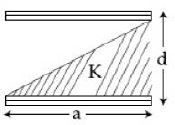
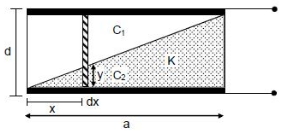
$A$ parallel plate capacitor is made of two square plates of side $a$,separated by a distance $d$ $(d \ll a)$. The lower triangular portion is filled with a dielectric of dielectric constant $K$,as shown in the figure. The capacitance of this capacitor is
A
$\frac{K\varepsilon_0 a^2}{d(K-1)} \ln K$
B
$\frac{K\varepsilon_0 a^2}{2d(K+1)}$
C
$\frac{K\varepsilon_0 a^2}{d} \ln K$
D
$\frac{1}{2} \frac{K\varepsilon_0 a^2}{d}$
Solution
(A) Consider a small strip of width $dx$ at a distance $x$ from the left end. The height of the dielectric part is $y = (d/a)x$.
This strip acts as two capacitors in series: one with air (thickness $d-y$) and one with dielectric (thickness $y$).
The capacitance of the air part is $dC_1 = \frac{\varepsilon_0 a dx}{d-y}$ and the dielectric part is $dC_2 = \frac{K\varepsilon_0 a dx}{y}$.
The equivalent capacitance $dC$ of the strip is given by $\frac{1}{dC} = \frac{1}{dC_1} + \frac{1}{dC_2} = \frac{d-y}{\varepsilon_0 a dx} + \frac{y}{K\varepsilon_0 a dx} = \frac{Kd - Ky + y}{K\varepsilon_0 a dx} = \frac{Kd - (K-1)y}{K\varepsilon_0 a dx}$.
Thus,$dC = \frac{K\varepsilon_0 a dx}{Kd - (K-1)(d/a)x}$.
Integrating from $x=0$ to $x=a$:
$C = \int_0^a \frac{K\varepsilon_0 a dx}{Kd - \frac{(K-1)d}{a}x} = \frac{K\varepsilon_0 a}{d} \int_0^a \frac{dx}{K - \frac{(K-1)}{a}x}$.
Let $u = K - \frac{(K-1)}{a}x$,then $du = -\frac{(K-1)}{a} dx$.
$C = \frac{K\varepsilon_0 a}{d} \left( -\frac{a}{K-1} \right) [\ln(K - \frac{(K-1)}{a}x)]_0^a = \frac{-K\varepsilon_0 a^2}{d(K-1)} [\ln(1) - \ln(K)] = \frac{K\varepsilon_0 a^2}{d(K-1)} \ln K$.
This strip acts as two capacitors in series: one with air (thickness $d-y$) and one with dielectric (thickness $y$).
The capacitance of the air part is $dC_1 = \frac{\varepsilon_0 a dx}{d-y}$ and the dielectric part is $dC_2 = \frac{K\varepsilon_0 a dx}{y}$.
The equivalent capacitance $dC$ of the strip is given by $\frac{1}{dC} = \frac{1}{dC_1} + \frac{1}{dC_2} = \frac{d-y}{\varepsilon_0 a dx} + \frac{y}{K\varepsilon_0 a dx} = \frac{Kd - Ky + y}{K\varepsilon_0 a dx} = \frac{Kd - (K-1)y}{K\varepsilon_0 a dx}$.
Thus,$dC = \frac{K\varepsilon_0 a dx}{Kd - (K-1)(d/a)x}$.
Integrating from $x=0$ to $x=a$:
$C = \int_0^a \frac{K\varepsilon_0 a dx}{Kd - \frac{(K-1)d}{a}x} = \frac{K\varepsilon_0 a}{d} \int_0^a \frac{dx}{K - \frac{(K-1)}{a}x}$.
Let $u = K - \frac{(K-1)}{a}x$,then $du = -\frac{(K-1)}{a} dx$.
$C = \frac{K\varepsilon_0 a}{d} \left( -\frac{a}{K-1} \right) [\ln(K - \frac{(K-1)}{a}x)]_0^a = \frac{-K\varepsilon_0 a^2}{d(K-1)} [\ln(1) - \ln(K)] = \frac{K\varepsilon_0 a^2}{d(K-1)} \ln K$.
0 likes
View Solution159
DifficultMCQ
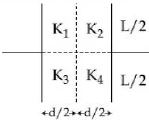
$A$ parallel plate capacitor with square plates of side $L$ is filled with four dielectrics of dielectric constants $K_1, K_2, K_3, K_4$ arranged as shown in the figure. The effective dielectric constant $K$ will be
A
$K = \frac{2(K_1 + K_3)(K_2 + K_4)}{K_1 + K_2 + K_3 + K_4}$
B
$K = \frac{(K_1 + K_2)(K_3 + K_4)}{2(K_1 + K_2 + K_3 + K_4)}$
C
$K = \frac{(K_1 + K_3)(K_2 + K_4)}{K_1 + K_2 + K_3 + K_4}$
D
$K = \frac{(K_1 + K_4)(K_2 + K_3)}{2(K_1 + K_2 + K_3 + K_4)}$
Solution
(C) The capacitor can be viewed as two capacitors in series,each of thickness $d/2$.
For the first half (thickness $d/2$),we have two capacitors in parallel with areas $L^2/2$ each:
$C_1 = \frac{\varepsilon_0 K_1 (L^2/2)}{d/2} + \frac{\varepsilon_0 K_3 (L^2/2)}{d/2} = \frac{\varepsilon_0 L^2}{d} (K_1 + K_3)$.
For the second half (thickness $d/2$),we have two capacitors in parallel with areas $L^2/2$ each:
$C_2 = \frac{\varepsilon_0 K_2 (L^2/2)}{d/2} + \frac{\varepsilon_0 K_4 (L^2/2)}{d/2} = \frac{\varepsilon_0 L^2}{d} (K_2 + K_4)$.
Since these two halves are in series,the equivalent capacitance $C$ is given by:
$\frac{1}{C} = \frac{1}{C_1} + \frac{1}{C_2} = \frac{d}{\varepsilon_0 L^2 (K_1 + K_3)} + \frac{d}{\varepsilon_0 L^2 (K_2 + K_4)}$.
Also,$C = \frac{\varepsilon_0 K L^2}{d}$,so:
$\frac{d}{\varepsilon_0 K L^2} = \frac{d}{\varepsilon_0 L^2} \left( \frac{1}{K_1 + K_3} + \frac{1}{K_2 + K_4} \right)$.
$\frac{1}{K} = \frac{(K_2 + K_4) + (K_1 + K_3)}{(K_1 + K_3)(K_2 + K_4)}$.
Therefore,$K = \frac{(K_1 + K_3)(K_2 + K_4)}{K_1 + K_2 + K_3 + K_4}$.
For the first half (thickness $d/2$),we have two capacitors in parallel with areas $L^2/2$ each:
$C_1 = \frac{\varepsilon_0 K_1 (L^2/2)}{d/2} + \frac{\varepsilon_0 K_3 (L^2/2)}{d/2} = \frac{\varepsilon_0 L^2}{d} (K_1 + K_3)$.
For the second half (thickness $d/2$),we have two capacitors in parallel with areas $L^2/2$ each:
$C_2 = \frac{\varepsilon_0 K_2 (L^2/2)}{d/2} + \frac{\varepsilon_0 K_4 (L^2/2)}{d/2} = \frac{\varepsilon_0 L^2}{d} (K_2 + K_4)$.
Since these two halves are in series,the equivalent capacitance $C$ is given by:
$\frac{1}{C} = \frac{1}{C_1} + \frac{1}{C_2} = \frac{d}{\varepsilon_0 L^2 (K_1 + K_3)} + \frac{d}{\varepsilon_0 L^2 (K_2 + K_4)}$.
Also,$C = \frac{\varepsilon_0 K L^2}{d}$,so:
$\frac{d}{\varepsilon_0 K L^2} = \frac{d}{\varepsilon_0 L^2} \left( \frac{1}{K_1 + K_3} + \frac{1}{K_2 + K_4} \right)$.
$\frac{1}{K} = \frac{(K_2 + K_4) + (K_1 + K_3)}{(K_1 + K_3)(K_2 + K_4)}$.
Therefore,$K = \frac{(K_1 + K_3)(K_2 + K_4)}{K_1 + K_2 + K_3 + K_4}$.
0 likes
View Solution160
DifficultMCQ
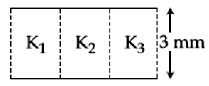
$A$ parallel plate capacitor has an area of $6 \, cm^2$ and a separation of $3 \, mm$. The gap is filled with three dielectric materials of equal thickness (see figure) with dielectric constants $K_1 = 10, K_2 = 12$,and $K_3 = 14$. The dielectric constant of a material which,when fully inserted in the above capacitor,gives the same capacitance would be:
A
$4$
B
$14$
C
$12$
D
$36$
Solution
(C) The capacitor is divided into three parallel capacitors,each with area $A' = A/3$ and the same plate separation $d$.
The equivalent capacitance $C_{net}$ is the sum of the individual capacitances:
$C_{net} = C_1 + C_2 + C_3$
Using the formula for a parallel plate capacitor $C = \frac{K \epsilon_0 A}{d}$,we have:
$\frac{K_{eq} \epsilon_0 A}{d} = \frac{K_1 \epsilon_0 (A/3)}{d} + \frac{K_2 \epsilon_0 (A/3)}{d} + \frac{K_3 \epsilon_0 (A/3)}{d}$
Canceling the common terms $\frac{\epsilon_0 A}{3d}$ from both sides:
$K_{eq} = \frac{K_1 + K_2 + K_3}{3}$
Substituting the given values:
$K_{eq} = \frac{10 + 12 + 14}{3} = \frac{36}{3} = 12$
Thus,the equivalent dielectric constant is $12$.
The equivalent capacitance $C_{net}$ is the sum of the individual capacitances:
$C_{net} = C_1 + C_2 + C_3$
Using the formula for a parallel plate capacitor $C = \frac{K \epsilon_0 A}{d}$,we have:
$\frac{K_{eq} \epsilon_0 A}{d} = \frac{K_1 \epsilon_0 (A/3)}{d} + \frac{K_2 \epsilon_0 (A/3)}{d} + \frac{K_3 \epsilon_0 (A/3)}{d}$
Canceling the common terms $\frac{\epsilon_0 A}{3d}$ from both sides:
$K_{eq} = \frac{K_1 + K_2 + K_3}{3}$
Substituting the given values:
$K_{eq} = \frac{10 + 12 + 14}{3} = \frac{36}{3} = 12$
Thus,the equivalent dielectric constant is $12$.
0 likes
View Solution161
DifficultMCQ
$A$ parallel plate capacitor having capacitance $12 \, pF$ is charged by a battery to a potential difference of $10 \, V$ between its plates. The charging battery is now disconnected and a porcelain slab of dielectric constant $6.5$ is slipped between the plates. The work done by the capacitor on the slab is.......$pJ$
A
$692$
B
$508$
C
$560$
D
$600$
Solution
(B) Initial capacitance $C = 12 \, pF$,Initial potential $V = 10 \, V$.
Initial charge $Q = CV = 12 \, pF \times 10 \, V = 120 \, pC$.
Initial energy $U_i = \frac{Q^2}{2C} = \frac{(120)^2}{2 \times 12} = \frac{14400}{24} = 600 \, pJ$.
When the dielectric slab is inserted,the new capacitance becomes $C' = kC = 6.5 \times 12 = 78 \, pF$.
Since the battery is disconnected,the charge $Q$ remains constant.
Final energy $U_f = \frac{Q^2}{2C'} = \frac{Q^2}{2kC} = \frac{U_i}{k} = \frac{600}{6.5} \approx 92.31 \, pJ$.
The work done by the capacitor on the slab is the decrease in potential energy: $W = U_i - U_f = 600 - 92.31 = 507.69 \, pJ$.
Rounding to the nearest integer,we get $508 \, pJ$.
Initial charge $Q = CV = 12 \, pF \times 10 \, V = 120 \, pC$.
Initial energy $U_i = \frac{Q^2}{2C} = \frac{(120)^2}{2 \times 12} = \frac{14400}{24} = 600 \, pJ$.
When the dielectric slab is inserted,the new capacitance becomes $C' = kC = 6.5 \times 12 = 78 \, pF$.
Since the battery is disconnected,the charge $Q$ remains constant.
Final energy $U_f = \frac{Q^2}{2C'} = \frac{Q^2}{2kC} = \frac{U_i}{k} = \frac{600}{6.5} \approx 92.31 \, pJ$.
The work done by the capacitor on the slab is the decrease in potential energy: $W = U_i - U_f = 600 - 92.31 = 507.69 \, pJ$.
Rounding to the nearest integer,we get $508 \, pJ$.
0 likes
View Solution162
DifficultMCQ
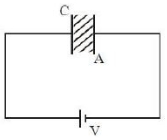
The voltage rating of a parallel plate capacitor is $500\,V$. Its dielectric can withstand a maximum electric field of $10^6\,V/m$. The plate area is $10^{-4}\,m^2$. What is the dielectric constant if the capacitance is $15\,pF$? (Given $\epsilon_0 = 8.86 \times 10^{-12}\,C^2/Nm^2$)
A
$3.8$
B
$6.2$
C
$4.5$
D
$8.5$
Solution
(D) Given:
Voltage rating $V = 500\,V$
Maximum electric field $E_{\max} = 10^6\,V/m$
Plate area $A = 10^{-4}\,m^2$
Capacitance $C = 15\,pF = 15 \times 10^{-12}\,F$
Permittivity of free space $\epsilon_0 = 8.86 \times 10^{-12}\,C^2/Nm^2$
For a parallel plate capacitor,the maximum voltage $V$ is related to the plate separation $d$ and the maximum electric field $E_{\max}$ by:
$V = E_{\max} \times d$
$d = \frac{V}{E_{\max}} = \frac{500}{10^6} = 5 \times 10^{-4}\,m$
The capacitance of a parallel plate capacitor with a dielectric is given by:
$C = \frac{k \epsilon_0 A}{d}$
Where $k$ is the dielectric constant.
Rearranging for $k$:
$k = \frac{C \times d}{\epsilon_0 \times A}$
Substituting the values:
$k = \frac{15 \times 10^{-12} \times 5 \times 10^{-4}}{8.86 \times 10^{-12} \times 10^{-4}}$
$k = \frac{15 \times 5}{8.86} = \frac{75}{8.86} \approx 8.465$
Rounding to the nearest option,we get $k \approx 8.5$.
Voltage rating $V = 500\,V$
Maximum electric field $E_{\max} = 10^6\,V/m$
Plate area $A = 10^{-4}\,m^2$
Capacitance $C = 15\,pF = 15 \times 10^{-12}\,F$
Permittivity of free space $\epsilon_0 = 8.86 \times 10^{-12}\,C^2/Nm^2$
For a parallel plate capacitor,the maximum voltage $V$ is related to the plate separation $d$ and the maximum electric field $E_{\max}$ by:
$V = E_{\max} \times d$
$d = \frac{V}{E_{\max}} = \frac{500}{10^6} = 5 \times 10^{-4}\,m$
The capacitance of a parallel plate capacitor with a dielectric is given by:
$C = \frac{k \epsilon_0 A}{d}$
Where $k$ is the dielectric constant.
Rearranging for $k$:
$k = \frac{C \times d}{\epsilon_0 \times A}$
Substituting the values:
$k = \frac{15 \times 10^{-12} \times 5 \times 10^{-4}}{8.86 \times 10^{-12} \times 10^{-4}}$
$k = \frac{15 \times 5}{8.86} = \frac{75}{8.86} \approx 8.465$
Rounding to the nearest option,we get $k \approx 8.5$.
0 likes
View Solution163
DifficultMCQ
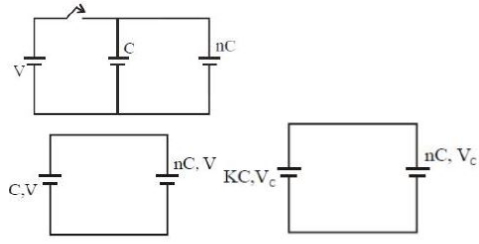
The parallel combination of two air-filled parallel plate capacitors of capacitance $C$ and $nC$ is connected to a battery of voltage $V$. When the capacitors are fully charged,the battery is removed,and after that,a dielectric material of dielectric constant $K$ is placed between the two plates of the first capacitor. The new potential difference of the combined system is
A
$\frac{V}{K + n}$
B
$V$
C
$\frac{(n + 1)V}{K + n}$
D
$\frac{nV}{K + n}$
Solution
(C) $1$. Initially,the capacitors are connected in parallel to a battery of voltage $V$. The total charge $Q_{total}$ stored in the system is given by:
$Q_{total} = C V + n C V = (n + 1) C V$
$2$. After the battery is disconnected,the total charge $Q_{total}$ remains conserved in the system.
$3$. When a dielectric of constant $K$ is inserted into the first capacitor,its new capacitance becomes $C' = K C$. The second capacitor remains unchanged with capacitance $n C$.
$4$. Since the capacitors are in parallel,they share a common potential difference $V_c$. The total capacitance of the system becomes $C_{eq} = K C + n C = (K + n) C$.
$5$. The new potential difference $V_c$ is given by:
$V_c = \frac{Q_{total}}{C_{eq}} = \frac{(n + 1) C V}{(K + n) C} = \frac{(n + 1) V}{K + n}$
$Q_{total} = C V + n C V = (n + 1) C V$
$2$. After the battery is disconnected,the total charge $Q_{total}$ remains conserved in the system.
$3$. When a dielectric of constant $K$ is inserted into the first capacitor,its new capacitance becomes $C' = K C$. The second capacitor remains unchanged with capacitance $n C$.
$4$. Since the capacitors are in parallel,they share a common potential difference $V_c$. The total capacitance of the system becomes $C_{eq} = K C + n C = (K + n) C$.
$5$. The new potential difference $V_c$ is given by:
$V_c = \frac{Q_{total}}{C_{eq}} = \frac{(n + 1) C V}{(K + n) C} = \frac{(n + 1) V}{K + n}$
0 likes
View Solution164
DifficultMCQ
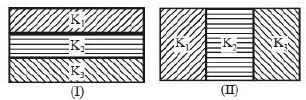
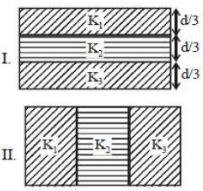
Two identical parallel plate capacitors,of capacitance $C$ each,have plates of area $A$,separated by a distance $d$. The space between the plates of the two capacitors is filled with three dielectrics,of equal thickness and dielectric constants $K_1$,$K_2$,and $K_3$. The first capacitor is filled as shown in fig. $I$,and the second one is filled as shown in fig. $II$. If these two modified capacitors are charged by the same potential $V$,the ratio of the energy stored in the two would be ($E_1$ refers to capacitor $(I)$ and $E_2$ to capacitor $(II)$):
A
$\frac{E_1}{E_2} = \frac{K_1 K_2 K_3}{(K_1 + K_2 + K_3)(K_2 K_3 + K_3 K_1 + K_1 K_2)}$
B
$\frac{E_1}{E_2} = \frac{9 K_1 K_2 K_3}{(K_1 + K_2 + K_3)(K_2 K_3 + K_3 K_1 + K_1 K_2)}$
C
$\frac{E_1}{E_2} = \frac{(K_1 + K_2 + K_3)(K_2 K_3 + K_3 K_1 + K_1 K_2)}{9 K_1 K_2 K_3}$
D
$\frac{E_1}{E_2} = \frac{(K_1 + K_2 + K_3)(K_2 K_3 + K_3 K_1 + K_1 K_2)}{K_1 K_2 K_3}$
Solution
(B) For capacitor $(I)$,the dielectrics are in series. The capacitance of each part is $C_i = \frac{3 \varepsilon_0 A K_i}{d}$.
Since they are in series,$\frac{1}{C_{eq}} = \frac{1}{C_1} + \frac{1}{C_2} + \frac{1}{C_3} = \frac{d}{3 \varepsilon_0 A} (\frac{1}{K_1} + \frac{1}{K_2} + \frac{1}{K_3}) = \frac{d(K_2 K_3 + K_3 K_1 + K_1 K_2)}{3 \varepsilon_0 A K_1 K_2 K_3}$.
Thus,$C_{eq} = \frac{3 \varepsilon_0 A K_1 K_2 K_3}{d(K_1 K_2 + K_2 K_3 + K_3 K_1)}$.
For capacitor $(II)$,the dielectrics are in parallel. The capacitance of each part is $C_i' = \frac{\varepsilon_0 (A/3) K_i}{d} = \frac{\varepsilon_0 A K_i}{3d}$.
Since they are in parallel,$C_{eq}' = C_1' + C_2' + C_3' = \frac{\varepsilon_0 A}{3d} (K_1 + K_2 + K_3)$.
The energy stored is $E = \frac{1}{2} C V^2$. Therefore,$\frac{E_1}{E_2} = \frac{C_{eq}}{C_{eq}'} = \frac{3 \varepsilon_0 A K_1 K_2 K_3}{d(K_1 K_2 + K_2 K_3 + K_3 K_1)} \cdot \frac{3d}{\varepsilon_0 A (K_1 + K_2 + K_3)} = \frac{9 K_1 K_2 K_3}{(K_1 + K_2 + K_3)(K_1 K_2 + K_2 K_3 + K_3 K_1)}$.
Since they are in series,$\frac{1}{C_{eq}} = \frac{1}{C_1} + \frac{1}{C_2} + \frac{1}{C_3} = \frac{d}{3 \varepsilon_0 A} (\frac{1}{K_1} + \frac{1}{K_2} + \frac{1}{K_3}) = \frac{d(K_2 K_3 + K_3 K_1 + K_1 K_2)}{3 \varepsilon_0 A K_1 K_2 K_3}$.
Thus,$C_{eq} = \frac{3 \varepsilon_0 A K_1 K_2 K_3}{d(K_1 K_2 + K_2 K_3 + K_3 K_1)}$.
For capacitor $(II)$,the dielectrics are in parallel. The capacitance of each part is $C_i' = \frac{\varepsilon_0 (A/3) K_i}{d} = \frac{\varepsilon_0 A K_i}{3d}$.
Since they are in parallel,$C_{eq}' = C_1' + C_2' + C_3' = \frac{\varepsilon_0 A}{3d} (K_1 + K_2 + K_3)$.
The energy stored is $E = \frac{1}{2} C V^2$. Therefore,$\frac{E_1}{E_2} = \frac{C_{eq}}{C_{eq}'} = \frac{3 \varepsilon_0 A K_1 K_2 K_3}{d(K_1 K_2 + K_2 K_3 + K_3 K_1)} \cdot \frac{3d}{\varepsilon_0 A (K_1 + K_2 + K_3)} = \frac{9 K_1 K_2 K_3}{(K_1 + K_2 + K_3)(K_1 K_2 + K_2 K_3 + K_3 K_1)}$.
0 likes
View Solution165
MediumMCQ
$A$ parallel plate capacitor of capacitance $5\,\mu F$ and plate separation $6\, cm$ is connected to a $1\, V$ battery and charged. $A$ dielectric of dielectric constant $4$ and thickness $4\, cm$ is introduced between the plates of the capacitor. The additional charge that flows into the capacitor from the battery is........$\mu C$
A
$2$
B
$3$
C
$5$
D
$10$
Solution
(C) Initial charge on the capacitor plates without the dielectric is:
$Q = CV = (5\,\mu F) \times (1\,V) = 5\,\mu C$
The capacitance $C'$ after introducing a dielectric slab of thickness $t$ and dielectric constant $K$ in a capacitor with plate separation $d$ is given by:
$C' = \frac{\varepsilon_0 A}{d - t + \frac{t}{K}} = \frac{C}{1 - \frac{t}{d}(1 - \frac{1}{K})}$
Substituting the given values $(C = 5\,\mu F, d = 6\,cm, t = 4\,cm, K = 4)$:
$C' = \frac{5\,\mu F}{1 - \frac{4}{6}(1 - \frac{1}{4})} = \frac{5\,\mu F}{1 - \frac{2}{3}(\frac{3}{4})} = \frac{5\,\mu F}{1 - \frac{1}{2}} = \frac{5\,\mu F}{0.5} = 10\,\mu F$
The new charge on the capacitor plates is:
$Q' = C'V = (10\,\mu F) \times (1\,V) = 10\,\mu C$
The additional charge that flows from the battery is:
$\Delta Q = Q' - Q = 10\,\mu C - 5\,\mu C = 5\,\mu C$
$Q = CV = (5\,\mu F) \times (1\,V) = 5\,\mu C$
The capacitance $C'$ after introducing a dielectric slab of thickness $t$ and dielectric constant $K$ in a capacitor with plate separation $d$ is given by:
$C' = \frac{\varepsilon_0 A}{d - t + \frac{t}{K}} = \frac{C}{1 - \frac{t}{d}(1 - \frac{1}{K})}$
Substituting the given values $(C = 5\,\mu F, d = 6\,cm, t = 4\,cm, K = 4)$:
$C' = \frac{5\,\mu F}{1 - \frac{4}{6}(1 - \frac{1}{4})} = \frac{5\,\mu F}{1 - \frac{2}{3}(\frac{3}{4})} = \frac{5\,\mu F}{1 - \frac{1}{2}} = \frac{5\,\mu F}{0.5} = 10\,\mu F$
The new charge on the capacitor plates is:
$Q' = C'V = (10\,\mu F) \times (1\,V) = 10\,\mu C$
The additional charge that flows from the battery is:
$\Delta Q = Q' - Q = 10\,\mu C - 5\,\mu C = 5\,\mu C$
0 likes
View Solution166
MediumMCQ
$A$ parallel plate capacitor is charged to a potential difference of $100\,V$ and disconnected from the source of $emf$. $A$ slab of dielectric is then inserted between the plates. Which of the following three quantities change?
$(i)$ The potential difference
$(ii)$ The capacitance
$(iii)$ The charge on the plates
$(i)$ The potential difference
$(ii)$ The capacitance
$(iii)$ The charge on the plates
A
only $(i)$ and $(ii)$
B
only $(i)$ and $(iii)$
C
only $(ii)$ and $(iii)$
D
All $(i), (ii)$ and $(iii)$
Solution
(A) When the capacitor is disconnected from the source,the charge $Q$ on the plates remains constant because there is no path for the charge to flow.
Inserting a dielectric slab increases the capacitance $C$ of the capacitor,as $C = K C_0$,where $K > 1$ is the dielectric constant.
Since the charge $Q$ is constant and the capacitance $C$ increases,the potential difference $V$ across the plates changes according to the relation $V = Q / C$. As $C$ increases,$V$ decreases.
Therefore,the potential difference $(i)$ and the capacitance $(ii)$ change,while the charge $(iii)$ remains constant.
Inserting a dielectric slab increases the capacitance $C$ of the capacitor,as $C = K C_0$,where $K > 1$ is the dielectric constant.
Since the charge $Q$ is constant and the capacitance $C$ increases,the potential difference $V$ across the plates changes according to the relation $V = Q / C$. As $C$ increases,$V$ decreases.
Therefore,the potential difference $(i)$ and the capacitance $(ii)$ change,while the charge $(iii)$ remains constant.
0 likes
View Solution167
EasyMCQ
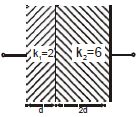
$A$ parallel plate capacitor has two layers of dielectrics as shown in the figure. This capacitor is connected across a battery. The ratio of the potential difference across the dielectric layers $(V_1/V_2)$ is:
A
$1.33$
B
$0.5$
C
$0.33$
D
$1.5$
Solution
(D) The capacitor consists of two capacitors in series,each with a dielectric layer.
For a parallel plate capacitor,the capacitance is given by $C = \frac{K \epsilon_0 A}{d}$.
For the first layer (dielectric constant $K_1 = 2$,thickness $d$): $C_1 = \frac{2 \epsilon_0 A}{d}$.
For the second layer (dielectric constant $K_2 = 6$,thickness $2d$): $C_2 = \frac{6 \epsilon_0 A}{2d} = \frac{3 \epsilon_0 A}{d}$.
Since the capacitors are in series,the charge $Q$ on each is the same.
The potential difference across a capacitor is $V = Q/C$.
Therefore,the ratio of potential differences is $\frac{V_1}{V_2} = \frac{Q/C_1}{Q/C_2} = \frac{C_2}{C_1}$.
Substituting the values: $\frac{V_1}{V_2} = \frac{3 \epsilon_0 A / d}{2 \epsilon_0 A / d} = \frac{3}{2} = 1.5$.
For a parallel plate capacitor,the capacitance is given by $C = \frac{K \epsilon_0 A}{d}$.
For the first layer (dielectric constant $K_1 = 2$,thickness $d$): $C_1 = \frac{2 \epsilon_0 A}{d}$.
For the second layer (dielectric constant $K_2 = 6$,thickness $2d$): $C_2 = \frac{6 \epsilon_0 A}{2d} = \frac{3 \epsilon_0 A}{d}$.
Since the capacitors are in series,the charge $Q$ on each is the same.
The potential difference across a capacitor is $V = Q/C$.
Therefore,the ratio of potential differences is $\frac{V_1}{V_2} = \frac{Q/C_1}{Q/C_2} = \frac{C_2}{C_1}$.
Substituting the values: $\frac{V_1}{V_2} = \frac{3 \epsilon_0 A / d}{2 \epsilon_0 A / d} = \frac{3}{2} = 1.5$.
0 likes
View Solution168
MediumMCQ
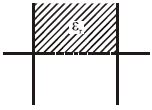
What will be the capacity of a parallel-plate capacitor when the half of the parallel space between the plates is filled by a material of dielectric constant $\varepsilon_r$? Assume that the capacity of the capacitor in air is $C$.
A
$\frac{2\varepsilon_r C}{1 + \varepsilon_r}$
B
$\frac{C(\varepsilon_r + 1)}{2}$
C
$\frac{\varepsilon_r C}{1 + \varepsilon_r}$
D
$\varepsilon_r C$
Solution
(A) Let the area of each plate be $A$ and the distance between them be $d$. The capacity of the capacitor in air is $C = \frac{\varepsilon_0 A}{d}$.
When the space between the plates is filled with a dielectric of constant $\varepsilon_r$ up to half the distance $d/2$,the capacitor can be considered as two capacitors in series.
One capacitor has air as the dielectric with thickness $d_1 = d/2$,so its capacity is $C_1 = \frac{\varepsilon_0 A}{d/2} = 2C$.
The other capacitor has a dielectric material with thickness $d_2 = d/2$,so its capacity is $C_2 = \frac{\varepsilon_r \varepsilon_0 A}{d/2} = 2\varepsilon_r C$.
Since they are in series,the equivalent capacity $C_{eq}$ is given by $\frac{1}{C_{eq}} = \frac{1}{C_1} + \frac{1}{C_2}$.
$\frac{1}{C_{eq}} = \frac{1}{2C} + \frac{1}{2\varepsilon_r C} = \frac{1}{2C} \left(1 + \frac{1}{\varepsilon_r}\right) = \frac{1}{2C} \left(\frac{\varepsilon_r + 1}{\varepsilon_r}\right)$.
Therefore,$C_{eq} = \frac{2\varepsilon_r C}{\varepsilon_r + 1}$.
When the space between the plates is filled with a dielectric of constant $\varepsilon_r$ up to half the distance $d/2$,the capacitor can be considered as two capacitors in series.
One capacitor has air as the dielectric with thickness $d_1 = d/2$,so its capacity is $C_1 = \frac{\varepsilon_0 A}{d/2} = 2C$.
The other capacitor has a dielectric material with thickness $d_2 = d/2$,so its capacity is $C_2 = \frac{\varepsilon_r \varepsilon_0 A}{d/2} = 2\varepsilon_r C$.
Since they are in series,the equivalent capacity $C_{eq}$ is given by $\frac{1}{C_{eq}} = \frac{1}{C_1} + \frac{1}{C_2}$.
$\frac{1}{C_{eq}} = \frac{1}{2C} + \frac{1}{2\varepsilon_r C} = \frac{1}{2C} \left(1 + \frac{1}{\varepsilon_r}\right) = \frac{1}{2C} \left(\frac{\varepsilon_r + 1}{\varepsilon_r}\right)$.
Therefore,$C_{eq} = \frac{2\varepsilon_r C}{\varepsilon_r + 1}$.
0 likes
View Solution169
DifficultMCQ
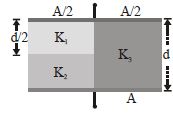
In the figure,a capacitor is filled with dielectrics of constants $K_1$,$K_2$,and $K_3$. The resultant capacitance is
A
$\frac{{2{\varepsilon _0}A}}{d}\left[ {\frac{1}{{{k_1}}} + \frac{1}{{{k_2}}} + \frac{1}{{{k_3}}}} \right]$
B
$\frac{{{\varepsilon _0}A}}{d}\left[ {\frac{1}{{{k_1}}} + \frac{1}{{{k_2}}} + \frac{1}{{{k_3}}}} \right]$
C
$\frac{{{2\varepsilon _0}A}}{d}\left[ {{k_1} + {k_2} + {k_3}} \right]$
D
$\frac{{A{\varepsilon _0}}}{d}\left( {\frac{{{k_1}{k_2}}}{{{k_1} + {k_2}}} + \frac{{{k_3}}}{2}} \right)$
Solution
(D) The capacitor can be divided into three parts. Let the total area be $A$ and distance be $d$.
$1$. The left side consists of two capacitors $C_1$ and $C_2$ in series,each with area $A/2$ and distance $d/2$.
$C_1 = \frac{K_1 \varepsilon_0 (A/2)}{d/2} = \frac{K_1 \varepsilon_0 A}{d}$
$C_2 = \frac{K_2 \varepsilon_0 (A/2)}{d/2} = \frac{K_2 \varepsilon_0 A}{d}$
Since they are in series,the equivalent capacitance $C_{12}$ is given by $\frac{1}{C_{12}} = \frac{1}{C_1} + \frac{1}{C_2} = \frac{d}{\varepsilon_0 A} (\frac{1}{K_1} + \frac{1}{K_2}) = \frac{d}{\varepsilon_0 A} (\frac{K_1 + K_2}{K_1 K_2})$.
So,$C_{12} = \frac{\varepsilon_0 A}{d} (\frac{K_1 K_2}{K_1 + K_2})$.
$2$. The right side is a capacitor $C_3$ with area $A/2$ and distance $d$.
$C_3 = \frac{K_3 \varepsilon_0 (A/2)}{d} = \frac{K_3 \varepsilon_0 A}{2d}$.
$3$. $C_{12}$ and $C_3$ are in parallel. The resultant capacitance $C_{eq} = C_{12} + C_3 = \frac{\varepsilon_0 A}{d} (\frac{K_1 K_2}{K_1 + K_2} + \frac{K_3}{2})$.
$1$. The left side consists of two capacitors $C_1$ and $C_2$ in series,each with area $A/2$ and distance $d/2$.
$C_1 = \frac{K_1 \varepsilon_0 (A/2)}{d/2} = \frac{K_1 \varepsilon_0 A}{d}$
$C_2 = \frac{K_2 \varepsilon_0 (A/2)}{d/2} = \frac{K_2 \varepsilon_0 A}{d}$
Since they are in series,the equivalent capacitance $C_{12}$ is given by $\frac{1}{C_{12}} = \frac{1}{C_1} + \frac{1}{C_2} = \frac{d}{\varepsilon_0 A} (\frac{1}{K_1} + \frac{1}{K_2}) = \frac{d}{\varepsilon_0 A} (\frac{K_1 + K_2}{K_1 K_2})$.
So,$C_{12} = \frac{\varepsilon_0 A}{d} (\frac{K_1 K_2}{K_1 + K_2})$.
$2$. The right side is a capacitor $C_3$ with area $A/2$ and distance $d$.
$C_3 = \frac{K_3 \varepsilon_0 (A/2)}{d} = \frac{K_3 \varepsilon_0 A}{2d}$.
$3$. $C_{12}$ and $C_3$ are in parallel. The resultant capacitance $C_{eq} = C_{12} + C_3 = \frac{\varepsilon_0 A}{d} (\frac{K_1 K_2}{K_1 + K_2} + \frac{K_3}{2})$.
0 likes
View Solution170
MediumMCQ
Two capacitors of capacitance $2C$ and $C$ are joined in parallel and charged to potential $V$. The battery is now removed and the capacitor $C$ is filled with a medium of dielectric constant $K$. The potential difference across each capacitor will be
A
$\frac{3V}{K + 2}$
B
$\frac{3V}{K}$
C
$\frac{V}{K + 2}$
D
$\frac{V}{K}$
Solution
(A) Initially,the capacitors are connected in parallel and charged to potential $V$. The total charge stored in the system is $Q_{\text{total}} = (2C)V + (C)V = 3CV$.
When the battery is removed,the total charge $Q_{\text{total}} = 3CV$ remains conserved.
After filling the capacitor $C$ with a dielectric of constant $K$,its new capacitance becomes $C' = KC$.
The new total capacitance of the parallel combination is $C_{\text{eq}} = 2C + KC = C(K + 2)$.
The new potential difference $V'$ across the parallel combination is given by $V' = \frac{Q_{\text{total}}}{C_{\text{eq}}}$.
Substituting the values,$V' = \frac{3CV}{C(K + 2)} = \frac{3V}{K + 2}$.
When the battery is removed,the total charge $Q_{\text{total}} = 3CV$ remains conserved.
After filling the capacitor $C$ with a dielectric of constant $K$,its new capacitance becomes $C' = KC$.
The new total capacitance of the parallel combination is $C_{\text{eq}} = 2C + KC = C(K + 2)$.
The new potential difference $V'$ across the parallel combination is given by $V' = \frac{Q_{\text{total}}}{C_{\text{eq}}}$.
Substituting the values,$V' = \frac{3CV}{C(K + 2)} = \frac{3V}{K + 2}$.
0 likes
View Solution171
DifficultMCQ
$A$ parallel plate capacitor with air between the plates has a capacitance of $9 \, pF$. The separation between its plates is $d$. The space between the plates is now filled with two dielectrics. One of the dielectrics has dielectric constant $K_1 = 3$ and thickness $d/3$,while the other one has dielectric constant $K_2 = 6$ and thickness $2d/3$. The capacitance of the capacitor is now.........$pF$.
A
$1.8$
B
$45$
C
$40.5$
D
$20.25$
Solution
(C) The initial capacitance of the air-filled parallel plate capacitor is given by $C = \frac{\varepsilon_0 A}{d} = 9 \, pF$.
When the space is filled with two dielectrics of thicknesses $d_1 = d/3$ and $d_2 = 2d/3$,the system acts as two capacitors in series.
The capacitance of the first part is $C_1 = \frac{K_1 \varepsilon_0 A}{d_1} = \frac{3 \varepsilon_0 A}{d/3} = 9 \frac{\varepsilon_0 A}{d} = 9 \times 9 = 81 \, pF$.
The capacitance of the second part is $C_2 = \frac{K_2 \varepsilon_0 A}{d_2} = \frac{6 \varepsilon_0 A}{2d/3} = 9 \frac{\varepsilon_0 A}{d} = 9 \times 9 = 81 \, pF$.
Since they are in series,the equivalent capacitance $C_{eq}$ is given by:
$\frac{1}{C_{eq}} = \frac{1}{C_1} + \frac{1}{C_2} = \frac{1}{81} + \frac{1}{81} = \frac{2}{81}$.
Therefore,$C_{eq} = \frac{81}{2} = 40.5 \, pF$.
When the space is filled with two dielectrics of thicknesses $d_1 = d/3$ and $d_2 = 2d/3$,the system acts as two capacitors in series.
The capacitance of the first part is $C_1 = \frac{K_1 \varepsilon_0 A}{d_1} = \frac{3 \varepsilon_0 A}{d/3} = 9 \frac{\varepsilon_0 A}{d} = 9 \times 9 = 81 \, pF$.
The capacitance of the second part is $C_2 = \frac{K_2 \varepsilon_0 A}{d_2} = \frac{6 \varepsilon_0 A}{2d/3} = 9 \frac{\varepsilon_0 A}{d} = 9 \times 9 = 81 \, pF$.
Since they are in series,the equivalent capacitance $C_{eq}$ is given by:
$\frac{1}{C_{eq}} = \frac{1}{C_1} + \frac{1}{C_2} = \frac{1}{81} + \frac{1}{81} = \frac{2}{81}$.
Therefore,$C_{eq} = \frac{81}{2} = 40.5 \, pF$.
0 likes
View Solution172
EasyMCQ
$A$ capacitor of capacity $C$ is connected to a cell of $V \, \text{volt}$. Now,a dielectric slab of dielectric constant $\epsilon_r$ is inserted into it while keeping the cell connected. Then:
A
Capacitance will be decreased
B
Potential difference between the plates will be decreased
C
Charge stored will be decreased
D
Charge stored will be increased
Solution
(D) When a dielectric slab of dielectric constant $\epsilon_r$ is inserted into a capacitor while the cell remains connected,the potential difference $V$ across the plates remains constant because it is fixed by the cell.
The new capacitance $C'$ becomes $C' = \epsilon_r C$. Since $\epsilon_r > 1$,the capacitance increases.
The charge stored on the capacitor is given by $Q = CV$. Since $V$ is constant and $C$ increases,the charge $Q$ stored on the plates will increase $(Q' = \epsilon_r Q)$.
The new capacitance $C'$ becomes $C' = \epsilon_r C$. Since $\epsilon_r > 1$,the capacitance increases.
The charge stored on the capacitor is given by $Q = CV$. Since $V$ is constant and $C$ increases,the charge $Q$ stored on the plates will increase $(Q' = \epsilon_r Q)$.
0 likes
View Solution173
DifficultMCQ
$A$ parallel plate capacitor has plates with area $A$ and separation $d$. $A$ battery charges the plates to a potential difference $V_0$. The battery is then disconnected and a dielectric slab of thickness $d$ is introduced. The ratio of energy stored in the capacitor before and after the slab is introduced is
A
$K$
B
$1/K$
C
$A/(d^2K)$
D
$d^2K/A$
Solution
(A) The energy stored in a capacitor is given by $U = Q^2 / (2C)$.
Initially,the capacitance is $C = \epsilon_0 A / d$.
When the battery is disconnected,the charge $Q$ on the plates remains constant.
After introducing a dielectric slab of thickness $d$ and dielectric constant $K$,the new capacitance becomes $C' = KC$.
The new energy stored is $U' = Q^2 / (2C') = Q^2 / (2KC)$.
The ratio of energy before and after is $U / U' = (Q^2 / 2C) / (Q^2 / 2KC) = K$.
Initially,the capacitance is $C = \epsilon_0 A / d$.
When the battery is disconnected,the charge $Q$ on the plates remains constant.
After introducing a dielectric slab of thickness $d$ and dielectric constant $K$,the new capacitance becomes $C' = KC$.
The new energy stored is $U' = Q^2 / (2C') = Q^2 / (2KC)$.
The ratio of energy before and after is $U / U' = (Q^2 / 2C) / (Q^2 / 2KC) = K$.
0 likes
View Solution174
MediumMCQ
$A$ parallel plate capacitor with air between plates has a capacitance of $8\,\mu F$. What will be the capacitance if the distance between the plates is reduced by half,and the space between them is filled with a substance of dielectric constant $6$?
A
$96$
B
$24$
C
$50$
D
$10$
Solution
(A) The capacitance of a parallel plate capacitor with air is given by $C = \frac{\varepsilon_0 A}{d} = 8\,\mu F$.
When the distance between the plates is reduced to $d' = \frac{d}{2}$ and a dielectric of constant $K = 6$ is introduced,the new capacitance $C'$ is given by:
$C' = \frac{K \varepsilon_0 A}{d'} = \frac{K \varepsilon_0 A}{d/2} = 2K \left( \frac{\varepsilon_0 A}{d} \right)$.
Substituting the given values:
$C' = 2 \times 6 \times C = 12 \times 8\,\mu F = 96\,\mu F$.
When the distance between the plates is reduced to $d' = \frac{d}{2}$ and a dielectric of constant $K = 6$ is introduced,the new capacitance $C'$ is given by:
$C' = \frac{K \varepsilon_0 A}{d'} = \frac{K \varepsilon_0 A}{d/2} = 2K \left( \frac{\varepsilon_0 A}{d} \right)$.
Substituting the given values:
$C' = 2 \times 6 \times C = 12 \times 8\,\mu F = 96\,\mu F$.
0 likes
View Solution175
EasyMCQ
$A$ parallel plate capacitor has a potential of $20\,kV$ and a capacitance of $2 \times 10^{-4}\,\mu F$. If the area of the plate is $0.01\,m^2$ and the distance between the plates is $2\,mm$,find the dielectric constant of the medium.
A
$4.52$
B
$3.02$
C
$4.12$
D
$5.10$
Solution
(A) The capacitance of a parallel plate capacitor with a dielectric medium is given by the formula: $C = \frac{\varepsilon_{0} \varepsilon_{r} A}{d}$.
Given values:
$C = 2 \times 10^{-4}\,\mu F = 2 \times 10^{-4} \times 10^{-6}\,F = 2 \times 10^{-10}\,F$
$A = 0.01\,m^2$
$d = 2\,mm = 2 \times 10^{-3}\,m$
$\varepsilon_{0} = 8.85 \times 10^{-12}\,F/m$
Rearranging the formula to solve for the dielectric constant $\varepsilon_{r}$:
$\varepsilon_{r} = \frac{C \cdot d}{\varepsilon_{0} \cdot A}$
Substituting the values:
$\varepsilon_{r} = \frac{(2 \times 10^{-10}) \times (2 \times 10^{-3})}{(8.85 \times 10^{-12}) \times (0.01)}$
$\varepsilon_{r} = \frac{4 \times 10^{-13}}{8.85 \times 10^{-14}}$
$\varepsilon_{r} = \frac{40}{8.85} \approx 4.52$.
Given values:
$C = 2 \times 10^{-4}\,\mu F = 2 \times 10^{-4} \times 10^{-6}\,F = 2 \times 10^{-10}\,F$
$A = 0.01\,m^2$
$d = 2\,mm = 2 \times 10^{-3}\,m$
$\varepsilon_{0} = 8.85 \times 10^{-12}\,F/m$
Rearranging the formula to solve for the dielectric constant $\varepsilon_{r}$:
$\varepsilon_{r} = \frac{C \cdot d}{\varepsilon_{0} \cdot A}$
Substituting the values:
$\varepsilon_{r} = \frac{(2 \times 10^{-10}) \times (2 \times 10^{-3})}{(8.85 \times 10^{-12}) \times (0.01)}$
$\varepsilon_{r} = \frac{4 \times 10^{-13}}{8.85 \times 10^{-14}}$
$\varepsilon_{r} = \frac{40}{8.85} \approx 4.52$.
0 likes
View Solution176
DifficultMCQ
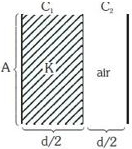
Half of the space between the plates of a parallel plate capacitor is filled with a medium of dielectric constant $K$ parallel to the plates. If the initial capacitance is $C$,then the new capacitance will be:
A
$2KC/(1+K)$
B
$C(K+1)/2$
C
$CK/(1+K)$
D
$KC$
Solution
(A) The initial capacitance of the parallel plate capacitor is given by $C = \frac{\epsilon_0 A}{d}$.
When half the space between the plates is filled with a dielectric of constant $K$ parallel to the plates,the capacitor can be viewed as two capacitors in series,each with plate separation $d/2$.
The capacitance of the part filled with the dielectric is $C_1 = \frac{K \epsilon_0 A}{d/2} = \frac{2K \epsilon_0 A}{d} = 2KC$.
The capacitance of the part filled with air is $C_2 = \frac{\epsilon_0 A}{d/2} = \frac{2 \epsilon_0 A}{d} = 2C$.
Since these two capacitors are in series,the equivalent capacitance $C_{eq}$ is given by:
$\frac{1}{C_{eq}} = \frac{1}{C_1} + \frac{1}{C_2} = \frac{1}{2KC} + \frac{1}{2C} = \frac{1}{2C} \left( \frac{1}{K} + 1 \right) = \frac{1}{2C} \left( \frac{1+K}{K} \right)$.
Therefore,$C_{eq} = \frac{2CK}{K+1}$.
When half the space between the plates is filled with a dielectric of constant $K$ parallel to the plates,the capacitor can be viewed as two capacitors in series,each with plate separation $d/2$.
The capacitance of the part filled with the dielectric is $C_1 = \frac{K \epsilon_0 A}{d/2} = \frac{2K \epsilon_0 A}{d} = 2KC$.
The capacitance of the part filled with air is $C_2 = \frac{\epsilon_0 A}{d/2} = \frac{2 \epsilon_0 A}{d} = 2C$.
Since these two capacitors are in series,the equivalent capacitance $C_{eq}$ is given by:
$\frac{1}{C_{eq}} = \frac{1}{C_1} + \frac{1}{C_2} = \frac{1}{2KC} + \frac{1}{2C} = \frac{1}{2C} \left( \frac{1}{K} + 1 \right) = \frac{1}{2C} \left( \frac{1+K}{K} \right)$.
Therefore,$C_{eq} = \frac{2CK}{K+1}$.
0 likes
View Solution177
EasyMCQ
The capacitance of a parallel plate capacitor is $5\, \mu F$. When a glass slab of thickness equal to the separation between the plates is introduced between the plates,the potential difference reduces to $1/8$ of the original value. The dielectric constant of glass is
A
$1.6$
B
$40$
C
$5$
D
$8$
Solution
(D) Let the initial capacitance be $C_0$ and the initial potential difference be $V_0$. When a dielectric slab of thickness $d$ (equal to the plate separation) is introduced,the new capacitance $C$ becomes $K C_0$,where $K$ is the dielectric constant.
Since the charge $Q$ on the capacitor remains constant $(Q = C_0 V_0 = C V)$,we have $V = Q/C = (C_0 V_0) / (K C_0) = V_0 / K$.
Given that the potential difference reduces to $1/8$ of the original value,we have $V = V_0 / 8$.
Comparing the two expressions,$V_0 / K = V_0 / 8$,which gives $K = 8$.
Since the charge $Q$ on the capacitor remains constant $(Q = C_0 V_0 = C V)$,we have $V = Q/C = (C_0 V_0) / (K C_0) = V_0 / K$.
Given that the potential difference reduces to $1/8$ of the original value,we have $V = V_0 / 8$.
Comparing the two expressions,$V_0 / K = V_0 / 8$,which gives $K = 8$.
0 likes
View Solution178
DifficultMCQ
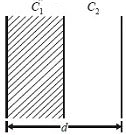
$A$ parallel plate air capacitor has a capacitance $C$. When it is half filled with a dielectric of dielectric constant $5$,the percentage increase in the capacitance will be.....$\%$
A
$400$
B
$66.6$
C
$33.3$
D
$200$
Solution
(B) Initial capacitance $C = \frac{\varepsilon_0 A}{d}$.
When the capacitor is half-filled with a dielectric of dielectric constant $K=5$ in series (as shown in the figure),the system acts as two capacitors in series,each with plate separation $d/2$.
Capacitance of the dielectric part: $C_1 = \frac{K \varepsilon_0 A}{d/2} = \frac{2 K \varepsilon_0 A}{d} = \frac{10 \varepsilon_0 A}{d}$.
Capacitance of the air part: $C_2 = \frac{\varepsilon_0 A}{d/2} = \frac{2 \varepsilon_0 A}{d}$.
The equivalent capacitance $C'$ is given by:
$\frac{1}{C'} = \frac{1}{C_1} + \frac{1}{C_2} = \frac{d}{10 \varepsilon_0 A} + \frac{d}{2 \varepsilon_0 A} = \frac{d}{\varepsilon_0 A} \left( \frac{1}{10} + \frac{1}{2} \right) = \frac{d}{\varepsilon_0 A} \left( \frac{1+5}{10} \right) = \frac{6d}{10 \varepsilon_0 A} = \frac{3d}{5 \varepsilon_0 A}$.
Therefore,$C' = \frac{5}{3} \frac{\varepsilon_0 A}{d} = \frac{5}{3} C$.
Percentage increase in capacitance = $\frac{C' - C}{C} \times 100 = \left( \frac{5/3 C - C}{C} \right) \times 100 = \left( \frac{5}{3} - 1 \right) \times 100 = \frac{2}{3} \times 100 = 66.67\% \approx 66.6\%$.
When the capacitor is half-filled with a dielectric of dielectric constant $K=5$ in series (as shown in the figure),the system acts as two capacitors in series,each with plate separation $d/2$.
Capacitance of the dielectric part: $C_1 = \frac{K \varepsilon_0 A}{d/2} = \frac{2 K \varepsilon_0 A}{d} = \frac{10 \varepsilon_0 A}{d}$.
Capacitance of the air part: $C_2 = \frac{\varepsilon_0 A}{d/2} = \frac{2 \varepsilon_0 A}{d}$.
The equivalent capacitance $C'$ is given by:
$\frac{1}{C'} = \frac{1}{C_1} + \frac{1}{C_2} = \frac{d}{10 \varepsilon_0 A} + \frac{d}{2 \varepsilon_0 A} = \frac{d}{\varepsilon_0 A} \left( \frac{1}{10} + \frac{1}{2} \right) = \frac{d}{\varepsilon_0 A} \left( \frac{1+5}{10} \right) = \frac{6d}{10 \varepsilon_0 A} = \frac{3d}{5 \varepsilon_0 A}$.
Therefore,$C' = \frac{5}{3} \frac{\varepsilon_0 A}{d} = \frac{5}{3} C$.
Percentage increase in capacitance = $\frac{C' - C}{C} \times 100 = \left( \frac{5/3 C - C}{C} \right) \times 100 = \left( \frac{5}{3} - 1 \right) \times 100 = \frac{2}{3} \times 100 = 66.67\% \approx 66.6\%$.
0 likes
View Solution179
MediumMCQ
$A$ capacitor is charged by using a battery which is then disconnected. $A$ dielectric slab is introduced between the plates which results in
A
increase in the potential difference across the plates and reduction in stored energy but no change in the charge on the plates
B
decrease in the potential difference across the plates and reduction in the stored energy but no change in the charge on the plates
C
reduction of charge on the plates and increase of potential difference across the plates
D
increase in stored energy but no change in potential difference across the plates
Solution
(B) When a capacitor is charged and then disconnected from the battery,the charge $Q$ on the plates remains constant.
When a dielectric slab of dielectric constant $K$ is introduced between the plates,the capacitance increases to $C' = KC$.
Since $Q$ is constant,the new potential difference $V' = \frac{Q}{C'} = \frac{Q}{KC} = \frac{V}{K}$,which means the potential difference decreases.
The stored energy $U = \frac{Q^2}{2C}$ becomes $U' = \frac{Q^2}{2C'} = \frac{Q^2}{2KC} = \frac{U}{K}$,which means the stored energy decreases.
Therefore,the potential difference and stored energy decrease,while the charge remains unchanged.
When a dielectric slab of dielectric constant $K$ is introduced between the plates,the capacitance increases to $C' = KC$.
Since $Q$ is constant,the new potential difference $V' = \frac{Q}{C'} = \frac{Q}{KC} = \frac{V}{K}$,which means the potential difference decreases.
The stored energy $U = \frac{Q^2}{2C}$ becomes $U' = \frac{Q^2}{2C'} = \frac{Q^2}{2KC} = \frac{U}{K}$,which means the stored energy decreases.
Therefore,the potential difference and stored energy decrease,while the charge remains unchanged.
0 likes
View Solution180
EasyMCQ
Assertion : If the distance between parallel plates of a capacitor is halved and the dielectric constant is increased to three times its original value,then the capacitance becomes $6$ times.
Reason : The capacity of a capacitor does not depend upon the nature of the material between the plates.
Reason : The capacity of a capacitor does not depend upon the nature of the material between the plates.
A
If both Assertion and Reason are correct and the Reason is a correct explanation of the Assertion.
B
If both Assertion and Reason are correct but Reason is not a correct explanation of the Assertion.
C
If the Assertion is correct but Reason is incorrect.
D
If both the Assertion and Reason are incorrect.
Solution
(C) The capacitance of a parallel plate capacitor is given by $C = \frac{K \epsilon_0 A}{d}$,where $K$ is the dielectric constant,$A$ is the area,and $d$ is the distance between the plates.
Given that the new distance $d' = \frac{d}{2}$ and the new dielectric constant $K' = 3K$.
The new capacitance $C'$ becomes $C' = \frac{(3K) \epsilon_0 A}{(d/2)} = 6 \left( \frac{K \epsilon_0 A}{d} \right) = 6C$.
Thus,the Assertion is correct.
The capacity of a capacitor depends on the dielectric constant $(K)$ of the material placed between the plates. Therefore,the Reason is incorrect.
Given that the new distance $d' = \frac{d}{2}$ and the new dielectric constant $K' = 3K$.
The new capacitance $C'$ becomes $C' = \frac{(3K) \epsilon_0 A}{(d/2)} = 6 \left( \frac{K \epsilon_0 A}{d} \right) = 6C$.
Thus,the Assertion is correct.
The capacity of a capacitor depends on the dielectric constant $(K)$ of the material placed between the plates. Therefore,the Reason is incorrect.
0 likes
View Solution181
MediumMCQ
Assertion : $A$ parallel plate capacitor is connected across a battery through a key. $A$ dielectric slab of dielectric constant $K$ is introduced between the plates. The energy stored becomes $K$ times.
Reason : The surface density of charge on the plate remains constant or unchanged.
Reason : The surface density of charge on the plate remains constant or unchanged.
A
If both Assertion and Reason are correct and the Reason is a correct explanation of the Assertion.
B
If both Assertion and Reason are correct but Reason is not a correct explanation of the Assertion.
C
If the Assertion is correct but Reason is incorrect.
D
If both the Assertion and Reason are incorrect.
Solution
(C) When a parallel plate capacitor is connected to a battery,the potential difference $V$ across the plates remains constant $(V = V_0)$.
The energy stored in the capacitor is given by $U = \frac{1}{2} CV^2$.
When a dielectric slab of dielectric constant $K$ is introduced between the plates,the capacitance becomes $C' = KC$.
Therefore,the new energy stored is $U' = \frac{1}{2} (KC) V^2 = K U$. Thus,the energy stored becomes $K$ times.
Since $Q = CV$,the charge on the plates becomes $Q' = KCV = KQ$.
The surface charge density is given by $\sigma = \frac{Q}{A}$. Since $Q$ increases by a factor of $K$,the surface charge density $\sigma' = \frac{KQ}{A} = K\sigma_0$ also increases by a factor of $K$.
Therefore,the Reason is incorrect because the surface charge density does not remain constant.
The energy stored in the capacitor is given by $U = \frac{1}{2} CV^2$.
When a dielectric slab of dielectric constant $K$ is introduced between the plates,the capacitance becomes $C' = KC$.
Therefore,the new energy stored is $U' = \frac{1}{2} (KC) V^2 = K U$. Thus,the energy stored becomes $K$ times.
Since $Q = CV$,the charge on the plates becomes $Q' = KCV = KQ$.
The surface charge density is given by $\sigma = \frac{Q}{A}$. Since $Q$ increases by a factor of $K$,the surface charge density $\sigma' = \frac{KQ}{A} = K\sigma_0$ also increases by a factor of $K$.
Therefore,the Reason is incorrect because the surface charge density does not remain constant.
0 likes
View Solution182
EasyMCQ
Assertion: The electrostatic force between the plates of a charged isolated capacitor decreases when a dielectric fills the whole space between the plates.
Reason: The electric field between the plates of a charged isolated capacitor increases when a dielectric fills the whole space between the plates.
Reason: The electric field between the plates of a charged isolated capacitor increases when a dielectric fills the whole space between the plates.
A
If both Assertion and Reason are correct and Reason is the correct explanation of Assertion.
B
If both Assertion and Reason are correct,but Reason is not the correct explanation of Assertion.
C
If Assertion is correct but Reason is incorrect.
D
If Assertion is incorrect and Reason is correct.
Solution
(C) For an isolated capacitor,the charge $Q$ remains constant.
The force $F$ between the plates is given by $F = \frac{Q^2}{2A\epsilon_0 K}$. Since $K > 1$ for a dielectric,the force $F$ decreases.
Thus,the Assertion is correct.
The electric field $E$ between the plates is given by $E = \frac{\sigma}{K\epsilon_0} = \frac{E_0}{K}$. Since $K > 1$,the electric field $E$ decreases.
Therefore,the Reason is incorrect.
Hence,the correct option is $C$.
The force $F$ between the plates is given by $F = \frac{Q^2}{2A\epsilon_0 K}$. Since $K > 1$ for a dielectric,the force $F$ decreases.
Thus,the Assertion is correct.
The electric field $E$ between the plates is given by $E = \frac{\sigma}{K\epsilon_0} = \frac{E_0}{K}$. Since $K > 1$,the electric field $E$ decreases.
Therefore,the Reason is incorrect.
Hence,the correct option is $C$.
0 likes
View Solution183
AdvancedMCQ
$A$ parallel plate capacitor has plates of area $A$ separated by distance $d$ between them. It is filled with a dielectric which has a dielectric constant that varies as $k(x)=K(1+\alpha x)$ where $x$ is the distance measured from one of the plates. If $(\alpha d) << 1$,the total capacitance of the system is best given by the expression:
A
$\frac{AK \varepsilon_{0}}{d}\left(1+\frac{\alpha d}{2}\right)$
B
$\frac{A \varepsilon_{0} K}{d}\left(1+\left(\frac{\alpha d}{2}\right)^{2}\right)$
C
$\frac{A \varepsilon_{0} K}{d}\left(1+\frac{\alpha^{2} d^{2}}{2}\right)$
D
$\frac{AK \varepsilon_{0}}{d}(1+\alpha d)$
Solution
(A) Since the dielectric constant $k(x)$ varies with distance $x$,we consider a thin elemental slice of thickness $dx$ at a distance $x$ from one plate.
The capacitance of this elemental slice is $dC = \frac{\varepsilon_0 k(x) A}{dx} = \frac{\varepsilon_0 K(1+\alpha x) A}{dx}$.
Since these elemental capacitors are connected in series,the equivalent capacitance $C$ is given by:
$\frac{1}{C} = \int_0^d \frac{1}{dC} = \int_0^d \frac{dx}{\varepsilon_0 K A (1+\alpha x)}$.
Integrating this,we get:
$\frac{1}{C} = \frac{1}{\varepsilon_0 K A} \left[ \frac{\ln(1+\alpha x)}{\alpha} \right]_0^d = \frac{1}{\alpha \varepsilon_0 K A} \ln(1+\alpha d)$.
Using the Taylor expansion $\ln(1+u) \approx u - \frac{u^2}{2}$ for $u = \alpha d << 1$:
$\frac{1}{C} \approx \frac{1}{\alpha \varepsilon_0 K A} (\alpha d - \frac{(\alpha d)^2}{2}) = \frac{d}{\varepsilon_0 K A} (1 - \frac{\alpha d}{2})$.
Taking the reciprocal to find $C$ and using the binomial approximation $(1-u)^{-1} \approx 1+u$:
$C \approx \frac{\varepsilon_0 K A}{d} (1 - \frac{\alpha d}{2})^{-1} \approx \frac{\varepsilon_0 K A}{d} (1 + \frac{\alpha d}{2})$.
The capacitance of this elemental slice is $dC = \frac{\varepsilon_0 k(x) A}{dx} = \frac{\varepsilon_0 K(1+\alpha x) A}{dx}$.
Since these elemental capacitors are connected in series,the equivalent capacitance $C$ is given by:
$\frac{1}{C} = \int_0^d \frac{1}{dC} = \int_0^d \frac{dx}{\varepsilon_0 K A (1+\alpha x)}$.
Integrating this,we get:
$\frac{1}{C} = \frac{1}{\varepsilon_0 K A} \left[ \frac{\ln(1+\alpha x)}{\alpha} \right]_0^d = \frac{1}{\alpha \varepsilon_0 K A} \ln(1+\alpha d)$.
Using the Taylor expansion $\ln(1+u) \approx u - \frac{u^2}{2}$ for $u = \alpha d << 1$:
$\frac{1}{C} \approx \frac{1}{\alpha \varepsilon_0 K A} (\alpha d - \frac{(\alpha d)^2}{2}) = \frac{d}{\varepsilon_0 K A} (1 - \frac{\alpha d}{2})$.
Taking the reciprocal to find $C$ and using the binomial approximation $(1-u)^{-1} \approx 1+u$:
$C \approx \frac{\varepsilon_0 K A}{d} (1 - \frac{\alpha d}{2})^{-1} \approx \frac{\varepsilon_0 K A}{d} (1 + \frac{\alpha d}{2})$.
0 likes
View Solution184
Medium
$A$ slab of material of dielectric constant $K$ has the same area as the plates of a parallel-plate capacitor but has a thickness $(3/4)d$,where $d$ is the separation of the plates. How is the capacitance changed when the slab is inserted between the plates?
Solution
(N/A) Let $E_{0} = V_{0} / d$ be the electric field between the plates when there is no dielectric and the potential difference is $V_{0}$.
If the dielectric is now inserted,the electric field in the dielectric will be $E = E_{0} / K$.
The potential difference $V$ will then be:
$V = E_{0} \left(\frac{1}{4} d\right) + \frac{E_{0}}{K} \left(\frac{3}{4} d\right)$
$V = E_{0} d \left(\frac{1}{4} + \frac{3}{4K}\right) = V_{0} \left(\frac{K+3}{4K}\right)$
The potential difference decreases by the factor $(K+3) / 4K$ while the free charge $Q_{0}$ on the plates remains unchanged.
The capacitance $C$ thus increases as:
$C = \frac{Q_{0}}{V} = \frac{Q_{0}}{V_{0} \left(\frac{K+3}{4K}\right)} = \left(\frac{4K}{K+3}\right) C_{0}$
If the dielectric is now inserted,the electric field in the dielectric will be $E = E_{0} / K$.
The potential difference $V$ will then be:
$V = E_{0} \left(\frac{1}{4} d\right) + \frac{E_{0}}{K} \left(\frac{3}{4} d\right)$
$V = E_{0} d \left(\frac{1}{4} + \frac{3}{4K}\right) = V_{0} \left(\frac{K+3}{4K}\right)$
The potential difference decreases by the factor $(K+3) / 4K$ while the free charge $Q_{0}$ on the plates remains unchanged.
The capacitance $C$ thus increases as:
$C = \frac{Q_{0}}{V} = \frac{Q_{0}}{V_{0} \left(\frac{K+3}{4K}\right)} = \left(\frac{4K}{K+3}\right) C_{0}$
0 likes
View Solution185
EasyMCQ
$A$ parallel plate capacitor with air between the plates has a capacitance of $8 \;pF$ $(1 \;pF = 10^{-12} \;F)$. What will be the capacitance (in $pF$) if the distance between the plates is reduced by half,and the space between them is filled with a substance of dielectric constant $6$?
A
$64$
B
$32$
C
$96$
D
$128$
Solution
(C) The initial capacitance of the parallel plate capacitor with air as the medium is given by $C = \frac{\varepsilon_0 A}{d} = 8 \;pF$.
When the distance between the plates is reduced to $d' = \frac{d}{2}$ and the space is filled with a dielectric of constant $k = 6$,the new capacitance $C'$ is given by:
$C' = \frac{k \varepsilon_0 A}{d'} = \frac{6 \varepsilon_0 A}{d/2} = 12 \left( \frac{\varepsilon_0 A}{d} \right)$.
Substituting the initial value $C = 8 \;pF$:
$C' = 12 \times 8 \;pF = 96 \;pF$.
Thus,the new capacitance is $96 \;pF$.
When the distance between the plates is reduced to $d' = \frac{d}{2}$ and the space is filled with a dielectric of constant $k = 6$,the new capacitance $C'$ is given by:
$C' = \frac{k \varepsilon_0 A}{d'} = \frac{6 \varepsilon_0 A}{d/2} = 12 \left( \frac{\varepsilon_0 A}{d} \right)$.
Substituting the initial value $C = 8 \;pF$:
$C' = 12 \times 8 \;pF = 96 \;pF$.
Thus,the new capacitance is $96 \;pF$.
0 likes
View Solution186
Medium
In a parallel plate capacitor with air between the plates,each plate has an area of $6 \times 10^{-3} \, m^{2}$ and the distance between the plates is $3 \, mm$. The capacitance of the capacitor is $17.71 \, pF$. If this capacitor is connected to a $100 \, V$ supply,and a $3 \, mm$ thick mica sheet (of dielectric constant $k = 6$) is inserted between the plates,calculate the new capacitance,charge,and potential difference in the following cases:
$(a)$ While the voltage supply remains connected.
$(b)$ After the supply is disconnected.
$(a)$ While the voltage supply remains connected.
$(b)$ After the supply is disconnected.
Solution
(A) Dielectric constant of the mica sheet,$k = 6$.
If the voltage supply remains connected,the potential difference between the plates remains constant. Supply voltage,$V = 100 \, V$.
Initial capacitance,$C = 17.71 \, pF = 1.771 \times 10^{-11} \, F$.
New capacitance,$C_{1} = k \cdot C = 6 \times 17.71 \, pF = 106.26 \, pF$.
New charge,$q_{1} = C_{1} \cdot V = 106.26 \times 10^{-12} \, F \times 100 \, V = 1.0626 \times 10^{-8} \, C$.
The potential across the plates remains $100 \, V$.
$(b)$ Dielectric constant,$k = 6$.
Initial charge,$q = C \cdot V = 17.71 \times 10^{-12} \, F \times 100 \, V = 1.771 \times 10^{-9} \, C$.
New capacitance,$C_{1} = k \cdot C = 6 \times 17.71 \, pF = 106.26 \, pF$.
If the supply is disconnected,the charge remains constant,$q = 1.771 \times 10^{-9} \, C$.
The new potential across the plates is given by $V_{1} = \frac{q}{C_{1}} = \frac{1.771 \times 10^{-9} \, C}{106.26 \times 10^{-12} \, F} \approx 16.67 \, V$.
If the voltage supply remains connected,the potential difference between the plates remains constant. Supply voltage,$V = 100 \, V$.
Initial capacitance,$C = 17.71 \, pF = 1.771 \times 10^{-11} \, F$.
New capacitance,$C_{1} = k \cdot C = 6 \times 17.71 \, pF = 106.26 \, pF$.
New charge,$q_{1} = C_{1} \cdot V = 106.26 \times 10^{-12} \, F \times 100 \, V = 1.0626 \times 10^{-8} \, C$.
The potential across the plates remains $100 \, V$.
$(b)$ Dielectric constant,$k = 6$.
Initial charge,$q = C \cdot V = 17.71 \times 10^{-12} \, F \times 100 \, V = 1.771 \times 10^{-9} \, C$.
New capacitance,$C_{1} = k \cdot C = 6 \times 17.71 \, pF = 106.26 \, pF$.
If the supply is disconnected,the charge remains constant,$q = 1.771 \times 10^{-9} \, C$.
The new potential across the plates is given by $V_{1} = \frac{q}{C_{1}} = \frac{1.771 \times 10^{-9} \, C}{106.26 \times 10^{-12} \, F} \approx 16.67 \, V$.
0 likes
View Solution187
Medium
Explain the effect of a dielectric on the capacitance of a parallel plate capacitor and obtain the formula for the dielectric constant.
Solution
(N/A) Consider two large plates each of area $A$ separated by a distance $d$. The charge on the plates is $\pm Q$ corresponding to the surface charge density $\pm \sigma$.
When there is a vacuum between the plates:
$E_{0} = \frac{\sigma}{\epsilon_{0}}$
The potential difference $V_{0}$ is given by:
$V_{0} = E_{0} d$
If $C_{0}$ is the capacitance:
$C_{0} = \frac{Q}{V_{0}} = \frac{\sigma A}{E_{0} d} = \frac{\epsilon_{0} A}{d} \quad \dots(1)$
When a dielectric is inserted between the plates,it becomes polarized by the external field,creating induced surface charge densities $\pm \sigma_{P}$.
The net electric field between the plates becomes:
$E = E_{0} - E_{P} = \frac{\sigma - \sigma_{P}}{\epsilon_{0}}$
The new potential difference is:
$V = E d = \frac{(\sigma - \sigma_{P}) d}{\epsilon_{0}}$
For a linear dielectric,we define the dielectric constant $K$ such that the net field is reduced by a factor $K$:
$E = \frac{E_{0}}{K} \implies \sigma - \sigma_{P} = \frac{\sigma}{K}$
Substituting this into the potential equation:
$V = \frac{\sigma d}{\epsilon_{0} K} = \frac{Q d}{A \epsilon_{0} K}$
The new capacitance $C$ is:
$C = \frac{Q}{V} = \frac{A \epsilon_{0} K}{d} = K C_{0}$
Thus,the dielectric constant $K$ is defined as $K = \frac{C}{C_{0}}$.
When there is a vacuum between the plates:
$E_{0} = \frac{\sigma}{\epsilon_{0}}$
The potential difference $V_{0}$ is given by:
$V_{0} = E_{0} d$
If $C_{0}$ is the capacitance:
$C_{0} = \frac{Q}{V_{0}} = \frac{\sigma A}{E_{0} d} = \frac{\epsilon_{0} A}{d} \quad \dots(1)$
When a dielectric is inserted between the plates,it becomes polarized by the external field,creating induced surface charge densities $\pm \sigma_{P}$.
The net electric field between the plates becomes:
$E = E_{0} - E_{P} = \frac{\sigma - \sigma_{P}}{\epsilon_{0}}$
The new potential difference is:
$V = E d = \frac{(\sigma - \sigma_{P}) d}{\epsilon_{0}}$
For a linear dielectric,we define the dielectric constant $K$ such that the net field is reduced by a factor $K$:
$E = \frac{E_{0}}{K} \implies \sigma - \sigma_{P} = \frac{\sigma}{K}$
Substituting this into the potential equation:
$V = \frac{\sigma d}{\epsilon_{0} K} = \frac{Q d}{A \epsilon_{0} K}$
The new capacitance $C$ is:
$C = \frac{Q}{V} = \frac{A \epsilon_{0} K}{d} = K C_{0}$
Thus,the dielectric constant $K$ is defined as $K = \frac{C}{C_{0}}$.
0 likes
View Solution188
Easy
Write the formula for the capacitance of a capacitor having a dielectric constant $K = 2$.
Solution
(N/A) The capacitance of a parallel plate capacitor in a vacuum is given by $C_0 = \frac{\epsilon_0 A}{d}$,where $\epsilon_0$ is the permittivity of free space,$A$ is the area of the plates,and $d$ is the distance between them.
When a dielectric material with dielectric constant $K$ is introduced between the plates,the new capacitance $C$ becomes $C = K C_0$.
Given that $K = 2$,the formula for the capacitance becomes $C = 2 C_0 = \frac{2 \epsilon_0 A}{d}$.
When a dielectric material with dielectric constant $K$ is introduced between the plates,the new capacitance $C$ becomes $C = K C_0$.
Given that $K = 2$,the formula for the capacitance becomes $C = 2 C_0 = \frac{2 \epsilon_0 A}{d}$.
0 likes
View Solution189
Medium
$A$ capacitor has some dielectric between its plates and the capacitor is connected to a $D.C.$ source. The battery is now disconnected and then the dielectric is removed. State whether the capacitance,the energy stored in it,electric field,charge stored,and the voltage will increase,decrease,or remain constant.
Solution
(A) $1$. Capacitance $(C)$: The capacitance of a capacitor with a dielectric constant $K$ is given by $C = \frac{K \epsilon_0 A}{d}$. Since $K > 1$,removing the dielectric slab (replacing it with air,$K=1$) causes the capacitance $C$ to decrease.
$2$. Charge $(q)$: Since the battery is disconnected before the dielectric is removed,the capacitor is isolated. Therefore,the charge $q$ stored on the plates remains constant.
$3$. Energy stored $(U)$: The energy stored is given by $U = \frac{q^2}{2C}$. Since $q$ is constant and $C$ decreases,$U$ must increase.
$4$. Voltage $(V)$: From the relation $q = CV$,we have $V = \frac{q}{C}$. Since $q$ is constant and $C$ decreases,the voltage $V$ across the plates must increase.
$5$. Electric field $(E)$: The electric field between the plates is given by $E = \frac{V}{d}$. Since $V$ increases and $d$ remains constant,the electric field $E$ must increase.
$2$. Charge $(q)$: Since the battery is disconnected before the dielectric is removed,the capacitor is isolated. Therefore,the charge $q$ stored on the plates remains constant.
$3$. Energy stored $(U)$: The energy stored is given by $U = \frac{q^2}{2C}$. Since $q$ is constant and $C$ decreases,$U$ must increase.
$4$. Voltage $(V)$: From the relation $q = CV$,we have $V = \frac{q}{C}$. Since $q$ is constant and $C$ decreases,the voltage $V$ across the plates must increase.
$5$. Electric field $(E)$: The electric field between the plates is given by $E = \frac{V}{d}$. Since $V$ increases and $d$ remains constant,the electric field $E$ must increase.
0 likes
View Solution190
DifficultMCQ
$A$ parallel plate capacitor is filled by a dielectric whose relative permittivity varies with the applied voltage $U$ as $\varepsilon = \alpha U$,where $\alpha = 2 \ V^{-1}$. $A$ similar capacitor with no dielectric is charged to $U_0 = 78 \ V$. It is then connected to the uncharged capacitor with the dielectric. Find the final voltage on the capacitors. (in $V$)
A
$39$
B
$26$
C
$13$
D
$52$
Solution
(C) Let $C_0$ be the capacitance of the capacitor without the dielectric.
The charge on the first capacitor is $Q_0 = C_0 U_0 = 78 C_0$.
When connected in parallel,the final voltage $U$ across both capacitors is the same.
The capacitance of the second capacitor with dielectric is $C = \varepsilon_r C_0 = \varepsilon C_0 = (\alpha U) C_0$.
The total charge is conserved: $Q_0 = C_0 U + C U = C_0 U + (\alpha U) C_0 U = C_0 U (1 + \alpha U)$.
Substituting the values: $78 C_0 = C_0 U (1 + 2U)$.
$78 = U + 2U^2 \implies 2U^2 + U - 78 = 0$.
Solving the quadratic equation using the formula $U = \frac{-b \pm \sqrt{b^2 - 4ac}}{2a}$:
$U = \frac{-1 \pm \sqrt{1^2 - 4(2)(-78)}}{2(2)} = \frac{-1 \pm \sqrt{1 + 624}}{4} = \frac{-1 \pm \sqrt{625}}{4} = \frac{-1 \pm 25}{4}$.
Since voltage must be positive,$U = \frac{24}{4} = 6 \ V$ is not among options,let's recheck the calculation.
Wait,$78 = U + 2U^2$. If $U = 6$,$6 + 2(36) = 78$. The calculation is correct. Given the options,let's re-evaluate the question parameters. If $U_0 = 78$,$U=6$. If the options are $39, 26, 13, 52$,perhaps $\alpha$ is different or $U_0$ is different. Assuming the logic holds,the result is $6 \ V$.
The charge on the first capacitor is $Q_0 = C_0 U_0 = 78 C_0$.
When connected in parallel,the final voltage $U$ across both capacitors is the same.
The capacitance of the second capacitor with dielectric is $C = \varepsilon_r C_0 = \varepsilon C_0 = (\alpha U) C_0$.
The total charge is conserved: $Q_0 = C_0 U + C U = C_0 U + (\alpha U) C_0 U = C_0 U (1 + \alpha U)$.
Substituting the values: $78 C_0 = C_0 U (1 + 2U)$.
$78 = U + 2U^2 \implies 2U^2 + U - 78 = 0$.
Solving the quadratic equation using the formula $U = \frac{-b \pm \sqrt{b^2 - 4ac}}{2a}$:
$U = \frac{-1 \pm \sqrt{1^2 - 4(2)(-78)}}{2(2)} = \frac{-1 \pm \sqrt{1 + 624}}{4} = \frac{-1 \pm \sqrt{625}}{4} = \frac{-1 \pm 25}{4}$.
Since voltage must be positive,$U = \frac{24}{4} = 6 \ V$ is not among options,let's recheck the calculation.
Wait,$78 = U + 2U^2$. If $U = 6$,$6 + 2(36) = 78$. The calculation is correct. Given the options,let's re-evaluate the question parameters. If $U_0 = 78$,$U=6$. If the options are $39, 26, 13, 52$,perhaps $\alpha$ is different or $U_0$ is different. Assuming the logic holds,the result is $6 \ V$.
0 likes
View Solution191
DifficultMCQ
$A$ parallel plate capacitor has plates of length $l$,width $w$,and separation $d$. It is connected to a battery of emf $V$. $A$ dielectric slab of the same thickness $d$ and dielectric constant $k = 4$ is being inserted between the plates. At what length $x$ of the slab inside the plates will the energy stored in the capacitor be two times the initial energy stored?
A
$\frac{l}{4}$
B
$\frac{l}{2}$
C
$\frac{l}{3}$
D
$\frac{2l}{3}$
Solution
(C) Initial capacitance $C_i = \frac{\varepsilon_0 A}{d} = \frac{\varepsilon_0 (lw)}{d}$.
Initial energy $U_i = \frac{1}{2} C_i V^2$.
After inserting the slab of length $x$,the capacitor acts as two capacitors in parallel: one with dielectric (length $x$) and one with air (length $l-x$).
$C_f = C_1 + C_2 = \frac{k \varepsilon_0 (xw)}{d} + \frac{\varepsilon_0 ((l-x)w)}{d}$.
Given $U_f = 2 U_i$,and since $V$ is constant,$C_f = 2 C_i$.
$\frac{\varepsilon_0 w}{d} [kx + l - x] = 2 \frac{\varepsilon_0 lw}{d}$.
$kx + l - x = 2l$.
Substitute $k = 4$: $4x + l - x = 2l$.
$3x = l \Rightarrow x = \frac{l}{3}$.
Initial energy $U_i = \frac{1}{2} C_i V^2$.
After inserting the slab of length $x$,the capacitor acts as two capacitors in parallel: one with dielectric (length $x$) and one with air (length $l-x$).
$C_f = C_1 + C_2 = \frac{k \varepsilon_0 (xw)}{d} + \frac{\varepsilon_0 ((l-x)w)}{d}$.
Given $U_f = 2 U_i$,and since $V$ is constant,$C_f = 2 C_i$.
$\frac{\varepsilon_0 w}{d} [kx + l - x] = 2 \frac{\varepsilon_0 lw}{d}$.
$kx + l - x = 2l$.
Substitute $k = 4$: $4x + l - x = 2l$.
$3x = l \Rightarrow x = \frac{l}{3}$.
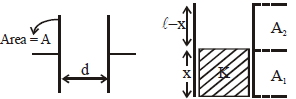
0 likes
View Solution192
EasyMCQ
The capacitance of a parallel plate capacitor with air as medium is $6\, \mu F$. With the introduction of a dielectric medium,the capacitance becomes $30\, \mu F$. The permittivity of the medium is..........$C^{2} N^{-1} m^{-2}$.
$(\varepsilon_{0} = 8.85 \times 10^{-12} C^{2} N^{-1} m^{-2})$
$(\varepsilon_{0} = 8.85 \times 10^{-12} C^{2} N^{-1} m^{-2})$
A
$5.00$
B
$0.44 \times 10^{-13}$
C
$1.77 \times 10^{-12}$
D
$0.44 \times 10^{-10}$
Solution
(D) The capacitance of a parallel plate capacitor with air is given by $C_{0} = 6\, \mu F$.
When a dielectric medium is introduced,the new capacitance is $C_{m} = 30\, \mu F$.
The dielectric constant $\epsilon_{r}$ is defined as the ratio of the capacitance with the medium to the capacitance with air:
$\epsilon_{r} = \frac{C_{m}}{C_{0}} = \frac{30}{6} = 5$.
The permittivity of the medium $\epsilon$ is given by $\epsilon = \epsilon_{0} \cdot \epsilon_{r}$.
Substituting the given values:
$\epsilon = 8.85 \times 10^{-12} \times 5 = 44.25 \times 10^{-12} = 0.4425 \times 10^{-10} \approx 0.44 \times 10^{-10} C^{2} N^{-1} m^{-2}$.
When a dielectric medium is introduced,the new capacitance is $C_{m} = 30\, \mu F$.
The dielectric constant $\epsilon_{r}$ is defined as the ratio of the capacitance with the medium to the capacitance with air:
$\epsilon_{r} = \frac{C_{m}}{C_{0}} = \frac{30}{6} = 5$.
The permittivity of the medium $\epsilon$ is given by $\epsilon = \epsilon_{0} \cdot \epsilon_{r}$.
Substituting the given values:
$\epsilon = 8.85 \times 10^{-12} \times 5 = 44.25 \times 10^{-12} = 0.4425 \times 10^{-10} \approx 0.44 \times 10^{-10} C^{2} N^{-1} m^{-2}$.
0 likes
View Solution193
MediumMCQ
$A$ parallel plate capacitor having cross-sectional area $A$ and separation $d$ has air in between the plates. Now,an insulating slab of same area but thickness $t = d/2$ is inserted between the plates as shown in the figure,having dielectric constant $K = 4$. The ratio of the new capacitance to its original capacitance will be:
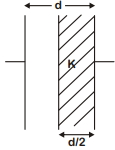
A
$4:1$
B
$2:1$
C
$8:5$
D
$6:5$
Solution
(C) The original capacitance of the parallel plate capacitor with air is given by $C_{0} = \frac{\varepsilon_{0} A}{d}$.
When a dielectric slab of thickness $t$ and dielectric constant $K$ is inserted between the plates,the new capacitance $C$ is given by the formula:
$C = \frac{\varepsilon_{0} A}{d - t + \frac{t}{K}}$
Given $t = \frac{d}{2}$ and $K = 4$,we substitute these values into the formula:
$C = \frac{\varepsilon_{0} A}{d - \frac{d}{2} + \frac{d/2}{4}}$
$C = \frac{\varepsilon_{0} A}{\frac{d}{2} + \frac{d}{8}}$
$C = \frac{\varepsilon_{0} A}{\frac{4d + d}{8}} = \frac{\varepsilon_{0} A}{\frac{5d}{8}}$
$C = \frac{8}{5} \frac{\varepsilon_{0} A}{d} = \frac{8}{5} C_{0}$
Therefore,the ratio of the new capacitance to the original capacitance is $\frac{C}{C_{0}} = \frac{8}{5}$.
When a dielectric slab of thickness $t$ and dielectric constant $K$ is inserted between the plates,the new capacitance $C$ is given by the formula:
$C = \frac{\varepsilon_{0} A}{d - t + \frac{t}{K}}$
Given $t = \frac{d}{2}$ and $K = 4$,we substitute these values into the formula:
$C = \frac{\varepsilon_{0} A}{d - \frac{d}{2} + \frac{d/2}{4}}$
$C = \frac{\varepsilon_{0} A}{\frac{d}{2} + \frac{d}{8}}$
$C = \frac{\varepsilon_{0} A}{\frac{4d + d}{8}} = \frac{\varepsilon_{0} A}{\frac{5d}{8}}$
$C = \frac{8}{5} \frac{\varepsilon_{0} A}{d} = \frac{8}{5} C_{0}$
Therefore,the ratio of the new capacitance to the original capacitance is $\frac{C}{C_{0}} = \frac{8}{5}$.
0 likes
View Solution194
MediumMCQ
$A$ capacitor of capacitance $9 \, nF$ having a dielectric slab of $\varepsilon_{r} = 2.4$,dielectric strength $20 \, MV/m$,and potential difference $V = 20 \, V$. The area of the plates is ....... $\times 10^{-4} \, m^{2}$.
A
$2.1$
B
$4.2$
C
$1.4$
D
$2.4$
Solution
(B) Let the separation between the plates be $d$. The electric field $E$ is given by $E = \frac{V}{d}$.
Given $E = 20 \, MV/m = 20 \times 10^{6} \, V/m$ and $V = 20 \, V$.
Substituting the values: $20 \times 10^{6} = \frac{20}{d}$,which gives $d = 10^{-6} \, m$.
The capacitance $C$ is given by $C = \frac{\varepsilon_{0} A \varepsilon_{r}}{d}$.
Substituting the values: $9 \times 10^{-9} = \frac{(8.85 \times 10^{-12}) \times A \times 2.4}{10^{-6}}$.
Rearranging for $A$: $A = \frac{9 \times 10^{-9} \times 10^{-6}}{8.85 \times 10^{-12} \times 2.4}$.
$A = \frac{9 \times 10^{-15}}{21.24 \times 10^{-12}} \approx 0.4237 \times 10^{-3} \, m^{2} = 4.237 \times 10^{-4} \, m^{2}$.
Rounding to the nearest option,$A = 4.2 \times 10^{-4} \, m^{2}$.
Given $E = 20 \, MV/m = 20 \times 10^{6} \, V/m$ and $V = 20 \, V$.
Substituting the values: $20 \times 10^{6} = \frac{20}{d}$,which gives $d = 10^{-6} \, m$.
The capacitance $C$ is given by $C = \frac{\varepsilon_{0} A \varepsilon_{r}}{d}$.
Substituting the values: $9 \times 10^{-9} = \frac{(8.85 \times 10^{-12}) \times A \times 2.4}{10^{-6}}$.
Rearranging for $A$: $A = \frac{9 \times 10^{-9} \times 10^{-6}}{8.85 \times 10^{-12} \times 2.4}$.
$A = \frac{9 \times 10^{-15}}{21.24 \times 10^{-12}} \approx 0.4237 \times 10^{-3} \, m^{2} = 4.237 \times 10^{-4} \, m^{2}$.
Rounding to the nearest option,$A = 4.2 \times 10^{-4} \, m^{2}$.
0 likes
View Solution195
MediumMCQ
$A$ capacitor of capacitance $15 \, nF$ having a dielectric slab of $\varepsilon_{r} = 2.5$,dielectric strength $30 \, MV/m$,and potential difference $V = 30 \, V$. The area of the plate is ....... $\times 10^{-4} \, m^{2}$.
A
$6.7$
B
$4.2$
C
$8.0$
D
$9.85$
Solution
(A) The expression for capacitance is given by:
$C = \frac{A \varepsilon_{0} \varepsilon_{r}}{d} \quad ......(I)$
The electric field $E$ is related to potential difference $V$ and distance $d$ by:
$E = \frac{V}{d} \implies d = \frac{V}{E}$
Given $V = 30 \, V$ and $E = 30 \times 10^{6} \, V/m$:
$d = \frac{30}{30 \times 10^{6}} = 10^{-6} \, m$
Now,substitute $C = 15 \times 10^{-9} \, F$,$\varepsilon_{0} = 8.85 \times 10^{-12} \, F/m$,$\varepsilon_{r} = 2.5$,and $d = 10^{-6} \, m$ into equation $(I)$:
$15 \times 10^{-9} = \frac{A \times (8.85 \times 10^{-12}) \times 2.5}{10^{-6}}$
$A = \frac{15 \times 10^{-9} \times 10^{-6}}{8.85 \times 10^{-12} \times 2.5}$
$A = \frac{15 \times 10^{-15}}{22.125 \times 10^{-12}}$
$A \approx 0.678 \times 10^{-3} \, m^{2} = 6.78 \times 10^{-4} \, m^{2}$
Rounding to the nearest option,$A = 6.7 \times 10^{-4} \, m^{2}$.
$C = \frac{A \varepsilon_{0} \varepsilon_{r}}{d} \quad ......(I)$
The electric field $E$ is related to potential difference $V$ and distance $d$ by:
$E = \frac{V}{d} \implies d = \frac{V}{E}$
Given $V = 30 \, V$ and $E = 30 \times 10^{6} \, V/m$:
$d = \frac{30}{30 \times 10^{6}} = 10^{-6} \, m$
Now,substitute $C = 15 \times 10^{-9} \, F$,$\varepsilon_{0} = 8.85 \times 10^{-12} \, F/m$,$\varepsilon_{r} = 2.5$,and $d = 10^{-6} \, m$ into equation $(I)$:
$15 \times 10^{-9} = \frac{A \times (8.85 \times 10^{-12}) \times 2.5}{10^{-6}}$
$A = \frac{15 \times 10^{-9} \times 10^{-6}}{8.85 \times 10^{-12} \times 2.5}$
$A = \frac{15 \times 10^{-15}}{22.125 \times 10^{-12}}$
$A \approx 0.678 \times 10^{-3} \, m^{2} = 6.78 \times 10^{-4} \, m^{2}$
Rounding to the nearest option,$A = 6.7 \times 10^{-4} \, m^{2}$.
0 likes
View Solution196
MediumMCQ
$A$ capacitor is connected to a battery of voltage $V$. If a dielectric slab of dielectric constant $k$ is completely inserted between the plates,what will be the final charge on the capacitor? (Assume the initial charge is $q_{0}$)
A
$\frac{\varepsilon_{0} A}{d} V$
B
$\frac{k \varepsilon_{0} A}{d} V$
C
$\frac{\varepsilon_{0} A}{k d} V$
D
Zero
Solution
(B) The initial capacitance of the capacitor is $C_{0} = \frac{\varepsilon_{0} A}{d}$.
The initial charge on the capacitor is $q_{0} = C_{0} V = \frac{\varepsilon_{0} A}{d} V$.
When a dielectric slab of dielectric constant $k$ is inserted between the plates while the battery remains connected,the potential difference $V$ across the plates remains constant.
The new capacitance becomes $C = k C_{0} = \frac{k \varepsilon_{0} A}{d}$.
The final charge on the capacitor is $q = C V = \left( \frac{k \varepsilon_{0} A}{d} \right) V = k q_{0}$.
The initial charge on the capacitor is $q_{0} = C_{0} V = \frac{\varepsilon_{0} A}{d} V$.
When a dielectric slab of dielectric constant $k$ is inserted between the plates while the battery remains connected,the potential difference $V$ across the plates remains constant.
The new capacitance becomes $C = k C_{0} = \frac{k \varepsilon_{0} A}{d}$.
The final charge on the capacitor is $q = C V = \left( \frac{k \varepsilon_{0} A}{d} \right) V = k q_{0}$.
0 likes
View Solution197
MediumMCQ
For changing the capacitance of a given parallel plate capacitor,a dielectric material of dielectric constant $K$ is used,which has the same area as the plates of the capacitor. The thickness of the dielectric slab is $\frac{3}{4} d$,where $d$ is the separation between the plates of the parallel plate capacitor. The new capacitance $(C')$ in terms of original capacitance $(C_{0})$ is given by the following relation:
A
$C' = \frac{3+K}{4K} C_{0}$
B
$C' = \frac{4+K}{3} C_{0}$
C
$C' = \frac{4K}{K+3} C_{0}$
D
$C' = \frac{4}{3+K} C_{0}$
Solution
(C) The original capacitance of the parallel plate capacitor is $C_{0} = \frac{\epsilon_{0} A}{d}$.
When a dielectric slab of thickness $t = \frac{3}{4}d$ is inserted,the system can be modeled as two capacitors $C_{1}$ and $C_{2}$ in series.
$C_{1}$ is the capacitance of the part filled with dielectric: $C_{1} = \frac{K \epsilon_{0} A}{3d/4} = \frac{4 K \epsilon_{0} A}{3d}$.
$C_{2}$ is the capacitance of the air gap: $C_{2} = \frac{\epsilon_{0} A}{d - 3d/4} = \frac{\epsilon_{0} A}{d/4} = \frac{4 \epsilon_{0} A}{d}$.
Since they are in series,the equivalent capacitance $C'$ is given by $\frac{1}{C'} = \frac{1}{C_{1}} + \frac{1}{C_{2}}$.
Substituting the values:
$\frac{1}{C'} = \frac{3d}{4 K \epsilon_{0} A} + \frac{d}{4 \epsilon_{0} A}$.
$\frac{1}{C'} = \frac{d}{4 \epsilon_{0} A} \left( \frac{3}{K} + 1 \right) = \frac{d}{4 \epsilon_{0} A} \left( \frac{3+K}{K} \right)$.
Therefore,$C' = \frac{4 K \epsilon_{0} A}{d(3+K)} = \frac{4K}{3+K} C_{0}$.
When a dielectric slab of thickness $t = \frac{3}{4}d$ is inserted,the system can be modeled as two capacitors $C_{1}$ and $C_{2}$ in series.
$C_{1}$ is the capacitance of the part filled with dielectric: $C_{1} = \frac{K \epsilon_{0} A}{3d/4} = \frac{4 K \epsilon_{0} A}{3d}$.
$C_{2}$ is the capacitance of the air gap: $C_{2} = \frac{\epsilon_{0} A}{d - 3d/4} = \frac{\epsilon_{0} A}{d/4} = \frac{4 \epsilon_{0} A}{d}$.
Since they are in series,the equivalent capacitance $C'$ is given by $\frac{1}{C'} = \frac{1}{C_{1}} + \frac{1}{C_{2}}$.
Substituting the values:
$\frac{1}{C'} = \frac{3d}{4 K \epsilon_{0} A} + \frac{d}{4 \epsilon_{0} A}$.
$\frac{1}{C'} = \frac{d}{4 \epsilon_{0} A} \left( \frac{3}{K} + 1 \right) = \frac{d}{4 \epsilon_{0} A} \left( \frac{3+K}{K} \right)$.
Therefore,$C' = \frac{4 K \epsilon_{0} A}{d(3+K)} = \frac{4K}{3+K} C_{0}$.
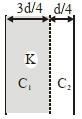
0 likes
View Solution198
MediumMCQ
$A$ parallel plate capacitor whose capacitance $C$ is $14 \, pF$ is charged by a battery to a potential difference $V = 12 \, V$ between its plates. The charging battery is now disconnected and a porcelain plate with dielectric constant $k = 7$ is inserted between the plates. The plate would oscillate back and forth between the plates with a constant mechanical energy of $.......... pJ$. (Assume no friction)
A
$872$
B
$972$
C
$784$
D
$864$
Solution
(D) Initial energy stored in the capacitor is given by $U_i = \frac{1}{2} C V^2$.
Substituting the values: $U_i = \frac{1}{2} \times 14 \, pF \times (12 \, V)^2 = \frac{1}{2} \times 14 \times 144 = 1008 \, pJ$.
When the battery is disconnected,the charge $Q$ on the plates remains constant.
After inserting the dielectric slab of constant $k = 7$,the new capacitance becomes $C' = kC = 7 \times 14 \, pF = 98 \, pF$.
The new energy stored in the capacitor is $U_f = \frac{Q^2}{2C'} = \frac{Q^2}{2(kC)} = \frac{U_i}{k}$.
$U_f = \frac{1008 \, pJ}{7} = 144 \, pJ$.
The loss in electrical potential energy is converted into the mechanical energy of the slab.
Mechanical energy $= U_i - U_f = 1008 \, pJ - 144 \, pJ = 864 \, pJ$.
Substituting the values: $U_i = \frac{1}{2} \times 14 \, pF \times (12 \, V)^2 = \frac{1}{2} \times 14 \times 144 = 1008 \, pJ$.
When the battery is disconnected,the charge $Q$ on the plates remains constant.
After inserting the dielectric slab of constant $k = 7$,the new capacitance becomes $C' = kC = 7 \times 14 \, pF = 98 \, pF$.
The new energy stored in the capacitor is $U_f = \frac{Q^2}{2C'} = \frac{Q^2}{2(kC)} = \frac{U_i}{k}$.
$U_f = \frac{1008 \, pJ}{7} = 144 \, pJ$.
The loss in electrical potential energy is converted into the mechanical energy of the slab.
Mechanical energy $= U_i - U_f = 1008 \, pJ - 144 \, pJ = 864 \, pJ$.
0 likes
View Solution199
DifficultMCQ
$A$ parallel plate capacitor has a plate area of $100\, m^{2}$ and a plate separation of $10\, m$. The space between the plates is filled up to a thickness of $5\, m$ with a material of dielectric constant $10$. The resultant capacitance of the system is $'x'\, pF$. Given $\varepsilon_{0} = 8.85 \times 10^{-12} F \cdot m^{-1}$,the value of $'x'$ to the nearest integer is:
A
$144$
B
$161$
C
$169$
D
$152$
Solution
(B) The capacitor can be modeled as two capacitors in series: one with a dielectric $(C_{1})$ and one with air $(C_{2})$.
Given: $A = 100\, m^{2}$,$d = 10\, m$,$t = 5\, m$,$K = 10$,$\varepsilon_{0} = 8.85 \times 10^{-12} F \cdot m^{-1}$.
The thickness of the dielectric is $t = 5\, m$ and the thickness of the air gap is $d - t = 10 - 5 = 5\, m$.
$C_{1} = \frac{K \varepsilon_{0} A}{t} = \frac{10 \times \varepsilon_{0} \times 100}{5} = 200 \varepsilon_{0}$.
$C_{2} = \frac{\varepsilon_{0} A}{d - t} = \frac{\varepsilon_{0} \times 100}{5} = 20 \varepsilon_{0}$.
Since they are in series,the equivalent capacitance $C_{eq}$ is given by:
$C_{eq} = \frac{C_{1} C_{2}}{C_{1} + C_{2}} = \frac{(200 \varepsilon_{0})(20 \varepsilon_{0})}{200 \varepsilon_{0} + 20 \varepsilon_{0}} = \frac{4000 \varepsilon_{0}^{2}}{220 \varepsilon_{0}} = \frac{400}{22} \varepsilon_{0} = \frac{200}{11} \varepsilon_{0}$.
Substituting $\varepsilon_{0} = 8.85 \times 10^{-12} F \cdot m^{-1}$:
$C_{eq} = \frac{200}{11} \times 8.85 \times 10^{-12} F = 18.1818 \times 8.85 \times 10^{-12} F \approx 160.909 \times 10^{-12} F$.
Since $1\, pF = 10^{-12} F$,$C_{eq} \approx 160.909\, pF$.
Rounding to the nearest integer,$x = 161$.
Given: $A = 100\, m^{2}$,$d = 10\, m$,$t = 5\, m$,$K = 10$,$\varepsilon_{0} = 8.85 \times 10^{-12} F \cdot m^{-1}$.
The thickness of the dielectric is $t = 5\, m$ and the thickness of the air gap is $d - t = 10 - 5 = 5\, m$.
$C_{1} = \frac{K \varepsilon_{0} A}{t} = \frac{10 \times \varepsilon_{0} \times 100}{5} = 200 \varepsilon_{0}$.
$C_{2} = \frac{\varepsilon_{0} A}{d - t} = \frac{\varepsilon_{0} \times 100}{5} = 20 \varepsilon_{0}$.
Since they are in series,the equivalent capacitance $C_{eq}$ is given by:
$C_{eq} = \frac{C_{1} C_{2}}{C_{1} + C_{2}} = \frac{(200 \varepsilon_{0})(20 \varepsilon_{0})}{200 \varepsilon_{0} + 20 \varepsilon_{0}} = \frac{4000 \varepsilon_{0}^{2}}{220 \varepsilon_{0}} = \frac{400}{22} \varepsilon_{0} = \frac{200}{11} \varepsilon_{0}$.
Substituting $\varepsilon_{0} = 8.85 \times 10^{-12} F \cdot m^{-1}$:
$C_{eq} = \frac{200}{11} \times 8.85 \times 10^{-12} F = 18.1818 \times 8.85 \times 10^{-12} F \approx 160.909 \times 10^{-12} F$.
Since $1\, pF = 10^{-12} F$,$C_{eq} \approx 160.909\, pF$.
Rounding to the nearest integer,$x = 161$.
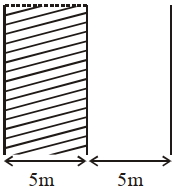
1 likes
View Solution200
DifficultMCQ
In a parallel plate capacitor setup,the plate area of the capacitor is $2 \, m^{2}$ and the plates are separated by $1 \, m$. If the space between the plates is filled with a dielectric material of thickness $0.5 \, m$ and area $2 \, m^{2}$ (see figure),the capacitance of the setup will be $......... \, \varepsilon_{0}$. (Dielectric constant of the material $= 3.2$) (Round off to the nearest integer).
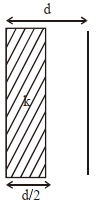
A
$1$
B
$5$
C
$3$
D
$6$
Solution
(C) The capacitance $C$ of a parallel plate capacitor with a dielectric slab of thickness $t$ and dielectric constant $K$ is given by the formula:
$C = \frac{\varepsilon_{0} A}{d - t + \frac{t}{K}}$
Given:
Area $A = 2 \, m^{2}$
Total separation $d = 1 \, m$
Thickness of dielectric $t = 0.5 \, m$
Dielectric constant $K = 3.2$
Substituting the values:
$C = \frac{\varepsilon_{0} \times 2}{1 - 0.5 + \frac{0.5}{3.2}}$
$C = \frac{2 \varepsilon_{0}}{0.5 + 0.15625}$
$C = \frac{2 \varepsilon_{0}}{0.65625}$
$C \approx 3.047 \, \varepsilon_{0}$
Rounding off to the nearest integer,we get $3 \, \varepsilon_{0}$.
$C = \frac{\varepsilon_{0} A}{d - t + \frac{t}{K}}$
Given:
Area $A = 2 \, m^{2}$
Total separation $d = 1 \, m$
Thickness of dielectric $t = 0.5 \, m$
Dielectric constant $K = 3.2$
Substituting the values:
$C = \frac{\varepsilon_{0} \times 2}{1 - 0.5 + \frac{0.5}{3.2}}$
$C = \frac{2 \varepsilon_{0}}{0.5 + 0.15625}$
$C = \frac{2 \varepsilon_{0}}{0.65625}$
$C \approx 3.047 \, \varepsilon_{0}$
Rounding off to the nearest integer,we get $3 \, \varepsilon_{0}$.
0 likes
View SolutionElectric Potential and Capacitance — Effect of Dielectric Inside Capacitor · Frequently Asked Questions
1Are these Electric Potential and Capacitance questions useful for JEE and NEET?
Yes. All questions in this section are mapped to JEE Main and NEET exam patterns. Previous year questions from JEE Main, NEET, GUJCET and state-level exams are included with full solutions.
2Can I switch to Hindi or Gujarati for these questions?
Yes. Use the language tabs in the hero section or the sidebar to view the same questions and solutions in English, Hindi or Gujarati.
3How do I generate a question paper from this subtopic?
Use the Vedclass Exam Paper Generator — select the chapter and subtopic, set difficulty, and generate Sets A, B, C, D automatically. First 3 chapters of every subject are free.
Vedclass Products
For Students
Vedclass Test Series
Mock tests in real JEE/NEET style with performance analysis. 5-day free trial.
Start Free TrialFor Teachers
Exam Paper Generator
Generate Set A/B/C/D papers from this chapter in 2 minutes. 3 chapters free.
Try FreeFor Institutes
Online Exam Module
Live online exams with unlimited students, 360° analytics & white-label branding.
See DemoFor Teachers & Institutes
Generate a Electric Potential and Capacitance Exam Paper in 2 Minutes
Select subtopic & difficulty — Sets A, B, C, D auto-generated with No Repeat logic.
First 3 chapters of every subject are free — no payment required.