
A English
Effect of Dielectric Inside Capacitor Questions in English
Class 12 Physics · Electric Potential and Capacitance · Effect of Dielectric Inside Capacitor
347+
Questions
English
Language
100%
With Solutions
Showing 50 of 347 questions in English
51
EasyMCQ
When a dielectric material is introduced between the plates of a charged capacitor,the electric field between the plates:
A
Remains constant
B
Decreases
C
Increases
D
First increases then decreases
Solution
(B) When a dielectric material with dielectric constant $K$ is introduced between the plates of a charged capacitor,the induced charges on the dielectric surface create an internal electric field that opposes the original external electric field.
If the original electric field is $E_0$,the new electric field $E$ is given by $E = \frac{E_0}{K}$.
Since $K > 1$ for any dielectric material,the resulting electric field $E$ is less than the original electric field $E_0$.
Therefore,the electric field between the plates decreases.
If the original electric field is $E_0$,the new electric field $E$ is given by $E = \frac{E_0}{K}$.
Since $K > 1$ for any dielectric material,the resulting electric field $E$ is less than the original electric field $E_0$.
Therefore,the electric field between the plates decreases.
0 likes
View Solution52
EasyMCQ
The capacity of an air condenser is $2.0 \, \mu F$. If a medium is placed between its plates,the capacity becomes $12 \, \mu F$. The dielectric constant of the medium will be:
A
$5$
B
$4$
C
$3$
D
$6$
Solution
(D) The dielectric constant $K$ of a medium is defined as the ratio of the capacitance of the capacitor with the dielectric medium $(C_m)$ to the capacitance of the capacitor with air or vacuum $(C_0)$.
Given:
$C_0 = 2.0 \, \mu F$
$C_m = 12 \, \mu F$
Using the formula:
$K = \frac{C_m}{C_0}$
$K = \frac{12 \, \mu F}{2.0 \, \mu F} = 6$
Therefore,the dielectric constant of the medium is $6$.
Given:
$C_0 = 2.0 \, \mu F$
$C_m = 12 \, \mu F$
Using the formula:
$K = \frac{C_m}{C_0}$
$K = \frac{12 \, \mu F}{2.0 \, \mu F} = 6$
Therefore,the dielectric constant of the medium is $6$.
0 likes
View Solution53
EasyMCQ
If the distance between the plates of a parallel plate capacitor is halved and the dielectric constant of the dielectric is doubled,then its capacity will
A
Increase by $16$ times
B
Increase by $4$ times
C
Increase by $2$ times
D
Remain the same
Solution
(B) The capacitance of a parallel plate capacitor is given by $C = \frac{K \varepsilon_0 A}{d}$,where $K$ is the dielectric constant,$\varepsilon_0$ is the permittivity of free space,$A$ is the area of the plates,and $d$ is the distance between them.
From the formula,we see that $C \propto \frac{K}{d}$.
Let the initial capacitance be $C_1 = \frac{K_1 \varepsilon_0 A}{d_1}$.
Given: $d_2 = \frac{d_1}{2}$ and $K_2 = 2K_1$.
The new capacitance $C_2$ is given by $C_2 = \frac{K_2 \varepsilon_0 A}{d_2} = \frac{(2K_1) \varepsilon_0 A}{d_1/2} = 4 \times \frac{K_1 \varepsilon_0 A}{d_1} = 4C_1$.
Therefore,the capacity increases by $4$ times.
From the formula,we see that $C \propto \frac{K}{d}$.
Let the initial capacitance be $C_1 = \frac{K_1 \varepsilon_0 A}{d_1}$.
Given: $d_2 = \frac{d_1}{2}$ and $K_2 = 2K_1$.
The new capacitance $C_2$ is given by $C_2 = \frac{K_2 \varepsilon_0 A}{d_2} = \frac{(2K_1) \varepsilon_0 A}{d_1/2} = 4 \times \frac{K_1 \varepsilon_0 A}{d_1} = 4C_1$.
Therefore,the capacity increases by $4$ times.
0 likes
View Solution54
EasyMCQ
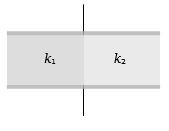
$A$ parallel plate capacitor is filled with two dielectrics as shown in the figure. The area of each plate is $A \; m^2$ and the separation between the plates is $t \; m$. The dielectric constants are $k_1$ and $k_2$ respectively. Its capacitance in farad will be:
A
$\frac{\varepsilon_0 A}{t}(k_1 + k_2)$
B
$\frac{\varepsilon_0 A}{t} \cdot \frac{k_1 + k_2}{2}$
C
$\frac{2\varepsilon_0 A}{t}(k_1 + k_2)$
D
$\frac{\varepsilon_0 A}{t} \cdot \frac{k_1 - k_2}{2}$
Solution
(B) The given arrangement can be considered as two capacitors connected in parallel,each having an area $A/2$ and plate separation $t$.
For the first capacitor with dielectric constant $k_1$,the capacitance is $C_1 = \frac{k_1 \varepsilon_0 (A/2)}{t} = \frac{k_1 \varepsilon_0 A}{2t}$.
For the second capacitor with dielectric constant $k_2$,the capacitance is $C_2 = \frac{k_2 \varepsilon_0 (A/2)}{t} = \frac{k_2 \varepsilon_0 A}{2t}$.
Since they are in parallel,the equivalent capacitance $C = C_1 + C_2$.
$C = \frac{k_1 \varepsilon_0 A}{2t} + \frac{k_2 \varepsilon_0 A}{2t} = \frac{\varepsilon_0 A}{2t}(k_1 + k_2) = \frac{\varepsilon_0 A}{t} \cdot \frac{k_1 + k_2}{2}$.
Thus,the correct option is $B$.
For the first capacitor with dielectric constant $k_1$,the capacitance is $C_1 = \frac{k_1 \varepsilon_0 (A/2)}{t} = \frac{k_1 \varepsilon_0 A}{2t}$.
For the second capacitor with dielectric constant $k_2$,the capacitance is $C_2 = \frac{k_2 \varepsilon_0 (A/2)}{t} = \frac{k_2 \varepsilon_0 A}{2t}$.
Since they are in parallel,the equivalent capacitance $C = C_1 + C_2$.
$C = \frac{k_1 \varepsilon_0 A}{2t} + \frac{k_2 \varepsilon_0 A}{2t} = \frac{\varepsilon_0 A}{2t}(k_1 + k_2) = \frac{\varepsilon_0 A}{t} \cdot \frac{k_1 + k_2}{2}$.
Thus,the correct option is $B$.
0 likes
View Solution55
MediumMCQ
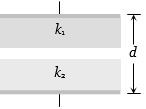
Two dielectric slabs of dielectric constants $K_1$ and $K_2$ are filled between the plates of a parallel plate capacitor as shown in the figure. If the area of each plate is $A$ and the separation between the plates is $d$,what is the equivalent capacitance of the capacitor?
A
$\frac{{2{\varepsilon _0}A}}{d}({K_1} + {K_2})$
B
$\frac{{2{\varepsilon _0}A}}{d}\left( {\frac{{{K_1} + {K_2}}}{{{K_1}{K_2}}}} \right)$
C
$\frac{{{\varepsilon _0}A}}{d}\left( {\frac{{{K_1}{K_2}}}{{{K_1} + {K_2}}}} \right)$
D
$\frac{{2{\varepsilon _0}A}}{d}\left( {\frac{{{K_1}{K_2}}}{{{K_1} + {K_2}}}} \right)$
Solution
(D) The capacitor can be viewed as two capacitors in series,each with plate area $A$ and plate separation $d/2$.
The capacitance of the first capacitor is $C_1 = \frac{K_1 \varepsilon_0 A}{d/2} = \frac{2 K_1 \varepsilon_0 A}{d}$.
The capacitance of the second capacitor is $C_2 = \frac{K_2 \varepsilon_0 A}{d/2} = \frac{2 K_2 \varepsilon_0 A}{d}$.
Since they are in series,the equivalent capacitance $C_{eq}$ is given by $\frac{1}{C_{eq}} = \frac{1}{C_1} + \frac{1}{C_2}$.
$\frac{1}{C_{eq}} = \frac{d}{2 K_1 \varepsilon_0 A} + \frac{d}{2 K_2 \varepsilon_0 A} = \frac{d}{2 \varepsilon_0 A} \left( \frac{1}{K_1} + \frac{1}{K_2} \right) = \frac{d}{2 \varepsilon_0 A} \left( \frac{K_1 + K_2}{K_1 K_2} \right)$.
Therefore,$C_{eq} = \frac{2 \varepsilon_0 A}{d} \left( \frac{K_1 K_2}{K_1 + K_2} \right)$.
The capacitance of the first capacitor is $C_1 = \frac{K_1 \varepsilon_0 A}{d/2} = \frac{2 K_1 \varepsilon_0 A}{d}$.
The capacitance of the second capacitor is $C_2 = \frac{K_2 \varepsilon_0 A}{d/2} = \frac{2 K_2 \varepsilon_0 A}{d}$.
Since they are in series,the equivalent capacitance $C_{eq}$ is given by $\frac{1}{C_{eq}} = \frac{1}{C_1} + \frac{1}{C_2}$.
$\frac{1}{C_{eq}} = \frac{d}{2 K_1 \varepsilon_0 A} + \frac{d}{2 K_2 \varepsilon_0 A} = \frac{d}{2 \varepsilon_0 A} \left( \frac{1}{K_1} + \frac{1}{K_2} \right) = \frac{d}{2 \varepsilon_0 A} \left( \frac{K_1 + K_2}{K_1 K_2} \right)$.
Therefore,$C_{eq} = \frac{2 \varepsilon_0 A}{d} \left( \frac{K_1 K_2}{K_1 + K_2} \right)$.
0 likes
View Solution56
DifficultMCQ
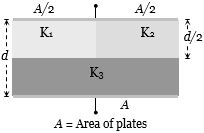
$A$ parallel plate capacitor of area $A$,plate separation $d$ and capacitance $C$ is filled with three different dielectric materials having dielectric constants $k_1, k_2$ and $k_3$ as shown in the figure. If a single dielectric material is to be used to have the same capacitance $C$ in this capacitor,then its dielectric constant $k$ is given by:
A
$\frac{1}{k} = \frac{1}{k_1} + \frac{1}{k_2} + \frac{1}{2k_3}$
B
$\frac{1}{k} = \frac{1}{k_1 + k_2} + \frac{1}{2k_3}$
C
$k = \frac{k_1 k_2}{k_1 + k_2} + 2k_3$
D
$k = k_1 + k_2 + 2k_3$
Solution
(B) The capacitor can be viewed as a combination of three capacitors. The top half consists of two capacitors in parallel with areas $A/2$ and separation $d/2$,having capacitances $C_1 = \frac{k_1 \epsilon_0 (A/2)}{d/2} = \frac{k_1 \epsilon_0 A}{d}$ and $C_2 = \frac{k_2 \epsilon_0 (A/2)}{d/2} = \frac{k_2 \epsilon_0 A}{d}$.
These two are in parallel,so their equivalent capacitance is $C_{12} = C_1 + C_2 = \frac{\epsilon_0 A}{d} (k_1 + k_2)$.
The bottom half is a capacitor with area $A$ and separation $d/2$,having capacitance $C_3 = \frac{k_3 \epsilon_0 A}{d/2} = \frac{2k_3 \epsilon_0 A}{d}$.
Since $C_{12}$ and $C_3$ are in series,the total capacitance $C$ is given by $\frac{1}{C} = \frac{1}{C_{12}} + \frac{1}{C_3}$.
Substituting the values: $\frac{1}{C} = \frac{d}{\epsilon_0 A (k_1 + k_2)} + \frac{d}{2k_3 \epsilon_0 A} = \frac{d}{\epsilon_0 A} \left( \frac{1}{k_1 + k_2} + \frac{1}{2k_3} \right)$.
For a single dielectric $k$,$C = \frac{k \epsilon_0 A}{d}$,so $\frac{1}{C} = \frac{d}{k \epsilon_0 A}$.
Comparing the two expressions,we get $\frac{1}{k} = \frac{1}{k_1 + k_2} + \frac{1}{2k_3}$.
These two are in parallel,so their equivalent capacitance is $C_{12} = C_1 + C_2 = \frac{\epsilon_0 A}{d} (k_1 + k_2)$.
The bottom half is a capacitor with area $A$ and separation $d/2$,having capacitance $C_3 = \frac{k_3 \epsilon_0 A}{d/2} = \frac{2k_3 \epsilon_0 A}{d}$.
Since $C_{12}$ and $C_3$ are in series,the total capacitance $C$ is given by $\frac{1}{C} = \frac{1}{C_{12}} + \frac{1}{C_3}$.
Substituting the values: $\frac{1}{C} = \frac{d}{\epsilon_0 A (k_1 + k_2)} + \frac{d}{2k_3 \epsilon_0 A} = \frac{d}{\epsilon_0 A} \left( \frac{1}{k_1 + k_2} + \frac{1}{2k_3} \right)$.
For a single dielectric $k$,$C = \frac{k \epsilon_0 A}{d}$,so $\frac{1}{C} = \frac{d}{k \epsilon_0 A}$.
Comparing the two expressions,we get $\frac{1}{k} = \frac{1}{k_1 + k_2} + \frac{1}{2k_3}$.
0 likes
View Solution57
MediumMCQ
In the figure,a capacitor is filled with dielectrics. The resultant capacitance is
A
$\frac{{2{\varepsilon _0}A}}{d}\,\left[ {\frac{1}{{{k_1}}} + \frac{1}{{{k_2}}} + \frac{1}{{{k_3}}}} \right]$
B
$\frac{{{\varepsilon _0}A}}{d}\,\left[ {\frac{1}{{{k_1}}} + \frac{1}{{{k_2}}} + \frac{1}{{{k_3}}}} \right]$
C
$\frac{{2{\varepsilon _0}A}}{d}\,\left[ {{k_1} + {k_2} + {k_3}} \right]$
D
None of these
Solution
(D) The capacitor can be modeled as a combination of three capacitors.
Capacitors with dielectrics $K_1$ and $K_2$ are in parallel with each other,and this combination is in series with the capacitor containing dielectric $K_3$.
For the top part,the area is $A/2$ and the distance is $d/2$:
$C_1 = \frac{K_1 \varepsilon_0 (A/2)}{d/2} = \frac{K_1 \varepsilon_0 A}{d}$
$C_2 = \frac{K_2 \varepsilon_0 (A/2)}{d/2} = \frac{K_2 \varepsilon_0 A}{d}$
Since $C_1$ and $C_2$ are in parallel,their equivalent capacitance is $C_p = C_1 + C_2 = \frac{\varepsilon_0 A}{d} (K_1 + K_2)$.
For the bottom part,the area is $A$ and the distance is $d/2$:
$C_3 = \frac{K_3 \varepsilon_0 A}{d/2} = \frac{2 K_3 \varepsilon_0 A}{d}$.
Now,$C_p$ and $C_3$ are in series:
$C_{eq} = \frac{C_p C_3}{C_p + C_3} = \frac{\left[ \frac{\varepsilon_0 A}{d} (K_1 + K_2) \right] \left[ \frac{2 K_3 \varepsilon_0 A}{d} \right]}{\frac{\varepsilon_0 A}{d} (K_1 + K_2 + 2K_3)} = \frac{2 K_3 (K_1 + K_2)}{K_1 + K_2 + 2K_3} \frac{\varepsilon_0 A}{d}$.
This expression does not match any of the given options,so the correct answer is $(d)$.
Capacitors with dielectrics $K_1$ and $K_2$ are in parallel with each other,and this combination is in series with the capacitor containing dielectric $K_3$.
For the top part,the area is $A/2$ and the distance is $d/2$:
$C_1 = \frac{K_1 \varepsilon_0 (A/2)}{d/2} = \frac{K_1 \varepsilon_0 A}{d}$
$C_2 = \frac{K_2 \varepsilon_0 (A/2)}{d/2} = \frac{K_2 \varepsilon_0 A}{d}$
Since $C_1$ and $C_2$ are in parallel,their equivalent capacitance is $C_p = C_1 + C_2 = \frac{\varepsilon_0 A}{d} (K_1 + K_2)$.
For the bottom part,the area is $A$ and the distance is $d/2$:
$C_3 = \frac{K_3 \varepsilon_0 A}{d/2} = \frac{2 K_3 \varepsilon_0 A}{d}$.
Now,$C_p$ and $C_3$ are in series:
$C_{eq} = \frac{C_p C_3}{C_p + C_3} = \frac{\left[ \frac{\varepsilon_0 A}{d} (K_1 + K_2) \right] \left[ \frac{2 K_3 \varepsilon_0 A}{d} \right]}{\frac{\varepsilon_0 A}{d} (K_1 + K_2 + 2K_3)} = \frac{2 K_3 (K_1 + K_2)}{K_1 + K_2 + 2K_3} \frac{\varepsilon_0 A}{d}$.
This expression does not match any of the given options,so the correct answer is $(d)$.
0 likes
View Solution58
MediumMCQ
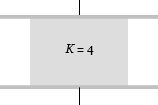
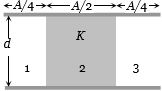
Consider a parallel plate capacitor of $10\,\mu F$ with air filled in the gap between the plates. Now,one half of the space between the plates is filled with a dielectric of dielectric constant $K = 4$,as shown in the figure. The capacity of the capacitor changes to.......$\mu F$.
A
$25$
B
$20$
C
$40$
D
$5$
Solution
(A) The initial capacitance of the air-filled capacitor is $C_0 = \frac{\varepsilon_0 A}{d} = 10\,\mu F$.
As shown in the figure,the capacitor can be considered as three capacitors in parallel: two air-filled capacitors ($C_1$ and $C_3$) each with area $A/4$ and distance $d$,and one dielectric-filled capacitor $(C_2)$ with area $A/2$,distance $d$,and dielectric constant $K=4$.
The capacitances are:
$C_1 = \frac{\varepsilon_0 (A/4)}{d} = \frac{1}{4} \left( \frac{\varepsilon_0 A}{d} \right) = \frac{1}{4} C_0 = 2.5\,\mu F$
$C_3 = \frac{\varepsilon_0 (A/4)}{d} = \frac{1}{4} C_0 = 2.5\,\mu F$
$C_2 = \frac{K \varepsilon_0 (A/2)}{d} = \frac{K}{2} \left( \frac{\varepsilon_0 A}{d} \right) = \frac{4}{2} C_0 = 2 C_0 = 20\,\mu F$
Since they are in parallel,the equivalent capacitance is:
$C_{eq} = C_1 + C_2 + C_3 = 2.5 + 20 + 2.5 = 25\,\mu F$.
As shown in the figure,the capacitor can be considered as three capacitors in parallel: two air-filled capacitors ($C_1$ and $C_3$) each with area $A/4$ and distance $d$,and one dielectric-filled capacitor $(C_2)$ with area $A/2$,distance $d$,and dielectric constant $K=4$.
The capacitances are:
$C_1 = \frac{\varepsilon_0 (A/4)}{d} = \frac{1}{4} \left( \frac{\varepsilon_0 A}{d} \right) = \frac{1}{4} C_0 = 2.5\,\mu F$
$C_3 = \frac{\varepsilon_0 (A/4)}{d} = \frac{1}{4} C_0 = 2.5\,\mu F$
$C_2 = \frac{K \varepsilon_0 (A/2)}{d} = \frac{K}{2} \left( \frac{\varepsilon_0 A}{d} \right) = \frac{4}{2} C_0 = 2 C_0 = 20\,\mu F$
Since they are in parallel,the equivalent capacitance is:
$C_{eq} = C_1 + C_2 + C_3 = 2.5 + 20 + 2.5 = 25\,\mu F$.
0 likes
View Solution59
MediumMCQ
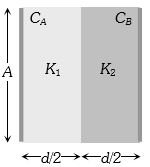
$A$ parallel plate capacitor has capacitance $C$. If it is equally filled with parallel layers of materials of dielectric constants $K_1$ and $K_2$,its capacity becomes $C_1$. The ratio of $C_1$ to $C$ is
A
$K_1 + K_2$
B
$\frac{K_1 K_2}{K_1 - K_2}$
C
$\frac{K_1 + K_2}{K_1 K_2}$
D
$\frac{2 K_1 K_2}{K_1 + K_2}$
Solution
(D) The initial capacitance of the parallel plate capacitor is $C = \frac{\varepsilon_0 A}{d}$.
When the space between the plates is filled with two dielectric layers of thickness $d/2$ each,they act as two capacitors in series.
The capacitance of the first layer is $C_A = \frac{K_1 \varepsilon_0 A}{d/2} = \frac{2 K_1 \varepsilon_0 A}{d} = 2 K_1 C$.
The capacitance of the second layer is $C_B = \frac{K_2 \varepsilon_0 A}{d/2} = \frac{2 K_2 \varepsilon_0 A}{d} = 2 K_2 C$.
Since they are in series,the equivalent capacitance $C_1$ is given by $\frac{1}{C_1} = \frac{1}{C_A} + \frac{1}{C_B} = \frac{1}{2 K_1 C} + \frac{1}{2 K_2 C} = \frac{K_1 + K_2}{2 K_1 K_2 C}$.
Therefore,$C_1 = \frac{2 K_1 K_2}{K_1 + K_2} C$.
The ratio $C_1/C$ is $\frac{2 K_1 K_2}{K_1 + K_2}$.
When the space between the plates is filled with two dielectric layers of thickness $d/2$ each,they act as two capacitors in series.
The capacitance of the first layer is $C_A = \frac{K_1 \varepsilon_0 A}{d/2} = \frac{2 K_1 \varepsilon_0 A}{d} = 2 K_1 C$.
The capacitance of the second layer is $C_B = \frac{K_2 \varepsilon_0 A}{d/2} = \frac{2 K_2 \varepsilon_0 A}{d} = 2 K_2 C$.
Since they are in series,the equivalent capacitance $C_1$ is given by $\frac{1}{C_1} = \frac{1}{C_A} + \frac{1}{C_B} = \frac{1}{2 K_1 C} + \frac{1}{2 K_2 C} = \frac{K_1 + K_2}{2 K_1 K_2 C}$.
Therefore,$C_1 = \frac{2 K_1 K_2}{K_1 + K_2} C$.
The ratio $C_1/C$ is $\frac{2 K_1 K_2}{K_1 + K_2}$.
0 likes
View Solution60
EasyMCQ
$A$ parallel plate air capacitor has a capacitance of $100\,\mu F$. The plates are at a distance $d$ apart. If a slab of thickness $t$ $(t < d)$ and dielectric constant $K = 5$ is introduced between the parallel plates,then the new capacitance will be:
A
$100\,\mu F$
B
$> 100\,\mu F$ but $< 500\,\mu F$
C
$500\,\mu F$
D
$< 100\,\mu F$
Solution
(B) The capacitance of a parallel plate capacitor with air is $C_0 = \frac{\epsilon_0 A}{d} = 100\,\mu F$.
When a dielectric slab of thickness $t$ and dielectric constant $K$ is introduced,the new capacitance $C'$ is given by the formula:
$C' = \frac{\epsilon_0 A}{d - t + \frac{t}{K}}$
Substituting $K = 5$:
$C' = \frac{\epsilon_0 A}{d - t + \frac{t}{5}} = \frac{\epsilon_0 A}{d - 0.8t}$
Since $t < d$,the denominator $(d - 0.8t)$ is less than $d$. Therefore,$C' > C_0$.
Also,if the slab were to fill the entire space $(t = d)$,the capacitance would be $K \times C_0 = 5 \times 100 = 500\,\mu F$.
Since $t < d$,the new capacitance $C'$ must be greater than $100\,\mu F$ but less than $500\,\mu F$.
When a dielectric slab of thickness $t$ and dielectric constant $K$ is introduced,the new capacitance $C'$ is given by the formula:
$C' = \frac{\epsilon_0 A}{d - t + \frac{t}{K}}$
Substituting $K = 5$:
$C' = \frac{\epsilon_0 A}{d - t + \frac{t}{5}} = \frac{\epsilon_0 A}{d - 0.8t}$
Since $t < d$,the denominator $(d - 0.8t)$ is less than $d$. Therefore,$C' > C_0$.
Also,if the slab were to fill the entire space $(t = d)$,the capacitance would be $K \times C_0 = 5 \times 100 = 500\,\mu F$.
Since $t < d$,the new capacitance $C'$ must be greater than $100\,\mu F$ but less than $500\,\mu F$.
0 likes
View Solution61
MediumMCQ
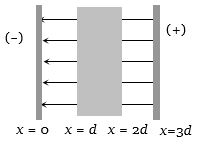
$A$ dielectric slab of thickness $d$ is inserted in a parallel plate capacitor whose negative plate is at $x = 0$ and positive plate is at $x = 3d$. The slab is equidistant from the plates. The capacitor is given some charge. As one goes from $x = 0$ to $x = 3d$:
A
The magnitude of the electric field remains the same.
B
The direction of the electric field remains the same.
C
The electric potential increases continuously.
D
Both $(b)$ and $(c)$.
Solution
(D) The negative plate is at $x = 0$ and the positive plate is at $x = 3d$. The electric field lines are always directed from the positive plate to the negative plate. Therefore,the direction of the electric field is from $x = 3d$ towards $x = 0$ (i.e.,in the negative $x$-direction) throughout the region. Thus,the direction remains the same.
The magnitude of the electric field in the air gap is $E_{air} = \frac{\sigma}{\varepsilon_0}$ and in the dielectric slab is $E_{dielectric} = \frac{\sigma}{K\varepsilon_0}$. Since $K > 1$,the magnitudes are different.
Electric potential $V$ is related to the electric field $E$ by $E = -\frac{dV}{dx}$. Since the electric field is directed towards the negative $x$-axis,$E_x < 0$. Thus,$-\frac{dV}{dx} < 0$,which implies $\frac{dV}{dx} > 0$. This means the electric potential $V$ increases continuously as we move from $x = 0$ (negative plate) to $x = 3d$ (positive plate).
Therefore,both statements $(b)$ and $(c)$ are correct.
The magnitude of the electric field in the air gap is $E_{air} = \frac{\sigma}{\varepsilon_0}$ and in the dielectric slab is $E_{dielectric} = \frac{\sigma}{K\varepsilon_0}$. Since $K > 1$,the magnitudes are different.
Electric potential $V$ is related to the electric field $E$ by $E = -\frac{dV}{dx}$. Since the electric field is directed towards the negative $x$-axis,$E_x < 0$. Thus,$-\frac{dV}{dx} < 0$,which implies $\frac{dV}{dx} > 0$. This means the electric potential $V$ increases continuously as we move from $x = 0$ (negative plate) to $x = 3d$ (positive plate).
Therefore,both statements $(b)$ and $(c)$ are correct.
0 likes
View Solution62
DifficultMCQ
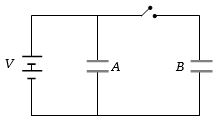
The figure given below shows two identical parallel plate capacitors connected to a battery with switch $S$ closed. The switch is now opened and the free space between the plates of both capacitors is filled with a dielectric of dielectric constant $K = 3$. What will be the ratio of the total electrostatic energy stored in both capacitors before and after the introduction of the dielectric?
A
$3:1$
B
$5:1$
C
$3:5$
D
$5:3$
Solution
(C) Initially,the switch $S$ is closed. Both capacitors $A$ and $B$ are connected in parallel to the battery of potential $V$. The capacitance of each capacitor is $C$.
The initial total energy stored in the system is:
$U_1 = \frac{1}{2}CV^2 + \frac{1}{2}CV^2 = CV^2$ --- $(i)$
When the switch $S$ is opened,capacitor $A$ remains connected to the battery,so its potential difference remains $V$. Capacitor $B$ is disconnected from the battery,so its charge $Q$ remains constant. The initial charge on capacitor $B$ was $Q = CV$.
After filling the space with a dielectric of constant $K = 3$,the new capacitance of each capacitor becomes $C' = KC = 3C$.
For capacitor $A$,the potential difference remains $V$. The new energy is $U_{A}' = \frac{1}{2}C'V^2 = \frac{1}{2}(3C)V^2 = \frac{3}{2}CV^2$.
For capacitor $B$,the charge $Q = CV$ remains constant. The new energy is $U_{B}' = \frac{Q^2}{2C'} = \frac{(CV)^2}{2(3C)} = \frac{1}{6}CV^2$.
The final total energy stored in the system is:
$U_2 = U_{A}' + U_{B}' = \frac{3}{2}CV^2 + \frac{1}{6}CV^2 = \left(\frac{9+1}{6}\right)CV^2 = \frac{10}{6}CV^2 = \frac{5}{3}CV^2$ --- (ii)
The ratio of total electrostatic energy before and after is:
$\frac{U_1}{U_2} = \frac{CV^2}{(5/3)CV^2} = \frac{3}{5}$
The initial total energy stored in the system is:
$U_1 = \frac{1}{2}CV^2 + \frac{1}{2}CV^2 = CV^2$ --- $(i)$
When the switch $S$ is opened,capacitor $A$ remains connected to the battery,so its potential difference remains $V$. Capacitor $B$ is disconnected from the battery,so its charge $Q$ remains constant. The initial charge on capacitor $B$ was $Q = CV$.
After filling the space with a dielectric of constant $K = 3$,the new capacitance of each capacitor becomes $C' = KC = 3C$.
For capacitor $A$,the potential difference remains $V$. The new energy is $U_{A}' = \frac{1}{2}C'V^2 = \frac{1}{2}(3C)V^2 = \frac{3}{2}CV^2$.
For capacitor $B$,the charge $Q = CV$ remains constant. The new energy is $U_{B}' = \frac{Q^2}{2C'} = \frac{(CV)^2}{2(3C)} = \frac{1}{6}CV^2$.
The final total energy stored in the system is:
$U_2 = U_{A}' + U_{B}' = \frac{3}{2}CV^2 + \frac{1}{6}CV^2 = \left(\frac{9+1}{6}\right)CV^2 = \frac{10}{6}CV^2 = \frac{5}{3}CV^2$ --- (ii)
The ratio of total electrostatic energy before and after is:
$\frac{U_1}{U_2} = \frac{CV^2}{(5/3)CV^2} = \frac{3}{5}$
0 likes
View Solution63
MediumMCQ
Between the plates of a parallel plate capacitor, a dielectric plate is introduced to completely fill the space between the plates. The capacitor is charged and then disconnected from the battery. The dielectric plate is slowly drawn out of the capacitor parallel to the plates. The plot of the potential difference $V$ across the plates versus the length $x$ of the dielectric plate drawn out is:
A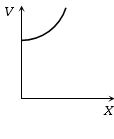
B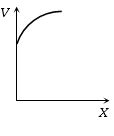
C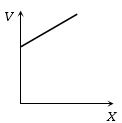
D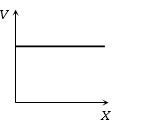
Solution
(B) When the capacitor is disconnected from the battery, the charge $Q$ on the plates remains constant.
The capacitance $C$ of a parallel plate capacitor with a dielectric is given by $C = \frac{K \epsilon_0 A}{d}$.
As the dielectric plate of length $L$ is drawn out by a distance $x$, the capacitor can be considered as two capacitors in parallel: one with dielectric (length $L-x$) and one with air (length $x$).
The equivalent capacitance $C(x)$ decreases as $x$ increases.
Since $V = \frac{Q}{C}$, and $Q$ is constant, the potential difference $V$ increases as $C$ decreases.
Specifically, $C(x) = \frac{\epsilon_0 w}{d} (L-x)K + \frac{\epsilon_0 w}{d} x = \frac{\epsilon_0 w}{d} [K(L-x) + x]$.
As $x$ increases from $0$ to $L$, $C(x)$ decreases linearly, which means $V(x) = \frac{Q}{C(x)}$ will increase non-linearly (specifically, it follows a hyperbolic curve $V \propto \frac{1}{a-bx}$).
Once the dielectric is completely removed $(x=L)$, the capacitance becomes constant $(C_{air} = \frac{\epsilon_0 A}{d})$, and thus the potential difference $V$ becomes constant.
Graph $B$ correctly shows $V$ increasing non-linearly and then becoming constant.
The capacitance $C$ of a parallel plate capacitor with a dielectric is given by $C = \frac{K \epsilon_0 A}{d}$.
As the dielectric plate of length $L$ is drawn out by a distance $x$, the capacitor can be considered as two capacitors in parallel: one with dielectric (length $L-x$) and one with air (length $x$).
The equivalent capacitance $C(x)$ decreases as $x$ increases.
Since $V = \frac{Q}{C}$, and $Q$ is constant, the potential difference $V$ increases as $C$ decreases.
Specifically, $C(x) = \frac{\epsilon_0 w}{d} (L-x)K + \frac{\epsilon_0 w}{d} x = \frac{\epsilon_0 w}{d} [K(L-x) + x]$.
As $x$ increases from $0$ to $L$, $C(x)$ decreases linearly, which means $V(x) = \frac{Q}{C(x)}$ will increase non-linearly (specifically, it follows a hyperbolic curve $V \propto \frac{1}{a-bx}$).
Once the dielectric is completely removed $(x=L)$, the capacitance becomes constant $(C_{air} = \frac{\epsilon_0 A}{d})$, and thus the potential difference $V$ becomes constant.
Graph $B$ correctly shows $V$ increasing non-linearly and then becoming constant.
0 likes
View Solution64
MediumMCQ
$A$ parallel plate capacitor has a capacitance $C$ and the distance between the plates is $d$. If the space between the plates is filled with a dielectric material of dielectric constant $K$ as shown in the figure,find the new capacitance of the capacitor.
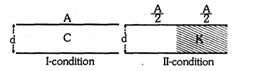
A
$\frac{C}{2}(1 + K)$
B
$\frac{C}{2}(K)$
C
$\frac{C}{2}$
D
$2C$
Solution
(A) The initial capacitance of the parallel plate capacitor is $C = \frac{\epsilon_0 A}{d}$.
In the second condition,the space between the plates is divided into two parts,each with area $A/2$ and distance $d$ between the plates.
These two parts act as two capacitors connected in parallel.
One capacitor has air as the dielectric,so its capacitance is $C_1 = \frac{\epsilon_0 (A/2)}{d} = \frac{C}{2}$.
The other capacitor has a dielectric material with constant $K$,so its capacitance is $C_2 = \frac{K \epsilon_0 (A/2)}{d} = \frac{KC}{2}$.
Since they are connected in parallel,the equivalent capacitance is $C_{eq} = C_1 + C_2$.
$C_{eq} = \frac{C}{2} + \frac{KC}{2} = \frac{C}{2}(1 + K)$.
In the second condition,the space between the plates is divided into two parts,each with area $A/2$ and distance $d$ between the plates.
These two parts act as two capacitors connected in parallel.
One capacitor has air as the dielectric,so its capacitance is $C_1 = \frac{\epsilon_0 (A/2)}{d} = \frac{C}{2}$.
The other capacitor has a dielectric material with constant $K$,so its capacitance is $C_2 = \frac{K \epsilon_0 (A/2)}{d} = \frac{KC}{2}$.
Since they are connected in parallel,the equivalent capacitance is $C_{eq} = C_1 + C_2$.
$C_{eq} = \frac{C}{2} + \frac{KC}{2} = \frac{C}{2}(1 + K)$.
0 likes
View Solution65
MediumMCQ
Two point charges are placed at a distance $r$ in air,experiencing a force $F$. When they are placed in a medium with a dielectric constant $K$,at what distance will the force between them remain the same?
A
$rK$
B
$r/K$
C
$r/\sqrt{K}$
D
$r\sqrt{K}$
Solution
(C) In air,the electrostatic force between two point charges $q_1$ and $q_2$ separated by distance $r$ is given by:
$F = \frac{1}{4\pi\epsilon_0} \frac{q_1 q_2}{r^2}$
When placed in a medium with dielectric constant $K$,the force $F'$ at a new distance $r'$ is given by:
$F' = \frac{1}{4\pi\epsilon_0 K} \frac{q_1 q_2}{(r')^2}$
We want the force to remain the same,so $F = F'$:
$\frac{1}{4\pi\epsilon_0} \frac{q_1 q_2}{r^2} = \frac{1}{4\pi\epsilon_0 K} \frac{q_1 q_2}{(r')^2}$
Canceling common terms:
$\frac{1}{r^2} = \frac{1}{K(r')^2}$
Rearranging for $r'$:
$(r')^2 = \frac{r^2}{K}$
Taking the square root of both sides:
$r' = \frac{r}{\sqrt{K}}$
$F = \frac{1}{4\pi\epsilon_0} \frac{q_1 q_2}{r^2}$
When placed in a medium with dielectric constant $K$,the force $F'$ at a new distance $r'$ is given by:
$F' = \frac{1}{4\pi\epsilon_0 K} \frac{q_1 q_2}{(r')^2}$
We want the force to remain the same,so $F = F'$:
$\frac{1}{4\pi\epsilon_0} \frac{q_1 q_2}{r^2} = \frac{1}{4\pi\epsilon_0 K} \frac{q_1 q_2}{(r')^2}$
Canceling common terms:
$\frac{1}{r^2} = \frac{1}{K(r')^2}$
Rearranging for $r'$:
$(r')^2 = \frac{r^2}{K}$
Taking the square root of both sides:
$r' = \frac{r}{\sqrt{K}}$
0 likes
View Solution66
EasyMCQ
When a dielectric slab is inserted between the plates of a capacitor while it remains connected to a battery,which of the following occurs during this process?
A
No work is done.
B
The energy stored in the capacitor before inserting the slab is consumed in this process.
C
Energy from the battery is consumed in this process.
D
Energy from both the capacitor and the battery is consumed in this process.
Solution
(C) When a capacitor remains connected to a battery,the potential difference $V$ across its plates remains constant.
When a dielectric slab of constant $K$ is inserted,the capacitance increases from $C$ to $C' = KC$.
The charge on the capacitor increases from $Q = CV$ to $Q' = KCV$.
The energy stored in the capacitor changes from $U = \frac{1}{2}CV^2$ to $U' = \frac{1}{2}KCV^2$.
The change in energy is $\Delta U = U' - U = \frac{1}{2}(K-1)CV^2$,which is positive,meaning the energy stored increases.
The work done by the battery is $W_{battery} = \Delta Q \cdot V = (Q' - Q)V = (K-1)CV^2$.
Since $W_{battery} = 2\Delta U$,the battery supplies energy equal to the increase in stored energy plus an equal amount of work done by the external agent (or the force of attraction pulling the slab in).
Thus,energy from the battery is consumed to increase the stored energy and perform work.
When a dielectric slab of constant $K$ is inserted,the capacitance increases from $C$ to $C' = KC$.
The charge on the capacitor increases from $Q = CV$ to $Q' = KCV$.
The energy stored in the capacitor changes from $U = \frac{1}{2}CV^2$ to $U' = \frac{1}{2}KCV^2$.
The change in energy is $\Delta U = U' - U = \frac{1}{2}(K-1)CV^2$,which is positive,meaning the energy stored increases.
The work done by the battery is $W_{battery} = \Delta Q \cdot V = (Q' - Q)V = (K-1)CV^2$.
Since $W_{battery} = 2\Delta U$,the battery supplies energy equal to the increase in stored energy plus an equal amount of work done by the external agent (or the force of attraction pulling the slab in).
Thus,energy from the battery is consumed to increase the stored energy and perform work.
0 likes
View Solution67
EasyMCQ
When a dielectric slab is introduced between the plates of a parallel plate capacitor that is connected to a battery,the new charge on the plates is:
A
less than the initial charge.
B
equal to the initial charge.
C
greater than the initial charge.
D
dependent on the nature of the material inserted.
Solution
(C) When a parallel plate capacitor is connected to a battery,the potential difference $V$ across the plates remains constant and equal to the electromotive force of the battery.
The capacitance of a parallel plate capacitor with a dielectric slab of constant $K$ is given by $C' = K C$,where $C$ is the initial capacitance.
The charge on the capacitor is given by $Q = CV$.
After introducing the dielectric slab,the new charge $Q'$ becomes:
$Q' = C' V = (K C) V = K Q$.
Since the dielectric constant $K > 1$ for all dielectric materials,it follows that $Q' > Q$.
Therefore,the new charge on the plates is greater than the initial charge.
The capacitance of a parallel plate capacitor with a dielectric slab of constant $K$ is given by $C' = K C$,where $C$ is the initial capacitance.
The charge on the capacitor is given by $Q = CV$.
After introducing the dielectric slab,the new charge $Q'$ becomes:
$Q' = C' V = (K C) V = K Q$.
Since the dielectric constant $K > 1$ for all dielectric materials,it follows that $Q' > Q$.
Therefore,the new charge on the plates is greater than the initial charge.
0 likes
View Solution68
EasyMCQ
$A$ capacitor is charged and then the battery is disconnected. If a dielectric slab is inserted between the plates,choose the correct statement.
A
Charge increases,voltage decreases,and electrostatic potential energy increases.
B
Charge remains constant,voltage increases,and electrostatic potential energy decreases.
C
Charge remains constant,and both voltage and electrostatic potential energy decrease.
D
None of the above.
Solution
(C) $1$. When the battery is disconnected,the charge $Q$ on the capacitor plates remains constant because there is no path for the charge to flow.
$2$. When a dielectric slab of constant $K > 1$ is inserted,the capacitance $C$ increases according to the formula $C' = KC$.
$3$. Since $Q = CV$,the new voltage $V' = Q / C'$. Since $C' > C$,the voltage $V'$ decreases $(V' = V/K)$.
$4$. The electrostatic potential energy $U$ is given by $U = Q^2 / (2C)$. Since $C$ increases and $Q$ is constant,the potential energy $U$ decreases $(U' = U/K)$.
$2$. When a dielectric slab of constant $K > 1$ is inserted,the capacitance $C$ increases according to the formula $C' = KC$.
$3$. Since $Q = CV$,the new voltage $V' = Q / C'$. Since $C' > C$,the voltage $V'$ decreases $(V' = V/K)$.
$4$. The electrostatic potential energy $U$ is given by $U = Q^2 / (2C)$. Since $C$ increases and $Q$ is constant,the potential energy $U$ decreases $(U' = U/K)$.
0 likes
View Solution69
EasyMCQ
When the air between the plates of a charged parallel plate capacitor is replaced by a dielectric medium,the intensity of the electric field:
A
decreases
B
remains the same
C
becomes zero
D
increases
Solution
(A) For a parallel plate capacitor,the electric field between the plates is given by $E = \frac{\sigma}{\epsilon_0}$,where $\sigma$ is the surface charge density.
When a dielectric medium with dielectric constant $K$ is introduced between the plates,the induced charges on the dielectric surface create an opposing electric field.
The net electric field inside the dielectric becomes $E' = \frac{E}{K}$.
Since $K > 1$ for any dielectric material,the new electric field $E'$ is less than the original electric field $E$.
Therefore,the intensity of the electric field decreases.
When a dielectric medium with dielectric constant $K$ is introduced between the plates,the induced charges on the dielectric surface create an opposing electric field.
The net electric field inside the dielectric becomes $E' = \frac{E}{K}$.
Since $K > 1$ for any dielectric material,the new electric field $E'$ is less than the original electric field $E$.
Therefore,the intensity of the electric field decreases.
0 likes
View Solution70
MediumMCQ
$A$ parallel plate capacitor has a plate separation of $d$ and each plate has an area $A$. What is the capacitance when a dielectric slab of thickness $t$ and dielectric constant $K$ is placed between the plates?
A
$\frac{\varepsilon_0 A}{d - t(1 - 1/K)}$
B
$\frac{\varepsilon_0 A}{d + t(1 + 1/K)}$
C
$\frac{\varepsilon_0 A}{d - t(1 + 1/K)}$
D
$\frac{\varepsilon_0 A}{d + t(1 - 1/K)}$
Solution
(A) The capacitance $C$ of a parallel plate capacitor with a dielectric slab of thickness $t$ and dielectric constant $K$ is given by the formula:
$C = \frac{\varepsilon_0 A}{d - t + t/K}$
This can be rearranged as:
$C = \frac{\varepsilon_0 A}{d - t(1 - 1/K)}$
Here,the effective distance between the plates is reduced due to the presence of the dielectric slab. The potential difference $V$ across the plates is the sum of the potential drop across the air gap $(d-t)$ and the dielectric slab $t$:
$V = E_{\text{air}}(d-t) + E_{\text{medium}}(t)$
Since $E_{\text{air}} = \frac{\sigma}{\varepsilon_0}$ and $E_{\text{medium}} = \frac{\sigma}{K\varepsilon_0}$,where $\sigma = \frac{Q}{A}$:
$V = \frac{Q}{A\varepsilon_0}(d-t) + \frac{Q}{A\varepsilon_0 K}(t) = \frac{Q}{A\varepsilon_0} [d - t + t/K] = \frac{Q}{A\varepsilon_0} [d - t(1 - 1/K)]$
Using $C = \frac{Q}{V}$,we get $C = \frac{\varepsilon_0 A}{d - t(1 - 1/K)}$.
$C = \frac{\varepsilon_0 A}{d - t + t/K}$
This can be rearranged as:
$C = \frac{\varepsilon_0 A}{d - t(1 - 1/K)}$
Here,the effective distance between the plates is reduced due to the presence of the dielectric slab. The potential difference $V$ across the plates is the sum of the potential drop across the air gap $(d-t)$ and the dielectric slab $t$:
$V = E_{\text{air}}(d-t) + E_{\text{medium}}(t)$
Since $E_{\text{air}} = \frac{\sigma}{\varepsilon_0}$ and $E_{\text{medium}} = \frac{\sigma}{K\varepsilon_0}$,where $\sigma = \frac{Q}{A}$:
$V = \frac{Q}{A\varepsilon_0}(d-t) + \frac{Q}{A\varepsilon_0 K}(t) = \frac{Q}{A\varepsilon_0} [d - t + t/K] = \frac{Q}{A\varepsilon_0} [d - t(1 - 1/K)]$
Using $C = \frac{Q}{V}$,we get $C = \frac{\varepsilon_0 A}{d - t(1 - 1/K)}$.
0 likes
View Solution71
EasyMCQ
In a parallel plate capacitor,two dielectric slabs of thicknesses $t_1$ and $t_2$ and dielectric constants $K_1$ and $K_2$ respectively are inserted. What is the capacitance of this capacitor?
A
$\frac{\varepsilon_0 A}{\frac{t_1}{K_1} + \frac{t_2}{K_2}}$
B
$\frac{\varepsilon_0 A}{\frac{K_1}{t_1} + \frac{K_2}{t_2}}$
C
$\frac{\varepsilon_0 A}{\frac{t_1}{K_2} + \frac{t_2}{K_1}}$
D
$\frac{\varepsilon_0 A}{\frac{K_2}{t_1} + \frac{K_1}{t_2}}$
Solution
(A) parallel plate capacitor with dielectric slabs of thicknesses $t_1$ and $t_2$ can be treated as two capacitors in series.
The capacitance of a parallel plate capacitor with a dielectric slab of thickness $t$ and dielectric constant $K$ is given by $C = \frac{\varepsilon_0 A}{t/K}$.
For two slabs in series,the equivalent capacitance $C_{eq}$ is given by $\frac{1}{C_{eq}} = \frac{1}{C_1} + \frac{1}{C_2}$.
Substituting the values,we get $\frac{1}{C_{eq}} = \frac{t_1}{\varepsilon_0 A K_1} + \frac{t_2}{\varepsilon_0 A K_2}$.
$\frac{1}{C_{eq}} = \frac{1}{\varepsilon_0 A} (\frac{t_1}{K_1} + \frac{t_2}{K_2})$.
Therefore,$C_{eq} = \frac{\varepsilon_0 A}{\frac{t_1}{K_1} + \frac{t_2}{K_2}}$.
The capacitance of a parallel plate capacitor with a dielectric slab of thickness $t$ and dielectric constant $K$ is given by $C = \frac{\varepsilon_0 A}{t/K}$.
For two slabs in series,the equivalent capacitance $C_{eq}$ is given by $\frac{1}{C_{eq}} = \frac{1}{C_1} + \frac{1}{C_2}$.
Substituting the values,we get $\frac{1}{C_{eq}} = \frac{t_1}{\varepsilon_0 A K_1} + \frac{t_2}{\varepsilon_0 A K_2}$.
$\frac{1}{C_{eq}} = \frac{1}{\varepsilon_0 A} (\frac{t_1}{K_1} + \frac{t_2}{K_2})$.
Therefore,$C_{eq} = \frac{\varepsilon_0 A}{\frac{t_1}{K_1} + \frac{t_2}{K_2}}$.
0 likes
View Solution72
MediumMCQ
$A$ capacitor of capacitance $20 \ \mu F$ has a distance of $2 \ mm$ between its plates. If a dielectric slab of thickness $1 \ mm$ and dielectric constant $K = 2$ is inserted between the plates,the new capacitance will be ..... $\mu F$.
A
$22$
B
$26.6$
C
$52.2$
D
$13$
Solution
(B) The initial capacitance is given by $C_0 = \frac{\epsilon_0 A}{d} = 20 \ \mu F$,where $d = 2 \ mm$.
When a dielectric slab of thickness $t = 1 \ mm$ and dielectric constant $K = 2$ is inserted,the new capacitance $C'$ is given by the formula:
$C' = \frac{\epsilon_0 A}{d - t + \frac{t}{K}}$
Substituting the values:
$C' = \frac{\epsilon_0 A}{2 \times 10^{-3} - 1 \times 10^{-3} + \frac{1 \times 10^{-3}}{2}}$
$C' = \frac{\epsilon_0 A}{1 \times 10^{-3} + 0.5 \times 10^{-3}} = \frac{\epsilon_0 A}{1.5 \times 10^{-3}}$
Since $\frac{\epsilon_0 A}{2 \times 10^{-3}} = 20 \ \mu F$,we have $\epsilon_0 A = 20 \times 10^{-6} \times 2 \times 10^{-3} = 40 \times 10^{-9} \ F \cdot m$.
$C' = \frac{40 \times 10^{-9}}{1.5 \times 10^{-3}} = \frac{40}{1.5} \times 10^{-6} \ F = 26.66 \ \mu F \approx 26.6 \ \mu F$.
When a dielectric slab of thickness $t = 1 \ mm$ and dielectric constant $K = 2$ is inserted,the new capacitance $C'$ is given by the formula:
$C' = \frac{\epsilon_0 A}{d - t + \frac{t}{K}}$
Substituting the values:
$C' = \frac{\epsilon_0 A}{2 \times 10^{-3} - 1 \times 10^{-3} + \frac{1 \times 10^{-3}}{2}}$
$C' = \frac{\epsilon_0 A}{1 \times 10^{-3} + 0.5 \times 10^{-3}} = \frac{\epsilon_0 A}{1.5 \times 10^{-3}}$
Since $\frac{\epsilon_0 A}{2 \times 10^{-3}} = 20 \ \mu F$,we have $\epsilon_0 A = 20 \times 10^{-6} \times 2 \times 10^{-3} = 40 \times 10^{-9} \ F \cdot m$.
$C' = \frac{40 \times 10^{-9}}{1.5 \times 10^{-3}} = \frac{40}{1.5} \times 10^{-6} \ F = 26.66 \ \mu F \approx 26.6 \ \mu F$.
0 likes
View Solution73
EasyMCQ
Two capacitors $C_1$ and $C_2$ are connected to a battery as shown in the figure. The space between the plates of $C_1$ is filled with air,and the space between the plates of $C_2$ is filled with a dielectric material. Which of the following is true regarding the charges $Q_1$ and $Q_2$ on the capacitors?
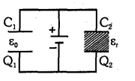
A
$Q_1 > Q_2$
B
$Q_1 < Q_2$
C
$Q_1 = Q_2$
D
None of the above
Solution
(B) The capacitors $C_1$ and $C_2$ are connected in parallel to the battery. Therefore,the potential difference across both capacitors is the same,i.e.,$V_1 = V_2 = V$.
The charge on a capacitor is given by the formula $Q = CV$.
For capacitor $C_1$,the charge is $Q_1 = C_1 V$.
For capacitor $C_2$,the charge is $Q_2 = C_2 V$.
Since the space between the plates of $C_2$ is filled with a dielectric material of dielectric constant $K > 1$,its capacitance increases such that $C_2 = K C_1$,which implies $C_2 > C_1$.
Since $V$ is constant and $C_2 > C_1$,it follows that $C_2 V > C_1 V$,which means $Q_2 > Q_1$ or $Q_1 < Q_2$.
The charge on a capacitor is given by the formula $Q = CV$.
For capacitor $C_1$,the charge is $Q_1 = C_1 V$.
For capacitor $C_2$,the charge is $Q_2 = C_2 V$.
Since the space between the plates of $C_2$ is filled with a dielectric material of dielectric constant $K > 1$,its capacitance increases such that $C_2 = K C_1$,which implies $C_2 > C_1$.
Since $V$ is constant and $C_2 > C_1$,it follows that $C_2 V > C_1 V$,which means $Q_2 > Q_1$ or $Q_1 < Q_2$.
0 likes
View Solution74
MediumMCQ
$A$ parallel plate capacitor has a capacitance $C$. The distance between the two plates is halved and the space between the plates is filled with a dielectric medium. If the new capacitance is $3C$,what is the dielectric constant of the medium?
A
$1$
B
$1.5$
C
$2$
D
$3$
Solution
(B) The initial capacitance of a parallel plate capacitor is given by $C = \frac{\epsilon_0 A}{d}$.
When the distance between the plates is halved $(d' = d/2)$ and the space is filled with a dielectric medium of constant $K$,the new capacitance $C'$ is given by $C' = \frac{K \epsilon_0 A}{d'}$.
Substituting $d' = d/2$ into the equation,we get $C' = \frac{K \epsilon_0 A}{d/2} = \frac{2K \epsilon_0 A}{d}$.
Given that the new capacitance $C' = 3C$,we equate the expressions:
$3 \left( \frac{\epsilon_0 A}{d} \right) = \frac{2K \epsilon_0 A}{d}$.
Canceling $\frac{\epsilon_0 A}{d}$ from both sides,we get $3 = 2K$.
Therefore,$K = \frac{3}{2} = 1.5$.
When the distance between the plates is halved $(d' = d/2)$ and the space is filled with a dielectric medium of constant $K$,the new capacitance $C'$ is given by $C' = \frac{K \epsilon_0 A}{d'}$.
Substituting $d' = d/2$ into the equation,we get $C' = \frac{K \epsilon_0 A}{d/2} = \frac{2K \epsilon_0 A}{d}$.
Given that the new capacitance $C' = 3C$,we equate the expressions:
$3 \left( \frac{\epsilon_0 A}{d} \right) = \frac{2K \epsilon_0 A}{d}$.
Canceling $\frac{\epsilon_0 A}{d}$ from both sides,we get $3 = 2K$.
Therefore,$K = \frac{3}{2} = 1.5$.
0 likes
View Solution75
EasyMCQ
The capacitance of a spherical capacitor in air is $50 \,\mu F$. When it is immersed in oil,its capacitance becomes $110 \,\mu F$. Calculate the dielectric constant of the oil.
A
$2.2$
B
$5$
C
$10.8$
D
$8$
Solution
(A) The capacitance of a capacitor in a medium is given by $C_{medium} = K \cdot C_{air}$,where $K$ is the dielectric constant of the medium.
Given:
$C_{air} = 50 \,\mu F$
$C_{medium} = 110 \,\mu F$
Therefore,the dielectric constant $K$ is calculated as:
$K = \frac{C_{medium}}{C_{air}}$
$K = \frac{110}{50} = 2.2$
Thus,the dielectric constant of the oil is $2.2$.
Given:
$C_{air} = 50 \,\mu F$
$C_{medium} = 110 \,\mu F$
Therefore,the dielectric constant $K$ is calculated as:
$K = \frac{C_{medium}}{C_{air}}$
$K = \frac{110}{50} = 2.2$
Thus,the dielectric constant of the oil is $2.2$.
0 likes
View Solution76
EasyMCQ
When a dielectric of constant $K = 2$ is filled in a capacitor,its capacitance becomes $C$. If the oil is removed,its capacitance will become ......
A
$\frac{C}{2}$
B
$\frac{C}{\sqrt{2}}$
C
$2C$
D
$\sqrt{2}C$
Solution
(A) The capacitance of a capacitor filled with a dielectric is given by $C = K C_0$,where $C_0$ is the capacitance of the capacitor when filled with air (or vacuum).
Given that $K = 2$ and the capacitance with the dielectric is $C$,we have $C = 2 C_0$.
Therefore,the capacitance without the dielectric (when the oil is removed) is $C_0 = \frac{C}{2}$.
Given that $K = 2$ and the capacitance with the dielectric is $C$,we have $C = 2 C_0$.
Therefore,the capacitance without the dielectric (when the oil is removed) is $C_0 = \frac{C}{2}$.
0 likes
View Solution77
EasyMCQ
$A$ parallel plate capacitor has plates of area $A$ and a separation distance of $100 \ mm$. It contains two dielectric layers: one with a dielectric constant of $10$ and a thickness of $6 \ mm$,and another with a dielectric constant of $5$ and a thickness of $4 \ mm$. Find the capacitance of the capacitor.
A
$\frac{12}{35} \varepsilon_0 A$
B
$\frac{2}{3} \varepsilon_0 A$
C
$\frac{5000}{7} \varepsilon_0 A$
D
$1500 \varepsilon_0 A$
Solution
(C) The equivalent capacitance $C$ of a capacitor with multiple dielectric slabs in series is given by the formula: $C = \frac{\varepsilon_0 A}{\sum \frac{d_i}{k_i}}$.
Given: $d_1 = 6 \ mm = 6 \times 10^{-3} \ m$,$k_1 = 10$,$d_2 = 4 \ mm = 4 \times 10^{-3} \ m$,$k_2 = 5$.
Substituting the values into the formula:
$C = \frac{\varepsilon_0 A}{\frac{6 \times 10^{-3}}{10} + \frac{4 \times 10^{-3}}{5}}$
$C = \frac{\varepsilon_0 A}{0.6 \times 10^{-3} + 0.8 \times 10^{-3}}$
$C = \frac{\varepsilon_0 A}{1.4 \times 10^{-3}}$
$C = \frac{1000}{1.4} \varepsilon_0 A = \frac{10000}{14} \varepsilon_0 A = \frac{5000}{7} \varepsilon_0 A$.
Given: $d_1 = 6 \ mm = 6 \times 10^{-3} \ m$,$k_1 = 10$,$d_2 = 4 \ mm = 4 \times 10^{-3} \ m$,$k_2 = 5$.
Substituting the values into the formula:
$C = \frac{\varepsilon_0 A}{\frac{6 \times 10^{-3}}{10} + \frac{4 \times 10^{-3}}{5}}$
$C = \frac{\varepsilon_0 A}{0.6 \times 10^{-3} + 0.8 \times 10^{-3}}$
$C = \frac{\varepsilon_0 A}{1.4 \times 10^{-3}}$
$C = \frac{1000}{1.4} \varepsilon_0 A = \frac{10000}{14} \varepsilon_0 A = \frac{5000}{7} \varepsilon_0 A$.
0 likes
View Solution78
EasyMCQ
$A$ parallel plate capacitor has a potential of $20 \, kV$ and a capacitance of $2 \times 10^{-4} \, \mu F$. If the area of the plates is $0.01 \, m^2$ and the distance between the plates is $2 \, mm$,find the dielectric constant of the medium.
A
$3.25$
B
$4.52$
C
$7.63$
D
$5.17$
Solution
(B) The capacitance of a parallel plate capacitor with a dielectric medium is given by the formula: $C = \frac{\varepsilon_0 \varepsilon_r A}{d}$.
Here,$C = 2 \times 10^{-4} \, \mu F = 2 \times 10^{-4} \times 10^{-6} \, F = 2 \times 10^{-10} \, F$.
The area $A = 0.01 \, m^2$,distance $d = 2 \, mm = 2 \times 10^{-3} \, m$,and permittivity of free space $\varepsilon_0 = 8.85 \times 10^{-12} \, F/m$.
Rearranging the formula to solve for the dielectric constant $\varepsilon_r$:
$\varepsilon_r = \frac{C \cdot d}{\varepsilon_0 \cdot A}$
Substituting the values:
$\varepsilon_r = \frac{(2 \times 10^{-10}) \times (2 \times 10^{-3})}{(8.85 \times 10^{-12}) \times (0.01)}$
$\varepsilon_r = \frac{4 \times 10^{-13}}{8.85 \times 10^{-14}}$
$\varepsilon_r = \frac{40}{8.85} \approx 4.52$.
Here,$C = 2 \times 10^{-4} \, \mu F = 2 \times 10^{-4} \times 10^{-6} \, F = 2 \times 10^{-10} \, F$.
The area $A = 0.01 \, m^2$,distance $d = 2 \, mm = 2 \times 10^{-3} \, m$,and permittivity of free space $\varepsilon_0 = 8.85 \times 10^{-12} \, F/m$.
Rearranging the formula to solve for the dielectric constant $\varepsilon_r$:
$\varepsilon_r = \frac{C \cdot d}{\varepsilon_0 \cdot A}$
Substituting the values:
$\varepsilon_r = \frac{(2 \times 10^{-10}) \times (2 \times 10^{-3})}{(8.85 \times 10^{-12}) \times (0.01)}$
$\varepsilon_r = \frac{4 \times 10^{-13}}{8.85 \times 10^{-14}}$
$\varepsilon_r = \frac{40}{8.85} \approx 4.52$.
0 likes
View Solution79
MediumMCQ
Two parallel plates of area $A$ are separated by two different dielectrics as shown in the figure. Find the resultant capacitance.
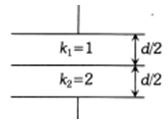
A
$\frac{4{\varepsilon _0}A}{3d}$
B
$\frac{3{\varepsilon _0}A}{4d}$
C
$\frac{2{\varepsilon _0}A}{d}$
D
$\frac{{\varepsilon _0}A}{d}$
Solution
(A) The capacitor is divided into two parts in series,each with a plate separation of $d/2$ and area $A$.
For the first part,the dielectric constant is $k_1 = 1$,so the capacitance is $C_1 = \frac{k_1 \varepsilon_0 A}{d/2} = \frac{1 \cdot \varepsilon_0 A}{d/2} = \frac{2 \varepsilon_0 A}{d}$.
For the second part,the dielectric constant is $k_2 = 2$,so the capacitance is $C_2 = \frac{k_2 \varepsilon_0 A}{d/2} = \frac{2 \cdot \varepsilon_0 A}{d/2} = \frac{4 \varepsilon_0 A}{d}$.
Since they are in series,the equivalent capacitance $C_{eq}$ is given by $\frac{1}{C_{eq}} = \frac{1}{C_1} + \frac{1}{C_2}$.
Substituting the values: $\frac{1}{C_{eq}} = \frac{d}{2 \varepsilon_0 A} + \frac{d}{4 \varepsilon_0 A} = \frac{2d + d}{4 \varepsilon_0 A} = \frac{3d}{4 \varepsilon_0 A}$.
Therefore,$C_{eq} = \frac{4 \varepsilon_0 A}{3d}$.
For the first part,the dielectric constant is $k_1 = 1$,so the capacitance is $C_1 = \frac{k_1 \varepsilon_0 A}{d/2} = \frac{1 \cdot \varepsilon_0 A}{d/2} = \frac{2 \varepsilon_0 A}{d}$.
For the second part,the dielectric constant is $k_2 = 2$,so the capacitance is $C_2 = \frac{k_2 \varepsilon_0 A}{d/2} = \frac{2 \cdot \varepsilon_0 A}{d/2} = \frac{4 \varepsilon_0 A}{d}$.
Since they are in series,the equivalent capacitance $C_{eq}$ is given by $\frac{1}{C_{eq}} = \frac{1}{C_1} + \frac{1}{C_2}$.
Substituting the values: $\frac{1}{C_{eq}} = \frac{d}{2 \varepsilon_0 A} + \frac{d}{4 \varepsilon_0 A} = \frac{2d + d}{4 \varepsilon_0 A} = \frac{3d}{4 \varepsilon_0 A}$.
Therefore,$C_{eq} = \frac{4 \varepsilon_0 A}{3d}$.
0 likes
View Solution80
DifficultMCQ
$A$ parallel plate capacitor has plates of area $A$ and a separation of $10 \, mm$. Two dielectric sheets are placed between the plates with dielectric constants $k_1 = 10$ and $k_2 = 5$,and thicknesses $t_1 = 6 \, mm$ and $t_2 = 4 \, mm$ respectively. Calculate the capacitance of the capacitor.
A
$\frac{12}{35} \varepsilon_0 A$
B
$\frac{2}{3} \varepsilon_0 A$
C
$\frac{5000}{7} \varepsilon_0 A$
D
$1500 \varepsilon_0 A$
Solution
(C) The equivalent capacitance $C$ for a parallel plate capacitor with multiple dielectric slabs of thickness $t_i$ and dielectric constant $k_i$ is given by the formula:
$C = \frac{\varepsilon_0 A}{\sum \frac{t_i}{k_i}}$
Given:
$t_1 = 6 \, mm = 6 \times 10^{-3} \, m$
$t_2 = 4 \, mm = 4 \times 10^{-3} \, m$
$k_1 = 10$
$k_2 = 5$
Substituting the values:
$C = \frac{\varepsilon_0 A}{\frac{6 \times 10^{-3}}{10} + \frac{4 \times 10^{-3}}{5}}$
$C = \frac{\varepsilon_0 A}{0.6 \times 10^{-3} + 0.8 \times 10^{-3}}$
$C = \frac{\varepsilon_0 A}{1.4 \times 10^{-3}}$
$C = \frac{1000}{1.4} \varepsilon_0 A = \frac{10000}{14} \varepsilon_0 A = \frac{5000}{7} \varepsilon_0 A$
$C = \frac{\varepsilon_0 A}{\sum \frac{t_i}{k_i}}$
Given:
$t_1 = 6 \, mm = 6 \times 10^{-3} \, m$
$t_2 = 4 \, mm = 4 \times 10^{-3} \, m$
$k_1 = 10$
$k_2 = 5$
Substituting the values:
$C = \frac{\varepsilon_0 A}{\frac{6 \times 10^{-3}}{10} + \frac{4 \times 10^{-3}}{5}}$
$C = \frac{\varepsilon_0 A}{0.6 \times 10^{-3} + 0.8 \times 10^{-3}}$
$C = \frac{\varepsilon_0 A}{1.4 \times 10^{-3}}$
$C = \frac{1000}{1.4} \varepsilon_0 A = \frac{10000}{14} \varepsilon_0 A = \frac{5000}{7} \varepsilon_0 A$
0 likes
View Solution81
EasyMCQ
$A$ capacitor is made of a thin metal strip. Its capacitance is $2 \ \mu F$. If the space between the strips is filled with paper of thickness $0.15 \ mm$,dielectric constant $2.5$,and width $400 \ mm$,what is the length of the strip in meters?
A
$0.34$
B
$1.33$
C
$13.4$
D
$33.9$
Solution
(D) The capacitance of a parallel plate capacitor is given by $C = \frac{k \epsilon_0 A}{d}$,where $A = l \times b$.
Given: $C = 2 \ \mu F = 2 \times 10^{-6} \ F$,$k = 2.5$,$d = 0.15 \ mm = 0.15 \times 10^{-3} \ m$,$b = 400 \ mm = 0.4 \ m$,and $\epsilon_0 = 8.85 \times 10^{-12} \ F/m$.
Substituting the values into the formula:
$2 \times 10^{-6} = \frac{2.5 \times 8.85 \times 10^{-12} \times (l \times 0.4)}{0.15 \times 10^{-3}}$
$2 \times 10^{-6} = \frac{2.5 \times 8.85 \times 10^{-12} \times 0.4 \times l}{0.15 \times 10^{-3}}$
$2 \times 10^{-6} = \frac{8.85 \times 10^{-12} \times l}{0.15 \times 10^{-3}}$
$l = \frac{2 \times 10^{-6} \times 0.15 \times 10^{-3}}{8.85 \times 10^{-12}}$
$l = \frac{0.3 \times 10^{-9}}{8.85 \times 10^{-12}} = \frac{300}{8.85} \approx 33.9 \ m$.
Given: $C = 2 \ \mu F = 2 \times 10^{-6} \ F$,$k = 2.5$,$d = 0.15 \ mm = 0.15 \times 10^{-3} \ m$,$b = 400 \ mm = 0.4 \ m$,and $\epsilon_0 = 8.85 \times 10^{-12} \ F/m$.
Substituting the values into the formula:
$2 \times 10^{-6} = \frac{2.5 \times 8.85 \times 10^{-12} \times (l \times 0.4)}{0.15 \times 10^{-3}}$
$2 \times 10^{-6} = \frac{2.5 \times 8.85 \times 10^{-12} \times 0.4 \times l}{0.15 \times 10^{-3}}$
$2 \times 10^{-6} = \frac{8.85 \times 10^{-12} \times l}{0.15 \times 10^{-3}}$
$l = \frac{2 \times 10^{-6} \times 0.15 \times 10^{-3}}{8.85 \times 10^{-12}}$
$l = \frac{0.3 \times 10^{-9}}{8.85 \times 10^{-12}} = \frac{300}{8.85} \approx 33.9 \ m$.
0 likes
View Solution82
MediumMCQ
$A$ parallel plate capacitor has a plate separation of $d$. $A$ metal plate of thickness $d/2$ and the same area as the capacitor plates is inserted between them without touching the plates. The capacitance of the resulting capacitor becomes:
A
remains the same
B
becomes double
C
becomes half
D
becomes one-fourth
Solution
(B) The capacitance of a parallel plate capacitor with a dielectric slab of thickness $t$ and dielectric constant $K$ is given by $C = \frac{\epsilon_0 A}{d - t + t/K}$.
For a metal plate,the dielectric constant $K = \infty$.
Given $t = d/2$,the new capacitance $C'$ is:
$C' = \frac{\epsilon_0 A}{d - d/2 + (d/2)/\infty} = \frac{\epsilon_0 A}{d/2 + 0} = \frac{2\epsilon_0 A}{d}$.
Since the original capacitance $C = \frac{\epsilon_0 A}{d}$,we have $C' = 2C$.
Therefore,the capacitance becomes double.
For a metal plate,the dielectric constant $K = \infty$.
Given $t = d/2$,the new capacitance $C'$ is:
$C' = \frac{\epsilon_0 A}{d - d/2 + (d/2)/\infty} = \frac{\epsilon_0 A}{d/2 + 0} = \frac{2\epsilon_0 A}{d}$.
Since the original capacitance $C = \frac{\epsilon_0 A}{d}$,we have $C' = 2C$.
Therefore,the capacitance becomes double.
0 likes
View Solution83
DifficultMCQ
$A$ parallel plate capacitor has a capacitance of $2\ \mu F$ with a separation of $0.4\ cm$ between the plates. If the distance between the plates is halved and the space is filled with a dielectric material of constant $K = 2.8$,the final capacitance of the capacitor will be .....$\mu F$.
A
$11.2$
B
$15.6$
C
$19.2$
D
$22.4$
Solution
(A) The capacitance of a parallel plate capacitor is given by $C = \frac{K \epsilon_0 A}{d}$.
Initially,$C_1 = 2\ \mu F$,$d_1 = 0.4\ cm$,and $K_1 = 1$ (assuming air).
Finally,$d_2 = \frac{d_1}{2} = 0.2\ cm$ and $K_2 = 2.8$.
The ratio of capacitances is $\frac{C_2}{C_1} = \frac{K_2}{K_1} \times \frac{d_1}{d_2}$.
Substituting the values: $\frac{C_2}{2} = \frac{2.8}{1} \times \frac{0.4}{0.2}$.
$\frac{C_2}{2} = 2.8 \times 2 = 5.6$.
$C_2 = 5.6 \times 2 = 11.2\ \mu F$.
Initially,$C_1 = 2\ \mu F$,$d_1 = 0.4\ cm$,and $K_1 = 1$ (assuming air).
Finally,$d_2 = \frac{d_1}{2} = 0.2\ cm$ and $K_2 = 2.8$.
The ratio of capacitances is $\frac{C_2}{C_1} = \frac{K_2}{K_1} \times \frac{d_1}{d_2}$.
Substituting the values: $\frac{C_2}{2} = \frac{2.8}{1} \times \frac{0.4}{0.2}$.
$\frac{C_2}{2} = 2.8 \times 2 = 5.6$.
$C_2 = 5.6 \times 2 = 11.2\ \mu F$.
0 likes
View Solution84
MediumMCQ
The figure shows two identical parallel plate capacitors connected to a battery and a closed switch $S$. Now,the switch is opened and a dielectric material with dielectric constant $K = 3$ is inserted into the free space between the plates of both capacitors. What is the ratio of the total electrostatic energy stored in both capacitors before and after the insertion of the dielectric?
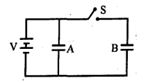
A
$3 : 1$
B
$5 : 1$
C
$3 : 5$
D
$5 : 3$
Solution
(C) Initially,both capacitors $A$ and $B$ are connected in parallel to a battery of potential $V$. The capacitance of each is $C$.
Total initial energy $U_i = \frac{1}{2}CV^2 + \frac{1}{2}CV^2 = CV^2$.
When the switch $S$ is opened,capacitor $A$ remains connected to the battery,so its potential remains $V$ and its capacitance becomes $K C$. Capacitor $B$ is disconnected,so its charge $Q = CV$ remains constant,and its capacitance becomes $K C$.
Final energy in capacitor $A$: $U_{Af} = \frac{1}{2}(KC)V^2 = \frac{3}{2}CV^2$.
Final energy in capacitor $B$: $U_{Bf} = \frac{Q^2}{2(KC)} = \frac{(CV)^2}{2(3C)} = \frac{CV^2}{6}$.
Total final energy $U_f = U_{Af} + U_{Bf} = \frac{3}{2}CV^2 + \frac{1}{6}CV^2 = \frac{9+1}{6}CV^2 = \frac{10}{6}CV^2 = \frac{5}{3}CV^2$.
The ratio of initial to final energy is $\frac{U_i}{U_f} = \frac{CV^2}{(5/3)CV^2} = \frac{3}{5}$.
Total initial energy $U_i = \frac{1}{2}CV^2 + \frac{1}{2}CV^2 = CV^2$.
When the switch $S$ is opened,capacitor $A$ remains connected to the battery,so its potential remains $V$ and its capacitance becomes $K C$. Capacitor $B$ is disconnected,so its charge $Q = CV$ remains constant,and its capacitance becomes $K C$.
Final energy in capacitor $A$: $U_{Af} = \frac{1}{2}(KC)V^2 = \frac{3}{2}CV^2$.
Final energy in capacitor $B$: $U_{Bf} = \frac{Q^2}{2(KC)} = \frac{(CV)^2}{2(3C)} = \frac{CV^2}{6}$.
Total final energy $U_f = U_{Af} + U_{Bf} = \frac{3}{2}CV^2 + \frac{1}{6}CV^2 = \frac{9+1}{6}CV^2 = \frac{10}{6}CV^2 = \frac{5}{3}CV^2$.
The ratio of initial to final energy is $\frac{U_i}{U_f} = \frac{CV^2}{(5/3)CV^2} = \frac{3}{5}$.
0 likes
View Solution85
EasyMCQ
In the given circuit,two identical capacitors $C_1$ and $C_2$ are connected to a battery. The space between the plates of $C_1$ is filled with air,while the space between the plates of $C_2$ is filled with a dielectric material of dielectric constant $K$. Then,
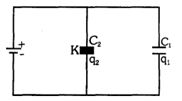
A
$q_1 < q_2$
B
$q_1 > q_2$
C
$q_1 = q_2$
D
None of these
Solution
(A) Since the capacitors are connected in parallel to the same battery,the potential difference $V$ across both capacitors is the same.
The charge on a capacitor is given by $q = CV$.
For capacitor $C_1$ (air-filled),the capacitance is $C_1 = C_0$.
For capacitor $C_2$ (dielectric-filled),the capacitance is $C_2 = KC_0$,where $K > 1$.
Thus,$q_1 = C_1 V = C_0 V$ and $q_2 = C_2 V = KC_0 V$.
Since $K > 1$,it follows that $KC_0 V > C_0 V$,which implies $q_2 > q_1$ or $q_1 < q_2$.
The charge on a capacitor is given by $q = CV$.
For capacitor $C_1$ (air-filled),the capacitance is $C_1 = C_0$.
For capacitor $C_2$ (dielectric-filled),the capacitance is $C_2 = KC_0$,where $K > 1$.
Thus,$q_1 = C_1 V = C_0 V$ and $q_2 = C_2 V = KC_0 V$.
Since $K > 1$,it follows that $KC_0 V > C_0 V$,which implies $q_2 > q_1$ or $q_1 < q_2$.
0 likes
View Solution86
MediumMCQ
$A$ capacitor has two circular plates,each with a radius of $8 \ cm$,separated by a distance of $1 \ mm$. Calculate the capacitance of this capacitor when a dielectric slab (dielectric constant $K = 6$) is placed between the plates.
A
$1.068 \times 10^{-9} \ F$
B
$1.068 \times 10^{-5} \ F$
C
$1.068 \times 10^{-7} \ F$
D
$1.068 \times 10^{-4} \ F$
Solution
(A) The area of the circular plate is $A = \pi r^2 = \pi \times (8 \times 10^{-2} \ m)^2 = 64\pi \times 10^{-4} \ m^2 \approx 0.0201 \ m^2$.
The distance between the plates is $d = 1 \ mm = 1 \times 10^{-3} \ m$.
The dielectric constant is $K = 6$.
The capacitance $C$ of a parallel plate capacitor with a dielectric is given by $C = \frac{K \varepsilon_0 A}{d}$.
Substituting the values: $C = \frac{6 \times 8.854 \times 10^{-12} \times 0.0201}{1 \times 10^{-3}}$.
$C = \frac{1.068 \times 10^{-12}}{10^{-3}} = 1.068 \times 10^{-9} \ F$.
The distance between the plates is $d = 1 \ mm = 1 \times 10^{-3} \ m$.
The dielectric constant is $K = 6$.
The capacitance $C$ of a parallel plate capacitor with a dielectric is given by $C = \frac{K \varepsilon_0 A}{d}$.
Substituting the values: $C = \frac{6 \times 8.854 \times 10^{-12} \times 0.0201}{1 \times 10^{-3}}$.
$C = \frac{1.068 \times 10^{-12}}{10^{-3}} = 1.068 \times 10^{-9} \ F$.
0 likes
View Solution87
MediumMCQ
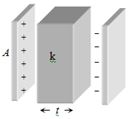
$A$ parallel plate capacitor has plates of area $A$ separated by a distance $d$. If a dielectric slab of thickness $t$ and dielectric constant $K$ is inserted between the plates,what is the new capacitance?
A
$\frac{{\varepsilon _0}A}{{d - t(1 - 1/K)}}$
B
$\frac{{\varepsilon _0}A}{{d + t(1 - 1/K)}}$
C
$\frac{{\varepsilon _0}A}{{d - t(1 + 1/K)}}$
D
$\frac{{\varepsilon _0}A}{{d + t(1 + 1/K)}}$
Solution
(A) The potential difference $V$ between the plates is the sum of the potential difference across the air gap and the dielectric slab.
$V = V_{air} + V_{medium} = \frac{\sigma}{\varepsilon_0}(d - t) + \frac{\sigma}{K\varepsilon_0}t$
Since $\sigma = \frac{Q}{A}$,we have:
$V = \frac{Q}{A\varepsilon_0} \left( (d - t) + \frac{t}{K} \right)$
$V = \frac{Q}{A\varepsilon_0} \left( d - t + \frac{t}{K} \right) = \frac{Q}{A\varepsilon_0} \left( d - t(1 - \frac{1}{K}) \right)$
The capacitance $C$ is given by $C = \frac{Q}{V}$:
$C = \frac{Q}{\frac{Q}{A\varepsilon_0} (d - t(1 - \frac{1}{K}))} = \frac{\varepsilon_0 A}{d - t(1 - \frac{1}{K})}$
$V = V_{air} + V_{medium} = \frac{\sigma}{\varepsilon_0}(d - t) + \frac{\sigma}{K\varepsilon_0}t$
Since $\sigma = \frac{Q}{A}$,we have:
$V = \frac{Q}{A\varepsilon_0} \left( (d - t) + \frac{t}{K} \right)$
$V = \frac{Q}{A\varepsilon_0} \left( d - t + \frac{t}{K} \right) = \frac{Q}{A\varepsilon_0} \left( d - t(1 - \frac{1}{K}) \right)$
The capacitance $C$ is given by $C = \frac{Q}{V}$:
$C = \frac{Q}{\frac{Q}{A\varepsilon_0} (d - t(1 - \frac{1}{K}))} = \frac{\varepsilon_0 A}{d - t(1 - \frac{1}{K})}$
0 likes
View Solution88
DifficultMCQ
The capacitance of an air-filled parallel plate capacitor is $9 \ pF$. If the space between the plates is filled with two dielectric slabs of thickness $d/3$ with dielectric constant $K_1 = 3$ and thickness $2d/3$ with dielectric constant $K_2 = 6$,the new capacitance will be ...... $pF$.
A
$40.5$
B
$20.25$
C
$1.8$
D
$45$
Solution
(A) For an air-filled capacitor,the initial capacitance is $C_0 = \frac{\epsilon_0 A}{d} = 9 \ pF$.
When two dielectric slabs are inserted in series,the equivalent capacitance $C'$ is given by $\frac{1}{C'} = \frac{1}{C_1} + \frac{1}{C_2}$.
The capacitance of the first slab is $C_1 = \frac{K_1 \epsilon_0 A}{d/3} = \frac{3 K_1 \epsilon_0 A}{d} = 3 K_1 C_0 = 3 \times 3 \times 9 \ pF = 81 \ pF$.
The capacitance of the second slab is $C_2 = \frac{K_2 \epsilon_0 A}{2d/3} = \frac{3 K_2 \epsilon_0 A}{2d} = \frac{3}{2} K_2 C_0 = \frac{3}{2} \times 6 \times 9 \ pF = 81 \ pF$.
Since $C_1$ and $C_2$ are in series,the equivalent capacitance is $C' = \frac{C_1 C_2}{C_1 + C_2} = \frac{81 \times 81}{81 + 81} = \frac{81}{2} = 40.5 \ pF$.
When two dielectric slabs are inserted in series,the equivalent capacitance $C'$ is given by $\frac{1}{C'} = \frac{1}{C_1} + \frac{1}{C_2}$.
The capacitance of the first slab is $C_1 = \frac{K_1 \epsilon_0 A}{d/3} = \frac{3 K_1 \epsilon_0 A}{d} = 3 K_1 C_0 = 3 \times 3 \times 9 \ pF = 81 \ pF$.
The capacitance of the second slab is $C_2 = \frac{K_2 \epsilon_0 A}{2d/3} = \frac{3 K_2 \epsilon_0 A}{2d} = \frac{3}{2} K_2 C_0 = \frac{3}{2} \times 6 \times 9 \ pF = 81 \ pF$.
Since $C_1$ and $C_2$ are in series,the equivalent capacitance is $C' = \frac{C_1 C_2}{C_1 + C_2} = \frac{81 \times 81}{81 + 81} = \frac{81}{2} = 40.5 \ pF$.
0 likes
View Solution89
MediumMCQ
$A$ parallel plate capacitor with air between the plates has a capacitance of $9 \ pF$. The distance between the plates is $d$. Now,the space between the plates is filled with two dielectrics. One dielectric has a dielectric constant $K_1 = 3$ and thickness $d/3$,while the other has a dielectric constant $K_2 = 6$ and thickness $2d/3$. Find the new capacitance of the capacitor in $pF$.
A
$1.8$
B
$45$
C
$40.5$
D
$20.25$
Solution
(C) The initial capacitance is $C = \frac{\epsilon_0 A}{d} = 9 \ pF$.
The space is divided into two layers of thickness $d_1 = d/3$ and $d_2 = 2d/3$,which act as two capacitors in series.
The capacitance of the first layer is $C_1 = \frac{K_1 \epsilon_0 A}{d_1} = \frac{3 \epsilon_0 A}{d/3} = 9 \left( \frac{\epsilon_0 A}{d} \right) = 9 \times 9 = 81 \ pF$.
The capacitance of the second layer is $C_2 = \frac{K_2 \epsilon_0 A}{d_2} = \frac{6 \epsilon_0 A}{2d/3} = \frac{18}{2} \left( \frac{\epsilon_0 A}{d} \right) = 9 \times 9 = 81 \ pF$.
Since $C_1$ and $C_2$ are in series,the equivalent capacitance $C_{eq}$ is given by:
$C_{eq} = \frac{C_1 C_2}{C_1 + C_2} = \frac{81 \times 81}{81 + 81} = \frac{81 \times 81}{162} = 40.5 \ pF$.
The space is divided into two layers of thickness $d_1 = d/3$ and $d_2 = 2d/3$,which act as two capacitors in series.
The capacitance of the first layer is $C_1 = \frac{K_1 \epsilon_0 A}{d_1} = \frac{3 \epsilon_0 A}{d/3} = 9 \left( \frac{\epsilon_0 A}{d} \right) = 9 \times 9 = 81 \ pF$.
The capacitance of the second layer is $C_2 = \frac{K_2 \epsilon_0 A}{d_2} = \frac{6 \epsilon_0 A}{2d/3} = \frac{18}{2} \left( \frac{\epsilon_0 A}{d} \right) = 9 \times 9 = 81 \ pF$.
Since $C_1$ and $C_2$ are in series,the equivalent capacitance $C_{eq}$ is given by:
$C_{eq} = \frac{C_1 C_2}{C_1 + C_2} = \frac{81 \times 81}{81 + 81} = \frac{81 \times 81}{162} = 40.5 \ pF$.
0 likes
View Solution90
MediumMCQ
If a capacitor with air,a capacitor with a dielectric,and a capacitor with a conducting slab have capacitances $C_1$,$C_2$,and $C_3$ respectively,then:
A
$C_1 > C_2 > C_3$
B
$C_2 > C_3 > C_1$
C
$C_3 > C_2 > C_1$
D
$C_3 > C_1 > C_2$
Solution
(C) The capacitance of a parallel plate capacitor with air is $C_1 = \frac{\epsilon_0 A}{d}$.
When a dielectric slab of thickness $t$ is inserted,the new capacitance is $C_2 = \frac{\epsilon_0 A}{d - t(1 - 1/K)}$. Since $K > 1$,the denominator decreases,so $C_2 > C_1$.
When a conducting slab of thickness $t$ is inserted,the effective distance between plates becomes $(d - t)$. The new capacitance is $C_3 = \frac{\epsilon_0 A}{d - t}$. Since $(d - t) < d$,$C_3 > C_1$.
Comparing $C_2$ and $C_3$: For a conducting slab,$K = \infty$. Substituting $K = \infty$ into the dielectric formula gives $C_3 = \frac{\epsilon_0 A}{d - t}$. Since the conducting slab effectively reduces the gap more significantly than a dielectric of the same thickness,$C_3 > C_2$.
Therefore,the order is $C_3 > C_2 > C_1$.
When a dielectric slab of thickness $t$ is inserted,the new capacitance is $C_2 = \frac{\epsilon_0 A}{d - t(1 - 1/K)}$. Since $K > 1$,the denominator decreases,so $C_2 > C_1$.
When a conducting slab of thickness $t$ is inserted,the effective distance between plates becomes $(d - t)$. The new capacitance is $C_3 = \frac{\epsilon_0 A}{d - t}$. Since $(d - t) < d$,$C_3 > C_1$.
Comparing $C_2$ and $C_3$: For a conducting slab,$K = \infty$. Substituting $K = \infty$ into the dielectric formula gives $C_3 = \frac{\epsilon_0 A}{d - t}$. Since the conducting slab effectively reduces the gap more significantly than a dielectric of the same thickness,$C_3 > C_2$.
Therefore,the order is $C_3 > C_2 > C_1$.
0 likes
View Solution91
MediumMCQ
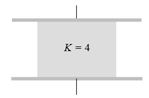
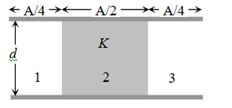
$A$ parallel plate capacitor has a capacitance of $10 \ \mu F$ with air between its plates. Now,half of the space between the two plates is filled with a dielectric material of dielectric constant $K = 4$ as shown in the figure. Find the capacitance of the capacitor in $\mu F$.
A
$25$
B
$20$
C
$40$
D
$5$
Solution
(A) The initial capacitance of the air-filled capacitor is $C = \frac{\varepsilon_0 A}{d} = 10 \ \mu F$.
As shown in the figure,the capacitor can be considered as a parallel combination of three capacitors:
$C_1$ with area $A/4$ and air dielectric $(K=1)$,
$C_2$ with area $A/2$ and dielectric $(K=4)$,
$C_3$ with area $A/4$ and air dielectric $(K=1)$.
The capacitances are:
$C_1 = \frac{\varepsilon_0 (A/4)}{d} = \frac{1}{4} \left( \frac{\varepsilon_0 A}{d} \right) = \frac{10}{4} = 2.5 \ \mu F$
$C_2 = \frac{K \varepsilon_0 (A/2)}{d} = \frac{4 \varepsilon_0 A}{2d} = 2 \left( \frac{\varepsilon_0 A}{d} \right) = 2 \times 10 = 20 \ \mu F$
$C_3 = \frac{\varepsilon_0 (A/4)}{d} = \frac{1}{4} \left( \frac{\varepsilon_0 A}{d} \right) = \frac{10}{4} = 2.5 \ \mu F$
Since they are in parallel,the equivalent capacitance is:
$C_{eq} = C_1 + C_2 + C_3 = 2.5 + 20 + 2.5 = 25 \ \mu F$.
As shown in the figure,the capacitor can be considered as a parallel combination of three capacitors:
$C_1$ with area $A/4$ and air dielectric $(K=1)$,
$C_2$ with area $A/2$ and dielectric $(K=4)$,
$C_3$ with area $A/4$ and air dielectric $(K=1)$.
The capacitances are:
$C_1 = \frac{\varepsilon_0 (A/4)}{d} = \frac{1}{4} \left( \frac{\varepsilon_0 A}{d} \right) = \frac{10}{4} = 2.5 \ \mu F$
$C_2 = \frac{K \varepsilon_0 (A/2)}{d} = \frac{4 \varepsilon_0 A}{2d} = 2 \left( \frac{\varepsilon_0 A}{d} \right) = 2 \times 10 = 20 \ \mu F$
$C_3 = \frac{\varepsilon_0 (A/4)}{d} = \frac{1}{4} \left( \frac{\varepsilon_0 A}{d} \right) = \frac{10}{4} = 2.5 \ \mu F$
Since they are in parallel,the equivalent capacitance is:
$C_{eq} = C_1 + C_2 + C_3 = 2.5 + 20 + 2.5 = 25 \ \mu F$.
0 likes
View Solution92
DifficultMCQ
The distance between the plates of a parallel plate capacitor is $0.05\, m$. An electric field of $3 \times 10^4\, V/m$ is established between the plates. The capacitor is disconnected from the battery,and an uncharged metal plate of thickness $0.01\, m$ is inserted. If a dielectric slab of dielectric constant $K = 2$ is inserted instead of the metal plate,what will be the potential difference in $kV$?
A
$1.89$
B
$2.15$
C
$1.20$
D
$1.35$
Solution
(D) For a parallel plate capacitor,the initial potential difference $V$ is given by $V = E \times d$.
Given $E = 3 \times 10^4\, V/m$ and $d = 0.05\, m$,we have $V = 3 \times 10^4 \times 0.05 = 1500\, V = 1.5\, kV$.
Since the capacitor is disconnected from the battery,the charge $q$ remains constant.
The potential difference $V'$ after inserting a slab of thickness $t$ and dielectric constant $K$ is given by $V' = V \times \frac{(d - t) + (t/K)}{d}$.
For a dielectric slab with $K = 2$ and $t = 0.01\, m$:
$V' = 1.5 \times \frac{(0.05 - 0.01) + (0.01/2)}{0.05}$
$V' = 1.5 \times \frac{0.04 + 0.005}{0.05}$
$V' = 1.5 \times \frac{0.045}{0.05}$
$V' = 1.5 \times 0.9 = 1.35\, kV$.
Given $E = 3 \times 10^4\, V/m$ and $d = 0.05\, m$,we have $V = 3 \times 10^4 \times 0.05 = 1500\, V = 1.5\, kV$.
Since the capacitor is disconnected from the battery,the charge $q$ remains constant.
The potential difference $V'$ after inserting a slab of thickness $t$ and dielectric constant $K$ is given by $V' = V \times \frac{(d - t) + (t/K)}{d}$.
For a dielectric slab with $K = 2$ and $t = 0.01\, m$:
$V' = 1.5 \times \frac{(0.05 - 0.01) + (0.01/2)}{0.05}$
$V' = 1.5 \times \frac{0.04 + 0.005}{0.05}$
$V' = 1.5 \times \frac{0.045}{0.05}$
$V' = 1.5 \times 0.9 = 1.35\, kV$.
0 likes
View Solution93
DifficultMCQ
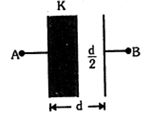
Half of the space between the plates of a parallel plate capacitor is filled with a dielectric material of dielectric constant $K$ parallel to the plates. If the initial capacitance is $C$,what will be the new (final) capacitance?
A
$\frac{2KC}{1 + K}$
B
$\frac{C(K + 1)}{2}$
C
$\frac{KC}{1 + K}$
D
$KC$
Solution
(A) The initial capacitance of the parallel plate capacitor is $C = \frac{\epsilon_0 A}{d}$.
When the space is filled with a dielectric of constant $K$ parallel to the plates,it acts as two capacitors in series,each with a plate separation of $d/2$.
The capacitance of the part with the dielectric is $C_1 = \frac{K \epsilon_0 A}{d/2} = 2KC$.
The capacitance of the part with air is $C_2 = \frac{\epsilon_0 A}{d/2} = 2C$.
Since these two capacitors are in series,the equivalent capacitance $C_{total}$ is given by:
$C_{total} = \frac{C_1 C_2}{C_1 + C_2} = \frac{(2KC)(2C)}{2KC + 2C} = \frac{4KC^2}{2C(K + 1)} = \frac{2KC}{K + 1}$.
When the space is filled with a dielectric of constant $K$ parallel to the plates,it acts as two capacitors in series,each with a plate separation of $d/2$.
The capacitance of the part with the dielectric is $C_1 = \frac{K \epsilon_0 A}{d/2} = 2KC$.
The capacitance of the part with air is $C_2 = \frac{\epsilon_0 A}{d/2} = 2C$.
Since these two capacitors are in series,the equivalent capacitance $C_{total}$ is given by:
$C_{total} = \frac{C_1 C_2}{C_1 + C_2} = \frac{(2KC)(2C)}{2KC + 2C} = \frac{4KC^2}{2C(K + 1)} = \frac{2KC}{K + 1}$.
0 likes
View Solution94
DifficultMCQ
$A$ parallel plate capacitor is charged to a potential of $100 \ V$. $A$ dielectric slab of thickness $2 \ mm$ is inserted between the plates. To maintain the same potential difference,the distance between the plates is increased by $1.6 \ mm$. The dielectric constant of the slab is:
A
$5$
B
$1.25$
C
$4$
D
$2.5$
Solution
(A) The potential difference between the plates in air is given by $V = E \cdot d = \frac{\sigma}{\varepsilon_0} d$.
When a dielectric slab of thickness $t$ and dielectric constant $K$ is inserted,the new potential difference $V'$ is given by $V' = \frac{\sigma}{\varepsilon_0} (d - t + \frac{t}{K})$.
Given that the distance between the plates is increased by $d' = 1.6 \ mm$ to maintain the same potential difference,the new potential difference becomes $V_{new} = \frac{\sigma}{\varepsilon_0} ((d + d') - t + \frac{t}{K})$.
Since the potential difference remains constant,$V = V_{new}$,which implies $d = d + d' - t + \frac{t}{K}$.
Rearranging the terms,we get $d' = t - \frac{t}{K} = t(1 - \frac{1}{K})$.
Substituting the given values $t = 2 \ mm$ and $d' = 1.6 \ mm$:
$1.6 = 2(1 - \frac{1}{K}) \implies 0.8 = 1 - \frac{1}{K} \implies \frac{1}{K} = 1 - 0.8 = 0.2$.
Therefore,$K = \frac{1}{0.2} = 5$.
When a dielectric slab of thickness $t$ and dielectric constant $K$ is inserted,the new potential difference $V'$ is given by $V' = \frac{\sigma}{\varepsilon_0} (d - t + \frac{t}{K})$.
Given that the distance between the plates is increased by $d' = 1.6 \ mm$ to maintain the same potential difference,the new potential difference becomes $V_{new} = \frac{\sigma}{\varepsilon_0} ((d + d') - t + \frac{t}{K})$.
Since the potential difference remains constant,$V = V_{new}$,which implies $d = d + d' - t + \frac{t}{K}$.
Rearranging the terms,we get $d' = t - \frac{t}{K} = t(1 - \frac{1}{K})$.
Substituting the given values $t = 2 \ mm$ and $d' = 1.6 \ mm$:
$1.6 = 2(1 - \frac{1}{K}) \implies 0.8 = 1 - \frac{1}{K} \implies \frac{1}{K} = 1 - 0.8 = 0.2$.
Therefore,$K = \frac{1}{0.2} = 5$.
0 likes
View Solution95
MediumMCQ
$A$ parallel plate capacitor is constructed with two plates. Each plate has an area of $100 \ cm^2$ and they are separated by a distance of $1 \ mm$. $A$ dielectric with a dielectric constant of $5.0$ and a dielectric strength of $1.9 \times 10^7 \ V/m$ is filled between the plates. Find the maximum charge that can be stored on the capacitor without causing dielectric breakdown.
A
$1.6 \times 10^{-6} \ C$
B
$5.9 \times 10^{-8} \ C$
C
$3.4 \times 10^{-6} \ C$
D
$8.4 \times 10^{-6} \ C$
Solution
(D) The electric field $E$ inside a dielectric-filled capacitor is given by $E = \frac{Q}{K A \varepsilon_0}$,where $Q$ is the charge,$K$ is the dielectric constant,$A$ is the area,and $\varepsilon_0$ is the permittivity of free space.
To avoid dielectric breakdown,the electric field must not exceed the dielectric strength $E_{max} = 1.9 \times 10^7 \ V/m$.
Thus,$Q_{max} = E_{max} \cdot K \cdot A \cdot \varepsilon_0$.
Given: $A = 100 \ cm^2 = 10^{-2} \ m^2$,$K = 5.0$,$\varepsilon_0 = 8.85 \times 10^{-12} \ F/m$,and $E_{max} = 1.9 \times 10^7 \ V/m$.
Substituting the values:
$Q_{max} = (1.9 \times 10^7) \times 5.0 \times 10^{-2} \times 8.85 \times 10^{-12}$
$Q_{max} = 8.4075 \times 10^{-6} \ C \approx 8.4 \times 10^{-6} \ C$.
To avoid dielectric breakdown,the electric field must not exceed the dielectric strength $E_{max} = 1.9 \times 10^7 \ V/m$.
Thus,$Q_{max} = E_{max} \cdot K \cdot A \cdot \varepsilon_0$.
Given: $A = 100 \ cm^2 = 10^{-2} \ m^2$,$K = 5.0$,$\varepsilon_0 = 8.85 \times 10^{-12} \ F/m$,and $E_{max} = 1.9 \times 10^7 \ V/m$.
Substituting the values:
$Q_{max} = (1.9 \times 10^7) \times 5.0 \times 10^{-2} \times 8.85 \times 10^{-12}$
$Q_{max} = 8.4075 \times 10^{-6} \ C \approx 8.4 \times 10^{-6} \ C$.
0 likes
View Solution96
EasyMCQ
$A$ parallel plate air capacitor has a capacitance of $10 \ \mu F$. As shown in the figure,if this capacitor is divided into two equal parts and these parts are filled with dielectric materials of dielectric constants $K_1 = 2$ and $K_2 = 4$,then the capacitance of this arrangement is ............. $\mu F$.
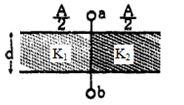
A
$20$
B
$30$
C
$10$
D
$40$
Solution
(B) The initial capacitance of the air capacitor is given by $C = \frac{\epsilon_0 A}{d} = 10 \ \mu F$.
When the capacitor is divided into two equal parts as shown in the figure,the area of each part becomes $A/2$ while the distance $d$ remains the same. These two parts act as two capacitors connected in parallel.
The capacitance of the first part is $C_1 = \frac{K_1 \epsilon_0 (A/2)}{d} = K_1 \times (C/2) = 2 \times (10/2) = 10 \ \mu F$.
The capacitance of the second part is $C_2 = \frac{K_2 \epsilon_0 (A/2)}{d} = K_2 \times (C/2) = 4 \times (10/2) = 20 \ \mu F$.
Since the two capacitors are connected in parallel,the equivalent capacitance is $C_{new} = C_1 + C_2$.
Therefore,$C_{new} = 10 \ \mu F + 20 \ \mu F = 30 \ \mu F$.
When the capacitor is divided into two equal parts as shown in the figure,the area of each part becomes $A/2$ while the distance $d$ remains the same. These two parts act as two capacitors connected in parallel.
The capacitance of the first part is $C_1 = \frac{K_1 \epsilon_0 (A/2)}{d} = K_1 \times (C/2) = 2 \times (10/2) = 10 \ \mu F$.
The capacitance of the second part is $C_2 = \frac{K_2 \epsilon_0 (A/2)}{d} = K_2 \times (C/2) = 4 \times (10/2) = 20 \ \mu F$.
Since the two capacitors are connected in parallel,the equivalent capacitance is $C_{new} = C_1 + C_2$.
Therefore,$C_{new} = 10 \ \mu F + 20 \ \mu F = 30 \ \mu F$.
0 likes
View Solution97
DifficultMCQ
Two parallel plate capacitors are connected in series and then connected to a $100 \ V$ battery. $A$ dielectric slab of dielectric constant $K = 4.0$ is inserted between the plates of the second capacitor. What will be the potential difference across each capacitor respectively?
A
$50 \ V, 50 \ V$
B
$80 \ V, 20 \ V$
C
$20 \ V, 80 \ V$
D
$75 \ V, 25 \ V$
Solution
(B) Let the initial capacitances be $C_1 = C$ and $C_2 = C$. When a dielectric of constant $K = 4$ is inserted into the second capacitor,its new capacitance becomes $C_2' = K \cdot C = 4C$.
In a series combination,the charge $Q$ on each capacitor is the same. Since $Q = CV$,we have $V = Q/C$,which implies $V \propto 1/C$.
The ratio of capacitances is $C_1 : C_2' = C : 4C = 1 : 4$.
Therefore,the ratio of potential differences is $V_1 : V_2 = 1/C_1 : 1/C_2' = 1/C : 1/4C = 4 : 1$.
The total potential difference is $V = 100 \ V$.
Potential difference across the first capacitor $(V_1)$: $V_1 = \frac{4}{4+1} \times 100 \ V = \frac{4}{5} \times 100 \ V = 80 \ V$.
Potential difference across the second capacitor $(V_2)$: $V_2 = \frac{1}{4+1} \times 100 \ V = \frac{1}{5} \times 100 \ V = 20 \ V$.
Thus,the potential differences are $80 \ V$ and $20 \ V$ respectively.
In a series combination,the charge $Q$ on each capacitor is the same. Since $Q = CV$,we have $V = Q/C$,which implies $V \propto 1/C$.
The ratio of capacitances is $C_1 : C_2' = C : 4C = 1 : 4$.
Therefore,the ratio of potential differences is $V_1 : V_2 = 1/C_1 : 1/C_2' = 1/C : 1/4C = 4 : 1$.
The total potential difference is $V = 100 \ V$.
Potential difference across the first capacitor $(V_1)$: $V_1 = \frac{4}{4+1} \times 100 \ V = \frac{4}{5} \times 100 \ V = 80 \ V$.
Potential difference across the second capacitor $(V_2)$: $V_2 = \frac{1}{4+1} \times 100 \ V = \frac{1}{5} \times 100 \ V = 20 \ V$.
Thus,the potential differences are $80 \ V$ and $20 \ V$ respectively.

0 likes
View Solution98
EasyMCQ
$A$ parallel plate capacitor has a capacitance of $5 \ \mu F$. When a glass plate is inserted between the plates of the capacitor,its potential becomes $1/8$ of its original value. What is the value of the dielectric constant?
A
$1.6$
B
$5$
C
$8$
D
$40$
Solution
(C) The capacitance of a parallel plate capacitor is given by $C = Q/V$. Since the charge $Q$ remains constant when the dielectric is inserted,we have $C_0 V_0 = C V$,where $C_0$ and $V_0$ are the initial capacitance and potential,and $C$ and $V$ are the values after inserting the dielectric.
Given that $V = V_0 / 8$,we can write $C_0 V_0 = C (V_0 / 8)$.
This simplifies to $C = 8 C_0$.
The relationship between the new capacitance $C$ and the initial capacitance $C_0$ with a dielectric constant $K$ is $C = K C_0$.
Comparing the two expressions,we get $K = 8$.
Given that $V = V_0 / 8$,we can write $C_0 V_0 = C (V_0 / 8)$.
This simplifies to $C = 8 C_0$.
The relationship between the new capacitance $C$ and the initial capacitance $C_0$ with a dielectric constant $K$ is $C = K C_0$.
Comparing the two expressions,we get $K = 8$.
0 likes
View Solution99
MediumMCQ
$A$ copper slab of thickness $d/2$ is inserted between the plates of a parallel plate capacitor,where $d$ is the distance between its two plates. If the capacitance of the capacitor without the copper slab is $C$ and with the copper slab is $C'$,find the ratio $C'/C$.
A
$\sqrt{2}$
B
$2$
C
$1$
D
$1/\sqrt{2}$
Solution
(B) The capacitance of a parallel plate capacitor with air between the plates is given by $C = \frac{\epsilon_0 A}{d}$.
When a conducting slab (copper) of thickness $t$ is inserted between the plates,the new capacitance $C'$ is given by $C' = \frac{\epsilon_0 A}{d - t}$.
Given that the thickness of the copper slab is $t = d/2$,we substitute this into the formula:
$C' = \frac{\epsilon_0 A}{d - d/2} = \frac{\epsilon_0 A}{d/2} = 2 \left( \frac{\epsilon_0 A}{d} \right)$.
Since $C = \frac{\epsilon_0 A}{d}$,we have $C' = 2C$.
Therefore,the ratio $C'/C = 2$.
When a conducting slab (copper) of thickness $t$ is inserted between the plates,the new capacitance $C'$ is given by $C' = \frac{\epsilon_0 A}{d - t}$.
Given that the thickness of the copper slab is $t = d/2$,we substitute this into the formula:
$C' = \frac{\epsilon_0 A}{d - d/2} = \frac{\epsilon_0 A}{d/2} = 2 \left( \frac{\epsilon_0 A}{d} \right)$.
Since $C = \frac{\epsilon_0 A}{d}$,we have $C' = 2C$.
Therefore,the ratio $C'/C = 2$.
0 likes
View Solution100
DifficultMCQ
In the given figure,there are two capacitors in series. $A$ rigid conducting slab of thickness $b$ can slide vertically. Find the equivalent capacitance of the system.
A
$C = \frac{{\varepsilon _0}A}{a - b}$
B
$C = \frac{{\varepsilon _0}A}{a - 2b}$
C
$C = \frac{{\varepsilon _0}A}{a + 2b}$
D
None of these
Solution
(A) The system consists of two capacitors in series,each with a plate separation of $d_1$ and $d_2$ such that $d_1 + d_2 = a - b$.
The capacitance of a parallel plate capacitor is given by $C = \frac{{\varepsilon _0}A}{d}$.
For two capacitors in series,the equivalent capacitance $C_{eq}$ is given by $\frac{1}{C_{eq}} = \frac{1}{C_1} + \frac{1}{C_2}$.
Substituting the values,we get $\frac{1}{C_{eq}} = \frac{d_1}{{\varepsilon _0}A} + \frac{d_2}{{\varepsilon _0}A} = \frac{d_1 + d_2}{{\varepsilon _0}A}$.
Since $d_1 + d_2 = a - b$,we have $\frac{1}{C_{eq}} = \frac{a - b}{{\varepsilon _0}A}$.
Therefore,$C_{eq} = \frac{{\varepsilon _0}A}{a - b}$.
The capacitance of a parallel plate capacitor is given by $C = \frac{{\varepsilon _0}A}{d}$.
For two capacitors in series,the equivalent capacitance $C_{eq}$ is given by $\frac{1}{C_{eq}} = \frac{1}{C_1} + \frac{1}{C_2}$.
Substituting the values,we get $\frac{1}{C_{eq}} = \frac{d_1}{{\varepsilon _0}A} + \frac{d_2}{{\varepsilon _0}A} = \frac{d_1 + d_2}{{\varepsilon _0}A}$.
Since $d_1 + d_2 = a - b$,we have $\frac{1}{C_{eq}} = \frac{a - b}{{\varepsilon _0}A}$.
Therefore,$C_{eq} = \frac{{\varepsilon _0}A}{a - b}$.
0 likes
View SolutionElectric Potential and Capacitance — Effect of Dielectric Inside Capacitor · Frequently Asked Questions
1Are these Electric Potential and Capacitance questions useful for JEE and NEET?
Yes. All questions in this section are mapped to JEE Main and NEET exam patterns. Previous year questions from JEE Main, NEET, GUJCET and state-level exams are included with full solutions.
2Can I switch to Hindi or Gujarati for these questions?
Yes. Use the language tabs in the hero section or the sidebar to view the same questions and solutions in English, Hindi or Gujarati.
3How do I generate a question paper from this subtopic?
Use the Vedclass Exam Paper Generator — select the chapter and subtopic, set difficulty, and generate Sets A, B, C, D automatically. First 3 chapters of every subject are free.
Vedclass Products
For Students
Vedclass Test Series
Mock tests in real JEE/NEET style with performance analysis. 5-day free trial.
Start Free TrialFor Teachers
Exam Paper Generator
Generate Set A/B/C/D papers from this chapter in 2 minutes. 3 chapters free.
Try FreeFor Institutes
Online Exam Module
Live online exams with unlimited students, 360° analytics & white-label branding.
See DemoFor Teachers & Institutes
Generate a Electric Potential and Capacitance Exam Paper in 2 Minutes
Select subtopic & difficulty — Sets A, B, C, D auto-generated with No Repeat logic.
First 3 chapters of every subject are free — no payment required.