
A English
Effect of Dielectric Inside Capacitor Questions in English
Class 12 Physics · Electric Potential and Capacitance · Effect of Dielectric Inside Capacitor
347+
Questions
English
Language
100%
With Solutions
Showing 48 of 347 questions in English
251
EasyMCQ
$A$ parallel plate air capacitor has capacity $C$ farad,potential $V$ volt,and energy $E$ joule. When the gap between the plates is completely filled with a dielectric material of dielectric constant $K > 1$,what happens to the potential $V$ and energy $E$?
A
Both $V$ and $E$ increase
B
Both $V$ and $E$ decrease
C
$V$ decreases,$E$ increases
D
$V$ increases,$E$ decreases
Solution
(B) When a dielectric is inserted into a capacitor while it remains connected to a battery,the potential difference $V$ remains constant. However,if the capacitor is disconnected from the battery,the charge $Q$ remains constant.
Assuming the capacitor is disconnected from the battery:
$1$. The new capacitance becomes $C' = KC$,where $K > 1$.
$2$. Since the charge $Q$ is constant,the new potential $V' = Q/C' = Q/(KC) = V/K$. Since $K > 1$,$V' < V$,so the potential decreases.
$3$. The new energy $E' = Q^2 / (2C') = Q^2 / (2KC) = E/K$. Since $K > 1$,$E' < E$,so the energy decreases.
Therefore,both $V$ and $E$ decrease.
Assuming the capacitor is disconnected from the battery:
$1$. The new capacitance becomes $C' = KC$,where $K > 1$.
$2$. Since the charge $Q$ is constant,the new potential $V' = Q/C' = Q/(KC) = V/K$. Since $K > 1$,$V' < V$,so the potential decreases.
$3$. The new energy $E' = Q^2 / (2C') = Q^2 / (2KC) = E/K$. Since $K > 1$,$E' < E$,so the energy decreases.
Therefore,both $V$ and $E$ decrease.
0 likes
View Solution252
MediumMCQ
The plates of a parallel plate capacitor are separated by a distance $d$ with air as the medium between them. $A$ dielectric slab of dielectric constant $K = 3$ is introduced between the plates so as to increase the capacity by $50 \%$. The thickness of the dielectric slab is
A
$\frac{d}{2}$
B
$\frac{d}{3}$
C
$\frac{d}{5}$
D
$\frac{5d}{6}$
Solution
(A) The initial capacitance of the parallel plate capacitor with air as the medium is $C_0 = \frac{\epsilon_0 A}{d}$.
When a dielectric slab of thickness $t$ and dielectric constant $K$ is introduced,the new capacitance $C'$ is given by $C' = \frac{\epsilon_0 A}{d - t + \frac{t}{K}}$.
Given that the capacity increases by $50 \%$,the new capacitance is $C' = C_0 + 0.5 C_0 = 1.5 C_0 = \frac{3}{2} C_0$.
Substituting the expressions,we get $\frac{\epsilon_0 A}{d - t + \frac{t}{K}} = \frac{3}{2} \frac{\epsilon_0 A}{d}$.
This simplifies to $\frac{1}{d - t + \frac{t}{3}} = \frac{3}{2d}$.
Cross-multiplying gives $2d = 3(d - t + \frac{t}{3}) = 3(d - \frac{2t}{3}) = 3d - 2t$.
Rearranging for $t$,we get $2t = 3d - 2d = d$,which implies $t = \frac{d}{2}$.
When a dielectric slab of thickness $t$ and dielectric constant $K$ is introduced,the new capacitance $C'$ is given by $C' = \frac{\epsilon_0 A}{d - t + \frac{t}{K}}$.
Given that the capacity increases by $50 \%$,the new capacitance is $C' = C_0 + 0.5 C_0 = 1.5 C_0 = \frac{3}{2} C_0$.
Substituting the expressions,we get $\frac{\epsilon_0 A}{d - t + \frac{t}{K}} = \frac{3}{2} \frac{\epsilon_0 A}{d}$.
This simplifies to $\frac{1}{d - t + \frac{t}{3}} = \frac{3}{2d}$.
Cross-multiplying gives $2d = 3(d - t + \frac{t}{3}) = 3(d - \frac{2t}{3}) = 3d - 2t$.
Rearranging for $t$,we get $2t = 3d - 2d = d$,which implies $t = \frac{d}{2}$.
0 likes
View Solution253
MediumMCQ
Two parallel plate air capacitors of same capacity $C$ are connected in parallel to a battery of e.m.f. $E$. Then,one of the capacitors is completely filled with a dielectric material of constant $K$. The change in the effective capacity of the parallel combination is:
A
$\frac{C}{(K-1)}$
B
$\frac{KC}{K-1}$
C
$KC+1$
D
$C(K-1)$
Solution
(D) Initially,both capacitors have capacity $C$ and are connected in parallel. The initial equivalent capacity is $C_{eq,i} = C + C = 2C$.
After one capacitor is filled with a dielectric of constant $K$,its new capacity becomes $C' = KC$. The other capacitor remains $C$.
The new equivalent capacity of the parallel combination is $C_{eq,f} = KC + C = C(K+1)$.
The change in the effective capacity is $\Delta C = C_{eq,f} - C_{eq,i} = C(K+1) - 2C = CK + C - 2C = C(K-1)$.
After one capacitor is filled with a dielectric of constant $K$,its new capacity becomes $C' = KC$. The other capacitor remains $C$.
The new equivalent capacity of the parallel combination is $C_{eq,f} = KC + C = C(K+1)$.
The change in the effective capacity is $\Delta C = C_{eq,f} - C_{eq,i} = C(K+1) - 2C = CK + C - 2C = C(K-1)$.
0 likes
View Solution254
EasyMCQ
$A$ parallel plate air capacitor has capacitance $C_p$. It is equally filled with parallel layers of materials of dielectric constants $K_1$ and $K_2$. Now its capacity becomes $C_K$. The ratio $C_P$ to $C_K$ is
A
$K_1+K_2$
B
$\frac{K_1+K_2}{K_1 K_2}$
C
$\frac{K_1+K_2}{2 K_1 K_2}$
D
$\frac{2 K_1 K_2}{K_1+K_2}$
Solution
(C) Let the area of the plates be $A$ and the distance between them be $d$. The capacitance of the air capacitor is $C_p = \frac{\epsilon_0 A}{d}$.
When the space is filled with two parallel layers of dielectric materials of thickness $d/2$ each,the capacitor acts as two capacitors $C_1$ and $C_2$ in series.
$C_1 = \frac{K_1 \epsilon_0 A}{d/2} = \frac{2 K_1 \epsilon_0 A}{d} = 2 K_1 C_p$.
$C_2 = \frac{K_2 \epsilon_0 A}{d/2} = \frac{2 K_2 \epsilon_0 A}{d} = 2 K_2 C_p$.
Since they are in series,the equivalent capacitance $C_K$ is given by $\frac{1}{C_K} = \frac{1}{C_1} + \frac{1}{C_2}$.
$\frac{1}{C_K} = \frac{1}{2 K_1 C_p} + \frac{1}{2 K_2 C_p} = \frac{1}{2 C_p} \left( \frac{1}{K_1} + \frac{1}{K_2} \right) = \frac{1}{2 C_p} \left( \frac{K_1 + K_2}{K_1 K_2} \right)$.
Therefore,$C_K = \frac{2 C_p K_1 K_2}{K_1 + K_2}$.
The ratio $\frac{C_p}{C_K} = \frac{C_p}{\frac{2 C_p K_1 K_2}{K_1 + K_2}} = \frac{K_1 + K_2}{2 K_1 K_2}$.
When the space is filled with two parallel layers of dielectric materials of thickness $d/2$ each,the capacitor acts as two capacitors $C_1$ and $C_2$ in series.
$C_1 = \frac{K_1 \epsilon_0 A}{d/2} = \frac{2 K_1 \epsilon_0 A}{d} = 2 K_1 C_p$.
$C_2 = \frac{K_2 \epsilon_0 A}{d/2} = \frac{2 K_2 \epsilon_0 A}{d} = 2 K_2 C_p$.
Since they are in series,the equivalent capacitance $C_K$ is given by $\frac{1}{C_K} = \frac{1}{C_1} + \frac{1}{C_2}$.
$\frac{1}{C_K} = \frac{1}{2 K_1 C_p} + \frac{1}{2 K_2 C_p} = \frac{1}{2 C_p} \left( \frac{1}{K_1} + \frac{1}{K_2} \right) = \frac{1}{2 C_p} \left( \frac{K_1 + K_2}{K_1 K_2} \right)$.
Therefore,$C_K = \frac{2 C_p K_1 K_2}{K_1 + K_2}$.
The ratio $\frac{C_p}{C_K} = \frac{C_p}{\frac{2 C_p K_1 K_2}{K_1 + K_2}} = \frac{K_1 + K_2}{2 K_1 K_2}$.
0 likes
View Solution255
MediumMCQ
$A$ parallel plate capacitor has a plate area of $50 \ cm^2$ and a plate separation of $3 \ mm$. The space between the plates is filled with a dielectric medium of thickness $1 \ mm$ and a dielectric constant of $4$. Calculate the capacitance. ($\epsilon_0$ is the permittivity of free space)
A
$\frac{18 \epsilon_0}{7}$
B
$\frac{20 \epsilon_0}{9}$
C
$\frac{16 \epsilon_0}{7}$
D
$\frac{14 \epsilon_0}{5}$
Solution
(B) The capacitance $C$ of a parallel plate capacitor with a dielectric slab of thickness $t$ and dielectric constant $K$ is given by the formula: $C = \frac{\epsilon_0 A}{d - t + \frac{t}{K}}$.
Given:
Area $A = 50 \ cm^2 = 50 \times 10^{-4} \ m^2 = 5 \times 10^{-3} \ m^2$.
Separation $d = 3 \ mm = 3 \times 10^{-3} \ m$.
Thickness of dielectric $t = 1 \ mm = 1 \times 10^{-3} \ m$.
Dielectric constant $K = 4$.
Substituting the values:
$C = \frac{\epsilon_0 (5 \times 10^{-3})}{3 \times 10^{-3} - 1 \times 10^{-3} + \frac{1 \times 10^{-3}}{4}}$
$C = \frac{\epsilon_0 (5 \times 10^{-3})}{2 \times 10^{-3} + 0.25 \times 10^{-3}}$
$C = \frac{\epsilon_0 (5 \times 10^{-3})}{2.25 \times 10^{-3}}$
$C = \frac{5 \epsilon_0}{2.25} = \frac{5 \epsilon_0}{9/4} = \frac{20 \epsilon_0}{9}$.
Given:
Area $A = 50 \ cm^2 = 50 \times 10^{-4} \ m^2 = 5 \times 10^{-3} \ m^2$.
Separation $d = 3 \ mm = 3 \times 10^{-3} \ m$.
Thickness of dielectric $t = 1 \ mm = 1 \times 10^{-3} \ m$.
Dielectric constant $K = 4$.
Substituting the values:
$C = \frac{\epsilon_0 (5 \times 10^{-3})}{3 \times 10^{-3} - 1 \times 10^{-3} + \frac{1 \times 10^{-3}}{4}}$
$C = \frac{\epsilon_0 (5 \times 10^{-3})}{2 \times 10^{-3} + 0.25 \times 10^{-3}}$
$C = \frac{\epsilon_0 (5 \times 10^{-3})}{2.25 \times 10^{-3}}$
$C = \frac{5 \epsilon_0}{2.25} = \frac{5 \epsilon_0}{9/4} = \frac{20 \epsilon_0}{9}$.
0 likes
View Solution256
MediumMCQ
$A$ parallel plate air capacitor has capacity $C$ and distance of separation between plates is $d$. If a conducting sheet of thickness $\frac{2d}{3}$ is inserted between the plates,the capacitance becomes $C_1$. The ratio of $\frac{C_1}{C}$ is (in $:1$)
A
$2$
B
$4$
C
$3$
D
$5$
Solution
(C) The capacitance of a parallel plate capacitor with air is given by $C = \frac{\epsilon_0 A}{d}$.
When a conducting sheet of thickness $t = \frac{2d}{3}$ is inserted between the plates,the effective distance between the plates decreases.
The new capacitance $C_1$ is given by the formula $C_1 = \frac{\epsilon_0 A}{d - t}$.
Substituting the value of $t = \frac{2d}{3}$ into the formula:
$C_1 = \frac{\epsilon_0 A}{d - \frac{2d}{3}} = \frac{\epsilon_0 A}{\frac{d}{3}} = 3 \left( \frac{\epsilon_0 A}{d} \right)$.
Since $C = \frac{\epsilon_0 A}{d}$,we have $C_1 = 3C$.
Therefore,the ratio $\frac{C_1}{C} = 3:1$.
When a conducting sheet of thickness $t = \frac{2d}{3}$ is inserted between the plates,the effective distance between the plates decreases.
The new capacitance $C_1$ is given by the formula $C_1 = \frac{\epsilon_0 A}{d - t}$.
Substituting the value of $t = \frac{2d}{3}$ into the formula:
$C_1 = \frac{\epsilon_0 A}{d - \frac{2d}{3}} = \frac{\epsilon_0 A}{\frac{d}{3}} = 3 \left( \frac{\epsilon_0 A}{d} \right)$.
Since $C = \frac{\epsilon_0 A}{d}$,we have $C_1 = 3C$.
Therefore,the ratio $\frac{C_1}{C} = 3:1$.
0 likes
View Solution257
EasyMCQ
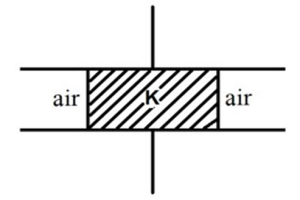
The capacity of an air-filled parallel plate capacitor is $C_0$. One-half of the space between the plates is filled with a dielectric of constant $K$ as shown in the figure. The new capacity becomes $C_n$. The ratio of $C_n$ to $C_0$ is:
A
$\left(\frac{K+1}{2}\right)$
B
$\left(\frac{K+1}{3}\right)$
C
$\left(\frac{K+1}{4}\right)$
D
$4(K+1)$
Solution
(A) The initial capacity of the air-filled parallel plate capacitor is $C_0 = \frac{\epsilon_0 A}{d}$,where $A$ is the area of the plates and $d$ is the distance between them.
When the space is filled as shown in the figure,the capacitor can be viewed as two capacitors connected in parallel.
One part has an area $A/2$ filled with air,and the other part has an area $A/2$ filled with a dielectric of constant $K$.
The capacity of the air-filled part is $C_1 = \frac{\epsilon_0 (A/2)}{d} = \frac{C_0}{2}$.
The capacity of the dielectric-filled part is $C_2 = \frac{K \epsilon_0 (A/2)}{d} = \frac{K C_0}{2}$.
Since they are in parallel,the new capacity $C_n = C_1 + C_2 = \frac{C_0}{2} + \frac{K C_0}{2} = C_0 \left(\frac{K+1}{2}\right)$.
Therefore,the ratio $\frac{C_n}{C_0} = \frac{K+1}{2}$.
When the space is filled as shown in the figure,the capacitor can be viewed as two capacitors connected in parallel.
One part has an area $A/2$ filled with air,and the other part has an area $A/2$ filled with a dielectric of constant $K$.
The capacity of the air-filled part is $C_1 = \frac{\epsilon_0 (A/2)}{d} = \frac{C_0}{2}$.
The capacity of the dielectric-filled part is $C_2 = \frac{K \epsilon_0 (A/2)}{d} = \frac{K C_0}{2}$.
Since they are in parallel,the new capacity $C_n = C_1 + C_2 = \frac{C_0}{2} + \frac{K C_0}{2} = C_0 \left(\frac{K+1}{2}\right)$.
Therefore,the ratio $\frac{C_n}{C_0} = \frac{K+1}{2}$.
0 likes
View Solution258
EasyMCQ
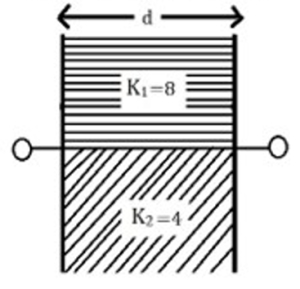
An air capacitor has a capacitance of $1 \mu F$. Now,the space between the two plates of the capacitor is filled with two dielectrics as shown in the figure. The capacitance of the capacitor is ($d=$ distance between two plates,$K_1=8$ and $K_2=4$ are the dielectric constants of the two dielectrics respectively).
A
$12 \mu F$
B
$6 \mu F$
C
$\frac{8}{3} \mu F$
D
$3 \mu F$
Solution
(B) The initial capacitance of the air capacitor is $C_0 = \frac{\epsilon_0 A}{d} = 1 \mu F$.
From the figure,the two dielectrics are placed in parallel,each occupying half the area of the plates $(A_1 = A_2 = A/2)$ and the full distance $d$ between the plates.
The capacitance of the two parts are:
$C_1 = \frac{K_1 \epsilon_0 (A/2)}{d} = K_1 \frac{C_0}{2} = 8 \times \frac{1}{2} = 4 \mu F$
$C_2 = \frac{K_2 \epsilon_0 (A/2)}{d} = K_2 \frac{C_0}{2} = 4 \times \frac{1}{2} = 2 \mu F$
Since they are in parallel,the equivalent capacitance is $C_{eq} = C_1 + C_2 = 4 \mu F + 2 \mu F = 6 \mu F$.
From the figure,the two dielectrics are placed in parallel,each occupying half the area of the plates $(A_1 = A_2 = A/2)$ and the full distance $d$ between the plates.
The capacitance of the two parts are:
$C_1 = \frac{K_1 \epsilon_0 (A/2)}{d} = K_1 \frac{C_0}{2} = 8 \times \frac{1}{2} = 4 \mu F$
$C_2 = \frac{K_2 \epsilon_0 (A/2)}{d} = K_2 \frac{C_0}{2} = 4 \times \frac{1}{2} = 2 \mu F$
Since they are in parallel,the equivalent capacitance is $C_{eq} = C_1 + C_2 = 4 \mu F + 2 \mu F = 6 \mu F$.
0 likes
View Solution259
EasyMCQ
$A$ parallel plate capacitor has plate area $40 \ cm^2$ and plate separation $2 \ mm$. The space between the plates is filled with a dielectric medium of thickness $1 \ mm$ and dielectric constant $5$. The capacitance of the system is ($\varepsilon_0 =$ permittivity of vacuum)
A
$24 \ \varepsilon_0 \ F$
B
$\frac{3}{10} \ \varepsilon_0 \ F$
C
$\frac{10}{3} \ \varepsilon_0 \ F$
D
$10 \ \varepsilon_0 \ F$
Solution
(C) The system can be viewed as two capacitors in series: one with the dielectric and one with the air gap.
$C_1 = \frac{K \varepsilon_0 A}{t} = \frac{5 \varepsilon_0 \times 40 \times 10^{-4}}{1 \times 10^{-3}} = 20 \varepsilon_0 \ F$
$C_2 = \frac{\varepsilon_0 A}{d-t} = \frac{\varepsilon_0 \times 40 \times 10^{-4}}{1 \times 10^{-3}} = 4 \varepsilon_0 \ F$
Since they are in series,the equivalent capacitance $C_{eq}$ is given by:
$\frac{1}{C_{eq}} = \frac{1}{C_1} + \frac{1}{C_2} = \frac{1}{20 \varepsilon_0} + \frac{1}{4 \varepsilon_0}$
$\frac{1}{C_{eq}} = \frac{1 + 5}{20 \varepsilon_0} = \frac{6}{20 \varepsilon_0} = \frac{3}{10 \varepsilon_0}$
$C_{eq} = \frac{10}{3} \varepsilon_0 \ F$
$C_1 = \frac{K \varepsilon_0 A}{t} = \frac{5 \varepsilon_0 \times 40 \times 10^{-4}}{1 \times 10^{-3}} = 20 \varepsilon_0 \ F$
$C_2 = \frac{\varepsilon_0 A}{d-t} = \frac{\varepsilon_0 \times 40 \times 10^{-4}}{1 \times 10^{-3}} = 4 \varepsilon_0 \ F$
Since they are in series,the equivalent capacitance $C_{eq}$ is given by:
$\frac{1}{C_{eq}} = \frac{1}{C_1} + \frac{1}{C_2} = \frac{1}{20 \varepsilon_0} + \frac{1}{4 \varepsilon_0}$
$\frac{1}{C_{eq}} = \frac{1 + 5}{20 \varepsilon_0} = \frac{6}{20 \varepsilon_0} = \frac{3}{10 \varepsilon_0}$
$C_{eq} = \frac{10}{3} \varepsilon_0 \ F$
0 likes
View Solution260
MediumMCQ
$A$ parallel plate air capacitor, with plate separation $d$, has a capacitance of $9 \text{ pF}$. The space between the plates is now filled with two dielectrics, the first having $K_1=3$ and thickness $d_1=d/3$, while the second has $K_2=6$ and thickness $d_2=2d/3$. The capacitance of the new capacitor is: (in $\text{ pF}$)
A
$3.8$
B
$20.25$
C
$40.5$
D
$45$
Solution
(C) For an air-filled parallel plate capacitor, the capacitance is given by $C = \frac{A \varepsilon_0}{d} = 9 \text{ pF}$.
When the space is filled with dielectrics of thickness $d_1$ and $d_2$, the system acts as two capacitors in series.
The capacitance of the first part is $C_1 = \frac{K_1 A \varepsilon_0}{d_1} = \frac{3 A \varepsilon_0}{d/3} = 9 \frac{A \varepsilon_0}{d} = 9C = 9 \times 9 \text{ pF} = 81 \text{ pF}$.
The capacitance of the second part is $C_2 = \frac{K_2 A \varepsilon_0}{d_2} = \frac{6 A \varepsilon_0}{2d/3} = 9 \frac{A \varepsilon_0}{d} = 9C = 9 \times 9 \text{ pF} = 81 \text{ pF}$.
Since the capacitors are in series, the equivalent capacitance $C_{\text{eq}}$ is given by $\frac{1}{C_{\text{eq}}} = \frac{1}{C_1} + \frac{1}{C_2}$.
$C_{\text{eq}} = \frac{C_1 C_2}{C_1 + C_2} = \frac{81 \times 81}{81 + 81} = \frac{81}{2} = 40.5 \text{ pF}$.
When the space is filled with dielectrics of thickness $d_1$ and $d_2$, the system acts as two capacitors in series.
The capacitance of the first part is $C_1 = \frac{K_1 A \varepsilon_0}{d_1} = \frac{3 A \varepsilon_0}{d/3} = 9 \frac{A \varepsilon_0}{d} = 9C = 9 \times 9 \text{ pF} = 81 \text{ pF}$.
The capacitance of the second part is $C_2 = \frac{K_2 A \varepsilon_0}{d_2} = \frac{6 A \varepsilon_0}{2d/3} = 9 \frac{A \varepsilon_0}{d} = 9C = 9 \times 9 \text{ pF} = 81 \text{ pF}$.
Since the capacitors are in series, the equivalent capacitance $C_{\text{eq}}$ is given by $\frac{1}{C_{\text{eq}}} = \frac{1}{C_1} + \frac{1}{C_2}$.
$C_{\text{eq}} = \frac{C_1 C_2}{C_1 + C_2} = \frac{81 \times 81}{81 + 81} = \frac{81}{2} = 40.5 \text{ pF}$.
0 likes
View Solution261
MediumMCQ
The function of a dielectric in a capacitor is
A
to reduce the effective potential on plates.
B
to increase the effective potential on plates.
C
to decrease the capacitance.
D
to reduce the plate area of capacitor.
Solution
(A) When a dielectric material is inserted between the plates of a capacitor,it gets polarized. This polarization creates an internal electric field that opposes the external electric field produced by the charges on the plates. As a result,the net electric field $E$ between the plates decreases. Since the potential difference $V$ is related to the electric field by $V = E \cdot d$ (where $d$ is the distance between the plates),a decrease in the electric field leads to a decrease in the potential difference between the plates for a given charge $Q$. Consequently,the capacitance $C = Q/V$ increases.
0 likes
View Solution262
EasyMCQ
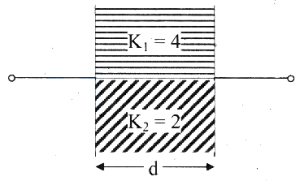
An air capacitor has a capacitance of $1 \mu F$. Now the space between the two plates of the capacitor is filled with two dielectrics as shown in the figure. The capacitance of the capacitor is: [$d=$ distance between two plates of the capacitor,$K_1$ and $K_2$ are dielectric constants of the first and second dielectric respectively] (in $\mu F$)
A
$3$
B
$6$
C
$8$
D
$12$
Solution
(A) The capacitance of a parallel plate air capacitor is given by $C = \frac{\varepsilon_0 A}{d} = 1 \mu F$.
From the figure,the area of each plate is divided into two halves,$A/2$ and $A/2$,while the distance $d$ remains the same for both. This configuration represents two capacitors in parallel.
For the first dielectric $(K_1 = 4)$:
$C_1 = \frac{K_1 \varepsilon_0 (A/2)}{d} = K_1 \times \frac{1}{2} \times C = 4 \times 0.5 \times 1 \mu F = 2 \mu F$.
For the second dielectric $(K_2 = 2)$:
$C_2 = \frac{K_2 \varepsilon_0 (A/2)}{d} = K_2 \times \frac{1}{2} \times C = 2 \times 0.5 \times 1 \mu F = 1 \mu F$.
Since the capacitors are in parallel,the effective capacitance is:
$C_{\text{eff}} = C_1 + C_2 = 2 \mu F + 1 \mu F = 3 \mu F$.
From the figure,the area of each plate is divided into two halves,$A/2$ and $A/2$,while the distance $d$ remains the same for both. This configuration represents two capacitors in parallel.
For the first dielectric $(K_1 = 4)$:
$C_1 = \frac{K_1 \varepsilon_0 (A/2)}{d} = K_1 \times \frac{1}{2} \times C = 4 \times 0.5 \times 1 \mu F = 2 \mu F$.
For the second dielectric $(K_2 = 2)$:
$C_2 = \frac{K_2 \varepsilon_0 (A/2)}{d} = K_2 \times \frac{1}{2} \times C = 2 \times 0.5 \times 1 \mu F = 1 \mu F$.
Since the capacitors are in parallel,the effective capacitance is:
$C_{\text{eff}} = C_1 + C_2 = 2 \mu F + 1 \mu F = 3 \mu F$.
0 likes
View Solution263
MediumMCQ
Two parallel plate air capacitors of same capacity '$C$' are connected in series to a battery of emf '$E$'. Then one of the capacitors is completely filled with a dielectric material of constant '$K$'. The change in the effective capacity of the series combination is
A
$\frac{C}{2}\left[\frac{K+1}{K-1}\right]$
B
$\frac{2}{C}\left[\frac{K-1}{K+1}\right]$
C
$\frac{C}{2}\left[\frac{K-1}{K+1}\right]$
D
$\frac{C}{2}\left[\frac{K-1}{K+1}\right]^2$
Solution
(C) Initially,two capacitors of capacity $C$ are in series. The equivalent capacity $C_1$ is given by:
$\frac{1}{C_1} = \frac{1}{C} + \frac{1}{C} = \frac{2}{C} \implies C_1 = \frac{C}{2}$
After filling one capacitor with a dielectric of constant $K$,its new capacity becomes $KC$. The new equivalent capacity $C_2$ is:
$\frac{1}{C_2} = \frac{1}{C} + \frac{1}{KC} = \frac{1}{C} \left(1 + \frac{1}{K}\right) = \frac{1}{C} \left(\frac{K+1}{K}\right) \implies C_2 = \frac{CK}{K+1}$
The change in effective capacity $\Delta C$ is:
$\Delta C = C_2 - C_1 = \frac{CK}{K+1} - \frac{C}{2}$
$\Delta C = C \left[ \frac{2K - (K+1)}{2(K+1)} \right] = \frac{C}{2} \left[ \frac{K-1}{K+1} \right]$
$\frac{1}{C_1} = \frac{1}{C} + \frac{1}{C} = \frac{2}{C} \implies C_1 = \frac{C}{2}$
After filling one capacitor with a dielectric of constant $K$,its new capacity becomes $KC$. The new equivalent capacity $C_2$ is:
$\frac{1}{C_2} = \frac{1}{C} + \frac{1}{KC} = \frac{1}{C} \left(1 + \frac{1}{K}\right) = \frac{1}{C} \left(\frac{K+1}{K}\right) \implies C_2 = \frac{CK}{K+1}$
The change in effective capacity $\Delta C$ is:
$\Delta C = C_2 - C_1 = \frac{CK}{K+1} - \frac{C}{2}$
$\Delta C = C \left[ \frac{2K - (K+1)}{2(K+1)} \right] = \frac{C}{2} \left[ \frac{K-1}{K+1} \right]$
0 likes
View Solution264
MediumMCQ
Two identical capacitors $A$ and $B$ are connected in series to a battery of $E$.$M$.$F$. $E$. Capacitor $B$ contains a slab of dielectric constant $K$. $Q_A$ and $Q_B$ are the charges stored in $A$ and $B$. When the dielectric slab is removed,the corresponding charges are $Q_A^{\prime}$ and $Q_B^{\prime}$. Then:
A
$\frac{Q_A^{\prime}}{Q_A}=\frac{K}{2}$
B
$\frac{Q_B^{\prime}}{Q_B}=\frac{K+1}{2}$
C
$\frac{Q_A^{\prime}}{Q_A}=\frac{K+1}{K}$
D
$\frac{Q_B^{\prime}}{Q_B}=\frac{K+1}{2K}$
Solution
(D) Initially,the capacitors are in series with capacitance $C_A = C$ and $C_B = KC$. The equivalent capacitance is $C_{net} = \frac{C_A C_B}{C_A + C_B} = \frac{C \cdot KC}{C + KC} = \frac{KC}{K+1}$.
The charge on each capacitor in series is $Q_A = Q_B = C_{net}E = \frac{KCE}{K+1}$.
After removing the dielectric,$C_A = C$ and $C_B = C$. The new equivalent capacitance is $C_{net}^{\prime} = \frac{C \cdot C}{C + C} = \frac{C}{2}$.
The new charge on each capacitor is $Q_A^{\prime} = Q_B^{\prime} = C_{net}^{\prime}E = \frac{CE}{2}$.
Calculating the ratio: $\frac{Q_B^{\prime}}{Q_B} = \frac{CE/2}{KCE/(K+1)} = \frac{K+1}{2K}$.
The charge on each capacitor in series is $Q_A = Q_B = C_{net}E = \frac{KCE}{K+1}$.
After removing the dielectric,$C_A = C$ and $C_B = C$. The new equivalent capacitance is $C_{net}^{\prime} = \frac{C \cdot C}{C + C} = \frac{C}{2}$.
The new charge on each capacitor is $Q_A^{\prime} = Q_B^{\prime} = C_{net}^{\prime}E = \frac{CE}{2}$.
Calculating the ratio: $\frac{Q_B^{\prime}}{Q_B} = \frac{CE/2}{KCE/(K+1)} = \frac{K+1}{2K}$.
0 likes
View Solution265
MediumMCQ
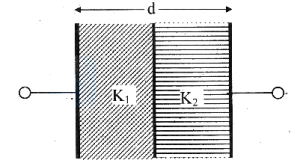
An air capacitor has capacitance $C_1$. The space between the two plates of the capacitor is filled with two dielectrics as shown in the figure. The new capacitance of the capacitor is $C_2$. The ratio $\frac{C_1}{C_2}$ is ($d=$ distance between two plates of the capacitor,$K_1$ and $K_2$ are dielectric constants of the two dielectrics respectively).
A
$K_1+K_2$
B
$\frac{K_1+K_2}{K_1-K_2}$
C
$\frac{2 K_1 K_2}{K_1+K_2}$
D
$\frac{K_1+K_2}{2 K_1 K_2}$
Solution
(D) For an air capacitor,$C_1 = \frac{A \varepsilon_0}{d}$.
When two dielectrics are inserted as shown,the arrangement acts as two capacitors in series,each with plate separation $d/2$ and area $A$.
The capacitance of the first part is $C_{a} = \frac{K_1 A \varepsilon_0}{d/2} = \frac{2 K_1 A \varepsilon_0}{d} = 2 K_1 C_1$.
The capacitance of the second part is $C_{b} = \frac{K_2 A \varepsilon_0}{d/2} = \frac{2 K_2 A \varepsilon_0}{d} = 2 K_2 C_1$.
Since they are in series,the equivalent capacitance $C_2$ is given by:
$\frac{1}{C_2} = \frac{1}{C_a} + \frac{1}{C_b} = \frac{1}{2 K_1 C_1} + \frac{1}{2 K_2 C_1} = \frac{1}{2 C_1} \left( \frac{1}{K_1} + \frac{1}{K_2} \right) = \frac{1}{2 C_1} \left( \frac{K_1 + K_2}{K_1 K_2} \right)$.
Therefore,$C_2 = \frac{2 C_1 K_1 K_2}{K_1 + K_2}$.
The ratio $\frac{C_1}{C_2} = \frac{C_1}{\frac{2 C_1 K_1 K_2}{K_1 + K_2}} = \frac{K_1 + K_2}{2 K_1 K_2}$.
When two dielectrics are inserted as shown,the arrangement acts as two capacitors in series,each with plate separation $d/2$ and area $A$.
The capacitance of the first part is $C_{a} = \frac{K_1 A \varepsilon_0}{d/2} = \frac{2 K_1 A \varepsilon_0}{d} = 2 K_1 C_1$.
The capacitance of the second part is $C_{b} = \frac{K_2 A \varepsilon_0}{d/2} = \frac{2 K_2 A \varepsilon_0}{d} = 2 K_2 C_1$.
Since they are in series,the equivalent capacitance $C_2$ is given by:
$\frac{1}{C_2} = \frac{1}{C_a} + \frac{1}{C_b} = \frac{1}{2 K_1 C_1} + \frac{1}{2 K_2 C_1} = \frac{1}{2 C_1} \left( \frac{1}{K_1} + \frac{1}{K_2} \right) = \frac{1}{2 C_1} \left( \frac{K_1 + K_2}{K_1 K_2} \right)$.
Therefore,$C_2 = \frac{2 C_1 K_1 K_2}{K_1 + K_2}$.
The ratio $\frac{C_1}{C_2} = \frac{C_1}{\frac{2 C_1 K_1 K_2}{K_1 + K_2}} = \frac{K_1 + K_2}{2 K_1 K_2}$.
0 likes
View Solution266
MediumMCQ
The potential energy of a charged parallel plate capacitor is $U_0$. If a slab of dielectric constant $K$ is inserted between the plates,then the new potential energy will be
A
$\frac{U_0}{K}$
B
$U_0 K^2$
C
$\frac{U_0}{K^2}$
D
$U_0^2$
Solution
(A) The potential energy of a charged capacitor is given by $U_0 = \frac{Q^2}{2C}$,where $Q$ is the charge on the plates and $C$ is the initial capacitance.
When a dielectric slab of constant $K$ is inserted between the plates,the new capacitance becomes $C' = KC$.
Assuming the capacitor is isolated (charge $Q$ remains constant),the new potential energy $U'$ is given by:
$U' = \frac{Q^2}{2C'} = \frac{Q^2}{2(KC)}$
$U' = \frac{1}{K} \left( \frac{Q^2}{2C} \right)$
$U' = \frac{U_0}{K}$
When a dielectric slab of constant $K$ is inserted between the plates,the new capacitance becomes $C' = KC$.
Assuming the capacitor is isolated (charge $Q$ remains constant),the new potential energy $U'$ is given by:
$U' = \frac{Q^2}{2C'} = \frac{Q^2}{2(KC)}$
$U' = \frac{1}{K} \left( \frac{Q^2}{2C} \right)$
$U' = \frac{U_0}{K}$
0 likes
View Solution267
DifficultMCQ
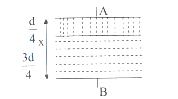
Two dielectric slabs having dielectric constants $K_1$ and $K_2$ of thicknesses $\frac{d}{4}$ and $\frac{3d}{4}$ are inserted between the plates of a capacitor as shown in the figure. The net capacitance between $A$ and $B$ is [where $\varepsilon_0$ is the permittivity of free space].
A
$\frac{2 A \varepsilon_0}{d} \left[\frac{K_1 K_2}{3 K_1+K_2}\right]$
B
$\frac{3 A \varepsilon_0}{d} \left[\frac{K_1+K_2}{K_1 K_2}\right]$
C
$\frac{3 A \varepsilon_0}{2 d} \left[\frac{K_1+K_2}{K_1 K_2}\right]$
D
$\frac{4 A \varepsilon_0}{d} \left[\frac{K_1 K_2}{3 K_1+K_2}\right]$
Solution
(D) The capacitor can be modeled as two capacitors in series,each with plate area $A$ and dielectric thicknesses $d_1 = \frac{d}{4}$ and $d_2 = \frac{3d}{4}$.
Capacity of the $1^{\text{st}}$ capacitor:
$C_1 = \frac{K_1 \varepsilon_0 A}{d/4} = \frac{4 K_1 \varepsilon_0 A}{d}$
Capacity of the $2^{\text{nd}}$ capacitor:
$C_2 = \frac{K_2 \varepsilon_0 A}{3d/4} = \frac{4 K_2 \varepsilon_0 A}{3d}$
Since they are in series,the equivalent capacitance $C$ is given by:
$\frac{1}{C} = \frac{1}{C_1} + \frac{1}{C_2}$
$\frac{1}{C} = \frac{d}{4 K_1 \varepsilon_0 A} + \frac{3d}{4 K_2 \varepsilon_0 A}$
$\frac{1}{C} = \frac{d}{4 \varepsilon_0 A} \left[\frac{1}{K_1} + \frac{3}{K_2}\right]$
$\frac{1}{C} = \frac{d}{4 \varepsilon_0 A} \left[\frac{K_2 + 3 K_1}{K_1 K_2}\right]$
Therefore,$C = \frac{4 \varepsilon_0 A}{d} \left[\frac{K_1 K_2}{3 K_1 + K_2}\right]$.
Capacity of the $1^{\text{st}}$ capacitor:
$C_1 = \frac{K_1 \varepsilon_0 A}{d/4} = \frac{4 K_1 \varepsilon_0 A}{d}$
Capacity of the $2^{\text{nd}}$ capacitor:
$C_2 = \frac{K_2 \varepsilon_0 A}{3d/4} = \frac{4 K_2 \varepsilon_0 A}{3d}$
Since they are in series,the equivalent capacitance $C$ is given by:
$\frac{1}{C} = \frac{1}{C_1} + \frac{1}{C_2}$
$\frac{1}{C} = \frac{d}{4 K_1 \varepsilon_0 A} + \frac{3d}{4 K_2 \varepsilon_0 A}$
$\frac{1}{C} = \frac{d}{4 \varepsilon_0 A} \left[\frac{1}{K_1} + \frac{3}{K_2}\right]$
$\frac{1}{C} = \frac{d}{4 \varepsilon_0 A} \left[\frac{K_2 + 3 K_1}{K_1 K_2}\right]$
Therefore,$C = \frac{4 \varepsilon_0 A}{d} \left[\frac{K_1 K_2}{3 K_1 + K_2}\right]$.
0 likes
View Solution268
EasyMCQ
$A$ parallel plate capacitor is charged by a battery and the battery remains connected. $A$ dielectric slab of constant $K$ is inserted between the plates and then taken out. What happens to the electric field between the plates?
A
remains the same
B
increases
C
decreases
D
becomes zero
Solution
(A) When a battery remains connected to a parallel plate capacitor,the potential difference $V$ between the plates remains constant.
The electric field $E$ between the plates is given by the formula $E = V/d$,where $d$ is the distance between the plates.
Since the battery is connected,$V$ is constant. When the dielectric slab is inserted,the capacitance increases,but the potential difference $V$ across the plates remains equal to the battery voltage.
When the dielectric slab is taken out,the system returns to its original state because the battery maintains the potential difference $V$ at all times.
Therefore,the electric field $E$ remains the same as it was before the insertion of the slab.
The electric field $E$ between the plates is given by the formula $E = V/d$,where $d$ is the distance between the plates.
Since the battery is connected,$V$ is constant. When the dielectric slab is inserted,the capacitance increases,but the potential difference $V$ across the plates remains equal to the battery voltage.
When the dielectric slab is taken out,the system returns to its original state because the battery maintains the potential difference $V$ at all times.
Therefore,the electric field $E$ remains the same as it was before the insertion of the slab.
0 likes
View Solution269
MediumMCQ
In a parallel plate capacitor with air between the plates,the distance '$d$' between the plates is changed and the space is filled with a dielectric of constant $K = 8$. If the capacity of the capacitor increases $16$ times,the new distance between the plates is:
A
$2d$
B
$4d$
C
$\frac{d}{2}$
D
$\frac{d}{4}$
Solution
(C) The initial capacitance of the air-filled parallel plate capacitor is given by $C_1 = \frac{A \varepsilon_0}{d}$.
When the space is filled with a dielectric of constant $K = 8$ and the distance is changed to $d'$,the new capacitance is $C_2 = \frac{K A \varepsilon_0}{d'} = \frac{8 A \varepsilon_0}{d'}$.
Given that the capacity increases $16$ times,we have $C_2 = 16 C_1$.
Substituting the expressions,we get $\frac{8 A \varepsilon_0}{d'} = 16 \left( \frac{A \varepsilon_0}{d} \right)$.
Simplifying the equation: $\frac{8}{d'} = \frac{16}{d}$.
Solving for $d'$,we get $d' = \frac{8d}{16} = \frac{d}{2}$.
When the space is filled with a dielectric of constant $K = 8$ and the distance is changed to $d'$,the new capacitance is $C_2 = \frac{K A \varepsilon_0}{d'} = \frac{8 A \varepsilon_0}{d'}$.
Given that the capacity increases $16$ times,we have $C_2 = 16 C_1$.
Substituting the expressions,we get $\frac{8 A \varepsilon_0}{d'} = 16 \left( \frac{A \varepsilon_0}{d} \right)$.
Simplifying the equation: $\frac{8}{d'} = \frac{16}{d}$.
Solving for $d'$,we get $d' = \frac{8d}{16} = \frac{d}{2}$.
0 likes
View Solution270
MediumMCQ
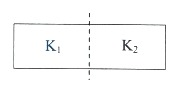
$A$ parallel plate capacitor with air medium between the plates has a capacitance of $10 \mu F$. The area of the capacitor is divided into two equal halves and filled with two media (as shown in the figure) having dielectric constants $K_1=2$ and $K_2=4$. The capacitance of the system will be (in $\mu F$)
A
$10$
B
$20$
C
$30$
D
$40$
Solution
(C) The initial capacitance of the air-filled parallel plate capacitor is given by $C = \frac{\varepsilon_0 A}{d} = 10 \mu F$.
When the area is divided into two equal halves and filled with dielectrics $K_1$ and $K_2$,the two parts act as two capacitors connected in parallel.
The area of each part is $A' = \frac{A}{2}$ and the distance between the plates remains $d$.
The capacitance of the first part is $C_1 = \frac{K_1 \varepsilon_0 A'}{d} = \frac{K_1 \varepsilon_0 A}{2d} = \frac{K_1}{2} C$.
The capacitance of the second part is $C_2 = \frac{K_2 \varepsilon_0 A'}{d} = \frac{K_2 \varepsilon_0 A}{2d} = \frac{K_2}{2} C$.
Since they are in parallel,the equivalent capacitance is $C_{\text{eq}} = C_1 + C_2 = \frac{C}{2} (K_1 + K_2)$.
Substituting the given values: $C_{\text{eq}} = \frac{10 \mu F}{2} (2 + 4) = 5 \mu F \times 6 = 30 \mu F$.
When the area is divided into two equal halves and filled with dielectrics $K_1$ and $K_2$,the two parts act as two capacitors connected in parallel.
The area of each part is $A' = \frac{A}{2}$ and the distance between the plates remains $d$.
The capacitance of the first part is $C_1 = \frac{K_1 \varepsilon_0 A'}{d} = \frac{K_1 \varepsilon_0 A}{2d} = \frac{K_1}{2} C$.
The capacitance of the second part is $C_2 = \frac{K_2 \varepsilon_0 A'}{d} = \frac{K_2 \varepsilon_0 A}{2d} = \frac{K_2}{2} C$.
Since they are in parallel,the equivalent capacitance is $C_{\text{eq}} = C_1 + C_2 = \frac{C}{2} (K_1 + K_2)$.
Substituting the given values: $C_{\text{eq}} = \frac{10 \mu F}{2} (2 + 4) = 5 \mu F \times 6 = 30 \mu F$.
0 likes
View Solution271
MediumMCQ
$A$ parallel plate air-filled capacitor of capacitance $C_1$ has plate area $A$ and the distance between the plates $d$. When a metal sheet of thickness $\frac{d}{2}$ and of the same area $A$ is introduced between the plates,its capacitance becomes $C_2$. The ratio $C_2: C_1$ is
A
$4: 1$
B
$2: 1$
C
$3: 1$
D
$3: 2$
Solution
(B) The capacitance of the air-filled parallel plate capacitor is given by:
$C_1 = \frac{\varepsilon_0 A}{d} \quad --- (1)$
When a slab of dielectric constant $K$ and thickness $t$ is introduced between the plates,the new capacitance $C_2$ is given by:
$C_2 = \frac{\varepsilon_0 A}{d - t + \frac{t}{K}}$
For a metal sheet,the dielectric constant $K = \infty$. Given $t = \frac{d}{2}$,we substitute these values:
$C_2 = \frac{\varepsilon_0 A}{d - \frac{d}{2} + \frac{d/2}{\infty}} = \frac{\varepsilon_0 A}{\frac{d}{2} + 0} = \frac{2 \varepsilon_0 A}{d}$
$C_2 = 2 \left( \frac{\varepsilon_0 A}{d} \right) = 2 C_1$
Therefore,the ratio $C_2 : C_1 = 2 : 1$.
$C_1 = \frac{\varepsilon_0 A}{d} \quad --- (1)$
When a slab of dielectric constant $K$ and thickness $t$ is introduced between the plates,the new capacitance $C_2$ is given by:
$C_2 = \frac{\varepsilon_0 A}{d - t + \frac{t}{K}}$
For a metal sheet,the dielectric constant $K = \infty$. Given $t = \frac{d}{2}$,we substitute these values:
$C_2 = \frac{\varepsilon_0 A}{d - \frac{d}{2} + \frac{d/2}{\infty}} = \frac{\varepsilon_0 A}{\frac{d}{2} + 0} = \frac{2 \varepsilon_0 A}{d}$
$C_2 = 2 \left( \frac{\varepsilon_0 A}{d} \right) = 2 C_1$
Therefore,the ratio $C_2 : C_1 = 2 : 1$.

0 likes
View Solution272
MediumMCQ
The dielectric slab is introduced between the plates of a parallel plate charged capacitor. Which one of the following quantities will not change?
A
The charge on the capacitor.
B
The potential difference between the plates.
C
The energy stored in the capacitor.
D
The electric field between the plates of a capacitor.
Solution
(A) When a dielectric slab is inserted into an isolated parallel plate capacitor,the charge $Q$ on the plates remains constant because the system is disconnected from the battery.
As the capacitance increases to $C' = KC$,the potential difference $V' = Q/C' = V/K$ decreases.
The electric field $E' = V'/d = E/K$ also decreases.
The energy stored $U' = Q^2/(2C') = U/K$ decreases.
Therefore,the charge on the capacitor is the only quantity that does not change.
As the capacitance increases to $C' = KC$,the potential difference $V' = Q/C' = V/K$ decreases.
The electric field $E' = V'/d = E/K$ also decreases.
The energy stored $U' = Q^2/(2C') = U/K$ decreases.
Therefore,the charge on the capacitor is the only quantity that does not change.
0 likes
View Solution273
DifficultMCQ
In a parallel plate air capacitor of plate separation $d$,a dielectric slab of thickness $t$ is introduced between the plates $(t < d)$. The capacitance becomes one-third of the original value. The dielectric constant of the slab will be
A
$\frac{t}{2 d+t}$
B
$\frac{t}{d-2 t}$
C
$\frac{t}{d+t}$
D
$\frac{2 t}{2 d-t}$
Solution
(A) The capacitance of an air-filled parallel plate capacitor is $C_0 = \frac{\varepsilon_0 A}{d}$.
When a dielectric slab of thickness $t$ and dielectric constant $K$ is introduced,the new capacitance $C'$ is given by:
$C' = \frac{\varepsilon_0 A}{d - t + \frac{t}{K}}$.
Given that the new capacitance is one-third of the original value,i.e.,$C' = \frac{C_0}{3}$:
$\frac{\varepsilon_0 A}{d - t + \frac{t}{K}} = \frac{1}{3} \left( \frac{\varepsilon_0 A}{d} \right)$.
Canceling $\varepsilon_0 A$ from both sides:
$\frac{1}{d - t + \frac{t}{K}} = \frac{1}{3d}$.
$3d = d - t + \frac{t}{K}$.
$2d + t = \frac{t}{K}$.
$K = \frac{t}{2d + t}$.
When a dielectric slab of thickness $t$ and dielectric constant $K$ is introduced,the new capacitance $C'$ is given by:
$C' = \frac{\varepsilon_0 A}{d - t + \frac{t}{K}}$.
Given that the new capacitance is one-third of the original value,i.e.,$C' = \frac{C_0}{3}$:
$\frac{\varepsilon_0 A}{d - t + \frac{t}{K}} = \frac{1}{3} \left( \frac{\varepsilon_0 A}{d} \right)$.
Canceling $\varepsilon_0 A$ from both sides:
$\frac{1}{d - t + \frac{t}{K}} = \frac{1}{3d}$.
$3d = d - t + \frac{t}{K}$.
$2d + t = \frac{t}{K}$.
$K = \frac{t}{2d + t}$.
0 likes
View Solution274
DifficultMCQ
$A$ parallel plate air capacitor is charged up to $100 \,V$. $A$ plate $2 \,mm$ thick is inserted between the plates. Then, to maintain the same potential difference, the distance between the plates is increased by $1.6 \,mm$. The dielectric constant of the thick plate is
A
$4$
B
$5$
C
$2$
D
$3$
Solution
(B) Let $d$ be the initial distance between the plates. The initial capacitance is $C = \frac{A \epsilon_0}{d}$.
When a dielectric plate of thickness $t = 2 \,mm$ is inserted, the new capacitance $C_1$ is given by $C_1 = \frac{A \epsilon_0}{d - t + \frac{t}{k}}$.
When the distance between the plates is increased by $x = 1.6 \,mm$ to maintain the same potential difference (which implies the same capacitance $C_2 = C$), the new distance becomes $d' = d + x$.
The new capacitance is $C_2 = \frac{A \epsilon_0}{d + x - t + \frac{t}{k}}$.
Since $C_2 = C$, we have $d + x - t + \frac{t}{k} = d$.
Simplifying this, we get $x - t + \frac{t}{k} = 0$, or $t - x = \frac{t}{k}$.
Substituting the values $t = 2 \,mm$ and $x = 1.6 \,mm$:
$2 - 1.6 = \frac{2}{k}$
$0.4 = \frac{2}{k}$
$k = \frac{2}{0.4} = 5$.
When a dielectric plate of thickness $t = 2 \,mm$ is inserted, the new capacitance $C_1$ is given by $C_1 = \frac{A \epsilon_0}{d - t + \frac{t}{k}}$.
When the distance between the plates is increased by $x = 1.6 \,mm$ to maintain the same potential difference (which implies the same capacitance $C_2 = C$), the new distance becomes $d' = d + x$.
The new capacitance is $C_2 = \frac{A \epsilon_0}{d + x - t + \frac{t}{k}}$.
Since $C_2 = C$, we have $d + x - t + \frac{t}{k} = d$.
Simplifying this, we get $x - t + \frac{t}{k} = 0$, or $t - x = \frac{t}{k}$.
Substituting the values $t = 2 \,mm$ and $x = 1.6 \,mm$:
$2 - 1.6 = \frac{2}{k}$
$0.4 = \frac{2}{k}$
$k = \frac{2}{0.4} = 5$.
0 likes
View Solution275
EasyMCQ
$A$ parallel plate capacitor filled with oil of a dielectric constant $3$ between the plates has capacitance $C$. If the oil is removed,then the capacitance of the capacitor will be
A
$\frac{C}{\sqrt{3}}$
B
$3 C$
C
$\sqrt{3} C$
D
$\frac{C}{3}$
Solution
(D) The capacitance of a parallel plate capacitor filled with a dielectric medium is given by $C = \frac{K \varepsilon_0 A}{d}$.
Given that the dielectric constant $K = 3$,the initial capacitance is $C = \frac{3 \varepsilon_0 A}{d}$.
When the oil (dielectric) is removed,the medium between the plates becomes air (or vacuum),for which the dielectric constant $K' = 1$.
The new capacitance $C'$ is given by $C' = \frac{\varepsilon_0 A}{d}$.
Comparing the two expressions,we find that $C' = \frac{C}{3}$.
Given that the dielectric constant $K = 3$,the initial capacitance is $C = \frac{3 \varepsilon_0 A}{d}$.
When the oil (dielectric) is removed,the medium between the plates becomes air (or vacuum),for which the dielectric constant $K' = 1$.
The new capacitance $C'$ is given by $C' = \frac{\varepsilon_0 A}{d}$.
Comparing the two expressions,we find that $C' = \frac{C}{3}$.
0 likes
View Solution276
MediumMCQ
An air-filled parallel plate capacitor has a capacity of $2 \ pF$. If the separation between the plates is doubled and the interspace between the plates is filled with a dielectric material,the capacity increases to $6 \ pF$. The dielectric constant of the material is:
A
$3$
B
$6$
C
$2$
D
$4$
Solution
(B) The capacitance of a parallel plate capacitor is given by $C = \frac{k A \varepsilon_0}{d}$.
Initially,for an air-filled capacitor,$C_1 = \frac{A \varepsilon_0}{d_1} = 2 \ pF$,where $k_1 = 1$.
Finally,the separation is doubled $(d_2 = 2d_1)$ and the space is filled with a dielectric of constant $k_2 = k$. The new capacitance is $C_2 = \frac{k A \varepsilon_0}{d_2} = 6 \ pF$.
Taking the ratio: $\frac{C_2}{C_1} = \frac{k \cdot A \varepsilon_0 / (2d_1)}{A \varepsilon_0 / d_1} = \frac{k}{2}$.
Given $\frac{C_2}{C_1} = \frac{6}{2} = 3$.
Therefore,$\frac{k}{2} = 3$,which gives $k = 6$.
Initially,for an air-filled capacitor,$C_1 = \frac{A \varepsilon_0}{d_1} = 2 \ pF$,where $k_1 = 1$.
Finally,the separation is doubled $(d_2 = 2d_1)$ and the space is filled with a dielectric of constant $k_2 = k$. The new capacitance is $C_2 = \frac{k A \varepsilon_0}{d_2} = 6 \ pF$.
Taking the ratio: $\frac{C_2}{C_1} = \frac{k \cdot A \varepsilon_0 / (2d_1)}{A \varepsilon_0 / d_1} = \frac{k}{2}$.
Given $\frac{C_2}{C_1} = \frac{6}{2} = 3$.
Therefore,$\frac{k}{2} = 3$,which gives $k = 6$.
0 likes
View Solution277
MediumMCQ
Two identical parallel plate air capacitors are connected in series to a battery of emf $V$. If one of the capacitors is inserted in a liquid of dielectric constant $K$,then the potential difference across the other capacitor will become:
A
$\frac{K-1}{KV}$
B
$\frac{K+1}{KV}$
C
$\frac{KV}{K+1}$
D
$\frac{KV}{K-1}$
Solution
(C) Initially,both capacitors have capacitance $C$. When one capacitor is filled with a dielectric of constant $K$,its new capacitance becomes $C_1 = KC$,while the other remains $C_2 = C$.
Since the capacitors are connected in series to a battery of emf $V$,the potential difference $V_2$ across the capacitor $C_2$ is given by the voltage divider rule:
$V_2 = V \left( \frac{C_1}{C_1 + C_2} \right)$
Substituting the values:
$V_2 = V \left( \frac{KC}{KC + C} \right) = V \left( \frac{KC}{C(K + 1)} \right)$
$V_2 = \frac{KV}{K + 1}$
Since the capacitors are connected in series to a battery of emf $V$,the potential difference $V_2$ across the capacitor $C_2$ is given by the voltage divider rule:
$V_2 = V \left( \frac{C_1}{C_1 + C_2} \right)$
Substituting the values:
$V_2 = V \left( \frac{KC}{KC + C} \right) = V \left( \frac{KC}{C(K + 1)} \right)$
$V_2 = \frac{KV}{K + 1}$
0 likes
View Solution278
MediumMCQ
When the battery across the plates of a charged condenser is disconnected and a dielectric slab is introduced between its plates,then the energy stored:
A
becomes infinity
B
does not change
C
increases
D
decreases
Solution
(D) When the battery is disconnected,the charge $q$ on the capacitor plates remains constant because there is no path for the charge to flow.
When a dielectric slab of dielectric constant $k$ is introduced between the plates,the capacitance of the capacitor increases from $C$ to $C' = kC$.
The energy stored in a capacitor is given by $U = \frac{q^2}{2C}$.
Since $q$ is constant and $C$ increases,the final energy $U_f = \frac{q^2}{2kC}$ will be less than the initial energy $U_i = \frac{q^2}{2C}$.
Therefore,the energy stored decreases.
When a dielectric slab of dielectric constant $k$ is introduced between the plates,the capacitance of the capacitor increases from $C$ to $C' = kC$.
The energy stored in a capacitor is given by $U = \frac{q^2}{2C}$.
Since $q$ is constant and $C$ increases,the final energy $U_f = \frac{q^2}{2kC}$ will be less than the initial energy $U_i = \frac{q^2}{2C}$.
Therefore,the energy stored decreases.
0 likes
View Solution279
DifficultMCQ
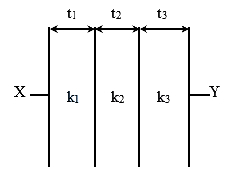
Two parallel plates with dielectric slabs placed between them are as shown in the figure. The resultant capacity of the capacitor will be: [$A$ = area of plate,$t_1, t_2, t_3$ are thicknesses of dielectric slabs,$k_1, k_2, k_3$ are dielectric constants.]
A
$\frac{A \varepsilon_0}{\left[\frac{t_1 + t_2 + t_3}{k_1 + k_2 + k_3}\right]}$
B
$\frac{A \varepsilon_0(k_1 k_2 k_3)}{t_1 t_2 t_3}$
C
$A \varepsilon_0 \left[\frac{k_1}{t_1} + \frac{k_2}{t_2} + \frac{k_3}{t_3}\right]$
D
$\frac{A \varepsilon_0}{\left[\frac{t_1}{k_1} + \frac{t_2}{k_2} + \frac{t_3}{k_3}\right]}$
Solution
(D) The arrangement consists of three capacitors connected in series.
For a parallel plate capacitor with a dielectric slab of thickness $t$ and dielectric constant $k$,the capacitance is $C = \frac{k \varepsilon_0 A}{t}$.
Since the slabs are placed in series,the equivalent capacitance $C_{eq}$ is given by $\frac{1}{C_{eq}} = \frac{1}{C_1} + \frac{1}{C_2} + \frac{1}{C_3}$.
Substituting the values,we get $\frac{1}{C_{eq}} = \frac{t_1}{k_1 \varepsilon_0 A} + \frac{t_2}{k_2 \varepsilon_0 A} + \frac{t_3}{k_3 \varepsilon_0 A}$.
Taking $\frac{1}{\varepsilon_0 A}$ as a common factor,$\frac{1}{C_{eq}} = \frac{1}{\varepsilon_0 A} \left[\frac{t_1}{k_1} + \frac{t_2}{k_2} + \frac{t_3}{k_3}\right]$.
Therefore,the resultant capacity is $C_{eq} = \frac{A \varepsilon_0}{\left[\frac{t_1}{k_1} + \frac{t_2}{k_2} + \frac{t_3}{k_3}\right]}$.
For a parallel plate capacitor with a dielectric slab of thickness $t$ and dielectric constant $k$,the capacitance is $C = \frac{k \varepsilon_0 A}{t}$.
Since the slabs are placed in series,the equivalent capacitance $C_{eq}$ is given by $\frac{1}{C_{eq}} = \frac{1}{C_1} + \frac{1}{C_2} + \frac{1}{C_3}$.
Substituting the values,we get $\frac{1}{C_{eq}} = \frac{t_1}{k_1 \varepsilon_0 A} + \frac{t_2}{k_2 \varepsilon_0 A} + \frac{t_3}{k_3 \varepsilon_0 A}$.
Taking $\frac{1}{\varepsilon_0 A}$ as a common factor,$\frac{1}{C_{eq}} = \frac{1}{\varepsilon_0 A} \left[\frac{t_1}{k_1} + \frac{t_2}{k_2} + \frac{t_3}{k_3}\right]$.
Therefore,the resultant capacity is $C_{eq} = \frac{A \varepsilon_0}{\left[\frac{t_1}{k_1} + \frac{t_2}{k_2} + \frac{t_3}{k_3}\right]}$.
0 likes
View Solution280
MediumMCQ
Two identical parallel plate air capacitors are connected in series to a battery of e.m.f. $V$. If one of the capacitors is inserted in a liquid of dielectric constant $K$,then the potential difference across the other capacitor will become:
A
$\frac{K}{V(K+1)}$
B
$\frac{KV}{K+1}$
C
$\frac{K+1}{KV}$
D
$\frac{K}{V(1-K)}$
Solution
(B) Let the initial capacitance of each capacitor be $C$. When one capacitor is filled with a dielectric of constant $K$,its new capacitance becomes $C' = KC$.
The two capacitors are connected in series to a battery of e.m.f. $V$.
Let $C_1 = KC$ be the capacitance of the dielectric-filled capacitor and $C_2 = C$ be the capacitance of the air-filled capacitor.
The potential difference across the air-filled capacitor $(C_2)$ in a series combination is given by the voltage divider rule:
$V_2 = V \times \frac{C_1}{C_1 + C_2}$
Substituting the values:
$V_2 = V \times \frac{KC}{KC + C}$
$V_2 = V \times \frac{KC}{C(K + 1)}$
$V_2 = \frac{KV}{K + 1}$
The two capacitors are connected in series to a battery of e.m.f. $V$.
Let $C_1 = KC$ be the capacitance of the dielectric-filled capacitor and $C_2 = C$ be the capacitance of the air-filled capacitor.
The potential difference across the air-filled capacitor $(C_2)$ in a series combination is given by the voltage divider rule:
$V_2 = V \times \frac{C_1}{C_1 + C_2}$
Substituting the values:
$V_2 = V \times \frac{KC}{KC + C}$
$V_2 = V \times \frac{KC}{C(K + 1)}$
$V_2 = \frac{KV}{K + 1}$
0 likes
View Solution281
EasyMCQ
The capacitance of a parallel plate capacitor with air as the medium is $3 \mu F$. With the introduction of a dielectric medium between the plates,the capacitance becomes $15 \mu F$. The permittivity of the medium in $SI$ units is: [Given: $\epsilon_{0} = 8.85 \times 10^{-12} \text{ SI units}$]
A
$15$
B
$8.845 \times 10^{-11}$
C
$0.4425 \times 10^{-10}$
D
$44.5$
Solution
(C) The capacitance of a parallel plate capacitor is given by $C = \frac{\varepsilon A}{d}$.
For air as the medium,the capacitance is $C_{0} = \frac{\varepsilon_{0} A}{d} = 3 \mu F$.
When a dielectric medium is introduced,the new capacitance is $C = \frac{\varepsilon A}{d} = 15 \mu F$.
Taking the ratio of the two capacitances:
$\frac{C}{C_{0}} = \frac{\varepsilon}{\varepsilon_{0}} = K$ (where $K$ is the dielectric constant).
$\frac{15}{3} = \frac{\varepsilon}{\varepsilon_{0}} \implies 5 = \frac{\varepsilon}{\varepsilon_{0}}$.
Therefore,the permittivity of the medium is $\varepsilon = 5 \times \varepsilon_{0}$.
$\varepsilon = 5 \times 8.85 \times 10^{-12} = 44.25 \times 10^{-12} \text{ F/m}$.
Converting to scientific notation: $\varepsilon = 0.4425 \times 10^{-10} \text{ F/m}$.
For air as the medium,the capacitance is $C_{0} = \frac{\varepsilon_{0} A}{d} = 3 \mu F$.
When a dielectric medium is introduced,the new capacitance is $C = \frac{\varepsilon A}{d} = 15 \mu F$.
Taking the ratio of the two capacitances:
$\frac{C}{C_{0}} = \frac{\varepsilon}{\varepsilon_{0}} = K$ (where $K$ is the dielectric constant).
$\frac{15}{3} = \frac{\varepsilon}{\varepsilon_{0}} \implies 5 = \frac{\varepsilon}{\varepsilon_{0}}$.
Therefore,the permittivity of the medium is $\varepsilon = 5 \times \varepsilon_{0}$.
$\varepsilon = 5 \times 8.85 \times 10^{-12} = 44.25 \times 10^{-12} \text{ F/m}$.
Converting to scientific notation: $\varepsilon = 0.4425 \times 10^{-10} \text{ F/m}$.
0 likes
View Solution282
MediumMCQ
In a parallel plate air capacitor, the distance between plates is reduced to one-fourth and the space between them is filled with a dielectric medium of constant $2$. If the initial capacity of the capacitor is $4 \mu F$, then its new capacity is: (in $\mu F$)
A
$32$
B
$18$
C
$8$
D
$44$
Solution
(A) The capacitance of a parallel plate air capacitor is given by $C_0 = \frac{\varepsilon_0 A}{d}$.
Here, $\varepsilon_0$ is the permittivity of free space, $A$ is the area of the plates, and $d$ is the distance between the plates.
When the distance between the plates is reduced to $d_1 = \frac{d}{4}$ and the space is filled with a dielectric of constant $K = 2$, the new capacitance $C$ is given by $C = \frac{K \varepsilon_0 A}{d_1}$.
Substituting $d_1 = \frac{d}{4}$ and $K = 2$ into the equation:
$C = \frac{2 \varepsilon_0 A}{d/4} = 8 \left( \frac{\varepsilon_0 A}{d} \right) = 8 C_0$.
Given $C_0 = 4 \mu F$, the new capacitance is $C = 8 \times 4 \mu F = 32 \mu F$.
Here, $\varepsilon_0$ is the permittivity of free space, $A$ is the area of the plates, and $d$ is the distance between the plates.
When the distance between the plates is reduced to $d_1 = \frac{d}{4}$ and the space is filled with a dielectric of constant $K = 2$, the new capacitance $C$ is given by $C = \frac{K \varepsilon_0 A}{d_1}$.
Substituting $d_1 = \frac{d}{4}$ and $K = 2$ into the equation:
$C = \frac{2 \varepsilon_0 A}{d/4} = 8 \left( \frac{\varepsilon_0 A}{d} \right) = 8 C_0$.
Given $C_0 = 4 \mu F$, the new capacitance is $C = 8 \times 4 \mu F = 32 \mu F$.
0 likes
View Solution283
DifficultMCQ
Two parallel plate air capacitors of the same capacity $C$ are connected in series to a battery of emf $E$. Then one of the capacitors is completely filled with a dielectric material of constant $K$. The change in the effective capacitance of the series combination is
A
$\frac{C}{2}\left[\frac{K-1}{K+1}\right]$
B
$\frac{C}{4}\left[\frac{K-1}{K+1}\right]$
C
$\frac{C}{2}\left[\frac{K+1}{K-1}\right]$
D
$\frac{C}{2}\left[\frac{K-1}{K+1}\right]^2$
Solution
(A) Initially,two capacitors of capacity $C$ are in series. The equivalent capacitance $C_1$ is given by $\frac{1}{C_1} = \frac{1}{C} + \frac{1}{C} = \frac{2}{C}$,so $C_1 = \frac{C}{2}$.
After filling one capacitor with a dielectric of constant $K$,its new capacity becomes $KC$. The new equivalent capacitance $C_2$ is given by $\frac{1}{C_2} = \frac{1}{C} + \frac{1}{KC} = \frac{1}{C} \left(1 + \frac{1}{K}\right) = \frac{K+1}{KC}$.
Thus,$C_2 = \frac{KC}{K+1}$.
The change in effective capacitance $\Delta C = C_2 - C_1 = \frac{KC}{K+1} - \frac{C}{2}$.
$\Delta C = C \left[ \frac{K}{K+1} - \frac{1}{2} \right] = C \left[ \frac{2K - (K+1)}{2(K+1)} \right] = \frac{C}{2} \left[ \frac{K-1}{K+1} \right]$.
After filling one capacitor with a dielectric of constant $K$,its new capacity becomes $KC$. The new equivalent capacitance $C_2$ is given by $\frac{1}{C_2} = \frac{1}{C} + \frac{1}{KC} = \frac{1}{C} \left(1 + \frac{1}{K}\right) = \frac{K+1}{KC}$.
Thus,$C_2 = \frac{KC}{K+1}$.
The change in effective capacitance $\Delta C = C_2 - C_1 = \frac{KC}{K+1} - \frac{C}{2}$.
$\Delta C = C \left[ \frac{K}{K+1} - \frac{1}{2} \right] = C \left[ \frac{2K - (K+1)}{2(K+1)} \right] = \frac{C}{2} \left[ \frac{K-1}{K+1} \right]$.
0 likes
View Solution284
MediumMCQ
Two identical parallel plate air capacitors are connected in series to a battery of emf $V$. If one of the capacitors is completely filled with a dielectric material of constant $K$,then the potential difference across the other capacitor will become:
A
$\frac{K V}{K+1}$
B
$\frac{V}{K+1}$
C
$\frac{(K-1) V}{K}$
D
$\frac{V}{K(K+1)}$
Solution
(A) Let the initial capacitance of each capacitor be $C$. When connected in series to a battery of emf $V$,the charge $q$ on both capacitors is the same.
Let $V_1$ be the potential difference across the air capacitor (capacitance $C$) and $V_2$ be the potential difference across the dielectric-filled capacitor (capacitance $KC$).
Since they are in series,$V_1 + V_2 = V$.
Using $q = CV$,we have $V_1 = \frac{q}{C}$ and $V_2 = \frac{q}{KC}$.
Substituting these into the sum equation: $\frac{q}{C} + \frac{q}{KC} = V$.
$\frac{q}{C} (1 + \frac{1}{K}) = V \Rightarrow \frac{q}{C} (\frac{K+1}{K}) = V$.
Therefore,the charge $q = \frac{CKV}{K+1}$.
The potential difference across the air capacitor is $V_1 = \frac{q}{C} = \frac{KV}{K+1}$.
Let $V_1$ be the potential difference across the air capacitor (capacitance $C$) and $V_2$ be the potential difference across the dielectric-filled capacitor (capacitance $KC$).
Since they are in series,$V_1 + V_2 = V$.
Using $q = CV$,we have $V_1 = \frac{q}{C}$ and $V_2 = \frac{q}{KC}$.
Substituting these into the sum equation: $\frac{q}{C} + \frac{q}{KC} = V$.
$\frac{q}{C} (1 + \frac{1}{K}) = V \Rightarrow \frac{q}{C} (\frac{K+1}{K}) = V$.
Therefore,the charge $q = \frac{CKV}{K+1}$.
The potential difference across the air capacitor is $V_1 = \frac{q}{C} = \frac{KV}{K+1}$.
0 likes
View Solution285
MediumMCQ
If a dielectric is inserted into a charged capacitor (battery removed),then the quantity that remains constant is
A
capacitance
B
potential
C
intensity
D
charge
Solution
(D) When a dielectric slab of constant $K$ is inserted into a charged parallel plate capacitor after the battery is disconnected,the charge $Q$ on the plates remains constant because there is no path for the charge to flow.
The variations in other physical quantities are as follows:
$1$. Capacitance: $C' = KC$ (increases).
$2$. Charge: $Q' = Q$ (remains constant).
$3$. Potential difference: $V' = V/K$ (decreases).
$4$. Electric field intensity: $E' = E/K$ (decreases).
$5$. Stored energy: $U' = U/K$ (decreases).
Therefore,the charge $Q$ is the quantity that remains constant.
The variations in other physical quantities are as follows:
$1$. Capacitance: $C' = KC$ (increases).
$2$. Charge: $Q' = Q$ (remains constant).
$3$. Potential difference: $V' = V/K$ (decreases).
$4$. Electric field intensity: $E' = E/K$ (decreases).
$5$. Stored energy: $U' = U/K$ (decreases).
Therefore,the charge $Q$ is the quantity that remains constant.
0 likes
View Solution286
MediumMCQ
$A$ capacitor is charged by a battery and the energy stored is $U$. Now,the battery is removed and the distance between the plates is increased to four times its original value. The new energy stored becomes:
A
$4 U$
B
$U$
C
$3 U$
D
$2 U$
Solution
(A) The energy stored in a capacitor is given by $U = \frac{Q^2}{2C}$.
When the battery is removed,the charge $Q$ on the capacitor plates remains constant.
The capacitance of a parallel plate capacitor is given by $C = \frac{\epsilon_0 A}{d}$,where $d$ is the distance between the plates.
If the distance $d$ is increased to $d' = 4d$,the new capacitance becomes $C' = \frac{\epsilon_0 A}{4d} = \frac{C}{4}$.
The new energy stored $U'$ is given by $U' = \frac{Q^2}{2C'} = \frac{Q^2}{2(C/4)} = 4 \times \frac{Q^2}{2C} = 4U$.
Therefore,the energy stored becomes $4U$.
When the battery is removed,the charge $Q$ on the capacitor plates remains constant.
The capacitance of a parallel plate capacitor is given by $C = \frac{\epsilon_0 A}{d}$,where $d$ is the distance between the plates.
If the distance $d$ is increased to $d' = 4d$,the new capacitance becomes $C' = \frac{\epsilon_0 A}{4d} = \frac{C}{4}$.
The new energy stored $U'$ is given by $U' = \frac{Q^2}{2C'} = \frac{Q^2}{2(C/4)} = 4 \times \frac{Q^2}{2C} = 4U$.
Therefore,the energy stored becomes $4U$.
0 likes
View Solution287
MediumMCQ
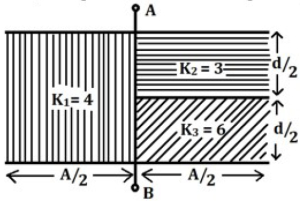
The equivalent capacitance between plates '$A$' and '$B$' ($A$-area of each plate,d-separation between plates) ($\epsilon_0$ - permittivity of free space) is
A
$\frac{A \epsilon_0}{d}$
B
$\frac{2 A \epsilon_0}{d}$
C
$\frac{4 A \epsilon_0}{d}$
D
$\frac{8 A \epsilon_0}{d}$
Solution
(C) The capacitor is divided into three parts. Let the total area be $A$ and separation be $d$.
$1$. The left part has area $A/2$ and dielectric constant $K_1 = 4$. Its capacitance is $C_1 = \frac{K_1 \epsilon_0 (A/2)}{d} = \frac{4 \epsilon_0 A}{2d} = \frac{2 \epsilon_0 A}{d}$.
$2$. The right side is divided into two parts in series,each with area $A/2$ and separation $d/2$. The dielectric constants are $K_2 = 3$ and $K_3 = 6$.
$3$. Capacitance of the top right part: $C_2 = \frac{K_2 \epsilon_0 (A/2)}{d/2} = \frac{3 \epsilon_0 A}{d}$.
$4$. Capacitance of the bottom right part: $C_3 = \frac{K_3 \epsilon_0 (A/2)}{d/2} = \frac{6 \epsilon_0 A}{d}$.
$5$. $C_2$ and $C_3$ are in series,so their equivalent capacitance $C_{23}$ is given by $\frac{1}{C_{23}} = \frac{1}{C_2} + \frac{1}{C_3} = \frac{d}{3 \epsilon_0 A} + \frac{d}{6 \epsilon_0 A} = \frac{2d + d}{6 \epsilon_0 A} = \frac{3d}{6 \epsilon_0 A} = \frac{d}{2 \epsilon_0 A}$. Thus,$C_{23} = \frac{2 \epsilon_0 A}{d}$.
$6$. $C_1$ and $C_{23}$ are in parallel. Therefore,the total equivalent capacitance $C_{eq} = C_1 + C_{23} = \frac{2 \epsilon_0 A}{d} + \frac{2 \epsilon_0 A}{d} = \frac{4 \epsilon_0 A}{d}$.
$1$. The left part has area $A/2$ and dielectric constant $K_1 = 4$. Its capacitance is $C_1 = \frac{K_1 \epsilon_0 (A/2)}{d} = \frac{4 \epsilon_0 A}{2d} = \frac{2 \epsilon_0 A}{d}$.
$2$. The right side is divided into two parts in series,each with area $A/2$ and separation $d/2$. The dielectric constants are $K_2 = 3$ and $K_3 = 6$.
$3$. Capacitance of the top right part: $C_2 = \frac{K_2 \epsilon_0 (A/2)}{d/2} = \frac{3 \epsilon_0 A}{d}$.
$4$. Capacitance of the bottom right part: $C_3 = \frac{K_3 \epsilon_0 (A/2)}{d/2} = \frac{6 \epsilon_0 A}{d}$.
$5$. $C_2$ and $C_3$ are in series,so their equivalent capacitance $C_{23}$ is given by $\frac{1}{C_{23}} = \frac{1}{C_2} + \frac{1}{C_3} = \frac{d}{3 \epsilon_0 A} + \frac{d}{6 \epsilon_0 A} = \frac{2d + d}{6 \epsilon_0 A} = \frac{3d}{6 \epsilon_0 A} = \frac{d}{2 \epsilon_0 A}$. Thus,$C_{23} = \frac{2 \epsilon_0 A}{d}$.
$6$. $C_1$ and $C_{23}$ are in parallel. Therefore,the total equivalent capacitance $C_{eq} = C_1 + C_{23} = \frac{2 \epsilon_0 A}{d} + \frac{2 \epsilon_0 A}{d} = \frac{4 \epsilon_0 A}{d}$.
0 likes
View Solution288
EasyMCQ
$A$ charged conductor produces an electric field of intensity $10^3 \ V/m$ just outside its surface in vacuum. Then,it produces an electric field of intensity $E$ just outside its surface,when it is placed in a medium of dielectric constant $4$. The value of $E$ will be (in $V/m$)
A
$400$
B
$450$
C
$250$
D
$150$
Solution
(C) The electric field $E_0$ just outside the surface of a charged conductor in vacuum is given by $E_0 = \frac{\sigma}{\epsilon_0}$,where $\sigma$ is the surface charge density.
When the conductor is placed in a medium with dielectric constant $K$,the electric field $E$ is given by $E = \frac{\sigma}{\epsilon_0 K} = \frac{E_0}{K}$.
Given $E_0 = 10^3 \ V/m$ and $K = 4$.
Therefore,$E = \frac{10^3}{4} \ V/m = 250 \ V/m$.
When the conductor is placed in a medium with dielectric constant $K$,the electric field $E$ is given by $E = \frac{\sigma}{\epsilon_0 K} = \frac{E_0}{K}$.
Given $E_0 = 10^3 \ V/m$ and $K = 4$.
Therefore,$E = \frac{10^3}{4} \ V/m = 250 \ V/m$.
0 likes
View Solution289
EasyMCQ
The force between two point charges placed in a material medium of dielectric constant $K$ is $F$. If the material is removed,then the force between them becomes . . . . . . .
A
$F \sqrt{ K }$
B
$FK$
C
$\frac{F}{\sqrt{K}}$
D
$\frac{ F }{ K }$
Solution
(B) The force between two point charges in a medium is given by $F_{\text{medium}} = \frac{F_{\text{air}}}{K}$,where $F_{\text{air}}$ is the force between the same charges in a vacuum (or air) and $K$ is the dielectric constant of the medium.
Given that the force in the medium is $F$,we have $F = \frac{F_{\text{air}}}{K}$.
To find the force when the material is removed (i.e.,the force in air),we rearrange the equation:
$F_{\text{air}} = F \times K$.
Therefore,the force becomes $FK$.
Given that the force in the medium is $F$,we have $F = \frac{F_{\text{air}}}{K}$.
To find the force when the material is removed (i.e.,the force in air),we rearrange the equation:
$F_{\text{air}} = F \times K$.
Therefore,the force becomes $FK$.
0 likes
View Solution290
EasyMCQ
$A$ parallel plate capacitor with air between the plates has a capacitance of $4 \ pF$. If the distance between the plates is reduced by half and the space between them is filled with a substance of dielectric constant $K = 6$,then the value of capacitance will be . . . . . . . (in $pF$)
A
$8$
B
$24$
C
$12$
D
$48$
Solution
(D) The initial capacitance of the parallel plate capacitor with air is given by:
$C_0 = \frac{A \varepsilon_0}{d} = 4 \ pF$
When the distance between the plates is reduced by half,the new distance is $d' = \frac{d}{2}$.
When the space is filled with a dielectric of constant $K = 6$,the new capacitance $C$ is given by:
$C = K \frac{A \varepsilon_0}{d'}$
Substituting $d' = \frac{d}{2}$ and $K = 6$:
$C = 6 \times \frac{A \varepsilon_0}{d/2} = 12 \times \frac{A \varepsilon_0}{d}$
Since $\frac{A \varepsilon_0}{d} = C_0 = 4 \ pF$,we have:
$C = 12 \times 4 \ pF = 48 \ pF$.
$C_0 = \frac{A \varepsilon_0}{d} = 4 \ pF$
When the distance between the plates is reduced by half,the new distance is $d' = \frac{d}{2}$.
When the space is filled with a dielectric of constant $K = 6$,the new capacitance $C$ is given by:
$C = K \frac{A \varepsilon_0}{d'}$
Substituting $d' = \frac{d}{2}$ and $K = 6$:
$C = 6 \times \frac{A \varepsilon_0}{d/2} = 12 \times \frac{A \varepsilon_0}{d}$
Since $\frac{A \varepsilon_0}{d} = C_0 = 4 \ pF$,we have:
$C = 12 \times 4 \ pF = 48 \ pF$.
0 likes
View Solution291
EasyMCQ
$A$ slab of material with a dielectric constant of $3$ has the same area as the plates of a parallel plate capacitor but has a thickness of $\left(\frac{3}{4}\right) d$,where $d$ is the separation between the plates. What is the electrical potential difference between the plates when the slab is inserted? The initial electrical potential difference is $V_0$.
A
$\frac{V_0}{6}$
B
$\frac{V_0}{4}$
C
$\frac{V_0}{2}$
D
$\frac{V_0}{3}$
Solution
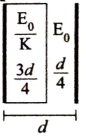
(C) In the absence of a dielectric,the electric field between the two plates is $E_0 = \frac{V_0}{d}$.
When the dielectric slab is inserted,the electric field inside the dielectric becomes $E = \frac{E_0}{K}$,where $K=3$ is the dielectric constant.
The thickness of the dielectric slab is $t = \frac{3}{4}d$,and the thickness of the air gap is $d - t = d - \frac{3}{4}d = \frac{1}{4}d$.
The new potential difference $V$ is the sum of the potential drops across the air gap and the dielectric slab:
$V = E_0 \left(\frac{1}{4}d\right) + E \left(\frac{3}{4}d\right)$
$V = E_0 \left(\frac{1}{4}d\right) + \frac{E_0}{K} \left(\frac{3}{4}d\right)$
$V = E_0 d \left[ \frac{1}{4} + \frac{3}{4K} \right]$
Since $E_0 d = V_0$ and $K = 3$:
$V = V_0 \left[ \frac{1}{4} + \frac{3}{4 \times 3} \right]$
$V = V_0 \left[ \frac{1}{4} + \frac{1}{4} \right]$
$V = V_0 \left( \frac{2}{4} \right) = \frac{V_0}{2}$
When the dielectric slab is inserted,the electric field inside the dielectric becomes $E = \frac{E_0}{K}$,where $K=3$ is the dielectric constant.
The thickness of the dielectric slab is $t = \frac{3}{4}d$,and the thickness of the air gap is $d - t = d - \frac{3}{4}d = \frac{1}{4}d$.
The new potential difference $V$ is the sum of the potential drops across the air gap and the dielectric slab:
$V = E_0 \left(\frac{1}{4}d\right) + E \left(\frac{3}{4}d\right)$
$V = E_0 \left(\frac{1}{4}d\right) + \frac{E_0}{K} \left(\frac{3}{4}d\right)$
$V = E_0 d \left[ \frac{1}{4} + \frac{3}{4K} \right]$
Since $E_0 d = V_0$ and $K = 3$:
$V = V_0 \left[ \frac{1}{4} + \frac{3}{4 \times 3} \right]$
$V = V_0 \left[ \frac{1}{4} + \frac{1}{4} \right]$
$V = V_0 \left( \frac{2}{4} \right) = \frac{V_0}{2}$
0 likes
View Solution292
EasyMCQ
$A$ parallel plate capacitor having air as the dielectric medium is charged by a potential difference of $V$ volt. After disconnecting the battery,the distance between the plates of the capacitor is increased using an insulated handle. As a result,the potential difference between the plates . . . . . . .
A
does not change.
B
decreases.
C
increases.
D
becomes zero.
Solution
(C) The correct option is $C$.
When the battery is disconnected,the charge $Q$ on the plates remains constant because there is no path for the charge to flow.
The capacitance of a parallel plate capacitor is given by $C = \frac{A \varepsilon_0}{d}$,where $A$ is the area of the plates,$\varepsilon_0$ is the permittivity of free space,and $d$ is the distance between the plates.
When the distance $d$ between the plates is increased,the capacitance $C$ decreases.
Since the charge $Q$ remains constant and $Q = CV$,the potential difference $V = \frac{Q}{C}$ must increase as $C$ decreases.
When the battery is disconnected,the charge $Q$ on the plates remains constant because there is no path for the charge to flow.
The capacitance of a parallel plate capacitor is given by $C = \frac{A \varepsilon_0}{d}$,where $A$ is the area of the plates,$\varepsilon_0$ is the permittivity of free space,and $d$ is the distance between the plates.
When the distance $d$ between the plates is increased,the capacitance $C$ decreases.
Since the charge $Q$ remains constant and $Q = CV$,the potential difference $V = \frac{Q}{C}$ must increase as $C$ decreases.
0 likes
View Solution293
MediumMCQ
$A$ parallel plate capacitor of capacitance $C_1$ with a dielectric slab in between its plates is connected to a battery. It has a potential difference $V_1$ across its plates. When the dielectric slab is removed,keeping the capacitor connected to the battery,the new capacitance and potential difference are $C_2$ and $V_2$ respectively. Then:
A
$V_1 = V_2, C_1 < C_2$
B
$V_1 > V_2, C_1 > C_2$
C
$V_1 < V_2, C_1 > C_2$
D
$V_1 = V_2, C_1 > C_2$
Solution
(D) $1$. When a dielectric slab of constant $K$ is present,the capacitance is $C_1 = \frac{K \varepsilon_0 A}{d}$.
$2$. Since the capacitor remains connected to the battery,the potential difference across the plates remains constant,so $V_1 = V_2 = V$.
$3$. When the dielectric slab is removed,the new capacitance becomes $C_2 = \frac{\varepsilon_0 A}{d}$.
$4$. Since $K > 1$,it is clear that $C_1 > C_2$.
$5$. Because the battery is still connected,the potential difference across the plates does not change,thus $V_1 = V_2$.
$2$. Since the capacitor remains connected to the battery,the potential difference across the plates remains constant,so $V_1 = V_2 = V$.
$3$. When the dielectric slab is removed,the new capacitance becomes $C_2 = \frac{\varepsilon_0 A}{d}$.
$4$. Since $K > 1$,it is clear that $C_1 > C_2$.
$5$. Because the battery is still connected,the potential difference across the plates does not change,thus $V_1 = V_2$.
0 likes
View Solution294
MediumMCQ
$A$ parallel plate capacitor is charged by connecting a $2 \ V$ battery across it. It is then disconnected from the battery and a glass slab is introduced between the plates. Which of the following pairs of quantities decrease?
A
Potential difference and energy stored
B
Energy stored and capacitance
C
Capacitance and charge
D
Charge and potential difference
Solution
(A) When a charged capacitor is disconnected from the battery and a glass slab (dielectric material) is introduced between the plates,the charge $(Q)$ remains constant because the circuit is open.
The capacitance $(C)$ increases as $C = KC_0$,where $K$ is the dielectric constant.
The potential difference $(V)$ decreases as $V = \frac{V_0}{K}$ because $V = \frac{Q}{C}$ and $C$ increases while $Q$ is constant.
The stored energy $(U)$ decreases as $U = \frac{Q^2}{2C} = \frac{U_0}{K}$ because $C$ increases while $Q$ is constant.
Therefore,the potential difference and the stored energy decrease.
The capacitance $(C)$ increases as $C = KC_0$,where $K$ is the dielectric constant.
The potential difference $(V)$ decreases as $V = \frac{V_0}{K}$ because $V = \frac{Q}{C}$ and $C$ increases while $Q$ is constant.
The stored energy $(U)$ decreases as $U = \frac{Q^2}{2C} = \frac{U_0}{K}$ because $C$ increases while $Q$ is constant.
Therefore,the potential difference and the stored energy decrease.
0 likes
View Solution295
MediumMCQ
If a slab of insulating material $4 \times 10^{-3} \ m$ thick is introduced between the plates of a parallel plate capacitor,the separation between the plates has to be increased by $3.5 \times 10^{-3} \ m$ to restore the capacity to its original value. The dielectric constant of the material will be:
A
$6$
B
$8$
C
$10$
D
$12$
Solution
(B) Let $t$ be the thickness of the dielectric slab and $K$ be the dielectric constant.
When a dielectric slab of thickness $t$ is introduced,the effective separation between the plates increases by an amount $x = t(1 - 1/K)$ to maintain the same capacitance.
Given,$x = 3.5 \times 10^{-3} \ m$ and $t = 4 \times 10^{-3} \ m$.
Substituting these values into the equation:
$3.5 \times 10^{-3} = 4 \times 10^{-3} \left(1 - \frac{1}{K}\right)$
Dividing both sides by $4 \times 10^{-3}$:
$\frac{3.5}{4} = 1 - \frac{1}{K}$
$0.875 = 1 - \frac{1}{K}$
$\frac{1}{K} = 1 - 0.875 = 0.125$
$K = \frac{1}{0.125} = 8$.
Thus,the dielectric constant of the material is $8$.
When a dielectric slab of thickness $t$ is introduced,the effective separation between the plates increases by an amount $x = t(1 - 1/K)$ to maintain the same capacitance.
Given,$x = 3.5 \times 10^{-3} \ m$ and $t = 4 \times 10^{-3} \ m$.
Substituting these values into the equation:
$3.5 \times 10^{-3} = 4 \times 10^{-3} \left(1 - \frac{1}{K}\right)$
Dividing both sides by $4 \times 10^{-3}$:
$\frac{3.5}{4} = 1 - \frac{1}{K}$
$0.875 = 1 - \frac{1}{K}$
$\frac{1}{K} = 1 - 0.875 = 0.125$
$K = \frac{1}{0.125} = 8$.
Thus,the dielectric constant of the material is $8$.
0 likes
View Solution296
MediumMCQ
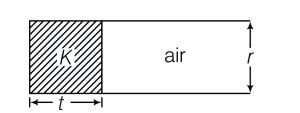
$A$ parallel plate capacitor with air as the dielectric has capacitance $C$. $A$ slab of dielectric constant $K$ and having the same thickness as the separation between the plates is introduced so as to fill one-fourth of the capacitor as shown in the figure. The new capacitance will be
A
$(K+3) \frac{C}{4}$
B
$(K+2) \frac{C}{4}$
C
$(K+1) \frac{C}{4}$
D
$\frac{K C}{4}$
Solution
(A) The original capacitance of the air-filled parallel plate capacitor is $C = \frac{\varepsilon_0 A}{d}$.
When a dielectric slab of constant $K$ is introduced to fill one-fourth of the area,the capacitor can be considered as two capacitors in parallel.
One capacitor has air as the dielectric with area $\frac{3A}{4}$ and plate separation $d$. Its capacitance is $C_1 = \frac{\varepsilon_0 (3A/4)}{d} = \frac{3}{4} \frac{\varepsilon_0 A}{d} = \frac{3C}{4}$.
The other capacitor has a dielectric $K$ with area $\frac{A}{4}$ and plate separation $d$. Its capacitance is $C_2 = \frac{K \varepsilon_0 (A/4)}{d} = \frac{K}{4} \frac{\varepsilon_0 A}{d} = \frac{KC}{4}$.
Since these two capacitors are in parallel,the equivalent capacitance is $C_{net} = C_1 + C_2$.
$C_{net} = \frac{3C}{4} + \frac{KC}{4} = \frac{C}{4}(K+3)$.
When a dielectric slab of constant $K$ is introduced to fill one-fourth of the area,the capacitor can be considered as two capacitors in parallel.
One capacitor has air as the dielectric with area $\frac{3A}{4}$ and plate separation $d$. Its capacitance is $C_1 = \frac{\varepsilon_0 (3A/4)}{d} = \frac{3}{4} \frac{\varepsilon_0 A}{d} = \frac{3C}{4}$.
The other capacitor has a dielectric $K$ with area $\frac{A}{4}$ and plate separation $d$. Its capacitance is $C_2 = \frac{K \varepsilon_0 (A/4)}{d} = \frac{K}{4} \frac{\varepsilon_0 A}{d} = \frac{KC}{4}$.
Since these two capacitors are in parallel,the equivalent capacitance is $C_{net} = C_1 + C_2$.
$C_{net} = \frac{3C}{4} + \frac{KC}{4} = \frac{C}{4}(K+3)$.
0 likes
View Solution297
EasyMCQ
$A$ voltmeter reads $4 \ V$ when connected to a parallel plate capacitor with air as a dielectric. When a dielectric slab is introduced between the plates for the same configuration,the voltmeter reads $2 \ V$. What is the dielectric constant of the material?
A
$0.5$
B
$2$
C
$4$
D
$8$
Solution
(B) We know that the charge $Q$ on the capacitor remains constant if the battery is disconnected,or the potential difference changes based on the capacitance. Given $Q = CV$,we have $V = Q/C$,which implies $V \propto 1/C$.
The capacitance with air is $C_0 = \epsilon_0 A / d$.
The capacitance with a dielectric slab is $C = K C_0$,where $K$ is the dielectric constant.
Therefore,the ratio of the potentials is given by $V_{dielectric} / V_0 = C_0 / C = C_0 / (K C_0) = 1/K$.
Given $V_0 = 4 \ V$ and $V_{dielectric} = 2 \ V$.
Substituting the values: $2 / 4 = 1/K$.
This gives $1/2 = 1/K$,so $K = 2$.
The capacitance with air is $C_0 = \epsilon_0 A / d$.
The capacitance with a dielectric slab is $C = K C_0$,where $K$ is the dielectric constant.
Therefore,the ratio of the potentials is given by $V_{dielectric} / V_0 = C_0 / C = C_0 / (K C_0) = 1/K$.
Given $V_0 = 4 \ V$ and $V_{dielectric} = 2 \ V$.
Substituting the values: $2 / 4 = 1/K$.
This gives $1/2 = 1/K$,so $K = 2$.
0 likes
View Solution298
DifficultMCQ
The force of repulsion between two identical positive charges when kept with a separation $r$ in air is $F$. Half the gap between the two charges is filled by a dielectric slab of dielectric constant $K=4$. Then the new force of repulsion between those two charges becomes:
A
$F/3$
B
$F/2$
C
$F/4$
D
$4F/9$
Solution
(D) The initial force between two identical charges $q$ separated by distance $r$ in air is given by $F = \frac{1}{4 \pi \varepsilon_0} \frac{q^2}{r^2} \quad (1)$.
When a dielectric slab of thickness $t$ and dielectric constant $K$ is placed between the charges,the effective separation becomes $r_{eff} = (r - t) + t\sqrt{K}$.
Here,$t = r/2$ and $K = 4$.
Substituting these values,$r_{eff} = (r - r/2) + (r/2)\sqrt{4} = r/2 + (r/2)(2) = r/2 + r = 3r/2$.
The new force $F'$ is given by $F' = \frac{1}{4 \pi \varepsilon_0} \frac{q^2}{(r_{eff})^2} = \frac{1}{4 \pi \varepsilon_0} \frac{q^2}{(3r/2)^2}$.
$F' = \frac{1}{4 \pi \varepsilon_0} \frac{q^2}{(9/4)r^2} = \frac{4}{9} \left( \frac{1}{4 \pi \varepsilon_0} \frac{q^2}{r^2} \right)$.
Using equation $(1)$,we get $F' = \frac{4}{9}F$.
When a dielectric slab of thickness $t$ and dielectric constant $K$ is placed between the charges,the effective separation becomes $r_{eff} = (r - t) + t\sqrt{K}$.
Here,$t = r/2$ and $K = 4$.
Substituting these values,$r_{eff} = (r - r/2) + (r/2)\sqrt{4} = r/2 + (r/2)(2) = r/2 + r = 3r/2$.
The new force $F'$ is given by $F' = \frac{1}{4 \pi \varepsilon_0} \frac{q^2}{(r_{eff})^2} = \frac{1}{4 \pi \varepsilon_0} \frac{q^2}{(3r/2)^2}$.
$F' = \frac{1}{4 \pi \varepsilon_0} \frac{q^2}{(9/4)r^2} = \frac{4}{9} \left( \frac{1}{4 \pi \varepsilon_0} \frac{q^2}{r^2} \right)$.
Using equation $(1)$,we get $F' = \frac{4}{9}F$.
0 likes
View SolutionElectric Potential and Capacitance — Effect of Dielectric Inside Capacitor · Frequently Asked Questions
1Are these Electric Potential and Capacitance questions useful for JEE and NEET?
Yes. All questions in this section are mapped to JEE Main and NEET exam patterns. Previous year questions from JEE Main, NEET, GUJCET and state-level exams are included with full solutions.
2Can I switch to Hindi or Gujarati for these questions?
Yes. Use the language tabs in the hero section or the sidebar to view the same questions and solutions in English, Hindi or Gujarati.
3How do I generate a question paper from this subtopic?
Use the Vedclass Exam Paper Generator — select the chapter and subtopic, set difficulty, and generate Sets A, B, C, D automatically. First 3 chapters of every subject are free.
Vedclass Products
For Students
Vedclass Test Series
Mock tests in real JEE/NEET style with performance analysis. 5-day free trial.
Start Free TrialFor Teachers
Exam Paper Generator
Generate Set A/B/C/D papers from this chapter in 2 minutes. 3 chapters free.
Try FreeFor Institutes
Online Exam Module
Live online exams with unlimited students, 360° analytics & white-label branding.
See DemoFor Teachers & Institutes
Generate a Electric Potential and Capacitance Exam Paper in 2 Minutes
Select subtopic & difficulty — Sets A, B, C, D auto-generated with No Repeat logic.
First 3 chapters of every subject are free — no payment required.