
A English
Electric Field Lines, Electric Flux and Gauss's Law Questions in English
Class 12 Physics · Electric Charges and Fields · Electric Field Lines, Electric Flux and Gauss's Law
312+
Questions
English
Language
100%
With Solutions
Showing 50 of 312 questions in English
151
EasyMCQ
How does the number of electric field lines depend on the area?
A
The number of field lines is directly proportional to the area.
B
The number of field lines is inversely proportional to the area.
C
The number of field lines is independent of the area.
D
The number of field lines is proportional to the square of the area.
Solution
(A) The number of electric field lines passing through a given surface area is defined as the electric flux $(\Phi_E)$.
Mathematically, electric flux is given by the dot product of the electric field vector $(\vec{E})$ and the area vector $(\vec{A})$, expressed as $\Phi_E = \int \vec{E} \cdot d\vec{A}$.
For a uniform electric field passing through a flat surface, this simplifies to $\Phi_E = EA \cos\theta$.
Since the number of field lines is proportional to the electric flux, it follows that the number of field lines is directly proportional to the area $(A)$ of the surface, provided the electric field strength remains constant.
Mathematically, electric flux is given by the dot product of the electric field vector $(\vec{E})$ and the area vector $(\vec{A})$, expressed as $\Phi_E = \int \vec{E} \cdot d\vec{A}$.
For a uniform electric field passing through a flat surface, this simplifies to $\Phi_E = EA \cos\theta$.
Since the number of field lines is proportional to the electric flux, it follows that the number of field lines is directly proportional to the area $(A)$ of the surface, provided the electric field strength remains constant.
0 likes
View Solution152
MediumMCQ
Draw the electric field lines for a system of two identical positive charges placed near each other.
A
Field lines originate from positive charges and terminate at infinity.
B
Field lines are parallel to each other.
C
Field lines exert a lateral pressure on each other,showing repulsion.
D
Field lines intersect at the midpoint.
Solution
(C) When two identical positive charges are placed near each other,the electric field lines originate from each positive charge and extend towards infinity.
Because both charges are positive,they exert a repulsive force on each other.
This repulsion is represented by the field lines bending away from each other in the region between the two charges.
There is a neutral point exactly at the midpoint between the two charges where the net electric field is zero,meaning no field lines pass through this point.
Because both charges are positive,they exert a repulsive force on each other.
This repulsion is represented by the field lines bending away from each other in the region between the two charges.
There is a neutral point exactly at the midpoint between the two charges where the net electric field is zero,meaning no field lines pass through this point.
0 likes
View Solution153
Medium
Why do electric field lines not form closed loops?
Solution
(N/A) Electric field lines originate from positive charges and terminate at negative charges.
If they were to form closed loops,it would imply that the electric field is conservative,which contradicts the property of electrostatic fields.
According to Gauss's Law,the net flux through a closed surface is proportional to the enclosed charge.
Since electrostatic fields are conservative,the line integral of the electric field around any closed path is zero,i.e.,$\oint \vec{E} \cdot d\vec{l} = 0$.
This mathematical condition ensures that electric field lines cannot form closed loops,unlike magnetic field lines which do form closed loops because magnetic monopoles do not exist.
If they were to form closed loops,it would imply that the electric field is conservative,which contradicts the property of electrostatic fields.
According to Gauss's Law,the net flux through a closed surface is proportional to the enclosed charge.
Since electrostatic fields are conservative,the line integral of the electric field around any closed path is zero,i.e.,$\oint \vec{E} \cdot d\vec{l} = 0$.
This mathematical condition ensures that electric field lines cannot form closed loops,unlike magnetic field lines which do form closed loops because magnetic monopoles do not exist.
0 likes
View Solution154
Medium
Why do two electric field lines not intersect each other?
Solution
(N/A) Two electric field lines never intersect each other because if they were to intersect,there would be two different directions for the electric field at the point of intersection.
Since the electric field at a given point is a unique vector quantity,it cannot have two directions simultaneously.
Therefore,the intersection of two electric field lines is physically impossible.
Since the electric field at a given point is a unique vector quantity,it cannot have two directions simultaneously.
Therefore,the intersection of two electric field lines is physically impossible.
0 likes
View Solution155
Medium
Explain electric flux.
Solution
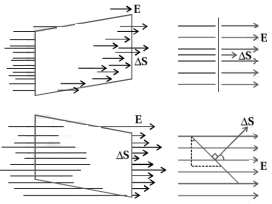
(N/A) If a small planar element of area $\overrightarrow{\Delta S}$ is placed in an electric field $\vec{E}$, the number of field lines crossing it is proportional to $\vec{E} \cdot \overrightarrow{\Delta S}$.
Suppose we tilt the area element by an angle $\theta$ relative to the normal, the number of field lines crossing $\Delta S$ is proportional to $E \Delta S \cos \theta$.
When $\theta = 90^{\circ}$, the field lines are parallel to the surface and do not cross it at all.
When $\theta = 0^{\circ}$, the field lines are normal to the surface.
The vector associated with every area element of a closed surface is taken to be in the direction of the outward normal. Thus, the area element vector $\overrightarrow{\Delta S}$ at a point on a closed surface equals $\Delta S \hat{n}$, where $\Delta S$ is the magnitude of the area element and $\hat{n}$ is a unit vector in the direction of the outward normal at that point.
Electric flux is the number of electric field lines passing through or associated with a surface placed in an electric field.
Therefore, the electric flux $\Delta \phi$ through an area element $\Delta \overrightarrow{S}$ is $\Delta \phi = \vec{E} \cdot \Delta \overrightarrow{S} = E \Delta S \cos \theta$, where $\theta$ is the angle between $\vec{E}$ and $\overrightarrow{\Delta S}$.
The total flux $\phi$ is given by $\phi = \int \vec{E} \cdot d\overrightarrow{S} = E \Delta S \cos \theta$.
The $SI$ unit of electric flux is $N \cdot m^{2} \cdot C^{-1}$ or $V \cdot m$, and it is a scalar quantity.
Definition of electric flux: "Electric flux associated with any area is the surface integral of the electric field vector over that area."
Suppose we tilt the area element by an angle $\theta$ relative to the normal, the number of field lines crossing $\Delta S$ is proportional to $E \Delta S \cos \theta$.
When $\theta = 90^{\circ}$, the field lines are parallel to the surface and do not cross it at all.
When $\theta = 0^{\circ}$, the field lines are normal to the surface.
The vector associated with every area element of a closed surface is taken to be in the direction of the outward normal. Thus, the area element vector $\overrightarrow{\Delta S}$ at a point on a closed surface equals $\Delta S \hat{n}$, where $\Delta S$ is the magnitude of the area element and $\hat{n}$ is a unit vector in the direction of the outward normal at that point.
Electric flux is the number of electric field lines passing through or associated with a surface placed in an electric field.
Therefore, the electric flux $\Delta \phi$ through an area element $\Delta \overrightarrow{S}$ is $\Delta \phi = \vec{E} \cdot \Delta \overrightarrow{S} = E \Delta S \cos \theta$, where $\theta$ is the angle between $\vec{E}$ and $\overrightarrow{\Delta S}$.
The total flux $\phi$ is given by $\phi = \int \vec{E} \cdot d\overrightarrow{S} = E \Delta S \cos \theta$.
The $SI$ unit of electric flux is $N \cdot m^{2} \cdot C^{-1}$ or $V \cdot m$, and it is a scalar quantity.
Definition of electric flux: "Electric flux associated with any area is the surface integral of the electric field vector over that area."
0 likes
View Solution156
Easy
When does the electric flux associated with a closed surface become positive,zero,or negative?
Solution
(N/A) The electric flux $\phi$ associated with an area vector $\overrightarrow{S}$ in an electric field $\overrightarrow{E}$ is given by the dot product:
$\phi = \overrightarrow{E} \cdot \overrightarrow{S} = ES \cos \theta$,where $\theta$ is the angle between the electric field vector $\overrightarrow{E}$ and the area vector $\overrightarrow{S}$.
$(i)$ If $\theta = 90^{\circ}$,then $\cos 90^{\circ} = 0$,so $\phi = 0$. This occurs when the electric field lines are parallel to the surface (i.e.,the area vector is perpendicular to the field).
(ii) If $\theta < 90^{\circ}$,then $\cos \theta > 0$,so $\phi > 0$. This occurs when the electric field lines are directed outward from the closed surface.
(iii) If $\theta > 90^{\circ}$,then $\cos \theta < 0$,so $\phi < 0$. This occurs when the electric field lines are directed inward into the closed surface.
$\phi = \overrightarrow{E} \cdot \overrightarrow{S} = ES \cos \theta$,where $\theta$ is the angle between the electric field vector $\overrightarrow{E}$ and the area vector $\overrightarrow{S}$.
$(i)$ If $\theta = 90^{\circ}$,then $\cos 90^{\circ} = 0$,so $\phi = 0$. This occurs when the electric field lines are parallel to the surface (i.e.,the area vector is perpendicular to the field).
(ii) If $\theta < 90^{\circ}$,then $\cos \theta > 0$,so $\phi > 0$. This occurs when the electric field lines are directed outward from the closed surface.
(iii) If $\theta > 90^{\circ}$,then $\cos \theta < 0$,so $\phi < 0$. This occurs when the electric field lines are directed inward into the closed surface.
0 likes
View Solution157
Easy
Define electric flux.
Solution
(N/A) Electric flux is a measure of the total number of electric field lines passing through a given surface area. Mathematically,for a surface $S$ in an electric field $\vec{E}$,the electric flux $\Phi_E$ is defined as the surface integral of the electric field over that surface: $\Phi_E = \int_S \vec{E} \cdot d\vec{A}$. If the electric field is uniform and the surface is flat with area $A$,the flux is given by $\Phi_E = EA \cos \theta$,where $\theta$ is the angle between the electric field vector $\vec{E}$ and the area vector $d\vec{A}$ (which is normal to the surface).
0 likes
View Solution158
EasyMCQ
When is electric flux said to be positive,negative,or zero?
A
Positive when flux enters the surface,negative when it leaves,zero when net flux is zero.
B
Positive when flux leaves the surface,negative when it enters,zero when net flux is zero.
C
Positive when flux is parallel to the surface,negative when perpendicular,zero when at an angle.
D
Positive when the surface is closed,negative when open,zero when the surface is infinite.
Solution
(B) Electric flux $\Phi_E$ through a surface is defined by the integral $\Phi_E = \int \vec{E} \cdot d\vec{A} = \int E \cos \theta \, dA$.
$1$. Positive Flux: When the electric field lines leave the surface (outward flux),the angle $\theta$ between the area vector $\vec{A}$ and the electric field $\vec{E}$ is acute $(0^\circ \le \theta < 90^\circ)$,making $\cos \theta > 0$. Thus,the flux is positive.
$2$. Negative Flux: When the electric field lines enter the surface (inward flux),the angle $\theta$ between the area vector $\vec{A}$ and the electric field $\vec{E}$ is obtuse $(90^\circ < \theta \le 180^\circ)$,making $\cos \theta < 0$. Thus,the flux is negative.
$3$. Zero Flux: When the electric field lines are parallel to the surface,the angle $\theta$ is $90^\circ$,making $\cos 90^\circ = 0$. Alternatively,if the net number of field lines entering equals the number leaving,the net flux is zero.
$1$. Positive Flux: When the electric field lines leave the surface (outward flux),the angle $\theta$ between the area vector $\vec{A}$ and the electric field $\vec{E}$ is acute $(0^\circ \le \theta < 90^\circ)$,making $\cos \theta > 0$. Thus,the flux is positive.
$2$. Negative Flux: When the electric field lines enter the surface (inward flux),the angle $\theta$ between the area vector $\vec{A}$ and the electric field $\vec{E}$ is obtuse $(90^\circ < \theta \le 180^\circ)$,making $\cos \theta < 0$. Thus,the flux is negative.
$3$. Zero Flux: When the electric field lines are parallel to the surface,the angle $\theta$ is $90^\circ$,making $\cos 90^\circ = 0$. Alternatively,if the net number of field lines entering equals the number leaving,the net flux is zero.
0 likes
View Solution159
EasyMCQ
Is electric flux a scalar or a vector quantity?
A
Scalar
B
Vector
C
Both
D
Neither
Solution
(A) Electric flux is defined as the dot product of the electric field vector $\vec{E}$ and the area vector $\vec{A}$.
Mathematically,$\Phi_E = \vec{E} \cdot \vec{A}$.
Since the dot product of two vectors always results in a scalar quantity,electric flux is a scalar quantity.
Mathematically,$\Phi_E = \vec{E} \cdot \vec{A}$.
Since the dot product of two vectors always results in a scalar quantity,electric flux is a scalar quantity.
0 likes
View Solution160
Easy
Write the $SI$ unit of electric flux.
Solution
(N/A) Electric flux $\Phi_E$ is defined as the product of the electric field $E$ and the area $A$ through which it passes,given by $\Phi_E = E \cdot A$.
The $SI$ unit of electric field $E$ is $\text{newton per coulomb}$ $(N/C)$ or $\text{volt per meter}$ $(V/m)$.
The $SI$ unit of area $A$ is $\text{square meter}$ $(m^2)$.
Therefore,the $SI$ unit of electric flux is $(N/C) \cdot m^2 = N \cdot m^2/C$ or $(V/m) \cdot m^2 = V \cdot m$.
Thus,the $SI$ unit of electric flux is $N \cdot m^2 \cdot C^{-1}$ or $V \cdot m$.
The $SI$ unit of electric field $E$ is $\text{newton per coulomb}$ $(N/C)$ or $\text{volt per meter}$ $(V/m)$.
The $SI$ unit of area $A$ is $\text{square meter}$ $(m^2)$.
Therefore,the $SI$ unit of electric flux is $(N/C) \cdot m^2 = N \cdot m^2/C$ or $(V/m) \cdot m^2 = V \cdot m$.
Thus,the $SI$ unit of electric flux is $N \cdot m^2 \cdot C^{-1}$ or $V \cdot m$.
0 likes
View Solution161
Medium
Obtain Gauss's law from the flux associated with a sphere of radius $r$ and charge $q$ at its centre.
Solution
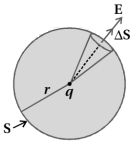
(N/A) Let us consider the total flux through a sphere of radius $r$,which encloses a point charge $q$ at its centre.
Divide the sphere into small area elements,as shown in the figure.
The flux through an area element $\Delta \overrightarrow{S}$ is,
$\Delta \phi = \overrightarrow{E} \cdot \Delta \overrightarrow{S} = E \Delta S \cos(0^{\circ}) = E \Delta S$
Using Coulomb's law for the electric field due to a point charge $q$ at distance $r$:
$E = \frac{1}{4 \pi \varepsilon_{0}} \frac{q}{r^{2}}$
Since the electric field $\overrightarrow{E}$ and the area vector $\Delta \overrightarrow{S}$ are in the same direction (radially outward),
$\Delta \phi = \left( \frac{1}{4 \pi \varepsilon_{0}} \frac{q}{r^{2}} \right) \Delta S$
The total flux $\phi$ through the sphere is the sum of fluxes through all such area elements:
$\phi = \sum \Delta \phi = \sum \left( \frac{q}{4 \pi \varepsilon_{0} r^{2}} \Delta S \right)$
$\phi = \frac{q}{4 \pi \varepsilon_{0} r^{2}} \sum \Delta S$
Since $\sum \Delta S = S = 4 \pi r^{2}$ (total surface area of the sphere),
$\phi = \frac{q}{4 \pi \varepsilon_{0} r^{2}} \times 4 \pi r^{2} = \frac{q}{\varepsilon_{0}}$
This is Gauss's law for a point charge,which states that the total electric flux through any closed surface is equal to the net charge enclosed by the surface divided by $\varepsilon_{0}$.
Divide the sphere into small area elements,as shown in the figure.
The flux through an area element $\Delta \overrightarrow{S}$ is,
$\Delta \phi = \overrightarrow{E} \cdot \Delta \overrightarrow{S} = E \Delta S \cos(0^{\circ}) = E \Delta S$
Using Coulomb's law for the electric field due to a point charge $q$ at distance $r$:
$E = \frac{1}{4 \pi \varepsilon_{0}} \frac{q}{r^{2}}$
Since the electric field $\overrightarrow{E}$ and the area vector $\Delta \overrightarrow{S}$ are in the same direction (radially outward),
$\Delta \phi = \left( \frac{1}{4 \pi \varepsilon_{0}} \frac{q}{r^{2}} \right) \Delta S$
The total flux $\phi$ through the sphere is the sum of fluxes through all such area elements:
$\phi = \sum \Delta \phi = \sum \left( \frac{q}{4 \pi \varepsilon_{0} r^{2}} \Delta S \right)$
$\phi = \frac{q}{4 \pi \varepsilon_{0} r^{2}} \sum \Delta S$
Since $\sum \Delta S = S = 4 \pi r^{2}$ (total surface area of the sphere),
$\phi = \frac{q}{4 \pi \varepsilon_{0} r^{2}} \times 4 \pi r^{2} = \frac{q}{\varepsilon_{0}}$
This is Gauss's law for a point charge,which states that the total electric flux through any closed surface is equal to the net charge enclosed by the surface divided by $\varepsilon_{0}$.
0 likes
View Solution162
Medium
Give a reason: 'If the net flux associated with a closed surface is zero,then the net charge enclosed by that surface is zero.'
Solution
(N/A) According to Gauss's Law,the total electric flux $\phi$ through a closed surface is given by $\phi = \frac{q_{enclosed}}{\epsilon_0}$,where $q_{enclosed}$ is the net charge enclosed by the surface.
If the net flux $\phi = 0$,then $\frac{q_{enclosed}}{\epsilon_0} = 0$,which implies $q_{enclosed} = 0$.
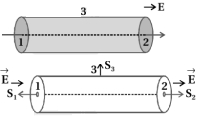
This means that the total charge enclosed by the surface must be zero. The flux through a closed surface is zero if the net charge inside is zero,even if there is an external electric field present,as illustrated by the case of a cylinder in a uniform electric field $\vec{E}$.
For a cylinder placed in a uniform electric field $\vec{E}$ parallel to its axis:
$1$. The flux through the curved surface $3$ is $\phi_3 = 0$ because the area vector is perpendicular to $\vec{E}$ at every point.
$2$. The flux through the flat surface $1$ is $\phi_1 = -ES$ (where $S$ is the cross-sectional area,and the normal is opposite to $\vec{E}$).
$3$. The flux through the flat surface $2$ is $\phi_2 = +ES$ (where the normal is along $\vec{E}$).
The total flux $\phi_{total} = \phi_1 + \phi_2 + \phi_3 = -ES + ES + 0 = 0$. Since the total flux is zero,the net charge enclosed is zero.
If the net flux $\phi = 0$,then $\frac{q_{enclosed}}{\epsilon_0} = 0$,which implies $q_{enclosed} = 0$.
This means that the total charge enclosed by the surface must be zero. The flux through a closed surface is zero if the net charge inside is zero,even if there is an external electric field present,as illustrated by the case of a cylinder in a uniform electric field $\vec{E}$.
For a cylinder placed in a uniform electric field $\vec{E}$ parallel to its axis:
$1$. The flux through the curved surface $3$ is $\phi_3 = 0$ because the area vector is perpendicular to $\vec{E}$ at every point.
$2$. The flux through the flat surface $1$ is $\phi_1 = -ES$ (where $S$ is the cross-sectional area,and the normal is opposite to $\vec{E}$).
$3$. The flux through the flat surface $2$ is $\phi_2 = +ES$ (where the normal is along $\vec{E}$).
The total flux $\phi_{total} = \phi_1 + \phi_2 + \phi_3 = -ES + ES + 0 = 0$. Since the total flux is zero,the net charge enclosed is zero.
0 likes
View Solution163
Difficult
Discuss some points about Gauss's law.
Solution
(N/A) $(i)$ If the total charge contained in a closed surface is zero,then the net electric flux through that closed surface is zero.
$(ii)$ Gauss's law is valid for any closed surface,regardless of its shape or size.
$(iii)$ The charges can be located anywhere inside the surface.
$(iv)$ When a surface is chosen such that some charges are inside and some are outside,the electric field on the left side of the equation $\phi = \frac{\Sigma q}{\epsilon_{0}}$ is due to all charges (both inside and outside). However,the term $\Sigma q$ on the right side represents only the total charge enclosed within the surface.
$(v)$ The surface chosen for the application of Gauss's law is called a Gaussian surface.
$(vi)$ Gauss's law is useful for simplifying the calculation of electrostatic fields when the system possesses symmetry.
$(vii)$ Gauss's law is based on the inverse square dependence of the electric field on distance.
$(ii)$ Gauss's law is valid for any closed surface,regardless of its shape or size.
$(iii)$ The charges can be located anywhere inside the surface.
$(iv)$ When a surface is chosen such that some charges are inside and some are outside,the electric field on the left side of the equation $\phi = \frac{\Sigma q}{\epsilon_{0}}$ is due to all charges (both inside and outside). However,the term $\Sigma q$ on the right side represents only the total charge enclosed within the surface.
$(v)$ The surface chosen for the application of Gauss's law is called a Gaussian surface.
$(vi)$ Gauss's law is useful for simplifying the calculation of electrostatic fields when the system possesses symmetry.
$(vii)$ Gauss's law is based on the inverse square dependence of the electric field on distance.
0 likes
View Solution164
Medium
State Gauss's law in electrostatics and provide its mathematical expression.
Solution
(N/A) Gauss's law states that the total electric flux $\Phi_E$ through any closed surface (Gaussian surface) is equal to $\frac{1}{\epsilon_0}$ times the net charge $q_{enclosed}$ enclosed by the surface.
Mathematically,it is expressed as:
$\Phi_E = \oint_S \vec{E} \cdot d\vec{A} = \frac{q_{enclosed}}{\epsilon_0}$
Where:
- $\Phi_E$ is the electric flux.
- $\oint_S$ represents the surface integral over a closed surface $S$.
- $\vec{E}$ is the electric field vector.
- $d\vec{A}$ is the area vector of an infinitesimal surface element.
- $q_{enclosed}$ is the total charge enclosed within the surface.
- $\epsilon_0$ is the permittivity of free space.
Mathematically,it is expressed as:
$\Phi_E = \oint_S \vec{E} \cdot d\vec{A} = \frac{q_{enclosed}}{\epsilon_0}$
Where:
- $\Phi_E$ is the electric flux.
- $\oint_S$ represents the surface integral over a closed surface $S$.
- $\vec{E}$ is the electric field vector.
- $d\vec{A}$ is the area vector of an infinitesimal surface element.
- $q_{enclosed}$ is the total charge enclosed within the surface.
- $\epsilon_0$ is the permittivity of free space.
0 likes
View Solution165
MediumMCQ
What can be said about the electric charge if the electric flux associated with a closed loop (surface) is zero?
A
The net charge inside the surface is zero.
B
The electric field inside the surface is zero.
C
The charge is present outside the surface.
D
Both $(A)$ and $(C)$ are possible.
Solution
(A) According to Gauss's Law,the total electric flux $\Phi_E$ through a closed surface is given by $\Phi_E = \frac{q_{net}}{\epsilon_0}$,where $q_{net}$ is the net charge enclosed by the surface.
If the electric flux $\Phi_E$ is zero,then $\frac{q_{net}}{\epsilon_0} = 0$,which implies that $q_{net} = 0$.
This means that either there is no charge inside the surface,or the sum of positive and negative charges inside the surface is zero.
It does not necessarily mean that there is no electric field at the surface,as charges outside the surface can contribute to the electric field but not to the net flux through the closed surface.
Therefore,the net charge enclosed must be zero.
If the electric flux $\Phi_E$ is zero,then $\frac{q_{net}}{\epsilon_0} = 0$,which implies that $q_{net} = 0$.
This means that either there is no charge inside the surface,or the sum of positive and negative charges inside the surface is zero.
It does not necessarily mean that there is no electric field at the surface,as charges outside the surface can contribute to the electric field but not to the net flux through the closed surface.
Therefore,the net charge enclosed must be zero.
0 likes
View Solution166
Medium
What is called a Gaussian surface?
Solution
(N/A) Gaussian surface is any hypothetical closed surface in three-dimensional space through which the flux of a vector field (such as the electric field,gravitational field,or magnetic field) is calculated.
In the context of electrostatics,it is an imaginary closed surface used in conjunction with Gauss's Law to simplify the calculation of the electric field produced by a given charge distribution.
The surface is typically chosen to have symmetry (such as spherical,cylindrical,or planar) that matches the symmetry of the charge distribution,allowing the electric field magnitude to be constant over the surface.
In the context of electrostatics,it is an imaginary closed surface used in conjunction with Gauss's Law to simplify the calculation of the electric field produced by a given charge distribution.
The surface is typically chosen to have symmetry (such as spherical,cylindrical,or planar) that matches the symmetry of the charge distribution,allowing the electric field magnitude to be constant over the surface.
0 likes
View Solution167
Medium
Obtain Gauss's law from Coulomb's law.
Solution
(N/A) Consider a point charge $q$ placed at the origin. The electric field $\overrightarrow{E}$ at a distance $r$ from the charge $q$ is given by Coulomb's law as:
$\overrightarrow{E} = \frac{1}{4 \pi \varepsilon_{0}} \cdot \frac{q}{r^{2}} \hat{r}$
Now,consider a spherical Gaussian surface of radius $r$ centered at the charge $q$. The electric flux $\phi_E$ through this surface is given by the surface integral:
$\phi_E = \oint \overrightarrow{E} \cdot d\overrightarrow{s}$
Since the electric field $\overrightarrow{E}$ is radial and the area vector $d\overrightarrow{s}$ is also radial (outward normal),the angle between them is $0^\circ$. Thus,$\overrightarrow{E} \cdot d\overrightarrow{s} = E ds \cos(0^\circ) = E ds$.
$\phi_E = \oint E ds = E \oint ds$
Since $E$ is constant at all points on the spherical surface,and $\oint ds = 4 \pi r^{2}$ (the surface area of the sphere):
$\phi_E = \left( \frac{1}{4 \pi \varepsilon_{0}} \cdot \frac{q}{r^{2}} \right) \cdot (4 \pi r^{2})$
$\phi_E = \frac{q}{\varepsilon_{0}}$
This is Gauss's law: $\oint \overrightarrow{E} \cdot d\overrightarrow{s} = \frac{q}{\varepsilon_{0}}$.
$\overrightarrow{E} = \frac{1}{4 \pi \varepsilon_{0}} \cdot \frac{q}{r^{2}} \hat{r}$
Now,consider a spherical Gaussian surface of radius $r$ centered at the charge $q$. The electric flux $\phi_E$ through this surface is given by the surface integral:
$\phi_E = \oint \overrightarrow{E} \cdot d\overrightarrow{s}$
Since the electric field $\overrightarrow{E}$ is radial and the area vector $d\overrightarrow{s}$ is also radial (outward normal),the angle between them is $0^\circ$. Thus,$\overrightarrow{E} \cdot d\overrightarrow{s} = E ds \cos(0^\circ) = E ds$.
$\phi_E = \oint E ds = E \oint ds$
Since $E$ is constant at all points on the spherical surface,and $\oint ds = 4 \pi r^{2}$ (the surface area of the sphere):
$\phi_E = \left( \frac{1}{4 \pi \varepsilon_{0}} \cdot \frac{q}{r^{2}} \right) \cdot (4 \pi r^{2})$
$\phi_E = \frac{q}{\varepsilon_{0}}$
This is Gauss's law: $\oint \overrightarrow{E} \cdot d\overrightarrow{s} = \frac{q}{\varepsilon_{0}}$.
0 likes
View Solution168
MediumMCQ
An arbitrary surface encloses a dipole. What is the electric flux through this surface?
A
Zero
B
Positive
C
Negative
D
Infinite
Solution
(A) According to Gauss's law,the electric flux $\phi$ through a closed surface is given by $\phi = \frac{q_{enclosed}}{\epsilon_{0}}$,where $q_{enclosed}$ is the net charge enclosed by the surface.
$A$ dipole consists of two equal and opposite charges,$+q$ and $-q$.
The net charge enclosed by the surface is $q_{enclosed} = (+q) + (-q) = 0$.
Therefore,the electric flux through the surface is $\phi = \frac{0}{\epsilon_{0}} = 0$.
$A$ dipole consists of two equal and opposite charges,$+q$ and $-q$.
The net charge enclosed by the surface is $q_{enclosed} = (+q) + (-q) = 0$.
Therefore,the electric flux through the surface is $\phi = \frac{0}{\epsilon_{0}} = 0$.
0 likes
View Solution169
Difficult
If the total charge enclosed by a surface is zero,does it imply that the electric field everywhere on the surface is zero? Conversely,if the electric field everywhere on a surface is zero,does it imply that the net charge inside is zero?
Solution
(N/A) According to Gauss's Law,the electric flux $\phi$ through a closed surface $S$ is given by $\phi = \oint_{S} \vec{E} \cdot d\vec{S} = \frac{q_{enclosed}}{\epsilon_{0}}$.
$1$. If the total charge enclosed by a surface is zero $(q_{enclosed} = 0)$,it implies that the net electric flux through the surface is zero. However,this does not mean the electric field $\vec{E}$ is zero everywhere on the surface. The electric field at any point on the surface can be non-zero due to charges located outside the surface.
$2$. Conversely,if the electric field $\vec{E}$ is zero everywhere on the surface,then the surface integral $\oint_{S} \vec{E} \cdot d\vec{S}$ must be zero. According to Gauss's Law,this implies that the net charge enclosed by the surface must be zero $(q_{enclosed} = 0)$.
$1$. If the total charge enclosed by a surface is zero $(q_{enclosed} = 0)$,it implies that the net electric flux through the surface is zero. However,this does not mean the electric field $\vec{E}$ is zero everywhere on the surface. The electric field at any point on the surface can be non-zero due to charges located outside the surface.
$2$. Conversely,if the electric field $\vec{E}$ is zero everywhere on the surface,then the surface integral $\oint_{S} \vec{E} \cdot d\vec{S}$ must be zero. According to Gauss's Law,this implies that the net charge enclosed by the surface must be zero $(q_{enclosed} = 0)$.
0 likes
View Solution170
Medium
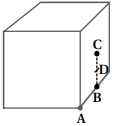
What will be the total flux through the faces of the cube as shown in the figure with side of length $a$ if a charge $q$ is placed at:
$(a)$ $C$: centre of a face of the cube.
$(b)$ $D$: midpoint of $B$ and $C$.
$(a)$ $C$: centre of a face of the cube.
$(b)$ $D$: midpoint of $B$ and $C$.
Solution
(N/A) If the charge $q$ is placed at $C$,the centre of a face of the cube,the flux is shared equally by $2$ adjacent cubes.
Therefore,the flux through each cube is:
$\phi = \frac{q}{2\epsilon_{0}}$
$(b)$ If the charge $q$ is placed at $D$,the midpoint of the edge $BC$,the charge is shared by $4$ adjacent cubes.
Therefore,the flux through each cube is:
$\phi = \frac{q}{4\epsilon_{0}}$
Therefore,the flux through each cube is:
$\phi = \frac{q}{2\epsilon_{0}}$
$(b)$ If the charge $q$ is placed at $D$,the midpoint of the edge $BC$,the charge is shared by $4$ adjacent cubes.
Therefore,the flux through each cube is:
$\phi = \frac{q}{4\epsilon_{0}}$
0 likes
View Solution171
Medium
The figure shows the electric field lines around three point charges $A, B$,and $C$.
$(a)$ Which charges are positive?
$(b)$ Which charge has the largest magnitude? Why?
$(c)$ In which region or regions of the picture could the electric field be zero? Justify your answer.
$(i)$ Near $A$ $(ii)$ Near $B$ $(iii)$ Near $C$ $(iv)$ Nowhere
$(a)$ Which charges are positive?
$(b)$ Which charge has the largest magnitude? Why?
$(c)$ In which region or regions of the picture could the electric field be zero? Justify your answer.
$(i)$ Near $A$ $(ii)$ Near $B$ $(iii)$ Near $C$ $(iv)$ Nowhere
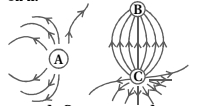
Solution
(A) The electric field lines for charges $A$ and $C$ are directed outwards,which indicates that $A$ and $C$ are positive charges.
$(b)$ The magnitude of a charge is proportional to the number of electric field lines originating from or terminating at it. By counting the lines,we observe that charge $C$ has the largest number of field lines associated with it. Therefore,charge $C$ has the largest magnitude.
$(c)$ The electric field can be zero only at a point where the electric fields due to individual charges are equal in magnitude and opposite in direction. This can occur between two like charges. Since $A$ and $C$ are both positive,the electric field can be zero in the region between $A$ and $C$. Because the magnitude of charge $C$ is greater than that of charge $A$,the neutral point (where the field is zero) will be closer to the charge with the smaller magnitude,which is charge $A$. Thus,the electric field could be zero in the region near $A$.
$(b)$ The magnitude of a charge is proportional to the number of electric field lines originating from or terminating at it. By counting the lines,we observe that charge $C$ has the largest number of field lines associated with it. Therefore,charge $C$ has the largest magnitude.
$(c)$ The electric field can be zero only at a point where the electric fields due to individual charges are equal in magnitude and opposite in direction. This can occur between two like charges. Since $A$ and $C$ are both positive,the electric field can be zero in the region between $A$ and $C$. Because the magnitude of charge $C$ is greater than that of charge $A$,the neutral point (where the field is zero) will be closer to the charge with the smaller magnitude,which is charge $A$. Thus,the electric field could be zero in the region near $A$.
0 likes
View Solution172
EasyMCQ
If the electric field is given by $\vec{E} = (5 \hat{i} + 4 \hat{j} + 9 \hat{k})$. The electric flux through a surface of area $20$ units lying in the $Y-Z$ plane will be (in units):
A
$100$
B
$80$
C
$180$
D
$20$
Solution
(A) The electric flux $\Phi$ is defined as the dot product of the electric field $\vec{E}$ and the area vector $\vec{A}$.
Given,$\vec{E} = (5 \hat{i} + 4 \hat{j} + 9 \hat{k})$.
The surface lies in the $Y-Z$ plane,so its area vector $\vec{A}$ is directed along the $X$-axis.
Therefore,$\vec{A} = 20 \hat{i}$ units.
The electric flux is calculated as:
$\Phi = \vec{E} \cdot \vec{A}$
$\Phi = (5 \hat{i} + 4 \hat{j} + 9 \hat{k}) \cdot (20 \hat{i})$
Since $\hat{i} \cdot \hat{i} = 1$,$\hat{i} \cdot \hat{j} = 0$,and $\hat{i} \cdot \hat{k} = 0$:
$\Phi = 5 \times 20 = 100$ units.
Given,$\vec{E} = (5 \hat{i} + 4 \hat{j} + 9 \hat{k})$.
The surface lies in the $Y-Z$ plane,so its area vector $\vec{A}$ is directed along the $X$-axis.
Therefore,$\vec{A} = 20 \hat{i}$ units.
The electric flux is calculated as:
$\Phi = \vec{E} \cdot \vec{A}$
$\Phi = (5 \hat{i} + 4 \hat{j} + 9 \hat{k}) \cdot (20 \hat{i})$
Since $\hat{i} \cdot \hat{i} = 1$,$\hat{i} \cdot \hat{j} = 0$,and $\hat{i} \cdot \hat{k} = 0$:
$\Phi = 5 \times 20 = 100$ units.
0 likes
View Solution173
MediumMCQ
The electric field in a region is given by $\overrightarrow{E} = \frac{2}{5} E_{0} \hat{i} + \frac{3}{5} E_{0} \hat{j}$ with $E_{0} = 4.0 \times 10^{3} \, N/C$. The flux of this field through a rectangular surface area $0.4 \, m^{2}$ parallel to the $Y-Z$ plane is ....... $N m^{2} C^{-1}$.
A
$624$
B
$661$
C
$620$
D
$640$
Solution
(D) The electric field is given by $\overrightarrow{E} = \frac{2}{5} E_{0} \hat{i} + \frac{3}{5} E_{0} \hat{j}$.
Given $E_{0} = 4.0 \times 10^{3} \, N/C$.
The surface area is $A = 0.4 \, m^{2}$ and it is parallel to the $Y-Z$ plane.
The area vector $\overrightarrow{A}$ for a surface parallel to the $Y-Z$ plane is directed along the $X$-axis,so $\overrightarrow{A} = 0.4 \hat{i} \, m^{2}$.
The electric flux $\phi$ is given by the dot product $\phi = \overrightarrow{E} \cdot \overrightarrow{A}$.
$\phi = (\frac{2}{5} E_{0} \hat{i} + \frac{3}{5} E_{0} \hat{j}) \cdot (0.4 \hat{i})$.
Since $\hat{i} \cdot \hat{i} = 1$ and $\hat{j} \cdot \hat{i} = 0$,we have $\phi = \frac{2}{5} E_{0} \times 0.4$.
Substituting the value of $E_{0} = 4.0 \times 10^{3} \, N/C$:
$\phi = \frac{2}{5} \times (4.0 \times 10^{3}) \times 0.4$.
$\phi = 0.4 \times 4000 \times 0.4 = 1600 \times 0.4 = 640 \, N m^{2} C^{-1}$.
Given $E_{0} = 4.0 \times 10^{3} \, N/C$.
The surface area is $A = 0.4 \, m^{2}$ and it is parallel to the $Y-Z$ plane.
The area vector $\overrightarrow{A}$ for a surface parallel to the $Y-Z$ plane is directed along the $X$-axis,so $\overrightarrow{A} = 0.4 \hat{i} \, m^{2}$.
The electric flux $\phi$ is given by the dot product $\phi = \overrightarrow{E} \cdot \overrightarrow{A}$.
$\phi = (\frac{2}{5} E_{0} \hat{i} + \frac{3}{5} E_{0} \hat{j}) \cdot (0.4 \hat{i})$.
Since $\hat{i} \cdot \hat{i} = 1$ and $\hat{j} \cdot \hat{i} = 0$,we have $\phi = \frac{2}{5} E_{0} \times 0.4$.
Substituting the value of $E_{0} = 4.0 \times 10^{3} \, N/C$:
$\phi = \frac{2}{5} \times (4.0 \times 10^{3}) \times 0.4$.
$\phi = 0.4 \times 4000 \times 0.4 = 1600 \times 0.4 = 640 \, N m^{2} C^{-1}$.
0 likes
View Solution174
DifficultMCQ
The electric field in a region is given by $\overrightarrow{E} = (\frac{3}{5} E_{0} \hat{i} + \frac{4}{5} E_{0} \hat{j}) \, N/C$. The ratio of the flux of this field through a rectangular surface of area $0.2 \, m^{2}$ (parallel to the $y-z$ plane) to that through a surface of area $0.3 \, m^{2}$ (parallel to the $x-z$ plane) is $a : b$,where $a = \dots$ [Here $\hat{i}, \hat{j}$ and $\hat{k}$ are unit vectors along the $x, y$ and $z$-axes respectively].
A
$2$
B
$3$
C
$4$
D
$1$
Solution
(D) The electric field is $\overrightarrow{E} = \frac{3 E_{0}}{5} \hat{i} + \frac{4 E_{0}}{5} \hat{j} \, N/C$.
For the first surface,the area vector is $\overrightarrow{A}_{1} = 0.2 \hat{i} \, m^{2}$ (since it is parallel to the $y-z$ plane).
The flux $\phi_{1} = \overrightarrow{E} \cdot \overrightarrow{A}_{1} = (\frac{3 E_{0}}{5} \hat{i} + \frac{4 E_{0}}{5} \hat{j}) \cdot (0.2 \hat{i}) = \frac{3 \times 0.2}{5} E_{0} = 0.12 E_{0} \, V \cdot m$.
For the second surface,the area vector is $\overrightarrow{A}_{2} = 0.3 \hat{j} \, m^{2}$ (since it is parallel to the $x-z$ plane).
The flux $\phi_{2} = \overrightarrow{E} \cdot \overrightarrow{A}_{2} = (\frac{3 E_{0}}{5} \hat{i} + \frac{4 E_{0}}{5} \hat{j}) \cdot (0.3 \hat{j}) = \frac{4 \times 0.3}{5} E_{0} = 0.24 E_{0} \, V \cdot m$.
The ratio of the fluxes is $\frac{\phi_{1}}{\phi_{2}} = \frac{0.12 E_{0}}{0.24 E_{0}} = \frac{1}{2}$.
Given the ratio is $a : b = 1 : 2$,therefore $a = 1$.
For the first surface,the area vector is $\overrightarrow{A}_{1} = 0.2 \hat{i} \, m^{2}$ (since it is parallel to the $y-z$ plane).
The flux $\phi_{1} = \overrightarrow{E} \cdot \overrightarrow{A}_{1} = (\frac{3 E_{0}}{5} \hat{i} + \frac{4 E_{0}}{5} \hat{j}) \cdot (0.2 \hat{i}) = \frac{3 \times 0.2}{5} E_{0} = 0.12 E_{0} \, V \cdot m$.
For the second surface,the area vector is $\overrightarrow{A}_{2} = 0.3 \hat{j} \, m^{2}$ (since it is parallel to the $x-z$ plane).
The flux $\phi_{2} = \overrightarrow{E} \cdot \overrightarrow{A}_{2} = (\frac{3 E_{0}}{5} \hat{i} + \frac{4 E_{0}}{5} \hat{j}) \cdot (0.3 \hat{j}) = \frac{4 \times 0.3}{5} E_{0} = 0.24 E_{0} \, V \cdot m$.
The ratio of the fluxes is $\frac{\phi_{1}}{\phi_{2}} = \frac{0.12 E_{0}}{0.24 E_{0}} = \frac{1}{2}$.
Given the ratio is $a : b = 1 : 2$,therefore $a = 1$.
0 likes
View Solution175
MediumMCQ
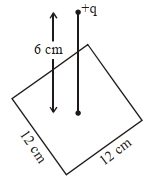
$A$ point charge of $+12 \,\mu C$ is at a distance $6 \,cm$ vertically above the centre of a square of side $12 \,cm$ as shown in the figure. The magnitude of the electric flux through the square will be ....... $\times 10^{3} \,Nm^{2}/C$.
A
$452$
B
$381$
C
$226$
D
$113$
Solution
(C) The charge is placed at a distance $a/2 = 6 \,cm$ from the center of a square of side $a = 12 \,cm$.
By considering the square as one face of a cube of side $a = 12 \,cm$,the charge is at the center of this cube.
According to Gauss's Law,the total electric flux through the entire cube is $\phi_{total} = \frac{q}{\varepsilon_{0}}$.
Since the cube has $6$ identical faces,the flux through one face (the square) is $\phi = \frac{1}{6} \frac{q}{\varepsilon_{0}}$.
Given $q = 12 \times 10^{-6} \,C$ and $\varepsilon_{0} = 8.854 \times 10^{-12} \,C^{2}/Nm^{2}$.
$\phi = \frac{12 \times 10^{-6}}{6 \times 8.854 \times 10^{-12}} = \frac{2 \times 10^{-6}}{8.854 \times 10^{-12}} \approx 0.2259 \times 10^{6} \,Nm^{2}/C$.
$\phi \approx 226 \times 10^{3} \,Nm^{2}/C$.
By considering the square as one face of a cube of side $a = 12 \,cm$,the charge is at the center of this cube.
According to Gauss's Law,the total electric flux through the entire cube is $\phi_{total} = \frac{q}{\varepsilon_{0}}$.
Since the cube has $6$ identical faces,the flux through one face (the square) is $\phi = \frac{1}{6} \frac{q}{\varepsilon_{0}}$.
Given $q = 12 \times 10^{-6} \,C$ and $\varepsilon_{0} = 8.854 \times 10^{-12} \,C^{2}/Nm^{2}$.
$\phi = \frac{12 \times 10^{-6}}{6 \times 8.854 \times 10^{-12}} = \frac{2 \times 10^{-6}}{8.854 \times 10^{-12}} \approx 0.2259 \times 10^{6} \,Nm^{2}/C$.
$\phi \approx 226 \times 10^{3} \,Nm^{2}/C$.
0 likes
View Solution176
DifficultMCQ
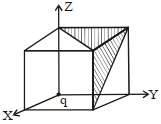
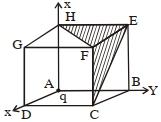
$A$ charge $q$ is placed at one corner of a cube as shown in the figure. The flux of the electrostatic field $\overrightarrow{E}$ through the shaded area is ...... .
A
$\frac{q}{4\varepsilon_{0}}$
B
$\frac{q}{24\varepsilon_{0}}$
C
$\frac{q}{48\varepsilon_{0}}$
D
$\frac{q}{8\varepsilon_{0}}$
Solution
(B) According to Gauss's Law,the total electric flux through a closed surface is $\frac{q}{\varepsilon_{0}}$.
Since the charge $q$ is placed at one corner of the cube,it is shared by $8$ such identical cubes to enclose the charge completely.
Therefore,the total flux through the cube is $\phi_{\text{cube}} = \frac{q}{8\varepsilon_{0}}$.
The flux through the three faces of the cube that meet at the corner where the charge is placed is zero because the electric field lines are parallel to these surfaces.
The remaining three faces are symmetric with respect to the charge,so the flux through each of these three faces is equal.
Let the shaded area be one of these faces. The flux through the shaded area is $\phi_{\text{shaded}} = \frac{1}{3} \times \phi_{\text{cube}} = \frac{1}{3} \times \frac{q}{8\varepsilon_{0}} = \frac{q}{24\varepsilon_{0}}$.
Since the charge $q$ is placed at one corner of the cube,it is shared by $8$ such identical cubes to enclose the charge completely.
Therefore,the total flux through the cube is $\phi_{\text{cube}} = \frac{q}{8\varepsilon_{0}}$.
The flux through the three faces of the cube that meet at the corner where the charge is placed is zero because the electric field lines are parallel to these surfaces.
The remaining three faces are symmetric with respect to the charge,so the flux through each of these three faces is equal.
Let the shaded area be one of these faces. The flux through the shaded area is $\phi_{\text{shaded}} = \frac{1}{3} \times \phi_{\text{cube}} = \frac{1}{3} \times \frac{q}{8\varepsilon_{0}} = \frac{q}{24\varepsilon_{0}}$.
0 likes
View Solution177
MediumMCQ
Choose the incorrect statement:
$(a)$ The electric lines of force entering into a Gaussian surface provide negative flux.
$(b)$ $A$ charge '$q$' is placed at the centre of a cube. The flux through all the faces will be the same.
$(c)$ In a uniform electric field,the net flux through a closed Gaussian surface containing no net charge is zero.
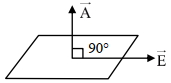
$(d)$ When the electric field is parallel to a Gaussian surface,it provides a finite non-zero flux.
Choose the most appropriate answer from the options given below:
$(a)$ The electric lines of force entering into a Gaussian surface provide negative flux.
$(b)$ $A$ charge '$q$' is placed at the centre of a cube. The flux through all the faces will be the same.
$(c)$ In a uniform electric field,the net flux through a closed Gaussian surface containing no net charge is zero.
$(d)$ When the electric field is parallel to a Gaussian surface,it provides a finite non-zero flux.
Choose the most appropriate answer from the options given below:
A
$(c)$ and $(d)$ only
B
$(b)$ and $(d)$ only
C
$(d)$ only
D
$(a)$ and $(c)$ only
Solution
(C) The electric flux $\phi$ through a surface is given by $\phi = \vec{E} \cdot \vec{A} = EA \cos \theta$,where $\theta$ is the angle between the electric field vector $\vec{E}$ and the area vector $\vec{A}$.
Statement $(a)$ is correct: Flux is negative when lines enter the surface $(\theta > 90^{\circ})$.
Statement $(b)$ is correct: Due to symmetry,a charge at the center of a cube produces equal flux through each of its six faces.
Statement $(c)$ is correct: According to Gauss's Law,$\phi_{net} = \frac{q_{enclosed}}{\epsilon_0}$. If $q_{enclosed} = 0$,then $\phi_{net} = 0$.
Statement $(d)$ is incorrect: When the electric field $\vec{E}$ is parallel to the surface,it is perpendicular to the area vector $\vec{A}$ (i.e.,$\theta = 90^{\circ}$). Thus,$\phi = EA \cos 90^{\circ} = 0$. The statement claims it provides a non-zero flux,which is false.
Statement $(a)$ is correct: Flux is negative when lines enter the surface $(\theta > 90^{\circ})$.
Statement $(b)$ is correct: Due to symmetry,a charge at the center of a cube produces equal flux through each of its six faces.
Statement $(c)$ is correct: According to Gauss's Law,$\phi_{net} = \frac{q_{enclosed}}{\epsilon_0}$. If $q_{enclosed} = 0$,then $\phi_{net} = 0$.
Statement $(d)$ is incorrect: When the electric field $\vec{E}$ is parallel to the surface,it is perpendicular to the area vector $\vec{A}$ (i.e.,$\theta = 90^{\circ}$). Thus,$\phi = EA \cos 90^{\circ} = 0$. The statement claims it provides a non-zero flux,which is false.
0 likes
View Solution178
MediumMCQ
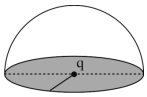
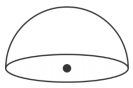
If a charge $q$ is placed at the centre of the flat surface of a closed hemispherical non-conducting surface,what is the total electric flux passing through the flat surface?
A
$\frac{q}{\varepsilon_{0}}$
B
$\frac{q}{2 \varepsilon_{0}}$
C
$\frac{q}{4 \varepsilon_{0}}$
D
$0$
Solution
(D) According to Gauss's Law,the total electric flux through a closed surface is $\Phi = \frac{q_{enclosed}}{\varepsilon_{0}}$.
For a charge $q$ placed exactly at the centre of the flat circular base of a hemisphere,the electric field lines originating from the charge $q$ are parallel to the flat surface at every point on it.
Since the electric field vector $\vec{E}$ is perpendicular to the area vector $\vec{A}$ of the flat surface (i.e.,$\vec{E} \cdot \vec{A} = EA \cos(90^{\circ}) = 0$),the electric flux passing through the flat surface is $0$.
However,the flux passing through the curved hemispherical part of the surface is $\frac{q}{2 \varepsilon_{0}}$.
For a charge $q$ placed exactly at the centre of the flat circular base of a hemisphere,the electric field lines originating from the charge $q$ are parallel to the flat surface at every point on it.
Since the electric field vector $\vec{E}$ is perpendicular to the area vector $\vec{A}$ of the flat surface (i.e.,$\vec{E} \cdot \vec{A} = EA \cos(90^{\circ}) = 0$),the electric flux passing through the flat surface is $0$.
However,the flux passing through the curved hemispherical part of the surface is $\frac{q}{2 \varepsilon_{0}}$.
0 likes
View Solution179
AdvancedMCQ
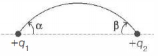
An electrostatic field line leaves at an angle $\alpha$ from a point charge $q_{1}$ and connects with a point charge $-q_{2}$ at an angle $\beta$ ($q_{1}$ and $q_{2}$ are positive). See the figure below. If $q_{2} = \frac{3}{2} q_{1}$ and $\alpha = 30^{\circ}$,then:
A
$0^{\circ} < \beta < 30^{\circ}$
B
$\beta = 30^{\circ}$
C
$30^{\circ} < \beta \leq 60^{\circ}$
D
$60^{\circ} < \beta \leq 90^{\circ}$
Solution
(A) The electric flux $\phi$ originating from a point charge $q$ within a cone of semi-vertical angle $\theta$ is given by $\phi = \frac{q}{2\varepsilon_{0}}(1 - \cos \theta)$.
Since the field lines originating from $q_{1}$ within the cone of angle $\alpha$ terminate on $q_{2}$ within the cone of angle $\beta$,the flux must be equal:
$\frac{q_{1}}{2\varepsilon_{0}}(1 - \cos \alpha) = \frac{q_{2}}{2\varepsilon_{0}}(1 - \cos \beta)$
Given $q_{2} = \frac{3}{2} q_{1}$,we have:
$q_{1}(1 - \cos \alpha) = \frac{3}{2} q_{1}(1 - \cos \beta)$
$1 - \cos 30^{\circ} = \frac{3}{2}(1 - \cos \beta)$
$1 - \frac{\sqrt{3}}{2} = \frac{3}{2}(1 - \cos \beta)$
$1 - 0.866 = 1.5(1 - \cos \beta)$
$0.134 = 1.5(1 - \cos \beta)$
$1 - \cos \beta = \frac{0.134}{1.5} \approx 0.0893$
$\cos \beta = 1 - 0.0893 = 0.9107$
Since $\cos 30^{\circ} \approx 0.866$,and $\cos \beta \approx 0.9107$,we find that $\beta < 30^{\circ}$.
Thus,$0^{\circ} < \beta < 30^{\circ}$.
Since the field lines originating from $q_{1}$ within the cone of angle $\alpha$ terminate on $q_{2}$ within the cone of angle $\beta$,the flux must be equal:
$\frac{q_{1}}{2\varepsilon_{0}}(1 - \cos \alpha) = \frac{q_{2}}{2\varepsilon_{0}}(1 - \cos \beta)$
Given $q_{2} = \frac{3}{2} q_{1}$,we have:
$q_{1}(1 - \cos \alpha) = \frac{3}{2} q_{1}(1 - \cos \beta)$
$1 - \cos 30^{\circ} = \frac{3}{2}(1 - \cos \beta)$
$1 - \frac{\sqrt{3}}{2} = \frac{3}{2}(1 - \cos \beta)$
$1 - 0.866 = 1.5(1 - \cos \beta)$
$0.134 = 1.5(1 - \cos \beta)$
$1 - \cos \beta = \frac{0.134}{1.5} \approx 0.0893$
$\cos \beta = 1 - 0.0893 = 0.9107$
Since $\cos 30^{\circ} \approx 0.866$,and $\cos \beta \approx 0.9107$,we find that $\beta < 30^{\circ}$.
Thus,$0^{\circ} < \beta < 30^{\circ}$.
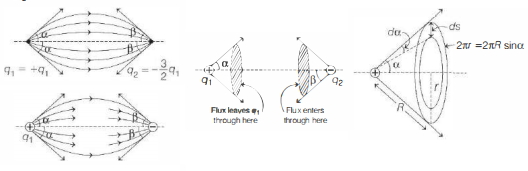
0 likes
View Solution180
AdvancedMCQ
Let the electrostatic field $E$ at distance $r$ from a point charge $q$ not be an inverse square but instead an inverse cubic, e.g., $E = k \cdot \frac{q}{r^3} \hat{r}$, where $k$ is a constant.
Consider the following two statements:
$(I)$ Flux through a spherical surface enclosing the charge is $\phi = q_{\text{enclosed}} / \varepsilon_0$.
$(II)$ $A$ charge placed inside a uniformly charged shell will experience a force.
Which of the above statements are valid?
Consider the following two statements:
$(I)$ Flux through a spherical surface enclosing the charge is $\phi = q_{\text{enclosed}} / \varepsilon_0$.
$(II)$ $A$ charge placed inside a uniformly charged shell will experience a force.
Which of the above statements are valid?
A
Only statement $I$ is valid
B
Only statement $II$ is valid
C
Both statements $I$ and $II$ are invalid
D
Both statements $I$ and $II$ are valid
Solution
(B) Statement $(I)$ is invalid because Gauss's law $(\phi = q_{\text{enclosed}} / \varepsilon_0)$ is only valid for inverse-square fields. If $E = \frac{kq}{r^3} \hat{r}$, the flux through a spherical surface of radius $r$ is:
$\phi = \oint E \cdot dA = \int \frac{kq}{r^3} dA = \frac{kq}{r^3} (4\pi r^2) = \frac{4\pi kq}{r} \neq \frac{q}{\varepsilon_0}$.
Statement $(II)$ is valid. In an inverse-square field, the electric field inside a uniformly charged shell is zero due to symmetry. However, for an inverse-cubic field, the superposition of fields from different parts of the shell does not cancel out at interior points. Thus, a charge placed inside will experience a non-zero net force.
Therefore, only statement $(II)$ is valid.
$\phi = \oint E \cdot dA = \int \frac{kq}{r^3} dA = \frac{kq}{r^3} (4\pi r^2) = \frac{4\pi kq}{r} \neq \frac{q}{\varepsilon_0}$.
Statement $(II)$ is valid. In an inverse-square field, the electric field inside a uniformly charged shell is zero due to symmetry. However, for an inverse-cubic field, the superposition of fields from different parts of the shell does not cancel out at interior points. Thus, a charge placed inside will experience a non-zero net force.
Therefore, only statement $(II)$ is valid.
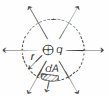
0 likes
View Solution181
MediumMCQ
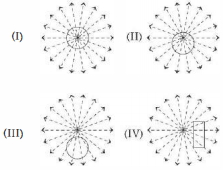
The black shapes in the figure below are closed surfaces. The electric field lines are shown by dashed arrows. For which case,the net flux through the surfaces is non-zero?
A
In all cases net flux is non-zero
B
For $III$ and $IV$ cases
C
For $I$ and $II$ cases
D
For $II, III$ and $IV$ cases
Solution
(C) According to Gauss's Law,the net electric flux $\phi$ through a closed surface is given by $\phi = \frac{q_{enclosed}}{\epsilon_0}$,where $q_{enclosed}$ is the net charge enclosed by the surface.
If no charge is enclosed by the surface $(q_{enclosed} = 0)$,the net flux through the surface is zero.
In cases $I$ and $II$,the point charge is enclosed within the closed surface,so the net flux is non-zero.
In cases $III$ and $IV$,the point charge is outside the closed surface,so the net charge enclosed is zero,which means the net flux through these surfaces is zero.
Therefore,the net flux is non-zero only for cases $I$ and $II$.
If no charge is enclosed by the surface $(q_{enclosed} = 0)$,the net flux through the surface is zero.
In cases $I$ and $II$,the point charge is enclosed within the closed surface,so the net flux is non-zero.
In cases $III$ and $IV$,the point charge is outside the closed surface,so the net charge enclosed is zero,which means the net flux through these surfaces is zero.
Therefore,the net flux is non-zero only for cases $I$ and $II$.
0 likes
View Solution182
AdvancedMCQ
If some charge is given to a solid metallic sphere,the field inside remains zero and by Gauss's law all the charge resides on the surface. Now,suppose that Coulomb's force between two charges varies as $1 / r^{3}$. Then,for a charged solid metallic sphere
A
field inside will be zero and charge density inside will be zero
B
field inside will not be zero and charge density inside will not be zero
C
field inside will not be zero and charge density inside will be zero
D
field inside will be zero and charge density inside will not be zero
Solution
(D) If Coulomb's force varies as $F \propto 1/r^3$,then the electric field $E$ at a distance $r$ from a point charge $q$ is given by $E = k q / r^3$.
For a solid metallic sphere of radius $R$ with total charge $Q$,by symmetry,the electric field inside the sphere $(r < R)$ must be zero because the contributions from different parts of the surface charge distribution cancel out at any internal point.
However,Gauss's law is modified for this force law. The flux $\phi$ through a spherical Gaussian surface of radius $r$ $(r < R)$ is given by $\phi = \oint E \cdot dA$. Since $E = 0$ inside,the flux $\phi = 0$.
In the standard case $(F \propto 1/r^2)$,Gauss's law states $\oint E \cdot dA = q_{enclosed} / \epsilon_0$. If the force law changes to $1/r^3$,the relationship between flux and enclosed charge changes. Specifically,for a $1/r^3$ force,the flux through a closed surface is not simply proportional to the enclosed charge. Calculations show that for this force law,the charge density $\rho$ inside the conductor is non-zero to maintain $E=0$ inside,as the standard Gauss's law does not hold in the same way. Thus,the field inside remains zero due to symmetry,but the charge density inside is non-zero.
For a solid metallic sphere of radius $R$ with total charge $Q$,by symmetry,the electric field inside the sphere $(r < R)$ must be zero because the contributions from different parts of the surface charge distribution cancel out at any internal point.
However,Gauss's law is modified for this force law. The flux $\phi$ through a spherical Gaussian surface of radius $r$ $(r < R)$ is given by $\phi = \oint E \cdot dA$. Since $E = 0$ inside,the flux $\phi = 0$.
In the standard case $(F \propto 1/r^2)$,Gauss's law states $\oint E \cdot dA = q_{enclosed} / \epsilon_0$. If the force law changes to $1/r^3$,the relationship between flux and enclosed charge changes. Specifically,for a $1/r^3$ force,the flux through a closed surface is not simply proportional to the enclosed charge. Calculations show that for this force law,the charge density $\rho$ inside the conductor is non-zero to maintain $E=0$ inside,as the standard Gauss's law does not hold in the same way. Thus,the field inside remains zero due to symmetry,but the charge density inside is non-zero.
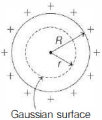
0 likes
View Solution183
AdvancedMCQ
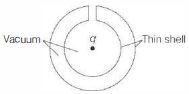
$A$ positive charge $q$ is placed at the centre of a neutral hollow cylindrical conducting shell with its cross-section as shown in the figure below. Which one of the following figures correctly indicates the induced charge distribution on the conductor? (Ignore edge effects)
A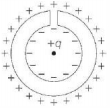
B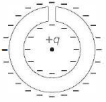
C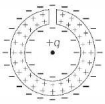
D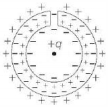
Solution
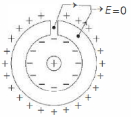
(A) When a positive charge $q$ is placed inside the cavity of a neutral conducting shell,it induces a charge of $-q$ on the inner surface of the shell to ensure that the electric field inside the conducting material is zero. Since the shell is neutral,a charge of $+q$ must appear on the outer surface of the shell. The charge distribution will be uniform on both the inner and outer surfaces,except near the gap. The electric field inside the material of the conductor must be zero,which is satisfied by this distribution. The correct representation is shown in the figure,where the inner surface has a negative charge and the outer surface has a positive charge.
0 likes
View Solution184
MediumMCQ
$A$ metallic sphere is kept in between two oppositely charged plates. The most appropriate representation of the field lines is
A
B
C
D
Solution
(C) When a metallic sphere is placed in an external electric field,the free electrons in the metal redistribute themselves such that the electric field inside the conductor becomes zero.
Electric field lines must be perpendicular to the surface of the conductor at every point of contact.
As the field lines approach the metallic sphere,they bend to become normal (perpendicular) to the surface of the sphere.
After passing through the sphere,they emerge from the other side,again remaining perpendicular to the surface.
Option $(c)$ correctly shows the field lines bending to meet the surface of the metallic sphere perpendicularly and emerging perpendicularly from the other side,while maintaining the uniform field pattern far from the sphere.
Therefore,the correct option is $(c)$.
Electric field lines must be perpendicular to the surface of the conductor at every point of contact.
As the field lines approach the metallic sphere,they bend to become normal (perpendicular) to the surface of the sphere.
After passing through the sphere,they emerge from the other side,again remaining perpendicular to the surface.
Option $(c)$ correctly shows the field lines bending to meet the surface of the metallic sphere perpendicularly and emerging perpendicularly from the other side,while maintaining the uniform field pattern far from the sphere.
Therefore,the correct option is $(c)$.
0 likes
View Solution185
EasyMCQ
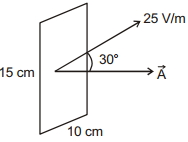
$A$ rectangular surface of sides $10 \,cm$ and $15 \,cm$ is placed inside a uniform electric field of $25 \,V/m$,such that the surface makes an angle of $30^{\circ}$ with the direction of the electric field. Find the flux of the electric field through the rectangular surface in $Nm^2/C$.
A
$0.1675$
B
$0.1875$
C
$0$
D
$0.1075$
Solution
(B) The electric flux $\phi$ through a surface is given by the formula $\phi = E A \cos \theta$,where $\theta$ is the angle between the electric field vector $\vec{E}$ and the area vector $\vec{A}$.
Given,the surface makes an angle of $30^{\circ}$ with the electric field. The area vector $\vec{A}$ is perpendicular to the surface. Therefore,the angle $\theta$ between the area vector $\vec{A}$ and the electric field $\vec{E}$ is $\theta = 90^{\circ} - 30^{\circ} = 60^{\circ}$.
Area $A = 10 \,cm \times 15 \,cm = 0.1 \,m \times 0.15 \,m = 0.015 \,m^2$.
Electric field $E = 25 \,V/m$.
Flux $\phi = E A \cos 60^{\circ} = 25 \times 0.015 \times 0.5 = 0.1875 \,Nm^2/C$.
Given,the surface makes an angle of $30^{\circ}$ with the electric field. The area vector $\vec{A}$ is perpendicular to the surface. Therefore,the angle $\theta$ between the area vector $\vec{A}$ and the electric field $\vec{E}$ is $\theta = 90^{\circ} - 30^{\circ} = 60^{\circ}$.
Area $A = 10 \,cm \times 15 \,cm = 0.1 \,m \times 0.15 \,m = 0.015 \,m^2$.
Electric field $E = 25 \,V/m$.
Flux $\phi = E A \cos 60^{\circ} = 25 \times 0.015 \times 0.5 = 0.1875 \,Nm^2/C$.
0 likes
View Solution186
EasyMCQ
If an electric field is given by $\vec{E} = 10 \hat{i} + 3 \hat{j} + 4 \hat{k}$,calculate the electric flux through a surface of area $A = 10 \text{ units}$ lying in the $yz$-plane.
A
$100$
B
$10$
C
$30$
D
$40$
Solution
(A) The electric flux $\phi$ is given by the dot product of the electric field $\vec{E}$ and the area vector $\vec{A}$.
Given $\vec{E} = 10 \hat{i} + 3 \hat{j} + 4 \hat{k}$.
The surface lies in the $yz$-plane,so its area vector $\vec{A}$ is directed along the $x$-axis (normal to the $yz$-plane).
Thus,$\vec{A} = 10 \hat{i}$.
The electric flux is $\phi = \vec{E} \cdot \vec{A} = (10 \hat{i} + 3 \hat{j} + 4 \hat{k}) \cdot (10 \hat{i})$.
Since $\hat{i} \cdot \hat{i} = 1$ and $\hat{i} \cdot \hat{j} = \hat{i} \cdot \hat{k} = 0$,we get $\phi = 10 \times 10 = 100 \text{ units}$.
Given $\vec{E} = 10 \hat{i} + 3 \hat{j} + 4 \hat{k}$.
The surface lies in the $yz$-plane,so its area vector $\vec{A}$ is directed along the $x$-axis (normal to the $yz$-plane).
Thus,$\vec{A} = 10 \hat{i}$.
The electric flux is $\phi = \vec{E} \cdot \vec{A} = (10 \hat{i} + 3 \hat{j} + 4 \hat{k}) \cdot (10 \hat{i})$.
Since $\hat{i} \cdot \hat{i} = 1$ and $\hat{i} \cdot \hat{j} = \hat{i} \cdot \hat{k} = 0$,we get $\phi = 10 \times 10 = 100 \text{ units}$.
0 likes
View Solution187
EasyMCQ
If the number of electric lines of force emerging out of a closed surface is $1000$,then the charge enclosed by the surface is .......... $C$.
A
$8.854 \times 10^{-9}$
B
$8.854 \times 10^{-4}$
C
$8.854 \times 10^{-1}$
D
$8.854$
Solution
(A) According to Gauss's Law,the electric flux $\phi$ through a closed surface is given by $\phi = \frac{q}{\varepsilon_0}$,where $q$ is the enclosed charge and $\varepsilon_0$ is the permittivity of free space.
Given that the number of electric lines of force (electric flux) $\phi = 1000$.
The value of $\varepsilon_0 = 8.854 \times 10^{-12} \, C^2 N^{-1} m^{-2}$.
Substituting the values into the formula:
$1000 = \frac{q}{8.854 \times 10^{-12}}$
$q = 1000 \times 8.854 \times 10^{-12}$
$q = 8.854 \times 10^{-9} \, C$.
Given that the number of electric lines of force (electric flux) $\phi = 1000$.
The value of $\varepsilon_0 = 8.854 \times 10^{-12} \, C^2 N^{-1} m^{-2}$.
Substituting the values into the formula:
$1000 = \frac{q}{8.854 \times 10^{-12}}$
$q = 1000 \times 8.854 \times 10^{-12}$
$q = 8.854 \times 10^{-9} \, C$.
0 likes
View Solution188
EasyMCQ
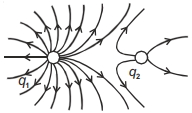
The figure shows electric field lines due to a charge configuration. From this,we conclude that:
A
$q_1$ and $q_2$ are positive and $q_2 > q_1$
B
$q_1$ and $q_2$ are positive and $q_1 > q_2$
C
$q_1$ and $q_2$ are negative and $|q_1| > |q_2|$
D
$q_1$ and $q_2$ are negative and $|q_2| > |q_1|$
Solution
(B) $(i)$ Electric field lines originate from a positive charge and terminate at a negative charge. In the given figure,the field lines are moving away from both $q_1$ and $q_2$,which indicates that both charges are positive.
$(ii)$ The magnitude of a charge is proportional to the number of electric field lines originating from it. By counting the lines,we observe that more field lines originate from $q_1$ than from $q_2$. Therefore,the magnitude of $q_1$ is greater than the magnitude of $q_2$,i.e.,$q_1 > q_2$.
$(ii)$ The magnitude of a charge is proportional to the number of electric field lines originating from it. By counting the lines,we observe that more field lines originate from $q_1$ than from $q_2$. Therefore,the magnitude of $q_1$ is greater than the magnitude of $q_2$,i.e.,$q_1 > q_2$.
0 likes
View Solution189
EasyMCQ
The electric field in a region is uniform and is given by $\vec{E} = a \hat{i} + b \hat{j} + c \hat{k}$. The electric flux associated with a surface of area $\vec{A} = \pi R^2 \hat{i}$ is:
A
$a \pi R^2$
B
$3 a \pi R^2$
C
$2 a b R$
D
$a c R$
Solution
(A) The electric flux $\phi$ through a surface is defined by the dot product of the electric field vector $\vec{E}$ and the area vector $\vec{A}$.
Given $\vec{E} = a \hat{i} + b \hat{j} + c \hat{k}$ and $\vec{A} = \pi R^2 \hat{i}$.
$\phi = \vec{E} \cdot \vec{A} = (a \hat{i} + b \hat{j} + c \hat{k}) \cdot (\pi R^2 \hat{i})$.
Since $\hat{i} \cdot \hat{i} = 1$,$\hat{i} \cdot \hat{j} = 0$,and $\hat{i} \cdot \hat{k} = 0$,we get:
$\phi = a \cdot \pi R^2 = a \pi R^2$.
Given $\vec{E} = a \hat{i} + b \hat{j} + c \hat{k}$ and $\vec{A} = \pi R^2 \hat{i}$.
$\phi = \vec{E} \cdot \vec{A} = (a \hat{i} + b \hat{j} + c \hat{k}) \cdot (\pi R^2 \hat{i})$.
Since $\hat{i} \cdot \hat{i} = 1$,$\hat{i} \cdot \hat{j} = 0$,and $\hat{i} \cdot \hat{k} = 0$,we get:
$\phi = a \cdot \pi R^2 = a \pi R^2$.
0 likes
View Solution190
MediumMCQ
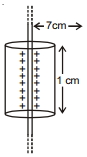
An infinite line charge is at the axis of a cylinder of length $1 \,m$ and radius $7 \,cm$. If the electric field at any point on the curved surface of the cylinder is $250 \,NC^{-1}$,then the net electric flux through the cylinder is ............ $Nm^2C^{-1}$.
A
$1.1 \times 10^2$
B
$9.74 \times 10^{-6}$
C
$5.5 \times 10^6$
D
$2.5 \times 10^2$
Solution
(A) The electric flux $\phi$ through the curved surface of a cylinder of radius $r$ and length $L$ is given by $\phi = E \times A$,where $A$ is the curved surface area.
The curved surface area $A = 2 \pi r L$.
Given: $E = 250 \,NC^{-1}$,$r = 7 \,cm = 0.07 \,m$,and $L = 1 \,m$.
Substituting the values:
$\phi = 250 \times (2 \times \pi \times 0.07 \times 1)$
$\phi = 250 \times (0.14 \pi)$
$\phi = 35 \pi$
Using $\pi \approx 3.14159$:
$\phi \approx 35 \times 3.14159 \approx 109.95 \,Nm^2C^{-1}$
Rounding to two significant figures,we get $\phi \approx 1.1 \times 10^2 \,Nm^2C^{-1}$.
The curved surface area $A = 2 \pi r L$.
Given: $E = 250 \,NC^{-1}$,$r = 7 \,cm = 0.07 \,m$,and $L = 1 \,m$.
Substituting the values:
$\phi = 250 \times (2 \times \pi \times 0.07 \times 1)$
$\phi = 250 \times (0.14 \pi)$
$\phi = 35 \pi$
Using $\pi \approx 3.14159$:
$\phi \approx 35 \times 3.14159 \approx 109.95 \,Nm^2C^{-1}$
Rounding to two significant figures,we get $\phi \approx 1.1 \times 10^2 \,Nm^2C^{-1}$.
0 likes
View Solution191
EasyMCQ
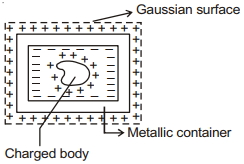
$A$ charged body has an electric flux $\phi$ associated with it. The body is now placed inside a metallic container. The flux $\phi$ outside the container will be
A
Zero
B
Equal to $\phi$
C
Greater than $\phi$
D
Less than $\phi$
Solution
(B) According to Gauss's Law,the total electric flux $\phi$ through any closed surface is equal to the net charge enclosed by the surface divided by the permittivity of free space,$\epsilon_0$,i.e.,$\phi = \frac{q_{enclosed}}{\epsilon_0}$.
When a charged body is placed inside a metallic container,the net charge enclosed by a Gaussian surface surrounding the entire container remains the same as the charge on the body itself (due to electrostatic induction,equal and opposite charges are induced on the inner and outer surfaces of the metallic container,keeping the net charge enclosed by the outer Gaussian surface equal to the original charge $q$).
Since the net charge enclosed remains the same,the total electric flux $\phi$ passing through the Gaussian surface outside the container remains equal to $\phi$.
When a charged body is placed inside a metallic container,the net charge enclosed by a Gaussian surface surrounding the entire container remains the same as the charge on the body itself (due to electrostatic induction,equal and opposite charges are induced on the inner and outer surfaces of the metallic container,keeping the net charge enclosed by the outer Gaussian surface equal to the original charge $q$).
Since the net charge enclosed remains the same,the total electric flux $\phi$ passing through the Gaussian surface outside the container remains equal to $\phi$.
0 likes
View Solution192
EasyMCQ
$A$ charge of $1 \,C$ is located at the centre of a sphere of radius $10 \,cm$ and a cube of side $20 \,cm$. The ratio of outgoing flux from the sphere and cube will be
A
More than one
B
Less than one
C
One
D
Nothing certain can be said
Solution
(C) According to Gauss's Law,the total electric flux $\phi$ through any closed surface is given by $\phi = \frac{q_{enclosed}}{\epsilon_0}$.
In this problem,the charge $q = 1 \,C$ is enclosed by both the sphere and the cube.
Since the charge enclosed by both surfaces is identical,the electric flux through both surfaces is the same.
Therefore,the ratio of the outgoing flux from the sphere to the flux from the cube is $\frac{\phi_{sphere}}{\phi_{cube}} = \frac{q/\epsilon_0}{q/\epsilon_0} = 1$.
In this problem,the charge $q = 1 \,C$ is enclosed by both the sphere and the cube.
Since the charge enclosed by both surfaces is identical,the electric flux through both surfaces is the same.
Therefore,the ratio of the outgoing flux from the sphere to the flux from the cube is $\frac{\phi_{sphere}}{\phi_{cube}} = \frac{q/\epsilon_0}{q/\epsilon_0} = 1$.
0 likes
View Solution193
MediumMCQ
The dimensional formula for electric flux is $..........$
A
$[ML^3 I^{-1} T^{-3}]$
B
$[M^2 L^2 I^{-1} T^{-2}]$
C
$[ML^3 I^1 T^{-3}]$
D
$[ML^{-3} I^{-1} T^{-3}]$
Solution
(A) Electric flux $\phi_E$ is defined as the product of the electric field $E$ and the area $A$,given by $\phi_E = E \cdot A$.
The unit of electric field $E$ is $N/C$ or $V/m$. The dimensional formula for force is $[MLT^{-2}]$ and for charge is $[IT]$.
Thus,the dimension of electric field $E = \frac{[MLT^{-2}]}{[IT]} = [MLT^{-3} I^{-1}]$.
The dimension of area $A$ is $[L^2]$.
Therefore,the dimensional formula for electric flux $\phi_E = [MLT^{-3} I^{-1}] \times [L^2] = [ML^3 T^{-3} I^{-1}]$.
Comparing this with the given options,the correct option is $A$.
The unit of electric field $E$ is $N/C$ or $V/m$. The dimensional formula for force is $[MLT^{-2}]$ and for charge is $[IT]$.
Thus,the dimension of electric field $E = \frac{[MLT^{-2}]}{[IT]} = [MLT^{-3} I^{-1}]$.
The dimension of area $A$ is $[L^2]$.
Therefore,the dimensional formula for electric flux $\phi_E = [MLT^{-3} I^{-1}] \times [L^2] = [ML^3 T^{-3} I^{-1}]$.
Comparing this with the given options,the correct option is $A$.
0 likes
View Solution194
MediumMCQ
$Assertion (A):$ $A$ charge $q$ is placed at a height $h/4$ above the center of a square of side $b$. The flux associated with the square is independent of the side length $b$.
$Reason (R):$ Gauss's law is independent of the size of the Gaussian surface.
$Reason (R):$ Gauss's law is independent of the size of the Gaussian surface.
A
If both $Assertion$ and $Reason$ are true and $Reason$ is the correct explanation of $Assertion$.
B
If both $Assertion$ and $Reason$ are true but $Reason$ is not the correct explanation of $Assertion$.
C
If $Assertion$ is true but $Reason$ is false.
D
If both $Assertion$ and $Reason$ are false.
Solution
(D) The flux through a surface depends on the solid angle subtended by the surface at the position of the charge.
For a square of side $b$ with a charge $q$ at height $d = h/4$ above its center,the solid angle $\Omega$ subtended by the square at the charge is given by $\Omega = 4 \arcsin \left( \frac{b^2}{b^2 + 4d^2} \right)$.
The flux $\phi$ is given by $\phi = \frac{q \Omega}{4\pi \epsilon_0}$.
Since the solid angle $\Omega$ depends on the ratio of the side length $b$ to the height $d$,the flux depends on the side length $b$. Thus,the $Assertion$ is false.
Gauss's law states that the total flux through a closed surface is $q_{enclosed} / \epsilon_0$,which is independent of the shape or size of the Gaussian surface. Thus,the $Reason$ is true.
Therefore,the correct option is $D$.
For a square of side $b$ with a charge $q$ at height $d = h/4$ above its center,the solid angle $\Omega$ subtended by the square at the charge is given by $\Omega = 4 \arcsin \left( \frac{b^2}{b^2 + 4d^2} \right)$.
The flux $\phi$ is given by $\phi = \frac{q \Omega}{4\pi \epsilon_0}$.
Since the solid angle $\Omega$ depends on the ratio of the side length $b$ to the height $d$,the flux depends on the side length $b$. Thus,the $Assertion$ is false.
Gauss's law states that the total flux through a closed surface is $q_{enclosed} / \epsilon_0$,which is independent of the shape or size of the Gaussian surface. Thus,the $Reason$ is true.
Therefore,the correct option is $D$.
0 likes
View Solution195
MediumMCQ
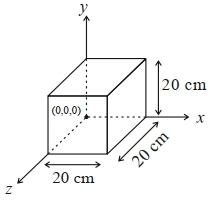
The expression for an electric field is given by $\vec{E} = 4000 x^2 \hat{i} \text{ V/m}$. The electric flux through the cube of side $20 \text{ cm}$ when placed in the electric field (as shown in the figure) is $......... \text{ V cm}$.
A
$640$
B
$689$
C
$652$
D
$258$
Solution
(A) The electric field is $\vec{E} = 4000 x^2 \hat{i} \text{ V/m}$. The flux through the cube is only through the faces perpendicular to the $x$-axis.
For the face at $x = 0$,the flux $\phi_1 = \vec{E} \cdot \vec{A} = (4000(0)^2 \hat{i}) \cdot (-A \hat{i}) = 0$.
For the face at $x = 0.2 \text{ m}$,the flux $\phi_2 = \vec{E} \cdot \vec{A} = (4000(0.2)^2 \hat{i}) \cdot (A \hat{i}) = 4000 \times 0.04 \times (0.2 \times 0.2) = 160 \times 0.04 = 6.4 \text{ V m}$.
Converting to $\text{V cm}$: $6.4 \text{ V m} = 6.4 \times 100 \text{ V cm} = 640 \text{ V cm}$.
For the face at $x = 0$,the flux $\phi_1 = \vec{E} \cdot \vec{A} = (4000(0)^2 \hat{i}) \cdot (-A \hat{i}) = 0$.
For the face at $x = 0.2 \text{ m}$,the flux $\phi_2 = \vec{E} \cdot \vec{A} = (4000(0.2)^2 \hat{i}) \cdot (A \hat{i}) = 4000 \times 0.04 \times (0.2 \times 0.2) = 160 \times 0.04 = 6.4 \text{ V m}$.
Converting to $\text{V cm}$: $6.4 \text{ V m} = 6.4 \times 100 \text{ V cm} = 640 \text{ V cm}$.
0 likes
View Solution196
EasyMCQ
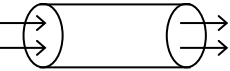
If $\oint_s \vec{E} \cdot \overrightarrow{d S}=0$ over a surface,then:
A
the electric field inside the surface is necessarily uniform.
B
the number of flux lines entering the surface must be equal to the number of flux lines leaving it.
C
the magnitude of electric field on the surface is constant.
D
all the charges must necessarily be inside the surface.
Solution
(B) The given expression $\oint_s \vec{E} \cdot \overrightarrow{d S} = 0$ represents the total electric flux $\phi$ through a closed surface.
According to Gauss's Law,the total flux through a closed surface is equal to the net charge enclosed divided by the permittivity of free space,$\phi = \frac{q_{\text{enclosed}}}{\epsilon_0}$.
Since the total flux is zero,the net charge enclosed by the surface must be zero $(q_{\text{enclosed}} = 0)$.
This implies that the number of electric field lines entering the surface is exactly equal to the number of electric field lines leaving the surface,resulting in a net flux of zero.
According to Gauss's Law,the total flux through a closed surface is equal to the net charge enclosed divided by the permittivity of free space,$\phi = \frac{q_{\text{enclosed}}}{\epsilon_0}$.
Since the total flux is zero,the net charge enclosed by the surface must be zero $(q_{\text{enclosed}} = 0)$.
This implies that the number of electric field lines entering the surface is exactly equal to the number of electric field lines leaving the surface,resulting in a net flux of zero.
0 likes
View Solution197
DifficultMCQ
Two charges of $5 Q$ and $-2 Q$ are situated at the points $(3 a, 0)$ and $(-5 a, 0)$ respectively. The electric flux through a sphere of radius $4 a$ having its center at the origin is
A
$\frac{2 Q}{\varepsilon_0}$
B
$\frac{5 Q}{\varepsilon_0}$
C
$\frac{7 Q}{\varepsilon_0}$
D
$\frac{3 Q}{\varepsilon_0}$
Solution
(B) According to Gauss's Law,the total electric flux $\phi$ through a closed surface is given by $\phi = \frac{q_{\text{enclosed}}}{\varepsilon_0}$,where $q_{\text{enclosed}}$ is the net charge enclosed by the surface.
The sphere has a radius of $4 a$ and is centered at the origin $(0, 0)$.
The charge $5 Q$ is located at $(3 a, 0)$. Since the distance from the origin is $3 a < 4 a$,this charge is inside the sphere.
The charge $-2 Q$ is located at $(-5 a, 0)$. Since the distance from the origin is $5 a > 4 a$,this charge is outside the sphere.
Therefore,the net charge enclosed by the sphere is $q_{\text{enclosed}} = 5 Q$.
Substituting this into Gauss's Law,we get $\phi = \frac{5 Q}{\varepsilon_0}$.
The sphere has a radius of $4 a$ and is centered at the origin $(0, 0)$.
The charge $5 Q$ is located at $(3 a, 0)$. Since the distance from the origin is $3 a < 4 a$,this charge is inside the sphere.
The charge $-2 Q$ is located at $(-5 a, 0)$. Since the distance from the origin is $5 a > 4 a$,this charge is outside the sphere.
Therefore,the net charge enclosed by the sphere is $q_{\text{enclosed}} = 5 Q$.
Substituting this into Gauss's Law,we get $\phi = \frac{5 Q}{\varepsilon_0}$.
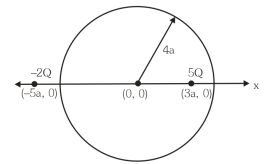
0 likes
View Solution198
DifficultMCQ
An electric field is given by $\vec{E} = (6 \hat{i} + 5 \hat{j} + 3 \hat{k}) \ N/C$. The electric flux through a surface area $\vec{A} = 30 \hat{i} \ m^2$ (in $SI$ units) is:
A
$90$
B
$150$
C
$180$
D
$60$
Solution
(C) The electric flux $\phi$ through a surface is given by the dot product of the electric field vector $\vec{E}$ and the area vector $\vec{A}$.
Given:
$\vec{E} = (6 \hat{i} + 5 \hat{j} + 3 \hat{k}) \ N/C$
$\vec{A} = 30 \hat{i} \ m^2$
Using the formula $\phi = \vec{E} \cdot \vec{A}$:
$\phi = (6 \hat{i} + 5 \hat{j} + 3 \hat{k}) \cdot (30 \hat{i})$
Since $\hat{i} \cdot \hat{i} = 1$,$\hat{i} \cdot \hat{j} = 0$,and $\hat{i} \cdot \hat{k} = 0$:
$\phi = 6 \times 30 = 180 \ N \cdot m^2/C$
Thus,the electric flux is $180 \ N \cdot m^2/C$.
Given:
$\vec{E} = (6 \hat{i} + 5 \hat{j} + 3 \hat{k}) \ N/C$
$\vec{A} = 30 \hat{i} \ m^2$
Using the formula $\phi = \vec{E} \cdot \vec{A}$:
$\phi = (6 \hat{i} + 5 \hat{j} + 3 \hat{k}) \cdot (30 \hat{i})$
Since $\hat{i} \cdot \hat{i} = 1$,$\hat{i} \cdot \hat{j} = 0$,and $\hat{i} \cdot \hat{k} = 0$:
$\phi = 6 \times 30 = 180 \ N \cdot m^2/C$
Thus,the electric flux is $180 \ N \cdot m^2/C$.
0 likes
View Solution199
DifficultMCQ
$C_1$ and $C_2$ are two hollow concentric cubes enclosing charges $2Q$ and $3Q$ respectively as shown in the figure. The ratio of electric flux passing through $C_1$ and $C_2$ is:
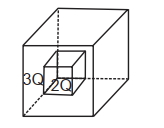
A
$2:5$
B
$5:2$
C
$2:3$
D
$3:2$
Solution
(A) According to Gauss's Law,the electric flux $\phi$ through a closed surface is given by $\phi = \frac{q_{\text{enclosed}}}{\epsilon_0}$.
For the smaller cube $C_1$,the enclosed charge is $q_1 = 2Q$. Therefore,the flux through $C_1$ is $\phi_1 = \frac{2Q}{\epsilon_0}$.
For the larger cube $C_2$,the enclosed charge is the sum of the charges inside it,which is $q_2 = 2Q + 3Q = 5Q$. Therefore,the flux through $C_2$ is $\phi_2 = \frac{5Q}{\epsilon_0}$.
The ratio of the electric flux passing through $C_1$ and $C_2$ is $\frac{\phi_1}{\phi_2} = \frac{2Q/\epsilon_0}{5Q/\epsilon_0} = \frac{2}{5}$.
For the smaller cube $C_1$,the enclosed charge is $q_1 = 2Q$. Therefore,the flux through $C_1$ is $\phi_1 = \frac{2Q}{\epsilon_0}$.
For the larger cube $C_2$,the enclosed charge is the sum of the charges inside it,which is $q_2 = 2Q + 3Q = 5Q$. Therefore,the flux through $C_2$ is $\phi_2 = \frac{5Q}{\epsilon_0}$.
The ratio of the electric flux passing through $C_1$ and $C_2$ is $\frac{\phi_1}{\phi_2} = \frac{2Q/\epsilon_0}{5Q/\epsilon_0} = \frac{2}{5}$.
0 likes
View Solution200
DifficultMCQ
$A$ charge $q$ is placed at the center of one of the faces of a cube. What is the electric flux linked with the cube?
A
$\frac{q}{4 \epsilon_0}$
B
$\frac{q}{2 \epsilon_0}$
C
$\frac{q}{8 \epsilon_0}$
D
Zero
Solution
(B) According to Gauss's Law,the total electric flux through a closed surface is $\frac{q_{enclosed}}{\epsilon_0}$.
To calculate the flux through the cube when the charge $q$ is placed on one of its faces,we imagine an identical cube placed on top of the first one such that the charge $q$ is now at the center of a closed Gaussian surface formed by the two cubes.
The total flux through this combined Gaussian surface is $\phi_{total} = \frac{q}{\epsilon_0}$.
Since the charge is placed symmetrically between the two cubes,the flux through each cube is equal.
Therefore,the flux linked with one cube is $\phi = \frac{1}{2} \phi_{total} = \frac{q}{2 \epsilon_0}$.
To calculate the flux through the cube when the charge $q$ is placed on one of its faces,we imagine an identical cube placed on top of the first one such that the charge $q$ is now at the center of a closed Gaussian surface formed by the two cubes.
The total flux through this combined Gaussian surface is $\phi_{total} = \frac{q}{\epsilon_0}$.
Since the charge is placed symmetrically between the two cubes,the flux through each cube is equal.
Therefore,the flux linked with one cube is $\phi = \frac{1}{2} \phi_{total} = \frac{q}{2 \epsilon_0}$.
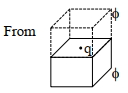
0 likes
View SolutionElectric Charges and Fields — Electric Field Lines, Electric Flux and Gauss's Law · Frequently Asked Questions
1Are these Electric Charges and Fields questions useful for JEE and NEET?
Yes. All questions in this section are mapped to JEE Main and NEET exam patterns. Previous year questions from JEE Main, NEET, GUJCET and state-level exams are included with full solutions.
2Can I switch to Hindi or Gujarati for these questions?
Yes. Use the language tabs in the hero section or the sidebar to view the same questions and solutions in English, Hindi or Gujarati.
3How do I generate a question paper from this subtopic?
Use the Vedclass Exam Paper Generator — select the chapter and subtopic, set difficulty, and generate Sets A, B, C, D automatically. First 3 chapters of every subject are free.
Vedclass Products
For Students
Vedclass Test Series
Mock tests in real JEE/NEET style with performance analysis. 5-day free trial.
Start Free TrialFor Teachers
Exam Paper Generator
Generate Set A/B/C/D papers from this chapter in 2 minutes. 3 chapters free.
Try FreeFor Institutes
Online Exam Module
Live online exams with unlimited students, 360° analytics & white-label branding.
See DemoFor Teachers & Institutes
Generate a Electric Charges and Fields Exam Paper in 2 Minutes
Select subtopic & difficulty — Sets A, B, C, D auto-generated with No Repeat logic.
First 3 chapters of every subject are free — no payment required.